Articles | Volume 16, issue 8
https://doi.org/10.5194/essd-16-3873-2024
© Author(s) 2024. This work is distributed under
the Creative Commons Attribution 4.0 License.
https://doi.org/10.5194/essd-16-3873-2024
© Author(s) 2024. This work is distributed under
the Creative Commons Attribution 4.0 License.
SHIFT: a spatial-heterogeneity improvement in DEM-based mapping of global geomorphic floodplains

Kaihao Zheng
Institute of Remote Sensing and Geographic Information System, School of Earth and Space Sciences, Peking University, Beijing, China
Southwest United Graduate School, Kunming, China
Institute of Remote Sensing and Geographic Information System, School of Earth and Space Sciences, Peking University, Beijing, China
International Research Center of Big Data for Sustainable Development Goals, Beijing, China
Ziyun Yin
Institute of Remote Sensing and Geographic Information System, School of Earth and Space Sciences, Peking University, Beijing, China
Related authors
Xiangyong Lei, Haomei Lin, Kaihao Zheng, and Peirong Lin
EGUsphere, https://doi.org/10.5194/egusphere-2025-6071, https://doi.org/10.5194/egusphere-2025-6071, 2026
This preprint is open for discussion and under review for Hydrology and Earth System Sciences (HESS).
Short summary
Short summary
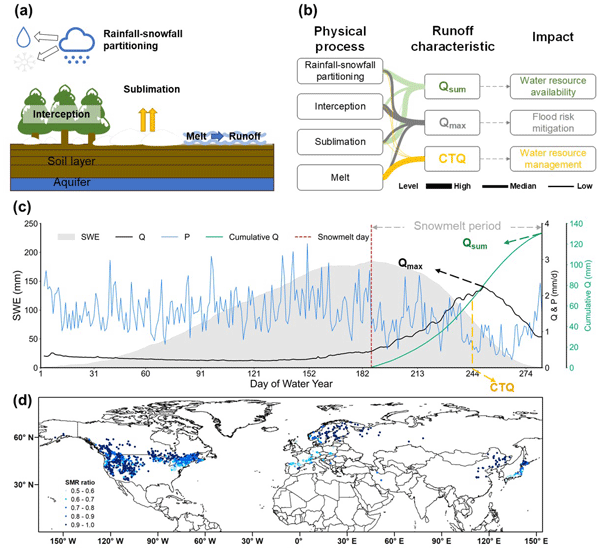
Snowmelt runoff (SMR) is a critical freshwater resource. This study conducts the first comprehensive assessment of SMR, specifically its volume, peak, and timing, across tens of large-scale models and thousand of basins. We also test the models by assessing their performance drop as basins become more and more complex. Our results highlight the systematic biases and certain model categories with stronger robustness in stern conditions, paving the way for process diagnosis for SMR in models.
Xiangyong Lei, Haomei Lin, Kaihao Zheng, and Peirong Lin
EGUsphere, https://doi.org/10.5194/egusphere-2025-6073, https://doi.org/10.5194/egusphere-2025-6073, 2026
This preprint is open for discussion and under review for Hydrology and Earth System Sciences (HESS).
Short summary
Short summary
Towards the central question of "are more complex models better" this study proposes a novel framework to score the process complexity of large-scale hydrological models. By systematically assessing their linkage with snowmelt runoff performance, we find while more model complexity does not lead to better runoff magnitude, centroid timing performance is positively correlated with model complexity. The study highlights the unique gains from process improvements to guide model development.
Xiangyong Lei, Haomei Lin, Kaihao Zheng, and Peirong Lin
EGUsphere, https://doi.org/10.5194/egusphere-2025-6071, https://doi.org/10.5194/egusphere-2025-6071, 2026
This preprint is open for discussion and under review for Hydrology and Earth System Sciences (HESS).
Short summary
Short summary
Snowmelt runoff (SMR) is a critical freshwater resource. This study conducts the first comprehensive assessment of SMR, specifically its volume, peak, and timing, across tens of large-scale models and thousand of basins. We also test the models by assessing their performance drop as basins become more and more complex. Our results highlight the systematic biases and certain model categories with stronger robustness in stern conditions, paving the way for process diagnosis for SMR in models.
Xiangyong Lei, Haomei Lin, Kaihao Zheng, and Peirong Lin
EGUsphere, https://doi.org/10.5194/egusphere-2025-6073, https://doi.org/10.5194/egusphere-2025-6073, 2026
This preprint is open for discussion and under review for Hydrology and Earth System Sciences (HESS).
Short summary
Short summary
Towards the central question of "are more complex models better" this study proposes a novel framework to score the process complexity of large-scale hydrological models. By systematically assessing their linkage with snowmelt runoff performance, we find while more model complexity does not lead to better runoff magnitude, centroid timing performance is positively correlated with model complexity. The study highlights the unique gains from process improvements to guide model development.
Ziyun Yin, Peirong Lin, Ryan Riggs, George H. Allen, Xiangyong Lei, Ziyan Zheng, and Siyu Cai
Earth Syst. Sci. Data, 16, 1559–1587, https://doi.org/10.5194/essd-16-1559-2024, https://doi.org/10.5194/essd-16-1559-2024, 2024
Short summary
Short summary
Large-sample hydrology (LSH) datasets have been the backbone of hydrological model parameter estimation and data-driven machine learning models for hydrological processes. This study complements existing LSH studies by creating a dataset with improved sample coverage, uncertainty estimates, and dynamic descriptions of human activities, which are all crucial to hydrological understanding and modeling.
Cited articles
Andreadis, K. M., Wing, O. E. J., Colven, E., Gleason, C. J., Bates, P. D., and Brown, C. M.: Urbanizing the floodplain: global changes of imperviousness in flood-prone areas, Environ. Res. Lett., 17, 104024, https://doi.org/10.1088/1748-9326/ac9197, 2022.
Annis, A., Nardi, F., Morrison, R. R., and Castelli, F.: Investigating hydrogeomorphic floodplain mapping performance with varying DTM resolution and stream, Hydrolog. Sci. J., 64, 515–538, 2019.
Afshari, S., Tavakoly, A. A., Rajib, M. A., Zheng, X., Follum, M. L., Omranian, E., and Fekete, B. M.: Comparison of new generation low-complexity flood inundation mapping tools with a hydrodynamic model, J. Hydrol., 556, 539–556, https://doi.org/10.1016/j.jhydrol.2017.11.036, 2018.
Bates, P.: Fundamental limits to flood inundation modelling, Nat. Water, 1, 566–567, https://doi.org/10.1038/s44221-023-00106-4, 2023.
Bates, P. D., Neal, J., Sampson, C., Smith, A., and Trigg, M.: Chapter 9 – Progress Toward Hyperresolution Models of Global Flood Hazard, in: Risk Modeling for Hazards and Disasters, edited by: Michel, G., Elsevier, 211–232, https://doi.org/10.1016/B978-0-12-804071-3.00009-4 2018.
Bernhofen, M. V., Cooper, S., Trigg, M., Mdee, A., Carr, A., Bhave, A., Solano-Correa, Y. T., Pencue-Fierro, E. L., Teferi, E., Haile, A. T., Yusop, Z., Alias, N. E., Sa'adi, Z., Bin Ramzan, M. A., Dhanya, C. T., and Shukla, P.: The Role of Global Data Sets for Riverine Flood Risk Management at National Scales, Water Resour. Res., 58, e2021WR031555, https://doi.org/10.1029/2021WR031555, 2022.
Best, J.: Anthropogenic stresses on the world's big rivers, Nat. Geosci., 12, 7–21, https://doi.org/10.1038/s41561-018-0262-x, 2019.
Beven, K. J. and Kirkby, M. J.: A physically based, variable contributing area model of basin hydrology/Un modèle à base physique de zone d'appel variable de l'hydrologie du bassin versant, Hydrol. Sci. B., 24, 43–69, https://doi.org/10.1080/02626667909491834, 1979.
Bhowmik, N. G.: Hydraulic geometry of floodplains, J. Hydrol., 68, 369–401, https://doi.org/10.1016/0022-1694(84)90221-X, 1984.
Brierley, G. J. and Fryirs, K. A.: Geomorphology and River Management: Applications of the River Styles Framework, John Wiley & Sons, 424 pp., ISBN 978-1-118-68530-3, 2013.
Cohen, J.: A Coefficient of Agreement for Nominal Scales, Educ. Psychol. Meas., 20, 37–46, https://doi.org/10.1177/001316446002000104, 1960.
Dhote, P. R., Joshi, Y., Rajib, A., Thakur, P. K., Nikam, B. R., and Aggarwal, S. P.: Evaluating topography-based approaches for fast floodplain mapping in data-scarce complex-terrain regions: Findings from a Himalayan basin, J. Hydrol., 620, 129309, https://doi.org/10.1016/j.jhydrol.2023.129309, 2023.
Di Baldassarre, G., Kooy, M., Kemerink, J. S., and Brandimarte, L.: Towards understanding the dynamic behaviour of floodplains as human-water systems, Hydrol. Earth Syst. Sci., 17, 3235–3244, https://doi.org/10.5194/hess-17-3235-2013, 2013.
Dottori, F., Salamon, P., Bianchi, A., Alfieri, L., Hirpa, F. A., and Feyen, L.: Development and evaluation of a framework for global flood hazard mapping, Adv. Water Resour., 94, 87–102, https://doi.org/10.1016/j.advwatres.2016.05.002, 2016.
Du, S., He, C., Huang, Q., and Shi, P.: How did the urban land in floodplains distribute and expand in China from 1992–2015?, Environ. Res. Lett., 13, 034018, https://doi.org/10.1088/1748-9326/aaac07, 2018.
Fleiss, J. L.: Measuring nominal scale agreement among many raters, Psychol. Bull., 76, 378–382, https://doi.org/10.1037/h0031619, 1971.
Haarsma, R. J., Roberts, M. J., Vidale, P. L., Senior, C. A., Bellucci, A., Bao, Q., Chang, P., Corti, S., Fučkar, N. S., Guemas, V., von Hardenberg, J., Hazeleger, W., Kodama, C., Koenigk, T., Leung, L. R., Lu, J., Luo, J.-J., Mao, J., Mizielinski, M. S., Mizuta, R., Nobre, P., Satoh, M., Scoccimarro, E., Semmler, T., Small, J., and von Storch, J.-S.: High Resolution Model Intercomparison Project (HighResMIP v1.0) for CMIP6, Geosci. Model Dev., 9, 4185–4208, https://doi.org/10.5194/gmd-9-4185-2016, 2016.
Hocini, N., Payrastre, O., Bourgin, F., Gaume, E., Davy, P., Lague, D., Poinsignon, L., and Pons, F.: Performance of automated methods for flash flood inundation mapping: a comparison of a digital terrain model (DTM) filling and two hydrodynamic methods, Hydrol. Earth Syst. Sci., 25, 2979–2995, https://doi.org/10.5194/hess-25-2979-2021, 2021.
Iskin, E. P. and Wohl, E.: Beyond the Case Study: Characterizing Natural Floodplain Heterogeneity in the United States, Water Resour. Res., 59, e2023WR035162, https://doi.org/10.1029/2023WR035162, 2023.
Knox, R. L., Morrison, R. R., and Wohl, E. E.: Identification of Artificial Levees in the Contiguous United States, Water Resour. Res., 58, e2021WR031308, https://doi.org/10.1029/2021WR031308, 2022.
Krizek, M., Hartvich, F., Chuman, T., Šefrna, L., Šobr, M., and Zádorová, T.: Floodplain and its delimitation, Geografie, 111, 260–273, https://doi.org/10.37040/geografie2006111030260, 2006.
Lehner, B. and Döll, P.: Development and validation of a global database of lakes, reservoirs and wetlands, J. Hydrol., 296, 1–22, https://doi.org/10.1016/j.jhydrol.2004.03.028, 2004.
Lehner, B. and Grill, G.: Global river hydrography and network routing: baseline data and new approaches to study the world's large river systems, Hydrol. Process., 27, 2171–2186, https://doi.org/10.1002/hyp.9740, 2013.
Leopold, L. B. and Maddock, T.: The Hydraulic Geometry of Stream Channels and Some Physiographic Implications, U.S. Government Printing Office, Washington D.C., 68 pp., 1953.
Lin, P., Pan, M., Beck, H. E., Yang, Y., Yamazaki, D., Frasson, R., David, C. H., Durand, M., Pavelsky, T. M., Allen, G. H., Gleason, C. J., and Wood, E. F.: Global Reconstruction of Naturalized River Flows at 2.94 Million Reaches, Water Resour. Res., 55, 6499–6516, https://doi.org/10.1029/2019WR025287, 2019.
Lindersson, S., Brandimarte, L., Mård, J., and Di Baldassarre, G.: A review of freely accessible global datasets for the study of floods, droughts and their interactions with human societies, WIREs Water, 7, e1424, https://doi.org/10.1002/wat2.1424, 2020.
Lindersson, S., Brandimarte, L., Mård, J., and Di Baldassarre, G.: Global riverine flood risk – how do hydrogeomorphic floodplain maps compare to flood hazard maps?, Nat. Hazards Earth Syst. Sci., 21, 2921–2948, https://doi.org/10.5194/nhess-21-2921-2021, 2021.
Manfreda, S., Nardi, F., Samela, C., Grimaldi, S., Taramasso, A. C., Roth, G., and Sole, A.: Investigation on the use of geomorphic approaches for the delineation of flood prone areas, J. Hydrol., 517, 863–876, https://doi.org/10.1016/j.jhydrol.2014.06.009, 2014.
Nardi, F., Vivoni, E. R., and Grimaldi, S.: Investigating a floodplain scaling relation using a hydrogeomorphic delineation method: Hydrogeomorphic floodplain delineation method, Water Resour. Res., 42, 2005WR004155, https://doi.org/10.1029/2005WR004155, 2006.
Nardi, F., Biscarini, C., Di Francesco, S., Manciola, P., and Ubertini, L.: Comparing a Large-Scale Dem-Based Floodplain Delineation Algorithm with Standard Flood Maps: The Tiber River Basin Case Study, Irrig. Drain., 62, 11–19, https://doi.org/10.1002/ird.1818, 2013.
Nardi, F., Morrison, R. R., Annis, A., and Grantham, T. E.: Hydrologic scaling for hydrogeomorphic floodplain mapping: Insights into human-induced floodplain disconnectivity: hydrologic scaling and geomorphic floodplain mapping in urban sbasins, River Res. Appl., 34, 675–685, https://doi.org/10.1002/rra.3296, 2018.
Nardi, F., Annis, A., Di Baldassarre, G., Vivoni, E. R., and Grimaldi, S.: GFPLAIN250m, a global high-resolution dataset of Earth's floodplains, Sci. Data, 6, 180309, https://doi.org/10.1038/sdata.2018.309, 2019.
Poggio, L., de Sousa, L. M., Batjes, N. H., Heuvelink, G. B. M., Kempen, B., Ribeiro, E., and Rossiter, D.: SoilGrids 2.0: producing soil information for the globe with quantified spatial uncertainty, SOIL, 7, 217–240, https://doi.org/10.5194/soil-7-217-2021, 2021.
Rajib, A., Zheng, Q., Golden, H. E., Wu, Q., Lane, C. R., Christensen, J. R., Morrison, R. R., Annis, A., and Nardi, F.: The changing face of floodplains in the Mississippi River Basin detected by a 60-year land use change dataset, Sci. Data, 8, 271, https://doi.org/10.1038/s41597-021-01048-w, 2021.
Rajib, A., Zheng, Q., Lane, C. R., Golden, H. E., Jay R. Christensen, Isibor, I. I., and Johnson, K.: Human alterations of the global floodplains 1992–2019, Sci. Data, 10, 499, https://doi.org/10.1038/s41597-023-02382-x, 2023.
Rennó, C. D., Nobre, A. D., Cuartas, L. A., Soares, J. V., Hodnett, M. G., Tomasella, J., and Waterloo, M. J.: HAND, a new terrain descriptor using SRTM-DEM: Mapping terra-firme rainforest environments in Amazonia, Remote Sens. Environ., 112, 3469–3481, https://doi.org/10.1016/j.rse.2008.03.018, 2008.
Rentschler, J., Salhab, M., and Jafino, B. A.: Flood exposure and poverty in 188 countries, Nat. Commun., 13, 3527, https://doi.org/10.1038/s41467-022-30727-4, 2022.
Rentschler, J., Avner, P., Marconcini, M., Su, R., Strano, E., Vousdoukas, M., and Hallegatte, S.: Global evidence of rapid urban growth in flood zones since 1985, Nature, 622, 87–92, https://doi.org/10.1038/s41586-023-06468-9, 2023.
Rudari, R., Silvestro, F., Campo, L., Rebora, N., Boni, G., CIMA Research Foundation, and Christian, C.: Improvement of the global flood model for the GAR 2015, United Nations Office for Disaster Risk Reduction (UNISDR), Centro Internazionale in Monitoraggio Ambientale (CIMA), UNEP GRID-Arendal (GRID-Arendal), Geneva, Switzerland, 2015.
Sampson, C. C., Smith, A. M., Bates, P. D., Neal, J. C., Alfieri, L., and Freer, J. E.: A high-resolution global flood hazard model, Water Resour. Res., 51, 7358–7381, https://doi.org/10.1002/2015WR016954, 2015.
Tarboton, D. G.: Terrain Analysis Using Digital Elevation Models (TAUDEM), 2016.
Tavares da Costa, R., Manfreda, S., Luzzi, V., Samela, C., Mazzoli, P., Castellarin, A., and Bagli, S.: A web application for hydrogeomorphic flood hazard mapping, Environ. Model. Softw., 118, 172–186, https://doi.org/10.1016/j.envsoft.2019.04.010, 2019.
Tellman, B., Sullivan, J. A., Kuhn, C., Kettner, A. J., Doyle, C. S., Brakenridge, G. R., Erickson, T. A., and Slayback, D. A.: Satellite imaging reveals increased proportion of population exposed to floods, Nature, 596, 80–86, https://doi.org/10.1038/s41586-021-03695-w, 2021.
Trigg, M. A., Birch, C. E., Neal, J. C., Bates, P. D., Smith, A., Sampson, C. C., Yamazaki, D., Hirabayashi, Y., Pappenberger, F., Dutra, E., Ward, P. J., Winsemius, H. C., Salamon, P., Dottori, F., Rudari, R., Kappes, M. S., Simpson, A. L., Hadzilacos, G., and Fewtrell, T. J.: The credibility challenge for global fluvial flood risk analysis, Environ. Res. Lett., 11, 094014, https://doi.org/10.1088/1748-9326/11/9/094014, 2016.
Trigg, M. A., Bernhofen, M., Marechal, D., Alfieri, L., Dottori, F., Hoch, J., Horritt, M., Sampson, C., Smith, A., Yamazaki, D., and Li, H.: Global Flood Models, in: Global Drought and Flood, American Geophysical Union (AGU), https://doi.org/10.1002/9781119427339.ch10, 181–200, 2021.
Weiss, A. D.: Topographic Position and Landforms Analysis, ESRI User Conference, San Diego, 9–13 July 2001.
Winsemius, H. C., Van Beek, L. P. H., Jongman, B., Ward, P. J., and Bouwman, A.: A framework for global river flood risk assessments, Hydrol. Earth Syst. Sci., 17, 1871–1892, https://doi.org/10.5194/hess-17-1871-2013, 2013.
Wohl, E.: An Integrative Conceptualization of Floodplain Storage, Rev. Geophys., 59, e2020RG000724, https://doi.org/10.1029/2020RG000724, 2021.
Wohl, E. and Iskin, E.: Patterns of Floodplain Spatial Heterogeneity in the Southern Rockies, USA, Geophys. Res. Lett., 46, 5864–5870, https://doi.org/10.1029/2019GL083140, 2019.
Xiong, L., Li, S., Tang, G., and Strobl, J.: Geomorphometry and terrain analysis: data, methods, platforms and applications, Earth-Sci. Rev., 233, 104191, https://doi.org/10.1016/j.earscirev.2022.104191, 2022.
Yamazaki, D., Kanae, S., Kim, H., and Oki, T.: A physically based description of floodplain inundation dynamics in a global river routing model, Water Resour. Res., 47, 2010WR009726, https://doi.org/10.1029/2010WR009726, 2011.
Yamazaki, D., Ikeshima, D., Sosa, J., Bates, P. D., Allen, G. H., and Pavelsky, T. M.: MERIT Hydro: A High-Resolution Global Hydrography Map Based on Latest Topography Dataset, Water Resour. Res., 55, 5053–5073, https://doi.org/10.1029/2019WR024873, 2019.
Zheng, K.: Mostaaaaa/SHIFT_floodplain: Core codes v1.0 (Floodplain), Zenodo [code], https://doi.org/10.5281/zenodo.13311752, 2024.
Zheng, K., Lin, P., and Yin, Z.: SHIFT: A DEM-Based Spatial Heterogeneity Improved Mapping of Global Geomorphic Floodplains, Zenodo [data set], https://doi.org/10.5281/zenodo.11835133, 2024.
Zheng, X., Tarboton, D. G., Maidment, D. R., Liu, Y. Y., and Passalacqua, P.: River Channel Geometry and Rating Curve Estimation Using Height above the Nearest Drainage, JAWRA J. Am. Water Resour. Assoc., 54, 785–806, https://doi.org/10.1111/1752-1688.12661, 2018.
Zomer, R. J., Xu, J., and Trabucco, A.: Version 3 of the Global Aridity Index and Potential Evapotranspiration Database, Sci. Data, 9, 409, https://doi.org/10.1038/s41597-022-01493-1, 2022.
Short summary
We develop a globally applicable thresholding scheme for DEM-based floodplain delineation to improve the representation of spatial heterogeneity. It involves a stepwise approach to estimate the basin-level floodplain hydraulic geometry parameters that best respect the scaling law while approximating the global hydrodynamic flood maps. A ~90 m resolution global floodplain map, the Spatial Heterogeneity Improved Floodplain by Terrain analysis (SHIFT), is delineated with demonstrated superiority.
We develop a globally applicable thresholding scheme for DEM-based floodplain delineation to...
Altmetrics
Final-revised paper
Preprint