Articles | Volume 14, issue 8
https://doi.org/10.5194/essd-14-3757-2022
© Author(s) 2022. This work is distributed under
the Creative Commons Attribution 4.0 License.
the Creative Commons Attribution 4.0 License.
https://doi.org/10.5194/essd-14-3757-2022
© Author(s) 2022. This work is distributed under
the Creative Commons Attribution 4.0 License.
the Creative Commons Attribution 4.0 License.
Data description article
| 
23 Aug 2022
Data description article |
| 23 Aug 2022
| 23 Aug 2022
Improved maps of surface water bodies, large dams, reservoirs, and lakes in China
Xinxin Wang
Ministry of Education Key Laboratory for Biodiversity Science and
Ecological Engineering, National Observations and Research Station for
Wetland Ecosystems of the Yangtze Estuary, Institute of Biodiversity Science
and Institute of Eco-Chongming, School of Life Sciences, Fudan University,
Shanghai 200438, China
Department of Microbiology and Plant
Biology, Center for Earth Observation and Modeling, University of Oklahoma,
Norman, OK 73019, USA
Xiangming Xiao
CORRESPONDING AUTHOR
Department of Microbiology and Plant
Biology, Center for Earth Observation and Modeling, University of Oklahoma,
Norman, OK 73019, USA
Yuanwei Qin
Department of Microbiology and Plant
Biology, Center for Earth Observation and Modeling, University of Oklahoma,
Norman, OK 73019, USA
Jinwei Dong
Key Laboratory of Land Surface Pattern and
Simulation, Institute of Geographic Sciences and Natural Resources Research,
Chinese Academy of Sciences, Beijing 100101, China
Jihua Wu
State Key
Laboratory of Grassland Agro-Ecosystems and College of Ecology, Lanzhou
University, Lanzhou, Gansu 730000, China
Bo Li
CORRESPONDING AUTHOR
Ministry of Education Key Laboratory for Biodiversity Science and
Ecological Engineering, National Observations and Research Station for
Wetland Ecosystems of the Yangtze Estuary, Institute of Biodiversity Science
and Institute of Eco-Chongming, School of Life Sciences, Fudan University,
Shanghai 200438, China
Yunnan Key Laboratory of
Plant Reproductive Adaptation and Evolutionary Ecology and Centre for
Invasion Biology, Institute of Biodiversity, School of Ecology and
Environmental Science, Yunnan University, Kunming, Yunnan 650504, China
Related authors
Yuanwei Qin, Xiangming Xiao, Hao Tang, Ralph Dubayah, Russell Doughty, Diyou Liu, Fang Liu, Yosio Shimabukuro, Egidio Arai, Xinxin Wang, and Berrien Moore III
Earth Syst. Sci. Data, 16, 321–336, https://doi.org/10.5194/essd-16-321-2024, https://doi.org/10.5194/essd-16-321-2024, 2024
Short summary
Short summary
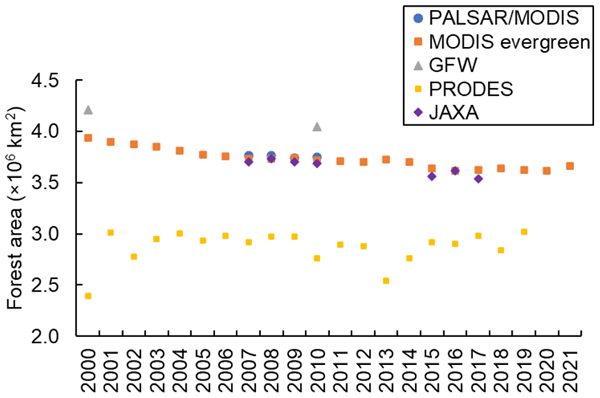
Forest definition has two major biophysical parameters, i.e., canopy height and canopy coverage. However, few studies have assessed forest cover maps in terms of these two parameters at a large scale. Here, we assessed the annual forest cover maps in the Brazilian Amazon using 1.1 million footprints of canopy height and canopy coverage. Over 93 % of our forest cover maps are consistent with the FAO forest definition, showing the high accuracy of these forest cover maps in the Brazilian Amazon.
Guanpu Qi, Jiawei Wei, Zaizhou Xin, Longcheng Yao, Huilan Yuan, Ming Nie, Bo Li, Xiong Chen, and Jun Ma
Earth Syst. Sci. Data Discuss., https://doi.org/10.5194/essd-2026-719, https://doi.org/10.5194/essd-2026-719, 2026
Preprint under review for ESSD
Short summary
Short summary
Using LiDAR scanning data and a deep learning model, we developed a new algorithm and produced a high-resolution dataset mapping vegetation structural complexity across China's coastal wetlands. Unlike existing metrics, this approach reliably captures subtle structural differences in coastal vegetation. The resulting publicly available maps reveal strong spatial heterogeneity and provide a valuable data foundation for wetland conservation, ecosystem assessment, and coastal ecological modelling.

Jiaying He, Xin Zou, Weihan Zhang, Quan Duan, Ronggao Liu, Yang Liu, Jinwei Dong, Chaoyang Wu, Wei Li, and Chao Wu
Earth Syst. Sci. Data, 18, 5915–5937, https://doi.org/10.5194/essd-18-5915-2026, https://doi.org/10.5194/essd-18-5915-2026, 2026
Short summary
Short summary
Understanding how forest fires reshape landscapes requires information not only on where fires occur, but also on the size, shape, and spatial organization of fire patches. We created a global 30 m dataset of forest fire patches spanning 1984–2022 using the Landsat satellite archive. Including nearly 12 million fire patches, this dataset facilitates ecological research at regional to global scales by characterizing fire patch structure and spatial organization over time.
Yifeng Cui, Jinwei Dong, Chao Zhang, Nanshan You, Shuai Ren, Peng Zhu, Quan Duan, Ronggao Liu, and César Terrer
Earth Syst. Sci. Data Discuss., https://doi.org/10.5194/essd-2026-613, https://doi.org/10.5194/essd-2026-613, 2026
Preprint under review for ESSD
Short summary
Short summary
Crop residues left on fields can protect fertile soils, but their distribution across major black-soil farming regions is poorly known. We used Sentinel-2 images to create annual 10-meter maps of four regions from 2019 to 2024 and checked them against field observations. The maps show that residues were most common in intensively farmed areas and that corn was the main source. This dataset can guide soil conservation and help assess farming impacts on soil carbon, water resources, and climate.
Zizhang Zhao, Geli Zhang, Jinwei Dong, Jilin Yang, Chang Fan, Ruoqi Liu, and Xiangming Xiao
Earth Syst. Sci. Data, 18, 5583–5599, https://doi.org/10.5194/essd-18-5583-2026, https://doi.org/10.5194/essd-18-5583-2026, 2026
Short summary
Short summary
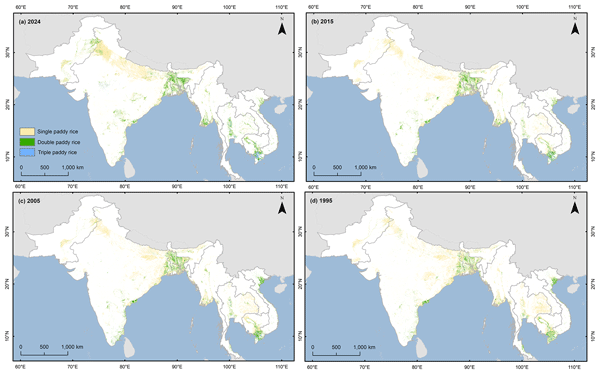
We created long-term, high-resolution maps of rice-growing areas in South and Southeast Asia to show how planting patterns have changed over the past three decades. Using satellite images, we tracked when and how often rice was grown and confirmed the results with more than 23,000 independent samples. The maps closely match national statistics and offer a valuable resource for understanding food production, water use, methane emissions, and climate impacts in this vital region.
Yuan Yao, Xiangming Xiao, Chenchen Zhang, Hao Tang, Yuanwei Qin, Cheng Meng, Baihong Pan, Li Pan, and Jie Wang
Earth Syst. Sci. Data Discuss., https://doi.org/10.5194/essd-2026-269, https://doi.org/10.5194/essd-2026-269, 2026
Revised manuscript under review for ESSD
Short summary
Short summary
Africa has experienced rapid forest loss, yet existing maps often disagree. Here, we produce annual forest cover maps at 30 m resolution from 2015 to 2023 using multiple satellite data and expert knowledge and compare them with other forest datasets. We find that forest area estimates of satellite-based products are larger than the Global Forest Resource Assessment statistics. Our results improve confidence in forest monitoring and support better understanding of forest change across Africa.
Binghong Han, Jian Bi, Shengli Tao, Tong Yang, Yongli Tang, Mengshuai Ge, Hao Wang, Zhenong Jin, Jinwei Dong, Zhibiao Nan, and Jin-Sheng He
Earth Syst. Sci. Data, 17, 2933–2952, https://doi.org/10.5194/essd-17-2933-2025, https://doi.org/10.5194/essd-17-2933-2025, 2025
Short summary
Short summary
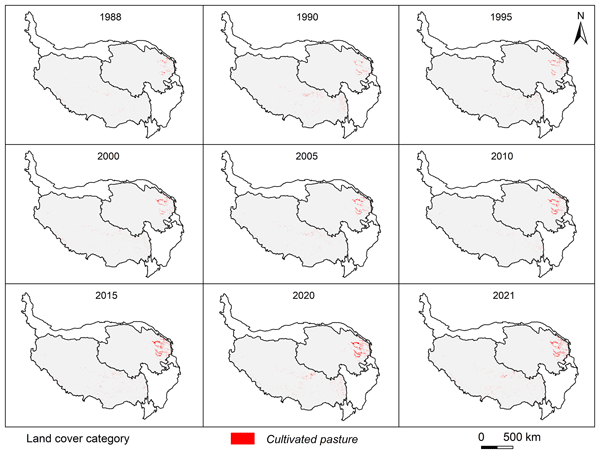
The Tibetan Plateau is an important pastoral area where cultivated pastures play an increasingly important role. However, little is known about the spatial distribution of the cultivated pastures due to the difficulty in distinguishing them from natural grasslands with remote sensing. For the first time, we have mapped the cultivated pastures on the plateau at a resolution of 30 m with decent accuracy. This dataset is valuable to scientists, policymakers, conservationists, and pastoralists.
Jie Wang, Xiangming Xiao, Yuanwei Qin, Jinwei Dong, Geli Zhang, Xuebin Yang, Xiaocui Wu, Chandrashekhar Biradar, and Yang Hu
Earth Syst. Sci. Data, 16, 4619–4639, https://doi.org/10.5194/essd-16-4619-2024, https://doi.org/10.5194/essd-16-4619-2024, 2024
Short summary
Short summary
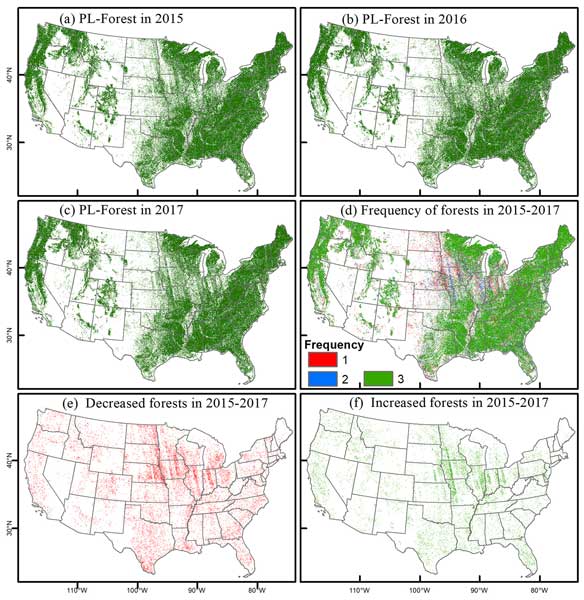
Existing satellite-based forest maps have large uncertainties due to different forest definitions and mapping algorithms. To effectively manage forest resources, timely and accurate annual forest maps at a high spatial resolution are needed. This study improved forest maps by integrating PALSAR-2 and Landsat images. Annual evergreen and non-evergreen forest-type maps were also generated. This critical information supports the Global Forest Resources Assessment.
Qinghang Mei, Zhao Zhang, Jichong Han, Jie Song, Jinwei Dong, Huaqing Wu, Jialu Xu, and Fulu Tao
Earth Syst. Sci. Data, 16, 3213–3231, https://doi.org/10.5194/essd-16-3213-2024, https://doi.org/10.5194/essd-16-3213-2024, 2024
Short summary
Short summary
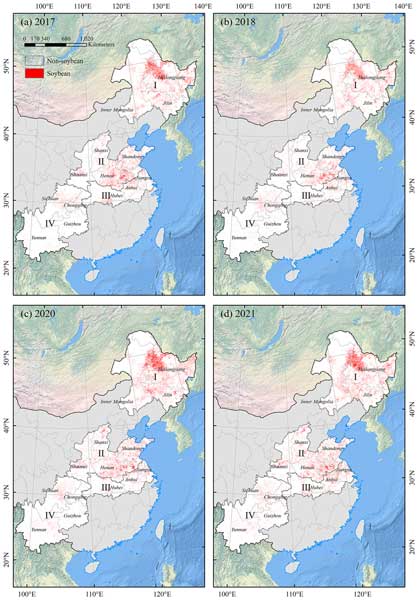
In order to make up for the lack of long-term soybean planting area maps in China, we firstly generated a dataset of soybean planting area with a spatial resolution of 10 m for major producing areas in China from 2017 to 2021 (ChinaSoyArea10m). Compared with existing datasets, ChinaSoyArea10m has higher consistency with census data and further improvement in spatial details. The dataset can provide reliable support for subsequent studies on yield monitoring and food security.
Russell Doughty, Yujie Wang, Jennifer Johnson, Nicholas Parazoo, Troy Magney, Zoe Pierrat, Xiangming Xiao, Luis Guanter, Philipp Köhler, Christian Frankenberg, Peter Somkuti, Shuang Ma, Yuanwei Qin, Sean Crowell, and Berrien Moore III
EGUsphere, https://doi.org/10.22541/essoar.168167172.20799710/v1, https://doi.org/10.22541/essoar.168167172.20799710/v1, 2024
Preprint archived
Short summary
Short summary
Here we present a novel model of global photosynthesis, ChloFluo, which uses spaceborne chlorophyll fluorescence to estimate the amount of photosynthetically active radiation absorbed by chlorophyll. Potential uses of our model are to advance our understanding of the timing and magnitude of photosynthesis, its effect on atmospheric carbon dioxide fluxes, and vegetation response to climate events and change.
Kai Yan, Jingrui Wang, Rui Peng, Kai Yang, Xiuzhi Chen, Gaofei Yin, Jinwei Dong, Marie Weiss, Jiabin Pu, and Ranga B. Myneni
Earth Syst. Sci. Data, 16, 1601–1622, https://doi.org/10.5194/essd-16-1601-2024, https://doi.org/10.5194/essd-16-1601-2024, 2024
Short summary
Short summary
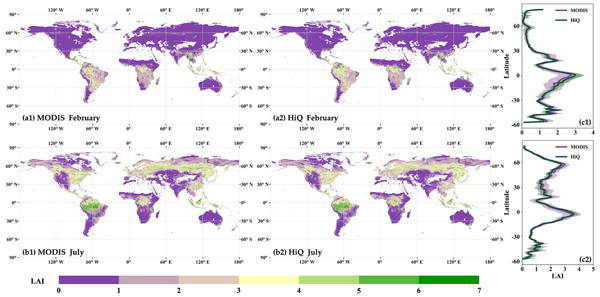
Variations in observational conditions have led to poor spatiotemporal consistency in leaf area index (LAI) time series. Using prior knowledge, we leveraged high-quality observations and spatiotemporal correlation to reprocess MODIS LAI, thereby generating HiQ-LAI, a product that exhibits fewer abnormal fluctuations in time series. Reprocessing was done on Google Earth Engine, providing users with convenient access to this value-added data and facilitating large-scale research and applications.
Yuanwei Qin, Xiangming Xiao, Hao Tang, Ralph Dubayah, Russell Doughty, Diyou Liu, Fang Liu, Yosio Shimabukuro, Egidio Arai, Xinxin Wang, and Berrien Moore III
Earth Syst. Sci. Data, 16, 321–336, https://doi.org/10.5194/essd-16-321-2024, https://doi.org/10.5194/essd-16-321-2024, 2024
Short summary
Short summary
Forest definition has two major biophysical parameters, i.e., canopy height and canopy coverage. However, few studies have assessed forest cover maps in terms of these two parameters at a large scale. Here, we assessed the annual forest cover maps in the Brazilian Amazon using 1.1 million footprints of canopy height and canopy coverage. Over 93 % of our forest cover maps are consistent with the FAO forest definition, showing the high accuracy of these forest cover maps in the Brazilian Amazon.
Cited articles
Armstrong, A.: Lake carbon, Nat. Geosci., 3, 151,
https://doi.org/10.1038/ngeo816, 2010.
Birkett, C. M. and Mason, I. M.: A New Global Lakes Database for a Remote
Sensing Program Studying Climatically Sensitive Large Lakes, J. Great Lakes
Res., 21, 307–318, https://doi.org/10.1016/S0380-1330(95)71041-3, 1995.
Dalin, C., Hanasaki, N., Qiu, H., Mauzerall, D. L., and Rodriguez-Iturbe,
I.: Water resources transfers through Chinese interprovincial and foreign
food trade, P. Natl. Acad. Sci. USA, 111, 9774–9779,
https://doi.org/10.1073/pnas.1404749111, 2014.
Fang, J., Wang, Z., Zhao, S., Li, Y., Tang, Z., Yu, D., Ni, L., Liu, H.,
Xie, P., Da, L., Li, Z., and Zheng, C.: Biodiversity changes in the lakes of
the Central Yangtze, Ecol. Environ., 4, 369–377,
https://doi.org/10.1890/1540-9295(2006)004[0369:BCITLO]2.0.CO;2, 2006.
Feng, L., Hu, C., Chen, X., and Zhao, X.: Dramatic inundation changes of
China's two largest freshwater lakes linked to the Three Gorges Dam,
Environ. Sci. Technol., 47, 9628–9634, https://doi.org/10.1021/es4009618,
2013.
Feng, L., Han, X., Hu, C., and Chen, X.: Four decades of wetland changes of
the largest freshwater lake in China: Possible linkage to the Three Gorges
Dam?, Remote Sens. Environ., 176, 43–55,
https://doi.org/10.1016/j.rse.2016.01.011, 2016.
Feng, S., Liu, S., Huang, Z., Jing, L., Zhao, M., Peng, X., Yan, W., Wu, Y.,
Lv, Y., Smith, A. R., McDonald, M. A., Patil, S. D., Sarkissian, A. J., Shi,
Z., Xia, J., and Ogbodo, U. S.: Inland water bodies in China: Features
discovered in the long-term satellite data, P. Natl. Acad. Sci. USA,
116, 25491–25496, https://doi.org/10.1073/pnas.1910872116, 2019.
Gao, H.: Satellite remote sensing of large lakes and reservoirs: from
elevation and area to storage, Wires Rev. Water, 2, 147–157,
https://doi.org/10.1002/wat2.1065, 2015.
Gao, H., Birkett, C., and Lettenmaier, D. P.: Global monitoring of large
reservoir storage from satellite remote sensing, Water Resour. Res., 48,
W09504, https://doi.org/10.1029/2012WR012063, 2012.
Hayes, N. M., Deemer, B. R., Corman, J. R., Razavi, N. R., and Strock, K.
E.: Key differences between lakes and reservoirs modify climate signals: A
case for a new conceptual model, Limnol. Oceanogr. Lett., 2, 47–62,
https://doi.org/10.1002/lol2.10036, 2017.
Howard Coker, E., Hotchkiss, R. H., and Johnson, D. A.: Conversion of a
Missouri River Dam and Reservoir to a Sustainable System: Sediment
Management1, J. Am. Water Resour. As., 45, 815–827,
https://doi.org/10.1111/j.1752-1688.2009.00324.x, 2009.
ICOLD: World Register of Dams, Paris, International Commission on Large Dams, http://www.icold-cigb.org (last access: 18 February 2022), 2011.
Lehner, B. and Döll, P.: Development and validation of a global database
of lakes, reservoirs and wetlands, J. Hydrol., 296, 1–22,
https://doi.org/10.1016/j.jhydrol.2004.03.028, 2004.
Lehner, B., Liermann, C. R., Revenga, C., Vörömsmarty, C., Fekete,
B., Crouzet, P., Döll, P., Endejan, M., Frenken, K., Magome, J.,
Nilsson, C., Robertson, J. C., Rödel, R., Sindorf, N., and Wisser, D.:
High-resolution mapping of the world's reservoirs and dams for sustainable
river-flow management, Front. Ecol. Environ., 9, 494–502,
https://doi.org/10.1890/100125, 2011.
Liu, J. and Yang, W.: Water sustainability for China and beyond, Science, 337, 649–650, https://doi.org/10.1126/science.1219471, 2012.
Ma, R. H., Yang, G. S., Duan, H. T., Jiang, J. H., Wang, S. M., Feng, X. Z.,
Li, A. N., Kong, F. X., Xue, B., Wu, J. L., and Li, S. J.: China's lakes at
present: Number, area and spatial distribution, Sci. China Earth Sci., 54,
283–289, https://doi.org/10.1007/s11430-010-4052-6, 2011.
Mulligan, M., van Soesbergen, A., and Sáenz, L.: GOODD, a global dataset
of more than 38,000 georeferenced dams, Sci. Data, 7, 1–8,
https://doi.org/10.1038/s41597-020-0362-5, 2020.
Murray, N. J., Phinn, S. R., DeWitt, M., Ferrari, R., Johnston, R., Lyons,
M. B., Clinton, N., Thau, D., and Fuller, R. A.: The global distribution and
trajectory of tidal flats, Nature, 565, 222,
https://doi.org/10.1038/s41586-018-0805-8, 2019.
Ogilvie, A., Belaud, G., Massuel, S., Mulligan, M., Le Goulven, P., and Calvez, R.: Surface water monitoring in small water bodies: potential and limits of multi-sensor Landsat time series, Hydrol. Earth Syst. Sci., 22, 4349–4380, https://doi.org/10.5194/hess-22-4349-2018, 2018.
Paredes-Beltran, B., Sordo-Ward, A., and Garrote, L.: Dataset of Georeferenced Dams in South America (DDSA), Earth Syst. Sci. Data, 13, 213–229, https://doi.org/10.5194/essd-13-213-2021, 2021.
Pekel, J. F., Cottam, A., Gorelick, N., and Belward, A. S.: High-resolution
mapping of global surface water and its long-term changes, Nature, 540, 418,
https://doi.org/10.1038/nature20584, 2016.
Ran, L., Butman, D. E., Battin, T. J., Yang, X., Tian, M., Duvert, C.,
Hartmann, J., Geeraert, N., and Liu, S.: Substantial decrease in CO2
emissions from Chinese inland waters due to global change, Nat. Commun., 12,
1–9, https://doi.org/10.1038/s41467-021-21926-6, 2021.
Slater, J. A., Garvey, G., Johnston, C., Haase, J., Heady, B., Kroenung, G.,
and Little, J. K.: The SRTM Data Finishing Process and Products, Photogramm.
Eng. Rem. S., 72, 237–247, 2006.
Tao, S., Zhang, H., Feng, Y., and Zhu, J.: Changes in China's water
resources in the early 21st century, Front. Ecol. Environ., 18, 188–193,
https://doi.org/10.1002/fee.2164, 2020.
Thornton, J., Steel, A., and Rast, W.: Chapter 8 – Reservoirs, in: Water
quality assessments: a guide to the use of biota, sediments and water in
environmental monitoring, edited by: Chapman, D. V., E&FN Spon,
2nd Edn., 2–3, ISBN 0419216006, 1996.
Wang, J., Sheng, Y., Gleason, C. J., and Wada, Y.: Downstream Yangtze River
levels impacted by Three Gorges Dam, Environ. Res. Lett., 8, 044012,
https://doi.org/10.1088/1748-9326/8/4/044012, 2013.
Wang, J., Walter, B. A., Yao, F., Song, C., Ding, M., Maroof, A. S., Zhu, J., Fan, C., McAlister, J. M., Sikder, S., Sheng, Y., Allen, G. H., Crétaux, J.-F., and Wada, Y.: GeoDAR: georeferenced global dams and reservoirs dataset for bridging attributes and geolocations, Earth Syst. Sci. Data, 14, 1869–1899, https://doi.org/10.5194/essd-14-1869-2022, 2022a.
Wang, J., Walter, B. A., Yao, F., Song, C., Ding, M., Maroof, A. S., Zhu, J., Fan, C., McAlister, J. M., Sikder, Md. S., Sheng, Y., Allen, G. H., Crétaux, J.-F., and Wada, Y.: GeoDAR: Georeferenced global Dams And Reservoirs dataset for bridging attributes and geolocations, Zenodo [data set], https://doi.org/10.5281/zenodo.6163413, 2022b.
Wang, X., Xiao, X., Zou, Z., Dong, J., Qin, Y., Doughty, R. B., Menarguez,
M. A., Chen, B., Wang, J., Ye, H., Ma, J., Zhong, Q., Zhao, B., and Li, B.:
Gainers and losers of surface and terrestrial water resources in China
during 1989–2016, Nat. Commun., 11, 1–12,
https://doi.org/10.1038/s41467-020-17103-w, 2020a.
Wang, X., Xiao, X., Zou, Z., Hou, L., Qin, Y., Dong, J., Doughty, R. B.,
Chen, B., Zhang, X., Chen, Y., Ma, J., Zhao, B., and Li, B.: Mapping coastal
wetlands of China using time series Landsat images in 2018 and Google Earth
Engine, ISPRS J. Photogramm., 163, 312–326,
https://doi.org/10.1016/j.isprsjprs.2020.03.014, 2020b.
Wang, X., Xiao, X., Xu, X., Zou, Z., Chen, B., Qin, Y., Zhang, X., Dong, J.,
Liu, D., Pan, L., and Li, B.: Rebound in China's coastal wetlands following
conservation and restoration, Nat. Sustain., 4, 1076–1083,
https://doi.org/10.1038/s41893-021-00793-5, 2021a.
Wang, X., Xiao, X., Qin, X., Dong, J., Wu, J., and Li, B.:
China-LDRL: China's surface water bodies, Large Dams, Reservoirs, and Lakes dataset, figshare [data set], https://doi.org/10.6084/m9.figshare.16964656.v3, 2021b.
Wu, J., Huang, J., Han, X., Gao, X., He, F., Jiang, M., Jiang, Z., Primack,
R. B., and Shen, Z.: The Three Gorges Dam: An ecological perspective, Front.
Ecol. Environ., 2, 241–248,
https://doi.org/10.1890/1540-9295(2004)002[0241:TTGDAE]2.0.CO;2, 2004.
Wulder, M. A., White, J. C., Loveland, T. R., Woodcock, C. E., Belward, A.
S., Cohen, W. B., Fosnight, E. A., Shaw, J., Masek, J. G., and Roy, D. P.:
The global Landsat archive: Status, consolidation, and direction, Remote
Sens. Environ., 185, 271–283, https://doi.org/10.1016/j.rse.2015.11.032,
2016.
Xiang, Y., Fu, Z., Meng, Y., Zhang, K., and Cheng, Z.: Analysis of wave
clipping effects of plain reservoir artificial islands based on MIKE21 SW
model, Water Sci. Eng., 12, 179–187,
https://doi.org/10.1016/j.wse.2019.08.002, 2019.
Yang, X. and Lu, X.: Drastic change in China's lakes and reservoirs over the
past decades, Sci. Rep., 4, 6041, https://doi.org/10.1038/srep06041, 2014.
Yang, X. and Lu, X. X.: Delineation of lakes and reservoirs in large river
basins: An example of the Yangtze River Basin, China, Geomorphology,
190, 92–102,
https://doi.org/10.1016/j.geomorph.2013.02.018, 2013.
Zhang, G., Yao, T., Chen, W., Zheng, G., Shum, C. K., Yang, K., Piao, S.,
Sheng, Y., Yi, S., Li, J., Oreilly, C., Qi, S., Shen, S., Zhang, H., and
Jia, Y.: Regional differences of lake evolution across China during
1960s–2015 and its natural and anthropogenic causes, Remote Sens. Environ.,
221, 386–404, https://doi.org/10.1016/j.rse.2018.11.038, 2019.
Zhang, Q., Li, L., Wang, Y. G., Werner, A. D., Xin, P., Jiang, T., and
Barry, D. A.: Has the Three-Gorges Dam made the Poyang Lake wetlands wetter
and drier?, Geophys. Res. Lett., 39, L20402,
https://doi.org/10.1029/2012GL053431, 2012.
Zhou, F., Bo, Y., Ciais, P., Dumas, P., Tang, Q., Wang, X., Liu, J., Zheng,
C., Polcher, J., Yin, Z., Guimberteau, M., Peng, S., Ottle, C., Zhao, X.,
Zhao, J., Tan, Q., Chen, L., Shen, H., Yang, H., Piao, S., Wang, H., and
Wada, Y.: Deceleration of China's human water use and its key drivers, P.
Natl. Acad. Sci. USA, 117, 7702–7711,
https://doi.org/10.1073/pnas.1909902117, 2020.
Zhou, Y., Dong, J., Xiao, X., Xiao, T., Yang, Z., Zhao, G., Zou, Z., and
Qin, Y.: Open surface water mapping algorithms: A comparison of
water-related spectral indices and sensors, Water, 9, 256,
https://doi.org/10.3390/w9040256, 2017.
Zhou, Y., Dong, J., Liu, J., Metternicht, G., Shen, W., You, N., Zhao, G.,
and Xiao, X.: Are there sufficient Landsat observations for retrospective
and continuous monitoring of land cover changes in China?, Remote Sens., 11, 1808,
https://doi.org/10.3390/rs11151808, 2019a.
Zhou, Y., Dong, J., Xiao, X., Liu, R., Zou, Z., Zhao, G., and Ge, Q.:
Continuous monitoring of lake dynamics on the Mongolian Plateau using all
available Landsat imagery and Google Earth Engine, Sci. Total Environ., 689,
366–380, https://doi.org/10.1016/J.SCITOTENV.2019.06.341, 2019b.
Zhu, J., Song, C., Wang, J., and Ke, L.: China's inland water dynamics: The
significance of water body types, P. Natl. Acad. Sci. USA, 117, 13876–13878,
https://doi.org/10.1073/pnas.2005584117, 2020.
Zhu, Z., Wang, S., and Woodcock, C. E.: Improvement and expansion of the
Fmask algorithm: Cloud, cloud shadow, and snow detection for Landsats 4-7,
8, and Sentinel 2 images, Remote Sens. Environ., 159, 269–277,
https://doi.org/10.1016/j.rse.2014.12.014, 2015.
Zou, Z. H., Dong, J. W., Menarguez, M. A., Xiao, X. M., Qin, Y. W., Doughty,
R. B., Hooker, K. V., and Hambright, K. D.: Continued decrease of open
surface water body area in Oklahoma during 1984–2015, Sci. Total Environ.,
595, 451–460, https://doi.org/10.1016/j.scitotenv.2017.03.259, 2017.
Zou, Z. H., Xiao, X. M., Dong, J. W., Qin, Y. W., Doughty, R. B., Menarguez,
M. A., Zhang, G. L., and Wang, J.: Divergent trends of open-surface water
body area in the contiguous United States from 1984 to 2016, P. Natl.
Acad. Sci. USA, 115, 3810–3815,
https://doi.org/10.1073/pnas.1719275115, 2018.
Short summary
We generated China’s surface water bodies, Large Dams, Reservoirs, and Lakes (China-LDRL) dataset by analyzing all available Landsat imagery in 2019 (19\,338 images) in Google Earth Engine. The dataset provides accurate information on the geographical locations and sizes of surface water bodies, large dams, reservoirs, and lakes in China. The China-LDRL dataset will contribute to the understanding of water security and water resources management in China.
We generated China’s surface water bodies, Large Dams, Reservoirs, and Lakes (China-LDRL)...


Altmetrics
Final-revised paper
Preprint