Articles | Volume 18, issue 2
https://doi.org/10.5194/essd-18-1405-2026
© Author(s) 2026. This work is distributed under
the Creative Commons Attribution 4.0 License.
the Creative Commons Attribution 4.0 License.
https://doi.org/10.5194/essd-18-1405-2026
© Author(s) 2026. This work is distributed under
the Creative Commons Attribution 4.0 License.
the Creative Commons Attribution 4.0 License.
Data review article
| 
24 Feb 2026
Data review article |
| 24 Feb 2026
| 24 Feb 2026
Synthesis of data products for ocean carbonate chemistry

Cooperative Institute for Satellite Earth System Studies, Earth System Science Interdisciplinary Center, University of Maryland, College Park, Maryland 20740, United States
NOAA/NESDIS National Centers for Environmental Information, Silver Spring, Maryland 20910, United States
Geosciences Research Division, Scripps Institution of Oceanography, University of California at San Diego, La Jolla, CA 92037, United States
Amanda Fay
Columbia University and Lamont-Doherty Earth Observatory, Palisades, New York 10964, United States
Jens Daniel Müller
Environmental Physics, Institute of Biogeochemistry and Pollutant Dynamics, ETH Zürich, Zurich, Switzerland
Carbon to Sea Initiative, Washington, D.C., United States
Luke Gregor
Environmental Physics, Institute of Biogeochemistry and Pollutant Dynamics, ETH Zürich, Zurich, Switzerland
Swiss Data Science Center, ETH Zurich and EPFL, Zurich, Switzerland
Alizée Roobaert
Flanders Marine Institute (VLIZ), Jacobsenstraat 1, 8400 Ostend, Belgium
Lydia Keppler
Vycarb Inc., Brooklyn, New York, United States
Dustin Carroll
Moss Landing Marine Laboratories, San José State University, Moss Landing, California, United States
Jet Propulsion Laboratory, California Institute of Technology, Pasadena, California, United States
Siv K. Lauvset
NORCE Research AS, Bjerknes Centre for Climate Research, Bergen, Norway
Tim DeVries
Department of Geography and Earth Research Institute, University of California, Santa Barbara, California, United States
Judith Hauck
Alfred Wegener Institute Helmholtz Centre for Polar and Marine Research, Bremerhaven, Germany
Department 02 Biology/Chemistry, University of Bremen, Bremen, Germany
Christian Rödenbeck
Max Planck Institute for Biogeochemistry, Jena, Germany
Nicolas Metzl
Laboratoire LOCEAN/IPSL, Sorbonne Université – CNRS-IRD-MNHN, 75005 Paris, France
Andrea J. Fassbender
NOAA/OAR Pacific Marine Environmental Laboratory, Seattle, Washington 98115, United States
Jean-Pierre Gattuso
Sorbonne Université, CNRS, Laboratoire d'Océanographie de Villefranche, 06230 Villefranche-sur-Mer, France
Institute for Sustainable Development and International Relations, Paris, France
Peter Landschützer
Flanders Marine Institute (VLIZ), Jacobsenstraat 1, 8400 Ostend, Belgium
Rik Wanninkhof
NOAA/OAR Atlantic Oceanographic and Meteorological Laboratory, Miami, Florida 33149, United States
Christopher Sabine
Department of Oceanography, University of Hawaii at Mānoa, 1000 Pope Rd., Honolulu, Hawaii 96822, United States
Simone R. Alin
NOAA/OAR Pacific Marine Environmental Laboratory, Seattle, Washington 98115, United States
Mario Hoppema
Alfred Wegener Institute Helmholtz Centre for Polar and Marine Research, Bremerhaven, Germany
Are Olsen
Geophysical Institute, University of Bergen and Bjerknes Centre for Climate Research, Bergen, Norway
Matthew P. Humphreys
Department of Ocean Systems, NIOZ Royal Netherlands Institute for Sea Research, Texel, the Netherlands
Kunal Chakraborty
Indian National Centre for Ocean Information Services, Ministry of Earth Sciences, Hyderabad, India
Ana C. Franco
Department of Earth, Ocean and Atmospheric Sciences, University of British Columbia, Vancouver, BC, Canada
Current affiliation: Earth Sciences Department, Barcelona Supercomputing Center, Barcelona, Spain
Kumiko Azetsu-Scott
Fisheries and Oceans, Canada, Bedford Institute of Oceanography, Dartmouth, Nova Scotia, Canada
Dorothee C. E. Bakker
Centre for Ocean and Atmospheric Sciences, School of Environmental Sciences, University of East Anglia, Norwich, NR4 7TJ, United Kingdom
Leticia Barbero
NOAA/OAR Atlantic Oceanographic and Meteorological Laboratory, Miami, Florida 33149, United States
Cooperative Institute for Marine and Atmospheric Studies, Rosenstiel School of Marine and Atmospheric Science, University of Miami, Miami, Florida 33149, United States
Nicholas R. Bates
Bermuda Institute of Ocean Sciences, ASU-BIOS, 17 Biological Lane, St. Georges, GEO1, Bermuda
School of Ocean Futures, Arizona State University, Tempe, Arizona 85281, United States
Nicole Besemer
NOAA/OAR Atlantic Oceanographic and Meteorological Laboratory, Miami, Florida 33149, United States
Henry C. Bittig
Leibniz Institute for Baltic Sea Research Warnemünde (IOW), Rostock, Germany
Albert E. Boyd
NOAA/OAR Atlantic Oceanographic and Meteorological Laboratory, Miami, Florida 33149, United States
Cooperative Institute for Marine and Atmospheric Studies, Rosenstiel School of Marine and Atmospheric Science, University of Miami, Miami, Florida 33149, United States
Daniel Broullón
Instituto de Investigacións Mariñas, IIM – CSIC, Vigo, Spain
Wei-Jun Cai
School of Marine Science and Policy, University of Delaware, Newark, Delaware 19716, United States
Brendan R. Carter
Cooperative Institute for Climate, Ocean, and Ecosystem Studies, University of Washington, Seattle, Washington, United States
NOAA/OAR Pacific Marine Environmental Laboratory, Seattle, Washington 98115, United States
Thi-Tuyet-Trang Chau
Laboratoire des Sciences du Climat et de l'Environnement, LSCE-IPSL, CEA-CNRS-UVSQ, Université Paris-Saclay, 91191 Gif-sur-Yvette, France
Laboratoire Interdisciplinaire des Sciences du Numérique (LISN), Centre de recherches INRIA, Université Paris–Saclay, René Thom, 91190 Gif-sur-Yvette, France
Chen-Tung Arthur Chen
Department of Oceanography, National Sun Yat-Sen University, Kaohsiung, Taiwan
Frédéric Cyr
Northwest Atlantic Fisheries Centre, Fisheries and Oceans Canada, St. John's, Newfoundland and Labrador, Canada
Current affiliation: Centre for Fisheries Ecosystems Research, Fisheries and Marine Institute of Memorial University of Newfoundland, St. John's, Canada
John E. Dore
Department of Land Resources and Environmental Sciences, Montana State University, Bozeman, Montana, United States
Ian Enochs
NOAA/OAR Atlantic Oceanographic and Meteorological Laboratory, Miami, Florida 33149, United States
Richard A. Feely
NOAA/OAR Pacific Marine Environmental Laboratory, Seattle, Washington 98115, United States
Hernan E. Garcia
NOAA/NESDIS National Centers for Environmental Information, Silver Spring, Maryland 20910, United States
Marion Gehlen
Laboratoire des Sciences du Climat et de l'Environnement, LSCE-IPSL, CEA-CNRS-UVSQ, Université Paris-Saclay, 91191 Gif-sur-Yvette, France
Prasanna Kanti Ghoshal
Indian National Centre for Ocean Information Services, Ministry of Earth Sciences, Hyderabad, India
Lucas Gloege
Columbia University and Lamont-Doherty Earth Observatory, Palisades, New York 10964, United States
Melchor González-Dávila
Instituto de Oceanografía Cambio Global, IOCAG, Universidad de Las Palmas de Gran Canaria, 35017 Las Palmas de Gran Canaria, Spain
Nicolas Gruber
Environmental Physics, Institute of Biogeochemistry and Pollutant Dynamics, ETH Zürich, Zurich, Switzerland
Debby Ianson
Institute of Ocean Sciences, Fisheries and Oceans Canada, Sidney, British Columbia, Canada
Yosuke Iida
Atmosphere and Ocean Department, Japan Meteorological Agency, 3-6-9 Toranomon, Minato City, Tokyo, Japan
Masao Ishii
Meteorological Research Institute, Japan Meteorological Agency, Tsukuba, Japan
Apurva Padamnabh Joshi
Indian National Centre for Ocean Information Services, Ministry of Earth Sciences, Hyderabad, India
Esther Kennedy
Bodea Marine Laboratory, University of California Davis, Davis, California, United States
Alex Kozyr
Cooperative Institute for Satellite Earth System Studies, Earth System Science Interdisciplinary Center, University of Maryland, College Park, Maryland 20740, United States
NOAA/NESDIS National Centers for Environmental Information, Silver Spring, Maryland 20910, United States
Nico Lange
NORCE Research AS, Bjerknes Centre for Climate Research, Bergen, Norway
Claire Lo Monaco
Laboratoire LOCEAN/IPSL, Sorbonne Université – CNRS-IRD-MNHN, 75005 Paris, France
Derek P. Manzello
Coral Reef Watch, US National Oceanic and Atmospheric Administration, College Park, Maryland, United States
Galen A. McKinley
Columbia University and Lamont-Doherty Earth Observatory, Palisades, New York 10964, United States
Natalie M. Monacci
College of Fisheries and Ocean Sciences, University of Alaska Fairbanks, Fairbanks, Alaska, United States
Xose A. Padin
Instituto de Investigacións Mariñas, IIM – CSIC, Vigo, Spain
Ana M. Palacio-Castro
NOAA/OAR Atlantic Oceanographic and Meteorological Laboratory, Miami, Florida 33149, United States
Cooperative Institute for Marine and Atmospheric Studies, Rosenstiel School of Marine and Atmospheric Science, University of Miami, Miami, Florida 33149, United States
Fiz F. Pérez
Instituto de Investigacións Mariñas, IIM – CSIC, Vigo, Spain
J. Magdalena Santana-Casiano
Instituto de Oceanografía Cambio Global, IOCAG, Universidad de Las Palmas de Gran Canaria, 35017 Las Palmas de Gran Canaria, Spain
Jonathan Sharp
Cooperative Institute for Climate, Ocean, and Ecosystem Studies, University of Washington, Seattle, Washington, United States
NOAA/OAR Pacific Marine Environmental Laboratory, Seattle, Washington 98115, United States
Adrienne Sutton
NOAA/OAR Pacific Marine Environmental Laboratory, Seattle, Washington 98115, United States
Jim Swift
Scripps Institution of Oceanography, La Jolla, California, United States
Toste Tanhua
GEOMAR Helmholtz Centre for Ocean Research Kiel, Kiel, Germany
Maciej Telszewski
International Ocean Carbon Coordination Project, Institute of Oceanology of Polish Academy of Sciences, Sopot, Poland
Jens Terhaar
Climate and Environmental Physics, Physics Institute, University of Bern, Bern, Switzerland
Oeschger Centre for Climate Change Research, University of Bern, Bern, Switzerland
Ruben van Hooidonk
Science for Climate Change Resilience, Boulder, Colorado 80302, United States
Anton Velo
Instituto de Investigacións Mariñas, IIM – CSIC, Vigo, Spain
Andrew J. Watson
Global Systems Institute, University of Exeter, Exeter, United Kingdom
Angelicque E. White
Department of Oceanography, University of Hawaii at Mānoa, 1000 Pope Rd., Honolulu, Hawaii 96822, United States
School of Marine Science and Policy, University of Delaware, Newark, Delaware 19716, United States
Liang Xue
First Institute of Oceanography, and Key Laboratory of Marine Science and Numerical Modeling, Ministry of Natural Resources, Qingdao, China
Hyelim Yoo
Cooperative Institute for Satellite Earth System Studies, Earth System Science Interdisciplinary Center, University of Maryland, College Park, Maryland 20740, United States
NOAA/NESDIS National Centers for Environmental Information, Silver Spring, Maryland 20910, United States
Jiye Zeng
National Institute for Environmental Studies, Tsukuba, Japan
Guorong Zhong
Institute of Oceanology, Chinese Academy of Sciences, Qingdao, China
Related authors
Li-Qing Jiang and Jean-Pierre Gattuso
Earth Syst. Sci. Data Discuss., https://doi.org/10.5194/essd-2026-650, https://doi.org/10.5194/essd-2026-650, 2026
Preprint under review for ESSD
Short summary
Short summary
The ocean is changing rapidly, yet the data needed to understand and respond to these changes remains scattered across institutions and countries. We examine the barriers in ocean data management and propose a new framework built on: a research-driven data model, policy-driven integration, and long-term preservation. This framework would enable seamless global data integration, open new horizons in ocean science, and strengthen economic resilience for present and future generations.
Hyelim Yoo, Li-Qing Jiang, Chris Langdon, Alex Kozyr, Simone R. Alin, Jose Martin Hernandez Ayon, Kumiko Azetsu-Scott, Leticia Barbero, Nicole Besemer, Albert Boyd, Jean R. Brodeur, Wei-Jun Cai, Brendan R. Carter, Cecilia Chapa, Eugene Colbourne, Jessica N. Cross, Ian Enochs, Leticia Espinosa-Carreon, Richard A. Feely, Karina E. Giesbrecht, Helen Gurney-Smith, Burke Hales, Naomi Harada, James Hooper, Christopher W. Hunt, Debby Ianson, Mike Jankulak, Terrence M. Joyce, Esther G. Kennedy, Brian A. King, Arne Körtzinger, Matthias Lankhorst, Gary Maillet, Derek Manzello, Anna K. McLaskey, Viviane V. Menezes, Nicolas Metzl, Christine Michel, Natalie M. Monacci, Julio M. Morell, Akihiko Murata, Jan Newton, Emily O'Grady, Ana M. Palacio-Castro, Denis Pierrot, Marc Ringuette, Christopher Sabine, Joseph E. Salisbury, Akash R. Sastri, Ute Schuster, Uwe Send, Ryan Smith, Michel Starr, James H. Swift, Lynne D. Talley, Helmuth Thomas, Douglas W. R. Wallace, Zhaohui Aleck Wang, Rik Wanninkhof, Chi S. Wong, Patricia L. Yager, and Igor Yashayaev
Earth Syst. Sci. Data Discuss., https://doi.org/10.5194/essd-2026-516, https://doi.org/10.5194/essd-2026-516, 2026
Preprint under review for ESSD
Short summary
Short summary
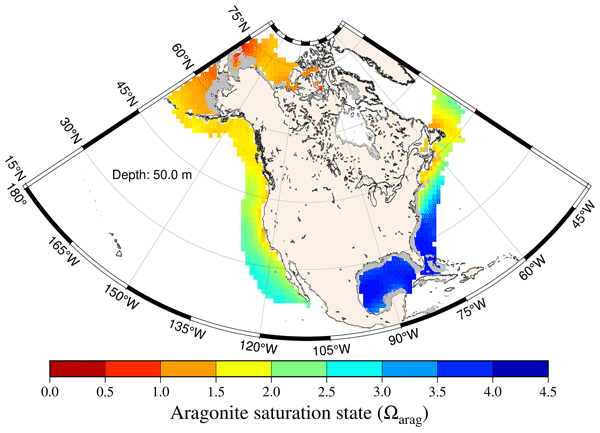
The coastal Ocean Data Analysis Product in North America (CODAP-NA, Version 2026) substantially increased both the spatial and temporal coverage of coastal biogeochemical measurements across North American continental shelves. This version comprises 446 cruises, 31,864 hydrographic profiles, and 195,489 discrete data records covering continental shelf environments from Alaska to Mexico in the west and from Canada to the Caribbean in the east from 1981 to 2024.
Li-Qing Jiang, Tim P. Boyer, Christopher R. Paver, Hyelim Yoo, James R. Reagan, Simone R. Alin, Leticia Barbero, Brendan R. Carter, Richard A. Feely, and Rik Wanninkhof
Earth Syst. Sci. Data, 16, 3383–3390, https://doi.org/10.5194/essd-16-3383-2024, https://doi.org/10.5194/essd-16-3383-2024, 2024
Short summary
Short summary
In this paper, we unveil a data product featuring ten coastal ocean acidification variables. These indicators are provided on 1°×1° spatial grids at 14 standardized depth levels, ranging from the surface to a depth of 500 m, along the North American ocean margins.
Li-Qing Jiang, Adam V. Subhas, Daniela Basso, Katja Fennel, and Jean-Pierre Gattuso
State Planet, 2-oae2023, 13, https://doi.org/10.5194/sp-2-oae2023-13-2023, https://doi.org/10.5194/sp-2-oae2023-13-2023, 2023
Short summary
Short summary
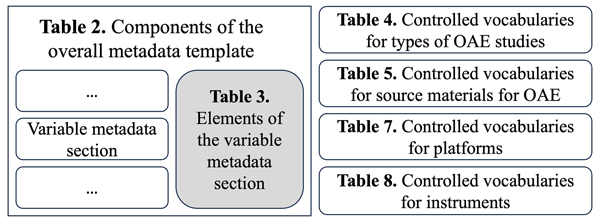
This paper provides comprehensive guidelines for ocean alkalinity enhancement (OAE) researchers on archiving their metadata and data. It includes data standards for various OAE studies and a universal metadata template. Controlled vocabularies for terms like alkalinization methods are included. These guidelines also apply to ocean acidification data.
Siv K. Lauvset, Nico Lange, Toste Tanhua, Henry C. Bittig, Are Olsen, Alex Kozyr, Simone Alin, Marta Álvarez, Kumiko Azetsu-Scott, Leticia Barbero, Susan Becker, Peter J. Brown, Brendan R. Carter, Leticia Cotrim da Cunha, Richard A. Feely, Mario Hoppema, Matthew P. Humphreys, Masao Ishii, Emil Jeansson, Li-Qing Jiang, Steve D. Jones, Claire Lo Monaco, Akihiko Murata, Jens Daniel Müller, Fiz F. Pérez, Benjamin Pfeil, Carsten Schirnick, Reiner Steinfeldt, Toru Suzuki, Bronte Tilbrook, Adam Ulfsbo, Anton Velo, Ryan J. Woosley, and Robert M. Key
Earth Syst. Sci. Data, 14, 5543–5572, https://doi.org/10.5194/essd-14-5543-2022, https://doi.org/10.5194/essd-14-5543-2022, 2022
Short summary
Short summary
GLODAP is a data product for ocean inorganic carbon and related biogeochemical variables measured by the chemical analysis of water bottle samples from scientific cruises. GLODAPv2.2022 is the fourth update of GLODAPv2 from 2016. The data that are included have been subjected to extensive quality controlling, including systematic evaluation of measurement biases. This version contains data from 1085 hydrographic cruises covering the world's oceans from 1972 to 2021.
Marcos Fontela, María Froján, Belén Arbones, María Jesús Álvarez-Fernández, Caio César-Ribeiro, Marylo Doval, José Luís Garrido, Sara Groppelli, María López-Acosta, María López-Rodríguez, Celeste L. Hinojo, Blanca Marigómez, Laura Moreno, Fiz F. Pérez, Isabel Gomes Teixeira, Antón Velo, and Xosé Antonio Padin
EGUsphere, https://doi.org/10.5194/egusphere-2026-5658, https://doi.org/10.5194/egusphere-2026-5658, 2026
This preprint is open for discussion and under review for Biogeosciences (BG).
Short summary
Short summary
Increasing seawater alkalinity is being explored as a way to remove carbon dioxide from the atmosphere, but effects on marine plankton are unclear. We exposed a coastal plankton community from northwest Iberian Upwelling System to this treatment. The responses were driven by nutrient exhaustion, not by the shift in water chemistry. Most plankton, and their ecosystem services, were unchanged; only the smallest size were affected. This approach may be ecologically safe at low nutrients.
Jens Terhaar, Laurent Bopp, Pierre Friedlingstein, Thomas Frölicher, Helene Hollitzer, Tatiana Ilyina, Lester Kwiatkowski, Paul Lerner, Hongmei Li, Anastasia Romanou, Jörg Schwinger, Roland Séférian, and Aaron Wienkers
EGUsphere, https://doi.org/10.5194/egusphere-2026-5757, https://doi.org/10.5194/egusphere-2026-5757, 2026
This preprint is open for discussion and under review for Biogeosciences (BG).
Short summary
Short summary
The ocean absorbs about 30% of CO2 emissions, but how much it will keep absorbing as CO2 levels rise and the climate warms is highly uncertain. Combining climate models with observations, we show models underestimate both the ocean CO2 uptake with increasing atmospheric CO2 and how strongly this uptake weakens with warming, and that the two are linked. Our tighter estimate reduces uncertainty in how much emitted CO2 stays in the atmosphere, and in the warming caused by future emissions.
Mark J. Hopwood, Raphaël Savelli, Martha Gledhill, Dustin Carroll, Laramie Jensen, and Stephanie Dutkiewicz
EGUsphere, https://doi.org/10.5194/egusphere-2026-5351, https://doi.org/10.5194/egusphere-2026-5351, 2026
This preprint is open for discussion and under review for Biogeosciences (BG).
Short summary
Short summary
A long-standing hypothesis is that rivers have little direct relevance to the biogeochemistry of dissolved Fe in the ocean. Efficient removal of Fe in estuaries is thought to limit transfer of riverine Fe to offshore ecosystems. However, recent observations in the Arctic and South Atlantic suggest rivers are dominant Fe sources to these ocean regions. The observed Fe-rich river plumes are absent in biogeochemical models, indicating a refinement of budget and model representations is needed.
Shrutika Wagh, Luana S. Basso, Ayan F. Fleischmann, João Henrique Fernandes Amaral, John Melack, Jost Larvic, David Walter, Stijn Hantson, Julia Marshall, Chris Wilson, Youmi Oh, Lori Bruhwiler, John B. Miller, Corinne Vigouroux, Christian Rödenbeck, and Santiago Botía
EGUsphere, https://doi.org/10.5194/egusphere-2026-5245, https://doi.org/10.5194/egusphere-2026-5245, 2026
This preprint is open for discussion and under review for Atmospheric Chemistry and Physics (ACP).
Short summary
Short summary
We estimated methane emissions from the Amazon, Orinoco, and Paraná river basins using the Jena CarboScope global inversion system. We included Amazon measurements to evaluate their effect on the results. Adding them led to a large adjustment in estimated wetland emissions and strongly influenced the Amazon estimate. Without these measurements, the Amazon estimate increased by about 75 %. Our findings highlight the need to maintain and expand measurements across tropical South America.
Haley D. Geizer, Francesco Bisiach, Alexandre Normandeau, Maria Armstrong, Stephan Hamisch, Silas W. Jones, Casey R. J. Hubert, Kumiko Azetsu-Scott, Paul V. R. Snelgrove, Christopher W. Hunt, Michelle Saunders, Rodd Laing, and Christopher K. Algar
EGUsphere, https://doi.org/10.5194/egusphere-2026-5292, https://doi.org/10.5194/egusphere-2026-5292, 2026
This preprint is open for discussion and under review for Biogeosciences (BG).
Short summary
Short summary
This study pairs direct measurements, a reactive transport model and 16S rRNA sequencing to assess benthic metabolisms in sediment from two subarctic fjords. Model results and predicted microbial communities aligned and indicate denitrification may be a significant process for cold and well-ventilated fjords. Organic carbon burial rates for fjords in the region were estimated and suggest they are important sites of carbon sequestration for at least a 200-year timescale.
Tobias Friedrich Ehmen, Neill Sutherland Mackay, and Andrew James Watson
EGUsphere, https://doi.org/10.5194/egusphere-2026-3396, https://doi.org/10.5194/egusphere-2026-3396, 2026
This preprint is open for discussion and under review for Biogeosciences (BG).
Short summary
Short summary
The ocean slows climate change by absorbing a large share of human carbon emissions, but estimates of how this uptake changes over time remain uncertain. We used machine learning and ocean observations to create a global map of interior ocean carbon stored throughout the ocean from the 1990s to 2019. Our results reveal substantial year-to-year and decade-to-decade changes in ocean carbon storage and provide an independent way to assess long-term trends in the ocean carbon sink.
Mercedes de la Paz, Susana Flecha, Fatima Zohra Bouthir, Milad Fahkri, Abed El Rahman Hassoun, Valeria Ibello, Korhan Özkan, Fiz F. Pérez, Adil Chair, and Iris E. Hendriks
Earth Syst. Sci. Data, 18, 6207–6224, https://doi.org/10.5194/essd-18-6207-2026, https://doi.org/10.5194/essd-18-6207-2026, 2026
Short summary
Short summary
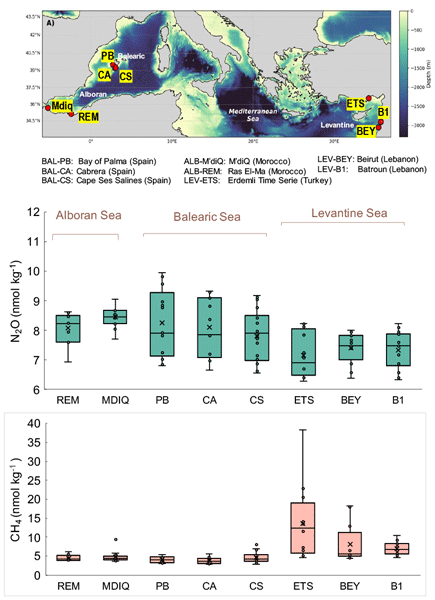
This study provides monthly year-long dataset of nitrous oxide and methane concentrations and their air-sea exchange in understudied coastal areas of the Mediterranean Sea. By using standardized methods across multiple sites, it reveals marked seasonal and regional differences, with methane showing highly variable bursts linked to local sources. The dataset addresses major observational gaps and offers a reliable foundation for future environmental evaluation in this sensitive region.
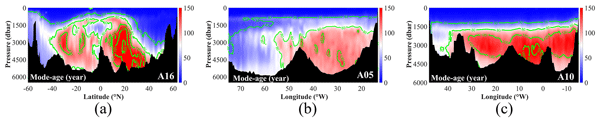
Mian Liu and Toste Tanhua
Ocean Sci., 22, 2595–2620, https://doi.org/10.5194/os-22-2595-2026, https://doi.org/10.5194/os-22-2595-2026, 2026
Short summary
Short summary
We measured the age of Atlantic waters using man-made gases and a radioactive isotope. Age increases with depth: young surface waters are about 30 years old, deep Antarctic water reaches 100 years, and the oldest bottom water is roughly 120 years. The western Atlantic is younger and better ventilated than the east. These patterns help estimate deep-sea oxygen use and are key for climate models and marine ecosystems.
Nabir Mamnun, Branwen Williams, Rena Mukherjee, Roberta L. Hansman, Rolf Sonnerup, Nikita Tournebise, Tim DeVries, and Heather Graven
Earth Syst. Sci. Data Discuss., https://doi.org/10.5194/essd-2026-691, https://doi.org/10.5194/essd-2026-691, 2026
Preprint under review for ESSD
Short summary
Short summary
Radiocarbon in the ocean reveals how seawater mixes and stores atmospheric carbon, yet measurements were spread across many separate studies. We compiled nearly 70,000 ship-based seawater and marine archive records from 1700 to 2024 into a harmonized global dataset, with quality checks and open archiving. The product captures pre-industrial conditions, changes from nuclear weapons testing, and recent decades, supporting climate and ocean model evaluation.
Li-Qing Jiang and Jean-Pierre Gattuso
Earth Syst. Sci. Data Discuss., https://doi.org/10.5194/essd-2026-650, https://doi.org/10.5194/essd-2026-650, 2026
Preprint under review for ESSD
Short summary
Short summary
The ocean is changing rapidly, yet the data needed to understand and respond to these changes remains scattered across institutions and countries. We examine the barriers in ocean data management and propose a new framework built on: a research-driven data model, policy-driven integration, and long-term preservation. This framework would enable seamless global data integration, open new horizons in ocean science, and strengthen economic resilience for present and future generations.
Nico Lange, Siv K. Lauvset, Brendan R. Carter, Matthew P. Humphreys, Ryan J. Woosley, Are Olsen, Henry C. Bittig, Alex Kozyr, Marta Álvarez, Kumiko Azetsu-Scott, Susan Becker, Peter J. Brown, Leticia Cotrim da Cunha, Larissa Dias, Mario Hoppema, Masao Ishii, Emil Jeansson, Akihiko Murata, Jens Daniel Müller, Fiz F. Pérez, Carsten Schirnick, Reiner Steinfeldt, Adam Ulfsbo, Anton Velo, and Toste Tanhua
Earth Syst. Sci. Data Discuss., https://doi.org/10.5194/essd-2026-496, https://doi.org/10.5194/essd-2026-496, 2026
Preprint under review for ESSD
Short summary
Short summary
GLODAP is a data product for ocean inorganic carbon and related biogeochemical variables measured by the chemical analysis of water bottle samples from scientific cruises. GLODAPv3 is the third version release of GLODAP. The data that are included have been subjected to extensive quality control, including systematic evaluation of systematic cruise differences. This version contains data from 1181 hydrographic cruises covering the world's oceans from 1972 to 2023.
Michaela Maier, Debby Ianson, and Roberta C. Hamme
EGUsphere, https://doi.org/10.5194/egusphere-2026-4197, https://doi.org/10.5194/egusphere-2026-4197, 2026
This preprint is open for discussion and under review for Ocean Science (OS).
Short summary
Short summary
Subsurface oxygen off Vancouver Island is largely shaped by the relative contributions of source waters entering the region, with biological processes further influencing shelf waters. Since 2003, a stronger contribution of warmer, saltier source waters has been linked to springtime oxygen declines at mid-depth. The deepest regularly upwelled waters, which affect life on the shelf floor and where oxygen is naturally lowest, show no long-term decline.
Tamara Mathys, Sergey S. Marchenko, Sebastian Westermann, Luke Gregor, Léo C. P. Martin, Murataly Duishonakunov, Christian Hauck, Mohammad Farzamian, Teddi Herring, Christin Hilbich, Ruslan Kenzhebaev, Mukhammad Esenaman uulu, Timur Musaev, Zhoodarbeshim Bektursunov, Ryskul Usubaliev, Isabella Brining, Tomas Saks, and Martin Hoelzle
EGUsphere, https://doi.org/10.5194/egusphere-2026-2756, https://doi.org/10.5194/egusphere-2026-2756, 2026
This preprint is open for discussion and under review for Earth Surface Dynamics (ESurf).
Short summary
Short summary
CryoGrid simulations constrained by geophysical and borehole data were used to assess permafrost thermal conditions and thaw depth in the Inner Tien Shan (Kyrgyzstan) at 30 m resolution. Surface-type-specific stratigraphies derived from geophysical surveys improved representation of subsurface heterogeneity. Results indicate widespread but spatially variable permafrost, with evidence of approximately 1 °C warming since the 1980s and increasing thaw depths.
Hyelim Yoo, Li-Qing Jiang, Chris Langdon, Alex Kozyr, Simone R. Alin, Jose Martin Hernandez Ayon, Kumiko Azetsu-Scott, Leticia Barbero, Nicole Besemer, Albert Boyd, Jean R. Brodeur, Wei-Jun Cai, Brendan R. Carter, Cecilia Chapa, Eugene Colbourne, Jessica N. Cross, Ian Enochs, Leticia Espinosa-Carreon, Richard A. Feely, Karina E. Giesbrecht, Helen Gurney-Smith, Burke Hales, Naomi Harada, James Hooper, Christopher W. Hunt, Debby Ianson, Mike Jankulak, Terrence M. Joyce, Esther G. Kennedy, Brian A. King, Arne Körtzinger, Matthias Lankhorst, Gary Maillet, Derek Manzello, Anna K. McLaskey, Viviane V. Menezes, Nicolas Metzl, Christine Michel, Natalie M. Monacci, Julio M. Morell, Akihiko Murata, Jan Newton, Emily O'Grady, Ana M. Palacio-Castro, Denis Pierrot, Marc Ringuette, Christopher Sabine, Joseph E. Salisbury, Akash R. Sastri, Ute Schuster, Uwe Send, Ryan Smith, Michel Starr, James H. Swift, Lynne D. Talley, Helmuth Thomas, Douglas W. R. Wallace, Zhaohui Aleck Wang, Rik Wanninkhof, Chi S. Wong, Patricia L. Yager, and Igor Yashayaev
Earth Syst. Sci. Data Discuss., https://doi.org/10.5194/essd-2026-516, https://doi.org/10.5194/essd-2026-516, 2026
Preprint under review for ESSD
Short summary
Short summary
The coastal Ocean Data Analysis Product in North America (CODAP-NA, Version 2026) substantially increased both the spatial and temporal coverage of coastal biogeochemical measurements across North American continental shelves. This version comprises 446 cruises, 31,864 hydrographic profiles, and 195,489 discrete data records covering continental shelf environments from Alaska to Mexico in the west and from Canada to the Caribbean in the east from 1981 to 2024.
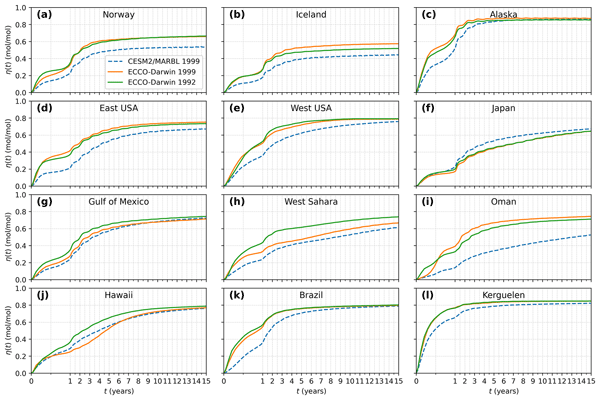
Michael Dominik Tyka, Mengyang Zhou, Elizabeth Yankovsky, and Dustin Carroll
Biogeosciences, 23, 4943–4966, https://doi.org/10.5194/bg-23-4943-2026, https://doi.org/10.5194/bg-23-4943-2026, 2026
Short summary
Short summary
Quantification of the kinetics of the induced ocean CO2 uptake following application of marine carbon dioxide removal technologies (mCDR) is crucial for such technologies to gain scientific and social acceptance. Here, we compare two circulation models commonly used for this purpose and find substantial differences in their predictions. We analyze which physical aspects of the models contribute the most to the inter-model discrepancies, and thus require future research.
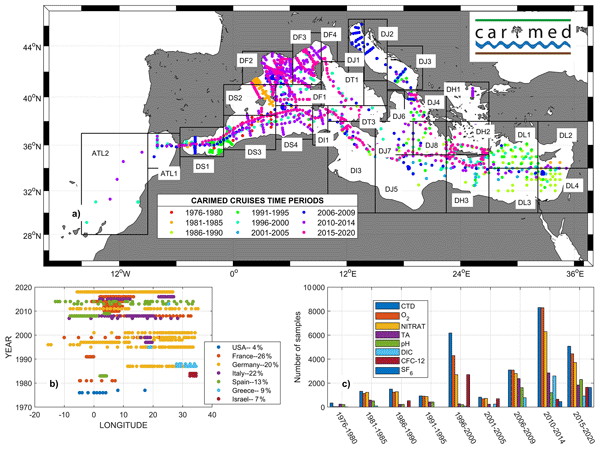
Marta Álvarez, Maribel I. García-Ibáñez, Nico Lange, Alex Kozyr, Antón Velo, Toste Tanhua, Giuseppe Civitarese, Carolina Cantoni, Malek Belgacem, Katrin Schroeder, Rubén Acerbi, Laurent Coppola, Thibaut Wagener, Noelia M. Fajar, Susana Flecha, Michele Giani, Louisa Giannoudi, Elisa F. Guallart, Abed El Rahman Hassoun, Emma I. Huertas, Valeria Ibello, Mehdia A. Keraghel, Férial Louanchi, Anna Luchetta, Fiz F. Pérez, Carsten Schirnick, Ekaterini Souvermezoglou, Lidia Urbini, Montserrat Vidal, and Patrizia Ziveri
Earth Syst. Sci. Data, 18, 4915–4941, https://doi.org/10.5194/essd-18-4915-2026, https://doi.org/10.5194/essd-18-4915-2026, 2026
Short summary
Short summary
CARIMED (CARbon, tracers, and ancillary data In the MEDiterranean Sea) is a high-quality, FAIR (Findability, Accessibility, Interoperability, and Reusability) dataset integrating hydrographic, biogeochemical, and transient tracer data from 46 research cruises (1976–2018) across the Mediterranean Sea. The data underwent rigorous, basin-adapted quality control to remove systematic biases, unifying four decades of fragmented data, delivering two complementary products: the aggregated original cruise data product and the bias-adjusted data synthesis product.
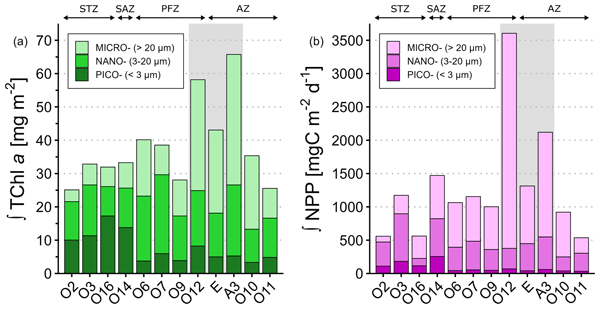
Valentin Deteix, Céline Ridame, Céline Dimier, Claire Lo Monaco, Aline Tribollet, and Frédéric Planchon
Biogeosciences, 23, 4793–4820, https://doi.org/10.5194/bg-23-4793-2026, https://doi.org/10.5194/bg-23-4793-2026, 2026
Short summary
Short summary
From in situ measurements, we characterized the size structure of both phytoplankton productivity and phytoplankton chemotaxonomic groups biomass in contrasting biogeochemical areas of the South Indian Ocean. We highlighted pronounced inter- and intra-zonal variability in these size structures. Across the study area, primary production and biomass was mainly driven by medium- and large-sized diatoms, haptophytes and dinoflagellates.
Daniel E. Sandborn, Brendan R. Carter, Mark J. Warner, and Larissa M. Dias
Geosci. Model Dev., 19, 5961–5978, https://doi.org/10.5194/gmd-19-5961-2026, https://doi.org/10.5194/gmd-19-5961-2026, 2026
Short summary
Short summary
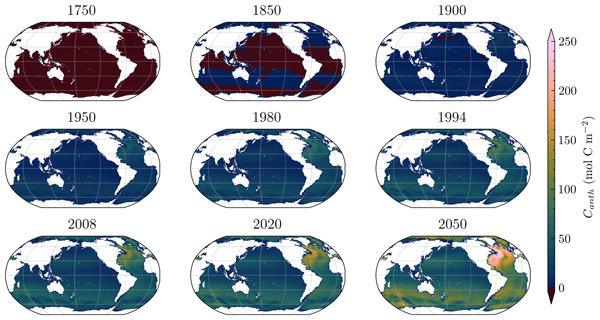
We present a new implementation of our method for estimation of human-created carbon dioxide in the ocean.
Tracer-based Rapid Anthropogenic Carbon Estimationrelies on transient tracer measurements to infer gas exchange and circulation. Our work implements practical and fundamental improvements increasing accessibility, flexibility, and skill of the method. We provide an updated data product of global ocean carbon inventories spanning the industrial era and a range of future projections.
Rémy Asselot, Virginie Thierry, Lidia I. Carracedo, Herle Mercier, Anton Velo, Raphaël Bajon, and Fiz F. Pérez
EGUsphere, https://doi.org/10.22541/essoar.15003488/v1, https://doi.org/10.22541/essoar.15003488/v1, 2026
Short summary
Short summary
Human activities have emitted large amounts of carbon dioxide (CO2) into the atmosphere since the beginning of the industrial revolution and this human-emitted CO2 (Cant) is absorbed by the ocean. We use autonomous robotic to show that the Cant content in the upper 2000 dbar of the Irminger Sea increased roughly steadily over 2011–2016, then reached a stationary state between 2016 and 2021. This study highlights how the monthly resolution of Argo data can complement ship-based measurements.
Amanda R. Fay, Dustin Carroll, Galen A. McKinley, Nicole S. Lovenduski, Dimitris Menemenlis, and Hong Zhang
EGUsphere, https://doi.org/10.5194/egusphere-2026-2870, https://doi.org/10.5194/egusphere-2026-2870, 2026
Short summary
Short summary
The ocean helps slow climate change by absorbing carbon dioxide, but our research shows this process weakens quickly when we reduce emissions. Using a sophisticated model, we found that the ocean’s carbon uptake drops within just a few years of mitigation. This change is most visible in the North Atlantic and Southern Ocean. To accurately track our progress in addressing climate change, we must focus global monitoring efforts on these specific, sensitive regions of the open sea.
Jeanne Dombret, Hugo Bellenger, Xavier Perrot, Laëtitia Parc, Lester Kwiatkowski, Frédéric Chevallier, Laurent Bopp, Marion Gehlen, Roland Séférian, Sarah Berthet, and James C. Orr
Biogeosciences, 23, 4133–4143, https://doi.org/10.5194/bg-23-4133-2026, https://doi.org/10.5194/bg-23-4133-2026, 2026
Short summary
Short summary
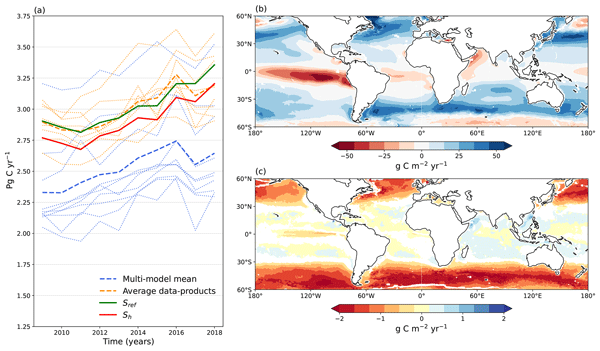
Estimates of ocean CO2 uptake based on atmospheric and oceanic observations typically rely on monthly averages, except for wind speed. Thus they neglect effects of shorter-term events such as storms, which are included in models. Here we account for the effect of this shorter-term variability on ocean carbon uptake and find that it is reduced, mainly because storms lower atmospheric pressure. This refinement closes the gap between data-based and model-based estimates by 25 %.
Suki C. K. Wong, Galen A. McKinley, Richard Seager, Tess Wei-Ping Jacobson, Amanda Fay, Özgür Gürses, Nicolas Gruber, Tatiana Ilyina, Tereza Jarnikova, Laure Resplandy, Jörg Schwinger, and Roland Séférian
EGUsphere, https://doi.org/10.5194/egusphere-2026-3104, https://doi.org/10.5194/egusphere-2026-3104, 2026
Short summary
Short summary
The ocean absorbs nearly a third of human-made carbon dioxide, slowing climate change. This uptake varies from decade to decade for reasons we do not fully understand. Using a 66-year ocean carbon dataset, we found that the tropical Pacific and Southern Ocean drive this variability, in step with broader climate patterns across the Pacific. But these patterns cannot fully explain the recent weakening of the Southern Ocean sink, suggesting biological processes may also play an important role.
Lisa G. T. Leist, Maxi Castrillejo, Kumiko Azetsu-Scott, Craig Lee, Jed Lenetsky, Marc Ringuette, Christof Vockenhuber, Habacuc Pérez-Tribouillier, Catherine Jeandel, Jean-Éric Tremblay, and Núria Casacuberta
Ocean Sci., 22, 1835–1860, https://doi.org/10.5194/os-22-1835-2026, https://doi.org/10.5194/os-22-1835-2026, 2026
Short summary
Short summary
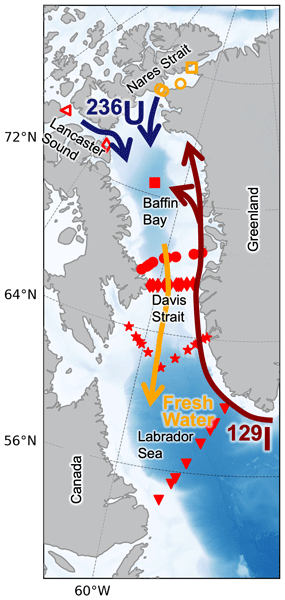
The Arctic and Atlantic Oceans are connected by narrow passages, and the exchange of waters affect global climate. Using artificial radionuclides from nuclear reprocessing discharges, we traced the origin of water masses from the Arctic to the Labrador Sea. Results show that waters from Canadian Arctic origin entering via Lancaster Sound are a key freshwater source to the Labrador Sea. These flows strongly influence the formation of deep waters in the Atlantic, vital for the global circulation.
Zong-Pei Jiang, Fengqin Chen, Wenzhao Liang, Kailang Ma, Chenfeng Le, Yiwen Pan, and Wei-Jun Cai
EGUsphere, https://doi.org/10.5194/egusphere-2026-3034, https://doi.org/10.5194/egusphere-2026-3034, 2026
Short summary
Short summary
Using satellite data and a machine‑learning model, we produced 22-year surface ocean CO2 partial pressure (pCO2) maps for the northern Gulf of Mexico. pCO2 is low in river‑influenced coastal waters because algae consume CO2. Seasonally, pCO2 change follows temperature (high in summer, low in winter), but biological uptake lowers it in spring‑summer, while autumn‑winter vertical mixing raises pCO2. Over 22 years, ocean pCO2 rose slower than atmospheric CO₂, enhancing ocean CO2 uptake.
Marina Lévy, Karina von Schuckmann, Mahé Butel, William W. L. Cheung, Joachim Claudet, Thomas L. Frölicher, Patrice Guillotreau, Peter Haugan, Janine Adams, Diva Amon, Tamatoa Bambridge, Cynthia Barzuna, Bruno Blanke, Lijing Cheng, Sanae Chiba, Jorge Cortés, Pierre Friedlingstein, Jean-Pierre Gattuso, Stefan Gelcich, Jessica Gephart, Deborah Greaves, Audrey Hasson, Claire Jolly, Daoji Li, Yunne-Jai Shin, Aimée Slangen, Mere Takoko, Olivier Thébaud, Adrien Vincent, and Patrick Vincent
State Planet, 7-osr10, 1, https://doi.org/10.5194/sp-7-osr10-1-2026, https://doi.org/10.5194/sp-7-osr10-1-2026, 2026
Short summary
Short summary
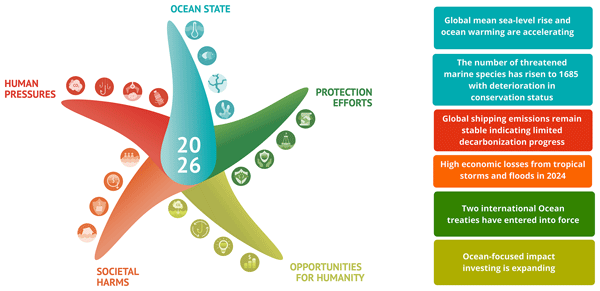
The Starfish Barometer provides an annual, science-based synthesis of global Ocean-related developments, structured around five interconnected dimensions: the Ocean state, human pressures, societal harms, protection efforts, and opportunities for humanity. It is released each year on World Ocean Day. This article presents the second edition of the Barometer, which shows a growing gap between increasing human pressures on the Ocean and the efforts being made to protect it and drive change.
Matthew P. Humphreys, Siv K. Lauvset, Nico Lange, Henry C. Bittig, Brendan R. Carter, Mario Hoppema, Akihiko Murata, Are Olsen, Toste Tanhua, Adam Ulfsbo, Antón Velo, Ryan J. Woosley, Kumiko Azetsu-Scott, Jens D. Müller, and Fiz F. Pérez
EGUsphere, https://doi.org/10.5194/egusphere-2026-3063, https://doi.org/10.5194/egusphere-2026-3063, 2026
Short summary
Short summary
The Global Ocean Data Analysis Project (GLODAP) collects oceanographic datasets from research cruises that are needed to study the marine carbon cycle. The datasets are quality controlled and adjusted where necessary to ensure consistency between cruises, and published as a global data product. Here, we present a new method for calculating the consistency adjustments called ‘furthest-first inversion’ which has been developed for the newest version of the data product.
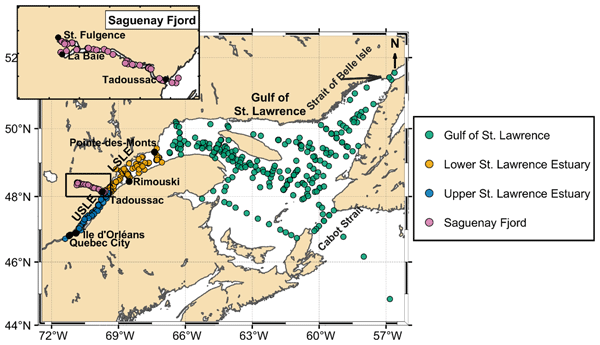
William A. Nesbitt, Alfonso O. Mucci, Toste Tanhua, Yves Gélinas, Jean-Éric Tremblay, Gwénaëlle Chaillou, Ludovic Pascal, Caroline Fradette, Lennart Gerke, Samuel W. Stevens, Mathilde Jutras, Marjolaine Blais, Martine Lizotte, Michel Starr, and Douglas W. R. Wallace
Earth Syst. Sci. Data, 18, 3609–3634, https://doi.org/10.5194/essd-18-3609-2026, https://doi.org/10.5194/essd-18-3609-2026, 2026
Short summary
Short summary
Over the past few decades, the St. Lawrence Estuary and Gulf have shown clear trends in oxygen depletion and acidification. This data description paper brings together twenty years of measurements from the St. Lawrence Estuary, Gulf of St. Lawrence, and Saguenay Fjord, carefully performing quality control procedures on data, and makes them publicly available. The resulting dataset supports future research, monitoring, and environmental management in this sensitive marine system.
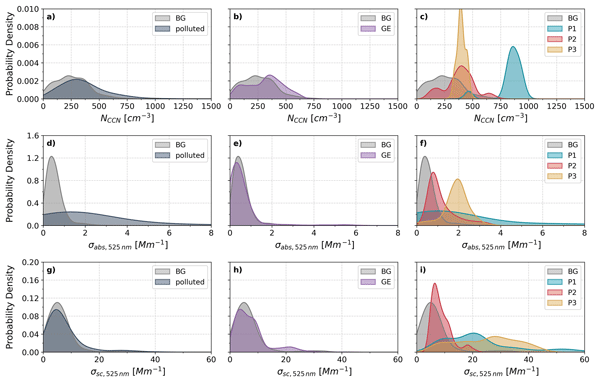
Joanna Alden, Nora Bergner, Benjamin Heutte, Lionel Favre, Mihnea Surdu, Julian Weng, Marta Augugliaro, Patrik Winiger, Berkay Dönmez, Roman Pohorsky, Radiance Calmer, Carmelle Chatterjee, Kalliopi Violaki, Athanasios Nenes, Luke Gregor, Silvia Henning, and Julia Schmale
Atmos. Chem. Phys., 26, 7165–7191, https://doi.org/10.5194/acp-26-7165-2026, https://doi.org/10.5194/acp-26-7165-2026, 2026
Short summary
Short summary
We studied sources, vertical dispersion and properties of aerosols in a Greenlandic fjord system and identified four main types: marine background, local anthropogenic, growth events, biomass burning (BB). Anthropogenic emissions increased absorption coefficients, BB significantly increased the cloud condensation number concentrations, growth events were very similar to background with regards to scattering coefficients. Aerosol properties and origins were distinct throughout the boundary layer.
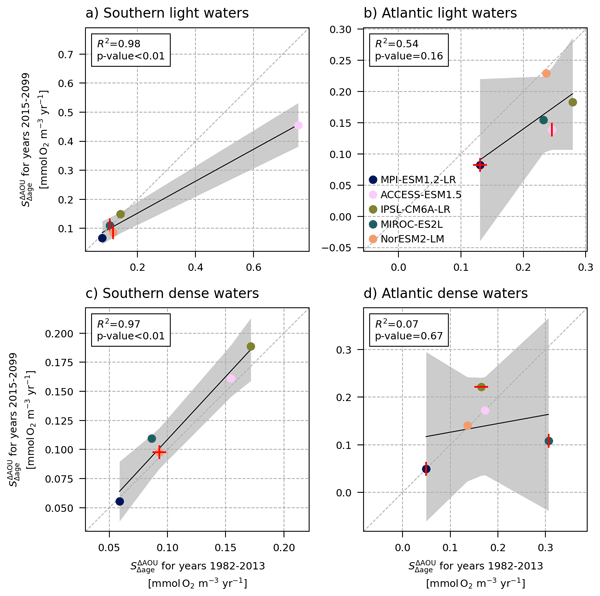
Damien Couespel, Xabier Davila, Nadine Goris, Emil Jeansson, Siv K. Lauvset, and Jerry Tjiputra
Biogeosciences, 23, 3433–3466, https://doi.org/10.5194/bg-23-3433-2026, https://doi.org/10.5194/bg-23-3433-2026, 2026
Short summary
Short summary
Remineralised carbon storage is projected to increase along the 21st century, but the magnitude of increase varies depending on the Earth system models. To constrain projections, we explore the relationship between remineralised carbon and deep ocean circulation. We show that the sensitivity of remineralised carbon to circulation slowdown varies considerably between models. More observational data and a larger model ensemble is needed to constrain projections of remineralised carbon storage.
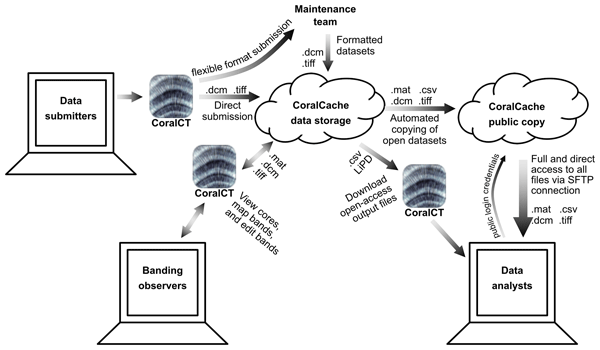
Thomas M. DeCarlo, Oliwia Jasnos, Avi Strange, Andreas Andersson, Angel T. Bautista VII, Sierra Bloomer, Isaiah W. Bolden, Maartje Bosman, Thomas C. Brachert, Giulia B. Braz, Gabriel O. Cardoso, Juan P. Carricart-Ganivet, Jessica E. Carilli, Karl D. Castillo, Leticia Cavole, Sylvia Chan, Xuefei Chen, Ben Chomitz, Thierry Correge, Travis A. Courtney, Mikayla Deigan, Juan Pablo D'Olivo, Robert Dunbar, Ian C. Enochs, Ludmilla Falsarella, Thomas Felis, Gabriela Gutierrez-Estrada, Brighton Hedger, Shijian Hu, Seamus Jameson, Stacy Jupiter, Paul Kench, Diego K. Kersting, Ke Lin, Yi-Wei Liu, Carla A. B. Lorigados, Derek P. Manzello, Malcolm T. McCulloch, Miguel Mies, Rodrigo L. Moura, Ferdinand Oberle, Natan Pereira, Nancy Prouty, Riovie D. Ramos, Haojia Ren, Emma Ryan, Diane M. Thompson, Lauren T. Toth, Marina J. Vergotti, Jody M. Webster, and Jens Zinke
Earth Syst. Sci. Data, 18, 3341–3353, https://doi.org/10.5194/essd-18-3341-2026, https://doi.org/10.5194/essd-18-3341-2026, 2026
Short summary
Short summary
We present CoralCache, a virtual coral core repository with global coverage. This repository fills a key gap by enabling researchers to transparently archive and share the raw core image datasets and the visual interpretations of those images, rather than simply the summarized growth rate data, which on their own cannot be traced or precisely reproduced. CoralCache is designed to meet the data-sharing principles of findability, accessibility, interoperability, and reusability (FAIR).
Yasmina Ourradi, Gert-Jan Reichart, Sonja van Leeuwen, and Matthew P. Humphreys
Biogeosciences, 23, 3323–3346, https://doi.org/10.5194/bg-23-3323-2026, https://doi.org/10.5194/bg-23-3323-2026, 2026
Short summary
Short summary
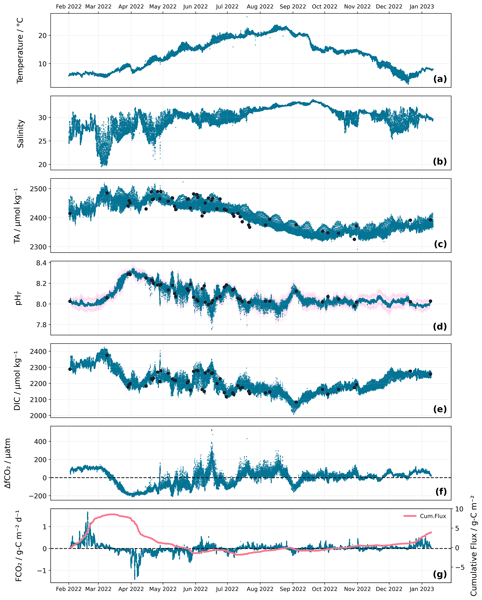
Coastal seas play a key role in the global carbon cycle, yet what drives their carbonate chemistry remains poorly understood. We measured pH at high frequency for a year at the Wadden Sea-North Sea interface. Biological activity drives pH changes, while freshwater inflow shapes total alkalinity. Both processes influence dissolved inorganic carbon. The Wadden Sea acts as a net carbon dioxide source to the atmosphere. High-frequency monitoring is essential under a changing climate.
Pierre Friedlingstein, Michael O'Sullivan, Matthew W. Jones, Robbie M. Andrew, Dorothee C. E. Bakker, Judith Hauck, Peter Landschützer, Corinne Le Quéré, Hongmei Li, Ingrid T. Luijkx, Glen P. Peters, Wouter Peters, Julia Pongratz, Clemens Schwingshackl, Stephen Sitch, Josep G. Canadell, Philippe Ciais, Kjetil Aas, Simone R. Alin, Peter Anthoni, Leticia Barbero, Nicholas R. Bates, Nicolas Bellouin, Alice Benoit-Cattin, Carla F. Berghoff, Raffaele Bernardello, Laurent Bopp, Ida Bagus Mandhara Brasika, Matthew A. Chamberlain, Naveen Chandra, Frédéric Chevallier, Louise P. Chini, Nathan O. Collier, Thomas H. Colligan, Margot Cronin, Laique M. Djeutchouang, Xinyu Dou, Matt P. Enright, Kazutaka Enyo, Michael Erb, Wiley Evans, Richard A. Feely, Liang Feng, Daniel J. Ford, Adrianna Foster, Filippa Fransner, Thomas Gasser, Marion Gehlen, Thanos Gkritzalis, Jefferson Goncalves De Souza, Giacomo Grassi, Luke Gregor, Nicolas Gruber, Bertrand Guenet, Özgür Gürses, Kirsty Harrington, Ian Harris, Jens Heinke, George C. Hurtt, Yosuke Iida, Tatiana Ilyina, Akihiko Ito, Andrew R. Jacobson, Atul K. Jain, Tereza Jarníková, Annika Jersild, Fei Jiang, Steve D. Jones, Etsushi Kato, Ralph F. Keeling, Kees Klein Goldewijk, Jürgen Knauer, Yawen Kong, Jan Ivar Korsbakken, Charles Koven, Taro Kunimitsu, Xin Lan, Junjie Liu, Zhiqiang Liu, Zhu Liu, Claire Lo Monaco, Lei Ma, Gregg Marland, Patrick C. McGuire, Galen A. McKinley, Joe R. Melton, Natalie Monacci, Erwan Monier, Eric J. Morgan, David R. Munro, Jens D. Müller, Shin-Ichiro Nakaoka, Lorna R. Nayagam, Yosuke Niwa, Tobias Nutzel, Are Olsen, Abdirahman M. Omar, Naiqing Pan, Sudhanshu Pandey, Denis Pierrot, Zhangcai Qin, Pierre Regnier, Gregor Rehder, Laure Resplandy, Alizée Roobaert, Thais M. Rosan, Christian Rödenbeck, Jörg Schwinger, Ingunn Skjelvan, T. Luke Smallman, Victoria Spada, Mohanan G. Sreeush, Qing Sun, Adrienne J. Sutton, Colm Sweeney, Didier Swingedouw, Roland Séférian, Shintaro Takao, Hiroaki Tatebe, Hanqin Tian, Xiangjun Tian, Bronte Tilbrook, Hiroyuki Tsujino, Francesco Tubiello, Erik van Ooijen, Guido R. van der Werf, Sebastiaan J. van de Velde, Anthony P. Walker, Rik Wanninkhof, Xiaojuan Yang, Wenping Yuan, Xu Yue, and Jiye Zeng
Earth Syst. Sci. Data, 18, 3211–3288, https://doi.org/10.5194/essd-18-3211-2026, https://doi.org/10.5194/essd-18-3211-2026, 2026
Short summary
Short summary
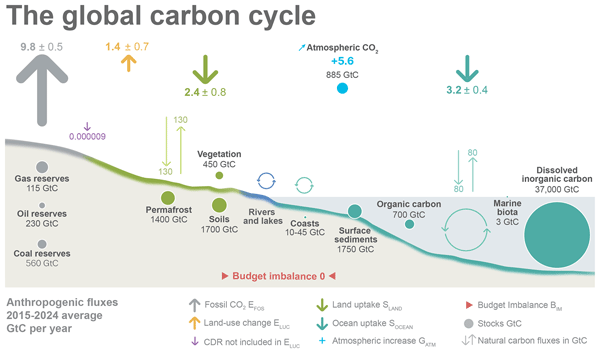
The Global Carbon Budget 2025 describes the methodology, main results, and datasets used to quantify the anthropogenic emissions of carbon dioxide (CO2) and their partitioning among the atmosphere, land ecosystems, and the ocean over the historical period (1750–2025). These living datasets are updated every year to provide the highest transparency and traceability in the reporting of CO2, the key driver of climate change.
Juan Du, Lijing Cheng, Takamitsu Ito, Hernan E. Garcia, Zhankun Wang, Jonathan D. Sharp, Christopher J. Roach, Shoshiro Minobe, Yuntao Zhou, Bin Lu, Gian Giacomo Navarra, and Seth M. Bushinsky
Ocean Sci., 22, 1483–1499, https://doi.org/10.5194/os-22-1483-2026, https://doi.org/10.5194/os-22-1483-2026, 2026
Short summary
Short summary
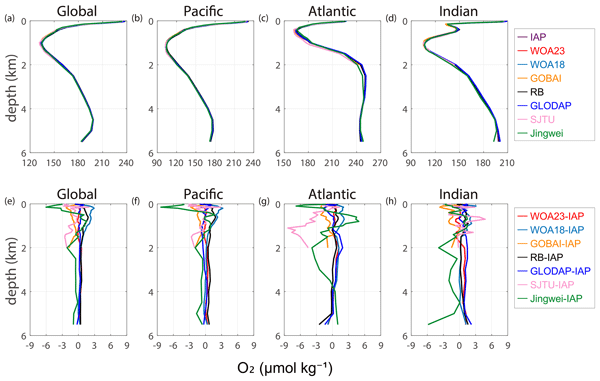
This study assesses the spread of mean state and annual cycle of ocean dissolved oxygen by multiple observational gridded data products. A good consistency is validated globally, although substantial local differences exist in areas of strong spatial gradient. Quantifying the discrepancies could give an insight into regions relatively more sensitive to data reconstruction processes and further advance the improvement of oxygen data products.
Jonathan Rogerson, Alessandro Tagliabue, Agathe Nguyen, Marcello Vichi, Lewis Wrightson, Prima Anugerahanti, Olivier Aumont, and Marion Gehlen
Biogeosciences, 23, 3179–3194, https://doi.org/10.5194/bg-23-3179-2026, https://doi.org/10.5194/bg-23-3179-2026, 2026
Short summary
Short summary
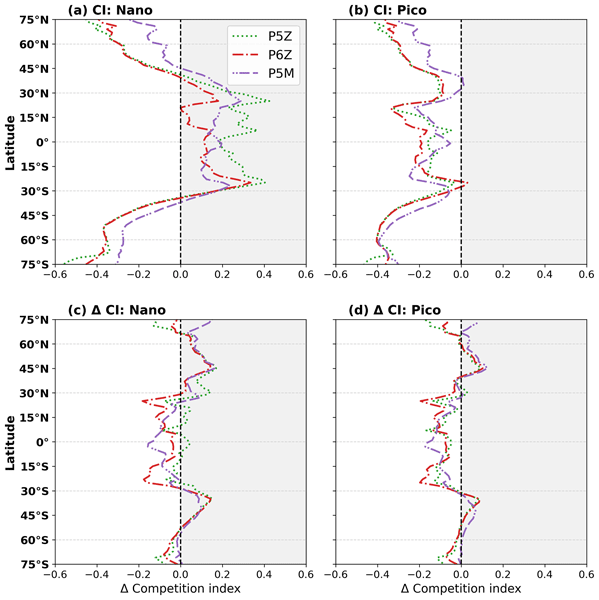
We use five different versions of a biogeochemical model to show that how phytoplankton growth processes are represented strongly shapes projections of future ocean productivity and carbon export. Added model complexity does not have a uniform global effect as some new processes mainly influence specific ocean regions, while others, such as an additional small phytoplankton type, lead to large intramodel differences in future trends and latitudinal patterns of productivity and carbon export.
Lennart Gerke, Toste Tanhua, William A. Nesbitt, Samuel W. Stevens, and Douglas W. R. Wallace
Ocean Sci., 22, 1391–1407, https://doi.org/10.5194/os-22-1391-2026, https://doi.org/10.5194/os-22-1391-2026, 2026
Short summary
Short summary
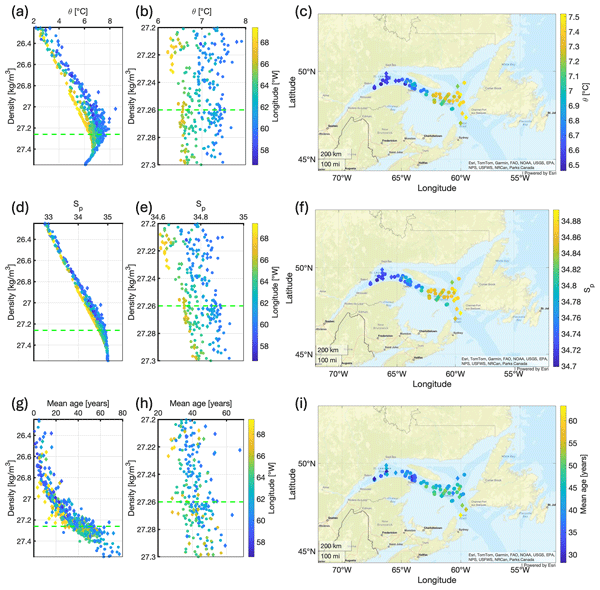
Transient tracer data, measured for the first time in 2022 in the Gulf of St. Lawrence, reveal older deep waters in the east than the west, contrary to expected estuarine circulation, indicating increased influence of older, warmer, less oxygenated North Atlantic Central Water over younger, oxygen-rich Labrador Current Water. While consistent with previous reports of increasing NACW contribution, our results contradict claims of a complete shift to NACW by 2021, showing that LCW still persists.
Luana S. Basso, Goran Georgievski, Victor Brovkin, Christian Beer, Christian Rödenbeck, and Mathias Göckede
Biogeosciences, 23, 2815–2830, https://doi.org/10.5194/bg-23-2815-2026, https://doi.org/10.5194/bg-23-2815-2026, 2026
Short summary
Short summary
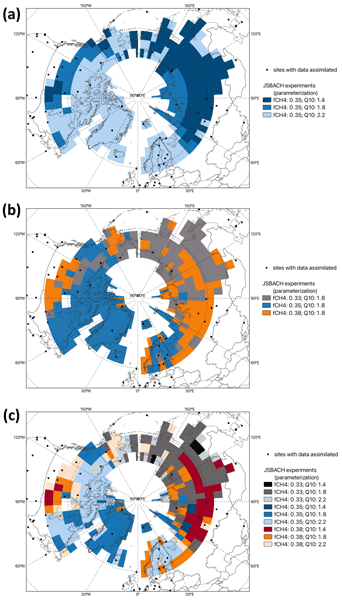
This study examines how combining atmospheric inversion with process-based modelling can reduce discrepancies in estimates of Arctic wetland CH4 emissions. We conducted a series of inversion experiments, each incorporating CH4 wetland fluxes from process-based models with different CH4 production parameterizations. Our results showed that no single parameterization captures the complexity of Arctic–Boreal emissions; instead, region-specific adjustments are needed to reduce discrepancies.
Yuanxu Dong, Christa A. Marandino, Ryo Dobashi, David T. Ho, Gregor Rehder, Henry C. Bittig, Josefine Karnatz, Bita Sabbaghzadeh, Helen Czerski, and Anja Engel
Atmos. Chem. Phys., 26, 5567–5587, https://doi.org/10.5194/acp-26-5567-2026, https://doi.org/10.5194/acp-26-5567-2026, 2026
Short summary
Short summary
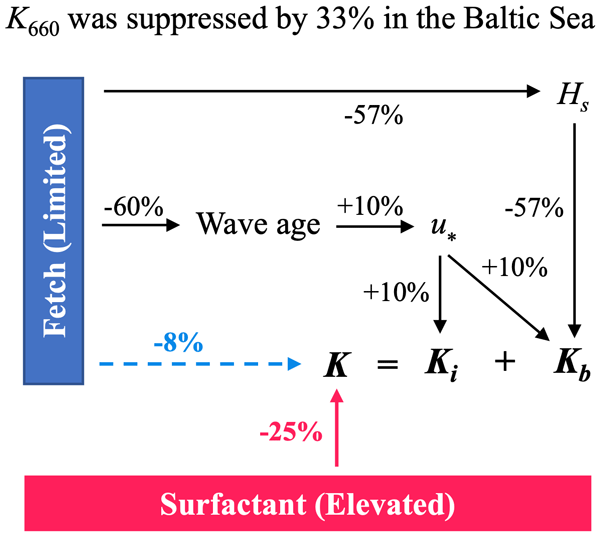
Air-sea gas exchange regulates the Earth’s climate. However, the description of the kinetic exchange process only uses wind speed, neglecting other drivers. In this study, we investigate how fetch and natural surfactants modulate air-sea carbon dioxide exchange. Measurements from the central Baltic Sea show that limited fetch and elevated surfactants significantly suppress this exchange. A new parameterisation is provided, improving regional carbon budgets and evaluations of climate solutions.
Mireia G. Mingote, Frédéric Cyr, Eve Galimany, Ricardo Santos-Bethencourt, Jordi Isern-Fontanet, Jordi Ribera-Altimir, Joan Sala-Coromina, Mariona Panisello-Garriga, and Joan B. Company
EGUsphere, https://doi.org/10.5194/egusphere-2026-1554, https://doi.org/10.5194/egusphere-2026-1554, 2026
This preprint is open for discussion and under review for Biogeosciences (BG).
Short summary
Short summary
We studied more than fifty years of Norway lobster catches in the northwestern Mediterranean to understand why they have dropped since the mid 2010s. By combining fishing records with ocean data, we found that warmer and saltier mid-depth waters are strongly linked to lower catches and slight shifts to deeper areas. Changes in ocean currents also play a role. These results show that climate change, not just fishing, is affecting this resource and should be included in management decisions.
Nicolas Metzl, Bronte Tilbrook, John Akl, Craig Neill, Alexandra Aymard, Claire Lo Monaco, Gilles Reverdin, Jean-Baptiste Sallée, Aude Barton, Frédéric Chevallier, and Marion Gehlen
EGUsphere, https://doi.org/10.5194/egusphere-2026-1664, https://doi.org/10.5194/egusphere-2026-1664, 2026
Short summary
Short summary
Ocean acidification is explored in the Adélie Land coastal region in East Antarctica. The region is a permanent CO2 sink leading to a positive increase of total CO2 concentrations and to a progressive decrease of pH and aragonite Ωar. The lowest surface Ωar of 1.2 was observed in winter 2024, a critical limit for some marine species such as pteropod. A projection in the future suggests that aragonite saturation state will occur as soon as 2055 in the Adélie Land region.
Cecilia Äijälä, Lucía Gutiérrez-Loza, Wolfgang Dorn, Siv K. Lauvset, Wieslaw Maslowski, and Petteri Uotila
EGUsphere, https://doi.org/10.5194/egusphere-2026-1849, https://doi.org/10.5194/egusphere-2026-1849, 2026
Short summary
Short summary
This study compares coupled ocean–atmosphere models, reanalyses, and satellite data for 1991–2020 in the Barents and Kara Seas, where Arctic sea‑ice loss has been greatest. The results evaluate how well these products asses sea ice and ocean temperature. Reanalyses and satellites show strong sea‑ice decline, while models show little or none – only HIRHAM‑NAOSIM shows a weak decline in the Barents Sea. Reanalyses also indicate stronger mixed‑layer warming then the models, especially in autumn.
Raphaël Bajon, Lidia I. Carracedo, Herlé Mercier, Rémy Asselot, and Fiz F. Pérez
Biogeosciences, 23, 2335–2363, https://doi.org/10.5194/bg-23-2335-2026, https://doi.org/10.5194/bg-23-2335-2026, 2026
Short summary
Short summary
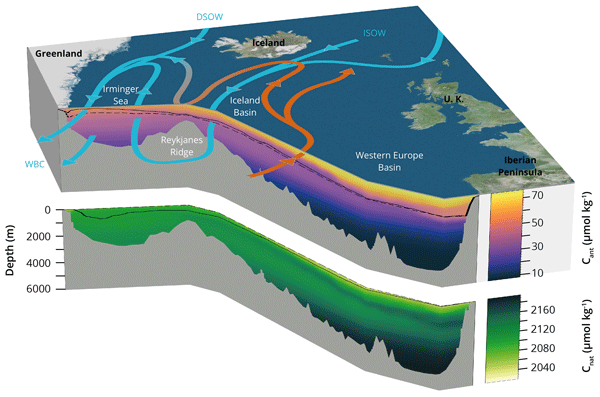
We analyzed three decades of carbon concentration and transport in the subpolar gyre of the North Atlantic Ocean, a key region in ocean carbon cycle. Natural carbon remained stable, but human-derived carbon rose by over 30 %. Upper layers exhibit strong seasonal to interannual variability driven by physical and biological processes. Carbon transport was tightly linked to circulation patterns. In the longterm, transport of human-derived carbon is proportional to the increase in its concentration.
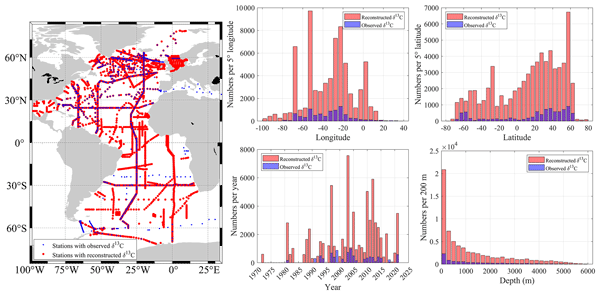
Hui Gao, Zelun Wu, Zhentao Sun, Diana Cai, Meibing Jin, and Wei-Jun Cai
Earth Syst. Sci. Data, 18, 2443–2467, https://doi.org/10.5194/essd-18-2443-2026, https://doi.org/10.5194/essd-18-2443-2026, 2026
Short summary
Short summary
Observations of stable carbon isotopes in dissolved inorganic carbon are sparse, limiting their potential in carbon cycle studies. We compiled 51 cruises and used a machine learning method trained on 37 cruises that passed secondary quality control to reconstruct isotope values in the Atlantic. The reconstruction expands usable samples from 8,941 to 68,435, reducing noise, filling gaps, preserving decadal trend, and strengthening studies of carbon variability and model validation.
Alexandre Schickele, Hadrien Savioz, Nicolas Gruber, Lionel Guidi, Jean-Olivier Irisson, and Meike Vogt
EGUsphere, https://doi.org/10.1101/2025.10.28.685123, https://doi.org/10.1101/2025.10.28.685123, 2026
Short summary
Short summary
By regulating the ocean nitrogen cycle, microbial plankton recycle nutrients and sustain productivity. Using global genetic data, we mapped where prokaryotes have the potential to carry out key nitrogen transformations. We show that this potential is structured by metabolic requirements, and environmental factors such as oxygen and nutrients concentrations. This reveals how microbial communities shape nitrogen processes and provides new insights to better represent them in global ocean models.
Fabian Maier, Christian Rödenbeck, Ute Karstens, Frank-Thomas Koch, Maksym Gachkivskyi, Andrew Smerald, and Christoph Gerbig
EGUsphere, https://doi.org/10.5194/egusphere-2026-739, https://doi.org/10.5194/egusphere-2026-739, 2026
Short summary
Short summary
Transport model errors represent a major source of uncertainty in greenhouse gas flux estimates derived from inverse modelling, yet they remain challenging to quantify. In our study, we leverage the similarities in the atmospheric transport of methane (CH4) and radon (222Rn) by performing a dual-tracer CH4-222Rn inversion over Europe, with the goal of enhancing the reliability of CH4 flux estimates. We discuss the benefits and limitations of this dual-tracer approach.
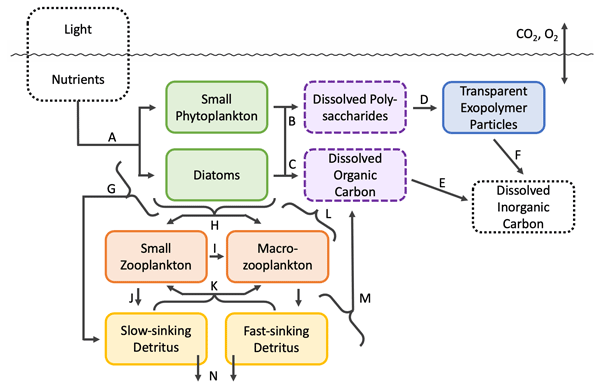
Moritz Zeising, Laurent Oziel, Silke Thoms, Özgür Gürses, Judith Hauck, Bernd Heinold, Svetlana N. Losa, Manuela van Pinxteren, Christoph Völker, Sebastian Zeppenfeld, and Astrid Bracher
Geosci. Model Dev., 19, 2077–2109, https://doi.org/10.5194/gmd-19-2077-2026, https://doi.org/10.5194/gmd-19-2077-2026, 2026
Short summary
Short summary
We assess the implementation of additional organic carbon pathways into a global setup of a numerical model, which simulates the ocean circulation, sea ice, and biogeochemical processes. With a focus on the Arctic Ocean, this model tracks the temporal and spatial dynamics of phytoplankton, exudation of organic carbon, and its aggregation to so-called transparent exopolymer particles. We evaluate the simulation using measurements from ship-based and remote-sensing campaigns in the Arctic Ocean.

Hinne F. van der Zant, Olivier Sulpis, Jack J. Middelburg, Matthew P. Humphreys, Raphaël Savelli, Dustin Carroll, Dimitris Menemenlis, Kay Sušelj, and Vincent Le Fouest
Geosci. Model Dev., 19, 1965–1989, https://doi.org/10.5194/gmd-19-1965-2026, https://doi.org/10.5194/gmd-19-1965-2026, 2026
Short summary
Short summary
We developed a model to simulate seafloor biogeochemical processes across a wide range of marine environments, from shallow coastal zones to deep-sea sediments. From this model, we derived a set of simple equations that predict how carbon, oxygen, and alkalinity are exchanged between sediments and overlying waters. These equations provide an efficient way to improve how ocean models represent seafloor interactions, which are often missing or overly simplified.
Helene A. L. Hollitzer, Laurent Bopp, and Jens Terhaar
EGUsphere, https://doi.org/10.5194/egusphere-2026-683, https://doi.org/10.5194/egusphere-2026-683, 2026
Short summary
Short summary
Due to its vast coastline, the Arctic Ocean receives large amounts of carbon and nutrients from land, yet the impact of these inputs on ocean acidification remains poorly quantified. Using an ocean biogeochemical model, we show that these inputs affect the intensity, vertical structure, and seasonal cycle of acidification. River inputs generally reduce acidification, whereas the coastal erosion intensifies it, emphasizing the value of including these inputs in future Arctic modeling efforts.

Jonathan Coyne, Frédéric Cyr, Sheila Atchison, Charlie Bishop, Sébastien Donnet, Peter S. Galbraith, Maxime Geoffroy, David Hebert, Chantelle Layton, Andry Ratsimandresy, Jose-Luis del Rio Iglesias, Jean-Luc Shaw, Stephen Snook, Nancy Soontiens, Elena Tel, and Wojciech Walkusz
Earth Syst. Sci. Data, 18, 1463–1488, https://doi.org/10.5194/essd-18-1463-2026, https://doi.org/10.5194/essd-18-1463-2026, 2026
Short summary
Short summary
As part of the new Fisheries Act, Fisheries and Oceans Canada (DFO) has made it a priority to make oceanographic data publicly available. The Canadian Atlantic Shelf Temperature-Salinity (CASTS) aims to address this priority, by creating an open-access data product that includes most of the historical temperature and salinity profiles in Atlantic Canada and its Arctic gateways since 1873.

Irene Sánchez-Mendoza, Melchor González-Dávila, David González-Santana, David Curbelo-Hernández, David Estupiñán-Santana, Aridane G. González, and J. Magdalena Santana-Casiano
Ocean Sci., 22, 609–628, https://doi.org/10.5194/os-22-609-2026, https://doi.org/10.5194/os-22-609-2026, 2026
Short summary
Short summary
Satellite and machine-learning methods now allow monitoring of pCO2,sw and acidity. Using ship and buoy data at the Canary Islands from 2019–2024, models (especially bagging) estimated CO2 and pH with high accuracy. Results show rapidly rising ocean CO2 and increasing acidification, driven by higher atmospheric CO2 and warming, including the 2023 marine heatwave. The region shifted from a weak CO2 sink to a strong source by 2024.

Fiz F. Pérez, Marta López-Mozos, Marcos Fontela, Maribel I. García-Ibáñez, Noelia Fajar, Xosé Antonio Padín, Mónica Castaño-Carrera, Mercedes de la Paz, Lidia I. Carracedo, Marta Álvarez, Herlé Mercier, Pascale Lherminier, and Antón Velo
Earth Syst. Sci. Data, 18, 801–821, https://doi.org/10.5194/essd-18-801-2026, https://doi.org/10.5194/essd-18-801-2026, 2026
Short summary
Short summary
Ocean acidification threatens marine ecosystems and the climate and is commonly assessed through ocean pH measurements. This study provides a new twenty-year dataset of pH measurements from the North Atlantic, derived from the correction and reevaluation of both historical and recent pH measurements affected by methodological bias. This revised dataset enables a more accurate reassessment of pH trends and carbon variables under novel and updated methodological standards.

Raphaël Savelli, Dustin Carroll, Dimitris Menemenlis, Jonathan M. Lauderdale, Clément Bertin, Stephanie Dutkiewicz, Manfredi Manizza, A. Anthony Bloom, Karel Castro-Morales, Charles E. Miller, Marc Simard, Kevin W. Bowman, and Hong Zhang
Geosci. Model Dev., 19, 867–885, https://doi.org/10.5194/gmd-19-867-2026, https://doi.org/10.5194/gmd-19-867-2026, 2026
Short summary
Short summary
Accounting for carbon and nutrients in rivers is essential for resolving carbon dioxide (CO2) exchanges between the ocean and the atmosphere. In this study, we add the effect of present-day rivers to a pioneering global-ocean biogeochemistry model. This study highlights the challenge for global ocean numerical models to cover the complexity of the flow of water and carbon across the Land-to-Ocean Aquatic Continuum.
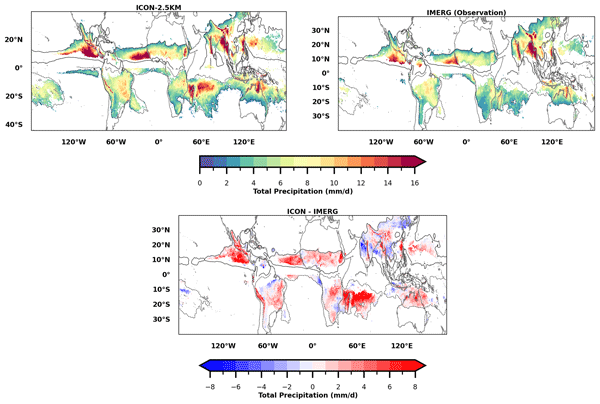
Anurag Dipankar, Mauro Bianco, Mona Bukenberger, Till Ehrengruber, Nicoletta Farabullini, Oliver Fuhrer, Abishek Gopal, Daniel Hupp, Andreas Jocksch, Samuel Kellerhals, Clarissa A. Kroll, Xavier Lapillonne, Matthieu Leclair, Magdalena Luz, Christoph Müller, Chia Rui Ong, Carlos Osuna, Praveen Pothapakula, Andreas Prein, Matthias Röthlin, William Sawyer, Christoph Schär, Sebastian Schemm, Giacomo Serafini, Hannes Vogt, Ben Weber, Robert C. Jnglin Wills, Nicolas Gruber, and Thomas C. Schulthess
Geosci. Model Dev., 19, 713–729, https://doi.org/10.5194/gmd-19-713-2026, https://doi.org/10.5194/gmd-19-713-2026, 2026
Short summary
Short summary
Climate models are becoming more detailed and accurate by simulating weather at scales of just a few kilometers. Simulating at km-scale is computationally demanding requiring powerful supercomputers and efficient code. This work presents a refactored dynamical core of a state-of-the-art climate model using a Python-based approach. The refactored code has passed through a sequence of verification and validation demonstrating its usability in performing km-scale global simulations.

Rachael N. C. Sanders, Elaine L. McDonagh, Siv K. Lauvset, Charles E. Turner, Thomas W. N. Haine, Nadine Goris, and Richard Sanders
Ocean Sci., 22, 225–240, https://doi.org/10.5194/os-22-225-2026, https://doi.org/10.5194/os-22-225-2026, 2026
Short summary
Short summary
Oxygen is essential to marine life, but the amount of oxygen in the ocean has been decreasing in recent decades. Using observations of oxygen concentration interpolated across a section of the subtropical North Atlantic Ocean, we show that deoxygenation in the region is primarily driven by an increase in oxygen being consumed during remineralisation of organic matter. The impact of this is strongest at depths of around 600 m, where the process drives up to 70 % of the total deoxygenation.
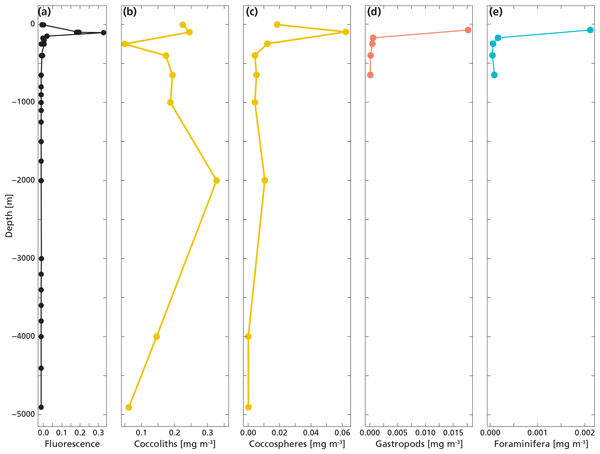
Anne L. Kruijt, Robin van Dijk, Olivier Sulpis, Luc Beaufort, Guillaume Lassus, Geert-Jan Brummer, A. Daniëlle van der Burg, Ben A. Cala, Yasmina Ourradi, Katja T. C. A. Peijnenburg, Matthew P. Humphreys, Sonia Chaabane, Appy Sluijs, and Jack J. Middelburg
Biogeosciences, 23, 531–563, https://doi.org/10.5194/bg-23-531-2026, https://doi.org/10.5194/bg-23-531-2026, 2026
Short summary
Short summary
We measured the three main types of plankton that produce calcium carbonate in the ocean, at the same time and location. While coccolithophores were the biggest contributors, we found that planktonic gastropods, not foraminifera, were the second largest contributor. This challenges the current view and improves our understanding of how these organisms influence oceans’ carbon cycling.
Arnaud Laurent, Bin Wang, Dariia Atamanchuk, Subhadeep Rakshit, Kumiko Azetsu-Scott, Chris Algar, and Katja Fennel
Biogeosciences, 23, 115–135, https://doi.org/10.5194/bg-23-115-2026, https://doi.org/10.5194/bg-23-115-2026, 2026
Short summary
Short summary
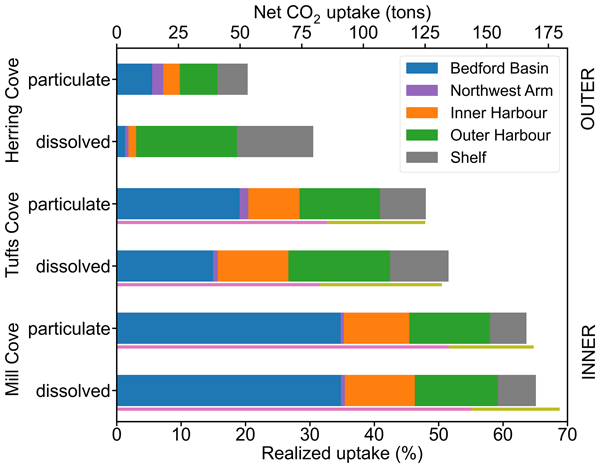
Surface ocean alkalinity enhancement, through the release of alkaline materials, is a technology that could increase the storage of anthropogenic carbon in the ocean. Halifax Harbour (Canada) is a current test site for operational alkalinity addition. Here, we present a model of Halifax Harbour that simulates alkalinity addition at various locations of the harbour and quantifies the resulting net CO2 uptake. The model can be relocated to study alkalinity addition in other coastal systems.
Jean-Francois Lamarque, Pierre Friedlingstein, Brian Osias, Steve Strongin, Venkatramani Balaji, Kevin W. Bowman, Josep G. Canadell, Philippe Ciais, Heidi Cullen, Kenneth J. Davis, Scott C. Doney, Kevin R. Gurney, Alicia R. Karspeck, Charles D. Koven, Galen McKinley, Glen P. Peters, Julia Pongratz, Britt Stephens, and Colm Sweeney
EGUsphere, https://doi.org/10.5194/egusphere-2025-6457, https://doi.org/10.5194/egusphere-2025-6457, 2026
Short summary
Short summary
This Perspective highlights requirements to scale the carbon credit market and enable the growth in climate solutions funded through such market. The requirements are on the understanding of the value of the proposed carbon credit projects, and on the availability of a verification system. This verification becomes particularly relevant as the carbon credit market scales to significant impacts on CO2 (or other greenhouse gases), such that attribution to collective actions can be identified.
Yuming Jin, Britton B. Stephens, Eric J. Morgan, Manfredi Manizza, and Jonathan Sharp
Earth Syst. Sci. Data Discuss., https://doi.org/10.5194/essd-2025-738, https://doi.org/10.5194/essd-2025-738, 2025
Revised manuscript under review for ESSD
Short summary
Short summary
We produce monthly air-sea O2 flux estimates (2004–2024) on a 1°×1° grid using machine learning-based dissolved oxygen fields (GOBAI-O2, Sharp et al., 2023). Fluxes are calculated with multiple gas exchange schemes and wind products, then constrained to match independent regional to global annual mean fluxes estimates. We evaluate flux seasonal cycles and annual patterns against atmospheric O2 observations and quantify flux uncertainties from multiple sources.
Tatsuki Tokoro, Shin-Ichiro Nakaoka, Shintaro Takao, Shu Saito, Daisuke Sasano, Kazutaka Enyo, Masao Ishii, Naohiro Kosugi, Tsuneo Ono, Kazuaki Tadokoro, and Yukihiro Nojiri
Biogeosciences, 22, 7709–7724, https://doi.org/10.5194/bg-22-7709-2025, https://doi.org/10.5194/bg-22-7709-2025, 2025
Short summary
Short summary
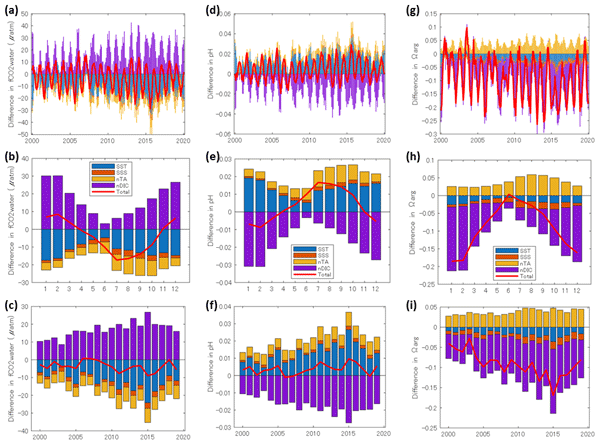
We studied how riverine water from the mainland of Japan affects the ocean's carbon cycle using decades of Total Alkalinity (TA) data from the Northwest Pacific. Statistical analysis revealed riverine water as a major TA source, reducing coastal acidification by 71 %, but with minimal impact on pH and atmospheric CO2 absorption. Future work aims to refine results with depth-specific data and apply findings to global models.
Anne-Marie Wefing, Annabel Payne, Marcel Scheiwiller, Christof Vockenhuber, Marcus Christl, Toste Tanhua, and Núria Casacuberta
Ocean Sci., 21, 3311–3340, https://doi.org/10.5194/os-21-3311-2025, https://doi.org/10.5194/os-21-3311-2025, 2025
Short summary
Short summary
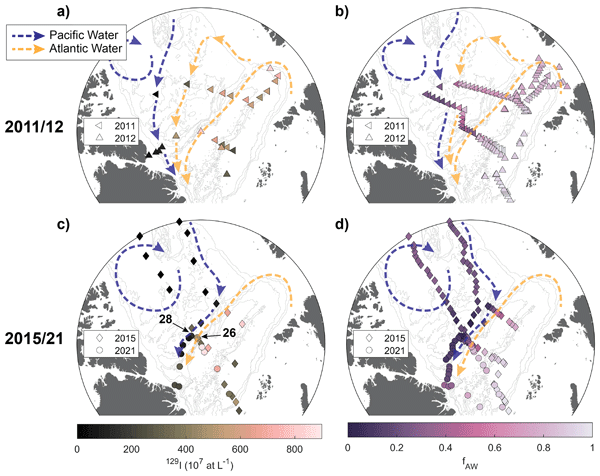
Here we used the anthropogenic radionuclides I-129 and U-236 as tracers for Atlantic Water circulation in the Arctic Ocean. New data collected in 2021 allowed to assess the distribution of Atlantic Water and mixing with Pacific-origin water in the surface layer in that year. By using historical tracer data from 2011 to 2021, we looked into temporal changes of the circulation and found slightly older waters in the central Arctic Ocean in 2021 compared to 2015.
Matthew P. Humphreys and Sharyn Ossebaar
Ocean Sci., 21, 3123–3130, https://doi.org/10.5194/os-21-3123-2025, https://doi.org/10.5194/os-21-3123-2025, 2025
Short summary
Short summary
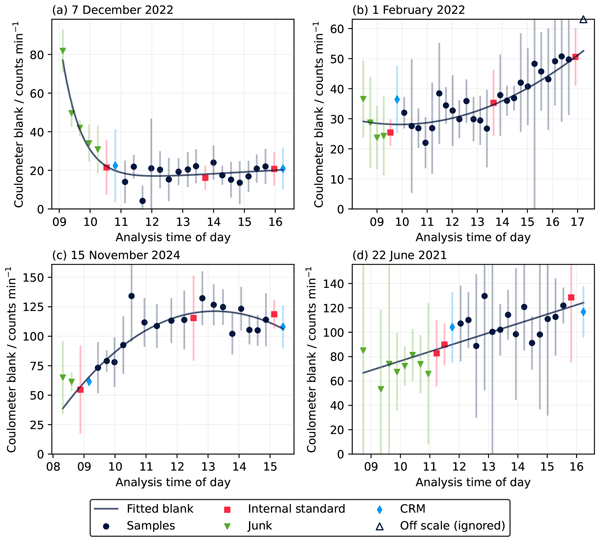
The ocean is one of the main reservoirs of carbon dioxide (CO2) on Earth's surface, so it plays an important role in modulating the climate. In this paper, we propose an update to how dissolved CO2 in seawater is determined from laboratory data, which can sometimes improve the accuracy of these measurements.
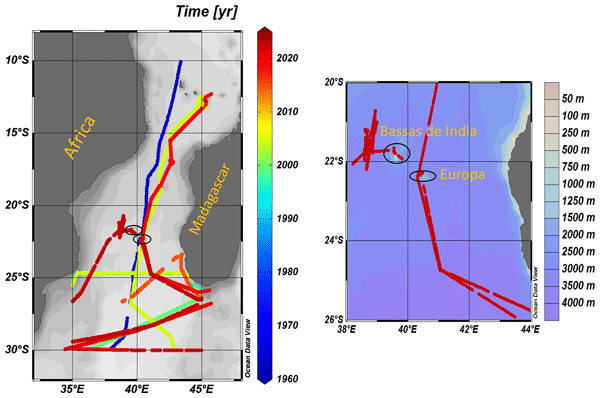
Nicolas Metzl, Claire Lo Monaco, Aline Tribollet, Jean-François Ternon, Frédéric Chevallier, and Marion Gehlen
Biogeosciences, 22, 7187–7204, https://doi.org/10.5194/bg-22-7187-2025, https://doi.org/10.5194/bg-22-7187-2025, 2025
Short summary
Short summary
In the Mozambique Channel, observed acceleration of the ocean acidification in the recent decades is mainly driven by anthropogenic CO2 uptake. In this region the aragonite saturation state reached 3.2 in 2025 and could be as low as 3 in the next 10 years with potential impact on marine ecosystem including corals reefs areas.
Germain Bénard, Marion Gehlen, and Mathieu Vrac
EGUsphere, https://doi.org/10.5194/egusphere-2025-4680, https://doi.org/10.5194/egusphere-2025-4680, 2025
Preprint archived
Short summary
Short summary
Climate change is transforming ocean ecosystem dynamics. We used causality methods to study how the relationships between ocean physics and biogeochemistry will change in the North Atlantic over the next century. By analyzing five different climate models, we discovered that environmental drivers' influence on ocean productivity evolves in complex ways under global warming. One environmental driver can become of major importance while others can become irrelevant.
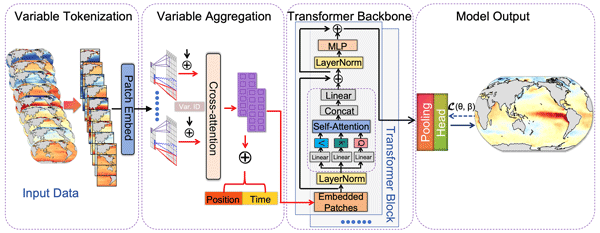
Xueying Zhang, Enhui Liao, Wenfang Lu, Zelun Wu, Guansuo Wang, Xueming Zhu, and Shiyu Liang
Earth Syst. Sci. Data, 17, 6071–6095, https://doi.org/10.5194/essd-17-6071-2025, https://doi.org/10.5194/essd-17-6071-2025, 2025
Short summary
Short summary
We created a new global dataset that reveals how ocean surface carbon dioxide has changed each month over the past four decades. By applying a deep learning model trained on both observational data and model simulations, we improved the representation of interannual variability and more accurately captured ocean responses to climate events like El Niño. This work supports global efforts to understand the ocean’s role in the carbon cycle and its response to climate change.
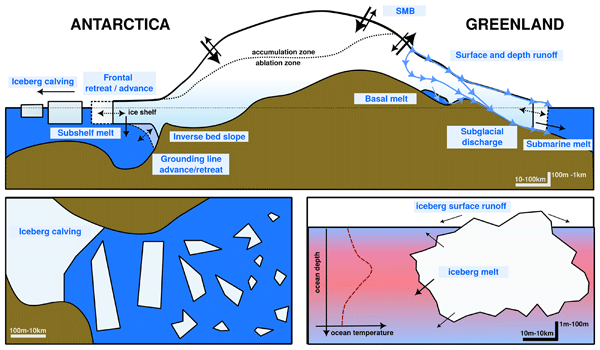
Gavin A. Schmidt, Kenneth D. Mankoff, Jonathan L. Bamber, Clara Burgard, Dustin Carroll, David M. Chandler, Violaine Coulon, Benjamin J. Davison, Matthew H. England, Paul R. Holland, Nicolas C. Jourdain, Qian Li, Juliana M. Marson, Pierre Mathiot, Clive R. McMahon, Twila A. Moon, Ruth Mottram, Sophie Nowicki, Anna Olivé Abelló, Andrew G. Pauling, Thomas Rackow, and Damien Ringeisen
Geosci. Model Dev., 18, 8333–8361, https://doi.org/10.5194/gmd-18-8333-2025, https://doi.org/10.5194/gmd-18-8333-2025, 2025
Short summary
Short summary
The impact of increasing mass loss from the Greenland and Antarctic ice sheets has not so far been included in historical climate model simulations. This paper describes the protocols and data available for modeling groups to add this anomalous freshwater to their ocean modules to better represent the impacts of these fluxes on ocean circulation, sea ice, salinity and sea level.
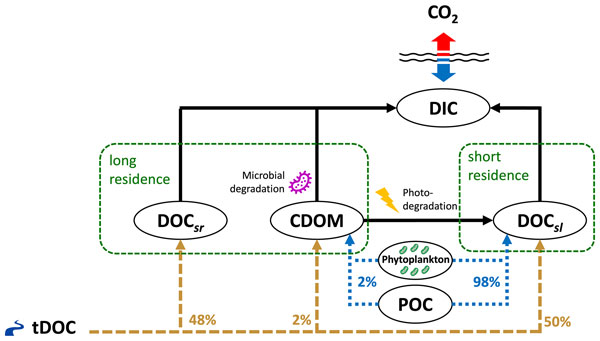
Clément Bertin, Vincent Le Fouest, Dustin Carroll, Stephanie Dutkiewicz, Dimitris Menemenlis, Atsushi Matsuoka, Manfredi Manizza, and Charles E. Miller
Biogeosciences, 22, 6607–6629, https://doi.org/10.5194/bg-22-6607-2025, https://doi.org/10.5194/bg-22-6607-2025, 2025
Short summary
Short summary
We adjusted a model of the Mackenzie River region to account for the riverine export of organic matter that affects light in the water. We show that such export causes a delay in the phytoplankton growth by two weeks and raises the water surface temperature by 1.7 °C. We found that temperature increase turns this coastal region from a sink of carbon dioxide to an emitter. Our findings suggest that rising exports of organic matter can significantly affect the carbon cycle in Arctic coastal areas.
Carlos A. Sierra, Ingrid Chanca, Meinrat O. Andreae, Alessandro Carioca de Araújo, Hella van Asperen, Lars Borchardt, Santiago Botía, Luiz Antonio Candido, Caio S. C. Correa, Cléo Quaresma Dias-Junior, Markus Eritt, Annica Fröhlich, Luciana V. Gatti, Marcus Guderle, Samuel Hammer, Martin Heimann, Viviana Horna, Armin Jordan, Steffen Knabe, Richard Kneißl, Jost Valentin Lavric, Ingeborg Levin, Kita Macario, Juliana Menger, Heiko Moossen, Carlos Alberto Quesada, Michael Rothe, Christian Rödenbeck, Yago Santos, Axel Steinhof, Bruno Takeshi, Susan Trumbore, and Sönke Zaehle
Earth Syst. Sci. Data, 17, 5871–5884, https://doi.org/10.5194/essd-17-5871-2025, https://doi.org/10.5194/essd-17-5871-2025, 2025
Short summary
Short summary
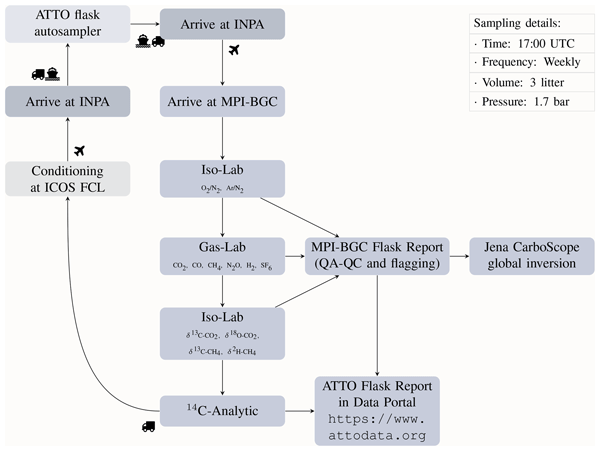
We present here a unique dataset of atmospheric observations of greenhouse gases and isotopes that provide key information on land-atmosphere interactions for the Amazon forests of central Brazil. The data show a relatively large level of variability, but also important trends in greenhouse gases, and signals from fires as well as seasonal biological activity.
Daisy D. Pickup, Dorothee C. E. Bakker, Karen J. Heywood, Francis Glassup, Emily M. Hammermeister, Sharon E. Stammerjohn, Gareth A. Lee, Socratis Loucaides, Bastien Y. Queste, Benjamin G. M. Webber, and Patricia L. Yager
Ocean Sci., 21, 2727–2741, https://doi.org/10.5194/os-21-2727-2025, https://doi.org/10.5194/os-21-2727-2025, 2025
Short summary
Short summary
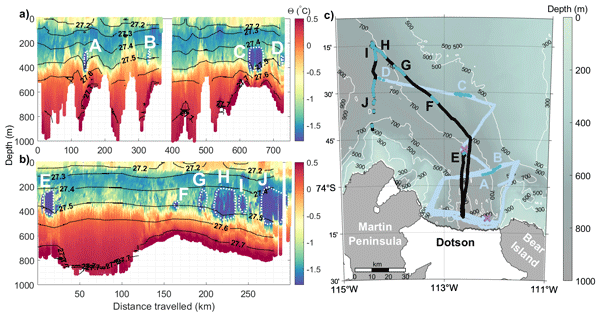
Autonomous platforms in the Amundsen Sea have allowed for detection of isolated water masses that are colder, saltier and denser than overlying water. They are also associated with a higher dissolved inorganic carbon concentration and lower pH. The water masses, referred to as lenses, could have implications for the transfer of heat and storage of carbon in the region. We hypothesise that they form in surrounding areas that experience intense cooling and sea ice formation in autumn/winter.
Don P. Chambers, Jennifer Bonin, Adrienne Sutton, Roman Battisti, Stacy Maenner, Veronica Tamsitt, and Nancy Williams
Earth Syst. Sci. Data, 17, 5641–5654, https://doi.org/10.5194/essd-17-5641-2025, https://doi.org/10.5194/essd-17-5641-2025, 2025
Short summary
Short summary
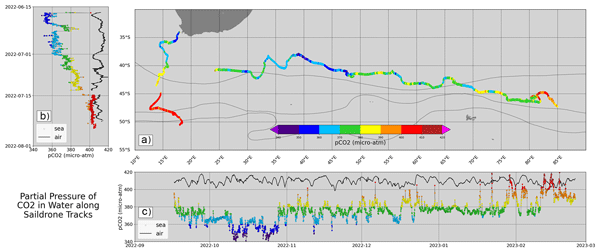
Two Uncrewed Surface Vehicles (USVs) collected observations of ocean/atmosphere pCO2 in 2022–2023 in the South Indian Ocean. The primary goal of the mission was to collect data within cyclonic and anticyclonic eddies during Austral Winter along the Polar Front. Unfortunate issues with the vehicles led to observations being collected in the spring and summer months and north of the Polar Front. Twelve eddies were sampled, but no meaningful relationship between pCO2 anomalies and eddies was found.
Miriam Seifert, Christopher Danek, Christoph Völker, and Judith Hauck
Biogeosciences, 22, 5897–5919, https://doi.org/10.5194/bg-22-5897-2025, https://doi.org/10.5194/bg-22-5897-2025, 2025
Short summary
Short summary
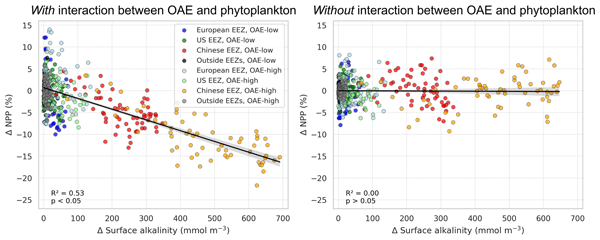
Ocean alkalinity enhancement (OAE) can help to remove CO2 from the atmosphere. Yet, our study is the first to investigate the link between OAE and phytoplankton in an Earth system model. We show that OAE can indirectly decrease primary production and that biological feedbacks can modify the efficiency of OAE. Our study provides hints for ecological risks of OAE and the quantification of carbon drawdown and can serve as a kick start for other models to consider OAE–ecosystem interactions.
Ben A. Cala, Mariette Wolthers, Olivier Sulpis, Jonathan D. Sharp, and Matthew P. Humphreys
EGUsphere, https://doi.org/10.5194/egusphere-2025-5059, https://doi.org/10.5194/egusphere-2025-5059, 2025
Preprint archived
Short summary
Short summary
Magnesium calcites are minerals produced by some marine organisms. Understanding how these minerals dissolve helps us to predict how the ocean stores carbon. We developed a new method to calculate the solubility of these minerals in seawater, using existing laboratory data and taking into account the effects of temperature, salinity and pressure. Applying this method globally, we found that magnesium calcites dissolve deeper than previously thought.
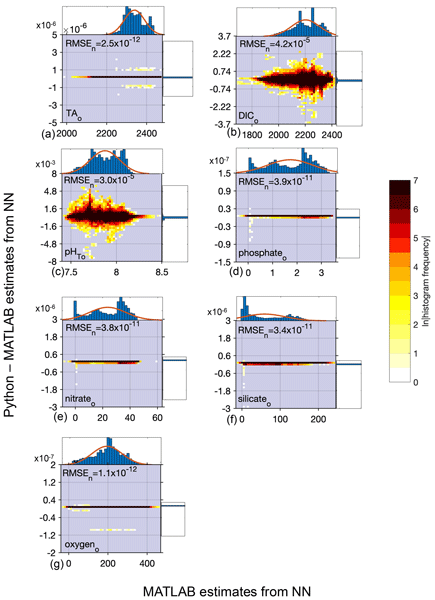
Larissa M. Dias and Brendan R. Carter
Geosci. Model Dev., 18, 7275–7295, https://doi.org/10.5194/gmd-18-7275-2025, https://doi.org/10.5194/gmd-18-7275-2025, 2025
Short summary
Short summary
The increasing availability of oceanographic physical and chemical data necessitates accompanying methods for optimizing use of these data. This project produced algorithms (PyESPERs) for estimating biogeochemical seawater properties in Python, a freely available coding language. These algorithms were based on empirical seawater property estimation routines (ESPERs), which were originally written in the proprietary MATLAB coding language and can be used in studies of marine carbonate chemistry.
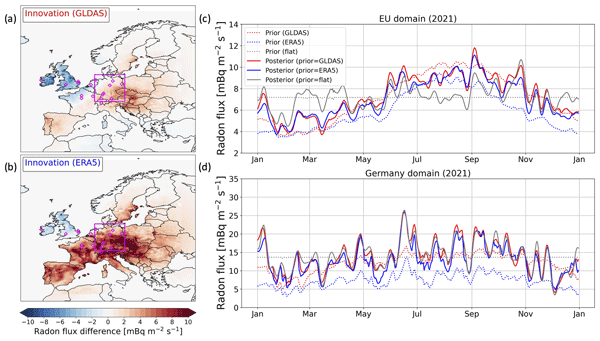
Fabian Maier, Eva Falge, Maksym Gachkivskyi, Stephan Henne, Ute Karstens, Dafina Kikaj, Ingeborg Levin, Alistair Manning, Christian Rödenbeck, and Christoph Gerbig
Atmos. Chem. Phys., 25, 12779–12809, https://doi.org/10.5194/acp-25-12779-2025, https://doi.org/10.5194/acp-25-12779-2025, 2025
Short summary
Short summary
The radioactive noble gas radon (222Rn) is a suitable natural tracer for atmospheric transport and mixing processes that can be used to validate and calibrate atmospheric transport models. However, this requires accurate estimates of the 222Rn flux from the soil into the atmosphere. In our study, we evaluate the reliability of process-based 222Rn flux maps for Europe using a 222Rn inversion. Our inversion results can give some indications on how to improve the process-based 222Rn flux maps.
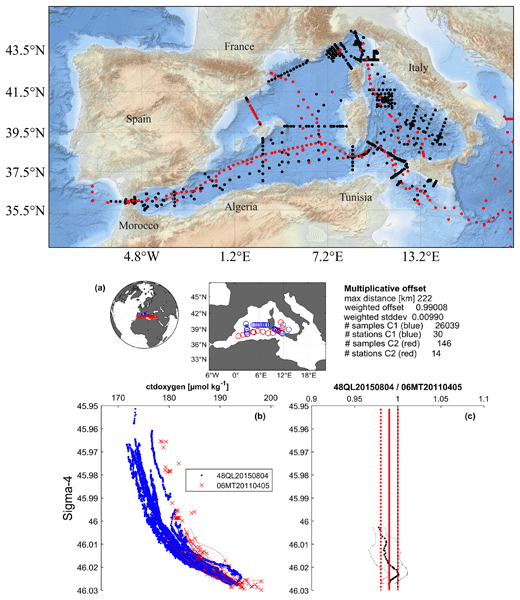
Malek Belgacem, Katrin Schroeder, Marta Álvarez, Siv K. Lauvset, Jacopo Chiggiato, Mireno Borghini, Carolina Cantoni, Tiziana Ciuffardi, and Stefania Sparnocchia
Earth Syst. Sci. Data, 17, 5315–5336, https://doi.org/10.5194/essd-17-5315-2025, https://doi.org/10.5194/essd-17-5315-2025, 2025
Short summary
Short summary
The Mediterranean Sea is changing rapidly, underscoring the urgent need for high-quality datasets to quantify trends and assess impacts on biogeochemical cycles. O2 is a key indicator of marine ecosystem health and plays a central role in CO2 and nutrient cycling. We compiled a regional-scale dataset of O2 in the western Mediterranean to provide a robust observational foundation for assessing O2 variability, associated with climate change, and anomalies related to deoxygenation processes.
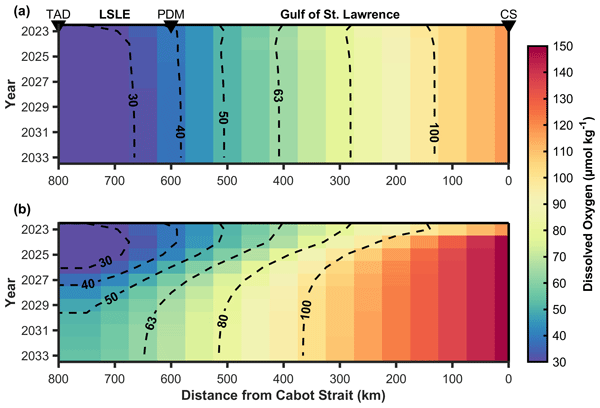
William A. Nesbitt, Samuel W. Stevens, Alfonso O. Mucci, Lennart Gerke, Toste Tanhua, Gwénaëlle Chaillou, and Douglas W. R. Wallace
Ocean Sci., 21, 2179–2195, https://doi.org/10.5194/os-21-2179-2025, https://doi.org/10.5194/os-21-2179-2025, 2025
Short summary
Short summary
We combine two decades of oxygen data with new carbon observations and a tracer-informed model to quantify oxygen loss and carbon buildup in the deep waters of the Gulf and Lower St. Lawrence Estuary. We then test a novel idea: reoxygenating these waters with the oxygen produced as a by-product from green-hydrogen production. Our results suggest this could significantly reduce hypoxia, though full recovery would require larger inputs.
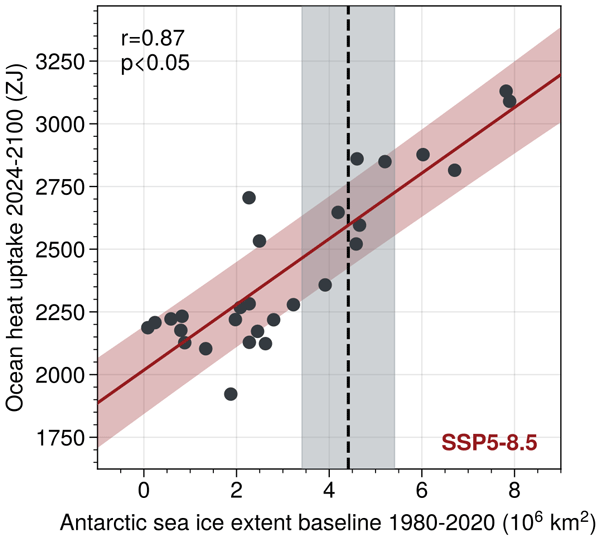
Linus Vogt, Casimir de Lavergne, Jean-Baptiste Sallée, Lester Kwiatkowski, Thomas L. Frölicher, and Jens Terhaar
Earth Syst. Dynam., 16, 1453–1482, https://doi.org/10.5194/esd-16-1453-2025, https://doi.org/10.5194/esd-16-1453-2025, 2025
Short summary
Short summary
Future projections of global ocean heat uptake (OHU) strongly differ between climate models. Here, we reveal an observational constraint on future OHU based on historical Antarctic sea ice extent observations. This emergent constraint is based on a coupling between sea ice, deep- and surface ocean temperatures, and cloud feedback. It implies an upward correction of 2024–2100 global OHU projections by up to 14 % and suggests that previous constraints have underestimated future warming.
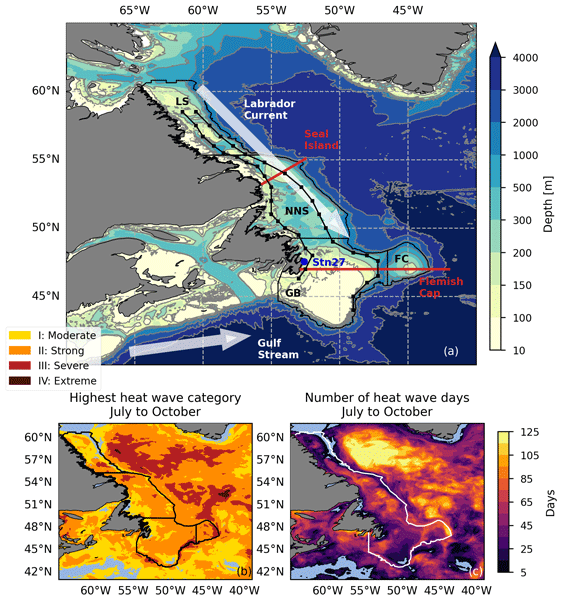
Nancy Soontiens, Heather J. Andres, Jonathan Coyne, Frédéric Cyr, Peter S. Galbraith, and Jared Penney
State Planet, 6-osr9, 12, https://doi.org/10.5194/sp-6-osr9-12-2025, https://doi.org/10.5194/sp-6-osr9-12-2025, 2025
Short summary
Short summary
In this study, we explored a series of surface marine heat waves over the Newfoundland and Labrador Shelf in the summer and fall of 2023. We connected these marine heat waves to environmental conditions and found that low winds, high freshwater density, and high stratification were factors contributing to the unusually high sea surface temperature anomalies. We explored the vertical structure of temperature anomalies and found that the heat waves were confined near the surface for most of the summer.
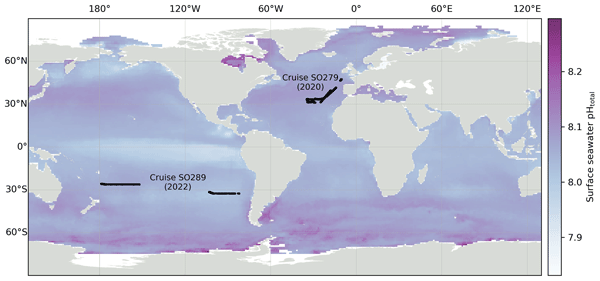
Louise Delaigue, Gert-Jan Reichart, Li Qiu, Eric P. Achterberg, Yasmina Ourradi, Chris Galley, André Mutzberg, and Matthew P. Humphreys
Biogeosciences, 22, 5103–5121, https://doi.org/10.5194/bg-22-5103-2025, https://doi.org/10.5194/bg-22-5103-2025, 2025
Short summary
Short summary
Our study analysed pH in ocean surface waters to understand how it fluctuates with changes in temperature, salinity, and biological activities. We found that temperature mainly controls daily pH variations, but biological processes also play a role, especially in affecting CO2 levels between the ocean and atmosphere. Our research shows how these factors together maintain the balance of ocean chemistry, which is crucial for predicting changes in marine environments.
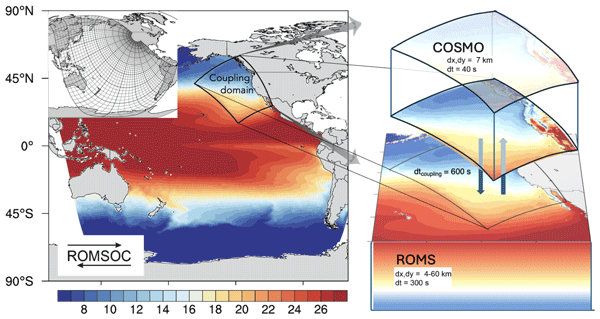
Gesa K. Eirund, Matthieu Leclair, Matthias Muennich, and Nicolas Gruber
Geosci. Model Dev., 18, 6255–6274, https://doi.org/10.5194/gmd-18-6255-2025, https://doi.org/10.5194/gmd-18-6255-2025, 2025
Short summary
Short summary
To realistically simulate small-scale processes in the atmosphere and ocean, such as clouds or mixing, high-resolution numerical models are needed. However, these models are computationally very demanding. Here, we present a recently developed atmosphere–ocean model which is able to resolve most of these processes and is less expensive to run due to its computational design. Our model can be used for a wide range of applications like the investigation of marine heatwaves or future projections.
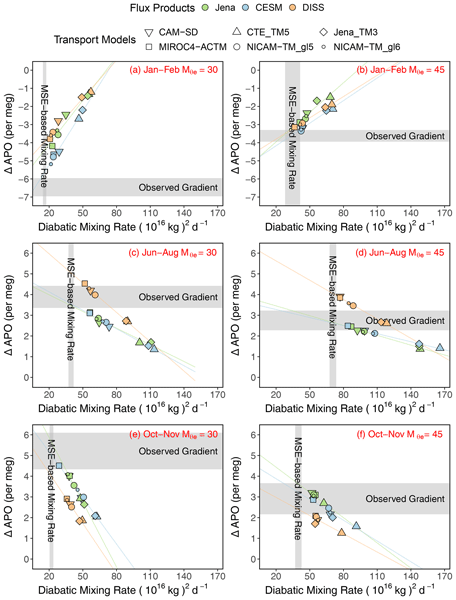
Yuming Jin, Britton B. Stephens, Matthew C. Long, Naveen Chandra, Frédéric Chevallier, Joram J. D. Hooghiem, Ingrid T. Luijkx, Shamil Maksyutov, Eric J. Morgan, Yosuke Niwa, Prabir K. Patra, Christian Rödenbeck, and Jesse Vance
Geosci. Model Dev., 18, 5937–5969, https://doi.org/10.5194/gmd-18-5937-2025, https://doi.org/10.5194/gmd-18-5937-2025, 2025
Short summary
Short summary
We carry out a comprehensive atmospheric transport model (ATM) intercomparison project. This project aims to evaluate errors in ATMs and three air-sea O2 flux products by comparing model simulations with observations collected from surface stations, ships, and aircraft. We also present a model evaluation framework to independently quantify transport-related and flux-related biases that contribute to model-observation discrepancies in atmospheric tracer distributions.
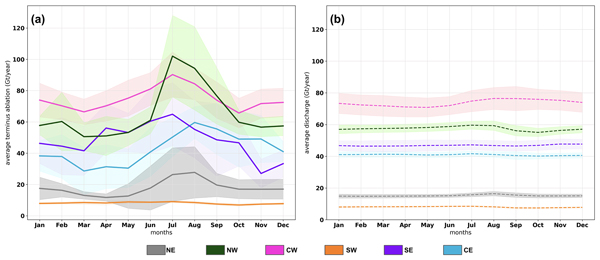
Aman KC, Ellyn M. Enderlin, Dominik Fahrner, Twila Moon, and Dustin Carroll
The Cryosphere, 19, 3089–3106, https://doi.org/10.5194/tc-19-3089-2025, https://doi.org/10.5194/tc-19-3089-2025, 2025
Short summary
Short summary
The sum of ice flowing towards a glacier’s terminus and changes in the position of the terminus over time collectively makes up terminus ablation. We found that terminus ablation has more seasonal variability than previously concluded from flux-based estimates of ice discharge. The findings are of importance in understanding the timing and location of the freshwater input to the fjords and surrounding ocean basins affecting local and regional ecosystems and ocean properties.
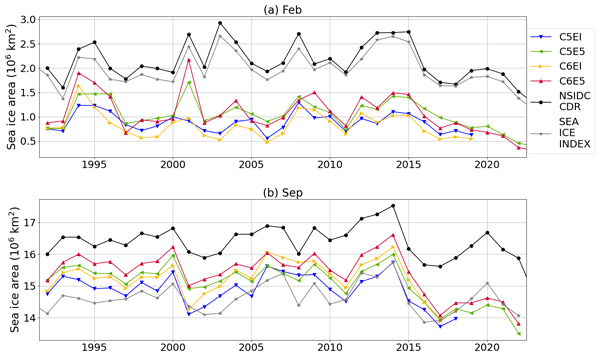
Cecilia Äijälä, Yafei Nie, Lucía Gutiérrez-Loza, Chiara De Falco, Siv Kari Lauvset, Bin Cheng, David Anthony Bailey, and Petteri Uotila
Geosci. Model Dev., 18, 4823–4853, https://doi.org/10.5194/gmd-18-4823-2025, https://doi.org/10.5194/gmd-18-4823-2025, 2025
Short summary
Short summary
The sea ice around Antarctica has experienced record lows in recent years. To understand these changes, models are needed. MetROMS-UHel is a new version of an ocean–sea ice model with updated sea ice code and the atmospheric data. We investigate the effect of our updates on different variables with a focus on sea ice and show an improved sea ice representation as compared with observations.
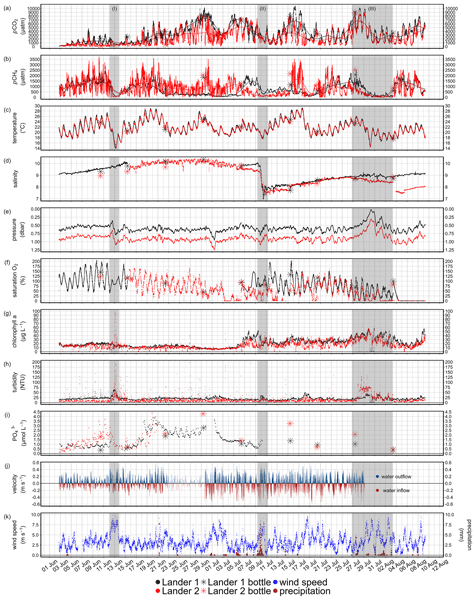
Daniel L. Pönisch, Henry C. Bittig, Martin Kolbe, Ingo Schuffenhauer, Stefan Otto, Peter Holtermann, Kusala Premaratne, and Gregor Rehder
Biogeosciences, 22, 3583–3614, https://doi.org/10.5194/bg-22-3583-2025, https://doi.org/10.5194/bg-22-3583-2025, 2025
Short summary
Short summary
Rewetted peatlands exhibit natural spatiotemporal biogeochemical heterogeneity, influenced by water level and vegetation. This study investigated the variability of greenhouse gas distribution in a peatland rewetted with brackish water. Two innovative sensor-equipped platforms were used to measure a wide range of marine physicochemical variables at high temporal resolution. The measurements revealed strong fluctuations in CO2 and CH4, expressed as multi-day, diurnal, and event-based variability.
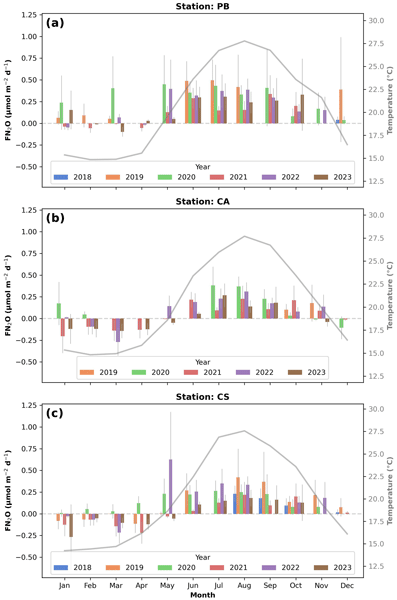
Susana Flecha, Mercedes de la Paz, Fiz Fernández Pérez, Núria Marbà, Carlos Morell, Eva Alou-Font, Joaquín Tintoré, and Iris E. Hendriks
Ocean Sci., 21, 1515–1532, https://doi.org/10.5194/os-21-1515-2025, https://doi.org/10.5194/os-21-1515-2025, 2025
Short summary
Short summary
Nitrous oxide (N2O), a potent greenhouse gas, is understudied in coastal zones. We present N2O concentrations and air–sea fluxes from the Balearic coast (2018–2023). Concentrations varied slightly across sites, with areas acting as weak sources or being near equilibrium. Temperature was the main driver of seasonal changes. These findings improve our understanding of coastal N2O emissions.
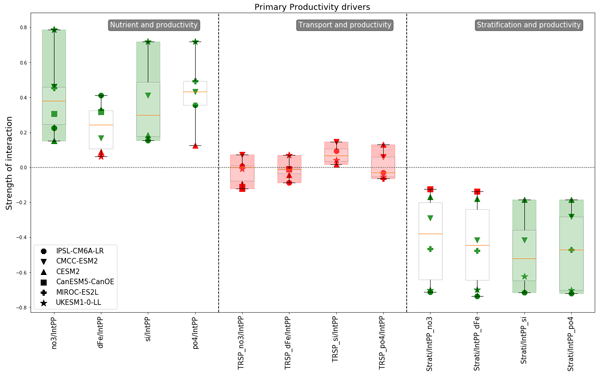
Germain Bénard, Marion Gehlen, and Mathieu Vrac
Earth Syst. Dynam., 16, 1085–1102, https://doi.org/10.5194/esd-16-1085-2025, https://doi.org/10.5194/esd-16-1085-2025, 2025
Short summary
Short summary
We introduce a novel approach to compare Earth system model output using a causality-based approach. The analysis of interactions between atmospheric, oceanic and biogeochemical variables in the North Atlantic subpolar gyre highlights the dynamics of each model. This method reveals potential underlying causes of model differences, offering a tool for enhanced model evaluation and improved understanding of complex Earth system dynamics under past and future climates.
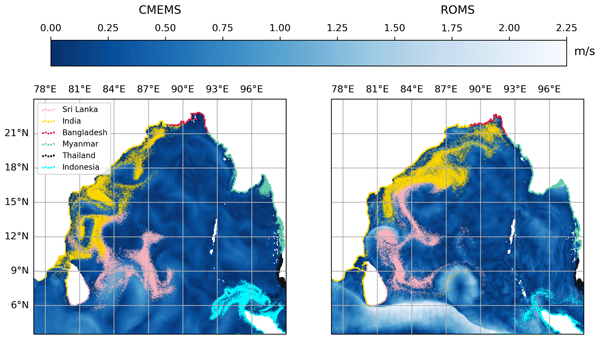
Lianne C. Harrison, Jennifer A. Graham, Piyali Chowdhury, Tiago A. M. Silva, Danja P. Hoehn, Alakes Samanta, Kunal Chakraborty, Sudheer Joseph, T. M. Balakrishnan Nair, and T. Srinivasa Kumar
Ocean Sci., 21, 1369–1393, https://doi.org/10.5194/os-21-1369-2025, https://doi.org/10.5194/os-21-1369-2025, 2025
Short summary
Short summary
Particle tracking models allow us to explore pathways of floating marine litter, source to sink, between countries. This study shows the influence of seasonality for dispersal in the Bay of Bengal and how ocean current forcing impacts model performance. Most litter beached on the country of origin, but there was a greater spread shown between countries during the post-monsoon period (Oct–Jan). Results will inform future model developments as well as management of marine litter in the region.
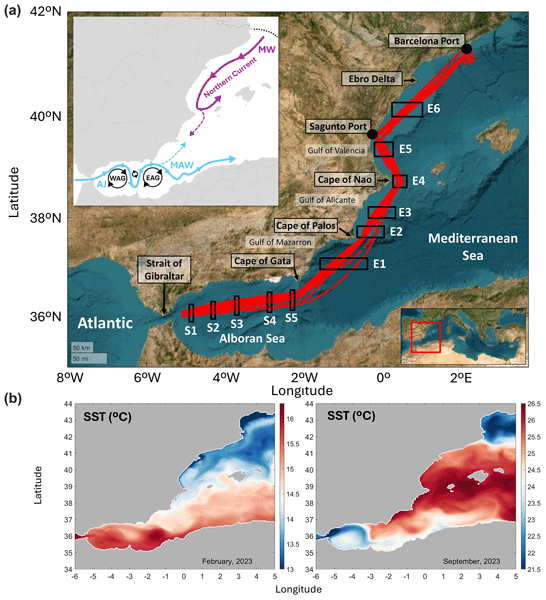
David Curbelo-Hernández, David González-Santana, Aridane G. González, J. Magdalena Santana-Casiano, and Melchor González-Dávila
Biogeosciences, 22, 3329–3356, https://doi.org/10.5194/bg-22-3329-2025, https://doi.org/10.5194/bg-22-3329-2025, 2025
Short summary
Short summary
This study offers a unique high-resolution dataset (2019–2024) on surface physicochemical properties in the western Mediterranean Sea. It reveals accelerated surface warming, significantly altering CO2 levels and pH. Currently a net CO2 sink, the region may become a CO2 source by 2030 due to weakening in-gassing. The research highlights the value of VOS (volunteer observing ship) lines for monitoring climate impacts and emphasizes the need for ongoing observations to enhance long-term trend accuracy and future projections.
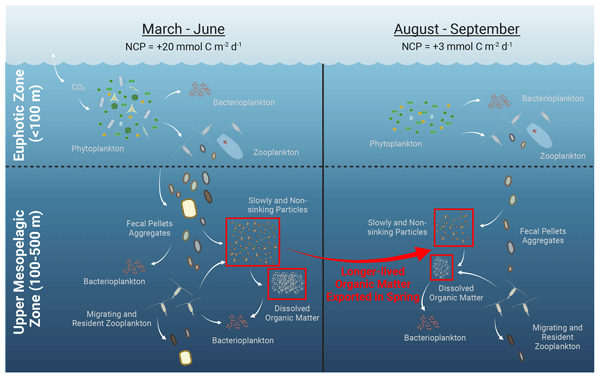
Brandon M. Stephens, Montserrat Roca-Martí, Amy E. Maas, Vinícius J. Amaral, Samantha Clevenger, Shawnee Traylor, Claudia R. Benitez-Nelson, Philip W. Boyd, Ken O. Buesseler, Craig A. Carlson, Nicolas Cassar, Margaret Estapa, Andrea J. Fassbender, Yibin Huang, Phoebe J. Lam, Olivier Marchal, Susanne Menden-Deuer, Nicola L. Paul, Alyson E. Santoro, David A. Siegel, and David P. Nicholson
Biogeosciences, 22, 3301–3328, https://doi.org/10.5194/bg-22-3301-2025, https://doi.org/10.5194/bg-22-3301-2025, 2025
Short summary
Short summary
The ocean’s mesopelagic zone (MZ) plays a crucial role in the global carbon cycle. This study combines new and previously published measurements of organic carbon supply and demand collected in August 2018 in the MZ of the subarctic North Pacific Ocean. Supply was insufficient to meet demand in August, but supply entering into the MZ in the spring of 2018 could have met the August demand. Results suggest observations over seasonal timescales may help to close MZ carbon budgets.
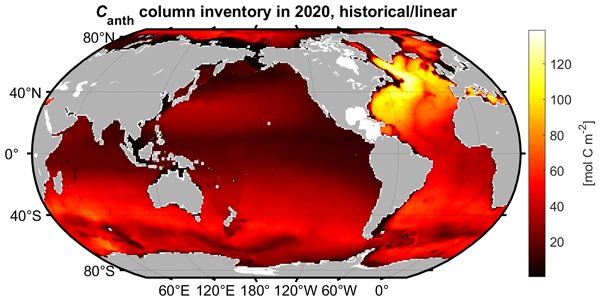
Brendan R. Carter, Jörg Schwinger, Rolf Sonnerup, Andrea J. Fassbender, Jonathan D. Sharp, Larissa M. Dias, and Daniel E. Sandborn
Earth Syst. Sci. Data, 17, 3073–3088, https://doi.org/10.5194/essd-17-3073-2025, https://doi.org/10.5194/essd-17-3073-2025, 2025
Short summary
Short summary
We infer ocean gas exchange and circulation from ocean tracer measurements and use this to create code to estimate the amount of carbon dioxide dissolved in the ocean that is there due to human emissions of CO2 into the atmosphere. The code works across the ocean depths for the past, present, or future from information about the location, temperature, and salinity of the seawater. We produce a data product with estimates throughout the ocean throughout the last ~300 and the next ~500 years.
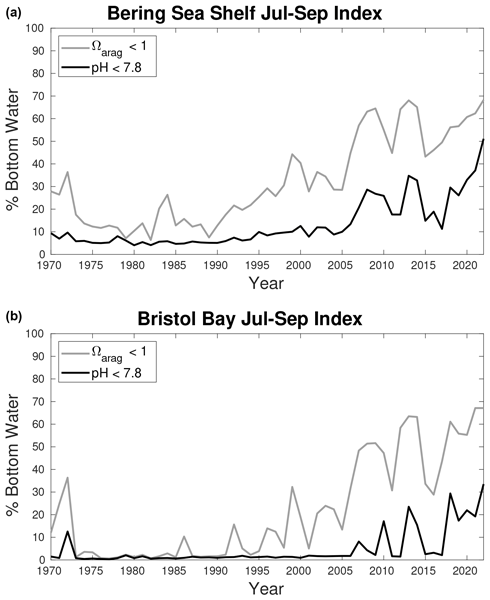
Darren J. Pilcher, Jessica N. Cross, Natalie Monacci, Linquan Mu, Kelly A. Kearney, Albert J. Hermann, and Wei Cheng
Biogeosciences, 22, 3103–3125, https://doi.org/10.5194/bg-22-3103-2025, https://doi.org/10.5194/bg-22-3103-2025, 2025
Short summary
Short summary
The Bering Sea shelf is a highly productive marine ecosystem that is vulnerable to ocean acidification. We use a computational model to simulate the carbon cycle and acidification rates from 1970–2022. The results suggest that bottom water acidification rates are more than twice as great as surface rates. Bottom waters are also naturally more acidic. Thus these waters will pass key thresholds known to negatively impact marine organisms, such as red king crab, much sooner than surface waters.
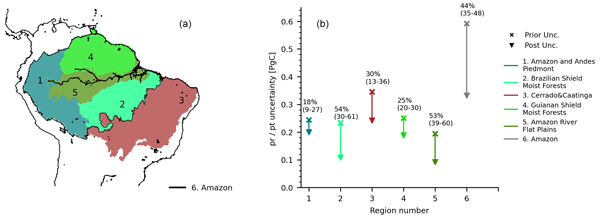
Santiago Botía, Saqr Munassar, Thomas Koch, Danilo Custodio, Luana S. Basso, Shujiro Komiya, Jost V. Lavric, David Walter, Manuel Gloor, Giordane Martins, Stijn Naus, Gerbrand Koren, Ingrid T. Luijkx, Stijn Hantson, John B. Miller, Wouter Peters, Christian Rödenbeck, and Christoph Gerbig
Atmos. Chem. Phys., 25, 6219–6255, https://doi.org/10.5194/acp-25-6219-2025, https://doi.org/10.5194/acp-25-6219-2025, 2025
Short summary
Short summary
This study uses dry CO2 mole fractions from the Amazon Tall Tower Observatory together with airborne profiles to estimate net carbon exchange in tropical South America. We found that the biogeographic Amazon is a net carbon sink, while the Cerrado and Caatinga biomes are net carbon sources, resulting in an overall neutral balance. Finally, to further reduce the uncertainty in our estimates we call for an expansion of the monitoring capacity, especially in the Amazon–Andes foothills.
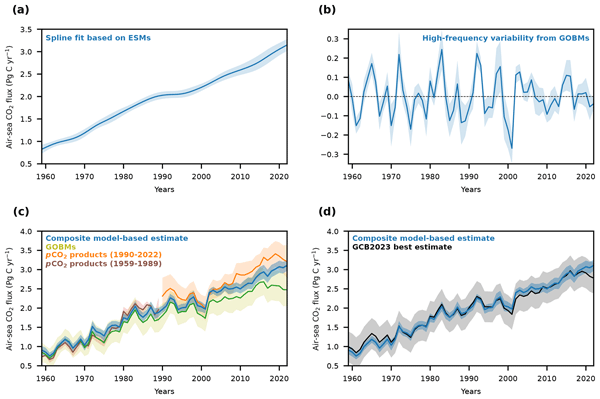
Jens Terhaar
Biogeosciences, 22, 1631–1649, https://doi.org/10.5194/bg-22-1631-2025, https://doi.org/10.5194/bg-22-1631-2025, 2025
Short summary
Short summary
The ocean is a major natural carbon sink. Despite its importance, estimates of the ocean carbon sink remain uncertain. Here, I present a hybrid model estimate of the ocean carbon sink from 1959 to 2022. By combining ocean models in hindcast mode and Earth system models, I keep the strength of each approach and remove the respective weaknesses. This composite model estimate is similar in magnitude to the best estimate of the Global Carbon Budget but 70 % less uncertain.
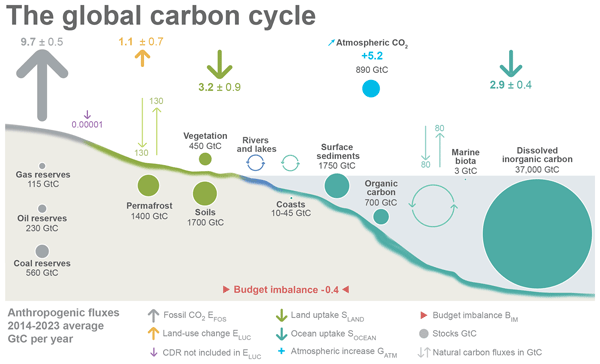
Pierre Friedlingstein, Michael O'Sullivan, Matthew W. Jones, Robbie M. Andrew, Judith Hauck, Peter Landschützer, Corinne Le Quéré, Hongmei Li, Ingrid T. Luijkx, Are Olsen, Glen P. Peters, Wouter Peters, Julia Pongratz, Clemens Schwingshackl, Stephen Sitch, Josep G. Canadell, Philippe Ciais, Robert B. Jackson, Simone R. Alin, Almut Arneth, Vivek Arora, Nicholas R. Bates, Meike Becker, Nicolas Bellouin, Carla F. Berghoff, Henry C. Bittig, Laurent Bopp, Patricia Cadule, Katie Campbell, Matthew A. Chamberlain, Naveen Chandra, Frédéric Chevallier, Louise P. Chini, Thomas Colligan, Jeanne Decayeux, Laique M. Djeutchouang, Xinyu Dou, Carolina Duran Rojas, Kazutaka Enyo, Wiley Evans, Amanda R. Fay, Richard A. Feely, Daniel J. Ford, Adrianna Foster, Thomas Gasser, Marion Gehlen, Thanos Gkritzalis, Giacomo Grassi, Luke Gregor, Nicolas Gruber, Özgür Gürses, Ian Harris, Matthew Hefner, Jens Heinke, George C. Hurtt, Yosuke Iida, Tatiana Ilyina, Andrew R. Jacobson, Atul K. Jain, Tereza Jarníková, Annika Jersild, Fei Jiang, Zhe Jin, Etsushi Kato, Ralph F. Keeling, Kees Klein Goldewijk, Jürgen Knauer, Jan Ivar Korsbakken, Xin Lan, Siv K. Lauvset, Nathalie Lefèvre, Zhu Liu, Junjie Liu, Lei Ma, Shamil Maksyutov, Gregg Marland, Nicolas Mayot, Patrick C. McGuire, Nicolas Metzl, Natalie M. Monacci, Eric J. Morgan, Shin-Ichiro Nakaoka, Craig Neill, Yosuke Niwa, Tobias Nützel, Lea Olivier, Tsuneo Ono, Paul I. Palmer, Denis Pierrot, Zhangcai Qin, Laure Resplandy, Alizée Roobaert, Thais M. Rosan, Christian Rödenbeck, Jörg Schwinger, T. Luke Smallman, Stephen M. Smith, Reinel Sospedra-Alfonso, Tobias Steinhoff, Qing Sun, Adrienne J. Sutton, Roland Séférian, Shintaro Takao, Hiroaki Tatebe, Hanqin Tian, Bronte Tilbrook, Olivier Torres, Etienne Tourigny, Hiroyuki Tsujino, Francesco Tubiello, Guido van der Werf, Rik Wanninkhof, Xuhui Wang, Dongxu Yang, Xiaojuan Yang, Zhen Yu, Wenping Yuan, Xu Yue, Sönke Zaehle, Ning Zeng, and Jiye Zeng
Earth Syst. Sci. Data, 17, 965–1039, https://doi.org/10.5194/essd-17-965-2025, https://doi.org/10.5194/essd-17-965-2025, 2025
Short summary
Short summary
The Global Carbon Budget 2024 describes the methodology, main results, and datasets used to quantify the anthropogenic emissions of carbon dioxide (CO2) and their partitioning among the atmosphere, land ecosystems, and the ocean over the historical period (1750–2024). These living datasets are updated every year to provide the highest transparency and traceability in the reporting of CO2, the key driver of climate change.
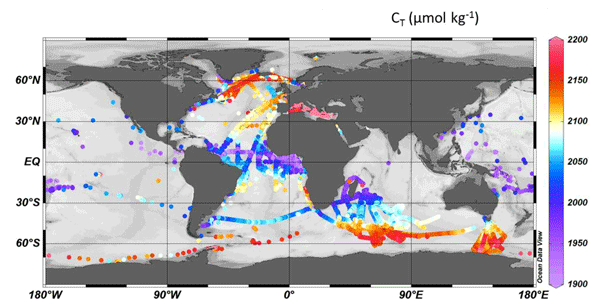
Nicolas Metzl, Jonathan Fin, Claire Lo Monaco, Claude Mignon, Samir Alliouane, Bruno Bombled, Jacqueline Boutin, Yann Bozec, Steeve Comeau, Pascal Conan, Laurent Coppola, Pascale Cuet, Eva Ferreira, Jean-Pierre Gattuso, Frédéric Gazeau, Catherine Goyet, Emilie Grossteffan, Bruno Lansard, Dominique Lefèvre, Nathalie Lefèvre, Coraline Leseurre, Sébastien Petton, Mireille Pujo-Pay, Christophe Rabouille, Gilles Reverdin, Céline Ridame, Peggy Rimmelin-Maury, Jean-François Ternon, Franck Touratier, Aline Tribollet, Thibaut Wagener, and Cathy Wimart-Rousseau
Earth Syst. Sci. Data, 17, 1075–1100, https://doi.org/10.5194/essd-17-1075-2025, https://doi.org/10.5194/essd-17-1075-2025, 2025
Short summary
Short summary
This work presents a new synthesis of 67 000 total alkalinity and total dissolved inorganic carbon observations obtained between 1993 and 2023 in the global ocean, coastal zones, and the Mediterranean Sea. We describe the data assemblage and associated quality control and discuss some potential uses of this dataset. The dataset is provided in a single format and includes the quality flag for each sample.
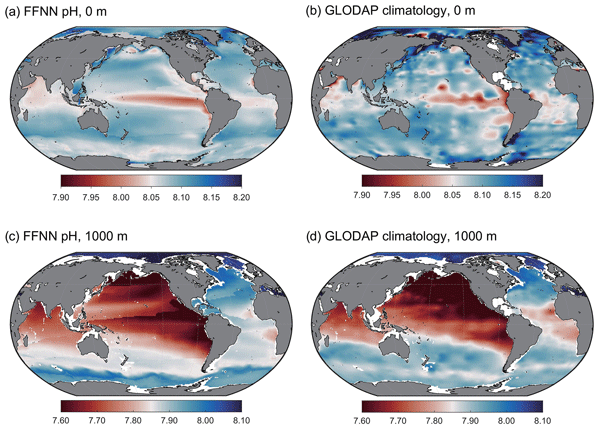
Guorong Zhong, Xuegang Li, Jinming Song, Baoxiao Qu, Fan Wang, Yanjun Wang, Bin Zhang, Lijing Cheng, Jun Ma, Huamao Yuan, Liqin Duan, Ning Li, Qidong Wang, Jianwei Xing, and Jiajia Dai
Earth Syst. Sci. Data, 17, 719–740, https://doi.org/10.5194/essd-17-719-2025, https://doi.org/10.5194/essd-17-719-2025, 2025
Short summary
Short summary
The continuous uptake of atmospheric CO2 by the ocean leads to decreasing seawater pH, which is an ongoing threat to the marine ecosystem. This pH change has been globally documented in the surface ocean, but information is limited below the surface. Here, we present a monthly 1° gridded product of global seawater pH based on a machine learning method and real pH observations. The pH product covers the years from 1992 to 2020 and depths from 0 to 2000 m.
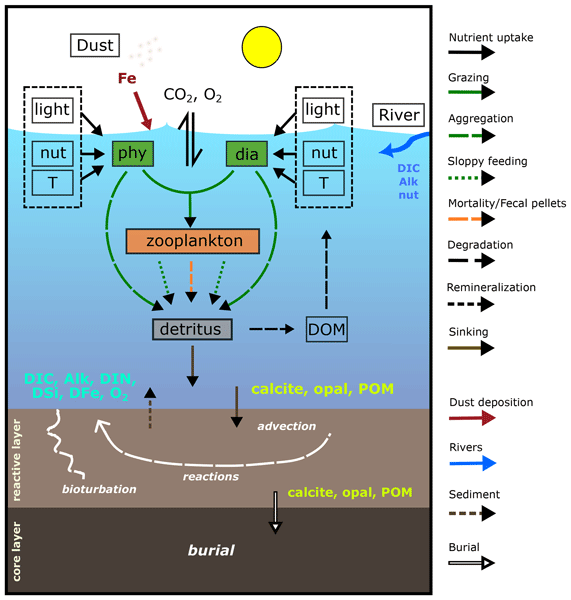
Ying Ye, Guy Munhoven, Peter Köhler, Martin Butzin, Judith Hauck, Özgür Gürses, and Christoph Völker
Geosci. Model Dev., 18, 977–1000, https://doi.org/10.5194/gmd-18-977-2025, https://doi.org/10.5194/gmd-18-977-2025, 2025
Short summary
Short summary
Many biogeochemistry models assume all material reaching the seafloor is remineralized and returned to solution, which is sufficient for studies on short-term climate change. Under long-term climate change, the carbon storage in sediments slows down carbon cycling and influences feedbacks in the atmosphere–ocean–sediment system. This paper describes the coupling of a sediment model to an ocean biogeochemistry model and presents results under the pre-industrial climate and under CO2 perturbation.
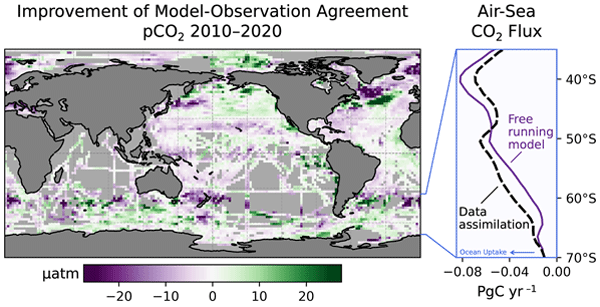
Frauke Bunsen, Judith Hauck, Sinhué Torres-Valdés, and Lars Nerger
Ocean Sci., 21, 437–471, https://doi.org/10.5194/os-21-437-2025, https://doi.org/10.5194/os-21-437-2025, 2025
Short summary
Short summary
Computer models are often used to estimate the ocean's CO2 uptake due to a lack of direct observations. Because such idealized models do not match precisely with the real world, we combine real-world observations of ocean temperature and salinity with a model and study the effect on the modeled air–sea CO2 flux (2010–2020). The corrections of temperature and salinity have their largest effect on regional CO2 fluxes in the Southern Ocean in winter and a small effect on the global CO2 uptake.
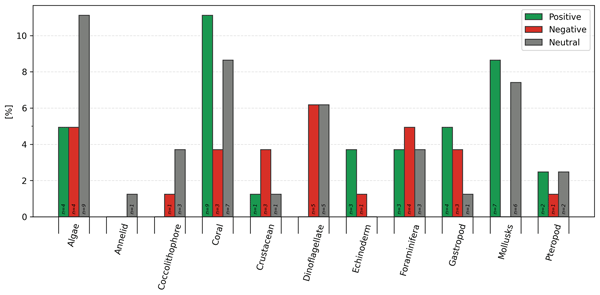
Nina Bednaršek, Hanna van de Mortel, Greg Pelletier, Marisol García-Reyes, Richard A. Feely, and Andrew G. Dickson
Biogeosciences, 22, 473–498, https://doi.org/10.5194/bg-22-473-2025, https://doi.org/10.5194/bg-22-473-2025, 2025
Short summary
Short summary
The environmental impacts of ocean alkalinity enhancement (OAE) are unknown. Our synthesis, based on 68 collected studies with 84 unique species, shows that 35 % of species respond positively, 26 % respond negatively, and 39 % show a neutral response to alkalinity addition. Biological thresholds were found from 50 to 500 µmol kg−1 NaOH addition. A precautionary approach is warranted to avoid potential risks, while current regulatory framework needs improvements to assure safe biological limits.
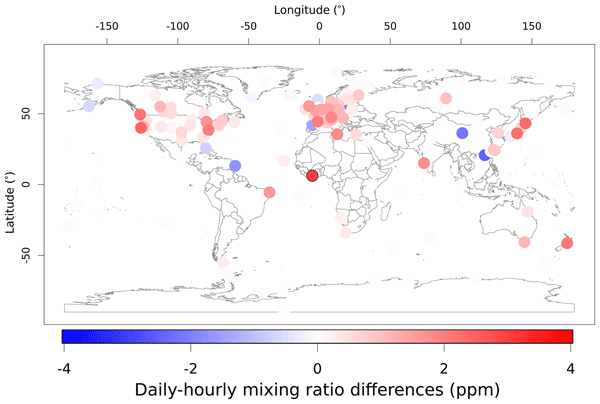
Saqr Munassar, Christian Rödenbeck, Michał Gałkowski, Frank-Thomas Koch, Kai U. Totsche, Santiago Botía, and Christoph Gerbig
Atmos. Chem. Phys., 25, 639–656, https://doi.org/10.5194/acp-25-639-2025, https://doi.org/10.5194/acp-25-639-2025, 2025
Short summary
Short summary
CO2 mole fractions simulated over a global set of stations showed an overestimation of CO2 if the diurnal cycle is missing in biogenic fluxes. This leads to biases in the estimated fluxes derived from the regional-scale inversions. Interannual variability of estimated biogenic fluxes is also affected by the exclusion of the CO2 diurnal cycle. The findings point to the importance of including the diurnal variations of CO2 in the biogenic fluxes used as priors in global and regional inversions.
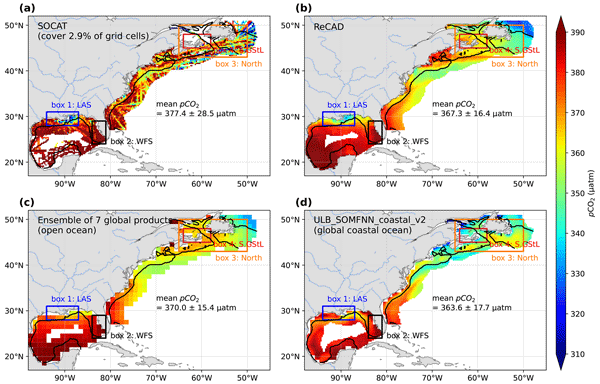
Zelun Wu, Wenfang Lu, Alizée Roobaert, Luping Song, Xiao-Hai Yan, and Wei-Jun Cai
Earth Syst. Sci. Data, 17, 43–63, https://doi.org/10.5194/essd-17-43-2025, https://doi.org/10.5194/essd-17-43-2025, 2025
Short summary
Short summary
This study addresses the lack of comprehensive sea surface partial pressure of CO2 (pCO2) data in the North American Atlantic Coastal Ocean Margin (NAACOM) by developing the Reconstructed Coastal Acidification Database (ReCAD-NAACOM-pCO2). The product reconstructed sea surface pCO2 from 1993 to 2021 using machine-learning and environmental data, capturing seasonal cycles, regional variations, and long-term trends of pCO2 for coastal carbon research.
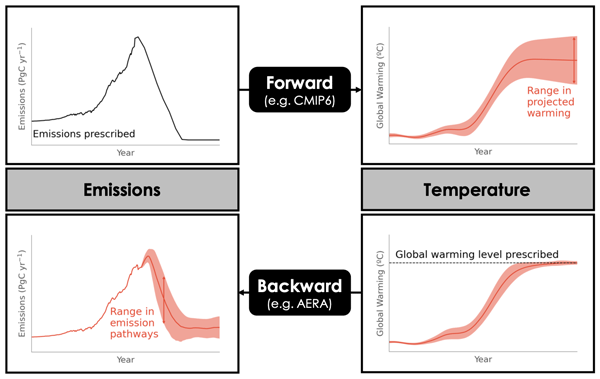
Yona Silvy, Thomas L. Frölicher, Jens Terhaar, Fortunat Joos, Friedrich A. Burger, Fabrice Lacroix, Myles Allen, Raffaele Bernardello, Laurent Bopp, Victor Brovkin, Jonathan R. Buzan, Patricia Cadule, Martin Dix, John Dunne, Pierre Friedlingstein, Goran Georgievski, Tomohiro Hajima, Stuart Jenkins, Michio Kawamiya, Nancy Y. Kiang, Vladimir Lapin, Donghyun Lee, Paul Lerner, Nadine Mengis, Estela A. Monteiro, David Paynter, Glen P. Peters, Anastasia Romanou, Jörg Schwinger, Sarah Sparrow, Eric Stofferahn, Jerry Tjiputra, Etienne Tourigny, and Tilo Ziehn
Earth Syst. Dynam., 15, 1591–1628, https://doi.org/10.5194/esd-15-1591-2024, https://doi.org/10.5194/esd-15-1591-2024, 2024
Short summary
Short summary
The adaptive emission reduction approach is applied with Earth system models to generate temperature stabilization simulations. These simulations provide compatible emission pathways and budgets for a given warming level, uncovering uncertainty ranges previously missing in the Coupled Model Intercomparison Project scenarios. These target-based emission-driven simulations offer a more coherent assessment across models for studying both the carbon cycle and its impacts under climate stabilization.
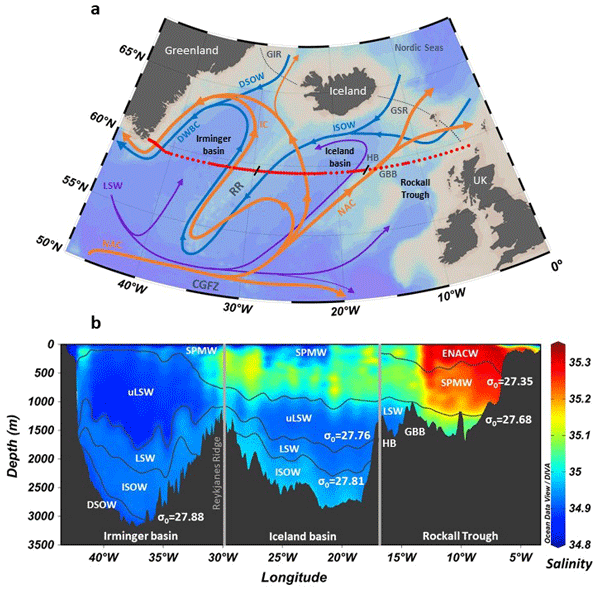
David Curbelo-Hernández, Fiz F. Pérez, Melchor González-Dávila, Sergey V. Gladyshev, Aridane G. González, David González-Santana, Antón Velo, Alexey Sokov, and J. Magdalena Santana-Casiano
Biogeosciences, 21, 5561–5589, https://doi.org/10.5194/bg-21-5561-2024, https://doi.org/10.5194/bg-21-5561-2024, 2024
Short summary
Short summary
The study evaluated CO2–carbonate system dynamics in the North Atlantic subpolar gyre during 2009–2019. Significant ocean acidification, largely due to rising anthropogenic CO2 levels, was found. Cooling, freshening, and enhanced convective processes intensified this trend, affecting calcite and aragonite saturation. The findings contribute to a deeper understanding of ocean acidification and improve our knowledge about its impact on marine ecosystems.
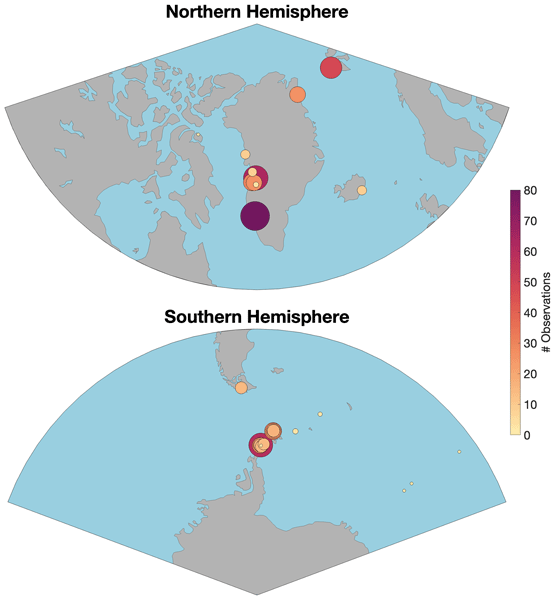
Jana Krause, Dustin Carroll, Juan Höfer, Jeremy Donaire, Eric P. Achterberg, Emilio Alarcón, Te Liu, Lorenz Meire, Kechen Zhu, and Mark J. Hopwood
The Cryosphere, 18, 5735–5752, https://doi.org/10.5194/tc-18-5735-2024, https://doi.org/10.5194/tc-18-5735-2024, 2024
Short summary
Short summary
Here we analysed calved ice samples from both the Arctic and Antarctic to assess the variability in the composition of iceberg meltwater. Our results suggest that low concentrations of nitrate and phosphate in ice are primarily from the ice matrix, whereas sediment-rich layers impart a low concentration of silica and modest concentrations of iron and manganese. At a global scale, there are very limited differences in the nutrient composition of ice.
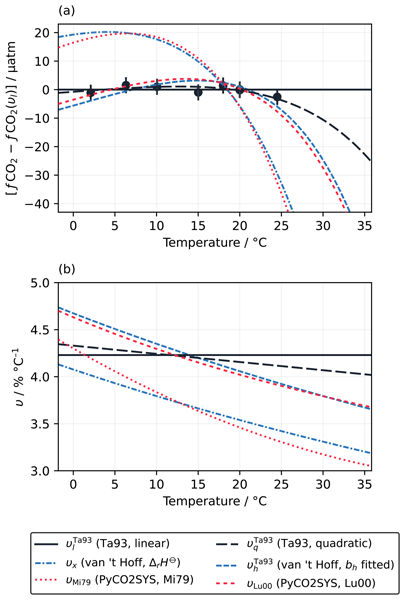
Matthew P. Humphreys
Ocean Sci., 20, 1325–1350, https://doi.org/10.5194/os-20-1325-2024, https://doi.org/10.5194/os-20-1325-2024, 2024
Short summary
Short summary
The ocean takes up carbon dioxide (CO2) from the atmosphere, slowing climate change. This CO2 uptake is controlled by a property called ƒCO2. Seawater ƒCO2 changes as seawater warms or cools, although by an uncertain amount; measurements and calculations give inconsistent results. Here, we work out how ƒCO2 should, in theory, respond to temperature. This matches field data and model calculations but still has discrepancies with scarce laboratory results, which need more measurements to resolve.
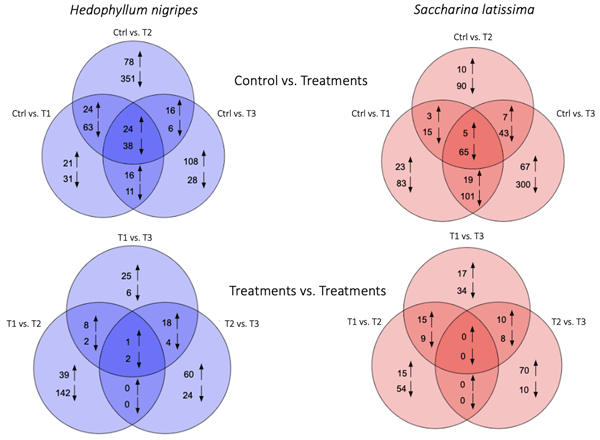
Anaïs Lebrun, Cale A. Miller, Marc Meynadier, Steeve Comeau, Pierre Urrutti, Samir Alliouane, Robert Schlegel, Jean-Pierre Gattuso, and Frédéric Gazeau
Biogeosciences, 21, 4605–4620, https://doi.org/10.5194/bg-21-4605-2024, https://doi.org/10.5194/bg-21-4605-2024, 2024
Short summary
Short summary
We tested the effects of warming, low salinity, and low irradiance on Arctic kelps. We show that growth rates were similar across species and treatments. Alaria esculenta is adapted to low-light conditions. Saccharina latissima exhibited nitrogen limitation, suggesting coastal erosion and permafrost thawing could be beneficial. Laminaria digitata did not respond to the treatments. Gene expression of Hedophyllum nigripes and S. latissima indicated acclimation to the experimental treatments.
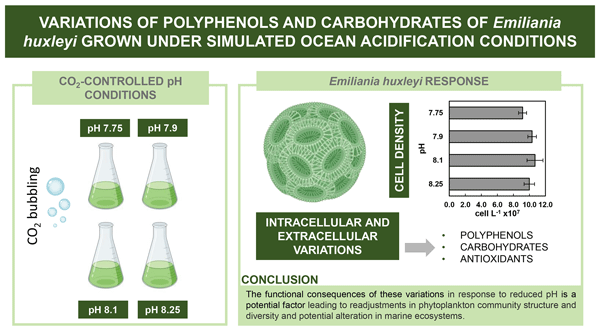
Milagros Rico, Paula Santiago-Díaz, Guillermo Samperio-Ramos, Melchor González-Dávila, and Juana Magdalena Santana-Casiano
Biogeosciences, 21, 4381–4394, https://doi.org/10.5194/bg-21-4381-2024, https://doi.org/10.5194/bg-21-4381-2024, 2024
Short summary
Short summary
Changes in pH generate stress conditions, either because high pH drastically decreases the availability of trace metals such as Fe(II), a restrictive element for primary productivity, or because reactive oxygen species are increased with low pH. The metabolic functions and composition of microalgae can be affected. These modifications in metabolites are potential factors leading to readjustments in phytoplankton community structure and diversity and possible alteration in marine ecosystems.
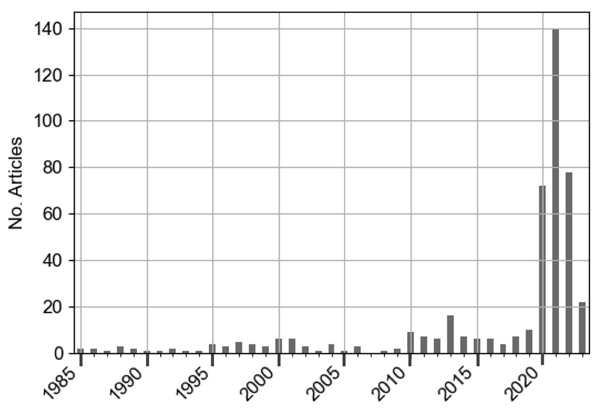
Aileen L. Doran, Victoria Dutch, Bridget Warren, Robert A. Watson, Kevin Murphy, Angus Aldis, Isabelle Cooper, Charlotte Cockram, Dyess Harp, Morgane Desmau, and Lydia Keppler
Geosci. Commun., 7, 227–244, https://doi.org/10.5194/gc-7-227-2024, https://doi.org/10.5194/gc-7-227-2024, 2024
Short summary
Short summary
In recent years, we have seen a global change in how we communicate, with an unplanned shift to virtual platforms, leading to inadvertent exclusion during online events. This article aims to provide guidance on planning online/hybrid events from an accessibility viewpoint, based on the combined experiences of several groups and individuals. Nevertheless, this is not a fully comprehensive guide, as every event is unique and has its own accessibility design needs.
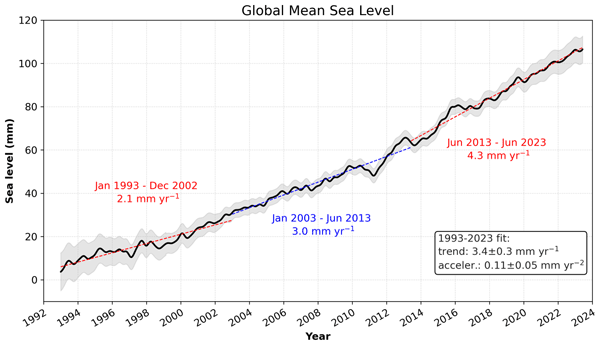
Karina von Schuckmann, Lorena Moreira, Mathilde Cancet, Flora Gues, Emmanuelle Autret, Jonathan Baker, Clément Bricaud, Romain Bourdalle-Badie, Lluis Castrillo, Lijing Cheng, Frederic Chevallier, Daniele Ciani, Alvaro de Pascual-Collar, Vincenzo De Toma, Marie Drevillon, Claudia Fanelli, Gilles Garric, Marion Gehlen, Rianne Giesen, Kevin Hodges, Doroteaciro Iovino, Simon Jandt-Scheelke, Eric Jansen, Melanie Juza, Ioanna Karagali, Thomas Lavergne, Simona Masina, Ronan McAdam, Audrey Minière, Helen Morrison, Tabea Rebekka Panteleit, Andrea Pisano, Marie-Isabelle Pujol, Ad Stoffelen, Sulian Thual, Simon Van Gennip, Pierre Veillard, Chunxue Yang, and Hao Zuo
State Planet, 4-osr8, 1, https://doi.org/10.5194/sp-4-osr8-1-2024, https://doi.org/10.5194/sp-4-osr8-1-2024, 2024
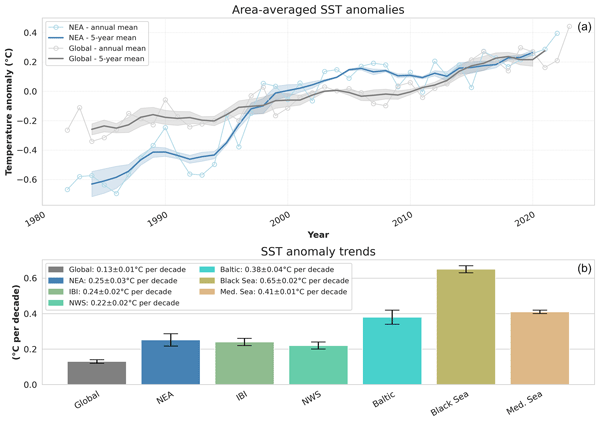
Karina von Schuckmann, Lorena Moreira, Mathilde Cancet, Flora Gues, Emmanuelle Autret, Ali Aydogdu, Lluis Castrillo, Daniele Ciani, Andrea Cipollone, Emanuela Clementi, Gianpiero Cossarini, Alvaro de Pascual-Collar, Vincenzo De Toma, Marion Gehlen, Rianne Giesen, Marie Drevillon, Claudia Fanelli, Kevin Hodges, Simon Jandt-Scheelke, Eric Jansen, Melanie Juza, Ioanna Karagali, Priidik Lagemaa, Vidar Lien, Leonardo Lima, Vladyslav Lyubartsev, Ilja Maljutenko, Simona Masina, Ronan McAdam, Pietro Miraglio, Helen Morrison, Tabea Rebekka Panteleit, Andrea Pisano, Marie-Isabelle Pujol, Urmas Raudsepp, Roshin Raj, Ad Stoffelen, Simon Van Gennip, Pierre Veillard, and Chunxue Yang
State Planet, 4-osr8, 2, https://doi.org/10.5194/sp-4-osr8-2-2024, https://doi.org/10.5194/sp-4-osr8-2-2024, 2024
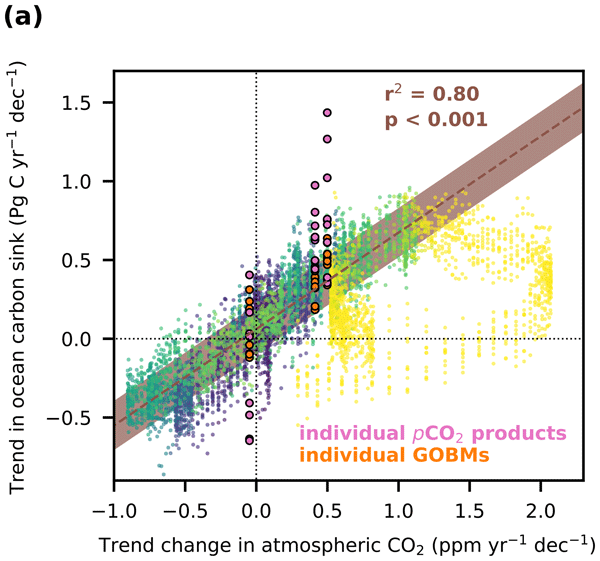
Jens Terhaar
Biogeosciences, 21, 3903–3926, https://doi.org/10.5194/bg-21-3903-2024, https://doi.org/10.5194/bg-21-3903-2024, 2024
Short summary
Short summary
Despite the ocean’s importance in the carbon cycle and hence the climate, observing the ocean carbon sink remains challenging. Here, I use an ensemble of 12 models to understand drivers of decadal trends of the past, present, and future ocean carbon sink. I show that 80 % of the decadal trends in the multi-model mean ocean carbon sink can be explained by changes in decadal trends in atmospheric CO2. The remaining 20 % are due to internal climate variability and ocean heat uptake.
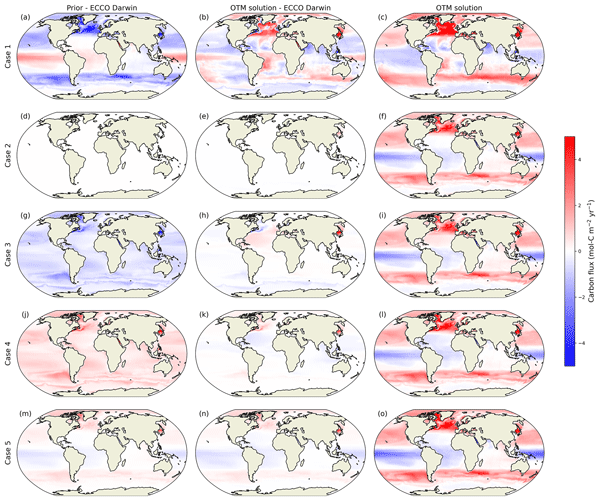
Neill Mackay, Taimoor Sohail, Jan David Zika, Richard G. Williams, Oliver Andrews, and Andrew James Watson
Geosci. Model Dev., 17, 5987–6005, https://doi.org/10.5194/gmd-17-5987-2024, https://doi.org/10.5194/gmd-17-5987-2024, 2024
Short summary
Short summary
The ocean absorbs carbon dioxide from the atmosphere, mitigating climate change, but estimates of the uptake do not always agree. There is a need to reconcile these differing estimates and to improve our understanding of ocean carbon uptake. We present a new method for estimating ocean carbon uptake and test it with model data. The method effectively diagnoses the ocean carbon uptake from limited data and therefore shows promise for reconciling different observational estimates.
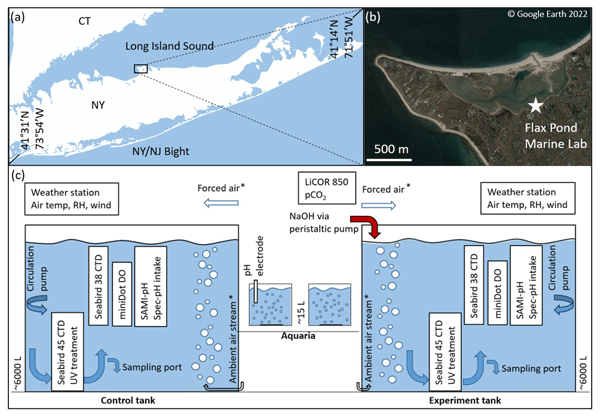
Mallory C. Ringham, Nathan Hirtle, Cody Shaw, Xi Lu, Julian Herndon, Brendan R. Carter, and Matthew D. Eisaman
Biogeosciences, 21, 3551–3570, https://doi.org/10.5194/bg-21-3551-2024, https://doi.org/10.5194/bg-21-3551-2024, 2024
Short summary
Short summary
Ocean alkalinity enhancement leverages the large surface area and carbon storage capacity of the oceans to store atmospheric CO2 as dissolved bicarbonate. We monitored CO2 uptake in seawater treated with NaOH to establish operational boundaries for carbon removal experiments. Results show that CO2 equilibration occurred on the order of weeks to months, was consistent with values expected from equilibration calculations, and was limited by mineral precipitation at high pH and CaCO3 saturation.
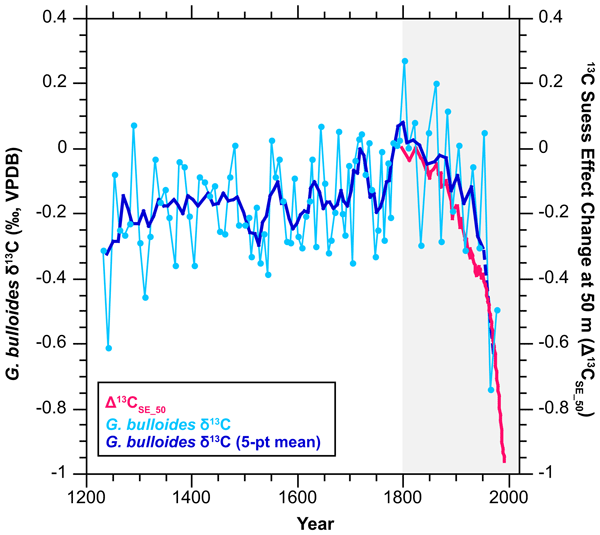
Nil Irvalı, Ulysses S. Ninnemann, Are Olsen, Neil L. Rose, David J. R. Thornalley, Tor L. Mjell, and François Counillon
Geochronology, 6, 449–463, https://doi.org/10.5194/gchron-6-449-2024, https://doi.org/10.5194/gchron-6-449-2024, 2024
Short summary
Short summary
Marine sediments are excellent archives for reconstructing past changes in climate and ocean circulation. Yet, dating uncertainties, particularly during the 20th century, pose major challenges. Here we propose a novel chronostratigraphic approach that uses anthropogenic signals, such as the oceanic 13C Suess effect and spheroidal carbonaceous fly-ash particles, to reduce age model uncertainties in high-resolution marine archives over the 20th century.
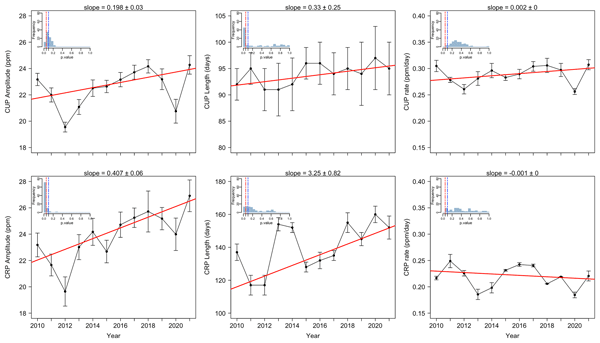
Dieu Anh Tran, Christoph Gerbig, Christian Rödenbeck, and Sönke Zaehle
Atmos. Chem. Phys., 24, 8413–8440, https://doi.org/10.5194/acp-24-8413-2024, https://doi.org/10.5194/acp-24-8413-2024, 2024
Short summary
Short summary
The analysis of the atmospheric CO2 record from the Zotino Tall Tower Observatory (ZOTTO) in central Siberia shows significant increases in the length and amplitude of the CO2 uptake and release in the 2010–2021 period. The trend shows a stronger increase in carbon release amplitude compared to the uptake, suggesting that, despite enhanced growing season uptake, during this period climate warming did not elevate the annual net CO2 uptake as cold-season respirations also responded to the warming.
Li-Qing Jiang, Tim P. Boyer, Christopher R. Paver, Hyelim Yoo, James R. Reagan, Simone R. Alin, Leticia Barbero, Brendan R. Carter, Richard A. Feely, and Rik Wanninkhof
Earth Syst. Sci. Data, 16, 3383–3390, https://doi.org/10.5194/essd-16-3383-2024, https://doi.org/10.5194/essd-16-3383-2024, 2024
Short summary
Short summary
In this paper, we unveil a data product featuring ten coastal ocean acidification variables. These indicators are provided on 1°×1° spatial grids at 14 standardized depth levels, ranging from the surface to a depth of 500 m, along the North American ocean margins.
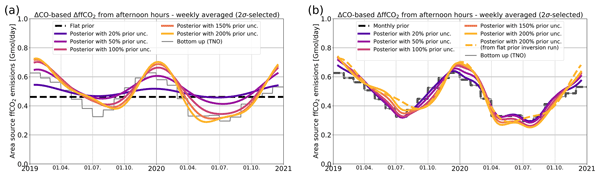
Fabian Maier, Christian Rödenbeck, Ingeborg Levin, Christoph Gerbig, Maksym Gachkivskyi, and Samuel Hammer
Atmos. Chem. Phys., 24, 8183–8203, https://doi.org/10.5194/acp-24-8183-2024, https://doi.org/10.5194/acp-24-8183-2024, 2024
Short summary
Short summary
We investigate the usage of discrete radiocarbon (14C)-based fossil fuel carbon dioxide (ffCO2) concentration estimates vs. continuous carbon monoxide (CO)-based ffCO2 estimates to evaluate the seasonal cycle of ffCO2 emissions in an urban region with an inverse modeling framework. We find that the CO-based ffCO2 estimates allow us to reconstruct robust seasonal cycles, which show the distinct COVID-19 drawdown in 2020 and can be used to validate emission inventories.
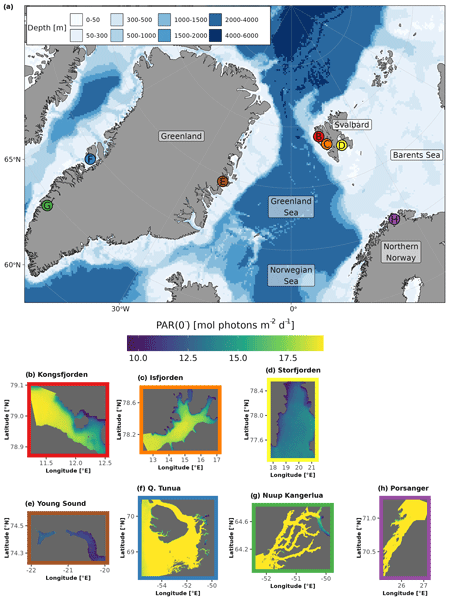
Robert W. Schlegel, Rakesh Kumar Singh, Bernard Gentili, Simon Bélanger, Laura Castro de la Guardia, Dorte Krause-Jensen, Cale A. Miller, Mikael Sejr, and Jean-Pierre Gattuso
Earth Syst. Sci. Data, 16, 2773–2788, https://doi.org/10.5194/essd-16-2773-2024, https://doi.org/10.5194/essd-16-2773-2024, 2024
Short summary
Short summary
Fjords play a vital role in the Arctic ecosystems and human communities. It is therefore important to have as clear of an understanding of the processes within these systems as possible. While temperature and salinity tend to be well measured, light is usually not. The dataset described in this paper uses remotely sensed data from 2003 to 2022 to address this problem by providing high-spatial-resolution surface, water column, and seafloor light data for several well-studied Arctic fjords.
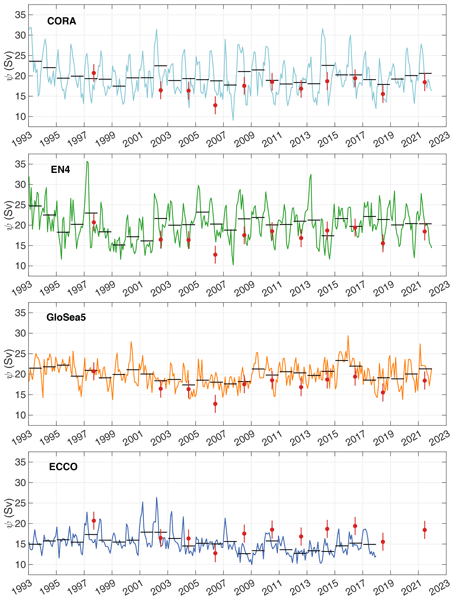
Herlé Mercier, Damien Desbruyères, Pascale Lherminier, Antón Velo, Lidia Carracedo, Marcos Fontela, and Fiz F. Pérez
Ocean Sci., 20, 779–797, https://doi.org/10.5194/os-20-779-2024, https://doi.org/10.5194/os-20-779-2024, 2024
Short summary
Short summary
We study the Atlantic Meridional Overturning Circulation (AMOC) measured between Greenland and Portugal between 1993–2021. We identify changes in AMOC limb volume and velocity as two major drivers of AMOC variability at subpolar latitudes. Volume variations dominate on the seasonal timescale, while velocity variations are more important on the decadal timescale. This decomposition proves useful for understanding the origin of the differences between AMOC time series from different analyses.
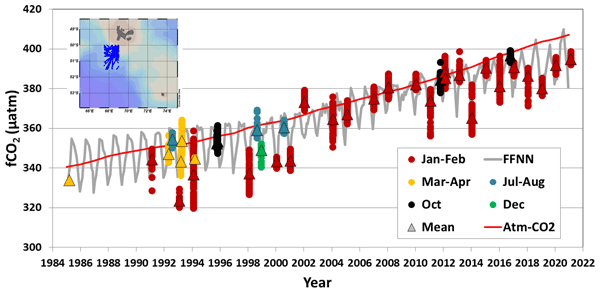
Nicolas Metzl, Claire Lo Monaco, Coraline Leseurre, Céline Ridame, Gilles Reverdin, Thi Tuyet Trang Chau, Frédéric Chevallier, and Marion Gehlen
Ocean Sci., 20, 725–758, https://doi.org/10.5194/os-20-725-2024, https://doi.org/10.5194/os-20-725-2024, 2024
Short summary
Short summary
In the southern Indian Ocean, south of the polar front, an observed increase of sea surface fCO2 and a decrease of pH over 1985–2021 are mainly driven by anthropogenic CO2 uptake, but in the last decade (2010–2020) fCO2 and pH were stable in summer, highlighting the competitive balance between anthropogenic CO2 and primary production. In the water column the increase of anthropogenic CO2 concentrations leads to migration of the aragonite saturation state from 600 m in 1985 up to 400 m in 2021.
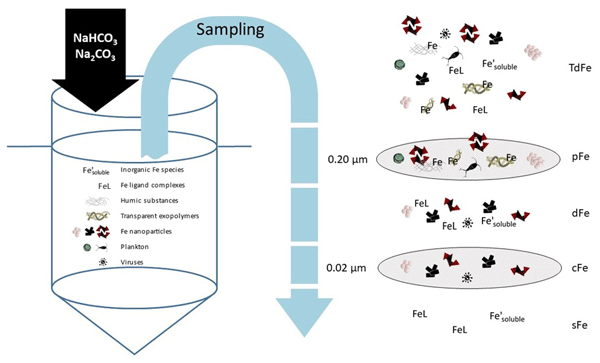
David González-Santana, María Segovia, Melchor González-Dávila, Librada Ramírez, Aridane G. González, Leonardo J. Pozzo-Pirotta, Veronica Arnone, Victor Vázquez, Ulf Riebesell, and J. Magdalena Santana-Casiano
Biogeosciences, 21, 2705–2715, https://doi.org/10.5194/bg-21-2705-2024, https://doi.org/10.5194/bg-21-2705-2024, 2024
Short summary
Short summary
In a recent experiment off the coast of Gran Canaria (Spain), scientists explored a method called ocean alkalinization enhancement (OAE), where carbonate minerals were added to seawater. This process changed the levels of certain ions in the water, affecting its pH and buffering capacity. The researchers were particularly interested in how this could impact the levels of essential trace metals in the water.
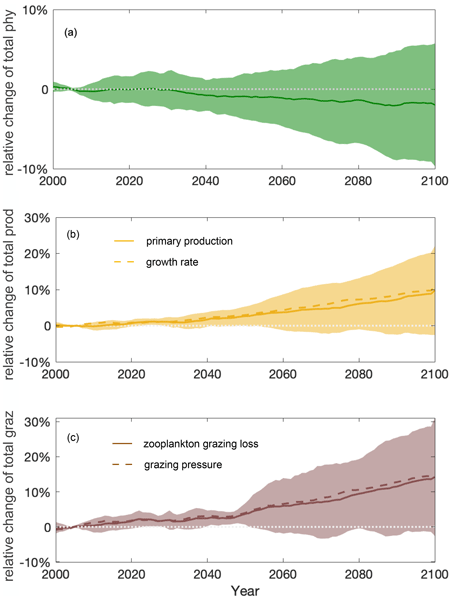
Tianfei Xue, Jens Terhaar, A. E. Friederike Prowe, Thomas L. Frölicher, Andreas Oschlies, and Ivy Frenger
Biogeosciences, 21, 2473–2491, https://doi.org/10.5194/bg-21-2473-2024, https://doi.org/10.5194/bg-21-2473-2024, 2024
Short summary
Short summary
Phytoplankton play a crucial role in marine ecosystems. However, climate change's impact on phytoplankton biomass remains uncertain, particularly in the Southern Ocean. In this region, phytoplankton biomass within the water column is likely to remain stable in response to climate change, as supported by models. This stability arises from a shallower mixed layer, favoring phytoplankton growth but also increasing zooplankton grazing due to phytoplankton concentration near the surface.
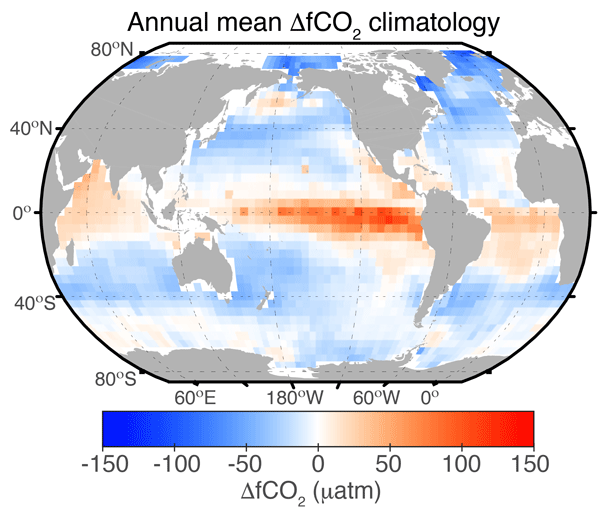
Amanda R. Fay, David R. Munro, Galen A. McKinley, Denis Pierrot, Stewart C. Sutherland, Colm Sweeney, and Rik Wanninkhof
Earth Syst. Sci. Data, 16, 2123–2139, https://doi.org/10.5194/essd-16-2123-2024, https://doi.org/10.5194/essd-16-2123-2024, 2024
Short summary
Short summary
Presented here is a near-global monthly climatological estimate of the difference between atmosphere and ocean carbon dioxide concentrations. The ocean's ability to take up carbon, both now and in the future, is defined by this difference in concentrations. With over 30 million measurements of surface ocean carbon over the last 40 years and utilization of an extrapolation technique, a mean estimate of surface ocean ΔfCO2 is presented.

Siv K. Lauvset, Nico Lange, Toste Tanhua, Henry C. Bittig, Are Olsen, Alex Kozyr, Marta Álvarez, Kumiko Azetsu-Scott, Peter J. Brown, Brendan R. Carter, Leticia Cotrim da Cunha, Mario Hoppema, Matthew P. Humphreys, Masao Ishii, Emil Jeansson, Akihiko Murata, Jens Daniel Müller, Fiz F. Pérez, Carsten Schirnick, Reiner Steinfeldt, Toru Suzuki, Adam Ulfsbo, Anton Velo, Ryan J. Woosley, and Robert M. Key
Earth Syst. Sci. Data, 16, 2047–2072, https://doi.org/10.5194/essd-16-2047-2024, https://doi.org/10.5194/essd-16-2047-2024, 2024
Short summary
Short summary
GLODAP is a data product for ocean inorganic carbon and related biogeochemical variables measured by the chemical analysis of water bottle samples from scientific cruises. GLODAPv2.2023 is the fifth update of GLODAPv2 from 2016. The data that are included have been subjected to extensive quality controlling, including systematic evaluation of measurement biases. This version contains data from 1108 hydrographic cruises covering the world's oceans from 1972 to 2021.
Bjorn Stevens, Stefan Adami, Tariq Ali, Hartwig Anzt, Zafer Aslan, Sabine Attinger, Jaana Bäck, Johanna Baehr, Peter Bauer, Natacha Bernier, Bob Bishop, Hendryk Bockelmann, Sandrine Bony, Guy Brasseur, David N. Bresch, Sean Breyer, Gilbert Brunet, Pier Luigi Buttigieg, Junji Cao, Christelle Castet, Yafang Cheng, Ayantika Dey Choudhury, Deborah Coen, Susanne Crewell, Atish Dabholkar, Qing Dai, Francisco Doblas-Reyes, Dale Durran, Ayoub El Gaidi, Charlie Ewen, Eleftheria Exarchou, Veronika Eyring, Florencia Falkinhoff, David Farrell, Piers M. Forster, Ariane Frassoni, Claudia Frauen, Oliver Fuhrer, Shahzad Gani, Edwin Gerber, Debra Goldfarb, Jens Grieger, Nicolas Gruber, Wilco Hazeleger, Rolf Herken, Chris Hewitt, Torsten Hoefler, Huang-Hsiung Hsu, Daniela Jacob, Alexandra Jahn, Christian Jakob, Thomas Jung, Christopher Kadow, In-Sik Kang, Sarah Kang, Karthik Kashinath, Katharina Kleinen-von Königslöw, Daniel Klocke, Uta Kloenne, Milan Klöwer, Chihiro Kodama, Stefan Kollet, Tobias Kölling, Jenni Kontkanen, Steve Kopp, Michal Koran, Markku Kulmala, Hanna Lappalainen, Fakhria Latifi, Bryan Lawrence, June Yi Lee, Quentin Lejeun, Christian Lessig, Chao Li, Thomas Lippert, Jürg Luterbacher, Pekka Manninen, Jochem Marotzke, Satoshi Matsouoka, Charlotte Merchant, Peter Messmer, Gero Michel, Kristel Michielsen, Tomoki Miyakawa, Jens Müller, Ramsha Munir, Sandeep Narayanasetti, Ousmane Ndiaye, Carlos Nobre, Achim Oberg, Riko Oki, Tuba Özkan-Haller, Tim Palmer, Stan Posey, Andreas Prein, Odessa Primus, Mike Pritchard, Julie Pullen, Dian Putrasahan, Johannes Quaas, Krishnan Raghavan, Venkatachalam Ramaswamy, Markus Rapp, Florian Rauser, Markus Reichstein, Aromar Revi, Sonakshi Saluja, Masaki Satoh, Vera Schemann, Sebastian Schemm, Christina Schnadt Poberaj, Thomas Schulthess, Cath Senior, Jagadish Shukla, Manmeet Singh, Julia Slingo, Adam Sobel, Silvina Solman, Jenna Spitzer, Philip Stier, Thomas Stocker, Sarah Strock, Hang Su, Petteri Taalas, John Taylor, Susann Tegtmeier, Georg Teutsch, Adrian Tompkins, Uwe Ulbrich, Pier-Luigi Vidale, Chien-Ming Wu, Hao Xu, Najibullah Zaki, Laure Zanna, Tianjun Zhou, and Florian Ziemen
Earth Syst. Sci. Data, 16, 2113–2122, https://doi.org/10.5194/essd-16-2113-2024, https://doi.org/10.5194/essd-16-2113-2024, 2024
Short summary
Short summary
To manage Earth in the Anthropocene, new tools, new institutions, and new forms of international cooperation will be required. Earth Virtualization Engines is proposed as an international federation of centers of excellence to empower all people to respond to the immense and urgent challenges posed by climate change.
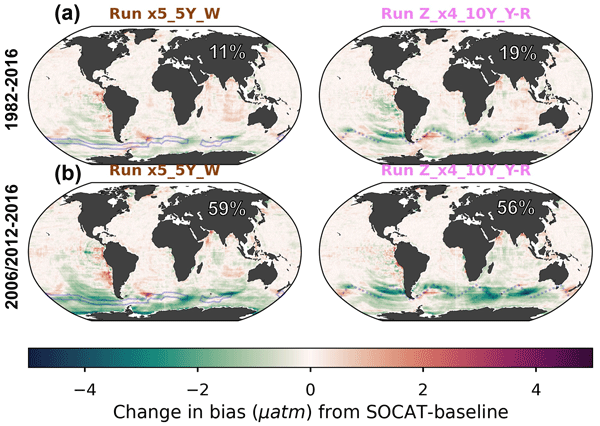
Thea H. Heimdal, Galen A. McKinley, Adrienne J. Sutton, Amanda R. Fay, and Lucas Gloege
Biogeosciences, 21, 2159–2176, https://doi.org/10.5194/bg-21-2159-2024, https://doi.org/10.5194/bg-21-2159-2024, 2024
Short summary
Short summary
Measurements of ocean carbon are limited in time and space. Machine learning algorithms are therefore used to reconstruct ocean carbon where observations do not exist. Improving these reconstructions is important in order to accurately estimate how much carbon the ocean absorbs from the atmosphere. In this study, we find that a small addition of observations from the Southern Ocean, obtained by autonomous sampling platforms, could significantly improve the reconstructions.
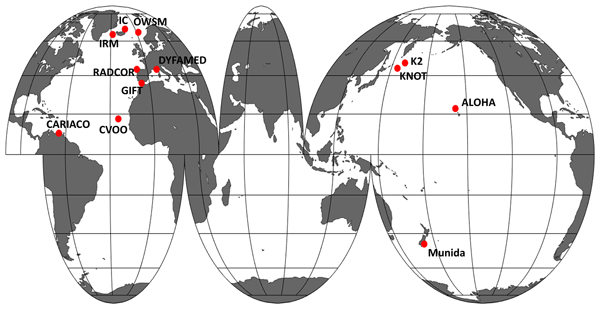
Nico Lange, Björn Fiedler, Marta Álvarez, Alice Benoit-Cattin, Heather Benway, Pier Luigi Buttigieg, Laurent Coppola, Kim Currie, Susana Flecha, Dana S. Gerlach, Makio Honda, I. Emma Huertas, Siv K. Lauvset, Frank Muller-Karger, Arne Körtzinger, Kevin M. O'Brien, Sólveig R. Ólafsdóttir, Fernando C. Pacheco, Digna Rueda-Roa, Ingunn Skjelvan, Masahide Wakita, Angelicque White, and Toste Tanhua
Earth Syst. Sci. Data, 16, 1901–1931, https://doi.org/10.5194/essd-16-1901-2024, https://doi.org/10.5194/essd-16-1901-2024, 2024
Short summary
Short summary
The Synthesis Product for Ocean Time Series (SPOTS) is a novel achievement expanding and complementing the biogeochemical data landscape by providing consistent and high-quality biogeochemical time-series data from 12 ship-based fixed time-series programs. SPOTS covers multiple unique marine environments and time-series ranges, including data from 1983 to 2021. All in all, it facilitates a variety of applications that benefit from the collective value of biogeochemical time-series observations.
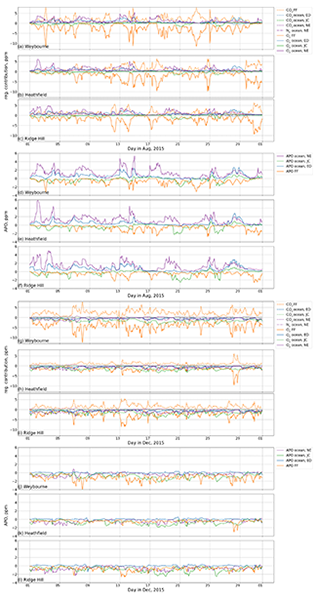
Hannah Chawner, Eric Saboya, Karina E. Adcock, Tim Arnold, Yuri Artioli, Caroline Dylag, Grant L. Forster, Anita Ganesan, Heather Graven, Gennadi Lessin, Peter Levy, Ingrid T. Luijkx, Alistair Manning, Penelope A. Pickers, Chris Rennick, Christian Rödenbeck, and Matthew Rigby
Atmos. Chem. Phys., 24, 4231–4252, https://doi.org/10.5194/acp-24-4231-2024, https://doi.org/10.5194/acp-24-4231-2024, 2024
Short summary
Short summary
The quantity of atmospheric potential oxygen (APO), derived from coincident measurements of carbon dioxide (CO2) and oxygen (O2), has been proposed as a tracer for fossil fuel CO2 emissions. In this model sensitivity study, we examine the use of APO for this purpose in the UK and compare our model to observations. We find that our model simulations are most sensitive to uncertainties relating to ocean fluxes and boundary conditions.
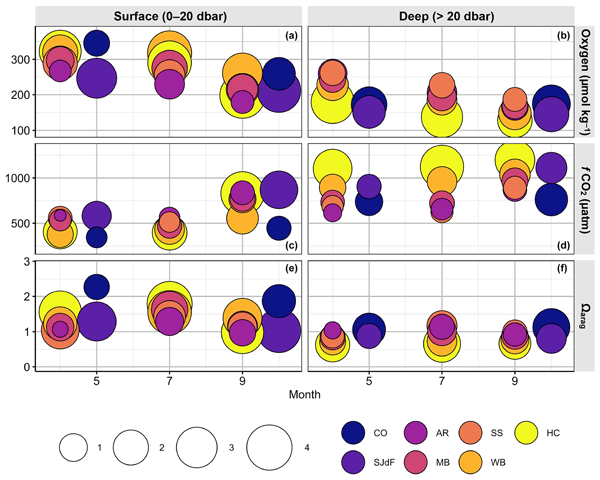
Simone R. Alin, Jan A. Newton, Richard A. Feely, Samantha Siedlecki, and Dana Greeley
Biogeosciences, 21, 1639–1673, https://doi.org/10.5194/bg-21-1639-2024, https://doi.org/10.5194/bg-21-1639-2024, 2024
Short summary
Short summary
We provide a new multi-stressor data product that allows us to characterize the seasonality of temperature, O2, and CO2 in the southern Salish Sea and delivers insights into the impacts of major marine heatwave and precipitation anomalies on regional ocean acidification and hypoxia. We also describe the present-day frequencies of temperature, O2, and ocean acidification conditions that cross thresholds of sensitive regional species that are economically or ecologically important.
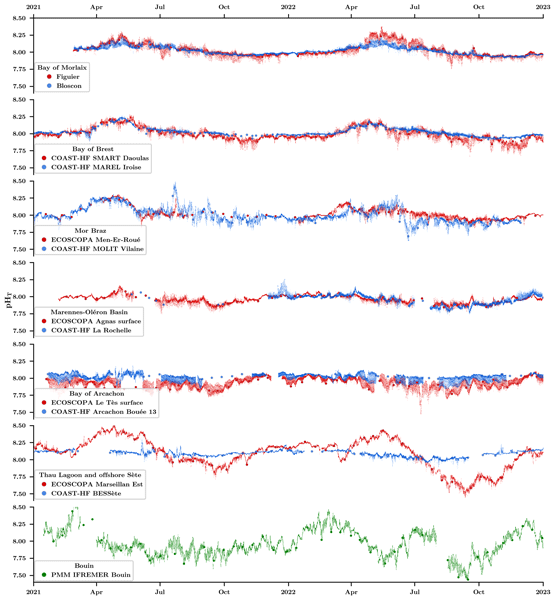
Sébastien Petton, Fabrice Pernet, Valérian Le Roy, Matthias Huber, Sophie Martin, Éric Macé, Yann Bozec, Stéphane Loisel, Peggy Rimmelin-Maury, Émilie Grossteffan, Michel Repecaud, Loïc Quemener, Michael Retho, Soazig Manac'h, Mathias Papin, Philippe Pineau, Thomas Lacoue-Labarthe, Jonathan Deborde, Louis Costes, Pierre Polsenaere, Loïc Rigouin, Jérémy Benhamou, Laure Gouriou, Joséphine Lequeux, Nathalie Labourdette, Nicolas Savoye, Grégory Messiaen, Elodie Foucault, Vincent Ouisse, Marion Richard, Franck Lagarde, Florian Voron, Valentin Kempf, Sébastien Mas, Léa Giannecchini, Francesca Vidussi, Behzad Mostajir, Yann Leredde, Samir Alliouane, Jean-Pierre Gattuso, and Frédéric Gazeau
Earth Syst. Sci. Data, 16, 1667–1688, https://doi.org/10.5194/essd-16-1667-2024, https://doi.org/10.5194/essd-16-1667-2024, 2024
Short summary
Short summary
Our research highlights the concerning impact of rising carbon dioxide levels on coastal areas. To better understand these changes, we've established an observation network in France. By deploying pH sensors and other monitoring equipment at key coastal sites, we're gaining valuable insights into how various factors, such as freshwater inputs, tides, temperature, and biological processes, influence ocean pH.
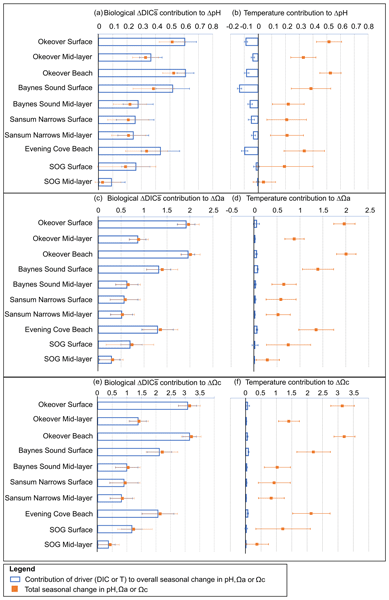
Eleanor Simpson, Debby Ianson, Karen E. Kohfeld, Ana C. Franco, Paul A. Covert, Marty Davelaar, and Yves Perreault
Biogeosciences, 21, 1323–1353, https://doi.org/10.5194/bg-21-1323-2024, https://doi.org/10.5194/bg-21-1323-2024, 2024
Short summary
Short summary
Shellfish aquaculture operates in nearshore areas where data on ocean acidification parameters are limited. We show daily and seasonal variability in pH and saturation states of calcium carbonate at nearshore aquaculture sites in British Columbia, Canada, and determine the contributing drivers of this variability. We find that nearshore locations have greater variability than open waters and that the uptake of carbon by phytoplankton is the major driver of pH and saturation state variability.
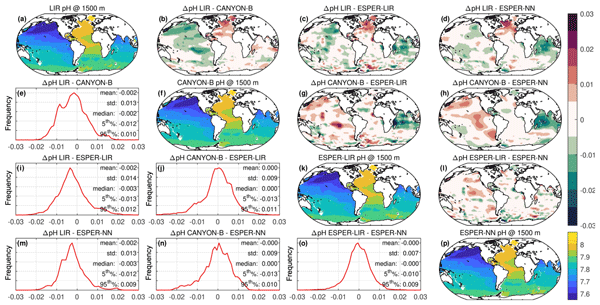
Cathy Wimart-Rousseau, Tobias Steinhoff, Birgit Klein, Henry Bittig, and Arne Körtzinger
Biogeosciences, 21, 1191–1211, https://doi.org/10.5194/bg-21-1191-2024, https://doi.org/10.5194/bg-21-1191-2024, 2024
Short summary
Short summary
The marine CO2 system can be measured independently and continuously by BGC-Argo floats since numerous pH sensors have been developed to suit these autonomous measurements platforms. By applying the Argo correction routines to float pH data acquired in the subpolar North Atlantic Ocean, we report the uncertainty and lack of objective criteria associated with the choice of the reference method as well the reference depth for the pH correction.
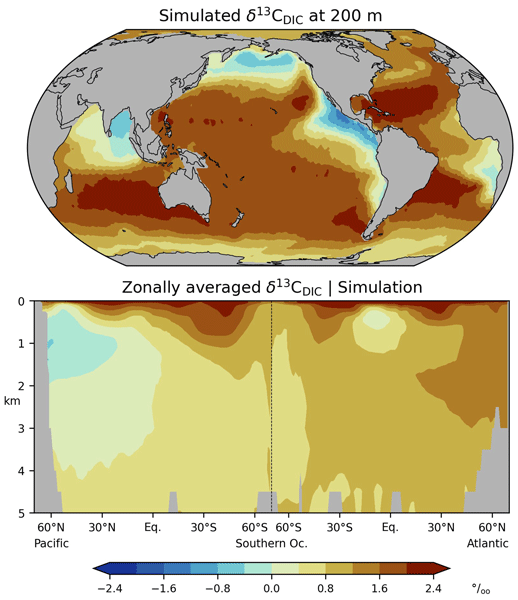
Martin Butzin, Ying Ye, Christoph Völker, Özgür Gürses, Judith Hauck, and Peter Köhler
Geosci. Model Dev., 17, 1709–1727, https://doi.org/10.5194/gmd-17-1709-2024, https://doi.org/10.5194/gmd-17-1709-2024, 2024
Short summary
Short summary
In this paper we describe the implementation of the carbon isotopes 13C and 14C into the marine biogeochemistry model FESOM2.1-REcoM3 and present results of long-term test simulations. Our model results are largely consistent with marine carbon isotope reconstructions for the pre-anthropogenic period, but also exhibit some discrepancies.
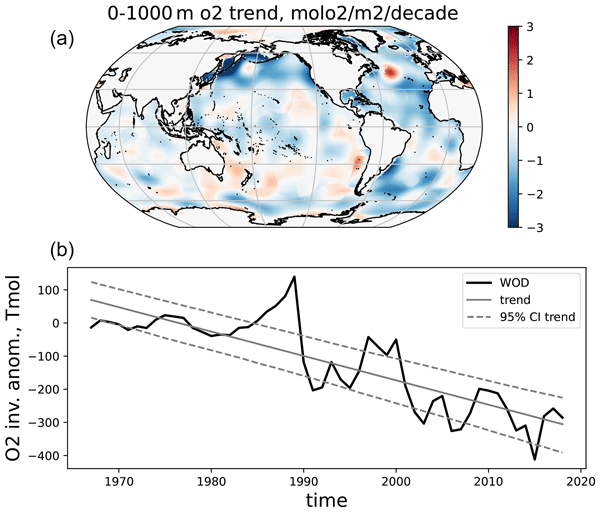
Takamitsu Ito, Hernan E. Garcia, Zhankun Wang, Shoshiro Minobe, Matthew C. Long, Just Cebrian, James Reagan, Tim Boyer, Christopher Paver, Courtney Bouchard, Yohei Takano, Seth Bushinsky, Ahron Cervania, and Curtis A. Deutsch
Biogeosciences, 21, 747–759, https://doi.org/10.5194/bg-21-747-2024, https://doi.org/10.5194/bg-21-747-2024, 2024
Short summary
Short summary
This study aims to estimate how much oceanic oxygen has been lost and its uncertainties. One major source of uncertainty comes from the statistical gap-filling methods. Outputs from Earth system models are used to generate synthetic observations where oxygen data are extracted from the model output at the location and time of historical oceanographic cruises. Reconstructed oxygen trend is approximately two-thirds of the true trend.
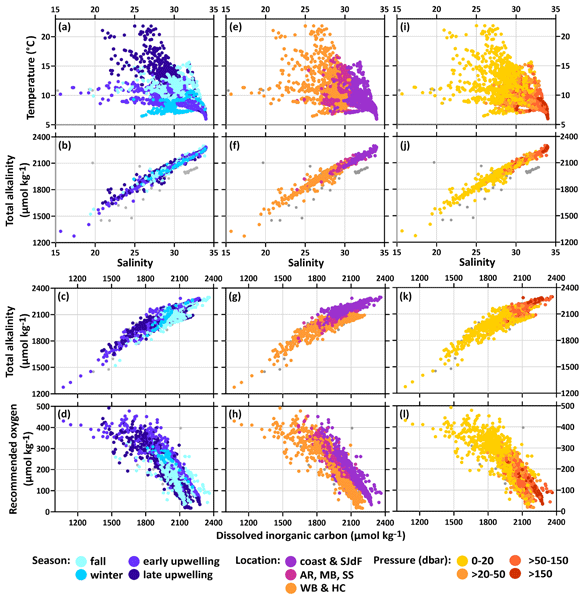
Simone R. Alin, Jan A. Newton, Richard A. Feely, Dana Greeley, Beth Curry, Julian Herndon, and Mark Warner
Earth Syst. Sci. Data, 16, 837–865, https://doi.org/10.5194/essd-16-837-2024, https://doi.org/10.5194/essd-16-837-2024, 2024
Short summary
Short summary
The Salish cruise data product provides 2008–2018 oceanographic data from the southern Salish Sea and nearby coastal sampling stations. Temperature, salinity, oxygen, nutrient, and dissolved inorganic carbon measurements from 715 oceanographic profiles will facilitate further study of ocean acidification, hypoxia, and marine heatwave impacts in this region. Three subsets of the compiled datasets from 35 cruises are available with consistent formatting and multiple commonly used units.
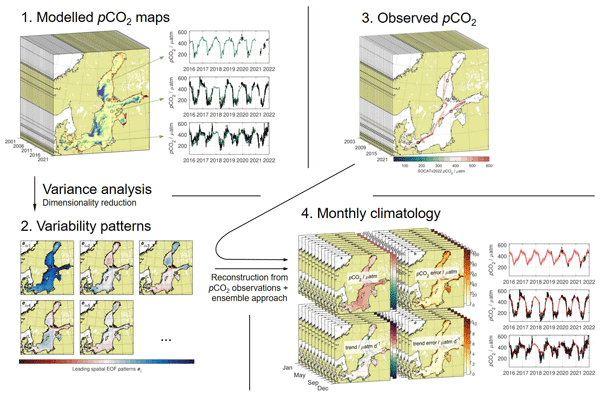
Henry C. Bittig, Erik Jacobs, Thomas Neumann, and Gregor Rehder
Earth Syst. Sci. Data, 16, 753–773, https://doi.org/10.5194/essd-16-753-2024, https://doi.org/10.5194/essd-16-753-2024, 2024
Short summary
Short summary
We present a pCO2 climatology of the Baltic Sea using a new approach to extrapolate from individual observations to the entire Baltic Sea. The extrapolation approach uses (a) a model to inform on how data at one location are connected to data at other locations, together with (b) very accurate pCO2 observations from 2003 to 2021 as the base data. The climatology can be used e.g. to assess uptake and release of CO2 or to identify extreme events.
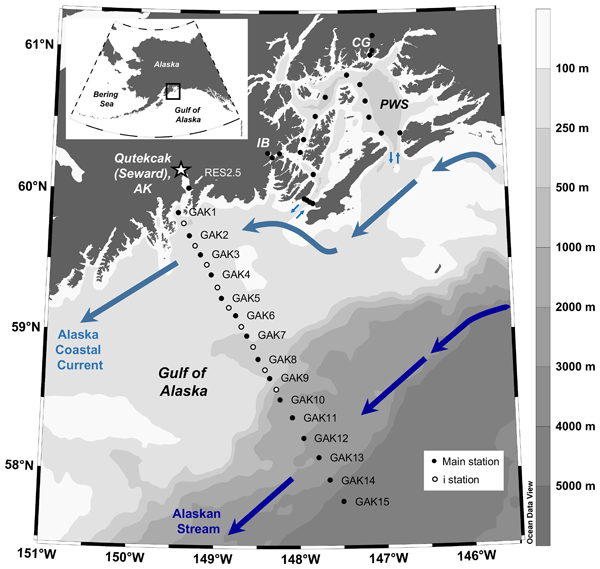
Natalie M. Monacci, Jessica N. Cross, Wiley Evans, Jeremy T. Mathis, and Hongjie Wang
Earth Syst. Sci. Data, 16, 647–665, https://doi.org/10.5194/essd-16-647-2024, https://doi.org/10.5194/essd-16-647-2024, 2024
Short summary
Short summary
As carbon dioxide is released into the air through human-generated activity, about one third dissolves into the surface water of oceans, lowering pH and increasing acidity. This is known as ocean acidification. We merged 10 years of ocean carbon data and made them publicly available for adaptation planning during a time of change. The data confirmed that Alaska is already experiencing the effects of ocean acidification due to naturally cold water, high productivity, and circulation patterns.
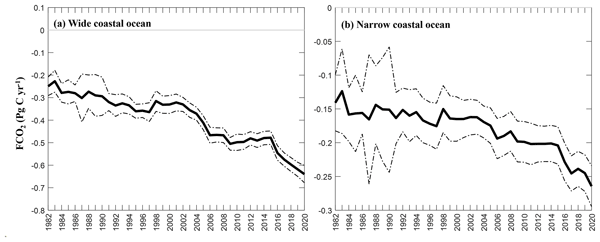
Alizée Roobaert, Pierre Regnier, Peter Landschützer, and Goulven G. Laruelle
Earth Syst. Sci. Data, 16, 421–441, https://doi.org/10.5194/essd-16-421-2024, https://doi.org/10.5194/essd-16-421-2024, 2024
Short summary
Short summary
The quantification of the coastal air–sea CO2 exchange (FCO2) has improved in recent years, but its multiannual variability remains unclear. This study, based on interpolated observations, reconstructs the longest global time series of coastal FCO2 (1982–2020). Results show the coastal ocean acts as a CO2 sink, with increasing intensity over time. This new coastal FCO2-product allows establishing regional carbon budgets and provides new constraints for closing the global carbon cycle.
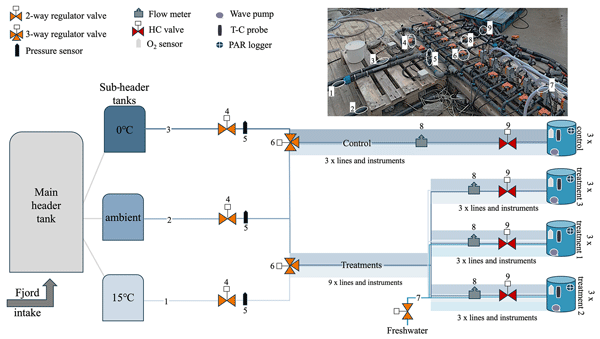
Cale A. Miller, Pierre Urrutti, Jean-Pierre Gattuso, Steeve Comeau, Anaïs Lebrun, Samir Alliouane, Robert W. Schlegel, and Frédéric Gazeau
Biogeosciences, 21, 315–333, https://doi.org/10.5194/bg-21-315-2024, https://doi.org/10.5194/bg-21-315-2024, 2024
Short summary
Short summary
This work describes an experimental system that can replicate and manipulate environmental conditions in marine or aquatic systems. Here, we show how the temperature and salinity of seawater delivered from a fjord is manipulated to experimental tanks on land. By constantly monitoring temperature and salinity in each tank via a computer program, the system continuously adjusts automated flow valves to ensure the seawater in each tank matches the targeted experimental conditions.
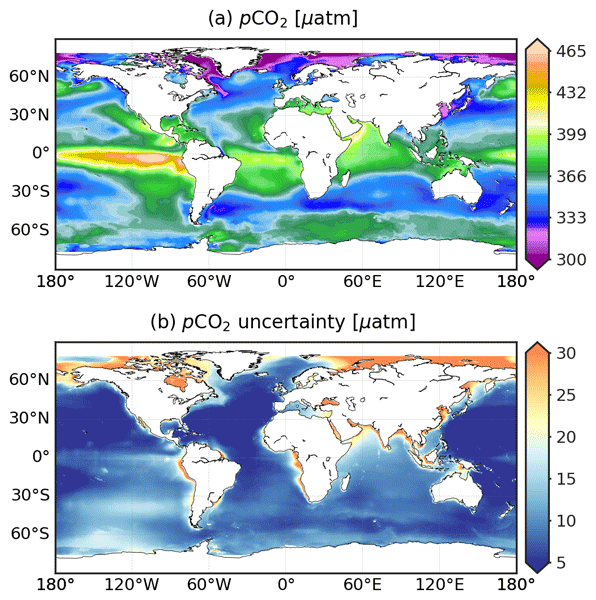
Thi-Tuyet-Trang Chau, Marion Gehlen, Nicolas Metzl, and Frédéric Chevallier
Earth Syst. Sci. Data, 16, 121–160, https://doi.org/10.5194/essd-16-121-2024, https://doi.org/10.5194/essd-16-121-2024, 2024
Short summary
Short summary
CMEMS-LSCE leads as the first global observation-based reconstructions of six carbonate system variables for the years 1985–2021 at monthly and 0.25° resolutions. The high-resolution reconstructions outperform their 1° counterpart in reproducing horizontal and temporal gradients of observations over various oceanic regions to nearshore time series stations. New datasets can be exploited in numerous studies, including monitoring changes in ocean carbon uptake and ocean acidification.
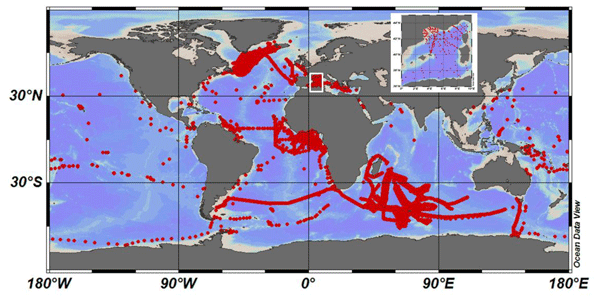
Nicolas Metzl, Jonathan Fin, Claire Lo Monaco, Claude Mignon, Samir Alliouane, David Antoine, Guillaume Bourdin, Jacqueline Boutin, Yann Bozec, Pascal Conan, Laurent Coppola, Frédéric Diaz, Eric Douville, Xavier Durrieu de Madron, Jean-Pierre Gattuso, Frédéric Gazeau, Melek Golbol, Bruno Lansard, Dominique Lefèvre, Nathalie Lefèvre, Fabien Lombard, Férial Louanchi, Liliane Merlivat, Léa Olivier, Anne Petrenko, Sébastien Petton, Mireille Pujo-Pay, Christophe Rabouille, Gilles Reverdin, Céline Ridame, Aline Tribollet, Vincenzo Vellucci, Thibaut Wagener, and Cathy Wimart-Rousseau
Earth Syst. Sci. Data, 16, 89–120, https://doi.org/10.5194/essd-16-89-2024, https://doi.org/10.5194/essd-16-89-2024, 2024
Short summary
Short summary
This work presents a synthesis of 44 000 total alkalinity and dissolved inorganic carbon observations obtained between 1993 and 2022 in the Global Ocean and the Mediterranean Sea at the surface and in the water column. Seawater samples were measured using the same method and calibrated with international Certified Reference Material. We describe the data assemblage, quality control and some potential uses of this dataset.
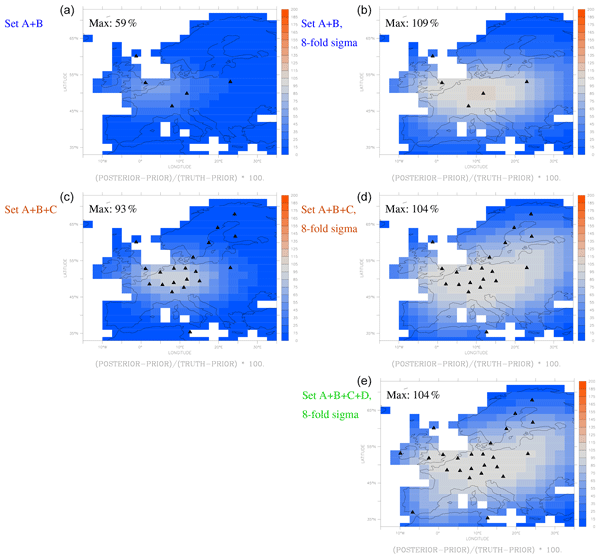
Christian Rödenbeck, Karina E. Adcock, Markus Eritt, Maksym Gachkivskyi, Christoph Gerbig, Samuel Hammer, Armin Jordan, Ralph F. Keeling, Ingeborg Levin, Fabian Maier, Andrew C. Manning, Heiko Moossen, Saqr Munassar, Penelope A. Pickers, Michael Rothe, Yasunori Tohjima, and Sönke Zaehle
Atmos. Chem. Phys., 23, 15767–15782, https://doi.org/10.5194/acp-23-15767-2023, https://doi.org/10.5194/acp-23-15767-2023, 2023
Short summary
Short summary
The carbon dioxide content of the Earth atmosphere is increasing due to human emissions from burning of fossil fuels, causing global climate change. The strength of the fossil-fuel emissions is estimated by inventories based on energy data, but independent validation of these inventories has been recommended by the Intergovernmental Panel on Climate Change. Here we investigate the potential to validate inventories based on measurements of small changes in the atmospheric oxygen content.
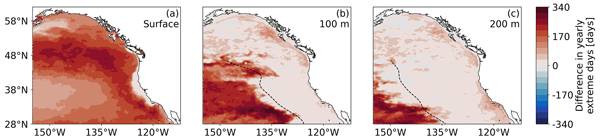
Flora Desmet, Matthias Münnich, and Nicolas Gruber
Biogeosciences, 20, 5151–5175, https://doi.org/10.5194/bg-20-5151-2023, https://doi.org/10.5194/bg-20-5151-2023, 2023
Short summary
Short summary
Ocean acidity extremes in the upper 250 m depth of the northeastern Pacific rapidly increase with atmospheric CO2 rise, which is worrisome for marine organisms that rapidly experience pH levels outside their local environmental conditions. Presented research shows the spatiotemporal heterogeneity in this increase between regions and depths. In particular, the subsurface increase is substantially slowed down by the presence of mesoscale eddies, often not resolved in Earth system models.
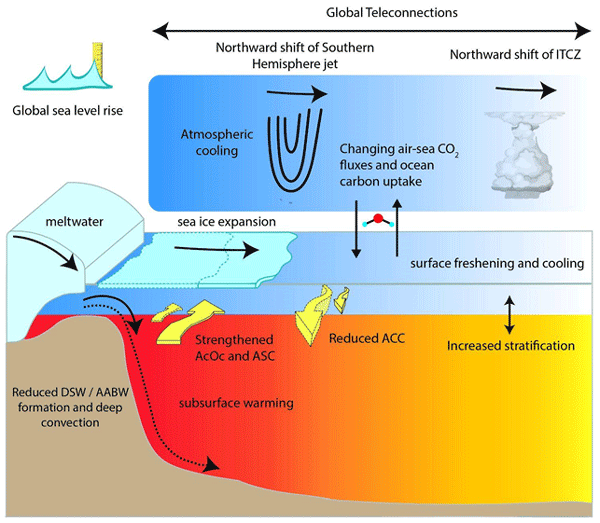
Neil C. Swart, Torge Martin, Rebecca Beadling, Jia-Jia Chen, Christopher Danek, Matthew H. England, Riccardo Farneti, Stephen M. Griffies, Tore Hattermann, Judith Hauck, F. Alexander Haumann, André Jüling, Qian Li, John Marshall, Morven Muilwijk, Andrew G. Pauling, Ariaan Purich, Inga J. Smith, and Max Thomas
Geosci. Model Dev., 16, 7289–7309, https://doi.org/10.5194/gmd-16-7289-2023, https://doi.org/10.5194/gmd-16-7289-2023, 2023
Short summary
Short summary
Current climate models typically do not include full representation of ice sheets. As the climate warms and the ice sheets melt, they add freshwater to the ocean. This freshwater can influence climate change, for example by causing more sea ice to form. In this paper we propose a set of experiments to test the influence of this missing meltwater from Antarctica using multiple different climate models.
Alizée Dale, Marion Gehlen, Douglas W. R. Wallace, Germain Bénard, Christian Éthé, and Elena Alekseenko
EGUsphere, https://doi.org/10.5194/egusphere-2023-2538, https://doi.org/10.5194/egusphere-2023-2538, 2023
Preprint archived
Short summary
Short summary
Diatom, which is at the base of a productive food chain that supports valuable fisheries, dominates the total primary production of the Labrador Sea (LS). The synthesis of biogenic silica frustules makes them peculiar among phytoplankton but also dependent on dissolved silicate (DSi). Regular oceanographic surveys show declining DSi concentrations since the mid-1990s. With a model-based approach, we show that weakening deep winter convection was the proximate cause of DSi decline in the LS.
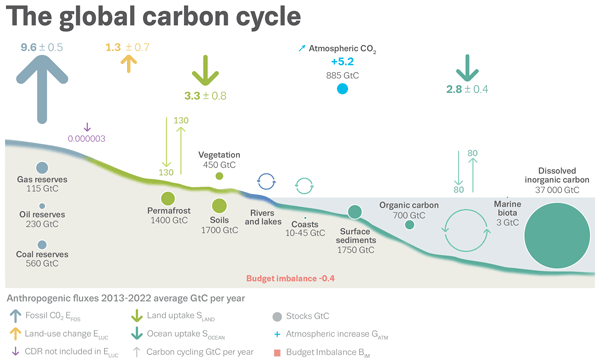
Pierre Friedlingstein, Michael O'Sullivan, Matthew W. Jones, Robbie M. Andrew, Dorothee C. E. Bakker, Judith Hauck, Peter Landschützer, Corinne Le Quéré, Ingrid T. Luijkx, Glen P. Peters, Wouter Peters, Julia Pongratz, Clemens Schwingshackl, Stephen Sitch, Josep G. Canadell, Philippe Ciais, Robert B. Jackson, Simone R. Alin, Peter Anthoni, Leticia Barbero, Nicholas R. Bates, Meike Becker, Nicolas Bellouin, Bertrand Decharme, Laurent Bopp, Ida Bagus Mandhara Brasika, Patricia Cadule, Matthew A. Chamberlain, Naveen Chandra, Thi-Tuyet-Trang Chau, Frédéric Chevallier, Louise P. Chini, Margot Cronin, Xinyu Dou, Kazutaka Enyo, Wiley Evans, Stefanie Falk, Richard A. Feely, Liang Feng, Daniel J. Ford, Thomas Gasser, Josefine Ghattas, Thanos Gkritzalis, Giacomo Grassi, Luke Gregor, Nicolas Gruber, Özgür Gürses, Ian Harris, Matthew Hefner, Jens Heinke, Richard A. Houghton, George C. Hurtt, Yosuke Iida, Tatiana Ilyina, Andrew R. Jacobson, Atul Jain, Tereza Jarníková, Annika Jersild, Fei Jiang, Zhe Jin, Fortunat Joos, Etsushi Kato, Ralph F. Keeling, Daniel Kennedy, Kees Klein Goldewijk, Jürgen Knauer, Jan Ivar Korsbakken, Arne Körtzinger, Xin Lan, Nathalie Lefèvre, Hongmei Li, Junjie Liu, Zhiqiang Liu, Lei Ma, Greg Marland, Nicolas Mayot, Patrick C. McGuire, Galen A. McKinley, Gesa Meyer, Eric J. Morgan, David R. Munro, Shin-Ichiro Nakaoka, Yosuke Niwa, Kevin M. O'Brien, Are Olsen, Abdirahman M. Omar, Tsuneo Ono, Melf Paulsen, Denis Pierrot, Katie Pocock, Benjamin Poulter, Carter M. Powis, Gregor Rehder, Laure Resplandy, Eddy Robertson, Christian Rödenbeck, Thais M. Rosan, Jörg Schwinger, Roland Séférian, T. Luke Smallman, Stephen M. Smith, Reinel Sospedra-Alfonso, Qing Sun, Adrienne J. Sutton, Colm Sweeney, Shintaro Takao, Pieter P. Tans, Hanqin Tian, Bronte Tilbrook, Hiroyuki Tsujino, Francesco Tubiello, Guido R. van der Werf, Erik van Ooijen, Rik Wanninkhof, Michio Watanabe, Cathy Wimart-Rousseau, Dongxu Yang, Xiaojuan Yang, Wenping Yuan, Xu Yue, Sönke Zaehle, Jiye Zeng, and Bo Zheng
Earth Syst. Sci. Data, 15, 5301–5369, https://doi.org/10.5194/essd-15-5301-2023, https://doi.org/10.5194/essd-15-5301-2023, 2023
Short summary
Short summary
The Global Carbon Budget 2023 describes the methodology, main results, and data sets used to quantify the anthropogenic emissions of carbon dioxide (CO2) and their partitioning among the atmosphere, land ecosystems, and the ocean over the historical period (1750–2023). These living datasets are updated every year to provide the highest transparency and traceability in the reporting of CO2, the key driver of climate change.
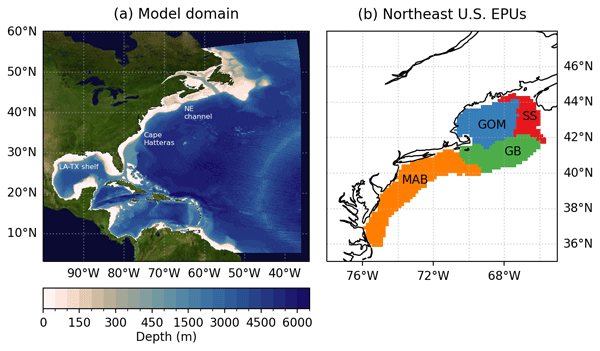
Andrew C. Ross, Charles A. Stock, Alistair Adcroft, Enrique Curchitser, Robert Hallberg, Matthew J. Harrison, Katherine Hedstrom, Niki Zadeh, Michael Alexander, Wenhao Chen, Elizabeth J. Drenkard, Hubert du Pontavice, Raphael Dussin, Fabian Gomez, Jasmin G. John, Dujuan Kang, Diane Lavoie, Laure Resplandy, Alizée Roobaert, Vincent Saba, Sang-Ik Shin, Samantha Siedlecki, and James Simkins
Geosci. Model Dev., 16, 6943–6985, https://doi.org/10.5194/gmd-16-6943-2023, https://doi.org/10.5194/gmd-16-6943-2023, 2023
Short summary
Short summary
We evaluate a model for northwest Atlantic Ocean dynamics and biogeochemistry that balances high resolution with computational economy by building on the new regional features in the MOM6 ocean model and COBALT biogeochemical model. We test the model's ability to simulate impactful historical variability and find that the model simulates the mean state and variability of most features well, which suggests the model can provide information to inform living-marine-resource applications.
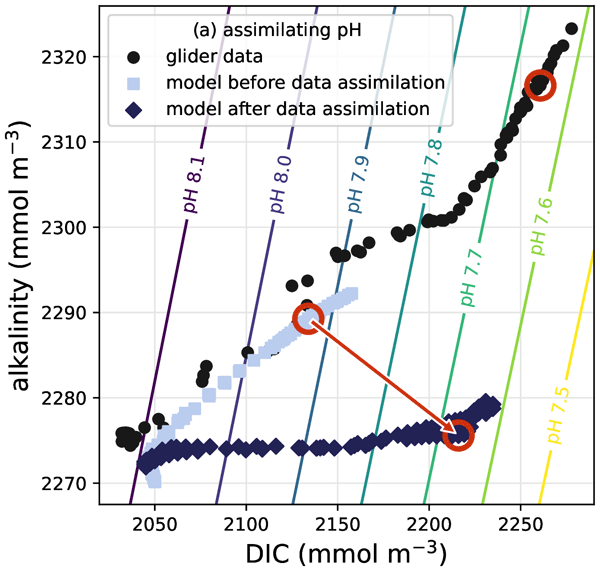
Katja Fennel, Matthew C. Long, Christopher Algar, Brendan Carter, David Keller, Arnaud Laurent, Jann Paul Mattern, Ruth Musgrave, Andreas Oschlies, Josiane Ostiguy, Jaime B. Palter, and Daniel B. Whitt
State Planet, 2-oae2023, 9, https://doi.org/10.5194/sp-2-oae2023-9-2023, https://doi.org/10.5194/sp-2-oae2023-9-2023, 2023
Short summary
Short summary
This paper describes biogeochemical models and modelling techniques for applications related to ocean alkalinity enhancement (OAE) research. Many of the most pressing OAE-related research questions cannot be addressed by observation alone but will require a combination of skilful models and observations. We present illustrative examples with references to further information; describe limitations, caveats, and future research needs; and provide practical recommendations.
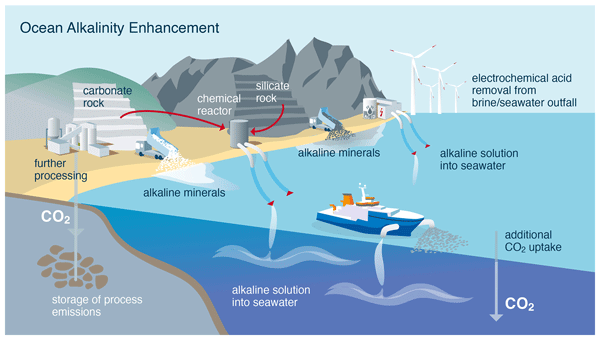
Andreas Oschlies, Lennart T. Bach, Rosalind E. M. Rickaby, Terre Satterfield, Romany Webb, and Jean-Pierre Gattuso
State Planet, 2-oae2023, 1, https://doi.org/10.5194/sp-2-oae2023-1-2023, https://doi.org/10.5194/sp-2-oae2023-1-2023, 2023
Short summary
Short summary
Reaching promised climate targets will require the deployment of carbon dioxide removal (CDR). Marine CDR options receive more and more interest. Based on idealized theoretical studies, ocean alkalinity enhancement (OAE) appears as a promising marine CDR method. We provide an overview on the current situation of developing OAE as a marine CDR method and describe the history that has led to the creation of the OAE research best practice guide.
Li-Qing Jiang, Adam V. Subhas, Daniela Basso, Katja Fennel, and Jean-Pierre Gattuso
State Planet, 2-oae2023, 13, https://doi.org/10.5194/sp-2-oae2023-13-2023, https://doi.org/10.5194/sp-2-oae2023-13-2023, 2023
Short summary
Short summary
This paper provides comprehensive guidelines for ocean alkalinity enhancement (OAE) researchers on archiving their metadata and data. It includes data standards for various OAE studies and a universal metadata template. Controlled vocabularies for terms like alkalinization methods are included. These guidelines also apply to ocean acidification data.
Christoph Heinze, Thorsten Blenckner, Peter Brown, Friederike Fröb, Anne Morée, Adrian L. New, Cara Nissen, Stefanie Rynders, Isabel Seguro, Yevgeny Aksenov, Yuri Artioli, Timothée Bourgeois, Friedrich Burger, Jonathan Buzan, B. B. Cael, Veli Çağlar Yumruktepe, Melissa Chierici, Christopher Danek, Ulf Dieckmann, Agneta Fransson, Thomas Frölicher, Giovanni Galli, Marion Gehlen, Aridane G. González, Melchor Gonzalez-Davila, Nicolas Gruber, Örjan Gustafsson, Judith Hauck, Mikko Heino, Stephanie Henson, Jenny Hieronymus, I. Emma Huertas, Fatma Jebri, Aurich Jeltsch-Thömmes, Fortunat Joos, Jaideep Joshi, Stephen Kelly, Nandini Menon, Precious Mongwe, Laurent Oziel, Sólveig Ólafsdottir, Julien Palmieri, Fiz F. Pérez, Rajamohanan Pillai Ranith, Juliano Ramanantsoa, Tilla Roy, Dagmara Rusiecka, J. Magdalena Santana Casiano, Yeray Santana-Falcón, Jörg Schwinger, Roland Séférian, Miriam Seifert, Anna Shchiptsova, Bablu Sinha, Christopher Somes, Reiner Steinfeldt, Dandan Tao, Jerry Tjiputra, Adam Ulfsbo, Christoph Völker, Tsuyoshi Wakamatsu, and Ying Ye
Biogeosciences Discuss., https://doi.org/10.5194/bg-2023-182, https://doi.org/10.5194/bg-2023-182, 2023
Revised manuscript not accepted
Short summary
Short summary
For assessing the consequences of human-induced climate change for the marine realm, it is necessary to not only look at gradual changes but also at abrupt changes of environmental conditions. We summarise abrupt changes in ocean warming, acidification, and oxygen concentration as the key environmental factors for ecosystems. Taking these abrupt changes into account requires greenhouse gas emissions to be reduced to a larger extent than previously thought to limit respective damage.
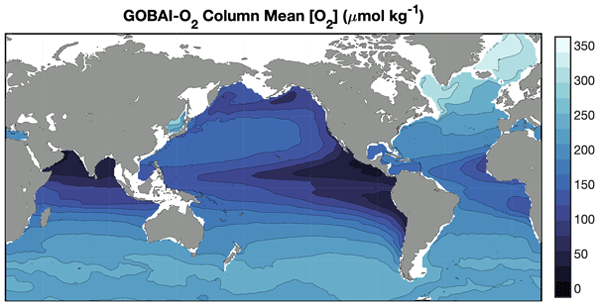
Jonathan D. Sharp, Andrea J. Fassbender, Brendan R. Carter, Gregory C. Johnson, Cristina Schultz, and John P. Dunne
Earth Syst. Sci. Data, 15, 4481–4518, https://doi.org/10.5194/essd-15-4481-2023, https://doi.org/10.5194/essd-15-4481-2023, 2023
Short summary
Short summary
Dissolved oxygen content is a critical metric of ocean health. Recently, expanding fleets of autonomous platforms that measure oxygen in the ocean have produced a wealth of new data. We leverage machine learning to take advantage of this growing global dataset, producing a gridded data product of ocean interior dissolved oxygen at monthly resolution over nearly 2 decades. This work provides novel information for investigations of spatial, seasonal, and interannual variability in ocean oxygen.
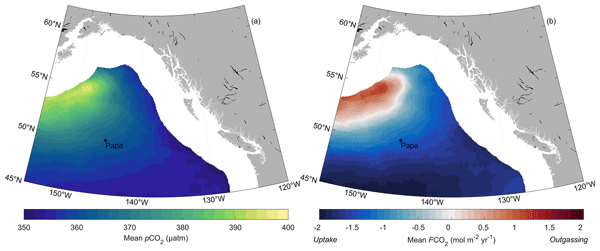
Patrick J. Duke, Roberta C. Hamme, Debby Ianson, Peter Landschützer, Mohamed M. M. Ahmed, Neil C. Swart, and Paul A. Covert
Biogeosciences, 20, 3919–3941, https://doi.org/10.5194/bg-20-3919-2023, https://doi.org/10.5194/bg-20-3919-2023, 2023
Short summary
Short summary
The ocean is both impacted by climate change and helps mitigate its effects through taking up carbon from the atmosphere. We used a machine learning approach to investigate what controls open-ocean carbon uptake in the northeast Pacific open ocean. Marine heatwaves that lasted 2–3 years increased uptake, while the upwelling strength of the Alaskan Gyre controlled uptake over 10-year time periods. The trend from 1998–2019 suggests carbon uptake in the northeast Pacific open ocean is increasing.
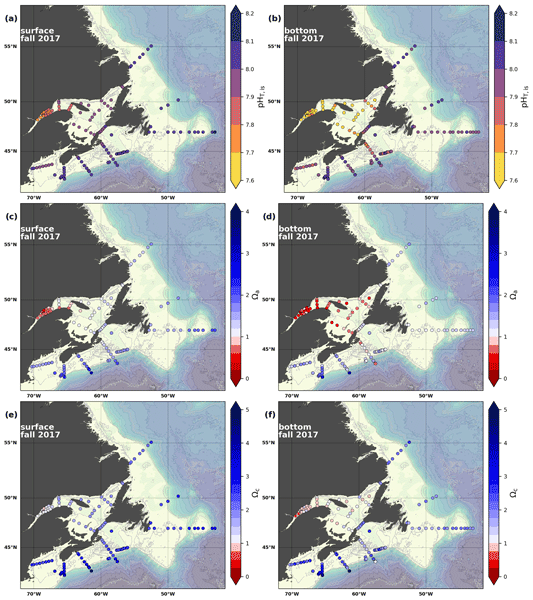
Olivia Gibb, Frédéric Cyr, Kumiko Azetsu-Scott, Joël Chassé, Darlene Childs, Carrie-Ellen Gabriel, Peter S. Galbraith, Gary Maillet, Pierre Pepin, Stephen Punshon, and Michel Starr
Earth Syst. Sci. Data, 15, 4127–4162, https://doi.org/10.5194/essd-15-4127-2023, https://doi.org/10.5194/essd-15-4127-2023, 2023
Short summary
Short summary
The ocean absorbs large quantities of carbon dioxide (CO2) released into the atmosphere as a result of the burning of fossil fuels. This, in turn, causes ocean acidification, which poses a major threat to global ocean ecosystems. In this study, we compiled 9 years (2014–2022) of ocean carbonate data (i.e., ocean acidification parameters) collected in Atlantic Canada as part of the Atlantic Zone Monitoring Program.
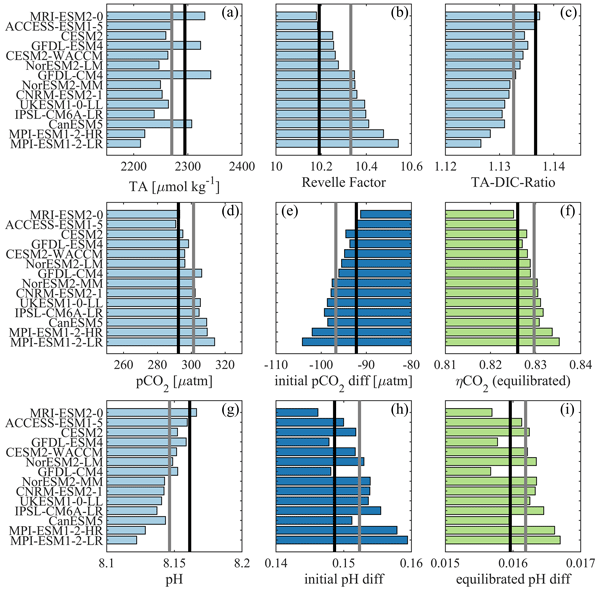
Claudia Hinrichs, Peter Köhler, Christoph Völker, and Judith Hauck
Biogeosciences, 20, 3717–3735, https://doi.org/10.5194/bg-20-3717-2023, https://doi.org/10.5194/bg-20-3717-2023, 2023
Short summary
Short summary
This study evaluated the alkalinity distribution in 14 climate models and found that most models underestimate alkalinity at the surface and overestimate it in the deeper ocean. It highlights the need for better understanding and quantification of processes driving alkalinity distribution and calcium carbonate dissolution and the importance of accounting for biases in model results when evaluating potential ocean alkalinity enhancement experiments.
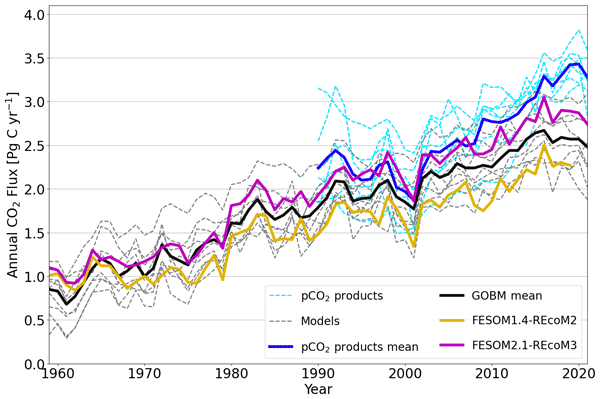
Özgür Gürses, Laurent Oziel, Onur Karakuş, Dmitry Sidorenko, Christoph Völker, Ying Ye, Moritz Zeising, Martin Butzin, and Judith Hauck
Geosci. Model Dev., 16, 4883–4936, https://doi.org/10.5194/gmd-16-4883-2023, https://doi.org/10.5194/gmd-16-4883-2023, 2023
Short summary
Short summary
This paper assesses the biogeochemical model REcoM3 coupled to the ocean–sea ice model FESOM2.1. The model can be used to simulate the carbon uptake or release of the ocean on timescales of several hundred years. A detailed analysis of the nutrients, ocean productivity, and ecosystem is followed by the carbon cycle. The main conclusion is that the model performs well when simulating the observed mean biogeochemical state and variability and is comparable to other ocean–biogeochemical models.
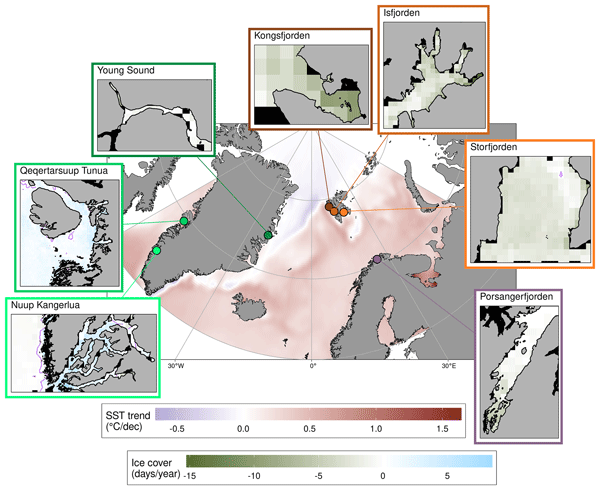
Robert W. Schlegel and Jean-Pierre Gattuso
Earth Syst. Sci. Data, 15, 3733–3746, https://doi.org/10.5194/essd-15-3733-2023, https://doi.org/10.5194/essd-15-3733-2023, 2023
Short summary
Short summary
A single dataset was created for investigations of changes in the socio-ecological systems within seven Arctic fjords by amalgamating roughly 1400 datasets from a number of sources. The many variables in these data were organised into five distinct categories and classified into 14 key drivers. Data for seawater temperature and salinity are available from the late 19th century, with some other drivers having data available from the 1950s and 1960s and the others starting from the 1990s onward.
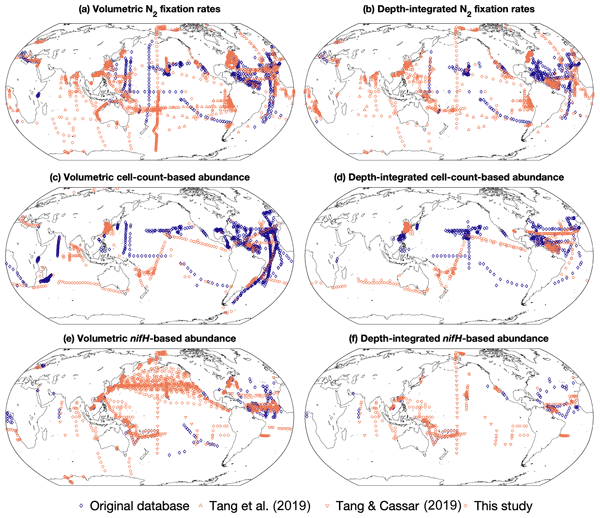
Zhibo Shao, Yangchun Xu, Hua Wang, Weicheng Luo, Lice Wang, Yuhong Huang, Nona Sheila R. Agawin, Ayaz Ahmed, Mar Benavides, Mikkel Bentzon-Tilia, Ilana Berman-Frank, Hugo Berthelot, Isabelle C. Biegala, Mariana B. Bif, Antonio Bode, Sophie Bonnet, Deborah A. Bronk, Mark V. Brown, Lisa Campbell, Douglas G. Capone, Edward J. Carpenter, Nicolas Cassar, Bonnie X. Chang, Dreux Chappell, Yuh-ling Lee Chen, Matthew J. Church, Francisco M. Cornejo-Castillo, Amália Maria Sacilotto Detoni, Scott C. Doney, Cecile Dupouy, Marta Estrada, Camila Fernandez, Bieito Fernández-Castro, Debany Fonseca-Batista, Rachel A. Foster, Ken Furuya, Nicole Garcia, Kanji Goto, Jesús Gago, Mary R. Gradoville, M. Robert Hamersley, Britt A. Henke, Cora Hörstmann, Amal Jayakumar, Zhibing Jiang, Shuh-Ji Kao, David M. Karl, Leila R. Kittu, Angela N. Knapp, Sanjeev Kumar, Julie LaRoche, Hongbin Liu, Jiaxing Liu, Caroline Lory, Carolin R. Löscher, Emilio Marañón, Lauren F. Messer, Matthew M. Mills, Wiebke Mohr, Pia H. Moisander, Claire Mahaffey, Robert Moore, Beatriz Mouriño-Carballido, Margaret R. Mulholland, Shin-ichiro Nakaoka, Joseph A. Needoba, Eric J. Raes, Eyal Rahav, Teodoro Ramírez-Cárdenas, Christian Furbo Reeder, Lasse Riemann, Virginie Riou, Julie C. Robidart, Vedula V. S. S. Sarma, Takuya Sato, Himanshu Saxena, Corday Selden, Justin R. Seymour, Dalin Shi, Takuhei Shiozaki, Arvind Singh, Rachel E. Sipler, Jun Sun, Koji Suzuki, Kazutaka Takahashi, Yehui Tan, Weiyi Tang, Jean-Éric Tremblay, Kendra Turk-Kubo, Zuozhu Wen, Angelicque E. White, Samuel T. Wilson, Takashi Yoshida, Jonathan P. Zehr, Run Zhang, Yao Zhang, and Ya-Wei Luo
Earth Syst. Sci. Data, 15, 3673–3709, https://doi.org/10.5194/essd-15-3673-2023, https://doi.org/10.5194/essd-15-3673-2023, 2023
Short summary
Short summary
N2 fixation by marine diazotrophs is an important bioavailable N source to the global ocean. This updated global oceanic diazotroph database increases the number of in situ measurements of N2 fixation rates, diazotrophic cell abundances, and nifH gene copy abundances by 184 %, 86 %, and 809 %, respectively. Using the updated database, the global marine N2 fixation rate is estimated at 223 ± 30 Tg N yr−1, which triplicates that using the original database.
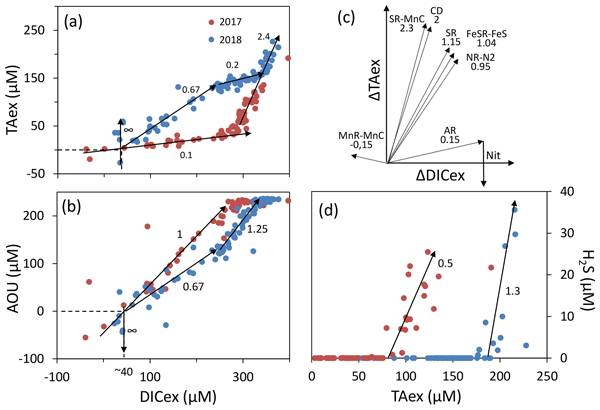
Aubin Thibault de Chanvalon, George W. Luther, Emily R. Estes, Jennifer Necker, Bradley M. Tebo, Jianzhong Su, and Wei-Jun Cai
Biogeosciences, 20, 3053–3071, https://doi.org/10.5194/bg-20-3053-2023, https://doi.org/10.5194/bg-20-3053-2023, 2023
Short summary
Short summary
The intensity of the oceanic trap of CO2 released by anthropogenic activities depends on the alkalinity brought by continental weathering. Between ocean and continent, coastal water and estuaries can limit or favour the alkalinity transfer. This study investigate new interactions between dissolved metals and alkalinity in the oxygen-depleted zone of estuaries.
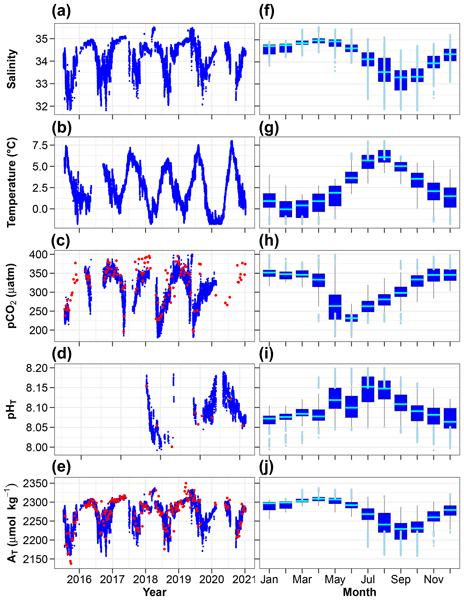
Jean-Pierre Gattuso, Samir Alliouane, and Philipp Fischer
Earth Syst. Sci. Data, 15, 2809–2825, https://doi.org/10.5194/essd-15-2809-2023, https://doi.org/10.5194/essd-15-2809-2023, 2023
Short summary
Short summary
The Arctic Ocean is subject to high rates of ocean warming and acidification, with critical implications for marine organisms, ecosystems and the services they provide. We report here on the first high-frequency (1 h), multi-year (5 years) dataset of the carbonate system at a coastal site in a high-Arctic fjord (Kongsfjorden, Svalbard). This site is a significant sink for CO2 every month of the year (9 to 17 mol m-2 yr-1). The saturation state of aragonite can be as low as 1.3.
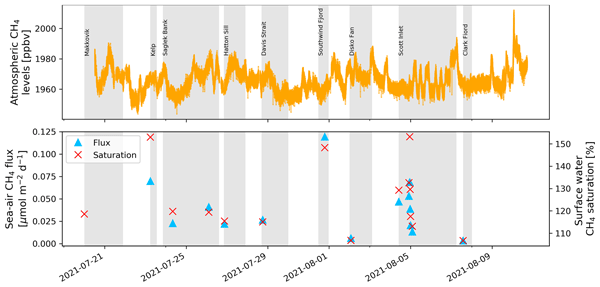
Judith Vogt, David Risk, Evelise Bourlon, Kumiko Azetsu-Scott, Evan N. Edinger, and Owen A. Sherwood
Biogeosciences, 20, 1773–1787, https://doi.org/10.5194/bg-20-1773-2023, https://doi.org/10.5194/bg-20-1773-2023, 2023
Short summary
Short summary
The release of the greenhouse gas methane from Arctic submarine sources could exacerbate climate change in a positive feedback. Continuous monitoring of atmospheric methane levels over a 5100 km voyage in the western margin of the Labrador Sea and Baffin Bay revealed above-global averages likely affected by both onshore and offshore methane sources. Instantaneous sea–air methane fluxes were near zero at all measured stations, including a persistent cold-seep location.
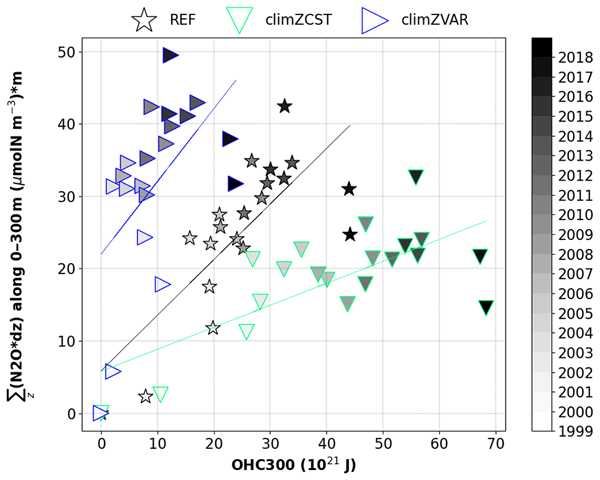
Sarah Berthet, Julien Jouanno, Roland Séférian, Marion Gehlen, and William Llovel
Earth Syst. Dynam., 14, 399–412, https://doi.org/10.5194/esd-14-399-2023, https://doi.org/10.5194/esd-14-399-2023, 2023
Short summary
Short summary
Phytoplankton absorbs the solar radiation entering the ocean surface and contributes to keeping the associated energy in surface waters. This natural effect is either not represented in the ocean component of climate models or its representation is simplified. An incomplete representation of this biophysical interaction affects the way climate models simulate ocean warming, which leads to uncertainties in projections of oceanic emissions of an important greenhouse gas (nitrous oxide).
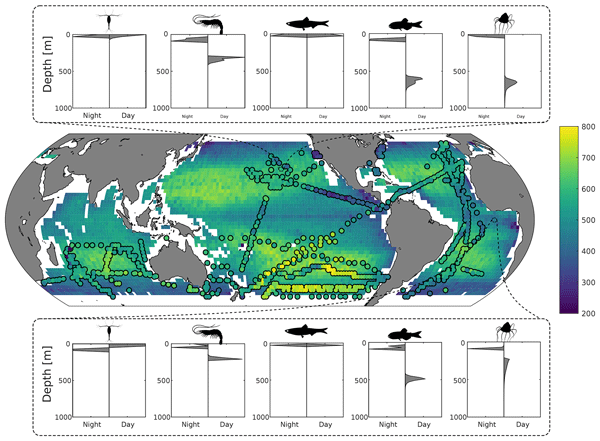
Jérôme Pinti, Tim DeVries, Tommy Norin, Camila Serra-Pompei, Roland Proud, David A. Siegel, Thomas Kiørboe, Colleen M. Petrik, Ken H. Andersen, Andrew S. Brierley, and André W. Visser
Biogeosciences, 20, 997–1009, https://doi.org/10.5194/bg-20-997-2023, https://doi.org/10.5194/bg-20-997-2023, 2023
Short summary
Short summary
Large numbers of marine organisms such as zooplankton and fish perform daily vertical migration between the surface (at night) and the depths (in the daytime). This fascinating migration is important for the carbon cycle, as these organisms actively bring carbon to depths where it is stored away from the atmosphere for a long time. Here, we quantify the contributions of different animals to this carbon drawdown and storage and show that fish are important to the biological carbon pump.
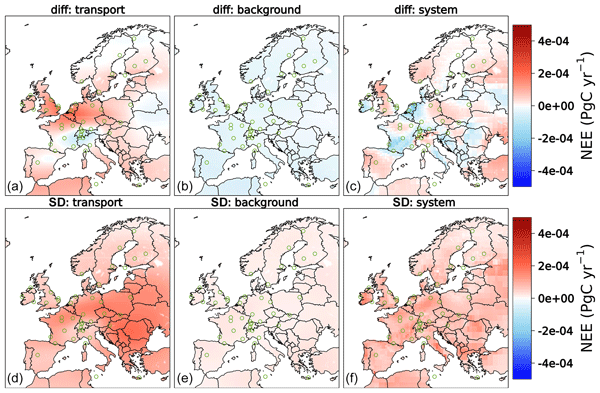
Saqr Munassar, Guillaume Monteil, Marko Scholze, Ute Karstens, Christian Rödenbeck, Frank-Thomas Koch, Kai U. Totsche, and Christoph Gerbig
Atmos. Chem. Phys., 23, 2813–2828, https://doi.org/10.5194/acp-23-2813-2023, https://doi.org/10.5194/acp-23-2813-2023, 2023
Short summary
Short summary
Using different transport models results in large errors in optimized fluxes in the atmospheric inversions. Boundary conditions and inversion system configurations lead to a smaller but non-negligible impact. The findings highlight the importance to validate transport models for further developments but also to properly account for such errors in inverse modelling. This will help narrow the convergence of gas estimates reported in the scientific literature from different inversion frameworks.
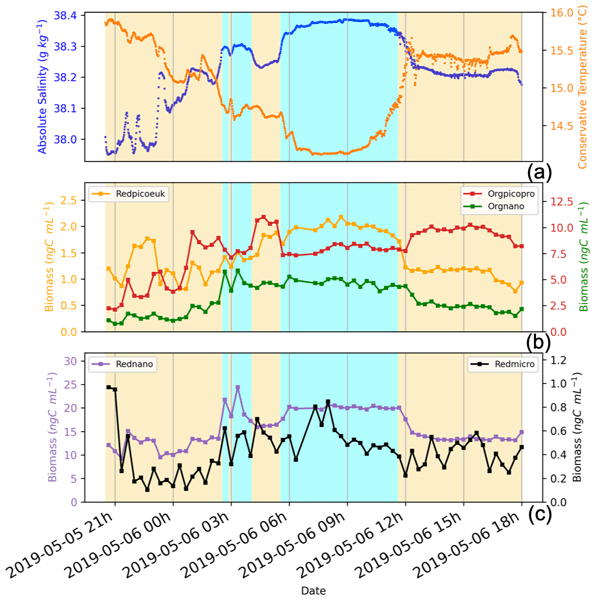
Stéphanie Barrillon, Robin Fuchs, Anne A. Petrenko, Caroline Comby, Anthony Bosse, Christophe Yohia, Jean-Luc Fuda, Nagib Bhairy, Frédéric Cyr, Andrea M. Doglioli, Gérald Grégori, Roxane Tzortzis, Francesco d'Ovidio, and Melilotus Thyssen
Biogeosciences, 20, 141–161, https://doi.org/10.5194/bg-20-141-2023, https://doi.org/10.5194/bg-20-141-2023, 2023
Short summary
Short summary
Extreme weather events can have a major impact on ocean physics and biogeochemistry, but their study is challenging. In May 2019, an intense storm occurred in the north-western Mediterranean Sea, during which in situ multi-platform measurements were performed. The results show a strong impact on the surface phytoplankton, highlighting the need for high-resolution measurements coupling physics and biology during these violent events that may become more common in the context of global change.
Siv K. Lauvset, Nico Lange, Toste Tanhua, Henry C. Bittig, Are Olsen, Alex Kozyr, Simone Alin, Marta Álvarez, Kumiko Azetsu-Scott, Leticia Barbero, Susan Becker, Peter J. Brown, Brendan R. Carter, Leticia Cotrim da Cunha, Richard A. Feely, Mario Hoppema, Matthew P. Humphreys, Masao Ishii, Emil Jeansson, Li-Qing Jiang, Steve D. Jones, Claire Lo Monaco, Akihiko Murata, Jens Daniel Müller, Fiz F. Pérez, Benjamin Pfeil, Carsten Schirnick, Reiner Steinfeldt, Toru Suzuki, Bronte Tilbrook, Adam Ulfsbo, Anton Velo, Ryan J. Woosley, and Robert M. Key
Earth Syst. Sci. Data, 14, 5543–5572, https://doi.org/10.5194/essd-14-5543-2022, https://doi.org/10.5194/essd-14-5543-2022, 2022
Short summary
Short summary
GLODAP is a data product for ocean inorganic carbon and related biogeochemical variables measured by the chemical analysis of water bottle samples from scientific cruises. GLODAPv2.2022 is the fourth update of GLODAPv2 from 2016. The data that are included have been subjected to extensive quality controlling, including systematic evaluation of measurement biases. This version contains data from 1085 hydrographic cruises covering the world's oceans from 1972 to 2021.
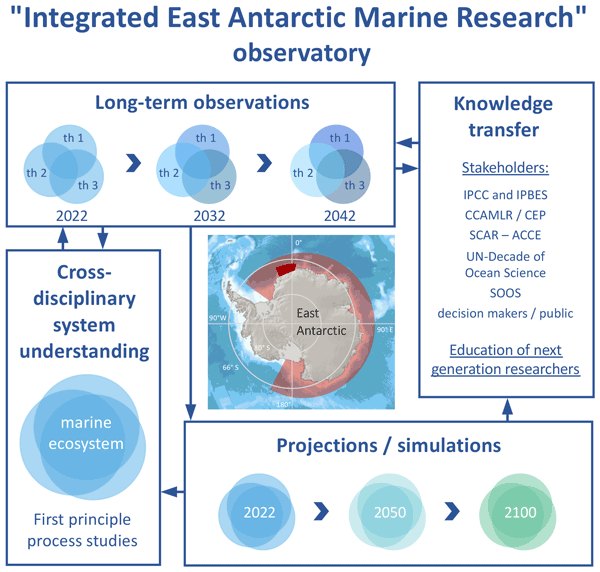
Julian Gutt, Stefanie Arndt, David Keith Alan Barnes, Horst Bornemann, Thomas Brey, Olaf Eisen, Hauke Flores, Huw Griffiths, Christian Haas, Stefan Hain, Tore Hattermann, Christoph Held, Mario Hoppema, Enrique Isla, Markus Janout, Céline Le Bohec, Heike Link, Felix Christopher Mark, Sebastien Moreau, Scarlett Trimborn, Ilse van Opzeeland, Hans-Otto Pörtner, Fokje Schaafsma, Katharina Teschke, Sandra Tippenhauer, Anton Van de Putte, Mia Wege, Daniel Zitterbart, and Dieter Piepenburg
Biogeosciences, 19, 5313–5342, https://doi.org/10.5194/bg-19-5313-2022, https://doi.org/10.5194/bg-19-5313-2022, 2022
Short summary
Short summary
Long-term ecological observations are key to assess, understand and predict impacts of environmental change on biotas. We present a multidisciplinary framework for such largely lacking investigations in the East Antarctic Southern Ocean, combined with case studies, experimental and modelling work. As climate change is still minor here but is projected to start soon, the timely implementation of this framework provides the unique opportunity to document its ecological impacts from the very onset.
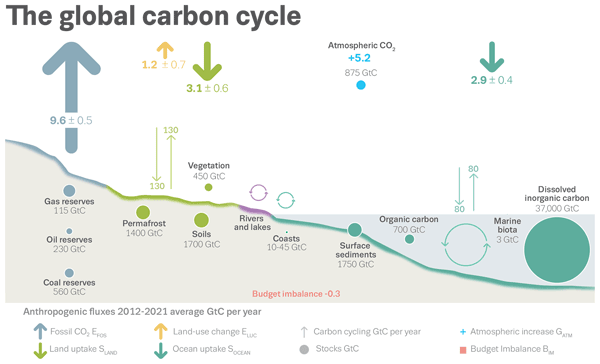
Pierre Friedlingstein, Michael O'Sullivan, Matthew W. Jones, Robbie M. Andrew, Luke Gregor, Judith Hauck, Corinne Le Quéré, Ingrid T. Luijkx, Are Olsen, Glen P. Peters, Wouter Peters, Julia Pongratz, Clemens Schwingshackl, Stephen Sitch, Josep G. Canadell, Philippe Ciais, Robert B. Jackson, Simone R. Alin, Ramdane Alkama, Almut Arneth, Vivek K. Arora, Nicholas R. Bates, Meike Becker, Nicolas Bellouin, Henry C. Bittig, Laurent Bopp, Frédéric Chevallier, Louise P. Chini, Margot Cronin, Wiley Evans, Stefanie Falk, Richard A. Feely, Thomas Gasser, Marion Gehlen, Thanos Gkritzalis, Lucas Gloege, Giacomo Grassi, Nicolas Gruber, Özgür Gürses, Ian Harris, Matthew Hefner, Richard A. Houghton, George C. Hurtt, Yosuke Iida, Tatiana Ilyina, Atul K. Jain, Annika Jersild, Koji Kadono, Etsushi Kato, Daniel Kennedy, Kees Klein Goldewijk, Jürgen Knauer, Jan Ivar Korsbakken, Peter Landschützer, Nathalie Lefèvre, Keith Lindsay, Junjie Liu, Zhu Liu, Gregg Marland, Nicolas Mayot, Matthew J. McGrath, Nicolas Metzl, Natalie M. Monacci, David R. Munro, Shin-Ichiro Nakaoka, Yosuke Niwa, Kevin O'Brien, Tsuneo Ono, Paul I. Palmer, Naiqing Pan, Denis Pierrot, Katie Pocock, Benjamin Poulter, Laure Resplandy, Eddy Robertson, Christian Rödenbeck, Carmen Rodriguez, Thais M. Rosan, Jörg Schwinger, Roland Séférian, Jamie D. Shutler, Ingunn Skjelvan, Tobias Steinhoff, Qing Sun, Adrienne J. Sutton, Colm Sweeney, Shintaro Takao, Toste Tanhua, Pieter P. Tans, Xiangjun Tian, Hanqin Tian, Bronte Tilbrook, Hiroyuki Tsujino, Francesco Tubiello, Guido R. van der Werf, Anthony P. Walker, Rik Wanninkhof, Chris Whitehead, Anna Willstrand Wranne, Rebecca Wright, Wenping Yuan, Chao Yue, Xu Yue, Sönke Zaehle, Jiye Zeng, and Bo Zheng
Earth Syst. Sci. Data, 14, 4811–4900, https://doi.org/10.5194/essd-14-4811-2022, https://doi.org/10.5194/essd-14-4811-2022, 2022
Short summary
Short summary
The Global Carbon Budget 2022 describes the datasets and methodology used to quantify the anthropogenic emissions of carbon dioxide (CO2) and their partitioning among the atmosphere, the land ecosystems, and the ocean. These living datasets are updated every year to provide the highest transparency and traceability in the reporting of CO2, the key driver of climate change.
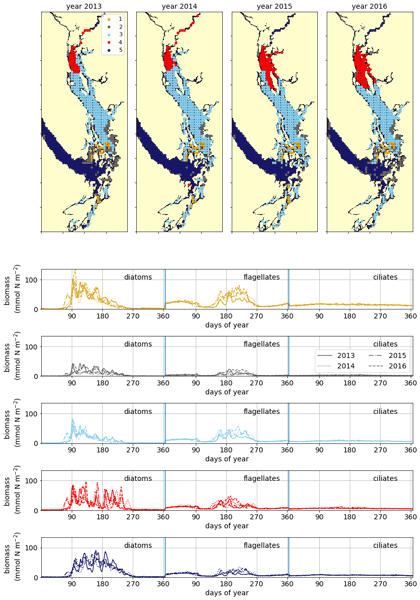
Tereza Jarníková, Elise M. Olson, Susan E. Allen, Debby Ianson, and Karyn D. Suchy
Ocean Sci., 18, 1451–1475, https://doi.org/10.5194/os-18-1451-2022, https://doi.org/10.5194/os-18-1451-2022, 2022
Short summary
Short summary
Understanding drivers of phytoplankton biomass in dynamic coastal regions is key to predicting present and future ecosystem functioning. Using a clustering-based method, we objectively determined biophysical provinces in a complex estuarine sea. The Salish Sea contains three major distinct provinces where phytoplankton dynamics are controlled by diverse stratification regimes. Our method is simple to implement and broadly applicable for identifying structure in large model-derived datasets.
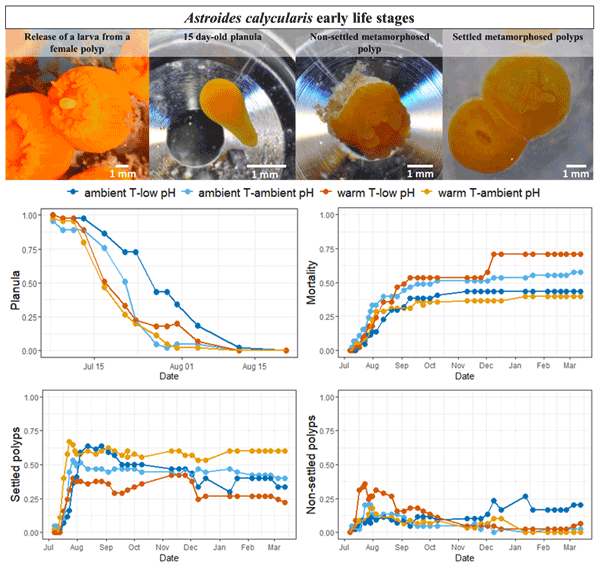
Chloe Carbonne, Steeve Comeau, Phoebe T. W. Chan, Keyla Plichon, Jean-Pierre Gattuso, and Núria Teixidó
Biogeosciences, 19, 4767–4777, https://doi.org/10.5194/bg-19-4767-2022, https://doi.org/10.5194/bg-19-4767-2022, 2022
Short summary
Short summary
For the first time, our study highlights the synergistic effects of a 9-month warming and acidification combined stress on the early life stages of a Mediterranean azooxanthellate coral, Astroides calycularis. Our results predict a decrease in dispersion, settlement, post-settlement linear extention, budding and survival under future global change and that larvae and recruits of A. calycularis are stages of interest for this Mediterranean coral resistance, resilience and conservation.
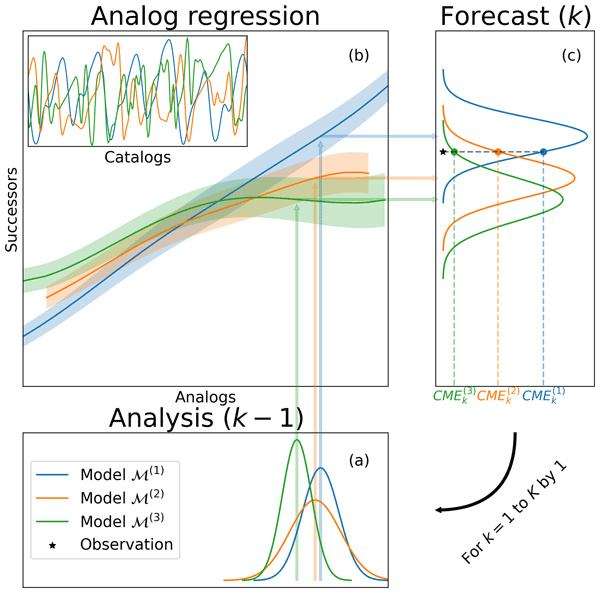
Juan Ruiz, Pierre Ailliot, Thi Tuyet Trang Chau, Pierre Le Bras, Valérie Monbet, Florian Sévellec, and Pierre Tandeo
Geosci. Model Dev., 15, 7203–7220, https://doi.org/10.5194/gmd-15-7203-2022, https://doi.org/10.5194/gmd-15-7203-2022, 2022
Short summary
Short summary
We present a new approach to validate numerical simulations of the current climate. The method can take advantage of existing climate simulations produced by different centers combining an analog forecasting approach with data assimilation to quantify how well a particular model reproduces a sequence of observed values. The method can be applied with different observations types and is implemented locally in space and time significantly reducing the associated computational cost.
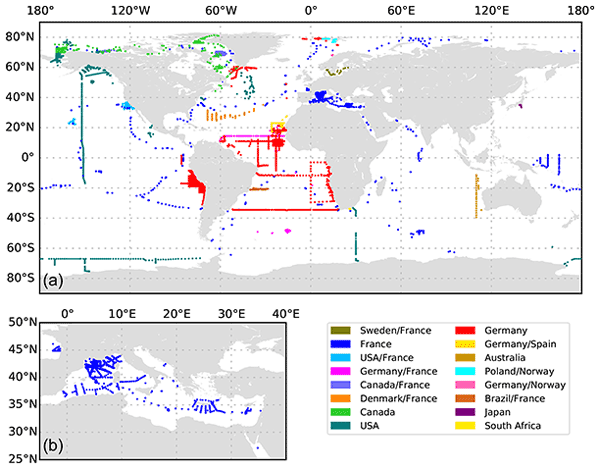
Rainer Kiko, Marc Picheral, David Antoine, Marcel Babin, Léo Berline, Tristan Biard, Emmanuel Boss, Peter Brandt, Francois Carlotti, Svenja Christiansen, Laurent Coppola, Leandro de la Cruz, Emilie Diamond-Riquier, Xavier Durrieu de Madron, Amanda Elineau, Gabriel Gorsky, Lionel Guidi, Helena Hauss, Jean-Olivier Irisson, Lee Karp-Boss, Johannes Karstensen, Dong-gyun Kim, Rachel M. Lekanoff, Fabien Lombard, Rubens M. Lopes, Claudie Marec, Andrew M. P. McDonnell, Daniela Niemeyer, Margaux Noyon, Stephanie H. O'Daly, Mark D. Ohman, Jessica L. Pretty, Andreas Rogge, Sarah Searson, Masashi Shibata, Yuji Tanaka, Toste Tanhua, Jan Taucher, Emilia Trudnowska, Jessica S. Turner, Anya Waite, and Lars Stemmann
Earth Syst. Sci. Data, 14, 4315–4337, https://doi.org/10.5194/essd-14-4315-2022, https://doi.org/10.5194/essd-14-4315-2022, 2022
Short summary
Short summary
The term
marine particlescomprises detrital aggregates; fecal pellets; bacterioplankton, phytoplankton and zooplankton; and even fish. Here, we present a global dataset that contains 8805 vertical particle size distribution profiles obtained with Underwater Vision Profiler 5 (UVP5) camera systems. These data are valuable to the scientific community, as they can be used to constrain important biogeochemical processes in the ocean, such as the flux of carbon to the deep sea.

Jens Terhaar, Thomas L. Frölicher, and Fortunat Joos
Biogeosciences, 19, 4431–4457, https://doi.org/10.5194/bg-19-4431-2022, https://doi.org/10.5194/bg-19-4431-2022, 2022
Short summary
Short summary
Estimates of the ocean sink of anthropogenic carbon vary across various approaches. We show that the global ocean carbon sink can be estimated by three parameters, two of which approximate the ocean ventilation in the Southern Ocean and the North Atlantic, and one of which approximates the chemical capacity of the ocean to take up carbon. With observations of these parameters, we estimate that the global ocean carbon sink is 10 % larger than previously assumed, and we cut uncertainties in half.
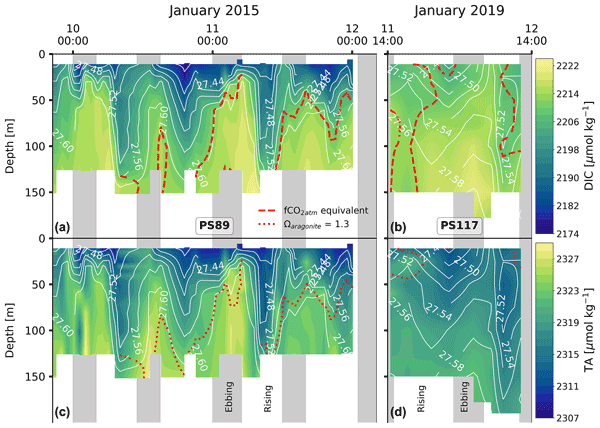
Elise S. Droste, Mario Hoppema, Melchor González-Dávila, Juana Magdalena Santana-Casiano, Bastien Y. Queste, Giorgio Dall'Olmo, Hugh J. Venables, Gerd Rohardt, Sharyn Ossebaar, Daniel Schuller, Sunke Trace-Kleeberg, and Dorothee C. E. Bakker
Ocean Sci., 18, 1293–1320, https://doi.org/10.5194/os-18-1293-2022, https://doi.org/10.5194/os-18-1293-2022, 2022
Short summary
Short summary
Tides affect the marine carbonate chemistry of a coastal polynya neighbouring the Ekström Ice Shelf by movement of seawater with different physical and biogeochemical properties. The result is that the coastal polynya in the summer can switch between being a sink or a source of CO2 multiple times a day. We encourage consideration of tides when collecting in polar coastal regions to account for tide-driven variability and to avoid overestimations or underestimations of air–sea CO2 exchange.
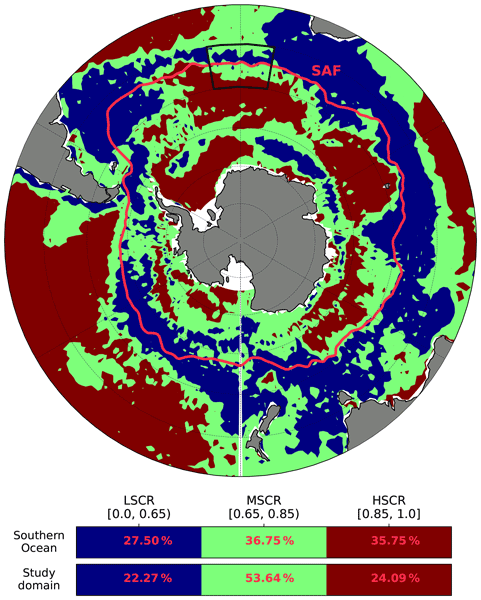
Laique M. Djeutchouang, Nicolette Chang, Luke Gregor, Marcello Vichi, and Pedro M. S. Monteiro
Biogeosciences, 19, 4171–4195, https://doi.org/10.5194/bg-19-4171-2022, https://doi.org/10.5194/bg-19-4171-2022, 2022
Short summary
Short summary
Based on observing system simulation experiments using a mesoscale-resolving model, we found that to significantly improve uncertainties and biases in carbon dioxide (CO2) mapping in the Southern Ocean, it is essential to resolve the seasonal cycle (SC) of the meridional gradient of CO2 through high frequency (at least daily) observations that also span the region's meridional axis. We also showed that the estimated SC anomaly and mean annual CO2 are highly sensitive to seasonal sampling biases.
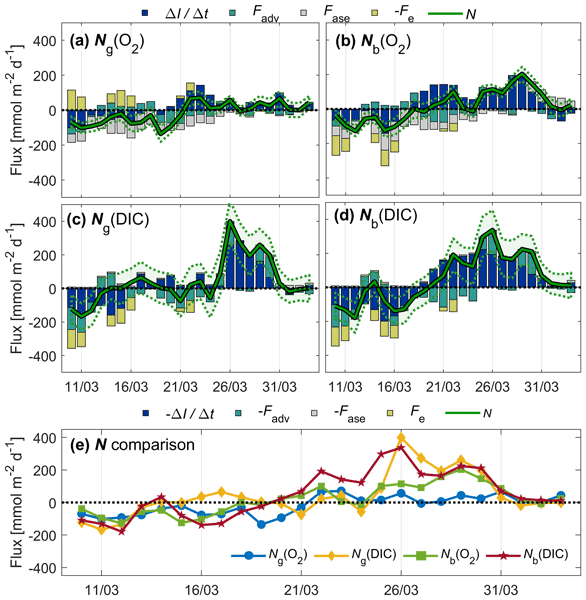
Michael P. Hemming, Jan Kaiser, Jacqueline Boutin, Liliane Merlivat, Karen J. Heywood, Dorothee C. E. Bakker, Gareth A. Lee, Marcos Cobas García, David Antoine, and Kiminori Shitashima
Ocean Sci., 18, 1245–1262, https://doi.org/10.5194/os-18-1245-2022, https://doi.org/10.5194/os-18-1245-2022, 2022
Short summary
Short summary
An underwater glider mission was carried out in spring 2016 near a mooring in the northwestern Mediterranean Sea. The glider deployment served as a test of a prototype ion-sensitive field-effect transistor pH sensor. Mean net community production rates were estimated from glider and buoy measurements of dissolved oxygen and inorganic carbon concentrations before and during the spring bloom. Incorporating advection is important for accurate mass budgets. Unexpected metabolic quotients were found.
Hein J. W. de Baar, Mario Hoppema, and Elizabeth M. Jones
EGUsphere, https://doi.org/10.5194/egusphere-2022-676, https://doi.org/10.5194/egusphere-2022-676, 2022
Preprint archived
Short summary
Short summary
There is confusion in the literature on interactions of dissolved phosphate and sulphate with the alkalinity of seawater. These do play a minor role in the titration to determine alkalinity. However, a perceived biological role of phosphate and sulphate has been suggested in the value of Oceanic Alkalinity. We think this is mistaken. Some other minor issues additionally have led to confusion on the exact description of Alkalinity. We treat those against a theoretical and empirical background.
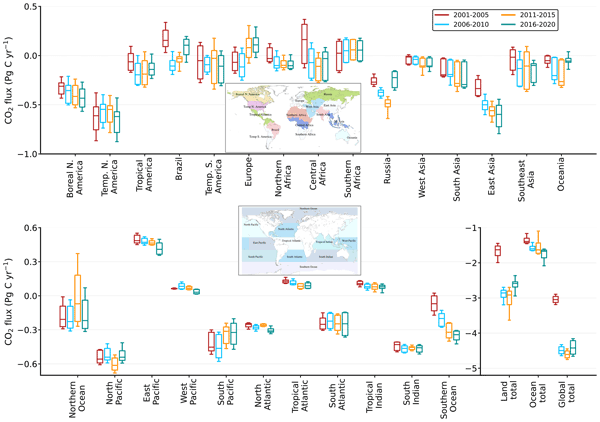
Naveen Chandra, Prabir K. Patra, Yousuke Niwa, Akihiko Ito, Yosuke Iida, Daisuke Goto, Shinji Morimoto, Masayuki Kondo, Masayuki Takigawa, Tomohiro Hajima, and Michio Watanabe
Atmos. Chem. Phys., 22, 9215–9243, https://doi.org/10.5194/acp-22-9215-2022, https://doi.org/10.5194/acp-22-9215-2022, 2022
Short summary
Short summary
This paper is intended to accomplish two goals: (1) quantify mean and uncertainty in non-fossil-fuel CO2 fluxes estimated by inverse modeling and (2) provide in-depth analyses of regional CO2 fluxes in support of emission mitigation policymaking. CO2 flux variability and trends are discussed concerning natural climate variability and human disturbances using multiple lines of evidence.
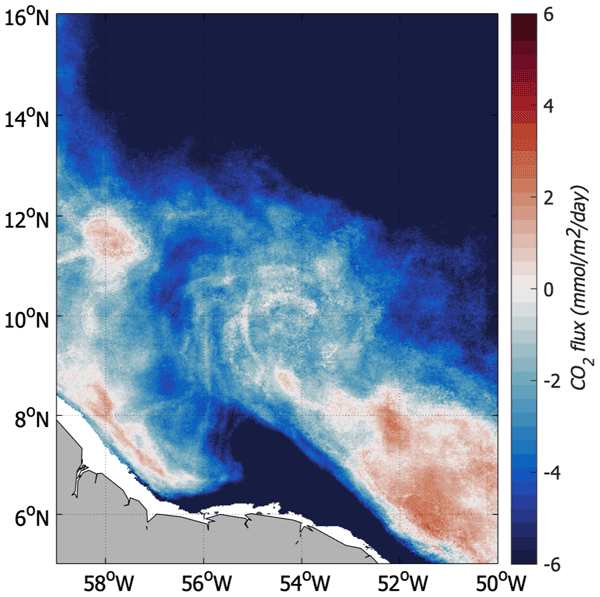
Léa Olivier, Jacqueline Boutin, Gilles Reverdin, Nathalie Lefèvre, Peter Landschützer, Sabrina Speich, Johannes Karstensen, Matthieu Labaste, Christophe Noisel, Markus Ritschel, Tobias Steinhoff, and Rik Wanninkhof
Biogeosciences, 19, 2969–2988, https://doi.org/10.5194/bg-19-2969-2022, https://doi.org/10.5194/bg-19-2969-2022, 2022
Short summary
Short summary
We investigate the impact of the interactions between eddies and the Amazon River plume on the CO2 air–sea fluxes to better characterize the ocean carbon sink in winter 2020. The region is a strong CO2 sink, previously underestimated by a factor of 10 due to a lack of data and understanding of the processes responsible for the variability in ocean carbon parameters. The CO2 absorption is mainly driven by freshwater from the Amazon entrained by eddies and by the winter seasonal cooling.
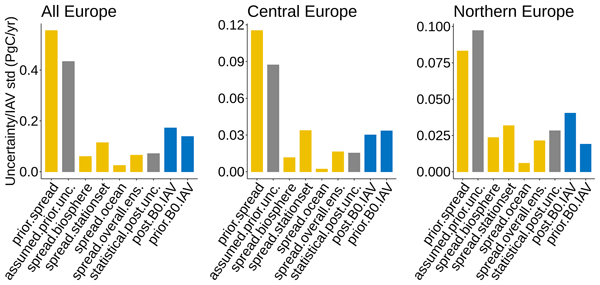
Saqr Munassar, Christian Rödenbeck, Frank-Thomas Koch, Kai U. Totsche, Michał Gałkowski, Sophia Walther, and Christoph Gerbig
Atmos. Chem. Phys., 22, 7875–7892, https://doi.org/10.5194/acp-22-7875-2022, https://doi.org/10.5194/acp-22-7875-2022, 2022
Short summary
Short summary
The results obtained from ensembles of inversions over 13 years show the largest spread in the a posteriori fluxes over the station set ensemble. Using different prior fluxes in the inversions led to a smaller impact. Drought occurrences in 2018 and 2019 affected CO2 fluxes as seen in net ecosystem exchange estimates. Our study highlights the importance of expanding the atmospheric site network across Europe to better constrain CO2 fluxes in inverse modelling.
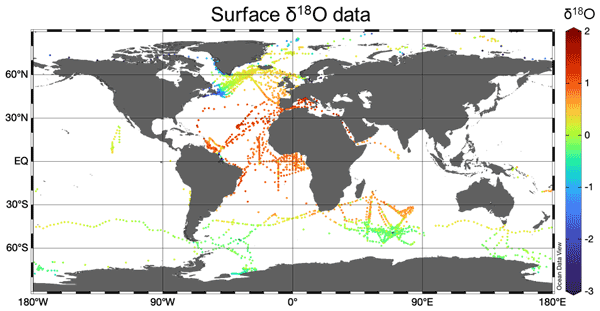
Gilles Reverdin, Claire Waelbroeck, Catherine Pierre, Camille Akhoudas, Giovanni Aloisi, Marion Benetti, Bernard Bourlès, Magnus Danielsen, Jérôme Demange, Denis Diverrès, Jean-Claude Gascard, Marie-Noëlle Houssais, Hervé Le Goff, Pascale Lherminier, Claire Lo Monaco, Herlé Mercier, Nicolas Metzl, Simon Morisset, Aïcha Naamar, Thierry Reynaud, Jean-Baptiste Sallée, Virginie Thierry, Susan E. Hartman, Edward W. Mawji, Solveig Olafsdottir, Torsten Kanzow, Anton Velo, Antje Voelker, Igor Yashayaev, F. Alexander Haumann, Melanie J. Leng, Carol Arrowsmith, and Michael Meredith
Earth Syst. Sci. Data, 14, 2721–2735, https://doi.org/10.5194/essd-14-2721-2022, https://doi.org/10.5194/essd-14-2721-2022, 2022
Short summary
Short summary
The CISE-LOCEAN seawater stable isotope dataset has close to 8000 data entries. The δ18O and δD isotopic data measured at LOCEAN have uncertainties of at most 0.05 ‰ and 0.25 ‰, respectively. Some data were adjusted to correct for evaporation. The internal consistency indicates that the data can be used to investigate time and space variability to within 0.03 ‰ and 0.15 ‰ in δ18O–δD17; comparisons with data analyzed in other institutions suggest larger differences with other datasets.
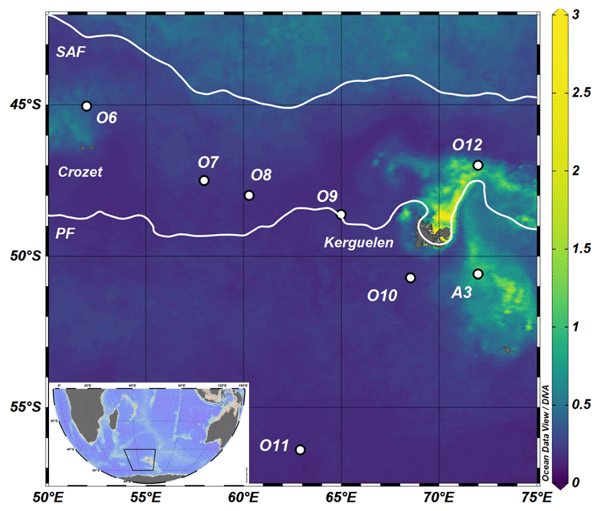
Coraline Leseurre, Claire Lo Monaco, Gilles Reverdin, Nicolas Metzl, Jonathan Fin, Claude Mignon, and Léa Benito
Biogeosciences, 19, 2599–2625, https://doi.org/10.5194/bg-19-2599-2022, https://doi.org/10.5194/bg-19-2599-2022, 2022
Short summary
Short summary
Decadal trends of fugacity of CO2 (fCO2), total alkalinity (AT), total carbon (CT) and pH in surface waters are investigated in different domains of the southern Indian Ocean (45°S–57°S) from ongoing and station observations regularly conducted in summer over the period 1998–2019. The fCO2 increase and pH decrease are mainly driven by anthropogenic CO2 estimated just below the summer mixed layer, as well as by a warming south of the polar front or in the fertilized waters near Kerguelen Island.
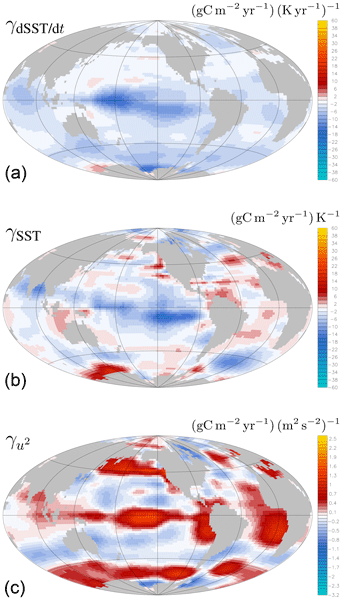
Christian Rödenbeck, Tim DeVries, Judith Hauck, Corinne Le Quéré, and Ralph F. Keeling
Biogeosciences, 19, 2627–2652, https://doi.org/10.5194/bg-19-2627-2022, https://doi.org/10.5194/bg-19-2627-2022, 2022
Short summary
Short summary
The ocean is an important part of the global carbon cycle, taking up about a quarter of the anthropogenic CO2 emitted by burning of fossil fuels and thus slowing down climate change. However, the CO2 uptake by the ocean is, in turn, affected by variability and trends in climate. Here we use carbon measurements in the surface ocean to quantify the response of the oceanic CO2 exchange to environmental conditions and discuss possible mechanisms underlying this response.
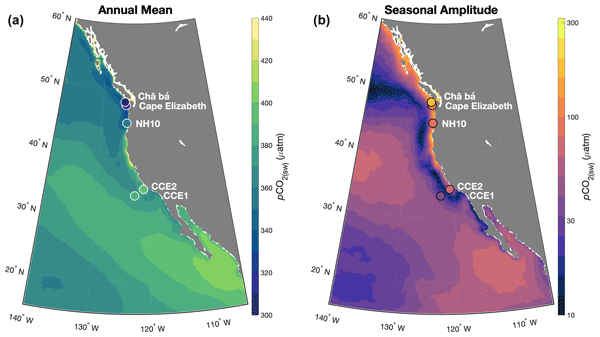
Jonathan D. Sharp, Andrea J. Fassbender, Brendan R. Carter, Paige D. Lavin, and Adrienne J. Sutton
Earth Syst. Sci. Data, 14, 2081–2108, https://doi.org/10.5194/essd-14-2081-2022, https://doi.org/10.5194/essd-14-2081-2022, 2022
Short summary
Short summary
Oceanographers calculate the exchange of carbon between the ocean and atmosphere by comparing partial pressures of carbon dioxide (pCO2). Because seawater pCO2 is not measured everywhere at all times, interpolation schemes are required to fill observational gaps. We describe a monthly gap-filled dataset of pCO2 in the northeast Pacific Ocean off the west coast of North America created by machine-learning interpolation. This dataset is unique in its robust representation of coastal seasonality.
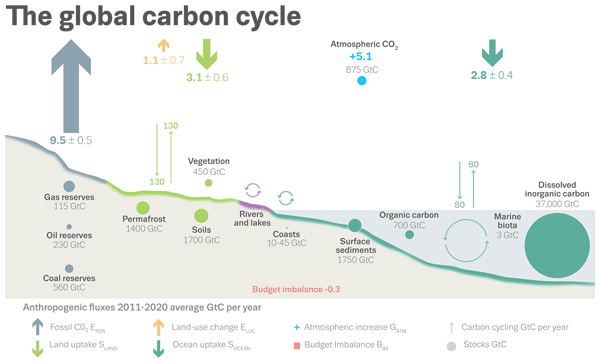
Pierre Friedlingstein, Matthew W. Jones, Michael O'Sullivan, Robbie M. Andrew, Dorothee C. E. Bakker, Judith Hauck, Corinne Le Quéré, Glen P. Peters, Wouter Peters, Julia Pongratz, Stephen Sitch, Josep G. Canadell, Philippe Ciais, Rob B. Jackson, Simone R. Alin, Peter Anthoni, Nicholas R. Bates, Meike Becker, Nicolas Bellouin, Laurent Bopp, Thi Tuyet Trang Chau, Frédéric Chevallier, Louise P. Chini, Margot Cronin, Kim I. Currie, Bertrand Decharme, Laique M. Djeutchouang, Xinyu Dou, Wiley Evans, Richard A. Feely, Liang Feng, Thomas Gasser, Dennis Gilfillan, Thanos Gkritzalis, Giacomo Grassi, Luke Gregor, Nicolas Gruber, Özgür Gürses, Ian Harris, Richard A. Houghton, George C. Hurtt, Yosuke Iida, Tatiana Ilyina, Ingrid T. Luijkx, Atul Jain, Steve D. Jones, Etsushi Kato, Daniel Kennedy, Kees Klein Goldewijk, Jürgen Knauer, Jan Ivar Korsbakken, Arne Körtzinger, Peter Landschützer, Siv K. Lauvset, Nathalie Lefèvre, Sebastian Lienert, Junjie Liu, Gregg Marland, Patrick C. McGuire, Joe R. Melton, David R. Munro, Julia E. M. S. Nabel, Shin-Ichiro Nakaoka, Yosuke Niwa, Tsuneo Ono, Denis Pierrot, Benjamin Poulter, Gregor Rehder, Laure Resplandy, Eddy Robertson, Christian Rödenbeck, Thais M. Rosan, Jörg Schwinger, Clemens Schwingshackl, Roland Séférian, Adrienne J. Sutton, Colm Sweeney, Toste Tanhua, Pieter P. Tans, Hanqin Tian, Bronte Tilbrook, Francesco Tubiello, Guido R. van der Werf, Nicolas Vuichard, Chisato Wada, Rik Wanninkhof, Andrew J. Watson, David Willis, Andrew J. Wiltshire, Wenping Yuan, Chao Yue, Xu Yue, Sönke Zaehle, and Jiye Zeng
Earth Syst. Sci. Data, 14, 1917–2005, https://doi.org/10.5194/essd-14-1917-2022, https://doi.org/10.5194/essd-14-1917-2022, 2022
Short summary
Short summary
The Global Carbon Budget 2021 describes the data sets and methodology used to quantify the emissions of carbon dioxide and their partitioning among the atmosphere, land, and ocean. These living data are updated every year to provide the highest transparency and traceability in the reporting of CO2, the key driver of climate change.
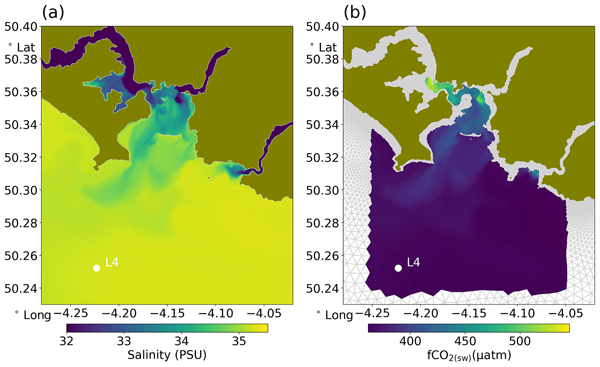
Richard P. Sims, Michael Bedington, Ute Schuster, Andrew J. Watson, Vassilis Kitidis, Ricardo Torres, Helen S. Findlay, James R. Fishwick, Ian Brown, and Thomas G. Bell
Biogeosciences, 19, 1657–1674, https://doi.org/10.5194/bg-19-1657-2022, https://doi.org/10.5194/bg-19-1657-2022, 2022
Short summary
Short summary
The amount of carbon dioxide (CO2) being absorbed by the ocean is relevant to the earth's climate. CO2 values in the coastal ocean and estuaries are not well known because of the instrumentation used. We used a new approach to measure CO2 across the coastal and estuarine zone. We found that CO2 and salinity were linked to the state of the tide. We used our CO2 measurements and model salinity to predict CO2. Previous studies overestimate how much CO2 the coastal ocean draws down at our site.
Jiye Zeng, Tsuneo Matsunaga, and Tomoko Shirai
Earth Syst. Sci. Data Discuss., https://doi.org/10.5194/essd-2022-71, https://doi.org/10.5194/essd-2022-71, 2022
Manuscript not accepted for further review
Short summary
Short summary
We have extracted the increase rates of ocean CO2 with three types of machine learning models. The results are new and important because scarce data made it difficult to use machine learning models for for ocean CO2 reconstruction and oceanic CO2 sink estimate. One of the approaches is to remove the trend in CO2 data obtained in multiple-years so that the models can learn the non-linear dependence of CO2 on seawater properties better.
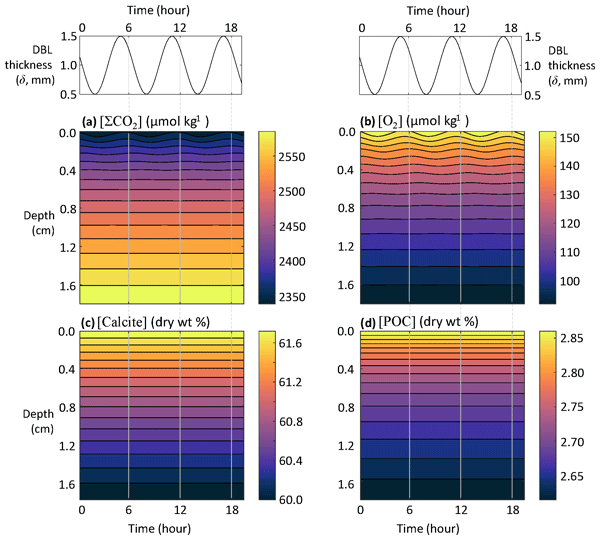
Olivier Sulpis, Matthew P. Humphreys, Monica M. Wilhelmus, Dustin Carroll, William M. Berelson, Dimitris Menemenlis, Jack J. Middelburg, and Jess F. Adkins
Geosci. Model Dev., 15, 2105–2131, https://doi.org/10.5194/gmd-15-2105-2022, https://doi.org/10.5194/gmd-15-2105-2022, 2022
Short summary
Short summary
A quarter of the surface of the Earth is covered by marine sediments rich in calcium carbonates, and their dissolution acts as a giant antacid tablet protecting the ocean against human-made acidification caused by massive CO2 emissions. Here, we present a new model of sediment chemistry that incorporates the latest experimental findings on calcium carbonate dissolution kinetics. This model can be used to predict how marine sediments evolve through time in response to environmental perturbations.
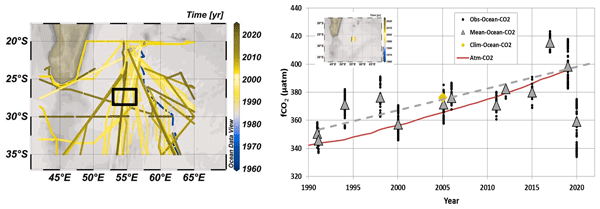
Nicolas Metzl, Claire Lo Monaco, Coraline Leseurre, Céline Ridame, Jonathan Fin, Claude Mignon, Marion Gehlen, and Thi Tuyet Trang Chau
Biogeosciences, 19, 1451–1468, https://doi.org/10.5194/bg-19-1451-2022, https://doi.org/10.5194/bg-19-1451-2022, 2022
Short summary
Short summary
During an oceanographic cruise conducted in January 2020 in the south-western Indian Ocean, we observed very low CO2 concentrations associated with a strong phytoplankton bloom that occurred south-east of Madagascar. This biological event led to a strong regional CO2 ocean sink not previously observed.
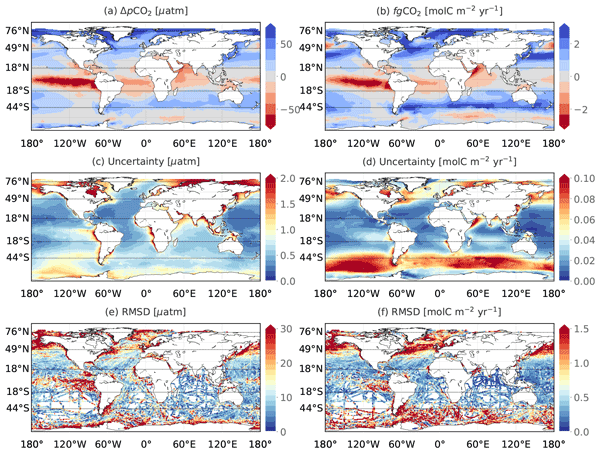
Thi Tuyet Trang Chau, Marion Gehlen, and Frédéric Chevallier
Biogeosciences, 19, 1087–1109, https://doi.org/10.5194/bg-19-1087-2022, https://doi.org/10.5194/bg-19-1087-2022, 2022
Short summary
Short summary
Air–sea CO2 fluxes and associated uncertainty over the open ocean to coastal shelves are estimated with a new ensemble-based reconstruction of pCO2 trained on observation-based data. The regional distribution and seasonality of CO2 sources and sinks are consistent with those suggested in previous studies as well as mechanisms discussed therein. The ensemble-based uncertainty field allows identifying critical regions where improvements in pCO2 and air–sea CO2 flux estimates should be a priority.
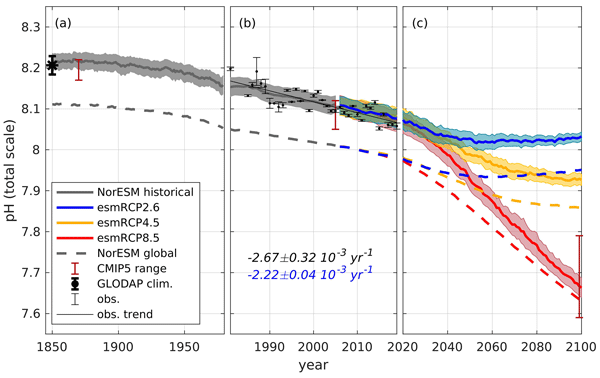
Filippa Fransner, Friederike Fröb, Jerry Tjiputra, Nadine Goris, Siv K. Lauvset, Ingunn Skjelvan, Emil Jeansson, Abdirahman Omar, Melissa Chierici, Elizabeth Jones, Agneta Fransson, Sólveig R. Ólafsdóttir, Truls Johannessen, and Are Olsen
Biogeosciences, 19, 979–1012, https://doi.org/10.5194/bg-19-979-2022, https://doi.org/10.5194/bg-19-979-2022, 2022
Short summary
Short summary
Ocean acidification, a direct consequence of the CO2 release by human activities, is a serious threat to marine ecosystems. In this study, we conduct a detailed investigation of the acidification of the Nordic Seas, from 1850 to 2100, by using a large set of samples taken during research cruises together with numerical model simulations. We estimate the effects of changes in different environmental factors on the rate of acidification and its potential effects on cold-water corals.
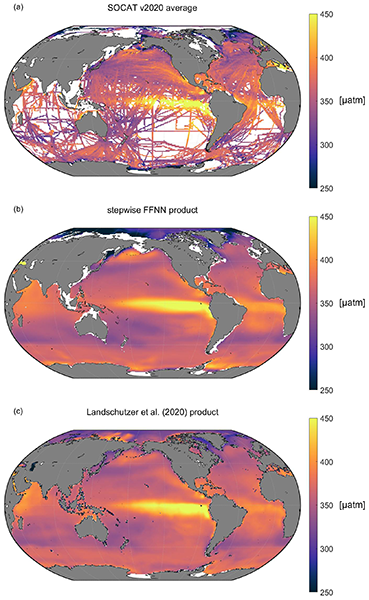
Guorong Zhong, Xuegang Li, Jinming Song, Baoxiao Qu, Fan Wang, Yanjun Wang, Bin Zhang, Xiaoxia Sun, Wuchang Zhang, Zhenyan Wang, Jun Ma, Huamao Yuan, and Liqin Duan
Biogeosciences, 19, 845–859, https://doi.org/10.5194/bg-19-845-2022, https://doi.org/10.5194/bg-19-845-2022, 2022
Short summary
Short summary
A predictor selection algorithm was constructed to decrease the predicting error in the surface ocean partial pressure of CO2 (pCO2) mapping by finding better combinations of pCO2 predictors in different regions. Compared with previous research using the same combination of predictors in all regions, using different predictors selected by the algorithm in different regions can effectively decrease pCO2 predicting errors.
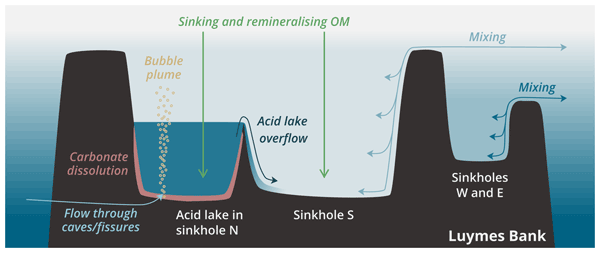
Matthew P. Humphreys, Erik H. Meesters, Henk de Haas, Szabina Karancz, Louise Delaigue, Karel Bakker, Gerard Duineveld, Siham de Goeyse, Andreas F. Haas, Furu Mienis, Sharyn Ossebaar, and Fleur C. van Duyl
Biogeosciences, 19, 347–358, https://doi.org/10.5194/bg-19-347-2022, https://doi.org/10.5194/bg-19-347-2022, 2022
Short summary
Short summary
A series of submarine sinkholes were recently discovered on Luymes Bank, part of Saba Bank, a carbonate platform in the Caribbean Netherlands. Here, we investigate the waters inside these sinkholes for the first time. One of the sinkholes contained a body of dense, low-oxygen and low-pH water, which we call the
acid lake. We use measurements of seawater chemistry to work out what processes were responsible for forming the acid lake and discuss the consequences for the carbonate platform.
Chiho Sukigara, Ryuichiro Inoue, Kanako Sato, Yoshihisa Mino, Takeyoshi Nagai, Andrea J. Fassbender, Yuichiro Takeshita, Stuart Bishop, and Eitarou Oka
Biogeosciences Discuss., https://doi.org/10.5194/bg-2022-9, https://doi.org/10.5194/bg-2022-9, 2022
Manuscript not accepted for further review
Short summary
Short summary
To investigate the physical changes in the ocean from winter to spring and the corresponding biological activities, two automated floats were used to conduct observations in the western North Pacific from January to April 2018. During the observation, repeated storms passed and mixed the ocean surface layer. Afterwards, active biological activity was observed. Using data from the float, we observed the formation, decomposition, and settling of particulate organic matter.
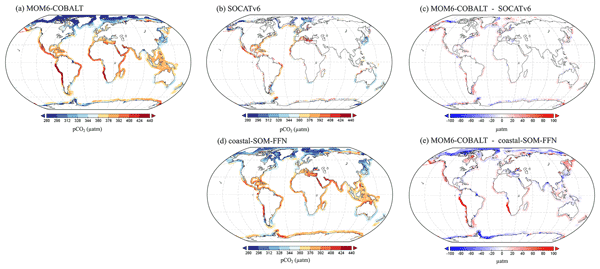
Alizée Roobaert, Laure Resplandy, Goulven G. Laruelle, Enhui Liao, and Pierre Regnier
Ocean Sci., 18, 67–88, https://doi.org/10.5194/os-18-67-2022, https://doi.org/10.5194/os-18-67-2022, 2022
Short summary
Short summary
This study uses a global oceanic model to investigate the seasonal dynamics of the sea surface partial pressure of CO2 (pCO2) in the global coastal ocean. Our method quantifies the respective effects of thermal changes, biological activity, ocean circulation and freshwater fluxes on the temporal pCO2 variations. The performance of our model is also evaluated against a data product derived from observations to identify coastal regions where our approach is most robust.
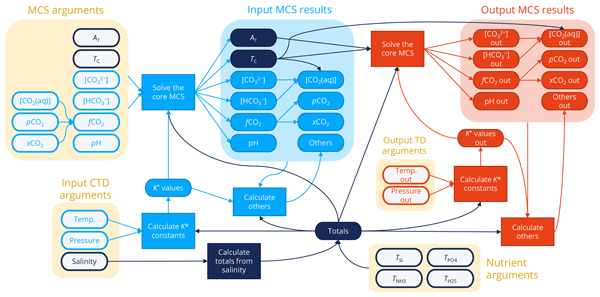
Matthew P. Humphreys, Ernie R. Lewis, Jonathan D. Sharp, and Denis Pierrot
Geosci. Model Dev., 15, 15–43, https://doi.org/10.5194/gmd-15-15-2022, https://doi.org/10.5194/gmd-15-15-2022, 2022
Short summary
Short summary
The ocean helps to mitigate our impact on Earth's climate by absorbing about a quarter of the carbon dioxide (CO2) released by human activities each year. However, once absorbed, chemical reactions between CO2 and water reduce seawater pH (
ocean acidification), which may have adverse effects on marine ecosystems. Our Python package, PyCO2SYS, models the chemical reactions of CO2 in seawater, allowing us to quantify the corresponding changes in pH and related chemical properties.

Roxane Tzortzis, Andrea M. Doglioli, Stéphanie Barrillon, Anne A. Petrenko, Francesco d'Ovidio, Lloyd Izard, Melilotus Thyssen, Ananda Pascual, Bàrbara Barceló-Llull, Frédéric Cyr, Marc Tedetti, Nagib Bhairy, Pierre Garreau, Franck Dumas, and Gérald Gregori
Biogeosciences, 18, 6455–6477, https://doi.org/10.5194/bg-18-6455-2021, https://doi.org/10.5194/bg-18-6455-2021, 2021
Short summary
Short summary
This work analyzes an original high-resolution data set collected in the Mediterranean Sea. The major result is the impact of a fine-scale frontal structure on the distribution of phytoplankton groups, in an area of moderate energy with oligotrophic conditions. Our results provide an in situ confirmation of the findings obtained by previous modeling studies and remote sensing about the structuring effect of the fine-scale ocean dynamics on the structure of the phytoplankton community.
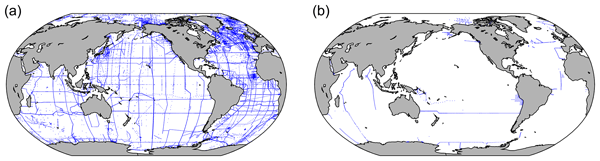
Siv K. Lauvset, Nico Lange, Toste Tanhua, Henry C. Bittig, Are Olsen, Alex Kozyr, Marta Álvarez, Susan Becker, Peter J. Brown, Brendan R. Carter, Leticia Cotrim da Cunha, Richard A. Feely, Steven van Heuven, Mario Hoppema, Masao Ishii, Emil Jeansson, Sara Jutterström, Steve D. Jones, Maren K. Karlsen, Claire Lo Monaco, Patrick Michaelis, Akihiko Murata, Fiz F. Pérez, Benjamin Pfeil, Carsten Schirnick, Reiner Steinfeldt, Toru Suzuki, Bronte Tilbrook, Anton Velo, Rik Wanninkhof, Ryan J. Woosley, and Robert M. Key
Earth Syst. Sci. Data, 13, 5565–5589, https://doi.org/10.5194/essd-13-5565-2021, https://doi.org/10.5194/essd-13-5565-2021, 2021
Short summary
Short summary
GLODAP is a data product for ocean inorganic carbon and related biogeochemical variables measured by the chemical analysis of water bottle samples from scientific cruises. GLODAPv2.2021 is the third update of GLODAPv2 from 2016. The data that are included have been subjected to extensive quality control, including systematic evaluation of measurement biases. This version contains data from 989 hydrographic cruises covering the world's oceans from 1972 to 2020.
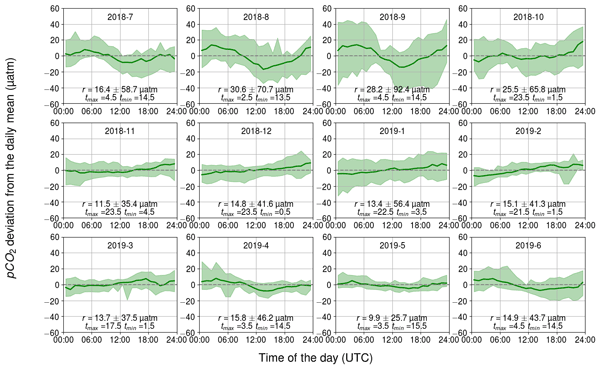
Martti Honkanen, Jens Daniel Müller, Jukka Seppälä, Gregor Rehder, Sami Kielosto, Pasi Ylöstalo, Timo Mäkelä, Juha Hatakka, and Lauri Laakso
Ocean Sci., 17, 1657–1675, https://doi.org/10.5194/os-17-1657-2021, https://doi.org/10.5194/os-17-1657-2021, 2021
Short summary
Short summary
The exchange of carbon dioxide (CO2) between the sea and the atmosphere is regulated by the gradient of CO2 partial pressure (pCO2) between the sea and the air. The daily variation of the seawater pCO2 recorded at the fixed station Utö in the Baltic Sea was found to be mainly biologically driven. Calculation of the annual net exchange of CO2 between the sea and atmosphere based on daily measurements of pCO2 carried out using the same sampling time every day could introduce a bias of up to 12 %.

Amanda R. Fay, Luke Gregor, Peter Landschützer, Galen A. McKinley, Nicolas Gruber, Marion Gehlen, Yosuke Iida, Goulven G. Laruelle, Christian Rödenbeck, Alizée Roobaert, and Jiye Zeng
Earth Syst. Sci. Data, 13, 4693–4710, https://doi.org/10.5194/essd-13-4693-2021, https://doi.org/10.5194/essd-13-4693-2021, 2021
Short summary
Short summary
The movement of carbon dioxide from the atmosphere to the ocean is estimated using surface ocean carbon (pCO2) measurements and an equation including variables such as temperature and wind speed; the choices of these variables lead to uncertainties. We introduce the SeaFlux ensemble which provides carbon flux maps calculated in a consistent manner, thus reducing uncertainty by using common choices for wind speed and a set definition of "global" coverage.
Cited articles
Alin, S. R., Newton, J. A., Feely, R. A., Greeley, D., Curry, B., Herndon, J., and Warner, M.: A decade-long cruise time series (2008–2018) of physical and biogeochemical conditions in the southern Salish Sea, North America, Earth Syst. Sci. Data, 16, 837–865, https://doi.org/10.5194/essd-16-837-2024, 2024a.
Alin, S. R., Newton, J. A., Feely, R. A., Siedlecki, S., and Greeley, D.: Seasonality and response of ocean acidification and hypoxia to major environmental anomalies in the southern Salish Sea, North America (2014–2018), Biogeosciences, 21, 1639–1673, https://doi.org/10.5194/bg-21-1639-2024, 2024b.
Alin, S. R., Newton, J., Ikeda, C., Boyar, A., Greeley, D., Herndon, J., Curry, B., Kozyr, A., and Feely, R. A.: SalishCruiseDataPackage_v2025: An updated compiled data package of sensor profile and discrete physical and biogeochemical measurements from 61 individual cruise data sets collected from a variety of ships in the southern Salish Sea and northern California Current System (Washington state marine waters) from 2008-02-04 to 2024-10-22 (NCEI Accession 0307188), NOAA National Centers for Environmental Information [data set], https://doi.org/10.25921/jgrz-v584, 2025a.
Alin, S. R., Newton, J., Feely, R. A., Ikeda, C., Boyar, A., Greeley, D., Herndon, J., and Kozyr, A.: SalishCruiseMultistressor_v2025: An updated multi-stressor data product for marine heatwave, hypoxia, and ocean acidification research, including calculated inorganic carbon parameters from the southern Salish Sea and northern California Current System from 2008-02-04 to 2024-10-22 (NCEI Accession 0307626), NOAA National Centers for Environmental Information [data set], https://doi.org/10.25921/4y18-rw26, 2025b.
Alin, S. R., Newton, J., Feely, R. A., Boyar, A., and Ikeda, C.: The second half decade of Washington Ocean Acidification Center cruises, in: PSEMP Marine Waters Workgroup 2025, Puget Sound marine waters: 2024 overview, edited by: Apple, J., Wold, R., Stark, K., and Newton, J., 24–25, https://pspwa.app.box.com/s/7ye4t366v5uzil8zybrqtyx11qd32779 (last access: 7 January 2026), 2025c.
Archer, D.: The Global Carbon Cycle, Princeton University Press, JSTOR, https://doi.org/10.2307/j.ctvcm4hx8, 2010.
Archer, D., Eby, M., Brovkin, V., Ridgwell, A., Cao, L., Mikolajewicz, U., Caldeira, K., Matsumoto, K., Munhoven, G., Montenegro, A., and Tokos, K.: Atmospheric lifetime of fossil fuel carbon dioxide, Annu. Rev. Earth Planet. Sci., 37, 117–134, https://doi.org/10.1146/annurev.earth.031208.100206, 2009.
Bach, L. T., Gill, S. J., Rickaby, R. E., Gore, S., and Renforth, P.: CO2 removal with enhanced weathering and ocean alkalinity enhancement: Potential risks and co-benefits for marine pelagic ecosystems, Front. Clim., 1, https://doi.org/10.3389/fclim.2019.00007, 2019.
Bakker, D. C. E., Pfeil, B., Smith, K., Hankin, S., Olsen, A., Alin, S. R., Cosca, C., Harasawa, S., Kozyr, A., Nojiri, Y., O'Brien, K. M., Schuster, U., Telszewski, M., Tilbrook, B., Wada, C., Akl, J., Barbero, L., Bates, N. R., Boutin, J., Bozec, Y., Cai, W.-J., Castle, R. D., Chavez, F. P., Chen, L., Chierici, M., Currie, K., de Baar, H. J. W., Evans, W., Feely, R. A., Fransson, A., Gao, Z., Hales, B., Hardman-Mountford, N. J., Hoppema, M., Huang, W.-J., Hunt, C. W., Huss, B., Ichikawa, T., Johannessen, T., Jones, E. M., Jones, S. D., Jutterström, S., Kitidis, V., Körtzinger, A., Landschützer, P., Lauvset, S. K., Lefèvre, N., Manke, A. B., Mathis, J. T., Merlivat, L., Metzl, N., Murata, A., Newberger, T., Omar, A. M., Ono, T., Park, G.-H., Paterson, K., Pierrot, D., Ríos, A. F., Sabine, C. L., Saito, S., Salisbury, J., Sarma, V. V. S. S., Schlitzer, R., Sieger, R., Skjelvan, I., Steinhoff, T., Sullivan, K. F., Sun, H., Sutton, A. J., Suzuki, T., Sweeney, C., Takahashi, T., Tjiputra, J., Tsurushima, N., van Heuven, S. M. A. C., Vandemark, D., Vlahos, P., Wallace, D. W. R., Wanninkhof, R., and Watson, A. J.: An update to the Surface Ocean CO2 Atlas (SOCAT version 2), Earth Syst. Sci. Data, 6, 69–90, https://doi.org/10.5194/essd-6-69-2014, 2014.
Bakker, D. C. E., Pfeil, B., Landa, C. S., Metzl, N., O'Brien, K. M., Olsen, A., Smith, K., Cosca, C., Harasawa, S., Jones, S. D., Nakaoka, S., Nojiri, Y., Schuster, U., Steinhoff, T., Sweeney, C., Takahashi, T., Tilbrook, B., Wada, C., Wanninkhof, R., Alin, S. R., Balestrini, C. F., Barbero, L., Bates, N. R., Bianchi, A. A., Bonou, F., Boutin, J., Bozec, Y., Burger, E. F., Cai, W.-J., Castle, R. D., Chen, L., Chierici, M., Currie, K., Evans, W., Featherstone, C., Feely, R. A., Fransson, A., Goyet, C., Greenwood, N., Gregor, L., Hankin, S., Hardman-Mountford, N. J., Harlay, J., Hauck, J., Hoppema, M., Humphreys, M. P., Hunt, C. W., Huss, B., Ibánhez, J. S. P., Johannessen, T., Keeling, R., Kitidis, V., Körtzinger, A., Kozyr, A., Krasakopoulou, E., Kuwata, A., Landschützer, P., Lauvset, S. K., Lefèvre, N., Lo Monaco, C., Manke, A., Mathis, J. T., Merlivat, L., Millero, F. J., Monteiro, P. M. S., Munro, D. R., Murata, A., Newberger, T., Omar, A. M., Ono, T., Paterson, K., Pearce, D., Pierrot, D., Robbins, L. L., Saito, S., Salisbury, J., Schlitzer, R., Schneider, B., Schweitzer, R., Sieger, R., Skjelvan, I., Sullivan, K. F., Sutherland, S. C., Sutton, A. J., Tadokoro, K., Telszewski, M., Tuma, M., van Heuven, S. M. A. C., Vandemark, D., Ward, B., Watson, A. J., and Xu, S.: A multi-decade record of high-quality fCO2 data in version 3 of the Surface Ocean CO2 Atlas (SOCAT), Earth Syst. Sci. Data, 8, 383–413, https://doi.org/10.5194/essd-8-383-2016, 2016.
Bakker, D. C. E., Alin, S. R., Aramaki, T., Barbero, L., Bates, N. R., Gkritzalis, T., Jones, S. D., Kozyr, A., Lauvset, S. K., Macovei, V., Metzl, N.; Munro, D. R., Nakaoka, S.-I., O'Brien, K. M., Olsen, A., Pierrot, D., Steinhoff, T., Sullivan, K. F., Sutton, A. J., Sweeney, C., Wada, C., Wanninkhof, R., Akl, J., Arbilla, L. A., Azetsu-Scott, K., Battisti, R., Beatty, C. M., Becker, M., Benoit-Cattin, A., Berghoff, C. F., Bittig, H. C., Bonin, J. A., Bott, R., Bozzano, R., Burger, E. F., Brunetti, F., Cantoni, C., Castelli, G., Chambers, D. P., Chierici, M., Corbo, A., Cronin, M., Cross, J. N., Currie, K. I., Dentico, C., Emerson, S. R., Enochs, I., Enright, M. P.; Enyo, K.; Ericson, Y.; Evans, W.; Fay, A. R.; Feely, R. A.; Fragiacomo, E., Fransson, A., Gehrung, M., Giani, M., Glockzin, M., Hamnca, S., Holodkov, N., Hoppema, M., Ibánhez, J. S. P., Kadono, K., Kamb, L., Kralj, M., Kristensin, T. O., Laudicella, V. A., Lefèvre, N., Leseurre, C., Lo Monaco, C., Maenner Jones, S. M., Maenza, R. A., McAuliffe, A. M., Mdokwana, B. W., Monacci, N. M., Musielewicz, S., Neill, C., Newberger, T., Nojiri, Y., Ohman, M. D., Ólafsdóttir, S. R., Olivier, L., Omar, A.; Osborne, J., Pensieri, S., Petersen, W., Plueddemann, A. J., Rehder, G., Roden, N. P., Rutgersson, A., Sallée, J.-B., Sanders, R., Sarpe, D., Schirnik, C., Schlitzer, R., Send, U., Skjelvan, I., Sutherland, S. C., T'Jampens, M., Tamsitt, V., Telszewski, M., Theetaert, H., Tilbrook, B., Trull, T., Tsanwani, M., Van de Velde, S., Van Heuven, S. M. A. C., Veccia, M. H., Voynova, Y. G., Weller, R. A., and Williams, N. L.: Surface Ocean CO2 Atlas Database Version 2025 (SOCATv2025) (NCEI Accession 0304549), NOAA National Centers for Environmental Information [data set], https://doi.org/10.25921/648f-fv35, 2025.
Barth, A., Beckers, J.-M., Troupin, C., Alvera-Azcárate, A., and Vandenbulcke, L.: DIVAnd-1.0: n-dimensional variational data analysis for ocean observations, Geosci. Model Dev., 7, 225–241, https://doi.org/10.5194/gmd-7-225-2014, 2014.
Bates, N., Johnson, R. J., Lomas, M. W., Steinberg, D. K., Lopez, P., Hayden, M., May, R., Derbyshire, L., Lethaby, P. J., Smith, D., and Lomas, D.: Determination of carbon, nitrogen, and phosphorus content in sinking particles at the Bermuda Atlantic Time-series Study (BATS) site from December 1988 to December 2023 using a Particle Interceptor Trap System (PITS), BCO-DMO – Biological and Chemical Oceanography Data Management Office (Version 4) Version Date 2024-11-14, https://doi.org/10.26008/1912/bco-dmo.894099.4, 2024a.
Bates, N., Johnson, R. J., Lethaby, P. J., Smith, D., and Medley, C.: Primary productivity estimates from the incubation of seawater collected at the Bermuda Atlantic Time-series Study (BATS) site from December 1988 through December 2023, BCO-DMO – Biological and Chemical Oceanography Data Management Office (Version 4) Version Date 2024-11-14, https://doi.org/10.26008/1912/bco-dmo.893182.4, 2024b.
Bates, N., Johnson, R. J., Lethaby, P. J., Smith, D., and Medley, C.: HPLC and fluorometric derived phytoplankton pigment concentrations from seawater collected on BATS Validation cruises from June 1996 to June 2023, BCO-DMO – Biological and Chemical Oceanography Data Management Office (Version 4) Version Date 2024-09-18, https://doi.org/10.26008/1912/bco-dmo.926534.4, 2024c.
Bates, N., Johnson, R. J., Lethaby, P. J., Medley, C., and Smith, D.: HPLC and fluorometric derived phytoplankton pigment concentrations from seawater collected at the Bermuda Atlantic Time-series Study (BATS) site from October 1988 through December 2023, BCO-DMO – Biological and Chemical Oceanography Data Management Office (Version 6) Version Date 2023-09-13, https://doi.org/10.26008/1912/bco-dmo.893521.6, 2024d.
Bates, N., Johnson, R. J., Smith, D., Lethaby, P .J., Lomas, M. W., and Lomas, D.: Discrete bottle samples collected during BATS Validation (BVAL) cruises from April 1991 through June 2023, BCO-DMO – Biological and Chemical Oceanography Data Management Office (Version 5) Version Date 2024-10-01, https://doi.org/10.26008/1912/bco-dmo.917255.5, 2024e.
Bates, N., Johnson, R. J., Lomas, M. W., Smith, D., Lethaby, P. J., Bakker, R., Davey, E., Derbyshire, L., Enright, M., Garley, R., Hayden, M. G., Lomas, D., May, R., Medley, C., Stuart, E., and Chambers, E.: Discrete bottle samples collected at the Bermuda Atlantic Time-series Study (BATS) site in the Sargasso Sea from October 1988 through December 2024, (Version 8) Version Date 2025-06-27, Biological and Chemical Oceanography Data Management Office (BCO-DMO) [data set], https://doi.org/10.26008/1912/bco-dmo.3782.8, 2025.
Bates, N. R. and Johnson, R. J.: Acceleration of ocean warming, salinification, deoxygenation, and acidification in the surface subtropical North Atlantic Ocean, Nat. Commun. Earth Environ., 1, 1–12, 2020.
Bates, N. R. and Johnson, R. J.: Forty years of ocean acidification observations (1983–2023) in the Sargasso Sea at the Bermuda Atlantic Time-series Study (BATS) site, Front. Mar. Sci., 10, https://doi.org/10.3389/fmars.2023.1289931, 2023.
Bennington, V., Gloege, L., and McKinley, G. A.: Variability in the global ocean carbon sink from 1959 to 2020 by correcting models with observations, Geophys. Res. Lett., 49, https://doi.org/10.1029/2022gl098632, 2022a.
Bennington, V., Galjanic, T., and McKinley, G. A.: Explicit physical knowledge in machine learning for Ocean Carbon Flux Reconstruction: The pCO2-residual method, J. Adv. Model. Earth Syst., 14, https://doi.org/10.1029/2021ms002960, 2022b.
Bennington, V., Fay, A., and McKinley, G.: LDEO pCO2-Residual Method (Version 2024), Zenodo [data set], https://doi.org/10.5281/zenodo.13941548, 2024.
Bertin, C., Carroll, D., Menemenlis, D., Dutkiewicz, S., Zhang, H., Matsuoka, A., Tank, S., Manizza, M., Miller, C. E., Babin, M., Mangin, A., and Le Fouest, V.: Biogeochemical river runoff drives intense coastal Arctic Ocean CO2 outgassing, Geophys. Res. Lett., 50, https://doi.org/10.1029/2022gl102377, 2023.
Bittig, H. C., Steinhoff, T., Claustre, H., Fiedler, B., Williams, N. L., Sauzède, R., Körtzinger, A., and Gattuso, J.-P.: An alternative to static climatologies: Robust estimation of open ocean CO2 variables and nutrient concentrations from T, S, and O2 data using Bayesian Neural Networks, Front. Mar. Sci., 5, https://doi.org/10.3389/fmars.2018.00328, 2018.
Bittig, H. C., Jacobs, E., Neumann, T., and Rehder, G.: A regional pCO2 climatology of the Baltic Sea, PANGAEA [data set], https://doi.org/10.1594/PANGAEA.961119, 2023.
Bittig, H. C., Jacobs, E., Neumann, T., and Rehder, G.: A regional pCO2 climatology of the Baltic Sea from in situ pCO2 observations and a model-based extrapolation approach, Earth Syst. Sci. Data, 16, 753–773, https://doi.org/10.5194/essd-16-753-2024, 2024.
Boyer, T. P., Garcia, H. E., Locarnini, R. A., Zweng, M. M., Mishonov, A. V., Reagan, J. R., Weathers, K. A., Baranova, O. K., Seidov, D., and Smolyar, I. V.: World Ocean Atlas 2018, NOAA National Centers for Environmental Information, https://www.ncei.noaa.gov/archive/accession/NCEI-WOA18 (last access: 7 January 2026), 2018.
BRCScienceProducts: BRCScienceProducts/PreformedPropertyEstimates: Submitted for Peer Review (Version V0), Zenodo [data set], https://doi.org/10.5281/zenodo.3745002, 2020.
Brett, A., Leape, J., Abbott, M., Sakaguchi, H., Cao, L., Chand, K., Golbuu, Y., Martin, T. J., Mayorga, J., and Myksvoll, M. S.: Ocean Data Need a sea change to help navigate the Warming World, Nature, 582, 181–183, https://doi.org/10.1038/d41586-020-01668-z, 2020.
Broecker, W. S.: Glacial to interglacial changes in ocean chemistry, Prog. Oceanogr., 11, 151–197, https://doi.org/10.1016/0079-6611(82)90007-6, 1982.
Broullón, D., Pérez, F. F., Velo, A., Hoppema, M., Olsen, A., Takahashi, T., Key, R. M., Tanhua, T., González-Dávila, M., Jeansson, E., Kozyr, A., and van Heuven, S. M. A. C.: A global monthly climatology of total alkalinity: a neural network approach, Earth Syst. Sci. Data, 11, 1109–1127, https://doi.org/10.5194/essd-11-1109-2019, 2019.
Broullón, D., Pérez, F. F., Velo, A., Hoppema, M., Olsen, A., Takahashi, T., Key, R. M., Tanhua, T., Santana-Casiano, J. M., and Kozyr, A.: A global monthly climatology of oceanic total dissolved inorganic carbon: A Neural Network approach, Earth Syst. Sci. Data, 12, 1725–1743, https://doi.org/10.5194/essd-12-1725-2020, 2020a.
Broullón, D., Pérez, F. F., Velo, A., Hoppema, M., Olsen, A., Takahashi, T., Key, R. M., Tanhua, T., González-Dávila, M., Jeansson, E., Kozyr, A., and van Heuven, S. M. A. C.: A global monthly climatology of total alkalinity (AT): a neural network approach (NCEI Accession 0222470), NOAA National Centers for Environmental Information [data set], https://doi.org/10.25921/5p69-y471, 2020b.
Broullón, D., Pérez, F. F., Velo, A., Hoppema, M., Olsen, A., Takahashi, T., Key, R. M., Tanhua, T;, Santana-Casiano, J. M., and Kozyr, A.: A global monthly climatology of oceanic total dissolved inorganic carbon (DIC): a neural network approach (NCEI Accession 0222469), NOAA National Centers for Environmental Information [data set], https://doi.org/10.25921/ndgj-jp24, 2020c.
Cai, W.-J., Hu, X., Huang, W.-J., Murrell, M. C., Lehrter, J. C., Lohrenz, S. E., Chou, W.-C., Zhai, W., Hollibaugh, J. T., Wang, Y., Zhao, P., Guo, X., Gundersen, K., Dai, M., and Gong, G.-C.: Acidification of subsurface coastal waters enhanced by eutrophication, Nat. Geosci., 4, 766–770, https://doi.org/10.1038/ngeo1297, 2011.
Carroll, D., Menemenlis, D., Adkins, J. F., Bowman, K. W., Brix, H., Dutkiewicz, S., Fenty, I., Gierach, M. M., Hill, C., Jahn, O., Landschützer, P., Lauderdale, J. M., Liu, J., Manizza, M., Naviaux, J. D., Rödenbeck, C., Schimel, D. S., Van der Stocken, T., and Zhang, H.: The ECCO-Darwin data-assimilative global ocean biogeochemistry model: Estimates of seasonal to multidecadal surface ocean pCO2 and air-sea CO2 flux, J. Adv. Model. Earth Syst., 12, https://doi.org/10.1029/2019ms001888, 2020.
Carroll, D., Menemenlis, D., Dutkiewicz, S., Lauderdale, J. M., Adkins, J. F., Bowman, K. W., Brix, H., Fenty, I., Gierach, M. M., Hill, C., Jahn, O., Landschützer, P., Manizza, M., Mazloff, M. R., Miller, C. E., Schimel, D. S., Verdy, A., Whitt, D. B., and Zhang, H.: Attribution of space-time variability in global-ocean dissolved Inorganic Carbon, Global Biogeochem. Cy., 36, https://doi.org/10.1029/2021gb007162, 2022.
Carroll, D., Menemenlis, D., Zhang, H., Mazloff, M., McKinley, G., Fay, A., Dutkiewicz, S., Lauderdale, J., and Fenty, I.: Evaluation of the ECCO-Darwin Ocean Biogeochemistry State Estimate vs. In-situ Observations (ver 1.0), Zenodo [data set], https://doi.org/10.5281/zenodo.10627664, 2024.
Carter, B.: Anthropogenic carbon distributions from preindustrial to 2500 c.e. estimated using Tracer-based Rapid Anthropogenic Carbon Estimation (version 1), Zenodo [data set], https://doi.org/10.5281/zenodo.15003059, 2025.
Carter, B. R., Williams, N. L., Gray, A. R., and Feely, R. A.: Locally interpolated alkalinity regression for global alkalinity estimation, Limnol. Oceanogr.: Meth., 14, 268–277, https://doi.org/10.1002/lom3.10087, 2016.
Carter, B. R., Feely, R. A., Williams, N. L., Dickson, A. G., Fong, M. B., and Takeshita, Y.: Updated methods for global locally interpolated estimation of alkalinity, ph, and nitrate, Limnol. Oceanogr.: Meth., 16, 119–131, https://doi.org/10.1002/lom3.10232, 2017.
Carter, B. R., Feely, R. A., Lauvset, S. K., Olsen, A., DeVries, T., and Sonnerup, R.: Preformed properties for marine organic matter and carbonate mineral cycling quantification, Global Biogeochem. Cy., 35, https://doi.org/10.1029/2020gb006623, 2020.
Carter, B. R., Bittig, H. C., Fassbender, A. J., Sharp, J. D., Takeshita, Y., Xu, Y.-Y., Álvarez, M., Wanninkhof, R., Feely, R. A., and Barbero, L.: New and updated global empirical seawater property estimation routines, Limnol. Oceanogr.: Meth., 19, 785–809, https://doi.org/10.1002/lom3.10461, 2021.
Carter, B. R., Schwinger, J., Sonnerup, R., Fassbender, A. J., Sharp, J. D., Dias, L. M., and Sandborn, D. E.: Tracer-based Rapid Anthropogenic Carbon Estimation (TRACE), Earth Syst. Sci. Data, 17, 3073–3088, https://doi.org/10.5194/essd-17-3073-2025, 2025.
Chakraborty, K., Joshi, A. P., Ghoshal, P. K., Baduru, B., Valsala, V., Sarma, V. V. S. S., Metzl, N., Gehlen, M., Chevallier, F., and Lo Monaco, C.: Indian Ocean acidification and its driving mechanisms over the last four decades (1980–2019), Global Biogeochem. Cy., 38, https://doi.org/10.1029/2024gb008139, 2024.
Chakraborty, K., Joshi, A. P., Ghoshal, P. K., Baduru, B., Valsala, V., Sarma, V. V. S. S., Metzl, N., Gehlen, M., Chevallier, F., and Lo Monaco, C.: Indian ocean acidification and its driving mechanisms over the last four decades from 1980-01-01 to 2019-12-31 (NCEI Accession 0307663), NOAA National Centers for Environmental Information [data set], https://doi.org/10.25921/z2x4-vt48, 2025.
Chau, T.-T.-T., Gehlen, M., and Chevallier, F.: A seamless ensemble-based reconstruction of surface ocean pCO2 and air–sea CO2 fluxes over the global coastal and open oceans, Biogeosciences, 19, 1087–1109, https://doi.org/10.5194/bg-19-1087-2022, 2022a.
Chau, T. T. T., Gehlen, M., and Chevallier, F.: Global ocean surface carbon product Le Laboratoire des Sciences du Climat et de l'Environnement (LSCE), IPSL/CEA Saclay [data set], https://doi.org/10.14768/a2f0891b-763a-49e9-af1b-78ed78b16982, 2022b.
Chau, T.-T.-T., Gehlen, M., Metzl, N., and Chevallier, F.: CMEMS-LSCE: a global, 0.25°, monthly reconstruction of the surface ocean carbonate system, Earth Syst. Sci. Data, 16, 121–160, https://doi.org/10.5194/essd-16-121-2024, 2024a.
Chau, T.-T.-T., Chevallier, F. and Gehlen, M.: Global analysis of surface ocean CO2 fugacity and air–sea fluxes with low latency, Geophys. Res. Lett., 51, e2023GL106670, https://doi.org/10.1029/2023GL106670, 2024b.
Chau, T. T. T., Gehlen, M., and Chevallier, F.: CMEMS-LSCE: Surface ocean carbon fields, EU Copernicus Marine Service Information (CMEMS). Marine Data Store (MDS) [data set], https://doi.org/10.48670/moi-00047, 2024c.
Chen, C.-T. A., Lui, H.-K., Hsieh, C.-H., Yanagi, T., Kosugi, N., Ishii, M., and Gong, G.-C.: Deep oceans may acidify faster than anticipated due to global warming, Nat. Clim. Change, 7, 890–894, https://doi.org/10.1038/s41558-017-0003-y, 2017.
Clement, D. and Gruber, N.: The EMLR(C*) method to determine decadal changes in the global ocean storage of Anthropogenic CO2, Global Biogeochem. Cy., 32, 654–679, https://doi.org/10.1002/2017gb005819, 2018.
Cooley, S. R. and Doney, S. C.: Anticipating ocean acidification's economic consequences for commercial fisheries, Environ. Res. Lett., 4, 024007, https://doi.org/10.1088/1748-9326/4/2/024007, 2009.
Crisp, D., Dolman, H., Tanhua, T., McKinley, G. A., Hauck, J., Bastos, A., Sitch, S., Eggleston, S., and Aich, V.: How well do we understand the land-ocean-atmosphere carbon cycle?, Rev. Geophys., 60, https://doi.org/10.1029/2021RG000736, 2022.
Cyr, F., Gibb, O., Azetsu-Scott, K., Chassé, J., Galbraith, P., Maillet, G., Pepin, P., Punshon, S., and Starr, M.: Ocean carbonate parameters on the Canadian Atlantic Continental Shelf, Federated Research Data Repository [data set], https://doi.org/10.20383/102.0673, 2022.
Delaigue, L., Sulpis, O., Reichart, G.-J., and Humphreys, M. P.: The changing biological carbon pump of the South Atlantic Ocean, Global Biogeochem. Cy., 38, https://doi.org/10.1029/2024gb008202, 2024.
DeVries, T.: Global Ocean Biogeochemical Model Air-Sea CO2 Fluxes, figshare [data set], https://doi.org/10.6084/m9.figshare.8091161.v1, 2019.
DeVries, T.: The Ocean Carbon Cycle, Annu. Rev. Environ. Resour., 47, 317–341, https://doi.org/10.1146/annurev-environ-120920-111307, 2022a.
DeVries, T.: Atmospheric CO2 and sea surface temperature variability cannot explain recent decadal variability of the Ocean CO2 Sink, Geophys. Res. Lett., 49, https://doi.org/10.1029/2021gl096018, 2022b.
DeVries, T.: OCIM2-48L abiotic ocean carbon cycle model output, figshare [data set], https://doi.org/10.6084/m9.figshare.19341974.v2, 2022c.
DeVries, T., Holzer, M., and Primeau, F.: Recent increase in oceanic carbon uptake driven by weaker upper-ocean overturning, Nature, 542, 215–218, https://doi.org/10.1038/nature21068, 2017.
DeVries, T., Le Quéré, C., Andrews, O., Berthet, S., Hauck, J., Ilyina, T., Landschützer, P., Lenton, A., Lima, I. D., Nowicki, M., Schwinger, J., and Séférian, R.: Decadal trends in the ocean carbon sink, P. Natl. Acad. Sci. USA, 116, 11646–11651, https://doi.org/10.1073/pnas.1900371116, 2019.
DeVries, T., Yamamoto, K., Wanninkhof, R., Gruber, N., Hauck, J., Müller, J. D., Bopp, L., Carroll, D., Carter, B., Chau, T., Doney, S. C., Gehlen, M., Gloege, L., Gregor, L., Henson, S., Kim, J. H., Iida, Y., Ilyina, T., Landschützer, P., Le Quéré, C., Munro, D., Nissen, C., Patara, L., Pérez, F. F., Resplandy, L., Rodgers, K. B., Schwinger, J., Séférian, R., Sicardi, V., Terhaar, J., Triñanes, J., Tsujino, H., Watson, A., Yasunaka, S., and Zeng, J.: Magnitude, trends, and variability of the Global Ocean Carbon Sink from 1985 to 2018, Global Biogeochem. Cy., 37, https://doi.org/10.1029/2023gb007780, 2023.
Doney, S. C., Busch, D. S., Cooley, S. R., and Kroeker, K. J.: The impacts of ocean acidification on marine ecosystems and reliant human communities, Annu. Rev. Environ. Resour., 45, 83–112, https://doi.org/10.1146/annurev-environ-012320-083019, 2020.
Dore, J. E., Lukas, R., Sadler, D. W., and Karl, D. M.: Climate-driven changes to the atmospheric CO2 sink in the subtropical North Pacific Ocean, Nature, 424, 754–757, https://doi.org/10.1038/nature01885, 2003.
Dore, J. E., Lukas, R., Sadler, D. W., Church, M. J., and Karl, D. M.: Physical and biogeochemical modulation of ocean acidification in the central North Pacific, P. Natl. Acad. Sci. USA, 106, 12235–12240, https://doi.org/10.1073/pnas.0906044106, 2009.
Dore, J. E., Church, M. J., Karl, D. M., Sadler, D. W., and Letelier, R. M.: Paired windward and leeward biogeochemical time series reveal consistent surface ocean CO2 trends across the Hawaiian Ridge, Geophys. Res. Lett., 41, 6459–6467, https://doi.org/10.1002/2014GL060725, 2014.
Dore, J. E., White, A. E., and Karl, D. M.: Hawaii Ocean Time-series (HOT) Carbon Dioxide (Version 1), Zenodo [data set], https://doi.org/10.5281/zenodo.15060931, 2025.
Dunne, J. P., John, J. G., Shevliakova, E., Stouffer, R. J., Krasting, J. P., Malyshev, S. L., Milly, P. C., Sentman, L. T., Adcroft, A. J., Cooke, W., Dunne, K. A., Griffies, S. M., Hallberg, R. W., Harrison, M. J., Levy, H., Wittenberg, A. T., Phillips, P. J., and Zadeh, N.: GFDL's ESM2 global coupled climate–carbon earth system models. part II: Carbon system formulation and baseline simulation characteristics, J. Climate, 26, 2247–2267, https://doi.org/10.1175/jcli-d-12-00150.1, 2013.
Dunne, J. P., Hewitt, H. T., Arblaster, J. M., Bonou, F., Boucher, O., Cavazos, T., Dingley, B., Durack, P. J., Hassler, B., Juckes, M., Miyakawa, T., Mizielinski, M., Naik, V., Nicholls, Z., O'Rourke, E., Pincus, R., Sanderson, B. M., Simpson, I. R., and Taylor, K. E.: An evolving Coupled Model Intercomparison Project phase 7 (CMIP7) and Fast Track in support of future climate assessment, Geosci. Model Dev., 18, 6671–6700, https://doi.org/10.5194/gmd-18-6671-2025, 2025.
Durack, P. J., Taylor, K. E., Gleckler, P. J., Meehl, G. A., Lawrence, B. N., Covey, C., Stouffer, R. J., Levavasseur, G., Ben-Nasser, A., Denvil, S., Stockhause, M., Gregory, J. M., Juckes, M., Ames, S. K., Antonio, F., Bader, D. C., Dunne, J. P., Ellis, D., Eyring, V., Fiore, S. L., Joussaume, S., Kershaw, P., Lamarque, J.-F., Lautenschlager, M., Lee, J., Mauzey, C. F., Mizielinski, M., Nassisi, P., Nuzzo, A., O'Rourke, E., Painter, J., Potter, G. L., Rodriguez, S., and Williams, D. N.: The Coupled Model Intercomparison Project (CMIP): Reviewing project history, evolution, infrastructure and implementation, EGUsphere [preprint], https://doi.org/10.5194/egusphere-2024-3729, 2025.
Edmond, J. M.: High precision determination of titration alkalinity and total carbon dioxide content of sea water by potentiometric titration, Deep-Sea Res. Oceanogr. Abstr., 17, 737–750, https://doi.org/10.1016/0011-7471(70)90038-0, 1970.
Fassbender, A. J.: Near-global, upper 2000 m estimates of preindustrial and year 2002 ocean pH, aragonite saturation state, carbon dioxide partial pressure, hydrogen ion concentration, and Revelle factor values, and their total changes caused by anthropogenic carbon accumulation in addition to the component of the changes induced by carbonate system nonlinearities (NCEI Accession 0290073), NOAA National Centers for Environmental Information [data set], https://doi.org/10.25921/rdtr-9t74, 2024.
Fassbender, A. J., Carter, B. R., Sharp, J. D., Huang, Y., Arroyo, M. C., and Frenzel, H.: Amplified subsurface signals of ocean acidification, Global Biogeochem. Cy., 37, e2023GB007843, https://doi.org/10.1029/2023GB007843, 2023.
Fay, A. R. and McKinley, G. A.: Observed regional fluxes to constrain modelled estimates of the Ocean Carbon Sink, Geophys. Res. Lett., 48, https://doi.org/10.1029/2021gl095325, 2021.
Fay, A. R., Gregor, L., Landschützer, P., McKinley, G. A., Gruber, N., Gehlen, M., Iida, Y., Laruelle, G. G., Rödenbeck, C., Roobaert, A., and Zeng, J.: SeaFlux: harmonization of air–sea CO2 fluxes from surface pCO2 data products using a standardized approach, Earth Syst. Sci. Data, 13, 4693–4710, https://doi.org/10.5194/essd-13-4693-2021, 2021.
Fay, A. R., Munro, D. R., McKinley, G. A., Pierrot, D., Sutherland, S. C., Sweeney, C., and Wanninkhof, R.: Climatological distributions of sea-air Delta fCO2 and CO2 flux densities in the Global Surface Ocean (NCEI Accession 0282251), NOAA National Centers for Environmental Information [data set], https://doi.org/10.25921/295g-sn13, 2023.
Fay, A. R., Munro, D. R., McKinley, G. A., Pierrot, D., Sutherland, S. C., Sweeney, C., and Wanninkhof, R.: Updated climatological mean ΔfCO2 and net sea–air CO2 flux over the global open ocean regions, Earth Syst. Sci. Data, 16, 2123–2139, https://doi.org/10.5194/essd-16-2123-2024, 2024a.
Fay, A., McKinley, G., Bennington, V., Gloege, L., and Samant, D.: LDEO-pCO2 HPD Back in Time, Zenodo [data set], https://doi.org/10.5281/zenodo.13891722, 2024b.
Feely, R. A., Jiang, L.-Q., Wanninkhof, R., Carter, B. R., Alin, S. A., Bednaršek, N., and Cosca, C. E.: Acidification of the global surface ocean: What we have learned from observations, Oceanography, 36, 120–129, https://doi.org/10.5670/oceanog.2023.222, 2023.
Fennel, K., Mattern, J. P., Doney, S. C., Bopp, L., Moore, A. M., Wang, B., and Yu, L.: Ocean biogeochemical modelling, Nat. Rev. Meth. Primers, 2, 76, https://doi.org/10.1038/s43586-022-00154-2, 2022.
Franco, A. C., Ianson, D., Ross, T., Hamme, R. C., Monahan, A. H., Christian, J. R., Davelaar, M., Johnson, W. K., Miller, L. A., Robert, M., and Tortell, P. D.: Anthropogenic and climatic contributions to observed carbon system trends in the northeast Pacific, Global Biogeochem. Cy., 35, https://doi.org/10.1029/2020GB006829, 2021a.
Franco, A. C., Ianson, D., Ross, T., Hamme, R. C., Monahan, A. H., Christian, J. R., Davelaar, M., Johnson, W. K., Miller, L. A., Robert, M., and Tortell, P. D.: A compilation of inorganic carbon system and other hydrographic and chemical discrete profile measurements obtained during the fifty five Line P cruises in the Northeast Pacific Ocean over the period from 1990 to 2019 (NCEI Accession 0234342), NOAA National Centers for Environmental Information [data set], https://doi.org/10.25921/zrw8-kn24, 2021b.
Freeland, H.: A short history of Ocean Station Papa and Line P, Prog. Oceanogr., 75, 120–125, https://doi.org/10.1016/j.pocean.2007.08.005, 2007.
Garcia, H. E., Locarnini, R. A., Boyer, T. P., Antonov, J. I.,Baranova, O. K., Zweng, M. M., Reagan, J. R., and Johnson, D. R.: World Ocean Atlas 2013, in: Volume 3: Dissolved Oxygen, Apparent Oxygen Utilization, and Oxygen Saturation, NOAA Atlas NESDIS 75, edited by: Levitus, S. and Mishonov, A., NOAA, 27 pp., https://doi.org/10.7289/V5XG9P2W, 2014.
Garcia, H. E., Weathers, K., Paver, C. R., Smolyar, I., Boyer, T. P., Locarnini, R. A., Zweng, M. M., Mishonov, A. V., Baranova, O. K., Seidov, D., and Reagan, J. R.: World Ocean Atlas 2018, in: Volume 4: Dissolved Inorganic Nutrients (phosphate, nitrate and nitrate + nitrite, silicate), NOAA Atlas NESDIS 84, edited by: Mishonov, A., NOAA, 35 pp., https://doi.org/10.25923/ng6j-ey81, 2018a.
Garcia, H. E., Weathers, K. W., Paver, C. R., Smolyar, I. V., Boyer, T. P., Locarnini, R. A., Zweng, M. M., Mishonov, A. V., Baranova, O. K., and Reagan, J. R.: World Ocean Atlas 2018, in: Volume 3: Dissolved Oxygen, Apparent Oxygen Utilization, and Oxygen Saturation, NOAA Atlas NESDIS 83, edited by: Mishonov, A., NOAA, https://doi.org/10.25923/qspr-pn52, 2018b.
Garcia, H. E., Boyer, T. P., Locarnini, R. A., Reagan, J. R., Mishonov, A. V., Baranova, O. K., Paver, C. R., Wang, Z., Bouchard, C. N., Cross, S. L., Seidov, D., and Dukhovskoy, D.: World Ocean Database 2023: User's Manual, in: NOAA Atlas NESDIS 98, edited by: Mishonov, A. V., NOAA, 129 pp., https://doi.org/10.25923/j8gq-eee82, 2024.
Gattuso, J.-P. and Hansson, L.: Ocean acidification, Oxford University Press, 326 pp., https://doi.org/10.1093/oso/9780199591091.001.0001, 2011.
Gattuso, J.-P., Epitalon, J.-M., Lavigne, H., and Orr, J.: seacarb: Seawater Carbonate Chemistry, R Package, Version 3.2.16, https://CRAN.R-project.org/package=seacarb (last access: 7 January 2026), 2021a.
Gattuso, J.-P., Alliouane, S., and Mousseau, L.: Seawater carbonate chemistry in the Bay of Villefranche, Point B (France), January 2007–June 2023, PANGAEA [data set], https://doi.org/10.1594/PANGAEA.727120, 2021b.
Gattuso, J.-P., Alliouane, S., and Fischer, P.: High-frequency, year-round time series of the carbonate chemistry in a high-Arctic fjord (Svalbard), Earth Syst. Sci. Data, 15, 2809–2825, https://doi.org/10.5194/essd-15-2809-2023, 2023a.
Gattuso, J.-P., Alliouane, S., and Fischer, P.: High-frequency, year-round time series of the carbonate chemistry in a high-Arctic fjord (Svalbard), PANGAEA [data set], https://doi.org/10.1594/PANGAEA.957028, 2023b.
Ghoshal, P. K., Joshi, A. P., and Chakraborty, K.: An improved long-term high-resolution surface pCO2 data product for the Indian Ocean using machine learning, Sci. Data, 12, https://doi.org/10.1038/s41597-025-04914-z, 2025a.
Ghoshal, P. K., Joshi, A. P., and Chakraborty, K.: An improved long-term high-resolution surface pCO2 data product for the Indian Ocean using machine learning from 1980-01-01 to 2020-12-31 (NCEI Accession 0307788), NOAA National Centers for Environmental Information [data set], https://doi.org/10.25921/r2q9-d197, 2025b.
Gibb, O., Cyr, F., Azetsu-Scott, K., Chassé, J., Childs, D., Gabriel, C.-E., Galbraith, P. S., Maillet, G., Pepin, P., Punshon, S., and Starr, M.: Spatiotemporal variability in pH and carbonate parameters on the Canadian Atlantic continental shelf between 2014 and 2022, Earth Syst. Sci. Data, 15, 4127–4162, https://doi.org/10.5194/essd-15-4127-2023, 2023.
Gloege, L., Yan, M., Zheng, T., and McKinley, G. A.: LDEO-HPD: Lamont-Doherty Earth Observatory Hybrid Physics Data pCO2 Product (Version 20210425), Zenodo [data set], https://doi.org/10.5281/zenodo.4760205, 2021.
Gloege, L., Yan, M., Zheng, T., and McKinley, G. A.: Improved quantification of ocean carbon uptake by using machine learning to merge global models and pCO2 data, J. Adv. Model. Earth Syst., 14, https://doi.org/10.1029/2021ms002620, 2022.
González-Dávila, M.: Physical oceanography measured on water bottle samples at site ESTOC in 1994, Faculty of Marine Sciences, University of Las Palmas, Gran Canaria, PANGAEA [data set], https://doi.org/10.1594/PANGAEA.856590, 2016a.
González-Dávila, M.: Physical oceanography measured on water bottle samples at site ESTOC in 2009, Faculty of Marine Sciences, University of Las Palmas, Gran Canaria, PANGAEA [data set], https://doi.org/10.1594/PANGAEA.856615, 2016b.
González-Dávila, M.: Physical oceanography measured on water bottle samples at site ESTOC in 2003, Faculty of Marine Sciences, University of Las Palmas, Gran Canaria, PANGAEA [data set], https://doi.org/10.1594/PANGAEA.856608, 2016c.
González-Dávila, M.: Physical oceanography measured on water bottle samples at site ESTOC in 2010, Faculty of Marine Sciences, University of Las Palmas, Gran Canaria, PANGAEA [data set], https://doi.org/10.1594/PANGAEA.856616, 2016d.
González-Dávila, M.: Physical oceanography measured on water bottle samples at site ESTOC in 1995, Faculty of Marine Sciences, University of Las Palmas, Gran Canaria, PANGAEA [data set], https://doi.org/10.1594/PANGAEA.856593, 2016e.
González-Dávila, M.: Physical oceanography measured on water bottle samples at site ESTOC in 2007, Faculty of Marine Sciences, University of Las Palmas, Gran Canaria, PANGAEA [data set], https://doi.org/10.1594/PANGAEA.856612, 2016f.
González-Dávila, M.: Physical oceanography measured on water bottle samples at site ESTOC in 2008, Faculty of Marine Sciences, University of Las Palmas, Gran Canaria, PANGAEA [data set], https://doi.org/10.1594/PANGAEA.856614, 2016g.
González-Dávila, M.: Physical oceanography measured on water bottle samples at site ESTOC in 2002, Faculty of Marine Sciences, University of Las Palmas, Gran Canaria, PANGAEA, [data set], https://doi.org/10.1594/PANGAEA.856607, 2016h.
González-Dávila, M. and Santana-Casiano, J. M.: Long-term trends of pH and inorganic carbon in the Eastern North Atlantic: the ESTOC site, Front. Mar. Sci., 10, 1236214, https://doi.org/10.3389/fmars.2023.1236214, 2023a.
González-Dávila, M. and Santana-Casiano, J. M.: European Carbonate system Time Series (November 2011–April 2023) in the North East Atlantic, ESTOC site, PANGAEA [data set], https://doi.org/10.1594/PANGAEA.959856, 2023b.
González-Dávila, M., Santana-Casiano, J. M., and Curbelo-Hernández, D.: Surface-to-bottom total alkalinity, inorganic carbon and CTD data in coastal areas leeward of the Macaronesia archipelagos during POS533, PANGAEA [data set], https://doi.org/10.1594/PANGAEA.956272, 2023.
Gregor, L.: luke-gregor/OceanSODA-ETHZ: code, Zenodo [code], https://doi.org/10.5281/zenodo.4455354, 2021.
Gregor, L. and Fay, A.: SeaFlux: harmonised sea-air CO2 fluxes from surface pCO2 data products using a standardised approach, Zenodo [data set], https://doi.org/10.5281/zenodo.5482547, 2021.
Gregor, L. and Gruber, N.: OceanSODA-ETHZ: A global gridded dataset of the surface ocean carbonate system for seasonal to decadal studies of ocean acidification (v2023) (NCEI Accession 0220059), NOAA National Centers for Environmental Information [data set], https://doi.org/10.25921/m5wx-ja34, 2020.
Gregor, L. and Gruber, N.: Oceansoda-ETHZ: A global gridded data set of the surface ocean carbonate system for seasonal to decadal studies of ocean acidification, Earth Syst. Sci. Data, 13, 777–808, https://doi.org/10.5194/essd-13-777-2021, 2021.
Gregor, L. and Gruber, N.: OceanSODA-ETHZ: A global gridded dataset of the surface ocean carbonate system for seasonal to decadal studies of ocean acidification (v2023) (NCEI accession 0220059), NOAA National Centers for Environmental Information [data set], https://doi.org/10.25921/m5wx-ja34, 2023.
Gregor, L. and Jiang, L.: Ocean CO2 products web page (Version 0.3), GitHub [data set], https://oceanco2.github.io/co2-products/ (last access: 10 February 2026), 2026.
Gregor, L., Lebehot, A. D., Kok, S., and Monteiro, P. M. S.: A comparative assessment of the uncertainties of Global Surface Ocean CO2 Estimates using a machine-learning ensemble (CSIR-ML6 version 2019a) – have we hit the wall?, Geosci. Model Dev., 12, 5113–5136, https://doi.org/10.5194/gmd-12-5113-2019, 2019a.
Gregor, L., Lebehot, A. D., Kok, S., and Monteiro, P. M. S.: Global surface-ocean partial pressure of carbon dioxide (pCO2) estimates from a machine learning ensemble: CSIR-ML6 v2019a (NCEI Accession 0206205), NOAA National Centers for Environmental Information [data set], https://doi.org/10.25921/z682-mn47, 2019b.
Gregor, L., Shutler, J., and Gruber, N.: High-resolution variability of the Ocean Carbon Sink, Global Biogeochem. Cy., 38, https://doi.org/10.1029/2024gb008127, 2024a.
Gregor, L., Shutler, J., and Gruber, N.: OceanSODA-ETHZ-v2: Surface ocean sea-air CO2 fluxes from 1982 to 2022 (8-day by 0.25°×0.25°) (v2.2024r01), Zenodo [data set], https://doi.org/10.5281/zenodo.11206366, 2024b.
Gruber, N., Clement, D., Carter, B. R., Feely, R. A., van Heuven, S., Hoppema, M., Ishii, M., Key, R. M., Kozyr, A., Lauvset, S. K., Lo Monaco, C., Mathis, J. T., Murata, A., Olsen, A., Perez, F. F., Sabine, C. L., Tanhua, T., and Wanninkhof, R.: The oceanic sink for anthropogenic CO2 from 1994 to 2007, Science, 363, 1193–1199, https://doi.org/10.1126/science.aau5153, 2019a.
Gruber, N., Clement, D., Carter, B. R., Feely, R. A., van Heuven, S., Hoppema, M., Ishii, M., Key, R. M., Kozyr, A., Lauvset, S. K., Lo Monaco, C., Mathis, J. T., Murata, A., Olsen, A., Perez, F. F., Sabine, C. L., Tanhua, T., and Wanninkhof, R.: The oceanic sink for anthropogenic CO2 from 1994 to 2007 – the data (NCEI Accession 0186034), NOAA National Centers for Environmental Information [data set], https://doi.org/10.25921/wdn2-pt10, 2019b.
Gruber, N., Bakker, D. C. E., DeVries, T., Gregor, L., Hauck, J., Landschützer, P., McKinley, G. A., and Müller, J. D.: Trends and variability in the ocean carbon sink, Nat. Rev. Earth Environ., 4, 119–134, https://doi.org/10.1038/s43017-022-00381-x, 2023.
Hauck, J., Mayot, N., Landschützer, P., and Jersild, A.: Global Carbon Budget 2024, surface ocean fugacity of CO2 (fCO2) and air–sea CO2 flux of individual global ocean biogeochemical models and surface ocean fCO2-based data-products, Zenodo [data set], https://doi.org/10.5281/zenodo.14639761, 2025.
Holding, T., Ashton, I. G. C., and Shutler, J. D.: Reanalysed (depth and temperature consistent) surface ocean CO2 atlas (SOCAT) version 2019 PANGAEA [data set], https://doi.org/10.1594/PANGAEA.905316, 2019.
Hollitzer, H. A. L., Patara, L., Terhaar, J., and Oschlies, A.: Competing effects of wind and buoyancy forcing on ocean oxygen trends in recent decades, Nat. Commun., 15, 9264, https://doi.org/10.1038/s41467-024-53557-y, 2024.
Holzer, M., DeVries, T., and de Lavergne, C.: Diffusion controls the ventilation of a Pacific Shadow Zone above abyssal overturning, Nat. Commun., 12, 4348, https://doi.org/10.1038/s41467-021-24648-x, 2021.
Huguenin, M. F., Holmes, R. M., and England, M. H.: Drivers and distribution of global ocean heat uptake over the last half century, Nat. Commun., 13, 4921, https://doi.org/10.1038/s41467-022-32540-5, 2022.
Humphreys, M. P., Lewis, E. R., Sharp, J. D., and Pierrot, D.: PyCO2SYS v1.8: Marine carbonate system calculations in Python, Geosci. Model Dev., 15, 15–43, https://doi.org/10.5194/gmd-15-15-2022, 2022.
Iida, Y., Takatani, Y., Kojima, A., and Ishii, M.: Global trends of ocean CO2 sink and ocean acidification: An observation-based reconstruction of surface ocean inorganic carbon variables, J. Oceanogr., 77, 323–358, https://doi.org/10.1007/s10872-020-00571-5, 2021.
IPCC: Climate Change 2023: Synthesis Report, Contribution of Working Groups I, II and III to the Sixth Assessment Report of the Intergovernmental Panel on Climate Change, edited by: Core Writing Team, Lee, H., and Romero, J., IPCC, Geneva, Switzerland, 35–115, https://doi.org/10.59327/IPCC/AR6-9789291691647, 2023.
Ishii, M., Kosugi, N., Sasano, D., Saito, S., Midorikawa, T., and Inoue, H. Y.: Ocean acidification off the south coast of Japan: A result from time series observations of CO2 Parameters from 1994 to 2008, . Geophys. Res., 116, https://doi.org/10.1029/2010jc006831, 2011a.
Ishii, M., Suzuki, T., and Key, R.: Pacific Ocean Interior Carbon Data Synthesis, PACIFICA, in Progress, PICES Press, 20–23, https://www.pices.int/publications/pices_press/volume19/v19_n1/pp_20-23_PACIFICA_f.pdf (last access: 7 January 2026)), 2011b.
Jersild, A., Landschützer, P., Gruber, N., and Bakker, D. C. E.: An observation-based global monthly gridded sea surface pCO2 and air–sea CO2 flux product from 1982 onward and its monthly climatology (NCEI Accession 0160558), NOAA National Centers for Environmental Information [data set], https://doi.org/10.7289/v5z899n6, 2017.
Jiang, L., Dunne, J., Carter, B. R., Tjiputra, J. F., Terhaar, J., Sharp, J. D., Olsen, A., Alin, S., Bakker, D. C., Feely, R. A., Gattuso, J., Hogan, P., Ilyina, T., Lange, N., Lauvset, S. K., Lewis, E. R., Lovato, T., Palmieri, J., Santana-Falcón, Y., Schwinger, J., Séférian, R., Strand, G., Swart, N., Tanhua, T., Tsujino, H., Wanninkhof, R., Watanabe, M., Yamamoto, A., and Ziehn, T.: Global surface ocean acidification indicators from 1750 to 2100 (NCEI Accession 0259391), NOAA National Centers for Environmental Information [data set], https://doi.org/10.25921/9ker-bc48, 2022c.
Jiang, L., Dunne, J., Carter, B. R., Tjiputra, J. F., Terhaar, J., Sharp, J. D., Olsen, A., Alin, S., Bakker, D. C., Feely, R. A., Gattuso, J., Hogan, P., Ilyina, T., Lange, N., Lauvset, S. K., Lewis, E. R., Lovato, T., Palmieri, J., Santana-Falcón, Y., Schwinger, J., Séférian, R., Strand, G., Swart, N., Tanhua, T., Tsujino, H., Wanninkhof, R., Watanabe, M., Yamamoto, A., and Ziehn, T.: Global surface ocean acidification indicators from 1750 to 2100, J. Adv. Model. Earth Syst., 15, https://doi.org/10.1029/2022ms003563, 2023b.
Jiang, L.-Q. and Feely, R. A.: Aragonite saturation state gridded to 1×1 degree latitude and longitude at depth levels of 0, 50, 100, 200, 500, 1000, 2000, 3000, and 4000 meters in the global oceans (NCEI Accession 0139360), NOAA National Centers for Environmental Information [data set], https://doi.org/10.7289/v5q81b4p, 2015.
Jiang, L.-Q., Feely, R. A., Carter, B. R., Greeley, D. J., Gledhill, D. K., and Arzayus, K. M.: Climatological distribution of aragonite saturation state in the global oceans, Global Biogeochem. Cy., 29, 1656–1673, https://doi.org/10.1002/2015GB005198, 2015.
Jiang, L.-Q., Carter, B. R., Feely, R. A., Lauvset, S., and Olsen, A.: Surface ocean pH and buffer capacity: Past, present and future, Sci. Rep., 9, 18624, https://doi.org/10.1038/s41598-019-55039-4, 2019a.
Jiang, L.-Q., Carter, B. R., Feely, R. A., Lauvset, S., and Olsen, A.: Global surface ocean pH, acidity, and Revelle Factor on a 1×1 degree global grid from 1770 to 2100 (NCEI Accession 0206289), NOAA National Centers for Environmental Information [data set], https://doi.org/10.25921/kgqr-9h49, 2019b.
Jiang, L.-Q., Feely, R. A., Wanninkhof, R., Greeley, D., Barbero, L., Alin, S., Carter, B. R., Pierrot, D., Featherstone, C., Hooper, J., Melrose, C., Monacci, N., Sharp, J. D., Shellito, S., Xu, Y.-Y., Kozyr, A., Byrne, R. H., Cai, W.-J., Cross, J., Johnson, G. C., Hales, B., Langdon, C., Mathis, J., Salisbury, J., and Townsend, D. W.: Coastal Ocean Data Analysis Product in North America (CODAP-NA, Version 2021) (NCEI Accession 0219960), NOAA National Centers for Environmental Information [data set], https://doi.org/10.25921/531n-c230, 2020.
Jiang, L.-Q., Feely, R. A., Wanninkhof, R., Greeley, D., Barbero, L., Alin, S., Carter, B. R., Pierrot, D., Featherstone, C., Hooper, J., Melrose, C., Monacci, N., Sharp, J. D., Shellito, S., Xu, Y.-Y., Kozyr, A., Byrne, R. H., Cai, W.-J., Cross, J., Johnson, G. C., Hales, B., Langdon, C., Mathis, J., Salisbury, J., and Townsend, D. W.: Coastal Ocean Data Analysis Product in North America (CODAP-NA) – an internally consistent data product for discrete inorganic carbon, oxygen, and nutrients on the North American ocean margins, Earth Syst. Sci. Data, 13, 2777–2799, https://doi.org/10.5194/essd-13-2777-2021, 2021.
Jiang, L.-Q., Pierrot, D., Wanninkhof, R., Feely, R. A., Tilbrook, B., Alin, S., Barbero, L., Byrne, R. H., Carter, B. R., Dickson, A. G., Gattuso, J.-P., Greeley, D., Hoppema, M., Humphreys, M. P., Karstensen, J., Lange, N., Lauvset, S. K., Lewis, E. R., Olsen, A., Perez, F. F., Sabine, C., Sharp, J. D., Tanhua, T., Trull, T. W., Velo, A., Allegra, A. J., Barker, P., Burger, E., Cai, W.-J., Chen, C.-T. A., Cross, J., Garcia, H., Hernandez-Ayon, J. M., Hu, X., Kozyr, A., Langdon, C., Lee, K., Salisbury, J., Wang, Z. A., and Xue, L.: Best practice data standards for discrete chemical oceanographic observations, Front. Mar. Sci., 8, https://doi.org/10.3389/fmars.2021.705638, 2022a.
Jiang, L.-Q., Boyer, T. P., Paver, C. R., Yoo, H., Reagan, J. R., Alin, S. R., Barbero, L., Carter, B. R., Feely, R. A., and Wanninkhof, R.: Climatological distribution of ocean acidification indicators from surface to 500 meters water depth on the North American ocean margins from 2003-12-06 to 2018-11-22 (NCEI Accession 0270962), NOAA National Centers for Environmental Information [data set], https://doi.org/10.25921/g8pb-zy76, 2022b.
Jiang, L.-Q., Kozyr, A., Relph, J., Ronje, E., Kamb, L., Burger, E., Myer, J., Nguyen, L., Arzayus, K. M., Boyer, T., Cross, S., Garcia, H., Hogan, P., Larsen, K., and Parsons, A. R.: The ocean carbon and acidification data system, Nature – Sci. Data, 10, https://doi.org/10.1038/s41597-023-02042-0, 2023a.
Jiang, L.-Q., Boyer, T. P., Paver, C. R., Yoo, H., Reagan, J. R., Alin, S. R., Barbero, L., Carter, B. R., Feely, R. A., and Wanninkhof, R.: Climatological distribution of ocean acidification variables along the North American ocean margins, Earth Syst. Sci. Data, 16, 3383–3390, https://doi.org/10.5194/essd-16-3383-2024, 2024.
John, S. G., Liang, H., Weber, T., DeVries, T., Primeau, F., Moore, K., Holzer, M., Mahowald, N., Gardner, W., Mishonov, A., Richardson, M. J., Faugere, Y., and Taburet, G.: Awesome OCIM: A simple, flexible, and powerful tool for modeling elemental cycling in the oceans, Chem. Geol., 533, 119403, https://doi.org/10.1016/j.chemgeo.2019.119403, 2020.
Johnson, G. C., Robbins, P. E., and Hufford, G. E.: Systematic adjustments of hydrographic sections for internal consistency, J. Atmos. Ocean. Tech., 18, 1234–1244, 2001.
Johnson, R. J., Bates, N., Lethaby, P. J., Smith, D., and Chambers, E.: Two decibar averaged CTD profiles collected during BATS Validation (BVAL) cruises from April 1991 through July 2024, (Version 9) Version Date 2025-02-25, Biological and Chemical Oceanography Data Management Office (BCO-DMO) [data set], https://doi.org/10.26008/1912/bco-dmo.939210.9, 2025a.
Johnson, R. J., Bates, N., Lethaby, P. J., Smith, D., and Chambers, E.: Two decibar averaged CTD profiles collected at the Bermuda Atlantic Time-series Study (BATS) site from October 1988 through December 2024, (Version 10) Version Date 2025-05-28, Biological and Chemical Oceanography Data Management Office (BCO-DMO) [data set], https://doi.org/10.26008/1912/bco-dmo.3918.10, 2025b.
Joshi, A. P., Ghoshal, P. K., Chakraborty, K., and Sarma, V. V. S. S.: Sea-surface pCO2 maps for the Bay of Bengal based on Advanced Machine Learning Algorithms, Sci. Data, 11, https://doi.org/10.1038/s41597-024-03236-w, 2024.
Joshi, A. P., Ghoshal, P. K., Chakraborty, K., and Sarma, V. V. S. S.: Sea-surface pCO2 maps for the Bay of Bengal based on advanced machine learning algorithms from 2015-01-01 to 2015-12-31 (NCEI Accession 0307627), NOAA National Centers for Environmental Information [data set], https://doi.org/10.25921/2sjr-pg16, 2025a.
Joshi, A. P., Ghoshal, P. K., Chakraborty, K., Roy, R., Jayaram, C., Sridevi, B., and Sarma, V. V. S. S.: Long-term changes of surface total alkalinity and its driving mechanisms in the north Indian Ocean, Global Biogeochem. Cy., 39, e2024GB008344, https://doi.org/10.1029/2024GB008344, 2025b.
Joshi, A. P., Ghoshal, P. K., Chakraborty, K., Roy, R., Jayaram, C, Sridevi, B., and Sarma, V. V. S. S.: Long-term changes of surface total alkalinity and its driving mechanisms in the Northern Indian Ocean from 1993-01-01 to 2020-12-31 (NCEI Accession 0307789), NOAA National Centers for Environmental Information [data set], https://doi.org/10.25921/7as7-et15, 2025c.
Kapsenberg, L., Alliouane, S., Gazeau, F., Mousseau, L., and Gattuso, J.-P.: Coastal ocean acidification and increasing total alkalinity in the northwestern Mediterranean Sea, Ocean Sci., 13, 411–426, https://doi.org/10.5194/os-13-411-2017, 2017.
Karl, D., Dore, J., Lukas, R., Michaels, A., Bates, N., and Knap, A.: Building the long-term picture: The U.S. JGOFS Time-series programs, Oceanography, 14, 6–17, https://doi.org/10.5670/oceanog.2001.02, 2001.
Karl, D. M. and Lukas, R.: The Hawaii Ocean Time-series (HOT) program: Background, rationale and field implementation, Deep-Sea Res. Pt. II, 43, 129–156, https://doi.org/10.1016/0967-0645(96)00005-7, 1996.
Kennedy, E. G., Zulian, M., Hamilton, S. L., Hill, T. M., Delgado, M., Fish, C. R., Gaylord, B., Kroeker, K. J., Palmer, H. M., Ricart, A. M., Sanford, E., Spalding, A. K., Ward, M., Carrasco, G., Elliott, M., Grisby, G. V., Harris, E., Jahncke, J., Rocheleau, C. N., Westerink, S., and Wilmot, M. I.: Multistressor Observations of Coastal Hypoxia and Acidification (MOCHA) Synthesis (NCEI Accession 0277984), NOAA National Centers for Environmental Information [data set], https://doi.org/10.25921/2vve-fh39, 2023.
Kennedy, E. G., Zulian, M., Hamilton, S. L., Hill, T. M., Delgado, M., Fish, C. R., Gaylord, B., Kroeker, K. J., Palmer, H. M., Ricart, A. M., Sanford, E., Spalding, A. K., Ward, M., Carrasco, G., Elliott, M., Grisby, G. V., Harris, E., Jahncke, J., Rocheleau, C. N., Westerink, S., and Wilmot, M. I.: A high-resolution synthesis dataset for multistressor analyses along the US West Coast, Earth Syst. Sci. Data, 16, 219–243, https://doi.org/10.5194/essd-16-219-2024, 2024.
Keppler, L., Landschützer, P., Gruber, N., Lauvset, S. K., and Stemmler, I.: Seasonal carbon dynamics in the near-global ocean, Global Biogeochem. Cy., 34, e2020GB006571, https://doi.org/10.1029/2020GB006571, 2020a.
Keppler, L., Landschützer, P., Gruber, N., Lauvset, S. K., and Stemmler, I.: Mapped Observation-Based Oceanic Dissolved Inorganic Carbon (DIC), monthly climatology from January to December (based on observations between 2004 and 2017), from the Max-Planck-Institute for Meteorology (MOBO-DIC_MPIM) (NCEI Accession 0221526), NOAA National Centers for Environmental Information [data set], https://doi.org/10.25921/yvzj-zx46, 2020b.
Keppler, L., Landschützer, P., Lauvset, S. K., and Gruber, N.: Recent trends and variability in the oceanic storage of dissolved inorganic carbon, Global Biogeochem. Cy., 37, https://doi.org/10.1029/2022gb007677, 2023a.
Keppler, L., Landschützer, P., Lauvset, S. K., and Gruber, N.: Mapped Observation-Based Oceanic Dissolved Inorganic Carbon Monthly fields from 2004 through 2019 (MOBO-DIC2004-2019) (NCEI Accession 0277099), NOAA National Centers for Environmental Information [data set], https://doi.org/10.25921/z31n-3m26, 2023b.
Key, R. M., Kozyr, A., Sabine, C. L., Lee, K., Wanninkhof, R., Bullister, J. L., Feely, R. A., Millero, F. J., Mordy, C., and Peng, T. -H.: A global ocean carbon climatology: Results from Global Data Analysis Project (GLODAP), Global Biogeochem. Cy., 18, https://doi.org/10.1029/2004gb002247, 2004.
Key, R. M., Tanhua, T., Olsen, A., Hoppema, M., Jutterström, S., Schirnick, C., van Heuven, S., Kozyr, A., Lin, X., Velo, A., Wallace, D. W. R., and Mintrop, L.: The CARINA data synthesis project: introduction and overview, Earth Syst. Sci. Data, 2, 105–121, https://doi.org/10.5194/essd-2-105-2010, 2010.
Key, R. M., Olsen, A., van Heuven, S., Lauvset, S. K., Velo, A., Lin, X., Schirnick, C., Kozyr, A., Tanhua, T., Hoppema, M., Jutterström, S., Steinfeldt, R., Jeansson, E., Ishi, M., Perez, F. F., and Suzuki, T.: Global Ocean Data Analysis Project, Version 2 (GLODAPv2), ORNL/CDIAC-162, ND-P093, Ocean Carbon and Acidification Data System, National Centers for Environmental Information, Silver Spring, Maryland, https://www.ncei.noaa.gov/access/ocean-carbon-acidification-data-system/oceans/GLODAPv2/NDP_093.pdf (last access: 7 January 2026), 2015.
Kheshgi, H. S.: Sequestering atmospheric carbon dioxide by increasing ocean alkalinity, Energy, 20, 915–922, https://doi.org/10.1016/0360-5442(95)00035-f, 1995.
Knor, L. A. C. M., Sabine, C. L., Sutton, A. J., White, A. E., Potemra, J., and Weller, R. A.: Quantifying net community production and calcification at Station ALOHA near Hawai?i: Insights and limitations from a dual tracer carbon budget approach, Global Biogeochem. Cy., 37, e2022GB007672, https://doi.org/10.1029/2022GB007672, 2023.
Knor, L. A. C. M., Sabine, C. L., Dore, J. E., White, A. E., and Potemra, J.: Drivers and variability of intensified subsurface ocean acidification trends at Station ALOHA, J. Geophys. Res.-Oceans, 130, e2024JC022251, https://doi.org/10.1029/2024JC022251, 2025.
Kwiatkowski, L., Torres, O., Bopp, L., Aumont, O., Chamberlain, M., Christian, J. R., Dunne, J. P., Gehlen, M., Ilyina, T., John, J. G., Lenton, A., Li, H., Lovenduski, N. S., Orr, J. C., Palmieri, J., Santana-Falcón, Y., Schwinger, J., Séférian, R., Stock, C. A., Tagliabue, A., Takano, Y., Tjiputra, J., Toyama, K., Tsujino, H., Watanabe, M., Yamamoto, A., Yool, A., and Ziehn, T.: Twenty-first century ocean warming, acidification, deoxygenation, and upper-ocean nutrient and primary production decline from CMIP6 model projections, Biogeosciences, 17, 3439–3470, https://doi.org/10.5194/bg-17-3439-2020, 2020.
Landschützer, P., Gruber, N., Bakker, D. C. E., Schuster, U., Nakaoka, S., Payne, M. R., Sasse, T., and Zeng, J.: A neural network-based estimate of the seasonal to inter-annual variability of the Atlantic Ocean carbon sink, Biogeosciences, 10, 7793–7815, https://doi.org/10.5194/bg-10-7793-2013, 2013.
Landschützer, P., Gruber, N., Bakker, D. C. E., and Schuster, U.: Recent variability of the Global Ocean Carbon Sink, Global Biogeochem. Cy., 28, 927–949, https://doi.org/10.1002/2014gb004853, 2014.
Landschützer, P., Gruber, N., and Bakker, D. C. E.: Decadal variations and trends of the Global Ocean Carbon Sink, Global Biogeochem. Cy., 30, 1396–1417, https://doi.org/10.1002/2015gb005359, 2016.
Landschützer, P., Laruelle, G. G., Roobaert, A., and Regnier, P.: A uniform pCO2 climatology combining open and coastal oceans, Earth Syst. Sci. Data, 12, 2537–2553, https://doi.org/10.5194/essd-12-2537-2020, 2020a.
Landschützer, P., Laruelle, G. G., Roobaert, A., and Regnier, P.: A combined global ocean pCO2 climatology combining open ocean and coastal areas (NCEI Accession 0209633), NOAA National Centers for Environmental Information [data set], https://doi.org/10.25921/qb25-f418, 2020b.
Lange, N., Tanhua, T., Pfeil, B., Bange, H. W., Lauvset, S. K., Grégoire, M., Bakker, D. C., Jones, S. D., Fiedler, B., O'Brien, K. M., and Körtzinger, A.: A status assessment of selected data synthesis products for ocean biogeochemistry, Front. Mar. Sci., 10, https://doi.org/10.3389/fmars.2023.1078908, 2023.
Lange, N., Fiedler, B., Álvarez, M., Benoit-Cattin, A., Benway, H., Buttigieg, P. L., Coppola, L., Currie, K., Flecha, S., Gerlach, D. S., Honda, M., Huertas, I. E., Lauvset, S. K., Muller-Karger, F., Körtzinger, A., O'Brien, K. M., Ólafsdóttir, S. R., Pacheco, F. C., Rueda-Roa, D., Skjelvan, I., Wakita, M., White, A., and Tanhua, T.: Synthesis product for ocean time series (spots) – a ship-based biogeochemical pilot, Earth Syst. Sci. Data, 16, 1901–1931, https://doi.org/10.5194/essd-16-1901-2024, 2024a.
Lange, N., Fiedler, B., Álvarez, M., Benoit-Cattin, A., Benway, H., Buttigieg, P. L., Coppola, L., Currie, K. I., Flecha, S., Gerlach, D. S., Honda, M. C., Huertas, E. I., Kinkade, D., Muller-Karger, F., Lauvset, S. K., Körtzinger, A., O'Brien, K. M., Ólafsdóttir, S., Pacheco, F. C., Rueda-Roa, D., Skjelvan, I., Wakita, M., White, A. E., and Tanhua, T.: Synthesis Product for Ocean Time Series (SPOTS), Biological and Chemical Oceanography Data Management Office (BCO-DMO), (Version 2) Version Date 2024-02-22, BCO-DMO – Biological and Chemical Oceanography Data Management Office [data set], https://doi.org/10.26008/1912/bco-dmo.896862.2, 2024b.
Laruelle, G. G., Landschützer, P., Gruber, N., Tison, J.-L., Delille, B., and Regnier, P.: Global high-resolution monthly pCO2 climatology for the coastal ocean derived from neural network interpolation, Biogeosciences, 14, 4545–4561, https://doi.org/10.5194/bg-14-4545-2017, 2017.
Lauvset, S. K. and Tanhua, T.: A toolbox for secondary quality control on ocean chemistry and Hydrographic Data, Limnol. Oceanogr.: Meth., 13, 601–608, https://doi.org/10.1002/lom3.10050, 2015.
Lauvset, S. K., Key, R. M., Olsen, A., van Heuven, S., Velo, A., Lin, X., Schirnick, C., Kozyr, A., Tanhua, T., Hoppema, M., Jutterström, S., Steinfeldt, R., Jeansson, E., Ishii, M., Perez, F. F., Suzuki, T., and Watelet, S.: A new global interior ocean mapped climatology: The 1°×1° GLODAP version 2, Earth Syst. Sci. Data, 8, 325–340, https://doi.org/10.5194/essd-8-325-2016, 2016.
Lauvset, S. K., Lange, N., Tanhua, T., Bittig, H. C., Olsen, A., Kozyr, A., Álvarez, M., Becker, S., Brown, P. J., Carter, B. R., Cotrim da Cunha, L., Feely, R. A., van Heuven, S., Hoppema, M., Ishii, M., Jeansson, E., Jutterström, S., Jones, S. D., Karlsen, M. K., Lo Monaco, C., Michaelis, P., Murata, A., Pérez, F. F., Pfeil, B., Schirnick, C., Steinfeldt, R., Suzuki, T., Tilbrook, B., Velo, A., Wanninkhof, R., Woosley, R. J., and Key, R. M.: An updated version of the global interior ocean biogeochemical data product, GLODAPv2.2021, Earth Syst. Sci. Data, 13, 5565–5589, https://doi.org/10.5194/essd-13-5565-2021, 2021.
Lauvset, S. K., Lange, N., Tanhua, T., Bittig, H. C., Olsen, A., Kozyr, A., Alin, S., Álvarez, M., Azetsu-Scott, K., Barbero, L., Becker, S., Brown, P. J., Carter, B. R., da Cunha, L. C., Feely, R. A., Hoppema, M., Humphreys, M. P., Ishii, M., Jeansson, E., Jiang, L.-Q., Jones, S. D., Lo Monaco, C., Murata, A., Müller, J. D., Pérez, F. F., Pfeil, B., Schirnick, C., Steinfeldt, R., Suzuki, T., Tilbrook, B., Ulfsbo, A., Velo, A., Woosley, R. J., and Key, R. M.: GLODAPv2.2022: the latest version of the global interior ocean biogeochemical data product, Earth Syst. Sci. Data, 14, 5543–5572, https://doi.org/10.5194/essd-14-5543-2022, 2022.
Lauvset, S. K., Key, R. M., Olsen, A., van Heuven, S. M. A. C., Velo, A., Lin, X., Schirnick, C., Kozyr, A., Tanhua, T., Hoppema, M., Jutterström, S., Steinfeldt, R., Jeansson, E., Ishii, M., Pérez, F. F., Suzuki, T., and Watelet, S.: A new global interior ocean mapped climatology: the 1°×1° GLODAP version 2 from 1972-01-01 to 2013-12-31 (NCEI Accession 0286118), NOAA National Centers for Environmental Information [data set], https://doi.org/10.3334/cdiac/otg.ndp093_glodapv2, 2023a.
Lauvset, S. K., Lange, N., Tanhua, T., Bittig, H. C., Olsen, A., Kozyr, A., Álvarez, M., Azetsu-Scott, K., Becker, S., Brown, P. J., Carter, B. R., Cotrim da Cunha, L., Feely, R. A., Hoppema, M., Humphreys, M. P., Ishii, M., Jeansson, E., Jones, S. D., Lo Monaco, C. Murata, A., Müller, J. D., Pérez, F. F., Schirnick, C., Steinfeldt, R., Suzuki, T., Tilbrook, B., Ulfsbo, A., Velo, A., Woosley, R. J., and Key, R. M.: Global Ocean Data Analysis Project version 2.2023 (GLODAPv2.2023) (NCEI Accession 0283442), NOAA National Centers for Environmental Information [data set], https://doi.org/10.25921/zyrq-ht66, 2023b.
Lauvset, S. K., Lange, N., Tanhua, T., Bittig, H. C., Olsen, A., Kozyr, A., Álvarez, M., Azetsu-Scott, K., Brown, P. J., Carter, B. R., Cotrim da Cunha, L., Hoppema, M., Humphreys, M. P., Ishii, M., Jeansson, E., Murata, A., Müller, J. D., Pérez, F. F., Schirnick, C., Steinfeldt, R., Suzuki, T., Ulfsbo, A., Velo, A., Woosley, R. J., and Key, R. M.: The annual update GLODAPv2.2023: the global interior ocean biogeochemical data product, Earth Syst. Sci. Data, 16, 2047–2072, https://doi.org/10.5194/essd-16-2047-2024, 2024.
Lee, C.-H., Subhas, A. V., Kim, J.-H., and Lee, K.: Ocean carbon dioxide removal and storage, Chem. Rev., https://doi.org/10.1021/acs.chemrev.5c00433, in press, 2026.
Lee, K., Tong, L. T., Millero, F. J., Sabine, C. L., Dickson, A. G., Goyet, C., Park, G., Wanninkhof, R., Feely, R. A., and Key, R. M.: Global relationships of total alkalinity with salinity and temperature in surface waters of the world's oceans, Geophys. Res. Lett., 33, https://doi.org/10.1029/2006gl027207, 2006.
Lewis, E. and Wallace, D. W. R.: Program Developed for CO2 System Calculations, ORNL/CDIAC-105, Carbon Dioxide Information Analysis Center, Oak Ridge National Laboratory, Oak Ridge, TN, https://www.ncei.noaa.gov/access/ocean-carbon-acidification-data-system/oceans/CO2SYS/co2rprt.html (last access: 7 January 2026), 1998.
Locarnini, R. A., Mishonov, A. V., Antonov, J. I., Boyer, T. P., Garcia, H. E., Baranova, O. K., Zweng, M. M., Paver, C. R., Reagan, J. R., Johnson, D. R., Hamilton, M., and Seidov, D.: World Ocean Atlas 2013, in: Volume 1: Temperature, NOAA Atlas NESDIS 73, edited by: Levitus, S. and Mishonov, A., NOAA, 40 pp., https://doi.org/10.7289/V55X26VD, 2013.
Locarnini, R. A., Mishonov, A. V., Baranova, O. K., Boyer, T., P., Zweng, M. M., Garcia, H. E., Reagan, J. R., Seidov, D., Weathers, K. W., Paver, C. R., and Smolyar, I. V.: World Ocean Atlas 2018, in: Volume 1: Temperature, NOAA Atlas NESDIS 81, edited by: Mishonov, A., NOAA, https://doi.org/10.25923/e5rn-9711, 2019.
Ma, D., Gregor, L., and Gruber, N.: Four decades of trends and drivers of global surface ocean acidification, Global Biogeochem. Cy., 37, https://doi.org/10.1029/2023gb007765, 2023.
Manzello, D. P., Enochs, I. C., and Hendee, J. C.: National Coral Reef Monitoring Program: Carbonate chemistry data collected in the Atlantic Ocean, NOAA National Centers for Environmental Information [data set], https://doi.org/10.25921/vfz0-dg77, 2018.
Mercier, H., Desbruyères, D., Lherminier, P., Velo, A., Carracedo, L., Fontela, M., and Pérez, F. F.: New insights into the eastern subpolar North Atlantic Meridional overturning circulation from OVIDE, Ocean Sci., 20, 779–797, https://doi.org/10.5194/os-20-779-2024, 2024.
Metzl, N., Tilbrook, B., Bakker, D., le Quéré, C., Doney, S., Feely, R., Hood, M., and Dargaville, R.: Surface Ocean CO2 variability and Vulnerability Workshop, Paris, France, 11–14 April 2007, Eos Trans. Am. Geophys. Union, 88, 287–287, https://doi.org/10.1029/2007eo280005, 2007.
Metzl, N., Fin, J., Lo Monaco, C., Mignon, C., Alliouane, S., Antoine, D., Bourdin, G., Boutin, J., Bozec, Y., Conan, P., Coppola, L., Diaz, F., Douville, E., Durrieu de Madron, X., Gattuso, J.-P., Gazeau, F., Golbol, M., Lansard, B., Lefèvre, D., Lefèvre, N., Lombard, F., Louanchi, F., Merlivat, L., Olivier, L., Petrenko, A., Petton, S., Pujo-Pay, M., Rabouille, C., Reverdin, G., Ridame, C., Tribollet, A., Vellucci, V., Wagener, T., and Wimart-Rousseau, C.: A synthesis of ocean total alkalinity and dissolved inorganic carbon measurements from 1993 to 2022: the SNAPO-CO2-v1 dataset, SEANOE [data set], https://doi.org/10.17882/95414, 2023.
Metzl, N., Fin, J., Lo Monaco, C., Mignon, C., Alliouane, S., Antoine, D., Bourdin, G., Boutin, J., Bozec, Y., Conan, P., Coppola, L., Diaz, F., Douville, E., Durrieu de Madron, X., Gattuso, J.-P., Gazeau, F., Golbol, M., Lansard, B., Lefèvre, D., Lefèvre, N., Lombard, F., Louanchi, F., Merlivat, L., Olivier, L., Petrenko, A., Petton, S., Pujo-Pay, M., Rabouille, C., Reverdin, G., Ridame, C., Tribollet, A., Vellucci, V., Wagener, T., and Wimart-Rousseau, C.: A synthesis of ocean total alkalinity and dissolved inorganic carbon measurements from 1993 to 2022: the SNAPO-CO2-v1 dataset, Earth Syst. Sci. Data, 16, 89–120, https://doi.org/10.5194/essd-16-89-2024, 2024.
Mishonov, A. V., Boyer, T. P., Baranova, O. K., Bouchard, C. N., Cross, S. L., Garcia H. E., Locarnini, R. A., Paver, C. R., Wang, Z., Seidov, D., Grodsky, A. I., and Beauchamp, J. G.: World Ocean Database 2023, in: NOAA Atlas NESDIS 97, edited by: Bouchard, C., NOAA, 20 pp., https://doi.org/10.25923/z885-h264, 2024.
Monacci, N. M., Cross, J. N., Danielson, S. L., Evans, W., Hopcroft, R. R., Mathis, J. T., Mordy, C. W., Naber, D. D., Shake, K. L., Trahanovsky, K., Wang, H., Weingartner, T. J., and Whitledge, T. E.: Marine carbonate system discrete profile data from the Gulf of Alaska (GAK) Seward Line cruises between 2008 and 2017 (NCEI Accession 0277034), NOAA National Centers for Environmental Information [data set], https://doi.org/10.25921/x9sg-9b08, 2023.
Monacci, N. M., Cross, J. N., Evans, W., Mathis, J. T., and Wang, H.: A decade of marine inorganic carbon chemistry observations in the northern Gulf of Alaska – insights into an environment in transition, Earth Syst. Sci. Data, 16, 647–665, https://doi.org/10.5194/essd-16-647-2024, 2024.
Müller, J. D.: RECCAP2-ocean data collection, Zenodo [data set], https://doi.org/10.5281/zenodo.7990823, 2023.
Müller, J. D. and Gruber, N.: Progression of ocean interior acidification over the industrial era, Sci. Adv., 10, https://doi.org/10.1126/sciadv.ado3103, 2024a.
Müller, J. D. and Gruber, N.: Progression of Ocean Interior Acidification over the Industrial Era from 1800-07-01 to 2014-06-30 (NCEI Accession 0298993), NOAA National Centers for Environmental Information [data set], https://doi.org/10.25921/tefm-x802, 2024b.
Müller, J. D., Gruber, N., Carter, B., Feely, R., Ishii, M., Lange, N., Lauvset, S. K., Murata, A., Olsen, A., Pérez, F. F., Sabine, C., Tanhua, T., Wanninkhof, R., and Zhu, D.: Decadal trends in the oceanic storage of anthropogenic carbon from 1994 to 2014, AGU Adv., 4, https://doi.org/10.1029/2023av000875, 2023a.
Müller, J. D., Gruber, N., Carter, B. R., Feely, R. A., Ishii, M., Lange, N., Lauvset, S. K., Murata, A., Olsen, A., Pérez, F. F., Sabine, C. L., Tanhua, T., Wanninkhof, R., and Zhu, D.: Decadal Trends in the Oceanic Storage of Anthropogenic Carbon from 1994 to 2014 (NCEI Accession 0279447), NOAA National Centers for Environmental Information [data set], https://doi.org/10.25921/ppcf-w020, 2023b.
Olsen, A., Key, R. M., van Heuven, S., Lauvset, S. K., Velo, A., Lin, X., Schirnick, C., Kozyr, A., Tanhua, T., Hoppema, M., Jutterström, S., Steinfeldt, R., Jeansson, E., Ishii, M., Pérez, F. F., and Suzuki, T.: The Global Ocean Data Analysis Project version 2 (GLODAPv2) – an internally consistent data product for the world ocean, Earth Syst. Sci. Data, 8, 297–323, https://doi.org/10.5194/essd-8-297-2016, 2016.
Olsen, A., Lange, N., Key, R. M., Tanhua, T., Álvarez, M., Becker, S., Bittig, H. C., Carter, B. R., Cotrim da Cunha, L., Feely, R. A., van Heuven, S., Hoppema, M., Ishii, M., Jeansson, E., Jones, S. D., Jutterström, S., Karlsen, M. K., Kozyr, A., Lauvset, S. K., Lo Monaco, C., Murata, A., Pérez, F. F., Pfeil, B., Schirnick, C., Steinfeldt, R., Suzuki, T., Telszewski, M., Tilbrook, B., Velo, A., and Wanninkhof, R.: GLODAPv2.2019 – an update of GLODAPv2, Earth Syst. Sci. Data, 11, 1437–1461, https://doi.org/10.5194/essd-11-1437-2019, 2019.
Olsen, A., Lange, N., Key, R. M., Tanhua, T., Bittig, H. C., Kozyr, A., Álvarez, M., Azetsu-Scott, K., Becker, S., Brown, P. J., Carter, B. R., Cotrim da Cunha, L., Feely, R. A., van Heuven, S., Hoppema, M., Ishii, M., Jeansson, E., Jutterström, S., Landa, C. S., Lauvset, S. K., Michaelis, P., Murata, A., Pérez, F. F., Pfeil, B., Schirnick, C., Steinfeldt, R., Suzuki, T., Tilbrook, B., Velo, A., Wanninkhof, R., and Woosley, R. J.: An updated version of the global interior ocean biogeochemical data product, GLODAPv2.2020, Earth Syst. Sci. Data, 12, 3653–3678, https://doi.org/10.5194/essd-12-3653-2020, 2020.
Orr, J. C., Fabry, V. J., Aumont, O., Bopp, L., Doney, S. C., Feely, R. A., Gnanadesikan, A., Gruber, N., Ishida, A., Joos, F., Key, R. M., Lindsay, K., Maier-Reimer, E., Matear, R., Monfray, P., Mouchet, A., Najjar, R. G., Plattner, G.-K., Rodgers, K. B., Sabine, C. L., Sarmiento, J. L., Schlitzer, R., Slater, R. D., Totterdell, I. J., Weirig, M.-F., Yamanaka, Y., and Yool, A.: Anthropogenic ocean acidification over the twenty-first century and its impact on calcifying organisms, Nature, 437, 681–686, https://doi.org/10.1038/nature04095, 2005.
Orr, J. C., Epitalon, J.-M., and Gattuso, J.-P.: Comparison of ten packages that compute ocean carbonate chemistry, Biogeosciences, 12, 1483–1510, https://doi.org/10.5194/bg-12-1483-2015, 2015.
Orr, J. C., Epitalon, J.-M., Dickson, A. G., and Gattuso, J.-P.: Routine uncertainty propagation for the Marine Carbon Dioxide System, Mar. Chem., 207, 84–107, https://doi.org/10.1016/j.marchem.2018.10.006, 2018.
Oschlies, A., Bach, L. T., Fennel, K., Gattuso, J.-P., and Mengis, N.: Perspectives and challenges of marine carbon dioxide removal, Front. Clim., 6, https://doi.org/10.3389/fclim.2024.1506181, 2025.
Padin, X. A., Velo, A., and Pérez, F. F.: Arios: A database for ocean acidification assessment in the Iberian Upwelling System (1976–2018), Earth Syst. Sci. Data, 12, 2647–2663, https://doi.org/10.5194/essd-12-2647-2020, 2020.
Palacio-Castro, A. M., Enochs, I. C., Besemer, N., Boyd, A., Jankulak, M., Kolodziej, G., Hirsh, H. K., Webb, A. E., Towle, E. K., Kelble, C., Smith, I., and Manzello, D. P.: Coral Reef carbonate chemistry reveals interannual, seasonal, and spatial impacts on ocean acidification off Florida, Global Biogeochemi. Cy., 37, https://doi.org/10.1029/2023gb007789, 2023.
Pérez, F. F., Fontela, M., García-Ibáñez, M. I., Mercier, H., Velo, A., Lherminier, P., Zunino, P., de la Paz, M., Alonso-Pérez, F., Guallart, E. F., and Padin, X. A.: Meridional overturning circulation conveys fast acidification to the deep Atlantic Ocean, Nature, 554, 515–518, https://doi.org/10.1038/nature25493, 2018.
Pérez, F. F., Velo, A., Padin, X. A., Doval, M. D., and Prego, R.: ARIOS Database: An Acidification Ocean Database for the Galician Upwelling Ecosystem, Instituto de Investigacións Marinas, CSIC – Consejo Superior de Investigaciones Cientificas, https://doi.org/10.20350/digitalCSIC/12498, 2020.
Pérez, F. F., Olafsson, J., Ólafsdóttir, S. R., Fontela, M., and Takahashi, T.: Contrasting drivers and trends of ocean acidification in the Subarctic Atlantic, Sci. Rep., 11, https://doi.org/10.1038/s41598-021-93324-3, 2021.
Pfeil, B., Olsen, A., Bakker, D. C. E., Hankin, S., Koyuk, H., Kozyr, A., Malczyk, J., Manke, A., Metzl, N., Sabine, C. L., Akl, J., Alin, S. R., Bates, N., Bellerby, R. G. J., Borges, A., Boutin, J., Brown, P. J., Cai, W.-J., Chavez, F. P., Chen, A., Cosca, C., Fassbender, A. J., Feely, R. A., González-Dávila, M., Goyet, C., Hales, B., Hardman-Mountford, N., Heinze, C., Hood, M., Hoppema, M., Hunt, C. W., Hydes, D., Ishii, M., Johannessen, T., Jones, S. D., Key, R. M., Körtzinger, A., Landschützer, P., Lauvset, S. K., Lefèvre, N., Lenton, A., Lourantou, A., Merlivat, L., Midorikawa, T., Mintrop, L., Miyazaki, C., Murata, A., Nakadate, A., Nakano, Y., Nakaoka, S., Nojiri, Y., Omar, A. M., Padin, X. A., Park, G.-H., Paterson, K., Perez, F. F., Pierrot, D., Poisson, A., Ríos, A. F., Santana-Casiano, J. M., Salisbury, J., Sarma, V. V. S. S., Schlitzer, R., Schneider, B., Schuster, U., Sieger, R., Skjelvan, I., Steinhoff, T., Suzuki, T., Takahashi, T., Tedesco, K., Telszewski, M., Thomas, H., Tilbrook, B., Tjiputra, J., Vandemark, D., Veness, T., Wanninkhof, R., Watson, A. J., Weiss, R., Wong, C. S., and Yoshikawa-Inoue, H.: A uniform, quality controlled Surface Ocean CO2 Atlas (SOCAT), Earth Syst. Sci. Data, 5, 125–143, https://doi.org/10.5194/essd-5-125-2013, 2013.
Qi, D., Chen, L., Chen, B., Gao, Z., Zhong, W., Feely, R. A., Anderson, L. G., Sun, H., Chen, J., Chen, M., Zhan, L., Zhang, Y., and Cai, W.-J.: Increase in acidifying water in the Western Arctic ocean, Nat. Clim. Change, 7, 195–199, https://doi.org/10.1038/nclimate3228, 2017.
Qi, D., Ouyang, Z., Chen, L., Wu, Y., Lei, R., Chen, B., Feely, R. A., Anderson, L. G., Zhong, W., Lin, H., Polukhin, A., Zhang, Y., Zhang, Y., Bi, H., Lin, X., Luo, Y., Zhuang, Y., He, J., Chen, J., and Cai, W.-J.: Climate change drives rapid decadal acidification in the Arctic Ocean from 1994 to 2020, Science, 377, 1544–1550, https://doi.org/10.1126/science.abo0383, 2022.
Resplandy, L., Hogikyan, A., Müller, J. D., Najjar, R. G., Bange, H. W., Bianchi, D., Weber, T., Cai, W. -J., Doney, S. C., Fennel, K., Gehlen, M., Hauck, J., Lacroix, F., Landschützer, P., Le Quéré, C., Roobaert, A., Schwinger, J., Berthet, S., Bopp, L., Chau, T. T. T., Dai, M., Gruber, N., Ilyina, T., Kock, A., Manizza, M., Lachkar, Z., Laruelle, G. G., Liao, E., Lima, I. D., Nissen, C., Rödenbeck, C., Séférian, R., Toyama, K., Tsujino, H., and Regnier, P.: A synthesis of global coastal Ocean Greenhouse Gas Fluxes, Global Biogeochem. Cy., 38, https://doi.org/10.1029/2023gb007803, 2024.
Revelle, R. and Suess, H. E.: Carbon dioxide exchange between atmosphere and ocean and the question of an increase of atmospheric CO2 during the past decades, Tellus, 9, 18–27, https://doi.org/10.1111/j.2153-3490.1957.tb01849.x, 1957.
Rödenbeck, C.: Jena CarboScope: pCO2-based ocean mixed-layer scheme, Max Planck Institute for Biogeochemistry [data set], https://doi.org/10.17871/CarboScope-oc_v2024E, 2024.
Rödenbeck, C., Keeling, R. F., Bakker, D. C., Metzl, N., Olsen, A., Sabine, C., and Heimann, M.: Global surface-ocean pCO2 and sea-air CO2 flux variability from an observation-driven ocean mixed-layer scheme, Ocean Sci., 9, 193–216, https://doi.org/10.5194/os-9-193-2013, 2013.
Rödenbeck, C., DeVries, T., Hauck, J., Le Quéré, C., and Keeling, R. F.: Data-based estimates of interannual sea-air CO2 flux variations 1957–2020 and their relation to environmental drivers, Biogeosciences, 19, 2627–2652, https://doi.org/10.5194/bg-19-2627-2022, 2022.
Roobaert, A., Regnier, P., Landschützer, P., and Laruelle, G. G.: A novel sea surface partial pressure of carbon dioxide (pCO2) data product for the global coastal ocean resolving trends over the 1982–2020 period (NCEI Accession 0279118), NOAA National Centers for Environmental Information [data set], https://doi.org/10.25921/4sde-p068, 2023.
Roobaert, A., Regnier, P., Landschützer, P., and Laruelle, G. G.: A novel sea surface pCO2-product for the global coastal ocean resolving trends over 1982–2020, Earth Syst. Sci. Data, 16, 421–441, https://doi.org/10.5194/essd-16-421-2024, 2024.
Sabine, C. L., Feely, R. A., Gruber, N., Key, R. M., Lee, K., Bullister, J. L., Wanninkhof, R., Wong, C. S., Wallace, D. W., Tilbrook, B., Millero, F. J., Peng, T.-H., Kozyr, A., Ono, T., and Rios, A. F.: The oceanic sink for anthropogenic CO2, Science, 305, 367–371, https://doi.org/10.1126/science.1097403, 2004.
Sabine, C. L., Feely, R. A., Key, R. M., Wanninkhof, R., Millero, F. J., and Kozyr, A.: GLobal Ocean Data Analysis Project (GLODAP) version 1.1 (NCEI Accession 0001644), NOAA National Centers for Environmental Information [data set], https://doi.org/10.25921/pkjs-5w29, 2005.
Sabine, C. L., Feely, R. A., Millero, F. J., Dickson, A. G., Langdon, C., Mecking, S., and Greeley, D.: Decadal changes in Pacific Carbon, J. Geophys. Res.-Oceans, 113, https://doi.org/10.1029/2007jc004577, 2008.
Sabine, C. L., Hankin, S., Koyuk, H., Bakker, D. C. E., Pfeil, B., Olsen, A., Metzl, N., Kozyr, A., Fassbender, A., Manke, A., Malczyk, J., Akl, J., Alin, S. R., Bellerby, R. G. J., Borges, A., Boutin, J., Brown, P. J., Cai, W.-J., Chavez, F. P., Chen, A., Cosca, C., Feely, R. A., González-Dávila, M., Goyet, C., Hardman-Mountford, N., Heinze, C., Hoppema, M., Hunt, C. W., Hydes, D., Ishii, M., Johannessen, T., Key, R. M., Körtzinger, A., Landschützer, P., Lauvset, S. K., Lefèvre, N., Lenton, A., Lourantou, A., Merlivat, L., Midorikawa, T., Mintrop, L., Miyazaki, C., Murata, A., Nakadate, A., Nakano, Y., Nakaoka, S., Nojiri, Y., Omar, A. M., Padin, X. A., Park, G.-H., Paterson, K., Perez, F. F., Pierrot, D., Poisson, A., Ríos, A. F., Salisbury, J., Santana-Casiano, J. M., Sarma, V. V. S. S., Schlitzer, R., Schneider, B., Schuster, U., Sieger, R., Skjelvan, I., Steinhoff, T., Suzuki, T., Takahashi, T., Tedesco, K., Telszewski, M., Thomas, H., Tilbrook, B., Vandemark, D., Veness, T., Watson, A. J., Weiss, R., Wong, C. S., and Yoshikawa-Inoue, H.: Surface Ocean CO2 Atlas (SOCAT) gridded data products, Earth Syst. Sci. Data, 5, 145–153, https://doi.org/10.5194/essd-5-145-2013, 2013.
Sarma, V. V. S. S., Krishna, M. S., Paul, Y. S., and Murty, V. S. N.: Observed changes in ocean acidity and carbon dioxide exchange in the coastal bay of Bengal – A link to air pollution, Tellus B, 67, 24638, https://doi.org/10.3402/tellusb.v67.24638, 2015.
Schimel, D. S. and Carroll, D.: Carbon cycle–climate feedbacks in the post-paris world, Annu. Rev. Earth Planet. Sci., 52, https://doi.org/10.1146/annurev-earth-031621-081700, 2024.
Schoderer, M., Bittig, H., Klein, B., Hägele, R., Steinhoff, T., Castro-Morales, K., Cotrim da Cunha, L., Hornidge, A., and Körtzinger, A.: From individual observations to global assessments: Tracing the Marine Carbon Knowledge Value Chain, Ocean Soc., 2, https://doi.org/10.17645/oas.8891, 2024.
Sharp, J. D., Pierrot, D., Humphreys, M. P., Epitalon, J.-M., Orr, J. C., Lewis, E. R., and Wallace, D. W. R.: CO2SYSv3 for MATLAB (Version v3.2.1), Zenodo [code], https://doi.org/10.5281/zenodo.3950562, 2023.
Sharp, J. D., Jiang, L.-Q., Carter, B. R., Lavin, P. D., Yoo, H., and Cross, S. L.: A mapped dataset of surface ocean acidification indicators in large marine ecosystems of the United States, Sci. Data, 11, 715, https://doi.org/10.1038/s41597-024-03530-7, 2024a.
Sharp, J. D., Jiang, L-Q., Carter, B. R., Lavin, P. D., Yoo, H., and Cross, S. L.: RFR-LME Ocean Acidification Indicators from 1998 to 2023 (NCEI Accession 0287551), NOAA National Centers for Environmental Information [data set], https://doi.org/10.25921/h8vw-e872, 2024b.
Sridevi, B. and Sarma, V. V. S. S.: Role of river discharge and warming on ocean acidification and pCO2 levels in the Bay of Bengal, Tellus B, 73, 1–20, https://doi.org/10.1080/16000889.2021.1971924, 2021.
Steinberg, D. K. and Cope, J.: Zooplankton biomass measured from net tows conducted during ongoing monthly cruises, from April 1994 to December 2024, at the Bermuda Atlantic Time-series Study (BATS) site in the Sargasso Sea, (Version 6) Version Date 2025-07-16, Biological and Chemical Oceanography Data Management Office (BCO-DMO) [data set], https://doi.org/10.26008/1912/bco-dmo.881861.6, 2025.
Sutton, A. J., Feely, R. A., Maenner-Jones, S., Musielwicz, S., Osborne, J., Dietrich, C., Monacci, N., Cross, J., Bott, R., and Kozyr, A.: Autonomous seawater partial pressure of carbon dioxide (pCO2) and pH time series from 40 surface buoys between 2004 and 2017 (NCEI Accession 0173932), NOAA National Centers for Environmental Information [data set], https://doi.org/10.7289/v5db8043, 2018.
Sutton, A. J., Feely, R. A., Maenner-Jones, S., Musielwicz, S., Osborne, J., Dietrich, C., Monacci, N., Cross, J., Bott, R., Kozyr, A., Andersson, A. J., Bates, N. R., Cai, W.-J., Cronin, M. F., De Carlo, E. H., Hales, B., Howden, S. D., Lee, C. M., Manzello, D. P., McPhaden, M. J., Meléndez, M., Mickett, J. B., Newton, J. A., Noakes, S. E., Noh, J. H., Olafsdottir, S. R., Salisbury, J. E., Send, U., Trull, T. W., Vandemark, D. C., and Weller, R. A.: Autonomous seawater pCO2 and pH time series from 40 surface buoys and the emergence of anthropogenic trends, Earth Syst. Sci. Data, 11, 421–439, https://doi.org/10.5194/essd-11-421-2019, 2019.
Suzuki, T., Ishii, M., Aoyama, M., Christian, J. R., Enyo, K., Kawano, T., Key, R. M., Kosugi, N., Kozyr, A., Miller, L. A., Murata, A., Nakano, T., Ono, T., Saino, T., Sasaki, K., Sasano, D., Takatani, Y., Wakita, M., and Sabine, C. L. The Pac:ific Ocean Interior Carbon (PACIFICA) Database (NCEI Accession 0110865), NOAA National Centers for Environmental Information [data set], https://doi.org/10.25921/n9nn-8324, 2013.
Swift, J. and Osborne, J.: The Java OceanAtlas Suite, https://joa.ucsd.edu (last access: 8 February 2025), 2025.
Takahashi, T., Feely, R. A., Weiss, R. F., Wanninkhof, R. H., Chipman, D. W., Sutherland, S. C., and Takahashi, T. T.: Global Air–sea Flux of CO2: An estimate based on measurements of sea–air pCO2 difference, P. Natl. Acad. Sci. USA, 94, 8292–8299, https://doi.org/10.1073/pnas.94.16.8292, 1997.
Takahashi, T., Sutherland, S. C., Sweeney, C., Poisson, A., Metzl, N., Tilbrook, B., Bates, N., Wanninkhof, R., Feely, R. A., Sabine, C., Olafsson, J., and Nojiri, Y.: Global sea–air CO2 flux based on climatological surface ocean pCO2, and seasonal biological and temperature effects, Deep-Sea Res. Pt. II, 49, 1601–1622, https://doi.org/10.1016/s0967-0645(02)00003-6, 2002.
Takahashi, T., Sutherland, S. C., Wanninkhof, R., Sweeney, C., Feely, R. A., Chipman, D. W., Hales, B., Friederich, G., Chavez, F., Sabine, C., Watson, A., Bakker, D. C. E., Schuster, U., Metzl, N., Yoshikawa-Inoue, H., Ishii, M., Midorikawa, T., Nojiri, Y., Körtzinger, A., Steinhoff, T., and de Baar, H. J. W.: Climatological mean and decadal change in Surface Ocean pCO2, and net sea–air CO2 flux over the Global Oceans, Deep-Sea Res. Pt. II, 56, 554–577, https://doi.org/10.1016/j.dsr2.2008.12.009, 2009.
Takahashi, T., Sutherland, S. C., and Kozyr, A.: LDEO Database (Version 2019): Global Ocean Surface Water Partial Pressure of CO2 Database: Measurements Performed During 1957–2019 (NCEI Accession 0160492), NOAA National Centers for Environmental Information [data set], https://doi.org/10.3334/cdiac/otg.ndp088(v2015), 2017.
Takano, Y., Ilyina, T., Tjiputra, J., Eddebbar, Y. A., Berthet, S., Bopp, L., Buitenhuis, E., Butenschön, M., Christian, J. R., Dunne, J. P., Gröger, M., Hayashida, H., Hieronymus, J., Koenigk, T., Krasting, J. P., Long, M. C., Lovato, T., Nakano, H., Palmieri, J., Schwinger, J., Séférian, R., Suntharalingam, P., Tatebe, H., Tsujino, H., Urakawa, S., Watanabe, M., and Yool, A.: Simulations of ocean deoxygenation in the historical era: insights from forced and coupled models, Front. Mar. Sci., 10, 1139917, https://doi.org/10.3389/fmars.2023.1139917, 2023.
Tanhua, T., Jones, E. P., Jeansson, E., Jutterström, S., Smethie, W. M., Wallace, D. W., and Anderson, L. G.: Ventilation of the Arctic Ocean: Mean ages and inventories of Anthropogenic CO2 and CFC-11, J. Geophys. Res.-Oceans, 114, https://doi.org/10.1029/2008jc004868, 2009.
Tanhua, T., van Heuven, S., Key, R. M., Velo, A., Olsen, A., and Schirnick, C.: Quality control procedures and methods of the CARINA database, Earth Syst. Sci. Data, 2, 35–49, https://doi.org/10.5194/essd-2-35-2010, 2010.
Tanhua, T., Olsen, A., Hoppema, M., Jutterström, S., Schirnick, C., van Heuven, S. M. A. C., Velo, A., Lin, X., Kozyr, A., Álvarez, M., Bakker, D. C. E., Brown, P. J., Falck, E., Jeansson, E., Lo Monaco, C., Ólafsson, J., Pérez, F. F., Pierrot, D., Ríos, A. F., Sabine, C. L., Schuster, U., Steinfeldt, R., Stendardo, I., Anderson, L. G., Bates, N., Bellerby, R. G. J., Blindheim, J., Bullister, J. L., Gruber, N., Ishii, M., Johannessen, T., Jones, E. P., Köhler, J., Körtzinger, A., Metzl, N., Murata, A., Musielewicz, S., Omar, A. M., Olsson, K. A., de la Paz, M., Pfeil, B., Rey, F., Rhein, M., Skjelvan, I., Tilbrook, B., Wanninkhof, R., Mintrop, L. J., Wallace, D. W. R., and Key, R. M.: The CARbon dioxide IN the Atlantic Ocean (CARINA) Database V1.1 2010 (NCEI Accession 0113899). NOAA National Centers for Environmental Information [data set], https://doi.org/10.3334/cdiac/otg.ndp091, 2013.
Tans, P. and Keeling, R.: Trends in atmospheric carbon dioxide, NOAA Global Monitoring Laboratory, Boulder, Colorado, USA and Scripps Institution of Oceanography, LaJolla, California, USA, https://gml.noaa.gov/ccgg/trends/ (last access: 7 January 2025), 2026.
Terhaar, J.: Composite model-based estimate of the ocean carbon sink from 1959 to 2022, Biogeosciences, 22, 1631–1649, https://doi.org/10.5194/bg-22-1631-2025, 2025.
Terhaar, J., Orr, J. C., Ethé, C., Regnier, P., and Bopp, L.: Simulated Arctic Ocean response to doubling of riverine carbon and nutrient delivery, Global Biogeochem. Cy., 33, 1048–1070, https://doi.org/10.1029/2019GB006200, 2019.
Terhaar, J., Tanhua, T., Stöven, T., Orr, J. C., and Bopp, L.: Evaluation of data-based estimates of anthropogenic carbon in the Arctic Ocean, J. Geophys. Res.-Oceans, 125, https://doi.org/10.1029/2020jc016124, 2020.
Terhaar, J., Torres, O., Bourgeois, T., and Kwiatkowski, L.: Arctic Ocean acidification over the 21st century co-driven by anthropogenic carbon increases and freshening in the CMIP6 model ensemble, Biogeosciences, 18, 2221–2240, https://doi.org/10.5194/bg-18-2221-2021, 2021a.
Terhaar, J., Frölicher, T. L., and Joos, F.: Southern Ocean anthropogenic carbon sink constrained by sea surface salinity, Sci. Adv., 7, https://doi.org/10.1126/sciadv.abd5964, 2021b.
Terhaar, J., Frölicher, T. L., Joos, F.: Simulated and constrained Southern Ocean carbon sink from 1850 to 2100 based on CMIP5 and CMIP6 models, SEANOE [data set], https://doi.org/10.17882/103938, 2021c.
Terhaar, J., Frölicher, T. L., and Joos, F.: Observation-constrained estimates of the Global Ocean Carbon Sink from earth system models, Biogeosciences, 19, 4431–4457, https://doi.org/10.5194/bg-19-4431-2022, 2022a.
Terhaar, J., Frölicher, T. L., and Joos, F.: Simulated and constrained ocean carbon sink from 1850 to 2100 based on CMIP6 models, SEANOE [data set], https://doi.org/10.17882/103934, 2022b.
Terhaar, J., Frölicher, T. L., and Joos, F.: Ocean acidification in emission-driven temperature stabilization scenarios: The role of TCRE and non-CO2 greenhouse gases, Environ. Res. Lett., 18, 02403, https://doi.org/10.1088/1748-9326/acaf91, 2023.
Terhaar, J., Tanhua, T., Stöven, T., Orr, J. C., and Bopp, L.: Observation-based anthropogenic carbon estimates in the Arctic Ocean, SEANOE [data set], https://doi.org/10.17882/103920, 2024a.
Terhaar, J., Goris, N., Müller, J. D., DeVries, T., Gruber, N., Hauck, J., Perez, F. F., and Séférian, R.: Assessment of global ocean biogeochemistry models for ocean carbon sink estimates in Reccap2 and recommendations for future studies, J. Adv. Model. Earth Syst., 16, https://doi.org/10.1029/2023ms003840, 2024b.
van Hooidonk, R.: Modeled ocean acidification data in the Gulf of Mexico and wider Caribbean using satellites and climate model data for the Ocean Acidification Products for the Gulf of Mexico and East Coast project from 2014-01-01 to 2020-12-31 (NCEI Accession 0245950), NOAA National Centers for Environmental Information [data set], https://doi.org/10.25921/tt1c-dx53, 2022.
Velo, A., Pérez, F. F., Tanhua, T., Gilcoto, M., Ríos, A. F., and Key, R. M.: Total alkalinity estimation using MLR and neural network techniques, J. Mar. Syst., 111–112, 11–18, https://doi.org/10.1016/j.jmarsys.2012.09.002, 2013.
Wanninkhof, R., Pierrot, D., Sullivan, K., Barbero, L., and Triñanes, J.: Gridded surface water fugacity of CO2 observations, and calculated pH, aragonite saturation state and air–sea CO2 fluxes in the northern Caribbean Sea from 2002 through 2019 (NCEI Accession 0207749), NOAA National Centers for Environmental Information [data set], https://doi.org/10.25921/2swk-9w56, 2019.
Wanninkhof, R., Pierrot, D., Sullivan, K., Barbero, L., and Triñanes, J.: A 17-year dataset of surface water fugacity of CO2 along with calculated pH, aragonite saturation state and air–sea CO2 fluxes in the northern Caribbean Sea, Earth Syst. Sci. Data, 12, 1489–1509, https://doi.org/10.5194/essd-12-1489-2020, 2020.
Wanninkhof, R., Triñanes, J., Pierrot, D., Munro, D. R., Sweeney, C., and Fay, A. R.: AOML_ET: Partial pressure of CO2 (pCO2) and air–sea CO2 fluxes for the global ocean, along with the predictor variables from 1998-01-01 to 2023-12-30, using an Extra Trees (extremely randomized trees) machine learning (NCEI Accession 0298989), NOAA National Centers for Environmental Information [data set], https://doi.org/10.25921/0s8y-q287, 2024.
Wanninkhof, R., Triñanes, J., Pierrot, D., Munro, D. R., Sweeney, C., and Fay, A. R.: Trends in sea-air CO2 fluxes and sensitivities to atmospheric forcing using an extremely randomized trees machine learning approach, Global Biogeochem. Cy., 39, https://doi.org/10.1029/2024GB008315, 2025.
Watson, A. J., Schuster, U., Shutler, J. D., Holding, T., Ashton, I. G., Landschützer, P., Woolf, D., and Goddijn-Murphy, L.: Revised estimates of ocean-atmosphere CO2 flux are consistent with ocean carbon inventory, Nat. Commun., 11, 1–6, https://doi.org/10.1038/s41467-020-18203-3, 2020.
Watson, A. J., Schuster, U., Shutler, J. D., Holding, T., Ashton, I. G., Landschützer, P., Woolf, D., and Goddijn-Murphy, L.: Revised estimates of ocean-atmosphere CO2 flux accounting for near-surface temperature and salinity deviations from 1985-01-01 to 2019-12-31 (NCEI Accession 0301544), NOAA National Centers for Environmental Information [data set], https://doi.org/10.25921/2dp5-xm29, 2025.
White, A. E., Karl, D. M., and Fujieki, L. A.: Niskin bottle water samples and associated CTD measurements from the Hawaii Ocean Time-Series cruises from 1988–2023, (Version 3) Version Date 2025-04-22, Biological and Chemical Oceanography Data Management Office (BCO-DMO) [data set], https://doi.org/10.26008/1912/bco-dmo.3773.3, 2025.
Wilkinson, M. D., Dumontier, M., Aalbersberg, I. J., Appleton, G., Axton, M., Baak, A., Blomberg, N., Boiten, J.-W., da Silva Santos, L. B., Bourne, P. E., Bouwman, J., Brookes, A. J., Clark, T., Crosas, M., Dillo, I., Dumon, O., Edmunds, S., Evelo, C. T., Finkers, R., Gonzalez-Beltran, A., Gray, A. J. G., Groth, P., Goble, C., Grethe, J. S., Heringa, J., Hoen, P., Hooft, R., Kuhn, T., Kok, R., Kok, J., Scott J. Lusher, S. J., Martone, M. E., Mons, A., Packer, A. L., Persson, B., Rocca-Serra, P., Roos, M., van Schaik, R., Sansone, S.-A., Schultes, E., Sengstag, T., Slater, T., Strawn, G., Swertz, M. A., Thompson, M., van der Lei, J., van Mulligen, E., Velterop, J., Waagmeester, A., Wittenburg, P., Wolstencroft, K., Zhao, J., and Mons, B.: The Fair Guiding Principles for Scientific Data Management and Stewardship, Sci. Data, 3, https://doi.org/10.1038/sdata.2016.18, 2016.
Winn, C. D., MacKenzie, F. T., Carrillo, C. J., Sabine, C. L., and Karl, D. M.: Air–sea carbon dioxide exchange in the North Pacific Subtropical Gyre: Implications for the global carbon budget, Global Biogeochem. Cy., 8, 157–163, https://doi.org/10.1029/94GB00387, 1994.
Winn, C. D., Li, Y.-H., Mackenzie, F. T., and Karl, D. M.: Rising surface ocean dissolved inorganic carbon at the Hawaii Ocean Time-series site, Mar. Chem., 60, 33–47, https://doi.org/10.1016/S0304-4203(97)00085-6, 1998.
Wu, Z., Lu, W., Roobaert, A., Song, L., Yan, X.-H., and Cai, W.-J.: A Reconstructed Coastal Acidification Database (ReCAD) pCO2 data product for the North American Atlantic Coastal Ocean Margins, Zenodo [data set], https://doi.org/10.5281/zenodo.11500974, 2024.
Wu, Z., Lu, W., Roobaert, A., Song, L., Yan, X.-H., and Cai, W.-J.: A machine-learning reconstruction of sea surface pCO2 in the North American Atlantic Coastal Ocean Margin from 1993 to 2021, Earth Syst. Sci. Data, 17, 43–63, https://doi.org/10.5194/essd-17-43-2025, 2025.
Zeng, J.: NIES-ML3 ensemble product of surface ocean CO2 concentrations and air–sea CO2 fluxes reconstructed by using three machine learning models with new CO2 trends, NIES – National Institute for Environmental Studies, Japan, https://doi.org/10.17595/20220311.001, 2022.
Zeng, J., Iida, Y., Matsunaga, T., and Shirai, T.: Surface ocean CO2 concentration and air–sea flux estimate by machine learning with modelled variable trends, Front. Mar. Sci., 9, 989233, https://doi.org/10.3389/fmars.2022.989233, 2022.
Zhang, H., Menemenlis, D., and Fenty, I. G.: ECCO LLC270 ocean-ice state estimate, Tech. Rep., Jet Propulsion Laboratory, California Institute of Technology, http://hdl.handle.net/1721.1/119821 (last access: 7 January 2026), 2018.
Zhong, G.: IOCAS global ocean gridded pCO2 version 2025, Marine Science Data Center Chinese Academy of Sciences [data set], https://doi.org/10.12157/IOCAS.20250814.001 2025.
Zhong, G., Li, X., Song, J., Qu, B., Wang, F., Wang, Y., Zhang, B., Sun, X., Zhang, W., Wang, Z., Ma, J., Yuan, H., and Duan, L.: Reconstruction of global surface ocean pCO2 using region-specific predictors based on a stepwise FFNN regression algorithm, Biogeosciences, 19, 845–859, https://doi.org/10.5194/bg-19-845-2022, 2022.
Zhong, G., Li, X., and Song, J.: Global ocean gridded seawater pH during 1992–2020 at 0–2000 m depth based on Stepwise FFNN algorithm 2023 version, Marine Science Data Center of the Chinese Academy of Sciences [data set], https://doi.org/10.12157/IOCAS.20230720.001, 2023.
Zhong, G., Li, X., Song, J., Qu, B., Wang, F., Wang, Y., Zhang, B., Cheng, L., Ma, J., Yuan, H., Duan, L., Li, N., Wang, Q., Xing, J., and Dai, J.: A global monthly 3D field of seawater pH over 3 decades: a machine learning approach, Earth Syst. Sci. Data, 17, 719–740, https://doi.org/10.5194/essd-17-719-2025, 2025.
Zweng, M. M, Reagan, J. R., Antonov, J. I., Locarnini, R. A., Mishonov, A. V., Boyer, T. P., Garcia, H. E., Baranova, O. K., Johnson, D. R., Seidov, D., and Biddle, M. M.: World Ocean Atlas 2013, in: Volume 2: Salinity, NOAA Atlas NESDIS 74, edited by: Levitus, S. and Mishonov, A., NOAA, 39 pp., https://doi.org/10.7289/V5251G4D, 2013.
Zweng, M. M, Reagan, J. R., Seidov, D., Boyer, T. P., Locarnini, R. A., Garcia, H. E., Mishonov, A. V., Baranova, O. K., Weathers, K. W., Paver, C. R., and Smolyar, I. V.: World Ocean Atlas 2018, in: Volume 2: Salinity, NOAA Atlas NESDIS 82, edited by: Mishonov, A., NOAA, https://doi.org/10.25923/9pgv-1224, 2019.
Short summary
This review article provides an overview of 68 existing ocean carbonate chemistry data products and data product sets, encompassing a broad range of types, including compilations of cruise datasets, gap-filled observational products, model simulations, and more. It is designed to help researchers identify and access the data products that best support their scientific objectives, thereby facilitating progress in understanding the ocean's changing carbonate chemistry.
This review article provides an overview of 68 existing ocean carbonate chemistry data products...


Altmetrics
Final-revised paper
Preprint