Articles | Volume 17, issue 3
https://doi.org/10.5194/essd-17-917-2025
© Author(s) 2025. This work is distributed under
the Creative Commons Attribution 4.0 License.
https://doi.org/10.5194/essd-17-917-2025
© Author(s) 2025. This work is distributed under
the Creative Commons Attribution 4.0 License.
Multi-year observations of near-bed hydrodynamics and suspended sediment at the core of the estuarine turbidity maximum of the Changjiang Estuary

Zaiyang Zhou
State Key Laboratory of Estuarine and Coastal Research, East China Normal University, Shanghai, 200241, China
Institute of Eco-Chongming (IEC), Shanghai, 202162, China
Dirk Sebastiaan van Maren
State Key Laboratory of Estuarine and Coastal Research, East China Normal University, Shanghai, 200241, China
Faculty of Civil Engineering and Geosciences, Delft University of Technology, Delft, 2628 CN, the Netherlands
Unit of Marine and Coastal Systems, Deltares, Delft, 2600 MH, the Netherlands
Hualong Luan
Changjiang River Scientific Research Institute of Changjiang Water Resources Commission, Wuhan, 430010, China
Key Laboratory of River and Lake Regulation and Flood Control in the Middle and Lower Reaches of the Changjiang River of Ministry of Water Resources, Wuhan, 430010, China
Wenyun Guo
College of ocean science and engineering, Shanghai Maritime University, Shanghai, 201306, China
Jianfei Ma
State Key Laboratory of Estuarine and Coastal Research, East China Normal University, Shanghai, 200241, China
Yingjia Tao
Shanghai Investigation, Design & Research Institute Co., Ltd., Shanghai, 200434, China
Peng Xu
Zhongke Sanqing Technology Co., Ltd, Beijing, 100029, China
Fuhai Dao
School of Atmospheric Sciences, Sun Yat-sen University, Zhuhai, 519082, China
Wanlun Yang
Shanghai Investigation, Design & Research Institute Co., Ltd., Shanghai, 200434, China
Keteng Ke
Shanghai Investigation, Design & Research Institute Co., Ltd., Shanghai, 200434, China
Shenyang Shi
State Key Laboratory of Estuarine and Coastal Research, East China Normal University, Shanghai, 200241, China
Jingting Zhang
State Key Laboratory of Estuarine and Coastal Research, East China Normal University, Shanghai, 200241, China
Yu Kuai
Faculty of Civil Engineering and Geosciences, Delft University of Technology, Delft, 2628 CN, the Netherlands
Cheng Li
Shanghai Water Authority (Shanghai Municipal Oceanic Bureau), Shanghai, 200050, China
Jinghua Gu
State Key Laboratory of Estuarine and Coastal Research, East China Normal University, Shanghai, 200241, China
Pingxing Ding
State Key Laboratory of Estuarine and Coastal Research, East China Normal University, Shanghai, 200241, China
Related authors
No articles found.
Roy van Weerdenburg, Thomas Veerman, Meike Traas, Jan-Willem Mol, Bas van Maren, Dannie Beks, Maarten van der Vegt, and Bram van Prooijen
Earth Syst. Sci. Data Discuss., https://doi.org/10.5194/essd-2026-75, https://doi.org/10.5194/essd-2026-75, 2026
Preprint under review for ESSD
Short summary
Short summary
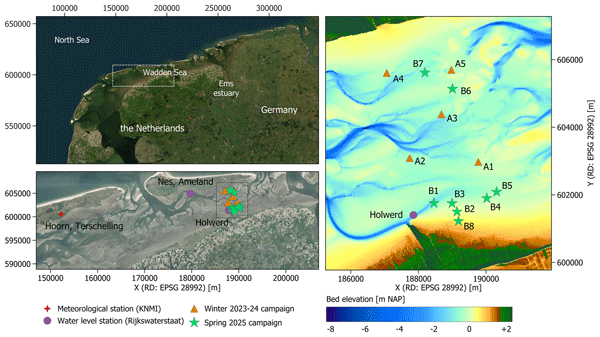
Two field measurement campaigns in the Dutch Wadden Sea captured how sand and mud move between deep channels and shallow tidal flats. Seabed-mounted frames equipped with multiple instruments recorded water levels, flow velocities, waves, and amounts of sand and mud in the water column and seabed. The resulting dataset helps reveal the processes that control sediment dynamics and the evolution of seabed morphology in tidal coastal systems.
Jialing Yao, Zhi Chen, Jianzhong Ge, and Wenyan Zhang
Biogeosciences, 21, 5435–5455, https://doi.org/10.5194/bg-21-5435-2024, https://doi.org/10.5194/bg-21-5435-2024, 2024
Short summary
Short summary
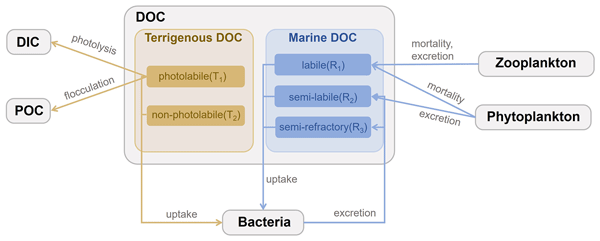
The transformation of dissolved organic carbon (DOC) in estuaries is vital for coastal carbon cycling. We studied source-to-sink pathways of DOC in the Changjiang Estuary using a physics–biogeochemistry model. Results showed a transition of DOC from a sink to a source in the plume area during summer, with a transition from terrestrial-dominant to marine-dominant DOC. Terrigenous and marine DOC exports account for about 31 % and 69 %, respectively.
Dirk S. van Maren, Christian Maushake, Jan-Willem Mol, Daan van Keulen, Jens Jürges, Julia Vroom, Henk Schuttelaars, Theo Gerkema, Kirstin Schulz, Thomas H. Badewien, Michaela Gerriets, Andreas Engels, Andreas Wurpts, Dennis Oberrecht, Andrew J. Manning, Taylor Bailey, Lauren Ross, Volker Mohrholz, Dante M. L. Horemans, Marius Becker, Dirk Post, Charlotte Schmidt, and Petra J. T. Dankers
Earth Syst. Sci. Data, 15, 53–73, https://doi.org/10.5194/essd-15-53-2023, https://doi.org/10.5194/essd-15-53-2023, 2023
Short summary
Short summary
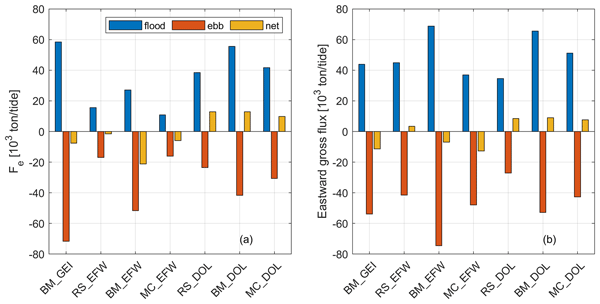
This paper reports on the main findings of a large measurement campaign aiming to better understand how an exposed estuary (the Ems Estuary on the Dutch–German border) interacts with a tidal river (the lower Ems River). Eight simultaneously deployed ships measuring a tidal cycle and 10 moorings collecting data throughout a spring–neap tidal cycle have produced a dataset providing valuable insight into processes determining exchange of water and sediment between the two systems.
Shuyun Dong, Wayne J. Stephenson, Sarah Wakes, Zhongyuan Chen, and Jianzhong Ge
Nat. Hazards Earth Syst. Sci., 22, 931–945, https://doi.org/10.5194/nhess-22-931-2022, https://doi.org/10.5194/nhess-22-931-2022, 2022
Short summary
Short summary
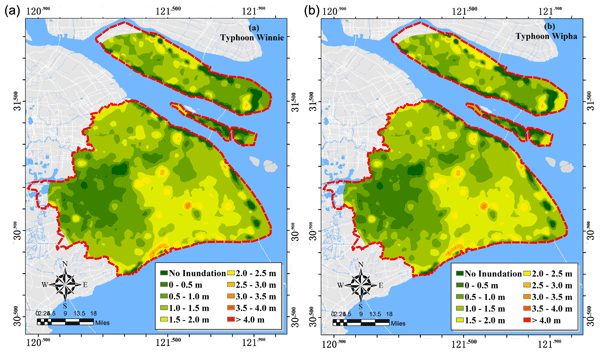
Mesoscale simulation provides a general approach that could be implemented to fulfill the purpose of planning and has relatively low requirements for computation time and data while still providing reasonable accuracy. The method is generally applicable to all coastal cities around the world for examining the effect of future climate change on typhoon-generated storm surge even where historical observed data are inadequate or not available.
Fucang Zhou, Jianzhong Ge, Dongyan Liu, Pingxing Ding, Changsheng Chen, and Xiaodao Wei
Geosci. Model Dev., 14, 6049–6070, https://doi.org/10.5194/gmd-14-6049-2021, https://doi.org/10.5194/gmd-14-6049-2021, 2021
Short summary
Short summary
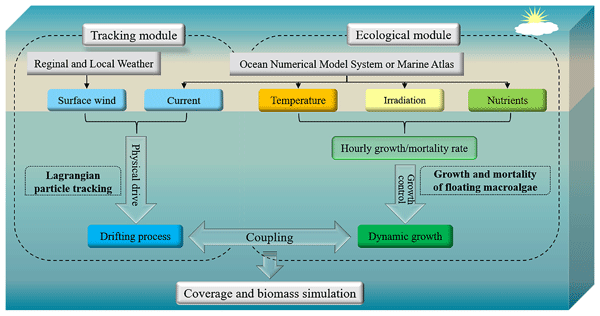
In this study, a physical–ecological model, the Floating Macroalgal Growth and Drift Model (FMGDM), was developed to determine the dynamic growth and drifting pattern of floating macroalgae. Based on Lagrangian tracking, the macroalgae bloom is jointly controlled by ocean flows, sea surface wind, temperature, irradiation, and nutrients. The FMGDM was robust in successfully reproducing the spatial and temporal dynamics of the massive green tide around the Yellow Sea.
Cited articles
Becker, M., Maushake, C., and Winter, C.: Observations of Mud-Induced Periodic Stratification in a Hyperturbid Estuary, Geophys. Res. Lett., 45, 5461–5469, https://doi.org/10.1029/2018GL077966, 2018.
Besset, M., Anthony, E. J., and Bouchette, F.: Multi-decadal variations in delta shorelines and their relationship to river sediment supply: An assessment and review, Earth-Sci. Rev., 193, 199–219, https://doi.org/10.1016/j.earscirev.2019.04.018, 2019.
Cai, H., Savenije, H. H. G., Zuo, S., Jiang, C., and Chua, V. P.: A predictive model for salt intrusion in estuaries applied to the Yangtze estuary, J. Hydrol., 529, 1336–1349, https://doi.org/10.1016/j.jhydrol.2015.08.050, 2015.
Chant, R. J.: Estuarine secondary circulation, in: Contemporary Issues in Estuarine Physics, edited by: Valle-Levinson, A., Cambridge University Press, Cambridge, 100–124, https://doi.org/10.1017/CBO9780511676567.006, 2010.
Chen, Q., Zhu, J., Lyu, H., Pan, S., and Chen, S.: Estuarine, Coastal and Shelf Science Impacts of topography change on saltwater intrusion over the past decade in the Changjiang Estuary, Estuar. Coast. Shelf Sci., 231, 106469, https://doi.org/10.1016/j.ecss.2019.106469, 2019.
Chen, W. and de Swart, H. E.: Longitudinal variation in lateral trapping of fine sediment in tidal estuaries: observations and a 3D exploratory model, Ocean Dynam., 68, 309–326, https://doi.org/10.1007/s10236-018-1134-z, 2018.
Cossu, R. and Wells, M. G.: Coriolis forces influence the secondary circulation of gravity currents flowing in large-scale sinuous submarine channel systems, Geophys. Res. Lett., 37, L17603, https://doi.org/10.1029/2010GL044296, 2010.
de Nijs, M. A. J. and Pietrzak, J. D.: Saltwater intrusion and ETM dynamics in a tidally-energetic stratified estuary, Ocean Model., 49–50, 60–85, https://doi.org/10.1016/j.ocemod.2012.03.004, 2012.
Du, Z., Yu, Q., Peng, Y., Wang, L., Lin, H., Wang, Y., and Gao, S.: The Formation of Coastal Turbidity Maximum by Tidal Pumping in Well-Mixed Inner Shelves, J. Geophys. Res.-Oceans, 127, 1–29, https://doi.org/10.1029/2022JC018478, 2022.
Fugate, D. C., Friedrichs, C. T., and Sanford, L. P.: Lateral dynamics and associated transport of sediment in the upper reaches of a partially mixed estuary, Chesapeake Bay, USA, Cont. Shelf Res., 27, 679–698, https://doi.org/10.1016/j.csr.2006.11.012, 2007.
Ge, J., Zhou, Z., Yang, W., Ding, P., Chen, C., Wang, Z. B., and Gu, J.: Formation of Concentrated Benthic Suspension in a Time-Dependent Salt Wedge Estuary, J. Geophys. Res.-Oceans, 123, 8581–8607, https://doi.org/10.1029/2018JC013876, 2018.
Ge, J., Chen, C., Wang, Z. B., Ke, K., Yi, J., and Ding, P.: Dynamic Response of the Fluid Mud to a Tropical Storm, J. Geophys. Res.-Oceans, 125, 1–27, https://doi.org/10.1029/2019JC015419, 2020.
Geyer, W. R.: The Importance of Suppression of Turbulence by Stratification on the Estuarine Turbidity Maximum, Estuaries, 16, 113, https://doi.org/10.2307/1352769, 1993.
Geyer, W. R. and Ralston, D. K.: The Dynamics of Strongly Stratified Estuaries, in: Treatise on Estuarine and Coastal Science, vol. 2, Elsevier, 37–51, https://doi.org/10.1016/B978-0-12-374711-2.00206-0, 2011.
Geyer, W. R., Ralston, D. K., and Chen, J. L.: Mechanisms of Exchange Flow in an Estuary With a Narrow, Deep Channel and Wide, Shallow Shoals, J. Geophys. Res.-Oceans, 125, 1–25, https://doi.org/10.1029/2020JC016092, 2020.
Guo, C., He, Q., Guo, L., and Winterwerp, J. C.: A study of in-situ sediment flocculation in the turbidity maxima of the Yangtze Estuary, Estuar. Coast. Shelf Sci., 191, 1–9, https://doi.org/10.1016/j.ecss.2017.04.001, 2017.
Guo, L., Su, N., Zhu, C., and He, Q.: How have the river discharges and sediment loads changed in the Changjiang River basin downstream of the Three Gorges Dam?, J. Hydrol., 560, 259–274, https://doi.org/10.1016/j.jhydrol.2018.03.035, 2018.
Jiang, C., De Swart, H. E., Li, J., and Liu, G.: Mechanisms of along-channel sediment transport in the North Passage of the Yangtze Estuary and their response to large-scale interventions Topical Collection on the 11th International Conference on Cohesive Sediment Transport, Ocean Dynam., 63, 283–305, https://doi.org/10.1007/s10236-013-0594-4, 2013.
Kim, Y. H. and Voulgaris, G.: Lateral circulation and suspended sediment transport in a curved estuarine channel: Winyah Bay, SC, USA, J. Geophys. Res.-Oceans, 113, 1–15, https://doi.org/10.1029/2007JC004509, 2008.
Kranenburg, W. M., Geyer, W. R., Garcia, A. M. P., and Ralston, D. K.: Reversed Lateral Circulation in a Sharp Estuarine Bend with Weak Stratification, J. Phys. Oceanogr., 49, 1619–1637, https://doi.org/10.1175/JPO-D-18-0175.1, 2019.
Kularatne, S. and Pattiaratchi, C.: Turbulent kinetic energy and sediment resuspension due to wave groups, Cont. Shelf Res., 28, 726–736, https://doi.org/10.1016/j.csr.2007.12.007, 2008.
Lerczak, J. A. and Rockwell Geyer, W.: Modeling the Lateral Circulation in Straight, Stratified Estuaries, J. Phys. Oceanogr., 34, 1410–1428, https://doi.org/10.1175/1520-0485(2004)034<1410:MTLCIS>2.0.CO;2, 2004.
Lin, J., van Prooijen, B. C., Guo, L., Zhu, C., He, Q., and Wang, Z. B.: Regime shifts in the Changjiang (Yangtze River) Estuary: The role of concentrated benthic suspensions, Mar. Geol., 433, 106403, https://doi.org/10.1016/j.margeo.2020.106403, 2021.
Liu, G., Zhu, J., Wang, Y., Wu, H., and Wu, J.: Tripod measured residual currents and sediment flux: Impacts on the silting of the Deepwater Navigation Channel in the Changjiang Estuary, Estuar. Coast. Shelf Sci., 93, 192–201, https://doi.org/10.1016/j.ecss.2010.08.008, 2011.
Liu, H., He, Q., Wang, Z., Weltje, G. J., and Zhang, J.: Dynamics and spatial variability of near-bottom sediment exchange in the Yangtze Estuary, China, Estuar. Coast. Shelf Sci., 86, 322–330, https://doi.org/10.1016/j.ecss.2009.04.020, 2010.
Luan, H. L., Ding, P. X., Wang, Z. B., Ge, J. Z., and Yang, S. L.: Decadal morphological evolution of the Yangtze Estuary in response to river input changes and estuarine engineering projects, Geomorphology, 265, 12–23, https://doi.org/10.1016/j.geomorph.2016.04.022, 2016.
Luan, H. L., Ding, P. X., Wang, Z. B., Yang, S. L., and Lu, J. Y.: Morphodynamic impacts of large-scale engineering projects in the Yangtze River delta, Coast. Eng., 141, 1–11, https://doi.org/10.1016/j.coastaleng.2018.08.013, 2018.
MacCready, P. and Geyer, W. R.: Advances in Estuarine Physics, Ann. Rev. Mar. Sci., 2, 35–58, https://doi.org/10.1146/annurev-marine-120308-081015, 2010.
McCoy, A., Constantinescu, G., and Weber, L.: A numerical investigation of coherent structures and mass exchange processes in channel flow with two lateral submerged groynes, Water Resour. Res., 43, 1–26, https://doi.org/10.1029/2006WR005267, 2007.
McSweeney, J. M., Chant, R. J., and Sommerfield, C. K.: Lateral variability of sediment transport in the Delaware Estuary, J. Geophys. Res.-Oceans, 121, 725–744, https://doi.org/10.1002/2015JC010974, 2016.
Nichols, M. M.: Sediments of the James River estuary, Virginia, in: Environmental Framework of Coastal Plain Estuaries, edited by: Nelson, B. W., Geological Society of America, ISBN 9780813711331, https://doi.org/10.1130/MEM133, 1972.
Okubo, A.: Effect of shoreline irregularities on streamwise dispersion in estuaries and other embayments, Neth. J. Sea Res., 6, 213–224, https://doi.org/10.1016/0077-7579(73)90014-8, 1973.
Pein, J., Valle-Levinson, A., and Stanev, E. V.: Secondary Circulation Asymmetry in a Meandering, Partially Stratified Estuary, J. Geophys. Res.-Oceans, 123, 1670–1683, https://doi.org/10.1002/2016JC012623, 2018.
Pu, X., Shi, J. Z., Hu, G. D., and Xiong, L. B.: Circulation and mixing along the North Passage in the Changjiang River estuary, China, J. Mar. Syst., 148, 213–235, https://doi.org/10.1016/j.jmarsys.2015.03.009, 2015.
Ralston, D. K., Geyer, W. R., and Warner, J. C.: Bathymetric controls on sediment transport in the Hudson River estuary: Lateral asymmetry and frontal trapping, J. Geophys. Res.-Oceans, 117, C10013, https://doi.org/10.1029/2012JC008124, 2012.
Song, D., Wang, X. H., Cao, Z., and Guan, W.: Suspended sediment transport in the Deepwater Navigation Channel, Yangtze River Estuary, China, in the dry season 2009: 1. Observations over spring and neap tidal cycles, J. Geophys. Res.-Oceans, 118, 5555–5567, https://doi.org/10.1002/jgrc.20410, 2013.
Stapleton, K. R. and Huntley, D. A.: Seabed stress determinations using the inertial dissipation method and the turbulent kinetic energy method, Earth Surf. Proc. Land., 20, 807–815, 1995.
Syvitski, J. P. M., Kettner, A. J., Overeem, I., Hutton, E. W. H., Hannon, M. T., Brakenridge, G. R., Day, J., Vörösmarty, C., Saito, Y., Giosan, L., and Nicholls, R. J.: Sinking deltas due to human activities, Nat. Geosci., 2, 681–686, https://doi.org/10.1038/ngeo629, 2009.
Ten Brinke, W. B. M., Schulze, F. H., and van Der Veer, P.: Sand exchange between groyne-field beaches and the navigation channel of the Dutch Rhine: the impact of navigation versus river flow, River Res. Appl., 20, 899–928, https://doi.org/10.1002/rra.809, 2004.
Uijttewaal, W. S. J.: Effects of Groyne Layout on the Flow in Groyne Fields: Laboratory Experiments, J. Hydraul. Eng., 131, 782–791, https://doi.org/10.1061/(ASCE)0733-9429(2005)131:9(782), 2005.
Uijttewaal, W. S. J., Lehmann, D., and van Mazijk, A.: Exchange Processes between a River and Its Groyne Fields: Model Experiments, J. Hydraul. Eng., 127, 928–936, https://doi.org/10.1061/(ASCE)0733-9429(2001)127:11(928), 2001.
Valle-Levinson, A., Wong, K.-C., and Lwiza, K. M. M.: Fortnightly variability in the transverse dynamics of a coastal plain estuary, J. Geophys. Res.-Oceans, 105, 3413–3424, https://doi.org/10.1029/1999JC900307, 2000.
van Maanen, B. and Sottolichio, A.: Hydro- and sediment dynamics in the Gironde estuary (France): Sensitivity to seasonal variations in river inflow and sea level rise, Cont. Shelf Res., 165, 37–50, https://doi.org/10.1016/j.csr.2018.06.001, 2018.
van Maren, D. S., Winterwerp, J. C., Decrop, B., Wang, Z. B., and Vanlede, J.: Predicting the effect of a Current Deflecting Wall on harbour siltation, Cont. Shelf Res., 31, S182–S198, https://doi.org/10.1016/j.csr.2010.12.005, 2011.
Wang, Z. B., Van Maren, D. S., Ding, P. X., Yang, S. L., Van Prooijen, B. C., De Vet, P. L. M., Winterwerp, J. C., De Vriend, H. J., Stive, M. J. F., and He, Q.: Human impacts on morphodynamic thresholds in estuarine systems, Cont. Shelf Res., 111, 174–183, https://doi.org/10.1016/j.csr.2015.08.009, 2015.
Winterwerp, J. C., Wang, Z. B., Van Braeckel, A., Van Holland, G., and Kösters, F.: Man-induced regime shifts in small estuaries – II: A comparison of rivers, Ocean Dynam., 63, 1293–1306, https://doi.org/10.1007/s10236-013-0663-8, 2013.
Wu, H., Zhu, J., and Ho Choi, B.: Links between saltwater intrusion and subtidal circulation in the Changjiang Estuary: A model-guided study, Cont. Shelf Res., 30, 1891–1905, https://doi.org/10.1016/j.csr.2010.09.001, 2010.
Wu, J., Wang, Y., and Cheng, H.: Bedforms and bed material transport pathways in the Changjiang (Yangtze) Estuary, Geomorphology, 104, 175–184, https://doi.org/10.1016/j.geomorph.2008.08.011, 2009.
Wu, J., Liu, J. T., and Wang, X.: Sediment trapping of turbidity maxima in the Changjiang Estuary, Mar. Geol., 303–306, 14–25, https://doi.org/10.1016/j.margeo.2012.02.011, 2012.
Xue, P., Chen, C., Ding, P., Beardsley, R. C., Lin, H., Ge, J., and Kong, Y.: Saltwater intrusion into the Changjiang River: A model-guided mechanism study, J. Geophys. Res.-Oceans, 114, 1–15, https://doi.org/10.1029/2008JC004831, 2009.
Yang, S. L., Milliman, J. D., Li, P., and Xu, K.: 50,000 dams later: Erosion of the Yangtze River and its delta, Global Planet. Change, 75, 14–20, https://doi.org/10.1016/j.gloplacha.2010.09.006, 2011.
Yun, C. X.: Recent evolution of the Yangtze estuary and its mechanisms, China Ocean Press, Beijing, China, ISBN 9787502762193, 2004.
Zhou, Z. and Ge, J.: Dataset of North Passage Channel Measurements (NP-ChaM), 4TU.Research.Data [data set], https://doi.org/10.4121/6d4fcaff-6a30-4990-881a-a5ac8ebb1ca6, 2024.
Zhou, Z., Ge, J., Wang, Z. B., Maren, D. S., Ma, J., and Ding, P.: Study of Lateral Flow in a Stratified Tidal Channel-Shoal System: The Importance of Intratidal Salinity Variation, J. Geophys. Res.-Oceans, 124, 6702–6719, https://doi.org/10.1029/2019JC015307, 2019.
Zhou, Z., Ge, J., van Maren, D. S., Wang, Z. B., Kuai, Y., and Ding, P.: Study of Sediment Transport in a Tidal Channel-Shoal System: Lateral Effects and Slack-Water Dynamics, J. Geophys. Res.-Oceans, 126, e2020JC016334, https://doi.org/10.1029/2020JC016334, 2021.
Zhu, C., van Maren, D. S., Guo, L., He, Q., and Wang, Z. B.: Impact of Reduced Fluvial Sediment Supply on Saltwater Intrusion in the Yangtze Estuary, Earth's Future, 11, 1–19, https://doi.org/10.1029/2022EF003274, 2023.
Zhu, J., Gu, Y., and Wu, H.: Determination of the period not suitable for taking demestic water supply to the Qingcaosha Reservoir near Changjiang River estuary, Oceanol. Limnol. Sin. Yang Yu Hu Chao, 44, 1138–1145, 2013.
Zhu, L., He, Q., and Shen, J.: Modeling lateral circulation and its influence on the along-channel flow in a branched estuary, Ocean Dynam., 68, 177–191, https://doi.org/10.1007/s10236-017-1114-8, 2018.
Short summary
The North Passage (NP) is the primary navigation channel of the Changjiang Estuary, supporting the shipping needs of Shanghai and its surrounding regions. To enhance our understanding of hydrodynamics and sediment dynamics of the NP, a multi-year field observation campaign was designed and conducted from 2015 to 2018. This campaign improves the temporal and spatial coverage compared to previous observations, enabling more detailed investigations of this important channel system.
The North Passage (NP) is the primary navigation channel of the Changjiang Estuary, supporting...
Altmetrics
Final-revised paper
Preprint