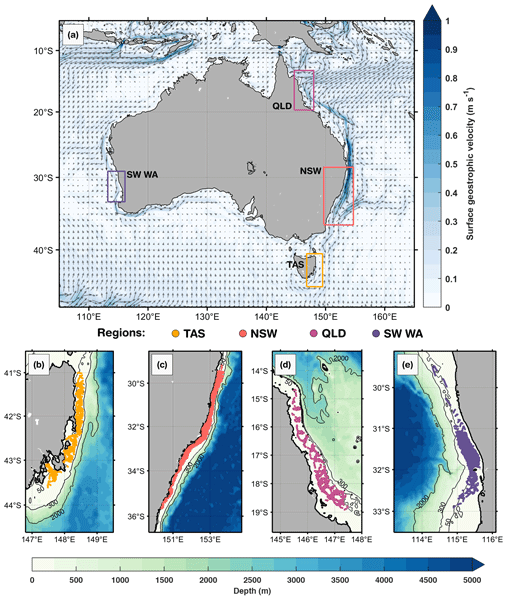
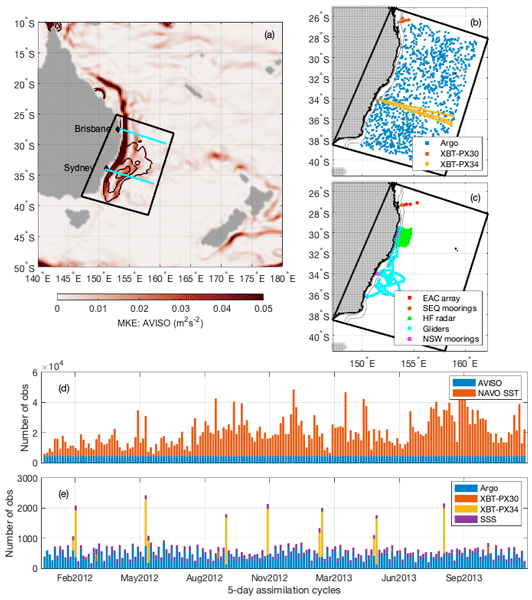
Bourg, N., Schaeffer, A., and Molcard, A.: East Australian Current System: Frontal Barrier and Fine-Scale Control of Chlorophyll-
a Distribution, J. Geophys. Res.-Oceans, 129, e2023JC020312,
https://doi.org/10.1029/2023jc020312, 2024.
a,
b,
c
Bowen, M. M., Wilkin, J. L., and Emery, W. J.: Variability and forcing of the East Australian Current, J. Geophys. Res.-Oceans, 110, 2004JC002533,
https://doi.org/10.1029/2004jc002533, 2005.
a,
b
Bull, C. Y. S., Kiss, A. E., Jourdain, N. C., England, M. H., and van Sebille, E.: Wind Forced Variability in Eddy Formation, Eddy Shedding, and the Separation of the East Australian Current, J. Geophys. Res.-Oceans, 122, 9980–9998,
https://doi.org/10.1002/2017jc013311, 2017.
a
Capodici, F., Cosoli, S., Ciraolo, G., Nasello, C., Maltese, A., Poulain, P.-M., Drago, A., Azzopardi, J., and Gauci, A.: Validation of HF radar sea surface currents in the Malta-Sicily Channel, Remote Sens. Environ., 225, 65–76,
https://doi.org/10.1016/j.rse.2019.02.026, 2019.
a,
b
Cetina-Heredia, P., Roughan, M., van Sebille, E., and Coleman, M. A.: Long-term trends in the East Australian Current separation latitude and eddy driven transport, J. Geophys. Res.-Oceans, 119, 4351–4366,
https://doi.org/10.1002/2014jc010071, 2014.
a,
b
Codiga, D.: UTide Unified Tidal Analysis and Prediction Functions, MATLAB Central File Exchange [code],
https://www.mathworks.com/matlabcentral/fileexchange/46523-utide-unified-tidal-analysis-and-prediction-functions (last access: 6 March 2025), 2025.
a,
b
Cosoli, S.: Implementation of the Listen-Before-Talk Mode for SeaSonde High-Frequency Ocean Radars, Journal of Marine Science and Engineering, 8, 57,
https://doi.org/10.3390/jmse8010057, 2020.
a,
b,
c
Cosoli, S. and Grcic, B.: IMOS – Ocean Radar – Quality Control procedures for IMOS Ocean Radar Manual, Tech. rep., Australian Ocean Data Network, 2019 (data available at:
https://thredds.aodn.org.au/thredds/catalog/IMOS/ACORN/catalog.html, last access: 1 October 2024).
a,
b,
c,
d,
e,
f
Dumas, D., Gramoullé, A., Guérin, C.-A., Molcard, A., Ourmières, Y., and Zakardjian, B.: Multistatic estimation of high-frequency radar surface currents in the region of Toulon, Ocean Dynam., 70, 1485–1503,
https://doi.org/10.1007/s10236-020-01406-z, 2020.
a
Dzwonkowski, B., Kohut, J. T., and Yan, X.-H.: Sub-inertial characteristics of the surface flow field over the shelf of the central Mid-Atlantic Bight, Cont. Shelf Res., 29, 1873–1886,
https://doi.org/10.1016/j.csr.2009.07.005, 2009.
a
D'Asaro, E. A., Shcherbina, A. Y., Klymak, J. M., Molemaker, J., Novelli, G., Guigand, C. M., Haza, A. C., Haus, B. K., Ryan, E. H., Jacobs, G. A., Huntley, H. S., Laxague, N. J. M., Chen, S., Judt, F., McWilliams, J. C., Barkan, R., Kirwan, A. D., Poje, A. C., and Özgökmen, T. M.: Ocean convergence and the dispersion of flotsam, P. Natl. Acad. Sci. USA, 115, 1162–1167,
https://doi.org/10.1073/pnas.1718453115, 2018.
a
Ebuchi, N., Fukamachi, Y., Ohshima, K. I., and Wakatsuchi, M.: Subinertial and seasonal variations in the Soya Warm Current revealed by HF ocean radars, coastal tide gauges, and bottom-mounted ADCP, J. Oceanogr., 65, 31–43,
https://doi.org/10.1007/s10872-009-0003-2, 2009.
a
García-Reyes, M. and Largier, J. L.: Seasonality of coastal upwelling off central and northern California: New insights, including temporal and spatial variability, J. Geophys. Res.-Oceans, 117, 2011JC007629,
https://doi.org/10.1029/2011jc007629, 2012.
a
Godfrey, J. S., Cresswell, G. R., Golding, T. J., Pearce, A. F., and Boyd, R.: The Separation of the East Australian Current, J. Phys. Oceanogr., 10, 430–440,
https://doi.org/10.1175/1520-0485(1980)010<0430:Tsotea>2.0.Co;2, 1980.
a
Kalampokis, A., Uttieri, M., Poulain, P.-M., and Zambianchi, E.: Validation of HF Radar-Derived Currents in the Gulf of Naples With Lagrangian Data, IEEE Geosci. Remote S., 13, 1452–1456,
https://doi.org/10.1109/lgrs.2016.2591258, 2016.
a
Kerry, C. and Roughan, M.: Downstream Evolution of the East Australian Current System: Mean Flow, Seasonal, and Intra-annual Variability, J. Geophys. Res.-Oceans, 125, e2019JC015227,
https://doi.org/10.1029/2019jc015227, 2020.
a,
b,
c,
d,
e
Kerry, C., Roughan, M., and Powell, B.: Observation Impact in a Regional Reanalysis of the East Australian Current System, J. Geophys. Res.-Oceans, 123, 7511–7528,
https://doi.org/10.1029/2017jc013685, 2018.
a
Kirincich, A., Emery, B., Washburn, L., and Flament, P.: Improving Surface Current Resolution Using Direction Finding Algorithms for Multiantenna High-Frequency Radars, J. Atmos. Ocean. Tech., 36, 1997–2014,
https://doi.org/10.1175/JTECH-D-19-0029.1, 2019.
a
Klinger, W. B., Bertaska, I. R., von Ellenrieder, K. D., and Dhanak, M. R.: Control of an Unmanned Surface Vehicle With Uncertain Displacement and Drag, IEEE J. Oceanic Eng., 42, 458–476,
https://doi.org/10.1109/JOE.2016.2571158, 2017.
a
Li, J., Roughan, M., and Kerry, C.: Drivers of ocean warming in the western boundary currents of the Southern Hemisphere, Nat. Clim. Change, 12, 901–909,
https://doi.org/10.1038/s41558-022-01473-8, 2022.
a,
b
Li, J., Roughan, M., and Hemming, M.: Interactions between cold cyclonic eddies and a western boundary current modulate marine heatwaves, Commun. Earth Environ., 4, 380,
https://doi.org/10.1038/s43247-023-01041-8, 2023.
a
Lipa, B. and Barrick, D.: Least-squares methods for the extraction of surface currents from CODAR crossed-loop data: Application at ARSLOE, IEEE J. Oceanic Eng., 8, 226–253,
https://doi.org/10.1109/joe.1983.1145578, 1983.
a
Liu, Y., Weisberg, R. H., and Merz, C. R.: Assessment of CODAR SeaSonde and WERA HF Radars in Mapping Surface Currents on the West Florida Shelf, J. Atmos. Ocean. Tech., 31, 1363–1382, 2014.
a,
b
Lodise, J., Özgökmen, T., Griffa, A., and Berta, M.: Vertical structure of ocean surface currents under high winds from massive arrays of drifters, Ocean Science, 15, 1627–1651,
https://doi.org/10.5194/os-15-1627-2019, 2019.
a
Lumpkin, R., Ozgokmen, T., and Centurioni, L.: Advances in the Application of Surface Drifters, Annu. Rev. Mar. Sci., 9, 59–81,
https://doi.org/10.1146/annurev-marine-010816-060641, 2017 (data available at:
https://data.pmel.noaa.gov/generic/erddap/tabledap/gdp_hourly_velocities.html, last access: 1 September 2024).
a,
b,
c
Malan, N., Roughan, M., and Kerry, C.: The Rate of Coastal Temperature Rise Adjacent to a Warming Western Boundary Current is Nonuniform with Latitude, Geophys. Res. Lett., 48, e2020GL090751,
https://doi.org/10.1029/2020GL090751, 2021.
a
Malan, N., Roughan, M., Stanley, G. J., Holmes, R., and Li, J.: Quantifying Cross-Shelf Transport in the East Australian Current System: A Budget-Based Approach, J. Phys. Oceanogr., 52, 2555–2572,
https://doi.org/10.1175/jpo-d-21-0193.1, 2022.
a,
b,
c,
d
Malan, N., Roughan, M., Hemming, M., and Schaeffer, A.: Mesoscale Circulation Controls Chlorophyll Concentrations in the East Australian Current Separation Zone, J. Geophys. Res.-Oceans, 128, e2022JC019361,
https://doi.org/10.1029/2022jc019361, 2023.
a,
b,
c
Mantovanelli, A., Keating, S., Wyatt, L. R., Roughan, M., and Schaeffer, A.: Lagrangian and Eulerian characterization of two counter-rotating submesoscale eddies in a western boundary current, J. Geophys. Res.-Oceans, 122, 4902–4921,
https://doi.org/10.1002/2016jc011968, 2017.
a,
b,
c,
d
Molcard, A., Poulain, P. M., Forget, P., Griffa, A., Barbin, Y., Gaggelli, J., De Maistre, J. C., and Rixen, M.: Comparison between VHF radar observations and data from drifter clusters in the Gulf of La Spezia (Mediterranean Sea), J. Marine Syst., 78, S79–S89,
https://doi.org/10.1016/j.jmarsys.2009.01.012, 2009.
a,
b
Muglia, M., Seim, H., and Taylor, P.: Gulf Stream Position, Width, and Orientation Estimated from HF Radar Radial Velocity Maps off Cape Hatteras, North Carolina, J. Atmos. Ocean. Techn., 39, 689–705,
https://doi.org/10.1175/jtech-d-21-0098.1, 2022.
a
Novelli, G., Guigand, C. M., Cousin, C., Ryan, E. H., Laxague, N. J. M., Dai, H., Haus, B. K., and Özgökmen, T. M.: A Biodegradable Surface Drifter for Ocean Sampling on a Massive Scale, J. Atmos. Ocean. Tech., 34, 2509–2532,
https://doi.org/10.1175/jtech-d-17-0055.1, 2017.
a,
b,
c
Oke, P. R., Roughan, M., Cetina-Heredia, P., Pilo, G. S., Ridgway, K. R., Rykova, T., Archer, M. R., Coleman, R. C., Kerry, C. G., Rocha, C., Schaeffer, A., and Vitarelli, E.: Revisiting the circulation of the East Australian Current: Its path, separation, and eddy field, Prog. Oceanogr., 176, 102139,
https://doi.org/10.1016/j.pocean.2019.102139, 2019.
a,
b,
c
Ribbat, N., Roughan, M., Powell, B., Rao, S., and Kerry, C. G.: Transport variability over the Hawkesbury Shelf (31.5–34.5° S) driven by the East Australian Current, PLoS ONE, 15, e0241622,
https://doi.org/10.1371/journal.pone.0241622, 2020.
a
Roarty, H., Cook, T., Hazard, L., George, D., Harlan, J., Cosoli, S., Wyatt, L., Alvarez Fanjul, E., Terrill, E., Otero, M., Largier, J., Glenn, S., Ebuchi, N., Whitehouse, B., Bartlett, K., Mader, J., Rubio, A., Corgnati, L., Mantovani, C., Griffa, A., Reyes, E., Lorente, P., Flores-Vidal, X., Saavedra-Matta, K. J., Rogowski, P., Prukpitikul, S., Lee, S.-H., Lai, J.-W., Guerin, C.-A., Sanchez, J., Hansen, B., and Grilli, S.: The Global High Frequency Radar Network, Front. Mar. Sci., 6, 164,
https://doi.org/10.3389/fmars.2019.00164, 2019.
a
Roughan, M. and Middleton, J. H.: On the East Australian Current: Variability, encroachment, and upwelling, J. Geophys. Res.-Oceans, 109, 2003JC001833,
https://doi.org/10.1029/2003jc001833, 2004.
a
Roughan, M., Schaeffer, A., and Suthers, I. M.: Sustained Ocean Observing along the Coast of Southeastern Australia, in: Coastal Ocean Observing Systems, 76–98, Elsevier, ISBN 978-0-12-802022-7, 2015 (data available at:
https://thredds.aodn.org.au/thredds/catalog/IMOS/ANMN/NSW/catalog.html, last access: 1 September 2024).
a,
b,
c,
d
Roughan, M., Keating, S. R., Schaeffer, A., Cetina Heredia, P., Rocha, C., Griffin, D., Robertson, R., and Suthers, I. M.: A tale of two eddies: The biophysical characteristics of two contrasting cyclonic eddies in the E ast A ustralian C urrent S ystem, J. Geophys. Res.-Oceans, 122, 2494–2518,
https://doi.org/10.1002/2016JC012241, 2017.
a
Rypina, I. I., Kirincich, A. R., Limeburner, R., and Udovydchenkov, I. A.: Eulerian and Lagrangian Correspondence of High-Frequency Radar and Surface Drifter Data: Effects of Radar Resolution and Flow Components, J. Atmos. Ocean. Tech., 31, 945–966,
https://doi.org/10.1175/jtech-d-13-00146.1, 2014.
a,
b
Schaeffer, A., Roughan, M., and Wood, J. E.: Observed bottom boundary layer transport and uplift on the continental shelf adjacent to a western boundary current, J. Geophys. Res.-Oceans, 119, 4922–4939,
https://doi.org/10.1002/2013jc009735, 2014.
a,
b
Schaeffer, A., Gramoulle, A., Roughan, M., and Mantovanelli, A.: Characterizing frontal eddies along the East Australian Current from HF radar observations, J. Geophys. Res.-Oceans, 122, 3964–3980,
https://doi.org/10.1002/2016jc012171, 2017.
a,
b,
c,
d,
e,
f
Schaeffer, A., Archer, M. R., Baumard, Q., Roughan, M., and Kerry, C.: An assessment of the East Australian Current as a renewable energy resource, J. Marine Syst., 204, 103285,
https://doi.org/10.1016/j.jmarsys.2019.103285, 2020.
a
Sentchev, A., Forget, P., and Fraunié, P.: Surface current dynamics under sea breeze conditions observed by simultaneous HF radar, ADCP and drifter measurements, Ocean Dynam., 67, 499–512,
https://doi.org/10.1007/s10236-017-1035-6, 2017.
a
Shimura, T., Mori, N., Takemi, T., and Mizuta, R.: Long-term impacts of ocean wave-dependent roughness on global climate systems, J. Geophys. Res.-Oceans, 122, 1995–2011,
https://doi.org/10.1002/2016JC012621, 2017.
a
Shimura, T., Hemer, M., Lenton, A., Chamberlain, M. A., and Monselesan, D.: Impacts of Ocean Wave-Dependent Momentum Flux on Global Ocean Climate, Geophys. Res. Lett., 47, e2020GL089296,
https://doi.org/10.1029/2020GL089296, 2020.
a
Simpson, J. H. and Sharples, J.: Introduction to the Physical and Biological Oceanography of Shelf Seas, Cambridge University Press, Cambridge, ISBN 978-0-521-87762-6, 2012. a
Sloyan, B. M., Ridgway, K. R., and Cowley, R.: The East Australian Current and Property Transport at 27° S from 2012 to 2013, J. Phys. Oceanogr., 46, 993–1008,
https://doi.org/10.1175/jpo-d-15-0052.1, 2016.
a
Su, C.-H.: Bureau of Meteorology Atmospheric high-resolution Regional Reanalysis for Australia – Version 2 (BARRA2), Bureau of Meteorology, Australia [data set],
https://doi.org/10.25914/1x6g-2v48, 2024.
a,
b,
c
Tran, M. C., Sentchev, A., and Nguyen, K. C.: Multi-scale variability of circulation in the Gulf of Tonkin from remote sensing of surface currents by high-frequency radars, Ocean Dynam., 71, 175–194,
https://doi.org/10.1007/s10236-020-01440-x, 2021.
a
van der Mheen, M., Pattiaratchi, C., Cosoli, S., and Wandres, M.: Depth-Dependent Correction for Wind-Driven Drift Current in Particle Tracking Applications, Frontiers in Marine Science, 7, 305,
https://doi.org/10.3389/fmars.2020.00305, 2020.
a
Wood, J. E., Schaeffer, A., Roughan, M., and Tate, P. M.: Seasonal variability in the continental shelf waters off southeastern Australia: Fact or fiction?, Cont. Shelf Res., 112, 92–103,
https://doi.org/10.1016/j.csr.2015.11.006, 2016.
a
Wyatt, L. R., Mantovanelli, A., Heron, M. L., Roughan, M., and Steinberg, C. R.: Assessment of Surface Currents Measured With High-Frequency Phased-Array Radars in Two Regions of Complex Circulation, IEEE J. Oceanic Eng., 43, 484–505,
https://doi.org/10.1109/joe.2017.2704165, 2018.
a,
b,
c,
d,
e,
f,
g,
h
Yaremchuk, M. and Sentchev, A.: Mapping radar-derived sea surface currents with a variational method, Cont. Shelf Res., 29, 1711–1722,
https://doi.org/10.1016/j.csr.2009.05.016, 2009.
a,
b,
c,
d,
e,
f,
g
Yaremchuk, M., Spence, P., Wei, M., and Jacobs, G.: Lagrangian predictability in the DWH region from HF radar observations and model output, Deep-Sea Res. Pt. II, 129, 394–400,
https://doi.org/10.1016/j.dsr2.2013.05.035, 2016.
a,
b