Articles | Volume 18, issue 10
https://doi.org/10.5194/essd-18-7125-2026
© Author(s) 2026. This work is distributed under
the Creative Commons Attribution 4.0 License.
the Creative Commons Attribution 4.0 License.
https://doi.org/10.5194/essd-18-7125-2026
© Author(s) 2026. This work is distributed under
the Creative Commons Attribution 4.0 License.
the Creative Commons Attribution 4.0 License.
Data description article
| 
30 Sep 2026
Data description article |
| 30 Sep 2026
| 30 Sep 2026
History of anthropogenic Phosphorus inputs (HaPi) to the terrestrial biosphere from 1860 to 2020

State Key Laboratory of Climate System Prediction and Risk Management, Nanjing Normal University, Nanjing 210023, China
School of Geography, Nanjing Normal University, Nanjing 210023, China
State Key Laboratory for Ecological Security of Regions and Cities, Research Center for Eco-Environmental Sciences, Chinese Academy of Sciences, Beijing 100085, China
Rui Li
Key Laboratory of Geographic Information Science of the Ministry of Education, School of Geographic Sciences, East China Normal University, Shanghai 200241, China
Fei Lun
College of Land Science and Technology, China Agricultural University, Beijing 100193, China
Francesco N. Tubiello
Statistics Division, Food and Agriculture Organization of the United Nations, Via Terme di Caracalla, 00153 Rome, Italy
Nathaniel D. Mueller
Department of Ecosystem Science and Sustainability, Colorado State University, Fort Collins, CO 80523, USA
Department of Soil and Crop Sciences, Colorado State University, Fort Collins, CO 80523, USA
Shiyu You
State Key Laboratory for Ecological Security of Regions and Cities, Research Center for Eco-Environmental Sciences, Chinese Academy of Sciences, Beijing 100085, China
Rong Hao
State Key Laboratory of Climate System Prediction and Risk Management, Nanjing Normal University, Nanjing 210023, China
School of Geography, Nanjing Normal University, Nanjing 210023, China
Jiageng Ma
State Key Laboratory for Ecological Security of Regions and Cities, Research Center for Eco-Environmental Sciences, Chinese Academy of Sciences, Beijing 100085, China
Longhui Li
State Key Laboratory of Climate System Prediction and Risk Management, Nanjing Normal University, Nanjing 210023, China
School of Geography, Nanjing Normal University, Nanjing 210023, China
Changchun Huang
State Key Laboratory of Climate System Prediction and Risk Management, Nanjing Normal University, Nanjing 210023, China
School of Geography, Nanjing Normal University, Nanjing 210023, China
School of Computer Science, Chengdu University of Information Technology, Chengdu 610225, China
Yuanzhi Yao
Key Laboratory of Geographic Information Science of the Ministry of Education, School of Geographic Sciences, East China Normal University, Shanghai 200241, China
Center for Earth System Science and Global Sustainability, Boston College, Chestnut Hill, MA 02467, USA
Department of Earth and Environmental Sciences, Boston College, Chestnut Hill, MA 02467, USA
Related authors

Hanqin Tian, Naiqing Pan, Rona L. Thompson, Josep G. Canadell, Parvadha Suntharalingam, Pierre Regnier, Eric A. Davidson, Michael Prather, Philippe Ciais, Marilena Muntean, Shufen Pan, Wilfried Winiwarter, Sönke Zaehle, Feng Zhou, Robert B. Jackson, Hermann W. Bange, Sarah Berthet, Zihao Bian, Daniele Bianchi, Alexander F. Bouwman, Erik T. Buitenhuis, Geoffrey Dutton, Minpeng Hu, Akihiko Ito, Atul K. Jain, Aurich Jeltsch-Thömmes, Fortunat Joos, Sian Kou-Giesbrecht, Paul B. Krummel, Xin Lan, Angela Landolfi, Ronny Lauerwald, Ya Li, Chaoqun Lu, Taylor Maavara, Manfredi Manizza, Dylan B. Millet, Jens Mühle, Prabir K. Patra, Glen P. Peters, Xiaoyu Qin, Peter Raymond, Laure Resplandy, Judith A. Rosentreter, Hao Shi, Qing Sun, Daniele Tonina, Francesco N. Tubiello, Guido R. van der Werf, Nicolas Vuichard, Junjie Wang, Kelley C. Wells, Luke M. Western, Chris Wilson, Jia Yang, Yuanzhi Yao, Yongfa You, and Qing Zhu
Earth Syst. Sci. Data, 16, 2543–2604, https://doi.org/10.5194/essd-16-2543-2024, https://doi.org/10.5194/essd-16-2543-2024, 2024
Short summary
Short summary
Atmospheric concentrations of nitrous oxide (N2O), a greenhouse gas 273 times more potent than carbon dioxide, have increased by 25 % since the preindustrial period, with the highest observed growth rate in 2020 and 2021. This rapid growth rate has primarily been due to a 40 % increase in anthropogenic emissions since 1980. Observed atmospheric N2O concentrations in recent years have exceeded the worst-case climate scenario, underscoring the importance of reducing anthropogenic N2O emissions.
Kyle E. Hinson, Marjorie A. M. Friedrichs, Raymond G. Najjar, Maria Herrmann, Zihao Bian, Gopal Bhatt, Pierre St-Laurent, Hanqin Tian, and Gary Shenk
Biogeosciences, 20, 1937–1961, https://doi.org/10.5194/bg-20-1937-2023, https://doi.org/10.5194/bg-20-1937-2023, 2023
Short summary
Short summary
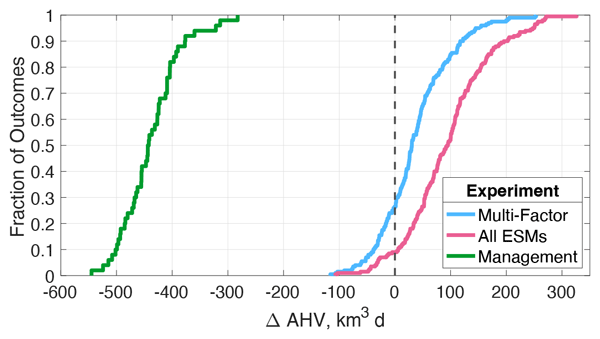
Climate impacts are essential for environmental managers to consider when implementing nutrient reduction plans designed to reduce hypoxia. This work highlights relative sources of uncertainty in modeling regional climate impacts on the Chesapeake Bay watershed and consequent declines in bay oxygen levels. The results demonstrate that planned water quality improvement goals are capable of reducing hypoxia levels by half, offsetting climate-driven impacts on terrestrial runoff.

Hanqin Tian, Zihao Bian, Hao Shi, Xiaoyu Qin, Naiqing Pan, Chaoqun Lu, Shufen Pan, Francesco N. Tubiello, Jinfeng Chang, Giulia Conchedda, Junguo Liu, Nathaniel Mueller, Kazuya Nishina, Rongting Xu, Jia Yang, Liangzhi You, and Bowen Zhang
Earth Syst. Sci. Data, 14, 4551–4568, https://doi.org/10.5194/essd-14-4551-2022, https://doi.org/10.5194/essd-14-4551-2022, 2022
Short summary
Short summary
Nitrogen is one of the critical nutrients for growth. Evaluating the change in nitrogen inputs due to human activity is necessary for nutrient management and pollution control. In this study, we generated a historical dataset of nitrogen input to land at the global scale. This dataset consists of nitrogen fertilizer, manure, and atmospheric deposition inputs to cropland, pasture, and rangeland at high resolution from 1860 to 2019.
Wensu Hao, Hanqin Tian, Hao Shi, Xing Yu, Naiqing Pan, Shufen Pan, Francesco N. Tubiello, Wulahati Adalibieke, Martial Bernoux, Philippe Ciais, Federico Maggi, Kazuya Nishina, Aimable Uwizeye, and Feng Zhou
Earth Syst. Sci. Data Discuss., https://doi.org/10.5194/essd-2026-595, https://doi.org/10.5194/essd-2026-595, 2026
Preprint under review for ESSD
Short summary
Short summary
HaNi-Crop dataset presents a long-term global dataset of nitrogen inputs from synthetic fertilizers and animal manure for different crops from 1961 to 2023. Built by combining agricultural statistics with crop distribution information, the dataset reveals how nutrient use has changed over time and provides a valuable resource for improving food production, environmental protection, climate change, and more sustainable agricultural management.
Kaitao Chen, Zheng Li, Rui Li, Luyao Chen, Rongjie Li, Binyu Xiao, Shaojun Lv, Can Wu, Rui Li, Junke Zhang, and Gehui Wang
Atmos. Chem. Phys., 26, 14329–14343, https://doi.org/10.5194/acp-26-14329-2026, https://doi.org/10.5194/acp-26-14329-2026, 2026
Short summary
Short summary
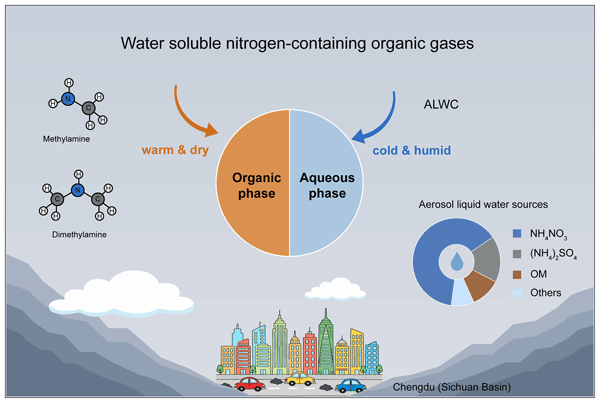
During winter haze in Chengdu, water-soluble organic nitrogen compounds shift from gas to particles, with concentrations more than doubling. The main driver is particle water content, not acidity or temperature. As particles absorb water, they take up these compounds, fueling aerosol growth. This study reveals how nitrogen-rich organic aerosols form in humid air, aiding pollution control strategies.

Francesco N. Tubiello, Anne Branthomme, Griffiths Obli-Laryea, Michelle Piccoli, Nidal Ramadan, Rocio Danica Condor, Nathan Wanner, Rachele Brivio, Örjan Jonsson, Giulia Conchedda, and Anssi Pekkarinen
Earth Syst. Sci. Data, 18, 6799–6813, https://doi.org/10.5194/essd-18-6799-2026, https://doi.org/10.5194/essd-18-6799-2026, 2026
Short summary
Short summary
Estimates of net forest emissions/removals were updated using the 2025 Forest Resources Assessment data, submitted by countries to the Food and Agriculture Organization. Results show that forests acted globally as sinks of atmospheric carbon, despite ongoing losses due to deforestation. Results were consistent with country data independently submitted under the Paris Agreement and with the most recent scientific evidence.
Simone Rossi, Clement Bourgoin, Joana Melo, Guido Ceccherini, Sandro Federici, Monica Crippa, Frederic Achard, René Colditz, Francesco N. Tubiello, Greet Janssens-Maenhout, and Giacomo Grassi
Earth Syst. Sci. Data Discuss., https://doi.org/10.5194/essd-2026-454, https://doi.org/10.5194/essd-2026-454, 2026
Preprint under review for ESSD
Short summary
Short summary
This study adds an important component to the EDGAR Emissions Database by developing a globally consistent dataset of forest-related carbon emissions and removals using satellite data and UN-compliant methods. Results confirm that forests absorb more carbon than deforestation emits but this sink shrinks as wood harvesting rises. The dataset serves as a benchmark for national greenhouse gas inventories and provides critical reference information for areas where official reporting is limited.
Mengze Li, Robert B. Jackson, Marielle Saunois, Philippe Ciais, Ben Poulter, Josep G. Canadell, Prabir K. Patra, Hanqin Tian, Zhen Zhang, Etienne Fluet-Chouinard, Zutao Ouyang, Ting Zhang, David J. Beerling, Dmitry A. Belikov, Philippe Bousquet, Danilo Custodio, Naveen Chandra, Xinyu Dou, Nicola Gedney, Peter O. Hopcroft, Alison M. Hoyt, Kazuhito Ichii, Akihito Ito, Atul K. Jain, Katherine Jensen, Fortunat Joos, Thomas Kleinen, Masayuki Kondo, Fa Li, Tingting Li, Xiangyu Liu, Shamil Maksyutov, Avni Malhotra, Adrien Martinez, Kyle McDonald, Joe R. Melton, Jurek Müller, Yosuke Niwa, Shufen Pan, Shushi Peng, Changhui Peng, Zhangcai Qin, Peter Raymond, William Riley, Arjo Segers, Rona L. Thompson, Aki Tsuruta, Yi Xi, Kunxiaojia Yuan, Wenxin Zhang, Bo Zheng, Qing Zhu, Qiuan Zhu, and Qianlai Zhuang
Earth Syst. Sci. Data, 18, 3507–3524, https://doi.org/10.5194/essd-18-3507-2026, https://doi.org/10.5194/essd-18-3507-2026, 2026
Short summary
Short summary
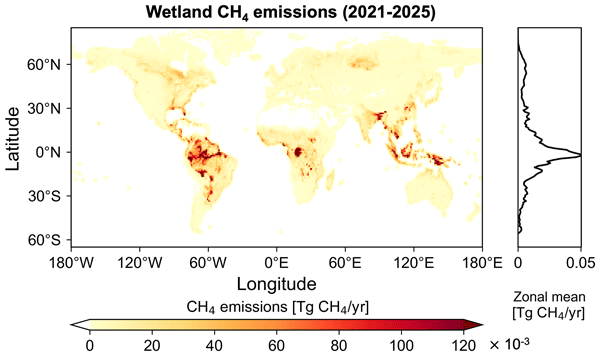
We proposed a framework that combines machine-learning and climate data to predict global natural vegetated wetland methane emissions for 2000–2025. We found that although total global emissions remained stable in the post-2020s, Northern Hemisphere emissions surged whilst tropical emissions fell. This approach allows us to rapidly monitor emissions and provides early warnings for climate impacts.
Pierre Friedlingstein, Michael O'Sullivan, Matthew W. Jones, Robbie M. Andrew, Dorothee C. E. Bakker, Judith Hauck, Peter Landschützer, Corinne Le Quéré, Hongmei Li, Ingrid T. Luijkx, Glen P. Peters, Wouter Peters, Julia Pongratz, Clemens Schwingshackl, Stephen Sitch, Josep G. Canadell, Philippe Ciais, Kjetil Aas, Simone R. Alin, Peter Anthoni, Leticia Barbero, Nicholas R. Bates, Nicolas Bellouin, Alice Benoit-Cattin, Carla F. Berghoff, Raffaele Bernardello, Laurent Bopp, Ida Bagus Mandhara Brasika, Matthew A. Chamberlain, Naveen Chandra, Frédéric Chevallier, Louise P. Chini, Nathan O. Collier, Thomas H. Colligan, Margot Cronin, Laique M. Djeutchouang, Xinyu Dou, Matt P. Enright, Kazutaka Enyo, Michael Erb, Wiley Evans, Richard A. Feely, Liang Feng, Daniel J. Ford, Adrianna Foster, Filippa Fransner, Thomas Gasser, Marion Gehlen, Thanos Gkritzalis, Jefferson Goncalves De Souza, Giacomo Grassi, Luke Gregor, Nicolas Gruber, Bertrand Guenet, Özgür Gürses, Kirsty Harrington, Ian Harris, Jens Heinke, George C. Hurtt, Yosuke Iida, Tatiana Ilyina, Akihiko Ito, Andrew R. Jacobson, Atul K. Jain, Tereza Jarníková, Annika Jersild, Fei Jiang, Steve D. Jones, Etsushi Kato, Ralph F. Keeling, Kees Klein Goldewijk, Jürgen Knauer, Yawen Kong, Jan Ivar Korsbakken, Charles Koven, Taro Kunimitsu, Xin Lan, Junjie Liu, Zhiqiang Liu, Zhu Liu, Claire Lo Monaco, Lei Ma, Gregg Marland, Patrick C. McGuire, Galen A. McKinley, Joe R. Melton, Natalie Monacci, Erwan Monier, Eric J. Morgan, David R. Munro, Jens D. Müller, Shin-Ichiro Nakaoka, Lorna R. Nayagam, Yosuke Niwa, Tobias Nutzel, Are Olsen, Abdirahman M. Omar, Naiqing Pan, Sudhanshu Pandey, Denis Pierrot, Zhangcai Qin, Pierre Regnier, Gregor Rehder, Laure Resplandy, Alizée Roobaert, Thais M. Rosan, Christian Rödenbeck, Jörg Schwinger, Ingunn Skjelvan, T. Luke Smallman, Victoria Spada, Mohanan G. Sreeush, Qing Sun, Adrienne J. Sutton, Colm Sweeney, Didier Swingedouw, Roland Séférian, Shintaro Takao, Hiroaki Tatebe, Hanqin Tian, Xiangjun Tian, Bronte Tilbrook, Hiroyuki Tsujino, Francesco Tubiello, Erik van Ooijen, Guido R. van der Werf, Sebastiaan J. van de Velde, Anthony P. Walker, Rik Wanninkhof, Xiaojuan Yang, Wenping Yuan, Xu Yue, and Jiye Zeng
Earth Syst. Sci. Data, 18, 3211–3288, https://doi.org/10.5194/essd-18-3211-2026, https://doi.org/10.5194/essd-18-3211-2026, 2026
Short summary
Short summary
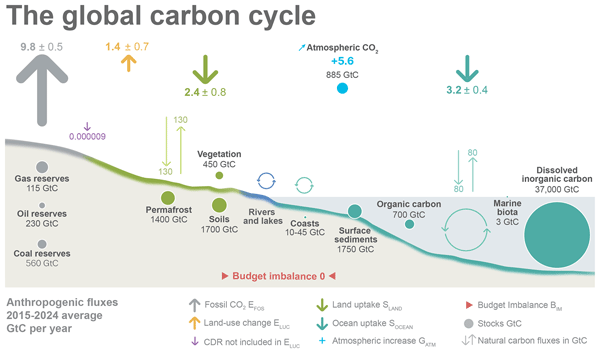
The Global Carbon Budget 2025 describes the methodology, main results, and datasets used to quantify the anthropogenic emissions of carbon dioxide (CO2) and their partitioning among the atmosphere, land ecosystems, and the ocean over the historical period (1750–2025). These living datasets are updated every year to provide the highest transparency and traceability in the reporting of CO2, the key driver of climate change.
Dongmei Tang, Yuanzhi Yao, Rui Li, and Xia Li
Earth Syst. Sci. Data Discuss., https://doi.org/10.5194/essd-2026-243, https://doi.org/10.5194/essd-2026-243, 2026
Revised manuscript under review for ESSD
Short summary
Short summary
We present a global, gridded dataset (1 km resolution) of consumption-based deforestation carbon emissions for the period 2001 to 2020. Our dataset shows that deforestation emissions embodied in international trade account for 31.8 % of global deforestation emissions. It provides spatially explicit information to support analyses of consumption-driven deforestation emissions and inform climate mitigation and policy assessments.
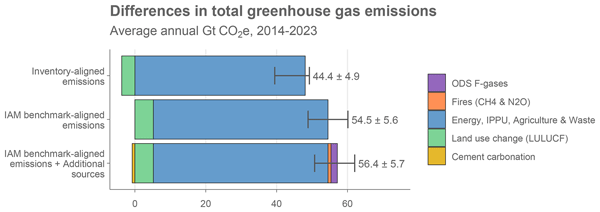
William F. Lamb, Robbie M. Andrew, Matthew Jones, Zebedee Nicholls, Glen P. Peters, Chris Smith, Marielle Saunois, Giacomo Grassi, Julia Pongratz, Steven J. Smith, Francesco N. Tubiello, Monica Crippa, Matthew Gidden, Pierre Friedlingstein, Jan Minx, and Piers M. Forster
Earth Syst. Sci. Data, 18, 2549–2572, https://doi.org/10.5194/essd-18-2549-2026, https://doi.org/10.5194/essd-18-2549-2026, 2026
Short summary
Short summary
This study explores why global greenhouse gas (GHG) emissions estimates vary. Key reasons include different coverage of gases and sectors, varying definitions of anthropogenic land use change emissions, and the Paris Agreement not covering all emission sources. The study highlights three main ways emissions data is reported, each with different objectives and resulting in varying global emission totals. It emphasizes the need for transparency in choosing datasets and setting assessment scopes.
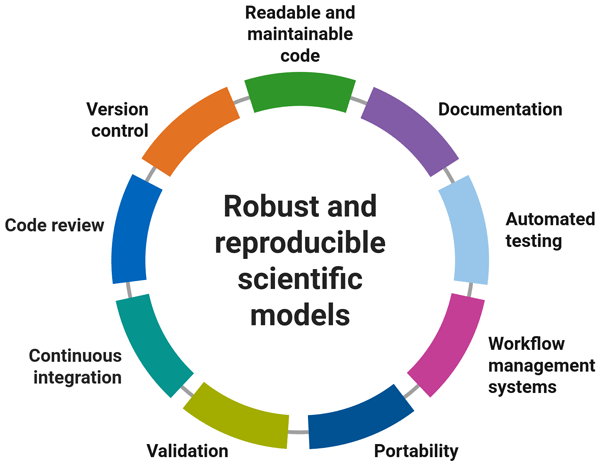
Konstantin Gregor, Benjamin F. Meyer, Tillmann Gaida, Victor Justo Vasquez, Karina Bett-Williams, Matthew Forrest, João P. Darela-Filho, Sam Rabin, Marcos Longo, Joe R. Melton, Johan Nord, Peter Anthoni, Vladislav Bastrikov, Thomas Colligan, Christine Delire, Michael C. Dietze, George Hurtt, Akihiko Ito, Lasse T. Keetz, Jürgen Knauer, Johannes Köster, Tzu-Shun Lin, Lei Ma, Marie Minvielle, Stefan Olin, Sebastian Ostberg, Hao Shi, Reiner Schnur, Qing Sun, Peter E. Thornton, and Anja Rammig
Geosci. Model Dev., 19, 2407–2436, https://doi.org/10.5194/gmd-19-2407-2026, https://doi.org/10.5194/gmd-19-2407-2026, 2026
Short summary
Short summary
Geoscientific models are crucial for understanding Earth’s processes. However, they sometimes do not adhere to highest software quality standards, and scientific results are often hard to reproduce due to the complexity of the workflows. Here we gather the expertise of 20 modeling groups and software engineers to define best practices for making geoscientific models maintainable, usable, and reproducible. We conclude with an open-source example serving as a reference for modeling communities.
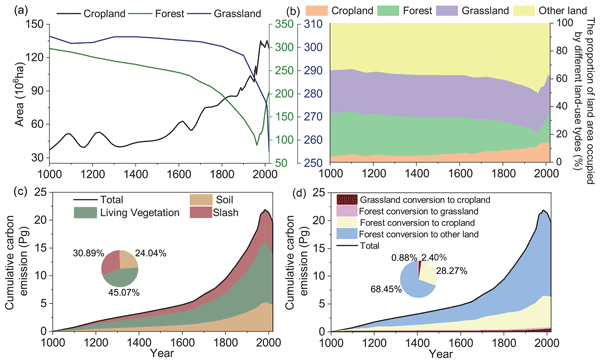
Fan Yang, Guanpeng Dong, Xiaoyu Meng, Richard A. Houghton, Yang Gao, Fanneng He, Meijiao Li, Wenjin Li, Bing Li, Zhihao Liu, Qinqin Mao, Pengfei Wu, Yuanzhi Yao, Xudong Zhai, Hongjuan Zhang, and Chao Yue
Earth Syst. Sci. Data, 18, 875–902, https://doi.org/10.5194/essd-18-875-2026, https://doi.org/10.5194/essd-18-875-2026, 2026
Short summary
Short summary
We used a millennial dataset of land-use change in China, combined with comprehensive soil and vegetation carbon density datasets, to quantify China’s annual carbon emissions resulting from land-use change between 1000 and 2019 using a bookkeeping model. The annual carbon emission flux provides a robust historical baseline for assessing terrestrial ecosystem carbon budgets at national and provincial scales, both in the present and future.
Francesco Tubiello, Nidal Ramadan, Giulia Conchedda, Reto Ruedy, Michael Hendrickson, Nathan Lenssen, Cynthia Rosenzweig, and Gavin Schmidt
Earth Syst. Sci. Data Discuss., https://doi.org/10.5194/essd-2025-681, https://doi.org/10.5194/essd-2025-681, 2026
Preprint under review for ESSD
Short summary
Short summary
We use FAO statistics to develop indicators of exposure for 1961–2024. For each region and year, exposure to temperature change of agriculture—rural population, land use area, harvested area, livestock numbers and production value—was defined as the share of regional aggregates over the total. We computed exposure indicators to ΔT > 1.5 °C and ΔT > 2.0 °C. Results help highlight which regions may be most in need of adaptation preparedness.
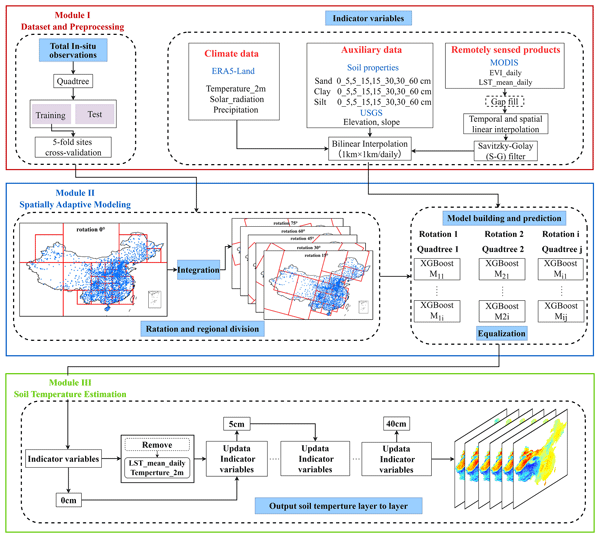
Xuetong Wang, Liang He, Peng Li, Jiageng Ma, Yu Shi, Qi Tian, Gang Zhao, Jianqiang He, Hao Feng, Hao Shi, and Qiang Yu
Earth Syst. Sci. Data, 18, 97–116, https://doi.org/10.5194/essd-18-97-2026, https://doi.org/10.5194/essd-18-97-2026, 2026
Short summary
Short summary
This study integrates ground observations, satellite remote sensing, and reanalysis data, applying machine learning techniques to generate a high-resolution, daily multi-layer soil temperature dataset in China from 2010 to 2020. The dataset accurately captures the spatiotemporal variations in soil temperature at multiple depths, offering valuable scientific insights for agricultural management and ecological research.
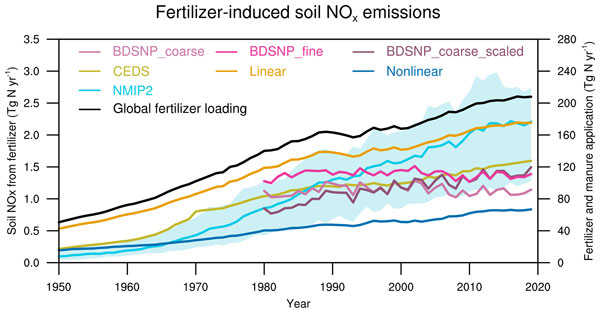
Cheng Gong, Yan Wang, Hanqin Tian, Sian Kou-Giesbrecht, Nicolas Vuichard, and Sönke Zaehle
Atmos. Chem. Phys., 25, 17009–17025, https://doi.org/10.5194/acp-25-17009-2025, https://doi.org/10.5194/acp-25-17009-2025, 2025
Short summary
Short summary
Our results showed substantially varied fertilizer-induced soil NOx emissions in 2019 from 0.84 to 2.2 Tg N yr-1 globally. Such variations further lead to 0.1 to 3.3 ppbv summertime ozone enhancement in agricultural hotspot regions and 6.7 ppbv to 16.6 ppbv reductions in global methane concentrations.
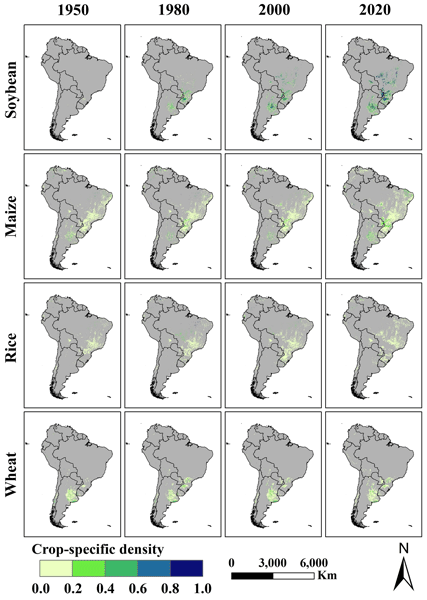
Binyuan Xu, Hanqin Tian, Shufen Pan, Xiaoyong Li, Ran Meng, Óscar Melo, Anne McDonald, María de los Ángeles Picone, Xiao-Peng Song, Edson Severnini, Katharine G. Young, and Feng Zhao
Earth Syst. Sci. Data, 17, 6353–6377, https://doi.org/10.5194/essd-17-6353-2025, https://doi.org/10.5194/essd-17-6353-2025, 2025
Short summary
Short summary
This study reconstructed the spatial and temporal patterns of four major crops (soybean, maize, wheat, and rice) in South America from 1950 to 2020 by integrating multiple data sources. The results reveal a significant expansion in cropland, particularly for soybean, leading to a substantial reduction in natural vegetation such as forests and grasslands. The datasets can be used to assess the impacts of cropland expansion on water, carbon, and nitrogen cycles in South America.
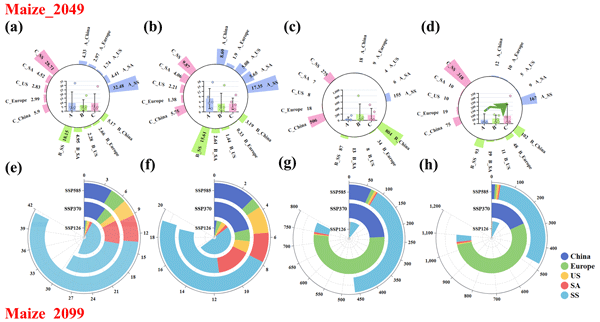
Rui Li, Yumeng Shao, Dongmei Tang, Yining Gao, and Hongfang Zhao
Atmos. Chem. Phys., 25, 14501–14511, https://doi.org/10.5194/acp-25-14501-2025, https://doi.org/10.5194/acp-25-14501-2025, 2025
Short summary
Short summary
In both of historical and future scenarios, Sub-Sahara Africa (SS) and South America (SA) showed the highest fire-sourced maximum daily 8 h average (MDA8) O3 concentrations. However, the crop production losses (CPL) caused by O3 exposure reached the highest values in China. The emission control measures largely decreased the O3 damage to crop in China instead of SS and SA.
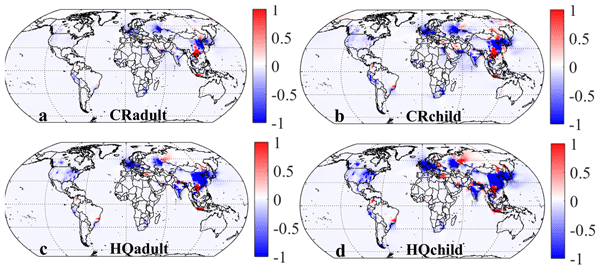
Wenwen Sun, Xing Liu, and Rui Li
Atmos. Chem. Phys., 25, 13007–13018, https://doi.org/10.5194/acp-25-13007-2025, https://doi.org/10.5194/acp-25-13007-2025, 2025
Short summary
Short summary
We predicted global variations in atmospheric nine hazardous trace metal levels and assess their responses to COVID-19 lockdown measures. The rise in Pb and Zn concentrations during lockdowns was primarily linked to sustained coal combustion and non-ferrous smelting activities. The reduced emissions of Pb and As during the lockdown period yielded the greatest health benefits. Targeting fossil fuel combustion should be prioritized in Pb and As mitigation strategies.
Rui Li, Xing Liu, Yubing Shen, Yumeng Shao, Yining Gao, Ziwei Yao, Xi Liu, and Guitao Shi
Atmos. Chem. Phys., 25, 9263–9274, https://doi.org/10.5194/acp-25-9263-2025, https://doi.org/10.5194/acp-25-9263-2025, 2025
Short summary
Short summary
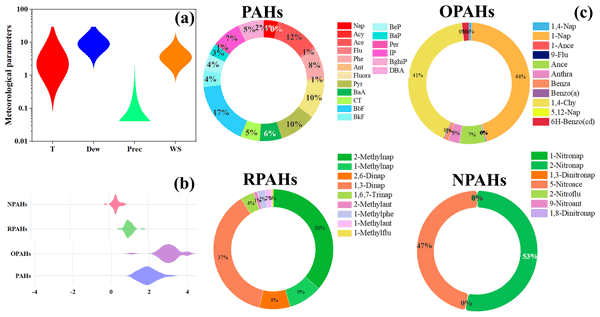
We reveal for the first time the global variations of PAHs and derivatives in marine air. We found that marine aerosols in East China Sea (ECS) and Western Pacific (WP) were significantly affected by coal and engine combustion, while those in Bismarck Sea (BS) and East Australian Sea (EAS) were mainly influenced by wildfire and coal combustion. The Antarctic Ocean (AO) was dominated by biomass burning and local shipping emissions. This finding helps elucidate the mechanism of the global PAH cycle.
Binyu Xiao, Fan Zhang, Zeyu Liu, Yan Zhang, Rui Li, Can Wu, Xinyi Wan, Yi Wang, Yubao Chen, Yong Han, Min Cui, Libo Zhang, Yingjun Chen, and Gehui Wang
Atmos. Chem. Phys., 25, 7053–7069, https://doi.org/10.5194/acp-25-7053-2025, https://doi.org/10.5194/acp-25-7053-2025, 2025
Short summary
Short summary
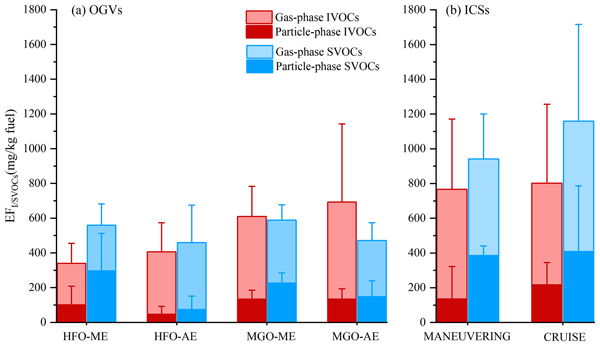
Intermediate-volatility/semi-volatile organic compounds in gas and particle phases from ship exhausts are enhanced due to the switch of fuels from low sulfur to ultra-low sulfur. The findings indicate that optimization is necessary for the forthcoming global implementation of an ultra-low-sulfur oil policy. Besides, we find that organic diagnostic markers of hopanes in conjunction with the ratio of octadecanoic to tetradecanoic could be considered potential tracers for heavy fuel oil exhausts.
Lingbo Li, Hong-Yi Li, Guta Abeshu, Jinyun Tang, L. Ruby Leung, Chang Liao, Zeli Tan, Hanqin Tian, Peter Thornton, and Xiaojuan Yang
Earth Syst. Sci. Data, 17, 2713–2733, https://doi.org/10.5194/essd-17-2713-2025, https://doi.org/10.5194/essd-17-2713-2025, 2025
Short summary
Short summary
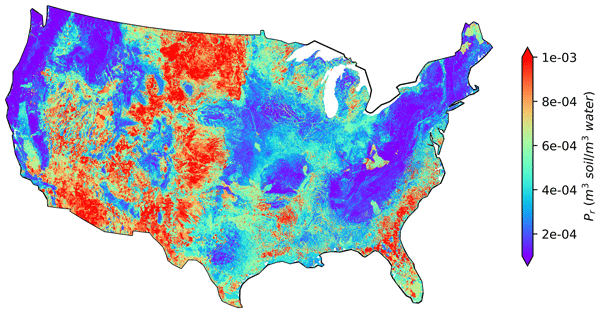
We have developed new maps that reveal how organic carbon from soil leaches into headwater streams over the contiguous United States. We use advanced artificial intelligence techniques and a massive amount of data, including observations at over 2500 gauges and a wealth of climate and environmental information. The maps are a critical step in understanding and predicting how carbon moves through our environment, hence making them a useful tool for tackling climate challenges.
Marielle Saunois, Adrien Martinez, Benjamin Poulter, Zhen Zhang, Peter A. Raymond, Pierre Regnier, Josep G. Canadell, Robert B. Jackson, Prabir K. Patra, Philippe Bousquet, Philippe Ciais, Edward J. Dlugokencky, Xin Lan, George H. Allen, David Bastviken, David J. Beerling, Dmitry A. Belikov, Donald R. Blake, Simona Castaldi, Monica Crippa, Bridget R. Deemer, Fraser Dennison, Giuseppe Etiope, Nicola Gedney, Lena Höglund-Isaksson, Meredith A. Holgerson, Peter O. Hopcroft, Gustaf Hugelius, Akihiko Ito, Atul K. Jain, Rajesh Janardanan, Matthew S. Johnson, Thomas Kleinen, Paul B. Krummel, Ronny Lauerwald, Tingting Li, Xiangyu Liu, Kyle C. McDonald, Joe R. Melton, Jens Mühle, Jurek Müller, Fabiola Murguia-Flores, Yosuke Niwa, Sergio Noce, Shufen Pan, Robert J. Parker, Changhui Peng, Michel Ramonet, William J. Riley, Gerard Rocher-Ros, Judith A. Rosentreter, Motoki Sasakawa, Arjo Segers, Steven J. Smith, Emily H. Stanley, Joël Thanwerdas, Hanqin Tian, Aki Tsuruta, Francesco N. Tubiello, Thomas S. Weber, Guido R. van der Werf, Douglas E. J. Worthy, Yi Xi, Yukio Yoshida, Wenxin Zhang, Bo Zheng, Qing Zhu, Qiuan Zhu, and Qianlai Zhuang
Earth Syst. Sci. Data, 17, 1873–1958, https://doi.org/10.5194/essd-17-1873-2025, https://doi.org/10.5194/essd-17-1873-2025, 2025
Short summary
Short summary
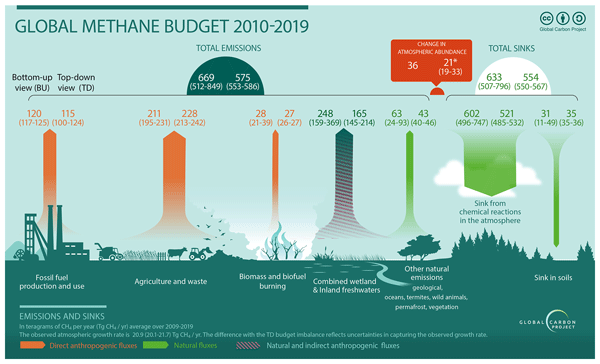
Methane (CH4) is the second most important human-influenced greenhouse gas in terms of climate forcing after carbon dioxide (CO2). A consortium of multi-disciplinary scientists synthesise and update the budget of the sources and sinks of CH4. This edition benefits from important progress in estimating emissions from lakes and ponds, reservoirs, and streams and rivers. For the 2010s decade, global CH4 emissions are estimated at 575 Tg CH4 yr-1, including ~65 % from anthropogenic sources.
Zhengyang Lin, Ling Huang, Hanqin Tian, Anping Chen, and Xuhui Wang
Geosci. Model Dev., 18, 2509–2520, https://doi.org/10.5194/gmd-18-2509-2025, https://doi.org/10.5194/gmd-18-2509-2025, 2025
Short summary
Short summary
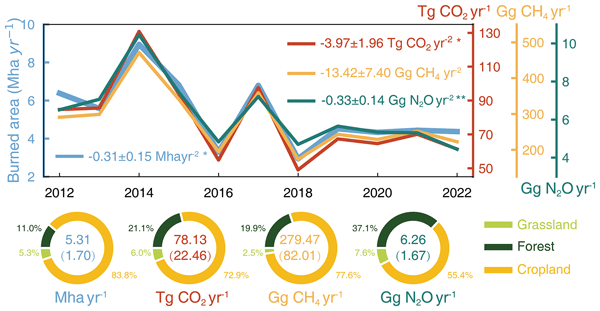
The China Wildfire Emission Dataset (ChinaWED v1) estimated wildfire emissions in China during 2012–2022 as 78.13 Tg CO2, 279.47 Gg CH4, and 6.26 Gg N2O annually. Agricultural fires dominated emissions, while forest and grassland emissions decreased. Seasonal peaks occurred in late spring, with hotspots in northeast, southwest, and east China. The model emphasizes the importance of using localized emission factors and high-resolution fire estimates for accurate assessments.
Zhu Deng, Philippe Ciais, Liting Hu, Adrien Martinez, Marielle Saunois, Rona L. Thompson, Kushal Tibrewal, Wouter Peters, Brendan Byrne, Giacomo Grassi, Paul I. Palmer, Ingrid T. Luijkx, Zhu Liu, Junjie Liu, Xuekun Fang, Tengjiao Wang, Hanqin Tian, Katsumasa Tanaka, Ana Bastos, Stephen Sitch, Benjamin Poulter, Clément Albergel, Aki Tsuruta, Shamil Maksyutov, Rajesh Janardanan, Yosuke Niwa, Bo Zheng, Joël Thanwerdas, Dmitry Belikov, Arjo Segers, and Frédéric Chevallier
Earth Syst. Sci. Data, 17, 1121–1152, https://doi.org/10.5194/essd-17-1121-2025, https://doi.org/10.5194/essd-17-1121-2025, 2025
Short summary
Short summary
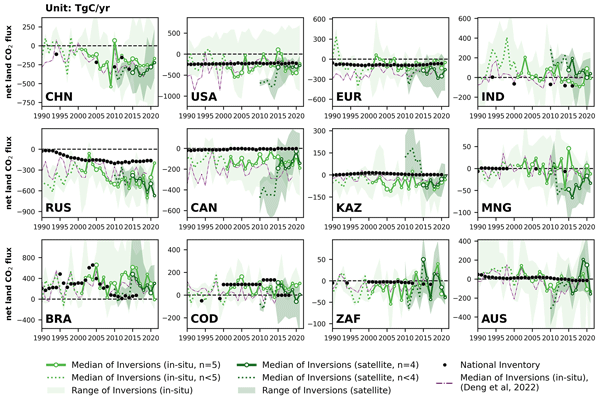
This study reconciles national greenhouse gas (GHG) inventories with updated atmospheric inversion results to evaluate discrepancies for three principal GHG fluxes at the national level. Compared to our previous study, new satellite-based CO2 inversions were included and an updated mask of managed lands was used, improving agreement for Brazil and Canada. The proposed methodology can be regularly applied as a check to assess the gap between top-down inversions and bottom-up inventories.
Pierre Friedlingstein, Michael O'Sullivan, Matthew W. Jones, Robbie M. Andrew, Judith Hauck, Peter Landschützer, Corinne Le Quéré, Hongmei Li, Ingrid T. Luijkx, Are Olsen, Glen P. Peters, Wouter Peters, Julia Pongratz, Clemens Schwingshackl, Stephen Sitch, Josep G. Canadell, Philippe Ciais, Robert B. Jackson, Simone R. Alin, Almut Arneth, Vivek Arora, Nicholas R. Bates, Meike Becker, Nicolas Bellouin, Carla F. Berghoff, Henry C. Bittig, Laurent Bopp, Patricia Cadule, Katie Campbell, Matthew A. Chamberlain, Naveen Chandra, Frédéric Chevallier, Louise P. Chini, Thomas Colligan, Jeanne Decayeux, Laique M. Djeutchouang, Xinyu Dou, Carolina Duran Rojas, Kazutaka Enyo, Wiley Evans, Amanda R. Fay, Richard A. Feely, Daniel J. Ford, Adrianna Foster, Thomas Gasser, Marion Gehlen, Thanos Gkritzalis, Giacomo Grassi, Luke Gregor, Nicolas Gruber, Özgür Gürses, Ian Harris, Matthew Hefner, Jens Heinke, George C. Hurtt, Yosuke Iida, Tatiana Ilyina, Andrew R. Jacobson, Atul K. Jain, Tereza Jarníková, Annika Jersild, Fei Jiang, Zhe Jin, Etsushi Kato, Ralph F. Keeling, Kees Klein Goldewijk, Jürgen Knauer, Jan Ivar Korsbakken, Xin Lan, Siv K. Lauvset, Nathalie Lefèvre, Zhu Liu, Junjie Liu, Lei Ma, Shamil Maksyutov, Gregg Marland, Nicolas Mayot, Patrick C. McGuire, Nicolas Metzl, Natalie M. Monacci, Eric J. Morgan, Shin-Ichiro Nakaoka, Craig Neill, Yosuke Niwa, Tobias Nützel, Lea Olivier, Tsuneo Ono, Paul I. Palmer, Denis Pierrot, Zhangcai Qin, Laure Resplandy, Alizée Roobaert, Thais M. Rosan, Christian Rödenbeck, Jörg Schwinger, T. Luke Smallman, Stephen M. Smith, Reinel Sospedra-Alfonso, Tobias Steinhoff, Qing Sun, Adrienne J. Sutton, Roland Séférian, Shintaro Takao, Hiroaki Tatebe, Hanqin Tian, Bronte Tilbrook, Olivier Torres, Etienne Tourigny, Hiroyuki Tsujino, Francesco Tubiello, Guido van der Werf, Rik Wanninkhof, Xuhui Wang, Dongxu Yang, Xiaojuan Yang, Zhen Yu, Wenping Yuan, Xu Yue, Sönke Zaehle, Ning Zeng, and Jiye Zeng
Earth Syst. Sci. Data, 17, 965–1039, https://doi.org/10.5194/essd-17-965-2025, https://doi.org/10.5194/essd-17-965-2025, 2025
Short summary
Short summary
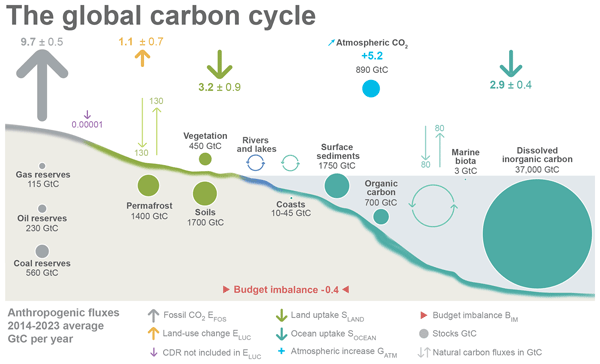
The Global Carbon Budget 2024 describes the methodology, main results, and datasets used to quantify the anthropogenic emissions of carbon dioxide (CO2) and their partitioning among the atmosphere, land ecosystems, and the ocean over the historical period (1750–2024). These living datasets are updated every year to provide the highest transparency and traceability in the reporting of CO2, the key driver of climate change.
Dongmei Tang, Yuanzhi Yao, and Xia Li
Earth Syst. Sci. Data Discuss., https://doi.org/10.5194/essd-2024-619, https://doi.org/10.5194/essd-2024-619, 2025
Manuscript not accepted for further review
Short summary
Short summary
We developed a global consumption-based carbon emissions gridded dataset (1 km) for deforestation from 2001 to 2015. Our dataset shows that trade-related emissions account for 31 % of global deforestation emissions, with high-income countries driving most of the emissions. This research highlights the importance of addressing consumption patterns in climate change strategies and offers valuable data to inform global policy and emission reduction efforts.
Gudeta Weldesemayat Sileshi, Edmundo Barrios, Johannes Lehmann, and Francesco Nicola Tubiello
Earth Syst. Sci. Data, 17, 369–391, https://doi.org/10.5194/essd-17-369-2025, https://doi.org/10.5194/essd-17-369-2025, 2025
Short summary
Short summary
Agricultural, fishery, forestry and agro-processing activities produce large quantities of residues, by-products and waste materials every year. Here, we present a global organic matter database (OMD), the first of its kind, consolidating estimates of residues and by-products potentially available for use in a circular bio-economy. It also provides definitions, typologies and methods to aid consistent classification, estimation and reporting of the various residues and by-products.
Baoye Hu, Naihua Chen, Rui Li, Mingqiang Huang, Jinsheng Chen, Youwei Hong, Lingling Xu, Xiaolong Fan, Mengren Li, Lei Tong, Qiuping Zheng, and Yuxiang Yang
Atmos. Chem. Phys., 25, 905–921, https://doi.org/10.5194/acp-25-905-2025, https://doi.org/10.5194/acp-25-905-2025, 2025
Short summary
Short summary
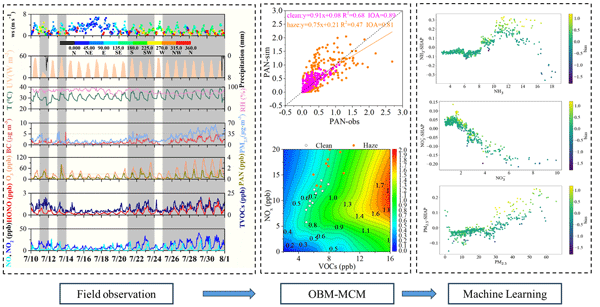
Box modeling with the Master Chemical Mechanism (MCM) was used to explore summertime peroxyacetyl nitrate (PAN) formation and its link to aerosol pollution under high-ozone conditions. The MCM model is effective in the study of PAN photochemical formation and performed better during the clean period than the haze period. Machine learning analysis identified ammonia, nitrate, and fine particulate matter as the top three factors contributing to simulation bias.
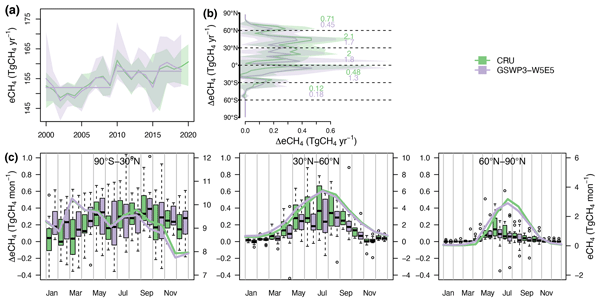
Zhen Zhang, Benjamin Poulter, Joe R. Melton, William J. Riley, George H. Allen, David J. Beerling, Philippe Bousquet, Josep G. Canadell, Etienne Fluet-Chouinard, Philippe Ciais, Nicola Gedney, Peter O. Hopcroft, Akihiko Ito, Robert B. Jackson, Atul K. Jain, Katherine Jensen, Fortunat Joos, Thomas Kleinen, Sara H. Knox, Tingting Li, Xin Li, Xiangyu Liu, Kyle McDonald, Gavin McNicol, Paul A. Miller, Jurek Müller, Prabir K. Patra, Changhui Peng, Shushi Peng, Zhangcai Qin, Ryan M. Riggs, Marielle Saunois, Qing Sun, Hanqin Tian, Xiaoming Xu, Yuanzhi Yao, Yi Xi, Wenxin Zhang, Qing Zhu, Qiuan Zhu, and Qianlai Zhuang
Biogeosciences, 22, 305–321, https://doi.org/10.5194/bg-22-305-2025, https://doi.org/10.5194/bg-22-305-2025, 2025
Short summary
Short summary
This study assesses global methane emissions from wetlands between 2000 and 2020 using multiple models. We found that wetland emissions increased by 6–7 Tg CH4 yr-1 in the 2010s compared to the 2000s. Rising temperatures primarily drove this increase, while changes in precipitation and CO2 levels also played roles. Our findings highlight the importance of wetlands in the global methane budget and the need for continuous monitoring to understand their impact on climate change.
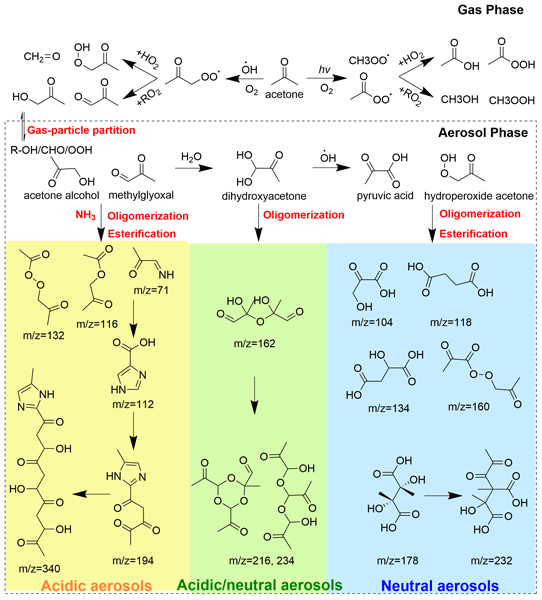
Si Zhang, Yining Gao, Xinbei Xu, Luyao Chen, Can Wu, Zheng Li, Rongjie Li, Binyu Xiao, Xiaodi Liu, Rui Li, Fan Zhang, and Gehui Wang
Atmos. Chem. Phys., 24, 14177–14190, https://doi.org/10.5194/acp-24-14177-2024, https://doi.org/10.5194/acp-24-14177-2024, 2024
Short summary
Short summary
Secondary organic aerosols (SOAs) from acetone photooxidation in the presence of various seeds were studied to illustrate SOA formation kinetics under ammonia-rich conditions. The oxidation mechanism of acetone was investigated using an observation-based model incorporating a Master Chemical Mechanism model. A higher SOA yield of acetone was observed compared to methylglyoxal due to an enhanced uptake of the small photooxidation products of acetone.
Xinbei Xu, Yining Gao, Si Zhang, Luyao Chen, Rongjie Li, Zheng Li, Rui Li, and Gehui Wang
EGUsphere, https://doi.org/10.5194/egusphere-2024-3046, https://doi.org/10.5194/egusphere-2024-3046, 2024
Preprint archived
Short summary
Short summary
This work systematically explained the nonlinear effect of NOx level on isoprene-SOA mass yield through a series of chamber experiments. We found that the turning point under various oxidants was smaller than previous reported in the presence of OH precursors, which could be attributed to the RO2 pathway competition in nucleation and condensation of low volatile products. The highest SOA yield was at a branching ratio β of 0.5, which can be used as a reference for field campaign and modeling.
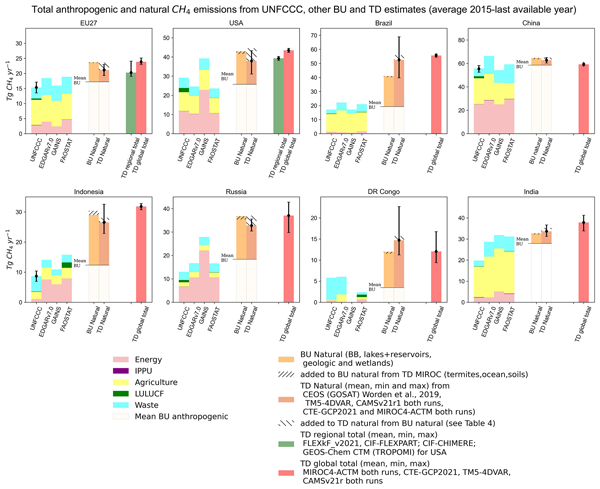
Ana Maria Roxana Petrescu, Glen P. Peters, Richard Engelen, Sander Houweling, Dominik Brunner, Aki Tsuruta, Bradley Matthews, Prabir K. Patra, Dmitry Belikov, Rona L. Thompson, Lena Höglund-Isaksson, Wenxin Zhang, Arjo J. Segers, Giuseppe Etiope, Giancarlo Ciotoli, Philippe Peylin, Frédéric Chevallier, Tuula Aalto, Robbie M. Andrew, David Bastviken, Antoine Berchet, Grégoire Broquet, Giulia Conchedda, Stijn N. C. Dellaert, Hugo Denier van der Gon, Johannes Gütschow, Jean-Matthieu Haussaire, Ronny Lauerwald, Tiina Markkanen, Jacob C. A. van Peet, Isabelle Pison, Pierre Regnier, Espen Solum, Marko Scholze, Maria Tenkanen, Francesco N. Tubiello, Guido R. van der Werf, and John R. Worden
Earth Syst. Sci. Data, 16, 4325–4350, https://doi.org/10.5194/essd-16-4325-2024, https://doi.org/10.5194/essd-16-4325-2024, 2024
Short summary
Short summary
This study provides an overview of data availability from observation- and inventory-based CH4 emission estimates. It systematically compares them and provides recommendations for robust comparisons, aiming to steadily engage more parties in using observational methods to complement their UNFCCC submissions. Anticipating improvements in atmospheric modelling and observations, future developments need to resolve knowledge gaps in both approaches and to better quantify remaining uncertainty.
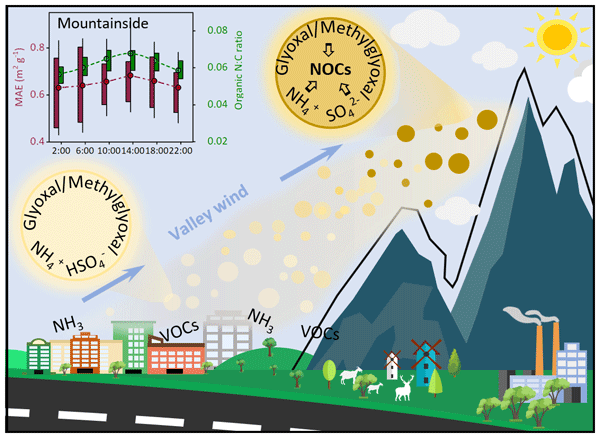
Can Wu, Xiaodi Liu, Ke Zhang, Si Zhang, Cong Cao, Jianjun Li, Rui Li, Fan Zhang, and Gehui Wang
Atmos. Chem. Phys., 24, 9263–9275, https://doi.org/10.5194/acp-24-9263-2024, https://doi.org/10.5194/acp-24-9263-2024, 2024
Short summary
Short summary
Brown carbon (BrC) is prevalent in the troposphere and can efficiently absorb solar and terrestrial radiation. Our observations show that the enhanced light absorption of BrC relative to black carbon at the tropopause can be attributed to the formation of nitrogen-containing organic compounds through the aqueous-phase reactions of carbonyls with ammonium.
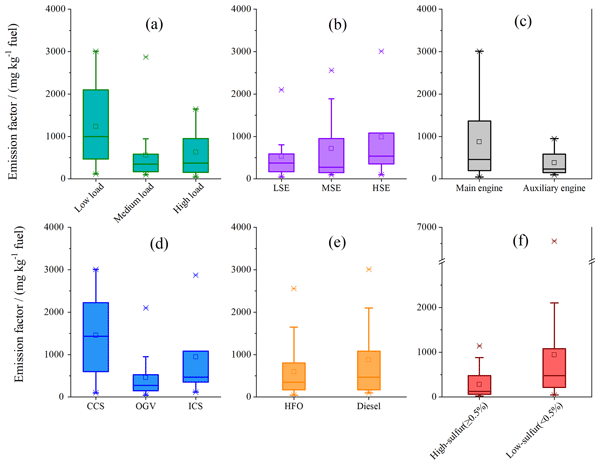
Fan Zhang, Binyu Xiao, Zeyu Liu, Yan Zhang, Chongguo Tian, Rui Li, Can Wu, Yali Lei, Si Zhang, Xinyi Wan, Yubao Chen, Yong Han, Min Cui, Cheng Huang, Hongli Wang, Yingjun Chen, and Gehui Wang
Atmos. Chem. Phys., 24, 8999–9017, https://doi.org/10.5194/acp-24-8999-2024, https://doi.org/10.5194/acp-24-8999-2024, 2024
Short summary
Short summary
Mandatory use of low-sulfur fuel due to global sulfur limit regulations means large uncertainties in volatile organic compound (VOC) emissions. On-board tests of VOCs from nine cargo ships in China were carried out. Results showed that switching from heavy-fuel oil to diesel increased emission factor VOCs by 48 % on average, enhancing O3 and the secondary organic aerosol formation potential. Thus, implementing a global ultra-low-sulfur oil policy needs to be optimized in the near future.
Shijie Liu, Xinbei Xu, Si Zhang, Rongjie Li, Zheng Li, Can Wu, Rui Li, Guiqin Zhang, and Gehui Wang
EGUsphere, https://doi.org/10.5194/egusphere-2024-1599, https://doi.org/10.5194/egusphere-2024-1599, 2024
Preprint archived
Short summary
Short summary
We conducted α-pinene photooxidation experiments in an atmospheric chamber at different NOx concentrations. The increased distribution coefficient of the oxidation products between the aerosol and gas phases with NOx was responsible for the increased SOA yields with NOx under low-NOx conditions. We also found the fraction of SOA made up of nitrogen-containing organic compounds (NOCs) increased with NOx.
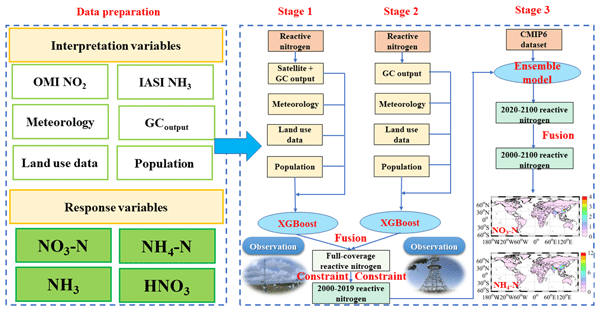
Rui Li, Yining Gao, Lijia Zhang, Yubing Shen, Tianzhao Xu, Wenwen Sun, and Gehui Wang
Atmos. Chem. Phys., 24, 7623–7636, https://doi.org/10.5194/acp-24-7623-2024, https://doi.org/10.5194/acp-24-7623-2024, 2024
Short summary
Short summary
A three-stage model was developed to obtain the global maps of reactive nitrogen components during 2000–2100. The results implied that cross-validation R2 values of four species showed satisfactory performance (R2 > 0.55). Most reactive nitrogen components, except NH3, in China showed increases during 2000–2013. In the future scenarios, SSP3-7.0 (traditional-energy scenario) and SSP1-2.6 (carbon neutrality scenario) showed the highest and lowest reactive nitrogen component concentrations.
Hanqin Tian, Naiqing Pan, Rona L. Thompson, Josep G. Canadell, Parvadha Suntharalingam, Pierre Regnier, Eric A. Davidson, Michael Prather, Philippe Ciais, Marilena Muntean, Shufen Pan, Wilfried Winiwarter, Sönke Zaehle, Feng Zhou, Robert B. Jackson, Hermann W. Bange, Sarah Berthet, Zihao Bian, Daniele Bianchi, Alexander F. Bouwman, Erik T. Buitenhuis, Geoffrey Dutton, Minpeng Hu, Akihiko Ito, Atul K. Jain, Aurich Jeltsch-Thömmes, Fortunat Joos, Sian Kou-Giesbrecht, Paul B. Krummel, Xin Lan, Angela Landolfi, Ronny Lauerwald, Ya Li, Chaoqun Lu, Taylor Maavara, Manfredi Manizza, Dylan B. Millet, Jens Mühle, Prabir K. Patra, Glen P. Peters, Xiaoyu Qin, Peter Raymond, Laure Resplandy, Judith A. Rosentreter, Hao Shi, Qing Sun, Daniele Tonina, Francesco N. Tubiello, Guido R. van der Werf, Nicolas Vuichard, Junjie Wang, Kelley C. Wells, Luke M. Western, Chris Wilson, Jia Yang, Yuanzhi Yao, Yongfa You, and Qing Zhu
Earth Syst. Sci. Data, 16, 2543–2604, https://doi.org/10.5194/essd-16-2543-2024, https://doi.org/10.5194/essd-16-2543-2024, 2024
Short summary
Short summary
Atmospheric concentrations of nitrous oxide (N2O), a greenhouse gas 273 times more potent than carbon dioxide, have increased by 25 % since the preindustrial period, with the highest observed growth rate in 2020 and 2021. This rapid growth rate has primarily been due to a 40 % increase in anthropogenic emissions since 1980. Observed atmospheric N2O concentrations in recent years have exceeded the worst-case climate scenario, underscoring the importance of reducing anthropogenic N2O emissions.
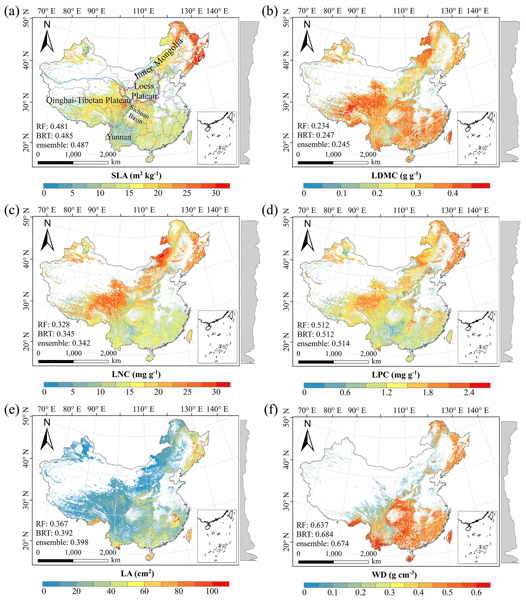
Nannan An, Nan Lu, Weiliang Chen, Yongzhe Chen, Hao Shi, Fuzhong Wu, and Bojie Fu
Earth Syst. Sci. Data, 16, 1771–1810, https://doi.org/10.5194/essd-16-1771-2024, https://doi.org/10.5194/essd-16-1771-2024, 2024
Short summary
Short summary
This study generated a spatially continuous plant functional trait dataset (~1 km) in China in combination with field observations, environmental variables and vegetation indices using machine learning methods. Results showed that wood density, leaf P concentration and specific leaf area showed good accuracy with an average R2 of higher than 0.45. This dataset could provide data support for development of Earth system models to predict vegetation distribution and ecosystem functions.
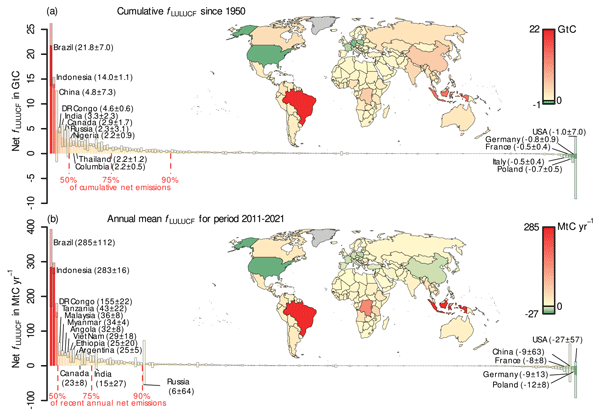
Wolfgang Alexander Obermeier, Clemens Schwingshackl, Ana Bastos, Giulia Conchedda, Thomas Gasser, Giacomo Grassi, Richard A. Houghton, Francesco Nicola Tubiello, Stephen Sitch, and Julia Pongratz
Earth Syst. Sci. Data, 16, 605–645, https://doi.org/10.5194/essd-16-605-2024, https://doi.org/10.5194/essd-16-605-2024, 2024
Short summary
Short summary
We provide and compare country-level estimates of land-use CO2 fluxes from a variety and large number of models, bottom-up estimates, and country reports for the period 1950–2021. Although net fluxes are small in many countries, they are often composed of large compensating emissions and removals. In many countries, the estimates agree well once their individual characteristics are accounted for, but in other countries, including some of the largest emitters, substantial uncertainties exist.
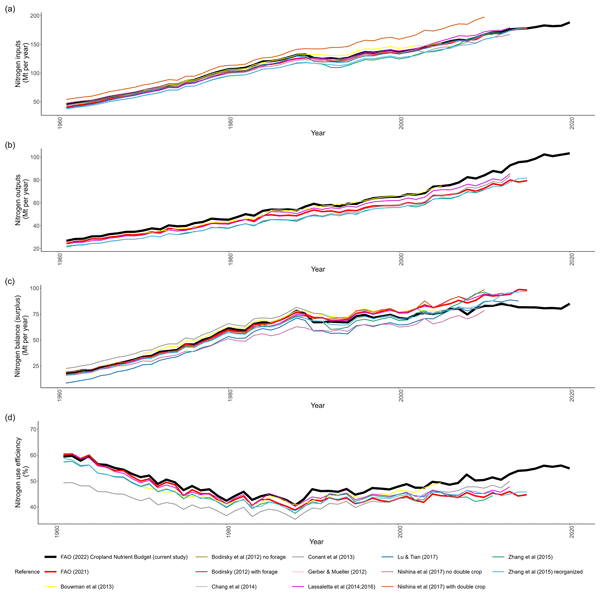
Cameron I. Ludemann, Nathan Wanner, Pauline Chivenge, Achim Dobermann, Rasmus Einarsson, Patricio Grassini, Armelle Gruere, Kevin Jackson, Luis Lassaletta, Federico Maggi, Griffiths Obli-Laryea, Martin K. van Ittersum, Srishti Vishwakarma, Xin Zhang, and Francesco N. Tubiello
Earth Syst. Sci. Data, 16, 525–541, https://doi.org/10.5194/essd-16-525-2024, https://doi.org/10.5194/essd-16-525-2024, 2024
Short summary
Short summary
Nutrient budgets help identify the excess or insufficient use of fertilizers and other nutrient sources in agriculture. They allow the calculation of indicators, such as the nutrient balance (surplus or deficit) and nutrient use efficiency, that help to monitor agricultural productivity and sustainability. This article describes a global cropland nutrient budget that provides data on 205 countries and territories from 1961 to 2020 (data available at https://www.fao.org/faostat/en/#data/ESB).
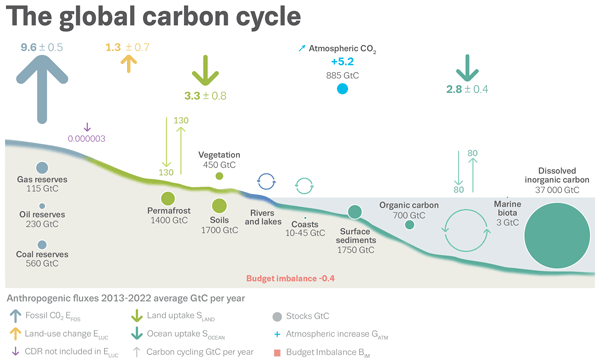
Pierre Friedlingstein, Michael O'Sullivan, Matthew W. Jones, Robbie M. Andrew, Dorothee C. E. Bakker, Judith Hauck, Peter Landschützer, Corinne Le Quéré, Ingrid T. Luijkx, Glen P. Peters, Wouter Peters, Julia Pongratz, Clemens Schwingshackl, Stephen Sitch, Josep G. Canadell, Philippe Ciais, Robert B. Jackson, Simone R. Alin, Peter Anthoni, Leticia Barbero, Nicholas R. Bates, Meike Becker, Nicolas Bellouin, Bertrand Decharme, Laurent Bopp, Ida Bagus Mandhara Brasika, Patricia Cadule, Matthew A. Chamberlain, Naveen Chandra, Thi-Tuyet-Trang Chau, Frédéric Chevallier, Louise P. Chini, Margot Cronin, Xinyu Dou, Kazutaka Enyo, Wiley Evans, Stefanie Falk, Richard A. Feely, Liang Feng, Daniel J. Ford, Thomas Gasser, Josefine Ghattas, Thanos Gkritzalis, Giacomo Grassi, Luke Gregor, Nicolas Gruber, Özgür Gürses, Ian Harris, Matthew Hefner, Jens Heinke, Richard A. Houghton, George C. Hurtt, Yosuke Iida, Tatiana Ilyina, Andrew R. Jacobson, Atul Jain, Tereza Jarníková, Annika Jersild, Fei Jiang, Zhe Jin, Fortunat Joos, Etsushi Kato, Ralph F. Keeling, Daniel Kennedy, Kees Klein Goldewijk, Jürgen Knauer, Jan Ivar Korsbakken, Arne Körtzinger, Xin Lan, Nathalie Lefèvre, Hongmei Li, Junjie Liu, Zhiqiang Liu, Lei Ma, Greg Marland, Nicolas Mayot, Patrick C. McGuire, Galen A. McKinley, Gesa Meyer, Eric J. Morgan, David R. Munro, Shin-Ichiro Nakaoka, Yosuke Niwa, Kevin M. O'Brien, Are Olsen, Abdirahman M. Omar, Tsuneo Ono, Melf Paulsen, Denis Pierrot, Katie Pocock, Benjamin Poulter, Carter M. Powis, Gregor Rehder, Laure Resplandy, Eddy Robertson, Christian Rödenbeck, Thais M. Rosan, Jörg Schwinger, Roland Séférian, T. Luke Smallman, Stephen M. Smith, Reinel Sospedra-Alfonso, Qing Sun, Adrienne J. Sutton, Colm Sweeney, Shintaro Takao, Pieter P. Tans, Hanqin Tian, Bronte Tilbrook, Hiroyuki Tsujino, Francesco Tubiello, Guido R. van der Werf, Erik van Ooijen, Rik Wanninkhof, Michio Watanabe, Cathy Wimart-Rousseau, Dongxu Yang, Xiaojuan Yang, Wenping Yuan, Xu Yue, Sönke Zaehle, Jiye Zeng, and Bo Zheng
Earth Syst. Sci. Data, 15, 5301–5369, https://doi.org/10.5194/essd-15-5301-2023, https://doi.org/10.5194/essd-15-5301-2023, 2023
Short summary
Short summary
The Global Carbon Budget 2023 describes the methodology, main results, and data sets used to quantify the anthropogenic emissions of carbon dioxide (CO2) and their partitioning among the atmosphere, land ecosystems, and the ocean over the historical period (1750–2023). These living datasets are updated every year to provide the highest transparency and traceability in the reporting of CO2, the key driver of climate change.
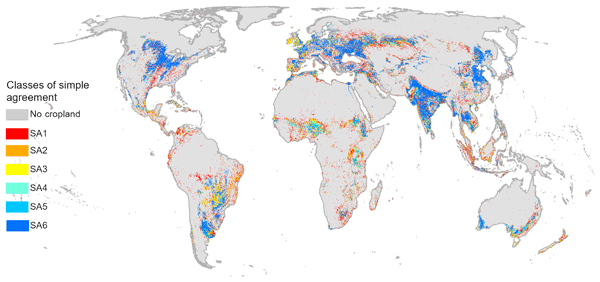
Francesco N. Tubiello, Giulia Conchedda, Leon Casse, Pengyu Hao, Giorgia De Santis, and Zhongxin Chen
Earth Syst. Sci. Data, 15, 4997–5015, https://doi.org/10.5194/essd-15-4997-2023, https://doi.org/10.5194/essd-15-4997-2023, 2023
Short summary
Short summary
We describe a new dataset of cropland area circa the year 2020, with global coverage and country detail. Data are generated from geospatial information on the agreement characteristics of six high-resolution cropland maps. By helping to highlight features of cropland characteristics and underlying causes for agreement across land cover products, the dataset can be used as a tool to help guide future mapping efforts towards improved agricultural monitoring.
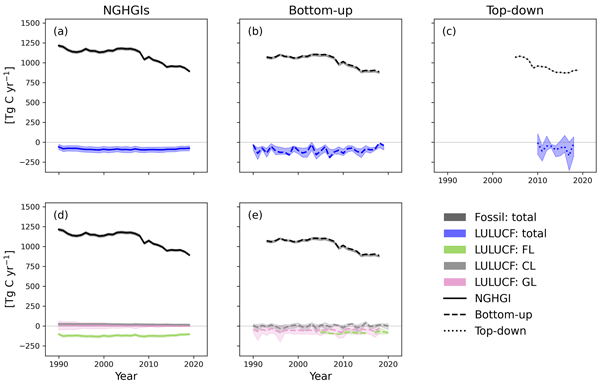
Matthew J. McGrath, Ana Maria Roxana Petrescu, Philippe Peylin, Robbie M. Andrew, Bradley Matthews, Frank Dentener, Juraj Balkovič, Vladislav Bastrikov, Meike Becker, Gregoire Broquet, Philippe Ciais, Audrey Fortems-Cheiney, Raphael Ganzenmüller, Giacomo Grassi, Ian Harris, Matthew Jones, Jürgen Knauer, Matthias Kuhnert, Guillaume Monteil, Saqr Munassar, Paul I. Palmer, Glen P. Peters, Chunjing Qiu, Mart-Jan Schelhaas, Oksana Tarasova, Matteo Vizzarri, Karina Winkler, Gianpaolo Balsamo, Antoine Berchet, Peter Briggs, Patrick Brockmann, Frédéric Chevallier, Giulia Conchedda, Monica Crippa, Stijn N. C. Dellaert, Hugo A. C. Denier van der Gon, Sara Filipek, Pierre Friedlingstein, Richard Fuchs, Michael Gauss, Christoph Gerbig, Diego Guizzardi, Dirk Günther, Richard A. Houghton, Greet Janssens-Maenhout, Ronny Lauerwald, Bas Lerink, Ingrid T. Luijkx, Géraud Moulas, Marilena Muntean, Gert-Jan Nabuurs, Aurélie Paquirissamy, Lucia Perugini, Wouter Peters, Roberto Pilli, Julia Pongratz, Pierre Regnier, Marko Scholze, Yusuf Serengil, Pete Smith, Efisio Solazzo, Rona L. Thompson, Francesco N. Tubiello, Timo Vesala, and Sophia Walther
Earth Syst. Sci. Data, 15, 4295–4370, https://doi.org/10.5194/essd-15-4295-2023, https://doi.org/10.5194/essd-15-4295-2023, 2023
Short summary
Short summary
Accurate estimation of fluxes of carbon dioxide from the land surface is essential for understanding future impacts of greenhouse gas emissions on the climate system. A wide variety of methods currently exist to estimate these sources and sinks. We are continuing work to develop annual comparisons of these diverse methods in order to clarify what they all actually calculate and to resolve apparent disagreement, in addition to highlighting opportunities for increased understanding.
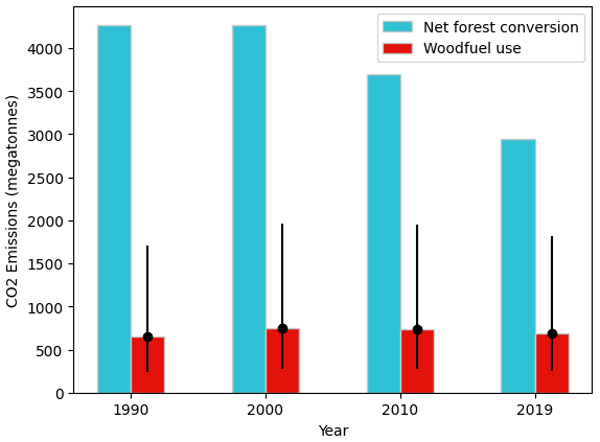
Alessandro Flammini, Hanif Adzmir, Kevin Karl, and Francesco Nicola Tubiello
Earth Syst. Sci. Data, 15, 2179–2187, https://doi.org/10.5194/essd-15-2179-2023, https://doi.org/10.5194/essd-15-2179-2023, 2023
Short summary
Short summary
This paper estimates the share of greenhouse gas (GHG) emissions attributable to non-renewable wood fuel harvesting for use in residential food-related activities. It adds to a growing research base estimating GHG emissions from across the entire agri-food value chain and contributes to the development of the FAOSTAT climate change domain.
Kyle E. Hinson, Marjorie A. M. Friedrichs, Raymond G. Najjar, Maria Herrmann, Zihao Bian, Gopal Bhatt, Pierre St-Laurent, Hanqin Tian, and Gary Shenk
Biogeosciences, 20, 1937–1961, https://doi.org/10.5194/bg-20-1937-2023, https://doi.org/10.5194/bg-20-1937-2023, 2023
Short summary
Short summary
Climate impacts are essential for environmental managers to consider when implementing nutrient reduction plans designed to reduce hypoxia. This work highlights relative sources of uncertainty in modeling regional climate impacts on the Chesapeake Bay watershed and consequent declines in bay oxygen levels. The results demonstrate that planned water quality improvement goals are capable of reducing hypoxia levels by half, offsetting climate-driven impacts on terrestrial runoff.
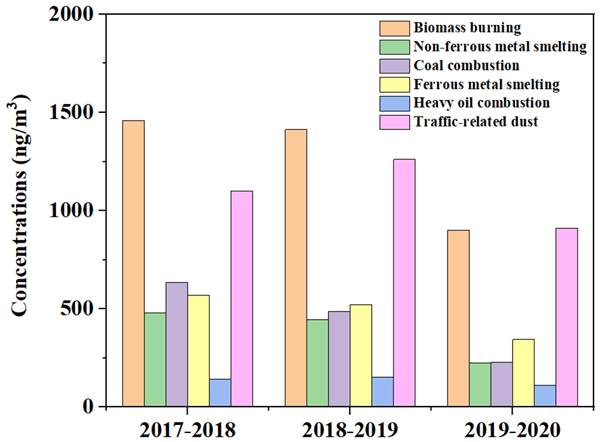
Rui Li, Yining Gao, Yubao Chen, Meng Peng, Weidong Zhao, Gehui Wang, and Jiming Hao
Atmos. Chem. Phys., 23, 4709–4726, https://doi.org/10.5194/acp-23-4709-2023, https://doi.org/10.5194/acp-23-4709-2023, 2023
Short summary
Short summary
A random forest model was used to isolate the effects of emission and meteorology to trace elements in PM2.5 in Tangshan. The results suggested that control measures facilitated decreases of Ga, Co, Pb, Zn, and As, due to the strict implementation of coal-to-gas strategies and optimisation of industrial structure and layout. However, the deweathered levels of Ca, Cr, and Fe only displayed minor decreases, indicating that ferrous metal smelting and vehicle emission controls should be enhanced.
Fiona H. M. Tang, Thu Ha Nguyen, Giulia Conchedda, Leon Casse, Francesco N. Tubiello, and Federico Maggi
Earth Syst. Sci. Data Discuss., https://doi.org/10.5194/essd-2023-130, https://doi.org/10.5194/essd-2023-130, 2023
Preprint withdrawn
Short summary
Short summary
CROPGRIDS is a comprehensive global, geo-referenced dataset that provides information on harvested and crop areas of 173 crops circa the year 2020. This new product provides more recent crop type information for 80 crops, covering about 1.2 billion hectares of crop area globally. CROPGRIDS will facilitate global-scale assessments in various disciplines, including agriculture and resource management, food systems, environmental impact and sustainability analyses, and agroeconomics.
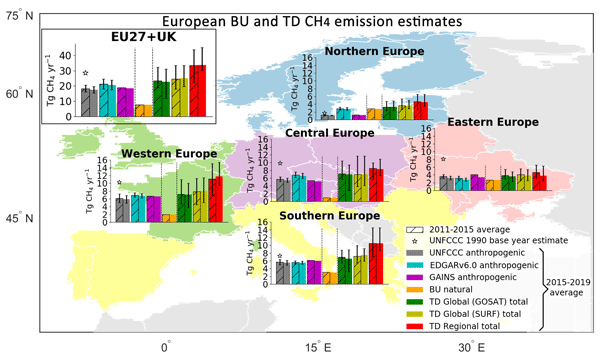
Ana Maria Roxana Petrescu, Chunjing Qiu, Matthew J. McGrath, Philippe Peylin, Glen P. Peters, Philippe Ciais, Rona L. Thompson, Aki Tsuruta, Dominik Brunner, Matthias Kuhnert, Bradley Matthews, Paul I. Palmer, Oksana Tarasova, Pierre Regnier, Ronny Lauerwald, David Bastviken, Lena Höglund-Isaksson, Wilfried Winiwarter, Giuseppe Etiope, Tuula Aalto, Gianpaolo Balsamo, Vladislav Bastrikov, Antoine Berchet, Patrick Brockmann, Giancarlo Ciotoli, Giulia Conchedda, Monica Crippa, Frank Dentener, Christine D. Groot Zwaaftink, Diego Guizzardi, Dirk Günther, Jean-Matthieu Haussaire, Sander Houweling, Greet Janssens-Maenhout, Massaer Kouyate, Adrian Leip, Antti Leppänen, Emanuele Lugato, Manon Maisonnier, Alistair J. Manning, Tiina Markkanen, Joe McNorton, Marilena Muntean, Gabriel D. Oreggioni, Prabir K. Patra, Lucia Perugini, Isabelle Pison, Maarit T. Raivonen, Marielle Saunois, Arjo J. Segers, Pete Smith, Efisio Solazzo, Hanqin Tian, Francesco N. Tubiello, Timo Vesala, Guido R. van der Werf, Chris Wilson, and Sönke Zaehle
Earth Syst. Sci. Data, 15, 1197–1268, https://doi.org/10.5194/essd-15-1197-2023, https://doi.org/10.5194/essd-15-1197-2023, 2023
Short summary
Short summary
This study updates the state-of-the-art scientific overview of CH4 and N2O emissions in the EU27 and UK in Petrescu et al. (2021a). Yearly updates are needed to improve the different respective approaches and to inform on the development of formal verification systems. It integrates the most recent emission inventories, process-based model and regional/global inversions, comparing them with UNFCCC national GHG inventories, in support to policy to facilitate real-time verification procedures.
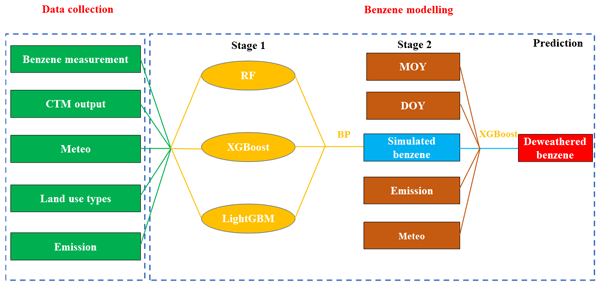
Chaohao Ling, Lulu Cui, and Rui Li
Atmos. Chem. Phys., 23, 3311–3324, https://doi.org/10.5194/acp-23-3311-2023, https://doi.org/10.5194/acp-23-3311-2023, 2023
Short summary
Short summary
An ensemble machine-learning model coupled with chemical transport models (CTMs) was applied to assess the impact of COVID-19 on ambient benzene. The change ratio of the deweathered benzene concentration from the pre-lockdown to lockdown period was in the order of India (−23.6 %) > Europe (−21.9 %) > the United States (−16.2 %) > China (−15.6 %), which might be associated with local serious benzene pollution and substantial emission reduction in the industrial and transportation sectors.
Giacomo Grassi, Clemens Schwingshackl, Thomas Gasser, Richard A. Houghton, Stephen Sitch, Josep G. Canadell, Alessandro Cescatti, Philippe Ciais, Sandro Federici, Pierre Friedlingstein, Werner A. Kurz, Maria J. Sanz Sanchez, Raúl Abad Viñas, Ramdane Alkama, Selma Bultan, Guido Ceccherini, Stefanie Falk, Etsushi Kato, Daniel Kennedy, Jürgen Knauer, Anu Korosuo, Joana Melo, Matthew J. McGrath, Julia E. M. S. Nabel, Benjamin Poulter, Anna A. Romanovskaya, Simone Rossi, Hanqin Tian, Anthony P. Walker, Wenping Yuan, Xu Yue, and Julia Pongratz
Earth Syst. Sci. Data, 15, 1093–1114, https://doi.org/10.5194/essd-15-1093-2023, https://doi.org/10.5194/essd-15-1093-2023, 2023
Short summary
Short summary
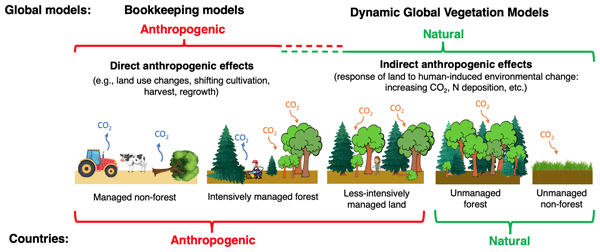
Striking differences exist in estimates of land-use CO2 fluxes between the national greenhouse gas inventories and the IPCC assessment reports. These differences hamper an accurate assessment of the collective progress under the Paris Agreement. By implementing an approach that conceptually reconciles land-use CO2 flux from national inventories and the global models used by the IPCC, our study is an important step forward for increasing confidence in land-use CO2 flux estimates.
Brendan Byrne, David F. Baker, Sourish Basu, Michael Bertolacci, Kevin W. Bowman, Dustin Carroll, Abhishek Chatterjee, Frédéric Chevallier, Philippe Ciais, Noel Cressie, David Crisp, Sean Crowell, Feng Deng, Zhu Deng, Nicholas M. Deutscher, Manvendra K. Dubey, Sha Feng, Omaira E. García, David W. T. Griffith, Benedikt Herkommer, Lei Hu, Andrew R. Jacobson, Rajesh Janardanan, Sujong Jeong, Matthew S. Johnson, Dylan B. A. Jones, Rigel Kivi, Junjie Liu, Zhiqiang Liu, Shamil Maksyutov, John B. Miller, Scot M. Miller, Isamu Morino, Justus Notholt, Tomohiro Oda, Christopher W. O'Dell, Young-Suk Oh, Hirofumi Ohyama, Prabir K. Patra, Hélène Peiro, Christof Petri, Sajeev Philip, David F. Pollard, Benjamin Poulter, Marine Remaud, Andrew Schuh, Mahesh K. Sha, Kei Shiomi, Kimberly Strong, Colm Sweeney, Yao Té, Hanqin Tian, Voltaire A. Velazco, Mihalis Vrekoussis, Thorsten Warneke, John R. Worden, Debra Wunch, Yuanzhi Yao, Jeongmin Yun, Andrew Zammit-Mangion, and Ning Zeng
Earth Syst. Sci. Data, 15, 963–1004, https://doi.org/10.5194/essd-15-963-2023, https://doi.org/10.5194/essd-15-963-2023, 2023
Short summary
Short summary
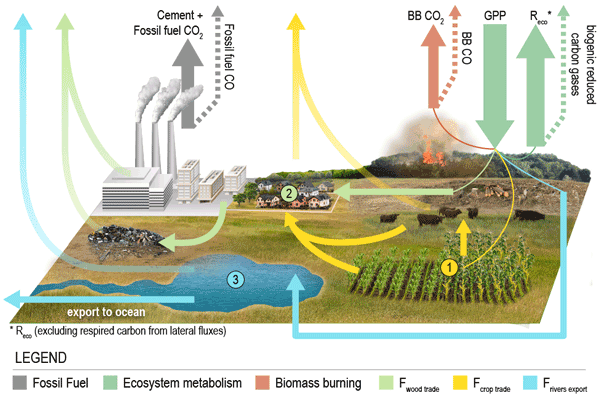
Changes in the carbon stocks of terrestrial ecosystems result in emissions and removals of CO2. These can be driven by anthropogenic activities (e.g., deforestation), natural processes (e.g., fires) or in response to rising CO2 (e.g., CO2 fertilization). This paper describes a dataset of CO2 emissions and removals derived from atmospheric CO2 observations. This pilot dataset informs current capabilities and future developments towards top-down monitoring and verification systems.
Xiaoyong Li, Hanqin Tian, Chaoqun Lu, and Shufen Pan
Earth Syst. Sci. Data, 15, 1005–1035, https://doi.org/10.5194/essd-15-1005-2023, https://doi.org/10.5194/essd-15-1005-2023, 2023
Short summary
Short summary
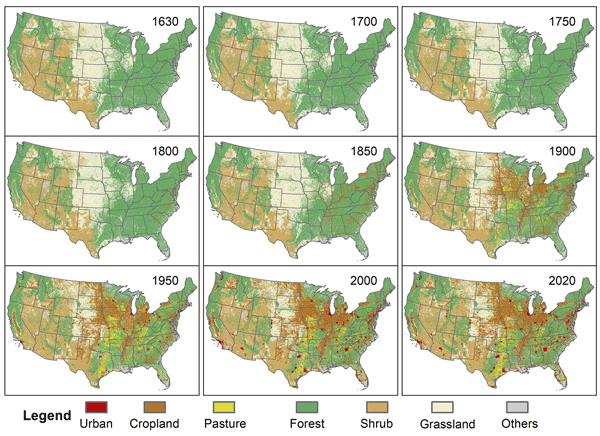
We reconstructed land use and land cover (LULC) history for the conterminous United States during 1630–2020 by integrating multi-source data. The results show the widespread expansion of cropland and urban land and the shrinking of natural vegetation in the past four centuries. Forest planting and regeneration accelerated forest recovery since the 1920s. The datasets can be used to assess the LULC impacts on the ecosystem's carbon, nitrogen, and water cycles.
Wenxiu Zhang, Di Liu, Hanqin Tian, Naiqin Pan, Ruqi Yang, Wenhan Tang, Jia Yang, Fei Lu, Buddhi Dayananda, Han Mei, Siyuan Wang, and Hao Shi
Earth Syst. Sci. Data Discuss., https://doi.org/10.5194/essd-2022-428, https://doi.org/10.5194/essd-2022-428, 2022
Manuscript not accepted for further review
Short summary
Short summary
High temporal resolution surface ozone concentration data is still lacking in China, so we used deep learning to generate hourly surface ozone data (HrSOD) during 2005–2020 across China. HrSOD showed that surface O3 in China tended to increase from 2016 to 2019, despite a decrease in 2020. HrSOD had high spatial and temporal accuracies, long time ranges and high temporal resolution, enabling it to be easily converted to various evaluation indicators for ecosystem and human health assessments.
Pierre Friedlingstein, Michael O'Sullivan, Matthew W. Jones, Robbie M. Andrew, Luke Gregor, Judith Hauck, Corinne Le Quéré, Ingrid T. Luijkx, Are Olsen, Glen P. Peters, Wouter Peters, Julia Pongratz, Clemens Schwingshackl, Stephen Sitch, Josep G. Canadell, Philippe Ciais, Robert B. Jackson, Simone R. Alin, Ramdane Alkama, Almut Arneth, Vivek K. Arora, Nicholas R. Bates, Meike Becker, Nicolas Bellouin, Henry C. Bittig, Laurent Bopp, Frédéric Chevallier, Louise P. Chini, Margot Cronin, Wiley Evans, Stefanie Falk, Richard A. Feely, Thomas Gasser, Marion Gehlen, Thanos Gkritzalis, Lucas Gloege, Giacomo Grassi, Nicolas Gruber, Özgür Gürses, Ian Harris, Matthew Hefner, Richard A. Houghton, George C. Hurtt, Yosuke Iida, Tatiana Ilyina, Atul K. Jain, Annika Jersild, Koji Kadono, Etsushi Kato, Daniel Kennedy, Kees Klein Goldewijk, Jürgen Knauer, Jan Ivar Korsbakken, Peter Landschützer, Nathalie Lefèvre, Keith Lindsay, Junjie Liu, Zhu Liu, Gregg Marland, Nicolas Mayot, Matthew J. McGrath, Nicolas Metzl, Natalie M. Monacci, David R. Munro, Shin-Ichiro Nakaoka, Yosuke Niwa, Kevin O'Brien, Tsuneo Ono, Paul I. Palmer, Naiqing Pan, Denis Pierrot, Katie Pocock, Benjamin Poulter, Laure Resplandy, Eddy Robertson, Christian Rödenbeck, Carmen Rodriguez, Thais M. Rosan, Jörg Schwinger, Roland Séférian, Jamie D. Shutler, Ingunn Skjelvan, Tobias Steinhoff, Qing Sun, Adrienne J. Sutton, Colm Sweeney, Shintaro Takao, Toste Tanhua, Pieter P. Tans, Xiangjun Tian, Hanqin Tian, Bronte Tilbrook, Hiroyuki Tsujino, Francesco Tubiello, Guido R. van der Werf, Anthony P. Walker, Rik Wanninkhof, Chris Whitehead, Anna Willstrand Wranne, Rebecca Wright, Wenping Yuan, Chao Yue, Xu Yue, Sönke Zaehle, Jiye Zeng, and Bo Zheng
Earth Syst. Sci. Data, 14, 4811–4900, https://doi.org/10.5194/essd-14-4811-2022, https://doi.org/10.5194/essd-14-4811-2022, 2022
Short summary
Short summary
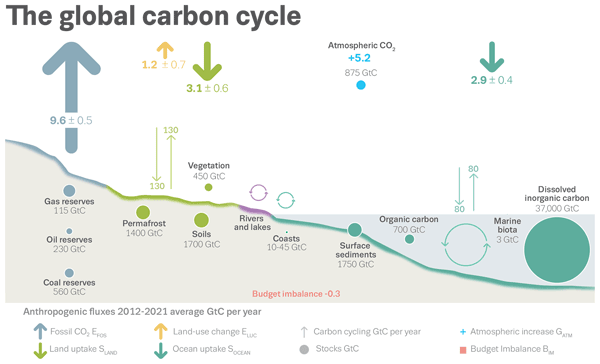
The Global Carbon Budget 2022 describes the datasets and methodology used to quantify the anthropogenic emissions of carbon dioxide (CO2) and their partitioning among the atmosphere, the land ecosystems, and the ocean. These living datasets are updated every year to provide the highest transparency and traceability in the reporting of CO2, the key driver of climate change.
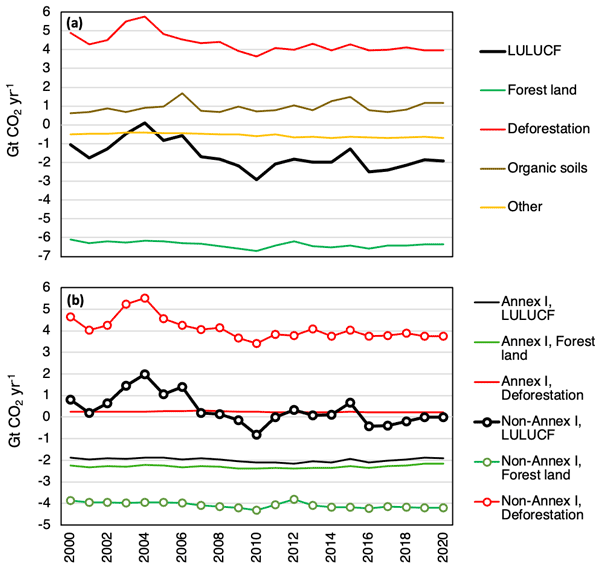
Giacomo Grassi, Giulia Conchedda, Sandro Federici, Raul Abad Viñas, Anu Korosuo, Joana Melo, Simone Rossi, Marieke Sandker, Zoltan Somogyi, Matteo Vizzarri, and Francesco N. Tubiello
Earth Syst. Sci. Data, 14, 4643–4666, https://doi.org/10.5194/essd-14-4643-2022, https://doi.org/10.5194/essd-14-4643-2022, 2022
Short summary
Short summary
Despite increasing attention on the role of land use CO2 fluxes in climate change mitigation, there are large differences in available databases. Here we present the most updated and complete compilation of land use CO2 data based on country submissions to United Nations Framework Convention on Climate Change and explain differences with other datasets. Our dataset brings clarity of land use CO2 fluxes and helps track country progress under the Paris Agreement.
Hanqin Tian, Zihao Bian, Hao Shi, Xiaoyu Qin, Naiqing Pan, Chaoqun Lu, Shufen Pan, Francesco N. Tubiello, Jinfeng Chang, Giulia Conchedda, Junguo Liu, Nathaniel Mueller, Kazuya Nishina, Rongting Xu, Jia Yang, Liangzhi You, and Bowen Zhang
Earth Syst. Sci. Data, 14, 4551–4568, https://doi.org/10.5194/essd-14-4551-2022, https://doi.org/10.5194/essd-14-4551-2022, 2022
Short summary
Short summary
Nitrogen is one of the critical nutrients for growth. Evaluating the change in nitrogen inputs due to human activity is necessary for nutrient management and pollution control. In this study, we generated a historical dataset of nitrogen input to land at the global scale. This dataset consists of nitrogen fertilizer, manure, and atmospheric deposition inputs to cropland, pasture, and rangeland at high resolution from 1860 to 2019.
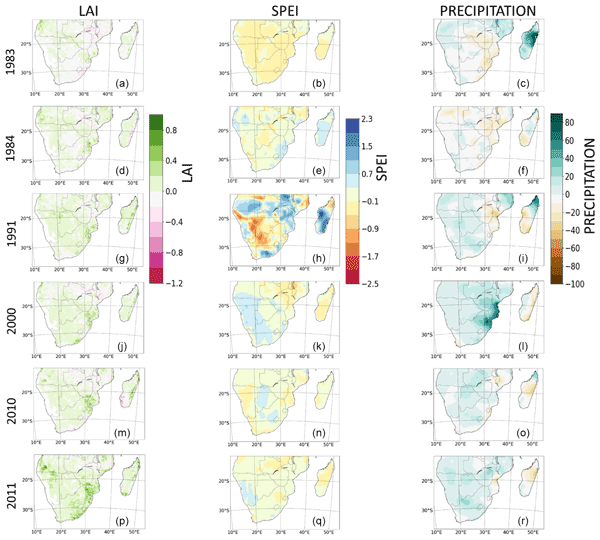
Shakirudeen Lawal, Stephen Sitch, Danica Lombardozzi, Julia E. M. S. Nabel, Hao-Wei Wey, Pierre Friedlingstein, Hanqin Tian, and Bruce Hewitson
Hydrol. Earth Syst. Sci., 26, 2045–2071, https://doi.org/10.5194/hess-26-2045-2022, https://doi.org/10.5194/hess-26-2045-2022, 2022
Short summary
Short summary
To investigate the impacts of drought on vegetation, which few studies have done due to various limitations, we used the leaf area index as proxy and dynamic global vegetation models (DGVMs) to simulate drought impacts because the models use observationally derived climate. We found that the semi-desert biome responds strongly to drought in the summer season, while the tropical forest biome shows a weak response. This study could help target areas to improve drought monitoring and simulation.
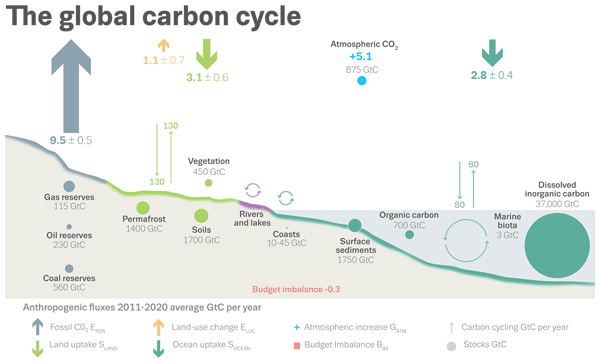
Pierre Friedlingstein, Matthew W. Jones, Michael O'Sullivan, Robbie M. Andrew, Dorothee C. E. Bakker, Judith Hauck, Corinne Le Quéré, Glen P. Peters, Wouter Peters, Julia Pongratz, Stephen Sitch, Josep G. Canadell, Philippe Ciais, Rob B. Jackson, Simone R. Alin, Peter Anthoni, Nicholas R. Bates, Meike Becker, Nicolas Bellouin, Laurent Bopp, Thi Tuyet Trang Chau, Frédéric Chevallier, Louise P. Chini, Margot Cronin, Kim I. Currie, Bertrand Decharme, Laique M. Djeutchouang, Xinyu Dou, Wiley Evans, Richard A. Feely, Liang Feng, Thomas Gasser, Dennis Gilfillan, Thanos Gkritzalis, Giacomo Grassi, Luke Gregor, Nicolas Gruber, Özgür Gürses, Ian Harris, Richard A. Houghton, George C. Hurtt, Yosuke Iida, Tatiana Ilyina, Ingrid T. Luijkx, Atul Jain, Steve D. Jones, Etsushi Kato, Daniel Kennedy, Kees Klein Goldewijk, Jürgen Knauer, Jan Ivar Korsbakken, Arne Körtzinger, Peter Landschützer, Siv K. Lauvset, Nathalie Lefèvre, Sebastian Lienert, Junjie Liu, Gregg Marland, Patrick C. McGuire, Joe R. Melton, David R. Munro, Julia E. M. S. Nabel, Shin-Ichiro Nakaoka, Yosuke Niwa, Tsuneo Ono, Denis Pierrot, Benjamin Poulter, Gregor Rehder, Laure Resplandy, Eddy Robertson, Christian Rödenbeck, Thais M. Rosan, Jörg Schwinger, Clemens Schwingshackl, Roland Séférian, Adrienne J. Sutton, Colm Sweeney, Toste Tanhua, Pieter P. Tans, Hanqin Tian, Bronte Tilbrook, Francesco Tubiello, Guido R. van der Werf, Nicolas Vuichard, Chisato Wada, Rik Wanninkhof, Andrew J. Watson, David Willis, Andrew J. Wiltshire, Wenping Yuan, Chao Yue, Xu Yue, Sönke Zaehle, and Jiye Zeng
Earth Syst. Sci. Data, 14, 1917–2005, https://doi.org/10.5194/essd-14-1917-2022, https://doi.org/10.5194/essd-14-1917-2022, 2022
Short summary
Short summary
The Global Carbon Budget 2021 describes the data sets and methodology used to quantify the emissions of carbon dioxide and their partitioning among the atmosphere, land, and ocean. These living data are updated every year to provide the highest transparency and traceability in the reporting of CO2, the key driver of climate change.
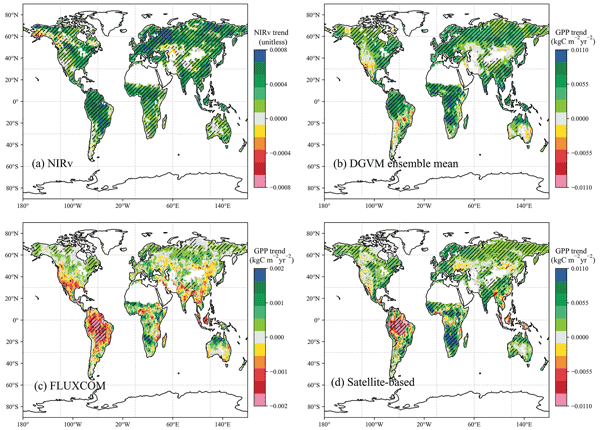
Ruqi Yang, Jun Wang, Ning Zeng, Stephen Sitch, Wenhan Tang, Matthew Joseph McGrath, Qixiang Cai, Di Liu, Danica Lombardozzi, Hanqin Tian, Atul K. Jain, and Pengfei Han
Earth Syst. Dynam., 13, 833–849, https://doi.org/10.5194/esd-13-833-2022, https://doi.org/10.5194/esd-13-833-2022, 2022
Short summary
Short summary
We comprehensively investigate historical GPP trends based on five kinds of GPP datasets and analyze the causes for any discrepancies among them. Results show contrasting behaviors between modeled and satellite-based GPP trends, and their inconsistencies are likely caused by the contrasting performance between satellite-derived and modeled leaf area index (LAI). Thus, the uncertainty in satellite-based GPP induced by LAI undermines its role in assessing the performance of DGVM simulations.
Francesco N. Tubiello, Kevin Karl, Alessandro Flammini, Johannes Gütschow, Griffiths Obli-Laryea, Giulia Conchedda, Xueyao Pan, Sally Yue Qi, Hörn Halldórudóttir Heiðarsdóttir, Nathan Wanner, Roberta Quadrelli, Leonardo Rocha Souza, Philippe Benoit, Matthew Hayek, David Sandalow, Erik Mencos Contreras, Cynthia Rosenzweig, Jose Rosero Moncayo, Piero Conforti, and Maximo Torero
Earth Syst. Sci. Data, 14, 1795–1809, https://doi.org/10.5194/essd-14-1795-2022, https://doi.org/10.5194/essd-14-1795-2022, 2022
Short summary
Short summary
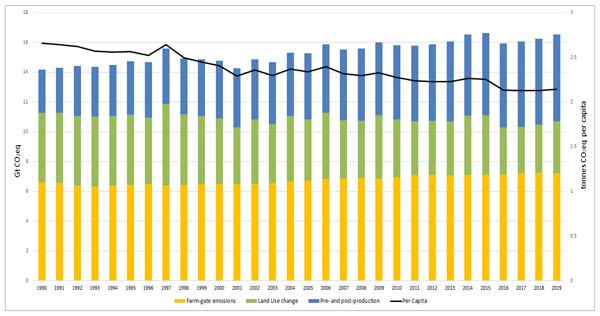
The paper presents results from the new FAOSTAT database on food system emissions, covering all countries over the time series 1990–2019. Results indicate and further clarify – updated to 2019 – the relevance of emissions from crop and livestock production processes within the farm gate; from conversion of natural ecosystems to agriculture, such as deforestation and peat degradation; and from use of fossil fuels for energy and other industrial processes along food supply chains.
Zhu Deng, Philippe Ciais, Zitely A. Tzompa-Sosa, Marielle Saunois, Chunjing Qiu, Chang Tan, Taochun Sun, Piyu Ke, Yanan Cui, Katsumasa Tanaka, Xin Lin, Rona L. Thompson, Hanqin Tian, Yuanzhi Yao, Yuanyuan Huang, Ronny Lauerwald, Atul K. Jain, Xiaoming Xu, Ana Bastos, Stephen Sitch, Paul I. Palmer, Thomas Lauvaux, Alexandre d'Aspremont, Clément Giron, Antoine Benoit, Benjamin Poulter, Jinfeng Chang, Ana Maria Roxana Petrescu, Steven J. Davis, Zhu Liu, Giacomo Grassi, Clément Albergel, Francesco N. Tubiello, Lucia Perugini, Wouter Peters, and Frédéric Chevallier
Earth Syst. Sci. Data, 14, 1639–1675, https://doi.org/10.5194/essd-14-1639-2022, https://doi.org/10.5194/essd-14-1639-2022, 2022
Short summary
Short summary
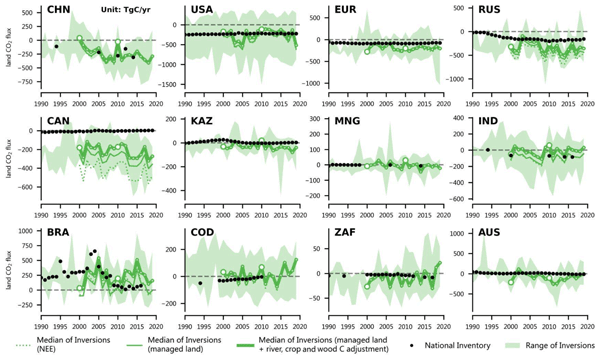
In support of the global stocktake of the Paris Agreement on climate change, we proposed a method for reconciling the results of global atmospheric inversions with data from UNFCCC national greenhouse gas inventories (NGHGIs). Here, based on a new global harmonized database that we compiled from the UNFCCC NGHGIs and a comprehensive framework presented in this study to process the results of inversions, we compared their results of carbon dioxide (CO2), methane (CH4), and nitrous oxide (N2O).
Alessandro Flammini, Xueyao Pan, Francesco Nicola Tubiello, Sally Yue Qiu, Leonardo Rocha Souza, Roberta Quadrelli, Stefania Bracco, Philippe Benoit, and Ralph Sims
Earth Syst. Sci. Data, 14, 811–821, https://doi.org/10.5194/essd-14-811-2022, https://doi.org/10.5194/essd-14-811-2022, 2022
Short summary
Short summary
Fossil-fuel-based energy used in agriculture, for crop and livestock production as well as in fisheries, generates significant amounts of greenhouse gases (GHG), which are typically not accounted for within the agriculture sector of national GHG inventories. Using activity data from UNSD and IEA, we construct a new database of energy use in agriculture and related emissions, covering the period 1970–2019 by country and by fossil fuel type, including emissions from electricity used on the farm.
Philippe Ciais, Ana Bastos, Frédéric Chevallier, Ronny Lauerwald, Ben Poulter, Josep G. Canadell, Gustaf Hugelius, Robert B. Jackson, Atul Jain, Matthew Jones, Masayuki Kondo, Ingrid T. Luijkx, Prabir K. Patra, Wouter Peters, Julia Pongratz, Ana Maria Roxana Petrescu, Shilong Piao, Chunjing Qiu, Celso Von Randow, Pierre Regnier, Marielle Saunois, Robert Scholes, Anatoly Shvidenko, Hanqin Tian, Hui Yang, Xuhui Wang, and Bo Zheng
Geosci. Model Dev., 15, 1289–1316, https://doi.org/10.5194/gmd-15-1289-2022, https://doi.org/10.5194/gmd-15-1289-2022, 2022
Short summary
Short summary
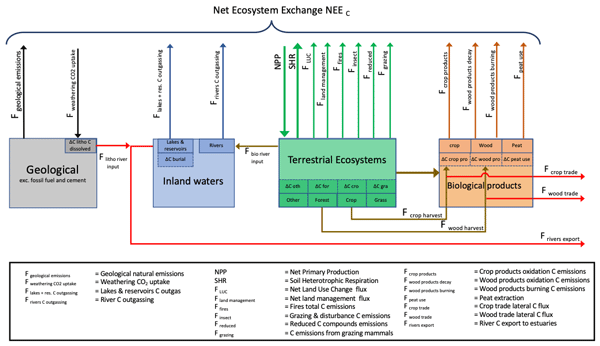
The second phase of the Regional Carbon Cycle Assessment and Processes (RECCAP) will provide updated quantification and process understanding of CO2, CH4, and N2O emissions and sinks for ten regions of the globe. In this paper, we give definitions, review different methods, and make recommendations for estimating different components of the total land–atmosphere carbon exchange for each region in a consistent and complete approach.
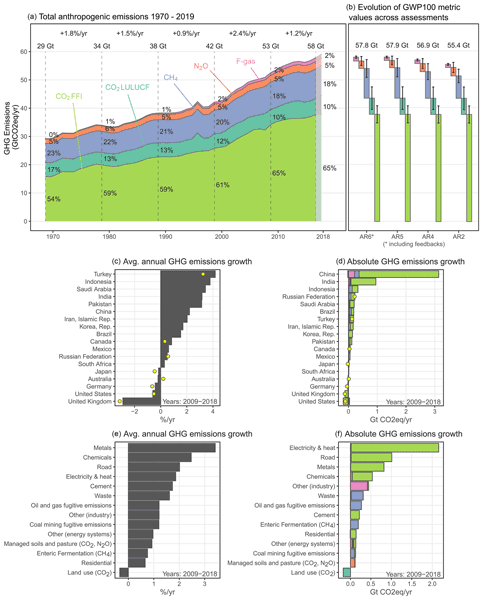
Jan C. Minx, William F. Lamb, Robbie M. Andrew, Josep G. Canadell, Monica Crippa, Niklas Döbbeling, Piers M. Forster, Diego Guizzardi, Jos Olivier, Glen P. Peters, Julia Pongratz, Andy Reisinger, Matthew Rigby, Marielle Saunois, Steven J. Smith, Efisio Solazzo, and Hanqin Tian
Earth Syst. Sci. Data, 13, 5213–5252, https://doi.org/10.5194/essd-13-5213-2021, https://doi.org/10.5194/essd-13-5213-2021, 2021
Short summary
Short summary
We provide a synthetic dataset on anthropogenic greenhouse gas (GHG) emissions for 1970–2018 with a fast-track extension to 2019. We show that GHG emissions continued to rise across all gases and sectors. Annual average GHG emissions growth slowed, but absolute decadal increases have never been higher in human history. We identify a number of data gaps and data quality issues in global inventories and highlight their importance for monitoring progress towards international climate goals.
Cited articles
Alexander, R. B., Smith, R. A., Schwarz, G. E., Boyer, E. W., Nolan, J. V., and Brakebill, J. W.: Differences in Phosphorus and Nitrogen Delivery to The Gulf of Mexico from the Mississippi River Basin, Environ. Sci. Technol., 42, 822–830, https://doi.org/10.1021/es0716103, 2008.
Barbieri, P., MacDonald, G. K., Bernard de Raymond, A., and Nesme, T.: Food system resilience to phosphorus shortages on a telecoupled planet, Nat. Sustain., 5, 114–122, https://doi.org/10.1038/s41893-021-00816-1, 2022.
Beusen, A. H. W., Bouwman, A. F., Van Beek, L. P. H., Mogollón, J. M., and Middelburg, J. J.: Global riverine N and P transport to ocean increased during the 20th century despite increased retention along the aquatic continuum, Biogeosciences, 13, 2441–2451, https://doi.org/10.5194/bg-13-2441-2016, 2016.
Bian, Z., Shi, H., and Tian, H.: HaPi: A Historical dataset of Anthropogenic Phosphorus Inputs to the terrestrial biosphere (1860–2020), figshare [data set], https://doi.org/10.6084/m9.figshare.29930279, 2026
Bouwman, A. F., Beusen, A. H., and Billen, G.: Human alteration of the global nitrogen and phosphorus soil balances for the period 1970–2050, Global Biogeochem. Cy., 23, GB0A04, https://doi.org/10.1029/2009GB003576, 2009.
Bouwman, L., Goldewijk, K. K., Van Der Hoek, K. W., Beusen, A. H. W., Van Vuuren, D. P., Willems, J., Rufino, M. C., and Stehfest, E.: Exploring global changes in nitrogen and phosphorus cycles in agriculture induced by livestock production over the 1900–2050 period, P. Natl. Acad. Sci. USA, 110, 20882–20887, https://doi.org/10.1073/pnas.1012878108, 2013.
Cao, S., Li, M., Zhu, Z., Wang, Z., Zha, J., Zhao, W., Duanmu, Z., Chen, J., Zheng, Y., Chen, Y., Myneni, R. B., and Piao, S.: Spatiotemporally consistent global dataset of the GIMMS leaf area index (GIMMS LAI4g) from 1982 to 2020, Earth Syst. Sci. Data, 15, 4877–4899, https://doi.org/10.5194/essd-15-4877-2023, 2023.
Carn, S.: Multi-Satellite Volcanic Sulfur Dioxide L4 Long-Term Global Database V3, GES DISC [data set], https://doi.org/10.5067/MEASURES/SO2/DATA404, 2019.
Carn, S. A., Yang, K., Prata, A. J., and Krotkov, N. A.: Extending the long-term record of volcanic SO2 emissions with the Ozone Mapping and Profiler Suite nadir mapper, Geophys. Res. Lett., 42, 925–932, https://doi.org/10.1002/2014GL062437, 2015.
Carpenter, S. R.: Eutrophication of aquatic ecosystems: Bistability and soil phosphorus, P. Natl. Acad. Sci. USA, 102, 10002–10005, https://doi.org/10.1073/pnas.0503959102, 2005.
Conley, D. J., Paerl, H. W., Howarth, R. W., Boesch, D. F., Seitzinger, S. P., Havens, K. E., Lancelot, C., and Likens, G. E.: Controlling Eutrophication: Nitrogen and Phosphorus, Science, 323, 1014–1015, https://doi.org/10.1126/science.1167755, 2009.
Cordell, D., Drangert, J.-O., and White, S.: The story of phosphorus: Global food security and food for thought, Global Environ. Change, 19, 292–305, https://doi.org/10.1016/j.gloenvcha.2008.10.009, 2009.
Crippa, M., Guizzardi, D., Schaaf, E., Monforti-Ferrario, F., Quadrelli, R., Risquez Martin, A., Rossi, S., Vignati, E., Muntean, M., Brandao De Melo, J., Oom, D., Pagani, F., Banja, M., Taghavi-Moharamli, P., Köykkä, J., Grassi, G., Branco, A., and San-Miguel, J.: GHG emissions of all world countries: 2023, Publications Office of the European Union, JRC134504, https://doi.org/10.2760/953322, 2023.
Dai, M., Zhao, Y., Chai, F., Chen, M., Chen, N., Chen, Y., Cheng, D., Gan, J., Guan, D., Hong, Y., Huang, J., Lee, Y., Leung, K. M. Y., Lim, P. E., Lin, S., Lin, X., Liu, X., Liu, Z., Luo, Y.-W., Meng, F., Sangmanee, C., Shen, Y., Uthaipan, K., Talaat, W. I. A. W., Wan, X. S., Wang, C., Wang, D., Wang, G., Wang, S., Wang, Y., Wang, Y., Wang, Z., Wang, Z., Xu, Y., Yang, J.-Y. T., Yang, Y., Yasuhara, M., Yu, D., Yu, J., Yu, L., Zhang, Z., and Zhang, Z.: Persistent eutrophication and hypoxia in the coastal ocean, Camb. Prisms Coast. Futur., 1, e19, https://doi.org/10.1017/cft.2023.7, 2023.
Demay, J., Ringeval, B., Pellerin, S., and Nesme, T.: Half of global agricultural soil phosphorus fertility derived from anthropogenic sources, Nat. Geosci., 16, 69–74, https://doi.org/10.1038/s41561-022-01092-0, 2023.
Du, Z., Yu, L., Zhao, Y., Li, X., Liu, X., Li, X., Hao, P., Chen, Z., Guo, Z., You, L., Ma, X., and Wang, H.: Annual global grided livestock mapping from 1961 to 2021, Earth Syst. Sci. Data, 17, 5543–5556, https://doi.org/10.5194/essd-17-5543-2025, 2025.
Einarsson, R., Sanz-Cobena, A., Aguilera, E., Billen, G., Garnier, J., van Grinsven, H. J. M., and Lassaletta, L.: Crop production and nitrogen use in European cropland and grassland 1961–2019, Sci. Data, 8, 288, https://doi.org/10.1038/s41597-021-01061-z, 2021.
Elser, J. and Bennett, E.: A broken biogeochemical cycle, Nature, 478, 29–31, https://doi.org/10.1038/478029a, 2011.
FAO: Cropland nutrient balance – Global, regional and country trends, 1961–2022, 95, FAO, Rome, https://openknowledge.fao.org/handle/20.500.14283/cd3164en (last access: 12 August 2025), 2024.
FAO and IIASA: Harmonized World Soil Database Version 2.0, Rome, Laxenburg, https://www.fao.org/soils-portal/data-hub/soil-maps-and-databases/harmonized-world-soil-database-v20/en/ (last access: 12 May 2024), 2023.
FAOSTAT – Food and Agriculture Organization Corporate Statistical Database: FAO online database, http://www.fao.org/faostat/ en/#data (last access: April 2024), 2024.
Feng, X., Lin, H., Fu, T.-M., Sulprizio, M. P., Zhuang, J., Jacob, D. J., Tian, H., Ma, Y., Zhang, L., Wang, X., Chen, Q., and Han, Z.: WRF-GC (v2.0): online two-way coupling of WRF (v3.9.1.1) and GEOS-Chem (v12.7.2) for modeling regional atmospheric chemistry–meteorology interactions, Geosci. Model Dev., 14, 3741–3768, https://doi.org/10.5194/gmd-14-3741-2021, 2021.
Fick, S. E. and Hijmans, R. J.: WorldClim 2: new 1‐km spatial resolution climate surfaces for global land areas, Int. J. Climatol., 37, 4302–4315, https://doi.org/10.1002/joc.5086, 2017.
Fink, G., Alcamo, J., Flörke, M., and Reder, K.: Phosphorus Loadings to the World's Largest Lakes: Sources and Trends, Global Biogeochem. Cy., 32, 617–634, https://doi.org/10.1002/2017GB005858, 2018.
Ge, C., Wang, J., Carn, S., Yang, K., Ginoux, P., and Krotkov, N.: Satellite-based global volcanic SO2 emissions and sulfate direct radiative forcing during 2005–2012, J. Geophys. Res.-Atmos., 121, 3446–3464, https://doi.org/10.1002/2015JD023134, 2016.
Gilbert, M., Nicolas, G., Cinardi, G., Van Boeckel, T. P., Vanwambeke, S. O., Wint, G. R. W., and Robinson, T. P.: Global distribution data for cattle, buffaloes, horses, sheep, goats, pigs, chickens and ducks in 2010, Sci. Data, 5, 180227, https://doi.org/10.1038/sdata.2018.227, 2018.
Hurtt, G. C., Chini, L., Sahajpal, R., Frolking, S., Bodirsky, B. L., Calvin, K., Doelman, J. C., Fisk, J., Fujimori, S., Klein Goldewijk, K., Hasegawa, T., Havlik, P., Heinimann, A., Humpenöder, F., Jungclaus, J., Kaplan, J. O., Kennedy, J., Krisztin, T., Lawrence, D., Lawrence, P., Ma, L., Mertz, O., Pongratz, J., Popp, A., Poulter, B., Riahi, K., Shevliakova, E., Stehfest, E., Thornton, P., Tubiello, F. N., van Vuuren, D. P., and Zhang, X.: Harmonization of global land use change and management for the period 850–2100 (LUH2) for CMIP6, Geosci. Model Dev., 13, 5425–5464, https://doi.org/10.5194/gmd-13-5425-2020, 2020.
Klein Goldewijk, K., Beusen, A., Doelman, J., and Stehfest, E.: Anthropogenic land use estimates for the Holocene – HYDE 3.2, Earth Syst. Sci. Data, 9, 927–953, https://doi.org/10.5194/essd-9-927-2017, 2017.
Lassaletta, L., Billen, G., Grizzetti, B., Anglade, J., and Garnier, J.: 50 year trends in nitrogen use efficiency of world cropping systems: the relationship between yield and nitrogen input to cropland, Environ. Res. Lett., 9, 105011, https://doi.org/10.1088/1748-9326/9/10/105011, 2014.
Li, X., Yu, L., Du, Z., and Liu, X.: Crop Statistic to Annual Map: Tracking spatiotemporal dynamics of crop-specific areas through machine learning and statistics disaggregating, Sci. Data, 12, 1249, https://doi.org/10.1038/s41597-025-05572-x, 2025.
Lu, C. and Tian, H.: Global nitrogen and phosphorus fertilizer use for agriculture production in the past half century: shifted hot spots and nutrient imbalance, Earth Syst. Sci. Data, 9, 181–192, https://doi.org/10.5194/essd-9-181-2017, 2017.
Ludemann, C. I., Wanner, N., Chivenge, P., Dobermann, A., Einarsson, R., Grassini, P., Gruere, A., Jackson, K., Lassaletta, L., Maggi, F., Obli-Laryea, G., van Ittersum, M. K., Vishwakarma, S., Zhang, X., and Tubiello, F. N.: A global FAOSTAT reference database of cropland nutrient budgets and nutrient use efficiency (1961–2020): nitrogen, phosphorus and potassium, Earth Syst. Sci. Data, 16, 525–541, https://doi.org/10.5194/essd-16-525-2024, 2024.
Lun, F., Liu, J., Ciais, P., Nesme, T., Chang, J., Wang, R., Goll, D., Sardans, J., Peñuelas, J., and Obersteiner, M.: Global and regional phosphorus budgets in agricultural systems and their implications for phosphorus-use efficiency, Earth Syst. Sci. Data, 10, 1–18, https://doi.org/10.5194/essd-10-1-2018, 2018.
Ma, J., Shi, H., Zhu, Y., Li, R., Wang, S., Lu, N., Yao, Y., Bian, Z., and Huang, K.: The Evolution of Global Surface Ammonia Concentrations during 2001–2019: Magnitudes, Patterns, and Drivers, Environ. Sci. Technol., 59, 5066–5079, https://doi.org/10.1021/acs.est.4c14020, 2025.
Malone, B. P., McBratney, A. B., Minasny, B., and Wheeler, I.: A general method for downscaling earth resource information, Comput. Geosci., 41, 119–125, https://doi.org/10.1016/j.cageo.2011.08.021, 2012.
Meng, J., Martin, R. V., Ginoux, P., Hammer, M., Sulprizio, M. P., Ridley, D. A., and van Donkelaar, A.: Grid-independent high-resolution dust emissions (v1.0) for chemical transport models: application to GEOS-Chem (12.5.0), Geosci. Model Dev., 14, 4249–4260, https://doi.org/10.5194/gmd-14-4249-2021, 2021.
Mueller, N. D., Gerber, J. S., Johnston, M., Ray, D. K., Ramankutty, N., and Foley, J. A.: Closing yield gaps through nutrient and water management, Nature, 490, 254–257, https://doi.org/10.1038/nature11420, 2012.
Muñoz-Sabater, J., Dutra, E., Agustí-Panareda, A., Albergel, C., Arduini, G., Balsamo, G., Boussetta, S., Choulga, M., Harrigan, S., Hersbach, H., Martens, B., Miralles, D. G., Piles, M., Rodríguez-Fernández, N. J., Zsoter, E., Buontempo, C., and Thépaut, J.-N.: ERA5-Land: a state-of-the-art global reanalysis dataset for land applications, Earth Syst. Sci. Data, 13, 4349–4383, https://doi.org/10.5194/essd-13-4349-2021, 2021.
Myriokefalitakis, S., Nenes, A., Baker, A. R., Mihalopoulos, N., and Kanakidou, M.: Bioavailable atmospheric phosphorous supply to the global ocean: a 3-D global modeling study, Biogeosciences, 13, 6519–6543, https://doi.org/10.5194/bg-13-6519-2016, 2016.
Nguyen, T. H., Tang, F. H. M., Conchedda, G., Casse, L., Obli-Laryea, G., Tubiello, F. N., and Maggi, F.: NPKGRIDS: a global georeferenced dataset of N, P2O5, and K2O fertilizer application rates for 173 crops, Sci. Data, 11, 1179, https://doi.org/10.1038/s41597-024-04030-4, 2024.
Randerson, J. T., Van Der Werf, G. R., Giglio, L., Collatz, G. J., and Kasibhatla, P. S.: Global Fire Emissions Database, Version 4.1 (GFEDv4), ORNL DAAC [data set], https://doi.org/10.3334/ORNLDAAC/1293, 2015.
Randles, C. A., da Silva, A. M., Buchard, V., Colarco, P. R., Darmenov, A., Govindaraju, R., Smirnov, A., Holben, B., Ferrare, R., Hair, J., Shinozuka, Y., and Flynn, C. J.: The MERRA-2 Aerosol Reanalysis, 1980 Onward. Part I: System Description and Data Assimilation Evaluation, J. Climate, 30, 6823–6850, https://doi.org/10.1175/JCLI-D-16-0609.1, 2017.
Ringeval, B., Augusto, L., Monod, H., van Apeldoorn, D., Bouwman, L., Yang, X., Achat, D. L., Chini, L. P., Van Oost, K., Guenet, B., Wang, R., Decharme, B., Nesme, T., and Pellerin, S.: Phosphorus in agricultural soils: drivers of its distribution at the global scale, Global Change Biol., 23, 3418–3432, https://doi.org/10.1111/gcb.13618, 2017.
Ringeval, B., Demay, J., Goll, D. S., He, X., Wang, Y.-P., Hou, E., Matej, S., Erb, K.-H., Wang, R., Augusto, L., Lun, F., Nesme, T., Borrelli, P., Helfenstein, J., McDowell, R. W., Pletnyakov, P., and Pellerin, S.: A global dataset on phosphorus in agricultural soils, Sci. Data, 11, 17, https://doi.org/10.1038/s41597-023-02751-6, 2024.
Roudier, P., Malone, B. P., Hedley, C. B., Minasny, B., and McBratney, A. B.: Comparison of regression methods for spatial downscaling of soil organic carbon stocks maps, Comput. Electron. Agric., 142, 91–100, https://doi.org/10.1016/j.compag.2017.08.021, 2017.
Sattari, S. Z., Bouwman, A. F., Giller, K. E., and van Ittersum, M. K.: Residual soil phosphorus as the missing piece in the global phosphorus crisis puzzle, P. Natl. Acad. Sci. USA, 109, 6348–6353, https://doi.org/10.1073/pnas.1113675109, 2012.
Sattari, S. Z., Bouwman, A. F., Martinez Rodríguez, R., Beusen, A. H. W., and van Ittersum, M. K.: Negative global phosphorus budgets challenge sustainable intensification of grasslands, Nat. Commun., 7, 10696, https://doi.org/10.1038/ncomms10696, 2016.
Stackpoole, S. M., Stets, E. G., and Sprague, L. A.: Variable impacts of contemporary versus legacy agricultural phosphorus on US river water quality, P. Natl. Acad. Sci. USA, 116, 20562–20567, https://doi.org/10.1073/pnas.1903226116, 2019.
Steffen, W., Richardson, K., Rockstrom, J., Cornell, S. E., Fetzer, I., Bennett, E. M., Biggs, R., Carpenter, S. R., de Vries, W., de Wit, C. A., Folke, C., Gerten, D., Heinke, J., Mace, G. M., Persson, L. M., Ramanathan, V., Reyers, B., and Sorlin, S.: Planetary boundaries: Guiding human development on a changing planet, Science, 347, 1259855, https://doi.org/10.1126/science.1259855, 2015.
Tian, H., Chen, G., Zhang, C., Melillo, J. M., and Hall, C. A. S.: Pattern and variation of C : N : P ratios in China's soils: a synthesis of observational data, Biogeochemistry, 98, 139–151, https://doi.org/10.1007/s10533-009-9382-0, 2010.
Tian, H., Bian, Z., Shi, H., Qin, X., Pan, N., Lu, C., Pan, S., Tubiello, F. N., Chang, J., Conchedda, G., Liu, J., Mueller, N., Nishina, K., Xu, R., Yang, J., You, L., and Zhang, B.: History of anthropogenic Nitrogen inputs (HaNi) to the terrestrial biosphere: a 5 arcmin resolution annual dataset from 1860 to 2019, Earth Syst. Sci. Data, 14, 4551–4568, https://doi.org/10.5194/essd-14-4551-2022, 2022.
Tian, H., Pan, N., Thompson, R. L., Canadell, J. G., Suntharalingam, P., Regnier, P., Davidson, E. A., Prather, M., Ciais, P., Muntean, M., Pan, S., Winiwarter, W., Zaehle, S., Zhou, F., Jackson, R. B., Bange, H. W., Berthet, S., Bian, Z., Bianchi, D., Bouwman, A. F., Buitenhuis, E. T., Dutton, G., Hu, M., Ito, A., Jain, A. K., Jeltsch-Thömmes, A., Joos, F., Kou-Giesbrecht, S., Krummel, P. B., Lan, X., Landolfi, A., Lauerwald, R., Li, Y., Lu, C., Maavara, T., Manizza, M., Millet, D. B., Mühle, J., Patra, P. K., Peters, G. P., Qin, X., Raymond, P., Resplandy, L., Rosentreter, J. A., Shi, H., Sun, Q., Tonina, D., Tubiello, F. N., van der Werf, G. R., Vuichard, N., Wang, J., Wells, K. C., Western, L. M., Wilson, C., Yang, J., Yao, Y., You, Y., and Zhu, Q.: Global nitrous oxide budget (1980–2020), Earth Syst. Sci. Data, 16, 2543–2604, https://doi.org/10.5194/essd-16-2543-2024, 2024.
Tubiello, F. N., Conchedda, G., Wanner, N., Federici, S., Rossi, S., and Grassi, G.: Carbon emissions and removals from forests: new estimates, 1990–2020, Earth Syst. Sci. Data, 13, 1681–1691, https://doi.org/10.5194/essd-13-1681-2021, 2021.
Weng, H., Lin, J., Martin, R., Millet, D. B., Jaeglé, L., Ridley, D., Keller, C., Li, C., Du, M., and Meng, J.: Global high-resolution emissions of soil NOx, sea salt aerosols, and biogenic volatile organic compounds, Sci. Data, 7, 148, https://doi.org/10.1038/s41597-020-0488-5, 2020.
Xu, R., Pan, S. F., Chen, J., Chen, G. S., Yang, J., Dangal, S. R. S., Shepard, J. P., and Tian, H. Q.: Half‐century ammonia emissions from agricultural systems in Southern Asia: Magnitude, spatiotemporal patterns, and implications for human health, GeoHealth, 2, 40–53, 2018.
You, S., Ma, J., Zheng, H., Liu, X., Tian, H., Wu, Y., Zaehle, S., Wang, Y., Shi, H., Li, R., and Shi, H.: Human Activities Dominate Global Trends in Terrestrial Phosphorus Deposition, Environ. Sci. Technol., 60, 10850–10860, https://doi.org/10.1021/acs.est.5c16208, 2026.
Yu, Q., You, L., Wood-Sichra, U., Ru, Y., Joglekar, A. K. B., Fritz, S., Xiong, W., Lu, M., Wu, W., and Yang, P.: A cultivated planet in 2010 – Part 2: The global gridded agricultural-production maps, Earth Syst. Sci. Data, 12, 3545–3572, https://doi.org/10.5194/essd-12-3545-2020, 2020.
Yuan, Z., Jiang, S., Sheng, H., Liu, X., Hua, H., Liu, X., and Zhang, Y.: Human Perturbation of the Global Phosphorus Cycle: Changes and Consequences, Environ. Sci. Technol., 52, 2438–2450, https://doi.org/10.1021/acs.est.7b03910, 2018.
Zhang, B., Tian, H., Lu, C., Dangal, S. R. S., Yang, J., and Pan, S.: Global manure nitrogen production and application in cropland during 1860–2014: a 5 arcmin gridded global dataset for Earth system modeling, Earth Syst. Sci. Data, 9, 667–678, https://doi.org/10.5194/essd-9-667-2017, 2017a.
Zhang, C., Tian, H., Liu, J., Wang, S., Liu, M., Pan, S., and Shi, X.: Pools and distributions of soil phosphorus in China, Global Biogeochem. Cy., 19, https://doi.org/10.1029/2004GB002296, 2005.
Zhang, J., Beusen, A. H. W., Van Apeldoorn, D. F., Mogollón, J. M., Yu, C., and Bouwman, A. F.: Spatiotemporal dynamics of soil phosphorus and crop uptake in global cropland during the 20th century, Biogeosciences, 14, 2055–2068, https://doi.org/10.5194/bg-14-2055-2017, 2017b.
Zou, T., Zhang, X., and Davidson, E. A.: Global trends of cropland phosphorus use and sustainability challenges, Nature, 611, 81–87, https://doi.org/10.1038/s41586-022-05220-z, 2022.
Short summary
The History of Anthropogenic Phosphorus Inputs (HaPi) provides a dataset of global human-driven phosphorus fluxes to terrestrial biosphere from 1860–2020 at a resolution of 5 arcmin. This comprehensive dataset consists of phosphorus fertilizer/manure application to cropland, manure application/deposition to pasture, manure deposition to rangeland, and atmospheric phosphorus deposition. It supports analyses of nutrient budgets and provides essential forcing data for Earth system models.
The History of Anthropogenic Phosphorus Inputs (HaPi) provides a dataset of global human-driven...


Altmetrics
Final-revised paper
Preprint