Articles | Volume 17, issue 2
https://doi.org/10.5194/essd-17-773-2025
© Author(s) 2025. This work is distributed under
the Creative Commons Attribution 4.0 License.
the Creative Commons Attribution 4.0 License.
https://doi.org/10.5194/essd-17-773-2025
© Author(s) 2025. This work is distributed under
the Creative Commons Attribution 4.0 License.
the Creative Commons Attribution 4.0 License.
Data description article
| 
28 Feb 2025
Data description article |
| 28 Feb 2025
| 28 Feb 2025
Annual vegetation maps in the Qinghai–Tibet Plateau (QTP) from 2000 to 2022 based on MODIS series satellite imagery
Guangsheng Zhou
CORRESPONDING AUTHOR

State Key Laboratory of Severe Weather, Chinese Academy of Meteorological Sciences, Beijing 100081, China
Hongrui Ren
Department of Geomatics, Taiyuan University of Technology, Taiyuan 030024, China
Lei Zhang
Department of Geomatics, Taiyuan University of Technology, Taiyuan 030024, China
Xiaomin Lv
State Key Laboratory of Severe Weather, Chinese Academy of Meteorological Sciences, Beijing 100081, China
Mengzi Zhou
State Key Laboratory of Severe Weather, Chinese Academy of Meteorological Sciences, Beijing 100081, China
Related authors
Xiaoyi Zhang, Wanyun Xu, Weili Lin, Gen Zhang, Jinjian Geng, Li Zhou, Huarong Zhao, Sanxue Ren, Guangsheng Zhou, Jianmin Chen, and Xiaobin Xu
Atmos. Chem. Phys., 24, 12323–12340, https://doi.org/10.5194/acp-24-12323-2024, https://doi.org/10.5194/acp-24-12323-2024, 2024
Short summary
Short summary
Ozone (O3) deposition is a key process that removes surface O3, affecting air quality, ecosystems and climate change. We conducted O3 deposition measurement over a wheat canopy using a newly relaxed eddy accumulation flux system. Large variabilities in O3 deposition were detected, mainly determined by crop growth and modulated by various environmental factors. More O3 deposition observations over different surfaces are needed for exploring deposition mechanisms and model optimization.
Jiangchuan Tao, Biao Luo, Weiqi Xu, Gang Zhao, Hanbin Xu, Biao Xue, Miaomiao Zhai, Wanyun Xu, Huarong Zhao, Sanxue Ren, Guangsheng Zhou, Li Liu, Ye Kuang, and Yele Sun
Atmos. Chem. Phys., 24, 9131–9154, https://doi.org/10.5194/acp-24-9131-2024, https://doi.org/10.5194/acp-24-9131-2024, 2024
Short summary
Short summary
Using simultaneous measurements of DMA–CCNC, H(/V)TDMA, and DMA–SP2, impacts of primary emissions and secondary aerosol formations on changes in aerosol physicochemical properties were comprehensively investigated. It was found that intercomparisons among aerosol mixing-state parameters derived from different techniques can help us gain more insight into aerosol physical properties which, in turn, will aid the investigation of emission characteristics and secondary aerosol formation pathways.
Juan Hong, Min Tang, Qiaoqiao Wang, Nan Ma, Shaowen Zhu, Shaobin Zhang, Xihao Pan, Linhong Xie, Guo Li, Uwe Kuhn, Chao Yan, Jiangchuan Tao, Ye Kuang, Yao He, Wanyun Xu, Runlong Cai, Yaqing Zhou, Zhibin Wang, Guangsheng Zhou, Bin Yuan, Yafang Cheng, and Hang Su
Atmos. Chem. Phys., 23, 5699–5713, https://doi.org/10.5194/acp-23-5699-2023, https://doi.org/10.5194/acp-23-5699-2023, 2023
Short summary
Short summary
A comprehensive investigation of the characteristics of new particle formation (NPF) events was conducted at a rural site on the North China Plain (NCP), China, during the wintertime of 2018 by covering the particle number size distribution down to sub–3 nm. Potential mechanisms for NPF under the current environment were explored, followed by a further discussion on the factors governing the occurrence of NPF at this rural site compared with other regions (e.g., urban areas) in the NCP region.
Jingnan Shi, Juan Hong, Nan Ma, Qingwei Luo, Yao He, Hanbing Xu, Haobo Tan, Qiaoqiao Wang, Jiangchuan Tao, Yaqing Zhou, Shuang Han, Long Peng, Linhong Xie, Guangsheng Zhou, Wanyun Xu, Yele Sun, Yafang Cheng, and Hang Su
Atmos. Chem. Phys., 22, 4599–4613, https://doi.org/10.5194/acp-22-4599-2022, https://doi.org/10.5194/acp-22-4599-2022, 2022
Short summary
Short summary
In this study, we investigated the hygroscopicity of submicron aerosols at a rural site in the North China Plain during the winter of 2018, using a HTDMA and a CV-ToF-ACSM. We observed differences in aerosol hygroscopicity during two distinct episodes with different primary emissions and secondary aerosol formation processes. These results provide an improved understanding of the complex influence of sources and aerosol evolution processes on their hygroscopicity.
Yaqing Zhou, Nan Ma, Qiaoqiao Wang, Zhibin Wang, Chunrong Chen, Jiangchuan Tao, Juan Hong, Long Peng, Yao He, Linhong Xie, Shaowen Zhu, Yuxuan Zhang, Guo Li, Wanyun Xu, Peng Cheng, Uwe Kuhn, Guangsheng Zhou, Pingqing Fu, Qiang Zhang, Hang Su, and Yafang Cheng
Atmos. Chem. Phys., 22, 2029–2047, https://doi.org/10.5194/acp-22-2029-2022, https://doi.org/10.5194/acp-22-2029-2022, 2022
Short summary
Short summary
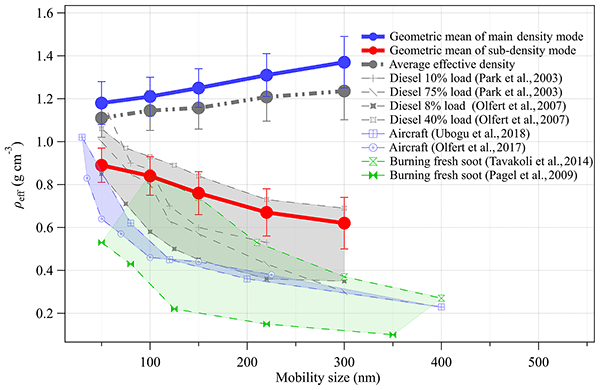
This study characterizes size-resolved particle effective densities and their evolution associated with emissions and aging processes in a rural area of the North China Plain. Particle effective density exhibits a high-frequency bimodal distribution, and two density modes exhibit opposite trends with increasing particle size. SIA and BC mass fractions are key factors of particle effective density, and a value of 0.6 g cm−3 is appropriate to represent BC effective density in bulk particles.
Xiaoyi Zhang, Wanyun Xu, Weili Lin, Gen Zhang, Jinjian Geng, Li Zhou, Huarong Zhao, Sanxue Ren, Guangsheng Zhou, Jianmin Chen, and Xiaobin Xu
Atmos. Chem. Phys., 24, 12323–12340, https://doi.org/10.5194/acp-24-12323-2024, https://doi.org/10.5194/acp-24-12323-2024, 2024
Short summary
Short summary
Ozone (O3) deposition is a key process that removes surface O3, affecting air quality, ecosystems and climate change. We conducted O3 deposition measurement over a wheat canopy using a newly relaxed eddy accumulation flux system. Large variabilities in O3 deposition were detected, mainly determined by crop growth and modulated by various environmental factors. More O3 deposition observations over different surfaces are needed for exploring deposition mechanisms and model optimization.
Jiangchuan Tao, Biao Luo, Weiqi Xu, Gang Zhao, Hanbin Xu, Biao Xue, Miaomiao Zhai, Wanyun Xu, Huarong Zhao, Sanxue Ren, Guangsheng Zhou, Li Liu, Ye Kuang, and Yele Sun
Atmos. Chem. Phys., 24, 9131–9154, https://doi.org/10.5194/acp-24-9131-2024, https://doi.org/10.5194/acp-24-9131-2024, 2024
Short summary
Short summary
Using simultaneous measurements of DMA–CCNC, H(/V)TDMA, and DMA–SP2, impacts of primary emissions and secondary aerosol formations on changes in aerosol physicochemical properties were comprehensively investigated. It was found that intercomparisons among aerosol mixing-state parameters derived from different techniques can help us gain more insight into aerosol physical properties which, in turn, will aid the investigation of emission characteristics and secondary aerosol formation pathways.
Juan Hong, Min Tang, Qiaoqiao Wang, Nan Ma, Shaowen Zhu, Shaobin Zhang, Xihao Pan, Linhong Xie, Guo Li, Uwe Kuhn, Chao Yan, Jiangchuan Tao, Ye Kuang, Yao He, Wanyun Xu, Runlong Cai, Yaqing Zhou, Zhibin Wang, Guangsheng Zhou, Bin Yuan, Yafang Cheng, and Hang Su
Atmos. Chem. Phys., 23, 5699–5713, https://doi.org/10.5194/acp-23-5699-2023, https://doi.org/10.5194/acp-23-5699-2023, 2023
Short summary
Short summary
A comprehensive investigation of the characteristics of new particle formation (NPF) events was conducted at a rural site on the North China Plain (NCP), China, during the wintertime of 2018 by covering the particle number size distribution down to sub–3 nm. Potential mechanisms for NPF under the current environment were explored, followed by a further discussion on the factors governing the occurrence of NPF at this rural site compared with other regions (e.g., urban areas) in the NCP region.
Jingnan Shi, Juan Hong, Nan Ma, Qingwei Luo, Yao He, Hanbing Xu, Haobo Tan, Qiaoqiao Wang, Jiangchuan Tao, Yaqing Zhou, Shuang Han, Long Peng, Linhong Xie, Guangsheng Zhou, Wanyun Xu, Yele Sun, Yafang Cheng, and Hang Su
Atmos. Chem. Phys., 22, 4599–4613, https://doi.org/10.5194/acp-22-4599-2022, https://doi.org/10.5194/acp-22-4599-2022, 2022
Short summary
Short summary
In this study, we investigated the hygroscopicity of submicron aerosols at a rural site in the North China Plain during the winter of 2018, using a HTDMA and a CV-ToF-ACSM. We observed differences in aerosol hygroscopicity during two distinct episodes with different primary emissions and secondary aerosol formation processes. These results provide an improved understanding of the complex influence of sources and aerosol evolution processes on their hygroscopicity.
Yaqing Zhou, Nan Ma, Qiaoqiao Wang, Zhibin Wang, Chunrong Chen, Jiangchuan Tao, Juan Hong, Long Peng, Yao He, Linhong Xie, Shaowen Zhu, Yuxuan Zhang, Guo Li, Wanyun Xu, Peng Cheng, Uwe Kuhn, Guangsheng Zhou, Pingqing Fu, Qiang Zhang, Hang Su, and Yafang Cheng
Atmos. Chem. Phys., 22, 2029–2047, https://doi.org/10.5194/acp-22-2029-2022, https://doi.org/10.5194/acp-22-2029-2022, 2022
Short summary
Short summary
This study characterizes size-resolved particle effective densities and their evolution associated with emissions and aging processes in a rural area of the North China Plain. Particle effective density exhibits a high-frequency bimodal distribution, and two density modes exhibit opposite trends with increasing particle size. SIA and BC mass fractions are key factors of particle effective density, and a value of 0.6 g cm−3 is appropriate to represent BC effective density in bulk particles.
Cited articles
Arévalo, P., Bullock, E. L., Woodcock, C. E., and Olofsson, P.: A suite of tools for continuous land change monitoring in Google Earth Engine, Front. Clim., 2, 111051, https://doi.org/10.3389/fclim.2020.576740, 2020.
Badgley, G., Field, C. B., and Berry, J. A.: Canopy near-infrared reflectance and terrestrial photosynthesis, Sci. Adv., 3, e1602244, https://doi.org/10.1126/sciadv.1602244, 2017.
Bontemps, S., Defourny, P., Bogaert, E. V., Arino, O., Kalogirou, V., and Perez, J. R.: GLOBCOVER 2009 Products Description and Validation Report, http://due.esrin.esa.int/files/GLOBCOVER2009_Validation_Report_2.2.pdf (last access: 29 September 2024), 2010.
Breiman, L.: Random forests, Mach. Learn., 45, 5–32, https://doi.org/10.1023/A:1010933404324, 2001.
Brown, J. F., Tollerud, H. J., Barber, C. P., Zhou, Q., Dwyer, J. L., Vogelmann, J. E., Loveland, T. R., Woodcock, C. E., Stehman, S. V., Zhu, Z., Pengra, B. W., Smith, K., Horton, J. A., Xian, G., Auch, R. F., Sohl, T. L., Sayler, K. L., Gallant, A. L., Zelenak, D., Reker, R. R., and Rover, J.: Lessons learned implementing an operational continuous United States national land change monitoring capability: The Land Change Monitoring, Assessment, and Projection (LCMAP) approach, Remote Sens. Environ., 238, 111356, https://doi.org/10.1016/j.rse.2019.111356, 2020.
Chen, J., Chen, J., Liao, A., Cao, X., Chen, L., Chen, X., He, C., Han, G., Peng, S., Lu, M., Zhang, W., Tong, X., and Mills, J.: Global land cover mapping at 30 m resolution: A POK-based operational approach, ISPRS J. Photogram. Remote Sens., 103, 7–27, https://doi.org/10.1016/j.isprsjprs.2014.09.002, 2015.
Chen, W., Liu, L., Zhang, C., Wang, J., Wang, J., and Pan, Y.: Monitoring the seasonal bare soil areas in Beijing using multitemporal TM images, in: IGARSS 2004: 2004 IEEE International Geoscience and Remote Sensing Symposium, 20–24 September 2004, Anchorage, AK, 3379–3382, https://doi.org/10.1109/IGARSS.2004.1370429, 2004.
Crippen, R. E.: Calculating the vegetation index faster, Remote Sens. Environ., 34, 71–73, https://doi.org/10.1016/0034-4257(90)90085-z, 1990.
Curran, P. J.: Remote sensing of foliar chemistry, Remote Sens. Environ., 30, 271–278, https://doi.org/10.1016/0034-4257(89)90069-2, 1989.
Defourny, P., Bontemps, S., Lamarche, C., Brockmann, C., Boettcher, M., Wevers, J., and Kirches, G.: Land cover CCI: product user guide version 2.0, https://maps.elie.ucl.ac.be/CCI/viewer/download/ESACCI-LC-Ph2-PUGv2_2.0.pdf (last access: 18 November 2024), 2017.
Ding, Y. and Peng, S.: Spatiotemporal trends and attribution of drought across China from 1901–2100, Sustainability, 12, 477, https://doi.org/10.3390/su12020477, 2020.
Du, Z., Yu, L., Li, X., Zhao, J., Chen, X., Xu, Y., Yang, P., Yang, J., Peng, D., Xue, Y., and Gong, P.: Integrating remote sensing temporal trajectory and survey statistics to update land use/land cover maps, Int. J. Digit. Earth, 16, 4428–4445, https://doi.org/10.1080/17538947.2023.2274422, 2023.
Editorial Board of the Vegetation Map of China: Chinese Academy of Sciences, Vegetation Map of the People's Republic of China (1:1 000 000), Geology Publishing House, Beijing, China, ISBN 978-7116045132, 2007.
Farr, T. G., Rosen, P. A., Caro, E., Crippen, R. E., Duren, R., Hensley, S., Kobrick, M., Paller, M., Rodriguez, E., Roth, L., Seal, D., Shaffer, S., Shimada, J., Umland, J., Werner, M., Oskin, M., Burbank, D., and Alsdorf, D.: The shuttle radar topography mission, Rev. Geophys., 45, RG2004, https://doi.org/10.1029/2005RG000183, 2007.
Feng, M. and Li, X.: Land cover mapping toward finer scales, Sci. Bull., 65, 1604–1606, https://doi.org/10.1016/j.scib.2020.06.014, 2020.
Feng, M., Huang, C., Channan, S., Vermote, E. F., Masek, J. G., and Townshend, J. R.: Quality assessment of Landsat surface reflectance products using MODIS data, Comput. Geosci., 38, 9–22, https://doi.org/10.1016/j.cageo.2011.04.011, 2012.
Friedl, M. and Sulla-Menashe, D.: MODIS/Terra+Aqua Land Cover Type Yearly L3 Global 500 m SIN Grid V061, NASA EOSDIS Land Processes Distributed Active Archive Center [data set], https://doi.org/10.5067/MODIS/MCD12Q1.061, 2022.
Friedl, M. A., Sulla-Menashe, D., Tan, B., Schneider, A., Ramankutty, N., Sibley, A., and Huang, X.: MODIS Collection 5 global land cover: Algorithm refinements and characterization of new datasets, Remote Sens. Environ., 114, 168–182, https://doi.org/10.1016/j.rse.2009.08.016, 2010.
Gao, B. C.: NDWI – A normalized difference water index for remote sensing of vegetation liquid water from space, Remote Sens. Environ., 58, 257–266, https://doi.org/10.1016/S0034-4257(96)00067-3, 1996.
Gong, P., Wang, J., Yu, L., Zhao, Y., Zhao, Y., Liang, L., Niu, Z., Huang, X., Fu, H., Liu, S., Li, C., Li, X., Fu, W., Liu, C., Xu, Y., Wang, X., Cheng, Q., Hu, L., Yao, W., Zhang, H., Zhu, P., Zhao, Z., Zhang, H., Zheng, Y., Ji, L., Zhang, Y., Chen, H., Yan, A., Guo, J., Yu, L., Wang, L., Liu, X., Shi, T., Zhu, M., Chen, Y., Yang, G., Tang, P., Xu, B., Giri, C., Clinton, N., Zhu, Z., Chen, J., and Chen, J.: Finer resolution observation and monitoring of global land cover: First mapping results with Landsat TM and ETM+ data, Int. J. Remote Sens., 34, 2607–2654, https://doi.org/10.1080/01431161.2012.748992, 2013.
Gong, P., Liu, H., Zhang, M., Li, C., Wang, J., Huang, H., Clinton, N., Ji, L., Li, W., Bai, Y., Chen, B., Xu, B., Zhu, Z., Yuan, C., Suen, H., Guo, J., Xu, N., Li, W., Zhao, Y., Yang, J., Yu, C., Wang, X., Fu, H., Yu, L., Dronova, I., Hui, F., Cheng, X., Shi, X., Xiao, F., Liu, Q., and Song, L.: Stable classification with limited sample: Transferring a 30-m resolution sample set collected in 2015 to mapping 10-m resolution global land cover in 2017, Sci. Bull., 64, 370–373, https://doi.org/10.1016/j.scib.2019.03.002, 2019.
Gorelick, N., Hancher, M., Dixon, M., Ilyushchenko, S., Thau, D., and Moore, R.: Google Earth Engine: Planetary-scale geospatial analysis for everyone, Remote Sens. Environ., 202, 18–27, https://doi.org/10.1016/j.rse.2017.06.031, 2017.
Hall, D. K., Riggs, G. A., and Salomonson, V. V.: Development of methods for mapping global snow cover using moderate resolution imaging spectroradiometer data, Remote Sens. Environ., 54, 127–140, https://doi.org/10.1016/0034-4257(95)00137-P, 1995.
Hu, M., Zhou, G., Lv, X., Zhou, L., Wang, X., He, X., and Tian, Z.: Warming Has Accelerated the Melting of Glaciers on the Tibetan Plateau, but the Debris-Covered Glaciers Are Rapidly Expanding, Remote Sens., 15, 132, https://doi.org/10.3390/rs15010132, 2023.
Huete, A., Justice, C., and Van Leeuwen, W.: MODIS vegetation index (MOD13), Algorithm theoretical basis document, https://www.cen.uni-hamburg.de/en/icdc/data/land/docs-land/modis-collection6-vegetation-index-atbd-mod13-v03-1.pdf (last access: 18 November 2024), 1999.
Huete, A. R.: A soil-adjusted vegetation index (SAVI), Remote Sens. Environ., 25, 295–309, https://doi.org/10.1016/0034-4257(88)90106-X, 1988.
Immerzeel, W. W., Van Beek, L. P. H., and Bierkens, M. F. P.: Climate change will affect the Asian water towers, Science, 328, 1382–1385, https://doi.org/10.1126/science.1183188, 2010.
James, G., Witten, D., Hastie, T., and Tibshirani, R.: An introduction to statistical learning, Springer, https://doi.org/10.1007/978-1-0716-1418-1, 2013.
Keshri, A. K., Shukla, A., and Gupta, R. P.: ASTER ratio indices for supraglacial terrain mapping, Int. J. Remote Sens., 30, 519–524, https://doi.org/10.1080/01431160802385459, 2009.
Li, C., Peng, G., Wang, J., Zhu, Z., Biging, G. S., Yuan, C., Hu, T., Zhang, H., Wang, Q., Li, X., Liu, X., Xu, Y., Guo, J., Liu, C., Hackman, K. O., Zhang, M., Cheng, Y., Yu, L., Yang, J., Huang, H., and Clinton, N.: The first all-season sample set for mapping global land cover with Landsat-8 data, Sci. Bull., 62, 508–515, https://doi.org/10.1016/j.scib.2017.03.011, 2017.
Li, X., Gong, P., and Liang, L.: A 30-year (1984–2013) record of annual urban dynamics of Beijing City derived from Landsat data, Remote Sens. Environ., 166, 78–90, https://doi.org/10.1016/j.rse.2015.06.007, 2015.
Li, Y., Hou, Z., Zhang, L., Song, C., Piao, S., Lin, J., Peng, S., Fang, K., Yang, J., Qu, Y., Wang, Y., Li, J., Li, R., and Yao, X.: Rapid expansion of wetlands on the Central Tibetan Plateau by global warming and El Niño, Sci. Bull., 68, 485–488, https://doi.org/10.1016/j.scib.2023.02.021, 2023.
Liu, H., Gong, P., Wang, J., Wang, X., Ning, G., and Xu, B.: Production of global daily seamless data cubes and quantification of global land cover change from 1985 to 2020-iMap World 1.0, Remote Sens. Environ., 258, 112364, https://doi.org/10.1016/j.rse.2021.112364, 2021a.
Liu, L., Gao, Y., Zhang, X., Chen, X., and Xie, S.: A Dataset of Global Land Cover Validation Samples, Zenodo [data set], https://doi.org/10.5281/zenodo.3551995, 2019.
Liu, L., Zhang, X., Gao, Y., Chen, X., Shuai, X., and Mi, J.: Finer Resolution Mapping of Global Land Cover: Recent Developments, Consistency Analysis, and Prospects, J. Remote Sens., 2021, 5289697, https://doi.org/10.34133/2021/5289697, 2021b.
Liu, L., Zhang, X., and Zhao, T.: GLC_FCS30D: the first global 30-m land-cover dynamic monitoring product with fine classification system from 1985 to 2022, Zenodo [data set], https://doi.org/10.5281/zenodo.8239305, 2023.
Lobell, D. B., Thau, D., Seifert, C., Engle, E., and Little, B.: A scalable satellite-based crop yield mapper, Remote Sens. Environ., 164, 324–333, https://doi.org/10.1016/j.rse.2015.04.021, 2015.
McFeeters, S. K.: The use of the Normalized Difference Water Index (NDWI) in the delineation of open water features, Int. J. Remote Sens., 17, 1425–1432, https://doi.org/10.1080/01431169608948714, 1996.
National Tibetan Plateau/Third Pole Environment Data Center: Data bank for Tibetan Plateau research projects, https://data.tpdc.ac.cn (last access: 29 September 2024), 2024.
Ngabire, M., Wang, T., Xue, X., Liao, J., Sahbeni, G., Huang, C., Duan, H., and Song, X.: Soil salinization mapping across different sandy land-cover types in the Shiyang River Basin: A remote sensing and multiple linear regression approach, Remote Sens. Appl. Soc. Environ., 28, 100847, https://doi.org/10.1016/j.rsase.2022.100847, 2022.
Pasquarella, V. J., Arévalo, P., Bratley, K. H., Bullock, E. L., Gorelick, N., Yang, Z., and Kennedy, R. E.: Demystifying LandTrendr and CCDC temporal segmentation, Int. J. Appl. Earth Obs., 110, 102806, https://doi.org/10.1016/j.jag.2022.102806, 2022.
Peng, S.: 1-km monthly mean temperature dataset for China (1901–2023), TPDC [data set], https://doi.org/10.11888/Meteoro.tpdc.270961, 2019.
Peng, S.: 1-km monthly precipitation dataset for China (1901–2023), TPDC [data set], https://doi.org/10.5281/zenodo.3114194, 2020.
Peng, S., Gang, C., Cao, Y., and Chen, Y.: Assessment of climate change trends over the Loess Plateau in China from 1901 to 2100, Int. J. Climatol., https://doi.org/10.1002/joc.5331, 2017a.
Peng, S., Ding, Y., Wen, Z., Chen, Y., Cao, Y., and Ren, J.: Spatiotemporal change and trend analysis of potential evapotranspiration over the Loess Plateau of China during 2011–2100, Agr. Forest Meteorol., 233, 183–194, https://doi.org/10.1016/j.agrformet.2016.11.129, 2017b.
Peng, S., Ding, Y., Liu, Z., and Li, Z.: 1 km monthly temperature and precipitation dataset for China from 1901 to 2017, Earth Syst. Sci. Data, 11, 1931–1946, https://doi.org/10.5194/essd-11-1931-2019, 2019.
Peng Cheng Laboratory: Star Cloud Data Service Platform, https://data-starcloud.pcl.ac.cn/resource/54 (last access: 29 September 2024), 2024.
Ramosaj, B. and Pauly, M.: Consistent estimation of residual variance with random forest Out-Of-Bag errors, Stat. Probabil. Lett., 151, 49–57, https://doi.org/10.1016/j.spl.2019.03.017, 2019.
Roujean, J. L. and Breon, F. M.: Estimating PAR absorbed by vegetation from bidirectional reflectance measurements, Remote Sens. Environ., 51, 375–384, https://doi.org/10.1016/0034-4257(94)00114-3, 1995.
Shimizu, K., Ota, T., and Mizoue, N.: Detecting Forest Changes Using Dense Landsat 8 and Sentinel-1 Time Series Data in Tropical Seasonal Forests, Remote Sens., 11, 1899, https://doi.org/10.3390/rs11161899, 2019.
Sulla-Menashe, D., Gray, J. M., Abercrombie, S. P., and Friedl, M. A.: Hierarchical mapping of annual global land cover 2001 to present: The MODIS Collection 6 Land Cover product, Remote Sens. Environ., 222, 183–194, https://doi.org/10.1016/j.rse.2018.12.013, 2019.
Tang, X., Bullock, E. L., Olofsson, P., Estel, S., and Woodcock, C. E.: Near real-time monitoring of tropical forest disturbance: New algorithms and assessment framework, Remote Sens. Environ., 224, 202-218, https://doi.org/10.1016/j.rse.2019.02.003, 2019.
Tucker, C. J.: Red and photographic infrared linear combinations for monitoring vegetation, Remote Sens. Environ., 8, 127–150, https://doi.org/10.1016/0034-4257(79)90013-0, 1979.
Vermote, E.: MODIS/Terra Surface Reflectance 8-Day L3 Global 500 m SIN Grid V061, NASA EOSDIS Land Processes Distributed Active Archive Center [data set], https://doi.org/10.5067/MODIS/MOD09A1.061, 2021.
Vermote, E. F., Roger, J. C., and Ray, J. P.: MODIS Surface Reflectance User's Guide, USGS, https://lpdaac.usgs.gov/documents/306/MOD09_User_Guide_V6.pdf (last access: 18 November 2024), 2015.
Wang, Y., Sun, J., He, W., Ye, C., Liu, B., Chen, Y., Zeng, T., Ma, S., Gan, X., Miao, C., Zhou, H., and Tsunekawa, A.: Migration of vegetation boundary between alpine steppe and meadow on a century-scale across the Tibetan Plateau, Ecol. Indicat., 136, 108599, https://doi.org/10.1016/j.ecolind.2022.108599, 2022.
Wang, Y., Xue, K., Hu, R., Ding, B., Zeng, H., Li, R., Xu, B., Pang, Z., Song, X., Li, C., Du, J., Yang, X., Zhang, Z., Hao, Y., Cui, X., Guo, K., Gao, Q., Zhang, Y., Zhu, J., Sun, J., Li, Y., Jiang, L., Zhou, H., Luo, C., Zhang, Z., Gao, Q., Chen, S., Ji, B., Xu, X., Chen, H., Li, Q., Zhao, L., Xu, S., Liu, Y., Hu, L., Wu, J., Yang, Q., Dong, S., He, J., Zhao, X., Wang, S., Piao, S., Yu, G., and Fu, B.: Vegetation structural shift tells environmental changes on the Tibetan Plateau over 40 years, Sci. Bull., 68, 1928–1937, https://doi.org/10.1016/j.scib.2023.07.035, 2023.
Wang, Z., Wang, Q., Zhao, L., Wu, X., Yue, G., Zou, D., Nan, Z., Liu, G., Pang, Q., Fang, H., Wu, T., Shi, J., Jiao, K., Zhao, Y., and Zhang, L.: Mapping the vegetation distribution of the permafrost zone on the Qinghai-Tibet Plateau, J. Mt. Sci., 13, 1035–1046, https://doi.org/10.1007/s11629-015-3485-y, 2016.
Wu, F., Ren, H., and Zhou, G.: The 30 m vegetation maps from 1990 to 2020 in the Tibetan Plateau, Sci. Data, 11, 804, https://doi.org/10.1038/s41597-024-03649-7, 2024.
Xian, G. Z., Smith, K., Wellington, D., Horton, J., Zhou, Q., Li, C., Auch, R., Brown, J. F., Zhu, Z., and Reker, R. R.: Implementation of the CCDC algorithm to produce the LCMAP Collection 1.0 annual land surface change product, Earth Syst. Sci. Data, 14, 143–162, https://doi.org/10.5194/essd-14-143-2022, 2022.
Xiao, X., Hollinger, D., Aber, J., Goltz, M., Davidson, E. A., Zhang, Q., and Moore III, B.: Satellite-based modeling of gross primary production in an evergreen needleleaf forest, Remote Sens. Environ., 89, 519–534, https://doi.org/10.1016/j.rse.2003.11.008, 2004.
Xu, H.: A new index for delineating built-up land features in satellite imagery, Int. J. Remote Sens., 29, 4269–4276, https://doi.org/10.1080/01431160802039957, 2008.
Yang, J. and Huang, X.: The 30 m annual land cover dataset and its dynamics in China from 1990 to 2019, Earth Syst. Sci. Data, 13, 3907–3925, https://doi.org/10.5194/essd-13-3907-2021, 2021.
Yang, J. and Huang, X.: The 30 m annual land cover datasets and its dynamics in China from 1985 to 2022, Zenodo [data set], https://doi.org/10.5281/zenodo.8176941, 2023.
Yao, T., Thompson, L. G., Mosbrugger, V., Zhang, F., Ma, Y., Luo, T., Xu, B., Yang, X., Joswiak, D. R., Wang, W., Joswiak, M. E., Devkota, L. P., Tayal, S., Jilani, R., and Fayziev, R.: Third pole environment (TPE), Environ. Dev., 3, 52–64, https://doi.org/10.1016/j.envdev.2012.04.002, 2012.
Yu, B., Lv, C., Lv, T., Yang, A., and Liu, C.: Datasets of the boundary and area of the Tibetan Plateau, Acta Geogr. Sin., 69, 65–68, https://doi.org/10.11821/dlxb2014S012, 2014.
Zha, Y., Gao, J., and Ni, S.: Use of normalized difference built-up index in automatically mapping urban areas from TM imagery, Int. J. Remote Sens., 24, 583–594, https://doi.org/10.1080/01431160304987, 2003.
Zhang, C., Zhang, H., and Tian, S.: Phenology-assisted supervised paddy rice mapping with the Landsat imagery on Google Earth Engine: Experiments in Heilongjiang Province of China from 1990 to 2020, Comput. Electron. Agric., 212, 108105, https://doi.org/10.1016/j.compag.2023.108105, 2023.
Zhang, G., Luo, W., Chen, W., and Zheng, G.: A robust but variable lake expansion on the Tibetan Plateau, Sci. Bull., 64, 1306–1309, https://doi.org/10.1016/j.scib.2019.07.018, 2019a.
Zhang, H., Zhao, C., and Zhu, W.: A new vegetation map for Qinghai-Tibet Plateau by integrated classification from multi-source data products (2020), TPDC [data set], https://doi.org/10.11888/Terre.tpdc.271997, 2021a.
Zhang, J., Okin, G. S., and Zhou, B.: Assimilating optical satellite remote sensing images and field data to predict surface indicators in the Western US: Assessing error in satellite predictions based on large geographical datasets with the use of machine learning, Remote Sens. Environ., 233, 111382, https://doi.org/10.1016/j.rse.2019.111382, 2019b.
Zhang, L., Shen, M., Yang, Z., Wang, Y., and Chen, J.: Spatial variations in the difference in elevational shifts between greenness and temperature isolines across the Tibetan Plateau grasslands under warming, Sci. Total Environ., 906, 167715, https://doi.org/10.1016/j.scitotenv.2023.167715, 2024a.
Zhang, X., Liu, L., Chen, X., Gao, Y., Xie, S., and Mi, J.: GLC_FCS30: global land-cover product with fine classification system at 30 m using time-series Landsat imagery, Earth Syst. Sci. Data, 13, 2753–2776, https://doi.org/10.5194/essd-13-2753-2021, 2021b.
Zhang, X., Liu, L., Chen, X., Xie, S., and Gao, Y.: Fine land-cover mapping in China using Landsat datacube and an operational SPECLib-based approach, Remote Sens., 11, 1056, https://doi.org/10.3390/rs11091056, 2019c.
Zhang, X., Zhao, T., Xu, H., Liu, W., Wang, J., Chen, X., and Liu, L.: GLC_FCS30D: the first global 30 m land-cover dynamics monitoring product with a fine classification system for the period from 1985 to 2022 generated using dense-time-series Landsat imagery and the continuous change-detection method, Earth Syst. Sci. Data, 16, 1353–1381, https://doi.org/10.5194/essd-16-1353-2024, 2024b.
Zhang, Y.: Integration dataset of Tibet Plateau boundary, TPDC [data set], https://doi.org/10.11888/Geogra.tpdc.270099, 2019.
Zhang, Y., Li, B., Liu, L., and Zheng, D.: Redetermine the region and boundaries of Tibetan Plateau, Geogr. Res., 40, 1543–1553, https://doi.org/10.11821/dlyj020210138, 2021c.
Zhang, Y., Liu, L., Li, B., and Zheng, D.: Boundary Data of the Tibetan Plateau (2021 Version), Digital Journal of Global Change Data Repository [data set], https://doi.org/10.3974/geodb.2021.07.10.V1, 2021d.
Zhang, Y., Liu, L., Li, B., and Zheng, D.: Comparison of boundary datasets covering Tibetan Plateau between 2021 and 2014 versions, J. Global Change Data Discov., 5, 322–332, https://doi.org/10.3974/geodp.2021.03.10, 2021e.
Zhou, G., Ren, H., Liu, T., Zhou, L., Ji, Y., Song, X., and Lv, X.: Vegetation map of Qinghai Tibet Plateau in 2020 with 10 m spatial resolution, TPDC [data set], https://doi.org/10.11888/Terre.tpdc.272408, 2022a.
Zhou, G., Ren, H., Liu, T., Zhou, L., Ji, Y., Song, X., and Lv, X.: A new regional vegetation mapping method based on terrain-climate-remote sensing and its application on the Qinghai-Xizang Plateau, Sci. China Earth Sci., 66, 237–246, https://doi.org/10.1007/s11430-022-1006-1, 2023.
Zhou, G., Ren, H., Zhang, L., Lv, X., and Zhou, M.: 500 m annual vegetation maps of Qinghai Tibet Plateau (2000–2022), TPDC [data set], https://doi.org/10.11888/Terre.tpdc.301205, 2024.
Zhou, J., Zheng, Y., Song, C., Cheng, C., Gao, P., Shen, S., and Ye, S.: Vegetation map of Qinghai Tibet Plateau in 1980s, TPDC [data set], https://doi.org/10.11888/Terre.tpdc.272385, 2022b.
Zhu, Z. and Woodcock, C. E.: Continuous change detection and classification of land cover using all available Landsat data, Remote Sens. Environ., 144, 152–171, https://doi.org/10.1016/j.rse.2014.01.011, 2014.
Zhu, Z., Zhang, J., Yang, Z., Aljaddani, A. H., Cohen, W. B., Qiu, S., and Zhou, C.: Continuous monitoring of land disturbance based on Landsat time series, Remote Sens. Environ., 238, 111116, https://doi.org/10.1016/j.rse.2019.03.009, 2019.
Short summary
This study developed a new approach to long-time continuous annual vegetation mapping from remote sensing imagery, and mapped the vegetation of the Qinghai–Tibet Plateau (QTP) from 2000 to 2022 using the MOD09A1 product. The overall accuracy of continuous annual QTP vegetation mapping reached 83.3%, with the reference annual 2020 data reaching an accuracy of 83.3% and a kappa coefficient of 0.82. The study supports the use of remote sensing data to mapping long-time continuous annual vegetation.
This study developed a new approach to long-time continuous annual vegetation mapping from...


Altmetrics
Final-revised paper
Preprint