Articles | Volume 18, issue 5
https://doi.org/10.5194/essd-18-3449-2026
© Author(s) 2026. This work is distributed under
the Creative Commons Attribution 4.0 License.
the Creative Commons Attribution 4.0 License.
https://doi.org/10.5194/essd-18-3449-2026
© Author(s) 2026. This work is distributed under
the Creative Commons Attribution 4.0 License.
the Creative Commons Attribution 4.0 License.
Data description article
| 
21 May 2026
Data description article |
| 21 May 2026
| 21 May 2026
A temporally consistent global 500 m-resolution monthly VIIRS-like nighttime light dataset (1992–2024)
Hongquan Cheng
Pengcheng Laboratory, Shenzhen 518000, China
Department of Geography, The University of Hong Kong, Hong Kong, SAR, China
Mengqing Geng
College of Land Science and Technology, China Agricultural University, Beijing 100083, China

Guangdong Key Laboratory for Urbanization and Geo-simulation, School of Geography and Planning, Sun Yat-sen University, Guangzhou 510006, China
Second correspondence author
Shijie Li
Department of Geography, The University of Hong Kong, Hong Kong, SAR, China
Faculty of Geographical Science, Beijing Normal University, Beijing 100875, China
Chen Lin
Institute for Climate and Carbon Neutrality, The University of Hong Kong, Hong Kong, SAR, China
Faculty of Business and Economics, The University of Hong Kong, Hong Kong, SAR, China
Jie Wang
Pengcheng Laboratory, Shenzhen 518000, China
Peng Gong
Department of Geography, The University of Hong Kong, Hong Kong, SAR, China
Institute for Climate and Carbon Neutrality, The University of Hong Kong, Hong Kong, SAR, China
Yuyu Zhou
CORRESPONDING AUTHOR
Department of Geography, The University of Hong Kong, Hong Kong, SAR, China
Institute for Climate and Carbon Neutrality, The University of Hong Kong, Hong Kong, SAR, China
SRT AI, Society & Social Dynamics, Faculty of Social Sciences, The University of Hong Kong, Hong Kong, SAR, China
First correspondence author
Related authors
No articles found.
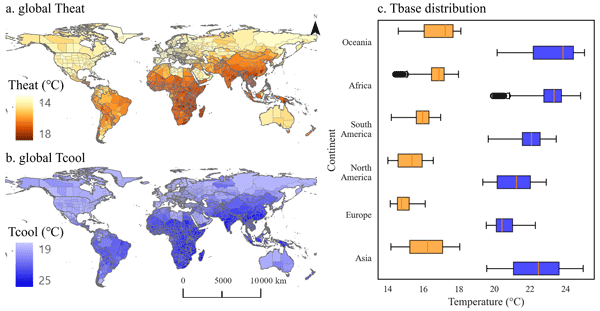
Xiujuan He, Jiyong Eom, Sha Yu, Shu Liu, Wenru Xu, and Yuyu Zhou
Earth Syst. Sci. Data, 18, 7417–7454, https://doi.org/10.5194/essd-18-7417-2026, https://doi.org/10.5194/essd-18-7417-2026, 2026
Short summary
Short summary
Buildings use large amounts of energy for heating and cooling. Cutting carbon emissions requires accurate forecasts of that demand, which depends on knowing the outdoor temperature at which buildings switch on heating or cooling. We combined energy use records with climate information and applied machine learning to create the first global dataset of these thresholds across many regions. It improves energy demand predictions by about 10 %, supporting smarter energy planning and climate policy.
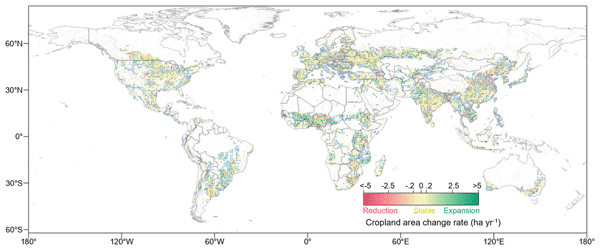
Yuanhong Liao, Shuang Chen, Yuqi Bai, Jie Wang, and Peng Gong
Earth Syst. Sci. Data, 18, 7071–7096, https://doi.org/10.5194/essd-18-7071-2026, https://doi.org/10.5194/essd-18-7071-2026, 2026
Short summary
Short summary
To track changes in land used for crops, we used satellite observations to create annual global maps for 2000–2024 at a resolution of 30 m. The global area used for crops increased by about 30 million hectares. Expansion was concentrated in parts of Africa and South America, while many other regions showed stability or decline. These maps help track agricultural land use and support research on food security and environmental change.
Dinoo Gunasekera, Zhongchang Sun, Wenjie Du, Jian Gao, Yunpeng Zhang, Yuyu Zhou, Robert Ndugwa, and Huadong Guo
Earth Syst. Sci. Data Discuss., https://doi.org/10.5194/essd-2026-381, https://doi.org/10.5194/essd-2026-381, 2026
Preprint under review for ESSD
Short summary
Short summary
Urban areas are expanding rapidly worldwide, but inconsistent definitions make cities hard to compare. This study created a new dataset mapping urban built-up areas for 1,611 cities from 2000 to 2025 using satellite imagery and population data. A unified definition of urban settlements allows fair comparisons across countries and time. The results show how land consumption and population growth are linked across regions, supporting global monitoring of sustainable development.
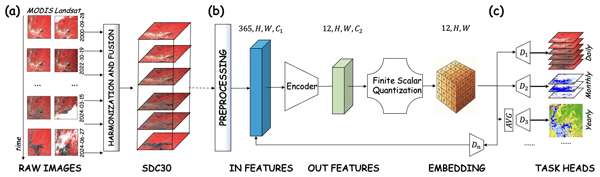
Shuang Chen, Jie Wang, Shuai Yuan, Jiayang Li, Yu Xia, Yuanhong Liao, Junbo Wei, Jincheng Yuan, Xiaoqing Xu, Xiaolin Zhu, Peng Zhu, Hongsheng Zhang, Yuyu Zhou, Haohuan Fu, Huabing Huang, Bin Chen, Fan Dai, and Peng Gong
Earth Syst. Sci. Data, 18, 5375–5398, https://doi.org/10.5194/essd-18-5375-2026, https://doi.org/10.5194/essd-18-5375-2026, 2026
Short summary
Short summary
Monitoring our planet with satellites produces massive datasets too large for researchers to handle. We created a new global database that condenses 25 years of Landsat and MODIS observations into a highly efficient format (Analysis-ready embedding vectors) using AI. By reducing data size by over 340 times while maintaining high accuracy, we allow global studies to be run on standard PC. Makes planetary research accessible to everyone and helps us better track environmental changes over time.

Yizhi Zhang, Yi Wang, Quanhua Dong, Xiao-Jian Chen, Fan Zhang, Xuecao Li, and Yu Liu
Earth Syst. Sci. Data, 18, 5329–5355, https://doi.org/10.5194/essd-18-5329-2026, https://doi.org/10.5194/essd-18-5329-2026, 2026
Short summary
Short summary
China’s cities have transformed dramatically over the past 30 years. Using multi-source satellite data and machine learning, this study maps annual building heights at 30-meter detail from 1990 to 2019, revealing both horizontal and vertical urban growth. The open dataset offers new insights into how Chinese cities expand and renew, supporting research and planning for urban development.
Yanan Wen, Tuo Chen, Xuecao Li, Tiecheng Bai, Ke Yao, Liheng Zhong, Han Chen, Meiling Liu, Xieqin Huang, Shunlin Liang, Shuangxi Miao, and Jianxi Huang
Earth Syst. Sci. Data Discuss., https://doi.org/10.5194/essd-2026-347, https://doi.org/10.5194/essd-2026-347, 2026
Revised manuscript accepted for ESSD
Short summary
Short summary
We developed a new method to track winter wheat growth across the world from 2001 to 2020. Using satellite data, we produced high-resolution maps (1 km) that show exactly where and how much winter wheat was planted over the last two decades. The results proved to be highly accurate when compared against international agricultural records. As the first long-term, global view of its kind, this map series is a vital tool for scientists and policymakers working to eliminate hunger.
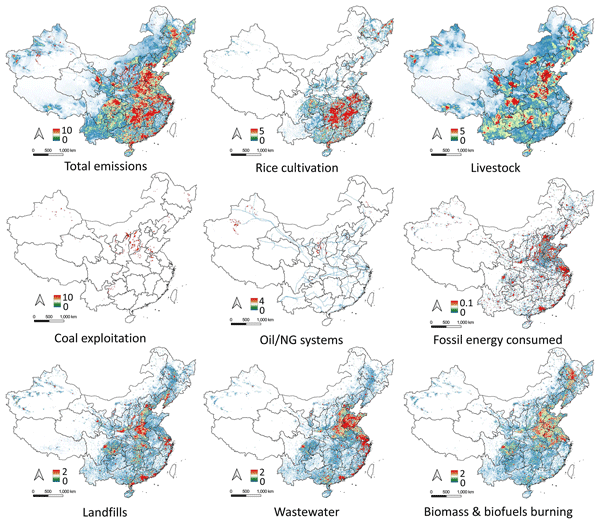
Fengxiang Guo, Fan Dai, Peng Gong, and Yuyu Zhou
Earth Syst. Sci. Data, 17, 4799–4819, https://doi.org/10.5194/essd-17-4799-2025, https://doi.org/10.5194/essd-17-4799-2025, 2025
Short summary
Short summary
China, the world’s largest methane emitter, faces challenges in accurately tracking. CHN-CH4, a map of anthropogenic methane emissions was created by combining satellite data, national statistics, and climate guidelines. Over 30 years, China emitted about 1157 Tg of methane, peaking in the 2010s. Shanxi province had the highest emissions. CHN-CH4 helps improve tracking, informs global climate models, and strengthens collaboration between science and policy to combat climate change.
Yishuo Cui, Shouzhi Chen, Yufeng Gong, Mingwei Li, Zitong Jia, Yuyu Zhou, and Yongshuo H. Fu
Earth Syst. Sci. Data, 17, 4005–4022, https://doi.org/10.5194/essd-17-4005-2025, https://doi.org/10.5194/essd-17-4005-2025, 2025
Short summary
Short summary
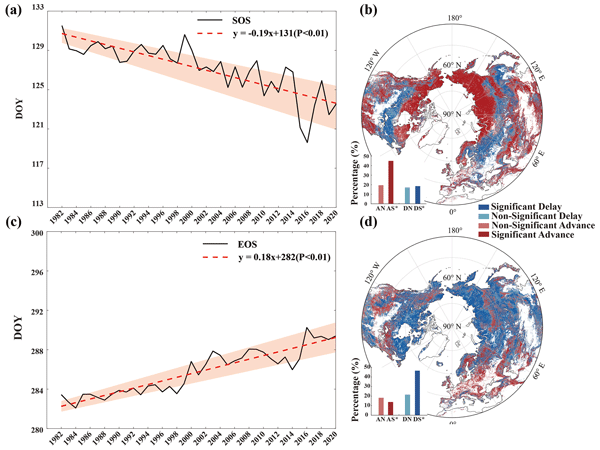
Global changes have significantly altered vegetation phenology, affecting terrestrial carbon cycles. While various remote-sensing-based phenology datasets exist, they often suffer from inconsistencies and uncertainties. To address this, we developed a new phenology dataset spanning 1982–2020 using a reliability ensemble averaging method. Validated against ground data, our dataset demonstrates substantially improved accuracy, providing a novel and reliable source for global ecological studies.
Yifan Cheng, Lei Zhao, TC Chakraborty, Keith Oleson, Matthias Demuzere, Xiaoping Liu, Yangzi Che, Weilin Liao, Yuyu Zhou, and Xinchang “Cathy” Li
Earth Syst. Sci. Data, 17, 2147–2174, https://doi.org/10.5194/essd-17-2147-2025, https://doi.org/10.5194/essd-17-2147-2025, 2025
Short summary
Short summary
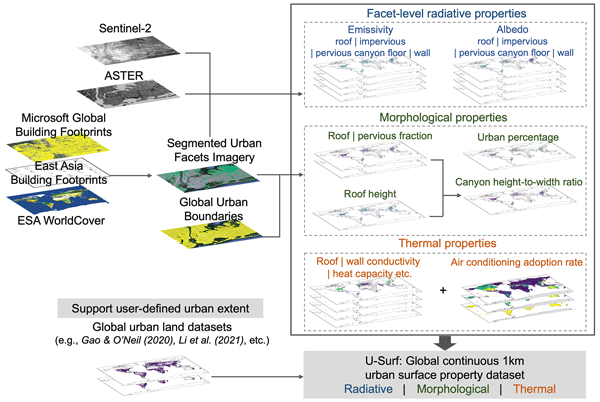
The absence of globally consistent and spatially continuous urban surface input has long hindered large-scale high-resolution urban climate modeling. Using remote sensing, cloud computing, and machine learning, we developed U-Surf, a 1 km dataset providing key urban surface properties worldwide. U-Surf enhances urban representation across scales and supports kilometer-scale urban-resolving Earth system modeling unprecedentedly, with broader applications in urban studies and beyond.
Kaiqi Du, Guilong Xiao, Jianxi Huang, Xiaoyan Kang, Xuecao Li, Yelu Zeng, Quandi Niu, Haixiang Guan, and Jianjian Song
Earth Syst. Sci. Data Discuss., https://doi.org/10.5194/essd-2024-432, https://doi.org/10.5194/essd-2024-432, 2025
Manuscript not accepted for further review
Short summary
Short summary
In this manuscript, we developed a 500-m spatial resolution monthly SIF dataset for the China region (CNSIF) from 2003 to 2022 based on high-resolution apparent reflectance and thermal infrared data. The comparison of CNSIF with tower-based SIF observations, tower-based GPP observations, MODIS GPP products, and other SIF datasets has validated CNSIF's ability to capture photosynthetic activity across different vegetation types and its potential for estimating carbon fluxes.
Shuang Chen, Jie Wang, Qiang Liu, Xiangan Liang, Rui Liu, Peng Qin, Jincheng Yuan, Junbo Wei, Shuai Yuan, Huabing Huang, and Peng Gong
Earth Syst. Sci. Data, 16, 5449–5475, https://doi.org/10.5194/essd-16-5449-2024, https://doi.org/10.5194/essd-16-5449-2024, 2024
Short summary
Short summary
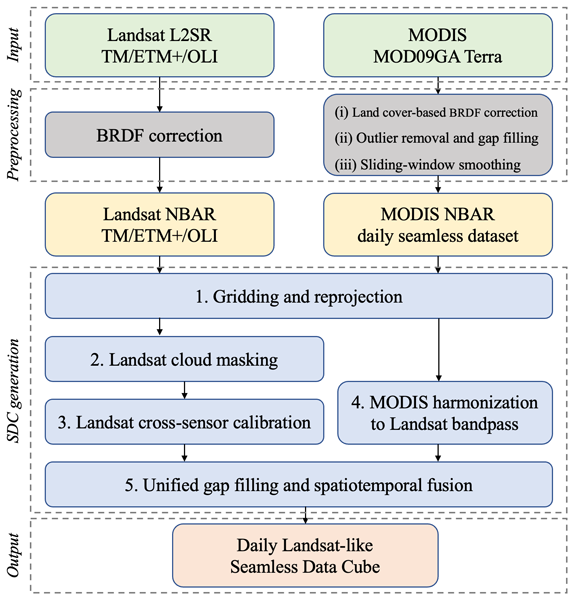
The inconsistent coverage of Landsat data due to its long revisit intervals and frequent cloud cover poses challenges to large-scale land monitoring. We developed a global 30 m 23-year (2000–2022) daily seamless data cube (SDC) of surface reflectance based on Landsat 5, 7, 8, and 9 and MODIS products. The SDC exhibits enhanced capabilities for monitoring land cover changes and robust consistency in both spatial and temporal dimensions, which are important for global environmental monitoring.
Yangzi Che, Xuecao Li, Xiaoping Liu, Yuhao Wang, Weilin Liao, Xianwei Zheng, Xucai Zhang, Xiaocong Xu, Qian Shi, Jiajun Zhu, Honghui Zhang, Hua Yuan, and Yongjiu Dai
Earth Syst. Sci. Data, 16, 5357–5374, https://doi.org/10.5194/essd-16-5357-2024, https://doi.org/10.5194/essd-16-5357-2024, 2024
Short summary
Short summary
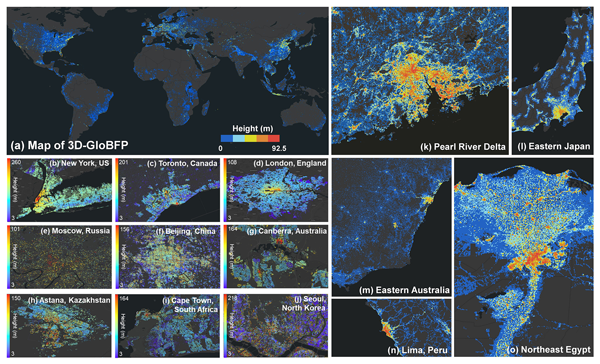
Most existing building height products are limited with respect to either spatial resolution or coverage, not to mention the spatial heterogeneity introduced by global building forms. Using Earth Observation (EO) datasets for 2020, we developed a global height dataset at the individual building scale. The dataset provides spatially explicit information on 3D building morphology, supporting both macro- and microanalysis of urban areas.
Ying Tu, Shengbiao Wu, Bin Chen, Qihao Weng, Yuqi Bai, Jun Yang, Le Yu, and Bing Xu
Earth Syst. Sci. Data, 16, 2297–2316, https://doi.org/10.5194/essd-16-2297-2024, https://doi.org/10.5194/essd-16-2297-2024, 2024
Short summary
Short summary
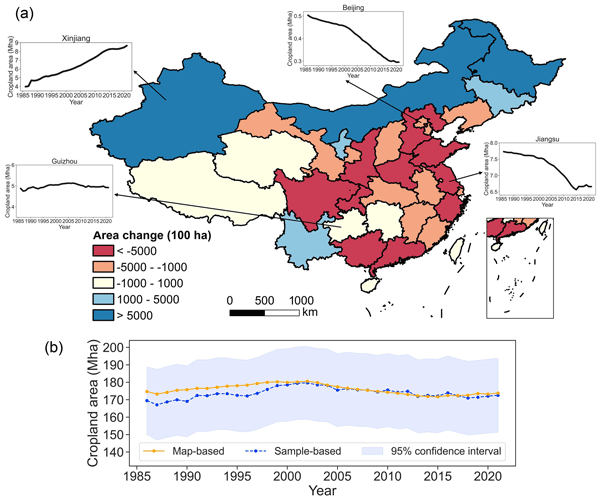
We developed the first 30 m annual cropland dataset of China (CACD) for 1986–2021. The overall accuracy of CACD reached up to 0.93±0.01 and was superior to other products. Our fine-resolution cropland maps offer valuable information for diverse applications and decision-making processes in the future.
Xiangan Liang, Qiang Liu, Jie Wang, Shuang Chen, and Peng Gong
Earth Syst. Sci. Data, 16, 177–200, https://doi.org/10.5194/essd-16-177-2024, https://doi.org/10.5194/essd-16-177-2024, 2024
Short summary
Short summary
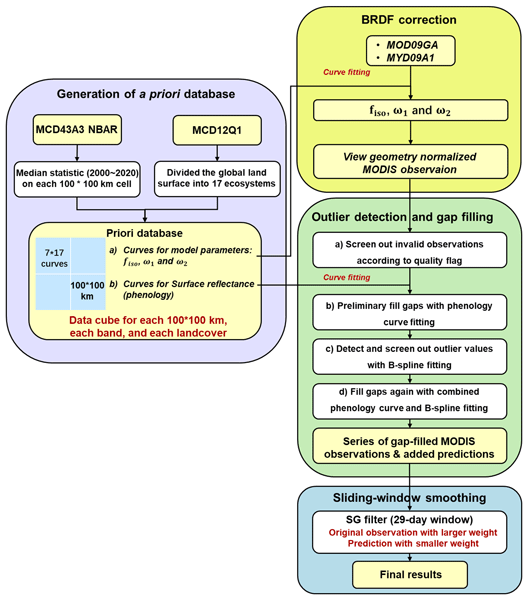
The state-of-the-art MODIS surface reflectance products suffer from temporal and spatial gaps, which make it difficult to characterize the continuous variation of the terrestrial surface. We proposed a framework for generating the first global 500 m daily seamless data cubes (SDC500), covering the period from 2000 to 2022. We believe that the SDC500 dataset can interest other researchers who study land cover mapping, quantitative remote sensing, and ecological science.
Wanru He, Xuecao Li, Yuyu Zhou, Zitong Shi, Guojiang Yu, Tengyun Hu, Yixuan Wang, Jianxi Huang, Tiecheng Bai, Zhongchang Sun, Xiaoping Liu, and Peng Gong
Earth Syst. Sci. Data, 15, 3623–3639, https://doi.org/10.5194/essd-15-3623-2023, https://doi.org/10.5194/essd-15-3623-2023, 2023
Short summary
Short summary
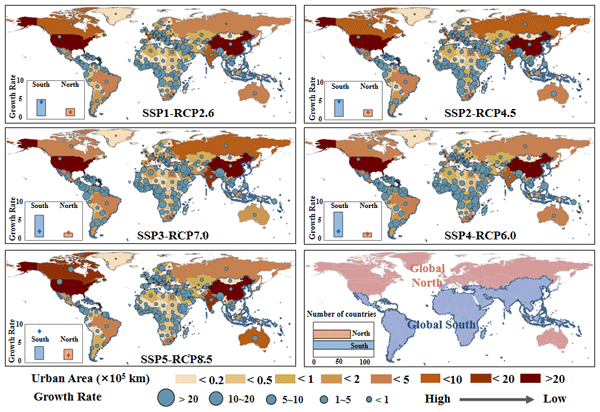
Most existing global urban products with future projections were developed in urban and non-urban categories, which ignores the gradual change of urban development at the local scale. Using annual global urban extent data from 1985 to 2015, we forecasted global urban fractional changes under eight scenarios throughout 2100. The developed dataset can provide spatially explicit information on urban fractions at 1 km resolution, which helps support various urban studies (e.g., urban heat island).
Jose Luis Gómez-Dans, Philip Edward Lewis, Feng Yin, Kofi Asare, Patrick Lamptey, Kenneth Kobina Yedu Aidoo, Dilys Sefakor MacCarthy, Hongyuan Ma, Qingling Wu, Martin Addi, Stephen Aboagye-Ntow, Caroline Edinam Doe, Rahaman Alhassan, Isaac Kankam-Boadu, Jianxi Huang, and Xuecao Li
Earth Syst. Sci. Data, 14, 5387–5410, https://doi.org/10.5194/essd-14-5387-2022, https://doi.org/10.5194/essd-14-5387-2022, 2022
Short summary
Short summary
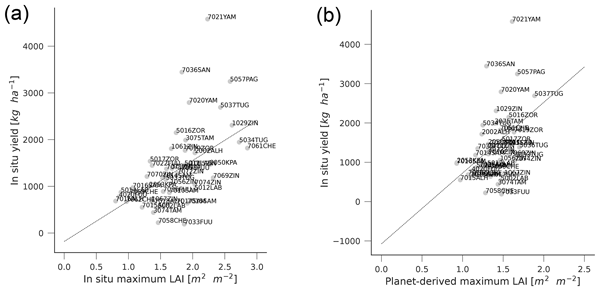
We provide a data set to support mapping croplands in smallholder landscapes in Ghana. The data set contains information on crop location on three agroecological zones for 2 years, temporal series of measurements of leaf area index and leaf chlorophyll concentration for maize canopies and yield. We demonstrate the use of these data to validate cropland masks, create a maize mask using satellite data and explore the relationship between satellite measurements and yield.
Quandi Niu, Xuecao Li, Jianxi Huang, Hai Huang, Xianda Huang, Wei Su, and Wenping Yuan
Earth Syst. Sci. Data, 14, 2851–2864, https://doi.org/10.5194/essd-14-2851-2022, https://doi.org/10.5194/essd-14-2851-2022, 2022
Short summary
Short summary
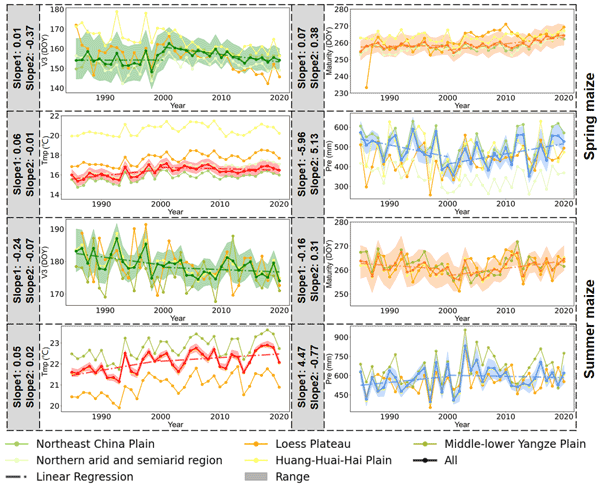
In this paper we generated the first national maize phenology product with a fine spatial resolution (30 m) and a long temporal span (1985–2020) in China, using Landsat images. The derived phenological indicators agree with in situ observations and provide more spatial details than moderate resolution phenology products. The extracted maize phenology dataset can support precise yield estimation and deepen our understanding of the response of agroecosystem to global warming in the future.
Min Zhao, Changxiu Cheng, Yuyu Zhou, Xuecao Li, Shi Shen, and Changqing Song
Earth Syst. Sci. Data, 14, 517–534, https://doi.org/10.5194/essd-14-517-2022, https://doi.org/10.5194/essd-14-517-2022, 2022
Short summary
Short summary
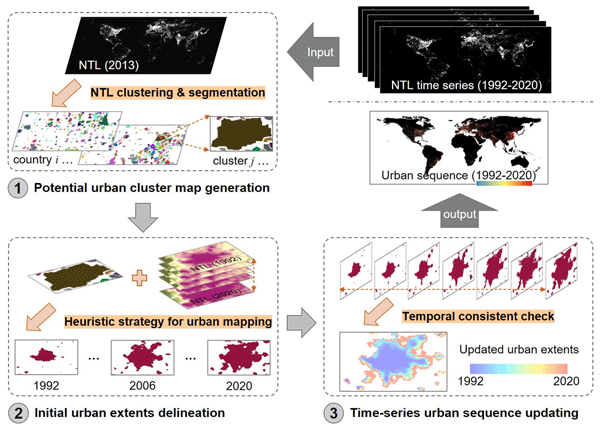
We generated a unique dataset of global annual urban extents (1992–2020) using consistent nighttime light observations and analyzed global urban dynamics over the past 3 decades. Evaluations using other urbanization-related ancillary data indicate that the derived urban areas are reliable for characterizing spatial extents associated with intensive human settlement and high-intensity socioeconomic activities. This dataset can provide unique information for studying urbanization and its impacts.

Bowen Cao, Le Yu, Xuecao Li, Min Chen, Xia Li, Pengyu Hao, and Peng Gong
Earth Syst. Sci. Data, 13, 5403–5421, https://doi.org/10.5194/essd-13-5403-2021, https://doi.org/10.5194/essd-13-5403-2021, 2021
Short summary
Short summary
In the study, the first 1 km global cropland proportion dataset for 10 000 BCE–2100 CE was produced through the harmonization and downscaling framework. The mapping result coincides well with widely used datasets at present. With improved spatial resolution, our maps can better capture the cropland distribution details and spatial heterogeneity. The dataset will be valuable for long-term simulations and precise analyses. The framework can be extended to specific regions or other land use types.
Cited articles
Anwar, S., Khan, S., and Barnes, N.: A Deep Journey into Super-resolution: A Survey, ACM Comput. Surv., 53, 1–34, https://doi.org/10.1145/3390462, 2021.
Asare, Y. M., Forkuo, E. K., Forkuor, G., and Thiel, M.: Evaluation of gap-filling methods for Landsat 7 ETM+ SLC-off image for LULC classification in a heterogeneous landscape of West Africa, Int. J. Remote Sens., 41, 2544–2564, https://doi.org/10.1080/01431161.2019.1693076, 2020.
Badawi, M., Helder, D., Leigh, L., and Jing, X.: Methods for Earth-Observing Satellite Surface Reflectance Validation, Remote Sens.-Basel, 11, 1543, https://doi.org/10.3390/rs11131543, 2019.
Bagan, H. and Yamagata, Y.: Analysis of urban growth and estimating population density using satellite images of nighttime lights and land-use and population data, GISci. Remote Sens., 52, 765–780, https://doi.org/10.1080/15481603.2015.1072400, 2015.
Bao, L., Pan, H., Fan, D., Li, M., Jiang, L., and Zhang, Z.: Evaluation of Socio-Economic Development in Yunnan Province in 2018 Based on LJ-1 01 Nighttime Light Remote Sensing Image, IGARSS 2024 – 2024 IEEE International Geoscience and Remote Sensing Symposium, 1315–1318, https://doi.org/10.1109/igarss53475.2024.10641883, 2024.
Baugh, K., Elvidge, C. D., Ghosh, T., and Ziskin, D.: Development of a 2009 Stable Lights Product using DMSP-OLS data, APAN Proceedings, 30, 114, https://doi.org/10.7125/apan.30.17, 2010.
Bian, J., Li, A., Lei, G., Zhang, Z., Nan, X., and Liang, L.: Inter-Calibration of Nighttime Light Data Between DMSP/OLS And NPP/VIIRS in the Economic Corridors of Belt And Road Initiative, IGARSS 2019–2019 IEEE International Geoscience and Remote Sensing Symposium, 9028–9031, https://doi.org/10.1109/igarss.2019.8900373, 2019.
Chen, H., Wu, B., Yu, B., Chen, Z., Wu, Q., Lian, T., Wang, C., Li, Q., and Wu, J.: A New Method for Building-Level Population Estimation by Integrating LiDAR, Nighttime Light, and POI Data, J. Remote Sens., 2021, https://doi.org/10.34133/2021/9803796, 2021a.
Chen, L.-C., Zhu, Y., Papandreou, G., Schroff, F., and Adam, H.: Encoder-decoder with atrous separable convolution for semantic image segmentation, Proceedings of the European conference on computer vision (ECCV), 801–818, https://doi.org/10.1007/978-3-030-01234-2_49, 2018.
Chen, X., Wang, Z., Zhang, F., Shen, G., and Chen, Q.: A global annual simulated VIIRS nighttime light dataset from 1992 to 2023, Sci. Data, 11, 1380, https://doi.org/10.1038/s41597-024-04228-6, 2024.
Chen, Z., Yu, B., Ta, N., Shi, K., Yang, C., Wang, C., Zhao, X., Deng, S., and Wu, J.: Delineating Seasonal Relationships Between Suomi NPP-VIIRS Nighttime Light and Human Activity Across Shanghai, China, IEEE J. Sel. Top. Appl., 12, 4275–4283, https://doi.org/10.1109/jstars.2019.2916323, 2019.
Chen, Z., Yu, B., Yang, C., Zhou, Y., Yao, S., Qian, X., Wang, C., Wu, B., Wu, J., Liao, L., and Shi, K.: The global NPP-VIIRS-like nighttime light data (Version 2) for 1992–2024 (V9), Harvard Dataverse, https://doi.org/10.7910/DVN/YGIVCD, 2020.
Chen, Z., Yu, B., Yang, C., Zhou, Y., Yao, S., Qian, X., Wang, C., Wu, B., and Wu, J.: An extended time series (2000–2018) of global NPP-VIIRS-like nighttime light data from a cross-sensor calibration, Earth Syst. Sci. Data, 13, 889–906, https://doi.org/10.5194/essd-13-889-2021, 2021b.
Chen, Z., Wei, Y., Shi, K., Zhao, Z., Wang, C., Wu, B., Qiu, B., and Yu, B.: The potential of nighttime light remote sensing data to evaluate the development of digital economy: A case study of China at the city level, Comput. Environ. Urban, 92, 101749, https://doi.org/10.1016/j.compenvurbsys.2021.101749, 2022.
Chen, Z., Liao, L., Wang, C., Shi, K., and Yu, B.: The 1992–2024 Global NPP-VIIRS-like Nighttime Light Annual Data from Deep Learning Super-Resolution Reconstruction, J. Remote Sens., 6, 0874, https://doi.org/10.34133/remotesensing.0874, 2026.
Cheng, H., Zhou, Y., and Li, X.: The World's First Long-Term Global 500 m-Resolution Monthly VIIRS Nighttime Lights Dataset (1992–Present), HKU Data Hub [data set], https://doi.org/10.25442/hku.31321315.v2, 2026a.
Cheng, H., Geng, M., Li, X., and Zhou, Y.: NightNet, Zenodo [code], https://doi.org/10.5281/zenodo.20134096, 2026b.
Cipolla, R., Gal, Y., and Kendall, A.: Multi-task Learning Using Uncertainty to Weigh Losses for Scene Geometry and Semantics, in: 2018 IEEE/CVF Conference on Computer Vision and Pattern Recognition, 2018 IEEE/CVF Conference on Computer Vision and Pattern Recognition (CVPR), 7482–7491, https://doi.org/10.1109/CVPR.2018.00781, 2018.
Claverie, M., Vermote, E. F., Franch, B., and Masek, J. G.: Evaluation of the Landsat-5 TM and Landsat-7 ETM+ surface reflectance products, Remote Sens. Environ., 169, 390–403, https://doi.org/10.1016/j.rse.2015.08.030, 2015.
Ding, L. and Goshtasby, A.: On the Canny edge detector, Pattern Recogn., 34, 721–725, https://doi.org/10.1016/S0031-3203(00)00023-6, 2001.
Doll, C. N. H., Muller, J.-P., and Elvidge, C. D.: Night-time Imagery as a Tool for Global Mapping of Socioeconomic Parameters and Greenhouse Gas Emissions, AMBIO, 29, 157–162, https://doi.org/10.1579/0044-7447-29.3.157, 2000.
Dong, B., Zhang, R., Li, S., Ye, Y., and Huang, C.: A meta-analysis for the nighttime light remote sensing data applied in urban research: Key topics, hotspot study areas and new trends, Science of Remote Sensing, 11, 100186, https://doi.org/10.1016/j.srs.2024.100186, 2025.
Elvidge, C. D.: Mapping City Lights With Nighttime Data from the DMSP Operational Linescan System, Photogramm. Eng. Rem. S., 63, 727–734, 1997.
Elvidge, C. D., Imhoff, M. L., Baugh, K. E., Hobson, V. R., Nelson, I., Safran, J., Dietz, J. B., and Tuttle, B. T.: Night-time lights of the world: 1994–1995, ISPRS J. Photogramm., 56, 81–99, https://doi.org/10.1016/s0924-2716(01)00040-5, 2001.
Elvidge, C. D., Zhizhin, M., Ghosh, T., Hsu, F.-C., and Taneja, J.: Annual Time Series of Global VIIRS Nighttime Lights Derived from Monthly Averages: 2012 to 2019, Remote Sens.-Basel, 13, 922, https://doi.org/10.3390/rs13050922, 2021.
Elvidge, C. D., Ghosh, T., Chatterjee, N., Zhizhin, M., Sutton, P. C., and Bazilian, M.: A comprehensive global mapping of offshore lighting, Earth Syst. Sci. Data, 17, 579–594, https://doi.org/10.5194/essd-17-579-2025, 2025.
Gibson, J., Olivia, S., and Boe-Gibson, G.: Night Lights in Economics: Sources and Uses1, J. Econ. Surv., 34, 955–980, https://doi.org/10.1111/joes.12387, 2020.
Gibson, J., Olivia, S., Boe-Gibson, G., and Li, C.: Which night lights data should we use in economics, and where?, J. Dev. Econ., 149, 102602, https://doi.org/10.1016/j.jdeveco.2020.102602, 2021.
Glenn, E. P., Nagler, P. L., and Huete, A. R.: Vegetation Index Methods for Estimating Evapotranspiration by Remote Sensing, Surv. Geophys., 31, 531–555, https://doi.org/10.1007/s10712-010-9102-2, 2010.
Gong, P., Li, X., Wang, J., Bai, Y., Chen, B., Hu, T., Liu, X., Xu, B., Yang, J., Zhang, W., and Zhou, Y.: Annual maps of global artificial impervious area (GAIA) between 1985 and 2018, Remote Sens. Environ., 236, 111510, https://doi.org/10.1016/j.rse.2019.111510, 2020.
Henderson, J. V., Storeygard, A., and Weil, D. N.: Measuring Economic Growth from Outer Space, Am. Econ. Rev., 102, 994–1028, https://doi.org/10.1257/aer.102.2.994, 2012.
Hong, Y., Wu, B., Song, Z., Li, Y., Wu, Q., Chen, Z., Liu, S., Yang, C., Wu, J., and Yu, B.: A monthly night-time light composite dataset of NOAA-20 in China: a multi-scale comparison with S-NPP, Int. J. Remote Sens., 42, 7931–7951, https://doi.org/10.1080/01431161.2021.1969057, 2021.
Hsu, F.-C., Baugh, K., Ghosh, T., Zhizhin, M., and Elvidge, C.: DMSP-OLS Radiance Calibrated Nighttime Lights Time Series with Intercalibration, Remote Sens.-Basel, 7, 1855–1876, https://doi.org/10.3390/rs70201855, 2015.
Hu, Y., Chen, J., Cao, X., Chen, X., Cui, X., and Gan, L.: Correcting the Saturation Effect in DMSP/OLS Stable Nighttime Light Products Based on Radiance-Calibrated Data, IEEE T. Geosci. Remote, 60, 1–11, https://doi.org/10.1109/tgrs.2021.3060170, 2022.
Huang, C., Zhuang, Q., Meng, X., Guo, H., and Han, J.: An improved nightlight threshold method for revealing the spatiotemporal dynamics and driving forces of urban expansion in China, J. Environ. Manage., 289, 112574, https://doi.org/10.1016/j.jenvman.2021.112574, 2021a.
Huang, C., Ye, Y., Jin, Y., and Liang, B.: Research Progress, Hotspots, and Evolution of Nighttime Light Pollution: Analysis Based on WOS Database and Remote Sensing Data, Remote Sens.-Basel, 15, 2305, https://doi.org/10.3390/rs15092305, 2023.
Huang, R., Wu, W., and Yu, K.: Building consistent time series night-time light data from average DMSP/OLS images for indicating human activities in a large-scale oceanic area, Int. J. Appl. Earth Obs., 114, 103023, https://doi.org/10.1016/j.jag.2022.103023, 2022.
Huang, S., Tang, L., Hupy, J. P., Wang, Y., and Shao, G.: A commentary review on the use of normalized difference vegetation index (NDVI) in the era of popular remote sensing, J. Forestry Res., 32, 1–6, https://doi.org/10.1007/s11676-020-01155-1, 2021b.
Hughes, M. J. and Kennedy, R.: High-Quality Cloud Masking of Landsat 8 Imagery Using Convolutional Neural Networks, Remote Sens.-Basel, 11, 2591, https://doi.org/10.3390/rs11212591, 2019.
Jindal, M., Gupta, P. K., and Srivastav, S. K.: Generation of monthly VIIRS nighttime lights time-series (1992–2013) images using deep learning (cGAN) technique, Remote Sensing Applications: Society and Environment, 35, 101263, https://doi.org/10.1016/j.rsase.2024.101263, 2024.
Kong, D., Zhang, Y., Gu, X., and Wang, D.: A robust method for reconstructing global MODIS EVI time series on the Google Earth Engine, ISPRS J. Photogramm., 155, 13–24, https://doi.org/10.1016/j.isprsjprs.2019.06.014, 2019.
Li, S. and Cao, X.: Monitoring the modes and phases of global human activity development over 30 years: Evidence from county-level nighttime light, Int. J. Appl. Earth Obs., 126, 103627, https://doi.org/10.1016/j.jag.2023.103627, 2024.
Li, S., Cao, X., Zhao, C., Jie, N., Liu, L., Chen, X., and Cui, X.: Developing a Pixel-Scale Corrected Nighttime Light Dataset (PCNL, 1992–2021) Combining DMSP-OLS and NPP-VIIRS, Remote Sens.-Basel, 15, 3925, https://doi.org/10.3390/rs15163925, 2023.
Li, X. and Zhou, Y.: A Stepwise Calibration of Global DMSP/OLS Stable Nighttime Light Data (1992–2013), Remote Sens.-Basel, 9, 637, https://doi.org/10.3390/rs9060637, 2017a.
Li, X. and Zhou, Y.: Urban mapping using DMSP/OLS stable night-time light: a review, Int. J. Remote Sens., 38, 6030–6046, https://doi.org/10.1080/01431161.2016.1274451, 2017b.
Li, X., Zhou, Y., Zhao, M., and Zhao, X.: A harmonized global nighttime light dataset 1992–2018, Sci. Data, 7, 168, https://doi.org/10.1038/s41597-020-0510-y, 2020a.
Li, X., Gong, P., Zhou, Y., Wang, J., Bai, Y., Chen, B., Hu, T., Xiao, Y., Xu, B., Yang, J., Liu, X., Cai, W., Huang, H., Wu, T., Wang, X., Lin, P., Li, X., Chen, J., He, C., Li, X., Yu, L., Clinton, N., and Zhu, Z.: Mapping global urban boundaries from the global artificial impervious area (GAIA) data, Environ. Res. Lett., 15, 094044, https://doi.org/10.1088/1748-9326/ab9be3, 2020b.
Li, Y., Liu, C., Zhang, J., Zhang, P., and Xue, Y.: Monitoring Spatial and Temporal Patterns of Rubber Plantation Dynamics Using Time-Series Landsat Images and Google Earth Engine, IEEE J. Sel. Top. Appl., 14, 9450–9461, https://doi.org/10.1109/jstars.2021.3110763, 2021.
Liu, P., Wang, Q., Zhang, D., and Lu, Y.: An Improved Correction Method of Nighttime Light Data Based on EVI and WorldPop Data, Remote Sens.-Basel, 12, 3988, https://doi.org/10.3390/rs12233988, 2020.
Liu, Y., Delahunty, T., Zhao, N., and Cao, G.: These lit areas are undeveloped: Delimiting China's urban extents from thresholded nighttime light imagery, Int. J. Appl. Earth Obs., 50, 39–50, https://doi.org/10.1016/j.jag.2016.02.011, 2016.
Liu, Y., Huang, Y., and Liu, Y.: Global risk assessment of river pollution stress based on nighttime light remote sensing data, Sci. Total Environ., 949, 175146, https://doi.org/10.1016/j.scitotenv.2024.175146, 2024.
Long, J., Shelhamer, E., and Darrell, T.: Fully convolutional networks for semantic segmentation, Proceedings of the IEEE conference on computer vision and pattern recognition, 3431–3440, https://doi.org/10.1109/CVPR.2015.7298965, 2015.
Ma, J., Guo, J., Ahmad, S., Li, Z., and Hong, J.: Constructing a New Inter-Calibration Method for DMSP-OLS and NPP-VIIRS Nighttime Light, Remote Sens.-Basel, 12, 937, https://doi.org/10.3390/rs12060937, 2020.
Masek, J. G., Honzak, M., Goward, S. N., Liu, P., and Pak, E.: Landsat-7 ETM+ as an observatory for land cover: Initial radiometric and geometric comparisons with Landsat-5 Thematic Mapper, Remote Sens. Environ., 78, 118–130, https://doi.org/10.1016/s0034-4257(01)00254-1, 2001.
Nechaev, D., Zhizhin, M., Poyda, A., Ghosh, T., Hsu, F.-C., and Elvidge, C.: Cross-Sensor Nighttime Lights Image Calibration for DMSP/OLS and SNPP/VIIRS with Residual U-Net, Remote Sens.-Basel, 13, 5026, https://doi.org/10.3390/rs13245026, 2021.
Oudrari, H., McIntire, J., Xiong, X., Butler, J., Lee, S., Lei, N., Schwarting, T., and Sun, J.: Prelaunch Radiometric Characterization and Calibration of the S-NPP VIIRS Sensor, IEEE T. Geosci. Remote, 53, 2195–2210, https://doi.org/10.1109/tgrs.2014.2357678, 2015.
Pandey, B., Zhang, Q., and Seto, K. C.: Comparative evaluation of relative calibration methods for DMSP/OLS nighttime lights, Remote Sens. Environ., 195, 67–78, https://doi.org/10.1016/j.rse.2017.04.011, 2017.
Qiu, Y., Li, X.-M., Yan, L., and Chen, Z.: Synergic sensing of light and heat emitted by offshore oil and gas platforms in the South China Sea, Int. J. Digit. Earth, 17, 2441932, https://doi.org/10.1080/17538947.2024.2441932, 2024.
Ronneberger, O., Fischer, P., and Brox, T.: U-net: Convolutional networks for biomedical image segmentation, International Conference on Medical image computing and computer-assisted intervention, 234–241, https://doi.org/10.1007/978-3-319-24574-4_28, 2015.
Sahoo, S., Gupta, P. K., and Srivastav, S. K.: Inter-calibration of DMSP-OLS and SNPP-VIIRS-DNB annual nighttime light composites using machine learning, GISci. Remote Sens., 57, 1144–1165, https://doi.org/10.1080/15481603.2020.1848323, 2020.
Sun, J., Qi, Y., Guo, J., Zheng, J., Zhang, L., and Yang, X.: Impact of nighttime light data saturation correction on the application of carbon emissions spatialization: A comparative study of the correction effect and application effect based on five methods in China, J. Clean. Prod., 438, 140815, https://doi.org/10.1016/j.jclepro.2024.140815, 2024a.
Sun, Y., Xie, J., Wang, Y., Chan, T. O., and Sun, Z.-Y.: Mapping local-scale working population and daytime population densities using points-of-interest and nighttime light satellite imageries, Geo-spatial Information Science, 27, 1852–1867, https://doi.org/10.1080/10095020.2023.2273826, 2024b.
Tan, X., Chen, R., Zhu, X., Li, X., Chen, J., Sing Wong, M., Xu, S., and Xu, Y. N.: Spatial heterogeneity of uncertainties in daily satellite nighttime light time series, Int. J. Appl. Earth Obs., 123, 103484, https://doi.org/10.1016/j.jag.2023.103484, 2023.
Wang, J., Sun, K., Cheng, T., Jiang, B., Deng, C., Zhao, Y., Liu, D., Mu, Y., Tan, M., Wang, X., Liu, W., and Xiao, B.: Deep High-Resolution Representation Learning for Visual Recognition, IEEE T. Pattern Anal., 43, 3349–3364, https://doi.org/10.1109/TPAMI.2020.2983686, 2021.
Wang, L., Tan, W., Xu, H., He, H., Chen, N., Li, D., Chapman, M. A., and Li, J.: DEEP LEARNING-BASED METHOD TO EXTEND THE TIME SERIES OF GLOBAL ANNUAL VIIRS-LIKE NIGHTTIME LIGHT DATA, Int. Arch. Photogramm. Remote Sens. Spatial Inf. Sci., XLIII-B1-2022, 73–78, https://doi.org/10.5194/isprs-archives-XLIII-B1-2022-73-2022, 2022.
Woo, S., Park, J., Lee, J.-Y., and Kweon, I. S.: CBAM: Convolutional Block Attention Module, in: Computer Vision – ECCV 2018: 15th European Conference, Munich, Germany, 8–14 September 2018, Proceedings, Part VII, Munich, Germany, 3–19, https://doi.org/10.1007/978-3-030-01234-2_1, 2018.
Wu, B., Yang, C., Wu, Q., Wang, C., Wu, J., and Yu, B.: A building volume adjusted nighttime light index for characterizing the relationship between urban population and nighttime light intensity, Comput. Environ. Urban, 99, 101911, https://doi.org/10.1016/j.compenvurbsys.2022.101911, 2023.
Wu, J., Tu, Y., Chen, Z., and Yu, B.: Analyzing the Spatially Heterogeneous Relationships between Nighttime Light Intensity and Human Activities across Chongqing, China, Remote Sens.-Basel, 14, 5695, https://doi.org/10.3390/rs14225695, 2022.
Wu, Y. and Li, X.: Exploring the Drivers of Variations in Daily Nighttime Light Time Series From the Perspective of Periodic Factors, IEEE Geosci. Remote S., 21, 1–5, https://doi.org/10.1109/LGRS.2024.3358856, 2024.
Yang, L., Cao, J., Zhuo, L., and Shi, Q.: A Novel Consistency Calibration Method for DMSP-OLS Nighttime Stable Light Time-Series Images, IEEE J. Sel. Top. Appl., 15, 2621–2631, https://doi.org/10.1109/jstars.2022.3157906, 2022.
Yao, J., Du, P., Zhao, Y., and Wang, Y.: Simulating Nighttime Visible Satellite Imagery of Tropical Cyclones Using Conditional Generative Adversarial Networks, IEEE J. Sel. Top. Appl., 18, 12616–12633, https://doi.org/10.1109/jstars.2025.3567074, 2025.
Zhang, C., Mao, Z., Nie, J., Lai, Y., and Lei, D.: A Comparative Study of Deep Learning Methods for Super-Resolution of Npp-Viirs Nighttime Light Images, https://doi.org/10.2139/ssrn.5017152, 2024a.
Zhang, H. K., Luo, D., and Roy, D. P.: Improved Landsat Operational Land Imager (OLI) Cloud and Shadow Detection with the Learning Attention Network Algorithm (LANA), Remote Sens.-Basel, 16, 1321, https://doi.org/10.3390/rs16081321, 2024b.
Zhang, L., Dong, R., Yuan, S., Zhang, J., Chen, M., Zheng, J., and Fu, H.: DeepLight: Reconstructing High-Resolution Observations of Nighttime Light With Multi-Modal Remote Sensing Data, in: Proceedings of the Thirty-ThirdInternational Joint Conference on Artificial Intelligence, Thirty-Third International Joint Conference on Artificial Intelligence IJCAI-24, 7563–7571, https://doi.org/10.24963/ijcai.2024/837, 2024c.
Zhang, Q., Pandey, B., and Seto, K. C.: A Robust Method to Generate a Consistent Time Series From DMSP/OLS Nighttime Light Data, IEEE T. Geosci. Remote, 54, 5821–5831, https://doi.org/10.1109/tgrs.2016.2572724, 2016.
Zhang, S., Ma, Y., Chen, H., Shang, E., Yao, W., Yang, J., and He, G.: The Spatiotemporal Fusion for Nighttime Light Based on SDGSAT-1 and VIIRS Data, IEEE T. Geosci. Remote, 63, 1–19, https://doi.org/10.1109/tgrs.2025.3560092, 2025.
Zhao, C., Cao, X., Chen, X., and Cui, X.: A consistent and corrected nighttime light dataset (CCNL 1992–2013) from DMSP-OLS data, Sci. Data, 9, https://doi.org/10.1038/s41597-022-01540-x, 2022.
Zhao, M., Zhou, Y., Li, X., Cao, W., He, C., Yu, B., Li, X., Elvidge, C. D., Cheng, W., and Zhou, C.: Applications of Satellite Remote Sensing of Nighttime Light Observations: Advances, Challenges, and Perspectives, Remote Sens.-Basel, 11, 1971, https://doi.org/10.3390/rs11171971, 2019.
Zheng, Q., Weng, Q., and Wang, K.: Developing a new cross-sensor calibration model for DMSP-OLS and Suomi-NPP VIIRS night-light imageries, ISPRS J. Photogramm., 153, 36–47, https://doi.org/10.1016/j.isprsjprs.2019.04.019, 2019a.
Zheng, Q., Weng, Q., Zhou, Y., and Dong, B.: Impact of temporal compositing on nighttime light data and its applications, Remote Sens. Environ., 274, 113016, https://doi.org/10.1016/j.rse.2022.113016, 2022.
Zheng, Q., Seto, K. C., Zhou, Y., You, S., and Weng, Q.: Nighttime light remote sensing for urban applications: Progress, challenges, and prospects, ISPRS J. Photogramm., 202, 125–141, https://doi.org/10.1016/j.isprsjprs.2023.05.028, 2023.
Zheng, Y., Yang, K., Wei, C., Fu, M., and Fan, M.: An Improved Cross-Sensor Calibration Approach for DMSP-OLS and NPP-VIIRS Nighttime Light Data, IEEE J. Sel. Top. Appl., 18, 865–877, https://doi.org/10.1109/jstars.2024.3494551, 2025.
Zheng, Z., Yang, Z., Chen, Y., Wu, Z., and Marinello, F.: The Interannual Calibration and Global Nighttime Light Fluctuation Assessment Based on Pixel-Level Linear Regression Analysis, Remote Sens.-Basel, 11, 2185, https://doi.org/10.3390/rs11182185, 2019b.
Zhuo, L., Zheng, J., Zhang, X., Li, J., and Liu, L.: An improved method of night-time light saturation reduction based on EVI, Int. J. Remote Sens., 36, 4114–4130, https://doi.org/10.1080/01431161.2015.1073861, 2015.
Short summary
Monthly records of nighttime light are scarce, especially over long periods, yet they are vital for tracking short-term economic shifts and seasonal urban change. This study provides a temporally consistent global 500 m-resolution monthly VIIRS (Visible Infrared Imaging Radiometer Suite)-like nighttime light dataset (1992–2024). By combining DMSP (Defense Meteorological Satellite Program) and VIIRS through reconstruction and correction, a consistent long-term record is created. The dataset supports improved analysis of urban growth and economic activity worldwide.
Monthly records of nighttime light are scarce, especially over long periods, yet they are vital...


Altmetrics
Final-revised paper
Preprint