Articles | Volume 18, issue 1
https://doi.org/10.5194/essd-18-245-2026
© Author(s) 2026. This work is distributed under
the Creative Commons Attribution 4.0 License.
the Creative Commons Attribution 4.0 License.
https://doi.org/10.5194/essd-18-245-2026
© Author(s) 2026. This work is distributed under
the Creative Commons Attribution 4.0 License.
the Creative Commons Attribution 4.0 License.
Data description article
| 
09 Jan 2026
Data description article |
| 09 Jan 2026
| 09 Jan 2026
The Global Spectra-Trait Initiative: A database of paired leaf spectroscopy and functional traits associated with leaf photosynthetic capacity

Centre de Recherche sur la Biodiversité et l'Environnement (CRBE), Université de Toulouse, CNRS, IRD, Toulouse INP, Université Toulouse 3 – Paul Sabatier (UT3), Toulouse, France
Shawn P. Serbin
Biospheric Sciences Laboratory (BSL), Code 618 NASA Goddard Space Flight Center 8800 Greenbelt Road Greenbelt, MD 20771 USA
Alistair Rogers
Climate and Ecosystem Sciences Division, Lawrence Berkeley National Laboratory, Berkeley CA 94720, USA
Kelvin T. Acebron
Smithsonian Environmental Research Center, Edgewater MD 21403, USA
Elizabeth Ainsworth
University of Illinois Urbana, Champaign, Urbana, IL 61801, USA
Loren P. Albert
Oregon State University Department of Forest Ecosystems & Society, Corvallis, OR 97333, USA
Michael Alonzo
Department of Environmental Science, American University, Washington, DC 20016, USA
Jeremiah Anderson
Biospheric Sciences Laboratory (BSL), Code 618 NASA Goddard Space Flight Center 8800 Greenbelt Road Greenbelt, MD 20771 USA
Owen K. Atkin
ARC Centre of Excellence in Plant Energy Biology, Research School of Biology, The Australian National University, Canberra, ACT 2601, Australia
Division of Plant Sciences, Research School of Biology, The Australian National University, Canberra, ACT 2601, Australia
Nicolas Barbier
AMAP, Univ Montpellier, CIRAD, CNRS, INRAE, IRD, Montpellier, France
Mallory L. Barnes
The O'Neill School of Public & Environmental Affairs, Indiana University Bloomington, Bloomington, IN, USA
Carl J. Bernacchi
USDA-ARS Photosynthesis Research Unit, Urbana, IL 61801, USA
University of Illinois Urbana, Champaign, Urbana, IL 61801, USA
Ninon Besson
AMAP, Univ Montpellier, CIRAD, CNRS, INRAE, IRD, Montpellier, France
UMR EcoFoG, AgroParisTech, Cirad, CNRS, INRAE, Université des Antilles, Université de la Guyane, Kourou, France
Angela C. Burnett
Advanced Research + Invention Agency, London, UK
Joshua S. Caplan
Department of Architecture & Environmental Design, Temple University, Ambler PA 19010, USA
Jérôme Chave
Centre de Recherche sur la Biodiversité et l'Environnement (CRBE), Université de Toulouse, CNRS, IRD, Toulouse INP, Université Toulouse 3 – Paul Sabatier (UT3), Toulouse, France
Alexander W. Cheesman
College of Science & Engineering, James Cook University, Cairns, Queensland 4878, Australia
Ilona Clocher
AMAP, Univ Montpellier, CIRAD, CNRS, INRAE, IRD, Montpellier, France
UMR EcoFoG, AgroParisTech, Cirad, CNRS, INRAE, Université des Antilles, Université de la Guyane, Kourou, France
Onoriode Coast
School of Environmental and Rural Science, University of New England, Armidale, NSW 2351, Australia
Sabrina Coste
UMR EcoFoG, AgroParisTech, Cirad, CNRS, INRAE, Université des Antilles, Université de la Guyane, Kourou, France
Holly Croft
Plants, Photosynthesis and Soil, School of Biosciences, University of Sheffield, South Yorkshire, UK
School of Biosciences, Institute for Sustainable Food, University of Sheffield, South Yorkshire, UK
Boya Cui
Department of Physical and Environmental Sciences, University of Toronto Scarborough, M1C 1A4, Toronto, Canada
Clément Dauvissat
AMAP, Univ Montpellier, CIRAD, CNRS, INRAE, IRD, Montpellier, France
Kenneth J. Davidson
American Forests, Washington, DC 20005, USA
Christopher Doughty
School of Informatics, Computing, and Cyber Systems, Northern Arizona University, Flagstaff, AZ, USA
Kim S. Ely
Climate and Ecosystem Sciences Division, Lawrence Berkeley National Laboratory, Berkeley CA 94720, USA
John R. Evans
ARC Centre of Excellence for Translational Photosynthesis, Research school of Biology, Australian National University, Canberra, ACT 2601, Australia
Jean-Baptiste Féret
TETIS, INRAE, AgroParisTech, CIRAD, CNRS, Université Montpellier, Montpellier, France
Iolanda Filella
Center for Ecological Research and Forestry Applications (CREAF) – National Research Council (CSIC), Edifici C, Universitat Autonoma de Barcelona, 08193 Bellaterra, Barcelona, Spain
Claire Fortunel
AMAP, Univ Montpellier, CIRAD, CNRS, INRAE, IRD, Montpellier, France
Peng Fu
School of Plant, Environmental and Soil Sciences, Louisiana State University and Louisiana State University AgCenter, Baton Rouge, LA 70803, USA
Robert T. Furbank
ARC Centre of Excellence for Translational Photosynthesis, Research school of Biology, Australian National University, Canberra, ACT 2601, Australia
Maquelle Garcia
Oregon State University Department of Forest Ecosystems & Society, Corvallis, OR 97333, USA
Bruno O. Gimenez
Department of Geography, University of California – Berkeley (UCB), 507 McCone Hall #4740, Berkeley, CA 94720, USA
Forest Management Laboratory, National Institute of Amazonian Research (INPA), Av. Andre Araújo, 69060-082, Manaus-AM, Brazil
Kaiyu Guan
Agroecosystem Sustainability Center, Institute for Sustainability, Energy, and Environment, University of Illinois Urbana-Champaign, Urbana, IL 61801, USA
Department of Nature Resources and Environmental Sciences, College of Agricultural, Consumer and Environmental Sciences, University of Illinois Urbana-Champaign, Urbana, IL 61801, USA
Zhengfei Guo
School of Biological Sciences, University of Hong Kong, Pokfulam Road, Hong Kong, China
David Heckmann
Bayer Crop Science, 40789 Monheim am Rhein, Germany
Patrick Heuret
AMAP, Univ Montpellier, CIRAD, CNRS, INRAE, IRD, Montpellier, France
Marney Isaac
Department of Physical and Environmental Sciences, University of Toronto Scarborough, M1C 1A4, Toronto, Canada
Shan Kothari
Department of Renewable Resources, University of Alberta, Edmonton, AB T6G 2E3, Canada
Etsushi Kumagai
Institute for Agro-Environmental Sciences, NARO, Tsukuba, Ibaraki 305-8604, Japan
Thu Ya Kyaw
Department of Environmental Science, American University, Washington, DC 20016, USA
Liangyun Liu
Aerospace Information Research Institute, Chinese Academy of Sciences, Beijing 100094, China
Lingli Liu
State Key Laboratory of Vegetation and Environmental Change, Institute of Botany, Chinese Academy of Sciences, Xiangshan, Beijing 100093, China
Shuwen Liu
Department of Forest and Wildlife Ecology, University of Wisconsin-Madison, 1630 Linden Drive, Madison, WI 53706, USA
School of Biological Sciences, University of Hong Kong, Pokfulam Road, Hong Kong, China
Joan Llusià
Center for Ecological Research and Forestry Applications (CREAF) – National Research Council (CSIC), Edifici C, Universitat Autonoma de Barcelona, 08193 Bellaterra, Barcelona, Spain
Troy Magney
Department of Plant Sciences, University of California, Davis, California, USA
Isabelle Maréchaux
AMAP, Univ Montpellier, CIRAD, CNRS, INRAE, IRD, Montpellier, France
Adam R. Martin
Department of Physical and Environmental Sciences, University of Toronto Scarborough, M1C 1A4, Toronto, Canada
Katherine Meacham-Hensold
Carl R Woese Institute for Genomic Biology, University of Illinois Urbana Champaign, Urbana, Illinois, USA
Christopher M. Montes
USDA-ARS Photosynthesis Research Unit, Urbana, IL 61801, USA
University of Illinois Urbana, Champaign, Urbana, IL 61801, USA
Romà Ogaya
Center for Ecological Research and Forestry Applications (CREAF) – National Research Council (CSIC), Edifici C, Universitat Autonoma de Barcelona, 08193 Bellaterra, Barcelona, Spain
Joy Ojo
School of Environmental and Rural Science, University of New England, Armidale, NSW 2351, Australia
Regison Oliveira
Forest Management Laboratory, National Institute of Amazonian Research (INPA), Av. Andre Araújo, 69060-082, Manaus-AM, Brazil
Alain Paquette
Centre for Forest Research, Université du Québec à Montréal, Montréal, Canada
Josep Peñuelas
Center for Ecological Research and Forestry Applications (CREAF) – National Research Council (CSIC), Edifici C, Universitat Autonoma de Barcelona, 08193 Bellaterra, Barcelona, Spain
Antonia Debora Placido
Forest Management Laboratory, National Institute of Amazonian Research (INPA), Av. Andre Araújo, 69060-082, Manaus-AM, Brazil
Juan M. Posada
Biology Department, Carrera 24 # 63C – 69, Universidad del Rosario, Bogotá, Colombia
Xiaojin Qian
School of Internet of Things, Nanjing University of Posts and Telecommunications, Nanjing 210003, China
Heidi J. Renninger
Department of Forestry, Mississippi State University, Mississippi State, MS 39762, USA
Milagros Rodriguez-Caton
Institute for Snow, Glaciers and Environmental Research, IANIGLA-CONICET, Mendoza, Argentina
Department of Plant Sciences, University of California, Davis, California, USA
Andrés Rojas-González
Laboratorio de Ecología Funcional y Ecosistemas Tropicales (LEFET), Escuela de Ciencias Biológicas, Facultad de Ciencias Exactas y Naturales, Universidad Nacional, Heredia, Costa Rica
Urte Schlüter
Institute for Plant Biochemistry, Heinrich Heine University Düsseldorf, Germany
Giacomo Sellan
UMR EcoFoG, AgroParisTech, Cirad, CNRS, INRAE, Université des Antilles, Université de la Guyane, Kourou, France
Courtney M. Siegert
Department of Forestry, Mississippi State University, Mississippi State, MS 39762, USA
Viridiana Silva-Perez
ARC Centre of Excellence for Translational Photosynthesis, Research school of Biology, Australian National University, Canberra, ACT 2601, Australia
Guangqin Song
School of Biological Sciences, University of Hong Kong, Pokfulam Road, Hong Kong, China
Charles D. Southwick
Oregon State University Department of Forest Ecosystems & Society, Corvallis, OR 97333, USA
Daisy C. Souza
Forest Management Laboratory, National Institute of Amazonian Research (INPA), Av. Andre Araújo, 69060-082, Manaus-AM, Brazil
Clément Stahl
UMR EcoFoG, AgroParisTech, Cirad, CNRS, INRAE, Université des Antilles, Université de la Guyane, Kourou, France
Yanjun Su
State Key Laboratory of Vegetation and Environmental Change, Institute of Botany, Chinese Academy of Sciences, Xiangshan, Beijing 100093, China
Leeladarshini Sujeeun
Department of Physical and Environmental Sciences, University of Toronto Scarborough, M1C 1A4, Toronto, Canada
To-Chia Ting
Agronomy Department, Purdue University, West Lafayette, IN, USA
Vicente Vasquez
University of Florida, School of Forestry, Fisheries and Geomatics, Gainesville, Florida, USA
Amrutha Vijayakumar
School of Environmental and Rural Science, University of New England, Armidale, NSW 2351, Australia
Marcelo Vilas-Boas
Forest Management Laboratory, National Institute of Amazonian Research (INPA), Av. Andre Araújo, 69060-082, Manaus-AM, Brazil
Diane R. Wang
Agronomy Department, Purdue University, West Lafayette, IN, USA
Sheng Wang
Department of Agroecology, Aarhus University, Aarhus 8000, Denmark
Agroecosystem Sustainability Center, Institute for Sustainability, Energy, and Environment, University of Illinois Urbana-Champaign, Urbana, IL 61801, USA
Han Wang
Ministry of Education Key Laboratory for Earth System Modelling, Department of Earth System Science, Tsinghua University, Beijing 100084, China
Jing Wang
School of Ecology, Shenzhen Campus of Sun Yat-sen University, Shenzhen, Guangdong, 518107, China
Xin Wang
State Key Laboratory of Vegetation and Environmental Change, Institute of Botany, Chinese Academy of Sciences, Xiangshan, Beijing 100093, China
Andreas P. M. Weber
Institute for Plant Biochemistry, Heinrich Heine University Düsseldorf, Germany
Cluster of Excellence on Plant Sciences (CEPLAS), Düsseldorf, Germany
Christopher Y. S. Wong
Faculty of Forestry and Environmental Management, University of New Brunswick, Fredericton NB E3B 5A3, Canada
Jin Wu
School of Biological Sciences, University of Hong Kong, Pokfulam Road, Hong Kong, China
Institute for Climate and Carbon Neutrality, University of Hong Kong Kong, Pofulam Road, Hong Kong, China
State Key Laboratory of Agrobiotechnology, Chinese University of Hong Kong, Sha Tin, Hong Kong, China
Fengqi Wu
State Key Laboratory of Vegetation and Environmental Change, Institute of Botany, Chinese Academy of Sciences, Xiangshan, Beijing 100093, China
Shengbiao Wu
Future Urbanity and Sustainable Environment (FUSE) Lab, Division of Landscape Architecture, Department of Architecture, Faculty of Architecture, The University of Hong Kong, Hong Kong, China
Zhengbing Yan
State Key Laboratory of Vegetation and Environmental Change, Institute of Botany, Chinese Academy of Sciences, Xiangshan, Beijing 100093, China
China National Botanical Garden, Beijing 100093, China
University of Chinese Academy of Sciences, Yuquanlu, Beijing 100049, China
Dedi Yang
Environmental Sciences Division and Climate Change Science Institute, Oak Ridge National Laboratory, Oak Ridge, TN 37830, USA
Yingyi Zhao
School of Biological Sciences, University of Hong Kong, Pokfulam Road, Hong Kong, China
Related authors
No articles found.
Estefanía Muñoz, Karis J. McFarlane, Romà Ogaya, Jofre Carnicer, Guillem Mampel, Xin Song, Sara Marañón-Jiménez, Josep Peñuelas, and Carlos A. Sierra
EGUsphere, https://doi.org/10.5194/egusphere-2026-6195, https://doi.org/10.5194/egusphere-2026-6195, 2026
Short summary
Short summary
Long-term drought is changing how Mediterranean forests store carbon. By measuring the age of carbon in leaves, roots, wood, soil, and respired CO₂, we found that drought makes carbon older overall. Forests are using older, long-stored carbon while taking in less new carbon. Drought also makes topsoil more uniform in carbon and age, depleting older reserves. These results highlight the need to protect soil carbon as droughts intensify.
Rong Shang, Shengwei Xu, Ziyi Yang, Xudong Lin, Lingyun Fan, Keyan Fang, Mingzhu Xu, Anxin Ding, Yulin Yan, Yunjian Liang, Chenningya Song, Wenjie Chen, Jiaorong Qian, Annan Zhang, Jing Heng, Siyu Chen, Xiao Zhang, Liangyun Liu, Wang Li, Licong Dai, Zhongmin Hu, and Jing M. Chen
Earth Syst. Sci. Data Discuss., https://doi.org/10.5194/essd-2026-705, https://doi.org/10.5194/essd-2026-705, 2026
Preprint under review for ESSD
Short summary
Short summary
This study created a Reference sample dataset of Stable, Disturbed and Forestated forests (RSDF) in China from1986 to 2025 with 12,991 samples. All samples were visually annotated using satellite imagery and forest records with strict quality checks. Nearly 80 % remained stable, and forest disturbance was most frequent in eastern and southern China. Over 95 % of samples received high confidence. This public dataset supports tracking forest change and assessing its effects on carbon storage.
Joshua S. Caplan, Martin Bouda, Allyson B. Salisbury, Michael Alonzo, Jonathan E. Nyquist, Laura Toran, and Sasha W. Eisenman
Hydrol. Earth Syst. Sci., 30, 6075–6093, https://doi.org/10.5194/hess-30-6075-2026, https://doi.org/10.5194/hess-30-6075-2026, 2026
Short summary
Short summary
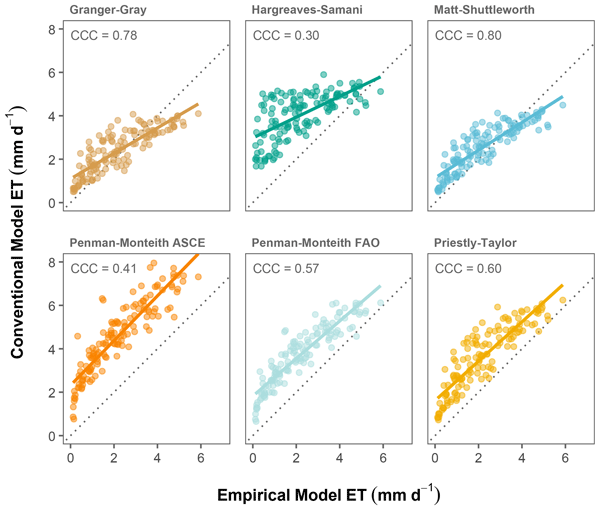
We sought to test and improve the modeling tools used to quantify evapotranspiration (ET) in urban bioretention basins, where plant size and shade vary widely. Using direct measurements and spatially detailed data from a basin in Philadelphia, we found that common models often produce ET estimates that differ substantially from empirical estimates. Simple corrections to standard models greatly improve agreement, helping cities better predict green stormwater infrastructure performance.
Lucas Mondon, Nicolas Martin-StPaul, Gregor Rickert, Isabelle Maréchaux, Arsène Druel, Quentin Chaffaut, Damien Jougnot, Nicolas Delpierre, Marc Pessel, Ilhan Özgen-Xian, Hervé Cochard, and Simon D. Carrière
EGUsphere, https://doi.org/10.5194/egusphere-2026-5115, https://doi.org/10.5194/egusphere-2026-5115, 2026
This preprint is open for discussion and under review for Biogeosciences (BG).
Short summary
Short summary
By calibrating a plant hydraulic model with fine-root distribution, we show that root distribution is a key determinant of drought resistance, with an influence comparable to other hydraulic traits. A “rare-root strategy” emerges as a balanced solution between accessing and conserving deep water reserves.
Pelin Erturk Ari, Rafael Marcé, Oriol Sacristán-Soriano, Duygu Tolunay, Carles M. Borrego, Sílvia Poblador, Biel Obrador, Enrique Moreno-Ostos, Jorge J. Montes-Pérez, Teresa Conejo-Orosa, Matthias Koschorreck, Josep Peñuelas, and Núria Catalán
EGUsphere, https://doi.org/10.5194/egusphere-2026-5010, https://doi.org/10.5194/egusphere-2026-5010, 2026
Short summary
Short summary
Rewetting dry sediments of Lake Gallocanta had little effect on carbon dioxide (CO₂) fluxes, which showed strong daily cycles of emission and uptake. Despite changes in microbial community composition, biological carbon fixation did not explain CO₂ uptake. Modeling of CO₂ flux and isotope data showed that abiotic processes, likely weathering, dominated CO₂ uptake, while respiration drove emissions. These results highlight the importance of abiotic controls on CO₂ dynamics in dry sediments.
Arathi Biju, Oleksandr Borysenko, Holger Virro, Jean-Baptiste Féret, Jan Pisek, and Evelyn Uuemaa
Int. Arch. Photogramm. Remote Sens. Spatial Inf. Sci., L-4-W1-2026, 3–10, https://doi.org/10.5194/isprs-archives-L-4-W1-2026-3-2026, https://doi.org/10.5194/isprs-archives-L-4-W1-2026-3-2026, 2026
Julia Bigwood, Jochen Stutz, Milagros Rodriguez-Caton, Troy Magney, Diego Dierick, Nicholas Parazoo, Gregory R. Goldsmith, Sol Cooperdock, and Ulrike Seibt
EGUsphere, https://doi.org/10.2139/ssrn.6429182, https://doi.org/10.2139/ssrn.6429182, 2026
Short summary
Short summary
Tropical forests absorb a large amount of carbon from the atmosphere. Even so, we still have a limited understanding of how this may change with a changing climate. We measured carbon exchange in a Costa Rican rainforest and found that the forest remained a strong carbon sink. However, estimates of carbon uptake depended on how measurements are analyzed and the time period considered, highlighting important challenges for predicting tropical forest responses to climate change.
Adam R. Martin, Dilene Mugenzi, Sean C. Thomas, Audrey Barker-Plotkin, Mahendra Doraisami, Mark Givelas, Adam Gorgolewski, Rachel O. Mariani, David Orwig, Benton N. Taylor, and Leeladarshini Sujeeun
Biogeosciences, 23, 5811–5825, https://doi.org/10.5194/bg-23-5811-2026, https://doi.org/10.5194/bg-23-5811-2026, 2026
Short summary
Short summary
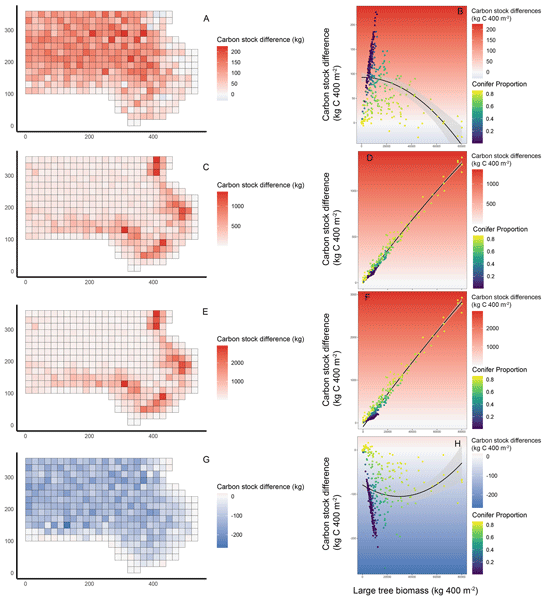
Forests are critical in the global carbon cycle. Accurate estimates of tree and forest carbon stocks depend on assumptions surrounding wood chemistry, though this is often overlooked in forest carbons science. We show that species-specific wood chemistry values upward-revise tree-and forest carbon stock estimates, though certain wood chemistry assumptions – namely, the commonly-employed 50 % wood carbon fraction assumption – over-estimate carbon stocks in virtually all temperate trees and forests.
Xuanhao Jiang, Tianyu Hu, Zhenying Huang, Zhiyao Tang, Leiyi Chen, Wenli Chen, Xiaoli Cheng, Yunxiang Cheng, Yuejun Fan, Ruiru Gao, Tiangang Gao, Yanming Gong, Yanpei Guo, Xiaokang Hu, Chengjun Ji, Liping Li, Shijin Li, Guofang Liu, Wanyin Luo, Wenhong Ma, Hongyuan Ma, Xiujuan Qiao, Chuangye Song, Guoyan Wang, Lei Wang, Qinggang Wang, Yonghui Wang, Zhong Wang, Xuejun Yang, Yan Yang, Yongchuan Yang, Xuehua Ye, Chunying Yin, Feihai Yu, Pujin Zhang, Shuren Zhang, Chengyang Zheng, Luhong Zhou, and Yanjun Su
Earth Syst. Sci. Data Discuss., https://doi.org/10.5194/essd-2026-628, https://doi.org/10.5194/essd-2026-628, 2026
Preprint under review for ESSD
Short summary
Short summary
We developed the first 30 m, wall-to-wall annual dataset of national grassland canopy cover from 1990 to 2023. By integrating drone and Landsat-series imagery, our model generates high predictive accuracy and robust temporal transferability compared to historical validation dataset. This dataset provides a critical foundation for advancing the understanding of grassland ecosystem dynamics and for supporting evidence-based conservation and sustainable management strategies.
Andrew P. Scafaro and Owen K. Atkin
EGUsphere, https://doi.org/10.5194/egusphere-2026-3927, https://doi.org/10.5194/egusphere-2026-3927, 2026
Short summary
Short summary
This research explored relationships between climate extremes and seasonal changes in ecosystem productivity split by hemisphere from 1977 to 2018. Hot extremes were associated with loss of seasonal productivity in the southern but not northern hemisphere, suggesting southern forests are generally closer to detrimental heat thresholds. Across both hemispheres, reductions in the Southern Oscillation Index (i.e. El Niño events) were associated with drier climates and reduced seasonal productivity.
Aldis Butlers, Zaiga Anna Zvaigzne, Arta Bārdule, Josep Peñuelas, Andis Lazdiņš, José-Miguel Sánchez-Pérez, Laure Gandois, Noémie Carles, Romain Darnajoux, Parvez Rana, Kaido Soosaar, Julien Tournebize, Jauhiainen Jyrki, Tuula Larmola, Muhammad Kamil-Sardar, Thomas Schindler, Laura Escarmena, Nerea Parada-Reverter, Sílvia Poblador, Francesc Sabater, and Tom De Dobbelaer
EGUsphere, https://doi.org/10.5194/egusphere-2026-3623, https://doi.org/10.5194/egusphere-2026-3623, 2026
Short summary
Short summary
Measuring greenhouse gas emissions from soils is expensive and time-consuming, limiting our ability to identify where emissions occur and how to reduce them. We tested whether infrared measurements of soil could provide a faster alternative. Using samples from wetlands across six European countries, we demonstrated that this method can predict a soil’s potential to release carbon dioxide and identify areas at risk of elevated greenhouse gas emissions, supporting more effective climate action.
Ankita Mitra, Nancy Harris, Javier G. P. Gamarra, Meredith L. Bastian, Thomas W. Crowther, Nicolas Picard, Martin Herold, Cang Hui, Sergio de-Miguel, W. Gabe Powell, Nathan R. Beane, John R. Shallock, Fons van der Plas, Michael J. Lawes, Mo Zhou, Mohammad Jahanshahi, Nadezhda M. Tchebakova, Elena I. Parfenova, Peter Reich, Cesar Ivan Alvarez, Daniel M. Griffith, Oliver L. Phillips, Ariane Mirabel, Marieke Sandker, WookJin Choi, Akane O. Abbasi, Giorgio Alberti, Jan Altman, Luciana F. Alves, Bienvenu H. K. Amani, Christian Amani, Christian Ammer, Valerio Avitabile, Gerardo A. Aymard C., Akomian F. Azihou, Timothy R. Baker, Radomir Balazy, Jorcely G. Barroso, Jean-François Bastin, Marijn Bauters, Mahmoud Bayat, Hans Beeckman, Eduardo van den Berg, Jahangeer A. Bhat, Anupam Bhatt, Angoboy Ilondea Bhely, Luca Birigazzi, Philippe Birnbaum, Robert Bitariho, Pascal Boeckx, Jan Bogaert, Alexander Bondarev, Frans Bongers, Elise Bouchard, Nils Bourland, Pedro H. S. Brancalion, Francis Q. Brearley, Jennifer L. Bufford, José Javier Corral-Rivas, Jaime Briseno-Reyes, Eben North Broadbent, David F. R. P. Burslem, Plinio Barbosa de Camargo, Goran D. Češljar, Ravi K. Chaturvedi, Han Y. H. Chen, Jiaxin Chen, Francesco Chianucci, George Chuyong, Emil Cienciala, Zorayda Restrepo Correa, Antonio Lola da Costa, Anibal Cuchietti, Javid Ahmad Dar, Selvadurai Dayanandan, Mathieu Decuyper, Tran Van Do, Jiri Dolezal, Ilija Đorđević, Donald R. Drake, Giselda Durigan, Guy-Michel A. Elogne, Tsutomu Enoki, Javier Silva Espejo, Tom Maurice Fayle, Rinaldo Luiz Caraciolo Ferreira, Paul F. Foster, Lorenzo Frizzera, Orou G. Gaoue, Roberto Cazzolla Gatti, Damiano Gianelle, Mario Guevara, Jesús Aguirre Gutiérrez, Richard Habonayo, David J. Harris, Billy C. H. Hau, Bruno Hérault, Wannes Hubau, Nobuo Imai, Andrzej M. Jagodzinski, Štěpán Janeček, Patrick A. Jansen, Bogdan Jaroszewicz, Vivian Kvist Johannsen, Carlos A. Joly, Daniel J. Johnson, Tommaso Jucker, Ben Hur Marimon Junior, Raimundo Cosme de Oliveira Junior, Goytom A. Kahsay, Victor Karminov, Elizabeth Kearsley, Deborah K. Kennard, Sebastian Kepfer-Rojas, Gunnar Keppel, Mohammed Latif Khan, John N. Kigomo, Hyun Seok Kim, Sukyung Kim, Carine Klauberg, Henn Korjus, Subashree Kothandaraman, Florian Kraxner, Leonid Krivobokov, Amit Kumar, Gajendra Kumar, Anna E. Kvashnina, Diana Laarmann, Felix Laurent, Gaia Vaglio Laurin, Rodrigo Vieira Leite, Bas Lerink, Simon L. Lewis, Moses B. Libalah, Weiguo Liu, Jon Lovett, Huicui Lu, Maria de los Angeles Soriano-Luna, Anne Mette Lykke, Emma Jane Mackintosh, Jean-Remy Makana, Andrew R. Marshall, Emanuel H. Martin, Radim Matula, Musingo Mbuvi, Sandra Liliana Medina, Vincent P. Medjibe, Desmond Mensah, Sylvanus Mensah, Thiago Metzker, Stanisław Miścicki, Liudmila Mukhortova, Sharif A. Mukul, Agustinus Murdjoko, Gert-Jan Nabuurs, Anny Estelle N'Guessan, Michael R. Ngugi, Alain Senghor K. Ngute, Thomas Nord-Larsen, Thomas O. Ochuodho, Friday N. Ogana, Luzmila Arroyo Padilla, Nazir A. Pala, Alain Paquette, Pablo L. Peri, Sebastian Pfautsch, Maria Teresa F. Piedade, Daniel Piotto, John James Pipoly III, Nigel C. A. Pitman, John R. Poulsen, Akhilesh Raghubanshi, Dipika Rana, Mirco Rodeghiero, Samir Rolim, Purabi Saikia, Peter Schall, Dmitry Schepaschenko, Jochen Schöngart, Vladimír Šebeň, Giacomo Sellan, Carlos Alberto Silva, Marcos Silveira, Jamuna Singh, Ferry Slik, Jarosław Socha, José Daniel Soto, Alexandre F. Souza, Prashant K. Srivastava, Hans ter Steege, Krzysztof Stereńczak, Somaiah Sundarapandian, Martin Svátek, Jens-Christian Svenning, Xiaolu Tang, Raquel S. Thomas, Antonio Tomao, Liam A. Trethowan, Robert Tropek, Kalidas Upadhyaya, Renato Valencia, Rodolfo Vásquez, Daniel Jose Vega-Nieva, Hans Verbeeck, Helder F. Viana, Alexander Christian Vibrans, Simone A. Vieira, Barbara Vinceti, Jason Vleminckx, Vincent Antoine Vos, Anna S. Vozmishcheva, Foma Vozmitel, Hayden Wagia, Hua-Feng Wang, Eric K. Wasingya, Edward L. Webb, Chemuku Wekesa, Verginia Wortel, Emmanuel Kasongo Yakusu, Zhen Yu, Angelica M. Almeyda Zambrano, Irié Casimir Zo-Bi, and Jingjing Liang
Earth Syst. Sci. Data Discuss., https://doi.org/10.5194/essd-2026-226, https://doi.org/10.5194/essd-2026-226, 2026
Preprint under review for ESSD
Short summary
Short summary
This study introduces the first global, spatially explicit dataset of tree diameter structure, capturing key aspects of forest organization, including average tree size, large-tree dominance, and within-stand variability. Built from over one million ground-based field plots combined with more than 50 satellite and environmental layers using machine learning, it provides a consistent representation of forest structure and supports ecosystem research, climate modeling, and forest management.
Tea Thum, Javier Pacheco-Labrador, Mika Aurela, Alan Barr, Marika Honkanen, Bruce Johnson, Hannakaisa Lindqvist, Troy Magney, Mirco Migliavacca, Zoe Amie Pierrat, Tristan Quaife, Jochen Stutz, and Sönke Zaehle
Biogeosciences, 23, 3541–3565, https://doi.org/10.5194/bg-23-3541-2026, https://doi.org/10.5194/bg-23-3541-2026, 2026
Short summary
Short summary
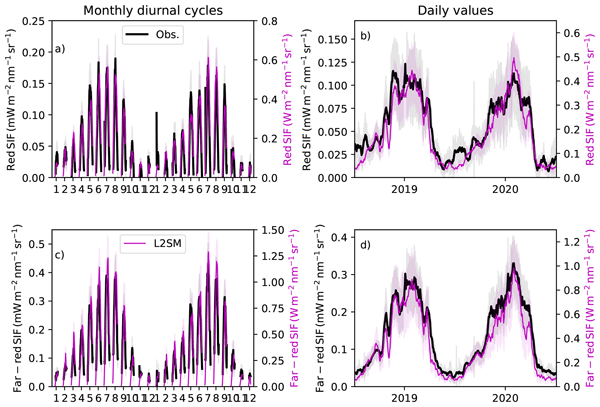
Solar-induced chlorophyll fluorescence (SIF) is an optical signal emitted by plants, connected to the biochemical status of the plants. Therefore it helps to unveil what happens inside plants and since it can be observed with remote sensing, it provides a global view of plant activity. We included SIF module in a terrestrial biosphere model and examined how to best describe movement of the SIF signal in the forest. Our work will help to model SIF in boreal coniferous forests.
Sarah Tardif, Maria Raquel Kanieski, Gauthier Lapa, Grégoire Bonnamour, Rita Sousa-Silva, Isabelle Laforest-Lapointe, and Alain Paquette
Atmos. Meas. Tech., 19, 2817–2835, https://doi.org/10.5194/amt-19-2817-2026, https://doi.org/10.5194/amt-19-2817-2026, 2026
Short summary
Short summary
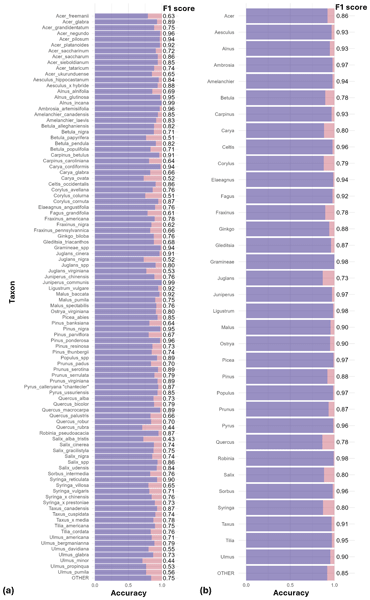
We developed a high-throughput method combining flow cytometry and machine learning to identify urban pollen. Using a reference database of 97 species across 34 genera, with values of particle size, granularity, and multi-channel fluorescence for each pollen grains, our method enables rapid species- and genus-level pollen identification. It provides an efficient alternative to microscopy, with potential for large-scale urban pollen monitoring and allergy management.
Andrew F. Feldman, William K. Smith, Alexandra G. Konings, Martin J. Baur, Marvin Browne, David Chaparro, Charles Devine, Jennifer L. Diehl, Arthur Endsley, Thomas Jagdhuber, Kristine M. Larson, Coral del Mar Valle-Rodriguez, Konstantin Schellenberg, Ruxandra-Maria Zotta, and Shawn P. Serbin
EGUsphere, https://doi.org/10.5194/egusphere-2026-1759, https://doi.org/10.5194/egusphere-2026-1759, 2026
Short summary
Short summary
Vegetation water observations from 272 field-based GNSS sensors and satellite-based vegetation optical depth are compared across the western U.S. We find significant positive correlations across the sites and identify common conditions that increase the correlations including less forest cover, more homogeneous vegetation across landscapes, and large seasonal amplitudes. These field-based sensors are thus useful tools to evaluate grass and shrub water stress and validate satellite signals.
Anne L. van Poecke, Laëtitia Bréchet, Clément Stahl, Giacomo Sellan, Lore T. Verryckt, Leandro Van Langenhove, Jordi Sardans, Josep Peñuelas, Andreas Richter, Maarten Op de Beeck, Gabriëlle Hoogsteyns, Benoit Burban, and Ivan A. Janssens
EGUsphere, https://doi.org/10.5194/egusphere-2026-682, https://doi.org/10.5194/egusphere-2026-682, 2026
Preprint archived
Short summary
Short summary
In the Amazon rainforest, long-term fertilisation stimulated the forest canopy to produce more leaves, reducing light availability for young trees. There was no overall increase in volume or improved photosynthesis for young trees. However, increased nutrients combined with lower light availability led to shade adaptations, such as taller stems and thinner leaves. Increases in foliar nutrients varied among species, potentially altering the long-term selection of trees that will grow into adults.
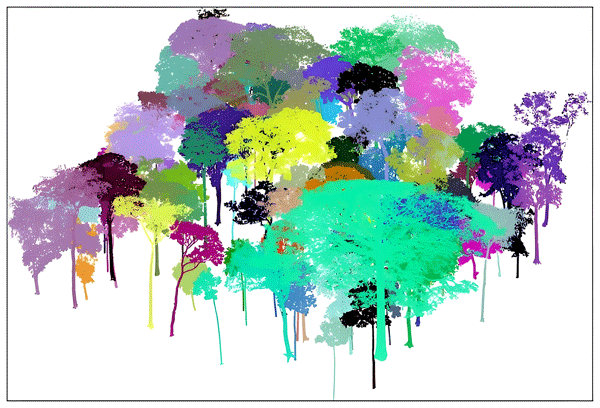
Cecilia Chavana-Bryant, Phil Wilkes, Wanxin Yang, Andrew Burt, Peter Vines, Amy C. Bennett, Georgia C. Pickavance, Declan L. M. Cooper, Simon L. Lewis, Oliver L. Phillips, Benjamin Brede, Alvaro Lau, Martin Herold, Iain M. McNicol, Edward T. A. Mitchard, David A. Coomes, Toby D. Jackson, Löic Makaga, Heddy O. Milamizokou Napo, Alfred Ngomanda, Stephan Ntie, Vincent Medjibe, Pacôme Dimbonda, Luna Soenens, Virginie Daelemans, Laetitia Proux, Reuben Nilus, Nicolas Labrière, Kathryn Jeffery, David F. R. P. Burslem, Dan Clewley, David Moffat, Lan Qie, Harm Bartholomeus, Gregoire Vincent, Nicolas Barbier, Geraldine Derroire, Katharine Abernethy, Klaus Scipal, and Mathias Disney
Earth Syst. Sci. Data, 18, 1243–1274, https://doi.org/10.5194/essd-18-1243-2026, https://doi.org/10.5194/essd-18-1243-2026, 2026
Short summary
Short summary
The ForestScan project provides a comprehensive set of datasets of tropical forest 3D structural measurements using terrestrial, unpiloted aerial vehicle and aerial laser scanning, plus tree census data. Collected at three sites in French Guiana, Gabon, and Malaysia, these datasets are crucial for calibrating and validating earth observation-derived forest biomass estimates, therefore, expanding and enhancing their use, and aiding global conservation efforts.
Ke Yu, Yang Su, Philippe Ciais, Ronny Lauerwald, David Makowski, Tianqi Shi, Shengbiao Wu, Petra Sieber, Chuanlong Zhou, and Daniel Goll
EGUsphere, https://doi.org/10.5194/egusphere-2026-219, https://doi.org/10.5194/egusphere-2026-219, 2026
Short summary
Short summary
Bare soil reflectance affects surface energy exchange in agricultural systems, but its field-scale variability is still poorly known. Using satellite observations and machine learning, we examined spatiotemporal variations of bare soil reflectance across European croplands. We show that it varies with soil properties, soil moisture, and observation geometry. These results suggest that dynamic soil reflectance should be taken into account in surface energy balance studies of agroecosystems.
Daju Wang, Ruowen Yang, Lei Cai, Pierre Gentine, César Terrer, Shuli Niu, Mirco Migliavacca, Wenping Yuan, Ryunosuke Tateno, Junlan Xiao, Josep Peñuelas, Caixian Tang, Yongshuo H. Fu, and Weiyu Shi
EGUsphere, https://doi.org/10.5194/egusphere-2026-296, https://doi.org/10.5194/egusphere-2026-296, 2026
Short summary
Short summary
Soil respiration is a major CO2 source, yet its response to vary nitrogen addition levels remains unclear. Using global data from 226 sites, we found moderate N addition has negligible or slightly positive effects, whereas high N addition consistently suppresses total and microbial respiration. These findings were incorporated into the CLM5 model, improving predictions of soil respiration and carbon storage. Our work elucidates how N deposition alters soil carbon processes and climate feedbacks.
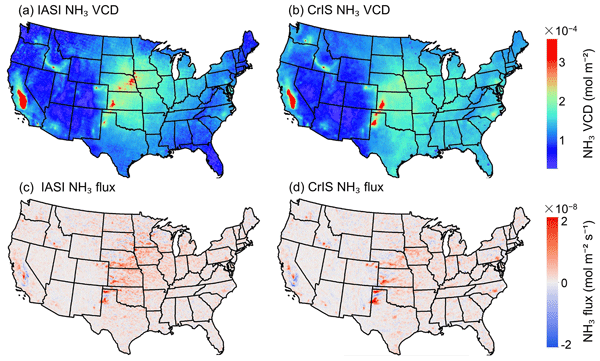
Zitong Li, Kang Sun, Kaiyu Guan, Sheng Wang, Bin Peng, Lieven Clarisse, Martin Van Damme, Pierre-François Coheur, Karen Cady-Pereira, Mark W. Shephard, Mark Zondlo, and Daniel Moore
Atmos. Chem. Phys., 26, 703–721, https://doi.org/10.5194/acp-26-703-2026, https://doi.org/10.5194/acp-26-703-2026, 2026
Short summary
Short summary
We estimate ammonia fluxes over the contiguous U.S. from 2008 to 2022 using a directional derivative approach applied to satellite observations from the Infrared Atmospheric Sounding Interferometer (IASI) and Cross-track Infrared Sounder (CrIS). The resulting flux estimates reveal pronounced seasonal and spatial patterns driven by agricultural activities and indicate substantial local deposition to surrounding vegetation, underscoring the need for improved monitoring and management strategies.
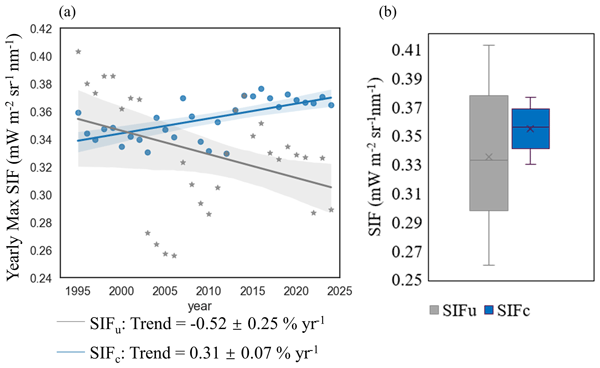
Chu Zou, Shanshan Du, Xinjie Liu, and Liangyun Liu
Earth Syst. Sci. Data, 18, 55–75, https://doi.org/10.5194/essd-18-55-2026, https://doi.org/10.5194/essd-18-55-2026, 2026
Short summary
Short summary
Understanding plant sunlight absorption is crucial for tracking global ecosystem health. We developed a 1995–2024 dataset that enhances satellite-based plant activity measurements by resolving data inconsistencies and improving resolution. Using advanced modeling, we harmonized signals from multiple satellites, cutting errors by 49 %. This offers clearer global photosynthesis trends, aiding climate research and vegetation monitoring.
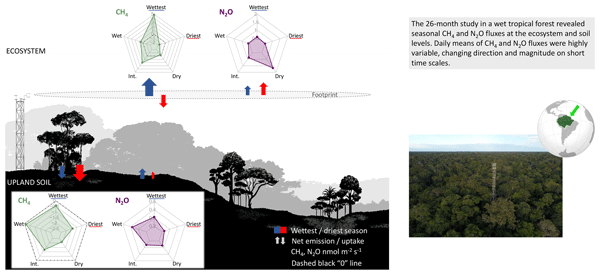
Laëtitia M. Bréchet, Mercedes Ibáñez, Robert B. Jackson, Benoît Burban, Clément Stahl, Damien Bonal, and Ivan A. Janssens
Biogeosciences, 22, 8031–8046, https://doi.org/10.5194/bg-22-8031-2025, https://doi.org/10.5194/bg-22-8031-2025, 2025
Short summary
Short summary
Net ecosystem and soil fluxes of the greenhouse gases methane (CH4) and nitrous oxide (N2O) were measured in a wet tropical forest. The measurements covered a 26-month period including contrasting seasons. The forest absorbed CH4 during the driest season, and emitted it during the wettest season, while consistently emitting N2O. The studied upland soils consistently absorb CH4 but emit N2O. Statistical models identified soil water content as one of the key drivers of these greenhouse gas fluxes.
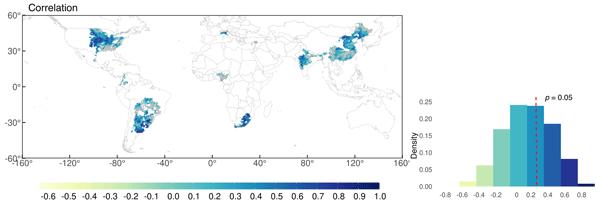
Astrid Yusara, Tomomichi Kato, Elizabeth A. Ainsworth, Rafael Battisti, Etsushi Kumagai, Satoshi Nakano, Yushan Wu, Yutaka Tsutsumi-Morita, Kazuhiko Kobayashi, and Yuji Masutomi
Geosci. Model Dev., 18, 8801–8826, https://doi.org/10.5194/gmd-18-8801-2025, https://doi.org/10.5194/gmd-18-8801-2025, 2025
Short summary
Short summary
We developed a soybean model, an ecosystem model for crop yield (namely MATCRO-Soy), integrating crop response toward climate variables. It offers a detailed yield estimation. Parameter tuning in the model used literature and field experiments. The model shows a moderate correlation with observed yields at the global, national, and grid-cell levels. Development of this model enhances crop modeling diversity approaches, particularly in climate change impact studies.
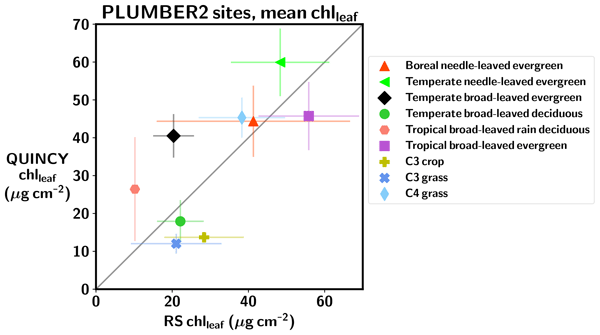
Tuuli Miinalainen, Amanda Ojasalo, Holly Croft, Mika Aurela, Mikko Peltoniemi, Silvia Caldararu, Sönke Zaehle, and Tea Thum
Biogeosciences, 22, 6937–6962, https://doi.org/10.5194/bg-22-6937-2025, https://doi.org/10.5194/bg-22-6937-2025, 2025
Short summary
Short summary
Estimating the future carbon budget requires an accurate understanding of the interlinkages between the land carbon and nitrogen cycles. We use a remote sensing leaf chlorophyll product to evaluate a terrestrial biosphere model, QUINCY (QUantifying Interactions between terrestrial Nutrient CYcles and the climate system). Our study showcases how the latest advancements in remote sensing-based vegetation monitoring can be harnessed for improving and evaluating process-based vegetation models.
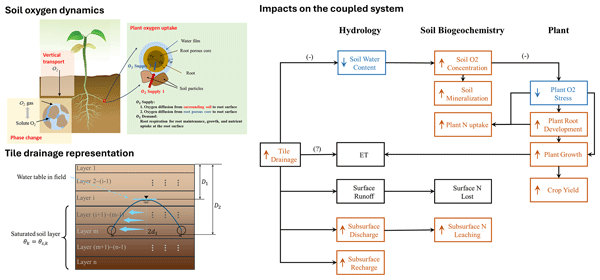
Zewei Ma, Kaiyu Guan, Bin Peng, Wang Zhou, Robert Grant, Jinyun Tang, Murugesu Sivapalan, Ming Pan, Li Li, and Zhenong Jin
Hydrol. Earth Syst. Sci., 29, 6393–6417, https://doi.org/10.5194/hess-29-6393-2025, https://doi.org/10.5194/hess-29-6393-2025, 2025
Short summary
Short summary
By involving soil oxygen dynamics, we explore tile drainage impacts on the coupled hydrology–biogeochemistry–crop system. We find that soil oxygen dynamics is the key mediator of tile–system dynamics. Tile drainage lowers soil water content and improves soil oxygen levels, helping crops grow during wet springs. The developed roots also help mitigate drought stress in dry summers. Overall, tile drainage increases crop resilience to climate change, making it a valuable future agricultural practice.
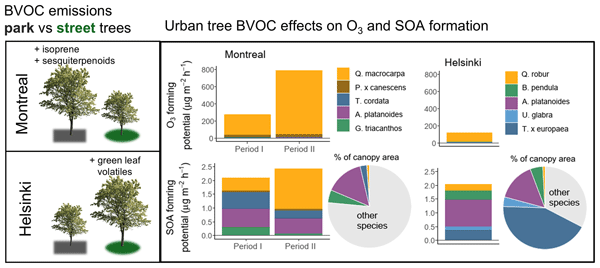
Kaisa Rissanen, Juho Aalto, Jaana Bäck, Heidi Hellén, Toni Tykkä, and Alain Paquette
Atmos. Chem. Phys., 25, 15415–15435, https://doi.org/10.5194/acp-25-15415-2025, https://doi.org/10.5194/acp-25-15415-2025, 2025
Short summary
Short summary
Urban trees emit biogenic volatile organic compounds (BVOC) that affect air quality through the formation of ozone and particulate matter. Trees in Montreal and Helsinki did not emit more BVOCs than expected based on measurements from forest trees, but the emissions varied between individual trees and growth environments. Avoiding high-BVOC emitting tree species and management strategies that protect trees from BVOC-inducing stress factors would help minimise their negative air quality impacts.
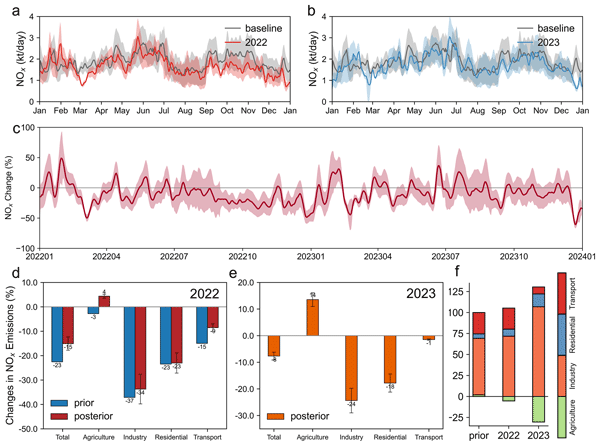
Yu Mao, Weimin Ju, Hengmao Wang, Liangyun Liu, Haikun Wang, Shuzhuang Feng, Mengwei Jia, and Fei Jiang
Atmos. Chem. Phys., 25, 14187–14204, https://doi.org/10.5194/acp-25-14187-2025, https://doi.org/10.5194/acp-25-14187-2025, 2025
Short summary
Short summary
The Russia-Ukraine war caused significant NOx emission reductions in Ukraine, exceeding COVID-19 impacts. Using TROPOMI data, we found a 15% drop in 2022 and 8% in 2023, with Eastern Ukraine (frontline) seeing declines of 29% and 17%. Industry emissions fell most (34% in 2022), while war-related NOx partially offset reductions (8-10%). Emissions closely tracked military actions, revealing conflict’s disruptive effects on socio-economic activity and air pollution.
Hayden Chak Hay Lam, David Ho Yin Yung, Donald Ka Chuen Tao, Joshua Tsz Wo Lo, Man Sing Wong, Jin Wu, and Amos Pui Kuen Tai
EGUsphere, https://doi.org/10.5194/egusphere-2025-4647, https://doi.org/10.5194/egusphere-2025-4647, 2025
Short summary
Short summary
We studied how forests in Hong Kong take up carbon through plant growth between 2002 and 2018. Using computer models, we found that forests remove a small but indispensable share of the city’s carbon emissions, mainly driven by changes in leaf area. This shows that forest management strategies can support climate goals, and highlights the role of local forests in working toward carbon neutrality targets.
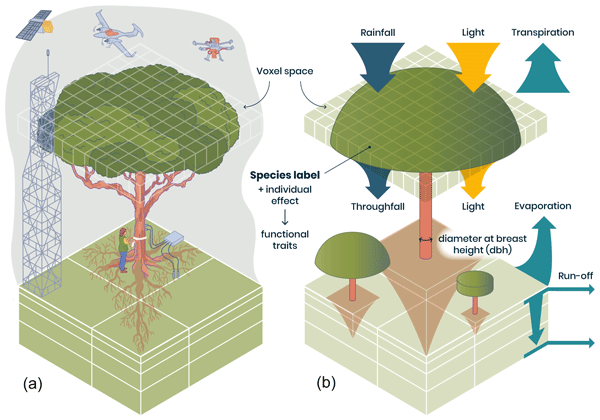
Isabelle Maréchaux, Fabian Jörg Fischer, Sylvain Schmitt, and Jérôme Chave
Geosci. Model Dev., 18, 5143–5204, https://doi.org/10.5194/gmd-18-5143-2025, https://doi.org/10.5194/gmd-18-5143-2025, 2025
Short summary
Short summary
We describe TROLL 4.0, a simulator of forest dynamics that represents trees in a virtual space at 1 m resolution. Tree birth, growth, and death and the underlying physiological processes such as carbon assimilation, water transpiration, and leaf phenology depend on plant traits that are measured in the field for many individuals and species. The model is thus capable of jointly simulating forest structure, diversity, and ecosystem functioning, a major challenge in modelling vegetation dynamics.
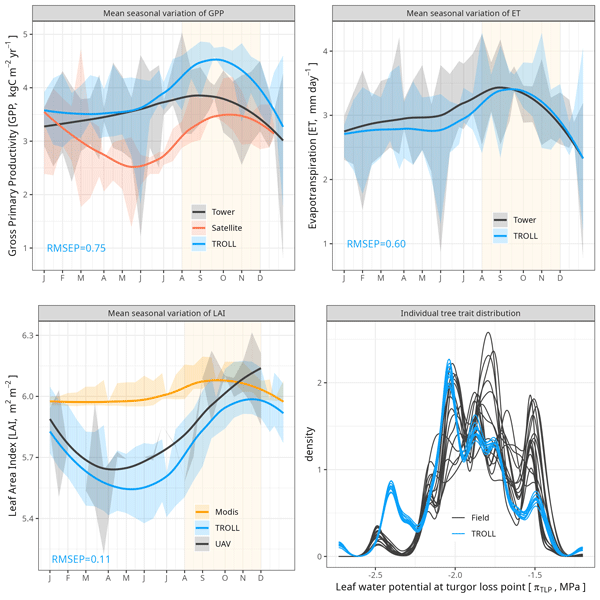
Sylvain Schmitt, Fabian J. Fischer, James G. C. Ball, Nicolas Barbier, Marion Boisseaux, Damien Bonal, Benoit Burban, Xiuzhi Chen, Géraldine Derroire, Jeremy W. Lichstein, Daniela Nemetschek, Natalia Restrepo-Coupe, Scott Saleska, Giacomo Sellan, Philippe Verley, Grégoire Vincent, Camille Ziegler, Jérôme Chave, and Isabelle Maréchaux
Geosci. Model Dev., 18, 5205–5243, https://doi.org/10.5194/gmd-18-5205-2025, https://doi.org/10.5194/gmd-18-5205-2025, 2025
Short summary
Short summary
We evaluate the capability of TROLL 4.0, a simulator of forest dynamics, to represent tropical forest structure, diversity, dynamics, and functioning in two Amazonian forests. Evaluation data include forest inventories, carbon and water fluxes between the forest and the atmosphere, and leaf area and canopy height from remote sensing products. The model realistically predicts the structure and composition as well as the seasonality of carbon and water fluxes at both sites.
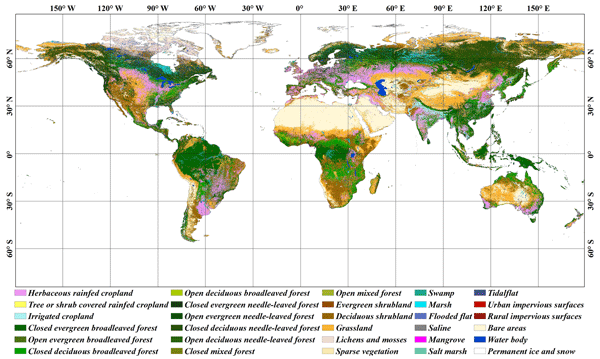
Xiao Zhang, Liangyun Liu, Tingting Zhao, Wenhan Zhang, Linlin Guan, Ming Bai, and Xidong Chen
Earth Syst. Sci. Data, 17, 4039–4062, https://doi.org/10.5194/essd-17-4039-2025, https://doi.org/10.5194/essd-17-4039-2025, 2025
Short summary
Short summary
This work describes a novel global 10 m land-cover dataset with a fine classification system, which contains 30 land-cover subcategories and achieves sufficient performance on a global scale.
Dianrun Zhao, Shanshan Du, Chu Zou, Longfei Tian, Meng Fan, Yulu Du, and Liangyun Liu
Atmos. Meas. Tech., 18, 3647–3667, https://doi.org/10.5194/amt-18-3647-2025, https://doi.org/10.5194/amt-18-3647-2025, 2025
Short summary
Short summary
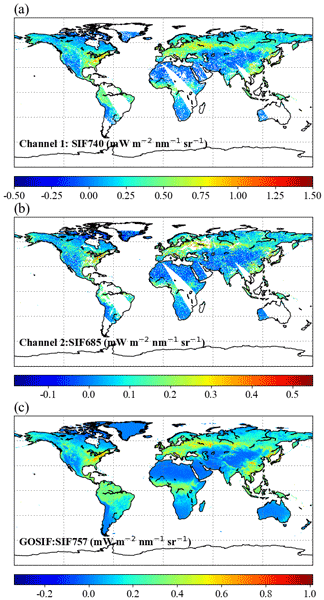
TanSat-2 is designed for global carbon monitoring, offering high-resolution dual-band observations of solar-induced chlorophyll fluorescence – a key indicator of photosynthesis. Simulations show its data processing can retrieve fluorescence with high accuracy. These results suggest TanSat-2 will enhance global tracking of the carbon cycle and vegetation health, providing valuable insights for climate change research.
Rubaya Pervin, Scott Robeson, Mallory Barnes, Stephen Sitch, Anthony Walker, Ben Poulter, Fabienne Maignan, Qing Sun, Thomas Colligan, Sönke Zaehle, Kashif Mahmud, Peter Anthoni, Almut Arneth, Vivek Arora, Vladislav Bastrikov, Liam Bogucki, Bertrand Decharme, Christine Delire, Stefanie Falk, Akihiko Ito, Etsushi Kato, Daniel Kennedy, Jürgen Knauer, Michael O’Sullivan, Wenping Yuan, and Natasha MacBean
EGUsphere, https://doi.org/10.5194/egusphere-2025-2841, https://doi.org/10.5194/egusphere-2025-2841, 2025
Short summary
Short summary
Drylands contribute more than a third of the global vegetation productivity. Yet, these regions are not well represented in global vegetation models. Here, we tested how well 15 global models capture annual changes in dryland vegetation productivity. Models that didn’t have vegetation change over time or fire have lower variability in vegetation productivity. Models need better representation of grass cover types and their coverage. Our work highlights where and how these models need to improve.
Rong Shang, Xudong Lin, Jing M. Chen, Yunjian Liang, Keyan Fang, Mingzhu Xu, Yulin Yan, Weimin Ju, Guirui Yu, Nianpeng He, Li Xu, Liangyun Liu, Jing Li, Wang Li, Jun Zhai, and Zhongmin Hu
Earth Syst. Sci. Data, 17, 3219–3241, https://doi.org/10.5194/essd-17-3219-2025, https://doi.org/10.5194/essd-17-3219-2025, 2025
Short summary
Short summary
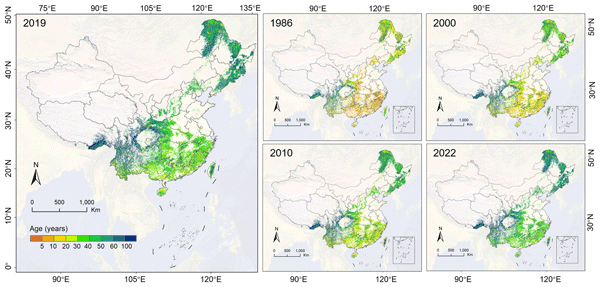
Forest age is critical for carbon cycle modeling and effective forest management. Existing datasets, however, have low spatial resolutions or limited temporal coverage. This study introduces China's annual forest age dataset (CAFA), spanning 1986–2022 at a 30 m resolution. By tracking forest disturbances, we annually update ages. Validation shows small errors for disturbed forests and larger errors for undisturbed forests. CAFA can enhance carbon cycle modeling and forest management in China.
Bernhard Lehner, Mira Anand, Etienne Fluet-Chouinard, Florence Tan, Filipe Aires, George H. Allen, Philippe Bousquet, Josep G. Canadell, Nick Davidson, Meng Ding, C. Max Finlayson, Thomas Gumbricht, Lammert Hilarides, Gustaf Hugelius, Robert B. Jackson, Maartje C. Korver, Liangyun Liu, Peter B. McIntyre, Szabolcs Nagy, David Olefeldt, Tamlin M. Pavelsky, Jean-Francois Pekel, Benjamin Poulter, Catherine Prigent, Jida Wang, Thomas A. Worthington, Dai Yamazaki, Xiao Zhang, and Michele Thieme
Earth Syst. Sci. Data, 17, 2277–2329, https://doi.org/10.5194/essd-17-2277-2025, https://doi.org/10.5194/essd-17-2277-2025, 2025
Short summary
Short summary
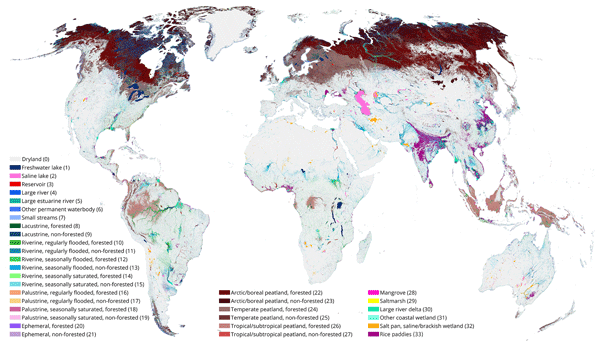
The Global Lakes and Wetlands Database (GLWD) version 2 distinguishes a total of 33 non-overlapping wetland classes, providing a static map of the world’s inland surface waters. It contains cell fractions of wetland extents per class at a grid cell resolution of ~500 m. The total combined extent of all classes including all inland and coastal waterbodies and wetlands of all inundation frequencies – that is, the maximum extent – covers 18.2 × 10⁶ km2, equivalent to 13.4 % of total global land area.
Tiangang Yuan, Tzung-May Fu, Aoxing Zhang, David H. Y. Yung, Jin Wu, Sien Li, and Amos P. K. Tai
Atmos. Chem. Phys., 25, 4211–4232, https://doi.org/10.5194/acp-25-4211-2025, https://doi.org/10.5194/acp-25-4211-2025, 2025
Short summary
Short summary
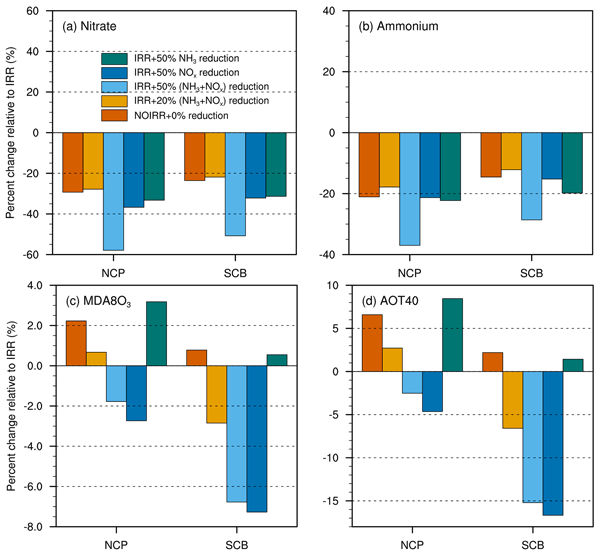
This study utilizes a regional climate–air quality coupled model to first investigate the complex interaction between irrigation, climate and air quality in China. We found that large-scale irrigation practices reduce summertime surface ozone while raising secondary inorganic aerosol concentration via complicated physical and chemical processes. Our results emphasize the importance of making a tradeoff between air pollution controls and sustainable agricultural development.
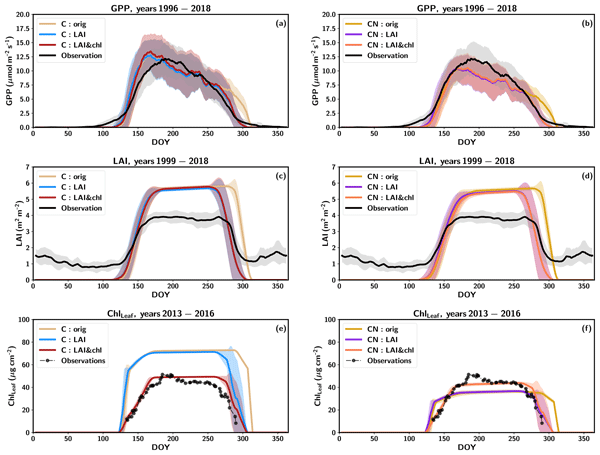
Tea Thum, Tuuli Miinalainen, Outi Seppälä, Holly Croft, Cheryl Rogers, Ralf Staebler, Silvia Caldararu, and Sönke Zaehle
Biogeosciences, 22, 1781–1807, https://doi.org/10.5194/bg-22-1781-2025, https://doi.org/10.5194/bg-22-1781-2025, 2025
Short summary
Short summary
Climate change has the potential to influence the carbon sequestration potential of terrestrial ecosystems, and here the nitrogen cycle is also important. We used the terrestrial biosphere model QUINCY (QUantifying Interactions between terrestrial Nutrient CYcles and the climate system) in a mixed deciduous forest in Canada. We investigated the usefulness of using the leaf area index and leaf chlorophyll content to improve the parameterization of the model. This work paves the way for using spaceborne observations in model parameterizations, also including information on the nitrogen cycle.
Sarah Camelo da Silva, Bárbara Bomfim, Jeffrey Quintin Chambers, Regison Costa de Oliveira, Cacilda Adélia Sampaio de Souza, Marcelo Nunes Vilas-Boas, Adriano José Nogueira Lima, Niro Higuchi, and Bruno Oliva Gimenez
EGUsphere, https://doi.org/10.5194/egusphere-2025-391, https://doi.org/10.5194/egusphere-2025-391, 2025
Preprint archived
Short summary
Short summary
Tropical forest soils are known for low fertility, but support vegetation with high species diversity and biomass. Nutrients and carbon essential for forest functioning are stored in the soil and biomass. The region’s topographic gradient, with variations in soil texture and water table depth, influences species distribution. This study quantified macronutrients and carbon in trunks, leaves, and soil of generalist and specialist species across different soil types.
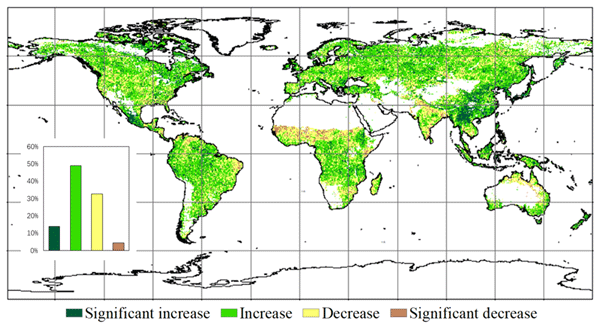
Chu Zou, Shanshan Du, Xinjie Liu, and Liangyun Liu
Earth Syst. Sci. Data, 16, 2789–2809, https://doi.org/10.5194/essd-16-2789-2024, https://doi.org/10.5194/essd-16-2789-2024, 2024
Short summary
Short summary
To obtain a temporally consistent satellite solar-induced chlorophyll fluorescence
(SIF) product (TCSIF), we corrected for time degradation of GOME-2A using a pseudo-invariant method. After the correction, the global SIF grew by 0.70 % per year from 2007 to 2021, and 62.91 % of vegetated regions underwent an increase in SIF. The dataset is a promising tool for monitoring global vegetation variation and will advance our understanding of vegetation's photosynthetic activities at a global scale.
(SIF) product (TCSIF), we corrected for time degradation of GOME-2A using a pseudo-invariant method. After the correction, the global SIF grew by 0.70 % per year from 2007 to 2021, and 62.91 % of vegetated regions underwent an increase in SIF. The dataset is a promising tool for monitoring global vegetation variation and will advance our understanding of vegetation's photosynthetic activities at a global scale.
Liangyun Liu and Xiao Zhang
ISPRS Ann. Photogramm. Remote Sens. Spatial Inf. Sci., X-2-2024, 137–143, https://doi.org/10.5194/isprs-annals-X-2-2024-137-2024, https://doi.org/10.5194/isprs-annals-X-2-2024-137-2024, 2024
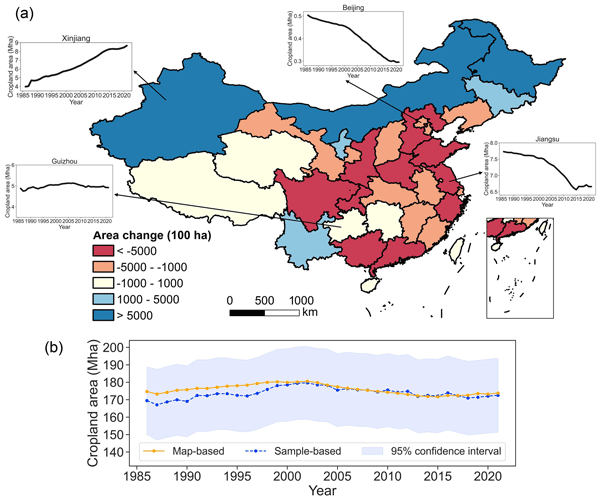
Ying Tu, Shengbiao Wu, Bin Chen, Qihao Weng, Yuqi Bai, Jun Yang, Le Yu, and Bing Xu
Earth Syst. Sci. Data, 16, 2297–2316, https://doi.org/10.5194/essd-16-2297-2024, https://doi.org/10.5194/essd-16-2297-2024, 2024
Short summary
Short summary
We developed the first 30 m annual cropland dataset of China (CACD) for 1986–2021. The overall accuracy of CACD reached up to 0.93±0.01 and was superior to other products. Our fine-resolution cropland maps offer valuable information for diverse applications and decision-making processes in the future.
Russell Doughty, Yujie Wang, Jennifer Johnson, Nicholas Parazoo, Troy Magney, Zoe Pierrat, Xiangming Xiao, Luis Guanter, Philipp Köhler, Christian Frankenberg, Peter Somkuti, Shuang Ma, Yuanwei Qin, Sean Crowell, and Berrien Moore III
EGUsphere, https://doi.org/10.22541/essoar.168167172.20799710/v1, https://doi.org/10.22541/essoar.168167172.20799710/v1, 2024
Preprint archived
Short summary
Short summary
Here we present a novel model of global photosynthesis, ChloFluo, which uses spaceborne chlorophyll fluorescence to estimate the amount of photosynthetically active radiation absorbed by chlorophyll. Potential uses of our model are to advance our understanding of the timing and magnitude of photosynthesis, its effect on atmospheric carbon dioxide fluxes, and vegetation response to climate events and change.
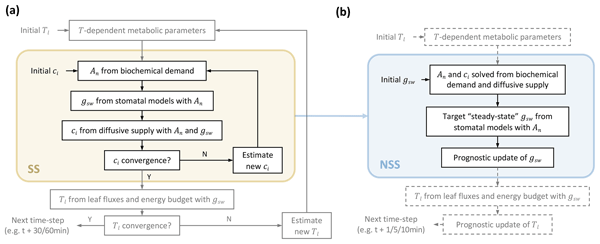
Ke Liu, Yujie Wang, Troy S. Magney, and Christian Frankenberg
Biogeosciences, 21, 1501–1516, https://doi.org/10.5194/bg-21-1501-2024, https://doi.org/10.5194/bg-21-1501-2024, 2024
Short summary
Short summary
Stomata are pores on leaves that regulate gas exchange between plants and the atmosphere. Existing land models unrealistically assume stomata can jump between steady states when the environment changes. We implemented dynamic modeling to predict gradual stomatal responses at different scales. Results suggested that considering this effect on plant behavior patterns in diurnal cycles was important. Our framework also simplified simulations and can contribute to further efficiency improvements.
Xiao Zhang, Tingting Zhao, Hong Xu, Wendi Liu, Jinqing Wang, Xidong Chen, and Liangyun Liu
Earth Syst. Sci. Data, 16, 1353–1381, https://doi.org/10.5194/essd-16-1353-2024, https://doi.org/10.5194/essd-16-1353-2024, 2024
Short summary
Short summary
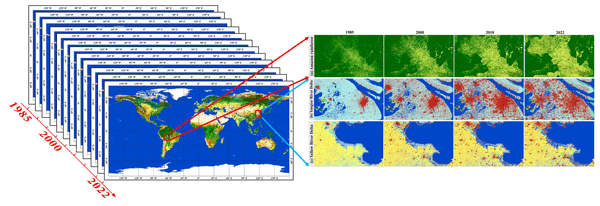
This work describes GLC_FCS30D, the first global 30 m land-cover dynamics monitoring dataset, which contains 35 land-cover subcategories and covers the period of 1985–2022 in 26 time steps (its maps are updated every 5 years before 2000 and annually after 2000).
Lammert Kooistra, Katja Berger, Benjamin Brede, Lukas Valentin Graf, Helge Aasen, Jean-Louis Roujean, Miriam Machwitz, Martin Schlerf, Clement Atzberger, Egor Prikaziuk, Dessislava Ganeva, Enrico Tomelleri, Holly Croft, Pablo Reyes Muñoz, Virginia Garcia Millan, Roshanak Darvishzadeh, Gerbrand Koren, Ittai Herrmann, Offer Rozenstein, Santiago Belda, Miina Rautiainen, Stein Rune Karlsen, Cláudio Figueira Silva, Sofia Cerasoli, Jon Pierre, Emine Tanır Kayıkçı, Andrej Halabuk, Esra Tunc Gormus, Frank Fluit, Zhanzhang Cai, Marlena Kycko, Thomas Udelhoven, and Jochem Verrelst
Biogeosciences, 21, 473–511, https://doi.org/10.5194/bg-21-473-2024, https://doi.org/10.5194/bg-21-473-2024, 2024
Short summary
Short summary
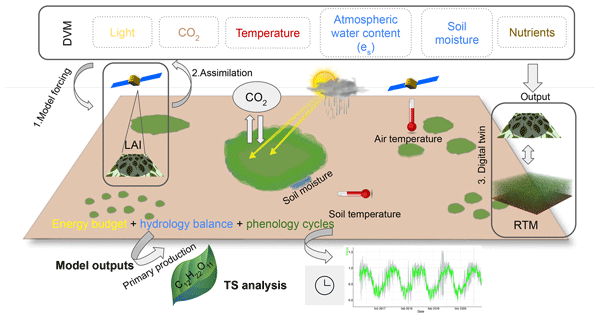
We reviewed optical remote sensing time series (TS) studies for monitoring vegetation productivity across ecosystems. Methods were categorized into trend analysis, land surface phenology, and assimilation into statistical or dynamic vegetation models. Due to progress in machine learning, TS processing methods will diversify, while modelling strategies will advance towards holistic processing. We propose integrating methods into a digital twin to improve the understanding of vegetation dynamics.
Martin Schwartz, Philippe Ciais, Aurélien De Truchis, Jérôme Chave, Catherine Ottlé, Cedric Vega, Jean-Pierre Wigneron, Manuel Nicolas, Sami Jouaber, Siyu Liu, Martin Brandt, and Ibrahim Fayad
Earth Syst. Sci. Data, 15, 4927–4945, https://doi.org/10.5194/essd-15-4927-2023, https://doi.org/10.5194/essd-15-4927-2023, 2023
Short summary
Short summary
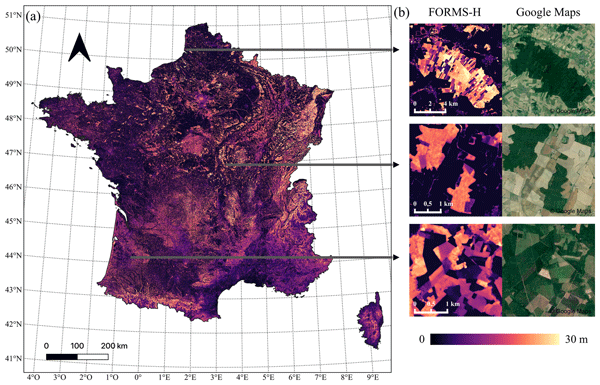
As forests play a key role in climate-related issues, their accurate monitoring is critical to reduce global carbon emissions effectively. Based on open-access remote-sensing sensors, and artificial intelligence methods, we created high-resolution tree height, wood volume, and biomass maps of metropolitan France that outperform previous products. This study, based on freely available data, provides essential information to support climate-efficient forest management policies at a low cost.
Xueqin Yang, Xiuzhi Chen, Jiashun Ren, Wenping Yuan, Liyang Liu, Juxiu Liu, Dexiang Chen, Yihua Xiao, Qinghai Song, Yanjun Du, Shengbiao Wu, Lei Fan, Xiaoai Dai, Yunpeng Wang, and Yongxian Su
Earth Syst. Sci. Data, 15, 2601–2622, https://doi.org/10.5194/essd-15-2601-2023, https://doi.org/10.5194/essd-15-2601-2023, 2023
Short summary
Short summary
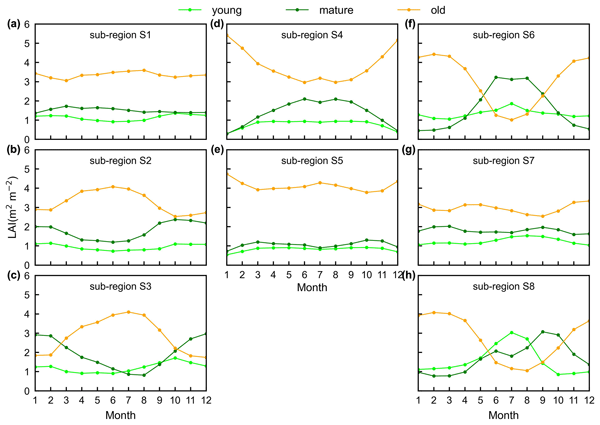
We developed the first time-mapped, continental-scale gridded dataset of monthly leaf area index (LAI) in three leaf age cohorts (i.e., young, mature, and old) from 2001–2018 data (referred to as Lad-LAI). The seasonality of three LAI cohorts from the new Lad-LAI product agrees well at eight sites with very fine-scale collections of monthly LAI. The proposed satellite-based approaches can provide references for mapping finer spatiotemporal-resolution LAI products with different leaf age cohorts.
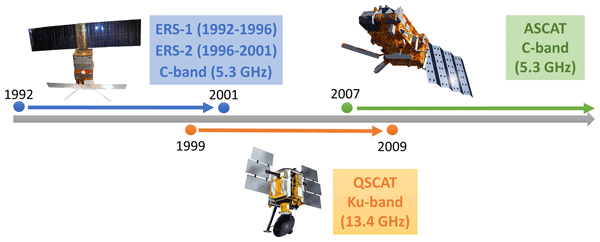
Shengli Tao, Zurui Ao, Jean-Pierre Wigneron, Sassan Saatchi, Philippe Ciais, Jérôme Chave, Thuy Le Toan, Pierre-Louis Frison, Xiaomei Hu, Chi Chen, Lei Fan, Mengjia Wang, Jiangling Zhu, Xia Zhao, Xiaojun Li, Xiangzhuo Liu, Yanjun Su, Tianyu Hu, Qinghua Guo, Zhiheng Wang, Zhiyao Tang, Yi Y. Liu, and Jingyun Fang
Earth Syst. Sci. Data, 15, 1577–1596, https://doi.org/10.5194/essd-15-1577-2023, https://doi.org/10.5194/essd-15-1577-2023, 2023
Short summary
Short summary
We provide the first long-term (since 1992), high-resolution (8.9 km) satellite radar backscatter data set (LHScat) with a C-band (5.3 GHz) signal dynamic for global lands. LHScat was created by fusing signals from ERS (1992–2001; C-band), QSCAT (1999–2009; Ku-band), and ASCAT (since 2007; C-band). LHScat has been validated against independent ERS-2 signals. It could be used in a variety of studies, such as vegetation monitoring and hydrological modelling.
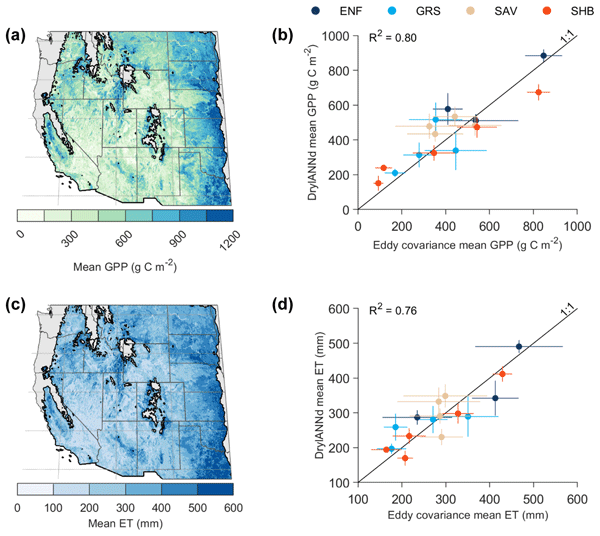
Matthew P. Dannenberg, Mallory L. Barnes, William K. Smith, Miriam R. Johnston, Susan K. Meerdink, Xian Wang, Russell L. Scott, and Joel A. Biederman
Biogeosciences, 20, 383–404, https://doi.org/10.5194/bg-20-383-2023, https://doi.org/10.5194/bg-20-383-2023, 2023
Short summary
Short summary
Earth's drylands provide ecosystem services to many people and will likely be strongly affected by climate change, but it is quite challenging to monitor the productivity and water use of dryland plants with satellites. We developed and tested an approach for estimating dryland vegetation activity using machine learning to combine information from multiple satellite sensors. Our approach excelled at estimating photosynthesis and water use largely due to the inclusion of satellite soil moisture.
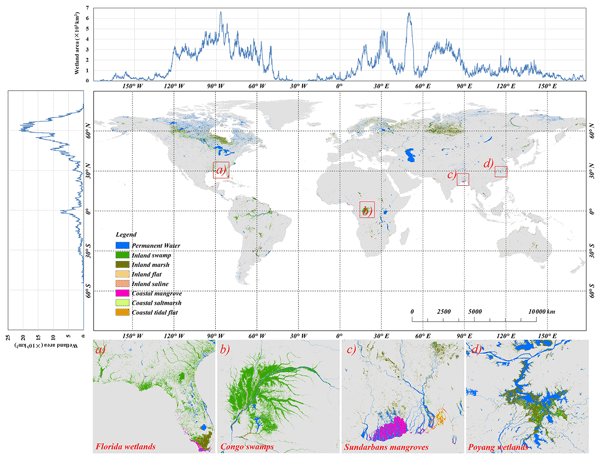
Xiao Zhang, Liangyun Liu, Tingting Zhao, Xidong Chen, Shangrong Lin, Jinqing Wang, Jun Mi, and Wendi Liu
Earth Syst. Sci. Data, 15, 265–293, https://doi.org/10.5194/essd-15-265-2023, https://doi.org/10.5194/essd-15-265-2023, 2023
Short summary
Short summary
An accurate global 30 m wetland dataset that can simultaneously cover inland and coastal zones is lacking. This study proposes a novel method for wetland mapping and generates the first global 30 m wetland map with a fine classification system (GWL_FCS30), including five inland wetland sub-categories (permanent water, swamp, marsh, flooded flat and saline) and three coastal wetland sub-categories (mangrove, salt marsh and tidal flats).

Yitong Yao, Emilie Joetzjer, Philippe Ciais, Nicolas Viovy, Fabio Cresto Aleina, Jerome Chave, Lawren Sack, Megan Bartlett, Patrick Meir, Rosie Fisher, and Sebastiaan Luyssaert
Geosci. Model Dev., 15, 7809–7833, https://doi.org/10.5194/gmd-15-7809-2022, https://doi.org/10.5194/gmd-15-7809-2022, 2022
Short summary
Short summary
To facilitate more mechanistic modeling of drought effects on forest dynamics, our study implements a hydraulic module to simulate the vertical water flow, change in water storage and percentage loss of stem conductance (PLC). With the relationship between PLC and tree mortality, our model can successfully reproduce the large biomass drop observed under throughfall exclusion. Our hydraulic module provides promising avenues benefiting the prediction for mortality under future drought events.
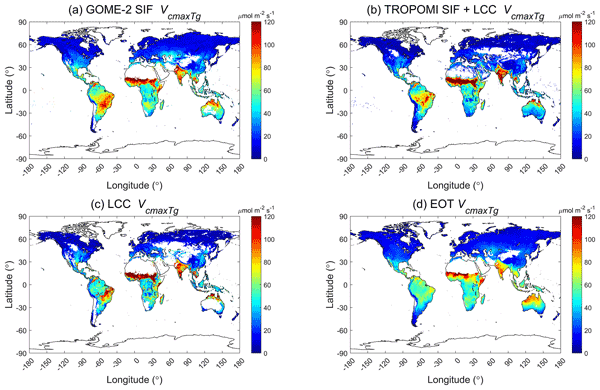
Jing M. Chen, Rong Wang, Yihong Liu, Liming He, Holly Croft, Xiangzhong Luo, Han Wang, Nicholas G. Smith, Trevor F. Keenan, I. Colin Prentice, Yongguang Zhang, Weimin Ju, and Ning Dong
Earth Syst. Sci. Data, 14, 4077–4093, https://doi.org/10.5194/essd-14-4077-2022, https://doi.org/10.5194/essd-14-4077-2022, 2022
Short summary
Short summary
Green leaves contain chlorophyll pigments that harvest light for photosynthesis and also emit chlorophyll fluorescence as a byproduct. Both chlorophyll pigments and fluorescence can be measured by Earth-orbiting satellite sensors. Here we demonstrate that leaf photosynthetic capacity can be reliably derived globally using these measurements. This new satellite-based information overcomes a bottleneck in global ecological research where such spatially explicit information is currently lacking.
Xiaojin Qian, Liangyun Liu, Xidong Chen, Xiao Zhang, Siyuan Chen, and Qi Sun
Earth Syst. Sci. Data Discuss., https://doi.org/10.5194/essd-2022-277, https://doi.org/10.5194/essd-2022-277, 2022
Manuscript not accepted for further review
Short summary
Short summary
Leaf chlorophyll content (LCC) is an important plant physiological trait and a proxy for leaf photosynthetic capacity. We generated a global LCC dataset from ENVISAT MERIS and Sentinel-3 OLCI satellite data for the period 2003–2012 to 2018–2020 using a physically-based radiative transfer modeling approach. This new LCC dataset spanning nearly 20 years will provide a valuable opportunity for the monitoring of vegetation growth and terrestrial carbon cycle modeling on a global scale.
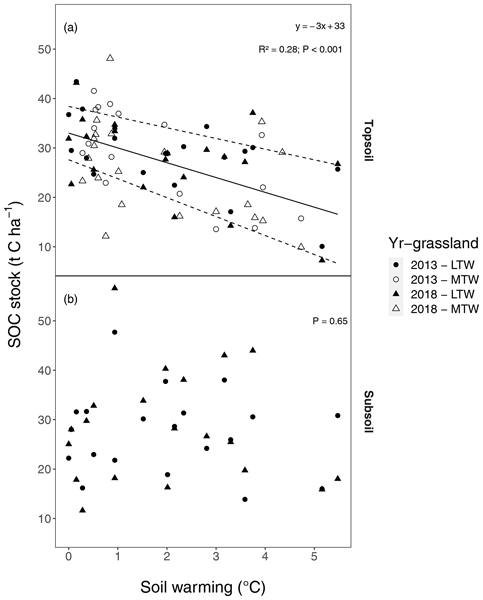
Niel Verbrigghe, Niki I. W. Leblans, Bjarni D. Sigurdsson, Sara Vicca, Chao Fang, Lucia Fuchslueger, Jennifer L. Soong, James T. Weedon, Christopher Poeplau, Cristina Ariza-Carricondo, Michael Bahn, Bertrand Guenet, Per Gundersen, Gunnhildur E. Gunnarsdóttir, Thomas Kätterer, Zhanfeng Liu, Marja Maljanen, Sara Marañón-Jiménez, Kathiravan Meeran, Edda S. Oddsdóttir, Ivika Ostonen, Josep Peñuelas, Andreas Richter, Jordi Sardans, Páll Sigurðsson, Margaret S. Torn, Peter M. Van Bodegom, Erik Verbruggen, Tom W. N. Walker, Håkan Wallander, and Ivan A. Janssens
Biogeosciences, 19, 3381–3393, https://doi.org/10.5194/bg-19-3381-2022, https://doi.org/10.5194/bg-19-3381-2022, 2022
Short summary
Short summary
In subarctic grassland on a geothermal warming gradient, we found large reductions in topsoil carbon stocks, with carbon stocks linearly declining with warming intensity. Most importantly, however, we observed that soil carbon stocks stabilised within 5 years of warming and remained unaffected by warming thereafter, even after > 50 years of warming. Moreover, in contrast to the large topsoil carbon losses, subsoil carbon stocks remained unaffected after > 50 years of soil warming.
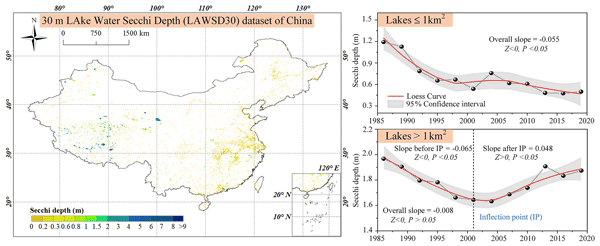
Xidong Chen, Liangyun Liu, Xiao Zhang, Junsheng Li, Shenglei Wang, Yuan Gao, and Jun Mi
Hydrol. Earth Syst. Sci., 26, 3517–3536, https://doi.org/10.5194/hess-26-3517-2022, https://doi.org/10.5194/hess-26-3517-2022, 2022
Short summary
Short summary
A 30 m LAke Water Secchi Depth (LAWSD30) dataset of China was first developed for 1985–2020, and national-scale water clarity estimations of lakes in China over the past 35 years were analyzed. Lake clarity in China exhibited a significant downward trend before the 21st century, but improved after 2000. The developed LAWSD30 dataset and the evaluation results can provide effective guidance for water preservation and restoration.
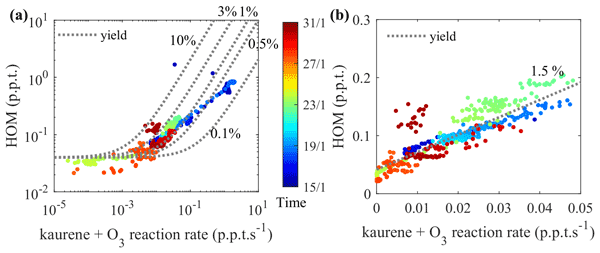
Yuanyuan Luo, Olga Garmash, Haiyan Li, Frans Graeffe, Arnaud P. Praplan, Anssi Liikanen, Yanjun Zhang, Melissa Meder, Otso Peräkylä, Josep Peñuelas, Ana María Yáñez-Serrano, and Mikael Ehn
Atmos. Chem. Phys., 22, 5619–5637, https://doi.org/10.5194/acp-22-5619-2022, https://doi.org/10.5194/acp-22-5619-2022, 2022
Short summary
Short summary
Diterpenes were only recently observed in the atmosphere, and little is known of their atmospheric fates. We explored the ozonolysis of the diterpene kaurene in a chamber, and we characterized the oxidation products for the first time using chemical ionization mass spectrometry. Our findings highlight similarities and differences between diterpenes and smaller terpenes during their atmospheric oxidation.
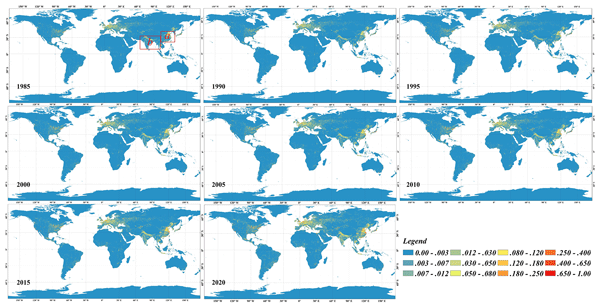
Xiao Zhang, Liangyun Liu, Tingting Zhao, Yuan Gao, Xidong Chen, and Jun Mi
Earth Syst. Sci. Data, 14, 1831–1856, https://doi.org/10.5194/essd-14-1831-2022, https://doi.org/10.5194/essd-14-1831-2022, 2022
Short summary
Short summary
Accurately mapping impervious-surface dynamics has great scientific significance and application value for research on urban sustainable development, the assessment of anthropogenic carbon emissions and global ecological-environment modeling. In this study, a novel and accurate global 30 m impervious surface dynamic dataset (GISD30) for 1985 to 2020 was produced using the spectral-generalization method and time-series Landsat imagery on the Google Earth Engine cloud computing platform.
Mathilda Hancock, Stephen Sitch, Fabian Jörg Fischer, Jérôme Chave, Michael O'Sullivan, Dominic Fawcett, and Lina María Mercado
Biogeosciences Discuss., https://doi.org/10.5194/bg-2022-87, https://doi.org/10.5194/bg-2022-87, 2022
Publication in BG not foreseen
Short summary
Short summary
Global vegetation models often underestimate the spatial variability of carbon stored in the Amazon forest. This paper demonstrates that including spatially varying tree mortality rates, as opposed to a homogeneous rate, in one model, significantly improves its simulations of the forest carbon store. To overcome the limited resolution of tree mortality data, this research presents a simple method of calculating mortality rates across Amazonia using a dependence on wood density.
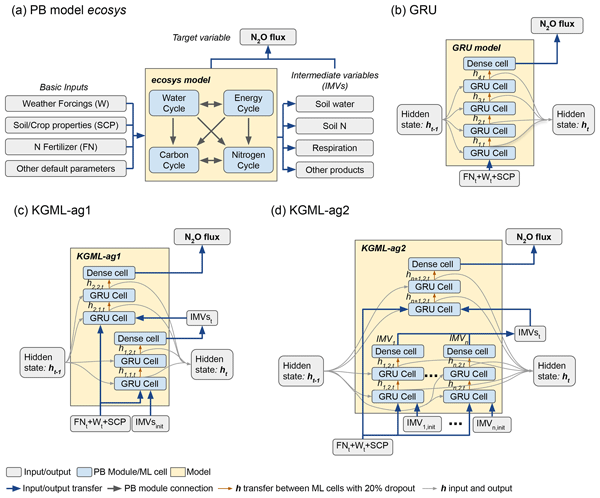
Licheng Liu, Shaoming Xu, Jinyun Tang, Kaiyu Guan, Timothy J. Griffis, Matthew D. Erickson, Alexander L. Frie, Xiaowei Jia, Taegon Kim, Lee T. Miller, Bin Peng, Shaowei Wu, Yufeng Yang, Wang Zhou, Vipin Kumar, and Zhenong Jin
Geosci. Model Dev., 15, 2839–2858, https://doi.org/10.5194/gmd-15-2839-2022, https://doi.org/10.5194/gmd-15-2839-2022, 2022
Short summary
Short summary
By incorporating the domain knowledge into a machine learning model, KGML-ag overcomes the well-known limitations of process-based models due to insufficient representations and constraints, and unlocks the “black box” of machine learning models. Therefore, KGML-ag can outperform existing approaches on capturing the hot moment and complex dynamics of N2O flux. This study will be a critical reference for the new generation of modeling paradigm for biogeochemistry and other geoscience processes.
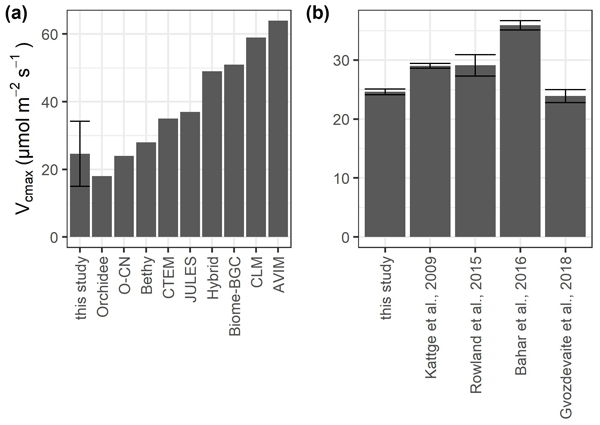
Lore T. Verryckt, Sara Vicca, Leandro Van Langenhove, Clément Stahl, Dolores Asensio, Ifigenia Urbina, Romà Ogaya, Joan Llusià, Oriol Grau, Guille Peguero, Albert Gargallo-Garriga, Elodie A. Courtois, Olga Margalef, Miguel Portillo-Estrada, Philippe Ciais, Michael Obersteiner, Lucia Fuchslueger, Laynara F. Lugli, Pere-Roc Fernandez-Garberí, Helena Vallicrosa, Melanie Verlinden, Christian Ranits, Pieter Vermeir, Sabrina Coste, Erik Verbruggen, Laëtitia Bréchet, Jordi Sardans, Jérôme Chave, Josep Peñuelas, and Ivan A. Janssens
Earth Syst. Sci. Data, 14, 5–18, https://doi.org/10.5194/essd-14-5-2022, https://doi.org/10.5194/essd-14-5-2022, 2022
Short summary
Short summary
We provide a comprehensive dataset of vertical profiles of photosynthesis and important leaf traits, including leaf N and P concentrations, from two 3-year, large-scale nutrient addition experiments conducted in two tropical rainforests in French Guiana. These data present a unique source of information to further improve model representations of the roles of N and P, and other leaf nutrients, in photosynthesis in tropical forests.

Alexander J. Turner, Philipp Köhler, Troy S. Magney, Christian Frankenberg, Inez Fung, and Ronald C. Cohen
Biogeosciences, 18, 6579–6588, https://doi.org/10.5194/bg-18-6579-2021, https://doi.org/10.5194/bg-18-6579-2021, 2021
Short summary
Short summary
This work builds a high-resolution estimate (500 m) of gross primary productivity (GPP) over the US using satellite measurements of solar-induced chlorophyll fluorescence (SIF) from the TROPOspheric Monitoring Instrument (TROPOMI) between 2018 and 2020. We identify ecosystem-specific scaling factors for estimating gross primary productivity (GPP) from TROPOMI SIF. Extreme precipitation events drive four regional GPP anomalies that account for 28 % of year-to-year GPP differences across the US.
Cited articles
Barnes, M. L., Breshears, D. D., Law, D. J., van Leeuwen, W. J. D., Monson, R. K., Fojtik, A. C., Barron-Gafford, G. A., and Moore, D. J. P.: Beyond greenness: Detecting temporal changes in photosynthetic capacity with hyperspectral reflectance data, PLOS ONE, 12, e0189539, https://doi.org/10.1371/journal.pone.0189539, 2017.
Bernacchi, C. J., Singsaas, E. L., Pimentel, C., Portis Jr., A. R., and Long, S. P.: Improved temperature response functions for models of Rubisco-limited photosynthesis, Plant, Cell & Environment, 24, 253–259, https://doi.org/10.1111/j.1365-3040.2001.00668.x, 2001.
Bjorkman, A. D., Myers-Smith, I. H., Elmendorf, S. C., et al.: Plant functional trait change across a warming tundra biome, Nature, 562, 57–62, https://doi.org/10.1038/s41586-018-0563-7, 2018.
Bonan, G. B., Lawrence, P. J., Oleson, K. W., Levis, S., Jung, M., Reichstein, M., Lawrence, D. M., and Swenson, S. C.: Improving canopy processes in the Community Land Model version 4 (CLM4) using global flux fields empirically inferred from FLUXNET data, Journal of Geophysical Research: Biogeosciences, 116, https://doi.org/10.1029/2010JG001593, 2011.
Bruhn, D., Newman, F., Hancock, M., Povlsen, P., Slot, M., Sitch, S., Drake, J., Weedon, G. P., Clark, D. B., Pagter, M., Ellis, R. J., Tjoelker, M. G., Andersen, K. M., Correa, Z. R., McGuire, P. C., and Mercado, L. M.: Nocturnal plant respiration is under strong non-temperature control, Nature Communications, 13, 5650, https://doi.org/10.1038/s41467-022-33370-1, 2022.
Burnett, A. C., Davidson, K. J., Serbin, S. P., and Rogers, A.: The “one-point method” for estimating maximum carboxylation capacity of photosynthesis: A cautionary tale, Plant, Cell & Environment, 42, 2472–2481, https://doi.org/10.1111/pce.13574, 2019.
Burnett, A. C., Anderson, J., Davidson, K. J., Ely, K. S., Lamour, J., Li, Q., Morrison, B. D., Yang, D., Rogers, A., and Serbin, S. P.: A best-practice guide to predicting plant traits from leaf-level hyperspectral data using partial least squares regression, Journal of Experimental Botany, 72, 6175–6189, https://doi.org/10.1093/jxb/erab295, 2021.
Busch, F. A., Sage, R. F., and Farquhar, G. D.: Plants increase CO2 uptake by assimilating nitrogen via the photorespiratory pathway, Nature Plants, 4, 46–54, https://doi.org/10.1038/s41477-017-0065-x, 2018.
Busch, F. A., Ainsworth, E. A., Amtmann, A., Cavanagh, A. P., Driever, S. M., Ferguson, J. N., Kromdijk, J., Lawson, T., Leakey, A. D. B., Matthews, J. S. A., Meacham-Hensold, K., Vath, R. L., Vialet-Chabrand, S., Walker, B. J., and Papanatsiou, M.: A guide to photosynthetic gas exchange measurements: Fundamental principles, best practice and potential pitfalls, Plant, Cell & Environment, 47, 3344–3364, https://doi.org/10.1111/pce.14815, 2024.
Chadwick, K. D. and Asner, G. P.: Organismic-Scale Remote Sensing of Canopy Foliar Traits in Lowland Tropical Forests, Remote Sensing, 8, https://doi.org/10.3390/rs8020087, 2016.
Coast, O., Shah, S., Ivakov, A., Gaju, O., Wilson, P. B., Posch, B. C., Bryant, C. J., Negrini, A. C. A., Evans, J. R., Condon, A. G., Silva-Pérez, V., Reynolds, M. P., Pogson, B. J., Millar, A. H., Furbank, R. T., and Atkin, O. K.: Predicting dark respiration rates of wheat leaves from hyperspectral reflectance, Plant, Cell & Environment, 42, 2133–2150, https://doi.org/10.1111/pce.13544, 2019.
Croft, H., Chen, J. M., Luo, X., Bartlett, P., Chen, B., and Staebler, R. M.: Leaf chlorophyll content as a proxy for leaf photosynthetic capacity, Global Change Biology, 23, 3513–3524, https://doi.org/10.1111/gcb.13599, 2017.
De Kauwe, M. G., Lin, Y.-S., Wright, I. J., Medlyn, B. E., Crous, K. Y., Ellsworth, D. S., Maire, V., Prentice, I. C., Atkin, O. K., Rogers, A., Niinemets, Ü., Serbin, S. P., Meir, P., Uddling, J., Togashi, H. F., Tarvainen, L., Weerasinghe, L. K., Evans, B. J., Ishida, F. Y., and Domingues, T. F.: A test of the `one-point method' for estimating maximum carboxylation capacity from field-measured, light-saturated photosynthesis, New Phytologist, 210, 1130–1144, https://doi.org/10.1111/nph.13815, 2016.
Dinerstein, E., Olson, D., Joshi, A., Vynne, C., Burgess, N. D., Wikramanayake, E., Hahn, N., Palminteri, S., Hedao, P., Noss, R., Hansen, M., Locke, H., Ellis, E. C., Jones, B., Barber, C. V., Hayes, R., Kormos, C., Martin, V., Crist, E., Sechrest, W., Price, L., Baillie, J. E. M., Weeden, D., Suckling, K., Davis, C., Sizer, N., Moore, R., Thau, D., Birch, T., Potapov, P., Turubanova, S., Tyukavina, A., de Souza, N., Pintea, L., Brito, J. C., Llewellyn, O. A., Miller, A. G., Patzelt, A., Ghazanfar, S. A., Timberlake, J., Klöser, H., Shennan-Farpón, Y., Kindt, R., Lillesø, J.-P. B., van Breugel, P., Graudal, L., Voge, M., Al-Shammari, K. F., and Saleem, M.: An Ecoregion-Based Approach to Protecting Half the Terrestrial Realm, BioScience, 67, 534–545, https://doi.org/10.1093/biosci/bix014, 2017.
Domingues, T. F., Meir, P., Feldpausch, T. R., Saiz, G., Veenendaal, E., Schrodt, F., Bird, M., Djagbletey, G., Hien, F., Compaore, H., Diallo, A., Grace, J., and Lloyd, J.: Co-limitation of photosynthetic capacity by nitrogen and phosphorus in West Africa woodlands, Plant, Cell & Environment, 33, 959–980, https://doi.org/10.1111/j.1365-3040.2010.02119.x, 2010.
EcoSIS: Ecological Spectral Information System. https://ecosis.org/, last access: 1 April 2025.
Ely, K. S., Rogers, A., Deborah A. Agarwal, Ainsworth, E. A., Albert, L. P., Ali, A., Anderson, J., Aspinwall, M. J., Bellasio, C., Bernacchi, C., Bonnage, S., Buckley, T. N., Bunce, J., Burnett, A. C., Busch, F. A., Cavanagh, A., Cernusak, L. A., Crystal-Ornelas, R., Damerow, J., Davidson, K. J., De Kauwe, M. G., Dietze, M. C., Domingues, T. F., Dusenge, M. E., Ellsworth, D. S., Evans, J. R., Gauthier, P. P. G., Gimenez, B. O., Gordon, E. P., Gough, C. M., Halbritter, A. H., Hanson, D. T., Heskel, M., Hogan, J. A., Hupp, J. R., Jardine, K., Kattge, J., Keenan, T., Kromdijk, J., Kumarathunge, D. P., Lamour, J., Leakey, A. D. B., LeBauer, D. S., Li, Q., Lundgren, M. R., McDowell, N., Meacham-Hensold, K., Medlyn, B. E., Moore, D. J. P., Negrón-Juárez, R., Niinemets, Ü., Osborne, C. P., Pivovaroff, A. L., Poorter, H., Reed, S. C., Ryu, Y., Sanz-Saez, A., Schmiege, S. C., Serbin, S. P., Sharkey, T. D., Slot, M., Smith, N. G., Sonawane, B. V., South, P. F., Souza, D. C., Stinziano, J. R., Stuart-Haëntjens, E., Taylor, S. H., Tejera, M. D., Uddling, J., Vandvik, V., Varadharajan, C., Walker, A. P., Walker, B. J., Warren, J. M., Way, D. A., Wolfe, B. T., Wu, J., Wullschleger, S. D., Xu, C., Yan, Z., and Yang, D.: A reporting format for leaf-level gas exchange data and metadata, Ecological Informatics, 61, 101232, https://doi.org/10.1016/j.ecoinf.2021.101232, 2021.
Fan, Y., Tcherkez, G., Scafaro, A. P., Taylor, N. L., Furbank, R. T., von Caemmerer, S., and Atkin, O. K.: Variation in leaf dark respiration among C3 and C4 grasses is associated with use of different substrates, Plant Physiology, 195, 1475–1490, https://doi.org/10.1093/plphys/kiae064, 2024.
Farquhar, G. D., Caemmerer, von S., and Berry, J. A.: A biochemical model of photosynthetic CO2 assimilation in leaves of C3 species, Planta, 149, 78–90, https://doi.org/10.1007/bf00386231, 1980.
Feng, X. and Dietze, M.: Scale dependence in the effects of leaf ecophysiological traits on photosynthesis: Bayesian parameterization of photosynthesis models, New Phytologist, 200, 1132–1144, https://doi.org/10.1111/nph.12454, 2013.
Fick, S. E. and Hijmans, R. J.: WorldClim 2: new 1-km spatial resolution climate surfaces for global land areas, International Journal of Climatology, 37, 4302–4315, https://doi.org/10.1002/joc.5086, 2017.
Flexas, J., Ribas-Carbó, M., Diaz-Espejo, A., Galmés, J., and Medrano, H.: Mesophyll conductance to CO2: current knowledge and future prospects, Plant, Cell & Environment, 31, 602–621, https://doi.org/10.1111/j.1365-3040.2007.01757.x, 2008.
Fu, P., Meacham-Hensold, K., Guan, K., and Bernacchi, C. J.: Hyperspectral Leaf Reflectance as Proxy for Photosynthetic Capacities: An Ensemble Approach Based on Multiple Machine Learning Algorithms, Frontiers in Plant Science, 10, https://doi.org/10.3389/fpls.2019.00730, 2019.
Fu, P., Montes, C. M., Siebers, M. H., Gomez-Casanovas, N., McGrath, J. M., Ainsworth, E. A., and Bernacchi, C. J.: Advances in field-based high-throughput photosynthetic phenotyping, Journal of Experimental Botany, 73, 3157–3172, https://doi.org/10.1093/jxb/erac077, 2022.
Furbank, R. T., Silva-Perez, V., Evans, J. R., Condon, A. G., Estavillo, G. M., He, W., Newman, S., Poiré, R., Hall, A., and He, Z.: Wheat physiology predictor: predicting physiological traits in wheat from hyperspectral reflectance measurements using deep learning, Plant Methods, 17, 108, https://doi.org/10.1186/s13007-021-00806-6, 2021.
Gitelson, A. A., Gritz, Y., and Merzlyak, M. N.: Relationships between leaf chlorophyll content and spectral reflectance and algorithms for non-destructive chlorophyll assessment in higher plant leaves, Journal of Plant Physiology, 160, 271–282, https://doi.org/10.1078/0176-1617-00887, 2003.
Harley, P. C., Thomas, R. B., Reynolds, J. F., and Strain, B. R.: Modelling photosynthesis of cotton grown in elevated CO2, Plant, Cell & Environment, 15, 271–282, https://doi.org/10.1111/j.1365-3040.1992.tb00974.x, 1992.
Heckmann, D., Schlüter, U., and Weber, A. P. M.: Machine Learning Techniques for Predicting Crop Photosynthetic Capacity from Leaf Reflectance Spectra, Molecular Plant, 10, 878–890, https://doi.org/10.1016/j.molp.2017.04.009, 2017.
Huntingford, C., Atkin, O. K., Martinez-de la Torre, A., Mercado, L. M., Heskel, M. A., Harper, A. B., Bloomfield, K. J., O'Sullivan, O. S., Reich, P. B., Wythers, K. R., Butler, E. E., Chen, M., Griffin, K. L., Meir, P., Tjoelker, M. G., Turnbull, M. H., Sitch, S., Wiltshire, A., and Malhi, Y.: Implications of improved representations of plant respiration in a changing climate, Nature Communications, 8, 1602, https://doi.org/10.1038/s41467-017-01774-z, 2017.
Ji, F., Li, F., Hao, D., Shiklomanov, A. N., Yang, X., Townsend, P. A., Dashti, H., Nakaji, T., Kovach, K. R., Liu, H., Luo, M., and Chen, M.: Unveiling the transferability of PLSR models for leaf trait estimation: lessons from a comprehensive analysis with a novel global dataset, New Phytologist, 243, 111–131, https://doi.org/10.1111/nph.19807, 2024.
Johnson, J. E. and Berry, J. A.: The role of Cytochrome b6f in the control of steady-state photosynthesis: a conceptual and quantitative model, Photosynthesis Research, 148, 101–136, https://doi.org/10.1007/s11120-021-00840-4, 2021.
Kattge, J., Bönisch, G., Díaz, S., et al.: TRY plant trait database – enhanced coverage and open access, Global Change Biology, 26, 119–188, https://doi.org/10.1111/gcb.14904, 2020.
Keenan, T. F. and Niinemets, Ü.: Global leaf trait estimates biased due to plasticity in the shade, Nature Plants, 3, 16201, https://doi.org/10.1038/nplants.2016.201, 2016.
Kothari, S., Beauchamp-Rioux, R., Blanchard, F., Crofts, A. L., Girard, A., Guilbeault-Mayers, X., Hacker, P. W., Pardo, J., Schweiger, A. K., Demers-Thibeault, S., Bruneau, A., Coops, N. C., Kalacska, M., Vellend, M., and Laliberté, E.: Predicting leaf traits across functional groups using reflectance spectroscopy, New Phytologist, 238, 549–566, https://doi.org/10.1111/nph.18713, 2023.
Kumarathunge, D. P., Medlyn, B. E., Drake, J. E., Tjoelker, M. G., Aspinwall, M. J., Battaglia, M., Cano, F. J., Carter, K. R., Cavaleri, M. A., Cernusak, L. A., Chambers, J. Q., Crous, K. Y., De Kauwe, M. G., Dillaway, D. N., Dreyer, E., Ellsworth, D. S., Ghannoum, O., Han, Q., Hikosaka, K., Jensen, A. M., Kelly, J. W. G., Kruger, E. L., Mercado, L. M., Onoda, Y., Reich, P. B., Rogers, A., Slot, M., Smith, N. G., Tarvainen, L., Tissue, D. T., Togashi, H. F., Tribuzy, E. S., Uddling, J., Vårhammar, A., Wallin, G., Warren, J. M., and Way, D. A.: Acclimation and adaptation components of the temperature dependence of plant photosynthesis at the global scale, New Phytologist, 222, 768–784, https://doi.org/10.1111/nph.15668, 2019.
Lamour, J., Davidson, K. J., Ely, K. S., Anderson, J. A., Rogers, A., Wu, J., and Serbin, S. P.: Rapid estimation of photosynthetic leaf traits of tropical plants in diverse environmental conditions using reflectance spectroscopy, PLOS ONE, 16, e0258791, https://doi.org/10.1371/journal.pone.0258791, 2021.
Lamour, J., Davidson, K. J., Ely, K. S., Li, Q., Serbin, S. P., and Rogers, A.: New calculations for photosynthesis measurement systems: what's the impact for physiologists and modelers?, New Phytologist, 233, 592–598, https://doi.org/10.1111/nph.17762, 2022.
Lamour, J., Serbin, S. P., Rogers, A., Acebron, K. T., Ainsworth, E., Albert, L. P., Alonzo, M., Anderson, J., Atkin, O. K., Barbier, N., Barnes, M. L., Bernacchi, C. J., Besson, N., Burnett, A. C., Caplan, J. S., Chave, J., Cheesman, A. W., Clocher, I., Coast, O., Coste, S., Croft, H., Cui, B., Dauvissat, C., Davidson, K. J., Doughty, C., Ely, K. S., Féret, J.-B., Filella, I., Fortunel, C., Fu, P., Garcia, M., Gimenez, B. O., Guan, K., Guo, Z., Heckmann, D., Heuret, P., Isaac, M., Kothari, S., Kumagai, E., Kyaw, T. Y., Liu, L., Liu, L., Liu, S., Llusià, J., Magney, T., Maréchaux, I., Martin, A. R., Meacham-Hensold, K., Montes, C. M., Ogaya, R., Ojo, J., Oliveira, R., Paquette, A., Peñuelas, J., Placido, A. D., Posada, J. M., Qian, X., Renninger, H. J., Rodriguez-Caton, M., Rojas-González, A., Schlüter, U., Sellan, G., Siegert, C. M., Song, G., Southwick, C. D., Souza, D. C., Stahl, C., Su, Y., Sujeeun, L., Ting, T.-C., Vasquez, V., Vijayakumar, A., Vilas-Boas, M., Wang, D. R., Wang, S., Wang, H., Wang, J., Wang, X., Weber, A. P. M., Wong, C. Y. S., Wu, J., Wu, F., Wu, S., Yan, Z., Yang, D., and Zhao, Y.: The Global Spectra-Trait Initiative: A database of paired leaf spectroscopy and functional traits associated with leaf photosynthetic capacity (v1.0.0), Next-Generation Ecosystem Experiments (NGEE) Tropics, ESS-DIVE repository [data set], https://doi.org/10.15485/2530733, 2025.
Leuning, R.: Temperature dependence of two parameters in a photosynthesis model, Plant, Cell & Environment, 25, 1205–1210, https://doi.org/10.1046/j.1365-3040.2002.00898.x, 2002.
Liu, Y., Holm, J. A., Koven, C. D., Salmon, V. G., Rogers, A., and Torn, M. S.: Large Divergence of Projected High Latitude Vegetation Composition and Productivity Due To Functional Trait Uncertainty, Earth's Future, 12, e2024EF004563, https://doi.org/10.1029/2024EF004563, 2024.
Long, S. P. and Bernacchi, C. J.: Gas exchange measurements, what can they tell us about the underlying limitations to photosynthesis? Procedures and sources of error, Journal of Experimental Botany, 54, 2393–2401, https://doi.org/10.1093/jxb/erg262, 2003.
Luo, X., Zhou, H., Satriawan, T. W., Tian, J., Zhao, R., Keenan, T. F., Griffith, D. M., Sitch, S., Smith, N. G., and Still, C. J.: Mapping the global distribution of C4 vegetation using observations and optimality theory, Nature Communications, 15, 1219, https://doi.org/10.1038/s41467-024-45606-3, 2024.
Márquez, D. A., Stuart-Williams, H., and Farquhar, G. D.: An improved theory for calculating leaf gas exchange more precisely accounting for small fluxes, Nature Plants, 7, 317–326, https://doi.org/10.1038/s41477-021-00861-w, 2021.
Meacham-Hensold, K., Montes, C. M., Wu, J., Guan, K., Fu, P., Ainsworth, E. A., Pederson, T., Moore, C. E., Brown, K. L., Raines, C., and Bernacchi, C. J.: High-throughput field phenotyping using hyperspectral reflectance and partial least squares regression (PLSR) reveals genetic modifications to photosynthetic capacity, Remote Sensing of Environment, 231, 111176, https://doi.org/10.1016/j.rse.2019.04.029, 2019.
Meacham-Hensold, K., Fu, P., Wu, J., Serbin, S., Montes, C. M., Ainsworth, E., Guan, K., Dracup, E., Pederson, T., Driever, S., and Bernacchi, C.: Plot-level rapid screening for photosynthetic parameters using proximal hyperspectral imaging, Journal of Experimental Botany, 71, 2312–2328, https://doi.org/10.1093/jxb/eraa068, 2020.
Meireles, J. E. and Schweiger, A.: meireles/spectrolab: CRAN-v0.0.15, Zenodo [code], https://doi.org/10.5281/zenodo.5524855, 2021.
Montes, C. M., Fox, C., Sanz-Sáez, Á., Serbin, S. P., Kumagai, E., Krause, M. D., Xavier, A., Specht, J. E., Beavis, W. D., Bernacchi, C. J., Diers, B. W., and Ainsworth, E. A.: High-throughput characterization, correlation, and mapping of leaf photosynthetic and functional traits in the soybean (Glycine max) nested association mapping population, Genetics, 221, iyac065, https://doi.org/10.1093/genetics/iyac065, 2022.
Niu, S., Chen, W., Liáng, L. L., Sierra, C. A., Xia, J., Wang, S., Heskel, M., Patel, K. F., Bond-Lamberty, B., Wang, J., Yvon-Durocher, G., Kirschbaum, M. U. F., Atkin, O. K., Huang, Y., Yu, G., and Luo, Y.: Temperature responses of ecosystem respiration, Nature Reviews Earth & Environment, 5, 559–571, https://doi.org/10.1038/s43017-024-00569-3, 2024.
Olson, D. M., Dinerstein, E., Wikramanayake, E. D., Burgess, N. D., Powell, G. V. N., Underwood, E. C., D'amico, J. A., Itoua, I., Strand, H. E., Morrison, J. C., Loucks, C. J., Allnutt, T. F., Ricketts, T. H., Kura, Y., Lamoreux, J. F., Wettengel, W. W., Hedao, P., and Kassem, K. R.: Terrestrial Ecoregions of the World: A New Map of Life on Earth: A new global map of terrestrial ecoregions provides an innovative tool for conserving biodiversity, BioScience, 51, 933–938, https://doi.org/10.1641/0006-3568(2001)051[0933:TEOTWA]2.0.CO;2, 2001.
R Core Team: R: A Language and Environment for Statistical Computing, R Foundation for Statistical Computing, Vienna, Austria, https://cran.r-project.org/ (last access: 7 January 2026), 2024.
Reich, P. B., Walters, M. B., and Ellsworth, D. S.: From tropics to tundra: Global convergence in plant functioning, Proceedings of the National Academy of Sciences, 94, 13730–13734, https://doi.org/10.1073/pnas.94.25.13730, 1997.
Ricciuto, D., Sargsyan, K., and Thornton, P.: The Impact of Parametric Uncertainties on Biogeochemistry in the E3SM Land Model, Journal of Advances in Modeling Earth Systems, 10, 297–319, https://doi.org/10.1002/2017ms000962, 2018.
Rogers, A.: The use and misuse of Vc,max in Earth System Models, Photosynthesis Research, 119, 15–29, https://doi.org/10.1007/s11120-013-9818-1, 2014.
Rogers, A., Medlyn, B. E., Dukes, J. S., Bonan, G., Von Caemmerer, S., Dietze, M. C., Kattge, J., Leakey, A. D., Mercado, L. M., and Niinemets, Ü.: A roadmap for improving the representation of photosynthesis in Earth system models, New Phytologist, 213, 22–42, 2017a.
Rogers, A., Serbin, S. P., Ely, K. S., Sloan, V. L., and Wullschleger, S. D.: Terrestrial biosphere models underestimate photosynthetic capacity and CO2 assimilation in the Arctic, New Phytologist, 216, 1090–1103, https://doi.org/10.1111/nph.14740, 2017b.
Rouse, J. W., Haas, R. H., Deering, D., Schell, J., and Harlan, J. C.: Monitoring the vernal advancement and retrogradation (green wave effect) of natural vegetation, NASA/GSFCT Type III Final Report, 371, 1974.
Saathoff, A. J. and Welles, J.: Gas exchange measurements in the unsteady state, Plant, Cell & Environment, 44, 3509–3523, https://doi.org/10.1111/pce.14178, 2021.
Sage, R. F.: A portrait of the C4 photosynthetic family on the 50th anniversary of its discovery: species number, evolutionary lineages, and Hall of Fame, Journal of Experimental Botany, 67, 4039–4056, https://doi.org/10.1093/jxb/erw156, 2016.
Sargent, D., Amthor, J. S., Stinziano, J. R., Evans, J. R., Whitney, S. M., Bange, M. P., Tissue, D. T., Conaty, W. C., and Sharwood, R. E.: The importance of species-specific and temperature-sensitive parameterisation of A/C models: A case study using cotton (Gossypium hirsutum L.) and the automated “OptiFitACi” R-package, Plant, Cell & Environment, 47, 1701–1715, https://doi.org/10.1111/pce.14800, 2024.
Schimel, D., Pavlick, R., Fisher, J. B., Asner, G. P., Saatchi, S., Townsend, P., Miller, C., Frankenberg, C., Hibbard, K., and Cox, P.: Observing terrestrial ecosystems and the carbon cycle from space, Global Change Biology, 21, 1762–1776, https://doi.org/10.1111/gcb.12822, 2015.
Serbin, S. P. and Townsend, P. A.: Scaling Functional Traits from Leaves to Canopies, in: Remote Sensing of Plant Biodiversity, edited by: Cavender-Bares, J., Gamon, J. A., and Townsend, P. A., Springer International Publishing, Cham, 43–82, https://doi.org/10.1007/978-3-030-33157-3_3, 2020.
Serbin, S. P., Dillaway, D. N., Kruger, E. L., and Townsend, P. A.: Leaf optical properties reflect variation in photosynthetic metabolism and its sensitivity to temperature, Journal of Experimental Botany, 63, 489–502, https://doi.org/10.1093/jxb/err294, 2012.
Serbin, S. P., Wu, J., Ely, K. S., Kruger, E. L., Townsend, P. A., Meng, R., Wolfe, B. T., Chlus, A., Wang, Z., and Rogers, A.: From the Arctic to the tropics: multibiome prediction of leaf mass per area using leaf reflectance, New Phytologist, 224, 1557–1568, https://doi.org/10.1111/nph.16123, 2019.
Sharkey, T. D.: Photosynthesis in intact leaves of C3 plants: Physics, physiology and rate limitations, The Botanical Review, 51, 53–105, https://doi.org/10.1007/BF02861058, 1985.
Silva-Pérez, V., Furbank, R. T., Condon, A. G., and Evans, J. R.: Biochemical model of C3 photosynthesis applied to wheat at different temperatures, Plant, Cell & Environment, 40, 1552–1564, https://doi.org/10.1111/pce.12953, 2017.
Silva-Perez, V., Molero, G., Serbin, S. P., Condon, A. G., Reynolds, M. P., Furbank, R. T., and Evans, J. R.: Hyperspectral reflectance as a tool to measure biochemical and physiological traits in wheat, Journal of Experimental Botany, 69, 483–496, https://doi.org/10.1093/jxb/erx421, 2018.
Stefan, V. and Levin, S.: plotbiomes: R package for plotting Whittaker biomes with ggplot2, Zenodo [code], https://doi.org/10.5281/zenodo.7145245, 2018.
Stinziano, J. R., Morgan, P. B., Lynch, D. J., Saathoff, A. J., McDermitt, D. K., and Hanson, D. T.: The rapid A–Ci response: photosynthesis in the phenomic era, Plant, Cell & Environment, 40, 1256–1262, https://doi.org/10.1111/pce.12911, 2017.
Stinziano, J. R., Way, D. A., and Bauerle, W. L.: Improving models of photosynthetic thermal acclimation: Which parameters are most important and how many should be modified?, Global Change Biology, 24, 1580–1598, https://doi.org/10.1111/gcb.13924, 2018.
Tejera-Nieves, M., Seong, D. Y., Reist, L., and Walker, B. J.: The Dynamic Assimilation Technique measures photosynthetic CO2 response curves with similar fidelity to steady-state approaches in half the time, Journal of Experimental Botany, 75, 2819–2828, https://doi.org/10.1093/jxb/erae057, 2024.
Vasseur, F., Cornet, D., Beurier, G., Messier, J., Rouan, L., Bresson, J., Ecarnot, M., Stahl, M., Heumos, S., Gérard, M., Reijnen, H., Tillard, P., Lacombe, B., Emanuel, A., Floret, J., Estarague, A., Przybylska, S., Sartori, K., Gillespie, L. M., Baron, E., Kazakou, E., Vile, D., and Violle, C.: A Perspective on Plant Phenomics: Coupling Deep Learning and Near-Infrared Spectroscopy, Frontiers in Plant Science, 13, https://doi.org/10.3389/fpls.2022.836488, 2022.
Violle, C., Navas, M.-L., Vile, D., Kazakou, E., Fortunel, C., Hummel, I., and Garnier, E.: Let the concept of trait be functional!, Oikos, 116, 882–892, https://doi.org/10.1111/j.0030-1299.2007.15559.x, 2007.
Walker, A. P., Beckerman, A. P., Gu, L., Kattge, J., Cernusak, L. A., Domingues, T. F., Scales, J. C., Wohlfahrt, G., Wullschleger, S. D., and Woodward, F. I.: The relationship of leaf photosynthetic traits – Vcmax and Jmax – to leaf nitrogen, leaf phosphorus, and specific leaf area: a meta-analysis and modeling study, Ecology and Evolution, 4, 3218–3235, https://doi.org/10.1002/ece3.1173, 2014.
Wang, S., Guan, K., Wang, Z., Ainsworth, E. A., Zheng, T., Townsend, P. A., Li, K., Moller, C., Wu, G., and Jiang, C.: Unique contributions of chlorophyll and nitrogen to predict crop photosynthetic capacity from leaf spectroscopy, Journal of Experimental Botany, 72, 341–354, https://doi.org/10.1093/jxb/eraa432, 2021.
Wang, Z., Huang, H., Wang, H., Peñuelas, J., Sardans, J., Niinemets, Ü., Niklas, K. J., Li, Y., Xie, J., and Wright, I. J.: Leaf water content contributes to global leaf trait relationships, Nature Communications, 13, 5525, https://doi.org/10.1038/s41467-022-32784-1, 2022.
Whittaker, R. H.: Communities and Ecosystems, in: Current concept in biology series, The MacMillan company, 162 pp., ISBN 0024274003, 1970.
Wilkinson, M. D., Dumontier, M., Aalbersberg, Ij. J., Appleton, G., Axton, M., Baak, A., Blomberg, N., Boiten, J.-W., da Silva Santos, L. B., Bourne, P. E., Bouwman, J., Brookes, A. J., Clark, T., Crosas, M., Dillo, I., Dumon, O., Edmunds, S., Evelo, C. T., Finkers, R., Gonzalez-Beltran, A., Gray, A. J. G., Groth, P., Goble, C., Grethe, J. S., Heringa, J., 't Hoen, P. A. C., Hooft, R., Kuhn, T., Kok, R., Kok, J., Lusher, S. J., Martone, M. E., Mons, A., Packer, A. L., Persson, B., Rocca-Serra, P., Roos, M., van Schaik, R., Sansone, S.-A., Schultes, E., Sengstag, T., Slater, T., Strawn, G., Swertz, M. A., Thompson, M., van der Lei, J., van Mulligen, E., Velterop, J., Waagmeester, A., Wittenburg, P., Wolstencroft, K., Zhao, J., and Mons, B.: The FAIR Guiding Principles for scientific data management and stewardship, Scientific Data, 3, 160018, https://doi.org/10.1038/sdata.2016.18, 2016.
Winter, K.: Ecophysiology of constitutive and facultative CAM photosynthesis, Journal of Experimental Botany, 70, 6495–6508, https://doi.org/10.1093/jxb/erz002, 2019.
Wold, S., Sjöström, M., and Eriksson, L.: PLS-regression: a basic tool of chemometrics, Chemometrics and Intelligent Laboratory Systems, 58, 109–130, https://doi.org/10.1016/S0169-7439(01)00155-1, 2001.
Wu, F., Liu, S., Lamour, J., Atkin, O. K., Yang, N., Dong, T., Xu, W., Smith, N. G., Wang, Z., Wang, H., Su, Y., Liu, X., Shi, Y., Xing, A., Dai, G., Dong, J., Swenson, N. G., Kattge, J., Reich, P. B., Serbin, S. P., Rogers, A., Wu, J., and Yan, Z.: Linking leaf dark respiration to leaf traits and reflectance spectroscopy across diverse forest types, New Phytologist, 246, 481–497, https://doi.org/10.1111/nph.20267, 2025.
Wu, J., Rogers, A., Albert, L. P., Ely, K., Prohaska, N., Wolfe, B. T., Oliveira Jr., R. C., Saleska, S. R., and Serbin, S. P.: Leaf reflectance spectroscopy captures variation in carboxylation capacity across species, canopy environment and leaf age in lowland moist tropical forests, New Phytologist, 224, 663–674, 2019.
Xiong, D. and Flexas, J.: Leaf economics spectrum in rice: leaf anatomical, biochemical, and physiological trait trade-offs, Journal of Experimental Botany, 69, 5599–5609, https://doi.org/10.1093/jxb/ery322, 2018.
Yan, Z., Guo, Z., Serbin, S. P., Song, G., Zhao, Y., Chen, Y., Wu, S., Wang, J., Wang, X., Li, J., Wang, B., Wu, Y., Su, Y., Wang, H., Rogers, A., Liu, L., and Wu, J.: Spectroscopy outperforms leaf trait relationships for predicting photosynthetic capacity across different forest types, New Phytologist, 232, 134–147, https://doi.org/10.1111/nph.17579, 2021.
Yendrek, C. R., Tomaz, T., Montes, C. M., Cao, Y., Morse, A. M., Brown, P. J., McIntyre, L. M., Leakey, A. D. B., and Ainsworth, E. A.: High-Throughput Phenotyping of Maize Leaf Physiological and Biochemical Traits Using Hyperspectral Reflectance, Plant Physiology, 173, 614–626, https://doi.org/10.1104/pp.16.01447, 2017.
Yin, X., Busch, F. A., Struik, P. C., and Sharkey, T. D.: Evolution of a biochemical model of steady-state photosynthesis, Plant, Cell & Environment, 44, 2811–2837, https://doi.org/10.1111/pce.14070, 2021.
Short summary
We present the Global Spectra-Trait Initiative (GSTI), a collaborative repository of paired leaf hyperspectral and gas exchange measurements from diverse ecosystems. This repository provides a unique source of information for creating hyperspectral models for predicting photosynthetic traits and associated leaf traits in terrestrial plants.
We present the Global Spectra-Trait Initiative (GSTI), a collaborative repository of paired leaf...


Altmetrics
Final-revised paper
Preprint