Articles | Volume 18, issue 11
https://doi.org/10.5194/essd-18-8275-2026
© Author(s) 2026. This work is distributed under
the Creative Commons Attribution 4.0 License.
the Creative Commons Attribution 4.0 License.
https://doi.org/10.5194/essd-18-8275-2026
© Author(s) 2026. This work is distributed under
the Creative Commons Attribution 4.0 License.
the Creative Commons Attribution 4.0 License.
Data description article
| 
12 Nov 2026
Data description article |
| 12 Nov 2026
| 12 Nov 2026
BOWTIE: ship-based measurements of atmosphere and ocean within the moist tropical Atlantic

Max-Planck-Institut für Meteorologie, Hamburg, Germany
Allison A. Wing
Department of Earth, Ocean and Atmospheric Science, Florida State University, Tallahassee, FL, USA
Heike Kalesse-Los
Faculty of Physics and Earth System Sciences, Institute for Meteorology, Universität Leipzig, Leipzig, Germany
Ruben Carrasco
Helmholtz-Zentrum Hereon, Geesthacht, Germany
James H. Ruppert Jr.
School of Meteorology, University of Oklahoma, Norman, OK, USA
Anna Trosits
Faculty of Physics and Earth System Sciences, Institute for Meteorology, Universität Leipzig, Leipzig, Germany
ETH Zürich, Zürich, Switzerland
Louise Nuijens
Delft University of Technology, Delft, the Netherlands
Felix Ament
Department of Earth System Sciences, Faculty of Mathematics, Informatics and Natural Sciences, Universität Hamburg, Hamburg, Germany
Daniel Blandfort
Helmholtz-Zentrum Hereon, Geesthacht, Germany
Michael M. Bell
Department of Atmospheric Science, Colorado State University, Fort Collins, CO, USA
Pierre Bosser
Lab-STICC/M3 UMR 6285 CNRS, ENSTA, IP Paris, Brest, France
Delián Colón-Burgos
Department of Atmospheric Science, Colorado State University, Fort Collins, CO, USA
Geet George
Delft University of Technology, Delft, the Netherlands
Joelle Habib
Laboratoire d’Océanographie de Villefranche, Villefranche-sur-Mer, France
Jochen Horstmann
Helmholtz-Zentrum Hereon, Geesthacht, Germany
Friedhelm Jansen
Max-Planck-Institut für Meteorologie, Hamburg, Germany
Lukas Kluft
Max-Planck-Institut für Meteorologie, Hamburg, Germany
Robert Kopte
Institute of Geosciences, Kiel University, Kiel, Germany
Klas Ove Möller
Helmholtz-Zentrum Hereon, Geesthacht, Germany
Peristera Paschou
Institute of Astronomy, Astrophysics, Space Applications & Remote Sensing (IAASARS), National Observatory of Athens, Athens, Greece
Hauke Schmidt
Max-Planck-Institut für Meteorologie, Hamburg, Germany
Michael Schlundt
GEOMAR Helmholtz-Zentrum für Ozeanforschung Kiel, Kiel, Germany
Ilya Serikov
Max-Planck-Institut für Meteorologie, Hamburg, Germany
Martin Stelzner
Deutscher Wetterdienst, Hamburg, Germany
Elizabeth J. Thompson
National Oceanic and Atmospheric Administration Physical Sciences Lab, Boulder, CO, USA
Werenfrid Wimmer
School of Ocean and Earth Science, Faculty of Environmental and Life Science, University of Southampton, Southhampton, United Kingdom
Marcus Dengler
GEOMAR Helmholtz-Zentrum für Ozeanforschung Kiel, Kiel, Germany
Daniel Klocke
Max-Planck-Institut für Meteorologie, Hamburg, Germany
Related authors
Marius Winkler, Marius Rixen, Florent Beucher, Fleur Couvreux, Chaehyeon C. Nam, Philippe Peyrillé, Hauke Schmidt, Hans Segura, Karl-Hermann Wieners, Ezri Alkilani-Brown, Abdou Aziz Coly, Giovanni Biagioli, Michael M. Bell, Ester Brito, Emma Chauvin, Julie Capo, Delián Colón-Burgos, Akeem Dawes, Jose Carlos da Luz, Zekican Demiralay, Vincent Douet, Vincent Ducastin, Clarisse Dufaux, Jean-Louis Dufresne, Florence Favot, Thomas Fiolleau, Emilie Fons, Geet George, Helene M. Gloeckner, Suelly Gonçalves, Laurent Gouttesoulard, Lennéa Hayo, Wei-Ting Hsiao, Sarah Kennison, Michael Kopelman, Tsung-Yung Lee, Enora Le Gall, Mateo Lovato, Emily Luschen, Nicolas Maury, Brett McKim, Louis Netz, Diouf Ousseynou, Karsten Peters-von Gehlen, Chavez Pope, Basile Poujol, Niwde Rivera Maldonado, Nina Robbins-Blanch, Nicolas Rochetin, Daniel Rowe, Paula Romero Jure, James H. Ruppert Jr., Jairo Segura Bermudez, Jarrett C. Starr, Martin Stelzner, Connor Stoll, Macintyre Syrett, Abraham Tekoe, Jeremie Trules, Colin Welty, Daniel Klocke, Raphaela Vogel, Sandrine Bony, Allison A. Wing, and Bjorn Stevens
Earth Syst. Sci. Data, 18, 1833–1854, https://doi.org/10.5194/essd-18-1833-2026, https://doi.org/10.5194/essd-18-1833-2026, 2026
Short summary
Short summary
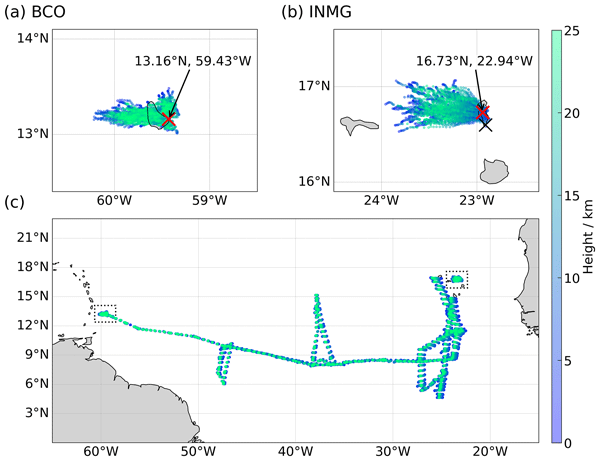
The RAPSODI dataset compiles 624 radiosonde profiles collected during the 2024 ORCESTRA campaign across the tropical Atlantic: from Cape Verde (INMG), the R/V Meteor, and the Barbados Cloud Observatory. It provides high-resolution temperature, humidity, wind, and pressure data to study convection, tropical waves, and ITCZ dynamics. Data are quality-controlled and openly available in Zarr format via IPFS.
Hans Segura, Xabier Pedruzo-Bagazgoitia, Philipp Weiss, Sebastian K. Müller, Thomas Rackow, Junhong Lee, Edgar Dolores-Tesillos, Imme Benedict, Matthias Aengenheyster, Razvan Aguridan, Gabriele Arduini, Alexander J. Baker, Jiawei Bao, Swantje Bastin, Eulàlia Baulenas, Tobias Becker, Sebastian Beyer, Hendryk Bockelmann, Nils Brüggemann, Lukas Brunner, Suvarchal K. Cheedela, Sushant Das, Jasper Denissen, Ian Dragaud, Piotr Dziekan, Madeleine Ekblom, Jan Frederik Engels, Monika Esch, Richard Forbes, Claudia Frauen, Lilli Freischem, Diego García-Maroto, Philipp Geier, Paul Gierz, Álvaro González-Cervera, Katherine Grayson, Matthew Griffith, Oliver Gutjahr, Helmuth Haak, Ioan Hadade, Kerstin Haslehner, Shabeh ul Hasson, Jan Hegewald, Lukas Kluft, Aleksei Koldunov, Nikolay Koldunov, Tobias Kölling, Shunya Koseki, Sergey Kosukhin, Josh Kousal, Peter Kuma, Arjun U. Kumar, Rumeng Li, Nicolas Maury, Maximilian Meindl, Sebastian Milinski, Kristian Mogensen, Bimochan Niraula, Jakub Nowak, Divya Sri Praturi, Ulrike Proske, Dian Putrasahan, René Redler, David Santuy, Domokos Sármány, Reiner Schnur, Patrick Scholz, Dmitry Sidorenko, Dorian Spät, Birgit Sützl, Daisuke Takasuka, Adrian Tompkins, Alejandro Uribe, Mirco Valentini, Menno Veerman, Aiko Voigt, Sarah Warnau, Fabian Wachsmann, Marta Wacławczyk, Nils Wedi, Karl-Hermann Wieners, Jonathan Wille, Marius Winkler, Yuting Wu, Florian Ziemen, Janos Zimmermann, Frida A.-M. Bender, Dragana Bojovic, Sandrine Bony, Simona Bordoni, Patrice Brehmer, Marcus Dengler, Emanuel Dutra, Saliou Faye, Erich Fischer, Chiel van Heerwaarden, Cathy Hohenegger, Heikki Järvinen, Markus Jochum, Thomas Jung, Johann H. Jungclaus, Noel S. Keenlyside, Daniel Klocke, Heike Konow, Martina Klose, Szymon Malinowski, Olivia Martius, Thorsten Mauritsen, Juan Pedro Mellado, Theresa Mieslinger, Elsa Mohino, Hanna Pawłowska, Karsten Peters-von Gehlen, Abdoulaye Sarré, Pajam Sobhani, Philip Stier, Lauri Tuppi, Pier Luigi Vidale, Irina Sandu, and Bjorn Stevens
Geosci. Model Dev., 18, 7735–7761, https://doi.org/10.5194/gmd-18-7735-2025, https://doi.org/10.5194/gmd-18-7735-2025, 2025
Short summary
Short summary
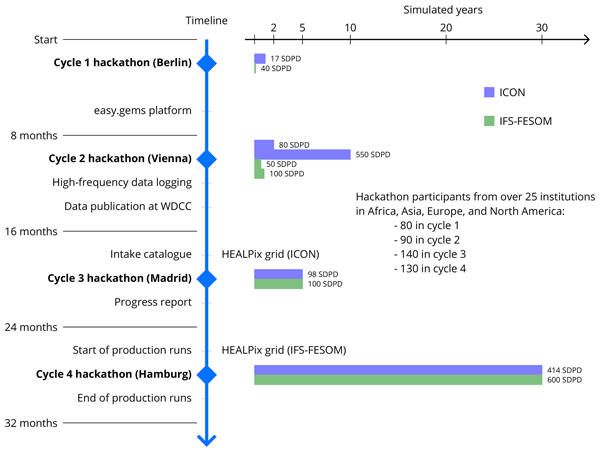
The Next Generation of Earth Modeling Systems project (nextGEMS) developed two Earth system models that use horizontal grid spacing of 10 km and finer, giving more fidelity to the representation of local phenomena, globally. In its fourth cycle, nextGEMS simulated the Earth System climate over the 2020–2049 period under the SSP3-7.0 scenario. Here, we provide an overview of nextGEMS, insights into the model development, and the realism of multi-decadal, kilometer-scale simulations.
Cathy Hohenegger, Peter Korn, Leonidas Linardakis, René Redler, Reiner Schnur, Panagiotis Adamidis, Jiawei Bao, Swantje Bastin, Milad Behravesh, Martin Bergemann, Joachim Biercamp, Hendryk Bockelmann, Renate Brokopf, Nils Brüggemann, Lucas Casaroli, Fatemeh Chegini, George Datseris, Monika Esch, Geet George, Marco Giorgetta, Oliver Gutjahr, Helmuth Haak, Moritz Hanke, Tatiana Ilyina, Thomas Jahns, Johann Jungclaus, Marcel Kern, Daniel Klocke, Lukas Kluft, Tobias Kölling, Luis Kornblueh, Sergey Kosukhin, Clarissa Kroll, Junhong Lee, Thorsten Mauritsen, Carolin Mehlmann, Theresa Mieslinger, Ann Kristin Naumann, Laura Paccini, Angel Peinado, Divya Sri Praturi, Dian Putrasahan, Sebastian Rast, Thomas Riddick, Niklas Roeber, Hauke Schmidt, Uwe Schulzweida, Florian Schütte, Hans Segura, Radomyra Shevchenko, Vikram Singh, Mia Specht, Claudia Christine Stephan, Jin-Song von Storch, Raphaela Vogel, Christian Wengel, Marius Winkler, Florian Ziemen, Jochem Marotzke, and Bjorn Stevens
Geosci. Model Dev., 16, 779–811, https://doi.org/10.5194/gmd-16-779-2023, https://doi.org/10.5194/gmd-16-779-2023, 2023
Short summary
Short summary
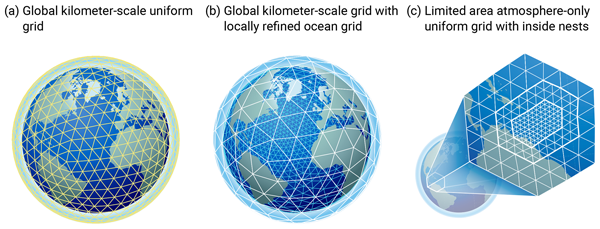
Models of the Earth system used to understand climate and predict its change typically employ a grid spacing of about 100 km. Yet, many atmospheric and oceanic processes occur on much smaller scales. In this study, we present a new model configuration designed for the simulation of the components of the Earth system and their interactions at kilometer and smaller scales, allowing an explicit representation of the main drivers of the flow of energy and matter by solving the underlying equations.
Georgia Peletidou, Kalliopi A. Voudouri, Konstantinos Michailidis, Peristera Paschou, Nikolaos Siomos, Sofia Papadogiannaki, Jens Reichardt, and Dimitrios Balis
Atmos. Chem. Phys., 26, 15461–15478, https://doi.org/10.5194/acp-26-15461-2026, https://doi.org/10.5194/acp-26-15461-2026, 2026
Short summary
Short summary
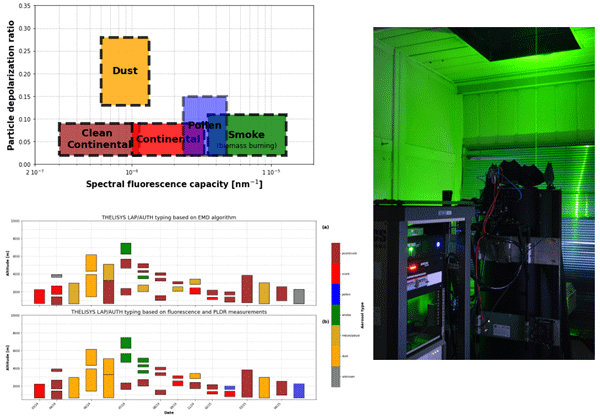
The integration of fluorescence measurements into operational Raman lidar systems significantly improves the aerosol classification, particularly in complex environments such as the Eastern Mediterranean. The study support the future inclusion of spectral fluorescence capacity as an intensive parameter within EARLINET (European Aerosol Research Lidar Network) and ACTRIS (Aerosol, Clouds and Trace Gases Research Infrastructure) frameworks and underline the need for harmonized fluorescence retrievals across the different lidar configurations.
Pablo Saavedra Garfias and Heike Kalesse-Los
Atmos. Chem. Phys., 26, 14843–14865, https://doi.org/10.5194/acp-26-14843-2026, https://doi.org/10.5194/acp-26-14843-2026, 2026
Short summary
Short summary
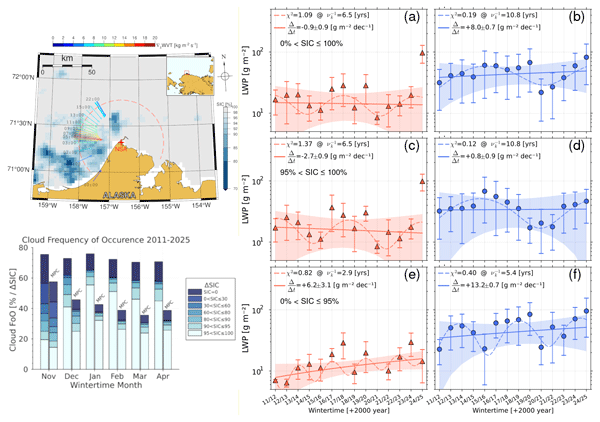
Arctic low level mixed-phase clouds were analysed from 14 years of wintertime observations from the North Slope of Alaska. We found that Arctic cloud physical properties are in correlation with changes in upwind sea ice. The cloud liquid and ice water content increases as sea ice decreases, although not at the same magnitude. Moreover, we uncovered that cloud properties have oscillation properties along the years that resemble climate indicators like El Niño Southern Oscillation among others.
Johanna Roschke, Benedikt Gast, Martin Radenz, Albert Ansmann, Patric Seifert, George McCosh, and Heike Kalesse-Los
Geosci. Model Dev., 19, 9905–9934, https://doi.org/10.5194/gmd-19-9905-2026, https://doi.org/10.5194/gmd-19-9905-2026, 2026
Short summary
Short summary
This research introduces a new method that combines model simulations with satellite observations to attribute the influence of wildfire smoke on an airmass. By dynamically determining the height of smoke plumes, we overcome a key limitation of earlier fixed reception-height approaches. This advancement is crucial for improving our understanding of how wildfire emissions influence cloud formation and the broader Earth's climate system.
Ulrich Löhnert, Maike Ahlgrimm, Felix Ament, Jens Bange, Kjell zum Berge, Birger Bohn, Yann Büchau, Leonie Esters, Lars van Gelder, Yohanes R. S. Ginting, Luise Helmstreit, Tobias Marke, Marcus G. Müller, Patrizia Ney, Anika Obermann-Hellhund, Andreas Platis, Bernhard Pospichal, Alexander Pschera, Anja Rapmund, Mirjana Sakradzija, Martin Schön, Jan H. Schween, Maria Toporov, and Andreas Wieser
Earth Syst. Sci. Data Discuss., https://doi.org/10.5194/essd-2026-784, https://doi.org/10.5194/essd-2026-784, 2026
Preprint under review for ESSD
Short summary
Short summary
Accurate weather forecasts require detailed measurements of temperature, humidity and wind. During a two-week campaign in Germany, we tested innovative instruments against established measurement techniques and satellite observations. Most ground-based instruments met international performance requirements and successfully captured daily atmospheric changes. The publicly available dataset supports improved weather forecasting and the development of future weather observation networks.
Paulo Ceppi, Alejandro Bodas-Salcedo, Mark D. Zelinka, Timothy Andrews, Florent Brient, Robin Chadwick, An-Zhuo Dai, Jonathan M. Gregory, Yen-Ting Hwang, Sarah M. Kang, Jennifer E. Kay, Thorsten Mauritsen, Tomoo Ogura, George Tselioudis, Masahiro Watanabe, Mark J. Webb, and Allison A. Wing
Geosci. Model Dev., 19, 8693–8708, https://doi.org/10.5194/gmd-19-8693-2026, https://doi.org/10.5194/gmd-19-8693-2026, 2026
Short summary
Short summary
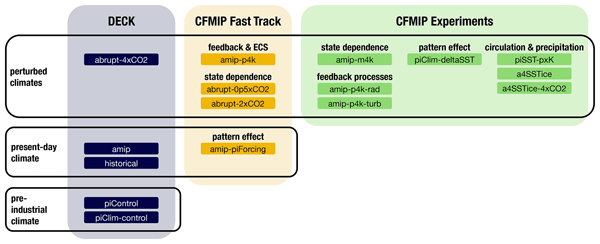
Clouds constitute a key uncertainty for climate change projections. The Cloud Feedback Model Intercomparison Project (CFMIP) aims to address this challenge by evaluating and understanding clouds and their impacts on atmospheric circulation, precipitation, and climate sensitivity. The present paper describes the CFMIP experiment protocol for the Coupled Model Intercomparison Project phase 7 (CMIP7), and discusses the accompanying science questions and opportunities for progress.
Anna Trosits, Andreas Foth, Allison A. Wing, Johanna Roschke, Moritz Haarig, Anton Kötsche, and Heike Kalesse-Los
EGUsphere, https://doi.org/10.5194/egusphere-2026-4385, https://doi.org/10.5194/egusphere-2026-4385, 2026
This preprint is open for discussion and under review for Atmospheric Chemistry and Physics (ACP).
Short summary
Short summary
This study shows the effect of air layers originating from the Saharan Desert on clouds over the tropical Atlantic observed during the ship-borne research campaign BOWTIE. These Saharan Air Layers (SAL) were analysed with data from several instruments providing atmospheric profiles and can be characterised by low moisture and dispersed mineral dust. The investigation suggests a suppression of vertical cloud development by the SAL, also affecting microphysical properties of the cloud.
Jingkun Yang, Benjamin Poschlod, and Felix Ament
EGUsphere, https://doi.org/10.5194/egusphere-2026-4111, https://doi.org/10.5194/egusphere-2026-4111, 2026
Short summary
Short summary
Heavy rainfall is becoming more severe, yet common measures capture only its peak strength, not how long it lasts or how wide an area it covers. Using high-resolution climate simulations for Germany, we rank the 200 most extreme events across past, present and future. We found that future events are not only more intense but also last longer and spread over larger areas. This means future rainfall hazards will be more complex, and assessments must consider strength, duration and extent together.
Helene Marie Gloeckner, Theresa Mieslinger, Nina Robbins-Blanch, Geet George, Lukas Kluft, Tobias Kölling, Sandrine Bony, Julia Miriam Windmiller, and Bjorn Stevens
Earth Syst. Sci. Data, 18, 4425–4450, https://doi.org/10.5194/essd-18-4425-2026, https://doi.org/10.5194/essd-18-4425-2026, 2026
Short summary
Short summary
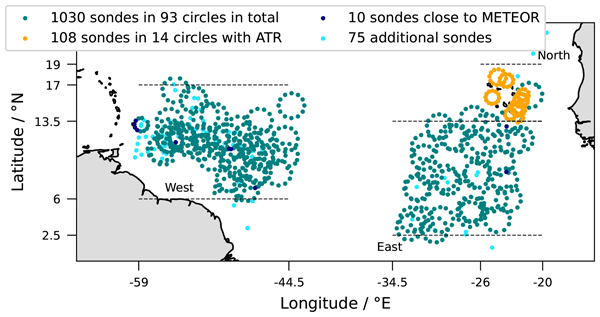
As part of the ORCESTRA (Organized Convection and EarthCARE Studies over the Tropical Atlantic) measurement field campaign in August and September 2024, 1191 dropsondes were deployed over the tropical Atlantic. They measure temperature, humidity, and horizontal winds throughout the atmosphere. Here, we present the resulting datasets, which contain different levels of quality controls as well as derived vertical winds. The data will help to understand processes within the tropical rain belt in the Atlantic.
Heikki Järvinen, Jouni Räisänen, Lauri Tuppi, Clément Bouvier, Antonio Sanchez-Benitez, Juniper Tyree, Antti Toropainen, Paolo Davini, Francisco Doblas-Reyes, Thomas Jung, Daniel Klocke, Jenni Kontkanen, Sebastian Milinski, Matteo Nurisso, Himansu Kesari Pradhan, and Irina Sandu
EGUsphere, https://doi.org/10.5194/egusphere-2026-3364, https://doi.org/10.5194/egusphere-2026-3364, 2026
Short summary
Short summary
There is rich process-level variability present in the new-generation kilometre-scale climate simulations. The EU’s Climate Change Adaptation Digital Twin (Climate DT) integrates global Earth observing systems and observation modelling capabilities – until now common only in weather prediction – into operational climate simulation workflow. This provides a novel framework for precise evaluation of fine-scale details of simulation data and informing adaptation decisions at local (city) scales.
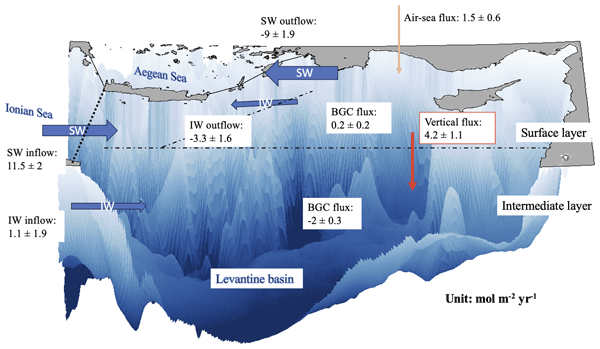
Joelle Habib, Caroline Ulses, Claude Estournel, Milad Fakhri, Patrick Marsaleix, Thierry Moutin, Dominique Lefevre, Mireille Pujo-Pay, Marine Fourrier, Laurent Coppola, Cathy Wimart-Rousseau, and Pascal Conan
Biogeosciences, 23, 2939–2958, https://doi.org/10.5194/bg-23-2939-2026, https://doi.org/10.5194/bg-23-2939-2026, 2026
Short summary
Short summary
The Levantine Basin in the eastern Mediterranean Sea is one of the most nutrient-poor marine regions on Earth. Using a detailed model and observations, we studied how oxygen changes from 2013 to 2020. We found that winter cooling draws oxygen into the sea and moves it to deeper waters, while warmer months release some back. Overall, the basin absorbs more oxygen than it releases, and winter heat loss and circulation patterns strongly control how oxygen is stored and transported.
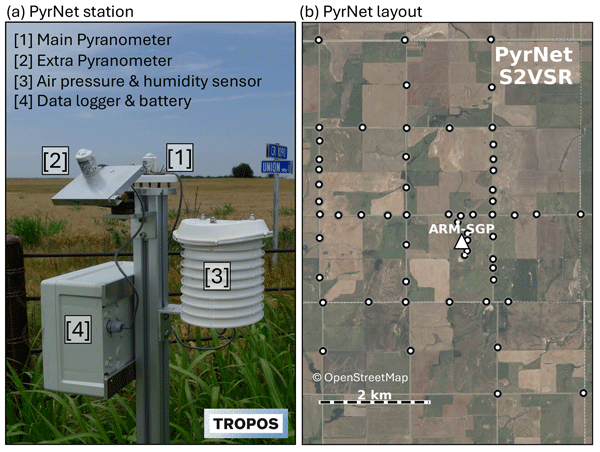
Jonas Witthuhn, Hartwig Deneke, Andreas Macke, Oscar Ritter, Jens Redemann, Connor J. Flynn, Abdulamid A. Fakoya, Bradley F. Lamkin, Emily D. Lenhardt, Logan T. Mitchell, Emily K. West, David M. Romps, Rusen Öktem, and Heike Kalesse-Los
Atmos. Chem. Phys., 26, 5727–5745, https://doi.org/10.5194/acp-26-5727-2026, https://doi.org/10.5194/acp-26-5727-2026, 2026
Short summary
Short summary
This study examines how solar irradiance changes when sunlight passes from clear sky into cloud shadows, focusing on 3‑D radiative effects of shallow cumulus clouds. Using data from a dense pyranometer network and cloud masks from cameras we found that irradiance can rise up to 20 % above clear‑sky levels near cloud edges. Key drivers include sun‑cloud geometry and microphysical cloud properties. The results highlight the need to incorporate such 3‑D effects in atmospheric models.
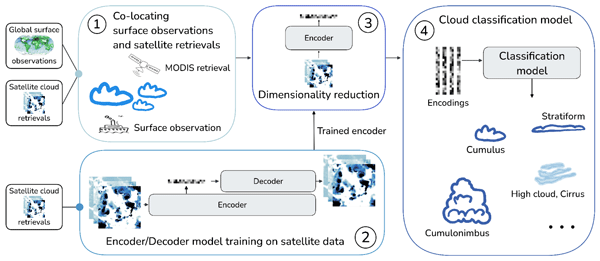
Julien Lenhardt, Johannes Quaas, Dino Sejdinovic, and Daniel Klocke
Atmos. Chem. Phys., 26, 5447–5475, https://doi.org/10.5194/acp-26-5447-2026, https://doi.org/10.5194/acp-26-5447-2026, 2026
Short summary
Short summary
Clouds come in various shapes and sizes and constitute a fundamental element of the Earth's climate system. Different cloud types show variable impacts on climate change. We present a new cloud type classification method called CloudViT (Cloud Vision Transformer) relying on spatial patterns of cloud properties obtained from satellite data using machine learning. We can thus help understanding the effects of different cloud types on climate change.
Aurélie Panetier, Pierre Bosser, and Félix Mercier
Earth Syst. Sci. Data Discuss., https://doi.org/10.5194/essd-2026-223, https://doi.org/10.5194/essd-2026-223, 2026
Revised manuscript accepted for ESSD
Short summary
Short summary
Water vapor plays a key role in climate, yet it is poorly measured over the oceans. This study provides a new dataset based on satellite signals collected by research vessels around the world over ten years. The results show that this method can reliably estimate atmospheric moisture. This dataset helps improve climate studies and the evaluation of remote sensing products over the oceans using in situ data.
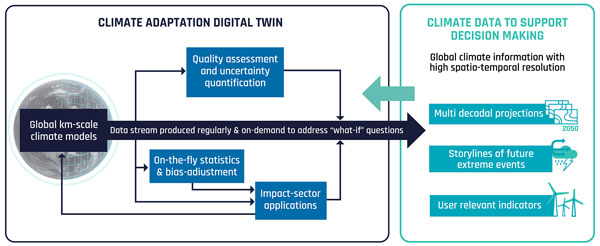
Francisco J. Doblas-Reyes, Jenni Kontkanen, Irina Sandu, Mario Acosta, Mohammed Hussam Al Turjmam, Ivan Alsina-Ferrer, Miguel Andrés-Martínez, Costanza Anerdi, Leo Arriola, Marvin Axness, Marc Batlle Martín, Peter Bauer, Tobias Becker, Daniel Beltrán, Sebastian Beyer, Hendryk Bockelmann, Pierre-Antoine Bretonnière, Sebastien Cabaniols, Silvia Caprioli, Miguel Castrillo, Aparna Chandrasekar, Suvarchal Cheedela, Victor Correal, Emanuele Danovaro, Paolo Davini, Jussi Enkovaara, Claudia Frauen, Barbara Früh, Aina Gaya Àvila, Paolo Ghinassi, Rohit Ghosh, Supriyo Ghosh, Iker González, Katherine Grayson, Matthew Griffith, Ioan Hadade, Christopher Haine, Carl Hartick, Utz-Uwe Haus, Shane Hearne, Heikki Järvinen, Bernat Jiménez, Amal John, Marlin Juchem, Thomas Jung, Jessica Kegel, Matthias Kelbling, Kai Keller, Bruno Kinoshita, Theresa Kiszler, Daniel Klocke, Lukas Kluft, Nikolay Koldunov, Tobias Kölling, Joonas Kolstela, Luis Kornblueh, Sergey Kosukhin, Aleksander Lacima-Nadolnik, Jeisson Javier Leal Rojas, Jonni Lehtiranta, Tuomas Lunttila, Anna Luoma, Pekka Manninen, Alexey Medvedev, Sebastian Milinski, Ali Mohammed, Sebastian Müller, Devaraju Naryanappa, Natalia Nazarova, Sami Niemelä, Bimochan Niraula, Henrik Nortamo, Aleksi Nummelin, Matteo Nurisso, Pablo Ortega, Stella Paronuzzi, Xabier Pedruzo-Bagazgoitia, Charles Pelletier, Carlos Peña, Suraj Polade, Himansu Kesari Pradhan, Rommel Quintanilla, Tiago Quintino, Thomas Rackow, Jouni Räisänen, Maqsood Mubarak Rajput, René Redler, Balthasar Reuter, Nuno Rocha Monteiro, Francesc Roura-Adserias, Silva Ruppert, Susan Sayed, Reiner Schnur, Tanvi Sharma, Dmitry Sidorenko, Outi Sievi-Korte, Albert Soret, Christian Steger, Bjorn Stevens, Jan Streffing, Jaleena Sunny, Luiggi Tenorio, Stephan Thober, Ulf Tigerstedt, Oriol Tinto, Juha Tonttila, Heikki Tuomenvirta, Lauri Tuppi, Ginka Van Thielen, Emanuele Vitali, Jost von Hardenberg, Ingo Wagner, Nils Wedi, Jan Wehner, Sven Willner, Xavier Yepes-Arbós, Florian Ziemen, and Janos Zimmermann
Geosci. Model Dev., 19, 2821–2848, https://doi.org/10.5194/gmd-19-2821-2026, https://doi.org/10.5194/gmd-19-2821-2026, 2026
Short summary
Short summary
The Climate Change Adaptation Digital Twin (Climate DT) pioneers the operationalisation of global climate projections. It produces global simulations with local granularity for adaptation decision-making. Applications are embedded to generate tailored indicators. A unified workflow orchestrates all components in several supercomputers. Data management ensures consistency and streaming enables real-time use. It is a complementary innovation to initiatives like CMIP, CORDEX, and climate services.
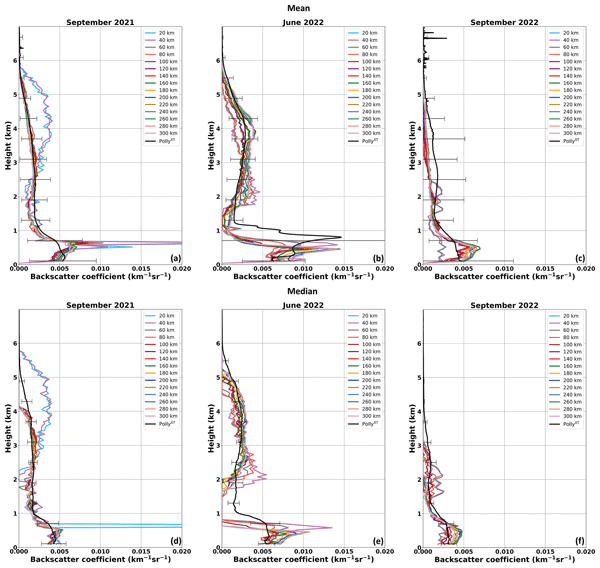
Athena Augusta Floutsi, Konstantinos Rizos, Dimitri Trapon, Ronny Engelmann, Dietrich Althausen, Eleni Marinou, Peristera Paschou, Julian Hofer, Emmanouil Proestakis, Henriette Gebauer, Annett Skupin, Albert Ansmann, Thorsten Fehr, Timon Hummel, Rob Koopman, Vassilis Amiridis, Ulla Wandinger, and Holger Baars
Atmos. Meas. Tech., 19, 1901–1925, https://doi.org/10.5194/amt-19-1901-2026, https://doi.org/10.5194/amt-19-1901-2026, 2026
Short summary
Short summary
We assess the representativeness of a remote ground-based station in Mindelo, Cabo Verde by utilizing continuous observations of a ground-based multiwavelength polarization Raman lidar and the LIdar climatology of Vertical Aerosol Structure (LIVAS) products. Based on a statistical analysis of the optical properties at different radii around Mindelo and case studies, we conclude that overall, the ground-based station in Mindelo can be considered conditionally representative.
Marius Winkler, Marius Rixen, Florent Beucher, Fleur Couvreux, Chaehyeon C. Nam, Philippe Peyrillé, Hauke Schmidt, Hans Segura, Karl-Hermann Wieners, Ezri Alkilani-Brown, Abdou Aziz Coly, Giovanni Biagioli, Michael M. Bell, Ester Brito, Emma Chauvin, Julie Capo, Delián Colón-Burgos, Akeem Dawes, Jose Carlos da Luz, Zekican Demiralay, Vincent Douet, Vincent Ducastin, Clarisse Dufaux, Jean-Louis Dufresne, Florence Favot, Thomas Fiolleau, Emilie Fons, Geet George, Helene M. Gloeckner, Suelly Gonçalves, Laurent Gouttesoulard, Lennéa Hayo, Wei-Ting Hsiao, Sarah Kennison, Michael Kopelman, Tsung-Yung Lee, Enora Le Gall, Mateo Lovato, Emily Luschen, Nicolas Maury, Brett McKim, Louis Netz, Diouf Ousseynou, Karsten Peters-von Gehlen, Chavez Pope, Basile Poujol, Niwde Rivera Maldonado, Nina Robbins-Blanch, Nicolas Rochetin, Daniel Rowe, Paula Romero Jure, James H. Ruppert Jr., Jairo Segura Bermudez, Jarrett C. Starr, Martin Stelzner, Connor Stoll, Macintyre Syrett, Abraham Tekoe, Jeremie Trules, Colin Welty, Daniel Klocke, Raphaela Vogel, Sandrine Bony, Allison A. Wing, and Bjorn Stevens
Earth Syst. Sci. Data, 18, 1833–1854, https://doi.org/10.5194/essd-18-1833-2026, https://doi.org/10.5194/essd-18-1833-2026, 2026
Short summary
Short summary
The RAPSODI dataset compiles 624 radiosonde profiles collected during the 2024 ORCESTRA campaign across the tropical Atlantic: from Cape Verde (INMG), the R/V Meteor, and the Barbados Cloud Observatory. It provides high-resolution temperature, humidity, wind, and pressure data to study convection, tropical waves, and ITCZ dynamics. Data are quality-controlled and openly available in Zarr format via IPFS.
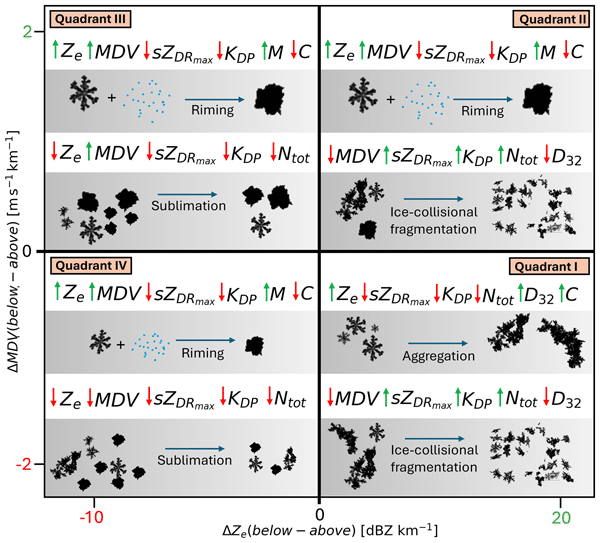
Anton Kötsche, Maximilian Maahn, Veronika Ettrichrätz, and Heike Kalesse-Los
Atmos. Chem. Phys., 26, 3277–3297, https://doi.org/10.5194/acp-26-3277-2026, https://doi.org/10.5194/acp-26-3277-2026, 2026
Short summary
Short summary
We studied how turbulence affects snowfall in the Colorado Rockies, focusing on a turbulent layer behind Gothic Mountain. Using radar and surface observations, we found turbulence enhances snow growth by causing snowflakes to stick and form extra ice via collisions. Liquid water at cold temperatures further boosts snow formation. This work shows how turbulence shapes mountain snowfall and demonstrates radar-based methods to study precipitation processes.
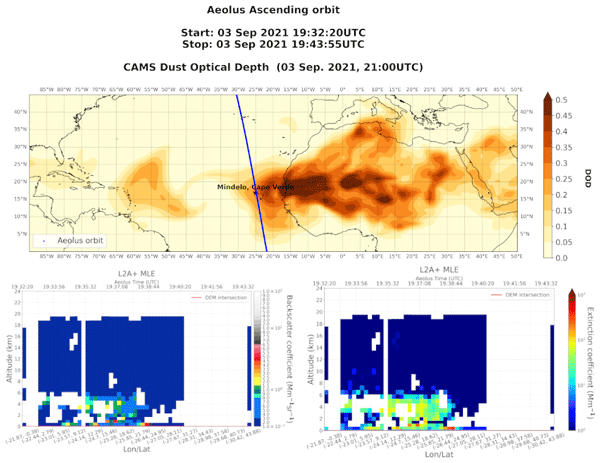
Konstantinos Rizos, Emmanouil Proestakis, Thanasis Georgiou, Antonis Gkikas, Eleni Marinou, Peristera Paschou, Kalliopi Artemis Voudouri, Athanasios Tsikerdekis, David P. Donovan, Gerd-Jan van Zadelhoff, Angela Benedetti, Holger Baars, Athena Augusta Floutsi, Nikos Benas, Martin Stengel, Christian Retscher, Edward Malina, and Vassilis Amiridis
Atmos. Meas. Tech., 19, 699–728, https://doi.org/10.5194/amt-19-699-2026, https://doi.org/10.5194/amt-19-699-2026, 2026
Short summary
Short summary
The Aeolus satellite's lidar system had limitations in detecting certain atmospheric layers and distinguishing between aerosol and cloud types. To improve accuracy, a new dust detection product was developed. By combining data from various sources and validating it with ground-based measurements, this enhanced product performs better than the original. It helps improve dust transport models and weather predictions, making it a valuable tool for atmospheric monitoring and forecasting.
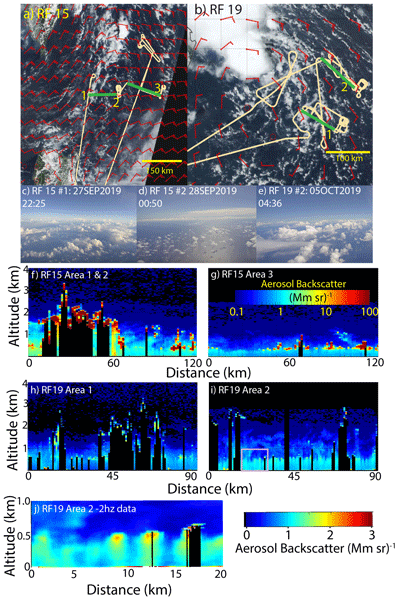
Jeffrey S. Reid, Robert E. Holz, Chris A. Hostetler, Richard A. Ferrare, Juli I. Rubin, Elizabeth J. Thompson, Susan C. van den Heever, Corey G. Amiot, Sharon P. Burton, Joshua P. DiGangi, Glenn S. Diskin, Joshua H. Cossuth, Daniel P. Eleuterio, Edwin W. Eloranta, Ralph Kuehn, Willem J. Marais, Hal B. Maring, Armin Sorooshian, Kenneth L. Thornhill, Charles R. Trepte, Jian Wang, Peng Xian, and Luke D. Ziemba
Atmos. Chem. Phys., 25, 18639–18673, https://doi.org/10.5194/acp-25-18639-2025, https://doi.org/10.5194/acp-25-18639-2025, 2025
Short summary
Short summary
We document air and ship born measurements of the vertical distribution of pollution and biomass burning aerosol particles transported within the Maritime Continent's monsoonal flows for 1000s of kilometers, and yet still exhibit intricate patterns around clouds near the ocean's surface. Findings demonstrate that, while aerosol transport occurs near the surface, there is heterogeneity in particle extinction that must be considered for both in situ observations and satellite retrievals.
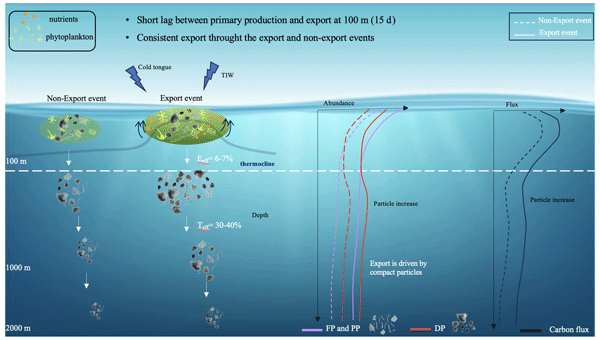
Joelle Habib, Lars Stemmann, Alexandre Accardo, Alberto Baudena, Franz Philip Tuchen, Peter Brandt, and Rainer Kiko
Biogeosciences, 22, 7985–8003, https://doi.org/10.5194/bg-22-7985-2025, https://doi.org/10.5194/bg-22-7985-2025, 2025
Short summary
Short summary
This study investigates how carbon moves from the ocean surface to the depths in the equatorial Atlantic, contributing to long-term carbon storage. Using an Argo float equipped with a camera, we captured two periods with major carbon export events. By identifying particle types and their sinking behaviors, we found that smaller, compact particles are key drivers of carbon transport. Our findings underscore the value of using imaging tools on autonomous platforms in tracking carbon sequestration.
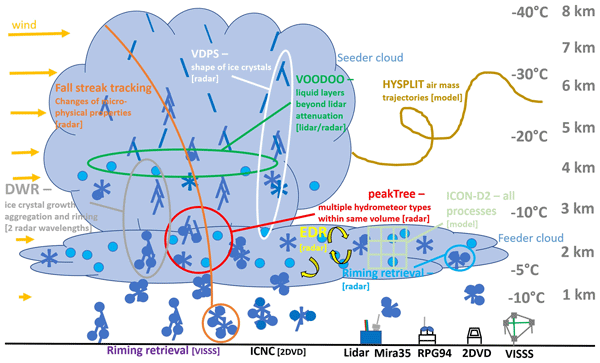
Kevin Ohneiser, Patric Seifert, Willi Schimmel, Fabian Senf, Tom Gaudek, Martin Radenz, Audrey Teisseire, Veronika Ettrichrätz, Teresa Vogl, Nina Maherndl, Nils Pfeifer, Jan Henneberger, Anna J. Miller, Nadja Omanovic, Christopher Fuchs, Huiying Zhang, Fabiola Ramelli, Robert Spirig, Anton Kötsche, Heike Kalesse-Los, Maximilian Maahn, Heather Corden, Alexis Berne, Majid Hajipour, Hannes Griesche, Julian Hofer, Ronny Engelmann, Annett Skupin, Albert Ansmann, and Holger Baars
Atmos. Chem. Phys., 25, 17363–17386, https://doi.org/10.5194/acp-25-17363-2025, https://doi.org/10.5194/acp-25-17363-2025, 2025
Short summary
Short summary
This study focuses on a seeder-feeder cloud system on 8 Jan 2024 in Eriswil, Switzerland. It is shown how the interaction of these cloud systems changes the cloud microphysical properties and the precipitation patterns. A big set of advanced remote-sensing techniques and retrieval algorithms are applied, so that a detailed view on the seeder-feeder cloud system is available. The gained knowledge can be used to improve weather models and weather forecasts.
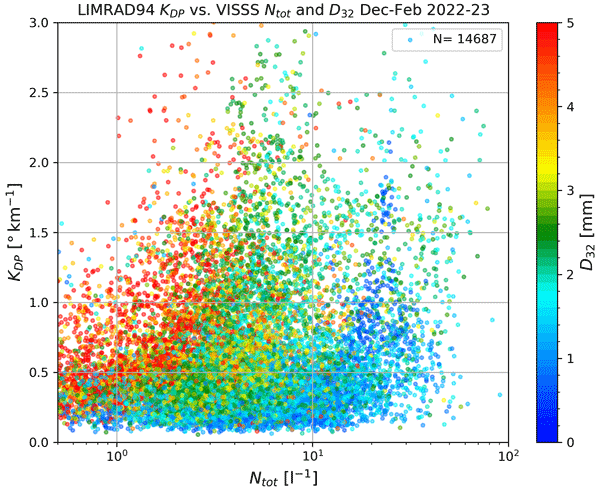
Anton Kötsche, Alexander Myagkov, Leonie von Terzi, Maximilian Maahn, Veronika Ettrichrätz, Teresa Vogl, Alexander Ryzhkov, Petar Bukovcic, Davide Ori, and Heike Kalesse-Los
Atmos. Chem. Phys., 25, 14045–14070, https://doi.org/10.5194/acp-25-14045-2025, https://doi.org/10.5194/acp-25-14045-2025, 2025
Short summary
Short summary
Our study combines radar observations of snow with snowfall camera observations on the ground to enhance our understanding of radar variables and snowfall properties. We found that values of an important radar variable (KDP) can be related to many different snow particle properties and number concentrations. We were able to constrain which particle sizes contribute to KDP by using computer models of snowflakes and showed which microphysical processes during snow formation can influence KDP.
Hans Segura, Xabier Pedruzo-Bagazgoitia, Philipp Weiss, Sebastian K. Müller, Thomas Rackow, Junhong Lee, Edgar Dolores-Tesillos, Imme Benedict, Matthias Aengenheyster, Razvan Aguridan, Gabriele Arduini, Alexander J. Baker, Jiawei Bao, Swantje Bastin, Eulàlia Baulenas, Tobias Becker, Sebastian Beyer, Hendryk Bockelmann, Nils Brüggemann, Lukas Brunner, Suvarchal K. Cheedela, Sushant Das, Jasper Denissen, Ian Dragaud, Piotr Dziekan, Madeleine Ekblom, Jan Frederik Engels, Monika Esch, Richard Forbes, Claudia Frauen, Lilli Freischem, Diego García-Maroto, Philipp Geier, Paul Gierz, Álvaro González-Cervera, Katherine Grayson, Matthew Griffith, Oliver Gutjahr, Helmuth Haak, Ioan Hadade, Kerstin Haslehner, Shabeh ul Hasson, Jan Hegewald, Lukas Kluft, Aleksei Koldunov, Nikolay Koldunov, Tobias Kölling, Shunya Koseki, Sergey Kosukhin, Josh Kousal, Peter Kuma, Arjun U. Kumar, Rumeng Li, Nicolas Maury, Maximilian Meindl, Sebastian Milinski, Kristian Mogensen, Bimochan Niraula, Jakub Nowak, Divya Sri Praturi, Ulrike Proske, Dian Putrasahan, René Redler, David Santuy, Domokos Sármány, Reiner Schnur, Patrick Scholz, Dmitry Sidorenko, Dorian Spät, Birgit Sützl, Daisuke Takasuka, Adrian Tompkins, Alejandro Uribe, Mirco Valentini, Menno Veerman, Aiko Voigt, Sarah Warnau, Fabian Wachsmann, Marta Wacławczyk, Nils Wedi, Karl-Hermann Wieners, Jonathan Wille, Marius Winkler, Yuting Wu, Florian Ziemen, Janos Zimmermann, Frida A.-M. Bender, Dragana Bojovic, Sandrine Bony, Simona Bordoni, Patrice Brehmer, Marcus Dengler, Emanuel Dutra, Saliou Faye, Erich Fischer, Chiel van Heerwaarden, Cathy Hohenegger, Heikki Järvinen, Markus Jochum, Thomas Jung, Johann H. Jungclaus, Noel S. Keenlyside, Daniel Klocke, Heike Konow, Martina Klose, Szymon Malinowski, Olivia Martius, Thorsten Mauritsen, Juan Pedro Mellado, Theresa Mieslinger, Elsa Mohino, Hanna Pawłowska, Karsten Peters-von Gehlen, Abdoulaye Sarré, Pajam Sobhani, Philip Stier, Lauri Tuppi, Pier Luigi Vidale, Irina Sandu, and Bjorn Stevens
Geosci. Model Dev., 18, 7735–7761, https://doi.org/10.5194/gmd-18-7735-2025, https://doi.org/10.5194/gmd-18-7735-2025, 2025
Short summary
Short summary
The Next Generation of Earth Modeling Systems project (nextGEMS) developed two Earth system models that use horizontal grid spacing of 10 km and finer, giving more fidelity to the representation of local phenomena, globally. In its fourth cycle, nextGEMS simulated the Earth System climate over the 2020–2049 period under the SSP3-7.0 scenario. Here, we provide an overview of nextGEMS, insights into the model development, and the realism of multi-decadal, kilometer-scale simulations.
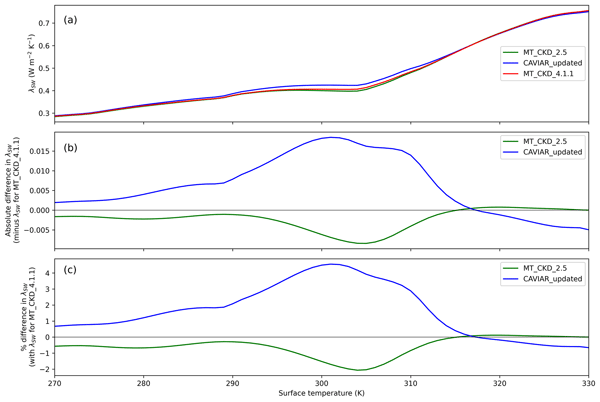
Kaah P. Menang, Stefan A. Buehler, Lukas Kluft, Robin J. Hogan, and Florian E. Roemer
Atmos. Chem. Phys., 25, 11689–11701, https://doi.org/10.5194/acp-25-11689-2025, https://doi.org/10.5194/acp-25-11689-2025, 2025
Short summary
Short summary
We investigated the impact of the shortwave water vapour continuum absorption on clear-sky shortwave radiative feedback. For current temperatures, the impact is modest (<2%). In a warmer world, continuum-induced uncertainty in estimated feedback would be up to ~5%. Representing continuum absorption with the widely used semi-empirical model in radiative transfer calculations leads to an underestimation of this feedback. Constraining the shortwave continuum will help reduce these discrepancies.
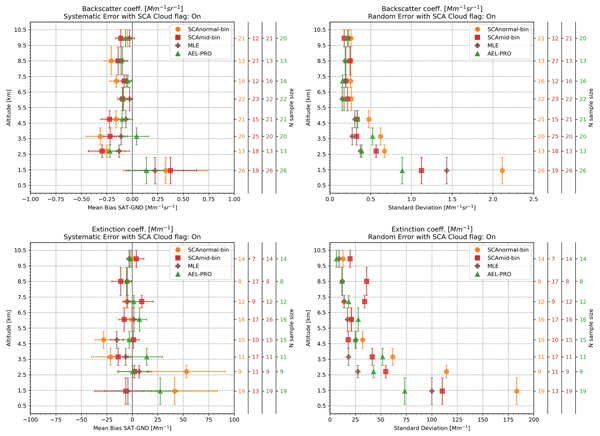
Peristera Paschou, Nikolaos Siomos, Eleni Marinou, Antonis Gkikas, Samira M. Idrissa, Daniel T. Quaye, Désiré D. Fiogbe Attannon, Kalliopi Artemis Voudouri, Charikleia Meleti, David P. Donovan, George Georgoussis, Tommaso Parrinello, Thorsten Fehr, Jonas von Bismarck, and Vassilis Amiridis
Atmos. Meas. Tech., 18, 4731–4754, https://doi.org/10.5194/amt-18-4731-2025, https://doi.org/10.5194/amt-18-4731-2025, 2025
Short summary
Short summary
This study presents the results from a validation study on the Level 2A products (aerosol optical properties) of the ESA's (European Space Agency) Aeolus mission. Measurements from the eVe lidar, a combined linear/circular polarization and Raman lidar and ESA's ground reference system, that have been collected during the Joint Aeolus Tropical Atlantic Campaign are compared with collocated Aeolus Level 2A profiles obtained from the latest version (Baseline 16) of the Aeolus algorithms.
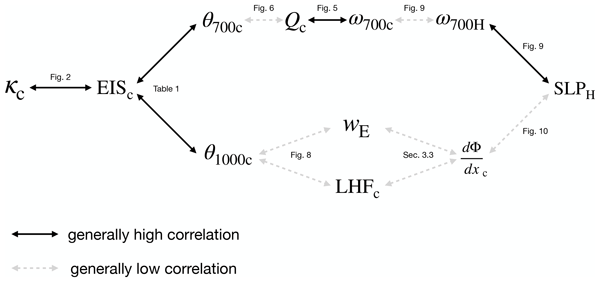
Hairu Ding, Bjorn Stevens, and Hauke Schmidt
Atmos. Chem. Phys., 25, 10511–10521, https://doi.org/10.5194/acp-25-10511-2025, https://doi.org/10.5194/acp-25-10511-2025, 2025
Short summary
Short summary
This study examines the physical link between subtropical highs and stratocumulus variability. Using reanalysis data, we test two proposed pathways – one at the surface and one in the free troposphere – but find that neither is a dominant mechanism for stratocumulus variability on seasonal and interannual timescales. These results challenge the assumed influence of subtropical highs on stratocumulus and highlight the need for further research into lower-tropospheric stability dynamics.
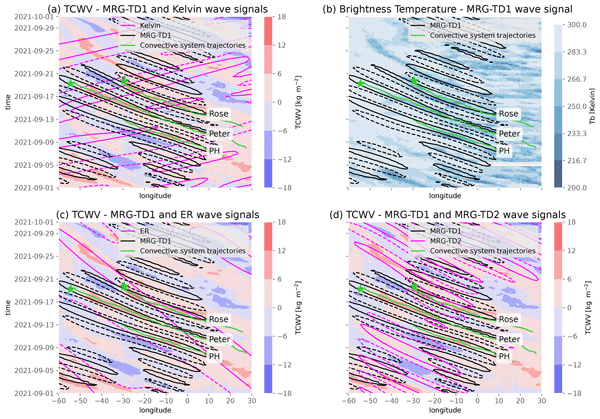
Tanguy Jonville, Maurus Borne, Cyrille Flamant, Juan Cuesta, Olivier Bock, Pierre Bosser, Christophe Lavaysse, Andreas Fink, and Peter Knippertz
Atmos. Chem. Phys., 25, 9765–9786, https://doi.org/10.5194/acp-25-9765-2025, https://doi.org/10.5194/acp-25-9765-2025, 2025
Short summary
Short summary
Tropical waves structure the atmosphere. Four types of tropical waves (equatorial Rossby – ER, Kelvin, MRG-TD1, and MRG-TD2 – mixed Rossby gravity–tropical depressions) are studied using filters, satellite measurements, and in situ data from the Clouds–Atmosphere Dynamics–Dust Interaction in West Africa (CADDIWA) campaign held in September 2021 in Cabo Verde. ER waves impact temperature and humidity above 2500 m, MRG-TD1 around 3500 m, and MRG-TD2 around 2000 m. Interactions between these waves favor tropical cyclone formation.
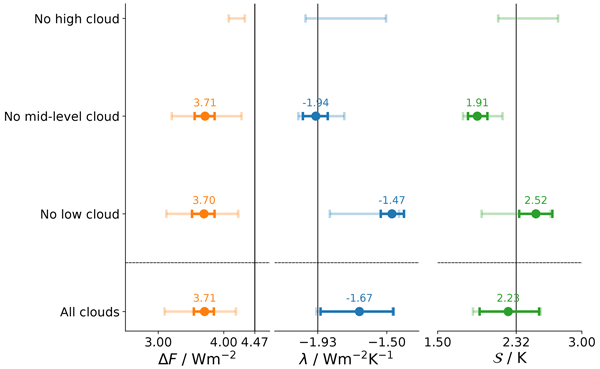
Lukas Kluft, Bjorn Stevens, Manfred Brath, and Stefan A. Buehler
Atmos. Chem. Phys., 25, 9075–9084, https://doi.org/10.5194/acp-25-9075-2025, https://doi.org/10.5194/acp-25-9075-2025, 2025
Short summary
Short summary
Using a single-column model, we investigate the effect of the vertical distribution of clouds on climate sensitivity. We show that, depending on their height, clouds can mask or unmask the radiative response of the clear-sky atmosphere. Our single-column model yields an all-sky climate sensitivity of 2.2 K, slightly less than the clear-sky value. This value can be interpreted as a baseline to which changes in surface albedo and an assumed reduction in cloud albedo would add.
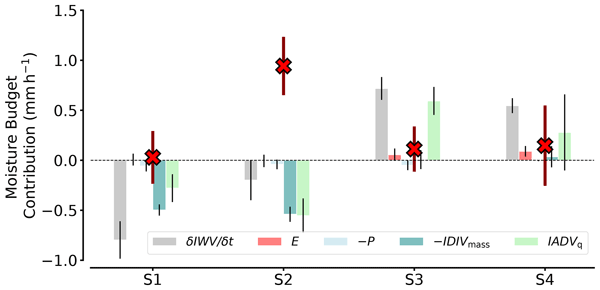
Henning Dorff, Florian Ewald, Heike Konow, Mario Mech, Davide Ori, Vera Schemann, Andreas Walbröl, Manfred Wendisch, and Felix Ament
Atmos. Chem. Phys., 25, 8329–8354, https://doi.org/10.5194/acp-25-8329-2025, https://doi.org/10.5194/acp-25-8329-2025, 2025
Short summary
Short summary
Using observations of an Arctic atmospheric river (AR) from a long-range research aircraft, we analyse how moisture transported into the Arctic by the AR is transformed and how it interacts with the Arctic environment. The moisture transport divergence is the main driver of local moisture change over time. Surface precipitation and evaporation are rather weak when averaged over extended AR sectors, although considerable heterogeneity of precipitation within the AR is observed.
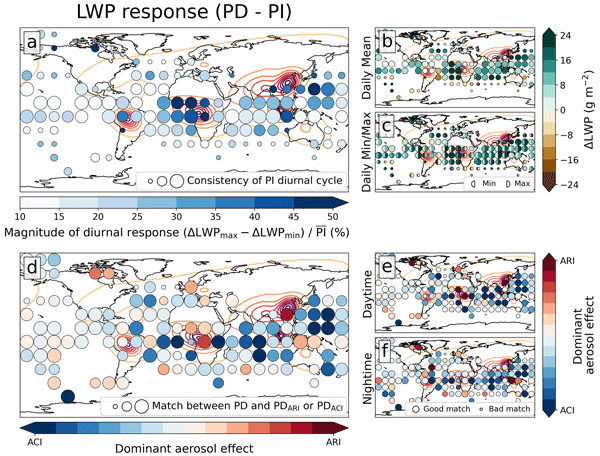
Ross J. Herbert, Andrew I. L. Williams, Philipp Weiss, Duncan Watson-Parris, Elisabeth Dingley, Daniel Klocke, and Philip Stier
Atmos. Chem. Phys., 25, 7789–7814, https://doi.org/10.5194/acp-25-7789-2025, https://doi.org/10.5194/acp-25-7789-2025, 2025
Short summary
Short summary
Clouds exist at scales that climate models struggle to represent, limiting our knowledge of how climate change may impact clouds. Here we use a new kilometer-scale global model representing an important step towards the necessary scale. We focus on how aerosol particles modify clouds, radiation, and precipitation. We find the magnitude and manner of responses tend to vary from region to region, highlighting the potential of global kilometer-scale simulations and a need to represent aerosols in climate models.
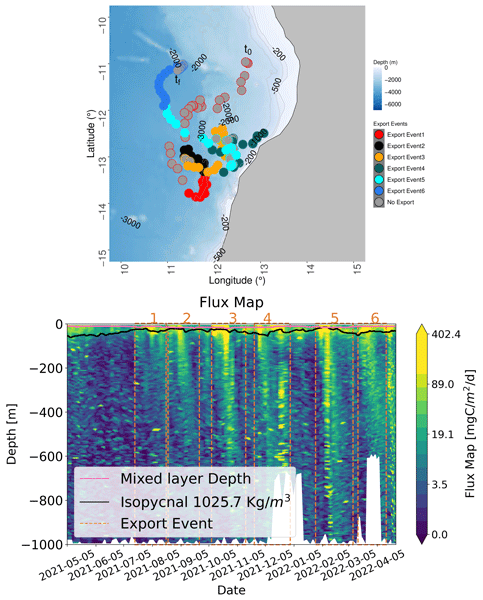
Yawouvi Dodji Soviadan, Miriam Beck, Joelle Habib, Alberto Baudena, Laetitia Drago, Alexandre Accardo, Remi Laxenaire, Sabrina Speich, Peter Brandt, Rainer Kiko, and Stemmann Lars
Biogeosciences, 22, 3485–3501, https://doi.org/10.5194/bg-22-3485-2025, https://doi.org/10.5194/bg-22-3485-2025, 2025
Short summary
Short summary
Key parameters representing the gravity flux in global models are sinking speed and vertical attenuation of exported material. We calculate, for the first time, these parameters in situ in the ocean for six intermittent blooms followed by export events using high-resolution (3 d) time series of 0–1000 m depth profiles from imaging sensors mounted on an Argo float. We show that sinking speed depends not only on size but also on the morphology of the particles, with density being an important property.
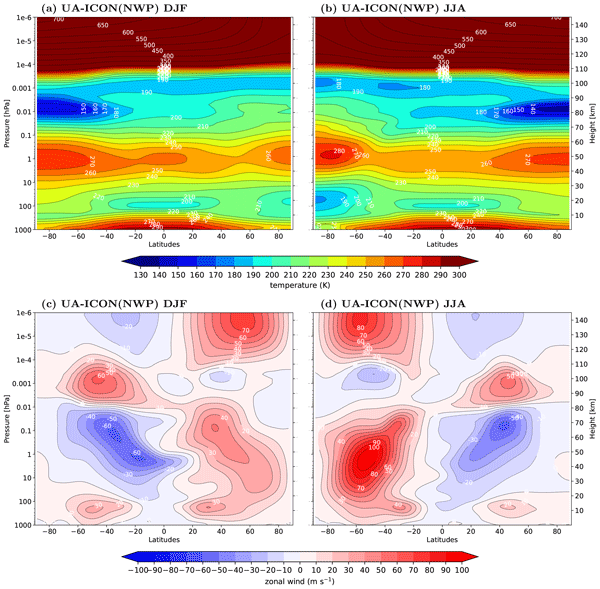
Markus Kunze, Christoph Zülicke, Tarique A. Siddiqui, Claudia C. Stephan, Yosuke Yamazaki, Claudia Stolle, Sebastian Borchert, and Hauke Schmidt
Geosci. Model Dev., 18, 3359–3385, https://doi.org/10.5194/gmd-18-3359-2025, https://doi.org/10.5194/gmd-18-3359-2025, 2025
Short summary
Short summary
We present the Icosahedral Nonhydrostatic (ICON) general circulation model with an upper-atmospheric extension with the physics package for numerical weather prediction (UA-ICON(NWP)). We optimized the parameters for the gravity wave parameterizations and achieved realistic modeling of the thermal and dynamic states of the mesopause regions. UA-ICON(NWP) now shows a realistic frequency of major sudden stratospheric warmings and well-represented solar tides in temperature.
Abisha Mary Gnanaraj, Jiawei Bao, and Hauke Schmidt
Weather Clim. Dynam., 6, 489–503, https://doi.org/10.5194/wcd-6-489-2025, https://doi.org/10.5194/wcd-6-489-2025, 2025
Short summary
Short summary
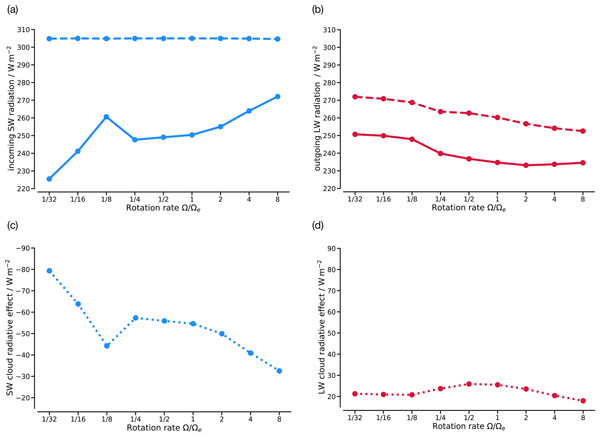
We study how the Coriolis force caused by a planet's rotation affects its energy budget and habitability. Using an atmospheric general circulation model in a simplified water-covered planet setup, we analyse how rotation rates both slower and faster than Earth affect the amount of water vapour and clouds in the atmosphere. Our results suggest that rotation slower than Earth's makes the planet colder and drier, while faster rotation makes it warmer and moister, reducing its habitability.
Ravikiran Hegde, Moritz Günther, Hauke Schmidt, and Clarissa Kroll
Atmos. Chem. Phys., 25, 3873–3887, https://doi.org/10.5194/acp-25-3873-2025, https://doi.org/10.5194/acp-25-3873-2025, 2025
Short summary
Short summary
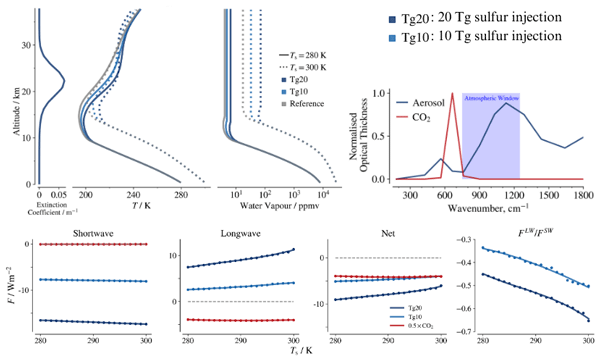
Using a one-dimensional radiative–convective equilibrium model, we show that in clear-sky conditions, stratospheric sulfate aerosol forcing weakens with increasing surface temperature while CO2 forcing varies much less. This effect arises as sulfate aerosol, unlike CO2, absorbs mainly at wavelengths where the atmosphere is optically thin. It thereby masks the surface emission, which increases with warming. The spectral masking also results in weaker radiative feedback when aerosol is present.

André Ehrlich, Susanne Crewell, Andreas Herber, Marcus Klingebiel, Christof Lüpkes, Mario Mech, Sebastian Becker, Stephan Borrmann, Heiko Bozem, Matthias Buschmann, Hans-Christian Clemen, Elena De La Torre Castro, Henning Dorff, Regis Dupuy, Oliver Eppers, Florian Ewald, Geet George, Andreas Giez, Sarah Grawe, Christophe Gourbeyre, Jörg Hartmann, Evelyn Jäkel, Philipp Joppe, Olivier Jourdan, Zsófia Jurányi, Benjamin Kirbus, Johannes Lucke, Anna E. Luebke, Maximilian Maahn, Nina Maherndl, Christian Mallaun, Johanna Mayer, Stephan Mertes, Guillaume Mioche, Manuel Moser, Hanno Müller, Veronika Pörtge, Nils Risse, Greg Roberts, Sophie Rosenburg, Johannes Röttenbacher, Michael Schäfer, Jonas Schaefer, Andreas Schäfler, Imke Schirmacher, Johannes Schneider, Sabrina Schnitt, Frank Stratmann, Christian Tatzelt, Christiane Voigt, Andreas Walbröl, Anna Weber, Bruno Wetzel, Martin Wirth, and Manfred Wendisch
Earth Syst. Sci. Data, 17, 1295–1328, https://doi.org/10.5194/essd-17-1295-2025, https://doi.org/10.5194/essd-17-1295-2025, 2025
Short summary
Short summary
This paper provides an overview of the HALO–(AC)3 aircraft campaign data sets, the campaign-specific instrument operation, data processing, and data quality. The data set comprises in situ and remote sensing observations from three research aircraft: HALO, Polar 5, and Polar 6. All data are published in the PANGAEA database by instrument-separated data subsets. It is highlighted how the scientific analysis of the HALO–(AC)3 data benefits from the coordinated operation of three aircraft.

Swantje Bastin, Aleksei Koldunov, Florian Schütte, Oliver Gutjahr, Marta Agnieszka Mrozowska, Tim Fischer, Radomyra Shevchenko, Arjun Kumar, Nikolay Koldunov, Helmuth Haak, Nils Brüggemann, Rebecca Hummels, Mia Sophie Specht, Johann Jungclaus, Sergey Danilov, Marcus Dengler, and Markus Jochum
Geosci. Model Dev., 18, 1189–1220, https://doi.org/10.5194/gmd-18-1189-2025, https://doi.org/10.5194/gmd-18-1189-2025, 2025
Short summary
Short summary
Vertical mixing is an important process, for example, for tropical sea surface temperature, but cannot be resolved by ocean models. Comparisons of mixing schemes and settings have usually been done with a single model, sometimes yielding conflicting results. We systematically compare two widely used schemes with different parameter settings in two different ocean models and show that most effects from mixing scheme parameter changes are model-dependent.

Johanna Roschke, Jonas Witthuhn, Marcus Klingebiel, Moritz Haarig, Andreas Foth, Anton Kötsche, and Heike Kalesse-Los
Atmos. Meas. Tech., 18, 487–508, https://doi.org/10.5194/amt-18-487-2025, https://doi.org/10.5194/amt-18-487-2025, 2025
Short summary
Short summary
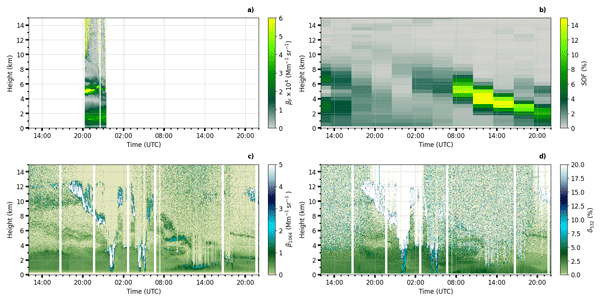
We present a technique to discriminate between the Cloudnet target classification of "drizzle or rain" and sea salt aerosols that is applicable to marine Cloudnet sites. The method is crucial for investigating the occurrence of precipitation and significantly improves the Cloudnet target classification scheme for measurements over the Barbados Cloud Observatory (BCO). A first-ever analysis of the Cloudnet product including the new "haze echo" target over 2 years at the BCO is presented.
Thomas Rackow, Xabier Pedruzo-Bagazgoitia, Tobias Becker, Sebastian Milinski, Irina Sandu, Razvan Aguridan, Peter Bechtold, Sebastian Beyer, Jean Bidlot, Souhail Boussetta, Willem Deconinck, Michail Diamantakis, Peter Dueben, Emanuel Dutra, Richard Forbes, Rohit Ghosh, Helge F. Goessling, Ioan Hadade, Jan Hegewald, Thomas Jung, Sarah Keeley, Lukas Kluft, Nikolay Koldunov, Aleksei Koldunov, Tobias Kölling, Josh Kousal, Christian Kühnlein, Pedro Maciel, Kristian Mogensen, Tiago Quintino, Inna Polichtchouk, Balthasar Reuter, Domokos Sármány, Patrick Scholz, Dmitry Sidorenko, Jan Streffing, Birgit Sützl, Daisuke Takasuka, Steffen Tietsche, Mirco Valentini, Benoît Vannière, Nils Wedi, Lorenzo Zampieri, and Florian Ziemen
Geosci. Model Dev., 18, 33–69, https://doi.org/10.5194/gmd-18-33-2025, https://doi.org/10.5194/gmd-18-33-2025, 2025
Short summary
Short summary
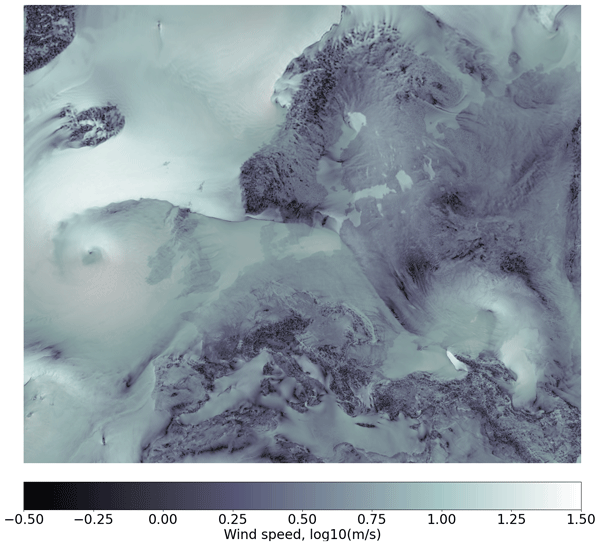
Detailed global climate model simulations have been created based on a numerical weather prediction model, offering more accurate spatial detail down to the scale of individual cities ("kilometre-scale") and a better understanding of climate phenomena such as atmospheric storms, whirls in the ocean, and cracks in sea ice. The new model aims to provide globally consistent information on local climate change with greater precision, benefiting environmental planning and local impact modelling.
Andreas Foth, Moritz Lochmann, Pablo Saavedra Garfias, and Heike Kalesse-Los
Atmos. Meas. Tech., 17, 7169–7181, https://doi.org/10.5194/amt-17-7169-2024, https://doi.org/10.5194/amt-17-7169-2024, 2024
Short summary
Short summary
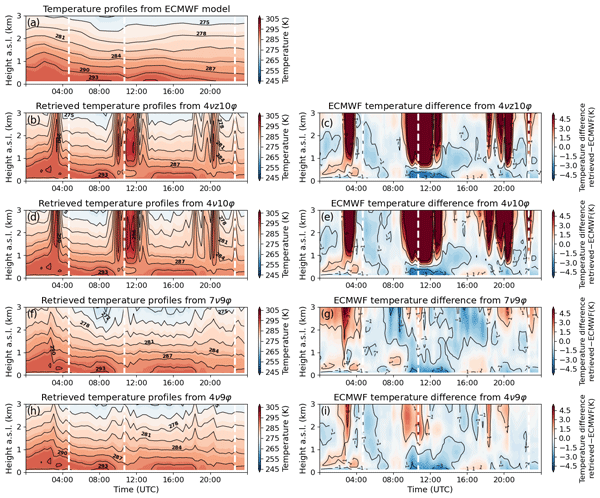
Microwave radiometers are usually not able to provide atmospheric quantities such as temperature profiles during rain. We present a method based on a selection of specific frequencies and elevation angles from microwave radiometer observations. A comparison with a numerical weather prediction model shows the presented method allows low-level temperature profiles during rain to be resolved, with rain rates of up to 2.5 mm h−1,, which was not possible before with state-of-the-art retrievals.
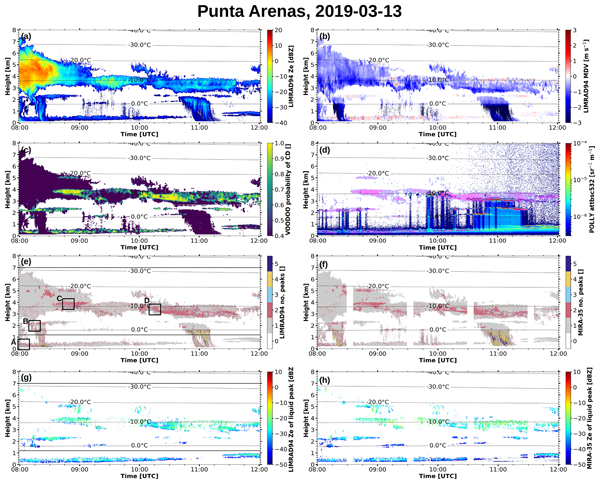
Teresa Vogl, Martin Radenz, Fabiola Ramelli, Rosa Gierens, and Heike Kalesse-Los
Atmos. Meas. Tech., 17, 6547–6568, https://doi.org/10.5194/amt-17-6547-2024, https://doi.org/10.5194/amt-17-6547-2024, 2024
Short summary
Short summary
In this study, we present a toolkit of two Python algorithms to extract information from Doppler spectra measured by ground-based cloud radars. In these Doppler spectra, several peaks can be formed due to populations of droplets/ice particles with different fall velocities coexisting in the same measurement time and height. The two algorithms can detect peaks and assign them to certain particle types, such as small cloud droplets or fast-falling ice particles like graupel.
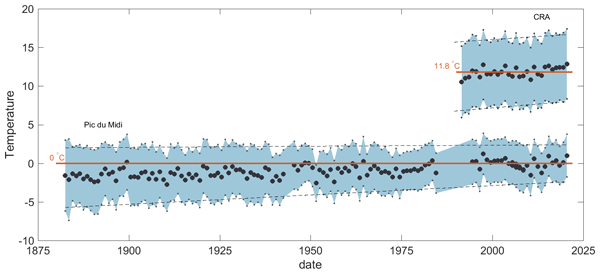
Marie Lothon, François Gheusi, Fabienne Lohou, Véronique Pont, Serge Soula, Corinne Jambert, Solène Derrien, Yannick Bezombes, Emmanuel Leclerc, Gilles Athier, Antoine Vial, Alban Philibert, Bernard Campistron, Frédérique Saïd, Jeroen Sonke, Julien Amestoy, Erwan Bargain, Pierre Bosser, Damien Boulanger, Guillaume Bret, Renaud Bodichon, Laurent Cabanas, Guylaine Canut, Jean-Bernard Estrampes, Eric Gardrat, Zaida Gomez Kuri, Jérémy Gueffier, Fabienne Guesdon, Morgan Lopez, Olivier Masson, Pierre-Yves Meslin, Yves Meyerfeld, Nicolas Pascal, Eric Pique, Michel Ramonet, Felix Starck, and Romain Vidal
Atmos. Meas. Tech., 17, 6265–6300, https://doi.org/10.5194/amt-17-6265-2024, https://doi.org/10.5194/amt-17-6265-2024, 2024
Short summary
Short summary
The Pyrenean Platform for Observation of the Atmosphere (P2OA) is a coupled plain–mountain instrumented platform in southwestern France for the monitoring of climate variables and the study of meteorological processes in a mountainous region. A comprehensive description of this platform is presented for the first time: its instrumentation, the associated dataset, and a meteorological characterization the site. The potential of the P2OA is illustrated through several examples of process studies.
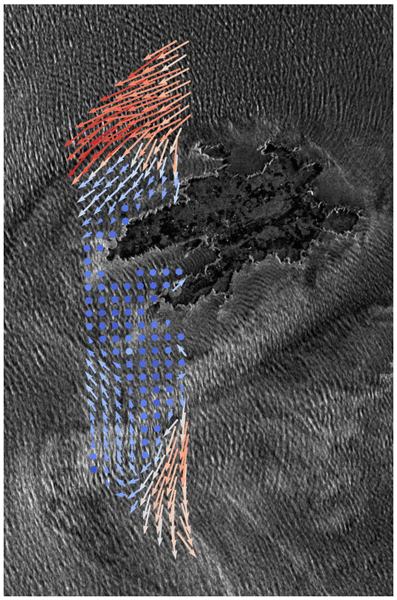
David L. McCann, Adrien C. H. Martin, Karlus A. C. de Macedo, Ruben Carrasco Alvarez, Jochen Horstmann, Louis Marié, José Márquez-Martínez, Marcos Portabella, Adriano Meta, Christine Gommenginger, Petronilo Martin-Iglesias, and Tania Casal
Ocean Sci., 20, 1109–1122, https://doi.org/10.5194/os-20-1109-2024, https://doi.org/10.5194/os-20-1109-2024, 2024
Short summary
Short summary
This paper presents the results of the first scientific campaign of a new method to remotely sense the small-scale, fast-evolving dynamics that are vital to our understanding of coastal and shelf sea processes. This work represents the first demonstration of the simultaneous measurement of current and wind vectors from this novel method. Comparisons with other current measuring systems and models around the dynamic area of the Iroise Sea are presented and show excellent agreement.
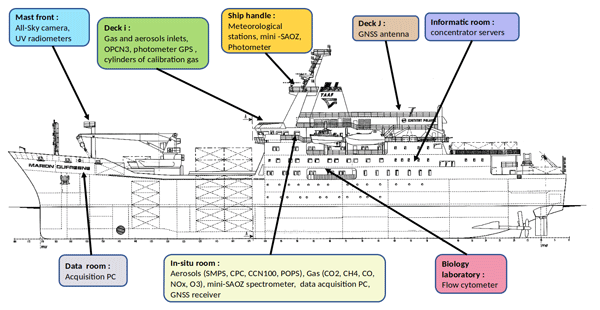
Pierre Tulet, Joel Van Baelen, Pierre Bosser, Jérome Brioude, Aurélie Colomb, Philippe Goloub, Andrea Pazmino, Thierry Portafaix, Michel Ramonet, Karine Sellegri, Melilotus Thyssen, Léa Gest, Nicolas Marquestaut, Dominique Mékiès, Jean-Marc Metzger, Gilles Athier, Luc Blarel, Marc Delmotte, Guillaume Desprairies, Mérédith Dournaux, Gaël Dubois, Valentin Duflot, Kevin Lamy, Lionel Gardes, Jean-François Guillemot, Valérie Gros, Joanna Kolasinski, Morgan Lopez, Olivier Magand, Erwan Noury, Manuel Nunes-Pinharanda, Guillaume Payen, Joris Pianezze, David Picard, Olivier Picard, Sandrine Prunier, François Rigaud-Louise, Michael Sicard, and Benjamin Torres
Earth Syst. Sci. Data, 16, 3821–3849, https://doi.org/10.5194/essd-16-3821-2024, https://doi.org/10.5194/essd-16-3821-2024, 2024
Short summary
Short summary
The MAP-IO program aims to compensate for the lack of atmospheric and oceanographic observations in the Southern Ocean by equipping the ship Marion Dufresne with a set of 17 scientific instruments. This program collected 700 d of measurements under different latitudes, seasons, sea states, and weather conditions. These new data will support the calibration and validation of numerical models and the understanding of the atmospheric composition of this region of Earth.
Allison A. Wing, Levi G. Silvers, and Kevin A. Reed
Geosci. Model Dev., 17, 6195–6225, https://doi.org/10.5194/gmd-17-6195-2024, https://doi.org/10.5194/gmd-17-6195-2024, 2024
Short summary
Short summary
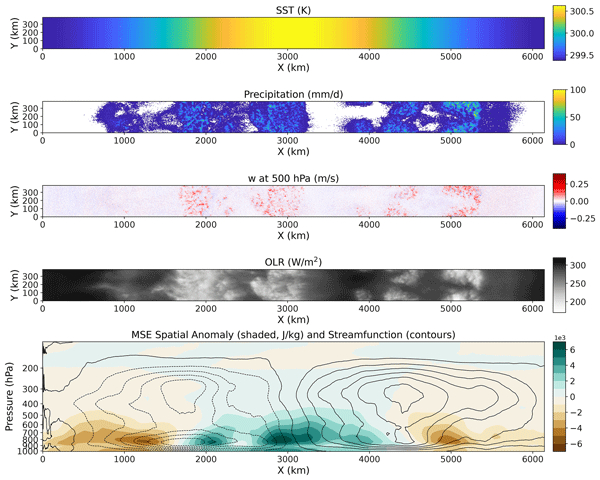
This paper presents the experimental design for a model intercomparison project to study tropical clouds and climate. It is a follow-up from a prior project that used a simplified framework for tropical climate. The new project adds one new component – a specified pattern of sea surface temperatures as the lower boundary condition. We provide example results from one cloud-resolving model and one global climate model and test the sensitivity to the experimental parameters.
Manfred Wendisch, Susanne Crewell, André Ehrlich, Andreas Herber, Benjamin Kirbus, Christof Lüpkes, Mario Mech, Steven J. Abel, Elisa F. Akansu, Felix Ament, Clémantyne Aubry, Sebastian Becker, Stephan Borrmann, Heiko Bozem, Marlen Brückner, Hans-Christian Clemen, Sandro Dahlke, Georgios Dekoutsidis, Julien Delanoë, Elena De La Torre Castro, Henning Dorff, Regis Dupuy, Oliver Eppers, Florian Ewald, Geet George, Irina V. Gorodetskaya, Sarah Grawe, Silke Groß, Jörg Hartmann, Silvia Henning, Lutz Hirsch, Evelyn Jäkel, Philipp Joppe, Olivier Jourdan, Zsofia Jurányi, Michail Karalis, Mona Kellermann, Marcus Klingebiel, Michael Lonardi, Johannes Lucke, Anna E. Luebke, Maximilian Maahn, Nina Maherndl, Marion Maturilli, Bernhard Mayer, Johanna Mayer, Stephan Mertes, Janosch Michaelis, Michel Michalkov, Guillaume Mioche, Manuel Moser, Hanno Müller, Roel Neggers, Davide Ori, Daria Paul, Fiona M. Paulus, Christian Pilz, Felix Pithan, Mira Pöhlker, Veronika Pörtge, Maximilian Ringel, Nils Risse, Gregory C. Roberts, Sophie Rosenburg, Johannes Röttenbacher, Janna Rückert, Michael Schäfer, Jonas Schaefer, Vera Schemann, Imke Schirmacher, Jörg Schmidt, Sebastian Schmidt, Johannes Schneider, Sabrina Schnitt, Anja Schwarz, Holger Siebert, Harald Sodemann, Tim Sperzel, Gunnar Spreen, Bjorn Stevens, Frank Stratmann, Gunilla Svensson, Christian Tatzelt, Thomas Tuch, Timo Vihma, Christiane Voigt, Lea Volkmer, Andreas Walbröl, Anna Weber, Birgit Wehner, Bruno Wetzel, Martin Wirth, and Tobias Zinner
Atmos. Chem. Phys., 24, 8865–8892, https://doi.org/10.5194/acp-24-8865-2024, https://doi.org/10.5194/acp-24-8865-2024, 2024
Short summary
Short summary
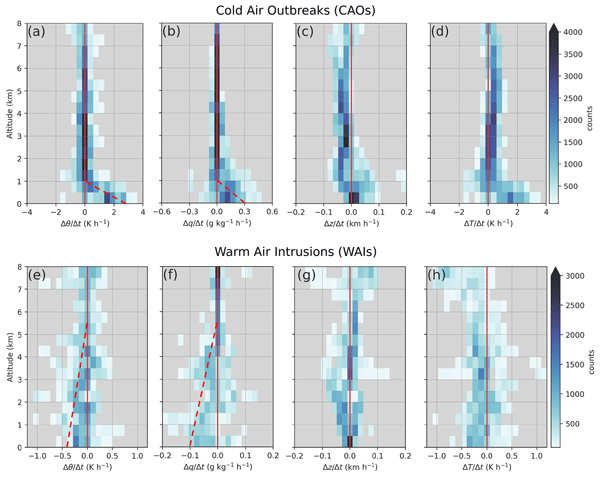
The Arctic is warming faster than the rest of the globe. Warm-air intrusions (WAIs) into the Arctic may play an important role in explaining this phenomenon. Cold-air outbreaks (CAOs) out of the Arctic may link the Arctic climate changes to mid-latitude weather. In our article, we describe how to observe air mass transformations during CAOs and WAIs using three research aircraft instrumented with state-of-the-art remote-sensing and in situ measurement devices.
Ting-Yu Cha and Michael M. Bell
Weather Clim. Dynam., 5, 1013–1029, https://doi.org/10.5194/wcd-5-1013-2024, https://doi.org/10.5194/wcd-5-1013-2024, 2024
Short summary
Short summary
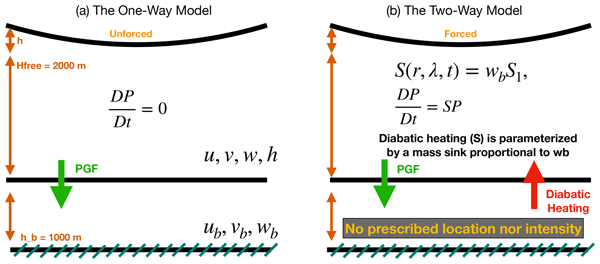
Our study investigates the dynamics of polygonal eyewall structures observed in intensifying hurricanes like Michael (2018) by using a simplified modeling approach. We develop a two-layer model to simulate the interactions between the free atmosphere and boundary layer to demonstrate the importance of different physical mechanisms in the intensification process. This simplified model offers insights into the interactions between dynamics and convection during hurricane intensification.

Henning Dorff, Heike Konow, Vera Schemann, and Felix Ament
Atmos. Chem. Phys., 24, 8771–8795, https://doi.org/10.5194/acp-24-8771-2024, https://doi.org/10.5194/acp-24-8771-2024, 2024
Short summary
Short summary
Using synthetic dropsondes, we assess how discrete spatial sampling and temporal evolution during flight affect the accuracy of real sonde-based moisture transport divergence in Arctic atmospheric rivers (ARs). Non-instantaneous sampling during temporal AR evolution deteriorates the divergence values more than spatial undersampling. Moisture advection is the dominating factor but most sensitive to the sampling method. We suggest a minimum of seven sondes to resolve the AR divergence components.
Moritz Günther, Hauke Schmidt, Claudia Timmreck, and Matthew Toohey
Atmos. Chem. Phys., 24, 7203–7225, https://doi.org/10.5194/acp-24-7203-2024, https://doi.org/10.5194/acp-24-7203-2024, 2024
Short summary
Short summary
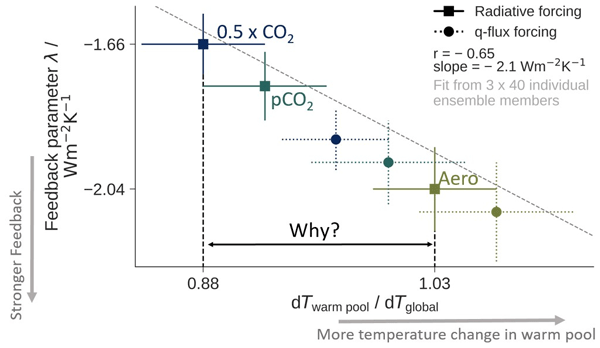
Stratospheric aerosol has been shown to cause pronounced cooling in the tropical Indian and western Pacific oceans. Using a climate model, we show that this arises from enhanced meridional energy export via the stratosphere. The aerosol causes stratospheric heating and thus an acceleration of the Brewer–Dobson circulation that accomplishes this transport. Our findings highlight the importance of circulation adjustments and surface perspectives on forcing for understanding temperature responses.

Finn Burgemeister, Marco Clemens, and Felix Ament
Earth Syst. Sci. Data, 16, 2317–2332, https://doi.org/10.5194/essd-16-2317-2024, https://doi.org/10.5194/essd-16-2317-2024, 2024
Short summary
Short summary
Knowledge of small-scale rainfall variability is needed for hydro-meteorological applications in urban areas. Therefore, we present an open-access data set covering reanalyzed radar reflectivities and rainfall estimates measured by a weather radar at high spatio-temporal resolution in the urban environment of Hamburg between 2013 and 2021. We describe the data reanalysis, outline the measurement’s performance for long time periods, and discuss open issues and limitations of the data set.
Bjorn Stevens, Stefan Adami, Tariq Ali, Hartwig Anzt, Zafer Aslan, Sabine Attinger, Jaana Bäck, Johanna Baehr, Peter Bauer, Natacha Bernier, Bob Bishop, Hendryk Bockelmann, Sandrine Bony, Guy Brasseur, David N. Bresch, Sean Breyer, Gilbert Brunet, Pier Luigi Buttigieg, Junji Cao, Christelle Castet, Yafang Cheng, Ayantika Dey Choudhury, Deborah Coen, Susanne Crewell, Atish Dabholkar, Qing Dai, Francisco Doblas-Reyes, Dale Durran, Ayoub El Gaidi, Charlie Ewen, Eleftheria Exarchou, Veronika Eyring, Florencia Falkinhoff, David Farrell, Piers M. Forster, Ariane Frassoni, Claudia Frauen, Oliver Fuhrer, Shahzad Gani, Edwin Gerber, Debra Goldfarb, Jens Grieger, Nicolas Gruber, Wilco Hazeleger, Rolf Herken, Chris Hewitt, Torsten Hoefler, Huang-Hsiung Hsu, Daniela Jacob, Alexandra Jahn, Christian Jakob, Thomas Jung, Christopher Kadow, In-Sik Kang, Sarah Kang, Karthik Kashinath, Katharina Kleinen-von Königslöw, Daniel Klocke, Uta Kloenne, Milan Klöwer, Chihiro Kodama, Stefan Kollet, Tobias Kölling, Jenni Kontkanen, Steve Kopp, Michal Koran, Markku Kulmala, Hanna Lappalainen, Fakhria Latifi, Bryan Lawrence, June Yi Lee, Quentin Lejeun, Christian Lessig, Chao Li, Thomas Lippert, Jürg Luterbacher, Pekka Manninen, Jochem Marotzke, Satoshi Matsouoka, Charlotte Merchant, Peter Messmer, Gero Michel, Kristel Michielsen, Tomoki Miyakawa, Jens Müller, Ramsha Munir, Sandeep Narayanasetti, Ousmane Ndiaye, Carlos Nobre, Achim Oberg, Riko Oki, Tuba Özkan-Haller, Tim Palmer, Stan Posey, Andreas Prein, Odessa Primus, Mike Pritchard, Julie Pullen, Dian Putrasahan, Johannes Quaas, Krishnan Raghavan, Venkatachalam Ramaswamy, Markus Rapp, Florian Rauser, Markus Reichstein, Aromar Revi, Sonakshi Saluja, Masaki Satoh, Vera Schemann, Sebastian Schemm, Christina Schnadt Poberaj, Thomas Schulthess, Cath Senior, Jagadish Shukla, Manmeet Singh, Julia Slingo, Adam Sobel, Silvina Solman, Jenna Spitzer, Philip Stier, Thomas Stocker, Sarah Strock, Hang Su, Petteri Taalas, John Taylor, Susann Tegtmeier, Georg Teutsch, Adrian Tompkins, Uwe Ulbrich, Pier-Luigi Vidale, Chien-Ming Wu, Hao Xu, Najibullah Zaki, Laure Zanna, Tianjun Zhou, and Florian Ziemen
Earth Syst. Sci. Data, 16, 2113–2122, https://doi.org/10.5194/essd-16-2113-2024, https://doi.org/10.5194/essd-16-2113-2024, 2024
Short summary
Short summary
To manage Earth in the Anthropocene, new tools, new institutions, and new forms of international cooperation will be required. Earth Virtualization Engines is proposed as an international federation of centers of excellence to empower all people to respond to the immense and urgent challenges posed by climate change.
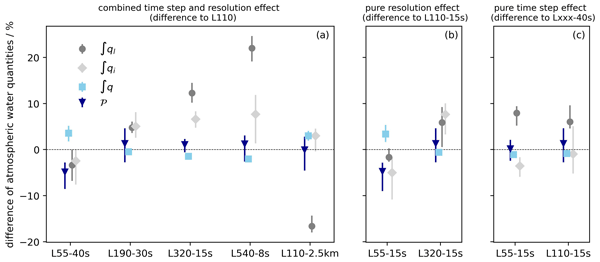
Hauke Schmidt, Sebastian Rast, Jiawei Bao, Amrit Cassim, Shih-Wei Fang, Diego Jimenez-de la Cuesta, Paul Keil, Lukas Kluft, Clarissa Kroll, Theresa Lang, Ulrike Niemeier, Andrea Schneidereit, Andrew I. L. Williams, and Bjorn Stevens
Geosci. Model Dev., 17, 1563–1584, https://doi.org/10.5194/gmd-17-1563-2024, https://doi.org/10.5194/gmd-17-1563-2024, 2024
Short summary
Short summary
A recent development in numerical simulations of the global atmosphere is the increase in horizontal resolution to grid spacings of a few kilometers. However, the vertical grid spacing of these models has not been reduced at the same rate as the horizontal grid spacing. Here, we assess the effects of much finer vertical grid spacings, in particular the impacts on cloud quantities and the atmospheric energy balance.
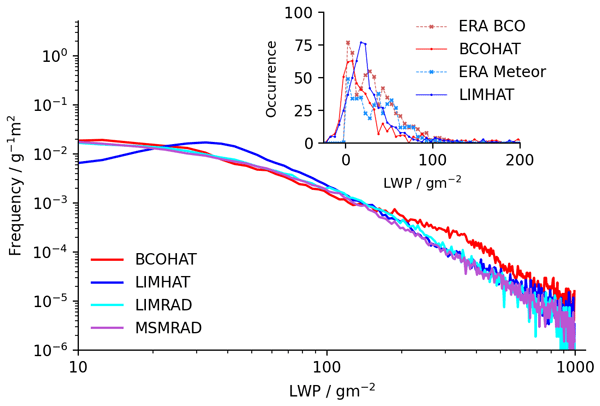
Sabrina Schnitt, Andreas Foth, Heike Kalesse-Los, Mario Mech, Claudia Acquistapace, Friedhelm Jansen, Ulrich Löhnert, Bernhard Pospichal, Johannes Röttenbacher, Susanne Crewell, and Bjorn Stevens
Earth Syst. Sci. Data, 16, 681–700, https://doi.org/10.5194/essd-16-681-2024, https://doi.org/10.5194/essd-16-681-2024, 2024
Short summary
Short summary
This publication describes the microwave radiometric measurements performed during the EUREC4A campaign at Barbados Cloud Observatory (BCO) and aboard RV Meteor and RV Maria S Merian. We present retrieved integrated water vapor (IWV), liquid water path (LWP), and temperature and humidity profiles as a unified, quality-controlled, multi-site data set on a 3 s temporal resolution for a core period between 19 January 2020 and 14 February 2020.
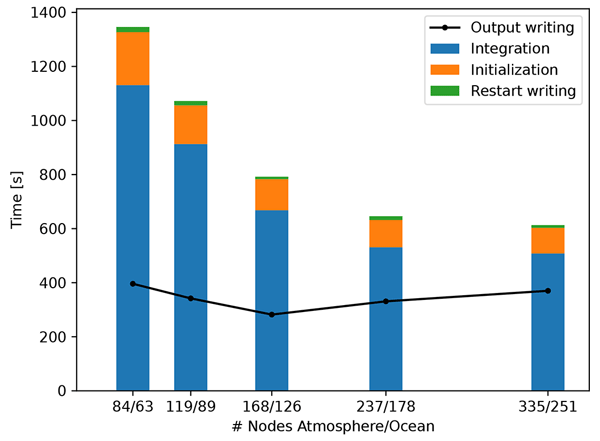
Abhiraj Bishnoi, Olaf Stein, Catrin I. Meyer, René Redler, Norbert Eicker, Helmuth Haak, Lars Hoffmann, Daniel Klocke, Luis Kornblueh, and Estela Suarez
Geosci. Model Dev., 17, 261–273, https://doi.org/10.5194/gmd-17-261-2024, https://doi.org/10.5194/gmd-17-261-2024, 2024
Short summary
Short summary
We enabled the weather and climate model ICON to run in a high-resolution coupled atmosphere–ocean setup on the JUWELS supercomputer, where the ocean and the model I/O runs on the CPU Cluster, while the atmosphere is running simultaneously on GPUs. Compared to a simulation performed on CPUs only, our approach reduces energy consumption by 45 % with comparable runtimes. The experiments serve as preparation for efficient computing of kilometer-scale climate models on future supercomputing systems.
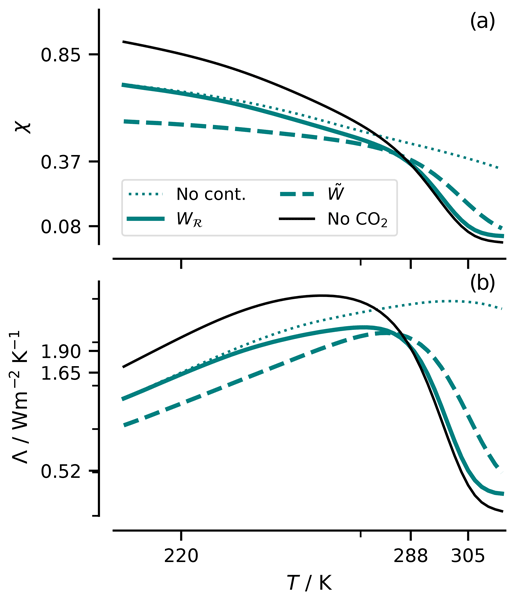
Bjorn Stevens and Lukas Kluft
Atmos. Chem. Phys., 23, 14673–14689, https://doi.org/10.5194/acp-23-14673-2023, https://doi.org/10.5194/acp-23-14673-2023, 2023
Short summary
Short summary
A simple model is introduced to account for the spectral diversity of radiant energy transfer. It provides an improved basis for assessing the different ways in which clouds influence Earth’s climate sensitivity, demonstrating how many cloud effects depend on the existing cloud climatology. Given existing assessments of changes in cloud albedo with warming, it is determined that clouds reduce Earth's climate sensitivity as compared to what it would be in a counterfactual world without clouds.
Pablo Saavedra Garfias, Heike Kalesse-Los, Luisa von Albedyll, Hannes Griesche, and Gunnar Spreen
Atmos. Chem. Phys., 23, 14521–14546, https://doi.org/10.5194/acp-23-14521-2023, https://doi.org/10.5194/acp-23-14521-2023, 2023
Short summary
Short summary
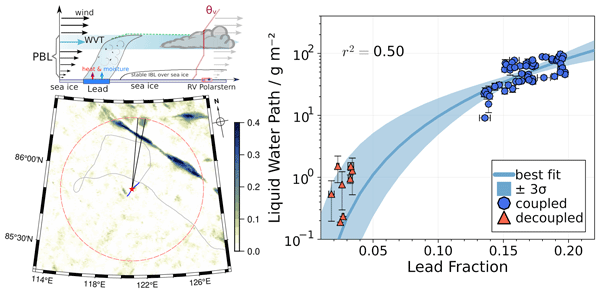
An important Arctic climate process is the release of heat fluxes from sea ice openings to the atmosphere that influence the clouds. The characterization of this process is the objective of this study. Using synergistic observations from the MOSAiC expedition, we found that single-layer cloud properties show significant differences when clouds are coupled or decoupled to the water vapour transport which is used as physical link between the upwind sea ice openings and the cloud under observation.
Olivia Linke, Johannes Quaas, Finja Baumer, Sebastian Becker, Jan Chylik, Sandro Dahlke, André Ehrlich, Dörthe Handorf, Christoph Jacobi, Heike Kalesse-Los, Luca Lelli, Sina Mehrdad, Roel A. J. Neggers, Johannes Riebold, Pablo Saavedra Garfias, Niklas Schnierstein, Matthew D. Shupe, Chris Smith, Gunnar Spreen, Baptiste Verneuil, Kameswara S. Vinjamuri, Marco Vountas, and Manfred Wendisch
Atmos. Chem. Phys., 23, 9963–9992, https://doi.org/10.5194/acp-23-9963-2023, https://doi.org/10.5194/acp-23-9963-2023, 2023
Short summary
Short summary
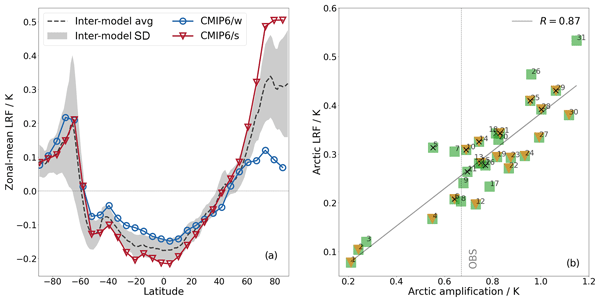
Lapse rate feedback (LRF) is a major driver of the Arctic amplification (AA) of climate change. It arises because the warming is stronger at the surface than aloft. Several processes can affect the LRF in the Arctic, such as the omnipresent temperature inversion. Here, we compare multimodel climate simulations to Arctic-based observations from a large research consortium to broaden our understanding of these processes, find synergy among them, and constrain the Arctic LRF and AA.
Amelie U. Schmitt, Felix Ament, Alessandro C. de Araújo, Marta Sá, and Paulo Teixeira
Atmos. Chem. Phys., 23, 9323–9346, https://doi.org/10.5194/acp-23-9323-2023, https://doi.org/10.5194/acp-23-9323-2023, 2023
Short summary
Short summary
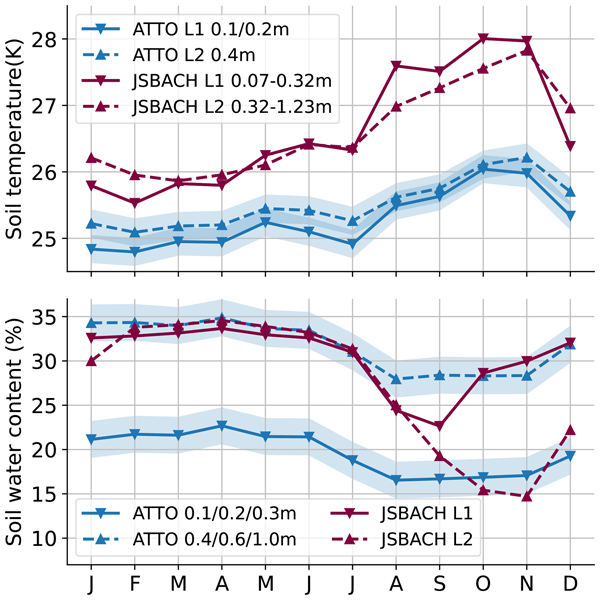
Tall vegetation in forests affects the exchange of heat and moisture between the atmosphere and the land surface. We compared measurements from the Amazon Tall Tower Observatory to results from a land surface model to identify model shortcomings. Our results suggest that soil temperatures in the model could be improved by incorporating a separate canopy layer which represents the heat storage within the forest.
Joelle Habib, Caroline Ulses, Claude Estournel, Milad Fakhri, Patrick Marsaleix, Mireille Pujo-Pay, Marine Fourrier, Laurent Coppola, Alexandre Mignot, Laurent Mortier, and Pascal Conan
Biogeosciences, 20, 3203–3228, https://doi.org/10.5194/bg-20-3203-2023, https://doi.org/10.5194/bg-20-3203-2023, 2023
Short summary
Short summary
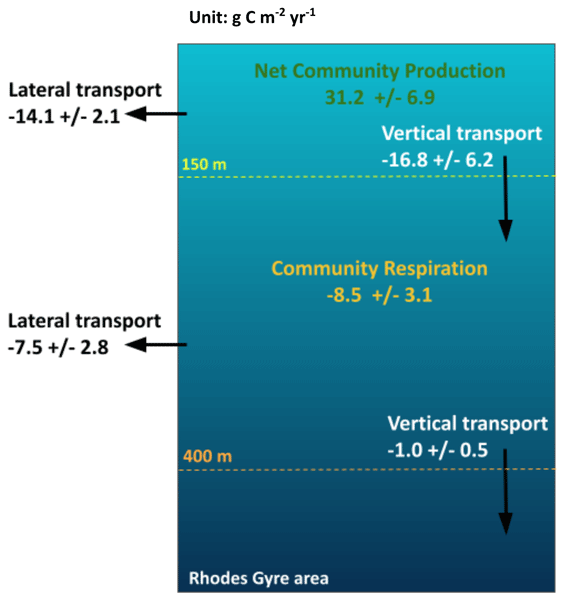
The Rhodes Gyre, eastern Mediterranean Sea, is the main Levantine Intermediate Water formation site. In this study, we use a 3D physical–biogeochemical model to investigate the seasonal and interannual variability of organic carbon dynamics in the gyre. Our results show its autotrophic nature and its high interannual variability, with enhanced primary production, downward exports, and onward exports to the surrounding regions during years marked by intense heat losses and deep mixed layers.
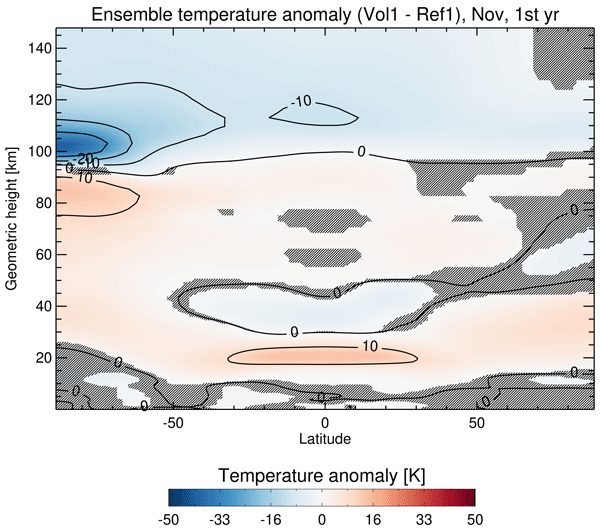
Sandra Wallis, Hauke Schmidt, and Christian von Savigny
Atmos. Chem. Phys., 23, 7001–7014, https://doi.org/10.5194/acp-23-7001-2023, https://doi.org/10.5194/acp-23-7001-2023, 2023
Short summary
Short summary
Strong volcanic eruptions are able to alter the temperature and the circulation of the middle atmosphere. This study simulates the atmospheric response to an idealized strong tropical eruption and focuses on the impact on the mesosphere. The simulations show a warming of the polar summer mesopause in the first November after the eruption. Our study indicates that this is mainly due to dynamical coupling in the summer hemisphere with a potential contribution from interhemispheric coupling.
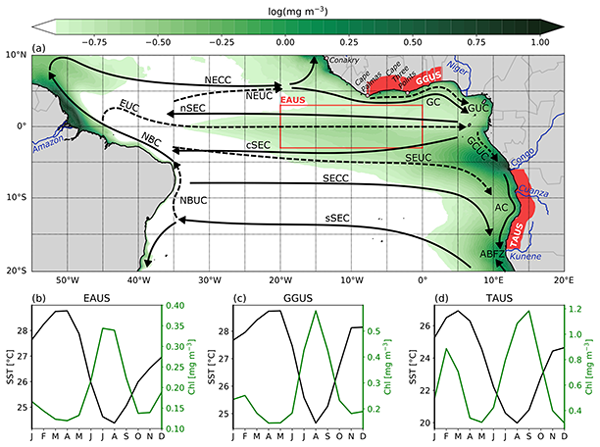
Peter Brandt, Gaël Alory, Founi Mesmin Awo, Marcus Dengler, Sandrine Djakouré, Rodrigue Anicet Imbol Koungue, Julien Jouanno, Mareike Körner, Marisa Roch, and Mathieu Rouault
Ocean Sci., 19, 581–601, https://doi.org/10.5194/os-19-581-2023, https://doi.org/10.5194/os-19-581-2023, 2023
Short summary
Short summary
Tropical upwelling systems are among the most productive ecosystems globally. The tropical Atlantic upwelling undergoes a strong seasonal cycle that is forced by the wind. Local wind-driven upwelling and remote effects, particularly via the propagation of equatorial and coastal trapped waves, lead to an upward and downward movement of the nitracline. Turbulent mixing results in upward supply of nutrients. Here, we review the different physical processes responsible for biological productivity.
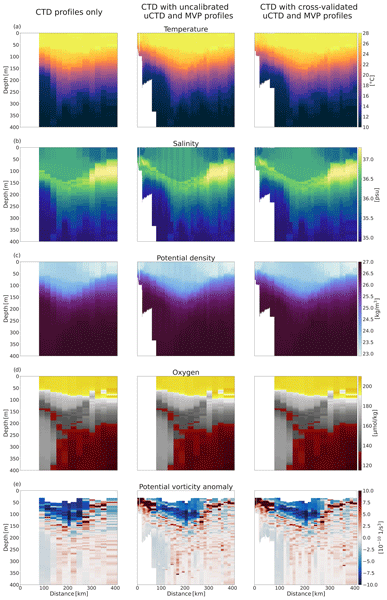
Pierre L'Hégaret, Florian Schütte, Sabrina Speich, Gilles Reverdin, Dariusz B. Baranowski, Rena Czeschel, Tim Fischer, Gregory R. Foltz, Karen J. Heywood, Gerd Krahmann, Rémi Laxenaire, Caroline Le Bihan, Philippe Le Bot, Stéphane Leizour, Callum Rollo, Michael Schlundt, Elizabeth Siddle, Corentin Subirade, Dongxiao Zhang, and Johannes Karstensen
Earth Syst. Sci. Data, 15, 1801–1830, https://doi.org/10.5194/essd-15-1801-2023, https://doi.org/10.5194/essd-15-1801-2023, 2023
Short summary
Short summary
In early 2020, the EUREC4A-OA/ATOMIC experiment took place in the northwestern Tropical Atlantic Ocean, a dynamical region where different water masses interact. Four oceanographic vessels and a fleet of autonomous devices were deployed to study the processes at play and sample the upper ocean, each with its own observing capability. The article first describes the data calibration and validation and second their cross-validation, using a hierarchy of instruments and estimating the uncertainty.
Samuel Kwakye, Heike Kalesse-Los, Maximilian Maahn, Patric Seifert, Roel van Klink, Christian Wirth, and Johannes Quaas
Atmos. Meas. Tech. Discuss., https://doi.org/10.5194/amt-2023-69, https://doi.org/10.5194/amt-2023-69, 2023
Publication in AMT not foreseen
Short summary
Short summary
Insect numbers in the atmosphere can be calculated using polarimetric weather radar but they have to be identified and separated from other echoes, especially weather phenomena. Here, the separation is demonstrated using three machine-learning algorithms and insect count data from suction traps and the nature of radar measurements of different radar echoes is revealed. Random forest is the best separating algorithm and insect echoes radar measurements are distinct.
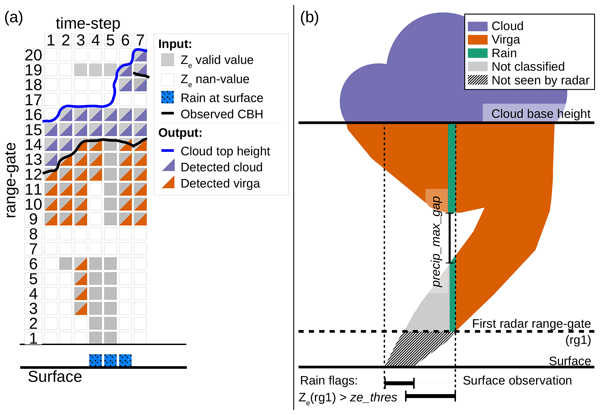
Heike Kalesse-Los, Anton Kötsche, Andreas Foth, Johannes Röttenbacher, Teresa Vogl, and Jonas Witthuhn
Atmos. Meas. Tech., 16, 1683–1704, https://doi.org/10.5194/amt-16-1683-2023, https://doi.org/10.5194/amt-16-1683-2023, 2023
Short summary
Short summary
The Virga-Sniffer, a new modular open-source Python package tool to characterize full precipitation evaporation (so-called virga) from ceilometer cloud base height and vertically pointing cloud radar reflectivity time–height fields, is described. Results of its first application to RV Meteor observations during the EUREC4A field experiment in January–February 2020 are shown. About half of all detected clouds with bases below the trade inversion height were found to produce virga.
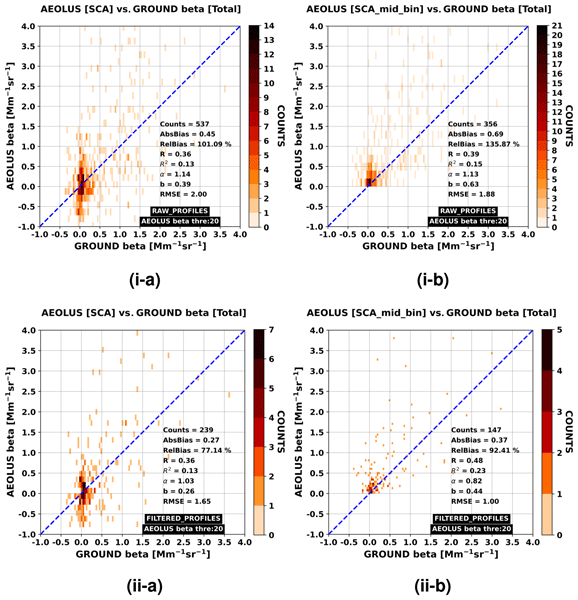
Antonis Gkikas, Anna Gialitaki, Ioannis Binietoglou, Eleni Marinou, Maria Tsichla, Nikolaos Siomos, Peristera Paschou, Anna Kampouri, Kalliopi Artemis Voudouri, Emmanouil Proestakis, Maria Mylonaki, Christina-Anna Papanikolaou, Konstantinos Michailidis, Holger Baars, Anne Grete Straume, Dimitris Balis, Alexandros Papayannis, Tomasso Parrinello, and Vassilis Amiridis
Atmos. Meas. Tech., 16, 1017–1042, https://doi.org/10.5194/amt-16-1017-2023, https://doi.org/10.5194/amt-16-1017-2023, 2023
Short summary
Short summary
We perform an assessment analysis of the Aeolus Standard Correct Algorithm (SCA) backscatter coefficient retrievals against reference observations acquired at three Greek lidar stations (Athens, Thessaloniki and Antikythera) of the PANACEA network. Overall, 43 cases are analysed, whereas specific aerosol scenarios in the vicinity of Antikythera island (SW Greece) are emphasised. All key Cal/Val aspects and recommendations, and the ongoing related activities, are thoroughly discussed.

José Dias Neto, Louise Nuijens, Christine Unal, and Steven Knoop
Earth Syst. Sci. Data, 15, 769–789, https://doi.org/10.5194/essd-15-769-2023, https://doi.org/10.5194/essd-15-769-2023, 2023
Short summary
Short summary
This paper describes a dataset from a novel experimental setup to retrieve wind speed and direction profiles, combining cloud radars and wind lidar. This setup allows retrieving profiles from near the surface to the top of clouds. The field campaign occurred in Cabauw, the Netherlands, between September 13th and October 3rd 2021. This paper also provides examples of applications of this dataset (e.g. studying atmospheric turbulence, validating numerical atmospheric models).
Cathy Hohenegger, Peter Korn, Leonidas Linardakis, René Redler, Reiner Schnur, Panagiotis Adamidis, Jiawei Bao, Swantje Bastin, Milad Behravesh, Martin Bergemann, Joachim Biercamp, Hendryk Bockelmann, Renate Brokopf, Nils Brüggemann, Lucas Casaroli, Fatemeh Chegini, George Datseris, Monika Esch, Geet George, Marco Giorgetta, Oliver Gutjahr, Helmuth Haak, Moritz Hanke, Tatiana Ilyina, Thomas Jahns, Johann Jungclaus, Marcel Kern, Daniel Klocke, Lukas Kluft, Tobias Kölling, Luis Kornblueh, Sergey Kosukhin, Clarissa Kroll, Junhong Lee, Thorsten Mauritsen, Carolin Mehlmann, Theresa Mieslinger, Ann Kristin Naumann, Laura Paccini, Angel Peinado, Divya Sri Praturi, Dian Putrasahan, Sebastian Rast, Thomas Riddick, Niklas Roeber, Hauke Schmidt, Uwe Schulzweida, Florian Schütte, Hans Segura, Radomyra Shevchenko, Vikram Singh, Mia Specht, Claudia Christine Stephan, Jin-Song von Storch, Raphaela Vogel, Christian Wengel, Marius Winkler, Florian Ziemen, Jochem Marotzke, and Bjorn Stevens
Geosci. Model Dev., 16, 779–811, https://doi.org/10.5194/gmd-16-779-2023, https://doi.org/10.5194/gmd-16-779-2023, 2023
Short summary
Short summary
Models of the Earth system used to understand climate and predict its change typically employ a grid spacing of about 100 km. Yet, many atmospheric and oceanic processes occur on much smaller scales. In this study, we present a new model configuration designed for the simulation of the components of the Earth system and their interactions at kilometer and smaller scales, allowing an explicit representation of the main drivers of the flow of energy and matter by solving the underlying equations.
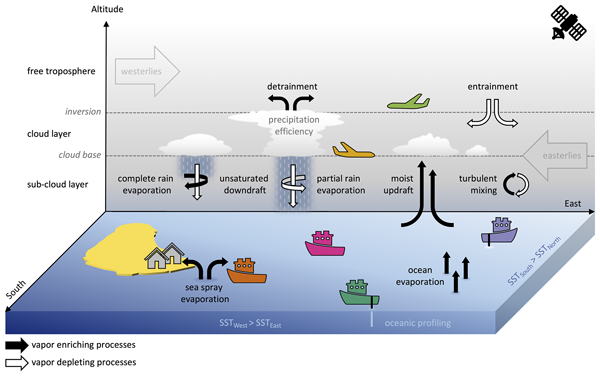
Adriana Bailey, Franziska Aemisegger, Leonie Villiger, Sebastian A. Los, Gilles Reverdin, Estefanía Quiñones Meléndez, Claudia Acquistapace, Dariusz B. Baranowski, Tobias Böck, Sandrine Bony, Tobias Bordsdorff, Derek Coffman, Simon P. de Szoeke, Christopher J. Diekmann, Marina Dütsch, Benjamin Ertl, Joseph Galewsky, Dean Henze, Przemyslaw Makuch, David Noone, Patricia K. Quinn, Michael Rösch, Andreas Schneider, Matthias Schneider, Sabrina Speich, Bjorn Stevens, and Elizabeth J. Thompson
Earth Syst. Sci. Data, 15, 465–495, https://doi.org/10.5194/essd-15-465-2023, https://doi.org/10.5194/essd-15-465-2023, 2023
Short summary
Short summary
One of the novel ways EUREC4A set out to investigate trade wind clouds and their coupling to the large-scale circulation was through an extensive network of isotopic measurements in water vapor, precipitation, and seawater. Samples were taken from the island of Barbados, from aboard two aircraft, and from aboard four ships. This paper describes the full collection of EUREC4A isotopic in situ data and guides readers to complementary remotely sensed water vapor isotope ratios.
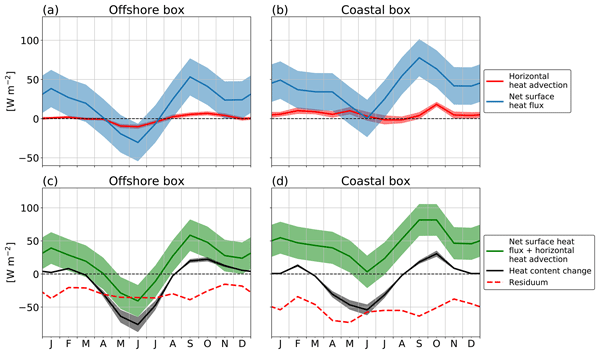
Mareike Körner, Peter Brandt, and Marcus Dengler
Ocean Sci., 19, 121–139, https://doi.org/10.5194/os-19-121-2023, https://doi.org/10.5194/os-19-121-2023, 2023
Short summary
Short summary
The coastal waters off Angola host a productive ecosystem. Surface waters at the coast are colder than further offshore. We find that surface heat fluxes warm the coastal region more strongly than the offshore region and cannot explain the differences. The influence of horizontal heat advection is minor on the surface temperature change. In contrast, ocean turbulence data suggest that cooling associated with vertical mixing is an important mechanism to explain the near-coastal cooling.
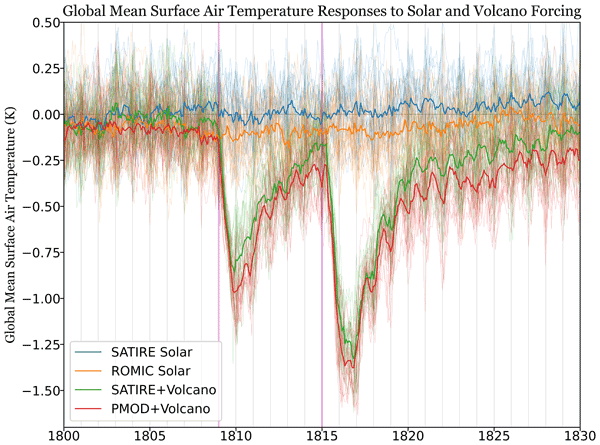
Shih-Wei Fang, Claudia Timmreck, Johann Jungclaus, Kirstin Krüger, and Hauke Schmidt
Earth Syst. Dynam., 13, 1535–1555, https://doi.org/10.5194/esd-13-1535-2022, https://doi.org/10.5194/esd-13-1535-2022, 2022
Short summary
Short summary
The early 19th century was the coldest period over the past 500 years, when strong tropical volcanic events and a solar minimum coincided. This study quantifies potential surface cooling from the solar and volcanic forcing in the early 19th century with large ensemble simulations, and identifies the regions that their impacts cannot be simply additive. The cooling perspective of Arctic amplification exists in both solar and post-volcano period with the albedo feedback as the main contribution.
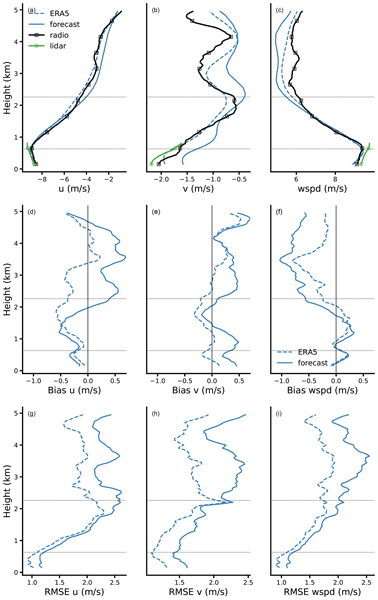
Alessandro Carlo Maria Savazzi, Louise Nuijens, Irina Sandu, Geet George, and Peter Bechtold
Atmos. Chem. Phys., 22, 13049–13066, https://doi.org/10.5194/acp-22-13049-2022, https://doi.org/10.5194/acp-22-13049-2022, 2022
Short summary
Short summary
Winds are of great importance for the transport of energy and moisture in the atmosphere. In this study we use measurements from the EUREC4A field campaign and several model experiments to understand the wind bias in the forecasts produced by the European Centre for Medium-Range Weather Forecasts. We are able to link the model errors to heights above 2 km and to the representation of the diurnal cycle of winds: the model makes the winds too slow in the morning and too strong in the evening.

Olivier Bock, Pierre Bosser, and Carl Mears
Atmos. Meas. Tech., 15, 5643–5665, https://doi.org/10.5194/amt-15-5643-2022, https://doi.org/10.5194/amt-15-5643-2022, 2022
Short summary
Short summary
Integrated water vapour measurements are often compared for the calibration and validation of instruments or techniques. Measurements made at different altitudes must be corrected to account for the vertical variation of water vapour. This paper shows that the widely used empirical correction model has severe limitations that are overcome using the proposed model. The method is applied to the inter-comparison of GPS and satellite microwave radiometer data in a tropical mountainous area.
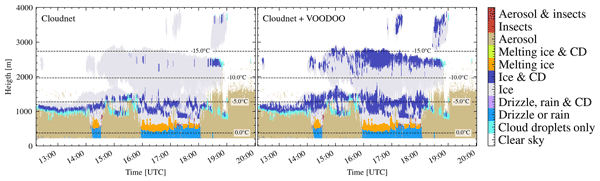
Willi Schimmel, Heike Kalesse-Los, Maximilian Maahn, Teresa Vogl, Andreas Foth, Pablo Saavedra Garfias, and Patric Seifert
Atmos. Meas. Tech., 15, 5343–5366, https://doi.org/10.5194/amt-15-5343-2022, https://doi.org/10.5194/amt-15-5343-2022, 2022
Short summary
Short summary
This study introduces the novel Doppler radar spectra-based machine learning approach VOODOO (reVealing supercOOled liquiD beyOnd lidar attenuatiOn). VOODOO is a powerful probability-based extension to the existing Cloudnet hydrometeor target classification, enabling the detection of liquid-bearing cloud layers beyond complete lidar attenuation via user-defined p* threshold. VOODOO performs best for (multi-layer) stratiform and deep mixed-phase clouds with liquid water path > 100 g m−2.
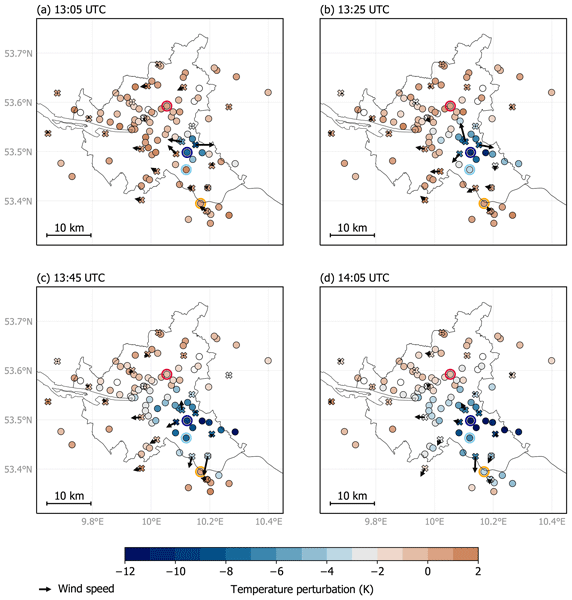
Bastian Kirsch, Cathy Hohenegger, Daniel Klocke, Rainer Senke, Michael Offermann, and Felix Ament
Earth Syst. Sci. Data, 14, 3531–3548, https://doi.org/10.5194/essd-14-3531-2022, https://doi.org/10.5194/essd-14-3531-2022, 2022
Short summary
Short summary
Conventional observation networks are too coarse to resolve the horizontal structure of kilometer-scale atmospheric processes. We present the FESST@HH field experiment that took place in Hamburg (Germany) during summer 2020 and featured a dense network of 103 custom-built, low-cost weather stations. The data set is capable of providing new insights into the structure of convective cold pools and the nocturnal urban heat island and variations of local temperature fluctuations.

Henning Dorff, Heike Konow, and Felix Ament
Atmos. Meas. Tech., 15, 3641–3661, https://doi.org/10.5194/amt-15-3641-2022, https://doi.org/10.5194/amt-15-3641-2022, 2022
Short summary
Short summary
This study elaborates how aircraft-based horizontal geometries of trade wind cumuli differ whether a one-dimensional profiling radar or a two-dimensional imager is used. Cloud size distributions are examined in terms of sensitivity to sample size, resolution, and instrument field of view. While the radar cannot reproduce the double power law distribution due to coarse resolution and restriction to vertical transects, the imager also reveals the elliptic cloud structure enhancing with wind speed.
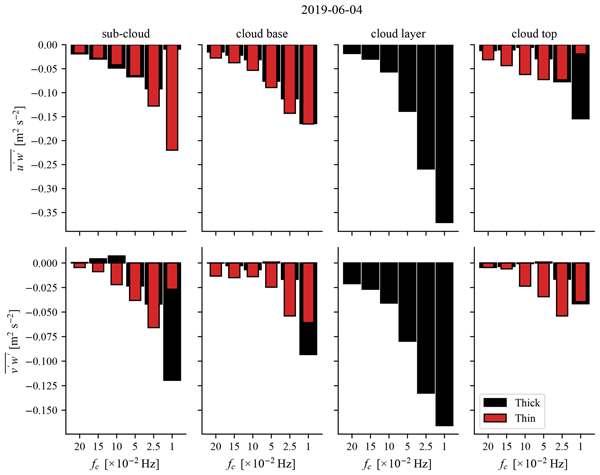
Ada Mariska Koning, Louise Nuijens, Christian Mallaun, Benjamin Witschas, and Christian Lemmerz
Atmos. Chem. Phys., 22, 7373–7388, https://doi.org/10.5194/acp-22-7373-2022, https://doi.org/10.5194/acp-22-7373-2022, 2022
Short summary
Short summary
Wind measurements from the mixed layer to cloud tops are scarce, causing a lack of knowledge on wind mixing between and within these layers. We use airborne observations of wind profiles and local wind at high frequency to study wind transport in cloud fields. A case with thick clouds had its maximum transport in the cloud layer, caused by eddies > 700 m, which was not expected from turbulence theory. In other cases large eddies undid transport of smaller eddies resulting in no net transport.

Peristera Paschou, Nikolaos Siomos, Alexandra Tsekeri, Alexandros Louridas, George Georgoussis, Volker Freudenthaler, Ioannis Binietoglou, George Tsaknakis, Alexandros Tavernarakis, Christos Evangelatos, Jonas von Bismarck, Thomas Kanitz, Charikleia Meleti, Eleni Marinou, and Vassilis Amiridis
Atmos. Meas. Tech., 15, 2299–2323, https://doi.org/10.5194/amt-15-2299-2022, https://doi.org/10.5194/amt-15-2299-2022, 2022
Short summary
Short summary
The eVe lidar delivers quality-assured aerosol and cloud optical properties according to the standards of ACTRIS. It is a mobile reference system for the validation of the ESA's Aeolus satellite mission (L2 aerosol and cloud products). eVe provides linear and circular polarisation measurements with Raman capabilities. Here, we describe the system design, the polarisation calibration techniques, and the software for the retrieval of the optical products.

Michael Schäfer, Kevin Wolf, André Ehrlich, Christoph Hallbauer, Evelyn Jäkel, Friedhelm Jansen, Anna Elizabeth Luebke, Joshua Müller, Jakob Thoböll, Timo Röschenthaler, Bjorn Stevens, and Manfred Wendisch
Atmos. Meas. Tech., 15, 1491–1509, https://doi.org/10.5194/amt-15-1491-2022, https://doi.org/10.5194/amt-15-1491-2022, 2022
Short summary
Short summary
The new airborne thermal infrared imager VELOX is introduced. It measures two-dimensional fields of spectral thermal infrared radiance or brightness temperature within the large atmospheric window. The technical specifications as well as necessary calibration and correction procedures are presented. Example measurements from the first field deployment are analysed with respect to cloud coverage and cloud top altitude.

Teresa Vogl, Maximilian Maahn, Stefan Kneifel, Willi Schimmel, Dmitri Moisseev, and Heike Kalesse-Los
Atmos. Meas. Tech., 15, 365–381, https://doi.org/10.5194/amt-15-365-2022, https://doi.org/10.5194/amt-15-365-2022, 2022
Short summary
Short summary
We are using machine learning techniques, a type of artificial intelligence, to detect graupel formation in clouds. The measurements used as input to the machine learning framework were performed by cloud radars. Cloud radars are instruments located at the ground, emitting radiation with wavelenghts of a few millimeters vertically into the cloud and measuring the back-scattered signal. Our novel technique can be applied to different radar systems and different weather conditions.
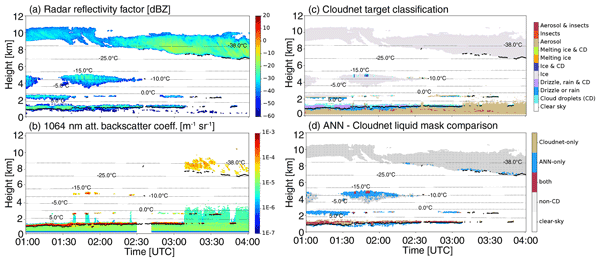
Heike Kalesse-Los, Willi Schimmel, Edward Luke, and Patric Seifert
Atmos. Meas. Tech., 15, 279–295, https://doi.org/10.5194/amt-15-279-2022, https://doi.org/10.5194/amt-15-279-2022, 2022
Short summary
Short summary
It is important to detect the vertical distribution of cloud droplets and ice in mixed-phase clouds. Here, an artificial neural network (ANN) previously developed for Arctic clouds is applied to a mid-latitudinal cloud radar data set. The performance of this technique is contrasted to the Cloudnet target classification. For thick/multi-layer clouds, the machine learning technique is better at detecting liquid than Cloudnet, but if lidar data are available Cloudnet is at least as good as the ANN.
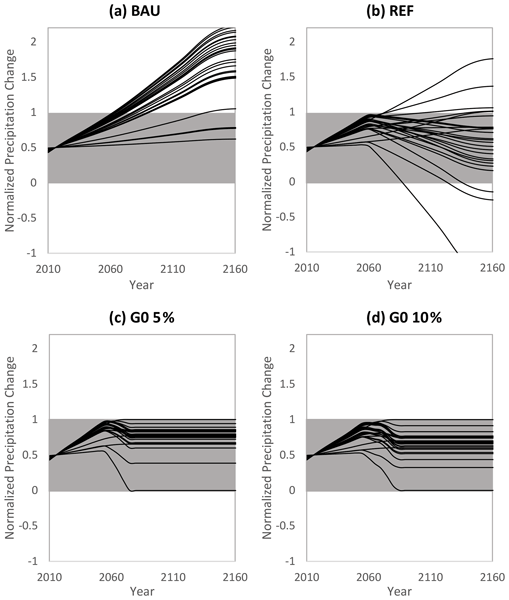
Mohammad M. Khabbazan, Marius Stankoweit, Elnaz Roshan, Hauke Schmidt, and Hermann Held
Earth Syst. Dynam., 12, 1529–1542, https://doi.org/10.5194/esd-12-1529-2021, https://doi.org/10.5194/esd-12-1529-2021, 2021
Short summary
Short summary
We ask for an optimal amount of solar radiation management (SRM) in conjunction with mitigation if global warming is limited to 2 °C and regional precipitation anomalies are confined to an amount ethically compatible with the 2 °C target. Then, compared to a scenario without regional targets, most of the SRM usage is eliminated from the portfolio even if transgressing regional targets are tolerated in terms of 1/10 of the standard deviation of natural variability.
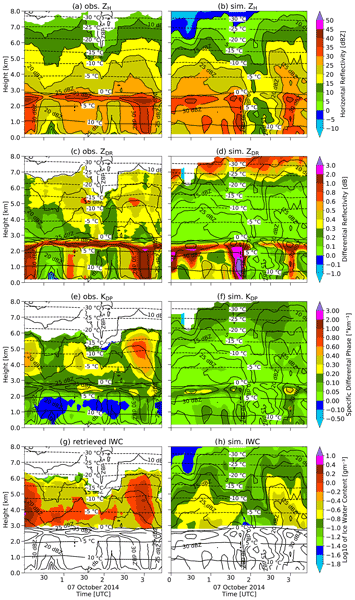
Silke Trömel, Clemens Simmer, Ulrich Blahak, Armin Blanke, Sabine Doktorowski, Florian Ewald, Michael Frech, Mathias Gergely, Martin Hagen, Tijana Janjic, Heike Kalesse-Los, Stefan Kneifel, Christoph Knote, Jana Mendrok, Manuel Moser, Gregor Köcher, Kai Mühlbauer, Alexander Myagkov, Velibor Pejcic, Patric Seifert, Prabhakar Shrestha, Audrey Teisseire, Leonie von Terzi, Eleni Tetoni, Teresa Vogl, Christiane Voigt, Yuefei Zeng, Tobias Zinner, and Johannes Quaas
Atmos. Chem. Phys., 21, 17291–17314, https://doi.org/10.5194/acp-21-17291-2021, https://doi.org/10.5194/acp-21-17291-2021, 2021
Short summary
Short summary
The article introduces the ACP readership to ongoing research in Germany on cloud- and precipitation-related process information inherent in polarimetric radar measurements, outlines pathways to inform atmospheric models with radar-based information, and points to remaining challenges towards an improved fusion of radar polarimetry and atmospheric modelling.
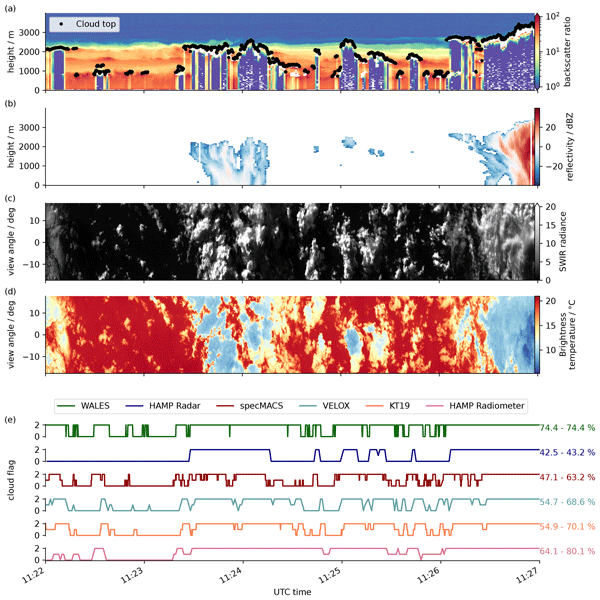
Heike Konow, Florian Ewald, Geet George, Marek Jacob, Marcus Klingebiel, Tobias Kölling, Anna E. Luebke, Theresa Mieslinger, Veronika Pörtge, Jule Radtke, Michael Schäfer, Hauke Schulz, Raphaela Vogel, Martin Wirth, Sandrine Bony, Susanne Crewell, André Ehrlich, Linda Forster, Andreas Giez, Felix Gödde, Silke Groß, Manuel Gutleben, Martin Hagen, Lutz Hirsch, Friedhelm Jansen, Theresa Lang, Bernhard Mayer, Mario Mech, Marc Prange, Sabrina Schnitt, Jessica Vial, Andreas Walbröl, Manfred Wendisch, Kevin Wolf, Tobias Zinner, Martin Zöger, Felix Ament, and Bjorn Stevens
Earth Syst. Sci. Data, 13, 5545–5563, https://doi.org/10.5194/essd-13-5545-2021, https://doi.org/10.5194/essd-13-5545-2021, 2021
Short summary
Short summary
The German research aircraft HALO took part in the research campaign EUREC4A in January and February 2020. The focus area was the tropical Atlantic east of the island of Barbados. We describe the characteristics of the 15 research flights, provide auxiliary information, derive combined cloud mask products from all instruments that observe clouds on board the aircraft, and provide code examples that help new users of the data to get started.
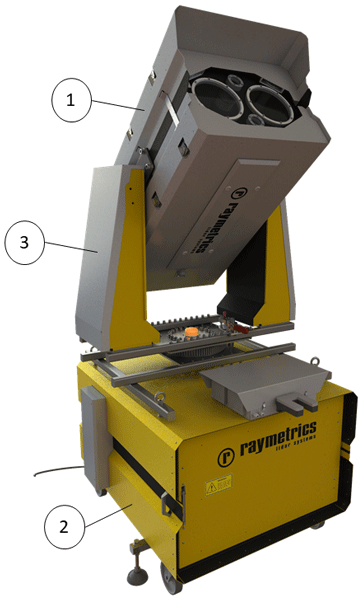
Alexandra Tsekeri, Vassilis Amiridis, Alexandros Louridas, George Georgoussis, Volker Freudenthaler, Spiros Metallinos, George Doxastakis, Josef Gasteiger, Nikolaos Siomos, Peristera Paschou, Thanasis Georgiou, George Tsaknakis, Christos Evangelatos, and Ioannis Binietoglou
Atmos. Meas. Tech., 14, 7453–7474, https://doi.org/10.5194/amt-14-7453-2021, https://doi.org/10.5194/amt-14-7453-2021, 2021
Short summary
Short summary
Dust orientation in the Earth's atmosphere has been an ongoing investigation in recent years, and its potential proof will be a paradigm shift for dust remote sensing. We have designed and developed a polarization lidar that provides direct measurements of dust orientation, as well as more detailed information of the particle microphysics. We provide a description of its design as well as its first measurements.
Cited articles
Acquistapace, C., Coulter, R., Crewell, S., Garcia-Benadi, A., Gierens, R., Labbri, G., Myagkov, A., Risse, N., and Schween, J. H.: EUREC4A's Maria S. Merian ship-based cloud and micro rain radar observations of clouds and precipitation, Earth Syst. Sci. Data, 14, 33–55, https://doi.org/10.5194/essd-14-33-2022, 2022. a
Bell, M. M., Dolan, B., DeHart, J., Colón-Burgos, D., Chandrasekar, V., George, J., Lovato, M., Junyent, F., Wing, A., Ruppert, J., and Kennison, S.: Level 4 Gridded Sea-Pol Radar Data Rainrate 2D, ORCESTRA [data set], https://doi.org/10.82246/bafybeigv34pwsk3t5 wlmatncnavfsfie5zyd6j36eyv57qsh6f7usn5kg4, 2026a. a
Bell, M. M., Dolan, B., DeHart, J., Colón-Burgos, D., Chandrasekar, V., George, J., Lovato, M., Junyent, F., Wing, A., Ruppert, J., and Kennison, S.: Level 4 Gridded Sea-Pol Radar Data RHI 2D, ORCESTRA [data set], https://doi.org/10.82246/bafybeigbngdrbifkqry 3hsqilx4rywi3pu4a6vf2fraf4bql3qyzoosh2m, 2026b. a
Bell, M. M., Dolan, B., DeHart, J., Colón-Burgos, D., Chandrasekar, V., George, J., Lovato, M., Junyent, F., Wing, A., Ruppert, J., and Kennison, S.: Level 4 Gridded Sea-Pol Radar Data Composite 2D, ORCESTRA [data set], https://doi.org/10.82246/bafybeigdehy7635uypwip v5xdnlvgnlbncvuyudajwejawn2llirbp2vyq, 2026c. a
Bell, M. M., Dolan, B., DeHart, J., Colón-Burgos, D., Chandrasekar, V., George, J., Lovato, M., Junyent, F., Wing, A., Ruppert, J., and Kennison, S.: Level 4 Gridded Sea-Pol Radar Data QVP 1D, ORCESTRA [data set], https://doi.org/10.82246/bafybeifhwxvq4kh66dry 6wo4s7auvdbfhur4gtmhwonw6ru2w537j53xiy, 2026d. a
Bertiger, W., Bar-Sever, Y., Dorsey, A., Haines, B., Harvey, N., Hemberger, D., Heflin, M., Lu, W., Miller, M., Moore, A. W., Murphy, D., Ries, P., Romans, L., Sibois, A., Sibthorpe, A., Szilagyi, B., Vallisneri, M., and Willis, P.: GipsyX/RTGx, a new tool set for space geodetic operations and research, Adv. Space Res., 66, 469–489, https://doi.org/10.1016/j.asr.2020.04.015, 2020. a
Bevis, M., Bussinger, S., Herring, T. A., Rocken, C., Anthes, R. A., and Ware, R. H.: GPS Meteorology: Remote Sensing of Atmospheric Water Vapor Using the Global Positioning System, J. Geophys. Res.-Atmos., 97, 15787–15801, https://doi.org/10.1029/92JD01517, 1992. a
Boedewadt, J., Carrasco, R., and Horstmann, J.: X-band Radar surface derived currents M203, ORCESTRA [data set], https://doi.org/10.82246/bafybeig3znybjnw6tzr5ek 6acavwmkvd6rl7bo6mpbbfhkhweq5oexs3ja, 2026. a
Bosser, P.: IWV data from GNSS antenna on R/V METEOR, ORCESTRA [data set], https://doi.org/10.82246/bafybeifanfvmxia7nfeuro s7gl3ouv3qb5cmg4dczl6ekkjuk7gv66w424, 2026. a
Bosser, P., Bock, O., Flamant, C., Bony, S., and Speich, S.: Integrated water vapour content retrievals from ship-borne GNSS receivers during EUREC4A, Earth Syst. Sci. Data, 13, 1499–1517, https://doi.org/10.5194/essd-13-1499-2021, 2021. a, b
Bosser, P., Van Baelen, J., and Bousquet, O.: Routine Measurement of Water Vapour Using GNSS in the Framework of the MAP-IO Project, Atmosphere, 13, 903, https://doi.org/10.3390/atmos13060903, 2022. a, b
Brandes, E. A., Zhang, G., and Vivekanandan, J.: Experiments in Rainfall Estimation with a Polarimetric Radar in a Subtropical Environment, J. Appl. Meteorol., 41, 674–685, https://doi.org/10.1175/1520-0450(2002)041<0674:EIREWA>2.0.CO;2, 2002. a
Bretherton, C. S., Peters, M. E., and Back, L. E.: Relationships between Water Vapor Path and Precipitation over the Tropical Oceans, J. Climate, 17, 1517–1528, https://doi.org/10.1175/1520-0442(2004)017<1517:RBWVPA>2.0.CO;2, 2004. a
Carrasco, R., Nieto-Borge, J.-C., Seemann, J., and Horstmann, J.: Significant Wave Height Retrieved From Coherent X-Band Radar: A Physics-Based Approach, IEEE T. Geosci. Remote, 62, 1–15, https://doi.org/10.1109/TGRS.2024.3354042, 2024. a
Carrasco, R., Nieto-Borge, J.-C., Seemann, J., and Horstmann, J.: Monitoring Ocean Waves Using Coherent X-Band Radar: Surface Reconstruction and Short-Term Prediction, IEEE T. Geosci. Remote, https://doi.org/10.1109/TGRS.2025.3597134, 2025. a
Colón-Burgos, D.: METEOR1 PARSIVEL Disdrometer QCed data, ORCESTRA [data set], https://doi.org/10.82246/bafybeicrrokylncpyjgs 52c6526otqbqxcxhmkt6mkqovya2xvt2n3yo54, 2026a. a
Colón-Burgos, D.: METEOR2 PARSIVEL Disdrometer QCed data, ORCESTRA [data set], https://doi.org/10.82246/bafybeiacc53awulhrtttt kdwd6uktvb3bfbsyac5g4ww7rkujigkalmkfe, 2026b. a
Colón-Burgos, D.: Merged PARSIVEL Disdrometer QCed data, ORCESTRA [data set], https://doi.org/10.82246/bafybeihjcwsecgpmsjxo o5peqafnuqfnalu3ya3vtibwl7qkm76izsnueie, 2026c. a
Dengler, M.: Continuous subskin sea surface temperature data along RV METEOR M203 cruise track, ORCESTRA [data set], https://doi.org/10.82246/bafybeieoosfm33u47expe jxhccectau4oxrp2jg4efzrqn743af6tzxide, 2026a. a
Dengler, M.: GEOMAR PO-processed CTD data of cruise Meteor 203/1 CTD station number 1, ORCESTRA [data set], https://doi.org/10.82246/bafybeihoghhgi655g7arw 2ubtpudbq4c4hpwjlrwghcex3snu7f36imjgq, 2026b. a
Donlon, C., Robinson, I. S., Reynolds, M., Wimmer, W., Fisher, G., Edwards, R., and Nightingale, T. J.: An infrared sea surface temperature autonomous radiometer (ISAR) for deployment aboard volunteer observing ships (VOS), J. Atmos. Ocean. Tech., 25, 93–113, https://doi.org/10.1175/2007JTECHO505.1, 2008. a
Fairall, C. W., Bradley, E. F., Godfrey, J. S., Wick, G. A., Edson, J. B., and Young, G. S.: Cool-skin and warm-layer effects on sea surface temperature, J. Geophys. Res.-Oceans, 101, 1295–1308, https://doi.org/10.1029/95JC03190, 1996. a, b, c
Fairall, C. W., White, A. B., Edson, J. B., and Hare, J. E.: Integrated Shipboard Measurements of the Marine Boundary Layer, J. Atmos. Ocean. Tech., 14, 338–359, https://doi.org/10.1175/1520-0426(1997)014<0338:ISMOTM>2.0.CO;2, 1997. a, b
Fairall, C. W., Thompson, E. J., Bariteau, L., Wick, G. A., Minnett, P. J., Szczodrak, M., Jessup, A. T., and Witte, C.: An Updated Treatment of the Oceanic Cool Skin in the COARE Bulk Flux Algorithm, J. Geophys. Res.-Oceans, 131, https://doi.org/10.1029/2025JC023539, 2026. a
Fer, I., Dengler, M., Holtermann, P., Le Boyer, A., and Lueck, R.: ATOMIX benchmark datasets for dissipation rate measurements using shear probes, Sci. Data, 11, 518, https://doi.org/10.1038/s41597-024-03323-y, 2024. a
Fischer, J., Brandt, P., Dengler, M., Müller, M., and Symonds, D.: Surveying the Upper Ocean with the Ocean Surveyor: A New Phased Array Doppler Current Profiler, J. Atmos. Ocean. Tech., 20, 742–751, https://doi.org/10.1175/1520-0426(2003)20<742:STUOWT>2.0.CO;2, 2003. a
Foth, A.: Cloud radar and Cloudnet on RV Meteor during BOWTIE, ORCESTRA [data set], https://doi.org/10.82246/bafybeidtfyua2vmmrpnhbl 6nj57x2ynowaceghdapyetc6lnrpjii2tlli, 2026a. a
Foth, A.: HATPRO observation on RV Meteor during BOWTIE MWR single-pointing from RV Meteor, ORCESTRA [data set], https://doi.org/10.82246/bafybeihc63mpkfatnvl6z 5hze2eijzwqr6o3ohubhi5i66dvos4qjcssvu, 2026b. a
Foth, A.: HATPRO observation on RV Meteor during BOWTIE MWR multiple-pointing from RV Meteor, ORCESTRA [data set], https://doi.org/10.82246/bafybeihddiylirtiv64yo 74wzt7zok545yowhiiu23kjonvz2wl57eunze, 2026c. a
Foth, A.: surface rain flag from Micro Rain Radar, ORCESTRA [data set], https://doi.org/10.82246/bafybeie2zhy2rkepcqh6tc 5lk75blv372rvpfnnrhsyl6efscdgmugld4a, 2026d. a
Friedrich, K., Higgins, S., Masters, F. J., and Lopez, C. R.: Articulating and stationary PARSIVEL disdrometer measurements in conditions with strong winds and heavy rainfall, J. Atmos. Ocean. Tech., 30, 2063–2080, https://doi.org/10.1175/JTECH-D-12-00254.1, 2013a. a, b
Friedrich, K., Higgins, S., Masters, F. J., and Lopez, C. R.: Articulating and Stationary PARSIVEL Disdrometer Measurements in Conditions with Strong Winds and Heavy Rainfall, J. Atmos. Ocean. Tech., 30, 2063–2080, https://doi.org/10.1175/JTECH-D-12-00254.1, 2013b. a
Friedrich, K., Kalina, E. A., Masters, F. J., and Lopez, C. R.: Drop-Size Distributions in Thunderstorms Measured by Optical Disdrometers during VORTEX2, Mon. Weather Rev., 141, 1182–1203, https://doi.org/10.1175/MWR-D-12-00116.1, 2013c. a
Gentemann, C. L., Minnett, P. J., and Ward, B.: Profiles of ocean surface heating (POSH): A new model of upper ocean diurnal warming, J. Geophys. Res.-Oceans, 114, https://doi.org/10.1029/2008JC004825, 2009. a
Greenfield, R. S. and Fein, J. S.: The Global Atmospheric Research Programs's Atlantic Tropical Experiment, Rev. Geophys., 17, 1762–1772, https://doi.org/10.1029/RG017i007p01762, 1979. a
Groß, S., Ewald, F., Stevens, B., Wirth, M., Dekoutsidis, G., Ehrlich, A., Kouklaki, D., Krüger, K., Rosenburg, S., Volkmer, L., von Bismark, J., Hirsch, L., Luebke, A. E., Marinou, E., Mayer, B., Pinol Sole, M., Wendisch, M., Windmiller, J., Amiridis, V., Koopman, R., Kubota, T., and Rapp, M.: Persistent EarthCARE underflight studies of the ITCZ and organized convection (PERCUSION): contribution to EarthCARE validation, Atmos. Meas. Tech., 19, 3933–3959, https://doi.org/10.5194/amt-19-3933-2026, 2026. a
Hersbach, H., Bell, B., Berrisford, P., Hirahara, S., Horányi, A., Muñoz-Sabater, J., Nicolas, J., Peubey, C., Radu, R., Schepers, D., Simmons, A., Soci, C., Abdalla, S., Abellan, X., Balsamo, G., Bechtold, P., Biavati, G., Bidlot, J., Bonavita, M., De Chiara, G., Dahlgren, P., Dee, D., Diamantakis, M., Dragani, R., Flemming, J., Forbes, R., Fuentes, M., Geer, A., Haimberger, L., Healy, S., Hogan, R. J., Hólm, E., Janisková, M., Keeley, S., Laloyaux, P., Lopez, P., Lupu, C., Radnoti, G., de Rosnay, P., Rozum, I., Vamborg, F., Villaume, S., and Thépaut, J.-N.: The ERA5 global reanalysis, Q. J. Roy. Meteor. Soc., 146, 1999–2049, https://doi.org/10.1002/qj.3803, 2020. a
Horstmann, J., Bödewadt, J., Carrasco, R., Cysewski, M., Seemann, J., and Stresser, M.: A coherent on receive x-band marine radar for ocean observations, Sensors, 21, https://doi.org/10.3390/s21237828, 2021. a, b
Illingworth, A. J., Hogan, R. J., O'Connor, E. J., Bouniol, D., Brooks, M. E., Delanoë, J., Donovan, D. P., Eastment, J. D., Gaussiat, N., Goddard, J. W., Haeffelin, M., Baltinik, H. K., Krasnov, O. A., Pelon, J., Piriou, J. M., Protat, A., Russchenberg, H. W., Seifert, A., Tompkins, A. M., van Zadelhoff, G. J., Vinit, F., Willen, U., Wilson, D. R., and Wrench, C. L.: Cloudnet: Continuous evaluation of cloud profiles in seven operational models using ground-based observations, B. Am. Meteorol. Soc., 88, 883–898, https://doi.org/10.1175/BAMS-88-6-883, 2007. a
Jansen, F.: Ceilometer (CHM15k Nimbus) measurements during METEOR cruise M203, ORCESTRA [data set], https://doi.org/10.82246/bafybeia74wnxe2nxwkc mespzjckqwt25tyhcknah3xqxxeeevbsdiawzom, 2026. a
Jia, C. and Minnett, P. J.: Ocean Warm Skin Signals Observed by Saildrone at High Latitudes, Geophys. Res. Lett., 50, https://doi.org/10.1029/2022GL102384, 2023. a
Kalesse-Los, H., Kötsche, A., Foth, A., Röttenbacher, J., Vogl, T., and Witthuhn, J.: The Virga-Sniffer – a new tool to identify precipitation evaporation using ground-based remote-sensing observations, Atmos. Meas. Tech., 16, 1683–1704, https://doi.org/10.5194/amt-16-1683-2023, 2023. a, b, c, d
Klocke, D., Brueck, M., Hohenegger, C., and Stevens, B.: Rediscovery of the doldrums in storm-resolving simulations over the tropical Atlantic /704/106 /704/106/35 /704/106/35/823 perspective, Nat. Geosci., 10, 891–896, https://doi.org/10.1038/s41561-017-0005-4, 2017. a
Klocke, D., Dengler, M., and Kopte, R.: Shipboard ADCP current measurements (38 kHz) during RV METEOR cruise M203, ORCESTRA [data set], https://doi.org/10.82246/bafybeieli3hwulxcvqqan 2f62lfajswqzbbbhmueenjaubc6zfxukjc2ke, 2026a. a
Klocke, D., Dengler, M., and Kopte, R.: Shipboard ADCP current measurements (75 kHz) during RV METEOR cruise M203, ORCESTRA [data set], https://doi.org/10.82246/bafybeia4pgtryncxt4pex fs2gyvgxn4cob43mfijkdo2alwcxgorpfn3va, 2026b. a
Klocke, D., Wing, A. A., Segura, H., Dengler, M., Bell, M. M., Ruppert, J. H., George, G., Kalesse-Los, H., Nuijens, L., Möller, K. O., Kiko, R., Mohr, W., Kidane, A. T., Trosits, A., Mertz, C., Imker, C., Begler, C., Blandfort, D., Colón-Burgos, D., Austen, D., Junyent, F., Schmidt, H., Habib, J., van der Giessen, J., Wieners, K.-H., Hayo, L., Stelzner, M., Lovato, M., O’Driscoll, O., Paschou, P., Henning, P., Mackenzie, R., Wimmer, W., Serikov, I., Brügmann, B., Wu, Y., Stevens, B., and Windmiller, J.: 40 days and nights in the Rains: The inner life of the Atlantic ITCZ during BOWTIE, B. Ame. Meteorol. Soc., https://doi.org/10.1175/bams-d-25-0166.1, 2026c. a, b, c, d
Köhler, L.: shipspy (Version 1.1.0), Github, [code], https://github.com/shipspy-development/shipspy (last access: 6 November 2026), 2024. a
Kollias, P. and Bartholomew, M. J.: Parsivel Disdrometer Support for MAGIC Field Campaign Report, Tech. rep., https://doi.org/10.2172/1255440, 2016. a
Kopte, R., Becker, M., Fischer, T., Brandt, P., Krahmann, G., Betz, M., Faber, C., Winter, C., Karstensen, J., and Wiemer, G.: FAIR ADCP data with OSADCP: a workflow to process ocean current data from vessel-mounted ADCPs, Front. Mar. Sci., 11, 2024, https://doi.org/10.3389/fmars.2024.1425086, 2024a. a
Kopte, R., Fischer, T., Krahmann, G., Brandt, P., Faber, C., and Becker, M.: OSADCP Toolbox, GEOMAR Helmholtz Centre for Ocean Research [code] https://doi.org/10.3289/SW_2_2024, 2024b. a
Kopte, R., Klocke, D., and Dengler, M.: Shipboard ADCP current measurements (75 kHz) during RV METEOR cruise M203, PANGAEA [data set], https://doi.org/10.1594/PANGAEA.974252, 2024c. a
Kopte, R., Klocke, D., and Dengler, M.: Shipboard ADCP current measurements (38 kHz) during RV METEOR cruise M203, PANGAEA [data set], https://doi.org/10.1594/PANGAEA.974251, 2024d. a
Küchler, N., Kneifel, S., Löhnert, U., Kollias, P., Czekala, H., and Rose, T.: A W-band radar-radiometer system for accurate and continuous monitoring of clouds and precipitation, J. Atmos. Ocean. Tech., 34, 2375–2392, https://doi.org/10.1175/JTECH-D-17-0019.1, 2017. a
Lind, E., Gupta, P., and Klocke, D.: Sunphotometer (Microtops) measurements during METEOR cruise M203 (data collection), ORCESTRA [data set], https://doi.org/10.82246/bafybeifw2qrevl4ckmn cq4zqpwivorcgketyyyjap5po7xkvkykjhi5jpa, 2026. a
Lueck, R., Fer, I., Bluteau, C., Dengler, M., Holtermann, P., Inoue, R., LeBoyer, A., Nicholson, S.-A., Schulz, K., and Stevens, C.: Best practices recommendations for estimating dissipation rates from shear probes, Front. Mar. Sci., 11, https://doi.org/10.3389/fmars.2024.1334327, 2024. a
Lund, B., Graber, H. C., Hessner, K., and Williams, N. J.: On shipboard marine X-band radar near-surface current “Calibration”, J. Atmos. Ocean. Tech., 32, 1928–1944, https://doi.org/10.1175/JTECH-D-14-00175.1, 2015. a
Lund, B., Haus, B. K., Horstmann, J., Graber, H. C., Carrasco, R., Laxague, N. J. M., Novelli, G., Guigand, C. M., and Özgökmen, T. M.: Near-Surface Current Mapping by Shipboard Marine X-Band Radar: A Validation, J. Atmos. Ocean. Tech., 35, 1077–1090, https://doi.org/10.1175/JTECH-D-17-0154.1, 2018. a, b
Löffler-Mang, M. and Joss, J.: An Optical Disdrometer for Measuring Size and Velocity of Hydrometeors, J. Atmos. Ocean. Tech., 17, 130–139, https://doi.org/10.1175/1520-0426(2000)017<0130:AODFMS>2.0.CO;2, 2000. a
Madgwick, S. O. H.: An efficient orientation filter for inertial and inertial/magnetic sensor arrays, https://x-io.co.uk/downloads/madgwick_internal_report.pdf (last access: 6 November 2026), 2010. a
Mason, B. J.: The GARP atlantic tropical experiment, Contemp. Phys., 16, 533–546, https://doi.org/10.1080/00107517508210831, 1975. a
Maury, M. F.: The Physical Geography of the Sea and its Meteorology, Sampson Low, Son & Co., London, 11th Edn., https://archive.org/details/physicalgeograph11maur/page/n13/mode/2up?ref=ol (last access: 6 November 2026), 1864. a
McCann, D. L. and Bell, P. S.: A Simple Offset ”calibration” Method for the Accurate Geographic Registration of Ship-Borne X-Band Radar Intensity Imagery, IEEE Access, 6, 13939–13948, https://doi.org/10.1109/ACCESS.2018.2814081, 2018. a
Mctaggart, K., Johnson, G., Johnson, M., Delahoyde, F., and Swift, J.: Notes on CTD/O2 data acquisition and processing using Sea-Bird hardware and software (as available), GO-SHIP repeat hydrography manual: A collection of expert reports and guidelines, https://go-ship.org/HydroMan.html (last access: 6 November 2026), 2010. a
Minnett, P. J.: Radiometric measurements of the sea-surface skin temperature: the competing roles of the diurnal thermocline and the cool skin, Int. J. Remote Sens., 24, 5033–5047, https://doi.org/10.1080/0143116031000095880, 2003. a, b
Nuijens, L.: Horizontal wind profiles from shipborne scanning wind lidar, ORCESTRA [data set], https://doi.org/10.82246/bafybeieggj743jwgs ahtv56hb7ier245mxnxey56zl5bdr3iltzmm4ik4a, 2026. a
Peters, G., Fischer, B., Münster, H., Clemens, M., and Wagner, A.: Profiles of Raindrop Size Distributions as Retrieved by Microrain Radars, J. Appl. Meteorol., 44, 1930–1949, https://doi.org/10.1175/JAM2316.1, 2005. a
Philander, G. and Düing, W.: The Oceanic Circulation Of The Tropical Atlantic, And Its Variability, As Observed During Gate, Pergamon, 1–27, ISBN 978-1-4832-8366-1, https://doi.org/10.1016/B978-1-4832-8366-1.50020-0, 1980. a
Pinkel, R., Goldin, M. A., Smith, J. A., Sun, O. M., Aja, A. A., Bui, M. N., and Hughen, T.: The Wirewalker: A vertically profiling instrument carrier powered by ocean waves, J. Atmos. Ocean. Tech., 28, 426–435, https://doi.org/10.1175/2010JTECHO805.1, 2011. a
Price, J. F., Weller, R. A., and Pinkel, R.: Diurnal cycling: Observations and models of the upper ocean response to diurnal heating, cooling, and wind mixing, J. Geophys. Res.-Oceans, 91, 8411–8427, https://doi.org/10.1029/JC091iC07p08411, 1986. a
Robinson, I. S., Wells, N. C., and Charnock, H.: The sea surface thermal boundary layer and its relevance to the measurement of sea surface temperature by airborne and spaceborne radiometers, Int. J. Remote Sens., 5, 19–45, https://doi.org/10.1080/01431168408948787, 1984. a
Rutledge, S. A., Chandrasekar, V., Fuchs, B., George, J., Junyent, F., Dolan, B., Kennedy, P. C., and Drushka, K.: Sea-pol goes to sea, B. Am. Meteorol. Soc., 100, 2285–2301, https://doi.org/10.1175/BAMS-D-18-0233.1, 2019. a, b
Sakamoto, C. M., Johnson, K. S., and Coletti, L. J.: Improved algorithm for the computation of nitrate concentrations in seawater using an in situ ultraviolet spectrophotometer, Limnol. Oceanogr. Meth., 7, 132–143, https://doi.org/10.4319/lom.2009.7.132, 2009. a
Sakamoto, C. M., Johnson, K. S., Coletti, L. J., and Jannasch, H. W.: Pressure correction for the computation of nitrate concentrations in seawater using an in situ ultraviolet spectrophotometer, Limnol. Oceanogr. Meth., 15, 897–902, https://doi.org/10.1002/lom3.10209, 2017. a
Saunders, P. M.: The Temperature at the Ocean-Air Interface, J. Atmos. Sci., 24, 269–273, https://doi.org/10.1175/1520-0469(1967)024<0269:TTATOA>2.0.CO;2, 1967. a, b
Schlundt, M.: Continuous thermosalinograph salinity and temperature data along RV METEOR M203 cruise track, ORCESTRA [data set], https://doi.org/10.82246/bafybeife55jwmknr q7heen6mu3vayxxl3m2xuqb6ekofm5pw7whpsxh4mq, 2026. a
Schlundt, M., Klocke, D., and Dengler, M.: Continuous thermosalinograph oceanography along RV METEOR cruise track M203, PANGAEA [data set], https://doi.org/10.1594/PANGAEA.977775, 2025. a
Schnitt, S., Foth, A., Kalesse-Los, H., Mech, M., Acquistapace, C., Jansen, F., Löhnert, U., Pospichal, B., Röttenbacher, J., Crewell, S., and Stevens, B.: Ground- and ship-based microwave radiometer measurements during EUREC4A, Earth Syst. Sci. Data, 16, 681–700, https://doi.org/10.5194/essd-16-681-2024, 2024. a
Schulz, H. and Stevens, B.: Observing the Tropical Atmosphere in Moisture Space, J. Atmos. Sci., 75, 3313–3330, https://doi.org/10.1175/JAS-D-17-0375.1, 2018. a
Schulz, H., Stolla, K., Köhler, L., Rixen, M., and Winkler, M.: pysonde: Postprocessing of Atmospheric Soundings, Zenodo [code], https://doi.org/10.5281/zenodo.13831915, 2024. a
Segura, H.: Ship information database (DVS DShip) of METEOR cruise M203, ORCESTRA [data set], https://doi.org/10.82246/bafybeib5awa3le6nx i4rgepn2mwxj733aazpkmgtcpa3uc2744gxv7op44, 2026a. a
Segura, H.: Station in BOWTIE (CTD, MSS, UAV), ORCESTRA [data set], https://doi.org/10.82246/bafybeiekpjsfkslf2 drgqtigah7a2y33zuzv6tjlrwgsxqv6plwebbnr5m, 2026b. a, b
Segura, H. and Wing, A. A.: FS Meteor log and coordination log between RV METEOR and other platforms during BOWTIE, ORCESTRA [data set], https://doi.org/10.82246/bafybeianebwhw4uzk qnaekl5kyoau7hubxaens7azrftgqtz2mccciejle, 2026. a, b, c
Segura, H., Bayley, C., Fievét, R., Glöckner, H., Günther, M., Kluft, L., Naumann, A. K., Ortega, S., Praturi, D. S., Rixen, M., Schmidt, H., Winkler, M., Hohenegger, C., and Stevens, B.: A Single Tropical Rainbelt in Global Storm‐Resolving Models: The Role of Surface Heat Fluxes Over the Warm Pool, J. Adv. Model. Earth Sy., 17, https://doi.org/10.1029/2024MS004897, 2025. a, b
Segura, H., Wing, A. A., James Ruppert, J., and Carrasco, R.: Scripts for Bowtie data paper, Edmond [code], https://doi.org/10.17617/3.FZYXYF, 2026. a
Serikov, I.: Raman LiDAR LICHT fast product (2min smoothing) during METEOR cruise M203, ORCESTRA [data set], https://doi.org/10.82246/bafybeidhokylvrnu44 7th4z3npevzflfmtjsva2icf7gbyp7mmsyyeknhm, 2026a. a
Serikov, I.: Raman LiDAR LICHT slow product (58min smoothing) during METEOR cruise M203, ORCESTRA [data set], https://doi.org/10.82246/bafybeie754xlrs75yw2v nqrneuh23vsalzagfputvjnbqnsi4fvyjjtf, 2026b. a
Serikov, I.: Wind LiDAR LiTra S raw data (ship motion present), ORCESTRA [data set], https://doi.org/10.82246/bafybeibg3e7kodnqrgj s5576soeq7gwcqjzdity56zlmz2bw27ucrip4fe, 2026c. a
Serikov, I.: Wind LiDAR LiTra S heave-corrected, asynchronous ship motion data, ORCESTRA [data set], https://doi.org/10.82246/bafybeiaonfwwrbianry o4nejd4fyfqjcrofo6wciz62aeuzpeplcqu6zqe, 2026d. a
Serikov, I.: Wind LiDAR LiTra S heave-corrected, synchronous ship motion data, ORCESTRA [data set], https://doi.org/10.82246/bafybeigh4aqyy3zmhqte q4y53zknarkmy7rwe6sctcwcskuyw4paap6kxm, 2026e. a
Servain, J., Busalacchi, A. J., McPhaden, M. J., Moura, A. D., Reverdin, G., Vianna, M., and Zebiak, S. E.: A Pilot Research Moored Array in the Tropical Atlantic (PIRATA), B. Am. Meteorol. Soc., 79, 2019–2032, https://doi.org/10.1175/1520-0477(1998)079<2019:APRMAI>2.0.CO;2, 1998. a
Simpson, J.: Global circulation and tropical cloud activity, pp. 77–92, A. DEEPAK Publishing, ISBN 0-937194-24-7, 1992. a
Smirnov, A., Holben, B. N., Slutsker, I., Giles, D. M., McClain, C. R., Eck, T. F., Sakerin, S. M., Macke, A., Croot, P., Zibordi, G., Quinn, P. K., Sciare, J., Kinne, S., Harvcy, M., Smyth, T. J., Piketh, S., Zielinski, T., Proshutinsky, A., Goes, J. I., Nelson, N. B., Larouche, P., Radionov, V. F., Goloub, P., Moorthy, K. K., Matarrese, R., Robertson, E. J., and Jourdin, F.: Maritime Aerosol Network as a component of Aerosol Robotic Network, J. Geophys. Res.-Atmos., 114, https://doi.org/10.1029/2008JD011257, 2009. a
Stelzner, M. and Klocke, D.: Rain gauge measurements during METEOR cruise M203, ORCESTRA [data set], https://doi.org/10.82246/bafybeievu3hvrmcb7bh6 fv4xqsx3kzsreokwknsk2mfz62xp2fspyzrrta, 2026. a
Stevens, B., Bony, S., Gross, S., Klocke, D., Windmiller, J., Wing, A., von Bismarck, J., Brito, E., David, R. O., Delanoë, J., Farrell, D., and Wu, Y.: ORCESTRA: Organized Convection and EarthCARE Studies over the Tropical Atlantic, Tellus, https://doi.org/10.16993/tellus.4123, 2026. a, b, c
Streßer, M., Horstmann, J., and Baschek, B.: Surface Wave and Roller Dissipation Observed With Shore-Based Doppler Marine Radar, J. Geophys. Res.-Oceans, 127, e2022JC018437, https://doi.org/10.1029/2022JC018437, 2022. a
Streßer, M., Carrasco, R., and Horstmann, J.: Relationship Between Wave-Related Reynolds Number and Doppler Velocity at Grazing Incidence, IEEE Geosci. Remote Sens. Lett., 23, https://doi.org/10.1109/LGRS.2026.3653263, 2026. a
Sun, B., Calbet, X., Reale, A., Schroeder, S., Bali, M., Smith, R., and Pettey, M.: Accuracy of Vaisala RS41 and RS92 Upper Tropospheric Humidity Compared to Satellite Hyperspectral Infrared Measurements, Remote Sens., 13, 173, https://doi.org/10.3390/rs13020173, 2021. a
Swift, J. H.: Reference-Quality Water Sample Data: Notes on Acquisition, Record Keeping and Evaluation, GO-SHIP repeat hydrography manual: A collection of expert reports and guidelines, https://doi.org/10.25607/OBP-1346, 2010. a
Takasuka, D., Kodama, C., Suematsu, T., Ohno, T., Yamada, Y., Seiki, T., Yashiro, H., Nakano, M., Miura, H., Noda, A. T., Nasuno, T., Miyakawa, T., and Masunaga, R.: How Can We Improve the Seamless Representation of Climatological Statistics and Weather Toward Reliable Global K-Scale Climate Simulations?, J. Adv. Model. Earth Sy., 16, https://doi.org/10.1029/2023MS003701, 2024. a
Tukiainen, S., O’Connor, E., and Korpinen, A.: CloudnetPy: A Python package for processing cloud remote sensing data, J. Open Source Softw., 5, 2123, https://doi.org/10.21105/joss.02123, 2020. a
Uchida, H., Johnson, G., and Mctaggart, K.: CTD oxygen sensor calibration procedures, GO-SHIP repeat hydrography manual: A collection of expert reports and guidelines, https://go-ship.org/HydroMan.html (last access: 6 November 2026), 2010. a
UoS: ISAR L2 SST product, ORCESTRA [data set], https://doi.org/10.82246/bafybeibei32rn7fcyrrh hx3gfsdz2yonze6rpqvvyih2avpxb74qqlqss4, 2026. a
Windmiller, J. M.: The Calm and Variable Inner Life of the Atlantic Intertropical Convergence Zone: The Relationship Between the Doldrums and Surface Convergence, Geophys. Res. Lett., 51, https://doi.org/10.1029/2024GL109460, 2024. a, b
Winkler, M., Rixen, M., Beucher, F., Couvreux, F., Nam, C. C., Peyrillé, P., Schmidt, H., Segura, H., Wieners, K.-H., Alkilani-Brown, E., Coly, A. A., Biagioli, G., Bell, M. M., Brito, E., Chauvin, E., Capo, J., Colón-Burgos, D., Dawes, A., da Luz, J. C., Demiralay, Z., Douet, V., Ducastin, V., Dufaux, C., Dufresne, J.-L., Favot, F., Fiolleau, T., Fons, E., George, G., Gloeckner, H. M., Gonçalves, S., Gouttesoulard, L., Hayo, L., Hsiao, W.-T., Kennison, S., Kopelman, M., Lee, T.-Y., Le Gall, E., Lovato, M., Luschen, E., Maury, N., McKim, B., Netz, L., Ousseynou, D., Peters-von Gehlen, K., Pope, C., Poujol, B., Rivera Maldonado, N., Robbins-Blanch, N., Rochetin, N., Rowe, D., Romero Jure, P., Ruppert Jr., J. H., Segura Bermudez, J., Starr, J. C., Stelzner, M., Stoll, C., Syrett, M., Tekoe, A., Trules, J., Welty, C., Klocke, D., Vogel, R., Bony, S., Wing, A. A., and Stevens, B.: RAPSODI: radiosonde atmospheric profiles from ship and island platforms during ORCESTRA, collected to Decipher the ITCZ, Earth Syst. Sci. Data, 18, 1833–1854, https://doi.org/10.5194/essd-18-1833-2026, 2026. a, b, c
Witte, C. R., Zappa, C. J., and Edson, J. B.: The Response of Ocean Skin Temperature to Rain: Observations and Implications for Parameterization of Rain-Induced Fluxes, J. Geophys. Res.-Oceans, 128, https://doi.org/10.1029/2022JC019146, 2023. a
Wylie, D. P. and Ropelewski, C. F.: The GATE Boundary Layer Instrumentation System (BLIS), B. Am. Meteorol. Soc., 61, 1002–1011, https://doi.org/10.1175/1520-0477(1980)061<1002:TGBLIS>2.0.CO;2, 1980. a
Yoneyama, K., Hanyu, M., Sueyoshi, S., Yoshiura, F., and Katsumata, M.: Radiosonde observation from ships in the tropical region, Tech. rep., Japan Marine Science and Technology Center, https://www.jamstec.go.jp/dcop/e/publications/pdf/Yoneyama-etal_2002_JAMSTECR.pdf (last access: 6 November 2026), 2002. a
Short summary
BOWTIE (Beobachtung von Ozean und Wolken - Das Trans ITCZ Experiment) was an observational campaign occurring in summer 2024, which intensively took measurements from the upper ocean to the upper troposphere in the wettest region of the tropical Atlantic. Here, we provide an overview of the measurements and instrumentation, including remote sensing and conventional, which targeted small-scale processes under different weather regimes, from calm doldrums to gusty, precipitating events.
BOWTIE (Beobachtung von Ozean und Wolken - Das Trans ITCZ Experiment) was an observational...


Altmetrics
Final-revised paper
Preprint