Articles | Volume 18, issue 7
https://doi.org/10.5194/essd-18-5505-2026
© Author(s) 2026. This work is distributed under
the Creative Commons Attribution 4.0 License.
the Creative Commons Attribution 4.0 License.
https://doi.org/10.5194/essd-18-5505-2026
© Author(s) 2026. This work is distributed under
the Creative Commons Attribution 4.0 License.
the Creative Commons Attribution 4.0 License.
Data description article
| 
27 Jul 2026
Data description article |
| 27 Jul 2026
| 27 Jul 2026
A pan-Arctic pigment database for phytoplankton and sea–ice algae

National Institute of Aquatic Resources, Technical University of Denmark (DTU Aqua), Kgs. Lyngby, Denmark
Danish Meteorological Institute, Copenhagen, Denmark
Philipp Assmy
Norwegian Polar Institute, Fram Centre, Tromsø, Norway
Atreya Basu
Centre for Earth Observation Science, University of Manitoba, Winnipeg, Canada
Astrid Bracher
Alfred-Wegener-Institute Helmholtz Center for Polar and Marine Research (AWI), Bremerhaven, Germany
Institute of Environmental Physics (IUP), University Bremen (UB), Bremen, Germany
Giulia Castellani
Institute of Environmental Physics (IUP), University Bremen (UB), Bremen, Germany
Giacomo Ditullio
University of Charleston, Grice Marine Laboratory, Charleston, USA
Katarzyna Dragańska-Deja
Institute of Oceanology Polish Academy of Sciences, Sopot, Poland
Amane Fujiwara
Institute of Arctic Climate and Environment Research, Japan Agency for Marine-Earth Science and Technology, Yokosuka, Japan
Glaucia Moreira Fragoso
SINTEF Ocean, Department of Climate and Environment, 7041 Trondheim, Norway
Jacob Høyer
Danish Meteorological Institute, Copenhagen, Denmark
Jiwoon Hwang
University of California, Berkeley, USA
Morten Iversen
Alfred-Wegener-Institute Helmholtz Center for Polar and Marine Research (AWI), Bremerhaven, Germany
Anabel von Jackowski
Stockholm University, Stockholm, Sweden
Thomas Juul-Pedersen
Greenland Climate Research Centre (GCRC), Greenland Institute of Natural Resources (GINR), Nuuk, Greenland
Piotr Kowalczuk
Institute of Oceanology Polish Academy of Sciences, Sopot, Poland
Youngju Lee
Korea Polar Research Institute, Incheon, Republic of Korea
Maria A. van Leeuwe
University of Groningen, Groningen Institute for Evolutionary Life Science, Groningen, the Netherlands
Atsushi Matsuoka
Institute for the Study of Earth, Oceans, and Space, University of New Hampshire, New Hampshire, USA
Alenya Merz
Greenland Climate Research Centre (GCRC), Greenland Institute of Natural Resources (GINR), Nuuk, Greenland
University of Groningen, Groningen Institute for Evolutionary Life Science, Groningen, the Netherlands
Christopher John Mundy
Centre for Earth Observation Science, Faculty of Environment, Earth and Resources, University of Manitoba, Winnipeg, Manitoba, Canada
Else Ostermann
Greenland Climate Research Centre (GCRC), Greenland Institute of Natural Resources (GINR), Nuuk, Greenland
Ilka Peeken
Alfred-Wegener-Institute Helmholtz Center for Polar and Marine Research (AWI), Bremerhaven, Germany
Matt Pinkerton
Earth Sciences New Zealand, Wellington, New Zealand
Joanna Stoń-Egiert
Institute of Oceanology Polish Academy of Sciences, Sopot, Poland
Jacqueline Stefels
University of Groningen, Groningen Institute for Evolutionary Life Science, Groningen, the Netherlands
Antonia U. Thielecke
Alfred-Wegener-Institute Helmholtz Center for Polar and Marine Research (AWI), Bremerhaven, Germany
Gaëlle Veyssiere
British Antarctic Survey, Cambridge, Cambridgeshire, UK
Hongyan Xi
Alfred-Wegener-Institute Helmholtz Center for Polar and Marine Research (AWI), Bremerhaven, Germany
Eun Jin Yang
Korea Polar Research Institute, Incheon, Republic of Korea
Rafael Gonçalves-Araujo
CORRESPONDING AUTHOR
National Institute of Aquatic Resources, Technical University of Denmark (DTU Aqua), Kgs. Lyngby, Denmark
Related authors
No articles found.
Gaëlle Veyssière, Julienne Stroeve, Ran Tao, and Bruce C. Forbes
EGUsphere, https://doi.org/10.5194/egusphere-2026-5279, https://doi.org/10.5194/egusphere-2026-5279, 2026
This preprint is open for discussion and under review for The Cryosphere (TC).
Short summary
Short summary
We examined how winter rain falling on snow may change across northwestern Eurasia as the climate warms. Using projections from nine climate models, we found more winter precipitation and a larger portion falling as rain. Rain-on-snow events become less concentrated in spring and occur over more of the winter, while some southern areas lose spring events as snow cover becomes less persistent. These changes could affect snow conditions, reindeer herding, ecosystems, transport and infrastructure.
Lukasz Stachnik, Meri Korhonen, Jonathan R. Hawkings, Marlena Szeligowska, Katarzyna Koziorowska, Emilia Trudnowska, Karol Kuliński, Beata Szymczycha, Oskar Głowacki, Małgorzata Kitowska, Katarzyna Dragańska-Deja, Marcin Syczewski, Liane G. Benning, Pablo Forjanes, and Mateusz Moskalik
EGUsphere, https://doi.org/10.5194/egusphere-2026-4466, https://doi.org/10.5194/egusphere-2026-4466, 2026
This preprint is open for discussion and under review for Biogeosciences (BG).
Short summary
Short summary
By comparing two glacier-fed bays in an Arctic fjord, we found that larger glaciers ending in the sea deliver far more sediment and essential micronutrients (Fe, Mn) to coastal waters than smaller glaciers ending on land. We showed that many of these nutrients are transported in particles that can travel farther offshore. As glaciers continue to shrink and surrounding landscapes become more stable, the supply of these nutrients is likely to decline, potentially affecting productivity.
Salem Ibrahim Salem, Andre Valente, Shubha Sathyendranath, Andrei Chuprin, Théo Renard, Jaime Pitarch, Ruth Airs, Moreno Ana, Maria-Manuel Angelico, David Antoine, Robert Arnone, Florinda Artuso, Paulo O. Oliveira, William Balch, Kathryn Barker, Ray Barlow, Simon Bélanger, Marco Bellacicco, Jean-François Berthon, Şükrü Beşiktepe, Francesco Bignami, Yngve Borsheim, Astrid Bracher, Federica Braga, Vittorio Brando, Robert J. W. Brewin, Vanda Brotas, Elisabetta Canuti, Francisco P. Chavez, Andrés Cianca, Hervé Claustre, Lesley Clementson, Simone Colella, Raul Costa, Cristina Nunes, Richard Crout, Emmanuel Devred, Annalisa Di Cicco, Federico Falcini, Ivan Farace, Afonso Ferreira, Scott Freeman, Robert Frouin, Carlos García-Soto, Isabella Giardina, Stuart W. Gibb, Arthur Gleason, Ralf Goericke, Richard Gould, Michael Grant, Nathalie Guillocheau, Hiroto Higa, Stanford B. Hooker, Chuamin Hu, Joji Ishizaka, Thomas Jackson, Mati Kahru, Milton Kampel, Bokyung Kim, Holger Klein, Piotr Kowalczuk, Susanne Kratzer, Raphael Kudela, Antonia Lai, Rosario Lavezza, Jesus Ledesma, Huiwon Lee, Steven Lohrenz, Hubert Loisel, Vivian Lutz, Antonio Mannino, Francesca Margiotta, Victor Martinez-Vicente, Salvatore Marullo, Luca Massi, Patricia Matrai, Atsushi Matsuoka, David McKee, Chiara Melillo, Carlos B. Mendes, Brian G. Mitchell, Tiffany Moisan, Enrique Montes, Frank Muller-Karger, Aimee Neeley, Michael Novak, Leonie O'Dowd, Michael Ondrusek, Emanuele Organelli, Heeyoon Park, Trevor Platt, Francesca Polonelli, Alex Poulton, Mariella Ragni, Michel Repecaud, Maurizio Ribera d’Alcalà, Tamara Rodriguez-Ramos, Rüdiger Röttgers, Manuel Ruiz-Villarreal, Michela Sammartino, Rosalia Santoleri, Gian Marco Scarpa, Thomas Schroeder, Valeria Segura, Timothy Smyth, Denise Smythe-Wright, Heidi M. Sosik, Joanna Stoń-Egiert, Malcolm Taberner, Jing Tan, Rob Thomas, Crystal Thomas, Gavin Tilstone, Andreia Tracana, Michael Twardowski, Vincenzo Vellucci, Gianluca Volpe, Kenneth Voss, Jeremy Werdell, Marcel Wernand, Bozena Wojtasiewicz, Simon Wright, Sunmi Yang, Giuseppe Zibordi, Maria Laura Zoffoli, and Steve Groom
Earth Syst. Sci. Data Discuss., https://doi.org/10.5194/essd-2026-539, https://doi.org/10.5194/essd-2026-539, 2026
Preprint under review for ESSD
Short summary
Short summary
This paper presents the fourth version of the ESA Ocean Colour Climate Change Initiative global in situ bio-optical database. The updated compilation combines observations from many international data sources collected between 1996 and 2025 and includes major expansions in coverage and variables. The dataset provides a consistent reference for validating satellite ocean-colour products and supports algorithm development and long-term climate studies.
Sophia Hirschmann, Anabel von Jackowski, Benjamin Pontiller, Katja Metfies, Vasily Povazhnyi, Stefan Neuhaus, Eva-Maria Nöthig, and Anja Engel
EGUsphere, https://doi.org/10.5194/egusphere-2026-4192, https://doi.org/10.5194/egusphere-2026-4192, 2026
This preprint is open for discussion and under review for Biogeosciences (BG).
Short summary
Short summary
Phytoplankton release dissolved organic carbon, including carbohydrates, which are either recycled by microbes or form sticky, sugar-containing gels that may contribute to carbon export via aggregation. By studying phytoplankton communities, dissolved carbohydrate composition and gel formation in the Fram Strait and Kara Sea, we show that blooms dominated by different phytoplankton groups leave distinct organic signatures, suggesting that community shifts could alter carbon processing pathways.
Antonia U. Thielecke, Clara J. M. Hoppe, Jeffrey W. Krause, Sarah Lena Eggers, Uwe John, Dave Clarke, Martin Whitehouse, Heejin Jeon, Nicolè Caputo, Francesca Cucchi, Amanda Curtin, and Mar Fernández-Méndez
EGUsphere, https://doi.org/10.5194/egusphere-2026-3186, https://doi.org/10.5194/egusphere-2026-3186, 2026
Short summary
Short summary
Climate change is reshaping Arctic phytoplankton blooms. Using mesocosms, we tracked competition between Phaeocystis and the diatom Chaetoceros under varying silicic acid availability. Silicic acid directly determines the magnitude of the diatom bloom, but species competition is shaped by diverging responses to nutrient scarcity, grazing and viral pressure. Warming is thus likely to restructure Arctic blooms, with consequences for food webs and carbon export.
Sebastian Zeppenfeld, Jonas Schaefer, Christian Pilz, Kerstin Ebell, Moritz Zeising, Frank Stratmann, Holger Siebert, Birgit Wehner, Matthias Wietz, Astrid Bracher, and Manuela van Pinxteren
Atmos. Chem. Phys., 26, 7235–7260, https://doi.org/10.5194/acp-26-7235-2026, https://doi.org/10.5194/acp-26-7235-2026, 2026
Short summary
Short summary
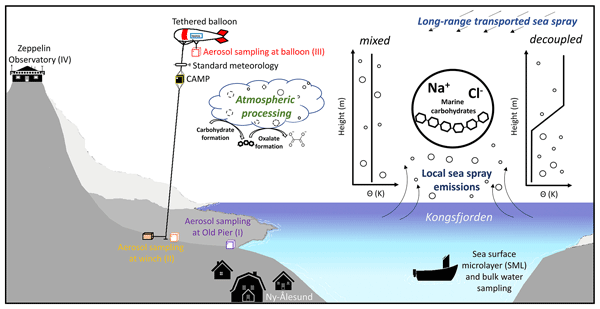
Sea spray aerosol transports inorganic salts and carbohydrates from the ocean into the atmosphere. In this field study conducted in Svalbard, we found that carbohydrates reach elevated altitudes that are relevant for cloud formation and properties.
Emilia Trudnowska, Katarzyna Koziorowska, Anna M. Dąbrowska, Rafał Boehnke, Beata Szymczycha, Katarzyna Draganska-Deja, Łukasz Stachnik, Jon Hawkings, Meri Korhonen, Małgorzata Kitowska, Karol Kuliński, and Mateusz Moskalik
EGUsphere, https://doi.org/10.5194/egusphere-2026-2515, https://doi.org/10.5194/egusphere-2026-2515, 2026
Short summary
Short summary
Glacier retreat in Svalbard alters marine ecosystems, with marine snow linking chemistry, particles, and biota while driving carbon export. This study examines fine-scale variability in fjord waters, revealing strong seasonal and local differences in biogeochemistry, nutrients, plankton, and particles. Results highlight local heterogeneity in coupled physical–biogeochemical–ecological processes near retreating glaciers.
Nasrollah Moradi, Lili Hufnagel, Simon Ramondenc, Clara M. Flintrop, Rainer Kiko, Tim Fischer, Helena Hauss, Arne Körtzinger, Gerhard Fischer, and Morten H. Iversen
Biogeosciences, 23, 2179–2203, https://doi.org/10.5194/bg-23-2179-2026, https://doi.org/10.5194/bg-23-2179-2026, 2026
Short summary
Short summary
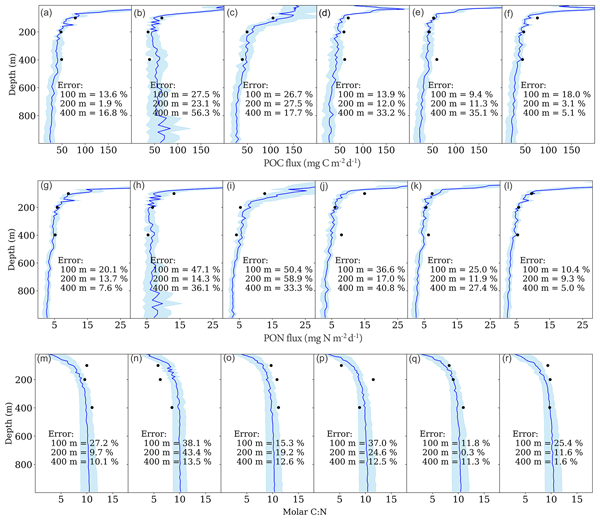
The presented framework advances estimates of particulate organic carbon and nitrogen fluxes in the water column derived from in situ imaging-based particle size distribution data. By accounting for non-sinking particles, depth-dependent degradation, and a dynamic carbon-to-nitrogen ratio that evolves with particle age during settling, it provides a more accurate representation of organic matter export to the deep ocean.
Moritz Zeising, Laurent Oziel, Silke Thoms, Özgür Gürses, Judith Hauck, Bernd Heinold, Svetlana N. Losa, Manuela van Pinxteren, Christoph Völker, Sebastian Zeppenfeld, and Astrid Bracher
Geosci. Model Dev., 19, 2077–2109, https://doi.org/10.5194/gmd-19-2077-2026, https://doi.org/10.5194/gmd-19-2077-2026, 2026
Short summary
Short summary
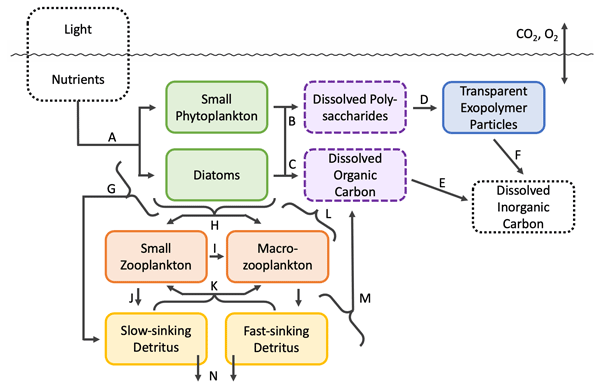
We assess the implementation of additional organic carbon pathways into a global setup of a numerical model, which simulates the ocean circulation, sea ice, and biogeochemical processes. With a focus on the Arctic Ocean, this model tracks the temporal and spatial dynamics of phytoplankton, exudation of organic carbon, and its aggregation to so-called transparent exopolymer particles. We evaluate the simulation using measurements from ship-based and remote-sensing campaigns in the Arctic Ocean.

Ehsan Mehdipour, Hongyan Xi, Alexander Barth, Aida Alvera-Azcárate, Adalbert Wilhelm, and Astrid Bracher
Geosci. Model Dev., 19, 1619–1643, https://doi.org/10.5194/gmd-19-1619-2026, https://doi.org/10.5194/gmd-19-1619-2026, 2026
Short summary
Short summary
Phytoplankton are vital for marine ecosystems and nutrient cycling, detectable by optical satellites. Data gaps caused by clouds and other non-optimal conditions limit comprehensive analyses like trend monitoring. This study evaluated DINCAE and DINEOF gap-filling methods for reconstructing chlorophyll a datasets, including total chlorophyll a and five major phytoplankton groups. Both methods showed robust reconstruction capabilities, aiding pattern detection and long-term ocean colour analysis.
Hisatomo Waga, Amane Fujiwara, Wesley J. Moses, Steven G. Ackleson, Daniel Koestner, Maria Tzortziou, Kyle Turner, Alana Menendez, Toru Hirawake, Koji Suzuki, and Sei-Ichi Saitoh
Biogeosciences, 23, 1043–1064, https://doi.org/10.5194/bg-23-1043-2026, https://doi.org/10.5194/bg-23-1043-2026, 2026
Short summary
Short summary
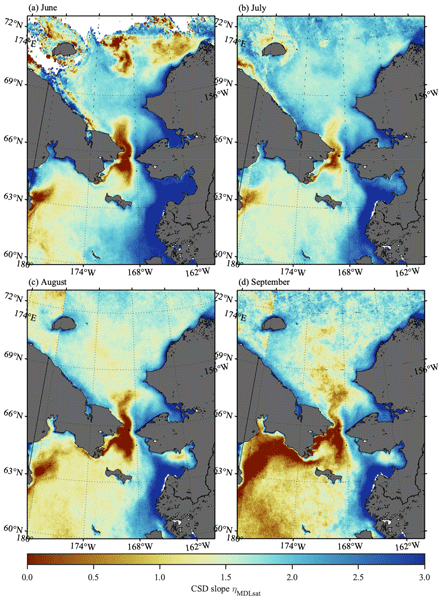
The present study developed a satellite remote sensing algorithm for estimating phytoplankton size structure from space using machine learning approaches in optically complex Pacific Arctic waters. One of the key findings is that more complex machine learning approaches do not always produce more effective performance compared with the simple ones. This study demonstrated the benefits of utilizing machine learning approaches for developing satellite remote sensing algorithms.
Anisbel Leon-Marcos, Manuela van Pinxteren, Sebastian Zeppenfeld, Moritz Zeising, Astrid Bracher, Laurent Oziel, Ina Tegen, and Bernd Heinold
Atmos. Chem. Phys., 26, 1109–1144, https://doi.org/10.5194/acp-26-1109-2026, https://doi.org/10.5194/acp-26-1109-2026, 2026
Short summary
Short summary
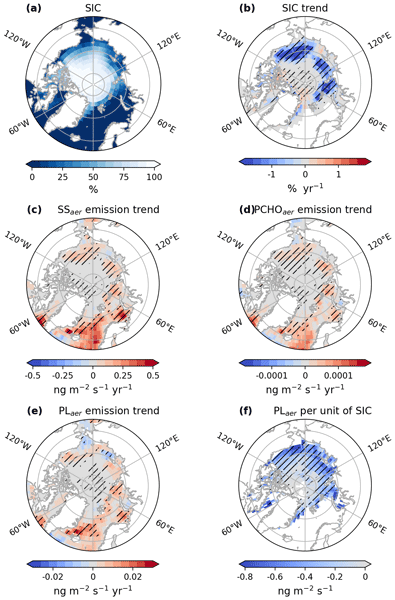
This study combines modelled ocean surface concentrations of major marine organic groups with the aerosol-climate model ECHAM-HAM to quantify species-resolved primary marine organic aerosol emissions from 1990 to 2019. Strong seasonality appears, driven by productivity and summer sea-ice loss. Emissions and burdens rise over time, with regional differences across the Arctic and aerosol species.
Ivia Closset, J. Jotautas Baronas, Fiorenza Torricella, Félix de Tombeur, Bianca T. P. Liguori, Alessandra Petrucciani, Natasha Bryan, María López-Acosta, Yelena Churakova, Antonia U. Thielecke, Zhouling Zhang, Natalia Llopis Monferrer, Rebecca A. Pickering, Mathis Guyomard, and Dongdong Zhu
Ocean Sci., 21, 3427–3470, https://doi.org/10.5194/os-21-3427-2025, https://doi.org/10.5194/os-21-3427-2025, 2025
Short summary
Short summary
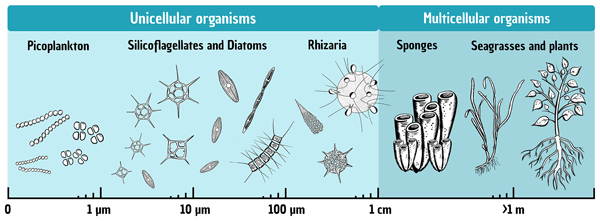
This review explores how various forms of marine life, from picoplankton to giant sponges, transform and control silicon to form silica-based structures, and how this process shapes the ocean silicon cycle. It also highlights the overlooked role of dynamic boundary zones where land, seafloor and ice meet seawater, and explains how combining biology and geochemistry can improve paleoceanographic proxies, biogeochemical models, and predictions of climate-driven changes in ocean productivity.
Alexander Hayward, Nishka Dasgupta, Ronan McAdam, Mark R. Payne, Roshin P. Raj, Giulia Bonino, Sourav Chatterjee, Vincent Combes, Dimitra Denaxa, Francesco De Rovere, Pia Englyst, Veera Haapaniemi, Paul Hargous, Jacob Høyer, K. Ajith Joseph, Beatriz Lopes, Ana Oliveira, João Paixão, Fabiola Silva, Saradhy Surendran, Artemis Zegna-Rata, and Steffen Olsen
Earth Syst. Sci. Data Discuss., https://doi.org/10.5194/essd-2025-590, https://doi.org/10.5194/essd-2025-590, 2025
Revised manuscript accepted for ESSD
Short summary
Short summary
We present a global marine heatwave dataset (1982–2024) based on satellite sea surface temperature. The dataset applies multiple definitions in parallel, varying baselines, thresholds, detrending, and event durations. It enables consistent comparisons of marine heatwave characterisation across methods and supports climate monitoring, model evaluation, and ecological impact studies.
Igor V. Polyakov, Andrey V. Pnyushkov, Eddy C. Carmack, Matthew Charette, Kyoung-Ho Cho, Steven Dykstra, Jari Haapala, Jinyoung Jung, Lauren Kipp, Eun Jin Yang, and Sergey Molodtsov
Ocean Sci., 21, 3105–3122, https://doi.org/10.5194/os-21-3105-2025, https://doi.org/10.5194/os-21-3105-2025, 2025
Short summary
Short summary
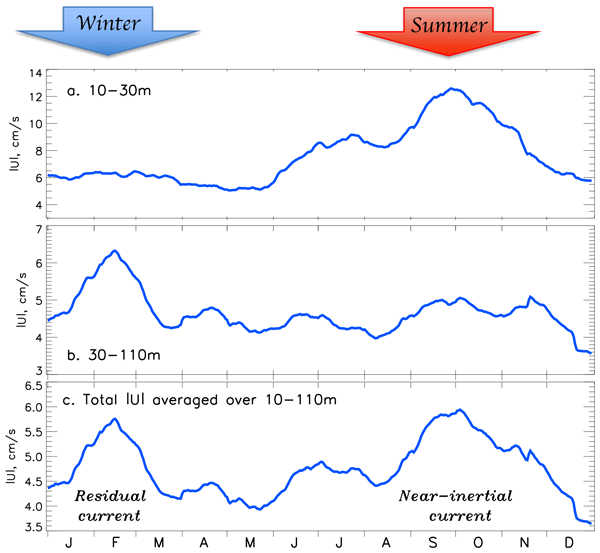
The Siberian Arctic Ocean greatly influences the Arctic climate system. Moreover, the region is experiencing some of the most notable Arctic climate change. In the summer, strong near-inertial currents in the upper (<30m) ocean account for more than half of the current speed and shear. In the winter, upper ocean ventilation due to atlantification distributes wind energy to far deeper (>100m) layers. Understanding the implications for mixing and halocline weakening depends on these findings.
Clément Bertin, Vincent Le Fouest, Dustin Carroll, Stephanie Dutkiewicz, Dimitris Menemenlis, Atsushi Matsuoka, Manfredi Manizza, and Charles E. Miller
Biogeosciences, 22, 6607–6629, https://doi.org/10.5194/bg-22-6607-2025, https://doi.org/10.5194/bg-22-6607-2025, 2025
Short summary
Short summary
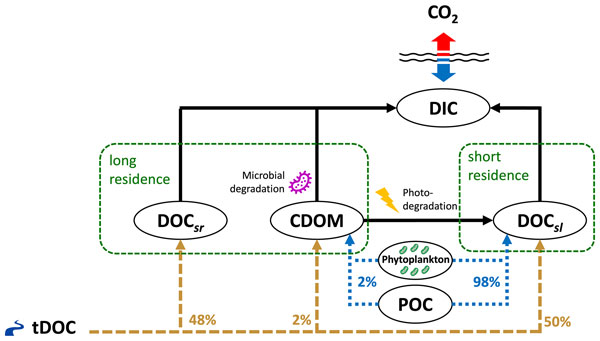
We adjusted a model of the Mackenzie River region to account for the riverine export of organic matter that affects light in the water. We show that such export causes a delay in the phytoplankton growth by two weeks and raises the water surface temperature by 1.7 °C. We found that temperature increase turns this coastal region from a sink of carbon dioxide to an emitter. Our findings suggest that rising exports of organic matter can significantly affect the carbon cycle in Arctic coastal areas.
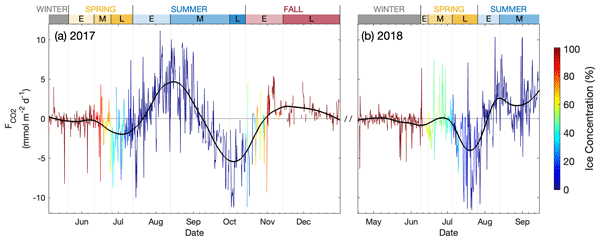
Brian J. Butterworth, Brent G. T. Else, Kristina A. Brown, Christopher J. Mundy, William J. Williams, Lina M. Rotermund, and Gijs de Boer
The Cryosphere, 19, 5317–5335, https://doi.org/10.5194/tc-19-5317-2025, https://doi.org/10.5194/tc-19-5317-2025, 2025
Short summary
Short summary
Observations of carbon dioxide transfer between water and air were measured at a seasonally ice-covered marine location using the eddy covariance method. The goal was to determine how sea ice influences water-air transfer of carbon dioxide by season. During full ice cover in winter, ice acted as a barrier to transfer. In spring, melt water absorbed carbon dioxide from the air. In fall, freezing released carbon dioxide from water to the air.
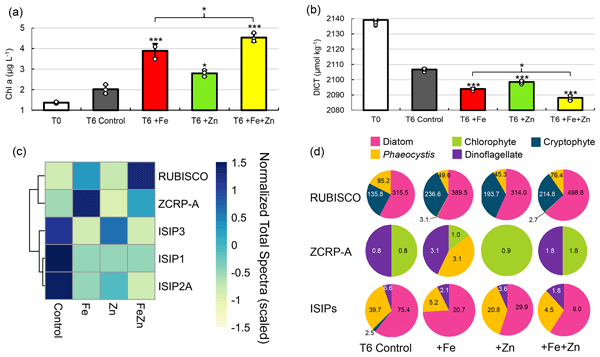
Riss M. Kell, Adam V. Subhas, Nicole L. Schanke, Lauren E. Lees, Rebecca J. Chmiel, Deepa Rao, Margaret M. Brisbin, Dawn M. Moran, Matthew R. McIlvin, Francesco Bolinesi, Olga Mangoni, Raffaella Casotti, Cecilia Balestra, Tristan J. Horner, Robert B. Dunbar, Andrew E. Allen, Giacomo R. DiTullio, and Mak A. Saito
Biogeosciences, 22, 5877–5896, https://doi.org/10.5194/bg-22-5877-2025, https://doi.org/10.5194/bg-22-5877-2025, 2025
Short summary
Short summary
Photosynthetic productivity is strongly influenced by water column nutrient availability. Despite the importance of zinc, definitive evidence for oceanic zinc limitation of photosynthesis has been scarce. We applied multiple biogeochemical measurements to a field site in Terra Nova Bay, Antarctica, to demonstrate that the phytoplankton community was experiencing zinc limitation. This field evidence paves the way for future experimental studies to consider Zn as a limiting oceanic micronutrient.
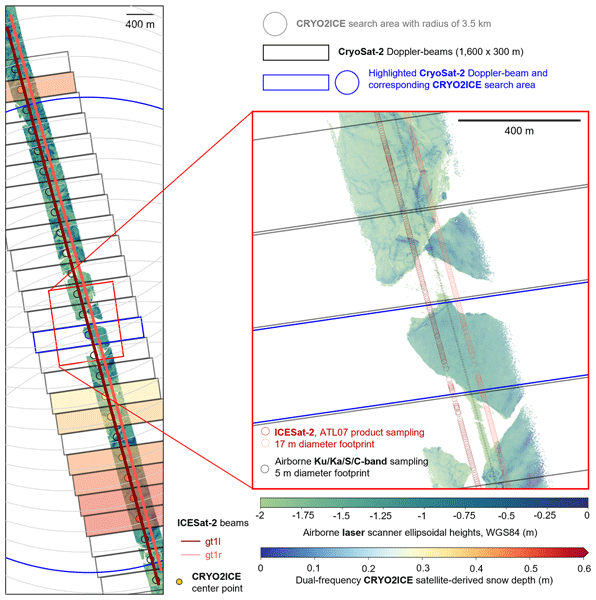
Renée Mie Fredensborg Hansen, Henriette Skourup, Eero Rinne, Arttu Jutila, Isobel R. Lawrence, Andrew Shepherd, Knut Vilhelm Høyland, Jilu Li, Fernando Rodriguez-Morales, Sebastian Bjerregaaard Simonsen, Jeremy Wilkinson, Gaelle Veyssiere, Donghui Yi, René Forsberg, and Taniâ Gil Duarte Casal
The Cryosphere, 19, 4193–4209, https://doi.org/10.5194/tc-19-4193-2025, https://doi.org/10.5194/tc-19-4193-2025, 2025
Short summary
Short summary
An airborne campaign collected unprecedented coincident multi-frequency radar and lidar data over sea ice along a CryoSat-2 and ICESat-2 (CRYO2ICE) orbit in the Weddell Sea, useful for evaluating microwave snow penetration. Ka-band and Ku-band had limited penetration with significant contributions from the air–snow interface, contradicting traditional assumptions with discrepancies between commonly used C/S-band "snow-radar" methodologies, all challenging comparisons of airborne and spaceborne estimates.
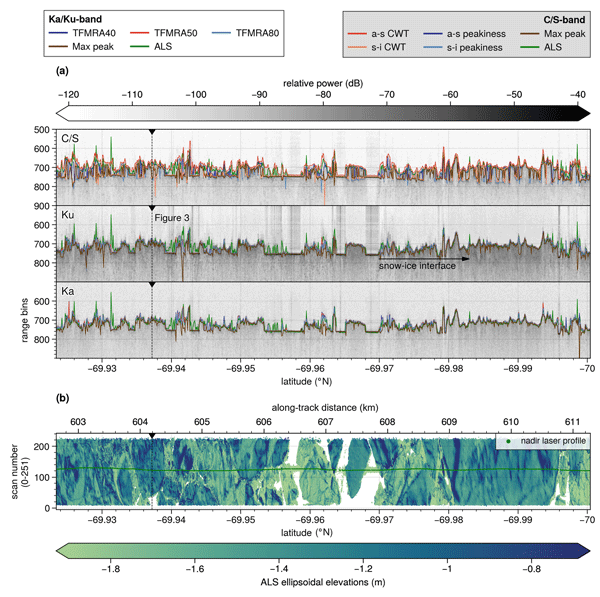
Renée Mie Fredensborg Hansen, Henriette Skourup, Eero Rinne, Arttu Jutila, Isobel R. Lawrence, Andrew Shepherd, Knut Vilhelm Høyland, Jilu Li, Fernando Rodriguez-Morales, Sebastian Bjerregaaard Simonsen, Jeremy Wilkinson, Gaelle Veyssiere, Donghui Yi, René Forsberg, and Taniâ Gil Duarte Casal
The Cryosphere, 19, 4167–4192, https://doi.org/10.5194/tc-19-4167-2025, https://doi.org/10.5194/tc-19-4167-2025, 2025
Short summary
Short summary
An airborne campaign collected unprecedented coincident multi-frequency radar and lidar data over sea ice along a CryoSat-2 and ICESat-2 (CRYO2ICE) orbit in the Weddell Sea, useful for evaluating microwave snow penetration. Ka-band and Ku-band had limited penetration with significant contributions from the air–snow interface, contradicting traditional assumptions with discrepancies between commonly used C/S-band "snow-radar" methodologies, all challenging comparisons of airborne and spaceborne estimates.
Hongyan Xi, Marine Bretagnon, Ehsan Mehdipour, Julien Demaria, Antoine Mangin, and Astrid Bracher
State Planet, 6-osr9, 7, https://doi.org/10.5194/sp-6-osr9-7-2025, https://doi.org/10.5194/sp-6-osr9-7-2025, 2025
Short summary
Short summary
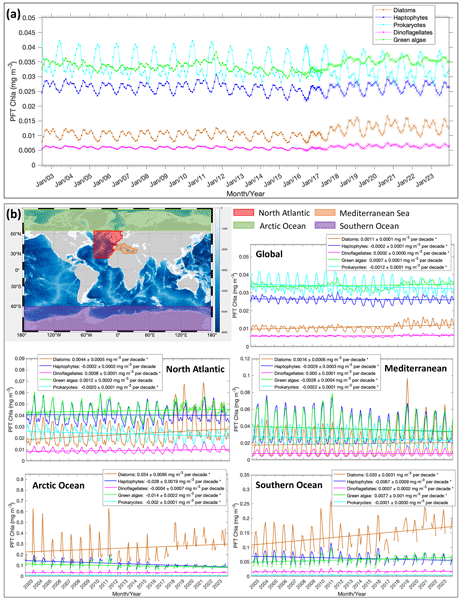
To better understand the marine phytoplankton variability on different scales in both space and time, this study proposes a machine-learning-based scheme to provide continuous and consistent long-term observations of various phytoplankton groups from space on a global scale, which enables time series analysis for further trend and anomaly investigations. This study provides an essential ocean variable to help assess the ocean health in the biogeochemical aspect.
Justyna Meler, Joanna Stoń-Egiert, and Monika Zabłocka
EGUsphere, https://doi.org/10.5194/egusphere-2025-2800, https://doi.org/10.5194/egusphere-2025-2800, 2025
Preprint archived
Short summary
Short summary
We present a variability of absorption properties by different size fractions of particles suspended in the Spitsbergen Fjords waters in the summer season. The light absorption coefficient by all suspended particles, detritus and phytoplankton was determined for four size fractions: pico, ultra, nano and micro-particles. We have shown the proportions of particles from the size classes in the total absorptions, and we have found that dominant contribution had ultra-particles.
Anisbel Leon-Marcos, Moritz Zeising, Manuela van Pinxteren, Sebastian Zeppenfeld, Astrid Bracher, Elena Barbaro, Anja Engel, Matteo Feltracco, Ina Tegen, and Bernd Heinold
Geosci. Model Dev., 18, 4183–4213, https://doi.org/10.5194/gmd-18-4183-2025, https://doi.org/10.5194/gmd-18-4183-2025, 2025
Short summary
Short summary
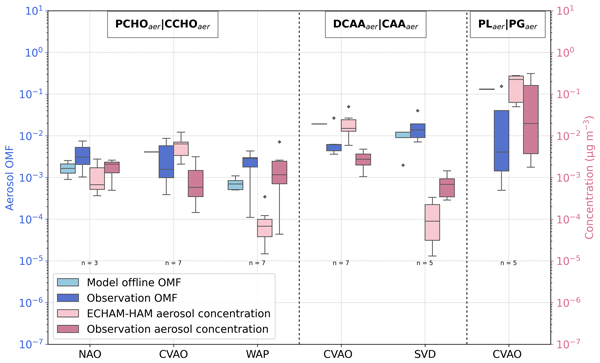
This study represents the primary marine organic aerosol (PMOA) emissions, focusing on their sea–atmosphere transfer. Using the FESOM2.1–REcoM3 model, concentrations of key organic biomolecules were estimated and integrated into the ECHAM6.3–HAM2.3 aerosol–climate model. Results highlight the influence of marine biological activity and surface winds on PMOA emissions, with reasonably good agreement with observations improving aerosol representation in the southern oceans.
Bennet Juhls, Anne Morgenstern, Jens Hölemann, Antje Eulenburg, Birgit Heim, Frederieke Miesner, Hendrik Grotheer, Gesine Mollenhauer, Hanno Meyer, Ephraim Erkens, Felica Yara Gehde, Sofia Antonova, Sergey Chalov, Maria Tereshina, Oxana Erina, Evgeniya Fingert, Ekaterina Abramova, Tina Sanders, Liudmila Lebedeva, Nikolai Torgovkin, Georgii Maksimov, Vasily Povazhnyi, Rafael Gonçalves-Araujo, Urban Wünsch, Antonina Chetverova, Sophie Opfergelt, and Pier Paul Overduin
Earth Syst. Sci. Data, 17, 1–28, https://doi.org/10.5194/essd-17-1-2025, https://doi.org/10.5194/essd-17-1-2025, 2025
Short summary
Short summary
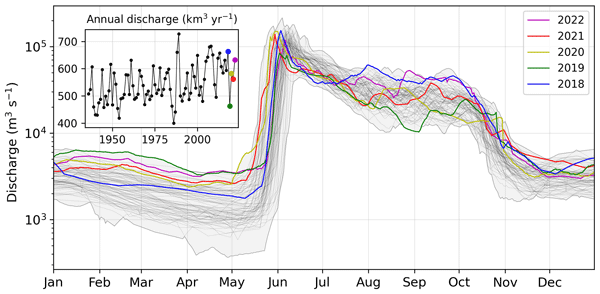
The Siberian Arctic is warming fast: permafrost is thawing, river chemistry is changing, and coastal ecosystems are affected. We aimed to understand changes in the Lena River, a major Arctic river flowing to the Arctic Ocean, by collecting 4.5 years of detailed water data, including temperature and carbon and nutrient contents. This dataset records current conditions and helps us to detect future changes. Explore it at https://doi.org/10.1594/PANGAEA.913197 and https://lena-monitoring.awi.de/.

Riss M. Kell, Rebecca J. Chmiel, Deepa Rao, Dawn M. Moran, Matthew R. McIlvin, Tristan J. Horner, Nicole L. Schanke, Ichiko Sugiyama, Robert B. Dunbar, Giacomo R. DiTullio, and Mak A. Saito
Biogeosciences, 21, 5685–5706, https://doi.org/10.5194/bg-21-5685-2024, https://doi.org/10.5194/bg-21-5685-2024, 2024
Short summary
Short summary
Despite interest in modeling the biogeochemical uptake and cycling of the trace metal zinc (Zn), measurements of Zn uptake in natural marine phytoplankton communities have not been conducted previously. To fill this gap, we employed a stable isotope uptake rate measurement method to quantify Zn uptake into natural phytoplankton assemblages within the Southern Ocean. Zn demand was high and rapid enough to depress the inventory of Zn available to phytoplankton on seasonal timescales.
Guisella Gacitúa, Jacob Lorentsen Høyer, Sten Schmidl Søbjærg, Hoyeon Shi, Sotirios Skarpalezos, Ioanna Karagali, Emy Alerskans, and Craig Donlon
Geosci. Instrum. Method. Data Syst., 13, 373–391, https://doi.org/10.5194/gi-13-373-2024, https://doi.org/10.5194/gi-13-373-2024, 2024
Short summary
Short summary
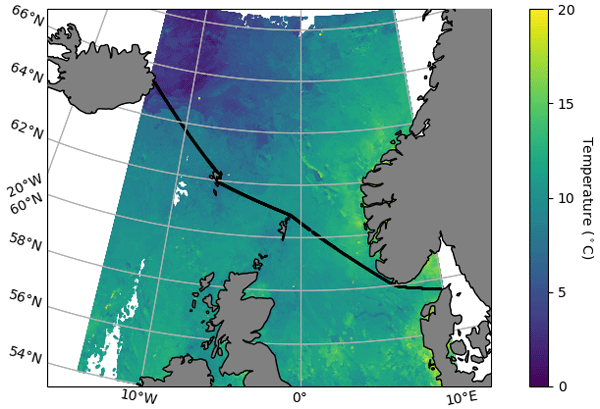
In spring 2021, a study compared sea surface temperature (SST) measurements from thermal infrared (IR) and passive microwave (PMW) radiometers on a ferry between Denmark and Iceland. The goal was to reduce atmospheric effects and directly compare IR and PMW measurements. A method was developed to convert PMW data to match IR data, with uncertainties analysed in the process. The findings provide insights to improve SST inter-comparisons and enhance the synergy between IR and PMW observations.
Esdoorn Willcox, Marcos Lemes, Thomas Juul-Pedersen, Mikael Kristian Sejr, Johnna Marchiano Holding, and Søren Rysgaard
Biogeosciences, 21, 4037–4050, https://doi.org/10.5194/bg-21-4037-2024, https://doi.org/10.5194/bg-21-4037-2024, 2024
Short summary
Short summary
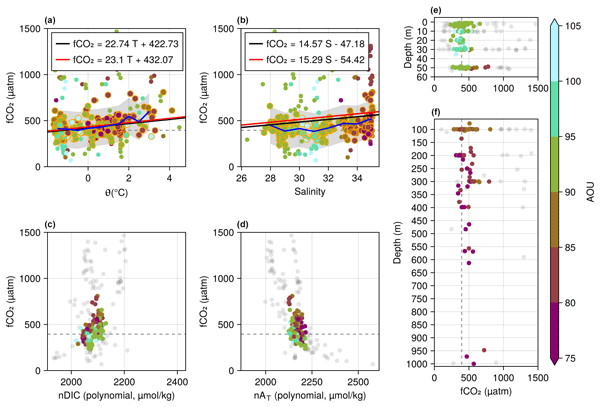
In this work, we measured the chemistry of seawater from samples obtained from different depths and locations off the east coast of the Northeast Greenland National Park to determine what is influencing concentrations of dissolved CO2. Historically, the region has always been thought to take up CO2 from the atmosphere, but we show that it is possible for the region to become a source in late summer. We discuss the variables that may be related to such changes.
Yange Deng, Hiroshi Tanimoto, Kohei Ikeda, Sohiko Kameyama, Sachiko Okamoto, Jinyoung Jung, Young Jun Yoon, Eun Jin Yang, and Sung-Ho Kang
Atmos. Chem. Phys., 24, 6339–6357, https://doi.org/10.5194/acp-24-6339-2024, https://doi.org/10.5194/acp-24-6339-2024, 2024
Short summary
Short summary
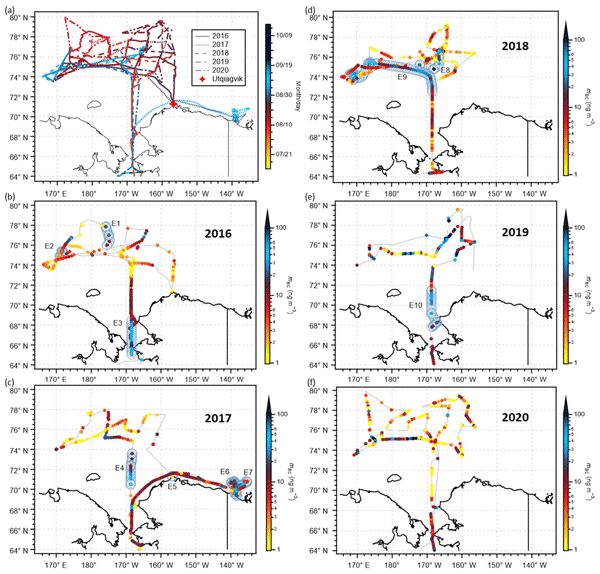
Black carbon (BC) aerosols play important roles in Arctic climate change, yet they are not well understood because of limited observational data. We observed BC mass concentrations (mBC) in the western Arctic Ocean during summer and early autumn 2016–2020. The mean mBC in 2019 was much higher than in other years. Biomass burning was likely the dominant BC source. Boreal fire BC transport occurring near the surface and/or in the mid-troposphere contributed to high-BC events in the Arctic Ocean.
Christian Lønborg, Cátia Carreira, Gwenaël Abril, Susana Agustí, Valentina Amaral, Agneta Andersson, Javier Arístegui, Punyasloke Bhadury, Mariana B. Bif, Alberto V. Borges, Steven Bouillon, Maria Ll. Calleja, Luiz C. Cotovicz Jr., Stefano Cozzi, Maryló Doval, Carlos M. Duarte, Bradley Eyre, Cédric G. Fichot, E. Elena García-Martín, Alexandra Garzon-Garcia, Michele Giani, Rafael Gonçalves-Araujo, Renee Gruber, Dennis A. Hansell, Fuminori Hashihama, Ding He, Johnna M. Holding, William R. Hunter, J. Severino P. Ibánhez, Valeria Ibello, Shan Jiang, Guebuem Kim, Katja Klun, Piotr Kowalczuk, Atsushi Kubo, Choon-Weng Lee, Cláudia B. Lopes, Federica Maggioni, Paolo Magni, Celia Marrase, Patrick Martin, S. Leigh McCallister, Roisin McCallum, Patricia M. Medeiros, Xosé Anxelu G. Morán, Frank E. Muller-Karger, Allison Myers-Pigg, Marit Norli, Joanne M. Oakes, Helena Osterholz, Hyekyung Park, Maria Lund Paulsen, Judith A. Rosentreter, Jeff D. Ross, Digna Rueda-Roa, Chiara Santinelli, Yuan Shen, Eva Teira, Tinkara Tinta, Guenther Uher, Masahide Wakita, Nicholas Ward, Kenta Watanabe, Yu Xin, Youhei Yamashita, Liyang Yang, Jacob Yeo, Huamao Yuan, Qiang Zheng, and Xosé Antón Álvarez-Salgado
Earth Syst. Sci. Data, 16, 1107–1119, https://doi.org/10.5194/essd-16-1107-2024, https://doi.org/10.5194/essd-16-1107-2024, 2024
Short summary
Short summary
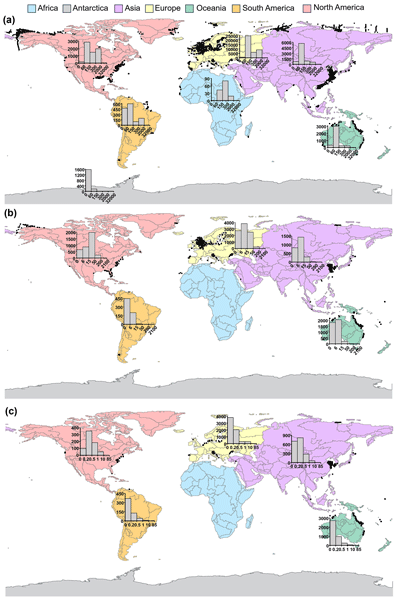
In this paper, we present the first edition of a global database compiling previously published and unpublished measurements of dissolved organic matter (DOM) collected in coastal waters (CoastDOM v1). Overall, the CoastDOM v1 dataset will be useful to identify global spatial and temporal patterns and to facilitate reuse in studies aimed at better characterizing local biogeochemical processes and identifying a baseline for modelling future changes in coastal waters.
Sebastian Zeppenfeld, Manuela van Pinxteren, Markus Hartmann, Moritz Zeising, Astrid Bracher, and Hartmut Herrmann
Atmos. Chem. Phys., 23, 15561–15587, https://doi.org/10.5194/acp-23-15561-2023, https://doi.org/10.5194/acp-23-15561-2023, 2023
Short summary
Short summary
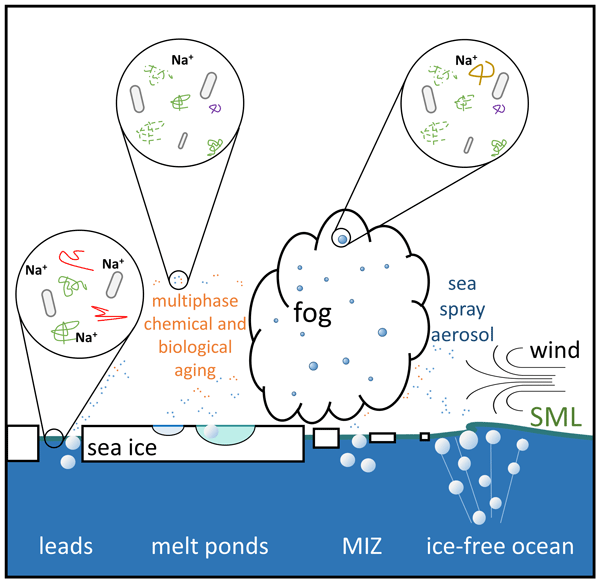
Marine carbohydrates are produced in the surface of the ocean, enter the atmophere as part of sea spray aerosol particles, and potentially contribute to the formation of fog and clouds. Here, we present the results of a sea–air transfer study of marine carbohydrates conducted in the high Arctic. Besides a chemo-selective transfer, we observed a quick atmospheric aging of carbohydrates, possibly as a result of both biotic and abiotic processes.
Aleksandra Cherkasheva, Rustam Manurov, Piotr Kowalczuk, Alexandra N. Loginova, Monika Zabłocka, and Astrid Bracher
EGUsphere, https://doi.org/10.5194/egusphere-2023-2495, https://doi.org/10.5194/egusphere-2023-2495, 2023
Preprint archived
Short summary
Short summary
We aimed to improve the quality of regional Greenland Sea primary production estimates. Seventy two versions of primary production model setups were tested against field data. Best performing models had local biomass and light absorption profiles. Thus by using local parametrizations for these parameters we can improve Arctic primary production model performance. Annual Greenland Sea basin estimates are larger than previously reported.
Rebecca J. Chmiel, Riss M. Kell, Deepa Rao, Dawn M. Moran, Giacomo R. DiTullio, and Mak A. Saito
Biogeosciences, 20, 3997–4027, https://doi.org/10.5194/bg-20-3997-2023, https://doi.org/10.5194/bg-20-3997-2023, 2023
Short summary
Short summary
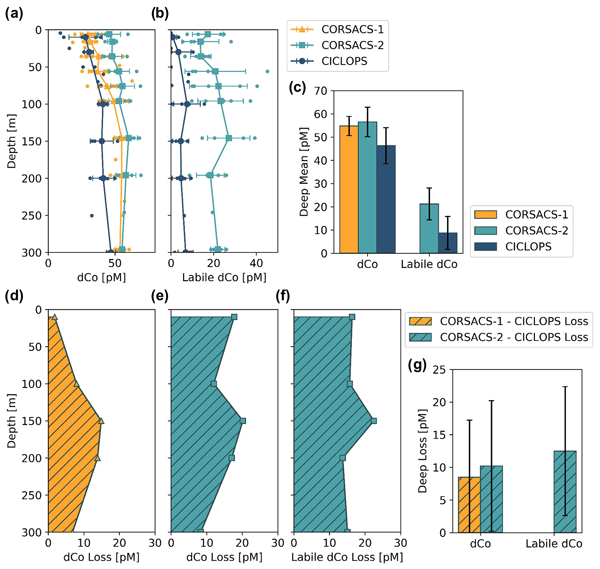
Cobalt is an important micronutrient for plankton, yet it is often scarce throughout the oceans. A 2017/2018 expedition to coastal Antarctica, including regions of the Amundsen Sea and the Ross Sea, discovered lower concentrations of cobalt compared to two past expeditions in 2005 and 2006, particularly for the type of cobalt preferred as a nutrient by phytoplankton. This loss may be due to changing inputs of other nutrients, causing higher uptake of cobalt by plankton over the last decade.
Hongyan Xi, Marine Bretagnon, Svetlana N. Losa, Vanda Brotas, Mara Gomes, Ilka Peeken, Leonardo M. A. Alvarado, Antoine Mangin, and Astrid Bracher
State Planet, 1-osr7, 5, https://doi.org/10.5194/sp-1-osr7-5-2023, https://doi.org/10.5194/sp-1-osr7-5-2023, 2023
Short summary
Short summary
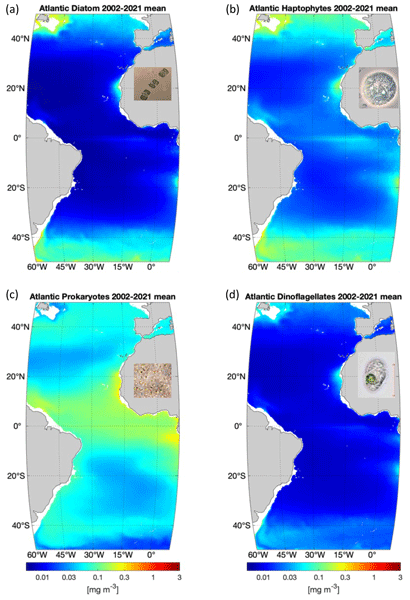
Continuous monitoring of phytoplankton groups using satellite data is crucial for understanding global ocean phytoplankton variability on different scales in both space and time. This study focuses on four important phytoplankton groups in the Atlantic Ocean to investigate their trend, anomaly and phenological characteristics both over the whole region and at subscales. This study paves the way to promote potentially important ocean monitoring indicators to help sustain the ocean health.
Fabrice Stephenson, Tom Brough, Drew Lohrer, Daniel Leduc, Shane Geange, Owen Anderson, David Bowden, Malcolm R. Clark, Niki Davey, Enrique Pardo, Dennis P. Gordon, Brittany Finucci, Michelle Kelly, Diana Macpherson, Lisa McCartain, Sadie Mills, Kate Neill, Wendy Nelson, Rachael Peart, Matthew H. Pinkerton, Geoffrey B. Read, Jodie Robertson, Ashley Rowden, Kareen Schnabel, Andrew Stewart, Carl Struthers, Leigh Tait, Di Tracey, Shaun Weston, and Carolyn Lundquist
Earth Syst. Sci. Data, 15, 3931–3939, https://doi.org/10.5194/essd-15-3931-2023, https://doi.org/10.5194/essd-15-3931-2023, 2023
Short summary
Short summary
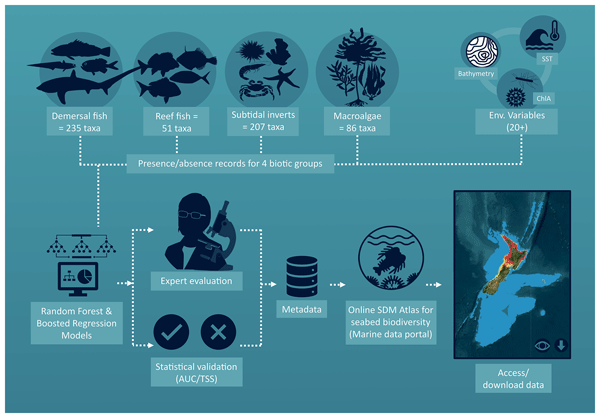
Understanding the distribution of species that live at the seafloor is critical to the management of the marine environment but is lacking in many areas. Here, we showcase an atlas of seafloor biodiversity that describes the distribution of approximately 600 organisms throughout New Zealand’s vast marine realm. Each layer in the open-access atlas has been evaluated by leading experts and provides a key resource for the sustainable use of New Zealand's marine environment.
Bronwyn E. Cahill, Piotr Kowalczuk, Lena Kritten, Ulf Gräwe, John Wilkin, and Jürgen Fischer
Biogeosciences, 20, 2743–2768, https://doi.org/10.5194/bg-20-2743-2023, https://doi.org/10.5194/bg-20-2743-2023, 2023
Short summary
Short summary
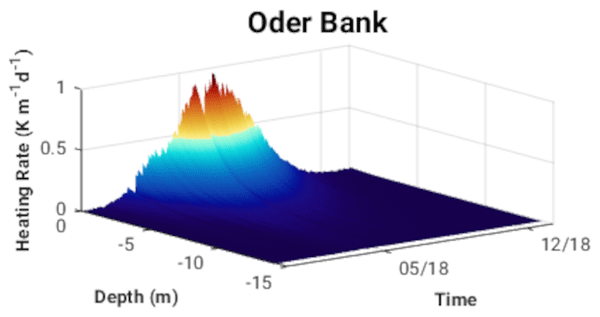
We quantify the impact of optically significant water constituents on surface heating rates and thermal energy fluxes in the western Baltic Sea. During productive months in 2018 (April to September) we found that the combined effect of coloured
dissolved organic matter and particulate absorption contributes to sea surface heating of between 0.4 and 0.9 K m−1 d−1 and a mean loss of heat (ca. 5 W m−2) from the sea to the atmosphere. This may be important for regional heat balance budgets.
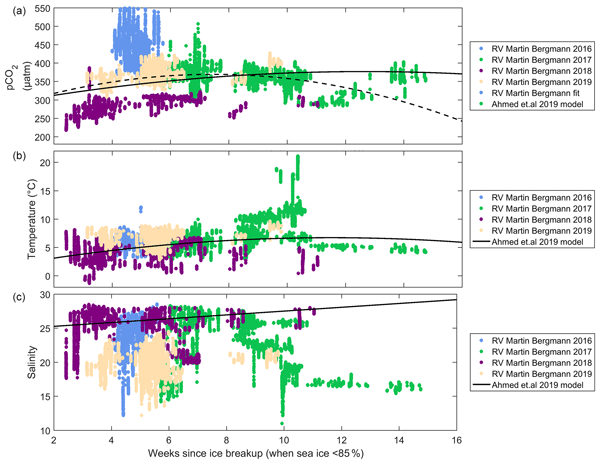
Richard P. Sims, Mohamed M. M. Ahmed, Brian J. Butterworth, Patrick J. Duke, Stephen F. Gonski, Samantha F. Jones, Kristina A. Brown, Christopher J. Mundy, William J. Williams, and Brent G. T. Else
Ocean Sci., 19, 837–856, https://doi.org/10.5194/os-19-837-2023, https://doi.org/10.5194/os-19-837-2023, 2023
Short summary
Short summary
Using a small research vessel based out of Cambridge Bay in the Kitikmeot Sea (Canadian Arctic Archipelago), we were able to make measurements of surface ocean pCO2 shortly after sea ice breakup for 4 consecutive years. We compare our measurements to previous underway measurements and the two ongoing ocean carbon observatories in the region. We identify high interannual variability and a potential bias in previous estimates due to lower pCO2 in bays and inlets.
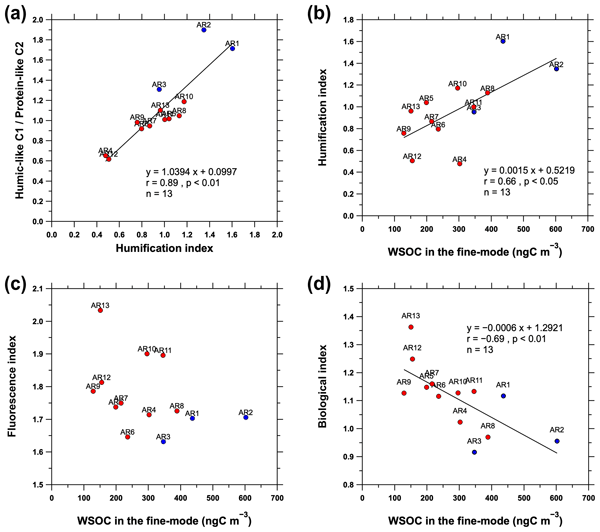
Jinyoung Jung, Yuzo Miyazaki, Jin Hur, Yun Kyung Lee, Mi Hae Jeon, Youngju Lee, Kyoung-Ho Cho, Hyun Young Chung, Kitae Kim, Jung-Ok Choi, Catherine Lalande, Joo-Hong Kim, Taejin Choi, Young Jun Yoon, Eun Jin Yang, and Sung-Ho Kang
Atmos. Chem. Phys., 23, 4663–4684, https://doi.org/10.5194/acp-23-4663-2023, https://doi.org/10.5194/acp-23-4663-2023, 2023
Short summary
Short summary
This study examined the summertime fluorescence properties of water-soluble organic carbon (WSOC) in aerosols over the western Arctic Ocean. We found that the WSOC in fine-mode aerosols in coastal areas showed a higher polycondensation degree and aromaticity than in sea-ice-covered areas. The fluorescence properties of atmospheric WSOC in the summertime marine Arctic boundary can improve our understanding of the WSOC chemical and biological linkages at the ocean–sea-ice–atmosphere interface.
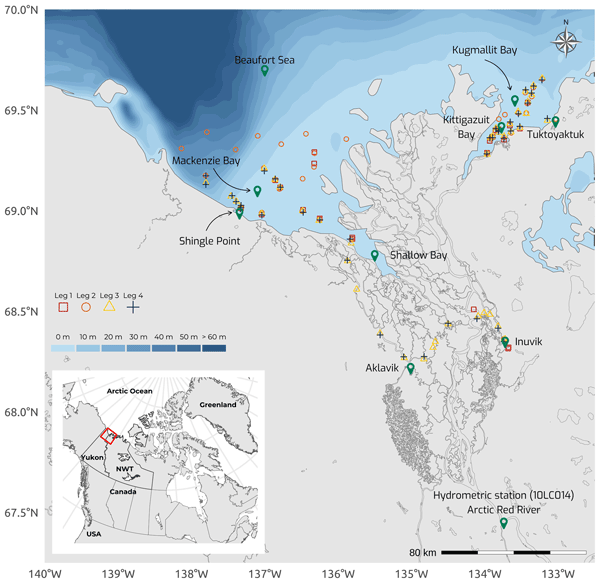
Martine Lizotte, Bennet Juhls, Atsushi Matsuoka, Philippe Massicotte, Gaëlle Mével, David Obie James Anikina, Sofia Antonova, Guislain Bécu, Marine Béguin, Simon Bélanger, Thomas Bossé-Demers, Lisa Bröder, Flavienne Bruyant, Gwénaëlle Chaillou, Jérôme Comte, Raoul-Marie Couture, Emmanuel Devred, Gabrièle Deslongchamps, Thibaud Dezutter, Miles Dillon, David Doxaran, Aude Flamand, Frank Fell, Joannie Ferland, Marie-Hélène Forget, Michael Fritz, Thomas J. Gordon, Caroline Guilmette, Andrea Hilborn, Rachel Hussherr, Charlotte Irish, Fabien Joux, Lauren Kipp, Audrey Laberge-Carignan, Hugues Lantuit, Edouard Leymarie, Antonio Mannino, Juliette Maury, Paul Overduin, Laurent Oziel, Colin Stedmon, Crystal Thomas, Lucas Tisserand, Jean-Éric Tremblay, Jorien Vonk, Dustin Whalen, and Marcel Babin
Earth Syst. Sci. Data, 15, 1617–1653, https://doi.org/10.5194/essd-15-1617-2023, https://doi.org/10.5194/essd-15-1617-2023, 2023
Short summary
Short summary
Permafrost thaw in the Mackenzie Delta region results in the release of organic matter into the coastal marine environment. What happens to this carbon-rich organic matter as it transits along the fresh to salty aquatic environments is still underdocumented. Four expeditions were conducted from April to September 2019 in the coastal area of the Beaufort Sea to study the fate of organic matter. This paper describes a rich set of data characterizing the composition and sources of organic matter.
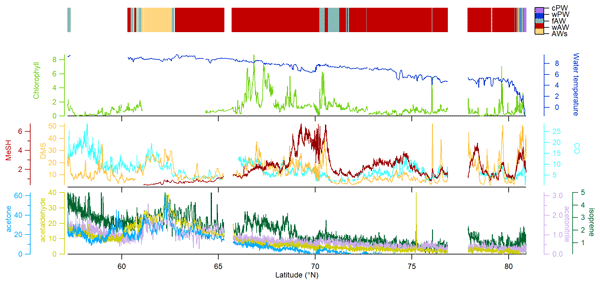
Valérie Gros, Bernard Bonsang, Roland Sarda-Estève, Anna Nikolopoulos, Katja Metfies, Matthias Wietz, and Ilka Peeken
Biogeosciences, 20, 851–867, https://doi.org/10.5194/bg-20-851-2023, https://doi.org/10.5194/bg-20-851-2023, 2023
Short summary
Short summary
The oceans are both sources and sinks for trace gases important for atmospheric chemistry and marine ecology. Here, we quantified selected trace gases (including the biological metabolites dissolved dimethyl sulfide, methanethiol and isoprene) along a 2500 km transect from the North Atlantic to the Arctic Ocean. In the context of phytoplankton and bacterial communities, our study suggests that methanethiol (rarely measured before) might substantially influence ocean–atmosphere cycling.
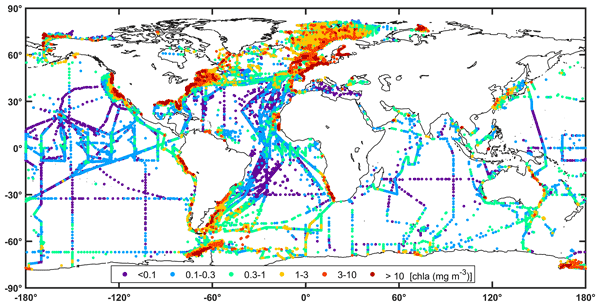
André Valente, Shubha Sathyendranath, Vanda Brotas, Steve Groom, Michael Grant, Thomas Jackson, Andrei Chuprin, Malcolm Taberner, Ruth Airs, David Antoine, Robert Arnone, William M. Balch, Kathryn Barker, Ray Barlow, Simon Bélanger, Jean-François Berthon, Şükrü Beşiktepe, Yngve Borsheim, Astrid Bracher, Vittorio Brando, Robert J. W. Brewin, Elisabetta Canuti, Francisco P. Chavez, Andrés Cianca, Hervé Claustre, Lesley Clementson, Richard Crout, Afonso Ferreira, Scott Freeman, Robert Frouin, Carlos García-Soto, Stuart W. Gibb, Ralf Goericke, Richard Gould, Nathalie Guillocheau, Stanford B. Hooker, Chuamin Hu, Mati Kahru, Milton Kampel, Holger Klein, Susanne Kratzer, Raphael Kudela, Jesus Ledesma, Steven Lohrenz, Hubert Loisel, Antonio Mannino, Victor Martinez-Vicente, Patricia Matrai, David McKee, Brian G. Mitchell, Tiffany Moisan, Enrique Montes, Frank Muller-Karger, Aimee Neeley, Michael Novak, Leonie O'Dowd, Michael Ondrusek, Trevor Platt, Alex J. Poulton, Michel Repecaud, Rüdiger Röttgers, Thomas Schroeder, Timothy Smyth, Denise Smythe-Wright, Heidi M. Sosik, Crystal Thomas, Rob Thomas, Gavin Tilstone, Andreia Tracana, Michael Twardowski, Vincenzo Vellucci, Kenneth Voss, Jeremy Werdell, Marcel Wernand, Bozena Wojtasiewicz, Simon Wright, and Giuseppe Zibordi
Earth Syst. Sci. Data, 14, 5737–5770, https://doi.org/10.5194/essd-14-5737-2022, https://doi.org/10.5194/essd-14-5737-2022, 2022
Short summary
Short summary
A compiled set of in situ data is vital to evaluate the quality of ocean-colour satellite data records. Here we describe the global compilation of bio-optical in situ data (spanning from 1997 to 2021) used for the validation of the ocean-colour products from the ESA Ocean Colour Climate Change Initiative (OC-CCI). The compilation merges and harmonizes several in situ data sources into a simple format that could be used directly for the evaluation of satellite-derived ocean-colour data.
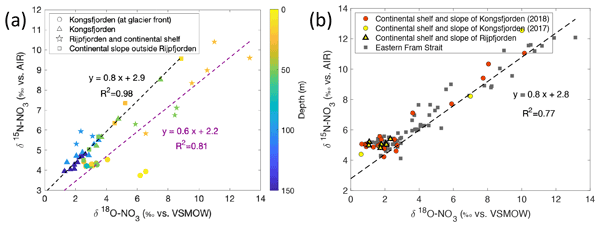
Marta Santos-Garcia, Raja S. Ganeshram, Robyn E. Tuerena, Margot C. F. Debyser, Katrine Husum, Philipp Assmy, and Haakon Hop
Biogeosciences, 19, 5973–6002, https://doi.org/10.5194/bg-19-5973-2022, https://doi.org/10.5194/bg-19-5973-2022, 2022
Short summary
Short summary
Terrestrial sources of nitrate are important contributors to the nutrient pool in the fjords of Kongsfjorden and Rijpfjorden in Svalbard during the summer, and they sustain most of the fjord primary productivity. Ongoing tidewater glacier retreat is postulated to favour light limitation and less dynamic circulation in fjords. This is suggested to encourage the export of nutrients to the middle and outer part of the fjord system, which may enhance primary production within and in offshore areas.
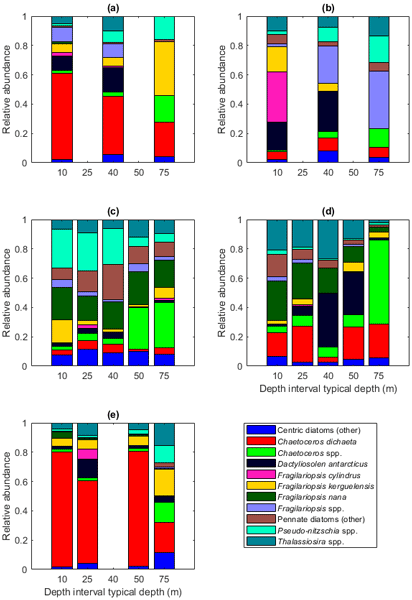
Hanna M. Kauko, Philipp Assmy, Ilka Peeken, Magdalena Różańska-Pluta, Józef M. Wiktor, Gunnar Bratbak, Asmita Singh, Thomas J. Ryan-Keogh, and Sebastien Moreau
Biogeosciences, 19, 5449–5482, https://doi.org/10.5194/bg-19-5449-2022, https://doi.org/10.5194/bg-19-5449-2022, 2022
Short summary
Short summary
This article studies phytoplankton (microscopic
plantsin the ocean capable of photosynthesis) in Kong Håkon VII Hav in the Southern Ocean. Different species play different roles in the ecosystem, and it is therefore important to assess the species composition. We observed that phytoplankton blooms in this area are formed by large diatoms with strong silica armors, which can lead to high silica (and sometimes carbon) export to depth and be important prey for krill.
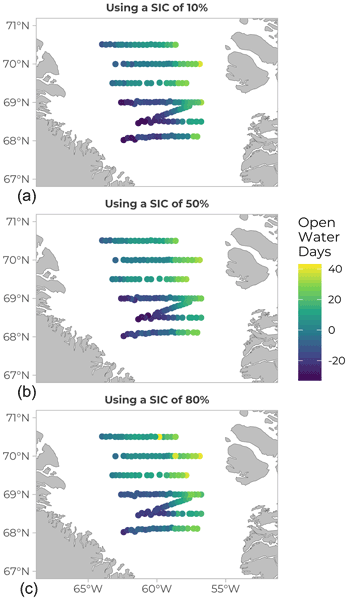
Flavienne Bruyant, Rémi Amiraux, Marie-Pier Amyot, Philippe Archambault, Lise Artigue, Lucas Barbedo de Freitas, Guislain Bécu, Simon Bélanger, Pascaline Bourgain, Annick Bricaud, Etienne Brouard, Camille Brunet, Tonya Burgers, Danielle Caleb, Katrine Chalut, Hervé Claustre, Véronique Cornet-Barthaux, Pierre Coupel, Marine Cusa, Fanny Cusset, Laeticia Dadaglio, Marty Davelaar, Gabrièle Deslongchamps, Céline Dimier, Julie Dinasquet, Dany Dumont, Brent Else, Igor Eulaers, Joannie Ferland, Gabrielle Filteau, Marie-Hélène Forget, Jérome Fort, Louis Fortier, Martí Galí, Morgane Gallinari, Svend-Erik Garbus, Nicole Garcia, Catherine Gérikas Ribeiro, Colline Gombault, Priscilla Gourvil, Clémence Goyens, Cindy Grant, Pierre-Luc Grondin, Pascal Guillot, Sandrine Hillion, Rachel Hussherr, Fabien Joux, Hannah Joy-Warren, Gabriel Joyal, David Kieber, Augustin Lafond, José Lagunas, Patrick Lajeunesse, Catherine Lalande, Jade Larivière, Florence Le Gall, Karine Leblanc, Mathieu Leblanc, Justine Legras, Keith Lévesque, Kate-M. Lewis, Edouard Leymarie, Aude Leynaert, Thomas Linkowski, Martine Lizotte, Adriana Lopes dos Santos, Claudie Marec, Dominique Marie, Guillaume Massé, Philippe Massicotte, Atsushi Matsuoka, Lisa A. Miller, Sharif Mirshak, Nathalie Morata, Brivaela Moriceau, Philippe-Israël Morin, Simon Morisset, Anders Mosbech, Alfonso Mucci, Gabrielle Nadaï, Christian Nozais, Ingrid Obernosterer, Thimoté Paire, Christos Panagiotopoulos, Marie Parenteau, Noémie Pelletier, Marc Picheral, Bernard Quéguiner, Patrick Raimbault, Joséphine Ras, Eric Rehm, Llúcia Ribot Lacosta, Jean-François Rontani, Blanche Saint-Béat, Julie Sansoulet, Noé Sardet, Catherine Schmechtig, Antoine Sciandra, Richard Sempéré, Caroline Sévigny, Jordan Toullec, Margot Tragin, Jean-Éric Tremblay, Annie-Pier Trottier, Daniel Vaulot, Anda Vladoiu, Lei Xue, Gustavo Yunda-Guarin, and Marcel Babin
Earth Syst. Sci. Data, 14, 4607–4642, https://doi.org/10.5194/essd-14-4607-2022, https://doi.org/10.5194/essd-14-4607-2022, 2022
Short summary
Short summary
This paper presents a dataset acquired during a research cruise held in Baffin Bay in 2016. We observed that the disappearance of sea ice in the Arctic Ocean increases both the length and spatial extent of the phytoplankton growth season. In the future, this will impact the food webs on which the local populations depend for their food supply and fisheries. This dataset will provide insight into quantifying these impacts and help the decision-making process for policymakers.
Ioanna Karagali, Magnus Barfod Suhr, Ruth Mottram, Pia Nielsen-Englyst, Gorm Dybkjær, Darren Ghent, and Jacob L. Høyer
The Cryosphere, 16, 3703–3721, https://doi.org/10.5194/tc-16-3703-2022, https://doi.org/10.5194/tc-16-3703-2022, 2022
Short summary
Short summary
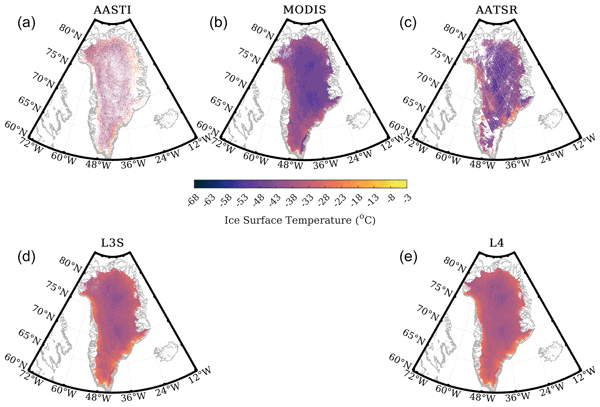
Ice surface temperature (IST) products were used to develop the first multi-sensor, gap-free Level 4 (L4) IST product of the Greenland Ice Sheet (GIS) for 2012, when a significant melt event occurred. For the melt season, mean IST was −15 to −1 °C, and almost the entire GIS experienced at least 1 to 5 melt days. Inclusion of the L4 IST to a surface mass budget (SMB) model improved simulated surface temperatures during the key onset of the melt season, where biases are typically large.
Brent G. T. Else, Araleigh Cranch, Richard P. Sims, Samantha Jones, Laura A. Dalman, Christopher J. Mundy, Rebecca A. Segal, Randall K. Scharien, and Tania Guha
The Cryosphere, 16, 3685–3701, https://doi.org/10.5194/tc-16-3685-2022, https://doi.org/10.5194/tc-16-3685-2022, 2022
Short summary
Short summary
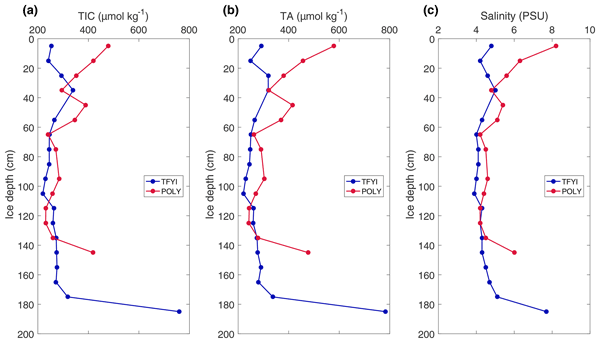
Sea ice helps control how much carbon dioxide polar oceans absorb. We compared ice cores from two sites to look for differences in carbon chemistry: one site had thin ice due to strong ocean currents and thick snow; the other site had thick ice, thin snow, and weak currents. We did find some differences in small layers near the top and the bottom of the cores, but for most of the ice volume the chemistry was the same. This result will help build better models of the carbon sink in polar oceans.
Tristan Petit, Børge Hamre, Håkon Sandven, Rüdiger Röttgers, Piotr Kowalczuk, Monika Zablocka, and Mats A. Granskog
Ocean Sci., 18, 455–468, https://doi.org/10.5194/os-18-455-2022, https://doi.org/10.5194/os-18-455-2022, 2022
Short summary
Short summary
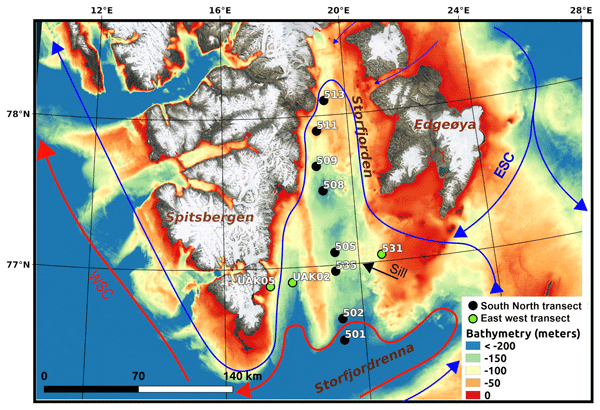
We provide the first insights on bio-optical processes in Storfjorden (Svalbard). Information on factors controlling light propagation in the water column in this arctic fjord becomes crucial in times of rapid sea ice decline. We find a significant contribution of dissolved matter to light absorption and a subsurface absorption maximum linked to phytoplankton production. Dense bottom waters from sea ice formation carry elevated levels of dissolved and particulate matter.
M. A. Soppa, D. A. Dinh, B. Silva, F. Steinmetz, L. Alvarado, and A. Bracher
Int. Arch. Photogramm. Remote Sens. Spatial Inf. Sci., XLVI-1-W1-2021, 69–72, https://doi.org/10.5194/isprs-archives-XLVI-1-W1-2021-69-2022, https://doi.org/10.5194/isprs-archives-XLVI-1-W1-2021-69-2022, 2022
Yanan Zhao, Dennis Booge, Christa A. Marandino, Cathleen Schlundt, Astrid Bracher, Elliot L. Atlas, Jonathan Williams, and Hermann W. Bange
Biogeosciences, 19, 701–714, https://doi.org/10.5194/bg-19-701-2022, https://doi.org/10.5194/bg-19-701-2022, 2022
Short summary
Short summary
We present here, for the first time, simultaneously measured dimethylsulfide (DMS) seawater concentrations and DMS atmospheric mole fractions from the Peruvian upwelling region during two cruises in December 2012 and October 2015. Our results indicate low oceanic DMS concentrations and atmospheric DMS molar fractions in surface waters and the atmosphere, respectively. In addition, the Peruvian upwelling region was identified as an insignificant source of DMS emissions during both periods.
Pedro Duarte, Philipp Assmy, Karley Campbell, and Arild Sundfjord
Geosci. Model Dev., 15, 841–857, https://doi.org/10.5194/gmd-15-841-2022, https://doi.org/10.5194/gmd-15-841-2022, 2022
Short summary
Short summary
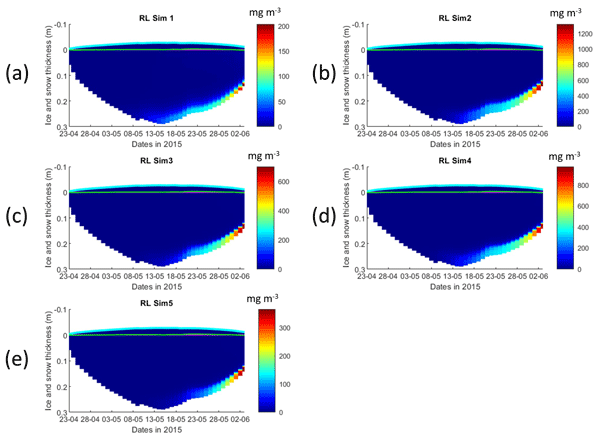
Sea ice modeling is an important part of Earth system models (ESMs). The results of ESMs are used by the Intergovernmental Panel on Climate Change in their reports. In this study we present an improvement to calculate the exchange of nutrients between the ocean and the sea ice. This nutrient exchange is an essential process to keep the ice-associated ecosystem functioning. We found out that previous calculation methods may underestimate the primary production of the ice-associated ecosystem.
Cited articles
Ardyna, M. and Arrigo, K. R.: Phytoplankton dynamics in a changing Arctic Ocean, Nat. Clim. Change, 10, 892–903, https://doi.org/10.1038/s41558-020-0905-y, 2020.
Arrigo, K. R. and van Dijken, G. L.: Continued increases in Arctic Ocean primary production, Synth. Arct. Res. SOAR, 136, 60–70, https://doi.org/10.1016/j.pocean.2015.05.002, 2015.
Artuso, F., Canuti, E., Cataldi, D., Costa Goela, P., Grung, M., Ras, J., and Röttgers, R.: HPLC/DAD intercomparison on phytoplankton pigments (HIP-1, HIP-2, HIP-3 and HIP-4), Publications Office of the European Union, https://doi.org/10.2788/134904, 2016.
Assmy, P., Duarte, P., Dujardin, J., Fernández-Méndez, M., Fransson, A., Hodgson, R., Kauko, H., Kristiansen, S., Mundy, C., Olsen, L. M., Peeken, I., Sandbu, M., Wallenschus, J., and Wold, A.: N-ICE2015 water column biogeochemistry, Norwegian Polar Data Centre [data set], https://doi.org/10.21334/NPOLAR.2016.3EBB7F64, 2016.
Bidigare, R. R., Van Heukelem, L., and Trees, C. C.: HPLC phytoplankton pigments: sampling, laboratory methods, and quality assurance procedures, Ocean Opt. Protoc. Satell. Ocean Color Sens. Valid. Revis., 3, 258–268, 2002.
Blais, M., Ardyna, M., Gosselin, M., Dumont, D., Bélanger, S., Tremblay, J.-É., Gratton, Y., Marchese, C., and Poulin, M.: Contrasting interannual changes in phytoplankton productivity and community structure in the coastal Canadian Arctic Ocean, Limnol. Oceanogr., 62, 2480–2497, https://doi.org/10.1002/lno.10581, 2017.
Bonilla, S., Rautio, M., and Vincent, W. F.: Phytoplankton and phytobenthos pigment strategies: implications for algal survival in the changing Arctic, Polar Biol., 32, 1293–1303, https://doi.org/10.1007/s00300-009-0626-1, 2009.
Bracher, A.: Phytoplankton pigment concentration and phytoplankton groups measured on water samples obtained during POLARSTERN cruise PS106 in the Arctic Ocean, Alfred Wegener Institute, Helmholtz Centre for Polar and Marine Research, Bremerhaven, PANGAEA [data set], https://doi.org/10.1594/PANGAEA.899284, 2019.
Bracher, A. and Wiegmann, S.: Phytoplankton pigment concentrations during POLARSTERN cruise PS121 from North Sea to Fram in August to September 2019, PANGAEA [data set], https://doi.org/10.1594/PANGAEA.941011, 2022.
Bracher, A., Vountas, M., Dinter, T., Burrows, J. P., Röttgers, R., and Peeken, I.: Quantitative observation of cyanobacteria and diatoms from space using PhytoDOAS on SCIAMACHY data, Biogeosciences, 6, 751–764, https://doi.org/10.5194/bg-6-751-2009, 2009.
Bracher, A., Bouman, H. A., Brewin, R. J. W., Bricaud, A., Brotas, V., Ciotti, A. M., Clementson, L., Devred, E., Di Cicco, A., Dutkiewicz, S., Hardman-Mountford, N. J., Hickman, A. E., Hieronymi, M., Hirata, T., Losa, S. N., Mouw, C. B., Organelli, E., Raitsos, D. E., Uitz, J., Vogt, M., and Wolanin, A.: Obtaining Phytoplankton Diversity from Ocean Color: A Scientific Roadmap for Future Development, Front. Mar. Sci., 4, https://doi.org/10.3389/fmars.2017.00055, 2017.
Bracher, A., Soppa, M. A., Gege, P., Losa, S. N., Silva, B., Steinmetz, F., and Droscher, I.: Extension of Atmospheric Correction Polymer to Hyperspectral Sensors: Application to HICO and First Results for DESIS Data, in: 2021 IEEE International Geoscience and Remote Sensing Symposium IGARSS, https://doi.org/10.1109/IGARSS47720.2021.9553568, 2021.
Bracher, A., Xi, Ho., Hohe, C., Wiegmann, S., and Peeken, I.: Phytoplankton pigment and phytoplankton group chlorophyll-a concentrations during POLARSTERN cruise PS126 from North Sea to Fram Strait in May to June 2021 from HPLC analysis of water samples, PANGAEA [data set], https://doi.org/10.1594/PANGAEA.982954, 2025a.
Bracher, A., Xi, H., and Hohe, C.: Phytoplankton pigment and phytoplankton group chlorophyll-a concentrations during POLARSTERN cruise PS131 from North Sea to East Greenland Sea in 29. June to 3. August 2022 from HPLC analysis of water, PANGAEA [data set], https://doi.org/10.1594/PANGAEA.983242, 2025b.
Bracher, A., Xi, H., and Wiegmann, S.: Phytoplankton pigment and phytoplankton group chlorophyll-a concentrations during POLARSTERN cruise PS136 from North Sea to Fram Strait in May to June 2023 from HPLC analysis of water samples, PANGAEA [data set], https://doi.org/10.1594/PANGAEA.983243, 2025c.
Bracher, A., Xi, H., and Wiegmann, S.: Phytoplankton pigment and phytoplankton group chlorophyll-a concentrations during POLARSTERN cruise PS143/2 from Tromsø to Fram Strait in 12 July to 5 August 2024 from HPLC analysis of water samples, PANGAEA [data set], https://doi.org/10.1594/PANGAEA.983244, 2025d.
Bracher, A., Hohe, C., Wiegmann, S., and Xi, H.: Phytoplankton pigment concentrations during Maria S. Merian cruise MSM93 from North Sea to Fram Strait and back in June to July 2020 from HPLC analysed water samples, PANGAEA [data set], https://doi.org/10.1594/PANGAEA.995973, 2026.
Brunet, C., Johnsen, G., Lavaud, J., and Roy, S.: Pigments and photoacclimation processes, in: Phytoplankton Pigments: Characterization, Chemotaxonomy and Applications in Oceanography, https://hal.science/hal-01101814 (last access: 9 July 2026), 2011.
Bruyant, F., Amiraux, R., Amyot, M.-P., Archambault, P., Artigue, L., Barbedo de Freitas, L., Bécu, G., Bélanger, S., Bourgain, P., Bricaud, A., Brouard, E., Brunet, C., Burgers, T., Caleb, D., Chalut, K., Claustre, H., Cornet-Barthaux, V., Coupel, P., Cusa, M., Cusset, F., Dadaglio, L., Davelaar, M., Deslongchamps, G., Dimier, C., Dinasquet, J., Dumont, D., Else, B., Eulaers, I., Ferland, J., Filteau, G., Forget, M.-H., Fort, J., Fortier, L., Galí, M., Gallinari, M., Garbus, S.-E., Garcia, N., Gérikas Ribeiro, C., Gombault, C., Gourvil, P., Goyens, C., Grant, C., Grondin, P.-L., Guillot, P., Hillion, S., Hussherr, R., Joux, F., Joy-Warren, H., Joyal, G., Kieber, D., Lafond, A., Lagunas, J., Lajeunesse, P., Lalande, C., Larivière, J., Le Gall, F., Leblanc, K., Leblanc, M., Legras, J., Lévesque, K., Lewis, K.-M., Leymarie, E., Leynaert, A., Linkowski, T., Lizotte, M., Lopes dos Santos, A., Marec, C., Marie, D., Massé, G., Massicotte, P., Matsuoka, A., Miller, L. A., Mirshak, S., Morata, N., Moriceau, B., Morin, P.-I., Morisset, S., Mosbech, A., Mucci, A., Nadaï, G., Nozais, C., Obernosterer, I., Paire, T., Panagiotopoulos, C., Parenteau, M., Pelletier, N., Picheral, M., Quéguiner, B., Raimbault, P., Ras, J., Rehm, E., Ribot Lacosta, L., Rontani, J.-F., Saint-Béat, B., Sansoulet, J., Sardet, N., Schmechtig, C., Sciandra, A., Sempéré, R., Sévigny, C., Toullec, J., Tragin, M., Tremblay, J.-É., Trottier, A.-P., Vaulot, D., Vladoiu, A., Xue, L., Yunda-Guarin, G., and Babin, M.: The Green Edge cruise: investigating the marginal ice zone processes during late spring and early summer to understand the fate of the Arctic phytoplankton bloom, Earth Syst. Sci. Data, 14, 4607–4642, https://doi.org/10.5194/essd-14-4607-2022, 2022a.
Bruyant, F., Amiraux, R., Amyot, M.-P., et al.: The Green Edge cruise: following the evolution of the Arctic phytoplankton spring bloom, from ice-covered to open waters, SEANOE [data set], https://doi.org/10.17882/86417, 2022b.
Campbell, R. G., Sherr, E. B., Ashjian, C. J., Plourde, S., Sherr, B. F., Hill, V., and Stockwell, D. A.: Mesozooplankton prey preference and grazing impact in the western Arctic Ocean, Deep-Sea Res. Pt. II, 56, 1274–1289, https://doi.org/10.1016/j.dsr2.2008.10.027, 2009.
Canuti, E.: Phytoplankton pigment in situ measurements uncertainty evaluation: an HPLC interlaboratory comparison with a European-scale dataset, Front. Mar. Sci., 10, https://doi.org/10.3389/fmars.2023.1197311, 2023.
Canuti, E., Grung, J., Röttgers, M., Goela, C., and Artuso, P.: HPLC/DAD Intercomparison on Phytoplankton Pigments (HIP-1, HIP-2, HIP-3 and HIP-4), European Union, https://doi.org/10.2788/47099, 2016.
Cetinić, I., Rousseaux, C. S., Carroll, I. T., Chase, A. P., Kramer, S. J., Werdell, P. J., Siegel, D. A., Dierssen, H. M., Catlett, D., Neeley, A., Soto Ramos, I. M., Wolny, J. L., Sadoff, N., Urquhart, E., Westberry, T. K., Stramski, D., Pahlevan, N., Seegers, B. N., Sirk, E., Lange, P. K., Vandermeulen, R. A., Graff, J. R., Allen, J. G., Gaube, P., McKinna, L. I. W., McKibben, S. M., Binding, C. E., Calzado, V. S., and Sayers, M.: Phytoplankton composition from sPACE: Requirements, opportunities, and challenges, Remote Sens. Environ., 302, 113964, https://doi.org/10.1016/j.rse.2023.113964, 2024.
Chamberlain, E. J., Balmonte, J. P., Torstensson, A., Fong, A. A., Snoeijs-Leijonmalm, P., and Bowman, J. S.: Impacts of sea ice melting procedures on measurements of microbial community structure, Elem. Sci. Anthr., 10, 00017, https://doi.org/10.1525/elementa.2022.00017, 2022.
Claustre, H., Hooker, S. B., Van Heukelem, L., Berthon, J.-F., Barlow, R., Ras, J., Sessions, H., Targa, C., Thomas, C. S., van der Linde, D., and Marty, J.-C.: An intercomparison of HPLC phytoplankton pigment methods using in situ samples: application to remote sensing and database activities, Mar. Chem., 85, 41–61, https://doi.org/10.1016/j.marchem.2003.09.002, 2004.
Coupel, P., Jin, H. Y., Joo, M., Horner, R., Bouvet, H. A., Sicre, M.-A., Gascard, J.-C., Chen, J. F., Garçon, V., and Ruiz-Pino, D.: Phytoplankton distribution in unusually low sea ice cover over the Pacific Arctic, Biogeosciences, 9, 4835–4850, https://doi.org/10.5194/bg-9-4835-2012, 2012.
Coupel, P., Matsuoka, A., Ruiz-Pino, D., Gosselin, M., Marie, D., Tremblay, J.-É., and Babin, M.: Pigment signatures of phytoplankton communities in the Beaufort Sea, Biogeosciences, 12, 991–1006, https://doi.org/10.5194/bg-12-991-2015, 2015.
DiTullio, G. and Lee, P.: Algal pigment concentrations, High Arctic, August–September 2018, Arctic Data Center [data set], https://doi.org/10.18739/A2028PD2H, 2019.
El Hourany, R., Abboud-Abi Saab, M., Faour, G., Aumont, O., Crépon, M., and Thiria, S.: Estimation of Secondary Phytoplankton Pigments From Satellite Observations Using Self-Organizing Maps (SOMs), J. Geophys. Res.-Oceans, 124, 1357–1378, https://doi.org/10.1029/2018JC014450, 2019.
El Hourany, R., Pierella Karlusich, J., Zinger, L., Loisel, H., Levy, M., and Bowler, C.: Linking satellites to genes with machine learning to estimate phytoplankton community structure from space, Ocean Sci., 20, 217–239, https://doi.org/10.5194/os-20-217-2024, 2024.
England, M. R., Eisenman, I., Lutsko, N. J., and Wagner, T. J. W.: The Recent Emergence of Arctic Amplification, Geophys. Res. Lett., 48, e2021GL094086, https://doi.org/10.1029/2021GL094086, 2021.
Falkowski, P. and Kiefer, D. A.: Chlorophyll a fluorescence in phytoplankton: relationship to photosynthesis and biomass, J. Plankton Res., 7, 715–731, https://doi.org/10.1093/plankt/7.5.715, 1985.
Falkowski, P. G.: The role of phytoplankton photosynthesis in global biogeochemical cycles, Photosynth. Res., 39, 235–258, https://doi.org/10.1007/BF00014586, 1994.
Flores, H., Veyssière, G., Castellani, G., Wilkinson, J., Hoppmann, M., Karcher, M., Valcic, L., Cornils, A., Geoffroy, M., Nicolaus, M., Niehoff, B., Priou, P., Schmidt, K., and Stroeve, J.: Sea-ice decline could keep zooplankton deeper for longer, Nat. Clim. Change, 13, 1122–1130, https://doi.org/10.1038/s41558-023-01779-1, 2023.
Fragoso, G. M., Poulton, A. J., Yashayaev, I. M., Head, E. J. H., and Purdie, D. A.: Spring phytoplankton communities of the Labrador Sea (2005–2014): pigment signatures, photophysiology and elemental ratios, Biogeosciences, 14, 1235–1259, https://doi.org/10.5194/bg-14-1235-2017, 2017a.
Fragoso, G. M., Poulton, A. J., Yashayaev, I. M., Head, E. J. H., and Purdie, D. A.: Spring phytoplankton communities of the Labrador Sea (2005–2014): pigment signatures, photophysiology and elemental ratios, PANGAEA [data set], https://doi.org/10.1594/PANGAEA.871872, 2017b.
Freer, J. J., Daase, M., and Tarling, G. A.: Modelling the biogeographic boundary shift of Calanus finmarchicus reveals drivers of Arctic Atlantification by subarctic zooplankton, Global Change Biol., 28, 429–440, https://doi.org/10.1111/gcb.15937, 2022.
Gege, P.: The water color simulator WASI: an integrating software tool for analysis and simulation of optical in situ spectra, Comput. Geosci., 30, 523–532, https://doi.org/10.1016/j.cageo.2004.03.005, 2004.
Gege, P.: WASI-2D: A software tool for regionally optimized analysis of imaging spectrometer data from deep and shallow waters, Comput. Geosci., 62, 208–215, https://doi.org/10.1016/j.cageo.2013.07.022, 2014.
Gosselin, M., Rysgaard, S., Lavaud, J., Else, B., Galindo, V., Mundy, C. J., Ehn, J., and Babin, M.: Pigment composition and photoprotection of Arctic sea ice algae during spring, Mar. Ecol.-Prog. Ser., 585, 49–69, 2017.
Gradinger, R.: Sea-ice algae: Major contributors to primary production and algal biomass in the Chukchi and Beaufort Seas during May/June 2002, Deep-Sea Res. Pt. II, 56, 1201–1212, https://doi.org/10.1016/j.dsr2.2008.10.016, 2009.
Hayward, A., Pinkerton, M. H., and Gutierrez-Rodriguez, A.: phytoclass: A pigment-based chemotaxonomic method to determine the biomass of phytoplankton classes, Limnol. Oceanogr. Meth., 21, 220–241, https://doi.org/10.1002/lom3.10541, 2023.
Hayward, A., Pinkerton, M. H., Wright, S. W., Gutiérrez-Rodriguez, A., and Law, C. S.: Twenty-six years of phytoplankton pigments reveal a circumpolar Class Divide around the Southern Ocean, Commun. Earth Environ., 5, 92, https://doi.org/10.1038/s43247-024-01261-6, 2024.
Hayward, A., Wright, S. W., Carroll, D., Law, C. S., Wongpan, P., Gutiérrez-Rodriguez, A., and Pinkerton, M. H.: Antarctic phytoplankton communities restructure under shifting sea–ice regimes, Nat. Clim. Change, 15, 889–896, https://doi.org/10.1038/s41558-025-02379-x, 2025.
Heidemann, A. C., Hayward, A., Assmy, P., Basu, A., Bracher, A., Castellani, G., Ditullio, G., Dragańska-Deja, K., Fujiwara, A., Fragoso, G. M., Høyer, J., Hwang, J., Iversen, M., von Jackowski, A., Juul-Pedersen, T., Kowalczuk, P., Lee, Y., Matsuoka, A., Merz, A., Mundy, C. J., Ostermann, E., Pinkerton, M. H., Peeken, I., Stoń-Egiert, J., Thielecke, A. U., Veyssiere, G., Xi, H., Yang, E. J., and Gonçalves-Araujo, R.: Consolidated Arctic Pigments (2000 to 2024), DTU [data set], https://doi.org/10.11583/DTU.29445104, 2026.
Hooker, S. B., Heukelem, L., Thomas, C. S., Claustre, H., Ras, J., Barlow, R., Sessions, H., Schlüter, L., Perl, J., Trees, C., Stuart, V., Head, E., Clementson, L., Fishwick, J., Llewellyn, C., and Aiken, J.: The Second SeaWiFS HPLC Analysis Round-robin Experiment (SeaHARRE-2), National Aeronautics and Space Administration, Goddard Space Flight Center, https://www.researchgate.net/publication/286901285_The_Second_SeaWiFS_HPLC_Analysis_Round-Robin_Experiment_SeaHARRE-2 (last access: 9 July 2026), 2005.
Hooker, S. B., Clementson, L., Thomas, C. S., Schlüter, L., Allerup, M., Ras, J., Claire, N., Cullen, J., Kienast, M., Kozlowski, W., Vernet, M., Chakraborty, S., Lohrenz, S., Tuel, M., Redalje, D., Cartaxana, P., Mendes, C. R., Brotas, V., Matondkar, S. G. P., Parab, S. G., Neeley, A., and Egeland, E. S.: The Fifth SeaWiFS HPLC Analysis Round-Robin Experiment (SeaHARRE-5), Technical Report, Publications Office of the European Union, Luxembourg, 2022, https://doi.org/10.2760/563102, JRC130280, 2012.
Hu, C.: Hyperspectral reflectance spectra of floating matters derived from Hyperspectral Imager for the Coastal Ocean (HICO) observations, Earth Syst. Sci. Data, 14, 1183–1192, https://doi.org/10.5194/essd-14-1183-2022, 2022.
Hwang, J.: Preliminarily annotated phytoplankton lipids from Polar Cod Connectivity Cruise 2022, Zenodo [data set], https://doi.org/10.5281/zenodo.15085544, 2025.
JAMSTEC: R/V MIRAI MR17-05C Cruise Data, JAMSTEC [data set], https://doi.org/10.17596/0001879, 2017.
Jeffrey, S. W., Wright, S. W., and Zapata, M.: Recent advances in HPLC pigment analysis of phytoplankton, Mar. Freshwater Res., 50, 879–896, 1999.
Kramer, S. J., Siegel, D. A., Maritorena, S., and Catlett, D.: Modeling surface ocean phytoplankton pigments from hyperspectral remote sensing reflectance on global scales, Remote Sens. Environ., 270, 112879, https://doi.org/10.1016/j.rse.2021.112879, 2022.
Lee, Y. J.: Phytoplankton pigments obtained during the Arctic cruises (ARA06B, ARA07B, ARA08B, ARA09B, ARA10B, ARA11B), Korea Polar Data Center [data set], https://doi.org/10.22663/KOPRI-KPDC-00002844, 2025.
Liu, Y., Boss, E., Chase, A. P., Xi, H., Zhang, X., Röttgers, R., Pan, Y., and Bracher, A.: Phytoplankton pigment concentration measured by HPLC during POLARSTERN cruise PS99, Alfred Wegener Institute, Helmholtz Centre for Polar and Marine Research, Bremerhaven, PANGAEA [data set], https://doi.org/10.1594/PANGAEA.894874, 2018a.
Liu, Y., Boss, E., Chase, A. P., Xi, H., Zhang, X., Röttgers, R., Pan, Y., and Bracher, A.: Phytoplankton pigment concentration measured by HPLC during POLARSTERN cruise PS107, Alfred Wegener Institute, Helmholtz Centre for Polar and Marine Research, Bremerhaven, PANGAEA [data set], https://doi.org/10.1594/PANGAEA.894860, 2018b.
Liu, Y., Hellmann, S., Wiegmann, S., and Bracher, A.: Phytoplankton pigment concentrations measured by HPLC during POLARSTERN cruise PS99.1, PANGAEA [data set], https://doi.org/10.1594/PANGAEA.905502, 2019.
Losa, S. N., Soppa, M. A., Dinter, T., Wolanin, A., Brewin, R. J. W., Bricaud, A., Oelker, J., Peeken, I., Gentili, B., Rozanov, V., and Bracher, A.: Synergistic Exploitation of Hyper- and Multi-Spectral Precursor Sentinel Measurements to Determine Phytoplankton Functional Types (SynSenPFT), Front. Mar. Sci., 4, https://doi.org/10.3389/fmars.2017.00203, 2017.
Massicotte, P., Amiraux, R., Amyot, M.-P., Archambault, P., Ardyna, M., Arnaud, L., Artigue, L., Aubry, C., Ayotte, P., Bécu, G., Bélanger, S., Benner, R., Bittig, H. C., Bricaud, A., Brossier, É., Bruyant, F., Chauvaud, L., Christiansen-Stowe, D., Claustre, H., Cornet-Barthaux, V., Coupel, P., Cox, C., Delaforge, A., Dezutter, T., Dimier, C., Domine, F., Dufour, F., Dufresne, C., Dumont, D., Ehn, J., Else, B., Ferland, J., Forget, M.-H., Fortier, L., Galí, M., Galindo, V., Gallinari, M., Garcia, N., Gérikas Ribeiro, C., Gourdal, M., Gourvil, P., Goyens, C., Grondin, P.-L., Guillot, P., Guilmette, C., Houssais, M.-N., Joux, F., Lacour, L., Lacour, T., Lafond, A., Lagunas, J., Lalande, C., Laliberté, J., Lambert-Girard, S., Larivière, J., Lavaud, J., LeBaron, A., Leblanc, K., Le Gall, F., Legras, J., Lemire, M., Levasseur, M., Leymarie, E., Leynaert, A., Lopes dos Santos, A., Lourenço, A., Mah, D., Marec, C., Marie, D., Martin, N., Marty, C., Marty, S., Massé, G., Matsuoka, A., Matthes, L., Moriceau, B., Muller, P.-E., Mundy, C.-J., Neukermans, G., Oziel, L., Panagiotopoulos, C., Pangrazi, J.-J., Picard, G., Picheral, M., Pinczon du Sel, F., Pogorzelec, N., Probert, I., Quéguiner, B., Raimbault, P., Ras, J., Rehm, E., Reimer, E., Rontani, J.-F., Rysgaard, S., Saint-Béat, B., Sampei, M., Sansoulet, J., Schmechtig, C., Schmidt, S., Sempéré, R., Sévigny, C., Shen, Y., Tragin, M., Tremblay, J.-É., Vaulot, D., Verin, G., Vivier, F., Vladoiu, A., Whitehead, J., and Babin, M.: Green Edge ice camp campaigns: understanding the processes controlling the under-ice Arctic phytoplankton spring bloom, Earth Syst. Sci. Data, 12, 151–176, https://doi.org/10.5194/essd-12-151-2020, 2020.
Massicotte, P., Amon, R. M. W., Antoine, D., Archambault, P., Balzano, S., Bélanger, S., Benner, R., Boeuf, D., Bricaud, A., Bruyant, F., Chaillou, G., Chami, M., Charrière, B., Chen, J., Claustre, H., Coupel, P., Delsaut, N., Doxaran, D., Ehn, J., Fichot, C., Forget, M.-H., Fu, P., Gagnon, J., Garcia, N., Gasser, B., Ghiglione, J.-F., Gorsky, G., Gosselin, M., Gourvil, P., Gratton, Y., Guillot, P., Heipieper, H. J., Heussner, S., Hooker, S. B., Huot, Y., Jeanthon, C., Jeffrey, W., Joux, F., Kawamura, K., Lansard, B., Leymarie, E., Link, H., Lovejoy, C., Marec, C., Marie, D., Martin, J., Martín, J., Massé, G., Matsuoka, A., McKague, V., Mignot, A., Miller, W. L., Miquel, J.-C., Mucci, A., Ono, K., Ortega-Retuerta, E., Panagiotopoulos, C., Papakyriakou, T., Picheral, M., Piepenburg, D., Prieur, L., Raimbault, P., Ras, J., Reynolds, R. A., Rochon, A., Rontani, J.-F., Schmechtig, C., Schmidt, S., Sempéré, R., Shen, Y., Song, G., Stramski, D., Tachibana, E., Thirouard, A., Tolosa, I., Tremblay, J.-É., Vaïtilingom, M., Vaulot, D., Vaultier, F., Volkman, J. K., Vonk, J. E., Xie, H., Zheng, G., and Babin, M.: The Malina oceanographic expedition: How do changes in ice cover, permafrost and UV radiation impact biodiversity and biogeochemical fluxes in the Arctic Ocean?, SEANOE [data set], https://doi.org/10.17882/75345, 2025.
Matsuoka, A., Juhls, B., Bécu, G., Oziel, L., Leymarie, E., Lizotte, M., Ferland, J., Doxaran, D., Maury, J., Béguin, M., Laberge-Carignan, A., Guilmette, C., Hilborn, A., Tisserand, L., Devred, E., Bossé-Demers, T., Mannino, A., and Babin, M.: Phytoplankton pigment concentrations measured by HPLC in the surface water of the Mackenzie Delta Region during 4 expeditions from spring to fall in 2019, PANGAEA [data ste], https://doi.org/10.1594/PANGAEA.937585, 2021.
Mattei, F. and Scardi, M.: Collection and analysis of a global marine phytoplankton primary-production dataset, Earth Syst. Sci. Data, 13, 4967–4985, https://doi.org/10.5194/essd-13-4967-2021, 2021.
Matthes, L. C., Mundy, C. J., and Ehns, J.: Algal pigments in ice and water – Hudson Bay 2018, Canadian Watershed Information Network [data set], https://doi.org/10.34992/e9kb-6s68, 2020.
Mendes, C. R., Cartaxana, P., and Brotas, V.: HPLC determination of phytoplankton and microphytobenthos pigments: comparing resolution and sensitivity of a C18 and a C8method, Limnol. Oceanogr. Meth., 5, 363–370, https://doi.org/10.4319/lom.2007.5.363, 2007.
Miller, L. A., Fripiat, F., Else, B. G. T., Bowman, J. S., Brown, K. A., Collins, R. E., Ewert, M., Fransson, A., Gosselin, M., Lannuzel, D., Meiners, K. M., Michel, C., Nishioka, J., Nomura, D., Papadimitriou, S., Russell, L. M., Sørensen, L. L., Thomas, D. N., Tison, J.-L., van Leeuwe, M. A., Vancoppenolle, M., Wolff, E. W., and Zhou, J.: Methods for biogeochemical studies of sea ice: The state of the art, caveats, and recommendations, Elem. Sci. Anthr., 3, 000038, https://doi.org/10.12952/journal.elementa.000038, 2015.
Miller, P.: Multi-spectral front maps for automatic detection of ocean colour features from SeaWiFS, Int. J. Remote Sens., 25, 1437–1442, https://doi.org/10.1080/01431160310001592409, 2004.
Negrete-García, G., Luo, J. Y., Petrik, C. M., Manizza, M., and Barton, A. D.: Changes in Arctic Ocean plankton community structure and trophic dynamics on seasonal to interannual timescales, Biogeosciences, 21, 4951–4973, https://doi.org/10.5194/bg-21-4951-2024, 2024.
Nieke, J., Mavrocordatos, C., Donlon, C., Berruti, B., Garnier, T., Riti, J.-B., and Delclaud, Y.: Ocean and Land Color Imager on Sentinel-3, in: Optical Payloads for Space Missions, John Wiley & Sons, Ltd, 223–245, https://doi.org/10.1002/9781118945179.ch10, 2015.
Nieke, J., Despoisse, L., Gabriele, A., Weber, H., Strese, H., Ghasemi, N., Gascon, F., Alonso, K., Boccia, V., Tsonevska, B., Choukroun, P., Ottavianelli, G., and Celesti, M.: The copernicus hyperspectral imaging mission for the environment (CHIME): an overview of its mission, system and planning status, in: Sensors, Systems, and Next-Generation Satellites XXVII, Sensors, Systems, and Next-Generation Satellites XXVII, 21–40, https://doi.org/10.1117/12.2679977, 2023.
Peloquin, J., Swan, C., Gruber, N., Vogt, M., Claustre, H., Ras, J., Uitz, J., Barlow, R., Behrenfeld, M., Bidigare, R., Dierssen, H., Ditullio, G., Fernandez, E., Gallienne, C., Gibb, S., Goericke, R., Harding, L., Head, E., Holligan, P., Hooker, S., Karl, D., Landry, M., Letelier, R., Llewellyn, C. A., Lomas, M., Lucas, M., Mannino, A., Marty, J.-C., Mitchell, B. G., Muller-Karger, F., Nelson, N., O'Brien, C., Prezelin, B., Repeta, D., Smith Jr., W. O., Smythe-Wright, D., Stumpf, R., Subramaniam, A., Suzuki, K., Trees, C., Vernet, M., Wasmund, N., and Wright, S.: The MAREDAT global database of high performance liquid chromatography marine pigment https://doi.org/10.5194/essd-5-109-2013, 2013a.
Peloquin, J. M., Swan, C., Gruber, N., Vogt, M., Claustre, H., Ras, J., Uitz, J., Barlow, R. G., Behrenfeld, M. J., Bidigare, R. R., Dierssen, H. M., Ditullio, G., Fernández, E., Gallienne, C., Gibb, S. W., Goericke, R., Harding, L., Head, E. J. H., Holligan, P. M., Hooker, S. B., Karl, D., Landry, M. R., Letelier, R., Llewellyn, C., Lomas, M. W., Lucas, M., Mannino, A., Marty, J.-C., Mitchell, B. G., Muller-Karger, F. E., Nelson, N., O'Brien, C. J., Prezelin, B., Repeta, D. J., Smith Jr., W. O., Smythe-Wright, D., Stumpf, R., Subramaniam, A., Suzuki, K., Trees, C., Vernet, M., Wasmund, N., and Wright, S.: The MAREDAT global database of high performance liquid chromatography marine pigment measurements – Gridded data product (NetCDF) – Contribution to the MAREDAT World Ocean Atlas of Plankton Functional Types, PANGAEA [data set], https://doi.org/10.1594/PANGAEA.793246, 2013b.
Pereira, L. and Gonçalves, A. M. M.: Plankton Communities, BoD – Books on Demand, 200 pp., ISBN 9781839686085, 2022.
Quinlan, R., Douglas, M. S. V., and Smol, J. P.: Food web changes in arctic ecosystems related to climate warming, Global Change Biol., 11, 1381–1386, https://doi.org/10.1111/j.1365-2486.2005.00981.x, 2005.
Roy, S., Llewellyn, C. A., Egeland, E. S., and Johnsen, G.: Phytoplankton Pigments: Characterization, Chemotaxonomy and Applications in Oceanography, Cambridge University Press, 891 pp., ISBN 9781139500999, 2011.
Sadeghi, A., Dinter, T., Vountas, M., Taylor, B. B., Altenburg-Soppa, M., Peeken, I., and Bracher, A.: Improvement to the PhytoDOAS method for identification of coccolithophores using hyper-spectral satellite data, Ocean Sci., 8, 1055–1070, https://doi.org/10.5194/os-8-1055-2012, 2012.
SeaBASS: ICESCAPE, SeaBASS [data set], https://doi.org/10.5067/SEABASS/ICESCAPE/DATA001, 2010.
Serra-Pompei, C., Ward, B. A., Pinti, J., Visser, A. W., Kiørboe, T., and Andersen, K. H.: Linking Plankton Size Spectra and Community Composition to Carbon Export and Its Efficiency, Global Biogeochem. Cy., 36, e2021GB007275, https://doi.org/10.1029/2021GB007275, 2022.
Simmons, L. J., Sandgren, C. D., and Berges, J. A.: Problems and pitfalls in using HPLC pigment analysis to distinguish Lake Michigan phytoplankton taxa, J. Gt. Lakes Res., 42, 397–404, https://doi.org/10.1016/j.jglr.2015.12.006, 2016.
Six, C., Ratin, M., Marie, D., and Corre, E.: Marine Synechococcus picocyanobacteria: Light utilization across latitudes, P. Natl. Acad. Sci. USA, 118, e2111300118, https://doi.org/10.1073/pnas.2111300118, 2021.
Stoń-Egiert, J. and Dragańska-Deja, K.: Phytoplankton pigments composition and concentrations measured with HPLC methods in water samples collected in Europen Arctic in 2000–2022, IOPAN Geonetwork [data set], https://doi.org/10.48457/IOPAN.2025.523, 2025.
Stoń-Egiert, J., Darecki, M., Granskog, M., Dodd, P., Palacz, A., and Kowalczuk, P.: Phytoplankton pigments composition and concentrations measured with HPLC methods in water samples collected in the Amundsen and Nansen basins of the Arctic Ocean in July/August 2024, IOPAN Geonetwork [data set], https://doi.org/10.48457/IOPAN.2025.386, 2025a.
Stoń-Egiert, J., Dragańska-Deja, K., Lis, D., Kowalczuk, P., and Palacz, A.: Phytoplankton pigments concentrations from HPLC method in water samples collected in the Woodfjorden, Northern Spitsbergen, between 20–26 August 2024, IOPAN Geonetwork [data set], https://doi.org/10.48457/IOPAN.2025.504, 2025b.
Stroeve, J. and Notz, D.: Changing state of Arctic sea ice across all seasons, Environ. Res. Lett., 13, 103001, https://doi.org/10.1088/1748-9326/aade56, 2018.
Swan, C. M., Vogt, M., Gruber, N., and Laufkoetter, C.: A global seasonal surface ocean climatology of phytoplankton types based on CHEMTAX analysis of HPLC pigments, Deep-Sea Res. Pt. I, 109, 137–156, https://doi.org/10.1016/j.dsr.2015.12.002, 2016.
van Leeuwe, M. A., Stefels, J., Peeken, I., Murawski, S., Bozzato, D., Castellani, G., Eggers, L., Fong, A. A., Hoppe, C. J. M., Snoeijs-Leijonmalm, P., and Webb, A. L.: Algal pigment concentrations in the ocean during the Arctic MOSAiC-expedition, PANGAEA [data set], https://doi.org/10.1594/PANGAEA.955763, 2023.
van Leeuwe, M. A., Stefels, J., Peeken, I., Murawski, S., Bozzato, D., Castellani, G., Eggers, L., Fong, A. A., Hoppe, C. J. M., Snoeijs-Leijonmalm, P., and Webb, A. L.: Annual patterns in algal pigment distribution in Arctic second year ice during the MOSAiC expedition 2019/2020, PANGAEA [data set], https://doi.org/10.1594/PANGAEA.967450, 2024a. van Leeuwe, M. A., Stefels, J., Peeken, I., Murawski, S., Bozzato, D., Castellani, G., Eggers, L., Fong, A. A., Hoppe, C. J. M., Snoeijs-Leijonmalm, P., and Webb, A. L.: Annual patterns in algal pigment distribution in Arctic first year ice during the MOSAiC expedition 2019/2020, PANGAEA [data set], https://doi.org/10.1594/PANGAEA.967448, 2024b.
Vidussi, F., Claustre, H., Manca, B. B., Luchetta, A., and Marty, J.-C.: Phytoplankton pigment distribution in relation to upper thermocline circulation in the eastern Mediterranean Sea during winter, J. Geophys. Res.-Oceans, 106, 19939–19956, https://doi.org/10.1029/1999JC000308, 2001.
Vonnahme, T. R., Chitkara, C., Krawczyk, D., Meire, L., Skogseth, R., Vader, A., and Juul-Pedersen, T.: Abrupt decline of microplankton species richness linked to coastal inflow in an Arctic fjord, Limnol. Oceanogr., 70, 2688–2702, https://doi.org/10.1002/lno.70159, 2025.
Werdell, P. J., Franz, B., Poulin, C., Allen, J., Cairns, B., Caplan, S., Cetinić, I., Craig, S., Gao, M., Hasekamp, O., Ibrahim, A., Knobelspiesse, K., Mannino, A., Martins, J. V., McKinna, L., Meister, G., Patt, F., Proctor, C., Rajapakshe, C., Ramos, I. S., Rietjens, J., Sayer, A., and Sirk, E.: Life after launch: a snapshot of the first six months of NASA's Plankton, Aerosol, Cloud, Ocean Ecosystem (PACE) mission, in: Sensors, Systems, and Next-Generation Satellites XXVIII, Sensors, Systems, and Next-Generation Satellites XXVIII, 70–84, https://doi.org/10.1117/12.3033830, 2024.
Wright, S. W. and Jeffrey, S. W.: Pigment Markers for Phytoplankton Production, in: Marine Organic Matter: Biomarkers, Isotopes and DNA, edited by: Volkman, J. K., Springer, Berlin, Heidelberg, 71–104, https://doi.org/10.1007/698_2_003, 2006.
Xi, H., Losa, S. N., Mangin, A., Soppa, M. A., Garnesson, P., Demaria, J., Liu, Y., d'Andon, O. H. F., and Bracher, A.: Global retrieval of phytoplankton functional types based on empirical orthogonal functions using CMEMS GlobColour merged products and further extension to OLCI data, Remote Sens. Environ., 240, 111704, https://doi.org/10.1016/j.rse.2020.111704, 2020.
Xi, H., Peeken, I., Gomes, M., Brotas, V., Tilstone, G. H., Brewin, R. J. W., Dall'Olmo, G., Tracana, A., Alvarado, L. M. A., Murawski, S., Wiegmann, S., and Bracher, A.: Phytoplankton pigment concentrations and phytoplankton groups measured on water samples collected from various expeditions in the Atlantic Ocean from 71° S to 84° N, PANGAEA [data set], https://doi.org/10.1594/PANGAEA.954738, 2023.
Zapata, M., Rodríguez, F., and Garrido, J. L.: Separation of chlorophylls and carotenoids from marine phytoplankton: a new HPLC method using a reversed phase C8 column and pyridine-containing mobile phases, Mar. Ecol.-Prog. Ser., 195, 29–45, https://doi.org/10.3354/meps195029, 2000.
Short summary
Algal pigments are widely used to quantify algal biomass and composition. These organisms form the basis of marine food webs and are vital for the wider ecosystem. Here, we present a pan-Arctic dataset of algal pigments, containing 10 798 measurements collected between 2000 and 2024. This publicly available dataset represents an international collaborative effort and provides an important resource for assessing environmental change and advancing future Arctic ecological and modelling studies.
Algal pigments are widely used to quantify algal biomass and composition. These organisms form...


Altmetrics
Final-revised paper
Preprint