Articles | Volume 18, issue 6
https://doi.org/10.5194/essd-18-4075-2026
© Author(s) 2026. This work is distributed under
the Creative Commons Attribution 4.0 License.
the Creative Commons Attribution 4.0 License.
https://doi.org/10.5194/essd-18-4075-2026
© Author(s) 2026. This work is distributed under
the Creative Commons Attribution 4.0 License.
the Creative Commons Attribution 4.0 License.
Data description article
| 
16 Jun 2026
Data description article |
| 16 Jun 2026
| 16 Jun 2026
EuroCrops v2.0: multi-annual harmonized parcel level crop type data linked to European Union-wide survey, statistical, and Earth Observation products
Martin Claverie
CORRESPONDING AUTHOR

European Commission, Joint Research Centre (JRC), Ispra, Italy
Ayshah Chan
CORRESPONDING AUTHOR
Technical University of Munich (TUM), TUM School of Engineering and Design, Department of Aerospace and Geodesy, Chair of Remote Sensing Technology, 80333 Munich, Germany
Technical University of Munich (TUM), Munich Data Science Institute (MDSI), 85748 Garching, Germany
Linda See
International Institute for Applied Systems Analysis, 2361 Laxenburg, Austria
Helena Ramos
Eurostat, Luxembourg, Luxembourg
Renate Koeble
ARHS Developments, Luxembourg, Luxembourg (Consultant with the European Commission, Joint Research Centre (JRC), Ispra, Italy)
Momchil Yordanov
SEIDOR Consulting S.L., 08500 Barcelona, Spain (consultant with the European Commission, Joint Research Centre (JRC), Ispra, Italy)
Jon Olav Skøien
ARHS Developments, Luxembourg, Luxembourg (Consultant with the European Commission, Joint Research Centre (JRC), Ispra, Italy)
Ferdinando Urbano
European Commission, Joint Research Centre (JRC), Ispra, Italy
Raphael d'Andrimont
European Commission Directorate of Agriculture and Rural Development, Brussels, Belgium
Maja Schneider
Technical University of Munich (TUM), TUM School of Engineering and Design, Department of Aerospace and Geodesy, Chair of Remote Sensing Technology, 80333 Munich, Germany
Ludwig Maximilian University (LMU) of Munich, Department of Geography, Munich, Germany
Marco Körner
Technical University of Munich (TUM), TUM School of Engineering and Design, Department of Aerospace and Geodesy, Chair of Remote Sensing Technology, 80333 Munich, Germany
Technical University of Munich (TUM), Munich Data Science Institute (MDSI), 85748 Garching, Germany
Marijn Van der Velde
European Commission, Joint Research Centre (JRC), Ispra, Italy
Related authors

Raphaël d'Andrimont, Martin Claverie, Pieter Kempeneers, Davide Muraro, Momchil Yordanov, Devis Peressutti, Matej Batič, and François Waldner
Earth Syst. Sci. Data, 15, 317–329, https://doi.org/10.5194/essd-15-317-2023, https://doi.org/10.5194/essd-15-317-2023, 2023
Short summary
Short summary
AI4boundaries is an open AI-ready data set to map field boundaries with Sentinel-2 and aerial photography provided with harmonised labels covering seven countries and 2.5 M parcels in Europe.
Julien Morel, Jon Olav Skøien, Momchil Iordanov, Mattia Rossi, Matteo Marcantonio, Xavier Rottlan-Puig, Linda See, and Marijn Van der Velde
Earth Syst. Sci. Data Discuss., https://doi.org/10.5194/essd-2026-640, https://doi.org/10.5194/essd-2026-640, 2026
Preprint under review for ESSD
Short summary
Short summary
Grasslands cover large parts of Europe and provide many services. Using the LUCAS survey, a large field survey covering the whole European Union, we produced the first regional map based on harmonized field data on grassland intensity and use, their forb-to-grass ratio, and age category. Strong differences in grassland management were found across Europe. This dataset can support satellite-based monitoring and large-scale modelling of grasslands.
Florian Weidinger, Sarah Matej, Claudine Egger, Simone Gingrich, Laura Rein, Elisa Lerchbaum, Martin Herold, Alexandra Runge, Fulvio Di Fulvio, Linda See, Kevin Black, Roberto Pilli, Jan Máslo, Elia Vangi, Emil Cienciala, Alessio Collalti, and Karl-Heinz Erb
Earth Syst. Sci. Data Discuss., https://doi.org/10.5194/essd-2026-540, https://doi.org/10.5194/essd-2026-540, 2026
Revised manuscript under review for ESSD
Short summary
Short summary
We created a database of European forests by combining subnational data from national forest inventories, census, and international sources, harmonizing forest area, growing stock, and harvest into annual time series for 2000–2023. The database enables forest-use intensity and uncertainty analyses and provides a valuable resource for studying forest biomass dynamics, carbon balances, forest use, and sustainable forest management across Europe.
Joana Reuss, Ekaterina Gikalo, and Marco Körner
ISPRS Ann. Photogramm. Remote Sens. Spatial Inf. Sci., XI-3-2026, 787–795, https://doi.org/10.5194/isprs-annals-XI-3-2026-787-2026, https://doi.org/10.5194/isprs-annals-XI-3-2026-787-2026, 2026
Lorenzo Beltrame, Jules Salzinger, Filip Svoboda, Phillipp Fanta-Jende, Jasmin Lampert, Radu Timofte, and Marco Körner
ISPRS Ann. Photogramm. Remote Sens. Spatial Inf. Sci., XI-3-2026, 11–18, https://doi.org/10.5194/isprs-annals-XI-3-2026-11-2026, https://doi.org/10.5194/isprs-annals-XI-3-2026-11-2026, 2026
Zavud Baghirov, Markus Reichstein, Basil Kraft, Bernhard Ahrens, Marco Körner, and Martin Jung
Geosci. Model Dev., 19, 4467–4496, https://doi.org/10.5194/gmd-19-4467-2026, https://doi.org/10.5194/gmd-19-4467-2026, 2026
Short summary
Short summary
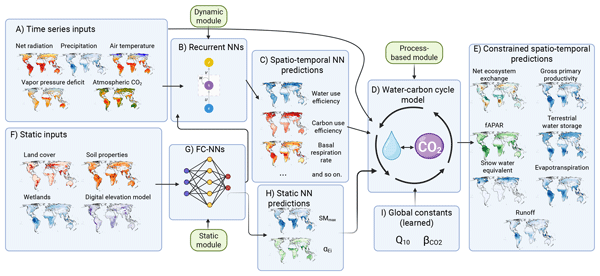
We introduce a new global model that links how water and carbon move through land ecosystems. By combining process knowledge with artificial intelligence that learns from observations, we model daily changes in vegetation, water and carbon cycle processes. This model outperforms both purely data-driven and traditional process models, especially in dry and tropical regions. This advance could improve current understanding of water–carbon cycle relationships.
Myroslava Lesiv, Steffen Fritz, Martina Dürauer, Ivelina Georgieva, Marcel Buchhorn, Luc Bertels, Nandika Tsendbazar, Ruben Van De Kerchove, Daniele Zanaga, Dmitry Schepaschenko, Linda See, Martin Herold, Bruno Smets, Michael Cherlet, Andreas Brink, and Ian McCallum
Earth Syst. Sci. Data, 17, 6149–6155, https://doi.org/10.5194/essd-17-6149-2025, https://doi.org/10.5194/essd-17-6149-2025, 2025
Short summary
Short summary
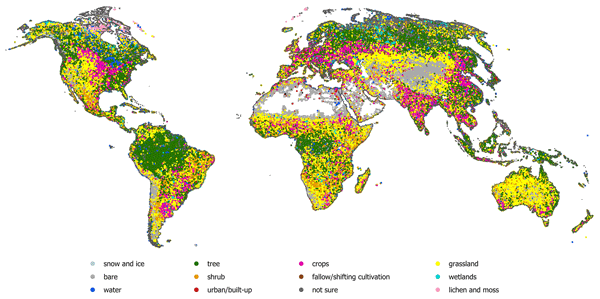
This paper presents a unique global reference data set for land cover mapping at a 10 m resolution, aligned with Sentinel-2 imagery for the year 2015. It contains more than 16.5 million data records at a 10 m resolution (or 165 K data records at 100 m) and information on 12 different land cover classes. The data set was collected by a group of experts through visual interpretation of very high resolution imagery, along with other sources of information provided in the Geo-Wiki platform.
Basil Kraft, Jacob A. Nelson, Sophia Walther, Fabian Gans, Ulrich Weber, Gregory Duveiller, Markus Reichstein, Weijie Zhang, Marc Rußwurm, Devis Tuia, Marco Körner, Zayd Hamdi, and Martin Jung
Biogeosciences, 22, 3965–3987, https://doi.org/10.5194/bg-22-3965-2025, https://doi.org/10.5194/bg-22-3965-2025, 2025
Short summary
Short summary
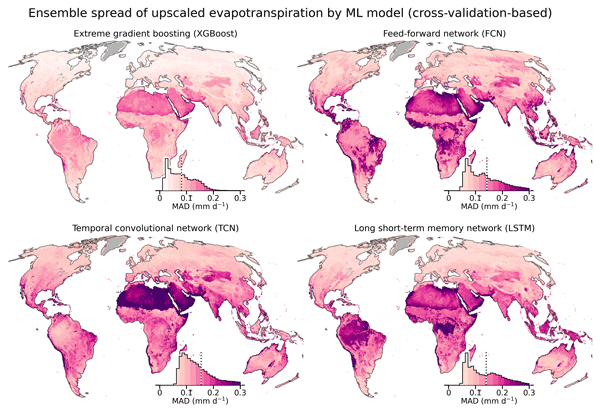
This study evaluates machine learning approaches for upscaling evapotranspiration from the site to the global scale. Sequential models capture temporal dynamics better, especially with precipitation data, but all models show biases in data-scarce regions. Improved upscaling requires richer training data, informed covariate selection, and physical constraints to enhance robustness and reduce extrapolation errors.
Nicolas Lampach, Jon Olav Skøien, Helena Ramos, Julien Gaffuri, Renate Koeble, Linda See, and Marijn van der Velde
Earth Syst. Sci. Data, 17, 3893–3919, https://doi.org/10.5194/essd-17-3893-2025, https://doi.org/10.5194/essd-17-3893-2025, 2025
Short summary
Short summary
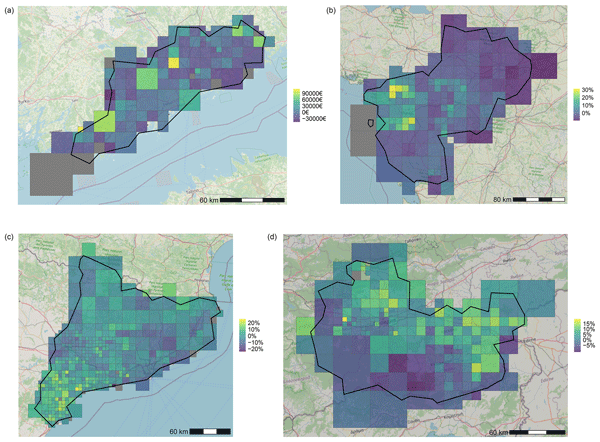
Eurostat and the Joint Research Centre developed a new methodology to make geospatial data from agricultural census available to users while ensuring that no confidential information from individuals is disclosed. The geospatial data presented in the article correspond to the contextual indicators of the monitoring framework of the Common Agricultural Policy. Our exploratory analysis reveals several interesting patterns which contribute to the broader debate on the future of European agriculture.
Zavud Baghirov, Martin Jung, Markus Reichstein, Marco Körner, and Basil Kraft
Geosci. Model Dev., 18, 2921–2943, https://doi.org/10.5194/gmd-18-2921-2025, https://doi.org/10.5194/gmd-18-2921-2025, 2025
Short summary
Short summary
We use an innovative approach to studying the Earth's water cycle by integrating advanced machine learning techniques with a traditional water cycle model. Our model is designed to learn from observational data, with a particular emphasis on understanding the influence of vegetation on water movement. By closely aligning with real-world observations, our model offers new possibilities for enhancing our understanding of the water cycle and its interactions with vegetation.
Raphaël d'Andrimont, Momchil Yordanov, Fernando Sedano, Astrid Verhegghen, Peter Strobl, Savvas Zachariadis, Flavia Camilleri, Alessandra Palmieri, Beatrice Eiselt, Jose Miguel Rubio Iglesias, and Marijn van der Velde
Earth Syst. Sci. Data, 16, 5723–5735, https://doi.org/10.5194/essd-16-5723-2024, https://doi.org/10.5194/essd-16-5723-2024, 2024
Short summary
Short summary
The Land Use/Cover Area frame Survey (LUCAS) Copernicus 2022 is a large and systematic in situ field survey of 137 966 polygons over the European Union in 2022. The data contain 82 land cover classes and 40 land use classes.
Yuanxin Pan, Grzegorz Kłopotek, Laura Crocetti, Rudi Weinacker, Tobias Sturn, Linda See, Galina Dick, Gregor Möller, Markus Rothacher, Ian McCallum, Vicente Navarro, and Benedikt Soja
Atmos. Meas. Tech., 17, 4303–4316, https://doi.org/10.5194/amt-17-4303-2024, https://doi.org/10.5194/amt-17-4303-2024, 2024
Short summary
Short summary
Crowdsourced smartphone GNSS data were processed with a dedicated data processing pipeline and could produce millimeter-level accurate estimates of zenith total delay (ZTD) – a critical atmospheric variable. This breakthrough not only demonstrates the feasibility of using ubiquitous devices for high-precision atmospheric monitoring but also underscores the potential for a global, cost-effective tropospheric monitoring network.
Giulia Ronchetti, Luigi Nisini Scacchiafichi, Lorenzo Seguini, Iacopo Cerrani, and Marijn van der Velde
Earth Syst. Sci. Data, 16, 1623–1649, https://doi.org/10.5194/essd-16-1623-2024, https://doi.org/10.5194/essd-16-1623-2024, 2024
Short summary
Short summary
We present a dataset of EU-wide harmonized subnational crop area, production, and yield statistics with information on data sources, processing steps, missing and derived data, and quality checks. Statistical records (344 282) collected from 1975 to 2020 for soft and durum wheat, winter and spring barley, grain maize, sunflower, and sugar beet were aligned with the EUROSTAT crop legend and the 2016 territorial classification for 961 regions. Time series have a median length of 21 years.
Raphaël d'Andrimont, Martin Claverie, Pieter Kempeneers, Davide Muraro, Momchil Yordanov, Devis Peressutti, Matej Batič, and François Waldner
Earth Syst. Sci. Data, 15, 317–329, https://doi.org/10.5194/essd-15-317-2023, https://doi.org/10.5194/essd-15-317-2023, 2023
Short summary
Short summary
AI4boundaries is an open AI-ready data set to map field boundaries with Sentinel-2 and aerial photography provided with harmonised labels covering seven countries and 2.5 M parcels in Europe.
Raphaël d'Andrimont, Momchil Yordanov, Laura Martinez-Sanchez, Peter Haub, Oliver Buck, Carsten Haub, Beatrice Eiselt, and Marijn van der Velde
Earth Syst. Sci. Data, 14, 4463–4472, https://doi.org/10.5194/essd-14-4463-2022, https://doi.org/10.5194/essd-14-4463-2022, 2022
Short summary
Short summary
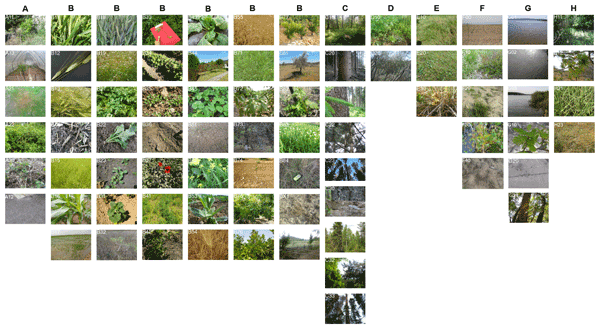
Between 2006 and 2018, 875 661 LUCAS cover (i.e. close-up) photos were taken over a systematic sample of the European Union. This geo-located photo dataset has been curated and is being made available along with the surveyed label data, including land cover and plant species.
Simone Persiano, Alessio Pugliese, Alberto Aloe, Jon Olav Skøien, Attilio Castellarin, and Alberto Pistocchi
Earth Syst. Sci. Data, 14, 4435–4443, https://doi.org/10.5194/essd-14-4435-2022, https://doi.org/10.5194/essd-14-4435-2022, 2022
Short summary
Short summary
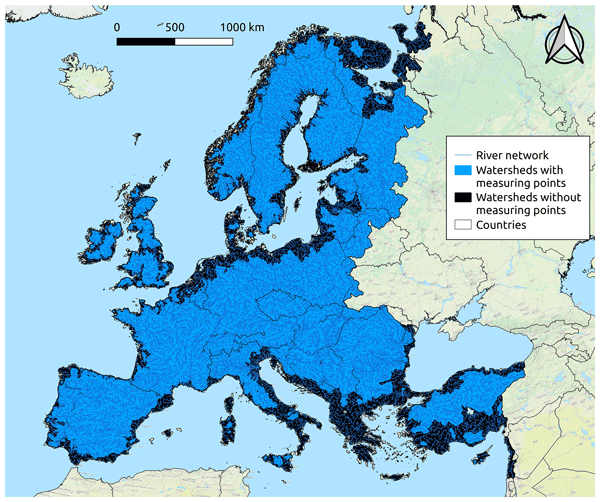
For about 24000 river basins across Europe, this study provides a continuous representation of the streamflow regime in terms of empirical flow–duration curves (FDCs), which are key signatures of the hydrological behaviour of a catchment and are widely used for supporting decisions on water resource management as well as for assessing hydrologic change. FDCs at ungauged sites are estimated by means of a geostatistical procedure starting from data observed at about 3000 sites across Europe.
Vera Thiemig, Goncalo N. Gomes, Jon O. Skøien, Markus Ziese, Armin Rauthe-Schöch, Elke Rustemeier, Kira Rehfeldt, Jakub P. Walawender, Christine Kolbe, Damien Pichon, Christoph Schweim, and Peter Salamon
Earth Syst. Sci. Data, 14, 3249–3272, https://doi.org/10.5194/essd-14-3249-2022, https://doi.org/10.5194/essd-14-3249-2022, 2022
Short summary
Short summary
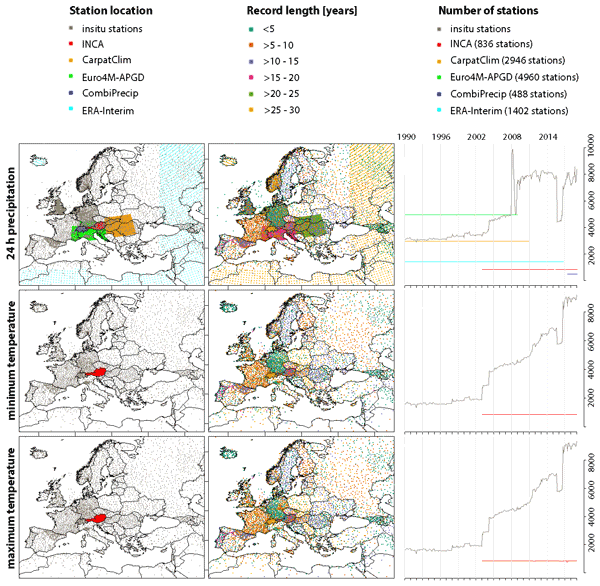
EMO-5 is a free and open European high-resolution (5 km), sub-daily, multi-variable (precipitation, temperatures, wind speed, solar radiation, vapour pressure), multi-decadal meteorological dataset based on quality-controlled observations coming from almost 30 000 stations across Europe, and is produced in near real-time. EMO-5 (v1) covers the time period from 1990 to 2019. In this paper, we have provided insight into the source data, the applied methods, and the quality assessment of EMO-5.
Francesco Dottori, Lorenzo Alfieri, Alessandra Bianchi, Jon Skoien, and Peter Salamon
Earth Syst. Sci. Data, 14, 1549–1569, https://doi.org/10.5194/essd-14-1549-2022, https://doi.org/10.5194/essd-14-1549-2022, 2022
Short summary
Short summary
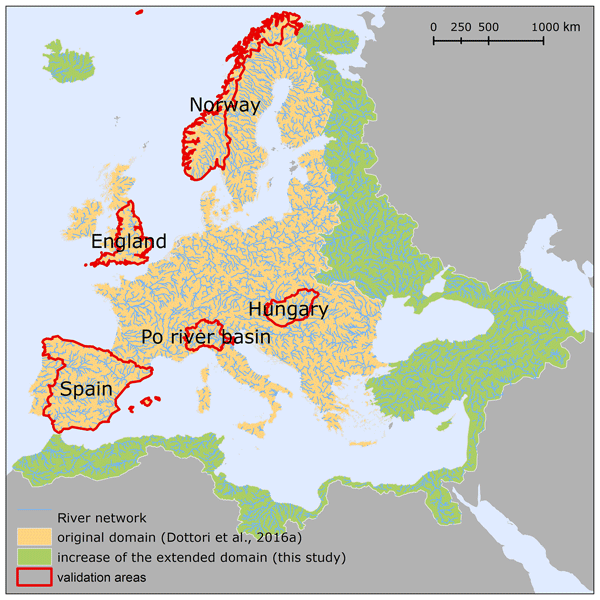
We present a set of hazard maps for river flooding for Europe and the Mediterranean basin. The maps depict inundation extent and depth for flood probabilities for up to 1-in-500-year flood hazards and are based on hydrological and hydrodynamic models driven by observed climatology. The maps can identify two-thirds of the flood extent reported by official flood maps, with increasing skill for higher-magnitude floods. The maps are used for evaluating present and future impacts of river floods.
Basil Kraft, Martin Jung, Marco Körner, Sujan Koirala, and Markus Reichstein
Hydrol. Earth Syst. Sci., 26, 1579–1614, https://doi.org/10.5194/hess-26-1579-2022, https://doi.org/10.5194/hess-26-1579-2022, 2022
Short summary
Short summary
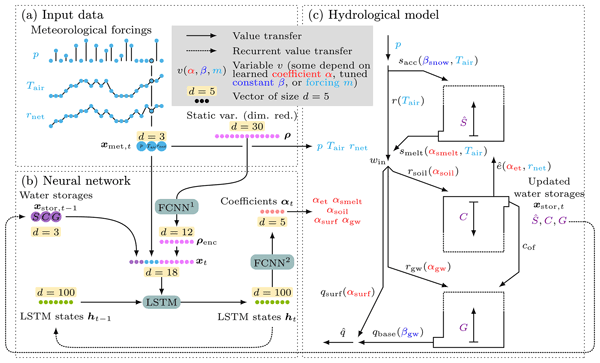
We present a physics-aware machine learning model of the global hydrological cycle. As the model uses neural networks under the hood, the simulations of the water cycle are learned from data, and yet they are informed and constrained by physical knowledge. The simulated patterns lie within the range of existing hydrological models and are plausible. The hybrid modeling approach has the potential to tackle key environmental questions from a novel perspective.
Cited articles
Arnold, S., Kosztra, B., Banko, G., Smith, G., Hazeu, G., Bock, M., and Valcarcel, N.: The EAGLE concept – A vision of a future European Land Monitoring Framework, in: EARSeL Symposium Proceedings “Towards Horizon 2020”, https://www.earsel.org/symposia/2013-symposium-Matera/pdf_proceedings/EARSeL-Symposium-2013_10_2 _Arnold.pdf (last access: 1 June 2026), 2013. a, b
Barbottin, A., Bouty, C., and Martin, P.: Using the French LPIS database to highlight farm area dynamics: The case study of the Niort Plain, Land Use Policy, 73, 281–289, https://doi.org/10.1016/j.landusepol.2018.02.012, 2018. a
Barriere, V., Claverie, M., Schneider, M., Lemoine, G., and d'Andrimont, R.: Boosting crop classification by hierarchically fusing satellite, rotational, and contextual data, Remote Sens. Environ., 305, 114110, https://doi.org/10.1016/j.rse.2024.114110, 2024. a, b
Cantelaube, P. and Lardot, B.: Construction d'une base de données géographiques exhaustive à échelle fine sur l'occupation agricole du sol: le “RPG complété”, hal-03818008f, INRAE, https://hal.inrae.fr/hal-03818008v1 (last access: 1 June 2026), 2022. a
Chantellier, V., Détang-Dessendre, C., and Guyomard, H.: A brief history of the CAP, in: Evolving the Common Agricultural Policy for Tomorrow's Challenges, edited by: Détang-Dessendre, C. and Guyomard, H., editions Quae, Versailles, 21–35, https://library.oapen.org/bitstream/handle/20.500.12657/63165/9782759237159.pdf (last access: 1 June 2026), 2022. a
Claverie, M., D'Andrimont, R., Donezar, U., Forslund, L., and Van der Velde, M.: Assessing the quality of new HRL Crop Types: A comparative analysis with farmers' declarations across the European Union, in: EO for Agriculture Under Pressure Workshop 2024, ESA-ESRIN, Frascati, Italy, 2024. a
Claverie, M., Yordanov, M., Chan, A. and Ramos, H.: EuroCropsV2, GitHub [code], https://github.com/Martincccc/EuroCropsV2 (last access: 1 June 2026), 2026. a
d'Andrimont, R., Verhegghen, A., Lemoine, G., Kempeneers, P., Meroni, M., and Van der Velde, M.: From parcel to continental scale – A first European crop type map based on Sentinel-1 and LUCAS Copernicus in-situ observations, Remote Sens. Environ., 266, 112708, https://doi.org/10.1016/j.rse.2021.112708, 2021. a
d'Andrimont, R., Claverie, M., Kempeneers, P., Muraro, D., Yordanov, M., Peressutti, D., Batič, M., and Waldner, F.: AI4Boundaries: an open AI-ready dataset to map field boundaries with Sentinel-2 and aerial photography, Earth Syst. Sci. Data, 15, 317–329, https://doi.org/10.5194/essd-15-317-2023, 2023. a, b
EU Copernicus: EAGLE Matrix, https://land.copernicus.eu/en/technical-library/eagle-matrix-3_2 (last access: 1 June 2026), 2023a. a
EU Copernicus: OBSERVER: Vegetated Land Cover Characteristics (VLCC): A New Era of Land Monitoring, https://www.copernicus.eu/en/news/news/observer-vegetated-land-cover-characteristics-vlcc-new-era-land -monitoring (last access: 1 June 2026), 2023b. a
European Commission: Corporate Reference Data Management policy in the European Commission, Publications Office of the European Union, https://op.europa.eu/en/web/eu-vocabularies/corporate-reference-data-management (last access: 1 June 2026), 2019. a
European Commission: Integrated Administration and Control System (IACS), https://agriculture.ec.europa.eu/common-agricultural-policy/financing-cap/assurance-and-audit/managing-payments_en#elements-of-the-iacs (last access: 1 June 2026), 2021. a
European Commission: Commission delegated regulation (EU) 2022/1172 of 4 May 2022 supplementing Regulation (EU) 2021/2116 of the European Parliament and of the Council with regard to the integrated administration and control system in the common agricultural policy and the application and calculation of administrative penalties for conditionality, https://eur-lex.europa.eu/eli/reg_del/2022/1172/oj (last access: 1 June 2026), 2022. a
European Commission: Commission implementing regulation (EU) 2023/138 of 21 December 2022 laying down a list of specific high-value datasets and the arrangements for their publication and re-use, https://eur-lex.europa.eu/eli/reg_impl/2023/138/oj (last access: 1 June 2026), 2023a. a
European Commission: The common agricultural policy: 2023-27, https://agriculture.ec.europa.eu/common-agricultural-policy/cap-overview/cap-2023-27_en (last access: 1 June 2026), 2023b. a
European Commission: Farm accountancy data network, https://agriculture.ec.europa.eu/data-and-analysis/farm-structures-and-economics/fadn_en (last access: 1 June 2026), 2023c. a
European Commission. Joint Research Centre: EuroCropsV2 [Dataset], European Commission. Joint Research Centre [data set], https://doi.org/10.2905/b9fb9e67-78a9-4327-9d59-39a928d812d3, 2026. a, b
European Network for Rural Development: The Farm Accountancy Data Network, https://ec.europa.eu/enrd/evaluation/back-basics/farm-accountancy-data-network_en.html (last access: 1 June 2026), 2020. a
Eurostat: Land cover statistics, https://ec.europa.eu/eurostat/statistics-explained/index.php?title=Land_cover_statistics (last access: 1 June 2026), 2021. a
Eurostat: LUCAS 2022 (Land Use/Cover Area Frame Survey), Technical reference document C1, Instructions for Surveyors, https://ec.europa.eu/eurostat/documents/205002/13686460/C1-LUCAS-2022.pdf (last access: 1 June 2026), 2022a. a
Eurostat: LUCAS 2022 (Land Use/Cover Area Frame Survey), Technical reference document C3 Classification (Land cover & Land use), Tech. rep., Eurostat, https://ec.europa.eu/eurostat/documents/205002/13686460/C3-LUCAS-2022.pdf (last access: 1 June 2026), 2022b. a
Eurostat: Farm Accountancy Data Network, https://ec.europa.eu/eurostat/statistics-explained/index.php?title=Farm_structure_survey_-_administrative_sources (last access: 1 June 2026), 2023b. a
Eurostat: NACE Rev. 2.1 – Statistical classification of economic activities in the European Union, 2025 Edition, Manuals and Guidelines, Publications Office of the European Union, Luxembourg, https://ec.europa.eu/eurostat/web/products-manuals-and-guidelines/w/ks-gq-24-007 (last access: 1 June 2026), 2025a. a
Eurostat: Code lists, https://ec.europa.eu/eurostat/web/metadata/code-lists (last access: 20 February 2025), 2025b. a
Eurostat: Agriculture Database, https://ec.europa.eu/eurostat/web/agriculture/database (last access: 24 July 2024), 2025c. a
Eurostat: Reference metadata, Crop production (apro_cp), https://ec.europa.eu/eurostat/cache/metadata/en/apro_cp_esms.htm#shortsource_typeDisseminated (last access: 1 June 2026), 2025d. a
Gackstetter, D., Körner, M., and Yu, K.: Approaching holistic crop type mapping in Europe through winter vegetation classification and the Hierarchical Crop and Agriculture Taxonomy, Int. J. Appl. Earth Obs. Geoinf., 134, 104159, https://doi.org/10.1016/j.jag.2024.104159, 2024. a
Ghassemi, B., Izquierdo-Verdiguier, E., Verhegghen, A., Yordanov, M., Lemoine, G., Moreno Martínez, A., De Marchi, D., Van Der Velde, M., Vuolo, F., and d'Andrimont, R.: European Union crop map 2022: Earth observation's 10-meter dive into Europe's crop tapestry, Sci. Data, 11, 1048, https://doi.org/10.1038/s41597-024-03884-y, 2024. a
Holden, P., Davis, T., Holmes, C., Senaras, C., and Wania, A.: RapidCrops: A pan-European label dataset for large-scale crop classification, Zenodo [data set], https://doi.org/10.5281/zenodo.15166359, 2025. a
Jänicke, C., Petersen, K. A., Schmidts, P., Müller, D., and Jepsen, M. R.: Field and farm-level data on agricultural land use for the European Union, Sci. Data, 12, 1050, https://doi.org/10.1038/s41597-025-05210-6, 2025. a, b, c, d
Lampach, N., Skøien, J. O., Ramos, H., Gaffuri, J., Koeble, R., See, L., and Van Der Velde, M.: Statistical atlas of European agriculture: gridded data from the agricultural census 2020 and the spatial distribution of CAP contextual indicators, Earth Syst. Sci. Data, 17, 3893–3919, https://doi.org/10.5194/essd-17-3893-2025, 2025. a
Li, W., Liang, S., Zhang, Y., Liu, L., Chen, K., Chen, Y., Ma, H., Xu, J., Ma, Y., Guan, S., and Shi, Z.: Fine-grained hierarchical crop type classification from integrated hyperspectral EnMAP data and multispectral Sentinel-2 time series: A large-scale dataset and dual-stream transformer method, arXiv [perprint], arXiv:2506.06155 [cs], https://doi.org/10.48550/arXiv.2506.06155, 2025. a, b
Machefer, M., Zampieri, M., Van Der Velde, M., Dentener, F., Claverie, M., and d'Andrimont, R.: Earth Observation based multi-scale analysis of crop diversity in the European Union: First insights for agro-environmental policies, Agr. Ecosyst. Environ., 374, 109143, https://doi.org/10.1016/j.agee.2024.109143, 2024. a
Ouda, S., Zohry, A. E.-H., and Noreldin, T.: Crop Rotation: An Approach to Secure Future Food, Springer International Publishing, Cham, ISBN 978-3-030-05350-5, https://doi.org/10.1007/978-3-030-05351-2, 2018. a
Pointereau, P., Coulon, F., Jiguet, F., Doxa, A., Paracchini, M.-L., and Terres, J.-M.: Les systèmes agricoles à haute valeur naturelle en France métropolitaine, https://solagro.org/images/imagesCK/files/article_HVN_INRA.pdf (last access: 1 June 2026), 2010. a
Reumaux, R., Chopin, P., Bergkvist, G., Watson, C. A., and Öborn, I.: Land Parcel Identification System (LPIS) data allows identification of crop sequence patterns and diversity in organic and conventional farming systems, Eur. J. Agron., 149, 126916, https://doi.org/10.1016/j.eja.2023.126916, 2023. a
Schneider, M., Broszeit, A., and Körner, M.: EuroCrops: A pan-european dataset for time series crop type classification, in: Proceedings of the 2021 conference on Big Data from Space, edited by: Soille, P., Loekken, S., and Albani, S., Publications Office of the European Union, Luxembourg, https://data.europa.eu/doi/10.2760/125905 (last access: 1 June 2026), 2021. a
Schneider, M., Gackstetter, D., Prexl, J., Meyer, S. T., and Körner, M.: Advancing transnational assessments of biodiversity drivers in European agriculture with an updated hierarchical crop and agriculture taxonomy (HCAT), npj Sustain. Agricult., 3, 3, https://doi.org/10.1038/s44264-024-00037-x, 2025. a, b
Skøien, J. O., Lampach, N., Ramos, H., Seljak, R., Koeble, R., See, L., and van der Velde, M.: A flexible approach for statistical disclosure control in geospatial data, J. Geogr. Syst., 27, 341–367, https://doi.org/10.1007/s10109-025-00472-5, 2025. a
Tang, F. H. M., Nguyen, T. H., Conchedda, G., Casse, L., Tubiello, F. N., and Maggi, F.: CROPGRIDS: a global geo-referenced dataset of 173 crops, Sci. Data, 11, 413, https://doi.org/10.1038/s41597-024-03247-7, 2024. a
Van Tricht, K., Degerickx, J., Gilliams, S., Zanaga, D., Battude, M., Grosu, A., Brombacher, J., Lesiv, M., Bayas, J. C. L., Karanam, S., Fritz, S., Becker-Reshef, I., Franch, B., Mollà-Bononad, B., Boogaard, H., Pratihast, A. K., Koetz, B., and Szantoi, Z.: WorldCereal: a dynamic open-source system for global-scale, seasonal, and reproducible crop and irrigation mapping, Earth Syst. Sci. Data, 15, 5491–5515, https://doi.org/10.5194/essd-15-5491-2023, 2023. a
Wegscheider, S., Stumpf, A., Siegert, C., Acar, E., De Roo, B., Gasber, T., and Faucqueur, L.: Copernicus Land Monitoring Service – High Resolution Layer – Vegetated Land Cover Characteristics, D1.12 HRL VLCC Product User Manual, Tech. rep., European Environment Agency, Denmark, Copenhagen, https://library.land.copernicus.eu/products/High_Resolution_Layer_Croplands_2017-present_PUM_v2.html (last access: 1 June 2026), 2024. a, b
Wojda, P., Escrui Paradell, J., Minghini, M., Kotsev, A., Toth, K., Schillaci, C., Simoes Vieira, D., Matthews, F., De Rosa, D., Martin Jimenez, J., De Medici, D., Scarpa, S., and Jones, A.: IACS data sharing project, JRC Technical Report, JRC, European Commission, Ispra, Italy, https://publications.jrc.ec.europa.eu/repository/handle/JRC132427 (last access: 1 June 2026), 2023. a
Short summary
The Eurocrops v2.0 dataset contains several years of farmer crop declarations from 16 Member States for the Common Agricultural Policy. These data were harmonized with a crop taxonomy and then linked to other classification systems including agricultural statistics and remotely sensed products. This dataset can support researchers and policy makers in tracking changes over time, calculating crop rotations, for national comparisons, for evaluating official statistics and for remote sensing.
The Eurocrops v2.0 dataset contains several years of farmer crop declarations from 16 Member...


Altmetrics
Final-revised paper
Preprint