Articles | Volume 18, issue 10
https://doi.org/10.5194/essd-18-7661-2026
© Author(s) 2026. This work is distributed under
the Creative Commons Attribution 4.0 License.
the Creative Commons Attribution 4.0 License.
https://doi.org/10.5194/essd-18-7661-2026
© Author(s) 2026. This work is distributed under
the Creative Commons Attribution 4.0 License.
the Creative Commons Attribution 4.0 License.
Data description article
| 
21 Oct 2026
Data description article |
| 21 Oct 2026
| 21 Oct 2026
A paired marine-fluvial modern pollen dataset from the Bohai Sea and its inflowing rivers, China
Jie Li
Qingdao Institute of Marine Geology, China Geological Survey, Qingdao 266237, China

Qingdao Institute of Marine Geology, China Geological Survey, Qingdao 266237, China
Siyuan Ye
Qingdao Institute of Marine Geology, China Geological Survey, Qingdao 266237, China
Xiangjun Meng
Qingdao Institute of Marine Geology, China Geological Survey, Qingdao 266237, China
Xiaohui Chen
Qingdao Institute of Marine Geology, China Geological Survey, Qingdao 266237, China
Xi Mei
Qingdao Institute of Marine Geology, China Geological Survey, Qingdao 266237, China
Maosheng Gao
Qingdao Institute of Marine Geology, China Geological Survey, Qingdao 266237, China
Qian Hao
Institute of Surface-Earth System Science, School of Earth System Science, Tianjin University, Tianjin 300072, China
Xianyong Cao
Group of Alpine Paleoecology and Human Adaptation (ALPHA), State Key Laboratory of Tibetan Plateau Earth System, Environment and Resources (TPESER), Institute of Tibetan Plateau Research, Chinese Academy of Sciences, Beijing 100101, China
Bin Chen
Qingdao Institute of Marine Geology, China Geological Survey, Qingdao 266237, China
Sangheon Yi
Korea Institute of Geoscience and Mineral Resources, Daejeon 305–350, Republic of Korea
Guangming Zhao
CORRESPONDING AUTHOR
Qingdao Institute of Marine Geology, China Geological Survey, Qingdao 266237, China
Related authors
No articles found.
Linfeng Wei, Jian Ni, Xianyong Cao, and Stefan Kruse
EGUsphere, https://doi.org/10.5194/egusphere-2026-3246, https://doi.org/10.5194/egusphere-2026-3246, 2026
Short summary
Short summary
Warming can push mountain forests into higher habitats, but these changes may differ between rivers in mountain range area. We studied four river corridors in the Hengduan Mountains to understand how treeline may shift by 2100. The results show that treeline may move both upward and sideways, with different patterns among rivers. This suggests that future risks to high mountain habitats should be assessed locally rather than from elevation change alone.
Mengna Liao, Kai Li, Yili Jin, Lina Liu, Xianyong Cao, and Jian Ni
Earth Syst. Sci. Data, 17, 5601–5613, https://doi.org/10.5194/essd-17-5601-2025, https://doi.org/10.5194/essd-17-5601-2025, 2025
Short summary
Short summary
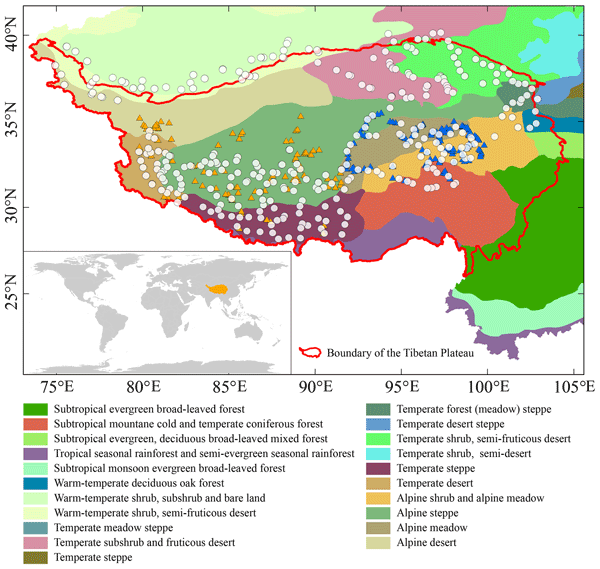
We present a modern pollen dataset comprising 555 pollen count records from 307 sites across the Tibetan Plateau (28–40° N and 75–103° E). This open-access dataset has diverse potential applications in paleoecological and paleoclimatic research. It provides a scientific basis for reconstructing temporal changes in climate and vegetation, and enables the assessment of pollen assemblages' reliability in representing the dynamics of vegetation cover, plant diversity, and functional traits.

Fang Tian, Weiyu Cao, Xiaohan Liu, Zixin Liu, and Xianyong Cao
Earth Syst. Sci. Data, 17, 5529–5542, https://doi.org/10.5194/essd-17-5529-2025, https://doi.org/10.5194/essd-17-5529-2025, 2025
Short summary
Short summary
We completed a modern pollen dataset obtained from 90 lakes from the Tibetan Plateau (TP), and integrated it with previous modern lacustrine pollen datasets. The comprehensive modern pollen dataset covers the full range of climatic gradients across the TP and all vegetation types. The modern pollen dataset has good predictive power in estimating net primary production and annual precipitation.
Chenzhi Li, Anne Dallmeyer, Jian Ni, Manuel Chevalier, Matteo Willeit, Andrei A. Andreev, Xianyong Cao, Laura Schild, Birgit Heim, Mareike Wieczorek, and Ulrike Herzschuh
Clim. Past, 21, 1001–1024, https://doi.org/10.5194/cp-21-1001-2025, https://doi.org/10.5194/cp-21-1001-2025, 2025
Short summary
Short summary
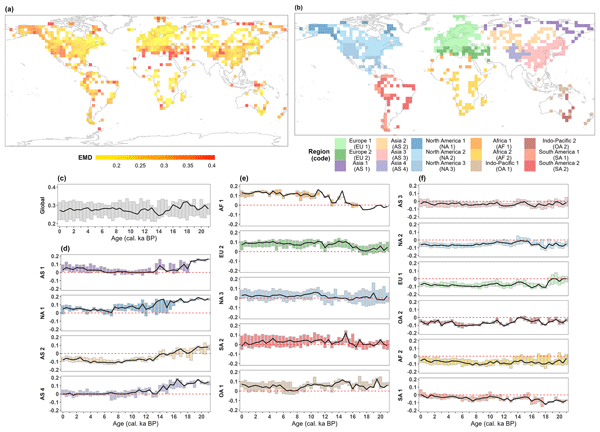
We present global megabiome dynamics and distributions derived from pollen-based reconstructions over the last 21 000 years, which are suitable for the evaluation of Earth-system-model-based paleo-megabiome simulations. We identified strong deviations between pollen- and model-derived megabiome distributions in the circum-Arctic and Tibetan Plateau areas during the Last Glacial Maximum and early deglaciation and in northern Africa and the Mediterranean region during the Holocene.
Xiaohuan Hou, Nannan Wang, Zhe Sun, Kan Yuan, Xianyong Cao, and Juzhi Hou
Clim. Past, 20, 335–348, https://doi.org/10.5194/cp-20-335-2024, https://doi.org/10.5194/cp-20-335-2024, 2024
Short summary
Short summary
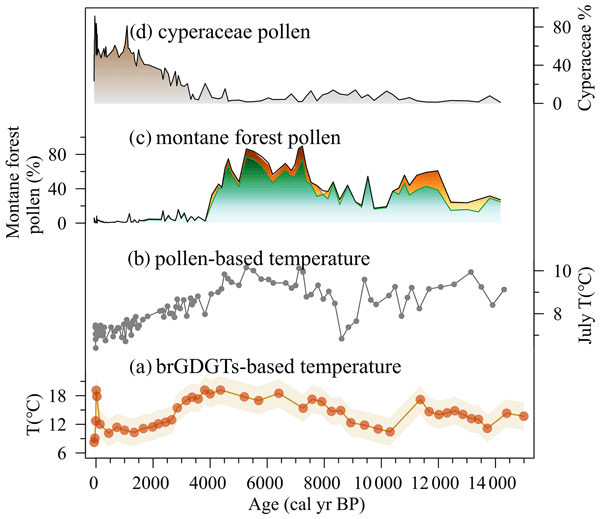
We present an ice-free season temperature based on brGDGTs over last 15 kyr on the eastern Tibetan Plateau (TP). The result shows that Holocene Thermal Maximum occurred during 8–3.5 ka, which lags behind pollen-based temperature recorded in same core, indicating a significant seasonal bias between different proxies. We also investigated previously published brGDGT-based temperatures on the TP to determine the pattern of Holocene temperature changes and possible reasons for the diverse records.
Ulrike Herzschuh, Thomas Böhmer, Manuel Chevalier, Raphaël Hébert, Anne Dallmeyer, Chenzhi Li, Xianyong Cao, Odile Peyron, Larisa Nazarova, Elena Y. Novenko, Jungjae Park, Natalia A. Rudaya, Frank Schlütz, Lyudmila S. Shumilovskikh, Pavel E. Tarasov, Yongbo Wang, Ruilin Wen, Qinghai Xu, and Zhuo Zheng
Clim. Past, 19, 1481–1506, https://doi.org/10.5194/cp-19-1481-2023, https://doi.org/10.5194/cp-19-1481-2023, 2023
Short summary
Short summary
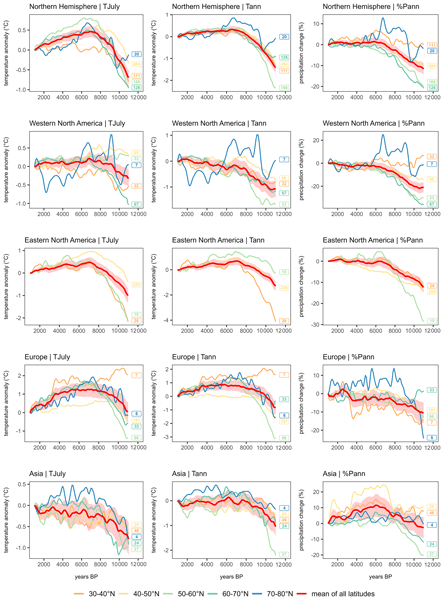
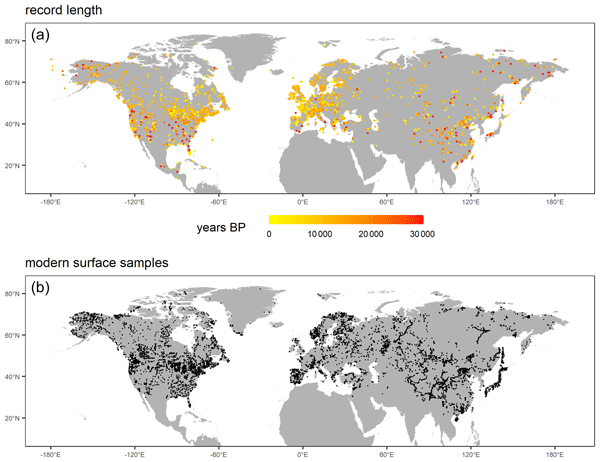
A mismatch between model- and proxy-based Holocene climate change may partially originate from the poor spatial coverage of climate reconstructions. Here we investigate quantitative reconstructions of mean annual temperature and annual precipitation from 1908 pollen records in the Northern Hemisphere. Trends show strong latitudinal patterns and differ between (sub-)continents. Our work contributes to a better understanding of the global mean.
Ulrike Herzschuh, Thomas Böhmer, Chenzhi Li, Manuel Chevalier, Raphaël Hébert, Anne Dallmeyer, Xianyong Cao, Nancy H. Bigelow, Larisa Nazarova, Elena Y. Novenko, Jungjae Park, Odile Peyron, Natalia A. Rudaya, Frank Schlütz, Lyudmila S. Shumilovskikh, Pavel E. Tarasov, Yongbo Wang, Ruilin Wen, Qinghai Xu, and Zhuo Zheng
Earth Syst. Sci. Data, 15, 2235–2258, https://doi.org/10.5194/essd-15-2235-2023, https://doi.org/10.5194/essd-15-2235-2023, 2023
Short summary
Short summary
Climate reconstruction from proxy data can help evaluate climate models. We present pollen-based reconstructions of mean July temperature, mean annual temperature, and annual precipitation from 2594 pollen records from the Northern Hemisphere, using three reconstruction methods (WA-PLS, WA-PLS_tailored, and MAT). Since no global or hemispheric synthesis of quantitative precipitation changes are available for the Holocene so far, this dataset will be of great value to the geoscientific community.
Manuel Chevalier, Anne Dallmeyer, Nils Weitzel, Chenzhi Li, Jean-Philippe Baudouin, Ulrike Herzschuh, Xianyong Cao, and Andreas Hense
Clim. Past, 19, 1043–1060, https://doi.org/10.5194/cp-19-1043-2023, https://doi.org/10.5194/cp-19-1043-2023, 2023
Short summary
Short summary
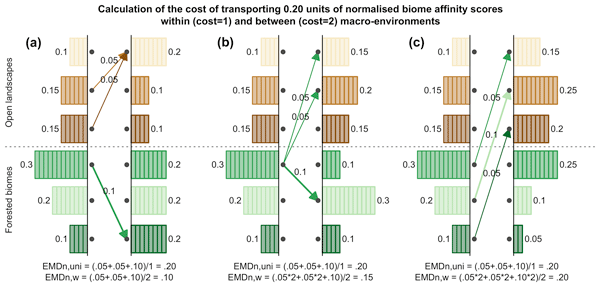
Data–data and data–model vegetation comparisons are commonly based on comparing single vegetation estimates. While this approach generates good results on average, reducing pollen assemblages to single single plant functional type (PFT) or biome estimates can oversimplify the vegetation signal. We propose using a multivariate metric, the Earth mover's distance (EMD), to include more details about the vegetation structure when performing such comparisons.
Furong Li, Marie-José Gaillard, Xianyong Cao, Ulrike Herzschuh, Shinya Sugita, Jian Ni, Yan Zhao, Chengbang An, Xiaozhong Huang, Yu Li, Hongyan Liu, Aizhi Sun, and Yifeng Yao
Earth Syst. Sci. Data, 15, 95–112, https://doi.org/10.5194/essd-15-95-2023, https://doi.org/10.5194/essd-15-95-2023, 2023
Short summary
Short summary
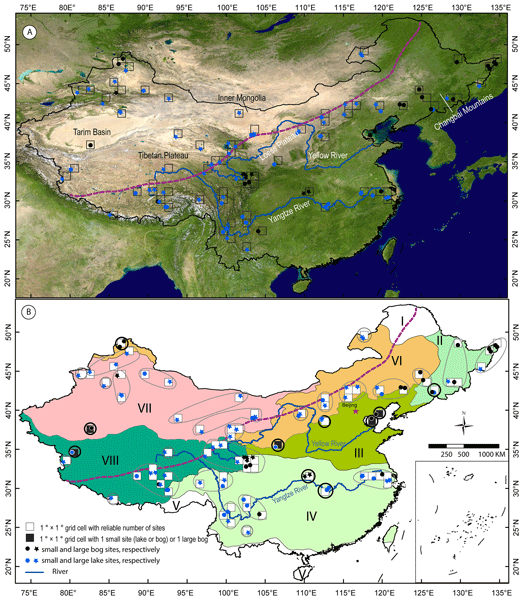
The objective of this study is present the first gridded and temporally continuous quantitative plant-cover reconstruction for temperate and northern subtropical China over the last 12 millennia. The reconstructions are based on 94 pollen records and include estimates for 27 plant taxa, 10 plant functional types, and 3 land-cover types. The dataset is suitable for palaeoclimate modelling and the evaluation of simulated past vegetation cover and anthropogenic land-cover change from models.

Nannan Wang, Lina Liu, Xiaohuan Hou, Yanrong Zhang, Haicheng Wei, and Xianyong Cao
Clim. Past, 18, 2381–2399, https://doi.org/10.5194/cp-18-2381-2022, https://doi.org/10.5194/cp-18-2381-2022, 2022
Short summary
Short summary
We reconstructed the vegetation and climate change since the last 14.2 ka BP from a fossil pollen record together with multiple proxies (grain size, contents of total organic carbon and total nitrogen) on the northeast Tibetan Plateau. The results reveal that an arid climate occurs in the early Holocene and the vegetation could be disturbed by human activities to some extent after ca. 0.24 ka BP (1710 CE).
Ulrike Herzschuh, Chenzhi Li, Thomas Böhmer, Alexander K. Postl, Birgit Heim, Andrei A. Andreev, Xianyong Cao, Mareike Wieczorek, and Jian Ni
Earth Syst. Sci. Data, 14, 3213–3227, https://doi.org/10.5194/essd-14-3213-2022, https://doi.org/10.5194/essd-14-3213-2022, 2022
Short summary
Short summary
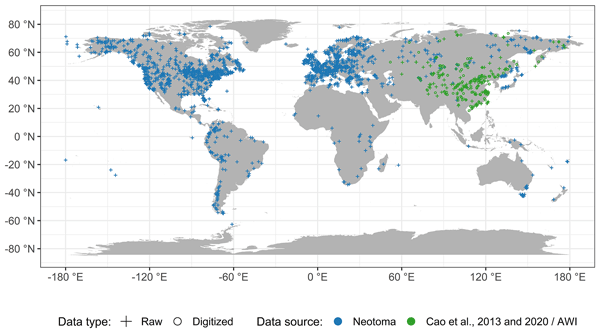
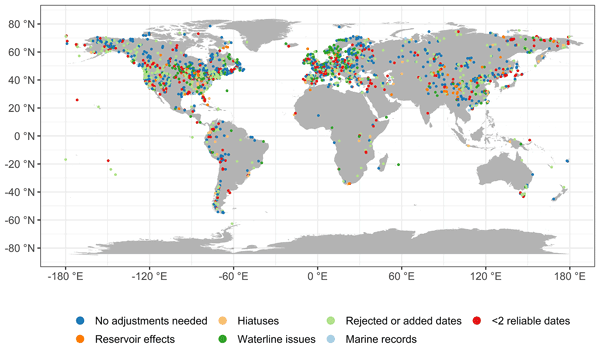
Pollen preserved in environmental archives such as lake sediments and bogs are extensively used for reconstructions of past vegetation and climate. Here we present LegacyPollen 1.0, a dataset of 2831 fossil pollen records from all over the globe that were collected from publicly available databases. We harmonized the names of the pollen taxa so that all datasets can be jointly investigated. LegacyPollen 1.0 is available as an open-access dataset.
Chenzhi Li, Alexander K. Postl, Thomas Böhmer, Xianyong Cao, Andrew M. Dolman, and Ulrike Herzschuh
Earth Syst. Sci. Data, 14, 1331–1343, https://doi.org/10.5194/essd-14-1331-2022, https://doi.org/10.5194/essd-14-1331-2022, 2022
Short summary
Short summary
Here we present a global chronology framework of 2831 palynological records, including globally harmonized chronologies covering up to 273 000 years. A comparison with the original chronologies reveals a major improvement according to our assessment. Our chronology framework and revised chronologies will interest a broad geoscientific community, as it provides the opportunity to make use in synthesis studies of, for example, pollen-based vegetation and climate change.
Xianzhang Dang, Maosheng Gao, Zhang Wen, Guohua Hou, Hamza Jakada, Daniel Ayejoto, and Qiming Sun
Hydrol. Earth Syst. Sci., 26, 1341–1356, https://doi.org/10.5194/hess-26-1341-2022, https://doi.org/10.5194/hess-26-1341-2022, 2022
Short summary
Short summary
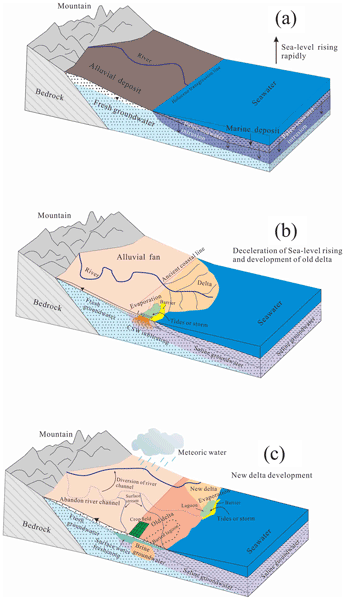
Due to the widespread salinity in coastal zones, freshwater supplies are now under pressure. This study analyzes the recharge and salinity sources of coastal groundwater (brine, saline, brackish, fresh), as well as salinization and freshening processes, using hydrochemical and isotopic methods. The evolution of saline groundwater is studied using sedimentary characteristics as multiple lines of evidence. This study can be used to better understand groundwater evolution in the coastal zone.
Cited articles
An, Z. S.: The history and variability of the East Asian paleomonsoon climate, Quat. Sci. Rev., 19, 171–187, https://doi.org/10.1016/S0277-3791(99)00060-8, 2000.
Blanchet, F. G., Legendre, P., and Borcard, D.: Forward selection of explanatory variables, Ecology, 89, 2623–2632, https://doi.org/10.1890/07-0986.1, 2008.
Blott, S. J. and Pye, K.: GRADISTAT: a grain size distribution and statistics package for the analysis of unconsolidated sediments, Earth Surf. Proc. Land., 26, 1237–1248, https://doi.org/10.1002/esp.261, 2001.
Brush, G. S., Brush, L. M., and Traverse, A.: Transport and deposition of pollen in an estuary: signature of the landscape. Sedimentation of organic particles, Cambridge University Press, Cambridge, 33–46, https://doi.org/10.1017/CBO9780511524875, 1994.
Chen, M. T., Shiau, L. J., Yu, P. S., Chiu, T. C., Chen, Y. G., and Wei, K. Y.: 500 000-Year records of carbonate, organic carbon, and foraminiferal sea-surface temperature from the southeastern South China Sea (near Palawan Island), Palaeogeogr. Palaeocl., 197, 113–131, https://doi.org/10.1016/S0031-0182(03)00389-4, 2003.
Chen, Z., Wu, S., and Xia, D.: The Bay Chorography in China, Ocean Press, Beijing, ISBN 7502743327, 1998.
Chmura, G. L. and Liu, K.-B.: Pollen in the lower Mississippi River, Rev. Palaeobot. Palyno., 64, 253–261, https://doi.org/10.1016/0034-6667(90)90140-E, 1990.
Chmura, G. L., Smirnov, A., and Campbell, I. D.: Pollen transport through distributaries and depositional patterns in coastal waters, Palaeogeogr. Palaeocl., 149, 257–270, https://doi.org/10.1016/S0031-0182(98)00205-3, 1999.
Davis, B. A. S., Zanon, M., Collins, P., Mauri, A., Bakker, J., Barboni, D., Barthelmes, A., Beaudouin, C., Bjune, A. E., Bozilova, E., Bradshaw, R. H. W., Brayshay, B. A., Brewer, S., Brugiapaglia, E., Bunting, J., Connor, S. E., de Beaulieu, J.-L., Edwards, K., Ejarque, A., Fall, P., Florenzano, A., Fyfe, R., Galop, D., Giardini, M., Giesecke, T., Grant, M. J., Guiot, J., Jahns, S., Jankovská, V., Juggins, S., Kahrmann, M., Karpińska-Kołaczek, M., Kołaczek, P., Kühl, N., Kuneš, P., Lapteva, E. G., Leroy, S. A. G., Leydet, M., López Sáez, J. A., Masi, A., Matthias, I., Mazier, F., Meltsov, V., Mercuri, A. M., Miras, Y., Mitchell, F. J. G., Morris, J. L., Naughton, F., Nielsen, A. B., Novenko, E., Odgaard, B., Ortu, E., Overballe-Petersen, M. V., Pardoe, H. S., Peglar, S. M., Pidek, I. A., Sadori, L., Seppä, H., Severova, E., Shaw, H., Święta-Musznicka, J., Theuerkauf, M., Tonkov, S., Veski, S., van der Knaap, W. O., van Leeuwen, J. F. N., Woodbridge, J., Zimny, M., and Kaplan, J. O.: The European Modern Pollen Database (EMPD) project, Veg. Hist. Archaeobot., 22, 521–530, https://doi.org/10.1007/s00334-012-0388-5, 2013.
Dupont, L. M. and Wyputta, U.: Reconstructing pathways of aeolian pollen transport to the marine sediments along the coastline of SW Africa, Quat. Sci. Rev., 22, 157–174, https://doi.org/10.1016/S0277-3791(02)00032-X, 2003.
Editorial Committee of Encyclopedia of Rivers and Lakes in China: Encyclopedia of Rivers and Lakes in China, Beijing, China Water Power Press, https://hhdd.digiwater.cn/appendix (last access: 21 September 2026), 2014.
Fang, G., Kwok, Y. K., Yu, K., and Zhu, Y.: Numerical simulation of principal tidal constituents in the South China Sea, Gulf of Tonkin and Gulf of Thailand, Cont. Shelf Res., 19, 845–869, https://doi.org/10.1016/S0278-4343(99)00002-3, 1999.
Guan, B.: Patterns and structures of the currents in Bohai, Huanghai and East China Seas, Springer Netherlands, Dordrecht, 17–26, https://doi.org/10.1007/978-94-011-0862-1_3, 1994.
Heiri, O. and Lotter, A. F.: Effect of low count sums on quantitative environmental reconstructions: an example using subfossil chironomids, J. Paleolimnol., 26, 343–350, https://doi.org/10.1023/A:1017568913302, 2001.
Heusser, L. and Balsam, W. L.: Pollen distribution in the northeast Pacific Ocean, Quat. Res., 7, 45–62, https://doi.org/10.1016/0033-5894(77)90013-8, 1977.
Heusser, L. E.: Pollen distribution in the bottom sediments of the western North Atlantic Ocean, Mar. Micropaleontol., 8, 77–88, https://doi.org/10.1016/0377-8398(83)90006-3, 1983.
Heusser, L. E.: Pollen distribution in marine sediments on the continental margin off northern California, Mar. Geol., 80, 131–147, https://doi.org/10.1016/0025-3227(88)90076-X, 1988.
Hill, M. O. and Gauch, H. G.: Detrended correspondence analysis: an improved ordination technique, Vegetatio, 42, 47–58, https://doi.org/10.1007/BF00048870, 1980.
Hopkins, J. S.: Differential flotation and deposition of coniferous and deciduous tree pollen, Ecology, 31, 633–641, https://doi.org/10.2307/1931580, 1950.
IBSCIBAS (Institute of Botany and South China Institute of Botany, Academia Sinica): Angiosperm Pollen Flora of Tropic and Subtropic China, Science Press, Beijing, ISBN 130312035, 1982.
IOCAS (Institute of Oceanology, Chinese Academy of Sciences): Geology of the Bohai Sea, China Ocean Press, Beijing, ISBN 130312949, 1985.
Juggins, S.: Quantitative reconstructions in palaeolimnology: new paradigm or sick science?, Quat. Sci. Rev., 64, 20–32, https://doi.org/10.1016/j.quascirev.2012.12.014, 2013.
Lambeck, K. and Chappell, J.: Sea level change through the last glacial cycle, Science, 292, 679–686, https://doi.org/10.1126/science.1059549, 2001.
Lambeck, K., Rouby, H., Purcell, A., Sun, Y., and Sambridge, M.: Sea level and global ice volumes from the Last Glacial Maximum to the Holocene, P. Natl. Acad. Sci. USA, 111, 15296–15303, https://doi.org/10.1073/pnas.1411762111, 2014.
Legendre, P. and Gallagher, E. D.: Ecologically meaningful transformations for ordination of species data, Oecologia, 129, 271–280, https://doi.org/10.1007/s004420100716, 2001.
Li, J. and Yang, S.: A paired marine-fluvial modern pollen dataset from the Bohai Sea and its inflowing rivers, China, National Tibetan Plateau/Third Pole Environment Data Center [data set], https://doi.org/10.11888/Paleoenv.tpdc.303516, 2026.
Li, J., Yang, S., Li, R., Shu, J., Chen, X., Meng, Y., Ye, S., and He, L.: Vegetation history and environment changes since MIS 5 recorded by pollen assemblages in sediments from the western Bohai Sea, Northern China, J. Asian Earth Sci., 187, 104085, https://doi.org/10.1016/j.jseaes.2019.104085, 2020.
Lin, C., Su, J., Xu, B., and Tang, Q.: Long-term variations of temperature and salinity of the Bohai Sea and their influence on its ecosystem, Prog. Oceanogr., 49, 7–19, https://doi.org/10.1016/S0079-6611(01)00013-1, 2001.
Liu, J., Saito, Y., Wang, H., Yang, Z., and Nakashima, R.: Sedimentary evolution of the Holocene subaqueous clinoform off the Shandong Peninsula in the Yellow Sea, Mar. Geol., 236, 165–187, https://doi.org/10.1016/j.margeo.2006.10.031, 2007.
Liu, Z., Xia, D., Berne, S., Wang, K., Marsset, T., Tang, Y., and Bourillet, J. F.: Tidal deposition systems of China's continental shelf, with special reference to the eastern Bohai Sea, Mar. Geol., 145, 225–253, https://doi.org/10.1016/s0025-3227(97)00116-3, 1998.
Luo, C., Chen, M., Xiang, R., Liu, J., Zhang, L., Lu, J., and Yang, M.: Modern pollen distribution in marine sediments from the northern part of the South China Sea, Mar. Micropaleontol., 108, 41–56, https://doi.org/10.1016/j.marmicro.2014.03.001, 2014.
Meng, G. L. and Wang, S. Q.: Studies on the Quaternary sporo-pollen assemblage from the Bohai Sea drilling core BC-1 and its paleoclimate, Oceanol. Limnol. Sin., 18, 253–264, https://ols.iocasjournals.cn/thesisDetails?columnId=36515215&Fpath=home&index=0&lang=zh (last access: 21 September 2026), 1987.
Milliman, J. D. and Farnsworth, K. L.: River Discharge to the Coastal Ocean: A Global Synthesis, Cambridge University Press, Cambridge, 384 pp., https://doi.org/10.1017/CBO9780511781247, 2011.
Milliman, J. D. and Meade, R. H.: World-wide delivery of river sediment to the oceans, J. Geol., 91, 1–21, https://doi.org/10.1086/628741, 1983.
Ministry of Water Resources of China: China River Sediment Bulletin in 2011, China Water & Power Press, Beijing, 64 pp., http://www.mwr.gov.cn/zzsc/tjgb/zghlnsgb/2011/files/basic-html/page1.html (last access: 21 September 2026), 2011.
Moore, P. D., Webb, J. A., and Collinson, M. E.: Pollen Analysis, 2nd edn., Blackwell Scientific, Oxford, 216 pp., ISBN 0632021764, 1991.
Mudie, P. J. and McCarthy, F. M. G.: Marine palynology: potentials for onshore–offshore correlation of Pleistocene–Holocene records, Trans. R. Soc. S. Afr., 61, 139–157, https://doi.org/10.1080/00359190609519964, 2006.
Müller, J.: Palynology of recent Orinoco delta and shelf sediments: reports of the Orinoco shelf expedition, volume 5, Micropaleontology, 5, 1–32, https://doi.org/10.2307/1484153, 1959.
Nakagawa, T., Brugiapaglia, E., Digerfeldt, G., Reille, M., de Beaulieu, J. L., and Yasuda, Y.: Dense-media separation as a more efficient pollen extraction method for use with organic sediment samples: comparison with the conventional method, Boreas, 27, 15–24, https://doi.org/10.1111/j.1502-3885.1998.tb00864.x, 1998.
Naughton, F., Sanchez Goñi, M. F., Desprat, S., Turon, J. L., Duprat, J., Malaizé, B., Joli, C., Cortijo, E., Drago, T., and Freitas, M. C.: Present-day and past (last 25,000 years) marine pollen signal off western Iberia, Mar. Micropaleontol., 62, 91–114, https://doi.org/10.1016/j.marmicro.2006.07.006, 2007.
Oksanen, J., Simpson, G. L., Blanchet, F. G., Kindt, R., Legendre, P., Minchin, P. R., O'Hara, R. B., Solymos, P., Stevens, M. H. H., Szoecs, E., Wagner, H., Barbour, M., Bedward, M., Bengtsson, H., Bolker, B., Borcard, D., Borman, T., Carvalho, G., Chirico, M., De Caceres, M., Durand, S., Evangelista, H. B. A., John, R. F., Friendly, M., Furneaux, B.,Hannigan, G., Heida, I., Hill, M. O., Lahti, L., Martino, C., McGlinn, D., Ouellette, M. H., Cunha, E. R., Smith, T., Stier, A., Ter Braak, C. J. F., and Weedon, J.: vegan: Community Ecology Package, version 2.7-6, https://CRAN.R-project.org/package=vegan (last access: 10 September 2026), 2026.
Overpeck, J. T., Webb, T., and Prentice, I. C.: Quantitative interpretation of fossil pollen spectra: dissimilarity coefficients and the method of modern analogs, Quat. Res., 23, 87–108, https://doi.org/10.1016/0033-5894(85)90074-2, 1985.
Prentice, I. C.: Multidimensional scaling as a research tool in Quaternary palynology: a review of theory and methods, Rev. Palaeobot. Palyno., 31, 71–104, https://doi.org/10.1016/0034-6667(80)90023-8, 1980.
Prentice, I. C.: Pollen representation, source area, and basin size: toward a unified theory of pollen analysis, Quat. Res., 23, 76–86, https://doi.org/10.1016/0033-5894(85)90073-0, 1985.
Qin, Y. S., Zhao, Y. Y., Chen, L. R., and Zhao, S. L.: Geology of Bohai Sea, China Ocean Press, Beijing, ISBN 130312949, 1990.
R Core Team: R: A Language and Environment for Statistical Computing, R Foundation for Statistical Computing, Vienna, Austria, https://www.R-project.org/ (last access: 21 March 2026), 2023.
Ren, G. and Beug, H.-J.: Mapping Holocene pollen data and vegetation of China, Quat. Sci. Rev., 21, 1395–1422, https://doi.org/10.1016/S0277-3791(01)00119-6, 2002.
Shen, C., Liu, K. B., Tang, L., and Overpeck, J. T.: Quantitative relationships between modern pollen rain and climate in the Tibetan Plateau, Rev. Palaeobot. Palyno., 140, 61–77, https://doi.org/10.1016/j.revpalbo.2006.03.001, 2006.
Sun, X. and Luo, Y.: Pollen record of the last 280 ka from deep-sea sediments of the northern South China Sea, Sci. China Ser. D, 44, 879–888, https://doi.org/10.1007/BF02907079, 2001.
Sun, Y., Clemens, S. C., Morrill, C., Lin, X., Wang, X., and An, Z.: Influence of Atlantic meridional overturning circulation on the East Asian winter monsoon, Nat. Geosci., 5, 46–49, https://doi.org/10.1038/ngeo1326, 2012.
Tang, L., Mao, L., Shu, J., Li, C., Shen, C., and Zhou, Z.: An Illustrated Handbook of Quaternary Pollen and Spores in China, Science Press, Beijing, ISBN 9787030624345, 2020.
ter Braak, C. J. F. and Prentice, I. C.: A theory of gradient analysis, Adv. Ecol. Res., 18, 271–317, https://doi.org/10.1016/S0065-2504(08)60183-X, 1988.
ter Braak, C. J. F. and Verdonschot, P. F. M.: Canonical correspondence analysis and related multivariate methods in aquatic ecology, Aquat. Sci., 57, 255–289, https://doi.org/10.1007/BF00877430, 1995.
Traverse, A.: Paleopalynology, 2nd edn., Springer, Dordrecht, 813 pp., https://doi.org/10.1007/978-1-4020-5610-9, 2007.
Ujiié, H., Hatakeyama, Y., Gu, X. X., Yamamoto, S., Ishiwatari, R., and Maeda, L.: Upward decrease of organic C/N ratios in the Okinawa Trough cores: proxy for tracing the post-glacial retreat of the continental shore line, Palaeogeogr. Palaeocl., 165, 129–140, https://doi.org/10.1016/S0031-0182(00)00157-7, 2001.
Wang, F. X., Qian, N. F., Zhang, Y. L., and Yang, H. Q.: Pollen Flora of China, 2nd edn., Science Press, Beijing, 461 pp., https://book.sciencereading.cn/shop/book/Booksimple/onlineRead.do?id=BC76C847D93234A549C27952C84DE3587000&readMark=0 (last access: 21 September 2026), 1995.
Wang, H., Saito, Y., Zhang, Y., Bi, N., Sun, X., and Yang, Z.: Recent changes of sediment flux to the western Pacific Ocean from major rivers in East and Southeast Asia, Earth-Sci. Rev., 108, 80–100, https://doi.org/10.1016/j.earscirev.2011.06.003, 2011.
Wang, H. J., Yang, Z. S., Saito, Y., Liu, J. P., Sun, X. X., and Wang, Y.: Stepwise decreases of the Huanghe (Yellow River) sediment load (1950–2005): impacts of climate change and human activities, Global Planet. Change, 57, 331–354, https://doi.org/10.1016/j.gloplacha.2007.01.003, 2007.
Wang, K. F.: Spore-Pollen and Algal Assemblages in the Sediments of the Bohai Sea and Palaeoenvironments, Geological Publishing House, Beijing, 157 pp., ISBN 711601344X, 1993.
Wang, P. X., Li, Q. Y., and Tian, J.: Pleistocene paleoceanography of the South China Sea: progress over the past 20 years, Mar. Geol., 352, 381–396, https://doi.org/10.1016/j.margeo.2014.03.003, 2014.
Wang, Y. G. and He, B. L.: Modern erosion and accumulation trends of the north shallow region of Liaodong Bay, Trans. Oceanol. Limnol., 4, 13–19, https://doi.org/10.13984/j.cnki.cn37-1141.1993.04.002, 1993.
Wentworth, C. K.: A scale of grade and class terms for clastic sediments, J. Geol., 30, 377–392, https://doi.org/10.1086/622910, 1922.
Yang, D. Z.: Analysis of hydrologic characteristics in the Daqing River basin, Hydrology, 23, 58–60, http://sw.allmaga.net/sw/article/abstract/20030245 (last access: 21 September 2026), 2003.
Yang, S., Li, J., Liu, K., Li, R., Wen, Z., Ye, S., Yi, S., and Chen, X.: Pollen-spore distribution in the surface sediments of the western Bohai Sea, China, Quat. Int., 392, 213–223, https://doi.org/10.1016/j.quaint.2015.05.072, 2016a.
Yang, S., Liu, K., Yi, S., Ye, S., Li, J., Yuan, H., Zhao, G., Pei, S., He, L., Ding, X., and Cho, T. S.: Distribution and provenance of modern pollen and spores in the surface sediments of Liaodong Bay, China, Mar. Geol., 376, 1–14, https://doi.org/10.1016/j.margeo.2016.03.004, 2016b.
Yang, S., Li, J., Mao, L., Liu, K., Gao, M., Ye, S., Yi, S., Zhou, L., and Wang, F.: Assessing pollen distribution patterns and provenance based on palynological investigation on surface sediments from Laizhou Bay, China, Palaeogeogr. Palaeocl., 457, 209–220, https://doi.org/10.1016/j.palaeo.2016.06.010, 2016c.
Yang, S., Song, B., Ye, S., Laws, E. A., He, L., Li, J., Zhao, G., and Zhao, J.: Large-scale pollen distribution in marine surface sediments from the Bohai Sea, China: insights into pollen provenance, transport, deposition, and coastal-shelf paleoenvironment, Prog. Oceanogr., 178, 102183, https://doi.org/10.1016/j.pocean.2019.102183, 2019a.
Yang, S., Song, B., Ye, S., Xu, Q., He, L., Zhao, G., Li, J., and Laws, E. A.: Regional-scale distributions of pollen and spore assemblages in alluvium around the Bohai Sea: An essential step toward understanding marine palynological sources in China, Mar. Geol., 415, 105968, https://doi.org/10.1016/j.margeo.2019.105968, 2019b.
Yang, S., Li, J., Ye, S., Mackenzie, L., Yuan, H., He, L., Zhao, G., Pei, S., and Ding, X.: Pollen distribution and transportation patterns in surface sediments of Liaodong Bay, China, Sci. Total Environ., 771, 144883, https://doi.org/10.1016/j.scitotenv.2020.144883, 2021.
Yao, Q., Liu, K. B., and Rodrigues, E.: An improved preparation procedure for pollen samples from coastal clastic sediments, MethodsX, 10, 102016, https://doi.org/10.1016/j.mex.2023.102016, 2023.
Yokoyama, Y., Lambeck, K., De Deckker, P., Johnston, P., and Fifield, L. K.: Timing of the Last Glacial Maximum from observed sea-level minima, Nature, 406, 713–716, https://doi.org/10.1038/35021035, 2000.
Youn, J. and Kim, T. J.: Geochemical composition and provenance of muddy shelf deposits in the East China Sea, Quat. Int., 230, 3–12, https://doi.org/10.1016/j.quaint.2009.11.001, 2011.
Zhang, D. E.: Historical records of climate change in China, Quat. Sci. Rev., 10, 551–554, https://doi.org/10.1016/0277-3791(91)90049-Z, 1991.
Zhang, X.: Vegetation Map of the People’s Republic of China (
Zheng, Z., Yang, S., Deng, Y., Huang, K., Wei, J., Berné, S., and Suc, J.-P.: Pollen record of the past 60 ka BP in the Middle Okinawa Trough: terrestrial provenance and reconstruction of the paleoenvironment, Palaeogeogr. Palaeocl., 307, 285–300, https://doi.org/10.1016/j.palaeo.2011.05.026, 2011.
Zheng, Z., Huang, K. Y., Deng, Y., Cao, L. L., Yu, S. H., Suc, J.-P., Berné, S., and Guichard, F.: A ∼200 ka pollen record from Okinawa Trough: paleoenvironment reconstruction of glacial–interglacial cycles, Sci. China Earth Sci., 56, 1731–1747, https://doi.org/10.1007/s11430-013-4619-0, 2013.
Zhu, D. Q.: Chinese Water System Dictionary, Qingdao Publishing House, Qingdao, 709 pp., ISBN 9787030624345, 2007.
Short summary
To better read past landscape and climate changes from seafloor sediments, we built a paired record of plant pollen and spores from 430 Bohai Sea samples and 104 river samples from 16 rivers. The results show that pine pollen is more common in deeper, offshore areas, while grasses and salt-tolerant plants are more common near coasts and river mouths. This open dataset helps researchers judge how rivers, wind, and water depth shape the plant signals preserved in sea sediments.
To better read past landscape and climate changes from seafloor sediments, we built a paired...


Altmetrics
Final-revised paper
Preprint