Articles | Volume 18, issue 1
https://doi.org/10.5194/essd-18-507-2026
© Author(s) 2026. This work is distributed under
the Creative Commons Attribution 4.0 License.
the Creative Commons Attribution 4.0 License.
https://doi.org/10.5194/essd-18-507-2026
© Author(s) 2026. This work is distributed under
the Creative Commons Attribution 4.0 License.
the Creative Commons Attribution 4.0 License.
Data description article
| 
21 Jan 2026
Data description article |
| 21 Jan 2026
| 21 Jan 2026
A global black carbon dataset of column concentration and microphysical information derived from MISR multi-band observations and Mie scattering simulations
Zhewen Liu
School of Environment Science and Spatial Informatics, China University of Mining and Technology, Xuzhou, 221116, China
Jason B. Cohen
CORRESPONDING AUTHOR

School of Environment Science and Spatial Informatics, China University of Mining and Technology, Xuzhou, 221116, China
Pravash Tiwari
School of Environment Science and Spatial Informatics, China University of Mining and Technology, Xuzhou, 221116, China
Luoyao Guan
School of Environment Science and Spatial Informatics, China University of Mining and Technology, Xuzhou, 221116, China
Shuo Wang
School of Environment Science and Spatial Informatics, China University of Mining and Technology, Xuzhou, 221116, China
Zhengqiang Li
State Environmental Protection Key Laboratory of Satellite Remote Sensing, Aerospace Information Research Institute, Chinese Academy of Sciences, Beijing 100101, China
School of Environment Science and Spatial Informatics, China University of Mining and Technology, Xuzhou, 221116, China
Related authors
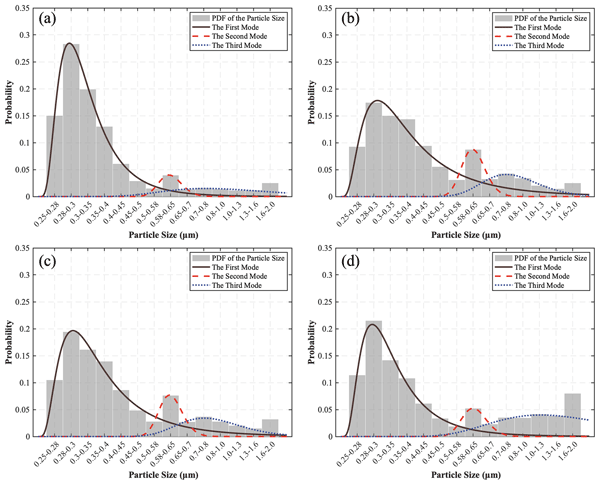
Luoyao Guan, Jason Blake Cohen, Shuo Wang, Pravash Tiwari, Zhewen Liu, Zhengqiang Li, and Kai Qin
Atmos. Chem. Phys., 26, 3107–3123, https://doi.org/10.5194/acp-26-3107-2026, https://doi.org/10.5194/acp-26-3107-2026, 2026
Short summary
Short summary
This study examines how black carbon particles from the coal industry influence regional climate by absorbing sunlight. Based on ground measurements and modeling, we find that conventional approaches, which oversimplify particle size and structure, which could leading a bias in terms of their warming effect. Our results highlight that more realistic particle characterizations are crucial for improving climate predictions in industrial regions.
Ye Feng, Jason Blake Cohen, Xiaolu Li, Lingxiao Lu, Zhewen Liu, Lei Wang, Jian Liu, and Kai Qin
EGUsphere, https://doi.org/10.5194/egusphere-2025-5890, https://doi.org/10.5194/egusphere-2025-5890, 2026
Short summary
Short summary
Carbon monoxide emissions in Central Asia's coal-heavy regions, like Xinjiang Province and Kazakhstan, are poorly tracked. Using satellite data and a new approach, this study maps daily emissions (2019–2024) while addressing measurement errors. About 69 % of estimates were unreliable. Underground coal fires, often ignored, emit as much CO as power plants. Emissions peaked in 2019, dropped until 2022, then rose again, linking to policy changes and economic shifts.
Wei Hu, Jason Blake Cohen, Lingxiao Lu, Bo Zheng, Pravash Tiwari, Simone Lolli, Andrea Garzelli, Jun Li, and Kai Qin
EGUsphere, https://doi.org/10.5194/egusphere-2026-4468, https://doi.org/10.5194/egusphere-2026-4468, 2026
This preprint is open for discussion and under review for Atmospheric Chemistry and Physics (ACP).
Short summary
Short summary
This study presents a perturbation experiment to investigate the impact of satellite data uncertainty which are not fully removed using a fast and physically-based divergence operator. The shape of the uncertainty distribution governs error propagation and thus effects the stability of derived fluxes. Coal-based emissions sources are reliably captured. These results provide a practical, uncertainty‑aware filter for satellite‑derived methane emissions.
Xinqi Wei, Qin He, and Kai Qin
Int. Arch. Photogramm. Remote Sens. Spatial Inf. Sci., XLIX-B3-2026, 1477–1485, https://doi.org/10.5194/isprs-archives-XLIX-B3-2026-1477-2026, https://doi.org/10.5194/isprs-archives-XLIX-B3-2026-1477-2026, 2026
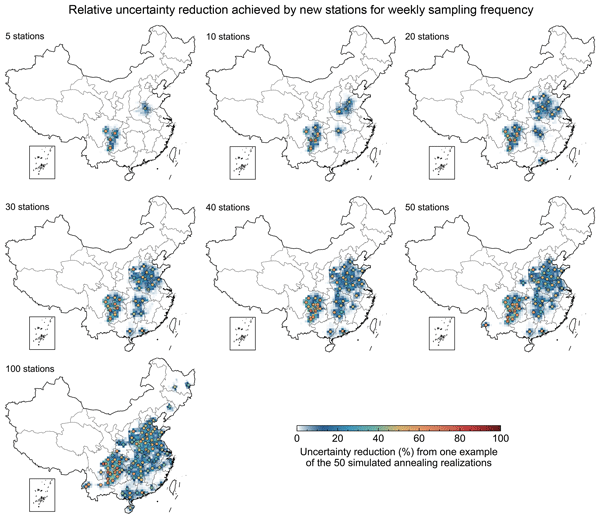
Huiru Zhong, Lu Shen, Fengwei Wan, Meng Qu, and Kai Qin
Atmos. Meas. Tech., 19, 4759–4778, https://doi.org/10.5194/amt-19-4759-2026, https://doi.org/10.5194/amt-19-4759-2026, 2026
Short summary
Short summary
Methane is a potent greenhouse gas, yet existing satellite and ground observations in China are too sparse to accurately quantify emissions, highlighting the need for an expanded ground network. Using Bayesian inversion and simulated annealing, we identify optimal locations for new sites. Results show that prioritizing stations in eastern and southwestern China would be most effective. Expanding the network with 50 stations could nearly double the current emission constraint capability.
Zihan Zhang and Zhengqiang Li
ISPRS Ann. Photogramm. Remote Sens. Spatial Inf. Sci., XI-3-2026, 989–994, https://doi.org/10.5194/isprs-annals-XI-3-2026-989-2026, https://doi.org/10.5194/isprs-annals-XI-3-2026-989-2026, 2026
Xinran Jiang, Gerrit de Leeuw, Cheng Fan, Jeon-Teo Dong, and Zhengqiang Li
EGUsphere, https://doi.org/10.5194/egusphere-2026-3382, https://doi.org/10.5194/egusphere-2026-3382, 2026
Short summary
Short summary
Evaluation of satellite greenhouse gas data is crucial for climate monitoring and mitigation. We assessed four XCO2 Proxy XCH4 results using Hefei and Xianghe TCCON sites in China. We found that the accuracy of retrieval products varies between both sites. Fundamental assumption of Proxy method leaves uncertainties. Independent XCO2 proxy comparison with TCCON data show discrepancies requiring continuous evaluation for proper determination of XCH4.
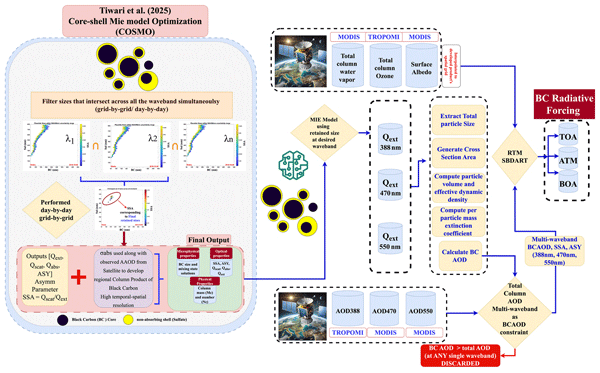
Pravash Tiwari, Jason Blake Cohen, Hongrui Gao, Lingxiao Lu, Jun Wang, Oleg Dubovik, and Kai Qin
Atmos. Chem. Phys., 26, 9149–9180, https://doi.org/10.5194/acp-26-9149-2026, https://doi.org/10.5194/acp-26-9149-2026, 2026
Short summary
Short summary
Black carbon's climate impact is highly uncertain because its radiative effect depends on particle size, mixing state, and column loading. This study combines satellite data, physics-based simulations, and machine learning to estimate black carbon forcing across contrasting regions. The same black carbon amount can warm or cool the atmosphere depending on local aerosol properties. The machine learning framework provides a fast, transferable tool for regional climate assessment.
Hongrui Gao, Qin He, Kai Qin, Jhoon Kim, Diego Loyola, Pravash Tiwari, Lingxiao Lu, and Jason Blake Cohen
Earth Syst. Sci. Data Discuss., https://doi.org/10.5194/essd-2026-443, https://doi.org/10.5194/essd-2026-443, 2026
Revised manuscript accepted for ESSD
Short summary
Short summary
There are always gaps in satellite records of air pollution because of factors such as clouds and operating conditions. We used a physics-aware deep learning method, producing a gapless 0.05° hourly dataset of tropospheric nitrogen dioxide over Asian pollution hotspots from 2019 to 2024. The dataset can capture sub-daily changes, revealing how traffic, industry, and clean-air policies shaped pollution, supporting health and environment studies.
Xingyu Yao, Ying Zhang, Xiaofan Li, Gerrit de Leeuw, Cheng Fan, Yuanxun Zhang, Zhanshan Wang, Yongjie Wei, and Zhengqiang Li
EGUsphere, https://doi.org/10.5194/egusphere-2026-2619, https://doi.org/10.5194/egusphere-2026-2619, 2026
Short summary
Short summary
Cities are major sources of carbon emissions, but measuring them accurately remains challenging. This study combines satellite observations with atmospheric modeling to estimate city-scale carbon dioxide emissions. Tests in three Chinese cities show that observation uncertainty and total error strongly influence emission estimates and their spatial patterns. The results are consistent with existing datasets and support improved urban emission monitoring.
Luoyao Guan, Jason Blake Cohen, Shuo Wang, Pravash Tiwari, Zhewen Liu, Zhengqiang Li, and Kai Qin
Atmos. Chem. Phys., 26, 3107–3123, https://doi.org/10.5194/acp-26-3107-2026, https://doi.org/10.5194/acp-26-3107-2026, 2026
Short summary
Short summary
This study examines how black carbon particles from the coal industry influence regional climate by absorbing sunlight. Based on ground measurements and modeling, we find that conventional approaches, which oversimplify particle size and structure, which could leading a bias in terms of their warming effect. Our results highlight that more realistic particle characterizations are crucial for improving climate predictions in industrial regions.
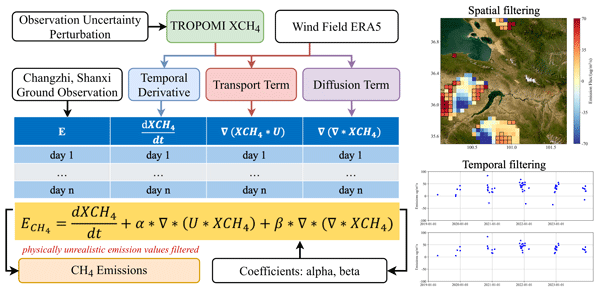
Bo Zheng, Jason Blake Cohen, Lingxiao Lu, Wei Hu, Pravash Tiwari, Simone Lolli, Andrea Garzelli, Hui Su, and Kai Qin
Atmos. Chem. Phys., 26, 1931–1946, https://doi.org/10.5194/acp-26-1931-2026, https://doi.org/10.5194/acp-26-1931-2026, 2026
Short summary
Short summary
This study provides TROPOMI (TROPOspheric Monitoring Instrument) with a new methane emission estimation method that can accurately identify emission sources. Our results generate non-negative emission datasets using objective selection and filtering methods. The results include lower minimum emission thresholds for all power grids and fewer false positives. The new method provides more robust emission quantification in the face of data uncertainty, going beyond traditional plume identification and background subtraction.
Ye Feng, Jason Blake Cohen, Xiaolu Li, Lingxiao Lu, Zhewen Liu, Lei Wang, Jian Liu, and Kai Qin
EGUsphere, https://doi.org/10.5194/egusphere-2025-5890, https://doi.org/10.5194/egusphere-2025-5890, 2026
Short summary
Short summary
Carbon monoxide emissions in Central Asia's coal-heavy regions, like Xinjiang Province and Kazakhstan, are poorly tracked. Using satellite data and a new approach, this study maps daily emissions (2019–2024) while addressing measurement errors. About 69 % of estimates were unreliable. Underground coal fires, often ignored, emit as much CO as power plants. Emissions peaked in 2019, dropped until 2022, then rose again, linking to policy changes and economic shifts.
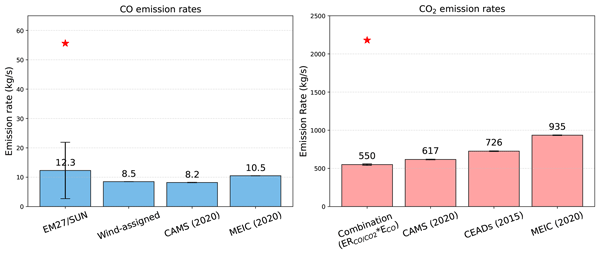
Qiansi Tu, Frank Hase, Ying Zhang, Jiaxin Fang, Yanwu Jiang, Xiaofan Li, Matthias Schneider, Zhuolin Yang, Xin Zhang, and Zhengqiang Li
Atmos. Chem. Phys., 25, 17779–17796, https://doi.org/10.5194/acp-25-17779-2025, https://doi.org/10.5194/acp-25-17779-2025, 2025
Short summary
Short summary
Understanding greenhouse gas and air pollutant concentrations and emissions characteristics in the Qinghai-Tibetan Plateau cities remains limited. We present the first CO2, CH4 and CO abundances using a portal Fourier-transform infrared (FTIR) spectrometer in Xining. Ground-based data exceeded satellite/model estimates, indicating higher local emissions. Strong CO discrepancies and ∆XCO–∆XCO2 correlation under easterly winds highlight the value of portable FTIR for urban emission studies.
Yan Wang, Yujia Cao, Haixiao Yu, Shuo Wang, Qiaoyun Hu, Yuyang Chang, Chun Zhao, Zhengqiang Li, and Cheng Chen
EGUsphere, https://doi.org/10.5194/egusphere-2025-5076, https://doi.org/10.5194/egusphere-2025-5076, 2025
Short summary
Short summary
Pyrocumulonimbus (PyroCb) convection during the August 2024 North American wildfires injected smoke aerosols into the upper troposphere and lower stratosphere, altering cloud microphysics. These aerosols induced warming near fire sources and downwind over Western Europe, while producing contrasting effects over fire-source regions, cooling along the US West Coast and warming across North America, demonstrating strong wildfire-aerosol-cloud-radiation feedbacks with transcontinental impacts.
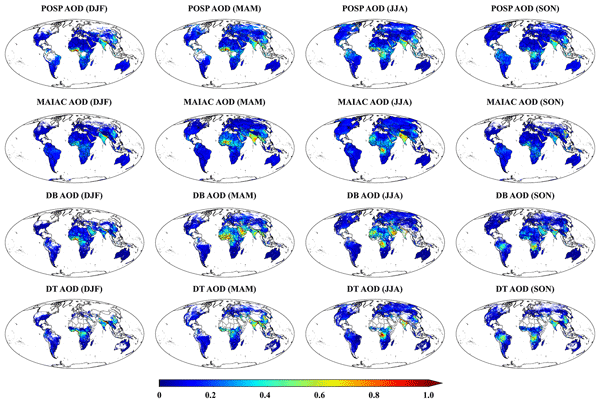
Zhe Ji, Zhengqiang Li, Gerrit de Leeuw, Zihan Zhang, Yan Ma, Zheng Shi, Cheng Fan, and Qian Yao
Atmos. Meas. Tech., 18, 5783–5803, https://doi.org/10.5194/amt-18-5783-2025, https://doi.org/10.5194/amt-18-5783-2025, 2025
Short summary
Short summary
A global AOD product from Particulate Observing Scanning Polarimeter (POSP) has been proposed and validated using Aerosol Robotic Network (AERONET). Results show a high accuracy, with correlation coefficients (R) of 0.914, a root mean square error (RMSE) of 0.085, outperforming Moderate Resolution Imaging Spectroradiometer (MODIS). Error analysis reveals seasonal variation with lower accuracy in autumn/winter, and increased uncertainty with lower Normalized Difference Vegetation Index NDVI.
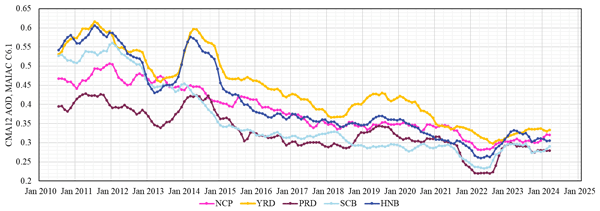
Cheng Fan, Gerrit de Leeuw, Xiaoxi Yan, Jiantao Dong, Hanqing Kang, Chengwei Fang, Zhengqiang Li, and Ying Zhang
Atmos. Chem. Phys., 25, 11951–11973, https://doi.org/10.5194/acp-25-11951-2025, https://doi.org/10.5194/acp-25-11951-2025, 2025
Short summary
Short summary
This study describes the analysis of time series of the MODIS-derived aerosol optical depth (AOD) over China between 2010 and 2024. Emission reduction policies were effective with respect to reducing the AOD until 2018. Thereafter, the overall reduction until the end of the study was very small due to unfavorable meteorological factors cancelling favorable anthropogenic effects and resulting in an AOD increase during extended periods. The variations over different areas in China are discussed.
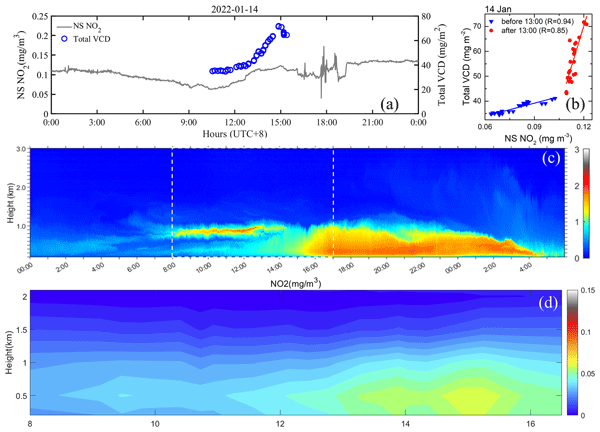
Ying Zhang, Yuanyuan Wei, Gerrit de Leeuw, Ouyang Liu, Yu Chen, Yang Lv, Yuanxun Zhang, and Zhengqiang Li
Atmos. Chem. Phys., 25, 10643–10660, https://doi.org/10.5194/acp-25-10643-2025, https://doi.org/10.5194/acp-25-10643-2025, 2025
Short summary
Short summary
Nitrogen dioxide (NO2) is a major pollutant that, at high concentrations, may affect human health. We evaluated the remote sensing column NO2 in relation to near-surface concentrations throughout the day and found that the prohibition of vertical transport in the morning and the mixing in the afternoon resulted in different relations between the near-surface (NS) and total column NO2 concentrations. These different relationships have consequences for the use of satellite remote sensing to estimate NS NO2 concentrations.
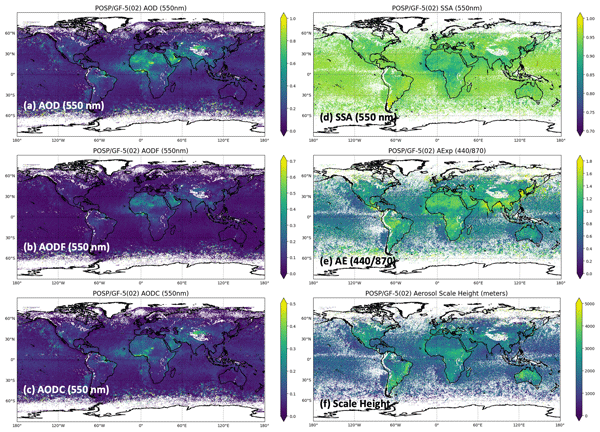
Cheng Chen, Xuefeng Lei, Zhenhai Liu, Haorang Gu, Oleg Dubovik, Pavel Litvinov, David Fuertes, Yujia Cao, Haixiao Yu, Guangfeng Xiang, Binghuan Meng, Zhenwei Qiu, Xiaobing Sun, Jin Hong, and Zhengqiang Li
Earth Syst. Sci. Data, 17, 3497–3519, https://doi.org/10.5194/essd-17-3497-2025, https://doi.org/10.5194/essd-17-3497-2025, 2025
Short summary
Short summary
Particulate Observing Scanning Polarization (POSP) on board the second GaoFen-5 (GF-5(02)) satellite is the first space-borne ultraviolet–visible–near-infrared–shortwave-infrared (UV–VIS–NIR–SWIR) multi-spectral cross-track scanning polarimeter. Due to its wide spectral range and polarimetric capabilities, POSP measurements provide rich information for aerosol and surface characterization. We present the detailed aerosol/surface products generated from POSP's first 18 months of operation, including spectral aerosol optical depth, aerosol-size-/absorption-related properties, surface black-sky and white-sky albedos, etc.
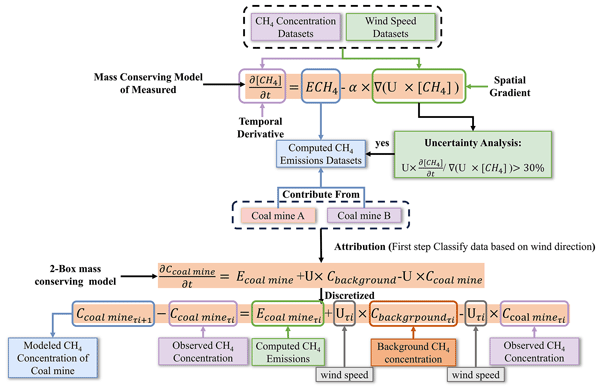
Fan Lu, Kai Qin, Jason Blake Cohen, Qin He, Pravash Tiwari, Wei Hu, Chang Ye, Yanan Shan, Qing Xu, Shuo Wang, and Qiansi Tu
Atmos. Chem. Phys., 25, 5837–5856, https://doi.org/10.5194/acp-25-5837-2025, https://doi.org/10.5194/acp-25-5837-2025, 2025
Short summary
Short summary
This work describes a field campaign and new fast emissions estimation approach to attribute methane from a large known and previously unknown coal mine in Shanxi, China. The emissions computed are shown to be larger than known oil and gas sources, indicating that methane from coal mines may play a larger role in the global methane budget. The results are found to be slightly larger than or similar to satellite observational campaigns over the same region.
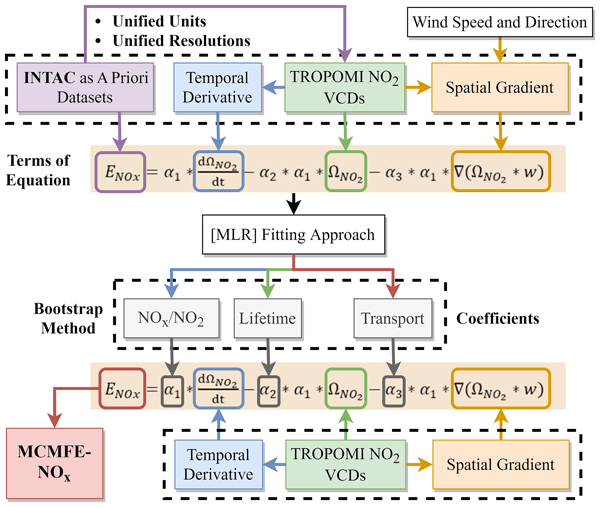
Lingxiao Lu, Jason Blake Cohen, Kai Qin, Xiaolu Li, and Qin He
Atmos. Chem. Phys., 25, 2291–2309, https://doi.org/10.5194/acp-25-2291-2025, https://doi.org/10.5194/acp-25-2291-2025, 2025
Short summary
Short summary
This study applies an approach that assimilates NO2 vertical column densities from TROPOMI in a mass-conserving manner and inverts daily NOx emissions, presented over rapidly changing regions in China. Source attribution is quantified by the local thermodynamics of the combustion temperature (NOx/NO2). Emission results identify sources which do not exist in the a priori datasets, especially medium industrial sources located next to the Yangtze River.
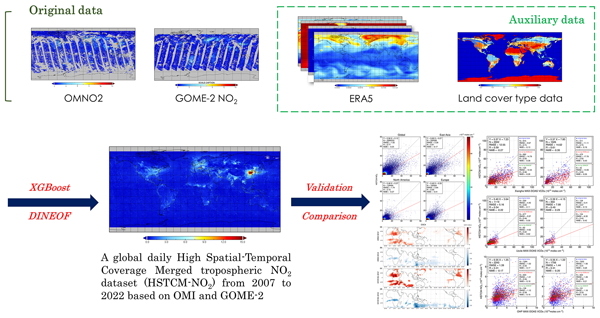
Kai Qin, Hongrui Gao, Xuancen Liu, Qin He, Pravash Tiwari, and Jason Blake Cohen
Earth Syst. Sci. Data, 16, 5287–5310, https://doi.org/10.5194/essd-16-5287-2024, https://doi.org/10.5194/essd-16-5287-2024, 2024
Short summary
Short summary
Satellites have brought new opportunities for monitoring atmospheric NO2, although the results are limited by clouds and other factors, resulting in missing data. This work proposes a new process to obtain reliable data products with high coverage by reconstructing the raw data from multiple satellites. The results are validated in terms of traditional methods as well as variance maximization and demonstrate a good ability to reproduce known polluted and clean areas around the world.
Wenxin Zhao, Yu Zhao, Yu Zheng, Dong Chen, Jinyuan Xin, Kaitao Li, Huizheng Che, Zhengqiang Li, Mingrui Ma, and Yun Hang
Atmos. Chem. Phys., 24, 6593–6612, https://doi.org/10.5194/acp-24-6593-2024, https://doi.org/10.5194/acp-24-6593-2024, 2024
Short summary
Short summary
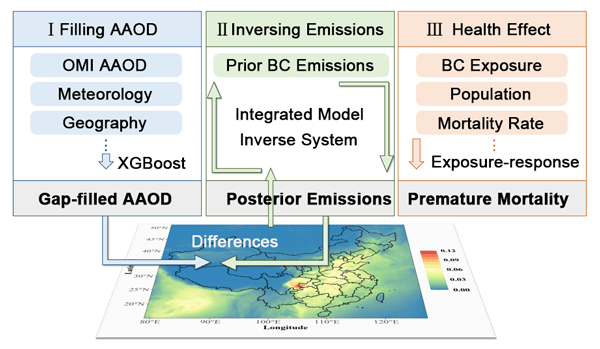
We evaluate the long-term (2000–2020) variabilities of aerosol absorption optical depth, black carbon emissions, and associated health risks in China with an integrated framework that combines multiple observations and modeling techniques. We demonstrate the remarkable emission abatement resulting from the implementation of national pollution controls and show how human activities affected the emissions with a spatiotemporal heterogeneity, thus supporting differentiated policy-making by region.
Kaixu Bai, Ke Li, Liuqing Shao, Xinran Li, Chaoshun Liu, Zhengqiang Li, Mingliang Ma, Di Han, Yibing Sun, Zhe Zheng, Ruijie Li, Ni-Bin Chang, and Jianping Guo
Earth Syst. Sci. Data, 16, 2425–2448, https://doi.org/10.5194/essd-16-2425-2024, https://doi.org/10.5194/essd-16-2425-2024, 2024
Short summary
Short summary
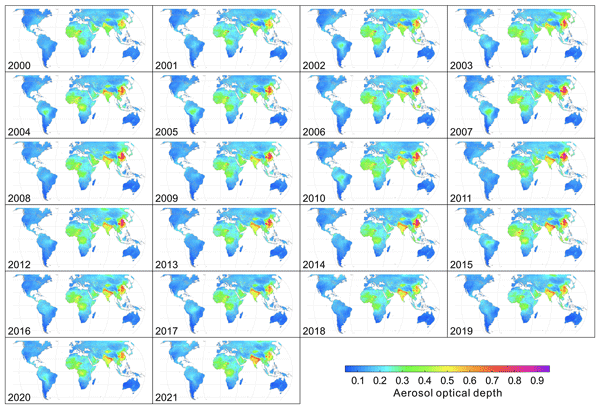
A global gap-free high-resolution air pollutant dataset (LGHAP v2) was generated to provide spatially contiguous AOD and PM2.5 concentration maps with daily 1 km resolution from 2000 to 2021. This gap-free dataset has good data accuracies compared to ground-based AOD and PM2.5 concentration observations, which is a reliable database to advance aerosol-related studies and trigger multidisciplinary applications for environmental management, health risk assessment, and climate change analysis.
Qiansi Tu, Frank Hase, Kai Qin, Jason Blake Cohen, Farahnaz Khosrawi, Xinrui Zou, Matthias Schneider, and Fan Lu
Atmos. Chem. Phys., 24, 4875–4894, https://doi.org/10.5194/acp-24-4875-2024, https://doi.org/10.5194/acp-24-4875-2024, 2024
Short summary
Short summary
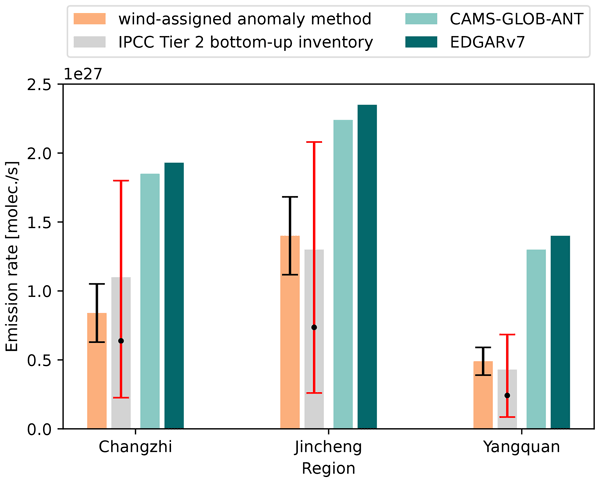
Four-year satellite observations of XCH4 are used to derive CH4 emissions in three regions of China’s coal-rich Shanxi province. The wind-assigned anomalies for two opposite wind directions are calculated, and the estimated emission rates are comparable to the current bottom-up inventory but lower than the CAMS and EDGAR inventories. This research enhances the understanding of emissions in Shanxi and supports climate mitigation strategies by validating emission inventories.
Kai Qin, Wei Hu, Qin He, Fan Lu, and Jason Blake Cohen
Atmos. Chem. Phys., 24, 3009–3028, https://doi.org/10.5194/acp-24-3009-2024, https://doi.org/10.5194/acp-24-3009-2024, 2024
Short summary
Short summary
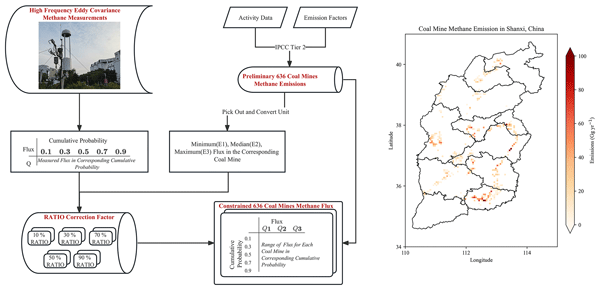
We compute CH4 emissions and uncertainty on a mine-by-mine basis, including underground, overground, and abandoned mines. Mine-by-mine gas and flux data and 30 min observations from a flux tower located next to a mine shaft are integrated. The observed variability and bias correction are propagated over the emissions dataset, demonstrating that daily observations may not cover the range of variability. Comparisons show both an emissions magnitude and spatial mismatch with current inventories.
Ouyang Liu, Zhengqiang Li, Yangyan Lin, Cheng Fan, Ying Zhang, Kaitao Li, Peng Zhang, Yuanyuan Wei, Tianzeng Chen, Jiantao Dong, and Gerrit de Leeuw
Atmos. Meas. Tech., 17, 377–395, https://doi.org/10.5194/amt-17-377-2024, https://doi.org/10.5194/amt-17-377-2024, 2024
Short summary
Short summary
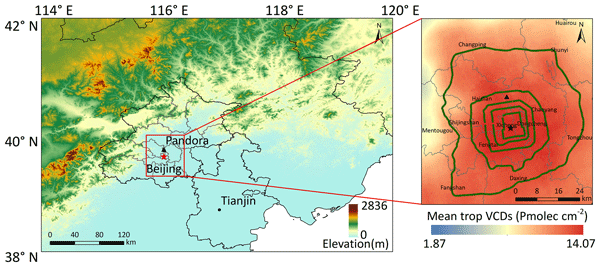
Nitrogen dioxide (NO2) is a trace gas which is important for atmospheric chemistry and may affect human health. To understand processes leading to harmful concentrations, it is important to monitor NO2 concentrations near the surface and higher up. To this end, a Pandora instrument has been installed in Beijing. An overview of the first year of data shows the large variability on diurnal to seasonal timescales and how this is affected by wind speed and direction and chemistry.
Jianping Guo, Jian Zhang, Jia Shao, Tianmeng Chen, Kaixu Bai, Yuping Sun, Ning Li, Jingyan Wu, Rui Li, Jian Li, Qiyun Guo, Jason B. Cohen, Panmao Zhai, Xiaofeng Xu, and Fei Hu
Earth Syst. Sci. Data, 16, 1–14, https://doi.org/10.5194/essd-16-1-2024, https://doi.org/10.5194/essd-16-1-2024, 2024
Short summary
Short summary
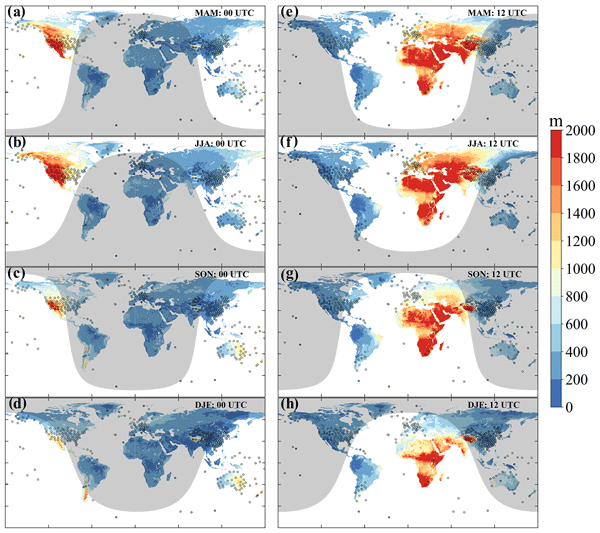
A global continental merged high-resolution (PBLH) dataset with good accuracy compared to radiosonde is generated via machine learning algorithms, covering the period from 2011 to 2021 with 3-hour and 0.25º resolution in space and time. The machine learning model takes parameters derived from the ERA5 reanalysis and GLDAS product as input, with PBLH biases between radiosonde and ERA5 as the learning targets. The merged PBLH is the sum of the predicted PBLH bias and the PBLH from ERA5.
Yuhang Zhang, Jintai Lin, Jhoon Kim, Hanlim Lee, Junsung Park, Hyunkee Hong, Michel Van Roozendael, Francois Hendrick, Ting Wang, Pucai Wang, Qin He, Kai Qin, Yongjoo Choi, Yugo Kanaya, Jin Xu, Pinhua Xie, Xin Tian, Sanbao Zhang, Shanshan Wang, Siyang Cheng, Xinghong Cheng, Jianzhong Ma, Thomas Wagner, Robert Spurr, Lulu Chen, Hao Kong, and Mengyao Liu
Atmos. Meas. Tech., 16, 4643–4665, https://doi.org/10.5194/amt-16-4643-2023, https://doi.org/10.5194/amt-16-4643-2023, 2023
Short summary
Short summary
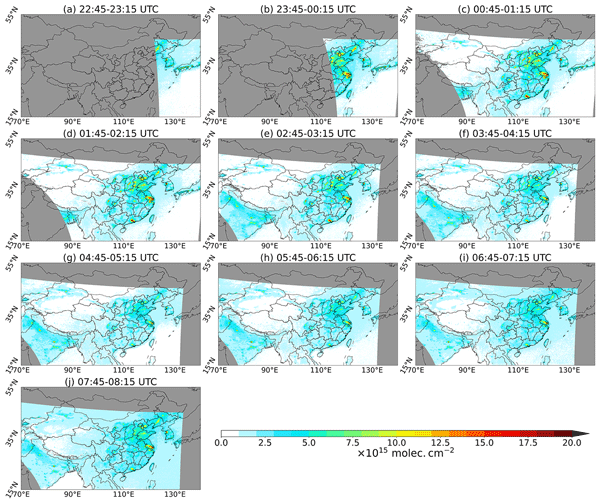
Our tropospheric NO2 vertical column density product with high spatiotemporal resolution is based on the Geostationary Environment Monitoring Spectrometer (GEMS) and named POMINO–GEMS. Strong hotspot signals and NO2 diurnal variations are clearly seen. Validations with multiple satellite products and ground-based, mobile car and surface measurements exhibit the overall great performance of the POMINO–GEMS product, indicating its capability for application in environmental studies.
Xiaolu Li, Jason Blake Cohen, Kai Qin, Hong Geng, Xiaohui Wu, Liling Wu, Chengli Yang, Rui Zhang, and Liqin Zhang
Atmos. Chem. Phys., 23, 8001–8019, https://doi.org/10.5194/acp-23-8001-2023, https://doi.org/10.5194/acp-23-8001-2023, 2023
Short summary
Short summary
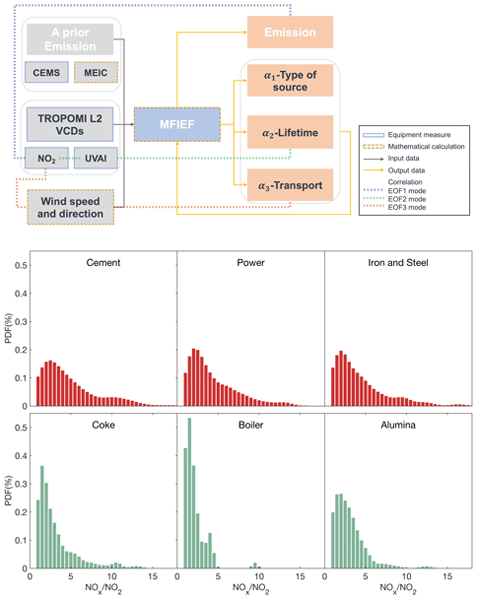
Remotely sensed NO2 and surface NOx are combined with a mathematical method to estimate daily NOx emissions. The results identify new sources and improve existing estimates. The estimation is driven by three flexible factors: thermodynamics of combustion, chemical loss, and atmospheric transport. The thermodynamic term separates power, iron, and cement from coking, boilers, and aluminum. This work finds three causes for the extremes: emissions, UV radiation, and transport.
Qiansi Tu, Frank Hase, Zihan Chen, Matthias Schneider, Omaira García, Farahnaz Khosrawi, Shuo Chen, Thomas Blumenstock, Fang Liu, Kai Qin, Jason Cohen, Qin He, Song Lin, Hongyan Jiang, and Dianjun Fang
Atmos. Meas. Tech., 16, 2237–2262, https://doi.org/10.5194/amt-16-2237-2023, https://doi.org/10.5194/amt-16-2237-2023, 2023
Short summary
Short summary
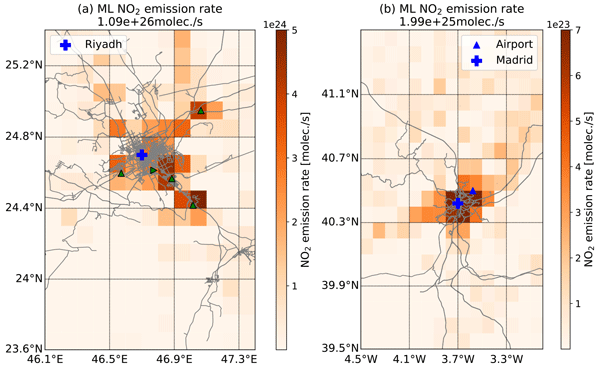
Four-year TROPOMI observations are used to derive tropospheric NO2 emissions in two mega(cities) with high anthropogenic activity. Wind-assigned anomalies are calculated, and the emission rates and spatial patterns are estimated based on a machine learning algorithm. The results are in reasonable agreement with previous studies and the inventory. Our method is quite robust and can be used as a simple method to estimate the emissions of NO2 as well as other gases in other regions.
Zexia Duan, Zhiqiu Gao, Qing Xu, Shaohui Zhou, Kai Qin, and Yuanjian Yang
Earth Syst. Sci. Data, 14, 4153–4169, https://doi.org/10.5194/essd-14-4153-2022, https://doi.org/10.5194/essd-14-4153-2022, 2022
Short summary
Short summary
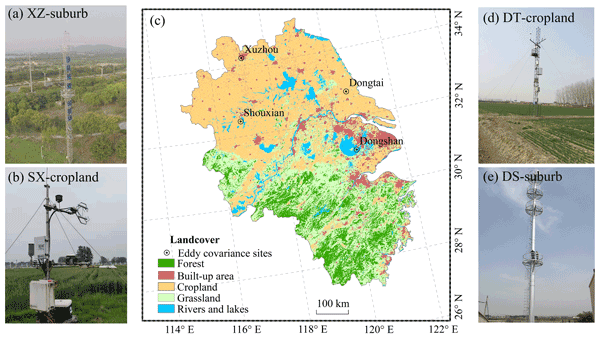
Land–atmosphere interactions over the Yangtze River Delta (YRD) in China are becoming more varied and complex, as the area is experiencing rapid land use changes. In this paper, we describe a dataset of microclimate and eddy covariance variables at four sites in the YRD. This dataset has potential use cases in multiple research fields, such as boundary layer parametrization schemes, evaluation of remote sensing algorithms, and development of climate models in typical East Asian monsoon regions.
Jie Luo, Zhengqiang Li, Chenchong Zhang, Qixing Zhang, Yongming Zhang, Ying Zhang, Gabriele Curci, and Rajan K. Chakrabarty
Atmos. Chem. Phys., 22, 7647–7666, https://doi.org/10.5194/acp-22-7647-2022, https://doi.org/10.5194/acp-22-7647-2022, 2022
Short summary
Short summary
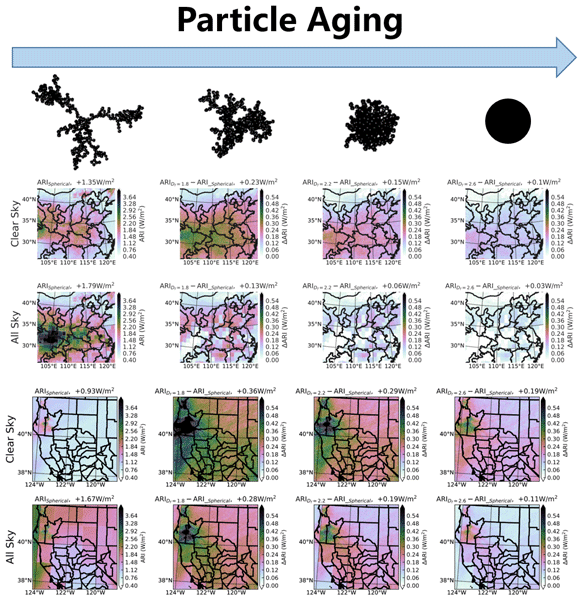
The fractal black carbon was applied to re-evaluate the regional impacts of morphologies on aerosol–radiation interactions (ARIs), and the effects were compared between the US and China. The regional-mean clear-sky ARI is significantly affected by the BC morphology, and relative differences of 17.1 % and 38.7 % between the fractal model with a Df of 1.8 and the spherical model were observed in eastern China and the northwest US, respectively.
Jie Luo, Zhengqiang Li, Cheng Fan, Hua Xu, Ying Zhang, Weizhen Hou, Lili Qie, Haoran Gu, Mengyao Zhu, Yinna Li, and Kaitao Li
Atmos. Meas. Tech., 15, 2767–2789, https://doi.org/10.5194/amt-15-2767-2022, https://doi.org/10.5194/amt-15-2767-2022, 2022
Short summary
Short summary
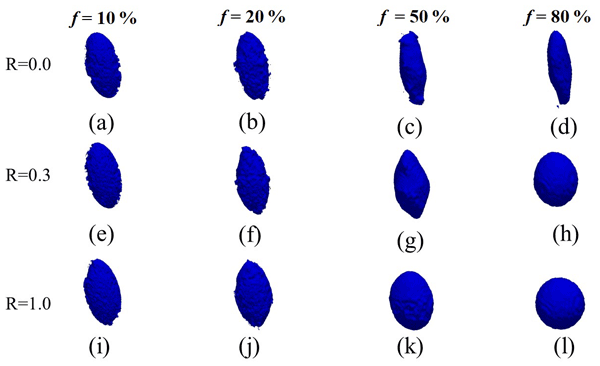
A single model is difficult to represent various shapes of dust. We proposed a tunable model to represent dust with various shapes. Two tunable parameters were used to represent the effects of the erosion degree and binding forces from the mass center. Thus, the model can represent various dust shapes by adjusting the tunable parameters. Besides, the applicability of the spheroid model in calculating the optical properties and polarimetric characteristics is evaluated.
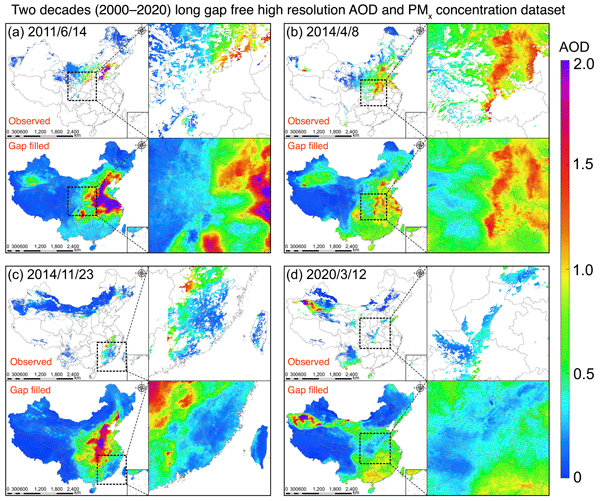
Kaixu Bai, Ke Li, Mingliang Ma, Kaitao Li, Zhengqiang Li, Jianping Guo, Ni-Bin Chang, Zhuo Tan, and Di Han
Earth Syst. Sci. Data, 14, 907–927, https://doi.org/10.5194/essd-14-907-2022, https://doi.org/10.5194/essd-14-907-2022, 2022
Short summary
Short summary
The Long-term Gap-free High-resolution Air Pollutant concentration dataset, providing gap-free aerosol optical depth (AOD) and PM2.5 and PM10 concentration with a daily 1 km resolution for 2000–2020 in China, is generated and made publicly available. This is the first long-term gap-free high-resolution aerosol dataset in China and has great potential to trigger multidisciplinary applications in Earth observations, climate change, public health, ecosystem assessment, and environment management.
Cited articles
Abramowitz, M. and Stegun, I. A. (Eds.): Handbook of Mathematical Functions, Dover Publications, New York, ISBN 978-0-486-61272-0, 1965.
Ahn, C., Torres, O., and Bhartia, P. K.: Comparison of Ozone Monitoring Instrument UV Aerosol Products with Aqua/Moderate Resolution Imaging Spectroradiometer and Multiangle Imaging Spectroradiometer observations in 2006, J. Geophys. Res.-Atmos., 113, 2007JD008832, https://doi.org/10.1029/2007JD008832, 2008.
Aouizerats, B., Thouron, O., Tulet, P., Mallet, M., Gomes, L., and Henzing, J. S.: Development of an online radiative module for the computation of aerosol optical properties in 3-D atmospheric models: validation during the EUCAARI campaign, Geosci. Model Dev., 3, 553–564, https://doi.org/10.5194/gmd-3-553-2010, 2010.
Bergstrom, R. W., Pilewskie, P., Russell, P. B., Redemann, J., Bond, T. C., Quinn, P. K., and Sierau, B.: Spectral absorption properties of atmospheric aerosols, Atmos. Chem. Phys., 7, 5937–5943, https://doi.org/10.5194/acp-7-5937-2007, 2007.
Bigi, A., Veratti, G., Andrews, E., Collaud Coen, M., Guerrieri, L., Bernardoni, V., Massabò, D., Ferrero, L., Teggi, S., and Ghermandi, G.: Aerosol absorption using in situ filter-based photometers and ground-based sun photometry in the Po Valley urban atmosphere, Atmos. Chem. Phys., 23, 14841–14869, https://doi.org/10.5194/acp-23-14841-2023, 2023.
Bohren, C. F. and Huffman, D. R.: Absorption and Scattering of Light by Small Particles, 1st edn., Wiley, https://doi.org/10.1002/9783527618156, 1998.
Bond, T. C. and Bergstrom, R. W.: Light Absorption by Carbonaceous Particles: An Investigative Review, Aerosol Sci. Technol., 40, 27–67, https://doi.org/10.1080/02786820500421521, 2006.
Bond, T. C., Doherty, S. J., Fahey, D. W., Forster, P. M., Berntsen, T., DeAngelo, B. J., Flanner, M. G., Ghan, S., Kärcher, B., Koch, D., Kinne, S., Kondo, Y., Quinn, P. K., Sarofim, M. C., Schultz, M. G., Schulz, M., Venkataraman, C., Zhang, H., Zhang, S., Bellouin, N., Guttikunda, S. K., Hopke, P. K., Jacobson, M. Z., Kaiser, J. W., Klimont, Z., Lohmann, U., Schwarz, J. P., Shindell, D., Storelvmo, T., Warren, S. G., and Zender, C. S.: Bounding the role of black carbon in the climate system: A scientific assessment, J. Geophys. Res.-Atmos., 118, 5380–5552, https://doi.org/10.1002/jgrd.50171, 2013.
Bousserez, N., Guerrette, J. J., and Henze, D. K.: Enhanced parallelization of the incremental 4D-Var data assimilation algorithm using the Randomized Incremental Optimal Technique, Q. J. R. Meteorol. Soc., 146, 1351–1371, https://doi.org/10.1002/qj.3740, 2020.
Buchard, V., Randles, C. A., Da Silva, A. M., Darmenov, A., Colarco, P. R., Govindaraju, R., Ferrare, R., Hair, J., Beyersdorf, A. J., Ziemba, L. D., and Yu, H.: The MERRA-2 Aerosol Reanalysis, 1980 Onward. Part II: Evaluation and Case Studies, J. Clim., 30, 6851–6872, https://doi.org/10.1175/JCLI-D-16-0613.1, 2017.
Cappa, C. D., Onasch, T. B., Massoli, P., Worsnop, D. R., Bates, T. S., Cross, E. S., Davidovits, P., Hakala, J., Hayden, K. L., Jobson, B. T., Kolesar, K. R., Lack, D. A., Lerner, B. M., Li, S.-M., Mellon, D., Nuaaman, I., Olfert, J. S., Petäjä, T., Quinn, P. K., Song, C., Subramanian, R., Williams, E. J., and Zaveri, R. A.: Radiative Absorption Enhancements Due to the Mixing State of Atmospheric Black Carbon, Science, 337, 1078–1081, https://doi.org/10.1126/science.1223447, 2012.
Cassee, F. R., Héroux, M.-E., Gerlofs-Nijland, M. E., and Kelly, F. J.: Particulate matter beyond mass: recent health evidence on the role of fractions, chemical constituents and sources of emission, Inhal. Toxicol., 25, 802–812, https://doi.org/10.3109/08958378.2013.850127, 2013.
Chakraborty, S., Devnath, M. K., Jabeli, A., Kulkarni, C., Boteju, G., Wang, J., and Janeja, V. P.: Impact of increased anthropogenic Amazon wildfires on Antarctic Sea ice melt via albedo reduction, Environ. Data Sci., 4, e18, https://doi.org/10.1017/eds.2025.1, 2025.
Chathurangika, N. P. M., Haque, Md. M., Nyasulu, M., Khan, R., Ahmmad, N., Sheikh, M. A. A., Hossain, M. L., and Rahman, A. K. M. L.: Long-term trends in aerosol optical properties and their relationship with cloud properties over southern India and Sri Lanka, Intl. Journal of Climatology, 42, 9051–9071, https://doi.org/10.1002/joc.7799, 2022.
Chen, B., Andersson, A., Lee, M., Kirillova, E. N., Xiao, Q., Kruså, M., Shi, M., Hu, K., Lu, Z., Streets, D. G., Du, K., and Gustafsson, Ö.: Source Forensics of Black Carbon Aerosols from China, Environ. Sci. Technol., 47, 9102–9108, https://doi.org/10.1021/es401599r, 2013.
Chen, C., Dubovik, O., Schuster, G. L., Chin, M., Henze, D. K., Lapyonok, T., Li, Z., Derimian, Y., and Zhang, Y.: Multi-angular polarimetric remote sensing to pinpoint global aerosol absorption and direct radiative forcing, Nat. Commun., 13, 7459, https://doi.org/10.1038/s41467-022-35147-y, 2022.
Chen, Y. and Prinn, R. G.: Estimation of atmospheric methane emissions between 1996 and 2001 using a three-dimensional global chemical transport model, J. Geophys. Res.-Atmos., 111, 2005JD006058, https://doi.org/10.1029/2005JD006058, 2006.
Chung, C. E., Lee, K., and Müller, D.: Effect of internal mixture on black carbon radiative forcing, Tellus B: Chemical and Physical Meteorology, 64, 10925, https://doi.org/10.3402/tellusb.v64i0.10925, 2012.
Cohen, J. B.: Quantifying the occurrence and magnitude of the Southeast Asian fire climatology, Environ. Res. Lett., 9, 114018, https://doi.org/10.1088/1748-9326/9/11/114018, 2014.
Cohen, J. B. and Wang, C.: Estimating global black carbon emissions using a top-down Kalman Filter approach, J. Geophys. Res.-Atmos., 119, 307–323, https://doi.org/10.1002/2013JD019912, 2014.
Cohen, J. B., Prinn, R. G., and Wang, C.: The impact of detailed urban-scale processing on the composition, distribution, and radiative forcing of anthropogenic aerosols: the impact of detailed urban-scale processing, Geophys. Res. Lett., 38, https://doi.org/10.1029/2011GL047417, 2011.
Diner, D. J., Beckert, J. C., Reilly, T. H., Bruegge, C. J., Conel, J. E., Kahn, R. A., Martonchik, J. V., Ackerman, T. P., Davies, R., Gerstl, S. A. W., Gordon, H. R., Muller, J., Myneni, R. B., Sellers, P. J., Pinty, B., and Verstraete, M. M.: Multi-angle Imaging SpectroRadiometer (MISR) instrument description and experiment overview, IEEE Trans. Geosci. Remote Sensing, 36, 1072–1087, https://doi.org/10.1109/36.700992, 1998.
Ding, A. J., Huang, X., Nie, W., Sun, J. N., Kerminen, V.-M., Petäjä, T., Su, H., Cheng, Y. F., Yang, X.-Q., Wang, M. H., Chi, X. G., Wang, J. P., Virkkula, A., Guo, W. D., Yuan, J., Wang, S. Y., Zhang, R. J., Wu, Y. F., Song, Y., Zhu, T., Zilitinkevich, S., Kulmala, M., and Fu, C. B.: Enhanced haze pollution by black carbon in megacities in China, Geophys. Res. Lett., 43, 2873–2879, https://doi.org/10.1002/2016GL067745, 2016.
Dubovik, O., Smirnov, A., Holben, B. N., King, M. D., Kaufman, Y. J., Eck, T. F., and Slutsker, I.: Accuracy assessments of aerosol optical properties retrieved from Aerosol Robotic Network (AERONET) Sun and sky radiance measurements, J. Geophys. Res.-Atmos., 105, 9791–9806, https://doi.org/10.1029/2000JD900040, 2000.
Eck, T. F., Holben, B. N., Ward, D. E., Dubovik, O., Reid, J. S., Smirnov, A., Mukelabai, M. M., Hsu, N. C., O'Neill, N. T., and Slutsker, I.: Characterization of the optical properties of biomass burning aerosols in Zambia during the 1997 ZIBBEE field campaign, J. Geophys. Res.-Atmos., 106, 3425–3448, https://doi.org/10.1029/2000JD900555, 2001.
Everett, J. T., Newton, E. N., and Odum, M. M.: A Review of Progress in Constraining Global Black Carbon Climate Effects, Earth Syst. Environ., 6, 771–785, https://doi.org/10.1007/s41748-022-00313-1, 2022.
Freire, J. L. M., Longo, K. M., Freitas, S. R., Coelho, C. A. S., Molod, A. M., Marshak, J., Da Silva, A., and Ribeiro, B. Z.: To What Extent Biomass Burning Aerosols Impact South America Seasonal Climate Predictions?, Geophys. Res. Lett., 47, e2020GL088096, https://doi.org/10.1029/2020GL088096, 2020.
Garay, M. J., Kalashnikova, O. V., and Bull, M. A.: Development and assessment of a higher-spatial-resolution (4.4 km) MISR aerosol optical depth product using AERONET-DRAGON data, Atmos. Chem. Phys., 17, 5095–5106, https://doi.org/10.5194/acp-17-5095-2017, 2017.
Garay, M. J., Witek, M. L., Kahn, R. A., Seidel, F. C., Limbacher, J. A., Bull, M. A., Diner, D. J., Hansen, E. G., Kalashnikova, O. V., Lee, H., Nastan, A. M., and Yu, Y.: Introducing the 4.4 km spatial resolution Multi-Angle Imaging SpectroRadiometer (MISR) aerosol product, Atmos. Meas. Tech., 13, 593–628, https://doi.org/10.5194/amt-13-593-2020, 2020.
Giles, D. M., Sinyuk, A., Sorokin, M. G., Schafer, J. S., Smirnov, A., Slutsker, I., Eck, T. F., Holben, B. N., Lewis, J. R., Campbell, J. R., Welton, E. J., Korkin, S. V., and Lyapustin, A. I.: Advancements in the Aerosol Robotic Network (AERONET) Version 3 database – automated near-real-time quality control algorithm with improved cloud screening for Sun photometer aerosol optical depth (AOD) measurements, Atmos. Meas. Tech., 12, 169–209, https://doi.org/10.5194/amt-12-169-2019, 2019.
Guo, J., Li, Y., Cohen, J. B., Li, J., Chen, D., Xu, H., Liu, L., Yin, J., Hu, K., and Zhai, P.: Shift in the Temporal Trend of Boundary Layer Height in China Using Long-Term (1979–2016) Radiosonde Data, Geophys. Res. Lett., 46, 6080–6089, https://doi.org/10.1029/2019GL082666, 2019.
Hansen, J., Sato, M., Ruedy, R., Kharecha, P., Lacis, A., Miller, R., Nazarenko, L., Lo, K., Schmidt, G. A., Russell, G., Aleinov, I., Bauer, S., Baum, E., Cairns, B., Canuto, V., Chandler, M., Cheng, Y., Cohen, A., Del Genio, A., Faluvegi, G., Fleming, E., Friend, A., Hall, T., Jackman, C., Jonas, J., Kelley, M., Kiang, N. Y., Koch, D., Labow, G., Lerner, J., Menon, S., Novakov, T., Oinas, V., Perlwitz, Ja., Perlwitz, Ju., Rind, D., Romanou, A., Schmunk, R., Shindell, D., Stone, P., Sun, S., Streets, D., Tausnev, N., Thresher, D., Unger, N., Yao, M., and Zhang, S.: Climate simulations for 1880–2003 with GISS modelE, Clim. Dyn., 29, 661–696, https://doi.org/10.1007/s00382-007-0255-8, 2007.
He, C., Liou, K.-N., Takano, Y., Zhang, R., Levy Zamora, M., Yang, P., Li, Q., and Leung, L. R.: Variation of the radiative properties during black carbon aging: theoretical and experimental intercomparison, Atmos. Chem. Phys., 15, 11967–11980, https://doi.org/10.5194/acp-15-11967-2015, 2015.
Helin, A., Virkkula, A., Backman, J., Pirjola, L., Sippula, O., Aakko-Saksa, P., Väätäinen, S., Mylläri, F., Järvinen, A., Bloss, M., Aurela, M., Jakobi, G., Karjalainen, P., Zimmermann, R., Jokiniemi, J., Saarikoski, S., Tissari, J., Rönkkö, T., Niemi, J. V., and Timonen, H.: Variation of Absorption Ångström Exponent in Aerosols From Different Emission Sources, J. Geophys. Res.-Atmos., 126, e2020JD034094, https://doi.org/10.1029/2020JD034094, 2021.
Hodnebrog, Ø., Myhre, G., and Samset, B. H.: How shorter black carbon lifetime alters its climate effect, Nat. Commun., 5, 5065, https://doi.org/10.1038/ncomms6065, 2014.
Huang, K.-T., Sui, C.-H., Lo, M.-H., Kuo, Y.-Y., and Chang, C.-W. J.: Effects of anthropogenic aerosols on the evolution of Indian summer monsoon, Terr. Atmos. Ocean. Sci., 34, 10, https://doi.org/10.1007/s44195-023-00041-7, 2023.
Jacobson, M. Z.: Strong radiative heating due to the mixing state of black carbon in atmospheric aerosols, Nature, 409, 695–697, https://doi.org/10.1038/35055518, 2001.
Jaganathan, S., Rajiva, A., Amini, H., De Bont, J., Dixit, S., Dutta, A., Kloog, I., Lane, K. J., Menon, J. S., Nori-Sarma, A., Prabhakaran, D., Schwartz, J., Sharma, P., Stafoggia, M., Walia, G. K., Wellenius, G. A., Prabhakaran, P., Ljungman, P., and Mandal, S.: Nationwide analysis of air pollution hotspots across India: A spatiotemporal PM2.5 trend analysis (2008–2019), Environ. Res., 264, 120276, https://doi.org/10.1016/j.envres.2024.120276, 2025.
Junghenn Noyes, K. T., Kahn, R. A., Limbacher, J. A., Li, Z., Fenn, M. A., Giles, D. M., Hair, J. W., Katich, J. M., Moore, R. H., Robinson, C. E., Sanchez, K. J., Shingler, T. J., Thornhill, K. L., Wiggins, E. B., and Winstead, E. L.: Wildfire Smoke Particle Properties and Evolution, From Space-Based Multi-Angle Imaging II: The Williams Flats Fire during the FIREX-AQ Campaign, Remote Sens., 12, 3823, https://doi.org/10.3390/rs12223823, 2020.
Kahn, R. A., Gaitley, B. J., Garay, M. J., Diner, D. J., Eck, T. F., Smirnov, A., and Holben, B. N.: Multiangle Imaging SpectroRadiometer global aerosol product assessment by comparison with the Aerosol Robotic Network, J. Geophys. Res.-Atmos., 115, 2010JD014601, https://doi.org/10.1029/2010JD014601, 2010.
Kahnert, M., Nousiainen, T., and Räisänen, P.: Mie simulations as an error source in mineral aerosol radiative forcing calculations, Q. J. R. Meteorol. Soc., 133, 299–307, https://doi.org/10.1002/qj.40, 2007.
Kalashnikova, O. V. and Kahn, R.: Ability of multiangle remote sensing observations to identify and distinguish mineral dust types: 2. Sensitivity over dark water, J. Geophys. Res.-Atmos., 111, 2005JD006756, https://doi.org/10.1029/2005JD006756, 2006.
Kalashnikova, O. V. and Kahn, R. A.: Mineral dust plume evolution over the Atlantic from MISR and MODIS aerosol retrievals, J. Geophys. Res.-Atmos., 113, 2008JD010083, https://doi.org/10.1029/2008JD010083, 2008.
Kalashnikova, O. V., Garay, M. J., Martonchik, J. V., and Diner, D. J.: MISR Dark Water aerosol retrievals: operational algorithm sensitivity to particle non-sphericity, Atmos. Meas. Tech., 6, 2131–2154, https://doi.org/10.5194/amt-6-2131-2013, 2013.
Kawano, A., Kelp, M., Qiu, M., Singh, K., Chaturvedi, E., Dahiya, S., Azevedo, I., and Burke, M.: Improved daily PM2.5 estimates in India reveal inequalities in recent enhancement of air quality, Sci. Adv., 11, eadq1071, https://doi.org/10.1126/sciadv.adq1071, 2025.
Kelesidis, G. A., Neubauer, D., Fan, L.-S., Lohmann, U., and Pratsinis, S. E.: Enhanced Light Absorption and Radiative Forcing by Black Carbon Agglomerates, Environ. Sci. Technol., 56, 8610–8618, https://doi.org/10.1021/acs.est.2c00428, 2022.
Kim, D., Wang, C., Ekman, A. M. L., Barth, M. C., and Rasch, P. J.: Distribution and direct radiative forcing of carbonaceous and sulfate aerosols in an interactive size-resolving aerosol–climate model, J. Geophys. Res.-Atmos., 113, 2007JD009756, https://doi.org/10.1029/2007JD009756, 2008.
Krol, M. C., Hooghiemstra, P. B., Van Leeuwen, T. T., Van Der Werf, G. R., Novelli, P. C., Deeter, M. N., Aben, I., and Röckmann, T.: Correction to “Interannual variability of carbon monoxide emission estimates over South America from 2006 to 2010”, J. Geophys. Res.-Atmos., 118, 5061–5064, https://doi.org/10.1002/jgrd.50389, 2013.
Kumar, P., Beig, G., Singh, V., Sahu, S. K., Siingh, D., and Bamniya, B. R.: Model simulation of carbonaceous fine particulate matter using SAFAR emission inventory and comparison with EDGAR-HTAP simulations, Atmos. Environ., 315, 120147, https://doi.org/10.1016/j.atmosenv.2023.120147, 2023.
Kunjir, G. M., Tikle, S., Das, S., Karim, M., Roy, S. K., and Chatterjee, U.: Assessing particulate matter (PM2.5) concentrations and variability across Maharashtra using satellite data and machine learning techniques, Discov. Sustain., 6, 238, https://doi.org/10.1007/s43621-025-01082-3, 2025.
Ladutenko, K., Pal, U., Rivera, A., and Peña-Rodríguez, O.: Mie calculation of electromagnetic near-field for a multilayered sphere, Comput. Phys. Commun., 214, 225–230, https://doi.org/10.1016/j.cpc.2017.01.017, 2017.
Lee, H., Kalashnikova, O. V., Suzuki, K., Braverman, A., Garay, M. J., and Kahn, R. A.: Climatology of the aerosol optical depth by components from the Multi-angle Imaging SpectroRadiometer (MISR) and chemistry transport models, Atmos. Chem. Phys., 16, 6627–6640, https://doi.org/10.5194/acp-16-6627-2016, 2016a.
Lee, J., Yun, J., and Kim, K. J.: Monitoring of black carbon concentration at an inland rural area including fixed sources in Korea, Chemosphere, 143, 3–9, https://doi.org/10.1016/j.chemosphere.2015.04.003, 2016b.
Li, B., Gasser, T., Ciais, P., Piao, S., Tao, S., Balkanski, Y., Hauglustaine, D., Boisier, J.-P., Chen, Z., Huang, M., Li, L. Z., Li, Y., Liu, H., Liu, J., Peng, S., Shen, Z., Sun, Z., Wang, R., Wang, T., Yin, G., Yin, Y., Zeng, H., Zeng, Z., and Zhou, F.: The contribution of China's emissions to global climate forcing, Nature, 531, 357–361, https://doi.org/10.1038/nature17165, 2016.
Li, J., Carlson, B. E., Yung, Y. L., Lv, D., Hansen, J., Penner, J. E., Liao, H., Ramaswamy, V., Kahn, R. A., Zhang, P., Dubovik, O., Ding, A., Lacis, A. A., Zhang, L., and Dong, Y.: Scattering and absorbing aerosols in the climate system, Nat. Rev. Earth Environ., 3, 363–379, https://doi.org/10.1038/s43017-022-00296-7, 2022a.
Li, L., Dubovik, O., Derimian, Y., Schuster, G. L., Lapyonok, T., Litvinov, P., Ducos, F., Fuertes, D., Chen, C., Li, Z., Lopatin, A., Torres, B., and Che, H.: Retrieval of aerosol components directly from satellite and ground-based measurements, Atmos. Chem. Phys., 19, 13409–13443, https://doi.org/10.5194/acp-19-13409-2019, 2019.
Li, L., Che, H., Derimian, Y., Dubovik, O., Schuster, G. L., Chen, C., Li, Q., Wang, Y., Guo, B., and Zhang, X.: Retrievals of fine mode light-absorbing carbonaceous aerosols from POLDER/PARASOL observations over East and South Asia, Remote Sens. Environ., 247, 111913, https://doi.org/10.1016/j.rse.2020.111913, 2020.
Li, L., Derimian, Y., Chen, C., Zhang, X., Che, H., Schuster, G. L., Fuertes, D., Litvinov, P., Lapyonok, T., Lopatin, A., Matar, C., Ducos, F., Karol, Y., Torres, B., Gui, K., Zheng, Y., Liang, Y., Lei, Y., Zhu, J., Zhang, L., Zhong, J., Zhang, X., and Dubovik, O.: Climatology of aerosol component concentrations derived from multi-angular polarimetric POLDER-3 observations using GRASP algorithm, Earth Syst. Sci. Data, 14, 3439–3469, https://doi.org/10.5194/essd-14-3439-2022, 2022b.
Li, L., Che, H., Su, X., Zhang, X., Gui, K., Zheng, Y., Zhao, H., Zhao, H., Liang, Y., Lei, Y., Zhang, L., Zhong, J., Wang, Z., and Zhang, X.: Quantitative Evaluation of Dust and Black Carbon Column Concentration in the MERRA-2 Reanalysis Dataset Using Satellite-Based Component Retrievals, Remote Sens., 15, 388, https://doi.org/10.3390/rs15020388, 2023.
Li, M., Zhang, Q., Kurokawa, J.-I., Woo, J.-H., He, K., Lu, Z., Ohara, T., Song, Y., Streets, D. G., Carmichael, G. R., Cheng, Y., Hong, C., Huo, H., Jiang, X., Kang, S., Liu, F., Su, H., and Zheng, B.: MIX: a mosaic Asian anthropogenic emission inventory under the international collaboration framework of the MICS-Asia and HTAP, Atmos. Chem. Phys., 17, 935–963, https://doi.org/10.5194/acp-17-935-2017, 2017.
Li, X., Cohen, J. B., Tiwari, P., Wu, L., Wang, S., He, Q., Yang, H., and Qin, K.: Space-based inversion reveals underestimated carbon monoxide emissions over Shanxi, Commun. Earth Environ., 6, 357, https://doi.org/10.1038/s43247-025-02301-5, 2025.
Limbacher, J. A., Kahn, R. A., and Lee, J.: The new MISR research aerosol retrieval algorithm: a multi-angle, multi-spectral, bounded-variable least squares retrieval of aerosol particle properties over both land and water, Atmos. Meas. Tech., 15, 6865–6887, https://doi.org/10.5194/amt-15-6865-2022, 2022.
Lin, C., Cohen, J. B., Wang, S., Lan, R., and Deng, W.: A new perspective on the spatial, temporal, and vertical distribution of biomass burning: quantifying a significant increase in CO emissions, Environ. Res. Lett., 15, 104091, https://doi.org/10.1088/1748-9326/abaa7a, 2020a.
Lin, C., Cohen, J. B., Wang, S., and Lan, R.: Application of a combined standard deviation and mean based approach to MOPITT CO column data, and resulting improved representation of biomass burning and urban air pollution sources, Remote Sensing of Environment, 241, 111720, https://doi.org/10.1016/j.rse.2020.111720, 2020b.
Liu, J., Cohen, J. B., Tiwari, P., Liu, Z., Yim, S. H.-L., Gupta, P., and Qin, K.: New top-down estimation of daily mass and number column density of black carbon driven by OMI and AERONET observations, Remote Sensing of Environment, 315, 114436, https://doi.org/10.1016/j.rse.2024.114436, 2024a.
Liu, Z., Cohen, J. B., Wang, S., Wang, X., Tiwari, P., and Qin, K.: Remotely sensed BC columns over rapidly changing Western China show significant decreases in mass and inconsistent changes in number, size, and mixing properties due to policy actions, npj Clim. Atmos. Sci., 7, 124, https://doi.org/10.1038/s41612-024-00663-9, 2024b.
Liu, Z., Cohen, J. B., Tiwari, P., Guan, L., Wang, S., Li, Z., and Qin, K.: Data from “A Global Black Carbon Dataset of Column Concentration and Microphysical Information Derived from MISR Muti-band Observations and Mie Scattering Simulations” (2004.10.1–2020.12.31), FigShare [data set], https://doi.org/10.6084/m9.figshare.30173917, 2026.
Lu, L., Cohen, J. B., Qin, K., Li, X., and He, Q.: Identifying missing sources and reducing NOx emissions uncertainty over China using daily satellite data and a mass-conserving method, Atmos. Chem. Phys., 25, 2291–2309, https://doi.org/10.5194/acp-25-2291-2025, 2025.
Lund, M. T., Berntsen, T. K., and Samset, B. H.: Sensitivity of black carbon concentrations and climate impact to aging and scavenging in OsloCTM2–M7, Atmos. Chem. Phys., 17, 6003–6022, https://doi.org/10.5194/acp-17-6003-2017, 2017.
Lund, M. T., Samset, B. H., Skeie, R. B., Watson-Parris, D., Katich, J. M., Schwarz, J. P., and Weinzierl, B.: Short Black Carbon lifetime inferred from a global set of aircraft observations, npj Clim. Atmos. Sci., 1, 31, https://doi.org/10.1038/s41612-018-0040-x, 2018.
Luo, B., Zhang, Y., Tang, T., Zhang, H., Hu, J., Mu, J., Wang, W., and Xue, L.: Spatial–temporal patterns in anthropogenic and biomass burning emission contributions to air pollution and mortality burden changes in India from 1995 to 2014, Atmos. Chem. Phys., 25, 4767–4783, https://doi.org/10.5194/acp-25-4767-2025, 2025.
Ma, Y., Ye, J., Xin, J., Zhang, W., Vilà-Guerau De Arellano, J., Wang, S., Zhao, D., Dai, L., Ma, Y., Wu, X., Xia, X., Tang, G., Wang, Y., Shen, P., Lei, Y., and Martin, S. T.: The Stove, Dome, and Umbrella Effects of Atmospheric Aerosol on the Development of the Planetary Boundary Layer in Hazy Regions, Geophys. Res. Lett., 47, e2020GL087373, https://doi.org/10.1029/2020GL087373, 2020.
Mallet, M., Solmon, F., Roblou, L., Peers, F., Turquety, S., Waquet, F., Jethva, H., and Torres, O.: Simulation of Optical Properties and Direct and Indirect Radiative Effects of Smoke Aerosols Over Marine Stratocumulus Clouds During Summer 2008 in California With the Regional Climate Model RegCM, J. Geophys. Res.-Atmos., 122, https://doi.org/10.1002/2017JD026905, 2017.
Mann, G. W., Carslaw, K. S., Spracklen, D. V., Ridley, D. A., Manktelow, P. T., Chipperfield, M. P., Pickering, S. J., and Johnson, C. E.: Description and evaluation of GLOMAP-mode: a modal global aerosol microphysics model for the UKCA composition-climate model, Geosci. Model Dev., 3, 519–551, https://doi.org/10.5194/gmd-3-519-2010, 2010.
Martonchik, J. V., Diner, D. J., Kahn, R., Gaitley, B., and Holben, B. N.: Comparison of MISR and AERONET aerosol optical depths over desert sites, Geophys. Res. Lett., 31, 2004GL019807, https://doi.org/10.1029/2004GL019807, 2004.
Mie, G.: Beiträge zur Optik trüber Medien, speziell kolloidaler Metallösungen, Ann. Phys.-Berlin, 330, 377–445, https://doi.org/10.1002/andp.19083300302, 1908.
Mylläri, F., Pirjola, L., Lihavainen, H., Asmi, E., Saukko, E., Laurila, T., Vakkari, V., O'Connor, E., Rautiainen, J., Häyrinen, A., Niemelä, V., Maunula, J., Hillamo, R., Keskinen, J., and Rönkkö, T.: Characteristics of particle emissions and their atmospheric dilution during co-combustion of coal and wood pellets in a large combined heat and power plant, J. Air Waste Manage. Assoc., 69, 97–108, https://doi.org/10.1080/10962247.2018.1521349, 2019.
NASA/LARC/SD/ASDC: MISR Level 3 Component Global Aerosol product in netCDF format covering a day V004, ASDC [data set], https://doi.org/10.5067/Terra/MISR/MIL3DAEN_L3.004, 2008.
Qin, W., Zhang, Y., Chen, J., Yu, Q., Cheng, S., Li, W., Liu, X., and Tian, H.: Variation, sources and historical trend of black carbon in Beijing, China based on ground observation and MERRA-2 reanalysis data, Environ. Pollut., 245, 853–863, https://doi.org/10.1016/j.envpol.2018.11.063, 2019.
Ramachandran, S., Rupakheti, M., Cherian, R., and Lawrence, M. G.: Aerosols heat up the Himalayan climate, Sci. Total Environ., 894, 164733, https://doi.org/10.1016/j.scitotenv.2023.164733, 2023.
Ramachandran, S., Ansari, K., and Cherian, R.: Air Pollution to Atmospheric Warming: Effects of Increasing Anthropogenic Aerosols on South Asia's Climate, Earth Syst. Environ., https://doi.org/10.1007/s41748-025-00732-w, 2025.
Ramanathan, V. and Carmichael, G.: Global and regional climate changes due to black carbon, Nat. Geosci., 1, 221–227, https://doi.org/10.1038/ngeo156, 2008.
Randles, C. A., Da Silva, A. M., Buchard, V., Colarco, P. R., Darmenov, A., Govindaraju, R., Smirnov, A., Holben, B., Ferrare, R., Hair, J., Shinozuka, Y., and Flynn, C. J.: The MERRA-2 Aerosol Reanalysis, 1980 Onward. Part I: System Description and Data Assimilation Evaluation, J. Clim., 30, 6823–6850, https://doi.org/10.1175/JCLI-D-16-0609.1, 2017.
Ren, Y., Oxford, C. R., Zhang, D., Liu, X., Zhu, H., Dillner, A. M., White, W. H., Chakrabarty, R. K., Hasheminassab, S., Diner, D. J., Le Roy, E. J., Kumar, J., Viteri, V., Song, K., Akoshile, C., Amador-Muñoz, O., Asfaw, A., Chang, R. Y.-W., Francis, D., Gahungu, P., Garland, R. M., Grutter, M., Kim, J., Langerman, K., Lee, P.-C., Lestari, P., Mayol-Bracero, O. L., Naidoo, M., Nelli, N., O'Neill, N., Park, S. S., Salam, A., Sarangi, B., Schechner, Y., Schofield, R., Tripathi, S. N., Windwer, E., Wu, M.-T., Zhang, Q., Rudich, Y., Brauer, M., and Martin, R. V.: Black carbon emissions generally underestimated in the global south as revealed by globally distributed measurements, Nat. Commun., 16, 7010, https://doi.org/10.1038/s41467-025-62468-5, 2025.
Roberts, D. L. and Jones, A.: Climate sensitivity to black carbon aerosol from fossil fuel combustion, J. Geophys. Res.-Atmos., 109, 2004JD004676, https://doi.org/10.1029/2004JD004676, 2004.
Rosenfeld, D., Andreae, M. O., Asmi, A., Chin, M., De Leeuw, G., Donovan, D. P., Kahn, R., Kinne, S., Kivekäs, N., Kulmala, M., Lau, W., Schmidt, K. S., Suni, T., Wagner, T., Wild, M., and Quaas, J.: Global observations of aerosol-cloud-precipitation-climate interactions: Aerosol-cloud-climate interactions, Rev. Geophys., 52, 750–808, https://doi.org/10.1002/2013RG000441, 2014.
Russell, P. B., Bergstrom, R. W., Shinozuka, Y., Clarke, A. D., DeCarlo, P. F., Jimenez, J. L., Livingston, J. M., Redemann, J., Dubovik, O., and Strawa, A.: Absorption Angstrom Exponent in AERONET and related data as an indicator of aerosol composition, Atmos. Chem. Phys., 10, 1155–1169, https://doi.org/10.5194/acp-10-1155-2010, 2010.
Santos, D. M. D., Oliveira, A. M. de, Duarte, E. S. F., Rodrigues, J. A., Menezes, L. S., Albuquerque, R., Roque, F. D. O., Peres, L. F., Hoelzemann, J. J., and Libonati, R.: Compound dry-hot-fire events connecting Central and Southeastern South America: an unapparent and deadly ripple effect, npj Nat. Hazards, 1, 32, https://doi.org/10.1038/s44304-024-00031-w, 2024.
Schuster, G. L., Dubovik, O., Holben, B. N., and Clothiaux, E. E.: Inferring black carbon content and specific absorption from Aerosol Robotic Network (AERONET) aerosol retrievals, J. Geophys. Res.-Atmos., 110, 2004JD004548, https://doi.org/10.1029/2004JD004548, 2005.
Schutgens, N., Dubovik, O., Hasekamp, O., Torres, O., Jethva, H., Leonard, P. J. T., Litvinov, P., Redemann, J., Shinozuka, Y., de Leeuw, G., Kinne, S., Popp, T., Schulz, M., and Stier, P.: AEROCOM and AEROSAT AAOD and SSA study – Part 1: Evaluation and intercomparison of satellite measurements, Atmos. Chem. Phys., 21, 6895–6917, https://doi.org/10.5194/acp-21-6895-2021, 2021.
Schwarz, J. P., Spackman, J. R., Fahey, D. W., Gao, R. S., Lohmann, U., Stier, P., Watts, L. A., Thomson, D. S., Lack, D. A., Pfister, L., Mahoney, M. J., Baumgardner, D., Wilson, J. C., and Reeves, J. M.: Coatings and their enhancement of black carbon light absorption in the tropical atmosphere, J. Geophys. Res.-Atmos., 113, 2007JD009042, https://doi.org/10.1029/2007JD009042, 2008.
Sedlacek, A. J., Lewis, E. R., Onasch, T. B., Zuidema, P., Redemann, J., Jaffe, D., and Kleinman, L. I.: Using the Black Carbon Particle Mixing State to Characterize the Lifecycle of Biomass Burning Aerosols, Environ. Sci. Technol., 56, 14315–14325, https://doi.org/10.1021/acs.est.2c03851, 2022.
Senf, F., Heinold, B., Kubin, A., Müller, J., Schrödner, R., and Tegen, I.: How the extreme 2019–2020 Australian wildfires affected global circulation and adjustments, Atmos. Chem. Phys., 23, 8939–8958, https://doi.org/10.5194/acp-23-8939-2023, 2023.
Shaban, A., Kourtit, K., and Nijkamp, P.: Causality Between Urbanization and Economic Growth: Evidence From the Indian States, Front. Sustain. Cities, 4, 901346, https://doi.org/10.3389/frsc.2022.901346, 2022.
Shanmugam, K. R. and Odasseril, M. K.: India at 100 and the Significance of Top Six States, Indian Public Policy Review, 5, 77–93, https://doi.org/10.55763/ippr.2024.05.03.003, 2024.
Shi, T. and Cressie, N.: Global statistical analysis of MISR aerosol data: a massive data product from NASA's Terra satellite, Environmetrics, 18, 665–680, https://doi.org/10.1002/env.864, 2007.
Si, Y., Chen, L., Xiong, X., Shi, S., Husi, L., and Cai, K.: Evaluation of the MISR fine resolution aerosol product using MODIS, MISR, and ground observations over China, Atmos. Environ., 223, 117229, https://doi.org/10.1016/j.atmosenv.2019.117229, 2020.
Sinyuk, A., Holben, B. N., Eck, T. F., Giles, D. M., Slutsker, I., Korkin, S., Schafer, J. S., Smirnov, A., Sorokin, M., and Lyapustin, A.: The AERONET Version 3 aerosol retrieval algorithm, associated uncertainties and comparisons to Version 2, Atmos. Meas. Tech., 13, 3375–3411, https://doi.org/10.5194/amt-13-3375-2020, 2020.
Song, Z., Fu, D., Zhang, X., Wu, Y., Xia, X., He, J., Han, X., Zhang, R., and Che, H.: Diurnal and seasonal variability of PM2.5 and AOD in North China plain: Comparison of MERRA-2 products and ground measurements, Atmos. Environ., 191, 70–78, https://doi.org/10.1016/j.atmosenv.2018.08.012, 2018.
Szidat, S., Jenk, T. M., Synal, H., Kalberer, M., Wacker, L., Hajdas, I., Kasper-Giebl, A., and Baltensperger, U.: Contributions of fossil fuel, biomass-burning, and biogenic emissions to carbonaceous aerosols in Zurich as traced by 14 C, J. Geophys. Res.-Atmos., 111, 2005JD006590, https://doi.org/10.1029/2005JD006590, 2006.
Tanaka, K., Berntsen, T., Fuglestvedt, J. S., and Rypdal, K.: Climate Effects of Emission Standards: The Case for Gasoline and Diesel Cars, Environ. Sci. Technol., 46, 5205–5213, https://doi.org/10.1021/es204190w, 2012.
Tegtmeier, S., Marandino, C., Jia, Y., Quack, B., and Mahajan, A. S.: Atmospheric gas-phase composition over the Indian Ocean, Atmos. Chem. Phys., 22, 6625–6676, https://doi.org/10.5194/acp-22-6625-2022, 2022.
Thornhill, G. D., Ryder, C. L., Highwood, E. J., Shaffrey, L. C., and Johnson, B. T.: The effect of South American biomass burning aerosol emissions on the regional climate, Atmos. Chem. Phys., 18, 5321–5342, https://doi.org/10.5194/acp-18-5321-2018, 2018.
Tiwari, P., Cohen, J. B., Wang, X., Wang, S., and Qin, K.: Radiative forcing bias calculation based on COSMO (Core-Shell Mie model Optimization) and AERONET data, npj Clim. Atmos. Sci., 6, 193, https://doi.org/10.1038/s41612-023-00520-1, 2023.
Tiwari, P., Cohen, J. B., Lu, L., Wang, S., Li, X., Guan, L., Liu, Z., Li, Z., and Qin, K.: Multi-platform observations and constraints reveal overlooked urban sources of black carbon in Xuzhou and Dhaka, Commun. Earth Environ., 6, 38, https://doi.org/10.1038/s43247-025-02012-x, 2025.
Torres, O., Jethva, H., Ahn, C., Jaross, G., and Loyola, D. G.: TROPOMI aerosol products: evaluation and observations of synoptic-scale carbonaceous aerosol plumes during 2018–2020, Atmos. Meas. Tech., 13, 6789–6806, https://doi.org/10.5194/amt-13-6789-2020, 2020.
Wang, C., An, X., Hou, Q., Sun, Z., Li, Y., and Li, J.: Development of four-dimensional variational assimilation system based on the GRAPES–CUACE adjoint model (GRAPES–CUACE-4D-Var V1.0) and its application in emission inversion, Geosci. Model Dev., 14, 337–350, https://doi.org/10.5194/gmd-14-337-2021, 2021a.
Wang, H., Ding, J., Xu, J., Wen, J., Han, J., Wang, K., Shi, G., Feng, Y., Ivey, C. E., Wang, Y., Nenes, A., Zhao, Q., and Russell, A. G.: Aerosols in an arid environment: The role of aerosol water content, particulate acidity, precursors, and relative humidity on secondary inorganic aerosols, Sci. Total Environ., 646, 564–572, https://doi.org/10.1016/j.scitotenv.2018.07.321, 2019.
Wang, M. and Gordon, H. R.: Estimating aerosol optical properties over the oceans with the multiangle imaging spectroadiometer: some preliminary studies, Appl. Opt., 33, 4042, https://doi.org/10.1364/AO.33.004042, 1994.
Wang, S., Cohen, J. B., Lin, C., and Deng, W.: Constraining the relationships between aerosol height, aerosol optical depth and total column trace gas measurements using remote sensing and models, Atmos. Chem. Phys., 20, 15401–15426, https://doi.org/10.5194/acp-20-15401-2020, 2020.
Wang, S., Wang, X., Cohen, J. B., and Qin, K.: Inferring Polluted Asian Absorbing Aerosol Properties Using Decadal Scale AERONET Measurements and a MIE Model, Geophys. Res. Lett., 48, e2021GL094300, https://doi.org/10.1029/2021GL094300, 2021b.
Wang, S., Cohen, J. B., Deng, W., Qin, K., and Guo, J.: Using a New Top-Down Constrained Emissions Inventory to Attribute the Previously Unknown Source of Extreme Aerosol Loadings Observed Annually in the Monsoon Asia Free Troposphere, Earth Future, 9, e2021EF002167, https://doi.org/10.1029/2021EF002167, 2021c.
Wang, S., Cohen, J. B., Guan, L., Lu, L., Tiwari, P., and Qin, K.: Observationally constrained global NOx and CO emissions variability reveals sources which contribute significantly to CO2 emissions, npj Clim. Atmos. Sci., 8, 87, https://doi.org/10.1038/s41612-025-00977-2, 2025.
Wang, Z., Wang, Q., and Zhang, H.: Equilibrium climate response of the East Asian summer monsoon to forcing of anthropogenic aerosol species, J. Meteorol. Res., 31, 1018–1033, https://doi.org/10.1007/s13351-017-7059-5, 2017.
Wei, L., Lu, Z., Wang, Y., Liu, X., Wang, W., Wu, C., Zhao, X., Rahimi, S., Xia, W., and Jiang, Y.: Black carbon-climate interactions regulate dust burdens over India revealed during COVID-19, Nat. Commun., 13, 1839, https://doi.org/10.1038/s41467-022-29468-1, 2022.
Xie, Y., Li, Z., Li, L., Wagener, R., Abboud, I., Li, K., Li, D., Zhang, Y., Chen, X., and Xu, H.: Aerosol optical, microphysical, chemical and radiative properties of high aerosol load cases over the Arctic based on AERONET measurements, Sci. Rep., 8, 9376, https://doi.org/10.1038/s41598-018-27744-z, 2018.
Xie, Y., Zeng, L., Hu, S., Wang, T., Du, Z., Tan, T., Xu, N., Chen, S., Mao, J., Xu, F., and Hu, M.: Long-term trends of black carbon levels, sources, and radiative effects from 2013 to 2022 in Beijing, China, npj Clean Air, 1, 10, https://doi.org/10.1038/s44407-025-00010-z, 2025.
Yan, G., Yu, H., Li, M., Zheng, X., Li, S., Yao, D., Liu, M., and Hu, P.: Pollution characteristics of black carbon based on MERRA-2 reanalysis data in core city of Central Plains Economic Zone, China: Historical trend and potential sources, Front. Environ. Sci., 10, 1028572, https://doi.org/10.3389/fenvs.2022.1028572, 2022.
Yang, J., Sakhvidi, M. J. Z., De Hoogh, K., Vienneau, D., Siemiatyck, J., Zins, M., Goldberg, M., Chen, J., Lequy, E., and Jacquemin, B.: Long-term exposure to black carbon and mortality: A 28-year follow-up of the GAZEL cohort, Environ. Int., 157, 106805, https://doi.org/10.1016/j.envint.2021.106805, 2021.
Yang, J., Kang, S., Chen, D., Zhao, L., Ji, Z., Duan, K., Deng, H., Tripathee, L., Du, W., Rai, M., Yan, F., Li, Y., and Gillies, R. R.: South Asian black carbon is threatening the water sustainability of the Asian Water Tower, Nat. Commun., 13, 7360, https://doi.org/10.1038/s41467-022-35128-1, 2022.
Yu, H., Li, M., Zheng, X., Zhu, M., Zheng, Z., Xie, T., Yan, G., Hu, P., Cao, Z., Feng, J., and Sun, J.: Potential source and health risks of black carbon based on MERRA-2 reanalysis data in a typical industrial city of North China Plain, J. Environ. Manage., 354, 120367, https://doi.org/10.1016/j.jenvman.2024.120367, 2024.
Zhang, Z., Li, J., Che, H., Dong, Y., Dubovik, O., Eck, T., Gupta, P., Holben, B., Kim, J., Lind, E., Saud, T., Tripathi, S. N., and Ying, T.: Long-term trends in aerosol properties derived from AERONET measurements, Atmos. Chem. Phys., 25, 4617–4637, https://doi.org/10.5194/acp-25-4617-2025, 2025.
Zhao, C. and Garrett, T. J.: Effects of Arctic haze on surface cloud radiative forcing, Geophys. Res. Lett., 42, 557–564, https://doi.org/10.1002/2014GL062015, 2015.
Zhao, C., Yang, Y., Chi, Y., Sun, Y., Zhao, X., Letu, H., and Xia, Y.: Recent progress in cloud physics and associated radiative effects in China from 2016 to 2022, Atmos. Res., 293, 106899, https://doi.org/10.1016/j.atmosres.2023.106899, 2023.
Zhao, M., Dai, T., Goto, D., Wang, H., and Shi, G.: Assessing the assimilation of Himawari-8 observations on aerosol forecasts and radiative effects during pollution transport from South Asia to the Tibetan Plateau, Atmos. Chem. Phys., 24, 235–258, https://doi.org/10.5194/acp-24-235-2024, 2024.
Short summary
Black carbon (BC), emitted from fires, industry, and fossil fuels, warms the climate and worsens air quality. Due to complex physical and optical properties, BC remains poorly constrained. We combined satellite observations with physical models to build a daily, high-resolution, decadal global dataset of BC mass, number, size, and mixing details. The data contains both known sources and new hotspots. These results can support climate models, satellite products, and pollution mitigation.
Black carbon (BC), emitted from fires, industry, and fossil fuels, warms the climate and worsens...


Altmetrics
Final-revised paper
Preprint