Articles | Volume 18, issue 3
https://doi.org/10.5194/essd-18-2203-2026
© Author(s) 2026. This work is distributed under
the Creative Commons Attribution 4.0 License.
the Creative Commons Attribution 4.0 License.
https://doi.org/10.5194/essd-18-2203-2026
© Author(s) 2026. This work is distributed under
the Creative Commons Attribution 4.0 License.
the Creative Commons Attribution 4.0 License.
Data description article
| 
25 Mar 2026
Data description article |
| 25 Mar 2026
| 25 Mar 2026
Advancing turbulence essential ocean variable: a reference glider-based microstructure dataset from the Western Mediterranean
Florian Volmer Martin Kokoszka
CORRESPONDING AUTHOR

Consiglio Nazionale delle Ricerche, Istituto di Scienze Marine (CNR-ISMAR), Naples, Italy
Mireno Borghini
Consiglio Nazionale delle Ricerche, Istituto di Scienze Marine (CNR-ISMAR), Lerici, Italy
Katrin Schroeder
Consiglio Nazionale delle Ricerche, Istituto di Scienze Marine (CNR-ISMAR), Venezia, Italy
Jacopo Chiggiato
Consiglio Nazionale delle Ricerche, Istituto di Scienze Marine (CNR-ISMAR), Venezia, Italy
Joaquín Tintoré
SOCIB, Balearic Islands Coastal Observing and Forecasting System, Palma, Spain
IMEDEA (CSIC-UIB), Esporles, Mallorca, Spain
Nikolaos Dimitrios Zarokanellos
SOCIB, Balearic Islands Coastal Observing and Forecasting System, Palma, Spain
Albert Miralles
SOCIB, Balearic Islands Coastal Observing and Forecasting System, Palma, Spain
Patricia Rivera Rodríguez
SOCIB, Balearic Islands Coastal Observing and Forecasting System, Palma, Spain
Manuel Rubio
SOCIB, Balearic Islands Coastal Observing and Forecasting System, Palma, Spain
Miguel Charcos
SOCIB, Balearic Islands Coastal Observing and Forecasting System, Palma, Spain
Benjamín Casas
SOCIB, Balearic Islands Coastal Observing and Forecasting System, Palma, Spain
Anneke ten Doeschate
Rockland Scientific, Victoria, B.C., Canada
Related authors
No articles found.
Simon F. Hauser, Yuanxu Dong, Anneke ten Doeschate, Kevin McGraw, Brian Ward, and Leonie Esters
EGUsphere, https://doi.org/10.5194/egusphere-2026-4525, https://doi.org/10.5194/egusphere-2026-4525, 2026
This preprint is open for discussion and under review for Atmospheric Chemistry and Physics (ACP).
Short summary
Short summary
The ocean absorbs 25-30% of anthropogenic carbon emissions. Estimates of the global ocean-atmosphere CO2 flux rely on the gas transfer velocity (k) which is normalized to the Schmidt number (Sc). However the Sc number also has an exponent term (n) associated with it, which is typically taken as a constant value of -0.5. Here we characterised n as a function of wind speed and recalculated the global air-sea fluxes with this new transfer velocity term.
Florian Kokoszka, Stefania Sparnocchia, Davide Cavaliere, Vincenzo Artale, Mireno Borghini, Beatrice Giambenedetti, and Federico Falcini
Ocean Sci., 22, 2249–2265, https://doi.org/10.5194/os-22-2249-2026, https://doi.org/10.5194/os-22-2249-2026, 2026
Short summary
Short summary
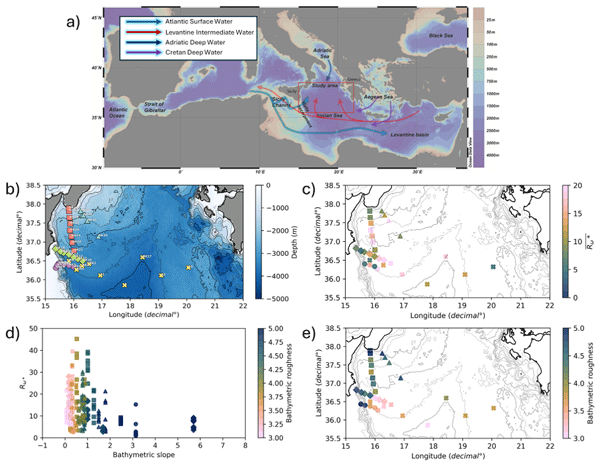
The deep Ionian Sea strongly influences how the Mediterranean water masses circulate. By studying how internal waves interact with the seafloor, we found that rougher terrain changes how wave energy is spread out. Energy shifts from large to small scales, affecting deep water mixing. These findings help improve models of Mediterranean circulation by showing how seafloor shape impacts mixing in the deep sea.
Morgan Reed Raven, Nitai Amiel, Dror L. Angel, James P. Barry, Thomas M. Blattmann, Laura Boicenco, Antoine Crémière, Natalya Evans, Nora Gallarotti, Sebastian Haas, Jan-Hendrik Hehemann, Peter Krost, Pranay Lal, David Lordkipanidze, Tiia Luostarinen, Aaron M. Martinez, Allison J. Matzelle, Selma Menabit, Mihaela Muresan, Andreas Neumann, Jean-Daniel Paris, Christopher R. Pearce, Nick Reynard, Daniel L. Sanchez, Florence Schubotz, Violeta Slabakova, Adrian Stanica, Elena Stoica, Andrew K. Sweetman, Tina Treude, Yoana G. Voynova, and Nikolaos D. Zarokanellos
Biogeosciences, 23, 3755–3776, https://doi.org/10.5194/bg-23-3755-2026, https://doi.org/10.5194/bg-23-3755-2026, 2026
Short summary
Short summary
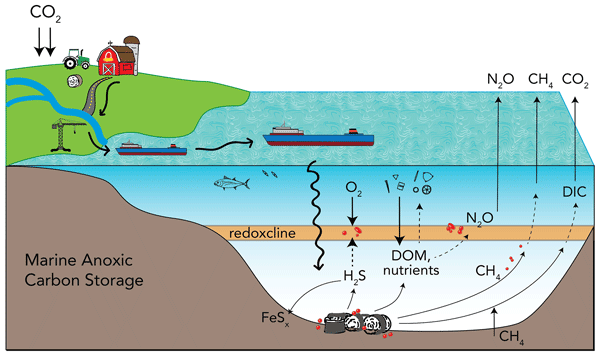
In addition to reducing emissions, vast quantities of CO2 will need to be removed from the atmosphere to meet climate goals. One strategy known as Marine Anoxic Carbon Storage (MACS) would bury plant carbon for thousands of years in parts in the ocean that lack oxygen, where carbon preservation can be highly efficient. We evaluate the environmental and other impacts of hypothetical large-scale MACS deployment from an interdisciplinary, international perspective and present a research roadmap.
Manuel Vargas-Yáñez, Orens Pasqueron de Fommervault, Emanuela Clementi, Christian Ferrarin, Svitlana Liubertseva, Diego Álvarez-Berastegui, Baptiste Mourre, Salvatore Aronica, Rosa Balbin, Joaquín Ballabrera-Poy, Sana Ben Ismail, Nathaniel Benssousan, Ismail Bessa, Alicia Blanco, Anthony Bosse, Evi Bourma, François Bourrin, Carlo Brandini, Fulvio Capodici, Clara Casals-Baixas, Branko Cermelj, Giuseppe Ciraolo, Pascal Conan, Laurent Coppola, Lorenzo Corgnati, Joaquín del Río, Emilie Diamond Riquier, Lara Diaz-Barroso, Bartolomeo Doronzo, Xavier Durrieu de Madron, Milad Fakhri, Costantine Frangoulis, Claudia Fratianni, Emilio García-Ladona, Jesus García-Lafuente, M. Carmen García-Martínez, Joaquín Garrabou, Josep Gasol, Adam Gauci, Frédéric Gazeau, Gerard Gregory, Abed El Raman Hassoun, Jordi Isern-Fontanet, Dominique Lefevre, Nadia Lo Bue, Guiomar López, Pablo Lorente, Deny Malengros, Ramon Massana, Sinan Mavruk, Stefano Miserocchi, Behzad Mostajir, Laure Mousseau, Francina Moya, Antonio Novellino, Arianna Orasi, Emanuele Organelli, Vicent Ouisse, Tal Ozer, Begoña Pérez-Gómez, Susana Pérez-Rubio, Leonidas Perivoliotis, Georges Petihakis, Anne Petrenko, Sebastien Pinel, Xavier Pitarch, Angela Pomaro, Lucía Quirós-Collazos, Emma Reyes, Simone Sammartino, Anna Sánchez-Vidal, Katrin Schroeder, Stefano Taddei, Elena Tel, Pierre Testor, Marco Torri, Daniela Turk, Laura Ursella, Dimitris Velaoras, Francesca Vidussi, Ivica Vilivić, Enrico Zambiachi, D. Nikolaos Zarokanellos, George Zodiatis, and Vanessa Cardin
EGUsphere, https://doi.org/10.5194/egusphere-2026-2632, https://doi.org/10.5194/egusphere-2026-2632, 2026
Short summary
Short summary
This work compiles current marine observation capabilities in the Mediterranean Sea, making this information accessible to scientists, organizations, stakeholders, and environmental policymakers. It supports initiatives such as Copernicus Marine Service, EMODNet, the European Ocean Pact, and EU directives. It is intended as a living resource to be updated, identifying strengths and gaps in Mediterranean observation systems.
Michele Bendoni, Andrew Michael Moore, Roberta Sciascia, Carlo Brandini, Katrin Schroeder, Mireno Borghini, and Marcello Gatimu Magaldi
Ocean Sci., 22, 281–303, https://doi.org/10.5194/os-22-281-2026, https://doi.org/10.5194/os-22-281-2026, 2026
Short summary
Short summary
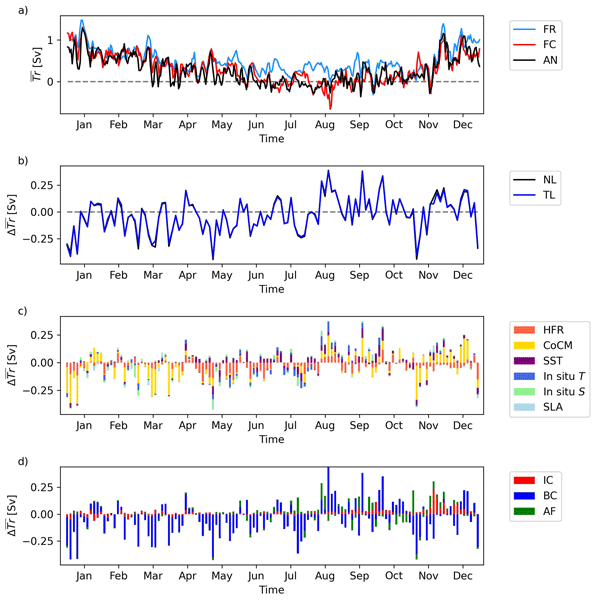
We use data assimilation (DA) to optimally merge information from observations of ocean variables and a numerical model of the north-western Mediterranean Sea. Data come from satellites, coastal high-frequency radars and fixed & movable devices. DA decreases model errors associated to all observed variables. The volume transport across the Corsica Channel, which connects the Tyrrhenian and Ligurian waters, is differently modified based on the typology and location of the assimilated observation.
Malek Belgacem, Katrin Schroeder, Marta Álvarez, Siv K. Lauvset, Jacopo Chiggiato, Mireno Borghini, Carolina Cantoni, Tiziana Ciuffardi, and Stefania Sparnocchia
Earth Syst. Sci. Data, 17, 5315–5336, https://doi.org/10.5194/essd-17-5315-2025, https://doi.org/10.5194/essd-17-5315-2025, 2025
Short summary
Short summary
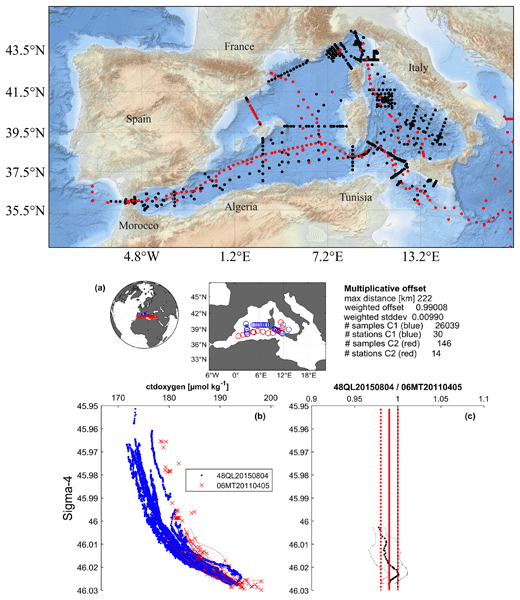
The Mediterranean Sea is changing rapidly, underscoring the urgent need for high-quality datasets to quantify trends and assess impacts on biogeochemical cycles. O2 is a key indicator of marine ecosystem health and plays a central role in CO2 and nutrient cycling. We compiled a regional-scale dataset of O2 in the western Mediterranean to provide a robust observational foundation for assessing O2 variability, associated with climate change, and anomalies related to deoxygenation processes.
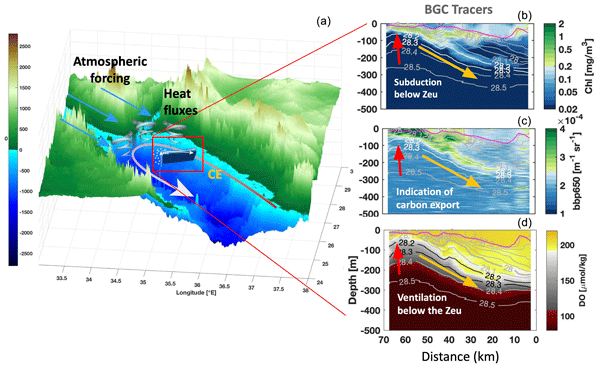
Lina Eyouni, Zoi Kokkini, Nikolaos D. Zarokanellos, and Burton H. Jones
Ocean Sci., 21, 2345–2366, https://doi.org/10.5194/os-21-2345-2025, https://doi.org/10.5194/os-21-2345-2025, 2025
Short summary
Short summary
This study examines how multiple processes in the northern Red Sea form Red Sea Outflow Water and affect biogeochemical fluxes. Using glider data, wind and air–sea flux reanalysis, and satellite observations, it highlights seasonal evolution. Eddy-driven upwelling exposes cool water to heat loss and evaporation, fueling primary productivity. Circulation patterns block inflows, extend cooling, and subduct water into the ocean interior, influencing regional dynamics.
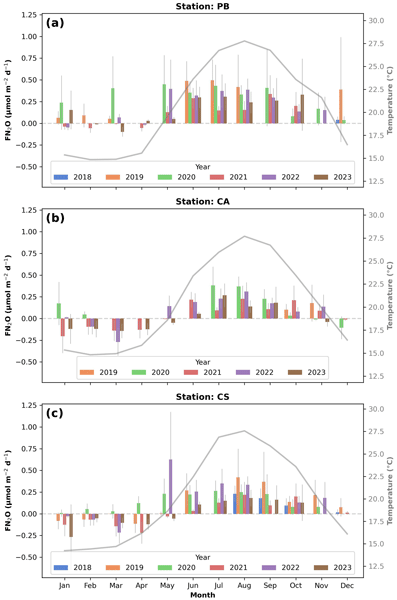
Susana Flecha, Mercedes de la Paz, Fiz Fernández Pérez, Núria Marbà, Carlos Morell, Eva Alou-Font, Joaquín Tintoré, and Iris E. Hendriks
Ocean Sci., 21, 1515–1532, https://doi.org/10.5194/os-21-1515-2025, https://doi.org/10.5194/os-21-1515-2025, 2025
Short summary
Short summary
Nitrous oxide (N2O), a potent greenhouse gas, is understudied in coastal zones. We present N2O concentrations and air–sea fluxes from the Balearic coast (2018–2023). Concentrations varied slightly across sites, with areas acting as weak sources or being near equilibrium. Temperature was the main driver of seasonal changes. These findings improve our understanding of coastal N2O emissions.
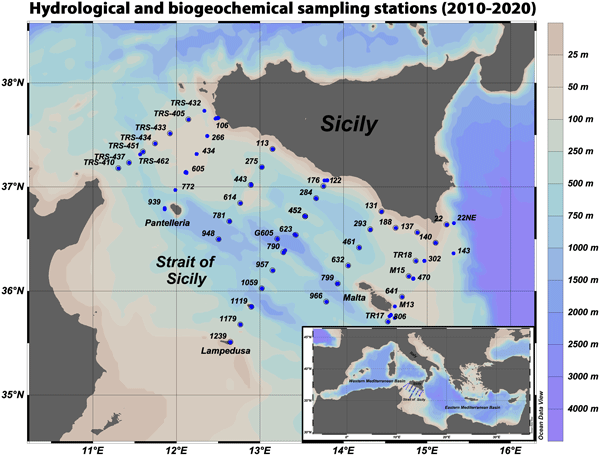
Francesco Placenti, Marco Torri, Katrin Schroeder, Mireno Borghini, Gabriella Cerrati, Angela Cuttitta, Vincenzo Tancredi, Carmelo Buscaino, and Bernardo Patti
Earth Syst. Sci. Data, 16, 743–752, https://doi.org/10.5194/essd-16-743-2024, https://doi.org/10.5194/essd-16-743-2024, 2024
Short summary
Short summary
Oceanographic surveys were conducted in the Strait of Sicily between 2010 and 2021. This paper provides a description of the time series of nutrients and hydrological data collected in this zone. The dataset fills an important gap in field observations of a crucial area where exchanges with the Mediterranean sub-basin take place, providing support for studies aimed at describing ongoing processes and at realizing reliable projections of the effects of these processes in the near future.
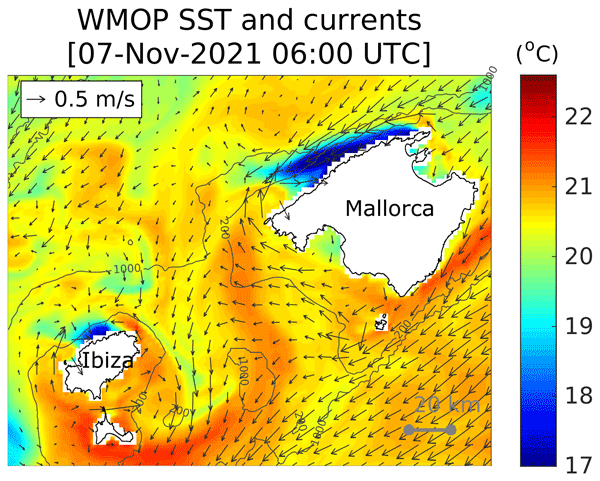
Baptiste Mourre, Emma Reyes, Pablo Lorente, Alex Santana, Jaime Hernández-Lasheras, Ismael Hernández-Carrasco, Maximo García-Jove, and Nikolaos D. Zarokanellos
State Planet, 1-osr7, 15, https://doi.org/10.5194/sp-1-osr7-15-2023, https://doi.org/10.5194/sp-1-osr7-15-2023, 2023
Short summary
Short summary
We characterize the signature of an intense storm-induced coastal upwelling along the north-western coast of the Balearic Islands in 2021 using a high-resolution operational prediction model. The upwelling, with a duration of 3 d and a spatial offshore extension of 20 km, led to cross-shore surface temperature differences of up to 6 °C. It was the most intense event of the past 9 years in terms of the impact on temperature and the second-most intense event in terms of cross-shore transports.
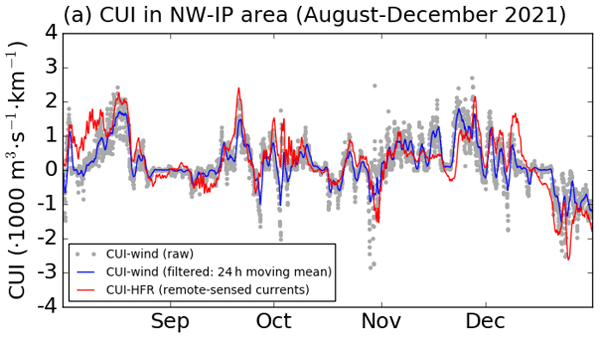
Pablo Lorente, Anna Rubio, Emma Reyes, Lohitzune Solabarrieta, Silvia Piedracoba, Joaquín Tintoré, and Julien Mader
State Planet, 1-osr7, 8, https://doi.org/10.5194/sp-1-osr7-8-2023, https://doi.org/10.5194/sp-1-osr7-8-2023, 2023
Short summary
Short summary
Upwelling is an important process that impacts water quality and aquaculture production in coastal areas. In this work we present a new methodology to monitor this phenomenon in two different regions by using surface current estimations provided by remote sensing technology called high-frequency radar.
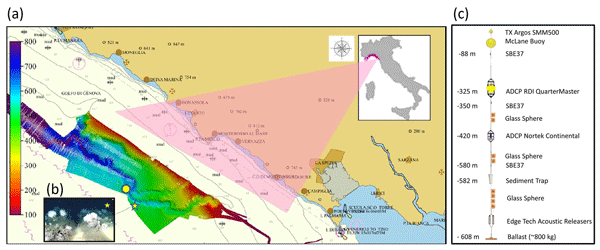
Tiziana Ciuffardi, Zoi Kokkini, Maristella Berta, Marina Locritani, Andrea Bordone, Ivana Delbono, Mireno Borghini, Maurizio Demarte, Roberta Ivaldi, Federica Pannacciulli, Anna Vetrano, Davide Marini, and Giovanni Caprino
Earth Syst. Sci. Data, 15, 1933–1946, https://doi.org/10.5194/essd-15-1933-2023, https://doi.org/10.5194/essd-15-1933-2023, 2023
Short summary
Short summary
This paper presents the results of the first 2 years of the Levante Canyon Mooring, a mooring line placed since 2020 in the eastern Ligurian Sea, to study a canyon area at about 600 m depth characterized by the presence of cold-water living corals. It provides hydrodynamic and thermohaline measurements along the water column, describing a water-mass distribution coherent with previous evidence in the Ligurian Sea. The data also show a Northern Current episodic and local reversal during summer.
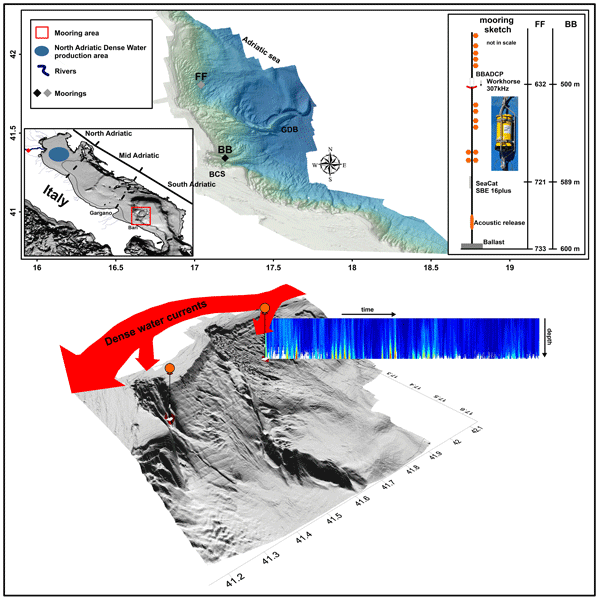
Francesco Paladini de Mendoza, Katrin Schroeder, Leonardo Langone, Jacopo Chiggiato, Mireno Borghini, Patrizia Giordano, Giulio Verazzo, and Stefano Miserocchi
Earth Syst. Sci. Data, 14, 5617–5635, https://doi.org/10.5194/essd-14-5617-2022, https://doi.org/10.5194/essd-14-5617-2022, 2022
Short summary
Short summary
This work presents the dataset of continuous monitoring in the southern Adriatic Margin, providing a unique observatory of deep-water dynamics. The study area is influenced by episodic dense-water cascading, which is a fundamental process for water renewal and deep-water dynamics. Information about the frequency and intensity variations of these events is observed along a time series. The monitoring activities are still ongoing and the moorings are part of the EMSO-ERIC network.
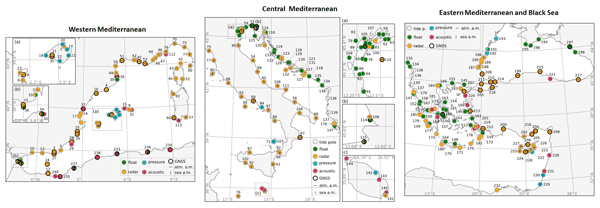
Begoña Pérez Gómez, Ivica Vilibić, Jadranka Šepić, Iva Međugorac, Matjaž Ličer, Laurent Testut, Claire Fraboul, Marta Marcos, Hassen Abdellaoui, Enrique Álvarez Fanjul, Darko Barbalić, Benjamín Casas, Antonio Castaño-Tierno, Srđan Čupić, Aldo Drago, María Angeles Fraile, Daniele A. Galliano, Adam Gauci, Branislav Gloginja, Víctor Martín Guijarro, Maja Jeromel, Marcos Larrad Revuelto, Ayah Lazar, Ibrahim Haktan Keskin, Igor Medvedev, Abdelkader Menassri, Mohamed Aïssa Meslem, Hrvoje Mihanović, Sara Morucci, Dragos Niculescu, José Manuel Quijano de Benito, Josep Pascual, Atanas Palazov, Marco Picone, Fabio Raicich, Mohamed Said, Jordi Salat, Erdinc Sezen, Mehmet Simav, Georgios Sylaios, Elena Tel, Joaquín Tintoré, Klodian Zaimi, and George Zodiatis
Ocean Sci., 18, 997–1053, https://doi.org/10.5194/os-18-997-2022, https://doi.org/10.5194/os-18-997-2022, 2022
Short summary
Short summary
This description and mapping of coastal sea level monitoring networks in the Mediterranean and Black seas reveals the existence of 240 presently operational tide gauges. Information is provided about the type of sensor, time sampling, data availability, and ancillary measurements. An assessment of the fit-for-purpose status of the network is also included, along with recommendations to mitigate existing bottlenecks and improve the network, in a context of sea level rise and increasing extremes.
Pablo Lorente, Eva Aguiar, Michele Bendoni, Maristella Berta, Carlo Brandini, Alejandro Cáceres-Euse, Fulvio Capodici, Daniela Cianelli, Giuseppe Ciraolo, Lorenzo Corgnati, Vlado Dadić, Bartolomeo Doronzo, Aldo Drago, Dylan Dumas, Pierpaolo Falco, Maria Fattorini, Adam Gauci, Roberto Gómez, Annalisa Griffa, Charles-Antoine Guérin, Ismael Hernández-Carrasco, Jaime Hernández-Lasheras, Matjaž Ličer, Marcello G. Magaldi, Carlo Mantovani, Hrvoje Mihanović, Anne Molcard, Baptiste Mourre, Alejandro Orfila, Adèle Révelard, Emma Reyes, Jorge Sánchez, Simona Saviano, Roberta Sciascia, Stefano Taddei, Joaquín Tintoré, Yaron Toledo, Laura Ursella, Marco Uttieri, Ivica Vilibić, Enrico Zambianchi, and Vanessa Cardin
Ocean Sci., 18, 761–795, https://doi.org/10.5194/os-18-761-2022, https://doi.org/10.5194/os-18-761-2022, 2022
Short summary
Short summary
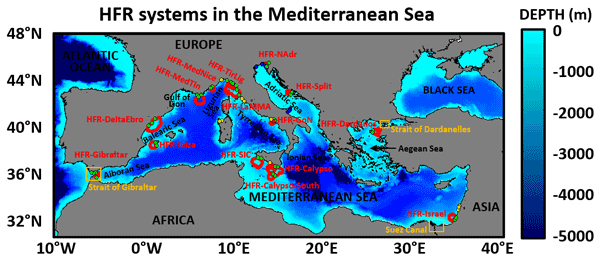
High-frequency radar (HFR) is a land-based remote sensing technology that can provide maps of the surface circulation over broad coastal areas, along with wave and wind information. The main goal of this work is to showcase the current status of the Mediterranean HFR network as well as present and future applications of this sensor for societal benefit such as search and rescue operations, safe vessel navigation, tracking of marine pollutants, and the monitoring of extreme events.
Emma Reyes, Eva Aguiar, Michele Bendoni, Maristella Berta, Carlo Brandini, Alejandro Cáceres-Euse, Fulvio Capodici, Vanessa Cardin, Daniela Cianelli, Giuseppe Ciraolo, Lorenzo Corgnati, Vlado Dadić, Bartolomeo Doronzo, Aldo Drago, Dylan Dumas, Pierpaolo Falco, Maria Fattorini, Maria J. Fernandes, Adam Gauci, Roberto Gómez, Annalisa Griffa, Charles-Antoine Guérin, Ismael Hernández-Carrasco, Jaime Hernández-Lasheras, Matjaž Ličer, Pablo Lorente, Marcello G. Magaldi, Carlo Mantovani, Hrvoje Mihanović, Anne Molcard, Baptiste Mourre, Adèle Révelard, Catalina Reyes-Suárez, Simona Saviano, Roberta Sciascia, Stefano Taddei, Joaquín Tintoré, Yaron Toledo, Marco Uttieri, Ivica Vilibić, Enrico Zambianchi, and Alejandro Orfila
Ocean Sci., 18, 797–837, https://doi.org/10.5194/os-18-797-2022, https://doi.org/10.5194/os-18-797-2022, 2022
Short summary
Short summary
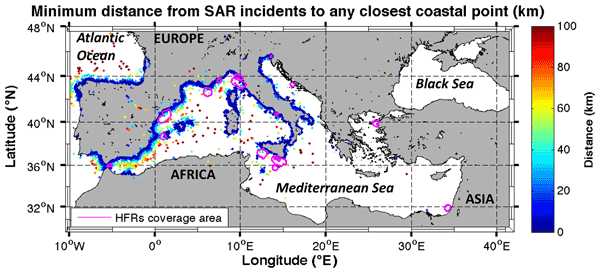
This work reviews the existing advanced and emerging scientific and societal applications using HFR data, developed to address the major challenges identified in Mediterranean coastal waters organized around three main topics: maritime safety, extreme hazards and environmental transport processes. It also includes a discussion and preliminary assessment of the capabilities of existing HFR applications, finally providing a set of recommendations towards setting out future prospects.
Malek Belgacem, Katrin Schroeder, Alexander Barth, Charles Troupin, Bruno Pavoni, Patrick Raimbault, Nicole Garcia, Mireno Borghini, and Jacopo Chiggiato
Earth Syst. Sci. Data, 13, 5915–5949, https://doi.org/10.5194/essd-13-5915-2021, https://doi.org/10.5194/essd-13-5915-2021, 2021
Short summary
Short summary
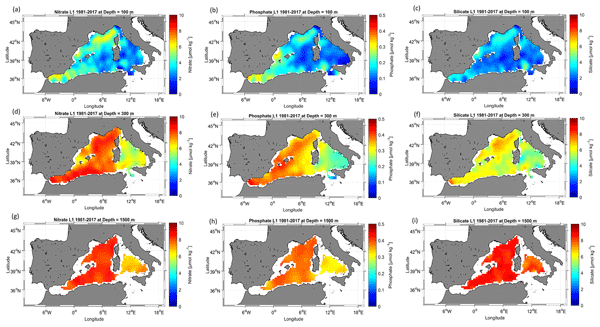
The Mediterranean Sea exhibits an anti-estuarine circulation, responsible for its low productivity. Understanding this peculiar character is still a challenge since there is no exact quantification of nutrient sinks and sources. Because nutrient in situ observations are generally infrequent and scattered in space and time, climatological mapping is often applied to sparse data in order to understand the biogeochemical state of the ocean. The dataset presented here partly addresses these issues.
Cited articles
Aulicino, G., Cotroneo, Y., Ruiz, S., Sánchez Román, A., Pascual, A., Fusco, G., Tintoré, J., and Budillon, G.: Monitoring the Algerian Basin through glider observations, satellite altimetry and numerical simulations along a SARAL/AltiKa track, J. Mar. Syst., 179, 55–71, https://doi.org/10.1016/j.jmarsys.2017.11.006, 2018.
Aydogdu, A., Escudier, R., Hernandez-Lasheras, J., Amadio, C., Pistoia, J., Zarokanellos, N. D., Cossarini, G., Remy, E., and Mourre, B.: Glider observations in the Western Mediterranean Sea: their assimilation and impact assessment using four analysis and forecasting systems, Front. Mar. Sci., 12, 1456463, https://doi.org/10.3389/fmars.2025.1456463, 2025.
Batchelor, G. K.: Small-scale variation of convected quantities like temperature in turbulent fluid Part 1. General discussion and the case of small conductivity, J. Fluid Mech., 5, 113–133, https://doi.org/10.1017/S002211205900009X, 1959.
Chiggiato, J., Schroeder, K., Borghini, M., Tintoré, J., D. Zarokanellos, N., Miralles, A., Rubio, M., Rivera, P., Charcos, M., and Casas, B.: Sardinia – MAllorca Repeated Transect (SMART) (2.0.0), SOCIB, https://doi.org/10.25704/ZWMH-AP87, 2021.
Chiggiato, J., Artale, V., Durrieu De Madron, X., Schroeder, K., Taupier-Letage, I., Velaoras, D., and Vargas-Yáñez, M.: Recent changes in the Mediterranean Sea, in: Oceanography of the Mediterranean Sea, Elsevier, 289–334, https://doi.org/10.1016/B978-0-12-823692-5.00008-X, 2023.
Eriksen, C. C., Osse, T. J., Light, R. D., Wen, T., Lehman, T. W., Sabin, P. L., Ballard, J. W., and Chiodi, A. M.: Seaglider: a long-range autonomous underwater vehicle for oceanographic research, IEEE J. Ocean. Eng., 26, 424–436, https://doi.org/10.1109/48.972073, 2001.
Fer, I., Dengler, M., Holtermann, P., Le Boyer, A., and Lueck, R.: ATOMIX benchmark datasets for dissipation rate measurements using shear probes, Sci. Data, 11, 518, https://doi.org/10.1038/s41597-024-03323-y, 2024.
Goodman, L., Levine, E. R., and Lueck, R. G.: On Measuring the Terms of the Turbulent Kinetic Energy Budget from an AUV, J. Atmos. Ocean. Tech., 23, 977–990, https://doi.org/10.1175/JTECH1889.1, 2006.
Gregg, M. C.: Scaling turbulent dissipation in the thermocline, J. Geophys. Res., 94, 9686–9698, https://doi.org/10.1029/JC094iC07p09686, 1989.
Juza, M., Heslop, E., Zarokanellos, N. D., and Tintoré, J.: Multi-scale ocean variability in the Ibiza Channel over 14-year repeated glider missions, Front. Mar. Sci., 12, 1604087, https://doi.org/10.3389/fmars.2025.1604087, 2025.
Kokoszka, F. V. M.: Teresa MR processing code, Zenodo [code], https://doi.org/10.5281/ZENODO.16541936, 2025.
Kokoszka, F. V. M., Borghini, M., Schroeder, K., Chiggiato, J., Tintoré, J., Zarokanellos, N., Miralles, A., Rivera Rodríguez, P., Rubio, M., Charcos, M., Casas, B., and Ten Doeschate, A.: Turbulence microstructure dataset from Slocum Glider Teresa (Western Mediterranean, 2015–2024) (1), SEANOE [data set], https://doi.org/10.17882/107995, 2025.
Kraichnan, R. H.: Small-Scale Structure of a Scalar Field Convected by Turbulence, Phys. Fluids, 11, 945–953, https://doi.org/10.1063/1.1692063, 1968.
Le Boyer, A., Couto, N., Alford, M. H., Drake, H. F., Bluteau, C. E., Hughes, K. G., Naveira Garabato, A. C., Moulin, A. J., Peacock, T., Fine, E. C., Mashayek, A., Cimoli, L., Meredith, M. P., Melet, A., Fer, I., Dengler, M., and Stevens, C. L.: Turbulent diapycnal fluxes as a pilot Essential Ocean Variable, Front. Mar. Sci., 10, 1241023, https://doi.org/10.3389/fmars.2023.1241023, 2023.
Lindstrom, E., Gunn, J., Fischer, A., McCurdy, A., Glover, L. K., and Members, T. T.: A Framework for Ocean Observing, European Space Agency, https://doi.org/10.5270/OceanObs09-FOO, 2012.
Lueck, R., Murowinski, E., and McMillan, J.: RSI Technical Note 039: A Guide To Data Processing, Rockland Scientific International Inc., Victoria, BC, Canada, https://rocklandscientific.com/support/technical-notes/ (last access: 29 July 2025), 2020.
Lueck, R., Fer, I., Bluteau, C., Dengler, M., Holtermann, P., Inoue, R., LeBoyer, A., Nicholson, S.-A., Schulz, K., and Stevens, C.: Best practices recommendations for estimating dissipation rates from shear probes, Front. Mar. Sci., 11, 1334327, https://doi.org/10.3389/fmars.2024.1334327, 2024.
Lueck, R. G., Wolk, F., and Yamazaki, H.: Oceanic Velocity Microstructure Measurements in the 20th Century, J. Oceanogr., 58, 153–174, https://doi.org/10.1023/A:1015837020019, 2002.
Luketina, D. A. and Imberger, J.: Determining Turbulent Kinetic Energy Dissipation from Batchelor Curve Fitting, J. Atmos. Ocean. Tech., 18, 100–113, https://doi.org/10.1175/1520-0426(2001)018<0100:DTKEDF>2.0.CO;2, 2001.
Margirier, F., Testor, P., Heslop, E., Mallil, K., Bosse, A., Houpert, L., Mortier, L., Bouin, M.-N., Coppola, L., D'Ortenzio, F., Durrieu De Madron, X., Mourre, B., Prieur, L., Raimbault, P., and Taillandier, V.: Abrupt warming and salinification of intermediate waters interplays with decline of deep convection in the Northwestern Mediterranean Sea, Sci. Rep., 10, https://doi.org/10.1038/s41598-020-77859-5, 2020.
Merckelbach, L., Berger, A., Krahmann, G., Dengler, M., and Carpenter, J. R.: A Dynamic Flight Model for Slocum Gliders and Implications for Turbulence Microstructure Measurements, J. Atmos. Ocean. Tech., 36, 281–296, https://doi.org/10.1175/JTECH-D-18-0168.1, 2019.
Millot, C.: Circulation in the Western Mediterranean Sea, J. Mar. Syst., 20, 423–442, https://doi.org/10.1016/S0924-7963(98)00078-5, 1999.
Nasmyth, P. W.: Oceanic turbulence, University of British Columbia, https://doi.org/10.14288/1.0302459, 1970.
Osborn, T. R. and Crawford, W. R.: An Airfoil Probe for Measuring Turbulent Velocity Fluctuations in Water, in: Air-Sea Interaction, edited by: Dobson, F., Hasse, L., and Davis, R., Springer US, Boston, MA, 369–386, https://doi.org/10.1007/978-1-4615-9182-5_20, 1980.
Peterson, A. K. and Fer, I.: Dissipation measurements using temperature microstructure from an underwater glider, Meth. Oceanogr., 10, 44–69, https://doi.org/10.1016/j.mio.2014.05.002, 2014.
Piccolroaz, S., Fernández-Castro, B., Toffolon, M., and Dijkstra, H. A.: A multi-site, year-round turbulence microstructure atlas for the deep perialpine Lake Garda, Sci. Data, 8, 188, https://doi.org/10.1038/s41597-021-00965-0, 2021.
Pinardi, N., Zavatarelli, M., Adani, M., Coppini, G., Fratianni, C., Oddo, P., Simoncelli, S., Tonani, M., Lyubartsev, V., Dobricic, S., and Bonaduce, A.: Mediterranean Sea large-scale low-frequency ocean variability and water mass formation rates from 1987 to 2007: A retrospective analysis, Prog. Oceanogr., 132, 318–332, https://doi.org/10.1016/j.pocean.2013.11.003, 2015.
Ruddick, B., Anis, A., and Thompson, K.: Maximum Likelihood Spectral Fitting: The Batchelor Spectrum, J. Atmos. Ocean. Tech., 17, 1541–1555, https://doi.org/10.1175/1520-0426(2000)017<1541:MLSFTB>2.0.CO;2, 2000.
Schroeder, K., Chiggiato, J., Bryden, H. L., Borghini, M., and Ben Ismail, S.: Abrupt climate shift in the Western Mediterranean Sea, Sci. Rep., 6, 23009, https://doi.org/10.1038/srep23009, 2016.
Schroeder, K., Ben Ismail, S., Bensi, M., Bosse, A., Chiggiato, J., Civitarese, G., Falcieri M, F., Fusco, G., Gačić, M., Gertman, I., Kubin, E., Malanotte-Rizzoli, P., Martellucci, R., Menna, M., Ozer, T., Taupier-Letage, I., Vargas-Yáñez, M., Velaoras, D., and Vilibić, I.: A consensus-based, revised and comprehensive catalogue for Mediterranean water masses acronyms, Mediterr. Mar. Sci., 25, 783–791, https://doi.org/10.12681/mms.38736, 2024.
Send, U., Font, J., Krahmann, G., Millot, C., Rhein, M., and Tintoré, J.: Recent advances in observing the physical oceanography of the western Mediterranean Sea, Prog. Oceanogr., 44, 37–64, https://doi.org/10.1016/S0079-6611(99)00020-8, 1999.
Sherman, J. T. and Davis, R. E.: Observations of Temperature Microstructure in NATRE, J. Phys. Oceanogr., 25, 1913–1929, https://doi.org/10.1175/1520-0485(1995)025<1913:OOTMIN>2.0.CO;2, 1995.
Steinbuck, J. V., Stacey, M. T., McManus, M. A., Cheriton, O. M., and Ryan, J. P.: Observations of turbulent mixing in a phytoplankton thin layer: Implications for formation, maintenance, and breakdown, Limnol. Oceanogr., 54, 1353–1368, https://doi.org/10.4319/lo.2009.54.4.1353, 2009.
St. Laurent, L. and Merrifield, S.: Measurements of Near-Surface Turbulence and Mixing from Autonomous Ocean Gliders, Oceanography, 30, 116–125, https://doi.org/10.5670/oceanog.2017.231, 2017.
Testor, P.: MOOSE-GE, French Oceanographic Cruises, https://doi.org/10.18142/235, 2010.
Testor, P., Send, U., Gascard, J. -C., Millot, C., Taupier-Letage, I., and Béranger, K.: The mean circulation of the southwestern Mediterranean Sea: Algerian Gyres, J. Geophys. Res., 110, 2004JC002861, https://doi.org/10.1029/2004JC002861, 2005.
Testor, P., Bosse, A., and Coppola, L.: MOOSE-GE, French Oceanographic Cruises, https://doi.org/10.18142/235, 2010.
Testor, P., Bosse, A., Houpert, L., Margirier, F., Mortier, L., Legoff, H., Dausse, D., Labaste, M., Karstensen, J., Hayes, D., Olita, A., Ribotti, A., Schroeder, K., Chiggiato, J., Onken, R., Heslop, E., Mourre, B., D'ortenzio, F., Mayot, N., Lavigne, H., De Fommervault, O., Coppola, L., Prieur, L., Taillandier, V., Durrieu De Madron, X., Bourrin, F., Many, G., Damien, P., Estournel, C., Marsaleix, P., Taupier-Letage, I., Raimbault, P., Waldman, R., Bouin, M., Giordani, H., Caniaux, G., Somot, S., Ducrocq, V., and Conan, P.: Multiscale Observations of Deep Convection in the Northwestern Mediterranean Sea During Winter 2012–2013 Using Multiple Platforms, J. Geophys. Res.-Oceans, 123, 1745–1776, https://doi.org/10.1002/2016JC012671, 2018.
Tintoré, J., Vizoso, G., Casas, B., Heslop, E., Pascual, A., Orfila, A., Ruiz, S., Martínez-Ledesma, M., Torner, M., Cusí, S., Diedrich, A., Balaguer, P., Gómez-Pujol, L., Álvarez-Ellacuria, A., Gómara, S., Sebastian, K., Lora, S., Beltrán, J. P., Renault, L., Juzà, M., Álvarez, D., March, D., Garau, B., Castilla, C., Cañellas, T., Roque, D., Lizarán, I., Pitarch, S., Carrasco, M. A., Lana, A., Mason, E., Escudier, R., Conti, D., Sayol, J. M., Barceló, B., Alemany, F., Reglero, P., Massuti, E., Vélez-Belchí, P., Ruiz, J., Oguz, T., Gómez, M., Álvarez, E., Ansorena, L., and Manriquez, M.: SOCIB: The Balearic Islands Coastal Ocean Observing and Forecasting System Responding to Science, Technology and Society Needs, Mar. Technol. Soc. J., 47, 101–117, https://doi.org/10.4031/MTSJ.47.1.10, 2013.
Waterhouse, A. F., MacKinnon, J. A., Nash, J. D., Alford, M. H., Kunze, E., Simmons, H. L., Polzin, K. L., St. Laurent, L. C., Sun, O. M., Pinkel, R., Talley, L. D., Whalen, C. B., Huussen, T. N., Carter, G. S., Fer, I., Waterman, S., Naveira Garabato, A. C., Sanford, T. B., and Lee, C. M.: Global Patterns of Diapycnal Mixing from Measurements of the Turbulent Dissipation Rate, J. Phys. Oceanogr., 44, 1854–1872, https://doi.org/10.1175/JPO-D-13-0104.1, 2014.
Wolk, F., Lueck, R. G., and St. Laurent, L.: Turbulence measurements from a glider, in: OCEANS 2009, Biloxi, MS, 1–6, https://doi.org/10.23919/OCEANS.2009.5422413, 2009.
Short summary
We present a unique dataset of underwater measurements collected by an autonomous glider in the western Mediterranean Sea. It reveals how ocean layers mix over seasons and years. Using sensors to detect small scale water movements, we estimated how mechanical energy and heat are transferred in the ocean. These data help scientists better understand ocean circulation and climate effects. All files and methods are openly shared to support future research.
We present a unique dataset of underwater measurements collected by an autonomous glider in the...


Altmetrics
Final-revised paper
Preprint