Articles | Volume 18, issue 2
https://doi.org/10.5194/essd-18-875-2026
© Author(s) 2026. This work is distributed under
the Creative Commons Attribution 4.0 License.
the Creative Commons Attribution 4.0 License.
https://doi.org/10.5194/essd-18-875-2026
© Author(s) 2026. This work is distributed under
the Creative Commons Attribution 4.0 License.
the Creative Commons Attribution 4.0 License.
Data description article
| 
03 Feb 2026
Data description article |
| 03 Feb 2026
| 03 Feb 2026
Annual carbon emissions from land-use change in China from 1000 to 2019
Key Research Institute of Yellow River Civilization and Sustainable Development, Henan University, Kaifeng 475001, China
Faculty of Geographical Science and Engineering, Henan University, Zhengzhou 450046, China
Laboratory of Climate Change Mitigation and Carbon Neutrality, Henan University, Zhengzhou 450046, China
Guanpeng Dong
CORRESPONDING AUTHOR

Key Research Institute of Yellow River Civilization and Sustainable Development, Henan University, Kaifeng 475001, China
Faculty of Geographical Science and Engineering, Henan University, Zhengzhou 450046, China
Laboratory of Climate Change Mitigation and Carbon Neutrality, Henan University, Zhengzhou 450046, China
Xiaoyu Meng
Key Research Institute of Yellow River Civilization and Sustainable Development, Henan University, Kaifeng 475001, China
Faculty of Geographical Science and Engineering, Henan University, Zhengzhou 450046, China
Laboratory of Climate Change Mitigation and Carbon Neutrality, Henan University, Zhengzhou 450046, China
Richard A. Houghton
Woodwell Climate Research Center, Falmouth, MA 02540, USA
Yang Gao
Key Research Institute of Yellow River Civilization and Sustainable Development, Henan University, Kaifeng 475001, China
Faculty of Geographical Science and Engineering, Henan University, Zhengzhou 450046, China
Laboratory of Climate Change Mitigation and Carbon Neutrality, Henan University, Zhengzhou 450046, China
Fanneng He
CORRESPONDING AUTHOR
Key Laboratory of Land Surface Pattern and Simulation, Institute of Geographic Sciences and Natural Resources Research, Chinese Academy of Sciences, Beijing 100101, China
Meijiao Li
College of Resources and Environment, Shanxi University of Finance and Economics, Taiyuan 030006, China
Wenjin Li
Key Research Institute of Yellow River Civilization and Sustainable Development, Henan University, Kaifeng 475001, China
Bing Li
Key Research Institute of Yellow River Civilization and Sustainable Development, Henan University, Kaifeng 475001, China
Faculty of Geographical Science and Engineering, Henan University, Zhengzhou 450046, China
Laboratory of Climate Change Mitigation and Carbon Neutrality, Henan University, Zhengzhou 450046, China
Zhihao Liu
Key Research Institute of Yellow River Civilization and Sustainable Development, Henan University, Kaifeng 475001, China
Qinqin Mao
Piesat Information Technology Co., Ltd., Xi'an 710100, China
Pengfei Wu
Key Research Institute of Yellow River Civilization and Sustainable Development, Henan University, Kaifeng 475001, China
Yuanzhi Yao
School of Geographic Science, East China Normal University, Shanghai 200241, China
Xudong Zhai
Key Research Institute of Yellow River Civilization and Sustainable Development, Henan University, Kaifeng 475001, China
Hongjuan Zhang
Key Research Institute of Yellow River Civilization and Sustainable Development, Henan University, Kaifeng 475001, China
Faculty of Geographical Science and Engineering, Henan University, Zhengzhou 450046, China
Laboratory of Climate Change Mitigation and Carbon Neutrality, Henan University, Zhengzhou 450046, China
State Key Laboratory of Soil and Water Conservation and Desertification Control, Northwest A&F University, Yangling, Shaanxi 712100, China
College of Soil and Water Conservation Science and Engineering, Northwest A&F University, Yangling, Shaanxi 712100, China
Related authors
No articles found.
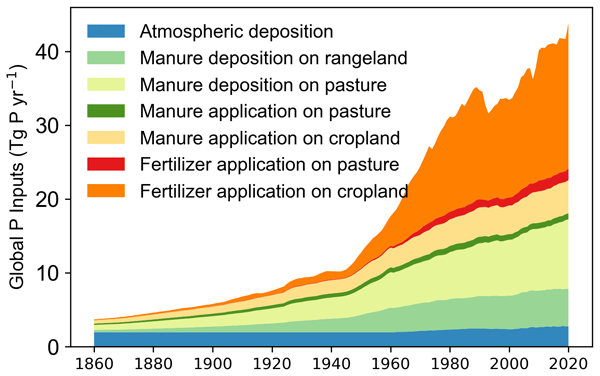
Zihao Bian, Hao Shi, Rui Li, Fei Lun, Francesco N. Tubiello, Nathaniel D. Mueller, Shiyu You, Rong Hao, Jiageng Ma, Longhui Li, Changchun Huang, Bing He, Yuanzhi Yao, and Hanqin Tian
Earth Syst. Sci. Data, 18, 7125–7141, https://doi.org/10.5194/essd-18-7125-2026, https://doi.org/10.5194/essd-18-7125-2026, 2026
Short summary
Short summary
The History of Anthropogenic Phosphorus Inputs (HaPi) provides a dataset of global human-driven phosphorus fluxes to terrestrial biosphere from 1860–2020 at a resolution of 5 arcmin. This comprehensive dataset consists of phosphorus fertilizer/manure application to cropland, manure application/deposition to pasture, manure deposition to rangeland, and atmospheric phosphorus deposition. It supports analyses of nutrient budgets and provides essential forcing data for Earth system models.
Wei Wen, Chao Yue, Bingming Chen, Xianhui Tang, Yabo Wang, Wajid Ali Khattak, and Xin Song
EGUsphere, https://doi.org/10.5194/egusphere-2026-2605, https://doi.org/10.5194/egusphere-2026-2605, 2026
Short summary
Short summary
Hydrogen isotope discrepancies between plant stem and soil water extracted using cryogenic vacuum distillation challenge the assumption that plant stem water represents its source water. Using controlled experiments with multiple plant types, we tested whether this mismatch reflects biological processes or extraction biases. We found that the extraction method affects both stem and soil water. Correcting these biases removes the mismatch and improves the reliability of isotope-based methods.
Dongmei Tang, Yuanzhi Yao, Rui Li, and Xia Li
Earth Syst. Sci. Data Discuss., https://doi.org/10.5194/essd-2026-243, https://doi.org/10.5194/essd-2026-243, 2026
Revised manuscript under review for ESSD
Short summary
Short summary
We present a global, gridded dataset (1 km resolution) of consumption-based deforestation carbon emissions for the period 2001 to 2020. Our dataset shows that deforestation emissions embodied in international trade account for 31.8 % of global deforestation emissions. It provides spatially explicit information to support analyses of consumption-driven deforestation emissions and inform climate mitigation and policy assessments.
Dongmei Tang, Yuanzhi Yao, and Xia Li
Earth Syst. Sci. Data Discuss., https://doi.org/10.5194/essd-2024-619, https://doi.org/10.5194/essd-2024-619, 2025
Manuscript not accepted for further review
Short summary
Short summary
We developed a global consumption-based carbon emissions gridded dataset (1 km) for deforestation from 2001 to 2015. Our dataset shows that trade-related emissions account for 31 % of global deforestation emissions, with high-income countries driving most of the emissions. This research highlights the importance of addressing consumption patterns in climate change strategies and offers valuable data to inform global policy and emission reduction efforts.
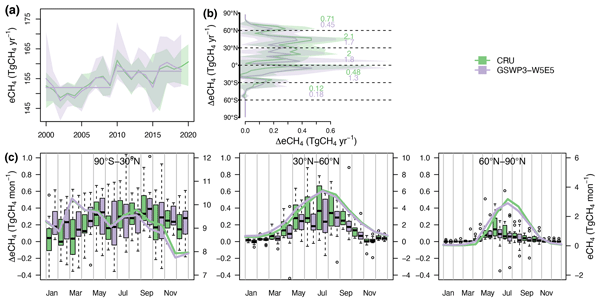
Zhen Zhang, Benjamin Poulter, Joe R. Melton, William J. Riley, George H. Allen, David J. Beerling, Philippe Bousquet, Josep G. Canadell, Etienne Fluet-Chouinard, Philippe Ciais, Nicola Gedney, Peter O. Hopcroft, Akihiko Ito, Robert B. Jackson, Atul K. Jain, Katherine Jensen, Fortunat Joos, Thomas Kleinen, Sara H. Knox, Tingting Li, Xin Li, Xiangyu Liu, Kyle McDonald, Gavin McNicol, Paul A. Miller, Jurek Müller, Prabir K. Patra, Changhui Peng, Shushi Peng, Zhangcai Qin, Ryan M. Riggs, Marielle Saunois, Qing Sun, Hanqin Tian, Xiaoming Xu, Yuanzhi Yao, Yi Xi, Wenxin Zhang, Qing Zhu, Qiuan Zhu, and Qianlai Zhuang
Biogeosciences, 22, 305–321, https://doi.org/10.5194/bg-22-305-2025, https://doi.org/10.5194/bg-22-305-2025, 2025
Short summary
Short summary
This study assesses global methane emissions from wetlands between 2000 and 2020 using multiple models. We found that wetland emissions increased by 6–7 Tg CH4 yr-1 in the 2010s compared to the 2000s. Rising temperatures primarily drove this increase, while changes in precipitation and CO2 levels also played roles. Our findings highlight the importance of wetlands in the global methane budget and the need for continuous monitoring to understand their impact on climate change.
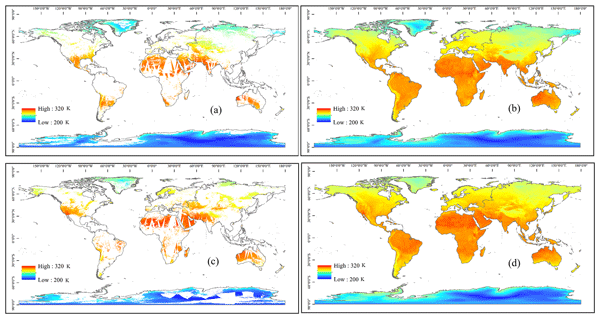
Bing Li, Shunlin Liang, Han Ma, Guanpeng Dong, Xiaobang Liu, Tao He, and Yufang Zhang
Earth Syst. Sci. Data, 16, 3795–3819, https://doi.org/10.5194/essd-16-3795-2024, https://doi.org/10.5194/essd-16-3795-2024, 2024
Short summary
Short summary
This study describes 1 km all-weather instantaneous and daily mean land surface temperature (LST) datasets on the global scale during 2000–2020. It is the first attempt to synergistically estimate all-weather instantaneous and daily mean LST data on a long global-scale time series. The generated datasets were evaluated by the observations from in situ stations and other LST datasets, and the evaluation indicated that the dataset is sufficiently reliable.

Hanqin Tian, Naiqing Pan, Rona L. Thompson, Josep G. Canadell, Parvadha Suntharalingam, Pierre Regnier, Eric A. Davidson, Michael Prather, Philippe Ciais, Marilena Muntean, Shufen Pan, Wilfried Winiwarter, Sönke Zaehle, Feng Zhou, Robert B. Jackson, Hermann W. Bange, Sarah Berthet, Zihao Bian, Daniele Bianchi, Alexander F. Bouwman, Erik T. Buitenhuis, Geoffrey Dutton, Minpeng Hu, Akihiko Ito, Atul K. Jain, Aurich Jeltsch-Thömmes, Fortunat Joos, Sian Kou-Giesbrecht, Paul B. Krummel, Xin Lan, Angela Landolfi, Ronny Lauerwald, Ya Li, Chaoqun Lu, Taylor Maavara, Manfredi Manizza, Dylan B. Millet, Jens Mühle, Prabir K. Patra, Glen P. Peters, Xiaoyu Qin, Peter Raymond, Laure Resplandy, Judith A. Rosentreter, Hao Shi, Qing Sun, Daniele Tonina, Francesco N. Tubiello, Guido R. van der Werf, Nicolas Vuichard, Junjie Wang, Kelley C. Wells, Luke M. Western, Chris Wilson, Jia Yang, Yuanzhi Yao, Yongfa You, and Qing Zhu
Earth Syst. Sci. Data, 16, 2543–2604, https://doi.org/10.5194/essd-16-2543-2024, https://doi.org/10.5194/essd-16-2543-2024, 2024
Short summary
Short summary
Atmospheric concentrations of nitrous oxide (N2O), a greenhouse gas 273 times more potent than carbon dioxide, have increased by 25 % since the preindustrial period, with the highest observed growth rate in 2020 and 2021. This rapid growth rate has primarily been due to a 40 % increase in anthropogenic emissions since 1980. Observed atmospheric N2O concentrations in recent years have exceeded the worst-case climate scenario, underscoring the importance of reducing anthropogenic N2O emissions.
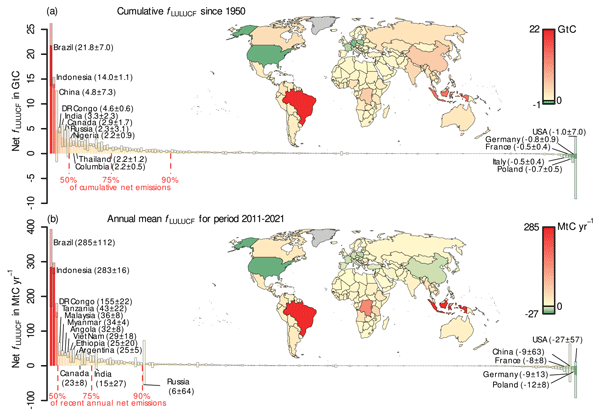
Wolfgang Alexander Obermeier, Clemens Schwingshackl, Ana Bastos, Giulia Conchedda, Thomas Gasser, Giacomo Grassi, Richard A. Houghton, Francesco Nicola Tubiello, Stephen Sitch, and Julia Pongratz
Earth Syst. Sci. Data, 16, 605–645, https://doi.org/10.5194/essd-16-605-2024, https://doi.org/10.5194/essd-16-605-2024, 2024
Short summary
Short summary
We provide and compare country-level estimates of land-use CO2 fluxes from a variety and large number of models, bottom-up estimates, and country reports for the period 1950–2021. Although net fluxes are small in many countries, they are often composed of large compensating emissions and removals. In many countries, the estimates agree well once their individual characteristics are accounted for, but in other countries, including some of the largest emitters, substantial uncertainties exist.
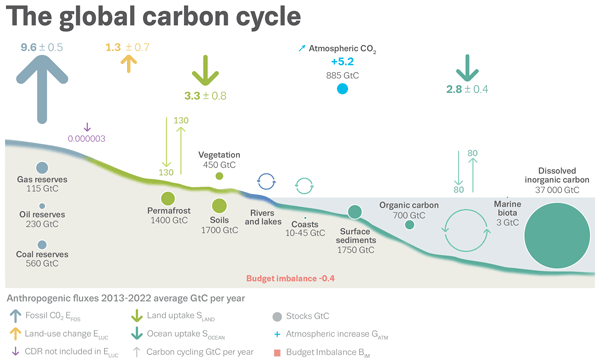
Pierre Friedlingstein, Michael O'Sullivan, Matthew W. Jones, Robbie M. Andrew, Dorothee C. E. Bakker, Judith Hauck, Peter Landschützer, Corinne Le Quéré, Ingrid T. Luijkx, Glen P. Peters, Wouter Peters, Julia Pongratz, Clemens Schwingshackl, Stephen Sitch, Josep G. Canadell, Philippe Ciais, Robert B. Jackson, Simone R. Alin, Peter Anthoni, Leticia Barbero, Nicholas R. Bates, Meike Becker, Nicolas Bellouin, Bertrand Decharme, Laurent Bopp, Ida Bagus Mandhara Brasika, Patricia Cadule, Matthew A. Chamberlain, Naveen Chandra, Thi-Tuyet-Trang Chau, Frédéric Chevallier, Louise P. Chini, Margot Cronin, Xinyu Dou, Kazutaka Enyo, Wiley Evans, Stefanie Falk, Richard A. Feely, Liang Feng, Daniel J. Ford, Thomas Gasser, Josefine Ghattas, Thanos Gkritzalis, Giacomo Grassi, Luke Gregor, Nicolas Gruber, Özgür Gürses, Ian Harris, Matthew Hefner, Jens Heinke, Richard A. Houghton, George C. Hurtt, Yosuke Iida, Tatiana Ilyina, Andrew R. Jacobson, Atul Jain, Tereza Jarníková, Annika Jersild, Fei Jiang, Zhe Jin, Fortunat Joos, Etsushi Kato, Ralph F. Keeling, Daniel Kennedy, Kees Klein Goldewijk, Jürgen Knauer, Jan Ivar Korsbakken, Arne Körtzinger, Xin Lan, Nathalie Lefèvre, Hongmei Li, Junjie Liu, Zhiqiang Liu, Lei Ma, Greg Marland, Nicolas Mayot, Patrick C. McGuire, Galen A. McKinley, Gesa Meyer, Eric J. Morgan, David R. Munro, Shin-Ichiro Nakaoka, Yosuke Niwa, Kevin M. O'Brien, Are Olsen, Abdirahman M. Omar, Tsuneo Ono, Melf Paulsen, Denis Pierrot, Katie Pocock, Benjamin Poulter, Carter M. Powis, Gregor Rehder, Laure Resplandy, Eddy Robertson, Christian Rödenbeck, Thais M. Rosan, Jörg Schwinger, Roland Séférian, T. Luke Smallman, Stephen M. Smith, Reinel Sospedra-Alfonso, Qing Sun, Adrienne J. Sutton, Colm Sweeney, Shintaro Takao, Pieter P. Tans, Hanqin Tian, Bronte Tilbrook, Hiroyuki Tsujino, Francesco Tubiello, Guido R. van der Werf, Erik van Ooijen, Rik Wanninkhof, Michio Watanabe, Cathy Wimart-Rousseau, Dongxu Yang, Xiaojuan Yang, Wenping Yuan, Xu Yue, Sönke Zaehle, Jiye Zeng, and Bo Zheng
Earth Syst. Sci. Data, 15, 5301–5369, https://doi.org/10.5194/essd-15-5301-2023, https://doi.org/10.5194/essd-15-5301-2023, 2023
Short summary
Short summary
The Global Carbon Budget 2023 describes the methodology, main results, and data sets used to quantify the anthropogenic emissions of carbon dioxide (CO2) and their partitioning among the atmosphere, land ecosystems, and the ocean over the historical period (1750–2023). These living datasets are updated every year to provide the highest transparency and traceability in the reporting of CO2, the key driver of climate change.
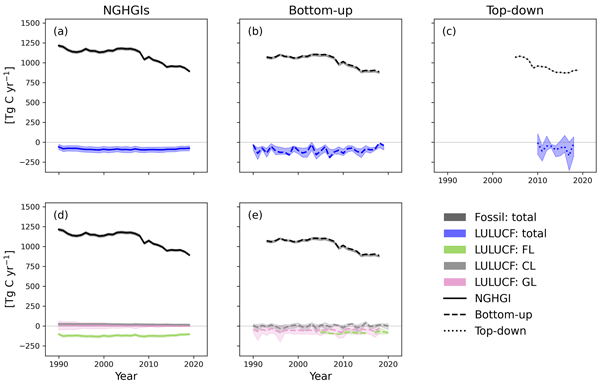
Matthew J. McGrath, Ana Maria Roxana Petrescu, Philippe Peylin, Robbie M. Andrew, Bradley Matthews, Frank Dentener, Juraj Balkovič, Vladislav Bastrikov, Meike Becker, Gregoire Broquet, Philippe Ciais, Audrey Fortems-Cheiney, Raphael Ganzenmüller, Giacomo Grassi, Ian Harris, Matthew Jones, Jürgen Knauer, Matthias Kuhnert, Guillaume Monteil, Saqr Munassar, Paul I. Palmer, Glen P. Peters, Chunjing Qiu, Mart-Jan Schelhaas, Oksana Tarasova, Matteo Vizzarri, Karina Winkler, Gianpaolo Balsamo, Antoine Berchet, Peter Briggs, Patrick Brockmann, Frédéric Chevallier, Giulia Conchedda, Monica Crippa, Stijn N. C. Dellaert, Hugo A. C. Denier van der Gon, Sara Filipek, Pierre Friedlingstein, Richard Fuchs, Michael Gauss, Christoph Gerbig, Diego Guizzardi, Dirk Günther, Richard A. Houghton, Greet Janssens-Maenhout, Ronny Lauerwald, Bas Lerink, Ingrid T. Luijkx, Géraud Moulas, Marilena Muntean, Gert-Jan Nabuurs, Aurélie Paquirissamy, Lucia Perugini, Wouter Peters, Roberto Pilli, Julia Pongratz, Pierre Regnier, Marko Scholze, Yusuf Serengil, Pete Smith, Efisio Solazzo, Rona L. Thompson, Francesco N. Tubiello, Timo Vesala, and Sophia Walther
Earth Syst. Sci. Data, 15, 4295–4370, https://doi.org/10.5194/essd-15-4295-2023, https://doi.org/10.5194/essd-15-4295-2023, 2023
Short summary
Short summary
Accurate estimation of fluxes of carbon dioxide from the land surface is essential for understanding future impacts of greenhouse gas emissions on the climate system. A wide variety of methods currently exist to estimate these sources and sinks. We are continuing work to develop annual comparisons of these diverse methods in order to clarify what they all actually calculate and to resolve apparent disagreement, in addition to highlighting opportunities for increased understanding.
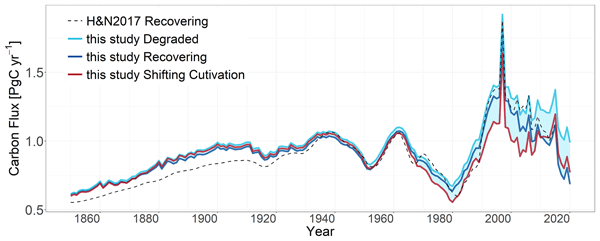
Richard A. Houghton and Andrea Castanho
Earth Syst. Sci. Data, 15, 2025–2054, https://doi.org/10.5194/essd-15-2025-2023, https://doi.org/10.5194/essd-15-2025-2023, 2023
Short summary
Short summary
We update a previous analysis of carbon emissions (annual and national) from land use, land-use change, and forestry from 1850 to 2020. We use data from the latest (2020) Global Forest Resources Assessment, incorporate shifting cultivation, and include improvements to the bookkeeping model and recent estimates of emissions from peatlands. Net global emissions declined steadily over the decade from 2011 to 2020 (mean of 0.96 Pg C yr−1), falling below 1.0 Pg C yr−1 for the first time in 30 years.
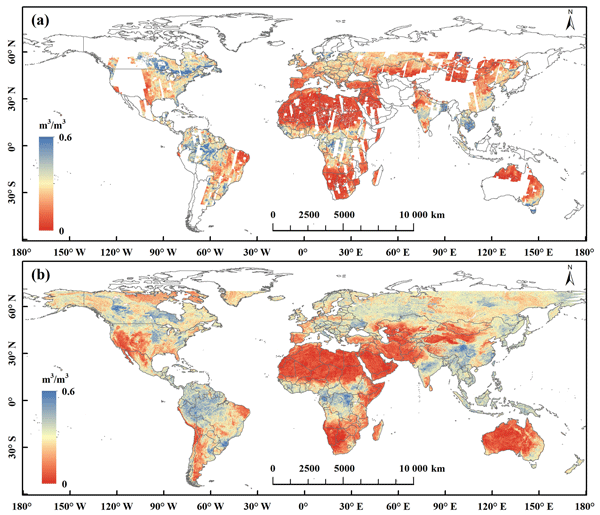
Yufang Zhang, Shunlin Liang, Han Ma, Tao He, Qian Wang, Bing Li, Jianglei Xu, Guodong Zhang, Xiaobang Liu, and Changhao Xiong
Earth Syst. Sci. Data, 15, 2055–2079, https://doi.org/10.5194/essd-15-2055-2023, https://doi.org/10.5194/essd-15-2055-2023, 2023
Short summary
Short summary
Soil moisture observations are important for a range of earth system applications. This study generated a long-term (2000–2020) global seamless soil moisture product with both high spatial and temporal resolutions (1 km, daily) using an XGBoost model and multisource datasets. Evaluation of this product against dense in situ soil moisture datasets and microwave soil moisture products showed that this product has reliable accuracy and more complete spatial coverage.
Giacomo Grassi, Clemens Schwingshackl, Thomas Gasser, Richard A. Houghton, Stephen Sitch, Josep G. Canadell, Alessandro Cescatti, Philippe Ciais, Sandro Federici, Pierre Friedlingstein, Werner A. Kurz, Maria J. Sanz Sanchez, Raúl Abad Viñas, Ramdane Alkama, Selma Bultan, Guido Ceccherini, Stefanie Falk, Etsushi Kato, Daniel Kennedy, Jürgen Knauer, Anu Korosuo, Joana Melo, Matthew J. McGrath, Julia E. M. S. Nabel, Benjamin Poulter, Anna A. Romanovskaya, Simone Rossi, Hanqin Tian, Anthony P. Walker, Wenping Yuan, Xu Yue, and Julia Pongratz
Earth Syst. Sci. Data, 15, 1093–1114, https://doi.org/10.5194/essd-15-1093-2023, https://doi.org/10.5194/essd-15-1093-2023, 2023
Short summary
Short summary
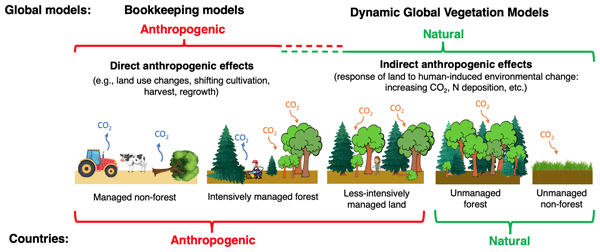
Striking differences exist in estimates of land-use CO2 fluxes between the national greenhouse gas inventories and the IPCC assessment reports. These differences hamper an accurate assessment of the collective progress under the Paris Agreement. By implementing an approach that conceptually reconciles land-use CO2 flux from national inventories and the global models used by the IPCC, our study is an important step forward for increasing confidence in land-use CO2 flux estimates.
Huanhuan Wang, Chao Yue, and Sebastiaan Luyssaert
Biogeosciences, 20, 75–92, https://doi.org/10.5194/bg-20-75-2023, https://doi.org/10.5194/bg-20-75-2023, 2023
Short summary
Short summary
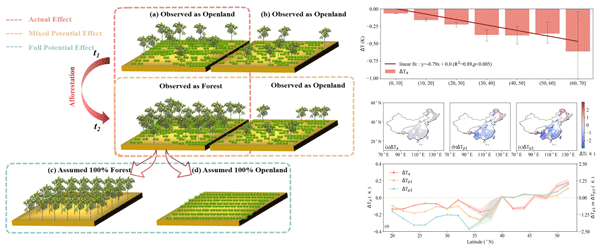
This study provided a synthesis of three influential methods to quantify afforestation impact on surface temperature. Results showed that actual effect following afforestation was highly dependent on afforestation fraction. When full afforestation is assumed, the actual effect approaches the potential effect. We provided evidence the afforestation faction is a key factor in reconciling different methods and emphasized that it should be considered for surface cooling impacts in policy evaluation.
Han Ma, Shunlin Liang, Changhao Xiong, Qian Wang, Aolin Jia, and Bing Li
Earth Syst. Sci. Data, 14, 5333–5347, https://doi.org/10.5194/essd-14-5333-2022, https://doi.org/10.5194/essd-14-5333-2022, 2022
Short summary
Short summary
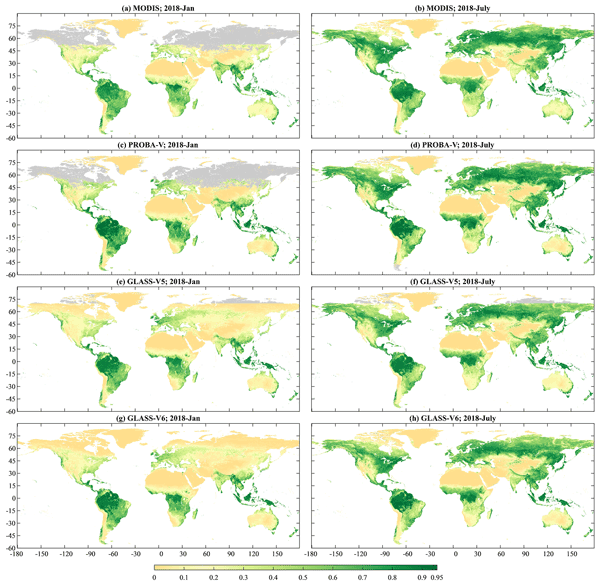
The fraction of absorbed photosynthetically active radiation (FAPAR) is one of the essential climate variables. This study generated a global land surface FAPAR product with a 250 m resolution based on a deep learning model that takes advantage of the existing FAPAR products and MODIS time series of observation information. Direct validation and intercomparison revealed that our product better meets user requirements and has a greater spatiotemporal continuity than other existing products.
Pierre Friedlingstein, Michael O'Sullivan, Matthew W. Jones, Robbie M. Andrew, Luke Gregor, Judith Hauck, Corinne Le Quéré, Ingrid T. Luijkx, Are Olsen, Glen P. Peters, Wouter Peters, Julia Pongratz, Clemens Schwingshackl, Stephen Sitch, Josep G. Canadell, Philippe Ciais, Robert B. Jackson, Simone R. Alin, Ramdane Alkama, Almut Arneth, Vivek K. Arora, Nicholas R. Bates, Meike Becker, Nicolas Bellouin, Henry C. Bittig, Laurent Bopp, Frédéric Chevallier, Louise P. Chini, Margot Cronin, Wiley Evans, Stefanie Falk, Richard A. Feely, Thomas Gasser, Marion Gehlen, Thanos Gkritzalis, Lucas Gloege, Giacomo Grassi, Nicolas Gruber, Özgür Gürses, Ian Harris, Matthew Hefner, Richard A. Houghton, George C. Hurtt, Yosuke Iida, Tatiana Ilyina, Atul K. Jain, Annika Jersild, Koji Kadono, Etsushi Kato, Daniel Kennedy, Kees Klein Goldewijk, Jürgen Knauer, Jan Ivar Korsbakken, Peter Landschützer, Nathalie Lefèvre, Keith Lindsay, Junjie Liu, Zhu Liu, Gregg Marland, Nicolas Mayot, Matthew J. McGrath, Nicolas Metzl, Natalie M. Monacci, David R. Munro, Shin-Ichiro Nakaoka, Yosuke Niwa, Kevin O'Brien, Tsuneo Ono, Paul I. Palmer, Naiqing Pan, Denis Pierrot, Katie Pocock, Benjamin Poulter, Laure Resplandy, Eddy Robertson, Christian Rödenbeck, Carmen Rodriguez, Thais M. Rosan, Jörg Schwinger, Roland Séférian, Jamie D. Shutler, Ingunn Skjelvan, Tobias Steinhoff, Qing Sun, Adrienne J. Sutton, Colm Sweeney, Shintaro Takao, Toste Tanhua, Pieter P. Tans, Xiangjun Tian, Hanqin Tian, Bronte Tilbrook, Hiroyuki Tsujino, Francesco Tubiello, Guido R. van der Werf, Anthony P. Walker, Rik Wanninkhof, Chris Whitehead, Anna Willstrand Wranne, Rebecca Wright, Wenping Yuan, Chao Yue, Xu Yue, Sönke Zaehle, Jiye Zeng, and Bo Zheng
Earth Syst. Sci. Data, 14, 4811–4900, https://doi.org/10.5194/essd-14-4811-2022, https://doi.org/10.5194/essd-14-4811-2022, 2022
Short summary
Short summary
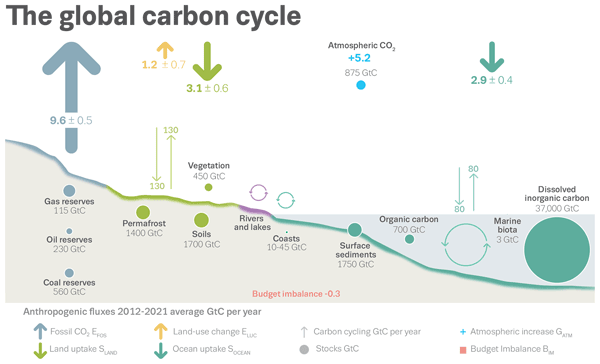
The Global Carbon Budget 2022 describes the datasets and methodology used to quantify the anthropogenic emissions of carbon dioxide (CO2) and their partitioning among the atmosphere, the land ecosystems, and the ocean. These living datasets are updated every year to provide the highest transparency and traceability in the reporting of CO2, the key driver of climate change.
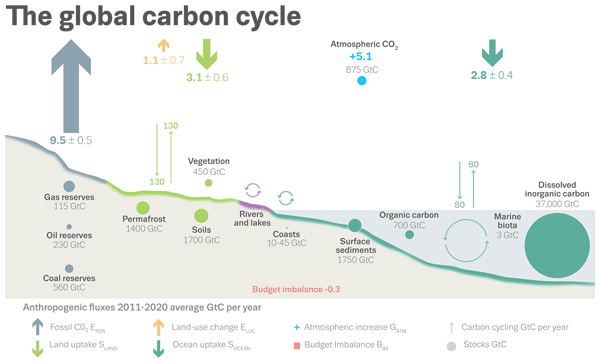
Pierre Friedlingstein, Matthew W. Jones, Michael O'Sullivan, Robbie M. Andrew, Dorothee C. E. Bakker, Judith Hauck, Corinne Le Quéré, Glen P. Peters, Wouter Peters, Julia Pongratz, Stephen Sitch, Josep G. Canadell, Philippe Ciais, Rob B. Jackson, Simone R. Alin, Peter Anthoni, Nicholas R. Bates, Meike Becker, Nicolas Bellouin, Laurent Bopp, Thi Tuyet Trang Chau, Frédéric Chevallier, Louise P. Chini, Margot Cronin, Kim I. Currie, Bertrand Decharme, Laique M. Djeutchouang, Xinyu Dou, Wiley Evans, Richard A. Feely, Liang Feng, Thomas Gasser, Dennis Gilfillan, Thanos Gkritzalis, Giacomo Grassi, Luke Gregor, Nicolas Gruber, Özgür Gürses, Ian Harris, Richard A. Houghton, George C. Hurtt, Yosuke Iida, Tatiana Ilyina, Ingrid T. Luijkx, Atul Jain, Steve D. Jones, Etsushi Kato, Daniel Kennedy, Kees Klein Goldewijk, Jürgen Knauer, Jan Ivar Korsbakken, Arne Körtzinger, Peter Landschützer, Siv K. Lauvset, Nathalie Lefèvre, Sebastian Lienert, Junjie Liu, Gregg Marland, Patrick C. McGuire, Joe R. Melton, David R. Munro, Julia E. M. S. Nabel, Shin-Ichiro Nakaoka, Yosuke Niwa, Tsuneo Ono, Denis Pierrot, Benjamin Poulter, Gregor Rehder, Laure Resplandy, Eddy Robertson, Christian Rödenbeck, Thais M. Rosan, Jörg Schwinger, Clemens Schwingshackl, Roland Séférian, Adrienne J. Sutton, Colm Sweeney, Toste Tanhua, Pieter P. Tans, Hanqin Tian, Bronte Tilbrook, Francesco Tubiello, Guido R. van der Werf, Nicolas Vuichard, Chisato Wada, Rik Wanninkhof, Andrew J. Watson, David Willis, Andrew J. Wiltshire, Wenping Yuan, Chao Yue, Xu Yue, Sönke Zaehle, and Jiye Zeng
Earth Syst. Sci. Data, 14, 1917–2005, https://doi.org/10.5194/essd-14-1917-2022, https://doi.org/10.5194/essd-14-1917-2022, 2022
Short summary
Short summary
The Global Carbon Budget 2021 describes the data sets and methodology used to quantify the emissions of carbon dioxide and their partitioning among the atmosphere, land, and ocean. These living data are updated every year to provide the highest transparency and traceability in the reporting of CO2, the key driver of climate change.
Jinshi Jian, Xuan Du, Juying Jiao, Xiaohua Ren, Karl Auerswald, Ryan Stewart, Zeli Tan, Jianlin Zhao, Daniel L. Evans, Guangju Zhao, Nufang Fang, Wenyi Sun, Chao Yue, and Ben Bond-Lamberty
Earth Syst. Sci. Data Discuss., https://doi.org/10.5194/essd-2022-87, https://doi.org/10.5194/essd-2022-87, 2022
Manuscript not accepted for further review
Short summary
Short summary
Field soil loss and sediment yield due to surface runoff observations were compiled into a database named AWESOME: Archive for Water Erosion and Sediment Outflow MEasurements. Annual soil erosion data from 1985 geographic sites and 75 countries have been compiled into AWESOME. This database aims to be an open framework for the scientific community to share field-based annual soil erosion measurements, enabling better understanding of the spatial and temporal variability of annual soil erosion.
Cited articles
Bastos, A., Hartung, K., Nützel, T. B., Nabel, J. E. M. S., Houghton, R. A., and Pongratz, J.: Comparison of uncertainties in land-use change fluxes from bookkeeping model parameterisation, Earth Syst. Dynam., 12, 745–762, https://doi.org/10.5194/esd-12-745-2021, 2021.
Cao, X., Jin, X., Wang, J., Miao, L., and Zhou, Y.: Reconstruction of cropland dataset in China over the past 300 years, Acta Geographica Sinica, 69, 896–906, https://doi.org/10.11821/dlxb201407002, 2014.
Chen, Y., Syvitski, J. P., Gao, S., Overeem, I., and Kettner, A.J.: Socio-economic impacts on flooding: a 4000-year history of the Yellow River, China, Ambio, 41, 682–698, https://doi.org/10.1007/s13280-012-0290-5, 2012.
Dorgeist, L., Schwingshackl, C., Bultan, S., and Pongratz, J.: A consistent budgeting of terrestrial carbon fluxes, Nat. Commun., 15, 7426, https://doi.org/10.1038/s41467-024-51126-x, 2024.
Fang, X. Q., Zhao, W. Y., Zhang, C. P., Zhang, D. Y., Wei, X. Q., Qiu, W., and Ye, Y.: Methodology for credibility assessment of historical global LUCC datasets, Science China Earth Sciences, 63, 1013–1025, https://doi.org/10.1007/s11430-019-9555-3, 2020.
FAO: FAOSTAT Statistical Database, FAO, Rome, http://www.fao.org/faostat/en/#data/ (last access: October 2023), 2021.
Gasser, T., Crepin, L., Quilcaille, Y., Houghton, R. A., Ciais, P., and Obersteiner, M.: Historical CO2 emissions from land use and land cover change and their uncertainty, Biogeosciences, 17, 4075–4101, https://doi.org/10.5194/bg-17-4075-2020, 2020.
Ge, Q. S., Dai, J. H., He, F. N., Zheng, J. Y., Man, Z. M., and Zhao, Y.: Spatiotemporal dynamics of reclamation and cultivation and its driving factors in parts of China during the last three centuries, Progress in Natural Science, 14, 605–613, 2004.
Ge, Q. S., Dai, J. H., He, F. N., Pan, Y., and Wang, M. M.: Land use changes and their relations with carbon cycles over the past 300 a in China, Science China: Earth Sciences, 51, 871–884, https://doi.org/10.1007/s11430-008-0046-z, 2008.
Gidden, M. J., Gasser, T., Grassi, G., Forsell, N., Janssens, I., Lamb, W. F., Minx, J., Nicholls, Z., Steinhauser, J., and Riahi, K.: Aligning climate scenarios to emissions inventories shifts global benchmarks, Nature, 624, 102—108, https://doi.org/10.1038/s41586-023-06724-y, 2023.
Hansis, E., Davis, S. J., and Pongratz, J.: Relevance of methodological choices for accounting of land use change carbon fluxes, Global Biogeochemical Cycles, 29, 1230–1246, https://doi.org/10.1002/2014gb004997, 2015.
Hartung, K., Bastos, A., Chini, L., Ganzenmüller, R., Havermann, F., Hurtt, G. C., Loughran, T., Nabel, J. E. M. S., Nützel, T., Obermeier, W. A., and Pongratz, J.: Bookkeeping estimates of the net land-use change flux – a sensitivity study with the CMIP6 land-use dataset, Earth Syst. Dynam., 12, 763–782, https://doi.org/10.5194/esd-12-763-2021, 2021.
He, F., Li, S., and Zhang, X.: A spatially explicit reconstruction of forest cover in China over 1700–2000, Global and Planetary Change, 131, 73–81, https://doi.org/10.1016/j.gloplacha.2015.05.008, 2015.
He, F., Li, S. C., Yang, F., and Li, M. J.: Evaluating the accuracy of Chinese pasture data in global historical land use datasets, Science China Earth Sciences, 61, 1685–1696, https://doi.org/10.1007/s11430-018-9256-1, 2018.
He, F., Yang, F., Zhao, C., Li, S., and Li, M.: Spatially explicit reconstruction of cropland cover for China over the past millennium, Science China Earth Sciences, 66, 111–128, https://doi.org/10.1007/s11430-021-9988-5, 2023.
He, F., Yang, F., and Wang, Y.: Reconstructing forest and grassland cover changes in China over the past millennium, Science China Earth Sciences, 68, 94–110, https://doi.org/10.1007/s11430-024-1454-4, 2025.
He, F. N., Ge, Q. S., Dai, J. H., and Rao, Y. J.: Forest change of China in recent 300 years, Journal of Geographical Sciences, 18, 59–72, https://doi.org/10.1007/s11442-008-0059-8, 2008.
He, Y., Piao, S., Ciais, P., Xu, H., and Gasser, T.: Future land carbon removals in China consistent with national inventory, Nature Communications, 15, 10426, https://doi.org/10.1038/s41467-024-54846-2, 2024.
Heinimann, A., Mertz, O., Frolking, S., Egelund Christensen, A., Hurni, K., Sedano, F., Parsons Chini, L., Sahajpal, R., Hansen, M., and Hurtt, G.: A global view of shifting cultivation: Recent, current, and future extent, Plos One, 12, e0184479, https://doi.org/10.1371/journal.pone.0184479, 2017.
Houghton, R. A. and Castanho, A.: Annual emissions of carbon from land use, land-use change, and forestry from 1850 to 2020, Earth Syst. Sci. Data, 15, 2025–2054, https://doi.org/10.5194/essd-15-2025-2023, 2023.
Houghton, R. A. and Hackler, J. L.: Sources and sinks of carbon from land-use change in China, Global Biogeochemical Cycles, 17, 1034, https://doi.org/10.1029/2002GB001970, 2003.
Houghton, R. A. and Nassikas, A. A.: Global and regional fluxes of carbon from land use and land cover change 1850–2015, Global Biogeochemical Cycles, 31, 456–472, https://doi.org/10.1002/2016gb005546, 2017.
Houghton, R. A., House, J. I., Pongratz, J., van der Werf, G. R., DeFries, R. S., Hansen, M. C., Le Quéré, C., and Ramankutty, N.: Carbon emissions from land use and land-cover change, Biogeosciences, 9, 5125–5142, https://doi.org/10.5194/bg-9-5125-2012, 2012.
Hurtt, G. C., Chini, L., Sahajpal, R., Frolking, S., Bodirsky, B. L., Calvin, K., Doelman, J. C., Fisk, J., Fujimori, S., Klein Goldewijk, K., Hasegawa, T., Havlik, P., Heinimann, A., Humpenöder, F., Jungclaus, J., Kaplan, J. O., Kennedy, J., Krisztin, T., Lawrence, D., Lawrence, P., Ma, L., Mertz, O., Pongratz, J., Popp, A., Poulter, B., Riahi, K., Shevliakova, E., Stehfest, E., Thornton, P., Tubiello, F. N., van Vuuren, D. P., and Zhang, X.: Harmonization of global land use change and management for the period 850–2100 (LUH2) for CMIP6, Geosci. Model Dev., 13, 5425–5464, https://doi.org/10.5194/gmd-13-5425-2020, 2020.
Jia, R., Fang, X., and Ye, Y.: Gridded reconstruction of cropland cover changes in Northeast China from AD 1000 to 1200, Regional Environmental Change, 23, 128, https://doi.org/10.1007/s10113-023-02118-y, 2023.
Kabora, T. K., Stump, D., Thomas, C. D., and Beale, C. M.: Assessing inconsistencies in historical land-use reconstructions for Africa at 1800, Regional Environmental Change, 24, 55, https://doi.org/10.1007/s10113-024-02224-5, 2024.
Kaplan, J. O., Ruddiman, W. F., Crucifix, M. C., Oldfield, F. A., Krumhardt, K. M., Ellis, E. C., Lemmen, C., and Klein Goldewijk, K.: Holocene carbon emissions as a result of anthropogenic land cover change, The Holocene, 21, 775–791, https://doi.org/10.1177/0959683610386983, 2011.
Klein Goldewijk, K.: Estimating global land use change over the past 300 years: The HYDE Database, Global Biogeochemical Cycles, 15, 417–433, https://doi.org/10.1029/1999GB001232, 2001.
Klein Goldewijk, K., Beusen, A., Doelman, J., and Stehfest, E.: Anthropogenic land use estimates for the Holocene – HYDE 3.2, Earth Syst. Sci. Data, 9, 927–953, https://doi.org/10.5194/essd-9-927-2017, 2017.
Li, B. B., Fang, X. Q., Ye, Y., and Zhang, X. Z.: Carbon emissions induced by cropland expansion in Northeast China during the past 300 years, Science China: Earth Sciences, 57, 2259–2268, 2014.
Li, M., He, F., Yang, F., and Zhao, L.: Reconstruction of provincial cropland area and its spatial-temporal characteristics in the Ming Dynasty, Geographical Research, 39, 447–460, https://doi.org/10.11821/dlyj020181315, 2020.
Li, M. J., He, F. N., Li, S. C., and Yang, F.: Reconstruction of the cropland cover changes in eastern China between the 10(th) century and 13(th) century using historical documents, Scientific Reports, 8, 13552, https://doi.org/10.1038/s41598-018-31807-6, 2018a.
Li, M. J., He, F. N., Yang, F., and Li, S. C.: Reconstructing provincial cropland area in eastern China during the early Yuan Dynasty(AD1271-1294), Journal of Geographical Sciences, 28, 1994–2006, https://doi.org/10.1007/s11442-018-1576-8, 2018b.
Li, S. C., He, F. N., and Zhang, X. Z.: A spatially explicit reconstruction of cropland cover in China from 1661 to 1996, Regional Environmental Change, 16, 417–428, https://doi.org/10.1007/s10113-014-0751-4, 2016.
Liu, M. and Tian, H.: China's land cover and land use change from 1700 to 2005: Estimations from high-resolution satellite data and historical archives, Global Biogeochemical Cycles, 24, GB3003, https://doi.org/10.1029/2009GB003687, 2010.
Mendelsohn, R. and Sohngen, B.: The net carbon emissions from historic land use and land use change, Journal of Forest Economics, 34, 263–283, https://doi.org/10.1561/112.00000505, 2019.
Obermeier, W. A., Schwingshackl, C., Bastos, A., Conchedda, G., Gasser, T., Grassi, G., Houghton, R. A., Tubiello, F. N., Sitch, S., and Pongratz, J.: Country-level estimates of gross and net carbon fluxes from land use, land-use change and forestry, Earth Syst. Sci. Data, 16, 605–645, https://doi.org/10.5194/essd-16-605-2024, 2024.
Pongratz, J., Reick, C., Raddatz, T., and Claussen, M.: A reconstruction of global agricultural areas and land cover for the last millennium, Global Biogeochemical Cycles, 22, GB3018, https://doi.org/10.1029/2007gb003153, 2008.
Pongratz, J., Reick, C. H., Raddatz, T., and Claussen, M.: Effects of anthropogenic land cover change on the carbon cycle of the last millennium, Global Biogeochemical Cycles, 23, GB4001, https://doi.org/10.1029/2009gb003488, 2009.
Qin, Z., Zhu, Y., Canadell, J. G., Chen, M., Li, T., Mishra, U., and Yuan, W.: Global spatially explicit carbon emissions from land-use change over the past six decades (1961–2020), One Earth, 7, 1–13, https://doi.org/10.1016/j.oneear.2024.04.002, 2024.
Ramankutty, N. and Foley, J. A.: Estimating historical changes in global land cover: Croplands from 1700 to 1992, Global Biogeochemical Cycles, 13, 997–1027, https://doi.org/10.1029/1999GB900046, 1999.
Tan, Q. X.: The Historical Atlas of China, Beijing, SinoMaps Press, ISBN 978-7-5031-1844-9, 1982.
Wedderburn-Bisshop, G.: Deforestation – a call for consistent carbon accounting, Environmental Research Letters, 19, 111006, https://doi.org/10.1088/1748-9326/ad7d21, 2024.
Wei, X., Ye, Y., Li, B., and Chen, T.: Reconstructing cropland change since 1650 AD in Shaanxi province, central China, Quaternary International, 641, 74–86, https://doi.org/10.1016/j.quaint.2022.02.025, 2022.
Winkler, K., Yang, H., Ganzenmüller, R., Fuchs, R., Ceccherini, G., Duveiller, G., Grassi, G., Pongratz, J., Bastos, A., Shvidenko, A., Araza, A., Herold, M., Wigneron, J.-P., and Ciais, P.: Changes in land use and management led to a decline in Eastern Europe's terrestrial carbon sink, Communications Earth & Environment, 4, 237, https://doi.org/10.1038/s43247-023-00893-4, 2023.
Wu, X., Wei, Y., Fu, B., Wang, S. and Moran, E. F.: Evolution and effects of the social-ecological system over a millennium in China's Loess Plateau, Science Advances, 6, eabc0276, https://doi.org/10.1126/sciadv.abc0276, 2020.
Xu, L., He, N., and Yu, G.: A dataset of carbon density in Chinese terrestrial ecosystems (2010s), China Sci. Data, 4, 49–54, 2019.
Yang, F., He, F. N., Li, M. J., and Li, S. C.: Evaluating the reliability of global historical land use scenarios for forest data in China, Journal of Geographical Sciences, 30, 1083–1094, https://doi.org/10.1007/s11442-020-1771-2, 2020.
Yang, F., He, F., Li, S., Li, M., and Wu, P.: A new estimation of carbon emissions from land use and land cover change in China over the past 300 years, Science of The Total Environment, 863, 160963, https://doi.org/10.1016/j.scitotenv.2022.160963, 2023.
Yang, F., Dong, G., Wu, P., and He, F.: Stylized facts of past 1000-year of China's cropland changes, Land Use Policy, 144, 107258, https://doi.org/10.1016/j.landusepol.2024.107258, 2024.
Yang, F., Dong, G., Meng, X., Gao, Y., He, F., Li, M., Li, W., Liu, Z., Zhai, X., Wu, P., Zhang, H., Mao, Q., Yao, Y., and Yue, C.: Annual carbon emissions from land use change in China from 1000 to 2019, Zenodo [data set], https://doi.org/10.5281/zenodo.14557386, 2025.
Yang, X., Jin, X., Xiang, X., Fan, Y., Shan, W., and Zhou, Y.: Reconstructing the spatial pattern of historical forest land in China in the past 300 years, Global and Planetary Change, 165, 173–185, https://doi.org/10.1016/j.gloplacha.2018.03.015, 2018.
Yang, X., Jin, X., Xiang, X., Fan, Y., Liu, J., Shan, W., and Zhou, Y.: Carbon emissions induced by farmland expansion in China during the past 300 years, Science China Earth Sciences, 62, 423–437, https://doi.org/10.1007/s11430-017-9221-7, 2019.
Yang, X., Jin, X., Xue, Q., and Zhou, Y.: Reconstruction of the spatial distribution of historical farmland in the Taiwan Province of China for 1659–1945, Land Use Policy, 114, 105951, https://doi.org/10.1016/j.landusepol.2021.105951, 2022.
Yang, Y., Mohammat, A., Feng, J., Zhou, R., and Fang, J.: Storage, patterns and environmental controls of soil organic carbon in China, Biogeochemistry, 84, 131–141, 2007.
Ye, Y., Fang, X. Q., Ren, Y. Y., Zhang, X. Z., and Chen, L.: Cropland cover change in Northeast China during the past 300 years, Science China Earth Sciences, 52, 1172–1182, https://doi.org/10.1007/s11430-009-0118-8, 2009.
Yu, Z., Jin, X., Miao, L., and Yang, X.: A historical reconstruction of cropland in China from 1900 to 2016, Earth Syst. Sci. Data, 13, 3203–3218, https://doi.org/10.5194/essd-13-3203-2021, 2021.
Yu, Z., Ciais, P., Piao, S., Houghton, R. A., Lu, C., Tian, H., Agathokleous, E., Kattel, G. R., Sitch, S., Goll, D., Yue, X., Walker, A., Friedlingstein, P., Jain, A. K., Liu, S., and Zhou, G.: Forest expansion dominates China's land carbon sink since 1980, Nat. Commun., 13, 5374, https://doi.org/10.1038/s41467-022-32961-2, 2022.
Yue, C., Ciais, P., Houghton, R. A., and Nassikas, A. A.: Contribution of land use to the interannual variability of the land carbon cycle, Nature Communications, 11, 3170, https://doi.org/10.1038/s41467-020-16953-8, 2020.
Yue, C., Xu, M., Ciais, P., Tao, S., Shen, H., Chang, J., Li, W., Deng, L., He, J., Leng, Y., Li, Y., Wang, J., Xu, C., Zhang, H., Zhang, P., Zhang, L., Zhao, J., Zhu, L., and Piao, S.: Contributions of ecological restoration policies to China's land carbon balance, Nature Communications, 15, 9708, https://doi.org/10.1038/s41467-024-54100-9, 2024.
Zhao, C., He, F., Yang, F. and Li, S.: Uncertainties of global historical land use scenarios in past-millennium cropland reconstruction in China, Quaternary International, 641, 87–96, https://doi.org/10.1016/j.quaint.2022.03.020, 2022.
Zhu, Y., Xia, X., Canadell, J., Piao, S., Lu, X., Mishra, U., Wang, X., Yuan, W., and Qin, Z.: China's Carbon Sinks from Land-Use Change Underestimated. Nature Climate Change, 15, 428–435, https://doi.org/10.1038/s41558-025-02296-z, 2025.
Short summary
We used a millennial dataset of land-use change in China, combined with comprehensive soil and vegetation carbon density datasets, to quantify China’s annual carbon emissions resulting from land-use change between 1000 and 2019 using a bookkeeping model. The annual carbon emission flux provides a robust historical baseline for assessing terrestrial ecosystem carbon budgets at national and provincial scales, both in the present and future.
We used a millennial dataset of land-use change in China, combined with comprehensive soil and...


Altmetrics
Final-revised paper
Preprint