Articles | Volume 18, issue 8
https://doi.org/10.5194/essd-18-5793-2026
© Author(s) 2026. This work is distributed under
the Creative Commons Attribution 4.0 License.
the Creative Commons Attribution 4.0 License.
https://doi.org/10.5194/essd-18-5793-2026
© Author(s) 2026. This work is distributed under
the Creative Commons Attribution 4.0 License.
the Creative Commons Attribution 4.0 License.
Data description article
| 
10 Aug 2026
Data description article |
| 10 Aug 2026
| 10 Aug 2026
The International Soil Radiocarbon Database (ISRaD) version 2: synthesis, data gaps, and future directions of soil radiocarbon data
Sophie F. von Fromm
CORRESPONDING AUTHOR

Montana State University, Bozeman, 59717, MT, USA
R. Scott Winton
University of California Santa Cruz, Santa Cruz, 95064, CA, USA
Derrick R. Vaughn
Utah State University, Logan, 84322, UT, USA
Jennifer C. Bowen
Georgia Institute of Technology, Atlanta, 30332, GA, USA
Max Planck Institute for Biogeochemistry, Jena, 07745, Germany
Kateřina Jandová
Charles University, Prague, 11636, Czech Republic
Julie Shahan
Stanford University, Stanford, 94305, CA, USA
Olga Vindušková
Charles University, Prague, 11636, Czech Republic
Shane W. Stoner
University of Wisconsin – Madison, Madison, 53707, WI, USA
Maedeh Chitsaz
University of California Berkeley, Berkeley, 94720, CA, USA
Avni Malhotra
Pacific Northwest National Laboratory, Richland, 99354, WA, USA
Adrian A. Wackett
Stanford University, Stanford, 94305, CA, USA
Alison M. Hoyt
Stanford University, Stanford, 94305, CA, USA
Katherine Heckman
USDA Forest Service, Northern Research Station, Houghton, 49932, MI, USA
Katerina Georgiou
Oregon State University, Corvallis, 97331, OR, USA
Daniel Wasner
ETH Zurich, Zurich, 8006, Switzerland
Luisa Isabell Minich
ETH Zurich, Zurich, 8006, Switzerland
Swiss Federal Institute for Forest, Snow, and Landscape Research WSL, Birmensdorf, 8903, Switzerland
Katherine E. Grant
Lawrence Livermore National Laboratory, Livermore, 94550, CA, USA
Caitlin E. Hicks Pries
Dartmouth College, Hanover, 03755, NH, USA
Karis J. McFarlane
Lawrence Livermore National Laboratory, Livermore, 94550, CA, USA
Anna Abramova
University of California Berkeley, Berkeley, 94720, CA, USA
Corey Lawrence
Andes Ag Inc, Alameda, 94501, CA, USA
Jeffrey Beem-Miller
Cornell University, Ithaca, 14853, NY, USA
Related authors
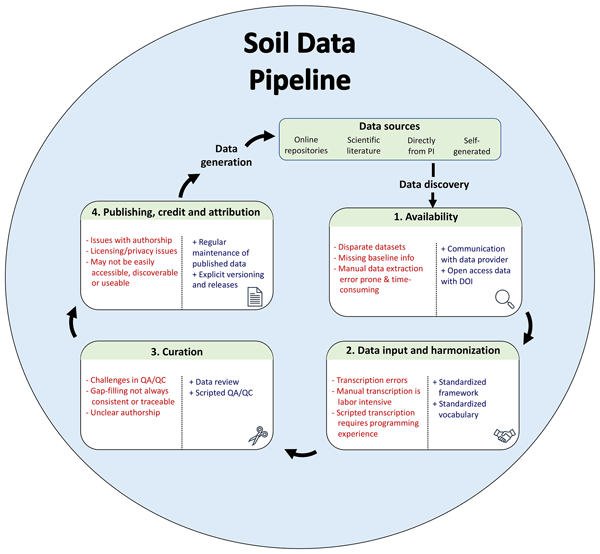
Katherine E. O. Todd-Brown, Rose Z. Abramoff, Jeffrey Beem-Miller, Hava K. Blair, Stevan Earl, Kristen J. Frederick, Daniel R. Fuka, Mario Guevara Santamaria, Jennifer W. Harden, Katherine Heckman, Lillian J. Heran, James R. Holmquist, Alison M. Hoyt, David H. Klinges, David S. LeBauer, Avni Malhotra, Shelby C. McClelland, Lucas E. Nave, Katherine S. Rocci, Sean M. Schaeffer, Shane Stoner, Natasja van Gestel, Sophie F. von Fromm, and Marisa L. Younger
Biogeosciences, 19, 3505–3522, https://doi.org/10.5194/bg-19-3505-2022, https://doi.org/10.5194/bg-19-3505-2022, 2022
Short summary
Short summary
Research data are becoming increasingly available online with tantalizing possibilities for reanalysis. However harmonizing data from different sources remains challenging. Using the soils community as an example, we walked through the various strategies that researchers currently use to integrate datasets for reanalysis. We find that manual data transcription is still extremely common and that there is a critical need for community-supported informatics tools like vocabularies and ontologies.
Estefanía Muñoz, Karis J. McFarlane, Romà Ogaya, Jofre Carnicer, Guillem Mampel, Xin Song, Sara Marañón-Jiménez, Josep Peñuelas, and Carlos A. Sierra
EGUsphere, https://doi.org/10.5194/egusphere-2026-6195, https://doi.org/10.5194/egusphere-2026-6195, 2026
Short summary
Short summary
Long-term drought is changing how Mediterranean forests store carbon. By measuring the age of carbon in leaves, roots, wood, soil, and respired CO₂, we found that drought makes carbon older overall. Forests are using older, long-stored carbon while taking in less new carbon. Drought also makes topsoil more uniform in carbon and age, depleting older reserves. These results highlight the need to protect soil carbon as droughts intensify.
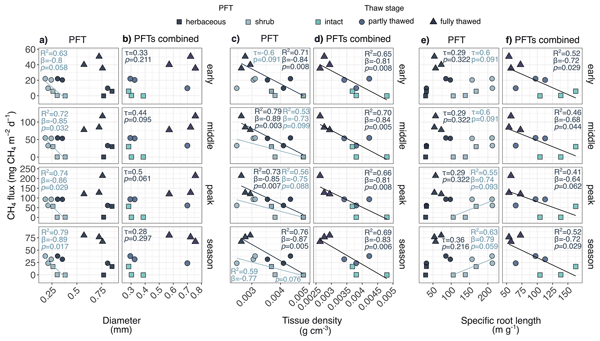
Tiia M. Määttä, Samantha H. Bosman, Jeffrey P. Chanton, Patrick Crill, Suzanne B. Hodgkins, Jalisha Theanutti Kallingal, Rachel M. Wilson, Ruth Varner, and Avni Malhotra
Biogeosciences, 23, 6639–6670, https://doi.org/10.5194/bg-23-6639-2026, https://doi.org/10.5194/bg-23-6639-2026, 2026
Short summary
Short summary
Permafrost thaw can lead to vegetation shifts and higher methane (CH4) emissions in peatlands. However, plant belowground controls of these emissions are uncertain. We investigated how plant roots and rhizomes contribute to CH4 emissions along a peatland permafrost thaw gradient. We found that low herbaceous plant root tissue density and high rhizome surface area were associated with higher CH4 emissions. This indicated increased plant-mediated CH4 transport with thaw.
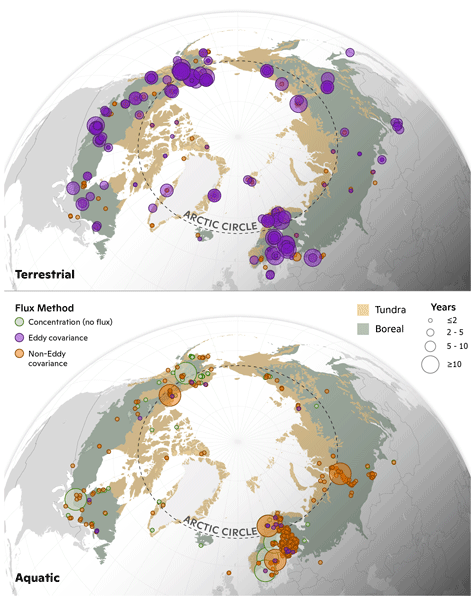
Anna-Maria Virkkala, Isabel Wargowsky, Judith Vogt, McKenzie A. Kuhn, Simran Madaan, Tiffany Windholz, Kyle A. Arndt, Gerard Rocher-Ros, Mathias Göckede, David Olefeldt, Edward A. G. Schuur, David Bastviken, Richard O'Keefe, Brendan M. Rogers, Jennifer D. Watts, Kelcy Kent, Kristoffer Aalstad, Kelly Aho, Joonatan Ala-Könni, Haley Alcock, Inge Althuizen, Christopher D. Arp, Jun Asanuma, Mika Aurela, Sivakiruthika Balathandayuthabani, Katrin Attermeyer, Alan Barr, Maialen Barret, Ochirbat Batkhishig, Christina Biasi, Mats P. Björkman, Andrew Black, Elena Blanc-Betes, Pascal Bodmer, Julia Boike, Abdullah Bolek, Frédéric Bouchard, Ingeborg Bussmann, Lea Cabrol, Eleonora Canfora, Sean Carey, Karel Castro-Morales, Namyi Chae, Andreas Christen, Torben R. Christensen, Casper T. Christiansen, Housen Chu, Graham Clark, Francois Clayer, Patrick Crill, Christopher Cunada, Scott J. Davidson, Joshua F. Dean, Sigrid Dengel, Matteo Detto, Catherine Dieleman, Florent Domine, Egor Dyukarev, Colin Edgar, Bo Elberling, Craig A. Emmerton, Eugenie Euskirchen, Grant Falvo, Thomas Friborg, Michelle Garneau, Mariasilvia Giamberini, Mikhail V. Glagolev, Miquel A. Gonzalez-Meler, Gustaf Granath, Jón Guðmundsson, Konsta Happonen, Yoshinobu Harazono, Lorna Harris, Josh Hashemi, Nicholas Hasson, Janna Heerah, Liam Heffernan, Manuel Helbig, Warren Helgason, Michal Heliasz, Greg Henry, Geert Hensgens, Tetsuya Hiyama, Beth Holmes, Macall Hock, David Holl, Jutta Holst, Thomas Holst, Gabriel Hould-Gosselin, Elyn Humphreys, Jacqueline Hung, Jussi Huotari, Hiroki Ikawa, Danil V. Ilyasov, Mamoru Ishikawa, Go Iwahana, Hiroki Iwata, Marcin Antoni Jackowicz-Korczynski, Joachim Jansen, Järvi Järveoja, Vincent E. J. Jassey, Rasmus Jensen, Katharina Jentzsch, Robert G. Jespersen, Carl-Fredrik Johannesson, Cheristy P. Jones, Anders Jonsson, Ji Young Jung, Sari Juutinen, Evan Kane, Jan Karlsson, Sergey Karsanaev, Kuno Kasak, Julia Kelly, Kasha Kempton, Marcus Klaus, George W. Kling, Natascha Kljun, Jacqueline Knutson, Hideki Kobayashi, John Kochendorfer, Kukka-Maaria Kohonen, Pasi Kolari, Mika Korkiakoski, Aino Korrensalo, Pirkko Kortelainen, Egle Koster, Kajar Koster, Ayumi Kotani, Praveena Krishnan, Juliya Kurbatova, Lars Kutzbach, Min Jung Kwon, Ethan D. Kyzivat, Jessica Lagroix, Theodore Langhorst, Elena Lapshina, Tuula Larmola, Klaus S. Larsen, Isabelle Laurion, Justin Ledman, Hanna Lee, A. Joshua Leffler, Lance Lesack, Anders Lindroth, David Lipson, Annalea Lohila, Efrén López-Blanco, Vincent L. St. Louis, Erik Lundin, Miska Luoto, Takashi Machimura, Marta Magnani, Avni Malhotra, Marja Maljanen, Ivan Mammarella, Elisa Männistö, Luca Belelli Marchesini, Phil Marsh, Pertti J. Martikainen, Maija E. Marushchak, Mikhail Mastepanov, Alex Mavrovic, Trofim Maximov, Christina Minions, Daniel F. Nadeau, Marco Montemayor, Tomoaki Morishita, Patrick Murphy, Erin Nicholls, Mats B. Nilsson, Anastasia Niyazova, Jenni Nordén, Koffi Dodji Noumonvi, Hannu Nykänen, Walter Oechel, Anne Ojala, Tomohiro Okadera, Sujan Pal, Alexey V. Panov, Tim Papakyriakou, Dario Papale, Sang-Jong Park, Frans-Jan W. Parmentier, Gilberto Pastorello, Mike Peacock, Matthias Peichl, Roman Petrov, Kyra St. Pierre, Norbert Pirk, Jessica Plein, Vilmantas Preskienis, Anatoly Prokushkin, Jukka Pumpanen, Hilary A. Rains, Niklas Rakos, Aleksi Räsänen, Helena Rautakoski, Riikka Rinnan, Janne Rinne, Adrian Rocha, Nigel Roulet, Alexandre Roy, Anna Rutgersson, Aleksandr F. Sabrekov, Torsten Sachs, Erik Sahlée, Alejandro Salazar, Henrique Oliveira Sawakuchi, Christopher Schulze, Roger Seco, Armando Sepulveda-Jauregui, Svetlana Serikova, Abbey Serrone, Hanna M. Silvennoinen, Sofie Sjogersten, June Skeeter, Jo Snöälv, Sebastian Sobek, Oliver Sonnentag, Emily H. Stanley, Maria Strack, Lena Strom, Patrick Sullivan, Ryan Sullivan, Anna Sytiuk, Torbern Tagesson, Pierre Taillardat, Julie Talbot, Suzanne E. Tank, Mario Tenuta, Irina Terenteva, Frederic Thalasso, Antoine Thiboult, Halldor Thorgeirsson, Fenix Garcia Tigreros, Margaret Torn, Amy Townsend-Small, Claire Treat, Alain Tremblay, Carlo Trotta, Eeva-Stiina Tuittila, Merritt Turetsky, Masahito Ueyama, Muhammad Umair, Aki Vähä, Lona van Delden, Maarten van Hardenbroek, Andrej Varlagin, Ruth K. Varner, Tarmo Virtanen, Elena Veretennikova, Timo Vesala, Carolina Voigt, Jorien E. Vonk, Robert Wagner, Katey Walter Anthony, Qinxue Wang, Masataka Watanabe, Hailey Webb, Jeffrey M. Welker, Andreas Westergaard-Nielsen, Sebastian Westermann, Jeffrey R. White, Christian Wille, Scott N. Williamson, Scott Zolkos, Donatella Zona, and Susan M. Natali
Earth Syst. Sci. Data, 18, 6357–6409, https://doi.org/10.5194/essd-18-6357-2026, https://doi.org/10.5194/essd-18-6357-2026, 2026
Short summary
Short summary
This dataset includes monthly measurements of carbon dioxide and methane exchange between land, water, and the atmosphere from over 1000 sites in Arctic and boreal regions. It combines measurements from a variety of ecosystems, including wetlands, forests, tundra, lakes, and rivers, gathered by over 260 researchers from 1984–2024. This dataset can be used to improve and reduce uncertainty in carbon budgets in order to strengthen our understanding of climate feedbacks in a warming world.
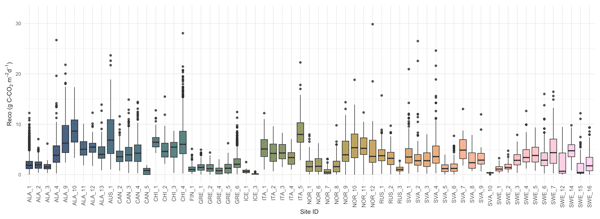
Sarah Schwieger, Jan Dietrich, Mats P. Björkman, Judith M. Sarneel, Bowen Li, Joel White, Inge H. J. Althuizen, Christina Biasi, Robert G. Björk, Hanna Böhner, Brage Bremset Hansen, Michele Carbognani, Giorgio Chiari, Casper T. Christiansen, Elisabeth J. Cooper, Hans Cornelissen, Ludovica D'Imperio, Ellen Dorrepaal, Bo Elberling, Patrick Faubert, Ned Fetcher, T'ai G. W. Forte, Joseph Gaudard, Konstantin Gavazov, Zhen-Huan Guan, Jón Guðmundsson, Siri V. Haugum, Jin-Sheng He, Caitlin Hicks Pries, Mark Hovenden, Simone I. Lang, Gus Jespersen, Ingibjörg S. Jónsdóttir, Ji Young Jung, Olga Khitun, Birgitte Kortegaard Danielsen, Richard Lamprecht, Mathilde Le Moullec, Hanna Lee, Maija E. Marushchak, Anders Michelsen, Tariq Munir, Eero Myrsky, Kevin K. Newsham, Marion Nyberg, Steven F. Oberbauer, Paulo Olivas, Johan Olofsson, Hlynur Óskarsson, Thomas C. Parker, Matteo Petit Bon, Alessandro Petraglia, Emily Pickering Pedersen, Katrine Raundrup, Nynne R. Ravn, Riikka Rinnan, Heidi Rodenhizer, Ingvild Ryde, Alejandro Salazar, Niels M. Schmidt, Ted Schuur, Sofie Sjögersten, Cecilie Skov Nielsen, Sari Stark, Maria Strack, Jianwu Tang, Sylvia Toet, Anne Tolvanen, Maria Väisänen, Richard Van Logtestijn, Vigdis Vandvik, Carolina Voigt, Josefine Walz, Jeffrey M. Welker, Yuanhe Yang, Henni Ylänne, and Sybryn L. Maes
Earth Syst. Sci. Data, 18, 4965–4982, https://doi.org/10.5194/essd-18-4965-2026, https://doi.org/10.5194/essd-18-4965-2026, 2026
Short summary
Short summary
Arctic and alpine tundra ecosystems are warming rapidly, yet measurements of ecosystem CO₂ respiration remain limited. We compile in situ respiration measurements from warming experiments across 64 Arctic and alpine tundra sites. By integrating fluxes with climate, vegetation, and soil data, this database improves understanding and prediction of how tundra carbon cycling responds to climate warming and feeds back to the climate system.
Amy E. Goldman, James C. Stegen, Elizabeth T. Borer, Robert Hensley, Allison Myers-Pigg, Mikayla A. Borton, Paytsar Muradyan, Nicholas D. Ward, Jean M. Andino, Andrew D. Richardson, Alexandro B. Leverkus, Christopher S. Lowry, Nate G. McDowell, Kaizad F. Patel, Scott J. Davidson, Brieanne Forbes, Martha R. Downs, W. Robert Bolton, Timothy D. Scheibe, and Avni Malhotra
EGUsphere, https://doi.org/10.5194/egusphere-2026-3537, https://doi.org/10.5194/egusphere-2026-3537, 2026
Short summary
Short summary
Distributed data generation, or data collected from multiple sources and locations using standardized approaches and coordination among researchers, is powerful for scalable environmental knowledge. This paper helps readers understand options for distributed data generation, offers practical guidance for outreach, operations, and sharing outcomes, and explores how artificial intelligence can help address longstanding challenges.
Tiia Määttä, Ankur R. Desai, Masahito Ueyama, Rodrigo Vargas, Eric J. Ward, Zhen Zhang, Gil Bohrer, Kyle Delwiche, Etienne Fluet-Chouinard, Järvi Järveoja, Sara H. Knox, Lulie Melling, Mats B. Nilsson, Matthias Peichl, Angela Che Ing Tang, Eeva-Stiina Tuittila, Jinsong Wang, Sheel Bansal, Sarah Feron, Manuel Helbig, Aino Korrensalo, Ken W. Krauss, Gavin McNicol, Shuli Niu, Zutao Ouyang, Kathleen Savage, Oliver Sonnentag, Robert Jackson, and Avni Malhotra
Biogeosciences, 23, 4379–4445, https://doi.org/10.5194/bg-23-4379-2026, https://doi.org/10.5194/bg-23-4379-2026, 2026
Short summary
Short summary
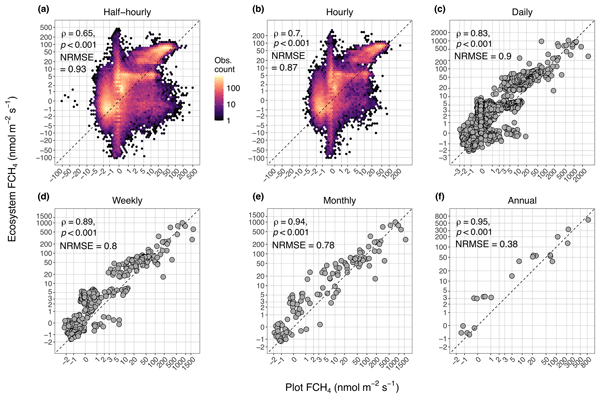
We compared ecosystem- and plot-scale methane fluxes across wetland and upland sites. Ecosystem-scale fluxes were higher than at plot scale, but differences were small. Vapor pressure deficit, atmospheric pressure, turbulence, and wind direction affected the differences. Both scales could be combined for improved methane flux estimates at coarser temporal scales.
Laura Summerauer, Fernando Bamba, Bendicto Akoraebirungi, Ahurra Wobusobozi, Marijn Bauters, Travis William Drake, Negar Haghipour, Clovis Kabaseke, Daniel Muhindo, Landry Cizungu Ntaboba, Leonardo Ramirez-Lopez, Johan Six, Daniel Wasner, and Sebastian Doetterl
Biogeosciences, 23, 3907–3938, https://doi.org/10.5194/bg-23-3907-2026, https://doi.org/10.5194/bg-23-3907-2026, 2026
Short summary
Short summary
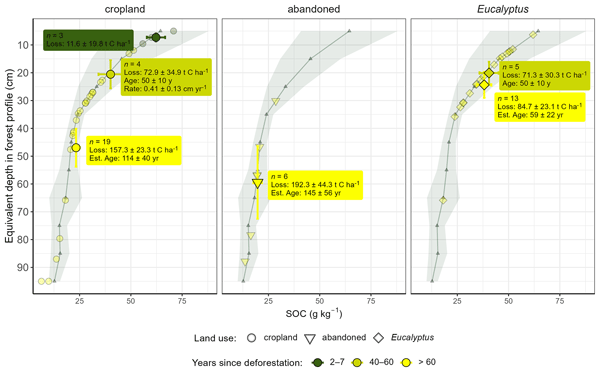
Deforestation for croplands on tropical hillslopes causes severe soil degradation and loss of fertile topsoil. We found that this leads to a steep decline in soil fertility, including organic carbon, nitrogen, and phosphorus. This makes the land unproductive, often leading farmers to abandon it. Replanting with Eucalyptus trees doesn't restore fertility. This degradation leads to cropland lifespans of only 145±56 years and poses a serious threat to future food production.
Fernando Montaño-López, Ravi Kukkadapu, Sean R. Schaefer, Jessica Gilman Ernakovich, and Caitlin Hicks Pries
EGUsphere, https://doi.org/10.5194/egusphere-2026-2641, https://doi.org/10.5194/egusphere-2026-2641, 2026
This preprint is open for discussion and under review for Biogeosciences (BG).
Short summary
Short summary
Permafrost is known to store large amounts of organic carbon. By analyzing Arctic permafrost soils with specialized mineral measurements, we discovered an overlooked form of inorganic carbon locked in an iron mineral called siderite. This mineral was missing from thawed surface soils, suggesting it may break down and release carbon as permafrost thaws. Our findings open new opportunities to study this hidden inorganic carbon and how it changes as permafrost thaws.
Mengze Li, Robert B. Jackson, Marielle Saunois, Philippe Ciais, Ben Poulter, Josep G. Canadell, Prabir K. Patra, Hanqin Tian, Zhen Zhang, Etienne Fluet-Chouinard, Zutao Ouyang, Ting Zhang, David J. Beerling, Dmitry A. Belikov, Philippe Bousquet, Danilo Custodio, Naveen Chandra, Xinyu Dou, Nicola Gedney, Peter O. Hopcroft, Alison M. Hoyt, Kazuhito Ichii, Akihito Ito, Atul K. Jain, Katherine Jensen, Fortunat Joos, Thomas Kleinen, Masayuki Kondo, Fa Li, Tingting Li, Xiangyu Liu, Shamil Maksyutov, Avni Malhotra, Adrien Martinez, Kyle McDonald, Joe R. Melton, Jurek Müller, Yosuke Niwa, Shufen Pan, Shushi Peng, Changhui Peng, Zhangcai Qin, Peter Raymond, William Riley, Arjo Segers, Rona L. Thompson, Aki Tsuruta, Yi Xi, Kunxiaojia Yuan, Wenxin Zhang, Bo Zheng, Qing Zhu, Qiuan Zhu, and Qianlai Zhuang
Earth Syst. Sci. Data, 18, 3507–3524, https://doi.org/10.5194/essd-18-3507-2026, https://doi.org/10.5194/essd-18-3507-2026, 2026
Short summary
Short summary
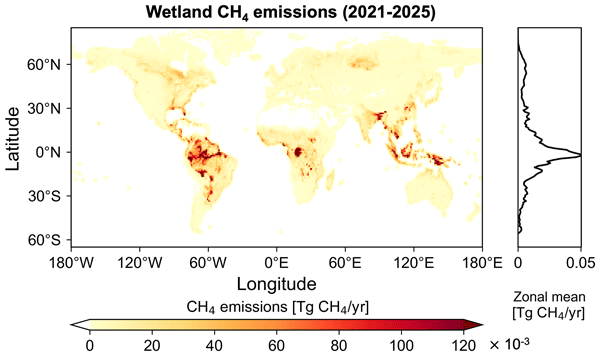
We proposed a framework that combines machine-learning and climate data to predict global natural vegetated wetland methane emissions for 2000–2025. We found that although total global emissions remained stable in the post-2020s, Northern Hemisphere emissions surged whilst tropical emissions fell. This approach allows us to rapidly monitor emissions and provides early warnings for climate impacts.
Jade Skye, Joe R. Melton, Colin Goldblatt, Angela Gallego-Sala, Michelle Garneau, and Scott Winton
Biogeosciences, 23, 2959–2983, https://doi.org/10.5194/bg-23-2959-2026, https://doi.org/10.5194/bg-23-2959-2026, 2026
Short summary
Short summary
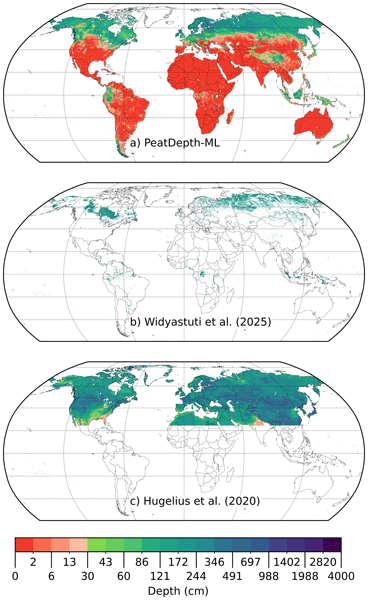
We developed PeatDepth-ML, a machine learning model predicting peat depth worldwide to help estimate carbon stocks in these climate-critical ecosystems. Our model predicts median depths of 134 cm in peatlands. Using bootstrapping, we rigorously assessed how sampling bias affects predictions. This revealed predictor selection and regional accuracy can vary greatly with different data subsets, demonstrating model reliability fundamentally depends on training data quality and geographic coverage.
Joao Henrique Fernandes Amaral, Santiago Botía, Paula Torres Quintero, Anghy Sthephany Gutierrez Rincon, David Ho, Adriana Sanchez, Alvaro Avila-Diaz, Antje Uhde, Benjamin Quesada, Juan C. Benavides, R. Scott Winton, Carlos A. Sierra, Miguel A. Navarro-Ramírez, Diego David Pardo Buitrago, and Stijn Hantson
EGUsphere, https://doi.org/10.5194/egusphere-2026-2080, https://doi.org/10.5194/egusphere-2026-2080, 2026
Short summary
Short summary
Methane is a powerful greenhouse gas driving climate change. Atmospheric methane levels are rising by anthropogenic emissions from livestock, oil and gas, rice farms, fires, and, naturally, mainly from wetlands. Tropical wetlands are a major source, yet data is uncertain. Our study examines South America's Orinoco wetlands (Colombia, Venezuela), reviewing emissions from natural and anthropogenic sources. We discuss and identify research needed to better understand this ecosystem's methane cycle.
Maximiliano González-Sosa, Carlos A. Sierra, J. Andrés Quincke, Walter E. Baethgen, Andrés Tangarife-Escobar, Susan Trumbore, and M. Virginia Pravia
EGUsphere, https://doi.org/10.5194/egusphere-2026-2227, https://doi.org/10.5194/egusphere-2026-2227, 2026
Short summary
Short summary
Based on a time series of soil organic carbon (SOC) and radiocarbon data from a long-term experiment (LTE) in Uruguay and their incorporation into dynamic compartmental models, we determined that integrated crop-pasture systems have a very high capacity to recover SOC stocks in previously degraded systems. However, this newly gained C would likely be stored in forms susceptible to environmental or management changes that could lead to its subsequent preferential loss.
Jeffrey Beem-Miller, William J. Riley, Peter B. Reich, Michael W. I. Schmidt, Yuxuan Bai, Raimundo Bermudez Villanueva, Zach Brown, Abad Chabbi, Susan E. Crow, Wenxu Dong, Serita D. Frey, Paul J. Hanson, Kai Jensen, Melissa A. Knorr, Emma Lathrop, Avni Malhotra, Patrick Megonigal, Adrienne Nicotra, Andrew Nottingham, Genevieve L. Noyce, Roy L. Rich, Heidi Rodenhizer, Agustín Sarquis, Andreas Schindlbacher, Edward A. G. Schuur, Zheng Shi, Artur Stefanski, Viktoria Unger, Tana E. Wood, Yuanhe Yang, Zhijie Yang, Jizhong Zhou, Biao Zhu, and Margaret S. Torn
Earth Syst. Sci. Data Discuss., https://doi.org/10.5194/essd-2026-23, https://doi.org/10.5194/essd-2026-23, 2026
Revised manuscript accepted for ESSD
Short summary
Short summary
The Soil Warming to Depth Data Integration Effort (SWEDDIE) synthesizes data from deep soil warming experiments around the world (n = 23), offering new insight into warming responses of both surface and subsoils. We demonstrate that variation in soil warming with depth is driven largely by warming methodology, while soil moisture changes due to warming differ by ecosystem. This work serves a foundation for future syntheses with SWEDDIE.

Luisa I. Minich, Dylan Geissbühler, Stefan Tobler, Annegret Udke, Alexander S. Brunmayr, Margaux Moreno Duborgel, Ciriaco McMackin, Lukas Wacker, Philip Gautschi, Negar Haghipour, Markus Egli, Ansgar Kahmen, Jens Leifeld, Timothy I. Eglinton, and Frank Hagedorn
Biogeosciences, 23, 811–829, https://doi.org/10.5194/bg-23-811-2026, https://doi.org/10.5194/bg-23-811-2026, 2026
Short summary
Short summary
We developed a conceptual framework using rates and 14C-derived ages of soil-respired CO2 and its sources (autotrophic, heterotrophic) to identify carbon cycling pathways in different land-use types. Rates, ages and sources of respired CO2 varied across forests, grasslands, croplands, and managed peatlands. Our results suggest that the relationship between rates and ages of respired CO2 serves as a robust indicator of carbon retention and loss from natural to disturbed systems.
Maximiliano González-Sosa, Carlos A. Sierra, Juan A. Quincke, Walter E. Baethgen, Susan Trumbore, and M. Virginia Pravia
EGUsphere, https://doi.org/10.5194/egusphere-2025-6451, https://doi.org/10.5194/egusphere-2025-6451, 2026
Short summary
Short summary
Through the analysis and modeling of SOC and isotope (Δ14C and δ13C) data from contrasting treatments in a 60-year agricultural experiment, we found that mineral-associated SOC is highly isolated from recent atmospheric CO₂ inputs, with isolation increasing with soil depth. Integrated crop-pasture rotational systems have not been able to sequester substantial new carbon along the profile, particularly at depth, but they are relevant to preserve the natural carbon legacy of these soils.
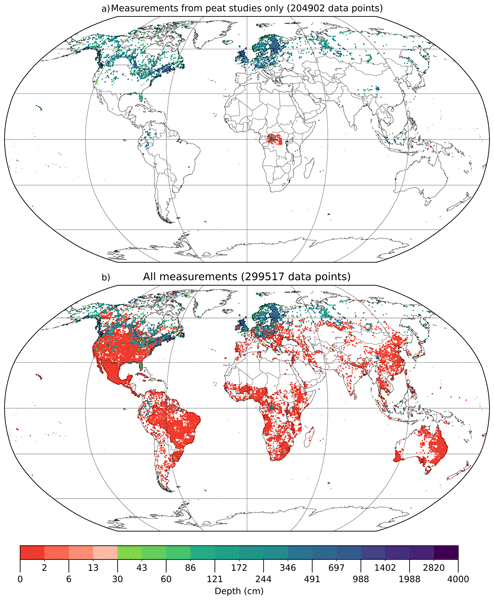
Jade Skye, Joe R. Melton, Colin Goldblatt, Louis Saumier, Angela Gallego-Sala, Michelle Garneau, R. Scott Winton, Erick B. Bahati, Juan C. Benavides, Lee Fedorchuk, Gérard Imani, Carol Kagaba Kairumba, Frank Kansiime, Mariusz Lamentowicz, Michel Mbasi, Daria Wochal, Sambor Czerwiński, Jacek Landowski, Joanna Landowska, Vincent Maire, Minna M. Väliranta, Matthew Warren, Lydia E. S. Cole, Marissa A. Davies, Erik A. Lilleskov, Jingjing Sun, and Yuwan Wang
Earth Syst. Sci. Data, 17, 7313–7330, https://doi.org/10.5194/essd-17-7313-2025, https://doi.org/10.5194/essd-17-7313-2025, 2025
Short summary
Short summary
Peatlands are large stores of carbon but are vulnerable to human activities and climate change. Comprehensive peatland data are vital to understand these ecosystems, but existing datasets are fragmented and contain errors. To address this, we created Peat-DBase – a standardized global database of peat depth measurements with > 200 000 measurements worldwide, showing median depths of 130 cm. Peat-DBase avoids overlapping data compilation efforts while identifying critical observational gaps.
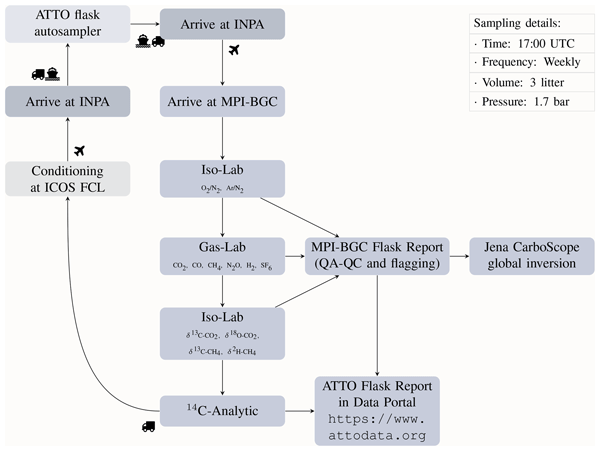
Carlos A. Sierra, Ingrid Chanca, Meinrat O. Andreae, Alessandro Carioca de Araújo, Hella van Asperen, Lars Borchardt, Santiago Botía, Luiz Antonio Candido, Caio S. C. Correa, Cléo Quaresma Dias-Junior, Markus Eritt, Annica Fröhlich, Luciana V. Gatti, Marcus Guderle, Samuel Hammer, Martin Heimann, Viviana Horna, Armin Jordan, Steffen Knabe, Richard Kneißl, Jost Valentin Lavric, Ingeborg Levin, Kita Macario, Juliana Menger, Heiko Moossen, Carlos Alberto Quesada, Michael Rothe, Christian Rödenbeck, Yago Santos, Axel Steinhof, Bruno Takeshi, Susan Trumbore, and Sönke Zaehle
Earth Syst. Sci. Data, 17, 5871–5884, https://doi.org/10.5194/essd-17-5871-2025, https://doi.org/10.5194/essd-17-5871-2025, 2025
Short summary
Short summary
We present here a unique dataset of atmospheric observations of greenhouse gases and isotopes that provide key information on land-atmosphere interactions for the Amazon forests of central Brazil. The data show a relatively large level of variability, but also important trends in greenhouse gases, and signals from fires as well as seasonal biological activity.
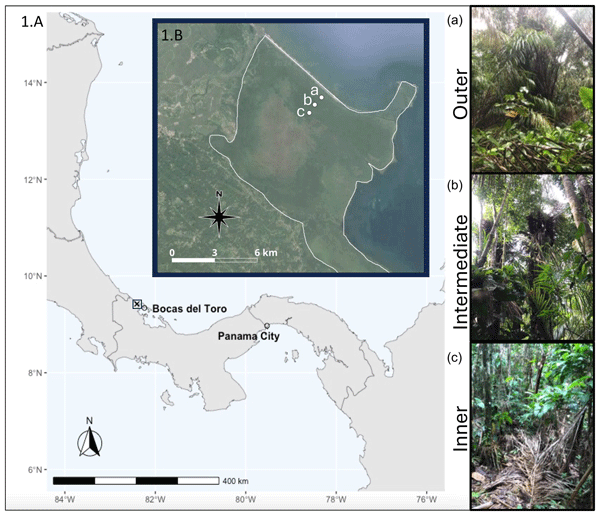
Alexandra Hedgpeth, Alison M. Hoyt, Kyle C. Cavanaugh, Karis J. McFarlane, and Daniela F. Cusack
Biogeosciences, 22, 2667–2690, https://doi.org/10.5194/bg-22-2667-2025, https://doi.org/10.5194/bg-22-2667-2025, 2025
Short summary
Short summary
Tropical peatlands store ancient carbon and have been identified as both being vulnerable to future climate change and taking a long time to recover after a disturbance. It is unknown if these gases are produced from decomposition of 1000-year-old peat. Radiocarbon dating shows emitted gases are young, indicating that surface carbon (rather than old peat) drives emissions. Preserving these ecosystems can trap old carbon, mitigating climate change.
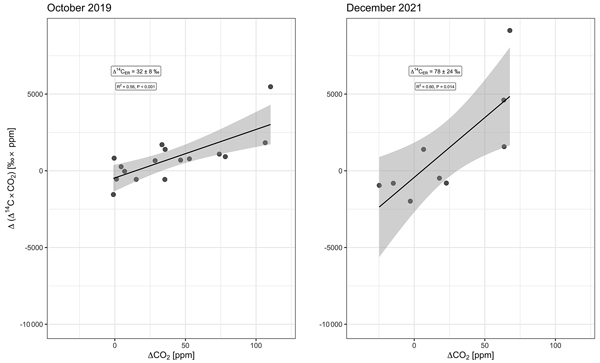
Ingrid Chanca, Ingeborg Levin, Susan Trumbore, Kita Macario, Jost Lavric, Carlos Alberto Quesada, Alessandro Carioca de Araújo, Cléo Quaresma Dias Júnior, Hella van Asperen, Samuel Hammer, and Carlos A. Sierra
Biogeosciences, 22, 455–472, https://doi.org/10.5194/bg-22-455-2025, https://doi.org/10.5194/bg-22-455-2025, 2025
Short summary
Short summary
Assessing the net carbon (C) budget of the Amazon entails considering the magnitude and timing of C absorption and losses through respiration (transit time of C). Radiocarbon-based estimates of the transit time of C in the Amazon Tall Tower Observatory (ATTO) suggest a change in the transit time from 6 ± 2 years and 18 ± 4 years within 2 years (October 2019 and December 2021, respectively). This variability indicates that only a fraction of newly fixed C can be stored for decades or longer.
Amey Tilak, Alina Premrov, Ruchita Ingle, Nigel Roulet, Benjamin R. K. Runkle, Matthew Saunders, Avni Malhotra, and Kenneth Byrne
EGUsphere, https://doi.org/10.5194/egusphere-2024-3852, https://doi.org/10.5194/egusphere-2024-3852, 2024
Preprint archived
Short summary
Short summary
For the future model users, 16 peatland and wetland models reviewed to identify individual model operational scale (spatial and temporal), stabilization timeframes of different carbon pools, model specific advantages and limitations, common and specific model driving inputs, critical inputs of individual models impacting CH4 plant mediated, CH4 diffusion and CH4 ebullition. Finally, we qualitatively ranked the process representations in each model for CH4 production, oxidation and transport.
Luciano Emmert, Susan Trumbore, Joaquim dos Santos, Adriano Lima, Niro Higuchi, Robinson Negrón-Juárez, Cléo Dias-Júnior, Tarek El-Madany, Olaf Kolle, Gabriel Ribeiro, and Daniel Marra
EGUsphere, https://doi.org/10.5194/egusphere-2024-3234, https://doi.org/10.5194/egusphere-2024-3234, 2024
Preprint archived
Short summary
Short summary
For the first time, we documented wind gusts with the potential to damage trees in a forest in the Central Amazon. We used meteorological data collected at crown height over 24 months. We recorded 424 gusts, which occur more frequently and intensely in higher elevated areas and during the transition from the dry to the wet season. More intense rains showed the strongest relationship with extreme winds, highlighting the role of extreme events in tree mortality.
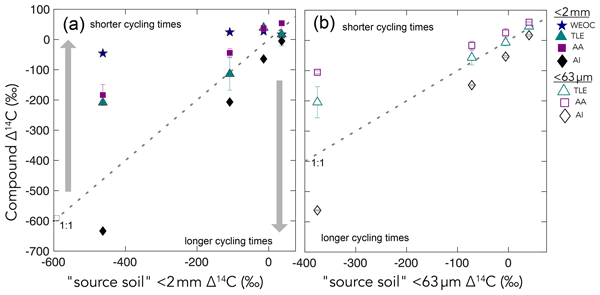
Katherine E. Grant, Marisa N. Repasch, Kari M. Finstad, Julia D. Kerr, Maxwell Marple, Christopher J. Larson, Taylor A. B. Broek, Jennifer Pett-Ridge, and Karis J. McFarlane
Biogeosciences, 21, 4395–4411, https://doi.org/10.5194/bg-21-4395-2024, https://doi.org/10.5194/bg-21-4395-2024, 2024
Short summary
Short summary
Soils store organic carbon composed of multiple compounds from plants and microbes for different lengths of time. To understand how soils store these different carbon types, we measure the time each carbon fraction is in a grassland soil profile. Our results show that the length of time each individual soil fraction is in our soil changes. Our approach allows a detailed look at the different components in soils. This study can help improve our understanding of soil dynamics.
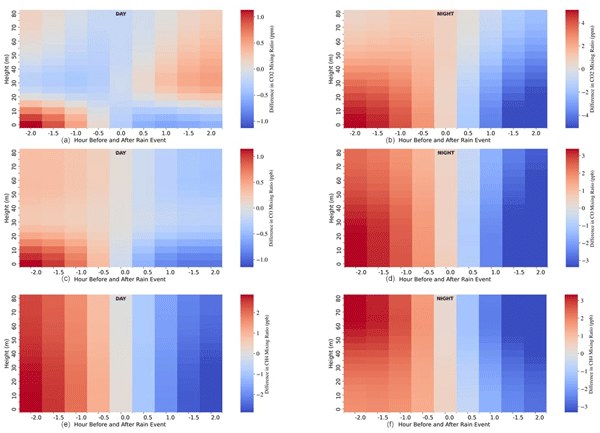
Luiz A. T. Machado, Jürgen Kesselmeier, Santiago Botía, Hella van Asperen, Meinrat O. Andreae, Alessandro C. de Araújo, Paulo Artaxo, Achim Edtbauer, Rosaria R. Ferreira, Marco A. Franco, Hartwig Harder, Sam P. Jones, Cléo Q. Dias-Júnior, Guido G. Haytzmann, Carlos A. Quesada, Shujiro Komiya, Jost Lavric, Jos Lelieveld, Ingeborg Levin, Anke Nölscher, Eva Pfannerstill, Mira L. Pöhlker, Ulrich Pöschl, Akima Ringsdorf, Luciana Rizzo, Ana M. Yáñez-Serrano, Susan Trumbore, Wanda I. D. Valenti, Jordi Vila-Guerau de Arellano, David Walter, Jonathan Williams, Stefan Wolff, and Christopher Pöhlker
Atmos. Chem. Phys., 24, 8893–8910, https://doi.org/10.5194/acp-24-8893-2024, https://doi.org/10.5194/acp-24-8893-2024, 2024
Short summary
Short summary
Composite analysis of gas concentration before and after rainfall, during the day and night, gives insight into the complex relationship between trace gas variability and precipitation. The analysis helps us to understand the sources and sinks of trace gases within a forest ecosystem. It elucidates processes that are not discernible under undisturbed conditions and contributes to a deeper understanding of the trace gas life cycle and its intricate interactions with cloud dynamics in the Amazon.
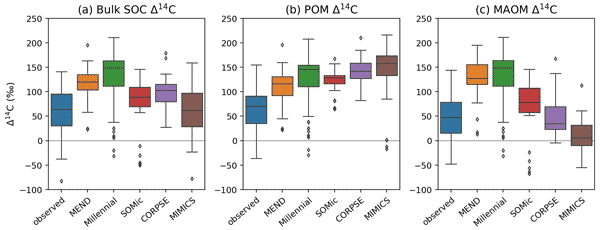
Alexander S. Brunmayr, Frank Hagedorn, Margaux Moreno Duborgel, Luisa I. Minich, and Heather D. Graven
Geosci. Model Dev., 17, 5961–5985, https://doi.org/10.5194/gmd-17-5961-2024, https://doi.org/10.5194/gmd-17-5961-2024, 2024
Short summary
Short summary
A new generation of soil models promises to more accurately predict the carbon cycle in soils under climate change. However, measurements of 14C (the radioactive carbon isotope) in soils reveal that the new soil models face similar problems to the traditional models: they underestimate the residence time of carbon in soils and may therefore overestimate the net uptake of CO2 by the land ecosystem. Proposed solutions include restructuring the models and calibrating model parameters with 14C data.
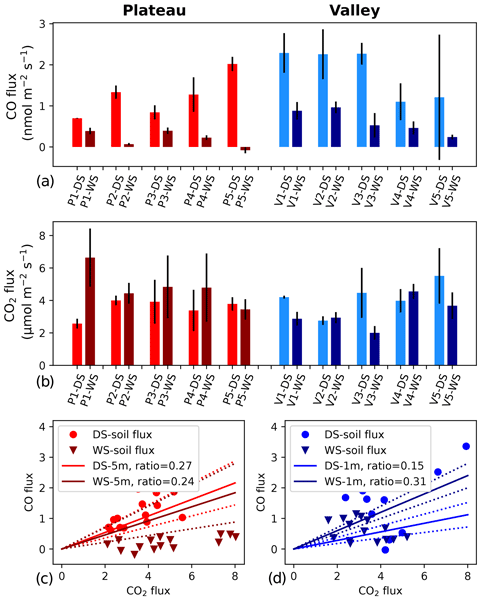
Hella van Asperen, Thorsten Warneke, Alessandro Carioca de Araújo, Bruce Forsberg, Sávio José Filgueiras Ferreira, Thomas Röckmann, Carina van der Veen, Sipko Bulthuis, Leonardo Ramos de Oliveira, Thiago de Lima Xavier, Jailson da Mata, Marta de Oliveira Sá, Paulo Ricardo Teixeira, Julie Andrews de França e Silva, Susan Trumbore, and Justus Notholt
Biogeosciences, 21, 3183–3199, https://doi.org/10.5194/bg-21-3183-2024, https://doi.org/10.5194/bg-21-3183-2024, 2024
Short summary
Short summary
Carbon monoxide (CO) is regarded as an important indirect greenhouse gas. Soils can emit and take up CO, but, until now, uncertainty remains as to which process dominates in tropical rainforests. We present the first soil CO flux measurements from a tropical rainforest. Based on our observations, we report that tropical rainforest soils are a net source of CO. In addition, we show that valley streams and inundated areas are likely additional hot spots of CO in the ecosystem.
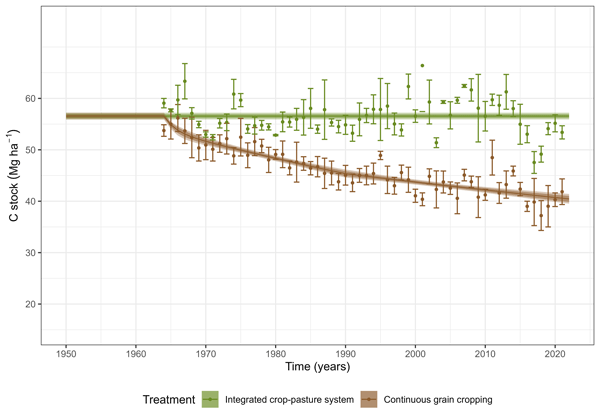
Maximiliano González-Sosa, Carlos A. Sierra, J. Andrés Quincke, Walter E. Baethgen, Susan Trumbore, and M. Virginia Pravia
SOIL, 10, 467–486, https://doi.org/10.5194/soil-10-467-2024, https://doi.org/10.5194/soil-10-467-2024, 2024
Short summary
Short summary
Based on an approach that involved soil organic carbon (SOC) monitoring, radiocarbon measurement in bulk soil, and incubations from a long-term 60-year experiment, it was concluded that the avoidance of old carbon losses in the integrated crop–pasture systems is the main reason that explains their greater carbon storage capacities compared to continuous cropping. A better understanding of these processes is essential for making agronomic decisions to increase the carbon sequestration capacity.
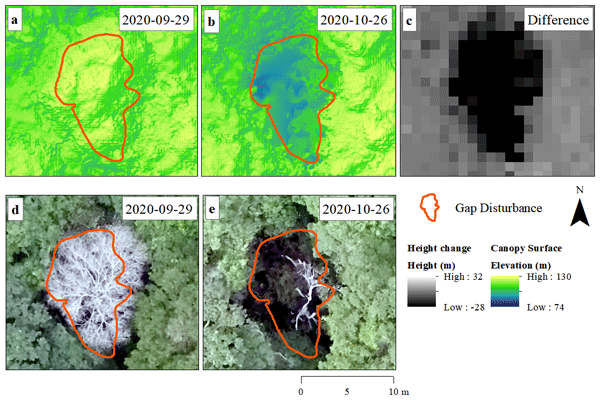
Adriana Simonetti, Raquel Fernandes Araujo, Carlos Henrique Souza Celes, Flávia Ranara da Silva e Silva, Joaquim dos Santos, Niro Higuchi, Susan Trumbore, and Daniel Magnabosco Marra
Biogeosciences, 20, 3651–3666, https://doi.org/10.5194/bg-20-3651-2023, https://doi.org/10.5194/bg-20-3651-2023, 2023
Short summary
Short summary
We combined 2 years of monthly drone-acquired RGB (red–green–blue) imagery with field surveys in a central Amazon forest. Our results indicate that small gaps associated with branch fall were the most frequent. Biomass losses were partially controlled by gap area, with branch fall and snapping contributing the least and greatest relative values, respectively. Our study highlights the potential of drone images for monitoring canopy dynamics in dense tropical forests.
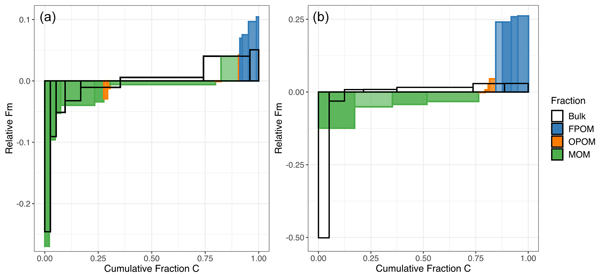
Shane W. Stoner, Marion Schrumpf, Alison Hoyt, Carlos A. Sierra, Sebastian Doetterl, Valier Galy, and Susan Trumbore
Biogeosciences, 20, 3151–3163, https://doi.org/10.5194/bg-20-3151-2023, https://doi.org/10.5194/bg-20-3151-2023, 2023
Short summary
Short summary
Soils store more carbon (C) than any other terrestrial C reservoir, but the processes that control how much C stays in soil, and for how long, are very complex. Here, we used a recent method that involves heating soil in the lab to measure the range of C ages in soil. We found that most C in soil is decades to centuries old, while some stays for much shorter times (days to months), and some is thousands of years old. Such detail helps us to estimate how soil C may react to changing climate.
Jeffrey Prescott Beem-Miller, Craig Rasmussen, Alison May Hoyt, Marion Schrumpf, Georg Guggenberger, and Susan Trumbore
EGUsphere, https://doi.org/10.5194/egusphere-2022-1083, https://doi.org/10.5194/egusphere-2022-1083, 2022
Preprint withdrawn
Short summary
Short summary
We compared the age of persistent soil organic matter as well as active emissions of carbon dioxide from soils across a gradient of climate and geology. We found that clay minerals are more important than mean annual temperature for both persistent and actively cycling soil carbon, and that they may attenuate the sensitivity of soil organic matter decomposition to temperature. Accounting for geology and soil development could therefore improve estimates of soil carbon stocks and changes.
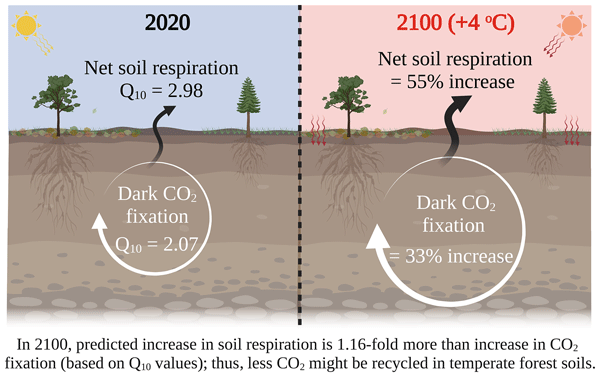
Rachael Akinyede, Martin Taubert, Marion Schrumpf, Susan Trumbore, and Kirsten Küsel
Biogeosciences, 19, 4011–4028, https://doi.org/10.5194/bg-19-4011-2022, https://doi.org/10.5194/bg-19-4011-2022, 2022
Short summary
Short summary
Soils will likely become warmer in the future, and this can increase the release of carbon dioxide (CO2) into the atmosphere. As microbes can take up soil CO2 and prevent further escape into the atmosphere, this study compares the rate of uptake and release of CO2 at two different temperatures. With warming, the rate of CO2 uptake increases less than the rate of release, indicating that the capacity to modulate soil CO2 release into the atmosphere will decrease under future warming.
Katherine E. O. Todd-Brown, Rose Z. Abramoff, Jeffrey Beem-Miller, Hava K. Blair, Stevan Earl, Kristen J. Frederick, Daniel R. Fuka, Mario Guevara Santamaria, Jennifer W. Harden, Katherine Heckman, Lillian J. Heran, James R. Holmquist, Alison M. Hoyt, David H. Klinges, David S. LeBauer, Avni Malhotra, Shelby C. McClelland, Lucas E. Nave, Katherine S. Rocci, Sean M. Schaeffer, Shane Stoner, Natasja van Gestel, Sophie F. von Fromm, and Marisa L. Younger
Biogeosciences, 19, 3505–3522, https://doi.org/10.5194/bg-19-3505-2022, https://doi.org/10.5194/bg-19-3505-2022, 2022
Short summary
Short summary
Research data are becoming increasingly available online with tantalizing possibilities for reanalysis. However harmonizing data from different sources remains challenging. Using the soils community as an example, we walked through the various strategies that researchers currently use to integrate datasets for reanalysis. We find that manual data transcription is still extremely common and that there is a critical need for community-supported informatics tools like vocabularies and ontologies.
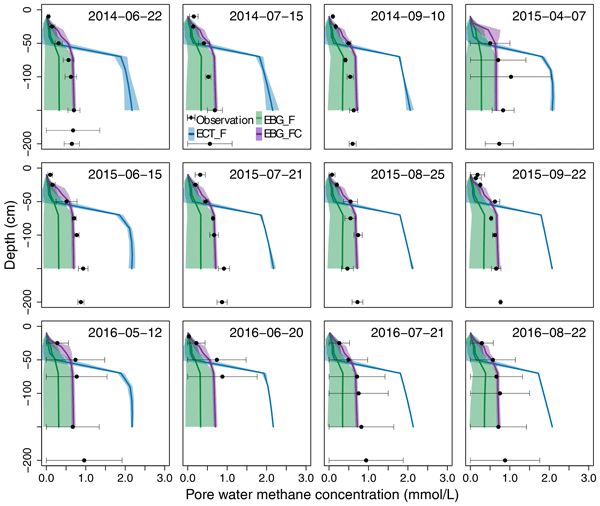
Shuang Ma, Lifen Jiang, Rachel M. Wilson, Jeff P. Chanton, Scott Bridgham, Shuli Niu, Colleen M. Iversen, Avni Malhotra, Jiang Jiang, Xingjie Lu, Yuanyuan Huang, Jason Keller, Xiaofeng Xu, Daniel M. Ricciuto, Paul J. Hanson, and Yiqi Luo
Biogeosciences, 19, 2245–2262, https://doi.org/10.5194/bg-19-2245-2022, https://doi.org/10.5194/bg-19-2245-2022, 2022
Short summary
Short summary
The relative ratio of wetland methane (CH4) emission pathways determines how much CH4 is oxidized before leaving the soil. We found an ebullition modeling approach that has a better performance in deep layer pore water CH4 concentration. We suggest using this approach in land surface models to accurately represent CH4 emission dynamics and response to climate change. Our results also highlight that both CH4 flux and belowground concentration data are important to constrain model parameters.
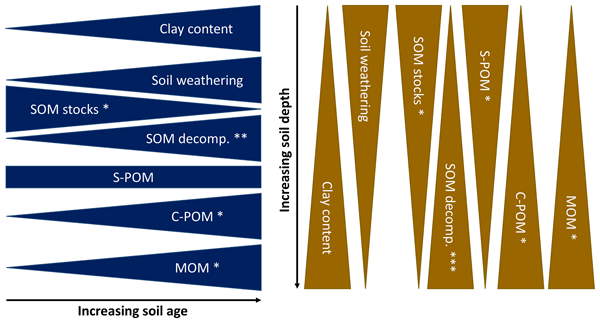
Moritz Mainka, Laura Summerauer, Daniel Wasner, Gina Garland, Marco Griepentrog, Asmeret Asefaw Berhe, and Sebastian Doetterl
Biogeosciences, 19, 1675–1689, https://doi.org/10.5194/bg-19-1675-2022, https://doi.org/10.5194/bg-19-1675-2022, 2022
Short summary
Short summary
The largest share of terrestrial carbon is stored in soils, making them highly relevant as regards global change. Yet, the mechanisms governing soil carbon stabilization are not well understood. The present study contributes to a better understanding of these processes. We show that qualitative changes in soil organic matter (SOM) co-vary with alterations of the soil matrix following soil weathering. Hence, the type of SOM that is stabilized in soils might change as soils develop.

Karis J. McFarlane, Heather M. Throckmorton, Jeffrey M. Heikoop, Brent D. Newman, Alexandra L. Hedgpeth, Marisa N. Repasch, Thomas P. Guilderson, and Cathy J. Wilson
Biogeosciences, 19, 1211–1223, https://doi.org/10.5194/bg-19-1211-2022, https://doi.org/10.5194/bg-19-1211-2022, 2022
Short summary
Short summary
Planetary warming is increasing seasonal thaw of permafrost, making this extensive old carbon stock vulnerable. In northern Alaska, we found more and older dissolved organic carbon in small drainages later in summer as more permafrost was exposed by deepening thaw. Younger and older carbon did not differ in chemical indicators related to biological lability suggesting this carbon can cycle through aquatic systems and contribute to greenhouse gas emissions as warming increases permafrost thaw.
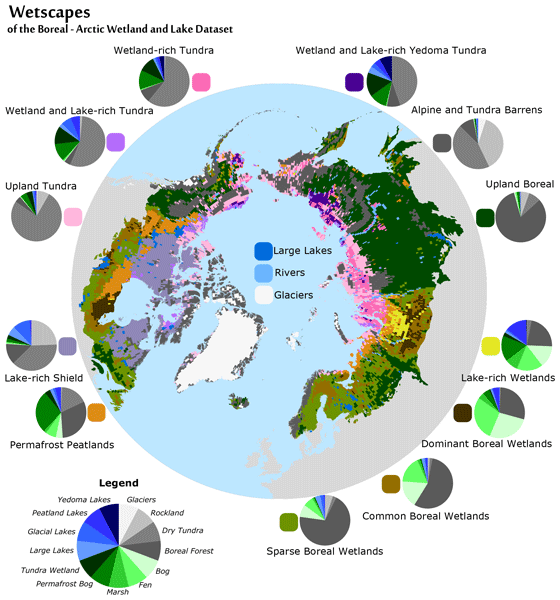
David Olefeldt, Mikael Hovemyr, McKenzie A. Kuhn, David Bastviken, Theodore J. Bohn, John Connolly, Patrick Crill, Eugénie S. Euskirchen, Sarah A. Finkelstein, Hélène Genet, Guido Grosse, Lorna I. Harris, Liam Heffernan, Manuel Helbig, Gustaf Hugelius, Ryan Hutchins, Sari Juutinen, Mark J. Lara, Avni Malhotra, Kristen Manies, A. David McGuire, Susan M. Natali, Jonathan A. O'Donnell, Frans-Jan W. Parmentier, Aleksi Räsänen, Christina Schädel, Oliver Sonnentag, Maria Strack, Suzanne E. Tank, Claire Treat, Ruth K. Varner, Tarmo Virtanen, Rebecca K. Warren, and Jennifer D. Watts
Earth Syst. Sci. Data, 13, 5127–5149, https://doi.org/10.5194/essd-13-5127-2021, https://doi.org/10.5194/essd-13-5127-2021, 2021
Short summary
Short summary
Wetlands, lakes, and rivers are important sources of the greenhouse gas methane to the atmosphere. To understand current and future methane emissions from northern regions, we need maps that show the extent and distribution of specific types of wetlands, lakes, and rivers. The Boreal–Arctic Wetland and Lake Dataset (BAWLD) provides maps of five wetland types, seven lake types, and three river types for northern regions and will improve our ability to predict future methane emissions.
Cited articles
Ahrens, B., Braakhekke, M. C., Guggenberger, G., Schrumpf, M., and Reichstein, M.: Contribution of sorption, DOC transport and microbial interactions to the 14C age of a soil organic carbon profile: Insights from a calibrated process model, Soil Biol. Biochem., 88, 390–402, https://doi.org/10.1016/j.soilbio.2015.06.008, 2015.
Ahrens, B., Guggenberger, G., Rethemeyer, J., John, S., Marschner, B., Heinze, S., Angst, G., Mueller, C. W., Kögel-Knabner, I., Leuschner, C., Hertel, D., Bachmann, J., Reichstein, M., and Schrumpf, M.: Combination of energy limitation and sorption capacity explains 14C depth gradients, Soil Biol. Biochem., 148, 107912, https://doi.org/10.1016/j.soilbio.2020.107912, 2020.
Amundson, R., Sanderman, J., Yoo, K., Chitsaz, M., Abramova, A., and Georgiou, K.: Neglecting vertical transport leads to underestimated soil carbon dynamics, Nat. Geosci., 18, 1239–1244, https://doi.org/10.1038/s41561-025-01846-6, 2025.
Baisden, W. T., Parfitt, R. L., Ross, C., Schipper, L. A., and Canessa, S.: Evaluating 50 years of time-series soil radiocarbon data: towards routine calculation of robust C residence times, Biogeochemistry, 112, 129–137, https://doi.org/10.1007/s10533-011-9675-y, 2013.
Barnes, R. T., Butman, D. E., Wilson, H. F., and Raymond, P. A.: Riverine Export of Aged Carbon Driven by Flow Path Depth and Residence Time, Environ. Sci. Technol., 52, 1028–1035, https://doi.org/10.1021/acs.est.7b04717, 2018.
Beck, H. E., McVicar, T. R., Vergopolan, N., Berg, A., Lutsko, N. J., Dufour, A., Zeng, Z., Jiang, X., van Dijk, A. I. J. M., and Miralles, D. G.: High-resolution (1 km) Köppen-Geiger maps for 1901–2099 based on constrained CMIP6 projections, Sci. Data, 10, 724, https://doi.org/10.1038/s41597-023-02549-6, 2023.
Beem-Miller, J., Schrumpf, M., Hoyt, A. M., Guggenberger, G., and Trumbore, S.: Impacts of drying and rewetting on the radiocarbon signature of respired CO2 and implications for incubating archived soils, J. Geophys. Res.-Biogeo., 126, e2020JG006119, https://doi.org/10.1029/2020JG006119, 2021.
Beem-Miller, J., Hoyt, A., Stoner, S., Monroe, J. G., Hicks Pries, C., and Levine, P. A.: ISRaD: Tools and Data for the International Soil Radiocarbon Database, Zenodo [data set], https://doi.org/10.5281/zenodo.17860507, 2025.
Billings, S. A., Lajtha, K., Malhotra, A., Berhe, A. A., de Graaff, M.-A., Earl, S., Fraterrigo, J., Georgiou, K., Grandy, S., Hobbie, S. E., Moore, J. A. M., Nadelhoffer, K., Pierson, D., Rasmussen, C., Silver, W. L., Sulman, B. N., Weintraub, S., and Wieder, W.: Soil organic carbon is not just for soil scientists: measurement recommendations for diverse practitioners, Ecol. Appl., 31, e02290, https://doi.org/10.1002/eap.2290, 2021.
Bond-Lamberty, B., Christianson, D. S., Malhotra, A., Pennington, S. C., Sihi, D., AghaKouchak, A., Anjileli, H., Altaf Arain, M., Armesto, J. J., Ashraf, S., Ataka, M., Baldocchi, D., Andrew Black, T., Buchmann, N., Carbone, M. S., Chang, S.-C., Crill, P., Curtis, P. S., Davidson, E. A., Desai, A. R., Drake, J. E., El-Madany, T. S., Gavazzi, M., Görres, C.-M., Gough, C. M., Goulden, M., Gregg, J., Gutiérrez del Arroyo, O., He, J.-S., Hirano, T., Hopple, A., Hughes, H., Järveoja, J., Jassal, R., Jian, J., Kan, H., Kaye, J., Kominami, Y., Liang, N., Lipson, D., Macdonald, C. A., Maseyk, K., Mathes, K., Mauritz, M., Mayes, M. A., McNulty, S., Miao, G., Migliavacca, M., Miller, S., Miniat, C. F., Nietz, J. G., Nilsson, M. B., Noormets, A., Norouzi, H., O'Connell, C. S., Osborne, B., Oyonarte, C., Pang, Z., Peichl, M., Pendall, E., Perez-Quezada, J. F., Phillips, C. L., Phillips, R. P., Raich, J. W., Renchon, A. A., Ruehr, N. K., Sánchez-Cañete, E. P., Saunders, M., Savage, K. E., Schrumpf, M., Scott, R. L., Seibt, U., Silver, W. L., Sun, W., Szutu, D., Takagi, K., Takagi, M., Teramoto, M., Tjoelker, M. G., Trumbore, S., Ueyama, M., Vargas, R., Varner, R. K., Verfaillie, J., Vogel, C., Wang, J., Winston, G., Wood, T. E., Wu, J., Wutzler, T., Zeng, J., Zha, T., Zhang, Q., and Zou, J.: COSORE: A community database for continuous soil respiration and other soil-atmosphere greenhouse gas flux data, Glob. Change Biol., 26, 7268–7283, https://doi.org/10.1111/gcb.15353, 2020.
Bossio, D. A., Cook-Patton, S. C., Ellis, P. W., Fargione, J., Sanderman, J., Smith, P., Wood, S., Zomer, R. J., von Unger, M., Emmer, I. M., and Griscom, B. W.: The role of soil carbon in natural climate solutions, Nat. Sustain., 3, 391–398, https://doi.org/10.1038/s41893-020-0491-z, 2020.
Bowen, J. C., Hoyt, A. M., Xu, X., Nuriman, M., Anshari, G. Z., Wahyudio, P. J., and Aluwihare, L. I.: Aquatic processing enhances the loss of aged carbon from drained and burned peatlands, Glob. Change Biol., 30, e17394, https://doi.org/10.1111/gcb.17394, 2024a.
Bowen, J. C., Wahyudio, P. J., Anshari, G. Z., Aluwihare, L. I., and Hoyt, A. M.: Canal networks regulate aquatic losses of carbon from degraded tropical peatlands, Nat. Geosci., 17, 213–218, https://doi.org/10.1038/s41561-024-01383-8, 2024b.
Brunmayr, A. S., Hagedorn, F., Moreno Duborgel, M., Minich, L. I., and Graven, H. D.: Radiocarbon analysis reveals underestimation of soil organic carbon persistence in new-generation soil models, Geosci. Model Dev., 17, 5961–5985, https://doi.org/10.5194/gmd-17-5961-2024, 2024.
Butman, D. E., Wilson, H. F., Barnes, R. T., Xenopoulos, M. A., and Raymond, P. A.: Increased mobilization of aged carbon to rivers by human disturbance, Nat. Geosci., 8, 112–116, https://doi.org/10.1038/ngeo2322, 2015.
Camino-Serrano, M., Tifafi, M., Balesdent, J., Hatté, C., Peñuelas, J., Cornu, S., and Guenet, B.: Including Stable Carbon Isotopes to Evaluate the Dynamics of Soil Carbon in the Land-Surface Model ORCHIDEE, J. Adv. Model. Earth Sy., 11, 3650–3669, https://doi.org/10.1029/2018MS001392, 2019.
Chai, X., Li, G., Shi, Z., and Ruan, H.: Soil radiocarbon abundance in global forest ecosystems controlled by climate and soil properties, Plant Soil, 489, 125–137, https://doi.org/10.1007/s11104-023-06002-w, 2023.
Chanton, J. P., Glaser, P. H., Chasar, L. S., Burdige, D. J., Hines, M. E., Siegel, D. I., Tremblay, L. B., and Cooper, W. T.: Radiocarbon evidence for the importance of surface vegetation on fermentation and methanogenesis in contrasting types of boreal peatlands, Global Biogeochem. Cy., 22, https://doi.org/10.1029/2008GB003274, 2008.
Chen, J., Zhu, Q., Riley, W. J., He, Y., Randerson, J. T., and Trumbore, S.: Comparison With Global Soil Radiocarbon Observations Indicates Needed Carbon Cycle Improvements in the E3SM Land Model, J. Geophys. Res.-Biogeo., 124, 1098–1114, https://doi.org/10.1029/2018JG004795, 2019.
Cisneros-Dozal, L. M., Trumbore, S., and Hanson, P. J.: Partitioning sources of soil-respired CO2 and their seasonal variation using a unique radiocarbon tracer, Glob. Change Biol., 12, 194–204, https://doi.org/10.1111/j.1365-2486.2005.001061.x, 2006.
Cole, J. J., Prairie, Y. T., Caraco, N. F., McDowell, W. H., Tranvik, L. J., Striegl, R. G., Duarte, C. M., Kortelainen, P., Downing, J. A., Middelburg, J. J., and Melack, J.: Plumbing the Global Carbon Cycle: Integrating Inland Waters into the Terrestrial Carbon Budget, Ecosystems, 10, 172–185, https://doi.org/10.1007/s10021-006-9013-8, 2007.
Cooray, I. G., Chalmers, G., Chittleborough, D., and Ghasemzadeh, Z.: Soil carbon fractionation as a tool to monitor coastal wetland rehabilitation, J. Environ. Manage., 373, 123950, https://doi.org/10.1016/j.jenvman.2024.123950, 2025.
Copard, Y., Hatté, C., Cécillon, L., Colin, Y., Barré, P., Chenu, C., and Cornu, S.: Soil Carbon Dynamics Reshaped by Ancient Carbon Quantification, Glob. Change Biol., 31, e70482, https://doi.org/10.1111/gcb.70482, 2025.
Cotrufo, M. F. and Lavallee, J. M.: Soil organic matter formation, persistence, and functioning: A synthesis of current understanding to inform its conservation and regeneration, Adv. Agron., 172, 1–66, https://doi.org/10.1016/bs.agron.2021.11.002, 2022.
Crow, S. E., Reeves, M., Schubert, O. S., and Sierra, C. A.: Optimization of method to quantify soil organic matter dynamics and carbon sequestration potential in volcanic ash soils, Biogeochemistry, 123, 27–47, https://doi.org/10.1007/s10533-014-0051-6, 2015.
Crystal-Ornelas, R., Varadharajan, C., O'Ryan, D., Beilsmith, K., Bond-Lamberty, B., Boye, K., Burrus, M., Cholia, S., Christianson, D. S., Crow, M., Damerow, J., Ely, K. S., Goldman, A. E., Heinz, S. L., Hendrix, V. C., Kakalia, Z., Mathes, K., O'Brien, F., Pennington, S. C., Robles, E., Rogers, A., Simmonds, M., Velliquette, T., Weisenhorn, P., Welch, J. N., Whitenack, K., and Agarwal, D. A.: Enabling FAIR data in Earth and environmental science with community-centric (meta)data reporting formats, Sci. Data, 9, 700, https://doi.org/10.1038/s41597-022-01606-w, 2022.
Dargie, G. C., Lewis, S. L., Lawson, I. T., Mitchard, E. T. A., Page, S. E., Bocko, Y. E., and Ifo, S. A.: Age, extent and carbon storage of the central Congo Basin peatland complex, Nature, 542, 86–90, https://doi.org/10.1038/nature21048, 2017.
Dean, J. F., Coxon, G., Zheng, Y., Bishop, J., Garnett, M. H., Bastviken, D., Galy, V., Spencer, R. G. M., Tank, S. E., Tipper, E. T., Vonk, J. E., Wallin, M. B., Zhang, L., Evans, C. D., and Hilton, R. G.: Old carbon routed from land to the atmosphere by global river systems, Nature, 642, 105–111, https://doi.org/10.1038/s41586-025-09023-w, 2025.
Derrien, D., Barré, P., Basile-Doelsch, I., Cécillon, L., Chabbi, A., Crème, A., Fontaine, S., Henneron, L., Janot, N., Lashermes, G., Quénéa, K., Rees, F., and Dignac, M.-F.: Current controversies on mechanisms controlling soil carbon storage: implications for interactions with practitioners and policy-makers. A review, Agron. Sustain. Dev., 43, 21, https://doi.org/10.1007/s13593-023-00876-x, 2023.
Doetterl, S., Berhe, A. A., Heckman, K., Lawrence, C., Schnecker, J., Vargas, R., Vogel, C., and Wagai, R.: A landscape-scale view of soil organic matter dynamics, Nat. Rev. Earth Environ., 6, 67–81, https://doi.org/10.1038/s43017-024-00621-2, 2025.
Drake, T. W., Van Oost, K., Barthel, M., Bauters, M., Hoyt, A. M., Podgorski, D. C., Six, J., Boeckx, P., Trumbore, S. E., Cizungu Ntaboba, L., and Spencer, R. G. M.: Mobilization of aged and biolabile soil carbon by tropical deforestation, Nat. Geosci., 12, 541–546, https://doi.org/10.1038/s41561-019-0384-9, 2019.
Eglinton, T. I., Graven, H. D., Raymond, P. A., Trumbore, S. E., Aluwihare, L., Bard, E., Basu, S., Friedlingstein, P., Hammer, S., Lester, J., Sanderman, J., Schuur, E. A. G., Sierra, C. A., Synal, H.-A., Turnbull, J. C., and Wacker, L.: Making the case for an International Decade of Radiocarbon, Philos. T. R. Soc. A, 381, 20230081, https://doi.org/10.1098/rsta.2023.0081, 2023.
Estop-Aragonés, C., Olefeldt, D., Abbott, B. W., Chanton, J. P., Czimczik, C. I., Dean, J. F., Egan, J. E., Gandois, L., Garnett, M. H., Hartley, I. P., Hoyt, A., Lupascu, M., Natali, S. M., O'Donnell, J. A., Raymond, P. A., Tanentzap, A. J., Tank, S. E., Schuur, E. A. G., Turetsky, M., and Anthony, K. W.: Assessing the Potential for Mobilization of Old Soil Carbon After Permafrost Thaw: A Synthesis of 14C Measurements From the Northern Permafrost Region, Global Biogeochem. Cy., 34, e2020GB006672, https://doi.org/10.1029/2020GB006672, 2020.
Fekete, I., Berki, I., Lajtha, K., Trumbore, S., Francioso, O., Gioacchini, P., Montecchio, D., Várbíró, G., Béni, Á., Makádi, M., Demeter, I., Madarász, B., Juhos, K., and Kotroczó, Z.: How will a drier climate change carbon sequestration in soils of the deciduous forests of Central Europe?, Biogeochemistry, 152, 13–32, https://doi.org/10.1007/s10533-020-00728-w, 2021.
Feng, W., Shi, Z., Jiang, J., Xia, J., Liang, J., Zhou, J., and Luo, Y.: Methodological uncertainty in estimating carbon turnover times of soil fractions, Soil Biol. Biochem., 100, 118–124, https://doi.org/10.1016/j.soilbio.2016.06.003, 2016.
Frischknecht, T., Ekici, A., and Joos, F.: Radiocarbon in the Land and Ocean Components of the Community Earth System Model, Global Biogeochem. Cy., 36, e2021GB007042, https://doi.org/10.1029/2021GB007042, 2022.
Fujisaki, K., Chevallier, T., Bispo, A., Laurent, J.-B., Thevenin, F., Chapuis-Lardy, L., Cardinael, R., Le Bas, C., Freycon, V., Bénédet, F., Blanfort, V., Brossard, M., Tella, M., and Demenois, J.: Semantics about soil organic carbon storage: DATA4C+, a comprehensive thesaurus and classification of management practices in agriculture and forestry, SOIL, 9, 89–100, https://doi.org/10.5194/soil-9-89-2023, 2023.
Galy, V., Peucker-Ehrenbrink, B., and Eglinton, T.: Global carbon export from the terrestrial biosphere controlled by erosion, Nature, 521, 204–207, https://doi.org/10.1038/nature14400, 2015.
Gaudinski, J. B., Trumbore, S. E., Davidson, E. A., and Zheng, S.: Soil carbon cycling in a temperate forest: radiocarbon-based estimates of residence times, sequestration rates and partitioning of fluxes, Biogeochemistry, 51, 33–69, https://doi.org/10.1023/A:1006301010014, 2000.
González-Sosa, M., Sierra, C. A., Quincke, J. A., Baethgen, W. E., Trumbore, S., and Pravia, M. V.: High capacity of integrated crop–pasture systems to preserve old soil carbon evaluated in a 60-year-old experiment, SOIL, 10, 467–486, https://doi.org/10.5194/soil-10-467-2024, 2024.
Grant, K. E., Galy, V. V., Chadwick, O. A., and Derry, L. A.: Thermal oxidation of carbon in organic matter rich volcanic soils: insights into SOC age differentiation and mineral stabilization, Biogeochemistry, 144, 291–304, https://doi.org/10.1007/s10533-019-00586-1, 2019.
Grant, K. E., Hilton, R. G., and Galy, V. V.: Global patterns of radiocarbon depletion in subsoil linked to rock-derived organic carbon, Geochem. Perspect. Lett., 25, 36–40, https://doi.org/10.7185/geochemlet.2312, 2023.
Graven, H., Keeling, R. F., and Rogelj, J.: Changes to Carbon Isotopes in Atmospheric CO2 Over the Industrial Era and Into the Future, Global Biogeochem. Cy., 34, e2019GB006170, https://doi.org/10.1029/2019GB006170, 2020.
Graven, H. D.: Impact of fossil fuel emissions on atmospheric radiocarbon and various applications of radiocarbon over this century, P. Natl. Acad. Sci. USA, 112, 9542–9545, https://doi.org/10.1073/pnas.1504467112, 2015.
Hamada, K., Ohtsuka, T., Fujitake, N., Miyajima, T., Yokoyama, Y., Miyairi, Y., and Kida, M.: Functional organic matter components in mangrove soils revealed by density fractionation, Soil Sci. Plant Nutr., 70, 88–99, https://doi.org/10.1080/00380768.2024.2304761, 2024.
Hamada, K., Yimatsa, N., Ohtsuka, T., Fujitake, N., Miyajima, T., Yokoyama, Y., Miyairi, Y., and Kida, M.: Organo-metal coprecipitation contributes to stable organic carbon fraction in mangrove soil, CATENA, 256, 109075, https://doi.org/10.1016/j.catena.2025.109075, 2025.
Hansen, P. M., Even, R., King, A. E., Lavallee, J., Schipanski, M., and Cotrufo, M. F.: Distinct, direct and climate-mediated environmental controls on global particulate and mineral-associated organic carbon storage, Glob. Change Biol., 30, e17080, https://doi.org/10.1111/gcb.17080, 2024.
Heckman, K., Lawrence, C. R., and Harden, J. W.: A sequential selective dissolution method to quantify storage and stability of organic carbon associated with Al and Fe hydroxide phases, Geoderma, 312, 24–35, https://doi.org/10.1016/j.geoderma.2017.09.043, 2018.
Heckman, K. A., Hicks Pries, C. E., Lawrence, C. R., Rasmussen, C., Crow, S. E., Hoyt, A. M., von Fromm, S. F., Shi, Z., Stoner, S., McGrath, C., Beem-Miller, J., Berhe, A. A., Blankinship, J. C., Keiluweit, M., Marín-Spiotta, E., Monroe, J. G., Plante, A. F., Schimel, J., Sierra, C. A., Thompson, A., and Wagai, R.: Beyond bulk: Density fractions explain heterogeneity in global soil carbon abundance and persistence, Glob. Change Biol., 28, 1178–1196, https://doi.org/10.1111/gcb.16023, 2022.
Hedgpeth, A.: Using isotopes to explore global peat carbon dynamics, University of California, Los Angeles, https://escholarship.org/uc/item/9ts283hs (last access: 25 June 2026), 2024.
Henneron, L., Balesdent, J., Alvarez, G., Barré, P., Baudin, F., Basile-Doelsch, I., Cécillon, L., Fernandez-Martinez, A., Hatté, C., and Fontaine, S.: Bioenergetic control of soil carbon dynamics across depth, Nat. Commun., 13, 7676, https://doi.org/10.1038/s41467-022-34951-w, 2022.
Hicks Pries, C. E., Schuur, E. A. G., and Crummer, K. G.: Holocene Carbon Stocks and Carbon Accumulation Rates Altered in Soils Undergoing Permafrost Thaw, Ecosystems, 15, 162–173, https://doi.org/10.1007/s10021-011-9500-4, 2012.
Hicks Pries, C. E., Ryals, R., Zhu, B., Min, K., Cooper, A., Goldsmith, S., Pett-Ridge, J., Torn, M., and Berhe, A. A.: The Deep Soil Organic Carbon Response to Global Change, Annu. Rev. Ecol. Evol. S., 54, 375–401, https://doi.org/10.1146/annurev-ecolsys-102320-085332, 2023.
Holmquist, J. R., Finkelstein, S. A., Garneau, M., Massa, C., Yu, Z., and MacDonald, G. M.: A comparison of radiocarbon ages derived from bulk peat and selected plant macrofossils in basal peat cores from circum-arctic peatlands, Quat. Geochronol., 31, 53–61, https://doi.org/10.1016/j.quageo.2015.10.003, 2016.
Hotchkiss, E. R., Hall Jr., R. O., Sponseller, R. A., Butman, D., Klaminder, J., Laudon, H., Rosvall, M., and Karlsson, J.: Sources of and processes controlling CO2 emissions change with the size of streams and rivers, Nat. Geosci., 8, 696–699, https://doi.org/10.1038/ngeo2507, 2015.
Houston, A., Garnett, M. H., and Austin, W. E. N.: Blue carbon additionality: New insights from the radiocarbon content of saltmarsh soils and their respired CO2, Limnol. Oceanogr., 69, 548–561, https://doi.org/10.1002/lno.12508, 2024.
Huang, H., Wu, J., and Calabrese, S.: Emergent Climatic Controls on Soil Carbon Turnover and Its Variability in Warm Climates, Geophys. Res. Lett., 50, e2023GL105291, https://doi.org/10.1029/2023GL105291, 2023.
Hugelius, G., Loisel, J., Chadburn, S., Jackson, R. B., Jones, M., MacDonald, G., Marushchak, M., Olefeldt, D., Packalen, M., Siewert, M. B., Treat, C., Turetsky, M., Voigt, C., and Yu, Z.: Large stocks of peatland carbon and nitrogen are vulnerable to permafrost thaw, P. Natl. Acad. Sci. USA, 117, 20438–20446, https://doi.org/10.1073/pnas.1916387117, 2020.
Jenkinson, D. S., Adams, D. E., and Wild, A.: Model estimates of CO2 emissions from soil in response to global warming, Nature, 351, 304–306, https://doi.org/10.1038/351304a0, 1991.
Jia, J., Liu, Z., Haghipour, N., Wacker, L., Zhang, H., Sierra, C. A., Ma, T., Wang, Y., Chen, L., Luo, A., Wang, Z., He, J.-S., Zhao, M., Eglinton, T. I., and Feng, X.: Molecular 14C evidence for contrasting turnover and temperature sensitivity of soil organic matter components, Ecol. Lett., 26, 778–788, https://doi.org/10.1111/ele.14204, 2023.
Jilling, A., Grandy, A. S., Daly, A. B., Hestrin, R., Possinger, A., Abramoff, R., Annis, M., Cates, A. M., Dynarski, K., Georgiou, K., Heckman, K., Keiluweit, M., Lang, A. K., Phillips, R. P., Rocci, K., Shabtai, I. A., Sokol, N. W., and Whalen, E. D.: Evidence for the existence and ecological relevance of fast-cycling mineral-associated organic matter, Commun. Earth Environ., 6, 690, https://doi.org/10.1038/s43247-025-02681-8, 2025.
Jobbágy, E. G. and Jackson, R. B.: The Vertical Distribution of Soil Organic Carbon and Its Relation to Climate and Vegetation, Ecol. Appl., 10, 423–436, https://doi.org/10.2307/2641104, 2000.
Ke, Y., Calmels, D., Bouchez, J., and Quantin, C.: MOdern River archivEs of Particulate Organic Carbon: MOREPOC, Earth Syst. Sci. Data, 14, 4743–4755, https://doi.org/10.5194/essd-14-4743-2022, 2022.
Kemp, A. C., Vane, C. H., Khan, N. S., Ellison, J. C., Engelhart, S. E., Horton, B. P., Nikitina, D., Smith, S. R., Rodrigues, L. J., and Moyer, R. P.: Testing the Utility of Geochemical Proxies to Reconstruct Holocene Coastal Environments and Relative Sea Level: A Case Study from Hungry Bay, Bermuda, Open Quat., https://doi.org/10.5334/oq.49, 2019.
Komada, T., Bravo, A., Brinkmann, M.-T., Lu, K., Wong, L., and Shields, G.: “Slow” and “fast” in blue carbon: Differential turnover of allochthonous and autochthonous organic matter in minerogenic salt marsh sediments, Limnol. Oceanogr., 67, S133–S147, https://doi.org/10.1002/lno.12090, 2022.
Lavallee, J. M., Soong, J. L., and Cotrufo, M. F.: Conceptualizing soil organic matter into particulate and mineral-associated forms to address global change in the 21st century, Glob. Change Biol., 26, 261–273, https://doi.org/10.1111/gcb.14859, 2020.
Lawrence, C. R., Beem-Miller, J., Hoyt, A. M., Monroe, G., Sierra, C. A., Stoner, S., Heckman, K., Blankinship, J. C., Crow, S. E., McNicol, G., Trumbore, S., Levine, P. A., Vindušková, O., Todd-Brown, K., Rasmussen, C., Hicks Pries, C. E., Schädel, C., McFarlane, K., Doetterl, S., Hatté, C., He, Y., Treat, C., Harden, J. W., Torn, M. S., Estop-Aragonés, C., Asefaw Berhe, A., Keiluweit, M., Della Rosa Kuhnen, Á., Marin-Spiotta, E., Plante, A. F., Thompson, A., Shi, Z., Schimel, J. P., Vaughn, L. J. S., von Fromm, S. F., and Wagai, R.: An open-source database for the synthesis of soil radiocarbon data: International Soil Radiocarbon Database (ISRaD) version 1.0, Earth Syst. Sci. Data, 12, 61–76, https://doi.org/10.5194/essd-12-61-2020, 2020.
Leuthold, S., Lavallee, J. M., Haddix, M. L., and Cotrufo, M. F.: Contrasting properties of soil organic matter fractions isolated by different physical separation methodologies, Geoderma, 445, 116870, https://doi.org/10.1016/j.geoderma.2024.116870, 2024.
Li, G., Chai, X., Shi, Z., and Ruan, H.: Interactive Effects Determine Radiocarbon Abundance in Soil Fractions of Global Biomes, Land, 12, https://doi.org/10.3390/land12051072, 2023.
Lupascu, M., Czimczik, C. I., Welker, M. C., Ziolkowski, L. A., Cooper, E. J., and Welker, J. M.: Winter Ecosystem Respiration and Sources of CO2 From the High Arctic Tundra of Svalbard: Response to a Deeper Snow Experiment, J. Geophys. Res.-Biogeo., 123, 2627–2642, https://doi.org/10.1029/2018JG004396, 2018.
MacBean, N., Bacour, C., Raoult, N., Bastrikov, V., Koffi, E. N., Kuppel, S., Maignan, F., Ottlé, C., Peaucelle, M., Santaren, D., and Peylin, P.: Quantifying and Reducing Uncertainty in Global Carbon Cycle Predictions: Lessons and Perspectives From 15 Years of Data Assimilation Studies With the ORCHIDEE Terrestrial Biosphere Model, Global Biogeochem. Cy., 36, e2021GB007177, https://doi.org/10.1029/2021GB007177, 2022.
MacDonald, G. M., Beilman, D. W., Kremenetski, K. V., Sheng, Y., Smith, L. C., and Velichko, A. A.: Rapid Early Development of Circumarctic Peatlands and Atmospheric CH4 and CO2 Variations, Science, 314, 285–288, https://doi.org/10.1126/science.1131722, 2006.
Macreadie, P. I., Costa, M. D. P., Atwood, T. B., Friess, D. A., Kelleway, J. J., Kennedy, H., Lovelock, C. E., Serrano, O., and Duarte, C. M.: Blue carbon as a natural climate solution, Nat. Rev. Earth Environ., 2, 826–839, https://doi.org/10.1038/s43017-021-00224-1, 2021.
Maher, D. T., Santos, I. R., Schulz, K. G., Call, M., Jacobsen, G. E., and Sanders, C. J.: Blue carbon oxidation revealed by radiogenic and stable isotopes in a mangrove system, Geophys. Res. Lett., 44, 4889–4896, https://doi.org/10.1002/2017GL073753, 2017.
Malhotra, A., Todd-Brown, K., Nave, L. E., Batjes, N. H., Holmquist, J. R., Hoyt, A. M., Iversen, C. M., Jackson, R. B., Lajtha, K., Lawrence, C., Vindušková, O., Wieder, W., Williams, M., Hugelius, G., and Harden, J.: The landscape of soil carbon data: Emerging questions, synergies and databases, Prog. Phys. Geogr. Earth Environ., 43, 707–719, https://doi.org/10.1177/0309133319873309, 2019.
Martel, Y. A. and Paul, E. A.: The Use of Radiocarbon Dating of Organic Matter in the Study of Soil Genesis, Soil Sci. Soc. Am. J., 38, 501–506, https://doi.org/10.2136/sssaj1974.03615995003800030033x, 1974.
Marwick, T. R., Tamooh, F., Teodoru, C. R., Borges, A. V., Darchambeau, F., and Bouillon, S.: The age of river-transported carbon: A global perspective, Global Biogeochem. Cy., 29, 122–137, https://doi.org/10.1002/2014GB004911, 2015.
Masiello, C. A. and Druffel, E. R. M.: Carbon isotope geochemistry of the Santa Clara River, Global Biogeochem. Cy., 15, 407–416, https://doi.org/10.1029/2000GB001290, 2001.
McFarlane, K. J., Cusack, D. F., Dietterich, L. H., Hedgpeth, A. L., Finstad, K. M., and Nottingham, A. T.: Experimental warming and drying increase older carbon contributions to soil respiration in lowland tropical forests, Nat. Commun., 15, 7084, https://doi.org/10.1038/s41467-024-51422-6, 2024.
Metzler, H., Zhu, Q., Riley, W., Hoyt, A., Müller, M., and Sierra, C. A.: Mathematical Reconstruction of Land Carbon Models From Their Numerical Output: Computing Soil Radiocarbon From C Dynamics, J. Adv. Model. Earth Sy., 12, e2019MS001776, https://doi.org/10.1029/2019MS001776, 2020.
Meybeck, M.: Riverine transport of atmospheric carbon: Sources, global typology and budget, Water Air. Soil Poll., 70, 443–463, https://doi.org/10.1007/BF01105015, 1993.
Min, K., Nuccio, E., Slessarev, E., Kan, M., McFarlane, K. J., Oerter, E., Jurusik, A., Sanford, G., Thelen, K. D., Pett-Ridge, J., and Berhe, A. A.: Deep-rooted perennials alter microbial respiration and chemical composition of carbon in density fractions along soil depth profiles, Geoderma, 455, 117202, https://doi.org/10.1016/j.geoderma.2025.117202, 2025.
Minich, L. I., Geissbühler, D., Tobler, S., Udke, A., Brunmayr, A. S., Moreno Duborgel, M., McMackin, C., Wacker, L., Gautschi, P., Haghipour, N., Egli, M., Kahmen, A., Leifeld, J., Eglinton, T. I., and Hagedorn, F.: Conceptualising carbon cycling pathways across different land-use types based on rates and ages of soil-respired CO2, Biogeosciences, 23, 811–829, https://doi.org/10.5194/bg-23-811-2026, 2026.
Monacci, N. M., Meier-Grünhagen, U., Finney, B. P., Behling, H., and Wooller, M. J.: Mangrove ecosystem changes during the Holocene at Spanish Lookout Cay, Belize, Palaeogeogr. Palaeocl., 280, 37–46, https://doi.org/10.1016/j.palaeo.2009.05.013, 2009.
Nakamura, W., Tsuchiya, K., Watanabe, K., Miyajima, T., Miyairi, Y., Yokoyama, Y., Naing, P. T., Kuwae, T., and Sasaki, J.: Radiocarbon analysis reveals decomposition of old soil organic carbon into dissolved inorganic carbon in a subtropical mangrove ecosystem, Limnol. Oceanogr., 70, 1740–1754, https://doi.org/10.1002/lno.70060, 2025.
Natali, S. M., Holdren, J. P., Rogers, B. M., Treharne, R., Duffy, P. B., Pomerance, R., and MacDonald, E.: Permafrost carbon feedbacks threaten global climate goals, P. Natl. Acad. Sci. USA, 118, e2100163118, https://doi.org/10.1073/pnas.2100163118, 2021.
Nowinski, N. S., Trumbore, S. E., Jimenez, G., and Fenn, M. E.: Alteration of belowground carbon dynamics by nitrogen addition in southern California mixed conifer forests, J. Geophys. Res.-Biogeo., 114, https://doi.org/10.1029/2008JG000801, 2009.
Paul, E. A., Follett, R. F., Leavitt, S. W., Halvorson, A., Peterson, G. A., and Lyon, D. J.: Radiocarbon Dating for Determination of Soil Organic Matter Pool Sizes and Dynamics, Soil Sci. Soc. Am. J., 61, 1058–1067, https://doi.org/10.2136/sssaj1997.03615995006100040011x, 1997.
Paul, E. A., Collins, H. P., and Leavitt, S. W.: Dynamics of resistant soil carbon of Midwestern agricultural soils measured by naturally occurring 14C abundance, Geoderma, 104, 239–256, https://doi.org/10.1016/S0016-7061(01)00083-0, 2001.
Pedron, S. A., Jespersen, R. G., Xu, X., Khazindar, Y., Welker, J. M., and Czimczik, C. I.: More Snow Accelerates Legacy Carbon Emissions From Arctic Permafrost, AGU Adv., 4, e2023AV000942, https://doi.org/10.1029/2023AV000942, 2023.
Phillips, C. L., McFarlane, K. J., Risk, D., and Desai, A. R.: Biological and physical influences on soil 14CO2 seasonal dynamics in a temperate hardwood forest, Biogeosciences, 10, 7999–8012, https://doi.org/10.5194/bg-10-7999-2013, 2013.
Poggio, L., de Sousa, L. M., Batjes, N. H., Heuvelink, G. B. M., Kempen, B., Ribeiro, E., and Rossiter, D.: SoilGrids 2.0: producing soil information for the globe with quantified spatial uncertainty, SOIL, 7, 217–240, https://doi.org/10.5194/soil-7-217-2021, 2021.
Poulter, B., Fluet-Chouinard, E., Hugelius, G., Koven, C., Fatoyinbo, L., Page, S. E., Rosentreter, J. A., Smart, L. S., Taillie, P. J., Thomas, N., Zhang, Z., and Wijedasa, L. S.: A Review of Global Wetland Carbon Stocks and Management Challenges, in: Wetland Carbon and Environmental Management, Geophysical Monograph Series, edited by: Krauss, K. W., Zhu, Z., and Stagg, C. L., https://doi.org/10.1002/9781119639305.ch1, 2021.
Qin, S., Yuan, H., Hu, C., Li, X., Wang, Y., Zhang, Y., Dong, W., Clough, T., Luo, J., Zhou, S., Wrage-Mönnig, N., Ma, L., and Oenema, O.: Anthropogenic N input increases global warming potential by awakening the “sleeping” ancient C in deep critical zones, Sci. Adv., 9, eadd0041, https://doi.org/10.1126/sciadv.add0041, 2023.
Raoult, N., Douglas, N., MacBean, N., Kolassa, J., Quaife, T., Roberts, A. G., Fisher, R. A., Fer, I., Bacour, C., Dagon, K., Hawkins, L., Carvalhais, N., Cooper, E., Dietze, M., Gentine, P., Kaminski, T., Kennedy, D., Liddy, H. M., Moore, D., Peylin, P., Pinnington, E., Sanderson, B. M., Scholze, M., Seiler, C., Smallman, T. L., Vergopolan, N., Viskari, T., Williams, M., and Zobitz, J.: Parameter Estimation in Land Surface Models: Challenges and Opportunities with Data Assimilation and Machine Learning, ESSOAR [preprint], https://doi.org/10.22541/essoar.172838640.01153603/v1, 2024.
Raymond, P. A., Bauer, J. E., Caraco, N. F., Cole, J. J., Longworth, B., and Petsch, S. T.: Controls on the variability of organic matter and dissolved inorganic carbon ages in northeast US rivers, J. Mar. Chem., 92, 353–366, https://doi.org/10.1016/j.marchem.2004.06.036, 2004.
Riley, W. J., Sierra, C. A., Tang, J., Bouskill, N. J., Zhu, Q., and Abramoff, R. Z.: Next-Generation Soil Biogeochemistry Model Representations, in: Multi-Scale Biogeochemical Processes in Soil Ecosystems, edited by: Yang, Y., Keiluweit, M., Senesi, N., and Xing, B., John Wiley & Sons, Inc., https://doi.org/10.1002/9781119480419.ch11, 2022.
Sanderman, J., Creamer, C., Baisden, W. T., Farrell, M., and Fallon, S.: Greater soil carbon stocks and faster turnover rates with increasing agricultural productivity, SOIL, 3, 1–16, https://doi.org/10.5194/soil-3-1-2017, 2017.
Schädel, C., Beem-Miller, J., Aziz Rad, M., Crow, S. E., Hicks Pries, C. E., Ernakovich, J., Hoyt, A. M., Plante, A., Stoner, S., Treat, C. C., and Sierra, C. A.: Decomposability of soil organic matter over time: the Soil Incubation Database (SIDb, version 1.0) and guidance for incubation procedures, Earth Syst. Sci. Data, 12, 1511–1524, https://doi.org/10.5194/essd-12-1511-2020, 2020.
Schmidt, M. W. I., Torn, M. S., Abiven, S., Dittmar, T., Guggenberger, G., Janssens, I. A., Kleber, M., Kögel-Knabner, I., Lehmann, J., Manning, D. A. C., Nannipieri, P., Rasse, D. P., Weiner, S., and Trumbore, S. E.: Persistence of soil organic matter as an ecosystem property, Nature, 478, 49–56, https://doi.org/10.1038/nature10386, 2011.
Schuur, E. A. G., Druffel, E., and Trumbore, S. E. (Eds.): Radiocarbon and Climate Change, Springer International Publishing, Cham, https://doi.org/10.1007/978-3-319-25643-6, 2016.
Schuur, E. A. G., Hicks Pries, C., Mauritz, M., Pegoraro, E., Rodenhizer, H., See, C., and Ebert, C.: Ecosystem and soil respiration radiocarbon detects old carbon release as a fingerprint of warming and permafrost destabilization with climate change, Philos. T. R. Soc. A, 381, 20220201, https://doi.org/10.1098/rsta.2022.0201, 2023.
Sefton, J., Woodroffe, S., Ascough, P., and Khan, N.: Reliability of mangrove radiocarbon chronologies: A case study from Mahé, Seychelles, The Holocene, 32, 529–542, https://doi.org/10.1177/09596836221080756, 2022.
Shi, Z., Allison, S. D., He, Y., Levine, P. A., Hoyt, A. M., Beem-Miller, J., Zhu, Q., Wieder, W. R., Trumbore, S., and Randerson, J. T.: The age distribution of global soil carbon inferred from radiocarbon measurements, Nat. Geosci., 13, 555–559, https://doi.org/10.1038/s41561-020-0596-z, 2020.
Sierra, C. A.: Forecasting Atmospheric Radiocarbon Decline to Pre-Bomb Values, Radiocarbon, 60, 1055–1066, https://doi.org/10.1017/RDC.2018.33, 2018.
Sierra, C. A., Trumbore, S. E., Davidson, E. A., Frey, S. D., Savage, K. E., and Hopkins, F. M.: Predicting decadal trends and transient responses of radiocarbon storage and fluxes in a temperate forest soil, Biogeosciences, 9, 3013–3028, https://doi.org/10.5194/bg-9-3013-2012, 2012.
Sierra, C. A., Hoyt, A. M., He, Y., and Trumbore, S. E.: Soil Organic Matter Persistence as a Stochastic Process: Age and Transit Time Distributions of Carbon in Soils, Global Biogeochem. Cy., 32, 1574–1588, https://doi.org/10.1029/2018GB005950, 2018.
Sierra, C. A., Ahrens, B., Bolinder, M. A., Braakhekke, M. C., von Fromm, S., Kätterer, T., Luo, Z., Parvin, N., and Wang, G.: Carbon sequestration in the subsoil and the time required to stabilize carbon for climate change mitigation, Glob. Change Biol., 30, e17153, https://doi.org/10.1111/gcb.17153, 2024.
Spohn, M., Braun, S., and Sierra, C. A.: Continuous decrease in soil organic matter despite increased plant productivity in an 80-years-old phosphorus-addition experiment, Commun. Earth Environ., 4, 251, https://doi.org/10.1038/s43247-023-00915-1, 2023.
Stewart, A. J., Halabisky, M., Babcock, C., Butman, D. E., D'Amore, D. V., and Moskal, L. M.: Revealing the hidden carbon in forested wetland soils, Nat. Commun., 15, 726, https://doi.org/10.1038/s41467-024-44888-x, 2024.
Stoner, S., Trumbore, S. E., González-Pérez, J. A., Schrumpf, M., Sierra, C. A., Hoyt, A. M., Chadwick, O., and Doetterl, S.: Relating mineral–organic matter stabilization mechanisms to carbon quality and age distributions using ramped thermal analysis, Philos. T. R. Soc. A, 381, 20230139, https://doi.org/10.1098/rsta.2023.0139, 2023.
Stoner, S. W., Hoyt, A. M., Trumbore, S., Sierra, C. A., Schrumpf, M., Doetterl, S., Baisden, W. T., and Schipper, L. A.: Soil organic matter turnover rates increase to match increased inputs in grazed grasslands, Biogeochemistry, 156, 145–160, https://doi.org/10.1007/s10533-021-00838-z, 2021.
Taylor, A. J., Lai, C.-T., Hopkins, F. M., Wharton, S., Bible, K., Xu, X., Phillips, C., Bush, S., and Ehleringer, J. R.: Radiocarbon-Based Partitioning of Soil Respiration in an Old-Growth Coniferous Forest, Ecosystems, 18, 459–470, https://doi.org/10.1007/s10021-014-9839-4, 2015.
Todd-Brown, K. E. O., Randerson, J. T., Post, W. M., Hoffman, F. M., Tarnocai, C., Schuur, E. A. G., and Allison, S. D.: Causes of variation in soil carbon simulations from CMIP5 Earth system models and comparison with observations, Biogeosciences, 10, 1717–1736, https://doi.org/10.5194/bg-10-1717-2013, 2013.
Todd-Brown, K. E. O., Abramoff, R. Z., Beem-Miller, J., Blair, H. K., Earl, S., Frederick, K. J., Fuka, D. R., Guevara Santamaria, M., Harden, J. W., Heckman, K., Heran, L. J., Holmquist, J. R., Hoyt, A. M., Klinges, D. H., LeBauer, D. S., Malhotra, A., McClelland, S. C., Nave, L. E., Rocci, K. S., Schaeffer, S. M., Stoner, S., van Gestel, N., von Fromm, S. F., and Younger, M. L.: Reviews and syntheses: The promise of big diverse soil data, moving current practices towards future potential, Biogeosciences, 19, 3505–3522, https://doi.org/10.5194/bg-19-3505-2022, 2022.
Townsend-Small, A., Noguera, J. L., McClain, M. E., and Brandes, J. A.: Radiocarbon and stable isotope geochemistry of organic matter in the Amazon headwaters, Peruvian Andes, Global Biogeochem. Cy., 21, https://doi.org/10.1029/2006GB002835, 2007.
Trumbore, S.: Radiocarbon and Soil Carbon Dynamics, Annu. Rev. Earth Pl. Sc., 37, 47–66, https://doi.org/10.1146/annurev.earth.36.031207.124300, 2009.
Trumbore, S. E.: Carbon respired by terrestrial ecosystems – recent progress and challenges, Glob. Change Biol., 12, 141–153, https://doi.org/10.1111/j.1365-2486.2006.01067.x, 2006.
Trumbore, S. E. and Zheng, S.: Comparison of Fractionation Methods for Soil Organic Matter 14C Analysis, Radiocarbon, 38, 219–229, https://doi.org/10.1017/S0033822200017598, 1996.
Trumbore, S. E., Chadwick, O. A., and Amundson, R.: Rapid Exchange Between Soil Carbon and Atmospheric Carbon Dioxide Driven by Temperature Change, Science, 272, 393–396, https://doi.org/10.1126/science.272.5260.393, 1996.
Van de Broek, M., Vandendriessche, C., Poppelmonde, D., Merckx, R., Temmerman, S., and Govers, G.: Long-term organic carbon sequestration in tidal marsh sediments is dominated by old-aged allochthonous inputs in a macrotidal estuary, Glob. Change Biol., 24, 2498–2512, https://doi.org/10.1111/gcb.14089, 2018.
Van de Broek, M., Govers, G., Schrumpf, M., and Six, J.: A microbially driven and depth-explicit soil organic carbon model constrained by carbon isotopes to reduce parameter equifinality, Biogeosciences, 22, 1427–1446, https://doi.org/10.5194/bg-22-1427-2025, 2025.
Vickery, C. E., Munro, H. L., Green, P. C., and Strahm, B. D.: Detecting change in belowground carbon stocks: Statistical feasibility and future opportunities from loblolly pine forests, Forest Ecol. Manag., 595, 122970, https://doi.org/10.1016/j.foreco.2025.122970, 2025.
van der Voort, T. S., Blattmann, T. M., Usman, M., Montluçon, D., Loeffler, T., Tavagna, M. L., Gruber, N., and Eglinton, T. I.: MOSAIC (Modern Ocean Sediment Archive and Inventory of Carbon): a (radio)carbon-centric database for seafloor surficial sediments, Earth Syst. Sci. Data, 13, 2135–2146, https://doi.org/10.5194/essd-13-2135-2021, 2021.
von Fromm, S. F., Doetterl, S., Butler, B. M., Aynekulu, E., Berhe, A. A., Haefele, S. M., McGrath, S. P., Shepherd, K. D., Six, J., Tamene, L., Tondoh, E. J., Vågen, T.-G., Winowiecki, L. A., Trumbore, S. E., and Hoyt, A. M.: Controls on timescales of soil organic carbon persistence across sub-Saharan Africa, Glob. Change Biol., 30, e17089, https://doi.org/10.1111/gcb.17089, 2023.
von Fromm, S. F., Hoyt, A. M., Sierra, C. A., Georgiou, K., Doetterl, S., and Trumbore, S. E.: Controls and relationships of soil organic carbon abundance and persistence vary across pedo-climatic regions, Glob. Change Biol., 30, e17320, https://doi.org/10.1111/gcb.17320, 2024.
von Fromm, S. F., Winton, R. S., Vaughn, D., Bowen, J. C., Trumbore, S., Jandová, K., Shahan, J., Vindušková, O., Stoner, S. W., Chitsaz, M., Malhotra, A., Wackett, A. A., Hoyt, A. M., Heckman, K., Georgiou, K., Wasner, D., Minich, L. I., Grant, K. E., Hicks Pries, C. E., McFarlane, K. J., Abramova, A., Lawrence, C., and Beem-Miller, J.: International-Soil-Radiocarbon- Database/ISRaD-v2-analysis, Zenodo [code], https://doi.org/10.5281/zenodo.17859527, 2025a.
von Fromm, S. F., Olson, C. I., Monroe, M. D., Sierra, C. A., Driscoll, C. T., Groffman, P. M., Johnson, C. E., Raymond, P. A., and Pries, C. H.: Temporal and Spatial Dynamics of Soil Carbon Cycling and Its Response to Environmental Change in a Northern Hardwood Forest, Glob. Change Biol., 31, e70250, https://doi.org/10.1111/gcb.70250, 2025b.
Wang, G., Wang, M., Xiao, L., Sierra, C. A., Chang, J., Shi, Z., and Luo, Z.: Fast Transit of Carbon Inputs in Global Soil Profiles Regardless of Entering Depth, Earths Future, 12, e2023EF003982, https://doi.org/10.1029/2023EF003982, 2024.
Wang, H., Maestre, F. T., Lu, N., Zhao, G., Zhang, Y., Asensio, S., Bramble, D. S. E., Chen, W., Dippold, M. A., Eldridge, D. J., Gaitán, J. J., García-Gómez, M., Gozalo, B., Gross, N., Guirado, E., Le Bagousse-Pinguet, Y., Martínez-Valderrama, J., Mendoza, B. J., Ochoa, V., Plaza, C., Saiz, H., Schrumpf, M., Sierra, C. A., Tangarife-Escobar, A., Valencia, E., von Fromm, S. F., Wang, C., Wang, K., Wang, Y., Zaehle, S., Fu, B., Trumbore, S., and Huang, J.: Persistence and turnover of soil organic carbon in global drylands, Nat. Commun., 17, 3565, https://doi.org/10.1038/s41467-026-70623-9, 2026.
Wang, J., Zhu, C., Wei, N., Liu, R., Zhang, B., Chu, C., Su, H., Xu, Y., Cheng, Z., Zhu, S., Wang, X., Yan, L., and Xia, J.: Biotic and Abiotic Factors Controlling Spatial Variation of Mean Carbon Turnover Time in Forest Soil, J. Geophys. Res.-Biogeo., 128, e2023JG007438, https://doi.org/10.1029/2023JG007438, 2023.
Wang, Y., Paul, S. M., Jocher, M., Espic, C., Alewell, C., Szidat, S., and Leifeld, J.: Soil carbon loss from drained agricultural peatland after coverage with mineral soil, Sci. Total Environ., 800, 149498, https://doi.org/10.1016/j.scitotenv.2021.149498, 2021a.
Wang, Y.-P., Zhang, H., Ciais, P., Goll, D., Huang, Y., Wood, J. D., Ollinger, S. V., Tang, X., and Prescher, A.-K.: Microbial Activity and Root Carbon Inputs Are More Important than Soil Carbon Diffusion in Simulating Soil Carbon Profiles, J. Geophys. Res.-Biogeo., 126, e2020JG006205, https://doi.org/10.1029/2020JG006205, 2021b.
Wieder, W. R., Pierson, D., Earl, S., Lajtha, K., Baer, S. G., Ballantyne, F., Berhe, A. A., Billings, S. A., Brigham, L. M., Chacon, S. S., Fraterrigo, J., Frey, S. D., Georgiou, K., de Graaff, M.-A., Grandy, A. S., Hartman, M. D., Hobbie, S. E., Johnson, C., Kaye, J., Kyker-Snowman, E., Litvak, M. E., Mack, M. C., Malhotra, A., Moore, J. A. M., Nadelhoffer, K., Rasmussen, C., Silver, W. L., Sulman, B. N., Walker, X., and Weintraub, S.: SoDaH: the SOils DAta Harmonization database, an open-source synthesis of soil data from research networks, version 1.0, Earth Syst. Sci. Data, 13, 1843–1854, https://doi.org/10.5194/essd-13-1843-2021, 2021.
Wiggins, E. B., Czimczik, C. I., Santos, G. M., Chen, Y., Xu, X., Holden, S. R., Randerson, J. T., Harvey, C. F., Kai, F. M., and Yu, L. E.: Smoke radiocarbon measurements from Indonesian fires provide evidence for burning of millennia-aged peat, P. Natl. Acad. Sci. USA, 115, 12419–12424, https://doi.org/10.1073/pnas.1806003115, 2018.
Williams, E. and Lawrence, C.: Quantifying the Effect of Petrogenic Carbon on SOC Turnover for Two Rocky Mountain Soils: When Are Petrogenic Carbon Corrections Required?, J. Geophys. Res.-Biogeo., 130, e2023JG007838, https://doi.org/10.1029/2023JG007838, 2025.
Wilson, R. M., Hopple, A. M., Tfaily, M. M., Sebestyen, S. D., Schadt, C. W., Pfeifer-Meister, L., Medvedeff, C., McFarlane, K. J., Kostka, J. E., Kolton, M., Kolka, R. K., Kluber, L. A., Keller, J. K., Guilderson, T. P., Griffiths, N. A., Chanton, J. P., Bridgham, S. D., and Hanson, P. J.: Stability of peatland carbon to rising temperatures, Nat. Commun., 7, 13723, https://doi.org/10.1038/ncomms13723, 2016.
Wilson, R. M., Griffiths, N. A., Visser, A., McFarlane, K. J., Sebestyen, S. D., Oleheiser, K. C., Bosman, S., Hopple, A. M., Tfaily, M. M., Kolka, R. K., Hanson, P. J., Kostka, J. E., Bridgham, S. D., Keller, J. K., and Chanton, J. P.: Radiocarbon Analyses Quantify Peat Carbon Losses With Increasing Temperature in a Whole Ecosystem Warming Experiment, J. Geophys. Res.-Biogeo., 126, e2021JG006511, https://doi.org/10.1029/2021JG006511, 2021.
Woodroffe, S. A., Long, A. J., Milne, G. A., Bryant, C. L., and Thomas, A. L.: New constraints on late Holocene eustatic sea-level changes from Mahé, Seychelles, Quaternary Sci. Rev., 115, 1–16, https://doi.org/10.1016/j.quascirev.2015.02.011, 2015a.
Woodroffe, S. A., Long, A. J., Punwong, P., Selby, K., Bryant, C. L., and Marchant, R.: Radiocarbon dating of mangrove sediments to constrain Holocene relative sea-level change on Zanzibar in the southwest Indian Ocean, The Holocene, 25, 820–831, https://doi.org/10.1177/0959683615571422, 2015b.
Wüst, R. A. J., Jacobsen, G. E., von der Gaast, H., and Smith, A. M.: Comparison of Radiocarbon Ages from Different Organic Fractions in Tropical Peat Cores: Insights from Kalimantan, Indonesia, Radiocarbon, 50, 359–372, https://doi.org/10.1017/S0033822200053492, 2008.
Xiao, L., Wang, G., Wang, M., Zhang, S., Sierra, C. A., Guo, X., Chang, J., Shi, Z., and Luo, Z.: Younger carbon dominates global soil carbon efflux, Glob. Change Biol., 28, 5587–5599, https://doi.org/10.1111/gcb.16311, 2022.
Yanai, J., Nishimura, C., Nakao, A., Ando, K., Oga, T., Otake, T., Taki, K., Kasuya, M., Takayama, T., Hasukawa, H., Takehisa, K., Takahashi, T., Togami, K., Takamoto, A., Haraguchi, T., F., Tayasu, I., and Funakawa, S.: Effects of long-term application of inorganic fertilizers and organic amendments on the turnover rates of fractionated soil organic carbon and their determining factors in paddy fields, Soil Sci. Plant Nutr., 70, 218–224, https://doi.org/10.1080/00380768.2024.2320871, 2024.
Short summary
Here we present the updated International Soil Radiocarbon Database version 2, which compiles radiocarbon data from over 500 studies at 1700 locations worldwide. The database provides various soil radiocarbon measurements to improve our understanding of factors that influence the age distributions of carbon in soils. While we have made progress expanding the database and improving its structure, important gaps remain in tropical regions, deep soils, and certain measurement types.
Here we present the updated International Soil Radiocarbon Database version 2, which compiles...


Altmetrics
Final-revised paper
Preprint