the Creative Commons Attribution 4.0 License.
the Creative Commons Attribution 4.0 License.
 | 16 Jul 2026
TundraFlux: a database of ecosystem respiration with biotic and abiotic metadata from Arctic and alpine tundra warming experiments
Sarah Schwieger
Jan Dietrich
Mats P. Björkman
Judith M. Sarneel
Bowen Li
Joel White
Inge H. J. Althuizen
Christina Biasi
Robert G. Björk
Hanna Böhner
Brage Bremset Hansen
Michele Carbognani
Giorgio Chiari
Casper T. Christiansen
Elisabeth J. Cooper
Hans Cornelissen
Ludovica D'Imperio
Ellen Dorrepaal
Bo Elberling
Patrick Faubert
Ned Fetcher
T'ai G. W. Forte
Joseph Gaudard
Konstantin Gavazov
Zhen-Huan Guan
Jón Guðmundsson
Siri V. Haugum
Jin-Sheng He
Caitlin Hicks Pries
Mark Hovenden
Simone I. Lang
Gus Jespersen
Ingibjörg S. Jónsdóttir
Ji Young Jung
Olga Khitun
Birgitte Kortegaard Danielsen
Richard Lamprecht
Mathilde Le Moullec
Hanna Lee
Maija E. Marushchak
Anders Michelsen
Tariq Munir
Eero Myrsky
Kevin K. Newsham
Marion Nyberg
Steven F. Oberbauer
Paulo Olivas
Johan Olofsson
Hlynur Óskarsson
Thomas C. Parker
Matteo Petit Bon
Alessandro Petraglia
Emily Pickering Pedersen
Katrine Raundrup
Nynne R. Ravn
Riikka Rinnan
Heidi Rodenhizer
Ingvild Ryde
Alejandro Salazar
Niels M. Schmidt
Ted Schuur
Sofie Sjögersten
Cecilie Skov Nielsen
Sari Stark
Maria Strack
Jianwu Tang
Sylvia Toet
Anne Tolvanen
Maria Väisänen
Richard Van Logtestijn
Vigdis Vandvik
Carolina Voigt
Josefine Walz
Jeffrey M. Welker
Yuanhe Yang
Henni Ylänne
Sybryn L. Maes
Empirical in-situ measurements of ecosystem carbon dioxide respiration (Reco) in high-latitude ecosystems remain limited, yet they are essential for understanding how tundra carbon cycling responds to climate warming across different environmental contexts and for reducing uncertainties in upscaled carbon budgets and carbon–climate feedbacks. Here, we present the TundraFlux Database, which to date is the most comprehensive synthesis of tundra Reco responses to experimental warming. The database compiles over 24 000 daily-aggregated in-situ Reco measurements from control and warmed plots with open-top chambers at 64 Arctic and alpine tundra sites across 12 countries. By coupling Reco measurements with extensive metadata on climate, vegetation, and soil characteristics, the TundraFlux Database enables the integration of field-scale ecological processes into large-scale models, offering new opportunities to refine global carbon budgets and test predictions of tundra ecosystem responses to warming. Open access to the TundraFlux Database will empower the research community to better quantify and predict how warming alters carbon cycling in Arctic and alpine tundra ecosystems. The data can be accessed on Zenodo (https://doi.org/10.5281/zenodo.17976235, Schwieger, 2026a).
- Article
(2093 KB) - Full-text XML
-
Supplement
(783 KB) - BibTeX
- EndNote


Ecosystem carbon dioxide (CO2) respiration, the sum of autotrophic respiration from plants and heterotrophic respiration from soil organisms (i.e., fauna and microbes), constitutes the largest natural carbon flux from terrestrial ecosystems to the atmosphere (Jones et al., 1999; Lu et al., 2013; Oberbauer et al., 1998; Schuur et al., 2008; Tarnocai et al., 2009). The Arctic and alpine tundra biome stores one-third of global soil organic carbon, which is nearly twice the atmospheric carbon pool (Schuur et al., 2015), much of it locked in permafrost (i.e., soil that remains consecutively frozen for at least 2 years), organic-rich mineral soils, and peat (Gorham, 1991; Hugelius et al., 2020; Park et al., 2025; Schuur et al., 2022; Tarnocai et al., 2009; Zimov et al., 2006). As ecosystem CO2 respiration (Reco) is a temperature-sensitive process (Davidson et al., 2006; Gudasz et al., 2021; Mahecha et al., 2010; Niu et al., 2024), understanding the consequences of the current rapid warming in Arctic and alpine tundra (Rantanen et al., 2022; Tingley and Huybers, 2013; Welker et al., 1999) is crucial for understanding climate-driven shifts in soil processes and global carbon cycling. Rising air and soil temperatures are expected to thaw permafrost, release previously stored soil organic carbon, and accelerate microbial decomposition of soil organic matter, thereby increasing CO2 emissions to the atmosphere (Dorrepaal et al., 2009; Friggens et al., 2025; Karhu et al., 2014; Maes et al., 2024; Rustad et al., 2001; Schimel et al., 2004, 2006), which could significantly amplify global climate change (Cox et al., 2000; Welker et al., 2004).
Ecosystem respiration plays a central role in the global carbon cycle, making it essential to predict how Reco responds to climate change. However, accurately forecasting the extent, as well as the spatial and temporal variability of these responses, remains a major scientific challenge (Karhu et al., 2014; Maes et al., 2024; Rustad et al., 2001; Schuur et al., 2022; Sulman et al., 2018; Virkkala et al., 2021). Spatially, addressing these challenges requires moving beyond isolated case studies toward synthezising empirical data across diverse tundra sites and microclimates. Temporally, interannual variability is high and data from the non-growing season are sparse, even though respiration during this period can contribute substantially to annual carbon budgets (Fahnestock et al., 1998, 1999; Natali et al., 2019; Welker et al., 2000). Here, we present the TundraFlux Database, which compiles Reco measurements derived from open-top chamber (OTC) warming experiments. These experiments use small greenhouses to passively increase air temperatures during the snow-free season while allowing relatively free entry of precipitation (Hollister et al., 2023; Marion et al., 1997; Welker et al., 1997). They are commonly used to simulate climate warming at a plot-scale in low-stature Arctic and alpine tundra systems, e.g., in the International Tundra Experiment network (ITEX; https://www.gvsu.edu/itex/, last access: 13 July 2026; Henry and Molau, 1997; Hollister et al., 2023). These experiments provide a unique opportunity to analyse patterns and drivers of CO2 respiration under warming conditions across bioclimatic gradients, which arise from differences in climate, vegetation, and soil characteristics (Maes et al., 2024). Experimental warming studies uniquely integrate multiple, interacting ecosystem responses, including vegetation dynamics, microbial activity, soil processes, and snow-mediated microclimate effects (Hollister et al., 2023; Leffler et al., 2016; Welker et al., 1997, 1999), all of which jointly regulate Reco (Niu et al., 2024).
The TundraFlux Database currently includes 24 951 Reco observations, aggregated to daily values (whenever multiple measurements were made within the same day) from experimentally warmed and associated control plots across 64 Arctic and alpine tundra sites (Fig. 1A), with measurements conducted between 2000 and 2024 (Fig. 1B). Here, we describe the data sources, the database structure and variables (Sect. 2), as well as potential applications (Sect. 3), data coverage and resolution (Sect. 4), future directions (Sect. 5), and availability (Sect. 6) of the TundraFlux Database.
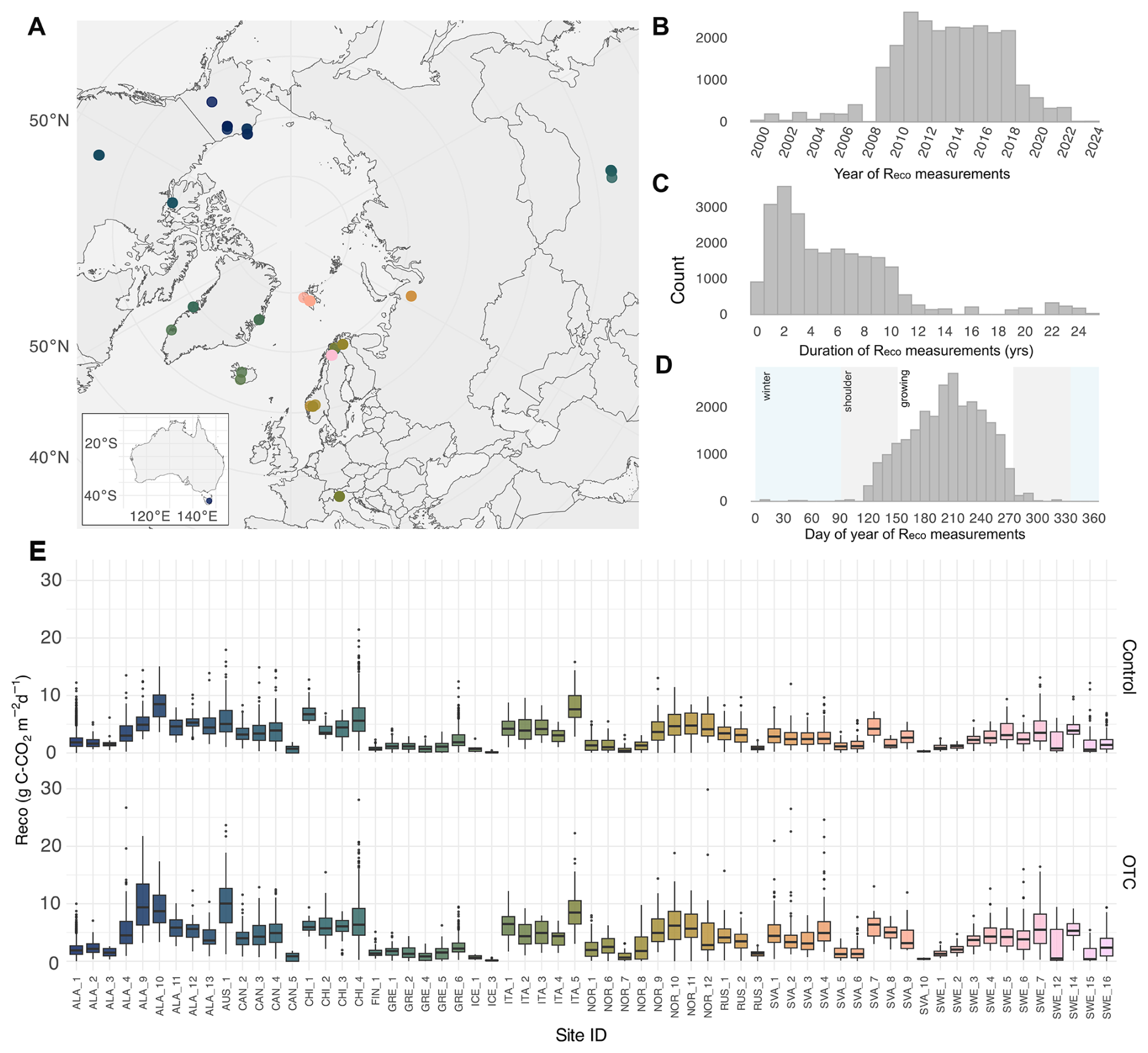
Figure 1(A) Map showing the locations of the 64 open-top chamber experiments from which the ecosystem CO2 respiration (Reco) measurements in the TundraFlux Database were derived. Temporal spread of the data showing (B) the distribution of the year of Reco measurements, (C) the duration of Reco measurements (start of flux measurements - start of the experiment), and (D) the distribution of day-of-year for Reco measurements, with shaded regions highlighting winter (December–March, light blue), shoulder (October–November, April–May, grey), and growing (June–September, white) seasons. (E) Boxplots showing the daily average Reco () for each site, for both the unmanipulated control (i.e., ambient conditions, top) and the warmed treatment with open-top chambers (OTC, bottom). Boxes show the median and interquartile range (IQR, 25th–75th percentiles); whiskers extend to 1.5 × IQR, and values beyond the whiskers are plotted as outliers. Colours for Site ID are the same for all panels. The database includes occasional negative and exact-zero Reco values. Negative values can result from instrument noise or brief net CO2 uptake, while exact zeros may reflect contributor preprocessing (e.g., rounding or thresholding small fluxes).
2.1 Scope and purpose
Warming alters tundra ecosystems through a suite of interacting biotic and abiotic pathways, including changes in vegetation composition (Bjorkman et al., 2020; Collins et al., 2021; García Criado et al., 2025; Wilson and Nilsson, 2009), plant productivity (Hollesen et al., 2015; Myers-Smith et al., 2019), microbial activity (Frossard et al., 2021), decomposition rates (Sarneel et al., 2020; Schwieger et al., 2025), nutrient cycling (Weedon et al., 2012), growing season length (Barichivich et al., 2013; Collins et al., 2021; Myers-Smith et al., 2019; Oberbauer et al., 1998), and snow-mediated microclimate conditions (Morgner et al., 2010; Pattison and Welker, 2014; Rixen et al., 2022), as well as increased thermokarst activity and permafrost degradation, which can strongly alter soil structure and carbon availability and thereby contribute to ecosystem respiration (Reco) (Abbott and Jones, 2015; Lewkowicz and Way, 2019; Olefeldt et al., 2016; Vogel et al., 2009). These processes jointly regulate Reco, making it an integrative indicator of tundra ecosystem responses to climate warming.
As these responses occur at multiple spatial and temporal scales and are significantly influenced by the local environmental context, a robust evaluation of the effects of warming on Reco requires long-term, spatially diverse datasets that link flux measurements with detailed site and plot-level metadata. The TundraFlux Database was developed to address this issue, systematically compiling chamber-derived Reco measurements from experimental warming studies in Arctic and alpine tundra ecosystems. Fin these efforts by specifically compiling Reco observations from both ambient and experimentally manipulated tundra ecosystems, as well as including extensive metadata on vegetation (e.g., plant community composition, functional traits, biomass), soils (e.g., pH, organic carbon and nitrogen content, soil organic matter), and microclimate (e.g., air and soil temperature, soil moisture). This structure enables users to categorise analyses according to ecosystem properties, environmental factors or experimental design. This supports hypothesis testing, model evaluation and the large-scale synthesis of tundra carbon–climate feedback.
2.2 Data sources and data collection
The TundraFlux Database compiles in-situ measurements of daily-aggregated terrestrial ecosystem-level CO2 fluxes () from Arctic and alpine tundra ecosystems to assess warming effects on ecosystem CO2 respiration (Reco). We compiled data from experiments that used open-top chambers (OTCs) from across the Arctic and alpine tundra biome.
To achieve this, we contacted potential data contributors through established research networks like ITEX, WaRM, INTERACT and the Permafrost Carbon Network, and identified relevant contact information from authors of previously published meta-analyses on Reco responses in warming experiments (Table S2).
We included data from experiments situated within the Arctic and alpine tundra biome (i.e., treeless regions beyond the climatic limit for tree growth) that reported in-situ measurements of ecosystem respiration (Reco) in both warmed open-top chamber (OTC) and unmanipulated control plots. Based on these criteria, we compiled 40 160 individual Reco measurements, encompassing repeated observations across multiple plots, years, days, and, in some cases, multiple measurement times within a day at each site.
To maximize data usability and harmonize temporal resolution across studies, we provide two interlinked versions of the Reco dataset. The raw dataset retains all individual measurements at their original temporal resolution, including multiple measurements per day and associated quality-control information (in total 40 160 observations), allowing users full flexibility in data filtering and aggregation. In addition, we provide a daily-aggregated dataset in which Reco values were averaged within each site (site_id), treatment (OTC or control), plot (plot_id), year (flux_year), and day of year (flux_doy) when multiple measurements occurred per day. This aggregation reduces short-term variability and preprocessing effort for synthesis applications, resulting in a total of 24 951 daily mean observations (OTC, n = 11 046; control, n = 13 905; Fig. 1E).
We define a dataset as all Reco measurements from a given site and year (site_id × flux_year), including both OTC and control treatments, all replicate plots, and one or more measurement dates (Table S3 in the Supplement). Plot-level data were retained by design to preserve within-site replication and enable flexible, user-defined aggregation and statistical modeling approaches, including treatment-wise averaging or hierarchical analyses.
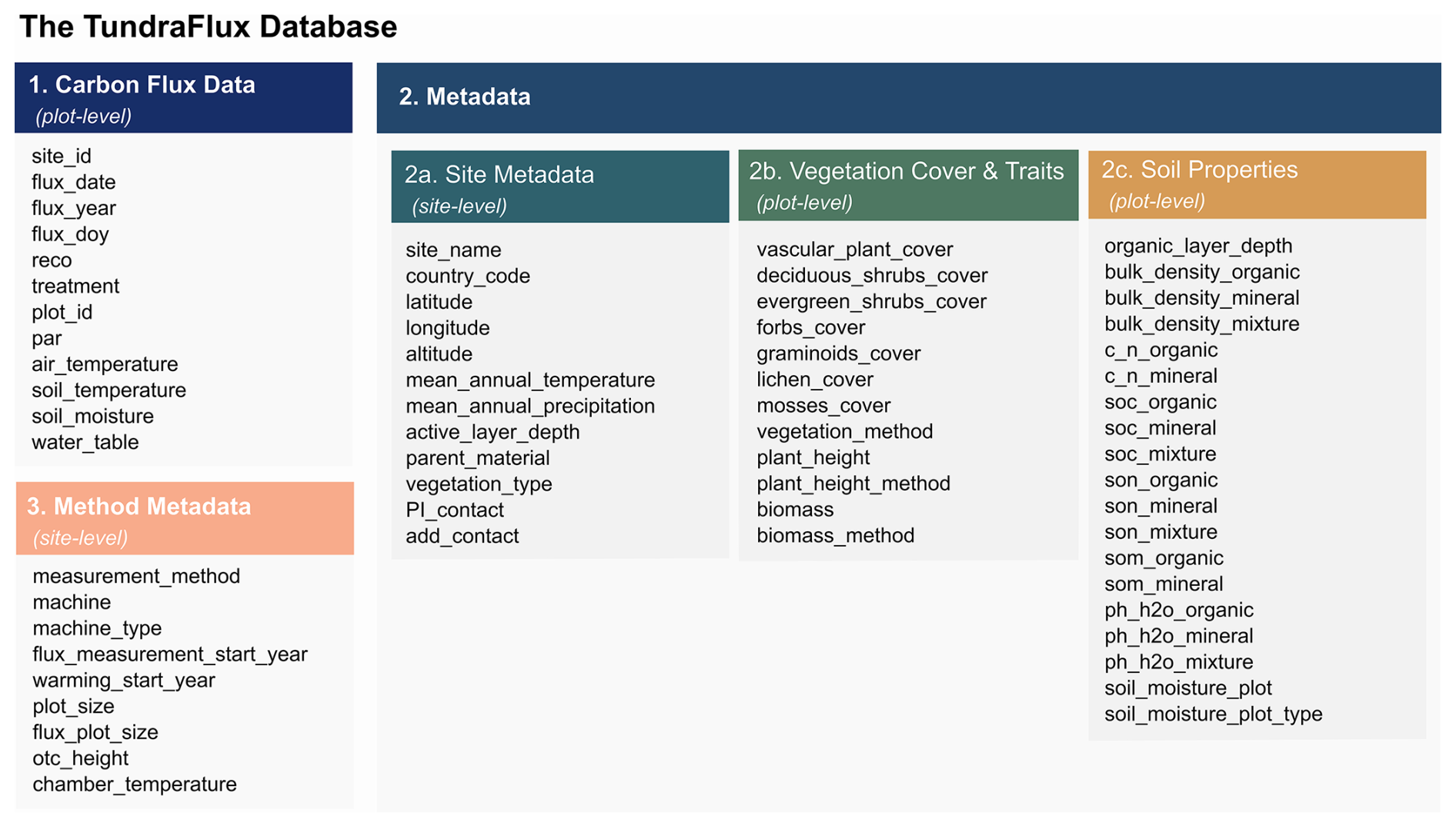
Figure 2Data structure of the TundraFlux Database. Boxes represent the main data types: (1) Carbon flux data, including plot-level daily averages of ecosystem CO2 respiration (Reco) in and data measured along with flux measurements; (2) Metadata, including information on (a) site, (b) vegetation cover and plant traits at plot-level, and (c) Soil properties at plot level; and (3) Method data including documentation of experimental setups. Variables listed inside the boxes correspond to column names in the database (identical to Table S4).
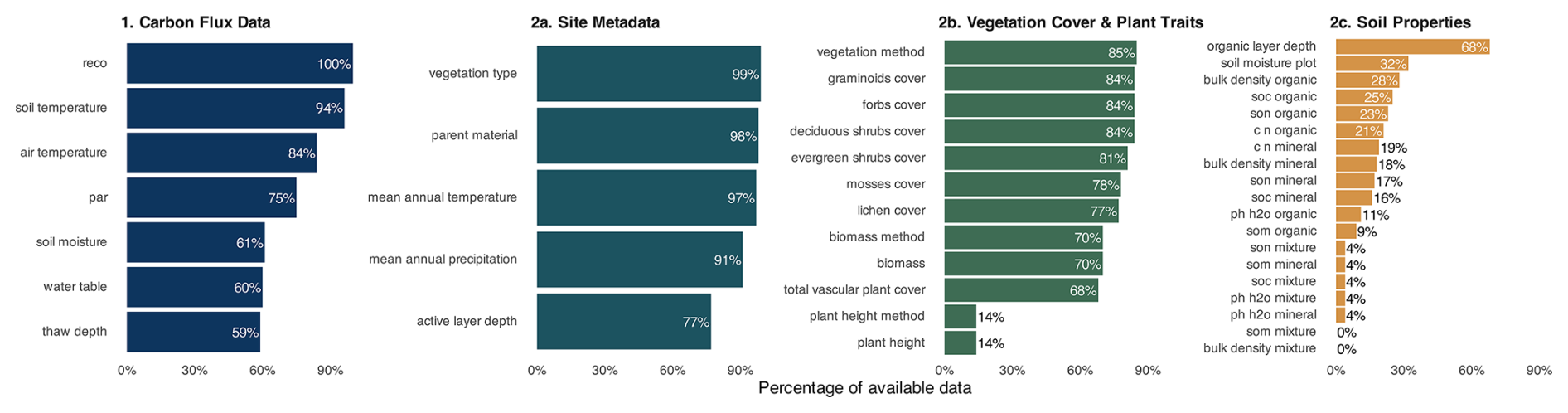
Figure 3Percentage of available observations for metadata variables presented in Fig. 2 relevant for CO2 modelling. Soil organic carbon (SOC), soil organic nitrogen (SON), carbon-to-nitrogen ratio (c_n), soil organic matter (SOM).
Alongside Reco, we compiled in-situ metadata on microclimate conditions, geolocation, vegetation cover, plant traits, and soil characteristics. These ancillary variables were measured at both plot and site levels, with some recorded concurrently with flux measurements (and provided within the Carbon Flux data, Fig. 2), and others representing broader site-level environmental context that can be linked to the relevant flux measurements (Figs. 2 and 3, Table S4 in the Supplement).
Part of the database compiled through this effort was previously presented in Maes et al. (2024), which focused exclusively on growing season measurements (i.e., June to August) and included data up to the year 2020. This current published version of the TundraFlux Database extends the earlier synthesis by incorporating updated measurements through 2024 (Fig. 1B) and by including shoulder season fluxes from April to May and September to November (Fig. 1D).
2.3 Data structure and variables
The TundraFlux Database comprises 76 variables describing Reco from 64 tundra sites spanning 2000–2024 (Fig. 1A and B). A comprehensive data dictionary with a description of the variables of the site, vegetation, soil and method metadata, including data-type and unit is provided in the Supplements (Table S4).
2.4 Data standardization and quality control
Data were processed in R version 4.5.1 (R Core Team 2025). We used the R package tidyverse (v.2.0.0) for data handling. For each dataset, defined by a unique combination of site_id and flux_year, we calculated treatment- and plot-specific daily mean Reco values, whenever multiple measurements were made within the same day. We provide an R script on Zenodo (DOI: https://doi.org/10.5281/zenodo.17976235) that documents the full aggregation procedure, and the un-aggregated dataset (see the “Data Availability” section). All individual flux measurements were standardized to a common unit () to ensure comparability across studies. We screened the data for inconsistencies in unit or sign conventions, contacting data contributors in cases of uncertainty. Spatial coordinates were validated by visualizing all sites on a map, and any imprecise or conflicting locations were corrected in consultation with site researchers.
All experiments measured daytime Reco using dark or opaque chambers, except for the CiPEHR site in Alaska (ALA_1), where automated chambers continuously measured CO2 respiration using clear chambers. To obtain comparable respiration estimates for this site, we extracted only night-time fluxes, defined by photosynthetically active radiation (PAR) values below 5 , as these best approximated dark chamber conditions. These night-time measurements were therefore used as the site's Reco values.
The same quality-control procedures were applied to associated metadata to ensure consistency in spatial reference and measurement units across sites. Soil moisture data, reported at the plot level, were provided either as volumetric or gravimetric values and were subsequently converted to percentages. Bulk density was standardized to g dwt cm−3. Soil organic carbon (SOC) and soil organic nitrogen (SON) were standardized to g C kg−1 soil and g N kg−1 soil, respectively, while soil organic matter (SOM) was standardized to percentages.
The TundraFlux Database includes occasional negative and exact-zero Reco values (Table S3). These originate from the heterogeneity of measurement techniques and pre-processing procedures used in the studies that contribute to the database. Negative fluxes can occur in chamber-based measurements due to short-term CO2 concentration fluctuations, instrument noise, pressure-induced artefacts or brief periods of apparent net CO2 uptake when Reco is close to the detection limit. We retained such values exactly as reported in the original datasets in order to preserve data fidelity. Exact-zero values appear when the net change in chamber CO2 concentration falls within instrument noise, or when contributors apply local preprocessing (e.g. rounding small negative fluxes to zero or applying minimum detection thresholds) prior to submission. As preprocessing conventions differed between studies, both negative and zero values are present in the compiled dataset. Users may apply additional filtering or thresholding, in line with their research objectives, for instance by removing negative fluxes, setting minimum detection limits or utilizing the quality control flags provided in the non-aggregated dataset.
2.4.1 Outlier detection and handling
We chose not to filter outliers from the database before calculating daily averages to preserve the original data structure. However, recognizing the substantial variability in carbon fluxes across sites (Fig. 1E) and years (Table S3), we developed a tailored outlier detection and flagging procedure for Reco data. This method applies the Median Absolute Deviation (MAD, Leys et al., 2013) to the non-aggregated Reco values. This resulted in 285 flagged outliers (0.71 % of the original 40 160 data points) and the user should consider whether to remove them or to use other criteria for outlier detection. We added a column to the non-aggregated dataset that indicates the flagged outliers. A full description of this method is provided in the Supplements. The R scripts used for data processing are archived on Zenodo (DOI: https://doi.org/10.5281/zenodo.17976235, Schwieger, 2026a) and are developed and maintained in a public GitHub repository (https://github.com/SarahSchwieger/TundraFlux_Database, Schwieger, 2026b).
3.1 Identifying extent and drivers of ecosystem respiration response to warming through meta-analysis
The TundraFlux Database is based on a global synthesis of how ecosystem respiration in Arctic and alpine tundra responds to experimental warming (Maes et al., 2024). Using 136 datasets from 56 OTC experiments at 28 tundra sites worldwide (60 % of the data presented here), the study quantified that a mean rise of 1.4 °C (confidence interval (CI) 0.9–2.0 °C) in air and 0.4 °C (CI 0.2–0.7 °C) in soil temperatures causes a 30 % (CI 22 %–38 %) increase in growing season Reco. It further showed that this stimulation persisted for up to 25 years of warming treatment, with evidence pointing to enhanced plant and microbial activity as the underlying drivers. By linking respiration responses to changes in local soil conditions (i.e., nitrogen concentration and carbon-to-nitrogen ratio), Maes et al. (2024) demonstrated that tundra sites with stronger nitrogen limitations and sites in which warming had stimulated plant and microbial nutrient turnover seemed particularly sensitive in their Reco response to warming. This example highlights the power of standardized, long-term experimental data to uncover generalizable patterns in climate responses. It also showcases how the TundraFlux Database enables large-scale syntheses that identify not only the direction but also the mechanism of possible climate change feedbacks on tundra ecosystems, which are essential to improve carbon–climate feedback projections in Earth System Models.
The expanded TundraFlux Database, which now includes spring and autumn (“shoulder-season”) measurements and updated observations through 2024, enables new high-impact research questions that could not be addressed in Maes et al. (2024). For example, users can quantify how experimental warming affects Reco beyond the peak growing season and evaluate whether the environmental controls of Reco differ between early-season, peak-season, and late-season periods. These additions substantially improve the capacity to analyze seasonal dynamics and long-term trajectories of tundra carbon cycling, thereby supporting more robust evaluations of climate–carbon feedbacks.
3.2 Carbon model parameterization and validation
Accurately predicting carbon release from permafrost soils under warming scenarios remains a major challenge in climate science (Knoblauch et al., 2021; Schuur et al., 2015) due to the high variability in ecosystem responses and limited availability of long-term data (Swindles et al., 2015). The Warming Permafrost Model Intercomparison Project (WrPMIP) led by Woodwell Climate Research Center is using the TundraFlux Database to bridge the gap between experimental warming studies and large-scale carbon modeling (warmingpermafrost.nau.edu). In this project, multi-model simulations are being run at both regional and site scales to align with the spatial and temporal dimensions of experimental data (Wells et al., 2023). By aligning field-based warming measurements from the TundraFlux Database with model simulations, the project will enhance our ability to project the magnitude and timing of carbon release from permafrost regions under climate change (Schädel et al., 2018).
As with any large database, not all biotic and abiotic variables, seasons, plant functional types, habitats, regions, or bioclimatic settings within the Arctic and alpine biomes are equally represented in the TundraFlux Database. Here, we identify some limitations related to gaps in the spatial and temporal resolution the database, which highlight clear priorities for future data collection efforts.
4.1 Spatial coverage and bias
The TundraFlux Database inherently reflects a sampling imbalance in the field, particularly the underrepresentation of key Arctic regions such as the Canadian High Arctic archipelago and Siberia (López-Blanco et al., 2024; Metcalfe et al., 2018; Virkkala et al., 2019; Fig. 1A, Table S5 in the Supplement). Still it represents the most comprehensive effort that is currently available of Reco data from warming experiments in the tundra. In particular, high-latitude North America and northern Europe are the best-represented regions (Table 1). This geographical concentration reflects a well-documented spatial bias in Arctic field sampling toward long-established research hubs with good accessibility and infrastructure (Metcalfe et al., 2018).
Table 1Number and percentages of daily Reco observations by region. See Table S5 for classification of sites into regions and distribution of individual sites across the regions.
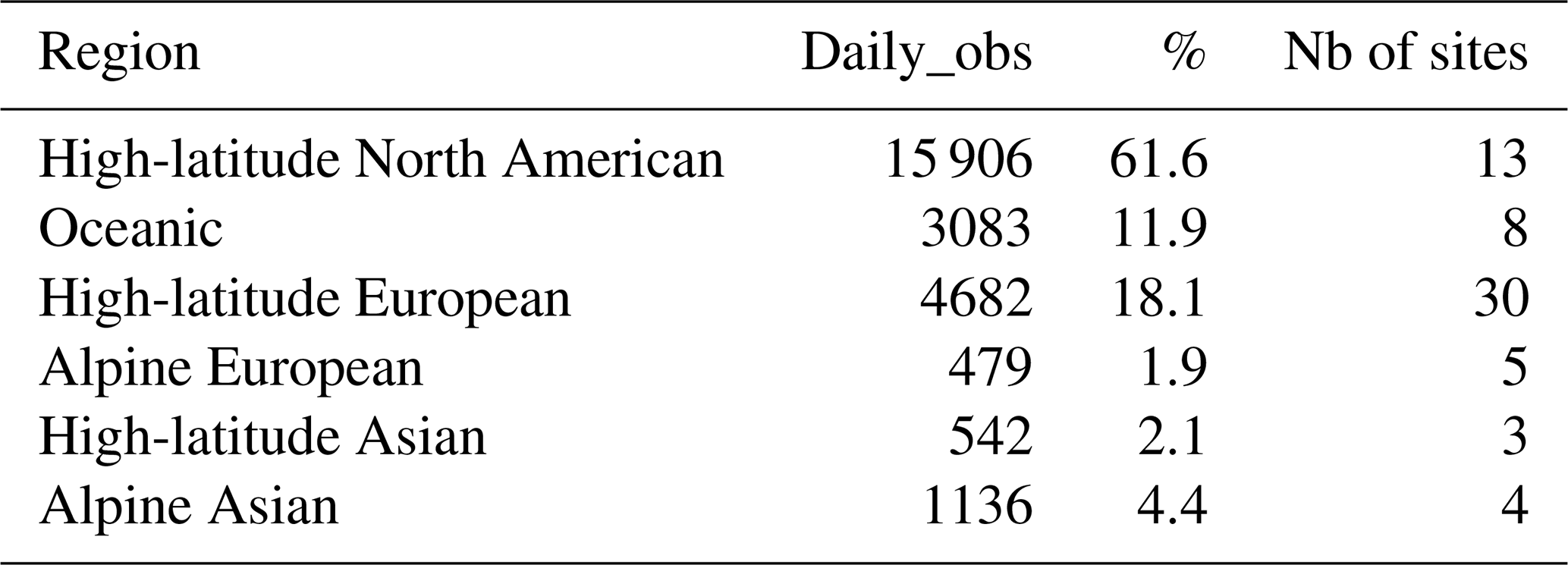
There is substantial variability in the number of measurements across sites (median = 120, IQR = 133.5; total measurements = 24 951). In particular, the CiPEHR site (ALA_1) near Eight Mile Lake, Alaska, USA, with 13 572 daily-aggregated observations, contributed 52.5 % of the Reco data in the TundraFlux Database (Table S5). A large proportion of observations from a single, well-studied site increases temporal and treatment-level detail but may disproportionately influence cross-site or pan-Arctic analyses if not accounted for. How to address this imbalance depends on the user's research question and analytical framework, but several approaches can help prevent disproportionate influence of high-density sites. These include applying hierarchical or mixed-effects models that treat site as a random effect, using equal or inverse-effort site weighting, aggregating fluxes to common temporal resolutions, conducting sensitivity analyses (e.g., subsampling or excluding dominant sites), or using site-level bootstrapping or partial-pooling approaches (Choi and Kang, 2025). At the same time, these long-term, high-density datasets provide valuable opportunities for method development, uncertainty quantification, and benchmarking models at sites with robust metadata.
By systematically compiling data from OTC experiments across Alaska, Greenland, Svalbard, Iceland, Fennoscandia, Canada, and Russia, the TundraFlux Database is the most comprehensive resource currently available for evaluating warming effects on tundra carbon cycling. Importantly, tundra ecosystems exhibit substantial spatial variability in both abiotic and biotic conditions (Aalto et al., 2022; Magnússon et al., 2023), meaning that each site, regardless of data quantity, contributes distinct information about ecosystem responses under different environmental and vegetation contexts.
4.2 Longer-term data on Reco response to experimental warming
In the TundraFlux Database, 93 % of the averaged daily data points (n = 22 534) come from warming experiments that lasted 11 years or less, and over half (51 %, (n = 12 239) lasted fewer than 4 years, at the time of Reco measurements. At the time of publication, all warming experiments included in the database were still ongoing (Table S2 in the Supplement). Out of the 64 sites in total, 7 sites (11.1 %) represent long-term experiments with continuous measurements (≥ 5 years), while 56 sites (88.9 %) represent short-term experiments (<5 years) with often only single measurements (Table S5). Consequently, longer-term measurements (>11–24 years) are rare (n = 1573), and data from warming experiments that lasted longer than 24 years are absent (Fig. 1C). This clearly highlights the importance of maintaining long-term experiments, particularly given that changes in soil processes or vegetation composition driven by warming may unfold over decades in Arctic and alpine tundra (Hollister et al., 2005; Jónsdóttir et al., 2023; Wei et al., 2025). At the same time, both OTCs and manual chamber measurements may introduce experimental disturbance effects (e.g., trampling, vegetation damage, soil compaction) that can accumulate over time (Hollister et al., 2023). Such disturbance may increasingly influence ecosystem functioning the longer an experiment runs. Thus, while longer-term data would help capture slow ecological changes, extended experiment duration may simultaneously amplify disturbance-related artefacts, complicating the interpretation of long-term trends.
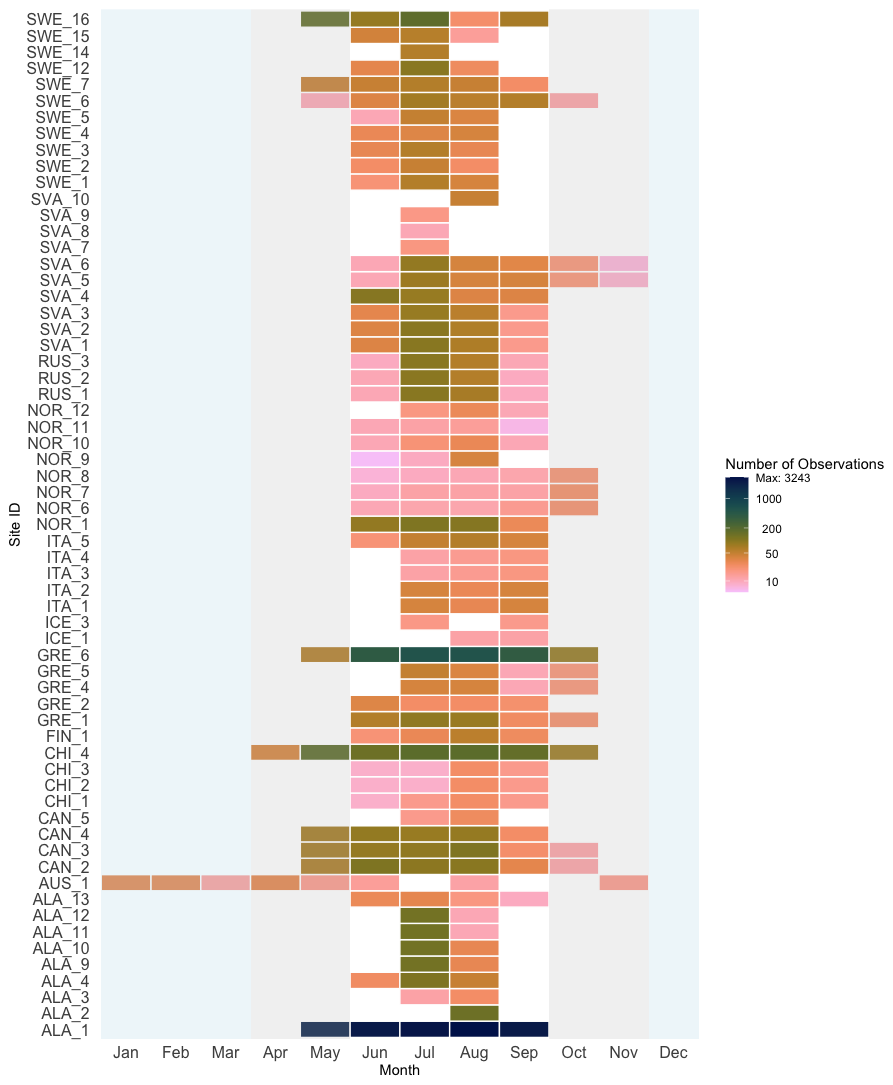
Figure 4Monthly Reco availability aggregated across all years. White/light grey/light blue cells = 0 observations. Color intensity based on Log10(Number of Observations + 1) due to strong bias of ALA_1. Growing season = June–September in the Northern Hemisphere, December–March in the Southern Hemisphere. Except for AUS_1, shaded areas indicate winter months (light blue) and shoulder months (light grey).
4.3 Shoulder and winter season respiration
Our database contains 21 830 daily-aggregated Reco observations from the growing season (defined here as June-September in the Northern Hemisphere, and December-March in the Southern Hemisphere), and 3297 observations from outside the growing season, highlighting a gap in our understanding of carbon fluxes in the shoulder (i.e., April, May, October, and November, n = 3330) and winter seasons (i.e., December–March in the Northern Hemisphere, n=0, Australia excluded) (Figs. 1D and 4).
As Arctic soils are usually covered in snow during the winter months, the spring and autumn shoulder seasons are particularly vulnerable to the effects of global warming, as these transitional periods experience rapid changes in snow cover and soil temperatures (Hassol, 2004; Shukla et al., 2019). Despite its length and significance, winter remains the most understudied season in Arctic ecosystems, even though cold-season processes can contribute substantially to annual carbon budgets through continued microbial activity and ecosystem respiration beneath the snowpack (Natali et al., 2019; Zona et al., 2016). Climate warming is altering Arctic winters by increasing air and soil temperatures, changing snow accumulation and duration, and increasing the frequency of winter warming events and rain-on-snow events, all of which affect soil thermal conditions, microbial activity, and carbon fluxes (Cooper, 2014; Rixen et al., 2022). Similarly, alpine ecosystems are experiencing reduced snowpack, earlier snowmelt, and glacier retreat, with important consequences for soil temperature regimes, hydrology, and ecosystem functioning (Ernakovich et al., 2014). Warming effects and mechanisms identified during the growing season (Maes et al., 2024) may not apply to the winter season, when factors such as snow depth and duration exert great control over carbon fluxes (Björkman et al., 2010; Grogan, 2012; Morgner et al., 2010; Rixen et al., 2022; Semenchuk et al., 2016; Slatyer et al., 2022).
More research focusing on the effects of warming on carbon fluxes during the underrepresented winter and shoulder seasons while developing a mechanistic understanding of winter carbon dynamics is therefore essential to improve predictions of future CO2 emissions from Arctic soils. Overlooking these seasons risks underestimating both the extent and variability of carbon release from rapidly warming Arctic soils.
4.4 Partitioning data
Reco responses to climate change depend on the dynamics of its two main components: autotrophic (plant-derived) and heterotrophic (microbial and faunal) respiration (Bond-Lamberty et al., 2004; Hicks Pries et al., 2013). Because these two components can respond differently to changes in climate (Borken et al., 2006; Muhr and Borken, 2009; Gomez-Casanovas et al., 2012), understanding their individual contributions is crucial to accurately predict ecosystem carbon dynamics and modeling carbon–climate feedback processes. However, partitioning Reco into these source fluxes remains methodologically challenging. As respiration partitioning measurements are usually destructive, altering ecosystem dynamics and making long-term measurements difficult, such data remain scarce. For example, in the meta-analysis on the drivers of Reco in Arctic and alpine tundra by Maes et al. (2024), only nine out of 136 Reco datasets included partitioning data on the autotrophic and heterotrophic respiration components.
In the coming years, our aim is to expand the scope of the TundraFlux Database beyond Reco by incorporating methane and nitrous oxide fluxes, net ecosystem exchange (NEE), and gross primary productivity (GPP). We also plan to expand the scope of warming manipulations represented in the database by including additional climate change treatments, such as the use of snow fences to manipulate snow depth. This will enable us to distinguish between the effects of summer (OTC) and winter (snow fences) warming on Reco, as well as the combined effects of these treatments (Hermesdorf et al., 2024). It will also allow us to account for cross-seasonal carry-over and the effects of coupled air-soil warming, whereby winter soil warming persists into summer and summer air warming can indirectly modify winter soil conditions via changes to vegetation (Kropp et al., 2020).
In recent years, remote sensing using unmanned aerial vehicles (UAVs) and satellites has advanced significantly, providing an opportunity to quantify landscape heterogeneity in the tundra biome at high spatio-temporal resolutions (Assmann et al., 2020; Myers-Smith et al., 2020). With this data, it is possible to bridge the gap between the TundraFlux plot-scale field measurements and large-scale remote sensing mapping products. In addition, we will incorporate remote sensing-derived metadata, such as tundra type and landform classification (e.g., peatlands, thaw slumps and coastal systems), as well as other derived products (Niittynen, 2026; Virkkala et al., 2024; Wagner and Hugelius, 2026), into future syntheses. Finally, we aim to link the TundraFlux Database with other available databases on terrestrial carbon fluxes (Table S1 in the Supplement), including the Tundra Trait Team database (Bjorkman et al., 2018), the Manipulation Experiments Synthesis Initiative (MESI; Van Sundert et al., 2023), COSORE (Bond-Lamberty et al., 2020), and the ABCflux database (Leffler et al., 2025; Virkkala et al., 2022). Although integration remains challenging due to differences in data formats, identifiers, and metadata standards, establishing common protocols will be crucial to advance syntheses across databases.
To follow updates on ongoing and future projects related to our Tundra flux Database, please visit our website https://arcticflux.org/ (last access: 13 July 2026). To contribute new datasets, please contact us via our mail tundrafluxdatabase@lists.umu.se.
The TundraFlux Database is organized as a set of interlinked R data files (.rds) that can be merged using shared identifiers such as site_id, flux_year, and, for plot-level data, plot_id. For users who prefer a modular workflow, separate metadata files are available, including site (site_metadata_v1.rds), vegetation (plant_metadata_v1.rds), soil properties (soil_metadata_plot_v1.rds), and methodological details (method_metadata_site_v1.rds). These metadata files can be linked to Reco-specific datasets, such as Reco_microclimate_daily_v1.rds, using the shared identifiers mentioned above.
For users who want a ready-to-use dataset, two fully integrated data files are provided: TundraFlux_daily_v1.rds, which contains daily aggregated Reco measurements along with site, vegetation, soil, and methodological metadata (Table S4), and TundraFlux_raw_v1.rds, which contains non-aggregated individual Reco measurements with quality-control flags.
Missing values are consistently represented as NA across all files.
All data is publicly available on Zenodo (https://doi.org/10.5281/zenodo.17976235, Schwieger, 2026a).
The code associated with this publication is publicly available on Zenodo (https://doi.org/10.5281/zenodo.17976235, Schwieger, 2026). The R scripts used for data processing are archived alongside the data and are also maintained in a public GitHub repository (https://github.com/SarahSchwieger/TundraFlux_Database, Schwieger, 2026b).
The TundraFlux Database provides the most comprehensive synthesis of tundra Reco responses to experimental warming, integrating over 40 000 individual in-situ Reco observations into 24 951 daily-aggregated Reco measurements from open-top chamber and control plots across 64 Arctic and alpine sites. By combining these data with extensive environmental metadata, the database enables cross-scale analyses that link ecological processes to global carbon modeling. Although long-term (> 24 years) data and measurements from outside the growing season remain limited, the TundraFlux Database establishes a foundation for coordinated synthesis and future expansion to include methane fluxes, NEE, and GPP. When linked with other ecological datasets, it will contribute to forming an unprecedented platform for cross-network analyses of Arctic and alpine carbon dynamics.
The supplement related to this article is available online at https://doi.org/10.5194/essd-18-4965-2026-supplement.
The TundraFlux database was conceptualized by JD, JS, ED, MB, and SLM. JD and SLM compiled the data in 2020. JD and SaS updated the data in 2023 and 2025. Data screening and curation by JD, SLM and SaS. SaS drafted and coordinated the manuscript in close collaboration with SLM, JD, JS, BL, JW and MB. SaS prepared the code and data files for the repository, revised by BL and JD. All authors contributed to the realization of the TundraFlux Database and participated in reviewing and editing of the manuscript.
The contact author has declared that none of the authors has any competing interests.
Publisher's note: Copernicus Publications remains neutral with regard to jurisdictional claims made in the text, published maps, institutional affiliations, or any other geographical representation in this paper. The authors bear the ultimate responsibility for providing appropriate place names. Views expressed in the text are those of the authors and do not necessarily reflect the views of the publisher.
We would like to acknowledge the numerous students and field assistants involved in the collection of ecosystem respiration and connected metadata measurements. In particular, we would like to thank Minna Männistö and Elina Kaarlejärvi. We would also like to thank the two anonymous reviewers for their helpful and constructive comments. We would also like to thank the station managers for their assistance and for granting us access to the field sites. We would also like to thank Jérémy Monsimet for his support in setting up our repository. Furthermore, we acknowledge the posthumous contribution of Jianwu Tang, whose work inspired the collection of the datasets ALA_2 and ALA_3.
Recognising the importance of Indigenous lands, we acknowledge that parts of our fieldwork were conducted on territories historically and presently belonging to Indigenous peoples. We express our respect and gratitude to these communities. Special thanks are extended to the residents of Utqiagvik and Atqasuk, Alaska, for their cooperation and understanding during research activities in the Arctic region. This research would not have been possible without the collective efforts and support of these individuals and communities.
This research has been supported by the Svenska Forskningsrådet Formas (grant nos. 2024-00244, 2021-02449, 2022-00786, 2018-04202, 2023-04048, and 2016-01187), the Fonds Wetenschappelijk Onderzoek (grant no. 12ZZV21N), the National Science Foundation (grant nos. 9321730, 9617643, 0632184, 0856728, 0119279, 1504381, 1417763, 1418010, 2113641, 1931333, and 1331083), the Norges Forskningsråd (grant nos. 274712, 250740, 276080, 223257, 294948, and 269957), the Research Council of Finland (grant nos. 332196, 341348, and 337550), the Danmarks Grundforskningsfond (grant nos. CENPERM DNRF 100, VOLT, and DNRF168), the National Research Foundation of Korea (grant nos. NRF-2021M1A5A1075508 and KOPRI-PN22012), the National Natural Science Foundation of China (grant no. 32201358), the Schweizerischer Nationalfonds zur Förderung der Wissenschaftlichen Forschung (grant nos. PZ00P2_174047, 771012, 819202, and 657627), the Australian Research Council (grant no. DP220100915), the U.S. Department of Energy (grant nos. #DE-SC0006982 (2012–2015), #DE-SC0020227 (2019–2022), and #DE-SC0014085 (2015–2018)), and the Rannís (grant nos. 70255021 and 1931333).
The publication of this article was funded by the Swedish Research Council, Forte, Formas, and Vinnova.
This paper was edited by Tobias Gerken and reviewed by two anonymous referees.
Aalto, J., Tyystjärvi, V., Niittynen, P., Kemppinen, J., Rissanen, T., Gregow, H., and Luoto, M.: Microclimate temperature variations from boreal forests to the tundra, Agr. Forest Meteorol., 323, 109037, https://doi.org/10.1016/j.agrformet.2022.109037, 2022.
Abbott, B. W. and Jones, J. B.: Permafrost collapse alters soil carbon stocks, respiration, CH4, and N2O in upland tundra, Glob. Change Biol., 21, 4570–4587, https://doi.org/10.1111/gcb.13069, 2015.
Assmann, J. J., Myers-Smith, I. H., Kerby, J. T., Cunliffe, A. M., and Daskalova, G. N.: Drone data reveal heterogeneity in tundra greenness and phenology not captured by satellites, Environ. Res. Lett., 15, 125002, https://doi.org/10.1088/1748-9326/abbf7d, 2020.
Barichivich, J., Briffa, K. R., Myneni, R. B., Osborn, T. J., Melvin, T. M., Ciais, P., Piao, S., and Tucker, C.: Large-scale variations in the vegetation growing season and annual cycle of atmospheric CO 2 at high northern latitudes from 1950 to 2011, Glob. Change Biol., 19, 3167–3183, https://doi.org/10.1111/gcb.12283, 2013.
Bjorkman, A., Criado, M., Myers-Smith, I., Ravolainen, V., Jonsdottir, I., Westergaard, K., Lawler, J., Aronsson, M., Bennett, B., Gardfjell, H., Heidmarsson, S., Stewart, L., and Normand, S.: Status and trends in Arctic vegetation: Evidence from experimental warming and long-term monitoring, AMBIO, 49, 678–692, https://doi.org/10.1007/s13280-019-01161-6, 2020.
Bjorkman, A. D., Myers-Smith, I. H., Elmendorf, S. C., Normand, S., Thomas, H. J. D., Alatalo, J. M., Alexander, H., Anadon-Rosell, A., Angers-Blondin, S., Bai, Y., Baruah, G., te Beest, M., Berner, L., Björk, R. G., Blok, D., Bruelheide, H., Buchwal, A., Buras, A., Carbognani, M., Christie, K., Collier, L. S., Cooper, E. J., Cornelissen, J. H. C., Dickinson, K. J. M., Dullinger, S., Elberling, B., Eskelinen, A., Forbes, B. C., Frei, E. R., Iturrate-Garcia, M., Good, M. K., Grau, O., Green, P., Greve, M., Grogan, P., Haider, S., Hájek, T., Hallinger, M., Happonen, K., Harper, K. A., Heijmans, M. M. P. D., Henry, G. H. R., Hermanutz, L., Hewitt, R. E., Hollister, R. D., Hudson, J., Hülber, K., Iversen, C. M., Jaroszynska, F., Jiménez-Alfaro, B., Johnstone, J., Jorgensen, R. H., Kaarlejärvi, E., Klady, R., Klimešová, J., Korsten, A., Kuleza, S., Kulonen, A., Lamarque, L. J., Lantz, T., Lavalle, A., Lembrechts, J. J., Lévesque, E., Little, C. J., Luoto, M., Macek, P., Mack, M. C., Mathakutha, R., Michelsen, A., Milbau, A., Molau, U., Morgan, J. W., Mörsdorf, M. A., Nabe-Nielsen, J., Nielsen, S. S., Ninot, J. M., Oberbauer, S. F., Olofsson, J., Onipchenko, V. G., Petraglia, A., Pickering, C., Prevéy, J. S., Rixen, C., Rumpf, S. B., Schaepman-Strub, G., Semenchuk, P., Shetti, R., Soudzilovskaia, N. A., Spasojevic, M. J., Speed, J. D. M., Street, L. E., Suding, K., Tape, K. D., Tomaselli, M., Trant, A., Treier, U. A., Tremblay, J.-P., Tremblay, M., Venn, S., Virkkala, A.-M., Vowles, T., Weijers, S., Wilmking, M., Wipf, S., and Zamin, T.: Tundra Trait Team: A database of plant traits spanning the tundra biome, Global Ecol. Biogeogr., 27, 1402–1411, https://doi.org/10.1111/geb.12821, 2018.
Björkman, M. P., Morgner, E., Björk, R. G., Cooper, E. J., Elberling, B., and Klemedtsson, L.: A comparison of annual and seasonal carbon dioxide effluxes between sub-Arctic Sweden and High-Arctic Svalbard, Polar Res., 29, 75–84, https://doi.org/10.3402/polar.v29i1.6051, 2010.
Bond-Lamberty, B., Wang, C., and Gower, S. T.: A global relationship between the heterotrophic and autotrophic components of soil respiration?, Glob. Change Biol., 10, 1756–1766, https://doi.org/10.1111/j.1365-2486.2004.00816.x, 2004.
Bond-Lamberty, B., Christianson, D. S., Malhotra, A., Pennington, S. C., Sihi, D., AghaKouchak, A., Anjileli, H., Altaf Arain, M., Armesto, J. J., Ashraf, S., Ataka, M., Baldocchi, D., Andrew Black, T., Buchmann, N., Carbone, M. S., Chang, S.-C., Crill, P., Curtis, P. S., Davidson, E. A., Desai, A. R., Drake, J. E., El-Madany, T. S., Gavazzi, M., Görres, C.-M., Gough, C. M., Goulden, M., Gregg, J., Gutiérrez del Arroyo, O., He, J.-S., Hirano, T., Hopple, A., Hughes, H., Järveoja, J., Jassal, R., Jian, J., Kan, H., Kaye, J., Kominami, Y., Liang, N., Lipson, D., Macdonald, C. A., Maseyk, K., Mathes, K., Mauritz, M., Mayes, M. A., McNulty, S., Miao, G., Migliavacca, M., Miller, S., Miniat, C. F., Nietz, J. G., Nilsson, M. B., Noormets, A., Norouzi, H., O'Connell, C. S., Osborne, B., Oyonarte, C., Pang, Z., Peichl, M., Pendall, E., Perez-Quezada, J. F., Phillips, C. L., Phillips, R. P., Raich, J. W., Renchon, A. A., Ruehr, N. K., Sánchez-Cañete, E. P., Saunders, M., Savage, K. E., Schrumpf, M., Scott, R. L., Seibt, U., Silver, W. L., Sun, W., Szutu, D., Takagi, K., Takagi, M., Teramoto, M., Tjoelker, M. G., Trumbore, S., Ueyama, M., Vargas, R., Varner, R. K., Verfaillie, J., Vogel, C., Wang, J., Winston, G., Wood, T. E., Wu, J., Wutzler, T., Zeng, J., Zha, T., Zhang, Q., and Zou, J.: COSORE: A community database for continuous soil respiration and other soil-atmosphere greenhouse gas flux data, Glob. Change Biol., 26, 7268–7283, https://doi.org/10.1111/gcb.15353, 2020.
Borken, W., Savage, K., Davidson, E. A., and Trumbore, S. E.: Effects of experimental drought on soil respiration and radiocarbon efflux from a temperate forest soil, Global Change Biol., 12, 177–193, https://doi.org/10.1111/j.1365-2486.2005.001058.x, 2006.
Choi, G. J. and Kang, H.: Heterogeneity in meta-analyses: an unavoidable challenge worth exploring, Korean J. Anesthesiol., 78, 301–314, https://doi.org/10.4097/kja.25001, 2025.
Collins, C. G., Elmendorf, S. C., Hollister, R. D., Henry, G. H. R., Clark, K., Bjorkman, A. D., Myers-Smith, I. H., Prevéy, J. S., Ashton, I. W., Assmann, J. J., Alatalo, J. M., Carbognani, M., Chisholm, C., Cooper, E. J., Forrester, C., Jónsdóttir, I. S., Klanderud, K., Kopp, C. W., Livensperger, C., Mauritz, M., May, J. L., Molau, U., Oberbauer, S. F., Ogburn, E., Panchen, Z. A., Petraglia, A., Post, E., Rixen, C., Rodenhizer, H., Schuur, E. A. G., Semenchuk, P., Smith, J. G., Steltzer, H., Totland, Ø., Walker, M. D., Welker, J. M., and Suding, K. N.: Experimental warming differentially affects vegetative and reproductive phenology of tundra plants, Nat. Commun., 12, 3442, https://doi.org/10.1038/s41467-021-23841-2, 2021.
Cooper, E. J.: Warmer Shorter Winters Disrupt Arctic Terrestrial Ecosystems, Annu. Rev. Ecol. Evol. S., 45, 271–295, https://doi.org/10.1146/annurev-ecolsys-120213-091620, 2014.
Cox, P. M., Betts, R. A., Jones, C. D., Spall, S. A., and Totterdell, I. J.: Acceleration of global warming due to carbon-cycle feedbacks in a coupled climate model, Nature, 408, 184–187, https://doi.org/10.1038/35041539, 2000.
Davidson, E. A., Janssens, I. A., and Luo, Y.: On the variability of respiration in terrestrial ecosystems: moving beyond Q10, Glob. Change Biol., 12, 154–164, https://doi.org/10.1111/j.1365-2486.2005.01065.x, 2006.
Dorrepaal, E., Toet, S., van Logtestijn, R. S. P., Swart, E., van de Weg, M. J., Callaghan, T. V., and Aerts, R.: Carbon respiration from subsurface peat accelerated by climate warming in the subarctic, Nature, 460, 616–619, https://doi.org/10.1038/nature08216, 2009.
Ernakovich, J. G., Hopping, K. A., Berdanier, A. B., Simpson, R. T., Kachergis, E. J., Steltzer, H., and Wallenstein, M. D.: Predicted responses of arctic and alpine ecosystems to altered seasonality under climate change, Glob. Change Biol., 20, 3256–3269, https://doi.org/10.1111/gcb.12568, 2014.
Fahnestock, J. T., Jones, M. H., Brooks, P. D., Walker, D. A., and Welker, J. M.: Winter and early spring CO2 efflux from tundra communities of northern Alaska, J. Geophys. Res.-Atmos., 103, 29023–29027, https://doi.org/10.1029/98JD00805, 1998.
Fahnestock, J. T., Jones, M. H., and Welker, J. M.: Wintertime CO2 efflux from Arctic soils: Implications for annual carbon budgets, Global. Biogeochem. Cy., 13, 775–779, https://doi.org/10.1029/1999GB900006, 1999.
Friggens, N. L., Hugelius, G., Kokelj, S. V., Murton, J. B., Phoenix, G. K., and Hartley, I. P.: Positive rhizosphere priming accelerates carbon release from permafrost soils, Nat. Commun., 16, 3576, https://doi.org/10.1038/s41467-025-58845-9, 2025.
Frossard, A., De Maeyer, L., Adamczyk, M., Svenning, M., Verleyen, E., and Frey, B.: Microbial carbon use and associated changes in microbial community structure in high-Arctic tundra soils under elevated temperature, Soil Biol. Biochem., 162, 108419, https://doi.org/10.1016/j.soilbio.2021.108419, 2021.
García Criado, M., Myers-Smith, I. H., Bjorkman, A. D., Elmendorf, S. C., Normand, S., Aastrup, P., Aerts, R., Alatalo, J. M., Baeten, L., Björk, R. G., Björkman, M. P., Boulanger-Lapointe, N., Butler, E. E., Cooper, E. J., Cornelissen, J. H. C., Daskalova, G. N., Fadrique, B., Forbes, B. C., Henry, G. H. R., Hollister, R. D., Høye, T. T., Jacobsen, I. B. D., Jägerbrand, A. K., Jónsdóttir, I. S., Kaarlejärvi, E., Khitun, O., Klanderud, K., Kolari, T. H. M., Lang, S. I., Lecomte, N., Lenoir, J., Macek, P., Messier, J., Michelsen, A., Molau, U., Muscarella, R., Nielsen, M.-L., Petit Bon, M., Post, E., Raundrup, K., Rinnan, R., Rixen, C., Ryde, I., Serra-Diaz, J. M., Schaepman-Strub, G., Schmidt, N. M., Schrodt, F., Sjögersten, S., Steinbauer, M. J., Stewart, L., Strandberg, B., Tolvanen, A., Tweedie, C. E., and Vellend, M.: Plant diversity dynamics over space and time in a warming Arctic, Nature, 642, 653–661, https://doi.org/10.1038/s41586-025-08946-8, 2025.
Gomez-Casanovas, N., Matamala, R., Cook, D. R., and Gonzalez-Meler, M. A.: Net ecosystem exchange modifies the relationship between the autotrophic and heterotrophic components of soil respiration with abiotic factors in prairie grasslands, Global Change Biol., 18, 2532–2545, https://doi.org/10.1111/j.1365-2486.2012.02721.x, 2012.
Gorham, E.: Northern Peatlands: Role in the Carbon Cycle and Probable Responses to Climatic Warming, Ecol. Appl., 1, 182–195, https://doi.org/10.2307/1941811, 1991.
Grogan, P.: Cold season respiration across a low arctic landscape: the influence of vegetation type, snow depth, and interannual climatic variation, Arct. Antarct. Alp. Res., 44, 446–456, https://doi.org/10.1657/1938-4246-44.4.446, 2012.
Gudasz, C., Karlsson, J., and Bastviken, D.: When does temperature matter for ecosystem respiration?, Environ. Res. Commun., 3, 121001, https://doi.org/10.1088/2515-7620/ac3b9f, 2021.
Hassol, S. J.: Impacts of a Warming Arctic: Arctic Climate Impact Assessment. With Arctic Climate Impact Assessment, Arctic Monitoring and Assessment Programme, Program for the Conservation of Arctic Flora and Fauna, and International Arctic Science Committee, Cambridge University Press, ISBN 978-0-521-61778-9, 2004.
Henry, G. H. R. and Molau, U.: Tundra plants and climate change: the International Tundra Experiment (ITEX), Glob. Change Biol., 3, 1–9, https://doi.org/10.1111/j.1365-2486.1997.gcb132.x, 1997.
Hermesdorf, L., Liu, Y., Michelsen, A., Westergaard-Nielsen, A., Mortensen, L. H., Jepsen, M. S., Sigsgaard, C., and Elberling, B.: Long-term changes in the daytime growing season carbon dioxide exchange following increased temperature and snow cover in arctic tundra, Glob. Change Biol., 30, e17087, https://doi.org/10.1111/gcb.17087, 2024.
Hicks Pries, C. E., Schuur, E. A. G., and Crummer, K. G.: Thawing permafrost increases old soil and autotrophic respiration in tundra: Partitioning ecosystem respiration using δ13C and ?14C, Glob. Change Biol., 19, 649–661, https://doi.org/10.1111/gcb.12058, 2013.
Hollesen, J., Buchwal, A., Rachlewicz, G., Hansen, B. U., Hansen, M. O., Stecher, O., and Elberling, B.: Winter warming as an important co-driver for Betula nana growth in western Greenland during the past century, Glob. Change Biol., 21, 2410–2423, https://doi.org/10.1111/gcb.12913, 2015.
Hollister, R. D., Webber, P. J., and Tweedie, C. E.: The response of Alaskan arctic tundra to experimental warming: differences between short- and long-term responses, Glob. Change Biol., 11, 525–536, https://doi.org/10.1111/j.1365-2486.2005.00926.x, 2005.
Hollister, R. D., Elphinstone, C., Henry, G. H. R., Bjorkman, A. D., Klanderud, K., Björk, R. G., Björkman, M. P., Bokhorst, S., Carbognani, M., Cooper, E. J., Dorrepaal, E., Elmendorf, S. C., Fetcher, N., Gallois, E. C., Guðmundsson, J., Healey, N. C., Jónsdóttir, I. S., Klarenberg, I. J., Oberbauer, S. F., Macek, P., May, J. L., Mereghetti, A., Molau, U., Petraglia, A., Rinnan, R., Rixen, C., and Wookey, P. A.: A review of open top chamber (OTC) performance across the ITEX Network, Arctic Sci., 9, 331–344, https://doi.org/10.1139/as-2022-0030, 2023.
Hugelius, G., Loisel, J., Chadburn, S., Jackson, R. B., Jones, M., MacDonald, G., Marushchak, M., Olefeldt, D., Packalen, M., Siewert, M. B., Treat, C., Turetsky, M., Voigt, C., and Yu, Z.: Large stocks of peatland carbon and nitrogen are vulnerable to permafrost thaw, P. Natl. Acad. Sci. USA, 117, 20438–20446, https://doi.org/10.1073/pnas.1916387117, 2020.
Jones, M. H., Fahnestock, J. T., and Welker, J. M.: Early and Late Winter CO2 Efflux from Arctic Tundra in the Kuparuk River Watershed, Alaska, U. S. A., Arct. Antarct. Alp. Res., 31, 187–190, https://doi.org/10.1080/15230430.1999.12003296, 1999.
Jónsdóttir, I. S., Halbritter, A. H., Christiansen, C. T., Althuizen, I. H. J., Haugum, S. V., Henn, J. J., Björnsdóttir, K., Maitner, B. S., Malhi, Y., Michaletz, S. T., Roos, R. E., Klanderud, K., Lee, H., Enquist, B. J., and Vandvik, V.: Intraspecific trait variability is a key feature underlying high Arctic plant community resistance to climate warming, Ecol. Monogr., 93, e1555, https://doi.org/10.1002/ecm.1555, 2023.
Karhu, K., Auffret, M. D., Dungait, J. A. J., Hopkins, D. W., Prosser, J. I., Singh, B. K., Subke, J.-A., Wookey, P. A., Ågren, G. I., Sebastià, M.-T., Gouriveau, F., Bergkvist, G., Meir, P., Nottingham, A. T., Salinas, N., and Hartley, I. P.: Temperature sensitivity of soil respiration rates enhanced by microbial community response, Nature, 513, 81–84, https://doi.org/10.1038/nature13604, 2014.
Knoblauch, C., Beer, C., Schuett, A., Sauerland, L., Liebner, S., Steinhof, A., Rethemeyer, J., Grigoriev, M. N., Faguet, A., and Pfeiffer, E.-M.: Carbon Dioxide and Methane Release Following Abrupt Thaw of Pleistocene Permafrost Deposits in Arctic Siberia, J. Geophys. Res. Biogeo., 126, e2021JG006543, https://doi.org/10.1029/2021JG006543, 2021.
Kropp, H., Loranty, M. M., Natali, S. M., Kholodov, A. L., Rocha, A. V., Myers-Smith, I., Abbot, B. W., Abermann, J., Blanc-Betes, E., Blok, D., Blume-Werry, G., Boike, J., Breen, A. L., Cahoon, S. M. P., Christiansen, C. T., Douglas, T. A., Epstein, H. E., Frost, G. V., Goeckede, M., Høye, T. T., Mamet, S. D., O'Donnell, J. A., Olefeldt, D., Phoenix, G. K., Salmon, V. G., Sannel, A. B. K., Smith, S. L., Sonnentag, O., Vaughn, L. S., Williams, M., Elberling, B., Gough, L., Hjort, J., Lafleur, P. M., Euskirchen, E. S., Heijmans, M. M., Humphreys, E. R., Iwata, H., Jones, B. M., Jorgenson, M. T., Grünberg, I., Kim, Y., Laundre, J., Mauritz, M., Michelsen, A., Schaepman-Strub, G., Tape, K. D., Ueyama, M., Lee, B.-Y., Langley, K., and Lund, M.: Shallow soils are warmer under trees and tall shrubs across Arctic and Boreal ecosystems, Environ. Res. Lett., 16, 015001, https://doi.org/10.1088/1748-9326/abc994, 2020.
Leffler, A. J., Klein, E. S., Oberbauer, S. F., and Welker, J. M.: Coupled long-term summer warming and deeper snow alters species composition and stimulates gross primary productivity in tussock tundra, Oecologia, 181, 287–297, https://doi.org/10.1007/s00442-015-3543-8, 2016.
Leffler, A. J., Serrone, A., Bolek, A., Rocha, A. V., Korrensalo, A., Vähä, A., Tremblay, A., Barr, A., Salazar, A., Sabrekov, A. F., Rasanen, A., Mavrovic, A., Roy, A., Panov, A. V., Townsend-Small, A., Niyazova, A., Prokushkin, A., Jonsson, A., Lindroth, A., Christen, A., Westergaard-Nielsen, A., Varlagin, A., Black, T. A., Rutgersson, A., Sytiuk, A., Virkkala, A.-M., Lohila, A., Ojala, A., Thiboult, A., Sepulveda-Jauregui, A., Malhotra, A., Kotani, A., Holmes, B., Elberling, B., Rogers, B., Johannesson, C., Trotta, C., Voigt, C., Christiansen, C. T., Dieleman, C., Jones, C. P., Wille, C., Biasi, C., Minions, C., Cunada, C., Arp, C. D., Schulze, C., Treat, C., Edgar, C., Emmerton, C. A., Nadeau, D. F., Ilyasov, D. V., Papale, D., Bastviken, D., Holl, D., Lipson, D., Olefeldt, D., Zona, D., Schuur, T., Tuittila, E. S., López-Blanco, E., Koster, E., Dyukarev, E., Blanc-Betes, E., Lapshina, E., Veretennikova, E., Canfora, E., Männisto, E., Humphreys, E., Stanley, E. H., Lundin, E., Sahlée, E., Nicholls, E., Kyzivat, E. D., Euskirchen, S. E., Kane, E. S., Tigreros, F. G., Domine, F., Clayer, F., Parmentier, F., Bouchard, F., Thalasso, F., Hould-Gosselin, G., Hensgens, G., Kling, G. W., Rocher-Ros, G., Pastorello, G., Iwahana, G., Clark, G., Falvo, G., Henry, G., Granath, G., Webb, H., Alcock, H., Thorgeirsson, H., Lee, H., Silvennoinen, H. M., Nykanen, H., Rautakoski, H., et al.: Arctic-Boreal Vulnerability Experiment (ABoVE)ABCFlux v2: Arctic-Boreal CO2 and CH4 In-situ Flux and Environmental Data, NASA, https://doi.org/10.3334/ORNLDAAC/2448, 2025.
Lewkowicz, A. G. and Way, R. G.: Extremes of summer climate trigger thousands of thermokarst landslides in a High Arctic environment, Nat. Commun., 10, 1329, https://doi.org/10.1038/s41467-019-09314-7, 2019.
Leys, C., Ley, C., Klein, O., Bernard, P., and Licata, L.: Detecting outliers: Do not use standard deviation around the mean, use absolute deviation around the median, J. Exp. Social Psychol., 49, 764–766, https://doi.org/10.1016/j.jesp.2013.03.013, 2013.
López-Blanco, E., Topp-Jørgensen, E., Christensen, T. R., Rasch, M., Skov, H., Arndal, M. F., Bret-Harte, M. S., Callaghan, T. V., and Schmidt, N. M.: Towards an increasingly biased view on Arctic change, Nat. Clim. Change, 14, 152–155, https://doi.org/10.1038/s41558-023-01903-1, 2024.
Lu, M., Zhou, X., Yang, Q., Li, H., Luo, Y., Fang, C., Chen, J., Yang, X., and Li, B.: Responses of ecosystem carbon cycle to experimental warming: a meta-analysis, Ecology, 94, 726–738, https://doi.org/10.1890/12-0279.1, 2013.
Maes, S. L., Dietrich, J., Midolo, G., Schwieger, S., Kummu, M., Vandvik, V., Aerts, R., Althuizen, I. H. J., Biasi, C., Björk, R. G., Böhner, H., Carbognani, M., Chiari, G., Christiansen, C. T., Clemmensen, K. E., Cooper, E. J., Cornelissen, J. H. C., Elberling, B., Faubert, P., Fetcher, N., Forte, T. G. W., Gaudard, J., Gavazov, K., Guan, Z., Guðmundsson, J., Gya, R., Hallin, S., Hansen, B. B., Haugum, S. V., He, J.-S., Hicks Pries, C., Hovenden, M. J., Jalava, M., Jónsdóttir, I. S., Juhanson, J., Jung, J. Y., Kaarlejärvi, E., Kwon, M. J., Lamprecht, R. E., Le Moullec, M., Lee, H., Marushchak, M. E., Michelsen, A., Munir, T. M., Myrsky, E. M., Nielsen, C. S., Nyberg, M., Olofsson, J., Óskarsson, H., Parker, T. C., Pedersen, E. P., Petit Bon, M., Petraglia, A., Raundrup, K., Ravn, N. M. R., Rinnan, R., Rodenhizer, H., Ryde, I., Schmidt, N. M., Schuur, E. A. G., Sjögersten, S., Stark, S., Strack, M., Tang, J., Tolvanen, A., Töpper, J. P., Väisänen, M. K., Van Logtestijn, R. S. P., Voigt, C., Walz, J., Weedon, J. T., Yang, Y., Ylänne, H., Björkman, M. P., Sarneel, J. M., and Dorrepaal, E.: Environmental drivers of increased ecosystem respiration in a warming tundra, Nature, 629, 105–113, https://doi.org/10.1038/s41586-024-07274-7, 2024.
Magnússon, R. Í., Sass-Klaassen, U., Limpens, J., Karsanaev, S. V., Ras, S., van Huissteden, K., Blok, D., and Heijmans, M. M. P. D.: Spatiotemporal variability in precipitation-growth association of Betula nana in the Siberian lowland tundra, J. Ecol., 111, 1882–1904, https://doi.org/10.1111/1365-2745.14165, 2023.
Mahecha, M. D., Reichstein, M., Carvalhais, N., Lasslop, G., Lange, H., Seneviratne, S. I., Vargas, R., Ammann, C., Arain, M. A., Cescatti, A., Janssens, I. A., Migliavacca, M., Montagnani, L., and Richardson, A. D.: Global Convergence in the Temperature Sensitivity of Respiration at Ecosystem Level, Science, 329, 838–840, https://doi.org/10.1126/science.1189587, 2010.
Marion, G. M., Henry, G. H. R., Freckman, D. W., Johnstone, J., Jones, G., Jones, M. H., Lévesque, E., Molau, U., Mølgaard, P., Parsons, A. N., J. Svoboda, and Virginia, R. A.: Open-top designs for manipulating field temperature in high-latitude ecosystems, Glob. Change Biol., 3, 20–32, https://doi.org/10.1111/j.1365-2486.1997.gcb136.x, 1997.
Metcalfe, D. B., Hermans, T. D. G., Ahlstrand, J., Becker, M., Berggren, M., Björk, R. G., Björkman, M. P., Blok, D., Chaudhary, N., Chisholm, C., Classen, A. T., Hasselquist, N. J., Jonsson, M., Kristensen, J. A., Kumordzi, B. B., Lee, H., Mayor, J. R., Prevéy, J., Pantazatou, K., Rousk, J., Sponseller, R. A., Sundqvist, M. K., Tang, J., Uddling, J., Wallin, G., Zhang, W., Ahlström, A., Tenenbaum, D. E., and Abdi, A. M.: Patchy field sampling biases understanding of climate change impacts across the Arctic, Nat. Ecol. Evol., 2, 1443–1448, https://doi.org/10.1038/s41559-018-0612-5, 2018.
Morgner, E., Elberling, B., Strebel, D., and Cooper, E. J.: The importance of winter in annual ecosystem respiration in the High Arctic: effects of snow depth in two vegetation types, Polar Res., 29, 58–74, https://doi.org/10.3402/polar.v29i1.6052, 2010.
Muhr, J. and Borken, W.: Delayed recovery of soil respiration after wetting of dry soil further reduces C losses from a Norway spruce forest soil, J. Geophys. Res., 114, 2009JG000998, https://doi.org/10.1029/2009JG000998, 2009.
Myers-Smith, I. H., Grabowski, M. M., Thomas, H. J. D., Angers-Blondin, S., Daskalova, G. N., Bjorkman, A. D., Cunliffe, A. M., Assmann, J. J., Boyle, J. S., McLeod, E., McLeod, S., Joe, R., Lennie, P., Arey, D., Gordon, R. R., and Eckert, C. D.: Eighteen years of ecological monitoring reveals multiple lines of evidence for tundra vegetation change, Ecol. Monogr., 89, e01351, https://doi.org/10.1002/ecm.1351, 2019.
Myers-Smith, I. H., Kerby, J. T., Phoenix, G. K., Bjerke, J. W., Howard E. Epstein, Assmann, J. J., John, C., Andreu-Hayles, L., Angers-Blondin, S., Beck, P. S. A., Berner, L. T., Bhatt, U. S., Bjorkman, A. D., Blok, D., Bryn, A., Christiansen, C. T., Cornelissen, J. H. C., Cunliffe, A. M., Elmendorf, S. C., Forbes, B. C., Goetz, S. J., Hollister, R. D., de Jong, R., Loranty, M. M., Macias-Fauria, M., Maseyk, K., Normand, S., Olofsson, J., Parker, T. C., Parmentier, F.-J. W., Post, E., Schaepman-Strub, G., Stordal, F., Sullivan, P. F., Thomas, H. J. D., Tømmervik, H., Treharne, R., Tweedie, C. E., Walker, D. A., Wilmking, M., and Wipf, S.: Complexity revealed in the greening of the Arctic, Nat. Clim. Change, 10, 106–117, https://doi.org/10.1038/s41558-019-0688-1, 2020.
Natali, S. M., Watts, J. D., Rogers, B. M., Potter, S., Ludwig, S. M., Selbmann, A.-K., Sullivan, P. F., Abbott, B. W., Arndt, K. A., Birch, L., Björkman, M. P., Bloom, A. A., Celis, G., Christensen, T. R., Christiansen, C. T., Commane, R., Cooper, E. J., Crill, P., Czimczik, C., Davydov, S., Du, J., Egan, J. E., Elberling, B., Euskirchen, E. S., Friborg, T., Genet, H., Göckede, M., Goodrich, J. P., Grogan, P., Helbig, M., Jafarov, E. E., Jastrow, J. D., Kalhori, A. A. M., Kim, Y., Kimball, J. S., Kutzbach, L., Lara, M. J., Larsen, K. S., Lee, B.-Y., Liu, Z., Loranty, M. M., Lund, M., Lupascu, M., Madani, N., Malhotra, A., Matamala, R., McFarland, J., McGuire, A. D., Michelsen, A., Minions, C., Oechel, W. C., Olefeldt, D., Parmentier, F.-J. W., Pirk, N., Poulter, B., Quinton, W., Rezanezhad, F., Risk, D., Sachs, T., Schaefer, K., Schmidt, N. M., Schuur, E. A. G., Semenchuk, P. R., Shaver, G., Sonnentag, O., Starr, G., Treat, C. C., Waldrop, M. P., Wang, Y., Welker, J., Wille, C., Xu, X., Zhang, Z., Zhuang, Q., and Zona, D.: Large loss of CO2 in winter observed across the northern permafrost region, Nat. Clim. Change, 9, 852–857, https://doi.org/10.1038/s41558-019-0592-8, 2019.
Niittynen, P.: snowman: an open-source R package for automated 30-m snow and ice cover mapping using the Landsat archive, EGUsphere, 1–0, https://doi.org/10.31223/X5FF32, 2026.
Niu, S., Chen, W., Liáng, L. L., Sierra, C. A., Xia, J., Wang, S., Heskel, M., Patel, K. F., Bond-Lamberty, B., Wang, J., Yvon-Durocher, G., Kirschbaum, M. U. F., Atkin, O. K., Huang, Y., Yu, G., and Luo, Y.: Temperature responses of ecosystem respiration, Nat. Rev. Earth Environ., 5, 559–571, https://doi.org/10.1038/s43017-024-00569-3, 2024.
Oberbauer, S., Starr, G., and Pop, E.: Effects of extended growing season and soil warming on carbon dioxide and methane exchange of tussock tundra in Alaska, J. Geophys. Res.-Atmos., 103, 29075–29082, https://doi.org/10.1029/98JD00522, 1998.
Olefeldt, D., Goswami, S., Grosse, G., Hayes, D., Hugelius, G., Kuhry, P., McGuire, A. D., Romanovsky, V. E., Sannel, A. B. K., Schuur, E. A. G., and Turetsky, M. R.: Circumpolar distribution and carbon storage of thermokarst landscapes, Nat. Commun., 7, 13043, https://doi.org/10.1038/ncomms13043, 2016.
Park, S.-W., Mun, J.-H., Lee, H., Steinert, N. J., An, S.-I., Shin, J., and Kug, J.-S.: Continued permafrost ecosystem carbon loss under net-zero and negative emissions, Sci. Adv., 11, eadn8819, https://doi.org/10.1126/sciadv.adn8819, 2025.
Pattison, R. R. and Welker, J. M.: Differential ecophysiological response of deciduous shrubs and a graminoid to long-term experimental snow reductions and additions in moist acidic tundra, Northern Alaska, Oecologia, 174, 339–350, https://doi.org/10.1007/s00442-013-2777-6, 2014.
Rantanen, M., Karpechko, A. Y., Lipponen, A., Nordling, K., Hyvärinen, O., Ruosteenoja, K., Vihma, T., and Laaksonen, A.: The Arctic has warmed nearly four times faster than the globe since 1979, Commun. Earth Environ., 3, 1–10, https://doi.org/10.1038/s43247-022-00498-3, 2022.
R Core Team: R: A Language and Environment for Statistical Computing, R Foundation for Statistical Computing, Vienna, Austria, https://www.R-project.org/ (last access: 13 July 2026), 2025.
Rixen, C., Høye, T. T., Macek, P., Aerts, R., Alatalo, J. M., Anderson, J. T., Arnold, P. A., Barrio, I. C., Bjerke, J. W., Björkman, M. P., Blok, D., Blume-Werry, G., Boike, J., Bokhorst, S., Carbognani, M., Christiansen, C. T., Convey, P., Cooper, E. J., Cornelissen, J. H. C., Coulson, S. J., Dorrepaal, E., Elberling, B., Elmendorf, S. C., Elphinstone, C., Forte, T. G. W., Frei, E. R., Geange, S. R., Gehrmann, F., Gibson, C., Grogan, P., Halbritter, A. H., Harte, J., Henry, G. H. R., Inouye, D. W., Irwin, R. E., Jespersen, G., Jónsdóttir, I. S., Jung, J. Y., Klinges, D. H., Kudo, G., Lämsä, J., Lee, H., Lembrechts, J. J., Lett, S., Lynn, J. S., Mann, H. M. R., Mastepanov, M., Morse, J., Myers-Smith, I. H., Olofsson, J., Paavola, R., Petraglia, A., Phoenix, G. K., Semenchuk, P., Siewert, M. B., Slatyer, R., Spasojevic, M. J., Suding, K., Sullivan, P., Thompson, K. L., Väisänen, M., Vandvik, V., Venn, S., Walz, J., Way, R., Welker, J. M., Wipf, S., and Zong, S.: Winters are changing: snow effects on Arctic and alpine tundra ecosystems, Arctic Sci., 8, 572–608, https://doi.org/10.1139/as-2020-0058, 2022.
Rustad, L., Campbell, J., Marion, G., Norby, R., Mitchell, M., Hartley, A., Cornelissen, J., Gurevitch, J., and GCTE-NEWS: A meta-analysis of the response of soil respiration, net nitrogen mineralization, and aboveground plant growth to experimental ecosystem warming, Oecologia, 126, 543–562, https://doi.org/10.1007/s004420000544, 2001.
Sarneel, J. M., Sundqvist, M. K., Molau, U., Björkman, M. P., and Alatalo, J. M.: Decomposition rate and stabilization across six tundra vegetation types exposed to > 20 years of warming, Sci. Total Environ., 724, 138304, https://doi.org/10.1016/j.scitotenv.2020.138304, 2020.
Schädel, C., Koven, C. D., Lawrence, D. M., Celis, G., Garnello, A. J., Hutchings, J., Mauritz, M., Natali, S. M., Pegoraro, E., Rodenhizer, H., Salmon, V. G., Taylor, M. A., Webb, E. E., Wieder, W. R., and Schuur, E. A.: Divergent patterns of experimental and model-derived permafrost ecosystem carbon dynamics in response to Arctic warming, Environ. Res. Lett., 13, 105002, https://doi.org/10.1088/1748-9326/aae0ff, 2018.
Schimel, J. P., Bilbrough, C., and Welker, J. M.: Increased snow depth affects microbial activity and nitrogen mineralization in two Arctic tundra communities, Soil Biol. Biochem., 36, 217–227, https://doi.org/10.1016/j.soilbio.2003.09.008, 2004.
Schimel, J. P., Fahnestock, J., Michaelson, G., Mikan, C., Ping, C.-L., Romanovsky, V. E., and Welker, J.: Cold-season Production of CO2 in Arctic Soils: Can Laboratory and Field Estimates Be Reconciled through a Simple Modeling Approach?, Arct. Antarct. Alp. Res., 38, 249–256, https://doi.org/10.1657/1523-0430(2006)38[249:CPOCIA]2.0.CO;2, 2006.
Schuur, E., Bockheim, J., Canadell, J. G., Euskirchen, E., Field, C. B., Goryachkin, S. V., Hagemann, S., Kuhry, P., Lafleur, P. M., Lee, H., Mazhitova, G., Nelson, F. E., Rinke, A., Romanovsky, V. E., Shiklomanov, N., Tarnocai, C., Venevsky, S., Vogel, J. G., and Zimov, S. A.: Vulnerability of Permafrost Carbon to Climate Change: Implications for the Global Carbon Cycle, BioScience, 58, 701–714, https://doi.org/10.1641/B580807, 2008.
Schuur, E. A. G., McGuire, A. D., Schädel, C., Grosse, G., Harden, J. W., Hayes, D. J., Hugelius, G., Koven, C. D., Kuhry, P., Lawrence, D. M., Natali, S. M., Olefeldt, D., Romanovsky, V. E., Schaefer, K., Turetsky, M. R., Treat, C. C., and Vonk, J. E.: Climate change and the permafrost carbon feedback, Nature, 520, 171–179, https://doi.org/10.1038/nature14338, 2015.
Schuur, E. A. G., Abbott, B. W., Commane, R., Ernakovich, J., Euskirchen, E., Hugelius, G., Grosse, G., Jones, M., Koven, C., Leshyk, V., Lawrence, D., Loranty, M. M., Mauritz, M., Olefeldt, D., Natali, S., Rodenhizer, H., Salmon, V., Schädel, C., Strauss, J., Treat, C., and Turetsky, M.: Permafrost and Climate Change: Carbon Cycle Feedbacks From the Warming Arctic, Annu. Rev. Env. Resour., 47, 343–371, https://doi.org/10.1146/annurev-environ-012220-011847, 2022.
Schwieger, S.: TundraFlux: A database of ecosystem respiration with biotic and abiotic metadata from Arctic and alpine tundra warming experiments (v1.0.0) [Data set], Zenodo [code and data set], https://doi.org/10.5281/zenodo.17976235, 2026a.
Schwieger, S.: TundraFlux_Database, GitHub repository, GitHub [code], https://github.com/SarahSchwieger/TundraFlux_Database (last access: 13 July 2026), 2026b.
Schwieger, S., Dorrepaal, E., Petit Bon, M., Vandvik, V., le Roux, E., Strack, M., Yang, Y., Venn, S., van den Hoogen, J., Valiño, F., Thomas, H. J. D., te Beest, M., Suzuki, S., Petraglia, A., Myers-Smith, I. H., Munir, T. M., Michelsen, A., Løkken, J. O., Li, Q., Koike, T., Klanderud, K., Karr, E. H., Jónsdóttir, I. S., Hollister, R. D., Hofgaard, A., Hassan, I. A., Genxu, W., Filippova, N., Crowther, T. W., Clark, K., Christiansen, C. T., Casanova-Katny, A., Carbognani, M., Bokhorst, S., Björnsdóttir, K., Asplund, J., Althuizen, I., Alonso, R., Alatalo, J., Agathokleous, E., Aerts, R., and Sarneel, J. M.: Environmental Conditions Modulate Warming Effects on Plant Litter Decomposition Globally, Ecol. Lett., 28, e70026, https://doi.org/10.1111/ele.70026, 2025.
Semenchuk, P. R., Christiansen, C. T., Grogan, P., Elberling, B., and Cooper, E. J.: Long-term experimentally deepened snow decreases growing-season respiration in a low- and high-arctic tundra ecosystem, J. Geophys. Res.-Biogeo., 121, 1236–1248, https://doi.org/10.1002/2015JG003251, 2016.
Shukla, P. R., Skeg, J., Calvo Buendia, E., Masson-Delmotte, V., Pörtner, H.-O., Roberts, D. C., Zhai, P., Slade, R., Connors, S., van Diemen, S., Ferrat, M., Haughey, E., Luz, S., Pathak, M., Petzold, J., Portugal Pereira, J., Vyas, P., Huntley, E., Kissick, K., Belkacemi, M., and Malley, J.: Climate Change and Land: an IPCC special report on climate change, desertification, land degradation, sustainable land management, food security, and greenhouse gas fluxes in terrestrial ecosystems, Cambridge University Press, Cambridge, UK and New York, NY, USA, https://doi.org/10.1017/9781009157988.001, 2019.
Slatyer, R. A., Umbers, K. D. L., and Arnold, P. A.: Ecological responses to variation in seasonal snow cover, Conserv. Biol., 36, e13727, https://doi.org/10.1111/cobi.13727, 2022.
Sulman, B. N., Moore, J. A. M., Abramoff, R., Averill, C., Kivlin, S., Georgiou, K., Sridhar, B., Hartman, M. D., Wang, G., Wieder, W. R., Bradford, M. A., Luo, Y., Mayes, M. A., Morrison, E., Riley, W. J., Salazar, A., Schimel, J. P., Tang, J., and Classen, A. T.: Multiple models and experiments underscore large uncertainty in soil carbon dynamics, Biogeochemistry, 141, 109–123, https://doi.org/10.1007/s10533-018-0509-z, 2018.
Swindles, G. T., Morris, P. J., Mullan, D., Watson, E. J., Turner, T. E., Roland, T. P., Amesbury, M. J., Kokfelt, U., Schoning, K., Pratte, S., Gallego-Sala, A., Charman, D. J., Sanderson, N., Garneau, M., Carrivick, J. L., Woulds, C., Holden, J., Parry, L., and Galloway, J. M.: The long-term fate of permafrost peatlands under rapid climate warming, Sci. Rep., 5, 17951, https://doi.org/10.1038/srep17951, 2015.
Tarnocai, C., Canadell, J. G., Schuur, E. a. G., Kuhry, P., Mazhitova, G., and Zimov, S.: Soil organic carbon pools in the northern circumpolar permafrost region, Global. Biogeochem. Cy., 23, https://doi.org/10.1029/2008GB003327, 2009.
Tingley, M. P. and Huybers, P.: Recent temperature extremes at high northern latitudes unprecedented in the past 600 years, Nature, 496, 201–205, https://doi.org/10.1038/nature11969, 2013.
Van Sundert, K., Leuzinger, S., Bader, M. K. -F., Chang, S. X., De Kauwe, M. G., Dukes, J. S., Langley, J. A., Ma, Z., Mariën, B., Reynaert, S., Ru, J., Song, J., Stocker, B., Terrer, C., Thoresen, J., Vanuytrecht, E., Wan, S., Yue, K., and Vicca, S.: When things get MESI: The Manipulation Experiments Synthesis Initiative—A coordinated effort to synthesize terrestrial global change experiments, Glob. Change Biol., 29, 1922–1938, https://doi.org/10.1111/gcb.16585, 2023.
Virkkala, A.-M., Abdi, A. M., Luoto, M., and Metcalfe, D. B.: Identifying multidisciplinary research gaps across Arctic terrestrial gradients, Environ. Res. Lett., 14, 124061, https://doi.org/10.1088/1748-9326/ab4291, 2019.
Virkkala, A.-M., Aalto, J., Rogers, B. M., Tagesson, T., Treat, C. C., Natali, S. M., Watts, J. D., Potter, S., Lehtonen, A., Mauritz, M., Schuur, E. A. G., Kochendorfer, J., Zona, D., Oechel, W., Kobayashi, H., Humphreys, E., Goeckede, M., Iwata, H., Lafleur, P. M., Euskirchen, E. S., Bokhorst, S., Marushchak, M., Martikainen, P. J., Elberling, B., Voigt, C., Biasi, C., Sonnentag, O., Parmentier, F.-J. W., Ueyama, M., Celis, G., St.Louis, V. L., Emmerton, C. A., Peichl, M., Chi, J., Järveoja, J., Nilsson, M. B., Oberbauer, S. F., Torn, M. S., Park, S.-J., Dolman, H., Mammarella, I., Chae, N., Poyatos, R., López-Blanco, E., Christensen, T. R., Kwon, M. J., Sachs, T., Holl, D., and Luoto, M.: Statistical upscaling of ecosystem CO2 fluxes across the terrestrial tundra and boreal domain: Regional patterns and uncertainties, Glob. Change Biol., 27, 4040–4059, https://doi.org/10.1111/gcb.15659, 2021.
Virkkala, A.-M., Natali, S. M., Rogers, B. M., Watts, J. D., Savage, K., Connon, S. J., Mauritz, M., Schuur, E. A. G., Peter, D., Minions, C., Nojeim, J., Commane, R., Emmerton, C. A., Goeckede, M., Helbig, M., Holl, D., Iwata, H., Kobayashi, H., Kolari, P., López-Blanco, E., Marushchak, M. E., Mastepanov, M., Merbold, L., Parmentier, F.-J. W., Peichl, M., Sachs, T., Sonnentag, O., Ueyama, M., Voigt, C., Aurela, M., Boike, J., Celis, G., Chae, N., Christensen, T. R., Bret-Harte, M. S., Dengel, S., Dolman, H., Edgar, C. W., Elberling, B., Euskirchen, E., Grelle, A., Hatakka, J., Humphreys, E., Järveoja, J., Kotani, A., Kutzbach, L., Laurila, T., Lohila, A., Mammarella, I., Matsuura, Y., Meyer, G., Nilsson, M. B., Oberbauer, S. F., Park, S.-J., Petrov, R., Prokushkin, A. S., Schulze, C., St. Louis, V. L., Tuittila, E.-S., Tuovinen, J.-P., Quinton, W., Varlagin, A., Zona, D., and Zyryanov, V. I.: The ABCflux database: Arctic–boreal CO2 flux observations and ancillary information aggregated to monthly time steps across terrestrial ecosystems, Earth Syst. Sci. Data, 14, 179–208, https://doi.org/10.5194/essd-14-179-2022, 2022.
Virkkala, A.-M., Niittynen, P., Kemppinen, J., Marushchak, M. E., Voigt, C., Hensgens, G., Kerttula, J., Happonen, K., Tyystjärvi, V., Biasi, C., Hultman, J., Rinne, J., and Luoto, M.: High-resolution spatial patterns and drivers of terrestrial ecosystem carbon dioxide, methane, and nitrous oxide fluxes in the tundra, Biogeosciences, 21, 335–355, https://doi.org/10.5194/bg-21-335-2024, 2024.
Vogel, J., Schuur, E. A. G., Trucco, C., and Lee, H.: Response of CO2 exchange in a tussock tundra ecosystem to permafrost thaw and thermokarst development, J. Geophys. Res. Biogeo., 114, 2008JG000901, https://doi.org/10.1029/2008JG000901, 2009.
Wagner, J. and Hugelius, G.: Comparing Multiscale Object-Based Image Analysis and Deep Learning for High-Resolution Classification of Ice Wedge Polygon Tundra, Can. J. Remote Sens., 52, 2654952, https://doi.org/10.1080/07038992.2026.2654952, 2026.
Weedon, J. T., A. Kowalchuk, G., Aerts, R., van Hal, J., van Logtestijn, R., Taş, N., F. M. Röling, W., and M. van Bodegom, P.: Summer warming accelerates sub-arctic peatland nitrogen cycling without changing enzyme pools or microbial community structure, Glob. Change Biol., 18, 138–150, https://doi.org/10.1111/j.1365-2486.2011.02548.x, 2012.
Wei, B., Zhang, D., Voigt, C., Zhou, W., Bai, Y., Zheng, Z., Xie, Y., Zhao, C., Wang, F., Huang, L., Yang, G., Kou, D., Peng, Y., Luo, Y., Peñuelas, J., and Yang, Y.: Progressive decline in soil nitrogen stocks with warming in a Tibetan permafrost ecosystem, Nat. Geosci., 18, 997–1004, https://doi.org/10.1038/s41561-025-01786-1, 2025.
Welker, J. M., Molau, U., Parsons, A. N., Robinson, C. H., and Wookey, P. A.: Responses of Dryas octopetala to ITEX environmental manipulations: a synthesis with circumpolar comparisons, Glob. Change Biol., 3, 61–73, https://doi.org/10.1111/j.1365-2486.1997.gcb143.x, 1997.
Welker, J. M., Brown, K. B., and Fahnestock, J. T.: CO2 Flux in Arctic and Alpine Dry Tundra: Comparative Field Responses Under Ambient and Experimentally Warmed Conditions, Arct. Antarct. Alp. Res., 31, 272–277, https://doi.org/10.1080/15230430.1999.12003309, 1999.
Welker, J. M., Fahnestock, J. T., and Jones, M. H.: Annual CO2 Flux in Dry and Moist Arctic Tundra: Field Responses to Increases in Summer Temperatures and Winter Snow Depth, Climatic Change, 44, 139–150, https://doi.org/10.1023/A:1005555012742, 2000.
Welker, J. M., Fahnestock, J. T., Henry, G. H. R., O'Dea, K. W., and Chimner, R. A.: CO2 exchange in three Canadian High Arctic ecosystems: response to long-term experimental warming, Glob. Change Biol., 10, 1981–1995, https://doi.org/10.1111/j.1365-2486.2004.00857.x, 2004.
Wells, J., Schaedel, C., Riley, W. J., Tao, J., Mekonnen, Z. A., Lawrence, D. M., Swenson, S. C., Schuur, E., Huntzinger, D. N., Poe, J. M., Maes, S., Dietrich, J., Schwieger, S., and Dorrepaal, E.: State-of-the-Arctic: Confronting State-of-the-Art Carbon Cycle Models with Pan-Arctic Warming Responses, AGU Fall Meeting Abstracts, ADS Bibcode: 2023AGUFM.B51C..03W, B51C-03, 2023.
Wilson, S. D. and Nilsson, C.: Arctic alpine vegetation change over 20 years, Glob. Change Biol., 15, 1676–1684, https://doi.org/10.1111/j.1365-2486.2009.01896.x, 2009.
Zimov, S. A., Schuur, E. A. G., and Chapin, F. S.: Permafrost and the Global Carbon Budget, Science, 312, 1612–1613, https://doi.org/10.1126/science.1128908, 2006.
Zona, D., Gioli, B., Commane, R., Lindaas, J., Wofsy, S. C., Miller, C. E., Dinardo, S. J., Dengel, S., Sweeney, C., Karion, A., Chang, R. Y.-W., Henderson, J. M., Murphy, P. C., Goodrich, J. P., Moreaux, V., Liljedahl, A., Watts, J. D., Kimball, J. S., Lipson, D. A., and Oechel, W. C.: Cold season emissions dominate the Arctic tundra methane budget, P. Natl. Acad. Sci. USA, 113, 40–45, https://doi.org/10.1073/pnas.1516017113, 2016.
- Abstract
- Introduction
- Description and structure
- Applications of the TundraFlux database
- Data coverage and resolution
- Future directions
- Data availability
- Code availability
- Conclusions
- Author contributions
- Competing interests
- Disclaimer
- Acknowledgements
- Financial support
- Review statement
- References
- Supplement
- Abstract
- Introduction
- Description and structure
- Applications of the TundraFlux database
- Data coverage and resolution
- Future directions
- Data availability
- Code availability
- Conclusions
- Author contributions
- Competing interests
- Disclaimer
- Acknowledgements
- Financial support
- Review statement
- References
- Supplement