Articles | Volume 18, issue 7
https://doi.org/10.5194/essd-18-5697-2026
© Author(s) 2026. This work is distributed under
the Creative Commons Attribution 4.0 License.
the Creative Commons Attribution 4.0 License.
https://doi.org/10.5194/essd-18-5697-2026
© Author(s) 2026. This work is distributed under
the Creative Commons Attribution 4.0 License.
the Creative Commons Attribution 4.0 License.
Data description article
| 
31 Jul 2026
Data description article |
| 31 Jul 2026
| 31 Jul 2026
Atmospheric and cryospheric observations in the high-altitude Zarafshon River Basin and the Hydrographic Party Glacier (GGP), Tajikistan, 2018–2025
Jonas Svensson
CORRESPONDING AUTHOR

Finnish Meteorological Institute, Erik Palménin aukio 1, 00506, Helsinki, Finland
Ramazon Rakhmonov
Agency for Hydrometeorology, Committee of Environmental Protection under the Government of the Republic of Tajikistan, Street B, Gafurov 373, Dushanbe, Tajikistan
Kamoliddin Nazirzoda
Agency for Hydrometeorology, Committee of Environmental Protection under the Government of the Republic of Tajikistan, Street B, Gafurov 373, Dushanbe, Tajikistan
Abdusamad Hojiev
Agency for Hydrometeorology, Committee of Environmental Protection under the Government of the Republic of Tajikistan, Street B, Gafurov 373, Dushanbe, Tajikistan
Tamlikho Jurabekov
Agency for Hydrometeorology, Committee of Environmental Protection under the Government of the Republic of Tajikistan, Street B, Gafurov 373, Dushanbe, Tajikistan
Amirsho Hiyoev
Agency for Hydrometeorology, Committee of Environmental Protection under the Government of the Republic of Tajikistan, Street B, Gafurov 373, Dushanbe, Tajikistan
Davlatjon Rahimzoda
Agency for Hydrometeorology, Committee of Environmental Protection under the Government of the Republic of Tajikistan, Street B, Gafurov 373, Dushanbe, Tajikistan
Hizbullo Kholzoda
Agency for Hydrometeorology, Committee of Environmental Protection under the Government of the Republic of Tajikistan, Street B, Gafurov 373, Dushanbe, Tajikistan
Muzaffar Shodmonov
Agency for Hydrometeorology, Committee of Environmental Protection under the Government of the Republic of Tajikistan, Street B, Gafurov 373, Dushanbe, Tajikistan
David Brus
Finnish Meteorological Institute, Erik Palménin aukio 1, 00506, Helsinki, Finland
Finnish Meteorological Institute, Erik Palménin aukio 1, 00506, Helsinki, Finland
Krista Luoma
Finnish Meteorological Institute, Erik Palménin aukio 1, 00506, Helsinki, Finland
Adriano Lemos
Finnish Meteorological Institute, Erik Palménin aukio 1, 00506, Helsinki, Finland
Germán Perez Fogwill
Finnish Meteorological Institute, Erik Palménin aukio 1, 00506, Helsinki, Finland
Meri M. Ruppel
Finnish Meteorological Institute, Erik Palménin aukio 1, 00506, Helsinki, Finland
Outi Meinander
Finnish Meteorological Institute, Erik Palménin aukio 1, 00506, Helsinki, Finland
Johan Ström
Department of Environmental Science, Stockholm University, 106 91 Stockholm, Sweden
Eija Asmi
Finnish Meteorological Institute, Erik Palménin aukio 1, 00506, Helsinki, Finland
Antti Hyvärinen
Finnish Meteorological Institute, Erik Palménin aukio 1, 00506, Helsinki, Finland
Related authors
John Backman, Sho Ohata, Yutaka Kondo, Jonas Svensson, Eija Asmi, Hitoshi Matsui, and Tatsuhiro Mori
EGUsphere, https://doi.org/10.5194/egusphere-2026-2102, https://doi.org/10.5194/egusphere-2026-2102, 2026
Short summary
Short summary
The Arctic climate is affected detrimentally by black carbon (BC). Our unique long-term observational results imply that Arctic BC size distributions do not wary substantially in space nor time although the mass concentration of BC can vary by orders of magnitude. Our findings suggest that, when modeling the climate impacts of BC in the Arctic, it is realistic to consider a BC size distribution with low variability.
Deeksha Shukla, Lejish Vettikkat, Mika Ihalainen, Markus Somero, Hendryk Czech, Siegfried Schobesberger, Angela Buchholz, Iida Pullinen, Kerneels Jaars, Kajar Köster, Viet Le, Pasi Yli-Pirilä, Stefan J. Siebert, Pieter G. van Zyl, Annele Virtanen, Ville Vakkari, Olli Sippula, and Ralf Zimmermann
Atmos. Chem. Phys., 26, 12977–13000, https://doi.org/10.5194/acp-26-12977-2026, https://doi.org/10.5194/acp-26-12977-2026, 2026
Short summary
Short summary
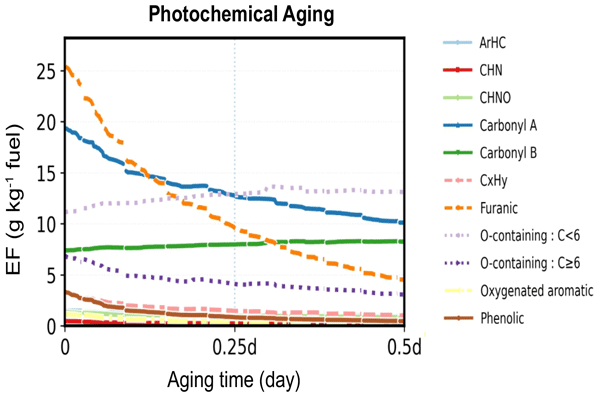
Biomass burning emits large amounts of pollutants that undergo atmospheric transformation. This study examined organic vapor emissions from three biomass fuels and their transformation under different oxidation regimes in a smog chamber by real-time mass spectrometry. OH-driven oxidation rapidly altered organic vapor composition than dark oxidation, eliminating differences in chemical vapor composition arising from fuel types or combustion conditions.
Charlotte G. Stapleton, Mikko Sipilä, Arundathi Chandrasekharan, Joonas Merikanto, Kimmo Neitola, Tuomo Nieminen, Risto Makkonen, Jorma Joutsensaari, Aki Virkkula, and Antti-Pekka Hyvärinen
EGUsphere, https://doi.org/10.5194/egusphere-2026-5001, https://doi.org/10.5194/egusphere-2026-5001, 2026
This preprint is open for discussion and under review for Atmospheric Chemistry and Physics (ACP).
Short summary
Short summary
Article presents observations of cloud condensation nuclei (CCN) in the Finnish sub-Arctic. At Pallastunturi, aerosol-cloud interactions have been measured since 2005. Based on these measurements, a simple model was developed to predict the CCN at Värriö for 1998–2021. The CCN concentrations have decreased about 50 % during the measurement period, especially during early spring, when polluted air from the south reaches the Arctic. A global climate model reproduced the observed long-term trend.
Ross J. Herbert, Larissa Lacher, Alexander Böhmländer, Mark D. Tarn, Antoine Canzi, Aidan Pantoya, Evelyn Freney, Kristina Höhler, Pia Bogert, Céline Planche, Ping Tian, Michael Adams, Sarah Barr, David Brus, Nicole Büttner, Martin Daily, Konstantinos Doulgeris, Konstantinos Eleftheriadis, Grant Forster, Romy Fösig, Dimitrios G. Georgakopoulos, Maria I. Gini, A. Gannet Hallar, Radovan Krejci, Elke Ludewig, Mauro Mazzola, Ian B. McCubbin, Athanasios Nenes, Tuukka Petäjä, Joseph Robinson, Franziska Vogel, Paul Zieger, Stephen Arnold, Kenneth S. Carslaw, Naruki Hiranuma, Ottmar Möhler, and Benjamin J. Murray
Earth Syst. Sci. Data, 18, 6465–6483, https://doi.org/10.5194/essd-18-6465-2026, https://doi.org/10.5194/essd-18-6465-2026, 2026
Short summary
Short summary
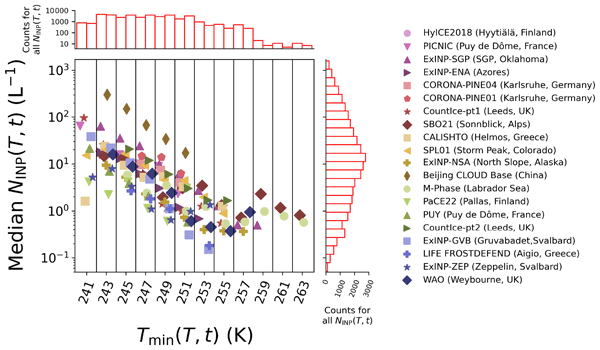
Ice formation in sub-zero clouds is influenced by airborne particles called ice-nucleating particles (INPs), whose concentrations vary substantially over short time and spatial scales. To assess the role of INPs in our climate, a comprehensive and consistent global dataset is essential. Our GloPINE model-ready dataset is a major step in this direction, comprising 36,000 measurements made using a single instrument design (PINE) over 70,000 hours of operation at 20 Northern Hemisphere sites.
Germán Perez Fogwill and André Welti
EGUsphere, https://doi.org/10.5194/egusphere-2026-3971, https://doi.org/10.5194/egusphere-2026-3971, 2026
Short summary
Short summary
We studied how accurately droplet temperature can be assigned in the FrESH freezing instrument, because this strongly affects measurements of particles that trigger ice formation. Using temperature sensors, routine measurement data, and cooling experiments, we found that droplets are consistently warmer than the bath and that the combined temperature uncertainty is 0.43–0.44 °C. These results provide a practical correction and uncertainty estimate for routine measurements.
Maria Filioglou, Krista Luoma, Eija Asmi, Viet Le, Klaus Haikarainen, David Brus, Tero Mielonen, Mika Komppula, Annele Virtanen, Olli Sippula, Iida Pullinen, Angela Buchholz, Pasi Miettinen, Snehitha Kommula, Saara Peltokorpi, Liqing Hao, Kajar Köster, Annika Saarto, Sanna Pätsi, Pieter G. van Zyl, Liezl Bredenkamp, and Ville Vakkari
Atmos. Chem. Phys., 26, 11525–11542, https://doi.org/10.5194/acp-26-11525-2026, https://doi.org/10.5194/acp-26-11525-2026, 2026
Short summary
Short summary
This study explores how smoke and volcanic ash particles, alter the way light is scattered in the atmosphere. By using a ground‑based HALO Doppler lidar system, we observed clear differences in the depolarization ratio, a shape-relevant optical parameter, between fresh smoke, aged smoke, and volcanic ash. These findings show that HALO Doppler lidars can help identify particle types in the air and even provide estimates of smoke mass concentrations, improving assessments of air quality.
Konstantinos Matthaios Doulgeris, David Brus, Christian Maier, Naděžda Zikova, Kajal Julaha, Cuiqi Zhang, Zamin A. Kanji, Ville Kaikkonen, Harri Juttula, Eero Molkoselkä, Anssi Makynen, Mika Komppula, Sergej Sel, and Elke Ludewig
EGUsphere, https://doi.org/10.5194/egusphere-2026-3898, https://doi.org/10.5194/egusphere-2026-3898, 2026
Short summary
Short summary
Clouds are important for weather and climate, but measuring their cloud water droplets accurately is difficult. We compared seven instruments during a field campaign at a high mountain observatory under natural cloud conditions. We found that the way instruments are installed can strongly influence the measurements. Our results provide practical guidance for improving cloud observations and support more consistent measurements across the European ACTRIS research infrastructure.
Viet Le, Ewan J. O'Connor, Maria Filioglou, and Ville Vakkari
Atmos. Meas. Tech., 19, 4923–4941, https://doi.org/10.5194/amt-19-4923-2026, https://doi.org/10.5194/amt-19-4923-2026, 2026
Short summary
Short summary
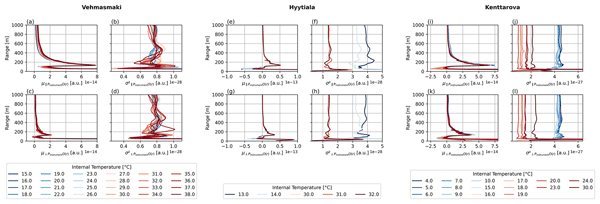
We evaluate the performance of the Vaisala CL61 ceilometer, with depolarization ratio capability at 910 nm, over a three-year period at four locations. This study examines instrument performance over time, describes methods for correcting instrument bias and presents corresponding uncertainty estimates. As these instruments are being deployed across large research networks, our findings support stable instrument performance and the generation of reliable measurements and derived products.
Aino Ovaska, Daniel Holmberg, Elio Rauth, Mansour Alghamdi, Paulo Artaxo, Eija Asmi, John Backman, Benjamin Bergmans, Matthew Boyer, Liezl Bredenkamp, Maurizio Busetto, Delano Campos De Oliveira, Juan Andrés Casquero-Vera, Darius Ceburnis, Tak Chan, Tommy Chan, Sebastien Conil, Daniele Contini, Suzanne Crumeyrolle, Valentin Duflot, Kostas Eleftheriadis, Johan Esveld, Ekaterina Ezhova, Markus Fiebig, Shahzad Gani, Olga Garmash, Francisco Gómez-Moreno, Roy M. Harrison, Andras Hoffer, Rakesh Hooda, Antti Hyvärinen, Tareq Hussein, Jorma Joutsensaari, Nikos Kalivitis, Heinz Kaminski, Jutta Kesti, Radovan Krejci, Adam Kristensson, Chongai Kuang, Markku Kulmala, Lauri Laakso, Ari Leskinen, Heikki Lihavainen, Andreas Massling, Maik Merkel, Steffen Noe, Jakub Ondracek, Noemí Perez, Jean-Eudes Petit, Tuukka Petäjä, Michael Pikridas, Christopher Pöhlker, Mira Pöhlker, Jean-Philippe Putaud, Ximeng Qi, Cristina Reche, Sergio Rodríguez, Petr Roztocil, Jean Sciare, Karine Sellegri, Dongjie Shang, Ashish Singh, Mikko Sipilä, Henrik Skov, Mar Sorribas, Tamanna Subba, Junying Sun, Peter Tunved, Ville Vakkari, Pieter G. Van Zyl, Aki Virkkula, Jens Voigtländer, Kay Weinhold, Alfred Wiedensohler, Hee-Jung Yoo, Putian Zhou, Kai Puolamäki, Tuomo Nieminen, Veli-Matti Kerminen, Victoria A. Sinclair, and Pauli Paasonen
Earth Syst. Sci. Data Discuss., https://doi.org/10.5194/essd-2026-415, https://doi.org/10.5194/essd-2026-415, 2026
Preprint under review for ESSD
Short summary
Short summary
All clouds form around aerosol particles, and their abundance influences cloud properties. In turn, clouds affect climate by changing how energy moves through the atmosphere, making them important for climate change. To better understand these interactions, we need accurate information on how many aerosol particles are in the atmosphere. Therefore, we have developed a new 21-year global dataset of particle concentrations relevant for cloud formation.
Ari Leskinen, Antonia Radlwimmer, Uula Isopahkala, Silvia Calderón, David Brus, Konstantinos Doulgeris, Ville Kaikkonen, Eero Molkoselkä, Dmitri Moiseev, Marie Lou Hirschy, Anssi Mäkynen, Sami Romakkaniemi, and Mika Komppula
EGUsphere, https://doi.org/10.5194/egusphere-2026-2088, https://doi.org/10.5194/egusphere-2026-2088, 2026
Short summary
Short summary
We present a lightweight holographic imaging instrument, designed for high-resolution in-cloud particle measurements at a rate of 10 holograms per second, which leads to sub-meter spatial resolution on-board UAV. The approach offers a cost-effective and versatile alternative, capable of accessing confined or remote areas, enabling improved validation of remote sensing products and numerical cloud models. We present the potential of such instrumentation for high-resolution cloud observations.
Luka Drinovec, Jesus Yus-Diez, Tobias Bühlmann, Maitane Iturrate-Garcia, Tobias Hammer, Konstantina Vasilatou, Arun Babu Suja, Thomas Müller, Krzysztof Ciupek, Alejandro Keller, Ernest Weingartner, Jorge Saturno, Maria Gini, Kostas Eleftheriadis, John Backman, Eija Asmi, and Griša Močnik
EGUsphere, https://doi.org/10.5194/egusphere-2026-1501, https://doi.org/10.5194/egusphere-2026-1501, 2026
Short summary
Short summary
We evaluated a traceable calibration method for aerosol absorption instruments based on monodisperse nigrosin particles. The absorption coefficient calculated using Mie theory was compared with measurements using the Photo-Thermal Aerosol Absorption Monitor, traceably calibrated with NO2. Particle classification using setups with the differential mobility analyzer, the centrifugal particle mass analyzer and a tandem of both in series were tested.
Viet Le, Konstantinos Doulgeris, Mika Komppula, John Backman, Gholamhossein Bagheri, Eberhard Bodenschatz, and David Brus
Earth Syst. Sci. Data Discuss., https://doi.org/10.5194/essd-2026-135, https://doi.org/10.5194/essd-2026-135, 2026
Preprint under review for ESSD
Short summary
Short summary
Vertical profiles and time series of aerosol particles, cloud droplets, and weather conditions were measured by the Finnish Meteorological Institute airborne payload attached to tethered balloons during the Pallas Cloud Experiment 2022 in Finland. When combined with other datasets collected during the campaign, these measurements will enable integrated analyses and offer a comprehensive view of the atmospheric conditions during the experiment.
John Backman, Sho Ohata, Yutaka Kondo, Jonas Svensson, Eija Asmi, Hitoshi Matsui, and Tatsuhiro Mori
EGUsphere, https://doi.org/10.5194/egusphere-2026-2102, https://doi.org/10.5194/egusphere-2026-2102, 2026
Short summary
Short summary
The Arctic climate is affected detrimentally by black carbon (BC). Our unique long-term observational results imply that Arctic BC size distributions do not wary substantially in space nor time although the mass concentration of BC can vary by orders of magnitude. Our findings suggest that, when modeling the climate impacts of BC in the Arctic, it is realistic to consider a BC size distribution with low variability.
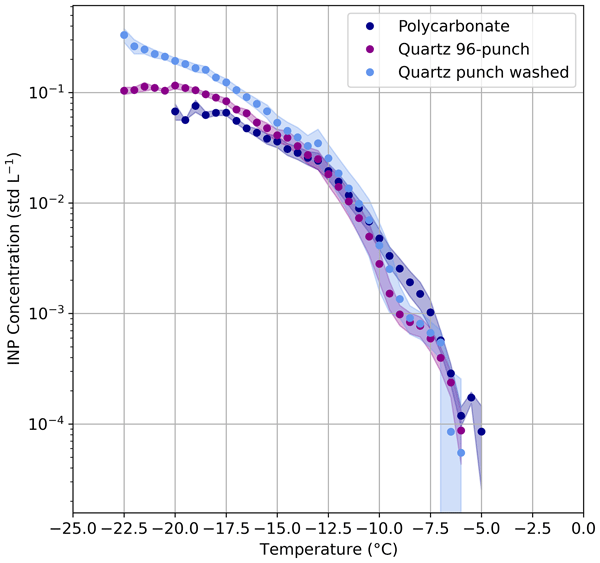
Elena Bazo, Olga Ruiz-Galera, Lucas Alados-Arboledas, Alexander Böhmländer, Kristina Höhler, Najin Kim, Larissa Lacher, Ottmar Möhler, Frascisco José Olmo, German Perez Fogwill, Ana A. Piedehierro, Nsikanabasi Silas Umo, André Welti, Gloria Titos, and Alberto Cazorla
Atmos. Meas. Tech., 19, 2695–2713, https://doi.org/10.5194/amt-19-2695-2026, https://doi.org/10.5194/amt-19-2695-2026, 2026
Short summary
Short summary
We evaluated different methods to obtain the ice nucleating particle (INP) concentration from ambient filters using GRAINS (GRAnada Ice Nuclei Spectrometer), the INP spectrometer at the Andalusian ObseRvatory of the Atmosphere (AGORA). We first characterized GRAINS and compared it to other INP devices. Then, we sampled polycarbonate and quartz filters for three months and tested three different particle extraction methods, finding general good agreement but that the INP concentration is systematically higher when using quartz filters.
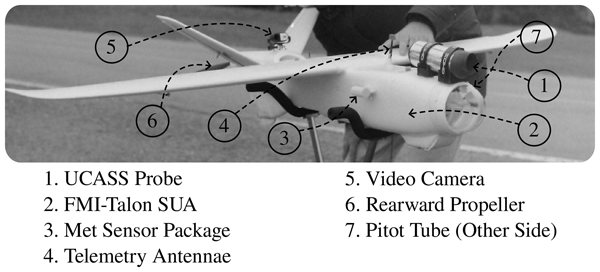
Jessica Girdwood, David Brus, Konstantinos-Matthaios Doulgeris, and Alexander Böhmländer
Earth Syst. Sci. Data, 18, 2819–2828, https://doi.org/10.5194/essd-18-2819-2026, https://doi.org/10.5194/essd-18-2819-2026, 2026
Short summary
Short summary
In-situ data of cloud microphysics is essential for targeted studies of cloud processes, validating remote sensing, and both assessing and improving the accuracy of weather and climate models. In this work we adopt a novel technique using a small uncrewed aircraft (SUA) and a bespoke sensor to produce vertical profiles of cloud microphysical parameters. The data are publicly available from https://zenodo.org/records/14756233.
Mustafo Safarov, Junli Li, Evan Miles, Majid Gulayozov, Ruonan Li, Ali Fazylov, Kamoliddin Nazirzoda, Firdavs Vosidov, Murodkhudzha Murodov, Hofiz Navruzshoev, and Ardamehr Halimov
EGUsphere, https://doi.org/10.5194/egusphere-2026-1923, https://doi.org/10.5194/egusphere-2026-1923, 2026
Short summary
Short summary
This study investigates a rapidly surging glacier in the Pamir Mountains using daily satellite imagery and unmanned aerial vehicle (UAV) data. It reveals that surge-driven ice detachment can rapidly displace ice downstream and transform valley morphology. The findings show that even small glaciers can cause large, rapid environmental impacts and highlight the need for high-frequency observations to understand glacier instability and improve hazard assessment in a warming climate.
Amit Singh Chandel, Chandan Sarangi, Nurun Nahar, Saqib Ahmad Zargar, Poul Cherian, Xena Mansoura, Vijay P. Kanawade, Bhishma Tyagi, Antti-Pekka Hyvärinen, Aki Virkkula, Harendra S. Negi, Swarup China, and Rakesh K. Hooda
EGUsphere, https://doi.org/10.5194/egusphere-2026-424, https://doi.org/10.5194/egusphere-2026-424, 2026
Short summary
Short summary
Dust storms reaching the western Himalayas often mix with pollution during transport. Using high-altitude measurements from May 2023, we show that this polluted dust has altered intrinsic optical properties, scattering and absorbing more sunlight than clean dust, with important implications for atmospheric heating and regional climate.
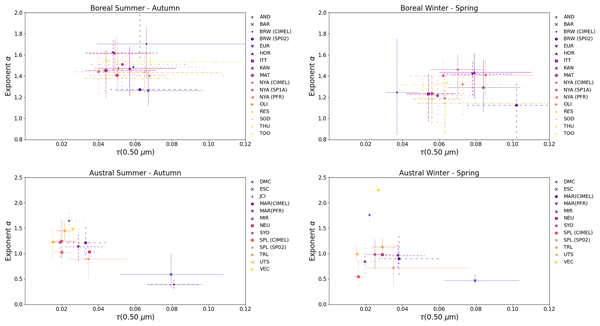
Simone Pulimeno, Angelo Lupi, Vito Vitale, Claudia Frangipani, Carlos Toledano, Stelios Kazadzis, Natalia Kouremeti, Christoph Ritter, Sandra Graßl, Kerstin Stebel, Vitali Fioletov, Ihab Abboud, Sandra Blindheim, Lynn Ma, Norm O'Neill, Piotr Sobolewski, Pawan Gupta, Elena Lind, Thomas F. Eck, Antti Hyvärinen, Veijo Aaltonen, Rigel Kivi, Janae Csavina, Dmitry Kabanov, Sergey M. Sakerin, Olga R. Sidorova, Robert S. Stone, Hagen Telg, Laura Riihimaki, Raul R. Cordero, Martin Radenz, Ronny Engelmann, Michel Van Roozendal, Anatoli Chaikovsky, Philippe Goloub, Junji Hisamitsu, and Mauro Mazzola
Atmos. Chem. Phys., 26, 1809–1846, https://doi.org/10.5194/acp-26-1809-2026, https://doi.org/10.5194/acp-26-1809-2026, 2026
Short summary
Short summary
This study analyzed aerosols optical properties over the Arctic and Antarctic to measure them even during long periods of darkness. It found that pollution in the Arctic is decreasing, likely due to European emission regulations, while wildfires are becoming a more important source of particles. In Antarctica, particle levels are higher near the coast than inland, and vary by season. These results help us better understand how air pollution and climate are changing at the Earth’s poles.
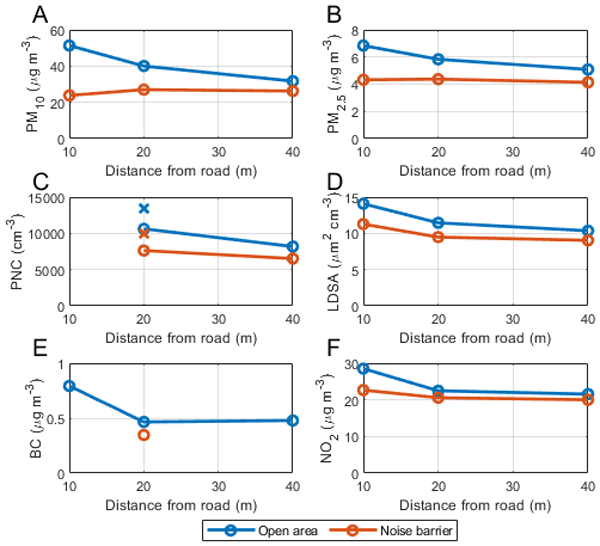
Sami D. Harni, Lasse Johansson, Jarkko V. Niemi, Ville Silvonen, Juan Andrés Casquero-Vera, Anu Kousa, Krista Luoma, Viet Le, David Brus, Konstantinos Doulgeris, Topi Rönkkö, Hanna E. Manninen, Tuukka Petäjä, and Hilkka Timonen
Atmos. Chem. Phys., 25, 18719–18738, https://doi.org/10.5194/acp-25-18719-2025, https://doi.org/10.5194/acp-25-18719-2025, 2025
Short summary
Short summary
A three-month-long measurement campaign was conducted at Espoo, Finland, in spring 2023. The measurement campaign studied the effect of the noise barrier on pollutant concentration gradients on the side of a major highway. The studied pollutants included PM10, PM2.5, lung deposited surface area (LDSA), particle number concentration (PNC), NO2, and black carbon (BC). The noise barrier was found to be effective in reducing, especially the concentration of particulate pollutants.
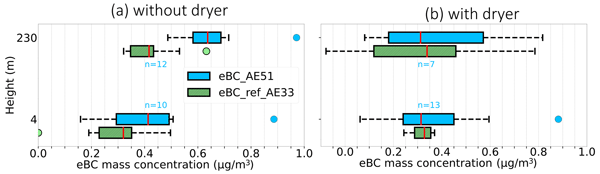
Kajal Julaha, Vladimír Ždímal, Saliou Mbengue, David Brus, and Naděžda Zíková
Atmos. Chem. Phys., 25, 17933–17951, https://doi.org/10.5194/acp-25-17933-2025, https://doi.org/10.5194/acp-25-17933-2025, 2025
Short summary
Short summary
This study used drones for vertical profiling of black carbon and particle number at rural and urban sites in Czechia. With aerosol drying, drone measurements matched with fixed instruments; without drying, black carbon was significantly overestimated. Rural profiles were more stratified in winter, while urban summer profiles were well-mixed. These findings can help improve air-quality monitoring and policies by capturing vertical pollution structures that ground stations cannot resolve.
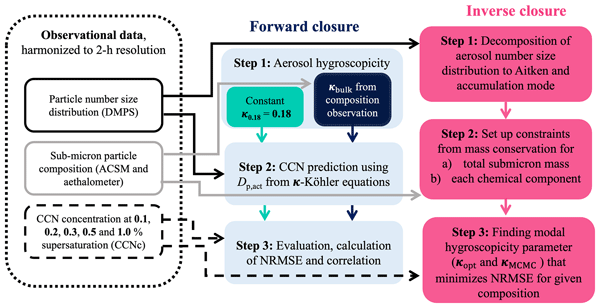
Rahul Ranjan, Maura Dewey, Liine Heikkinen, Lauri R. Ahonen, Krista Luoma, Paul Bowen, Tuukka Petäjä, Annica M. L. Ekman, Daniel G. Partridge, and Ilona Riipinen
Atmos. Chem. Phys., 25, 17275–17300, https://doi.org/10.5194/acp-25-17275-2025, https://doi.org/10.5194/acp-25-17275-2025, 2025
Short summary
Short summary
We use multi-year measurements of cloud condensation nuclei (CCN) at a boreal forest site to inversely infer size-resolved aerosol chemical composition. We find that inorganic species are more enriched in the larger end (accumulation mode) of the sub-micron aerosol population while organics often dominate the smaller end (Aitken mode). Our approach demonstrates the potential of long-term CCN measurements to infer size-resolved chemical composition of sub-micron aerosol.
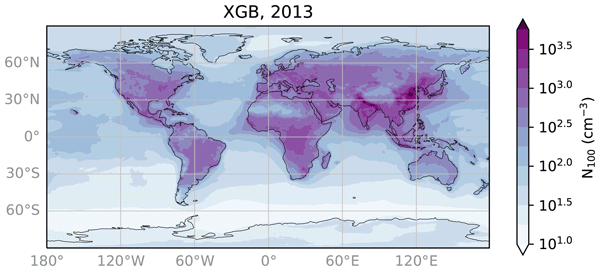
Aino Ovaska, Elio Rauth, Daniel Holmberg, Paulo Artaxo, John Backman, Benjamin Bergmans, Don Collins, Marco Aurélio Franco, Shahzad Gani, Roy M. Harrison, Rakesh K. Hooda, Tareq Hussein, Antti-Pekka Hyvärinen, Kerneels Jaars, Adam Kristensson, Markku Kulmala, Lauri Laakso, Ari Laaksonen, Nikolaos Mihalopoulos, Colin O'Dowd, Jakub Ondracek, Tuukka Petäjä, Kristina Plauškaitė, Mira Pöhlker, Ximeng Qi, Peter Tunved, Ville Vakkari, Alfred Wiedensohler, Kai Puolamäki, Tuomo Nieminen, Veli-Matti Kerminen, Victoria A. Sinclair, and Pauli Paasonen
Aerosol Research, 3, 589–618, https://doi.org/10.5194/ar-3-589-2025, https://doi.org/10.5194/ar-3-589-2025, 2025
Short summary
Short summary
We trained machine learning models to estimate the number of aerosol particles large enough to form clouds and generated daily estimates for the entire globe. The models performed well in many continental regions but struggled in remote and marine areas. Still, this approach offers a way to quantify these particles in areas that lack direct measurements, helping us understand their influence on clouds and climate on a global scale.
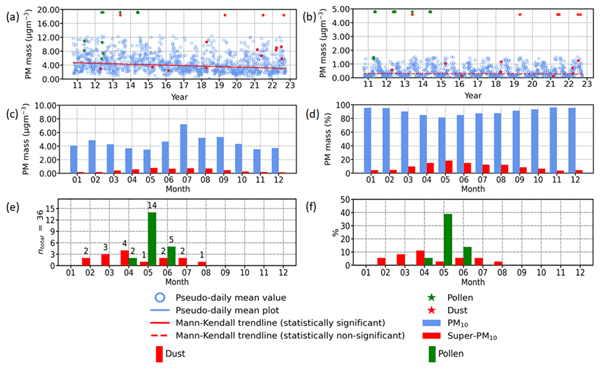
Sujai Banerji, Krista Luoma, Ilona Ylivinkka, Lauri Ahonen, Veli-Matti Kerminen, and Tuukka Petäjä
Atmos. Chem. Phys., 25, 16895–16914, https://doi.org/10.5194/acp-25-16895-2025, https://doi.org/10.5194/acp-25-16895-2025, 2025
Short summary
Short summary
We studied supermicron aerosol particles (PM1–10) for 12 years at a Finnish boreal forest by subtracting PM1 from total measurements. This allowed us to examine their optical and mass properties, seasonal patterns and events like pollen and dust. We also measured particles >10 µm using filters, which are missed by optical instruments. These large particles significantly influence light scattering.
Konstantinos Matthaios Doulgeris, Ville Kaikkonen, Harri Juttula, Eero Molkoselkä, Anssi Mäkynen, and David Brus
Earth Syst. Sci. Data, 17, 6497–6506, https://doi.org/10.5194/essd-17-6497-2025, https://doi.org/10.5194/essd-17-6497-2025, 2025
Short summary
Short summary
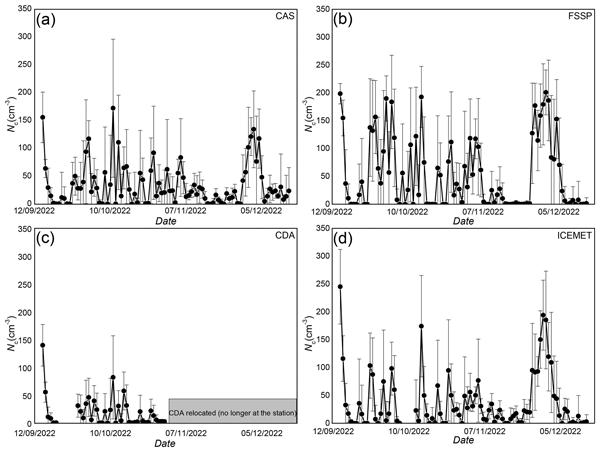
We present data collected from ground-based cloud instruments that measured cloud droplets in autumn 2022 in northern Finland. The aim of the research was to improve understanding of how clouds form and behave in cold regions. Measurements were taken directly inside clouds and include information on droplet sizes, water content, and weather conditions. The results support better climate and weather prediction.
Arya Mukherjee, Anni Hartikainen, Markus Somero, Viljami Luostari, Mika Ihalainen, Christopher P. Rüger, Timo Kekäläinen, Ville H. Nissinen, Luis M. F. Barreira, Hanna Koponen, Tuukka Kokkola, Delun Li, Lejish Vettikkat, Pasi Yli-Pirilä, Muhammad Shahzaib, Meri M. Ruppel, Ville Vakkari, Kerneels Jaars, Stefan J. Siebert, Angela Buchholz, Kajar Köster, Pieter G. van Zyl, Hilkka Timonen, Niko Kinnunen, Janne Jänis, Annele Virtanen, Aki Virkkula, and Olli Sippula
Atmos. Chem. Phys., 25, 16747–16774, https://doi.org/10.5194/acp-25-16747-2025, https://doi.org/10.5194/acp-25-16747-2025, 2025
Short summary
Short summary
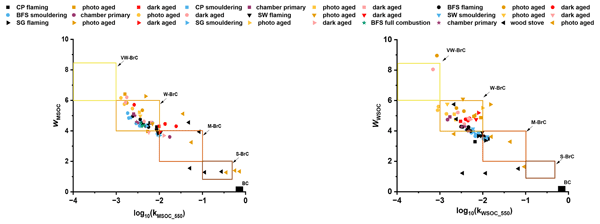
Warming climate is predicted to increase boreal and peatland fires in Northern Eurasia. Limited studies have characterized light absorbing aerosol emissions from these biomasses, thus necessitating this work. Brown carbon (BrC) emitted from laboratory-scale biomass burning had weak light absorptivities based on their complex refractive index values. A combustion temperature dependent light absorptivity continuum existed for emitted BrC. Photochemical aging decreased BrC light absorptivity.
Alexander Böhmländer, Larissa Lacher, Kristina Höhler, David Brus, Konstantinos-Matthaios Doulgeris, Jessica Girdwood, Thomas Leisner, and Ottmar Möhler
Earth Syst. Sci. Data, 17, 6157–6164, https://doi.org/10.5194/essd-17-6157-2025, https://doi.org/10.5194/essd-17-6157-2025, 2025
Short summary
Short summary
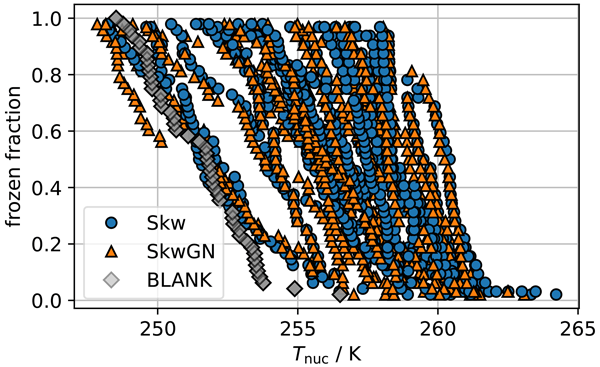
Clouds play a key role in weather and climate. Pure liquid water droplets are liquid until about −35 °C without the presence of a small subset of aerosols, ice-nucleating particles (INPs). These INPs lead to primary ice formation and therefore impact the phase of clouds. The dataset described herein provides INP concentration measurements at two altitudes. Connecting this data to synoptic conditions and ambient data might provide a better understanding of INPs in Finnish Lapland.
Alexander Böhmländer, Larissa Lacher, Romy Fösig, Nicole Büttner, Jens Nadolny, David Brus, Konstantinos-Matthaios Doulgeris, and Ottmar Möhler
Earth Syst. Sci. Data, 17, 6165–6171, https://doi.org/10.5194/essd-17-6165-2025, https://doi.org/10.5194/essd-17-6165-2025, 2025
Short summary
Short summary
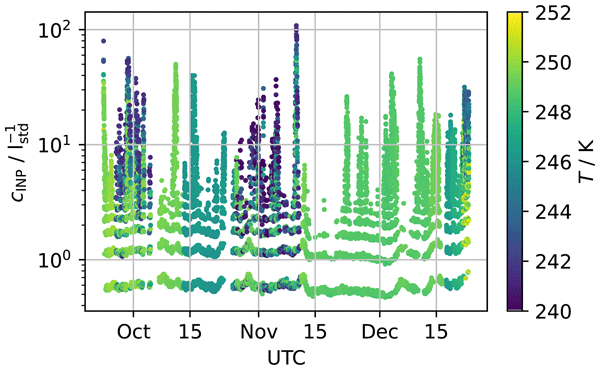
Cloud-aerosol interactions lead to a phase change of water droplets inside the atmosphere. One of these interactions happens due to a small subset of aerosols, ice-nucleating particles (INPs). These INPs lead to the freezing of pure water droplets above −35 °C, which otherwise would stay liquid. This has impacts on the weather and climate. The present data set presents a unique data set with a high temporal resolution.
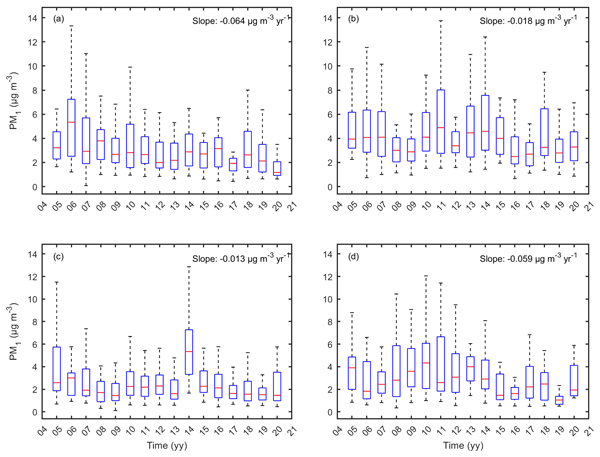
Ilona Ylivinkka, Helmi-Marja Keskinen, Lauri R. Ahonen, Liine Heikkinen, Pasi P. Aalto, Tuomo Nieminen, Katrianne Lehtipalo, Krista Luoma, Sujai Banerji, Juho Aalto, Janne Levula, Jutta Kesti, Ekaterina Ezhova, Markku Kulmala, and Tuukka Petäjä
Aerosol Research, 3, 503–520, https://doi.org/10.5194/ar-3-503-2025, https://doi.org/10.5194/ar-3-503-2025, 2025
Short summary
Short summary
Three different particulate matter (PM) measurement techniques were compared in Finland, showing good correlation (R about 0.8). Although the measured PM concentrations were low, decreasing trends were observed in all seasons. The decrease followed the trends observed in concentrations of anthropogenic pollutants, resulting from the EU legislation to improve air quality. The highest PM concentrations were measured in summer, indicating the dominance of organic compounds to the PM mass.
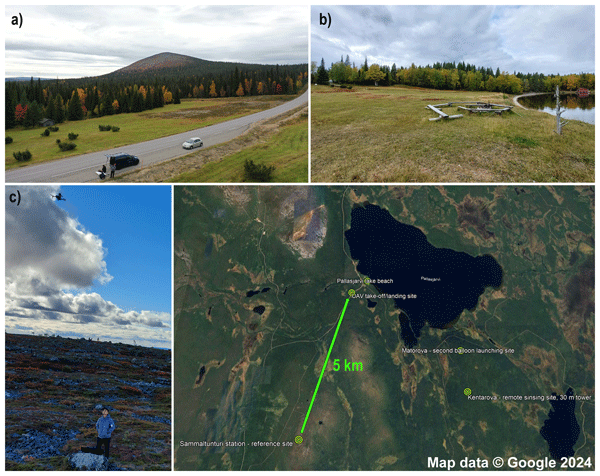
David Brus, Viet Le, Joel Kuula, and Konstantinos Doulgeris
Earth Syst. Sci. Data, 17, 5209–5219, https://doi.org/10.5194/essd-17-5209-2025, https://doi.org/10.5194/essd-17-5209-2025, 2025
Short summary
Short summary
This paper provides datasets collected as part of the Pallas Cloud Experiment campaign in northern Finland during autumn of 2022. We provide an overview of a custom-built drone backpack for air quality and atmospheric state variable measurements carried on top of a consumer-grade drone (DJI Mavic 2 Pro). Moreover, we describe the flight strategies and provide an overview of the datasets obtained, including a description of the measurements against a reference for data validation.
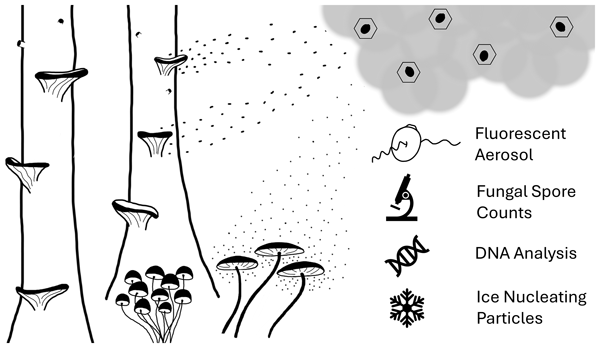
Jürgen Gratzl, Alexander Böhmländer, Sanna Pätsi, Clara-E. Pogner, Markus Gorfer, David Brus, Konstantinos Matthaios Doulgeris, Florian Wieland, Eija Asmi, Annika Saarto, Ottmar Möhler, Dominik Stolzenburg, and Hinrich Grothe
Atmos. Chem. Phys., 25, 12007–12035, https://doi.org/10.5194/acp-25-12007-2025, https://doi.org/10.5194/acp-25-12007-2025, 2025
Short summary
Short summary
We studied particles in the air over 1 year in the Finnish sub-Arctic to understand how biological particles affect ice formation in clouds. We found that fungal spores are the main contributors to ice formation at warmer temperatures. These particles are released locally and vary with the weather. Our results also show that we know very little about which fungi can form ice in the atmosphere, highlighting a major gap in our understanding of how nature influences weather and climate.
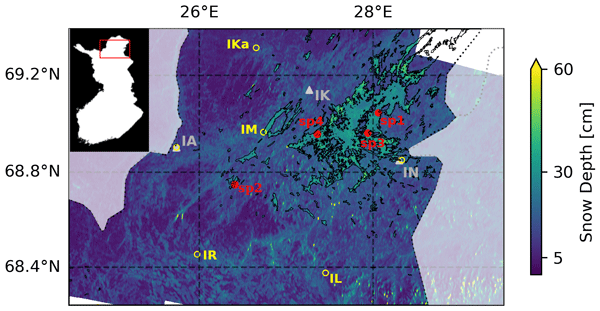
Adriano Lemos and Aku Riihelä
The Cryosphere, 19, 3939–3947, https://doi.org/10.5194/tc-19-3939-2025, https://doi.org/10.5194/tc-19-3939-2025, 2025
Short summary
Short summary
Here we used satellite imagery to measure snow depth in northern Finland and compared our results to on-site measurements from 2019–2022. We correlated snow depths and vegetation coverage and found thicker snow over non-vegetated areas and frozen waterbodies due to the satellite's sensitivity. Our estimates showed underestimated results of snow depth and need further investigation, but they show potential in monitoring seasonal snow changes, particularly where direct measurements are lacking.
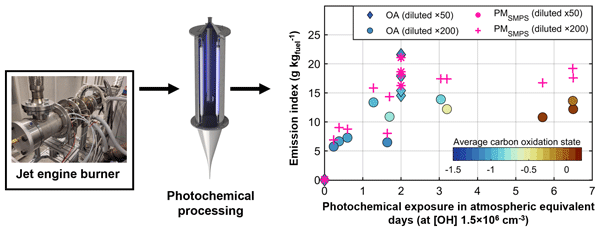
Anni Hartikainen, Mika Ihalainen, Deeksha Shukla, Marius Rohkamp, Arya Mukherjee, Quanfu He, Sandra Piel, Aki Virkkula, Delun Li, Tuukka Kokkola, Seongho Jeong, Hanna Koponen, Uwe Etzien, Anusmita Das, Krista Luoma, Lukas Schwalb, Thomas Gröger, Alexandre Barth, Martin Sklorz, Thorsten Streibel, Hendryk Czech, Benedikt Gündling, Markus Kalberer, Bert Buchholz, Andreas Hupfer, Thomas Adam, Thorsten Hohaus, Johan Øvrevik, Ralf Zimmermann, and Olli Sippula
Atmos. Chem. Phys., 25, 9275–9294, https://doi.org/10.5194/acp-25-9275-2025, https://doi.org/10.5194/acp-25-9275-2025, 2025
Short summary
Short summary
Photochemical reactions altered the properties of kerosene-operated jet engine burner exhaust emissions, which were studied in a laboratory using an oxidation flow reactor. Particle mass increased 300-fold as particles and gases became more oxidized. Light absorption increased, but the total direct radiative forcing efficiency was estimated to have shifted from positive to negative. The results highlight the importance of considering secondary aerosol formation when assessing the impacts of aviation.
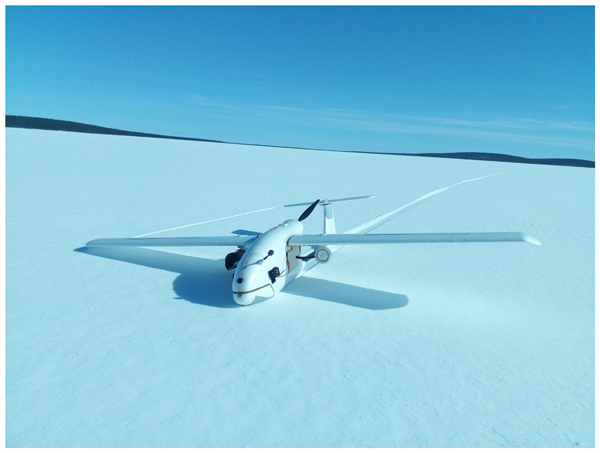
Alexander Böhmländer, Larissa Lacher, David Brus, Konstantinos-Matthaios Doulgeris, Zoé Brasseur, Matthew Boyer, Joel Kuula, Thomas Leisner, and Ottmar Möhler
Atmos. Meas. Tech., 18, 3959–3971, https://doi.org/10.5194/amt-18-3959-2025, https://doi.org/10.5194/amt-18-3959-2025, 2025
Short summary
Short summary
Clouds and aerosol are important for weather and climate. Typically, pure water cloud droplets stay liquid until around −35 °C, unless they come into contact with ice-nucleating particles (INPs). INPs are a rare subset of aerosol particles. Using uncrewed aerial vehicles (UAVs), it is possible to collect aerosol particles and analyse their ice-nucleating ability. This study describes the test and validation of a sampling set-up that can be used to collect aerosol particles onto a filter.
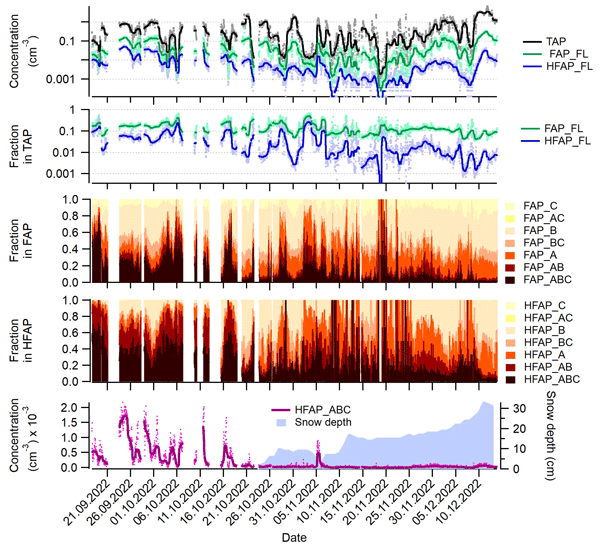
Jürgen Gratzl, David Brus, Konstantinos Doulgeris, Alexander Böhmländer, Ottmar Möhler, and Hinrich Grothe
Earth Syst. Sci. Data, 17, 3975–3985, https://doi.org/10.5194/essd-17-3975-2025, https://doi.org/10.5194/essd-17-3975-2025, 2025
Short summary
Short summary
Near-real time monitoring of airborne biological particles like fungal spores or pollen grains is of great interest for two main reasons: to improve atmospheric allergen forecasts and to deepen the understanding of how bio-aerosols influence cloud formation. Here, we measured fluorescent bio-aerosols in the Finnish sub-Arctic with a high time resolution. A data set that might improve our understanding of biosphere–cloud interactions and the dynamics of bio-aerosols in the atmosphere.
John Backman, Krista Luoma, Henri Servomaa, Ville Vakkari, and David Brus
Earth Syst. Sci. Data Discuss., https://doi.org/10.5194/essd-2025-284, https://doi.org/10.5194/essd-2025-284, 2025
Revised manuscript under review for ESSD
Short summary
Short summary
This work describes the in-situ aerosol measurements at the Arctic Sammaltunturi measurement station in Pallas in northern Finland. This data paper describes the instruments and the data post processing of key aerosol particle measurements that are relevant for cloud properties. Data reported here are part of the Pallas Cloud Experiment in 2022 (PaCE2022).
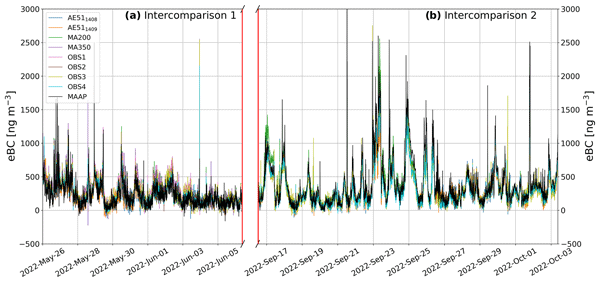
J. Tapio Elomaa, Krista Luoma, Sami D. Harni, Aki Virkkula, Hilkka Timonen, and Tuukka Petäjä
Aerosol Research, 3, 293–314, https://doi.org/10.5194/ar-3-293-2025, https://doi.org/10.5194/ar-3-293-2025, 2025
Short summary
Short summary
Black carbon (BC) is a pollutant from combustion that affects the climate and is harmful to health. We tested four different small BC sensors with a reference in Helsinki. The sensors compared well with the reference. As a sensor network they were able to capture differences in BC. Changes in temperature (T) and relative humidity (RH) caused error in the measurements. To reduce the effects of T and RH on BC sensors, more robust boxes should be developed, or corrections should be applied.
Viet Le, Konstantinos Matthaios Doulgeris, Mika Komppula, John Backman, Gholamhossein Bagheri, Eberhard Bodenschatz, and David Brus
Earth Syst. Sci. Data Discuss., https://doi.org/10.5194/essd-2025-148, https://doi.org/10.5194/essd-2025-148, 2025
Preprint withdrawn
Short summary
Short summary
This manuscript presents datasets collected during the Pallas Cloud Experiment in northern Finland during the autumn of 2022. We provide an overview of the payload that measured meteorological, cloud, and aerosol properties, and was deployed on tethered balloon systems across 21 flights. Additionally, we describe the datasets obtained, including details of the instruments on the payload.
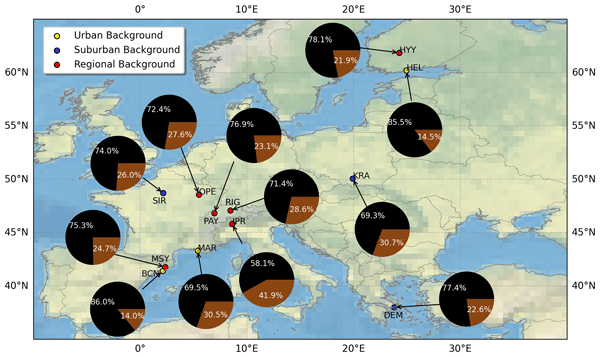
Hector Navarro-Barboza, Jordi Rovira, Vincenzo Obiso, Andrea Pozzer, Marta Via, Andres Alastuey, Xavier Querol, Noemi Perez, Marjan Savadkoohi, Gang Chen, Jesus Yus-Díez, Matic Ivancic, Martin Rigler, Konstantinos Eleftheriadis, Stergios Vratolis, Olga Zografou, Maria Gini, Benjamin Chazeau, Nicolas Marchand, Andre S. H. Prevot, Kaspar Dallenbach, Mikael Ehn, Krista Luoma, Tuukka Petäjä, Anna Tobler, Jaroslaw Necki, Minna Aurela, Hilkka Timonen, Jarkko Niemi, Olivier Favez, Jean-Eudes Petit, Jean-Philippe Putaud, Christoph Hueglin, Nicolas Pascal, Aurélien Chauvigné, Sébastien Conil, Marco Pandolfi, and Oriol Jorba
Atmos. Chem. Phys., 25, 2667–2694, https://doi.org/10.5194/acp-25-2667-2025, https://doi.org/10.5194/acp-25-2667-2025, 2025
Short summary
Short summary
Brown carbon (BrC) absorbs ultraviolet (UV) and visible light, influencing climate. This study explores BrC's imaginary refractive index (k) using data from 12 European sites. Residential emissions are a major organic aerosol (OA) source in winter, while secondary organic aerosol (SOA) dominates in summer. Source-specific k values were derived, improving model accuracy. The findings highlight BrC's climate impact and emphasize source-specific constraints in atmospheric models.
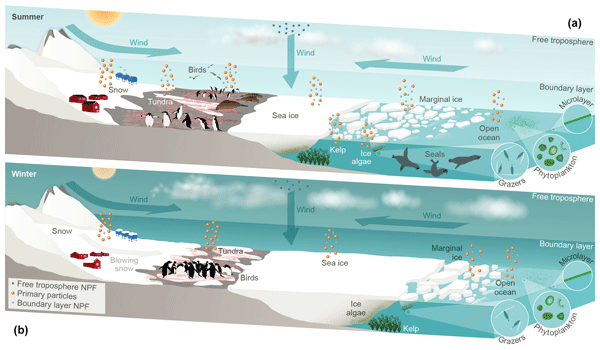
James Brean, David C. S. Beddows, Eija Asmi, Aki Virkkula, Lauriane L. J. Quéléver, Mikko Sipilä, Floortje Van Den Heuvel, Thomas Lachlan-Cope, Anna Jones, Markus Frey, Angelo Lupi, Jiyeon Park, Young Jun Yoon, Rolf Weller, Giselle L. Marincovich, Gabriela C. Mulena, Roy M. Harrison, and Manuel Dall'Osto
Atmos. Chem. Phys., 25, 1145–1162, https://doi.org/10.5194/acp-25-1145-2025, https://doi.org/10.5194/acp-25-1145-2025, 2025
Short summary
Short summary
Our results emphasise how understanding the geographical variation in surface types across the Antarctic is key to understanding secondary aerosol sources.
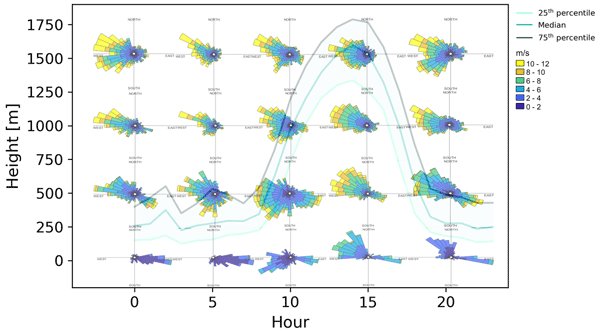
Jutta Kesti, Ewan J. O'Connor, Anne Hirsikko, John Backman, Maria Filioglou, Anu-Maija Sundström, Juha Tonttila, Heikki Lihavainen, Hannele Korhonen, and Eija Asmi
Atmos. Chem. Phys., 24, 9369–9386, https://doi.org/10.5194/acp-24-9369-2024, https://doi.org/10.5194/acp-24-9369-2024, 2024
Short summary
Short summary
The study combines aerosol particle measurements at the surface and vertical profiling of the atmosphere with a scanning Doppler lidar to investigate how particle transportation together with boundary layer evolution can affect particle and SO2 concentrations at the surface in the Arabian Peninsula region. The instrumentation enabled us to see elevated nucleation mode particle and SO2 concentrations at the surface when air masses transported from polluted areas are mixed in the boundary layer.
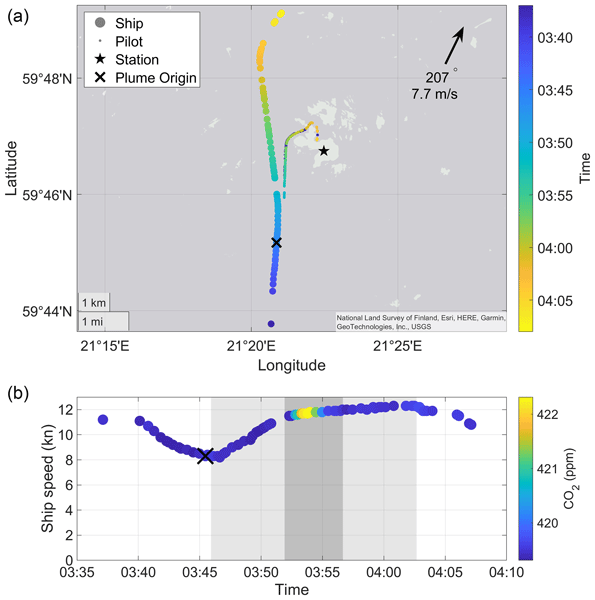
Mikko Heikkilä, Krista Luoma, Timo Mäkelä, and Tiia Grönholm
Atmos. Chem. Phys., 24, 8927–8941, https://doi.org/10.5194/acp-24-8927-2024, https://doi.org/10.5194/acp-24-8927-2024, 2024
Short summary
Short summary
Black carbon (BC) concentration was measured from 211 ship exhaust gas plumes at a remote marine station. Emission factors of BC were calculated in grams per kilogram of fuel. Ships with an exhaust gas cleaning system (EGCS) were found to have median BC emissions per fuel consumed 5 times lower than ships without an EGCS. However, this might be because of non-EGCS ships running at low engine loads rather than the EGCS itself. A local speed restriction would increase BC emissions of ships.
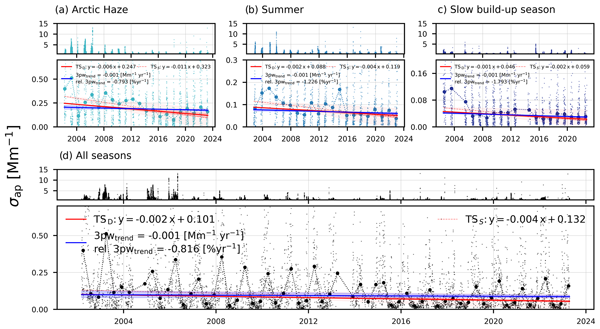
Dominic Heslin-Rees, Peter Tunved, Johan Ström, Roxana Cremer, Paul Zieger, Ilona Riipinen, Annica M. L. Ekman, Konstantinos Eleftheriadis, and Radovan Krejci
Atmos. Chem. Phys., 24, 2059–2075, https://doi.org/10.5194/acp-24-2059-2024, https://doi.org/10.5194/acp-24-2059-2024, 2024
Short summary
Short summary
Light-absorbing atmospheric particles (e.g. black carbon – BC) exert a warming effect on the Arctic climate. We show that the amount of particle light absorption decreased from 2002 to 2023. We conclude that in addition to reductions in emissions of BC, wet removal plays a role in the long-term reduction of BC in the Arctic, given the increase in surface precipitation experienced by air masses arriving at the site. The potential impact of biomass burning events is shown to have increased.
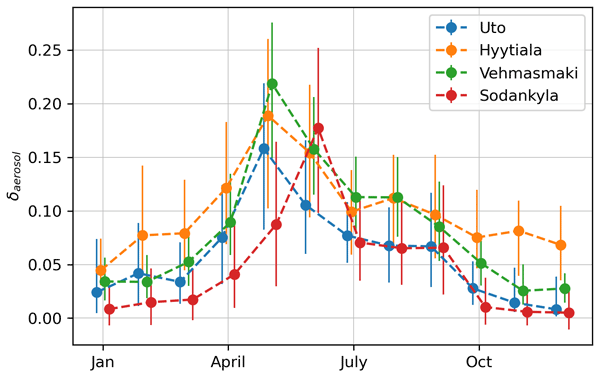
Viet Le, Hannah Lobo, Ewan J. O'Connor, and Ville Vakkari
Atmos. Meas. Tech., 17, 921–941, https://doi.org/10.5194/amt-17-921-2024, https://doi.org/10.5194/amt-17-921-2024, 2024
Short summary
Short summary
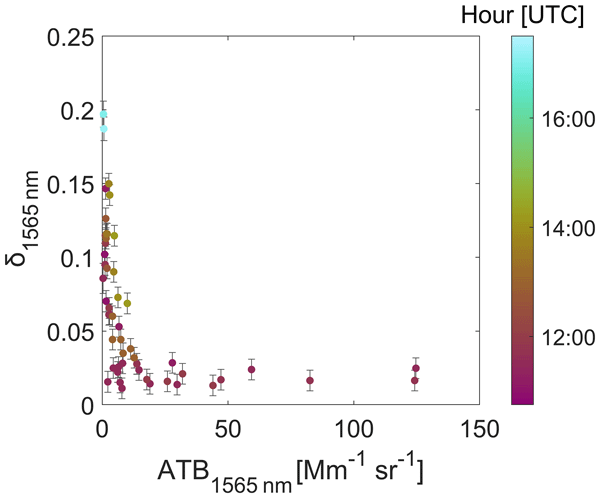
This study offers a long-term overview of aerosol particle depolarization ratio at the wavelength of 1565 nm obtained from vertical profiling measurements by Halo Doppler lidars during 4 years at four different locations across Finland. Our observations support the long-term usage of Halo Doppler lidar depolarization ratio such as the detection of aerosols that may pose a safety risk for aviation. Long-range Saharan dust transport and pollen transport are also showcased here.
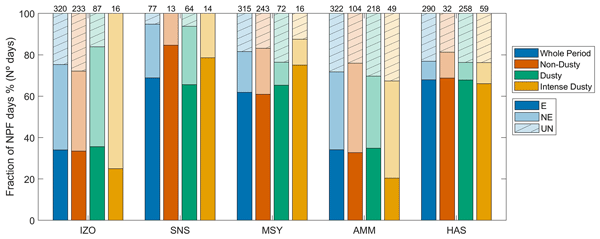
Juan Andrés Casquero-Vera, Daniel Pérez-Ramírez, Hassan Lyamani, Fernando Rejano, Andrea Casans, Gloria Titos, Francisco José Olmo, Lubna Dada, Simo Hakala, Tareq Hussein, Katrianne Lehtipalo, Pauli Paasonen, Antti Hyvärinen, Noemí Pérez, Xavier Querol, Sergio Rodríguez, Nikos Kalivitis, Yenny González, Mansour A. Alghamdi, Veli-Matti Kerminen, Andrés Alastuey, Tuukka Petäjä, and Lucas Alados-Arboledas
Atmos. Chem. Phys., 23, 15795–15814, https://doi.org/10.5194/acp-23-15795-2023, https://doi.org/10.5194/acp-23-15795-2023, 2023
Short summary
Short summary
Here we present the first study of the effect of mineral dust on the inhibition/promotion of new particle formation (NPF) events in different dust-influenced areas. Unexpectedly, we show that the occurrence of NPF events is highly frequent during mineral dust outbreaks, occurring even during extreme dust outbreaks. We also show that the occurrence of NPF events during mineral dust outbreaks significantly affects the potential cloud condensation nuclei budget.
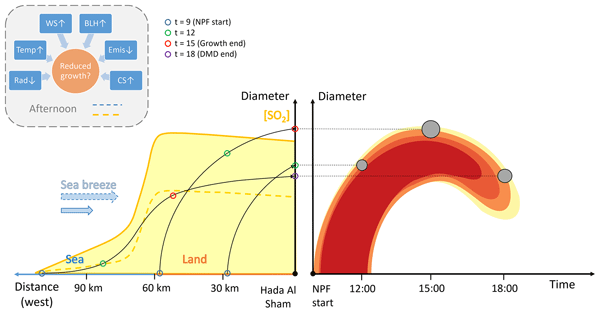
Simo Hakala, Ville Vakkari, Heikki Lihavainen, Antti-Pekka Hyvärinen, Kimmo Neitola, Jenni Kontkanen, Veli-Matti Kerminen, Markku Kulmala, Tuukka Petäjä, Tareq Hussein, Mamdouh I. Khoder, Mansour A. Alghamdi, and Pauli Paasonen
Atmos. Chem. Phys., 23, 9287–9321, https://doi.org/10.5194/acp-23-9287-2023, https://doi.org/10.5194/acp-23-9287-2023, 2023
Short summary
Short summary
Things are not always as they first seem in ambient aerosol measurements. Observations of decreasing particle sizes are often interpreted as resulting from particle evaporation. We show that such observations can counterintuitively be explained by particles that are constantly growing in size. This requires one to account for the previous movements of the observed air. Our explanation implies a larger number of larger particles, meaning more significant effects of aerosols on climate and health.
Franz Martin Schnaiter, Claudia Linke, Eija Asmi, Henri Servomaa, Antti-Pekka Hyvärinen, Sho Ohata, Yutaka Kondo, and Emma Järvinen
Atmos. Meas. Tech., 16, 2753–2769, https://doi.org/10.5194/amt-16-2753-2023, https://doi.org/10.5194/amt-16-2753-2023, 2023
Short summary
Short summary
Light-absorbing particles from combustion processes are important contributors to climate warming. Their highly variable spectral light absorption properties need to be monitored in the field. Commonly used methods show measurement artefacts that are difficult to correct. We introduce a new instrument that is based on the photoacoustic effect. Long-term operation in the Finnish Arctic demonstrates the applicability of the new instrument for unattended light absorption monitoring.
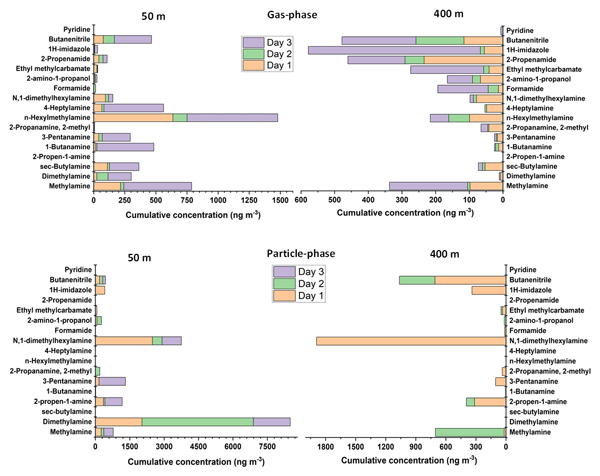
Eka Dian Pusfitasari, Jose Ruiz-Jimenez, Aleksi Tiusanen, Markus Suuronen, Jesse Haataja, Yusheng Wu, Juha Kangasluoma, Krista Luoma, Tuukka Petäjä, Matti Jussila, Kari Hartonen, and Marja-Liisa Riekkola
Atmos. Chem. Phys., 23, 5885–5904, https://doi.org/10.5194/acp-23-5885-2023, https://doi.org/10.5194/acp-23-5885-2023, 2023
Short summary
Short summary
A miniaturized air-sampling drone system was successfully applied for the collection of volatile organic compounds (VOCs) and for the measurement of black carbon (BC) and total particle number concentrations in atmospheric air. Here we report, for the first time, the vertical profiles of BC and aerosol number concentrations above the boreal forest in Hyytiälä (Finland) at high altitudes close to the boundary layer in autumn 2021. VOC composition with its distribution was studied as well.
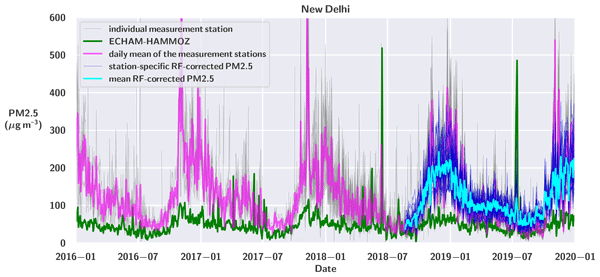
Tuuli Miinalainen, Harri Kokkola, Antti Lipponen, Antti-Pekka Hyvärinen, Vijay Kumar Soni, Kari E. J. Lehtinen, and Thomas Kühn
Atmos. Chem. Phys., 23, 3471–3491, https://doi.org/10.5194/acp-23-3471-2023, https://doi.org/10.5194/acp-23-3471-2023, 2023
Short summary
Short summary
We simulated the effects of aerosol emission mitigation on both global and regional radiative forcing and city-level air quality with a global-scale climate model. We used a machine learning downscaling approach to bias-correct the PM2.5 values obtained from the global model for the Indian megacity New Delhi. Our results indicate that aerosol mitigation could result in both improved air quality and less radiative heating for India.
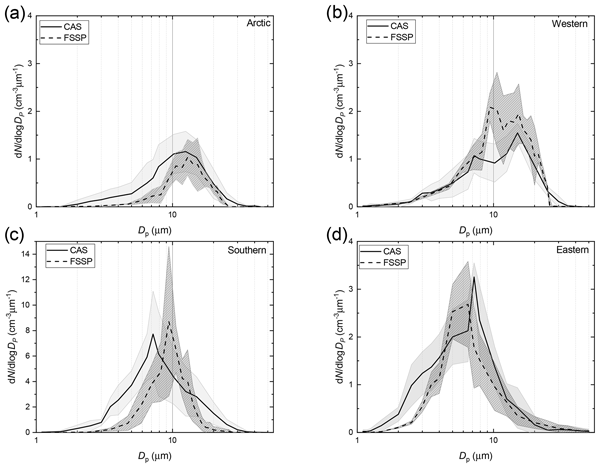
Konstantinos Matthaios Doulgeris, Ville Vakkari, Ewan J. O'Connor, Veli-Matti Kerminen, Heikki Lihavainen, and David Brus
Atmos. Chem. Phys., 23, 2483–2498, https://doi.org/10.5194/acp-23-2483-2023, https://doi.org/10.5194/acp-23-2483-2023, 2023
Short summary
Short summary
We investigated how different long-range-transported air masses can affect the microphysical properties of low-level clouds in a clean subarctic environment. A connection was revealed. Higher values of cloud droplet number concentrations were related to continental air masses, whereas the lowest values of number concentrations were related to marine air masses. These were characterized by larger cloud droplets. Clouds in all regions were sensitive to increases in cloud number concentration.
James Brean, David C. S. Beddows, Roy M. Harrison, Congbo Song, Peter Tunved, Johan Ström, Radovan Krejci, Eyal Freud, Andreas Massling, Henrik Skov, Eija Asmi, Angelo Lupi, and Manuel Dall'Osto
Atmos. Chem. Phys., 23, 2183–2198, https://doi.org/10.5194/acp-23-2183-2023, https://doi.org/10.5194/acp-23-2183-2023, 2023
Short summary
Short summary
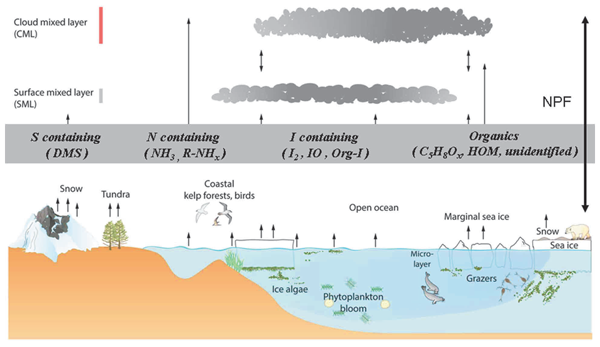
Our results emphasize how understanding the geographical variation in surface types across the Arctic is key to understanding secondary aerosol sources. We provide a harmonised analysis of new particle formation across the Arctic.
Matthew Boyer, Diego Aliaga, Jakob Boyd Pernov, Hélène Angot, Lauriane L. J. Quéléver, Lubna Dada, Benjamin Heutte, Manuel Dall'Osto, David C. S. Beddows, Zoé Brasseur, Ivo Beck, Silvia Bucci, Marina Duetsch, Andreas Stohl, Tiia Laurila, Eija Asmi, Andreas Massling, Daniel Charles Thomas, Jakob Klenø Nøjgaard, Tak Chan, Sangeeta Sharma, Peter Tunved, Radovan Krejci, Hans Christen Hansson, Federico Bianchi, Katrianne Lehtipalo, Alfred Wiedensohler, Kay Weinhold, Markku Kulmala, Tuukka Petäjä, Mikko Sipilä, Julia Schmale, and Tuija Jokinen
Atmos. Chem. Phys., 23, 389–415, https://doi.org/10.5194/acp-23-389-2023, https://doi.org/10.5194/acp-23-389-2023, 2023
Short summary
Short summary
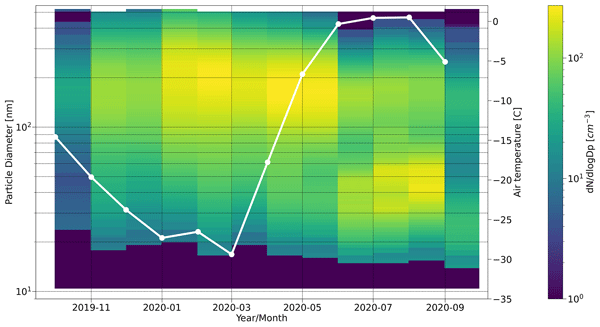
The Arctic is a unique environment that is warming faster than other locations on Earth. We evaluate measurements of aerosol particles, which can influence climate, over the central Arctic Ocean for a full year and compare the data to land-based measurement stations across the Arctic. Our measurements show that the central Arctic has similarities to but also distinct differences from the stations further south. We note that this may change as the Arctic warms and sea ice continues to decline.
Svetlana Sofieva, Eija Asmi, Nina S. Atanasova, Aino E. Heikkinen, Emeline Vidal, Jonathan Duplissy, Martin Romantschuk, Rostislav Kouznetsov, Jaakko Kukkonen, Dennis H. Bamford, Antti-Pekka Hyvärinen, and Mikhail Sofiev
Atmos. Meas. Tech., 15, 6201–6219, https://doi.org/10.5194/amt-15-6201-2022, https://doi.org/10.5194/amt-15-6201-2022, 2022
Short summary
Short summary
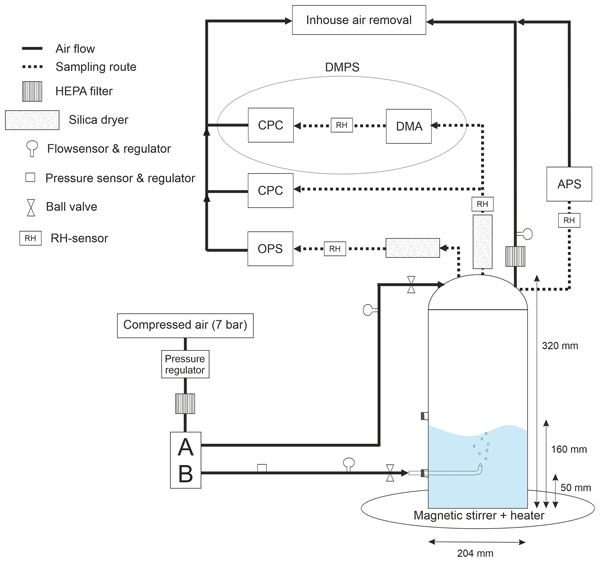
A new bubble-generating glass chamber design with an extensive set of aerosol production experiments is presented to re-evaluate bubble-bursting-mediated aerosol production as a function of water parameters: bubbling air flow, water salinity, and temperature. Our main findings suggest modest dependence of aerosol production on the water salinity and a strong dependence on temperature below ~ 10 °C.
Outi Meinander, Pavla Dagsson-Waldhauserova, Pavel Amosov, Elena Aseyeva, Cliff Atkins, Alexander Baklanov, Clarissa Baldo, Sarah L. Barr, Barbara Barzycka, Liane G. Benning, Bojan Cvetkovic, Polina Enchilik, Denis Frolov, Santiago Gassó, Konrad Kandler, Nikolay Kasimov, Jan Kavan, James King, Tatyana Koroleva, Viktoria Krupskaya, Markku Kulmala, Monika Kusiak, Hanna K. Lappalainen, Michał Laska, Jerome Lasne, Marek Lewandowski, Bartłomiej Luks, James B. McQuaid, Beatrice Moroni, Benjamin Murray, Ottmar Möhler, Adam Nawrot, Slobodan Nickovic, Norman T. O’Neill, Goran Pejanovic, Olga Popovicheva, Keyvan Ranjbar, Manolis Romanias, Olga Samonova, Alberto Sanchez-Marroquin, Kerstin Schepanski, Ivan Semenkov, Anna Sharapova, Elena Shevnina, Zongbo Shi, Mikhail Sofiev, Frédéric Thevenet, Throstur Thorsteinsson, Mikhail Timofeev, Nsikanabasi Silas Umo, Andreas Uppstu, Darya Urupina, György Varga, Tomasz Werner, Olafur Arnalds, and Ana Vukovic Vimic
Atmos. Chem. Phys., 22, 11889–11930, https://doi.org/10.5194/acp-22-11889-2022, https://doi.org/10.5194/acp-22-11889-2022, 2022
Short summary
Short summary
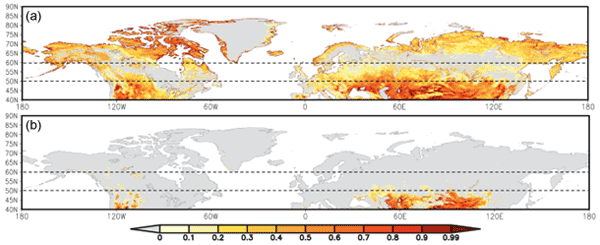
High-latitude dust (HLD) is a short-lived climate forcer, air pollutant, and nutrient source. Our results suggest a northern HLD belt at 50–58° N in Eurasia and 50–55° N in Canada and at >60° N in Eurasia and >58° N in Canada. Our addition to the previously identified global dust belt (GDB) provides crucially needed information on the extent of active HLD sources with both direct and indirect impacts on climate and environment in remote regions, which are often poorly understood and predicted.
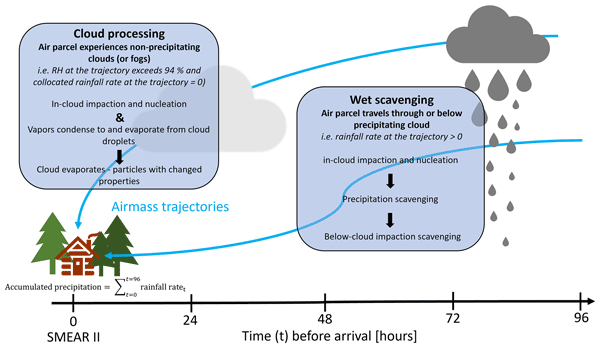
Sini Isokääntä, Paul Kim, Santtu Mikkonen, Thomas Kühn, Harri Kokkola, Taina Yli-Juuti, Liine Heikkinen, Krista Luoma, Tuukka Petäjä, Zak Kipling, Daniel Partridge, and Annele Virtanen
Atmos. Chem. Phys., 22, 11823–11843, https://doi.org/10.5194/acp-22-11823-2022, https://doi.org/10.5194/acp-22-11823-2022, 2022
Short summary
Short summary
This research employs air mass history analysis and observations to study how clouds and precipitation affect atmospheric aerosols during transport to a boreal forest site. The mass concentrations of studied chemical species showed exponential decrease as a function of accumulated rain along the air mass route. Our analysis revealed in-cloud sulfate formation, while no major changes in organic mass were seen. Most of the in-cloud-formed sulfate could be assigned to particle sizes above 200 nm.
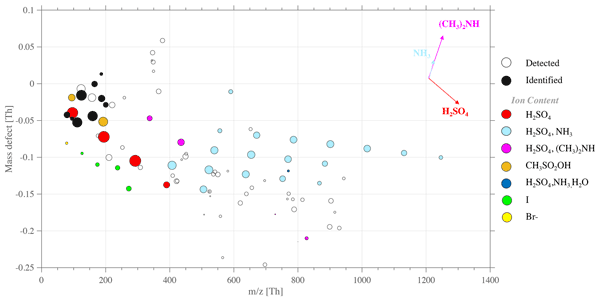
Lauriane L. J. Quéléver, Lubna Dada, Eija Asmi, Janne Lampilahti, Tommy Chan, Jonathan E. Ferrara, Gustavo E. Copes, German Pérez-Fogwill, Luis Barreira, Minna Aurela, Douglas R. Worsnop, Tuija Jokinen, and Mikko Sipilä
Atmos. Chem. Phys., 22, 8417–8437, https://doi.org/10.5194/acp-22-8417-2022, https://doi.org/10.5194/acp-22-8417-2022, 2022
Short summary
Short summary
Understanding how aerosols form is crucial for correctly modeling the climate and improving future predictions. This work provides extensive analysis of aerosol particles and their precursors at Marambio Station, Antarctic Peninsula. We show that sulfuric acid, ammonia, and dimethylamine are key contributors to the frequent new particle formation events observed at the site. We discuss nucleation mechanisms and highlight the need for targeted measurement to fully understand these processes.
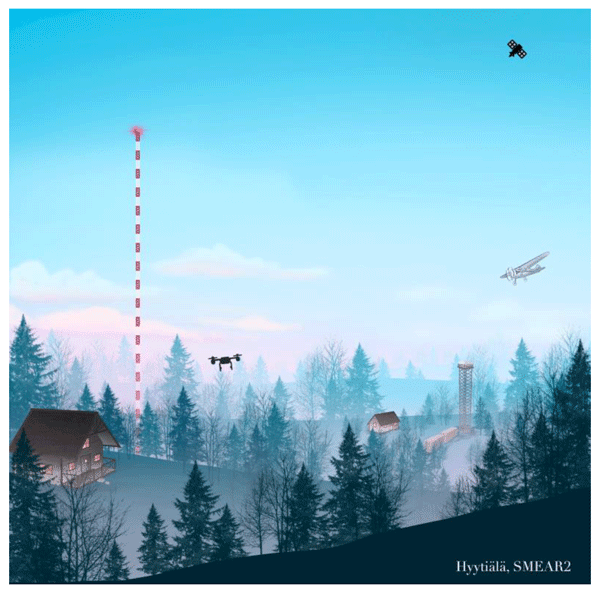
Zoé Brasseur, Dimitri Castarède, Erik S. Thomson, Michael P. Adams, Saskia Drossaart van Dusseldorp, Paavo Heikkilä, Kimmo Korhonen, Janne Lampilahti, Mikhail Paramonov, Julia Schneider, Franziska Vogel, Yusheng Wu, Jonathan P. D. Abbatt, Nina S. Atanasova, Dennis H. Bamford, Barbara Bertozzi, Matthew Boyer, David Brus, Martin I. Daily, Romy Fösig, Ellen Gute, Alexander D. Harrison, Paula Hietala, Kristina Höhler, Zamin A. Kanji, Jorma Keskinen, Larissa Lacher, Markus Lampimäki, Janne Levula, Antti Manninen, Jens Nadolny, Maija Peltola, Grace C. E. Porter, Pyry Poutanen, Ulrike Proske, Tobias Schorr, Nsikanabasi Silas Umo, János Stenszky, Annele Virtanen, Dmitri Moisseev, Markku Kulmala, Benjamin J. Murray, Tuukka Petäjä, Ottmar Möhler, and Jonathan Duplissy
Atmos. Chem. Phys., 22, 5117–5145, https://doi.org/10.5194/acp-22-5117-2022, https://doi.org/10.5194/acp-22-5117-2022, 2022
Short summary
Short summary
The present measurement report introduces the ice nucleation campaign organized in Hyytiälä, Finland, in 2018 (HyICE-2018). We provide an overview of the campaign settings, and we describe the measurement infrastructure and operating procedures used. In addition, we use results from ice nucleation instrument inter-comparison to show that the suite of these instruments deployed during the campaign reports consistent results.

Mathew Sebastian, Sobhan Kumar Kompalli, Vasudevan Anil Kumar, Sandhya Jose, S. Suresh Babu, Govindan Pandithurai, Sachchidanand Singh, Rakesh K. Hooda, Vijay K. Soni, Jeffrey R. Pierce, Ville Vakkari, Eija Asmi, Daniel M. Westervelt, Antti-Pekka Hyvärinen, and Vijay P. Kanawade
Atmos. Chem. Phys., 22, 4491–4508, https://doi.org/10.5194/acp-22-4491-2022, https://doi.org/10.5194/acp-22-4491-2022, 2022
Short summary
Short summary
Characteristics of particle number size distributions and new particle formation in six locations in India were analyzed. New particle formation occurred frequently during the pre-monsoon (spring) season and it significantly modulates the shape of the particle number size distributions. The contribution of newly formed particles to cloud condensation nuclei concentrations was ~3 times higher in urban locations than in mountain background locations.
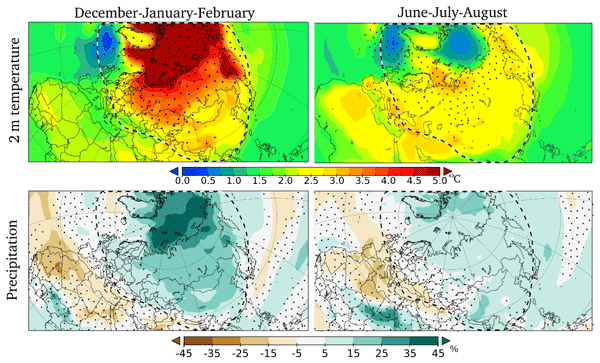
Hanna K. Lappalainen, Tuukka Petäjä, Timo Vihma, Jouni Räisänen, Alexander Baklanov, Sergey Chalov, Igor Esau, Ekaterina Ezhova, Matti Leppäranta, Dmitry Pozdnyakov, Jukka Pumpanen, Meinrat O. Andreae, Mikhail Arshinov, Eija Asmi, Jianhui Bai, Igor Bashmachnikov, Boris Belan, Federico Bianchi, Boris Biskaborn, Michael Boy, Jaana Bäck, Bin Cheng, Natalia Chubarova, Jonathan Duplissy, Egor Dyukarev, Konstantinos Eleftheriadis, Martin Forsius, Martin Heimann, Sirkku Juhola, Vladimir Konovalov, Igor Konovalov, Pavel Konstantinov, Kajar Köster, Elena Lapshina, Anna Lintunen, Alexander Mahura, Risto Makkonen, Svetlana Malkhazova, Ivan Mammarella, Stefano Mammola, Stephany Buenrostro Mazon, Outi Meinander, Eugene Mikhailov, Victoria Miles, Stanislav Myslenkov, Dmitry Orlov, Jean-Daniel Paris, Roberta Pirazzini, Olga Popovicheva, Jouni Pulliainen, Kimmo Rautiainen, Torsten Sachs, Vladimir Shevchenko, Andrey Skorokhod, Andreas Stohl, Elli Suhonen, Erik S. Thomson, Marina Tsidilina, Veli-Pekka Tynkkynen, Petteri Uotila, Aki Virkkula, Nadezhda Voropay, Tobias Wolf, Sayaka Yasunaka, Jiahua Zhang, Yubao Qiu, Aijun Ding, Huadong Guo, Valery Bondur, Nikolay Kasimov, Sergej Zilitinkevich, Veli-Matti Kerminen, and Markku Kulmala
Atmos. Chem. Phys., 22, 4413–4469, https://doi.org/10.5194/acp-22-4413-2022, https://doi.org/10.5194/acp-22-4413-2022, 2022
Short summary
Short summary
We summarize results during the last 5 years in the northern Eurasian region, especially from Russia, and introduce recent observations of the air quality in the urban environments in China. Although the scientific knowledge in these regions has increased, there are still gaps in our understanding of large-scale climate–Earth surface interactions and feedbacks. This arises from limitations in research infrastructures and integrative data analyses, hindering a comprehensive system analysis.
Joseph Girdwood, Warren Stanley, Chris Stopford, and David Brus
Atmos. Meas. Tech., 15, 2061–2076, https://doi.org/10.5194/amt-15-2061-2022, https://doi.org/10.5194/amt-15-2061-2022, 2022
Short summary
Short summary
UAVs have great potential to be used for airborne measurements of cloud and aerosol properties, which are of particular importance due to the largely uncharacterised nature of such phenomena. However, since UAVs are a new tool in atmospheric physics expensive platform validation and characterisation of UAV-instrument combinations needs to be performed. This paper presents an evaluation of a fixed-wing UAV in combination with an instrument that measures cloud droplet diameter.
Stephen M. Platt, Øystein Hov, Torunn Berg, Knut Breivik, Sabine Eckhardt, Konstantinos Eleftheriadis, Nikolaos Evangeliou, Markus Fiebig, Rebecca Fisher, Georg Hansen, Hans-Christen Hansson, Jost Heintzenberg, Ove Hermansen, Dominic Heslin-Rees, Kim Holmén, Stephen Hudson, Roland Kallenborn, Radovan Krejci, Terje Krognes, Steinar Larssen, David Lowry, Cathrine Lund Myhre, Chris Lunder, Euan Nisbet, Pernilla B. Nizzetto, Ki-Tae Park, Christina A. Pedersen, Katrine Aspmo Pfaffhuber, Thomas Röckmann, Norbert Schmidbauer, Sverre Solberg, Andreas Stohl, Johan Ström, Tove Svendby, Peter Tunved, Kjersti Tørnkvist, Carina van der Veen, Stergios Vratolis, Young Jun Yoon, Karl Espen Yttri, Paul Zieger, Wenche Aas, and Kjetil Tørseth
Atmos. Chem. Phys., 22, 3321–3369, https://doi.org/10.5194/acp-22-3321-2022, https://doi.org/10.5194/acp-22-3321-2022, 2022
Short summary
Short summary
Here we detail the history of the Zeppelin Observatory, a unique global background site and one of only a few in the high Arctic. We present long-term time series of up to 30 years of atmospheric components and atmospheric transport phenomena. Many of these time series are important to our understanding of Arctic and global atmospheric composition change. Finally, we discuss the future of the Zeppelin Observatory and emerging areas of future research on the Arctic atmosphere.
Konstantinos Matthaios Doulgeris, Heikki Lihavainen, Anti-Pekka Hyvärinen, Veli-Matti Kerminen, and David Brus
Earth Syst. Sci. Data, 14, 637–649, https://doi.org/10.5194/essd-14-637-2022, https://doi.org/10.5194/essd-14-637-2022, 2022
Short summary
Short summary
We produced and summarized data sets obtained from two cloud ground-based spectrometers (CAPS and FSSP-100 ground setups) during 8 years of Pallas Cloud Experiment campaigns conducted in autumn from 2004 until 2019 along with several meteorological variables. The campaigns took place in the Finnish sub-Arctic region in a clear environment in temperatures that were usually below zero. This data set provides a helpful contribution to cloud microphysics processes.
Daniel M. Kalbermatter, Griša Močnik, Luka Drinovec, Bradley Visser, Jannis Röhrbein, Matthias Oscity, Ernest Weingartner, Antti-Pekka Hyvärinen, and Konstantina Vasilatou
Atmos. Meas. Tech., 15, 561–572, https://doi.org/10.5194/amt-15-561-2022, https://doi.org/10.5194/amt-15-561-2022, 2022
Short summary
Short summary
Soot particles with varying amounts of secondary organic matter coating were generated and used to compare a series of aerosol-absorption-measuring instruments: filter-based and photoacoustic instruments as well as photo-thermal interferometers. Significant deviations in the response of the instruments were observed depending on the amount of secondary organic coating. The system can be used for the inter-comparison and characterisation of instruments.
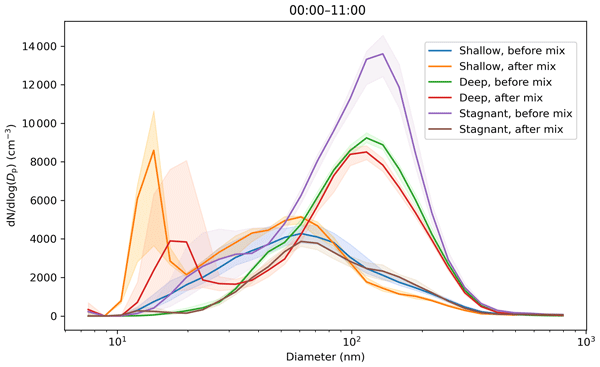
Jutta Kesti, John Backman, Ewan J. O'Connor, Anne Hirsikko, Eija Asmi, Minna Aurela, Ulla Makkonen, Maria Filioglou, Mika Komppula, Hannele Korhonen, and Heikki Lihavainen
Atmos. Chem. Phys., 22, 481–503, https://doi.org/10.5194/acp-22-481-2022, https://doi.org/10.5194/acp-22-481-2022, 2022
Short summary
Short summary
In this study we combined aerosol particle measurements at the surface with a scanning Doppler lidar providing vertical profiles of the atmosphere to study the effect of different boundary layer conditions on aerosol particle properties in the understudied Arabian Peninsula region. The instrumentation used in this study enabled us to identify periods when pollution from remote sources was mixed down to the surface and initiated new particle formation in the growing boundary layer.
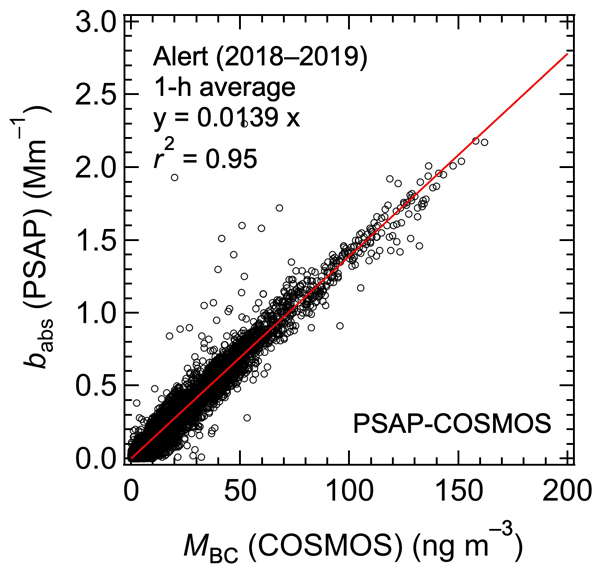
Sho Ohata, Tatsuhiro Mori, Yutaka Kondo, Sangeeta Sharma, Antti Hyvärinen, Elisabeth Andrews, Peter Tunved, Eija Asmi, John Backman, Henri Servomaa, Daniel Veber, Konstantinos Eleftheriadis, Stergios Vratolis, Radovan Krejci, Paul Zieger, Makoto Koike, Yugo Kanaya, Atsushi Yoshida, Nobuhiro Moteki, Yongjing Zhao, Yutaka Tobo, Junji Matsushita, and Naga Oshima
Atmos. Meas. Tech., 14, 6723–6748, https://doi.org/10.5194/amt-14-6723-2021, https://doi.org/10.5194/amt-14-6723-2021, 2021
Short summary
Short summary
Reliable values of mass absorption cross sections (MACs) of black carbon (BC) are required to determine mass concentrations of BC at Arctic sites using different types of filter-based absorption photometers. We successfully estimated MAC values for these instruments through comparison with independent measurements of BC by a continuous soot monitoring system called COSMOS. These MAC values are consistent with each other and applicable to study spatial and temporal variation in BC in the Arctic.
Cited articles
Aizen, V., Aizen, E., and Melack, J.: Climate, snow cover, glaciers, and runoff in the Tien Shan, Central Asia, Water Resour., 31, 1113–1129, 1995.
Barandun, M. and Pohl, E.: Central Asia's spatiotemporal glacier response ambiguity due to data inconsistencies and regional simplifications, The Cryosphere, 17, 1343–1371, https://doi.org/10.5194/tc-17-1343-2023, 2023.
Barandun, M., Fiddes, J., Scherler, M., Mathys, T., Saks, T., Petrakov, D., and Hoelzle, M.: The state and future of the cryosphere in Central Asia, Water Secur., 11, 100072, https://doi.org/10.1016/j.wasec.2020.100072, 2020.
Beck, H. E., Wood, E. F., McVicar, T. R., Zambrano-Bigiarini, M., Alvarez-Garreton, C., Baez-Villanueva O. M., McVicar, T. R., Sheffield, J., and Karger, D. N.: Bias Correction of Global High-Resolution Precipitation Climatologies Using Streamflow Observations from 9372 Catchments, J. Climate, 33, 1299–1315, https://doi.org/10.1175/JCLI-D-19-0332.1, 2020.
Birch, M. E. and Cary, R. A.: Elemental carbon-based method for monitoring occupational exposures, to particulate diesel exhaust, Aerosol Sci. Tech., 25, 221–241, https://doi.org/10.1080/02786829608965393, 1996.
Cavalli, F., Viana, M., Yttri, K. E., Genberg, J., and Putaud, J.-P.: Toward a standardised thermal-optical protocol for measuring atmospheric organic and elemental carbon: the EUSAAR protocol, Atmos. Meas. Tech., 3, 79–89, https://doi.org/10.5194/amt-3-79-2010, 2010.
Chen, Y., Li, W., Deng, H., Fang, G., and Li, Z.: Changes in Central Asia's Water Tower: Past, Present and Future, Sci., Rep., 6, 35458, https://doi.org/10.1038/srep35458, 2016.
Cogley, J. G., Hock, R., Rasmussen, L. A., Arendt, A. A., Bauder, A., Braithwaite, R. J., Jansson, P., Kaser, G., Möller, M., Nicholson, L., and Zemp, M.: Glossary of Glacier Mass Balance and Related Terms, IHP-VII Technical Documents in Hydrology No. 86, IACS Contribution No. 2, UNESCO-IHP, Paris, https://doi.org/10.5167/uzh-53475, 2011.
Crawford, C. J., Roy, D. P., Arab, S., Barnes, C., Vermote, É., Hulley, G., Gerace, A., Choate, M. J., Engebretson, C., Micijevic, E., Schmidt, G. L., Anderson, C., Anderson, M. C., Bouchard, M., Cook, B. D., Dittmeier, R., Howard, D. M., Jenkerson, C. B., Kim, M., Kleynhans, T., Maiersperger, T., Mueller, C., Neigh, C. S. R., Owen, L. R., Page, B. P., Pahlevan, N., Rengarajan, R., Roger, J. C., Sayler, K. L., Scaramuzza, P., Skakun, S., Yan, L., Zhang, H. K., Zhu, Z., and Zahn, S.: The 50-year Landsat collection 2 archive, Sci. Remote Sens., 8, 100103, https://doi.org/10.1016/j.srs.2023.100103, 2023.
Doherty, S. J., Grenfell, T. C., Forsstrom, S., Hegg, D. L., Brandt, R. E., and Warren, S. G.: Observed vertical redistribution of black carbon and other insoluble light-absorbing particles in melting snow, J. Geophys. Res.-Atmos., 118, 5553–5569, https://doi.org/10.1002/jgrd.50235, 2013.
Drusch, M., Del Bello, U., Carlier, S., Colin, O., Fernandez, V., Gascon, F., Hoersch, B., Isola, C., Laberinti, P., Martimort, P., Meygret, A., Spoto, F., Sy, O., Marchese, F., and Bargellini, P.: Sentinel-2: ESA's Optical High-Resolution Mission for GMES Operational Services, Remote Sens. Environ., 120, 25–36, https://doi.org/10.1016/j.rse.2011.11.026, 2012.
Hassan, W. U., Nayak M. A., Saharwardi, M. S., Dar, J. A., Dasari, H. P., Hoteit, I., and Abualnaja, Y.: Unveiling the devastating effect of the spring 2022 mega-heatwave on the South Asian snowpack, Commun. Earth Environ., 5, https://doi.org/10.1038/s43247-024-01857-y, 2024.
Hoelzle, M., Azisov, E., Barandun, M., Huss, M., Farinotti, D., Gafurov, A., Hagg, W., Kenzhebaev, R., Kronenberg, M., Machguth, H., Merkushkin, A., Moldobekov, B., Petrov, M., Saks, T., Salzmann, N., Schöne, T., Tarasov, Y., Usubaliev, R., Vorogushyn, S., Yakovlev, A., and Zemp, M.: Re-establishing glacier monitoring in Kyrgyzstan and Uzbekistan, Central Asia, Geosci. Instrum. Method. Data Syst., 6, 397–418, https://doi.org/10.5194/gi-6-397-2017, 2017.
Marks, D. and Dozier, J.: Climate and energy exchange at the snow surface in the alpine region of the Sierra Nevada 2, Snow cover energy balance, Water Resour. Res. 28, 3043–3054, https://doi.org/10.1029/92WR01483, 1992.
Menounos, B., Huss, M., Marshall, S., Ednie, M., Florentine, C., and Hartl, L.: Glaciers in Western Canada-conterminous US and Switzerland experience unprecedented mass loss over the last four years (2021–2024), Geophys. Res. Lett., https://doi.org/10.1029/2025GL115235, 2025.
Moon, T. and Joughin, I.: Changes in ice front position on Greenland's outlet glaciers from 1992 to 2007, J. Geophys. Res., 113, F02022, https://doi.org/10.1029/2007JF00092, 2008.
Pohl, E., Gloaguen, R., Andermann, C., and Knoche, M.: Glacier melt buffers river runoff in the Pamir Mountains, Water Resour. Res., 53, 2467–2489, 2017.
Pritchard, H. D.: Asia's shrinking glaciers protect large populations from drought stress, Nature, 569, 649–654, https://doi.org/10.1038/s41586-019-1240- 1, 2019.
Pritchard, H. D.: Global data gaps in our knowledge of the terrestrial cryosphere, Front. Clim., 3, 689823, https://doi.org/10.3389/fclim.2021.689823, 2021.
Rose, C., Collaud Coen, M., Andrews, E., Lin, Y., Bossert, I., Lund Myhre, C., Tuch, T., Wiedensohler, A., Fiebig, M., Aalto, P., Alastuey, A., Alonso-Blanco, E., Andrade, M., Artíñano, B., Arsov, T., Baltensperger, U., Bastian, S., Bath, O., Beukes, J. P., Brem, B. T., Bukowiecki, N., Casquero-Vera, J. A., Conil, S., Eleftheriadis, K., Favez, O., Flentje, H., Gini, M. I., Gómez-Moreno, F. J., Gysel-Beer, M., Hallar, A. G., Kalapov, I., Kalivitis, N., Kasper-Giebl, A., Keywood, M., Kim, J. E., Kim, S.-W., Kristensson, A., Kulmala, M., Lihavainen, H., Lin, N.-H., Lyamani, H., Marinoni, A., Martins Dos Santos, S., Mayol-Bracero, O. L., Meinhardt, F., Merkel, M., Metzger, J.-M., Mihalopoulos, N., Ondracek, J., Pandolfi, M., Pérez, N., Petäjä, T., Petit, J.-E., Picard, D., Pichon, J.-M., Pont, V., Putaud, J.-P., Reisen, F., Sellegri, K., Sharma, S., Schauer, G., Sheridan, P., Sherman, J. P., Schwerin, A., Sohmer, R., Sorribas, M., Sun, J., Tulet, P., Vakkari, V., van Zyl, P. G., Velarde, F., Villani, P., Vratolis, S., Wagner, Z., Wang, S.-H., Weinhold, K., Weller, R., Yela, M., Zdimal, V., and Laj, P.: Seasonality of the particle number concentration and size distribution: a global analysis retrieved from the network of Global Atmosphere Watch (GAW) near-surface observatories, Atmos. Chem. Phys., 21, 17185–17223, https://doi.org/10.5194/acp-21-17185-2021, 2021.
Sandradewi, J., Prévôt, A., Szidat, S., Perron, N., Alfarra, M., Lanz, V., Weingartner, E., and Baltensperger, U.: Using aerosol light absorption measurements for the quantitative determination of wood burning and traffic emission contributions to particulate matter, Environ. Sci. Technol., 42, 3316–3323, https://doi.org/10.1021/es702253m, 2008.
Savadkoohi, M., Pandolfi, M., Reche, C., Niemi, J. V., Mooibroek, D., Titos, G., Green, D. C., Tremper, A. H., Hueglin, C., Liakakou, E., Mihalopoulos, N., Stavroulas, I., Artiñano, B., Coz, E., Alados-Arboledas, L., Beddows, D., Riffault, V., De Brito, J. F., Bastian, S., Baudic, A., Colombi, C., Costabile, F., Chazeau, B., Marchand, N., Gómez-Amo, J. L., Estellés, V., Matos, V., van der Gaag, E., Gille, G., Luoma, K., Manninen, H. E., Norman, M., Silvergren, S., Petit, J.-E., Putaud, J.-P., Rattigan, O. V., Timonen, H., Tuch, T., Merkel, M., Weinhold, K., Vratolis, S., Vasilescu, J., Favez, O., Harrison, R. M., Laj, P., Wiedensohler, A., Hopke, P. K., Petäjä, T., Alastuey, A., and Querol, X.: The variability of mass concentrations and source apportionment analysis of equivalent black carbon across urban Europe, Environ. Int., 178, 108081, https://doi.org/10.1016/j.envint.2023.108081, 2023.
Svensson, J., Ström, J., Kivekäs, N., Dkhar, N. B., Tayal, S., Sharma, V. P., Jutila, A., Backman, J., Virkkula, A., Ruppel, M., Hyvärinen, A., Kontu, A., Hannula, H.-R., Leppäranta, M., Hooda, R. K., Korhola, A., Asmi, E., and Lihavainen, H.: Light-absorption of dust and elemental carbon in snow in the Indian Himalayas and the Finnish Arctic, Atmos. Meas. Tech., 11, 1403–1416, https://doi.org/10.5194/amt-11-1403-2018, 2018.
Svensson, J., Rakhmonov, R., Nazirzoda, K., Shodmonov, M., Brus, D., Le, V., Luoma, K., Lemos, A., Ruppel, M., Meinander, O., Ström, J., Asmi, E., Fogwill, G. P., Hojiev, A., Jurabekov, T., Hiyoev, A., Rahimzoda, D., Kholzoda, H., and Hyvärinen, A.-P.: Data for manuscript: “Atmospheric and cryospheric observations at the high-altitude Zarafshon River Basin and the hydrographic party glacier (GGP), Tajikistan”, Finnish Meteorological Institute [data set], https://doi.org/10.57707/fmi-b2share.t4vwg-gf542, 2026.
Vladimirova, V. N., Uskov, Y. S., Kuznetsov, N. A., Department of Hydrometeorology of the Tajik SSR: Technical report on glaciological work on the GGP ice cap, Main Department of Hydrometeorological Service of the USSR CM, Dushanbe, 1976.
World Health Organization: WHO global air quality guidelines: particulate matter (PM2.5 and PM10), ozone, nitrogen dioxide, sulfur dioxide and carbon monoxide, ISBN: 9789240034228, 2021.
You, Q., Cai, Z., Pepin, N., Chen, D., Ahrens, B., Jiang, Z., Wu, F., Kang, S., Zhang, R., Wu, T., Wang, P., Li, M., Zuo, Z., Gao, Y., Zhai, P., and Zhang, Y.: Warming amplification over the Arctic Pole and Third Pole: Trends, mechanisms and consequences, Earth Sci. Rev., 217, 103625, https://doi.org/10.1016/j.earscirev.2021.103625, 2021.
Zech, C., Schöne, T., Illigner, J., Stolarczuk, N., Queißer, T., Köppl, M., Thoss, H., Zubovich, A., Sharshebaev, A., Zakhidov, K., Toshpulatov, K., Tillayev, Y., Olimov, S., Paiman, Z., Unger-Shayesteh, K., Gafurov, A., and Moldobekov, B.: Hydrometeorological data from a Remotely Operated Multi-Parameter Station network in Central Asia, Earth Syst. Sci. Data, 13, 1289–1306, https://doi.org/10.5194/essd-13-1289-2021, 2021.
Zhang, Y., Kang, S., Gao, T., Kang, S., Shangguan, D., and Luo, X.: Albedo reduction as an important driver for glacier melting in Tibetan Plateau and its surrounding areas, Earth Sci. Rev., 220, 103735, https://doi.org/10.1016/j.earscirev.2021.103735, 2021.
Short summary
This paper presents data collected at the Zarafshon River Basin and the Hydrographic Party Glacier (GGP), Tajikistan. In annual field expeditions from 2018–2025, data has been collected on the glacier, as well as including meteorological measurements and aerosols. Presented results highlight the environmental conditions that are driving environmental change in Central Asia.
This paper presents data collected at the Zarafshon River Basin and the Hydrographic Party...


Altmetrics
Final-revised paper
Preprint