Articles | Volume 18, issue 3
https://doi.org/10.5194/essd-18-2443-2026
© Author(s) 2026. This work is distributed under
the Creative Commons Attribution 4.0 License.
https://doi.org/10.5194/essd-18-2443-2026
© Author(s) 2026. This work is distributed under
the Creative Commons Attribution 4.0 License.
Reconstruction of δ13CDIC in the Atlantic Ocean: a probabilistic machine learning approach for filling historical data gaps

Hui Gao
School of Marine Science and Policy, University of Delaware, Newark, Delaware, USA
College of Chemistry and Environmental Science, Guangdong Ocean University, Zhanjiang, China
School of Marine Science and Policy, University of Delaware, Newark, Delaware, USA
Zhentao Sun
School of Marine Science and Policy, University of Delaware, Newark, Delaware, USA
Diana Cai
Center for Computational Mathematics, Flatiron Institute, New York, New York, USA
Meibing Jin
School of Marine Sciences, Nanjing University of Information Science and Technology, Nanjing, China
International Arctic Research Center, University of Alaska Fairbanks, Fairbanks, Alaska, USA
School of Marine Science and Policy, University of Delaware, Newark, Delaware, USA
Related authors
No articles found.
Li-Qing Jiang, Amanda Fay, Jens Daniel Müller, Luke Gregor, Alizée Roobaert, Lydia Keppler, Dustin Carroll, Siv K. Lauvset, Tim DeVries, Judith Hauck, Christian Rödenbeck, Nicolas Metzl, Andrea J. Fassbender, Jean-Pierre Gattuso, Peter Landschützer, Rik Wanninkhof, Christopher Sabine, Simone R. Alin, Mario Hoppema, Are Olsen, Matthew P. Humphreys, Kunal Chakraborty, Ana C. Franco, Kumiko Azetsu-Scott, Dorothee C. E. Bakker, Leticia Barbero, Nicholas R. Bates, Nicole Besemer, Henry C. Bittig, Albert E. Boyd, Daniel Broullón, Wei-Jun Cai, Brendan R. Carter, Thi-Tuyet-Trang Chau, Chen-Tung Arthur Chen, Frédéric Cyr, John E. Dore, Ian Enochs, Richard A. Feely, Hernan E. Garcia, Marion Gehlen, Prasanna Kanti Ghoshal, Lucas Gloege, Melchor González-Dávila, Nicolas Gruber, Debby Ianson, Yosuke Iida, Masao Ishii, Apurva Padamnabh Joshi, Esther Kennedy, Alex Kozyr, Nico Lange, Claire Lo Monaco, Derek P. Manzello, Galen A. McKinley, Natalie M. Monacci, Xose A. Padin, Ana M. Palacio-Castro, Fiz F. Pérez, J. Magdalena Santana-Casiano, Jonathan Sharp, Adrienne Sutton, Jim Swift, Toste Tanhua, Maciej Telszewski, Jens Terhaar, Ruben van Hooidonk, Anton Velo, Andrew J. Watson, Angelicque E. White, Zelun Wu, Liang Xue, Hyelim Yoo, Jiye Zeng, and Guorong Zhong
Earth Syst. Sci. Data, 18, 1405–1462, https://doi.org/10.5194/essd-18-1405-2026, https://doi.org/10.5194/essd-18-1405-2026, 2026
Short summary
Short summary
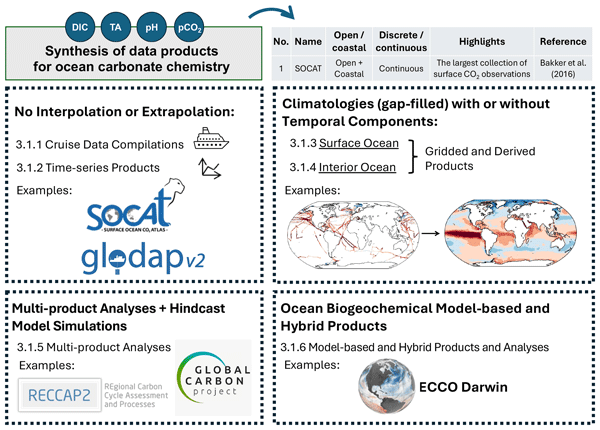
This review article provides an overview of 68 existing ocean carbonate chemistry data products and data product sets, encompassing a broad range of types, including compilations of cruise datasets, gap-filled observational products, model simulations, and more. It is designed to help researchers identify and access the data products that best support their scientific objectives, thereby facilitating progress in understanding the ocean's changing carbonate chemistry.
Letizia Tedesco, Giulia Castellani, Pedro Duarte, Meibing Jin, Sebastien Moreau, Eric Mortenson, Benjamin Tobey Saenz, Nadja Steiner, and Martin Vancoppenolle
The Cryosphere, 20, 723–736, https://doi.org/10.5194/tc-20-723-2026, https://doi.org/10.5194/tc-20-723-2026, 2026
Short summary
Short summary
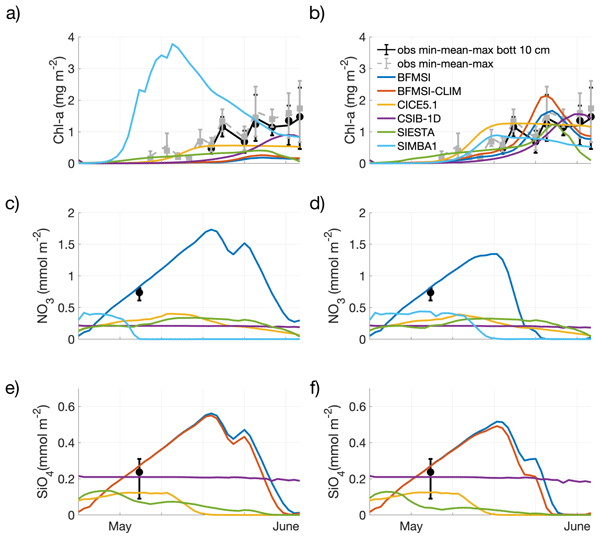
Sea ice hosts tiny algae that support polar marine life, yet their growth remains challenging to simulate. We tested six computer models using data from a 2015 Arctic drifting ice expedition to see how well they reproduced spring algae blooms and nutrient changes. While tuning helped models better match algae growth, nutrients remained difficult to capture. Our results highlight key challenges in representing fragile sea‑ice habitats that are expected to become more common as the Arctic warms.
Xueying Zhang, Enhui Liao, Wenfang Lu, Zelun Wu, Guansuo Wang, Xueming Zhu, and Shiyu Liang
Earth Syst. Sci. Data, 17, 6071–6095, https://doi.org/10.5194/essd-17-6071-2025, https://doi.org/10.5194/essd-17-6071-2025, 2025
Short summary
Short summary
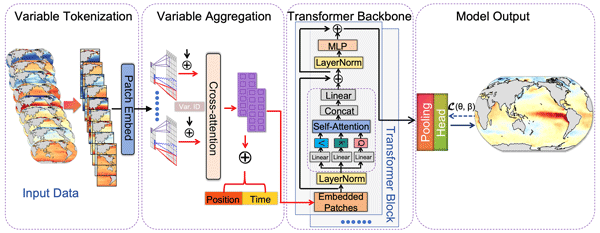
We created a new global dataset that reveals how ocean surface carbon dioxide has changed each month over the past four decades. By applying a deep learning model trained on both observational data and model simulations, we improved the representation of interannual variability and more accurately captured ocean responses to climate events like El Niño. This work supports global efforts to understand the ocean’s role in the carbon cycle and its response to climate change.
Zelun Wu, Wenfang Lu, Alizée Roobaert, Luping Song, Xiao-Hai Yan, and Wei-Jun Cai
Earth Syst. Sci. Data, 17, 43–63, https://doi.org/10.5194/essd-17-43-2025, https://doi.org/10.5194/essd-17-43-2025, 2025
Short summary
Short summary
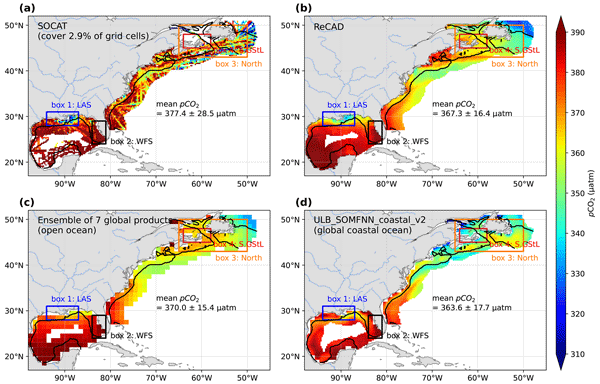
This study addresses the lack of comprehensive sea surface partial pressure of CO2 (pCO2) data in the North American Atlantic Coastal Ocean Margin (NAACOM) by developing the Reconstructed Coastal Acidification Database (ReCAD-NAACOM-pCO2). The product reconstructed sea surface pCO2 from 1993 to 2021 using machine-learning and environmental data, capturing seasonal cycles, regional variations, and long-term trends of pCO2 for coastal carbon research.
Aubin Thibault de Chanvalon, George W. Luther, Emily R. Estes, Jennifer Necker, Bradley M. Tebo, Jianzhong Su, and Wei-Jun Cai
Biogeosciences, 20, 3053–3071, https://doi.org/10.5194/bg-20-3053-2023, https://doi.org/10.5194/bg-20-3053-2023, 2023
Short summary
Short summary
The intensity of the oceanic trap of CO2 released by anthropogenic activities depends on the alkalinity brought by continental weathering. Between ocean and continent, coastal water and estuaries can limit or favour the alkalinity transfer. This study investigate new interactions between dissolved metals and alkalinity in the oxygen-depleted zone of estuaries.
Li-Qing Jiang, Richard A. Feely, Rik Wanninkhof, Dana Greeley, Leticia Barbero, Simone Alin, Brendan R. Carter, Denis Pierrot, Charles Featherstone, James Hooper, Chris Melrose, Natalie Monacci, Jonathan D. Sharp, Shawn Shellito, Yuan-Yuan Xu, Alex Kozyr, Robert H. Byrne, Wei-Jun Cai, Jessica Cross, Gregory C. Johnson, Burke Hales, Chris Langdon, Jeremy Mathis, Joe Salisbury, and David W. Townsend
Earth Syst. Sci. Data, 13, 2777–2799, https://doi.org/10.5194/essd-13-2777-2021, https://doi.org/10.5194/essd-13-2777-2021, 2021
Short summary
Short summary
Coastal ecosystems account for most of the economic activities related to commercial and recreational fisheries and aquaculture industries, supporting about 90 % of the global fisheries yield and 80 % of known species of marine fish. Despite the large potential risks from ocean acidification (OA), internally consistent water column OA data products in the coastal ocean still do not exist. This paper is the first time we report a high quality OA data product in North America's coastal waters.
Cited articles
Alling, V., Porcelli, D., Mörth, C.-M., Anderson, L. G., Sanchez-Garcia, L., Gustafsson, Ö., Andersson, P. S., and Humborg, C.: Degradation of terrestrial organic carbon, primary production and out-gassing of CO2 in the Laptev and East Siberian Seas as inferred from δ13C values of DIC, Geochim. Cosmochim. Ac., 95, 143–159, https://doi.org/10.1016/j.gca.2012.07.028, 2012.
Becker, M., Andersen, N., Erlenkeuser, H., Humphreys, M. P., Tanhua, T., and Körtzinger, A.: An internally consistent dataset of δ13C-DIC in the North Atlantic Ocean – NAC13v1, Earth Syst. Sci. Data, 8, 559–570, https://doi.org/10.5194/essd-8-559-2016, 2016.
Bennington, V., Galjanic, T., and McKinley, G. A.: Explicit Physical Knowledge in Machine Learning for Ocean Carbon Flux Reconstruction: The pCO2 – Residual Method, J. Adv. Model Earth Sy., 14, e2021MS002960, https://doi.org/10.1029/2021MS002960, 2022.
Carter, B. R., Sharp, J. D., Dickson, A. G., Álvarez, M., Fong, M. B., García-Ibáñez, M. I., Woosley, R. J., Takeshita, Y., Barbero, L., Byrne, R. H., Cai, W., Chierici, M., Clegg, S. L., Easley, R. A., Fassbender, A. J., Fleger, K. L., Li, X., Martín-Mayor, M., Schockman, K. M., and Wang, Z. A.: Uncertainty sources for measurable ocean carbonate chemistry variables, Limnol. Oceanogr., 69, 1–21, https://doi.org/10.1002/lno.12477, 2024.
Claret, M., Sonnerup, R. E., and Quay, P. D.: A Next Generation Ocean Carbon Isotope Model for Climate Studies I: Steady State Controls on Ocean 13C, Global Biogeochem. Cy., 35, e2020GB006757, https://doi.org/10.1029/2020GB006757, 2021.
Deng, X., Li, Q., Su, J., Liu, C.-Y., Atekwana, E., and Cai, W.-J.: Performance evaluations and applications of a δ13C-DIC analyzer in seawater and estuarine waters, Sci. Total Environ., 833, 155013, https://doi.org/10.1016/j.scitotenv.2022.155013, 2022.
Eide, M., Olsen, A., Ninnemann, U. S., and Johannessen, T.: A global ocean climatology of preindustrial and modern ocean δ13C, Global Biogeochem. Cy., 31, 515–534, https://doi.org/10.1002/2016GB005473, 2017.
Esposito, M., Achterberg, E. P., Bach, L. T., Connelly, D. P., Riebesell, U., and Taucher, J.: Application of Stable Carbon Isotopes in a Subtropical North Atlantic MesocosmStudy: A New Approach to Assess CO2 Effects on the Marine Carbon Cycle, Front. Mar. Sci., 6, 616, https://doi.org/10.3389/fmars.2019.00616, 2019.
Gao, H., Cai, W., Jin, M., Dong, C., and Timmerman, A. H. V.: Ocean Ventilation Controls the Contrasting Anthropogenic CO2 Uptake Rates Between the Western and Eastern South Atlantic Ocean Basins, Global Biogeochem. Cy., 36, e2021GB007265, https://doi.org/10.1029/2021GB007265, 2022.
Gao, H., Jin, M., Zhao, H., Hussain, N., and Cai, W.: Using DIC-δ13C Pair to Constrain Anthropogenic Carbon Increase in the Southeastern Atlantic Ocean Over the Most Recent Decade (2010–2020), J. Geophys. Res.-Oceans, 129, e2024JC021586, https://doi.org/10.1029/2024JC021586, 2024.
Gao, H., Wu, Z., Sun, Z., Cai, D., Jin, M., and Cai, W.-J.: Reconstruction of δ13CDIC in the Atlantic Ocean, Zenodo [data set], https://doi.org/10.5281/zenodo.16907402, 2025.
Gregor, L. and Gruber, N.: OceanSODA-ETHZ: a global gridded data set of the surface ocean carbonate system for seasonal to decadal studies of ocean acidification, Earth Syst. Sci. Data, 13, 777–808, https://doi.org/10.5194/essd-13-777-2021, 2021.
Gruber, N., Keeling, C. D., Bacastow, R. B., Guenther, P. R., Lueker, T. J., Wahlen, M., Meijer, H. A. J., Mook, W. G., and Stocker, T. F.: Spatiotemporal patterns of carbon-13 in the global surface oceans and the oceanic suess effect, Global Biogeochem. Cy., 13, 307–335, https://doi.org/10.1029/1999GB900019, 1999.
Hughes, I. and Hase, T. P. A.: Measurements and their uncertainties: a practical guide to modern error analysis, New York, Oxford University Press, Oxford, 136 pp., ISBN 9780199566334, E-book ISBN 9780191576560, 2010.
huigao109: huigao109/ReC13_ML: ReC13_ML (v1.0), Zenodo [code], https://doi.org/10.5281/zenodo.19244239, 2026.
Keeling, C. D.: The Suess effect: 13Carbon-14Carbon interrelations, Environ. Int., 2, 229–300, https://doi.org/10.1016/0160-4120(79)90005-9, 1979.
Körtzinger, A., Quay, P. D., and Sonnerup, R. E.: Relationship between anthropogenic CO2 and the 13C Suess effect in the North Atlantic Ocean, Global Biogeochem. Cy., 17, https://doi.org/10.1029/2001GB001427, 2003.
Kroopnick, P.: The distribution of 13C in the Atlantic Ocean, Earth Planet. Sc. Lett., 49, 469–484, https://doi.org/10.1016/0012-821X(80)90088-6, 1980a.
Kroopnick, P.: Isotopic fractionations during oxygen consumption and carbonate dissolution within the North Atlantic Deep Water, Earth Planet. Sc. Lett., 49, 485–498, https://doi.org/10.1016/0012-821X(80)90089-8, 1980b.
Kroopnick, P.: The distribution of 13C of ΣCO2 in the world oceans, Deep-Sea Res. Pt. A, 32, 57–84, https://doi.org/10.1016/0198-0149(85)90017-2, 1985.
Kwon, E. Y., DeVries, T., Galbraith, E. D., Hwang, J., Kim, G., and Timmermann, A.: Stable Carbon Isotopes Suggest Large Terrestrial Carbon Inputs to the Global Ocean, Global Biogeochem. Cy., 35, e2020GB006684, https://doi.org/10.1029/2020GB006684, 2021.
Lauvset, S. K. and Tanhua, T.: A toolbox for secondary quality control on ocean chemistry and hydrographic data, Limnol. Oceanogr. Meth., 13, 601–608, https://doi.org/10.1002/lom3.10050, 2015.
Lauvset, S. K., Key, R. M., Olsen, A., van Heuven, S., Velo, A., Lin, X., Schirnick, C., Kozyr, A., Tanhua, T., Hoppema, M., Jutterström, S., Steinfeldt, R., Jeansson, E., Ishii, M., Perez, F. F., Suzuki, T., and Watelet, S.: A new global interior ocean mapped climatology: the 1° × 1° GLODAP version 2, Earth Syst. Sci. Data, 8, 325–340, https://doi.org/10.5194/essd-8-325-2016, 2016.
Lauvset, S. K., Lange, N., Tanhua, T., Bittig, H. C., Olsen, A., Kozyr, A., Álvarez, M., Azetsu-Scott, K., Brown, P. J., Carter, B. R., Cotrim da Cunha, L., Hoppema, M., Humphreys, M. P., Ishii, M., Jeansson, E., Murata, A., Müller, J. D., Pérez, F. F., Schirnick, C., Steinfeldt, R., Suzuki, T., Ulfsbo, A., Velo, A., Woosley, R. J., and Key, R. M.: The annual update GLODAPv2.2023: the global interior ocean biogeochemical data product, Earth Syst. Sci. Data, 16, 2047–2072, https://doi.org/10.5194/essd-16-2047-2024, 2024.
Lima, I. D., Wang, Z. A., Cameron, L. P., Grabowski, J. H., and Rheuban, J. E.: Predicting Carbonate Chemistry on the Northwest Atlantic Shelf Using Neural Networks, J. Geophys. Res.-Biogeo., 128, e2023JG007536, https://doi.org/10.1029/2023JG007536, 2023.
Liu, B., Six, K. D., and Ilyina, T.: Incorporating the stable carbon isotope 13C in the ocean biogeochemical component of the Max Planck Institute Earth System Model, Biogeosciences, 18, 4389–4429, https://doi.org/10.5194/bg-18-4389-2021, 2021.
Millero, F. J.: Chemical Oceanography, 4th Edn., CRC Press, ISBN 9781466512498, https://doi.org/10.1201/b14753, 2013.
Olsen, A. and Ninnemann, U.: Large δ 13C Gradients in the Preindustrial North Atlantic Revealed, Science, 330, 658–659, https://doi.org/10.1126/science.1193769, 2010.
Olsen, A., Key, R. M., van Heuven, S., Lauvset, S. K., Velo, A., Lin, X., Schirnick, C., Kozyr, A., Tanhua, T., Hoppema, M., Jutterström, S., Steinfeldt, R., Jeansson, E., Ishii, M., Pérez, F. F., and Suzuki, T.: The Global Ocean Data Analysis Project version 2 (GLODAPv2) – an internally consistent data product for the world ocean, Earth Syst. Sci. Data, 8, 297–323, https://doi.org/10.5194/essd-8-297-2016, 2016.
Quay, P.: Organic Matter Export Rates and the Pathways of Nutrient Supply in the Ocean, Global Biogeochem. Cy., 37, e2023GB007855, https://doi.org/10.1029/2023GB007855, 2023.
Quay, P., Sonnerup, R., Westby, T., Stutsman, J., and McNichol, A.: Changes in the 13C/12C of dissolved inorganic carbon in the ocean as a tracer of anthropogenic CO2 uptake, Global Biogeochem. Cy., 17, https://doi.org/10.1029/2001GB001817, 2003.
Quay, P., Sonnerup, R., Stutsman, J., Maurer, J., Körtzinger, A., Padin, X. A., and Robinson, C.: Anthropogenic CO2 accumulation rates in the North Atlantic Ocean from changes in the 13C/12C of dissolved inorganic carbon, Global Biogeochem. Cy., 21, 2006GB002761, https://doi.org/10.1029/2006GB002761, 2007.
Quay, P., Sonnerup, R., Munro, D., and Sweeney, C.: Anthropogenic CO2 accumulation and uptake rates in the Pacific Ocean based on changes in the 13C/12C of dissolved inorganic carbon, Global Biogeochem. Cy., 31, 59–80, https://doi.org/10.1002/2016GB005460, 2017.
Quay, P., Emerson, S., and Palevsky, H.: Regional Pattern of the Ocean's Biological Pump Based on Geochemical Observations, Geophys. Res. Lett., 47, e2020GL088098, https://doi.org/10.1029/2020GL088098, 2020.
Quay, P. D., Tilbrook, B., and Wong, C. S.: Oceanic Uptake of Fossil Fuel CO2: Carbon-13 Evidence, Science, 256, 74–79, https://doi.org/10.1126/science.256.5053.74, 1992.
Quay, P. D., Stutsman, J., Feely, R. A., and Juranek, L. W.: Net community production rates across the subtropical and equatorial Pacific Ocean estimated from air-sea δ13C disequilibrium, Global Biogeochem. Cy., 23, 2008GB003193, https://doi.org/10.1029/2008GB003193, 2009.
Racapé, V., Pierre, C., Metzl, N., Lo Monaco, C., Reverdin, G., Olsen, A., Morin, P., Vázquez-Rodríguez, M., Ríos, A. F., and Pérez, F. F.: Anthropogenic carbon changes in the Irminger Basin (1981–2006): Coupling δ13CDIC and DIC observations, J. Mar. Syst., 126, 24–32, https://doi.org/10.1016/j.jmarsys.2012.12.005, 2013.
Rasmussen, C. E. and Williams, C. K. I.: Gaussian Processes for Machine Learning, MIT Press, Cambridge, Massachusetts, ISBN 9780262182535, https://doi.org/10.7551/mitpress/3206.001.0001, 2006.
Regier, P., Duggan, M., Myers-Pigg, A., and Ward, N.: Effects of random forest modeling decisions on biogeochemical time series predictions, Limnol. Oceanogr. Meth., 21, 40–52, https://doi.org/10.1002/lom3.10523, 2023.
Roobaert, A., Regnier, P., Landschützer, P., and Laruelle, G. G.: A novel sea surface pCO2-product for the global coastal ocean resolving trends over 1982–2020, Earth Syst. Sci. Data, 16, 421–441, https://doi.org/10.5194/essd-16-421-2024, 2024.
Samanta, S., Dalai, T. K., Pattanaik, J. K., Rai, S. K., and Mazumdar, A.: Dissolved inorganic carbon (DIC) and its δ13C in the Ganga (Hooghly) River estuary, India: Evidence of DIC generation via organic carbon degradation and carbonate dissolution, Geochim. Cosmochim. Ac., 165, 226–248, https://doi.org/10.1016/j.gca.2015.05.040, 2015.
Schmittner, A., Gruber, N., Mix, A. C., Key, R. M., Tagliabue, A., and Westberry, T. K.: Biology and air–sea gas exchange controls on the distribution of carbon isotope ratios (δ13C) in the ocean, Biogeosciences, 10, 5793–5816, https://doi.org/10.5194/bg-10-5793-2013, 2013.
Seeger, M.: Gaussian processes for machine learning, Int. J. Neural Syst., 14, 69–106, https://doi.org/10.1142/S0129065704001899, 2004.
Sharp, J. D., Fassbender, A. J., Carter, B. R., Lavin, P. D., and Sutton, A. J.: A monthly surface pCO2 product for the California Current Large Marine Ecosystem, Earth Syst. Sci. Data, 14, 2081–2108, https://doi.org/10.5194/essd-14-2081-2022, 2022.
Silverman, B. W.: Density Estimation for Statistics and Data Analysis, Monographs on Statistics and Applied Probability, Chapman and Hall, London, UK, ISBN 9780412246203, https://doi.org/10.1201/9781315140919, 1986.
Sonnerup, R. E. and Quay, P. D.: 13C constraints on ocean carbon cycle models: 13C IN OCEAN MODELS, Global Biogeochem. Cy., 26, https://doi.org/10.1029/2010GB003980, 2012.
Su, J., Cai, W.-J., Hussain, N., Brodeur, J., Chen, B., and Huang, K.: Simultaneous determination of dissolved inorganic carbon (DIC) concentration and stable isotope (δ13C-DIC) by Cavity Ring-Down Spectroscopy: Application to study carbonate dynamics in the Chesapeake Bay, Mar. Chem., 215, 103689, https://doi.org/10.1016/j.marchem.2019.103689, 2019.
Sun, Z., Li, X., Ouyang, Z., Featherstone, C., Atekwana, E. A., Hussain, N., and Cai, W.: Simultaneous onboard analysis of seawater dissolved inorganic carbon (DIC) concentration and stable isotope ratio (δ13C-DIC), Limnol. Ocean Meth., 22, 862–875, https://doi.org/10.1002/lom3.10642, 2024.
Sun, Z., Gao, H., Dong, B., Hussain, N., Atekwana, E. A., and Cai, W.: High-resolution dataset of stable carbon isotope of dissolved inorganic carbon (δ13C-DIC) from the North Atlantic Ocean, Limnol. Oceanogr. Lett., lol2.70038, https://doi.org/10.1002/lol2.70038, 2025.
Tanhua, T., van Heuven, S., Key, R. M., Velo, A., Olsen, A., and Schirnick, C.: Quality control procedures and methods of the CARINA database, Earth Syst. Sci. Data, 2, 35–49, https://doi.org/10.5194/essd-2-35-2010, 2010.
Taylor, J. R.: An introduction to error analysis: the study of uncertainties in physical measurements, 2nd Edn., University Science Books, Sausalito, Calif, 327 pp., ISBN 9780935702750, 1997.
Wanninkhof, R., Doney, S. C., Bullister, J. L., Levine, N. M., Warner, M., and Gruber, N.: Detecting anthropogenic CO2 changes in the interior Atlantic Ocean between 1989 and 2005, J. Geophys. Res., 115, 2010JC006251, https://doi.org/10.1029/2010JC006251, 2010.
Wu, Z., Lu, W., Roobaert, A., Song, L., Yan, X.-H., and Cai, W.-J.: A machine-learning reconstruction of sea surface pCO2 in the North American Atlantic Coastal Ocean Margin from 1993 to 2021, Earth Syst. Sci. Data, 17, 43–63, https://doi.org/10.5194/essd-17-43-2025, 2025.
Yang, B., Emerson, S. R., and Quay, P. D.: The Subtropical Ocean's Biological Carbon Pump Determined From O2 and DIC/DI 13C Tracers, Geophys. Res. Lett., 46, 5361–5368, https://doi.org/10.1029/2018GL081239, 2019.
Short summary
Observations of stable carbon isotopes in dissolved inorganic carbon are sparse, limiting their potential in carbon cycle studies. We compiled 51 cruises and used a machine learning method trained on 37 cruises that passed secondary quality control to reconstruct isotope values in the Atlantic. The reconstruction expands usable samples from 8,941 to 68,435, reducing noise, filling gaps, preserving decadal trend, and strengthening studies of carbon variability and model validation.
Observations of stable carbon isotopes in dissolved inorganic carbon are sparse, limiting their...
Altmetrics
Final-revised paper
Preprint