Articles | Volume 17, issue 12
https://doi.org/10.5194/essd-17-7079-2025
© Author(s) 2025. This work is distributed under
the Creative Commons Attribution 4.0 License.
the Creative Commons Attribution 4.0 License.
https://doi.org/10.5194/essd-17-7079-2025
© Author(s) 2025. This work is distributed under
the Creative Commons Attribution 4.0 License.
the Creative Commons Attribution 4.0 License.
Data description article
| 
15 Dec 2025
Data description article |
| 15 Dec 2025
| 15 Dec 2025
An observational record of global gridded near-surface air temperature change over land and ocean from 1781
Colin P. Morice
CORRESPONDING AUTHOR

Met Office, Exeter, EX1 3PB, United Kingdom
David I. Berry
National Oceanography Centre, Southampton, SO14 3ZH, United Kingdom
Richard C. Cornes
National Oceanography Centre, Southampton, SO14 3ZH, United Kingdom
Kathryn Cowtan
Department of Chemistry, University of York, York, YO10 5DD, United Kingdom
Thomas Cropper
National Oceanography Centre, Southampton, SO14 3ZH, United Kingdom
Ed Hawkins
Department of Meteorology, National Centre for Atmospheric Science, University of Reading, Reading, United Kingdom
John J. Kennedy
Met Office, Exeter, EX1 3PB, United Kingdom
Timothy J. Osborn
Climatic Research Unit, School of Environmental Sciences, University of East Anglia, Norwich, NR4 7TJ, United Kingdom
Nick A. Rayner
Met Office, Exeter, EX1 3PB, United Kingdom
Beatriz Recinos Rivas
School of Geosciences, University of Edinburgh, Edinburgh, EH9 3JW, United Kingdom
National Oceanography Centre, Southampton, SO14 3ZH, United Kingdom
Andrew P. Schurer
School of Geosciences, University of Edinburgh, Edinburgh, EH9 3JW, United Kingdom
Michael Taylor
Climatic Research Unit, School of Environmental Sciences, University of East Anglia, Norwich, NR4 7TJ, United Kingdom
Praveen R. Teleti
Department of Meteorology, National Centre for Atmospheric Science, University of Reading, Reading, United Kingdom
Emily J. Wallis
Climatic Research Unit, School of Environmental Sciences, University of East Anglia, Norwich, NR4 7TJ, United Kingdom
Jonathan Winn
Met Office, Exeter, EX1 3PB, United Kingdom
Elizabeth C. Kent
National Oceanography Centre, Southampton, SO14 3ZH, United Kingdom
Related authors
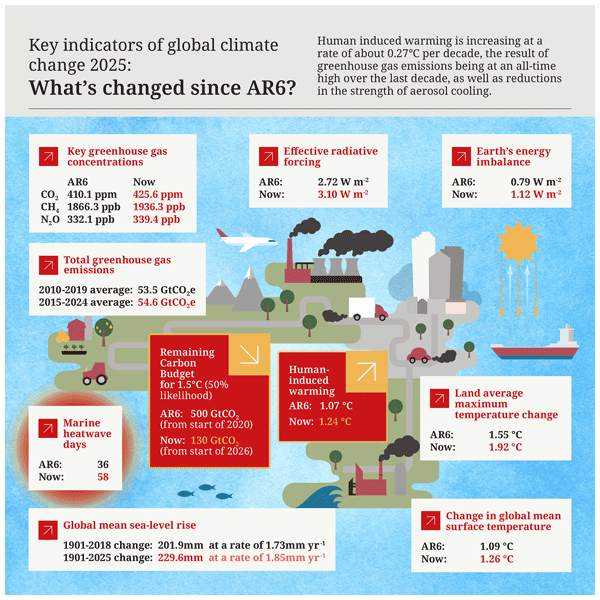
Piers M. Forster, Tristram Walsh, Chris Smith, William F. Lamb, Robin Lamboll, Christophe Cassou, Mathias Hauser, Zeke Hausfather, June-Yi Lee, Matthew D. Palmer, Karina von Schuckmann, Aimée B. A. Slangen, Sophie Szopa, Blair Trewin, Jeongeun Yun, Nathan P. Gillett, Stuart Jenkins, H. Damon Matthews, Krishnan Raghavan, Aurélien Ribes, Joeri Rogelj, Debbie Rosen, Xuebin Zhang, Myles Allen, Robbie M. Andrew, Chris Atkinson, Richard A. Betts, Antonio Bombelli, Samantha N. Burgess, Lijing Cheng, Helen E. Claxton, Pierre Friedlingstein, Thomas L. Frölicher, Catia M. Domingues, Thomas Gasser, Catherine H. Gregory, Rachel M. Hoesly, Daniel Huppmann, Masayoshi Ishii, Christopher Kadow, Alexia Karwat, John Kennedy, Rachel E. Killick, Mahesh V. M. Kovilakam, Paul B. Krummel, Xin Lan, Jean-François Lamarque, Aurélien Liné, Belén Martín-Míguez, Didier P. Monselesan, Colin Morice, Jens Mühle, Pino Mussak, Glen P. Peters, Anna Pirani, Julia Pongratz, Matthew Rigby, Robert Rohde, Abhishek Savita, Sonia I. Seneviratne, Steven J. Smith, Ghassan Taha, Caterina Tassone, Peter Thorne, Christopher Wells, Luke M. Western, Guido R. van der Werf, Susan E. Wijffels, Marco Zecchetto, Junting Zhong, Xiao-Ye Zhang, Valérie Masson-Delmotte, and Panmao Zhai
Earth Syst. Sci. Data, 18, 3889–3933, https://doi.org/10.5194/essd-18-3889-2026, https://doi.org/10.5194/essd-18-3889-2026, 2026
Short summary
Short summary
We give our annual update of key climate indicators. Our work quantifies the human contribution to global warming and the pace of climate change. This represents a large effort by the international community akin to an Intergovernmental Panel on Climate Change (IPCC) report.
Peter W. Thorne, John M. Nicklas, John J. Kennedy, Bruce Calvert, Baylor Fox-Kemper, Mark T. Richardson, Adrian Simmons, Ed Hawkins, Robert Rhode, Kathryn Cowtan, Nerilie J. Abram, Axel Andersson, Simon Noone, Phillipe Marbaix, Nathan Lenssen, Dirk Olonscheck, Tristram Walsh, Stephen Outten, Ingo Bethke, Bjorn H. Samset, Chris Smith, Anna Pirani, Jan Fuglestvedt, Lavanya Rajamani, Richard A. Betts, Elizabeth C. Kent, Blair Trewin, Colin Morice, Tim Osborn, Samantha N. Burgess, Oliver Geden, Andrew Parnell, Piers M. Forster, Chris Hewitt, Zeke Hausfather, Valerie Masson-Delmotte, Jochem Marotzke, Nathan Gillett, Sonia I. Seneviratne, Gavin A. Schmidt, Duo Chan, Stefan Brönnimann, Andy Reisinger, Matthew Menne, Maisa Rojas Corradi, Christopher Kadow, Peter Huybers, David B. Stephenson, Emily Wallis, Joeri Rogelj, Andrew Schurer, Karen McKinnon, Panmao Zhai, Fatima Driouech, Wilfran Moufouma Okia, Saeed Vazifehkhah, Sophie Szopa, Christopher J. Merchant, Shoji Hirahara, Masayoshi Ishii, Francois A. Engelbrecht, Qingxiang Li, June-Yi Lee, Alex J. Cannon, Christophe Cassou, Karina von Schuckmann, Amir H. Delju, and Ellie Murtagh
Earth Syst. Sci. Data Discuss., https://doi.org/10.5194/essd-2025-825, https://doi.org/10.5194/essd-2025-825, 2026
Revised manuscript has not been submitted
Short summary
Short summary
We reassess the basis for determining the present level of long-term global warming. Unbiased estimates of both realised warming and anthropogenic warming are possible that approximate a 20-year retrospective mean. Our resulting estimates of 1.40 [1.23–1.58] °C (realised) and 1.34 [1.18–1.50] °C (anthropogenic) as at end of 2024 highlight the urgency of immediate, far-reaching and sustained climate mitigation actions if we are to meet the long term temperature goal of the Paris Agreement.
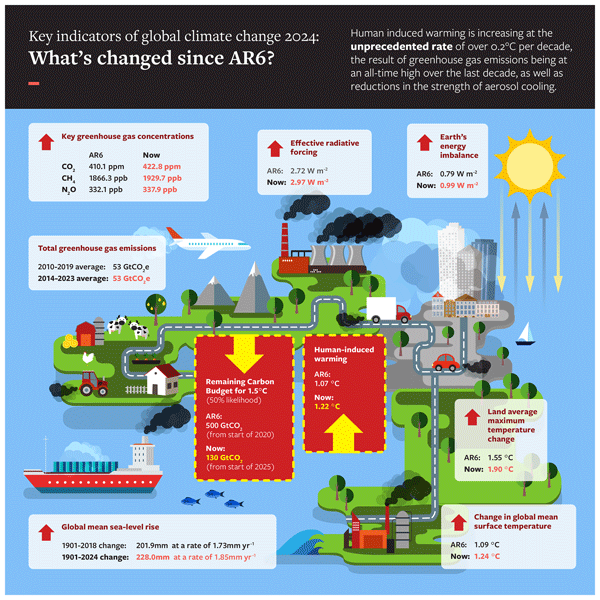
Piers M. Forster, Chris Smith, Tristram Walsh, William F. Lamb, Robin Lamboll, Christophe Cassou, Mathias Hauser, Zeke Hausfather, June-Yi Lee, Matthew D. Palmer, Karina von Schuckmann, Aimée B. A. Slangen, Sophie Szopa, Blair Trewin, Jeongeun Yun, Nathan P. Gillett, Stuart Jenkins, H. Damon Matthews, Krishnan Raghavan, Aurélien Ribes, Joeri Rogelj, Debbie Rosen, Xuebin Zhang, Myles Allen, Lara Aleluia Reis, Robbie M. Andrew, Richard A. Betts, Alex Borger, Jiddu A. Broersma, Samantha N. Burgess, Lijing Cheng, Pierre Friedlingstein, Catia M. Domingues, Marco Gambarini, Thomas Gasser, Johannes Gütschow, Masayoshi Ishii, Christopher Kadow, John Kennedy, Rachel E. Killick, Paul B. Krummel, Aurélien Liné, Didier P. Monselesan, Colin Morice, Jens Mühle, Vaishali Naik, Glen P. Peters, Anna Pirani, Julia Pongratz, Jan C. Minx, Matthew Rigby, Robert Rohde, Abhishek Savita, Sonia I. Seneviratne, Peter Thorne, Christopher Wells, Luke M. Western, Guido R. van der Werf, Susan E. Wijffels, Valérie Masson-Delmotte, and Panmao Zhai
Earth Syst. Sci. Data, 17, 2641–2680, https://doi.org/10.5194/essd-17-2641-2025, https://doi.org/10.5194/essd-17-2641-2025, 2025
Short summary
Short summary
In a rapidly changing climate, evidence-based decision-making benefits from up-to-date and timely information. Here we compile monitoring datasets to track real-world changes over time. To make our work relevant to policymakers, we follow methods from the Intergovernmental Panel on Climate Change (IPCC). Human activities are increasing the Earth's energy imbalance and driving faster sea-level rise compared to the IPCC assessment.
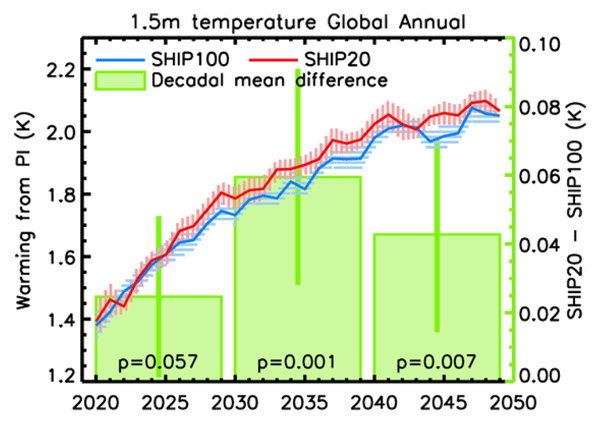
Masaru Yoshioka, Daniel P. Grosvenor, Ben B. B. Booth, Colin P. Morice, and Ken S. Carslaw
Atmos. Chem. Phys., 24, 13681–13692, https://doi.org/10.5194/acp-24-13681-2024, https://doi.org/10.5194/acp-24-13681-2024, 2024
Short summary
Short summary
A 2020 regulation has reduced sulfur emissions from shipping by about 80 %, leading to a decrease in atmospheric aerosols that have a cooling effect primarily by affecting cloud properties and amounts. Our climate model simulations predict a global temperature increase of 0.04 K over the next 3 decades as a result, which could contribute to surpassing the Paris Agreement's 1.5 °C target. Reduced aerosols may have also contributed to the recent temperature spikes.
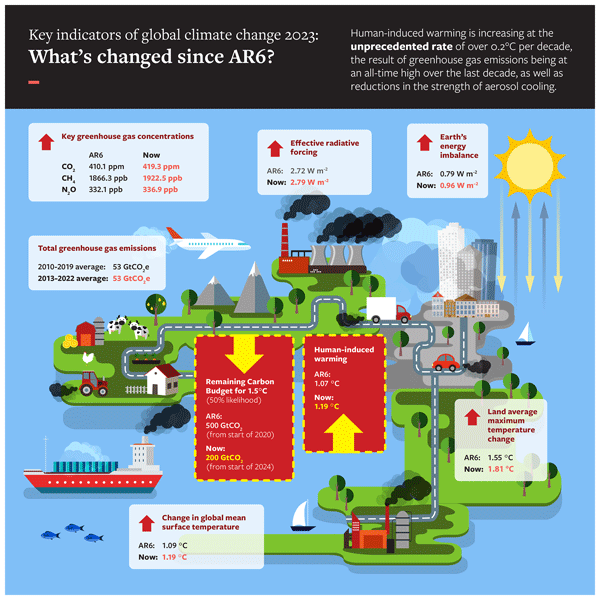
Piers M. Forster, Chris Smith, Tristram Walsh, William F. Lamb, Robin Lamboll, Bradley Hall, Mathias Hauser, Aurélien Ribes, Debbie Rosen, Nathan P. Gillett, Matthew D. Palmer, Joeri Rogelj, Karina von Schuckmann, Blair Trewin, Myles Allen, Robbie Andrew, Richard A. Betts, Alex Borger, Tim Boyer, Jiddu A. Broersma, Carlo Buontempo, Samantha Burgess, Chiara Cagnazzo, Lijing Cheng, Pierre Friedlingstein, Andrew Gettelman, Johannes Gütschow, Masayoshi Ishii, Stuart Jenkins, Xin Lan, Colin Morice, Jens Mühle, Christopher Kadow, John Kennedy, Rachel E. Killick, Paul B. Krummel, Jan C. Minx, Gunnar Myhre, Vaishali Naik, Glen P. Peters, Anna Pirani, Julia Pongratz, Carl-Friedrich Schleussner, Sonia I. Seneviratne, Sophie Szopa, Peter Thorne, Mahesh V. M. Kovilakam, Elisa Majamäki, Jukka-Pekka Jalkanen, Margreet van Marle, Rachel M. Hoesly, Robert Rohde, Dominik Schumacher, Guido van der Werf, Russell Vose, Kirsten Zickfeld, Xuebin Zhang, Valérie Masson-Delmotte, and Panmao Zhai
Earth Syst. Sci. Data, 16, 2625–2658, https://doi.org/10.5194/essd-16-2625-2024, https://doi.org/10.5194/essd-16-2625-2024, 2024
Short summary
Short summary
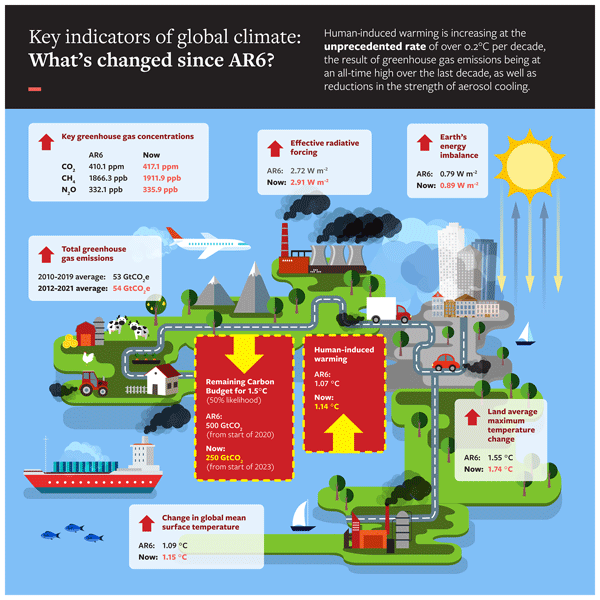
This paper tracks some key indicators of global warming through time, from 1850 through to the end of 2023. It is designed to give an authoritative estimate of global warming to date and its causes. We find that in 2023, global warming reached 1.3 °C and is increasing at over 0.2 °C per decade. This is caused by all-time-high greenhouse gas emissions.
Piers M. Forster, Christopher J. Smith, Tristram Walsh, William F. Lamb, Robin Lamboll, Mathias Hauser, Aurélien Ribes, Debbie Rosen, Nathan Gillett, Matthew D. Palmer, Joeri Rogelj, Karina von Schuckmann, Sonia I. Seneviratne, Blair Trewin, Xuebin Zhang, Myles Allen, Robbie Andrew, Arlene Birt, Alex Borger, Tim Boyer, Jiddu A. Broersma, Lijing Cheng, Frank Dentener, Pierre Friedlingstein, José M. Gutiérrez, Johannes Gütschow, Bradley Hall, Masayoshi Ishii, Stuart Jenkins, Xin Lan, June-Yi Lee, Colin Morice, Christopher Kadow, John Kennedy, Rachel Killick, Jan C. Minx, Vaishali Naik, Glen P. Peters, Anna Pirani, Julia Pongratz, Carl-Friedrich Schleussner, Sophie Szopa, Peter Thorne, Robert Rohde, Maisa Rojas Corradi, Dominik Schumacher, Russell Vose, Kirsten Zickfeld, Valérie Masson-Delmotte, and Panmao Zhai
Earth Syst. Sci. Data, 15, 2295–2327, https://doi.org/10.5194/essd-15-2295-2023, https://doi.org/10.5194/essd-15-2295-2023, 2023
Short summary
Short summary
This is a critical decade for climate action, but there is no annual tracking of the level of human-induced warming. We build on the Intergovernmental Panel on Climate Change assessment reports that are authoritative but published infrequently to create a set of key global climate indicators that can be tracked through time. Our hope is that this becomes an important annual publication that policymakers, media, scientists and the public can refer to.
Derrick Muheki, Koen Hufkens, Kim Jacobsen, Hans Verbeeck, Pascal Boeckx, Dominique Kankonde Ntumba, Olivier Kapalay Moulasa, Bas Vercruysse, Julie M. Birkholz, Christophe Verbruggen, Ed Hawkins, Seppe Lampe, Emmanuel Kasongo Yakusu, Fils Makanzu Imwangana, José Mbifo, Théophile Besango Likwela, Félicien Meunier, Olivier Dewitte, Peter Thorne, and Wim Thiery
Earth Syst. Dynam., 17, 1455–1511, https://doi.org/10.5194/esd-17-1455-2026, https://doi.org/10.5194/esd-17-1455-2026, 2026
Short summary
Short summary
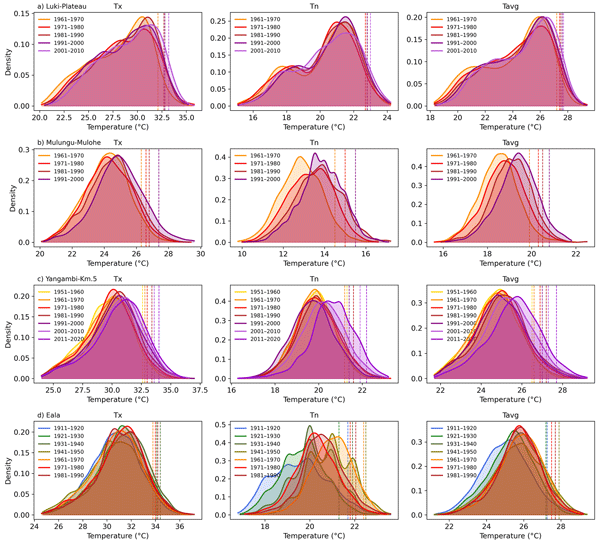
The Congo Basin is one of the least studied regions for climate change due to limited accessible data, despite large volumes of historical records stored on paper in archives. In this study, we digitised over 9000 sheets from 37 stations in the Democratic Republic of the Congo, producing more than one million daily weather observations. The results show clear warming since the 1960s, with more hot days and fewer cold days, highlighting the importance of data rescue in data-sparse regions.
Rhidian Thomas, Gilbert P. Compo, Steve George, Gabriele C. Hegerl, Andrew Schurer, Theodore G. Shepherd, Laura C. Slivinski, Vikki Thompson, and Ed Hawkins
Earth Syst. Dynam., 17, 1365–1380, https://doi.org/10.5194/esd-17-1365-2026, https://doi.org/10.5194/esd-17-1365-2026, 2026
Short summary
Short summary
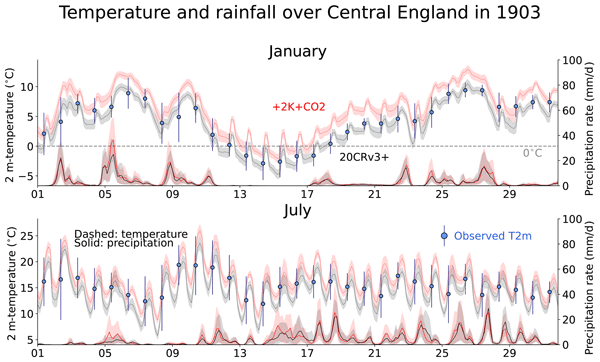
We explore how our day-to-day experience of the weather may change in a warmer world. We compare weather model experiments that share the same weather patterns, but have different levels of CO2 and ocean surface warming. In the warmer experiments, the biggest temperature changes occur on the coldest and hottest days. Daily swings in rainfall become larger, and we see fewer drizzly days and more days with heavy rain. This illustrates the impact of climate change on our day-to-day weather.
Vikki Thompson, Erin Coughlan de Perez, Dorothy Heinrich, Karin van der Wiel, Ed Hawkins, and Andrew Schurer
EGUsphere, https://doi.org/10.5194/egusphere-2026-4100, https://doi.org/10.5194/egusphere-2026-4100, 2026
Short summary
Short summary
Extreme rainfall often cause severe impacts to society including loss of life and damage to property. Places with more recent extreme events or more extreme records may be better prepared for extreme rainfall. Assessing daily rainfall records across Europe, we show where may be better prepared and highlight cities that may be less ready. Sofia, Barcelona, Munich, and Amsterdam are highlighted as at risk. Tailored adaptation policies can ensure readiness for the next extreme rainfall events.
Piers M. Forster, Tristram Walsh, Chris Smith, William F. Lamb, Robin Lamboll, Christophe Cassou, Mathias Hauser, Zeke Hausfather, June-Yi Lee, Matthew D. Palmer, Karina von Schuckmann, Aimée B. A. Slangen, Sophie Szopa, Blair Trewin, Jeongeun Yun, Nathan P. Gillett, Stuart Jenkins, H. Damon Matthews, Krishnan Raghavan, Aurélien Ribes, Joeri Rogelj, Debbie Rosen, Xuebin Zhang, Myles Allen, Robbie M. Andrew, Chris Atkinson, Richard A. Betts, Antonio Bombelli, Samantha N. Burgess, Lijing Cheng, Helen E. Claxton, Pierre Friedlingstein, Thomas L. Frölicher, Catia M. Domingues, Thomas Gasser, Catherine H. Gregory, Rachel M. Hoesly, Daniel Huppmann, Masayoshi Ishii, Christopher Kadow, Alexia Karwat, John Kennedy, Rachel E. Killick, Mahesh V. M. Kovilakam, Paul B. Krummel, Xin Lan, Jean-François Lamarque, Aurélien Liné, Belén Martín-Míguez, Didier P. Monselesan, Colin Morice, Jens Mühle, Pino Mussak, Glen P. Peters, Anna Pirani, Julia Pongratz, Matthew Rigby, Robert Rohde, Abhishek Savita, Sonia I. Seneviratne, Steven J. Smith, Ghassan Taha, Caterina Tassone, Peter Thorne, Christopher Wells, Luke M. Western, Guido R. van der Werf, Susan E. Wijffels, Marco Zecchetto, Junting Zhong, Xiao-Ye Zhang, Valérie Masson-Delmotte, and Panmao Zhai
Earth Syst. Sci. Data, 18, 3889–3933, https://doi.org/10.5194/essd-18-3889-2026, https://doi.org/10.5194/essd-18-3889-2026, 2026
Short summary
Short summary
We give our annual update of key climate indicators. Our work quantifies the human contribution to global warming and the pace of climate change. This represents a large effort by the international community akin to an Intergovernmental Panel on Climate Change (IPCC) report.
Andrea Rivosecchi, Andrea Dittus, Ed Hawkins, Reinhard Schiemann, and Erich Fischer
EGUsphere, https://doi.org/10.5194/egusphere-2026-1733, https://doi.org/10.5194/egusphere-2026-1733, 2026
Short summary
Short summary
We analysed 250-year global temperature trends under zero CO2 emissions in the UK Earth System Model. Stopping emissions while global temperatures remain below +2 °C limits the post-net-zero mean surface warming. Annual hot extremes cool regionally after zero emissions in the midlatitudes, due to the expansion of evergreen vegetation. However, in this framework vegetation change is largely unconstrained by modern land-use changes, highlighting a potential limitation of idealised model protocols.
Qianyu Zha, Yi He, Timothy J. Osborn, and Nicole Forstenhäusler
Hydrol. Earth Syst. Sci., 30, 2395–2415, https://doi.org/10.5194/hess-30-2395-2026, https://doi.org/10.5194/hess-30-2395-2026, 2026
Short summary
Short summary
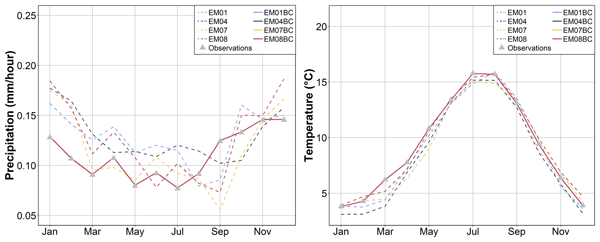
We apply and evaluate a statistical method to adjust biases in high-resolution climate projections for England. By comparing modelled rainfall and temperature with observations, we show that the adjusted projections agree much more closely with real conditions for both average patterns and extremes, providing a more reliable basis for high-resolution impact modelling and assessments that depend on hourly precipitation data.
Derrick Muheki, Bas Vercruysse, Krishna Kumar Thirukokaranam Chandrasekar, Christophe Verbruggen, Julie M. Birkholz, Koen Hufkens, Hans Verbeeck, Pascal Boeckx, Seppe Lampe, Ed Hawkins, Peter Thorne, Dominique Kankonde Ntumba, Olivier Kapalay Moulasa, and Wim Thiery
Geosci. Model Dev., 19, 3213–3255, https://doi.org/10.5194/gmd-19-3213-2026, https://doi.org/10.5194/gmd-19-3213-2026, 2026
Short summary
Short summary
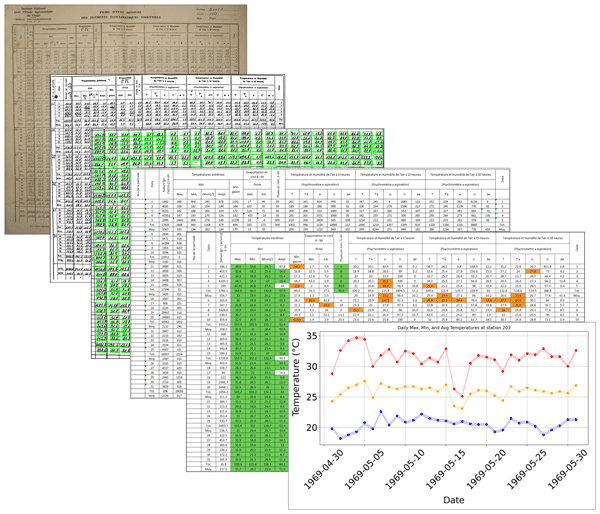
Archives worldwide host vast records of observed weather data crucial for understanding climate variability. However, most of these records are still in paper form, limiting their use. To address this, we developed MeteoSaver, an open-source tool, to transcribe these records to machine-readable format. Applied to ten handwritten temperature sheets, it achieved a median accuracy of 74 %. This tool offers a promising solution to preserve records from archives and unlock historical weather insights.
Yongyao Liang, Ed Hawkins, Gerard McCarthy, and Peter Thorne
EGUsphere, https://doi.org/10.5194/egusphere-2026-699, https://doi.org/10.5194/egusphere-2026-699, 2026
Short summary
Short summary
Using novel climate simulations and historical temperature estimates, we separated natural climate fluctuations from externally driven influences. We find that the timing of long-term temperature swings since the mid-nineteenth century is mainly controlled by external factors, while natural variability mostly affects their strength. We also show that biases in early temperature estimates can complicate interpretation of Atlantic Multidecadal Variability.
Archie Cable, Thomas Caton Harrison, Elizabeth Kent, Richard Cornes, and Thomas J. Bracegirdle
Weather Clim. Dynam., 7, 247–262, https://doi.org/10.5194/wcd-7-247-2026, https://doi.org/10.5194/wcd-7-247-2026, 2026
Short summary
Short summary
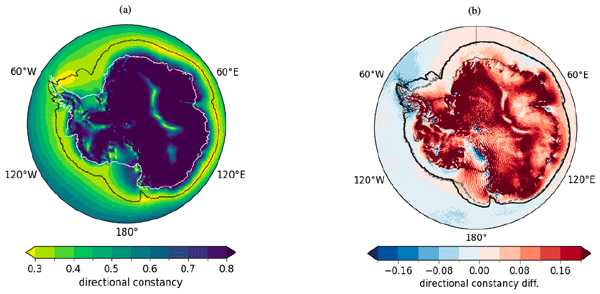
Winds around the Antarctic coast have global importance. With influences from competing drivers, their structure is complex so it is hard to understand how they will change in the future. We develop a simple measure that identifies key features in the coastal winds, including their northern extent. Using climate models, we analyse future projections of this boundary and find that it will shift polewards, shrinking the Antarctic coastal wind region.
Peter W. Thorne, John M. Nicklas, John J. Kennedy, Bruce Calvert, Baylor Fox-Kemper, Mark T. Richardson, Adrian Simmons, Ed Hawkins, Robert Rhode, Kathryn Cowtan, Nerilie J. Abram, Axel Andersson, Simon Noone, Phillipe Marbaix, Nathan Lenssen, Dirk Olonscheck, Tristram Walsh, Stephen Outten, Ingo Bethke, Bjorn H. Samset, Chris Smith, Anna Pirani, Jan Fuglestvedt, Lavanya Rajamani, Richard A. Betts, Elizabeth C. Kent, Blair Trewin, Colin Morice, Tim Osborn, Samantha N. Burgess, Oliver Geden, Andrew Parnell, Piers M. Forster, Chris Hewitt, Zeke Hausfather, Valerie Masson-Delmotte, Jochem Marotzke, Nathan Gillett, Sonia I. Seneviratne, Gavin A. Schmidt, Duo Chan, Stefan Brönnimann, Andy Reisinger, Matthew Menne, Maisa Rojas Corradi, Christopher Kadow, Peter Huybers, David B. Stephenson, Emily Wallis, Joeri Rogelj, Andrew Schurer, Karen McKinnon, Panmao Zhai, Fatima Driouech, Wilfran Moufouma Okia, Saeed Vazifehkhah, Sophie Szopa, Christopher J. Merchant, Shoji Hirahara, Masayoshi Ishii, Francois A. Engelbrecht, Qingxiang Li, June-Yi Lee, Alex J. Cannon, Christophe Cassou, Karina von Schuckmann, Amir H. Delju, and Ellie Murtagh
Earth Syst. Sci. Data Discuss., https://doi.org/10.5194/essd-2025-825, https://doi.org/10.5194/essd-2025-825, 2026
Revised manuscript has not been submitted
Short summary
Short summary
We reassess the basis for determining the present level of long-term global warming. Unbiased estimates of both realised warming and anthropogenic warming are possible that approximate a 20-year retrospective mean. Our resulting estimates of 1.40 [1.23–1.58] °C (realised) and 1.34 [1.18–1.50] °C (anthropogenic) as at end of 2024 highlight the urgency of immediate, far-reaching and sustained climate mitigation actions if we are to meet the long term temperature goal of the Paris Agreement.
Hamish D. Pritchard, Edward C. King, David J. Goodger, Douglas Boyle, Daniel N. Goldberg, Beatriz Recinos, Andrew Orr, and Dhananjay Regmi
Earth Syst. Sci. Data, 18, 199–217, https://doi.org/10.5194/essd-18-199-2026, https://doi.org/10.5194/essd-18-199-2026, 2026
Short summary
Short summary
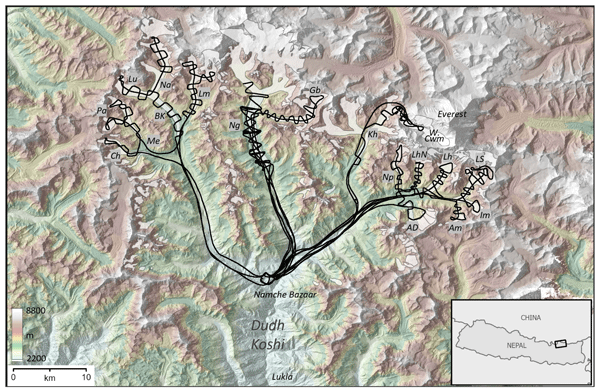
We present a new and uniquely extensive dataset of glacier thickness from the Khumbu Himal around Mount Everest that stretches for 119 km, doubling the extent of thickness measurements in High Mountain Asia. Such measurements are key inputs for models that estimate how much ice is stored on the whole mountain range scale and for models that predict how this ice reserve will change in future, and what impact this will have on water supply for the large populations living downstream.
Kirsty J. Pringle, Richard Rigby, Steven T. Turnock, Carly L. Reddington, Meruyert Shayakhmetova, Malcolm Illingworth, Denis Barclay, Neil Chue Hong, Ed Hawkins, Douglas S. Hamilton, Ethan Brain, and James B. McQuaid
Geosci. Commun., 8, 229–236, https://doi.org/10.5194/gc-8-229-2025, https://doi.org/10.5194/gc-8-229-2025, 2025
Short summary
Short summary
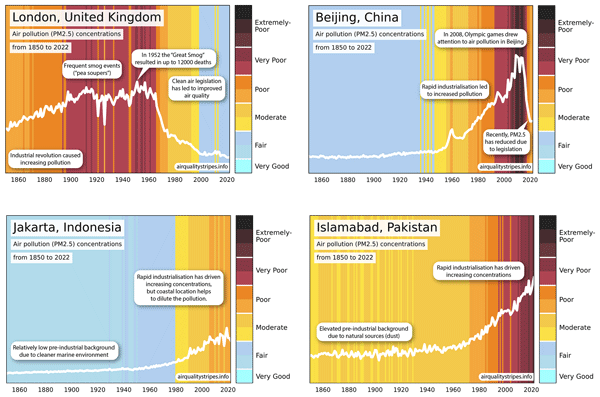
The Air Quality Stripes images visualise historical changes in particulate matter air pollution in over 150 cities worldwide. The project celebrates significant improvements in air quality in regions like Europe, North America, and China while highlighting the urgent need for action in areas such as central Asia. Designed to raise awareness, the images aim to inspire discussions about the critical impact of air pollution and the global inequalities it causes.
Piers M. Forster, Chris Smith, Tristram Walsh, William F. Lamb, Robin Lamboll, Christophe Cassou, Mathias Hauser, Zeke Hausfather, June-Yi Lee, Matthew D. Palmer, Karina von Schuckmann, Aimée B. A. Slangen, Sophie Szopa, Blair Trewin, Jeongeun Yun, Nathan P. Gillett, Stuart Jenkins, H. Damon Matthews, Krishnan Raghavan, Aurélien Ribes, Joeri Rogelj, Debbie Rosen, Xuebin Zhang, Myles Allen, Lara Aleluia Reis, Robbie M. Andrew, Richard A. Betts, Alex Borger, Jiddu A. Broersma, Samantha N. Burgess, Lijing Cheng, Pierre Friedlingstein, Catia M. Domingues, Marco Gambarini, Thomas Gasser, Johannes Gütschow, Masayoshi Ishii, Christopher Kadow, John Kennedy, Rachel E. Killick, Paul B. Krummel, Aurélien Liné, Didier P. Monselesan, Colin Morice, Jens Mühle, Vaishali Naik, Glen P. Peters, Anna Pirani, Julia Pongratz, Jan C. Minx, Matthew Rigby, Robert Rohde, Abhishek Savita, Sonia I. Seneviratne, Peter Thorne, Christopher Wells, Luke M. Western, Guido R. van der Werf, Susan E. Wijffels, Valérie Masson-Delmotte, and Panmao Zhai
Earth Syst. Sci. Data, 17, 2641–2680, https://doi.org/10.5194/essd-17-2641-2025, https://doi.org/10.5194/essd-17-2641-2025, 2025
Short summary
Short summary
In a rapidly changing climate, evidence-based decision-making benefits from up-to-date and timely information. Here we compile monitoring datasets to track real-world changes over time. To make our work relevant to policymakers, we follow methods from the Intergovernmental Panel on Climate Change (IPCC). Human activities are increasing the Earth's energy imbalance and driving faster sea-level rise compared to the IPCC assessment.
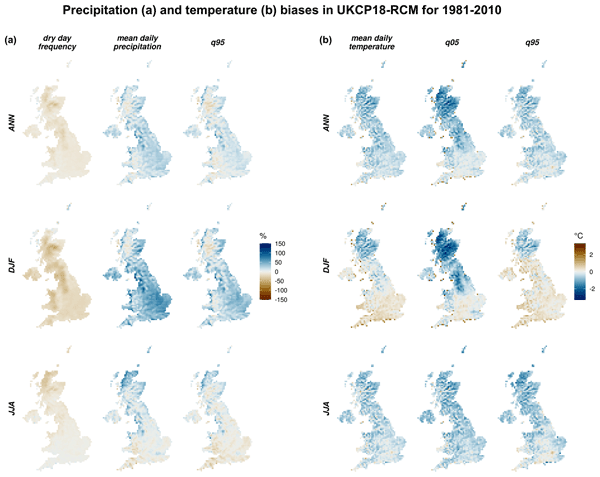
Nele Reyniers, Qianyu Zha, Nans Addor, Timothy J. Osborn, Nicole Forstenhäusler, and Yi He
Earth Syst. Sci. Data, 17, 2113–2133, https://doi.org/10.5194/essd-17-2113-2025, https://doi.org/10.5194/essd-17-2113-2025, 2025
Short summary
Short summary
We present bias-corrected UK Climate Projections 2018 (UKCP18) regional datasets for temperature, precipitation, and potential evapotranspiration (1981–2080). All 12 members of the 12 km ensemble were corrected using quantile mapping and a change-preserving variant. Both methods effectively reduce biases in multiple statistics while maintaining projected climatic changes. We provide guidance on using the bias-corrected datasets for climate change impact assessment.

Lauren R. Marshall, Anja Schmidt, Andrew P. Schurer, Nathan Luke Abraham, Lucie J. Lücke, Rob Wilson, Kevin J. Anchukaitis, Gabriele C. Hegerl, Ben Johnson, Bette L. Otto-Bliesner, Esther C. Brady, Myriam Khodri, and Kohei Yoshida
Clim. Past, 21, 161–184, https://doi.org/10.5194/cp-21-161-2025, https://doi.org/10.5194/cp-21-161-2025, 2025
Short summary
Short summary
Large volcanic eruptions have caused temperature deviations over the past 1000 years; however, climate model results and reconstructions of surface cooling using tree rings do not match. We explore this mismatch using the latest models and find a better match to tree-ring reconstructions for some eruptions. Our results show that the way in which eruptions are simulated in models matters for the comparison to tree-rings, particularly regarding the spatial spread of volcanic aerosol.
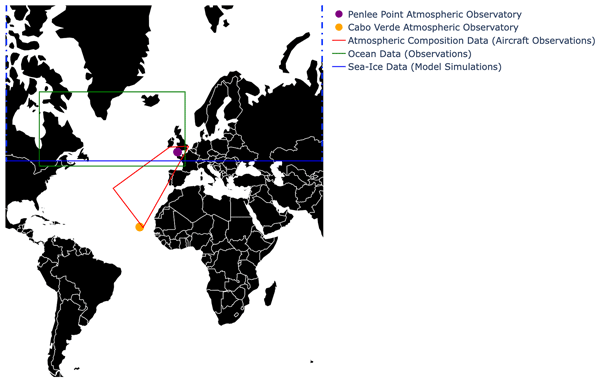
Alex T. Archibald, Bablu Sinha, Maria R. Russo, Emily Matthews, Freya A. Squires, N. Luke Abraham, Stephane J.-B. Bauguitte, Thomas J. Bannan, Thomas G. Bell, David Berry, Lucy J. Carpenter, Hugh Coe, Andrew Coward, Peter Edwards, Daniel Feltham, Dwayne Heard, Jim Hopkins, James Keeble, Elizabeth C. Kent, Brian A. King, Isobel R. Lawrence, James Lee, Claire R. Macintosh, Alex Megann, Bengamin I. Moat, Katie Read, Chris Reed, Malcolm J. Roberts, Reinhard Schiemann, David Schroeder, Timothy J. Smyth, Loren Temple, Navaneeth Thamban, Lisa Whalley, Simon Williams, Huihui Wu, and Mingxi Yang
Earth Syst. Sci. Data, 17, 135–164, https://doi.org/10.5194/essd-17-135-2025, https://doi.org/10.5194/essd-17-135-2025, 2025
Short summary
Short summary
Here, we present an overview of the data generated as part of the North Atlantic Climate System Integrated Study (ACSIS) programme that are available through dedicated repositories at the Centre for Environmental Data Analysis (CEDA; www.ceda.ac.uk) and the British Oceanographic Data Centre (BODC; bodc.ac.uk). The datasets described here cover the North Atlantic Ocean, the atmosphere above (it including its composition), and Arctic sea ice.
Masaru Yoshioka, Daniel P. Grosvenor, Ben B. B. Booth, Colin P. Morice, and Ken S. Carslaw
Atmos. Chem. Phys., 24, 13681–13692, https://doi.org/10.5194/acp-24-13681-2024, https://doi.org/10.5194/acp-24-13681-2024, 2024
Short summary
Short summary
A 2020 regulation has reduced sulfur emissions from shipping by about 80 %, leading to a decrease in atmospheric aerosols that have a cooling effect primarily by affecting cloud properties and amounts. Our climate model simulations predict a global temperature increase of 0.04 K over the next 3 decades as a result, which could contribute to surpassing the Paris Agreement's 1.5 °C target. Reduced aerosols may have also contributed to the recent temperature spikes.
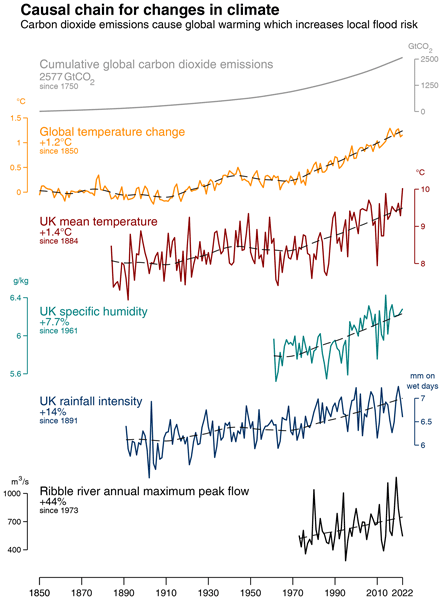
Ed Hawkins, Nigel Arnell, Jamie Hannaford, and Rowan Sutton
Geosci. Commun., 7, 161–165, https://doi.org/10.5194/gc-7-161-2024, https://doi.org/10.5194/gc-7-161-2024, 2024
Short summary
Short summary
Climate change can often seem rather remote, especially when the discussion is about global averages which appear to have little relevance to local experiences. But those global changes are already affecting people, even if they do not fully realise it, and effective communication of this issue is critical. We use long observations and well-understood physical principles to visually highlight how global emissions influence local flood risk in one river basin in the UK.
Piers M. Forster, Chris Smith, Tristram Walsh, William F. Lamb, Robin Lamboll, Bradley Hall, Mathias Hauser, Aurélien Ribes, Debbie Rosen, Nathan P. Gillett, Matthew D. Palmer, Joeri Rogelj, Karina von Schuckmann, Blair Trewin, Myles Allen, Robbie Andrew, Richard A. Betts, Alex Borger, Tim Boyer, Jiddu A. Broersma, Carlo Buontempo, Samantha Burgess, Chiara Cagnazzo, Lijing Cheng, Pierre Friedlingstein, Andrew Gettelman, Johannes Gütschow, Masayoshi Ishii, Stuart Jenkins, Xin Lan, Colin Morice, Jens Mühle, Christopher Kadow, John Kennedy, Rachel E. Killick, Paul B. Krummel, Jan C. Minx, Gunnar Myhre, Vaishali Naik, Glen P. Peters, Anna Pirani, Julia Pongratz, Carl-Friedrich Schleussner, Sonia I. Seneviratne, Sophie Szopa, Peter Thorne, Mahesh V. M. Kovilakam, Elisa Majamäki, Jukka-Pekka Jalkanen, Margreet van Marle, Rachel M. Hoesly, Robert Rohde, Dominik Schumacher, Guido van der Werf, Russell Vose, Kirsten Zickfeld, Xuebin Zhang, Valérie Masson-Delmotte, and Panmao Zhai
Earth Syst. Sci. Data, 16, 2625–2658, https://doi.org/10.5194/essd-16-2625-2024, https://doi.org/10.5194/essd-16-2625-2024, 2024
Short summary
Short summary
This paper tracks some key indicators of global warming through time, from 1850 through to the end of 2023. It is designed to give an authoritative estimate of global warming to date and its causes. We find that in 2023, global warming reached 1.3 °C and is increasing at over 0.2 °C per decade. This is caused by all-time-high greenhouse gas emissions.
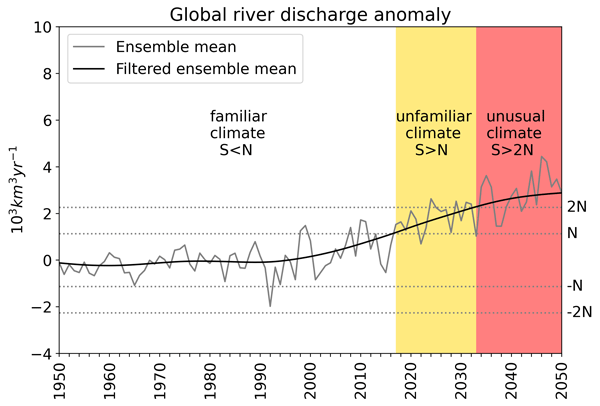
Omar V. Müller, Patrick C. McGuire, Pier Luigi Vidale, and Ed Hawkins
Hydrol. Earth Syst. Sci., 28, 2179–2201, https://doi.org/10.5194/hess-28-2179-2024, https://doi.org/10.5194/hess-28-2179-2024, 2024
Short summary
Short summary
This work evaluates how rivers are projected to change in the near future compared to the recent past in the context of a warming world. We show that important rivers of the world will notably change their flows, mainly during peaks, exceeding the variations that rivers used to exhibit. Such large changes may produce more frequent floods, alter hydropower generation, and potentially affect the ocean's circulation.
Ed Hawkins, Gilbert P. Compo, and Prashant D. Sardeshmukh
Earth Syst. Dynam., 14, 1081–1084, https://doi.org/10.5194/esd-14-1081-2023, https://doi.org/10.5194/esd-14-1081-2023, 2023
Short summary
Short summary
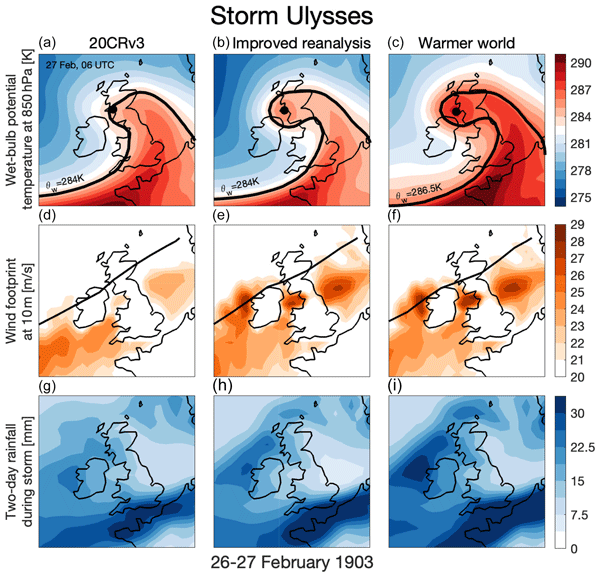
Adapting to climate change requires an understanding of how extreme weather events are changing. We propose a new approach to examine how the consequences of a particular weather pattern have been made worse by climate change, using an example of a severe windstorm that occurred in 1903. When this storm is translated into a warmer world, it produces higher wind speeds and increased rainfall, suggesting that this storm would be more damaging if it occurred today rather than 120 years ago.
Beatriz Recinos, Daniel Goldberg, James R. Maddison, and Joe Todd
The Cryosphere, 17, 4241–4266, https://doi.org/10.5194/tc-17-4241-2023, https://doi.org/10.5194/tc-17-4241-2023, 2023
Short summary
Short summary
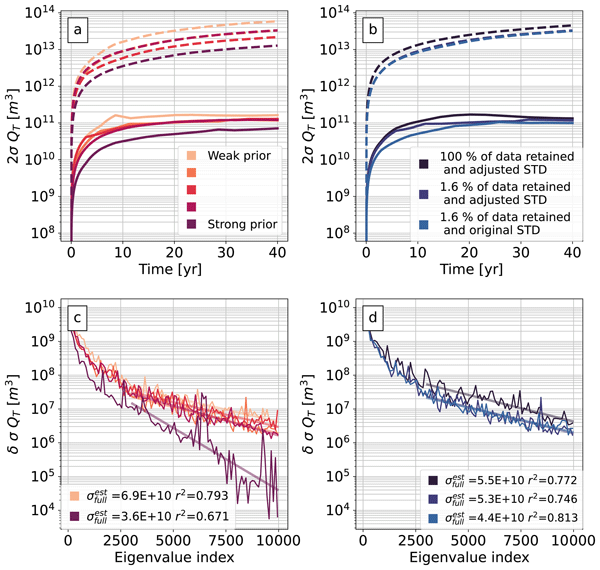
Ice sheet models generate forecasts of ice sheet mass loss, a significant contributor to sea level rise; thus, capturing the complete range of possible projections of mass loss is of critical societal importance. Here we add to data assimilation techniques commonly used in ice sheet modelling (a Bayesian inference approach) and fully characterize calibration uncertainty. We successfully propagate this type of error onto sea level rise projections of three ice streams in West Antarctica.
Piers M. Forster, Christopher J. Smith, Tristram Walsh, William F. Lamb, Robin Lamboll, Mathias Hauser, Aurélien Ribes, Debbie Rosen, Nathan Gillett, Matthew D. Palmer, Joeri Rogelj, Karina von Schuckmann, Sonia I. Seneviratne, Blair Trewin, Xuebin Zhang, Myles Allen, Robbie Andrew, Arlene Birt, Alex Borger, Tim Boyer, Jiddu A. Broersma, Lijing Cheng, Frank Dentener, Pierre Friedlingstein, José M. Gutiérrez, Johannes Gütschow, Bradley Hall, Masayoshi Ishii, Stuart Jenkins, Xin Lan, June-Yi Lee, Colin Morice, Christopher Kadow, John Kennedy, Rachel Killick, Jan C. Minx, Vaishali Naik, Glen P. Peters, Anna Pirani, Julia Pongratz, Carl-Friedrich Schleussner, Sophie Szopa, Peter Thorne, Robert Rohde, Maisa Rojas Corradi, Dominik Schumacher, Russell Vose, Kirsten Zickfeld, Valérie Masson-Delmotte, and Panmao Zhai
Earth Syst. Sci. Data, 15, 2295–2327, https://doi.org/10.5194/essd-15-2295-2023, https://doi.org/10.5194/essd-15-2295-2023, 2023
Short summary
Short summary
This is a critical decade for climate action, but there is no annual tracking of the level of human-induced warming. We build on the Intergovernmental Panel on Climate Change assessment reports that are authoritative but published infrequently to create a set of key global climate indicators that can be tracked through time. Our hope is that this becomes an important annual publication that policymakers, media, scientists and the public can refer to.
Lucie J. Lücke, Andrew P. Schurer, Matthew Toohey, Lauren R. Marshall, and Gabriele C. Hegerl
Clim. Past, 19, 959–978, https://doi.org/10.5194/cp-19-959-2023, https://doi.org/10.5194/cp-19-959-2023, 2023
Short summary
Short summary
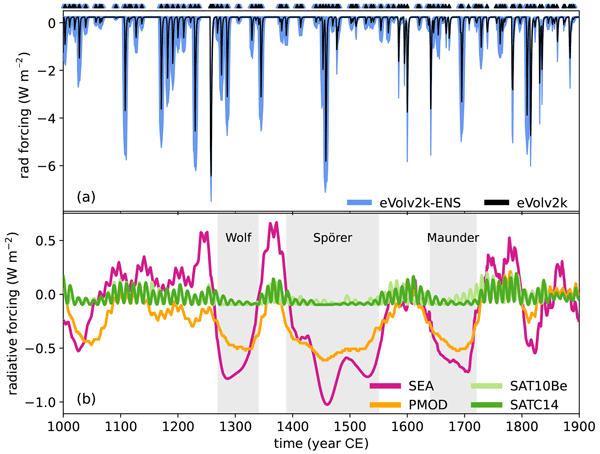
Evidence from tree rings and ice cores provides incomplete information about past volcanic eruptions and the Sun's activity. We model past climate with varying solar and volcanic scenarios and compare it to reconstructed temperature. We confirm that the Sun's influence was small and that uncertain volcanic activity can strongly influence temperature shortly after the eruption. On long timescales, independent data sources closely agree, increasing our confidence in understanding of past climate.

Andrew P. Schurer, Gabriele C. Hegerl, Hugues Goosse, Massimo A. Bollasina, Matthew H. England, Michael J. Mineter, Doug M. Smith, and Simon F. B. Tett
Clim. Past, 19, 943–957, https://doi.org/10.5194/cp-19-943-2023, https://doi.org/10.5194/cp-19-943-2023, 2023
Short summary
Short summary
We adopt an existing data assimilation technique to constrain a model simulation to follow three important modes of variability, the North Atlantic Oscillation, El Niño–Southern Oscillation and the Southern Annular Mode. How it compares to the observed climate is evaluated, with improvements over simulations without data assimilation found over many regions, particularly the tropics, the North Atlantic and Europe, and discrepancies with global cooling following volcanic eruptions are reconciled.
Ed Hawkins, Philip Brohan, Samantha N. Burgess, Stephen Burt, Gilbert P. Compo, Suzanne L. Gray, Ivan D. Haigh, Hans Hersbach, Kiki Kuijjer, Oscar Martínez-Alvarado, Chesley McColl, Andrew P. Schurer, Laura Slivinski, and Joanne Williams
Nat. Hazards Earth Syst. Sci., 23, 1465–1482, https://doi.org/10.5194/nhess-23-1465-2023, https://doi.org/10.5194/nhess-23-1465-2023, 2023
Short summary
Short summary
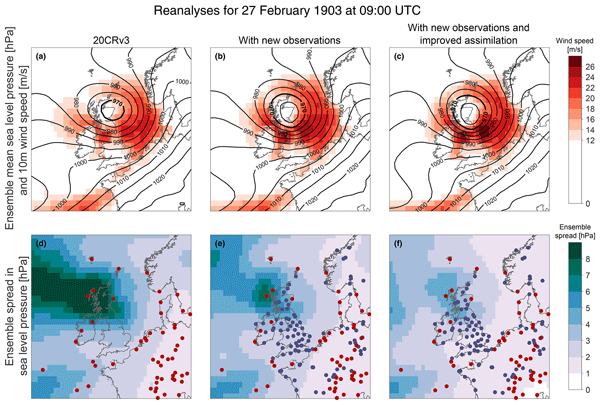
We examine a severe windstorm that occurred in February 1903 and caused significant damage in the UK and Ireland. Using newly digitized weather observations from the time of the storm, combined with a modern weather forecast model, allows us to determine why this storm caused so much damage. We demonstrate that the event is one of the most severe windstorms to affect this region since detailed records began. The approach establishes a new tool to improve assessments of risk from extreme weather.
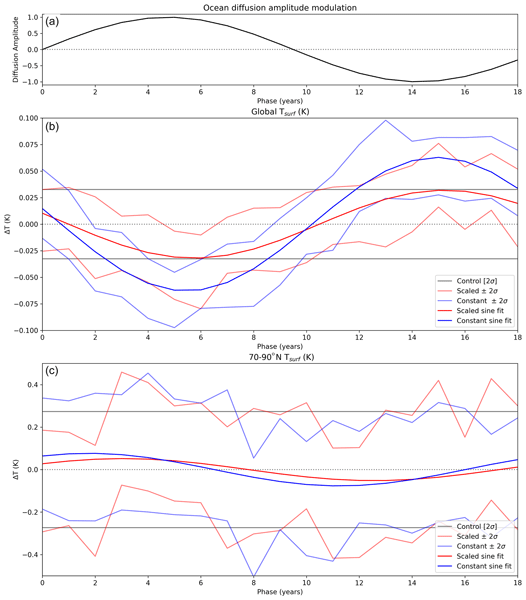
Manoj Joshi, Robert A. Hall, David P. Stevens, and Ed Hawkins
Earth Syst. Dynam., 14, 443–455, https://doi.org/10.5194/esd-14-443-2023, https://doi.org/10.5194/esd-14-443-2023, 2023
Short summary
Short summary
The 18.6-year lunar nodal cycle arises from variations in the angle of the Moon's orbital plane and affects ocean tides. In this work we use a climate model to examine the effect of this cycle on the ocean, surface, and atmosphere. The timing of anomalies is consistent with the so-called slowdown in global warming and has implications for when global temperatures will exceed 1.5 ℃ above pre-industrial levels. Regional anomalies have implications for seasonal climate areas such as Europe.
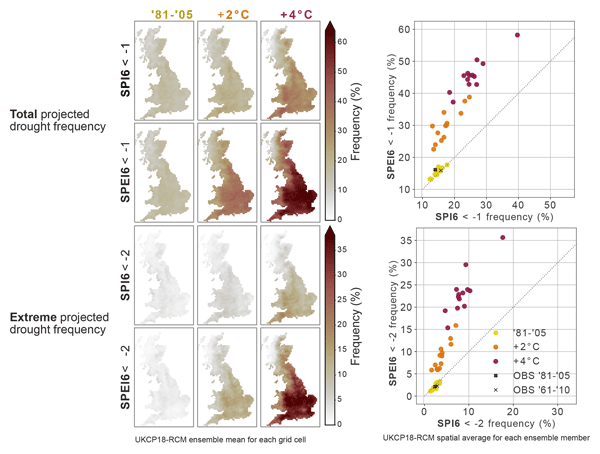
Nele Reyniers, Timothy J. Osborn, Nans Addor, and Geoff Darch
Hydrol. Earth Syst. Sci., 27, 1151–1171, https://doi.org/10.5194/hess-27-1151-2023, https://doi.org/10.5194/hess-27-1151-2023, 2023
Short summary
Short summary
In an analysis of future drought projections for Great Britain based on the Standardised Precipitation Index and the Standardised Precipitation Evapotranspiration Index, we show that the choice of drought indicator has a decisive influence on the resulting projected changes in drought characteristics, although both result in increased drying. This highlights the need to understand the interplay between increasing atmospheric evaporative demand and drought impacts under a changing climate.

Jörg Franke, Michael N. Evans, Andrew Schurer, and Gabriele C. Hegerl
Clim. Past, 18, 2583–2597, https://doi.org/10.5194/cp-18-2583-2022, https://doi.org/10.5194/cp-18-2583-2022, 2022
Short summary
Short summary
Detection and attribution is a statistical method to evaluate if external factors or random variability have caused climatic changes. We use for the first time a comparison of simulated and observed tree-ring width that circumvents many limitations of previous studies relying on climate reconstructions. We attribute variability in temperature-limited trees to strong volcanic eruptions and for the first time detect a spatial pattern in the growth of moisture-sensitive trees after eruptions.
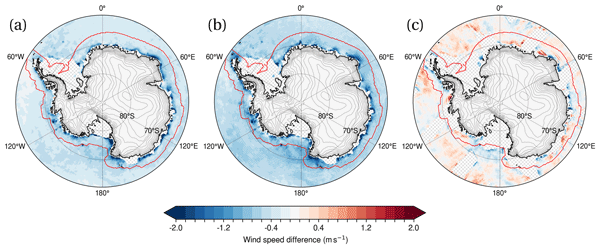
Thomas Caton Harrison, Stavroula Biri, Thomas J. Bracegirdle, John C. King, Elizabeth C. Kent, Étienne Vignon, and John Turner
Weather Clim. Dynam., 3, 1415–1437, https://doi.org/10.5194/wcd-3-1415-2022, https://doi.org/10.5194/wcd-3-1415-2022, 2022
Short summary
Short summary
Easterly winds encircle Antarctica, impacting sea ice and helping drive ocean currents which shield ice shelves from warmer waters. Reanalysis datasets give us our most complete picture of how these winds behave. In this paper we use satellite data, surface measurements and weather balloons to test how realistic recent reanalysis estimates are. The winds are generally accurate, especially in the most recent of the datasets, but important short-term variations are often misrepresented.
Cited articles
Anchukaitis, K. J. and Smerdon, J. E.: Progress and uncertainties in global and hemispheric temperature reconstructions of the Common Era, Quaternary Sci. Rev., 286, 107537, https://doi.org/10.1016/j.quascirev.2022.107537, 2022. a, b
Ashcroft, L., Gergis, J., and Karoly, D. J.: A historical climate dataset for southeastern Australia, 1788–1859, Geosci. Data J., 1, 158–178, https://doi.org/10.1002/gdj3.19, 2014. a
Berry, D. I. and Kent, E. C.: Air–Sea fluxes from ICOADS: the construction of a new gridded dataset with uncertainty estimates, Int. J. Climatol., 31, 987–1001, https://doi.org/10.1002/joc.2059, 2011. a
Berry, D. I. and Kent, E. C.: Assessing the health of the in situ global surface marine climate observing system, Int. J. Climatol., 37, 2248–2259, https://doi.org/10.1002/joc.4914, 2016. a
Berry, D. I., Kent, E. C., and Taylor, P. K.: An Analytical Model of Heating Errors in Marine Air Temperatures from Ships, J. Atmos. Ocean. Tech., 21, 1198–1215, https://doi.org/10.1175/1520-0426(2004)021<1198:aamohe>2.0.co;2, 2004. a, b, c
Biri, S., Cornes, R. C., Berry, D. I., Kent, E. C., and Yelland, M. J.: AirSeaFluxCode: Open-source software for calculating turbulent air-sea fluxes from meteorological parameters, Front. Mar. Sci., 9, 1049168, https://doi.org/10.3389/fmars.2022.1049168, 2023. a
Böhm, R., Jones, P. D., Hiebl, J., Frank, D., Brunetti, M., and Maugeri, M.: The early instrumental warm-bias: a solution for long central European temperature series 1760–2007, Climatic Change, 101, 41–67, https://doi.org/10.1007/s10584-009-9649-4, 2009. a
Bottomley, M., Folland, C. K., Hsiung, J., Newell, R. E., and Parker, D. E.: Global Ocean Surface Temperature Atlas (GOSTA), Meteorological Office (Bracknell) and Massachusetts Institute of Technology, 1990. a
Brohan, P., Kennedy, J. J., Harris, I., Tett, S. F. B., and Jones, P. D.: Uncertainty estimates in regional and global observed temperature changes: A new data set from 1850, J. Geophys. Res.-Atmos., 111, D12106, https://doi.org/10.1029/2005jd006548, 2006. a, b
Brohan, P., Allan, R., Freeman, J. E., Waple, A. M., Wheeler, D., Wilkinson, C., and Woodruff, S.: Marine Observations of Old Weather, B. Am. Meteorol. Soc., 90, 219–230, https://doi.org/10.1175/2008bams2522.1, 2009. a
Brönnimann, S., Brugnara, Y., Allan, R. J., Brunet, M., Compo, G. P., Crouthamel, R. I., Jones, P. D., Jourdain, S., Luterbacher, J., Siegmund, P., Valente, M. A., and Wilkinson, C. W.: A roadmap to climate data rescue services, Geosci. Data J., 5, 28–39, https://doi.org/10.1002/gdj3.56, 2018. a
Brönnimann, S., Franke, J., Nussbaumer, S. U., Zumbühl, H. J., Steiner, D., Trachsel, M., Hegerl, G. C., Schurer, A., Worni, M., Malik, A., Flückiger, J., and Raible, C. C.: Last phase of the Little Ice Age forced by volcanic eruptions, Nat. Geosci., 12, 650–656, https://doi.org/10.1038/s41561-019-0402-y, 2019. a
Brunet, M., Saladié, O., Jones, P., Sigró, J., Aguilar, E., Moberg, A., Lister, D., Walther, A., Lopez, D., and Almarza, C.: The development of a new dataset of Spanish Daily Adjusted Temperature Series (SDATS) (1850–2003), Int. J. Climatol., 26, 1777–1802, https://doi.org/10.1002/joc.1338, 2006. a
Brunet, M., Asin, J., Sigró, J., Bañón, M., García, F., Aguilar, E., Palenzuela, J. E., Peterson, T. C., and Jones, P.: The minimization of the screen bias from ancient Western Mediterranean air temperature records: an exploratory statistical analysis, Int. J. Climatol., 31, 1879–1895, https://doi.org/10.1002/joc.2192, 2011. a
Chan, D. and Huybers, P.: Correcting Observational Biases in Sea Surface Temperature Observations Removes Anomalous Warmth during World War II, J. Climate, 34, 4585–4602, https://doi.org/10.1175/JCLI-D-20-0907.1, 2021. a
Chan, D., Kent, E. C., Berry, D. I., and Huybers, P.: Correcting datasets leads to more homogeneous early-twentieth-century sea surface warming, Nature, 571, 393–397, 2019. a
Chan, D., Gebbie, G., Huybers, P., and Kent, E.: DCENT: Dynamically Consistent ENsemble of Temperature at the earth surface, Harvard Dataverse, V2 [data set], https://doi.org/10.7910/DVN/NU4UGW, 2024.
Cornes, R., Berry, D., Junod, R., Kent, E. C., and Rayner, N.: Sidebar 2.1. Night marine air temperature [in “State of the Climate in 2020”], B. Am. Meteorol. Soc., 102, S39–S41, https://doi.org/10.1175/BAMS-D-21-0098.1, 2021. a
Cornes, R. C., Kent, E. C., Berry, D. I., and Kennedy, J. J.: CLASSnmat: monthly, global, gridded night marine air temperature data, Centre for Environmental Data Analysis [data set], https://catalogue.ceda.ac.uk/uuid/5bbf48b128bd488dbb10a56111feb36a (last access: 13 June 2023), 2020b. a
Cornes, R. C., Cropper, T., and Kent, E.: CLASSnmat version 2: monthly, global, gridded night marine air temperature data, NERC EDS Centre for Environmental Data Analysis [data set], https://doi.org/10.5285/306246329ae04eb3b2299446d911530a, 2025a. a, b
Cornes, R. C., Cropper, T., and Kent, E.: GloSATMAT: monthly, global, gridded marine air temperature data, NERC EDS Centre for Environmental Data Analysis [data set], https://doi.org/10.5285/e6251bf935304cfbb9c9269dc7757a35, 2025b. a, b
Cowtan, K. and Way, R. G.: Coverage bias in the HadCRUT4 temperature series and its impact on recent temperature trends, Q. J. Roy. Meteor. Soc., 140, 1935–1944, https://doi.org/10.1002/qj.2297, 2014. a
Cowtan, K., Hausfather, Z., Hawkins, E., Jacobs, P., Mann, M. E., Miller, S. K., Steinman, B. A., Stolpe, M. B., and Way, R. G.: Robust comparison of climate models with observations using blended land air and ocean sea surface temperatures, Geophys. Res. Lett., 42, 6526–6534, https://doi.org/10.1002/2015gl064888, 2015. a, b
Folland, C. K., Rayner, N. A., Brown, S. J., Smith, T. M., Shen, S. S. P., Parker, D. E., Macadam, I., Jones, P. D., Jones, R. N., Nicholls, N., and Sexton, D. M. H.: Global temperature change and its uncertainties since 1861, Geophys. Res. Lett., 28, 2621–2624, https://doi.org/10.1029/2001gl012877, 2001. a
Freeman, E., Woodruff, S. D., Worley, S. J., Lubker, S. J., Kent, E. C., Angel, W. E., Berry, D. I., Brohan, P., Eastman, R., Gates, L., Gloeden, W., Ji, Z., Lawrimore, J., Rayner, N. A., Rosenhagen, G., and Smith, S. R.: ICOADS Release 3.0: a major update to the historical marine climate record, Int. J. Climatol., 37, 2211–2232, https://doi.org/10.1002/joc.4775, 2017. a, b
Gulev, S. K., Thorne, P. W., Ahn, J., Dentener, F. J., Domingues, C. M., Gerland, S., Gong, D., Kaufman, D. S., Nnamchi, H. C., Quaas, J., Rivera, J. A., Sathyendranath, S., Smith, S. L., Trewin, B., von Schuckmann, K., and Vose, R. S.: Changing State of the Climate System, Cambridge University Press, Cambridge, United Kingdom and New York, NY, USA, 287–422, https://doi.org/10.1017/9781009157896.004, 2021. a, b, c, d, e, f
Hegerl, G. C., Brönnimann, S., Schurer, A., and Cowan, T.: The early 20th century warming: Anomalies, causes, and consequences, WIREs Clim. Change, 9, e522, https://doi.org/10.1002/wcc.522, 2018. a
Huang, B., Thorne, P. W., Banzon, V. F., Boyer, T., Chepurin, G., Lawrimore, J. H., Menne, M. J., Smith, T. M., Vose, R. S., and Zhang, H.-M.: Extended Reconstructed Sea Surface Temperature, Version 5 (ERSSTv5): Upgrades, Validations, and Intercomparisons, J. Climate, 30, 8179–8205, https://doi.org/10.1175/jcli-d-16-0836.1, 2017. a
Huang, B., Yin, X., Menne, M. J., Vose, R., and Zhang, H.-M.: Improvements to the Land Surface Air Temperature Reconstruction in NOAAGlobalTemp: An Artificial Neural Network Approach, Artificial Intelligence for the Earth Systems, 1, e220032, https://doi.org/10.1175/aies-d-22-0032.1, 2022. a, b
Huang, B., Yin, X., Menne, M. J., Vose, R. S., and Zhang, H.-M.: NOAA Global Surface Temperature Dataset (NOAAGlobalTemp), Version 6.0, NOAA National Centers for Environmental Information [data set], https://doi.org/10.25921/rzxg-p717, 2024. a
Huang, B., Yin, X., Boyer, T., Liu, C., Menne, M., Rao, Y. D., Smith, T., Vose, R., and Zhang, H.-M.: Extended Reconstructed Sea Surface Temperature, Version 6 (ERSSTv6). Part I: An Artificial Neural Network Approach, J. Climate, 38, 1105–1121, https://doi.org/10.1175/JCLI-D-23-0707.1, 2025a. a, b
Huang, B., Yin, X., Boyer, T., Liu, C., Menne, M., Rao, Y. D., Smith, T., Vose, R., and Zhang, H.-M.: Extended Reconstructed Sea Surface Temperature, Version 6 (ERSSTv6). Part II: Upgrades on Quality Control and Large-Scale Filter, J. Climate, 38, 1123–1136, https://doi.org/10.1175/JCLI-D-24-0185.1, 2025b. a, b
Ishii, M., Nishimura, A., Yasui, S., and Hirahara, S.: Historical High-Resolution Daily SST Analysis (COBE-SST3) with Consistency to Monthly Land Surface Air Temperature, J. Meteorol. Soc. Jpn. Ser. II, 103, 17–44, https://doi.org/10.2151/jmsj.2025-002, 2025. a, b, c, d
Jones, G. S.: “Apples and Oranges”: On comparing simulated historic near-surface temperature changes with observations, Q. J. Roy. Meteor. Soc., 146, 3747–3771, https://doi.org/10.1002/qj.3871, 2020. a
Jones, P. D. and Moberg, A.: Hemispheric and Large-Scale Surface Air Temperature Variations: An Extensive Revision and an Update to 2001, J. Climate, 16, 206–223, https://doi.org/10.1175/1520-0442(2003)016<0206:halssa>2.0.co;2, 2003. a
Jones, P. D., New, M., Parker, D. E., Martin, S., and Rigor, I. G.: Surface air temperature and its changes over the past 150 years, Rev. Geophys., 37, 173–199, https://doi.org/10.1029/1999rg900002, 1999. a
Jones, P. D., Lister, D. H., Osborn, T. J., Harpham, C., Salmon, M., and Morice, C. P.: Hemispheric and large-scale land-surface air temperature variations: An extensive revision and an update to 2010, J. Geophys. Res.-Atmos., 117, D05127, https://doi.org/10.1029/2011jd017139, 2012. a
Junod, R. A. and Christy, J. R.: A new compilation of globally gridded night-time marine air temperatures: The UAHNMATv1 dataset, Int. J. Climatol., 40, 2609–2623, https://doi.org/10.1002/joc.6354, 2020. a, b, c
Kadow, C., Hall, D. M., and Ulbrich, U.: Artificial intelligence reconstructs missing climate information, Nat. Geosci., 13, 408–413, https://doi.org/10.1038/s41561-020-0582-5, 2020. a, b, c
Kennedy, J. J., Rayner, N. A., Atkinson, C. P., and Killick, R. E.: An Ensemble Data Set of Sea Surface Temperature Change From 1850: The Met Office Hadley Centre HadSST.4.0.0.0 Data Set, J. Geophys. Res.-Atmos., 124, 7719–7763, https://doi.org/10.1029/2018jd029867, 2019. a, b, c
Kent, E. C., Woodruff, S. D., and Berry, D. I.: Metadata from WMO Publication No. 47 and an Assessment of Voluntary Observing Ship Observation Heights in ICOADS, J. Atmos. Ocean. Tech., 24, 214–234, https://doi.org/10.1175/jtech1949.1, 2007. a
Kent, E. C., Rayner, N. A., Berry, D. I., Saunby, M., Moat, B. I., Kennedy, J. J., and Parker, D. E.: Global analysis of night marine air temperature and its uncertainty since 1880: The HadNMAT2 data set, J. Geophys. Res.-Atmos., 118, 1281–1298, https://doi.org/10.1002/jgrd.50152, 2013. a, b, c, d, e
Kent, E. C., Rayner, N. A., Berry, D. I., Eastman, R., Grigorieva, V. G., Huang, B., Kennedy, J. J., Smith, S. R., and Willett, K. M.: Observing Requirements for Long-Term Climate Records at the Ocean Surface, Frontiers in Marine Science, 6, 441, https://doi.org/10.3389/fmars.2019.00441, 2019. a
Lenssen, N. J. L., Schmidt, G. A., Hansen, J. E., Menne, M. J., Persin, A., Ruedy, R., and Zyss, D.: Improvements in the GISTEMP Uncertainty Model, J. Geophys. Res.-Atmos., 124, 6307–6326, https://doi.org/10.1029/2018jd029522, 2019. a, b
Li, Q., Sun, W., Yun, X., Huang, B., Dong, W., Wang, X. L., Zhai, P., and Jones, P.: An updated evaluation of the global mean land surface air temperature and surface temperature trends based on CLSAT and CMST, Clim. Dynam., 56, 635–650, https://doi.org/10.1007/s00382-020-05502-0, 2021. a, b, c
Luterbacher, J., Allan, R., Wilkinson, C., Hawkins, E., Teleti, P., Lorrey, A., Brönnimann, S., Hechler, P., Velikou, K., and Xoplaki, E.: The Importance and Scientific Value of Long Weather and Climate Records; Examples of Historical Marine Data Efforts across the Globe, Climate, 12, 39, https://doi.org/10.3390/cli12030039, 2024. a
Menne, M. J. and Williams, C. N.: Homogenization of Temperature Series via Pairwise Comparisons, J. Climate, 22, 1700–1717, https://doi.org/10.1175/2008jcli2263.1, 2009. a
Menne, M. J., Williams, C. N., Gleason, B. E., Rennie, J. J., and Lawrimore, J. H.: The Global Historical Climatology Network Monthly Temperature Dataset, Version 4, J. Climate, 31, 9835–9854, https://doi.org/10.1175/jcli-d-18-0094.1, 2018. a
Meuer, J., Plésiat, E., Inoue, N., Witte, M., Seitz, S., and Kadow, C.: FREVA-CLINT/climatereconstructionAI: v1.0.3b, Zenodo [data set], https://doi.org/10.5281/zenodo.11262704, 2024. a
Morice, C. P., Kennedy, J. J., Rayner, N. A., and Jones, P. D.: Quantifying uncertainties in global and regional temperature change using an ensemble of observational estimates: The HadCRUT4 data set, J. Geophys. Res.-Atmos., 117, D08101, https://doi.org/10.1029/2011jd017187, 2012. a, b, c, d, e, f, g, h, i, j, k, l, m
Morice, C. P., Kennedy, J. J., Rayner, N. A., Winn, J. P., Hogan, E., Killick, R. E., Dunn, R. J. H., Osborn, T. J., Jones, P. D., and Simpson, I. R.: An Updated Assessment of Near-Surface Temperature Change From 1850: The HadCRUT5 Data Set, J. Geophys. Res.-Atmos., 126, e2019JD032361, https://doi.org/10.1029/2019jd032361, 2021. a, b, c, d, e, f, g, h, i, j, k, l
Morice, C. P., Berry, D. I., Cornes, R. C., Cowtan, K., Cropper, T., Hawkins, E., Kennedy, J. J., Osborn, T., Rayner, N. A., Rivas, B. R., Schurer, A., Taylor, M., Teleti, P. R., Wallis, E. J., Winn, J. P., and Kent, E. C.: GloSATLAT.1.0.0.0 [data set]: An observational record of global surface air temperature change over land from 1781, NERC EDS Centre for Environmental Data Analysis, https://doi.org/10.5285/ef237f578329487eb02fb42f9db56bb2, 2025a. a, b
Morice, C. P., Berry, D. I., Cornes, R. C., Cowtan, K., Cropper, T., Hawkins, E., Kennedy, J. J., Osborn, T., Rayner, N. A., Rivas, B. R., Schurer, A., Taylor, M., Teleti, P. R., Wallis, E. J., Winn, J. P., and Kent, E. C.: GloSATref.1.0.0.0: An observational record of global gridded near surface air temperature change over land and ocean from 1781, NERC EDS Centre for Environmental Data Analysis [data set], https://doi.org/10.5285/a2519624a593402a83246bd359d098be, 2025b. a, b
Naylor, S.: Thermometer screens and the geographies of uniformity in nineteenth-century meteorology, Notes Rec., 73, 203–221, https://doi.org/10.1098/rsnr.2018.0037, 2018. a
Neukom, R., Barboza, L. A., Erb, M. P., Shi, F., Emile-Geay, J., Evans, M. N., Franke, J., Kaufman, D. S., Lücke, L., Rehfeld, K., Schurer, A. P., Zhu, F., Brönnimann, S., Hakim, G. J., Henley, B. J., Ljungqvist, F. C., McKay, N. P., Valler, V., and von Gunten, L.: NOAA/WDS Paleoclimatology – PAGES2k Common Era Surface Temperature Reconstructions, NOAA National Centers for Environmental Information [data set], https://doi.org/10.25921/tkxp-vn12, 2019. a
Osborn, T. J., Jones, P. D., Lister, D. H., Morice, C. P., Simpson, I. R., Winn, J. P., Hogan, E., and Harris, I. C.: Land Surface Air Temperature Variations Across the Globe Updated to 2019: The CRUTEM5 Data Set, J. Geophys. Res.-Atmos., 126, e2019JD032352, https://doi.org/10.1029/2019jd032352, 2021. a, b, c, d, e, f, g, h, i
PAGES2k: Consistent multidecadal variability in global temperature reconstructions and simulations over the Common Era, Nat. Geosci., 12, 643–649, https://doi.org/10.1038/s41561-019-0400-0, 2019. a, b, c
Parker, D. E.: Effects of changing exposure of thermometers at land stations, Int. J. Climatol., 14, 1–31, https://doi.org/10.1002/joc.3370140102, 1994. a
Rayner, N. A., Parker, D. E., Horton, E. B., Folland, C. K., Alexander, L. V., Rowell, D. P., Kent, E. C., and Kaplan, A.: Global analyses of sea surface temperature, sea ice, and night marine air temperature since the late nineteenth century, J. Geophys. Res.-Atmos., 108, 4407, https://doi.org/10.1029/2002jd002670, 2003. a, b
Richardson, M., Cowtan, K., and Millar, R. J.: Global temperature definition affects achievement of long-term climate goals, Environ. Res. Lett., 13, 054004, https://doi.org/10.1088/1748-9326/aab305, 2018. a, b
Richardson, M. T.: A Physical Explanation for Ocean Air–Water Warming Differences under CO2-Forced Warming, J. Climate, 36, 2857–2871, https://doi.org/10.1175/jcli-d-22-0215.1, 2023. a, b
Rohde, R., Muller, R., Jacobsen, R., Muller, E., Perlmutter, S., Rosenfeld, A., Wurtel, J., Groom, D., and Wickham, C.: A New Estimate of the Average Earth Surface Land Temperature Spanning 1753 to 2011, Geoinformatics & Geostatistics: An Overview, 1, 1, https://doi.org/10.4172/2327-4581.1000101, 2013a. a, b
Rohde, R., Muller, R., Jacobsen, R., Perlmutter, S., and Mosher, S.: Berkeley Earth Temperature Averaging Process, Geoinformatics & Geostatistics: An Overview, 1, 2, https://doi.org/10.4172/2327-4581.1000103, 2013b. a, b
Rohde, R. A. and Hausfather, Z.: The Berkeley Earth Land/Ocean Temperature Record, Earth Syst. Sci. Data, 12, 3469–3479, https://doi.org/10.5194/essd-12-3469-2020, 2020. a, b
Sippel, S., Kent, E. C., Meinshausen, N., Chan, D., Kadow, C., Neukom, R., Fischer, E. M., Humphrey, V., Rohde, R., de Vries, I., and Knutti, R.: Early-twentieth-century cold bias in ocean surface temperature observations, Nature, 635, 618–624, https://doi.org/10.1038/s41586-024-08230-1, 2024. a, b
Smith, S. R., Briggs, K., Bourassa, M. A., Elya, J., and Paver, C. R.: Shipboard automated meteorological and oceanographic system data archive: 2005–2017, Geosci. Data J., 5, 73–86, https://doi.org/10.1002/gdj3.59, 2018. a
Spencer, L., McColl, C., Brohan, P., Wood, K., Allan, R., and Compo, G.: OldWeather3 Marine Data for ICOADS Input [data set], https://doi.org/10.5065/Q54H-3R61, 2019. a
Sun, W. and Li, Q.: China global Merged surface temperature 2.0 during 1850–2020, figshare [data set], https://doi.org/10.6084/m9.figshare.16929427.v4, 2021. a
Sun, W., Yang, Y., Chao, L., Dong, W., Huang, B., Jones, P., and Li, Q.: Description of the China global Merged Surface Temperature version 2.0, Earth Syst. Sci. Data, 14, 1677–1693, https://doi.org/10.5194/essd-14-1677-2022, 2022. a
Taylor, M., Osborn, T. J., Cowtan, K., Morice, C. P., Jones, P. D., Wallis, E. J., and Lister, D. H.: GloSAT LATsdb: a global compilation of land air temperature station records with updated climatological normals from local expectation kriging, Geosci. Data J., 12, e70024, https://doi.org/10.1002/gdj3.70024, 2025. a, b, c, d, e
World Meteorological Organisation: Climatological Normals (CLINO) for the Period 1961–1990, WMO-No. 847, https://community.wmo.int/en/activity-areas/climate-services/climate-products-and-initiatives/wmo-climatological-normals (last access: 26 October 2024), 1996. a
World Meteorological Organisation: Guide to Instruments and Methods of Observation, WMO-No. 8, https://community.wmo.int/en/activity-areas/imop/wmo-no_8 (last access: 26 October 2024), 2018. a
Yin, X., Huang, B., Menne, M., Vose, R., Zhang, H.-M., Adeyeye, A., Applequist, S., Gleason, K., Liu, C., and Sanchez-Lugo, A.: NOAAGlobalTemp Version 6: An AI-Based Global Surface Temperature Dataset, B. Am. Meteorol. Soc., 105, E2184–E2193, https://doi.org/10.1175/BAMS-D-24-0012.1, 2024. a, b
Zambri, B., Robock, A., Mills, M. J., and Schmidt, A.: Modeling the 1783–1784 Laki Eruption in Iceland: 2. Climate Impacts, J. Geophys. Res.-Atmos., 124, 6770–6790, https://doi.org/10.1029/2018jd029554, 2019. a
Short summary
We present a new data set of global gridded surface air temperature change extending back to the 1780s. This is achieved using marine air temperature observations with newly available estimates of diurnal-heating biases together with an updated land station database that includes bias adjustments for early thermometer enclosures. These developments allow the data set to extend further into the past than current data sets that use sea surface temperature rather than marine air temperature data.
We present a new data set of global gridded surface air temperature change extending back to the...


Altmetrics
Final-revised paper
Preprint