Articles | Volume 17, issue 12
https://doi.org/10.5194/essd-17-6965-2025
© Author(s) 2025. This work is distributed under
the Creative Commons Attribution 4.0 License.
the Creative Commons Attribution 4.0 License.
https://doi.org/10.5194/essd-17-6965-2025
© Author(s) 2025. This work is distributed under
the Creative Commons Attribution 4.0 License.
the Creative Commons Attribution 4.0 License.
Data description article
| 
09 Dec 2025
Data description article |
| 09 Dec 2025
| 09 Dec 2025
Long-term hourly stream-water flux data to study the effects of forest management on solute transport processes at the catchment scale

Forschungszentrum Jülich GmbH, Institute of Bio- and Geosciences, Agrosphere Institute (IBG-3), Wilhelm-Johnen-Straße, 52425 Jülich, Germany
Frank Herrmann
Forschungszentrum Jülich GmbH, Institute of Bio- and Geosciences, Agrosphere Institute (IBG-3), Wilhelm-Johnen-Straße, 52425 Jülich, Germany
Andreas Lücke
Forschungszentrum Jülich GmbH, Institute of Bio- and Geosciences, Agrosphere Institute (IBG-3), Wilhelm-Johnen-Straße, 52425 Jülich, Germany
Thomas Pütz
Forschungszentrum Jülich GmbH, Institute of Bio- and Geosciences, Agrosphere Institute (IBG-3), Wilhelm-Johnen-Straße, 52425 Jülich, Germany
Harry Vereecken
Forschungszentrum Jülich GmbH, Institute of Bio- and Geosciences, Agrosphere Institute (IBG-3), Wilhelm-Johnen-Straße, 52425 Jülich, Germany
Related authors
Nunzio Romano, Harry Vereecken, Heye R. Bogena, Giorgio Cassiani, Matteo Censini, Giovanna Armiento, Marco Proposito, Lorenzo De Silvestri, Eyal Ben Dor, Nicolas Francos, Christian Massari, János Mészáros, Tünde Takáts, Caterina Mazzitelli, Benedetto Sica, Ugo Lazzaro, and Paolo Nasta
Earth Syst. Sci. Data Discuss., https://doi.org/10.5194/essd-2026-725, https://doi.org/10.5194/essd-2026-725, 2026
Preprint under review for ESSD
Short summary
Short summary
Understanding how climate and land-use change affect water resources requires observations that connect processes from soils and vegetation to groundwater and streams. The Alento dataset is presented that integrates environmental monitoring with targeted field observations across multiple Critical Zone components and scales. The dataset offers a distinctive resource for studying water storage and movement, evaluating environmental models, and improving understanding of water-limited regions.
Haojin Zhao, Richard Hoffmann, Heye Bogena, Cosimo Brogi, Alexandre Belleflamme, Klaus Görgen, Johannes Keller, Lukas Strebel, and Harrie-Jan Hendricks Franssen
EGUsphere, https://doi.org/10.5194/egusphere-2026-4630, https://doi.org/10.5194/egusphere-2026-4630, 2026
This preprint is open for discussion and under review for Geoscientific Model Development (GMD).
Short summary
Short summary
Farmers need timely information on how much water is available in the soil, especially as drought and weather variability increase. We developed an automated system that combines field measurements, computer simulations, and multiple weather forecasts to predict soil moisture up to ten days ahead. Applied at a German test site, the system improved agreement with observations by about 20 percent and turned forecasts into simple indicators that can support irrigation and field management.
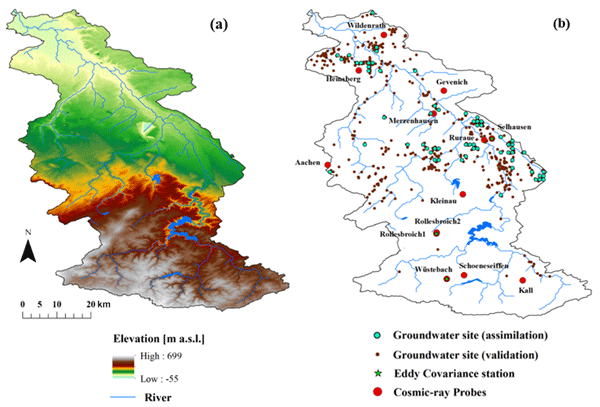
Fang Li, Heye Reemt Bogena, Johannes Keller, Bagher Bayat, Rahul Raj, and Harrie-Jan Hendricks-Franssen
Hydrol. Earth Syst. Sci., 29, 6419–6443, https://doi.org/10.5194/hess-29-6419-2025, https://doi.org/10.5194/hess-29-6419-2025, 2025
Short summary
Short summary
We developed a new method to improve hydrological modeling by jointly using soil moisture and groundwater level data from field sensors in a catchment in Germany. By updating the model separately for shallow and deep soil zones, we achieved more accurate predictions of soil water, groundwater depth, and evapotranspiration. Our results show that combining both data types gives more balanced and reliable outcomes than using either alone.
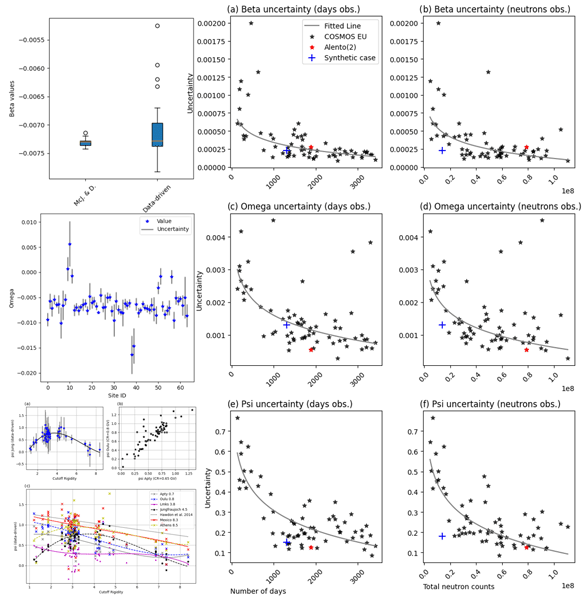
Roland Baatz, Patrick Davies, Paolo Nasta, and Heye Bogena
Hydrol. Earth Syst. Sci., 29, 2583–2597, https://doi.org/10.5194/hess-29-2583-2025, https://doi.org/10.5194/hess-29-2583-2025, 2025
Short summary
Short summary
The data-driven approach enhances soil water content measurements by improving the precision of cosmic ray neutron sensors (CRNSs). This study demonstrates a new method to account for dynamics in air pressure, atmospheric humidity, and incoming neutron intensity. Soil water content measured by CRNSs showed reduced errors compared to reference measurements. The findings highlight the need for precise adjustments to better measure soil moisture for agricultural, water, and climate monitoring.
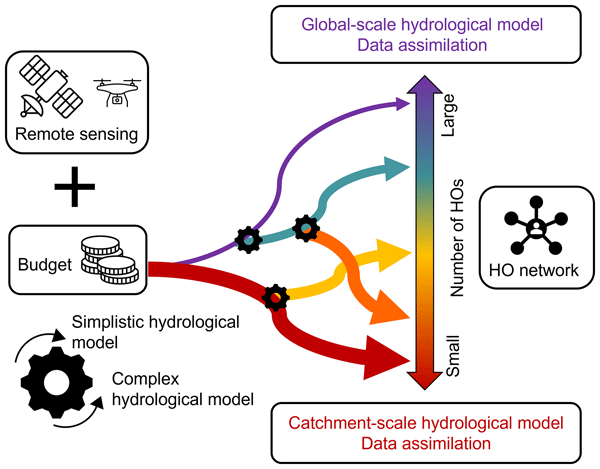
Paolo Nasta, Günter Blöschl, Heye R. Bogena, Steffen Zacharias, Roland Baatz, Gabriëlle De Lannoy, Karsten H. Jensen, Salvatore Manfreda, Laurent Pfister, Ana M. Tarquis, Ilja van Meerveld, Marc Voltz, Yijian Zeng, William Kustas, Xin Li, Harry Vereecken, and Nunzio Romano
Hydrol. Earth Syst. Sci., 29, 465–483, https://doi.org/10.5194/hess-29-465-2025, https://doi.org/10.5194/hess-29-465-2025, 2025
Short summary
Short summary
The Unsolved Problems in Hydrology (UPH) initiative has emphasized the need to establish networks of multi-decadal hydrological observatories to tackle catchment-scale challenges on a global scale. This opinion paper provocatively discusses two endmembers of possible future hydrological observatory (HO) networks for a given hypothesized community budget: a comprehensive set of moderately instrumented observatories or, alternatively, a small number of highly instrumented supersites.
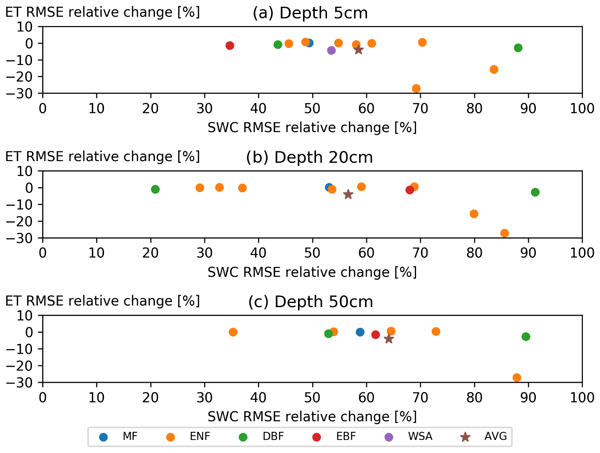
Lukas Strebel, Heye Bogena, Harry Vereecken, Mie Andreasen, Sergio Aranda-Barranco, and Harrie-Jan Hendricks Franssen
Hydrol. Earth Syst. Sci., 28, 1001–1026, https://doi.org/10.5194/hess-28-1001-2024, https://doi.org/10.5194/hess-28-1001-2024, 2024
Short summary
Short summary
We present results from using soil water content measurements from 13 European forest sites in a state-of-the-art land surface model. We use data assimilation to perform a combination of observed and modeled soil water content and show the improvements in the representation of soil water content. However, we also look at the impact on evapotranspiration and see no corresponding improvements.
Theresa Boas, Heye Reemt Bogena, Dongryeol Ryu, Harry Vereecken, Andrew Western, and Harrie-Jan Hendricks Franssen
Hydrol. Earth Syst. Sci., 27, 3143–3167, https://doi.org/10.5194/hess-27-3143-2023, https://doi.org/10.5194/hess-27-3143-2023, 2023
Short summary
Short summary
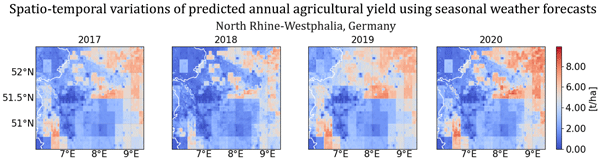
In our study, we tested the utility and skill of a state-of-the-art forecasting product for the prediction of regional crop productivity using a land surface model. Our results illustrate the potential value and skill of combining seasonal forecasts with modelling applications to generate variables of interest for stakeholders, such as annual crop yield for specific cash crops and regions. In addition, this study provides useful insights for future technical model evaluations and improvements.
Tanja Denager, Torben O. Sonnenborg, Majken C. Looms, Heye Bogena, and Karsten H. Jensen
Hydrol. Earth Syst. Sci., 27, 2827–2845, https://doi.org/10.5194/hess-27-2827-2023, https://doi.org/10.5194/hess-27-2827-2023, 2023
Short summary
Short summary
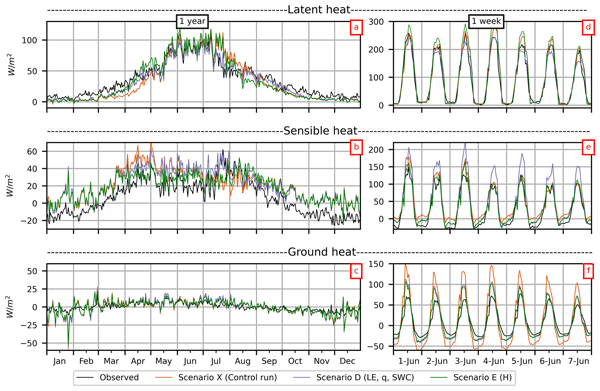
This study contributes to improvements in the model characterization of water and energy fluxes. The results show that multi-objective autocalibration in combination with mathematical regularization is a powerful tool to improve land surface models. Using the direct measurement of turbulent fluxes as the target variable, parameter optimization matches simulations and observations of latent heat, whereas sensible heat is clearly biased.
Cosimo Brogi, Heye Reemt Bogena, Markus Köhli, Johan Alexander Huisman, Harrie-Jan Hendricks Franssen, and Olga Dombrowski
Geosci. Instrum. Method. Data Syst., 11, 451–469, https://doi.org/10.5194/gi-11-451-2022, https://doi.org/10.5194/gi-11-451-2022, 2022
Short summary
Short summary
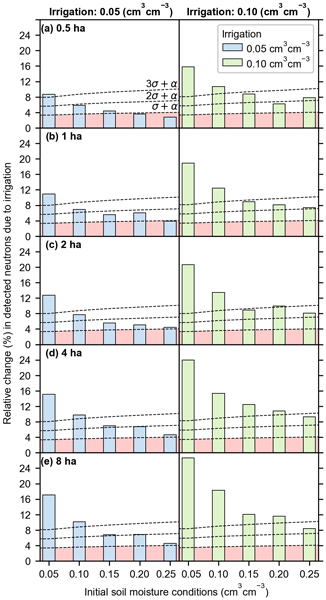
Accurate monitoring of water in soil can improve irrigation efficiency, which is important considering climate change and the growing world population. Cosmic-ray neutrons sensors (CRNSs) are a promising tool in irrigation monitoring due to a larger sensed area and to lower maintenance than other ground-based sensors. Here, we analyse the feasibility of irrigation monitoring with CRNSs and the impact of the irrigated field dimensions, of the variations of water in soil, and of instrument design.
Friedrich Boeing, Oldrich Rakovec, Rohini Kumar, Luis Samaniego, Martin Schrön, Anke Hildebrandt, Corinna Rebmann, Stephan Thober, Sebastian Müller, Steffen Zacharias, Heye Bogena, Katrin Schneider, Ralf Kiese, Sabine Attinger, and Andreas Marx
Hydrol. Earth Syst. Sci., 26, 5137–5161, https://doi.org/10.5194/hess-26-5137-2022, https://doi.org/10.5194/hess-26-5137-2022, 2022
Short summary
Short summary
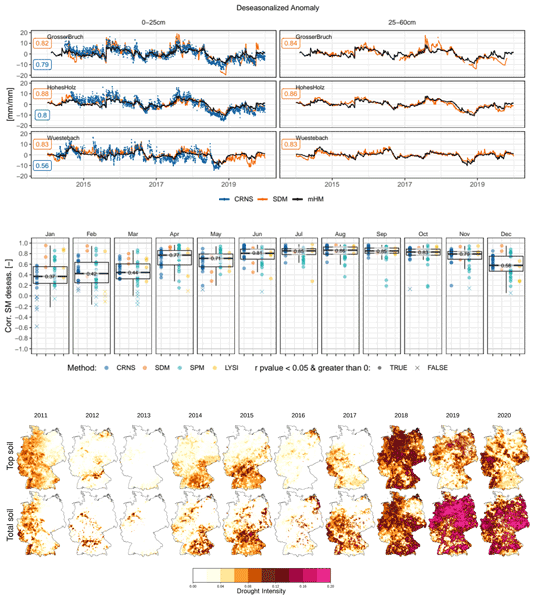
In this paper, we deliver an evaluation of the second generation operational German drought monitor (https://www.ufz.de/duerremonitor) with a state-of-the-art compilation of observed soil moisture data from 40 locations and four different measurement methods in Germany. We show that the expressed stakeholder needs for higher resolution drought information at the one-kilometer scale can be met and that the agreement of simulated and observed soil moisture dynamics can be moderately improved.
Olga Dombrowski, Cosimo Brogi, Harrie-Jan Hendricks Franssen, Damiano Zanotelli, and Heye Bogena
Geosci. Model Dev., 15, 5167–5193, https://doi.org/10.5194/gmd-15-5167-2022, https://doi.org/10.5194/gmd-15-5167-2022, 2022
Short summary
Short summary
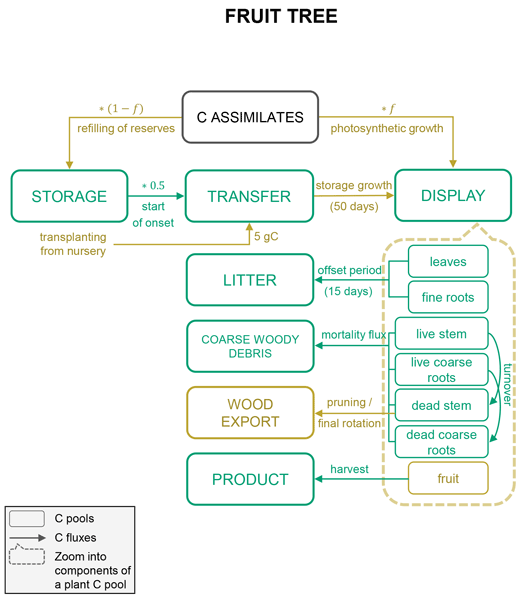
Soil carbon storage and food production of fruit orchards will be influenced by climate change. However, they lack representation in models that study such processes. We developed and tested a new sub-model, CLM5-FruitTree, that describes growth, biomass distribution, and management practices in orchards. The model satisfactorily predicted yield and exchange of carbon, energy, and water in an apple orchard and can be used to study land surface processes in fruit orchards at different scales.
Maik Heistermann, Heye Bogena, Till Francke, Andreas Güntner, Jannis Jakobi, Daniel Rasche, Martin Schrön, Veronika Döpper, Benjamin Fersch, Jannis Groh, Amol Patil, Thomas Pütz, Marvin Reich, Steffen Zacharias, Carmen Zengerle, and Sascha Oswald
Earth Syst. Sci. Data, 14, 2501–2519, https://doi.org/10.5194/essd-14-2501-2022, https://doi.org/10.5194/essd-14-2501-2022, 2022
Short summary
Short summary
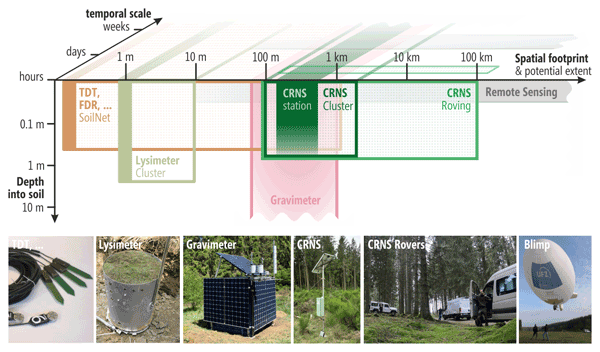
This paper presents a dense network of cosmic-ray neutron sensing (CRNS) to measure spatio-temporal soil moisture patterns during a 2-month campaign in the Wüstebach headwater catchment in Germany. Stationary, mobile, and airborne CRNS technology monitored the root-zone water dynamics as well as spatial heterogeneity in the 0.4 km2 area. The 15 CRNS stations were supported by a hydrogravimeter, biomass sampling, and a wireless soil sensor network to facilitate holistic hydrological analysis.
Wei Qu, Heye Bogena, Christoph Schüth, Harry Vereecken, Zongmei Li, and Stephan Schulz
Geosci. Model Dev. Discuss., https://doi.org/10.5194/gmd-2022-131, https://doi.org/10.5194/gmd-2022-131, 2022
Publication in GMD not foreseen
Short summary
Short summary
We applied the global sensitivity analysis LH-OAT to the integrated hydrology model ParFlow-CLM to investigate the sensitivity of the 12 parameters for different scenarios. And we found that the general patterns of the parameter sensitivities were consistent, however, for some parameters a significantly larger span of the sensitivities was observed, especially for the higher slope and in subarctic climatic scenarios.
Heye Reemt Bogena, Martin Schrön, Jannis Jakobi, Patrizia Ney, Steffen Zacharias, Mie Andreasen, Roland Baatz, David Boorman, Mustafa Berk Duygu, Miguel Angel Eguibar-Galán, Benjamin Fersch, Till Franke, Josie Geris, María González Sanchis, Yann Kerr, Tobias Korf, Zalalem Mengistu, Arnaud Mialon, Paolo Nasta, Jerzy Nitychoruk, Vassilios Pisinaras, Daniel Rasche, Rafael Rosolem, Hami Said, Paul Schattan, Marek Zreda, Stefan Achleitner, Eduardo Albentosa-Hernández, Zuhal Akyürek, Theresa Blume, Antonio del Campo, Davide Canone, Katya Dimitrova-Petrova, John G. Evans, Stefano Ferraris, Félix Frances, Davide Gisolo, Andreas Güntner, Frank Herrmann, Joost Iwema, Karsten H. Jensen, Harald Kunstmann, Antonio Lidón, Majken Caroline Looms, Sascha Oswald, Andreas Panagopoulos, Amol Patil, Daniel Power, Corinna Rebmann, Nunzio Romano, Lena Scheiffele, Sonia Seneviratne, Georg Weltin, and Harry Vereecken
Earth Syst. Sci. Data, 14, 1125–1151, https://doi.org/10.5194/essd-14-1125-2022, https://doi.org/10.5194/essd-14-1125-2022, 2022
Short summary
Short summary
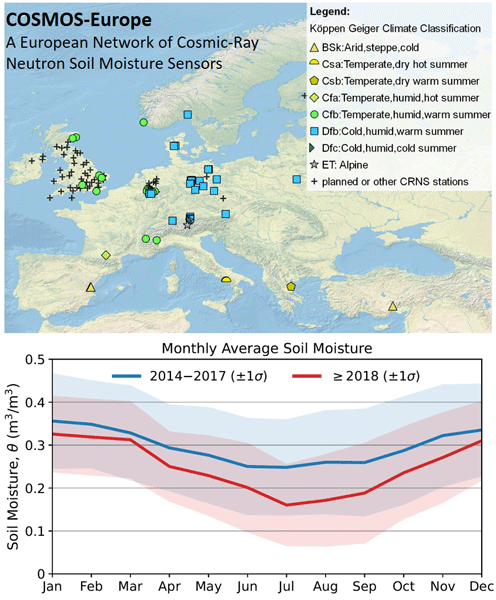
Monitoring of increasingly frequent droughts is a prerequisite for climate adaptation strategies. This data paper presents long-term soil moisture measurements recorded by 66 cosmic-ray neutron sensors (CRNS) operated by 24 institutions and distributed across major climate zones in Europe. Data processing followed harmonized protocols and state-of-the-art methods to generate consistent and comparable soil moisture products and to facilitate continental-scale analysis of hydrological extremes.
Lukas Strebel, Heye R. Bogena, Harry Vereecken, and Harrie-Jan Hendricks Franssen
Geosci. Model Dev., 15, 395–411, https://doi.org/10.5194/gmd-15-395-2022, https://doi.org/10.5194/gmd-15-395-2022, 2022
Short summary
Short summary
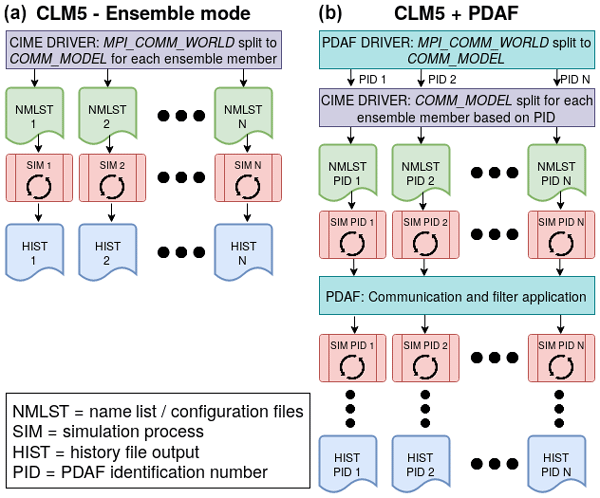
We present the technical coupling between a land surface model (CLM5) and the Parallel Data Assimilation Framework (PDAF). This coupling enables measurement data to update simulated model states and parameters in a statistically optimal way. We demonstrate the viability of the model framework using an application in a forested catchment where the inclusion of soil water measurements significantly improved the simulation quality.
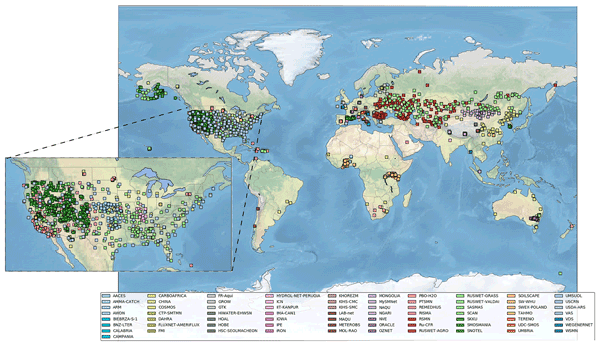
Wouter Dorigo, Irene Himmelbauer, Daniel Aberer, Lukas Schremmer, Ivana Petrakovic, Luca Zappa, Wolfgang Preimesberger, Angelika Xaver, Frank Annor, Jonas Ardö, Dennis Baldocchi, Marco Bitelli, Günter Blöschl, Heye Bogena, Luca Brocca, Jean-Christophe Calvet, J. Julio Camarero, Giorgio Capello, Minha Choi, Michael C. Cosh, Nick van de Giesen, Istvan Hajdu, Jaakko Ikonen, Karsten H. Jensen, Kasturi Devi Kanniah, Ileen de Kat, Gottfried Kirchengast, Pankaj Kumar Rai, Jenni Kyrouac, Kristine Larson, Suxia Liu, Alexander Loew, Mahta Moghaddam, José Martínez Fernández, Cristian Mattar Bader, Renato Morbidelli, Jan P. Musial, Elise Osenga, Michael A. Palecki, Thierry Pellarin, George P. Petropoulos, Isabella Pfeil, Jarrett Powers, Alan Robock, Christoph Rüdiger, Udo Rummel, Michael Strobel, Zhongbo Su, Ryan Sullivan, Torbern Tagesson, Andrej Varlagin, Mariette Vreugdenhil, Jeffrey Walker, Jun Wen, Fred Wenger, Jean Pierre Wigneron, Mel Woods, Kun Yang, Yijian Zeng, Xiang Zhang, Marek Zreda, Stephan Dietrich, Alexander Gruber, Peter van Oevelen, Wolfgang Wagner, Klaus Scipal, Matthias Drusch, and Roberto Sabia
Hydrol. Earth Syst. Sci., 25, 5749–5804, https://doi.org/10.5194/hess-25-5749-2021, https://doi.org/10.5194/hess-25-5749-2021, 2021
Short summary
Short summary
The International Soil Moisture Network (ISMN) is a community-based open-access data portal for soil water measurements taken at the ground and is accessible at https://ismn.earth. Over 1000 scientific publications and thousands of users have made use of the ISMN. The scope of this paper is to inform readers about the data and functionality of the ISMN and to provide a review of the scientific progress facilitated through the ISMN with the scope to shape future research and operations.
Nunzio Romano, Harry Vereecken, Heye R. Bogena, Giorgio Cassiani, Matteo Censini, Giovanna Armiento, Marco Proposito, Lorenzo De Silvestri, Eyal Ben Dor, Nicolas Francos, Christian Massari, János Mészáros, Tünde Takáts, Caterina Mazzitelli, Benedetto Sica, Ugo Lazzaro, and Paolo Nasta
Earth Syst. Sci. Data Discuss., https://doi.org/10.5194/essd-2026-725, https://doi.org/10.5194/essd-2026-725, 2026
Preprint under review for ESSD
Short summary
Short summary
Understanding how climate and land-use change affect water resources requires observations that connect processes from soils and vegetation to groundwater and streams. The Alento dataset is presented that integrates environmental monitoring with targeted field observations across multiple Critical Zone components and scales. The dataset offers a distinctive resource for studying water storage and movement, evaluating environmental models, and improving understanding of water-limited regions.
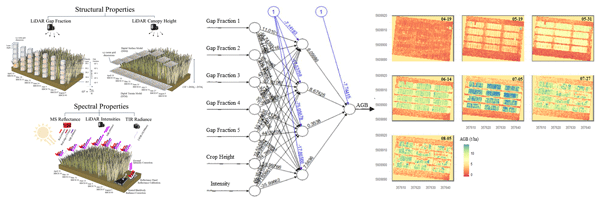
Jordan Steven Bates, Carsten Montzka, Rajina Bajracharya, Harry Vereecken, and François Jonard
Biogeosciences, 23, 6179–6210, https://doi.org/10.5194/bg-23-6179-2026, https://doi.org/10.5194/bg-23-6179-2026, 2026
Short summary
Short summary
This study compared drone-based laser, multispectral, and thermal sensors for estimating winter wheat biomass. Combining laser-derived crop structure and signal intensity improved predictions compared with crop height or multispectral data alone, while combining multispectral and thermal data with laser-derived features provided additional information during particular growth stages. The results highlight the potential of underutilized laser-derived features for crop biomass monitoring.
Haojin Zhao, Richard Hoffmann, Heye Bogena, Cosimo Brogi, Alexandre Belleflamme, Klaus Görgen, Johannes Keller, Lukas Strebel, and Harrie-Jan Hendricks Franssen
EGUsphere, https://doi.org/10.5194/egusphere-2026-4630, https://doi.org/10.5194/egusphere-2026-4630, 2026
This preprint is open for discussion and under review for Geoscientific Model Development (GMD).
Short summary
Short summary
Farmers need timely information on how much water is available in the soil, especially as drought and weather variability increase. We developed an automated system that combines field measurements, computer simulations, and multiple weather forecasts to predict soil moisture up to ten days ahead. Applied at a German test site, the system improved agreement with observations by about 20 percent and turned forecasts into simple indicators that can support irrigation and field management.
Matthias Cuntz, Stephan Thober, Anne Verhoef, Yijian Zeng, Aaron Boone, Agnès Ducharne, Sujan Koirala, David M. Lawrence, Philipp de Vrese, Carsten Montzka, Sonia I. Seneviratne, Harry Vereecken, Dani Or, Salma Tafasca, Naoki Mizukami, Rich Ellis, Patrick C. McGuire, and Lukas Gudmundsson
EGUsphere, https://doi.org/10.5194/egusphere-2026-4223, https://doi.org/10.5194/egusphere-2026-4223, 2026
Preprint archived
Short summary
Short summary
Land surface models (LSMs) are essential tools to analyze future climate change. Here we pushed state-of-the-art LSMs out of their comfort zone revealing hidden connections between processes encoded into the models. The LSMs reacted differently due to complex, sometimes counter-intuitive interactions of different water fluxes. We identified surface runoff and soil evaporation as the two main reasons behind model differences, which should be improved by using more mechanistic descriptions.
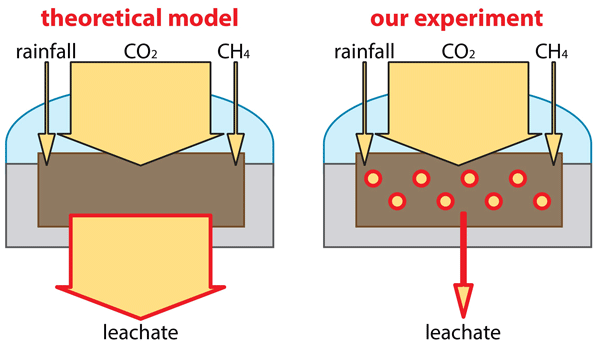
Francois Rineau, Alexander H. Frank, Jannis Groh, Kristof Grosjean, Arnaud Legout, Daniil I. Kolokolov, Michel Mench, Maria Moreno-Druet, Benoît Pollier, Virmantas Povilaitis, Johanna Pausch, Thomas Puetz, Tjalling Rooks, Peter Schröder, Wieslaw Szulc, Beata Rutkowska, Xander Swinnen, Sofie Thijs, Harry Vereecken, Janna V. Veselovskaya, Mwahija Zubery, Renaldas Žydelis, and Evelin Loit
Biogeosciences, 23, 2261–2276, https://doi.org/10.5194/bg-23-2261-2026, https://doi.org/10.5194/bg-23-2261-2026, 2026
Short summary
Short summary
Enhanced weathering can significantly slow climate change by capturing CO2 and converting it into stable bicarbonate. In study, this method removed up to 1.5 tons of carbon per hectare in a single growing season. We had however very little evidence of bicarbonate formation. Our findings show that enhanced weathering facilitated instead carbon accrual via not only carbonate precipitation but also enhanced biogeochemical activities promoting additional carbon storage.
Youri Rothfuss, Samuel Le Gall, Nicolas Brüggemann, Sharmin Jahan, Mathieu Javaux, Julian Klaus, Harry Vereecken, and Dagmar van Dusschoten
EGUsphere, https://doi.org/10.5194/egusphere-2026-1518, https://doi.org/10.5194/egusphere-2026-1518, 2026
Short summary
Short summary
How plants cope with water stress is relevant when studying plant water sources in soil. We associated two techniques for measuring the content in water stable isotopes in the stem of sunflower plants and for locating where they take up water in a non-destructive manner. We highlight the role of stem water as a source of water to transpiration flux.
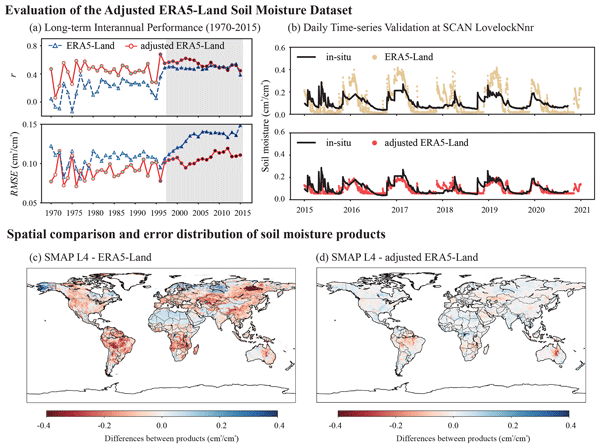
Wenhong Wang, Shiao Feng, Yonggen Zhang, Zhongwang Wei, Jianzhi Dong, Lutz Weihermüller, Cong-Qiang Liu, and Harry Vereecken
Earth Syst. Sci. Data, 18, 1061–1088, https://doi.org/10.5194/essd-18-1061-2026, https://doi.org/10.5194/essd-18-1061-2026, 2026
Short summary
Short summary
Current soil moisture data often suffers from gaps or errors. We combined the long-term coverage of ERA5-Land with the high accuracy of SMAP (Soil Moisture Active Passive) satellites to create a corrected global moisture dataset spanning 1950–2025. Validated against 3.8 million ground measurements, our product reduces errors by ~ 25 % in the modern period (2015–2020) and maintains ~ 20 % improvement historically (1960–2015). This reliable, daily 75-year record is essential for monitoring long-term climate trends and droughts.
Joschka Neumann, Nicolas Brüggemann, Patrick Chaumet, Normen Hermes, Jan Huwer, Peter Kirchner, Werner Lesmeister, Wilhelm August Mertens, Thomas Pütz, Jörg Wolters, Harry Vereecken, and Ghaleb Natour
Geosci. Instrum. Method. Data Syst., 14, 353–377, https://doi.org/10.5194/gi-14-353-2025, https://doi.org/10.5194/gi-14-353-2025, 2025
Short summary
Short summary
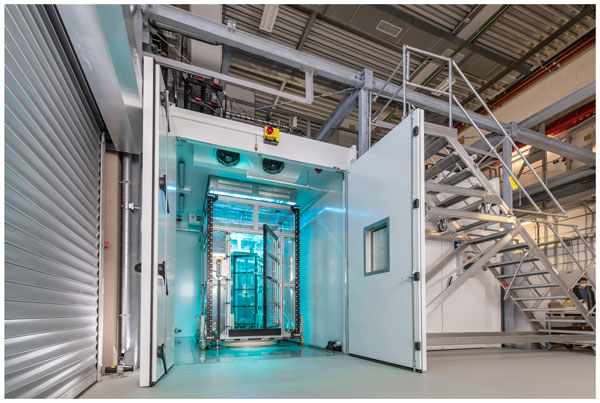
Climate change in combination with a steadily growing world population and a simultaneous decrease in agricultural land is one of the greatest global challenges facing mankind. In this context, Forschungszentrum Jülich established an "agricultural simulator" (AgraSim), which enables research into the effects of climate change on agricultural ecosystems and the optimization of agricultural cultivation and management strategies with the aid of combined experimental and numerical simulation.
Fang Li, Heye Reemt Bogena, Johannes Keller, Bagher Bayat, Rahul Raj, and Harrie-Jan Hendricks-Franssen
Hydrol. Earth Syst. Sci., 29, 6419–6443, https://doi.org/10.5194/hess-29-6419-2025, https://doi.org/10.5194/hess-29-6419-2025, 2025
Short summary
Short summary
We developed a new method to improve hydrological modeling by jointly using soil moisture and groundwater level data from field sensors in a catchment in Germany. By updating the model separately for shallow and deep soil zones, we achieved more accurate predictions of soil water, groundwater depth, and evapotranspiration. Our results show that combining both data types gives more balanced and reliable outcomes than using either alone.
Salar Saeed Dogar, Cosimo Brogi, Dave O'Leary, Ixchel M. Hernández-Ochoa, Marco Donat, Harry Vereecken, and Johan Alexander Huisman
SOIL, 11, 655–679, https://doi.org/10.5194/soil-11-655-2025, https://doi.org/10.5194/soil-11-655-2025, 2025
Short summary
Short summary
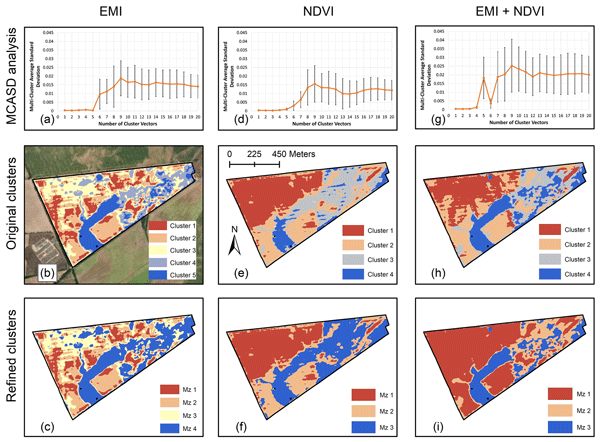
Farmers need precise information about their fields to use water, fertilizers, and other resources efficiently. This study combines underground soil data and satellite images to create detailed field maps using advanced machine learning. By testing different ways of processing data, we ensured a balanced and accurate approach. The results help farmers manage their land more effectively, leading to better harvests and more sustainable farming practices.
Jordan Bates, Carsten Montzka, Harry Vereecken, and François Jonard
EGUsphere, https://doi.org/10.5194/egusphere-2025-3919, https://doi.org/10.5194/egusphere-2025-3919, 2025
Short summary
Short summary
We used unmanned aerial vehicles (UAVs) with advanced cameras and laser scanning to measure crop water use and detect early signs of plant stress. By combining 3D views of crop structure with surface temperature and reflectance data, we improved estimates of water loss, especially in dense crops like wheat. This approach can help farmers use water more efficiently, respond quickly to stress, and support sustainable agriculture in a changing climate.
Roland Baatz, Patrick Davies, Paolo Nasta, and Heye Bogena
Hydrol. Earth Syst. Sci., 29, 2583–2597, https://doi.org/10.5194/hess-29-2583-2025, https://doi.org/10.5194/hess-29-2583-2025, 2025
Short summary
Short summary
The data-driven approach enhances soil water content measurements by improving the precision of cosmic ray neutron sensors (CRNSs). This study demonstrates a new method to account for dynamics in air pressure, atmospheric humidity, and incoming neutron intensity. Soil water content measured by CRNSs showed reduced errors compared to reference measurements. The findings highlight the need for precise adjustments to better measure soil moisture for agricultural, water, and climate monitoring.
Manuela S. Kaufmann, Anja Klotzsche, Jan van der Kruk, Anke Langen, Harry Vereecken, and Lutz Weihermüller
SOIL, 11, 267–285, https://doi.org/10.5194/soil-11-267-2025, https://doi.org/10.5194/soil-11-267-2025, 2025
Short summary
Short summary
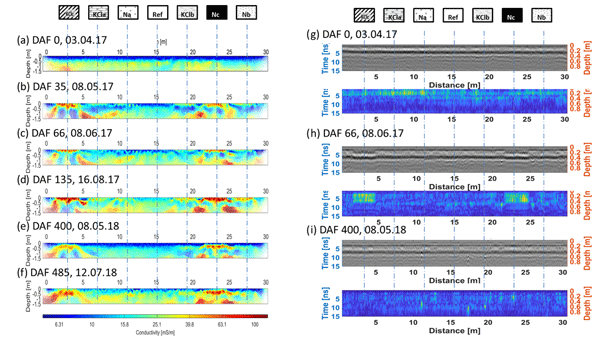
To use fertilizers more effectively, non-invasive geophysical methods can be used to understand nutrient distributions in the soil. We utilize, in a long-term field study, geophysical techniques to study soil properties and conditions under different fertilizer treatments. We compared the geophysical response with soil samples and soil sensor data. In particular, electromagnetic induction and electrical resistivity tomography were effective in monitoring changes in nitrate levels over time.
Bamidele Oloruntoba, Stefan Kollet, Carsten Montzka, Harry Vereecken, and Harrie-Jan Hendricks Franssen
Hydrol. Earth Syst. Sci., 29, 1659–1683, https://doi.org/10.5194/hess-29-1659-2025, https://doi.org/10.5194/hess-29-1659-2025, 2025
Short summary
Short summary
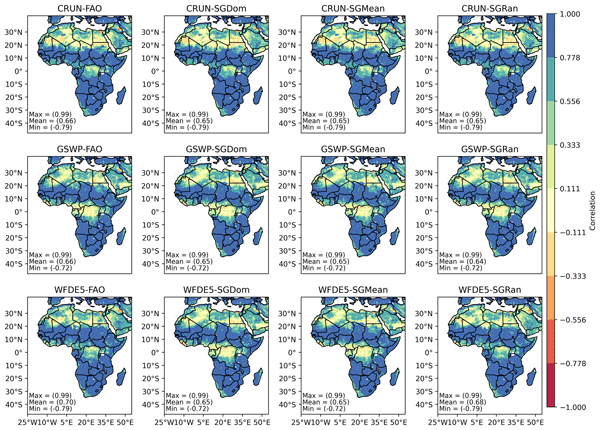
We studied how soil and weather data affect land model simulations over Africa. By combining soil data processed in different ways with weather data of varying time intervals, we found that weather inputs had a greater impact on water processes than soil data type. However, the way soil data were processed became crucial when paired with high-frequency weather inputs, showing that detailed weather data can improve local and regional predictions of how water moves and interacts with the land.
Paolo Nasta, Günter Blöschl, Heye R. Bogena, Steffen Zacharias, Roland Baatz, Gabriëlle De Lannoy, Karsten H. Jensen, Salvatore Manfreda, Laurent Pfister, Ana M. Tarquis, Ilja van Meerveld, Marc Voltz, Yijian Zeng, William Kustas, Xin Li, Harry Vereecken, and Nunzio Romano
Hydrol. Earth Syst. Sci., 29, 465–483, https://doi.org/10.5194/hess-29-465-2025, https://doi.org/10.5194/hess-29-465-2025, 2025
Short summary
Short summary
The Unsolved Problems in Hydrology (UPH) initiative has emphasized the need to establish networks of multi-decadal hydrological observatories to tackle catchment-scale challenges on a global scale. This opinion paper provocatively discusses two endmembers of possible future hydrological observatory (HO) networks for a given hypothesized community budget: a comprehensive set of moderately instrumented observatories or, alternatively, a small number of highly instrumented supersites.
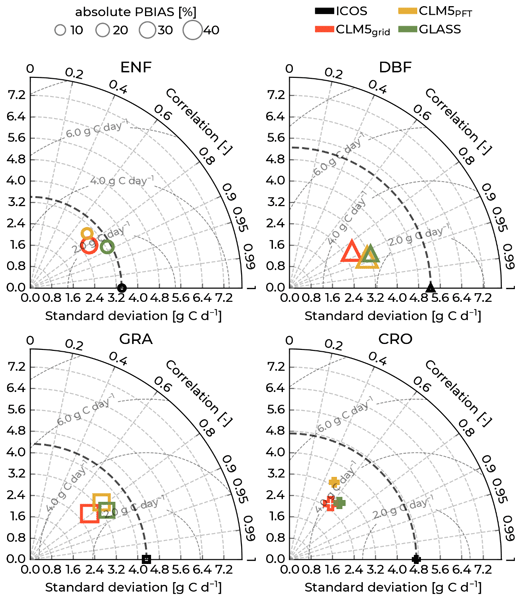
Christian Poppe Terán, Bibi S. Naz, Harry Vereecken, Roland Baatz, Rosie A. Fisher, and Harrie-Jan Hendricks Franssen
Geosci. Model Dev., 18, 287–317, https://doi.org/10.5194/gmd-18-287-2025, https://doi.org/10.5194/gmd-18-287-2025, 2025
Short summary
Short summary
Carbon and water exchanges between the atmosphere and the land surface contribute to water resource availability and climate change mitigation. Land surface models, like the Community Land Model version 5 (CLM5), simulate these. This study finds that CLM5 and other data sets underestimate the magnitudes of and variability in carbon and water exchanges for the most abundant plant functional types compared to observations. It provides essential insights for further research into these processes.
Ying Zhao, Mehdi Rahmati, Harry Vereecken, and Dani Or
Hydrol. Earth Syst. Sci., 28, 4059–4063, https://doi.org/10.5194/hess-28-4059-2024, https://doi.org/10.5194/hess-28-4059-2024, 2024
Short summary
Short summary
Gao et al. (2023) question the importance of soil in hydrology, sparking debate. We acknowledge some valid points but critique their broad, unsubstantiated views on soil's role. Our response highlights three key areas: (1) the false divide between ecosystem-centric and soil-centric approaches, (2) the vital yet varied impact of soil properties, and (3) the call for a scale-aware framework. We aim to unify these perspectives, enhancing hydrology's comprehensive understanding.
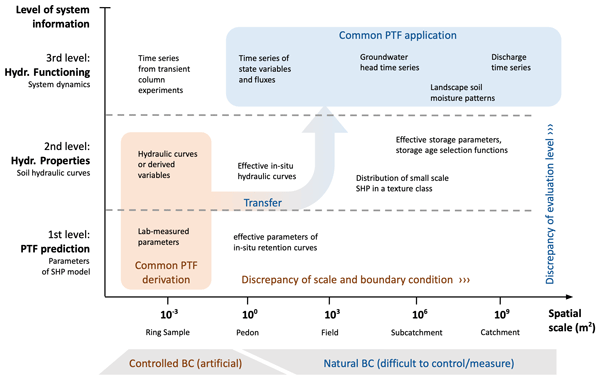
Tobias Karl David Weber, Lutz Weihermüller, Attila Nemes, Michel Bechtold, Aurore Degré, Efstathios Diamantopoulos, Simone Fatichi, Vilim Filipović, Surya Gupta, Tobias L. Hohenbrink, Daniel R. Hirmas, Conrad Jackisch, Quirijn de Jong van Lier, John Koestel, Peter Lehmann, Toby R. Marthews, Budiman Minasny, Holger Pagel, Martine van der Ploeg, Shahab Aldin Shojaeezadeh, Simon Fiil Svane, Brigitta Szabó, Harry Vereecken, Anne Verhoef, Michael Young, Yijian Zeng, Yonggen Zhang, and Sara Bonetti
Hydrol. Earth Syst. Sci., 28, 3391–3433, https://doi.org/10.5194/hess-28-3391-2024, https://doi.org/10.5194/hess-28-3391-2024, 2024
Short summary
Short summary
Pedotransfer functions (PTFs) are used to predict parameters of models describing the hydraulic properties of soils. The appropriateness of these predictions critically relies on the nature of the datasets for training the PTFs and the physical comprehensiveness of the models. This roadmap paper is addressed to PTF developers and users and critically reflects the utility and future of PTFs. To this end, we present a manifesto aiming at a paradigm shift in PTF research.
Lukas Strebel, Heye Bogena, Harry Vereecken, Mie Andreasen, Sergio Aranda-Barranco, and Harrie-Jan Hendricks Franssen
Hydrol. Earth Syst. Sci., 28, 1001–1026, https://doi.org/10.5194/hess-28-1001-2024, https://doi.org/10.5194/hess-28-1001-2024, 2024
Short summary
Short summary
We present results from using soil water content measurements from 13 European forest sites in a state-of-the-art land surface model. We use data assimilation to perform a combination of observed and modeled soil water content and show the improvements in the representation of soil water content. However, we also look at the impact on evapotranspiration and see no corresponding improvements.
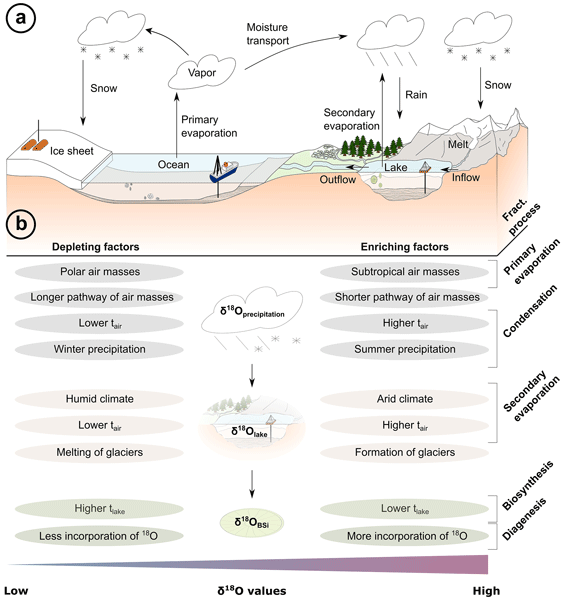
Philip Meister, Anne Alexandre, Hannah Bailey, Philip Barker, Boris K. Biskaborn, Ellie Broadman, Rosine Cartier, Bernhard Chapligin, Martine Couapel, Jonathan R. Dean, Bernhard Diekmann, Poppy Harding, Andrew C. G. Henderson, Armand Hernandez, Ulrike Herzschuh, Svetlana S. Kostrova, Jack Lacey, Melanie J. Leng, Andreas Lücke, Anson W. Mackay, Eniko Katalin Magyari, Biljana Narancic, Cécile Porchier, Gunhild Rosqvist, Aldo Shemesh, Corinne Sonzogni, George E. A. Swann, Florence Sylvestre, and Hanno Meyer
Clim. Past, 20, 363–392, https://doi.org/10.5194/cp-20-363-2024, https://doi.org/10.5194/cp-20-363-2024, 2024
Short summary
Short summary
This paper presents the first comprehensive compilation of diatom oxygen isotope records in lake sediments (δ18OBSi), supported by lake basin parameters. We infer the spatial and temporal coverage of δ18OBSi records and discuss common hemispheric trends on centennial and millennial timescales. Key results are common patterns for hydrologically open lakes in Northern Hemisphere extratropical regions during the Holocene corresponding to known climatic epochs, i.e. the Holocene Thermal Maximum.
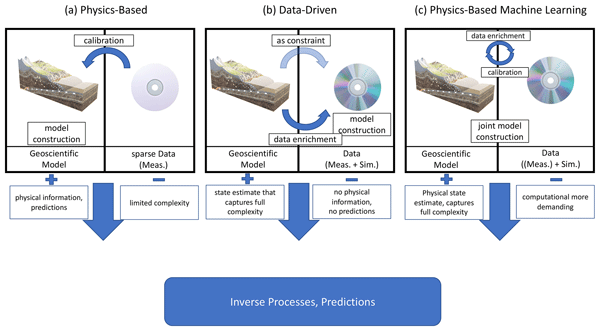
Denise Degen, Daniel Caviedes Voullième, Susanne Buiter, Harrie-Jan Hendricks Franssen, Harry Vereecken, Ana González-Nicolás, and Florian Wellmann
Geosci. Model Dev., 16, 7375–7409, https://doi.org/10.5194/gmd-16-7375-2023, https://doi.org/10.5194/gmd-16-7375-2023, 2023
Short summary
Short summary
In geosciences, we often use simulations based on physical laws. These simulations can be computationally expensive, which is a problem if simulations must be performed many times (e.g., to add error bounds). We show how a novel machine learning method helps to reduce simulation time. In comparison to other approaches, which typically only look at the output of a simulation, the method considers physical laws in the simulation itself. The method provides reliable results faster than standard.
Tobias Schnepper, Jannis Groh, Horst H. Gerke, Barbara Reichert, and Thomas Pütz
Hydrol. Earth Syst. Sci., 27, 3265–3292, https://doi.org/10.5194/hess-27-3265-2023, https://doi.org/10.5194/hess-27-3265-2023, 2023
Short summary
Short summary
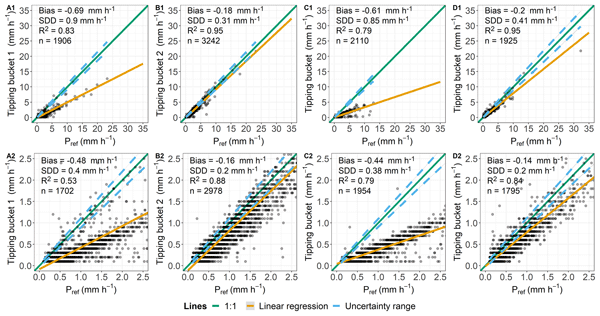
We compared hourly data from precipitation gauges with lysimeter reference data at three sites under different climatic conditions. Our results show that precipitation gauges recorded 33–96 % of the reference precipitation data for the period under consideration (2015–2018). Correction algorithms increased the registered precipitation by 9–14 %. It follows that when using point precipitation data, regardless of the precipitation measurement method used, relevant uncertainties must be considered.
Theresa Boas, Heye Reemt Bogena, Dongryeol Ryu, Harry Vereecken, Andrew Western, and Harrie-Jan Hendricks Franssen
Hydrol. Earth Syst. Sci., 27, 3143–3167, https://doi.org/10.5194/hess-27-3143-2023, https://doi.org/10.5194/hess-27-3143-2023, 2023
Short summary
Short summary
In our study, we tested the utility and skill of a state-of-the-art forecasting product for the prediction of regional crop productivity using a land surface model. Our results illustrate the potential value and skill of combining seasonal forecasts with modelling applications to generate variables of interest for stakeholders, such as annual crop yield for specific cash crops and regions. In addition, this study provides useful insights for future technical model evaluations and improvements.
Tanja Denager, Torben O. Sonnenborg, Majken C. Looms, Heye Bogena, and Karsten H. Jensen
Hydrol. Earth Syst. Sci., 27, 2827–2845, https://doi.org/10.5194/hess-27-2827-2023, https://doi.org/10.5194/hess-27-2827-2023, 2023
Short summary
Short summary
This study contributes to improvements in the model characterization of water and energy fluxes. The results show that multi-objective autocalibration in combination with mathematical regularization is a powerful tool to improve land surface models. Using the direct measurement of turbulent fluxes as the target variable, parameter optimization matches simulations and observations of latent heat, whereas sensible heat is clearly biased.
Cosimo Brogi, Heye Reemt Bogena, Markus Köhli, Johan Alexander Huisman, Harrie-Jan Hendricks Franssen, and Olga Dombrowski
Geosci. Instrum. Method. Data Syst., 11, 451–469, https://doi.org/10.5194/gi-11-451-2022, https://doi.org/10.5194/gi-11-451-2022, 2022
Short summary
Short summary
Accurate monitoring of water in soil can improve irrigation efficiency, which is important considering climate change and the growing world population. Cosmic-ray neutrons sensors (CRNSs) are a promising tool in irrigation monitoring due to a larger sensed area and to lower maintenance than other ground-based sensors. Here, we analyse the feasibility of irrigation monitoring with CRNSs and the impact of the irrigated field dimensions, of the variations of water in soil, and of instrument design.
Friedrich Boeing, Oldrich Rakovec, Rohini Kumar, Luis Samaniego, Martin Schrön, Anke Hildebrandt, Corinna Rebmann, Stephan Thober, Sebastian Müller, Steffen Zacharias, Heye Bogena, Katrin Schneider, Ralf Kiese, Sabine Attinger, and Andreas Marx
Hydrol. Earth Syst. Sci., 26, 5137–5161, https://doi.org/10.5194/hess-26-5137-2022, https://doi.org/10.5194/hess-26-5137-2022, 2022
Short summary
Short summary
In this paper, we deliver an evaluation of the second generation operational German drought monitor (https://www.ufz.de/duerremonitor) with a state-of-the-art compilation of observed soil moisture data from 40 locations and four different measurement methods in Germany. We show that the expressed stakeholder needs for higher resolution drought information at the one-kilometer scale can be met and that the agreement of simulated and observed soil moisture dynamics can be moderately improved.
Olga Dombrowski, Cosimo Brogi, Harrie-Jan Hendricks Franssen, Damiano Zanotelli, and Heye Bogena
Geosci. Model Dev., 15, 5167–5193, https://doi.org/10.5194/gmd-15-5167-2022, https://doi.org/10.5194/gmd-15-5167-2022, 2022
Short summary
Short summary
Soil carbon storage and food production of fruit orchards will be influenced by climate change. However, they lack representation in models that study such processes. We developed and tested a new sub-model, CLM5-FruitTree, that describes growth, biomass distribution, and management practices in orchards. The model satisfactorily predicted yield and exchange of carbon, energy, and water in an apple orchard and can be used to study land surface processes in fruit orchards at different scales.
Jordan Bates, Francois Jonard, Rajina Bajracharya, Harry Vereecken, and Carsten Montzka
AGILE GIScience Ser., 3, 23, https://doi.org/10.5194/agile-giss-3-23-2022, https://doi.org/10.5194/agile-giss-3-23-2022, 2022
Maik Heistermann, Heye Bogena, Till Francke, Andreas Güntner, Jannis Jakobi, Daniel Rasche, Martin Schrön, Veronika Döpper, Benjamin Fersch, Jannis Groh, Amol Patil, Thomas Pütz, Marvin Reich, Steffen Zacharias, Carmen Zengerle, and Sascha Oswald
Earth Syst. Sci. Data, 14, 2501–2519, https://doi.org/10.5194/essd-14-2501-2022, https://doi.org/10.5194/essd-14-2501-2022, 2022
Short summary
Short summary
This paper presents a dense network of cosmic-ray neutron sensing (CRNS) to measure spatio-temporal soil moisture patterns during a 2-month campaign in the Wüstebach headwater catchment in Germany. Stationary, mobile, and airborne CRNS technology monitored the root-zone water dynamics as well as spatial heterogeneity in the 0.4 km2 area. The 15 CRNS stations were supported by a hydrogravimeter, biomass sampling, and a wireless soil sensor network to facilitate holistic hydrological analysis.
Wei Qu, Heye Bogena, Christoph Schüth, Harry Vereecken, Zongmei Li, and Stephan Schulz
Geosci. Model Dev. Discuss., https://doi.org/10.5194/gmd-2022-131, https://doi.org/10.5194/gmd-2022-131, 2022
Publication in GMD not foreseen
Short summary
Short summary
We applied the global sensitivity analysis LH-OAT to the integrated hydrology model ParFlow-CLM to investigate the sensitivity of the 12 parameters for different scenarios. And we found that the general patterns of the parameter sensitivities were consistent, however, for some parameters a significantly larger span of the sensitivities was observed, especially for the higher slope and in subarctic climatic scenarios.
Nicholas Jarvis, Jannis Groh, Elisabet Lewan, Katharina H. E. Meurer, Walter Durka, Cornelia Baessler, Thomas Pütz, Elvin Rufullayev, and Harry Vereecken
Hydrol. Earth Syst. Sci., 26, 2277–2299, https://doi.org/10.5194/hess-26-2277-2022, https://doi.org/10.5194/hess-26-2277-2022, 2022
Short summary
Short summary
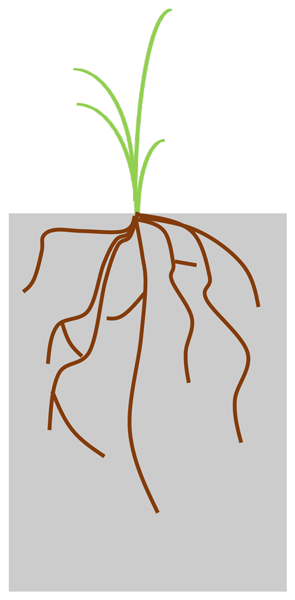
We apply an eco-hydrological model to data on soil water balance and grassland growth obtained at two sites with contrasting climates. Our results show that the grassland in the drier climate had adapted by developing deeper roots, which maintained water supply to the plants in the face of severe drought. Our study emphasizes the importance of considering such plastic responses of plant traits to environmental stress in the modelling of soil water balance and plant growth under climate change.
Heye Reemt Bogena, Martin Schrön, Jannis Jakobi, Patrizia Ney, Steffen Zacharias, Mie Andreasen, Roland Baatz, David Boorman, Mustafa Berk Duygu, Miguel Angel Eguibar-Galán, Benjamin Fersch, Till Franke, Josie Geris, María González Sanchis, Yann Kerr, Tobias Korf, Zalalem Mengistu, Arnaud Mialon, Paolo Nasta, Jerzy Nitychoruk, Vassilios Pisinaras, Daniel Rasche, Rafael Rosolem, Hami Said, Paul Schattan, Marek Zreda, Stefan Achleitner, Eduardo Albentosa-Hernández, Zuhal Akyürek, Theresa Blume, Antonio del Campo, Davide Canone, Katya Dimitrova-Petrova, John G. Evans, Stefano Ferraris, Félix Frances, Davide Gisolo, Andreas Güntner, Frank Herrmann, Joost Iwema, Karsten H. Jensen, Harald Kunstmann, Antonio Lidón, Majken Caroline Looms, Sascha Oswald, Andreas Panagopoulos, Amol Patil, Daniel Power, Corinna Rebmann, Nunzio Romano, Lena Scheiffele, Sonia Seneviratne, Georg Weltin, and Harry Vereecken
Earth Syst. Sci. Data, 14, 1125–1151, https://doi.org/10.5194/essd-14-1125-2022, https://doi.org/10.5194/essd-14-1125-2022, 2022
Short summary
Short summary
Monitoring of increasingly frequent droughts is a prerequisite for climate adaptation strategies. This data paper presents long-term soil moisture measurements recorded by 66 cosmic-ray neutron sensors (CRNS) operated by 24 institutions and distributed across major climate zones in Europe. Data processing followed harmonized protocols and state-of-the-art methods to generate consistent and comparable soil moisture products and to facilitate continental-scale analysis of hydrological extremes.
Lukas Strebel, Heye R. Bogena, Harry Vereecken, and Harrie-Jan Hendricks Franssen
Geosci. Model Dev., 15, 395–411, https://doi.org/10.5194/gmd-15-395-2022, https://doi.org/10.5194/gmd-15-395-2022, 2022
Short summary
Short summary
We present the technical coupling between a land surface model (CLM5) and the Parallel Data Assimilation Framework (PDAF). This coupling enables measurement data to update simulated model states and parameters in a statistically optimal way. We demonstrate the viability of the model framework using an application in a forested catchment where the inclusion of soil water measurements significantly improved the simulation quality.
Veronika Forstner, Jannis Groh, Matevz Vremec, Markus Herndl, Harry Vereecken, Horst H. Gerke, Steffen Birk, and Thomas Pütz
Hydrol. Earth Syst. Sci., 25, 6087–6106, https://doi.org/10.5194/hess-25-6087-2021, https://doi.org/10.5194/hess-25-6087-2021, 2021
Short summary
Short summary
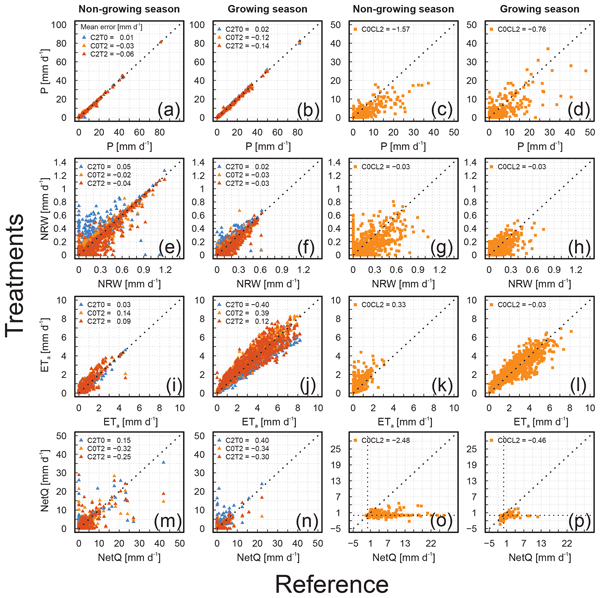
Lysimeter-based manipulative and observational experiments were used to identify responses of water fluxes and aboveground biomass (AGB) to climatic change in permanent grassland. Under energy-limited conditions, elevated temperature actual evapotranspiration (ETa) increased, while seepage, dew, and AGB decreased. Elevated CO2 mitigated the effect on ETa. Under water limitation, elevated temperature resulted in reduced ETa, and AGB was negatively correlated with an increasing aridity.
Yafei Huang, Jonas Weis, Harry Vereecken, and Harrie-Jan Hendricks Franssen
Hydrol. Earth Syst. Sci. Discuss., https://doi.org/10.5194/hess-2021-569, https://doi.org/10.5194/hess-2021-569, 2021
Manuscript not accepted for further review
Short summary
Short summary
Trends in agricultural droughts cannot be easily deduced from measurements. Here trends in agricultural droughts over 31 German and Dutch sites were calculated with model simulations and long-term observed meteorological data as input. We found that agricultural droughts are increasing although precipitation hardly decreases. The increase is driven by increase in evapotranspiration. The year 2018 was for half of the sites the year with the most extreme agricultural drought in the last 55 years.
Wouter Dorigo, Irene Himmelbauer, Daniel Aberer, Lukas Schremmer, Ivana Petrakovic, Luca Zappa, Wolfgang Preimesberger, Angelika Xaver, Frank Annor, Jonas Ardö, Dennis Baldocchi, Marco Bitelli, Günter Blöschl, Heye Bogena, Luca Brocca, Jean-Christophe Calvet, J. Julio Camarero, Giorgio Capello, Minha Choi, Michael C. Cosh, Nick van de Giesen, Istvan Hajdu, Jaakko Ikonen, Karsten H. Jensen, Kasturi Devi Kanniah, Ileen de Kat, Gottfried Kirchengast, Pankaj Kumar Rai, Jenni Kyrouac, Kristine Larson, Suxia Liu, Alexander Loew, Mahta Moghaddam, José Martínez Fernández, Cristian Mattar Bader, Renato Morbidelli, Jan P. Musial, Elise Osenga, Michael A. Palecki, Thierry Pellarin, George P. Petropoulos, Isabella Pfeil, Jarrett Powers, Alan Robock, Christoph Rüdiger, Udo Rummel, Michael Strobel, Zhongbo Su, Ryan Sullivan, Torbern Tagesson, Andrej Varlagin, Mariette Vreugdenhil, Jeffrey Walker, Jun Wen, Fred Wenger, Jean Pierre Wigneron, Mel Woods, Kun Yang, Yijian Zeng, Xiang Zhang, Marek Zreda, Stephan Dietrich, Alexander Gruber, Peter van Oevelen, Wolfgang Wagner, Klaus Scipal, Matthias Drusch, and Roberto Sabia
Hydrol. Earth Syst. Sci., 25, 5749–5804, https://doi.org/10.5194/hess-25-5749-2021, https://doi.org/10.5194/hess-25-5749-2021, 2021
Short summary
Short summary
The International Soil Moisture Network (ISMN) is a community-based open-access data portal for soil water measurements taken at the ground and is accessible at https://ismn.earth. Over 1000 scientific publications and thousands of users have made use of the ISMN. The scope of this paper is to inform readers about the data and functionality of the ISMN and to provide a review of the scientific progress facilitated through the ISMN with the scope to shape future research and operations.
Cited articles
Appling, A. P., Leon, M. C., and McDowell, W. H.: Reducing bias and quantifying uncertainty in watershed flux estimates: the R package loadflex, Ecosphere, 6, 1–25, https://doi.org/10.1890/ES14-00517.1, 2015.
Aulenbach, B. T. and Hooper, R. P.: The composite method: an improved method for stream-water solute load estimation, Hydrol. Process., 20, 3029–3047, https://doi.org/10.1002/hyp.6147, 2006.
Birgand, F., Faucheux, C., Gruau, G., Augeard, B., Moatar, F., and Bordenave, P.: Uncertainties in Assessing Annual Nitrate Loads and Concentration Indicators: Part 1. Impact of Sampling Frequency and Load Estimation Algorithms, Trans. ASABE, 53, 437–446, https://doi.org/10.13031/2013.29584, 2010.
Bogena, H. and Herrmann, F.: Wüstebach data paper: Long-term hourly solute flux data 2010–2024, Jülich DATA [data set], https://doi.org/10.26165/JUELICH-DATA/AKAMNQ, 2025.
Bogena, H. R., Herbst, M., Huisman, J. A., Rosenbaum, U., Weuthen, A., and Vereecken, H.: Potential of Wireless Sensor Networks for Measuring Soil Water Content Variability, Vadose Zone J., 9, 1002–1013, https://doi.org/10.2136/vzj2009.0173, 2010.
Bogena, H. R., Bol, R., Borchard, N., Brüggemann, N., Diekkrüger, B., Drüe, C., Groh, J., Gottselig, N., Huisman, J. A., Lücke, A., Missong, A., Neuwirth, B., Pütz, T., Schmidt, M., Stockinger, M., Tappe, W., Weihermüller, L., Wiekenkamp, I., and Vereecken, H.: A terrestrial observatory approach to the integrated investigation of the effects of deforestation on water, energy, and matter fluxes, Sci. China Earth Sci., 58, 61–75, https://doi.org/10.1007/s11430-014-4911-7, 2015.
Bogena, H. R., Montzka, C., Huisman, J. A., Graf, A., Schmidt, M., Stockinger, M., von Hebel, C., Hendricks-Franssen, H. J., van der Kruk, J., Tappe, W., Lücke, A., Baatz, R., Bol, R., Groh, J., Pütz, T., Jakobi, J., Kunkel, R., Sorg, J., and Vereecken, H.: The TERENO-Rur Hydrological Observatory: A Multiscale Multi-Compartment Research Platform for the Advancement of Hydrological Science, Vadose Zone J., 17, 180055, https://doi.org/10.2136/vzj2018.03.0055, 2018.
Bogena, H. R., Stockinger, M. P., and Lücke, A.: Long-term stable water isotope and runoff data for the investigation of deforestation effects on the hydrological system of the Wüstebach catchment, Germany, Hydrol. Process., 35, e14006, https://doi.org/10.1002/hyp.14006, 2021.
Bol, R., Lücke, A., Tappe, W., Kummer, S., Krause, M., Weigand, S., Pütz, T., and Vereecken, H.: Spatio-temporal Variations of Dissolved Organic Matter in a German Forested Mountainous Headwater Catchment, Vadose Zone J., 14, vzj2015.01.0005, https://doi.org/10.2136/vzj2015.01.0005, 2015.
Brunet, C. E., Gemrich, E. R. C., Biedermann, S., Jacobson, P. J., Schilling, K. E., Jones, C. S., and Graham, A. M.: Nutrient capture in an Iowa farm pond: Insights from high-frequency observations, J. Environ. Manage., 299, 113647, https://doi.org/10.1016/j.jenvman.2021.113647, 2021.
Buso, D. C.: Chemistry of precipitation, streamwater, and lakewater from the Hubbard Brook Ecosystem Study: a record of sampling protocols and analytical procedures, US Department of Agriculture, Forest Service, Northeastern Research Station, 275, 2000.
Canfield, D. E., Thamdrup, B., and Hansen, J. W.: The anaerobic degradation of organic matter in Danish coastal sediments: Iron reduction, manganese reduction, and sulfate reduction, Geochim. Cosmochim. Acta, 57, 3867–3883, https://doi.org/10.1016/0016-7037(93)90340-3, 1993.
Chen, M., Jomaa, S., Lausch, A., Beudert, B., Ghaffar, S., Jia, W., and Rode, M.: Impact of Forest Dieback on Hydrology and Nitrogen Export Using a New Dynamic Water Quality Model, Water Resour. Res., 60, e2024WR037341, https://doi.org/10.1029/2024WR037341, 2024.
Coble, A. A., Wymore, A. S., Shattuck, M. D., Potter, J. D., and McDowell, W. H.: Multiyear Trends in Solute Concentrations and Fluxes From a Suburban Watershed: Evaluating Effects of 100-Year Flood Events, J. Geophys. Res. Biogeosciences, 123, 3072–3087, https://doi.org/10.1029/2018JG004657, 2018.
Cohn, T. A., Caulder, D. L., Gilroy, E. J., Zynjuk, L. D., and Summers, R. M.: The validity of a simple statistical model for estimating fluvial constituent loads: An Empirical study involving nutrient loads entering Chesapeake Bay, Water Resour. Res., 28, 2353–2363, https://doi.org/10.1029/92WR01008, 1992.
Cox, N. J., Warburton, J., Armstrong, A., and Holliday, V. J.: Fitting concentration and load rating curves with generalized linear models, Earth Surf. Process. Landf., 33, 25–39, https://doi.org/10.1002/esp.1523, 2008.
Deuffic, P., Garms, M., He, J., Brahic, E., Yang, H., and Mayer, M.: Forest Dieback, a Tangible Proof of Climate Change? A Cross-Comparison of Forest Stakeholders' Perceptions and Strategies in the Mountain Forests of Europe and China, Environ. Manage., 66, 858–872, https://doi.org/10.1007/s00267-020-01363-9, 2020.
Ekström, S. M., Regnell, O., Reader, H. E., Nilsson, P. A., Löfgren, S., and Kritzberg, E. S.: Increasing concentrations of iron in surface waters as a consequence of reducing conditions in the catchment area, J. Geophys. Res. Biogeosciences, 121, 479–493, https://doi.org/10.1002/2015JG003141, 2016.
Feller, M. C.: Forest harvesting and streamwater inorganic chemistry in western north America: a review, J. Am. Water Resour. Assoc., 41, 785–811, https://doi.org/10.1111/j.1752-1688.2005.tb04464.x, 2005.
Georgiev, K. B., Beudert, B., Bässler, C., Feldhaar, H., Heibl, C., Karasch, P., Müller, J., Perlík, M., Weiss, I., and Thorn, S.: Forest disturbance and salvage logging have neutral long-term effects on drinking water quality but alter biodiversity, For. Ecol. Manag., 495, 119354, https://doi.org/10.1016/j.foreco.2021.119354, 2021.
Gottselig, N., Wiekenkamp, I., Weihermüller, L., Brüggemann, N., Berns, A. E., Bogena, H. R., Borchard, N., Klumpp, E., Lücke, A., Missong, A., Pütz, T., Vereecken, H., Huisman, J. A., and Bol, R.: A Three-Dimensional View on Soil Biogeochemistry: A Dataset for a Forested Headwater Catchment, J. Environ. Qual., 46, 210–218, https://doi.org/10.2134/jeq2016.07.0276, 2017.
Graf, A., Bogena, H. R., Drüe, C., Hardelauf, H., Pütz, T., Heinemann, G., and Vereecken, H.: Spatiotemporal relations between water budget components and soil water content in a forested tributary catchment, Water Resour. Res., 50, 4837–4857, https://doi.org/10.1002/2013WR014516, 2014.
Gupta, H. V., Sorooshian, S., and Yapo, P. O.: Status of Automatic Calibration for Hydrologic Models: Comparison with Multilevel Expert Calibration, J. Hydrol. Eng., 4, 135–143, https://doi.org/10.1061/(ASCE)1084-0699(1999)4:2(135), 1999.
Harley, J. R., Biles, F. E., Brooks, M. K., Fellman, J., Hood, E., and D'Amore, D. V.: Riverine Dissolved Inorganic Carbon Export From the Southeast Alaskan Drainage Basin With Implications for Coastal Ocean Processes, J. Geophys. Res. Biogeosciences, 128, e2023JG007609, https://doi.org/10.1029/2023JG007609, 2023.
Heistermann, M., Bogena, H., Francke, T., Güntner, A., Jakobi, J., Rasche, D., Schrön, M., Döpper, V., Fersch, B., Groh, J., Patil, A., Pütz, T., Reich, M., Zacharias, S., Zengerle, C., and Oswald, S.: Soil moisture observation in a forested headwater catchment: combining a dense cosmic-ray neutron sensor network with roving and hydrogravimetry at the TERENO site Wüstebach, Earth Syst. Sci. Data, 14, 2501–2519, https://doi.org/10.5194/essd-14-2501-2022, 2022.
Hirsch, R. M. and De Cicco, L. A.: User guide to exploration and graphics for RivEr Trends (EGRET) and data Retrieval: R packages for hydrologic data. Version 2.0., U.S. Geological Survey, Reston, Virginia, USA, https://pubs.usgs.gov/publication/tm4A10 (last access: 3 December 2025), 2015.
Huntington, T. G., Hooper, R. P., and Aulenbach, B. T.: Hydrologic processes controlling sulfate mobility in a small forested watershed, Water Resour. Res., 30, 283–295, https://doi.org/10.1029/93WR02950, 1994.
Keller, H. M.: Der Chemismus kleiner Bache in teilweise bewaldeten Einzugsgebieten in der Flyschzone eines Voralpentales, Mitteilgn. Schweiz. Anst. F. Forstl. Vers., 46, 113–155, 1970.
Kelly, P. T., Vanni, M. J., and Renwick, W. H.: Assessing uncertainty in annual nitrogen, phosphorus, and suspended sediment load estimates in three agricultural streams using a 21-year dataset, Environ. Monit. Assess., 190, 91, https://doi.org/10.1007/s10661-018-6470-4, 2018.
Kong, X., Ghaffar, S., Determann, M., Friese, K., Jomaa, S., Mi, C., Shatwell, T., Rinke, K., and Rode, M.: Reservoir water quality deterioration due to deforestation emphasizes the indirect effects of global change, Water Res., 221, 118721, https://doi.org/10.1016/j.watres.2022.118721, 2022.
Likens, G. E.: Biogeochemistry of a Forested Ecosystem, Springer, New York, NY, https://doi.org/10.1007/978-1-4614-7810-2, 2013.
Likens, G. E., Bormann, F. H., Johnson, N. M., Fisher, D. W., and Pierce, R. S.: Effects of Forest Cutting and Herbicide Treatment on Nutrient Budgets in the Hubbard Brook Watershed-Ecosystem, Ecol. Monogr., 40, 23–47, https://doi.org/10.2307/1942440, 1970.
Lorenz, D. R., Runkel, R., and De Cicco, L.: Rloadest: river load estimation, U.S. Geol. Surv. Software, Mounds View, Minnesota, USA, https://ldecicco-usgs.r-universe.dev/rloadest/rloadest.pdf (last access: 3 December 2025), 2015.
McDowell, W. H., McDowell, W. G., Potter, J. D., and Ramírez, A.: Nutrient export and elemental stoichiometry in an urban tropical river, Ecol. Appl., 29, e01839, https://doi.org/10.1002/eap.1839, 2019.
Mikkelson, K. M., Dickenson, E. R. V., Maxwell, R. M., McCray, J. E., and Sharp, J. O.: Water-quality impacts from climate-induced forest die-off, Nat. Clim. Change, 3, 218–222, https://doi.org/10.1038/nclimate1724, 2013.
Mollenhauer, H., Kasner, M., Haase, P., Peterseil, J., Wohner, C., Frenzel, M., Mirtl, M., Schima, R., Bumberger, J., and Zacharias, S.: Long-term environmental monitoring infrastructures in Europe: observations, measurements, scales, and socio-ecological representativeness, Sci. Total Environ., 624, 968–978, https://doi.org/10.1016/j.scitotenv.2017.12.095, 2018.
Moriasi, D. N., Arnold, J. G., Van Liew, M. W., Bingner, R. L., Harmel, R. D., and Veith, T. L.: Model Evaluation Guidelines for Systematic Quantification of Accuracy in Watershed Simulations, Trans. ASABE, 50, 885–900, https://doi.org/10.13031/2013.23153, 2007.
Musolff, A., Tarasova, L., Rinke, K., and Ledesma, J. L. J.: Forest Dieback Alters Nutrient Pathways in a Temperate Headwater Catchment, Hydrol. Process., 38, e15308, https://doi.org/10.1002/hyp.15308, 2024.
Nash, J. E. and Sutcliffe, J. V.: River flow forecasting through conceptual models part I – A discussion of principles, J. Hydrol., 10, 282–290, https://doi.org/10.1016/0022-1694(70)90255-6, 1970.
Ney, P., Graf, A., Bogena, H., Diekkrüger, B., Drüe, C., Esser, O., Heinemann, G., Klosterhalfen, A., Pick, K., Pütz, T., Schmidt, M., Valler, V., and Vereecken, H.: CO2 fluxes before and after partial deforestation of a Central European spruce forest, Agric. For. Meteorol., 274, 61–74, https://doi.org/10.1016/j.agrformet.2019.04.009, 2019.
Obladen, N., Dechering, P., Skiadaresis, G., Tegel, W., Keßler, J., Höllerl, S., Kaps, S., Hertel, M., Dulamsuren, C., Seifert, T., Hirsch, M., and Seim, A.: Tree mortality of European beech and Norway spruce induced by 2018–2019 hot droughts in central Germany, Agric. For. Meteorol., 307, 108482, https://doi.org/10.1016/j.agrformet.2021.108482, 2021.
Płaczkowska, E., Mostowik, K., Bogena, H. R., and Leuchner, M.: The Impact of Partial Deforestation on Solute Fluxes and Stream Water Ionic Composition in a Headwater Catchment, Water, 15, 107, https://doi.org/10.3390/w15010107, 2022.
Płaczkowska, E., Kijowska-Strugała, M., Ketzler, G., Bogena, H. R., and Leuchner, M.: Solute fluxes in headwater catchments with contrasting anthropogenic impact, Geomorphology, 454, 109166, https://doi.org/10.1016/j.geomorph.2024.109166, 2024a.
Płaczkowska, E., Kijowska-Strugała, M., Ketzler, G., Bogena, H. R., and Leuchner, M.: Solute fluxes in headwater catchments with contrasting anthropogenic impact, Geomorphology, 454, 109166, https://doi.org/10.1016/j.geomorph.2024.109166, 2024b.
Preston, S. D., Bierman, V. J., and Silliman, S. E.: An evaluation of methods for the estimation of tributary mass loads, Water Resour. Res., 25, 1379–1389, https://doi.org/10.1029/WR025i006p01379, 1989.
Rajwa-Kuligiewicz, A. and Bojarczuk, A.: Streamflow response to catastrophic windthrow and forest recovery in subalpine spruce forest, J. Hydrol., 634, 131078, https://doi.org/10.1016/j.jhydrol.2024.131078, 2024.
Robertson, D. M. and Roerish, E. D.: Influence of various water quality sampling strategies on load estimates for small streams, Water Resour. Res., 35, 3747–3759, https://doi.org/10.1029/1999WR900277, 1999.
Robinson, K.-L., Bogena, H. R., Wang, Q., Cammeraat, E., and Bol, R.: Effects of deforestation on dissolved organic carbon and nitrate in catchment stream water revealed by wavelet analysis, Front. Water, 4, 1003693, https://doi.org/10.3389/frwa.2022.1003693, 2022.
Rosenbaum, U., Bogena, H. R., Herbst, M., Huisman, J. A., Peterson, T. J., Weuthen, A., Western, A. W., and Vereecken, H.: Seasonal and event dynamics of spatial soil moisture patterns at the small catchment scale, Water Resour. Res., 48, 2011WR011518, https://doi.org/10.1029/2011WR011518, 2012.
Runkel, R. and De Cicco, L.: USGS-R/rloadest: River Load Estimation, U. S. Geological Survey (USGS), https://water.usgs.gov/software/loadest/ (last access: 3 December 2025), 2017.
Runkel, R. L., Crawford, C. G., and Timothy, A. C.: Load Estimator (LOADEST): A FORTRAN program for estimating constituent loads in streams and rivers, U. S. Geological Survey (USGS), https://www.usgs.gov/data/data-and-rloadest-models-used-estimate-sediment-and-nutrient (last access: 3 December 2025), 2004.
Saadi, M., Furusho-Percot, C., Belleflamme, A., Trömel, S., Kollet, S., and Reinoso-Rondinel, R.: Comparison of Three Radar-Based Precipitation Nowcasts for the Extreme July 2021 Flooding Event in Germany, J. Hydrometeorol., 24, 1241–1261, https://doi.org/10.1175/JHM-D-22-0121.1, 2023.
Škerlep, M., Nehzati, S., Sponseller, R. A., Persson, P., Laudon, H., and Kritzberg, E. S.: Differential Trends in Iron Concentrations of Boreal Streams Linked to Catchment Characteristics, Glob. Biogeochem. Cycles, 37, e2022GB007484, https://doi.org/10.1029/2022GB007484, 2023.
Stockinger, M. P., Bogena, H. R., Lücke, A., Diekkrüger, B., Weiler, M., and Vereecken, H.: Seasonal soil moisture patterns: Controlling transit time distributions in a forested headwater catchment, Water Resour. Res., 50, 5270–5289, https://doi.org/10.1002/2013WR014815, 2014.
Strohmeier, S., Knorr, K.-H., Reichert, M., Frei, S., Fleckenstein, J. H., Peiffer, S., and Matzner, E.: Concentrations and fluxes of dissolved organic carbon in runoff from a forested catchment: insights from high frequency measurements, Biogeosciences, 10, 905–916, https://doi.org/10.5194/bg-10-905-2013, 2013.
Tittel, J., Büttner, O., Friese, K., Lechtenfeld, O. J., Schuth, S., Von Tümpling, W., and Musolff, A.: Iron Exports From Catchments Are Constrained by Redox Status and Topography, Glob. Biogeochem. Cycles, 36, e2021GB007056, https://doi.org/10.1029/2021GB007056, 2022.
Vilhar, U., Kermavnar, J., Kozamernik, E., Petrič, M., and Ravbar, N.: The effects of large-scale forest disturbances on hydrology – An overview with special emphasis on karst aquifer systems, Earth-Sci. Rev., 235, 104243, https://doi.org/10.1016/j.earscirev.2022.104243, 2022.
Walker, W. W.: Simplified procedures for eutrophication assessment and prediction: user manual, U.S. Army Engineer Waterways Experiment Station, Vicksburg, Mississippi, USA, https://www.waterboards.ca.gov/losangeles/board_decisions/basin_plan_amendments/technical_documents/64_New/07_0712/BATHTUB_Manual.pdf (last access: 3 December 2025), 1996.
Wang, J., Bogena, H., Süß, T., Graf, A., Weuthen, A., and Brüggemann, N.: Investigating the controls on greenhouse gas emission in the riparian zone of a small headwater catchment using an automated monitoring system, Vadose Zone J., 20, https://doi.org/10.1002/vzj2.20149, 2021.
Wang, J., Bouchez, J., Dolant, A., Floury, P., Stumpf, A. J., Bauer, E., Keefer, L., Gaillardet, J., Kumar, P., and Druhan, J. L.: Sampling frequency, load estimation and the disproportionate effect of storms on solute mass flux in rivers, Sci. Total Environ., 906, 167379, https://doi.org/10.1016/j.scitotenv.2023.167379, 2024.
Wang, Q., Qu, Y., Robinson, K.-L., Bogena, H., Graf, A., Vereecken, H., Tietema, A., and Bol, R.: Deforestation alters dissolved organic carbon and sulfate dynamics in a mountainous headwater catchment – A wavelet analysis, Front. For. Glob. Change, 5, 1044447, https://doi.org/10.3389/ffgc.2022.1044447, 2022.
Weigand, S., Bol, R., Reichert, B., Graf, A., Wiekenkamp, I., Stockinger, M., Luecke, A., Tappe, W., Bogena, H., Puetz, T., Amelung, W., and Vereecken, H.: Spatiotemporal Analysis of Dissolved Organic Carbon and Nitrate in Waters of a Forested Catchment Using Wavelet Analysis, Vadose Zone J., 16, vzj2016.09.0077, https://doi.org/10.2136/vzj2016.09.0077, 2017.
Wiekenkamp, I., Huisman, J. A., Bogena, H. R., Graf, A., Lin, H. S., Drüe, C., and Vereecken, H.: Changes in measured spatiotemporal patterns of hydrological response after partial deforestation in a headwater catchment, J. Hydrol., 542, 648–661, https://doi.org/10.1016/j.jhydrol.2016.09.037, 2016a.
Wiekenkamp, I., Huisman, J. A., Bogena, H. R., Lin, H. S., and Vereecken, H.: Spatial and temporal occurrence of preferential flow in a forested headwater catchment, J. Hydrol., 534, 139–149, https://doi.org/10.1016/j.jhydrol.2015.12.050, 2016b.
Wiekenkamp, I., Huisman, J. A., Bogena, H. R., and Vereecken, H.: Effects of Deforestation on Water Flow in the Vadose Zone, Water, 12, 35, https://doi.org/10.3390/w12010035, 2019.
Winter, C., Jawitz, J. W., Ebeling, P., Cohen, M. J., and Musolff, A.: Divergence Between Long-Term and Event-Scale Nitrate Export Patterns, Geophys. Res. Lett., 51, e2024GL108437, https://doi.org/10.1029/2024GL108437, 2024.
Winter, C., Müller, S., Kattenborn, T., Stahl, K., Szillat, K., Weiler, M., and Schnabel, F.: Forest Dieback in Drinking Water Protection Areas – A Hidden Threat to Water Quality, Earths Future, 13, e2025EF006078, https://doi.org/10.1029/2025EF006078, 2025.
Worrall, F., Howden, N. J. K., and Burt, T. P.: Assessment of sample frequency bias and precision in fluvial flux calculations – An improved low bias estimation method, J. Hydrol., 503, 101–110, https://doi.org/10.1016/j.jhydrol.2013.08.048, 2013.
Xu, C., Förster, M., Beckschäfer, P., Talkner, U., Klinck, C., and Kleinschmit, B.: Modeling European beech defoliation at a regional scale gradient in Germany from northern lowlands to central uplands using geo-ecological parameters, Sentinel-2 and National Forest Condition Survey data, For. Ecol. Manag., 576, 122383, https://doi.org/10.1016/j.foreco.2024.122383, 2025.
Zacharias, S., Bogena, H., Samaniego, L., Mauder, M., Fuß, R., Pütz, T., Frenzel, M., Schwank, M., Baessler, C., Butterbach-Bahl, K., Bens, O., Borg, E., Brauer, A., Dietrich, P., Hajnsek, I., Helle, G., Kiese, R., Kunstmann, H., Klotz, S., Munch, J. C., Papen, H., Priesack, E., Schmid, H. P., Steinbrecher, R., Rosenbaum, U., Teutsch, G., and Vereecken, H.: A Network of Terrestrial Environmental Observatories in Germany, Vadose Zone J., 10, 955–973, https://doi.org/10.2136/vzj2010.0139, 2011.
Zacharias, S., Loescher, H. W., Bogena, H., Kiese, R., Schrön, M., Attinger, S., Blume, T., Borchardt, D., Borg, E., Bumberger, J., Chwala, C., Dietrich, P., Fersch, B., Frenzel, M., Gaillardet, J., Groh, J., Hajnsek, I., Itzerott, S., Kunkel, R., Kunstmann, H., Kunz, M., Liebner, S., Mirtl, M., Montzka, C., Musolff, A., Pütz, T., Rebmann, C., Rinke, K., Rode, M., Sachs, T., Samaniego, L., Schmid, H. P., Vogel, H., Weber, U., Wollschläger, U., and Vereecken, H.: Fifteen Years of Integrated Terrestrial Environmental Observatories (TERENO) in Germany: Functions, Services, and Lessons Learned, Earths Future, 12, e2024EF004510, https://doi.org/10.1029/2024EF004510, 2024.
Short summary
The Wüstebach catchment, which is part of the German TERENO (Terrestrial Environmental Observatories) network, was partially deforested in 2013 to promote natural forest regrowth. This data paper provides 16 years of hourly concentrations and fluxes of 11 solutes and runoff rates (2010–2024) from two runoff gauging stations, one affected by deforestation and one not, illustrating forest-management effects on solute transport processes at the catchment scale.
The Wüstebach catchment, which is part of the German TERENO (Terrestrial Environmental...


Altmetrics
Final-revised paper
Preprint