Articles | Volume 16, issue 3
https://doi.org/10.5194/essd-16-1209-2024
© Author(s) 2024. This work is distributed under
the Creative Commons Attribution 4.0 License.
the Creative Commons Attribution 4.0 License.
https://doi.org/10.5194/essd-16-1209-2024
© Author(s) 2024. This work is distributed under
the Creative Commons Attribution 4.0 License.
the Creative Commons Attribution 4.0 License.
Data description article
| 
07 Mar 2024
Data description article |
| 07 Mar 2024
| 07 Mar 2024
Dams in the Mekong: a comprehensive database, spatiotemporal distribution, and hydropower potentials
Wei Jing Ang
Asian School of the Environment, Nanyang Technological University, Singapore
Asian School of the Environment, Nanyang Technological University, Singapore
National Institute of Education and Earth Observatory of Singapore, Nanyang Technological University, Singapore
Yadu Pokhrel
Department of Civil and Environmental Engineering, Michigan State University, East Lansing, Michigan, USA
Dung Duc Tran
National Institute of Education and Earth Observatory of Singapore, Nanyang Technological University, Singapore
Center of Water Management and Climate Change (WACC), Institute for Environment and Water Resources (IER), Vietnam National University (VNU), Ho Chi Minh City, Vietnam
Ho Huu Loc
Earth Systems and Global Change, Wageningen University & Research, Wageningen, the Netherlands
Related authors
No articles found.
Amen Al-Yaari, Chris Smith, Yi Yao, Kjetil S. Aas, L. Ruby Leung, Min-Hui Lo, Sonali McDermid, Larissa Nazarenko, Yadu Pokhrel, Yusuke Satoh, Tokuta Yokohata, and Wim Thiery
EGUsphere, https://doi.org/10.5194/egusphere-2026-4199, https://doi.org/10.5194/egusphere-2026-4199, 2026
Short summary
Short summary
In this study, we use the Irrigation Model Intercomparison Project (IRRMIP) to provide the first multi-model quantification of irrigation-induced effective radiative forcing (ERF) across seven Earth system models over 1902–2014. We find that the global multi-model mean ERF is positive but small (~0.023 W m⁻²). This small global signal masks regional heterogeneity: South Asia and West Central Asia show higher positive ERF (~0.25 W m⁻²), while East Asia shows a negative signal (−0.03 W m⁻²).
Dung Duc Tran, Nguyen Duc Thien, Nguyen Thi Thuy Hang, and Do Quang Linh
EGUsphere, https://doi.org/10.5194/egusphere-2026-3711, https://doi.org/10.5194/egusphere-2026-3711, 2026
Short summary
Short summary
Traditional dam management fails to protect growing coastal cities from complex floods driven by climate change. We reviewed global studies from 2000–2025 to explore how linking dam operations with advanced flood mapping improves safety, focusing on Vietnam's Dong Nai-Sai Gon river basin. Results show that shifting from rigid historical rules to flexible, forecast-driven strategies significantly reduces downstream risks. Modern, coordinated computer systems are critical for climate resilience.
Yuhao Wang, Hao Xu, Nan Xu, Edward Park, Xuejiao Hou, Jiayi Fang, Zhen Zhang, Yongjing Mao, Huichao Xin, Chunpeng Chen, Yinxia Cao, Yifu Ou, Xinyue Gu, Wenyu Li, Xiaojuan Liu, Conghong Huang, and Qingquan Li
Earth Syst. Sci. Data, 18, 4563–4591, https://doi.org/10.5194/essd-18-4563-2026, https://doi.org/10.5194/essd-18-4563-2026, 2026
Short summary
Short summary
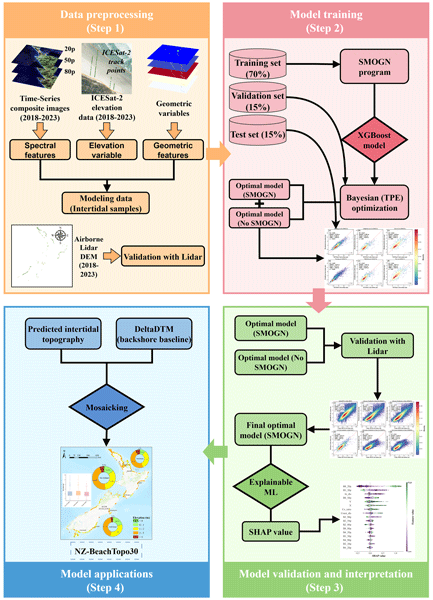
We developed NZ-BeachTopo30, a full-coverage 30 m beach topography dataset for New Zealand, by integrating Ice, Cloud, and land Elevation Satellite-2 (ICESat-2) and Sentinel-2 data with extreme gradient boosting (XGBoost). It expands valid intertidal coverage by 145.8 % and achieves a 0.94 m root mean square error against airborne light detection and ranging (airborne LiDAR) data, supporting sea-level rise and coastal erosion planning.
Julien E. S. Boulange, Fang Zhao, Simon N. Gosling, Yadu Pokhrel, Dai Yamazaki, and Xudong Zhou
EGUsphere, https://doi.org/10.5194/egusphere-2026-2739, https://doi.org/10.5194/egusphere-2026-2739, 2026
Short summary
Short summary
Many flood-prone regions lack the river observations needed for flood planning. We compared two widely used global datasets by testing how well they reproduced observed river flow at more than 5,000 gauging stations worldwide. One dataset better captured daily river flow changes, while the other provided more reliable estimates of long-term change. The results show that the most suitable dataset depends on whether the goal is flood monitoring or long-term risk assessment.
Robert Reinecke, Tanjila Akhter, Annemarie Bäthge, Ricarda Dietrich, Sebastian Gnann, Simon N. Gosling, Danielle Grogan, Andreas Hartmann, Stefan Kollet, Rohini Kumar, Richard Lammers, Sida Liu, Yan Liu, Nils Moosdorf, Bibi Naz, Sara Nazari, Chibuike Orazulike, Yadu Pokhrel, Jacob Schewe, Mikhail Smilovic, Maryna Strokal, Wim Thiery, Yoshihide Wada, Shan Zuidema, and Inge de Graaf
Geosci. Model Dev., 19, 523–542, https://doi.org/10.5194/gmd-19-523-2026, https://doi.org/10.5194/gmd-19-523-2026, 2026
Short summary
Short summary
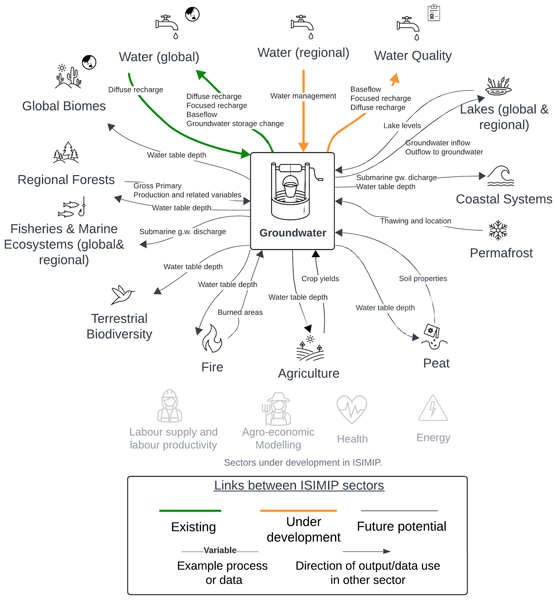
Here we describe a collaborative effort to improve predictions of how climate change will affect groundwater. The ISIMIP (The Inter-Sectoral Impact Model Intercomparison Project) groundwater sector combines multiple global groundwater models to capture a range of possible outcomes and reduce uncertainty. Initial comparisons reveal significant differences between models in key metrics like water table depth and recharge rates, highlighting the need for structured model intercomparisons.
Hannes Müller Schmied, Simon Newland Gosling, Marlo Garnsworthy, Laura Müller, Camelia-Eliza Telteu, Atiq Kainan Ahmed, Lauren Seaby Andersen, Julien Boulange, Peter Burek, Jinfeng Chang, He Chen, Lukas Gudmundsson, Manolis Grillakis, Luca Guillaumot, Naota Hanasaki, Aristeidis Koutroulis, Rohini Kumar, Guoyong Leng, Junguo Liu, Xingcai Liu, Inga Menke, Vimal Mishra, Yadu Pokhrel, Oldrich Rakovec, Luis Samaniego, Yusuke Satoh, Harsh Lovekumar Shah, Mikhail Smilovic, Tobias Stacke, Edwin Sutanudjaja, Wim Thiery, Athanasios Tsilimigkras, Yoshihide Wada, Niko Wanders, and Tokuta Yokohata
Geosci. Model Dev., 18, 2409–2425, https://doi.org/10.5194/gmd-18-2409-2025, https://doi.org/10.5194/gmd-18-2409-2025, 2025
Short summary
Short summary
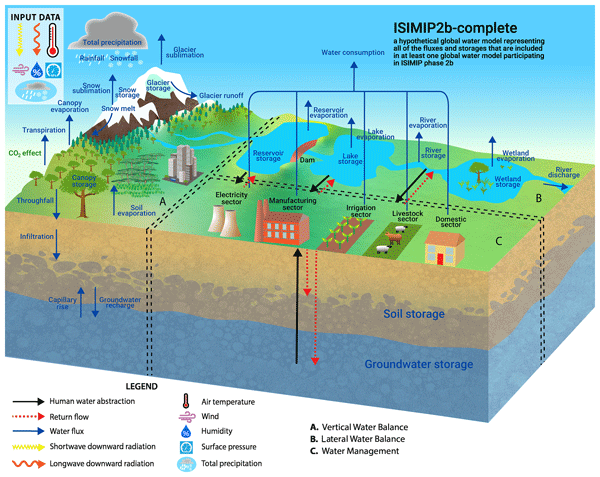
Global water models contribute to the evaluation of important natural and societal issues but are – as all models – simplified representation of reality. So, there are many ways to calculate the water fluxes and storages. This paper presents a visualization of 16 global water models using a standardized visualization and the pathway towards this common understanding. Next to academic education purposes, we envisage that these diagrams will help researchers, model developers, and data users.
Khosro Morovati, Keer Zhang, Lidi Shi, Yadu Pokhrel, Maozhou Wu, Paradis Someth, Sarann Ly, and Fuqiang Tian
Hydrol. Earth Syst. Sci., 28, 5133–5147, https://doi.org/10.5194/hess-28-5133-2024, https://doi.org/10.5194/hess-28-5133-2024, 2024
Short summary
Short summary
This study examines large daily river flow fluctuations in the dammed Mekong River, developing integrated 3D hydrodynamic and response time models alongside a hydrological model with an embedded reservoir module. This approach allows estimation of travel times between hydrological stations and contributions of subbasins and upstream regions. Findings show a power correlation between upstream discharge and travel time, and significant fluctuations occurred even before dam construction.
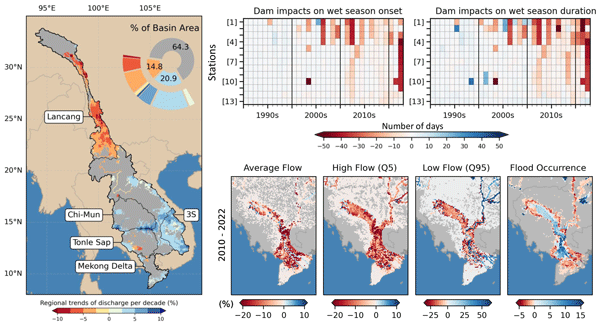
Huy Dang and Yadu Pokhrel
Hydrol. Earth Syst. Sci., 28, 3347–3365, https://doi.org/10.5194/hess-28-3347-2024, https://doi.org/10.5194/hess-28-3347-2024, 2024
Short summary
Short summary
By examining basin-wide simulations of a river regime over 83 years with and without dams, we present evidence that climate variation was a key driver of hydrologic variabilities in the Mekong River basin (MRB) over the long term; however, dams have largely altered the seasonality of the Mekong’s flow regime and annual flooding patterns in major downstream areas in recent years. These findings could help us rethink the planning of future dams and water resource management in the MRB.
Urmin Vegad, Yadu Pokhrel, and Vimal Mishra
Hydrol. Earth Syst. Sci., 28, 1107–1126, https://doi.org/10.5194/hess-28-1107-2024, https://doi.org/10.5194/hess-28-1107-2024, 2024
Short summary
Short summary
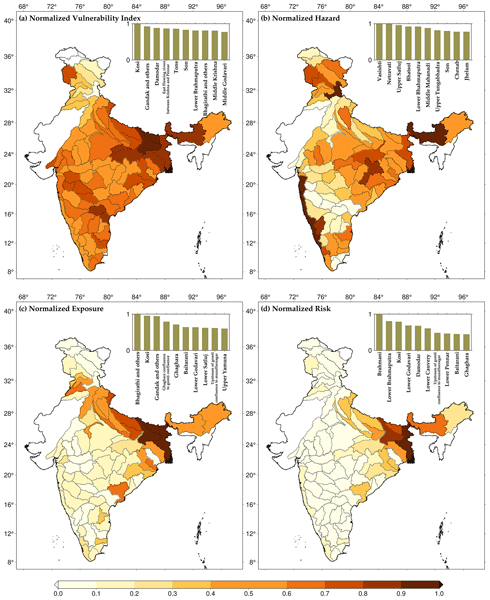
A large population is affected by floods, which leave their footprints through human mortality, migration, and damage to agriculture and infrastructure, during almost every summer monsoon season in India. Despite the massive damage of floods, sub-basin level flood risk assessment is still in its infancy and needs to be improved. Using hydrological and hydrodynamic models, we reconstructed sub-basin level observed floods for the 1901–2020 period.
Jiabo Yin, Louise J. Slater, Abdou Khouakhi, Le Yu, Pan Liu, Fupeng Li, Yadu Pokhrel, and Pierre Gentine
Earth Syst. Sci. Data, 15, 5597–5615, https://doi.org/10.5194/essd-15-5597-2023, https://doi.org/10.5194/essd-15-5597-2023, 2023
Short summary
Short summary
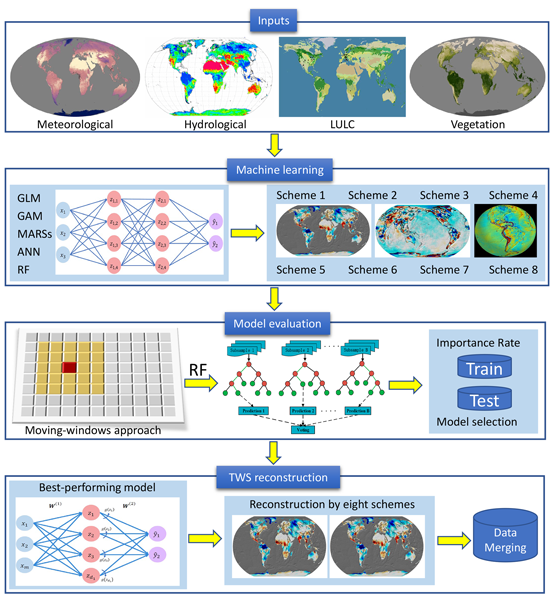
This study presents long-term (i.e., 1940–2022) and high-resolution (i.e., 0.25°) monthly time series of TWS anomalies over the global land surface. The reconstruction is achieved by using a set of machine learning models with a large number of predictors, including climatic and hydrological variables, land use/land cover data, and vegetation indicators (e.g., leaf area index). Our proposed GTWS-MLrec performs overall as well as, or is more reliable than, previous TWS datasets.
Jingyu Wang, Xianfeng Wang, Edward Park, and Yun Lin
Nat. Hazards Earth Syst. Sci. Discuss., https://doi.org/10.5194/nhess-2023-100, https://doi.org/10.5194/nhess-2023-100, 2023
Manuscript not accepted for further review
Short summary
Short summary
Building upon the findings in a preceding study by the authors (Wang et al., 2023), this brief communication successfully applied the soil moisture-based tornado damage track detection method to the 24–25 March 2023 Mississippi outbreak. This study also found that the notable discrepancies between spotter reports and ground survey assessments at the tornado early stage can be reconciled using the new method.
Enner Alcântara, José A. Marengo, José Mantovani, Luciana R. Londe, Rachel Lau Yu San, Edward Park, Yunung Nina Lin, Jingyu Wang, Tatiana Mendes, Ana Paula Cunha, Luana Pampuch, Marcelo Seluchi, Silvio Simões, Luz Adriana Cuartas, Demerval Goncalves, Klécia Massi, Regina Alvalá, Osvaldo Moraes, Carlos Souza Filho, Rodolfo Mendes, and Carlos Nobre
Nat. Hazards Earth Syst. Sci., 23, 1157–1175, https://doi.org/10.5194/nhess-23-1157-2023, https://doi.org/10.5194/nhess-23-1157-2023, 2023
Short summary
Short summary
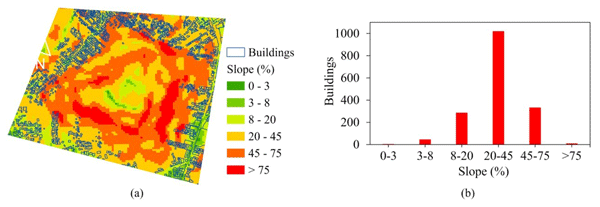
The municipality of Petrópolis (approximately 305 687 inhabitants) is nestled in the mountains 68 km outside the city of Rio de Janeiro. On 15 February 2022, the city of Petrópolis in Rio de Janeiro, Brazil, received an unusually high volume of rain within 3 h (258 mm). This resulted in flash floods and subsequent landslides that caused 231 fatalities, the deadliest landslide disaster recorded in Petrópolis. This work shows how the disaster was triggered.

Inne Vanderkelen, Shervan Gharari, Naoki Mizukami, Martyn P. Clark, David M. Lawrence, Sean Swenson, Yadu Pokhrel, Naota Hanasaki, Ann van Griensven, and Wim Thiery
Geosci. Model Dev., 15, 4163–4192, https://doi.org/10.5194/gmd-15-4163-2022, https://doi.org/10.5194/gmd-15-4163-2022, 2022
Short summary
Short summary
Human-controlled reservoirs have a large influence on the global water cycle. However, dam operations are rarely represented in Earth system models. We implement and evaluate a widely used reservoir parametrization in a global river-routing model. Using observations of individual reservoirs, the reservoir scheme outperforms the natural lake scheme. However, both schemes show a similar performance due to biases in runoff timing and magnitude when using simulated runoff.
Cited articles
Amornsakchai, S., Annez, P., Vongvisessomjai, S., Choowaew, S., Thailand Development Research Institute (TDRI), Kunurat, P., Nippanon, J., Schouten, R., Sripapatrprasite, P., Vaddhanaphuti, C., Vidthayanon, C., Wirojanagud, W., and Watana, E.: Pak Mun Dam, Mekong River Basin, Thailand, A WCD Case Study prepared as an input to the World Commission on Dams, Cape Town, https://www.mrcmekong.org/assets/Publications/Council-Study/Amornsakchai-etal-2001-Case-Study-PakMunDam-MRB-Thailand.pdf (last access: 24 September 2023), 2000.
Ang, W. J., Park, E., and Yang, X.: Geomorphic control on stage-area hysteresis in three of the largest floodplain lakes, J. Hydrol., 614, 128574, https://doi.org/10.1016/j.jhydrol.2022.128574, 2022.
Ang, W. J., Park, E., Pokhrel, Y., Tran D. D., and Loc, H. H.: Replication Data for: Dams in the Mekong: A comprehensive database, spatiotemporal distribution, and hydropower potentials, DR-NTU [data set], https://doi.org/10.21979/N9/ACZIJN, 2023.
Baird, I. G.: Local Ecological Knowledge and Small-scale Freshwater Fisheries Management in the Mekong River in Southern Laos, in: Fishers' Knowledge in Fisheries Science and Management, edited by: Haggan, N., Neis, B., and Baird, I. G., UNESCO, 247–266, https://www.researchgate.net/publication/228734632_Local_ecological_knowledge_and_small-scale_freshwater_fisheries_management_in_the_Mekong_River_in_Southern_Laos (last access: 1 March 2024) 2007.
Barbarossa, V., Schmitt, R. J. P., Huijbregts, M. A. J., Zarfl, C., King, H., and Schipper, A. M.: Impacts of current and future large dams on the geographic range connectivity of freshwater fish worldwide, P. Natl. Acad. Sci. USA, 117, 3648–3655, https://doi.org/10.1073/pnas.1912776117, 2020.
Biba, S.: China's Continuous Dam-building on the Mekong River, J. Contemp. Asia, 42, 603–628, https://doi.org/10.1080/00472336.2012.712257, 2012.
Binh, D. V., Kantoush, S. A., Saber, M., Mai, N. P., Maskey, S., Phong, D. T., and Sumi, T.: Long-term alterations of flow regimes of the Mekong River and adaptation strategies for the Vietnamese Mekong Delta, J. Hydrol. Reg. Stud., 32, 100742, https://doi.org/10.1016/j.ejrh.2020.100742, 2020.
Chen, H. and Boutros, P. C.: VennDiagram: A package for the generation of highly-customizable Venn and Euler diagrams in R, BMC Bioinformatics, 12, 35, https://doi.org/10.1186/1471-2105-12-35, 2011.
CHIRPS: CHIRPS: Rainfall Estimates from Rain Gauge and Satellite Observations, https://www.chc.ucsb.edu/data/chirps (last access: 28 December 2023).
Cho, M. S. and Qi, J.: Quantifying spatiotemporal impacts of hydro-dams on land use/land cover changes in the Lower Mekong River Basin, Appl. Geogr., 136, 102588, https://doi.org/10.1016/j.apgeog.2021.102588, 2021.
Chowdhury, A. F. M. K., Dang, T. D., Bagchi, A., and Galelli, S.: Expected Benefits of Laos' Hydropower Development Curbed by Hydroclimatic Variability and Limited Transmission Capacity: Opportunities to Reform, J. Water Res. Plan. Man., 146, 05020019, https://doi.org/10.1061/(ASCE)WR.1943-5452.0001279, 2020.
Cochrane, T. A., Arias, M. E., and Piman, T.: Historical impact of water infrastructure on water levels of the Mekong River and the Tonle Sap system, Hydrol. Earth Syst. Sci., 18, 4529–4541, https://doi.org/10.5194/hess-18-4529-2014, 2014.
Cooley, H., Christian-Smith, J., Gleick, P., Allen, L., and Cohen, M.: Understanding and Reducing the Risks of Climate Change for Transboundary Waters, Pacific Institute, https://pacinst.org/wp-content/uploads/2009/12/transboundary_water_and_climate_report3.pdf (last access: 1 March 2024), 2009.
Cronin, R.: Mekong Dams and the Perils of Peace, Survival, 51, 147–160, https://doi.org/10.1080/00396330903461716, 2009.
Cuya, D. G. P., Brandimarte, L., Popescu, I., Alterach, J., and Peviani, M.: A GIS-based assessment of maximum potential hydropower production in La Plata basin under global changes, Renew. Energ., 50, 103–114, https://doi.org/10.1016/j.renene.2012.06.019, 2013.
Dang, H., Pokhrel, Y., Shin, S., Stelly, J., Ahlquist, D., and Du Bui, D.: Hydrologic balance and inundation dynamics of Southeast Asia's largest inland lake altered by hydropower dams in the Mekong River basin, Sci. Total Environ., 831, 154833, https://doi.org/10.1016/j.scitotenv.2022.15483, 2022.
Dugan, P. J., Barlow, C., Agostinho, A. A., Baran, E., Cada, G. F., Chen, D., Cowx, I. G., Ferguson, J. W., Jutagate, T., Mallen-Cooper, M., Marmulla, G., Nestler, J., Petrere, M., Welcomme, R. L., and Winemiller, K. O.: Fish Migration, Dams, and Loss of Ecosystem Services in the Mekong Basin, Ambio, 39, 344–348, https://doi.org/10.1007/s13280-010-0036-1, 2010.
EDL-Generation Public Company: Nam Mang 3 Hydro Power Plant, https://edlgen.com.la/project/nam-mang3-hpp/?lang=en (last access: 19 December 2023).
Energy Market Authority: Singapore commences first renewable energy electricity import via regional multilateral power trade [Press Release], https://www.ema.gov.sg/content/dam/corporate/news/media-releases/2022/20220623_MediaRelease_Singapore-commences-first-renewable-energy-electricity-imports-100MW.pdf.coredownload.pdf (last access: 29 January 2023), 2022.
Ezell, S.: 4 Dams on the Upper Mekong in Yunnan, China: 2011–2019, The Diplomat, https://thediplomat.com/2021/05/4-dams-on-the-upper-mekong-in-yunnan-china-2011-2019/ (last access: 11 October 2023), 2021.
FAO: AQUASTAT – FAO's Global Information System on Water and Agriculture, https://www.fao.org/aquastat/en/databases/dams (last access: 29 January 2023), 2015.
Galelli, S., Dang, T. D., Ng, J. Y., Chowdhury, A. F. M. K., and Arias, M. E.: Opportunities to curb hydrological alterations via dam re-operation in the Mekong, Nat. Sustain., 5, 1058–1069, https://doi.org/10.1038/s41893-022-00971-z, 2022.
Gao, Y., Sarker, S., Sarker, T., and Leta, O. T.: Analyzing the critical locations in response of constructed and planned dams on the Mekong River Basin for environmental integrity, Environ. Res. Commun., 4, 101001, https://doi.org/10.1088/2515-7620/ac9459, 2022.
Gosling, S. N., Schmied, H. M., Burek, P., Chang, J., Ciais, P., Döll, P., Eisner, S., Fink, G., Flörke, M., Franssen, W., Grillakis, M., Hagemann, S., Hanasaki, N., Koutroulis, A., Leng, G., Liu, X., Masaki, Y., Mathison, C., Mishra, V., Ostberg, S., Portmann, F., Qi, W., Sahu, R., Satoh, Y., Schewe, J., Seneviratne, S., Shah, H. L., Stacke, T., Tao, F., Telteu, C., Thiery, W., Trautmann, T., Tsanis, I., Wanders, N., Zhai, R., Büchner, M., Schewe, J., and Zhao, F.: ISIMIP2b Simulation Data from the Global Water Sector (v1.0), ISIMIP Repository [data set], https://doi.org/10.48364/ISIMIP.626689, 2023.
Grill, G., Ouellet Dallaire, C., Fluet Chouinard, E., Sindorf, N., and Lehner, B.: Development of new indicators to evaluate river fragmentation and flow regulation at large scales: A case study for the Mekong River Basin, Ecol. Indic., 45, 148–159, https://doi.org/10.1016/j.ecolind.2014.03.026, 2014.
Grill, G., Lehner, B., Thieme, M., Geenen, B., Tickner, D., Antonelli, F., Babu, S., Borrelli, P., Cheng, L., Crochetiere, H., Ehalt Macedo, H., Filgueiras, R., Goichot, M., Higgins, J., Hogan, Z., Lip, B., McClain, M. E., Meng, J., Mulligan, M., Nilsson, C., Olden, J. D., Opperman, J. J., Petry, P., Reidy Liermann, C., Sáenz, L., Salinas-Rodríguez, S., Schelle, P., Schmitt, R. J. P., Snider, J., Tan, F., Tockner, K., Valdujo, P. H., van Soesbergen, A., and Zarfl, C.: Mapping the world's free-flowing Rivers, Nature, 569, 215–221, https://doi.org/10.1038/s41586-019-1111-9, 2019.
Grumbine, R. E., Dore, J., and Xu, J.: Mekong hydropower: Drivers of change and governance challenges, Front. Ecol. Environ., 10, 91–98, https://doi.org/10.1890/110146, 2012.
Grünwald, R., Wang, W., and Feng, Y.: Politicization of the hydropower dams in the Lancang-Mekong Basin: A review of contemporary environmental challenges, Energies, 15, 1682, https://doi.org/10.3390/en15051682, 2022.
Gudmundsson, L., Boulange, J., Do, H. X., Gosling, S. N., Grillakis, M. G., Koutroulis, A. G., Leonard, M., Liu, J., Schmied, H. M., Papadimitriou, L., Pokhrel, Y., Seneviratne, S. I., Satoh, Y., Thiery, W., Westra, S., Zhang, X., and Zhao, F.: Globally observed trends in mean and extreme river flow attributed to climate change, Science, 371, 1159–1162, https://doi.org/10.1126/science.aba3996, 2021.
Hanna, J. W., Kim, M. S., Ramsey, A. C., Omdal, D. W., Mulvey, R. L., Goodrich, B. A., Ferguson, B. A., Bronson, J. J., Goheen, E. M., Chadwick, K. L., Kearns, H. S. J., Lockman, I. B., LaBarge, A. K. B., Stewart, J. E., Maffei, H. M., Oblinger, B. W., Smith, A. L., Ross-Davis, A. L., Shaw, D. C., LeBoldus, J. M., Bennett, P. I., Alveshere, B. C., Ashiglar, S. M., McDonald, G. I., Pitman, E. W. I., Donley, J. B., Bright, B. C., Warwell, M. V., and Klopfenstein, N. B.: Maximum entropy-based bioclimatic models predict areas of current and future suitable habitat for Armillaria species in western Oregon and western Washington, in: 66th Annual Western International Forest Disease Work Conference, Estes Park, 3–7 June 2019, 161–170, https://www.fs.usda.gov/research/treesearch/61283 (last access: 2 March 2024), 2019.
Hecht, J. S., Lacombe, G., Arias, M. E., Dang, T. D., and Piman, T.: Hydropower dams of the Mekong River basin: A review of their hydrological impacts, J. Hydrol., 568, 285–300, https://doi.org/10.1016/j.jhydrol.2018.10.045, 2019.
Hempel, S., Frieler, K., Warszawski, L., Schewe, J., and Piontek, F.: A trend-preserving bias correction – the ISI-MIP approach, Earth Syst. Dynam., 4, 219–236, https://doi.org/10.5194/esd-4-219-2013, 2013.
Hirsch, P.: The Changing Political Dynamics of Dam Building on the Mekong, Water Altern., 3, 312–323, 2010.
Hirsch, P.: The shifting regional geopolitics of Mekong dams, Polit. Geogr., 51, 63–74, https://doi.org/10.1016/j.polgeo.2015.12.004, 2016.
Hobo Maps: Home Page, https://hobomaps.com/ (last access: 18 July 2023).
HydroSHEDS: Data Products, https://www.hydrosheds.org/products (last access: 30 January 2023).
IPCC: Climate Change 2014: Synthesis Report, Contribution of Working Groups I, II and III to the Fifth Assessment Report of the Intergovernmental Panel on Climate Change [Core Writing Team, Pachauri, R. K. and Meyer, L. A. (Eds.)], IPCC, Geneva, Switzerland, 151 pp., 2014.
IR: Lancang River Dams: Threatening the Flow of the Lower Mekong, https://archive.internationalrivers.org/sites/default/files/attached-files/ir_lacang_dams_2013_5.pdf (last access: 17 February 2023), 2013.
IR: Spreadsheet of Major Dams in China, https://archive.internationalrivers.org/resources/spreadsheet-of-major-dams-in-china-7743 (last access: 29 January 2023), 2014.
IR: Pak Beng Dam, https://archive.internationalrivers.org/node/10852 (last access: 29 January 2023).
IRENA: Renewable Power Generation Costs in 2021, International Renewable Energy Agency, Abu Dhabi, https://www.irena.org/publications/2022/Jul/Renewable-Power-Generation-Costs-in-2021 (last access: 27 March 2023), 2022.
Kang, H., Sridhar, V., Mainuddin, M., and Trung, L. D.: Future rice farming threatened by drought in the Lower Mekong Basin, Sci. Rep.-UK, 11, 9383, https://doi.org/10.1038/s41598-021-88405-2, 2021.
Kummu, M. and Varis, O.: Sediment-related impacts due to upstream reservoir trapping, the Lower Mekong River, Geomorphology, 85, 275–293, https://doi.org/10.1016/j.geomorph.2006.03.024, 2007.
Kondolf, G. M., Rubin, Z. K., and Minear, J. T.: Dams on the Mekong: Cumulative sediment starvation, Water Resour. Res., 50, 5158–5169, https://doi.org/10.1002/2013WR014651, 2014.
Larsson, J.: eulerr: Area-Proportional Euler and Venn Diagrams with Ellipses, CRAN [code], https://CRAN.R-project.org/package=eulerr (last access: 1 March 2024), 2023.
Larsson, J. and Gustafsson, P.: A Case Study in Fitting Area-Proportional Euler Diagrams with Ellipses using eulerr, in: Proceedings of International Workshop on Set Visualization and Reasoning, Edinburgh, United Kingdom, 18 June 2018, 2116, 84–91, 2018.
Le, T. V. H., Nguyen, H. N., Wolanski, E., Tran, T. C., and Haruyama, S.: The combined impact on the flooding in Vietnam's Mekong River delta of local man-made structures, sea level rise, and dams upstream in the river catchment, Estuar. Coast. Shelf S., 71, 110–116, https://doi.org/10.1016/j.ecss.2006.08.021, 2007.
Lebel, L., Dore, J., Daniel, R., and Koma, Y. S.: Democratizing water governance in the Mekong Region, Mekong Press, http://www.mpowernetwork.org/Knowledge_Bank/Our_Books/PDF/Water_Governance.pdf (last access: 4 April 2023), 2007.
Lehner, B., Czisch, G., and Vassolo, S.: The impact of global change on the hydropower potential of Europe: A model- based analysis, Energ. Policy, 33, 839–855, https://doi.org/10.1016/j.enpol.2003.10.018, 2005.
Lehner, B., Liermann, C. R., Revenga, C., Vörösmarty, C., Fekete, B., Crouzet, P., Döll, P., Endejan, M., Frenken, K., Magome, J., Nilsson, C., Robertson, J. C., Rödel, R., Sindorf, N., and Wisser, D.: High-resolution mapping of the world's reservoirs and dams for sustainable river-flow management, Front. Ecol. Environ., 9, 494–502, https://doi.org/10.1890/100125, 2011.
Leinenkugel, P., Kuenzer, C., Oppelt, N., and Dech, S.: Characterisation of land surface phenology and land cover based on moderate resolution satellite data in cloud prone areas—A novel product for the Mekong Basin, Remote Sens. Environ., 136, 180–198, https://doi.org/10.1016/j.rse.2013.05.004, 2013.
Li, J., Xia, J., and Ji, Q.: Rapid and long-distance channel incision in the Lower Yellow River owing to upstream damming, Catena, 196, 104943, https://doi.org/10.1016/j.catena.2020.104943, 2021.
Lu, X., Kummu, M., and Oeurng, C.: Reappraisal of sediment dynamics in the Lower Mekong River, Cambodia, Earth Surf. Proc. Land., 39, 1855–1865, https://doi.org/10.1002/esp.3573, 2014.
Li, X., Liu, J. P., Saito, Y., and Nguyen, V. L.: Recent evolution of the Mekong Delta and the impacts of dams, Earth-Sci. Rev., 175, 1–17, https://doi.org/10.1016/j.earscirev.2017.10.008, 2017.
MacDonald, L. H. and Coe, D.: Influence of headwater streams on downstream reaches in forested areas, Forest Sci., 53, 148–168, https://www.nrel.colostate.edu/assets/nrel_files/labs/macdonald-lab/pubs/MacDonald_Coe_Forest_Science.pdf (last access: 25 January 2024), 2007.
Matthews, N.: Water Grabbing in the Mekong Basin-An Analysis of the Winners and Losers of Thailand's Hydropower Development in Lao PDR, Water Altern., 5, 392–411, 2012.
Meijer, L. J. J., van der Ent, R. J., Hoes, A. C., Mondeel, H., Pramana, K. E. R., and van de Giesen, N. C.: World hydropower capacity evaluation, Netherlands, http://resolver.tudelft.nl/uuid:49d8d013-9a48-4222-85a1-0ebb53f83dc8 (last access: 26 March 2023), 2012.
MIT: Stimson Mekong Infrastructure Tracker, https://www.stimson.org/project/mekong-infrastructure/ (last access: 29 January 2023), 2021.
MRC: Assessment of Basin-Wide Development Scenarios (Main Report), https://www.mrcmekong.org/resource/ajhykw (last access: 24 January 2023), 2011.
MRC: Briefing Notes Package 6th RTWG Meeting, https://www.mrcmekong.org/assets/Publications/Council-Study/6th-RTWG-Briefing-Notes-Package.pdf (last access: 18 September 2023), 2015.
MRC: Consultancy to assist the Hydropower Thematic in Council Study Development Scenarios, https://www.mrcmekong.org/assets/Publications/Council-Study/018-Hydropower-Development-Scenarios.pdf (last access: 21 December 2023), 2016.
MRC: Mekong Basin, https://www.mrcmekong.org/about/mekong-basin/ (last access: 23 September 2023).
Mulligan, M., van Soesbergen, A., and Sáenz, L.: GOODD, a global dataset of more than 38,000 georeferenced dams, Sci. Data, 7, 31, https://doi.org/10.1038/s41597-020-0362-5, 2020.
Observatory of Economic Complexity: Electricity in Laos, OEC – The Observatory of Economic Complexity, https://oec.world/en/profile/bilateral-product/electricity/reporter/lao (last access: 29 January 2023).
ODM: Greater Mekong Subregion hydropower dams, https://data.opendevelopmentmekong.net/en/dataset/greater-mekong-subregion-hydropower-dams (last access: 22 November 2022), 2014.
ODM: National grid, import of energy, consumption of energy, hydro-electric dams, https://data.opendevelopmentmekong.net/en/dataset/national-grid-import-of-energy-consumption-of-energy-hydro-electric-dams (last access: 22 November 2022), 2015.
ODM: Greater Mekong Subregion hydropower dams (2016), https://data.opendevelopmentmekong.net/en/dataset/greater-mekong-subregion-hydropower-dams-2016 (last access: 22 November 2022), 2016a.
ODM: Hydropower dam (1993–2020), https://data.opendevelopmentmekong.net/en/dataset/hydropower-2009-2014 (last access: 22 November 2022), 2016b.
ODM: Hydropower Dams in Myanmar 2017, https://data.opendevelopmentmekong.net/en/dataset/hydropower-dam-in-myanmar-2017 (last access: 22 November 2022), 2017a.
ODM: Hydropower 2017, ICEM (International Centre for Environmental Management) Prod2, https://data.opendevelopmentmekong.net/en/dataset/hydropower-2017-icem-international-centre-for-environmental-management-prod2 (last access: 22 November 2022), 2017b.
ODM: Myanmar Dams, https://data.opendevelopmentmekong.net/dataset/myanmar-dams (last access: 22 November 2022), 2018.
ODM: Mekong Regional Hydropower Dams 2020, https://data.opendevelopmentmekong.net/dataset/mekong-regional-hydropower-dams-2020 (last access: 22 November 2022), 2020a.
ODM: Hydropower Dams in Thailand, https://data.opendevelopmentmekong.net/en/dataset/hydropower-dams-in-thailand (last access: 22 November 2022), 2020b.
ODM: Laos to export 20,000 MW of electricity by 2030, https://opendevelopmentmekong.net/news/laos-to-export-20000-mw-of-electricity-by-2030/ (last access: 29 January 2023), 2020c.
ODM: Hydropower dams on primary rivers in the Mekong basin in 2022, https://data.opendevelopmentmekong.net/en/dataset/hydropower-dams-in-the-mekong-region-in-2022, last access: 22 November 2022.
ODM: Open Development Mekong Datahub, https://data.opendevelopmentmekong.net/dataset, last access: 29 January 2023.
Park, E., Loc, H. H., Van Binh, D., and Kantoush, S.: The worst 2020 saline water intrusion disaster of the past century in the Mekong Delta: Impacts, causes, and management implications, Ambio, 51, 691–699, https://doi.org/10.1007/s13280-021-01577-z, 2022.
Pearse-Smith, S. W. D.: The Impact of Continued Mekong Basin Hydropower Development on Local Livelihoods, Consilience, 7, 73–86, https://www.jstor.org/stable/26167837 (last access: 7 April 2023), 2012.
Pholsena, S. and Phonekeo, D. D.: Lao hydropower potential and policy in the GMS context, United Nations Symposium on Hydropower and Sustainable Development, Beijing International Convention Centre, 1–7, https://www.un.org/esa/sustdev/sdissues/energy/op/hydro_phonekeoLaoPDR.pdf (last access: 2 March 2024), 27 October 2004.
Poff, N. L. and Hart, D. D.: How dams vary and why it matters for the emerging science of dam removal: an ecological classification of dams is needed to characterize how the tremendous variation in the size, operational mode, age, and number of dams in a river basin influences the potential for restoring regulated rivers via dam removal, BioScience, 52, 659–668, https://doi.org/10.1641/0006-3568(2002)052[0659:HDVAWI]2.0.CO;2, 2002..
Poindexter, G.: 86-MW Nam Phay hydropower project in Lao PDR officially commissioned, Hydro Review, https://www.hydroreview.com/world-regions/86-mw-nam-phay-hydropower-project-in-laos-officially-commissioned/ (last access: 15 February 2023), 2018.
Pokhrel, Y. N., Oki, T., and Kanae, S.: A Grid Based Assessment of Global Theoretical Hydropower Potential, Prooceedings of Hydraulic Engineering, 52, 7–12, https://doi.org/10.2208/prohe.52.7, 2008.
Pokhrel, Y. N., Felfelani, F., Shin, S., Yamada, T. J., and Satoh, Y.: Modeling large-scale human alteration of land surface hydrology and climate, Geosci. Lett., 4, 1–13, https://doi.org/10.1186/s40562-017-0076-5, 2017.
Pokhrel, Y., Felfelani, F., Satoh, Y., Boulange, J., Burek, P., Gädeke, A., Gosling, S. N., Grillakis, M., Gudmundsson, L., Hanasaki, N., Kim, H., Koutroulis, A., Liu, J., Papadimitriou, L., Schewe, J., Schmied, H. M., Stacke, T., Telteu, C., Thiery, W., Veldkamp, T., Zhao, F., and Wada, Y.: Global terrestrial water storage and drought severity under climate change, Nat. Clim. Change, 11, 226–233, https://doi.org/10.1038/s41558-020-00972-w, 2021.
Power Technology: Home, https://www.power-technology.com/ (last access: 19 December 2023).
Reyes-Gavilán, F. G., Garrido, R., Nicieza, A. G., Toledo, M. M., and Brana, F.: Fish community variation along physical gradients in short streams of northern Spain and the disruptive effect of dams, Hydrobiologia, 321, 155–163, https://doi.org/10.1007/BF00023171, 1996.
Rossi, C. G., Srinivasan, R., Jirayoot, K., Le Duc, T., Souvannabouth, P., Binh, N., and Gassman, P. W.: Hydrologic evaluation of the Lower Mekong River Basin with the soil and water assessment tool model, Int. Agric. Eng. J., 18, 1–13, https://handle.nal.usda.gov/10113/48579 (last access: 20 March 2023), 2009.
Schmitt, R. J. P., Bizzi, S., Castelletti, A., and Kondolf, G. M.: Improved trade-offs of hydropower and sand connectivity by strategic dam planning in the Mekong, Nat. Sustain., 1, 96–104, https://doi.org/10.1038/s41893-018-0022-3, 2018.
Shin, S., Pokhrel, Y., Yamazaki, D., Huang, X., Torbick, N., Qi, J., Pattanakiat, S., Ngo-Duc, T., and Nguyen, T. D.: High resolution modeling of river- floodplain-reservoir inundation dynamics in the Mekong River Basin, Water Resour. Res., 56, e2019WR026449, https://doi.org/10.1029/2019WR026449, 2020.
Soukhaphon, A., Baird, I. G., and Hogan, Z. S.: The Impacts of Hydropower Dams in the Mekong River Basin: A Review, Water, 13, 265, https://doi.org/10.3390/w13030265, 2021.
Souter, N. J., Shaad, K., Vollmer, D., Regan, H. M., Farrell, T. A., Arnaiz, M., Meynell, P.-J., Cochrane, T. A., Arias, M. E., Piman, T., and Andelman, S. J.: Using the Freshwater Health Index to Assess Hydropower Development Scenarios in the Sesan, Srepok and Sekong River Basin, Water, 12, 788, https://doi.org/10.3390/w12030788, 2020.
Speckhann, G. A., Kreibich, H., and Merz, B.: Inventory of dams in Germany, Earth Syst. Sci. Data, 13, 731–740, https://doi.org/10.5194/essd-13-731-2021, 2021.
Sun, J., Du, W., Lucas, M. C., Ding, C., Chen, J., Tao, J., and He, D.: River fragmentation and barrier impacts on fishes have been greatly underestimated in the upper Mekong River, J. Environ. Manage., 327, 116817, https://doi.org/10.1016/j.jenvman.2022.116817, 2023.
Tang, L., Mo, K., Zhang, J., Wang, J., Chen, Q., He, S., Zhu, C., and Lin, Y.: Removing tributary low-head dams can compensate for fish habitat losses in dammed rivers, J. Hydrol., 598, 126204, https://doi.org/10.1016/j.jhydrol.2021.126204, 2021.
Tefera, W. M. and Kasiviswanathan, K. S.: A global-scale hydropower potential assessment and feasibility evaluations, Water Resour. Econ., 38, 100198, https://doi.org/10.1016/j.wre.2022.100198, 2022.
The Anh, D., Van Tinh, T., and Ngoc Vang, N.: The Domestic Rice Value Chain in the Mekong Delta, in: White Gold: The Commercialisation of Rice Farming in the Lower Mekong Basin, edited by: Cramb, R., Springer Nature, 375–395, https://doi.org/10.1007/978-981-15-0998-8_18, 2020.
The World Bank: Small Hydro Resource Mapping in LAO PDR Inception Report (Project ID. 1239196), https://documents1.worldbank.org/curated/en/160621508232662247/pdf/120466-ESM-P163979-PUBLIC-LaoPDRHydropowerMappingInceptionReportWBESMAPJuly.pdf (last access: 19 December 2023), 2017.
Tiwari, A. D., Pokhrel, Y., Kramer, D., Akhter, T., Tang, Q., Liu, J., Qi, J., Loc, H. H., and Lakshmi, V.: A synthesis of hydroclimatic, ecological, and socioeconomic data for transdisciplinary research in the Mekong, Sci. Data, 10, 283, https://doi.org/10.1038/s41597-023-02193-0, 2023.
Tri, V. K.: Hydrology and Hydraulic Infrastructure Systems in the Mekong Delta, Vietnam, in: The Mekong Delta System: Interdisciplinary Analyses of a River Delta, edited by: Renaud, F. G. and Kuenzer, C., Springer Netherlands, 49–81, https://doi.org/10.1007/978-94-007-3962-8_3, 2012.
Urban, F., Nordensvärd, J., Khatri, D., and Wang, Y.: An analysis of China's investment in the hydropower sector in the Greater Mekong Sub-Region, Environ. Dev. Sustain., 15, 301–324, https://doi.org/10.1007/s10668-012-9415-z, 2013.
USGS: EarthExplorer, https://earthexplorer.usgs.gov/ (last access: 30 January 2023).
VietNamNet: Hydro-power dam broken in Central Highlands, https://vietnamnet.vn/en/hydro-power-dam-broken-in-central-highlands-E76563.html (last access: 11 October 2023), 2013.
VnExpress: Confessions of a hydropower calamity in Vietnam, https://e.vnexpress.net/projects/confessions-of-a-hydropower-calamity-in-vietnam-3655314/index.html (last access: 11 October 2023), 2017.
Wang, J., Walter, B. A., Yao, F., Song, C., Ding, M., Maroof, A. S., Zhu, J., Fan, C., McAlister, J. M., Sikder, S., Sheng, Y., Allen, G. H., Crétaux, J.-F., and Wada, Y.: GeoDAR: georeferenced global dams and reservoirs dataset for bridging attributes and geolocations, Earth Syst. Sci. Data, 14, 1869–1899, https://doi.org/10.5194/essd-14-1869-2022, 2022a.
Wang, J., Walter, B. A., Yao, F., Song, C., Ding, M., Maroof, A. S., Zhu, J., Fan, C., McAlister, J. M., Safat Sikder, M., Sheng, Y., Allen, G. H., Crétaux, J.-F., and Wada, Y.: GeoDAR: Georeferenced global Dams And Reservoirs dataset for bridging attributes and geolocations, In Earth System Science Data (v1.1; v1.0, Bd. 14, Nummer 4, S. 1869–1899), Zenodo [data set], https://doi.org/10.5281/zenodo.6163413, 2022b.
Wang, P., Dong, S., and Lassoie, J.: The Large Dam Dilemma: An Exploration of the Impacts of Hydro Projects on People and the Environment in China, Springer Netherlands, https://doi.org/10.1007/978-94-007-7630-2, 2014.
Wang, W., Lu, H., Ruby Leung, L., Li, H. Y., Zhao, J., Tian, F., Yang, K., and Sothea, K.: Dam construction in Lancang–Mekong River Basin could mitigate future flood risk from warming-induced intensified rainfall, Geophys. Res. Lett., 44, 10–378, https://doi.org/10.1002/2017GL075037, 2017.
Wang, X., Xiao, X., Qin, Y., Dong, J., Wu, J., and Li, B.: Improved maps of surface water bodies, large dams, reservoirs, and lakes in China, Earth Syst. Sci. Data, 14, 3757–3771, https://doi.org/10.5194/essd-14-3757-2022, 2022.
Xu, S., Chen, M., Feng, T., Zhan, L., Zhou, L., and Yu, G.: Use ggbreak to effectively utilize plotting space to deal with large datasets and outliers, Front. Genet., 12, 2122, https://doi.org/10.3389/fgene.2021.774846, 2021.
Xue, Z., Liu, J. P., DeMaster, D., Van Nguyen, L., and Ta, T. K. O.: Late Holocene Evolution of the Mekong Subaqueous Delta, Southern Vietnam, Mar. Geol., 269, 46–60, https://doi.org/10.1016/j.margeo.2009.12.005, 2010.
Yoshida, Y., Lee, H. S., Trung, B. H., Tran, H.-D., Lall, M. K., Kakar, K., and Xuan, T. D.: Impacts of Mainstream Hydropower Dams on Fisheries and Agriculture in Lower Mekong Basin, Sustainability, 12, 2408, https://doi.org/10.3390/su12062408, 2020.
Yuen, K. W., Park, E., Hazrina, M., Taufik, M., Santikayasa, P., Latrubesse, E., and Lee, J. S. H.: A Comprehensive Database of Indonesian Dams and Its Spatial Distribution, Remote Sens.-Basel, 15, 925, https://doi.org/10.3390/rs15040925, 2023.
Zarfl, C., Lumsdon, A. E., Berlekamp, J., Tydecks, L., and Tockner, K.: A global boom in hydropower dam construction, Aquat. Sci., 77, 161–170, https://doi.org/10.1007/s00027-014-0377-0, 2015.
Zawahri, N. A. and Hensengerth, O.: Domestic environmental activists and the governance of the Ganges and Mekong Rivers in India and China, Int. Environ. Agreem.-P., 12, 269–298, https://doi.org/10.1007/s10784-012-9179-9, 2012.
Zhou, Y., Hejazi, M., Smith, S., Edmonds, J., Li, H., Clarke, L., Calvin, K., and Thomson, A.: A comprehensive view of global potential for hydro-generated electricity, Energy Environ. Sci., 8, 2622–2633, https://doi.org/10.1039/C5EE00888C, 2015.
Ziv, G., Baran, E., Nam, S., Rodríguez-Iturbe, I., and Levin, S. A.: Trading-off fish biodiversity, food security, and hydropower in the Mekong River Basin, P. Natl. Acad. Sci. USA, 109, 5609–5614, https://doi.org/10.1073/pnas.1201423109, 2012.
Short summary
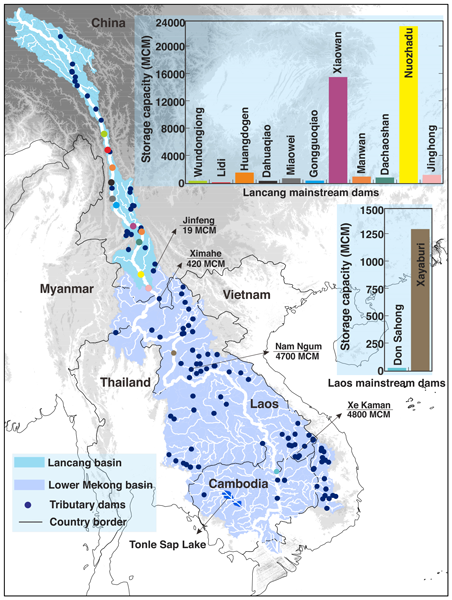
Dams have burgeoned in the Mekong, but information on dams is scattered and inconsistent. Up-to-date evaluation of dams is unavailable, and basin-wide hydropower potential has yet to be systematically assessed. We present a comprehensive database of 1055 dams, a spatiotemporal analysis of the dams, and a total hydropower potential of 1 334 683 MW. Considering projected dam development and hydropower potential, the vulnerability and the need for better dam management may be highest in Laos.
Dams have burgeoned in the Mekong, but information on dams is scattered and inconsistent....


Altmetrics
Final-revised paper
Preprint