Articles | Volume 18, issue 10
https://doi.org/10.5194/essd-18-7861-2026
© Author(s) 2026. This work is distributed under
the Creative Commons Attribution 4.0 License.
https://doi.org/10.5194/essd-18-7861-2026
© Author(s) 2026. This work is distributed under
the Creative Commons Attribution 4.0 License.
Extreme precipitation events: a comprehensive catalog for northern Chile (17.5° S to 30.0° S)

Felipe Matus
Advanced Mining Technology Center (AMTC), Faculty of Physical and Mathematical Sciences, University of Chile, Santiago, Chile
Marcia Paredes
Advanced Mining Technology Center (AMTC), Faculty of Physical and Mathematical Sciences, University of Chile, Santiago, Chile
Miguel Lagos-Zúñiga
Departamento de Obras Civiles, Universidad Técnica Federico Santa María, Valparaíso, Chile
Alex Garcés
Advanced Mining Technology Center (AMTC), Faculty of Physical and Mathematical Sciences, University of Chile, Santiago, Chile
Diego Pinto
Advanced Mining Technology Center (AMTC), Faculty of Physical and Mathematical Sciences, University of Chile, Santiago, Chile
Germán Aguilar
Advanced Mining Technology Center (AMTC), Faculty of Physical and Mathematical Sciences, University of Chile, Santiago, Chile
Santiago Montserrat
CORRESPONDING AUTHOR
Advanced Mining Technology Center (AMTC), Faculty of Physical and Mathematical Sciences, University of Chile, Santiago, Chile
Related authors
No articles found.
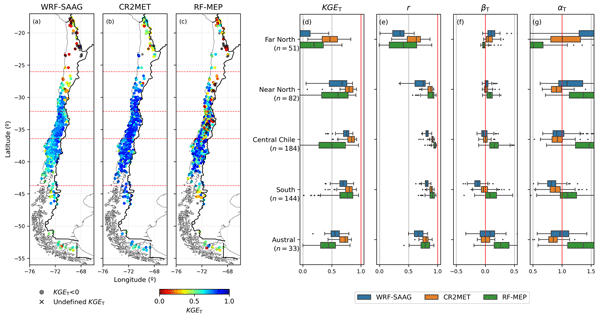
Sofía Segovia-Escafi, Pablo A. Mendoza, Miguel Lagos-Zúñiga, Lucía Scaff, and Andreas F. Prein
Hydrol. Earth Syst. Sci., 30, 6481–6510, https://doi.org/10.5194/hess-30-6481-2026, https://doi.org/10.5194/hess-30-6481-2026, 2026
Short summary
Short summary
High-resolution climate simulations can improve our understanding of precipitation and temperature patterns in regions with complex terrain. We evaluate a new climate dataset against in-situ observations and assess its potential for hydrological modeling. Our results show that, despite some limitations in dry areas, high-resolution climate models can provide useful daily-scale information for hydrological applications, supporting their use in water resources planning and decision-making.
Álvaro González, Alex Garcés, Aldo Tamburrino, and Santiago Montserrat
EGUsphere, https://doi.org/10.5194/egusphere-2026-5979, https://doi.org/10.5194/egusphere-2026-5979, 2026
This preprint is open for discussion and under review for Natural Hazards and Earth System Sciences (NHESS).
Short summary
Short summary
Debris flows can rapidly change the ground they move over, but many models do not let those changes affect the flow itself. We developed a model that updates the terrain as material is eroded or deposited. Tests with laboratory experiments, an idealized geometry, and a real event in Chile show that terrain change can alter flow paths, speed, depth, and runout, and can promote channel formation and blockage. These effects are important for understanding debris-flow hazards.
Jerónimo Sota, Pablo A. Mendoza, and Miguel Lagos-Zúñiga
EGUsphere, https://doi.org/10.5194/egusphere-2026-4067, https://doi.org/10.5194/egusphere-2026-4067, 2026
This preprint is open for discussion and under review for Hydrology and Earth System Sciences (HESS).
Short summary
Short summary
Despite snowmelt runoff from mountainous domains is a vital water source, river flows months ahead remain difficult to predict. This study tested several ways to improve dynamical forecasts across 21 Andean basins using nearly four decades of past data. Results show that some configurations improve forecasts only at specific times or in certain basins, while others can reduce accuracy. The results can help water managers choose more reliable forecasting tools for decision making.
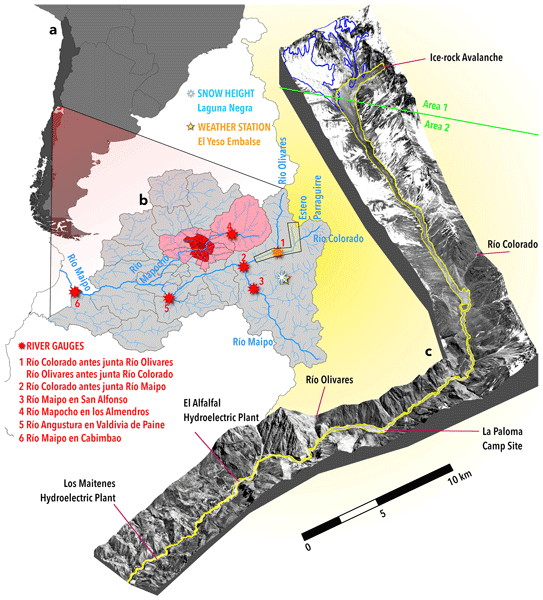
Johannes J. Fürst, David Farías-Barahona, Thomas Bruckner, Lucia Scaff, Martin Mergili, Santiago Montserrat, and Humberto Peña
Nat. Hazards Earth Syst. Sci., 25, 3559–3579, https://doi.org/10.5194/nhess-25-3559-2025, https://doi.org/10.5194/nhess-25-3559-2025, 2025
Short summary
Short summary
The 1987 Parraguirre ice–rock avalanche developed into a devastating debris flow, causing the loss of many lives and inflicting severe damage near Santiago, Chile. Here, we revise this event, combining various observational records with modelling techniques. In that year, important snow cover coincided with persistent warm periods in spring. We also put forward upward corrections for the trigger and flood volumes involved in this debris flow. Finally, temporary river damming was key for the flow ferocity.
Ivan Vergara, Fernanda Santibañez, René Garreaud, and Germán Aguilar
Earth Syst. Dynam. Discuss., https://doi.org/10.5194/esd-2024-27, https://doi.org/10.5194/esd-2024-27, 2024
Manuscript not accepted for further review
Short summary
Short summary
The denudation rate was modelled in over a thousand basins across the Earth. The results suggest that water and associated life have a positive effect across their whole range, which is regulated by topography. Because of this, bioclimatic effect is weak in flat landscapes, but it could vary denudation forty times in mountain settings. It was also observed that other things being equal, water availability steepens basins, so climate also has an indirect effect acting on geological timeframes.
Tania Habel, Martine Simoes, Robin Lacassin, Daniel Carrizo, and German Aguilar
Solid Earth, 14, 17–42, https://doi.org/10.5194/se-14-17-2023, https://doi.org/10.5194/se-14-17-2023, 2023
Short summary
Short summary
The Central Andes are one of the most emblematic reliefs on Earth, but their western flank remains understudied. Here we explore two rare key sites in the hostile conditions of the Atacama desert to build cross-sections, quantify crustal shortening, and discuss the timing of this deformation at ∼20–22°S. We propose that the structures of the Western Andes accommodated significant crustal shortening here, but only during the earliest stages of mountain building.
Alex Garcés, Gerardo Zegers, Albert Cabré, Germán Aguilar, Aldo Tamburrino, and Santiago Montserrat
Nat. Hazards Earth Syst. Sci., 22, 377–393, https://doi.org/10.5194/nhess-22-377-2022, https://doi.org/10.5194/nhess-22-377-2022, 2022
Short summary
Short summary
We propose a workflow to model the response of an alluvial fan located in the Atacama Desert during an extreme storm event. For this alluvial fan, five different deposits were identified and associated with different debris flow surges. Using a commercial software program, our workflow concatenates these surges into one model. This study depicts the significance of the mechanical classification of debris flows to reproduce how an alluvial fan controls the tributary–river junction connectivity.
Cited articles
Aceituno, P., Boisier, J. P., Garreaud, R., Rondanelli, R., and Rutllant, J. A.: Climate and Weather in Chile, in: Water Resources of Chile, Springer, 7–29, ISBN 978-3-030-56900-6, https://doi.org/10.1007/978-3-030-56901-3, 2021. a, b, c
Aguilar, G., Carretier, S., Regard, V., Vassallo, R., Riquelme, R., and Martinod, J.: Grain Size-Dependent 10Be Concentrations in Alluvial Stream Sediment of the Huasco Valley, a Semi-Arid Andes Region, Quat. Geochronol., 19, 163–172, https://doi.org/10.1016/j.quageo.2013.01.011, 2014. a
Aguilar, G., Cabré, A., Fredes, V., and Villela, B.: Erosion after an extreme storm event in an arid fluvial system of the southern Atacama Desert: an assessment of the magnitude, return time, and conditioning factors of erosion and debris flow generation, Nat. Hazards Earth Syst. Sci., 20, 1247–1265, https://doi.org/10.5194/nhess-20-1247-2020, 2020. a, b, c, d, e, f
Berti, M., Bernard, M., Gregoretti, C., and Simoni, A.: Physical Interpretation of Rainfall Thresholds or Runoff-Generated Debris Flows, J. Geophys. Res.-Earth, 125, https://doi.org/10.1029/2019JF005513, 2020. a, b, c
Boisier, J. P.: CR2MET: A High-Resolution Precipitation and Temperature Dataset for the Period 1960–2021 in Continental Chile, Zenodo [data set], https://doi.org/10.5281/ZENODO.7529682, 2023. a
Boisier, J. P., Alvarez-Garretón, C., Cepeda, J., Osses, A., Vásquez, N., and Rondanelli, R.: CR2MET: A High-Resolution Precipitation and Temperature Dataset for Hydroclimatic Research in Chile, in: Geophysical Research Abstracts, vol. 20, https://ui.adsabs.harvard.edu/abs/2018EGUGA..2019739B/abstract (last access: 23 October 2026), 2018. a
Börgel, R.: Geomorfología, Instituto Geográfico Militar (IGM), Santiago, Chile, https://bibliotecadigital.infor.cl/handle/20.500.12220/4923 (last access: 19 December 2025), 1983. a
Bozkurt, D., Rondanelli, R., Garreaud, R., and Arriagada, A.: Impact of Warmer Eastern Tropical Pacific SST on the March 2015 Atacama Floods, Mon. Weather Rev., 144, 4441–4460, https://doi.org/10.1175/MWR-D-16-0041.1, 2016. a, b, c
Cabré, A., Remy, D., Aguilar, G., Carretier, S., and Riquelme, R.: Mapping Rainstorm Erosion Associated with an Individual Storm from InSAR Coherence Loss Validated by Field Evidence for the Atacama Desert, Earth Surf. Proc. Land., 45, 2091–2106, https://doi.org/10.1002/esp.4868, 2020. a
Copernicus Climate Change Service: ERA5 hourly data on single levels from 1940 to present, Copernicus Climate Change Service (C3S) Climate Data Store (CDS) [data set], https://doi.org/10.24381/cds.adbb2d47, 2023. a
DeWalle, D. R. and Rango, A.: Remote Sensing of the Snowpack, in: Principles of Snow Hydrology, Cambridge University Press, 118–145, https://doi.org/10.1017/cbo9780511535673.006, 2008. a
Falvey, M. and Garreaud, R.: Moisture Variability over the South American Altiplano during the SALLJEX Observing Season, J. Geophys. Res.-Atmos., 110, D22105, https://doi.org/10.1029/2005JD006152, 2005. a
Farr, T. G., Rosen, P. A., Caro, E., Crippen, R., Duren, R., Hensley, S., Kobrick, M., Paller, M., Rodriguez, E., Roth, L., Seal, D., Shaffer, S., Shimada, J., Umland, J., Werner, M., Oskin, M., Burbank, D., and Alsdorf, D.: The Shuttle Radar Topography Mission, Rev. Geophys., 45, 2005RG000183, https://doi.org/10.1029/2005RG000183, 2007. a
Fuenzalida, H. A., Sánchez, R., and Garreaud, R. D.: A Climatology of Cutoff Lows in the Southern Hemisphere, J. Geophys. Res.-Atmos., 110, https://doi.org/10.1029/2005JD005934, 2005. a
Gafurov, A. and Bárdossy, A.: Cloud removal methodology from MODIS snow cover product, Hydrol. Earth Syst. Sci., 13, 1361–1373, https://doi.org/10.5194/hess-13-1361-2009, 2009. a
Garcés, A., Zegers, G., Cabré, A., Aguilar, G., Tamburrino, A., and Montserrat, S.: A modeling methodology to study the tributary-junction alluvial fan connectivity during a debris flow event, Nat. Hazards Earth Syst. Sci., 22, 377–393, https://doi.org/10.5194/nhess-22-377-2022, 2022. a, b
Garreaud, R.: Estimación de La Línea de Nieve En Cuencas Andinas de Chile Central, Revista De La Sociedad Chilena De Ingeniería Hidráulica, 7, 21–32, 1992. a
Garreaud, R.: Warm Winter Storms in Central Chile, J. Hydrometeorol., 14, 1515–1534, https://doi.org/10.1175/JHM-D-12-0135.1, 2013. a
Garreaud, R. D.: The Andes climate and weather, Adv. Geosci., 22, 3–11, https://doi.org/10.5194/adgeo-22-3-2009, 2009. a
Garreaud, R. D., Alvarez-Garreton, C., Barichivich, J., Boisier, J. P., Christie, D., Galleguillos, M., LeQuesne, C., McPhee, J., and Zambrano-Bigiarini, M.: The 2010–2015 megadrought in central Chile: impacts on regional hydroclimate and vegetation, Hydrol. Earth Syst. Sci., 21, 6307–6327, https://doi.org/10.5194/hess-21-6307-2017, 2017. a
Hall, D. K. and Riggs, G. A.: MODIS/Terra Snow Cover Daily L3 Global 500 m SIN Grid, Version 61, NASA National Snow and Ice Data Center Distributed Active Archive Center [data set], https://doi.org/10.5067/MODIS/MOD10A1.061, 2021a. a, b
Hall, D. K. and Riggs, G. A.: MODIS/Aqua Snow Cover Daily L3 Global 500 m SIN Grid, Version 61, NASA National Snow and Ice Data Center Distributed Active Archive Center [data set], https://doi.org/10.5067/MODIS/MYD10A1.061, 2021b. a, b
Hall, D. K., Riggs, G. A., Salomonson, V. V., DiGirolamo, N. E., and Bayr, K. J.: MODIS Snow-Cover Products, Remote Sens. Environ., 83, 181–194, https://doi.org/10.1016/S0034-4257(02)00095-0, 2002. a
Hersbach, H., Bell, B., Berrisford, P., Hirahara, S., Horányi, A., Muñoz-Sabater, J., Nicolas, J., Peubey, C., Radu, R., Schepers, D., Simmons, A., Soci, C., Abdalla, S., Abellan, X., Balsamo, G., Bechtold, P., Biavati, G., Bidlot, J., Bonavita, M., De Chiara, G., Dahlgren, P., Dee, D., Diamantakis, M., Dragani, R., Flemming, J., Forbes, R., Fuentes, M., Geer, A., Haimberger, L., Healy, S., Hogan, R. J., Hólm, E., Janisková, M., Keeley, S., Laloyaux, P., Lopez, P., Lupu, C., Radnoti, G., De Rosnay, P., Rozum, I., Vamborg, F., Villaume, S., and Thépaut, J.-N.: The ERA5 Global Reanalysis, Q. J. Roy. Meteor. Soc., 146, 1999–2049, https://doi.org/10.1002/qj.3803, 2020a. a
Houze Jr., R. A.: Mesoscale Convective Systems, Rev. Geophys., 42, https://doi.org/10.1029/2004RG000150, 2004. a
JICA: Technical Standards and Guidelines for Planning and Design of Sabo Structures, https://www.jica.go.jp/english/index.html (last access: 19 December 2025), 2010. a
Krajčí, P., Holko, L., Perdigão, R. A., and Parajka, J.: Estimation of Regional Snowline Elevation (RSLE) from MODIS Images for Seasonally Snow Covered Mountain Basins, J. Hydrol., 519, 1769–1778, https://doi.org/10.1016/j.jhydrol.2014.08.064, 2014. a
Matus, F., Rondanelli, R., Rutllant, J., and Henderson, S.: Mechanisms for the Influence of the Madden–Julian Oscillation on Precipitation in Southwestern South America, J. Geophys. Res.-Atmos., 130, e2024JD041935, https://doi.org/10.1029/2024JD041935, 2025. a
Matus, F., Paredes-Aravena, M., Garces, A., Pinto, D., Lagos-Zúñiga, M. A., Montserrat, S., and Advanced Mining Technology Center: Comprehensive Catalog of Extreme Precipitation Events in Northern-Central Chile (17.5° S–30° S), Zenodo [code and data set], https://doi.org/10.5281/ZENODO.14342935, 2026. a, b, c, d, e, f
Mo, K. C. and Higgins, R. W.: The Pacific-South American Modes and Tropical Convection during the Southern Hemisphere Winter, Mon. Weather Rev., 126, 1581–1596, https://doi.org/10.1175/1520-0493(1998)126<1581:TPSAMA>2.0.CO;2, 1998. a
Montserrat, S., Aguilar, G., Garcés, A., Lagos-Zúñiga, M., Paredes, M., Pinto, D., Jerez, C., Villela, B., Matus, F., Contreras, T., and Iturra, D.: Guía Metodológica Para El Diagnóstico y Cálculo de La Amenaza Aluvional Presente y Futura (Methodological Guide for the Diagnosis and Calculation of Present and Future Debris-Flow Hazard), 1 edn., Advanced Mining Technology Center, Universidad de Chile, Santiago, Chile, 2025. a
Nikolopoulos, E. I., Destro, E., Maggioni, V., Marra, F., and Borga, M.: Satellite Rainfall Estimates for Debris Flow Prediction: An Evaluation Based on Rainfall Accumulation-Duration Thresholds, J. Hydrometeorol., 18, 2207–2214, https://doi.org/10.1175/JHM-D-17-0052.1, 2017. a, b
Ortega, C., Vargas, G., Rojas, M., Rutllant, J. A., Munoz, P., Lange, C. B., Pantoja, S., Dezileau, L., and Ortlieb, L.: Extreme ENSO-driven Torrential Rainfalls at the Southern Edge of the Atacama Desert during the Late Holocene and Their Projection into the 21th Century, Global Planet. Change, 175, 226–237, https://doi.org/10.1016/j.gloplacha.2019.02.011, 2019. a
Romero, J. E., Vergara-Pinto, F., Aguilar, G., Garcés, A., and Montserrat, S.: Triggering Factors, Behavior, and Social Impact of the January 2021 Hail-Debris Flows at the Central Valley of Chile, Landslides, 19, 865–883, https://doi.org/10.1007/s10346-021-01830-2, 2022. a
Rondanelli, R.: Cutoff Lows Over Southwestern South America, in: Oxford Research Encyclopedia of Climate Science, Oxford Academic, https://doi.org/10.1093/acrefore/9780190228620.013.976, 2025. a
Rondanelli, R., Hatchett, B., Rutllant, J., Bozkurt, D., and Garreaud, R.: Strongest MJO on Record Triggers Extreme Atacama Rainfall and Warmth in Antarctica, Geophys. Res. Lett., 46, 3482–3491, https://doi.org/10.1029/2018GL081475, 2019. a, b, c
Rutllant, J. A., Matus, F., Rudloff, V., and Rondanelli, R.: The Role of Atmospheric Rivers in Rainfall-Induced Landslides: A Study from the Elqui Valley, J. Arid Environ., 216, 105016, https://doi.org/10.1016/j.jaridenv.2023.105016, 2023. a, b, c
Takahashi, T.: Debris Flow: Mechanics, Prediction and Countermeasures, in: 2nd Edn., Taylor & Francis, ISBN 978-0-203-57674-8, 2014. a
Valenzuela, R., Garreaud, R., Vergara, I., Campos, D., Viale, M., and Rondanelli, R.: An Extraordinary Dry Season Precipitation Event in the Subtropical Andes: Drivers, Impacts and Predictability, Weather and Climate Extremes, 37, 100472, https://doi.org/10.1016/j.wace.2022.100472, 2022. a, b
Valenzuela, R. A. and Garreaud, R. D.: Extreme Daily Rainfall in Central-Southern Chile and Its Relationship with Low-Level Horizontal Water Vapor Fluxes, J. Hydrometeorol., 20, 1829–1850, https://doi.org/10.1175/JHM-D-19-0036.1, 2019. a, b
Vicencio Veloso, J. M.: Analysis of an Extreme Precipitation Event in the Atacama Desert on January 2020 and Its Relationship to Humidity Advection along the Southeast Pacific, Atmósfera, 35, https://doi.org/10.20937/ATM.52911, 2020. a
Wilcox, A., Escauriaza, C., Agredano, R., Mignot, E., Zuazo, V., Otárola, S., Castro, L., Gironás, J., Cienfuegos, R., and Mao, L.: An Integrated Analysis of the March 2015 Atacama Floods, Geophys. Res. Lett., https://doi.org/10.1002/2016GL069751, 2016. a, b
Zegers, G., Mendoza, P. A., Garces, A., and Montserrat, S.: Sensitivity and identifiability of rheological parameters in debris flow modeling, Nat. Hazards Earth Syst. Sci., 20, 1919–1930, https://doi.org/10.5194/nhess-20-1919-2020, 2020. a
Zhang, S. J., Xu, C. X., Wei, F. Q., Hu, K. H., Xu, H., Zhao, L. Q., and Zhang, G. P.: A Physics-Based Model to Derive Rainfall Intensity-Duration Threshold for Debris Flow, Geomorphology, 351, 106930, https://doi.org/10.1016/j.geomorph.2019.106930, 2020. a, b
Short summary
We compiled a detailed catalog of extreme seasonal precipitation events observed in northern Chile during 1979–2019 to better understand how, when, and where these occur. The catalog uses atmospheric data and local meteorological products to identify different types of storms categories occurring in the study area, and the daily meteorological conditions for each event. This information was tested to evaluate landslide occurrence and composite analysis in Chilean arid and semiarid regions.
We compiled a detailed catalog of extreme seasonal precipitation events observed in northern...
Altmetrics
Final-revised paper
Preprint