Articles | Volume 18, issue 8
https://doi.org/10.5194/essd-18-6017-2026
© Author(s) 2026. This work is distributed under
the Creative Commons Attribution 4.0 License.
the Creative Commons Attribution 4.0 License.
https://doi.org/10.5194/essd-18-6017-2026
© Author(s) 2026. This work is distributed under
the Creative Commons Attribution 4.0 License.
the Creative Commons Attribution 4.0 License.
Data description article
| Highlight paper
| 
25 Aug 2026
Data description article | Highlight paper |
| 25 Aug 2026
| 25 Aug 2026
Grounded icebergs around Antarctica: a high-resolution dataset derived from deep learning and Sentinel-1 synthetic aperture radar

Institute for Marine and Antarctic Studies (IMAS), University of Tasmania, nipaluna/Hobart, Australia
Australian Antarctic Program Partnership, Institute for Marine and Antarctic Studies, University of Tasmania, nipaluna/Hobart, Australia
Alexander D. Fraser
Institute for Marine and Antarctic Studies (IMAS), University of Tasmania, nipaluna/Hobart, Australia
Australian Antarctic Program Partnership, Institute for Marine and Antarctic Studies, University of Tasmania, nipaluna/Hobart, Australia
Johannes Lohse
Australian Antarctic Program Partnership, Institute for Marine and Antarctic Studies, University of Tasmania, nipaluna/Hobart, Australia
Institute for Marine and Antarctic Studies (IMAS), University of Tasmania, nipaluna/Hobart, Australia
Department of Physics and Technology, UiT The Arctic University of Norway, Tromsø, Norway
Pat Wongpan
Institute for Marine and Antarctic Studies (IMAS), University of Tasmania, nipaluna/Hobart, Australia
Australian Antarctic Program Partnership, Institute for Marine and Antarctic Studies, University of Tasmania, nipaluna/Hobart, Australia
Australian Antarctic Division, Department of Climate Change, Energy, the Environment and Water, Kingston, Tasmania, Australia
Caitlin Adams
Geoscience Australia, Canberra, Australia
Alexander C. Bradley
Geoscience Australia, Canberra, Australia
Related authors
No articles found.
Robert A. Massom, Phillip A. Reid, Stephen G. Warren, Bonnie Light, Donald K. Perovich, Luke G. Bennetts, Petteri Uotila, Siobhan P. O'Farrell, Michael H. Meylan, Klaus M. Meiners, Pat Wongpan, Alexander D. Fraser, Alessandro Toffoli, Giulio Passerotti, Peter G. Strutton, Sean M. T. Chua, and Melissa Fedrigo
The Cryosphere, 20, 3271–3298, https://doi.org/10.5194/tc-20-3271-2026, https://doi.org/10.5194/tc-20-3271-2026, 2026
Short summary
Short summary
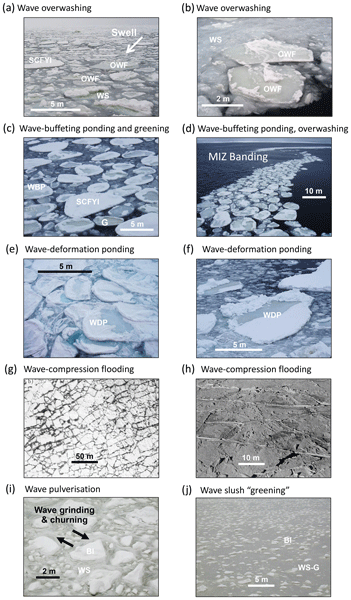
This paper advances understanding of why and how Antarctic sea ice can retreat so rapidly each summer, and identifies critical gaps in climate models, by highlighting 3 previously-neglected wave-driven processes and 5 associated feedbacks that accelerate seasonal ice melting and link physics to biology (wave flooding, wave pulverisation and wave greening). There are major implications for Earth’s radiation budget, Antarctic ecosystems and the accuracy of future sea-ice and climate projections.
Daniel Patrick Atwater, Pat Wongpan, Siobhan O’Farrell, Will Hobbs, Paul Spence, Mathieu Plante, Jean-Francois Lemieux, Alexander C. Bradley, Caitlin Adams, and Alexander D. Fraser
EGUsphere, https://doi.org/10.5194/egusphere-2026-1541, https://doi.org/10.5194/egusphere-2026-1541, 2026
Short summary
Short summary
This study improves how Antarctic landfast sea ice is represented in a computer model. By testing different settings and adding a new map of grounded icebergs, we found a setup that closely matches the observed location and seasonal cycle of this type of sea ice. We also show that most of the simulated landfast sea ice depends on grounded icebergs for support. These results provide a practical way to improve climate models without harming their broader sea ice performance.
Joey J. Voermans, Alexander D. Fraser, Jill Brouwer, Michael H. Meylan, Qingxiang Liu, and Alexander V. Babanin
The Cryosphere, 19, 3381–3395, https://doi.org/10.5194/tc-19-3381-2025, https://doi.org/10.5194/tc-19-3381-2025, 2025
Short summary
Short summary
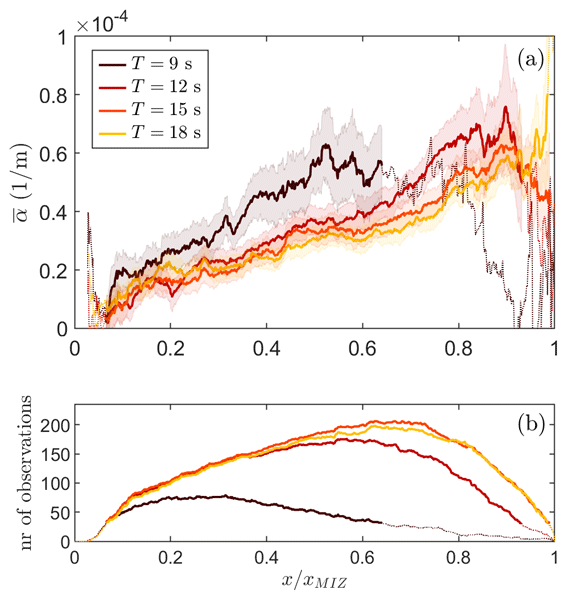
Limited measurements of waves in sea ice exist, preventing our understanding of wave attenuation in sea ice under a wide range of ice conditions. Using satellite observations from ICESat-2, we observe an overall linear increase in the wave attenuation rate with distance into the marginal ice zone. While attenuation may vary greatly locally, this finding may provide opportunities for the modeling of waves in sea ice at global and climate scales when such fine detail may not be needed.
Kazuya Kusahara, Daisuke Hirano, Masakazu Fujii, Alexander D. Fraser, Takeshi Tamura, Kohei Mizobata, Guy D. Williams, and Shigeru Aoki
The Cryosphere, 18, 43–73, https://doi.org/10.5194/tc-18-43-2024, https://doi.org/10.5194/tc-18-43-2024, 2024
Short summary
Short summary
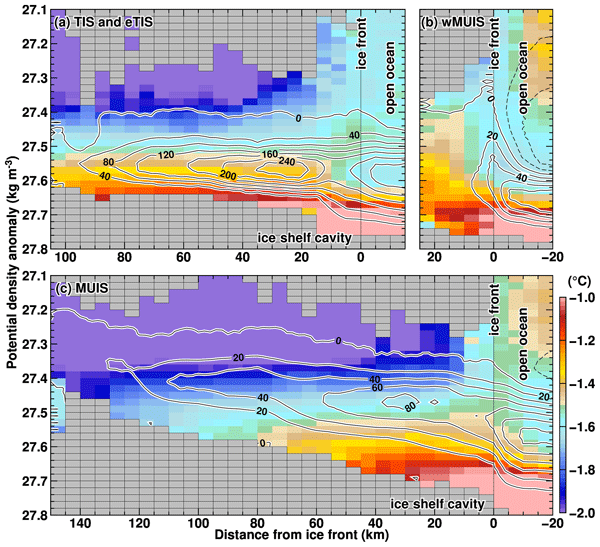
This study focuses on the Totten and Moscow University ice shelves, East Antarctica. We used an ocean–sea ice–ice shelf model to better understand regional interactions between ocean, sea ice, and ice shelf. We found that a combination of warm ocean water and local sea ice production influences the regional ice shelf basal melting. Furthermore, the model reproduced the summertime undercurrent on the upper continental slope, regulating ocean heat transport onto the continental shelf.
Lingwei Zhang, Tessa R. Vance, Alexander D. Fraser, Lenneke M. Jong, Sarah S. Thompson, Alison S. Criscitiello, and Nerilie J. Abram
The Cryosphere, 17, 5155–5173, https://doi.org/10.5194/tc-17-5155-2023, https://doi.org/10.5194/tc-17-5155-2023, 2023
Short summary
Short summary
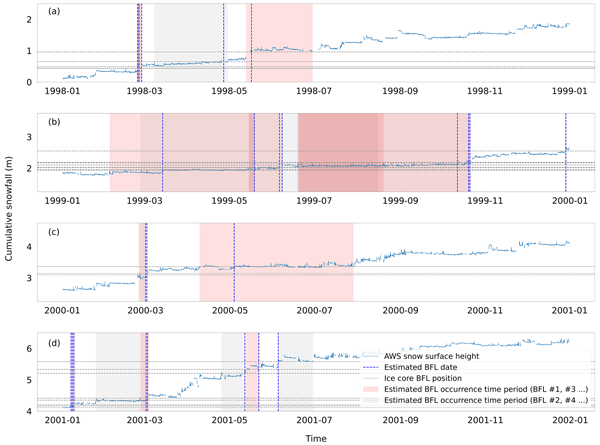
Physical features in ice cores provide unique records of past variability. We identified 1–2 mm ice layers without bubbles in surface ice cores from Law Dome, East Antarctica, occurring on average five times per year. The origin of these bubble-free layers is unknown. In this study, we investigate whether they have the potential to record past atmospheric processes and circulation. We find that the bubble-free layers are linked to accumulation hiatus events and meridional moisture transport.
Jill Brouwer, Alexander D. Fraser, Damian J. Murphy, Pat Wongpan, Alberto Alberello, Alison Kohout, Christopher Horvat, Simon Wotherspoon, Robert A. Massom, Jessica Cartwright, and Guy D. Williams
The Cryosphere, 16, 2325–2353, https://doi.org/10.5194/tc-16-2325-2022, https://doi.org/10.5194/tc-16-2325-2022, 2022
Short summary
Short summary
The marginal ice zone is the region where ocean waves interact with sea ice. Although this important region influences many sea ice, ocean and biological processes, it has been difficult to accurately measure on a large scale from satellite instruments. We present new techniques for measuring wave attenuation using the NASA ICESat-2 laser altimeter. By measuring how waves attenuate within the sea ice, we show that the marginal ice zone may be far wider than previously realised.
Tian R. Tian, Alexander D. Fraser, Noriaki Kimura, Chen Zhao, and Petra Heil
The Cryosphere, 16, 1299–1314, https://doi.org/10.5194/tc-16-1299-2022, https://doi.org/10.5194/tc-16-1299-2022, 2022
Short summary
Short summary
This study presents a comprehensive validation of a satellite observational sea ice motion product in Antarctica by using drifting buoys. Two problems existing in this sea ice motion product have been noticed. After rectifying problems, we use it to investigate the impacts of satellite observational configuration and timescale on Antarctic sea ice kinematics and suggest the future improvement of satellite missions specifically designed for retrieval of sea ice motion.
Jessica Cartwright, Alexander D. Fraser, and Richard Porter-Smith
Earth Syst. Sci. Data, 14, 479–490, https://doi.org/10.5194/essd-14-479-2022, https://doi.org/10.5194/essd-14-479-2022, 2022
Short summary
Short summary
Due to the scale and remote nature of the polar regions, it is essential to use satellite remote sensing to monitor and understand them and their dynamics. Here we present data from the Advanced Scatterometer (ASCAT), processed in a manner proven for use in cryosphere studies. The data have been processed on three timescales (5 d, 2 d and 1 d) in order to optimise temporal resolution as each of the three MetOp satellites is launched.
Alexander D. Fraser, Robert A. Massom, Mark S. Handcock, Phillip Reid, Kay I. Ohshima, Marilyn N. Raphael, Jessica Cartwright, Andrew R. Klekociuk, Zhaohui Wang, and Richard Porter-Smith
The Cryosphere, 15, 5061–5077, https://doi.org/10.5194/tc-15-5061-2021, https://doi.org/10.5194/tc-15-5061-2021, 2021
Short summary
Short summary
Landfast ice is sea ice that remains stationary by attaching to Antarctica's coastline and grounded icebergs. Although a variable feature, landfast ice exerts influence on key coastal processes involving pack ice, the ice sheet, ocean, and atmosphere and is of ecological importance. We present a first analysis of change in landfast ice over an 18-year period and quantify trends (−0.19 ± 0.18 % yr−1). This analysis forms a reference of landfast-ice extent and variability for use in other studies.
Cited articles
Arrigo, K. R.: Sea ice as a habitat for primary producers, in: Sea Ice, edited by: Thomas, D. N., 352–369, https://doi.org/10.1002/9781118778371.ch14, 2016. a, b
Barbat, M. M., Wesche, C., Werhli, A. V., and Mata, M. M.: An adaptive machine learning approach to improve automatic iceberg detection from SAR images, ISPRS J. Photogramm., 156, 247–259, https://doi.org/10.1016/j.isprsjprs.2019.08.015, 2019. a
Barbat, M. M., Rackow, T., Wesche, C., Hellmer, H. H., and Mata, M. M.: Automated iceberg tracking with a machine learning approach applied to SAR imagery: A Weddell sea case study, ISPRS J. Photogramm., 172, 189–206, https://doi.org/10.1016/j.isprsjprs.2020.12.006, 2021. a, b, c
Bigg, G. R., Wadley, M. R., Stevens, D. P., and Johnson, J. A.: Modelling the dynamics and thermodynamics of icebergs, Cold Reg. Sci. Technol., 26, 113–135, https://doi.org/10.1016/s0165-232x(97)00012-8, 1997. a
Braakmann-Folgmann, A., Shepherd, A., Gerrish, L., Izzard, J., and Ridout, A.: Observing the disintegration of the A68A iceberg from space, Remote Sens. Environ., 270, 112855, https://doi.org/10.1016/j.rse.2021.112855, 2022. a
Braakmann-Folgmann, A., Shepherd, A., Hogg, D., and Redmond, E.: Mapping the extent of giant Antarctic icebergs with deep learning, The Cryosphere, 17, 4675–4690, https://doi.org/10.5194/tc-17-4675-2023, 2023. a, b, c
Bradski, G.: The opencv library, Dr. Dobb's Journal: Software Tools for the Professional Programmer, 25, 120–123, https://opencv.org/ (last access: 20 August 2026), 2000. a
Cefarelli, A. O., Ferrario, M. E., and Vernet, M.: Diatoms (Bacillariophyceae) associated with free-drifting Antarctic icebergs: taxonomy and distribution, Polar Biol., 39, 443–459, https://doi.org/10.1007/s00300-015-1791-z, 2015. a
Chen, Z., Liu, X., Guan, Z., Li, T., Cheng, X., Li, T., Liu, Y., Liang, Q., Zheng, L., and Liu, J.: A six-year circum-Antarctic icebergs dataset (2018–2023), Earth Syst. Sci. Data, 18, 147–166, https://doi.org/10.5194/essd-18-147-2026, 2026. a, b, c, d
Deng, J., Dong, W., Socher, R., Li, L.-J., Li, K., and Fei-Fei, L.: ImageNet: A large-scale hierarchical image database, in: 2009 IEEE Conference on Computer Vision and Pattern Recognition, IEEE, https://doi.org/10.1109/cvpr.2009.5206848, 2009. a
Diakogiannis, F. I., Waldner, F., Caccetta, P., and Wu, C.: ResUNet-a: A deep learning framework for semantic segmentation of remotely sensed data, ISPRS J. Photogramm., 162, 94–114, https://doi.org/10.1016/j.isprsjprs.2020.01.013, 2020. a
Dierking, W. and Wesche, C.: C-Band Radar Polarimetry—Useful for Detection of Icebergs in Sea Ice?, IEEE T. Geosci. Remote, 52, 25–37, https://doi.org/10.1109/tgrs.2012.2234756, 2014. a
Doddridge, E. W., Hobbs, W. R., Auger, M., Boyd, P. W., Chua, S. M. T., Cook, S., Corney, S., Emmerson, L., Fraser, A. D., Heil, P., Kelly, N., Lannuzel, D., Li, X., Liniger, G., Massom, R. A., Meyer, A., Reid, P., Southwell, C., Spence, P., Steketee, A., Swadling, K. M., Teder, N., Wienecke, B., Wongpan, P., and Yamazaki, K.: Impacts of Antarctic summer sea-ice extremes, PNAS Nexus, 4, https://doi.org/10.1093/pnasnexus/pgaf164, 2025. a, b
Dorschel, B., Hehemann, L., Viquerat, S., Warnke, F., Dreutter, S., Tenberge, Y. S., Accettella, D., An, L., Barrios, F., Bazhenova, E., Black, J., Bohoyo, F., Davey, C., De Santis, L., Dotti, C. E., Fremand, A. C., Fretwell, P. T., Gales, J. A., Gao, J., Gasperini, L., Greenbaum, J. S., Jencks, J. H., Hogan, K., Hong, J. K., Jakobsson, M., Jensen, L., Kool, J., Larin, S., Larter, R. D., Leitchenkov, G., Loubrieu, B., Mackay, K., Mayer, L., Millan, R., Morlighem, M., Navidad, F., Nitsche, F. O., Nogi, Y., Pertuisot, C., Post, A. L., Pritchard, H. D., Purser, A., Rebesco, M., Rignot, E., Roberts, J. L., Rovere, M., Ryzhov, I., Sauli, C., Schmitt, T., Silvano, A., Smith, J., Snaith, H., Tate, A. J., Tinto, K., Vandenbossche, P., Weatherall, P., Wintersteller, P., Yang, C., Zhang, T., and Arndt, J. E.: The International Bathymetric Chart of the Southern Ocean Version 2, Sci. Data, 9, https://doi.org/10.1038/s41597-022-01366-7, 2022. a, b, c, d
Dowdeswell, J. and Bamber, J.: Keel depths of modern Antarctic icebergs and implications for sea-floor scouring in the geological record, Mar. Geo., 243, 120–131, https://doi.org/10.1016/j.margeo.2007.04.008, 2007. a, b, c
Duprat, L. P. A. M., Bigg, G. R., and Wilton, D. J.: Enhanced Southern Ocean marine productivity due to fertilization by giant icebergs, Nat. Geosci., 9, 219–221, https://doi.org/10.1038/ngeo2633, 2016. a, b, c
European Space Agency: Sentinel-2 User Handbook, ESA/ESTEC, Paris, France, issue 1, revision 2 edn., standard document, European Space Agency: Sentinel-2 User Handbook, ESA/ESTEC, Paris, France, Issue 1, Rev. 2, https://sentinels.copernicus.eu/documents/247904/685211/Sentinel-2_User_Handbook (last access: 20 August 2026), 2015. a
Evans, B., Faul, A., Fleming, A., Vaughan, D. G., and Hosking, J. S.: Unsupervised machine learning detection of iceberg populations within sea ice from dual-polarisation SAR imagery, Remote Sens. Environ., 297, 113780, https://doi.org/10.1016/j.rse.2023.113780, 2023. a, b, c
Færch, L., Dierking, W., Hughes, N., and Doulgeris, A. P.: A comparison of constant false alarm rate object detection algorithms for iceberg identification in L- and C-band SAR imagery of the Labrador Sea, The Cryosphere, 17, 5335–5355, https://doi.org/10.5194/tc-17-5335-2023, 2023. a
Fraser, A., Massom, R., and Michael, K.: A Method for Compositing Polar MODIS Satellite Images to Remove Cloud Cover for Landfast Sea-Ice Detection, IEEE T. Geosci. Remote, 47, 3272–3282, https://doi.org/10.1109/tgrs.2009.2019726, 2009. a
Fraser, A. D., Massom, R. A., and Michael, K. J.: Generation of high-resolution East Antarctic landfast sea-ice maps from cloud-free MODIS satellite composite imagery, Remote Sens. Environ., 114, 2888–2896, https://doi.org/10.1016/j.rse.2010.07.006, 2010. a
Fraser, A. D., Massom, R. A., Michael, K. J., Galton-Fenzi, B. K., and Lieser, J. L.: East Antarctic Landfast Sea Ice Distribution and Variability, 2000–08, J. Climate, 25, 1137–1156, https://doi.org/10.1175/jcli-d-10-05032.1, 2012. a, b
Fraser, A. D., Ohshima, K. I., Nihashi, S., Massom, R. A., Tamura, T., Nakata, K., Williams, G. D., Carpentier, S., and Willmes, S.: Landfast ice controls on sea-ice production in the Cape Darnley Polynya: A case study, Remote Sens. Environ., 233, 111315, https://doi.org/10.1016/j.rse.2019.111315, 2019. a
Fraser, A. D., Massom, R. A., Handcock, M. S., Reid, P., Ohshima, K. I., Raphael, M. N., Cartwright, J., Klekociuk, A. R., Wang, Z., and Porter-Smith, R.: Eighteen-year record of circum-Antarctic landfast-sea-ice distribution allows detailed baseline characterisation and reveals trends and variability, The Cryosphere, 15, 5061–5077, https://doi.org/10.5194/tc-15-5061-2021, 2021. a, b, c, d
Fraser, A. D., Wongpan, P., Langhorne, P. J., Klekociuk, A. R., Kusahara, K., Lannuzel, D., Massom, R. A., Meiners, K. M., Swadling, K. M., Atwater, D. P., Brett, G. M., Corkill, M., Dalman, L. A., Fiddes, S., Granata, A., Guglielmo, L., Heil, P., Leonard, G. H., Mahoney, A. R., McMinn, A., van der Merwe, P., Weldrick, C. K., and Wienecke, B.: Antarctic Landfast Sea Ice: A Review of Its Physics, Biogeochemistry and Ecology, Rev. Geophys., 61, https://doi.org/10.1029/2022rg000770, 2023. a, b, c, d, e, f, g, h, i, j, k
Galler, B. A. and Fisher, M. J.: An improved equivalence algorithm, Commun. ACM, 7, 301–303, https://doi.org/10.1145/364099.364331, 1964. a
GAMMA Remote Sensing AG: GAMMA Software, GAMMA Remote Sensing AG, Gümligen, Switzerland, https://www.gamma-rs.ch (last access: 28 January 2026), n.d. a
Garvin, J. B., McDonagh-Smith, P., Peters, R. M., Fricker, H. A., Armston, J. D., Blair, J. B., and Luthcke, S. B.: Return on Investment and Economic Impact of a NASA-Funded Swath Mapping Laser Altimeter Orbiter for Earth Surface Elevations Situational Awareness in 2031–2040, New Space, 14, https://doi.org/10.1177/21680256261434504, 2026. a
Gerrish, L., Ireland, L., Fretwell, P., Cooper, P., and Skachkova, A.: High resolution vector polygons of the Antarctic coastline – VERSION 7.11, NERC EDS UK Polar Data Centre [data set], https://doi.org/10.5285/7D6793C2-2513-4752-8F37-11DB5B791FB5, 2025. a, b
Gillies, S. and Rasterio contributors: Rasterio: Access to geospatial raster data, GitHub [code], https://github.com/rasterio/rasterio (last access: 20 August 2026), 2013. a
Gladstone, R. M., Bigg, G. R., and Nicholls, K. W.: Iceberg trajectory modeling and meltwater injection in the Southern Ocean, J. Geophys. Res.-Oceans, 106, 19903–19915, https://doi.org/10.1029/2000jc000347, 2001. a
Greene, C. A., Gardner, A. S., Schlegel, N.-J., and Fraser, A. D.: Antarctic calving loss rivals ice-shelf thinning, Nature, 609, 948–953, https://doi.org/10.1038/s41586-022-05037-w, 2022. a, b
He, K., Zhang, X., Ren, S., and Sun, J.: Deep Residual Learning for Image Recognition, in: 2016 IEEE Conference on Computer Vision and Pattern Recognition (CVPR), 770–778, IEEE, https://doi.org/10.1109/cvpr.2016.90, 2016. a, b, c
Herraiz‐Borreguero, L., Lannuzel, D., van der Merwe, P., Treverrow, A., and Pedro, J. B.: Large flux of iron from the Amery Ice Shelf marine ice to Prydz Bay, East Antarctica, J. Geophys. Res.-Oceans, 121, 6009–6020, https://doi.org/10.1002/2016jc011687, 2016. a, b
Hopwood, M. J., Carroll, D., Höfer, J., Achterberg, E. P., Meire, L., Le Moigne, F. A. C., Bach, L. T., Eich, C., Sutherland, D. A., and González, H. E.: Highly variable iron content modulates iceberg-ocean fertilisation and potential carbon export, Nat. Commun., 10, https://doi.org/10.1038/s41467-019-13231-0, 2019. a
Hu, M.-K.: Visual pattern recognition by moment invariants, IEEE T. Inform. Theory, 8, 179–187, https://doi.org/10.1109/tit.1962.1057692, 1962. a, b, c
ISCE3 Development Team: ISCE3 Documentation, GitHub [code], https://isce-framework.github.io/isce3/, last access: 19 May 2026. a
Jiao, K., Fraser, A. D., Lohse, J., Wongpan, P., Adams, C., and Bradley, A. C.: Grounded Icebergs around Antarctica: A High-Resolution Dataset Derived from Deep Learning and Sentinel-1 Synthetic Aperture Radar, IMAS Metadata Catalogue [data set], https://doi.org/10.25959/54sx-pt47, 2026. a, b
Jiao, K. and Lohse, J.: kj0703/Antarctic-Grounded-Iceberg-Detection: v1.0.0: Grounded Iceberg Detection Dataset (Training, Test, and Validation) (Version Model_Datasetv1.0.0), Zenodo [software], https://doi.org/10.5281/zenodo.19228332, 2026. a
Koo, Y., Xie, H., Mahmoud, H., Iqrah, J. M., and Ackley, S. F.: Automated detection and tracking of medium-large icebergs from Sentinel-1 imagery using Google Earth Engine, Remote Sens. Environ., 296, 113731, https://doi.org/10.1016/j.rse.2023.113731, 2023. a, b
Kostov, Y., Holland, P. R., Hogan, K. A., Smith, J. A., Jourdain, N. C., Mathiot, P., Olivé Abelló, A., Fleming, A. H., and Meijers, A. J. S.: Modelled dynamics of floating and grounded icebergs, with application to the Amundsen Sea, The Cryosphere, 20, 135–169, https://doi.org/10.5194/tc-20-135-2026, 2026. a, b, c, d, e
Kuhn, H. W.: The Hungarian method for the assignment problem, Nav. Res. Logist. Q., 2, 83–97, https://doi.org/10.1002/nav.3800020109, 1955. a
Leane, E. and Maddison, B.: A biography of iceberg B09B, Aust. Humanit. Rev., 63, 99–115, 2018. a
Li, X., Shokr, M., Hui, F., Chi, Z., Heil, P., Chen, Z., Yu, Y., Zhai, M., and Cheng, X.: The spatio-temporal patterns of landfast ice in Antarctica during 2006–2011 and 2016–2017 using high-resolution SAR imagery, Remote Sens. Environ., 242, 111736, https://doi.org/10.1016/j.rse.2020.111736, 2020. a, b, c, d, e
Lohse, J., Doulgeris, A. P., and Dierking, W.: Mapping sea-ice types from Sentinel-1 considering the surface-type dependent effect of incidence angle, Ann. Glaciol., 61, 260–270, https://doi.org/10.1017/aog.2020.45, 2020. a
Loshchilov, I. and Hutter, F.: Decoupled Weight Decay Regularization, arXiv [preprint], https://doi.org/10.48550/ARXIV.1711.05101, 2017. a
Lucas, N. S., Brearley, J. A., Hendry, K. R., Spira, T., Braakmann-Folgmann, A., Abrahamsen, E. P., Meredith, M. P., and Tarling, G. A.: Giant iceberg meltwater increases upper-ocean stratification and vertical mixing, Nat. Geosci., 18, 305–312, https://doi.org/10.1038/s41561-025-01659-7, 2025. a, b, c
Magnard, C., Werner, C., and Wegmüller, U.: Gamma technical report: Interpolation and resampling, Tech. rep., Gamma Remote Sensing Research and Consulting AG, Bern, Switzerland, https://www.gamma-rs.ch/uploads/media/2017-2_TR_Interpolation_and_resampling.pdf] (last access: 20 August 2026), 2017. a
Marino, A., Dierking, W., and Wesche, C.: A Depolarization Ratio Anomaly Detector to Identify Icebergs in Sea Ice Using Dual-Polarization SAR Images, IEEE T. Geosci. Remote, 54, 5602–5615, https://doi.org/10.1109/tgrs.2016.2569450, 2016. a
Markus, T., Neumann, T., Martino, A., Abdalati, W., Brunt, K., Csatho, B., Farrell, S., Fricker, H., Gardner, A., Harding, D., Jasinski, M., Kwok, R., Magruder, L., Lubin, D., Luthcke, S., Morison, J., Nelson, R., Neuenschwander, A., Palm, S., Popescu, S., Shum, C. K., Schutz, B. E., Smith, B., Yang, Y., and Zwally, J.: The Ice, Cloud, and land Elevation Satellite-2 (ICESat-2): science requirements, concept, and implementation, Remote Sens. Environ., 190, 260–273, https://doi.org/10.1016/j.rse.2016.12.029, 2017. a
Massom, R. A., Hill, K. L., Lytle, V. I., Worby, A. P., Paget, M., and Allison, I.: Effects of regional fast-ice and iceberg distributions on the behaviour of the Mertz Glacier polynya, East Antarctica, Ann. Glaciol., 33, 391–398, https://doi.org/10.3189/172756401781818518, 2001. a, b, c, d, e, f, g, h
Meiners, K. M., Vancoppenolle, M., Carnat, G., Castellani, G., Delille, B., Delille, D., Dieckmann, G. S., Flores, H., Fripiat, F., Grotti, M., Lange, B. A., Lannuzel, D., Martin, A., McMinn, A., Nomura, D., Peeken, I., Rivaro, P., Ryan, K. G., Stefels, J., Swadling, K. M., Thomas, D. N., Tison, J., van der Merwe, P., van Leeuwe, M. A., Weldrick, C., and Yang, E. J.: Chlorophyll‐a in Antarctic Landfast Sea Ice: A First Synthesis of Historical Ice Core Data, J. Geophys. Res.-Oceans, 123, 8444–8459, https://doi.org/10.1029/2018jc014245, 2018. a, b
Merino, N., Le Sommer, J., Durand, G., Jourdain, N. C., Madec, G., Mathiot, P., and Tournadre, J.: Antarctic icebergs melt over the Southern Ocean: Climatology and impact on sea ice, Ocean Model., 104, 99–110, https://doi.org/10.1016/j.ocemod.2016.05.001, 2016. a
Micikevicius, P., Narang, S., Alben, J., Diamos, G., Elsen, E., Garcia, D., Ginsburg, B., Houston, M., Kuchaiev, O., Venkatesh, G., and Wu, H.: Mixed Precision Training, arXiv [preprint], https://doi.org/10.48550/ARXIV.1710.03740, 2017. a
Nakayama, Y., Timmermann, R., Schröder, M., and Hellmer, H.: On the difficulty of modeling Circumpolar Deep Water intrusions onto the Amundsen Sea continental shelf, Ocean Model., 84, 26–34, https://doi.org/10.1016/j.ocemod.2014.09.007, 2014. a, b, c
Ohshima, K. I., Fukamachi, Y., Williams, G. D., Nihashi, S., Roquet, F., Kitade, Y., Tamura, T., Hirano, D., Herraiz-Borreguero, L., Field, I., Hindell, M., Aoki, S., and Wakatsuchi, M.: Antarctic Bottom Water production by intense sea-ice formation in the Cape Darnley polynya, Nat. Geosci., 6, 235–240, https://doi.org/10.1038/ngeo1738, 2013. a
OPERA Jet Propulsion Laboratory: OPERA Radiometric Terrain-Corrected (RTC) Product, GitHub [code], https://github.com/opera-adt/RTC (last access: 19 May 2026), 2026a. a
OPERA Project Team: Algorithm Theoretical Basis Document (ATBD) for the OPERA Radiometric Terrain Corrected (RTC) Product from Sentinel-1, Technical Report D-107393, Jet Propulsion Laboratory, California Institute of Technology, Pasadena, CA, USA, initial Release, Version 1.0, https://d2pn8kiwq2w21t.cloudfront.net/documents/ProductSpec_RTC-S1.pdf (last access: 20 August 2026), 2024. a, b
Porter-Smith, R., McKinlay, J., Fraser, A. D., and Massom, R. A.: Coastal complexity of the Antarctic continent, Earth Syst. Sci. Data, 13, 3103–3114, https://doi.org/10.5194/essd-13-3103-2021, 2021. a, b
Rackow, T., Wesche, C., Timmermann, R., Hellmer, H. H., Juricke, S., and Jung, T.: A simulation of small to giant A ntarctic iceberg evolution: Differential impact on climatology estimates, J. Geophys. Res.-Oceans, 122, 3170–3190, https://doi.org/10.1002/2016jc012513, 2017. a
Raiswell, R., Benning, L. G., Tranter, M., and Tulaczyk, S.: Bioavailable iron in the Southern Ocean: the significance of the iceberg conveyor belt, Geochem. T., 9, https://doi.org/10.1186/1467-4866-9-7, 2008. a
Rignot, E., Jacobs, S., Mouginot, J., and Scheuchl, B.: Ice-Shelf Melting Around Antarctica, Science, 341, 266–270, https://doi.org/10.1126/science.1235798, 2013. a, b
Ronneberger, O., Fischer, P., and Brox, T.: U-Net: Convolutional Networks for Biomedical Image Segmentation, 234–241, Springer International Publishing, ISBN 9783319245744, https://doi.org/10.1007/978-3-319-24574-4_28, 2015. a, b
Salehi, S. S. M., Erdogmus, D., and Gholipour, A.: Tversky Loss Function for Image Segmentation Using 3D Fully Convolutional Deep Networks, 379–387, Springer International Publishing, ISBN 9783319673899, https://doi.org/10.1007/978-3-319-67389-9_44, 2017. a
Scambos, T., Fricker, H. A., Liu, C.-C., Bohlander, J., Fastook, J., Sargent, A., Massom, R., and Wu, A.-M.: Ice shelf disintegration by plate bending and hydro-fracture: Satellite observations and model results of the 2008 Wilkins ice shelf break-ups, Earth Planet. Sc. Lett., 280, 51–60, https://doi.org/10.1016/j.epsl.2008.12.027, 2009. a
Snoek, J., Larochelle, H., and Adams, R. P.: Practical bayesian optimization of machine learning algorithms, Adv. Neur. In., 25, https://proceedings.neurips.cc/paper_files/paper/2012/file/05311655a15b75fab86956663e1819cd-Paper.pdf (last access: 20 August 2026), 2012. a
Torres, R., Snoeij, P., Geudtner, D., Bibby, D., Davidson, M., Attema, E., Potin, P., Rommen, B., Floury, N., Brown, M., Traver, I. N., Deghaye, P., Duesmann, B., Rosich, B., Miranda, N., Bruno, C., L’Abbate, M., Croci, R., Pietropaolo, A., Huchler, M., and Rostan, F.: GMES Sentinel-1 mission, Remote Sens. Environ., 120, 9–24, https://doi.org/10.1016/j.rse.2011.05.028, 2012. a
Tournadre, J., Bouhier, N., Girard‐Ardhuin, F., and Rémy, F.: Antarctic icebergs distributions 1992–2014, J. Geophys. Res.-Oceans, 121, 327–349, https://doi.org/10.1002/2015jc011178, 2016. a
Truckenbrodt, J., Cremer, F., Baris, I., and Eberle, J.: pyroSAR: A framework for large-scale SAR satellite data processing, in: Proceedings of the 2019 Conference on Big Data from Space (BiDS'19), pp. 197–200, Publications Office of the European Union, Munich, Germany, https://doi.org/10.2760/848593, 2019. a
Vancoppenolle, M., Jourdain, N. C., Fichefet, T., Fraser, A. D., Massonnet, F., Mathiot, P., Madec, G., Mehlmann, C., Abelló, A. O., Atwater, D. P., Billy, C., Brearley, A., Delfieu, J., Kostov, Y., Lemaire, E., Marson, J. M., Petit, J., Pirlet, N., Wongpan, P., Burgard, C., de Lavergne, C., Holland, P. R., Hutchinson, K., Noël, M., Ortega, É., Piedagnel, E., Rampal, P., Ridley, J., Rousset, C., Sallée, J.-B., and Thomas, M.: Why Icebergs and their Interactions with Sea Ice Should Be Included in Earth System Models?, B. Am. Meteorol. Soc., https://doi.org/10.1175/bams-d-25-0322.1, 2025. a, b
Wesche, C. and Dierking, W.: Iceberg signatures and detection in SAR images in two test regions of the Weddell Sea, Antarctica, J. Glaciol., 58, 325–339, https://doi.org/10.3189/2012j0g11j020, 2012. a
Wesche, C. and Dierking, W.: Near-coastal circum-Antarctic iceberg size distributions determined from Synthetic Aperture Radar images, Remote Sens. Environ., 156, 561–569, https://doi.org/10.1016/j.rse.2014.10.025, 2015. a, b
Willis, C. J., Macklin, J. T., Partington, K. C., Teleki, K. A., Rees, W. G., and Williams, R. G.: Iceberg detection using ERS-1 synthetic aperture radar, Int. J. Remote Sens., 17, 1777–1795, https://doi.org/10.1080/01431169608948739, 1996. a
Woo, S., Park, J., Lee, J.-Y., and Kweon, I. S.: CBAM: Convolutional Block Attention Module, 3–19, Springer International Publishing, ISBN 9783030012342, https://doi.org/10.1007/978-3-030-01234-2_1, 2018. a
Woodworth-Lynas, C., Josenhans, H., Barrie, J., Lewis, C., and Parrott, D.: The physical processes of seabed disturbance during iceberg grounding and scouring, Cont. Shelf Res., 11, 939–961, https://doi.org/10.1016/0278-4343(91)90086-l, 1991. a, b
Wright, C. S. and Priestley, R. E.: British (Terra Nova) Antarctic Expedition 1910–1913: Glaciology, Harrison and Sons, Ltd., London, https://books.google.com.au/books?id=txtLwAEACAAJ (last access: 20 August 2026), 1922. a
Editorial statement
This study presents a high-resolution, continent-wide dataset of grounded icebergs around Antarctica. By providing a comprehensive inventory of 39 619 stationary icebergs, including icebergs as small as 0.016 km², it establishes a reference dataset for investigations of Antarctic coastal processes, fast ice dynamics, and marine ecosystems.
This study presents a high-resolution, continent-wide dataset of grounded icebergs around...
Short summary
Grounded icebergs anchor Antarctic sea ice and support marine ecosystems, yet their continent-wide distribution was previously unknown. Using satellite radar imagery and an automated artificial intelligence tool, we mapped nearly 40 000 stationary icebergs. We discovered that tiny, frequently overlooked icebergs actually dominate both the total number and area. This public dataset offers a crucial new baseline for modelling coastal ice stability and understanding broader environmental changes.
Grounded icebergs anchor Antarctic sea ice and support marine ecosystems, yet their...


Altmetrics
Final-revised paper
Preprint