the Creative Commons Attribution 4.0 License.
the Creative Commons Attribution 4.0 License.
 | 10 Aug 2026
The International Soil Radiocarbon Database (ISRaD) version 2: synthesis, data gaps, and future directions of soil radiocarbon data
Sophie F. von Fromm
R. Scott Winton
Derrick R. Vaughn
Jennifer C. Bowen
Kateřina Jandová
Julie Shahan
Olga Vindušková
Shane W. Stoner
Maedeh Chitsaz
Avni Malhotra
Adrian A. Wackett
Alison M. Hoyt
Katherine Heckman
Katerina Georgiou
Daniel Wasner
Luisa Isabell Minich
Katherine E. Grant
Caitlin E. Hicks Pries
Karis J. McFarlane
Anna Abramova
Corey Lawrence
Jeffrey Beem-Miller
Soil radiocarbon (14C) measurements are crucial for understanding soil carbon cycling over timescales ranging from years to millennia. However, the global synthesis and comparison of radiocarbon data have been limited due to the variety of measurement methodologies and data formats. The International Soil Radiocarbon Database (ISRaD) is an open-access, community-driven archive designed to compile soil radiocarbon data and facilitate large-scale research on soil carbon dynamics. Here, we present ISRaD version 2 (v2), which has grown significantly since its initial release in 2020 (https://doi.org/10.5281/zenodo.17860507, Beem-Miller et al., 2025). It now contains data from 515 unique studies spanning 1669 sites globally, with over 20 000 radiocarbon observations across multiple hierarchical levels, including bulk soil layers, soil fractions, laboratory incubations, interstitial carbon in soil pores, and in situ fluxes of CO2 and CH4. Major updates include expanded metadata structures to capture emerging measurement techniques and an improved soil fractionation template to better capture diverse methods. There has also been a substantial increase in data from underrepresented ecosystems, including cultivated soils and wetlands. Despite this growth, significant geographic and data-type gaps persist. Tropical and arid regions, soils deeper than 100 cm, and certain types of measurements, including incubation, interstitial, and flux, are severely undersampled. We discuss the scientific advances enabled by ISRaD v1 and the major updates to the database and data representation. We also explore future opportunities for ISRaD and the soil radiocarbon community. ISRaD v2 continues to serve as a living archive and dynamic platform for the soil radiocarbon research community. It supports synthesis efforts that are critical for predicting how soil carbon will respond to environmental and climatic changes.
- Article
(2366 KB) - Full-text XML
- Version 2020
-
Supplement
(793 KB) - BibTeX
- EndNote


Total soil carbon (C) is the largest terrestrial C reservoir, serving as an important climate regulator. Soil organic matter provides crucial benefits to people and nature, including improved soil water retention, crop yield, nutrient availability, microbial activity and biodiversity, and long-term ecosystem productivity and resilience (Bossio et al., 2020; Jenkinson et al., 1991; Natali et al., 2021). With ongoing environmental and climatic change threatening these benefits, there is a need to understand how soil C dynamics will respond. Models used to predict how organic matter responds to environmental changes often treat soil C as a homogeneous pool (Todd-Brown et al., 2013). However, observational evidence, including radiocarbon data, suggests that soil C dynamics are better explained by models that treat soil C as separate pools (or fractions) that cycle on different timescales (Schmidt et al., 2011; Sierra et al., 2018; Stoner et al., 2023; Trumbore, 2009). These different soil C fractions cycle across a range of timescales (Heckman et al., 2022), and natural abundance radiocarbon (14C) allows us to evaluate timescales ranging from multi-annual to millennial. Combining 14C measurements that represent different parts of this age spectrum, including soil fractions of different physical or chemical properties, interstitial C in soil pores, and C losses through respiration and lateral fluxes, provides critical constraints for testing hypotheses about mechanisms underlying C persistence and models of soil organic matter dynamics (Ahrens et al., 2015; Lawrence et al., 2020).
The production of atmospheric 14C from nuclear weapon testing in the 1950s and 1960s (i.e., “bomb” 14C) has provided a useful tool for tracing C exchange between the atmosphere and soil C over annual to decadal timescales (Trumbore, 2009). Much of the subsequent decline observed in atmospheric 14C has been due to mixing of this excess `bomb' 14C into long-term terrestrial and marine C reservoirs. In recent decades, acceleration of fossil fuel burning has become the largest cause of 14C decline in atmospheric CO2. Since 2020, the ratio of C of northern hemisphere CO2 has dropped below pre-industrial levels, such that newly synthesized organic matter has 14C values equal to those last experienced before 1950 (Graven, 2015). With increased access to 14C measurement capabilities and more researchers utilizing 14C, there is a unique opportunity to understand changes in the C cycle over the next decade. This opportunity is provided by a coordinated effort to synthesize current and past measurements of soil 14C as part of an overall effort to quantify past and present 14C distributions across Earth's C reservoirs, i.e. an “International Decade of Radiocarbon” (Eglinton et al., 2023).
Here, we present the second version of the International Soil Radiocarbon Database (ISRaD v2). ISRaD fills a critical gap in soil C research by offering the first open-access, on-going, and comprehensive archive of soil radiocarbon data, with particular emphasis on diverse soil fractions, fluxes, and interstitial measurements (Lawrence et al., 2020). ISRaD is a community-driven effort that continues to evolve in response to the needs and interests of its contributors and user community. In this manuscript, we briefly describe the scientific rationale of the database structure, review scientific insights enabled by ISRaD v1, detail major updates since its initial release, present the geographic and thematic distribution of data in ISRaD v2, and conclude with some proposals of future directions for soil radiocarbon research and synthesis efforts.
Throughout the manuscript, we express radiocarbon measurements as ΔΔ14C (measured Δ14C minus atmospheric Δ14C at the time of sampling) rather than as C ages. This approach normalizes for temporal changes in atmospheric 14C during the period from 1990 to the 2020s, when most samples in the database were taken. During this period, the Δ14C of atmospheric CO2 decreased by nearly 200 ‰. Subtracting this changing atmospheric component allows us to compare measurements made in different years without requiring assumptions about the age distribution of soil C.
The reported ΔΔ14C values can provide insight into C dynamics. For example, fractions with consistently positive ΔΔ14C are respiring C fixed years to decades earlier when atmospheric Δ14C values were higher than at the time of sampling. Conversely, negative ΔΔ14C values (≲ −25 ‰) indicate that the C in the fraction was mostly fixed prior to the onset of bomb testing. While C ages may be easier to interpret, direct conversion of ΔΔ14C to C ages is not straightforward for two reasons. First, during and after the “bomb” period, a single ΔΔ14C value can correspond to two distinct ages. Second, bulk soil C represents a mixture of C pools with different ages and turnover times, meaning any single age estimate would be an oversimplification of the underlying C dynamics. Quantifying soil C turnover with 14C requires the use of a model, and radiocarbon measurements like those in ISRaD provide important constraints or tests of the dynamics built into soil C models.
It is important to note that ISRaD is a repository of measurements rather than interpretations. The database captures core radiocarbon measurements and associated metadata as reported in the original publication. Users should be aware that various factors can complicate interpretation of radiocarbon data, including mixing of C sources, inputs from non-soil C sources, and methodological differences across studies. We encourage users to carefully consider these factors when drawing conclusions from data in ISRaD, and provide guidance on this in Sect. 8.2.
ISRaD is organized hierarchically around individual datasets (entries; Fig. 1a), with data reported at multiple spatial and temporal scales: from site-level geospatial information through profile-level characteristics to layer-specific measurements, individual soil fractions, and observations of fluxes, interstitial samples, and laboratory incubations (Lawrence et al., 2020). This structure accommodates the diversity of radiocarbon measurement methodologies while maintaining the capacity for accurate comparison across studies. The ISRaD hierarchical data model incorporates principles established in international soil information standards (e.g., the Global Soil Information System, GLOSIS) while extending these frameworks to capture the temporal complexity and isotopic specificity required for radiocarbon measurements. Below, we describe the scientific rationale for this diverse data architecture and how these multiple measurement types contribute to understanding soil C cycling. For more details about the general structure of ISRaD, we refer to Lawrence et al. (2020).
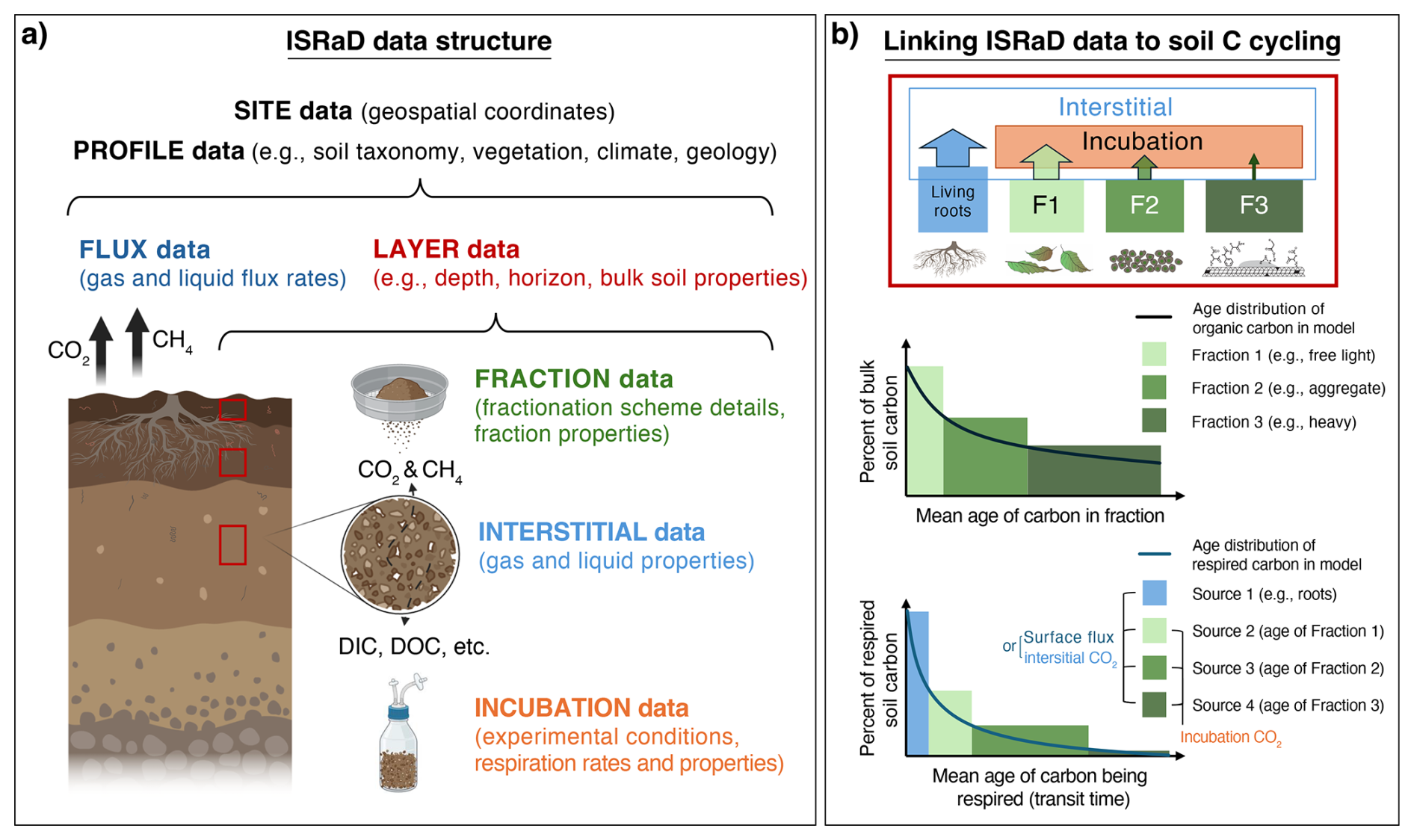
Figure 1Conceptual figure of (a) the data types in ISRaD and (b) how these different measures can link to biogeochemical representations of soil carbon cycling. Abbreviations: DIC = dissolved inorganic carbon; DOC = dissolved organic carbon.
One of the primary objectives of initiating ISRaD was to synthesize soil radiocarbon data to improve our understanding of the factors that influence the age and transit time distributions of C in soils. Additionally, this effort aimed to establish benchmarks to evaluate models of soil C dynamics. For instance, combining sequential physical, density and chemical isolated fractions of organic matter with increasing 14C ages provides information on the timescales associated with different stabilization mechanisms (Fig. 1b). Multi-pool models of soil C dynamics will also predict age distributions within soil organic matter, which can be compared with the distributions of observed C stocks and radiocarbon-derived ages (Fig. 1b). One ongoing area of research is to identify the fractionation schemes that best approximate the pools used for models. Comparisons of the age (or 14C) distributions provide a metric for model comparison, even for complex model structures (Metzler et al., 2020).
Measurements of 14C being respired or leached from soils provide an estimate of the transit time of C in ecosystems, i.e., the time elapsed from C fixation by photosynthesis to its loss by plant respiration, exudation, decomposition, or leaching. Measurements of C emitted from the soil surface (“flux”), or in soil pore space (“interstitial”), include contributions from living roots, as well as the decomposition of C pools with faster turnover (Fig. 1b). CO2 respired in soil incubations reflects the age of microbially available C substrates and tends to be younger than the bulk soil C. This is because bulk soil C age is mass-weighted and dominated by larger, slower-cycling fractions, while respired C is weighted by fluxes and dominated by the fastest cycling fractions (Trumbore, 2006). Soil C models also predict the distribution of ages in respired C, providing an additional constraint for understanding the dynamics of the faster-cycling soil C fractions (Fekete et al., 2021). Since the radiocarbon signatures of C derived from living roots (CO2, root exudates) often differ from those derived from microbial decomposition (CO2, CH4, or dissolved organic carbon, DOC), the radiocarbon signature of fluxes that combine these sources (surface fluxes, interstitial C) can be used to partition their relative contributions (Chanton et al., 2008; Cisneros-Dozal et al., 2006; Gaudinski et al., 2000; Phillips et al., 2013; Wilson et al., 2016).
Understanding vertical patterns in soil C age requires measuring C age across multiple soil compartments simultaneously. Approximately 30 %–60 % of the global variation in bulk 14C is explained by systematic aging with depth (von Fromm et al., 2024; Shi et al., 2020). This depth pattern is likely driven by a combination of factors including microbial availability, root density, and differences in decomposition kinetics (Henneron et al., 2022; Sierra et al., 2024). Several other processes can influence the age distribution of soil C, including vertical transport and pre-aging of C litter, and inputs of radiocarbon-dead C from geogenic sources or parent material in addition to simple aging mechanisms.
Understanding these depth-dependent patterns requires diverse measurement approaches. ISRaD archives extensive data from traditional physical and chemical fractionation methods that try to characterize the age structure of bulk organic matter. The new version of ISRaD also incorporates emerging approaches, such as ramped thermal oxidation, which directly link C ages to chemical composition and mineral association (Grant et al., 2019; Stoner et al., 2023). Other resources in ISRaD include data from experimental manipulations, for example how radiocarbon in soil organic matter or respired CO2 changes with soil warming or nitrogen fertilization (e.g., McFarlane et al., 2024; Nowinski et al., 2009; Qin et al., 2023). An increasing number of the studies in ISRaD deal with manipulations of cropping or pasture management (e.g., González-Sosa et al., 2024; Min et al., 2025; Sanderman et al., 2017; Spohn et al., 2023; Stoner et al., 2021). Collectively, these diverse measurement types enable mechanistic understanding of soil C cycling across spatial and temporal scales, precisely the synthesis opportunity that ISRaD facilitates.
Since its initial release in 2020, ISRaD has been widely cited and used to enable diverse scientific advances. These advances span quantifying soil C turnover, benchmarking soil models, and identifying depth, mineral, and climate controls on soil C persistence from local to global scales. Studies that used data from ISRaD found that soil C age is strongly depth-dependent. Subsoils contain old C (14C depleted) that has accumulated over centuries to millennia, highlighting the importance of accurately representing deep soil processes in models (e.g., Shi et al., 2020; Sierra et al., 2024; von Fromm et al., 2024; Wang et al., 2024). Nevertheless, soil CO2 efflux is dominated by young C despite substantial old soil C stocks (Xiao et al., 2022). Studies also found that vertical transport processes influence apparent soil C ages, but their relative importance varies. While advection and bioturbation can significantly shape 14C soil profiles in some regions (e.g., Amundson et al., 2025), the balance between root inputs and C decomposition (mediated by microbial activity) may be equally or more important than physical transport processes in controlling soil C profiles elsewhere (Sierra et al., 2024; Wang et al., 2021b). ISRaD data also served as an important model benchmark, suggesting a likely underestimation of SOC persistence in Earth system models. Specifically, comparisons of modeled bulk and fraction 14C values with observations highlight overestimation of 14C content (underestimation of C persistence) in some new-generation soil models and motivate depth-explicit, process-rich, isotope-enabled modeling frameworks (e.g., Brunmayr et al., 2024; Chen et al., 2019). Studies using ISRaD also supported the existing hypothesis that climate, soil properties, parent material, and land use history jointly regulate SOC persistence, albeit with noticeable and important regional differences (e.g., Chai et al., 2023; Huang et al., 2023; von Fromm et al., 2023, 2024; Wang et al., 2023). ISRaD also enabled an analysis of global patterns of C accumulation in tropical peatlands (Hedgpeth, 2024). Fraction-resolved 14C indicates that mineral-associated organic matter and particulate organic matter have distinct C ages, transit times, and environmental sensitivities (e.g., Hansen et al., 2024; Heckman et al., 2022; Jia et al., 2023; Li et al., 2023). Recent studies also demonstrate that radiocarbon-dead C from multiple sources, including geogenic organic C from sedimentary parent materials (e.g., kerogen, lignite) and surficial deposits such as loess can contribute to 14C depletion and should be considered when interpreting soil radiocarbon (e.g., Copard et al., 2025; Grant et al., 2023; Williams and Lawrence, 2025). These contributions can potentially exceed 50 % of total C in deep soils (Copard et al., 2025). Taken as a whole, these studies comprise a substantial increase in our understanding of soil C dynamics, illustrating the power of ISRaD v1 to enable new and innovative science.
Beyond these scientific advances, ISRaD also facilitated community development around soil research. ISRaD users and developers meet regularly both virtually and at international conferences to discuss research and data priorities. One focus is on advancing land surface modeling through radiocarbon constraints and isotope-enabled frameworks (e.g., Billings et al., 2021; Camino-Serrano et al., 2019; Cotrufo and Lavallee, 2022; Derrien et al., 2023; Doetterl et al., 2025; Frischknecht et al., 2022; MacBean et al., 2022; Raoult et al., 2024; Riley et al., 2022; Todd-Brown et al., 2022; Van de Broek et al., 2025; Vickery et al., 2025). Various soil-related data syntheses cite ISRaD as a key reference for good data practices (e.g., Bond-Lamberty et al., 2020; Crystal-Ornelas et al., 2022; Fujisaki et al., 2023; Ke et al., 2022; Malhotra et al., 2019; Schädel et al., 2020; van der Voort et al., 2021; Wieder et al., 2021). Many of the scientific lessons enabled by ISRaD have contributed to a more nuanced understanding of the potential caveats and pitfalls of using soil radiocarbon to better understand soil C dynamics. ISRaD v2 will further deepen these insights with its expanded data coverage.
The first version of ISRaD (v1) was released in 2020 (Lawrence et al., 2020). Since then, substantial growth in community contributions and improvements to the database have motivated the release of ISRaD v2. The most recent version of ISRaD incorporates 186 new unique studies, expanding the database by more than half, from 329 to 515 entries (Table 1). Data increased substantially across all hierarchical levels, with particularly large growth in bulk layer (+143 %) and fraction data (+96 %), reflecting the growing emphasis on understanding soil C dynamics at depth and across different C pools. Geographically, the expanded dataset now provides improved representation across major climate zones, soil orders, and land-cover types, with notable growth in understudied ecosystems including wetlands. This growth underscores the increasing importance of radiocarbon as a tool for constraining soil C dynamics. Additionally, it reflects the critical need for a centralized, open-access database that standardizes and facilitates comparison of radiocarbon measurements across diverse methodologies and spatial scales. In the following sections, we will highlight some of the major updates since the initial release of ISRaD.
Table 1Number of data points included at each hierarchical level in ISRaD v1.2.3.2019-12-20 and ISRaD v2.9.9.2025-08-14. Note: Not every entry has radiocarbon measurements.

4.1 Improvements in the representation of different soil fractionation schemes
Methods for partitioning bulk soil into distinct parts, or fractions, are fundamental to radiocarbon-based quantification of soil C age and transit time distributions (Trumbore, 2009). While soil incubations warrant a separate structure within ISRaD due to their unique temporal dynamics, most other soil fractionation methods are recorded in the fraction table. The broad diversity of methods used for soil fractionations, as well as subtle variations in the implementation of specific methods, complicate inter-study comparisons and were one of the primary reasons for initiation of the ISRaD database. During analysis of synthesized fraction data in ISRaD v1 (Heckman et al., 2022), we became aware that the initial template structure could not adequately capture the various fractionation schemes used in soil science. This motivated us to restructure the fraction table in v2 to better capture the specifics of different soil fractionation techniques, as well as to make data entry and analysis more consistent.
The updated template for entering fraction data includes two new mandatory fields, frc_aba and frc_ aggregate_dis, to record information about macrofossil pretreatment (e.g., acid-base-acid) and aggregate dispersion, respectively. Controlled values available for selection in the fractionation scheme (frc_scheme), agent (frc_agent), and property (frc_property) fields were also expanded and reorganized. Accepted fractionation approaches now fall into one of the following schemes: density, particle size, aggregate, chemical, physical (other), thermal, and compound-specific methods. This expansion enables capture of emerging techniques, such as ramped thermal oxidation and compound-specific radiocarbon analysis, which were not represented in ISRaD v1.
In concert with these changes, the ISRaD template has been updated to incorporate dynamic lists to aid in selection of fractionation details. Through this approach, only fractionation agents and properties that correspond with the selected fractionation scheme are available for selection. This should minimize confusion and encourage consistency in the reporting of fractionation data. As before, additional controlled values can be added to capture novel fractionation methods that are not currently available.
All fraction data ingested into the ISRaD database prior to implementation of these changes has been manually inspected and updated for consistency with the revised template structure. More detailed information about how to enter soil radiocarbon fraction data is provided on the ISRaD website (https://www.soilradiocarbon.org/, last access: 25 June 2026).
4.2 Improved accessibility of the database
ISRaD's primary objective is twofold: to serve as a central repository for soil radiocarbon data and to equip users with the tools necessary to analyze the data they access. To this end, ISRaD offers a comprehensive R package and tutorials, as well as a website that provides valuable information on the database and on soil radiocarbon in general. The R package was first publicly released in 2020 and has since been updated and improved iteratively (Beem-Miller et al., 2025). All data and code can also be found in the ISRaD GitHub repository (https://github.com/International-Soil-Radiocarbon-Database/ISRaD, last access: 25 June 2026). The ISRaD website has been completely redesigned (https://www.soilradiocarbon.org/, last access: 25 June 2026) and includes links to an updated R tutorial to help first-time users get started analyzing ISRaD data (https://www.soilradiocarbon.org/user-manual, last access: 25 June 2026). Additionally, students at Virginia Tech have developed an interactive data portal (R ShinyApp) that allows users to explore the database online, and to filter and download targeted data directly (https://www.soilradiocarbon.org/integrated-interactive, last access: 25 June 2026).
4.3 Governance and community involvement
ISRaD operates as a community-driven initiative, currently without dedicated funding or formal governance structures. Instead of adhering to pyramid-style governance outlined in the initial ISRaD release (Lawrence et al., 2020), ISRaD v2 evolved organically through contributions from the international soil radiocarbon research community. This approach reflects how open-source, collaborative scientific databases often function in practice. The ISRaD GitHub repository and associated resources are currently maintained by a dedicated group of contributors from the authoring team and broader community. Major decisions regarding database structure, new data types, or template modifications are made collaboratively through GitHub discussions, during regular self-funded workshops, and are informed by community feedback and emerging research needs.
While this community-driven approach has proven effective for fostering engagement and rapid development, it does present some challenges. For example, reliance on volunteer efforts and self-funded workshops means that critical maintenance tasks or major infrastructure improvements may be delayed if community capacity is limited. We recognize that securing stable institutional or funding partnerships would strengthen the database's long-term capacity to serve the growing research community.
Anyone wishing to contribute data, suggest improvements, report issues, or participate in database development is encouraged to reach out directly to any member of the authoring team or post issues on the ISRaD GitHub repository (https://github.com/International-Soil-Radiocarbon-Database/ISRaD, last access: 25 June 2026). ISRaD's continuous growth over the past five years demonstrates the value of community-maintained open-source databases for synthesizing scientific data. This flexible approach has facilitated the substantial growth in data and community engagement since ISRaD v1 was released in 2020. To ensure continued evolution and maintenance of ISRaD, we encourage the community to contribute not only data but also technical expertise, funding support, and institutional support as available.
The geospatial distribution of all data types in ISRaD v2 reveals substantial variation across climate zones, land-cover types, and soil orders (Fig. 2). Across climate zones (Fig. 2a), arid environments (B climate zones) consistently represent the smallest percentage of observations (1 %–7 %) within each data type, while cold climates (D climate zones) dominate most data types (34 %–74 %). Flux measurements are particularly skewed toward cold regions (D and E climate zones: 88 %). The database exhibits a strong bias toward forest ecosystems, comprising approximately 43 % of observations across all data types (Fig. 2b). In contrast, bare and urban soils remain critically undersampled. Cultivated soils (2 %–7 %) and shrublands (2 %–9 %) are also underrepresented across most data types, though cultivated soils account for 12 % of bulk layer data. Certain land-cover types show pronounced biases within specific data types. For example, wetlands constitute 22 % of interstitial data but only 8 % of incubation data. Tundra represents 32 % of flux measurements but merely 3 % of bulk layer data. Range-/grasslands comprise 18 % of bulk layer observations yet only 5 % of interstitial data.
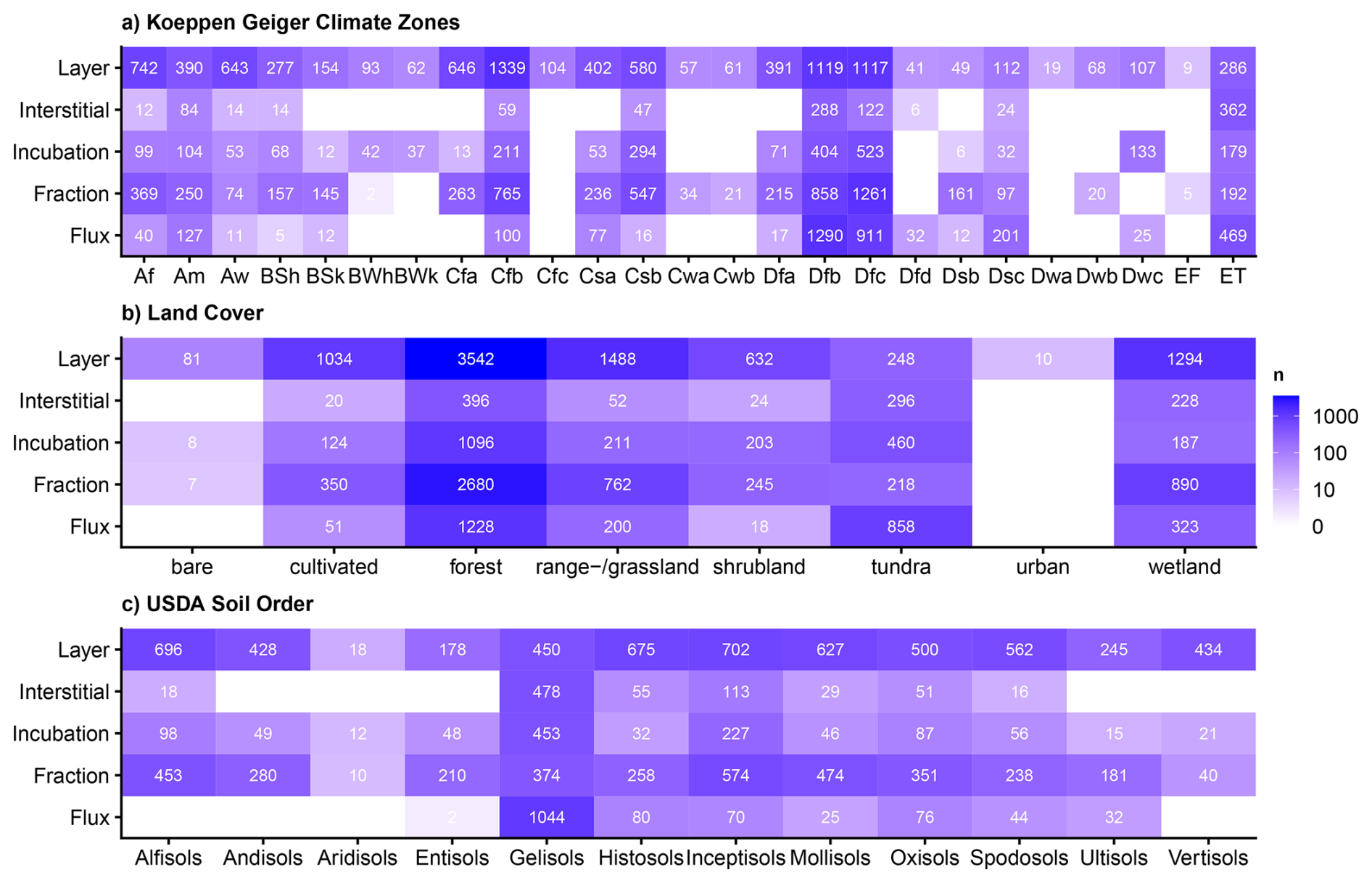
Figure 2Total number of 14C observations by data type and (a) Koeppen-Geiger Climate Zones (after Beck et al. 2023; key for each climate zone code can be found in Table S1). Capital letters indicate the main climate zone: A – tropical, B – arid, C – temperate, D – cold, E – polar. (b) by land cover (as reported in original studies; excluding NA's). (c) by USDA soil order (as reported in original studies; excluding NA's).
Soil order representation (as reported in the original studies) largely mirrors the above-described climate-related patterns, with Aridisols being among the least sampled soils in the database (Fig. 2c). Interstitial and flux data are particularly limited, with observations being heavily dominated by Gelisols (63 % and 76 %, respectively) and many soil orders lack any records in these categories. Incubation data likewise concentrate on Gelisols (40 %), followed by Inceptisols (20 %), with the latter being the most represented soil order in both bulk layer (13 %) and fraction (17 %) data. Temporally, the database shows limited observations prior to 1985, with the vast majority of data collected in the past two decades (Fig. S1 in the Supplement). This trend is also reflected in increased soil radiocarbon research activities (Fig. S2).
5.1 Bulk layer
Bulk layer data correspond to measurements made for a specific depth increment collected from a soil profile as described in more detail in Lawrence et al. (2020). Bulk 14C measurements entered in the database always refer to the organic soil component, assuming that inorganic C (if present) has been removed prior to the radiocarbon analysis. Since the initial release of ISRaD, the updated template for entering bulk layer data has four more columns that allow the user to specify if a buried organic horizon was sampled, the International Geo Sample Number (IGSN), the density of the coarse fraction, and to specify if the sample is the basal layer of a peat profile. The number of bulk layer data have increased by about 143 %, totaling 41 823 observations from 479 unique studies, 1549 different sites, and 4935 individual profiles. This makes the bulk layer measurements by far the most common data type in ISRaD. Most of these samples have been collected from topsoils in temperate and cold climate zones (Fig. 3).
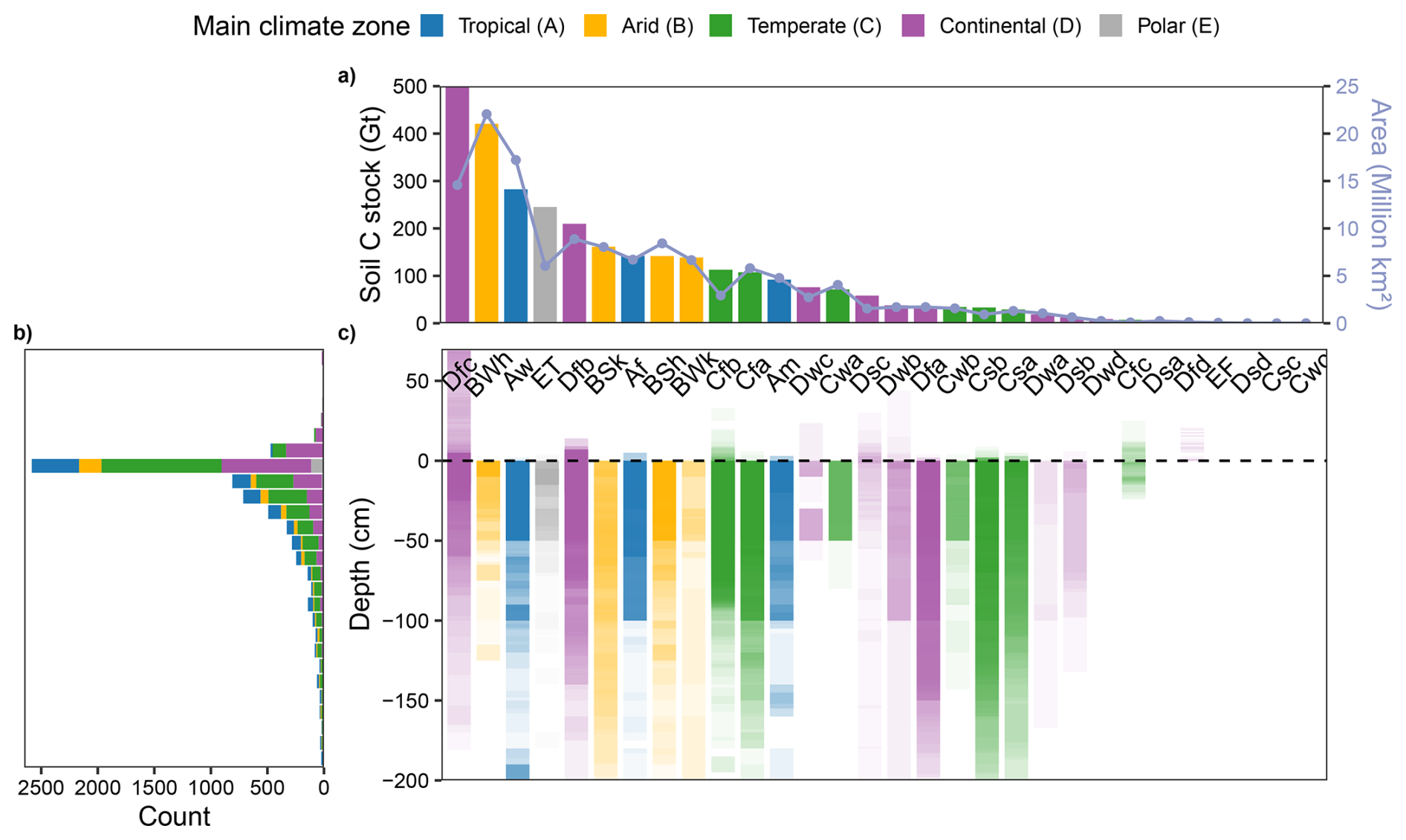
Figure 3(a) Area-weighted total soil organic carbon stocks down to 200 cm (SoilGrids 2.0; Poggio et al., 2021) for each Koeppen-Geiger Climate Zone (Beck et al., 2023; key for each climate zone code can be found in Table S1) and total land area (excluding ice) covered by each climate zone; (b) Number of bulk soil radiocarbon measurements for each 0.1 m depth interval; (c) Data distribution of bulk soil radiocarbon measurements with depth (limited to 200 cm and excluding wetlands and peatlands; positive depth values refer to litter layers above the mineral soil) across each Koeppen-Geiger Climate Zone (code for each climate zone is shown above each bar). The darker the color, the more data points are present in a given depth range. Colors in each panel refer to the main climate zones as indicated by the capital letter.
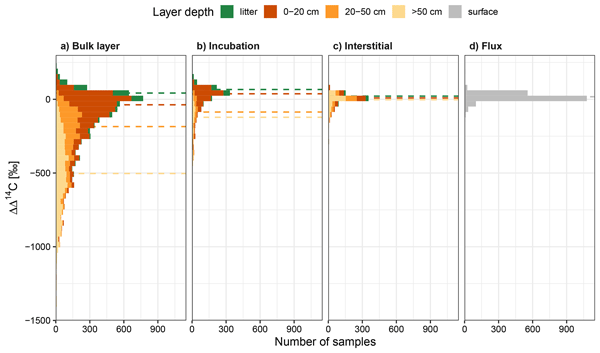
The vertical distribution of bulk layer 14C measurements reveals strong sampling biases towards surface mineral horizons (Figs. 3b and 4a). Approximately 60 % of all 14C measurements come from the upper 30 cm of soil, with data density declining exponentially with depth and for surface litter layers. Despite the critical importance of subsoils and deep soils for long-term C storage and contribution to global SOC stocks (Jobbágy and Jackson, 2000), horizons below 30 cm, and particularly deep soil horizons (> 100 cm) remain severely undersampled across all climate zones, soil orders, and land-cover types (Figs. 3c, S3 and S4). This sampling bias is particularly problematic given that bulk soil ΔΔ14C values (i.e., measured – atmospheric Δ14C) show the greatest depletion (oldest ages) and widest variability below 50 cm depth (Fig. 4a), highlighting the need to expand deep soil sampling to better constrain estimates of C persistence and vulnerability (Hicks Pries et al., 2023).
Climate-specific patterns reveal substantial heterogeneity in both sampling intensity and depth coverage (Fig. 3). Bulk layer 14C measurements in temperate (C) and cold (D) climate zones dominate, collectively accounting for approximately 72 % of all layer observations. These climate zones also show the most comprehensive depth profiles, with measurements extending to 200 cm (Fig. 3c). In contrast, tropical (A) and arid (B) climates are underrepresented, together comprising about 26 % of observations despite storing substantial SOC stocks globally (Fig. 3a). Tropical regions show moderate sampling in surface layers but minimal deep (> 50 cm) soil coverage, while arid systems lack comprehensive depth profiles entirely. Polar (E) climate zones are the least represented, accounting for less than 3% of all layer 14C data. These climate-related sampling biases in layer 14C measurements are mirrored in soil order representation, with Aridisols accounting for less than 1 % of observations despite covering ∼ 12 % of global land area, and tropical Ultisols and Oxisols showing particularly poor deep soil coverage (Fig. S3). Similarly, land cover analysis demonstrates extreme bias toward forested ecosystems (∼ 51 % of observations), while cultivated soils represent only ∼ 15 % of layer 14C data and urban soils remain essentially absent (Fig. S4). When accounting for both land area and SOC stocks (Fig. 3a), the underrepresentation of tropical and arid systems, along with cultivated and degraded lands, represents critical gaps that limit our ability to understand C dynamics in regions experiencing rapid climate and land-use change.
5.2 Incubation
Incubation data include C gas production rates (CO2 or CH4) and C isotopic signatures of laboratory-incubated samples as described in more detail in Lawrence et al. (2020). Since the initial release of ISRaD, the updated template for entering incubation data has two more columns that allow the user to specify the incubation analyte (CO2 or CH4) and if the incubation was performed under anaerobic conditions. The number of incubation data have increased by about 36 %, totaling 3002 observations, from 79 unique studies, 273 different sites, and 896 individual profiles. So far, of the reported incubation 14C measurements (n = 2334), zero have CH4 reported as an analyte. The majority of 14C measurements from incubations have been carried out on “root-picked soils” (n = 1333), followed by “soils with dead roots” (n= 601), “litter” (n = 174), “live roots only” (n = 116), and “soils with live roots” (n = 110). Given this data distribution, we will highlight some insights based on incubated “root-picked soils”.
The majority of the incubated “root-picked soil” samples exhibit relatively fast C cycling, albeit with a strong depth trend: incubated soils from deeper depths tend to release slower-cycling C (Fig. 4b). Since C fluxes from incubated “root-picked soil” samples are dominated by microbially derived C, this suggests that the C age of the substrate increases with depth. However, interpreting incubation 14C data requires careful consideration of multiple factors. First, it is unclear how much the measured 14C fluxes are influenced by methodological differences (e.g., incubation duration, temperature, moisture conditions), which vary substantially across studies in ISRaD (Beem-Miller et al., 2021). Systematic comparison of these methodological variations would strengthen our ability to draw robust conclusions about the age of microbially-derived C from incubation data. Additionally, incubation-derived 14CO2 measurements may be influenced by inorganic C sources from carbonates, particularly in soils derived from calcareous parent materials or in systems receiving carbonate amendments (e.g., limed agricultural soils). Co-measurement of 13CO2 alongside 14CO2 can help identify and quantify inorganic C contributions to respired CO2 fluxes.
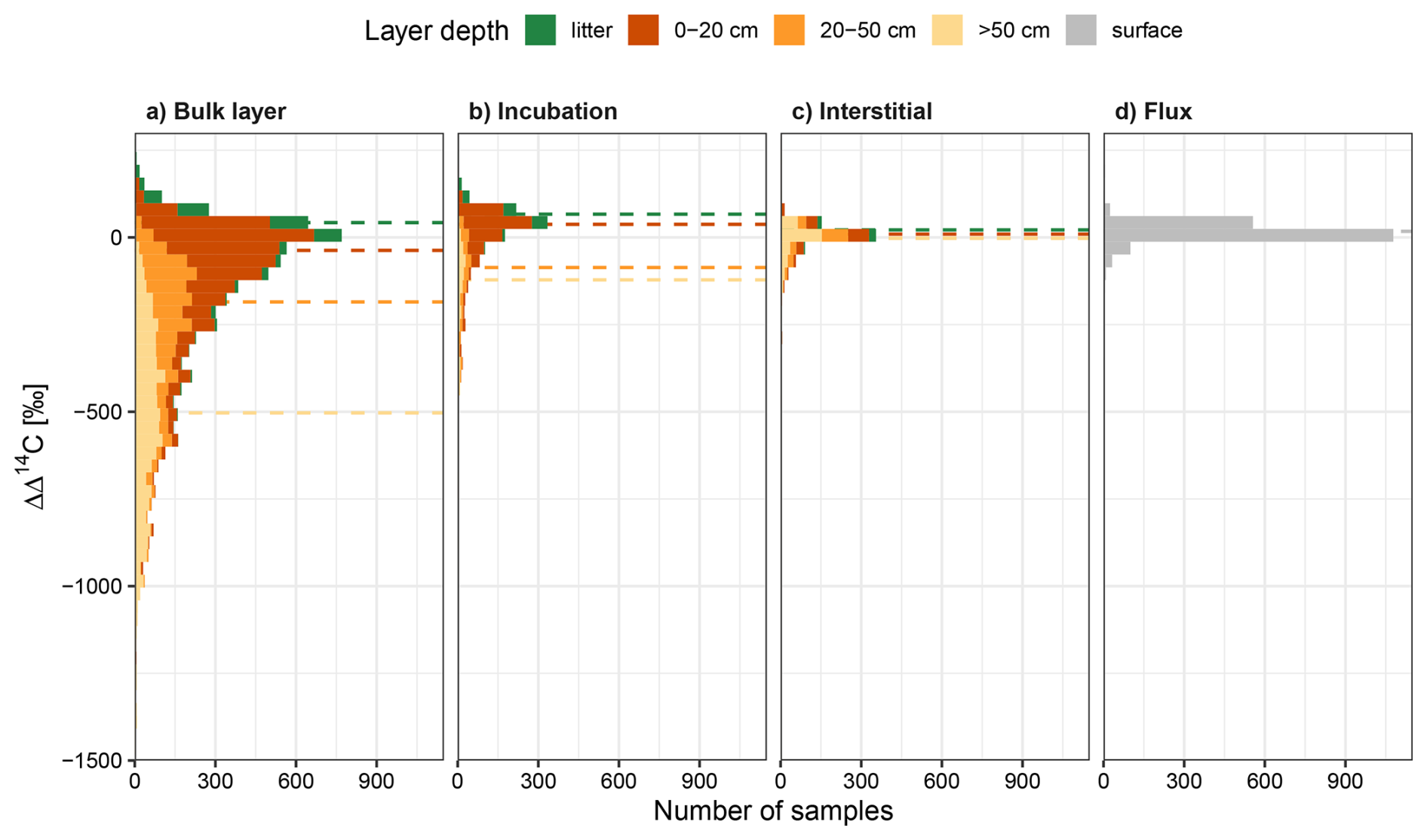
Figure 4All ΔΔ14C (measured – atmospheric Δ14C) measurements for (a) layer data, (b) incubation data from “root-picked soil”, (c) interstitial data of CO2, and (d) soil flux data of ecosystem CO2 soil emissions. Dashed lines refer to median values. Peatland and wetland studies are excluded.
In terms of data coverage, 28 % and 9 % of the incubated “root-picked soil” samples are from Gelisols and Inceptisols, respectively. For 43 % of the incubations, the soil order was not reported. Additionally, 48 % and 30 % of the data are from forest and tundra ecosystems, respectively. Furthermore, 49 % and 22 % of the data are from cold climate zones with no dry season (Dfa, Dfb, and Dfc) and temperate climate zones with dry summers (Csa, Csb, and Csc), respectively. More data from other soil orders, land covers (including wetlands), and climate zones are needed to draw robust conclusions at larger scales (Fig. 2). In addition, to improve our understanding of actively cycling C, more depth-resolved data of incubated “living roots” or “soils with living roots” are needed, as they are currently limited to a few studies and only down to 20 cm.
5.3 Interstitial data
Interstitial data (CO2, CH4, dissolved inorganic C (DIC), DOC, or particulate organic carbon (POC)) refer to measurements made on material (gas, liquid, or frozen) occupying the interstices of the soil structure, as described in more detail in ISRaD v1 (Lawrence et al., 2020). Since the first release of ISRaD, the updated template for entering interstitial data contains two new columns that allow the user to enter other stable isotope measurements in addition to δ13C, namely δ18O and δ2H. The number of interstitial data have increased by about 46 %, totaling 1219 observations, from 34 individual studies, 59 unique sites and 136 different profiles. The vast majority of entered 14C interstitial data are CO2 measurements (n= 820), followed by DOC (n = 159), CH4 (n = 70), and POC (n= 6). Thus, we will highlight some insights based on CO2 measurements and provide suggestions for future sampling efforts.
Measurements of interstitial 14CO2 in mineral soils indicate that the majority of gaseous C in soil pores cycles on timescales of years to a few decades, independent of sampling depth (Fig. 4c). This suggests that interstitial CO2 data are a mix of much younger root respiration mixed with microbial decomposition of other organic matter that supplies the CO2 released in incubations (Fig. 4b). Future work should further investigate the source of interstitial CO2 throughout a soil profile by combining radiocarbon with stable isotope measurements. It is important to note that current 14C data from interstitial CO2 are limited in their coverage of climate zones, ecosystems, and different soil orders. Most data originate from forest (45 %) and tundra (36 %) ecosystems and the majority were collected in cold climate zones with no dry season (Dfb, Dfc, Dfd; 42 %) and polar climate zones (ET; 34 %). In addition, the diversity of soil orders represented is limited: 44 % of the measurements come from Gelisols, 14 % from Inceptisols, and 27 % are not classified. This indicates that broader and more diverse data coverage is needed to draw robust conclusions at larger spatial scales (Fig. 2). In addition, to improve our understanding of the timescales of C transport and mobilization through a profile, more depth-resolved DOC and POC data are urgently needed. This sampling effort should also be extended to wetlands, where radiocarbon measures of interstitial C may be used to interpret changes in soil C cycling with climatic or land-use changes (Wilson et al., 2021), or to understand the age of laterally transported C (Bowen et al., 2024a). Finally, future work could also further investigate how interstitial 14C data compare with other soil 14C measurements to provide a more holistic understanding of the different rates of soil C cycling.
5.4 Flux data
Flux data refer to temporally explicit measurements of mass or energy transfer occurring at the profile scale. These measurements include both gas (e.g., CO2 or CH4) and liquid (e.g., DIC, DOC, or POC) analytes. The definition of flux data is described in more detail in ISRaD v1 (Lawrence et al., 2020). Since the initial release of ISRaD, the updated template for entering flux data has six new columns. These new columns allow users to enter flux analyte concentrations, flux analyte discharge rates, flux analyte pH, and conductivity (if aquatic). Users can also enter additional stable isotope measurements of δ18O and δ2H. The number of flux data have increased by about 17 %, totaling 4597 observations from 79 individual studies, 163 unique sites, and 587 different profiles. The vast majority of the entered 14C flux data are CO2 measurements (n = 2894), followed by lateral DOC (n = 251), CH4 (n= 167), and lateral POC (n = 44) analytes. The distribution of the most common flux analytes is also reflected in the most abundant flux pathways, including “soil emission” (n= 2,694), “bubble ebullition” (n = 272), “dissolved” (n = 251) and “suspended” (n = 44). The ecosystem components most represented by flux measurements are “ecosystem” respiration (i.e., net fluxes from soils; n = 1972), “heterotrophic” respiration (n = 544), and “aquatic” (n = 299). Given this data distribution, we will highlight insights based on CO2 fluxes representing net ecosystem soil emissions (n = 1962).
The majority of ecosystem CO2 soil emission fluxes cycle on fast timescales (years to a few decades; Fig. 4d). This suggests that ecosystem CO2 soil emission flux data are most likely dominated by C that has recently entered the soil system, reflecting a combination of root-respired and decomposition-derived C. Comparison of the 14C in CO2 in surface soil respiration and soil pore spaces to its component sources can be used to partition soil respiration into younger and older C sources (Chanton et al., 2008; Gaudinski et al., 2000; Taylor et al., 2015; Trumbore, 2006). These component sources include recently fixed C from root respiration and decomposed organic matter that is often fixed years to decades earlier. Changes in the age of respiration sources can indicate disturbances that destabilize older C and make it available for decomposition, for example as a result of thawing permafrost (Estop-Aragonés et al., 2020; Schuur et al., 2023), deforestation and conversion to agriculture (Drake et al., 2019; Minich et al., 2026), peatland drainage and fires (Bowen et al., 2024a; Wiggins et al., 2018), or changes in snow cover (Lupascu et al., 2018; Pedron et al., 2023).
It is important to note that about 23 % of the current ecosystem 14CO2 soil emission measurements in ISRaD are from Gelisols, while 67 % of the measurements have no soil order reported. In addition, 52 % and 23 % of the data are from forest and tundra ecosystems, respectively, and about 89 % are from cold climate zones with no dry season (Dfa, Dfb, and Dfc). More data from other soil orders, land covers, climate zones and ecosystem components are needed to draw robust conclusions at larger scales (Fig. 2). In addition, to improve our understanding of the timescales of C fluxes across ecosystems, seasonally resolved data, CH4 fluxes from wet soils, as well as DIC, DOC and POC data from aquatic systems (e.g., wetlands and peatlands) are urgently needed.
5.5 Fraction data
Since its initial release, the fraction data template in ISRaD has been updated and is now designed to accommodate the wide range of methodologies used to partition soils into discrete fractions and allow for fair comparison (see Sect. 4.1). The number of fraction data have increased by approximately 96 %, totaling 8351 observations from 218 individual studies, 481 unique sites, and 1324 different profiles. The majority of fraction data are from density separations (n = 3991), followed by physical separation of distinct particles such as macrofossils (i.e., recognizable plant remains such as seeds, leaves, or wood fragments, commonly separated in peatland studies), charcoal or roots (n = 1849), chemical separations (n = 1446), and particle size fractions (n = 850). More narrowly applied fractionation schemes include thermal fractionation (n = 315), separation by aggregate classes (n = 162), and compound-specific analyses which currently include lipids only (n = 64).
The currently compiled fraction data suggest significant variation among fractionation schemes regarding their efficacy in separating pools of contrasting 14C concentration (Fig. 5). Density fractionation has historically been the most commonly employed approach, reflected in the much higher number of these fractions in ISRaD. Particle-size and chemical fractionation schemes seemingly yield fractions with greater 14C heterogeneity. These operationally-defined separations, particularly density fractionation (which isolates heavy from light fractions) and particle size fractionation (which isolates coarse from fine fractions), are increasingly being interpreted as isolating mineral-associated and particulate organic matter pools (Heckman et al., 2022; Lavallee et al., 2020; Leuthold et al., 2024). ISRaD data reveal substantial variation in C ages within these conceptual pools, with many mineral-associated fractions exhibiting young 14C signatures, suggesting these pools contain significant proportions of actively cycling C (Feng et al., 2016; Jilling et al., 2025; Leuthold et al., 2024).
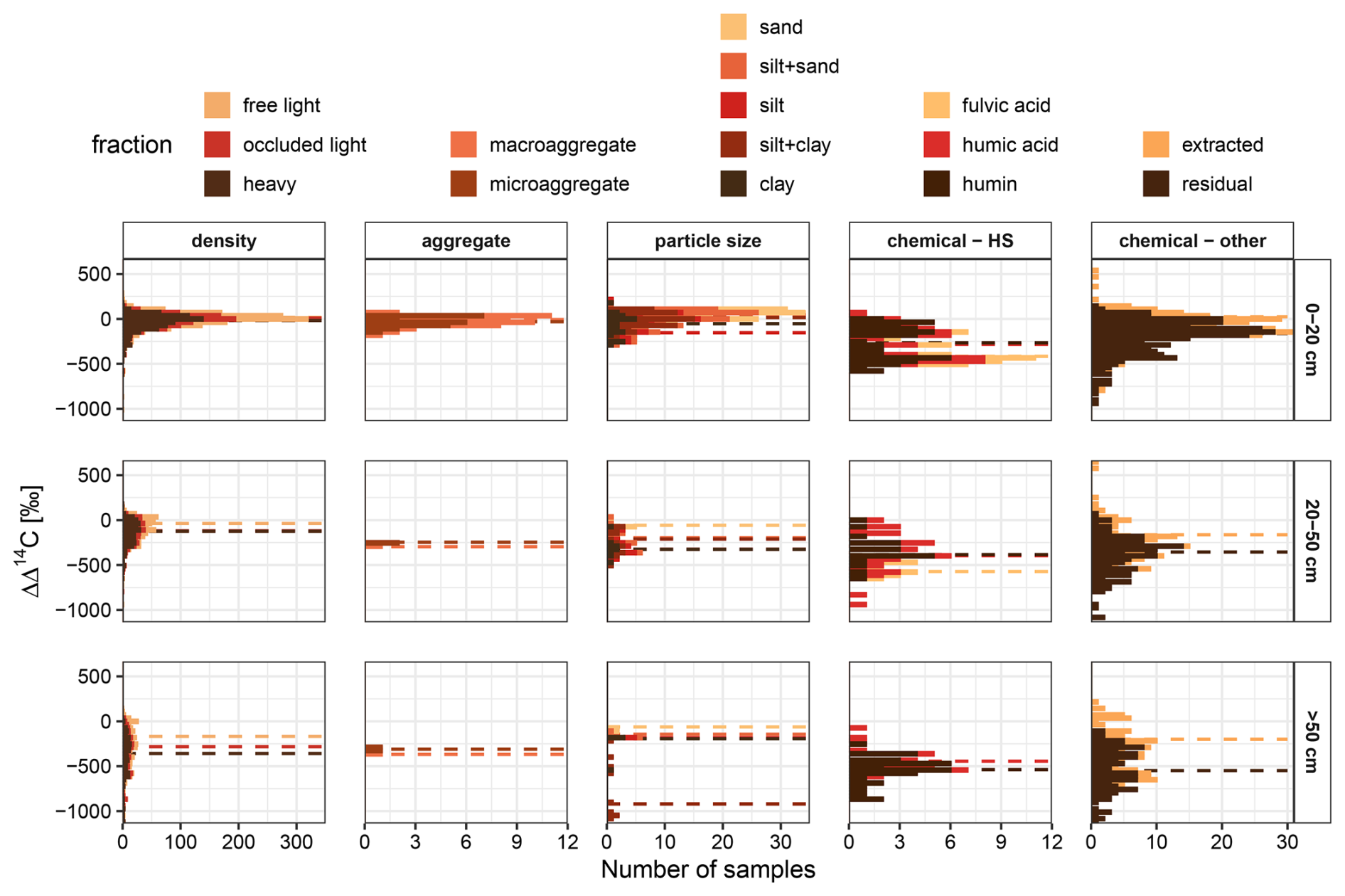
Figure 5ΔΔ14C (measured – atmospheric Δ14C) measurements for selected types of fraction data from different depths. Dashed lines refer to median values. Peatland and wetland studies are excluded. HS = humic substances. Note the different scales for the x axes.
Chemical fractionations, based on solubility or other chemical properties, also effectively separate C into pools of contrasting 14C ages (Fig. 5; Heckman et al., 2018; Martel and Paul, 1974; Paul et al., 1997, 2001; Yanai et al., 2024). However, the mechanistic basis for these separations remains unclear, and the resulting pools do not map directly onto the persistence mechanisms central to soil C modeling. Thermal fractionation, represented by a smaller but growing number of ISRaD datasets, shows promise for distinguishing thermally labile versus stable pools, highlighting potential directions for future methodological development (Grant et al., 2019; Stoner et al., 2023). Overall, ISRaD data underscore that fractionation approaches each capture distinct aspects of soil C cycling; the choice of fractionation method reflects both scientific objectives and assumptions about soil C persistence mechanisms.
The diversity of fractionation approaches in ISRaD creates both opportunity and challenge. Investigating soil fractions aids in interpreting bulk soil data given the underlying heterogeneity of soil C. On one hand, having multiple fractionation methods applied to the same soils and profiles enables comparison of what each method reveals about C age structure. On the other hand, the lack of standardized fractionation protocols complicates cross-study synthesis. Nevertheless, connecting operationally-defined fractions with conceptually-defined pools in soil C models provides important constraints that can help refine models and minimize parameter equifinality (Ahrens et al., 2020; Brunmayr et al., 2024; Van de Broek et al., 2025).
Despite substantial growth in fraction data since ISRaD v1, important gaps remain. An underexplored question is whether different fractionation approaches preferentially isolate plant-derived versus microbial-derived soil C components. The mechanistic basis for chemical fractionations remains poorly characterized in the radiocarbon literature. Furthermore, compound-specific approaches offer unique mechanistic insights into microbial C cycling that bulk measurements cannot provide, yet are rarely analyzed for radiocarbon. These gaps represent important opportunities for future data collection and synthesis through ISRaD. More broadly, ISRaD's expanded fraction database demonstrates both the power and the limitation of current fractionation approaches: while diverse methods reveal the complexity of soil C age structure, the continued lack of consensus on “best-practice” fractionation highlights fundamental questions about which soil C characteristics are most relevant to understanding how ecosystem-scale C cycling is linked to climate, parent material, and land use feedbacks. More systematic comparisons of different fractionation methods across diverse soil systems are needed (Crow et al., 2015; Leuthold et al., 2024; Trumbore and Zheng, 1996).
5.6 Wetlands
Wetlands are important components of the global terrestrial C system. They store 520–710 Pg of soil organic C (Poulter et al., 2021), which is roughly one-third of the global soil organic C pool. This C storage occurs on just 6 % of the land surface (Stewart et al., 2024). Of the different types of wetlands, peatlands store twice as much C as global forests (∼ 350 Pg of soil organic C; Dargie et al., 2017; Hugelius et al., 2020), while coastal wetlands, including mangroves and salt marshes, store approximately 2.73–9.75 Pg of soil organic C globally (Macreadie et al., 2021). Historically, radiocarbon measurements in wetlands have had paleoecological applications (e.g., MacDonald et al., 2006). More recently, radiocarbon has become a key tool to investigate mechanisms of soil C accumulation and avenues of soil C loss (Bowen et al., 2024a; Cooray et al., 2025; Hamada et al., 2024, 2025; Maher et al., 2017). Despite the importance of wetlands and the increase of wetland studies using radiocarbon measurements, the v1 database contained disproportionately low amounts of 14C data from wetland ecosystems (Lawrence et al., 2020; Fig. 6).
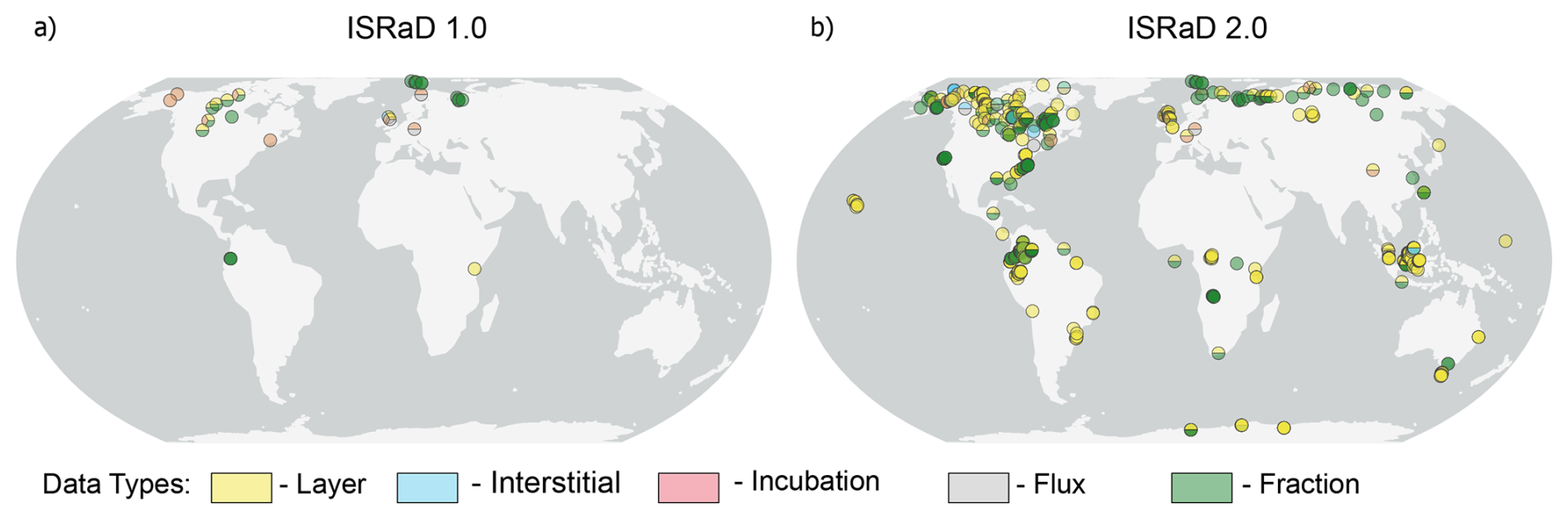
Figure 6Geographical location of all wetland samples (pro_land_cover “wetland” or pro_peatland “yes”) in ISRaD v1.2.3.2019-12-20 and v2.9.9.2025-08-14 colored by data types.
To address this in v2, we have added more data from wetlands compared to v1, especially from peatlands, salt marshes and mangroves. These wetlands now account for one-third of all entered studies in ISRaD. Currently, the ISRaD data template includes wetland as a category of land cover, with a separate column dedicated to the presence of peat. This column designates peatland sites and tracks whether organic horizons are present. Users should note that peatland designation adopts author-reported nomenclature and that depth reporting conventions differ between systems with superficial organic layers (negative depths) and thick organic-dominated soils (organic horizons at zero depth). Guidance for interpreting wetland data metadata is available on the ISRaD website. In addition, users should note that coastal wetland environments, including mangroves and salt marshes, are currently grouped under the broader wetland land-cover category in ISRaD. No dedicated metadata field allows systematic filtering by wetland type. Since these environments differ substantially in vegetation, organic matter production, and C preservation potential, data users may have to determine further distinctions through site-level description fields and geographic location. Improved classification of coastal wetland types is a recognized limitation and a priority for future versions of ISRaD.
The largest category of data from wetland soils is in the layer data with 128 individual studies covering 215 unique sites and 512 different profiles (Fig. 6). The next largest category for wetland soils is the fraction data, which has 91 individual studies covering 149 unique sites, and 325 different profiles. The majority of the fraction data are from physical separation of distinct particles such as macrofossils (i.e., pollens), charcoal, roots, or non-root plant material (n= 1023), followed by density separations (n = 93), particle size fractions (n= 81), chemical separations (n= 78), and very narrowly applied fractionation schemes of thermal fractionation (n= 10) and compound specific analyses that only include lipids (n= 6). This distribution likely reflects recognized challenges: bulk 14C analysis has limitations in wetlands due to mixed C sources with varying transit times (Komada et al., 2022; Sefton et al., 2022), while macrofossils in peatlands provide more reliable paleoenvironmental records compared to bulk material which may represent inputs spanning centuries (Holmquist et al., 2016; Monacci et al., 2009; Woodroffe et al., 2015a; Wüst et al., 2008). Notably, density fractionation has shown greater success than particle-size fractionation for resolving different C sources in coastal wetlands, which may explain the relative abundance of density-separated samples in ISRaD (Hamada et al., 2024, 2025; Kemp et al., 2019; Sefton et al., 2022; Van de Broek et al., 2018; Woodroffe et al., 2015b).
Given that many wetlands have faced extensive management and land-use changes, there has been a growing number of studies collecting flux and interstitial radiocarbon data to understand wetland responses to disturbance and to restoration efforts (Bowen et al., 2024a; Houston et al., 2024; Van de Broek et al., 2018; Wang et al., 2021a). Yet, despite these efforts, flux, incubation, and interstitial data remain low in abundance for wetland soils in ISRaD, covering 68, 60, and 35 different profiles, respectively, each with less than 15 individual studies and less than 20 unique sites. For example, for incubation data, there are currently only three studies in peatlands that utilize radiocarbon and only one study in coastal wetland ecosystems, the latter finding that young soil C is preferentially respired, consistent with findings from other ecosystems (Houston et al., 2024). For flux data, nearly all correspond to soil fluxes of CO2 or CH4. With the close proximity of coastal wetlands to the ocean and the loss of coastal wetlands to anthropogenic disturbance and sea-level rise, there has also been increased use of radiocarbon to understand the lateral fluxes of dissolved organic and inorganic C (Bowen et al., 2024b; Maher et al., 2017; Nakamura et al., 2025). Because ISRaD now includes DOC and DIC in the column designating the species for the flux measured, future efforts should focus on integrating aquatic radiocarbon datasets (e.g., Dean et al., 2025; Marwick et al., 2015) into ISRaD.
As detailed above, ISRaD is an open-source project that provides several ways for participation. ISRaD v2 data are archived and freely available (Beem-Miller et al., 2025). Anyone may share or adapt the ISRaD dataset, provided they do so in accordance with the Creative Commons Attribution 4.0 International Public License (https://creativecommons.org/licenses/by/4.0/legalcode, last access: 26 November 2025), also referred to as CC BY.
ISRaD data are released and archived periodically following major structural changes or after ingestion of a substantial amount of new data. Each official release is assigned a DOI and archived on Zenodo to facilitate reproducibility of analyses. Versioning follows a three-tiered sequential numeric identifier in the form of major.minor.patch, accompanied by the date of the most recent change (e.g., ISRaD v2.9.9.2025-08-14). All changes to data and code are maintained under version control and are immediately available through the ISRaD GitHub repository. New data entries must pass an automated QA/QC check, which can be initiated via the ISRaD R package or directly from the ISRaD website, before submission (as previously described in Lawrence et al. 2020). Entries that pass automated QA/QC are then subject to expert review to ensure proper completion of more complex aspects of the template, such as classification of soil fractionation methods. Only entries that pass both automated and expert review are ingested into the database. To ensure repeatability of analyses and accurate attribution, users should always record both the full version number and the date when accessing ISRaD data, and cite both this publication and the specific data release used in their work. If users leverage individual data entries from the database, they should also cite the original source dataset or paper. Finally, we strongly encourage users who interpret their own data in the context of data accessed from ISRaD to submit those new data for inclusion in ISRaD after they have published their results or obtained a DOI for their dataset.
The International Soil Radiocarbon Database (ISRaD) v2.9.8 data (Beem-Miller et al., 2025) is archived and freely available (https://doi.org/10.5281/zenodo.17860507). In addition, the development version of the database can be accessed directly from GitHub (https://github.com/International-Soil-Radiocarbon-Database/ISRaD, last acccess: 25 June 2026). All code to reproduce the analysis and figures presented in this publication are available at https://doi.org/10.5281/zenodo.17859527 (von Fromm et al., 2025a) and at https://github.com/International-Soil-Radiocarbon-Database/ISRaD-v2-analysis (last access: 25 June 2026).
The International Soil Radiocarbon Database has evolved into an important resource for understanding soil C dynamics across spatial and temporal scales. Since its initial release in 2020, ISRaD v2 has grown substantially and demonstrated its usefulness to enable diverse scientific advances. Nonetheless, substantial opportunities remain to expand ISRaD's coverage, improve metadata specificity, and strengthen its integration with complementary data systems and modeling frameworks. The following sections outline priority directions for the continued evolution of ISRaD and the soil radiocarbon community.
8.1 Leveraging time-series to navigate declining atmospheric radiocarbon
As atmospheric 14C concentrations continue to decline from their “bomb”-spike maximum into a “post-bomb” era, interpreting single-point radiocarbon measurements from soils becomes increasingly challenging (Graven et al., 2020; Sierra, 2018). We now observe Δ14C values at or below the initial values of the “bomb”-spike (∼ 0 ‰), meaning that CO2 fixed by plants today has a similar 14C value to C fixed in the 1950s. However, this emerging challenge underscores a critical strength of ISRaD: utilizing time-series radiocarbon data.
The analytical power of 14C measurements is derived from changes in the atmospheric signal combined with modeling approaches that track C movement through soil pools over time. The “bomb”-spike made it possible to characterize soil C dynamics at a finer temporal resolution (∼ 1–10 years) than natural abundance 14C (∼ 100–1000 years). Although the “bomb”-spike dilutes over time due to the burning of fossil fuels, the resulting decline in the atmospheric 14C signal continues to provide a measurable and predictable tracer. As long as atmospheric 14C values are changing, time-series measurements are uniquely powerful for distinguishing between fast- and slow-cycling carbon pools and for constraining transit times, far more so than single-point measurements alone.
Several studies already in ISRaD demonstrate the power of combining temporal measurements with modeling (e.g., Baisden et al., 2013; von Fromm et al., 2025b; González-Sosa et al., 2024; Sanderman et al., 2017; Sierra et al., 2012; Spohn et al., 2023; Stoner et al., 2021; Trumbore et al., 1996). These studies show that revisiting sites over years to decades, and resampling archived soil collected decades ago, can improve our ability to better constrain soil C cycling. Alternatively, accreting systems like organic peatland or permafrost soils can preserve atmospheric 14C with depth via annual C inputs (e.g., Hicks Pries et al., 2012). Thus, we encourage the scientific community to focus on (i) systematic resampling of existing sites, (ii) analysis of archived samples, and (iii) leveraging natural archives (i.e., peatlands, wetlands, and permafrost soils).
8.2 Best practice for collecting, reporting, sharing, and interpreting soil radiocarbon data
The growth of ISRaD v2 and synthesis studies leveraging the database have highlighted both the value of comprehensive data archiving and the importance of consistent, high-quality metadata. To maximize the scientific utility of soil radiocarbon data and facilitate meaningful cross-study comparisons, we recommend the following best practices for the soil radiocarbon community. Minimum metadata requirements: every soil radiocarbon measurement should include the following core information to ensure accurate attribution, reproducibility and comparability:
- i.
Geographic location. Sampling site coordinates (latitude, longitude) at the highest possible precision, preferably at the individual profile level rather than regional generalizations. Accurate geolocation is essential for linking radiocarbon data to climate, soil, and land-use variables and for identifying candidate sites for resampling.
- ii.
Depth intervals. Precise reporting of sampling depths (e.g., 0–10, 10–30 cm) with clear notation of reference levels (e.g., mineral soil surface, peat surface, or litter surface). Standardized depth notation is critical for depth-dependent analyses and for comparing data across studies.
- iii.
Both the year of sample collection and the year of radiocarbon analysis must be reported. This is essential because changes in atmospheric 14C content, particularly during and after the “bomb” period, directly affect the interpretation of measured 14C values. This distinction is particularly important for archived samples analyzed years or decades after collection.
- iv.
Sample description. Clear identification of the material analyzed (e.g., bulk soil, specific fraction, roots, incubation, interstitial CO2), including pretreatment methods if applicable (e.g., acid-base-acid for macrofossils, acid fumigation or HCl treatment for carbonate removal).
- v.
Laboratory information. Laboratory code/reference number, and reported uncertainties (Δ14C or Fm, with associated standard deviation).
While ISRaD captures the core radiocarbon measurements and basic soil properties, several types of supplementary data significantly strengthen the interpretive power of radiocarbon studies but are often incompletely reported: (i) soil mineralogy and texture, (ii) soil chemistry, (iii) microbial and biological indicators, (iv) management and disturbance history, and (v) parent material. We recognize that not all studies will have access to comprehensive soil characterization data. However, when such data are available, we strongly encourage their inclusion in ISRaD submissions or as supplementary information linked to database entries.
Alongside these data submission considerations, users of ISRaD should also be aware of factors that can complicate the interpretation of compiled radiocarbon data. While a comprehensive treatment of radiocarbon interpretation is beyond the scope of this paper, detailed guidance is available elsewhere (e.g., Schuur et al., 2016). Here, we highlight considerations that are particularly relevant when working with compiled data from ISRaD. Several environmental variables, including mean annual temperature, mean annual precipitation, soil order, land cover type, and parent material, can be entered as site-level metadata in ISRaD. However, none of these are mandatory fields, and therefore, coverage is incomplete across entries. To overcome this shortage, the ISRaD R package provides a number of data enhancement tools (ISRaD_extra functions) that calculate or fill in certain fields with missing data, as well as provide ancillary data from various geospatial data sources that can help contextualize individual measurements.
Beyond environmental context, users should be aware of factors affecting the radiocarbon signal itself. Inputs of radiocarbon-dead C from geogenic sources, including petrogenic organic C from sedimentary parent materials, such as kerogen and lignite, as well as C-rich surficial deposits, such as loess, can substantially deplete soil 14C signatures (Copard et al., 2025). Users are encouraged to consider these inputs when working with data from deep soils, soils formed in areas with significant aeolian inputs, and/or soils derived from C-rich parent materials. Though not available across all entries, data from radiocarbon in fractions and incubations specifically are intended to demonstrate that bulk radiocarbon data often represent mixtures of different-aged components, and this is one reason we highlight them in this update of ISRaD. In addition, although bulk layer data are entered under the assumption that inorganic C has been removed before analysis (Sect. 5.1), inorganic C from carbonates can still affect radiocarbon measurements from incubations and flux data, especially in calcareous soils, limed agricultural systems, or arid regions (Wang et al., 2026). Finally, methodological differences across studies, including variations in fractionation protocols, incubation conditions, and sample pretreatments, can introduce systematic differences in measured 14C values, complicating cross-study comparisons.
8.3 Future Directions for ISRaD
The following future directions represent a subset of emerging opportunities identified by the soil radiocarbon community and are not intended to be exhaustive or prescriptive. Despite substantial growth in ISRaD v2, significant geographic and data type gaps remain that limit our ability to understand soil C dynamics at global scales. Tropical and arid regions remain severely undersampled relative to their global soil C stocks, and agricultural and urban soils are critically underrepresented. Depth-resolved sampling is particularly biased toward surface mineral horizons; a critical limitation given that deep soils contribute substantially to long-term C storage. Beyond geographic gaps, several data types remain limited: interstitial DOC and POC measurements (especially from wetlands and peatlands), CH4 measurements from anaerobic systems, living root incubations deeper than 20 cm, and seasonally-resolved flux measurements. A major untapped opportunity exists to reanalyze archived soil samples collected decades ago from well-documented sites, which would enable the construction of radiocarbon time series to constrain ages and transit times and test model predictions of soil C dynamics during the declining “bomb” radiocarbon era. Addressing these sampling gaps will require not only expanded data collection but also improved metadata reporting in ISRaD. We encourage researchers who publish radiocarbon data, especially those who have benefited from ISRaD, to contribute their measurements to the database. Community participation is essential for addressing sampling gaps and advancing our understanding of soil C dynamics.
ISRaD continues to evolve in response to emerging research priorities and community needs. One area for improvement is the classification of land-cover types and capture of disturbance and restoration history, particularly for ecosystems with rapidly growing radiocarbon research. Wetlands are increasingly recognized as critical components of the global C cycle, yet current ISRaD metadata do not adequately capture the diversity and disturbance history within these systems. Beyond wetlands, agricultural soils under different management regimes (conservation vs. conventional tillage, liming, fertilization history) represent another critical gap, as do disturbed systems affected by fire, erosion, or land-use change. We recognize that developing robust classification schemes for disturbance is challenging since disturbances vary in type, severity, timing, and recovery trajectory. Rather than prescribing a single solution, we invite the community to contribute ideas, data, and expertise on how best to capture this information. Proposed improvements might include: hierarchical ecosystem classifications that distinguish management states and disturbance types; metadata fields for disturbance type, timing, and intensity; or linkages to external land-use change databases. We encourage contributions on these topics and welcome collaborative efforts to refine ISRaD's capacity to represent the full complexity of terrestrial C cycling and beyond in a rapidly changing world.
Another emerging research area is understanding the fate of soil-derived C once it leaves terrestrial systems and enters aquatic pathways. It is well established that the fate of soil-derived C in aquatic ecosystems and emission of soil-derived C to the atmosphere from aquatic ecosystems play a critical role in the global C cycle (e.g., Cole et al., 2007; Hotchkiss et al., 2015; Meybeck, 1993). There is a growing body of literature demonstrating that streams, canals, and rivers transport and emit substantial quantities of aged soil C to the atmosphere, further highlighting the importance of lateral C fluxes in global C budgets (Barnes et al., 2018; Bowen et al., 2024a; Butman et al., 2015; Dean et al., 2025; Galy et al., 2015; Marwick et al., 2015; Masiello and Druffel, 2001; Raymond et al., 2004; Townsend-Small et al., 2007). Expanding ISRaD to systematically link soil radiocarbon measurements with riverine C observations at shared locations would provide critical constraints on how soil C ages and sources translate into aquatic C dynamics, ultimately providing a full picture of the avenues through which terrestrial C is transferred to the atmosphere. Beyond improved ecosystem representations, broader integration with complementary data systems and modeling frameworks would amplify the utility of ISRaD data across disciplines. Realizing these collaborative opportunities and expanding ISRaD's capacity will require sustained effort and resources; while ISRaD has demonstrated resilience in continuing without dedicated funding, maintaining and advancing the database remains challenging without institutional or financial support.
While ISRaD provides a centralized repository for soil radiocarbon measurements, substantial opportunities exist for the broader soil science and modeling communities to develop deeper integrations with complementary databases and create model-ready data products. Linking ISRaD with other soil information systems (e.g., parent material and land-use history), aquatic C databases, and climate datasets could unlock powerful cross-disciplinary research on soil C dynamics and fate. The ISRaD database distinguishes between raw data available in publications and extrapolations. One limitation of this approach is that users must research and add information not provided by the original study. This information may include parent material, land use, disturbance history, mineralogy, and other standard soil descriptors that might be available at nearby sites or from global products, some of which are provided through ISRaD_extra. In addition, developing standardized formats and pre-processed data products tailored to the needs of land surface modelers would greatly enhance the utility of radiocarbon constraints for model parameterization and validation. Such integration efforts require coordinated development and community engagement beyond the scope of a single database. We invite the soil science, soil C modeling, and aquatic C communities to collaborate on defining priorities for these integrations and to contribute technical expertise and resources toward building the necessary linkages and products. These collaborative efforts would strengthen the scientific value of radiocarbon data across disciplinary boundaries and improve our ability to predict soil C responses to environmental change.
A former version of this article was published on 6 January 2020 and is available at https://doi.org/10.5194/essd-12-61-2020.
The supplement related to this article is available online at https://doi.org/10.5194/essd-18-5793-2026-supplement.
SvF, RSW, DRV, JCB, ST, KJ, JS, OV, SWS, MC, AM, AAW, KH, DW, LIM, KEG, CEHP, KJM, AA, CL, and JBM contributed to data curation. SvF lead the formal analysis with contributions from DRV, JCB, ST, OV, SWS, AM, AAW, AMH, KG, DW, LIM, KEG, CEHP, KJM, and AA. SvF lead the writing with contributions from all co-authors.
The contact author has declared that none of the authors has any competing interests.
Publisher's note: Copernicus Publications remains neutral with regard to jurisdictional claims made in the text, published maps, institutional affiliations, or any other geographical representation in this paper. The authors bear the ultimate responsibility for providing appropriate place names. Views expressed in the text are those of the authors and do not necessarily reflect the views of the publisher.
The authors would like to thank all those who contributed data to the International Soil Radiocarbon Database, either by making their data publicly available or by sharing it directly. The authors would also like to thank those who dedicated their time and knowledge to the database. Additionally, the authors thank the various funding sources that supported personnel and workshops in past years, including the US Geological Survey Powell Center working group on Soil Carbon Storage and Feedbacks, the US Department of Agriculture (award no. 2018-67003-27935), Stanford VPDoR Propel Grant, the European Research Council (Horizon 2020 Research and Innovation Program; grant no. 695101; 14Constraint), CAMS/LLNL, LBL, Stanford University, Dartmouth College, and the Max Planck Society.
The article processing charges for this open-access publication were covered by the Max Planck Society.
This paper was edited by Giulio G. R. Iovine and reviewed by two anonymous referees.
Ahrens, B., Braakhekke, M. C., Guggenberger, G., Schrumpf, M., and Reichstein, M.: Contribution of sorption, DOC transport and microbial interactions to the 14C age of a soil organic carbon profile: Insights from a calibrated process model, Soil Biol. Biochem., 88, 390–402, https://doi.org/10.1016/j.soilbio.2015.06.008, 2015.
Ahrens, B., Guggenberger, G., Rethemeyer, J., John, S., Marschner, B., Heinze, S., Angst, G., Mueller, C. W., Kögel-Knabner, I., Leuschner, C., Hertel, D., Bachmann, J., Reichstein, M., and Schrumpf, M.: Combination of energy limitation and sorption capacity explains 14C depth gradients, Soil Biol. Biochem., 148, 107912, https://doi.org/10.1016/j.soilbio.2020.107912, 2020.
Amundson, R., Sanderman, J., Yoo, K., Chitsaz, M., Abramova, A., and Georgiou, K.: Neglecting vertical transport leads to underestimated soil carbon dynamics, Nat. Geosci., 18, 1239–1244, https://doi.org/10.1038/s41561-025-01846-6, 2025.
Baisden, W. T., Parfitt, R. L., Ross, C., Schipper, L. A., and Canessa, S.: Evaluating 50 years of time-series soil radiocarbon data: towards routine calculation of robust C residence times, Biogeochemistry, 112, 129–137, https://doi.org/10.1007/s10533-011-9675-y, 2013.
Barnes, R. T., Butman, D. E., Wilson, H. F., and Raymond, P. A.: Riverine Export of Aged Carbon Driven by Flow Path Depth and Residence Time, Environ. Sci. Technol., 52, 1028–1035, https://doi.org/10.1021/acs.est.7b04717, 2018.
Beck, H. E., McVicar, T. R., Vergopolan, N., Berg, A., Lutsko, N. J., Dufour, A., Zeng, Z., Jiang, X., van Dijk, A. I. J. M., and Miralles, D. G.: High-resolution (1 km) Köppen-Geiger maps for 1901–2099 based on constrained CMIP6 projections, Sci. Data, 10, 724, https://doi.org/10.1038/s41597-023-02549-6, 2023.
Beem-Miller, J., Schrumpf, M., Hoyt, A. M., Guggenberger, G., and Trumbore, S.: Impacts of drying and rewetting on the radiocarbon signature of respired CO2 and implications for incubating archived soils, J. Geophys. Res.-Biogeo., 126, e2020JG006119, https://doi.org/10.1029/2020JG006119, 2021.
Beem-Miller, J., Hoyt, A., Stoner, S., Monroe, J. G., Hicks Pries, C., and Levine, P. A.: ISRaD: Tools and Data for the International Soil Radiocarbon Database, Zenodo [data set], https://doi.org/10.5281/zenodo.17860507, 2025.
Billings, S. A., Lajtha, K., Malhotra, A., Berhe, A. A., de Graaff, M.-A., Earl, S., Fraterrigo, J., Georgiou, K., Grandy, S., Hobbie, S. E., Moore, J. A. M., Nadelhoffer, K., Pierson, D., Rasmussen, C., Silver, W. L., Sulman, B. N., Weintraub, S., and Wieder, W.: Soil organic carbon is not just for soil scientists: measurement recommendations for diverse practitioners, Ecol. Appl., 31, e02290, https://doi.org/10.1002/eap.2290, 2021.
Bond-Lamberty, B., Christianson, D. S., Malhotra, A., Pennington, S. C., Sihi, D., AghaKouchak, A., Anjileli, H., Altaf Arain, M., Armesto, J. J., Ashraf, S., Ataka, M., Baldocchi, D., Andrew Black, T., Buchmann, N., Carbone, M. S., Chang, S.-C., Crill, P., Curtis, P. S., Davidson, E. A., Desai, A. R., Drake, J. E., El-Madany, T. S., Gavazzi, M., Görres, C.-M., Gough, C. M., Goulden, M., Gregg, J., Gutiérrez del Arroyo, O., He, J.-S., Hirano, T., Hopple, A., Hughes, H., Järveoja, J., Jassal, R., Jian, J., Kan, H., Kaye, J., Kominami, Y., Liang, N., Lipson, D., Macdonald, C. A., Maseyk, K., Mathes, K., Mauritz, M., Mayes, M. A., McNulty, S., Miao, G., Migliavacca, M., Miller, S., Miniat, C. F., Nietz, J. G., Nilsson, M. B., Noormets, A., Norouzi, H., O'Connell, C. S., Osborne, B., Oyonarte, C., Pang, Z., Peichl, M., Pendall, E., Perez-Quezada, J. F., Phillips, C. L., Phillips, R. P., Raich, J. W., Renchon, A. A., Ruehr, N. K., Sánchez-Cañete, E. P., Saunders, M., Savage, K. E., Schrumpf, M., Scott, R. L., Seibt, U., Silver, W. L., Sun, W., Szutu, D., Takagi, K., Takagi, M., Teramoto, M., Tjoelker, M. G., Trumbore, S., Ueyama, M., Vargas, R., Varner, R. K., Verfaillie, J., Vogel, C., Wang, J., Winston, G., Wood, T. E., Wu, J., Wutzler, T., Zeng, J., Zha, T., Zhang, Q., and Zou, J.: COSORE: A community database for continuous soil respiration and other soil-atmosphere greenhouse gas flux data, Glob. Change Biol., 26, 7268–7283, https://doi.org/10.1111/gcb.15353, 2020.
Bossio, D. A., Cook-Patton, S. C., Ellis, P. W., Fargione, J., Sanderman, J., Smith, P., Wood, S., Zomer, R. J., von Unger, M., Emmer, I. M., and Griscom, B. W.: The role of soil carbon in natural climate solutions, Nat. Sustain., 3, 391–398, https://doi.org/10.1038/s41893-020-0491-z, 2020.
Bowen, J. C., Hoyt, A. M., Xu, X., Nuriman, M., Anshari, G. Z., Wahyudio, P. J., and Aluwihare, L. I.: Aquatic processing enhances the loss of aged carbon from drained and burned peatlands, Glob. Change Biol., 30, e17394, https://doi.org/10.1111/gcb.17394, 2024a.
Bowen, J. C., Wahyudio, P. J., Anshari, G. Z., Aluwihare, L. I., and Hoyt, A. M.: Canal networks regulate aquatic losses of carbon from degraded tropical peatlands, Nat. Geosci., 17, 213–218, https://doi.org/10.1038/s41561-024-01383-8, 2024b.
Brunmayr, A. S., Hagedorn, F., Moreno Duborgel, M., Minich, L. I., and Graven, H. D.: Radiocarbon analysis reveals underestimation of soil organic carbon persistence in new-generation soil models, Geosci. Model Dev., 17, 5961–5985, https://doi.org/10.5194/gmd-17-5961-2024, 2024.
Butman, D. E., Wilson, H. F., Barnes, R. T., Xenopoulos, M. A., and Raymond, P. A.: Increased mobilization of aged carbon to rivers by human disturbance, Nat. Geosci., 8, 112–116, https://doi.org/10.1038/ngeo2322, 2015.
Camino-Serrano, M., Tifafi, M., Balesdent, J., Hatté, C., Peñuelas, J., Cornu, S., and Guenet, B.: Including Stable Carbon Isotopes to Evaluate the Dynamics of Soil Carbon in the Land-Surface Model ORCHIDEE, J. Adv. Model. Earth Sy., 11, 3650–3669, https://doi.org/10.1029/2018MS001392, 2019.
Chai, X., Li, G., Shi, Z., and Ruan, H.: Soil radiocarbon abundance in global forest ecosystems controlled by climate and soil properties, Plant Soil, 489, 125–137, https://doi.org/10.1007/s11104-023-06002-w, 2023.
Chanton, J. P., Glaser, P. H., Chasar, L. S., Burdige, D. J., Hines, M. E., Siegel, D. I., Tremblay, L. B., and Cooper, W. T.: Radiocarbon evidence for the importance of surface vegetation on fermentation and methanogenesis in contrasting types of boreal peatlands, Global Biogeochem. Cy., 22, https://doi.org/10.1029/2008GB003274, 2008.
Chen, J., Zhu, Q., Riley, W. J., He, Y., Randerson, J. T., and Trumbore, S.: Comparison With Global Soil Radiocarbon Observations Indicates Needed Carbon Cycle Improvements in the E3SM Land Model, J. Geophys. Res.-Biogeo., 124, 1098–1114, https://doi.org/10.1029/2018JG004795, 2019.
Cisneros-Dozal, L. M., Trumbore, S., and Hanson, P. J.: Partitioning sources of soil-respired CO2 and their seasonal variation using a unique radiocarbon tracer, Glob. Change Biol., 12, 194–204, https://doi.org/10.1111/j.1365-2486.2005.001061.x, 2006.
Cole, J. J., Prairie, Y. T., Caraco, N. F., McDowell, W. H., Tranvik, L. J., Striegl, R. G., Duarte, C. M., Kortelainen, P., Downing, J. A., Middelburg, J. J., and Melack, J.: Plumbing the Global Carbon Cycle: Integrating Inland Waters into the Terrestrial Carbon Budget, Ecosystems, 10, 172–185, https://doi.org/10.1007/s10021-006-9013-8, 2007.
Cooray, I. G., Chalmers, G., Chittleborough, D., and Ghasemzadeh, Z.: Soil carbon fractionation as a tool to monitor coastal wetland rehabilitation, J. Environ. Manage., 373, 123950, https://doi.org/10.1016/j.jenvman.2024.123950, 2025.
Copard, Y., Hatté, C., Cécillon, L., Colin, Y., Barré, P., Chenu, C., and Cornu, S.: Soil Carbon Dynamics Reshaped by Ancient Carbon Quantification, Glob. Change Biol., 31, e70482, https://doi.org/10.1111/gcb.70482, 2025.
Cotrufo, M. F. and Lavallee, J. M.: Soil organic matter formation, persistence, and functioning: A synthesis of current understanding to inform its conservation and regeneration, Adv. Agron., 172, 1–66, https://doi.org/10.1016/bs.agron.2021.11.002, 2022.
Crow, S. E., Reeves, M., Schubert, O. S., and Sierra, C. A.: Optimization of method to quantify soil organic matter dynamics and carbon sequestration potential in volcanic ash soils, Biogeochemistry, 123, 27–47, https://doi.org/10.1007/s10533-014-0051-6, 2015.
Crystal-Ornelas, R., Varadharajan, C., O'Ryan, D., Beilsmith, K., Bond-Lamberty, B., Boye, K., Burrus, M., Cholia, S., Christianson, D. S., Crow, M., Damerow, J., Ely, K. S., Goldman, A. E., Heinz, S. L., Hendrix, V. C., Kakalia, Z., Mathes, K., O'Brien, F., Pennington, S. C., Robles, E., Rogers, A., Simmonds, M., Velliquette, T., Weisenhorn, P., Welch, J. N., Whitenack, K., and Agarwal, D. A.: Enabling FAIR data in Earth and environmental science with community-centric (meta)data reporting formats, Sci. Data, 9, 700, https://doi.org/10.1038/s41597-022-01606-w, 2022.
Dargie, G. C., Lewis, S. L., Lawson, I. T., Mitchard, E. T. A., Page, S. E., Bocko, Y. E., and Ifo, S. A.: Age, extent and carbon storage of the central Congo Basin peatland complex, Nature, 542, 86–90, https://doi.org/10.1038/nature21048, 2017.
Dean, J. F., Coxon, G., Zheng, Y., Bishop, J., Garnett, M. H., Bastviken, D., Galy, V., Spencer, R. G. M., Tank, S. E., Tipper, E. T., Vonk, J. E., Wallin, M. B., Zhang, L., Evans, C. D., and Hilton, R. G.: Old carbon routed from land to the atmosphere by global river systems, Nature, 642, 105–111, https://doi.org/10.1038/s41586-025-09023-w, 2025.
Derrien, D., Barré, P., Basile-Doelsch, I., Cécillon, L., Chabbi, A., Crème, A., Fontaine, S., Henneron, L., Janot, N., Lashermes, G., Quénéa, K., Rees, F., and Dignac, M.-F.: Current controversies on mechanisms controlling soil carbon storage: implications for interactions with practitioners and policy-makers. A review, Agron. Sustain. Dev., 43, 21, https://doi.org/10.1007/s13593-023-00876-x, 2023.
Doetterl, S., Berhe, A. A., Heckman, K., Lawrence, C., Schnecker, J., Vargas, R., Vogel, C., and Wagai, R.: A landscape-scale view of soil organic matter dynamics, Nat. Rev. Earth Environ., 6, 67–81, https://doi.org/10.1038/s43017-024-00621-2, 2025.
Drake, T. W., Van Oost, K., Barthel, M., Bauters, M., Hoyt, A. M., Podgorski, D. C., Six, J., Boeckx, P., Trumbore, S. E., Cizungu Ntaboba, L., and Spencer, R. G. M.: Mobilization of aged and biolabile soil carbon by tropical deforestation, Nat. Geosci., 12, 541–546, https://doi.org/10.1038/s41561-019-0384-9, 2019.
Eglinton, T. I., Graven, H. D., Raymond, P. A., Trumbore, S. E., Aluwihare, L., Bard, E., Basu, S., Friedlingstein, P., Hammer, S., Lester, J., Sanderman, J., Schuur, E. A. G., Sierra, C. A., Synal, H.-A., Turnbull, J. C., and Wacker, L.: Making the case for an International Decade of Radiocarbon, Philos. T. R. Soc. A, 381, 20230081, https://doi.org/10.1098/rsta.2023.0081, 2023.
Estop-Aragonés, C., Olefeldt, D., Abbott, B. W., Chanton, J. P., Czimczik, C. I., Dean, J. F., Egan, J. E., Gandois, L., Garnett, M. H., Hartley, I. P., Hoyt, A., Lupascu, M., Natali, S. M., O'Donnell, J. A., Raymond, P. A., Tanentzap, A. J., Tank, S. E., Schuur, E. A. G., Turetsky, M., and Anthony, K. W.: Assessing the Potential for Mobilization of Old Soil Carbon After Permafrost Thaw: A Synthesis of 14C Measurements From the Northern Permafrost Region, Global Biogeochem. Cy., 34, e2020GB006672, https://doi.org/10.1029/2020GB006672, 2020.
Fekete, I., Berki, I., Lajtha, K., Trumbore, S., Francioso, O., Gioacchini, P., Montecchio, D., Várbíró, G., Béni, Á., Makádi, M., Demeter, I., Madarász, B., Juhos, K., and Kotroczó, Z.: How will a drier climate change carbon sequestration in soils of the deciduous forests of Central Europe?, Biogeochemistry, 152, 13–32, https://doi.org/10.1007/s10533-020-00728-w, 2021.
Feng, W., Shi, Z., Jiang, J., Xia, J., Liang, J., Zhou, J., and Luo, Y.: Methodological uncertainty in estimating carbon turnover times of soil fractions, Soil Biol. Biochem., 100, 118–124, https://doi.org/10.1016/j.soilbio.2016.06.003, 2016.
Frischknecht, T., Ekici, A., and Joos, F.: Radiocarbon in the Land and Ocean Components of the Community Earth System Model, Global Biogeochem. Cy., 36, e2021GB007042, https://doi.org/10.1029/2021GB007042, 2022.
Fujisaki, K., Chevallier, T., Bispo, A., Laurent, J.-B., Thevenin, F., Chapuis-Lardy, L., Cardinael, R., Le Bas, C., Freycon, V., Bénédet, F., Blanfort, V., Brossard, M., Tella, M., and Demenois, J.: Semantics about soil organic carbon storage: DATA4C+, a comprehensive thesaurus and classification of management practices in agriculture and forestry, SOIL, 9, 89–100, https://doi.org/10.5194/soil-9-89-2023, 2023.
Galy, V., Peucker-Ehrenbrink, B., and Eglinton, T.: Global carbon export from the terrestrial biosphere controlled by erosion, Nature, 521, 204–207, https://doi.org/10.1038/nature14400, 2015.
Gaudinski, J. B., Trumbore, S. E., Davidson, E. A., and Zheng, S.: Soil carbon cycling in a temperate forest: radiocarbon-based estimates of residence times, sequestration rates and partitioning of fluxes, Biogeochemistry, 51, 33–69, https://doi.org/10.1023/A:1006301010014, 2000.
González-Sosa, M., Sierra, C. A., Quincke, J. A., Baethgen, W. E., Trumbore, S., and Pravia, M. V.: High capacity of integrated crop–pasture systems to preserve old soil carbon evaluated in a 60-year-old experiment, SOIL, 10, 467–486, https://doi.org/10.5194/soil-10-467-2024, 2024.
Grant, K. E., Galy, V. V., Chadwick, O. A., and Derry, L. A.: Thermal oxidation of carbon in organic matter rich volcanic soils: insights into SOC age differentiation and mineral stabilization, Biogeochemistry, 144, 291–304, https://doi.org/10.1007/s10533-019-00586-1, 2019.
Grant, K. E., Hilton, R. G., and Galy, V. V.: Global patterns of radiocarbon depletion in subsoil linked to rock-derived organic carbon, Geochem. Perspect. Lett., 25, 36–40, https://doi.org/10.7185/geochemlet.2312, 2023.
Graven, H., Keeling, R. F., and Rogelj, J.: Changes to Carbon Isotopes in Atmospheric CO2 Over the Industrial Era and Into the Future, Global Biogeochem. Cy., 34, e2019GB006170, https://doi.org/10.1029/2019GB006170, 2020.
Graven, H. D.: Impact of fossil fuel emissions on atmospheric radiocarbon and various applications of radiocarbon over this century, P. Natl. Acad. Sci. USA, 112, 9542–9545, https://doi.org/10.1073/pnas.1504467112, 2015.
Hamada, K., Ohtsuka, T., Fujitake, N., Miyajima, T., Yokoyama, Y., Miyairi, Y., and Kida, M.: Functional organic matter components in mangrove soils revealed by density fractionation, Soil Sci. Plant Nutr., 70, 88–99, https://doi.org/10.1080/00380768.2024.2304761, 2024.
Hamada, K., Yimatsa, N., Ohtsuka, T., Fujitake, N., Miyajima, T., Yokoyama, Y., Miyairi, Y., and Kida, M.: Organo-metal coprecipitation contributes to stable organic carbon fraction in mangrove soil, CATENA, 256, 109075, https://doi.org/10.1016/j.catena.2025.109075, 2025.
Hansen, P. M., Even, R., King, A. E., Lavallee, J., Schipanski, M., and Cotrufo, M. F.: Distinct, direct and climate-mediated environmental controls on global particulate and mineral-associated organic carbon storage, Glob. Change Biol., 30, e17080, https://doi.org/10.1111/gcb.17080, 2024.
Heckman, K., Lawrence, C. R., and Harden, J. W.: A sequential selective dissolution method to quantify storage and stability of organic carbon associated with Al and Fe hydroxide phases, Geoderma, 312, 24–35, https://doi.org/10.1016/j.geoderma.2017.09.043, 2018.
Heckman, K. A., Hicks Pries, C. E., Lawrence, C. R., Rasmussen, C., Crow, S. E., Hoyt, A. M., von Fromm, S. F., Shi, Z., Stoner, S., McGrath, C., Beem-Miller, J., Berhe, A. A., Blankinship, J. C., Keiluweit, M., Marín-Spiotta, E., Monroe, J. G., Plante, A. F., Schimel, J., Sierra, C. A., Thompson, A., and Wagai, R.: Beyond bulk: Density fractions explain heterogeneity in global soil carbon abundance and persistence, Glob. Change Biol., 28, 1178–1196, https://doi.org/10.1111/gcb.16023, 2022.
Hedgpeth, A.: Using isotopes to explore global peat carbon dynamics, University of California, Los Angeles, https://escholarship.org/uc/item/9ts283hs (last access: 25 June 2026), 2024.
Henneron, L., Balesdent, J., Alvarez, G., Barré, P., Baudin, F., Basile-Doelsch, I., Cécillon, L., Fernandez-Martinez, A., Hatté, C., and Fontaine, S.: Bioenergetic control of soil carbon dynamics across depth, Nat. Commun., 13, 7676, https://doi.org/10.1038/s41467-022-34951-w, 2022.
Hicks Pries, C. E., Schuur, E. A. G., and Crummer, K. G.: Holocene Carbon Stocks and Carbon Accumulation Rates Altered in Soils Undergoing Permafrost Thaw, Ecosystems, 15, 162–173, https://doi.org/10.1007/s10021-011-9500-4, 2012.
Hicks Pries, C. E., Ryals, R., Zhu, B., Min, K., Cooper, A., Goldsmith, S., Pett-Ridge, J., Torn, M., and Berhe, A. A.: The Deep Soil Organic Carbon Response to Global Change, Annu. Rev. Ecol. Evol. S., 54, 375–401, https://doi.org/10.1146/annurev-ecolsys-102320-085332, 2023.
Holmquist, J. R., Finkelstein, S. A., Garneau, M., Massa, C., Yu, Z., and MacDonald, G. M.: A comparison of radiocarbon ages derived from bulk peat and selected plant macrofossils in basal peat cores from circum-arctic peatlands, Quat. Geochronol., 31, 53–61, https://doi.org/10.1016/j.quageo.2015.10.003, 2016.
Hotchkiss, E. R., Hall Jr., R. O., Sponseller, R. A., Butman, D., Klaminder, J., Laudon, H., Rosvall, M., and Karlsson, J.: Sources of and processes controlling CO2 emissions change with the size of streams and rivers, Nat. Geosci., 8, 696–699, https://doi.org/10.1038/ngeo2507, 2015.
Houston, A., Garnett, M. H., and Austin, W. E. N.: Blue carbon additionality: New insights from the radiocarbon content of saltmarsh soils and their respired CO2, Limnol. Oceanogr., 69, 548–561, https://doi.org/10.1002/lno.12508, 2024.
Huang, H., Wu, J., and Calabrese, S.: Emergent Climatic Controls on Soil Carbon Turnover and Its Variability in Warm Climates, Geophys. Res. Lett., 50, e2023GL105291, https://doi.org/10.1029/2023GL105291, 2023.
Hugelius, G., Loisel, J., Chadburn, S., Jackson, R. B., Jones, M., MacDonald, G., Marushchak, M., Olefeldt, D., Packalen, M., Siewert, M. B., Treat, C., Turetsky, M., Voigt, C., and Yu, Z.: Large stocks of peatland carbon and nitrogen are vulnerable to permafrost thaw, P. Natl. Acad. Sci. USA, 117, 20438–20446, https://doi.org/10.1073/pnas.1916387117, 2020.
Jenkinson, D. S., Adams, D. E., and Wild, A.: Model estimates of CO2 emissions from soil in response to global warming, Nature, 351, 304–306, https://doi.org/10.1038/351304a0, 1991.
Jia, J., Liu, Z., Haghipour, N., Wacker, L., Zhang, H., Sierra, C. A., Ma, T., Wang, Y., Chen, L., Luo, A., Wang, Z., He, J.-S., Zhao, M., Eglinton, T. I., and Feng, X.: Molecular 14C evidence for contrasting turnover and temperature sensitivity of soil organic matter components, Ecol. Lett., 26, 778–788, https://doi.org/10.1111/ele.14204, 2023.
Jilling, A., Grandy, A. S., Daly, A. B., Hestrin, R., Possinger, A., Abramoff, R., Annis, M., Cates, A. M., Dynarski, K., Georgiou, K., Heckman, K., Keiluweit, M., Lang, A. K., Phillips, R. P., Rocci, K., Shabtai, I. A., Sokol, N. W., and Whalen, E. D.: Evidence for the existence and ecological relevance of fast-cycling mineral-associated organic matter, Commun. Earth Environ., 6, 690, https://doi.org/10.1038/s43247-025-02681-8, 2025.
Jobbágy, E. G. and Jackson, R. B.: The Vertical Distribution of Soil Organic Carbon and Its Relation to Climate and Vegetation, Ecol. Appl., 10, 423–436, https://doi.org/10.2307/2641104, 2000.
Ke, Y., Calmels, D., Bouchez, J., and Quantin, C.: MOdern River archivEs of Particulate Organic Carbon: MOREPOC, Earth Syst. Sci. Data, 14, 4743–4755, https://doi.org/10.5194/essd-14-4743-2022, 2022.
Kemp, A. C., Vane, C. H., Khan, N. S., Ellison, J. C., Engelhart, S. E., Horton, B. P., Nikitina, D., Smith, S. R., Rodrigues, L. J., and Moyer, R. P.: Testing the Utility of Geochemical Proxies to Reconstruct Holocene Coastal Environments and Relative Sea Level: A Case Study from Hungry Bay, Bermuda, Open Quat., https://doi.org/10.5334/oq.49, 2019.
Komada, T., Bravo, A., Brinkmann, M.-T., Lu, K., Wong, L., and Shields, G.: “Slow” and “fast” in blue carbon: Differential turnover of allochthonous and autochthonous organic matter in minerogenic salt marsh sediments, Limnol. Oceanogr., 67, S133–S147, https://doi.org/10.1002/lno.12090, 2022.
Lavallee, J. M., Soong, J. L., and Cotrufo, M. F.: Conceptualizing soil organic matter into particulate and mineral-associated forms to address global change in the 21st century, Glob. Change Biol., 26, 261–273, https://doi.org/10.1111/gcb.14859, 2020.
Lawrence, C. R., Beem-Miller, J., Hoyt, A. M., Monroe, G., Sierra, C. A., Stoner, S., Heckman, K., Blankinship, J. C., Crow, S. E., McNicol, G., Trumbore, S., Levine, P. A., Vindušková, O., Todd-Brown, K., Rasmussen, C., Hicks Pries, C. E., Schädel, C., McFarlane, K., Doetterl, S., Hatté, C., He, Y., Treat, C., Harden, J. W., Torn, M. S., Estop-Aragonés, C., Asefaw Berhe, A., Keiluweit, M., Della Rosa Kuhnen, Á., Marin-Spiotta, E., Plante, A. F., Thompson, A., Shi, Z., Schimel, J. P., Vaughn, L. J. S., von Fromm, S. F., and Wagai, R.: An open-source database for the synthesis of soil radiocarbon data: International Soil Radiocarbon Database (ISRaD) version 1.0, Earth Syst. Sci. Data, 12, 61–76, https://doi.org/10.5194/essd-12-61-2020, 2020.
Leuthold, S., Lavallee, J. M., Haddix, M. L., and Cotrufo, M. F.: Contrasting properties of soil organic matter fractions isolated by different physical separation methodologies, Geoderma, 445, 116870, https://doi.org/10.1016/j.geoderma.2024.116870, 2024.
Li, G., Chai, X., Shi, Z., and Ruan, H.: Interactive Effects Determine Radiocarbon Abundance in Soil Fractions of Global Biomes, Land, 12, https://doi.org/10.3390/land12051072, 2023.
Lupascu, M., Czimczik, C. I., Welker, M. C., Ziolkowski, L. A., Cooper, E. J., and Welker, J. M.: Winter Ecosystem Respiration and Sources of CO2 From the High Arctic Tundra of Svalbard: Response to a Deeper Snow Experiment, J. Geophys. Res.-Biogeo., 123, 2627–2642, https://doi.org/10.1029/2018JG004396, 2018.
MacBean, N., Bacour, C., Raoult, N., Bastrikov, V., Koffi, E. N., Kuppel, S., Maignan, F., Ottlé, C., Peaucelle, M., Santaren, D., and Peylin, P.: Quantifying and Reducing Uncertainty in Global Carbon Cycle Predictions: Lessons and Perspectives From 15 Years of Data Assimilation Studies With the ORCHIDEE Terrestrial Biosphere Model, Global Biogeochem. Cy., 36, e2021GB007177, https://doi.org/10.1029/2021GB007177, 2022.
MacDonald, G. M., Beilman, D. W., Kremenetski, K. V., Sheng, Y., Smith, L. C., and Velichko, A. A.: Rapid Early Development of Circumarctic Peatlands and Atmospheric CH4 and CO2 Variations, Science, 314, 285–288, https://doi.org/10.1126/science.1131722, 2006.
Macreadie, P. I., Costa, M. D. P., Atwood, T. B., Friess, D. A., Kelleway, J. J., Kennedy, H., Lovelock, C. E., Serrano, O., and Duarte, C. M.: Blue carbon as a natural climate solution, Nat. Rev. Earth Environ., 2, 826–839, https://doi.org/10.1038/s43017-021-00224-1, 2021.
Maher, D. T., Santos, I. R., Schulz, K. G., Call, M., Jacobsen, G. E., and Sanders, C. J.: Blue carbon oxidation revealed by radiogenic and stable isotopes in a mangrove system, Geophys. Res. Lett., 44, 4889–4896, https://doi.org/10.1002/2017GL073753, 2017.
Malhotra, A., Todd-Brown, K., Nave, L. E., Batjes, N. H., Holmquist, J. R., Hoyt, A. M., Iversen, C. M., Jackson, R. B., Lajtha, K., Lawrence, C., Vindušková, O., Wieder, W., Williams, M., Hugelius, G., and Harden, J.: The landscape of soil carbon data: Emerging questions, synergies and databases, Prog. Phys. Geogr. Earth Environ., 43, 707–719, https://doi.org/10.1177/0309133319873309, 2019.
Martel, Y. A. and Paul, E. A.: The Use of Radiocarbon Dating of Organic Matter in the Study of Soil Genesis, Soil Sci. Soc. Am. J., 38, 501–506, https://doi.org/10.2136/sssaj1974.03615995003800030033x, 1974.
Marwick, T. R., Tamooh, F., Teodoru, C. R., Borges, A. V., Darchambeau, F., and Bouillon, S.: The age of river-transported carbon: A global perspective, Global Biogeochem. Cy., 29, 122–137, https://doi.org/10.1002/2014GB004911, 2015.
Masiello, C. A. and Druffel, E. R. M.: Carbon isotope geochemistry of the Santa Clara River, Global Biogeochem. Cy., 15, 407–416, https://doi.org/10.1029/2000GB001290, 2001.
McFarlane, K. J., Cusack, D. F., Dietterich, L. H., Hedgpeth, A. L., Finstad, K. M., and Nottingham, A. T.: Experimental warming and drying increase older carbon contributions to soil respiration in lowland tropical forests, Nat. Commun., 15, 7084, https://doi.org/10.1038/s41467-024-51422-6, 2024.
Metzler, H., Zhu, Q., Riley, W., Hoyt, A., Müller, M., and Sierra, C. A.: Mathematical Reconstruction of Land Carbon Models From Their Numerical Output: Computing Soil Radiocarbon From C Dynamics, J. Adv. Model. Earth Sy., 12, e2019MS001776, https://doi.org/10.1029/2019MS001776, 2020.
Meybeck, M.: Riverine transport of atmospheric carbon: Sources, global typology and budget, Water Air. Soil Poll., 70, 443–463, https://doi.org/10.1007/BF01105015, 1993.
Min, K., Nuccio, E., Slessarev, E., Kan, M., McFarlane, K. J., Oerter, E., Jurusik, A., Sanford, G., Thelen, K. D., Pett-Ridge, J., and Berhe, A. A.: Deep-rooted perennials alter microbial respiration and chemical composition of carbon in density fractions along soil depth profiles, Geoderma, 455, 117202, https://doi.org/10.1016/j.geoderma.2025.117202, 2025.
Minich, L. I., Geissbühler, D., Tobler, S., Udke, A., Brunmayr, A. S., Moreno Duborgel, M., McMackin, C., Wacker, L., Gautschi, P., Haghipour, N., Egli, M., Kahmen, A., Leifeld, J., Eglinton, T. I., and Hagedorn, F.: Conceptualising carbon cycling pathways across different land-use types based on rates and ages of soil-respired CO2, Biogeosciences, 23, 811–829, https://doi.org/10.5194/bg-23-811-2026, 2026.
Monacci, N. M., Meier-Grünhagen, U., Finney, B. P., Behling, H., and Wooller, M. J.: Mangrove ecosystem changes during the Holocene at Spanish Lookout Cay, Belize, Palaeogeogr. Palaeocl., 280, 37–46, https://doi.org/10.1016/j.palaeo.2009.05.013, 2009.
Nakamura, W., Tsuchiya, K., Watanabe, K., Miyajima, T., Miyairi, Y., Yokoyama, Y., Naing, P. T., Kuwae, T., and Sasaki, J.: Radiocarbon analysis reveals decomposition of old soil organic carbon into dissolved inorganic carbon in a subtropical mangrove ecosystem, Limnol. Oceanogr., 70, 1740–1754, https://doi.org/10.1002/lno.70060, 2025.
Natali, S. M., Holdren, J. P., Rogers, B. M., Treharne, R., Duffy, P. B., Pomerance, R., and MacDonald, E.: Permafrost carbon feedbacks threaten global climate goals, P. Natl. Acad. Sci. USA, 118, e2100163118, https://doi.org/10.1073/pnas.2100163118, 2021.
Nowinski, N. S., Trumbore, S. E., Jimenez, G., and Fenn, M. E.: Alteration of belowground carbon dynamics by nitrogen addition in southern California mixed conifer forests, J. Geophys. Res.-Biogeo., 114, https://doi.org/10.1029/2008JG000801, 2009.
Paul, E. A., Follett, R. F., Leavitt, S. W., Halvorson, A., Peterson, G. A., and Lyon, D. J.: Radiocarbon Dating for Determination of Soil Organic Matter Pool Sizes and Dynamics, Soil Sci. Soc. Am. J., 61, 1058–1067, https://doi.org/10.2136/sssaj1997.03615995006100040011x, 1997.
Paul, E. A., Collins, H. P., and Leavitt, S. W.: Dynamics of resistant soil carbon of Midwestern agricultural soils measured by naturally occurring 14C abundance, Geoderma, 104, 239–256, https://doi.org/10.1016/S0016-7061(01)00083-0, 2001.
Pedron, S. A., Jespersen, R. G., Xu, X., Khazindar, Y., Welker, J. M., and Czimczik, C. I.: More Snow Accelerates Legacy Carbon Emissions From Arctic Permafrost, AGU Adv., 4, e2023AV000942, https://doi.org/10.1029/2023AV000942, 2023.
Phillips, C. L., McFarlane, K. J., Risk, D., and Desai, A. R.: Biological and physical influences on soil 14CO2 seasonal dynamics in a temperate hardwood forest, Biogeosciences, 10, 7999–8012, https://doi.org/10.5194/bg-10-7999-2013, 2013.
Poggio, L., de Sousa, L. M., Batjes, N. H., Heuvelink, G. B. M., Kempen, B., Ribeiro, E., and Rossiter, D.: SoilGrids 2.0: producing soil information for the globe with quantified spatial uncertainty, SOIL, 7, 217–240, https://doi.org/10.5194/soil-7-217-2021, 2021.
Poulter, B., Fluet-Chouinard, E., Hugelius, G., Koven, C., Fatoyinbo, L., Page, S. E., Rosentreter, J. A., Smart, L. S., Taillie, P. J., Thomas, N., Zhang, Z., and Wijedasa, L. S.: A Review of Global Wetland Carbon Stocks and Management Challenges, in: Wetland Carbon and Environmental Management, Geophysical Monograph Series, edited by: Krauss, K. W., Zhu, Z., and Stagg, C. L., https://doi.org/10.1002/9781119639305.ch1, 2021.
Qin, S., Yuan, H., Hu, C., Li, X., Wang, Y., Zhang, Y., Dong, W., Clough, T., Luo, J., Zhou, S., Wrage-Mönnig, N., Ma, L., and Oenema, O.: Anthropogenic N input increases global warming potential by awakening the “sleeping” ancient C in deep critical zones, Sci. Adv., 9, eadd0041, https://doi.org/10.1126/sciadv.add0041, 2023.
Raoult, N., Douglas, N., MacBean, N., Kolassa, J., Quaife, T., Roberts, A. G., Fisher, R. A., Fer, I., Bacour, C., Dagon, K., Hawkins, L., Carvalhais, N., Cooper, E., Dietze, M., Gentine, P., Kaminski, T., Kennedy, D., Liddy, H. M., Moore, D., Peylin, P., Pinnington, E., Sanderson, B. M., Scholze, M., Seiler, C., Smallman, T. L., Vergopolan, N., Viskari, T., Williams, M., and Zobitz, J.: Parameter Estimation in Land Surface Models: Challenges and Opportunities with Data Assimilation and Machine Learning, ESSOAR [preprint], https://doi.org/10.22541/essoar.172838640.01153603/v1, 2024.
Raymond, P. A., Bauer, J. E., Caraco, N. F., Cole, J. J., Longworth, B., and Petsch, S. T.: Controls on the variability of organic matter and dissolved inorganic carbon ages in northeast US rivers, J. Mar. Chem., 92, 353–366, https://doi.org/10.1016/j.marchem.2004.06.036, 2004.
Riley, W. J., Sierra, C. A., Tang, J., Bouskill, N. J., Zhu, Q., and Abramoff, R. Z.: Next-Generation Soil Biogeochemistry Model Representations, in: Multi-Scale Biogeochemical Processes in Soil Ecosystems, edited by: Yang, Y., Keiluweit, M., Senesi, N., and Xing, B., John Wiley & Sons, Inc., https://doi.org/10.1002/9781119480419.ch11, 2022.
Sanderman, J., Creamer, C., Baisden, W. T., Farrell, M., and Fallon, S.: Greater soil carbon stocks and faster turnover rates with increasing agricultural productivity, SOIL, 3, 1–16, https://doi.org/10.5194/soil-3-1-2017, 2017.
Schädel, C., Beem-Miller, J., Aziz Rad, M., Crow, S. E., Hicks Pries, C. E., Ernakovich, J., Hoyt, A. M., Plante, A., Stoner, S., Treat, C. C., and Sierra, C. A.: Decomposability of soil organic matter over time: the Soil Incubation Database (SIDb, version 1.0) and guidance for incubation procedures, Earth Syst. Sci. Data, 12, 1511–1524, https://doi.org/10.5194/essd-12-1511-2020, 2020.
Schmidt, M. W. I., Torn, M. S., Abiven, S., Dittmar, T., Guggenberger, G., Janssens, I. A., Kleber, M., Kögel-Knabner, I., Lehmann, J., Manning, D. A. C., Nannipieri, P., Rasse, D. P., Weiner, S., and Trumbore, S. E.: Persistence of soil organic matter as an ecosystem property, Nature, 478, 49–56, https://doi.org/10.1038/nature10386, 2011.
Schuur, E. A. G., Druffel, E., and Trumbore, S. E. (Eds.): Radiocarbon and Climate Change, Springer International Publishing, Cham, https://doi.org/10.1007/978-3-319-25643-6, 2016.
Schuur, E. A. G., Hicks Pries, C., Mauritz, M., Pegoraro, E., Rodenhizer, H., See, C., and Ebert, C.: Ecosystem and soil respiration radiocarbon detects old carbon release as a fingerprint of warming and permafrost destabilization with climate change, Philos. T. R. Soc. A, 381, 20220201, https://doi.org/10.1098/rsta.2022.0201, 2023.
Sefton, J., Woodroffe, S., Ascough, P., and Khan, N.: Reliability of mangrove radiocarbon chronologies: A case study from Mahé, Seychelles, The Holocene, 32, 529–542, https://doi.org/10.1177/09596836221080756, 2022.
Shi, Z., Allison, S. D., He, Y., Levine, P. A., Hoyt, A. M., Beem-Miller, J., Zhu, Q., Wieder, W. R., Trumbore, S., and Randerson, J. T.: The age distribution of global soil carbon inferred from radiocarbon measurements, Nat. Geosci., 13, 555–559, https://doi.org/10.1038/s41561-020-0596-z, 2020.
Sierra, C. A.: Forecasting Atmospheric Radiocarbon Decline to Pre-Bomb Values, Radiocarbon, 60, 1055–1066, https://doi.org/10.1017/RDC.2018.33, 2018.
Sierra, C. A., Trumbore, S. E., Davidson, E. A., Frey, S. D., Savage, K. E., and Hopkins, F. M.: Predicting decadal trends and transient responses of radiocarbon storage and fluxes in a temperate forest soil, Biogeosciences, 9, 3013–3028, https://doi.org/10.5194/bg-9-3013-2012, 2012.
Sierra, C. A., Hoyt, A. M., He, Y., and Trumbore, S. E.: Soil Organic Matter Persistence as a Stochastic Process: Age and Transit Time Distributions of Carbon in Soils, Global Biogeochem. Cy., 32, 1574–1588, https://doi.org/10.1029/2018GB005950, 2018.
Sierra, C. A., Ahrens, B., Bolinder, M. A., Braakhekke, M. C., von Fromm, S., Kätterer, T., Luo, Z., Parvin, N., and Wang, G.: Carbon sequestration in the subsoil and the time required to stabilize carbon for climate change mitigation, Glob. Change Biol., 30, e17153, https://doi.org/10.1111/gcb.17153, 2024.
Spohn, M., Braun, S., and Sierra, C. A.: Continuous decrease in soil organic matter despite increased plant productivity in an 80-years-old phosphorus-addition experiment, Commun. Earth Environ., 4, 251, https://doi.org/10.1038/s43247-023-00915-1, 2023.
Stewart, A. J., Halabisky, M., Babcock, C., Butman, D. E., D'Amore, D. V., and Moskal, L. M.: Revealing the hidden carbon in forested wetland soils, Nat. Commun., 15, 726, https://doi.org/10.1038/s41467-024-44888-x, 2024.
Stoner, S., Trumbore, S. E., González-Pérez, J. A., Schrumpf, M., Sierra, C. A., Hoyt, A. M., Chadwick, O., and Doetterl, S.: Relating mineral–organic matter stabilization mechanisms to carbon quality and age distributions using ramped thermal analysis, Philos. T. R. Soc. A, 381, 20230139, https://doi.org/10.1098/rsta.2023.0139, 2023.
Stoner, S. W., Hoyt, A. M., Trumbore, S., Sierra, C. A., Schrumpf, M., Doetterl, S., Baisden, W. T., and Schipper, L. A.: Soil organic matter turnover rates increase to match increased inputs in grazed grasslands, Biogeochemistry, 156, 145–160, https://doi.org/10.1007/s10533-021-00838-z, 2021.
Taylor, A. J., Lai, C.-T., Hopkins, F. M., Wharton, S., Bible, K., Xu, X., Phillips, C., Bush, S., and Ehleringer, J. R.: Radiocarbon-Based Partitioning of Soil Respiration in an Old-Growth Coniferous Forest, Ecosystems, 18, 459–470, https://doi.org/10.1007/s10021-014-9839-4, 2015.
Todd-Brown, K. E. O., Randerson, J. T., Post, W. M., Hoffman, F. M., Tarnocai, C., Schuur, E. A. G., and Allison, S. D.: Causes of variation in soil carbon simulations from CMIP5 Earth system models and comparison with observations, Biogeosciences, 10, 1717–1736, https://doi.org/10.5194/bg-10-1717-2013, 2013.
Todd-Brown, K. E. O., Abramoff, R. Z., Beem-Miller, J., Blair, H. K., Earl, S., Frederick, K. J., Fuka, D. R., Guevara Santamaria, M., Harden, J. W., Heckman, K., Heran, L. J., Holmquist, J. R., Hoyt, A. M., Klinges, D. H., LeBauer, D. S., Malhotra, A., McClelland, S. C., Nave, L. E., Rocci, K. S., Schaeffer, S. M., Stoner, S., van Gestel, N., von Fromm, S. F., and Younger, M. L.: Reviews and syntheses: The promise of big diverse soil data, moving current practices towards future potential, Biogeosciences, 19, 3505–3522, https://doi.org/10.5194/bg-19-3505-2022, 2022.
Townsend-Small, A., Noguera, J. L., McClain, M. E., and Brandes, J. A.: Radiocarbon and stable isotope geochemistry of organic matter in the Amazon headwaters, Peruvian Andes, Global Biogeochem. Cy., 21, https://doi.org/10.1029/2006GB002835, 2007.
Trumbore, S.: Radiocarbon and Soil Carbon Dynamics, Annu. Rev. Earth Pl. Sc., 37, 47–66, https://doi.org/10.1146/annurev.earth.36.031207.124300, 2009.
Trumbore, S. E.: Carbon respired by terrestrial ecosystems – recent progress and challenges, Glob. Change Biol., 12, 141–153, https://doi.org/10.1111/j.1365-2486.2006.01067.x, 2006.
Trumbore, S. E. and Zheng, S.: Comparison of Fractionation Methods for Soil Organic Matter 14C Analysis, Radiocarbon, 38, 219–229, https://doi.org/10.1017/S0033822200017598, 1996.
Trumbore, S. E., Chadwick, O. A., and Amundson, R.: Rapid Exchange Between Soil Carbon and Atmospheric Carbon Dioxide Driven by Temperature Change, Science, 272, 393–396, https://doi.org/10.1126/science.272.5260.393, 1996.
Van de Broek, M., Vandendriessche, C., Poppelmonde, D., Merckx, R., Temmerman, S., and Govers, G.: Long-term organic carbon sequestration in tidal marsh sediments is dominated by old-aged allochthonous inputs in a macrotidal estuary, Glob. Change Biol., 24, 2498–2512, https://doi.org/10.1111/gcb.14089, 2018.
Van de Broek, M., Govers, G., Schrumpf, M., and Six, J.: A microbially driven and depth-explicit soil organic carbon model constrained by carbon isotopes to reduce parameter equifinality, Biogeosciences, 22, 1427–1446, https://doi.org/10.5194/bg-22-1427-2025, 2025.
Vickery, C. E., Munro, H. L., Green, P. C., and Strahm, B. D.: Detecting change in belowground carbon stocks: Statistical feasibility and future opportunities from loblolly pine forests, Forest Ecol. Manag., 595, 122970, https://doi.org/10.1016/j.foreco.2025.122970, 2025.
van der Voort, T. S., Blattmann, T. M., Usman, M., Montluçon, D., Loeffler, T., Tavagna, M. L., Gruber, N., and Eglinton, T. I.: MOSAIC (Modern Ocean Sediment Archive and Inventory of Carbon): a (radio)carbon-centric database for seafloor surficial sediments, Earth Syst. Sci. Data, 13, 2135–2146, https://doi.org/10.5194/essd-13-2135-2021, 2021.
von Fromm, S. F., Doetterl, S., Butler, B. M., Aynekulu, E., Berhe, A. A., Haefele, S. M., McGrath, S. P., Shepherd, K. D., Six, J., Tamene, L., Tondoh, E. J., Vågen, T.-G., Winowiecki, L. A., Trumbore, S. E., and Hoyt, A. M.: Controls on timescales of soil organic carbon persistence across sub-Saharan Africa, Glob. Change Biol., 30, e17089, https://doi.org/10.1111/gcb.17089, 2023.
von Fromm, S. F., Hoyt, A. M., Sierra, C. A., Georgiou, K., Doetterl, S., and Trumbore, S. E.: Controls and relationships of soil organic carbon abundance and persistence vary across pedo-climatic regions, Glob. Change Biol., 30, e17320, https://doi.org/10.1111/gcb.17320, 2024.
von Fromm, S. F., Winton, R. S., Vaughn, D., Bowen, J. C., Trumbore, S., Jandová, K., Shahan, J., Vindušková, O., Stoner, S. W., Chitsaz, M., Malhotra, A., Wackett, A. A., Hoyt, A. M., Heckman, K., Georgiou, K., Wasner, D., Minich, L. I., Grant, K. E., Hicks Pries, C. E., McFarlane, K. J., Abramova, A., Lawrence, C., and Beem-Miller, J.: International-Soil-Radiocarbon- Database/ISRaD-v2-analysis, Zenodo [code], https://doi.org/10.5281/zenodo.17859527, 2025a.
von Fromm, S. F., Olson, C. I., Monroe, M. D., Sierra, C. A., Driscoll, C. T., Groffman, P. M., Johnson, C. E., Raymond, P. A., and Pries, C. H.: Temporal and Spatial Dynamics of Soil Carbon Cycling and Its Response to Environmental Change in a Northern Hardwood Forest, Glob. Change Biol., 31, e70250, https://doi.org/10.1111/gcb.70250, 2025b.
Wang, G., Wang, M., Xiao, L., Sierra, C. A., Chang, J., Shi, Z., and Luo, Z.: Fast Transit of Carbon Inputs in Global Soil Profiles Regardless of Entering Depth, Earths Future, 12, e2023EF003982, https://doi.org/10.1029/2023EF003982, 2024.
Wang, H., Maestre, F. T., Lu, N., Zhao, G., Zhang, Y., Asensio, S., Bramble, D. S. E., Chen, W., Dippold, M. A., Eldridge, D. J., Gaitán, J. J., García-Gómez, M., Gozalo, B., Gross, N., Guirado, E., Le Bagousse-Pinguet, Y., Martínez-Valderrama, J., Mendoza, B. J., Ochoa, V., Plaza, C., Saiz, H., Schrumpf, M., Sierra, C. A., Tangarife-Escobar, A., Valencia, E., von Fromm, S. F., Wang, C., Wang, K., Wang, Y., Zaehle, S., Fu, B., Trumbore, S., and Huang, J.: Persistence and turnover of soil organic carbon in global drylands, Nat. Commun., 17, 3565, https://doi.org/10.1038/s41467-026-70623-9, 2026.
Wang, J., Zhu, C., Wei, N., Liu, R., Zhang, B., Chu, C., Su, H., Xu, Y., Cheng, Z., Zhu, S., Wang, X., Yan, L., and Xia, J.: Biotic and Abiotic Factors Controlling Spatial Variation of Mean Carbon Turnover Time in Forest Soil, J. Geophys. Res.-Biogeo., 128, e2023JG007438, https://doi.org/10.1029/2023JG007438, 2023.
Wang, Y., Paul, S. M., Jocher, M., Espic, C., Alewell, C., Szidat, S., and Leifeld, J.: Soil carbon loss from drained agricultural peatland after coverage with mineral soil, Sci. Total Environ., 800, 149498, https://doi.org/10.1016/j.scitotenv.2021.149498, 2021a.
Wang, Y.-P., Zhang, H., Ciais, P., Goll, D., Huang, Y., Wood, J. D., Ollinger, S. V., Tang, X., and Prescher, A.-K.: Microbial Activity and Root Carbon Inputs Are More Important than Soil Carbon Diffusion in Simulating Soil Carbon Profiles, J. Geophys. Res.-Biogeo., 126, e2020JG006205, https://doi.org/10.1029/2020JG006205, 2021b.
Wieder, W. R., Pierson, D., Earl, S., Lajtha, K., Baer, S. G., Ballantyne, F., Berhe, A. A., Billings, S. A., Brigham, L. M., Chacon, S. S., Fraterrigo, J., Frey, S. D., Georgiou, K., de Graaff, M.-A., Grandy, A. S., Hartman, M. D., Hobbie, S. E., Johnson, C., Kaye, J., Kyker-Snowman, E., Litvak, M. E., Mack, M. C., Malhotra, A., Moore, J. A. M., Nadelhoffer, K., Rasmussen, C., Silver, W. L., Sulman, B. N., Walker, X., and Weintraub, S.: SoDaH: the SOils DAta Harmonization database, an open-source synthesis of soil data from research networks, version 1.0, Earth Syst. Sci. Data, 13, 1843–1854, https://doi.org/10.5194/essd-13-1843-2021, 2021.
Wiggins, E. B., Czimczik, C. I., Santos, G. M., Chen, Y., Xu, X., Holden, S. R., Randerson, J. T., Harvey, C. F., Kai, F. M., and Yu, L. E.: Smoke radiocarbon measurements from Indonesian fires provide evidence for burning of millennia-aged peat, P. Natl. Acad. Sci. USA, 115, 12419–12424, https://doi.org/10.1073/pnas.1806003115, 2018.
Williams, E. and Lawrence, C.: Quantifying the Effect of Petrogenic Carbon on SOC Turnover for Two Rocky Mountain Soils: When Are Petrogenic Carbon Corrections Required?, J. Geophys. Res.-Biogeo., 130, e2023JG007838, https://doi.org/10.1029/2023JG007838, 2025.
Wilson, R. M., Hopple, A. M., Tfaily, M. M., Sebestyen, S. D., Schadt, C. W., Pfeifer-Meister, L., Medvedeff, C., McFarlane, K. J., Kostka, J. E., Kolton, M., Kolka, R. K., Kluber, L. A., Keller, J. K., Guilderson, T. P., Griffiths, N. A., Chanton, J. P., Bridgham, S. D., and Hanson, P. J.: Stability of peatland carbon to rising temperatures, Nat. Commun., 7, 13723, https://doi.org/10.1038/ncomms13723, 2016.
Wilson, R. M., Griffiths, N. A., Visser, A., McFarlane, K. J., Sebestyen, S. D., Oleheiser, K. C., Bosman, S., Hopple, A. M., Tfaily, M. M., Kolka, R. K., Hanson, P. J., Kostka, J. E., Bridgham, S. D., Keller, J. K., and Chanton, J. P.: Radiocarbon Analyses Quantify Peat Carbon Losses With Increasing Temperature in a Whole Ecosystem Warming Experiment, J. Geophys. Res.-Biogeo., 126, e2021JG006511, https://doi.org/10.1029/2021JG006511, 2021.
Woodroffe, S. A., Long, A. J., Milne, G. A., Bryant, C. L., and Thomas, A. L.: New constraints on late Holocene eustatic sea-level changes from Mahé, Seychelles, Quaternary Sci. Rev., 115, 1–16, https://doi.org/10.1016/j.quascirev.2015.02.011, 2015a.
Woodroffe, S. A., Long, A. J., Punwong, P., Selby, K., Bryant, C. L., and Marchant, R.: Radiocarbon dating of mangrove sediments to constrain Holocene relative sea-level change on Zanzibar in the southwest Indian Ocean, The Holocene, 25, 820–831, https://doi.org/10.1177/0959683615571422, 2015b.
Wüst, R. A. J., Jacobsen, G. E., von der Gaast, H., and Smith, A. M.: Comparison of Radiocarbon Ages from Different Organic Fractions in Tropical Peat Cores: Insights from Kalimantan, Indonesia, Radiocarbon, 50, 359–372, https://doi.org/10.1017/S0033822200053492, 2008.
Xiao, L., Wang, G., Wang, M., Zhang, S., Sierra, C. A., Guo, X., Chang, J., Shi, Z., and Luo, Z.: Younger carbon dominates global soil carbon efflux, Glob. Change Biol., 28, 5587–5599, https://doi.org/10.1111/gcb.16311, 2022.
Yanai, J., Nishimura, C., Nakao, A., Ando, K., Oga, T., Otake, T., Taki, K., Kasuya, M., Takayama, T., Hasukawa, H., Takehisa, K., Takahashi, T., Togami, K., Takamoto, A., Haraguchi, T., F., Tayasu, I., and Funakawa, S.: Effects of long-term application of inorganic fertilizers and organic amendments on the turnover rates of fractionated soil organic carbon and their determining factors in paddy fields, Soil Sci. Plant Nutr., 70, 218–224, https://doi.org/10.1080/00380768.2024.2320871, 2024.
- Abstract
- Introduction
- Scientific rationale for ISRaD's data structure
- Science enabled by ISRaD v1
- Major structural updates since ISRaD v1
- Major data updates since ISRaD v1
- Database availability and user guidelines
- Code and data availability
- Conclusion and Future Directions
- Note on former version
- Author contributions
- Competing interests
- Disclaimer
- Acknowledgements
- Financial support
- Review statement
- References
- Supplement
- Abstract
- Introduction
- Scientific rationale for ISRaD's data structure
- Science enabled by ISRaD v1
- Major structural updates since ISRaD v1
- Major data updates since ISRaD v1
- Database availability and user guidelines
- Code and data availability
- Conclusion and Future Directions
- Note on former version
- Author contributions
- Competing interests
- Disclaimer
- Acknowledgements
- Financial support
- Review statement
- References
- Supplement