the Creative Commons Attribution 4.0 License.
the Creative Commons Attribution 4.0 License.
 | 15 Jul 2026
CARIMED (CARbon, tracers, and ancillary data In the MEDiterranean Sea): a ship-based data synthesis product – overview and quality control procedures
Maribel I. García-Ibáñez
Nico Lange
Alex Kozyr
Antón Velo
Toste Tanhua
Giuseppe Civitarese
Carolina Cantoni
Malek Belgacem
Katrin Schroeder
Rubén Acerbi
Laurent Coppola
Thibaut Wagener
Noelia M. Fajar
Susana Flecha
Michele Giani
Louisa Giannoudi
Elisa F. Guallart
Abed El Rahman Hassoun
Emma I. Huertas
Valeria Ibello
Mehdia A. Keraghel
Férial Louanchi
Anna Luchetta
Fiz F. Pérez
Carsten Schirnick
Ekaterini Souvermezoglou
Lidia Urbini
Montserrat Vidal
Patrizia Ziveri
The Mediterranean Sea (MedSea) is highly sensitive to climate-driven changes in temperature, oxygen, and pH, among other variables. To better assess these long-term trends, we developed CARIMED (CARbon, tracers, and ancillary data In the MEDiterranean Sea), the first comprehensive, harmonised data synthesis product for the MedSea. CARIMED integrates hydrographic, inorganic carbon, transient tracer, and ancillary measurements from 46 research cruises spanning the period from 1976 to 2018, containing observations for the entire water column across all MedSea sub-basins. A substantial component of the data was retrieved from fragmented or locally archived historical records, thus consolidating previously inaccessible measurements. Following global synthesis approaches, CARIMED applies a quality-controlled, and bias-adjusted framework. A key adaptation was the secondary quality control (2QC) procedure, specifically tailored to the MedSea's unique hydrography, utilising sub-basin divisions and supplementary checks (including statistical consistency assessments) to resolve complex, often contradictory, inter-cruise offsets. This rigorous process minimised systematic biases, yielding a dataset with improved consistency, and highlights the urgent need for adapted standard operating procedures and reference materials to address the MedSea biogeochemical particularities. CARIMED delivers two complementary, freely available products: the aggregated original cruise data product (https://doi.org/10.20350/digitalCSIC/17785, García-Ibáñez et al., 2025) and the final bias-adjusted data synthesis product (https://doi.org/10.25921/cp5b-zq67, Álvarez et al., 2025; hosted at https://www.ncei.noaa.gov/access/ocean-carbon-acidification-data-system/oceans/CARIMED/, last access: 26 June 2026). This essential resource establishes a new benchmark for assessing long-term biogeochemical trends, validating regional ocean models, and supporting climate-change mitigation and adaptation strategies in this rapidly changing semi-enclosed basin.
- Article
(2399 KB) - Full-text XML
-
Supplement
(5402 KB) - BibTeX
- EndNote


The global ocean currently absorbs close to 30 % of anthropogenic CO2 emissions and nearly 90 % of excess heat, driving rapid alterations in its physical, chemical, and biological state (e.g., Friedlingstein et al., 2025). These changes manifest as warming, ocean acidification (OA), and ocean deoxygenation – three major stressors that often act synergistically (Cooley et al., 2022), frequently referred to as the “triple threat” (e.g., Gruber, 2011). Quantifying these impacts remains hampered by the limited availability, consistency, and quality of observational data.
Long-term assessments of ocean physics and biogeochemistry require sustained and complementary observations. Autonomous platforms and time-series stations resolve short-term variability (e.g., Henson, 2014; Chai et al., 2020), whereas repeat hydrography programmes provide the highest-quality, full-depth measurements (see Talley et al., 2016, McDonagh et al., 2026 and references therein) needed to evaluate long-term trends and, providing reference data sets to calibrate sensor-based measurements usually through interpolation methods (e.g., Bittig et al., 2018; Carter et al., 2021). Ensuring that these diverse observations adhere to the FAIR (Findability, Accessibility, Interoperability, and Reusability) principles (Wilkinson et al., 2016) remains an ongoing effort, supported by international programmes (e.g., UNESCO IOC – United Nations Educational, Scientific and Cultural Organization Intergovernmental Oceanographic Commission, ICES – International Council for the Exploration of the Sea, GOOS – Global Ocean Observing System), specific European Union projects (e.g., the SeaDataNet – Pan-European infrastructure for marine and ocean data management, EMODnet – European Marine Observation and Data Network, Copernicus Marine Environment Monitoring Service, EuroSea – Improving and integrating the European Ocean Observing and Forecasting System, BioGeoSea – Biogeochemical observation to better understand and protect our ocean, ObsSea4Clim – Ocean observations and indicators for climate and assessments, and BioEcoOcean – Co-Creating Transformative Pathways to Biological and Ecosystem Ocean Observation), and major repositories (e.g., NOAA NCEI–OCADS – National Oceanic and Atmospheric Administration – National Center for Environmental Information – Ocean Carbon and Acidification Data System, CCHDO – CLIVAR and Carbon Hydrographic Data Office, PANGAEA, SEANOE). For biogeochemical datasets, internal consistency additionally requires detailed documentation and calibration, and the identification and adjustment of analytical biases.
Global and regional data synthesis efforts have established community standards for assembling quality-controlled biogeochemical datasets. These include GLODAPv1.1 (Global Ocean Data Analysis Product; Key et al., 2004), CARINA (Carbon In the Atlantic; Pierrot et al., 2010; Key et al., 2010), and PACIFICA (PACIFic ocean Interior CArbon; Suzuki et al., 2013), later merged and recalibrated into GLODAPv2 (Olsen et al., 2016; Lauvset et al., 2024). More targeted initiatives – such as SPOTS (Synthesis Product for Ocean Time Series; Lange et al., 2024), SNAPO-CO2 (Metzl et al., 2024, 2025), and CODAP-NA (Coastal Ocean Data Analysis Product in North America; Jiang et al., 2021) – demonstrate the community's increasing willingness and capacity to assemble high-quality water-column observational data (Jiang et al., 2026). Complementary regional efforts include the aggregated data regarding eutrophication (dissolved inorganic nutrients, dissolved oxygen, chlorophyll and acidity accomplished by EMODnet Chemistry (HCMR/HNODC, 2025) with specific quality control procedures tailored for the Mediterranean Sea (Lipizer et al., 2026) but no specific bias detection and correction procedures. In contrast, the data products DIN-WMED for dissolved inorganic nutrients (Belgacem et al., 2019, 2021) and CTDO2-WMED for dissolved oxygen in the western Mediterranean Sea (Belgacem et al., 2025a, b), developed procedures to detect and apply adjustments to the aggregated data, and further highlight the value of basin-specific data synthesis products tailored to regions with strong temporal and spatial variability. Collectively, these initiatives not only comply with FAIR principles but also aim to streamline workflows to enable efficient and interoperable use of ocean data (Tanhua et al., 2019, 2021), in line with the Framework of Ocean Observing (FOO) readiness-level (RL) concept (Lindstrom et al., 2012; Lange et al., 2023).
Despite their ecological and climatic importance, marginal seas remain underrepresented in these data synthesis products (Lee et al., 2011). In the Mediterranean Sea (MedSea), long-term OA and carbon-cycle assessments are constrained by the sparse seawater CO2 system measurements (Álvarez et al., 2014; Hassoun et al., 2022) as well as by the lack of publicly available, consistently formatted, and quality-controlled datasets (Malanotte-Rizzoli et al., 2014). The MedSea is not simply a reduced-scale analogue of the global ocean but a dynamically distinct system, characterized by strong evaporative forcing, important air-sea interactions, and relatively rapid overturning circulation. Ventilation timescales in the MedSea are relatively short compared to the global ocean, facilitating the rapid propagation of surface-driven perturbations to intermediate and deep layers. As a result, changes in dense water formation, stratification, and circulation can be transmitted through the water column on relatively short timescales, directly impacting the oxygen, carbon, and nutrient distribution. Recent studies suggest potential weakening of dense water formation under warming scenarios, while deoxygenation and acidification signals are projected to intensify across the basin (e.g., Robinson and Golnaraghi, 1994; Tanhua et al., 2013a; MedECC, 2020; Ali et al., 2022; Álvarez et al., 2023, and references therein). In such a rapidly responding system, detecting and attributing long-term changes critically depends on consistent, high-quality observations capable of resolving both ventilation-driven variability and biogeochemical trends.
Yet, historical measurements in the MedSea remain dispersed across multiple archives, stored in heterogeneous formats, and often lack standardised quality control (QC). Shifts in analytical techniques since the 1970s, along with the introduction of reference materials in the 1990s further complicate the integration of historical data with modern observations and their consistency with global data synthesis products.
These challenges underscore the need for a basin-wide, harmonised, and bias-adjusted data synthesis product for the MedSea. CARIMED (CARbon, tracers, and ancillary data In the MEDiterranean Sea) addresses this gap. Building on experience from CARINA and GLODAP, CARIMED was motivated by key community efforts, including CIESM (Mediterranean Science Commission) workshops – such as those held in Menton, which focused on OA impacts (CIESM, 2008), and Supetar, which aimed at designing the Med-SHIP repeat hydrography programme (CIESM, 2012; Schroeder et al., 2015, 2024b) – and the EU MedSeA and EuroGO-SHIP projects, which sought to compile full-depth water-column seawater CO2 system measurements (Cossarini et al., 2015; Gemayel et al., 2015; Hassoun et al., 2015; Lovato and Vichi, 2015; Schroeder et al., 2024a) and sustain regional, Mediterranean, and Black Sea hydrographic observations, respectively. Previous MedSea data compilations, however, were neither FAIR-compliant nor systematically bias-adjusted.
The present CARIMED release includes 46 cruises (1976–2018) (Fig. 1) that measured carbon-relevant variables, combining historical and modern measurements of seawater CO2 system variables, dissolved oxygen, dissolved inorganic nutrients, transient tracers, and physical variables from all major MedSea sub-basins. Through the application of both primary and secondary QC, CARIMED delivers a FAIR-compliant, bias-adjusted data synthesis product that enables assessments of long-term carbon-cycle changes, OA progression, water mass ventilation, and supports validation of regional biogeochemical models in this climatically sensitive basin.
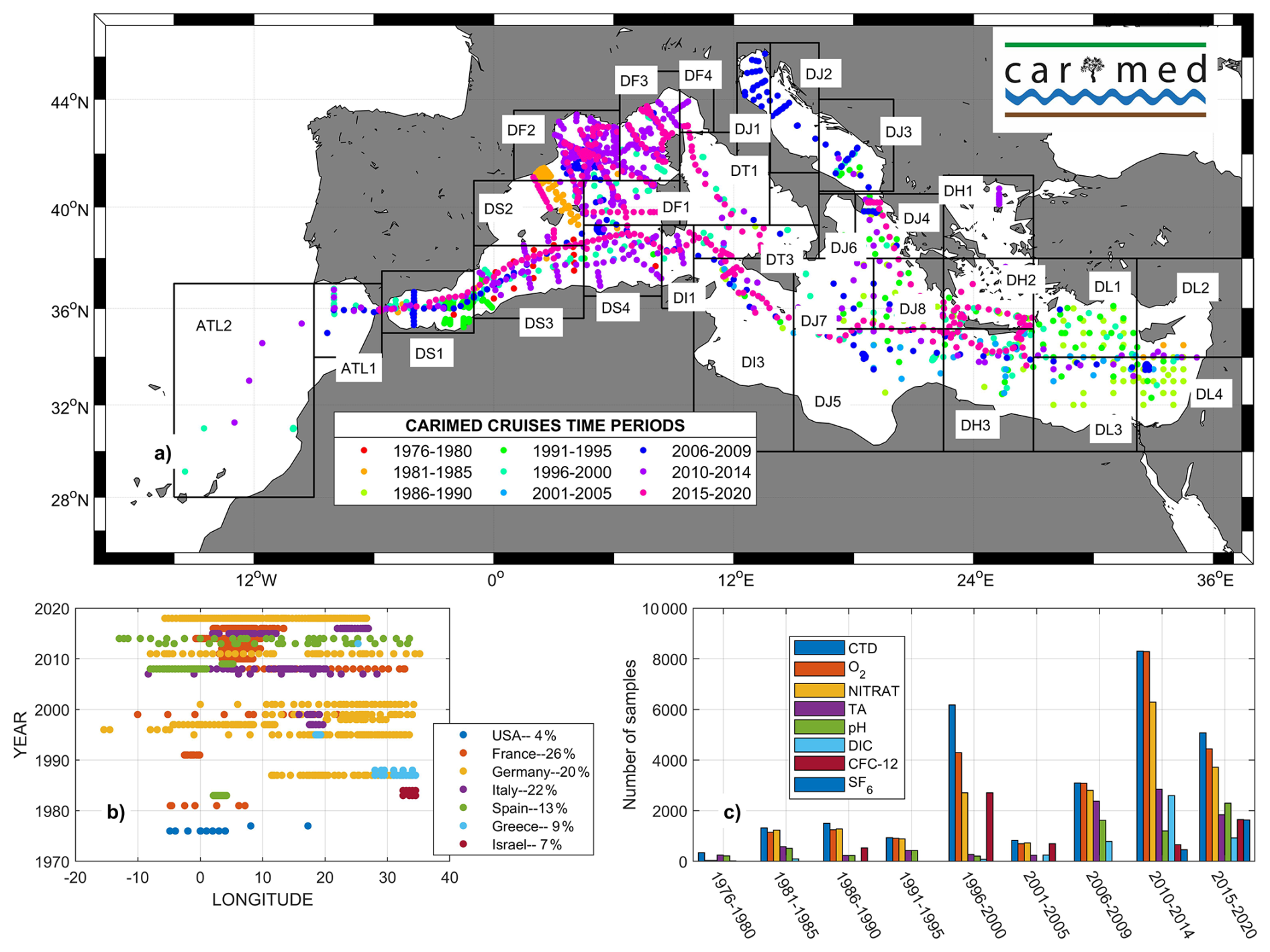
Figure 1Overview of the cruises included in the CARIMED data synthesis products: (a) map showing the cruise stations included in CARIMED grouped by five-year periods; (b) spatiotemporal distribution of stations (year vs. longitude), coloured by Chief Scientist country, with the legend indicating the percentage of cruises per country; (c) histogram of the number of samples per variable, grouped into five-year periods, with variables categorised as CTD (thermohaline variables), dissolved oxygen (O2), dissolved inorganic nutrients represented with nitrate (NITRAT), total alkalinity (TA), pH, total dissolved inorganic carbon (DIC), and transient tracers (CFC-12, and SF6). Regional areas according to Manca et al. (2004) are depicted in Fig. 1a. See Table 2 for more information.
The CARIMED workflow (Fig. 2) comprises a sequence of steps aimed at recovering, standardising, QCing, and harmonising hydrographic and biogeochemical observations collected during research cruises across the MedSea. The individual components of the workflow are described in detail in the following sections: (i) discovery and retrieval of cruise data (Sect. 3.1); (ii) standardisation and merging of retrieved files into cruise-level files (Sect. 3.2); (iii) production of merged cruise files including primary (first-level) QC (1QC) flags and cruise-level metadata (Sect. 3.3); and (iv) identification and adjustment of systematic offsets through a secondary QC (2QC) procedure (Sect. 5). An overview of the cruises contained in CARIMED is provided in Sect. 4, while Sect. 6 presents the CARIMED data synthesis products.
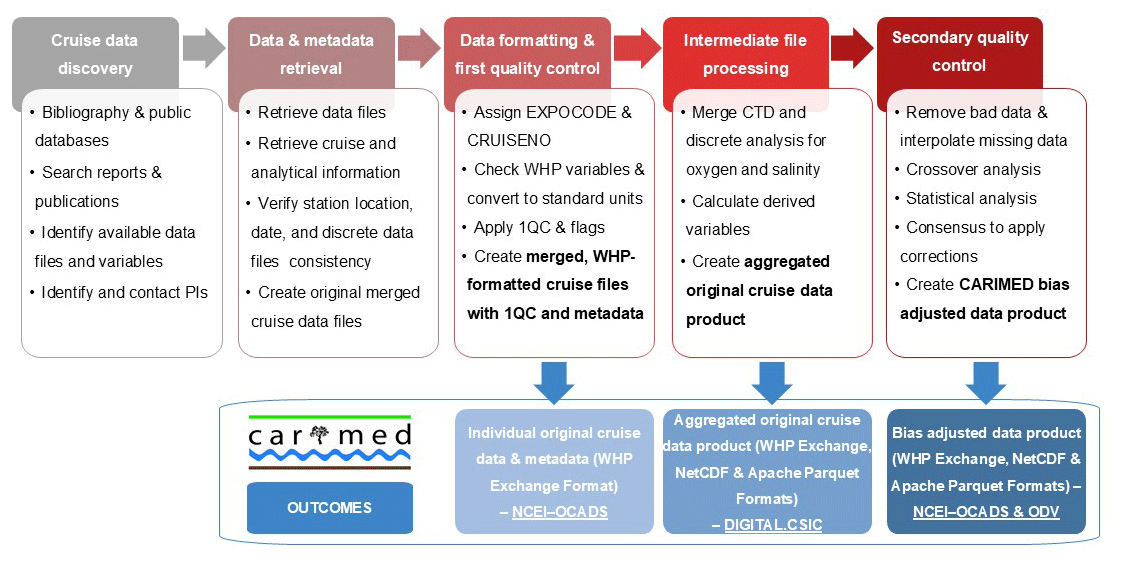
Figure 2Summary of the CARIMED workflow, from cruise data discovery to the generation of the final data synthesis products. The workflow includes five main stages (shaded blocks) and results in three complementary outputs: individual cruise files with primary (first-level) quality control (1QC), an aggregated original data product (before bias adjustment), and the final CARIMED bias-adjusted data synthesis product (bias-adjusted after secondary quality control). All files are available in WHP (World Ocean Circulation Experiment, WOCE, Hydrographic Program) Exchange format. NCEI-OCADS and IEO-CSIC correspond to the National Oceanic and Atmospheric Administration National Center for Environmental Information – Ocean Carbon and Acidification Data System and the Spanish Institute of Oceanography-Agencia Consejo Superior de Investigaciones Científicas data repositories.
The workflow results in two complementary and FAIR-compliant data synthesis products (Sect. 6). The first is the aggregated original cruise data product, comprising all merged and 1QC'd measurements together with derived variables. The second is the final CARIMED bias-adjusted data synthesis product, which applies the harmonised 2QC adjustments to correct systematic biases in the aggregated original cruise dataset, thereby reducing inter-cruise and inter-variable inconsistencies.
The recovery of historical and recent cruise data across the MedSea exposed substantial fragmentation in archival and documentation. Files were retrieved from a variety of sources – data portals, institutional repositories, project archives, and personal communications – frequently differing in format, naming conventions, and documentation level. This heterogeneity, stemming from decades of evolving measurement protocols and data-management practices, as well as the involvement of diverse teams from various countries, necessitated a systematic effort to identify, retrieve, merge, and consolidate all relevant material prior to QC and harmonisation.
3.1 Cruise discovery and data retrieval
Cruises included in CARIMED were located through a comprehensive bibliographic review and an extensive search across public repositories and catalogues. Because no single repository provides complete coverage of historical and recent measurements, data discovery and retrieval relied on multiple complementary sources, including cruise reports, scientific publications, conference and workshop proceedings, publicly accessible databases, and direct communication with principal investigators (PIs) or data providers.
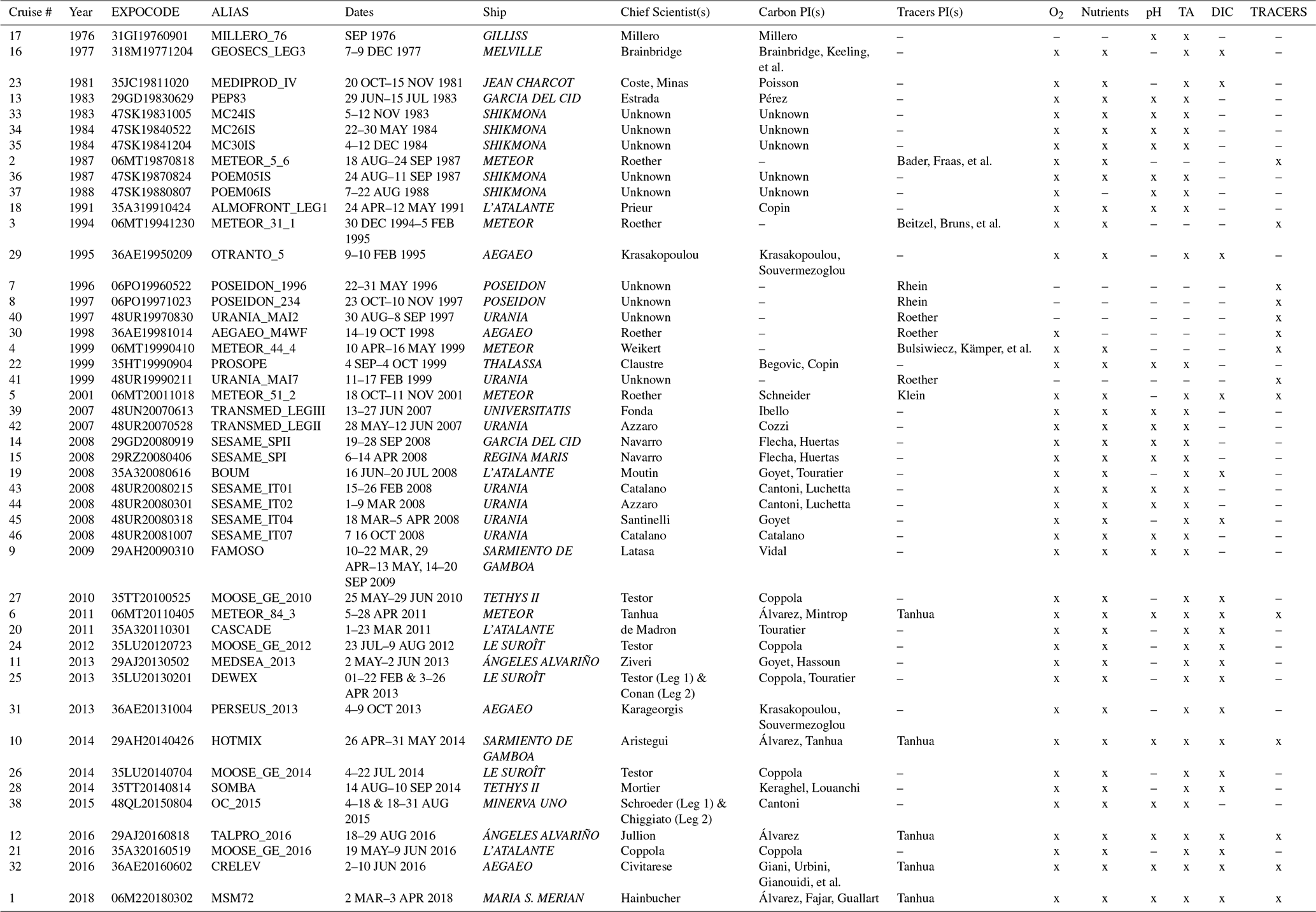
The initial compilation efforts were guided by the CIESM (2012) workshop No. 43 and preliminary work conducted within the EU MedSeA project (Gemayel et al., 2015; Lovato and Vichi, 2015). Cruises were selected if they provided water-column data for at least two variables of the seawater CO2 system and/or transient tracers. Cruises providing seawater CO2 system data were also required to include dissolved oxygen (O2) and dissolved inorganic nutrient data, with the exception of the earliest cruise in 1976 (MILLERO_76). Some cruises containing transient tracers' data were included even without O2, dissolved inorganic nutrients, or seawater CO2 system data (Sect. 4, Table 1), as transient tracers can be used to estimate the amount of content of anthropogenic carbon. Ancillary variables – including spatial and temporal coordinates and thermohaline properties – were required for all cruises.
Metadata fields, including cruise name, research vessel, sampling dates, chief scientist, and PIs responsible for each variable, were compiled. When available, additional information on analytical methods and measurement QC was collected, with comprehensive cruise reports proving particularly valuable information. For many cruises, several independent files were obtained, typically corresponding to different subsets of variables (e.g., CTD, discrete bottle data). Each file was carefully checked for consistency in station, cast, and Niskin bottle identifiers, as well as station coordinates, sampling dates, and pressure/depth records, ensuring agreement with associated reports and/or publications.
All files were catalogued and assigned standardised names and metadata descriptors to facilitate subsequent merging, QC, and integration into the data synthesis product. The compiled set of individual source files for each cruise and variable is available upon request.
Table 1CARIMED cruise summary table containing basic information on each cruise and measured variables. This table, including additional metadata, is hosted on the CARIMED OCADS site. Note that the cruises in this table are listed in chronological order, whereas in OCADS, the assigned cruise number follows the alphabetical ordering of EXPOCODEs.
3.2 File merging and formatting
A unified and formatted data file was generated for each cruise, containing all retrieved hydrographic and biogeochemical data. Merging was based on reference ancillary information such as station and cast identifiers (when available), sampling dates, bottle numbers (when available), and pressure/depth values, to ensure correspondence among files containing discrete bottle data. Pressure was established as the primary vertical coordinate; depth values were converted to pressure where necessary. Information on each retrieved file – including data source, variable units, formats, analytical techniques, and QC procedures – was incorporated into the file metadata (Sect. 3.3).
The merging process depended on cruise characteristics (Sect. 4), a merged cruise data file was created for each case. Following merging, each cruise file containing ancillary, thermohaline, and biogeochemical data was formatted according to the WHP (World Ocean Circulation Experiment, WOCE, Hydrographic Program) Exchange format (Swift and Diggs, 2008), with headers and units as listed in Table S1 in the Supplement.
Formatting involved two main steps:
- i.
Assignment and creation of standardised identifiers and auxiliary variables:
- –
Cruise Identification (ID). Each cruise was assigned a cruise number and alias (ALIAS) (Table 1).
- –
EXPOCODE. When not already assigned, an EXPOCODE (expedition code) was generated to uniquely identify each cruise, following international oceanographic data-management practices. The EXPOCODE consists of the four-digit ICES (International Council for the Exploration of the Sea) research vessel code (https://vocab.ices.dk/, last access: 26 June 2026) and the date of departure from port (UTC) in ISO8601 format (YYYYMMDD), if not known, the first sampling station date.
- –
Stations. Assigned numerical identifiers; original station identifiers using letters or words were replaced by numbers and documented in the cruise metadata.
- –
Casts. Cast numbers were assigned as 1 when unavailable.
- –
Bottles. Niskin bottle numbers were assigned sequentially, starting from 1 for the deepest sample, when unavailable.
- –
Dates. When station dates were missing, at least month and year were retrieved from publications or cruise reports.
- –
Times. Default time of 00:00 UTC was assigned when station times were missing.
- –
CTD variables. Temperature, salinity, and pressure data were usually obtained from CTD (Conductivity, Temperature, and Depth) sensors; when unavailable (e.g., MILLERO_76), this was noted in the metadata, and the same variable headers (CTDTMP, CTDSAL, CTDPRS; see Table S1) were retained for consistency.
- –
- ii.
Conversion of variables to internationally accepted units:
- –
In situ temperature. Expressed in degrees Celsius (°C) on the International Temperature Scale of 1990 (ITS-90). Values originally reported on the International Practical Temperature Scale of 1968 (IPTS-68) were converted using ITS-90 = IPTS-68 × 0.99976 (Saunders, 1990).
- –
Salinity. Reported on the Practical Salinity Scale of 1978 (PSS-78).
- –
Dissolved oxygen (O2). Expressed in µmol kg−1; data originally in mL L−1 were converted using the factor 44.66 mL µmol−1 and seawater density derived from salinity and potential temperature.
- –
Dissolved inorganic nutrient contents. Amounts of content (nitrate, nitrite, phosphate, and silicate) were standardised to µmol kg−1. Data originally in µmol L−1 were converted using seawater density at corresponding salinity and an assumed measurement temperature of 20 °C, as is the most common practice. Nitrite and nitrate are measured together as total oxidised nitrogen (NO NO), given the low nitrite content in open ocean and specially in the MedSea, total oxidised nitrogen is listed as nitrate.
- –
Seawater CO2 system variables. pH values were converted to the total hydrogen ion scale (pHT) at 25 °C. Conversion from other scales or temperatures was performed using the MATLAB version of CO2SYSv3 (Orr et al., 2018) with the carbonic acid dissociation constants of Mehrbach et al. (1973) reformulated on the total hydrogen scale by Lueker et al. (2000), the bisulfate dissociation constant of Dickson (1990), and the total boron to salinity ratio of Lee et al. (2010). Total alkalinity (TA) and total dissolved inorganic carbon (DIC) were expressed in µmol kg−1 (as usually retrieved).
- –
Transient tracers. Expressed in their standard units (see Table 4) (as retrieved, see Table S1).
- –
Missing data. Coded as −999. Samples lacking temperature, pressure/depth, or salinity were removed from the dataset.
- –
The merged cruise data files, derived from the retrieved data files and formatted according to the WHP standard, subsequently underwent a 1QC process (Sect. 3.3).
3.3 WHP-formatting, 1QC, and metadata
Each cruise data file underwent a rigorous 1QC following the procedures described by Tanhua et al. (2010) and implemented via the Velo et al. (2023) software tool. The flagging scheme followed WOCE standards, as adopted by GLODAP, using only the flags: 0 (interpolated data), 2 (good data), 3 (questionable data), and 9 (not sampled, measured, or reported). Variables were examined for range variability and property–property relationships to detect anomalous values. Regional context was considered to minimise incorrect flagging. For instance, the typical positive TA-salinity relationship is invalid in the Adriatic Basin due to high TA from low-salinity riverine inputs.
Sensor-based O2 (CTDOXY) data were cross-checked against discrete O2 (OXYGEN) data when available, following GO-SHIP (Global Ocean Ship-based Hydrographic Investigations Program) Hydro Manual guidelines (Hood et al., 2010). Recalibration of sensor-based O2 (CTDOXY) against Winkler O2 titrations (OXYGEN) was required for several cruises, including PROSOPE, TRANSMED, SESAME legs, BOUM, METEOR_84_3, MEDSEA, SOMBA, TALPRO, CRELEV, and MSM72. For SESAME_IT07, the O2 data source could not be clearly identified and was assumed to represent uncalibrated CTDOXY. CTDOXY recalibrations, when needed, were documented in the metadata and communicated to the variable PI and the cruise Chief Scientist. Recalibrations were performed as a function of pressure and cruise (Fig. S1a and b in the Supplement). After the recalibration process, the residuals between CTDOXY and OXYGEN were centred around zero and exhibited lower standard deviations than the original retrieved CTDOXY values (Fig. S1c and d). A few cruises (MILLERO_76, GEOSECS_Leg3, PROSOPE, MEDIPROD_IV, OTRANTO_5, CRELEV) reported discrete salinity (SALNTY) data contributing less than 28 % of corresponding sensor-based salinity (CTDSAL) data. Retrieved CTDSAL values were assumed calibrated against SALNTY, but limited availability of SALNTY and CTDSAL paired data (only 315 samples from the MEDIPROD_IV, PROSOPE and CRELEV cruises, out of the compiled 27 590 total samples) prevented formal verification. Other issues (wrong latitude and longitude coordinates, non-existent stations and/or depths, weird or badly reported units, for example) identified during 1QC were, wherever possible, discussed with the respective PIs.
Upon completion of 1QC, standardised metadata were compiled for each cruise, including basic information (ship name, dates, cruise alias, EXPOCODE, Chief Scientist, and station numbering) and variable-specific details (unit conversion methods, analytical techniques, and quality assurance and control procedures, particularly the use of reference materials). Metadata were incorporated as a readme-style header in the WHP Exchange Format files – a comma-delimited ASCII (CSV) structure. Each cruise file begins with a line specifying the data type (in this case, BOTTLE data, i.e., bottle data and CTD data at the discrete bottle depths), followed by a timestamp and a CARIMED reference. The subsequent section contains metadata, including references to the initial retrieved files, citation information, and associated publications, reports, or data repositories. Finally, the 1QC-flagged (Table S1 in the Supplement) and formatted data are presented, with the file concluding with the END_DATA line.
These merged 1QC files per cruise, including cruise-level metadata, are available through the NOAA-NCEI-OCADS repository, with file identifiers (DOI) listed in Table S2.
4.1 Cruise information and original data
Individual cruise data and metadata are centrally accessible via the CARIMED summary cruise table hosted within the NCEI–OCADS repository (Jiang et al., 2023), with Digital Object Identifiers (DOI) listed in Table S2. This repository provides: (i) the WHP-compliant CSV files containing the merged individual cruise data, verified by the 1QC process, along with their associated metadata; (ii) corresponding cruise reports, where available; and (iii) a map illustrating the station locations for each dataset. For each cruise, a dedicated NCEI–OCADS metadata landing page is available, summarising key metadata such as identifiers, temporal and spatial coverage, measurement methods, PIs and institutions, and a station map.
4.2 General overview of cruises included in CARIMED
The CARIMED data synthesis products integrate 46 hydrographic cruises conducted between 1976 and 2018 (Fig. 1, Table 1). These cruises provide full-depth water-column data across all major MedSea sub-basins. Spatial gaps remain evident, particularly in the Libyan-Tunisian, Egyptian, Greek, and Turkish exclusive economic zones of the eastern Mediterranean Basin, while the western Mediterranean Basin shows the highest density of both cruise coverage and sampling (Fig. 1a).
Cruises on research vessels' from France, Germany, and Italy account for 68 % of the entire dataset (Fig. 1b). Sampling density increased significantly during the 2000s (Fig. 1c) due to international collaborations enabled by Research Infrastructure initiatives (e.g., EUROFLEETS) and particular projects (e.g., METEOR_84_3, MSM72, MEDSEA_2013; and the SESAME cruises: SESAME_SPI, SESAME_ SPII, SESAME_IT01, SESAME_IT02, SESAME_IT04, and SESAME_IT07). A notable imbalance persists in Chief Scientists from north African and eastern Mediterranean countries, which likely reflects limited access to research vessels and/or specialised expertise in seawater CO2 system and transient tracer measurements, as previously noted by Hassoun et al. (2022). Nevertheless, successful regional efforts, such as the SOMBA (Système d'Observations à la mer dans le Bassin Algérien) 2014 cruise (Keraghel et al., 2020), demonstrate fruitful collaboration and growing regional capacity.
The high data density in the Gulf of Lion stems from the French MOOSE (Mediterranean Ocean Observing System for the Environment) programme (Coppola et al., 2019), which conducts cruises approximately every two years. More recently, the Med-SHIP program has promoted repetition every 5–6 years of North–South hydrographic lines in each MedSea sub-basin, with TALPRO and CRELEV cruises in 2016 (Schroeder et al., 2024b) serving as reference occupations. The decadal reoccupation of the MED01 GO-SHIP line is represented by METEOR_84_3 in 2011 (Tanhua et al., 2013b) and MSM72 in 2018 (Hainbucher et al., 2020).
Figure 1c summarises the sample availability by variable across five-year periods. CTD temperature and salinity consistently form the backbone of the hydrographic component. O2 is the most frequently measured biogeochemical variable, with nitrate being the most abundant among the dissolved inorganic nutrients. TA is the most abundant seawater CO2 system variable, followed by pH and DIC. CFC-12 is the most frequent transient tracer, with SF6 measurements appearing in the most recent period.
4.3 Particular issues with cruises and variables included in CARIMED
This section provides necessary context on particular issues encountered during the recovery, formatting, and 1QC of specific cruises and variables included in CARIMED. Further detailed information on the measurement techniques and associated references for each cruise is available within the metadata accompanying the NCEI–OCADS summary cruise table for CARIMED (Tables 1 and S2 and Sect. 6).
4.3.1 Cruises from 1976 to 1988
Early oceanographic studies in the MedSea (e.g., Schmidt, 1912; Wüst, 1961) primarily focused on assessing circulation. Seawater CO2 chemistry investigations in the MedSea began in the 1970s (Alekin, 1972; Chernyakova, 1976; Millero et al., 1979). The CARIMED dataset recovered data from Prof. F. Millero's cruise (1976), retrieved through technical report digitisation (D. Pierrot, AOML, NOAA), and GEOSECS (Geochemical Ocean Sections Study) Leg 3 (1977) (Weiss et al., 1983). The French MEDIPROD_IV (1981) cruise (Groupe MEDIPROD, 1984) focused on the West Mediterranean Basin (Packard et al., 1988) and while its CTD, O2, and dissolved inorganic nutrients data from this project are publicly available (Minas and MEDAR Group, 2012), its seawater CO2 system data were recovered by digitising a technical report provided by M. Fichaut (IFREMER).
The Spanish PEP (Producció Estival Profunda) 1983 cruise contributed pH and TA data (Pérez et al., 1986). Additional pH and TA datasets were recovered from the MEDAR/MEDATLAS 2002 initiative (MEDAR Group, 2002; Fichaut et al., 2003) and five RV Shikmona cruises from the Levantine Basin, retrieved from the Israel Marine Data Center (ISRAMAR) and PANGAEA (MC24IS, MC26IS, and MC30IS cruises; MEDAR Group, 2012a, b, c). Two additional RV Shikmona cruises, POEM05IS and POEM06IS, were likely conducted under the framework of the Physical Oceanography of the Eastern Mediterranean (POEM) project (Malanotte-Rizzoli and Robinson, 1988). None of these cruises included transient tracer measurements; only the METEOR_5_6 cruise in 1987 measured CFC-11, CFC-12, helium, tritium, and neon (Roether and Schlitzer, 1991; Schlitzer et al., 1991; Roether et al., 1998; Roether et al., 1999).
During 1976–1988, TA and pH were the most frequently measured seawater CO2 system variables, both measured potentiometrically. DIC was measured in only two cruises, also by potentiometric titration. Reference materials for biogeochemical measurements, particularly those related to seawater CO2 system variables, were not available in this early period.
4.3.2 Cruises from 1991 to 1999
Of the ten cruises compiled for CARIMED for this decade, only three (ALMOFRONT_LEG1 in 1991; OTRANTO_5 in 1995; and PROSOPE in 1999) included seawater CO2 system measurements; most cruises measured transient tracers (CFCs, helium, tritium), but none measured SF6. These cruises, along with the more recent ones METEOR_51_2 (2001) and METEOR_84_3 (2011), were key to study MedSea ventilation (Schneider et al., 2014; Li and Tanhua, 2020).
The ALMOFRONT_LEG1 (1991) cruise supported the first MedSea TA and DIC budget estimates (Copin-Montégut, 1993), (French contribution to Frontal-Joint Global Ocean Flux Study, JGOFS, studying the Almeria-Oran frontal area; Prieur and Sournia, 1994). Physical, chemical, and biological data from this project are stored at Laboratoire d'Oceanographie de Villefranche (LOV-CNRS). Potentiometric TA and pH and calculated DIC (not included in CARIMED) were provided by L. Prieur and C. Schmechtig (LOV-CNRS). No CO2-in-seawater reference materials were used in this cruise.
The OTRANTO_5 (1995) was among the first to use CO2 reference materials in the MedSea, measuring DIC and TA potentiometrically, following DOE (1994) (Krasakopoulou et al., 2011). The PROSOPE (1999) cruise (Claustre et al., 2002), which covered the eastern and western Mediterranean Basins, also used CO2 reference materials to control potentiometric TA following the double end-point technique of Pérez and Fraga (1987) and potentiometric pH (controlled with TRIS following DOE, 1994).
4.3.3 Cruises from 2001 to 2010
This decade saw coordinated sampling in both western and eastern Mediterranean Basins under EU projects such as SESAME (Southern European Sea: Assessing and Modelling Ecosystem changes) that sponsored the Italian and Spanish 2008 cruises and the French BOUM (Biogeochemistry from the Oligotrophic to the Ultra oligotrophic Mediterranean Sea) cruise 2008 (Moutin et al., 2012). National initiatives also expanded basin coverage, notably the Italian VECTOR (VulnErabilità delle Coste e degli ecosistemi marini italiani ai cambiamenti climaTici e loro ruolO nei cicli del caRbonio mediterraneo; D'Ortenzio and Ribera d'Alcalà, 2009) conducted the TRANSMED 2007 cruises (TRANSMED_LEGII in the western and TRANSMED_LEGIII in the eastern MedSea; Rivaro et al., 2010). The eastern MedSea was further sampled by METEOR_51_2 (2001). Convection in the Gulf of Lion was a focus of the Spanish FAMOSO (FAte of the northwestern Mediterranean Open sea Spring blOom) cruise (Mouriño-Carballido et al., 2016) in 2009, and the French MOOSE (Observation Infrastructure Système D'observation Intégré Et Multidisciplinaire En Méditerranée) programme conducted its annual MOOSE_GE cruise in 2010.
Only the METEOR_51_2 (2001) cruise measured transient tracers and represents the first repeat of the eastern part of the MED01 GO-SHIP line. It was the first CARIMED cruise to include coulometric DIC measurements (Johnson et al., 1993) and used CO2 reference materials for TA and DIC QC. This cruise was the first MedSea component considered in global data synthesis products like CARINA (Pierrot et al., 2010) and GLODAPv2 (Olsen et al., 2016). Please note that CARIMED cruises also contained in GLODAPv2 (METEOR_51_2 and 84_3, see next section) were retrieved and treated using uncorrected data.
The first cruise compiled for CARIMED with spectrophotometric pH measurements (Clayton and Byrne, 1993) was the Spanish SESAME_SPI in 2008 (Huertas et al., 2012), followed by several additional SESAME legs and FAMOSO cruises. Only the TRANSMED cruises reported potentiometric pH. DIC and TA were measured following DOE (1994) protocols in SESAME_IT04 (2008) and MOOSE_GE (2010) at the SNAPO-CO2 facility (Metzl et al., 2024) at LOCEAN (CNRS, Paris). CO2 reference materials were used across all cruises; and BOUM was the only cruise to report using reference materials for dissolved inorganic nutrients from OSIL (Ocean Scientific International) (Pujo-Pay et al., 2011).
4.3.4 Cruises from 2011 to 2015
This period includes the second repeat of the MED01 GO-SHIP line, METEOR_84_3 in 2011, which was the first CARIMED cruise to deliver an overdetermined seawater CO2 system (pH, DIC, and TA measured; Álvarez et al., 2014). This cruise, along with MeDSeA in 2013 (Mediterranean Sea Acidification; Ziveri and Grelaud, 2015; Hassoun et al., 2015) and HOTMIX in 2014 (Catalá et al., 2018), spanned the entire MedSea. Regional initiatives complemented these occupations: PERSEUS in 2013 sampled the North Aegean Basin, while other cruises focused on the Gulf of Lion, like CASCADE cruise in 2011 (Cascading, Surge, Convection, Advection and Downwelling Events; Touratier et al., 2016), MOOSE_GE_2012 and MOOSE_GE_2014 (Fourrier et al., 2022), and DEWEX in 2013 (Deep Water Experiment; Conan et al., 2018). Additional coverage of the western Mediterranean Basin, including the Alboran and Tyrrhenian Basins was provided by SOMBA_2014 and OC_2015 (Ocean Certain cruise; Cantoni et al., 2020; Schroeder et al., 2020). All cruises used state-of-the-art methods for pH (spectrophotometry), TA (potentiometry), and DIC (coulometry/potentiometry), utilizing CO2 reference materials. Only METEOR_84_3 and HOTMIX provided transient tracer measurements.
4.3.5 Cruises from 2016 to 2018
This short period is notable for the implementation of the two 2016 Med-SHIP cruises: TALPRO and CRELEV (Schroeder et al., 2024b). The third repeat of the MED01 GO-SHIP line, MSM72 (2018), also occurred here. pH measurements during CRELEV and MSM72 utilised purified indicator dyes, following modern oceanographic practice (e.g., Liu et al., 2011).
The CARIMED dataset was subjected to 2QC procedures to evaluate and harmonise data consistency across all the compiled 46 cruises. This process identifies and adjusts systematic biases in measurements, ensuring that the CARIMED data synthesis product achieves higher coherency (Sect. 5.3).
Secondary QC focuses on detecting systematic biases that exist beyond measurement random uncertainty. Such biases typically arise when combining datasets collected from different sources, using different instrumentation, analytical protocols, and methodological standards, often spanning several decades, which consequently possess varying degrees of uncertainty. According to the International Vocabulary for Metrology (VIM; JCGM, 2012), measurement uncertainty is a non-negative parameter that characterises the dispersion of the quantity values attributed to a measurand and is defined as the dispersion of the values attributed to the measurand, usually expressed as a standard deviation or confidence interval. This uncertainty comprises both random and systematic components: random uncertainty is associated with the variability of measured values under replicate conditions, while systematic uncertainty reflects the deviation from a considered true or reference value.
Technological advances have progressively reduced random uncertainty – improving precision in terms of repeatability (measurements under identical conditions) and reproducibility (measurements under different conditions) – making systematic biases easier to isolate. The first 2QC approach tailored to ship-based hydrographic data was developed by Gouretski and Jancke (1999) to detect, objectively quantify, and correct “inter-cruise offsets” (systematic differences) between WOCE cruises in the 1990s and historical hydrographic records (see Álvarez et al., 2024 for an overview of hydrographic 2QC procedures). These procedures are designed to reduce uncertainty in compiled datasets, whether from single or multiple sources. The resulting 2QC-data synthesis product exhibits increased internal consistency, promoting its usability with a higher degree of confidence in downstream analysis. In the digital era, ocean data products with informed uncertainty are essential components of the ocean-observing value chain, serving as the backbone of scientific assessments required by various stakeholders (Guidi et al., 2020; EMB, 2021).
Amidst an increasing number of data synthesis products for ocean biogeochemistry (e.g., Lange et al., 2023; Jiang et al., 2026), GLODAP updates, integrating ship-based biogeochemical observations (Olsen et al., 2016; Lauvset et al., 2024), have established a benchmark for 2QC procedures. These efforts build upon methodological experience gained in the CARINA initiative (Tanhua et al., 2010; Lauvset and Tanhua, 2015). Fundamentally, the 2QC method involves examining potential biases between cruise datasets in geographically overlapping regions (crossover areas) and on vertical spaces (pressure, potential temperature or density surfaces) characterised by very low temporal variability. These biases are quantified against a typical uncertainty threshold defined for each physical or chemical variable, using datasets measured following internationally recognised Standard Operating Procedures (SOP) and reference materials as reference (the “true value” in metrological terms). Ideally, ship-based measurements, both sensor and discrete data, should be traceable to the international system of units (SI), with informed uncertainty regarding their precision and accuracy to ensure consistency.
However, recent efforts within projects such as MINKE (Metrology for Integrated marine maNagement and Knowledge-transfer nEtwork, EU INFRAIA-02-2020), SapHTies (Metrology for standardised seawater pHT measurements in support of international and European climate strategies, EU EMPIR 20NRM06), and EuroGO-SHIP (Developing a Research Infrastructure Concept to Support European Hydrography, HORIZON-INFRA-2022-DEV-01-01) evidence two primary challenges to improve the consistency of ocean observations: the need for standardised, internationally endorsed SOPs and the availability of reference materials, particularly for biogeochemical variables (e.g., Pearlman et al., 2021; Capitaine et al., 2023; Hartman et al., 2023; Firing et al., 2024; García-Ibáñez and Easley-Vidal, 2025).
Two specific issues render 2QC procedures particularly challenging in the MedSea:
-
Rapid temporal variability. Physical and biogeochemical properties in the MedSea evolve on temporal and spatial scales significantly shorter than those in other ocean basins (Chiggiato et al., 2023, and references therein). Consequently, the region lacks a vertical layer with low temporal variability.
-
Biogeochemical complexity. MedSea biogeochemical variables are distinct in terms of their cycles and drivers (Álvarez et al., 2023) and analytically challenging. Dissolved inorganic nutrients exhibit low concentrations, transitioning from oligotrophic to ultra-oligotrophic regimes from the western to the eastern sub-basins. Conversely, DIC and, specially, TA and pH values are high compared to other ocean basins. Furthermore, these properties must be measured within a high-salinity matrix, which challenges both the working range and the background matrix of the available reference materials (García-Ibáñez and Easley-Vidal, 2025; and the review chapters in Aoyama et al., 2025).
To overcome these challenges, recent efforts have implemented adapted 2QC procedures to enhance the usability of ship-based dissolved inorganic nutrients (Belgacem et al., 2020) and sensor-based O2 data (Belgacem et al., 2025a) in the western Mediterranean Basin. Building upon these initiatives, we use an adapted 2QC procedure tailored to the specific oceanographic characteristics of the different MedSea sub-basins, integrating both crossover and statistical evaluation techniques.
5.1 CARIMED 2QC framework: crossover analysis adapted to the Mediterranean Sea
The CARIMED 2QC framework employs the established running cluster crossover procedure (cnaX) originally used in CARINA (Tanhua et al., 2010) and consistently applied in recent GLODAPv2 updates (Lauvset et al., 2024). However, for CARIMED, these routines were adapted to account for the distinct hydrography and high spatiotemporal variability of the MedSea.
Unlike GLODAP, which typically relies on deep-water crossovers, the crossover depth intervals in CARIMED were defined individually for each sub-basin. The selected layers correspond to those of minimum temporal variability, as identified in previous reviews (Schneider et al., 2014; Stöven and Tanhua, 2014; Schroeder et al., 2016; Li and Tanhua, 2020, Belgacem et al., 2025a) and corroborated by transient tracer observations compiled within CARIMED. Figure S2 shows the Tracer Minimum Zone (TMZ) for each sub-basin, based on regional mean vertical profiles. Mediterranean sub-basin boundaries follow Manca et al. (2004) (Table 2 and Figs. 1 and S3). TMZs are assumed to represent older, slowly renewing water masses, and therefore serve as the vertical domains for crossover inspection. However, some variability is detected even within these layers (Figs. S15 and S16), highlighting the MedSea's sensitivity to climate change and warranting cautious crossover inspection.
Table 2Code names and regional areas defined by Manca et al. (2004), illustrated in Figs. 1 and S3. Unique and grouped areas are used to elaborate the 2QC framework analysis in the CARIMED cruises.
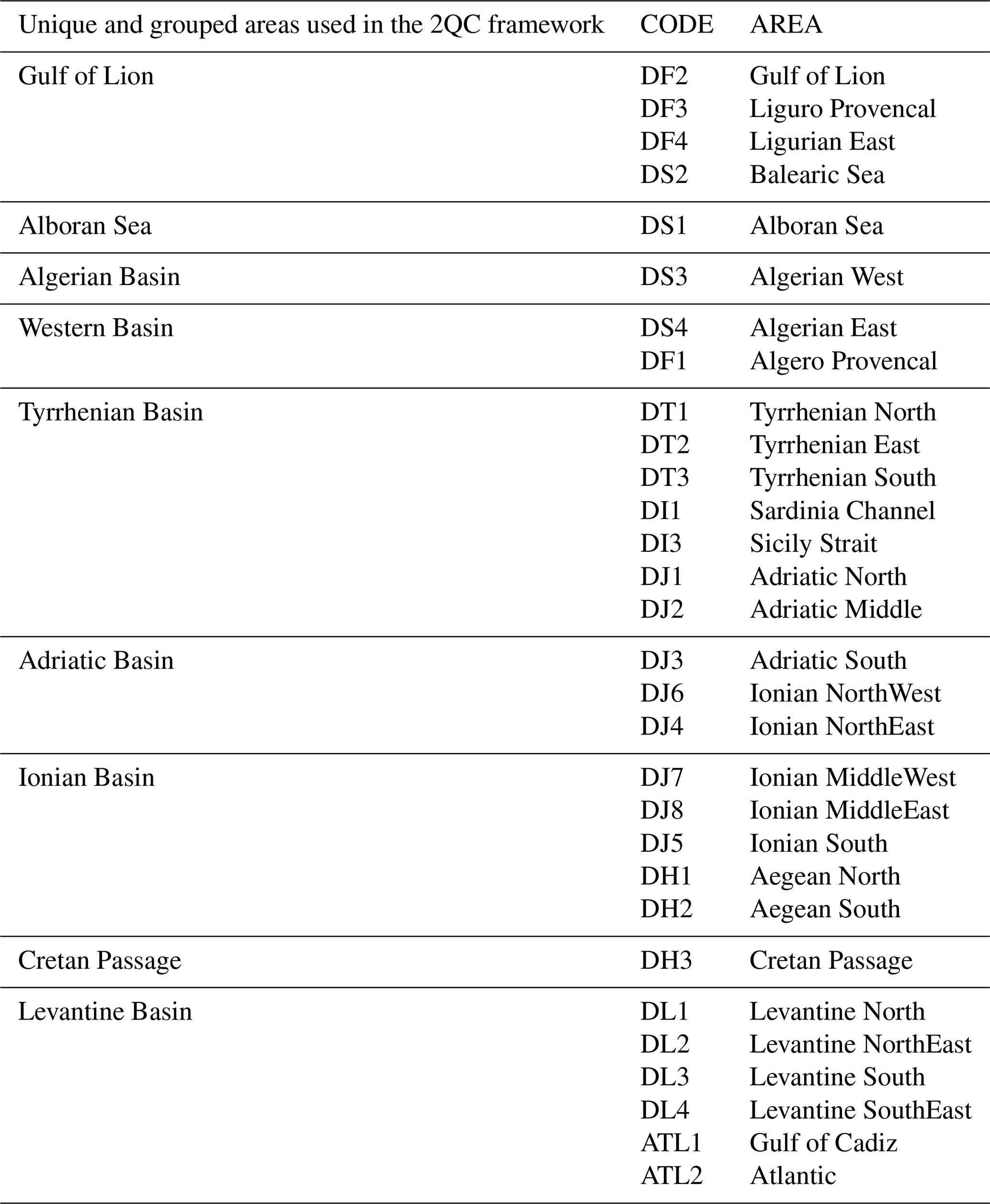
The specific crossover depth criteria were applied as follows:
-
For the Levantine and Ionian Basins, crossovers were performed at depths between 600 and 2000 m.
-
For the Adriatic Basin, crossovers were performed for water depths greater than 800 m (Cardin et al., 2015).
-
For the Tyrrhenian Basin, 2QC was based on crossovers between 1900 and 3000 m.
-
For the western Mediterranean Basin, crossovers were performed for waters at depths between 600 and 2000 m.
These criteria were applied consistently across all cruise years, even where major water-mass changes occurred, such as the Eastern Mediterranean Transient (EMT) at the end of the 1980s that induced a dramatic change in the deep and bottom layers of the eastern Mediterranean Sea where saltier and warmer waters from the Aegean Sea replaced the resident deep water with an Adriatic Sea origin (see Malanotte-Rizzoli et al., 1999; Lascaratos et al., 1999; Klein et al., 1999), and the Western Mediterranean Transient (WMT), a major deep water formation event in 2004/05 (López-Jurado et al., 2005), introducing warmer and saltier bottom waters in the Gulf of Lion, that propagate into the Alboran and the Tyrrhenian Sea after 2010 (e.g., Schroeder et al., 2016). Crossover analyses were conducted for salinity and all biogeochemical variables.
The adapted cnaX routine objectively quantifies systematic differences between a target cruise and nearby cruises conducted within a ∼ 250 km radius across different vertical coordinates (potential temperature, pressure, and density), yielding a weighted cruise-by-cruise mean offset and standard deviation for each crossover pair (e.g., Figs. S4 and S5). The quality of these results is objectively quantified by considering the amount of data per station and the number of stations per cruise, which together influence the weighted standard deviation of the offset and the overall confidence of the crossover pair. Where sufficient crossover pairs exist for a given target cruise and variable, the adapted routine calculates a final cruise-level weighted mean offset and standard deviation considering all cruise pairs (e.g., Figs. S6 and S7), indicating the required correction. These offsets are variable-dependent: additive adjustments are evaluated for salinity, DIC, TA, and pH, while multiplicative factors are evaluated for O2 and dissolved inorganic nutrients.
Ideally, final adjustments would be determined via the weighted least-squares inversion procedure proposed by Johnson et al. (2001), as utilised in GLODAP, which minimises offsets for a given cruise and variable across all crossover pairs. However, strict application of this procedure in CARIMED would inadvertently remove genuine temporal trends affecting the whole water column (Béthoux et al., 1998; Ozer et al., 2017; Schroeder et al., 2017; Kubin et al., 2023) and regime shifts (Roether et al., 1996; Rubino and Hainbucher, 2007; Schroeder et al., 2016) in the deep MedSea water masses. Ongoing work within the GLODAP reference group is currently developing a new 2QC method tailored to retain temporal trends while quantifying systematic biases (N. Lange and S. Lauvset, personal communication, 2025). The crossover routine could not be applied to SESAME_SPI (2008) because sampling only extended to 600 m. It was also not feasible for PEP83 (1983) and GEOSECS_LEG3 (1977) due to the very limited number of crossover pairs with enough quality, the latter cruise contains only two stations.
A curated subset of crossover results is included in the CARIMED adjustments workbench (hosted at GEOMAR; https://carimed.geomar.de/, last access: 26 June 2026), documenting the evidence supporting the adjustments applied (Sect. 5.3). In several cases, crossover analyses remained inconclusive for specific cruises or variables, due to one or more limiting factors: insufficient vertical or horizontal sampling density; sparse temporal overlap (crossover pairs separated by long intervals), high variability relative to analytical precision, and difficulty distinguishing systematic biases from true temporal variability. In some instances, crossovers even yielded contradictory adjustment directions for the same cruise when evaluated in different sub-basins (e.g. dissolved inorganic nutrients for the MEDSEA 2013 cruise).
5.2 Supplemental statistical information: adjustment limits and crossover support
A supplemental statistical consistency assessment was conducted by inspecting the average, standard deviation (SD), and mean absolute deviation (MAD) within the minimum temporal variability depth layers (Sect. 5.1), following Belgacem et al. (2025a). These statistical values were calculated for every cruise and grouped according to the sub-basins classification by Manca et al. (2004) (see Table 2, Fig. 1 with the areas and Fig. S3 with the areas and stations compiling with the depth criteria for crossover analysis presented in Sect. 5.1). In this scheme, we inspected in the western Mediterranean Basin: area DS1 (Alboran Sea), area DS3 (Algerian Basin), areas DS4 and DF1 (Western Basin), area DF2 (Gulf of Lion), and areas DT1 and DT2 (Tyrrhenian Basin); in the eastern Mediterranean we inspected: area DJ3 (Adriatic Basin), areas DJ5, DJ7, and DJ8 (Ionian Basin), are DH3 (Cretan Passage), and areas DL1, DL2, DL3, and DL4 (Levantine Basin). See Table 2 for more details.
To guide the required adjustments, minimum adjustments limits were prescribed for each variable. Consistent with 2QC procedures, these limits represent the minimum systematic bias that can be confidently identified relative to the measurement uncertainty, typically approximated by measurement precision. The CARIMED synthesis comprises historical and recent cruises collected using evolving methodologies, SOPs, and quality assurance procedures. Many early cruises were conducted before the availability of reference materials for biogeochemical variables, and on top the long-term temporal variability in the MedSea is evident. Therefore, the adjustment limits are the same order of magnitude as GLODAP but less restrictive (Table 3).
Figure S8 presents a preliminary inspection of the intra-cruise homogeneity (precision) for physical and biogeochemical variables. Heatmaps of SD values per cruise (Tables 1 and S2) and sub-basin show the inter-cruise variability by region, with biogeochemical variables, particularly for dissolved inorganic nutrients and TA, which display higher SD values.
The overall mean SD values for each variable were therefore adopted as the minimum adjustment limits. For dissolved inorganic nutrients and O2, SD values were converted to a percentage of the mean, providing the relative adjustment limit (Table 3). The high SD value obtained for salinity clearly reflects the significant temporal shifts characteristic of the MedSea over the CARIMED temporal coverage. The O2 adjustment limit aligns with the value obtained by Belgacem et al. (2025a). Importantly, the derived limit for dissolved inorganic nutrients clearly exceeds the stringent GLODAP convention of 2 %, also used by Belgacem et al. (2020) in the western basin (values of about 5 % would be obtained using western basin CARIMED cruises). In contrast, the adjustment limits for TA, DIC, and pH derived from the CARIMED cruises are comparable to GLODAP values.
Table 3Adjustment limits for CARIMED calculated from the average standard deviation (SD) of the measured variables in layers with minimum temporal variability across all Mediterranean Sea sub-basins using CARIMED cruises. Absolute SD values are transformed to a percentage using the corresponding mean values for O2 and dissolved inorganic nutrients.
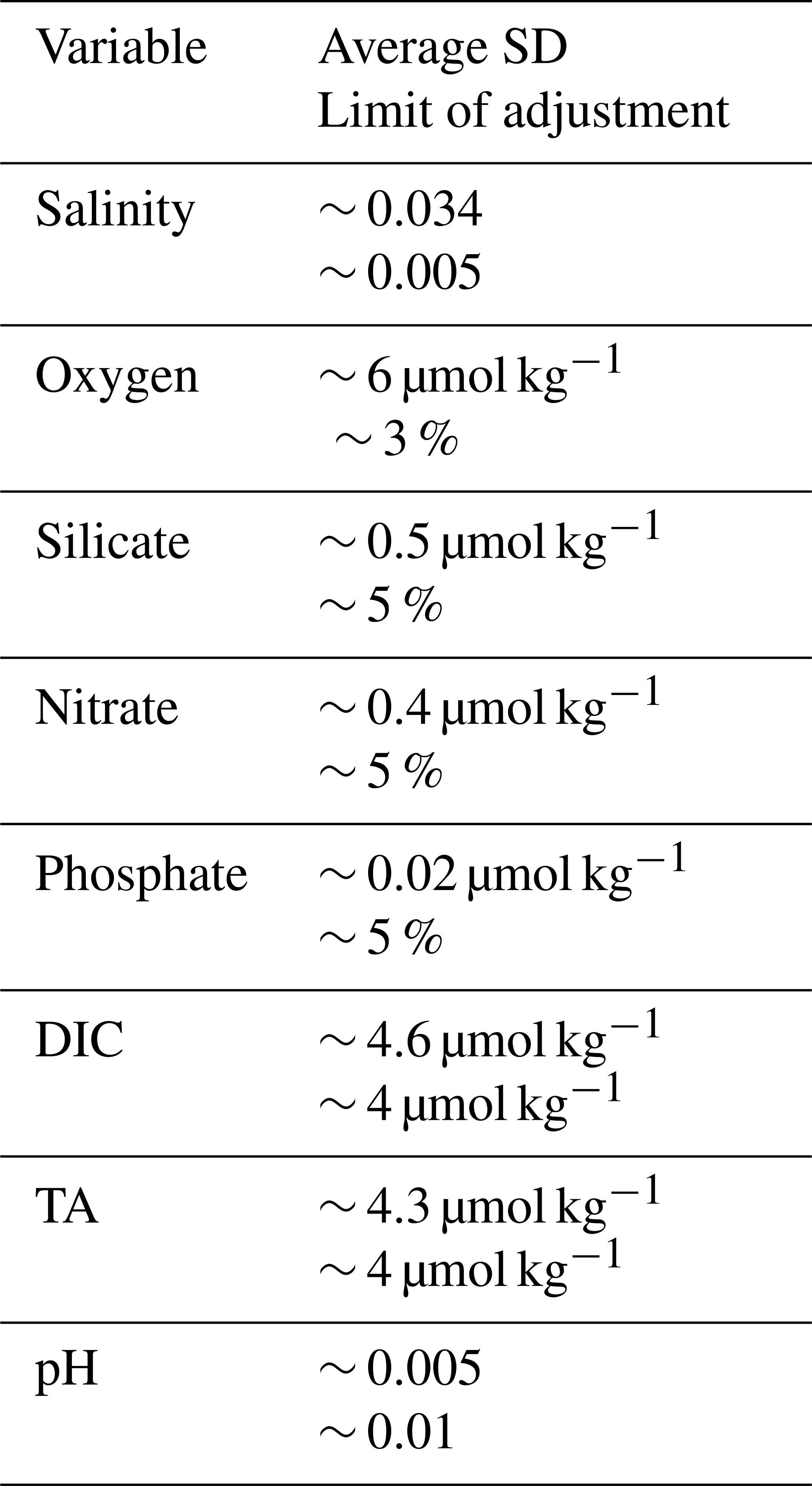
As noted in Sect. 5.1, the crossover analysis results proved challenging due to the dynamic nature of the MedSea. To provide robust confidence in the suggested adjustments, the crossover results were therefore supplemented with a statistical evaluation of the mean and SD values of each property per cruise and region within the minimum temporal variability depth layers.
The outcomes of this statistical assessment are presented in the Supplement, separating the western MedSea regions (Alboran Sea, Algerian Basin, Western Basin, Gulf of Lion, and Tyrrhenian Basin) (Figs. S9 to S11) from the eastern MedSea regions (Adriatic Basin, Ionian Basin, Cretan Passage, and Levantine Basin) (Figs. S12 to S14). These evaluations were used to either validate or override the crossover-derived adjustments, effectively compensating for the spatial and temporal limitations of data availability. In several cases, statistical evidence was essential. For example, for the anomalously low DIC concentrations observed during the MEDIPROD_IV (1981) cruise across the Alboran, Algerian, Western, and Gulf of Lion regions. Similarly, the low dissolved inorganic nutrient values reported for the MEDSEA (2013) cruise were confirmed across both the western and eastern sub-basins.
5.3 Applied adjustments and final consistency assessment
Careful analysis of both the crossover results and the statistical information within the minimum temporal variability layers enabled the detection of systematic biases in salinity and biogeochemical variables that exceeded the predefined adjustment limits (Table 3). Lacking a completely objective quantitative approach (as the standard inversion procedure was not suitable for the MedSea's dynamic deep water), the CARIMED group relied on expert judgement-driven analysis to determine the magnitude and applicability of corrections.
Cruises that followed modern GO-SHIP best practices and utilized reference materials were selected as primary benchmarks for comparison. For cruises crossing multiple sub-basins, determining the final adjustment was challenging, as crossover analysis sometimes proposed contradictory adjustments for the same cruise when applied separately in different sub-basins. Adjustment limits were surpassed only when the bias was exceptionally clear, particularly when comparing recent high-precision cruises. All corrections were rigorously inspected to ensure they did not remove true temporal trends or natural variability before being applied. The specific adjustments for each cruise and variable are listed in Table S3, and additional graphical justifications are provided in the CARIMED adjustment workbench hosted in GEOMAR (https://carimed.geomar.de/, last access: 26 June 2026). Variables corrected through the 2QC process are denoted by the _2QC suffix in the final CARIMED bias-adjusted data synthesis product headers (e.g., OXYGEN_2QC; Table 4). The proposed corrections are the following:
-
Salinity. Four cruises needed an adjustment in CTDSAL, suggesting issues related to CTD calibration, even for recent cruises. Corrections included:
- –
A downward adjustment of 0.015 for MC24IS,
- –
A downward adjustment of 0.007 for POSEIDON_234,
- –
An upward adjustment of 0.010 for MEDSEA_2013,
- –
A downward adjustment of 0.010 for OC_2015.
- –
-
Oxygen. OXYGEN required adjustment in seven cruises:
- –
METEOR_5_6 and POEM05IS needed an upward adjustment of 2 %,
- –
METEOR_31_1 needed a downward adjustment of 5 %,
- –
METEOR_44_4 needed an upward adjustment of 3 %,
- –
MC24IS and MC30IS needed a downward adjustment of 4 %,
- –
MC26IS and SESAME_IT01 needed a downward adjustment of 2 %.
- –
-
Nutrients. Dissolved inorganic nutrients required the most significant adjustments both in number and magnitude. Approximately 30 % of the cruises needed adjustments, particularly for phosphate and silicate. This issue strongly underscores the ongoing need for adapted SOPs and reference materials.
-
Carbonate system. For the seawater CO2 system variables, no adjustments were applied to pH. Despite the change in methodologies, transitioning from potentiometric to spectrophotometric measurements, the overall agreement for pH was comparatively better, which may be related to a better agreement of pH at the higher MedSea pH values (Álvarez et al., 2025). However, adjustments for TA and DIC were particularly high, sometimes exceeding the adjustment limit by an order of magnitude, even for cruises that reported using CO2 reference materials. A clear example is the OTRANTO_5 cruise where DIC and TA profiles have a coherent vertical distribution, a good precision, but bad accuracy. The METEOR_51_2 TA was corrected both in CARIMED (+5 µmol kg−1) and GLODAPv2 (+9 µmol kg−1) while no corrections were applied for biogeochemical variables in the METEOR_84_3 cruise in both data products. Preliminary findings from an inter-laboratory comparison exercise based on high DIC, TA, and pH mid-depth water from the Levantine Basin (Ibello et al., 2026) will also help to devise a strategy to improve the consistency of these climate-relevant biogeochemical variables.
The statistical consistency of the dataset was investigated before and after applying the 2QC adjustments (Fig. 3a, b). Specifically, we quantified MAD values for “good” data (flag 2) within the minimum temporal variability layers (Sect. 5.1) across different MedSea regions, arranged from west to east, using the entire CARIMED dataset. High MAD values, indicating higher data dispersion around the regional mean, are evident for all variables in the Adriatic Basin, even after adjustments were applied. This behaviour reflects the pronounced temporal variability of this region. Conversely, regions showing lower MAD values are generally located in the eastern MedSea (Ionian Basin, Cretan Passage, and Levantine Basin). Overall, the 2QC procedures successfully improved the internal consistency of the CARIMED dataset, as evidenced by the reduction in MAD after applying the CARIMED 2QC framework (Fig. 3c). Mean reductions were 14 % for OXYGEN, 8 % for NITRATE, 9 % for PHOSPHATE, 13 % for SILICATE, 16 % for TA, and 26 % for DIC. As no 2QC adjustments were applied to pH, no change in pH MAD was expected. A few exceptions were noted, including a slight increase in MAD for dissolved inorganic nutrients in the Adriatic Basin and for CTDSAL, which likely points to the regime shifts in the MedSea. The overall decrease in MAD confirms that the CARIMED 2QC framework successfully minimised systematic biases and produced an internally consistent CARIMED dataset suitable for robust regional biogeochemical studies.
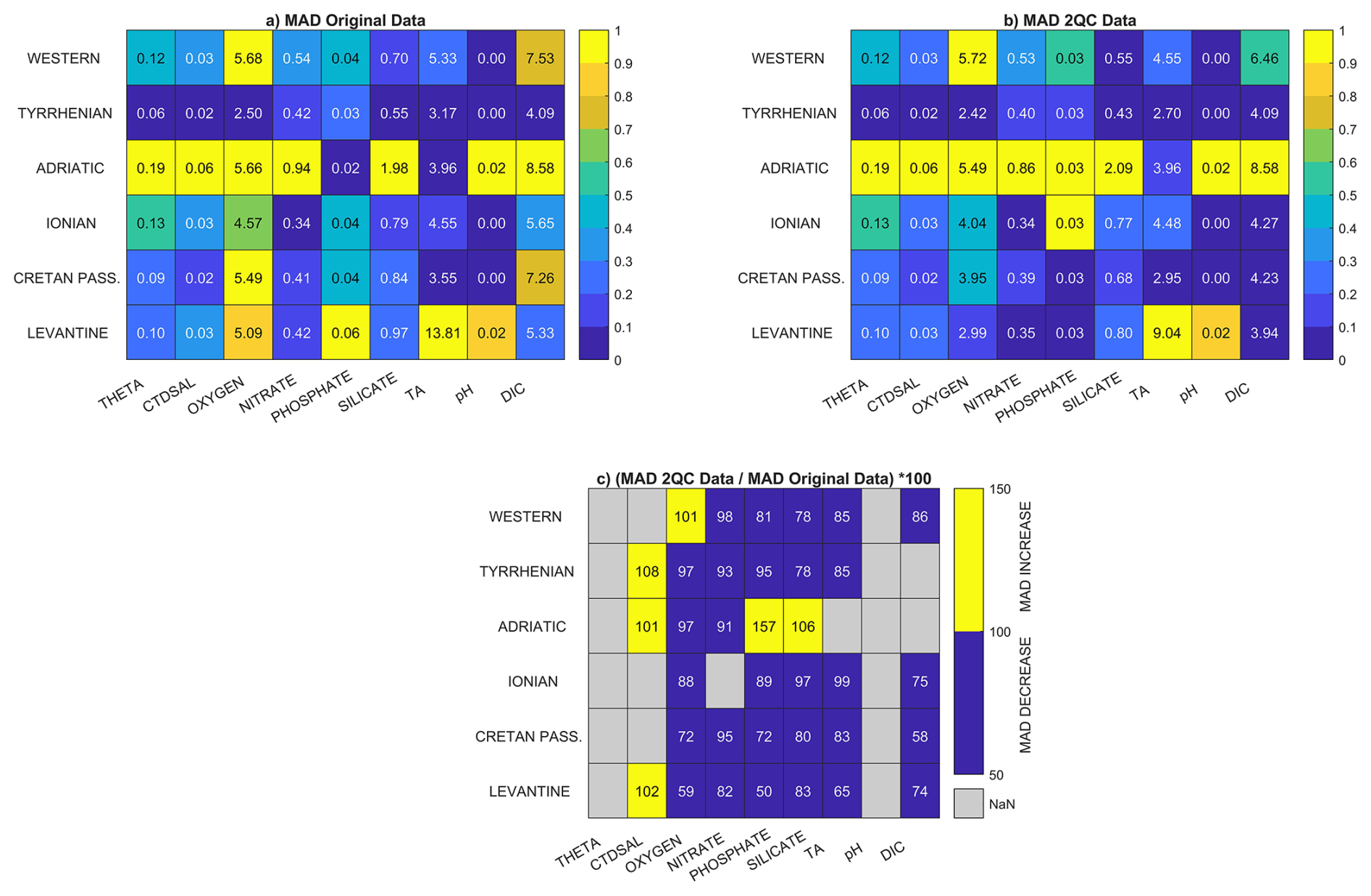
Figure 3Overall Mean Absolute Deviation (MAD) (a) before and (b) after applying the 2QC adjustments to the CARIMED cruise collection. MAD are calculated for different Mediterranean Sea regions defined after Manca et al. (2004) and within the depth layers of minimum temporal variability (Sect. 5.1). Regions are shown in the y-axis and physical and biogeochemical variables in the x-axis: potential temperature (THETA, in °C), salinity (CTDSAL), dissolved oxygen (OXYGEN, in µmol kg−1), dissolved inorganic nutrients (NITRATE, PHOSPHATE, and SILICATE, all in µmol kg−1), total alkalinity (TA, in µmol kg−1), pH on the total hydrogen ion scale at 25 °C (pH), and total dissolved inorganic carbon (DIC, in µmol kg−1). The Western Basin comprises areas DF1 and DS4 (Algero-Provençal and Algerian East); the Tyrrhenian Basin comprises areas DT1 and DT3 (Tyrrhenian Sea North and Tyrrhenian Sea South); the Adriatic Basin comprises area DJ3 (Adriatic South); the Ionian Basin comprises areas DJ5, DJ7, and DJ8 (Ionian South, Middle East, and West, respectively); the Cretan Passage region comprises area DH3 (Cretan Passage), and the Levantine Basin comprises areas DL1, DL2, DL3, and DL4 (Levantine North, North East, South and South East, respectively) (see Figs. 1 and S3 and Table 2 for more information).
Along with the individual original cruise data files, CARIMED outcomes consist of two data synthesis products: (i) the aggregated original data product containing all measurements subjected to 1QC, and (ii) the final CARIMED bias-adjusted data synthesis product containing both the original data with flag 2 and bias-adjusted (2QC) data, with interpolated ancillary data (O2 and dissolved inorganic nutrients) if seawater CO2 data is available. See Table 4 for the variables information and Table S4 regarding the corresponding flags.
Table 4Variables, header aliases, units, and flag headers in the CARIMED data synthesis products. The table lists variables included in the aggregated (original cruise data) and final (original and bias-adjusted cruise data) data synthesis products, including derived physical and biogeochemical variables. The final CARIMED bias-adjusted data synthesis product provides secondary quality control (2QC) adjusted variable values.
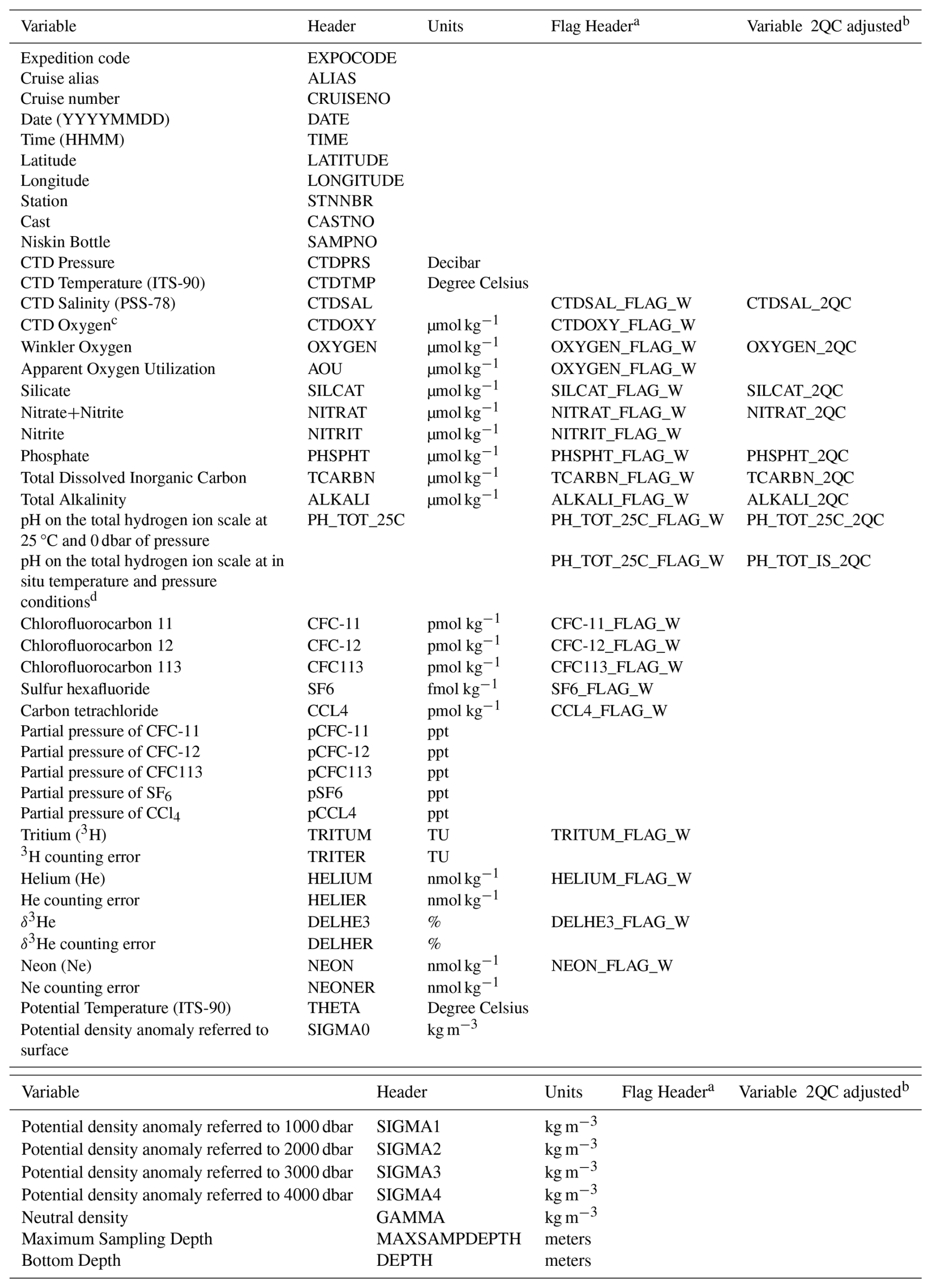
a the aggregated original data product includes data flagged as 3 (probably bad), 2 (good), and 0 (interpolated). b the bias adjusted data product contains only data flagged as 2 (good) and 0 (interpolated). c the bias adjusted data product contains no CTDOXY but the merged OXYGEN variable with measured Winkler and calibrated CTDOXY data. d just the bias adjusted data product contains pH on the total hydrogen ion scale at in situ temperature and pressure conditions, calculated from bias-adjusted data.
6.1 Aggregated original cruise data synthesis product
The aggregated original cruise data product is a unified aggregated CARIMED dataset compiling the unadjusted physical, biogeochemical, and tracer measurements from all 46 cruises included in Table 1. This ensemble file includes all variables present in the individual cruise files (Table S1), in addition to several derived variables (see Table 4 for the full variable list). These include:
- i.
cruise identifiers such as ALIAS and CRUISENO (identifying each cruise according to the NCEI–OCADS system, alphabetically ordered by EXPOCODEs; Table S2), year, and month;
- ii.
derived physical and chemical variables, including potential temperature and density anomalies (calculated using the Thermodynamic Equation Of Seawater – 2010, TEOS-10; IOC, SCOR and IAPSO, 2010), partial pressures of CFC-11 and CFC-12 (Warner and Weiss, 1985), CCl4 (Bullister and Wisegarver, 1998), CFC-113 (Bu and Warner, 1995), and SF6 (Bullister et al., 2002), and apparent oxygen utilization (AOU; García and Gordon, 1992).
Metadata such as maximum sampling depth and bottom depth (from the ETOPO Global Relief Model bathymetry; Amante and Eakins, 2009) are also provided. Each variable is expressed in standardized units and accompanied by WOCE-style quality flags (0, 2, 3, and 9) (see Table S4). The dataset is organized by cruise, with each cruise identified by its EXPOCODE.
CTD salinity (CTDSAL) is the only salinity variable included, as it is available for nearly all cruises. Salinometer data from the following cruises: MILLERO_76, GEOSECS_Leg3 and OTRANTO_5, were assigned to the CTDSAL variable with flag 0 (interpolated values) (432 samples vs a total of 27590, Table S4). Both OXYGEN (discrete) and the recalibrated CTDOXY (sensor) are included. Since OXYGEN discrete data are generally more reliable but less abundant, missing OXYGEN values were substituted with corresponding CTDOXY values and assigned a flag value of 0 (interpolated), and vice versa (see Table S4) consistent with GLODAP protocols. AOU was calculated using the resulting combined OXYGEN data. The aggregated original cruise data product is available from DIGITAL.CSIC (https://digital.csic.es/, last access: 26 June 2026): https://doi.org/10.20350/digitalCSIC/17785 (García-Ibáñez et al., 2025).
6.2 Final CARIMED bias-adjusted data synthesis product
The final CARIMED bias-adjusted (2QC) data synthesis product maintains the same structure and variables as the aggregated original cruise data product, with two exceptions: dissolved oxygen is only provided as the combined variable OXYGEN with mainly discrete Winkler data and calibrated sensor-based oxygen data (see Sect. 6.1 and Table S4), pH is also provided at in situ temperature and pressure conditions from bias-adjusted data. In situ pH was calculated with the CO2SYS package for Matlab® (van Heuven et al., 2011) with option 10 for the CO2 constants (Lueker et al., 2000) and option 1 for the total boron to chlorinity ratio (Üppstrom, 1974) and bisulphate constant (Dickson, 1990) as agreed by the GLODAPv2 team (Olsen et al., 2016; Velo et al., 2010). Please note that in situ pH was mostly calculated from measured TA and pH (5929 samples from a total of 6726), when TA was unavailable from measured DIC and pH (212 samples from a total of 6726) and finally, if no DIC or TA was available, a constant value of 2500 µmol kg−1 was assumed for TA (584 samples from a total of 6726). Crucially, it exclusively contains values flagged as “good” (flag 2) and interpolated (flag 0), sensor-based or vertically as following. The bias-adjusted data product incorporates the adjustments derived from the 2QC analysis to remove systematic offsets, thus establishing an improved consistency.
Where seawater CO2 system data were available, and ancillary variables such as O2 and dissolved inorganic nutrients were either missing or deemed unreliable (flagged as 3), these variables were vertically interpolated using a quasi-Hermitian piecewise polynomial, closely following the GLODAP procedure (Olsen et al., 2016) (see Table S4).
The final CARIMED bias-adjusted data synthesis product is available from NCEI–OCADS (https://www.ncei.noaa.gov/, last access: 26 June 2026): https://doi.org/10.25921/cp5b-zq67 (Álvarez et al., 2025) and can also be found within the Ocean Data View Ocean collections and the webODV Explore site.
CARIMED information is hosted at NCEI-OCADS, https://www.ncei.noaa.gov/access/ocean-carbon-acidification-data-system/oceans/CARIMED/ (CARIMED, 2026) with links to relevant information, the original cruise summary table and the data products. The aggregated original cruise data product is made available at DIGITAL.CSIC (https://doi.org/10.20350/digitalCSIC/17785, García-Ibáñez et al., 2025), and the final CARIMED bias-adjusted data synthesis product, available from NCEI–OCADS (https://doi.org/10.25921/cp5b-zq67, Álvarez et al., 2025). Both data products are available in multiple formats to ensure broad accessibility, adhering to FAIR (Findable, Accessible, Interoperable, and Reusable) data principles: (1) WHP-Exchange bottle format following WOCE Hydrographic Program Exchange format standards, (2) NetCDF format, and (3) Apache Parquet format. These merged 1QC files per cruise, including cruise-level metadata, are available through NCEI–OCADS, with file identifiers (DOI) listed in Table S2.
The CARIMED data synthesis products represent the first comprehensive, basin-wide compilation of hydrographic, biogeochemical, and tracer measurements for the MedSea from cruises that measured carbon-relevant variables, harmonised under a consistent QC framework. By integrating data from 46 cruises spanning more than four decades, CARIMED provides an unprecedented resource for understanding the long-term evolution of the MedSea's physical and biogeochemical properties. The dataset consolidates previously fragmented or inaccessible observations and ensures their long-term preservation and data accessibility, as well as interoperability with global efforts such as GLODAP (Olsen et al., 2016).
The CARIMED workflow demonstrates that a coordinated, basin-scale synthesis is feasible even in a semi-enclosed, data-limited, and conflictive region such as the MedSea. A key lesson learned is the importance of data rescue and standardisation: a substantial fraction of measurements existed only in non-standard formats or were archived locally without public access. Their recovery required collaboration with cruise PIs and national data centres, highlighting the need for systematic archiving practices and clear metadata documentation. When available, additional information on analytical methods and measurement QC was collected, and comprehensive cruise reports were particularly valuable, often providing the context required to correctly apply the adjustments. Ensuring that future datasets follow FAIR principles will greatly enhance their long-term usability.
The experience gained in the MedSea also emphasises that while GLODAP-style crossovers are effective for the global ocean, regional implementations require tailored approaches that account for finer water-mass structures and higher temporal variability. The lessons from CARIMED may thus inform the design of future data synthesis products.
Looking ahead, sustained observational efforts will be essential to extend and maintain CARIMED data synthesis products. The Med-SHIP repeat hydrography program (Schroeder et al., 2015), an Ocean Decade Action endorsed by UNESCO, and large-scale initiatives such as MonGOOS (The Mediterranean Oceanographic Network for the Global Ocean Observing System) are essential in providing new high-precision measurements and ensuring continuity with existing ship-based observations, delivering benchmark environmental information for better implementation of the Ocean Decade Sustainable Goals in the MedSea (Cappelletto et al., 2021). We strongly encourage the scientific community to submit new and legacy cruise data to public repositories such as NCEI–OCADS and to adopt the CARIMED framework when reporting physical, biogeochemical, and tracer observations from the MedSea. Expanding the database with additional cruises and repeated occupations will allow more robust detection and evaluation of OA, deoxygenation, and anthropogenic carbon storage trends across the basin.
We recommend that the final CARIMED bias-adjusted data synthesis product be used as the primary source for quantitative scientific analyses, including the evaluation of ocean biogeochemical models, the estimation of anthropogenic carbon storage, or the assessment of long-term OA trends. The aggregated original cruise data product should be used only for specialised applications requiring unadjusted measurements. Users should pay close attention to the QC flags provided for each variable, particularly the interpolated status (flag 0), and should cite the CARIMED data synthesis product DOI as well as the original cruise data DOIs (Table S2) when relevant. We invite users to report any anomalies that may have gone undetected or to suggest potential misclassifications within the present products (e.g., data that are probably good but assigned flag 3, or data that are probably erroneous).
Finally, CARIMED's completion underscores the value of community-driven initiatives in regional ocean data synthesis. Sustained institutional and financial support will be critical for ensuring regular updates, open access, and long-term stewardship of this data synthesis product. Through these collective efforts, CARIMED could continue to provide a cornerstone for observational and modelling studies addressing the impacts of climate change on the MedSea.
Last but not least, CARIMED emphasises the need to support North African countries in Med-SHIP hydrographic cruises to foster collaboration, exchange knowledge and improve sampling coverage within under sampled MedSea regions.
The supplement related to this article is available online at https://doi.org/10.5194/essd-18-4915-2026-supplement.
MA, MIGI and TT designed the study, conceptualization, methodology, validation and formal analysis. The manuscript was written by MA and MIGI, with contributions from all authors. NL and AV conducted the crossover analysis for secondary quality control adapting a former software. AK is the data curator at NCEI/OCADS. CS manages the adjustment table e-infrastructure at GEOMAR. TT performed the secondary quality control on all transient tracers. Many authors conducted ancillary quality control analyses and contributed to the data product validation. MIGI and TT provided fundamental financial resources.
At least one of the (co-)authors is a member of the editorial board of Earth System Science Data. The peer-review process was guided by an independent editor, and the authors also have no other competing interests to declare.
Publisher's note: Copernicus Publications remains neutral with regard to jurisdictional claims made in the text, published maps, institutional affiliations, or any other geographical representation in this paper. The authors bear the ultimate responsibility for providing appropriate place names. Views expressed in the text are those of the authors and do not necessarily reflect the views of the publisher.
We appreciate and are grateful for the dedication of all contributors to the CARIMED cruises. While chief scientists and principal investigators for specific variables are listed in the NCEI–OCADS cruise summary table, the execution of the cruise data collection would not have been possible without the efforts and commitment of the captains, the crew, and the numerous scientific and technical personnel not explicitly named in the tables. This work was initially envisioned following the inspirational CIESM No 43 workshop in Supetar (Croatia, 2011). CARIMED commenced more than ten years ago as a volunteer, unfunded project, relying largely on personal efforts. We sincerely appreciate the sustained commitment along the way and acknowledge recent funding that enabled us to prioritise the public release of this data synthesis product.
We thank Reiner Schlitzer and Ana Bodí for the assistance with the Ocean Data View CARIMED collection https://odv.awi.de/data/ocean/carimed/ (last access: 26 June 2026) and the webODV Explore CARIMED visualization and online analysis, https://explore.webodv.awi.de/ocean/carbon/carimed/ (last access: 26 June 2026).
We strongly encourage potential stakeholders and users to follow FAIR data use practices and to contact principal investigators to explore collaboration opportunities and co-authorship.
In this document, Artificial Intelligence-powered tools have been used to assist with language editing. Artificial Intelligence has not been used for any key writing task, such as producing scientific insights, creating a literature review, or drawing scientific conclusions. Mónica Martínez (SopaDeLetras comunicación) kindly designed the CARIMED logo reflecting the wish of peace and collaboration between the northern and southern Mediterranean Sea countries.
This research has been supported by the MediBGC-SynEval project (PID2023-148927NA-I00 funded by MICIU/AEI/10.13039/501100011033 and FEDER, UE), the BioGeoSea project (European Union's Horizon Europe research and innovation programme under Grant Agreement No. 101216427), the EuroGO-SHIP project (HORIZON-INFRA-2022-DEV-01-01, Grant Agreement No. 101094690) and the SESAME project (FP6-036949 GOCE). Structural IEO-CSIC projects supported M. Álvarez and the INOCEN (M. Álvarez, M. I. García-Ibáñez, R. Acerbi, N. M. Fajar, E. F. Guallart) research group to participate in several CARIMED cruises and complete the data synthesis product release. M. Álvarez was supported by a Spanish Ministry of Science, Innovation and Universities Salvador de Madariaga Grant (PRX23/00051). M. I. García-Ibáñez received postdoctoral funding from the “Severo Ochoa Centre of Excellence” (CEX2019-000928-S) funded by AEI 10.13039/501100011033, which enabled her to be part of the CARIMED effort. A. Velo and F. F. Pérez have been supported by the BOCATS2 (grant no. PID2019-104279GB-C21) and by FICARAM+ (PID2023-148924OB-I00) projects funded by MICIU/AEI/10.13039/501100011033 and the Horizon Europe project EuroGO-SHIP (101094690). I. E. Huertas is supported by the SYMPHONIA project (202630E144) and S. Flecha was supported by the Generation D initiative, promoted by Red.es, an organisation affiliated with the Ministry for Digital Transformation and the Civil Service, financed by the Recovery, Transformation, and Resilience Plan through the European Union's Next Generation funds. This work contributes to ICTA-UAB “María de Maeztu” Programme for Unit of Excellence of the Spanish Ministry of Science and Innovation (MICIU/AEI/10.13039/501100011033), MERS research group, 2021 SGR 00640-Generalitat de Catalunya, PUREEF-Y project EU Horizon program (grant no. 101158830) and the AEI-DFG project BONITOS (PCI2025-163190, 541693727).
The article processing charges for this open-access publication were covered by the CSIC Open Access Publication Support Initiative through its Unit of Information Resources for Research (URICI).
This paper was edited by Sabine Schmidt and reviewed by three anonymous referees.
Alekin, O. A.: Saturation of Mediterranean Sea water with calcium carbonate, Geochemistry, 206, 239–242, 1972.
Ali, E., Cramer, W., Carnicer, J., Georgopoulou, E., Hilmi, N. J. M., Le Cozannet, G., and Lionello, P.: Cross-Chapter Paper 4: Mediterranean Region, in: Climate Change 2022: Impacts, Adaptation and Vulnerability. Contribution of Working Group II to the Sixth Assessment Report of the Intergovernmental Panel on Climate Change, edited by: Pörtner, H.-O., Roberts, D. C., Tignor, M., Poloczanska, E. S., Mintenbeck, K., Alegría, A., Craig, M., Langsdorf, S., Löschke, S., Möller, V., Okem, A., and Rama, B., Cambridge University Press, Cambridge, UK and New York, NY, USA, 2233–2272, https://doi.org/10.1017/9781009325844.027, 2022.
Álvarez, M., Sanleón-Bartolomé, H., Tanhua, T., Mintrop, L., Luchetta, A., Cantoni, C., Schroeder, K., and Civitarese, G.: The CO2 system in the Mediterranean Sea: a basin wide perspective, Ocean Sci., 10, 69–92, https://doi.org/10.5194/os-10-69-2014, 2014.
Álvarez, M., Catalá, T. S., Civitarese, G., Coppola, L., Hassoun, A. E. R., Ibello, V., Lazzari, P., Lefèvre, D., Macías, D., Santinelli, C., and Ulses, C.: Chapter 11 – Mediterranean Sea general biogeochemistry, edited by: Schroeder, K. and Chiggiato, J., Oceanography of the Mediterranean Sea, Elsevier, 387–451, https://doi.org/10.1016/B978-0-12-823692-5.00004-2, 2023.
Álvarez, M., Lauvset, S. K., McDonagh, E., Firing, Y., Jebri, F., and Belgacem, M.: EuroGO-SHIP D2.4: Report on defining a framework for estimating uncertainty as part of a 2QC procedure, 2024.
Álvarez, M., García-Ibáñez, M. I., Lange, N., Kozyr, A., Velo, A., Tanhua, T., Civitarese, G., Cantoni, C., Belgacem, M., Schroeder, K., Acerbi, R., Coppola, L., Wagener, T., Fajar, N. M.., Flecha, S., Giani, M., Giannoudi, L., Guallart, E. F., Hassoun, A. E. R., Huertas, E., Ibello, V., Keraghel, M. A., Louanchi, F., Luchetta, A., Pérez, F. F., Schirnick, C., Souvermezoglou, E., Urbini, L., Vidal, M., and Ziveri, P.: CARbon, tracers, and ancillary data In the MEDiterranean Sea (CARIMED) (NCEI Accession 0309255), NOAA National Centers for Environmental Information [data set], https://doi.org/10.25921/cp5b-zq67, 2025.
Amante, C. and Eakins, B. W.: ETOPO1 1 Arc-Minute Global Relief Model: Procedures, Data Sources and Analysis, NOAA Technical Memorandum NESDIS NGDC-24, 2009.
Aoyama, M., Cheong, C., and Murata, A. (Eds.): Chemical Reference Materials for Oceanography. History, Production, and Certification, Springer Nature Singapore, https://doi.org/10.1007/978-981-96-2520-8, 2025.
Belgacem, M., Chiggiato, J., Borghini, M., Pavoni, B., Cerrati, G., Acri, F., Cozzi, S., Ribotti, A., Álvarez, M., Lauvset, S. K., and Schroeder, K.: Quality controlled dataset of dissolved inorganic nutrients in the western Mediterranean Sea (2004–2017) from R/V oceanographic cruises, PANGAEA [data set], https://doi.org/10.1594/PANGAEA.904172, 2019.
Belgacem, M., Chiggiato, J., Borghini, M., Pavoni, B., Cerrati, G., Acri, F., Cozzi, S., Ribotti, A., Álvarez, M., Lauvset, S. K., and Schroeder, K.: Dissolved inorganic nutrients in the western Mediterranean Sea (2004–2017), Earth Syst. Sci. Data, 12, 1985–2011, https://doi.org/10.5194/essd-12-1985-2020, 2020.
Belgacem, M., Schroeder, K., Barth, A., Troupin, C., Pavoni, B., Raimbault, P., Garcia, N., Borghini, M., and Chiggiato, J.: Climatological distribution of dissolved inorganic nutrients in the western Mediterranean Sea (1981–2017), Earth Syst. Sci. Data, 13, 5915–5949, https://doi.org/10.5194/essd-13-5915-2021, 2021.
Belgacem, M., Schroeder, K., Álvarez, M., Lauvset, S. K., Chiggiato, J., Borghini, M., Cantoni, C., Ciuffardi, T., and Sparnocchia, S.: A consistent regional dataset of dissolved oxygen in the western Mediterranean Sea (2004–2023): CTD-O2WMED, Earth Syst. Sci. Data, 17, 5315–5336, https://doi.org/10.5194/essd-17-5315-2025, 2025a.
Belgacem, M., Schroeder, K., Lauvset, S. K, Álvarez, M., Chiggiato, J.o, Borghini, M., Cantoni, C., Ciuffardi, T., and Sparnocchia, S.: CTD-O2WMED: Quality controlled dataset of CTD dissolved oxygen profiles in the Western Mediterranean Sea (2004-2023) from R/V oceanographic cruises, PANGAEA [data set], https://doi.org/10.1594/PANGAEA.982858, 2025b.
Béthoux, J. P., Gentili, B., and Tailliez, D.: Warming and freshwater budget change in the Mediterranean since the 1940s, their possible relation to the greenhouse effect, Geophysical Res. Lett., 25, 1023–1026, https://doi.org/10.1029/98GL00724, 1998.
Bittig, H. C., Steinhoff, T., Claustre, H., Fiedler, B., Williams, N. L., Sauzède, R., Körtzinger, A., and Gattuso J.-P.: An Alternative to Static Climatologies: Robust Estimation of Open Ocean CO2 Variables and Nutrient Concentrations From T, S, and O2 Data Using Bayesian Neural Networks, Front. Mar. Sci., 5, 328, https://doi.org/10.3389/fmars.2018.00328, 2018.
Bu, X. and Warner, M. J.: Solubility of chlorofluorocarbon-113 in water and seawater, Deep-Sea Res. Pt. I, 42, 1151–1161, 1995.
Bullister, J. L. and Wisegarver, D. P.: The solubility of carbon tetrachloride in water and seawater, Deep-Sea Res. Pt. I, 45, 1285–1302, 1998.
Bullister, J. L., Wisegarver, D. P., and Menzia, F. A.: The solubility of sulfur hexafluoride in water and seawater, Deep-Sea Res. Pt. I, 49, 175–187, 2002.
Cantoni, C., Durante, S., Calesso, G., Cipolla, A., Poiana, A., Borghini, M., Schroeder, K., and Chiggiato, J.: The carbonate chemistry of the Western Mediterranean during the OCEAN CERTAIN 2015 cruise, PANGAEA [data set], https://doi.org/10.1594/PANGAEA.911046, 2020.
Capitaine, G., Stoica, D., Wagener, T., and Fisicaro, P.: Production of a reference material for seawater pHT measurements by a National Metrology Institute, Mar. Chem., 252, 104244, https://doi.org/10.1016/j.marchem.2023.104244, 2023.
Cappelletto, M., Santoleri, R., Evangelista, L., Galgani, F., Garcés, E., Giorgetti, A., Fava, F., Herut, B., Hilmi, K., Kholeif, S., and Solidoro, C.: The Mediterranean Sea we want, Ocean Coast. Res. 69 (suppl 1), https://doi.org/10.1590/2675-2824069.21019mc, 2021.
Cardin, V., Civitarese, G., Hainbucher, D., Bensi, M., and Rubino, A.: Thermohaline properties in the Eastern Mediterranean in the last three decades: is the basin returning to the pre-EMT situation?, Ocean Sci., 11, 53–66, https://doi.org/10.5194/os-11-53-2015, 2015.
CARIMED: Carbon, tracers and ancillary data in the Mediterranean Sea, a data synthesis product for Mediterranean Sea observations on inorganic carbon and carbon-relevant variables, https://www.ncei.noaa.gov/access/ocean-carbon-acidification-data-system/oceans/CARIMED/, last access: 19 May 2026.
Carter, B. R., Bittig, H. C., Fassbender, A. J., Sharp, J. D., Takeshita, Y., Xu, Y. Y., Álvarez, M., Wanninkhof, R., Feely, R. A., and Barbero, L.: New and updated global empirical seawater property estimation routines, Limnol. Oceanogr.-Meth., 19, 785–809, https://doi.org/10.1002/lom3.10461, 2021.
Catalá, T. S., Martínez-Pérez, A. M., Nieto-Cid, M., Álvarez, M., Otero, J., Emelianov, M., Reche, I., Arístegui, J., and Álvarez-Salgado, X. A.: Dissolved Organic Matter (DOM) in the open Mediterranean Sea. I. Basin–wide distribution and drivers of chromophoric DOM, Prog. Oceanogr., 165, 35–51, https://doi.org/10.1016/j.pocean.2018.05.002, 2018.
Chai, F., Johnson, K. S., Claustre, H., Xing, X., Wang, Y., Boss, E., Riser, S., Fennel, K., Schofield, O., and Sutton, A.: Monitoring ocean biogeochemistry with autonomous platforms, Nat. Rev. Earth Environ., 1, 315–326, https://doi.org/10.1038/s43017-020-0053-y, 2020.
Chernyakova, A. M.: Element of the carbonate system in the Straits of Sicily (Tunis Strait) area, Oceanology, 16, 36–39, 1976.
Chiggiato, J., Artale, V., Durrieu de Madron, X., Schroeder, K., Taupier-Letage, I., Velaoras, D., and Vargas-Yáñez, M.: Chapter 9 – Recent changes in the Mediterranean Sea, in: Oceanography of the Mediterranean Sea, edited by: Schroeder, K. and Chiggiato, J., Elsevier, 289–334, ISBN 978-0-12-823692-5, https://doi.org/10.1016/B978-0-12-823692-5.00008-X, 2023.
CIESM: Impacts of acidification on biological, chemical and physical systems in the Mediterranean and Black Seas, No. 36 in CIESM Workshop Monographs, edited by: Briand, F., CIESM Publisher, Monaco, 124 pp., 2008.
CIESM: Designing Med-SHIP: a Program for repeated oceanographic surveys, CIESM Workshop Monograph no. 43, edited by: Briand, F., CIESM Publisher, Monaco, 164 pp., 2012.
Claustre, H., Morel, A., Hooker, S. B., Babin, M., Antoine, D., Oubelkheir, K., Bricaud, A., Leblanc, K., Quéguiner, B., and Maritorena, S.: Is desert dust making oligotrophic waters greener?, Geophys. Res. Lett., 29, 107-1–107-4, https://doi.org/10.1029/2001GL014056, 2002.
Clayton, T. D. and Byrne, R. H.: Spectrophotometric seawater pH measurements: total hydrogen ion concentration scale concentration scale calibration of m-cresol purple and at-sea results, DeepSea Res. Pt. I, 40, 2115–2129, 1993.
Conan, P., Testor, P., Estournel, C., D'Ortenzio, F., Pujo-Pay, M., and Durrieu de Madron, X.: Preface to the Special Section: Dense Water Formations in the Northwestern Mediterranean: From the Physical Forcings to the Biogeochemical Consequences, J. Geophys. Res.-Oceans, 23, 6983–6995, https://doi.org/10.1029/2018JC014301, 2018.
Cooley, S., Schoeman, D., Bopp, L., Boyd, P., Donner, S., Ghebrehiwet, D.Y., Ito, S.-I., Kiessling, W., Martinetto, P., Ojea, E., Racault, M.-F., Rost, B., and Skern-Mauritzen, M.: “Oceans and Coastal Ecosystems and Their Services”, in: Climate Change 2022: Impacts, Adaptation and Vulnerability Contribution of Working Group II to the Sixth Assessment Report of the Intergovernmental Panel on Climate Change, edited by: Pörtner, H.-O., Roberts, D. C., Tignor, M., Poloczanska, E. S., Mintenbeck, K., Alegría, A., Craig, M., Langsdorf, S., Löschke, S., Möller, V., Okem, A., and Rama, B.: Cambridge, UK and New York, NY, USA: Cambridge University Press, 379–550, https://doi.org/10.1017/9781009325844.005, 2022.
Copin-Montégut, C.: Alkalinity and carbon budgets in the Mediterranean Sea, Global Biogeochem. Cy., 7, 915–925, 1993.
Coppola, L., Raimbault, P., Mortier, L., and Testor, P.: Monitoring the environment in the northwestern Mediterranean Sea, Eos, 100, https://doi.org/10.1029/2019EO125951, 2019.
Cossarini, G., Lazzari, P., and Solidoro, C.: Spatiotemporal variability of alkalinity in the Mediterranean Sea, Biogeosciences, 12, 1647–1658, https://doi.org/10.5194/bg-12-1647-2015, 2015.
D'Ortenzio, F. and Ribera d'Alcalà, M.: On the trophic regimes of the Mediterranean Sea: a satellite analysis, Biogeosciences, 6, 139–148, https://doi.org/10.5194/bg-6-139-2009, 2009.
Dickson, A. G.: Standard Potential of the Reaction: AgCl(s) + 12H2(g) = Ag(s) + HCl(Aq), and and the Standard Acidity Constant of the Ion HSO4− in Synthetic Sea Water from 273.15 to 318.15 K, J. Chem. Thermodyn., 22, 113–127, https://doi.org/10.1016/0021-9614(90)90074-Z, 1990.
DOE: Handbook of Methods for the Determination of the Parameters of the Oceanic Carbon Dioxide System, edited by: Dickson, A. G. and Goyet, C., ORNL/CDIAC–74, 1994.
EMB (European Marine Board): Sustaining in situ ocean observations in the age of the digital ocean, EMB Policy Brief 9, 14, https://doi.org/10.5281/zenodo.4836060, 2021.
Fichaut, M., Garcia, M., Giorgetti, A., Iona, A., Kuznetsov, A., Rixen, M., and MEDAR Group: MEDAR/MEDATLAS 2002: A mediterranean and black sea database for operational oceanography, in Building the European Capacity in Operational Oceanography, Proceedings of the Third International Conference on EuroGOOS, edited by: Dahlin, H., Flemming, N. C., Nittis, K., and Petersson, S. E., Elsevier, Amsterdam, vol. 69, 645–648, https://doi.org/10.1016/S0422-9894(03)80107-1, 2003.
Firing, Y., Álvarez, M., Balan, S., Karstensen, J., Musat, T., O'Donnell, G., Sanchez-Franks, A., Schroeder, K., and Vasiliu, D.: EuroGO-SHIP D3.3: Report on updating salinity best practice, 2024.
Fourrier, M., Coppola, L., D'Ortenzio, F., Migon, C., and Gattuso, J.-P: Impact of intermittent convection in the northwestern Mediterranean Sea on oxygen content, nutrients, and the carbonate system, J. Geophys. Res.-Oceans, 127, e2022JC018615, https://doi.org/10.1029/2022JC018615, 2022.
Friedlingstein, P., O'Sullivan, M., Jones, M. W., Andrew, R. M., Hauck, J., Landschützer, P., Le Quéré, C., Li, H., Luijkx, I. T., Olsen, A., Peters, G. P., Peters, W., Pongratz, J., Schwingshackl, C., Sitch, S., Canadell, J. G., Ciais, P., Jackson, R. B., Alin, S. R., Arneth, A., Arora, V., Bates, N. R., Becker, M., Bellouin, N., Berghoff, C. F., Bittig, H. C., Bopp, L., Cadule, P., Campbell, K., Chamberlain, M. A., Chandra, N., Chevallier, F., Chini, L. P., Colligan, T., Decayeux, J., Djeutchouang, L. M., Dou, X., Duran Rojas, C., Enyo, K., Evans, W., Fay, A. R., Feely, R. A., Ford, D. J., Foster, A., Gasser, T., Gehlen, M., Gkritzalis, T., Grassi, G., Gregor, L., Gruber, N., Gürses, Ö., Harris, I., Hefner, M., Heinke, J., Hurtt, G. C., Iida, Y., Ilyina, T., Jacobson, A. R., Jain, A. K., Jarníková, T., Jersild, A., Jiang, F., Jin, Z., Kato, E., Keeling, R. F., Klein Goldewijk, K., Knauer, J., Korsbakken, J. I., Lan, X., Lauvset, S. K., Lefèvre, N., Liu, Z., Liu, J., Ma, L., Maksyutov, S., Marland, G., Mayot, N., McGuire, P. C., Metzl, N., Monacci, N. M., Morgan, E. J., Nakaoka, S.-I., Neill, C., Niwa, Y., Nützel, T., Olivier, L., Ono, T., Palmer, P. I., Pierrot, D., Qin, Z., Resplandy, L., Roobaert, A., Rosan, T. M., Rödenbeck, C., Schwinger, J., Smallman, T. L., Smith, S. M., Sospedra-Alfonso, R., Steinhoff, T., Sun, Q., Sutton, A. J., Séférian, R., Takao, S., Tatebe, H., Tian, H., Tilbrook, B., Torres, O., Tourigny, E., Tsujino, H., Tubiello, F., van der Werf, G., Wanninkhof, R., Wang, X., Yang, D., Yang, X., Yu, Z., Yuan, W., Yue, X., Zaehle, S., Zeng, N., and Zeng, J.: Global Carbon Budget 2024, Earth Syst. Sci. Data, 17, 965–1039, https://doi.org/10.5194/essd-17-965-2025, 2025.
Garcia, H. E. and Gordon, L. I.: Oxygen solubility in seawater: Better fitting equations, Limnol. Oceanogr., 37 1307–1312, https://doi.org/10.4319/lo.1992.37.6.1307, 1992.
García-Ibáñez, M. I. and Easley-Vidal, R. A.: Future Strategy for a Resilient Production and Certification of Seawater Reference Materials for the Carbonate System, in: Chemical Reference Materials for Oceanography, edited by: Aoyama, M., Cheong, C., and Murata, A., Springer Oceanography, Springer, Singapore, https://doi.org/10.1007/978-981-96-2520-8_13, 2025.
García-Ibáñez, M. I., Álvarez, M., Lange, N., Kozyr, A., Velo, A., Tanhua, T., Civitarese, G., Cantoni, C., Belgacem, M., Schroeder, K., Acerbi, R., Coppola, L., Wagener, T., Fajar, N. M., Flecha, S., Giani, M., Giannoudi, L., Guallart, E. F., Hassoun, A. E. R., Huertas, E. I.; Ibello, V., Keraghel, M. A., Louanchi, F., Luchetta, A., Pérez, F. F., Schirnick, C., Souvermezoglou, E., Urbini, L., Vidal, M., and Ziveri, P.: CARIMED (CARbon, tracers, and ancillary data In the MEDiterranean Sea) aggregated original cruise data product, DIGITAL.CSIC [data set], https://doi.org/10.20350/digitalCSIC/17785, 2025.
Gemayel, E., Hassoun, A. E. R., Benallal, M. A., Goyet, C., Rivaro, P., Abboud-Abi Saab, M., Krasakopoulou, E., Touratier, F., and Ziveri, P.: Climatological variations of total alkalinity and total dissolved inorganic carbon in the Mediterranean Sea surface waters, Earth Syst. Dynam., 6, 789–800, https://doi.org/10.5194/esd-6-789-2015, 2015.
Gouretski, V. and Jancke, K.: A description and quality assessment of the historical hydrographic data for the South Pacific Ocean, J. Atmos. Ocean. Tech., 16, 1791-1815, https://doi.org/10.1175/1520-0426(1999)016<1791:ADAQAO>2.0.CO;2, 1999.
Groupe MEDIPROD: Propriétés hydrologiques et chimiques des eaux du bassin occidental de la Méditerranée. Campagne MEDIPROD IV – 15 octobre – 17 novembre 1981, Publications du Centre National pour l'Exploitation des Océans (CNEXO), Série Résultats des campagnes à la mer, no 26 – 1984, ISSN 0339-2902, https://archimer.ifremer.fr/doc/00717/82871/ (last access: 26 June 2026), 1984.
Gruber, N.: Warming up, turning sour, losing breath: ocean biogeochemistry under global change, Philos. T. R. Soc. A, 369, 1980–1996, https://doi.org/10.1098/rsta.2011.0003, 2011.
Guidi, L., Fernàndez-Guerra, A., Bakker, D., Canchaya, C., Curry, E., Foglini, F., Irission, J.-O., Malde, K., Marshall, C. T., Obst, M., Ribeiro, R. P., and Tjiputra, J.: Big data in marine science, edited by:. Alexander, B., Heymans, J. J., Muñiz Piniella, A., Kellett, P., and Coopman, J., Ostend, Belgium: Future Science Brief 6 of the European Marine Board, Zenodo, https://doi.org/10.5281/zenodo.3755793, 2020.
Hainbucher, D., Álvarez, M., Astray Uceda, B., Bachi, G., Cardin, V., Celentano, P., Chaikalis, S., del Mar Chaves Montero, M., Civitarese, G., Fajar, N. M., Fripiat, F., Gerke, L., Gogou, A., Guallart, E. F., Gülk, B., El Rahman Hassoun, A., Lange, N., Rochner, A., Santinelli, C., Steinhoff, T., Tanhua, T., Urbini, L., Velaoras, D., Wolf, F., and Welsch, A.: Physical and biogeochemical parameters of the Mediterranean Sea during a cruise with RV Maria S. Merian in March 2018, Earth Syst. Sci. Data, 12, 2747–2763, https://doi.org/10.5194/essd-12-2747-2020, 2020.
Hartman, S. E., Gates, A. R., Lopez-Garcia, P., Bozzano, R., Delory, E., Favali, P., Lefevre, D., Chirurgien, L., Pensieri, S., Petihakis, G., Nair, R., Neves, S., Dañobeitia, J. J., Salvetat, F., Le Menn, M., Seppälä, J., Schroeder, K., and Piera, J.: Proposed synergies between oceanography and metrology, Front. Mar. Sci., 10, 1192030, https://doi.org/10.3389/fmars.2023.1192030, 2023.
Hassoun, A. E. R., Gemayel, E., Krasakopoulou, E., Goyet, C., Abboud-Abi Saab, M., Guglielmi, V., Touratier, F., and Falco, C.: Acidification of the Mediterranean Sea from anthropogenic carbon penetration, Deep-Sea Res. Pt. I, 102, 1–15, https://doi.org/10.1016/j.dsr.2015.04.005, 2015.
Hassoun, A. E. R., Bantelman, A., Canu, D., Comeau, S., Galdies, C., Gattuso, J.-P., Giani, M., Grelaud, M., Hendriks, I. E., Ibello, V., Idrissi, M., Krasakopoulou, E., Shaltout, N., Solidoro, C., Swarzenski, P. W., and Ziveri, P.: Ocean acidification research in the Mediterranean Sea: Status, trends and next steps, Front. Mar. Sci., 9, 892670, https://doi.org/10.3389/fmars.2022.892670, 2022.
Hellenic Centre for Marine Research: Hellenic National Oceanographic Data Centre (HCMR/HNODC), National Institute of Oceanography and Applied Geophysics – OGS, Division of Oceanography, Mediterranean Sea – Eutrophication and Acidity aggregated datasets 1911/2024 v2025. https://doi.org/10.13120/13d2a552-ee18-49a0-abdf-ac7936bc070f, 2025.
Henson, S. A.: Slow sciences: the value of long ocean biogeochemistry records, Philos. T. R. Soc. A., 372, 20130334, https://doi.org/10.1098/rsta.2013.0334, 2014.
Hood, E. M., Sabine, C. L., and Sloyan, B. M. (Eds.): The GO-SHIP Repeat Hydrography Manual: A Collection of Expert Reports and Guidelines, IOCCP Report Number 14, Paris, SCOR, 2010.
Huertas, I. E., Ríos, A. F., García-Lafuente, J., Navarro, G., Makaoui, A., Sánchez-Román, A., Rodriguez-Galvez, S., Orbi, A., Ruíz, J., and Pérez, F. F.: Atlantic forcing of the Mediterranean oligotrophy, Global Biogeochem. Cy., 26, GB2022, https://doi.org/10.1029/2011GB004167, 2012.
Ibello, V., Alemdar, P., Álvarez, M., Ayar, Y., Bednarsek, N., Bouthir, F. Z., Comeau, S., Fahkri, M., Flickinger, S., Flecha, S., García-Ibáñez, M., Giannoudi, L., Giani, M., Hassoun, A. E. R., Hendriks, I. E., Kocaman, E., Krajnc, B., Krasakopoulou, E., Laudicella, V. A., Metzl, N., Ogrinc, N., Santiago-Domenech, R., and Steinhoff, T.: An inter-laboratory comparison of marine carbonate system measurements in the Mediterranean Basin (Abstract ID: 2044368) [Poster], Ocean Sciences Meeting, 22–27 February 2026, Glasgow, Scotland (UK), 2026.
IOC, SCOR and IAPSO: The international thermodynamic equation of seawater – 2010: Calculation and use of thermodynamic properties. Intergovernmental Oceanographic Commission, Manuals and Guides No. 56, UNESCO (English), 196 pp., 2010.
JCGM: International Vocabulary of Metrology (VIM) – basic and general concepts and associated terms, 3rd Edn., https://www.bipm.org/documents/20126/2071204/JCGM_200_2012.pdf (last access: 26 June 2026), 2012.
Jiang, L.-Q., Feely, R. A., Wanninkhof, R., Greeley, D., Barbero, L., Alin, S., Carter, B. R., Pierrot, D., Featherstone, C., Hooper, J., Melrose, C., Monacci, N., Sharp, J. D., Shellito, S., Xu, Y.-Y., Kozyr, A., Byrne, R. H., Cai, W.-J., Cross, J., Johnson, G. C., Hales, B., Langdon, C., Mathis, J., Salisbury, J., and Townsend, D. W.: Coastal Ocean Data Analysis Product in North America (CODAP-NA) – an internally consistent data product for discrete inorganic carbon, oxygen, and nutrients on the North American ocean margins, Earth Syst. Sci. Data, 13, 2777–2799, https://doi.org/10.5194/essd-13-2777-2021, 2021.
Jiang, L.-Q., Kozyr, A., Relph, J. M., Ronje, E. I., Kamb, L., Burger, E., Myer, J., Nguyen, L., Arzayus, K. M., Boyer, T., Cross, S., Garcia, H., Hogan, P., Larsen, K., and Parsons, A. R.: The Ocean Carbon and Acidification Data System, Sci Data. Mar., 15, 136, https://doi.org/10.1038/s41597-023-02042-0, 2023.
Jiang, L.-Q., Fay, A., Müller, J. D., Gregor, L., Roobaert, A., Keppler, L., Carroll, D., Lauvset, S. K., DeVries, T., Hauck, J., Rödenbeck, C., Metzl, N., Fassbender, A. J., Gattuso, J.-P., Landschützer, P., Wanninkhof, R., Sabine, C., Alin, S. R., Hoppema, M., Olsen, A., Humphreys, M. P., Chakraborty, K., Franco, A. C., Azetsu-Scott, K., Bakker, D. C. E., Barbero, L., Bates, N. R., Besemer, N., Bittig, H. C., Boyd, A. E., Broullón, D., Cai, W.-J., Carter, B. R., Chau, T.-T.-T., Chen, C.-T. A., Cyr, F., Dore, J. E., Enochs, I., Feely, R. A., Garcia, H. E., Gehlen, M., Ghoshal, P. K., Gloege, L., González-Dávila, M., Gruber, N., Ianson, D., Iida, Y., Ishii, M., Joshi, A. P., Kennedy, E., Kozyr, A., Lange, N., Lo Monaco, C., Manzello, D. P., McKinley, G. A., Monacci, N. M., Padin, X. A., Palacio-Castro, A. M., Pérez, F. F., Santana-Casiano, J. M., Sharp, J., Sutton, A., Swift, J., Tanhua, T., Telszewski, M., Terhaar, J., van Hooidonk, R., Velo, A., Watson, A. J., White, A. E., Wu, Z., Xue, L., Yoo, H., Zeng, J., and Zhong, G.: Synthesis of data products for ocean carbonate chemistry, Earth Syst. Sci. Data, 18, 1405–1462, https://doi.org/10.5194/essd-18-1405-2026, 2026.
Johnson, G. C., Robbins, P. E., and Hufford, G. E.: Systematic adjustments of hydrographic sections for internal consistency, J. Atmos. Ocean. Tech., 18, 1234–1244, 2001.
Johnson, K. M., Wills, K. D., Butler, D. B., Johnson, W. K., and Wong, C. S.: Coulometric total CO2 analysis for marine studies, Mar. Chem., 44, 167–187, 1993.
Key, R. M., Kozyr, A., Sabine, C. L., Lee, K., Wanninkhof, R., Bullister, J. L., Feely, R. A., Millero, F. J., Mordy, C., and Peng, T.-H.: A global ocean carbon climatology: Results from Global Data Analysis Project (GLODAP), Global Biogeochem. Cy., 18, GB4031, https://doi.org/10.1029/2004GB002247, 2004.
Key, R. M., Tanhua, T., Olsen, A., Hoppema, M., Jutterström, S., Schirnick, C., van Heuven, S., Kozyr, A., Lin, X., Velo, A., Wallace, D. W. R., and Mintrop, L.: The CARINA data synthesis project: introduction and overview, Earth Syst. Sci. Data, 2, 105–121, https://doi.org/10.5194/essd-2-105-2010, 2010.
Keraghel, M. A., Louanchi, F., Zerrouki, M., Aït Kaci, M., Aït-Ameur, N., Labaste, M., Legoff, H., Taillandier, V., Harid, R., and Mortier, L.: Carbonate system properties and anthropogenic carbon inventory in the Algerian basin during SOMBA cruise (2014): acidification rate estimate, Mar. Chem., 221, 103783, https://doi.org/10.1016/j.marchem.2020.103783, 2020.
Klein, B., Roether, W., Manca, B. B., Bregant, D., Beitzel, V., Kovacevic, V., and Luchetta, A.: A large deep water transient in the eastern Mediterranean, Deep-Sea Res. Pt. I, 46, 371–414, 1999.
Krasakopoulou, E., Souvermezoglou, E., and Goyet, C.: Anthropogenic CO2 fluxes in the Otranto Strait (E. Mediterranean) in February 1995, Deep-Sea Res. Pt. I, 58, 1103-1114, https://doi.org/10.1016/j.dsr.2011.08.008, 2011.
Kubin, E., Menna, M., Mauri, E., Notarstefano, G., Mieruch, S. and Poulain, P.M.: Heat content and temperature trends in the Mediterranean Sea as derived from Argo float data, Front. Mar. Sci., 10, 1271638, https://doi.org/10.3389/fmars.2023.1271638, 2023.
Lange, N., Tanhua, T., Pfeil, B., Bange, H. W., Lauvset, S. K., Grégoire, M., Bakker, D. C. E., Jones, S. D., Fiedler, B., O'Brien, K. M., and Körtzinger, A.: A status assessment of selected data synthesis products for ocean biogeochemistry, Front. Mar. Sci., 10, 1078908, https://doi.org/10.3389/fmars.2023.1078908, 2023.
Lange, N., Fiedler, B., Álvarez, M., Benoit-Cattin, A., Benway, H., Buttigieg, P. L., Coppola, L., Currie, K., Flecha, S., Gerlach, D. S., Honda, M., Huertas, I. E., Lauvset, S. K., Muller-Karger, F., Körtzinger, A., O'Brien, K. M., Ólafsdóttir, S. R., Pacheco, F. C., Rueda-Roa, D., Skjelvan, I., Wakita, M., White, A., and Tanhua, T.: Synthesis Product for Ocean Time Series (SPOTS) – a ship-based biogeochemical pilot, Earth Syst. Sci. Data, 16, 1901–1931, https://doi.org/10.5194/essd-16-1901-2024, 2024.
Lascaratos, A., Roether, W., Nittis, K., and Klein, K.: Recent changes in the Eastern Mediterranean Deep Waters: A review, Prog. Oceanogr., 44, 5–36, 1999.
Lauvset, S. and Tanhua, T.: A toolbox for secondary quality control on ocean chemistry and hydrographic data, Limnol. Oceanogr. Meth., 11601–11608, https://doi.org/10.1002/lom3.10050, 2015.
Lauvset, S. K., Lange, N., Tanhua, T., Bittig, H. C., Olsen, A., Kozyr, A., Álvarez, M., Azetsu-Scott, K., Brown, P. J., Carter, B. R., Cotrim da Cunha, L., Hoppema, M., Humphreys, M. P., Ishii, M., Jeansson, E., Murata, A., Müller, J. D., Pérez, F. F., Schirnick, C., Steinfeldt, R., Suzuki, T., Ulfsbo, A., Velo, A., Woosley, R. J., and Key, R. M.: The annual update GLODAPv2.2023: the global interior ocean biogeochemical data product, Earth Syst. Sci. Data, 16, 2047–2072, https://doi.org/10.5194/essd-16-2047-2024, 2024.
Lee, K., Kim, T.-W., Byrne, R. H., Millero, F. J., Feely, R. A., and Liu, M.-M.: The universal ratio of boron to chlorinity for the North Pacific and North Atlantic Oceans, Geochim. Cosmochim. Ac., 74, 1801–1811, 2010.
Lee, K., Sabine, C. L., Tanhua, T., Kim, T. W., Feely, R. A., and Kim, H. C.: Roles of marginal seas in absorbing and storing fossil fuel CO2, Energy Environ. Sci., 4, 1133–1146, https://doi.org/10.1029/2003GB002067, 2011.
Li, P. and Tanhua, T.: Recent Changes in Deep Ventilation of the Mediterranean Sea; Evidence From Long-Term Transient Tracer Observations, Front. Mar. Sci. 7, 594, https://doi.org/10.3389/fmars.2020.00594, 2020.
Lindstrom, E., Gunn, J., Fischer, A., McCurdy, A., Glover, L., Alverson, K., Berx, B., Burkill, P., Chavez, F., Checkley, D., Clark, C., Fabry, V., Fischer, A., Gunn, J., Hall, J., Lindstrom, E., Masumoto, Y., Meldrum, D., Meredith, M., Monteiro, P., Mulbert, J., Pouliquen, S., Richter, C., Song, S., Tanner, M., Koopman, R., Cripe, D., Visbeck, M., and Wilson, S.: A framework for ocean observing, in By the task team for an integrated framework for sustained ocean observing (Paris: UNESCO), https://doi.org/10.5270/OceanObs09-FOO, 2012.
Lipizer, M., Molina Jack, M. E., Wesslander, K., Fyrberg, L., Tsompanou M., Iona A., Buga L., Sarbu G., Gatti J., Larsen M. M., Østrem A. K., and Giorgetti A.: Guidelines for eutrophication data aggregation, harmonisation and Quality Control, Version 3, 45 pp., https://doi.org/10.13120/8XM0-5M67, 2026.
Liu, X., Patsavas, M. C., and Byrne, R. H.: Purification and Characterization of meta-Cresol Purple for Spectrophotometric Seawater pH Measurements, Environ. Sci. Technol., 45, 4862–4868, https://doi.org/10.1021/es200665d, 2011.
López-Jurado, J.-L., González-Pola, C., and Vélez-Belchí, P.: Observation of an abrupt disruption of the long-term warming trend at the Balearic Sea, western Mediterranean Sea, in summer 2005, Geophys. Res. Lett., 32, L24606, https://doi.org/10.1029/2005GL024430, 2005.
Lovato, T. and Vichi, M.: An objective reconstruction of the Mediterranean Sea carbonate system. Deep Sea Res. Pt. I, 98, 21–30, https://doi.org/10.1016/j.dsr.2014.11.018, 2015.
Lueker, T. J., Dickson, A. G., and Keeling, C. D.: Ocean pCO2 calculated from dissolved inorganic carbon, alkalinity, and equations for K1 and K2: validation based on laboratory measurements of CO2 in gas and seawater at equilibrium, Mar. Chem., 70, 105–119, 2000.
Malanotte-Rizzoli, P. and Robinson, A. R.: Physical oceanography of the eastern Mediterranean, EOS – The Oceanography Report, 69, 194–203, 1988.
Malanotte-Rizzoli, P., Manca, B. B., Ribera d'Alcalà, M., Theocharis, A., Brenner, S., Budillon, G., and Ozsoy, E.: The eastern Mediterranean in the 80s and in the 90s: The big transition in the intermediate and deep circulations, Dyn. Atmos. Oceans, 29, 365–395, 1999.
Malanotte-Rizzoli, P., Artale, V., Borzelli-Eusebi, G. L., Brenner, S., Crise, A., Gacic, M., Kress, N., Marullo, S., Ribera d'Alcalà, M., Sofianos, S., Tanhua, T., Theocharis, A., Alvarez, M., Ashkenazy, Y., Bergamasco, A., Cardin, V., Carniel, S., Civitarese, G., D'Ortenzio, F., Font, J., Garcia-Ladona, E., Garcia-Lafuente, J. M., Gogou, A., Gregoire, M., Hainbucher, D., Kontoyannis, H., Kovacevic, V., Kraskapoulou, E., Kroskos, G., Incarbona, A., Mazzocchi, M. G., Orlic, M., Ozsoy, E., Pascual, A., Poulain, P.-M., Roether, W., Rubino, A., Schroeder, K., Siokou-Frangou, J., Souvermezoglou, E., Sprovieri, M., Tintoré, J., and Triantafyllou, G.: Physical forcing and physical/biochemical variability of the Mediterranean Sea: a review of unresolved issues and directions for future research, Ocean Sci., 10, 281–322, https://doi.org/10.5194/os-10-281-2014, 2014.
Manca, B., Burca, M., Giorgetti, A., Coatanoan, C., Garcia, M. J., and Iona, A.: Physical and biochemical averaged vertical profiles in the Mediterranean regions: an important tool to trace the climatology of water masses and to validate incoming data from operational oceanography, J. Marine Syst., 48, 83–116, https://doi.org/10.1016/j.jmarsys.2003.11.025, 2004.
McDonagh, E., et al.: Changes in Ocean Heat, Carbon Content, Ventilation, and Biology: A Review of the Second Decade of GO-SHIP Global Repeat Hydrography, Annu. Rev. Mar. Sci., accepted, 2026.
MEDAR Group: MEDATLAS/2002 database: Mediterranean and Black Sea database of temperature salinity and biochemical parameters, in: Climatological Atlas [CD-ROM], Fr. Res. Inst. For Exploit. of Sea, Issy-les-Moulineaux, France, 2002.
MEDAR Group: Hydrochemistry measured on water bottle samples during SHIKMONA cruise MC30IS, National Oceanographic Data Center, Silver Spring, PANGAEA [data set], https://doi.org/10.1594/PANGAEA.803955, 2012a.
MEDAR Group: Hydrochemistry measured on water bottle samples during SHIKMONA cruise MC26IS, PANGAEA [data set], https://doi.org/10.1594/PANGAEA.803954, 2012b.
MEDAR Group: Hydrochemistry measured on water bottle samples during SHIKMONA cruise MC24IS, PANGAEA [data set], https://doi.org/10.1594/PANGAEA.803953, 2012c.
MedECC: Climate and Environmental Change in the Mediterranean Basin – Current Situation and Risks for the Future, First Mediterranean Assessment Report, edited by: Cramer, W., Guiot, J., and Marini, K., Union for the Mediterranean, Plan Bleu, UNEP/MAP, Marseille, France, 632 pp., Zenodo, https://doi.org/10.5281/zenodo.4768833, 2020.
Mehrbach, C., Culberson, C. H., Hawley, J. E., and Pytkowitcz, R. M.: Measurements of the apparent dissociation constants of carbonic acid in seawater at atmospheric pressure, Limnol. Oceanogr., 18, 897–907, 1973.
Metzl, N., Fin, J., Lo Monaco, C., Mignon, C., Alliouane, S., Antoine, D., Bourdin, G., Boutin, J., Bozec, Y., Conan, P., Coppola, L., Diaz, F., Douville, E., Durrieu de Madron, X., Gattuso, J.-P., Gazeau, F., Golbol, M., Lansard, B., Lefèvre, D., Lefèvre, N., Lombard, F., Louanchi, F., Merlivat, L., Olivier, L., Petrenko, A., Petton, S., Pujo-Pay, M., Rabouille, C., Reverdin, G., Ridame, C., Tribollet, A., Vellucci, V., Wagener, T., and Wimart-Rousseau, C.: A synthesis of ocean total alkalinity and dissolved inorganic carbon measurements from 1993 to 2022: the SNAPO-CO2-v1 dataset, Earth Syst. Sci. Data, 16, 89–120, https://doi.org/10.5194/essd-16-89-2024, 2024.
Metzl, N., Fin, J., Lo Monaco, C., Mignon, C., Alliouane, S., Bombled, B., Boutin, J., Bozec, Y., Comeau, S., Conan, P., Coppola, L., Cuet, P., Ferreira, E., Gattuso, J.-P., Gazeau, F., Goyet, C., Grossteffan, E., Lansard, B., Lefèvre, D., Lefèvre, N., Leseurre, C., Petton, S., Pujo-Pay, M., Rabouille, C., Reverdin, G., Ridame, C., Rimmelin-Maury, P., Ternon, J.-F., Touratier, F., Tribollet, A., Wagener, T., and Wimart-Rousseau, C.: An updated synthesis of ocean total alkalinity and dissolved inorganic carbon measurements from 1993 to 2023: the SNAPO-CO2-v2 dataset, Earth Syst. Sci. Data, 17, 1075–1100, https://doi.org/10.5194/essd-17-1075-2025, 2025.
Millero, F. J., Morse, J., and Chen, C.-T.: The carbonate system in the Western Mediterranean Sea, Deep-Sea Res., 26A, 1395–1404, 1979.
Minas, H. J. and MEDAR Group: Hydrochemistry measured on water bottle samples during Jean Charcot cruise MEDIPROD IV, Institut français de recherche pour l'exploitation de la mer – Siège social, PANGAEA [data set], https://doi.org/10.1594/PANGAEA.804054, 2012.
Mouriño-Carballido, B., Hojas, E., Cermeño, P., Chouciño, P., Fernández-Castro, B., Latasa, M., Marañón, E., Morán, X. A. G., and Vidal, M.: Nutrient supply controls picoplankton community structure during three contrasting seasons in the northwestern Mediterranean Sea. Mar. Ecol. Prog. Ser., 543, 1–19, https://doi.org/10.3354/meps11558, 2016.
Moutin, T., Van Wambeke, F., and Prieur, L.: Introduction to the Biogeochemistry from the Oligotrophic to the Ultraoligotrophic Mediterranean (BOUM) experiment, Biogeosciences, 9, 3817–3825, https://doi.org/10.5194/bg-9-3817-2012, 2012.
Olsen, A., Key, R. M., van Heuven, S., Lauvset, S. K., Velo, A., Lin, X., Schirnick, C., Kozyr, A., Tanhua, T., Hoppema, M., Jutterström, S., Steinfeldt, R., Jeansson, E., Ishii, M., Pérez, F. F., and Suzuki, T.: The Global Ocean Data Analysis Project version 2 (GLODAPv2) – an internally consistent data product for the world ocean, Earth Syst. Sci. Data, 8, 297–323, https://doi.org/10.5194/essd-8-297-2016, 2016.
Orr, J. C., Epitalon, J.-M., Dickson, A. G., and Gattuso, J.-P.: Routine Uncertainty Propagation for the Marine Carbon Dioxide System, Mar. Chem., 207, 84–107, 2018.
Ozer, T., Gertman, I., Kress, N., Silverman, J., and Herut, B.: Interannual thermohaline, (1979–2014) and nutrient, (2002–2014) dynamics in the Levantine surface and intermediate water masses, SE Mediterranean Sea, Global Planet. Change, 151, 60–67, https://doi.org/10.1016/j.gloplacha.2016.04.001, 2017.
Packard, T. T., Minas, H. J., Coste, B., Martinez, R., Bonn, M. C., Gostan, J., Garfield, P., Christensen, J., Dortch, Q., Minas, M., Copin-Montegut, G., and Copin-Montegut, C.: Formation of the Alboran minimum zone, Deep-Sea Res., 35, 1111–1118, 1988.
Pearlman, J., Buttigieg, P. L., Bushnell, M., Delgado, C., Hermes, J., Heslop, E., Hörstmann, C., Isensee, K., Karstensen, J., Lambert, A., Lara-Lopez, A., Muller-Karger, F., Munoz Mas, C., Pearlman, F., Pissierssens, P., Przeslawski, R., Simpson, P., van Stavel, J., and Venkatesan, R.: Evolving and Sustaining Ocean Best Practices to Enable Interoperability in the UN Decade of Ocean Science for Sustainable Development, Front. Mar. Sci., 8, 619685, https://doi.org/10.3389/fmars.2021.619685, 2021.
Pérez, F. F. and Fraga, F.: A precise and rapid analytical procedure for alkalinity determination, Mar. Chem., 21, 169–182, 1987.
Pérez, F. F., Estrada, M., and Salat, J.: Sistema del carbónico, oxígeno y nutrientes en el Mediterráneo occidental, Inv. Pesq., 50, 333–351, 1986.
Pierrot, D., Brown, P., Van Heuven, S., Tanhua, T., Schuster, U., Wanninkhof, R., and Key, R. M.: CARINA TCO2 data in the Atlantic Ocean, Earth Syst. Sci. Data, 2, 177–187, https://doi.org/10.5194/essd-2-177-2010, 2010.
Prieur, L. and Sournia, A.: “Almofront-1” (April–May 1991): an interdisciplinary study of the Almeria-Oran geostrophic front, SW Mediterranean Sea, J. Maine Syst. 5, 187–203, https://doi.org/10.1016/0924-7963(94)90046-9, 1994.
Pujo-Pay, M., Conan, P., Oriol, L., Cornet-Barthaux, V., Falco, C., Ghiglione, J.-F., Goyet, C., Moutin, T., and Prieur, L.: Integrated survey of elemental stoichiometry (C, N, P) from the western to eastern Mediterranean Sea, Biogeosciences, 8, 883–899, https://doi.org/10.5194/bg-8-883-2011, 2011.
Rivaro, P., Messa, R., Massolo, S., and Frache, R.: Distributions of carbonate properties along the water column in the Mediterranean Sea: spatial and temporal variations, Mar. Chem., 121, 236–245, 2010.
Robinson, A. R. and Golnaraghi, M.: The physical and dynamical oceanography of the Mediterranean Sea, in: Ocean Processes in Climate Dynamics: Global and Mediterranean Examples, edited by: Malanotte-Rizzoli, P. and Robinson, A. R., NATO ASI Series, vol. 419, Springer, Dordrecht, https://doi.org/10.1007/978-94-011-0870-6_12, 1994.
Roether, W. and Schlitzer, R.: Eastern Mediterranean deep water renewal on the basis of chlorofluoromethane and tritium data, Dynam. Atmos. Oceans, 15, 333–354, 1991.
Roether, W., Manca, B. B., Klein, B., Bregant, D., Georgopoulos, D., Beitzel V., Kovacevic, V., and Luchetta, A.: Recent changes in eastern Mediterranean deep waters, Science, 271, 333–335, https://doi.org/10.1126/science.271.5247.333, 1996.
Roether, W., Klein, B., Beitzel, V., and Manca, B. B.: Property distributions and transient-tracer ages in Levantine Intermediate Water in the Eastern Mediterranean, J. Marine Syst. 18, 71–87, https://doi.org/10.1016/s0924-7963(98)00006-2, 1998.
Roether, W., Beitzel, V., Sültenfu, J., and Putzka, A.: The Eastern Mediterranean tritium distribution in 1987, J. Marine Syst., 20, 49-61, 1999.
Rubino, A. and Hainbucher, D.: A large abrupt change in the abyssal water masses of the eastern Mediterranean, Geophys. Res. Lett., 34, L23607, https://doi.org/10.1029/2007gl031737, 2007.
Saunders, P.: The International Temperature Scale of 1990, ITS-90. WOCE Newsletter 10, IOS, Wormley, UK, 1990.
Schlitzer, R., Roether, W., Oster, H., Junghans, H.-G., Hausmann, M., Johannsen, H., and Michelato, A.: Chlorofluoromethane and oxygen in the Eastern Mediterranean, Deep-Sea Res. Pt. I, 38, 1531–1551, https://doi.org/10.1016/0198-0149(91)90088-w, 1991.
Schmidt, J.: Introduction. Report on the Danish Oceanographical Expeditions 1908-1910 to the Mediterranean and Adjacent Seas, Høst & Son, Copenhagen, 1–49, 1912.
Schneider, A., Tanhua, T., Roether, W., and Steinfeldt, R.: Changes in ventilation of the Mediterranean Sea during the past 25 year, Ocean Sci., 10, 1–16, https://doi.org/10.5194/os-10-1-2014, 2014.
Schroeder, K., Tanhua, T., Bryden, H. L., Álvarez, M., Chiggiato, J., and Aracri, S.: Mediterranean Sea Ship-based Hydrographic Investigations Program (Med-SHIP), Oceanography, 28, 12–15, https://doi.org/10.5670/oceanog.2015.71, 2015.
Schroeder, K., Chiggiato, J., Bryden, H. L., Borghini, M., and Ismail, S. B.: Abrupt climate shift in the western Mediterranean Sea, Sci. Rep., 6, 23009, https://doi.org/10.1038/srep23009, 2016.
Schroeder, K., Chiggiato, J., Josey, S. A., Borghini, M., Aracri, S., and Sparnocchia, S.: Rapid response to climate change in a marginal sea, Sci. Rep., 7, 1–7, https://doi.org/10.1038/s41598-017-04455-5, 2017.
Schroeder, K., Cozzi, S., Belgacem, M., Borghini, M., Cantoni, C., Durante, S., Petrizzo, A., Poiana, A., and Chiggiato, J.: Along-Path Evolution of Biogeochemical and Carbonate System Properties in the Intermediate Water of the Western Mediterranean, Front. Mar. Sci., 7, 375, https://doi.org/10.3389/fmars.2020.00375, 2020.
Schroeder, K., Cusack, C., Vasiliu, D., and Musat, T.: D4.2. Report summarizing the results of consultations with regional networks, EuroGO-SHIP Report, 2024a.
Schroeder, K., Kovačević, V., Civitarese, G., Velaoras, D., Álvarez, M., Tanhua, T., Jullion, L., Coppola, L., Bensi, M., Ursella, L., Santinelli, C., Giani, M., Chiggiato, J., Aly-Eldeen, M., Assimakopoulou, G., Bachi, G., Bogner, B., Borghini, M., Cardin, V., and Zervoudaki, S.: Seawater physics and chemistry along the Med-SHIP transects in the Mediterranean Sea in 2016, Sci. Data, 11, 52, https://doi.org/10.1038/s41597-023-02835-3, 2024b.
Stöven, T. and Tanhua, T.: Ventilation of the Mediterranean Sea constrained by multiple transient tracer measurements, Ocean Sci., 10, 439–457, https://doi.org/10.5194/os-10-439-2014, 2014.
Suzuki, T., Ishii, M., Aoyama, A., Christian, J. R., Enyo, K., Kawano, T., Key, R. M., Kosugi, N., Kozyr, A., Miller, L. A., Murata, A., Nakano, T., Ono, T., Saino, T., Sasaki, K., Sasano, D., Takatani, Y., Wakita, M., and Sabine, C. L.: PACIFICA Data Synthesis Project, ORNL/CDIAC-159, NDP-092, Carbon Dioxide Information Analysis Center, Oak Ridge National Laboratory, U. S. Department of Energy, Oak Ridge, Tennessee, 2013.
Swift, J. H. and Diggs, S. C.: Description of WHP-Exchange Format for CTD/Hydrographic Data, CLIVAR and Carbon Hydrographic Data Office, UCSD Scripps Institution of Oceanography, 19 pp., 2008.
Talley, L. D., Feely, R. A., Sloyan, B. M., Wanninkhof, R., Baringer, M. O., Bullister, J. L., Carlson, C. A., Doney, S. C., Fine, R. A., Firing, E., Gruber, N., Hansell, D. A., Ishii, M., Johnson, G. C., Katsumata, K., Key, R. M., Kramp, M., Langdon, C., Macdonald, A. M., Mathis, J. T., McDonagh, E. L., Mecking, S., Millero, F. J., Mordy, C. W., Nakano, T., Sabine, C. L., Smethie, W. M., Swift, J. H., Tanhua, T., Thurnherr, A. M., Warner, M. J., and Zhang, J.-Z.: Changes in ocean heat, carbon content, and ventilation: Review of the first decade of global repeat hydrography (GO-SHIP), Ann. Rev. Mar. Sci., 8, 185–215, https://doi.org/10.1146/annurev-marine-052915-100829, 2016.
Tanhua, T., van Heuven, S., Key, R. M., Velo, A., Olsen, A., and Schirnick, C.: Quality control procedures and methods of the CARINA database, Earth Syst. Sci. Data, 2, 35–49, https://doi.org/10.5194/essd-2-35-2010, 2010.
Tanhua, T., Hainbucher, D., Schroeder, K., Cardin, V., Álvarez, M., and Civitarese, G.: The Mediterranean Sea system: a review and an introduction to the special issue, Ocean Sci., 9, 789–803, https://doi.org/10.5194/os-9-789-2013, 2013a.
Tanhua, T., Hainbucher, D., Cardin, V., Álvarez, M., Civitarese, G., McNichol, A. P., and Key, R. M.: Repeat hydrography in the Mediterranean Sea, data from the Meteor cruise 84/3 in 2011, Earth Syst. Sci. Data, 5, 289–294, https://doi.org/10.5194/essd-5-289-2013, 2013b.
Tanhua, T., McCurdy, A., Fischer, A., Appeltans, W., Bax, N., Currie, K., DeYoung, B., Dunn, D., Heslop, E., Glover, L. K., Gunn, J., Hill, K., Ishii, M., Legler, D., Lindstrom, E., Miloslavich, P., Moltmann, T., Nolan, G., Palacz, A., and Wilkin, J.: What we have learned from the framework for ocean observing: evolution of the global ocean observing system, Front. Mar. Sci., 6, https://doi.org/10.3389/fmars.2019.00471, 2019.
Tanhua, T., Lauvset, S. K., Lange, N., Olsen, A., Álvarez, M., Diggs, S., Bittig, H. C., Brown, P. J., Carter, B. R., da Cunha, L. C., Feely, R. A., Hoppema, M., Ishii, M., Jeansson, E., Kozyr, A., Murata, A., Pérez, F. F., Pfeil, B., Schirnick, C., and Key, R. M.: A vision for FAIR ocean data products, Commun. Earth Environ., 2, 136, https://doi.org/10.1038/s43247-021-00209-4, 2021.
Touratier, F., Goyet, C., Houpert, L., Durrieu de Madron, X., Lefèvre, D., Stabholz, M., and Guglielmi, V.: Role of deep convection on anthropogenic CO2 sequestration in the Gulf of Lions (northwestern Mediterranean Sea), Deep Sea Res. Pt. I, 113, 33–48, https://doi.org/10.1016/j.dsr.2016.04.003, 2016.
Uppström, L. R.: The Boron/Chlorinity Ratio of Deep-Sea Water from the Pacific Ocean, Deep-Sea Res., 21, 161–162, https://doi.org/10.1016/0011-7471(74)90074-6, 1974.
van Heuven, S., Pierrot, D., Rae, J. W. B., Lewis, E., and Wallace, D. W. R.: CO2SYS v 1.1. MATLAB Program Developed for CO2 System Calculations. ORNL/CDIAC-105b, Oak Ridge National Laboratory, Oak Ridge, Tennesee, https://doi.org/10.3334/CDIAC/otg.CO2SYS_MATLAB_v1.1, 2011.
Velo, A., Pérez, F. F., Lin, X., Key, R. M., Tanhua, T., de la Paz, M., Olsen, A., van Heuven, S., Jutterström, S., and Ríos, A. F.: CARINA data synthesis project: pH data scale unification and cruise adjustments, Earth Syst. Sci. Data, 2, 133–155, https://doi.org/10.5194/essd-2-133-2010, 2010.
Velo, A., Cacabelos, J., Lange, N., Tanhua, T., Olsen, A., and Perez, F. F.: EuroGO-SHIP AtlantOS_QC v1.5.0 (v1.5.0), Zenodo [code], https://doi.org/10.5281/zenodo.10015795, 2023.
Warner, M. J. and Weiss, R. F.: Solubilities of chlorofluorocarbons 11 and 12 in water and seawater, Deep-Sea Res. Pt. I, 32, 1485–1497, 1985.
Weiss, R. F., Broecker, W. S., Craig, H., and Spencer, D.: GEOSECS Indian Ocean Expedition Vol. 5, Hydrographic Data. National Science Foundation, Washington D.C., 1983.
Wilkinson, M. D., Dumontier, M., Aalbersberg, Ij. J., Appleton, G., Axton, M., Baak, A., Blomberg, N., Boiten, J. W., da Silva Santos, L. B., Bourne, P. E., Bouwman, J., Brookes, A. J., Clark, T., Crosas, M., Dillo, I., Dumon, O., Edmunds, S., Evelo, C. T., Finkers, R., and Mons, B.: The FAIR Guiding Principles for scientific data management and stewardship, Sci. Data, 3, 160018, https://doi.org/10.1038/sdata.2016.18, 2016.
Wüst, G.: On the vertical circulation of the Mediterranean Sea, J. Geophys. Res., 66, 3261-3271, 1961.
Ziveri, P. and Grelaud, M.: Physical oceanography measured on water bottle samples during Ángeles Alvariño cruise MedSeA2013, Universitat Autònoma de Barcelona, PANGAEA [data set], https://doi.org/10.1594/PANGAEA.846051, 2015.
- Abstract
- Introduction
- CARIMED workflow: Overview and data synthesis products
- Data recovery, formatting, and primary (first-level) quality control (1QC)
- Cruises included in CARIMED
- Secondary quality control (2QC) framework for the Mediterranean Sea
- CARIMED data synthesis products availability
- Data availability
- Conclusions, lessons learned, and outlook
- Author contributions
- Competing interests
- Disclaimer
- Acknowledgements
- Financial support
- Review statement
- References
- Supplement
- Abstract
- Introduction
- CARIMED workflow: Overview and data synthesis products
- Data recovery, formatting, and primary (first-level) quality control (1QC)
- Cruises included in CARIMED
- Secondary quality control (2QC) framework for the Mediterranean Sea
- CARIMED data synthesis products availability
- Data availability
- Conclusions, lessons learned, and outlook
- Author contributions
- Competing interests
- Disclaimer
- Acknowledgements
- Financial support
- Review statement
- References
- Supplement