Articles | Volume 18, issue 7
https://doi.org/10.5194/essd-18-4489-2026
© Author(s) 2026. This work is distributed under
the Creative Commons Attribution 4.0 License.
the Creative Commons Attribution 4.0 License.
https://doi.org/10.5194/essd-18-4489-2026
© Author(s) 2026. This work is distributed under
the Creative Commons Attribution 4.0 License.
the Creative Commons Attribution 4.0 License.
Data description article
| 
02 Jul 2026
Data description article |
| 02 Jul 2026
| 02 Jul 2026
HDM-Plot: a plot dataset of plant communities across three-dimensional zonal vegetation in the Hengduan Mountains and adjacent regions, southwestern China
Yili Jin
College of Life Sciences, Zhejiang Normal University, Jinhua 321004, China
Liuyiyi Yang
College of Life Sciences, Zhejiang Normal University, Jinhua 321004, China
Xiaofei Hu
College of Life Sciences, Zhejiang Normal University, Jinhua 321004, China
Chen Yang
College of Life Sciences, Zhejiang Normal University, Jinhua 321004, China
Haojun Xia
College of Life Sciences, Zhejiang Normal University, Jinhua 321004, China
Ying Hou
College of Life Sciences, Zhejiang Normal University, Jinhua 321004, China
Kai Wu
College of Life Sciences, Zhejiang Normal University, Jinhua 321004, China
Shaolin Shi
College of Life Sciences, Zhejiang Normal University, Jinhua 321004, China
Xingxing Mao
CORRESPONDING AUTHOR

College of Life Sciences, Zhejiang Normal University, Jinhua 321004, China
College of Life Sciences, Zhejiang Normal University, Jinhua 321004, China
Related authors
Mengna Liao, Kai Li, Yili Jin, Lina Liu, Xianyong Cao, and Jian Ni
Earth Syst. Sci. Data, 17, 5601–5613, https://doi.org/10.5194/essd-17-5601-2025, https://doi.org/10.5194/essd-17-5601-2025, 2025
Short summary
Short summary
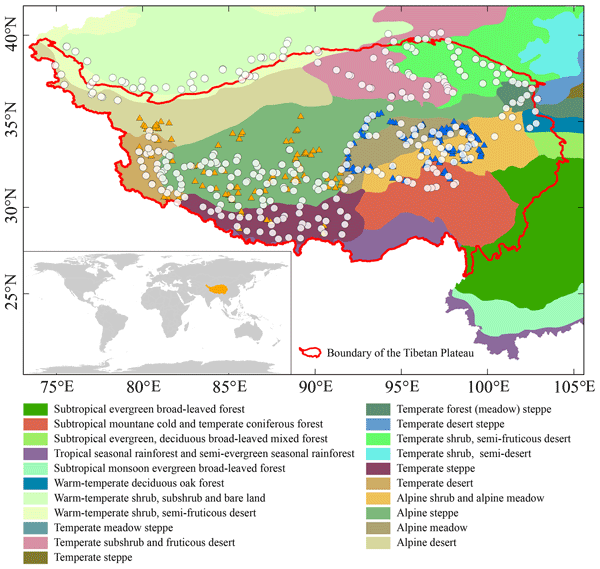
We present a modern pollen dataset comprising 555 pollen count records from 307 sites across the Tibetan Plateau (28–40° N and 75–103° E). This open-access dataset has diverse potential applications in paleoecological and paleoclimatic research. It provides a scientific basis for reconstructing temporal changes in climate and vegetation, and enables the assessment of pollen assemblages' reliability in representing the dynamics of vegetation cover, plant diversity, and functional traits.
Linfeng Wei, Jian Ni, Xianyong Cao, and Stefan Kruse
EGUsphere, https://doi.org/10.5194/egusphere-2026-3246, https://doi.org/10.5194/egusphere-2026-3246, 2026
Short summary
Short summary
Warming can push mountain forests into higher habitats, but these changes may differ between rivers in mountain range area. We studied four river corridors in the Hengduan Mountains to understand how treeline may shift by 2100. The results show that treeline may move both upward and sideways, with different patterns among rivers. This suggests that future risks to high mountain habitats should be assessed locally rather than from elevation change alone.
Mengna Liao, Kai Li, Yili Jin, Lina Liu, Xianyong Cao, and Jian Ni
Earth Syst. Sci. Data, 17, 5601–5613, https://doi.org/10.5194/essd-17-5601-2025, https://doi.org/10.5194/essd-17-5601-2025, 2025
Short summary
Short summary
We present a modern pollen dataset comprising 555 pollen count records from 307 sites across the Tibetan Plateau (28–40° N and 75–103° E). This open-access dataset has diverse potential applications in paleoecological and paleoclimatic research. It provides a scientific basis for reconstructing temporal changes in climate and vegetation, and enables the assessment of pollen assemblages' reliability in representing the dynamics of vegetation cover, plant diversity, and functional traits.
Chenzhi Li, Anne Dallmeyer, Jian Ni, Manuel Chevalier, Matteo Willeit, Andrei A. Andreev, Xianyong Cao, Laura Schild, Birgit Heim, Mareike Wieczorek, and Ulrike Herzschuh
Clim. Past, 21, 1001–1024, https://doi.org/10.5194/cp-21-1001-2025, https://doi.org/10.5194/cp-21-1001-2025, 2025
Short summary
Short summary
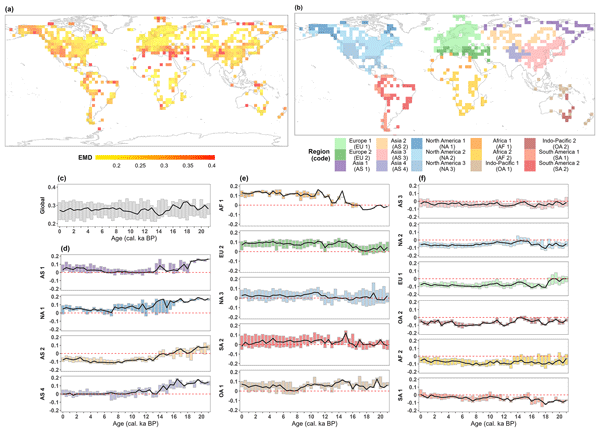
We present global megabiome dynamics and distributions derived from pollen-based reconstructions over the last 21 000 years, which are suitable for the evaluation of Earth-system-model-based paleo-megabiome simulations. We identified strong deviations between pollen- and model-derived megabiome distributions in the circum-Arctic and Tibetan Plateau areas during the Last Glacial Maximum and early deglaciation and in northern Africa and the Mediterranean region during the Holocene.
Furong Li, Marie-José Gaillard, Xianyong Cao, Ulrike Herzschuh, Shinya Sugita, Jian Ni, Yan Zhao, Chengbang An, Xiaozhong Huang, Yu Li, Hongyan Liu, Aizhi Sun, and Yifeng Yao
Earth Syst. Sci. Data, 15, 95–112, https://doi.org/10.5194/essd-15-95-2023, https://doi.org/10.5194/essd-15-95-2023, 2023
Short summary
Short summary
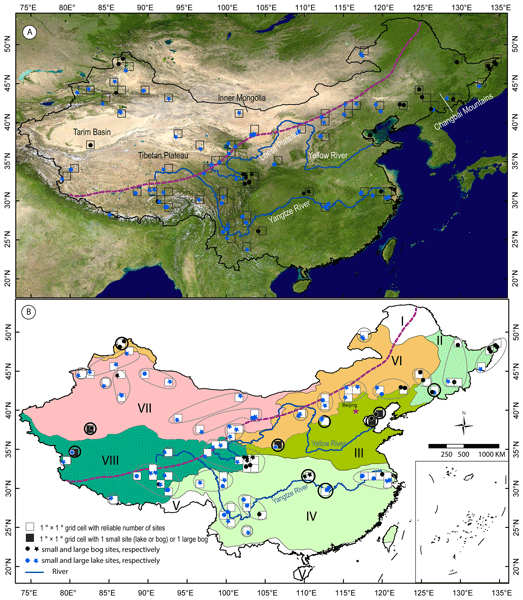
The objective of this study is present the first gridded and temporally continuous quantitative plant-cover reconstruction for temperate and northern subtropical China over the last 12 millennia. The reconstructions are based on 94 pollen records and include estimates for 27 plant taxa, 10 plant functional types, and 3 land-cover types. The dataset is suitable for palaeoclimate modelling and the evaluation of simulated past vegetation cover and anthropogenic land-cover change from models.
Yili Jin, Haoyan Wang, Jie Xia, Jian Ni, Kai Li, Ying Hou, Jing Hu, Linfeng Wei, Kai Wu, Haojun Xia, and Borui Zhou
Earth Syst. Sci. Data, 15, 25–39, https://doi.org/10.5194/essd-15-25-2023, https://doi.org/10.5194/essd-15-25-2023, 2023
Short summary
Short summary
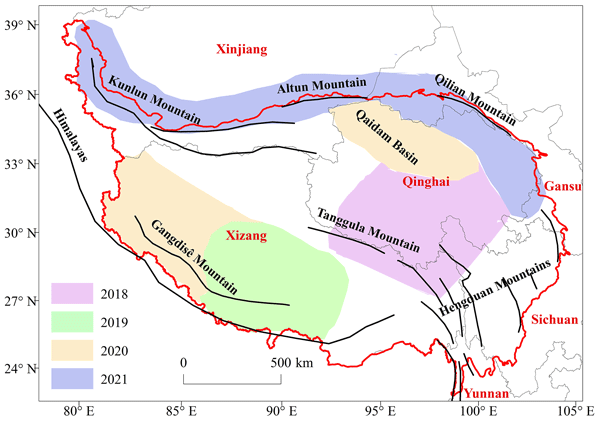
The TiP-Leaf dataset was compiled from direct field measurements and included 11 leaf traits from 468 species of 1692 individuals, covering a great proportion of species and vegetation types on the highest plateau in the world. This work is the first plant trait dataset that represents all of the alpine vegetation on the TP, which is not only an update of the Chinese plant trait database, but also a great contribution to the global trait database.
Ulrike Herzschuh, Chenzhi Li, Thomas Böhmer, Alexander K. Postl, Birgit Heim, Andrei A. Andreev, Xianyong Cao, Mareike Wieczorek, and Jian Ni
Earth Syst. Sci. Data, 14, 3213–3227, https://doi.org/10.5194/essd-14-3213-2022, https://doi.org/10.5194/essd-14-3213-2022, 2022
Short summary
Short summary
Pollen preserved in environmental archives such as lake sediments and bogs are extensively used for reconstructions of past vegetation and climate. Here we present LegacyPollen 1.0, a dataset of 2831 fossil pollen records from all over the globe that were collected from publicly available databases. We harmonized the names of the pollen taxa so that all datasets can be jointly investigated. LegacyPollen 1.0 is available as an open-access dataset.
Mengna Liao, Kai Li, Weiwei Sun, and Jian Ni
Clim. Past, 17, 2291–2303, https://doi.org/10.5194/cp-17-2291-2021, https://doi.org/10.5194/cp-17-2291-2021, 2021
Short summary
Short summary
The long-term trajectories of precipitation, hydrological balance and soil moisture are not completely consistent in southwest China. Hydrological balance was more sensitive to temperature change on a millennial scale. For soil moisture, plant processes also played a big role in addition to precipitation and temperature. Under future climate warming, surface water shortage in southwest China can be even more serious and efforts at reforestation may bring some relief to the soil moisture deficit.
Cited articles
Chi, X. F., Zhang, F. Q., Gao, Q. B., Xing, R., and Chen, S. L.: Genetic structure and eco-geographical differentiation of Lancea tibetica in the Qinghai-Tibetan Plateau, Genes, 10, 97, https://doi.org/10.3390/genes10020097, 2019.
Ding, W. N., Ree, R. H., Spicer, R. A., and Xing, Y. W.: Ancient orogenic and monsoon-driven assembly of the world's richest temperate alpine flora, Science, 369, 578–581, https://doi.org/10.1126/science.abb4484, 2020.
Editorial Committee of Flora Sichuanica: Flora Sichuanica, 21 volumes, Sichuan People's Publishing House & Sichuan Science and Technology Press, Chengdu, 1981–2012.
Editorial Committee of the Flora of China: Reipublicae Popularis Sinicae, 80 volumes, Science Press, Beijing, 1959–2004.
Editorial Committee of the Vegetation of China: Vegetation of China, Science Press, Beijing, ISBN 7030024222, 1980.
Editorial Committee of Vegetation Map of China, Chinese Academy of Sciences: Vegetation of China and Its Geographical Pattern – Illustration of the Vegetation Map of the People's Republic of China (1:1,000,000), Geology Press, Beijing, ISBN 9787116051461, 2007a.
Editorial Committee of Vegetation Map of China, Chinese Academy of Sciences: Vegetation Map of the People's Republic of China (1:1,000,000), Geology Press, Beijing, ISBN 9787116045132, 2007b.
Fang, J. Y., Wang, X. P., Shen, Z. H., Tang, Z. Y., He, J. S., Yu, D., Jiang, Y., Wang, Z. H., Zheng, C. Y., Zhu, J. L., and Guo, Z. D.: Methods and protocols for plant community inventory, Biodiv. Sci., 17, 533–548, https://www.biodiversity-science.net/CN/10.3724/SP.J.1003.2009.09253 (last access: 30 June 2026), 2009.
Fang, J. Y., Guo, K., Wang, G. H., Tang, Z. Y., Xie, Z. Q., Shen, Z. H., Wang, R. Q., Qiang, S., Liang, C. Z., Da, L. J., and Yu, D.: Vegetation classification system and classification of vegetation types used for the compilation of vegetation of China, Chin. J. Plant Ecol., 44, 96–110, 2020.
Farr, T. G., Rosen, P. A., Caro, E., Crippen, R., Duren, R., Hensley, S., Kobrick, M., Paller, M., Rodriguez, E., Roth, L., Seal, D., Shaffer, S., Shimada, J., Umland, J., Werner, M., Oskin, M., Burbank, D., and Alsdorf, D.: The Shuttle Radar Topography Mission, Rev. Geophys., 45, RG2004, https://doi.org/10.1029/2005RG000183, 2007.
Guo, K., Fang, J. Y., Wang, G. H., Tang, Z. Y., Xie, Z. Q., Shen, Z. H., Wang, R. Q., Qiang, S., Liang, C. Z., Da, L. J., and Yu, D.: A revised scheme of vegetation classification system of China, Chin. J. Plant Ecol., 44, 111–127, https://doi.org/10.17521/cjpe.2019.0271, 2020.
He, Y. L., Xiong, Q. L., Yu, L., Yan, W. B., and Qu, X. X.: Impact of climate change on potential distribution patterns of alpine vegetation in the Hengduan Mountains region, China, Mt. Res. Dev., 40, R48–R54, https://doi.org/10.1659/MRD-JOURNAL-D-20-00010.1, 2020.
Hu, X. F., Shi, S. L., Zhou, B. R., and Ni, J.: A 1 km monthly dataset of historical and future climate changes over China, Sci. Data, 12, 436, https://doi.org/10.1038/s41597-025-04761-y, 2025.
iFlora Initiative of Kunming Institute of Botany, Chinese Academy of Sciences: A Dictionary of the Families and Genera of Chinese Vascular Plants, Science Press, Beijing, ISBN 9787030551207, 2018.
Integrated Scientific Expedition to Qinghai-Tibet Plateau, Chinese Academy of Sciences: Flora Xizangica, 5 volumes, Science Press, Beijing, 1983–1987.
Jin, Y. L., Wang, H. Y., Wei, L. F., Hou, Y., Hu, J., Wu, K., Xia, H. J., Xia, J., Zhou, B. R., Li, K., and Ni, J.: A plot-based dataset of plant community on the Qingzang Plateau, Chin. J. Plant Ecol., 46, 846–854, https://doi.org/10.17521/cjpe.2022.0174, 2022.
Jin, Y. L., Yang, L. Y. Y., Hu, X. F., Yang, C., Xia, H. J., Hou, Y., Wu, K., Mao, X. X., and Ni, J.: A plot-based plant community dataset in the Hengduan Mountains and adjacent regions (2022–2024), Figshare [data set], https://doi.org/10.6084/m9.figshare.32706207, 2026a.
Jin, Y. L., Yang, L. Y. Y., Hu, X. F., Yang, C., Xia, H. J., Hou, Y., Wu, K., Mao, X. X., and Ni, J.: A plot-based plant community dataset in the Hengduan Mountains (2022–2024), National Tibetan Plateau/Third Pole Environment Data Center [data set], https://doi.org/10.11888/Terre.tpdc.303394, 2026b.
Jin, Z. Z.: Floristic features of dry-hot and dry-warm valleys, Yunnan and Sichuan, Yunnan Science and Technology Press, Kunming, ISBN 9787541617379, 2002.
Jin, Z. Z. and Ou, X. K.: Yuanjiang, Nujiang, Jinshajiang, Lancangjiang Vegetation of Dry Valley, Yunnan University Press & Yunnan Science and Technology Press, Kunming, ISBN 9787810681421, 2000.
Kunming Institute of Botany, Chinese Academy of Sciences: Flora Yunnanica, 21 volumes, Science Press, Beijing, 1977–2006.
Li, D. J.: The primary characteristics of flora in the Hengduan Mountainous regions, Mt. Res., 6, 147–152, https://doi.org/10.16089/j.cnki.1008-2786.1988.03.003, 1988.
Li, X. W.: Floristic statistics and analyses of seed plants from China, Acta Bot. Yunnan, 18, 363–384, 1996.
Liang, Q. L., Xu, X. T., Mao, K. S., Wang, M. C., Wang, K., Xi, Z. X., and Liu, J. Q.: Shifts in plant distributions in response to climate warming in a biodiversity hotspot, the Hengduan Mountains, J. Biogeogr., 45, 1334–1344, https://doi.org/10.1111/jbi.13229, 2018.
Liu, Y., Li, P., Xu, Y., Shi, S. L., Ying, L. X., Zhang, W. J., Peng, P. H., and Shen, Z. H.: Quantitative classification and ordination for plant communities in dry valleys of Southwest China, Biodiv. Sci., 24, 378–388, https://doi.org/10.17520/biods.2015241, 2016a.
Liu, Y., Zhu, X. X., Shen, Z. H., and Sun, H.: Flora compositions and spatial differentiations of vegetation in dry valleys of Southwest China, Biodiv. Sci., 24, 367–377, https://doi.org/10.17520/biods.2015240, 2016b.
Myers, N., Mittermeier, R. A., Mittermeier, C. G., da Fonseca, G. A. B., and Kent, J.: Biodiversity hotspots for conservation priorities, Nature, 403, 853–858, https://doi.org/10.1038/35002501, 2000.
Nan, X., Li, A. N., and Deng, W.: Data set of “Digital Mountain Map of China” (2015), National Tibetan Plateau/Third Pole Environment Data Center, https://doi.org/10.11888/Terre.tpdc.272523, 2022.
Piao, S. L., Zhang, X. Z., Wang, T., Liang, E. Y., Wang, S. P., Zhu, J. T., and Niu, B.: Responses and feedback of the Tibetan Plateau's alpine ecosystem to climate change, Chinese Sci. Bull., 64, 2842–2855, https://doi.org/10.1360/TB-2019-0074, 2019.
Shen, Z. H., Liu, Z. L., and Wu, J.: Altitudinal pattern of flora on the eastern slope of Mt. Gongga, Biodiv. Sci., 12, 89–98, https://doi.org/10.17520/biods.2004011, 2004.
Sherman, R., Mullen, R., Li, H. M., Fang, Z. D., and Wang, Y.: Spatial patterns of plant diversity and communities in alpine ecosystems of the Hengduan Mountains, northwest Yunnan, China, J. Plant Ecol., 1, 117–136, https://doi.org/10.1093/jpe/rtn012, 2008.
Sloan, S., Jenkins, C. N., Joppa, L. N., Gaveau, D. L. A., and Laurance, W. F.: Remaining natural vegetation in the global biodiversity hotspots, Biol. Conserv., 177, 12–24, https://doi.org/10.1016/j.biocon.2014.05.027, 2014.
Sun, H., Zhang, J. W., Deng, T., and Boufford, D. E.: Origins and evolution of plant diversity in the Hengduan Mountains, Plant Divers., 39, 161–166, https://doi.org/10.1016/j.pld.2017.09.004, 2017.
Wang, G. H., Fang, J. Y., Guo, K., Xie, Z. Q., Tang, Z. Y., Shen, Z. H., Wang, R. Q., Wang, X. P., Wang, D. L., Qiang, S., Yu, D., Peng, S. L., Da, L. J., Liu, Q., and Liang, C. Z.: Contents and protocols for the classification and description of vegetation formations, alliances and associations of vegetation of China, Chin. J. Plant Ecol., 44, 128–178, https://doi.org/10.17521/cjpe.2019.0272, 2020.
Wu, S. H., Pan, T., Cao, J., He, D. M., and Xiao, Z. N.: Barrier-corridor effect of longitudinal range-gorge terrain on monsoons in Southwest China, Geogr. Res., 31, 1–13, https://www.dlyj.ac.cn/CN/10.11821/yj2012010001 (last access: 30 June 2026), 2012.
Wu, X. J. and Yu, C. Y.: Vegetation distribution characteristics and diversity conservation in Habaxueshan Provincial Nature Reserve, Forest Inventory and Planning, 45, 47–51, 2020.
Wu, Z. Y.: The areal-types of Chinese genera of seed plants, Acta Bot. Yunnan, Suppl. IV, 1–139, https://www.integrativebiology.ac.cn/EN/abstract/abstract31833.shtml (last access: 30 June 2026), 1991.
Wu, Z. Y., Zhou, Z. K., Li, D. Z., Peng, H., and Sun, H.: The areal-types of the world families of seed plants, Acta Bot. Yunnan, 25, 245–257, https://www.integrativebiology.ac.cn/EN/abstract/abstract32639.shtml (last access: 30 June 2026), 2003.
Xing, Y. W. and Ree, R. H.: Uplift-driven diversification in the Hengduan Mountains, a temperate biodiversity hotspot, P. Natl. Acad. Sci. USA, 114, E3444–E3451, https://doi.org/10.1073/pnas.1616063114, 2017.
Xu, B., Li, Z. M., and Sun, H.: Plant diversity and floristic characters of the alpine subnival belt flora in the Hengduan Mountains, SW China, J. Syst. Evol., 52, 271–279, https://doi.org/10.1111/jse.12037, 2014.
Xu, C. D., Feng, J. M., Wang, X. P., and Yang, X.: Vertical distribution patterns of plant species diversity in northern Mt. Gaoligong, Yunnan Province, Chin. J. Ecol., 27, 323–330, 2008.
Yang, J. D., Zhang, Z. M., Shen, Z. H., Ou, X. K., Geng, Y. P., and Yang, M. Y.: Review of research on the vegetation and environment of dry-hot valleys in Yunnan, Biodiv. Sci., 24, 462–474, https://doi.org/10.17520/biods.2015251, 2016a.
Yang, Q. Y. and Zheng, D.: An outline of physico-geographic regionalization of the Hengduan Mountains region, Mt. Res., 7, 56–64, https://doi.org/10.16089/j.cnki.1008-2786.1989.01.010, 1989.
Yang, Y., Han, J., Liu, Y., Zhong-Yong, C. R., Shi, S. L., Si-Na, C. L., Xu, Y., Ying, L. X., Zhang, W. J., and Shen, Z. H.: A comparison of the altitudinal patterns in plant species diversity within the dry valleys of the Three Parallel Rivers region, northwestern Yunnan, Biodiv. Sci., 24, 440–452, https://doi.org/10.17520/biods.2015361, 2016b.
Yao, Y. H., Zhang, B. P., Han, F., and Pang, Y.: Diversity and geographical pattern of altitudinal belts in the Hengduan Mountains in China, J. Mt. Sci., 7, 123–132, https://doi.org/10.1007/s11629-010-1011-9, 2010.
Yin, L., Dai, E. F., Zheng, D., Wang, Y. H., Ma, L., and Tong, M.: What drives the vegetation dynamics in the Hengduan Mountain region, southwest China: climate change or human activity?, Ecol. Indic., 112, 106013, https://doi.org/10.1016/j.ecolind.2019.106013, 2020.
Yu, H. B., Miao, S. Y., Xie, G. W., Guo, X. Y., Chen, Z., and Favre, A.: Contrasting floristic diversity of the Hengduan Mountains, the Himalayas and the Qinghai-Tibet Plateau sensu stricto in China, Front. Ecol. Evol., 8, 136, https://doi.org/10.3389/fevo.2020.00136, 2020.
Yu, Y. D., Liu, L. H., and Zhang, J. H.: Vegetation regionalization of the Hengduan Mountains region, Mt. Res., 7, 47–55, https://doi.org/10.16089/j.cnki.1008-2786.1989.01.009, 1989.
Zhang, H. N., Zou, W., Chen, Z., He, L. J., Peng, X. F., Wang, G. Y., Peng, P. H., Li, J. J., and Shi, S. L.: Distribution pattern of plant communities and its relationship with environmental factors in eastern Xizang, China, Chin. J. Appl. Environ. Biol., 29, 1289–1297, https://doi.org/10.19675/j.cnki.1006-687x.2022.10037, 2023.
Zhang, R. Z., Zheng, D., Yang, Q. Y., and Liu, Y. H.: Physical Geography of Hengduan Mountains, Science Press, Beijing, ISBN 9787030055729, 1997.
Zhang, S. R.: Carex, in: Flora of Pan-Himalaya, edited by: Hong, D. Y., Sun, H., Watson, M., Wen, J., and Zhang, X. C., Vol. 12, Science Press, Beijing, ISBN 9787030623546, 2020.
Zhang, X. Q., Xu, X. M., Li, X., Cui, P., and Zheng, D.: A new scheme of climate-vegetation regionalization in the Hengduan Mountains region, Sci. China Earth Sci., 67, 751–768, https://doi.org/10.1007/s11430-023-1231-0, 2024.
Zhang, X. Z., Yang, Y. P., Piao, S. L., Bao, W. K., Wang, S. P., Wang, G. X., Sun, H., Luo, T. X., Zhang, Y. J., Shi, P. L., Liang, E. Y., Shen, M. G., Wang, J. S., Gao, Q. Z., Zhang, Y. L., and Ouyang, H.: Ecological change on the Tibetan Plateau, Chinese Sci. Bull., 60, 3048–3056, https://doi.org/10.1360/N972014-01339, 2015.
Zheng, D.: A comparative study on physico-geographic conditions between the Himalayas and Hengduan Mountainous regions, Mt. Res., 6, 137–144, 1988.
Zheng, D. and Yang, Q. Y.: Some problems on physicogeographic regionalization of the Hengduan Mountains region, Mt. Res., 5, 7–13, 1987.
Short summary
Vegetation plot databases have been widely developed, yet the Hengduan Mountains (HDM), one of the world’s richest biodiversity hotspots, remain insufficiently represented. The HDM-Plot dataset was compiled from field surveys conducted between 2022 and 2024 and includes 314 plots with 14 113 individual records from lowland dry-hot valleys to alpine ecosystems. It provides updated and standardized plot data for vegetation classification, mapping, and biodiversity research in mountain regions.
Vegetation plot databases have been widely developed, yet the Hengduan Mountains (HDM), one of...


Altmetrics
Final-revised paper
Preprint