Articles | Volume 17, issue 12
https://doi.org/10.5194/essd-17-6669-2025
© Author(s) 2025. This work is distributed under
the Creative Commons Attribution 4.0 License.
the Creative Commons Attribution 4.0 License.
https://doi.org/10.5194/essd-17-6669-2025
© Author(s) 2025. This work is distributed under
the Creative Commons Attribution 4.0 License.
the Creative Commons Attribution 4.0 License.
Data description article
| 
01 Dec 2025
Data description article |
| 01 Dec 2025
| 01 Dec 2025
Global spatially-distributed sectoral GDP map for disaster risk analysis

Graduate School of Engineering, The University of Tokyo, Tokyo, 113-8656, Japan
Institute of Industrial Science, The University of Tokyo, Tokyo, 153-8505, Japan
Kiyoharu Kajiyama
Institute of Industrial Science, The University of Tokyo, Tokyo, 153-8505, Japan
Dai Yamazaki
Graduate School of Engineering, The University of Tokyo, Tokyo, 113-8656, Japan
Institute of Industrial Science, The University of Tokyo, Tokyo, 153-8505, Japan
Yuki Kita
Institute of Industrial Science, The University of Tokyo, Tokyo, 153-8505, Japan
Gaia Vision Inc., Tokyo, Japan
Megumi Watanabe
Institute of Industrial Science, The University of Tokyo, Tokyo, 153-8505, Japan
LIRA, Observatoire de Paris, Paris, 75014, France
Related authors
No articles found.
Naota Hanasaki, Kiyoharu Kajiyama, Yuga Takahashi, Kazufumi Yabu, Yuika Maniwa, and Shinjiro Kanae
EGUsphere, https://doi.org/10.5194/egusphere-2026-5322, https://doi.org/10.5194/egusphere-2026-5322, 2026
This preprint is open for discussion and under review for Geoscientific Model Development (GMD).
Short summary
Short summary
We propose a simple but efficient method for representing cities in global hydrological models. That is, abstract water from sources, distribute it within the city boundary, drain it through sewage, and return it to the downstream water body. Our method enables modelers to conduct city-level water scarcity assessments (i.e., one water scarcity score per city), which offers a clear advantage over conventional basin- or grid-level assessments.
Cinzia Mazzetti, Hannah Cloke, Dai Yamazaki, Gianpaolo Balsamo, Souhail Boussetta, Jasper Denissen, Michel Wortmann, Gabriele Arduini, Gurpreet Dass, Joe McNorton, Anna Agusti-Panareda, Maliko Tanguy, Ervin Zsoter, Margarita Choulga, Emanuel Dutra, Florian Pappenberger, Christoph Rüdiger, and Christel Prudhomme
EGUsphere, https://doi.org/10.5194/egusphere-2026-4305, https://doi.org/10.5194/egusphere-2026-4305, 2026
This preprint is open for discussion and under review for Geoscientific Model Development (GMD).
Short summary
Short summary
Rivers are an essential component of the water cycle, yet many Earth system and weather prediction models do not explicitly represent river flow. We integrated a global river model into ECMWF's forecasting system, enabling the simulation of river discharge, water levels, and flooding within a single operational framework. This development lays the foundation for future land–river–atmosphere interactions, paving the way for more complete Earth system models and improved predictions.
Shengyu Kang, Jiabo Yin, and Dai Yamazaki
Geosci. Model Dev., 19, 5623–5640, https://doi.org/10.5194/gmd-19-5623-2026, https://doi.org/10.5194/gmd-19-5623-2026, 2026
Short summary
Short summary
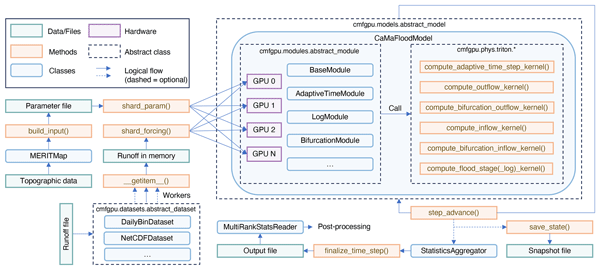
Global floods pose serious risks, but existing models are too slow for large-scale prediction. We redesigned the Catchment-based Macro-scale Floodplain (CaMa-Flood) model for graphics processing units (GPUs), reformulating irregular river networks, flux updates, and floodplain dynamics into highly parallel algorithms. CaMa-Flood-GPU runs global simulations in hours instead of days with the same accuracy, enabling larger ensembles, better flood-risk analysis, and improved preparedness worldwide.
Karan Ruparell, Dai Yamazaki, Kieran Hunt, Hannah Cloke, Christel Prudhomme, Florian Pappenberger, and Matthew Chantry
EGUsphere, https://doi.org/10.5194/egusphere-2026-2909, https://doi.org/10.5194/egusphere-2026-2909, 2026
Short summary
Short summary
Reservoirs change how rivers behave, making them harder to predict. We tested whether machine learning models can learn these effects by training on river sites with and without upstream reservoirs across Great Britain. Models without reservoir training overestimated regulated flows, while reservoir-only models performed poorly on natural rivers. Training on both performed well everywhere. All models failed at heavily managed reservoirs where human decisions dominate river flow.
Julien E. S. Boulange, Fang Zhao, Simon N. Gosling, Yadu Pokhrel, Dai Yamazaki, and Xudong Zhou
EGUsphere, https://doi.org/10.5194/egusphere-2026-2739, https://doi.org/10.5194/egusphere-2026-2739, 2026
Short summary
Short summary
Many flood-prone regions lack the river observations needed for flood planning. We compared two widely used global datasets by testing how well they reproduced observed river flow at more than 5,000 gauging stations worldwide. One dataset better captured daily river flow changes, while the other provided more reliable estimates of long-term change. The results show that the most suitable dataset depends on whether the goal is flood monitoring or long-term risk assessment.
Muhammad Hasnain Aslam, Yukiko Hirabayashi, Dai Yamazaki, Gang Zhao, Yuki Kita, and Do Ngoc Khanh
Geosci. Model Dev., 19, 3709–3724, https://doi.org/10.5194/gmd-19-3709-2026, https://doi.org/10.5194/gmd-19-3709-2026, 2026
Short summary
Short summary
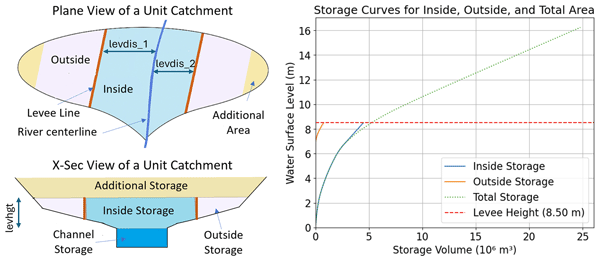
We present a simple method that turns coarse flood volume estimates into local flood depth maps by using the shape of the land and mapped levee zones. Used with a large-scale river model, it keeps total water volume consistent while spreading water realistically inside and outside levees. Tests show levees often confine water and cut flood volume by about 10 %–15 % for many event sizes. The method reveals place-to-place differences in protection and yields clearer hazard maps for planning.
Bernhard Lehner, Mira Anand, Etienne Fluet-Chouinard, Florence Tan, Filipe Aires, George H. Allen, Philippe Bousquet, Josep G. Canadell, Nick Davidson, Meng Ding, C. Max Finlayson, Thomas Gumbricht, Lammert Hilarides, Gustaf Hugelius, Robert B. Jackson, Maartje C. Korver, Liangyun Liu, Peter B. McIntyre, Szabolcs Nagy, David Olefeldt, Tamlin M. Pavelsky, Jean-Francois Pekel, Benjamin Poulter, Catherine Prigent, Jida Wang, Thomas A. Worthington, Dai Yamazaki, Xiao Zhang, and Michele Thieme
Earth Syst. Sci. Data, 17, 2277–2329, https://doi.org/10.5194/essd-17-2277-2025, https://doi.org/10.5194/essd-17-2277-2025, 2025
Short summary
Short summary
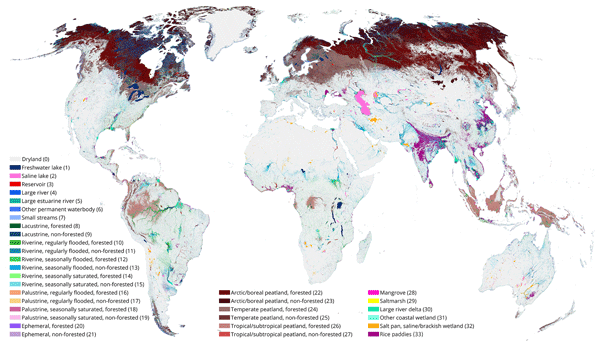
The Global Lakes and Wetlands Database (GLWD) version 2 distinguishes a total of 33 non-overlapping wetland classes, providing a static map of the world’s inland surface waters. It contains cell fractions of wetland extents per class at a grid cell resolution of ~500 m. The total combined extent of all classes including all inland and coastal waterbodies and wetlands of all inundation frequencies – that is, the maximum extent – covers 18.2 × 10⁶ km2, equivalent to 13.4 % of total global land area.
Yuki Kimura, Yukiko Hirabayashi, and Dai Yamazaki
EGUsphere, https://doi.org/10.22541/essoar.170365204.46854879/v1, https://doi.org/10.22541/essoar.170365204.46854879/v1, 2024
Preprint archived
Short summary
Short summary
The limited number of ensemble members causes uncertainty in future climate predictions. To address this, using multiple simulations under a single future climate scenario can increase the sample size, but data availability is limited in the scenario-based future projection experiment of climate model intercomparison projects. Our proposed method integrates multiple climate scenarios at specific temperature increases, effectively reducing uncertainty in future flood hazard assessments globally.
Menaka Revel, Xudong Zhou, Prakat Modi, Jean-François Cretaux, Stephane Calmant, and Dai Yamazaki
Earth Syst. Sci. Data, 16, 75–88, https://doi.org/10.5194/essd-16-75-2024, https://doi.org/10.5194/essd-16-75-2024, 2024
Short summary
Short summary
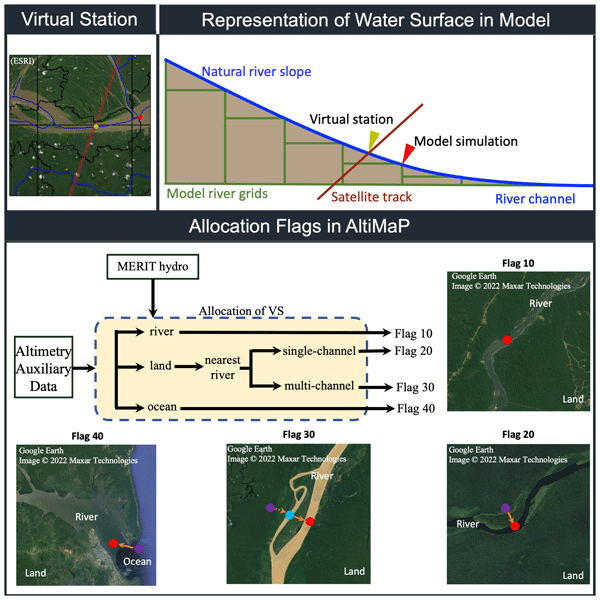
As satellite technology advances, there is an incredible amount of remotely sensed data for observing terrestrial water. Satellite altimetry observations of water heights can be utilized to calibrate and validate large-scale hydrodynamic models. However, because large-scale models are discontinuous, comparing satellite altimetry to predicted water surface elevation is difficult. We developed a satellite altimetry mapping procedure for high-resolution river network data.
Md Safat Sikder, Jida Wang, George H. Allen, Yongwei Sheng, Dai Yamazaki, Chunqiao Song, Meng Ding, Jean-François Crétaux, and Tamlin M. Pavelsky
Earth Syst. Sci. Data, 15, 3483–3511, https://doi.org/10.5194/essd-15-3483-2023, https://doi.org/10.5194/essd-15-3483-2023, 2023
Short summary
Short summary
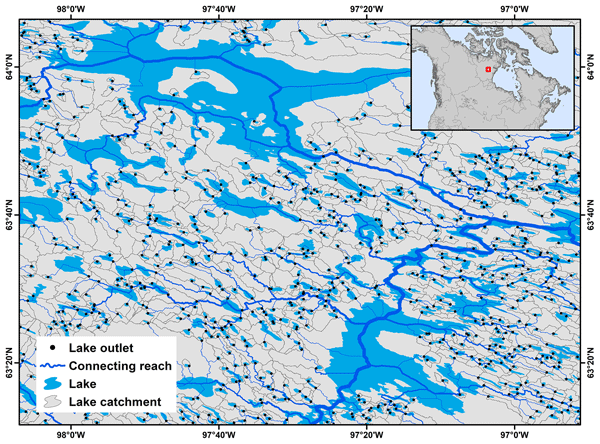
We introduce Lake-TopoCat to reveal detailed lake hydrography information. It contains the location of lake outlets, the boundary of lake catchments, and a wide suite of attributes that depict detailed lake drainage relationships. It was constructed using lake boundaries from a global lake dataset, with the help of high-resolution hydrography data. This database may facilitate a variety of applications including water quality, agriculture and fisheries, and integrated lake–river modeling.
Youjiang Shen, Karina Nielsen, Menaka Revel, Dedi Liu, and Dai Yamazaki
Earth Syst. Sci. Data, 15, 2781–2808, https://doi.org/10.5194/essd-15-2781-2023, https://doi.org/10.5194/essd-15-2781-2023, 2023
Short summary
Short summary
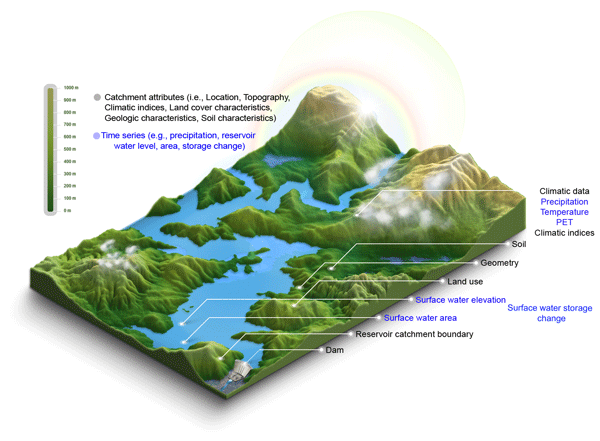
Res-CN fills a gap in a comprehensive and extensive dataset of reservoir-catchment characteristics for 3254 Chinese reservoirs with 512 catchment-level attributes and significantly enhanced spatial and temporal coverage (e.g., 67 % increase in water level and 225 % in storage anomaly) of time series of reservoir water level (data available for 20 % of 3254 reservoirs), water area (99 %), storage anomaly (92 %), and evaporation (98 %), supporting a wide range of applications and disciplines.
Yuki Kimura, Yukiko Hirabayashi, Yuki Kita, Xudong Zhou, and Dai Yamazaki
Hydrol. Earth Syst. Sci., 27, 1627–1644, https://doi.org/10.5194/hess-27-1627-2023, https://doi.org/10.5194/hess-27-1627-2023, 2023
Short summary
Short summary
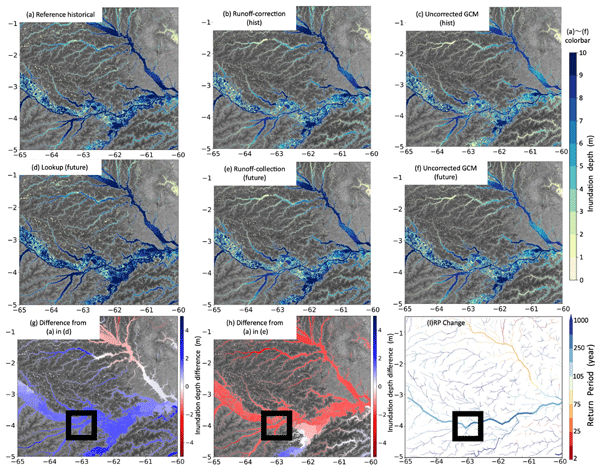
Since both the frequency and magnitude of flood will increase by climate change, information on spatial distributions of potential inundation depths (i.e., flood-hazard map) is required. We developed a method for constructing realistic future flood-hazard maps which addresses issues due to biases in climate models. A larger population is estimated to face risk in the future flood-hazard map, suggesting that only focusing on flood-frequency change could cause underestimation of future risk.
Dirk Eilander, Anaïs Couasnon, Tim Leijnse, Hiroaki Ikeuchi, Dai Yamazaki, Sanne Muis, Job Dullaart, Arjen Haag, Hessel C. Winsemius, and Philip J. Ward
Nat. Hazards Earth Syst. Sci., 23, 823–846, https://doi.org/10.5194/nhess-23-823-2023, https://doi.org/10.5194/nhess-23-823-2023, 2023
Short summary
Short summary
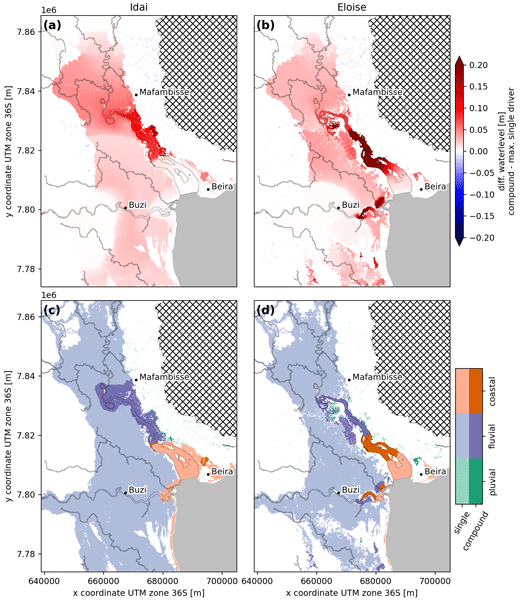
In coastal deltas, flooding can occur from interactions between coastal, riverine, and pluvial drivers, so-called compound flooding. Global models however ignore these interactions. We present a framework for automated and reproducible compound flood modeling anywhere globally and validate it for two historical events in Mozambique with good results. The analysis reveals differences in compound flood dynamics between both events related to the magnitude of and time lag between drivers.
Menaka Revel, Xudong Zhou, Dai Yamazaki, and Shinjiro Kanae
Hydrol. Earth Syst. Sci., 27, 647–671, https://doi.org/10.5194/hess-27-647-2023, https://doi.org/10.5194/hess-27-647-2023, 2023
Short summary
Short summary
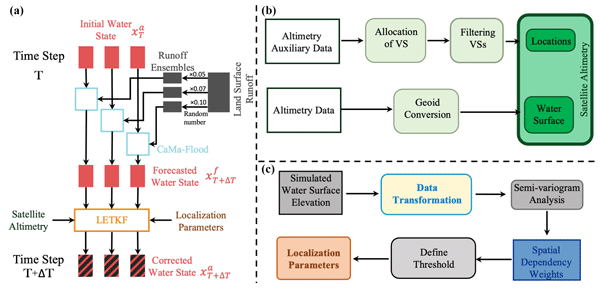
The capacity to discern surface water improved as satellites became more available. Because remote sensing data is discontinuous, integrating models with satellite observations will improve knowledge of water resources. However, given the current limitations (e.g., parameter errors) of water resource modeling, merging satellite data with simulations is problematic. Integrating observations and models with the unique approaches given here can lead to a better estimation of surface water dynamics.
Robert J. Parker, Chris Wilson, Edward Comyn-Platt, Garry Hayman, Toby R. Marthews, A. Anthony Bloom, Mark F. Lunt, Nicola Gedney, Simon J. Dadson, Joe McNorton, Neil Humpage, Hartmut Boesch, Martyn P. Chipperfield, Paul I. Palmer, and Dai Yamazaki
Biogeosciences, 19, 5779–5805, https://doi.org/10.5194/bg-19-5779-2022, https://doi.org/10.5194/bg-19-5779-2022, 2022
Short summary
Short summary
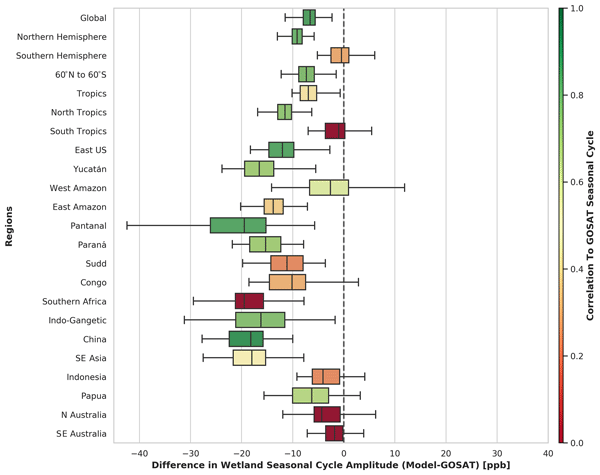
Wetlands are the largest natural source of methane, one of the most important climate gases. The JULES land surface model simulates these emissions. We use satellite data to evaluate how well JULES reproduces the methane seasonal cycle over different tropical wetlands. It performs well for most regions; however, it struggles for some African wetlands influenced heavily by river flooding. We explain the reasons for these deficiencies and highlight how future development will improve these areas.
Toby R. Marthews, Simon J. Dadson, Douglas B. Clark, Eleanor M. Blyth, Garry D. Hayman, Dai Yamazaki, Olivia R. E. Becher, Alberto Martínez-de la Torre, Catherine Prigent, and Carlos Jiménez
Hydrol. Earth Syst. Sci., 26, 3151–3175, https://doi.org/10.5194/hess-26-3151-2022, https://doi.org/10.5194/hess-26-3151-2022, 2022
Short summary
Short summary
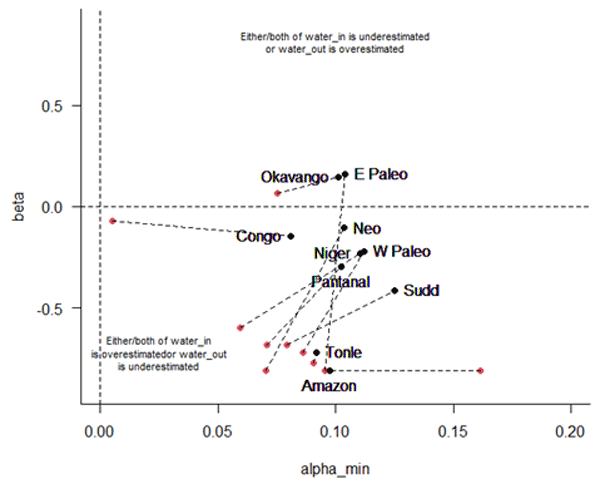
Reliable data on global inundated areas remain uncertain. By matching a leading global data product on inundation extents (GIEMS) against predictions from a global hydrodynamic model (CaMa-Flood), we found small but consistent and non-random biases in well-known tropical wetlands (Sudd, Pantanal, Amazon and Congo). These result from known limitations in the data and the models used, which shows us how to improve our ability to make critical predictions of inundation events in the future.
Cited articles
Alfieri, L., Bisselink, B., Dottori, F., Naumann, G., De Roo, A., Salamon, P., Wyser, K., and Feyen, L.: Global projections of river flood risk in a warmer world, Earth's Future, 5, 171–182, 2017.
Bontemps, S., Herold, M., Kooistra, L., van Groenestijn, A., Hartley, A., Arino, O., Moreau, I., and Defourny, P.: Revisiting land cover observation to address the needs of the climate modeling community, Biogeosciences, 9, 2145–2157, https://doi.org/10.5194/bg-9-2145-2012, 2012.
Chen, J., Gao, M., Cheng, S., Hou, W., Song, M., Liu, X., and Liu, Y.: Global 1 km × 1 km gridded revised real gross domestic product and electricity consumption during 1992–2019 based on calibrated nighttime light data, Scientific Data, 9, https://doi.org/10.1038/s41597-022-01322-5, 2022.
Ciccone, A. and Hall, R. E.: Productivity and the density of economic activity, The American Economic Review, 86, 54–70, 1996.
De Moel, H., Van Vliet, M., and Aerts, J. C. J. H.: Evaluating the effect of flood damage-reducing measures: a case study of the unembanked area of Rotterdam, the Netherlands, Regional Environmental Change, 14, 895–908, 2014.
Dottori, F., Szewczyk, W., Ciscar, J., Zhao, F., Alfieri, L., Hirabayashi, Y., Bianchi, A., Mongelli, I., Frieler, K., Betts, R. A., and Feyen, L.: Increased human and economic losses from river flooding with anthropogenic warming, Nature Climate Change, 8, 781–786, 2018.
Duan, Y., Xiong, J., Cheng, W., Li, Y., Wang, N., Shen, G., and Yang, J.: Increasing Global Flood Risk in 2005–2020 from a Multi-Scale Perspective, Remote Sensing, 14, 5551, https://doi.org/10.3390/rs14215551, 2022.
Esch, T., Heldens, W., Hirner, A., Keil, M., Marconcini, M., Roth, A., Zeidler, J., Dech, S., and Strano, E.: Breaking new ground in mapping human settlements from space – The Global Urban Footprint, ISPRS Journal of Photogrammetry and Remote Sensing, 134, 30–42, 2017.
GADM: GADM 4.1, https://gadm.org/data.html (last access: 18 October 2025), 2025.
GDAL/OGR contributors: GDAL/OGR Geospatial Data Abstraction software Library, Open Source Geospatial Foundation, https://gdal.org (last access: 18 October 2025), 2024.
Iizumi, T., Takikawa, H., Hirabayashi, Y., Hanasaki, N., and Nishimori, M.: Contributions of different bias-correction methods and reference meteorological forcing data sets to uncertainty in projected temperature and precipitation extremes, Journal of Geophysical Research-Atmospheres, https://doi.org/10.1002/2017JD026613, 2017.
IPCC: Managing the Risks of Extreme Events and Disasters to Advance Climate Change Adaptation, A Special Report of Working Groups I and II of the Intergovernmental Panel on Climate Change, 582 pp., https://doi.org/10.13140/2.1.3117.9529, 2012.
Jongman, B., Kreibich, H., Apel, H., Barredo, J. I., Bates, P. D., Feyen, L., Gericke, A., Neal, J., Aerts, J. C. J. H., and Ward, P. J.: Comparative flood damage model assessment: towards a European approach, Nat. Hazards Earth Syst. Sci., 12, 3733–3752, https://doi.org/10.5194/nhess-12-3733-2012, 2012.
Kummu, M., Maija, T., and Guillaume, J. H. A.: Gridded global datasets for gross domestic product and human development index over 1990–2015, Scientific Data, 5, 180004, https://doi.org/10.1038/sdata.2018.4, 2018.
Kummu, M., Kosonen, M., and Masoumzadeh Sayyar, S.: Downscaled gridded global dataset for gross domestic product (GDP) per capita PPP over 1990–2022, Scientific Data, 12, 178, https://doi.org/10.1038/s41597-025-04487-x, 2025.
Ministry of Economy, Trade, and Industry: A survey on industry statistics, https://www.meti.go.jp/statistics/tyo/kougyo/result-2/h10/kakuho/youti/youti1.html (last access: 18 October 2025), 2007.
Ministry of Land, Infrastructure, Transport and Tourism: Mesh Data of Subdivided Land Use in Urban Area, https://nlftp.mlit.go.jp/ksj/gml/datalist/KsjTmplt-L03-b-u.html (last access: 18 October 2025), 2021.
Morikawa, M.: Economies of density and productivity in service industries: An analysis of personal service industries based on establishment-level data, Review of Economics and Statistics, 93, 179–192, 2011.
Murakami, D. and Yamagata, Y.: Estimation of gridded population and GDP scenarios with spatially explicit statistical downscaling, Sustainability, 11, 2106, https://doi.org/10.3390/su11072106, 2019.
Pesaresi, M. and Politis, P.: GHS-BUILT-S R2022A: GHS built-up surface grid, derived from Sentinel2 composite and Landsat, multitemporal (1975–2030), European Commission, Joint Research Centre (JRC), https://doi.org/10.2905/D07D81B4-7680-4D28-B896-583745C27085, 2022.
Potapov, P., Svetlana, T., Matthew, C. H., Alexandra, T., Viviana, Z., Ahmad, K., Xiao-Peng, S., Amy, P., Quan, S., and Jocelyn, C.: Global maps of cropland extent and change show accelerated cropland expansion in the twenty-first century, Nature Food, 3, 19–28, 2022.
Rose, A.: Economic Principles, Issues, and Research Priorities in Hazard Loss Estimation. Modeling Spatial and Economic Impacts of Disasters, Springer Berlin Heidelberg, Berlin, Heidelberg, 13–36, https://doi.org/10.1007/978-3-540-24787-6_2, 2004.
Ru, Y., Blankespoor, B., Wood-Sichra, U., Thomas, T. S., You, L., and Kalvelagen, E.: Estimating local agricultural gross domestic product (AgGDP) across the world, Earth Syst. Sci. Data, 15, 1357–1387, https://doi.org/10.5194/essd-15-1357-2023, 2023.
Shoji, T., Yamazaki, D., Kita, Y., and Megumi, W.: Global Sectoral GDP map at 30” resolution (SectGDP30) v2.0, Zenodo [data set], https://doi.org/10.5281/zenodo.15774017, 2025.
Sieg, T., Thomas, S., Kristin, V., Reinhard, M., Bruno, M., and Heidi, K.: Integrated assessment of short-term direct and indirect economic flood impacts including uncertainty quantification, PLOS ONE, 14, e0212932, https://doi.org/10.1371/journal.pone.0212932, 2019.
Taguchi, R., Tanoue, M., Yamazaki, D., and Hirabayashi, Y.: Global-scale assessment of economic losses caused by flood-related business interruption, Water, 14, 967, https://doi.org/10.3390/w14060967, 2022.
Tanoue, M., Taguchi, R., Nakata, S., Watanabe, S., Fujimori, S., and Hirabayashi, Y.: Estimation of direct and indirect economic losses caused by a flood with long-lasting inundation: Application to the 2011 Thailand flood, Water Resources Research 56, https://doi.org/10.1029/2019WR026092, 2020.
Tanoue, M., Taguchi, R., Alifu, H., and Hirabayashi, Y.: Residual flood damage under intensive adaptation, Nature Climate Change, 11, 823–826, 2021.
Tellman, B., Sullivan, J. A., Kuhn, C., Kettner, A. J., Doyle, C. S., Brakenridge, G. R., Erickson, T. A., and Slayback, D. A.: Satellite imaging reveals increased proportion of population exposed to floods, Nature, 596, 80–86, 2021.
The European Environmental Agency: CORINE Land Cover, https://land.copernicus.eu/en/products/corine-land-cover?tab=main (last access: 18 October 2025), 2017.
Theobald, D. M.: Development and Applications of a Comprehensive Land Use Classification and Map for the US, PLoS ONE, 9, e94628, https://doi.org/10.1371/journal.pone.0094628, 2014.
Wenz, L. and Willner, S. N.: 18. Climate impacts and global supply chains: An overview, Handbook on Trade Policy and Climate Change, 290, https://doi.org/10.4337/9781839103247, 2022.
Wenz, L., Carr, R. D., Kögel, N., Kotz, M., and Kalkuhl, M.: DOSE – Global data set of reported sub-national economic output, Sci. Data, 10, 425, https://doi.org/10.1038/s41597-023-02323-8, 2023.
Willner, S. N., Otto, C., and Levermann, A.: Global economic response to river floods, Nature Climate Change, 8, 594–598, 2018.
The World Bank: 2011 Thailand Floods: Rapid Assessment for Resilient Recovery and Reconstruction Planning, https://recovery.preventionweb.net/publication/2011-thailand-floods-rapid-assessment-resilient-recovery-and-reconstruction-planning (last access: 18 October 2025), 2011.
The World Bank: World Development Indicators, https://databank.worldbank.org/source/world-development-indicators (last access: 18 October 2025), 2023.
Yamazaki, D., Kanae, S., Kim, H., and Oki, T.: A physically-based description of floodplain inundation dynamics in a global river routing model: floodplain inundation dynamics, Water Resources Research, 47, w04501, https://doi.org/10.1029/2010WR009726, 2011.
Zhuang, L. and Ye, C.: More sprawl than agglomeration: The multi-scale spatial patterns and industrial characteristics of varied development zones in China, Cities, 140, 104406, https://doi.org/10.1016/j.cities.2023.104406, 2023.
Short summary
This study addressed the essential need for detailed spatial economic data to accurately assess global economic losses from natural disasters by developing high-resolution global maps of sector-specific (Service, Industry, and Agriculture) Gross Domestic Product (GDP) for 2010, 2015, and 2020. The new maps showed improved accuracy in reflecting local economies, revealing that sectoral GDP distribution differs by country and affects disaster impact estimates.
This study addressed the essential need for detailed spatial economic data to accurately assess...


Altmetrics
Final-revised paper
Preprint