Articles | Volume 17, issue 12
https://doi.org/10.5194/essd-17-6647-2025
© Author(s) 2025. This work is distributed under
the Creative Commons Attribution 4.0 License.
https://doi.org/10.5194/essd-17-6647-2025
© Author(s) 2025. This work is distributed under
the Creative Commons Attribution 4.0 License.
GlobalBuildingAtlas: an open global and complete dataset of building polygons, heights and LoD1 3D models

Technical University of Munich, Munich, Germany
Munich Center for Machine Learning, Munich, Germany
Sining Chen
Technical University of Munich, Munich, Germany
Munich Center for Machine Learning, Munich, Germany
Fahong Zhang
Technical University of Munich, Munich, Germany
Yilei Shi
Technical University of Munich, Munich, Germany
Yuanyuan Wang
Technical University of Munich, Munich, Germany
Related authors
Yang Mu, Zhitong Xiong, Yi Wang, Muhammad Shahzad, Franz Essl, Holger Kreft, Mark van Kleunen, and Xiao Xiang Zhu
Earth Syst. Sci. Data Discuss., https://doi.org/10.5194/essd-2025-613, https://doi.org/10.5194/essd-2025-613, 2025
Preprint under review for ESSD
Short summary
Short summary
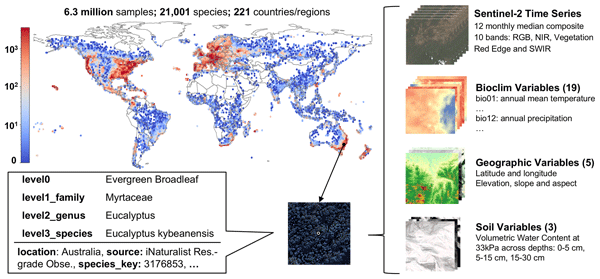
To better protect our planet's forests, we need to know what trees are where. We created GlobalGeoTree, a massive public dataset linking 6.3 million tree locations worldwide with satellite data. This dataset helps computers learn to identify tree species from space, supporting biodiversity monitoring and climate action. Our baseline model shows this is a promising path to understanding global forests.
Zhenghang Yuan, Zhitong Xiong, Lichao Mou, and Xiao Xiang Zhu
Earth Syst. Sci. Data, 17, 1245–1263, https://doi.org/10.5194/essd-17-1245-2025, https://doi.org/10.5194/essd-17-1245-2025, 2025
Short summary
Short summary
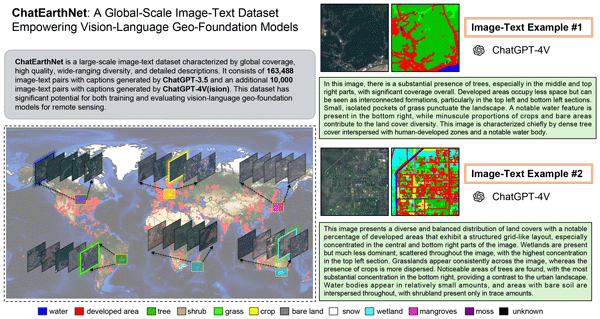
ChatEarthNet is an image–text dataset that provides high-quality, detailed natural language descriptions for global-scale satellite data. It consists of 163 488 image-text pairs with captions generated by ChatGPT-3.5 and an additional 10 000 image-text pairs with captions generated by ChatGPT-4V(ision). This dataset has significant potential for training and evaluating vision–language geo-foundation models in remote sensing.
Viola Steidl, Jonathan Louis Bamber, and Xiao Xiang Zhu
The Cryosphere, 19, 645–661, https://doi.org/10.5194/tc-19-645-2025, https://doi.org/10.5194/tc-19-645-2025, 2025
Short summary
Short summary
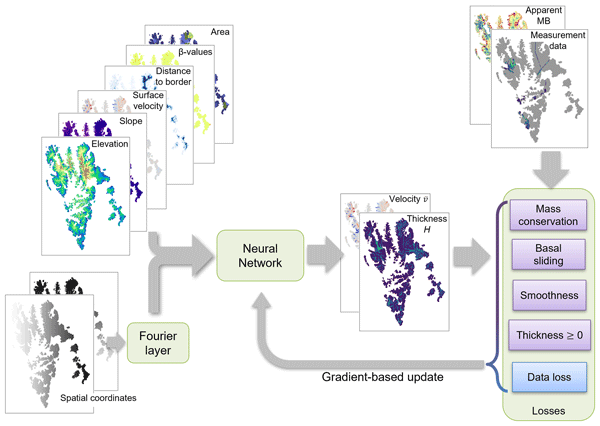
Glacier ice thickness is difficult to measure directly but is essential for glacier evolution modelling. In this work, we employ a novel approach combining physical knowledge and data-driven machine learning to estimate the ice thickness of multiple glaciers in Spitsbergen, Barentsøya, and Edgeøya in Svalbard. We identify challenges for the physics-aware machine learning model and opportunities for improving the accuracy and physical consistency that would also apply to other geophysical tasks.
Yifan Tian, Yao Sun, and Xiao Xiang Zhu
Abstr. Int. Cartogr. Assoc., 7, 171, https://doi.org/10.5194/ica-abs-7-171-2024, https://doi.org/10.5194/ica-abs-7-171-2024, 2024
Erik Loebel, Mirko Scheinert, Martin Horwath, Angelika Humbert, Julia Sohn, Konrad Heidler, Charlotte Liebezeit, and Xiao Xiang Zhu
The Cryosphere, 18, 3315–3332, https://doi.org/10.5194/tc-18-3315-2024, https://doi.org/10.5194/tc-18-3315-2024, 2024
Short summary
Short summary
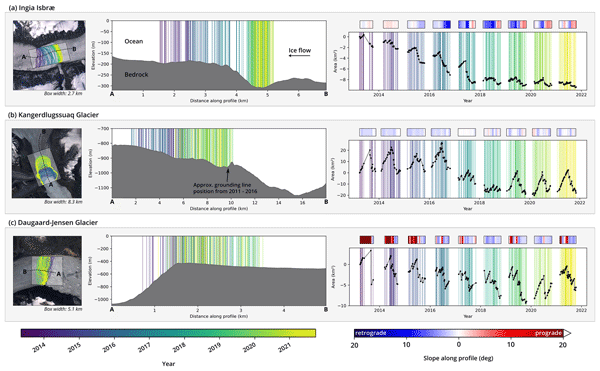
Comprehensive datasets of calving-front changes are essential for studying and modeling outlet glaciers. Current records are limited in temporal resolution due to manual delineation. We use deep learning to automatically delineate calving fronts for 23 glaciers in Greenland. Resulting time series resolve long-term, seasonal, and subseasonal patterns. We discuss the implications of our results and provide the cryosphere community with a data product and an implementation of our processing system.
Weiyan Lin, Jiasong Zhu, Yuansheng Hua, Qingyu Li, Lichao Mou, and Xiao Xiang Zhu
Int. Arch. Photogramm. Remote Sens. Spatial Inf. Sci., XLVIII-1-2024, 371–378, https://doi.org/10.5194/isprs-archives-XLVIII-1-2024-371-2024, https://doi.org/10.5194/isprs-archives-XLVIII-1-2024-371-2024, 2024
Tian Li, Konrad Heidler, Lichao Mou, Ádám Ignéczi, Xiao Xiang Zhu, and Jonathan L. Bamber
Earth Syst. Sci. Data, 16, 919–939, https://doi.org/10.5194/essd-16-919-2024, https://doi.org/10.5194/essd-16-919-2024, 2024
Short summary
Short summary
Our study uses deep learning to produce a new high-resolution calving front dataset for 149 marine-terminating glaciers in Svalbard from 1985 to 2023, containing 124 919 terminus traces. This dataset offers insights into understanding calving mechanisms and can help improve glacier frontal ablation estimates as a component of the integrated mass balance assessment.
Y. Sun, A. Kruspe, L. Meng, Y. Tian, E. J. Hoffmann, S. Auer, and X. X. Zhu
Int. Arch. Photogramm. Remote Sens. Spatial Inf. Sci., XLVIII-1-W2-2023, 225–232, https://doi.org/10.5194/isprs-archives-XLVIII-1-W2-2023-225-2023, https://doi.org/10.5194/isprs-archives-XLVIII-1-W2-2023-225-2023, 2023
J. Zhao, F. Roth, B. Bauer-Marschallinger, W. Wagner, M. Chini, and X. X. Zhu
ISPRS Ann. Photogramm. Remote Sens. Spatial Inf. Sci., X-1-W1-2023, 911–918, https://doi.org/10.5194/isprs-annals-X-1-W1-2023-911-2023, https://doi.org/10.5194/isprs-annals-X-1-W1-2023-911-2023, 2023
Yao Sun, Stefan Auer, Liqiu Meng, and Xiao Xiang Zhu
Abstr. Int. Cartogr. Assoc., 6, 250, https://doi.org/10.5194/ica-abs-6-250-2023, https://doi.org/10.5194/ica-abs-6-250-2023, 2023
Jingliang Hu, Rong Liu, Danfeng Hong, Andrés Camero, Jing Yao, Mathias Schneider, Franz Kurz, Karl Segl, and Xiao Xiang Zhu
Earth Syst. Sci. Data, 15, 113–131, https://doi.org/10.5194/essd-15-113-2023, https://doi.org/10.5194/essd-15-113-2023, 2023
Short summary
Short summary
Multimodal data fusion is an intuitive strategy to break the limitation of individual data in Earth observation. Here, we present a multimodal data set, named MDAS, consisting of synthetic aperture radar (SAR), multispectral, hyperspectral, digital surface model (DSM), and geographic information system (GIS) data for the city of Augsburg, Germany, along with baseline models for resolution enhancement, spectral unmixing, and land cover classification, three typical remote sensing applications.
S. Zhao, S. Saha, and X. X. Zhu
Int. Arch. Photogramm. Remote Sens. Spatial Inf. Sci., XLIII-B3-2022, 1407–1413, https://doi.org/10.5194/isprs-archives-XLIII-B3-2022-1407-2022, https://doi.org/10.5194/isprs-archives-XLIII-B3-2022-1407-2022, 2022
S. Saha, J. Gawlikowski, and X. X. Zhu
Int. Arch. Photogramm. Remote Sens. Spatial Inf. Sci., XLIII-B3-2022, 423–428, https://doi.org/10.5194/isprs-archives-XLIII-B3-2022-423-2022, https://doi.org/10.5194/isprs-archives-XLIII-B3-2022-423-2022, 2022
T. Beker, H. Ansari, S. Montazeri, Q. Song, and X. X. Zhu
ISPRS Ann. Photogramm. Remote Sens. Spatial Inf. Sci., V-3-2022, 85–92, https://doi.org/10.5194/isprs-annals-V-3-2022-85-2022, https://doi.org/10.5194/isprs-annals-V-3-2022-85-2022, 2022
K. R. Traoré, A. Camero, and X. X. Zhu
ISPRS Ann. Photogramm. Remote Sens. Spatial Inf. Sci., V-3-2022, 217–224, https://doi.org/10.5194/isprs-annals-V-3-2022-217-2022, https://doi.org/10.5194/isprs-annals-V-3-2022-217-2022, 2022
Y. Xie, K. Schindler, J. Tian, and X. X. Zhu
Int. Arch. Photogramm. Remote Sens. Spatial Inf. Sci., XLIII-B2-2021, 247–254, https://doi.org/10.5194/isprs-archives-XLIII-B2-2021-247-2021, https://doi.org/10.5194/isprs-archives-XLIII-B2-2021-247-2021, 2021
P. Ebel, S. Saha, and X. X. Zhu
Int. Arch. Photogramm. Remote Sens. Spatial Inf. Sci., XLIII-B3-2021, 243–249, https://doi.org/10.5194/isprs-archives-XLIII-B3-2021-243-2021, https://doi.org/10.5194/isprs-archives-XLIII-B3-2021-243-2021, 2021
S. Saha, L. Kondmann, and X. X. Zhu
ISPRS Ann. Photogramm. Remote Sens. Spatial Inf. Sci., V-3-2021, 311–316, https://doi.org/10.5194/isprs-annals-V-3-2021-311-2021, https://doi.org/10.5194/isprs-annals-V-3-2021-311-2021, 2021
Yang Mu, Zhitong Xiong, Yi Wang, Muhammad Shahzad, Franz Essl, Holger Kreft, Mark van Kleunen, and Xiao Xiang Zhu
Earth Syst. Sci. Data Discuss., https://doi.org/10.5194/essd-2025-613, https://doi.org/10.5194/essd-2025-613, 2025
Preprint under review for ESSD
Short summary
Short summary
To better protect our planet's forests, we need to know what trees are where. We created GlobalGeoTree, a massive public dataset linking 6.3 million tree locations worldwide with satellite data. This dataset helps computers learn to identify tree species from space, supporting biodiversity monitoring and climate action. Our baseline model shows this is a promising path to understanding global forests.
Zhenghang Yuan, Zhitong Xiong, Lichao Mou, and Xiao Xiang Zhu
Earth Syst. Sci. Data, 17, 1245–1263, https://doi.org/10.5194/essd-17-1245-2025, https://doi.org/10.5194/essd-17-1245-2025, 2025
Short summary
Short summary
ChatEarthNet is an image–text dataset that provides high-quality, detailed natural language descriptions for global-scale satellite data. It consists of 163 488 image-text pairs with captions generated by ChatGPT-3.5 and an additional 10 000 image-text pairs with captions generated by ChatGPT-4V(ision). This dataset has significant potential for training and evaluating vision–language geo-foundation models in remote sensing.
Viola Steidl, Jonathan Louis Bamber, and Xiao Xiang Zhu
The Cryosphere, 19, 645–661, https://doi.org/10.5194/tc-19-645-2025, https://doi.org/10.5194/tc-19-645-2025, 2025
Short summary
Short summary
Glacier ice thickness is difficult to measure directly but is essential for glacier evolution modelling. In this work, we employ a novel approach combining physical knowledge and data-driven machine learning to estimate the ice thickness of multiple glaciers in Spitsbergen, Barentsøya, and Edgeøya in Svalbard. We identify challenges for the physics-aware machine learning model and opportunities for improving the accuracy and physical consistency that would also apply to other geophysical tasks.
Yifan Tian, Yao Sun, and Xiao Xiang Zhu
Abstr. Int. Cartogr. Assoc., 7, 171, https://doi.org/10.5194/ica-abs-7-171-2024, https://doi.org/10.5194/ica-abs-7-171-2024, 2024
Erik Loebel, Mirko Scheinert, Martin Horwath, Angelika Humbert, Julia Sohn, Konrad Heidler, Charlotte Liebezeit, and Xiao Xiang Zhu
The Cryosphere, 18, 3315–3332, https://doi.org/10.5194/tc-18-3315-2024, https://doi.org/10.5194/tc-18-3315-2024, 2024
Short summary
Short summary
Comprehensive datasets of calving-front changes are essential for studying and modeling outlet glaciers. Current records are limited in temporal resolution due to manual delineation. We use deep learning to automatically delineate calving fronts for 23 glaciers in Greenland. Resulting time series resolve long-term, seasonal, and subseasonal patterns. We discuss the implications of our results and provide the cryosphere community with a data product and an implementation of our processing system.
Weiyan Lin, Jiasong Zhu, Yuansheng Hua, Qingyu Li, Lichao Mou, and Xiao Xiang Zhu
Int. Arch. Photogramm. Remote Sens. Spatial Inf. Sci., XLVIII-1-2024, 371–378, https://doi.org/10.5194/isprs-archives-XLVIII-1-2024-371-2024, https://doi.org/10.5194/isprs-archives-XLVIII-1-2024-371-2024, 2024
Tian Li, Konrad Heidler, Lichao Mou, Ádám Ignéczi, Xiao Xiang Zhu, and Jonathan L. Bamber
Earth Syst. Sci. Data, 16, 919–939, https://doi.org/10.5194/essd-16-919-2024, https://doi.org/10.5194/essd-16-919-2024, 2024
Short summary
Short summary
Our study uses deep learning to produce a new high-resolution calving front dataset for 149 marine-terminating glaciers in Svalbard from 1985 to 2023, containing 124 919 terminus traces. This dataset offers insights into understanding calving mechanisms and can help improve glacier frontal ablation estimates as a component of the integrated mass balance assessment.
Y. Sun, A. Kruspe, L. Meng, Y. Tian, E. J. Hoffmann, S. Auer, and X. X. Zhu
Int. Arch. Photogramm. Remote Sens. Spatial Inf. Sci., XLVIII-1-W2-2023, 225–232, https://doi.org/10.5194/isprs-archives-XLVIII-1-W2-2023-225-2023, https://doi.org/10.5194/isprs-archives-XLVIII-1-W2-2023-225-2023, 2023
J. Zhao, F. Roth, B. Bauer-Marschallinger, W. Wagner, M. Chini, and X. X. Zhu
ISPRS Ann. Photogramm. Remote Sens. Spatial Inf. Sci., X-1-W1-2023, 911–918, https://doi.org/10.5194/isprs-annals-X-1-W1-2023-911-2023, https://doi.org/10.5194/isprs-annals-X-1-W1-2023-911-2023, 2023
Yao Sun, Stefan Auer, Liqiu Meng, and Xiao Xiang Zhu
Abstr. Int. Cartogr. Assoc., 6, 250, https://doi.org/10.5194/ica-abs-6-250-2023, https://doi.org/10.5194/ica-abs-6-250-2023, 2023
Jingliang Hu, Rong Liu, Danfeng Hong, Andrés Camero, Jing Yao, Mathias Schneider, Franz Kurz, Karl Segl, and Xiao Xiang Zhu
Earth Syst. Sci. Data, 15, 113–131, https://doi.org/10.5194/essd-15-113-2023, https://doi.org/10.5194/essd-15-113-2023, 2023
Short summary
Short summary
Multimodal data fusion is an intuitive strategy to break the limitation of individual data in Earth observation. Here, we present a multimodal data set, named MDAS, consisting of synthetic aperture radar (SAR), multispectral, hyperspectral, digital surface model (DSM), and geographic information system (GIS) data for the city of Augsburg, Germany, along with baseline models for resolution enhancement, spectral unmixing, and land cover classification, three typical remote sensing applications.
S. Zhao, S. Saha, and X. X. Zhu
Int. Arch. Photogramm. Remote Sens. Spatial Inf. Sci., XLIII-B3-2022, 1407–1413, https://doi.org/10.5194/isprs-archives-XLIII-B3-2022-1407-2022, https://doi.org/10.5194/isprs-archives-XLIII-B3-2022-1407-2022, 2022
S. Saha, J. Gawlikowski, and X. X. Zhu
Int. Arch. Photogramm. Remote Sens. Spatial Inf. Sci., XLIII-B3-2022, 423–428, https://doi.org/10.5194/isprs-archives-XLIII-B3-2022-423-2022, https://doi.org/10.5194/isprs-archives-XLIII-B3-2022-423-2022, 2022
T. Beker, H. Ansari, S. Montazeri, Q. Song, and X. X. Zhu
ISPRS Ann. Photogramm. Remote Sens. Spatial Inf. Sci., V-3-2022, 85–92, https://doi.org/10.5194/isprs-annals-V-3-2022-85-2022, https://doi.org/10.5194/isprs-annals-V-3-2022-85-2022, 2022
K. R. Traoré, A. Camero, and X. X. Zhu
ISPRS Ann. Photogramm. Remote Sens. Spatial Inf. Sci., V-3-2022, 217–224, https://doi.org/10.5194/isprs-annals-V-3-2022-217-2022, https://doi.org/10.5194/isprs-annals-V-3-2022-217-2022, 2022
Y. Xie, K. Schindler, J. Tian, and X. X. Zhu
Int. Arch. Photogramm. Remote Sens. Spatial Inf. Sci., XLIII-B2-2021, 247–254, https://doi.org/10.5194/isprs-archives-XLIII-B2-2021-247-2021, https://doi.org/10.5194/isprs-archives-XLIII-B2-2021-247-2021, 2021
P. Ebel, S. Saha, and X. X. Zhu
Int. Arch. Photogramm. Remote Sens. Spatial Inf. Sci., XLIII-B3-2021, 243–249, https://doi.org/10.5194/isprs-archives-XLIII-B3-2021-243-2021, https://doi.org/10.5194/isprs-archives-XLIII-B3-2021-243-2021, 2021
S. Saha, L. Kondmann, and X. X. Zhu
ISPRS Ann. Photogramm. Remote Sens. Spatial Inf. Sci., V-3-2021, 311–316, https://doi.org/10.5194/isprs-annals-V-3-2021-311-2021, https://doi.org/10.5194/isprs-annals-V-3-2021-311-2021, 2021
Cited articles
Cao, Y. and Huang, X.: A deep learning method for building height estimation using high-resolution multi-view imagery over urban areas: A case study of 42 Chinese cities, Remote Sensing of Environment, 264, 112590, https://doi.org/10.1016/j.rse.2021.112590, 2021. a
Che, Y., Li, X., Liu, X., Wang, Y., Liao, W., Zheng, X., Zhang, X., Xu, X., Shi, Q., Zhu, J., Zhang, H., Yuan, H., and Dai, Y.: 3D-GloBFP: the first global three-dimensional building footprint dataset, Earth Syst. Sci. Data, 16, 5357–5374, https://doi.org/10.5194/essd-16-5357-2024, 2024. a, b, c, d
Chen, S., Shi, Y., Xiong, Z., and Zhu, X. X.: HTC-DC Net: Monocular Height Estimation From Single Remote Sensing Images, IEEE Transactions on Geoscience and Remote Sensing, 61, 1–18, https://doi.org/10.1109/TGRS.2023.3321255, 2023. a
City of Helsinki: Helsinki 3D City Model, [3D model], https://hri.fi/data/en_GB/dataset/helsingin-3d-kaupunkimalli (last access: 1 November 2025), 2017. a
Dosovitskiy, A., Beyer, L., Kolesnikov, A., Weissenborn, D., Zhai, X., Unterthiner, T., Dehghani, M., Minderer, M., Heigold, G., Gelly, S., Uszkoreit, J., and Houlsby, N.: An image is worth 16 × 16 words: Transformers for image recognition at scale, arXiv [preprint], https://doi.org/10.48550/arXiv.2010.11929, 2020. a
Esch, T., Thiel, M., Schenk, A., Roth, A., Müller, A., and Dech, S.: Delineation of Urban Footprints From TerraSAR-X Data by Analyzing Speckle Characteristics and Intensity Information, IEEE Transactions on Geoscience and Remote Sensing, 48, 905–916, https://doi.org/10.1109/TGRS.2009.2037144, 2010. a
Esch, T., Schenk, A., Ullmann, T., Thiel, M., Roth, A., and Dech, S.: Characterization of Land Cover Types in TerraSAR-X Images by Combined Analysis of Speckle Statistics and Intensity Information, IEEE Transactions on Geoscience and Remote Sensing, 49, 1911–1925, https://doi.org/10.1109/TGRS.2010.2091644, 2011. a
Esch, T., Taubenböck, H., Roth, A., Heldens, W., Felbier, A., Thiel, M., Schmidt, M., Müller, A., and Dech, S.: TanDEM-X Mission – New Perspectives for the Inventory and Monitoring of Global Settlement Patterns, Journal of Applied Remote Sensing, 6, 061702, https://doi.org/10.1117/1.JRS.6.061702, 2012. a
Esch, T., Marconcini, M., Felbier, A., Roth, A., Heldens, W., Huber, M., Schwinger, M., Taubenböck, H., Müller, A., and Dech, S.: Urban Footprint Processor – Fully Automated Processing Chain Generating Settlement Masks from Global Data of the TanDEM-X Mission, IEEE Geoscience and Remote Sensing Letters, 10, 1617–1621, https://doi.org/10.1109/LGRS.2013.2272953, 2013. a
Esch, T., Zeidler, J., Palacios-Lopez, D., Marconcini, M., Roth, A., Mönks, M., Leutner, B., Brzoska, E., Metz-Marconcini, A., Bachofer, F., Loekken, S., and Dech, S.: Towards a Large-Scale 3D Modeling of the Built Environment—Joint Analysis of TanDEM-X, Sentinel-2 and Open Street Map Data, Remote Sensing, 12, 2391, https://doi.org/10.3390/rs12152391, 2020. a, b
Esch, T., Brzoska, E., Dech, S., Leutner, B., Palacios-Lopez, D., Metz-Marconcini, A., Marconcini, M., Roth, A., and Zeidler, J.: World Settlement Footprint 3D – A first three-dimensional survey of the global building stock, Remote Sensing of Environment, 270, 112877, https://doi.org/10.1016/j.rse.2021.112877, 2022. a, b, c, d
Eurostat: Population distribution – GEOSTAT, https://ec.europa.eu/eurostat/web/gisco/geodata/population-distribution/population-grids (last access: 24 November 2025), 2021. a
Everingham, M., Van Gool, L., Williams, C. K., Winn, J., and Zisserman, A.: The pascal visual object classes (voc) challenge, International journal of computer vision, International Journal of Computer Vision, 88, 303–338, 2010. a
GADM: Global Administrative Areas (GADM), https://gadm.org/data.html (last access: 23 April 2025), 2025. a
Liu, Z., Mao, H., Wu, C.-Y., Feichtenhofer, C., Darrell, T., and Xie, S.: A convnet for the 2020s, in: Proceedings of the IEEE/CVF conference on computer vision and pattern recognition, 11976–11986, https://doi.org/10.48550/arXiv.2201.03545, 2022. a
Loshchilov, I. and Hutter, F.: Decoupled weight decay regularization, arXiv [preprint], https://doi.org/10.48550/arXiv.1711.05101, 2019. a, b
Ma, X., Zheng, G., Xu, C., Moskal, L. M., Gong, P., Guo, Q., Huang, H., Li, X., Liang, X., Pang, Y., Wang, C., Xie, H., Yu, B., Zhao, B., and Zhou, Y.: A global product of 150-m urban building height based on spaceborne lidar, Scientific Data, 11, 1387, https://doi.org/10.1038/s41597-024-04237-5, 2024. a, b
Ministry of Land, Infrastructure, Transport and Tourism (MLIT) Japan: PLATEAU 3D City Model, [3D city model], https://www.geospatial.jp/ckan/dataset/plateau (last access: 1 November 2025), 2024. a
OpenStreetMap contributors: OpenStreetMap, available under the Open Database License, https://www.openstreetmap.org (last access: 30 April 2025), 2025. a
Pennsylvania State University: Philadelphia 3D City Model, [3D city model], https://www.pasda.psu.edu/uci/DataSummary.aspx?dataset=7146 (last access: 1 November 2025), 2015. a
Pesaresi, M. and Politis, P.: GHS-BUILT-H R2023A – GHS building height, derived from AW3D30, SRTM30, and Sentinel-2 composite (2018) [data set], https://doi.org/10.2905/85005901-3A49-48DD-9D19-6261354F56FE, 2023a. a, b, c
Pesaresi, M. and Politis, P.: GHS-BUILT-V R2023A – GHS built-up volume grids derived from joint assessment of Sentinel-2, Landsat, and global DEM data, multitemporal (1975–2030), European Commission, Joint Research Centre (JRC) [data set], https://doi.org/10.2905/AB2F107A-03CD-47A3-85E5-139D8EC63283, 2023b. a, b
Pesaresi, M., Schiavina, M., Politis, P., Freire, S., Krasnodębska, K., Uhl, J. H., Carioli, A., Corbane, C., Dijkstra, L., Florio, P., Friedrich, H. K., Gao, J., Leyk, S., Lu, L., Maffenini, L., Mari-Rivero, I., Melchiorri, M., Syrris, V., Van Den Hoek, J., and Kemper, T.: Advances on the Global Human Settlement Layer by joint assessment of Earth Observation and population survey data, International Journal of Digital Earth, 17, https://publications.jrc.ec.europa.eu/repository/handle/JRC136539 (last access: 24 November 2025), 2024. a, b
Peters, R., Dukai, B., Vitalis, S., van Liempt, J., and Stoter, J.: Automated 3D reconstruction of LoD2 and LoD1 models for all 10 million buildings of the Netherlands, Photogrammetric Engineering & Remote Sensing, 88, 3, https://doi.org/10.14358/PERS.21-00032R2, 2022. a
Shi, Q., Zhu, J., Liu, Z., Guo, H., Gao, S., Liu, M., Liu, Z., and Liu, X.: The Last Puzzle of Global Building Footprints – Mapping 280 Million Buildings in East Asia Based on VHR Images, Journal of Remote Sensing, 4, 0138, https://doi.org/10.34133/remotesensing.0138, 2024. a, b
Sirko, W., Brempong, E. A., Marcos, J. T. C., Annkah, A., Korme, A., Hassen, M. A., Sapkota, K., Shekel, T., Diack, A., Nevo, S., Hickey, J., and Quinn, J. A.: High-Resolution Building and Road Detection from Sentinel-2, arXiv [preprint], https://doi.org/10.48550/arXiv.2310.11622, 2023. a, b, c
Tan, M. and Le, Q. V.: EfficientNet: Rethinking model scaling for convolutional neural networks, arXiv [preprint], https://doi.org/10.48550/arXiv.1905.11946, 2020. a
The GDAL Development Team: GDAL – Geospatial Data Abstraction Library, https://gdal.org (last access: 2 April 2023), 2020. a
The World Bank: GDP per capita (current US$), The World Bank [data set], https://data.worldbank.org/indicator/NY.GDP.PCAP.CD (last access: 16 April 2025), 2019a. a
United Nations: The Sustainable Development Goals Report 2024, https://unstats.un.org/sdgs/report/2024/The-Sustainable-Development-Goals-Report-2024.pdf (last access: 8 April 2025), 2024. a
Xiao, T., Liu, Y., Zhou, B., Jiang, Y., and Sun, J.: Unified perceptual parsing for scene understanding, arXiv [preprint], https://doi.org/10.48550/arXiv.1807.10221, 2018. a
Zanaga, D., Van De Kerchove, R., De Keersmaecker, W., Souverijns, N., Brockmann, C., Quast, R., Wevers, J., Grosu, A., Paccini, A., Vergnaud, S., Cartus, O., Santoro, M., Fritz, S., Georgieva, I., Lesiv, M., Carter, S., Herold, M., Li, L., Tsendbazar, N., Ramoino, F., and Arino, O.: ESA WorldCover 10 m 2020 v100, Zenodo [data set], https://doi.org/10.5281/zenodo.5571936, 2021. a
Zhang, F., Shi, Y., and Zhu, X. X.: Global Collinearity-aware Polygonizer for Polygonal Building Mapping in Remote Sensing, arXiv [preprint], https://doi.org/10.48550/arXiv.2505.01385, 2025a. a
Zhang, F., Chen, S., and Wang, Y.: zhu-xlab/GlobalBuildingAtlas: v1.0.0 (v1.0.0), Zenodo [code], https://doi.org/10.5281/zenodo.17543406, 2025b. a
Zhao, H., Shi, J., Qi, X., Wang, X., and Jia, J.: Pyramid scene parsing network, in: Proceedings of the IEEE conference on computer vision and pattern recognition, 2881–2890, https://doi.org/10.1109/CVPR.2017.660, 2017. a
Zhu, X. X., Li, Q., Shi, Y., Wang, Y., Stewart, A., and Prexl, J.: GlobalBuildingMap – Unveiling the Mystery of Global Buildings, arXiv [preprint], https://doi.org/10.48550/arXiv.2404.13911, 2024. a, b, c
Zhu, X. X., Chen, S., Zhang, F., Shi, Y., and Wang, Y.: zhu-xlab/GBA.ODbLPolygon, Hugging Face [data set], https://doi.org/10.57967/hf/6771, 2025a. a
Zhu, X. X., Chen, S., Zhang, F., Shi, Y., and Wang, Y.: GlobalBuildingAtlas: An Open Global and Complete Dataset of Building Polygons, Heights and LoD1 3D Models, TUM [data set], https://doi.org/10.14459/2025mp1782307, 2025b. a, b
Short summary
We introduce GlobalBuildingAtlas, a publicly available dataset offering global and complete coverage of building polygons (GBA.Polygon), heights (GBA.Height) and Level of Detail 1 3D models (GBA.LoD1). This is the first open dataset to offer high quality, consistent, and complete building data in 2D and 3D at the individual building level on a global scale. With more than 2.75 billion buildings worldwide, it surpasses the most comprehensive database to date by more than 1 billion buildings.
We introduce GlobalBuildingAtlas, a publicly available dataset offering global and complete...
Altmetrics
Final-revised paper
Preprint