Articles | Volume 18, issue 11
https://doi.org/10.5194/essd-18-8693-2026
© Author(s) 2026. This work is distributed under
the Creative Commons Attribution 4.0 License.
https://doi.org/10.5194/essd-18-8693-2026
© Author(s) 2026. This work is distributed under
the Creative Commons Attribution 4.0 License.
Data description article
| 
23 Nov 2026
Data description article |
| 23 Nov 2026
Historical Nansen cast temperature profiles and the ocean heat content changes since 19th century
Viktor Gouretski
CORRESPONDING AUTHOR

Institute of Atmospheric Physics, Chinese Academy of Sciences, Beijing, China
Institute of Atmospheric Physics, Chinese Academy of Sciences, Beijing, China
Institute of Atmospheric Physics, Chinese Academy of Sciences, Beijing, China
Related authors
Zhetao Tan, Lijing Cheng, Christine Coatanoan, Tanguy Szekely, Jérome Gourrion, Zhankun Wang, James Reagan, Viktor Gouretski, Rachel Killick, Xinyi Song, and Gael Forget
EGUsphere, https://doi.org/10.5194/egusphere-2026-6750, https://doi.org/10.5194/egusphere-2026-6750, 2026
This preprint is open for discussion and under review for Ocean Science (OS).
Short summary
Short summary
High-quality salinity observational data is crucial for understanding ocean changes. We used benchmark data checked by experts to compare and identify three best-practice schemes for detecting salinity errors while keeping good measurements. These best-practice schemes provide practical guidance for building more trustworthy salinity records for ocean and climate research.
Viktor Gouretski, Lijing Cheng, Juan Du, Xiaogang Xing, Fei Chai, and Zhetao Tan
Earth Syst. Sci. Data, 16, 5503–5530, https://doi.org/10.5194/essd-16-5503-2024, https://doi.org/10.5194/essd-16-5503-2024, 2024
Short summary
Short summary
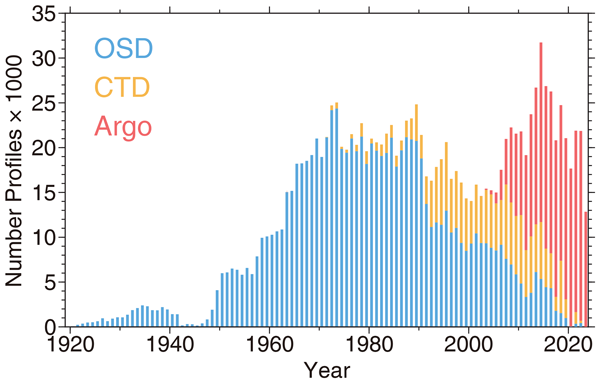
High-quality observations are crucial to understanding ocean oxygen changes and their impact on marine biota. We developed a quality control procedure to ensure the high quality of the heterogeneous ocean oxygen data archive and to prove data consistency. Oxygen data obtained by means of oxygen sensors on autonomous Argo floats were compared with reference data based on the chemical analysis, and estimates of the residual offsets were obtained.
Lijing Cheng, Yuying Pan, Zhetao Tan, Huayi Zheng, Yujing Zhu, Wangxu Wei, Juan Du, Huifeng Yuan, Guancheng Li, Hanlin Ye, Viktor Gouretski, Yuanlong Li, Kevin E. Trenberth, John Abraham, Yuchun Jin, Franco Reseghetti, Xiaopei Lin, Bin Zhang, Gengxin Chen, Michael E. Mann, and Jiang Zhu
Earth Syst. Sci. Data, 16, 3517–3546, https://doi.org/10.5194/essd-16-3517-2024, https://doi.org/10.5194/essd-16-3517-2024, 2024
Short summary
Short summary
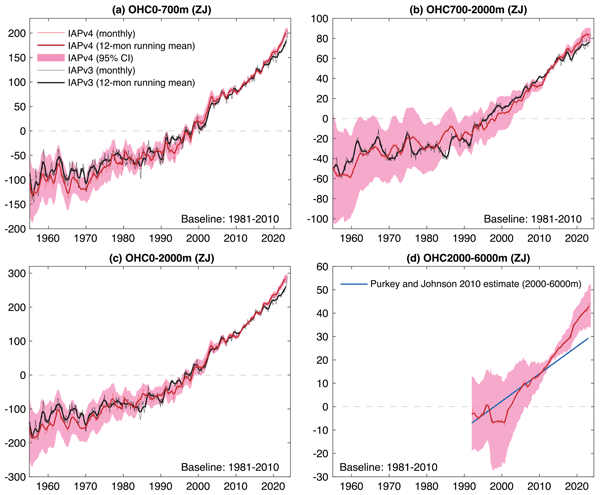
Observational gridded products are essential for understanding the ocean, the atmosphere, and climate change; they support policy decisions and socioeconomic developments. This study provides an update of an ocean subsurface temperature and ocean heat content gridded product, named the IAPv4 data product, which is available for the upper 6000 m (119 levels) since 1940 (more reliable after ~1955) for monthly and 1° × 1° temporal and spatial resolutions.
Zhetao Tan, Lijing Cheng, Christine Coatanoan, Tanguy Szekely, Jérome Gourrion, Zhankun Wang, James Reagan, Viktor Gouretski, Rachel Killick, Xinyi Song, and Gael Forget
EGUsphere, https://doi.org/10.5194/egusphere-2026-6750, https://doi.org/10.5194/egusphere-2026-6750, 2026
This preprint is open for discussion and under review for Ocean Science (OS).
Short summary
Short summary
High-quality salinity observational data is crucial for understanding ocean changes. We used benchmark data checked by experts to compare and identify three best-practice schemes for detecting salinity errors while keeping good measurements. These best-practice schemes provide practical guidance for building more trustworthy salinity records for ocean and climate research.
Haohao Zhang, Andrea Storto, Lijing Cheng, Romain Bourdallé-Badie, Satoshi Osafune, Andrea Cipollone, Caihong Wen, James A. Carton, Gaël Forget, Yuying Pan, Marie Drevillon, Karina von Schuckmann, Magdalena A. Balsamda, Matthew A. Chamberlain, and Chunxue Yang
EGUsphere, https://doi.org/10.5194/egusphere-2026-6613, https://doi.org/10.5194/egusphere-2026-6613, 2026
This preprint is open for discussion and under review for Ocean Science (OS).
Short summary
Short summary
We assess ocean heat content changes from 1993 to the present using 13 recent-generation ocean reanalyses. All ocean reanalysis data consistently show sustained global warming, mainly in the upper 2000 m. Agreement among products improves substantially in the Argo era, particularly at 700–2000 m, and exceeds that of earlier-generation reanalyses. Large uncertainties persist below 2000 m, in polar oceans, and in dynamically active regions.
Qingyou He, Yunchen Liu, Weikang Zhan, Yinghui He, Zhenting Mo, Peiya Zhang, Shuqun Cai, Lijing Cheng, and Haigang Zhan
Earth Syst. Sci. Data, 18, 7817–7838, https://doi.org/10.5194/essd-18-7817-2026, https://doi.org/10.5194/essd-18-7817-2026, 2026
Short summary
Short summary
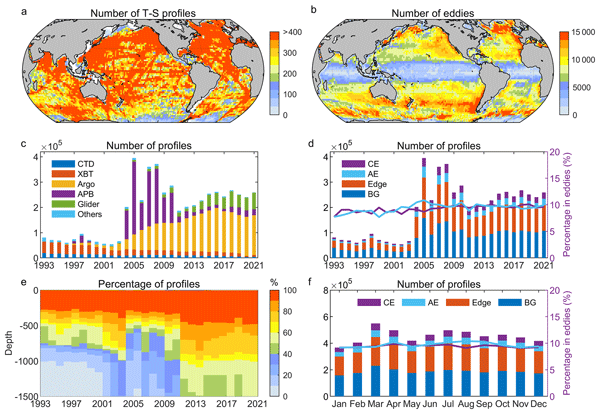
We integrated nearly 30 years of global ocean temperature and salinity profile data with satellite mesoscale eddy observations, matching 5.46 million in-situ profiles to adjacent eddies. This dataset enables researchers to characterize the regional three-dimensional eddy structure and investigate how eddies modify ocean thermohaline distributions, alter stratification and mixing, trigger extreme events, drive heat and tracer transport, and respond to climate change.

Zhaokun Wang, Bin Lu, Yi Xin, Takamitsu Ito, Lei Zhou, Lijing Cheng, Yuanlong Li, Xinbing Wang, and Meng Jin
Earth Syst. Sci. Data, 18, 5069–5092, https://doi.org/10.5194/essd-18-5069-2026, https://doi.org/10.5194/essd-18-5069-2026, 2026
Short summary
Short summary
We present Jingwei-Nutrients, a global monthly data product of ocean nitrate, phosphate, and silicate from 1965 to 2023 down to 2000 meters. Built using a multi-task deep learning framework, it combines sparse historical observations with hydrographic information. This continuous record helps scientists understand marine ecosystems and climate change responses. We also provide the Jingwei web platform (https://jingwei.acemap.info) for dynamic data exploration and visualization without coding.
Piers M. Forster, Tristram Walsh, Chris Smith, William F. Lamb, Robin Lamboll, Christophe Cassou, Mathias Hauser, Zeke Hausfather, June-Yi Lee, Matthew D. Palmer, Karina von Schuckmann, Aimée B. A. Slangen, Sophie Szopa, Blair Trewin, Jeongeun Yun, Nathan P. Gillett, Stuart Jenkins, H. Damon Matthews, Krishnan Raghavan, Aurélien Ribes, Joeri Rogelj, Debbie Rosen, Xuebin Zhang, Myles Allen, Robbie M. Andrew, Chris Atkinson, Richard A. Betts, Antonio Bombelli, Samantha N. Burgess, Lijing Cheng, Helen E. Claxton, Pierre Friedlingstein, Thomas L. Frölicher, Catia M. Domingues, Thomas Gasser, Catherine H. Gregory, Rachel M. Hoesly, Daniel Huppmann, Masayoshi Ishii, Christopher Kadow, Alexia Karwat, John Kennedy, Rachel E. Killick, Mahesh V. M. Kovilakam, Paul B. Krummel, Xin Lan, Jean-François Lamarque, Aurélien Liné, Belén Martín-Míguez, Didier P. Monselesan, Colin Morice, Jens Mühle, Pino Mussak, Glen P. Peters, Anna Pirani, Julia Pongratz, Matthew Rigby, Robert Rohde, Abhishek Savita, Sonia I. Seneviratne, Steven J. Smith, Ghassan Taha, Caterina Tassone, Peter Thorne, Christopher Wells, Luke M. Western, Guido R. van der Werf, Susan E. Wijffels, Marco Zecchetto, Junting Zhong, Xiao-Ye Zhang, Valérie Masson-Delmotte, and Panmao Zhai
Earth Syst. Sci. Data, 18, 3889–3933, https://doi.org/10.5194/essd-18-3889-2026, https://doi.org/10.5194/essd-18-3889-2026, 2026
Short summary
Short summary
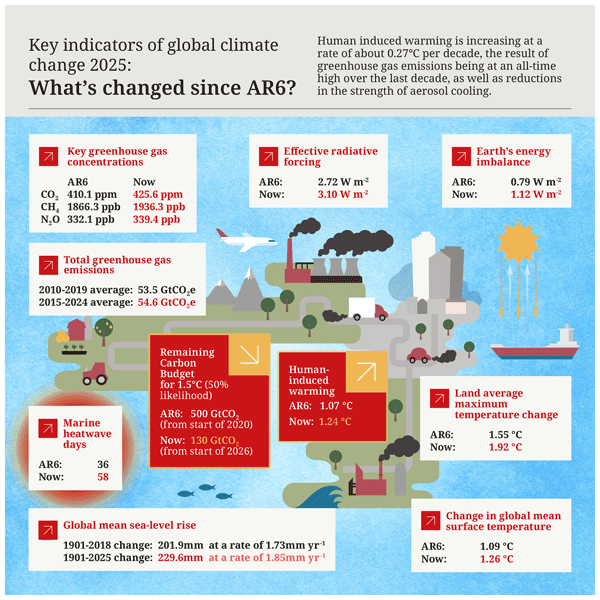
We give our annual update of key climate indicators. Our work quantifies the human contribution to global warming and the pace of climate change. This represents a large effort by the international community akin to an Intergovernmental Panel on Climate Change (IPCC) report.
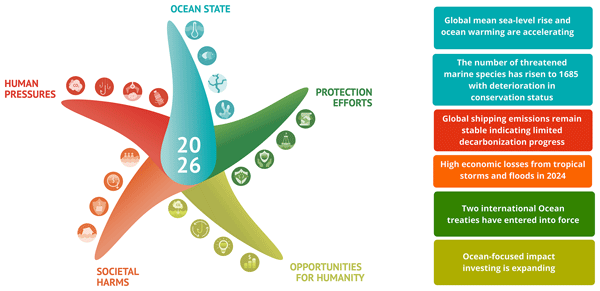
Marina Lévy, Karina von Schuckmann, Mahé Butel, William W. L. Cheung, Joachim Claudet, Thomas L. Frölicher, Patrice Guillotreau, Peter Haugan, Janine Adams, Diva Amon, Tamatoa Bambridge, Cynthia Barzuna, Bruno Blanke, Lijing Cheng, Sanae Chiba, Jorge Cortés, Pierre Friedlingstein, Jean-Pierre Gattuso, Stefan Gelcich, Jessica Gephart, Deborah Greaves, Audrey Hasson, Claire Jolly, Daoji Li, Yunne-Jai Shin, Aimée Slangen, Mere Takoko, Olivier Thébaud, Adrien Vincent, and Patrick Vincent
State Planet, 7-osr10, 1, https://doi.org/10.5194/sp-7-osr10-1-2026, https://doi.org/10.5194/sp-7-osr10-1-2026, 2026
Short summary
Short summary
The Starfish Barometer provides an annual, science-based synthesis of global Ocean-related developments, structured around five interconnected dimensions: the Ocean state, human pressures, societal harms, protection efforts, and opportunities for humanity. It is released each year on World Ocean Day. This article presents the second edition of the Barometer, which shows a growing gap between increasing human pressures on the Ocean and the efforts being made to protect it and drive change.
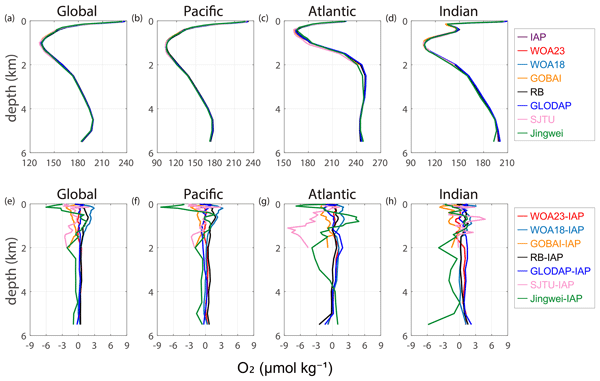
Juan Du, Lijing Cheng, Takamitsu Ito, Hernan E. Garcia, Zhankun Wang, Jonathan D. Sharp, Christopher J. Roach, Shoshiro Minobe, Yuntao Zhou, Bin Lu, Gian Giacomo Navarra, and Seth M. Bushinsky
Ocean Sci., 22, 1483–1499, https://doi.org/10.5194/os-22-1483-2026, https://doi.org/10.5194/os-22-1483-2026, 2026
Short summary
Short summary
This study assesses the spread of mean state and annual cycle of ocean dissolved oxygen by multiple observational gridded data products. A good consistency is validated globally, although substantial local differences exist in areas of strong spatial gradient. Quantifying the discrepancies could give an insight into regions relatively more sensitive to data reconstruction processes and further advance the improvement of oxygen data products.
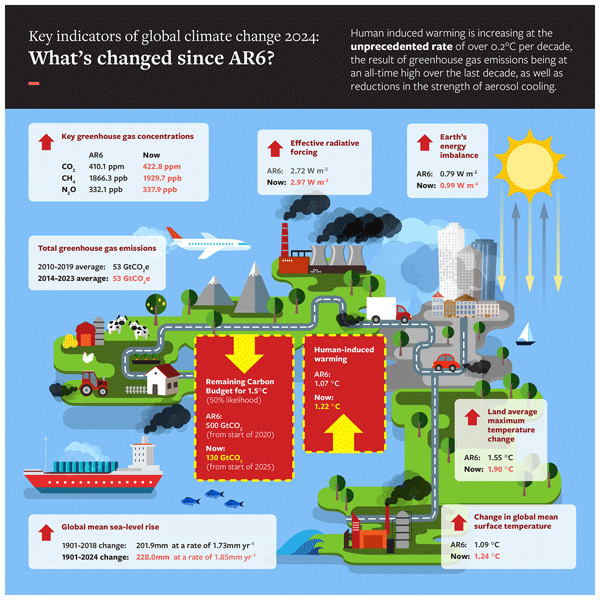
Piers M. Forster, Chris Smith, Tristram Walsh, William F. Lamb, Robin Lamboll, Christophe Cassou, Mathias Hauser, Zeke Hausfather, June-Yi Lee, Matthew D. Palmer, Karina von Schuckmann, Aimée B. A. Slangen, Sophie Szopa, Blair Trewin, Jeongeun Yun, Nathan P. Gillett, Stuart Jenkins, H. Damon Matthews, Krishnan Raghavan, Aurélien Ribes, Joeri Rogelj, Debbie Rosen, Xuebin Zhang, Myles Allen, Lara Aleluia Reis, Robbie M. Andrew, Richard A. Betts, Alex Borger, Jiddu A. Broersma, Samantha N. Burgess, Lijing Cheng, Pierre Friedlingstein, Catia M. Domingues, Marco Gambarini, Thomas Gasser, Johannes Gütschow, Masayoshi Ishii, Christopher Kadow, John Kennedy, Rachel E. Killick, Paul B. Krummel, Aurélien Liné, Didier P. Monselesan, Colin Morice, Jens Mühle, Vaishali Naik, Glen P. Peters, Anna Pirani, Julia Pongratz, Jan C. Minx, Matthew Rigby, Robert Rohde, Abhishek Savita, Sonia I. Seneviratne, Peter Thorne, Christopher Wells, Luke M. Western, Guido R. van der Werf, Susan E. Wijffels, Valérie Masson-Delmotte, and Panmao Zhai
Earth Syst. Sci. Data, 17, 2641–2680, https://doi.org/10.5194/essd-17-2641-2025, https://doi.org/10.5194/essd-17-2641-2025, 2025
Short summary
Short summary
In a rapidly changing climate, evidence-based decision-making benefits from up-to-date and timely information. Here we compile monitoring datasets to track real-world changes over time. To make our work relevant to policymakers, we follow methods from the Intergovernmental Panel on Climate Change (IPCC). Human activities are increasing the Earth's energy imbalance and driving faster sea-level rise compared to the IPCC assessment.
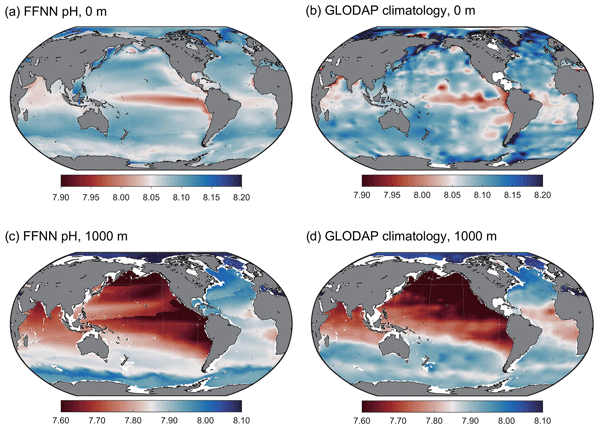
Guorong Zhong, Xuegang Li, Jinming Song, Baoxiao Qu, Fan Wang, Yanjun Wang, Bin Zhang, Lijing Cheng, Jun Ma, Huamao Yuan, Liqin Duan, Ning Li, Qidong Wang, Jianwei Xing, and Jiajia Dai
Earth Syst. Sci. Data, 17, 719–740, https://doi.org/10.5194/essd-17-719-2025, https://doi.org/10.5194/essd-17-719-2025, 2025
Short summary
Short summary
The continuous uptake of atmospheric CO2 by the ocean leads to decreasing seawater pH, which is an ongoing threat to the marine ecosystem. This pH change has been globally documented in the surface ocean, but information is limited below the surface. Here, we present a monthly 1° gridded product of global seawater pH based on a machine learning method and real pH observations. The pH product covers the years from 1992 to 2020 and depths from 0 to 2000 m.
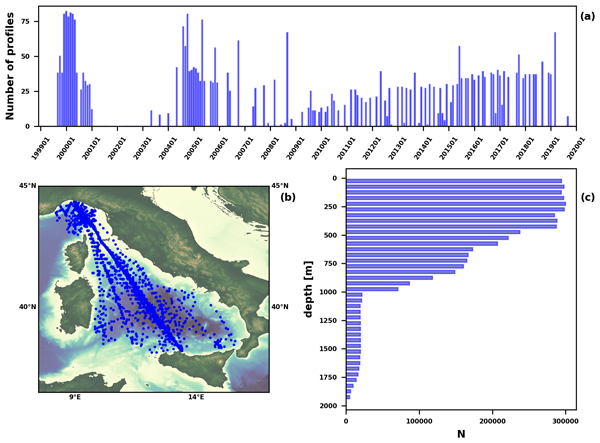
Simona Simoncelli, Franco Reseghetti, Claudia Fratianni, Lijing Cheng, and Giancarlo Raiteri
Earth Syst. Sci. Data, 16, 5531–5561, https://doi.org/10.5194/essd-16-5531-2024, https://doi.org/10.5194/essd-16-5531-2024, 2024
Short summary
Short summary
This data review is about the reprocessing of historical eXpendable BathyThermograp (XBT) profiles from the Ligurian and Tyrrhenian seas over the time period 1999–2019. A new automated quality control analysis has been performed starting from the original raw data and operational log sheets. The data have been formatted and standardized according to the latest community best practices, and all available metadata have been inserted, including calibration information and uncertainty specification.
Viktor Gouretski, Lijing Cheng, Juan Du, Xiaogang Xing, Fei Chai, and Zhetao Tan
Earth Syst. Sci. Data, 16, 5503–5530, https://doi.org/10.5194/essd-16-5503-2024, https://doi.org/10.5194/essd-16-5503-2024, 2024
Short summary
Short summary
High-quality observations are crucial to understanding ocean oxygen changes and their impact on marine biota. We developed a quality control procedure to ensure the high quality of the heterogeneous ocean oxygen data archive and to prove data consistency. Oxygen data obtained by means of oxygen sensors on autonomous Argo floats were compared with reference data based on the chemical analysis, and estimates of the residual offsets were obtained.
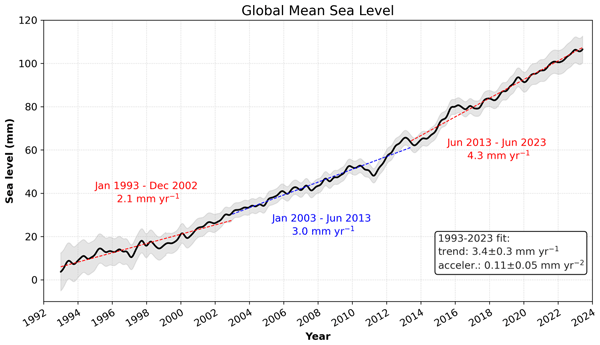
Karina von Schuckmann, Lorena Moreira, Mathilde Cancet, Flora Gues, Emmanuelle Autret, Jonathan Baker, Clément Bricaud, Romain Bourdalle-Badie, Lluis Castrillo, Lijing Cheng, Frederic Chevallier, Daniele Ciani, Alvaro de Pascual-Collar, Vincenzo De Toma, Marie Drevillon, Claudia Fanelli, Gilles Garric, Marion Gehlen, Rianne Giesen, Kevin Hodges, Doroteaciro Iovino, Simon Jandt-Scheelke, Eric Jansen, Melanie Juza, Ioanna Karagali, Thomas Lavergne, Simona Masina, Ronan McAdam, Audrey Minière, Helen Morrison, Tabea Rebekka Panteleit, Andrea Pisano, Marie-Isabelle Pujol, Ad Stoffelen, Sulian Thual, Simon Van Gennip, Pierre Veillard, Chunxue Yang, and Hao Zuo
State Planet, 4-osr8, 1, https://doi.org/10.5194/sp-4-osr8-1-2024, https://doi.org/10.5194/sp-4-osr8-1-2024, 2024
Lijing Cheng, Yuying Pan, Zhetao Tan, Huayi Zheng, Yujing Zhu, Wangxu Wei, Juan Du, Huifeng Yuan, Guancheng Li, Hanlin Ye, Viktor Gouretski, Yuanlong Li, Kevin E. Trenberth, John Abraham, Yuchun Jin, Franco Reseghetti, Xiaopei Lin, Bin Zhang, Gengxin Chen, Michael E. Mann, and Jiang Zhu
Earth Syst. Sci. Data, 16, 3517–3546, https://doi.org/10.5194/essd-16-3517-2024, https://doi.org/10.5194/essd-16-3517-2024, 2024
Short summary
Short summary
Observational gridded products are essential for understanding the ocean, the atmosphere, and climate change; they support policy decisions and socioeconomic developments. This study provides an update of an ocean subsurface temperature and ocean heat content gridded product, named the IAPv4 data product, which is available for the upper 6000 m (119 levels) since 1940 (more reliable after ~1955) for monthly and 1° × 1° temporal and spatial resolutions.
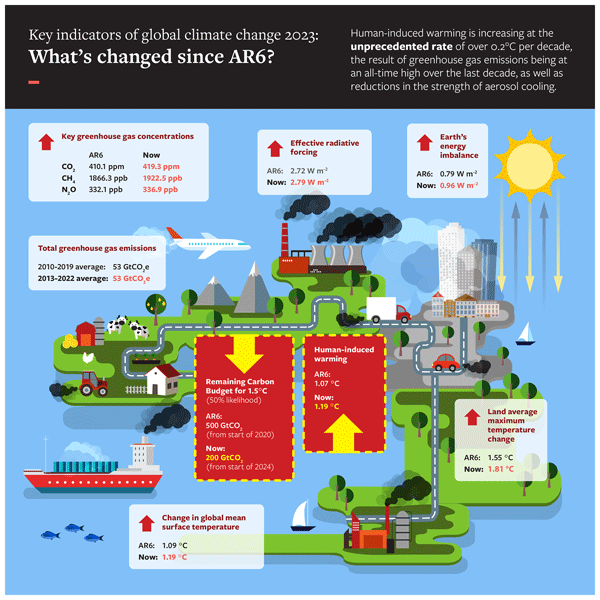
Piers M. Forster, Chris Smith, Tristram Walsh, William F. Lamb, Robin Lamboll, Bradley Hall, Mathias Hauser, Aurélien Ribes, Debbie Rosen, Nathan P. Gillett, Matthew D. Palmer, Joeri Rogelj, Karina von Schuckmann, Blair Trewin, Myles Allen, Robbie Andrew, Richard A. Betts, Alex Borger, Tim Boyer, Jiddu A. Broersma, Carlo Buontempo, Samantha Burgess, Chiara Cagnazzo, Lijing Cheng, Pierre Friedlingstein, Andrew Gettelman, Johannes Gütschow, Masayoshi Ishii, Stuart Jenkins, Xin Lan, Colin Morice, Jens Mühle, Christopher Kadow, John Kennedy, Rachel E. Killick, Paul B. Krummel, Jan C. Minx, Gunnar Myhre, Vaishali Naik, Glen P. Peters, Anna Pirani, Julia Pongratz, Carl-Friedrich Schleussner, Sonia I. Seneviratne, Sophie Szopa, Peter Thorne, Mahesh V. M. Kovilakam, Elisa Majamäki, Jukka-Pekka Jalkanen, Margreet van Marle, Rachel M. Hoesly, Robert Rohde, Dominik Schumacher, Guido van der Werf, Russell Vose, Kirsten Zickfeld, Xuebin Zhang, Valérie Masson-Delmotte, and Panmao Zhai
Earth Syst. Sci. Data, 16, 2625–2658, https://doi.org/10.5194/essd-16-2625-2024, https://doi.org/10.5194/essd-16-2625-2024, 2024
Short summary
Short summary
This paper tracks some key indicators of global warming through time, from 1850 through to the end of 2023. It is designed to give an authoritative estimate of global warming to date and its causes. We find that in 2023, global warming reached 1.3 °C and is increasing at over 0.2 °C per decade. This is caused by all-time-high greenhouse gas emissions.
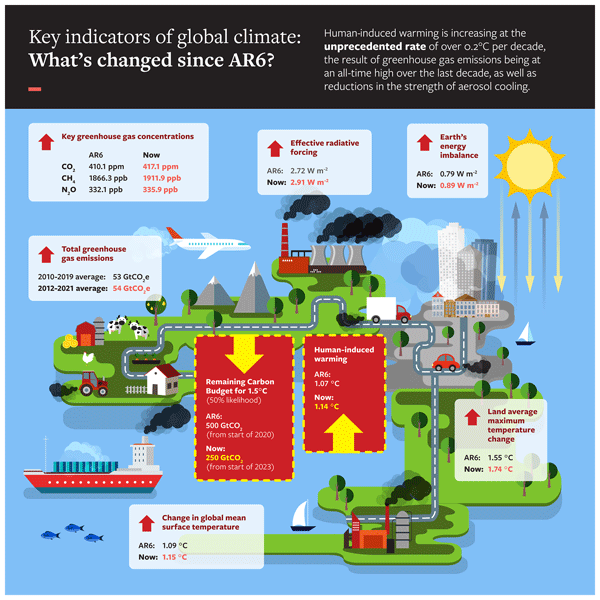
Piers M. Forster, Christopher J. Smith, Tristram Walsh, William F. Lamb, Robin Lamboll, Mathias Hauser, Aurélien Ribes, Debbie Rosen, Nathan Gillett, Matthew D. Palmer, Joeri Rogelj, Karina von Schuckmann, Sonia I. Seneviratne, Blair Trewin, Xuebin Zhang, Myles Allen, Robbie Andrew, Arlene Birt, Alex Borger, Tim Boyer, Jiddu A. Broersma, Lijing Cheng, Frank Dentener, Pierre Friedlingstein, José M. Gutiérrez, Johannes Gütschow, Bradley Hall, Masayoshi Ishii, Stuart Jenkins, Xin Lan, June-Yi Lee, Colin Morice, Christopher Kadow, John Kennedy, Rachel Killick, Jan C. Minx, Vaishali Naik, Glen P. Peters, Anna Pirani, Julia Pongratz, Carl-Friedrich Schleussner, Sophie Szopa, Peter Thorne, Robert Rohde, Maisa Rojas Corradi, Dominik Schumacher, Russell Vose, Kirsten Zickfeld, Valérie Masson-Delmotte, and Panmao Zhai
Earth Syst. Sci. Data, 15, 2295–2327, https://doi.org/10.5194/essd-15-2295-2023, https://doi.org/10.5194/essd-15-2295-2023, 2023
Short summary
Short summary
This is a critical decade for climate action, but there is no annual tracking of the level of human-induced warming. We build on the Intergovernmental Panel on Climate Change assessment reports that are authoritative but published infrequently to create a set of key global climate indicators that can be tracked through time. Our hope is that this becomes an important annual publication that policymakers, media, scientists and the public can refer to.
Karina von Schuckmann, Audrey Minière, Flora Gues, Francisco José Cuesta-Valero, Gottfried Kirchengast, Susheel Adusumilli, Fiammetta Straneo, Michaël Ablain, Richard P. Allan, Paul M. Barker, Hugo Beltrami, Alejandro Blazquez, Tim Boyer, Lijing Cheng, John Church, Damien Desbruyeres, Han Dolman, Catia M. Domingues, Almudena García-García, Donata Giglio, John E. Gilson, Maximilian Gorfer, Leopold Haimberger, Maria Z. Hakuba, Stefan Hendricks, Shigeki Hosoda, Gregory C. Johnson, Rachel Killick, Brian King, Nicolas Kolodziejczyk, Anton Korosov, Gerhard Krinner, Mikael Kuusela, Felix W. Landerer, Moritz Langer, Thomas Lavergne, Isobel Lawrence, Yuehua Li, John Lyman, Florence Marti, Ben Marzeion, Michael Mayer, Andrew H. MacDougall, Trevor McDougall, Didier Paolo Monselesan, Jan Nitzbon, Inès Otosaka, Jian Peng, Sarah Purkey, Dean Roemmich, Kanako Sato, Katsunari Sato, Abhishek Savita, Axel Schweiger, Andrew Shepherd, Sonia I. Seneviratne, Leon Simons, Donald A. Slater, Thomas Slater, Andrea K. Steiner, Toshio Suga, Tanguy Szekely, Wim Thiery, Mary-Louise Timmermans, Inne Vanderkelen, Susan E. Wjiffels, Tonghua Wu, and Michael Zemp
Earth Syst. Sci. Data, 15, 1675–1709, https://doi.org/10.5194/essd-15-1675-2023, https://doi.org/10.5194/essd-15-1675-2023, 2023
Short summary
Short summary
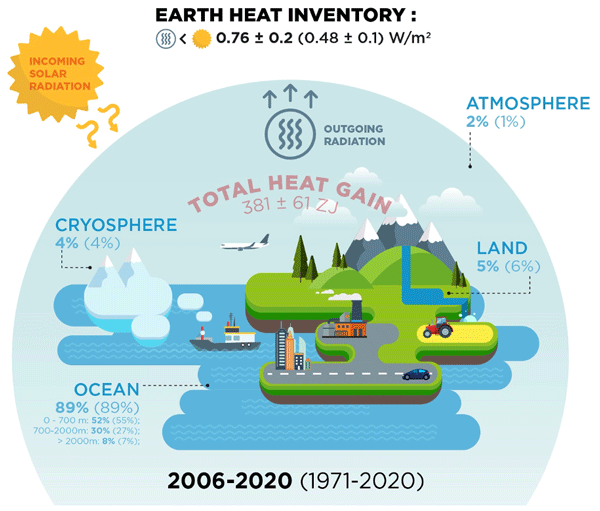
Earth's climate is out of energy balance, and this study quantifies how much heat has consequently accumulated over the past decades (ocean: 89 %, land: 6 %, cryosphere: 4 %, atmosphere: 1 %). Since 1971, this accumulated heat reached record values at an increasing pace. The Earth heat inventory provides a comprehensive view on the status and expectation of global warming, and we call for an implementation of this global climate indicator into the Paris Agreement’s Global Stocktake.
Tian Tian, Lijing Cheng, Gongjie Wang, John Abraham, Wangxu Wei, Shihe Ren, Jiang Zhu, Junqiang Song, and Hongze Leng
Earth Syst. Sci. Data, 14, 5037–5060, https://doi.org/10.5194/essd-14-5037-2022, https://doi.org/10.5194/essd-14-5037-2022, 2022
Short summary
Short summary
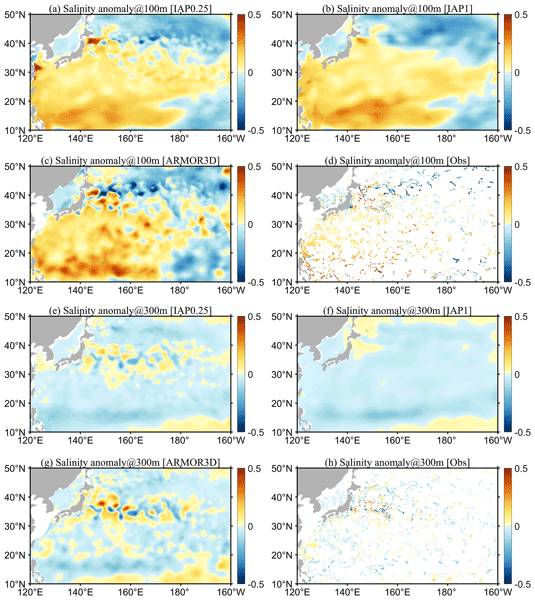
A high-resolution gridded dataset is crucial for understanding ocean processes at various spatiotemporal scales. Here we used a machine learning approach and successfully reconstructed a high-resolution (0.25° × 0.25°) ocean subsurface (1–2000 m) salinity dataset for the period 1993–2018 (monthly) by merging in situ salinity profile observations with high-resolution satellite remote-sensing data. This new product could be useful in various applications in ocean and climate fields.
Cited articles
Abdulla, K., Cunningham, L., and Gillie, M.: Out-of-plane strengthening of adobe masonry using hemp fibre ropes: An experimental investigation, Eng. Struc., 245, 1–14, https://doi.org/10.1016/j.engstruct.2021.112931, 2021.
Austin, J. F. and McConnel, A.: James Six F. R. S.: Two hundred years of the Six's self-registering thermometer, Notes Rec. Roy. Soc. Lond., 35, 49–65, https://doi.org/10.1098/rsnr.1980.0004, 1980.
Becker, J. J., Sandwell, D. T., Smith, W. H. F., Braud, J., Binder, B., Depner, J., Fabre, D., Factor, J., Ingalls, S., Kim, S.-H., Ladner, R., Marks, K., Nelson, S., Pharaoh, A., Trimmer, R., Von Rosenberg, J., Wallace, G., and Weatherall, P.: Global bathymetry and elevation data at 30 arcsec resolution: SRTM30_PLUS, Mar. Geod., 32, 355–371, https://doi.org/10.1080/01490410903297766, 2009.
Borishanski, L. S.: Manual for the performance of work on standard hydrological sections and marine hydrological surveys, Gidrometeoizdat, Leningrad, 284 pp., https://search.rsl.ru/ru/record/01005762178 (last access: 8 October 2026), 1954.
Boyce, F. M.: A brief study of the protected deep-sea reversing thermometer, Manuscript Report Series (Oceanographic and Limnological) no. 227, 17 pp., https://waves-vagues.dfo-mpo.gc.ca/library-bibliotheque/40648199.pdf (last access: 8 October 2026), 1966.
Boyer, T., Domingues, C. M., Goog, S. A., Johnson, G. C., Lyman, J. M., Ishii, M., Gouretski, V., Willis, J. K., Antonov, J., Wijffels, S., Church, J. A., Cowley, R., and Bindoff, N. L.: Sensitivity of global upper-ocean heat content estimates to mapping methods, XBT bias corrections, and baseline climatologies, J. Climate, 29, 4817–4842, https://doi.org/10.1175/JCLI-D-15-0801.1, 2016.
Brennecke, W.: Die ozeanographischen Arbeiten der Deutschen Antarktischen Expedition 1911–1912, Archiv der Deutschen Seewarte, XXXIX, no. 1, Hamburg, https://digitale-bibliothek.bsh.de/viewer/api/v1/records/141316/tei/en/ (last access: 8 October 2026), 1921.
Brohan, P., Kennedy, J., Harris, I., Tett, S., and Jones, P.: Uncertainty estimates in regional and global observed temperature changes: A new dataset from 1850, J. Geophys. Res., 111, D12106, https://doi.org/10.1029/2005JD006548, 2006.
Chapman, S.: The International Geophysical Year, 1957–58, Nature, 175, 55–56, https://doi.org/10.1038/175055a0, 1959.
Cheng, L. and Zhu, J.: Benefits of CMIP5 multimodel ensemble in reconstructing historical ocean subsurface temperature variation, J. Climate, 29, 5393–5415, https://doi.org/10.1175/JCLI-D-15-0730.1, 2016.
Cheng, L., Abraham, J., Trenberth, K. E., Reagan, J., Zhang, H.-M., Storto, A., Von Schuckmann, K., Pan, Y., Zhu, Y., Mann, M. E., Zhu, J., Wang, F., Yu, F., Locarnini, R., Fasullo, J., Huang, B., Graham, G., Yin, X., Gouretski, V., Zheng, F., Li, Y., Zhang, B., Wan, L., Chen, X., Wang, D., Feng, L., Song, X., Liu, Y., Reseghetti, F., Simoncelli, S., Chen, G., Zhang, R., Mishonov, A., Tan, Z., Wei, W., Yuan, H., Li, G., Ren, Q., Cao, L., Lu, Y., Du, J., Lyu, K., Sulaiman, A., Mayer, M., Wang, H., Ma, Z., Bao, S., Yan, H., Liu, Z., Yang, C., Liu, X., Hausfather, Z., Szekely, T., and Gues, F.: Record high temperatures in the ocean in 2024, Adv. Atmos. Sci., 42, 1092–1109, https://doi.org/10.1007/s00376-025-4541-3, 2025.
Frankignoul, C.: On the depth interpolation of repeated hydrographic data, J. Geophys. Res., 86, 2001–2004, https://doi.org/10.1029/JC086iC03p02001, 1981.
Garcia, H. E., Boyer, T. P., Baranova, O. K., Locarnini, R. A., Mishonov, A. V., Grodsky, A., Paver, C. R., Weathers, K. W., Smolyar, I. V., Reagan, J. R., Seidov, D., and Zweng, M. M.: World Ocean Atlas 2018: Product Documentation, edited by: Mishonov, A., NOAA, https://doi.org/10.25923/ng6j-ey81, 2019.
Gebbie, G. and Huybers, P.: The little ice age and 20th-century deep Pacific cooling, Science, 363, 70–74, https://doi.org/10.1126/science.aar8413, 2019.
Gould, J., Sloyan, B., and Visbeck, M.: Chapter 3 – In situ ocean observations: a brief history, present status, and future directions, Int. Geophys., 103, 59–81, https://doi.org/10.1016/B978-0-12-391851-2.00003-9, 2013.
Gouretski, V.: World Ocean Circulation Experiment – Argo Global Hydrographic Climatology, Ocean Sci., 14, 1127–1146, https://doi.org/10.5194/os-14-1127-2018, 2018.
Gouretski, V. and Cheng, L.: Correction for systematic errors in the global dataset of temperature profiles from mechanical bathythermographs, J. Atmos. Ocean. Tech., 37, 841–855, https://doi.org/10.1175/JTECH-D-19-0205.1, 2020.
Gouretski, V. and Koltermann, K. P.: How much is the ocean really warming?, Geophys. Res. Lett., 34, L01610, https://doi.org/10.1029/2006GL027834, 2007.
Gouretski, V. and Reseghetti, F.: On depth and temperature biases in bathythermograph data: development of a new correction scheme based on analysis of a global ocean database, Deep-Sea Res. Pt. I, 57, 812–834, https://doi.org/10.1016/j.dsr.2010.03.011, 2010.
Gouretski, V., Jungclaus, J. H., and Haack, H.: Revisiting the Meteor 1925–1927 hydrographic dataset reveals centennial full-depth changes in the Atlantic Ocean, Geophys. Res. Lett., 40, 2236–2241, https://doi.org/10.1002/grl.50503, 2012.
Gouretski, V., Cheng, L., and Boyer, T.: On the consistency of the bottle and CTD profile data, J. Atmos. Ocean. Tech., 39, 1869–1887, https://doi.org/10.1175/JTECH-D-22-0004.1, 2022.
Gouretski, V., Cheng, L., Du, J., Xing, X., Chai, F., and Tan, Z.: A consistent ocean oxygen profile dataset with new quality control and bias assessment, Earth Syst. Sci. Data, 16, 5503–5530, https://doi.org/10.5194/essd-16-5503-2024, 2024.
Gouretski, V., Cheng, L., and Du, J.: IAP Historical Nansen Cast Temperature Profile Dataset [data set], Zenodo [data set], https://doi.org/10.5281/zenodo.22764102, 2026a.
Gouretski, V., Cheng, L., and Du, J.: IAP Historical Nansen Cast Temperature Profile Dataset [data set], Marine Science Data Center, Chinese Academy of Sciences [data set], https://doi.org/10.12157/IOCAS.20260520.001, 2026b.
Helland-Hansen, B. and Nansen, F.: The Norwegian Sea: its physical oceanography based upon the Norwegian researches 1900–1904, Vol. II, Det Mallingske Bogtrykkeri, 390 pp., https://imr.brage.unit.no/imr-xmlui/handle/11250/114874 (last access: 8 October 2026), 1909.
Hydrographisches Amt der Admiralität: Die Forschungsreise S.M.S. “Gazelle” in den Jahren 1874 bis 1876, II. Theil, Physik und Chemie, https://epic.awi.de (last access: 8 October 2026), 1888.
Köhl, A.: Evaluating the GECCO3 1948-2018 ocean synthesis – a configuration for intializing the MPI-ESM climate model, Q. J. Roy. Meteorol. Soc., 146, 2250–2273, https://doi.org/10.1002/qj.3790, 2020.
Levitus, S., Antonov, J., and Boyer, T.: Warming of the world ocean, 1955–2003, Geophys. Res. Lett., 32, L02604, https://doi.org/10.1029/2004GL021592, 2005.
Li, Y., Church, J. A., McDougall, T. J., and Baker, P. M.: Sensitivity of observationally based estimates of ocean heat content and thermal expansion to vertical interpolation schemes, Geophys. Res. Lett., 49, e2022GL101079, https://doi.org/10.1029/2022GL101079, 2022.
Locarnini, R. A., Mishonov, A. V., Baranova, O. K., Reagan, J. R., Boyer, T. P., Seidov, D., Wang, Z., Garcia, H. E., Bouchard, C., Cross, S. L., Paver, C. R., and Dukhovskoy, D.: World Ocean Atlas 2023, Volume 1: Temperature, A. Mishonov, Technical Editor, NOAA Atlas NESDIS 89, NOAA, https://doi.org/10.25923/54bh-1613, 2024.
Moroshkin, K. V.: Experience of work with domestic unprotected thermometers, Collected Works of the Institute of Oceanology, Academy of Sciences of the USSR, 5, 78–92, https://search.rsl.ru/ru/record/01006019350 (last access: 8 October 2026), 1951.
Nansen, F.: The Norwegian North Polar Expedition, 1893–1896, Scientific Results, in: Vol. VI, edited by: Nansen, F., London, 659 pp., https://archive.org/details/cu31924012205765 (last access: 8 October 2026), 1905.
Negretti, H. and Zambra, J. W.: On new deep-sea thermometer, P. Roy. Soc., 22, 238–241, https://doi.org/10.1098/rspl.1873.0034, 1874.
Pan, Y., Cheng, L., Abraham, J., Trenberth, K. E., Reagan, J., Du, J., Wang, Z., Storto, A., Von Schuckmann, K., Zhu, Y., Mann, M. E., Zhu, J., Wang, F., Yu, F., Locarnini, R., Fasullo, J., Huang, B., Graham, G., Yin, X., Gouretski, V., Zheng, F., Li, Y., Zhang, B., Wan, L., Chen, X., Wang, D., Feng, L., Song, X., Liu, Y., Reseghetti, F., Simoncelli, S., Chen, G., Zhang, R., Mishonov, A., Wei, W., Tan, Z., Li, G., Cao, L., Chen, L., Yuan, H., Lyu, K., Sulaiman, A., Mayer, M., Wang, H., Ma, Z., Bao, S., Yan, H., Liu, Z., Yang, C., Liu, X., Hausfather, Z., Gues, F., Song, X., Zhang, M., and Lin, C.: Ocean heat content sets another record in 2025, Adv. Atmos. Sci., 43, 2019–2041, https://doi.org/10.1007/s00376-026-5876-0, 2026.
Rayner, N. A., Parker, D. E., Horton, E. B., Folland, C. K., Alexander, L. V., Rowell, D. P., Kent, E. C., and Kaplan, A.: Global analyses of sea surface temperature, sea ice, and night marine air temperature since the late nineteenth century, J. Geophys. Res., 108, 4407, https://doi.org/10.1029/2002JD002670, 2003.
Reiniger, R. F. and Ross, C. K.: A method of interpolation with application to oceanographic data, Deep-Sea Res., 15, 185–193, https://doi.org/10.1016/0011-7471(68)90040-5, 1968.
Roemmich, D., Gould, W. J., and Gilson, J.: 135 years of global ocean warming between the Challenger expedition and the Argo Programme, Nat. Clim. Change, 2, 425–428, https://doi.org/10.1038/nclimate1461, 2012.
Spilhaus, A. F.: A bathythermograph, J. Mar. Res., 1, 95–100, 1938.
State Oceanographic Institute: Manual for hydrological works in oceans and seas, in: 2nd Edn., Gidrometeoizdat, Leningrad, 725 pp., https://mgmtmo.ru/edumat/hydrology/Guidelines_hydrol_work_oceans_seas_77.pdf (last access: 8 October 2026), 1977.
Swift, J. H.: Reference-quality water sample data: notes on acquisition, record keeping, and evaluation, The GO-SHIP Repeat Hydrography Manual: A Collection of Expert Reports and Guidelines, IOCCP Report No. 14, ICPO Publication Series No. 134, Version 1, http://www.go-ship.org/Manual/Swift_DataEval.pdf (last access: 8 October 2026), 2010.
Thomson, C. W. and Murray, J.: Report on the scientific results of the voyage of H.M.S. Challenger during the years 1873–76, in: Physics and Chemistry, Vol. II, Her Majesty Stationery Office, London, https://www.biodiversitylibrary.org/item/30429#page/1/mode/1up (last access: 8 October 2026), 1889.
Thomson, W. and Murray, J.: The voyage of H.M.S. Challenger 1873–1876, Narrative, in: Vol. 1, First Part, Ch. III, Johnson Reprint Corporation, http://archimer.ifremer.fr/doc/00000/4751/ (last access: 8 October 2026), 1885.
US Hydrographic Office: Deep-sea soundings in the North Pacific Ocean obtained in the United States Steamer Tuscarora, Commander George E. Belknap, Government Printing Office, Washington, D.C., https://www.nodc.noaa.gov/OC5/PACIFIC2009/HTML/books.html (last access: 8 October 2026), 1874.
US Naval Oceanographic Office: Instruction manual for obtaining oceanographic data, U.S. Government Printing Office, Washington, D.C., 232 pp., https://epic.awi.de/id/eprint/32525/1/manual_oce-data.pdf (last access: 8 October 2026), 1968.
Wu, Q., Gregory, J. M., Zanna, L., and Khatiwala, S.: Time-varying global energy budget since 1880 from a reconstruction of ocean warming, P. Natl. Acad. Sci. USA, 122, e2408839122, https://doi.org/10.1073/pnas.2408839122, 2025.
Wunsch, C. and Heimbach, P.: Practical global oceanic state estimation, Physica D, 230, 197–208, https://doi.org/10.1016/j.physd.2006.09.040, 2007.
Wüst, G., Böhnecke, G., and Meyer, H. F.: Ozeanographische Methoden und Instrumente, in: Wissenschaftliche Ergebnisse der Deutschen Atlantischen Expedition auf dem Forschungs- und Vermessungsschiff “Meteor” 1925–1927, Band IV, Erster Teil, Walter de Gruyter & Co., Berlin, https://ci.nii.ac.jp/ncid/BA82926827 (last access: 8 October 2026), 1932.
Zanna, L., Khatiwala, S., Gregory, J. M., Ison, J., and Heimbach, P.: Global reconstruction of historical ocean heat. storage and transport, P. Natl. Acad. Sci. USA, 116, 1126–1131, https://doi.org/10.1073/pnas.1808838115, 2019.
Short summary
This study depicts a three-step quality control procedure applied to the Nansen cast temperature profiles (1873–2025, especially before 1970), including automatic/manual quality control and temperature anomaly quality control. Corrections for depth bias are also suggested with improved vertical interpolation procedure. Based on this dataset we access for the first time the change of the ocean heat content of the upper 2000 m layer over a 100 year time period between 1870s and 2020s.
This study depicts a three-step quality control procedure applied to the Nansen cast temperature...


Altmetrics
Final-revised paper
Preprint