Articles | Volume 18, issue 11
https://doi.org/10.5194/essd-18-8591-2026
© Author(s) 2026. This work is distributed under
the Creative Commons Attribution 4.0 License.
the Creative Commons Attribution 4.0 License.
https://doi.org/10.5194/essd-18-8591-2026
© Author(s) 2026. This work is distributed under
the Creative Commons Attribution 4.0 License.
the Creative Commons Attribution 4.0 License.
Data description article
| 
20 Nov 2026
Data description article |
| 20 Nov 2026
| 20 Nov 2026
A multi-decadal dataset of surface damage on Antarctic ice shelves (1999–2024)
Leyue Tang
Center for Spatial Information Science and Sustainable Development Applications, College of Surveying and Geo-Informatics, Tongji University, Shanghai 200092, China
Bristol Glaciology Centre, School of Geographical Sciences, University of Bristol, Bristol, BS8 1SS, UK
Jonathan L. Bamber
Bristol Glaciology Centre, School of Geographical Sciences, University of Bristol, Bristol, BS8 1SS, UK
Institute for Advanced Study, Technical University of Munich, 85748 Garching, Germany
Bristol Glaciology Centre, School of Geographical Sciences, University of Bristol, Bristol, BS8 1SS, UK

Center for Spatial Information Science and Sustainable Development Applications, College of Surveying and Geo-Informatics, Tongji University, Shanghai 200092, China
Related authors
Zheyi Cao, Leyue Tang, Xiaohan Yuan, and Gang Qiao
Int. Arch. Photogramm. Remote Sens. Spatial Inf. Sci., XLVIII-1-2024, 59–64, https://doi.org/10.5194/isprs-archives-XLVIII-1-2024-59-2024, https://doi.org/10.5194/isprs-archives-XLVIII-1-2024-59-2024, 2024
Qiuyu Wang, Zihao Li, Ritu Anilkumar, Huake Zhang, Xiaojun Ma, Wenke Sun, and Jonathan Bamber
EGUsphere, https://doi.org/10.5194/egusphere-2026-5913, https://doi.org/10.5194/egusphere-2026-5913, 2026
This preprint is open for discussion and under review for The Cryosphere (TC).
Short summary
Short summary
Global glaciers continued to lose mass in 2025, but two independent satellite records suggest that the loss was not as large as previously reported. The difference mainly reflects weaker losses or gains in Alaska and Arctic Canada, while High Mountain Asia still lost substantial mass. The results highlight the importance of satellite altimetry as an independent constraint on annual global glacier mass change.

Nils Lehmann, Cesar Aybar, Ando Shah, Marcello Passaro, Jonathan L. Bamber, and Xiao Xiang Zhu
Earth Syst. Sci. Data, 18, 6815–6840, https://doi.org/10.5194/essd-18-6815-2026, https://doi.org/10.5194/essd-18-6815-2026, 2026
Short summary
Short summary
Different satellites, ocean floats and model reanalysis products record sea surface height, temperature, salt content and winds, but each archive stores its data differently, so combining them is tedious and time consuming. We therefore combine these data sources into a consistent collection, so that data retrieval across sources becomes easier. Ocean studies are consequently easier to reproduce and compare, and hopefully support research and better understanding of ocean and climate processes.
Alejandro Blazquez, Benoit Meyssignac, Robin Fraudeau, Michael Ablain, Jonathan Bamber, Antonio Bonaduce, Marie Bouih, Anny Cazenave, Thorben Döhne, Ines Dussaillant, Ramiro Ferrari, Martin Horwath, Nicolas Kolodziejczyk, Hugo Lecomte, Stephanie Leroux, William Llovel, Daniele Melini, Erwan Oulhen, Thierry Penduff, Roshin P. Raj, Giorgio Spada, Marius Schlaak, Papasarafianou Stamatia, Andrea Storto, Chunxue Yang, and Sarah Connors
Earth Syst. Sci. Data Discuss., https://doi.org/10.5194/essd-2026-627, https://doi.org/10.5194/essd-2026-627, 2026
Preprint under review for ESSD
Short summary
Short summary
Closing the sea‑level budget on annual and longer time scales is a cornerstone of physical oceanography because sea‑level rise is one of the best indicators of climate change, and a closed budget shows we have identified and quantified all major drivers. We examined it from 1993 to 2022, finding an accelerated rise that matched ice melt and warm water until 2015. Afterwards an unexplained gap appears. Better deep‑ocean observations and refined gravity processing are needed to close the budget.
Xiaojun Ma, Matt King, Jonathan Bamber, Bin Liu, Wenke Sun, and Qiuyu Wang
EGUsphere, https://doi.org/10.5194/egusphere-2026-3461, https://doi.org/10.5194/egusphere-2026-3461, 2026
Short summary
Short summary
Satellite records of glacier change are only about two decades long, so short-term climate swings can strongly affect estimated trends. Using satellite gravity data, we show that the largest year-to-year changes in global glacier mass come from the Arctic and are linked to the North Atlantic Oscillation and Pacific Decadal Oscillation. Accounting for these effects makes Alaska’s estimated ice loss about one-third larger, improving interpretation of glacier change and future sea-level rise.
Ruitang Yang, Lizz Ultee, Kristoffer Aalstad, Matvey V. Debolskiy, Regine Hock, Patrick Schmitt, David Rounce, and Tian Li
EGUsphere, https://doi.org/10.5194/egusphere-2026-1081, https://doi.org/10.5194/egusphere-2026-1081, 2026
Short summary
Short summary
We present a new framework to model frontal ablation of marine-terminating glaciers by linking two global glacier models with a simple physics-based calving scheme and Bayesian calibration. Applied to 71 Svalbard glaciers (2000–2019) and projected to 2100, it reproduces seasonal front changes but overestimates ablation due to uncertain geometry and velocity. This efficient approach can improve regional to global simulations.
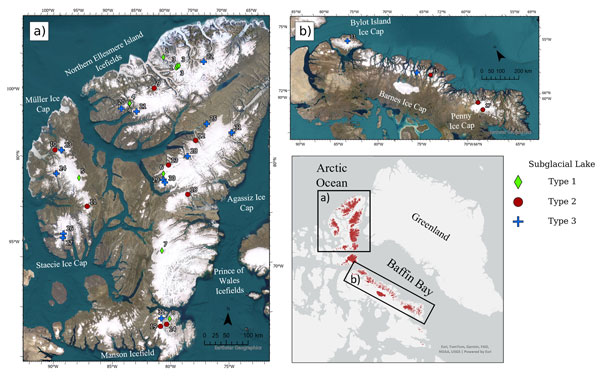
Whyjay Zheng, Wesley Van Wychen, Tian Li, and Tsutomu Yamanokuchi
The Cryosphere, 20, 1699–1714, https://doi.org/10.5194/tc-20-1699-2026, https://doi.org/10.5194/tc-20-1699-2026, 2026
Short summary
Short summary
We identify lakes beneath the glaciers in the Canadian Arctic using satellite measurements over a decade, increasing the number of known subglacial lakes in this area from 2 to 37. These lakes are recharged by billions of cubic meters of water, and the draining of these lakes can lower the ice elevation by more than 100 m. We find three types of subglacial lakes, two of which are primarily located in the Canadian Arctic. When glaciers lose their ice quickly, these lakes become active.
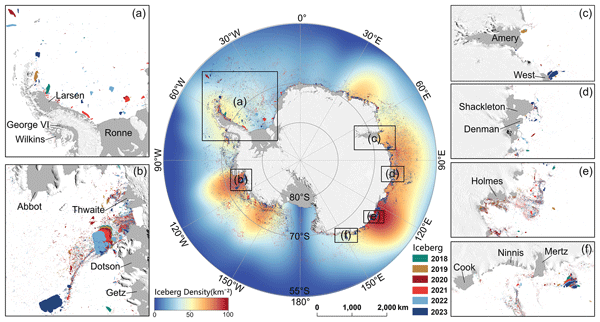
Zilong Chen, Xuying Liu, Zhenfu Guan, Teng Li, Xiao Cheng, Tian Li, Yan Liu, Qi Liang, Lei Zheng, and Jiping Liu
Earth Syst. Sci. Data, 18, 147–166, https://doi.org/10.5194/essd-18-147-2026, https://doi.org/10.5194/essd-18-147-2026, 2026
Short summary
Short summary
Our study uses Google Earth Engine to create a dataset of Antarctic icebergs in the Southern Ocean (south of 55° S) from October 2018 to 2023. The dataset includes icebergs larger than 0.04 km², with details on their locations, sizes, and shapes. It shows significant changes in iceberg number and area, mainly driven by major ice shelf calving events – especially in the Weddell Sea. This resource fills key gaps in understanding iceberg impacts on the ocean and climate.
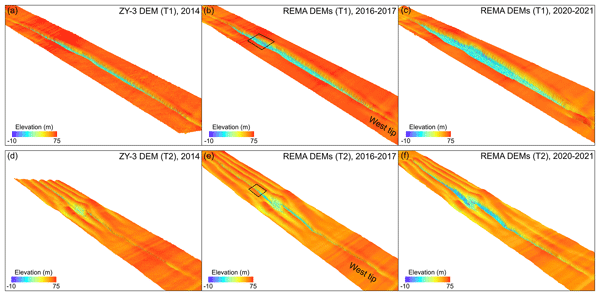
Menglian Xia, Rongxing Li, Marco Scaioni, Lu An, Zhenshi Li, and Gang Qiao
The Cryosphere, 19, 6749–6770, https://doi.org/10.5194/tc-19-6749-2025, https://doi.org/10.5194/tc-19-6749-2025, 2025
Short summary
Short summary
We propose an innovative multi-satellite DEM adjustment model (MDAM) that removes biases in elevation between sub-DEMs across ice shelves. Our results reveal quantitative 3D structural and mélange features of a ~50 km long rift. For first time, we found that while the mélange elevation decreased from 2014–2021, the mélange inside the rift experienced a rapid expansion, attributing to newly calved shelf ice from rift walls, associated rift widening, and other rift-mélange interaction factors.
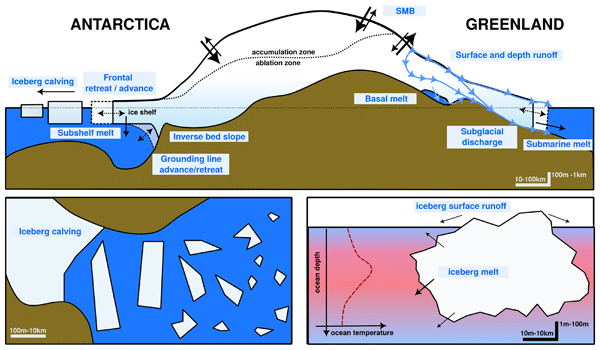
Gavin A. Schmidt, Kenneth D. Mankoff, Jonathan L. Bamber, Clara Burgard, Dustin Carroll, David M. Chandler, Violaine Coulon, Benjamin J. Davison, Matthew H. England, Paul R. Holland, Nicolas C. Jourdain, Qian Li, Juliana M. Marson, Pierre Mathiot, Clive R. McMahon, Twila A. Moon, Ruth Mottram, Sophie Nowicki, Anna Olivé Abelló, Andrew G. Pauling, Thomas Rackow, and Damien Ringeisen
Geosci. Model Dev., 18, 8333–8361, https://doi.org/10.5194/gmd-18-8333-2025, https://doi.org/10.5194/gmd-18-8333-2025, 2025
Short summary
Short summary
The impact of increasing mass loss from the Greenland and Antarctic ice sheets has not so far been included in historical climate model simulations. This paper describes the protocols and data available for modeling groups to add this anomalous freshwater to their ocean modules to better represent the impacts of these fluxes on ocean circulation, sea ice, salinity and sea level.
Yanjun Li, Violaine Coulon, Javier Blasco, Gang Qiao, Qinghua Yang, and Frank Pattyn
The Cryosphere, 19, 4373–4390, https://doi.org/10.5194/tc-19-4373-2025, https://doi.org/10.5194/tc-19-4373-2025, 2025
Short summary
Short summary
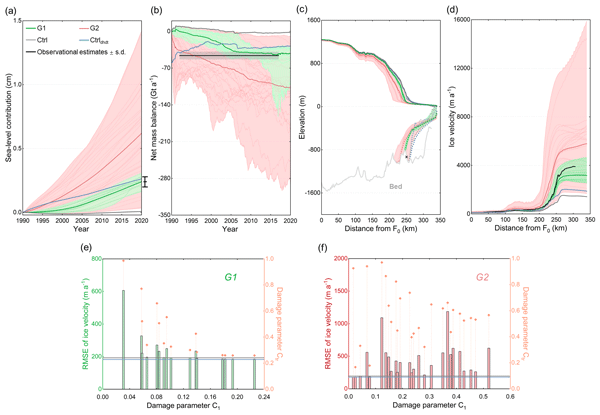
We incorporate ice damage processes into an ice-sheet model and apply the new model to Thwaites Glacier. The upgraded model more accurately captures the observed ice mass loss of Thwaites Glacier over 1990–2020. Our simulations show that ice damage has a notable impact on the ice mass loss, grounding-line retreat, ice velocity, and ice thickness of the Thwaites Glacier basin. This study highlights the necessity for incorporating ice damage into ice-sheet models.
Bertie W. J. Miles, Tian Li, and Robert G. Bingham
The Cryosphere, 19, 4027–4043, https://doi.org/10.5194/tc-19-4027-2025, https://doi.org/10.5194/tc-19-4027-2025, 2025
Short summary
Short summary
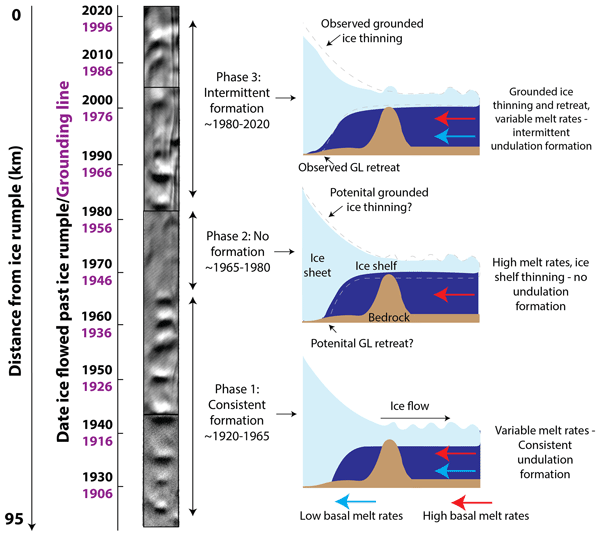
Totten Glacier, East Antarctica's largest mass-loss source, has thinned since at least the 1990s. No sustained acceleration has occurred since 1973, but earlier grounding-line retreat suggests prior loss. A ~20-year gap in surface undulations implies a mid-20th-century warm period that may have triggered ongoing loss. Collapse of a nearby ice shelf supports this. Current ~30-year satellite records are too short to capture full decadal melt-rate variability.
Adam Igneczi and Jonathan Louis Bamber
Earth Syst. Sci. Data, 17, 3203–3218, https://doi.org/10.5194/essd-17-3203-2025, https://doi.org/10.5194/essd-17-3203-2025, 2025
Short summary
Short summary
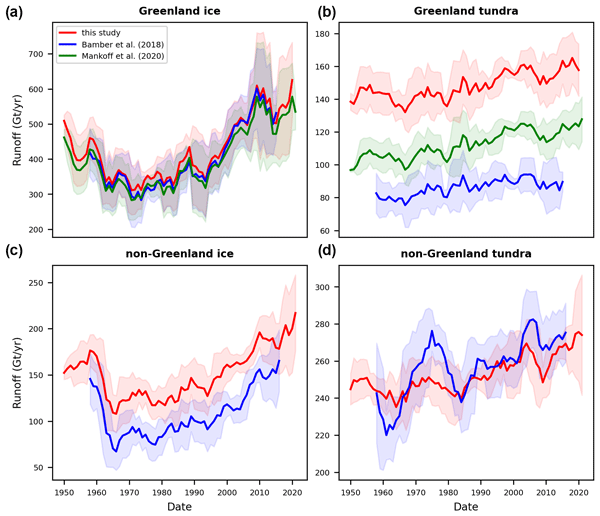
Freshwater from Arctic land ice loss strongly affects the Arctic and North Atlantic oceans. Datasets describing this freshwater discharge have low resolution and do not cover the entire Arctic. We statistically enhanced coarse-resolution climate model data – from approximately 6 km to 250 m – and routed meltwater towards the coastlines to provide high-resolution data covering all Arctic regions. This approach has far fewer computational requirements than running climate models at high resolution.
Viola Steidl, Jonathan Louis Bamber, and Xiao Xiang Zhu
The Cryosphere, 19, 645–661, https://doi.org/10.5194/tc-19-645-2025, https://doi.org/10.5194/tc-19-645-2025, 2025
Short summary
Short summary
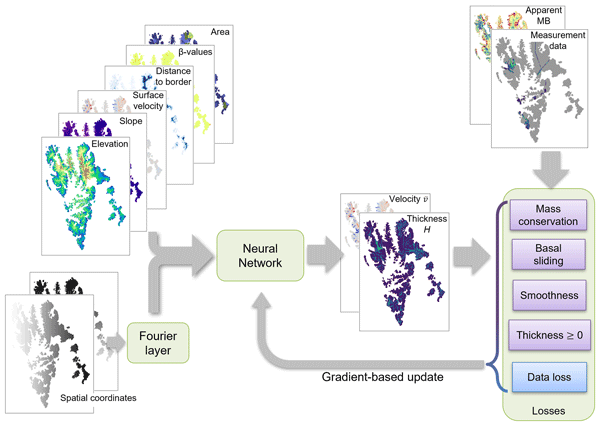
Glacier ice thickness is difficult to measure directly but is essential for glacier evolution modelling. In this work, we employ a novel approach combining physical knowledge and data-driven machine learning to estimate the ice thickness of multiple glaciers in Spitsbergen, Barentsøya, and Edgeøya in Svalbard. We identify challenges for the physics-aware machine learning model and opportunities for improving the accuracy and physical consistency that would also apply to other geophysical tasks.
Penglan Luo, Gang Qiao, Zhi Qu, and Sergey Popov
Int. Arch. Photogramm. Remote Sens. Spatial Inf. Sci., XLVIII-3-2024, 311–318, https://doi.org/10.5194/isprs-archives-XLVIII-3-2024-311-2024, https://doi.org/10.5194/isprs-archives-XLVIII-3-2024-311-2024, 2024
Zheyi Cao, Leyue Tang, Xiaohan Yuan, and Gang Qiao
Int. Arch. Photogramm. Remote Sens. Spatial Inf. Sci., XLVIII-1-2024, 59–64, https://doi.org/10.5194/isprs-archives-XLVIII-1-2024-59-2024, https://doi.org/10.5194/isprs-archives-XLVIII-1-2024-59-2024, 2024
Hongwei Li, Youquan He, Yuanyuan Gu, and Gang Qiao
Int. Arch. Photogramm. Remote Sens. Spatial Inf. Sci., XLVIII-1-2024, 323–328, https://doi.org/10.5194/isprs-archives-XLVIII-1-2024-323-2024, https://doi.org/10.5194/isprs-archives-XLVIII-1-2024-323-2024, 2024
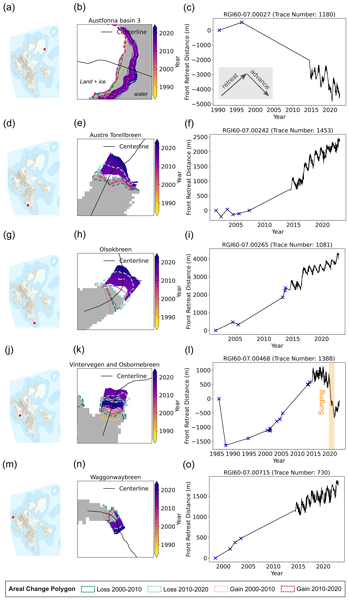
Tian Li, Konrad Heidler, Lichao Mou, Ádám Ignéczi, Xiao Xiang Zhu, and Jonathan L. Bamber
Earth Syst. Sci. Data, 16, 919–939, https://doi.org/10.5194/essd-16-919-2024, https://doi.org/10.5194/essd-16-919-2024, 2024
Short summary
Short summary
Our study uses deep learning to produce a new high-resolution calving front dataset for 149 marine-terminating glaciers in Svalbard from 1985 to 2023, containing 124 919 terminus traces. This dataset offers insights into understanding calving mechanisms and can help improve glacier frontal ablation estimates as a component of the integrated mass balance assessment.
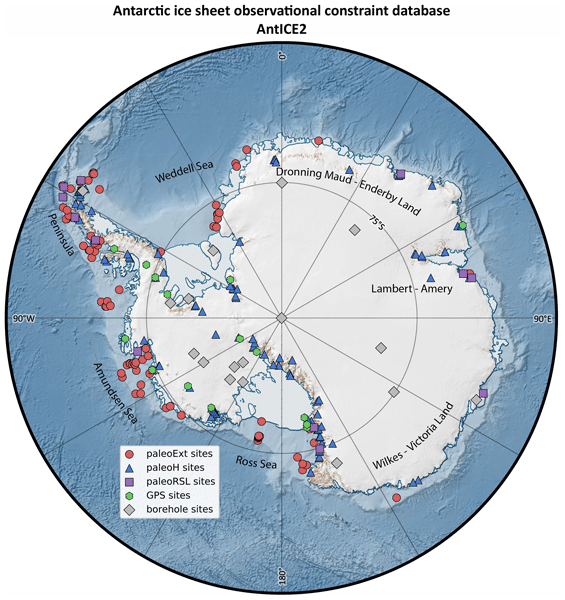
Benoit S. Lecavalier, Lev Tarasov, Greg Balco, Perry Spector, Claus-Dieter Hillenbrand, Christo Buizert, Catherine Ritz, Marion Leduc-Leballeur, Robert Mulvaney, Pippa L. Whitehouse, Michael J. Bentley, and Jonathan Bamber
Earth Syst. Sci. Data, 15, 3573–3596, https://doi.org/10.5194/essd-15-3573-2023, https://doi.org/10.5194/essd-15-3573-2023, 2023
Short summary
Short summary
The Antarctic Ice Sheet Evolution constraint database version 2 (AntICE2) consists of a large variety of observations that constrain the evolution of the Antarctic Ice Sheet over the last glacial cycle. This includes observations of past ice sheet extent, past ice thickness, past relative sea level, borehole temperature profiles, and present-day bedrock displacement rates. The database is intended to improve our understanding of past Antarctic changes and for ice sheet model calibrations.
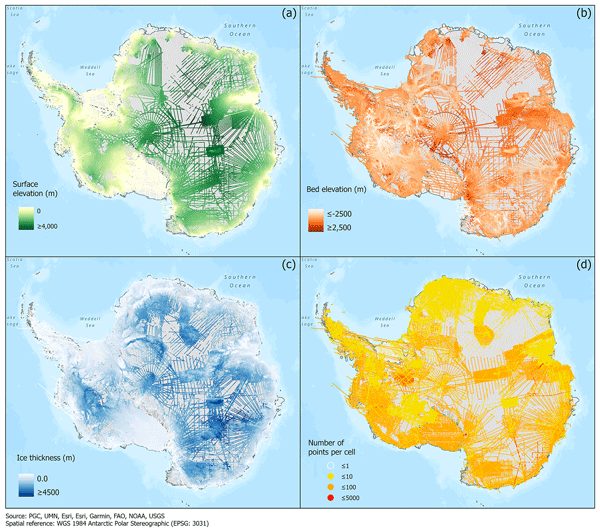
Alice C. Frémand, Peter Fretwell, Julien A. Bodart, Hamish D. Pritchard, Alan Aitken, Jonathan L. Bamber, Robin Bell, Cesidio Bianchi, Robert G. Bingham, Donald D. Blankenship, Gino Casassa, Ginny Catania, Knut Christianson, Howard Conway, Hugh F. J. Corr, Xiangbin Cui, Detlef Damaske, Volkmar Damm, Reinhard Drews, Graeme Eagles, Olaf Eisen, Hannes Eisermann, Fausto Ferraccioli, Elena Field, René Forsberg, Steven Franke, Shuji Fujita, Yonggyu Gim, Vikram Goel, Siva Prasad Gogineni, Jamin Greenbaum, Benjamin Hills, Richard C. A. Hindmarsh, Andrew O. Hoffman, Per Holmlund, Nicholas Holschuh, John W. Holt, Annika N. Horlings, Angelika Humbert, Robert W. Jacobel, Daniela Jansen, Adrian Jenkins, Wilfried Jokat, Tom Jordan, Edward King, Jack Kohler, William Krabill, Mette Kusk Gillespie, Kirsty Langley, Joohan Lee, German Leitchenkov, Carlton Leuschen, Bruce Luyendyk, Joseph MacGregor, Emma MacKie, Kenichi Matsuoka, Mathieu Morlighem, Jérémie Mouginot, Frank O. Nitsche, Yoshifumi Nogi, Ole A. Nost, John Paden, Frank Pattyn, Sergey V. Popov, Eric Rignot, David M. Rippin, Andrés Rivera, Jason Roberts, Neil Ross, Anotonia Ruppel, Dustin M. Schroeder, Martin J. Siegert, Andrew M. Smith, Daniel Steinhage, Michael Studinger, Bo Sun, Ignazio Tabacco, Kirsty Tinto, Stefano Urbini, David Vaughan, Brian C. Welch, Douglas S. Wilson, Duncan A. Young, and Achille Zirizzotti
Earth Syst. Sci. Data, 15, 2695–2710, https://doi.org/10.5194/essd-15-2695-2023, https://doi.org/10.5194/essd-15-2695-2023, 2023
Short summary
Short summary
This paper presents the release of over 60 years of ice thickness, bed elevation, and surface elevation data acquired over Antarctica by the international community. These data are a crucial component of the Antarctic Bedmap initiative which aims to produce a new map and datasets of Antarctic ice thickness and bed topography for the international glaciology and geophysical community.
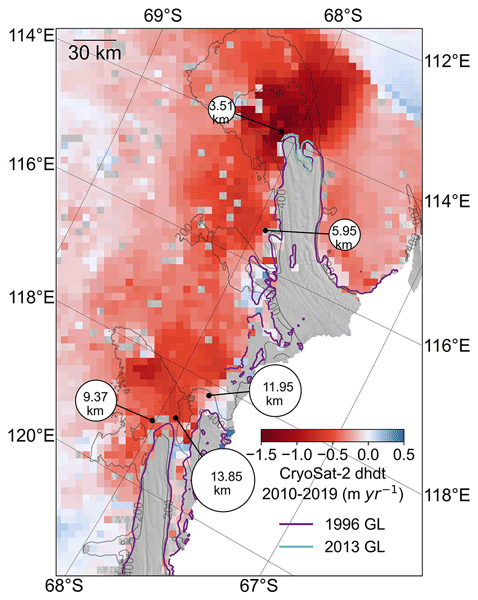
Tian Li, Geoffrey J. Dawson, Stephen J. Chuter, and Jonathan L. Bamber
The Cryosphere, 17, 1003–1022, https://doi.org/10.5194/tc-17-1003-2023, https://doi.org/10.5194/tc-17-1003-2023, 2023
Short summary
Short summary
The Totten and Moscow University glaciers in East Antarctica have the potential to make a significant contribution to future sea-level rise. We used a combination of different satellite measurements to show that the grounding lines have been retreating along the fast-flowing ice streams across these two glaciers. We also found two tide-modulated ocean channels that might open new pathways for the warm ocean water to enter the ice shelf cavity.
Sam Royston, Rory J. Bingham, and Jonathan L. Bamber
Ocean Sci., 18, 1093–1107, https://doi.org/10.5194/os-18-1093-2022, https://doi.org/10.5194/os-18-1093-2022, 2022
Short summary
Short summary
Decadal sea-level variability masks longer-term changes and increases uncertainty in observed trend and acceleration estimates. We use numerical ocean models to determine the magnitude of decadal variability we might expect in sea-level trends at coastal locations around the world, resulting from natural, internal variability. A proportion of that variability can be replicated from known climate modes, giving a range to add to short- to mid-term projections of regional sea-level trends.
Z. Yu, Z. Cao, C. Yu, G. Qiao, and R. Li
Int. Arch. Photogramm. Remote Sens. Spatial Inf. Sci., XLIII-B3-2022, 799–804, https://doi.org/10.5194/isprs-archives-XLIII-B3-2022-799-2022, https://doi.org/10.5194/isprs-archives-XLIII-B3-2022-799-2022, 2022
L. Wang, G. Qiao, I. V. Florinsky, and S. Popov
Int. Arch. Photogramm. Remote Sens. Spatial Inf. Sci., XLIII-B3-2022, 785–791, https://doi.org/10.5194/isprs-archives-XLIII-B3-2022-785-2022, https://doi.org/10.5194/isprs-archives-XLIII-B3-2022-785-2022, 2022
K. Lin, G. Qiao, L. Zhang, and S. Popov
Int. Arch. Photogramm. Remote Sens. Spatial Inf. Sci., XLIII-B3-2022, 765–770, https://doi.org/10.5194/isprs-archives-XLIII-B3-2022-765-2022, https://doi.org/10.5194/isprs-archives-XLIII-B3-2022-765-2022, 2022
S. Ge, Y. Cheng, R. Li, H. Cui, Z. Yu, T. Chang, S. Luo, Z. Li, G. Li, A. Zhao, X. Yuan, Y. Li, M. Xia, X. Wang, and G. Qiao
Int. Arch. Photogramm. Remote Sens. Spatial Inf. Sci., XLIII-B3-2022, 757–763, https://doi.org/10.5194/isprs-archives-XLIII-B3-2022-757-2022, https://doi.org/10.5194/isprs-archives-XLIII-B3-2022-757-2022, 2022
Stephen J. Chuter, Andrew Zammit-Mangion, Jonathan Rougier, Geoffrey Dawson, and Jonathan L. Bamber
The Cryosphere, 16, 1349–1367, https://doi.org/10.5194/tc-16-1349-2022, https://doi.org/10.5194/tc-16-1349-2022, 2022
Short summary
Short summary
We find the Antarctic Peninsula to have a mean mass loss of 19 ± 1.1 Gt yr−1 over the 2003–2019 period, driven predominantly by changes in ice dynamic flow like due to changes in ocean forcing. This long-term record is crucial to ascertaining the region’s present-day contribution to sea level rise, with the understanding of driving processes enabling better future predictions. Our statistical approach enables us to estimate this previously poorly surveyed regions mass balance more accurately.
Tom Mitcham, G. Hilmar Gudmundsson, and Jonathan L. Bamber
The Cryosphere, 16, 883–901, https://doi.org/10.5194/tc-16-883-2022, https://doi.org/10.5194/tc-16-883-2022, 2022
Short summary
Short summary
We modelled the response of the Larsen C Ice Shelf (LCIS) and its tributary glaciers to the calving of the A68 iceberg and validated our results with observations. We found that the impact was limited, confirming that mostly passive ice was calved. Through further calving experiments we quantified the total buttressing provided by the LCIS and found that over 80 % of the buttressing capacity is generated in the first 5 km of the ice shelf downstream of the grounding line.
Rongxing Li, Yuan Cheng, Haotian Cui, Menglian Xia, Xiaohan Yuan, Zhen Li, Shulei Luo, and Gang Qiao
The Cryosphere, 16, 737–760, https://doi.org/10.5194/tc-16-737-2022, https://doi.org/10.5194/tc-16-737-2022, 2022
Short summary
Short summary
Historical velocity maps of the Antarctic ice sheet are valuable for long-term ice flow dynamics analysis. We developed an innovative method for correcting overestimations existing in historical velocity maps. The method is validated rigorously using high-quality Landsat 8 images and then successfully applied to historical velocity maps. The historical change signatures are preserved and can be used for assessing the impact of long-term global climate changes on the ice sheet.
Tian Li, Geoffrey J. Dawson, Stephen J. Chuter, and Jonathan L. Bamber
Earth Syst. Sci. Data, 14, 535–557, https://doi.org/10.5194/essd-14-535-2022, https://doi.org/10.5194/essd-14-535-2022, 2022
Short summary
Short summary
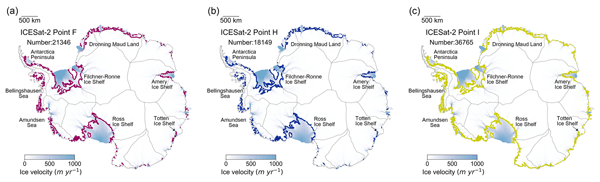
Accurate knowledge of the Antarctic grounding zone is important for mass balance calculation, ice sheet stability assessment, and ice sheet model projections. Here we present the first ICESat-2-derived high-resolution grounding zone product of the Antarctic Ice Sheet, including three important boundaries. This new data product will provide more comprehensive insights into ice sheet instability, which is valuable for both the cryosphere and sea level science communities.
Fanny Lehmann, Bramha Dutt Vishwakarma, and Jonathan Bamber
Hydrol. Earth Syst. Sci., 26, 35–54, https://doi.org/10.5194/hess-26-35-2022, https://doi.org/10.5194/hess-26-35-2022, 2022
Short summary
Short summary
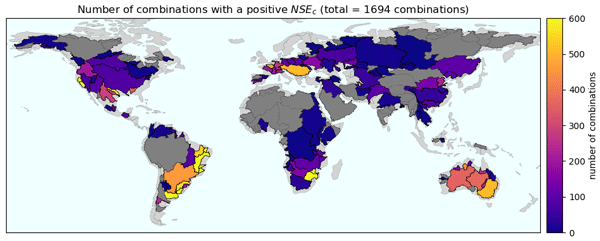
Many data sources are available to evaluate components of the water cycle (precipitation, evapotranspiration, runoff, and terrestrial water storage). Despite this variety, it remains unclear how different combinations of datasets satisfy the conservation of mass. We conducted the most comprehensive analysis of water budget closure on a global scale to date. Our results can serve as a basis to select appropriate datasets for regional hydrological studies.
Cited articles
Bassis, J., Crawford, A., Kachuck, S., Benn, D., Walker, C., Millstein, J., Duddu, R., Åström, J., Fricker, H., and Luckman, A.: Stability of Ice Shelves and Ice Cliffs in a Changing Climate, Annu. Rev. Earth Planet. Sci., 52, 221–247, https://doi.org/10.1146/annurev-earth-040522-122817, 2024.
Baumhoer, C.: IceLines – Sentinel-1 – Antarctica, German Aerospace Center (DLR) [data set], https://doi.org/10.15489/BTC4QU75GR92, 2022.
Baumhoer, C. A., Dietz, A. J., Heidler, K., and Kuenzer, C.: IceLines – A new data set of Antarctic ice shelf front positions, Sci. Data, 10, 138, https://doi.org/10.1038/s41597-023-02045-x, 2023.
Benn, D., Luckman, A., Åström, J., Crawford, A., Cornford, S., Bevan, S., Zwinger, T., Gladstone, R., Alley, K., Pettit, E., and Bassis, J.: Rapid fragmentation of Thwaites Eastern Ice Shelf, The Cryosphere, 16, 2545–2564, https://doi.org/10.5194/tc-16-2545-2022, 2022.
Borstad, C., Khazendar, A., Larour, E., Morlighem, M., Rignot, E., Schodlok, M., and Seroussi, H.: A damage mechanics assessment of the Larsen B ice shelf prior to collapse: Toward a physically-based calving law, Geophys. Res. Lett., 39, L18502, https://doi.org/10.1029/2012gl053317, 2012.
Chen, L.-C., Zhu, Y., Papandreou, G., Schroff, F., and Adam, H.: Encoder-decoder with atrous separable convolution for semantic image segmentation, European Conference on Computer Vision (ECCV) 2018, 833–851, https://doi.org/10.1007/978-3-030-01234-2_49, 2018.
Colgan, W., Rajaram, H., Abdalati, W., McCutchan, C., Mottram, R., Moussavi, M., and Grigsby, S.: Glacier crevasses: Observations, models, and mass balance implications, Rev. Geophys., 54, 119–161, https://doi.org/10.1002/2015rg000504, 2016.
Davison, B., Hogg, A., Gourmelen, N., Jakob, L., Wuite, J., Nagler, T., Greene, C., Andreasen, J., and Engdahl, M.: Annual mass budget of Antarctic ice shelves from 1997 to 2021, Sci. Adv., 9, eadi0186, https://doi.org/10.1126/sciadv.adi0186, 2023.
EROS – Earth Resources Observation and Science – Center: Landsat 7 Enhanced Thematic Mapper Plus Level-1, Collection 2, US Geological Survey [data set], https://doi.org/10.5066/P9TU80IG, 2020a.
EROS – Earth Resources Observation and Science – Center: Landsat 8–9 Operational Land Imager/Thermal Infrared Sensor Level-1, Collection 2, US Geological Survey [data set], https://doi.org/10.5066/P975CC9B, 2020b.
Francis, D., Mattingly, K. S., Lhermitte, S., Temimi, M., and Heil, P.: Atmospheric extremes caused high oceanward sea surface slope triggering the biggest calving event in more than 50 years at the Amery Ice Shelf, The Cryosphere, 15, 2147–2165, https://doi.org/10.5194/tc-15-2147-2021, 2021.
Fretwell, P., Pritchard, H., Vaughan, D., Bamber, J., Barrand, N., Bell, R., Bianchi, C., Bingham, R., Blankenship, D., Casassa, G., Catania, G., Callens, D., Conway, H., Cook, A., Corr, H., Damaske, D., Damm, V., Ferraccioli, F., Forsberg, R., Fujita, S., Gim, Y., Gogineni, P., Griggs, J., Hindmarsh, R., Holmlund, P., Holt, J., Jacobel, R., Jenkins, A., Jokat, W., Jordan, T., King, E., Kohler, J., Krabill, W., Riger-Kusk, M., Langley, K., Leitchenkov, G., Leuschen, C., Luyendyk, B., Matsuoka, K., Mouginot, J., Nitsche, F., Nogi, Y., Nost, O., Popov, S., Rignot, E., Rippin, D., Rivera, A., Roberts, J., Ross, N., Siegert, M., Smith, A., Steinhage, D., Studinger, M., Sun, B., Tinto, B., Welch, B., Wilson, D., Young, D., Xiangbin, C., and Zirizzotti, A.: Bedmap2: improved ice bed, surface and thickness datasets for Antarctica, The Cryosphere, 7, 375–393, https://doi.org/10.5194/tc-7-375-2013, 2013.
Fretwell, P., Fremand, A., Bodart, J., Pritchard, H., Vaughan, D., Bamber, J., Barrand, N., Bell, R. E., Bianchi, C., Bingham, R., Blankenship, D., Casassa, G., Catania, G., Callens, D., Conway, H., Cook, A., Corr, H., Damaske, D., Damn, V., Ferraccioli, F., Forsberg, R., Fujita, S., Gim, Y., Gogineni, P., Griggs, J., Hindmarsh, R., Holmlund, P., Holt, J. W., Jacobel, R., Jenkins, A., Jokat, W., Jordan, T., King, E., Kohler, J., Krabill, W., Riger-Kusk, M., Langley, K., Leitchenkov, G., Leuschen, C., Luyendyk, B., Matsuoka, K., Mouginot, J., Nitsche, F., Nogi, Y., Nost, O., Popov, S., Rignot, E., Rippin, D., Rivera, A., Roberts, J. L., Ross, N., Siegert, M., Smith, A., Steinhage, D., Studinger, M., Sun, B., Tinto, K., Welch, B., Wilson, D. S., Young, D., Xiangbin, C., and Zirizzotti, A.: BEDMAP2 – Ice thickness, bed and surface elevation for Antarctica – standardised data points, NERC EDS UK Polar Data Centre [data set], https://doi.org/10.5285/2FD95199-365E-4DA1-AE26-3B6D48B3E6AC, 2022.
Fricker, H. A., Galton-Fenzi, B. K., Walker, C. C., Freer, B. I. D., Padman, L., and DeConto, R.: Antarctica in 2025: Drivers of deep uncertainty in projected ice loss, Science, 387, 601–609, https://doi.org/10.1126/science.adt9619, 2025.
Glasser, N. and Scambos, T.: A structural glaciological analysis of the 2002 Larsen B ice-shelf collapse, J. Glaciol., 54, 3–16, https://doi.org/10.3189/002214308784409017, 2008.
Greene, C. A., Gardner, A. S., Schlegel, N.-J., and Fraser, A. D.: Antarctic calving loss rivals ice-shelf thinning, Nature, 609, 948–953, https://doi.org/10.1038/s41586-022-05037-w, 2022.
Greene, C. A., Gardner, A. S., Schlegel, N., and Fraser, A. D.: MEaSUREs ITS_LIVE Antarctic Annual 240 m Ice Sheet Extent Masks, 1997–2021, Version 1, NASA National Snow and Ice Data Center Distributed Active Archive Center [data set], https://doi.org/10.5067/9ZFX84T5GI6D, 2024.
Herzfeld, U., Trantow, T., Lawson, M., Hans, J., and Medley, G.: Surface heights and crevasse morphologies of surging and fast-moving glaciers from ICESat-2 laser altimeter data – Application of the density-dimension algorithm (DDA-ice) and evaluation using airborne altimeter and Planet SkySat data, Sci. Remote Sens., 3, 100013, https://doi.org/10.1016/j.srs.2020.100013, 2021.
Horé, A. and Ziou, D.: Image Quality Metrics: PSNR vs. SSIM, 2010 20th International Conference on Pattern Recognition, 2366–2369, https://doi.org/10.1109/ICPR.2010.579, 2010.
Howat, I., Porter, C., Smith, B., Noh, M., and Morin, P.: The Reference Elevation Model of Antarctica, The Cryosphere, 13, 665–674, https://doi.org/10.5194/tc-13-665-2019, 2019.
Howat, I., Porter, C., Noh, M.-J., Husby, E., Khuvis, S., Danish, E., Tomko, K., Gardiner, J., Negrete, A., Yadav, B., Klassen, J., Kelleher, C., Cloutier, M., Bakker, J., Enos, J., Arnold, G., Bauer, G., and Morin, P.: The Reference Elevation Model of Antarctica – Mosaics, Version 2, Harvard Dataverse [data set], https://doi.org/10.7910/DVN/EBW8UC, 2022.
Huang, Z., Wang, S., Alley, R., Li, A., and Parizek, B.: A Novel Deep Learning-Based Approach for Rift and Iceberg Recognition From ICESat-2 Data, IEEE T. Geosci. Remote, 62, 4300917, https://doi.org/10.1109/tgrs.2024.3382573, 2024.
Huang, Z., Wang, S., Alley, R. B., and Parizek, B. R.: A robust multitask deep learning algorithm for Antarctic ice shelf fracture detection from multisource satellite imagery, Remote Sens. Environ., 330, 114964, https://doi.org/10.1016/j.rse.2025.114964, 2025.
Hulbe, C., LeDoux, C., and Cruikshank, K.: Propagation of long fractures in the Ronne Ice Shelf, Antarctica, investigated using a numerical model of fracture propagation, J. Glaciol., 56, 459–472, https://doi.org/10.3189/002214310792447743, 2010.
Izeboud, M. and Lhermitte, S.: Damage detection on Antarctic ice shelves using the normalised radon transform, Remote Sens. Environ., 284, 113359, https://doi.org/10.1016/j.rse.2022.113359, 2023.
Izeboud, M., Wouters, B., de Roda Husman, S., and Lhermitte, S.: Damage development on Antarctic ice shelves sensitive to climate warming, Nat. Clim. Change, 15, 1333–1339, https://doi.org/10.1038/s41558-025-02453-4, 2025.
Jin, J., Payne, A., and Bull, C.: Current reversal leads to regime change in the Amery Ice Shelf cavity in the 21st century, The Cryosphere, 19, 1873–1896, https://doi.org/10.5194/tc-19-1873-2025, 2025.
Joughin, I., Shapero, D., Smith, B., Dutrieux, P., and Barham, M.: Ice-shelf retreat drives recent Pine Island Glacier speedup, Sci. Adv., 7, eabg3080, https://doi.org/10.1126/sciadv.abg3080, 2021.
King, E. C., De Rydt, J., and Gudmundsson, G. H.: The internal structure of the Brunt Ice Shelf from ice-penetrating radar analysis and implications for ice shelf fracture, The Cryosphere, 12, 3361–3372, https://doi.org/10.5194/tc-12-3361-2018, 2018.
Lai, C., Kingslake, J., Wearing, M., Chen, P., Gentine, P., Li, H., Spergel, J., and van Wessem, J.: Vulnerability of Antarctica's ice shelves to meltwater-driven fracture, Nature, 584, 574–578, https://doi.org/10.1038/s41586-020-2627-8, 2020.
Lhermitte, S., Sun, S., Shuman, C., Wouters, B., Pattyn, F., Wuite, J., Berthier, E., and Nagler, T.: Damage accelerates ice shelf instability and mass loss in Amundsen Sea Embayment, P. Natl. Acad. Sci. USA, 117, 24735–24741, https://doi.org/10.1073/pnas.1912890117, 2020.
Li, G., Guo, J., Pei, L., Zhang, S., Tang, X., and Yao, J.: Extraction and Analysis of the Three-Dimensional Features of Crevasses in the Amery Ice Shelf Based on ICESat-2 ATL06 Data, IEEE J. Select. Top. Appl. Earth Obs. Remote Sens., 14, 5796–5806, https://doi.org/10.1109/jstars.2021.3085302, 2021.
Li, Q., An, J., Xing, Z., Wang, Z., Jiang, P., Yan, B., Wu, Y., and Zhang, B.: Three-dimensional dynamic monitoring of crevasses based on deep learning and surface elevation reconstruction methods, Int. J. Appl. Earth Obs. Geoinf., 132, 104017, https://doi.org/10.1016/j.jag.2024.104017, 2024a.
Li, Q., Wang, Z., An, J., and Zhang, B.: Three-Dimensional Characterization of Pan-Antarctic Ice Shelf Fracture: An Integrated Deep Learning and Hydrological Analysis Framework, IEEE Geosci. Remote Sens. Lett., 22, 1–5, https://doi.org/10.1109/lgrs.2025.3595934, 2025a.
Li, Q., Wang, Z., An, J., Liu, M., Jiang, P., and Shi, Z.: Assessment of Larsen C Ice Shelf stability: insights from surface and basal fracture, Int. J. Digit. Earth, 18, 2475165, https://doi.org/10.1080/17538947.2025.2475165, 2025b.
Li, T., Heidler, K., Mou, L., Ignéczi, A., Zhu, X. X., and Bamber, J.: A high-resolution calving front data product for marine-terminating glaciers in Svalbard, Earth Syst. Sci. Data, 16, 919–939, https://doi.org/10.5194/essd-16-919-2024, 2024b.
Lilien, D., Joughin, I., Smith, B., and Shean, D.: Changes in flow of Crosson and Dotson ice shelves, West Antarctica, in response to elevated melt, The Cryosphere, 12, 1415–1431, https://doi.org/10.5194/tc-12-1415-2018, 2018.
Lv, D., Cheng, Y., Xiao, H., and Hai, G.: A Framework for Fracture Extraction Under Glaciological Property-Based Constraints: Scientific Application on the Filchner-Ronne Ice Shelf of Antarctica, Earth Space Sci., 9, e2022EA002293, https://doi.org/10.1029/2022ea002293, 2022.
Marsh, O., Arthern, R., and De Rydt, J.: Ocean tides trigger ice shelf rift growth and calving, Nat. Commun., 16, 6697, https://doi.org/10.1038/s41467-025-61796-w, 2025.
Massom, R. A., Scambos, T. A., Bennetts, L. G., Reid, P., Squire, V. A., and Stammerjohn, S. E.: Antarctic ice shelf disintegration triggered by sea ice loss and ocean swell, Nature, 558, 383–389, https://doi.org/10.1038/s41586-018-0212-1, 2018.
McGrath, D., Steffen, K., Scambos, T., Rajaram, H., Casassa, G., and Rodriguez Lagos, J. L.: Basal crevasses and associated surface crevassing on the Larsen C ice shelf, Antarctica, and their role in ice-shelf instability, Ann. Glaciol., 53, 10–18, https://doi.org/10.3189/2012AoG60A005, 2012.
Miles, B. W. J. and Bingham, R. G.: Progressive unanchoring of Antarctic ice shelves since 1973, Nature, 626, 785–791, https://doi.org/10.1038/s41586-024-07049-0, 2024.
Miles, B. W. J., Li, T., and Bingham, R.: Totten Ice Shelf history over the past century interpreted from satellite imagery, The Cryosphere, 19, 4027–4043, https://doi.org/10.5194/tc-19-4027-2025, 2025.
Morris, A., Lipovsky, B., Walker, C., and Marsh, O.: Ice shelf calving due to shear stresses: observing the response of Brunt Ice Shelf and Halloween Crack to iceberg calving using ICESat-2 laser altimetry, satellite imagery, and ice flow models, The Cryosphere, 19, 4303–4325, https://doi.org/10.5194/tc-19-4303-2025, 2025.
Mouginot, J., Scheuchl, B., and Rignot, E.: MEaSUREs Antarctic Boundaries for IPY 2007–2009 from Satellite Radar, Version 2, NASA National Snow and Ice Data Center Distributed Active Archive Center [data set], https://doi.org/10.5067/AXE4121732AD, 2017.
Ochwat, N., Scambos, T., Banwell, A., Anderson, R., Maclennan, M., Picard, G., Shates, J., Marinsek, S., Margonari, L., Truffer, M., and Pettit, E.: Triggers of the 2022 Larsen B multi-year landfast sea ice breakout and initial glacier response, The Cryosphere, 18, 1709–1731, https://doi.org/10.5194/tc-18-1709-2024, 2024.
Otosaka, I., Shepherd, A., Ivins, E., Schlegel, N., Amory, C., van den Broeke, M., Horwath, M., Joughin, I., King, M., Krinner, G., Nowicki, S., Payne, A., Rignot, E., Scambos, T., Simon, K., Smith, B., Sorensen, L., Velicogna, I., Whitehouse, P., Geruo, A., Agosta, C., Ahlstrom, A., Blazquez, A., Colgan, W., Engdahl, M., Fettweis, X., Forsberg, R., Gallée, H., Gardner, A., Gilbert, L., Gourmelen, N., Groh, A., Gunter, B., Harig, C., Helm, V., Khan, S., Kittel, C., Konrad, H., Langen, P., Lecavalier, B., Liang, C., Loomis, B., McMillan, M., Melini, D., Mernild, S., Mottram, R., Mouginot, J., Nilsson, J., Noël, B., Pattle, M., Peltier, W., Pie, N., Roca, M., Sasgen, I., Save, H., Seo, K., Scheuchl, B., Schrama, E., Schröder, L., Simonsen, S., Slater, T., Spada, G., Sutterley, T., Vishwakarma, B., van Wessem, J., Wiese, D., van der Wal, W., and Wouters, B.: Mass balance of the Greenland and Antarctic ice sheets from 1992 to 2020, Earth Syst. Sci. Data, 15, 1597–1616, https://doi.org/10.5194/essd-15-1597-2023, 2023.
Pang, A., Liang, Q., Li, W., Zheng, L., Li, T., and Cheng, X.: The distribution and evolution of surface fractures on pan-Antarctic ice shelves, Int. J. Digit. Earth, 16, 3295–3320, https://doi.org/10.1080/17538947.2023.2246436, 2023.
Pang, A., Liang, Q., Hulbe, C., Yang, T., Zhou, Q., Forbes, M., and Cheng, X.: A Framework for Characterizing 3-D Structures of Crevasses and Rifts Across Antarctic Ice Shelves, IEEE T. Geosci. Remote, 64, 4300119, https://doi.org/10.1109/tgrs.2025.3645189, 2026.
Qiao, G., Li, Y., Guo, S., and Ye, W.: Evolving Instability of the Scar Inlet Ice Shelf based on Sequential Landsat Images Spanning 2005–2018, Remote Sens., 12, 36, https://doi.org/10.3390/rs12010036, 2020.
Ranganathan, M., Robel, A. A., Huth, A., and Duddu, R.: Glacier damage evolution over ice flow timescales, The Cryosphere, 19, 1599–1619, https://doi.org/10.5194/tc-19-1599-2025, 2025.
Rignot, E., Mouginot, J., and Scheuchl, B.: MEaSUREs InSAR-Based Antarctica Ice Velocity Map, Version 2, NASA National Snow and Ice Data Center Distributed Active Archive Center [data set], https://doi.org/10.5067/D7GK8F5J8M8R, 2017.
Ronneberger, O., Fischer, P., and Brox, T.: U-Net: Convolutional networks for biomedical image segmentation, in: Medical Image Computing and Computer-Assisted Intervention (MICCAI) 2015, 234–241, https://doi.org/10.1007/978-3-319-24574-4_28, 2015.
Scambos, T. A., Haran, T. M., Fahnestock, M. A., Painter, T. H., and Bohlander, J.: MODIS-based Mosaic of Antarctica (MOA) data sets: Continent-wide surface morphology and snow grain size, Remote Sens. Environ., 111, 242–257, https://doi.org/10.1016/j.rse.2006.12.020, 2007.
Spergel, J., Kingslake, J., Creyts, T., van Wessem, M., and Fricker, H.: Surface meltwater drainage and ponding on Amery Ice Shelf, East Antarctica, 1973–2019, J. Glaciol., 67, 985–998, https://doi.org/10.1017/jog.2021.46, 2021.
Studinger, M.: IceBridge ATM L1B Elevation and Return Strength, Version 2, NASA National Snow and Ice Data Center Distributed Active Archive Center [data set], https://doi.org/10.5067/19SIM5TXKPGT, 2013.
Studinger, M. and Harbeck, J.: IceBridge CAMBOT L1B Geolocated Images, Version 2, NASA National Snow and Ice Data Center Distributed Active Archive Center [data set], https://doi.org/10.5067/B0HL940D452L, 2019.
Surawy-Stepney, T., Hogg, A., Cornford, S., and Davison, B.: Episodic dynamic change linked to damage on the Thwaites Glacier ice tongue, Nat. Geosci., 16, 37–43, https://doi.org/10.1038/s41561-022-01097-9, 2023a.
Surawy-Stepney, T., Hogg, A., Cornford, S., and Hogg, D.: Mapping Antarctic crevasses and their evolution with deep learning applied to satellite radar imagery, The Cryosphere, 17, 4421–4445, https://doi.org/10.5194/tc-17-4421-2023, 2023b.
Surawy-Stepney, T., Hogg, A., Cornford, S., Wallis, B., Davison, B., Selley, H., Slater, R., Lie, E., Jakob, L., Ridout, A., Gourmelen, N., Freer, B., Wilson, S., and Shepherd, A.: The effect of landfast sea ice buttressing on ice dynamic speedup in the Larsen B embayment, Antarctica, The Cryosphere, 18, 977–993, https://doi.org/10.5194/tc-18-977-2024, 2024.
Tang, L.: Surface Damage Mapping and Analysis Code (Version v1.0.0) [Computer software], Zenodo [code], https://doi.org/10.5281/zenodo.24334784, 2026a (code also available at: https://github.com/tly-code/surface-damage-seg, last access: 18 November 2026).
Tang, L.: DiffGF Code (Version v1.0.0) [Computer software], Zenodo [code], https://doi.org/10.5281/zenodo.24334780, 2026b (code also available at: https://github.com/tly-code/DiffGF, last access: 18 November 2026).
Tang, L., Bamber, J., Li, T., and Qiao, G.: Surface Damage Dataset for Antarctic Ice Shelves 1999–2024, Zenodo [data set], https://doi.org/10.5281/zenodo.20425951, 2026a.
Tang, L., Bamber, J. L., Qiao, G., and Kong, Y.: A NonReference Diffusion-Based Restoration Framework for Landsat 7 ETM+ SLC-off Imagery in Antarctica, IEEE J. Select. Top. Appl. Earth Obs. Remote Sens., 19, 30257–30274, https://doi.org/10.1109/JSTARS.2026.3720971, 2026b.
Walker, C., Becker, M., and Fricker, H.: A High Resolution, Three-Dimensional View of the D-28 Calving Event From Amery Ice Shelf With ICESat-2 and Satellite Imagery, Geophys. Res. Lett., 48, e2020GL091200, https://doi.org/10.1029/2020gl091200, 2021.
Wang, S., Alexander, P., Wu, Q., Tedesco, M., and Shu, S.: Characterization of ice shelf fracture features using ICESat-2-A case study over the Amery Ice Shelf, Remote Sens. Environ., 255, 112266, https://doi.org/10.1016/j.rse.2020.112266, 2021.
Wang, S., Alexander, P., Alley, R., Huang, Z., Parizek, B., Willet, A., and Anandakrishnan, S.: Recent Variability in Fracture Characteristics and Ice Flow of Thwaites Ice Shelf, West Antarctica, J. Geophys. Res.-Earth, 130, e2024JF008118, https://doi.org/10.1029/2024jf008118, 2025.
Wang, Z. and Bovik, A.: A universal image quality index, IEEE Signal Proc. Lett., 9, 81–84, https://doi.org/10.1109/97.995823, 2002.
Wang, Z., Bovik, A., Sheikh, H., and Simoncelli, E.: Image quality assessment: From error visibility to structural similarity, IEEE T. Image Process., 13, 600–612, https://doi.org/10.1109/tip.2003.819861, 2004.
Xie, E., Wang, W., Yu, Z., Anandkumar, A., Alvarez, J. M., and Luo, P.: SegFormer: Simple and Efficient Design for Semantic Segmentation with Transformers, Adv. Neural Inf. Process. Syst., 34, 12077–12090, 2021.
Xu, B., Liang, Q., Chang, B., Li, Y., Li, T., Zheng, L., Zhang, W., and Cheng, X.: Extracting Antarctic ice shelf fracture depths using the linear cloth simulation filtering algorithm, Int. J. Appl. Earth Obs. Geoinf., 149, 105255, https://doi.org/10.1016/j.jag.2026.105255, 2026.
Zhang, R., Isola, P., Efros, A., Shechtman, E., and Wang, O.: The Unreasonable Effectiveness of Deep Features as a Perceptual Metric, in: 31st IEEE/CVF Conference on Computer Vision and Pattern Recognition (CVPR), 586–595, https://doi.org/10.1109/cvpr.2018.00068, 2018.
Zhao, J., Liang, S., Li, X., Duan, Y., and Liang, L.: Detection of Surface Crevasses over Antarctic Ice Shelves Using SAR Imagery and Deep Learning Method, Remote Sens., 14, 487, https://doi.org/10.3390/rs14030487, 2022.
Zheng, K., Li, Q., Wang, Z., An, J., Huang, F., Liu, M., and Bao, S.: CREVNet: A Transformer and CNN-Based Network for Accurate Segmentation of Ice Shelf Crevasses, IEEE Geosci. Remote Sens. Lett., 21, 1–5, https://doi.org/10.1109/lgrs.2024.3407860, 2024.
Zhu, Q., Guo, H., Zhang, L., Liang, D., Wu, Z., Liu, Y., and Lv, Z.: GLA-STDeepLab: SAR Enhancing Glacier and Ice Shelf Front Detection Using Swin-TransDeepLab With Global-Local Attention, IEEE T. Geosci. Remote, 61, 5218113, https://doi.org/10.1109/tgrs.2023.3324404, 2023.
Short summary
Many Antarctic ice shelves are thinning and retreating, threatening future sea-level rise. Surface damage indicates structural weakening, but long-term records are scarce. We created a multi-decadal surface damage record for nine representative Antarctic ice shelves using satellite imagery and deep learning. Among them, Pine Island, Thwaites and Scar Inlet have experienced the most significant changes in surface damage during the study period, providing insights into ice shelf stability.
Many Antarctic ice shelves are thinning and retreating, threatening future sea-level rise....


Altmetrics
Final-revised paper
Preprint