Articles | Volume 18, issue 10
https://doi.org/10.5194/essd-18-7627-2026
© Author(s) 2026. This work is distributed under
the Creative Commons Attribution 4.0 License.
Special issue:
https://doi.org/10.5194/essd-18-7627-2026
© Author(s) 2026. This work is distributed under
the Creative Commons Attribution 4.0 License.
A review of Last Interglacial sea-level proxies in South Asia and the Indian Ocean

Mubashir Ali
Department for Environmental Sciences, Informatics and Statistics (DAIS), Ca' Foscari University of Venice, Via Torino 155, 30172 Venice, Italy
Department of Earth and Environmental Sciences, University of Milano-Bicocca, 20126 Milano, Italy
Ciro Cerrone
Department for Environmental Sciences, Informatics and Statistics (DAIS), Ca' Foscari University of Venice, Via Torino 155, 30172 Venice, Italy
International Centre for Climate Change Research and Studies (CSRCC), Franchetti Palace, San Marco 2847, 30124 Venice, Italy
Department of Mathematics, Informatics and Geosciences, University of Trieste, 34128 Trieste, Italy
Department for Environmental Sciences, Informatics and Statistics (DAIS), Ca' Foscari University of Venice, Via Torino 155, 30172 Venice, Italy
MARUM, Center for Marine Environmental Sciences, University of Bremen, Leobener Str. 8, 28359 Bremen, Germany
Related authors
No articles found.
Patrick Boyden, Donghao Li, Sonia Bejarano, Benjamin Mueller, Christian Wild, Eric Mijts, Giovanni Scicchitano, Giovanni Scardino, Denovan Chauveau, Ute Merkel, Yusuf C. El-Khaled, Paolo Stocchi, Mark Vermeij, and Alessio Rovere
EGUsphere, https://doi.org/10.31223/X58Q9J, https://doi.org/10.31223/X58Q9J, 2026
Short summary
Short summary
Exposed fossil reefs from Aruba, Bonaire, and Curaçao reveal that during the Last Interglacial (~125,000 years ago), reefs thrived on both windward and leeward coasts. However today, living reefs are mostly confined to the sheltered leeward coasts. We tie this dichotomy to weaker trade winds and calmer seas in the southern Caribbean at the onset of the Last Interglacial. This contrast highlights how changing ocean and wind patterns have substantially shaped reef resilience through time.
Andrew Hollyday, Maureen E. Raymo, Jacqueline Austermann, Fred Richards, Mark Hoggard, and Alessio Rovere
Earth Surf. Dynam., 12, 883–905, https://doi.org/10.5194/esurf-12-883-2024, https://doi.org/10.5194/esurf-12-883-2024, 2024
Short summary
Short summary
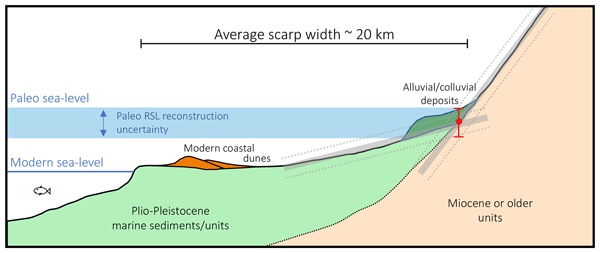
Sea level was significantly higher during the Pliocene epoch, around 3 million years ago. The present-day elevations of shorelines that formed in the past provide a data constraint on the extent of ice sheet melt and the global sea level response under warm Pliocene conditions. In this study, we identify 10 escarpments that formed from wave-cut erosion during Pliocene times and compare their elevations with model predictions of solid Earth deformation processes to estimate past sea level.
Patrick Boyden, Paolo Stocchi, and Alessio Rovere
Earth Surf. Dynam., 11, 917–931, https://doi.org/10.5194/esurf-11-917-2023, https://doi.org/10.5194/esurf-11-917-2023, 2023
Short summary
Short summary
Preservation bias often hampers the extraction of sea level changes from the stratigraphic record. In this contribution, we use a forward stratigraphic model to build three synthetic subtropical fringing reefs for a site in southwestern Madagascar (Indian Ocean). Each of the three synthetic reefs represents a different ice sheet melt scenario for the Pleistocene. We then evaluate each resultant reef sequence against the observed stratigraphic record.
Paolo Scussolini, Job Dullaart, Sanne Muis, Alessio Rovere, Pepijn Bakker, Dim Coumou, Hans Renssen, Philip J. Ward, and Jeroen C. J. H. Aerts
Clim. Past, 19, 141–157, https://doi.org/10.5194/cp-19-141-2023, https://doi.org/10.5194/cp-19-141-2023, 2023
Short summary
Short summary
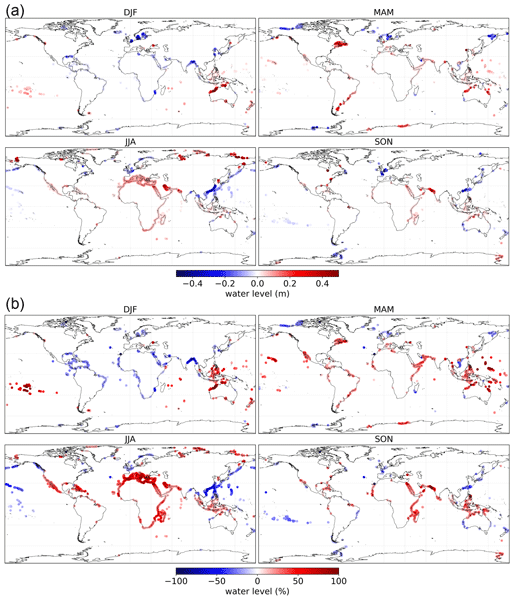
We reconstruct sea level extremes due to storm surges in a past warmer climate. We employ a novel combination of paleoclimate modeling and global ocean hydrodynamic modeling. We find that during the Last Interglacial, about 127 000 years ago, seasonal sea level extremes were indeed significantly different – higher or lower – on long stretches of the global coast. These changes are associated with different patterns of atmospheric storminess linked with meridional shifts in wind bands.
Alessio Rovere, Deirdre D. Ryan, Matteo Vacchi, Andrea Dutton, Alexander R. Simms, and Colin V. Murray-Wallace
Earth Syst. Sci. Data, 15, 1–23, https://doi.org/10.5194/essd-15-1-2023, https://doi.org/10.5194/essd-15-1-2023, 2023
Short summary
Short summary
In this work, we describe WALIS, the World Atlas of Last Interglacial Shorelines. WALIS is a sea-level database that includes sea-level proxies and samples dated to marine isotope stage 5 (~ 80 to 130 ka). The database was built through topical data compilations included in a special issue in this journal.
Karla Rubio-Sandoval, Alessio Rovere, Ciro Cerrone, Paolo Stocchi, Thomas Lorscheid, Thomas Felis, Ann-Kathrin Petersen, and Deirdre D. Ryan
Earth Syst. Sci. Data, 13, 4819–4845, https://doi.org/10.5194/essd-13-4819-2021, https://doi.org/10.5194/essd-13-4819-2021, 2021
Short summary
Short summary
The Last Interglacial (LIG) is a warm period characterized by a higher-than-present sea level. For this reason, scientists use it as an analog for future climatic conditions. In this paper, we use the World Atlas of Last Interglacial Shorelines database to standardize LIG sea-level data along the coasts of the western Atlantic and mainland Caribbean, identifying 55 unique sea-level indicators.
Cited articles
Ali, M., Cerrone, C., and Rovere, A.: A review of last interglacial sea-level proxies in South Asia and the Indian Ocean, Zenodo [data set], https://doi.org/10.5281/zenodo.18512769, 2026.
Antonioli, F., Lo Presti, V., Rovere, A., Ferranti, L., Anzidei, M., Furlani, S., Mastronuzzi, G., Orru, P. E., Scicchitano, G., Sannino, G., Spampinato, C. R., Pagliarulo, R., Deiana, G., de Sabata, E., Sansò, P., Vacchi, M., and Vecchio, A.: Tidal notches in Mediterranean Sea: a comprehensive analysis, Quaternary Sci. Rev., 119, 66–84, https://doi.org/10.1016/j.quascirev.2015.03.016, 2015.
Banerjee, P.: Holocene and Late Pleistocene relative sea level fluctuations along the east coast of India, Mar. Geol., 167, 243–260, https://doi.org/10.1016/S0025-3227(00)00028-1, 2000.
Bhatt, N. and Bhonde, U.: Geomorphic expression of late Quaternary sea level changes along the southern Saurashtra coast, western India, J. Earth Syst. Sci., 115, 395–402, https://doi.org/10.1007/BF02702868, 2006.
Bird, P.: An updated digital model of plate boundaries, G-cubed, 4, https://doi.org/10.1029/2001GC000252, 2003.
Boyden, P., Weil-Accardo, J., Deschamps, P., Oppo, D., and Rovere, A.: Last interglacial sea-level proxies in East Africa and the Western Indian Ocean, Earth Syst. Sci. Data, 13, 1633–1651, https://doi.org/10.5194/essd-13-1633-2021, 2021.
Brückner, H.: Late quaternary shorelines in India, in: Late Quaternary Sea-Level Correlation and Applications: Walter S. Newman Memorial Volume, Springer Netherlands, Dordrecht, 169–194, https://doi.org/10.1007/978-94-009-0873-4_9, 1989.
Byrne, D. E., Davis, D. M., and Sykes, L. R.: Loci and maximum size of thrust earthquakes and the mechanics of the shallow region of subduction zones, Tectonics, 7, 833–857, https://doi.org/10.1029/tc007i004p00833, 1988.
Dutton, A. and Lambeck, K.: Ice volume and sea level during the Last Interglacial, Science, 337, 216–219, https://doi.org/10.1126/science.1205749, 2012.
Dutton, A., Webster, J. M., Zwartz, D., Lambeck, K., and Wohlfarth, B.: Tropical tales of polar ice: evidence of Last Interglacial polar ice sheet retreat recorded by fossil reefs of the granitic Seychelles islands, Quaternary Sci. Rev., 107, 182–196, https://doi.org/10.1016/j.quascirev.2014.10.025, 2015.
Ellouz-Zimmermann, N., Deville, E., Müller, C., Lallemant, S., Subhani, A. B., and Tabreez, A. R.: Impact of sedimentation on convergent margin tectonics: Example of the Makran accretionary prism (Pakistan), Thrust belts and foreland basins, Springer, 327–350, https://doi.org/10.1007/978-3-540-69426-7_17, 2007.
Falkenroth, M., Schneider, B., and Hoffmann, G.: Beachrock as sea-level indicator – A case study at the coastline of Oman (Indian Ocean), Quaternary Sci. Rev., 206, 81–98, https://doi.org/10.1016/j.quascirev.2019.01.003, 2019.
Falkenroth, M., Adolphs, S., Cahnbley, M., Bagci, H., Kázmér, M., Mechernich, S., and Hoffmann, G.: Biological indicators reveal small-scale sea-level variability during MIS 5e (Sur, Sultanate of Oman), Open Quatern., 6, https://doi.org/10.5334/oq.72, 2020.
Farrell, W. E. and Clark, J. A.: On postglacial sea level, Geophys. J. Roy. Astron. Soc., 46, 647–667, https://doi.org/10.1111/j.1365-246X.1976.tb01252.x, 1976.
Garzón, S. and Rovere, A.: WALIS dashboard: An online tool to explore a global paleo sea-level database, Open Res. Europe, 3, 114, https://doi.org/10.12688/openreseurope.16183.2, 2024.
Gischler, E.: Corrigendum to “Late Quaternary reef growth and sea level in the Maldives (Indian Ocean)” by E. Gischler, J. H. Hudson and A. Pisera. [Marine Geology 250 (2008) 104–113], Mar. Geol., 255, 102, https://doi.org/10.1016/j.margeo.2008.07.002, 2008.
Gischler, E., Hudson, J. H., and Pisera, A.: Late Quaternary reef growth and sea level in the Maldives (Indian Ocean), Mar. Geol., 250, 104–113, https://doi.org/10.1016/j.margeo.2008.01.004, 2008.
Gischler, E., Humblet, M., Braga, J. C., and Eisenhauer, A.: Last interglacial reef facies and late Quaternary subsidence in the Maldives, Indian Ocean, Mar. Geol., 406, 34–41, https://doi.org/10.1016/j.margeo.2018.09.001, 2018.
Goswami, K., Krishnan, S., Kumerasan, A., Sadasivam, S. K., Kumar, P., and Jaiswal, M. K.: Luminescence chronology of fluvial and marine records from subsurface core in Kaveri delta, Tamil Nadu: Implications to sea level fluctuations, Geochronometria, 46, 125–137, https://doi.org/10.1515/geochr-2015-0112, 2019.
Hearty, P. J., Hollin, J. T., Neumann, A. C., O'Leary, M. J., and McCulloch, M.: Global sea-level fluctuations during the Last Interglaciation (MIS 5e), Quaternary Sci. Rev., 26, 2090–2112, https://doi.org/10.1016/j.quascirev.2007.06.019, 2007.
Henderson, G. M., Cohen, A. S., and O'nions, R. K.: 234U 238U ratios and 230Th ages for Hateruma Atoll corals: implications for coral diagenesis and seawater 234U 238U ratios, Earth Planet. Sc. Lett., 115, 65–73, https://doi.org/10.1016/0012-821X(93)90213-S, 1993.
Hoffmann, G., Reicherter, K., Wiatr, T., Grützner, C., and Rausch, T.: Block and boulder accumulations along the coastline between Fins and Sur (Sultanate of Oman): tsunamigenic remains?, Nat. Hazards, 65, 851–873, https://doi.org/10.1007/s11069-012-0399-7, 2013a.
Hoffmann, G., Rupprechter, M., and Mayrhofer, C.: Review of the long-term coastal evolution of North Oman-subsidence versus uplift, Z. Deutsch. Gesell. Geowiss., 164, 237–252, https://doi.org/10.1127/1860-1804/2013/0002 , 2013b.
Hoffmann, G., Schneider, B., Mechernich, S., Falkenroth, M., Dunai, T., and Preusser, F.: Quaternary uplift along a passive continental margin (Oman, Indian Ocean), Geomorphology, 350, 106870, https://doi.org/10.1016/j.geomorph.2019.106870, 2020.
Hoggard, M. J., White, N., and Al-Attar, D.: Global dynamic topography observations reveal limited influence of large-scale mantle flow, Nat. Geosci., 9, 456–463, https://doi.org/10.1038/ngeo2709, 2016.
Kaufman, A., Broecker, W. S., Ku, T. L., and Thurber, D. L.: The status of U-series methods of mollusk dating, Geochim. Cosmochim. Ac., 35, 1155–1183, https://doi.org/10.1016/0016-7037(71)90031-7, 1971.
Khan, N. S., Horton, B. P., Engelhart, S., Rovere, A., Vacchi, M., Ashe, E. L., Törnqvist, T. E., Dutton, A., Hijma, M. P., and Shennan, I.: Inception of a global atlas of sea levels since the Last Glacial Maximum, Quaternary Sci. Rev., 220, 359–371, https://doi.org/10.1016/j.quascirev.2019.07.016, 2019.
Kopp, R. E., Simons, F. J., Mitrovica, J. X., Maloof, A. C., and Oppenheimer, M.: Probabilistic assessment of sea level during the last interglacial stage, Nature, 462, 863–867, https://doi.org/10.1038/nature08686, 2009.
Lambeck, K., Rouby, H., Purcell, A., Sun, Y., and Sambridge, M.: Sea level and global ice volumes from the Last Glacial Maximum to the Holocene, P. Natl. Acad. Sci. USA, 111, 15296–15303, https://doi.org/10.1073/pnas.1411762111, 2014.
Lorscheid, T. and Rovere, A.: The indicative meaning calculator quantification of paleo sea-level relationships by using global wave and tide datasets, Open Geospat. Data Softw. Stand., 4, https://doi.org/10.1186/s40965-019-0069-8, 2019.
Loveson, V. J. and Nigam, R.: Reconstruction of Late Pleistocene and Holocene sea level curve for the east coast of India, J. Geol. Soc. India, 93, 507–514, https://doi.org/10.1007/s12594-019-1211-z, 2019.
Mauz, B., Vacchi, M., Green, A., Hoffmann, G., and Cooper, A.: Beachrock: a tool for reconstructing relative sea level in the far-field, Mar. Geol., 362, 1–16, https://doi.org/10.1016/j.margeo.2015.01.009, 2015.
Milne, G. A., Gehrels, W. R., Hughes, C. W., and Tamisiea, M. E.: Identifying the causes of sea-level change, Nat. Geosci., 2, 471–478, https://doi.org/10.1038/ngeo544, 2009.
Müller, R. D., Sdrolias, M., Gaina, C., and Roest, W. R.: Age, spreading rates and spreading asymmetry of the world's ocean crust, Geochem. Geophy., Geosy., 9, https://doi.org/10.1029/2007GC001743, 2008.
Normand, R., Simpson, G., Herman, F., Biswas, R. H., Bahroudi, A., and Schneider, B.: Dating and morpho-stratigraphy of uplifted marine terraces in the Makran subduction zone (Iran), Earth Surf. Dynam., 7, 321–344, https://doi.org/10.5194/esurf-7-321-2019, 2019.
Otvos, E. G.: Beach ridges – definitions and significance, Geomorphology, 32, 83–108, https://doi.org/10.1016/S0169-555X(99)00075-6, 2000.
Parsons, B. and Sclater, J. G.: An analysis of the variation of ocean floor bathymetry and heat flow with age, J. Geophys. Res., 82, 803–827, https://doi.org/10.1029/JB082i005p00803, 1977.
Pedoja, K., Husson, L., Johnson, M. E., Melnick, D., Witt, C., Pochat, S., Nexer, M., Delcaillau, B., Pinegina, T., Poprawski, Y., Authemayou, C., Elliot, M., Regard, V., and Garestier, F.: Coastal staircase sequences reflecting sea-level oscillations and tectonic uplift during the Quaternary and Neogene, Earth Sci. Rev., 132, 13–38, https://doi.org/10.1016/j.earscirev.2014.01.007, 2014.
Perry, C. T., Spencer, T., and Kench, P. S.: Carbonate budgets and reef production states: a geomorphic perspective on the ecological phase-shift concept, Coral Reefs, 27, 853–866, https://doi.org/10.1007/s00338-008-0418-z, 2008.
Pirazzoli, P. A.: Marine Terraces, in: Encyclopedia of Coastal Science, Springer, 632–633, https://doi.org/10.1007/1-4020-3880-1_209, 2005.
Pirazzoli, P. A., Reyss, J.-L., Fontugne, M., Haghipour, A., Hilgers, A., Kasper, H. U., Nazari, H., Preusser, F., and Radtke, U.: Quaternary coral-reef terraces from Kish and Qeshm Islands, Persian Gulf: new radiometric ages and tectonic implications, Quatern. Int., 120, 15–27, https://doi.org/10.1016/j.quaint.2004.01.003, 2004.
Plaziat, J. C., Reyss, J. L., Choukri, A., and Cazala, C.: Diagenetic rejuvenation of raised coral reefs and precision of dating. The contribution of the Red Sea reefs to the question of reliability of the Uranium-series datings of middle to late Pleistocene key reef-terraces of the world, Carnets de Géologie/Notebooks on Geology, A04, 1-35, https://doi.org/10.4267/2042/16743, 2008.
Preusser, F., Radtke, U., Fontugne, M., Haghipour, A., Hilgers, A., Kasper, H. U., Nazari, H., and Pirazzoli, P. A.: ESR dating of raised coral reefs from Kish Island, Persian Gulf, Quaternary Sci. Rev., 22, 1317–1322, https://doi.org/10.1016/s0277-3791(03)00038-6, 2003.
Purdy, E. G. and Bertram, G. T.: Carbonate concepts from the Maldives, Indian ocean, AAPG Studies in Geology, 1–56, https://doi.org/10.1306/St34568, 1993.
Regard, V., Bellier, O., Thomas, J.-C., Bourlès, D., Bonnet, S., Abbassi, M. R., Braucher ,R., Mercier, J., Shabanian, E., Soleymani, S., and Feghhi, K.: Cumulative right-lateral fault slip rate across the Zagros–Makran transfer zone: role of the Minab–Zendan fault system in accommodating Arabia–Eurasia convergence in southeast Iran, Geophys. J. Int., 162, 177–203, https://doi.org/10.1111/j.1365-246X.2005.02558.x, 2005.
Reyss, J.-L., Pirazzoli, P. A., Haghipour, A., Hatté, C., and Fontugne, M.: Quaternary marine terraces and tectonic uplift rates on the south coast of Iran, in: Coastal Tectonics, Special Publications, 146, edited by: Stewart, I. S. and Vita-Finzi, C., Geological Society, London, 225–237, https://doi.org/10.1144/GSL.SP.1999.146.01.13, 1999.
Rovere, A., Stocchi, P., and Vacchi, M.: Eustatic and relative sea level changes, Curr. Clim. Change Rep., 2, 221–231, https://doi.org/10.1007/s40641-016-0045-7, 2016a.
Rovere, A., Raymo, M. E., Vacchi, M., Lorscheid, T., Stocchi, P., Gomez-Pujol, L., Harris, D. L., Casella, E., O'Leary, M. J., and Hearty, P. J.: The analysis of Last Interglacial (MIS 5e) relative sea-level indicators: Reconstructing sea-level in a warmer world, Earth Sci. Rev., 159, 404–427, https://doi.org/10.1016/j.earscirev.2016.06.006, 2016b.
Rovere, A., Ryan, D., Murray-Wallace, C., Simms, A., Vacchi, M., Dutton, A., Lorscheid, T., Chutcharavan, P., Brill, D., Bartz, M., Jankowski, N., Mueller, D., Cohen, K., and Gowan, E.: Documentation of the World Atlas of Last Interglacial Shorelines (WALIS) (Version v1.0), Zenodo [data set], https://doi.org/10.5281/zenodo.3961544, 2020.
Rovere, A., Ryan, D. D., Vacchi, M., Dutton, A., Simms, A. R., and Murray-Wallace, C. V.: The World Atlas of Last Interglacial Shorelines (version 1.0), Earth Syst. Sci. Data, 15, 1–23, https://doi.org/10.5194/essd-15-1-2023, 2023.
Ryan, W. B. F., Carbotte, S. M., Coplan, J. O., O'Hara, S., Melkonian, A., Arko, R., Weissel, R. A., Ferrini, V., Goodwillie, A., Nitsche, F., Bonczkowski, J., and Zemsky, R.: Global Multi-Resolution Topography synthesis, Geochem. Geophy. Geosy., 10, https://doi.org/10.1029/2008GC002332, 2009.
Shennan, I.: Interpretation of Flandrian sea-level data from the Fenland, England, P. Geol. Assoc., 93, 53–63, https://doi.org/10.1016/S0016-7878(82)80032-1, 1982.
Shennan, I.: Flandrian sea-level changes in the Fenland. I: The geographical setting and evidence of relative sea-level changes, J. Quaternary Sci., 1, 119–153, https://doi.org/10.1002/jqs.3390010204, 1986.
Shennan, I.: Holocene crustal movements and sea-level changes in Great Britain, J. Quaternary Sci., 4, 77–89, https://doi.org/10.1002/jqs.3390040109, 1989.
Shennan, I.: Handbook of sea-level research, in: Handbook of Sea-Level Research, Wiley, 3–25, https://doi.org/10.1002/9781118452547.ch2, 2015.
Shennan, I., Tooley, M. J., Davis, M. J., and Haggart, B. A.: Analysis and interpretation of Holocene sea-level data, Nature, 302, 404–406, https://doi.org/10.1038/302404a0, 1983.
Talebian, M. and Jackson, J.: Offset on the Main Recent Fault of NW Iran and implications for the late Cenozoic tectonics of the Arabia–Eurasia collision zone, Geophys. J. Int., 150, 422–439, https://doi.org/10.1046/j.1365-246X.2002.01711.x, 2002.
Thompson, S. B. and Creveling, J. R.: A global database of marine isotope substage 5a and 5c marine terraces and paleoshoreline indicators, Earth Syst. Sci. Data, 13, 3467–3490, https://doi.org/10.5194/essd-13-3467-2021, 2021.
Woodroffe, C. D.: Late Quaternary sea-level highstands in the central and eastern Indian Ocean: A review, Global Planet. Change, 49, 121–138, https://doi.org/10.1016/j.gloplacha.2005.06.002, 2005.
Woodroffe, C. D., Veeh, H. H., Falkland, A. C., McLean, R. F., and Wallensky, E.: Last interglacial reef and subsidence of the Cocos (Keeling) Islands, Indian Ocean, Mar. Geol., 96, 137–143, https://doi.org/10.1016/0025-3227(91)90210-U, 1991.
Short summary
We compiled a database of 54 ancient shoreline markers from Iran, Oman, India, the Maldives and the Cocos Islands, dating to Marine Isotopic Stage 5. The records show that the same past ocean level can appear far above today's sea on rising coasts, near today's level on stable coasts, and many meters underwater where land is sinking. This helps separate true ocean change from land motion and improves future sea-level planning.
We compiled a database of 54 ancient shoreline markers from Iran, Oman, India, the Maldives and...
Special issue
Altmetrics
Final-revised paper
Preprint