Articles | Volume 18, issue 10
https://doi.org/10.5194/essd-18-7403-2026
© Author(s) 2026. This work is distributed under
the Creative Commons Attribution 4.0 License.
https://doi.org/10.5194/essd-18-7403-2026
© Author(s) 2026. This work is distributed under
the Creative Commons Attribution 4.0 License.
Ground-motion dataset for shallow earthquakes in Colombia

Daniel Martinez-Jaramillo
CORRESPONDING AUTHOR
Posgrado en Ciencias de la Tierra, Instituto de Geociencias, Universidad Nacional Autónoma de México, Querétaro, 76230, México
Sreeram-Reddy Kotha
University Grenoble Alpes, University Savoie Mont Blanc, CNRS, IRD, University Gustave Eiffel, ISTerre, 38400 Grenoble, France
F. Ramón Zúñiga
Instituto de Geociencias, Universidad Nacional Autónoma de México. Juriquilla, 76230, Querétaro, México
Pierre Lacan
Instituto de Geociencias, Universidad Nacional Autónoma de México. Juriquilla, 76230, Querétaro, México
Related authors
No articles found.
Quetzalcoatl Rodríguez-Pérez, Víctor Hugo Márquez-Ramírez, and Francisco Ramón Zúñiga
Solid Earth, 17, 803–824, https://doi.org/10.5194/se-17-803-2026, https://doi.org/10.5194/se-17-803-2026, 2026
Short summary
Short summary
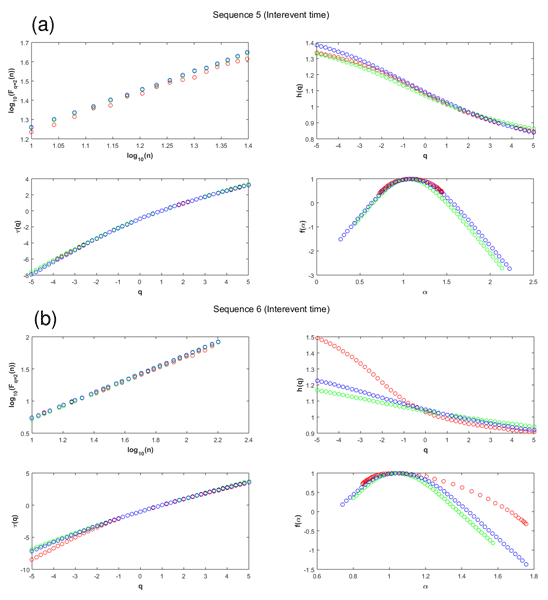
We studied the statistical properties of weak signals known as non-volcanic tremors along the Mexican coast to understand how the earth moves deep underground. By analyzing the timing and size of these faint tremors, we discovered they behave similarly to regular earthquakes but follow complex, persistent patterns. Our findings suggest these movements are influenced by underground fluids and nonlinear forces. This work clarifies how energy builds up, improving our grasp of earthquake risks.
Nicolas Harrichhausen, Léo Marconato, Laurence Audin, Pierre Lacan, Stéphane Baize, Hervé Jomard, Alexandra Alvarado, James Hollingsworth, Pierre-Henri Blard, Patricia Ann Mothes, Frédérique Rolandone, and Iván Dario Ortiz Martin
Solid Earth, 17, 763–787, https://doi.org/10.5194/se-17-763-2026, https://doi.org/10.5194/se-17-763-2026, 2026
Short summary
Short summary
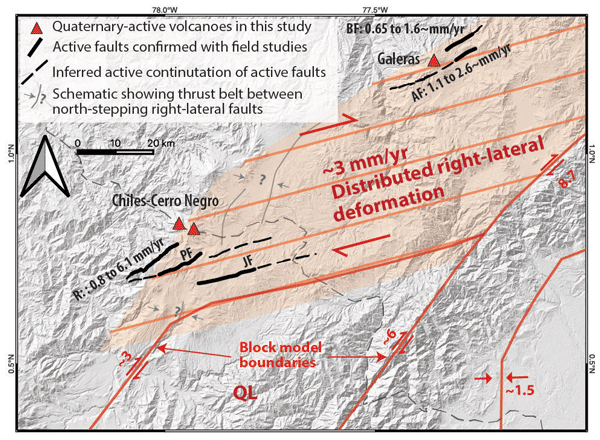
Tectonic plates can be broken into smaller blocks with deformation concentrated at their boundaries. We use remote sensing and field studies to investigate how faulting accommodates deformation at the northern boundary of the Quito-Latacunga microblock (Ecuador & Colombia). We show this boundary is a wide zone characterized by several parallel faults capable of hosting moderate to large (<M7) earthquakes, such as the one in 2022, and which may be influenced by nearby volcanism.
Quetzalcoatl Rodríguez-Pérez and F. Ramón Zúñiga
Nat. Hazards Earth Syst. Sci. Discuss., https://doi.org/10.5194/nhess-2024-92, https://doi.org/10.5194/nhess-2024-92, 2024
Preprint withdrawn
Short summary
Short summary
Seismic intensity reflects earthquake damage, although this parameter is often subjective. On the other hand, peak acceleration values are a direct measure of earthquake effects. Seismic intensity was used to describe historical earthquakes, and its use is rare today. For this reason, it is important to have a relationship between these parameters of strong movements in order to predict the acceleration of historical earthquakes.
Graeme Weatherill, Sreeram Reddy Kotha, Laurentiu Danciu, Susana Vilanova, and Fabrice Cotton
Nat. Hazards Earth Syst. Sci., 24, 1795–1834, https://doi.org/10.5194/nhess-24-1795-2024, https://doi.org/10.5194/nhess-24-1795-2024, 2024
Short summary
Short summary
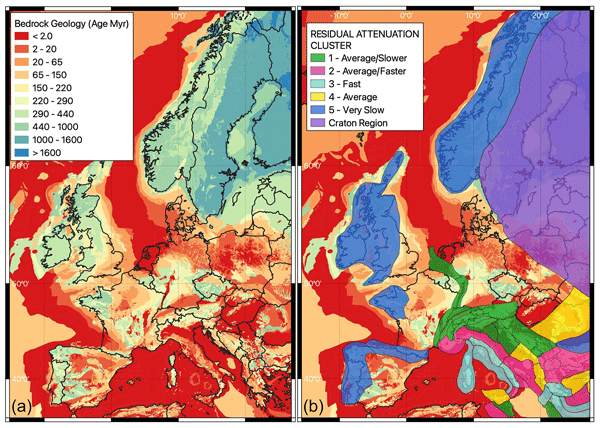
The ground motion models (GMMs) selected for the 2020 European Seismic Hazard Model (ESHM20) and their uncertainties require adaptation to different tectonic environments. Using insights from new data, local experts and developments in the scientific literature, we further calibrate the ESHM20 GMM logic tree to capture previously unmodelled regional variation. We also propose a new scaled-backbone logic tree for application to Europe's subduction zones and the Vrancea deep seismic source.
Quetzalcoatl Rodríguez-Pérez and F. Ramón Zúñiga
Solid Earth, 15, 229–249, https://doi.org/10.5194/se-15-229-2024, https://doi.org/10.5194/se-15-229-2024, 2024
Short summary
Short summary
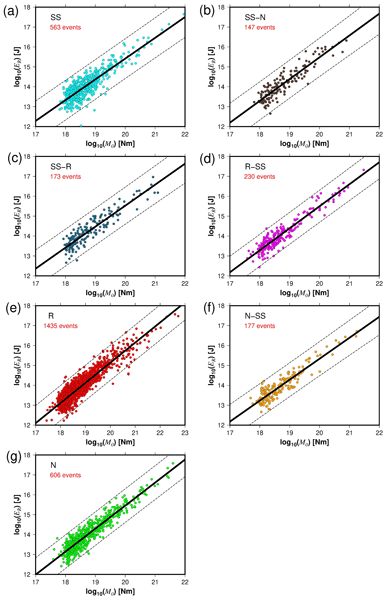
The behavior of seismic energy parameters and their possible dependence on the type of fault for globally detected earthquakes were studied. For this purpose, different energy estimation methods were used. Equations were obtained to convert energies obtained in different ways. The dependence of the seismic energy on the focal mechanism was confirmed up to depths close to 180 km. The results will help to explain the seismic rupture of earthquakes generated at greater depth.
Quetzalcoatl Rodríguez-Pérez and F. Ramón Zúñiga
Earth Syst. Sci. Data, 15, 4781–4801, https://doi.org/10.5194/essd-15-4781-2023, https://doi.org/10.5194/essd-15-4781-2023, 2023
Short summary
Short summary
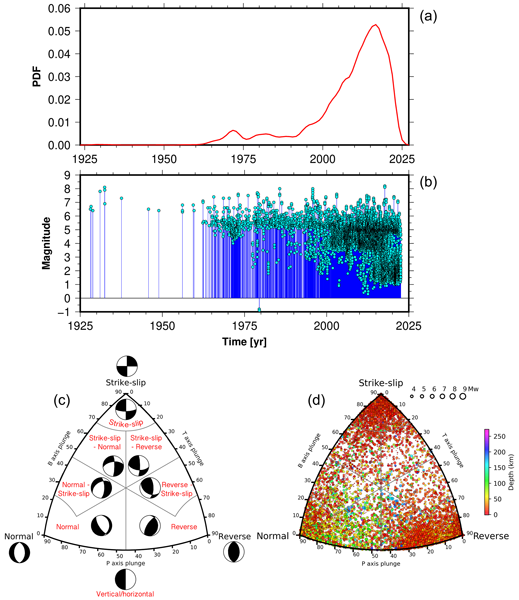
We present a comprehensive catalog of focal mechanisms for earthquakes in Mexico and neighboring areas spanning February 1928 to July 2022. The catalog comprises a wide range of earthquake magnitudes and depths and includes data from diverse geological environments. We collected and revised focal mechanism data from various sources and methods. The catalog is a valuable resource for future studies on earthquake source mechanisms, tectonics, and seismic hazard in the region.
Cited articles
Abrahamson, N. A. and Silva, W. J.: Empirical response spectral attenuation relations for shallow crustal earthquakes, Seismol. Res. Lett., 68, 94–127, https://doi.org/10.1785/gssrl.68.1.94, 1997.
Abrahamson, N. A., Silva, W. J., and Kamai, R.: Summary of the ASK14 ground motion relation for active crustal regions, Earthq. Spectra, 30, 1025–1055, https://doi.org/10.1193/070913EQS198M, 2014.
Akkar, S., Sandıkkaya, M. A., Şenyurt, M., Azari Sisi, A., Ay, B. Ö., Traversa, P., Douglas, J., Cotton, F., Luzi, L., Hernandez, B., and Godey, S.: Reference database for seismic ground-motion in Europe (RESORCE), B. Earthq. Eng., 12, 311–339, https://doi.org/10.1007/s10518-013-9506-8, 2014.
Al Atik, L., Abrahamson, N., Bommer, J. J., Scherbaum, F., Cotton, F., and Kuehn, N.: The variability of ground-motion prediction models and its components, Seismol. Res. Lett., 81, 794–801, https://doi.org/10.1785/gssrl.81.5.794, 2010.
Ancheta, T. D., Darragh, R. B., Stewart, J. P., Seyhan, E., Silva, W. J., Chiou, B. S.-J., Wooddell, K. E., Graves, R. W., Kottke, A. R., Boore, D. M., Kishida, T., and Donahue, J. L.: NGA-West2 database, Earthq. Spectra, 30, 989–1005, https://doi.org/10.1193/070913EQS197M, 2014.
Arteta, C. A., Pajaro, C. A., Mercado, V., Montejo, J., Arcila, M., and Abrahamson, N. A.: Ground-motion model for subduction earthquakes in northern South America, Earthq. Spectra, 37, 2419–2452, https://doi.org/10.1177/87552930211027585, 2021.
Arteta, C. A., Pajaro, C. A., Mercado, V., Montejo, J., Arcila, M., and Abrahamson, N. A.: Ground-motion model (GMM) for crustal earthquakes in Northern South America (NoSAm crustal GMM), B. Seismol. Soc. Am., 113, 186–203, https://doi.org/10.1785/0120220168, 2023.
Bastías, N. and Montalva, G. A.: Chile Strong Ground Motion Flatfile, Earthq. Spectra, 32, 2549–2566, https://doi.org/10.1193/102715EQS158DP, 2016.
Bayless, J. and Abrahamson, N. A.: Summary of the BA18 ground-motion model for Fourier amplitude spectra for crustal earthquakes in California, B. Seismol. Soc. Am., 109, 2088–2105, https://doi.org/10.1785/0120190077, 2019.
Bindi, D., Kotha, S. R., Weatherill, G., Lanzano, G., Luzi, L., and Cotton, F.: The pan-European engineering strong motion (ESM) flatfile: consistency check via residual analysis, B. Earthq. Eng., 17, 583–602, https://doi.org/10.1007/s10518-018-0466-x, 2019.
Boore, D. M.: Orientation-independent, nongeometric-mean measures of seismic intensity from two horizontal components of motion, B. Seismol. Soc. Am., 100, 1830–1835, https://doi.org/10.1785/0120090400, 2010.
Brune, J. N.: Tectonic stress and the spectra of seismic shear waves from earthquakes, J. Geophys. Res., 75, 4997–5009, https://doi.org/10.1029/JB075i026p04997, 1970.
Buscetti, M., Traversa, P., Perron, V., Rischette, P., Hollender, F., and Shible, H.: Epos-France Database of Earthquake Ground Motion for Mainland France: 1996–2021 Updated Version, Seismol. Res. Lett., 96, 1214–1226, https://doi.org/10.1785/0220240053, 2025.
Dawood, H. M., Rodriguez-Marek, A., Bayless, J., Goulet, C., and Thompson, E.: A flatfile for the KiK-net database processed using an automated protocol, Earthq. Spectra, 32, 1281–1302, https://doi.org/10.1193/071214EQS106, 2016.
Ekström, G., Nettles, M., and Dziewonski, A. M.: The global CMT project 2004–2010: Centroid-moment tensors for 13,017 earthquakes, Phys. Earth Planet. In., 200–201, 1–9, https://doi.org/10.1016/j.pepi.2012.04.002, 2012.
Eraso, J. and Montejo, J.: Mapa de Vs30 Integrado para Colombia, Servicio Geológico Colombiano, Bogotá, https://doi.org/10.32685/4.3.2020.927, 2019.
Goulet, C. A., Kishida, T., Ancheta, T. D., Cramer, C. H., Darragh, R. B., Silva, W. J., Hashash, Y. M. A., Harmon, J., Parker, G. A., Stewart, J. P., and Youngs, R. R.: PEER NGA-east database, Earthq. Spectra, 37, 1331–1353, https://doi.org/10.1177/87552930211015695, 2021.
Hanks, T. C. and Kanamori, H.: A moment magnitude scale, J. Geophys. Res., 84, 2348–2350, https://doi.org/10.1029/JB084iB05p02348, 1979.
International Seismological Centre: ISC-EHB dataset, International Seismological Centre [data set], https://doi.org/10.31905/PY08W6S3, 2026 (last access: 12 August 2026).
Konno, K. and Ohmachi, T.: Ground-motion characteristics estimated from spectral ratio between horizontal and vertical components of microtremor, B. Seismol. Soc. Am., 88, 228–241, https://doi.org/10.1785/BSSA0880010228, 1998.
Kottke, A., Abrahamson, N. A., Boore, D. M., Bozorgnia, Y., Goulet, C. A., Hollenback, J., Kishida, T., Der Kiureghian, A., Ktenidou, O.-J., Kuehn, N., Rathje, E. M., Silva, W. J., Thompson, E., and Wang, X.: Selection of random vibration procedures for the NGA East Project, PEER Report No. 2018/05, Pacific Earthquake Engineering Research Center, University of California, Berkeley, CA, https://peer.berkeley.edu/publications/2018-05 (last access: 5 October 2026), 2018.
Lanzano, G., Sgobba, S., Luzi, L., Puglia, R., Pacor, F., Felicetta, C., D'Amico, M., Cotton, F., and Bindi, D.: The pan-European Engineering Strong Motion (ESM) flatfile: compilation criteria and data statistics, B. Earthq. Eng., 17, 561–582, https://doi.org/10.1007/s10518-018-0480-z, 2019.
Marín-Arias, J. P., Castillo González, H., and Salcedo Hurtado, E. de J.: Modelo geométrico del foco del terremoto de Popayán (Colombia) a partir de datos macrosísmicos, Bol. Geol., 28, 93–109, https://www.redalyc.org/articulo.oa?id=349631992005 (last access: 5 October 2026, 2006.
Marín-Arias, J. P., Valencia Muñoz, L. Y., and Rendón Cardona, L. M.: Macroseismic analysis of Murindo earthquake, Antioquia (Colombia) October 1992, Bol. Geol., 31, 85–93, http://www.scielo.org.co/pdf/boge/v31n1/v31n1a06.pdf (last access: 5 October 2026), 2009.
Martinez-Jaramillo, D., Kotha, S. R., Zúñiga, F. R., and Lacan, P.: Ground-Motion Dataset for Shallow Earthquakes in Colombia (v2), Zenodo [data set], https://doi.org/10.5281/zenodo.22031680, 2026.
Mercado, V., Díaz-Parra, F. J., Pajaro, C. A., Montejo, J., Posada, G., Arcila, M., and Arteta, C. A.: Performance evaluation of parameters as estimators of seismic site effects in northern South America, Soil Dyn. Earthq. Eng., 180, 108584, https://doi.org/10.1016/j.soildyn.2024.108584, 2024.
Montejo, J., Arcila Rivera, M., and Zornosa, D. G.: Integrated Seismic Catalog for Colombia, Bol. Geol., 50, https://doi.org/10.32685/0120-1425/bol.geol.50.1.2023.665, 2023.
Mosquera-Machado, S., Lalinde-Pulido, C., Salcedo-Hurtado, E., and Michetti, A. M.: Ground effects of the 18 October 1992, Murindo earthquake (NW Colombia), using the Environmental Seismic Intensity Scale (ESI 2007) for the assessment of intensity, Geol. Soc. Spec. Publ., 316, 123–144, https://doi.org/10.1144/SP316.7, 2009.
Oliveti, I., Faenza, L., and Michelini, A.: Intensity-ground motion dataset for Italy (INGe), version 2.0, Istituto Nazionale di Geofisica e Vulcanologia (INGV) [data set], https://doi.org/10.13127/inge.2, 2021.
Pacor, F., Felicetta, C., Lanzano, G., Sgobba, S., Puglia, R., D'Amico, M., Russo, E., Baltzopoulos, G., and Iervolino, I.: NESS1: A worldwide collection of strong-motion data to investigate near source effects, Seismol. Res. Lett., 89, 2299–2313, https://doi.org/10.1785/0220180149, 2018.
Pájaro, C. A., Arteta, C. A., Mercado, V., Montejo, J., Arcila, M., and Abrahamson, N. A.: Partially non-ergodic ground motion model for the Bucaramanga seismic nest in Northern South America (NoSAm Nest GMM), B. Earthq. Eng., 22, 3677–3702, https://doi.org/10.1007/s10518-024-01898-w, 2024.
Paolucci, R., Pacor, F., Puglia, R., Ameri, G., Cauzzi, C., and Massa, M.: Record processing in ITACA, the new Italian strong-motion database, in: Earthquake Data in Engineering Seismology, edited by: Akkar, S., Gülkan, P., and van Eck, T., Springer, Dordrecht, 99–113, https://doi.org/10.1007/978-94-007-0152-6_8, 2011.
Paris, G., Machette, M. N., Dart, R. L., and Haller, K. M.: Map and database of Quaternary faults and folds in Colombia and its offshore regions, US Geological Survey Open-File Report 00-284, https://doi.org/10.3133/ofr00284, 2000.
Rodríguez, L., Diederix, H., Torres, E., Audemard, F., Hernández, C., Singer, A., and Yepez, S.: Identification of the seismogenic source of the 1875 Cucuta earthquake on the basis of a combination of neotectonic, paleoseismologic and historic seismicity studies, J. S. Am. Earth Sci., 82, 274–291, https://doi.org/10.1016/j.jsames.2017.09.019, 2018.
Servicio Geológico Colombiano: Red Sismologica Nacional de Colombia, International Federation of Digital Seismograph Networks [data set], https://doi.org/10.7914/SN/CM, 1993.
Sgobba, S., Felicetta, C., Lanzano, G., Ramadan, F., D'Amico, M., and Pacor, F.: NESS2.0: An Updated Version of the Worldwide Dataset for Calibrating and Adjusting Ground-Motion Models in Near Source, B. Seismol. Soc. Am., 111, 2358–2378, https://doi.org/10.1785/0120210080, 2021.
Sharma, S., Mannu, U., and Bora, S. S.: A Flat-File Compilation of Strong Ground-Motion Intensity Measures for Crustal Earthquakes in the Indian Region, Seismica, 4, https://doi.org/10.26443/seismica.v4i2.1620, 2025.
Strasser, F. O., Arango, M. C., and Bommer, J. J.: Scaling of the source dimensions of interface and intraslab subduction-zone earthquakes with moment magnitude, Seismol. Res. Lett., 81, 941–950, https://doi.org/10.1785/gssrl.81.6.941, 2010.
Vanneste, K., Onvani, M., Rapagnani, G., and Van Noten, K.: The BELSHAKE Database of Earthquake Ground Motion in Belgium, Seismol. Res. Lett., 97, 918–933, https://doi.org/10.1785/0220250321, 2026.
Vargas-Jiménez, C. A. and Monsalve-Jaramillo, H.: 3D velocity structure around the source area of the Armenia earthquake: 25 January 1999, Mw= 6.2 (Colombia), Bol. Soc. Geol. Mex., 61, 339–351, 2009.
Wells, D. L. and Coppersmith, K. J.: New empirical relationships among magnitude, rupture length, rupture width, rupture area, and surface displacement, B. Seismol. Soc. Am., 84, 974–1002, https://doi.org/10.1785/BSSA0840040974, 1994.
Weston, J., Engdahl, E. R., Harris, J., Di Giacomo, D., and Storchak, D. A.: ISC-EHB: Reconstruction of a robust earthquake dataset, Geophys. J. Int., 214, 474–484, https://doi.org/10.1093/gji/ggy155, 2018.
Short summary
Colombia is regularly struck by damaging earthquakes. We gathered and uniformly processed 7550 recordings from 667 shallow earthquakes into a single open collection describing each earthquake, recording site and level of shaking. Comparison with widely used prediction methods confirmed its quality. The collection can help engineers design safer buildings and improve earthquake hazard maps in Colombia and similar regions.
Colombia is regularly struck by damaging earthquakes. We gathered and uniformly processed 7550...
Altmetrics
Final-revised paper
Preprint