Articles | Volume 18, issue 9
https://doi.org/10.5194/essd-18-6321-2026
© Author(s) 2026. This work is distributed under
the Creative Commons Attribution 4.0 License.
the Creative Commons Attribution 4.0 License.
https://doi.org/10.5194/essd-18-6321-2026
© Author(s) 2026. This work is distributed under
the Creative Commons Attribution 4.0 License.
the Creative Commons Attribution 4.0 License.
Data review article
| 
03 Sep 2026
Data review article |
| 03 Sep 2026
| 03 Sep 2026
Hydrographic CTD profiles capturing the onset of near-surface stratification in Southwest Greenland fjords during two consecutive spring 2025 field campaigns
Marta Umbert
CORRESPONDING AUTHOR

Barcelona Expert Center/Institut de Ciències del Mar (ICM-CSIC), Passeig Marítim de la Barceloneta 37–49, 08003 Barcelona, Spain
Nina Hoareau
CORRESPONDING AUTHOR
Barcelona Expert Center/Institut de Ciències del Mar (ICM-CSIC), Passeig Marítim de la Barceloneta 37–49, 08003 Barcelona, Spain
Júlia Crespin
Barcelona Expert Center/Institut de Ciències del Mar (ICM-CSIC), Passeig Marítim de la Barceloneta 37–49, 08003 Barcelona, Spain
Maria Sánchez-Urrea
Barcelona Expert Center/Institut de Ciències del Mar (ICM-CSIC), Passeig Marítim de la Barceloneta 37–49, 08003 Barcelona, Spain
Ferran Hernández-Macià
Barcelona Expert Center/Institut de Ciències del Mar (ICM-CSIC), Passeig Marítim de la Barceloneta 37–49, 08003 Barcelona, Spain
Carolina Gabarró
Barcelona Expert Center/Institut de Ciències del Mar (ICM-CSIC), Passeig Marítim de la Barceloneta 37–49, 08003 Barcelona, Spain
Eva De-Andrés
Barcelona Expert Center/Institut de Ciències del Mar (ICM-CSIC), Passeig Marítim de la Barceloneta 37–49, 08003 Barcelona, Spain
Related authors
Nicolas Werner-Pelletier, Júlia Crespin, Aleida Rosquete, Maria Sánchez-Urrea, Nina Hoareau, Mario Martin, and Marta Umbert
Earth Syst. Sci. Data Discuss., https://doi.org/10.5194/essd-2026-519, https://doi.org/10.5194/essd-2026-519, 2026
Preprint under review for ESSD
Short summary
Short summary
The Arctic Ocean is changing rapidly, but many areas remain hard to observe. This work combines satellite measurements, in-water observations, and deep learning to create a new eleven-year enhanced picture of Arctic temperature, saltiness, and ocean currents. It can help researchers study freshwater change, circulation, sea ice links, and how polar changes may affect the global climate.
Aleida Rosquete-Estevez, Júlia Crespin, Luis Yubero, Ana María Mancho, and Marta Umbert
EGUsphere, https://doi.org/10.5194/egusphere-2026-3629, https://doi.org/10.5194/egusphere-2026-3629, 2026
This preprint is open for discussion and under review for Ocean Science (OS).
Short summary
Short summary
Understanding Arctic currents is vital for climate research, but sparse data makes validation difficult. We evaluated six satellite and ocean reanalysis products using real drifting buoys. Products incorporating wind and mixed-layer data reproduced currents best. Crucially, we show that local velocity accuracy does not guarantee realistic transport pathways. To correctly track melting freshwater, tracking frameworks must evaluate entire journeys rather than point-wise speeds.
Verónica González-Gambau, Estrella Olmedo, Aina García-Espriu, Cristina González-Haro, Antonio Turiel, Carolina Gabarró, Alessandro Silvano, Aditya Narayanan, Alberto Naveira-Garabato, Rafael Catany, Nina Hoareau, Marta Umbert, Giuseppe Aulicino, Yuri Cotroneo, Roberto Sabia, and Diego Fernández-Prieto
Earth Syst. Sci. Data, 17, 5089–5111, https://doi.org/10.5194/essd-17-5089-2025, https://doi.org/10.5194/essd-17-5089-2025, 2025
Short summary
Short summary
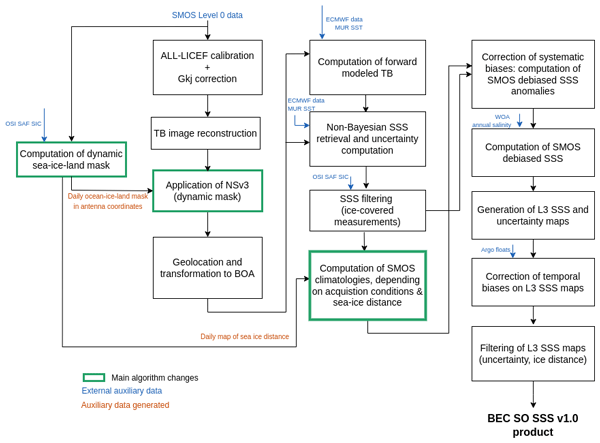
This paper introduces a new Sea Surface Salinity product for the Southern Ocean, based on SMOS data and developed by the Barcelona Expert Center. It offers 9 d maps on a 25 km EASE-SL grid, from 2011 to 2023, covering areas south of 30° S. The product is accurate beyond 150 km from sea ice, with nearly zero bias and a ~0.22 STD. It tracks well seasonal and interannual changes and will contribute to the understanding of processes influenced by upper-ocean salinity, including ice formation/melt.
Marta Umbert, Eva De Andrés, Maria Sánchez, Carolina Gabarró, Nina Hoareau, Veronica González-Gambau, Aina García-Espriu, Estrella Olmedo, Roshin P. Raj, Jiping Xie, and Rafael Catany
Ocean Sci., 20, 279–291, https://doi.org/10.5194/os-20-279-2024, https://doi.org/10.5194/os-20-279-2024, 2024
Short summary
Short summary
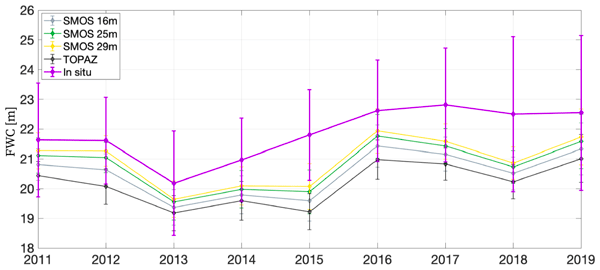
Satellite retrievals of sea surface salinity (SSS) offer insights into freshwater changes in the Arctic Ocean. This study evaluates freshwater content in the Beaufort Gyre using SMOS and reanalysis data, revealing underestimation with reanalysis alone. Incorporating satellite SSS measurements improves freshwater content estimation, especially near ice-melting areas. Adding remotely sensed salinity aids in monitoring Arctic freshwater content and in understanding its impact on global climate.
Verónica González-Gambau, Estrella Olmedo, Antonio Turiel, Cristina González-Haro, Aina García-Espriu, Justino Martínez, Pekka Alenius, Laura Tuomi, Rafael Catany, Manuel Arias, Carolina Gabarró, Nina Hoareau, Marta Umbert, Roberto Sabia, and Diego Fernández
Earth Syst. Sci. Data, 14, 2343–2368, https://doi.org/10.5194/essd-14-2343-2022, https://doi.org/10.5194/essd-14-2343-2022, 2022
Short summary
Short summary
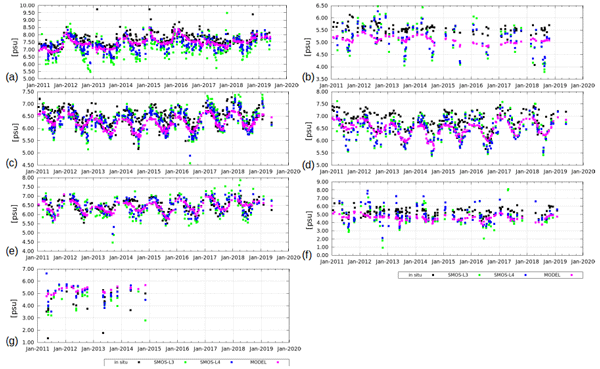
We present the first Soil Moisture and Ocean Salinity Sea Surface Salinity (SSS) dedicated products over the Baltic Sea (ESA Baltic+ Salinity Dynamics). The Baltic+ L3 product covers 9 days in a 0.25° grid. The Baltic+ L4 is derived by merging L3 SSS with sea surface temperature information, giving a daily product in a 0.05° grid. The accuracy of L3 is 0.7–0.8 and 0.4 psu for the L4. Baltic+ products have shown to be useful, covering spatiotemporal data gaps and for validating numerical models.
Justino Martínez, Carolina Gabarró, Antonio Turiel, Verónica González-Gambau, Marta Umbert, Nina Hoareau, Cristina González-Haro, Estrella Olmedo, Manuel Arias, Rafael Catany, Laurent Bertino, Roshin P. Raj, Jiping Xie, Roberto Sabia, and Diego Fernández
Earth Syst. Sci. Data, 14, 307–323, https://doi.org/10.5194/essd-14-307-2022, https://doi.org/10.5194/essd-14-307-2022, 2022
Short summary
Short summary
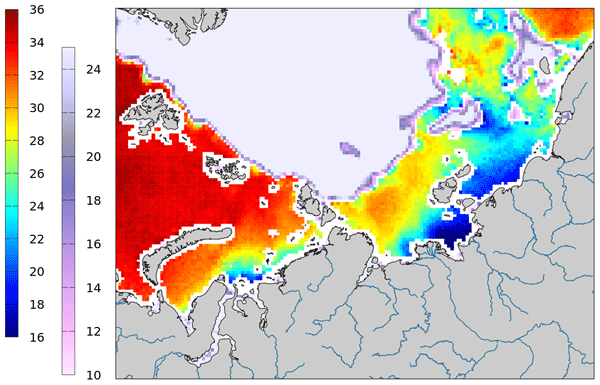
Measuring salinity from space is challenging since the sensitivity of the brightness temperature to sea surface salinity is low, but the retrieval of SSS in cold waters is even more challenging. In 2019, the ESA launched a specific initiative called Arctic+Salinity to produce an enhanced Arctic SSS product with better quality and resolution than the available products. This paper presents the methodologies used to produce the new enhanced Arctic SMOS SSS product.
Nicolas Werner-Pelletier, Júlia Crespin, Aleida Rosquete, Maria Sánchez-Urrea, Nina Hoareau, Mario Martin, and Marta Umbert
Earth Syst. Sci. Data Discuss., https://doi.org/10.5194/essd-2026-519, https://doi.org/10.5194/essd-2026-519, 2026
Preprint under review for ESSD
Short summary
Short summary
The Arctic Ocean is changing rapidly, but many areas remain hard to observe. This work combines satellite measurements, in-water observations, and deep learning to create a new eleven-year enhanced picture of Arctic temperature, saltiness, and ocean currents. It can help researchers study freshwater change, circulation, sea ice links, and how polar changes may affect the global climate.
Aleida Rosquete-Estevez, Júlia Crespin, Luis Yubero, Ana María Mancho, and Marta Umbert
EGUsphere, https://doi.org/10.5194/egusphere-2026-3629, https://doi.org/10.5194/egusphere-2026-3629, 2026
This preprint is open for discussion and under review for Ocean Science (OS).
Short summary
Short summary
Understanding Arctic currents is vital for climate research, but sparse data makes validation difficult. We evaluated six satellite and ocean reanalysis products using real drifting buoys. Products incorporating wind and mixed-layer data reproduced currents best. Crucially, we show that local velocity accuracy does not guarantee realistic transport pathways. To correctly track melting freshwater, tracking frameworks must evaluate entire journeys rather than point-wise speeds.
Ziyu Yan, Yufang Ye, Georg Heygster, Bin Cheng, Carolina Gabarró, Ferran Hernández-Macià, and Xiao Cheng
EGUsphere, https://doi.org/10.5194/egusphere-2026-1680, https://doi.org/10.5194/egusphere-2026-1680, 2026
Short summary
Short summary
Passive microwave retrieval of snow depth remains constrained by snow and ice conditions. By combining the Snow Microwave Radiative Transfer model with global sensitivity analysis, this study quantifies how snow grain size, density, and sea ice type affect snow depth retrievability across channels. The small grain size of new snow limits retrieval performance and increases its sensitivity to sea ice type, while the use of the 89 GHz channel may help address this limitation.
Ferran Hernández-Macià, Marcus Huntemann, Carolina Gabarró, Gunnar Spreen, and Randall K. Scharien
EGUsphere, https://doi.org/10.5194/egusphere-2026-1336, https://doi.org/10.5194/egusphere-2026-1336, 2026
Preprint archived
Short summary
Short summary
Radiometric low-frequency microwave measurements collected in the Canadian Arctic are used to evaluate how well different models reproduce the emission of snow-covered sea ice. Standard models assume that radiation from different layers does not interfere, but the in situ observations can only be explained when interference effects are included. The results show that this coherent approach reproduces the measurements better, highlighting an effect often neglected in current approaches.
Ferran Hernández-Macià, Maria José Escorihuela, Carolina Gabarró, Gemma Sanjuan Gomez, and Albert Garcia-Mondéjar
EGUsphere, https://doi.org/10.5194/egusphere-2026-422, https://doi.org/10.5194/egusphere-2026-422, 2026
Short summary
Short summary
We propose a new way to improve measurements of thin sea ice from space, as current estimates are uncertain. By combining observations from two satellites, where one helps interpret the signal of the other, we better estimated key ice properties. Tests with field data show more accurate and stable thickness results for young ice, improving polar monitoring and supporting future Earth observation missions.
Valentin Ludwig, Caroline Ribere, Sara Fleury, Christian Haas, Michel Tsamados, Mahmoud El Hajj, Jerome Bouffard, Michele Scagliola, Marion Bocquet, Eric de Boisseson, Vincent Boulenger, Guillaume Boutin, Laurence Connor, Léo Edel, Stefan Hendricks, Ferran Hernández Macià, Marcus Huntemann, Lars Kaleschke, Frank Kauker, Jack Landy, Tom Megain, Alek Petty, Till Soya Rasmussen, Mads Hvid Ribergaard, Robert Ricker, Axel Schweiger, Hoyeon Shi, Xiangshan Tian-Kunze, Donghui Yi, and Alessandro Di Bella
EGUsphere, https://doi.org/10.5194/egusphere-2025-6201, https://doi.org/10.5194/egusphere-2025-6201, 2026
Short summary
Short summary
Our paper compares Arctic sea-ice thickness datasets from models, reanalyses, satellite-only, and multi-product sources. We validate them against Beaufort Sea reference data, compare large-scale products, and analyse time series. Cross-product biases range from 0.2–0.4 m, RMSDs from 0.4–0.9 m, and correlations from 0.5–0.8. We find no 2010–2023 trend, but 1995–2023 thinning of ~ 0.5 m in November and ~ 0.3 m in March.
Verónica González-Gambau, Estrella Olmedo, Aina García-Espriu, Cristina González-Haro, Antonio Turiel, Carolina Gabarró, Alessandro Silvano, Aditya Narayanan, Alberto Naveira-Garabato, Rafael Catany, Nina Hoareau, Marta Umbert, Giuseppe Aulicino, Yuri Cotroneo, Roberto Sabia, and Diego Fernández-Prieto
Earth Syst. Sci. Data, 17, 5089–5111, https://doi.org/10.5194/essd-17-5089-2025, https://doi.org/10.5194/essd-17-5089-2025, 2025
Short summary
Short summary
This paper introduces a new Sea Surface Salinity product for the Southern Ocean, based on SMOS data and developed by the Barcelona Expert Center. It offers 9 d maps on a 25 km EASE-SL grid, from 2011 to 2023, covering areas south of 30° S. The product is accurate beyond 150 km from sea ice, with nearly zero bias and a ~0.22 STD. It tracks well seasonal and interannual changes and will contribute to the understanding of processes influenced by upper-ocean salinity, including ice formation/melt.
Júlia Crespin, Jordi Solé, and Miquel Canals
Geosci. Model Dev., 18, 5891–5912, https://doi.org/10.5194/gmd-18-5891-2025, https://doi.org/10.5194/gmd-18-5891-2025, 2025
Short summary
Short summary
This study presents the Offline Fennel model, a tool designed to simulate ocean biogeochemical processes efficiently. By using existing hydrodynamic data, the model significantly reduces computation time from 6 h to just 30 min. We tested its accuracy in the northern Gulf of Mexico and found it closely matches physical–biogeochemical coupled simulations. This model allows researchers to conduct more tests and simulations without the need for extensive computational resources.
Marta Umbert, Eva De Andrés, Maria Sánchez, Carolina Gabarró, Nina Hoareau, Veronica González-Gambau, Aina García-Espriu, Estrella Olmedo, Roshin P. Raj, Jiping Xie, and Rafael Catany
Ocean Sci., 20, 279–291, https://doi.org/10.5194/os-20-279-2024, https://doi.org/10.5194/os-20-279-2024, 2024
Short summary
Short summary
Satellite retrievals of sea surface salinity (SSS) offer insights into freshwater changes in the Arctic Ocean. This study evaluates freshwater content in the Beaufort Gyre using SMOS and reanalysis data, revealing underestimation with reanalysis alone. Incorporating satellite SSS measurements improves freshwater content estimation, especially near ice-melting areas. Adding remotely sensed salinity aids in monitoring Arctic freshwater content and in understanding its impact on global climate.
Jiping Xie, Roshin P. Raj, Laurent Bertino, Justino Martínez, Carolina Gabarró, and Rafael Catany
Ocean Sci., 19, 269–287, https://doi.org/10.5194/os-19-269-2023, https://doi.org/10.5194/os-19-269-2023, 2023
Short summary
Short summary
Sea ice melt, together with other freshwater sources, has effects on the Arctic environment. Sea surface salinity (SSS) plays a key role in representing water mixing. Recently the satellite SSS from SMOS was developed in the Arctic region. In this study, we first evaluate the impact of assimilating these satellite data in an Arctic reanalysis system. It shows that SSS errors are reduced by 10–50 % depending on areas, encouraging its use in a long-time reanalysis to monitor the Arctic water cycle.
Verónica González-Gambau, Estrella Olmedo, Antonio Turiel, Cristina González-Haro, Aina García-Espriu, Justino Martínez, Pekka Alenius, Laura Tuomi, Rafael Catany, Manuel Arias, Carolina Gabarró, Nina Hoareau, Marta Umbert, Roberto Sabia, and Diego Fernández
Earth Syst. Sci. Data, 14, 2343–2368, https://doi.org/10.5194/essd-14-2343-2022, https://doi.org/10.5194/essd-14-2343-2022, 2022
Short summary
Short summary
We present the first Soil Moisture and Ocean Salinity Sea Surface Salinity (SSS) dedicated products over the Baltic Sea (ESA Baltic+ Salinity Dynamics). The Baltic+ L3 product covers 9 days in a 0.25° grid. The Baltic+ L4 is derived by merging L3 SSS with sea surface temperature information, giving a daily product in a 0.05° grid. The accuracy of L3 is 0.7–0.8 and 0.4 psu for the L4. Baltic+ products have shown to be useful, covering spatiotemporal data gaps and for validating numerical models.
Justino Martínez, Carolina Gabarró, Antonio Turiel, Verónica González-Gambau, Marta Umbert, Nina Hoareau, Cristina González-Haro, Estrella Olmedo, Manuel Arias, Rafael Catany, Laurent Bertino, Roshin P. Raj, Jiping Xie, Roberto Sabia, and Diego Fernández
Earth Syst. Sci. Data, 14, 307–323, https://doi.org/10.5194/essd-14-307-2022, https://doi.org/10.5194/essd-14-307-2022, 2022
Short summary
Short summary
Measuring salinity from space is challenging since the sensitivity of the brightness temperature to sea surface salinity is low, but the retrieval of SSS in cold waters is even more challenging. In 2019, the ESA launched a specific initiative called Arctic+Salinity to produce an enhanced Arctic SSS product with better quality and resolution than the available products. This paper presents the methodologies used to produce the new enhanced Arctic SMOS SSS product.
Cited articles
Argo Data Management Team: Argo quality control manual for CTD and trajectory data, Argo Data Management Team [data set], https://doi.org/10.13155/33951, 2022. a, b
Bendtsen, J., Mortensen, J., Lennert, K. and Rysgaard, S.: Heat sources for glacial ice melt in a west Greenland tidewater outlet glacier fjord: The role of subglacial freshwater discharge, Geophys. Res. Lett., 42, 4089–4095, https://doi.org/10.1002/2015GL063846, 2015. a
Carroll, D., Sutherland, D. A., Shroyer, E. L., Nash, J. D., Catania, G. A., and Stearns, L. A.: Subglacial discharge-driven renewal of tidewater glacier fjords, J. Geophys. Res.-Oceans, 122, 6611–6629, https://doi.org/10.1002/2017JC012962, 2017. a, b
CF Conventions Committee: CF Conventions and Metadata, version 1.8, https://cfconventions.org/cf-conventions/cf-conventions.html (last access: 2 April 2026), 2020. a
Cowton, T., Slater, D., Sole, A., Goldberg, D., and Nienow, P.: Modeling the impact of glacial runoff on fjord circulation and submarine melt rate using a new nautical melt model, J. Geophys. Res.-Oceans, 120, 796–812, https://doi.org/10.1002/2014JC010324, 2015. a
Daniault, N., Mercier, H., Lherminier, P., Sarafanov, A., Falina, A., Zunino, P., Pérez, F. F., Ríos, A. F., Ferron, B., Huck, T., Thierry, V., and Gladyshev, S.: The northern North Atlantic Ocean mean circulation in the early 21st century, Prog. Oceanogr., 146, 142–158, https://doi.org/10.1016/j.pocean.2016.06.007, 2016. a
De Andrés, E., Slater, D. A., Straneo, F., Otero, J., Das, S., and Navarro, F.: Surface emergence of glacial plumes determined by fjord stratification, The Cryosphere, 14, 1951–1969, https://doi.org/10.5194/tc-14-1951-2020, 2020. a
Drushka, K., Asher, W. E., Ward, B., and Walesby, K.: Understanding the formation and evolution of rain-formed fresh lenses at the ocean surface, J. Geophys. Res.-Oceans, 121, 2673–2689, https://doi.org/10.1002/2015JC011527, 2016. a
ESIP Federation: Attribute Convention for Data Discovery (ACDD), version 1.3, https://wiki.esipfed.org/Attribute_Convention_for_Data_Discovery_1-3 (last access: 2 April 2026), 2015. a
Hoareau, N.: ARICE-PONANT-2025-CTD-processing: MATLAB v4 pipeline for RBR Concerto CTD data (SIMSVAL + FANS campaigns), Zenodo [code], https://doi.org/10.5281/zenodo.20527364, 2026. a
Hoareau, N., Gabarró, C., and Umbert, M.: CTD profiles from western Greenland fjords, ARICE-PONANT 2025 (SIMSVAL + FANS campaigns), Zenodo [data set], https://doi.org/10.5281/zenodo.20489479, 2026. a, b
Holland, D. M., Thomas, R. H., de Young, B., Ribergaard, M. H., and Lyberth, B.: Acceleration of Jakobshavn Isbrae triggered by warm subsurface ocean waters, Nat. Geosci., 1, 659–664, https://doi.org/10.1038/ngeo316, 2008. a
Jackson, R. H., Straneo, F., and Sutherland, D. A.: Externally forced fluctuations in ocean temperature at Greenland glaciers in non-summer months, Nat. Geosci., 7, 503–508, https://doi.org/10.1038/ngeo2186, 2014. a
Jenkins, A.: Convection-driven melting near the grounding lines of ice shelves and tidewater glaciers, J. Phys. Oceanogr., 41, 2279–2294, https://doi.org/10.1175/JPO-D-11-03.1, 2011. a, b
Mankoff, K. D., Straneo, F., Cenedese, C., Das, S. B., Hansen, C. G., and Singh, H.: Structure and dynamics of a subglacial discharge plume in a Greenlandic fjord, J. Geophys. Res.-Oceans, 121, 8670–8688, https://doi.org/10.1002/2016JC011764, 2016. a
Massicotte, P., Amiraux, R., Amyot, M.-P., Archambault, P., Ardyna, M., Arnaud, L., Artigue, L., Aubry, C., Ayotte, P., Bécu, G., Bélanger, S., Benner, R., Bittig, H. C., Bricaud, A., Brossier, É., Bruyant, F., Chauvaud, L., Christiansen-Stowe, D., Claustre, H., Cornet-Barthaux, V., Coupel, P., Cox, C., Delaforge, A., Dezutter, T., Dimier, C., Domine, F., Dufour, F., Dufresne, C., Dumont, D., Ehn, J., Else, B., Ferland, J., Forget, M.-H., Fortier, L., Galí, M., Galindo, V., Gallinari, M., Garcia, N., Gérikas Ribeiro, C., Gourdal, M., Gourvil, P., Goyens, C., Grondin, P.-L., Guillot, P., Guilmette, C., Houssais, M.-N., Joux, F., Lacour, L., Lacour, T., Lafond, A., Lagunas, J., Lalande, C., Laliberté, J., Lambert-Girard, S., Larivière, J., Lavaud, J., LeBaron, A., Leblanc, K., Le Gall, F., Legras, J., Lemire, M., Levasseur, M., Leymarie, E., Leynaert, A., Lopes dos Santos, A., Lourenço, A., Mah, D., Marec, C., Marie, D., Martin, N., Marty, C., Marty, S., Massé, G., Matsuoka, A., Matthes, L., Moriceau, B., Muller, P.-E., Mundy, C.-J., Neukermans, G., Oziel, L., Panagiotopoulos, C., Pangrazi, J.-J., Picard, G., Picheral, M., Pinczon du Sel, F., Pogorzelec, N., Probert, I., Quéguiner, B., Raimbault, P., Ras, J., Rehm, E., Reimer, E., Rontani, J.-F., Rysgaard, S., Saint-Béat, B., Sampei, M., Sansoulet, J., Schmechtig, C., Schmidt, S., Sempéré, R., Sévigny, C., Shen, Y., Tragin, M., Tremblay, J.-Ë., Vaulot, D., Verin, G., Vivier, F., Vladoiu, A., Whitehead, J., and Babin, M.: Green Edge ice camp campaigns: understanding the processes controlling the under-ice Arctic phytoplankton spring bloom, Earth Syst. Sci. Data, 12, 151–176, https://doi.org/10.5194/essd-12-151-2020, 2020. a
Meire, L., Mortensen, J., Rysgaard, S., Bendtsen, J., Boone, W., Chambord, A., Freiwald, A., Hodal, H., Ikonen, J., Meysman, F. J. R., Nygaard, M., Pedersen, J. T., Sejr, M. K., Straneo, F., Sørensen, H. L., and Juul-Pedersen, T.: Spring bloom dynamics in a subarctic fjord influenced by tidewater outlet glaciers (Godthåbsfjord, SW Greenland), J. Geophys. Res.-Biogeo., 121, 1581–1592, https://doi.org/10.1002/2015JG003240, 2016. a, b, c
Meire, L., Mortensen, J., Rysgaard, S., and Bendtsen, J.: Glacially influenced circulation drives seasonal oxygen minimum zones in a Scoresby Sund fjord, Front. Mar. Sci., 6, 412, https://doi.org/10.3389/fmars.2019.00412, 2019. a
Mortensen, J., Lennert, K., Bendtsen, J., and Rysgaard, S.: Heat sources for glacial melt in a sub-Arctic fjord (Godthåbsfjord) in contact with the Greenland Ice Sheet. J. Geophys. Res., 116, C01013, https://doi.org/10.1029/2010JC006528, 2011. a
Mortensen, J., Bendtsen, J., Motyka, R. J., Lennert, K., Truffer, M., Fahnestock, M., and Rysgaard, S.: On the seasonal freshwater stratification in the proximity of fast-flowing tidewater outlet glaciers in a sub-Arctic sill fjord, J. Geophys. Res.-Oceans, 118, 1382–1395, https://doi.org/10.1002/jgrc.20134, 2013. a, b, c, d
Mortensen, J., Bendtsen, J., Lennert, K., and Rysgaard, S.: Seasonal variability of the fjord–shelf exchange in front of a marine-terminating outlet glacier, Godthåbsfjord (SW Greenland), J. Geophys. Res.-Earth, 119, 2591–2609, https://doi.org/10.1002/2014JF003267, 2014. a
Mortensen, J., Rysgaard, S., Arendt, K. E., Juul-Pedersen, T., Søgaard, D. H., Bendtsen, J., and Meire, L.: Local coastal water masses control heat levels in a west Greenland tidewater glacier fjord, J. Geophys. Res.-Oceans, 123, 8068–8083, https://doi.org/10.1029/2018JC014549, 2018. a
Paver, C. R., Haas, C. N., Hanratty, T. J., Roth, G. E., and Barber, D. G.: Potential for entrainment bias in Niskin bottle samples collected in strong vertical salinity gradients, Limnol. Oceanogr. Meth., 18, 285–297, https://doi.org/10.1002/lom3.10368, 2020. a
Rignot, E., Fenty, I., Xu, Y., Cai, C., and Kemp, C.: Undercutting of marine-terminating glaciers in West Greenland, Geophys. Res. Lett., 42, 5909–5917, https://doi.org/10.1002/2015GL064236, 2015. a
Rysgaard, S., Boone, W., Carlson, D., Sejr, M. K., Bendtsen, J., Juul-Pedersen, T., Lund, H., Meire, L., and Mortensen, J.: An updated view on water masses on the pan-West Greenland continental shelf and their link to proglacial fjords, J. Geophys. Res.-Oceans, 125, e2019JC015564, https://doi.org/10.1029/2019JC015564, 2020. a, b, c, d
SeaDataNet: SeaDataNet quality control flags (BODC L20), https://vocab.seadatanet.org/v_bodc_vocab_v2/browse.asp?local_class=L20 (last access: 2 April 2026), 2010. a
Straneo, F. and Cenedese, C.: The dynamics of Greenland's glacial fjords and their role in climate, Annu. Rev. Mar. Sci., 7, 89–112, https://doi.org/10.1146/annurev-marine-010213-135133, 2015. a, b, c
Straneo, F. and Heimbach, P.: North Atlantic warming and the retreat of Greenland's outlet glaciers, Nature, 504, 36–43, https://doi.org/10.1038/nature12854, 2013. a, b
Straneo, F., Sutherland, D. A., Stearns, L., Catania, G., Heimbach, P., Moon, T., Cape, M. R., Cowton, T., Luckman, A. J., Dodd, P., Fricker, H., Fried, M., Gonzalez, G. H., Inall, M., Kane, E., Kramer, G., Mankoff, K., Mayo, T., Padman, J., Slater, D., and Stern, A.: The case for a sustained Greenland Ice Sheet–Ocean Observing System (GrIOOS), Front. Mar. Sci., 6, 138, https://doi.org/10.3389/fmars.2019.00138, 2019. a, b, c
Stuart-Lee, A. C., Sutherland, D. A., Straneo, F., and Beaird, N. L.: Freshwater pathways and water mass transformation along the west Greenland shelf and into fjords, J. Geophys. Res.-Oceans, 126, e2021JC017552, https://doi.org/10.1029/2021JC017552, 2021. a, b, c, d
Short summary
Greenland fjords are changing rapidly, but observations in winter and early spring are rare. We collected 73 temperature and salinity profiles from southwest Greenland fjords during two ship campaigns in March and April 2025. The data reveal the start of spring surface freshening, strongest near glacier-fed fjords, while deeper waters changed little. The open dataset will help improve studies of glacier melt, ocean change, and climate models.
Greenland fjords are changing rapidly, but observations in winter and early spring are rare. We...


Altmetrics
Final-revised paper
Preprint