Articles | Volume 18, issue 7
https://doi.org/10.5194/essd-18-4669-2026
© Author(s) 2026. This work is distributed under
the Creative Commons Attribution 4.0 License.
the Creative Commons Attribution 4.0 License.
https://doi.org/10.5194/essd-18-4669-2026
© Author(s) 2026. This work is distributed under
the Creative Commons Attribution 4.0 License.
the Creative Commons Attribution 4.0 License.
Data description article
| 
06 Jul 2026
Data description article |
| 06 Jul 2026
| 06 Jul 2026
Extending the late 1963 to 1964 Mt Agung rescued searchlight aerosol profiles dataset at 32° N, from early 1963 to 1975
Juan Carlos Antuña-Marrero
CORRESPONDING AUTHOR

Instituto de Geociencias (IGEO), CSIC-UCM, Madrid 28040, Spain
Grupo de Óptica Atmosférica (GOA-UVA), Universidad de Valladolid, Valladolid 47011, Spain
EPhysLab, CIM-UVigo, Universidad de Vigo, 32004, Ourense, Spain
Abel Calle
Grupo de Óptica Atmosférica (GOA-UVA), Universidad de Valladolid, Valladolid 47011, Spain
Juan Antonio Añel
EPhysLab, CIM-UVigo, Universidad de Vigo, 32004, Ourense, Spain
Victoria Cachorro
Grupo de Óptica Atmosférica (GOA-UVA), Universidad de Valladolid, Valladolid 47011, Spain
Laura de la Torre
EPhysLab, CIM-UVigo, Universidad de Vigo, 32004, Ourense, Spain
David Barriopedro
Instituto de Geociencias (IGEO), CSIC-UCM, Madrid 28040, Spain
Ricardo García Herrera
Instituto de Geociencias (IGEO), CSIC-UCM, Madrid 28040, Spain
Departamento de Física de la Tierra y Astrofísica, Universidad Complutense de Madrid, 28040, Madrid, Spain
Javier Pacheco
Grupo de Óptica Atmosférica (GOA-UVA), Universidad de Valladolid, Valladolid 47011, Spain
Related authors
Victoria E. Cachorro, Juan Carlos Antuña-Marrero, Abel Calle, Roberto Román, David Mateos, Carlos Toledano, Juan Carlos Antuña-Sánchez, Ramiro González, Manuel Antón, Javier Vaquero-Martínez, Angel M. de Frutos Baraja, and Javier Pacheco
EGUsphere, https://doi.org/10.5194/egusphere-2026-2374, https://doi.org/10.5194/egusphere-2026-2374, 2026
Short summary
Short summary
Observations of the Arctic integrated water vapor (IWV) from sun photometers (SP) are in general dryer than the ones from GNSS. High correlations between IWV from SP and IWV from GNSS at all sites, show the good agreement between both techniques. Moist bias of hourly IWV magnitudes from ERA5 and MERRA-2 reanalyses respect to GNSS, radiosonde, SP, show that current and future state-of-the-art reanalyses require improvements to match the range of variability of these IWV observation techniques.
Juan-Carlos Antuña-Marrero, Graham W. Mann, John Barnes, Abel Calle, Sandip S. Dhomse, Victoria E. Cachorro-Revilla, Terry Deshler, Li Zhengyao, Nimmi Sharma, and Louis Elterman
Earth Syst. Sci. Data Discuss., https://doi.org/10.5194/essd-2022-272, https://doi.org/10.5194/essd-2022-272, 2022
Revised manuscript not accepted
Short summary
Short summary
Tropospheric and stratospheric aerosol extinction profiles observations from a searchlight at New Mexico, US, were rescued and re-calibrated. Spanning between December 1963 and 1964, they measured the volcanic aerosols from the 1963 Agung eruption. Contemporary and state of the art information were used in the re-calibration. A unique and until the present forgotten/ignored dataset, it contributes current observational and modelling research on the impact of major volcanic eruptions on climate.
Gonzalo Agurto Barragán, Soledad Collazo, and Ricardo García-Herrera
Weather Clim. Dynam., 7, 1779–1796, https://doi.org/10.5194/wcd-7-1779-2026, https://doi.org/10.5194/wcd-7-1779-2026, 2026
Short summary
Short summary
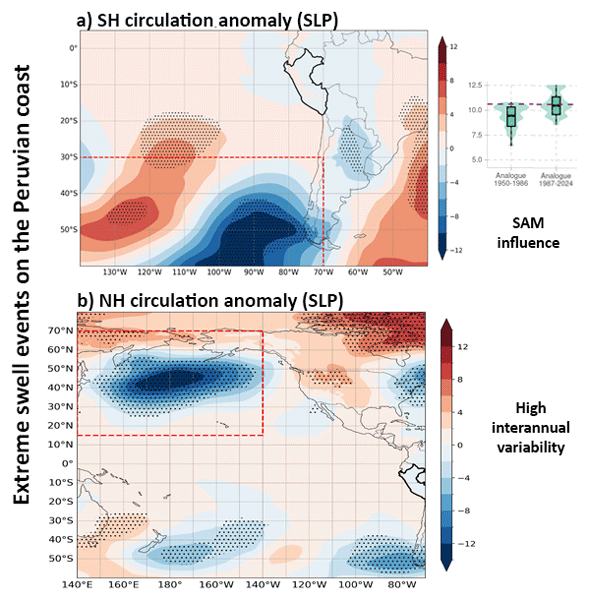
Large swells can travel thousands of kilometers and impact the Peruvian coast. Using Peruvian Navy warnings and ERA5 reanalysis, we compared extreme swells from the Southern and Northern Hemispheres. In both cases, a deep Pacific storm aligned with a strengthened jet stream sustained strong winds over swell-generation regions, directing wave energy toward Peru. Southern Hemisphere events reach higher intensity, and show a recent wind strengthening, unlike the North Pacific.
Celia Herrero del Barrio, Roberto Román, Sara Herrero-Anta, Daniel González-Fernández, Rogelio Carracedo, Ramiro González, Javier Gatón, Bruno Longarela, Juan Carlos Antuña-Sánchez, David Mateos, Carlos Toledano, Abel Calle, Victoria Cachorro, and Ángel de Frutos
Atmos. Meas. Tech., 19, 5785–5814, https://doi.org/10.5194/amt-19-5785-2026, https://doi.org/10.5194/amt-19-5785-2026, 2026
Short summary
Short summary
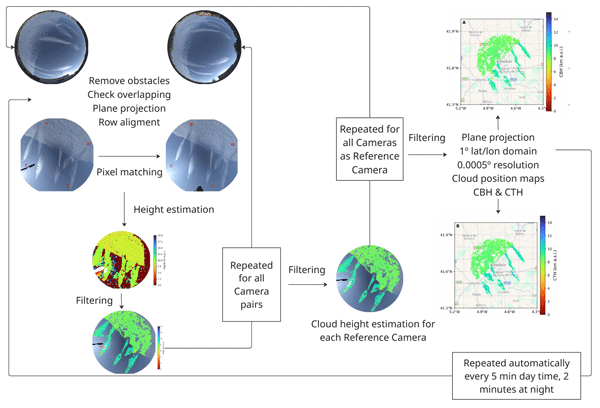
This work presents an automated method to create cloud height maps in near real time using a network of 20 ground-based sky cameras in Valladolid, Spain. By comparing simultaneous images from different locations, the system estimates cloud base and top heights every few minutes over a large area with 50 m resolution. The results agree well with satellite and ceilometer measurements, showing that low-cost camera networks can improve continuous cloud monitoring for weather and climate studies.

Daniele Visioni, Alan Robock, Alistair Duffey, Matthew Henry, Haruki Hirasawa, Walker Raymond Lee, Cindy Wang, Kelsey Roberts, Shingo Watanabe, Michelle Simões Reboita, Masahiro Sugiyama, Ben Kravitz, Jim Haywood, Simone Tilmes, Frédéric K. Bonou, Jack Chen, Timofei Sukhodolov, Sandro Vattioni, Andrin Jörimann, Diego Villanueva, Ryan Vella, Paul Farron, Ewa Bednarz, Ulrike Niemeier, Colleen Golja, and Juan A. Añel
Geosci. Model Dev., 19, 8469–8499, https://doi.org/10.5194/gmd-19-8469-2026, https://doi.org/10.5194/gmd-19-8469-2026, 2026
Short summary
Short summary
The Geoengineering Model Intercomparison Project is a coordinated international model intercomparison effort aiming to provide robust experimental protocols for simulations of various Solar Radiation Modification (SRM) methods. In this manuscript, we describe a list of novel experiments decided by the community, to be run by climate models to better understand sources of uncertainty in SRM. We also show and discuss some preliminary results from a few climate models.
Michael García-Rodríguez, Javier Rodeiro-Iglesias, and Juan A. Añel
Geosci. Model Dev., 19, 7687–7704, https://doi.org/10.5194/gmd-19-7687-2026, https://doi.org/10.5194/gmd-19-7687-2026, 2026
Short summary
Short summary
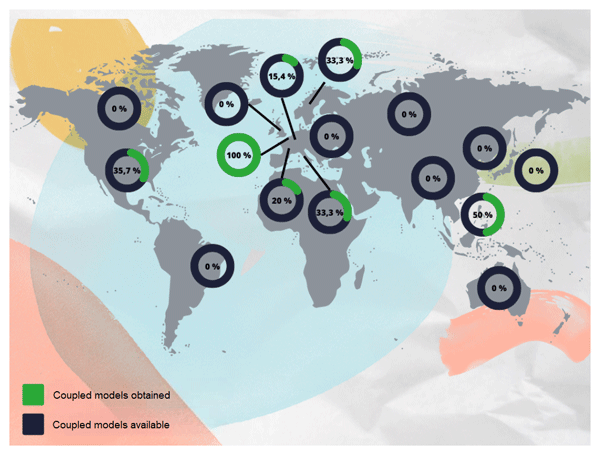
We studied how accessible and reliable the computer code behind major climate models has been over time. By reviewing different phases of the Coupled Model Intercomparison Project, we found improvements in transparency and coding practices, but also gaps that limit reproducibility. Our work suggests practical steps to make future climate research more open, traceable, and trustworthy for scientists and society.
Tahimy Fuentes-Alvarez, Carlos Ordóñez, Ricardo García-Herrera, David Barriopedro, and Jose Manuel Garrido-Perez
EGUsphere, https://doi.org/10.5194/egusphere-2026-3914, https://doi.org/10.5194/egusphere-2026-3914, 2026
This preprint is open for discussion and under review for Atmospheric Chemistry and Physics (ACP).
Short summary
Short summary
This study investigates the three largest surface ozone episodes in Europe during 2003–2022. By identifying days with similar atmospheric circulation patterns, we separate the effects of dynamical and non-dynamical processes. We provide further insights into the factors contributing to the severity of the episodes such as the availability of ozone precursors or biomass burning emissions. These findings improve our understanding of extreme ozone pollution in a changing climate.
Victoria E. Cachorro, Juan Carlos Antuña-Marrero, Abel Calle, Roberto Román, David Mateos, Carlos Toledano, Juan Carlos Antuña-Sánchez, Ramiro González, Manuel Antón, Javier Vaquero-Martínez, Angel M. de Frutos Baraja, and Javier Pacheco
EGUsphere, https://doi.org/10.5194/egusphere-2026-2374, https://doi.org/10.5194/egusphere-2026-2374, 2026
Short summary
Short summary
Observations of the Arctic integrated water vapor (IWV) from sun photometers (SP) are in general dryer than the ones from GNSS. High correlations between IWV from SP and IWV from GNSS at all sites, show the good agreement between both techniques. Moist bias of hourly IWV magnitudes from ERA5 and MERRA-2 reanalyses respect to GNSS, radiosonde, SP, show that current and future state-of-the-art reanalyses require improvements to match the range of variability of these IWV observation techniques.
Solange Suli, David Barriopedro, Ricardo García-Herrera, Soledad Collazo, Antonello Squintu, and Matilde Rusticucci
Weather Clim. Dynam., 7, 149–164, https://doi.org/10.5194/wcd-7-149-2026, https://doi.org/10.5194/wcd-7-149-2026, 2026
Short summary
Short summary
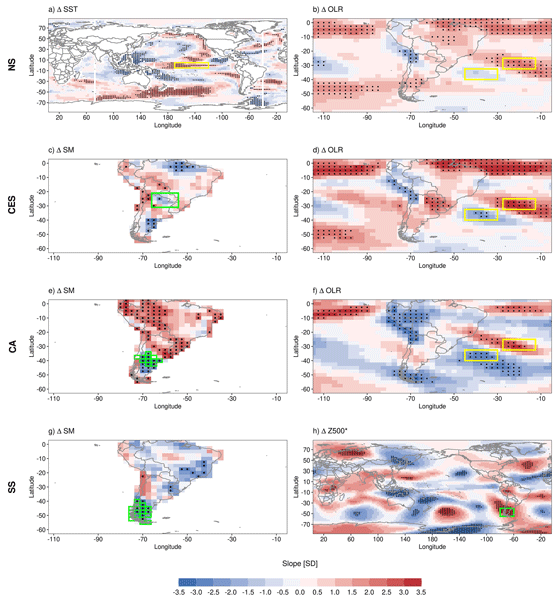
Heat extremes are becoming more frequent and intense in southern South America. This study uses a storyline approach to explore how different climate drivers shape future summer temperature extremes. Using climate model simulations, we identified key drivers, such as soil moisture, sea surface temperature and atmospheric circulation, to build physically consistent scenarios that explain the sources of uncertainty in regional warming projections in southern South America.
Soledad Collazo, David Barriopedro, Ricardo García-Herrera, and Santiago Beguería
Nat. Hazards Earth Syst. Sci., 25, 3221–3238, https://doi.org/10.5194/nhess-25-3221-2025, https://doi.org/10.5194/nhess-25-3221-2025, 2025
Short summary
Short summary
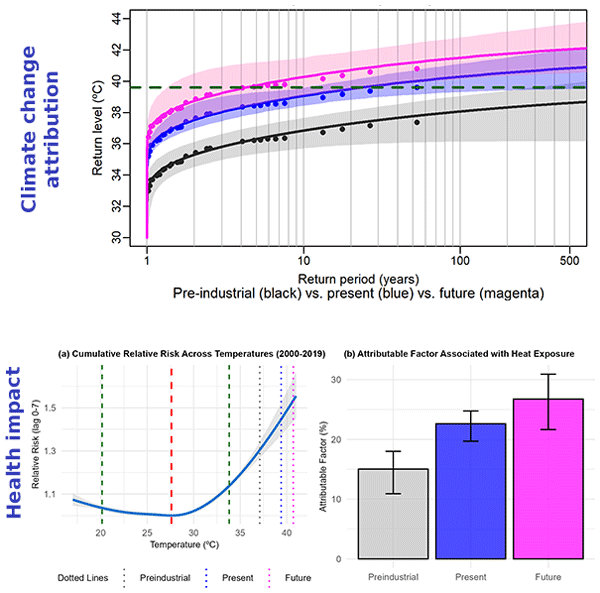
In 2023, Rio de Janeiro experienced record-breaking heat waves linked to climate change and El Niño. Our study shows that global warming made these extreme temperatures at least 2 °C hotter than in pre-industrial times. Heat-related deaths surged, with climate change contributing to one in three fatalities during the peak event. Without adaptation, future heat waves will claim even more lives. This underscores the urgent need for policies to mitigate climate impacts from escalating heat threats.
Juan A. Añel, Juan-Carlos Antuña-Marrero, Antonio Cid Samamed, Celia Pérez-Souto, Laura de la Torre, Maria Antonia Valente, Yuri Brugnara, Alfonso Saiz-Lopez, and Luis Gimeno
Earth Syst. Sci. Data, 17, 2437–2446, https://doi.org/10.5194/essd-17-2437-2025, https://doi.org/10.5194/essd-17-2437-2025, 2025
Short summary
Short summary
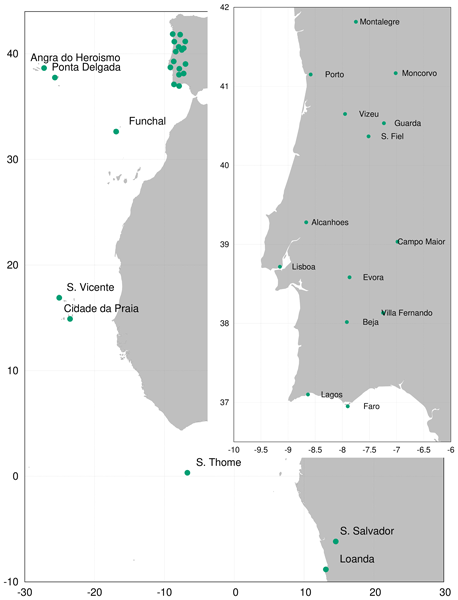
Ozone (discovered in 1837) was first measured in 1847 using paper strips that reacted with ozone, providing an indication of its concentration based on colour changes. Here, we present the data, covering over 60 years of daily observations conducted along the eastern Atlantic coast, spanning from the tropics to the northern extratropics.
Chaim I. Garfinkel, Zachary D. Lawrence, Amy H. Butler, Etienne Dunn-Sigouin, Irene Erner, Alexey Y. Karpechko, Gerbrand Koren, Marta Abalos, Blanca Ayarzagüena, David Barriopedro, Natalia Calvo, Alvaro de la Cámara, Andrew Charlton-Perez, Judah Cohen, Daniela I. V. Domeisen, Javier García-Serrano, Neil P. Hindley, Martin Jucker, Hera Kim, Robert W. Lee, Simon H. Lee, Marisol Osman, Froila M. Palmeiro, Inna Polichtchouk, Jian Rao, Jadwiga H. Richter, Chen Schwartz, Seok-Woo Son, Masakazu Taguchi, Nicholas L. Tyrrell, Corwin J. Wright, and Rachel W.-Y. Wu
Weather Clim. Dynam., 6, 171–195, https://doi.org/10.5194/wcd-6-171-2025, https://doi.org/10.5194/wcd-6-171-2025, 2025
Short summary
Short summary
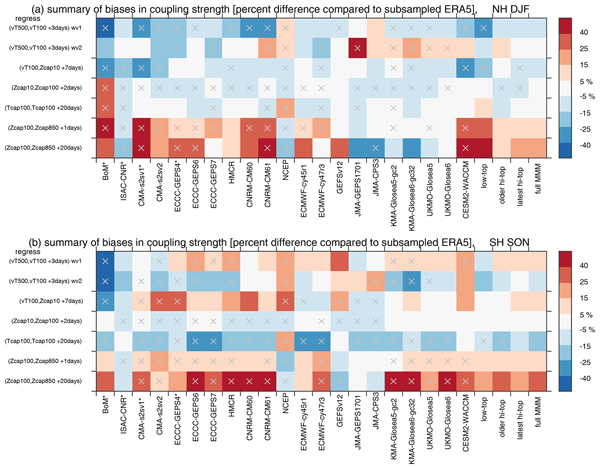
Variability in the extratropical stratosphere and troposphere is coupled, and because of the longer timescales characteristic of the stratosphere, this allows for a window of opportunity for surface prediction. This paper assesses whether models used for operational prediction capture these coupling processes accurately. We find that most processes are too weak; however downward coupling from the lower stratosphere to the near surface is too strong.
Emilio Cuevas-Agulló, David Barriopedro, Rosa Delia García, Silvia Alonso-Pérez, Juan Jesús González-Alemán, Ernest Werner, David Suárez, Juan José Bustos, Gerardo García-Castrillo, Omaira García, África Barreto, and Sara Basart
Atmos. Chem. Phys., 24, 4083–4104, https://doi.org/10.5194/acp-24-4083-2024, https://doi.org/10.5194/acp-24-4083-2024, 2024
Short summary
Short summary
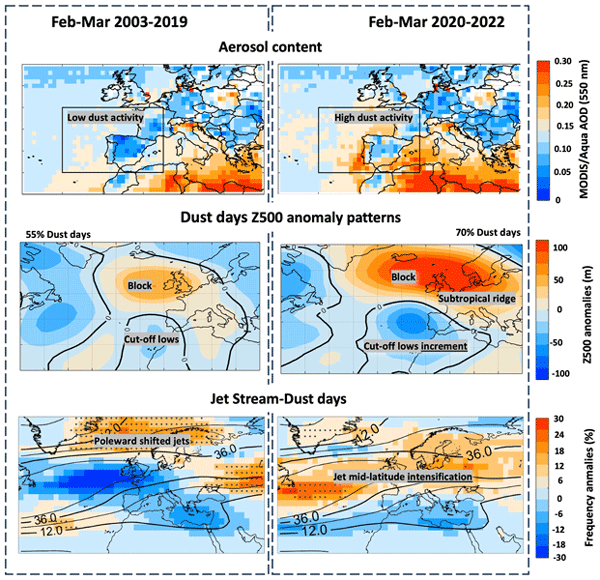
During February–March (FM) 2020–2022, unusually intense dust storms from northern Africa hit the western Euro-Mediterranean (WEM). Using dust products from satellites and atmospheric reanalysis for 2003–2022, results show that cut-off lows and European blocking are key drivers of FM dust intrusions over the WEM. A higher frequency of cut-off lows associated with subtropical ridges is observed in the late 2020–2022 period.
Juan-Carlos Antuña-Marrero, Graham W. Mann, John Barnes, Abel Calle, Sandip S. Dhomse, Victoria E. Cachorro-Revilla, Terry Deshler, Li Zhengyao, Nimmi Sharma, and Louis Elterman
Earth Syst. Sci. Data Discuss., https://doi.org/10.5194/essd-2022-272, https://doi.org/10.5194/essd-2022-272, 2022
Revised manuscript not accepted
Short summary
Short summary
Tropospheric and stratospheric aerosol extinction profiles observations from a searchlight at New Mexico, US, were rescued and re-calibrated. Spanning between December 1963 and 1964, they measured the volcanic aerosols from the 1963 Agung eruption. Contemporary and state of the art information were used in the re-calibration. A unique and until the present forgotten/ignored dataset, it contributes current observational and modelling research on the impact of major volcanic eruptions on climate.
Zachary D. Lawrence, Marta Abalos, Blanca Ayarzagüena, David Barriopedro, Amy H. Butler, Natalia Calvo, Alvaro de la Cámara, Andrew Charlton-Perez, Daniela I. V. Domeisen, Etienne Dunn-Sigouin, Javier García-Serrano, Chaim I. Garfinkel, Neil P. Hindley, Liwei Jia, Martin Jucker, Alexey Y. Karpechko, Hera Kim, Andrea L. Lang, Simon H. Lee, Pu Lin, Marisol Osman, Froila M. Palmeiro, Judith Perlwitz, Inna Polichtchouk, Jadwiga H. Richter, Chen Schwartz, Seok-Woo Son, Irene Erner, Masakazu Taguchi, Nicholas L. Tyrrell, Corwin J. Wright, and Rachel W.-Y. Wu
Weather Clim. Dynam., 3, 977–1001, https://doi.org/10.5194/wcd-3-977-2022, https://doi.org/10.5194/wcd-3-977-2022, 2022
Short summary
Short summary
Forecast models that are used to predict weather often struggle to represent the Earth’s stratosphere. This may impact their ability to predict surface weather weeks in advance, on subseasonal-to-seasonal (S2S) timescales. We use data from many S2S forecast systems to characterize and compare the stratospheric biases present in such forecast models. These models have many similar stratospheric biases, but they tend to be worse in systems with low model tops located within the stratosphere.
Cited articles
Antuña-Marrero, J.-C., Mann, G. W., Keckhut, P., Avdyushin, S., Nardi, B., and Thomason, L. W.: Shipborne lidar measurements showing the progression of the tropical reservoir of volcanic aerosol after the June 1991 Pinatubo eruption, Earth Syst. Sci. Data, 12, 2843–2851, https://doi.org/10.5194/essd-12-2843-2020, 2020a.
Antuña-Marrero, J. C., Mann, G. W., Keckhut, P., Avdyushin, S. I., Nardi, B., and Thomason, L. W.: Ship borne lidar measurements in the Atlantic of the 1991 Mt Pinatubo aerosol cloud, PANGAEA [data set], https://doi.org/10.1594/PANGAEA.912770, 2020b.
Antuña-Marrero, J.-C., Mann, G. W., Barnes, J., Rodríguez-Vega, A., Shallcross, S., Dhomse, S., Fiocco, G., and Grams, G. W.: The first ever multi-year lidar dataset of the stratospheric aerosol layer, from Lexington, MA, and Fairbanks, AK, January 1964 to July 1965, PANGAEA [data set], https://doi.org/10.1594/PANGAEA.922105, 2020c.
Antuña-Marrero, J.-C., Mann, G. W., Barnes, J., Rodríguez-Vega, A., Shallcross, S., Dhomse, S. S., Fiocco, G., and Grams, G. W.: Recovery of the first ever multi-year lidar dataset of the stratospheric aerosol layer, from Lexington, MA, and Fairbanks, AK, January 1964 to July 1965, Earth Syst. Sci. Data, 13, 4407–4423, https://doi.org/10.5194/essd-13-4407-2021, 2021.
Antuña-Marrero, J.-C., Mann, G. W., Barnes, J., Calle, A., Dhomse, S., Cachorro Revilla, V. E., Deshler, T., Zhengyao, L., Sharma, N., and Elterman, L.: Tropospheric and stratospheric aerosol extinction and stratospheric aerosol optical depth from searchlight measurements conducted at White Sands, New Mexico, US between December 1963 and December 1964, PANGAEA [data set], https://doi.org/10.1594/PANGAEA.949377, 2023.
Antuña-Marrero, J.-C., Mann, G. W., Barnes, J., Calle, A., Dhomse, S. S., Cachorro, V. E., Deshler, T., Li, Z., Sharma, N., and Elterman, L.: The Recovery and Re-Calibration of a 13-Month Aerosol Extinction Profiles Dataset from Searchlight Observations from New Mexico, after the 1963 Agung Eruption, Atmosphere, 15, 635, https://doi.org/10.3390/atmos15060635, 2024.
Antuña-Marrero, J.-C., Calle, A., Añel, J. A., Cachorro, V. E, de la Torre, L., Barriopedro, D., García-Herrera, R., and Pacheco, J.: Rescued searchlight aerosol profiles dataset at New Mexico (32° N), completing the period from early 1963 to 1975, PANGAEA [data set], https://doi.org/10.1594/PANGAEA.992616, 2026a.
Antuña-Marrero, J.-C., Calle, A., Cachorro, V. E., Deshler, T., Barriopedro, D., García-Herrera, R., and Muriel, M.: Rescued, digitized and homogenized UTLS aerosol particle size distributions, measured by US projects monitoring radioactive debris from nuclear weapons tests, 1960 to 1964, in preparation, 2026b.
Arfeuille, F., Weisenstein, D., Mack, H., Rozanov, E., Peter, T., and Brönnimann, S.: Volcanic forcing for climate modeling: a new microphysics-based data set covering years 1600–present, Clim. Past, 10, 359–375, https://doi.org/10.5194/cp-10-359-2014, 2014.
Aubry, T. J., Toohey, M., Khanal, S., Chim, M. M., Verkerk, M., Johnson, B., Schmidt, A., Kovilakam, M., Sigl, M., Nicholls, Z., Thomason, L., Naik, V., Rieger, L., Stiller, D., Ziegler, E., Durack, P., and Smith, I. H.: Stratospheric aerosol forcing for CMIP7 – Part 1: optical properties for pre-industrial, historical, and scenario simulations, Geosci. Model Dev., 19, 3725–3756, https://doi.org/10.5194/gmd-19-3725-2026, 2026.
Clemesha, B. R., Kent, G. S., and Wright, R. W. H.: Laser probing of the lower atmosphere, Nature, 209, 184–185, https://doi.org/10.1038/209184a0, 1966.
Cronin, E. C.: A Systems Analysis, A Functional Organization; A Customer Users Library (CUL), AFCRL-72-035, 626 pp., https://apps.dtic.mil/sti/tr/pdf/AD0755389.pdf (last access: 26 May 2025), 1972.
Dhomse, S. S., Mann, G. W., Antuña Marrero, J. C., Shallcross, S. E., Chipperfield, M. P., Carslaw, K. S., Marshall, L., Abraham, N. L., and Johnson, C. E.: Evaluating the simulated radiative forcings, aerosol properties, and stratospheric warmings from the 1963 Mt Agung, 1982 El Chichón, and 1991 Mt Pinatubo volcanic aerosol clouds, Atmos. Chem. Phys., 20, 13627–13654, https://doi.org/10.5194/acp-20-13627-2020, 2020.
Dyer, A. J. and Hicks, B. B.: Global spread of volcanic dust from the Bali eruption of 1963, Q. J. Roy. Meteor. Soc., 94, 545–554, https://doi.org/10.1002/qj.49709440209, 1968.
Ellis, H. T. and Pueschel, R. F.: Solar radiation: absence of air pollution trends at Mauna Loa, Science, 172, 845–847, https://10.1126/science.172.3985.845,1971.
Elterman, L.: Atmospheric Attenuation Model in the Ultraviolet, Visible, and Infrared Regions for Altitudes to 50 km, AFCRL-64-740, https://apps.dtic.mil/sti/pdfs/AD0607859.pdf (last access: 20 August 2025), 1964.
Elterman, L.: Aerosol Measurements in the Troposphere and Stratosphere, Appl. Optics, 5, 1769–1776, https://doi.org/10.1364/AO.5.001769, 1966a.
Elterman, L.: An Atlas of Aerosol Attenuation and Extinction Profiles for the Troposphere and Stratosphere, Report AFCRL-66-828, AFCRL, Bedford, MA, USA, 128 pp., https://apps.dtic.mil/sti/pdfs/AD0649778.pdf (last access: 5 June 2024), 1966b.
Elterman, L.: Stratospheric aerosol parameters for the Fuego volcanic incursion, Appl. Optics, 14, 1262–1263, https://doi.org/10.1364/AO.14.001262, 1975.
Elterman, L.: Aerosol measurements since 1973 for normal and volcanic stratospheres, Appl. Optics, 15, 1113–1114, https://doi.org/10.1364/AO.15.001113, 1976.
Elterman, L., Toolin, R. B., and Essex, J. D.: Stratospheric Aerosol Measurements with Implications for Global Climate, Appl. Optics, 12, 1262–1263, https://doi.org/10.1364/AO.12.000330, 1973.
Fiocco, G. and Grams, G.: Observations of the aerosol layer at 20 km by optical radar, J. Atmos. Sci., 21, 323–324, https://doi.org/10.1175/1520-0469(1964)021<0323:OOTALA>2.0.CO;2, 1964.
Fontijn, K., Costa, F., Sutawidjaja, I., Newhall, C. G., and Herrin, J. S.: A 5000-year record of multiple highly explosive mafic eruptions from Gunung Agung (Bali, Indonesia): implications for eruption frequency and volcanic hazards, B. Volcanol., 77, 59, https://doi.org/10.1007/s00445-015-0943-x, 2015.
Gao, C., Robock, A., and Ammann, C.: Volcanic forcing of climate over the past 1500 years: an improved ice core-based index for climate models, J. Geophys. Res, 113, D23111, https://doi.org/10.1029/2008JD010239, 2008.
Kondratyevet, K. Ya., Ivlev, L. S., and Nikolvsky, G. A.: Investigations of the stratospheric aerosols, Proc. 3rd Conf. on the Climatic Impact Assessment Program, 26 February–1 March, 143–152, https://rosap.ntl.bts.gov/view/dot/10975 (last access: 24 May 2025), 1974.
Reeger, E. and Siedentopf, H.: Die Streufunktion des Atmospharischen Dunstes nach Scheinwerfer Messungen, Optik, 1, 15–41, 1946.
Rohatgi, A.: WebPlotDigitizer, Version 5, https://automeris.io (last access: 23 November 2024), 2024.
Sato, M., Hansen, J. E., McCormick, M. P., and Pollack, J. B.: Stratospheric aerosol optical depths, J. Geophys. Res., 98, 22987, https://doi.org/10.1029/93JD02553, 1993.
Self, S. and Rampino, M. R.: The 1963–1964 eruption of Agung volcano (Bali, Indonesia), B. Volcanol., 74, 1521–1536, https://doi.org/10.1007/s00445-012-0615-z, 2012.
Stothers, R. B.: Major optical depth perturbations to the stratosphere from volcanic eruptions: Stellar extinction period, 1961–1978, J. Geophys. Res.-Atmos., 106, 2993–3003, https://doi.org/10.1029/2000JD900652, 2001.
Thomason, L. W., Ernest, N., Millán, L., Rieger, L., Bourassa, A., Vernier, J.-P., Manney, G., Luo, B., Arfeuille, F., and Peter, T.: A global space-based stratospheric aerosol climatology: 1979–2016, Earth Syst. Sci. Data, 10, 469–492, https://doi.org/10.5194/essd-10-469-2018, 2018.
Volz, F. E.: Twilight Phenomena Caused by the Eruption of Agung Volcano., Science, 144, 1121–1122, https://www.jstor.org/stable/1713387 (last access: 2 February 2025), 1964.
Wells, M. B.: Monte Carlo Analysis of Searchlight Scattering Measurements, AFCRL-68-0311, AD0675153, Air Force Cambridge Research Laboratories, Office of Aerospace Research, United States Air Force: Bedford, MA, USA, 1968, 23 pp., https://apps.dtic.mil/sti/pdfs/AD0675153.pdf (last access: 26 May 2025), 1968.
Short summary
New rescued searchlight stratospheric aerosol profiles (SSAEP) at 32° N extent the recovered SAP from late 1963 to 1964 to early 1963 to 1976. It covers 1963 Agung and 1974 Fuego volcanic eruptions and background conditions in between. Early 1963 perturbed SSAEP challenges currently assumed northern hemisphere arrival in second half of 1963. The extended dataset will contribute to advance our limited knowledge and understanding of the Agung stratospheric aerosol transport.
New rescued searchlight stratospheric aerosol profiles (SSAEP) at 32° N extent the recovered SAP...


Altmetrics
Final-revised paper
Preprint