the Creative Commons Attribution 4.0 License.
the Creative Commons Attribution 4.0 License.
 | 24 Jun 2026
Reconstructing two-decade daily high-resolution seamless global land XCO2 records using a hybrid Transformer–BiLSTM model
Yu Qu
Xian Shi
Yulong Fan
Zhihui Wang
Accurate and temporally continuous global observations of atmospheric carbon dioxide (XCO2) are essential for climate monitoring and emission assessment. However, satellite-based XCO2 observations are often spatially incomplete and temporally discontinuous, while existing products typically suffer from coarse spatial resolution, hindering the detection of fine-scale emission changes. Here, we developed a novel spatiotemporal Transformer–BiLSTM deep-learning network that combines the Transformer's ability to model long-range spatial dependencies through self-attention mechanisms with the BiLSTM's ability to capture temporal dynamics. The network assimilates multisource data from satellite observations, meteorological reanalysis, and precursor gases to reconstruct a global, daily, and seamless XCO2 dataset over land at 0.1° spatial resolution from 2003 to 2022. Independent validation of the data-fused XCO2 product against Total Carbon Column Observing Network (TCCON) measurements shows excellent agreement, with an R2 of 0.99, an RMSE of 1.10 ppm, and a mean bias of 0.01 ppm. After bias correction, cross-satellite consistency is further enhanced, achieving a sample-based CV-R2 of 0.99 and an RMSE of 0.36 ppm. The dataset provides accurate daily XCO2 estimates over global land surfaces, enabling investigations of spatial heterogeneity and regional-to-local XCO2 enhancement patterns linked to anthropogenic emissions and biomass-burning events. The record reveals a persistent global increase in atmospheric XCO2 over the past two decades, with a mean growth rate of 2.24 ppm yr−1 (p<0.001). It reliably resolves global XCO2 variability across a wide range of temporal scales, from day-to-day fluctuations to long-term trends. It consistently captures large-scale climate-driven signals, such as ENSO-related interannual variability, and short-lived XCO2 enhancements associated with major wildfire events, demonstrating its capability to represent both persistent and episodic emission signals. This high-resolution, daily global XCO2 (GlobalHighXCO2) product provides a valuable resource for carbon-cycle research, atmospheric model evaluation, and emission monitoring, and is publicly available at https://doi.org/10.5281/zenodo.18220962 (Qu and Wei, 2026).
- Article
(18593 KB) - Full-text XML
- BibTeX
- EndNote


Carbon dioxide (CO2) is a principal greenhouse gas that plays a significant role in driving global climate change (Romanov, 2017). Driven by anthropogenic activities and extreme wildfires, the global mean atmospheric CO2 concentration reached 419.31±0.15 ppm (parts per million) in 2023, approximately 50 % higher than preindustrial levels, making it a major contributor to ongoing climate change (Friedlingstein et al., 2023). In response to rising CO2 levels, the international community adopted the Paris Agreement in 2015, aiming to limit global warming to well below 2 °C compared to preindustrial levels. Owing to its long atmospheric lifetime, CO2 accumulates and exerts sustained radiative forcing, resulting in long-term climate impacts (Lee et al., 2023; Kemp et al., 2022). Accurate long-term monitoring of atmospheric CO2 is therefore essential for advancing understanding of the global carbon cycle, verifying national emission-reduction commitments, and informing effective climate-mitigation policies.
Atmospheric column-averaged dry-air mole fractions of CO2 (XCO2) are commonly quantified using ground-based networks and satellite remote sensing (Petzold et al., 2015; Huang et al., 2024a). Ground-based networks, such as the Total Carbon Column Observing Network (TCCON), provide accurate and stable point-based measurements; however, their sparse spatial distribution limits their ability to support refined assessments of the global carbon budget and regional carbon fluxes (Li et al., 2024a). Satellite remote sensing offers a complementary approach by providing broad spatial coverage for regional and global-scale XCO2 monitoring, but it generally has a lower temporal sampling frequency (Buchwitz et al., 2015). Since the early 2000s, a series of satellite missions has progressively advanced XCO2 observations in accuracy, spatial resolution, and temporal coverage. The SCanning Imaging Absorption spectroMeter for Atmospheric CHartographY (SCIAMACHY) aboard the Environmental Satellite (Envisat), launched in 2002, was the first satellite instrument to provide global XCO2 observations until 2012 (Bovensmann et al., 1999). Subsequently, a new generation of spaceborne sensors, including Japan's Greenhouse Gas Observing Satellite (GOSAT) (Kuze et al., 2009; Butz et al., 2011) NASA's Orbiting Carbon Observatory-2/3 (OCO-2/3) (Crisp et al., 2017), and China's TanSat (Yang et al., 2018), have substantially advanced top-down constraints on carbon sources and sinks. These satellite data have become indispensable for understanding large-scale carbon cycle processes. Despite major advances in satellite XCO2 observations, existing products remain limited by cloud and aerosol contamination, surface effects, and orbital sampling constraints (He et al., 2022). These gaps severely restrict the accurate analysis of seasonal and interannual changes in regional carbon fluxes and impede the detection of carbon-cycle anomalies associated with extreme climate events (Ma et al., 2021; Li et al., 2022).
To address spatial gaps in satellite XCO2 observations, researchers have explored a range of data fusion and reconstruction methods. Early studies primarily relied on geospatial interpolation techniques, such as kriging and its spatiotemporal extensions (Hammerling et al., 2012; He et al., 2020; Wang et al., 2025; Chen et al., 2024). While effective in data-rich regions, these methods often assume stationary spatial correlations, leading to large uncertainties in sparsely observed areas. Global reanalysis products, including CAMS and CarbonTracker, provide spatially complete fields but typically have coarse spatial resolution, limiting their ability to resolve regional emission sources (Hua et al., 2024). Traditional machine-learning (ML) models, such as Random Forest and XGBoost, have been widely adopted for XCO2 reconstruction due to their strong nonlinear fitting capabilities (Ma et al., 2021; Zhang et al., 2023; Liang et al., 2023). However, these approaches generally treat reconstruction as a point-wise regression problem, neglecting the intrinsic spatiotemporal autocorrelation and physical coherence of atmospheric fields, which often results in spatially and temporally discontinuous outputs (Siabi et al., 2019; He et al., 2023b). Although some recent studies have attempted to incorporate spatiotemporal information (Wang et al., 2020; Liu et al., 2024), their ability to capture long-range temporal dependencies and cross-regional teleconnections remains limited (He et al., 2023a). The rapid development of deep learning (DL) has created new opportunities for reconstructing atmospheric data, overcoming the limitations of conventional linear models (Wei et al., 2024). Spatiotemporally aware DL architectures, particularly those integrating convolutional neural networks (CNNs) with recurrent neural networks such as long short-term memory (LSTM), have demonstrated strong capabilities in capturing fine-scale spatial patterns and temporal dependencies (He et al., 2024; Zhang and Liu, 2023; Wu et al., 2024). Recent studies have leveraged these models to fuse multisource satellite data (Huang et al., 2024a), incorporate temporal sequence features for daily XCO2 estimation (Tian et al., 2024), and generate high-resolution regional products using deep autoencoders (Antezana Lopez et al., 2025; Li et al., 2025; Wang, 2026).
Despite these methodological advances, generating a truly seamless global daily XCO2 dataset remains challenging. Harmonizing long-term records from multiple satellite missions, including SCIAMACHY, GOSAT, and OCO-2, introduces inter-sensor inconsistencies due to differences in instrument design and retrieval algorithms (Li et al., 2022; Chen et al., 2024). Although TCCON observations have been used for post hoc harmonization in some studies (Li et al., 2024b), bias correction is not yet fully integrated into the reconstruction framework. Moreover, existing global products often face a trade-off between spatial resolution and temporal frequency, providing either coarse daily fields or high-resolution monthly averages, thereby limiting their ability to capture short-term variability associated with extreme events such as wildfires (Liu et al., 2022; Rodrigues et al., 2025) and climate anomalies during El Niño episodes (Chatterjee et al., 2017; Betts et al., 2016). Consequently, a unified methodology that simultaneously addresses inter-satellite biases and captures long-range spatiotemporal dependencies at the global daily scale remains lacking.
To address these limitations, we develop a hybrid spatiotemporal deep-learning framework based on a Transformer–BiLSTM architecture for global daily XCO2 reconstruction. Through jointly learning temporal evolution and spatial coherence from multisource satellite observations, reanalysis data, and auxiliary predictors, the proposed approach effectively captures complex spatiotemporal variability in atmospheric XCO2 fields. Leveraging this framework, we generate a seamless global daily XCO2 dataset over land at 0.1° resolution spanning 2003–2022. A TCCON-based bias-correction strategy is incorporated to harmonize multiple satellite mission records and ensure long-term temporal consistency. In addition, explainable artificial intelligence techniques are employed to enhance model interpretability and quantify the relative contributions of key drivers of XCO2 variability. Together, these advances provide a consistent long-term XCO2 product suitable for carbon-cycle analysis, emission monitoring, and climate-related applications.
2.1 Multisource data
2.1.1 Satellite, reanalysis, and ground-based XCO2 data
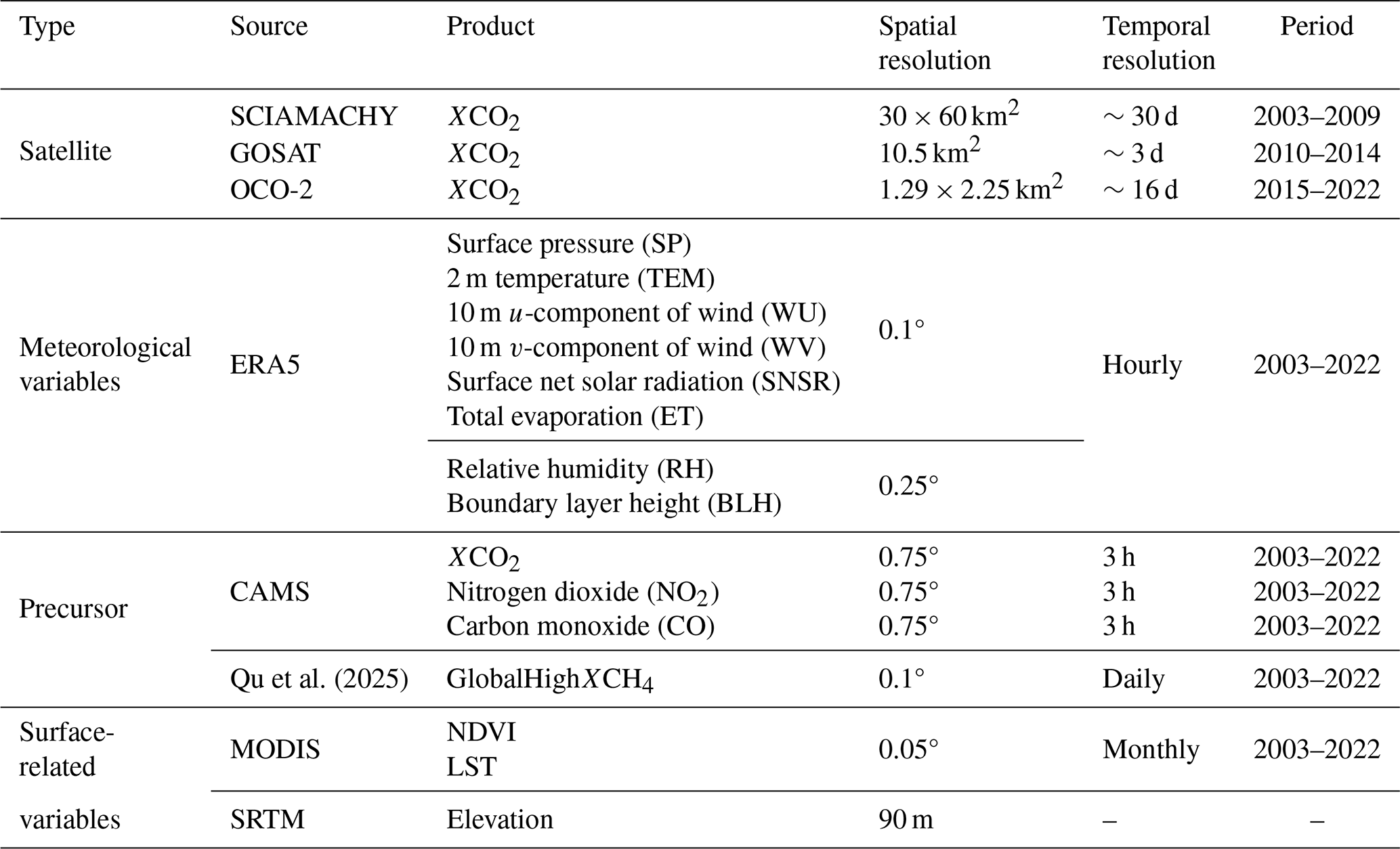
Satellite-based XCO2 retrievals from SCIAMACHY, GOSAT, and OCO-2 were used as the primary observational constraints in this study. SCIAMACHY, onboard Envisat and operating from 2002 to 2012, provided global XCO2 observations at a resolution of 30×60 km2 approximately every 30 d, retrieved using the Bremen Optimal Estimation DOAS (BESD) algorithm (Bovensmann et al., 1999; Buchwitz et al., 2005; Reuter et al., 2011). GOSAT, launched in 2009, provides near-global coverage at 10.5 km spatial resolution every 3 d through its Fourier Transform Spectrometer. OCO-2, operating since 2014, provides XCO2 measurements at 1.29×2.25 km2 resolution every ∼16 d using three grating spectrometers (Crisp, 2015). Here, we used the SCIAMACHY BESD products from 2003 to 2009, GOSAT Level 2 XCO2 Version 9r products from 2010 to 2014, and OCO-2 Level 2 XCO2 Lite Version 11r product from 2015 to 2022. All retrievals underwent standard quality control, and only high-quality observations were retained. In addition, the Copernicus Atmosphere Monitoring Service (CAMS) provides a global atmospheric composition reanalysis, offering continuous greenhouse gas fields from 2003 to the present at 0.75°×0.75° horizontal resolution and a 3 h temporal resolution (Agustí-Panareda et al., 2023). CAMS provides spatially complete and consistent estimates of large-scale XCO2 patterns and was also employed in this study.
Ground-based observations were obtained from the TCCON, which provides high-precision XCO2 measurements with an average uncertainty of approximately 0.2 %. The network offers sub-daily temporal sampling, typically including multiple observations per clear-sky day, and serves as a standard reference for the validation of satellite XCO2 retrievals (Wunch et al., 2017). We used all available 31 stations in the GGG2020 release, distributed across global land areas (Fig. 1), serving as the reference for assessing reconstruction performance and guiding bias correction. To independently evaluate the bias-corrected daily XCO2 dataset, we used surface flask measurements from the Observations Package (ObsPack) dataset, including 41 land-based sites (Fig. 1). Only stations with a quality inspection flag of 1 or 2 were retained to ensure consistency with the World Meteorological Organization X2019 calibration scale.
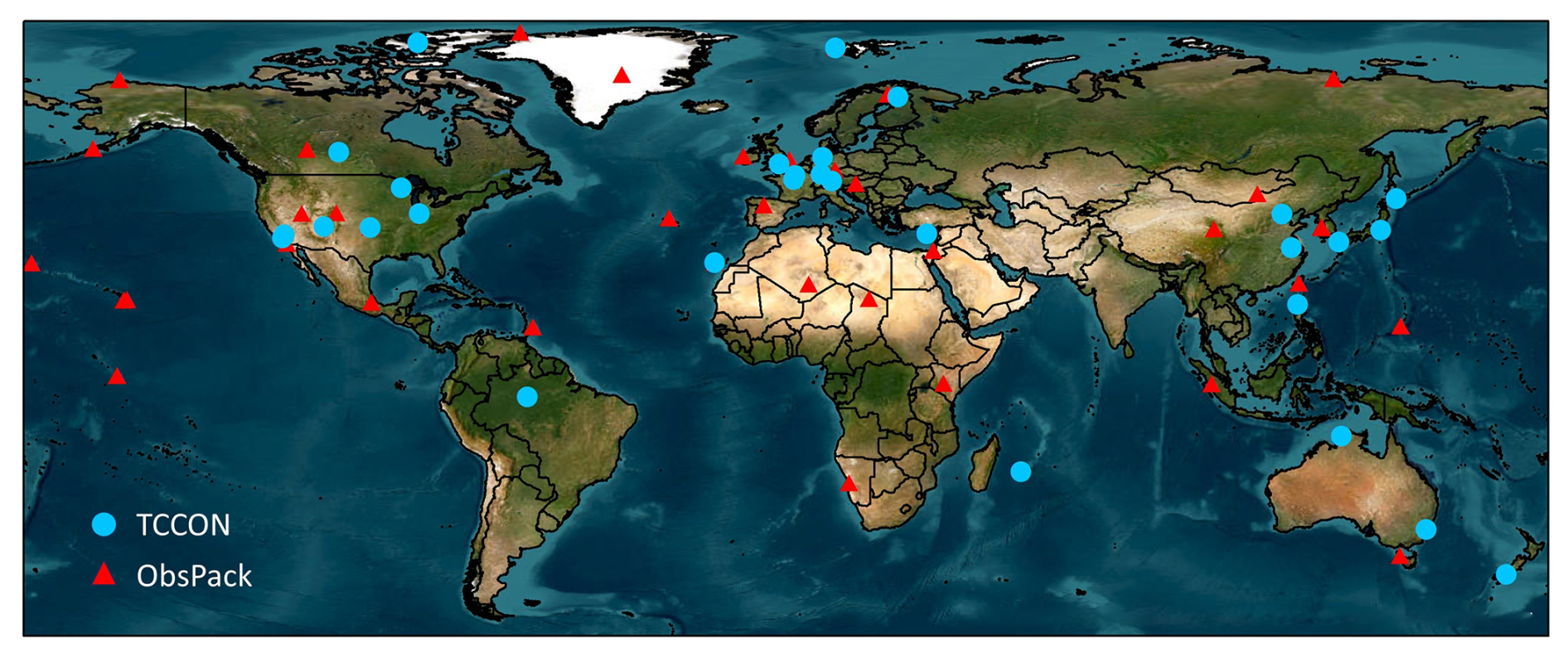
Figure 1Geographic locations of TCCON (Total Carbon Column Observing Network; blue dots) and ObsPack (Observations Package; red triangles) observation stations.
2.1.2 Meteorological and auxiliary variables
Meteorological variables relevant to atmospheric CO2 variability were obtained from the ERA5-Land hourly reanalysis at a spatial resolution of 0.1°×0.1°, including surface pressure (SP), 2 m air temperature (TEM), surface net solar radiation (SNSR), total evaporation (ET), and 10 m u- and v-components of wind (WU and WV). Boundary layer height (BLH) and relative humidity (RH) were obtained from the ERA5 reanalysis at 0.25°×0.25° resolution. To capture short-lived atmospheric precursors associated with anthropogenic and biomass-burning emissions, we included daily nitrogen dioxide (NO2) and carbon monoxide (CO) total columns from the CAMS analysis, as well as column-averaged methane (XCH4) derived from our previous study (Qu et al., 2025), which were used as proxies for fossil-fuel combustion and fire-related emissions (Reuter et al., 2019). Land-surface conditions were characterized using MODIS products, including monthly normalized difference vegetation index (NDVI) and land surface temperature (LST), which are closely related to terrestrial carbon uptake and surface–atmosphere carbon exchange (Huang et al., 2015; Li et al., 2025). Topographic effects were represented using the Shuttle Radar Topography Mission (SRTM) digital elevation model (DEM) at 90 m resolution. Table 1 provides an overview of all data sources used in this study.
Table 1Summary of the datasets used for XCO2 reconstruction in this study.
2.2 Model development and construction
2.2.1 Transformer–BiLSTM framework
In this study, we proposed a hybrid spatiotemporal Transformer–BiLSTM deep-learning framework to capture both spatial and temporal dependencies. The input predictors are first processed by a Transformer encoder (Vaswani et al., 2017), which models long-range spatial dependencies at regional and global scales through multi-head self-attention and position-wise feed-forward layers, without relying on local receptive fields. Each location's feature vector is projected into query (Q), key (K), and value (V) vectors, and the resulting attention scores quantify the influence of all other locations on that location. The multi-head attention mechanism integrates complementary spatial relationships across multiple feature subspaces, enabling the model to explicitly capture planetary-scale influences, such as atmospheric teleconnections and large-scale weather systems, on regional XCO2 concentrations.
The spatially encoded features generated by the Transformer are subsequently passed to a Bidirectional Long Short-Term Memory (BiLSTM) network, which learns forward and backward temporal dependencies by integrating both past and future information (Zhang et al., 2020). This sequence-to-sequence formulation effectively captures temporal variability arising from diurnal cycles, synoptic weather variations, and seasonal biospheric processes affecting XCO2 concentrations, thereby generating comprehensive spatiotemporal feature representations for each grid cell.
The resulting spatiotemporal features are finally passed through a multilayer perceptron (MLP) block, followed by a fully connected linear layer that projects the fused features to scalar daily XCO2 estimates for each grid cell. To effectively capture the complex spatiotemporal dynamics of atmospheric XCO2, we designed a weighted spatiotemporal loss function that accounts for intrinsic temporal continuity and spatial correlation, in contrast to the standard mean squared error (MSE) loss function:
where yi and denote the observed and predicted XCO2 values for the ith sample, respectively, and Δyi and represent the corresponding temporal differences between consecutive time steps. The first term enforces point-wise reconstruction accuracy, the second term promotes temporal consistency, and Lspatial introduces a Laplacian-based spatial smoothness constraint to preserve coherence among neighboring 0.1° grid cells. The hyperparameters χ1=0.5 and χ2=0.01, which regulate the temporal and spatial regularization terms, respectively, were determined via a grid search.
During model construction, the dataset was randomly partitioned into training, validation, and testing sets at a ratio of . The temporal encoder was implemented as a single-layer bidirectional LSTM (BiLSTM) with 64 hidden units per direction, yielding a 128-dimensional output feature. A dropout rate of 0.5 was applied to mitigate overfitting. The Transformer module comprised 4 encoder layers, each with 64-dimensional hidden layers and 4 attention heads, with ReLU activation functions applied between layers to enhance learning and facilitate sparse feature extraction. The Transformer–BiLSTM model was trained with the Adam optimizer, an initial learning rate of 0.001, and a batch size of 256. To optimize convergence, a learning-rate scheduler reduced the learning rate by a factor of 0.1 every 10 epochs if the validation loss did not improve. Training continued for up to 200 epochs, with early stopping applied if the validation loss failed to decrease for 15 consecutive epochs (Yeom et al., 2021).
2.2.2 Two-phase reconstruction workflow
To address the spatial discontinuity of raw satellite observations and the limited coverage of TCCON ground-based stations, we designed a sequential two-phase “fusion-then-correction” reconstruction workflow that decouples spatial pattern learning from magnitude calibration (Fig. 2).
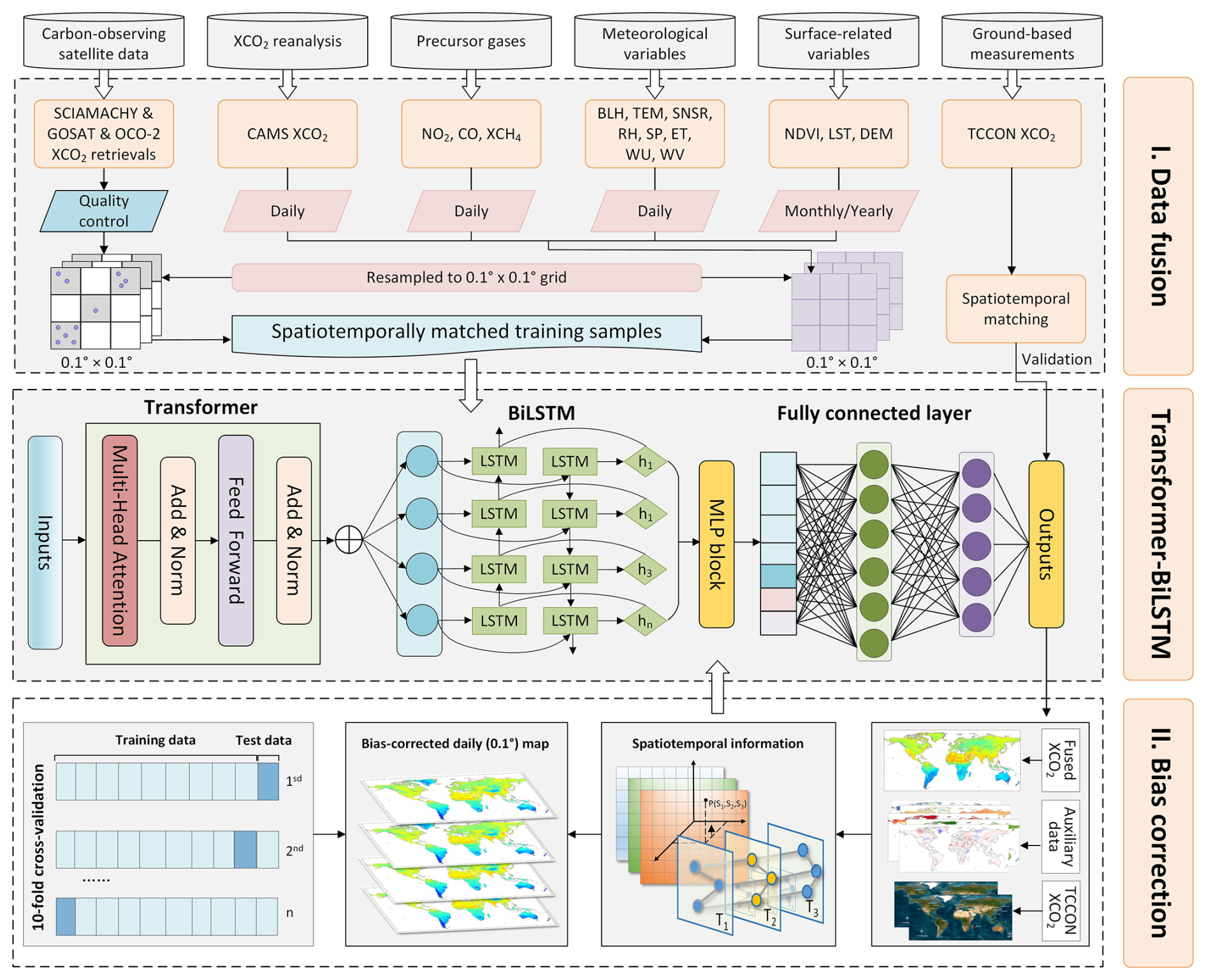
Figure 2Workflow for generating a global, daily, seamless XCO2 dataset at a spatial resolution of 0.1°×0.1° using the developed Transformer–BiLSTM framework.
Phase 1: data fusion
The objective of this stage is to reconstruct a spatially continuous global XCO2 field from sparse and discontinuous satellite observations. The Transformer–BiLSTM model uses XCO2 retrievals from SCIAMACHY, GOSAT, and OCO-2 as training targets and integrates multisource predictors, including atmospheric variables (XCH4 from our previous study, Qu et al., 2025, as well as CAMS XCO2, NO2, and CO columns), ERA5 meteorology variables (BLH, TEM, SNSR, RH, SP, ET, WU, and WV), and land-surface variables (NDVI, LST, and DEM). In addition, spatiotemporal encoding vectors are incorporated to characterize geographic and temporal dependencies. Specifically, spatial coordinates are represented using three Euclidean spherical functions (PS = S1, S2, S3), while temporal information is encoded using three helix-shaped trigonometric functions (PT = T1, T2, T3), enabling the model to capture spatial heterogeneity and temporal variability (Wei et al., 2023; Qu et al., 2025). The output of this stage is a preliminary global XCO2 dataset at 0.1°×0.1° spatial resolution, providing a seamless and spatially continuous field for the subsequent bias-correction stage.
Phase 2: bias correction
Satellite XCO2 retrievals often exhibit systematic biases arising from differences in sensor characteristics, retrieval algorithms, and temporal sampling. In this phase, the fused XCO2 field from Phase 1 () is further calibrated through a bias-correction procedure using ground-based TCCON measurements as reference observations. The Transformer–BiLSTM model ingests the fused XCO2 product together with the same auxiliary predictors used in the fusion stage, including atmospheric composition variables, meteorological variables, land-surface characteristics, and spatiotemporal encoding vectors. By learning the complex nonlinear relationships between satellite-dependent biases and environmental conditions, the model effectively reduces systematic errors while maintaining robust global generalization capability. The final output is a bias-corrected, seamless daily global XCO2 dataset at 0.1°×0.1° spatial resolution with improved consistency across all satellite platforms:
2.2.3 Innovations of the framework
The key innovation of our study lies in the synergistic integration of Transformer and BiLSTM modules to jointly model long-range spatial dependencies and temporal continuity. Specifically, the Transformer encoder utilizes self-attention mechanisms to capture non-local spatial relationships and global contextual information, which are critical for representing large-scale atmospheric transport and spatially heterogeneous carbon dynamics. In contrast, the BiLSTM module focuses on bidirectional temporal evolution, enabling the model to better characterize daily continuity, temporal autocorrelation, and persistent XCO2 variability. Compared with conventional BiLSTM-attention frameworks (Wang et al., 2025), which mainly enhance sequential learning using local attention operations, our Transformer–BiLSTM architecture provides a substantially larger receptive field and stronger capability for jointly learning global spatiotemporal dependencies. In addition, we further introduce a weighted spatiotemporal loss function that jointly constrains reconstruction accuracy, temporal smoothness, and spatial coherence, thereby improving the temporal consistency and physical continuity of reconstructed daily XCO2 fields. This differs from previous studies that mainly optimize point-wise reconstruction errors using standard loss functions such as MSE.
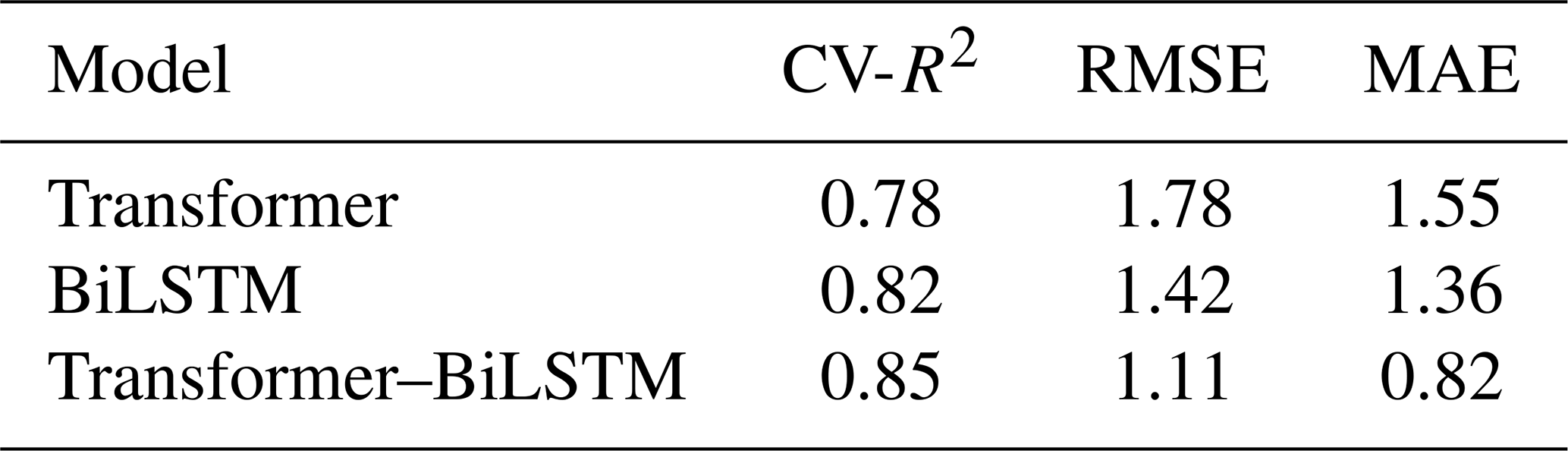
We further conducted an architecture-level ablation analysis comparing three backbone variants: BiLSTM, Transformer, and Transformer–BiLSTM (Table 2). The hybrid Transformer–BiLSTM model achieved the best overall performance, demonstrating the advantage of jointly modeling long-range spatial dependencies and temporal continuity.
Table 2Ablation analysis of different backbone models for XCO2 reconstruction.
Another important difference is that our framework is specifically designed for long-term multi-mission reconstruction. We propose a “data fusion + bias correction” workflow with explicit TCCON-guided bias correction to harmonize systematic discrepancies among SCIAMACHY, GOSAT, and OCO-2. Unlike previous studies that mainly focus on single-mission reconstruction performance, our framework explicitly addresses cross-mission inconsistencies and minimizes artificial temporal discontinuities caused by sensor replacement and orbital differences. Therefore, while previous studies have explored BiLSTM or attention-based approaches (Wang et al., 2025), the novelty of our study lies in the development of a Transformer–BiLSTM framework specifically designed for long-term, multi-mission daily XCO2 reconstruction with improved temporal continuity and cross-mission consistency.
2.3 Validation method
The data-fused XCO2 estimates were independently evaluated against TCCON XCO2 measurements. For both the data-fused and bias-corrected XCO2 products, a multi-strategy ten-fold cross-validation (10-CV) framework was applied using satellite and TCCON observations. Specifically, the sample-based CV randomly withheld 10 % of the daily grid-level samples to assess overall performance and internal consistency. The temporal-based CV withheld continuous blocks of daily data to evaluate the model's temporal generalization during periods without ground-based measurements. The spatial-based CV withheld spatially contiguous clusters of grid cells (1°×1°) to assess the model's capability to generalize to regions lacking ground-based observations.
3.1 Model performance
3.1.1 Validation of data-fused XCO2 estimates
We first evaluated the Transformer–BiLSTM model in the data-fusion phase using three 10-fold cross-validation approaches, comparing daily XCO2 estimates with satellite retrievals from SCIAMACHY, GOSAT, and OCO-2 (Fig. 3). Sample-based CV shows that our model accurately reconstructs daily XCO2 concentrations across different satellite missions, as evidenced by increasing cross-validation R2 (CV-R2) values from 0.91 (SCIAMACHY) to 0.96 (GOSAT) and 0.98 (OCO-2), and decreasing RMSE (MAE) values from 1.39 (1.03) to 0.82 (0.58) and 0.76 (0.53) ppm, reflecting improvements associated with higher observation density and retrieval quality in later missions. Temporal-based CV further demonstrates stable predictive performance under interannual extrapolation, with CV-R2 rising from 0.72 (SCIAMACHY) to 0.88 (GOSAT) and 0.93 (OCO-2), and RMSE (MAE) decreasing from 2.47 (1.43) to 1.45 (1.09) and 1.42 (1.05) ppm, indicating robust generalization across years and satellite transitions. Spatial-based CV confirms strong spatial predictive ability in under-monitored regions, with CV-R2 increasing from 0.86 (SCIAMACHY) to 0.89 (GOSAT) and 0.96 (OCO-2), accompanied by corresponding reductions in RMSE (MAE) from 1.71 (1.28) to 1.30 (0.98) and 1.10 (0.79) ppm.
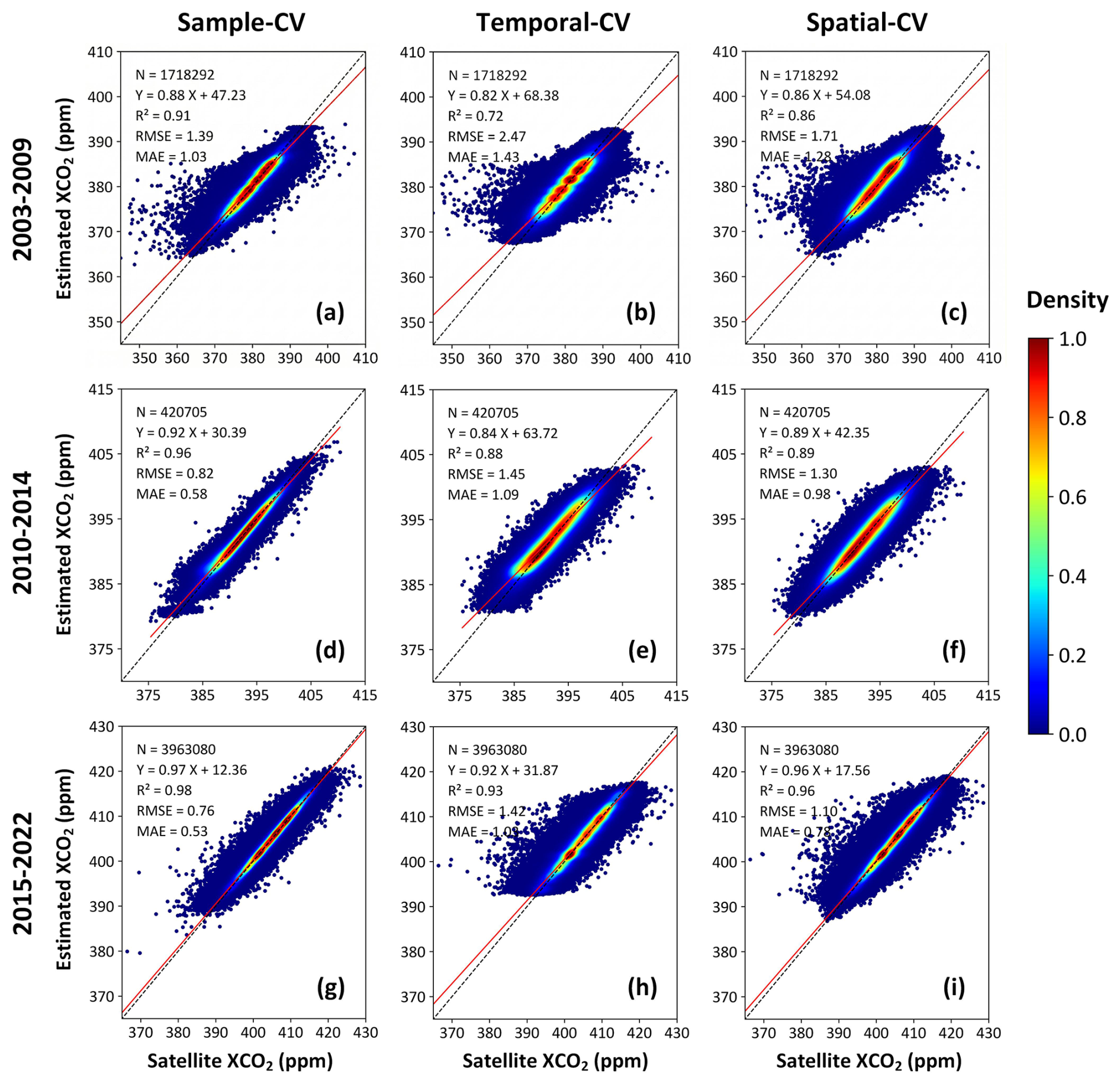
Figure 3Density scatterplots of sample-based (a, d, g), temporal-based (b, e, h), and spatial-based (c, f, i) ten-fold cross-validation (10-CV) results for daily XCO2 estimates during 2003–2009 (SCIAMACHY, a–c), 2010–2014 (GOSAT, d–f), and 2015–2022 (OCO-2, g–i). Black dashed lines represent the 1:1 relationship, and red solid lines indicate linear regression fits.
Furthermore, we independently evaluated our data-fused XCO2 estimates against TCCON ground-based measurements and compared their performance with satellite retrievals and the CAMS reanalysis. Satellite XCO2 observations show strong agreement with TCCON, yielding an R2 of 0.96, an RMSE of 1.67 ppm, and a mean bias of 0.13 ppm (Fig. 4a). CAMS reanalysis exhibits a comparable correlation (R2=0.97) but larger errors and a more pronounced systematic bias (RMSE = 1.74 ppm, mean bias = 0.38 ppm; Fig. 4b). In contrast, our data-fused XCO2 product achieves the best agreement with TCCON, with an R2 of 0.99, an RMSE of 1.10 ppm, an MAE of 0.82 ppm, and a near-zero mean bias of 0.01 ppm (Fig. 4c), demonstrating that the fusion framework substantially improves consistency with ground-based observations.
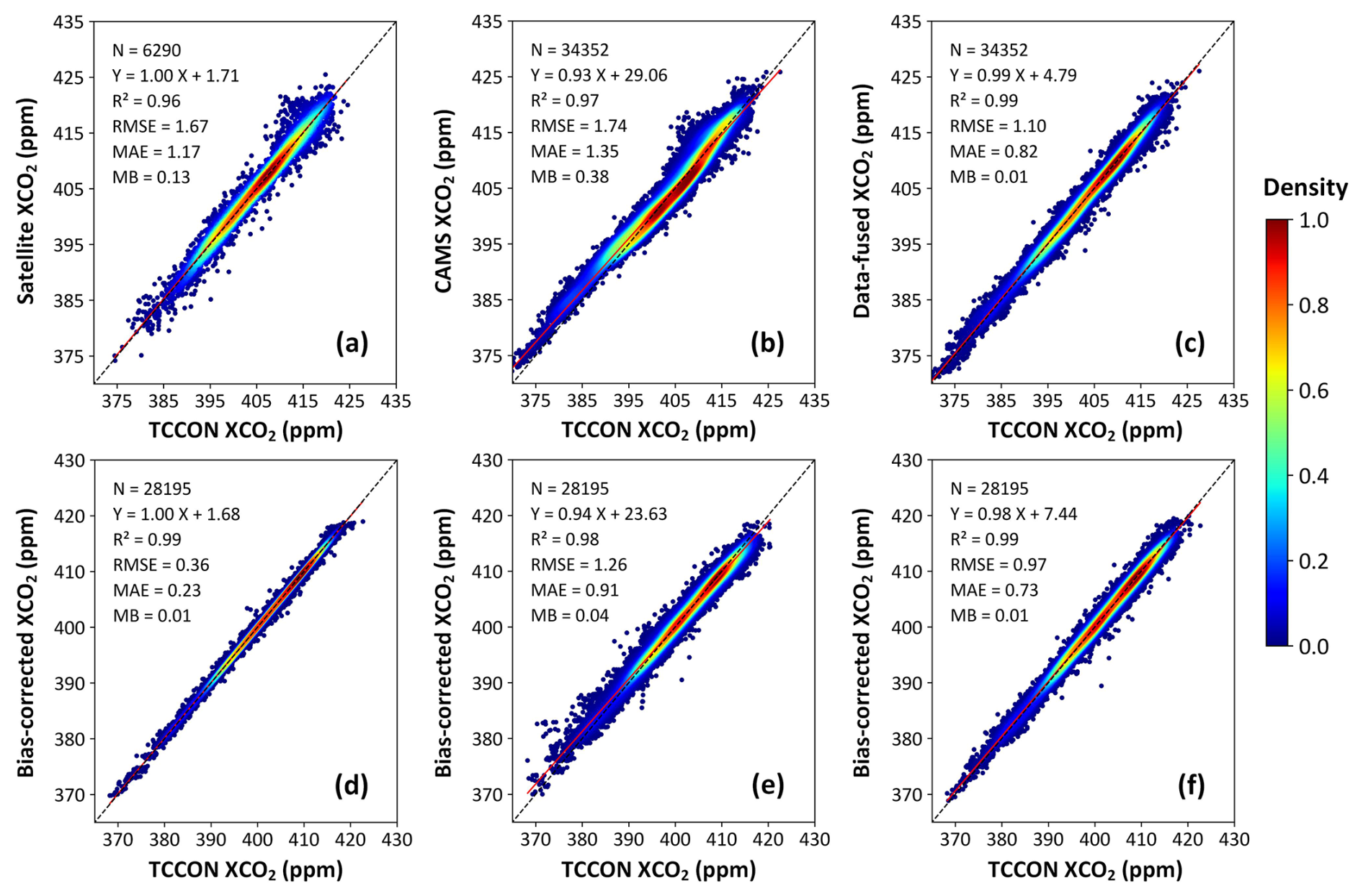
Figure 4Density scatterplots comparing daily XCO2 concentrations from (a) satellite retrievals, (b) CAMS reanalysis, and (c) our data-fusion approach against TCCON ground-based measurements, as well as ten-fold cross-validation (10-CV) results for our bias-corrected daily XCO2 concentrations using (d) sample-based, (e) temporal-based, and (f) spatial-based CV strategies. Black dashed lines represent the 1:1 relationship, and red solid lines indicate linear regression fits.
3.1.2 Validation of bias-corrected XCO2 estimates
The bias-corrected XCO2 estimates achieve excellent agreement with TCCON observations (R2=0.99, RMSE = 0.36 ppm, MAE = 0.23 ppm) and a near-zero mean bias of 0.01 ppm, indicating that systematic biases in the data-fused product are effectively removed (Fig. 4d). Temporal-based CV further demonstrates stable predictive performance under interannual extrapolation: when continuous years are withheld from training, the bias-corrected XCO2 achieves a CV-R2 of 0.98, with an RMSE of 1.26 ppm, an MAE of 0.91 ppm, and a mean bias of 0.04 ppm (Fig. 4e), confirming stable temporal generalization across different years. Spatial-based CV confirms strong spatial transferability, with a CV-R2 of 0.99, an RMSE of 0.97 ppm, an MAE of 0.73 ppm, and a mean bias of 0.01 ppm (Fig. 4f), demonstrating reliable performance when extrapolating to under-monitored regions.
Beyond overall statistical accuracy, temporal seamlessness is critical when merging multi-decadal satellite records, particularly across mission transitions where systematic retrieval offsets can introduce artificial discontinuities. To evaluate the temporal stability of the reconstructed dataset across major satellite mission transitions (∼2010 and ∼2015), we conducted targeted diagnostics at long-term TCCON sites, including Garmisch (Europe) and Park Falls (North America) (Fig. 5). Daily XCO2 time series spanning the SCIAMACHY–GOSAT and GOSAT–OCO-2 transitions reveal clear differences between the initial data-fused product and the bias-corrected reconstruction. At both sites, the uncorrected fused XCO2 occasionally exhibits small but discernible step changes or systematic offsets coincident with mission transitions, indicating residual inter-mission inconsistencies. In contrast, the bias-corrected XCO2 time series remains temporally smooth and continuous across the transition periods, with no apparent artificial discontinuities. Moreover, the corrected series closely follows TCCON observations in both seasonal phase and amplitude, preserving natural temporal variability while effectively eliminating sensor-induced biases. Together, these results highlight the robustness of the bias-correction strategy in ensuring the temporal seamlessness of the multi-decadal XCO2 record.
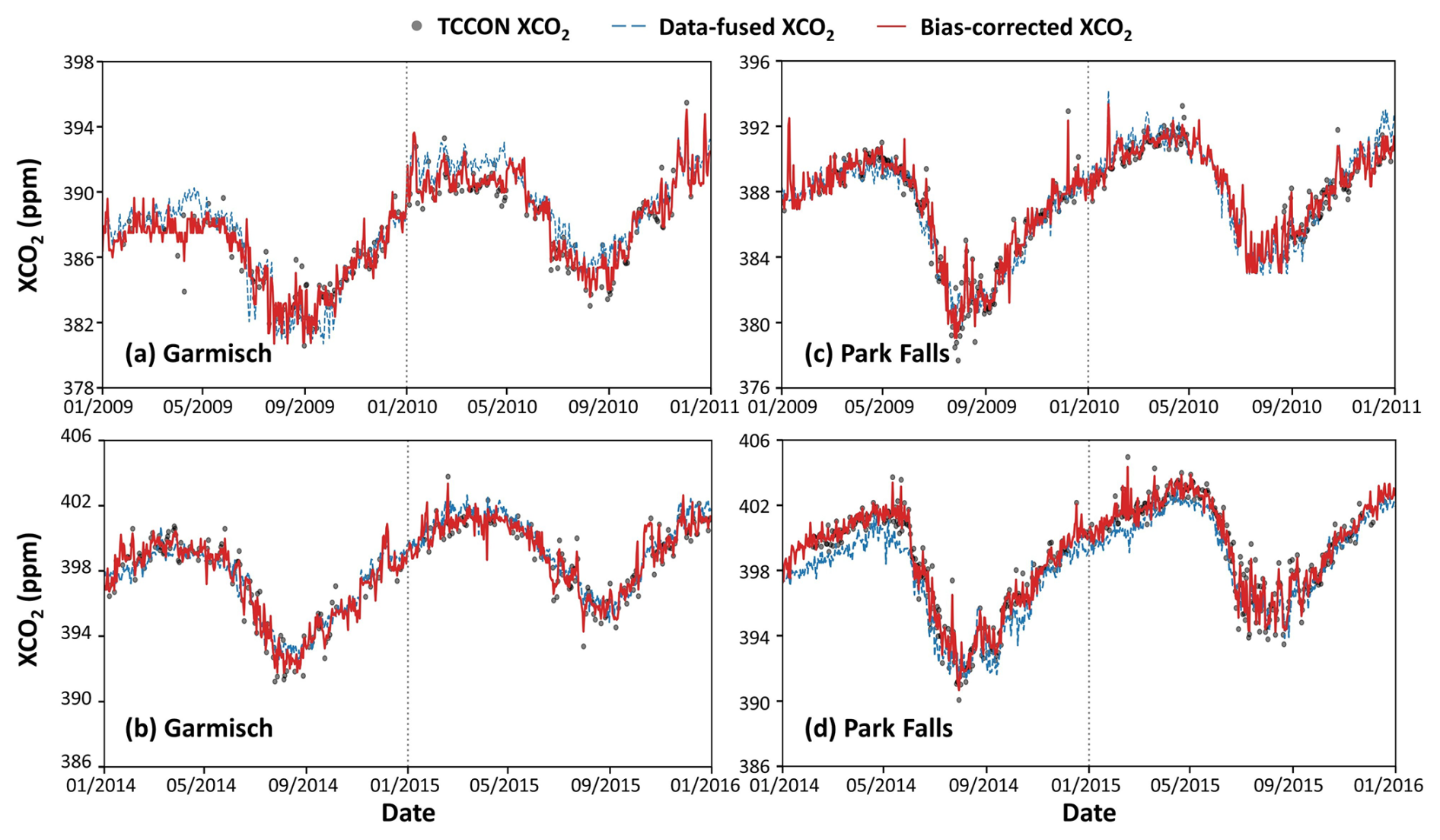
Figure 5Time series of TCCON (grey dots), data-fused (blue dashed lines), and bias-corrected (red solid lines) XCO2 concentrations at (a, b) Garmisch (Europe) and (c, d) Park Falls (North America) across major satellite mission transitions: (a, c) SCIAMACHY–GOSAT (2009–2010) and (b, d) GOSAT–OCO-2 (2014–2016). The vertical dotted lines indicate the approximate timing of satellite mission transitions.
3.1.3 Independent validation against ObsPack observations
To further evaluate the generalization ability of the bias-corrected daily XCO2 dataset, we conducted an independent validation against surface flask measurements at 41 ObsPack stations from 2003 to 2022 (Fig. 6). The bias-corrected XCO2 exhibits strong consistency with ObsPack observations, yielding a global mean R2 of 0.86. More than 90 % of the stations show high R2 values exceeding 0.6, and over half (54 %) exceed 0.9, indicating robust performance across diverse geographic and climatic conditions. The low R2 at the AZR station is mainly due to the limited number of matched observations and the relatively small temporal variability at this site, which can lead to unstable correlation statistics. Importantly, the RMSE and bias at this station remain relatively small, suggesting that the low R2 does not indicate a systematic deficiency in the reconstructed dataset. Spatially, most stations (58 %) show RMSE values ranging from 3 to 6 ppm, with larger values observed at stations in North America, Europe, and East Asia, where complex terrain and strong anthropogenic emissions dominate. Nonetheless, the estimated bias and MAE are generally low, with more than 73 % and 80 % of the stations having bias values within ±3 ppm and MAE values below 5.0 ppm, respectively.
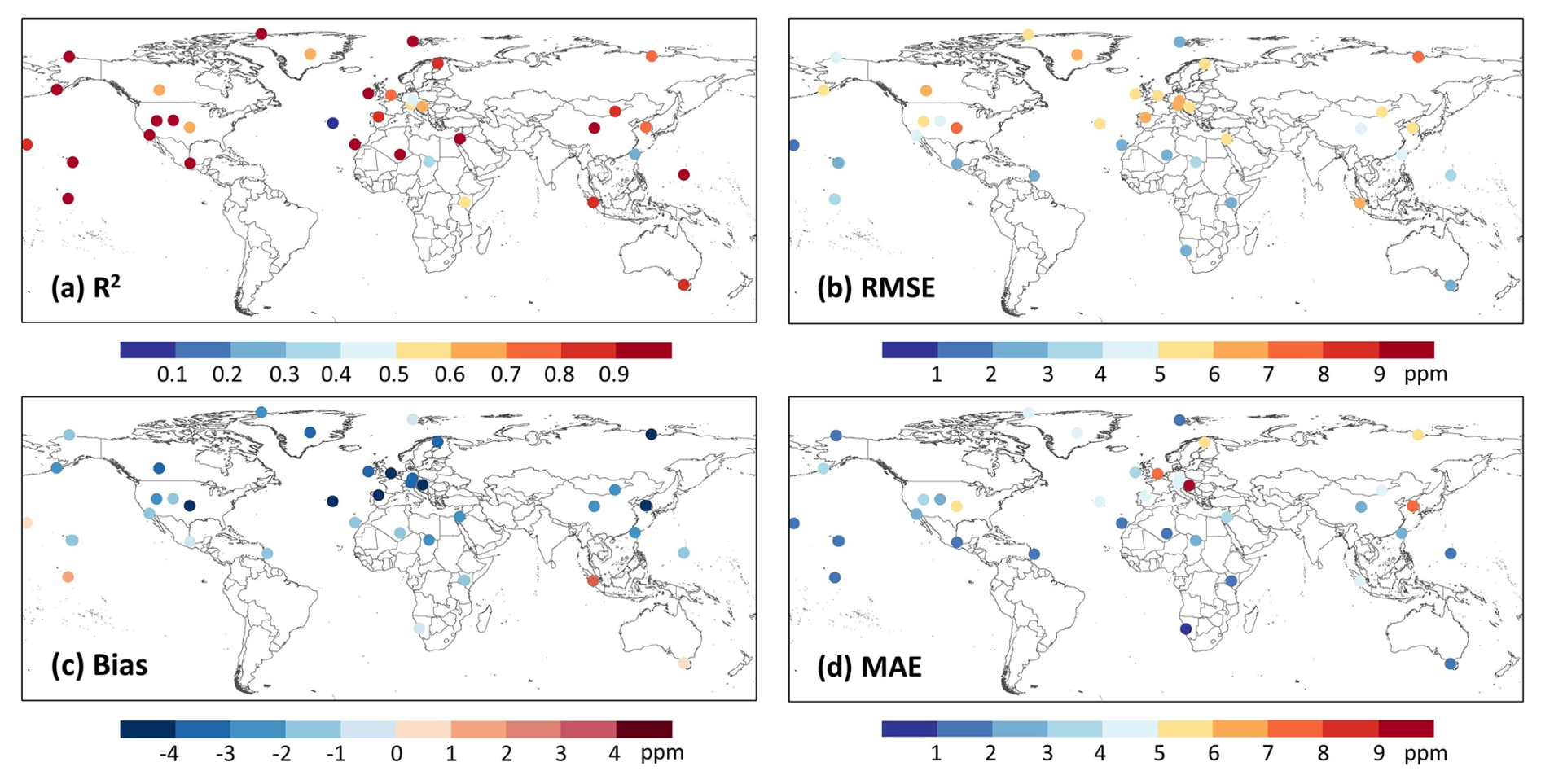
Figure 6Global validation of our bias-corrected daily XCO2 dataset against ObsPack surface flask observations during 2003–2022.
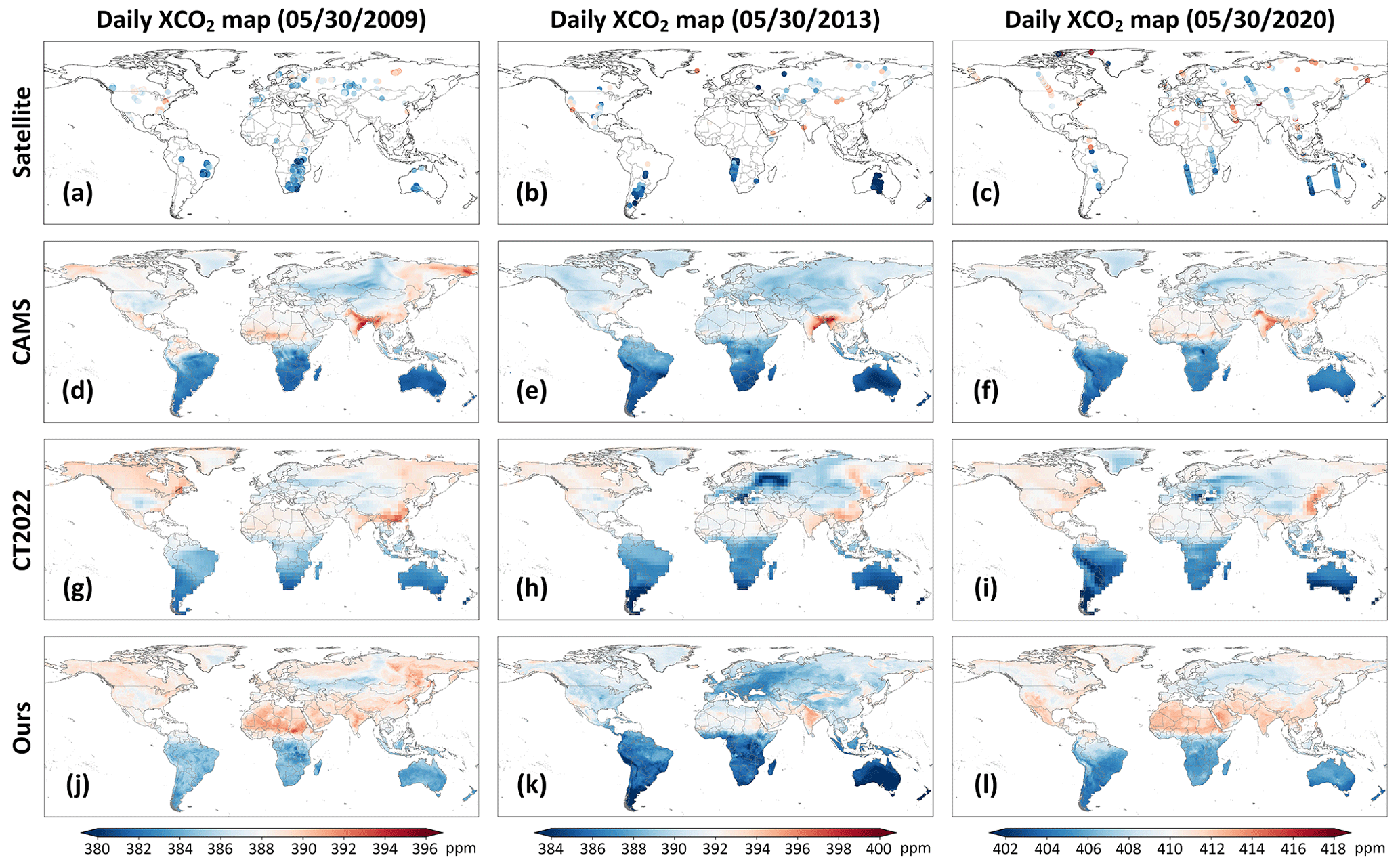
Figure 7Spatial distributions of global daily XCO2 concentrations on 30 May 2009, 2013, and 2020 from (a–c) SCIAMACHY, GOSAT, and OCO-2 retrievals, (d–f) CAMS reanalysis, (g–i) CarbonTracker (CT2022), and (j–l) our reconstructed XCO2 product.
3.2 Spatiotemporal variations of global atmospheric XCO2
3.2.1 Global daily seamless XCO2 maps
We compare global daily XCO2 data derived from different products for three representative dates: 30 May 2009, 2013, and 2020, where the coarser-resolution products are plotted at their native resolutions for qualitative comparison (Fig. 7). Satellite retrievals provide physically realistic XCO2 signals but suffer from sparse and discontinuous spatial coverage due to orbital limitations and cloud contamination. CAMS (0.75°×0.75°) offers spatially complete fields but tends to weaken local spatial gradients, attenuating enhancements over major emission regions and underestimating background values in the Southern Hemisphere. CarbonTracker 2022 (CT2022, 3°×2°) is a widely used global CO2 flux inversion system developed by NOAA to quantify atmospheric CO2 sources and sinks using transport modeling (Jacobson et al., 2023). It captures large-scale interhemispheric gradients but exhibits regional inconsistencies, including exaggerated concentrations in parts of the Northern Hemisphere mid-latitudes and muted contrasts in tropical source regions. In contrast, our XCO2 product achieves seamless global coverage while preserving fine-scale spatial heterogeneity and maintaining close consistency with satellite retrievals where available. Representative regional comparisons (highlighted by red circles) further illustrate these differences. In 2009, CT2022 overestimated XCO2 concentrations over the eastern United States, while CAMS underestimated regional XCO2 enhancements; our estimates closely matched satellite observations. In 2013, both CAMS and CT2022 underestimated XCO2 concentrations over northern China and southern Mongolia, whereas our product accurately captured the observed spatial patterns. In 2020, both CAMS and CT2022 underestimated XCO2 concentrations over the Middle East, whereas our reconstruction captured the enhanced concentrations, in agreement with satellite observations. These examples demonstrate that our data provide a balanced and physically consistent representation of daily global XCO2, avoiding CAMS over-smoothing and the regional biases evident in CT2022.
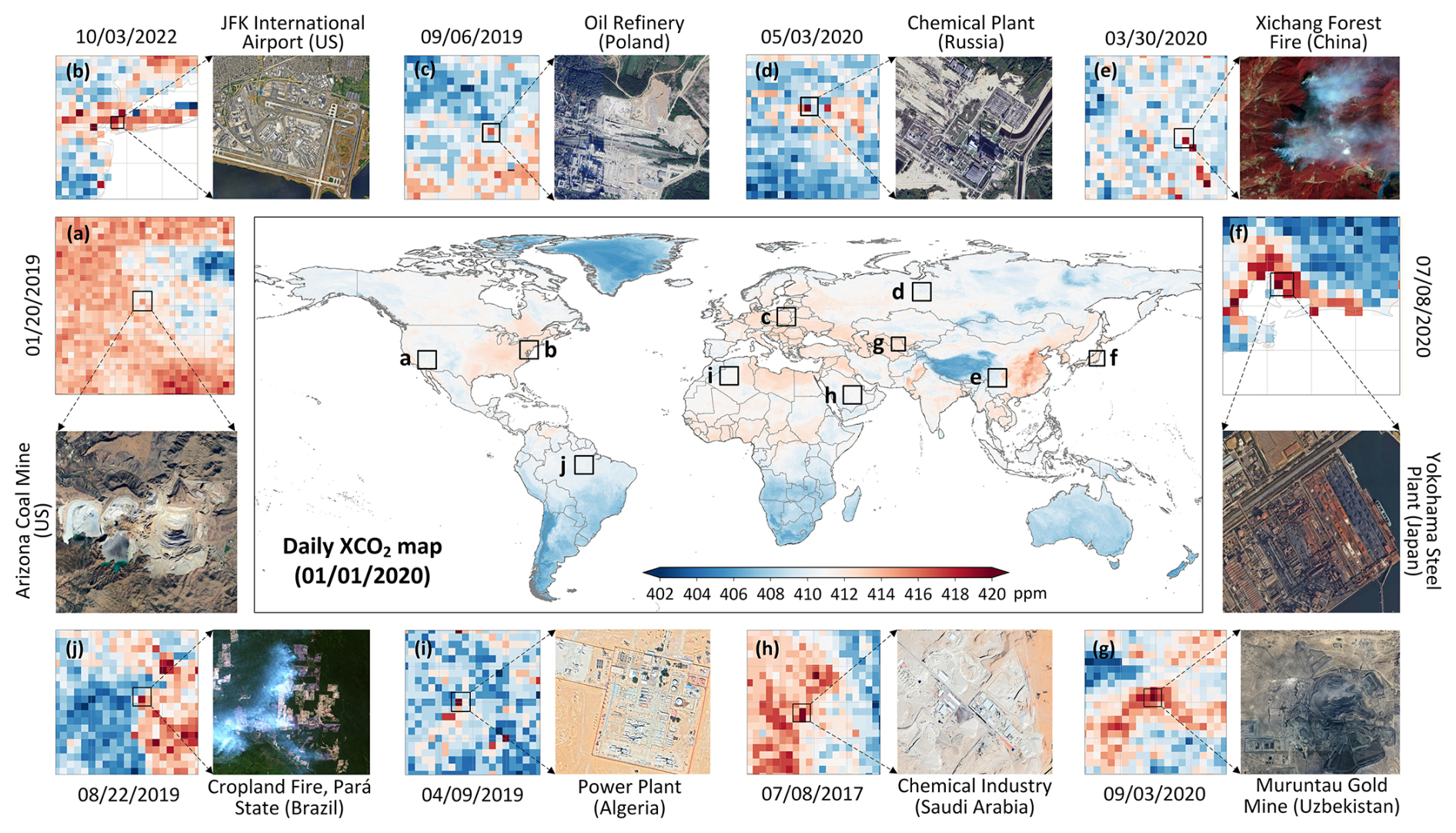
Figure 8Characterization of localized XCO2 enhancement identified signals from the reconstructed global daily seamless dataset across (a–j) 10 regions of interest on different days. The central map shows the global distribution of XCO2 on 1 January 2020.
3.2.2 Characterization of localized XCO2 enhancement signals
Daily XCO2 observations provide a distinct advantage for revealing localized and transient regions with elevated XCO2 concentrations that are often obscured in temporally averaged products (Fig. 8). Pronounced XCO2 enhancements are observed over regions with strong anthropogenic influence, including major industrial and energy-related areas such as steel production (the Yokohama Steel Plant in Japan), coal mining (the Arizona Coal Mine in the US), power generation (a power plant in Algeria), and chemical processing (a chemical plant in Russia). Elevated XCO2 concentrations are also observed over industrial clusters in East Asia, Central Asia (the Muruntau Gold Mine in Uzbekistan), Europe (an oil refinery in Poland), North America, and the Middle East (the chemical industry in Saudi Arabia). These patterns are consistent with localized regions of relatively high XCO2 concentrations associated with fossil-fuel combustion and extraction-related activities. In addition to stationary sources, localized enhancements are also evident near major transport hubs, such as John F. Kennedy International Airport in the US. Beyond anthropogenic sources, the daily XCO2 dataset also captures episodic enhancement events associated with natural processes, such as forest fires (the Xichang Forest Fire in China) and large-scale agricultural burning (cropland fires in Pará State, Brazil), which can generate short-lived yet spatially coherent XCO2 anomalies at daily timescales. These examples suggest that the reconstructed daily XCO2 product can identify typical regions with elevated XCO2 concentrations associated with both anthropogenic and natural processes, resolve their spatial footprints, and support the monitoring of regional XCO2 variability at the global scale. Nevertheless, these selected examples are intended to illustrate localized elevated XCO2 signals rather than strict point-source detections; however, some isolated high-value pixels may partly reflect retrieval uncertainty or noise, especially in regions with limited observations.
3.2.3 Impacts of biomass burning and ENSO on XCO2 growth
Elevated fire-related CO2 emissions and corresponding short-term XCO2 anomalies are clearly captured in our reconstructed dataset during extreme wildfire events. Over southeastern Australia (Fig. 9a), pronounced XCO2 enhancements are observed from 27 December 2019, to 8 January 2020, coinciding with the peak of the 2019–2020 Australian bushfires. The daily XCO2 time series exhibits a distinct local maximum on 5 January 2020 (average = 411.35±0.56 ppm), superimposed on a gradually increasing background trend, with spatial distributions revealing significantly elevated concentrations over fire-affected regions. A similar short-term response is detected over Xichang City in southwestern China during the March–April 2020 wildfire episode (Fig. 9b), lasting for over two weeks, from 24 March to 8 April 2020, with elevated daily XCO2 concentrations. A clear local peak of 410.56±0.53 ppm is observed on 30 March, coinciding with the reported Xichang forest fire outbreak, followed by a gradual decline after 5 April. These event-scale XCO2 anomalies, resolved at daily resolution, demonstrate the dataset's ability to capture rapid, short-lived carbon emissions and their impact on regional atmospheric XCO2 variability.
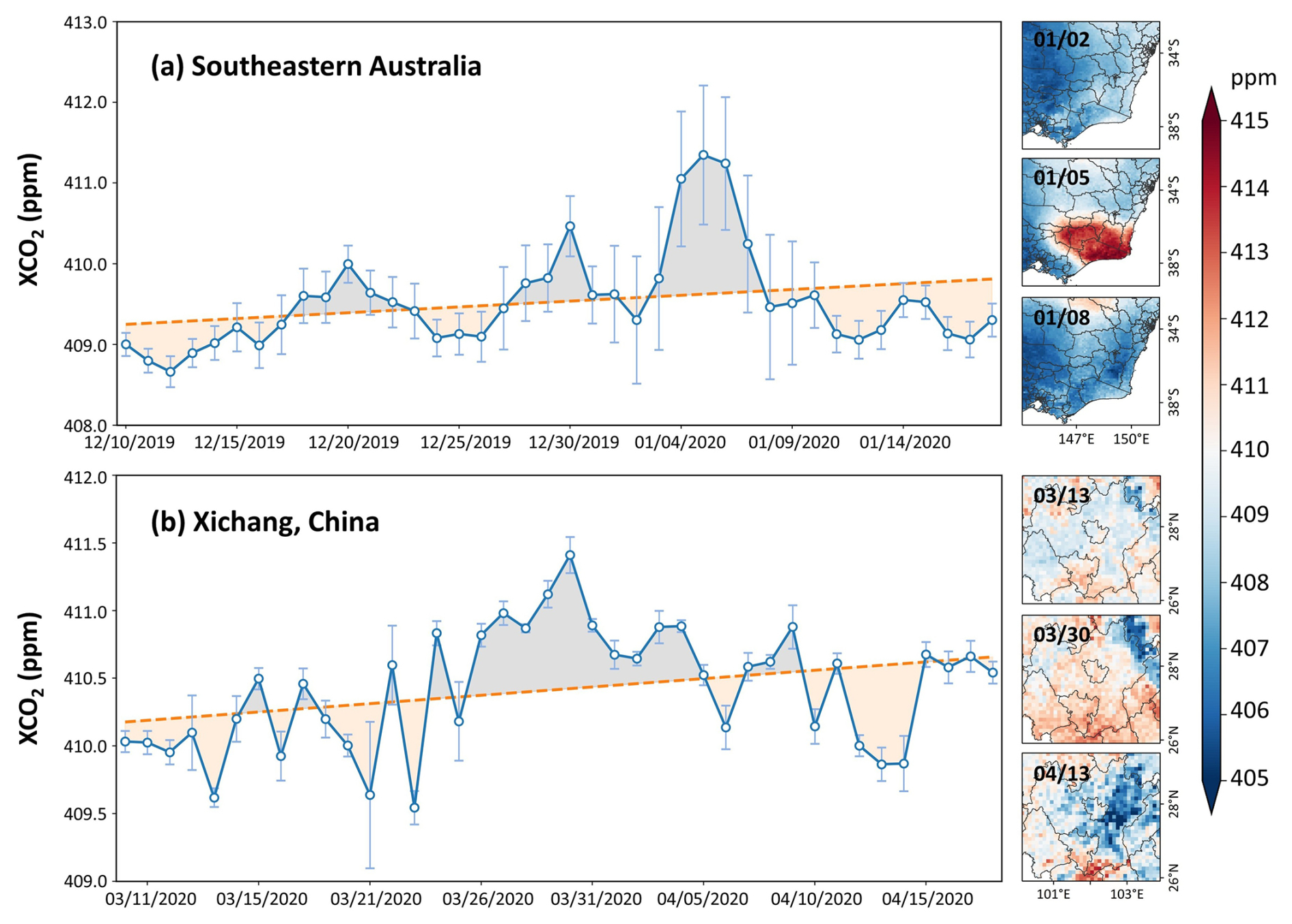
Figure 9Time series and spatial distributions of daily XCO2 concentrations associated with extreme wildfire events in (a) southeastern Australia during December 2019–January 2020 and (b) Xichang, China, during March–April 2020.
Figure 10 shows that XCO2 growth rates from our reconstructed dataset consistently respond to ENSO phases, as evidenced by a strong correlation with the multivariate ENSO index (MEI; R=0.55, p<0.01) (Wolter and Timlin, 2011), which explains ∼30 % of the observed interannual variability (Kim et al., 2016; Chatterjee et al., 2017). ENSO-driven anomalies in temperature and precipitation strongly regulate terrestrial carbon uptake and fire activity (da Costa et al., 2024). During El Niño conditions, warmer, drier climates suppress ecosystem CO2 uptake and enhance biomass burning, leading to elevated atmospheric growth rates (Betts et al., 2016; Guan et al., 2023; Ak-Bhd, 2021). This effect was most evident during the extreme 2015–2016 El Niño, which coincided with the highest recorded global XCO2 growth rate of 3.11 ppm yr−1 (p<0.001) (Liu et al., 2024). In contrast, La Niña phases are typically associated with cooler and wetter conditions that strengthen terrestrial carbon sinks and reduce atmospheric CO2 growth rates, as observed in 2011–2012 and 2022 (Wang et al., 2014; Chatterjee et al., 2017). Regionally, ENSO sensitivity is highest in the tropics, where MEI explains ∼45 % of the interannual variability, highlighting the vulnerability of tropical forests to climate-induced stress and fire-related carbon losses (Brando et al., 2019; Liu et al., 2022). The Northern Extratropics show moderate sensitivity (∼37 %), while the Southern Extratropics are less affected (∼27 %), reflecting hemispheric differences in land–atmosphere coupling and fire regimes.
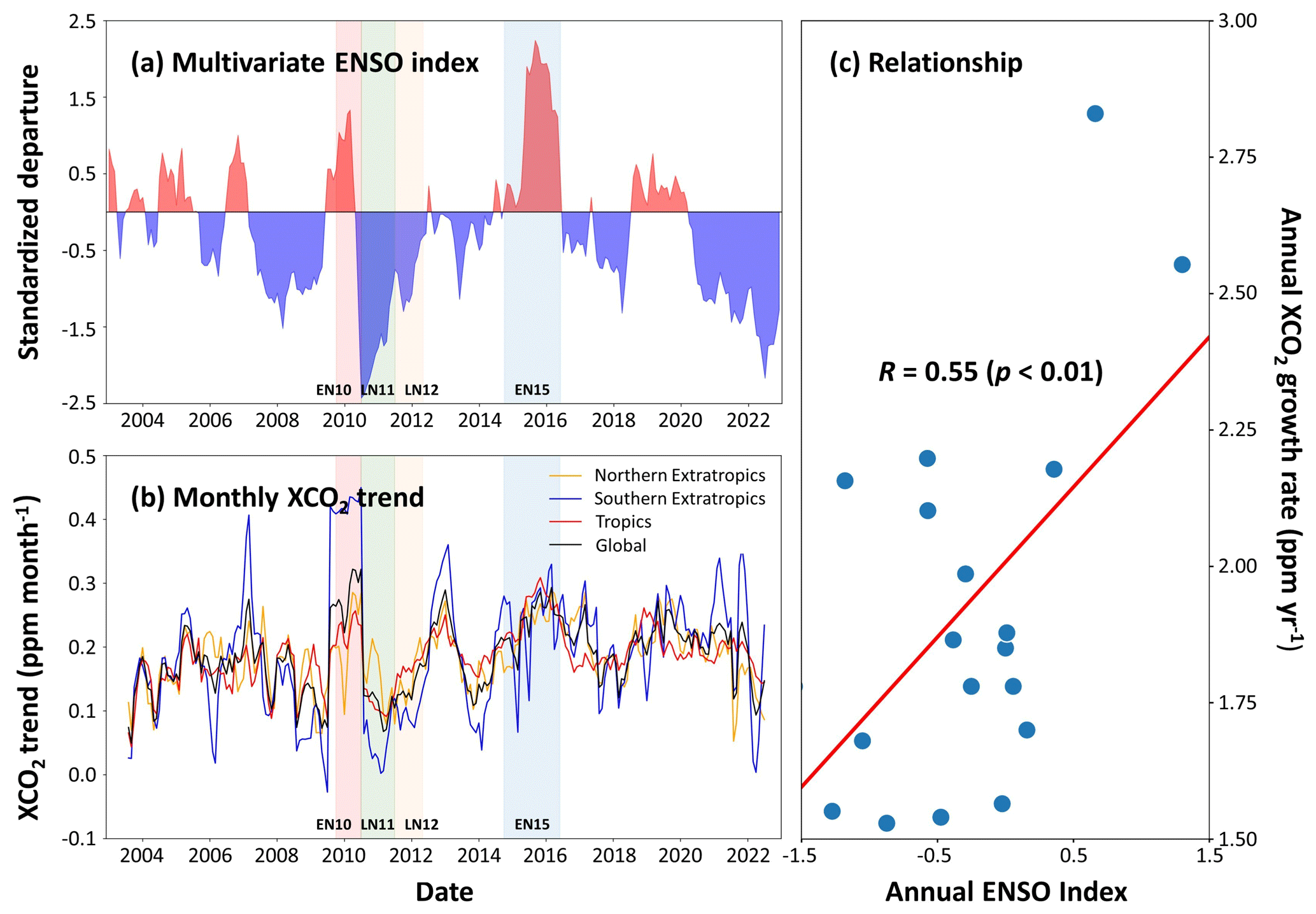
Figure 10Time series of the monthly (a) multivariate ENSO index and (b) detrended XCO2 growth rates over major regions, including the Northern Extratropics (30–90° N), Southern Extratropics (90–30° S), Tropics (30° S–30° N), and the globe. (c) Scatter plots of annual XCO2 growth rates versus the annual ENSO index. The 2011 La Niña event (LN11) is shaded in dark green. The preceding 2010 El Niño event (EN10) and subsequent weak 2012 La Niña event (LN12) are shaded in lighter red and green colors, respectively. The 2015 El Niño event (EN15) is shaded in dark blue.
3.2.4 Annual maps and long-term trends in global XCO2
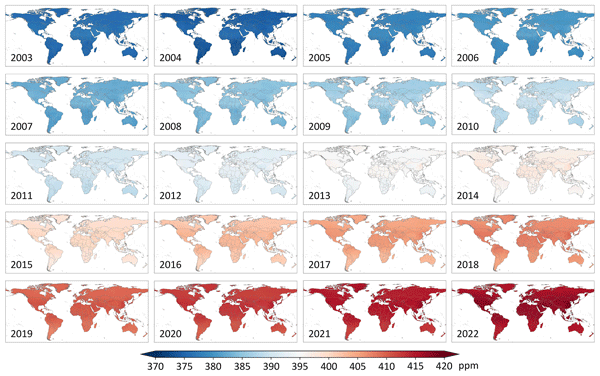
Figure 11 shows the annual mean global XCO2 from 2003 to 2022 over land, revealing a pronounced and sustained increase over the past two decades. During the early period (2003–2005), global XCO2 levels were relatively low, with most regions characterized by concentrations below ∼380 ppm. From 2006 to 2010, XCO2 increased steadily across all continents, while spatial contrasts remained relatively modest. After approximately 2010, the spatial patterns intensified markedly. From 2011 to 2015, high-XCO2 regions expanded and strengthened, and from 2016 onward, the global increase accelerates further, with XCO2 exceeding ∼410 ppm over large portions of the Northern Hemisphere by 2018–2019 (Buchwitz et al., 2018; Lee et al., 2025). By 2022, nearly all continental regions displayed XCO2 values above 415 ppm, with the highest concentrations concentrated over major industrialized and densely populated regions in the Northern Hemisphere. Overall, the global mean XCO2 increased monotonically from 374.54 ppm in 2003 to 416.36 ppm in 2022, corresponding to approximately an 11 % increase over the past 20 years. This substantial growth highlights the rapid accumulation of atmospheric CO2 and the growing influence of anthropogenic emissions on the global carbon cycle.
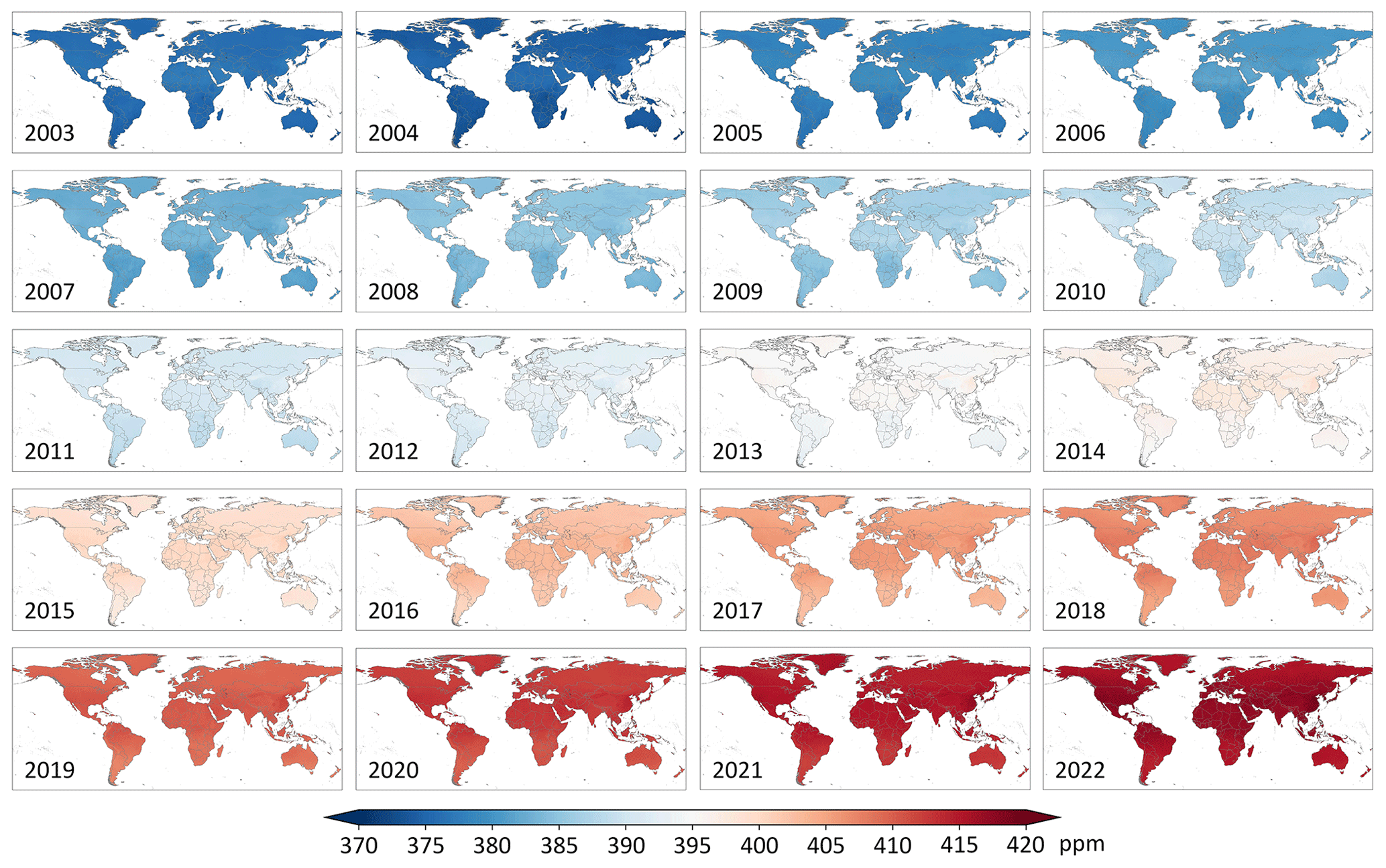
Figure 11Spatial distribution of annual mean XCO2 concentrations (unit: ppm) over land from 2003 to 2022.
Figure 12 presents the long-term (2003–2022) annual mean XCO2 and seasonal climatology. The long-term global mean XCO2 is 394.58±0.76 ppm, with a clear interhemispheric gradient, characterized by higher concentrations in the Northern Hemisphere and lower values in the Southern Hemisphere. The highest XCO2 concentrations are concentrated in the northern low- to mid-latitudes (∼10–45° N), encompassing East and Southeast Asia, northern Africa and the Middle East, the United States, and parts of Europe and South Asia. These regions coincide with dense population centers, intensive industrial activity, and high fossil fuel consumption (Crippa et al., 2021; Sheng et al., 2021). Conversely, persistently low XCO2 values occur over South America, central and southern Africa, and Australia, where strong biospheric uptake, sparse anthropogenic emissions, and the influence of clean marine air masses suppress atmospheric CO2 levels. At the national scale, South Korea exhibits the highest XCO2 value (396.11±0.69 ppm), followed by Kuwait (395.88±0.79 ppm), consistent with intensive energy use and strong fossil fuel dependence.
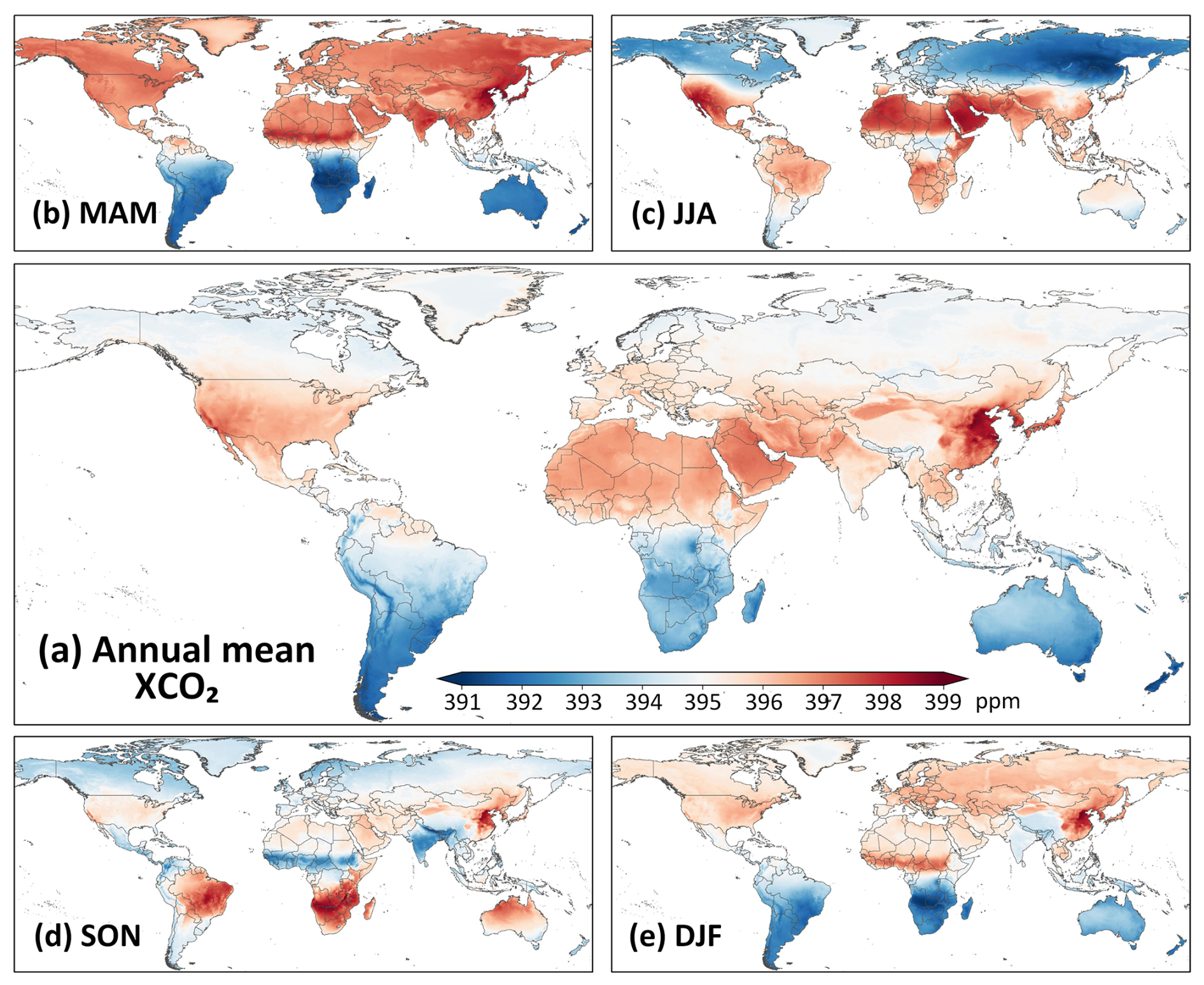
Figure 12Multi-year (a) annual mean XCO2 map (unit: ppm) over land for 2003–2022 and seasonal mean XCO2 maps for (b) March–April–May (MAM), (c) June–July–August (JJA), (d) September–October–November (SON), and (e) December–January–February (DJF).
Pronounced seasonal variability in XCO2 is evident across global land (Fig. 12b–d). During boreal spring (MAM; average = 395.36±2.20 ppm), elevated XCO2 concentrations are widespread across the Northern Hemisphere, reflecting accumulated winter emissions and the delayed onset of biospheric uptake. In boreal summer (JJA; average = 392.74±1.29 ppm), XCO2 decreases markedly over northern high-latitude continents but increases in the Southern Hemisphere, forming extensive low-concentration bands associated with peak vegetation photosynthesis and strong net carbon uptake. Boreal autumn (SON; average = 393.48±0.54 ppm) is characterized by distinct enhancements over southern Africa, South America, and much of Australia, linked to biomass burning and reduced biospheric uptake. Seasonal amplitudes are particularly large in East Asia and the western United States (e.g., California), where intensive anthropogenic emissions coincide with strong biospheric seasonality (Sheng et al., 2021; Guan et al., 2024). In boreal winter (DJF; mean = 394.76±1.37 ppm), enhanced fossil fuel combustion and reduced biospheric uptake lead to elevated XCO2 concentrations across the Northern Hemisphere, whereas lower values prevail over the Southern Hemisphere land and adjacent oceans, resulting in a pronounced interhemispheric gradient.
Figure 13 presents long-term XCO2 trends from 2003 to 2022 across different temporal scales. All land regions exhibit significant increasing trends, with an average of 2.24 ppm yr−1 (p<0.001). The strongest increases (>2.25 ppm yr−1) occur over East and Southeast Asia, northern South America, and central Africa, while comparatively weaker growth (<2.15 ppm yr−1) is observed over southern South America, Australia, and the Sahara. Seasonal trends reveal distinct patterns (Fig. 13b–e). During MAM (average = 2.16 ppm yr−1, p<0.001), large positive trends dominate the northern mid-latitudes, especially across much of Asia and North America, reflecting winter-emission accumulation and delayed biospheric uptake. In JJA (average = 2.23 ppm yr−1, p<0.001), trends weaken over boreal and temperate regions but remain pronounced in the tropics, particularly in the Amazon basin, central Africa, and Southeast Asia, reflecting ongoing anthropogenic emissions and biomass burning. SON (average = 2.25 ppm yr−1, p<0.001) shows enhanced trends over Africa and South America, forming clear regional maxima in biomass-burning regions, while northern mid-latitudes experience moderate growth. In DJF (average = 2.19 ppm yr−1, p<0.001), trends intensify again across the Northern Hemisphere, notably in East Asia and Europe, driven by wintertime fossil fuel combustion, whereas the Southern Hemisphere shows weaker increases. Although the spring and winter seasons exhibit stronger regional contrasts, the autumn season shows a systematically higher spatially averaged XCO2 growth trend, indicating a more widespread enhancement rather than localized extremes.
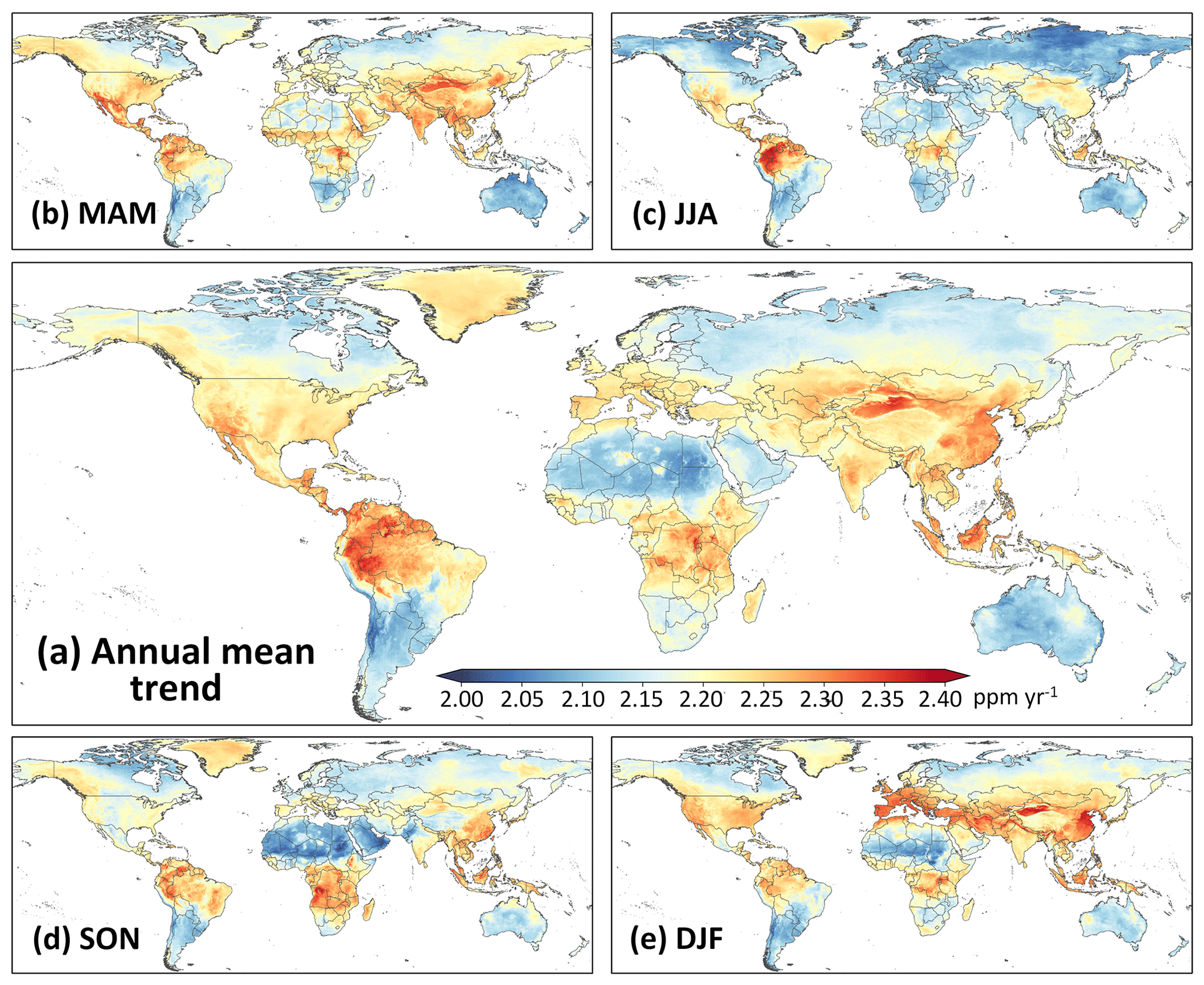
Figure 13Spatial patterns of long-term (a) annual XCO2 trends (unit: ppm yr−1) from 2003 to 2022 and seasonal XCO2 trends (unit: ppm yr−1) for (b) March–April–May (MAM), (c) June–July–August (JJA), (d) September–October–November (SON), and (e) December–January–February (DJF).
3.3 Discussion
3.3.1 Model interpretation with XAI
To improve model transparency and quantify the relative importance of input variables, we applied SHapley Additive exPlanations (SHAP) to the trained spatiotemporal Transformer–BiLSTM model (Lundberg and Lee, 2017). The SHAP values were calculated to assess the contribution of each predictor to the reconstructed XCO2 fields. For the data-fusion stage (Fig. 14a), CAMS XCO2 emerges as the dominant contributor, accounting for 37 % of the total importance, reflecting its role in providing a temporally continuous and spatially coherent background field. Spatiotemporal encoding variables collectively contribute 30 %, highlighting the importance of explicitly representing spatial structure and temporal dynamics in global XCO2 reconstruction. Meteorological variables (16 %) and satellite-derived surface variables (11 %) provide complementary information that refines regional-scale variability, while precursor gases contribute a smaller but non-negligible share (6 %). The relatively small mean SHAP value for NO2 suggests that its overall contribution to the global XCO2 reconstruction is smaller than that of variables such as CAMS XCO2 and meteorological factors. This is expected because NO2 mainly reflects localized anthropogenic combustion emissions, whereas large-scale atmospheric transport, background concentration fields, and biospheric exchange processes more strongly control XCO2 variability at the global scale. Nevertheless, NO2 still provides useful complementary information for identifying regional anthropogenic emission patterns, particularly over urban and industrial areas.
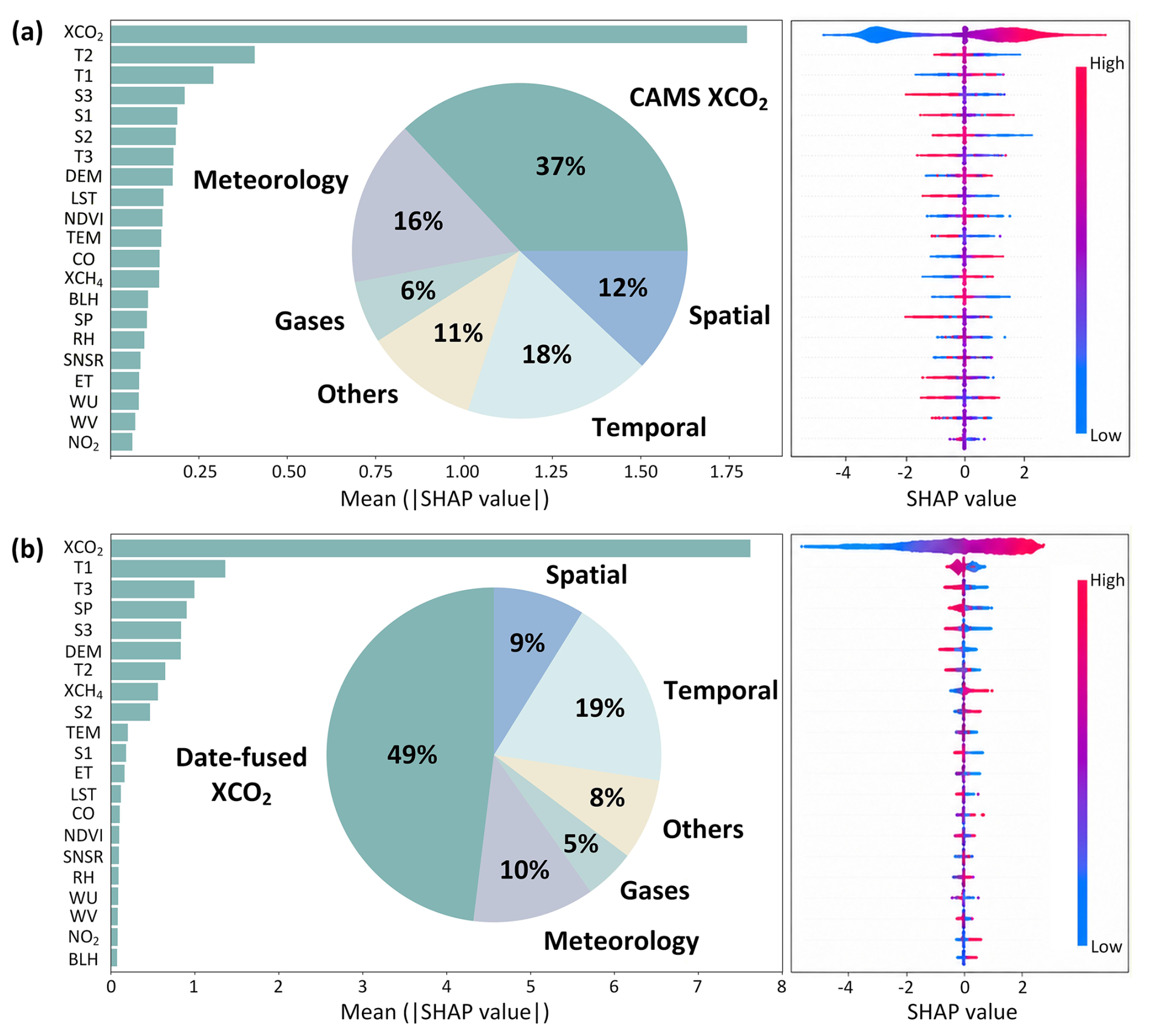
Figure 14Model interpretability analysis using the SHAP approach, showing the relative importance of each predictor in the (a) data-fusion phase and (b) bias-correction phase.
For the bias-correction stage (Fig. 14b), the fused XCO2 field dominates the model output, contributing 49 %, consistent with its role as the primary constraint for harmonizing inter-satellite differences using TCCON observations. Temporal indicators (19 %), spatial variables (9 %), and meteorological variables (10 %) further capture systematic temporal, spatial, and environmental patterns in satellite retrieval biases. Overall, the XAI analysis indicates that the proposed framework is primarily constrained by physically meaningful background information, while auxiliary variables are effectively integrated to refine spatiotemporal XCO2 structures and reduce systematic biases.
3.3.2 Comparison with previous studies
We compared our reconstructed XCO2 dataset with previous global studies that applied independent validation against TCCON observations (Table 3). Some studies are limited to coarser temporal resolutions at monthly (Zhang et al., 2023; Wang et al., 2025; Hwang et al., 2026; Yu et al., 2026), 8 d (Li et al., 2022; Guan et al., 2024), or 3 d (Sheng et al., 2023) scales, which limits their ability to capture short-term (daily) variability. In addition, many studies generated XCO2 at coarser spatial resolutions (≥0.25°), limiting their representation of localized emission gradients and subregional heterogeneity (Li et al., 2022; Sheng et al., 2023; Jin et al., 2022; Gao et al., 2023; Huang et al., 2024b; Wang et al., 2023). Many products cover only limited periods (usually <10 years) after 2014, constraining analyses of long-term historical trends (Sheng et al., 2023; Huang et al., 2024b; Li et al., 2026; Lee et al., 2025; Yu et al., 2026). More importantly, previous studies with fine temporal resolution (daily or subdaily) exhibit greater fluctuations in overall accuracy, with R2 ranging from 0.91 to 0.98 and RMSE values from 1.06 to 2.62 ppm. However, a recent study (Wang, 2026) provides a long-term global daily XCO2 product at a 1 km spatial resolution with considerable accuracy (R2=0.98, RMSE = 1.10 ppm). In contrast, our Transformer–BiLSTM framework reconstructs a global, seamless, cross-mission-consistent, daily XCO2 dataset at 0.1° spatial resolution over 2003–2022, achieving an R2 of 0.99 and an RMSE of 1.10 ppm, comparable to or better than those reported in the literature.
Table 3Comparison of reconstructed global XCO2 datasets reported in previous studies.
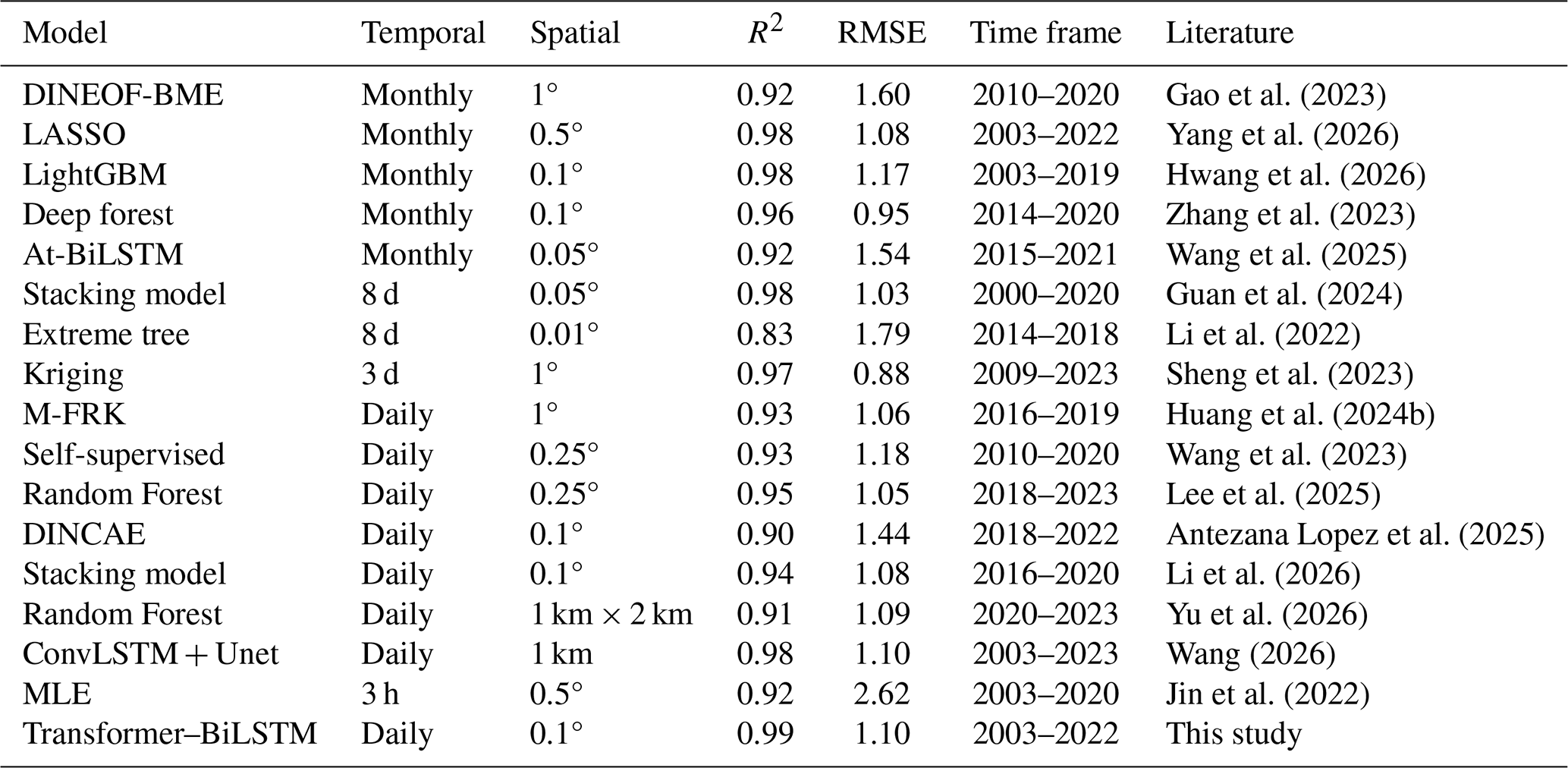
DINEOF-BME: Data Interpolation Empirical Orthogonal Function-Bayesian Maximum Entropy; At-BiLSTM: Attention bidirectional long short-term memory; LASSO: Least Absolute Shrinkage and Selection Operator (LASSO) regression; M-FRK: Multiscale fixed rank kriging; DINCAE: Data Interpolating Empirical Orthogonal Functions and Convolutional Auto-Encoder; MLE: Maximum likelihood estimation.
3.3.3 Strengths
We acknowledge the previous related studies, including Wang (2026), which provides a 1 km global XCO2 product with strong validation performance. However, our study focuses on constructing a temporally seamless, cross-mission-consistent, and physically coherent daily global XCO2 dataset spanning two decades (2003–2022), which is particularly important for long-term carbon-cycle and climate analyses, rather than simply pursuing the highest spatial resolution.
The primary innovation of our study lies in the explicit treatment of inter-satellite inconsistencies among SCIAMACHY, GOSAT, and OCO-2. Previous long-term reconstruction studies generally fuse multiple satellite products directly but often do not sufficiently address systematic biases arising from differences in sensor characteristics, orbital sampling, retrieval algorithms, and mission transitions. These inconsistencies can introduce artificial discontinuities and temporal drift, compromising long-term trend analyses. To address this issue, we developed a TCCON-guided bias-correction framework that harmonizes observations across different satellite missions and minimizes artificial step changes during the SCIAMACHY–GOSAT and GOSAT–OCO-2 transition periods. Compared with the uncorrected data-fused product, the bias-corrected XCO2 dataset exhibits improved agreement with TCCON, with RMSEs of 0.36, 1.26, and 0.97 ppm under sample-based, temporal-based, and spatial-based ten-fold cross-validation, respectively. These findings highlight the importance of cross-mission harmonization for constructing consistent and reliable long-term XCO2 records.
Another key strength of our study is the emphasis on temporal continuity and daily dynamics. While previous studies mainly focus on improving spatial resolution, our hybrid Transformer–BiLSTM framework is specifically designed to capture both long-range spatial dependencies and temporal evolution. The Transformer module leverages self-attention mechanisms to characterize non-local spatial relationships and global contextual information, while the BiLSTM module extracts temporal features to preserve daily continuity and capture temporal evolution. In addition, we introduced a weighted spatiotemporal loss function to jointly constrain point-wise accuracy, temporal smoothness, and spatial coherence. These designs enable the reconstruction of seamless daily XCO2 fields while better capturing temporal variability driven by atmospheric transport, biospheric carbon exchange, and anthropogenic emissions.
Importantly, our study also places a stronger emphasis on physical interpretability. In addition to satellite XCO2 observations, we incorporate multiple physically relevant predictors, including CAMS XCO2, meteorological variables, surface variables, and emission-related precursor gases such as NO2, CO, and XCH4. These variables help characterize atmospheric circulation, fossil-fuel combustion, biomass burning, and biospheric activity, thereby improving the physical realism of the reconstructed XCO2 fields. SHAP analysis further confirms the meaningful contribution of these predictors to the reconstruction process. We believe this is an important advantage because high spatial resolution alone cannot compensate for missing physical constraints or temporal inconsistencies.
Furthermore, our validation framework is more comprehensive for assessing long-term robustness. In addition to evaluation against TCCON observations, we also validate the dataset using 41 independent ObsPack stations distributed globally. These independent evaluations demonstrate that the reconstructed dataset maintains strong spatial transferability and temporal stability across diverse regions and atmospheric conditions.
Therefore, the novelty of our study lies not in generating another high-resolution XCO2 dataset but in developing a temporally seamless, physically consistent, and cross-satellite-harmonized daily global XCO2 record suitable for investigating long-term carbon-cycle dynamics, interannual variability, and climate-related changes. In this regard, our dataset complements previous ultra-high-resolution products (Wang, 2026), which emphasize fine-scale spatial mapping, by providing a framework optimized for long-term temporal analyses and climate applications that require stable cross-mission continuity.
The daily high-resolution seamless global XCO2 product (GlobalHighXCO2) is publicly available at https://doi.org/10.5281/zenodo.18220962 (Qu and Wei, 2026).
Accurate, high-resolution observations of atmospheric XCO2 are critical for understanding the global carbon cycle, quantifying anthropogenic emissions, and supporting climate mitigation strategies. This study develops a novel Transformer–BiLSTM framework to reconstruct a global, daily, and spatially seamless XCO2 dataset over land at 0.1° resolution covering 2003–2022. By jointly integrating multi-mission satellite retrievals, CAMS reanalysis, meteorological variables, and precursor gas information, the framework effectively bridges spatial gaps and temporal discontinuities inherent in individual satellite records. A dedicated spatiotemporal loss formulation enforces continuity across space and time, and a bias-correction strategy harmonizes inter-satellite differences to generate a physically consistent long-term XCO2 record.
Comprehensive validation demonstrates that the reconstructed dataset achieves high accuracy and robustness, as evidenced by independent evaluation against TCCON observations after data fusion (R2=0.99, RMSE = 1.10 ppm), and sample-based ten-fold cross-validation after bias correction (CV-R2=0.99, RMSE = 0.36 ppm). The daily XCO2 dataset enables the detection of rapid temporal variations and the characterization of localized XCO2 enhancement patterns associated with a wide range of emission sources, including urban activities, industrial emissions, and biomass burning. The dataset also effectively captures strong responses of XCO2 growth to major climate events, such as intense El Niño episodes and large-scale wildfires. Across temporal scales, XCO2 increased significantly at a global mean rate of approximately 2.24 ppm yr−1 (p<0.001) from 2003 to 2022. Spatially, the largest growth rates occurred over northern South America, East and Southeast Asia, and central Africa, while relatively weaker increases were observed over southern South America, Australia, and the Sahara. This high-resolution, daily global land XCO2 dataset provides a robust tool for analyzing both long-term trends and short-term variability, offering valuable insights for carbon-cycle research, emission monitoring, and climate mitigation assessments. Future improvements may include enhancing XCO2 retrievals using higher-resolution satellite observations, better representing natural and, in particular, urban emissions, and expanding ground-based validation networks.
JW conceived and supervised the study, managed project administration, and acquired funding. YQ, XS, YF, and ZW collected the data, performed the formal analysis and investigation, and wrote the original draft of the manuscript.
At least one of the (co-)authors is a member of the editorial board of Earth System Science Data. The peer-review process was guided by an independent editor, and the authors also have no other competing interests to declare.
Publisher's note: Copernicus Publications remains neutral with regard to jurisdictional claims made in the text, published maps, institutional affiliations, or any other geographical representation in this paper. The authors bear the ultimate responsibility for providing appropriate place names. Views expressed in the text are those of the authors and do not necessarily reflect the views of the publisher.
The authors acknowledge the data providers whose datasets were used in this study.
This work was supported by the Fundamental and Interdisciplinary Disciplines Breakthrough Plan of the Ministry of Education of China (grant no. JYB2025XDXM906), the Jing-Jin-Ji Regional Integrated Environmental Improvement-National Science and Technology Major Project (grant no. 2026ZD1212900), the National Key Technology and Development Program of Corps (grant no. 2025AA001), the Fundamental Research Funds for the Central Universities, Peking University, and the Scientific Research Innovation Project of Graduate School of South China Normal University (grant no. 2025KYLX064).
This paper was edited by Yuqiang Zhang and reviewed by two anonymous referees.
Agustí-Panareda, A., Barré, J., Massart, S., Inness, A., Aben, I., Ades, M., Baier, B. C., Balsamo, G., Borsdorff, T., and Bousserez, N.: The CAMS greenhouse gas reanalysis from 2003 to 2020, Atmos. Chem. Phys., 23, 3829–3859, https://doi.org/10.5194/acp-23-3829-2023, 2023.
Ak-Bhd, M.: WMO greenhouse gas bulletin, World Meteorological Organization: Geneva, Switzerland, https://gaw.kishou.go.jp/publications/bulletin (last access: 14 May 2026), 2021.
Antezana Lopez, F. P., Zhou, G., Jing, G., Zhang, K., Chen, L., Chen, L., and Tan, Y.: Global Daily Column Average CO2 at 0.1°×0.1° Spatial Resolution Integrating OCO-3, GOSAT, CAMS with EOF and Deep Learning, Sci. Data, 12, 268, https://doi.org/10.1038/s41597-024-04135-w, 2025.
Betts, R. A., Jones, C. D., Knight, J. R., Keeling, R. F., and Kennedy, J. J.: El Niño and a record CO2 rise, Nat. Clim. Change, 6, 806–810, 2016.
Bovensmann, H., Burrows, J., Buchwitz, M., Frerick, J., Noel, S., Rozanov, V., Chance, K., and Goede, A.: SCIAMACHY: Mission objectives and measurement modes, J. Atmos. Sci., 56, 127–150, https://doi.org/10.1175/1520-0469(1999)056<0127:SMOAMM>2.0.CO;2, 1999.
Brando, P. M., Paolucci, L., Ummenhofer, C. C., Ordway, E. M., Hartmann, H., Cattau, M. E., Rattis, L., Medjibe, V., Coe, M. T., and Balch, J.: Droughts, wildfires, and forest carbon cycling: A pantropical synthesis, Annu. Rev. Earth Planet. Sci., 47, 555–581, https://doi.org/10.1146/annurev-earth-082517-010235, 2019.
Buchwitz, M., De Beek, R., Noël, S., Burrows, J., Bovensmann, H., Bremer, H., Bergamaschi, P., Körner, S., and Heimann, M.: Carbon monoxide, methane and carbon dioxide columns retrieved from SCIAMACHY by WFM-DOAS: year 2003 initial data set, Atmos. Chem. Phys., 5, 3313–3329, https://doi.org/10.5194/acp-5-3313-2005, 2005.
Buchwitz, M., Reuter, M., Schneising, O., Boesch, H., Guerlet, S., Dils, B., Aben, I., Armante, R., Bergamaschi, P., and Blumenstock, T.: The Greenhouse Gas Climate Change Initiative (GHG-CCI): Comparison and quality assessment of near-surface-sensitive satellite-derived CO2 and CH4 global data sets, Remote Sens. Environ., 162, 344–362, https://doi.org/10.1016/j.rse.2013.04.024, 2015.
Buchwitz, M., Reuter, M., Schneising, O., Noël, S., Gier, B., Bovensmann, H., Burrows, J. P., Boesch, H., Anand, J., and Parker, R. J.: Computation and analysis of atmospheric carbon dioxide annual mean growth rates from satellite observations during 2003–2016, Atmos. Chem. Phys., 18, 17355–17370, https://doi.org/10.5194/acp-18-17355-2018, 2018.
Butz, A., Guerlet, S., Hasekamp, O., Schepers, D., Galli, A., Aben, I., Frankenberg, C., Hartmann, J. M., Tran, H., and Kuze, A.: Toward accurate CO2 and CH4 observations from GOSAT, Geophys. Res. Lett., 38, https://doi.org/10.1029/2011GL047888, 2011.
Chatterjee, A., Gierach, M., Sutton, A., Feely, R., Crisp, D., Eldering, A., Gunson, M., O'Dell, C., Stephens, B., and Schimel, D.: Influence of El Niño on atmospheric CO2 over the tropical Pacific Ocean: Findings from NASA's OCO-2 mission, Science, 358, eaam5776, https: //doi/10.1126/science.aam5776, 2017.
Chen, J., Hu, R., Chen, L., Liao, Z., Che, L., and Li, T.: Multi-sensor integrated mapping of global XCO2 from 2015 to 2021 with a local random forest model, ISPRS J. Photogram. Remote Sens., 208, 107–120, https://doi.org/10.1016/j.isprsjprs.2024.01.009, 2024.
Crippa, M., Guizzardi, D., Pisoni, E., Solazzo, E., Guion, A., Muntean, M., Florczyk, A., Schiavina, M., Melchiorri, M., and Hutfilter, A. F.: Global anthropogenic emissions in urban areas: patterns, trends, and challenges, Environ. Res. Lett., 16, 074033, https://doi.org/10.1088/1748-9326/ac00e2, 2021.
Crisp, D.: Measuring atmospheric carbon dioxide from space with the Orbiting Carbon Observatory-2 (OCO-2), Proc. SPIE 9607, Earth Observing Systems XX, 960702, https://doi.org/10.1117/12.2187291, 2015.
Crisp, D., Pollock, H. R., Rosenberg, R., Chapsky, L., Lee, R. A., Oyafuso, F. A., Frankenberg, C., O'Dell, C. W., Bruegge, C. J., and Doran, G. B.: The on-orbit performance of the Orbiting Carbon Observatory-2 (OCO-2) instrument and its radiometrically calibrated products, Atmos. Meas. Tech., 10, 59–81, https://doi.org/10.5194/amt-10-59-2017, 2017.
da Costa, L. M., de Araújo Santos, G. A., de Mendonça, G. C., de Souza Maria, L., da Silva Jr., C. A., Panosso, A. R., and La Scala Jr., N.: Exploring CO2 anomalies in Brazilian biomes combining OCO-2 & 3 data: Linkages to wildfires patterns, Adv. Space Res., 73, 4158–4174, https://doi.org/10.1016/j.asr.2024.01.016, 2024.
Friedlingstein, P., O'Sullivan, M., Jones, M. W., Andrew, R. M., Bakker, D. C. E., Hauck, J., Landschützer, P., Le Quéré, C., Luijkx, I. T., Peters, G. P., Peters, W., Pongratz, J., Schwingshackl, C., Sitch, S., Canadell, J. G., Ciais, P., Jackson, R. B., Alin, S. R., Anthoni, P., Barbero, L., Bates, N. R., Becker, M., Bellouin, N., Decharme, B., Bopp, L., Brasika, I. B. M., Cadule, P., Chamberlain, M. A., Chandra, N., Chau, T.-T.-T., Chevallier, F., Chini, L. P., Cronin, M., Dou, X., Enyo, K., Evans, W., Falk, S., Feely, R. A., Feng, L., Ford, D. J., Gasser, T., Ghattas, J., Gkritzalis, T., Grassi, G., Gregor, L., Gruber, N., Gürses, Ö., Harris, I., Hefner, M., Heinke, J., Houghton, R. A., Hurtt, G. C., Iida, Y., Ilyina, T., Jacobson, A. R., Jain, A., Jarníková, T., Jersild, A., Jiang, F., Jin, Z., Joos, F., Kato, E., Keeling, R. F., Kennedy, D., Klein Goldewijk, K., Knauer, J., Korsbakken, J. I., Körtzinger, A., Lan, X., Lefèvre, N., Li, H., Liu, J., Liu, Z., Ma, L., Marland, G., Mayot, N., McGuire, P. C., McKinley, G. A., Meyer, G., Morgan, E. J., Munro, D. R., Nakaoka, S.-I., Niwa, Y., O'Brien, K. M., Olsen, A., Omar, A. M., Ono, T., Paulsen, M., Pierrot, D., Pocock, K., Poulter, B., Powis, C. M., Rehder, G., Resplandy, L., Robertson, E., Rödenbeck, C., Rosan, T. M., Schwinger, J., Séférian, R., Smallman, T. L., Smith, S. M., Sospedra-Alfonso, R., Sun, Q., Sutton, A. J., Sweeney, C., Takao, S., Tans, P. P., Tian, H., Tilbrook, B., Tsujino, H., Tubiello, F., van der Werf, G. R., van Ooijen, E., Wanninkhof, R., Watanabe, M., Wimart-Rousseau, C., Yang, D., Yang, X., Yuan, W., Yue, X., Zaehle, S., Zeng, J., and Zheng, B.: Global Carbon Budget 2023, Earth Syst. Sci. Data, 15, 5301–5369, https://doi.org/10.5194/essd-15-5301-2023, 2023.
Gao, Z., Jiang, Y., He, J., and Wu, J.: Spatiotemporal variation analysis of global XCO2 concentration during 2010–2020 based on DINEOF-BME framework and wavelet function, Sci. Total Environ., 892, 164750, https://doi.org/10.1016/j.scitotenv.2023.164750, 2023.
Guan, X., Sun, Z., Chu, D., Xie, G., Wang, Y., and Shen, H.: Long-term (2000–2020) global 0.05° continuous atmospheric carbon dioxide mapping combining OCO-2 observations and model simulations, Sci. Total Environ., 957, 177051, https://doi.org/10.1016/j.scitotenv.2024.177051, 2024.
Guan, Y., Keppel-Aleks, G., Doney, S. C., Petri, C., Pollard, D., Wunch, D., Hase, F., Ohyama, H., Morino, I., and Notholt, J.: Characteristics of interannual variability in space-based XCO2 global observations, Atmos. Chem. Phys., 23, 5355–5372, https://doi.org/10.5194/acp-23-5355-2023, 2023.
Hammerling, D. M., Michalak, A. M., and Kawa, S. R.: Mapping of CO2 at high spatiotemporal resolution using satellite observations: Global distributions from OCO-2, J. Geophys. Res.-Atmos., 117, https://doi.org/10.1029/2011JD017015, 2012.
He, C., Ji, M., Li, T., Liu, X., Tang, D., Zhang, S., Luo, Y., Grieneisen, M. L., Zhou, Z., and Zhan, Y.: Deriving full-coverage and fine-scale XCO2 across China based on OCO-2 satellite retrievals and CarbonTracker output, Geophys. Res. Lett., 49, e2022GL098435, https://doi.org/10.1029/2022GL098435, 2022.
He, Q., Ye, T., Chen, X., Dong, H., Wang, W., Liang, Y., and Li, Y.: Full-coverage mapping high-resolution atmospheric CO2 concentrations in China from 2015 to 2020: Spatiotemporal variations and coupled trends with particulate pollution, J. Clean. Product., 428, 139290, https://doi.org/10.1016/j.jclepro.2023.139290, 2023a.
He, S., Yuan, Y., Wang, Z., Luo, L., Zhang, Z., Dong, H., and Zhang, C.: Machine learning model-based estimation of XCO2 with high spatiotemporal resolution in china, Atmosphere, 14, 436, https://doi.org/10.3390/atmos14030436, 2023b.
He, Z., Lei, L., Zhang, Y., Sheng, M., Wu, C., Li, L., Zeng, Z.-C., and Welp, L. R.: Spatio-temporal mapping of multi-satellite observed column atmospheric CO2 using precision-weighted kriging method, Remote Sens., 12, 576, https://doi.org/10.3390/rs12030576, 2020.
He, Z., Fan, G., Li, X., Gong, F.-Y., Liang, M., Gao, L., and Zhou, M.: Spatio-temporal modeling of satellite-observed CO2 columns in China using deep learning, Int. J. Appl. Earth Obs. Geoinf., 129, 103859, https://doi.org/10.1016/j.jag.2024.103859, 2024.
Hua, Y., Zhao, X., Sun, W., and Sun, Q.: Satellite-Based Reconstruction of Atmospheric CO2 Concentration over China Using a Hybrid CNN and Spatiotemporal Kriging Model, Remote Sens., 16, 2433, https://doi.org/10.3390/rs16132433, 2024.
Huang, N., Gu, L., Black, T. A., Wang, L., and Niu, Z.: Remote sensing-based estimation of annual soil respiration at two contrasting forest sites, J. Geophys. Res.-Biogeo., 120, 2306–2325, https://doi.org/10.1002/2015JG003060, 2015.
Huang, X., Deng, Z., Jiang, F., Zhou, M., Lin, X., Liu, Z., and Peng, M.: Improved consistency of satellite XCO2 retrievals based on machine learning, Geophys. Res. Lett., 51, e2023GL107536, https://doi.org/10.1029/2023GL107536, 2024a.
Huang, Y., Wang, R., Ju, M., Zhu, X., and Xie, Y.: Reconstructing global daily XCO2 at 1×1 spatial resolution from 2016 to 2019 with multisource satellite observation data, J. Appl. Remote Sens., 18, 028502, https://doi.org/10.1117/1.JRS.18.028502, 2024b.
Hwang, S., Choi, H., Kang, Y., and Im, J.: Reconstructing long-term (2003–2019) global high-resolution XCO2: bridging observational gaps with machine learning, GISci. Remote Sens., 63, 2627042, https://doi.org/10.1080/15481603.2026.2627042, 2026.
Jacobson, A., Schuldt, K., Tans, P., Andrews, A., Miller, J., Oda, T., Mund, J., Weir, B., Ott, L., and Aalto, T.: CarbonTracker CT2022, NOAA Global Monitoring Laboratory, https://gml.noaa.gov/ccgg/carbontracker/ (last access: 14 May 2026), 2023.
Jin, C., Xue, Y., Jiang, X., Zhao, L., Yuan, T., Sun, Y., Wu, S., and Wang, X.: A long-term global XCO2 dataset: Ensemble of satellite products, Atmos. Res., 279, 106385, https://doi.org/10.1016/j.atmosres.2022.106385, 2022.
Kemp, L., Xu, C., Depledge, J., Ebi, K. L., Gibbins, G., Kohler, T. A., Rockström, J., Scheffer, M., Schellnhuber, H. J., and Steffen, W.: Climate endgame: Exploring catastrophic climate change scenarios, P. Natl. Acad. Sci. USA, 119, e2108146119, https://doi.org/10.1073/pnas.2108146119, 2022.
Kim, J.-S., Kug, J.-S., Yoon, J.-H., and Jeong, S.-J.: Increased atmospheric CO2 growth rate during El Niño driven by reduced terrestrial productivity in the CMIP5 ESMs, J. Climate, 29, 8783–8805, https://doi.org/10.1175/JCLI-D-14-00672.1, 2016.
Kuze, A., Suto, H., Nakajima, M., and Hamazaki, T.: Thermal and near infrared sensor for carbon observation Fourier-transform spectrometer on the Greenhouse Gases Observing Satellite for greenhouse gases monitoring, Appl. Optics, 48, 6716–6733, https://doi.org/10.1364/AO.48.006716, 2009.
Lee, H., Calvin, K., Dasgupta, D., Krinner, G., Mukherji, A., Thorne, P., Trisos, C., Romero, J., Aldunce, P., and Barret, K.: IPCC, 2023: Climate change 2023: Synthesis report, summary for policymakers, in: Contribution of working groups I, II and III to the sixth assessment report of the intergovernmental panel on climate change, edited by: core writing team, Lee, H., and Romero, J., IPCC, geneva, Switzerland, https://doi.org/10.59327/IPCC/AR6-9789291691647.001, 2023.
Lee, J., Jeong, S., Kim, Y. J., Roh, S., Kim, J., and Jin, H.: Synergy of multiple-satellite measurements to fill the gap of global XCO2, J. Geophys. Res.-Atmos., 130, e2024JD042809, https://doi.org/10.1029/2024JD042809, 2025.
Li, J., Jia, K., Wei, X., Xia, M., Chen, Z., Yao, Y., Zhang, X., Jiang, H., Yuan, B., and Tao, G.: High-spatiotemporal resolution mapping of spatiotemporally continuous atmospheric CO2 concentrations over the global continent, Int. J. Appl. Earth Obs. Geoinf., 108, 102743, https://doi.org/10.1016/j.jag.2022.102743, 2022.
Li, J., Zhang, Z., Li, T., Yuan, Q., and Zhang, L.: Global daily seamless XCO2 Mapping (2016–2020): Spatio-temporal trends and variations during wildfire events, Int. J. Appl. Earth Obs. Geoinf., 146, 105092, https://doi.org/10.1016/j.jag.2026.105092, 2026.
Li, K., Bai, K., Jiao, P., Chen, H., He, H., Shao, L., Sun, Y., Zheng, Z., Li, R., and Chang, N.-B.: Developing unbiased estimation of atmospheric methane via machine learning and multiobjective programming based on TROPOMI and GOSAT data, Remote Sens. Environ., 304, 114039, https://doi.org/10.1016/j.rse.2024.114039, 2024a.
Li, R., Zhou, X., Cheng, T., Tao, Z., Wang, N., Zhang, H., and Lv, T.: Improving Satellite XCO2 Measurements Accuracy: A Bayesian Bias Correction Approach Considering Spatiotemporal Bias Characteristics, IEEE T. Geosci. Remote, 62, 4111411, https://doi.org/10.1109/TGRS.2024.3483776, 2024b.
Li, Y., Yan, J., Zhong, L., Bao, D., Sun, L., and Li, G.: Full-Coverage Mapping of Daily High-Resolution XCO2 across China from 2015 to 2020 by Deep Learning-Based Spatio-Temporal Fusion, IEEE T. Geosci. Remote, 63, 4102716, https://doi.org/10.1109/TGRS.2025.3540289, 2025.
Liang, A., Pang, R., Chen, C., and Xiang, C.: XCO2 Fusion algorithm based on multisource greenhouse gas satellites and carbontracker, Atmosphere, 14, 1335, https://doi.org/10.3390/atmos14091335, 2023.
Liu, W., Li, R., Cao, J., Huang, C., Zhang, F., and Zhang, M.: Mapping high-resolution XCO2 concentrations in China from 2015 to 2020 based on spatiotemporal ensemble learning model, Ecol. Inform., 83, 102806, https://doi.org/10.1016/j.ecoinf.2024.102806, 2024.
Liu, Z., Deng, Z., Zhu, B., Ciais, P., Davis, S. J., Tan, J., Andrew, R. M., Boucher, O., Arous, S. B., and Canadell, J. G.: Global patterns of daily CO2 emissions reductions in the first year of COVID-19, Nat. Geosci., 15, 615–620, https://doi.org/10.1038/s41561-022-00965-8, 2022.
Lundberg, S. M. and Lee, S.-I.: A unified approach to interpreting model predictions, arXiv [preprint] https://doi.org/10.48550/arXiv.1705.07874, 2017.
Ma, X., Zhang, H., Han, G., Mao, F., Xu, H., Shi, T., Hu, H., Sun, T., and Gong, W.: A regional spatiotemporal downscaling method for CO2 columns, IEEE T. Geosci. Remote, 59, 8084–8093, https://doi.org/10.1109/TGRS.2021.3052215, 2021.
Petzold, A., Thouret, V., Gerbig, C., Zahn, A., Brenninkmeijer, C. A., Gallagher, M., Hermann, M., Pontaud, M., Ziereis, H., and Boulanger, D.: Global-scale atmosphere monitoring by in-service aircraft – current achievements and future prospects of the European Research Infrastructure IAGOS, Tellus B, 67, 28452, https://doi.org/10.3402/tellusb.v67.28452, 2015.
Qu, Y. and Wei, J.: GlobalHighXCO2: Global Daily Seamless 10 km XCO2 Dataset Over Land (2003–Present), Zenodo [data set], https://doi.org/10.5281/zenodo.18220962, 2026.
Qu, Y., Wei, J., Xing, H., Shi, X., Ao, Z., and Meng, X.: Global estimates of daily gapless atmospheric XCH4 concentrations from satellite and reanalysis data during 2003–2020, IEEE T. Geosci. Remote, 63, 4109012, https://doi.org/10.1109/TGRS.2025.3593486, 2025.
Reuter, M., Bovensmann, H., Buchwitz, M., Burrows, J., Connor, B., Deutscher, N. M., Griffith, D., Heymann, J., Keppel-Aleks, G., and Messerschmidt, J.: Retrieval of atmospheric CO2 with enhanced accuracy and precision from SCIAMACHY: Validation with FTS measurements and comparison with model results, J. Geophys. Res.-Atmos., 116, https://doi.org/10.1029/2010JD015047, 2011.
Reuter, M., Buchwitz, M., Schneising, O., Krautwurst, S., O'Dell, C. W., Richter, A., Bovensmann, H., and Burrows, J. P.: Towards monitoring localized CO2 emissions from space: co-located regional CO2 and NO2 enhancements observed by the OCO-2 and S5P satellites, Atmos. Chem. Phys., 19, 9371–9383, https://doi.org/10.5194/acp-19-9371-2019, 2019.
Rodrigues, A., Albuquerque Sardinha, R., and Pita, G.: Fundamentals of global carbon budgets and climate change, in: Fundamental Principles of Environmental Physics, Springer, 303–351, https://doi.org/10.1007/978-3-031-84841-4_8, 2025.
Romanov, V.: Greenhouse Gases and Clay Minerals: Enlightening Down-to-Earth Road Map to Basic Science of Clay-Greenhouse Gas Interfaces, Springer, https://doi.org/10.1007/978-3-319-12661-6, 2017.
Sheng, M., Lei, L., Zeng, Z.-C., Rao, W., and Zhang, S.: Detecting the responses of CO2 column abundances to anthropogenic emissions from satellite observations of GOSAT and OCO-2, Remote Sens., 13, 3524, https://doi.org/10.3390/rs13173524, 2021.
Sheng, M., Lei, L., Zeng, Z.-C., Rao, W., Song, H., and Wu, C.: Global land 1° mapping dataset of XCO2 from satellite observations of GOSAT and OCO-2 from 2009 to 2020, Big Earth Data, 7, 170–190, https://doi.org/10.1080/20964471.2022.2033149, 2023.
Siabi, Z., Falahatkar, S., and Alavi, S. J.: Spatial distribution of XCO2 using OCO-2 data in growing seasons, J. Environ. Manage., 244, 110–118, https://doi.org/10.1016/j.jenvman.2019.05.049, 2019.
Tian, W., Zhang, L., Yu, T., Wu, Y., Zhang, W., Wang, Z., and Zhu, H.: Using multisource data and time series features to construct a global terrestrial CO2 coverage by deep learning, IEEE T. Geosci. Remote, 62, 4109814, https://doi.org/10.1109/TGRS.2024.3462589, 2024.
Vaswani, A., Shazeer, N., Parmar, N., Uszkoreit, J., Jones, L., Gomez, A. N., Kaiser, Ł., and Polosukhin, I.: Attention is all you need, arXiv [preprint], https://doi.org/10.48550/arXiv.1706.03762, 2017.
Wang, J.: Global daily 1 km gapless XCO2 (2003–2023) derived from multi-satellite observations and a spatiotemporal deep learning framework, Environ.Imp. Assess. Rev., 117, 108146, https://doi.org/10.1016/j.eiar.2025.108146, 2026.
Wang, J., Liu, Z., Zeng, N., Jiang, F., Wang, H., and Ju, W.: Spaceborne detection of XCO2 enhancement induced by Australian mega-bushfires, Environ. Res. Lett., 15, 124069, https://doi.org/10.1088/1748-9326/abc846, 2020.
Wang, X., Piao, S., Ciais, P., Friedlingstein, P., Myneni, R. B., Cox, P., Heimann, M., Miller, J., Peng, S., and Wang, T.: A two-fold increase of carbon cycle sensitivity to tropical temperature variations, Nature, 506, 212–215, https://doi.org/10.1038/nature12915, 2014.
Wang, Y., Yuan, Q., Li, T., Yang, Y., Zhou, S., and Zhang, L.: Seamless mapping of long-term (2010–2020) daily global XCO2 and XCH4 from the Greenhouse Gases Observing Satellite (GOSAT), Orbiting Carbon Observatory 2 (OCO-2), and CAMS global greenhouse gas reanalysis (CAMS-EGG4) with a spatiotemporally self-supervised fusion method, Earth System Science Data, 15, 3597–3622, https://doi.org/10.5194/essd-15-3597-2023, 2023.
Wang, Z., Zhang, C., Shi, K., Shangguan, Y., Hu, B., Chen, X., Wei, D., Chen, S., Atkinson, P. M., and Zhang, Q.: A full-coverage satellite-based global atmospheric CO2 dataset at 0.05° resolution from 2015 to 2021 for exploring global carbon dynamics, Earth Syst. Sci. Data, 17, 5355–5375, https://doi.org/10.5194/essd-17-5355-2025, 2025.
Wei, J., Li, Z., Chen, X., Li, C., Sun, Y., Wang, J., Lyapustin, A., Brasseur, G. P., Jiang, M., and Sun, L.: Separating daily 1 km PM2.5 inorganic chemical composition in China since 2000 via deep learning integrating ground, satellite, and model data, Environ. Sci. Technol., 57, 18282–18295, https://doi.org/10.1021/acs.est.3c00272, 2023.
Wei, J., Wang, Z., Li, Z., Li, Z., Pang, S., Xi, X., Cribb, M., and Sun, L.: Global aerosol retrieval over land from Landsat imagery integrating Transformer and Google Earth Engine, Remote Sens. Enviro., 315, 114404, https://doi.org/10.1016/j.rse.2024.114404, 2024.
Wolter, K. and Timlin, M. S.: El Niño/Southern Oscillation behaviour since 1871 as diagnosed in an extended multivariate ENSO index (MEI. ext), Int. J. Climatol., 31, 1074–1087, https://doi.org/10.1002/joc.2336, 2011.
Wu, C., Yang, S., Jiao, D., Chen, Y., Yang, J., and Huang, B.: Estimation of daily XCO2 at 1 km resolution in China using a spatiotemporal ResNet model, Sci. Total Environ., 954, 176171, https://doi.org/10.1016/j.scitotenv.2024.176171, 2024.
Wunch, D., Wennberg, P. O., Osterman, G., Fisher, B., Naylor, B., Roehl, C. M., O'Dell, C., Mandrake, L., Viatte, C., and Kiel, M.: Comparisons of the orbiting carbon observatory-2 (OCO-2) XCO2 measurements with TCCON, Atmos. Meas. Tech., 10, 2209–2238, https://doi.org/10.5194/amt-10-2209-2017, 2017.
Yang, D., Liu, Y., Cai, Z., Chen, X., Yao, L., and Lu, D.: First global carbon dioxide maps produced from TanSat measurements, Adv. Atmos. Sci., 35, 621–623, https://doi.org/10.1007/s00376-018-7312-6, 2018.
Yang, H., Li, T., Wu, J., Wang, Y., Zhang, L., and Hu, R.: Global 20-year XCO2 mapping through synergy of multi-satellite observations, Geosci. Front., 17, 102333, https://doi.org/10.1016/j.gsf.2026.102333, 2026.
Yeom, J.-M., Jeong, S., Ha, J.-S., Lee, K.-H., Lee, C.-S., and Park, S.: Estimation of the hourly aerosol optical depth from GOCI geostationary satellite data: deep neural network, machine learning, and physical models, IEEE T. Geosci. Remote, 60, 4103612, https://doi.org/10.1109/TGRS.2021.3107542, 2021.
Yu, Y., Tian, W., Zhang, L., Yu, T., Wu, Y., and Cheng, T.: MCF-XCO2: A cross-mission consistency and fusion framework for integrating multi-satellite XCO2 observations, Atmos. Res., 334, 108747, https://doi.org/10.1016/j.atmosres.2026.108747, 2026.
Zhang, B., Zhang, H., Zhao, G., and Lian, J.: Constructing a PM2.5 concentration prediction model by combining auto-encoder with Bi-LSTM neural networks, Environ. Model. Softw., 124, 104600, https://doi.org/10.1016/j.envsoft.2019.104600, 2020.
Zhang, L., Li, T., Wu, J., and Yang, H.: Global estimates of gap-free and fine-scale CO2 concentrations during 2014–2020 from satellite and reanalysis data, Environ. Int., 178, 108057, https://doi.org/10.1016/j.envint.2023.108057, 2023.
Zhang, M. and Liu, G.: Mapping contiguous XCO2 by machine learning and analyzing the spatio-temporal variation in China from 2003 to 2019, Sci. Total Environ., 858, 159588, https://doi.org/10.1016/j.scitotenv.2022.159588, 2023.