Articles | Volume 18, issue 6
https://doi.org/10.5194/essd-18-4241-2026
© Author(s) 2026. This work is distributed under
the Creative Commons Attribution 4.0 License.
the Creative Commons Attribution 4.0 License.
https://doi.org/10.5194/essd-18-4241-2026
© Author(s) 2026. This work is distributed under
the Creative Commons Attribution 4.0 License.
the Creative Commons Attribution 4.0 License.
Data description article
| 
22 Jun 2026
Data description article |
| 22 Jun 2026
| 22 Jun 2026
Ice thickness and subglacial topography of Swedish reference glaciers revealed by radio-echo sounding

Tarfala Research Station, Stockholm University, Stockholm, Sweden
Bolin Centre for Climate Research, Stockholm University, Stockholm, Sweden
Neil Ross
School of Geography, Politics and Sociology, Newcastle University, Newcastle upon Tyne, UK
Thomas Frank
Department of Earth Sciences, Uppsala University, Uppsala, Sweden
Jamie Barnett
Bolin Centre for Climate Research, Stockholm University, Stockholm, Sweden
Department of Geological Sciences, Stockholm University, Stockholm, Sweden
Ilaria Santin
Department of Civil, Environmental and Geomatic Engineering, ETH Zurich, Zurich, Switzerland
Swiss Federal Institute for Forest, Snow and Landscape Research (WSL), bâtiment ALPOLE, Sion, Switzerland
Martin Houssais
Tarfala Research Station, Stockholm University, Stockholm, Sweden
Johanna Dahlkvist
Tarfala Research Station, Stockholm University, Stockholm, Sweden
Tarfala Research Station, Stockholm University, Stockholm, Sweden
Bolin Centre for Climate Research, Stockholm University, Stockholm, Sweden
Department of Physical Geography, Stockholm University, Stockholm, Sweden
Related authors
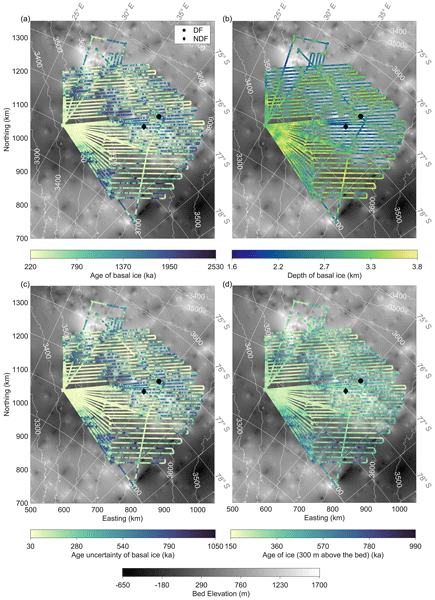
Zhuo Wang, Ailsa Chung, Daniel Steinhage, Frédéric Parrenin, Johannes Freitag, and Olaf Eisen
The Cryosphere, 17, 4297–4314, https://doi.org/10.5194/tc-17-4297-2023, https://doi.org/10.5194/tc-17-4297-2023, 2023
Short summary
Short summary
We combine radar-based observed internal layer stratigraphy of the ice sheet with a 1-D ice flow model in the Dome Fuji region. This results in maps of age and age density of the basal ice, the basal thermal conditions, and reconstructed accumulation rates. Based on modeled age we then identify four potential candidates for ice which is potentially 1.5 Myr old. Our map of basal thermal conditions indicates that melting prevails over the presence of stagnant ice in the study area.
Tim van den Akker, Mathieu Morlighem, and Nina Kirchner
EGUsphere, https://doi.org/10.5194/egusphere-2026-6156, https://doi.org/10.5194/egusphere-2026-6156, 2026
This preprint is open for discussion and under review for The Cryosphere (TC).
Short summary
Short summary
Ice sheet models initialised from observations often suffer an initial “shock” when starting future simulations. The usual fix, a relaxation period where the model settles freely, lets the ice drift from observed conditions and may never reach a steady state. We introduce nudging: gently steering the model during relaxation to remove drift, keep the ice close to observations, and start with the observed thinning rates. We demonstrate it on C.H. Ostenfeld Glacier, northern Greenland.
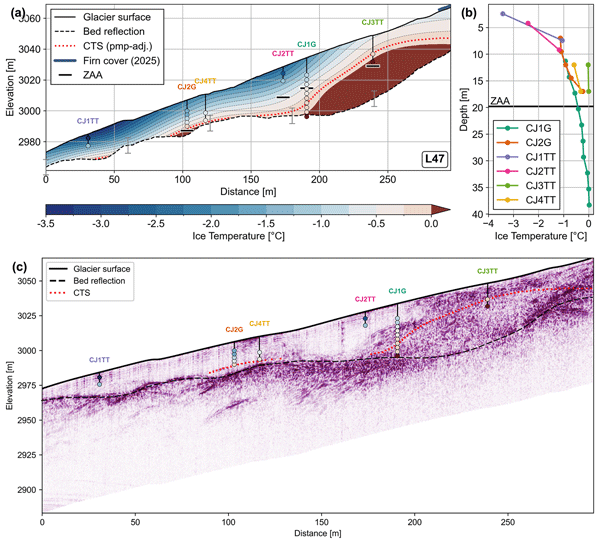
Janosch Beer, Mylène Jacquemart, Matthias Huss, Ilaria Santin, Gabriela Clara Racz, Christophe Ogier, Saskia Gindraux, Leo Hösli, Raphael Moser, James Irving, Mauro Fischer, and Daniel Farinotti
The Cryosphere, 20, 5453–5473, https://doi.org/10.5194/tc-20-5453-2026, https://doi.org/10.5194/tc-20-5453-2026, 2026
Short summary
Short summary
Small Alpine glaciers can exhibit a mix of cold and temperate ice, a polythermal structure, which can promote hazardous conditions. We drilled into six small Swiss glaciers and measured ice temperatures in boreholes. We found polythermal conditions in three of six sites and show that the thermal structure is linked to firn cover loss. Our results suggest that polythermal glaciers may be more common in the Alps than previously recognised.
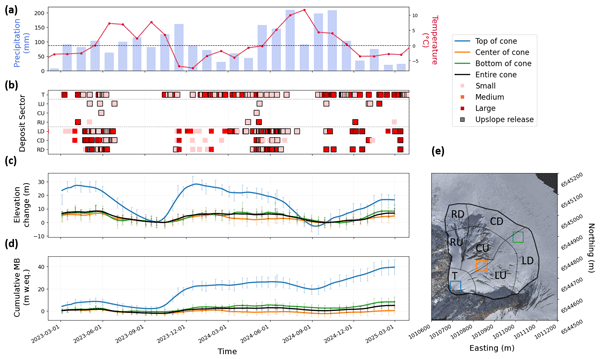
Marin Kneib, Patrick Wagnon, Laurent Arnaud, Louise Balmas, Olivier Laarman, Bruno Jourdain, Amaury Dehecq, Emmanuel Lemeur, Fanny Brun, Andrea Kneib-Walter, Ilaria Santin, Laurane Charrier, Thierry Faug, Giulia Mazzotti, Antoine Rabatel, Delphine Six, and Daniel Farinotti
The Cryosphere, 20, 5327–5344, https://doi.org/10.5194/tc-20-5327-2026, https://doi.org/10.5194/tc-20-5327-2026, 2026
Short summary
Short summary
Avalanches are vital for glacier survival, yet their impact is difficult to quantify. We used low-cost cameras and drones to monitor an avalanche cone in the French Alps for two years. By accounting for ice flow, we found that avalanches can deposit 30 meters of snow annually – 50 times more than normal snowfall. This high-frequency data reveals that these cones fill until reaching a specific steepness, after which new snow slides further down to the base.

Christophe Ogier, Mauro A. Werder, Olivier Gagliardini, Ilaria Santin, Raphael Moser, Romain Hugonnet, Antoine Blanc, and Daniel Farinotti
Nat. Hazards Earth Syst. Sci., 26, 3901–3917, https://doi.org/10.5194/nhess-26-3901-2026, https://doi.org/10.5194/nhess-26-3901-2026, 2026
Short summary
Short summary
In June 2024, a destructive flood impacted the village of La Bérarde in the French Alps. Rain, snowmelt, and the drainage of a surface lake on a glacier cannot fully explain the flood magnitude. We used glacier topography to estimate how much water could also have been stored beneath the glacier before the event. Our results show that large volumes of hidden water may have existed and could have amplified the flood, highlighting an overlooked hazard in debris-covered mountain glaciers.
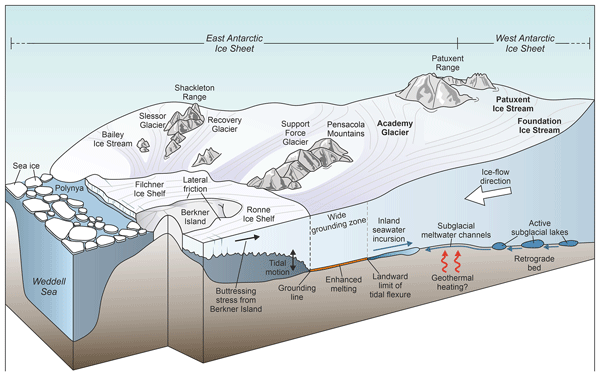
Neil Ross, Rebecca J. Sanderson, Bernd Kulessa, Martin Siegert, Guy J. G. Paxman, Keir A. Nichols, Matthew R. Siegfried, Stewart S. R. Jamieson, Michael J. Bentley, Tom A. Jordan, Christine L. Batchelor, David Small, Olaf Eisen, Kate Winter, Robert G. Bingham, S. Louise Callard, Rachel Carr, Christine F. Dow, Helen A. Fricker, Emily Hill, Benjamin H. Hills, Coen Hofstede, Hafeez Jeofry, Felipe Napoleoni, and Wilson Sauthoff
The Cryosphere, 20, 3705–3737, https://doi.org/10.5194/tc-20-3705-2026, https://doi.org/10.5194/tc-20-3705-2026, 2026
Short summary
Short summary
We review research about a group of fast-flowing Antarctic ice streams, the Foundation-Patuxent-Academy System. Previously, we knew little about how these ice streams flow, how they interact with each other and the ocean, what their geological history was, and how they might evolve in a warming world. By reviewing existing research, we have identified the future research needed to determine how these ice streams function, and how they might contribute to future global sea level rise.
Jamie Barnett, Felicity A. Holmes, Sarah L. Greenwood, Mathieu Morlighem, Nina Kirchner, and Martin Jakobsson
The Cryosphere, 20, 3599–3617, https://doi.org/10.5194/tc-20-3599-2026, https://doi.org/10.5194/tc-20-3599-2026, 2026
Short summary
Short summary
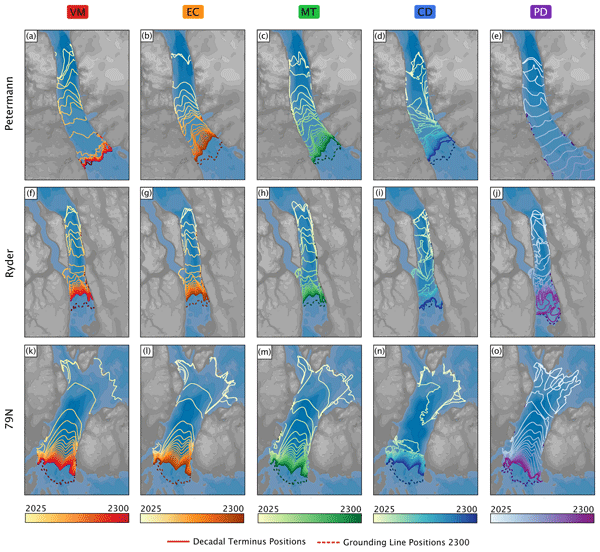
Computer models used to predict future change of the Greenland Ice Sheet are uncertain, especially in how they represent iceberg calving. We compare several calving approaches by testing model results against satellite observations of changes at three unique floating ice shelves in Greenland. We then extend the simulations to the year 2300 to explore future ice loss, finding that warming of the atmosphere or ocean is more important than the choice of calving method.
Ilaria Santin, Huw J. Horgan, Raphael Moser, Nanna Bjørnholt Karlsson, Faezeh M. Nick, Andreas Vieli, Anja Rutishauser, Hansruedi Maurer, and Daniel Farinotti
The Cryosphere, 20, 3435–3441, https://doi.org/10.5194/tc-20-3435-2026, https://doi.org/10.5194/tc-20-3435-2026, 2026
Short summary
Short summary
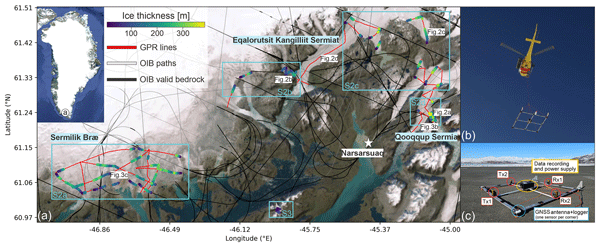
Ice thickness near Greenland’s coast is still poorly measured, yet it is vital for predicting sea level rise. We flew a helicopter ice-penetrating radar over three outlet glaciers in southern Greenland and mapped the glacier bed where basal reflections were clear. We measured ice up to about 340 meters thick, with reliable penetration typically to about 300 meters, providing new constraints that can improve regional bed maps.
Felipe Napoleoni, Michael J. Bentley, Neil Ross, Stewart S. R. Jamieson, José A. Uribe, Jonathan Oberreuter, Rodrigo Zamora, Andrés Rivera, Andrew M. Smith, Robert G. Bingham, and Kenichi Matsuoka
The Cryosphere, 20, 2793–2824, https://doi.org/10.5194/tc-20-2793-2026, https://doi.org/10.5194/tc-20-2793-2026, 2026
Short summary
Short summary
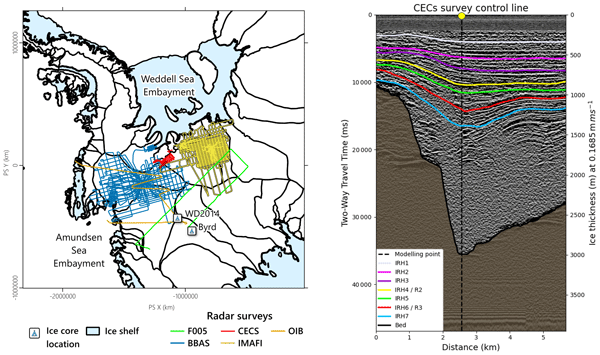
We mapped buried layers inside West Antarctic ice across 13,000 km² near the Amundsen–Weddell divide using radar. Some layers may be up to 17 kyr old. The layers remain well preserved in slow-moving ice but become distorted where ice flows faster. Snowfall has long been greater on one side of the divide, suggesting the ice divide has remained stable for thousands of years. Our study helps connect climate records across West Antarctica and improve models used to predict future ice-sheet change.
Camille Hayatte Akhoudas, Johan Nilsson, William Jenkins, Jamie Barnett, Jürgen Sültenfuß, Nina Kirchner, Martin Jakobsson, and Christian Stranne
EGUsphere, https://doi.org/10.5194/egusphere-2026-1366, https://doi.org/10.5194/egusphere-2026-1366, 2026
Short summary
Short summary
Understanding how freshwater input shapes circulation in Greenland fjords is key to ice-ocean interactions in a warming climate. Using hydrographic measurements, oxygen isotopes, and noble gas tracers, we map water composition and meltwater pathways in the sparsely observed Petermann and Victoria fjords. The results show that most freshwater comes from local glaciers, enters both at the subsurface and deeper layers, and that fjord conditions strongly influence how meltwater spreads and mixes.
Ankit Pramanik, Sarah L. Greenwood, Mathieu Morlighem, Jamie Barnett, Felicity A. Holmes, Richard Gyllencreutz, and Carl Regnéll
EGUsphere, https://doi.org/10.5194/egusphere-2026-172, https://doi.org/10.5194/egusphere-2026-172, 2026
Short summary
Short summary
Ice sheet/glacier retreat is driving expansion of glacial lakes impounded at the ice margin. Using an ice sheet model, we find that lake filling and drainage causes systematic changes to glacier thickness, velocity and mass loss. Rising lake levels dramatically increase mass loss as the ice margin becomes buoyant, while rapid lake drainage can drive crevassing and destabilise the margin. Steady lake drainage, in contrast, has a stabilising effect, and may mitigate mass loss and flood hazards.
Robert G. Bingham, Julien A. Bodart, Marie G. P. Cavitte, Ailsa Chung, Rebecca J. Sanderson, Johannes C. R. Sutter, Olaf Eisen, Nanna B. Karlsson, Joseph A. MacGregor, Neil Ross, Duncan A. Young, David W. Ashmore, Andreas Born, Winnie Chu, Xiangbin Cui, Reinhard Drews, Steven Franke, Vikram Goel, John W. Goodge, A. Clara J. Henry, Antoine Hermant, Benjamin H. Hills, Nicholas Holschuh, Michelle R. Koutnik, Gwendolyn J.-M. C. Leysinger Vieli, Emma J. MacKie, Elisa Mantelli, Carlos Martín, Felix S. L. Ng, Falk M. Oraschewski, Felipe Napoleoni, Frédéric Parrenin, Sergey V. Popov, Therese Rieckh, Rebecca Schlegel, Dustin M. Schroeder, Martin J. Siegert, Xueyuan Tang, Thomas O. Teisberg, Kate Winter, Shuai Yan, Harry Davis, Christine F. Dow, Tyler J. Fudge, Tom A. Jordan, Bernd Kulessa, Kenichi Matsuoka, Clara J. Nyqvist, Maryam Rahnemoonfar, Matthew R. Siegfried, Shivangini Singh, Vjeran Višnjević, Rodrigo Zamora, and Alexandra Zuhr
The Cryosphere, 19, 4611–4655, https://doi.org/10.5194/tc-19-4611-2025, https://doi.org/10.5194/tc-19-4611-2025, 2025
Short summary
Short summary
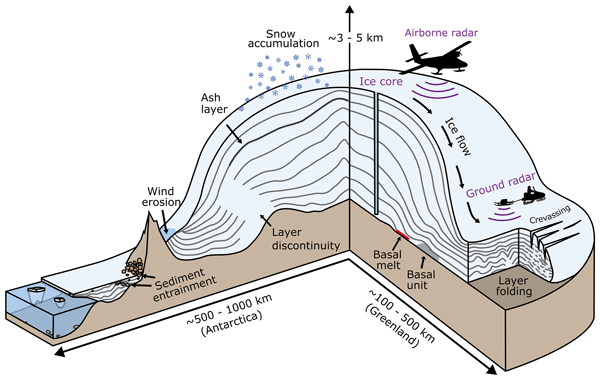
The ice sheets covering Antarctica have built up over millenia through successive snowfall events which become buried and preserved as internal surfaces of equal age detectable with ice-penetrating radar. This paper describes an international initiative working together on these archival data to build a comprehensive 3-D picture of how old the ice is everywhere across Antarctica and how this is being used to reconstruct past and to predict future ice and climate behaviour.
Adrian Dye, Robert Bryant, Francesca Falcini, Joseph Mallalieu, Miles Dimbleby, Michael Beckwith, David Rippin, and Nina Kirchner
The Cryosphere, 19, 4471–4486, https://doi.org/10.5194/tc-19-4471-2025, https://doi.org/10.5194/tc-19-4471-2025, 2025
Short summary
Short summary
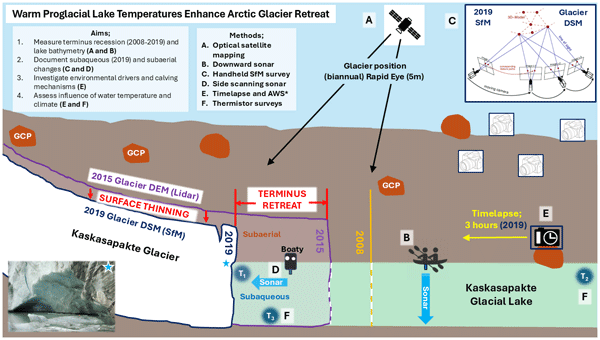
Thermal undercutting of the terminus has enhanced recent rapid retreat of an Arctic glacier. Water temperatures (~4 °C) at the ice front were warmer than previously reported and thermal undercutting was over several metres deep. This triggered phases of high calving activity, playing a substantial role in the rapid retreat of Kaskasapakte Glacier since 2012, with important implications for processes occurring at glacier-water contact points and implications for hydrology and ecology downstream.
Jamie Barnett, Felicity A. Holmes, Joshua Cuzzone, Henning Åkesson, Mathieu Morlighem, Matt O'Regan, Johan Nilsson, Nina Kirchner, and Martin Jakobsson
The Cryosphere, 19, 3631–3653, https://doi.org/10.5194/tc-19-3631-2025, https://doi.org/10.5194/tc-19-3631-2025, 2025
Short summary
Short summary
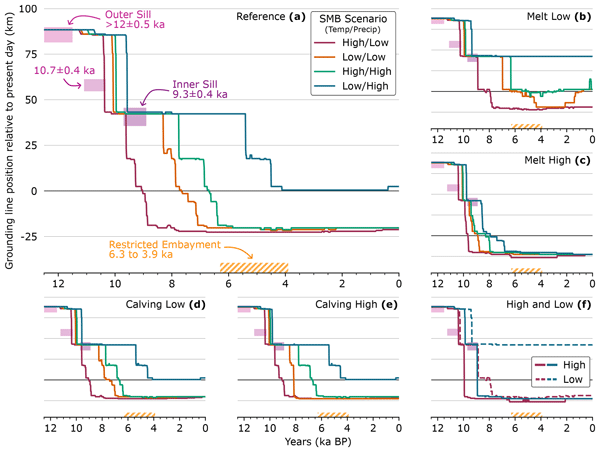
Understanding how ice sheets have changed in the past can allow us to make better predictions for the future. By running a state-of-the-art model of Ryder Glacier, North Greenland, over the past 12 000 years we find that both a warming atmosphere and the ocean play a key role in the evolution of the glacier. Our conclusions stress that accurately quantifying the ice sheet’s interactions with the ocean is required to predict future changes and reliable sea level rise estimates.
Felicity A. Holmes, Jamie Barnett, Henning Åkesson, Mathieu Morlighem, Johan Nilsson, Nina Kirchner, and Martin Jakobsson
The Cryosphere, 19, 2695–2714, https://doi.org/10.5194/tc-19-2695-2025, https://doi.org/10.5194/tc-19-2695-2025, 2025
Short summary
Short summary
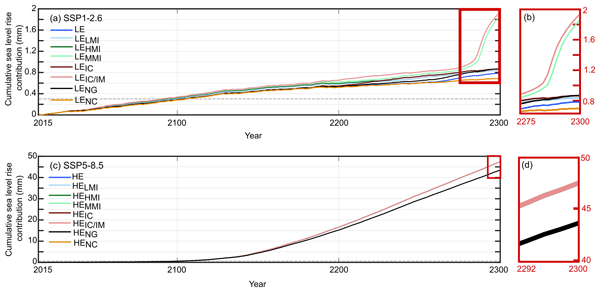
Northern Greenland contains some of the ice sheet's last remaining glaciers with floating ice tongues. One of these is Ryder Glacier, which has been relatively stable in recent decades, in contrast to nearby glaciers. Here, we use a computer model to simulate Ryder Glacier until 2300 under both a low- and a high-emissions scenario. Very high levels of surface melt under a high-emissions future lead to a sea level rise contribution that is an order of magnitude higher than under a low-emissions future.
Ward van Pelt and Thomas Frank
The Cryosphere, 19, 1–17, https://doi.org/10.5194/tc-19-1-2025, https://doi.org/10.5194/tc-19-1-2025, 2025
Short summary
Short summary
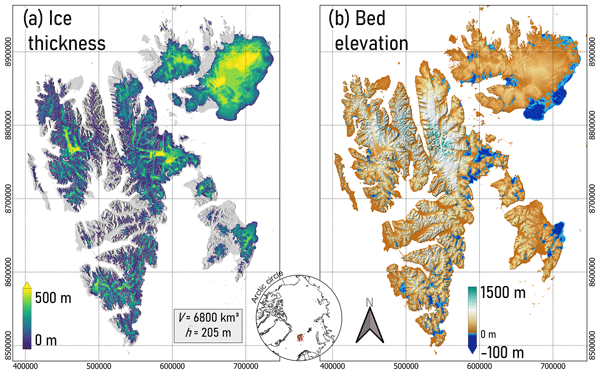
Accurate information on the ice thickness of Svalbard's glaciers is important for assessing the contribution to sea level rise in a present and a future climate. However, direct observations of the glacier bed are scarce. Here, we use an inverse approach and high-resolution surface observations to infer basal conditions. We present and analyse the new bed and thickness maps, quantify the ice volume (6800 km3), and compare these against radar data and previous studies.
Charlotte M. Carter, Michael J. Bentley, Stewart S. R. Jamieson, Guy J. G. Paxman, Tom A. Jordan, Julien A. Bodart, Neil Ross, and Felipe Napoleoni
The Cryosphere, 18, 2277–2296, https://doi.org/10.5194/tc-18-2277-2024, https://doi.org/10.5194/tc-18-2277-2024, 2024
Short summary
Short summary
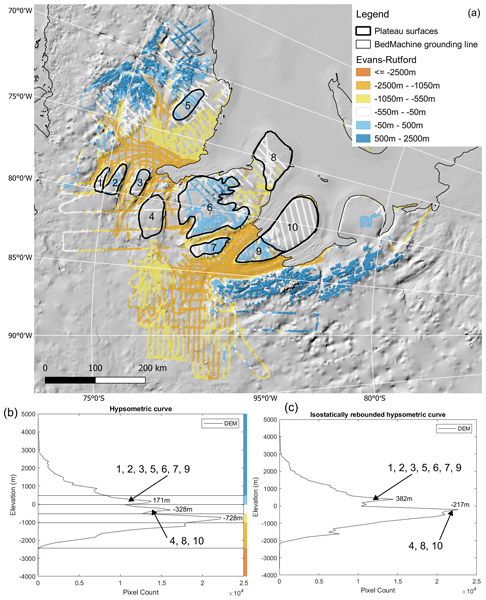
We use radio-echo sounding data to investigate the presence of flat surfaces beneath the Evans–Rutford region in West Antarctica. These surfaces may be what remains of laterally continuous surfaces, formed before the inception of the West Antarctic Ice Sheet, and we assess two hypotheses for their formation. Tectonic structures in the region may have also had a control on the growth of the ice sheet by focusing ice flow into troughs adjoining these surfaces.
Abhay Prakash, Qin Zhou, Tore Hattermann, and Nina Kirchner
The Cryosphere, 17, 5255–5281, https://doi.org/10.5194/tc-17-5255-2023, https://doi.org/10.5194/tc-17-5255-2023, 2023
Short summary
Short summary
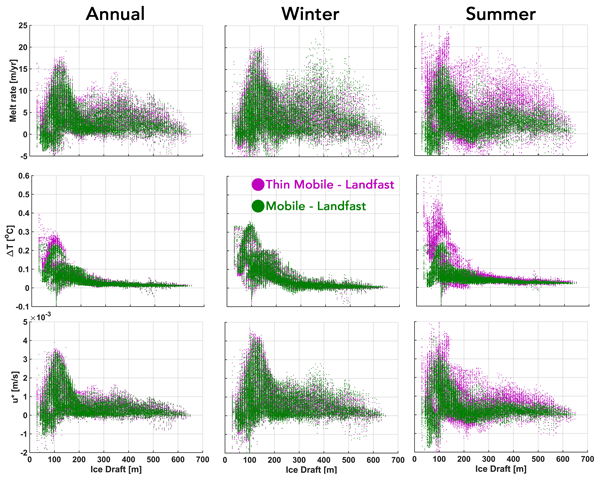
Sea ice arch formation in the Nares Strait has shielded the Petermann Glacier ice shelf from enhanced basal melting. However, with the sustained decline of the Arctic sea ice predicted to continue, the ice shelf is likely to be exposed to a year-round mobile and thin sea ice cover. In such a scenario, our modelled results show that elevated temperatures, and more importantly, a stronger ocean circulation in the ice shelf cavity, could result in up to two-thirds increase in basal melt.
Rebecca J. Sanderson, Kate Winter, S. Louise Callard, Felipe Napoleoni, Neil Ross, Tom A. Jordan, and Robert G. Bingham
The Cryosphere, 17, 4853–4871, https://doi.org/10.5194/tc-17-4853-2023, https://doi.org/10.5194/tc-17-4853-2023, 2023
Short summary
Short summary
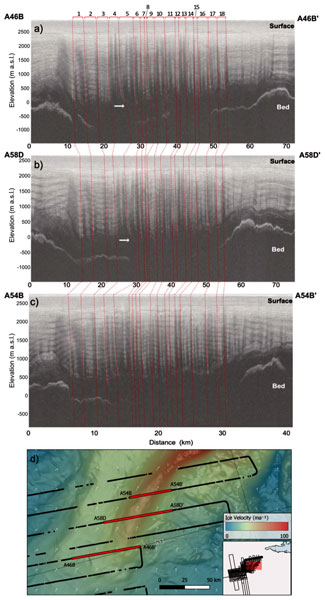
Ice-penetrating radar allows us to explore the internal structure of glaciers and ice sheets to constrain past and present ice-flow conditions. In this paper, we examine englacial layers within the Lambert Glacier in East Antarctica using a quantitative layer tracing tool. Analysis reveals that the ice flow here has been relatively stable, but evidence for former fast flow along a tributary suggests that changes have occurred in the past and could change again in the future.
Zhuo Wang, Ailsa Chung, Daniel Steinhage, Frédéric Parrenin, Johannes Freitag, and Olaf Eisen
The Cryosphere, 17, 4297–4314, https://doi.org/10.5194/tc-17-4297-2023, https://doi.org/10.5194/tc-17-4297-2023, 2023
Short summary
Short summary
We combine radar-based observed internal layer stratigraphy of the ice sheet with a 1-D ice flow model in the Dome Fuji region. This results in maps of age and age density of the basal ice, the basal thermal conditions, and reconstructed accumulation rates. Based on modeled age we then identify four potential candidates for ice which is potentially 1.5 Myr old. Our map of basal thermal conditions indicates that melting prevails over the presence of stagnant ice in the study area.
Thomas Frank, Ward J. J. van Pelt, and Jack Kohler
The Cryosphere, 17, 4021–4045, https://doi.org/10.5194/tc-17-4021-2023, https://doi.org/10.5194/tc-17-4021-2023, 2023
Short summary
Short summary
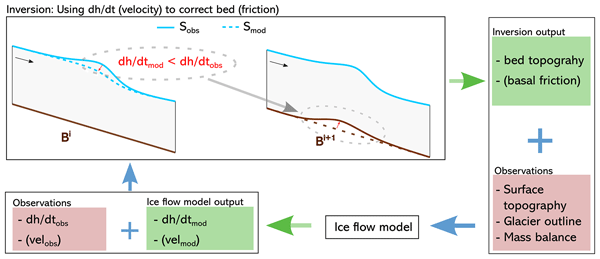
Since the ice thickness of most glaciers worldwide is unknown, and since it is not feasible to visit every glacier and observe their thickness directly, inverse modelling techniques are needed that can calculate ice thickness from abundant surface observations. Here, we present a new method for doing that. Our methodology relies on modelling the rate of surface elevation change for a given glacier, compare this with observations of the same quantity and change the bed until the two are in line.
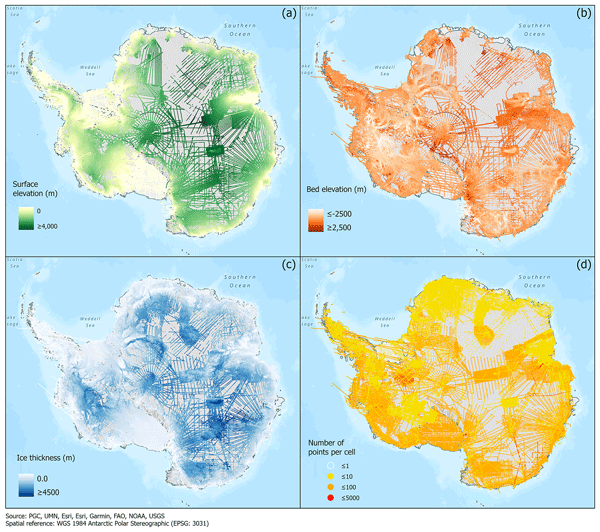
Alice C. Frémand, Peter Fretwell, Julien A. Bodart, Hamish D. Pritchard, Alan Aitken, Jonathan L. Bamber, Robin Bell, Cesidio Bianchi, Robert G. Bingham, Donald D. Blankenship, Gino Casassa, Ginny Catania, Knut Christianson, Howard Conway, Hugh F. J. Corr, Xiangbin Cui, Detlef Damaske, Volkmar Damm, Reinhard Drews, Graeme Eagles, Olaf Eisen, Hannes Eisermann, Fausto Ferraccioli, Elena Field, René Forsberg, Steven Franke, Shuji Fujita, Yonggyu Gim, Vikram Goel, Siva Prasad Gogineni, Jamin Greenbaum, Benjamin Hills, Richard C. A. Hindmarsh, Andrew O. Hoffman, Per Holmlund, Nicholas Holschuh, John W. Holt, Annika N. Horlings, Angelika Humbert, Robert W. Jacobel, Daniela Jansen, Adrian Jenkins, Wilfried Jokat, Tom Jordan, Edward King, Jack Kohler, William Krabill, Mette Kusk Gillespie, Kirsty Langley, Joohan Lee, German Leitchenkov, Carlton Leuschen, Bruce Luyendyk, Joseph MacGregor, Emma MacKie, Kenichi Matsuoka, Mathieu Morlighem, Jérémie Mouginot, Frank O. Nitsche, Yoshifumi Nogi, Ole A. Nost, John Paden, Frank Pattyn, Sergey V. Popov, Eric Rignot, David M. Rippin, Andrés Rivera, Jason Roberts, Neil Ross, Anotonia Ruppel, Dustin M. Schroeder, Martin J. Siegert, Andrew M. Smith, Daniel Steinhage, Michael Studinger, Bo Sun, Ignazio Tabacco, Kirsty Tinto, Stefano Urbini, David Vaughan, Brian C. Welch, Douglas S. Wilson, Duncan A. Young, and Achille Zirizzotti
Earth Syst. Sci. Data, 15, 2695–2710, https://doi.org/10.5194/essd-15-2695-2023, https://doi.org/10.5194/essd-15-2695-2023, 2023
Short summary
Short summary
This paper presents the release of over 60 years of ice thickness, bed elevation, and surface elevation data acquired over Antarctica by the international community. These data are a crucial component of the Antarctic Bedmap initiative which aims to produce a new map and datasets of Antarctic ice thickness and bed topography for the international glaciology and geophysical community.
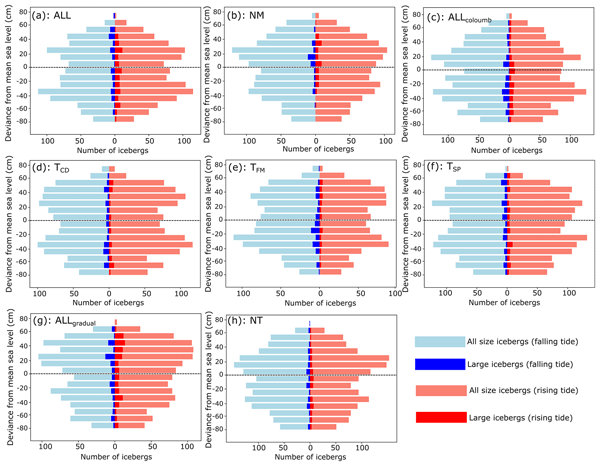
Felicity A. Holmes, Eef van Dongen, Riko Noormets, Michał Pętlicki, and Nina Kirchner
The Cryosphere, 17, 1853–1872, https://doi.org/10.5194/tc-17-1853-2023, https://doi.org/10.5194/tc-17-1853-2023, 2023
Short summary
Short summary
Glaciers which end in bodies of water can lose mass through melting below the waterline, as well as by the breaking off of icebergs. We use a numerical model to simulate the breaking off of icebergs at Kronebreen, a glacier in Svalbard, and find that both melting below the waterline and tides are important for iceberg production. In addition, we compare the modelled glacier front to observations and show that melting below the waterline can lead to undercuts of up to around 25 m.
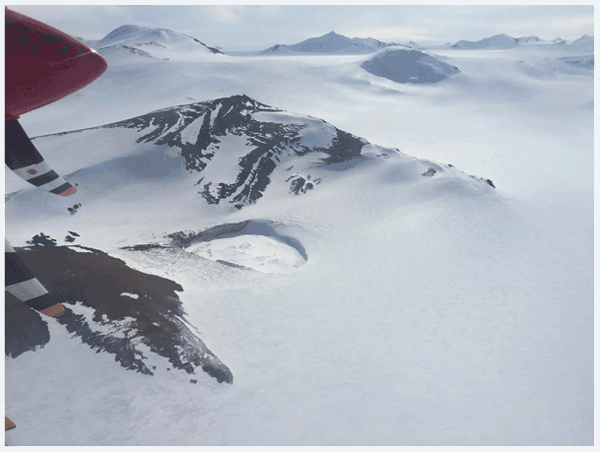
Dominic A. Hodgson, Tom A. Jordan, Neil Ross, Teal R. Riley, and Peter T. Fretwell
The Cryosphere, 16, 4797–4809, https://doi.org/10.5194/tc-16-4797-2022, https://doi.org/10.5194/tc-16-4797-2022, 2022
Short summary
Short summary
This paper describes the drainage (and refill) of a subglacial lake on the Antarctic Peninsula resulting in the collapse of the overlying ice into the newly formed subglacial cavity. It provides evidence of an active hydrological network under the region's glaciers and close coupling between surface climate processes and the base of the ice.
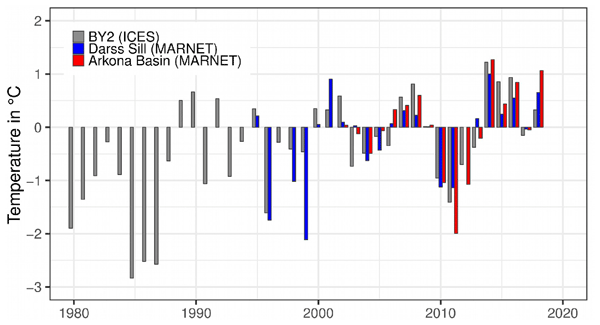
H. E. Markus Meier, Madline Kniebusch, Christian Dieterich, Matthias Gröger, Eduardo Zorita, Ragnar Elmgren, Kai Myrberg, Markus P. Ahola, Alena Bartosova, Erik Bonsdorff, Florian Börgel, Rene Capell, Ida Carlén, Thomas Carlund, Jacob Carstensen, Ole B. Christensen, Volker Dierschke, Claudia Frauen, Morten Frederiksen, Elie Gaget, Anders Galatius, Jari J. Haapala, Antti Halkka, Gustaf Hugelius, Birgit Hünicke, Jaak Jaagus, Mart Jüssi, Jukka Käyhkö, Nina Kirchner, Erik Kjellström, Karol Kulinski, Andreas Lehmann, Göran Lindström, Wilhelm May, Paul A. Miller, Volker Mohrholz, Bärbel Müller-Karulis, Diego Pavón-Jordán, Markus Quante, Marcus Reckermann, Anna Rutgersson, Oleg P. Savchuk, Martin Stendel, Laura Tuomi, Markku Viitasalo, Ralf Weisse, and Wenyan Zhang
Earth Syst. Dynam., 13, 457–593, https://doi.org/10.5194/esd-13-457-2022, https://doi.org/10.5194/esd-13-457-2022, 2022
Short summary
Short summary
Based on the Baltic Earth Assessment Reports of this thematic issue in Earth System Dynamics and recent peer-reviewed literature, current knowledge about the effects of global warming on past and future changes in the climate of the Baltic Sea region is summarised and assessed. The study is an update of the Second Assessment of Climate Change (BACC II) published in 2015 and focuses on the atmosphere, land, cryosphere, ocean, sediments, and the terrestrial and marine biosphere.
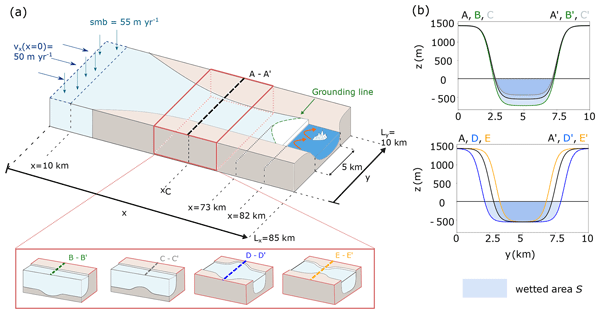
Thomas Frank, Henning Åkesson, Basile de Fleurian, Mathieu Morlighem, and Kerim H. Nisancioglu
The Cryosphere, 16, 581–601, https://doi.org/10.5194/tc-16-581-2022, https://doi.org/10.5194/tc-16-581-2022, 2022
Short summary
Short summary
The shape of a fjord can promote or inhibit glacier retreat in response to climate change. We conduct experiments with a synthetic setup under idealized conditions in a numerical model to study and quantify the processes involved. We find that friction between ice and fjord is the most important factor and that it is possible to directly link ice discharge and grounding line retreat to fjord topography in a quantitative way.
Cited articles
Bondesan, A. and Francese, R. G.: The climate-driven disaster of the Marmolada Glacier (Italy), Geomorphology, 431, 108687, https://doi.org/10.1016/j.geomorph.2023.108687, 2023. a
Brinkerhoff, D. J., Aschwanden, A., and Truffer, M.: Bayesian Inference of Subglacial Topography Using Mass Conservation, Front. Earth Sci., 4, https://doi.org/10.3389/feart.2016.00008, 2016. a
Carey, M.: In the shadow of melting glaciers: Climate change and Andean society, Oxford University Press, https://doi.org/10.1093/acprof:oso/9780195396065.001.0001, 2010. a, b
Cui, X., Jeofry, H., Greenbaum, J. S., Guo, J., Li, L., Lindzey, L. E., Habbal, F. A., Wei, W., Young, D. A., Ross, N., Morlighem, M., Jong, L. M., Roberts, J. L., Blankenship, D. D., Bo, S., and Siegert, M. J.: Bed topography of Princess Elizabeth Land in East Antarctica, Earth Syst. Sci. Data, 12, 2765–2774, https://doi.org/10.5194/essd-12-2765-2020, 2020. a
Dowdeswell, J. A. and Evans, S.: Investigations of the form and flow of ice sheets and glaciers using radio-echo sounding, Rep. Prog. Phys., 67, 1821–1861, https://doi.org/10.1088/0034-4885/67/10/R03, 2004. a, b
Esri: World Imagery [basemap], https://www.arcgis.com/home/webmap/viewer.html?useExisting=1&layers=10df2279f9684e4a9f6a7f08febac2a9, last access: 1 December 2025. a
Farinotti, D., Huss, M., Bauder, A., Funk, M., and Truffer, M.: A method to estimate the ice volume and ice-thickness distribution of alpine glaciers, J. Glaciol., 55, 422–430, https://doi.org/10.3189/002214309788816759, 2009. a
Farinotti, D., Brinkerhoff, D. J., Clarke, G. K. C., Fürst, J. J., Frey, H., Gantayat, P., Gillet-Chaulet, F., Girard, C., Huss, M., Leclercq, P. W., Linsbauer, A., Machguth, H., Martin, C., Maussion, F., Morlighem, M., Mosbeux, C., Pandit, A., Portmann, A., Rabatel, A., Ramsankaran, R., Reerink, T. J., Sanchez, O., Stentoft, P. A., Singh Kumari, S., van Pelt, W. J. J., Anderson, B., Benham, T., Binder, D., Dowdeswell, J. A., Fischer, A., Helfricht, K., Kutuzov, S., Lavrentiev, I., McNabb, R., Gudmundsson, G. H., Li, H., and Andreassen, L. M.: How accurate are estimates of glacier ice thickness? Results from ITMIX, the Ice Thickness Models Intercomparison eXperiment, The Cryosphere, 11, 949–970, https://doi.org/10.5194/tc-11-949-2017, 2017. a
Farinotti, D., Round, V., Huss, M., Compagno, L., and Zekollari, H.: Large hydropower and water-storage potential in future glacier-free basins, Nature, 575, 341–344, https://doi.org/10.1038/s41586-019-1740-z, 2019b. a
Farinotti, D., Brinkerhoff, D. J., Fürst, J. J., Gantayat, P., Gillet-Chaulet, F., Huss, M., Leclercq, P. W., Maurer, H., Morlighem, M., Pandit, A., Rabatel, A., Ramsankaran, R., Reerink, T. J., Robo, E., Rouges, E., Tamre, E., van Pelt, W. J. J., Werder, M. A., Azam, M. F., Li, H., and Andreassen, L. M.: Results from the Ice Thickness Models Intercomparison eXperiment Phase 2 (ITMIX2), Front. Earth Sci., 8, https://doi.org/10.3389/feart.2020.571923, 2021. a
Frank, T., van Pelt, W. J. J., and Kohler, J.: Reconciling ice dynamics and bed topography with a versatile and fast ice thickness inversion, The Cryosphere, 17, 4021–4045, https://doi.org/10.5194/tc-17-4021-2023, 2023. a
Fürst, J. J., Gillet-Chaulet, F., Benham, T. J., Dowdeswell, J. A., Grabiec, M., Navarro, F., Pettersson, R., Moholdt, G., Nuth, C., Sass, B., Aas, K., Fettweis, X., Lang, C., Seehaus, T., and Braun, M.: Application of a two-step approach for mapping ice thickness to various glacier types on Svalbard, The Cryosphere, 11, 2003–2032, https://doi.org/10.5194/tc-11-2003-2017, 2017. a
Gantayat, P., Kulkarni, A. V., and Srinivasan, J.: Estimation of ice thickness using surface velocities and slope: case study at Gangotri Glacier, India, J. Glaciol., 60, 277–282, https://doi.org/10.3189/2014JoG13J078, 2014. a
Gardner, A., Fahnestock, M., Greene, C., Kennedy, J., Liukis, M., Lopez, L., and Scambos, T.: MEASURES ITS_LIVE Regional Glacier and Ice Sheet Surface Velocities, Version 2, https://doi.org/10.5067/JQ6337239C96, 2024. a
Garmin International, Inc.: GPS 18x Technical Specifications (Revision B), Olathe, Kansas, USA, https://static.garmin.com/pumac/GPS_18x_Tech_Specs.pdf (last access: 8 November 2025), 2024. a
Gillespie, M. K., Andreassen, L. M., Huss, M., de Villiers, S., Sjursen, K. H., Aasen, J., Bakke, J., Cederstrøm, J. M., Elvehøy, H., Kjøllmoen, B., Loe, E., Meland, M., Melvold, K., Nerhus, S. D., Røthe, T. O., Støren, E. W. N., Øst, K., and Yde, J. C.: Ice thickness and bed topography of Jostedalsbreen ice cap, Norway, Earth Syst. Sci. Data, 16, 5799–5825, https://doi.org/10.5194/essd-16-5799-2024, 2024. a, b, c, d
GlaThiDa Consortium: Glacier Thickness Database 3.1.0., World Glacier Monitoring Service (WGMS) [data set], https://doi.org/10.5904/wgms-glathida-2020-10, 2020. a, b, c
GLIMS Consortium: GLIMS Glacier Database, Version 1, NASA National Snow and Ice Data Center Distributed Active Archive Center [data set], https://doi.org/10.7265/N5V98602, 2005. a
Gogineni, S., Yan, J.B., Paden, J., Leuschen, C., Li, J., Rodriguez-Morales, F., Braaten, D., Purdon, K., Wang, Z., Liu, W., and Gauch, J.: Bed topography of Jakobshavn Isbræ, Greenland, and Byrd Glacier, Antarctica, J. Glaciol., 60, 813–833, https://doi.org/10.3189/2014JoG14J129, 2014. a
Grab, M., Mattea, E., Bauder, A., Huss, M., Rabenstein, L., Hodel, E., Linsbauer, A., Langhammer, L., Schmid, L., Church, G., Hellmann, S., Délèze, K., Schaer, P., Lathion, P., Farinotti, D., and Maurer, H.: Ice thickness distribution of all Swiss glaciers based on extended ground-penetrating radar data and glaciological modeling, J. Glaciol., 67, 1074–1092, https://doi.org/10.1017/jog.2021.55, 2021. a, b, c
Gudmundsson, G. H. and Raymond, M.: On the limit to resolution and information on basal properties obtainable from surface data on ice streams, The Cryosphere, 2, 167–178, https://doi.org/10.5194/tc-2-167-2008, 2008. a
Haualand, K. F., Sauter, T., Abermann, J., De Villiers, S. D., Georgi, A., Goger, B., Dawson, I., Nerhus, S. D., Robson, B. A., Sjursen, K. H, Thomas, D. J., Thomaser, M., and Yde, J. C.: Meteorological impact of glacier retreat and proglacial lake temperature in western Norway, J. Geophys. Res.-Atmos., 130, e2024JD042715, https://doi.org/10.1029/2024JD042715, 2025. a
Herzfeld, U. C., Eriksson, M. G., and Holmlund, P.: On the influence of kriging parameters on the cartographic output – A study in mapping subglacial topography, Math. Geol., 25, 881–900, https://doi.org/10.1007/BF00891049, 1993. a, b, c, d
Holmlund, P.: Mass balance of Storglaciären during the 20th century, Geogr. Ann. A, 69, 439–447, https://doi.org/10.2307/521357, 1987. a
Holmlund, P. and Eriksson, M.: The Cold Surface Layer on Storglaciären, Geogr. Ann. A, 71, 241–244, https://doi.org/10.1080/04353676.1989.11880291, 1989. a
Holmlund, P., Karlén, W., and Grudd, H.: Fifty years of mass balance and glacier front observations at the Tarfala Research Station, Geogr. Ann. A, 78, 105–114, https://doi.org/10.1080/04353676.1996.11880456, 1996. a
Hugonnet, R., McNabb, R., Berthier, E., Menounos, B., Nuth, C., Girod, L., Farinotti, D., Huss, M., Dussaillant, I., Brun, F., and Kääb, A.: Accelerated global glacier mass loss in the early twenty-first century, Nature, 592, 726–731, https://doi.org/10.1038/s41586-021-03436-z, 2021. a, b
Johansson, E., Islar, M., Shah, M., Gómez-Baggethun, E., Subramanian, S., and Margiotta, C.: Glaciers’ contributions to people, nature’s values, and coping strategies in the Indian Himalaya, Ecol. Soc., 30, https://doi.org/10.5751/ES-16633-300432, 2025. a
Johansson, F. E., Bakke, J., Støren, E. N., Gillespie, M. K., and Laumann, T.: Mapping of the Subglacial Topography of Folgefonna Ice Cap in Western Norway – Consequences for Ice Retreat Patterns and Hydrological Changes, Front. Earth Sci., 10, https://doi.org/10.3389/feart.2022.886361, 2022. a
Jouvet, G. and Cordonnier, G.: Ice-flow model emulator based on physics-informed deep learning, J. Glaciol., 69, 1941–1955, https://doi.org/10.1017/jog.2023.73, 2023. a
Langhammer, L., Grab, M., Bauder, A., and Maurer, H.: Glacier thickness estimations of alpine glaciers using data and modeling constraints, The Cryosphere, 13, 2189–2202, https://doi.org/10.5194/tc-13-2189-2019, 2019. a
Lantmäteriet: SWEN17_RH2000: Sveriges geoidmodell 2017, Tech. rep., Lantmäteriet, https://www.lantmateriet.se/globalassets/geodata/gps-och-geodetisk-matning/presentation-av-swen17_rh2000-j-agren-lang-version-171025.pdf (last access: 8 July 2025), 2017. a
Lapazaran, J. J., Otero, J., Martín-Español, A., and Navarro, F. J.: On the errors involved in ice-thickness estimates I: ground-penetrating radar measurement errors, J. Glaciol., 62, 1008–1020, https://doi.org/10.1017/jog.2016.93, 2016. a, b
Lindbäck, K., Kohler, J., Pettersson, R., Nuth, C., Langley, K., Messerli, A., Vallot, D., Matsuoka, K., and Brandt, O.: Subglacial topography, ice thickness, and bathymetry of Kongsfjorden, northwestern Svalbard, Earth Syst. Sci. Data, 10, 1769–1781, https://doi.org/10.5194/essd-10-1769-2018, 2018. a
Linsbauer, A., Paul, F., and Haeberli, W.: Modeling glacier thickness distribution and bed topography over entire mountain ranges with GlabTop: Application of a fast and robust approach, J. Geophys. Res.-Earth, 117, https://doi.org/10.1029/2011JF002313, 2012. a
Millan, R., Mouginot, J., Rabatel, A., and Morlighem, M.: Ice velocity and thickness of the world’s glaciers, Nat. Geosci., 15, 124–129, https://doi.org/10.1038/s41561-021-00885-z, 2022. a, b, c, d
Mingo, L. and Flowers, G. E.: An integrated lightweight ice-penetrating radar system, J. Glaciol., 56, 709–714, https://doi.org/10.3189/002214310793146179, 2010. a
Morlighem, M., Rignot, E., Seroussi, H., Larour, E., Ben Dhia, H., and Aubry, D.: A mass conservation approach for mapping glacier ice thickness, Geophys. Res. Lett., 38, https://doi.org/10.1029/2011GL048659, 2011. a
Nesje, A., Bakke, J., Dahl, S. O., Lie, Ø., and Matthews, J. A.: Norwegian mountain glaciers in the past, present and future, Global Planet. Change, 60, 10–27, https://doi.org/10.1016/j.gloplacha.2006.08.004, 2008. a
Otto, J.-C., Helfricht, K., Prasicek, G., Binder, D., and Keuschnig, M.: Testing the performance of ice thickness models to estimate the formation of potential future glacial lakes in Austria, Earth Surf. Proc. Land., 47, 723–741, https://doi.org/10.1002/esp.5266, 2022. a
Pettersson, R., Jansson, P., and Holmlund, P.: Cold surface layer thinning on Storglaciären, Sweden, observed by repeated ground penetrating radar surveys, J. Geophys. Res.-Earth, 108, https://doi.org/10.1029/2003JF000024, 2003. a, b
Pettersson, R., Jansson, P., and Blatter, H.: Spatial variability in water content at the cold-temperate transition surface of the polythermal Storglaciären, Sweden, J. Geophys. Res.-Earth, 109, https://doi.org/10.1029/2003JF000110, 2004. a
Porter, C., Howat, I., Noh, M.-J., Husby, E., Khuvis, S., Danish, E., Tomko, K., Gardiner, J., Negrete, A., Yadav, B., Klassen, J., Kelleher, C., Cloutier, M., Bakker, J., Enos, J., Arnold, G., Bauer, G., and Morin, P.: ArcticDEM – Strips, Version 4.1, Harvard Dataverse, V1 [data set], https://doi.org/10.7910/DVN/C98DVS, 2022. a, b, c
Pritchard, H. D.: Asia’s shrinking glaciers protect large populations from drought stress, Nature, 569, 649–654, https://doi.org/10.1038/s41586-019-1240-1, 2019. a
QGIS Development Team: QGIS Geographic Information System, QGIS Association, Zenodo [code], https://doi.org/10.5281/zenodo.6139224, 2025. a, b
Raymond, M. J. and Gudmundsson, G. H.: On the relationship between surface and basal properties on glaciers, ice sheets, and ice streams, J. Geophys. Res.-Sol. Ea., 110, https://doi.org/10.1029/2005JB003681, 2005. a
RGI Consortium: Randolph Glacier Inventory – A Dataset of Global Glacier Outlines, Version 6, National Snow and Ice Data Center [data set], https://doi.org/10.7265/4M1F-GD79, 2017. a
RGI Consortium: Randolph Glacier Inventory – A Dataset of Global Glacier Outlines, Version 7, National Snow and Ice Data Center [data set], https://doi.org/10.5067/F6JMOVY5NAVZ, 2023. a
Rounce, D. R., Hock, R., Maussion, F., Hugonnet, R., Kochtitzky, W., Huss, M., Berthier, E., Brinkerhoff, D., Compagno, L., Copland, L., Farinotti, D., Menounos, B., and McNabb, R. W.: Global glacier change in the 21st century: Every increase in temperature matters, Science, 379, 78–83, https://doi.org/10.1126/science.abo1324, 2023. a, b, c, d
Sandmeier, K. J.: ReflexW Version 10.5, Sandmeier Geophysical Research, Karlsruhe, Germany, https://www.sandmeier-geo.de/reflexw.html (last access: 21 March 2025), 2024. a
Schannwell, C., Murray, T., Kulessa, B., Gusmeroli, A., Saintenoy, A., and Jansson, P.: An automatic approach to delineate the cold–temperate transition surface with ground-penetrating radar on polythermal glaciers, Ann. Glaciol., 55, 89–96, https://doi.org/10.3189/2014AoG67A102, 2014. a
Shaw, T. E. and Pellicciotti, F.: Mountain glaciers will lose their cooling capacity as they shrink, Nat. Clim. Change, 15, 1150–1151, https://doi.org/10.1038/s41558-025-02448-1, 2025. a
Steffen, T., Huss, M., Estermann, R., Hodel, E., and Farinotti, D.: Volume, evolution, and sedimentation of future glacier lakes in Switzerland over the 21st century, Earth Surf. Dynam., 10, 723–741, https://doi.org/10.5194/esurf-10-723-2022, 2022. a
Stoffel, M. and Huggel, C.: Effects of climate change on mass movements in mountain environments, Prog. Phys. Geogr., 36, 421–439, https://doi.org/10.1177/0309133312441010, 2012. a
The MathWorks Inc.: MATLAB R2024a, https://www.mathworks.com (last access: 15 May 2026), 2024. a
Walford, M. E. R., Kennett, M. I., and Holmlund, P.: Interpretation of Radio Echoes from Storglaciären, Northern Sweden, J. Glaciol., 32, 39–49, https://doi.org/10.3189/S0022143000006857, 1986. a
Wang, Z.: Code associated with the manuscript “Ice thickness and subglacial topography of Swedish reference glaciers revealed by radio-echo sounding”, Zenodo [code], https://doi.org/10.5281/zenodo.18001737, 2026. a
Wang, Z., Chung, A., Steinhage, D., Parrenin, F., Freitag, J., and Eisen, O.: Mapping age and basal conditions of ice in the Dome Fuji region, Antarctica, by combining radar internal layer stratigraphy and flow modeling, The Cryosphere, 17, 4297–4314, https://doi.org/10.5194/tc-17-4297-2023, 2023. a
Wang, Z., Ross, N., Frank, T., Barnett, J., Santin, I., Houssais, M., Dahlkvist, J., and Kirchner, N.: Ice thickness and bed topography for Moarhmmáglaciären, northern Sweden, Bolin Centre Database [data set], https://doi.org/10.17043/tarfala-marma-res-3, 2026a. a, b, c
Wang, Z., Ross, N., Frank, T., Barnett, J., Santin, I., Houssais, M., Dahlkvist, J., and Kirchner, N.: Ice thickness and bed topography for Rabots glaciär, northern Sweden, Bolin Centre Database [data set], https://doi.org/10.17043/tarfala-rabot-res-3, 2026b. a, b, c
Wang, Z., Ross, N., Frank, T., Barnett, J., Santin, I., Houssais, M., Dahlkvist, J., and Kirchner, N.: Ice thickness and bed topography for Rivgojiehkki, northern Sweden, Bolin Centre Database [data set], https://doi.org/10.17043/tarfala-rivgojiehkki-res-3, 2026c. a, b, c
Wang, Z., Ross, N., Frank, T., Barnett, J., Santin, I., Houssais, M., Dahlkvist, J., and Kirchner, N.: Ice thickness and bed topography for Storglaciären, northern Sweden, Bolin Centre Database [data set], https://doi.org/10.17043/tarfala-storglaciaren-res-3, 2026d. a, b, c
Wang, Z., Ross, N., Johanna, D., and Kirchner, N.: Raw and processed radio-echo sounding data for Rabots glaciär, northern Sweden, Bolin Centre Database [data set], https://doi.org/10.17043/tarfala-rabot-res-survey-2, 2026e. a, b
Wang, Z., Ross, N., and Kirchner, N.: Raw and processed radio-echo sounding data for Moarhmmáglaciären, northern Sweden, Bolin Centre Database [data set], https://doi.org/10.17043/tarfala-marma-res-survey-2, 2026f. a, b
Wang, Z., Ross, N., and Kirchner, N.: Raw and processed radio-echo sounding data for Rivgojiehkki, northern Sweden, Bolin Centre Database [data set], https://doi.org/10.17043/tarfala-rivgojiehkki-res-survey-2, 2026g. a, b
Wang, Z., Ross, N., and Kirchner, N.: Raw and processed radio-echo sounding data for Storglaciären, northern Sweden, Bolin Centre Database [data set], https://doi.org/10.17043/tarfala-storglaciaren-res-survey-2, 2026h. a, b
WCRP Global Sea Level Budget Group: Global sea-level budget 1993–present, Earth Syst. Sci. Data, 10, 1551–1590, https://doi.org/10.5194/essd-10-1551-2018, 2018. a
Welling, J. T., Árnason, T., and Ólafsdottír, R.: Glacier tourism: a scoping review, Tourism Geogr., 17, 635–662, https://doi.org/10.1080/14616688.2015.1084529, 2015. a, b, c
Welty, E., Zemp, M., Navarro, F., Huss, M., Fürst, J. J., Gärtner-Roer, I., Landmann, J., Machguth, H., Naegeli, K., Andreassen, L. M., Farinotti, D., Li, H., and GlaThiDa Contributors: Worldwide version-controlled database of glacier thickness observations, Earth Syst. Sci. Data, 12, 3039–3055, https://doi.org/10.5194/essd-12-3039-2020, 2020. a, b
Zekollari, H., Huss, M., Schuster, L., Maussion, F., Rounce, D. R., Aguayo, R., Champollion, N., Compagno, L., Hugonnet, R., Marzeion, B., Mojtabavi, S., and Farinotti, D.: Twenty-first century global glacier evolution under CMIP6 scenarios and the role of glacier-specific observations, The Cryosphere, 18, 5045–5066, https://doi.org/10.5194/tc-18-5045-2024, 2024. a
Zekollari, H., Schuster, L., Maussion, F., Hock, R., Marzeion, B., Rounce, D. R., Compagno, L., Fujita, K., Huss, M., James, M., Kraaijenbrink, P. D. A., Lipscomb, W. H., Minallah, S., Oberrauch, M., Van Tricht, L., Champollion, N., Edwards, T., Farinotti, D., Immerzeel, W., Leguy, G., and Sakai, A.: Glacier preservation doubled by limiting warming to 1.5°C versus 2.7°C, Science, 388, 979–983, https://doi.org/10.1126/science.adu4675, 2025. a, b, c
Zemp, M., Frey, H., Gärtner-Roer, I., Nussbaumer, S. U., Hoelzle, M., Paul, F., Haeberli, W., Denzinger, F., Ahlstrøm, A. P., Anderson, B., Bajracharya, S., Baroni, C., Braun, L. N., Cáceres, B. E., Casassa, G., Cobos, G., Dávila, L. R., Granados, H. D., Demuth, M. N., Espizua, L., Fischer, A., Fujita, K., Gadek, B., Ghazanfar, A., Hagen, J. O., Holmlund, P., Karimi, N., Li, Z., Pelto, M., Pitte, P., Popovnin, V. V., Portocarrero, C. A., Prinz, R., Sangewar, C. V., Severskiy, I., Sigurđsson, O., Soruco, A., Usubaliev, R., and Vincent, C.: Historically unprecedented global glacier decline in the early 21st century, J. Glaciol., 61, 745–762, https://doi.org/10.3189/2015JoG15J017, 2015. a, b
Short summary
Under global warming, Sweden's remaining glaciers are shrinking rapidly, and all four Swedish reference glaciers (Mårmaglaciären, Storglaciären, Rabots glaciär, and Riukojietna) may disappear within this century. To better project their future evolution, we measured the ice thickness of the four glaciers using radio-echo sounding and mapped the bed topography beneath the ice. These maps provide essential insights into future landscapes, ecosystems, and policymaking.
Under global warming, Sweden's remaining glaciers are shrinking rapidly, and all four Swedish...


Altmetrics
Final-revised paper
Preprint