Articles | Volume 18, issue 5
https://doi.org/10.5194/essd-18-3635-2026
© Author(s) 2026. This work is distributed under
the Creative Commons Attribution 4.0 License.

https://doi.org/10.5194/essd-18-3635-2026
© Author(s) 2026. This work is distributed under
the Creative Commons Attribution 4.0 License.
Two biogenic volatile organic compound emission datasets over Europe based on land surface modelling and satellite data assimilation

NILU, 2027 Kjeller, Norway
Miha Markelj
NILU, 2027 Kjeller, Norway
Oscar Rojas-Munoz
Centre National de Recherches Météorologiques, Université de Toulouse, Météo-France, CNRS, Toulouse, France
Bertrand Bonan
Centre National de Recherches Météorologiques, Université de Toulouse, Météo-France, CNRS, Toulouse, France
Jean-Christophe Calvet
Centre National de Recherches Météorologiques, Université de Toulouse, Météo-France, CNRS, Toulouse, France
Virginie Marécal
Centre National de Recherches Météorologiques, Université de Toulouse, Météo-France, CNRS, Toulouse, France
Centre d'Etudes Spatiales de la Biosphère, Univ. Toulouse, CNES/IRD/CNRS/INRAe, CESBIO, Toulouse, France
Alex Guenther
Department of Earth System Science, University of California at Irvine, Irvine, CA 92697, USA
Heidi Trimmel
International Institute for Applied Systems Analysis (IIASA), Schloßplatz 1, 2361, Laxenburg, Austria
Institute of Meteorology and Climatology, Department of Ecosystem Management, Climate and Biodiversity, BOKU University, Vienna, Austria
Islen Vallejo
NILU, 2027 Kjeller, Norway
Sabine Eckhardt
NILU, 2027 Kjeller, Norway
Gabriela Sousa Santos
NILU, 2027 Kjeller, Norway
Katerina Sindelarova
Department of Atmospheric Physics, Faculty of Mathematics and Physics, Charles University, Prague, V Holešovičkách 2, 18000 Prague 8, Czechia
David Simpson
Climate and Environment Department, Norwegian Meteorological Institute, 0313 Oslo, Norway
Department of Space, Earth and Environment, Chalmers University of Technology, 412 96 Gothenburg, Sweden
Norbert Schmidbauer
NILU, 2027 Kjeller, Norway
Heidi Hellén
Atmospheric Composition Research, Finnish Meteorological Institute, P.O. Box 503, 00101 Helsinki, Finland
added as co-author after manuscript acceptance, see section author contribution
Pascal Rubli
Swiss Federal Laboratories for Materials Science and Technology, Laboratory for Air Pollution/Environmental Technology, Überlandstrasse 129, 8600 Dübendorf, Switzerland
added as co-author after manuscript acceptance, see section author contribution
Stefan Reimann
Swiss Federal Laboratories for Materials Science and Technology, Laboratory for Air Pollution/Environmental Technology, Überlandstrasse 129, 8600 Dübendorf, Switzerland
added as co-author after manuscript acceptance, see section author contribution
Anja Claude
Deutscher Wetterdienst (DWD), Hohenpeissenberg Meteorological Observatory, Hohenpeissenberg, Germany
added as co-author after manuscript acceptance, see section author contribution
Dagmar Kubistin
Deutscher Wetterdienst (DWD), Hohenpeissenberg Meteorological Observatory, Hohenpeissenberg, Germany
added as co-author after manuscript acceptance, see section author contribution
Julie Cozic
Atmo Auvergne-Rhône-Alpes, 3 allée des Sorbiers, 69500 Bron, France
added as co-author after manuscript acceptance, see section author contribution
James Dernie
Ricardo Energy & Environment, Gemini Building, Fermi Avenue, Harwell, Oxfordshire, OX11 0QR, UK
added as co-author after manuscript acceptance, see section author contribution
Leonor Tarrasón
NILU, 2027 Kjeller, Norway
Related authors
Wenche Aas, Thérèse Salameh, Robert Wegener, Heidi Hellén, Jean-Luc Jaffrezo, Pontus Roldin, Elisabeth Alonso-Blanco, Andres Alastuey, Crist Amelynck, Jgor Arduini, Benjamin Bergmans, Marie Bertrand, Agnes Borbon, Efstratios Bourtsoukidis, Laetitia Bouvier, David Butterfield, Iris Buxbaum, Darius Ceburnis, Anja Claude, Aurélie Colomb, Sophie Darfeuil, James Dernie, Maximilien Desservettaz, Elías Díaz-Ramiro, Marvin Dufresne, René Dubus, Mario Duval, Marie Dury, Anna Font, Kirsten Fossum, Evelyn Freney, Gotzon Gangoiti, Yao Ge, Maria Carmen Gomez, Francisco J. Gómez-Moreno, Marie Gohy, Valérie Gros, Paul Hamer, Bryan Hellack, Hartmut Herrmann, Robert Holla, Adéla Holubová, Niels Jensen, Tuija Jokinen, Matthew Jones, Uwe Käfer, Lukas Kesper, Dieter Klemp, Dagmar Kubistin, Angela Marinoni, Martina Mazzini, Vy Ngoc Thuy Dinh, Jurgita Ovadnevaite, Tuukka Petäjä, Miguel Portillo-Estrada, Jitka Přívozníková, Jean-Philippe Putaud, Stefan Reimann, Laura Renzi, Veronique Riffault, Stuart Ritchie, Chris Robins, Begoña Artíñano Rodríguez de Torres, Laurent Poulain, Julian Rüdiger, Agnieszka Sanocka, Estibaliz Saez de Camara Oleaga, Niels Schoon, Roger Seco, Ivan Simmons, Leïla Simon, David Simpson, Emmanuel Tison, August Thomasson, Svetlana Tsyro, Marsailidh Twigg, Toni Tykkä, Bert Verreyken, Ana Maria Yáñez-Serrano, Sverre Solberg, Karen Yeung, Ilona Ylivinkka, Karl Espen Yttri, Ågot Watne, and Katie Williams
EGUsphere, https://doi.org/10.5194/egusphere-2025-6166, https://doi.org/10.5194/egusphere-2025-6166, 2025
Short summary
Short summary
A one-week intensive VOC and organic-tracer campaign during the 2022 European heatwave showed contributions from both biogenic and anthropogenic sources to ozone and SOA peaks, while model–observation differences underline the need for better characterization of sources and formation pathways.
Safae Oumami, Joaquim Arteta, Vincent Guidard, Pierre Tulet, and Paul David Hamer
Geosci. Model Dev., 17, 3385–3408, https://doi.org/10.5194/gmd-17-3385-2024, https://doi.org/10.5194/gmd-17-3385-2024, 2024
Short summary
Short summary
In this paper, we coupled the SURFEX and MEGAN models. The aim of this coupling is to improve the estimation of biogenic fluxes by using the SURFEX canopy environment model. The coupled model results were validated and several sensitivity tests were performed. The coupled-model total annual isoprene flux is 442 Tg; this value is within the range of other isoprene estimates reported. The ultimate aim of this coupling is to predict the impact of climate change on biogenic emissions.
Herizo Narivelo, Paul David Hamer, Virginie Marécal, Luke Surl, Tjarda Roberts, Sophie Pelletier, Béatrice Josse, Jonathan Guth, Mickaël Bacles, Simon Warnach, Thomas Wagner, Stefano Corradini, Giuseppe Salerno, and Lorenzo Guerrieri
Atmos. Chem. Phys., 23, 10533–10561, https://doi.org/10.5194/acp-23-10533-2023, https://doi.org/10.5194/acp-23-10533-2023, 2023
Short summary
Short summary
Volcanic emissions emit large quantities of gases and primary aerosols that can play an important role in atmospheric chemistry. We present a study of the fate of volcanic bromine emissions from the eruption of Mount Etna around Christmas 2018. Using a numerical model and satellite observations, we analyse the impact of the volcanic plume and how it modifies the composition of the air over the whole Mediterranean basin, in particular on tropospheric ozone through the bromine-explosion cycle.
Virginie Marécal, Ronan Voisin-Plessis, Tjarda Jane Roberts, Alessandro Aiuppa, Herizo Narivelo, Paul David Hamer, Béatrice Josse, Jonathan Guth, Luke Surl, and Lisa Grellier
Geosci. Model Dev., 16, 2873–2898, https://doi.org/10.5194/gmd-16-2873-2023, https://doi.org/10.5194/gmd-16-2873-2023, 2023
Short summary
Short summary
We implemented a halogen volcanic chemistry scheme in a one-dimensional modelling framework preparing for further use in a three-dimensional global chemistry-transport model. The results of the simulations for an eruption of Mt Etna in 2008, including various sensitivity tests, show a good consistency with previous modelling studies.
Christine D. Groot Zwaaftink, Wenche Aas, Sabine Eckhardt, Nikolaos Evangeliou, Paul Hamer, Mona Johnsrud, Arve Kylling, Stephen M. Platt, Kerstin Stebel, Hilde Uggerud, and Karl Espen Yttri
Atmos. Chem. Phys., 22, 3789–3810, https://doi.org/10.5194/acp-22-3789-2022, https://doi.org/10.5194/acp-22-3789-2022, 2022
Short summary
Short summary
We investigate causes of a poor-air-quality episode in northern Europe in October 2020 during which EU health limits for air quality were vastly exceeded. Such episodes may trigger measures to improve air quality. Analysis based on satellite observations, transport simulations, and surface observations revealed two sources of pollution. Emissions of mineral dust in Central Asia and biomass burning in Ukraine arrived almost simultaneously in Norway, and transport continued into the Arctic.
Paul D. Hamer, Virginie Marécal, Ryan Hossaini, Michel Pirre, Gisèle Krysztofiak, Franziska Ziska, Andreas Engel, Stephan Sala, Timo Keber, Harald Bönisch, Elliot Atlas, Kirstin Krüger, Martyn Chipperfield, Valery Catoire, Azizan A. Samah, Marcel Dorf, Phang Siew Moi, Hans Schlager, and Klaus Pfeilsticker
Atmos. Chem. Phys., 21, 16955–16984, https://doi.org/10.5194/acp-21-16955-2021, https://doi.org/10.5194/acp-21-16955-2021, 2021
Short summary
Short summary
Bromoform is a stratospheric ozone-depleting gas released by seaweed and plankton transported to the stratosphere via convection in the tropics. We study the chemical interactions of bromoform and its derivatives within convective clouds using a cloud-scale model and observations. Our findings are that soluble bromine gases are efficiently washed out and removed within the convective clouds and that most bromine is transported vertically to the upper troposphere in the form of bromoform.
Claire Lamotte, Jonathan Guth, Virginie Marécal, Martin Cussac, Paul David Hamer, Nicolas Theys, and Philipp Schneider
Atmos. Chem. Phys., 21, 11379–11404, https://doi.org/10.5194/acp-21-11379-2021, https://doi.org/10.5194/acp-21-11379-2021, 2021
Short summary
Short summary
Improvements are made in a global chemical transfer model by considering a new volcanic SO2 emissions inventory, with more volcanoes referenced and more information on the altitude of injection. Better constraining volcanic emissions with this inventory improves the global, but mostly local, tropospheric sulfur composition. The tropospheric sulfur budget shows a nonlinearity to the volcanic contribution, especially to the sulfate aerosol burden and sulfur wet deposition.
Hélène De Longueville, Daniela B. Melo, Alison L. Redington, Alice Ramsden, Alexandre Danjou, Peter Andrews, Joseph Pitt, Brendan Murphy, Lionel Constantin, Kieran M. Stanley, Simon O'Doherty, Angelina Wenger, Dickon Young, Andreas Engel, Tanja Schuck, Katharina Meixner, Thomas Wagenhaeuser, Fides Gad, Martin K. Vollmer, Stefan Reimann, Michela Maoine, Jgor Arduini, Chris Lunder, Norbert Schmidtbauer, László Haszpra, Mihály Molnár, Arnoud Frumau, Cedric Couret, Matthew Rigby, Stephan Henne, Alistair Manning, and Anita L. Ganesan
Atmos. Chem. Phys., 26, 7647–7675, https://doi.org/10.5194/acp-26-7647-2026, https://doi.org/10.5194/acp-26-7647-2026, 2026
Short summary
Short summary
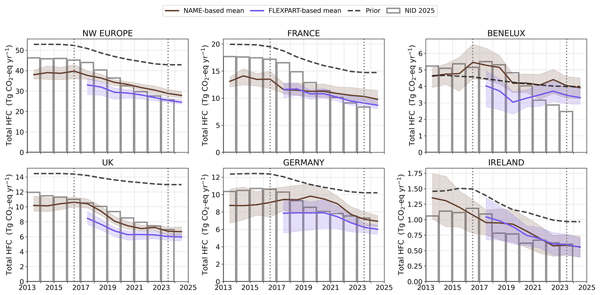
This study estimates emissions of hydrofluorocarbons, potent greenhouse gases, in north-western Europe using atmospheric observations and atmospheric modelling. The estimates are compared with nationally reported emissions submitted to the United Nations. Overall, our results are consistent with reported values, although differences are found for some gases and countries. The findings indicate that emissions in north-western Europe are declining, reflecting the effects of climate regulations.
Martin K. Vollmer, Joseph R. Pitt, Dickon Young, Stephan Henne, Blagoj Mitrevski, Jens Mühle, Anita Ganesan, Jgor Arduini, Alistair J. Manning, Thomas Wagenhäuser, Alison L. Redington, Daniela B. Melo, Brendan Murphy, Ray Gluckmann, Kieran M. Stanley, Paul B. Krummel, Chris R. Lunder, Jaegeun Yun, Dominique Rust, Angelina Wenger, Myriam Guillevic, Jooil Kim, Ray H. J. Wang, Tae Siek Rhee, Lionel Constantin, Arnoud Frumau, Christina M. Harth, Peter K. Salameh, Ove Hermansen, Matthew Rigby, Luke M. Western, Andreas Engel, Simon O'Doherty, Sunyoung Park, Michela Maione, Paul J. Fraser, Ronald G. Prinn, Ray F. Weiss, and Stefan Reimann
Atmos. Chem. Phys., 26, 6993–7012, https://doi.org/10.5194/acp-26-6993-2026, https://doi.org/10.5194/acp-26-6993-2026, 2026
Short summary
Short summary
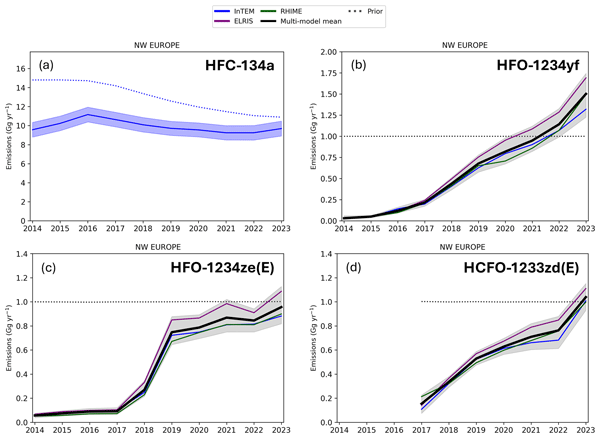
Halogenated olefins (HFOs) are newly emerging compounds in the atmosphere. They are in reach of the definition of PFAS (Per- and polyfluoroalkyl substances) and some decay to the eternal chemical trifluoroacetate (TFA). We provide atmospheric measurements of three HFOs from the large Advanced Global Atmospheric Gases Experiment (AGAGE) network and estimate emissions for Northwest Europe for the first time. We find a quasi-ubiquitous presence in the atmosphere and rapidly increasing emissions.
Lauri K. Savolainen, Teemu Lepistö, Heidi Hellén, Henna Lintusaari, Milja Jäppi, Jarkko V. Niemi, Kimmo Teinilä, Minna Aurela, Markus Lampimäki, Anu Kousa, Janne Lampilahti, Katrianne Lehtipalo, Tuukka Petäjä, Miikka Dal Maso, Hanna E. Manninen, Hilkka Timonen, and Topi Rönkkö
EGUsphere, https://doi.org/10.5194/egusphere-2026-1692, https://doi.org/10.5194/egusphere-2026-1692, 2026
This preprint is open for discussion and under review for Atmospheric Chemistry and Physics (ACP).
Short summary
Short summary
The study investigates vehicle fleet emissions of road traffic. Despite technological advances, road traffic is still an important pollution source in urban areas, especially when considering unregulated, but health-relevant, emerging pollutants. We report fuel consumption normalized vehicle fleet emission factors for various regulated and unregulated air pollutants. Also, we show that road traffic has inverse and indirect effects on urban aerosol which are not generally well understood.
Marco Zanatta, Paolo Bonasoni, Francescopiero Calzolari, Paolo Cristofanelli, Sabine Eckhardt, Nikolaos Evangeliou, Cecilia Magnani, Camilla Perfetti, Davide Putero, Laura Renzi, Franziska Vogel, and Angela Marinoni
Earth Syst. Sci. Data Discuss., https://doi.org/10.5194/essd-2026-211, https://doi.org/10.5194/essd-2026-211, 2026
Preprint under review for ESSD
Short summary
Short summary
This work presents 18 years of high-quality observations of equivalent black carbon concentration measured at the Monte Cimone mountain site in Italy. We provide a detailed description of the measurement setup, data processing, and associated uncertainties to ensure consistency over time. The openly available dataset offers information for long-term studies, including the integration of renaltysis data parameters and comparison with atmospheric models.
Jean-François Müller, Trissevgeni Stavrakou, Bruno Franco, Lieven Clarisse, Crist Amelynck, Niels Schoon, Bert W. D. Verreyken, Beata Opacka, Corinne Vigouroux, Alex B. Guenther, Emmanuel Mahieu, Maria Makarova, and Kimberly Strong
Atmos. Chem. Phys., 26, 5375–5406, https://doi.org/10.5194/acp-26-5375-2026, https://doi.org/10.5194/acp-26-5375-2026, 2026
Short summary
Short summary
We use an atmospheric model and aircraft measurements to evaluate methanol measurements from satellite sensors. The spaceborne data are found to be too low over source regions. Next, we use the model and the bias-corrected satellite data to derive improved terrestrial emissions of methanol between 2008 and 2019, and we evaluate the results against aircraft and ground-based measurements. This work shows that biogenic emissions of methanol might be ~ 60 % larger than previously estimated.
Yann Baehr, Pierre Vanderbecken, Bertrand Bonan, Catherine Robert, Mathieu Regimbeau, François Pimont, Kevyn Raynal, Xiangzhuo Liu, Remi Savazzi, Moncef Garouani, Josiane Mothe, Nemesio Rodriguez-Fernandez, Lionel Jarlan, and Jean-Christophe Calvet
EGUsphere, https://doi.org/10.5194/egusphere-2026-1247, https://doi.org/10.5194/egusphere-2026-1247, 2026
This preprint is open for discussion and under review for Natural Hazards and Earth System Sciences (NHESS).
Short summary
Short summary
This study produced vegetation water content maps to help manage the risk of forest fires in France. Artificial intelligence was used alongside land surface model outputs, satellite data and in situ observations to monitor vegetation stress in real time. The methodology tested has been shown to be robust and spatially consistent.
Joseph R. Pitt, Dominique Rust, Anita Ganesan, Luke M. Western, Martin K. Vollmer, Jens Mühle, Tobias Bühlmann, Christina M. Harth, Stephen A. Montzka, Brad D. Hall, Isaac J. Vimont, Alistair J. Manning, Alison L. Redington, Stephan Henne, Daniela B. Melo, Saurabh Annadate, Lionel Constantin, Brendan M. Murphy, Matthew Rigby, Dickon Young, Simon O'Doherty, Angelina Wenger, Chris R. Lunder, Ove Hermansen, Thomas Wagenhäuser, Andreas Engel, Jgor Arduini, Michela Maione, Jaegeun Yun, Blagoj Mitrevski, Paul B. Krummel, Paul J. Fraser, Jooil Kim, Ray H. J. Wang, Tae Siek Rhee, Peter K. Salameh, T. Gerard Spain, Stefan Reimann, Ronald G. Prinn, Ray F. Weiss, and Kieran M. Stanley
EGUsphere, https://doi.org/10.5194/egusphere-2026-1589, https://doi.org/10.5194/egusphere-2026-1589, 2026
Short summary
Short summary
1,2‑Dichloroethane (DCE) can contribute to the depletion of the stratospheric ozone layer. Whether DCE reaches the stratosphere depends on where and when it is emitted. We present the ongoing measurements of DCE from the AGAGE and NOAA global monitoring networks. For the period 2017–2023, our modelled average global emissions based on these observations align with another study, while regional estimates differ. This suggests remaining uncertainty in the geographical distribution of emissions.
Zihui Teng, Jane Tygesen Skønager, Andreas Massling, Henrik Skov, Nikolaos Evangeliou, Sabine Eckhardt, Merete Bilde, and Bernadette Rosati
Aerosol Research, 4, 169–187, https://doi.org/10.5194/ar-4-169-2026, https://doi.org/10.5194/ar-4-169-2026, 2026
Short summary
Short summary
Coastal aerosols in Scandinavian urban areas remain understudied. We examined aerosol optical properties and size distributions along Denmark's coastline. Combining in situ data with dispersion modelling, we identified two main aerosol types: carbonaceous aerosols from fossil fuel and biomass burning and large, highly scattering aerosols (potentially sea salt). Black carbon from in situ data and dispersion modelling correlated well, while FLEXPART underestimated the concentration.
Enrico Mancinelli, Saurabh Annadate, Paolo Cristofanelli, Umberto Giostra, Michela Maione, Stefan Reimann, and Jgor Arduini
Atmos. Chem. Phys., 26, 4105–4129, https://doi.org/10.5194/acp-26-4105-2026, https://doi.org/10.5194/acp-26-4105-2026, 2026
Short summary
Short summary
Propane is the second most abundant non-methane hydrocarbon in the atmosphere and is mainly emitted by anthropogenic activities. Despite playing a significant role in atmospheric chemistry, propane emission sources are poorly defined. Analysis of high-frequency long-term measurements at the GAW-WMO (Global Atmosphere Watch-World Meteorological Organization) station of Monte Cimone Italy make some improvements in identifications of different contributions at the regional scale.
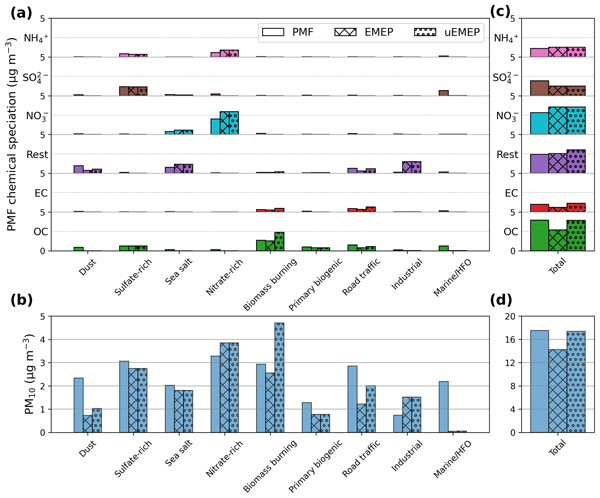
Willem Elias van Caspel, Olivier Favez, Jean-Luc Jaffrezo, Gaëlle Uzu, Kaspar Rudolf Daellenbach, Imad El Haddad, and David Simpson
EGUsphere, https://doi.org/10.5194/egusphere-2025-5547, https://doi.org/10.5194/egusphere-2025-5547, 2026
Short summary
Short summary
Exposure to particulate matter, or aerosols, is the most important environmental risk factor for negative health impacts. Understanding the sources of aerosols is therefore of great importance. This paper compares modelled aerosol source contributions to those from three European observationally derived datasets. Urban-scale modelling is shown to be impactful, although modelling of anthropogenic sources (argued to be the most toxic) remains challenging.
Jasmin Vural, Pierre Vanderbecken, Bertrand Bonan, Oscar Rojas-Munoz, and Jean-Christophe Calvet
EGUsphere, https://doi.org/10.5194/egusphere-2026-838, https://doi.org/10.5194/egusphere-2026-838, 2026
Short summary
Short summary
New satellite observations are used to improve our understanding of agricultural land on a global scale. Innovative artificial intelligence methods are employed to combine the available information. This improvement is evaluated using independent observations and varies depending on the characteristics of instruments and models.
Luce Creman, Stuart K. Grange, Pascal Rubli, Andrea Fischer, Dominik Brunner, Christoph Hueglin, Lukas Emmenegger, and Leonie Bernet
Atmos. Meas. Tech., 19, 1441–1463, https://doi.org/10.5194/amt-19-1441-2026, https://doi.org/10.5194/amt-19-1441-2026, 2026
Short summary
Short summary
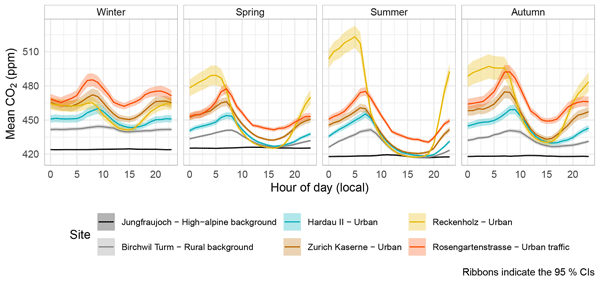
ZiCOS-L is a network of low-cost sensors in Zurich (Switzerland) to monitor carbon dioxide (CO2) concentrations. After correcting for drift and checking the sensor performance, we found that local factors like traffic, public events and vegetation affect CO2 levels. Even though the sensors have higher uncertainties than other sensors, the lower cost allows for a denser network with detailed insights into CO2 levels across the city, helping cities track emissions and support climate action plans.
Pierre Vanderbecken, Jasmin Vural, Oscar Rojas-Munoz, Sébastien Garrigues, Bertrand Bonan, Cédric Bacour, Uwe Rascher, Bastian Siegmann, Patricia de Rosnay, and Jean-Christophe Calvet
EGUsphere, https://doi.org/10.5194/egusphere-2026-941, https://doi.org/10.5194/egusphere-2026-941, 2026
Short summary
Short summary
New satellite observations are used to improve our understanding of regional-scale vegetation. Innovative artificial intelligence methods are employed to combine the available information. The effectiveness of this approach is evaluated using independent observations. The results show that agricultural practices such as irrigation can be modelled more accurately.
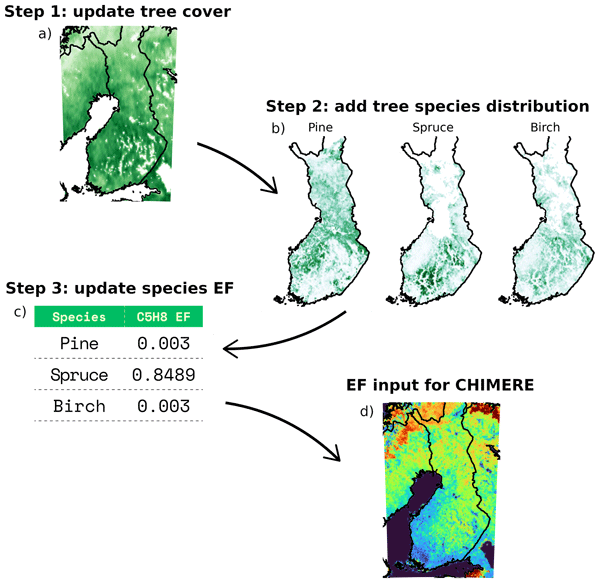
Manuel Bettineschi, Arineh Cholakian, Victoria Sinclair, Katerina Sindelarova, Arnaud Patrick Praplan, Steven Job Thomas, Tuukka Petäjä, Federico Bianchi, and Giancarlo Ciarelli
EGUsphere, https://doi.org/10.5194/egusphere-2026-352, https://doi.org/10.5194/egusphere-2026-352, 2026
Short summary
Short summary
We studied how forests in Finland release natural gases that affect air quality and climate. Existing models strongly overestimated these emissions because they used overly simple forest descriptions. By adding detailed information on tree species, we greatly improved agreement with real measurements. This means more realistic estimates of particle formation in the air. Our results show that accurate forest data are essential for reliable climate and air quality predictions.
Patrick Aigner, Jia Chen, Felix Böhm, Mali Chariot, Lukas Emmenegger, Lars Frölich, Stuart Grange, Daniel Kühbacher, Klaus Kürzinger, Olivier Laurent, Moritz Makowski, Pascal Rubli, Adrian Schmitt, and Adrian Wenzel
Atmos. Meas. Tech., 19, 745–773, https://doi.org/10.5194/amt-19-745-2026, https://doi.org/10.5194/amt-19-745-2026, 2026
Short summary
Short summary
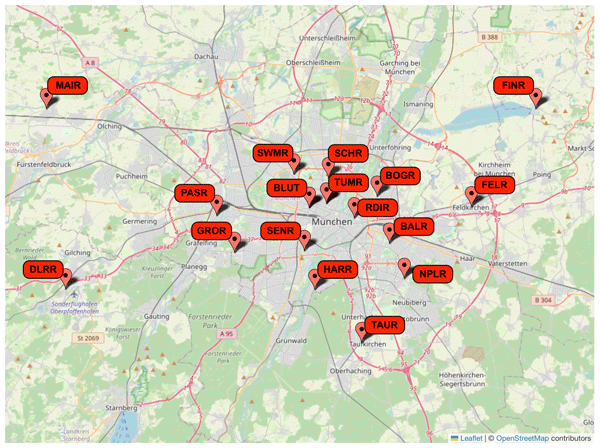
Dense urban CO2 monitoring is challenging due to cost and operational constraints. We developed a mid-cost sensor network for Munich, deployed on 17 rooftops. Temperature-stabilized enclosures and automated 2-point calibration ensured reliable performance, assessed by side-by-side comparison with a Picarro reference. In 1.5 years, the network collected 90 million measurements and resolved urban-rural gradients and seasonal diurnal patterns, capturing spatial CO2 variability at city scale.
Sara Herrero-Anta, Sabine Eckhardt, Nikolaos Evangeliou, Stefania Gilardoni, Sandra Graßl, Dominic Heslin-Rees, Stelios Kazadzis, Natalia Kouremeti, Radovan Krejci, David Mateos, Mauro Mazzola, Christoph Ritter, Roberto Román, Kerstin Stebel, and Tymon Zielinski
Atmos. Chem. Phys., 26, 1435–1457, https://doi.org/10.5194/acp-26-1435-2026, https://doi.org/10.5194/acp-26-1435-2026, 2026
Short summary
Short summary
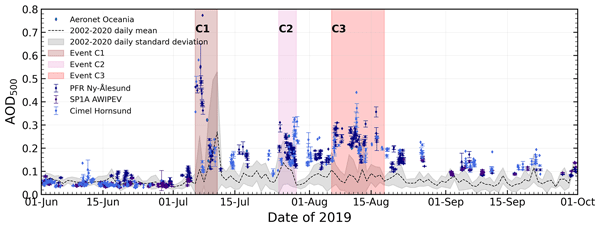
In summer 2019, unusually high aerosol concentrations were measured in the Arctic, extending through the troposphere and stratosphere up to 16 km. Using multiple instruments and models, aerosol particles were linked to wildfires, volcanic eruptions, and anthropogenic pollution. The aerosol consisted of spherical, fine-mode, weakly absorbing particles, which significantly reduced direct solar radiation. This combined approach improves understanding of Arctic aerosol events and climate processes.
Oscar Rojas-Munoz, Constantin Ardilouze, Bertrand Bonan, Diane Tzanos, Darren Ghent, Céline Lamarche, Thomas Nagler, and Jean-Christophe Calvet
EGUsphere, https://doi.org/10.5194/egusphere-2026-65, https://doi.org/10.5194/egusphere-2026-65, 2026
Short summary
Short summary
The impact of land cover representation on snow simulations within the ISBA land surface model in Europe between 2010 and 2022 is assessed. The ECMWF ERA5 atmospheric forcing dataset is used to conduct offline simulations with and without new land cover data. Using the new data reduces the ISBA snow water equivalent bias by around 33 %. These results highlight the importance of accurate land cover data for improving snow representation in land surface models.
Zoé Le Bras, Pascal Rubli, Christoph Hueglin, and Stefan Reimann
Atmos. Chem. Phys., 26, 869–878, https://doi.org/10.5194/acp-26-869-2026, https://doi.org/10.5194/acp-26-869-2026, 2026
Short summary
Short summary
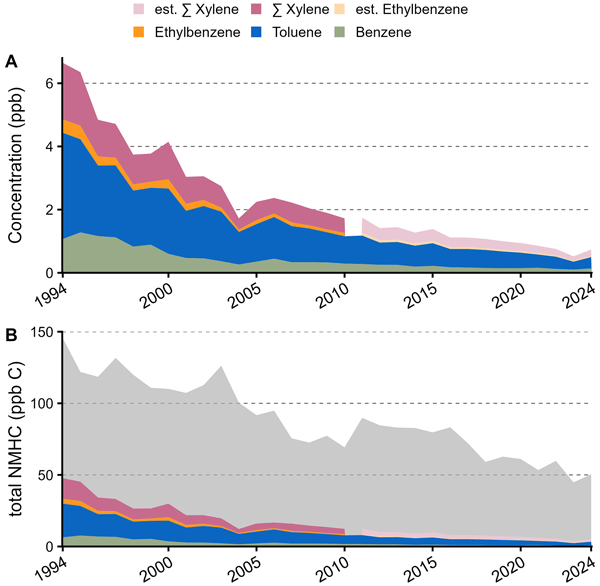
Since 1994, harmful air pollutants called BTEX (benzene, toluene, ethylbenzene and xylene) have declined by up to 89 % in the suburban area of Zurich thanks to the introduction of various air quality directives in Switzerland and in Europe. Although their contribution to ozone formation became less abundant, they still significantly contribute to the formation of airborne particles. While this study shows clear improvements in air quality, it also highlights the need for further efforts.
Song Liu, Xiaopu Lyu, Fumo Yang, Zongbo Shi, Xin Huang, Tengyu Liu, Hongli Wang, Mei Li, Jian Gao, Nan Chen, Guoliang Shi, Yu Zou, Chenglei Pei, Chengxu Tong, Xinyi Liu, Li Zhou, Alex B. Guenther, and Nan Wang
Atmos. Chem. Phys., 26, 635–646, https://doi.org/10.5194/acp-26-635-2026, https://doi.org/10.5194/acp-26-635-2026, 2026
Short summary
Short summary
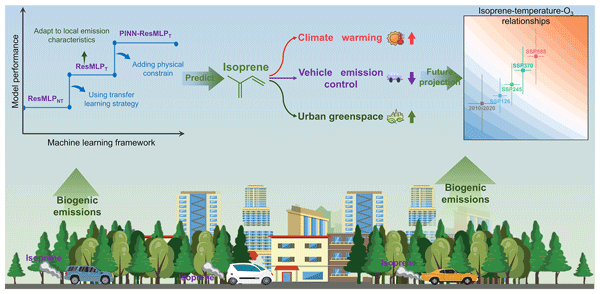
We studied the invisible gas isoprene, which trees and vehicles release into the air and which can worsen urban smog. Using advanced computer learning trained on measurements from many cities, we uncovered how temperature, sunlight, and city greening shape isoprene levels. Comparing Hong Kong and London, we found climate warming boosts isoprene and future ozone pollution, but strong cuts in anthropogenic emission could limit this impact.
Nikolai Ponomarev, Michael Steiner, Erik Koene, Pascal Rubli, Stuart Grange, Lionel Constantin, Michel Ramonet, Leslie David, Arash Hamzehloo, Lukas Emmenegger, and Dominik Brunner
Atmos. Chem. Phys., 26, 547–570, https://doi.org/10.5194/acp-26-547-2026, https://doi.org/10.5194/acp-26-547-2026, 2026
Short summary
Short summary
Urban inversions are gaining increasing attention, as cities are major contributors to anthropogenic emissions, making accurate emission estimates at this scale essential for supporting climate action plans and verifying reported emission reductions. We estimated carbon dioxide emissions in Zurich and Paris over one year by combining atmospheric observations with mesoscale model simulations. Our study shows how factors like city size, terrain, and measurement methods affect emission estimates.
Vy Ngoc Thuy Dinh, Jean-Luc Jaffrezo, Pamela A. Dominutti, Rhabira Elazzouzi, Sophie Darfeuil, Céline Voiron, Anouk Marsal, Stéphane Socquet, Gladys Mary, Julie Cozic, Catherine Coulaud, Marc Durif, Olivier Favez, and Gaëlle Uzu
Atmos. Chem. Phys., 26, 247–268, https://doi.org/10.5194/acp-26-247-2026, https://doi.org/10.5194/acp-26-247-2026, 2026
Short summary
Short summary
Long-term particulate matter (PM) filter sampling at a French urban background and temperature measurements at different altitudes were used to investigate decadal trends of the main PM sources and related oxidative potential metrics. Positive Matrix Factorization analyses were conducted on the corresponding 11-year dataset, which determined ten PM sources. Temporal evolution of these sources is investigated, highlighting a strong downward trend of anthropogenic sources over 11 years.
Wenche Aas, Thérèse Salameh, Robert Wegener, Heidi Hellén, Jean-Luc Jaffrezo, Pontus Roldin, Elisabeth Alonso-Blanco, Andres Alastuey, Crist Amelynck, Jgor Arduini, Benjamin Bergmans, Marie Bertrand, Agnes Borbon, Efstratios Bourtsoukidis, Laetitia Bouvier, David Butterfield, Iris Buxbaum, Darius Ceburnis, Anja Claude, Aurélie Colomb, Sophie Darfeuil, James Dernie, Maximilien Desservettaz, Elías Díaz-Ramiro, Marvin Dufresne, René Dubus, Mario Duval, Marie Dury, Anna Font, Kirsten Fossum, Evelyn Freney, Gotzon Gangoiti, Yao Ge, Maria Carmen Gomez, Francisco J. Gómez-Moreno, Marie Gohy, Valérie Gros, Paul Hamer, Bryan Hellack, Hartmut Herrmann, Robert Holla, Adéla Holubová, Niels Jensen, Tuija Jokinen, Matthew Jones, Uwe Käfer, Lukas Kesper, Dieter Klemp, Dagmar Kubistin, Angela Marinoni, Martina Mazzini, Vy Ngoc Thuy Dinh, Jurgita Ovadnevaite, Tuukka Petäjä, Miguel Portillo-Estrada, Jitka Přívozníková, Jean-Philippe Putaud, Stefan Reimann, Laura Renzi, Veronique Riffault, Stuart Ritchie, Chris Robins, Begoña Artíñano Rodríguez de Torres, Laurent Poulain, Julian Rüdiger, Agnieszka Sanocka, Estibaliz Saez de Camara Oleaga, Niels Schoon, Roger Seco, Ivan Simmons, Leïla Simon, David Simpson, Emmanuel Tison, August Thomasson, Svetlana Tsyro, Marsailidh Twigg, Toni Tykkä, Bert Verreyken, Ana Maria Yáñez-Serrano, Sverre Solberg, Karen Yeung, Ilona Ylivinkka, Karl Espen Yttri, Ågot Watne, and Katie Williams
EGUsphere, https://doi.org/10.5194/egusphere-2025-6166, https://doi.org/10.5194/egusphere-2025-6166, 2025
Short summary
Short summary
A one-week intensive VOC and organic-tracer campaign during the 2022 European heatwave showed contributions from both biogenic and anthropogenic sources to ozone and SOA peaks, while model–observation differences underline the need for better characterization of sources and formation pathways.
Stephan Henne, Florian R. Storck, Henry Wöhrnschimmel, Markus Leuenberger, Martin K. Vollmer, and Stefan Reimann
Atmos. Chem. Phys., 25, 18157–18186, https://doi.org/10.5194/acp-25-18157-2025, https://doi.org/10.5194/acp-25-18157-2025, 2025
Short summary
Short summary
We observed the persistent, man-made trifluoroacetate (TFA) in precipitation and surface waters. Atmospheric simulations attributed TFA to precursor gases in the atmosphere. Although recently increasing concentrations could be followed, gaps in the budget indicate limited understanding of the atmospheric degradation of widely used fluorocarbons. Without additional regulation, environmental TFA concentrations are expected to rise strongly, necessitating continued monitoring and risk assessment.
Luke M. Western, Stephen Bourguet, Molly Crotwell, Lei Hu, Paul B. Krummel, Hélène De Longueville, Alistair J. Manning, Jens Mühle, Dominique Rust, Isaac Vimont, Martin K. Vollmer, Minde An, Jgor Arduini, Andreas Engel, Paul J. Fraser, Anita L. Ganesan, Christina M. Harth, Chris Lunder, Michela Maione, Stephen A. Montzka, David Nance, Simon O'Doherty, Sunyoung Park, Stefan Reimann, Peter K. Salameh, Roland Schmidt, Kieran M. Stanley, Thomas Wagenhäuser, Dickon Young, Matt Rigby, Ronald G. Prinn, and Ray F. Weiss
Atmos. Chem. Phys., 25, 17761–17778, https://doi.org/10.5194/acp-25-17761-2025, https://doi.org/10.5194/acp-25-17761-2025, 2025
Short summary
Short summary
We used atmospheric measurements to estimate emissions of two hydrochlorofluorocarbon (HCFC) gases, called HCFC-123 and HCFC-124, that harm the ozone layer. Despite international regulation to stop their production, their emissions have not fallen. This may be linked to how they are used to make other chemicals. Our findings show that some banned substances are still reaching the atmosphere, likely through leaks during chemical production, which could slow the recovery of the ozone layer.
Luke M. Western, Matthew Rigby, Jens Mühle, Paul B. Krummel, Chris R. Lunder, Simon O'Doherty, Stefan Reimann, Martin K. Vollmer, Dickon Young, Ben Adam, Paul J. Fraser, Anita L. Ganesan, Christina M. Harth, Ove Hermansen, Jooil Kim, Ray L. Langenfelds, Zoë M. Loh, Blagoj Mitrevski, Joseph R. Pitt, Peter K. Salameh, Roland Schmidt, Kieran Stanley, Ann R. Stavert, Hsiang-Jui Wang, Ray F. Weiss, and Ronald G. Prinn
Earth Syst. Sci. Data, 17, 6557–6582, https://doi.org/10.5194/essd-17-6557-2025, https://doi.org/10.5194/essd-17-6557-2025, 2025
Short summary
Short summary
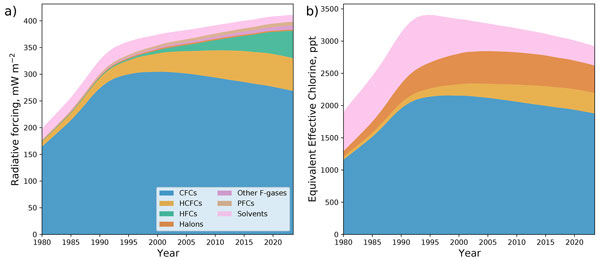
We used global measurements and an atmospheric model to estimate how emissions and abundances of 42 chemically and radiatively important trace gases have changed over time. These gases affect the Earth's radiative balance and the ozone layer. Our data sets help track progress in reducing emissions of these gases to the atmosphere. This work supports international efforts to protect the environment by providing clear, long-term, consistent data on how these gases are changing in the atmosphere.
Maksym Gachkivskyi, Ute Karstens, Bernd Fischer, Dagmar Kubistin, Jennifer Müller-Williams, Matthias Lindauer, and Ingeborg Levin
Earth Syst. Sci. Data, 17, 6173–6197, https://doi.org/10.5194/essd-17-6173-2025, https://doi.org/10.5194/essd-17-6173-2025, 2025
Short summary
Short summary
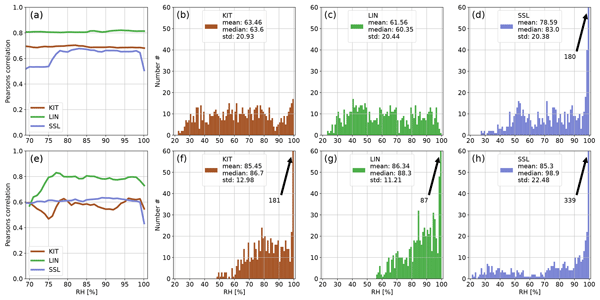
222Radon (Rn) can be used to distinguish marine and continental air masses or to validate transport models. The Heidelberg Radon Monitor (HRM) measures 214polonium (Po), a progeny of Rn. This study presents Po-based Rn activity concentrations measured with the HRM at eight stations in Germany with guidelines for estimating Rn from Po measurements. Comparison between modeled and measured activity concentrations shows that at high relative humidity Po measurements cannot be interpreted as Rn.
Kaisa Rissanen, Juho Aalto, Jaana Bäck, Heidi Hellén, Toni Tykkä, and Alain Paquette
Atmos. Chem. Phys., 25, 15415–15435, https://doi.org/10.5194/acp-25-15415-2025, https://doi.org/10.5194/acp-25-15415-2025, 2025
Short summary
Short summary
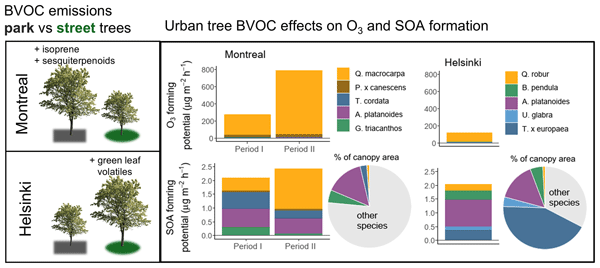
Urban trees emit biogenic volatile organic compounds (BVOC) that affect air quality through the formation of ozone and particulate matter. Trees in Montreal and Helsinki did not emit more BVOCs than expected based on measurements from forest trees, but the emissions varied between individual trees and growth environments. Avoiding high-BVOC emitting tree species and management strategies that protect trees from BVOC-inducing stress factors would help minimise their negative air quality impacts.
Erin F. Katz, Caleb M. Arata, Eva Y. Pfannerstill, Robert J. Weber, Darian Ng, Michael J. Milazzo, Haley Byrne, Hui Wang, Alex B. Guenther, Camilo Rey-Sanchez, Joshua Apte, Dennis D. Baldocchi, and Allen H. Goldstein
Atmos. Chem. Phys., 25, 15281–15299, https://doi.org/10.5194/acp-25-15281-2025, https://doi.org/10.5194/acp-25-15281-2025, 2025
Short summary
Short summary
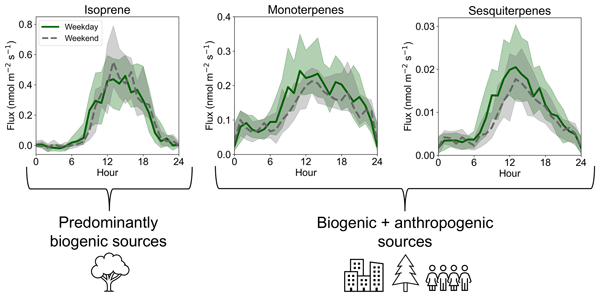
Terpenoids are organic gases that can originate from natural and human-caused sources, and their reactions in the atmosphere can cause air pollution. In this study, emissions of organic gases in an urban environment were measured. For some terpenoids, human-caused sources were responsible for about a quarter of the emissions, while others were predominantly from vegetation. This study contributes to a better understanding of urban emission sources and causes of air pollution.
Dominik Brunner, Ivo Suter, Leonie Bernet, Lionel Constantin, Stuart K. Grange, Pascal Rubli, Junwei Li, Jia Chen, Alessandro Bigi, and Lukas Emmenegger
Atmos. Chem. Phys., 25, 14387–14410, https://doi.org/10.5194/acp-25-14387-2025, https://doi.org/10.5194/acp-25-14387-2025, 2025
Short summary
Short summary
To support the city of Zurich in tracking its path to net-zero greenhouse gas emissions planned to be reached by 2040, a CO2 emission monitoring system was established. The system combines a dense network of CO2 sensors with a high-resolution atmospheric transport model GRAMM/GRAL. This study presents the setup of the model together with its numerous inputs and evaluates its performance in comparison with observations from the CO2 sensor network.
Ann-Kristin Kunz, Lars Borchardt, Andreas Christen, Julian Della Coletta, Markus Eritt, Xochilt Gutiérrez, Josh Hashemi, Rainer Hilland, Armin Jordan, Richard Kneißl, Virgile Legendre, Ingeborg Levin, Susanne Preunkert, Pascal Rubli, Stavros Stagakis, and Samuel Hammer
Atmos. Meas. Tech., 18, 5349–5373, https://doi.org/10.5194/amt-18-5349-2025, https://doi.org/10.5194/amt-18-5349-2025, 2025
Short summary
Short summary
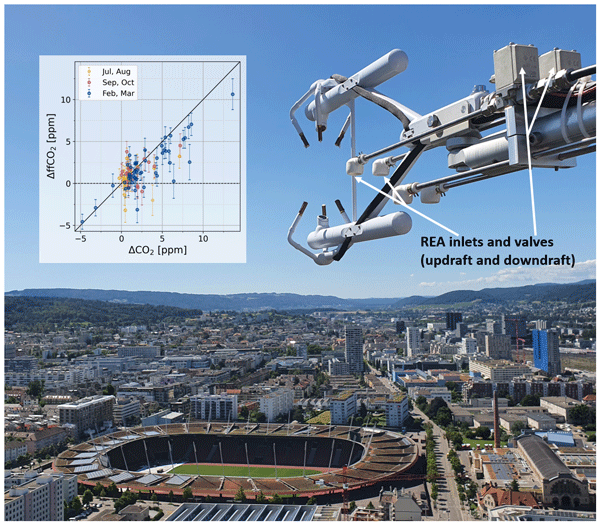
We present, to our knowledge, the first relaxed eddy accumulation system explicitly tailored to a radiocarbon (14C)-based partitioning of fossil and non-fossil urban CO2 fluxes. Laboratory tests and in-depth quality and performance checks prove that the system meets the technical requirements. A pilot application on a tall tower in the city of Zurich, Switzerland, demonstrates the ability to separate fossil and non-fossil CO2 components within the typical precision of 14C measurements.
Augustin Colette, Gaëlle Collin, François Besson, Etienne Blot, Vincent Guidard, Frédérik Meleux, Adrien Royer, Valentin Petiot, Claire Miller, Oihana Fermond, Alizé Jeant, Mario Adani, Joaquim Arteta, Anna Benedictow, Robert Bergström, Dene Bowdalo, Jorgen Brandt, Gino Briganti, Ana C. Carvalho, Jesper Heile Christensen, Florian Couvidat, Ilaria D'Elia, Massimo D'Isidoro, Hugo Denier van der Gon, Gaël Descombes, Enza Di Tomaso, John Douros, Jeronimo Escribano, Henk Eskes, Hilde Fagerli, Yalda Fatahi, Johannes Flemming, Elmar Friese, Lise Frohn, Michael Gauss, Camilla Geels, Guido Guarnieri, Marc Guevara, Antoine Guion, Jonathan Guth, Risto Hänninen, Kaj Hansen, Ulas Im, Ruud Janssen, Marine Jeoffrion, Mathieu Joly, Luke Jones, Oriol Jorba, Evgeni Kadantsev, Michael Kahnert, Jacek W. Kaminski, Rostislav Kouznetsov, Richard Kranenburg, Jeroen Kuenen, Anne Caroline Lange, Joachim Langner, Victor Lannuque, Francesca Macchia, Astrid Manders, Mihaela Mircea, Agnes Nyiri, Miriam Olid, Carlos Pérez García-Pando, Yuliia Palamarchuk, Antonio Piersanti, Blandine Raux, Miha Razinger, Lennard Robertson, Arjo Segers, Martijn Schaap, Pilvi Siljamo, David Simpson, Mikhail Sofiev, Anders Stangel, Joanna Struzewska, Carles Tena, Renske Timmermans, Thanos Tsikerdekis, Svetlana Tsyro, Svyatoslav Tyuryakov, Anthony Ung, Andreas Uppstu, Alvaro Valdebenito, Peter van Velthoven, Lina Vitali, Zhuyun Ye, Vincent-Henri Peuch, and Laurence Rouïl
Geosci. Model Dev., 18, 6835–6883, https://doi.org/10.5194/gmd-18-6835-2025, https://doi.org/10.5194/gmd-18-6835-2025, 2025
Short summary
Short summary
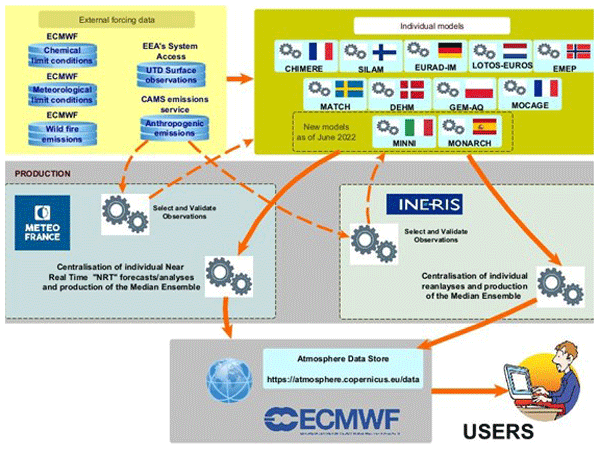
The Copernicus Atmosphere Monitoring Service – Regional Production delivers daily forecasts, analyses, and reanalyses of air quality in Europe. The service relies on a distributed modelling production by 11 leading European modelling teams following stringent requirements with an operational design that has no equivalent in the world. All the products are free, open, and quality-assured and disseminated with a high level of reliability.
Kirstin Gerrand, Elena Fillola, Alistair J. Manning, Jgor Arduini, Paul B. Krummel, Chris R. Lunder, Jens Mühle, Simon O'Doherty, Sunyoung Park, Ronald G. Prinn, Stefan Reimann, Dickon Young, and Matthew Rigby
EGUsphere, https://doi.org/10.5194/egusphere-2025-4137, https://doi.org/10.5194/egusphere-2025-4137, 2025
Short summary
Short summary
To analyse long-term trends in atmospheric trace gas concentrations, it is important to identify data points minimally affected by local pollution sources or air masses carried from other latitudes or altitudes. Traditional methods for detecting these “baselines” are computationally expensive or lack a basis in physical principles. This paper introduces a machine-learning method that uses meteorological data and offers significantly lower computational costs compared to physics-based techniques.
Aurélien Mirebeau, Cécile de Munck, Bertrand Bonan, Christine Delire, Aude Lemonsu, Valéry Masson, and Stephan Weber
Geosci. Model Dev., 18, 5329–5349, https://doi.org/10.5194/gmd-18-5329-2025, https://doi.org/10.5194/gmd-18-5329-2025, 2025
Short summary
Short summary
The greening of cities is recommended to limit the effects of climate change. In particular, green roofs can provide numerous environmental benefits, such as urban cooling, water retention, and carbon sequestration. The aim of this research is to develop a new module for calculating green roof CO2 fluxes within a model that can already simulate hydrological and thermal processes of such roofs. The calibration and evaluation of this module take advantage of long-term experimental data.
Per Erik Karlsson, Patrick Büker, Sam Bland, David Simpson, Katrina Sharps, Felicity Hayes, and Lisa D. Emberson
Biogeosciences, 22, 3563–3582, https://doi.org/10.5194/bg-22-3563-2025, https://doi.org/10.5194/bg-22-3563-2025, 2025
Short summary
Short summary
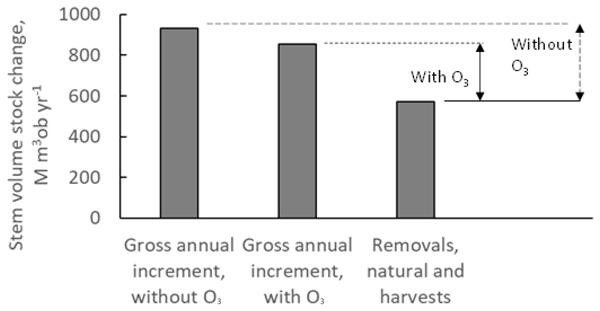
Stomatal ozone uptake and the negative impacts on forest growth rates were estimated for European forests. This was translated to annual increments in the forest living biomass carbon stocks, with and without ozone exposure. In the absence of O3 exposure, on average, European forest growth rates would increase by 9%, but the sequestration to the living-biomass carbon stocks would increase by 31% since the sequestration depends on the difference between growth and harvest rates.
Olga B. Popovicheva, Marina A. Chichaeva, Nikolaos Evangeliou, Sabine Eckhardt, Evangelia Diapouli, and Nikolay S. Kasimov
Atmos. Chem. Phys., 25, 7719–7739, https://doi.org/10.5194/acp-25-7719-2025, https://doi.org/10.5194/acp-25-7719-2025, 2025
Short summary
Short summary
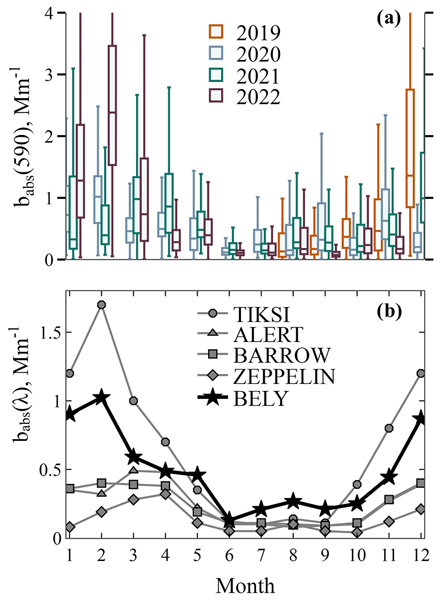
High-quality measurements of light-absorbing carbon were performed at the polar aerosol station "Island Bely” (Western Siberian Arctic) from 2019 to 2022. The maximum light absorption coefficients were seen in summer due to gas flaring, which is the most significant source in the region. However, the increasing Siberian wildfires had a special share in carbon contribution at this high Arctic station, with a persistent smoke layer extending over the whole troposphere in summer.
Sophie Barthelemy, Bertrand Bonan, Miquel Tomas-Burguera, Gilles Grandjean, Séverine Bernardie, Jean-Philippe Naulin, Patrick Le Moigne, Aaron Boone, and Jean-Christophe Calvet
Hydrol. Earth Syst. Sci., 29, 2321–2337, https://doi.org/10.5194/hess-29-2321-2025, https://doi.org/10.5194/hess-29-2321-2025, 2025
Short summary
Short summary
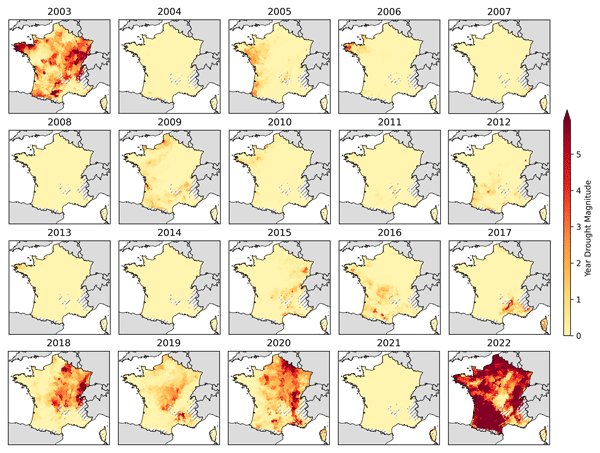
A drought index is developed that quantifies drought on an annual scale, making it applicable to monitoring clay shrinkage damage to buildings. A comparison with the number of insurance claims for subsidence shows that the presence of trees near individual houses must be taken into account. Significant soil moisture droughts occurred in France in 2003, 2018, 2019, 2020, and 2022. Particularly high index values are observed in 2022. It is found that droughts will become more severe in the future.
Kimmo Teinilä, Sanna Saarikoski, Henna Lintusaari, Teemu Lepistö, Petteri Marjanen, Minna Aurela, Heidi Hellén, Toni Tykkä, Markus Lampimäki, Janne Lampilahti, Luis Barreira, Timo Mäkelä, Leena Kangas, Juha Hatakka, Sami Harni, Joel Kuula, Jarkko V. Niemi, Harri Portin, Jaakko Yli-Ojanperä, Ville Niemelä, Milja Jäppi, Katrianne Lehtipalo, Joonas Vanhanen, Liisa Pirjola, Hanna E. Manninen, Tuukka Petäjä, Topi Rönkkö, and Hilkka Timonen
Atmos. Chem. Phys., 25, 4907–4928, https://doi.org/10.5194/acp-25-4907-2025, https://doi.org/10.5194/acp-25-4907-2025, 2025
Short summary
Short summary
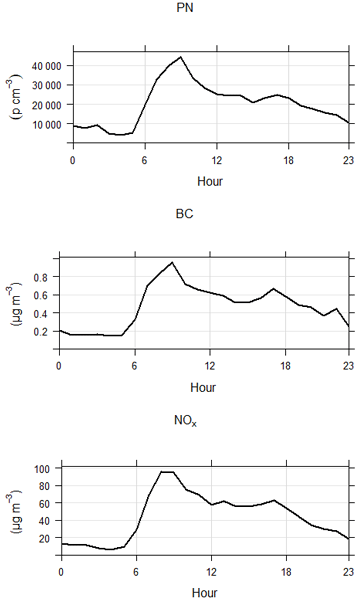
Physical and chemical properties of particulate matter and concentrations of trace gases were measured in a street canyon in Helsinki, Finland, and an urban background site in January–February 2022 to investigate the effect of wintertime conditions on pollutants. State-of-the-art instruments and a mobile laboratory were used, and the measurement data were analysed further with modelling tools like positive matrix factorization and the Pollution Detection Algorithm.
Nikolaos Evangeliou, Ondřej Tichý, Marit Svendby Otervik, Sabine Eckhardt, Yves Balkanski, and Didier A. Hauglustaine
Aerosol Research, 3, 155–174, https://doi.org/10.5194/ar-3-155-2025, https://doi.org/10.5194/ar-3-155-2025, 2025
Short summary
Short summary
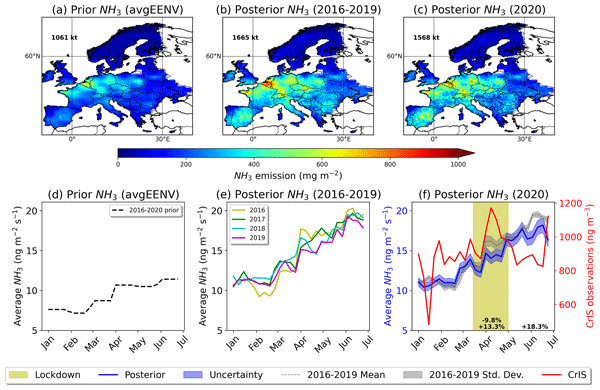
The COVID-19 lockdown measures in 2020 reduced emissions of various substances, improving air quality. However, PM2.5 stayed unchanged due to NH3 and related chemical transformations. Higher humidity favoured more SO42- production, as did the accumulated NH3. Excess NH3 reacted with HNO3 to make NO3-. In high-NH3 conditions such as those in 2020, a small reduction in NOx levels drove faster oxidation of NO3- and slower deposition of total inorganic NO3-, causing high secondary PM2.5.
Beata Opacka, Trissevgeni Stavrakou, Jean-François Müller, Isabelle De Smedt, Jos van Geffen, Eloise A. Marais, Rebekah P. Horner, Dylan B. Millet, Kelly C. Wells, and Alex B. Guenther
Atmos. Chem. Phys., 25, 2863–2894, https://doi.org/10.5194/acp-25-2863-2025, https://doi.org/10.5194/acp-25-2863-2025, 2025
Short summary
Short summary
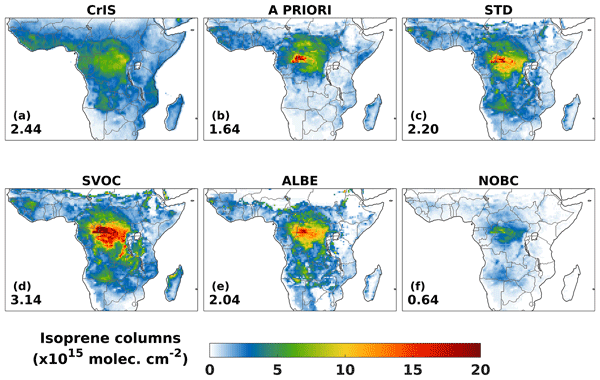
Vegetation releases biogenic volatile organic compounds, while soils and lightning contribute to the natural emissions of nitrogen oxides into the atmosphere. These gases interact in complex ways. Using satellite data and models, we developed a new method to simultaneously optimize these natural emissions over Africa in 2019. Our approach resulted in an increase in natural emissions, supported by independent data indicating that current estimates are underestimated.
Stuart K. Grange, Pascal Rubli, Andrea Fischer, Dominik Brunner, Christoph Hueglin, and Lukas Emmenegger
Atmos. Chem. Phys., 25, 2781–2806, https://doi.org/10.5194/acp-25-2781-2025, https://doi.org/10.5194/acp-25-2781-2025, 2025
Short summary
Short summary
Carbon dioxide (CO2) is a very important atmospheric pollutant, and to better understand the gas's source and sink dynamics, a mid-cost sensor network hosting 26 sites was deployed in and around Zurich, Switzerland. The sensor measurement performance was quantified, and natural and anthropogenic CO2 emission sources were explored with a focus on what drives high CO2 levels. The observations will be used further by others to validate what is thought to be known about CO2 emissions in the region.
Min Huang, Gregory R. Carmichael, Kevin W. Bowman, Isabelle De Smedt, Andreas Colliander, Michael H. Cosh, Sujay V. Kumar, Alex B. Guenther, Scott J. Janz, Ryan M. Stauffer, Anne M. Thompson, Niko M. Fedkin, Robert J. Swap, John D. Bolten, and Alicia T. Joseph
Atmos. Chem. Phys., 25, 1449–1476, https://doi.org/10.5194/acp-25-1449-2025, https://doi.org/10.5194/acp-25-1449-2025, 2025
Short summary
Short summary
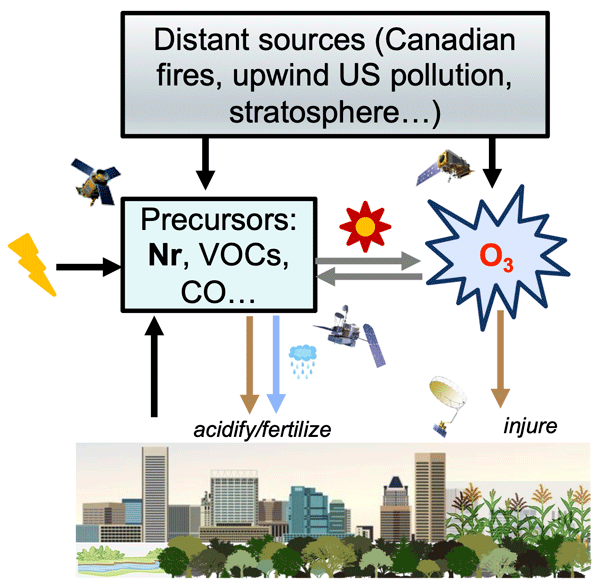
We use model simulations along with multiplatform, multidisciplinary observations and a range of analysis methods to estimate and understand the distributions, temporal changes, and impacts of reactive nitrogen and ozone over the most populous US region that has undergone significant environmental changes. Deposition, biogenic emissions, and extra-regional sources have been playing increasingly important roles in controlling pollutant budgets in this area as local anthropogenic emissions drop.
Michel Legrand, Mstislav Vorobyev, Daria Bokuchava, Stanislav Kutuzov, Andreas Plach, Andreas Stohl, Alexandra Khairedinova, Vladimir Mikhalenko, Maria Vinogradova, Sabine Eckhardt, and Susanne Preunkert
Atmos. Chem. Phys., 25, 1385–1399, https://doi.org/10.5194/acp-25-1385-2025, https://doi.org/10.5194/acp-25-1385-2025, 2025
Short summary
Short summary
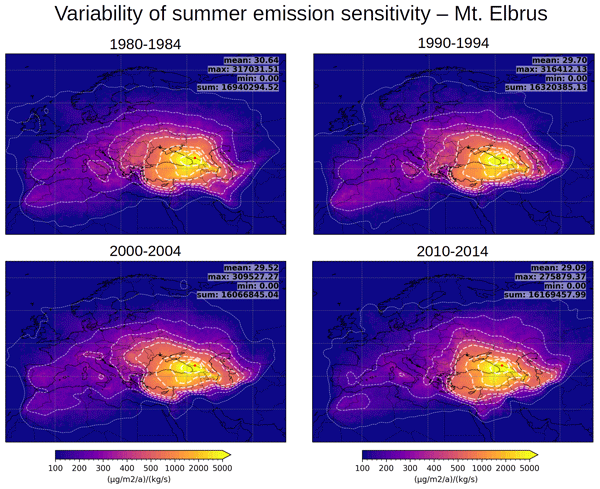
Past atmospheric NH3 pollution in south-eastern Europe was reconstructed by analysing ammonium in an ice core drilled at the Mount Elbrus (Caucasus, Russia). The observed 3.5-fold increase in ice concentrations between 1750 and 1990 CE is in good agreement with estimated past dominant ammonia emissions from agriculture, mainly from south European Russia and Türkiye. In contrast to present-day conditions, the ammonium level observed in 1750 CE indicates significant natural emissions at that time.
Adam E. Thomas, Hayley S. Glicker, Alex B. Guenther, Roger Seco, Oscar Vega Bustillos, Julio Tota, Rodrigo A. F. Souza, and James N. Smith
Atmos. Chem. Phys., 25, 959–977, https://doi.org/10.5194/acp-25-959-2025, https://doi.org/10.5194/acp-25-959-2025, 2025
Short summary
Short summary
We present measurements of the organic composition of ultrafine particles collected from the eastern Amazon, an understudied region that is subjected to increasing human influence. We find that while isoprene chemistry is likely significant for ultrafine-particle growth throughout the year, compounds related to other sources, such as biological-spore emissions and biomass burning, exhibit striking seasonal differences, implying extensive variation in regional ultrafine-particle sources.
Maitane Iturrate-Garcia, Thérèse Salameh, Paul Schlauri, Annarita Baldan, Martin K. Vollmer, Evdokia Stratigou, Sebastien Dusanter, Jianrong Li, Stefan Persijn, Anja Claude, Rupert Holzinger, Christophe Sutour, Tatiana Macé, Yasin Elshorbany, Andreas Ackermann, Céline Pascale, and Stefan Reimann
Atmos. Meas. Tech., 18, 371–403, https://doi.org/10.5194/amt-18-371-2025, https://doi.org/10.5194/amt-18-371-2025, 2025
Short summary
Short summary
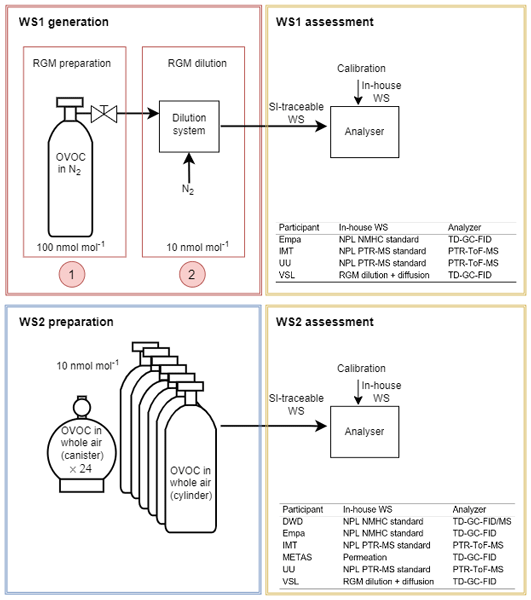
Accurate and comparable measurements of oxygenated organic compounds (OVOCs) are crucial in assessing tropospheric ozone burdens and trends. However, the monitoring of many OVOCs remains challenging because of their low atmospheric abundance and lack of stable and traceable calibration standards. This paper describes the calibration standards developed for OVOCs at a low amount of substance fractions (<100 nmol mol-1) to transfer traceability of the International System of Units to the field.
Xiansheng Liu, Xun Zhang, Marvin Dufresne, Tao Wang, Lijie Wu, Rosa Lara, Roger Seco, Marta Monge, Ana Maria Yáñez-Serrano, Marie Gohy, Paul Petit, Audrey Chevalier, Marie-Pierre Vagnot, Yann Fortier, Alexia Baudic, Véronique Ghersi, Grégory Gille, Ludovic Lanzi, Valérie Gros, Leïla Simon, Heidi Héllen, Stefan Reimann, Zoé Le Bras, Michelle Jessy Müller, David Beddows, Siqi Hou, Zongbo Shi, Roy M. Harrison, William Bloss, James Dernie, Stéphane Sauvage, Philip K. Hopke, Xiaoli Duan, Taicheng An, Alastair C. Lewis, James R. Hopkins, Eleni Liakakou, Nikolaos Mihalopoulos, Xiaohu Zhang, Andrés Alastuey, Xavier Querol, and Thérèse Salameh
Atmos. Chem. Phys., 25, 625–638, https://doi.org/10.5194/acp-25-625-2025, https://doi.org/10.5194/acp-25-625-2025, 2025
Short summary
Short summary
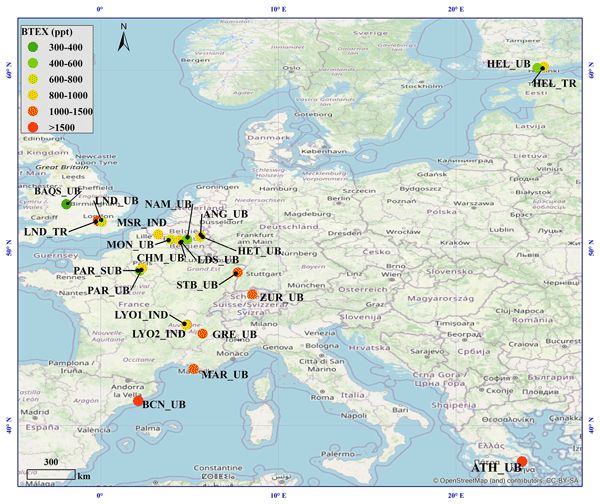
This study examines BTEX (benzene, toluene, ethylbenzene, xylenes) pollution in urban areas across seven European countries. Analyzing data from 22 monitoring sites, we found traffic and industrial activities significantly impact BTEX levels, with peaks during rush hours. The risk from BTEX exposure remains moderate, especially in high-traffic and industrial zones, highlighting the need for targeted air quality management to protect public health and improve urban air quality.
Thibaut Lebourgeois, Bastien Sauvage, Pawel Wolff, Béatrice Josse, Virginie Marécal, Yasmine Bennouna, Romain Blot, Damien Boulanger, Hannah Clark, Jean-Marc Cousin, Philippe Nedelec, and Valérie Thouret
Atmos. Chem. Phys., 24, 13975–14004, https://doi.org/10.5194/acp-24-13975-2024, https://doi.org/10.5194/acp-24-13975-2024, 2024
Short summary
Short summary
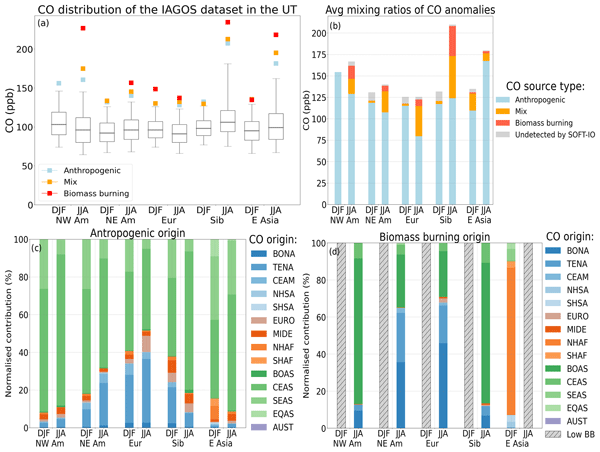
Our study examines intense-carbon-monoxide (CO) pollution events measured by commercial aircraft from the In-service Aircraft for a Global Observing System (IAGOS) research infrastructure. We combine these measurements with the SOFT-IO model to trace the origin of the observed CO. A comprehensive analysis of the geographical origin, source type, seasonal variation, and ozone levels of these pollution events is provided.
Fang Li, Xiang Song, Sandy P. Harrison, Jennifer R. Marlon, Zhongda Lin, L. Ruby Leung, Jörg Schwinger, Virginie Marécal, Shiyu Wang, Daniel S. Ward, Xiao Dong, Hanna Lee, Lars Nieradzik, Sam S. Rabin, and Roland Séférian
Geosci. Model Dev., 17, 8751–8771, https://doi.org/10.5194/gmd-17-8751-2024, https://doi.org/10.5194/gmd-17-8751-2024, 2024
Short summary
Short summary
This study provides the first comprehensive assessment of historical fire simulations from 19 Earth system models in phase 6 of the Coupled Model Intercomparison Project (CMIP6). Most models reproduce global totals, spatial patterns, seasonality, and regional historical changes well but fail to simulate the recent decline in global burned area and underestimate the fire response to climate variability. CMIP6 simulations address three critical issues of phase-5 models.
Lucie Bakels, Daria Tatsii, Anne Tipka, Rona Thompson, Marina Dütsch, Michael Blaschek, Petra Seibert, Katharina Baier, Silvia Bucci, Massimo Cassiani, Sabine Eckhardt, Christine Groot Zwaaftink, Stephan Henne, Pirmin Kaufmann, Vincent Lechner, Christian Maurer, Marie D. Mulder, Ignacio Pisso, Andreas Plach, Rakesh Subramanian, Martin Vojta, and Andreas Stohl
Geosci. Model Dev., 17, 7595–7627, https://doi.org/10.5194/gmd-17-7595-2024, https://doi.org/10.5194/gmd-17-7595-2024, 2024
Short summary
Short summary
Computer models are essential for improving our understanding of how gases and particles move in the atmosphere. We present an update of the atmospheric transport model FLEXPART. FLEXPART 11 is more accurate due to a reduced number of interpolations and a new scheme for wet deposition. It can simulate non-spherical aerosols and includes linear chemical reactions. It is parallelised using OpenMP and includes new user options. A new user manual details how to use FLEXPART 11.
Jieying Ding, Ronald van der A, Henk Eskes, Enrico Dammers, Mark Shephard, Roy Wichink Kruit, Marc Guevara, and Leonor Tarrason
Atmos. Chem. Phys., 24, 10583–10599, https://doi.org/10.5194/acp-24-10583-2024, https://doi.org/10.5194/acp-24-10583-2024, 2024
Short summary
Short summary
Here we applied the existing Daily Emissions Constrained by Satellite Observations (DECSO) inversion algorithm to NH3 observations from the CrIS satellite instrument to estimate NH3 emissions. As NH3 in the atmosphere is influenced by NOx, we implemented DECSO to estimate NOx and NH3 emissions simultaneously. The emissions are derived over Europe for 2020 at a spatial resolution of 0.2° using daily observations from CrIS and TROPOMI. Results are compared to bottom-up emission inventories.
Yao Ge, Sverre Solberg, Mathew R. Heal, Stefan Reimann, Willem van Caspel, Bryan Hellack, Thérèse Salameh, and David Simpson
Atmos. Chem. Phys., 24, 7699–7729, https://doi.org/10.5194/acp-24-7699-2024, https://doi.org/10.5194/acp-24-7699-2024, 2024
Short summary
Short summary
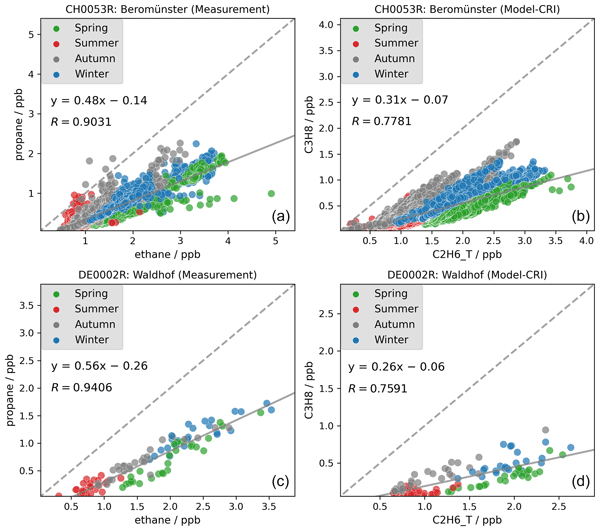
Atmospheric volatile organic compounds (VOCs) constitute many species, acting as precursors to ozone and aerosol. Given the uncertainties in VOC emissions, lack of evaluation studies, and recent changes in emissions, this work adapts the EMEP MSC-W to evaluate emission inventories in Europe. We focus on the varying agreement between modelled and measured VOCs across different species and underscore potential inaccuracies in total and sector-specific emission estimates.
En Liu, Yonghua Zhu, Jean-Christophe Calvet, Haishen Lü, Bertrand Bonan, Jingyao Zheng, Qiqi Gou, Xiaoyi Wang, Zhenzhou Ding, Haiting Xu, Ying Pan, and Tingxing Chen
Hydrol. Earth Syst. Sci., 28, 2375–2400, https://doi.org/10.5194/hess-28-2375-2024, https://doi.org/10.5194/hess-28-2375-2024, 2024
Short summary
Short summary
Overestimated root zone soil moisture (RZSM) based on land surface models (LSMs) is attributed to overestimated precipitation and an underestimated ratio of transpiration to total evapotranspiration and performs better in the wet season. Underestimated SMOS L3 surface SM triggers the underestimated SMOS L4 RZSM, which performs better in the dry season due to the attenuated radiation in the wet season. LSMs should reduce and increase the frequency of wet and dry soil moisture, respectively.
Safae Oumami, Joaquim Arteta, Vincent Guidard, Pierre Tulet, and Paul David Hamer
Geosci. Model Dev., 17, 3385–3408, https://doi.org/10.5194/gmd-17-3385-2024, https://doi.org/10.5194/gmd-17-3385-2024, 2024
Short summary
Short summary
In this paper, we coupled the SURFEX and MEGAN models. The aim of this coupling is to improve the estimation of biogenic fluxes by using the SURFEX canopy environment model. The coupled model results were validated and several sensitivity tests were performed. The coupled-model total annual isoprene flux is 442 Tg; this value is within the range of other isoprene estimates reported. The ultimate aim of this coupling is to predict the impact of climate change on biogenic emissions.
Heidi Hellén, Rostislav Kouznetsov, Kaisa Kraft, Jukka Seppälä, Mika Vestenius, Jukka-Pekka Jalkanen, Lauri Laakso, and Hannele Hakola
Atmos. Chem. Phys., 24, 4717–4731, https://doi.org/10.5194/acp-24-4717-2024, https://doi.org/10.5194/acp-24-4717-2024, 2024
Short summary
Short summary
Mixing ratios of C2-C5 NMHCs and methanethiol were measured on an island in the Baltic Sea using an in situ gas chromatograph. Shipping emissions were found to be an important source of ethene, ethyne, propene, and benzene. High summertime mixing ratios of methanethiol and dependence of mixing ratios on seawater temperature and height indicated the biogenic origin to possibly be phytoplankton or macroalgae. These emissions may have a strong impact on SO2 production and new particle formation.
Qian Li, Maor Gabay, Chen Dayan, Pawel Misztal, Alex Guenther, Erick Fredj, and Eran Tas
EGUsphere, https://doi.org/10.5194/egusphere-2024-717, https://doi.org/10.5194/egusphere-2024-717, 2024
Preprint archived
Short summary
Short summary
Biogenic volatile organic compounds (BVOCs) affect the climate and air quality, while their emission from terrestrial vegetation is affected by drought in a way that is not well characterized. Our study reveals that the instantaneous intraday changes in meteorological conditions serve as a better proxy for drought-related variations in BVOCs emission rate than the absolute values of the meteorological parameters, advancing our understanding of BVOCs emission effects under climate change.
Sophie Barthelemy, Bertrand Bonan, Jean-Christophe Calvet, Gilles Grandjean, David Moncoulon, Dorothée Kapsambelis, and Séverine Bernardie
Nat. Hazards Earth Syst. Sci., 24, 999–1016, https://doi.org/10.5194/nhess-24-999-2024, https://doi.org/10.5194/nhess-24-999-2024, 2024
Short summary
Short summary
This work presents a drought index specifically adapted to subsidence, a seasonal phenomenon of soil shrinkage that occurs frequently in France and damages buildings. The index is computed from land surface model simulations and evaluated by a rank correlation test with insurance data. With its optimal configuration, the index is able to identify years of both zero and significant loss.
Yang Liu, Raluca Ciuraru, Letizia Abis, Crist Amelynck, Pauline Buysse, Alex Guenther, Bernard Heinesch, Florence Lafouge, Florent Levavasseur, Benjamin Loubet, Auriane Voyard, and Raia-Silvia Massad
EGUsphere, https://doi.org/10.5194/egusphere-2024-530, https://doi.org/10.5194/egusphere-2024-530, 2024
Preprint archived
Short summary
Short summary
This paper reviews the emission and emission processes of biogenic volatile organic compounds (BVOCs) from various crops and soil under different management practices, highlighting challenges in modeling the emissions and proposing a conceptual model for estimation. The aim of this paper is to present agricultural BVOC data and related mechanistic processes to enhance model accuracy and reduce uncertainties in estimating BVOC emissions from agriculture.
Karl Espen Yttri, Are Bäcklund, Franz Conen, Sabine Eckhardt, Nikolaos Evangeliou, Markus Fiebig, Anne Kasper-Giebl, Avram Gold, Hans Gundersen, Cathrine Lund Myhre, Stephen Matthew Platt, David Simpson, Jason D. Surratt, Sönke Szidat, Martin Rauber, Kjetil Tørseth, Martin Album Ytre-Eide, Zhenfa Zhang, and Wenche Aas
Atmos. Chem. Phys., 24, 2731–2758, https://doi.org/10.5194/acp-24-2731-2024, https://doi.org/10.5194/acp-24-2731-2024, 2024
Short summary
Short summary
We discuss carbonaceous aerosol (CA) observed at the high Arctic Zeppelin Observatory (2017 to 2020). We find that organic aerosol is a significant fraction of the Arctic aerosol, though less than sea salt aerosol and mineral dust, as well as non-sea-salt sulfate, originating mainly from anthropogenic sources in winter and from natural sources in summer, emphasizing the importance of wildfires for biogenic secondary organic aerosol and primary biological aerosol particles observed in the Arctic.
Jean-François Müller, Trissevgeni Stavrakou, Glenn-Michael Oomen, Beata Opacka, Isabelle De Smedt, Alex Guenther, Corinne Vigouroux, Bavo Langerock, Carlos Augusto Bauer Aquino, Michel Grutter, James Hannigan, Frank Hase, Rigel Kivi, Erik Lutsch, Emmanuel Mahieu, Maria Makarova, Jean-Marc Metzger, Isamu Morino, Isao Murata, Tomoo Nagahama, Justus Notholt, Ivan Ortega, Mathias Palm, Amelie Röhling, Wolfgang Stremme, Kimberly Strong, Ralf Sussmann, Yao Té, and Alan Fried
Atmos. Chem. Phys., 24, 2207–2237, https://doi.org/10.5194/acp-24-2207-2024, https://doi.org/10.5194/acp-24-2207-2024, 2024
Short summary
Short summary
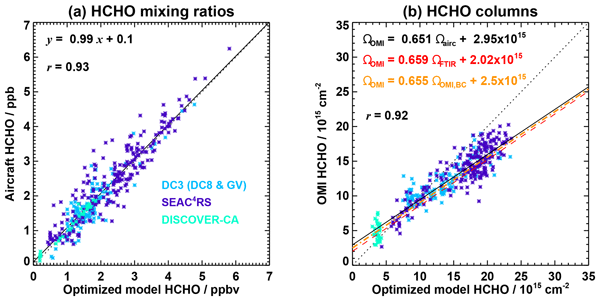
Formaldehyde observations from satellites can be used to constrain the emissions of volatile organic compounds, but those observations have biases. Using an atmospheric model, aircraft and ground-based remote sensing data, we quantify these biases, propose a correction to the data, and assess the consequence of this correction for the evaluation of emissions.
Rona L. Thompson, Stephen A. Montzka, Martin K. Vollmer, Jgor Arduini, Molly Crotwell, Paul B. Krummel, Chris Lunder, Jens Mühle, Simon O'Doherty, Ronald G. Prinn, Stefan Reimann, Isaac Vimont, Hsiang Wang, Ray F. Weiss, and Dickon Young
Atmos. Chem. Phys., 24, 1415–1427, https://doi.org/10.5194/acp-24-1415-2024, https://doi.org/10.5194/acp-24-1415-2024, 2024
Short summary
Short summary
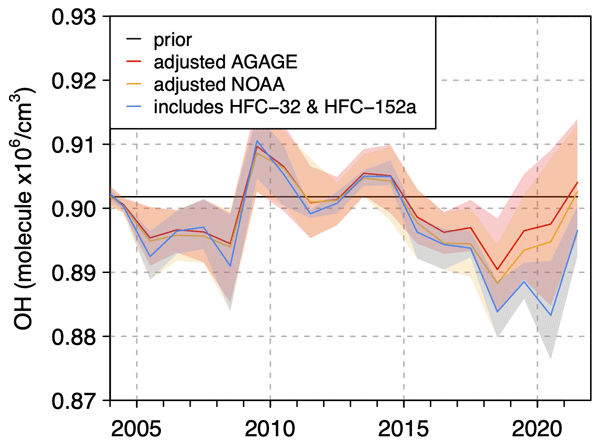
The hydroxyl radical determines the atmospheric lifetimes of numerous species including methane. Since OH is very short-lived, it is not possible to directly measure its concentration on scales relevant for understanding its effect on other species. Here, OH is inferred by looking at changes in hydrofluorocarbons (HFCs). We find that OH levels have been fairly stable over our study period (2004 to 2021), suggesting that OH is not the main driver of the recent increase in atmospheric methane.
Heidi Hellén, Toni Tykkä, Simon Schallhart, Evdokia Stratigou, Thérèse Salameh, and Maitane Iturrate-Garcia
Atmos. Meas. Tech., 17, 315–333, https://doi.org/10.5194/amt-17-315-2024, https://doi.org/10.5194/amt-17-315-2024, 2024
Short summary
Short summary
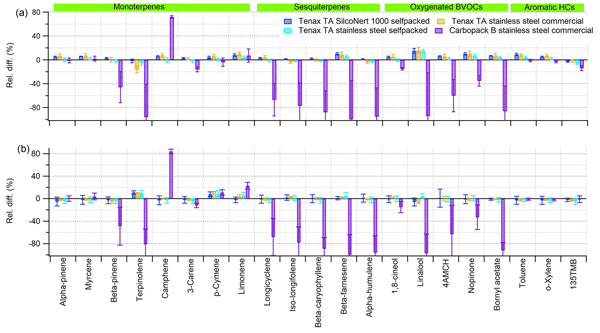
Even though online measurements of biogenic volatile organic compounds (BVOCs) are becoming more common, the use of sorbent tubes is expected to continue because they offer greater spatial coverage and no infrastructure is required for sampling. In this study the sorbent tube sampling method was optimized and evaluated for the determination of BVOCs in gas-phase samples. Tenax TA sorbent tubes were found to be suitable for the quantitative measurements of C10–C15 BVOCs.
Davide Putero, Paolo Cristofanelli, Kai-Lan Chang, Gaëlle Dufour, Gregory Beachley, Cédric Couret, Peter Effertz, Daniel A. Jaffe, Dagmar Kubistin, Jason Lynch, Irina Petropavlovskikh, Melissa Puchalski, Timothy Sharac, Barkley C. Sive, Martin Steinbacher, Carlos Torres, and Owen R. Cooper
Atmos. Chem. Phys., 23, 15693–15709, https://doi.org/10.5194/acp-23-15693-2023, https://doi.org/10.5194/acp-23-15693-2023, 2023
Short summary
Short summary
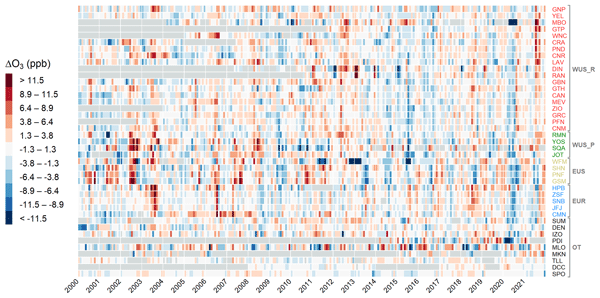
We investigated the impact of societal restriction measures during the COVID-19 pandemic on surface ozone at 41 high-elevation sites worldwide. Negative ozone anomalies were observed for spring and summer 2020 for all of the regions considered. In 2021, negative anomalies continued for Europe and partially for the eastern US, while western US sites showed positive anomalies due to wildfires. IASI satellite data and the Carbon Monitor supported emission reductions as a cause of the anomalies.
Willem E. van Caspel, David Simpson, Jan Eiof Jonson, Anna M. K. Benedictow, Yao Ge, Alcide di Sarra, Giandomenico Pace, Massimo Vieno, Hannah L. Walker, and Mathew R. Heal
Geosci. Model Dev., 16, 7433–7459, https://doi.org/10.5194/gmd-16-7433-2023, https://doi.org/10.5194/gmd-16-7433-2023, 2023
Short summary
Short summary
Radiation coming from the sun is essential to atmospheric chemistry, driving the breakup, or photodissociation, of atmospheric molecules. This in turn affects the chemical composition and reactivity of the atmosphere. The representation of photodissociation effects is therefore essential in atmospheric chemistry modeling. One such model is the EMEP MSC-W model, for which a new way of calculating the photodissociation rates is tested and evaluated in this paper.
Ondřej Tichý, Sabine Eckhardt, Yves Balkanski, Didier Hauglustaine, and Nikolaos Evangeliou
Atmos. Chem. Phys., 23, 15235–15252, https://doi.org/10.5194/acp-23-15235-2023, https://doi.org/10.5194/acp-23-15235-2023, 2023
Short summary
Short summary
We show declining trends in NH3 emissions over Europe for 2013–2020 using advanced dispersion and inverse modelling and satellite measurements from CrIS. Emissions decreased by −26% since 2013, showing that the abatement strategies adopted by the European Union have been very efficient. Ammonia emissions are low in winter and peak in summer due to temperature-dependent soil volatilization. The largest decreases were observed in central and western Europe in countries with high emissions.
Paolo Cristofanelli, Cosimo Fratticioli, Lynn Hazan, Mali Chariot, Cedric Couret, Orestis Gazetas, Dagmar Kubistin, Antti Laitinen, Ari Leskinen, Tuomas Laurila, Matthias Lindauer, Giovanni Manca, Michel Ramonet, Pamela Trisolino, and Martin Steinbacher
Atmos. Meas. Tech., 16, 5977–5994, https://doi.org/10.5194/amt-16-5977-2023, https://doi.org/10.5194/amt-16-5977-2023, 2023
Short summary
Short summary
We investigated the application of two automatic methods for detecting spikes due to local emissions in greenhouse gas (GHG) observations at a subset of sites from the ICOS Atmosphere network. We analysed the sensitivity to the spike frequency of using different methods and settings. We documented the impact of the de-spiking on different temporal aggregations (i.e. hourly, monthly and seasonal averages) of CO2, CH4 and CO 1 min time series.
Steven Job Thomas, Toni Tykkä, Heidi Hellén, Federico Bianchi, and Arnaud P. Praplan
Atmos. Chem. Phys., 23, 14627–14642, https://doi.org/10.5194/acp-23-14627-2023, https://doi.org/10.5194/acp-23-14627-2023, 2023
Short summary
Short summary
The study employed total ozone reactivity to demonstrate how emissions of Norway spruce readily react with ozone and could be a major ozone sink, particularly under stress. Additionally, this approach provided insight into the limitations of current analytical techniques that measure the compounds present or emitted into the atmosphere. The study shows how the technique used was not enough to measure all compounds emitted, and this could potentially underestimate various atmospheric processes.
Ioannis Katharopoulos, Dominique Rust, Martin K. Vollmer, Dominik Brunner, Stefan Reimann, Simon J. O'Doherty, Dickon Young, Kieran M. Stanley, Tanja Schuck, Jgor Arduini, Lukas Emmenegger, and Stephan Henne
Atmos. Chem. Phys., 23, 14159–14186, https://doi.org/10.5194/acp-23-14159-2023, https://doi.org/10.5194/acp-23-14159-2023, 2023
Short summary
Short summary
The effectiveness of climate change mitigation needs to be scrutinized by monitoring greenhouse gas (GHG) emissions. Countries report their emissions to the UN in a bottom-up manner. By combining atmospheric observations and transport models someone can independently validate emission estimates in a top-down fashion. We report Swiss emissions of synthetic GHGs based on kilometer-scale transport and inverse modeling, highlighting the role of appropriate resolution in complex terrain.
Susanna Strada, Andrea Pozzer, Graziano Giuliani, Erika Coppola, Fabien Solmon, Xiaoyan Jiang, Alex Guenther, Efstratios Bourtsoukidis, Dominique Serça, Jonathan Williams, and Filippo Giorgi
Atmos. Chem. Phys., 23, 13301–13327, https://doi.org/10.5194/acp-23-13301-2023, https://doi.org/10.5194/acp-23-13301-2023, 2023
Short summary
Short summary
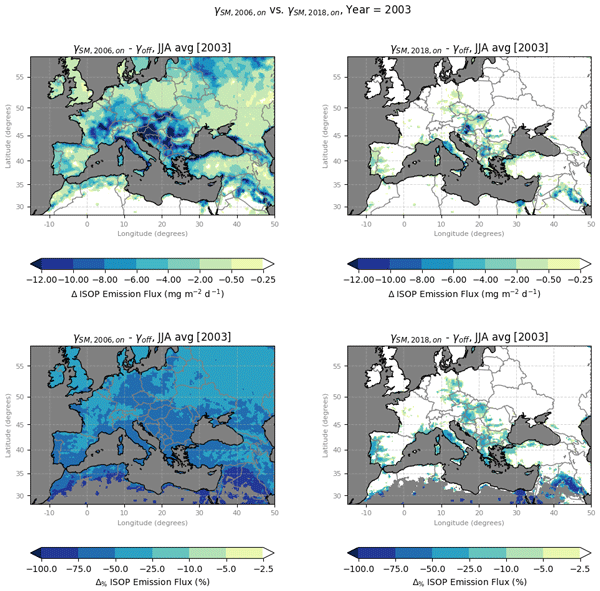
Water deficit modifies emissions of isoprene, an aromatic compound released by plants that influences the production of an air pollutant such as ozone. Numerical modelling shows that, during the warmest and driest summers, isoprene decreases between −20 and −60 % over the Euro-Mediterranean region, while near-surface ozone only diminishes by a few percent. Decreases in isoprene emissions not only happen under dry conditions, but also could occur after prolonged or repeated water deficits.
Magdalena Okuljar, Olga Garmash, Miska Olin, Joni Kalliokoski, Hilkka Timonen, Jarkko V. Niemi, Pauli Paasonen, Jenni Kontkanen, Yanjun Zhang, Heidi Hellén, Heino Kuuluvainen, Minna Aurela, Hanna E. Manninen, Mikko Sipilä, Topi Rönkkö, Tuukka Petäjä, Markku Kulmala, Miikka Dal Maso, and Mikael Ehn
Atmos. Chem. Phys., 23, 12965–12983, https://doi.org/10.5194/acp-23-12965-2023, https://doi.org/10.5194/acp-23-12965-2023, 2023
Short summary
Short summary
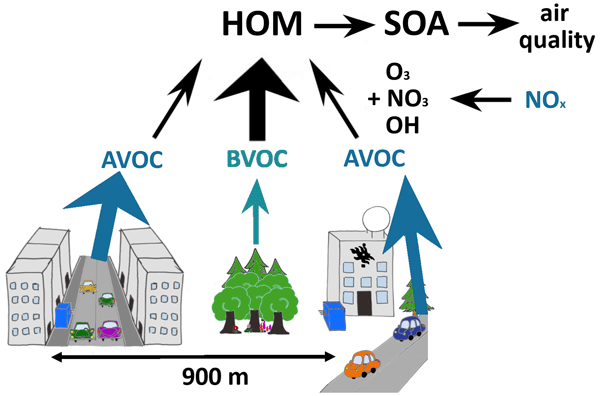
Highly oxygenated organic molecules (HOMs) form secondary organic aerosol that affects air quality and health. In this study, we demonstrate that in a moderately polluted city with abundant vegetation, the composition of HOMs is largely controlled by the effect of NOx on the biogenic volatile organic compound oxidation. Comparing the results from two nearby stations, we show that HOM composition and formation pathways can change considerably within small distances in urban environments.
Herizo Narivelo, Paul David Hamer, Virginie Marécal, Luke Surl, Tjarda Roberts, Sophie Pelletier, Béatrice Josse, Jonathan Guth, Mickaël Bacles, Simon Warnach, Thomas Wagner, Stefano Corradini, Giuseppe Salerno, and Lorenzo Guerrieri
Atmos. Chem. Phys., 23, 10533–10561, https://doi.org/10.5194/acp-23-10533-2023, https://doi.org/10.5194/acp-23-10533-2023, 2023
Short summary
Short summary
Volcanic emissions emit large quantities of gases and primary aerosols that can play an important role in atmospheric chemistry. We present a study of the fate of volcanic bromine emissions from the eruption of Mount Etna around Christmas 2018. Using a numerical model and satellite observations, we analyse the impact of the volcanic plume and how it modifies the composition of the air over the whole Mediterranean basin, in particular on tropospheric ozone through the bromine-explosion cycle.
Jenny Oh, Chubashini Shunthirasingham, Ying Duan Lei, Faqiang Zhan, Yuening Li, Abigaëlle Dalpé Castilloux, Amina Ben Chaaben, Zhe Lu, Kelsey Lee, Frank A. P. C. Gobas, Sabine Eckhardt, Nick Alexandrou, Hayley Hung, and Frank Wania
Atmos. Chem. Phys., 23, 10191–10205, https://doi.org/10.5194/acp-23-10191-2023, https://doi.org/10.5194/acp-23-10191-2023, 2023
Short summary
Short summary
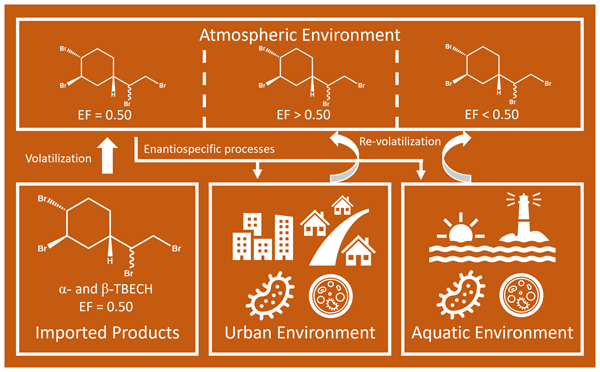
An emerging brominated flame retardant (BFR) called TBECH (1,2-dibromo-4-(1,2-dibromoethyl)cyclohexane) has never been produced or imported for use in Canada yet is found to be one of the most abundant gaseous BFRs in the Canadian atmosphere. The recorded spatial and temporal variability of TBECH suggest that the release from imported consumer products containing TBECH is the most likely explanation for its environmental occurrence in Canada.
Eliane Gomes Alves, Raoni Aquino Santana, Cléo Quaresma Dias-Júnior, Santiago Botía, Tyeen Taylor, Ana Maria Yáñez-Serrano, Jürgen Kesselmeier, Efstratios Bourtsoukidis, Jonathan Williams, Pedro Ivo Lembo Silveira de Assis, Giordane Martins, Rodrigo de Souza, Sérgio Duvoisin Júnior, Alex Guenther, Dasa Gu, Anywhere Tsokankunku, Matthias Sörgel, Bruce Nelson, Davieliton Pinto, Shujiro Komiya, Diogo Martins Rosa, Bettina Weber, Cybelli Barbosa, Michelle Robin, Kenneth J. Feeley, Alvaro Duque, Viviana Londoño Lemos, Maria Paula Contreras, Alvaro Idarraga, Norberto López, Chad Husby, Brett Jestrow, and Iván Mauricio Cely Toro
Atmos. Chem. Phys., 23, 8149–8168, https://doi.org/10.5194/acp-23-8149-2023, https://doi.org/10.5194/acp-23-8149-2023, 2023
Short summary
Short summary
Isoprene is emitted mainly by plants and can influence atmospheric chemistry and air quality. But, there are uncertainties in model emission estimates and follow-up atmospheric processes. In our study, with long-term observational datasets of isoprene and biological and environmental factors from central Amazonia, we show that isoprene emission estimates could be improved when biological processes were mechanistically incorporated into the model.
Alison L. Redington, Alistair J. Manning, Stephan Henne, Francesco Graziosi, Luke M. Western, Jgor Arduini, Anita L. Ganesan, Christina M. Harth, Michela Maione, Jens Mühle, Simon O'Doherty, Joseph Pitt, Stefan Reimann, Matthew Rigby, Peter K. Salameh, Peter G. Simmonds, T. Gerard Spain, Kieran Stanley, Martin K. Vollmer, Ray F. Weiss, and Dickon Young
Atmos. Chem. Phys., 23, 7383–7398, https://doi.org/10.5194/acp-23-7383-2023, https://doi.org/10.5194/acp-23-7383-2023, 2023
Short summary
Short summary
Chlorofluorocarbons (CFCs) were used in Europe pre-1990, damaging the stratospheric ozone layer. Legislation has controlled production and use, and global emissions have decreased sharply. The global rate of decline in CFC-11 recently slowed and was partly attributed to illegal emission in eastern China. This study concludes that emissions of CFC-11 in western Europe have not contributed to the unexplained part of the global increase in CFC-11 observed in the last decade.
James Weber, James A. King, Katerina Sindelarova, and Maria Val Martin
Geosci. Model Dev., 16, 3083–3101, https://doi.org/10.5194/gmd-16-3083-2023, https://doi.org/10.5194/gmd-16-3083-2023, 2023
Short summary
Short summary
The emissions of volatile organic compounds from vegetation (BVOCs) influence atmospheric composition and contribute to certain gases and aerosols (tiny airborne particles) which play a role in climate change. BVOC emissions are likely to change in the future due to changes in climate and land use. Therefore, accurate simulation of BVOC emission is important, and this study describes an update to the simulation of BVOC emissions in the United Kingdom Earth System Model (UKESM).
Virginie Marécal, Ronan Voisin-Plessis, Tjarda Jane Roberts, Alessandro Aiuppa, Herizo Narivelo, Paul David Hamer, Béatrice Josse, Jonathan Guth, Luke Surl, and Lisa Grellier
Geosci. Model Dev., 16, 2873–2898, https://doi.org/10.5194/gmd-16-2873-2023, https://doi.org/10.5194/gmd-16-2873-2023, 2023
Short summary
Short summary
We implemented a halogen volcanic chemistry scheme in a one-dimensional modelling framework preparing for further use in a three-dimensional global chemistry-transport model. The results of the simulations for an eruption of Mt Etna in 2008, including various sensitivity tests, show a good consistency with previous modelling studies.
Anja Eichler, Michel Legrand, Theo M. Jenk, Susanne Preunkert, Camilla Andersson, Sabine Eckhardt, Magnuz Engardt, Andreas Plach, and Margit Schwikowski
The Cryosphere, 17, 2119–2137, https://doi.org/10.5194/tc-17-2119-2023, https://doi.org/10.5194/tc-17-2119-2023, 2023
Short summary
Short summary
We investigate how a 250-year history of the emission of air pollutants (major inorganic aerosol constituents, black carbon, and trace species) is preserved in ice cores from four sites in the European Alps. The observed uniform timing in species-dependent longer-term concentration changes reveals that the different ice-core records provide a consistent, spatially representative signal of the pollution history from western European countries.
En Liu, Yonghua Zhu, Jean-christophe Calvet, Haishen Lü, Bertrand Bonan, Jingyao Zheng, Qiqi Gou, Xiaoyi Wang, Zhenzhou Ding, Haiting Xu, Ying Pan, and Tingxing Chen
Hydrol. Earth Syst. Sci. Discuss., https://doi.org/10.5194/hess-2023-33, https://doi.org/10.5194/hess-2023-33, 2023
Manuscript not accepted for further review
Short summary
Short summary
Among the 8 considered products, GLDAS_CLSM product performs best. All RZSM products overestimate the in situ measurements which attributes to a wet bias of air temperature, precipitation amount and frequency except the underestimation of SMOS L4 RZSM related to the underestimation of SMOS L3 SSM. The higher R between SMPA L4 and MERRA-2 was attributed to they both use CLSM and meteorological forcing from GEOS-5 where precipitation was corrected with CPCU precipitation product.
Sanna Saarikoski, Heidi Hellén, Arnaud P. Praplan, Simon Schallhart, Petri Clusius, Jarkko V. Niemi, Anu Kousa, Toni Tykkä, Rostislav Kouznetsov, Minna Aurela, Laura Salo, Topi Rönkkö, Luis M. F. Barreira, Liisa Pirjola, and Hilkka Timonen
Atmos. Chem. Phys., 23, 2963–2982, https://doi.org/10.5194/acp-23-2963-2023, https://doi.org/10.5194/acp-23-2963-2023, 2023
Short summary
Short summary
This study elucidates properties and sources of volatile organic compounds (VOCs) and organic aerosol (OA) in a traffic environment. Anthropogenic VOCs (aVOCs) were clearly higher than biogenic VOCs (bVOCs), but bVOCs produced a larger portion of oxidation products. OA consisted mostly of oxygenated OA, representing secondary OA (SOA). SOA was partly associated with bVOCs, but it was also related to long-range transport. Primary OA originated mostly from traffic.
Lejish Vettikkat, Pasi Miettinen, Angela Buchholz, Pekka Rantala, Hao Yu, Simon Schallhart, Tuukka Petäjä, Roger Seco, Elisa Männistö, Markku Kulmala, Eeva-Stiina Tuittila, Alex B. Guenther, and Siegfried Schobesberger
Atmos. Chem. Phys., 23, 2683–2698, https://doi.org/10.5194/acp-23-2683-2023, https://doi.org/10.5194/acp-23-2683-2023, 2023
Short summary
Short summary
Wetlands cover a substantial fraction of the land mass in the northern latitudes, from northern Europe to Siberia and Canada. Yet, their isoprene and terpene emissions remain understudied. Here, we used a state-of-the-art measurement technique to quantify ecosystem-scale emissions from a boreal wetland during an unusually warm spring/summer. We found that the emissions from this wetland were (a) higher and (b) even more strongly dependent on temperature than commonly thought.
Arsène Druel, Simon Munier, Anthony Mucia, Clément Albergel, and Jean-Christophe Calvet
Geosci. Model Dev., 15, 8453–8471, https://doi.org/10.5194/gmd-15-8453-2022, https://doi.org/10.5194/gmd-15-8453-2022, 2022
Short summary
Short summary
Crop phenology and irrigation is implemented into a land surface model able to work at a global scale. A case study is presented over Nebraska (USA). Simulations with and without the new scheme are compared to different satellite-based observations. The model is able to produce a realistic yearly irrigation water amount. The irrigation scheme improves the simulated leaf area index, gross primary productivity, evapotransipiration, and land surface temperature.
Yuxuan Wang, Nan Lin, Wei Li, Alex Guenther, Joey C. Y. Lam, Amos P. K. Tai, Mark J. Potosnak, and Roger Seco
Atmos. Chem. Phys., 22, 14189–14208, https://doi.org/10.5194/acp-22-14189-2022, https://doi.org/10.5194/acp-22-14189-2022, 2022
Short summary
Short summary
Drought can cause large changes in biogenic isoprene emissions. In situ field observations of isoprene emissions during droughts are confined by spatial coverage and, thus, provide limited constraints. We derived a drought stress factor based on satellite HCHO data for MEGAN2.1 in the GEOS-Chem model using water stress and temperature. This factor reduces the overestimation of isoprene emissions during severe droughts and improves the simulated O3 and organic aerosol responses to droughts.
Elizabeth Klovenski, Yuxuan Wang, Susanne E. Bauer, Kostas Tsigaridis, Greg Faluvegi, Igor Aleinov, Nancy Y. Kiang, Alex Guenther, Xiaoyan Jiang, Wei Li, and Nan Lin
Atmos. Chem. Phys., 22, 13303–13323, https://doi.org/10.5194/acp-22-13303-2022, https://doi.org/10.5194/acp-22-13303-2022, 2022
Short summary
Short summary
Severe drought stresses vegetation and causes reduced emission of isoprene. We study the impact of including a new isoprene drought stress (yd) parameterization in NASA GISS ModelE called DroughtStress_ModelE, which is specifically tuned for ModelE. Inclusion of yd leads to better simulated isoprene emissions at the MOFLUX site during the severe drought of 2012, reduced overestimation of OMI satellite ΩHCHO (formaldehyde column), and improved simulated O3 (ozone) during drought.
Peter Bergamaschi, Arjo Segers, Dominik Brunner, Jean-Matthieu Haussaire, Stephan Henne, Michel Ramonet, Tim Arnold, Tobias Biermann, Huilin Chen, Sebastien Conil, Marc Delmotte, Grant Forster, Arnoud Frumau, Dagmar Kubistin, Xin Lan, Markus Leuenberger, Matthias Lindauer, Morgan Lopez, Giovanni Manca, Jennifer Müller-Williams, Simon O'Doherty, Bert Scheeren, Martin Steinbacher, Pamela Trisolino, Gabriela Vítková, and Camille Yver Kwok
Atmos. Chem. Phys., 22, 13243–13268, https://doi.org/10.5194/acp-22-13243-2022, https://doi.org/10.5194/acp-22-13243-2022, 2022
Short summary
Short summary
We present a novel high-resolution inverse modelling system, "FLEXVAR", and its application for the inverse modelling of European CH4 emissions in 2018. The new system combines a high spatial resolution of 7 km x 7 km with a variational data assimilation technique, which allows CH4 emissions to be optimized from individual model grid cells. The high resolution allows the observations to be better reproduced, while the derived emissions show overall good consistency with two existing models.
Peter Huszar, Jan Karlický, Lukáš Bartík, Marina Liaskoni, Alvaro Patricio Prieto Perez, and Kateřina Šindelářová
Atmos. Chem. Phys., 22, 12647–12674, https://doi.org/10.5194/acp-22-12647-2022, https://doi.org/10.5194/acp-22-12647-2022, 2022
Short summary
Short summary
Urbanization turns rural land cover into artificial land cover, while due to human activities, it introduces a great quantity of emissions. We attempt to quantify the impact of urbanization on the final air pollutant levels by looking not only at these emissions, but also the way urban land cover influences meteorological conditions, how the removal of pollutants changes due to urban land cover, and how biogenic emissions from vegetation change due to less vegetation in urban areas.
Detlev Helmig, Alex Guenther, Jacques Hueber, Ryan Daly, Wei Wang, Jeong-Hoo Park, Anssi Liikanen, and Arnaud P. Praplan
Atmos. Meas. Tech., 15, 5439–5454, https://doi.org/10.5194/amt-15-5439-2022, https://doi.org/10.5194/amt-15-5439-2022, 2022
Short summary
Short summary
This research demonstrates a new method for determination of the chemical reactivity of volatile organic compounds that are emitted from the leaves and needles of trees. These measurements allow elucidating if and how much of these emissions and their associated reactivity are captured and quantified by currently applicable chemical analysis methods.
Megan Jeramaz Lickley, John S. Daniel, Eric L. Fleming, Stefan Reimann, and Susan Solomon
Atmos. Chem. Phys., 22, 11125–11136, https://doi.org/10.5194/acp-22-11125-2022, https://doi.org/10.5194/acp-22-11125-2022, 2022
Short summary
Short summary
Halocarbons contained in equipment continue to be emitted after production has ceased. These
banksmust be carefully accounted for in evaluating compliance with the Montreal Protocol. We extend a Bayesian model to the suite of regulated chemicals subject to banking. We find that banks are substantially larger than previous estimates, and we identify banks by chemical and equipment type whose future emissions will contribute to global warming and delay ozone-hole recovery if left unrecovered.
Deanna C. Myers, Saewung Kim, Steven Sjostedt, Alex B. Guenther, Roger Seco, Oscar Vega Bustillos, Julio Tota, Rodrigo A. F. Souza, and James N. Smith
Atmos. Chem. Phys., 22, 10061–10076, https://doi.org/10.5194/acp-22-10061-2022, https://doi.org/10.5194/acp-22-10061-2022, 2022
Short summary
Short summary
We present the first measurements of gas-phase sulfuric acid from the Amazon basin and evaluate the efficacy of existing sulfuric acid parameterizations in this understudied region. Sulfuric acid is produced during the daytime and nighttime, though current proxies underestimate nighttime production. These results illustrate the need for better parameterizations of sulfuric acid and its precursors that are informed by measurements across a broad range of locations.
Hannele Hakola, Ditte Taipale, Arnaud Praplan, Simon Schallhart, Steven Thomas, Toni Tykkä, Aku Helin, Jaana Bäck, and Heidi Hellén
Atmos. Chem. Phys. Discuss., https://doi.org/10.5194/acp-2022-478, https://doi.org/10.5194/acp-2022-478, 2022
Revised manuscript not accepted
Short summary
Short summary
Norway spruce is one of the main tree species growing in the boreal area. We show that volatile organic compound emission potentials and compound composition vary a lot. We have investigated if e.g. growing location or age of a tree could explain the variations. Recognizing this observed large variability in spruce BVOC emissions (precursors for new particle formation processes), we also tested the consequences of this variability in simulations of aerosol formation.
Luke M. Western, Alison L. Redington, Alistair J. Manning, Cathy M. Trudinger, Lei Hu, Stephan Henne, Xuekun Fang, Lambert J. M. Kuijpers, Christina Theodoridi, David S. Godwin, Jgor Arduini, Bronwyn Dunse, Andreas Engel, Paul J. Fraser, Christina M. Harth, Paul B. Krummel, Michela Maione, Jens Mühle, Simon O'Doherty, Hyeri Park, Sunyoung Park, Stefan Reimann, Peter K. Salameh, Daniel Say, Roland Schmidt, Tanja Schuck, Carolina Siso, Kieran M. Stanley, Isaac Vimont, Martin K. Vollmer, Dickon Young, Ronald G. Prinn, Ray F. Weiss, Stephen A. Montzka, and Matthew Rigby
Atmos. Chem. Phys., 22, 9601–9616, https://doi.org/10.5194/acp-22-9601-2022, https://doi.org/10.5194/acp-22-9601-2022, 2022
Short summary
Short summary
The production of ozone-destroying gases is being phased out. Even though production of one of the main ozone-depleting gases, called HCFC-141b, has been declining for many years, the amount that is being released to the atmosphere has been increasing since 2017. We do not know for sure why this is. A possible explanation is that HCFC-141b that was used to make insulating foams many years ago is only now escaping to the atmosphere, or a large part of its production is not being reported.
Jason E. Williams, Vincent Huijnen, Idir Bouarar, Mehdi Meziane, Timo Schreurs, Sophie Pelletier, Virginie Marécal, Beatrice Josse, and Johannes Flemming
Geosci. Model Dev., 15, 4657–4687, https://doi.org/10.5194/gmd-15-4657-2022, https://doi.org/10.5194/gmd-15-4657-2022, 2022
Short summary
Short summary
The global CAMS air quality model is used for providing tropospheric ozone information to end users. This paper updates the chemical mechanism employed (CBA) and compares it against two other mechanisms (MOCAGE, MOZART) and a multi-decadal dataset based on a previous version of CBA. We perform extensive validation for the US using multiple surface and aircraft datasets, providing an assessment of biases and the extent of correlation across different seasons during 2014.
Anthony Mucia, Bertrand Bonan, Clément Albergel, Yongjun Zheng, and Jean-Christophe Calvet
Biogeosciences, 19, 2557–2581, https://doi.org/10.5194/bg-19-2557-2022, https://doi.org/10.5194/bg-19-2557-2022, 2022
Short summary
Short summary
For the first time, microwave vegetation optical depth data are assimilated in a land surface model in order to analyze leaf area index and root zone soil moisture. The advantage of microwave products is the higher observation frequency. A large variety of independent datasets are used to verify the added value of the assimilation. It is shown that the assimilation is able to improve the representation of soil moisture, vegetation conditions, and terrestrial water and carbon fluxes.
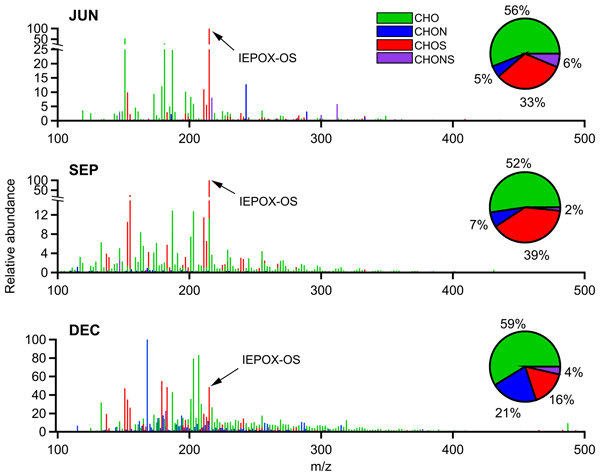
Cynthia H. Whaley, Rashed Mahmood, Knut von Salzen, Barbara Winter, Sabine Eckhardt, Stephen Arnold, Stephen Beagley, Silvia Becagli, Rong-You Chien, Jesper Christensen, Sujay Manish Damani, Xinyi Dong, Konstantinos Eleftheriadis, Nikolaos Evangeliou, Gregory Faluvegi, Mark Flanner, Joshua S. Fu, Michael Gauss, Fabio Giardi, Wanmin Gong, Jens Liengaard Hjorth, Lin Huang, Ulas Im, Yugo Kanaya, Srinath Krishnan, Zbigniew Klimont, Thomas Kühn, Joakim Langner, Kathy S. Law, Louis Marelle, Andreas Massling, Dirk Olivié, Tatsuo Onishi, Naga Oshima, Yiran Peng, David A. Plummer, Olga Popovicheva, Luca Pozzoli, Jean-Christophe Raut, Maria Sand, Laura N. Saunders, Julia Schmale, Sangeeta Sharma, Ragnhild Bieltvedt Skeie, Henrik Skov, Fumikazu Taketani, Manu A. Thomas, Rita Traversi, Kostas Tsigaridis, Svetlana Tsyro, Steven Turnock, Vito Vitale, Kaley A. Walker, Minqi Wang, Duncan Watson-Parris, and Tahya Weiss-Gibbons
Atmos. Chem. Phys., 22, 5775–5828, https://doi.org/10.5194/acp-22-5775-2022, https://doi.org/10.5194/acp-22-5775-2022, 2022
Short summary
Short summary
Air pollutants, like ozone and soot, play a role in both global warming and air quality. Atmospheric models are often used to provide information to policy makers about current and future conditions under different emissions scenarios. In order to have confidence in those simulations, in this study we compare simulated air pollution from 18 state-of-the-art atmospheric models to measured air pollution in order to assess how well the models perform.
Christine D. Groot Zwaaftink, Wenche Aas, Sabine Eckhardt, Nikolaos Evangeliou, Paul Hamer, Mona Johnsrud, Arve Kylling, Stephen M. Platt, Kerstin Stebel, Hilde Uggerud, and Karl Espen Yttri
Atmos. Chem. Phys., 22, 3789–3810, https://doi.org/10.5194/acp-22-3789-2022, https://doi.org/10.5194/acp-22-3789-2022, 2022
Short summary
Short summary
We investigate causes of a poor-air-quality episode in northern Europe in October 2020 during which EU health limits for air quality were vastly exceeded. Such episodes may trigger measures to improve air quality. Analysis based on satellite observations, transport simulations, and surface observations revealed two sources of pollution. Emissions of mineral dust in Central Asia and biomass burning in Ukraine arrived almost simultaneously in Norway, and transport continued into the Arctic.
Henry Bowman, Steven Turnock, Susanne E. Bauer, Kostas Tsigaridis, Makoto Deushi, Naga Oshima, Fiona M. O'Connor, Larry Horowitz, Tongwen Wu, Jie Zhang, Dagmar Kubistin, and David D. Parrish
Atmos. Chem. Phys., 22, 3507–3524, https://doi.org/10.5194/acp-22-3507-2022, https://doi.org/10.5194/acp-22-3507-2022, 2022
Short summary
Short summary
A full understanding of ozone in the troposphere requires investigation of its temporal variability over all timescales. Model simulations show that the northern midlatitude ozone seasonal cycle shifted with industrial development (1850–2014), with an increasing magnitude and a later summer peak. That shift reached a maximum in the mid-1980s, followed by a reversal toward the preindustrial cycle. The few available observations, beginning in the 1970s, are consistent with the model simulations.
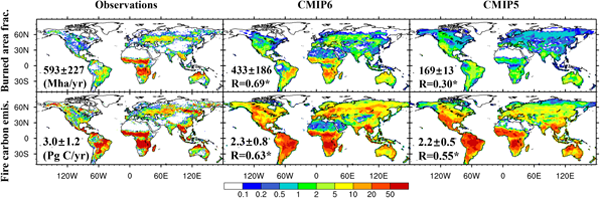
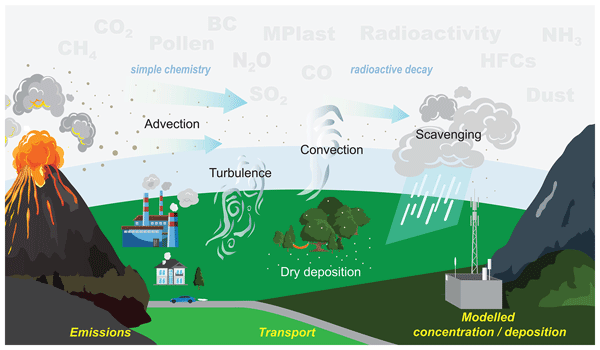
Stephen M. Platt, Øystein Hov, Torunn Berg, Knut Breivik, Sabine Eckhardt, Konstantinos Eleftheriadis, Nikolaos Evangeliou, Markus Fiebig, Rebecca Fisher, Georg Hansen, Hans-Christen Hansson, Jost Heintzenberg, Ove Hermansen, Dominic Heslin-Rees, Kim Holmén, Stephen Hudson, Roland Kallenborn, Radovan Krejci, Terje Krognes, Steinar Larssen, David Lowry, Cathrine Lund Myhre, Chris Lunder, Euan Nisbet, Pernilla B. Nizzetto, Ki-Tae Park, Christina A. Pedersen, Katrine Aspmo Pfaffhuber, Thomas Röckmann, Norbert Schmidbauer, Sverre Solberg, Andreas Stohl, Johan Ström, Tove Svendby, Peter Tunved, Kjersti Tørnkvist, Carina van der Veen, Stergios Vratolis, Young Jun Yoon, Karl Espen Yttri, Paul Zieger, Wenche Aas, and Kjetil Tørseth
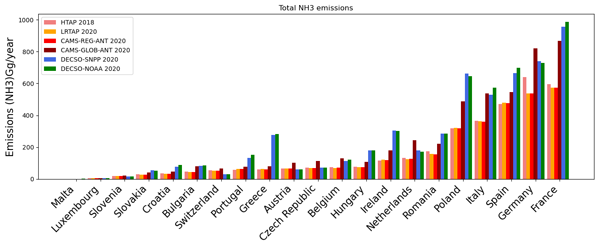
Atmos. Chem. Phys., 22, 3321–3369, https://doi.org/10.5194/acp-22-3321-2022, https://doi.org/10.5194/acp-22-3321-2022, 2022
Short summary
Short summary
Here we detail the history of the Zeppelin Observatory, a unique global background site and one of only a few in the high Arctic. We present long-term time series of up to 30 years of atmospheric components and atmospheric transport phenomena. Many of these time series are important to our understanding of Arctic and global atmospheric composition change. Finally, we discuss the future of the Zeppelin Observatory and emerging areas of future research on the Arctic atmosphere.
Dominique Rust, Ioannis Katharopoulos, Martin K. Vollmer, Stephan Henne, Simon O'Doherty, Daniel Say, Lukas Emmenegger, Renato Zenobi, and Stefan Reimann
Atmos. Chem. Phys., 22, 2447–2466, https://doi.org/10.5194/acp-22-2447-2022, https://doi.org/10.5194/acp-22-2447-2022, 2022
Short summary
Short summary
Artificial halocarbons contribute to ozone layer depletion and to global warming. We measured the atmospheric concentrations of halocarbons at the Beromünster tower, modelled the Swiss emissions, and compared the results to the internationally reported Swiss emissions inventory. For most of the halocarbons, we found good agreement, whereas one refrigerant might be overestimated in the inventory. In addition, we present first emission estimates of the newest types of halocarbons.
Katerina Sindelarova, Jana Markova, David Simpson, Peter Huszar, Jan Karlicky, Sabine Darras, and Claire Granier
Earth Syst. Sci. Data, 14, 251–270, https://doi.org/10.5194/essd-14-251-2022, https://doi.org/10.5194/essd-14-251-2022, 2022
Short summary
Short summary
Three new datasets of global emissions of biogenic volatile organic compounds (BVOCs) emitted into the atmosphere from terrestrial vegetation were developed for air quality modelling using the Model of Emissions of Gases and Aerosols from Nature (MEGANv2.1) driven by European Centre for Medium-Range Weather Forecasts meteorological reanalyses for the years 2000–2019. The datasets include updates of the isoprene emission factors in Europe and study the impact of land cover change on emissions.
Abhinna K. Behera, Emmanuel D. Rivière, Sergey M. Khaykin, Virginie Marécal, Mélanie Ghysels, Jérémie Burgalat, and Gerhard Held
Atmos. Chem. Phys., 22, 881–901, https://doi.org/10.5194/acp-22-881-2022, https://doi.org/10.5194/acp-22-881-2022, 2022
Short summary
Short summary
Deep convection overshooting the stratosphere's contribution to the global stratospheric water budget is still being quantified. We ran three different cloud-resolving simulations of an observed case of overshoots in Bauru during the TRO-Pico balloon campaign in the context of upscaling the impact of overshoots at a large scale. These simulations, which have been validated with balloon-borne and S-band radar measurements, shed light on the local-scale variability and composition of overshoots.
Paul D. Hamer, Virginie Marécal, Ryan Hossaini, Michel Pirre, Gisèle Krysztofiak, Franziska Ziska, Andreas Engel, Stephan Sala, Timo Keber, Harald Bönisch, Elliot Atlas, Kirstin Krüger, Martyn Chipperfield, Valery Catoire, Azizan A. Samah, Marcel Dorf, Phang Siew Moi, Hans Schlager, and Klaus Pfeilsticker
Atmos. Chem. Phys., 21, 16955–16984, https://doi.org/10.5194/acp-21-16955-2021, https://doi.org/10.5194/acp-21-16955-2021, 2021
Short summary
Short summary
Bromoform is a stratospheric ozone-depleting gas released by seaweed and plankton transported to the stratosphere via convection in the tropics. We study the chemical interactions of bromoform and its derivatives within convective clouds using a cloud-scale model and observations. Our findings are that soluble bromine gases are efficiently washed out and removed within the convective clouds and that most bromine is transported vertically to the upper troposphere in the form of bromoform.
Wouter Dorigo, Irene Himmelbauer, Daniel Aberer, Lukas Schremmer, Ivana Petrakovic, Luca Zappa, Wolfgang Preimesberger, Angelika Xaver, Frank Annor, Jonas Ardö, Dennis Baldocchi, Marco Bitelli, Günter Blöschl, Heye Bogena, Luca Brocca, Jean-Christophe Calvet, J. Julio Camarero, Giorgio Capello, Minha Choi, Michael C. Cosh, Nick van de Giesen, Istvan Hajdu, Jaakko Ikonen, Karsten H. Jensen, Kasturi Devi Kanniah, Ileen de Kat, Gottfried Kirchengast, Pankaj Kumar Rai, Jenni Kyrouac, Kristine Larson, Suxia Liu, Alexander Loew, Mahta Moghaddam, José Martínez Fernández, Cristian Mattar Bader, Renato Morbidelli, Jan P. Musial, Elise Osenga, Michael A. Palecki, Thierry Pellarin, George P. Petropoulos, Isabella Pfeil, Jarrett Powers, Alan Robock, Christoph Rüdiger, Udo Rummel, Michael Strobel, Zhongbo Su, Ryan Sullivan, Torbern Tagesson, Andrej Varlagin, Mariette Vreugdenhil, Jeffrey Walker, Jun Wen, Fred Wenger, Jean Pierre Wigneron, Mel Woods, Kun Yang, Yijian Zeng, Xiang Zhang, Marek Zreda, Stephan Dietrich, Alexander Gruber, Peter van Oevelen, Wolfgang Wagner, Klaus Scipal, Matthias Drusch, and Roberto Sabia
Hydrol. Earth Syst. Sci., 25, 5749–5804, https://doi.org/10.5194/hess-25-5749-2021, https://doi.org/10.5194/hess-25-5749-2021, 2021
Short summary
Short summary
The International Soil Moisture Network (ISMN) is a community-based open-access data portal for soil water measurements taken at the ground and is accessible at https://ismn.earth. Over 1000 scientific publications and thousands of users have made use of the ISMN. The scope of this paper is to inform readers about the data and functionality of the ISMN and to provide a review of the scientific progress facilitated through the ISMN with the scope to shape future research and operations.
Oscar Javier Rojas Muñoz, Marjolaine Chiriaco, Sophie Bastin, and Justine Ringard
Atmos. Chem. Phys., 21, 15699–15723, https://doi.org/10.5194/acp-21-15699-2021, https://doi.org/10.5194/acp-21-15699-2021, 2021
Short summary
Short summary
A method is developed and evaluated to quantify each process that affects hourly 2 m temperature variations on a local scale, based almost exclusively on observations retrieved from an observatory near the Paris region. Each term involved in surface temperature variations is estimated, and its contribution and importance are also assessed. It is found that clouds are the main modulator on hourly temperature variations for most hours of the day, and thus their characterization is addressed.
Yang Liu, Simon Schallhart, Ditte Taipale, Toni Tykkä, Matti Räsänen, Lutz Merbold, Heidi Hellén, and Petri Pellikka
Atmos. Chem. Phys., 21, 14761–14787, https://doi.org/10.5194/acp-21-14761-2021, https://doi.org/10.5194/acp-21-14761-2021, 2021
Short summary
Short summary
We studied the mixing ratio of biogenic volatile organic compounds (BVOCs) in a humid highland and dry lowland African ecosystem in Kenya. The mixing ratio of monoterpenoids was similar to that measured in the relevant ecosystems in western and southern Africa, while that of isoprene was lower. Modeling the emission factors (EFs) for BVOCs from the lowlands, the EFs for isoprene and β-pinene agreed well with what is assumed in the MEGAN, while those of α-pinene and limonene were higher.
Alex Resovsky, Michel Ramonet, Leonard Rivier, Jerome Tarniewicz, Philippe Ciais, Martin Steinbacher, Ivan Mammarella, Meelis Mölder, Michal Heliasz, Dagmar Kubistin, Matthias Lindauer, Jennifer Müller-Williams, Sebastien Conil, and Richard Engelen
Atmos. Meas. Tech., 14, 6119–6135, https://doi.org/10.5194/amt-14-6119-2021, https://doi.org/10.5194/amt-14-6119-2021, 2021
Short summary
Short summary
We present a technical description of a statistical methodology for extracting synoptic- and seasonal-length anomalies from greenhouse gas time series. The definition of what represents an anomalous signal is somewhat subjective, which we touch on throughout the paper. We show, however, that the method performs reasonably well in extracting portions of time series influenced by significant North Atlantic Oscillation weather episodes and continent-wide terrestrial biospheric aberrations.
Jessica L. McCarty, Juha Aalto, Ville-Veikko Paunu, Steve R. Arnold, Sabine Eckhardt, Zbigniew Klimont, Justin J. Fain, Nikolaos Evangeliou, Ari Venäläinen, Nadezhda M. Tchebakova, Elena I. Parfenova, Kaarle Kupiainen, Amber J. Soja, Lin Huang, and Simon Wilson
Biogeosciences, 18, 5053–5083, https://doi.org/10.5194/bg-18-5053-2021, https://doi.org/10.5194/bg-18-5053-2021, 2021
Short summary
Short summary
Fires, including extreme fire seasons, and fire emissions are more common in the Arctic. A review and synthesis of current scientific literature find climate change and human activity in the north are fuelling an emerging Arctic fire regime, causing more black carbon and methane emissions within the Arctic. Uncertainties persist in characterizing future fire landscapes, and thus emissions, as well as policy-relevant challenges in understanding, monitoring, and managing Arctic fire regimes.
Alistair J. Manning, Alison L. Redington, Daniel Say, Simon O'Doherty, Dickon Young, Peter G. Simmonds, Martin K. Vollmer, Jens Mühle, Jgor Arduini, Gerard Spain, Adam Wisher, Michela Maione, Tanja J. Schuck, Kieran Stanley, Stefan Reimann, Andreas Engel, Paul B. Krummel, Paul J. Fraser, Christina M. Harth, Peter K. Salameh, Ray F. Weiss, Ray Gluckman, Peter N. Brown, John D. Watterson, and Tim Arnold
Atmos. Chem. Phys., 21, 12739–12755, https://doi.org/10.5194/acp-21-12739-2021, https://doi.org/10.5194/acp-21-12739-2021, 2021
Short summary
Short summary
This paper estimates UK emissions of important greenhouse gases (hydrofluorocarbons (HFCs)) using high-quality atmospheric observations and atmospheric modelling. We compare these estimates with those submitted by the UK to the United Nations. We conclude that global concentrations of these gases are still increasing. Our estimates for the UK are 73 % of those reported and that the UK emissions are now falling, demonstrating an impact of UK government policy.
Chinmoy Sarkar, Gracie Wong, Anne Mielnik, Sanjeevi Nagalingam, Nicole Jenna Gross, Alex B. Guenther, Taehyoung Lee, Taehyun Park, Jihee Ban, Seokwon Kang, Jin-Soo Park, Joonyoung Ahn, Danbi Kim, Hyunjae Kim, Jinsoo Choi, Beom-Keun Seo, Jong-Ho Kim, Jeong-Ho Kim, Soo Bog Park, and Saewung Kim
Atmos. Chem. Phys., 21, 11505–11518, https://doi.org/10.5194/acp-21-11505-2021, https://doi.org/10.5194/acp-21-11505-2021, 2021
Short summary
Short summary
We present experimental proofs illustrating the emission of an unexplored volatile organic compound, tentatively assigned as ketene, in an industrial facility in South Korea. The emission of such a compound has rarely been reported, but our experimental data show that the emission rate is substantial. It potentially has tremendous implications for regional air quality and public health, as it is highly reactive and toxic at the same time.
Claire Lamotte, Jonathan Guth, Virginie Marécal, Martin Cussac, Paul David Hamer, Nicolas Theys, and Philipp Schneider
Atmos. Chem. Phys., 21, 11379–11404, https://doi.org/10.5194/acp-21-11379-2021, https://doi.org/10.5194/acp-21-11379-2021, 2021
Short summary
Short summary
Improvements are made in a global chemical transfer model by considering a new volcanic SO2 emissions inventory, with more volcanoes referenced and more information on the altitude of injection. Better constraining volcanic emissions with this inventory improves the global, but mostly local, tropospheric sulfur composition. The tropospheric sulfur budget shows a nonlinearity to the volcanic contribution, especially to the sulfate aerosol burden and sulfur wet deposition.
David Simpson and Sabine Darras
Earth Syst. Sci. Data Discuss., https://doi.org/10.5194/essd-2021-221, https://doi.org/10.5194/essd-2021-221, 2021
Manuscript not accepted for further review
Short summary
Short summary
We present a dataset of global soil NO emissions suitable for atmospheric chemistry modelling. Data are provided globally at 0.5° × 0.5° degrees horizontal resolution, and with monthly time resolution over the period 2000–2018. This paper presents the emission algorithms and their data-sources, some comments on the availability of soil NO emissions in other inventories (and how to avoid double-counting), and finally some preliminary modelling results and comparison with observed data.
Beata Opacka, Jean-François Müller, Trissevgeni Stavrakou, Maite Bauwens, Katerina Sindelarova, Jana Markova, and Alex B. Guenther
Atmos. Chem. Phys., 21, 8413–8436, https://doi.org/10.5194/acp-21-8413-2021, https://doi.org/10.5194/acp-21-8413-2021, 2021
Short summary
Short summary
Isoprene is mainly emitted from plants, and about 80 % of its global emissions occur in the tropics. Current isoprene inventories are usually based on modelled vegetation maps, but high pressure on land use over the last decades has led to severe losses, especially in tropical forests, that are not considered by models. We provide a study on the present-day impact of spaceborne land cover changes on isoprene emissions and the first inventory based on high-resolution Landsat tree cover dataset.
Cited articles
Aas, ., Salameh, T., Wegener, R., Hellén, H., Jaffrezo, J.-L., Roldin, P., Alonso-Blanco, E., Alastuey, A., Amelynck, C., Arduini, J., Bergmans, B., Bertrand, M., Borbon, A., Bourtsoukidis, E., Bouvier, L., Butterfield, D., Buxbaum, I., Ceburnis, D., Claude, A., Colomb, A., Darfeuil, S., Dernie, J., Desservettaz, M., Díaz-Ramiro, E., Dufresne, M., Dubus, R., Duval, M., Dury, M., Font, A., Fossum, K., Freney, E., Gangoiti, G., Ge, Y., Gomez, M. C., Gómez-Moreno, F. J., Gohy, M., Gros, V., Hamer, P., Hellack, B., Herrmann, H., Holla, R., Holubová, A., Jensen, N., Jokinen, T., Jones, M., Käfer, U., Kesper, L., Klemp, D., Kubistin, D., Marinoni, A., Mazzini, M., Thuy Dinh, V. N., Ovadnevaite, J., Petäjä, T., Portillo-Estrada, M., Přívozníková, J., Putaud, J.-P., Reimann, S., Renzi, L., Riffault, V., Ritchie, S., Robins, C., Rodríguez de Torres, B. A., Poulain, L., Rüdiger, J., Sanocka, A., Saez de Camara Oleaga, E., Schoon, N., Seco, R., Simmons, I., Simon, L., Simpson, D., Tison, E., Thomasson, A., Tsyro, S., Twigg, M., Tykkä, T., Verreyken, B., Yáñez-Serrano, A. M., Solberg, S., Yeung, K., Ylivinkka, I., Yttri, K. E., Watne, Å., and Williams, K.: Spatial variability of VOCs, ozone, and carbonaceous aerosols during the 2022 European summer heatwave, EGUsphere [preprint], https://doi.org/10.5194/egusphere-2025-6166, 2025.
Albergel, C., Munier, S., Leroux, D. J., Dewaele, H., Fairbairn, D., Barbu, A. L., Gelati, E., Dorigo, W., Faroux, S., Meurey, C., Le Moigne, P., Decharme, B., Mahfouf, J.-F., and Calvet, J.-C.: Sequential assimilation of satellite-derived vegetation and soil moisture products using SURFEX_v8.0: LDAS-Monde assessment over the Euro-Mediterranean area, Geosci. Model Dev., 10, 3889–3912, https://doi.org/10.5194/gmd-10-3889-2017, 2017.
Albergel, C., Dutra, E., Bonan, B., Zheng, Y., Munier, S., Balsamo, G., de Rosnay, P., Muñoz-Sabater, J., and Calvet, J.-C.: Monitoring and Forecasting the Impact of the 2018 Summer Heatwave on Vegetation, Remote Sens., 11, https://doi.org/10.3390/rs11050520, 2019.
Arneth, A., Niinemets, Ü., Pressley, S., Bäck, J., Hari, P., Karl, T., Noe, S., Prentice, I. C., Serça, D., Hickler, T., Wolf, A., and Smith, B.: Process-based estimates of terrestrial ecosystem isoprene emissions: incorporating the effects of a direct CO2-isoprene interaction, Atmos. Chem. Phys., 7, 31–53, https://doi.org/10.5194/acp-7-31-2007, 2007.
Arneth, A., Schurgers, G., Lathiere, J., Duhl, T., Beerling, D. J., Hewitt, C. N., Martin, M., and Guenther, A.: Global terrestrial isoprene emission models: sensitivity to variability in climate and vegetation, Atmos. Chem. Phys., 11, 8037–8052, https://doi.org/10.5194/acp-11-8037-2011, 2011.
Blyverket, J., Hamer, P. D., Bertino, L., Albergel, C., Fairbairn, D., and Lahoz, W. A.: An evaluation of the EnKF vs. EnOI and the assimilation of SMAP, SMOS and ESA CCI soil moisture data over the contiguous US, Remote Sens., 11, 478, https://doi.org/10.3390/rs11050478, 2019.
Bonn, B., Magh, R.-K., Rombach, J., and Kreuzwieser, J.: Biogenic isoprenoid emissions under drought stress: different responses for isoprene and terpenes, Biogeosciences, 16, 4627–4645, https://doi.org/10.5194/bg-16-4627-2019, 2019.
Brown, L. A., Meier, C., Morris, H., Pastor-Guzman, J., Bai, G., Lerebourg, C., Gobron, N., Lanconelli, C., Clerici, M., and Dash, J.: Evaluation of global leaf area index and fraction of absorbed photosynthetically active radiation products over North America using Copernicus Ground Based Observations for Validation data, Remote Sens. Environ., 247, https://doi.org/10.1016/j.rse.2020.111935, 2020.
Broxton, P. D., Zeng, X., Scheftic, W., and Troch, P. A.: A MODIS-based global 1-km maximum green vegetation fraction dataset, J. Appl. Meteorol. Clim., 53, 1996–2004, 2014.
Calvet, J.-C., Noilhan, J., Roujean, J.-L., Bessemoulin, P., Cabelguenne, M., Olioso, A., and Wigneron, J.-P.: An interactive vegetation SVAT model tested against data from six contrasting sites, Agr. Forest Meteorol., 92, 73–95, https://doi.org/10.1016/S0168-1923(98)00091-4, 1998.
Calvet, J.-C., Fritz, N., Froissard, F., Suquia, D., Petitpa, A., and Piguet, B.: In situ soil moisture observations for the CAL/VAL of SMOS: the SMOSMANIA network, in: 2007 IEEE International Geoscience and Remote Sensing Symposium, 1196–1199, https://doi.org/10.1109/IGARSS.2007.4423019, 2007.
Carlton, A. G., Wiedinmyer, C., and Kroll, J. H.: A review of Secondary Organic Aerosol (SOA) formation from isoprene, Atmos. Chem. Phys., 9, 4987–5005, https://doi.org/10.5194/acp-9-4987-2009, 2009.
Claude, A. and Kubistin, D.: GAW-WDCRG, ACTRIS, EMEP, 2018–2022, VOC (hydrocarbons) at Hohenpeissenberg, EBAS at NILU [data set], https://doi.org/10.48597/V8XG-29XA, 2026.
Decharme, B., Boone, A., Delire, C., and Noilhan, J.: Local evaluation of the Interaction between Soil Biosphere Atmosphere soil multilayer diffusion scheme using four pedotransfer functions, J. Geophys. Res.-Atmos., 116, https://doi.org/10.1029/2011JD016002, 2011.
Decharme, B., Delire, C., Minvielle, M., Colin, J., Vergnes, J.-P., Alias, A., Saint-Martin, D., Séférian, R., Sénési, S., and Voldoire, A.: Recent changes in the ISBA-CTRIP land surface system for use in the CNRM-CM6 climate model and in global off-line hydrological applications, J. Adv. Model. Earth Sy., 11, 1207–1252, 2019.
Delire, C., Séférian, R., Decharme, B., Alkama, R., Calvet, J. C., Carrer, D., Gibelin, A. L., Joetzjer, E., Morel, X., Rocher, M., and Tzanos, D.: The Global Land Carbon Cycle Simulated With ISBA-CTRIP: Improvements Over the Last Decade, J. Adv. Model. Earth Sy., 12, https://doi.org/10.1029/2019MS001886, 2020.
Denier van der Gon, H., Gauss, M., Granier, C., Guevara, M., Arrellano, S., Sindelarova, K., Liaskoni, M., Markova, J., Prieto Perez, A., Bartik, L., Jalkanen, J.-P., Majamäki, E., Quack, B., Bouarar, I., Li, C., Liousse, C., Simpson, D., Olivié, D., Benedictow, A., Segers, A., Zilbermann, N., Dellaert, S., Kuenen, J., Schoenmakers, E., Super, I., and Krueger, K.: Documentation of CAMS emission inventory products, Copernicus Atmosphere Monitoring Service, https://doi.org/10.24380/q2si-ti6i, 2025.
Donahue, N. M., Robinson, A. L., and Pandis, S. N.: Atmospheric organic particulate matter: From smoke to secondary organic aerosol, Atmos. Environ., 43, 94–106, 2009.
Druel, A., Munier, S., Mucia, A., Albergel, C., and Calvet, J.-C.: Implementation of a new crop phenology and irrigation scheme in the ISBA land surface model using SURFEX_v8.1, Geosci. Model Dev., 15, 8453–8471, https://doi.org/10.5194/gmd-15-8453-2022, 2022.
Emmons, L. K., Walters, S., Hess, P. G., Lamarque, J.-F., Pfister, G. G., Fillmore, D., Granier, C., Guenther, A., Kinnison, D., Laepple, T., Orlando, J., Tie, X., Tyndall, G., Wiedinmyer, C., Baughcum, S. L., and Kloster, S.: Description and evaluation of the Model for Ozone and Related chemical Tracers, version 4 (MOZART-4), Geosci. Model Dev., 3, 43–67, https://doi.org/10.5194/gmd-3-43-2010, 2010.
Fairbairn, D., Barbu, A. L., Napoly, A., Albergel, C., Mahfouf, J.-F., and Calvet, J.-C.: The effect of satellite-derived surface soil moisture and leaf area index land data assimilation on streamflow simulations over France, Hydrol. Earth Syst. Sci., 21, 2015–2033, https://doi.org/10.5194/hess-21-2015-2017, 2017.
Faroux, S., Kaptué Tchuenté, A. T., Roujean, J.-L., Masson, V., Martin, E., and Le Moigne, P.: ECOCLIMAP-II/Europe: a twofold database of ecosystems and surface parameters at 1 km resolution based on satellite information for use in land surface, meteorological and climate models, Geosci. Model Dev., 6, 563–582, https://doi.org/10.5194/gmd-6-563-2013, 2013.
Fuster, B., Sánchez-Zapero, J., Camacho, F., García-Santos, V., Verger, A., Lacaze, R., Weiss, M., Baret, F., and Smets, B.: Quality Assessment of PROBA-V LAI, fAPAR and fCOVER Collection 300 m Products of Copernicus Global Land Service, Remote Sens., 12, 1017, https://doi.org/10.3390/rs12061017, 2020.
Gibelin, A.-L., Calvet, J.-C., Roujean, J.-L., Jarlan, L., and Los, S. O.: Ability of the land surface model ISBA-A-gs to simulate leaf area index at the global scale: Comparison with satellites products, J. Geophys. Res.-Atmos., 111, https://doi.org/10.1029/2005JD006691, 2006.
Guanter, L., Bacour, C., Schneider, A., Aben, I., van Kempen, T. A., Maignan, F., Retscher, C., Köhler, P., Frankenberg, C., Joiner, J., and Zhang, Y.: The TROPOSIF global sun-induced fluorescence dataset from the Sentinel-5P TROPOMI mission, Earth Syst. Sci. Data, 13, 5423–5440, https://doi.org/10.5194/essd-13-5423-2021, 2021.
Guenther, A., Hewitt, C. N., Erickson, D., Fall, R., Geron, C., Graedel, T., Harley, P., Klinger, L., Lerdau, M., Mckay, W. A., Pierce, T., Scholes, B., Steinbrecher, R., Tallamraju, R., Taylor, J., and Zimmerman, P.: A global model of natural volatile organic compound emissions, J. Geophys. Res.-Atmos., 100, 8873–8892, https://doi.org/10.1029/94JD02950, 1995.
Guenther, A., Karl, T., Harley, P., Wiedinmyer, C., Palmer, P. I., and Geron, C.: Estimates of global terrestrial isoprene emissions using MEGAN (Model of Emissions of Gases and Aerosols from Nature), Atmos. Chem. Phys., 6, 3181–3210, https://doi.org/10.5194/acp-6-3181-2006, 2006.
Guenther, A., Jiang, X., Shah, T., Huang, L., Kemball-Cook, S., and Yarwood, G.: Model of emissions of gases and aerosol from nature version 3 (MEGAN3) for estimating biogenic emissions, in: Air Pollution Modeling and its Application XXVI 36, 187–192, https://doi.org/10.1007/978-3-030-22055-6_29, 2020.
Guenther, A. B., Zimmerman, P. R., Harley, P. C., Monson, R. K., and Fall, R.: Isoprene and monoterpene emission rate variability: model evaluations and sensitivity analyses, J. Geophys. Res.-Atmos., 98, 12609–12617, 1993.
Guenther, A. B., Jiang, X., Heald, C. L., Sakulyanontvittaya, T., Duhl, T., Emmons, L. K., and Wang, X.: The Model of Emissions of Gases and Aerosols from Nature version 2.1 (MEGAN2.1): an extended and updated framework for modeling biogenic emissions, Geosci. Model Dev., 5, 1471–1492, https://doi.org/10.5194/gmd-5-1471-2012, 2012.
Hamer, P., Trimmel, H., Markelj, M., Rojas-Munoz, O., Bonan, B., Calvet, J.-C., Vallejo, I., Eckhardt, S., Sousa-Santos, G., Marecal, V., and Tarrason, L.: SURFEX-MEGAN3.0 analysis based BVOC emissions, Harvard Dataverse/SEEDS Project Datasets [data set], https://doi.org/10.7910/DVN/LAUVTU, 2025a.
Hamer, P., Trimmel, H., Markelj, M., Rojas-Munoz, O., Bonan, B., Calvet, J.-C., Vallejo, I., Eckhardt, S., Sousa-Santos, G., Marecal, V., and Tarrason, L.: SURFEX-MEGAN3.0 open-loop based BVOC emissions, Harvard Dataverse/SEEDS Project Datasets [data set], https://doi.org/10.7910/DVN/69G1FX, 2025b.
Hansen, M. C., DeFries, R. S., Townshend, J. R. G., Carroll, M., Dimiceli, C., and Sohlberg, R. A.: Global percent tree cover at a spatial resolution of 500 meters: First results of the MODIS vegetation continuous fields algorithm, Earth Interact., 7, 1–15, 2003.
Hersbach, H., Bell, B., Berrisford, P., Hirahara, S., Horányi, A., Muñoz-Sabater, J., Nicolas, J., Peubey, C., Radu, R., Schepers, D., Simmons, A., Soci, C., Abdalla, S., Abellan, X., Balsamo, G., Bechtold, P., Biavati, G., Bidlot, J., Bonavita, M., De Chiara, G., Dahlgren, P., Dee, D., Diamantakis, M., Dragani, R., Flemming, J., Forbes, R., Fuentes, M., Geer, A., Haimberger, L., Healy, S., Hogan, R. J., Hólm, E., Janisková, M., Keeley, S., Laloyaux, P., Lopez, P., Lupu, C., Radnoti, G., de Rosnay, P., Rozum, I., Vamborg, F., Villaume, S., and Thépaut, J. N.: The ERA5 global reanalysis, Q. J. Roy. Meteor. Soc., 146, 1999–2049, https://doi.org/10.1002/qj.3803, 2020.
Hill, M. and Reimann, S.: GAW-WDCRG, ACTRIS, EMEP, 2018–2022, VOC (volatile organic compounds) at Beromünster, EBAS at NILU [data set], https://doi.org/10.48597/9M6N-7GJZ, 2026.
Hill, M., Reimann, S., and Le Bras, Z.: GAW-WDCRG, RI-URBANS, EMEP, ATMO-ACCESS, 2022–2025, VOC (volatile organic compounds) at Zürich-Kaserne, EBAS at NILU [data set], https://doi.org/10.48597/UYW4-RZPY, 2026.
Homer, C., Dewitz, J., Yang, L., Jin, S., Danielson, P., Xian, G., Coulston, J., Herold, N., Wickham, J., and Megown, K.: Completion of the 2011 National Land Cover Database for the conterminous United States–representing a decade of land cover change information, Photogramm. Eng. Remote Sensing, 81, 345–354, 2015.
Jarlan, L., ALBERGEL, C., Bonan, B., Calvet, J.-C., DE ROSNAY, P., OTTLÉ, C., and PEYLIN, P.: Assimilation de données de télédétection pour le suivi des surfaces continentales, Inversion et assimilation de données de télédétection: Estimation des paramètres géophysiques, 45, https://doi.org/10.51926/ISTE.9142.ch2, 2023.
Jiang, X., Guenther, A., Potosnak, M., Geron, C., Seco, R., Karl, T., Kim, S., Gu, L., and Pallardy, S.: Isoprene emission response to drought and the impact on global atmospheric chemistry, Atmos. Environ., 183, 69–83, https://doi.org/10.1016/j.atmosenv.2018.01.026, 2018.
Keenan, T., Niinemets, Ü., Sabate, S., Gracia, C., and Peñuelas, J.: Process based inventory of isoprenoid emissions from European forests: model comparisons, current knowledge and uncertainties, Atmos. Chem. Phys., 9, 4053–4076, https://doi.org/10.5194/acp-9-4053-2009, 2009.
Khan, M. A. H., Schlich, B.-L., Jenkin, M. E., Shallcross, B. M. A., Moseley, K., Walker, C., Morris, W. C., Derwent, R. G., Percival, C. J., and Shallcross, D. E.: A two-decade anthropogenic and biogenic isoprene emissions study in a London urban background and a London urban traffic site, Atmosphere, 9, 387, https://doi.org/10.3390/atmos9100387, 2018.
Langford, B., Cash, J., Acton, W. J. F., Valach, A. C., Hewitt, C. N., Fares, S., Goded, I., Gruening, C., House, E., Kalogridis, A.-C., Gros, V., Schafers, R., Thomas, R., Broadmeadow, M., and Nemitz, E.: Isoprene emission potentials from European oak forests derived from canopy flux measurements: an assessment of uncertainties and inter-algorithm variability, Biogeosciences, 14, 5571–5594, https://doi.org/10.5194/bg-14-5571-2017, 2017.
Laothawornkitkul, J., Taylor, J. E., Paul, N. D., and Hewitt, C. N.: Biogenic volatile organic compounds in the Earth system, New Phytol., 183, 27–51, 2009.
Latham, J., Cumani, R., Rosati, I., and Bloise, M.: Global land cover share (GLC-SHARE) database beta-release version 1.0-2014, FAO: Rome, Italy, 29, https://www.fao.org/uploads/media/glc-share-doc.pdf (last access: 24 April 2026), 2014.
Lathière, J., Hauglustaine, D. A., Friend, A. D., De Noblet-Ducoudré, N., Viovy, N., and Folberth, G. A.: Impact of climate variability and land use changes on global biogenic volatile organic compound emissions, Atmos. Chem. Phys., 6, 2129–2146, https://doi.org/10.5194/acp-6-2129-2006, 2006.
Lathière, J., Hewitt, C. N., and Beerling, D. J.: Sensitivity of isoprene emissions from the terrestrial biosphere to 20th century changes in atmospheric CO2 concentration, climate, and land use, Global Biogeochem. Cy., 24, https://doi.org/10.1029/2009gb003548, 2010.
Levis, S., Wiedinmyer, C., Bonan, G. B., and Guenther, A.: Simulating biogenic volatile organic compound emissions in the Community Climate System Model, J. Geophys. Res.-Atmos., 108, 1–9, https://doi.org/10.1029/2002jd003203, 2003.
Lin, Y., Lun, X., Tang, W., Zhang, Z., Jing, X., Fan, C., and Wang, Q.: Characteristics and chemical reactivity of biogenic volatile organic compounds from dominant forest species in the Jing-Jin-Ji area, China, For. Ecosyst., 8, 1–14, 2021.
Masson, V., Le Moigne, P., Martin, E., Faroux, S., Alias, A., Alkama, R., Belamari, S., Barbu, A., Boone, A., Bouyssel, F., Brousseau, P., Brun, E., Calvet, J.-C., Carrer, D., Decharme, B., Delire, C., Donier, S., Essaouini, K., Gibelin, A.-L., Giordani, H., Habets, F., Jidane, M., Kerdraon, G., Kourzeneva, E., Lafaysse, M., Lafont, S., Lebeaupin Brossier, C., Lemonsu, A., Mahfouf, J.-F., Marguinaud, P., Mokhtari, M., Morin, S., Pigeon, G., Salgado, R., Seity, Y., Taillefer, F., Tanguy, G., Tulet, P., Vincendon, B., Vionnet, V., and Voldoire, A.: The SURFEXv7.2 land and ocean surface platform for coupled or offline simulation of earth surface variables and fluxes, Geosci. Model Dev., 6, 929–960, https://doi.org/10.5194/gmd-6-929-2013, 2013.
Millet, D. B., Jacob, D. J., Turquety, S., Hudman, R. C., Wu, S., Fried, A., Walega, J., Heikes, B. G., Blake, D. R., Singh, H. B., Anderson, B. E., and Clarke, A. D.: Formaldehyde distribution over North America: Implications for satellite retrievals of formaldehyde columns and isoprene emission, J. Geophys. Res.-Atmos., 111, https://doi.org/10.1029/2005JD006853, 2006.
Müller, J.-F., Stavrakou, T., Wallens, S., De Smedt, I., Van Roozendael, M., Potosnak, M. J., Rinne, J., Munger, B., Goldstein, A., and Guenther, A. B.: Global isoprene emissions estimated using MEGAN, ECMWF analyses and a detailed canopy environment model, Atmos. Chem. Phys., 8, 1329–1341, https://doi.org/10.5194/acp-8-1329-2008, 2008.
Naik, V., Delire, C., and Wuebbles, D. J.: Sensitivity of global biogenic isoprenoid emissions to climate variability and atmospheric CO2, J. Geophys. Res.-Atmos., 109, https://doi.org/10.1029/2003jd004236, 2004.
Niinemets, Ü., Kuhn, U., Harley, P. C., Staudt, M., Arneth, A., Cescatti, A., Ciccioli, P., Copolovici, L., Geron, C., Guenther, A., Kesselmeier, J., Lerdau, M. T., Monson, R. K., and Peñuelas, J.: Estimations of isoprenoid emission capacity from enclosure studies: measurements, data processing, quality and standardized measurement protocols, Biogeosciences, 8, 2209–2246, https://doi.org/10.5194/bg-8-2209-2011, 2011.
Oderbolz, D. C., Aksoyoglu, S., Keller, J., Barmpadimos, I., Steinbrecher, R., Skjøth, C. A., Plaß-Dülmer, C., and Prévôt, A. S. H.: A comprehensive emission inventory of biogenic volatile organic compounds in Europe: improved seasonality and land-cover, Atmos. Chem. Phys., 13, 1689–1712, https://doi.org/10.5194/acp-13-1689-2013, 2013.
Oomen, G.-M., Müller, J.-F., Stavrakou, T., De Smedt, I., Blumenstock, T., Kivi, R., Makarova, M., Palm, M., Röhling, A., Té, Y., Vigouroux, C., Friedrich, M. M., Frieß, U., Hendrick, F., Merlaud, A., Piters, A., Richter, A., Van Roozendael, M., and Wagner, T.: Weekly derived top-down volatile-organic-compound fluxes over Europe from TROPOMI HCHO data from 2018 to 2021, Atmos. Chem. Phys., 24, 449–474, https://doi.org/10.5194/acp-24-449-2024, 2024.
Oumami, S., Arteta, J., Guidard, V., Tulet, P., and Hamer, P. D.: Evaluation of isoprene emissions from the coupled model SURFEX–MEGANv2.1, Geosci. Model Dev., 17, 3385–3408, https://doi.org/10.5194/gmd-17-3385-2024, 2024.
Owens, R. G. and Hewson, T. D.: ECMWF Forecast User Guide, Reading, https://doi.org/10.21957/m1cs7h, 2018.
Pacholczyk, P. and Verger, A.: GEOV2 AVHRR Product User Manual, Centre National D'Etudes Spatiales, https://www.theia-land.fr/wp-content/uploads/2022/03/THEIA-MU-44-0369-CNES-GEOV2-AVHRR-Product-User-Manual-V2_AV.pdf (last access: 24 April 2026), 2020.
Pacifico, F., Harrison, S. P., Jones, C. D., Arneth, A., Sitch, S., Weedon, G. P., Barkley, M. P., Palmer, P. I., Serça, D., Potosnak, M., Fu, T.-M., Goldstein, A., Bai, J., and Schurgers, G.: Evaluation of a photosynthesis-based biogenic isoprene emission scheme in JULES and simulation of isoprene emissions under present-day climate conditions, Atmos. Chem. Phys., 11, 4371–4389, https://doi.org/10.5194/acp-11-4371-2011, 2011.
Palmer, P. I., Jacob, D. J., Fiore, A. M., Martin, R. V, Chance, K., and Kurosu, T. P.: Mapping isoprene emissions over North America using formaldehyde column observations from space, J. Geophys. Res.-Atmos., 108, https://doi.org/10.1029/2002JD002153, 2003.
Peano, D., Hemming, D., Materia, S., Delire, C., Fan, Y., Joetzjer, E., Lee, H., Nabel, J. E. M. S., Park, T., Peylin, P., Wårlind, D., Wiltshire, A., and Zaehle, S.: Plant phenology evaluation of CRESCENDO land surface models – Part 1: Start and end of the growing season, Biogeosciences, 18, 2405–2428, https://doi.org/10.5194/bg-18-2405-2021, 2021.
Pegoraro, E., Rey, A., Greenberg, J., Harley, P., Grace, J., Malhi, Y., and Guenther, A.: Effect of drought on isoprene emission rates from leaves of Quercus virginiana Mill, Atmos. Environ., 38, 6149–6156, https://doi.org/10.1016/j.atmosenv.2004.07.028, 2004.
Pfister, G. G., Emmons, L. K., Hess, P. G., Lamarque, J. F., Orlando, J. J., Walters, S., Guenther, A., Palmer, P. I., and Lawrence, P. J.: Contribution of isoprene to chemical budgets: A model tracer study with the NCAR CTM MOZART-4, J. Geophys. Res.-Atmos., 113, 1–21, https://doi.org/10.1029/2007JD008948, 2008.
Plass-Dülmer, C., Schmidbauer, N., Slemr, J., Slemr, F., and D'Souza, H.: European hydrocarbon intercomparison experiment AMOHA part 4: Canister sampling of ambient air, J. Geophys. Res.-Atmos., 111, https://doi.org/10.1029/2005JD006351, 2006.
Plass-Dülmer, C., Michl, K., Ruf, R., and Berresheim, H.: C2–C8 Hydrocarbon measurement and quality control procedures at the Global Atmosphere Watch Observatory Hohenpeissenberg, J. Chromatogr. A, 953, 175–197, https://doi.org/10.1016/S0021-9673(02)00128-0, 2002.
Potter, C. S., Alexander, S. E., Coughlan, J. C., and Klooster, S. A.: Modeling biogenic emissions of isoprene: Exploration of model drivers, climate control algorithms, and use of global satellite observations, Atmos. Environ., 35, 6151–6165, https://doi.org/10.1016/S1352-2310(01)00390-9, 2001.
Rinne, J., Bäck, J., and Hakola, H.: Biogenic volatile organic compound emissions from the Eurasian taiga: current knowledge and future directions, Boreal Environ. Res., 14, 807, https://www.borenv.net/BER/archive/pdfs/ber14/ber14-807.pdf (last access: 24 April 2026), 2009.
Roger, J. C., Santamaria Artigas, A., Ray, J. P., Villaescusa Nadal, J. L., Vermote, E. F., and Devadiga, S.: LTDR AVHRR Products (Version 5) User’s Guide, NASA, https://landweb.modaps.eosdis.nasa.gov/data/userguide/LTDR_Ver5_Products_UserGuide_v1.0.pdf (last access: 24 April 2026), 2021.
Rojas-Munoz, O., Calvet, J.-C., Bonan, B., Baghdadi, N., Meurey, C., Napoly, A., Wigneron, J.-P., and Zribi, M.: Soil Moisture Monitoring at Kilometer Scale: Assimilation of Sentinel-1 Products in ISBA, Remote Sens., 15, 4329, https://doi.org/10.3390/rs15174329, 2023.
Sanchez-Zapero, J., Fuster, B., and Camacho, F.: Quality Assessment Report, (LAI, FAPAR, FCOVER, Collection 300 M, Version 1), https://land.copernicus.eu/en/technical-library/quality-assessment-report-leaf-area-index-333-m-version-1/ (last access: 24 April 2026), 2018.
Schoetter, R., Kwok, Y. T., de Munck, C., Lau, K. K. L., Wong, W. K., and Masson, V.: Multi-layer coupling between SURFEX-TEB-v9.0 and Meso-NH-v5.3 for modelling the urban climate of high-rise cities, Geosci. Model Dev., 13, 5609–5643, https://doi.org/10.5194/gmd-13-5609-2020, 2020.
Shim, C., Wang, Y., Choi, Y., Palmer, P. I., Abbot, D. S., and Chance, K.: Constraining global isoprene emissions with Global Ozone Monitoring Experiment (GOME) formaldehyde column measurements, J. Geophys. Res.-Atmos., 110, 1–14, https://doi.org/10.1029/2004JD005629, 2005.
Simpson, D., Winiwarter, W., Börjesson, G., Cinderby, S., Ferreiro, A., Guenther, A., Hewitt, C. N., Janson, R., Khalil, M. A. K., Owen, S., Pierce, T. E., Puxbaum, H., Shearer, M., Skiba, U., Steinbrecher, R., Tarrasón, L., and Öquist, M. G.: Inventorying emissions from nature in Europe, J. Geophys. Res.-Atmos. 104, 8113–8152, https://doi.org/10.1029/98JD02747, 1999.
Simpson, D., Benedictow, A., Berge, H., Bergström, R., Emberson, L. D., Fagerli, H., Flechard, C. R., Hayman, G. D., Gauss, M., Jonson, J. E., Jenkin, M. E., Nyíri, A., Richter, C., Semeena, V. S., Tsyro, S., Tuovinen, J.-P., Valdebenito, Á., and Wind, P.: The EMEP MSC-W chemical transport model – technical description, Atmos. Chem. Phys., 12, 7825–7865, https://doi.org/10.5194/acp-12-7825-2012, 2012.
Sindelarova, K., Granier, C., Bouarar, I., Guenther, A., Tilmes, S., Stavrakou, T., Müller, J.-F., Kuhn, U., Stefani, P., and Knorr, W.: Global data set of biogenic VOC emissions calculated by the MEGAN model over the last 30 years, Atmos. Chem. Phys., 14, 9317–9341, https://doi.org/10.5194/acp-14-9317-2014, 2014.
Sindelarova, K., Markova, J., Simpson, D., Huszar, P., Karlicky, J., Darras, S., and Granier, C.: High-resolution biogenic global emission inventory for the time period 2000–2019 for air quality modelling, Earth Syst. Sci. Data, 14, 251–270, https://doi.org/10.5194/essd-14-251-2022, 2022.
Sporre, M. K., Blichner, S. M., Karset, I. H. H., Makkonen, R., and Berntsen, T. K.: BVOC–aerosol–climate feedbacks investigated using NorESM, Atmos. Chem. Phys., 19, 4763–4782, https://doi.org/10.5194/acp-19-4763-2019, 2019.
Stavrakou, T., Müller, J.-F., De Smedt, I., Van Roozendael, M., Kanakidou, M., Vrekoussis, M., Wittrock, F., Richter, A., and Burrows, J. P.: The continental source of glyoxal estimated by the synergistic use of spaceborne measurements and inverse modelling, Atmos. Chem. Phys., 9, 8431–8446, https://doi.org/10.5194/acp-9-8431-2009, 2009.
Stockwell, W. R., Kirchner, F., Kuhn, M., and Seefeld, S.: A new mechanism for regional atmospheric chemistry modeling, J. Geophys. Res.-Atmos., 102, 25847–25879, 1997.
Szczypta, C., Calvet, J.-C., Maignan, F., Dorigo, W., Baret, F., and Ciais, P.: Suitability of modelled and remotely sensed essential climate variables for monitoring Euro-Mediterranean droughts, Geosci. Model Dev., 7, 931–946, https://doi.org/10.5194/gmd-7-931-2014, 2014.
Tao, Z. and Jain, A. K.: Modeling of global biogenic emissions for key indirect greenhouse gases and their response to atmospheric CO2 increases and changes in land cover and climate, J. Geophys. Res.-Atmos., 110, 1–13, https://doi.org/10.1029/2005JD005874, 2005.
Thornhill, G., Collins, W., Olivié, D., Skeie, R. B., Archibald, A., Bauer, S., Checa-Garcia, R., Fiedler, S., Folberth, G., Gjermundsen, A., Horowitz, L., Lamarque, J.-F., Michou, M., Mulcahy, J., Nabat, P., Naik, V., O'Connor, F. M., Paulot, F., Schulz, M., Scott, C. E., Séférian, R., Smith, C., Takemura, T., Tilmes, S., Tsigaridis, K., and Weber, J.: Climate-driven chemistry and aerosol feedbacks in CMIP6 Earth system models, Atmos. Chem. Phys., 21, 1105–1126, https://doi.org/10.5194/acp-21-1105-2021, 2021.
Tuanmu, M.-N. and Jetz, W.: A global 1-km consensus land-cover product for biodiversity and ecosystem modelling, Global Ecol. Biogeogr., 23, 1031–1045, 2014.
Verger, A., Baret, F., and Weiss, M.: Near real-time vegetation monitoring at global scale, IEEE J. Sel. Top. Appl., 7, 3473–3481, 2014.
Verger, A., Sánchez-Zapero, J., Weiss, M., Descals, A., Camacho, F., Lacaze, R., and Baret, F.: GEOV2: Improved smoothed and gap filled time series of LAI, FAPAR and FCover 1 km Copernicus Global Land products, Int. J. Appl. Earth Obs. Geoinf., 123, https://doi.org/10.1016/j.jag.2023.103479, 2023.
Wang, H., Lu, X., Seco, R., Stavrakou, T., Karl, T., Jiang, X., Gu, L., and Guenther, A. B.: Modeling Isoprene Emission Response to Drought and Heatwaves Within MEGAN Using Evapotranspiration Data and by Coupling With the Community Land Model, J. Adv. Model. Earth Sy., 14, https://doi.org/10.1029/2022MS003174, 2022.
Wiedinmyer, C., Tie, X., Guenther, A., Neilson, R., and Granier, C.: Future changes in biogenic isoprene emissions: How might they affect regional and global atmospheric chemistry?, Earth Interact., 10, 1–19, https://doi.org/10.1175/EI174.1, 2006.
Young, P. J., Arneth, A., Schurgers, G., Zeng, G., and Pyle, J. A.: The CO2 inhibition of terrestrial isoprene emission significantly affects future ozone projections, Atmos. Chem. Phys., 9, 2793–2803, https://doi.org/10.5194/acp-9-2793-2009, 2009.
Yuan, H., Dai, Y., Xiao, Z., Ji, D., and Shangguan, W.: Reprocessing the MODIS Leaf Area Index products for land surface and climate modelling, Remote Sens. Environ., 115, 1171–1187, https://doi.org/10.1016/j.rse.2011.01.001, 2011.
Yuan, X., Calatayud, V., Gao, F., Fares, S., Paoletti, E., Tian, Y., and Feng, Z.: Interaction of drought and ozone exposure on isoprene emission from extensively cultivated poplar, Plant Cell Environ., 39, 2276–2287, https://doi.org/10.1111/pce.12798, 2016.
Zhang, M., Zhao, C., Yang, Y., Du, Q., Shen, Y., Lin, S., Gu, D., Su, W., and Liu, C.: Modeling sensitivities of BVOCs to different versions of MEGAN emission schemes in WRF-Chem (v3.6) and its impacts over eastern China, Geosci. Model Dev., 14, 6155–6175, https://doi.org/10.5194/gmd-14-6155-2021, 2021.
Zheng, Y., Unger, N., Tadić, J. M., Seco, R., Guenther, A. B., Barkley, M. P., Potosnak, M. J., Murray, L. T., Michalak, A. M., Qiu, X., Kim, S., Karl, T., Gu, L., and Pallardy, S. G.: Drought impacts on photosynthesis, isoprene emission and atmospheric formaldehyde in a mid-latitude forest, Atmos. Environ., 167, 190–201, https://doi.org/10.1016/j.atmosenv.2017.08.017, 2017.
Short summary
Plants release gases like isoprene that can form ozone and affect air quality. Using models and satellite data, we mapped the emissions of isoprene from plants across Europe and found that droughts can reduce leaf growth, leading to lower emissions. This shows that to understand and predict air quality, we must also understand how drought impacts vegetation. Our findings highlight the value of linking extreme weather, plant health, and pollution in models of the Earth system as a whole.
Plants release gases like isoprene that can form ozone and affect air quality. Using models and...
Altmetrics
Final-revised paper
Preprint