Articles | Volume 18, issue 4
https://doi.org/10.5194/essd-18-2829-2026
© Author(s) 2026. This work is distributed under
the Creative Commons Attribution 4.0 License.
the Creative Commons Attribution 4.0 License.
https://doi.org/10.5194/essd-18-2829-2026
© Author(s) 2026. This work is distributed under
the Creative Commons Attribution 4.0 License.
the Creative Commons Attribution 4.0 License.
Data description article
| 
22 Apr 2026
Data description article |
| 22 Apr 2026
| 22 Apr 2026
PROMICE | GC-NET automatic weather station data

The Geological Survey of Denmark and Greenland, Øster Voldgade 10, 1350 Copenhagen, Denmark
Penelope How
The Geological Survey of Denmark and Greenland, Øster Voldgade 10, 1350 Copenhagen, Denmark
Baptiste Vandecrux
The Geological Survey of Denmark and Greenland, Øster Voldgade 10, 1350 Copenhagen, Denmark
Mads C. Lund
The Geological Survey of Denmark and Greenland, Øster Voldgade 10, 1350 Copenhagen, Denmark
Jason E. Box
The Geological Survey of Denmark and Greenland, Øster Voldgade 10, 1350 Copenhagen, Denmark
Kenneth D. Mankoff
The Geological Survey of Denmark and Greenland, Øster Voldgade 10, 1350 Copenhagen, Denmark
NASA Goddard Institute for Space Studies, New York, NY, 10025 USA
Autonomic Integra LLC, New York, NY, 10025 USA
Signe B. Andersen
The Geological Survey of Denmark and Greenland, Øster Voldgade 10, 1350 Copenhagen, Denmark
Dirk van As
The Geological Survey of Denmark and Greenland, Øster Voldgade 10, 1350 Copenhagen, Denmark
Rasmus Bahbah
The Geological Survey of Denmark and Greenland, Øster Voldgade 10, 1350 Copenhagen, Denmark
Michele Citterio
The Geological Survey of Denmark and Greenland, Øster Voldgade 10, 1350 Copenhagen, Denmark
William Colgan
The Geological Survey of Denmark and Greenland, Øster Voldgade 10, 1350 Copenhagen, Denmark
Henrik T. Jakobsgaard
The Geological Survey of Denmark and Greenland, Øster Voldgade 10, 1350 Copenhagen, Denmark
Nanna B. Karlsson
The Geological Survey of Denmark and Greenland, Øster Voldgade 10, 1350 Copenhagen, Denmark
Kristian K. Kjeldsen
The Geological Survey of Denmark and Greenland, Øster Voldgade 10, 1350 Copenhagen, Denmark
Signe H. Larsen
The Geological Survey of Denmark and Greenland, Øster Voldgade 10, 1350 Copenhagen, Denmark
Charlotte Olsen
The Geological Survey of Denmark and Greenland, Øster Voldgade 10, 1350 Copenhagen, Denmark
Falk M. Oraschewski
The Geological Survey of Denmark and Greenland, Øster Voldgade 10, 1350 Copenhagen, Denmark
Anja Rutishauser
The Geological Survey of Denmark and Greenland, Øster Voldgade 10, 1350 Copenhagen, Denmark
Christopher L. Shields
The Geological Survey of Denmark and Greenland, Øster Voldgade 10, 1350 Copenhagen, Denmark
Anne M. Solgaard
The Geological Survey of Denmark and Greenland, Øster Voldgade 10, 1350 Copenhagen, Denmark
Ian T. Stevens
The Geological Survey of Denmark and Greenland, Øster Voldgade 10, 1350 Copenhagen, Denmark
Synne H. Svendsen
The Geological Survey of Denmark and Greenland, Øster Voldgade 10, 1350 Copenhagen, Denmark
Kirsty Langley
Hydrology, Climate and Environment, Asiaq Greenland Survey, Nuuk, Greenland
Alexandra Messerli
Hydrology, Climate and Environment, Asiaq Greenland Survey, Nuuk, Greenland
Anders A. Bjørk
Department of Geosciences and Natural Resource Management (IGN), University of Copenhagen, Copenhagen, Denmark
Jonas K. Andersen
Department of Geosciences and Natural Resource Management (IGN), University of Copenhagen, Copenhagen, Denmark
Jakob Abermann
Department of Geography and Regional Science, University of Graz, Graz, Austria
Jakob Steiner
Department of Geography and Regional Science, University of Graz, Graz, Austria
Rainer Prinz
Department of Atmospheric and Cryospheric Sciences, University of Innsbruck, Innsbruck, Austria
Berhard Hynek
Geosphere Austria, Department Climate Impact Research, Vienna, Austria
Department of Geography and Regional Science, University of Graz, Graz, Austria
Austrian Polar Research Institute, Vienna, Austria
James M. Lea
Department of Geography and Planning, School of Environmental Sciences, University of Liverpool, Liverpool, UK
Stephen Brough
Department of Geography and Planning, School of Environmental Sciences, University of Liverpool, Liverpool, UK
Andreas P. Ahlstrøm
The Geological Survey of Denmark and Greenland, Øster Voldgade 10, 1350 Copenhagen, Denmark
Related authors
Anne Solgaard, Anders Kusk, John Peter Merryman Boncori, Jørgen Dall, Andreas P. Ahlstrøm, Signe B. Andersen, Michele Citterio, Penelope How, Nanna B. Karlsson, Kristian K. Kjeldsen, Signe H. Larsen, Mads C. Lund, Anja Løkkegaard, Martin P. Lüthi, Jessica Mejia, Kenneth D. Mankoff, Dirk van As, Shin Sugiyama, and Robert S. Fausto
Earth Syst. Sci. Data Discuss., https://doi.org/10.5194/essd-2026-221, https://doi.org/10.5194/essd-2026-221, 2026
Preprint under review for ESSD
Short summary
Short summary
We present the PROMICE ice-velocity dataset, a time series of maps showing how fast the Greenland Ice Sheet flows. The time series is created using satellite radar images from Sentinel-1 since 2016 and is updated with a new map every 12 days providing a detailed view of ice sheet wide dynamics for more than a decade. Continuous updates and improvements, such as those presented here, are essential for maintaining long, consistent, high-quality records of key climate variables for research.
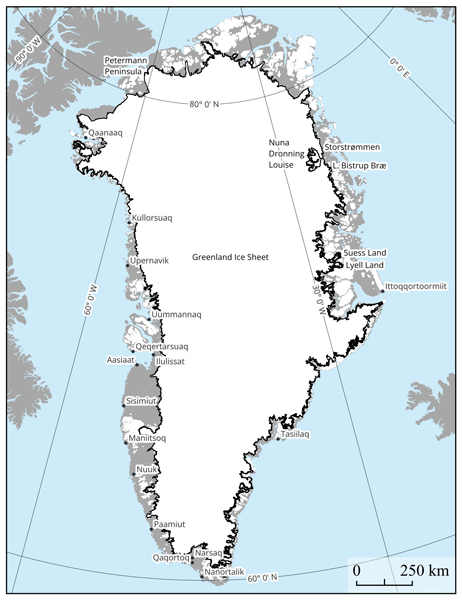
Gregor Luetzenburg, Niels Jakup Korsgaard, Anna Kirk Deichmann, Tobias Socher, Karin Gleie, Thomas Scharffenberger, Dominik Fahrner, Eva Bendix Nielsen, Penelope How, Anders Anker Bjørk, Kristian Kjellerup Kjeldsen, Andreas Peter Ahlstrøm, and Robert Schjøtt Fausto
Earth Syst. Sci. Data, 18, 411–427, https://doi.org/10.5194/essd-18-411-2026, https://doi.org/10.5194/essd-18-411-2026, 2026
Short summary
Short summary
We mapped the edge of the Greenland Ice Sheet using recent satellite images to create a detailed outline of its extent in 2022. This helps track how the ice sheet is changing as the climate warms. By carefully combining satellite data and checking results by hand, we created one of the most accurate maps of the ice sheet to date. This map supports research on ice loss and improves predictions of future changes in Greenland’s ice and its effect on the planet.
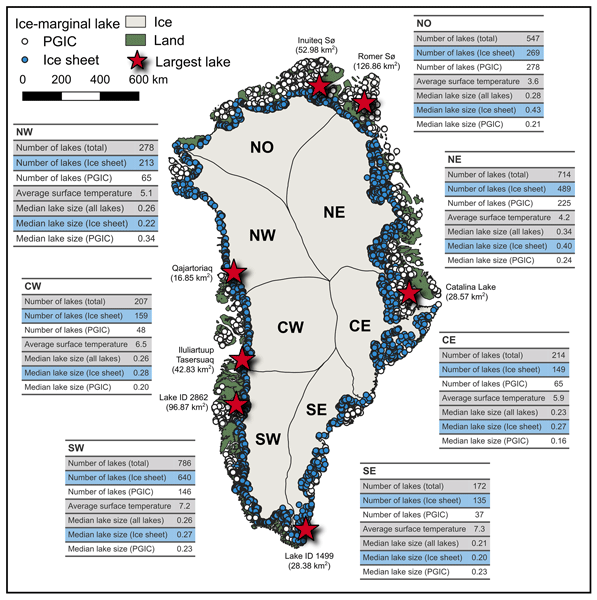
Penelope How, Dorthe Petersen, Kristian K. Kjeldsen, Katrine Raundrup, Nanna B. Karlsson, Alexandra Messerli, Anja Rutishauser, Jonathan L. Carrivick, James M. Lea, Robert S. Fausto, Andreas P. Ahlstrøm, and Signe B. Andersen
Earth Syst. Sci. Data, 17, 6331–6351, https://doi.org/10.5194/essd-17-6331-2025, https://doi.org/10.5194/essd-17-6331-2025, 2025
Short summary
Short summary
We mapped 2918 ice-marginal lakes across Greenland (2016–2023), revealing changes in size, abundance and temperature. This open dataset improves understanding of terrestrial water storage, glacier dynamics, and Arctic ecology, supporting research on sea level rise, glacier-lake interactions, and sustainable resource planning including hydropower development under Greenland’s climate commitments.
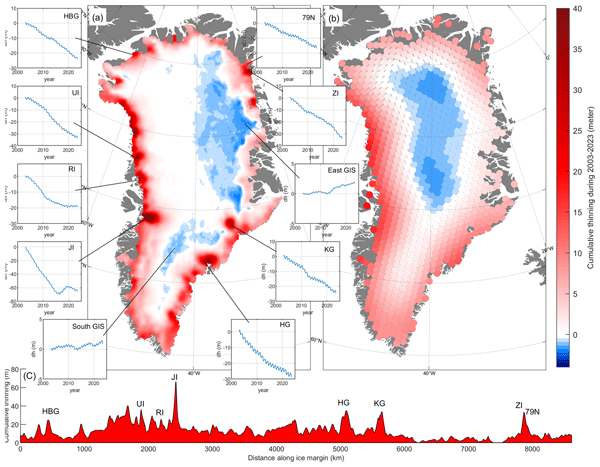
Shfaqat A. Khan, Helene Seroussi, Mathieu Morlighem, William Colgan, Veit Helm, Gong Cheng, Danjal Berg, Valentina R. Barletta, Nicolaj K. Larsen, William Kochtitzky, Michiel van den Broeke, Kurt H. Kjær, Andy Aschwanden, Brice Noël, Jason E. Box, Joseph A. MacGregor, Robert S. Fausto, Kenneth D. Mankoff, Ian M. Howat, Kuba Oniszk, Dominik Fahrner, Anja Løkkegaard, Eigil Y. H. Lippert, Alicia Bråtner, and Javed Hassan
Earth Syst. Sci. Data, 17, 3047–3071, https://doi.org/10.5194/essd-17-3047-2025, https://doi.org/10.5194/essd-17-3047-2025, 2025
Short summary
Short summary
The surface elevation of the Greenland Ice Sheet is changing due to surface mass balance processes and ice dynamics, each exhibiting distinct spatiotemporal patterns. Here, we employ satellite and airborne altimetry data with fine spatial (1 km) and temporal (monthly) resolutions to document this spatiotemporal evolution from 2003 to 2023. This dataset of fine-resolution altimetry data in both space and time will support studies of ice mass loss and be useful for GIS ice sheet modeling.
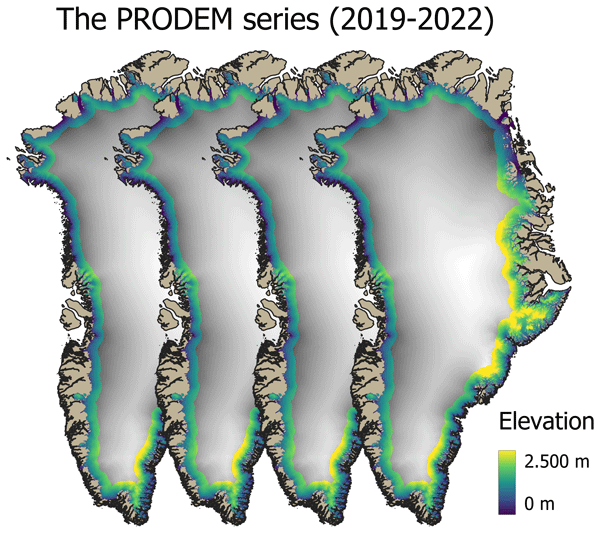
Mai Winstrup, Heidi Ranndal, Signe Hillerup Larsen, Sebastian B. Simonsen, Kenneth D. Mankoff, Robert S. Fausto, and Louise Sandberg Sørensen
Earth Syst. Sci. Data, 16, 5405–5428, https://doi.org/10.5194/essd-16-5405-2024, https://doi.org/10.5194/essd-16-5405-2024, 2024
Short summary
Short summary
Surface topography across the marginal zone of the Greenland Ice Sheet is constantly evolving. Here we present an annual series (2019–2022) of summer digital elevation models (PRODEMs) for the Greenland Ice Sheet margin, covering all outlet glaciers from the ice sheet. The PRODEMs are based on fusion of CryoSat-2 radar altimetry and ICESat-2 laser altimetry. With their high spatial and temporal resolution, the PRODEMs will enable detailed studies of the changes in marginal ice sheet elevations.
Signe Hillerup Larsen, Daniel Binder, Anja Rutishauser, Bernhard Hynek, Robert Schjøtt Fausto, and Michele Citterio
Earth Syst. Sci. Data, 16, 4103–4118, https://doi.org/10.5194/essd-16-4103-2024, https://doi.org/10.5194/essd-16-4103-2024, 2024
Short summary
Short summary
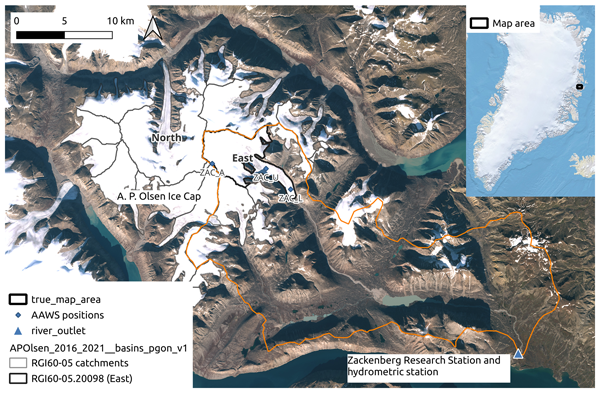
The Greenland Ecosystem Monitoring programme has been running since 1995. In 2008, the Glaciological monitoring sub-program GlacioBasis was initiated at the Zackenberg site in northeast Greenland, with a transect of three weather stations on the A. P. Olsen Ice Cap. In 2022, the weather stations were replaced with a more standardized set up. Here, we provide the reprocessed and quality-checked data from 2008 to 2022, i.e., the first 15 years of continued monitoring.
Anja Rutishauser, Kirk M. Scanlan, Baptiste Vandecrux, Nanna B. Karlsson, Nicolas Jullien, Andreas P. Ahlstrøm, Robert S. Fausto, and Penelope How
The Cryosphere, 18, 2455–2472, https://doi.org/10.5194/tc-18-2455-2024, https://doi.org/10.5194/tc-18-2455-2024, 2024
Short summary
Short summary
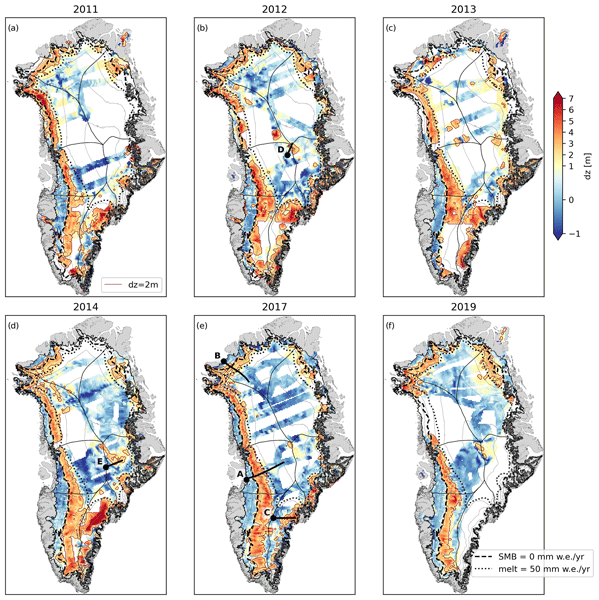
The Greenland Ice Sheet interior is covered by a layer of firn, which is important for surface meltwater runoff and contributions to global sea-level rise. Here, we combine airborne radar sounding and laser altimetry measurements to delineate vertically homogeneous and heterogeneous firn. Our results reveal changes in firn between 2011–2019, aligning well with known climatic events. This approach can be used to outline firn areas primed for significantly changing future meltwater runoff.
Baptiste Vandecrux, Robert S. Fausto, Jason E. Box, Federico Covi, Regine Hock, Åsa K. Rennermalm, Achim Heilig, Jakob Abermann, Dirk van As, Elisa Bjerre, Xavier Fettweis, Paul C. J. P. Smeets, Peter Kuipers Munneke, Michiel R. van den Broeke, Max Brils, Peter L. Langen, Ruth Mottram, and Andreas P. Ahlstrøm
The Cryosphere, 18, 609–631, https://doi.org/10.5194/tc-18-609-2024, https://doi.org/10.5194/tc-18-609-2024, 2024
Short summary
Short summary
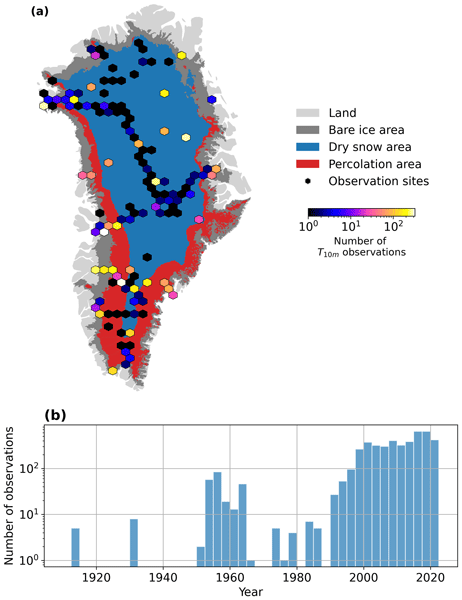
How fast is the Greenland ice sheet warming? In this study, we compiled 4500+ temperature measurements at 10 m below the ice sheet surface (T10m) from 1912 to 2022. We trained a machine learning model on these data and reconstructed T10m for the ice sheet during 1950–2022. After a slight cooling during 1950–1985, the ice sheet warmed at a rate of 0.7 °C per decade until 2022. Climate models showed mixed results compared to our observations and underestimated the warming in key regions.
Baptiste Vandecrux, Jason E. Box, Andreas P. Ahlstrøm, Signe B. Andersen, Nicolas Bayou, William T. Colgan, Nicolas J. Cullen, Robert S. Fausto, Dominik Haas-Artho, Achim Heilig, Derek A. Houtz, Penelope How, Ionut Iosifescu Enescu, Nanna B. Karlsson, Rebecca Kurup Buchholz, Kenneth D. Mankoff, Daniel McGrath, Noah P. Molotch, Bianca Perren, Maiken K. Revheim, Anja Rutishauser, Kevin Sampson, Martin Schneebeli, Sandy Starkweather, Simon Steffen, Jeff Weber, Patrick J. Wright, Henry Jay Zwally, and Konrad Steffen
Earth Syst. Sci. Data, 15, 5467–5489, https://doi.org/10.5194/essd-15-5467-2023, https://doi.org/10.5194/essd-15-5467-2023, 2023
Short summary
Short summary
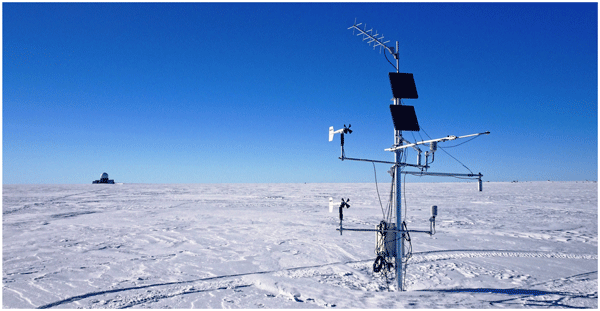
The Greenland Climate Network (GC-Net) comprises stations that have been monitoring the weather on the Greenland Ice Sheet for over 30 years. These stations are being replaced by newer ones maintained by the Geological Survey of Denmark and Greenland (GEUS). The historical data were reprocessed to improve their quality, and key information about the weather stations has been compiled. This augmented dataset is available at https://doi.org/10.22008/FK2/VVXGUT (Steffen et al., 2022).
Anja Løkkegaard, Kenneth D. Mankoff, Christian Zdanowicz, Gary D. Clow, Martin P. Lüthi, Samuel H. Doyle, Henrik H. Thomsen, David Fisher, Joel Harper, Andy Aschwanden, Bo M. Vinther, Dorthe Dahl-Jensen, Harry Zekollari, Toby Meierbachtol, Ian McDowell, Neil Humphrey, Anne Solgaard, Nanna B. Karlsson, Shfaqat A. Khan, Benjamin Hills, Robert Law, Bryn Hubbard, Poul Christoffersen, Mylène Jacquemart, Julien Seguinot, Robert S. Fausto, and William T. Colgan
The Cryosphere, 17, 3829–3845, https://doi.org/10.5194/tc-17-3829-2023, https://doi.org/10.5194/tc-17-3829-2023, 2023
Short summary
Short summary
This study presents a database compiling 95 ice temperature profiles from the Greenland ice sheet and peripheral ice caps. Ice viscosity and hence ice flow are highly sensitive to ice temperature. To highlight the value of the database in evaluating ice flow simulations, profiles from the Greenland ice sheet are compared to a modeled temperature field. Reoccurring discrepancies between modeled and observed temperatures provide insight on the difficulties faced when simulating ice temperatures.
William Colgan, Agnes Wansing, Kenneth Mankoff, Mareen Lösing, John Hopper, Keith Louden, Jörg Ebbing, Flemming G. Christiansen, Thomas Ingeman-Nielsen, Lillemor Claesson Liljedahl, Joseph A. MacGregor, Árni Hjartarson, Stefan Bernstein, Nanna B. Karlsson, Sven Fuchs, Juha Hartikainen, Johan Liakka, Robert S. Fausto, Dorthe Dahl-Jensen, Anders Bjørk, Jens-Ove Naslund, Finn Mørk, Yasmina Martos, Niels Balling, Thomas Funck, Kristian K. Kjeldsen, Dorthe Petersen, Ulrik Gregersen, Gregers Dam, Tove Nielsen, Shfaqat A. Khan, and Anja Løkkegaard
Earth Syst. Sci. Data, 14, 2209–2238, https://doi.org/10.5194/essd-14-2209-2022, https://doi.org/10.5194/essd-14-2209-2022, 2022
Short summary
Short summary
We assemble all available geothermal heat flow measurements collected in and around Greenland into a new database. We use this database of point measurements, in combination with other geophysical datasets, to model geothermal heat flow in and around Greenland. Our geothermal heat flow model is generally cooler than previous models of Greenland, especially in southern Greenland. It does not suggest any high geothermal heat flows resulting from Icelandic plume activity over 50 million years ago.
Kenneth D. Mankoff, Xavier Fettweis, Peter L. Langen, Martin Stendel, Kristian K. Kjeldsen, Nanna B. Karlsson, Brice Noël, Michiel R. van den Broeke, Anne Solgaard, William Colgan, Jason E. Box, Sebastian B. Simonsen, Michalea D. King, Andreas P. Ahlstrøm, Signe Bech Andersen, and Robert S. Fausto
Earth Syst. Sci. Data, 13, 5001–5025, https://doi.org/10.5194/essd-13-5001-2021, https://doi.org/10.5194/essd-13-5001-2021, 2021
Short summary
Short summary
We estimate the daily mass balance and its components (surface, marine, and basal mass balance) for the Greenland ice sheet. Our time series begins in 1840 and has annual resolution through 1985 and then daily from 1986 through next week. Results are operational (updated daily) and provided for the entire ice sheet or by commonly used regions or sectors. This is the first input–output mass balance estimate to include the basal mass balance.
Soňa Tomaškovičová, Fredrik Johansson, Michele Citterio, and Thomas Ingeman-Nielsen
EGUsphere, https://doi.org/10.5194/egusphere-2026-3688, https://doi.org/10.5194/egusphere-2026-3688, 2026
This preprint is open for discussion and under review for The Cryosphere (TC).
Short summary
Short summary
Systematic errors in permafrost temperature monitoring data could constitute a non-negligible part of the temperature changes reported from some regions. Due to inherent drift-inducing mechanisms in different thermal sensor technologies, calibration best practices should be expanded to include periodic recalibration of individual sensors, reporting of sensor metadata and calibration histories, and calibration guidelines tailored to long-term monitoring and short-term measurement campaigns.
Lea Hartl, Jakob Abermann, Ayla Akgün, Giulia Bertolotti, Tobias Bolch, Svenja Conzelmann, Codrut-Andrei Diaconu, Iris Hansche, Anne Hartig, Anna Haut, Kay Helfricht, Bernhard Hynek, Marie Sophie Kaucher, Andreas Kellerer-Pirklbauer, Ann Christin Kogel, Julie Krippes, Marcela Violeta Lauria, Christoph Mayer, Jan-Christoph Otto, Rainer Prinz, Sina Prölß, Lorenzo Rieg, Lea Schönleber, Gabriele Schwaizer, Bernd Seiser, Martin Stocker-Waldhuber, Markus Strudl, Martin Verhounik, and Harald Zandler
The Cryosphere, 20, 5157–5180, https://doi.org/10.5194/tc-20-5157-2026, https://doi.org/10.5194/tc-20-5157-2026, 2026
Short summary
Short summary
We mapped glacier outlines in Austria using recent, high resolution imagery. The resulting glacier inventory provides an update on glacier area in Austria in 2021-2023. More than 30% of glacier area was lost and 95 glaciers have disappeared since the mid-2000s. Glacier recession is accelerating and regular updates to glacier inventories are needed to understand downstream changes to the hydrological system, quantify glacier mass loss, and support planning and adaptation measures.
Sofie Hedetoft, Olivia Bang Brinck, Ruth Mottram, Andrea M. U. Gierisch, Steffen Malskær Olsen, Martin Olesen, Nicolaj Hansen, Anders Anker Bjørk, Erik Loebel, Anne Solgaard, and Peter Thejll
The Cryosphere, 20, 5071–5098, https://doi.org/10.5194/tc-20-5071-2026, https://doi.org/10.5194/tc-20-5071-2026, 2026
Short summary
Short summary
Iceberg mélange is the jumble of icebergs in front of some glaciers that calve into the sea. Some studies suggest mélange might help to control the retreat of glaciers. We studied 3 glaciers in NW Greenland where we used GPS sensors and satellites to track ice movement. We found that glaciers push forward and calve all year, including when mélange and landfast sea ice are present, suggesting mélange is not important in supporting glaciers, but may influence the seasonal calving cycle.
Aris Kwadijk, Philip D. A. Kraaijenbrink, Faezeh M. Nick, Joseph M. Shea, Jakob F. Steiner, René R. Wijngaard, and Walter W. Immerzeel
EGUsphere, https://doi.org/10.5194/egusphere-2026-5005, https://doi.org/10.5194/egusphere-2026-5005, 2026
This preprint is open for discussion and under review for Hydrology and Earth System Sciences (HESS).
Short summary
Short summary
The Himalayas supply water to millions of people downstream, yet high-altitude rainfall remains poorly understood. Using thirteen years of data from weather stations across Nepal's Langtang Valley, we found that during the monsoon the moist atmosphere causes rainfall to be highly sensitive to topography. We show how precipitation-elevation gradients shift during the day. This shift is captured in a numerical relation, that can serve to validate weather models.
Signe Hillerup Larsen, Kirsty Langley, Daniel A. Rudd, Mikhail Mastepanov, Niels Martin Schmidt, Arno C. Hammann, Andreas Westergaard-Nielsen, Efrén Lopéz-Blanco, and Torben R. Christensen
EGUsphere, https://doi.org/10.5194/egusphere-2026-3962, https://doi.org/10.5194/egusphere-2026-3962, 2026
This preprint is open for discussion and under review for The Cryosphere (TC).
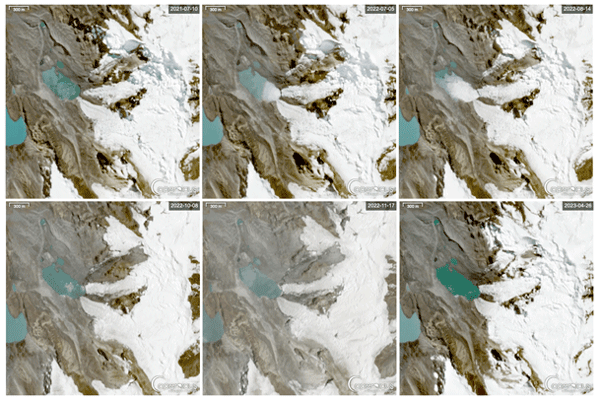
Short summary
Short summary
Snow cover shapes Arctic ecosystems by controlling for example when plants flower and glaciers melt. Using 26 years of daily satellite images over Greenland, we found high year-to-year variability and no systematic change in the length of the snow-free season at three long-term ecosystem monitoring sites. Thus, detecting the effects of climate change on snow cover and the ecosystems depending on it requires longer monitoring records, underscoring the value of continued long-term observation.
Hannah Bailey, Jason E. Box, Ben G. Kopec, Valtteri Hyöky, Hannu Marttila, Jeffrey M. Welker, Jack Kohler, Dmitry V. Divine, and Alun Hubbard
The Cryosphere, 20, 4421–4436, https://doi.org/10.5194/tc-20-4421-2026, https://doi.org/10.5194/tc-20-4421-2026, 2026
Short summary
Short summary
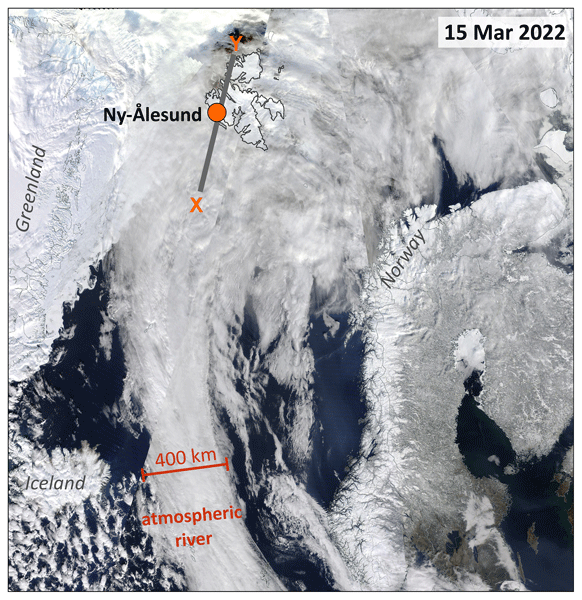
Atmospheric rivers (ARs) are narrow corridors of intense heat and moisture that can deliver extreme weather to the Arctic. We investigate a record March 2022 event in Svalbard using measurements of air and precipitation to track its origin and evolution. While the AR brought unusual winter rain and snow melt, it also delivered substantial snowfall that partially offset glacier mass loss. These findings show that the impacts of ARs on Arctic glaciers are more complex than typically reported.
Natalia H. Andersen, Sebastian B. Simonsen, Karina Nielsen, Mai Winstrup, Baptiste Vandecrux, Hui Gao, Beata Csatho, Anton Schenk, and Louise Sandberg Sørensen
The Cryosphere, 20, 4327–4344, https://doi.org/10.5194/tc-20-4327-2026, https://doi.org/10.5194/tc-20-4327-2026, 2026
Short summary
Short summary
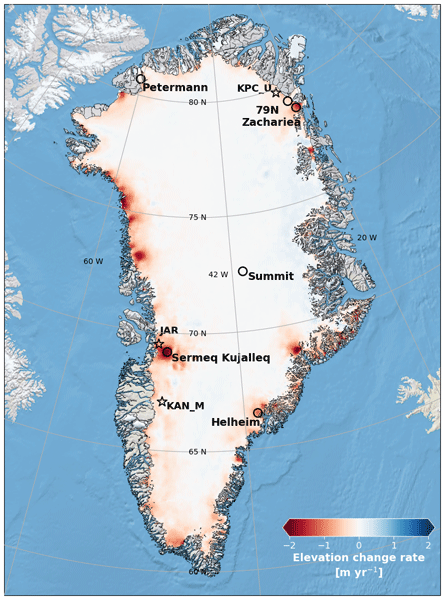
We developed a new statistical approach to track monthly changes in the surface height of the Greenland Ice Sheet using radar data from the CryoSat-2 satellite (2011–2025). The method lets seasonal and long-term variations emerge directly from the data, creating a consistent record of elevation change that helps reveal how Greenland responds to ongoing climate change.
Rebecca Schlegel, Johannes Noll, Leah Sopie Muhle, Christian T. Wild, Falk M. Oraschewski, Olaf Eisen, and Reinhard Drews
EGUsphere, https://doi.org/10.5194/egusphere-2026-3900, https://doi.org/10.5194/egusphere-2026-3900, 2026
This preprint is open for discussion and under review for The Cryosphere (TC).
Short summary
Short summary
Step-like terraces at the base of Antarctic ice shelves are known from warm-water settings, but we show for the first time that they also occur at the base of a cold-water ice shelf. Repeat radar observations reveal that the terraces melt slowly and remain almost unchanged over one year. Our results suggest they form near the grounding line and are then transported with the flowing ice while melting only slowly.
Tiago Silva, Kristine Flacké Haualand, Jacob Clement Yde, Johan Hassing Scheller, Jakob Abermann, Andreas Trügler, and Wolfgang Schöner
EGUsphere, https://doi.org/10.5194/egusphere-2026-3687, https://doi.org/10.5194/egusphere-2026-3687, 2026
Short summary
Short summary
Severe downslope windstorms (locally known as piteraq) impact southeast Greenland communities and global ocean currents. Using high-resolution weather reanalysis, we show how piteraq events are driven by massive cold weather systems colliding with Greenland. As the dense air plunges down the steep coastal slopes, it accelerates into concentrated low-level jets. Recognizing the associated large-scale preconditioning will improve early warning systems and future climate predictions.
Kristine Flacké Haualand, Tiago Silva, Kerstin Rasmussen, Caroline Drost Jensen, Johan Hassing Scheller, Jakob Abermann, Simon de Villiers, Andreas Trügler, Wolfgang Schöner, and Jacob Clement Yde
EGUsphere, https://doi.org/10.5194/egusphere-2026-3684, https://doi.org/10.5194/egusphere-2026-3684, 2026
Short summary
Short summary
Southeast Greenland is often affected by damaging windstorms from the Greenland ice sheet. Using weather observations, we find that these windstorms have footprints covering several 100 km in the horizontal and several km in the vertical. The largest seasonal differences are warming instead of cooling and larger reductions in humidity in summer compared to winter. Our findings improve our understanding of spatial and temporal characteristics of these windstorms in the present and future climate.
Ilaria Santin, Huw J. Horgan, Raphael Moser, Nanna Bjørnholt Karlsson, Faezeh M. Nick, Andreas Vieli, Anja Rutishauser, Hansruedi Maurer, and Daniel Farinotti
The Cryosphere, 20, 3435–3441, https://doi.org/10.5194/tc-20-3435-2026, https://doi.org/10.5194/tc-20-3435-2026, 2026
Short summary
Short summary
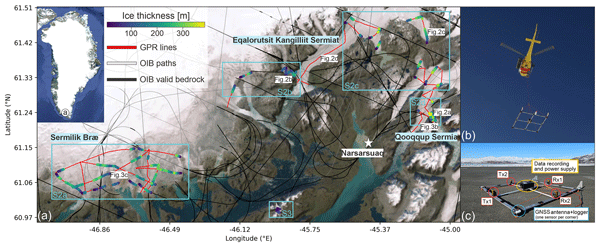
Ice thickness near Greenland’s coast is still poorly measured, yet it is vital for predicting sea level rise. We flew a helicopter ice-penetrating radar over three outlet glaciers in southern Greenland and mapped the glacier bed where basal reflections were clear. We measured ice up to about 340 meters thick, with reliable penetration typically to about 300 meters, providing new constraints that can improve regional bed maps.
Anne Solgaard, Anders Kusk, John Peter Merryman Boncori, Jørgen Dall, Andreas P. Ahlstrøm, Signe B. Andersen, Michele Citterio, Penelope How, Nanna B. Karlsson, Kristian K. Kjeldsen, Signe H. Larsen, Mads C. Lund, Anja Løkkegaard, Martin P. Lüthi, Jessica Mejia, Kenneth D. Mankoff, Dirk van As, Shin Sugiyama, and Robert S. Fausto
Earth Syst. Sci. Data Discuss., https://doi.org/10.5194/essd-2026-221, https://doi.org/10.5194/essd-2026-221, 2026
Preprint under review for ESSD
Short summary
Short summary
We present the PROMICE ice-velocity dataset, a time series of maps showing how fast the Greenland Ice Sheet flows. The time series is created using satellite radar images from Sentinel-1 since 2016 and is updated with a new map every 12 days providing a detailed view of ice sheet wide dynamics for more than a decade. Continuous updates and improvements, such as those presented here, are essential for maintaining long, consistent, high-quality records of key climate variables for research.
Rebecca McCerery, Joseph A. Graly, Christopher L. Hansen, Kate Winter, William P. Gilhooly III, Trinity L. Hamilton, Moses Jatta, Jeff R. Havig, Felipe Napoleoni, Alicia M. Rutledge, Matthew Terrell, Tanya M. Trott, Kayla Woodie, Bernd Kulessa, Sevi Modestou, Hannah Bahrani, Tori Kennedy, Alexandra Messerli, and Kathy Licht
EGUsphere, https://doi.org/10.5194/egusphere-2026-2131, https://doi.org/10.5194/egusphere-2026-2131, 2026
Short summary
Short summary
Ice cores from Isunnguata Sermia’s forefield reveal how proglacial naled and accreted ices form in Greenland. Naledi build up in winter from precipitation and mineral-rich subglacial water, while accreted ice forms in summer through supercooled water upwelling. Geophysical surveys indicate both are fed by subsurface flows potentially originating from the glacier bed hundreds of metres away. Here, we present the first conceptual model of these formations in Greenland.
Didier Swingedouw, Laura Jackson, Aixue Hu, Anastasia Romanou, Nicole C. Laureanti, Wilbert Weijer, Sina Loriani, Bette Otto-Bliesner, Ayako Abe-Ouchi, Lucas Almeida, Alessio Bellucci, Reyk Börner, Gokhan Danabasoglu, Donovan P. Dennis, Marion Devilliers, Sybren Drijfhout, Jonathan Donges, Friederike Fröb, Thomas L. Frölicher, Guillaume Gastineau, Heiko Goelzer, Chuncheng Guo, Urs Hofmann, Anna Höse, Colin Jones, Torben Koenigk, Ann Kristin Klose, Valerio Lembo, Jose Licon-Salaiz, Ken Mankoff, Virna Meccia, Irina Melnikova, Oliver Mehling, Laurie Menviel, Juliette Mignot, Jon I. Robson, Gavin A. Schmidt, Robin Smith, Yuchen Sun, Irene Trombini, Matteo Willeit, Richard Wood, Fanghua Wu, Lin Zhaohui, and Ricarda Winkelmann
EGUsphere, https://doi.org/10.5194/egusphere-2026-1698, https://doi.org/10.5194/egusphere-2026-1698, 2026
Short summary
Short summary
This study presents a plan for climate model experiments to better understand how changes in freshwater in the North Atlantic affect major ocean currents. We designed coordinated simulations to test their response to warming, added freshwater, and possible recovery after weakening. Comparing results across models and past climate evidence helps improve confidence in projections and assess risks of large ocean circulation changes.
Javed Hassan, Karina Nielsen, William Colgan, Rijan Bhakta Kayastha, Mira Khadka, and Shfaqat Abbas Khan
EGUsphere, https://doi.org/10.5194/egusphere-2026-808, https://doi.org/10.5194/egusphere-2026-808, 2026
Short summary
Short summary
High-altitude lakes in High Mountain Asia (HMA) are important sources of freshwater and sensitive indicators of environmental change. Using satellite data from 2010 to 2024, we examine water level changes in 232 lakes across HMA. Results show rising lake levels on the Tibetan Plateau, while lakes in the Himalaya are declining. These contrasting patterns highlight strong regional differences and provide valuable information for understanding water availability and associated hazards.
Francesca Pellicciotti, Adrià Fontrodona-Bach, David R. Rounce, Catriona L. Fyffe, Leif S. Anderson, Álvaro Ayala, Ben W. Brock, Pascal Buri, Stefan Fugger, Koji Fujita, Prateek Gantayat, Alexander R. Groos, Walter Immerzeel, Marin Kneib, Christoph Mayer, Shelley MacDonell, Michael McCarthy, James McPhee, Evan Miles, Heather Purdie, Ekaterina Rets, Akiko Sakai, Thomas E. Shaw, Jakob Steiner, Patrick Wagnon, and Alex Winter-Billington
The Cryosphere, 20, 1895–1928, https://doi.org/10.5194/tc-20-1895-2026, https://doi.org/10.5194/tc-20-1895-2026, 2026
Short summary
Short summary
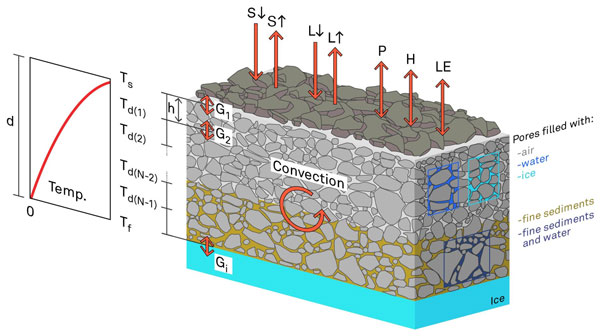
Rock debris covers many of the world glaciers, modifying the transfer of atmospheric energy to the debris and into the ice. Models of different complexity simulate this process, and we compare 15 models at 9 sites to show that the most complex models at the debris-atmosphere interface have the highest performance. However, we lack debris properties and their derivation from measurements is ambiguous, hindering global modelling and calling for both model development and data collection.
Matthew Switanek, Jakob Abermann, Wolfgang Schöner, and Michael L. Anderson
Hydrol. Earth Syst. Sci., 30, 1719–1734, https://doi.org/10.5194/hess-30-1719-2026, https://doi.org/10.5194/hess-30-1719-2026, 2026
Short summary
Short summary
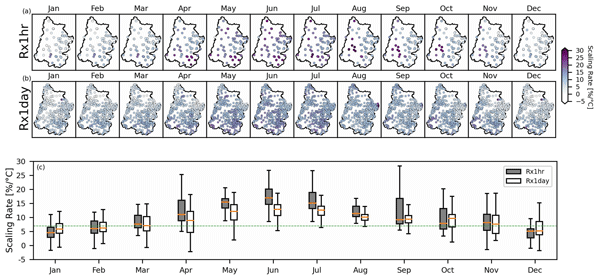
Extreme precipitation is expected to increase in a warming climate. Station-based measurements of precipitation and dew point temperature are often used to estimate observed precipitation-temperature scaling rates. In this study, we use three different approaches which rely on either raw or normalized data to estimate scaling rates and produce predictions of extreme precipitation. We find that normalizing the data first can improve our estimates of precipitation-temperature scaling rates.
Jakob Steiner, Jakob Abermann, and Rainer Prinz
The Cryosphere, 20, 1797–1814, https://doi.org/10.5194/tc-20-1797-2026, https://doi.org/10.5194/tc-20-1797-2026, 2026
Short summary
Short summary
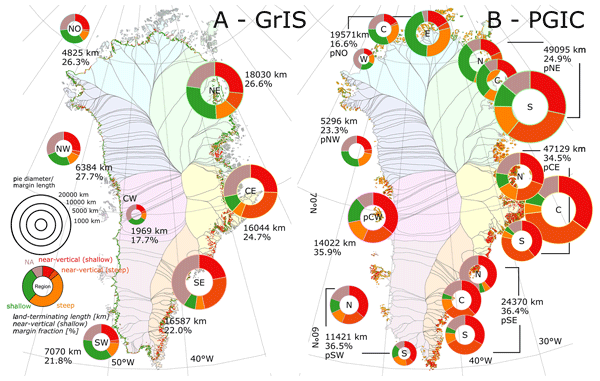
Nearly 95% of the Greenland ice margin ends on land, where meltwater leaves the ice to supply surrounding ecosystems. Here we show that nearly 30% of this land-terminating margin ends in extremely steep, often vertical sections, previously only described in individual locations. Less than 20% are shallow ramps. Knowledge of these margin shapes and their locations allows us to further investigate what they can potentially tell us about the current ice sheet health and its future evolution.
Anna Bang Kvorning, Marie-Alexandrine Sicre, Gregor Luetzenburg, Sabine Schmidt, Thorbjørn Joest Andersen, Vincent Klein, Eleanor Georgiadis, Audrey Limoges, Jacques Giraudeau, Anders Anker Bjørk, Nicolaj Krog Larsen, and Sofia Ribeiro
Clim. Past, 22, 605–624, https://doi.org/10.5194/cp-22-605-2026, https://doi.org/10.5194/cp-22-605-2026, 2026
Short summary
Short summary
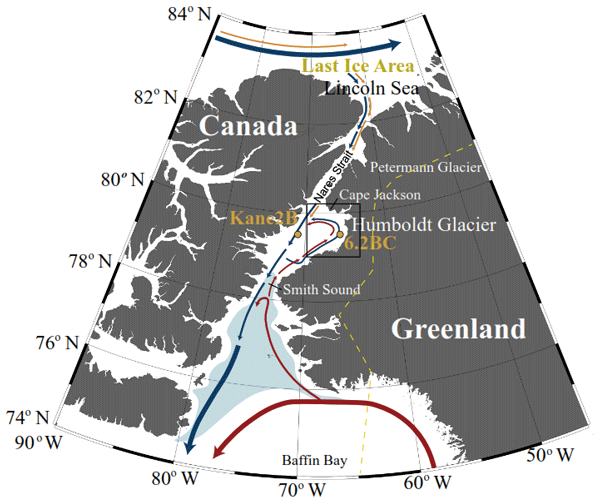
We compare two marine sediment cores collected from contrasting locations in Kane Basin, northwest Greenland. The two sites differ in terms of how much sediment they receive, the level of primary production, and the source and composition of organic matter. Despite these spatial differences, both records reveal a similar long-term environmental trend, a shift from cold, heavy sea-ice conditions between ca. 1750–1900 CE, towards more open, fresher, and biologically productive waters by 1950 CE.
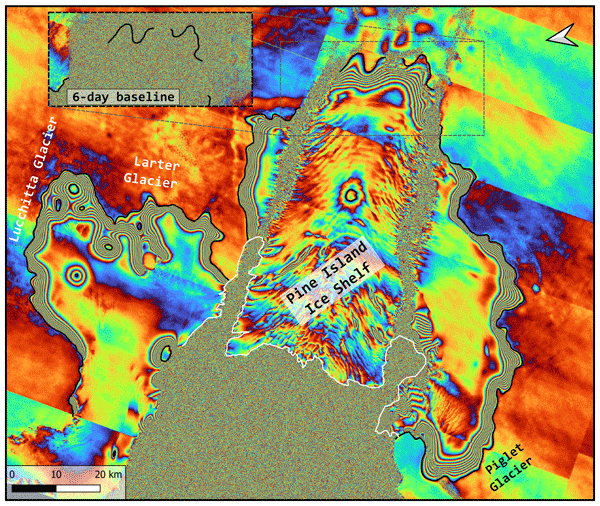
Jonas K. Andersen, Romain Millan, Eric Rignot, Lucille Gimenes, Bernd Scheuchl, Jean Baptiste Barré, and Anders A. Bjørk
The Cryosphere, 20, 1589–1598, https://doi.org/10.5194/tc-20-1589-2026, https://doi.org/10.5194/tc-20-1589-2026, 2026
Short summary
Short summary
We used new satellite radar data from 2025 to map the border where Antarctic glaciers lose contact with the ground and begin to float. This updated map shows recent changes to many glaciers in the Amundsen Sea region, some of which have retreated by several kilometers. Our results help track how Antarctica is responding to climate change and highlight the value of future satellite missions for monitoring ice sheet stability.
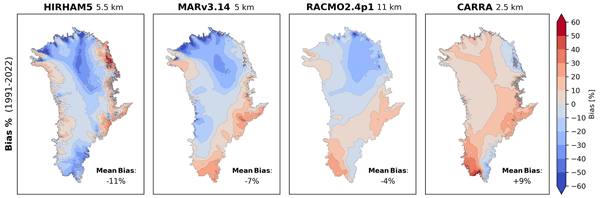
Josephine Lindsey-Clark, Aslak Grinsted, Baptiste Vandecrux, and Christine Schøtt Hvidberg
The Cryosphere, 20, 1463–1495, https://doi.org/10.5194/tc-20-1463-2026, https://doi.org/10.5194/tc-20-1463-2026, 2026
Short summary
Short summary
Accurate maps of snowfall over the Greenland ice sheet are essential for reliable projections of future sea-level rise. Climate models often struggle to capture realistic snowfall patterns, leading to significant long-term errors. We present a new method that corrects these errors using over two million observations. The corrected snowfall maps can help to reduce uncertainty in sea-level rise projections and improve understanding of Greenland’s proximity to irreversible melting thresholds.
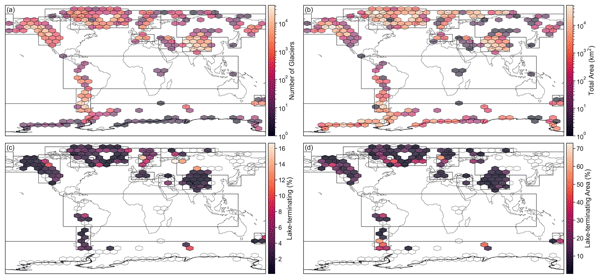
Jakob Steiner, William Armstrong, Will Kochtitzky, Robert McNabb, Rodrigo Aguayo, Tobias Bolch, Fabien Maussion, Vibhor Agarwal, Iestyn Barr, Nathaniel R. Baurley, Mike Cloutier, Katelyn DeWater, Frank Donachie, Yoann Drocourt, Siddhi Garg, Gunjan Joshi, Byron Guzman, Stanislav Kutuzov, Thomas Loriaux, Caleb Mathias, Brian Menounos, Evan Miles, Aleksandra Osika, Kaleigh Potter, Adina Racoviteanu, Brianna Rick, Miles Sterner, Guy D. Tallentire, Levan Tielidze, Rebecca White, Kunpeng Wu, and Whyjay Zheng
Earth Syst. Sci. Data, 18, 1665–1681, https://doi.org/10.5194/essd-18-1665-2026, https://doi.org/10.5194/essd-18-1665-2026, 2026
Short summary
Short summary
Many mountain glaciers around the world flow into lakes – exactly how many however, has never been mapped. Across a large team of experts we have now identified all glaciers that end in lakes. Only about 1% do so, but they are generally larger than those which end on land. This is important to understand, as lakes can influence the behaviour of glacier ice, including how fast it disappears. This new dataset allows us to better model glaciers at a global scale, accounting for the effect of lakes.
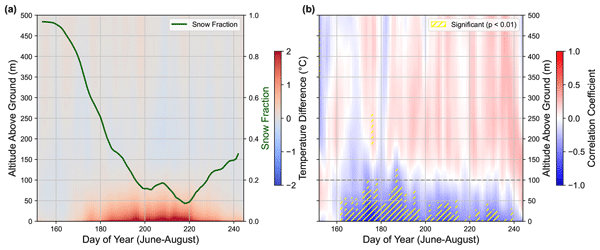
Jonathan Fipper, Jakob Abermann, Ingo Sasgen, Henrik Skov, Lise Lotte Sørensen, and Wolfgang Schöner
The Cryosphere, 20, 683–698, https://doi.org/10.5194/tc-20-683-2026, https://doi.org/10.5194/tc-20-683-2026, 2026
Short summary
Short summary
We use measurements conducted with uncrewed aerial vehicles (UAVs) and reanalysis data to study the drivers of vertical air temperature structures and their link to the surface mass balance of Flade Isblink, a large ice cap in Northeast Greenland. Surface properties control temperature structures up to 100 m above ground, while large-scale circulation dominates above. Mass loss has increased since 2015, with record loss in 2023 associated with frequent synoptic conditions favouring melt.
Ida Haven, Hans Christian Steen-Larsen, Laura J. Dietrich, Sonja Wahl, Jason E. Box, Michiel R. van den Broeke, Alun Hubbard, Stephan T. Kral, Joachim Reuder, and Maurice van Tiggelen
The Cryosphere, 20, 573–593, https://doi.org/10.5194/tc-20-573-2026, https://doi.org/10.5194/tc-20-573-2026, 2026
Short summary
Short summary
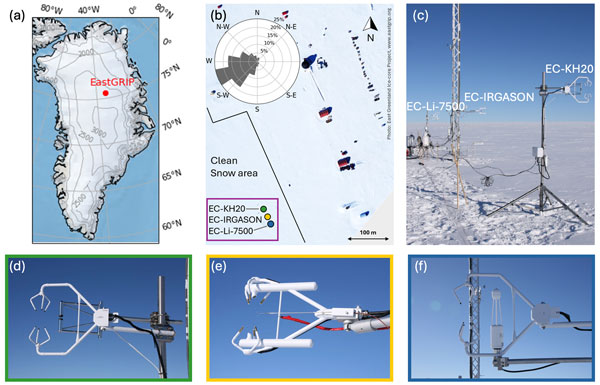
Three independent Eddy-Covariance measurement systems deployed on top of the Greenland Ice Sheet are compared. Using this dataset, we evaluate the reproducibility and quantify the differences between the systems. The fidelity of two regional climate models in capturing the seasonal variability in the latent and sensible heat flux between the snow surface and the atmosphere is assessed. We identify differences between observations and model simulations, especially during the winter period.
Jan Niklas Richter, Anselm Arndt, Nikolina Ban, Nicolas Gampierakis, Fabien Maussion, Rainer Prinz, Matthias Scheiter, Nikolaus Umlauf, and Lindsey Nicholson
EGUsphere, https://doi.org/10.5194/egusphere-2025-6249, https://doi.org/10.5194/egusphere-2025-6249, 2026
Short summary
Short summary
We developed a multi-objective Bayesian framework to calibrate a surface energy balance (SEB) model using only publicly available satellite data and climate simulations. The framework constrains model parameters well but also reveals biases in the forcing, affecting the SEB and the simulated mass balance and snowlines. The results indicate that an uncertainty-aware model chain can help identify model errors and provides a first step towards physical glacier modelling without in-situ data.
Gregor Luetzenburg, Niels Jakup Korsgaard, Anna Kirk Deichmann, Tobias Socher, Karin Gleie, Thomas Scharffenberger, Dominik Fahrner, Eva Bendix Nielsen, Penelope How, Anders Anker Bjørk, Kristian Kjellerup Kjeldsen, Andreas Peter Ahlstrøm, and Robert Schjøtt Fausto
Earth Syst. Sci. Data, 18, 411–427, https://doi.org/10.5194/essd-18-411-2026, https://doi.org/10.5194/essd-18-411-2026, 2026
Short summary
Short summary
We mapped the edge of the Greenland Ice Sheet using recent satellite images to create a detailed outline of its extent in 2022. This helps track how the ice sheet is changing as the climate warms. By carefully combining satellite data and checking results by hand, we created one of the most accurate maps of the ice sheet to date. This map supports research on ice loss and improves predictions of future changes in Greenland’s ice and its effect on the planet.

An Y. Li, Michelle R. Koutnik, Stephen Brough, Matteo Spagnolo, and Iestyn Barr
Earth Surf. Dynam., 14, 1–31, https://doi.org/10.5194/esurf-14-1-2026, https://doi.org/10.5194/esurf-14-1-2026, 2026
Short summary
Short summary
Many alcoves on Mars resemble glacial cirques on Earth. While some contain glacier-like forms, many do not, and they have never been studied at a large scale. We mapped ~2,000 alcoves in Deuteronilus Mensae and identified 435 as "cirque-like." These show geomorphic signs of past glaciation and mainly face south–southeast, implying ice accumulation during high obliquity. Further research is needed to confirm the style of glaciation as either warm-based or cold-based.
Penelope How, Dorthe Petersen, Kristian K. Kjeldsen, Katrine Raundrup, Nanna B. Karlsson, Alexandra Messerli, Anja Rutishauser, Jonathan L. Carrivick, James M. Lea, Robert S. Fausto, Andreas P. Ahlstrøm, and Signe B. Andersen
Earth Syst. Sci. Data, 17, 6331–6351, https://doi.org/10.5194/essd-17-6331-2025, https://doi.org/10.5194/essd-17-6331-2025, 2025
Short summary
Short summary
We mapped 2918 ice-marginal lakes across Greenland (2016–2023), revealing changes in size, abundance and temperature. This open dataset improves understanding of terrestrial water storage, glacier dynamics, and Arctic ecology, supporting research on sea level rise, glacier-lake interactions, and sustainable resource planning including hydropower development under Greenland’s climate commitments.
Gavin A. Schmidt, Kenneth D. Mankoff, Jonathan L. Bamber, Clara Burgard, Dustin Carroll, David M. Chandler, Violaine Coulon, Benjamin J. Davison, Matthew H. England, Paul R. Holland, Nicolas C. Jourdain, Qian Li, Juliana M. Marson, Pierre Mathiot, Clive R. McMahon, Twila A. Moon, Ruth Mottram, Sophie Nowicki, Anna Olivé Abelló, Andrew G. Pauling, Thomas Rackow, and Damien Ringeisen
Geosci. Model Dev., 18, 8333–8361, https://doi.org/10.5194/gmd-18-8333-2025, https://doi.org/10.5194/gmd-18-8333-2025, 2025
Short summary
Short summary
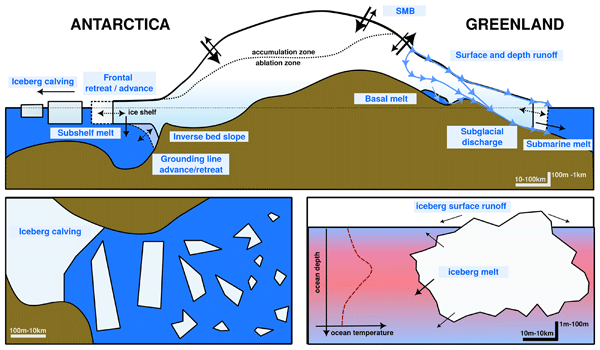
The impact of increasing mass loss from the Greenland and Antarctic ice sheets has not so far been included in historical climate model simulations. This paper describes the protocols and data available for modeling groups to add this anomalous freshwater to their ocean modules to better represent the impacts of these fluxes on ocean circulation, sea ice, salinity and sea level.
Robert G. Bingham, Julien A. Bodart, Marie G. P. Cavitte, Ailsa Chung, Rebecca J. Sanderson, Johannes C. R. Sutter, Olaf Eisen, Nanna B. Karlsson, Joseph A. MacGregor, Neil Ross, Duncan A. Young, David W. Ashmore, Andreas Born, Winnie Chu, Xiangbin Cui, Reinhard Drews, Steven Franke, Vikram Goel, John W. Goodge, A. Clara J. Henry, Antoine Hermant, Benjamin H. Hills, Nicholas Holschuh, Michelle R. Koutnik, Gwendolyn J.-M. C. Leysinger Vieli, Emma J. MacKie, Elisa Mantelli, Carlos Martín, Felix S. L. Ng, Falk M. Oraschewski, Felipe Napoleoni, Frédéric Parrenin, Sergey V. Popov, Therese Rieckh, Rebecca Schlegel, Dustin M. Schroeder, Martin J. Siegert, Xueyuan Tang, Thomas O. Teisberg, Kate Winter, Shuai Yan, Harry Davis, Christine F. Dow, Tyler J. Fudge, Tom A. Jordan, Bernd Kulessa, Kenichi Matsuoka, Clara J. Nyqvist, Maryam Rahnemoonfar, Matthew R. Siegfried, Shivangini Singh, Vjeran Višnjević, Rodrigo Zamora, and Alexandra Zuhr
The Cryosphere, 19, 4611–4655, https://doi.org/10.5194/tc-19-4611-2025, https://doi.org/10.5194/tc-19-4611-2025, 2025
Short summary
Short summary
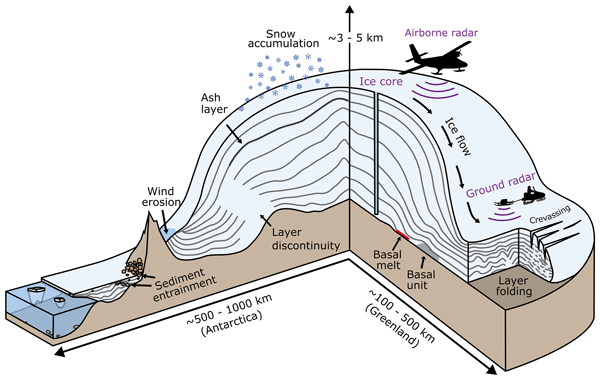
The ice sheets covering Antarctica have built up over millenia through successive snowfall events which become buried and preserved as internal surfaces of equal age detectable with ice-penetrating radar. This paper describes an international initiative working together on these archival data to build a comprehensive 3-D picture of how old the ice is everywhere across Antarctica and how this is being used to reconstruct past and to predict future ice and climate behaviour.
Florina Roana Schalamon, Sebastian Scher, Andreas Trügler, Lea Hartl, Wolfgang Schöner, and Jakob Abermann
Weather Clim. Dynam., 6, 1075–1088, https://doi.org/10.5194/wcd-6-1075-2025, https://doi.org/10.5194/wcd-6-1075-2025, 2025
Short summary
Short summary
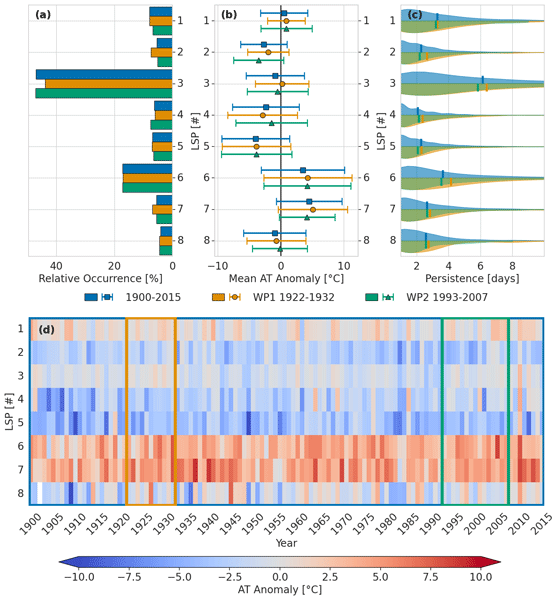
Atmospheric patterns influence the air temperature in Greenland. We investigate two warming periods, from 1922–1932 and 1993–2007, both showing similar temperature increases. Using a neural network-based clustering method, we defined predominant atmospheric patterns for further analysis. Our findings reveal that while the connection between these patterns and local air temperature remains stable, the distribution of patterns changes between the warming periods and the full period (1900–2015).
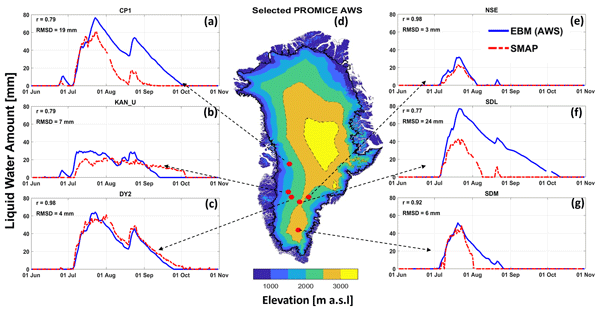
Alamgir Hossan, Andreas Colliander, Baptiste Vandecrux, Nicole-Jeanne Schlegel, Joel Harper, Shawn Marshall, and Julie Z. Miller
The Cryosphere, 19, 4237–4258, https://doi.org/10.5194/tc-19-4237-2025, https://doi.org/10.5194/tc-19-4237-2025, 2025
Short summary
Short summary
We used L-band observations from the Soil Moisture Active Passive (SMAP) mission to quantify the surface and subsurface liquid water amounts (LWAs) in the percolation zone of the Greenland ice sheet. The algorithm is described, and the validation results are provided. The results demonstrate the potential for creating an LWA data product across the Greenland ice sheet (GrIS), which will advance our understanding of ice sheet physical processes for better projection of Greenland’s contribution to global sea level rise.
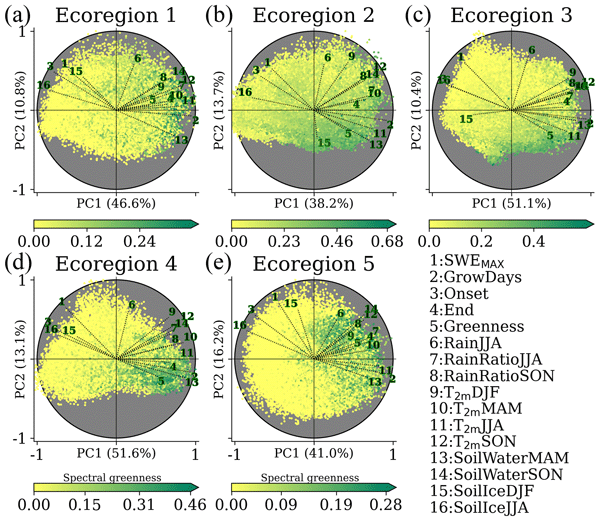
Tiago Silva, Brandon Samuel Whitley, Elisabeth Machteld Biersma, Jakob Abermann, Katrine Raundrup, Natasha de Vere, Toke Thomas Høye, Verena Haring, and Wolfgang Schöner
Biogeosciences, 22, 4601–4626, https://doi.org/10.5194/bg-22-4601-2025, https://doi.org/10.5194/bg-22-4601-2025, 2025
Short summary
Short summary
Ecosystems in Greenland have experienced significant changes over recent decades. We show the consistency of a high-resolution polar-adapted reanalysis product to represent bio-climatic factors influencing ecological processes. Our results describe the relevance/interaction between snowmelt and soil water content before the growing season onset, infer how the thermal growing season relates to changes in spectral greenness, and describe regions of ongoing changes in vegetation distribution.
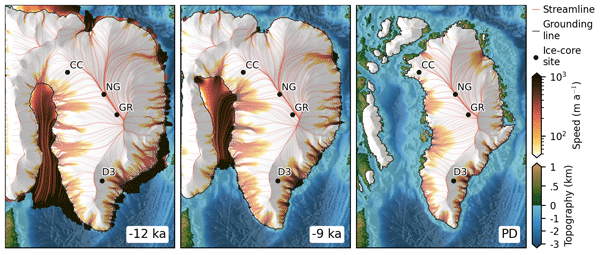
Mikkel Langgaard Lauritzen, Anne Solgaard, Nicholas Mossor Rathmann, Bo Møllesøe Vinther, Aslak Grindsted, Brice Noël, Guðfinna Aðalgeirsdóttir, and Christine Schøtt Hvidberg
The Cryosphere, 19, 3599–3622, https://doi.org/10.5194/tc-19-3599-2025, https://doi.org/10.5194/tc-19-3599-2025, 2025
Short summary
Short summary
We studied the Holocene (past 11 700 years) to understand how the Greenland Ice Sheet has changed. Using 841 computer simulations, we tested different scenarios and matched them to historical ice elevation data, confirming our model's accuracy. Results show that Greenland's melting has raised sea levels by about 5.3 m since the Holocene began and by around 12 mm in just the past 500 years.
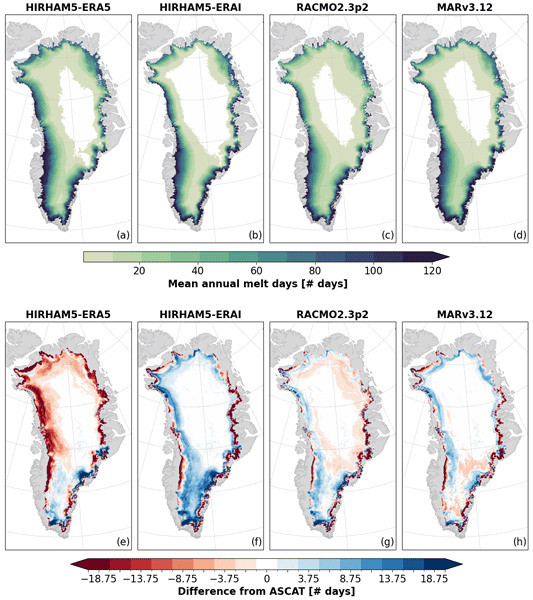
Anna Puggaard, Nicolaj Hansen, Ruth Mottram, Thomas Nagler, Stefan Scheiblauer, Sebastian B. Simonsen, Louise S. Sørensen, Jan Wuite, and Anne M. Solgaard
The Cryosphere, 19, 2963–2981, https://doi.org/10.5194/tc-19-2963-2025, https://doi.org/10.5194/tc-19-2963-2025, 2025
Short summary
Short summary
Regional climate models are currently the only source for assessing the melt volume of the Greenland Ice Sheet on a global scale. This study compares the modeled melt volume with observations from weather stations and melt extent observed from the Advanced SCATterometer (ASCAT) to assess the performance of the models. It highlights the importance of critically evaluating model outputs with high-quality satellite measurements to improve the understanding of variability among models.
Marc Girona-Mata, Andrew Orr, Martin Widmann, Daniel Bannister, Ghulam Hussain Dars, Scott Hosking, Jesse Norris, David Ocio, Tony Phillips, Jakob Steiner, and Richard E. Turner
Hydrol. Earth Syst. Sci., 29, 3073–3100, https://doi.org/10.5194/hess-29-3073-2025, https://doi.org/10.5194/hess-29-3073-2025, 2025
Short summary
Short summary
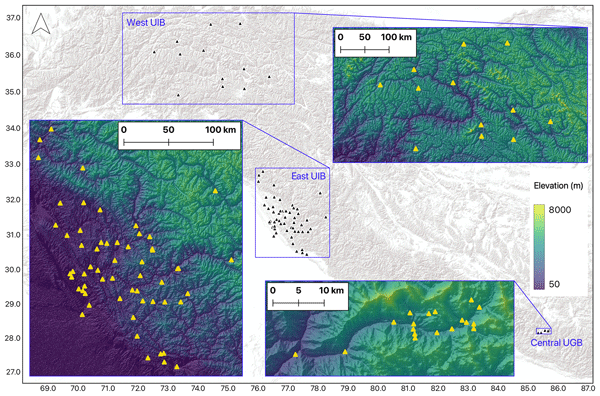
We introduce a novel method for improving daily precipitation maps in mountain regions and pilot it across three basins in the Hindu Kush Himalaya (HKH). The approach leverages climate model and weather station data, along with statistical or machine learning techniques. Our results show that this approach outperforms traditional methods, especially in remote ungauged areas, suggesting that it could be used to improve precipitation maps across much of the HKH, as well as other mountain regions.
Shfaqat A. Khan, Helene Seroussi, Mathieu Morlighem, William Colgan, Veit Helm, Gong Cheng, Danjal Berg, Valentina R. Barletta, Nicolaj K. Larsen, William Kochtitzky, Michiel van den Broeke, Kurt H. Kjær, Andy Aschwanden, Brice Noël, Jason E. Box, Joseph A. MacGregor, Robert S. Fausto, Kenneth D. Mankoff, Ian M. Howat, Kuba Oniszk, Dominik Fahrner, Anja Løkkegaard, Eigil Y. H. Lippert, Alicia Bråtner, and Javed Hassan
Earth Syst. Sci. Data, 17, 3047–3071, https://doi.org/10.5194/essd-17-3047-2025, https://doi.org/10.5194/essd-17-3047-2025, 2025
Short summary
Short summary
The surface elevation of the Greenland Ice Sheet is changing due to surface mass balance processes and ice dynamics, each exhibiting distinct spatiotemporal patterns. Here, we employ satellite and airborne altimetry data with fine spatial (1 km) and temporal (monthly) resolutions to document this spatiotemporal evolution from 2003 to 2023. This dataset of fine-resolution altimetry data in both space and time will support studies of ice mass loss and be useful for GIS ice sheet modeling.
Jonas K. Andersen, Rasmus P. Meyer, Flora S. Huiban, Mads L. Dømgaard, Romain Millan, and Anders A. Bjørk
The Cryosphere, 19, 1717–1724, https://doi.org/10.5194/tc-19-1717-2025, https://doi.org/10.5194/tc-19-1717-2025, 2025
Short summary
Short summary
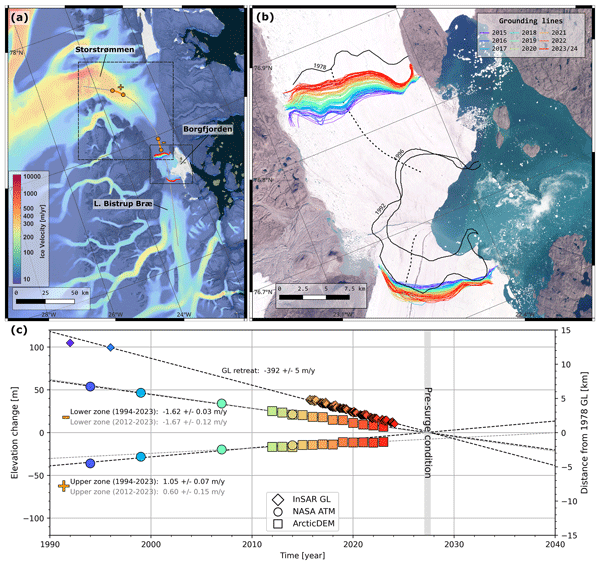
Storstrømmen Glacier in northeastern Greenland goes through cycles of sudden flow speed-ups (known as surges) followed by long quiet phases. It is currently in its quiet phase, but recent measurements suggest it may be nearing conditions for a new surge, possibly between 2027 and 2040. We also observed several lake drainages that caused brief increases in glacier flow but did not trigger a surge. Continued monitoring is essential to understand how these processes influence glacier behavior.
Lea Hartl, Patrick Schmitt, Lilian Schuster, Kay Helfricht, Jakob Abermann, and Fabien Maussion
The Cryosphere, 19, 1431–1452, https://doi.org/10.5194/tc-19-1431-2025, https://doi.org/10.5194/tc-19-1431-2025, 2025
Short summary
Short summary
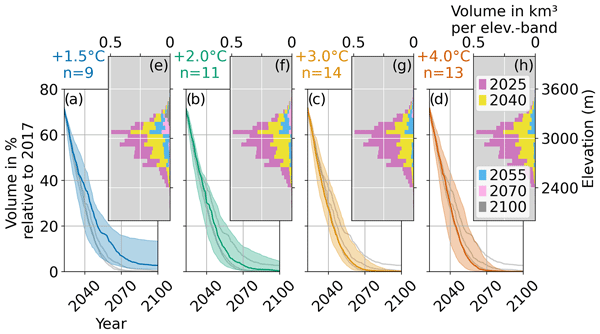
We use regional observations of glacier area and volume change to inform glacier evolution modeling in the Ötztal and Stubai range (Austrian Alps) until 2100 in different climate scenarios. Glaciers in the region lost 23 % of their volume between 2006 and 2017. Under current warming trajectories, glacier loss in the region is expected to be near-total by 2075. We show that integrating regional calibration and validation data in glacier models is important to improve confidence in projections.
Andrea Securo, Costanza Del Gobbo, Giovanni Baccolo, Carlo Barbante, Michele Citterio, Fabrizio De Blasi, Marco Marcer, Mauro Valt, and Renato R. Colucci
The Cryosphere, 19, 1335–1352, https://doi.org/10.5194/tc-19-1335-2025, https://doi.org/10.5194/tc-19-1335-2025, 2025
Short summary
Short summary
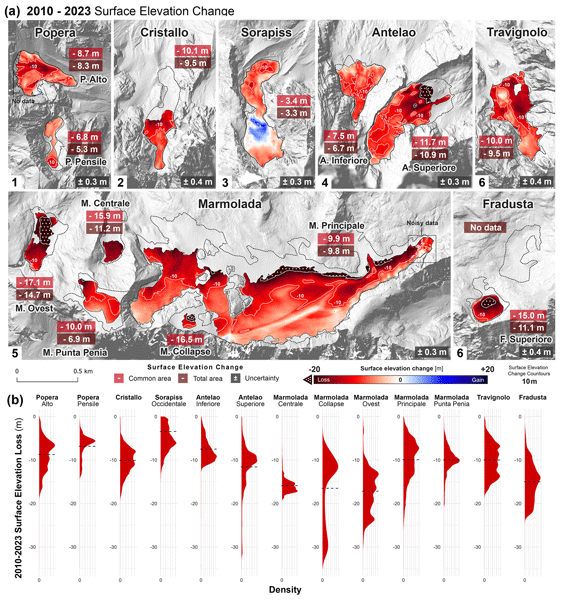
We have reconstructed the multi-decadal (1980s–2023) ice mass changes for all the current mountain glaciers in the Dolomites. We used historical aerial photographs, drone surveys, and lidar to fill the glaciological data gap for the region. We observed an alarming decline in both glacier area and volume, with some of the glaciers showing smaller losses due to local topography and debris cover feedback. We strongly recommend more specific monitoring of these glaciers.
Kirk M. Scanlan, Anja Rutishauser, and Sebastian B. Simonsen
The Cryosphere, 19, 1221–1239, https://doi.org/10.5194/tc-19-1221-2025, https://doi.org/10.5194/tc-19-1221-2025, 2025
Short summary
Short summary
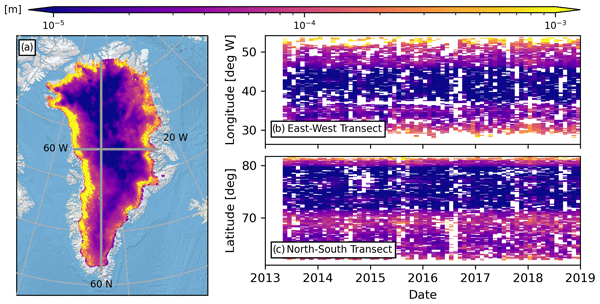
An ice sheet's surface modulates its response to climate change, and it is therefore critical to monitor how it evolves through time. Here, we investigate novel measurements of Greenland surface roughness based on the strength of reflected local airborne and pan-Greenland satellite radar signals. These measurements respond to roughness at scales typically larger than those considered in mass balance modelling while highlighting the scale dependency of surface roughness that is often overlooked.
Etienne Ducasse, Romain Millan, Jonas Kvist Andersen, and Antoine Rabatel
The Cryosphere, 19, 911–917, https://doi.org/10.5194/tc-19-911-2025, https://doi.org/10.5194/tc-19-911-2025, 2025
Short summary
Short summary
Our study examines glacier movement in the tropical Andes from 2013 to 2022 using satellite data. Despite challenges like small glacier size and frequent cloud cover, we tracked annual speeds and seasonal changes. We found stable annual speeds but significant shifts between wet and dry seasons, likely due to changes in meltwater production and glacier–bedrock conditions. This research enhances understanding of how tropical glaciers react to climate change.
Rasmus Meyer, Mathias Preisler Schødt, Mikkel Lydholm Rasmussen, Jonas Kvist Andersen, Mads Dømgaard, and Anders Anker Bjørk
EGUsphere, https://doi.org/10.5194/egusphere-2024-3850, https://doi.org/10.5194/egusphere-2024-3850, 2025
Preprint archived
Short summary
Short summary
Understanding snow accumulation is important for water resource management, but measurements of snow depth in mountainous regions are sparse. We introduce a novel satellite-based approach to estimate snow depth for deep snow in mountainous regions by combining two types of satellite data: radar images and laser surface height measurements. Results suggest that our method more accurately estimate the magnitude of snowfall compared to modelled data over the Southern Norwegian Mountains.
Eva L. Doting, Ian T. Stevens, Anne M. Kellerman, Pamela E. Rossel, Runa Antony, Amy M. McKenna, Martyn Tranter, Liane G. Benning, Robert G. M. Spencer, Jon R. Hawkings, and Alexandre M. Anesio
Biogeosciences, 22, 41–53, https://doi.org/10.5194/bg-22-41-2025, https://doi.org/10.5194/bg-22-41-2025, 2025
Short summary
Short summary
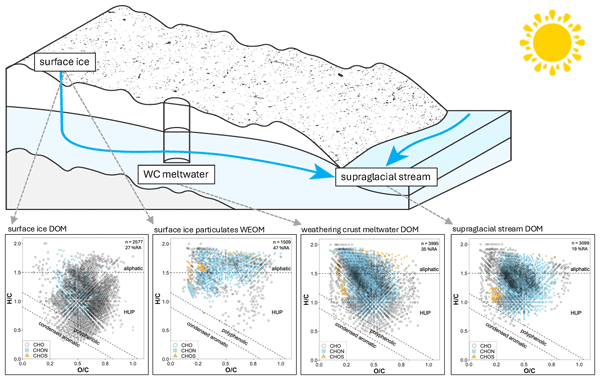
This study provides the first evidence for biogeochemical cycling of supraglacial dissolved organic matter (DOM) in meltwater flowing through the porous crust of weathering ice that covers glacier ice surfaces during the melt season. Movement of water through the weathering crust is slow, allowing microbes and solar radiation to alter the DOM in glacial meltwaters. This is important as supraglacial meltwaters deliver DOM to downstream aquatic environments.
Jorrit van der Schot, Jakob Abermann, Tiago Silva, Kerstin Rasmussen, Michael Winkler, Kirsty Langley, and Wolfgang Schöner
The Cryosphere, 18, 5803–5823, https://doi.org/10.5194/tc-18-5803-2024, https://doi.org/10.5194/tc-18-5803-2024, 2024
Short summary
Short summary
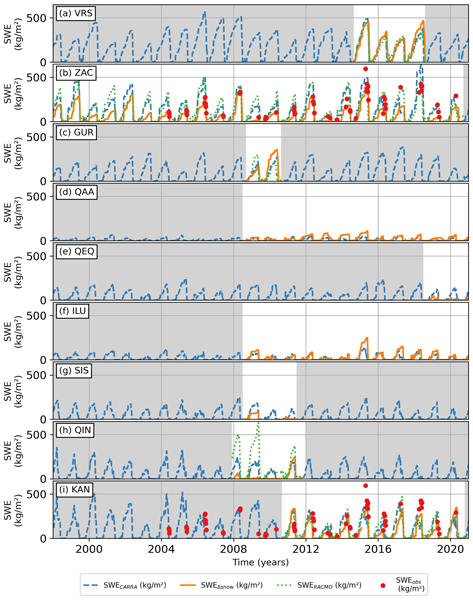
We present snow data from nine locations in coastal Greenland. We show that a reanalysis product (CARRA) simulates seasonal snow characteristics better than a regional climate model (RACMO). CARRA output matches particularly well with our reference dataset when we look at the maximum snow water equivalent and the snow cover end date. We show that seasonal snow in coastal Greenland has large spatial and temporal variability and find little evidence of trends in snow cover characteristics.
Mai Winstrup, Heidi Ranndal, Signe Hillerup Larsen, Sebastian B. Simonsen, Kenneth D. Mankoff, Robert S. Fausto, and Louise Sandberg Sørensen
Earth Syst. Sci. Data, 16, 5405–5428, https://doi.org/10.5194/essd-16-5405-2024, https://doi.org/10.5194/essd-16-5405-2024, 2024
Short summary
Short summary
Surface topography across the marginal zone of the Greenland Ice Sheet is constantly evolving. Here we present an annual series (2019–2022) of summer digital elevation models (PRODEMs) for the Greenland Ice Sheet margin, covering all outlet glaciers from the ice sheet. The PRODEMs are based on fusion of CryoSat-2 radar altimetry and ICESat-2 laser altimetry. With their high spatial and temporal resolution, the PRODEMs will enable detailed studies of the changes in marginal ice sheet elevations.
Bernhard Hynek, Daniel Binder, Michele Citterio, Signe Hillerup Larsen, Jakob Abermann, Geert Verhoeven, Elke Ludewig, and Wolfgang Schöner
The Cryosphere, 18, 5481–5494, https://doi.org/10.5194/tc-18-5481-2024, https://doi.org/10.5194/tc-18-5481-2024, 2024
Short summary
Short summary
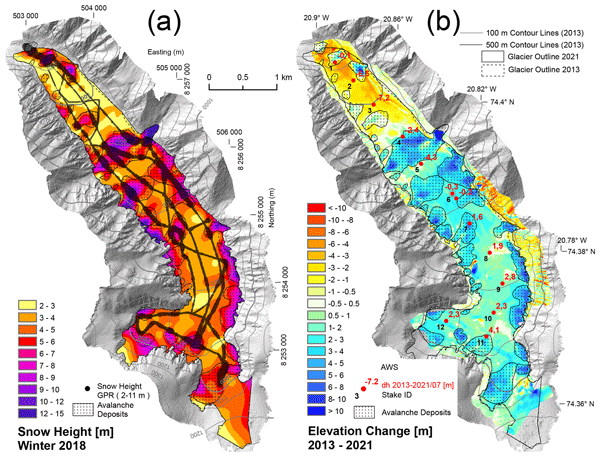
An avalanche event in February 2018 caused thick snow deposits on Freya Glacier, a peripheral mountain glacier in northeastern Greenland. The avalanche deposits contributed significantly to the mass balance, leaving a strong imprint in the elevation changes in 2013–2021. The 8-year geodetic mass balance (2013–2021) of the glacier is positive, whereas previous estimates by direct measurements were negative and now turned out to have a negative bias.
Signe Hillerup Larsen, Daniel Binder, Anja Rutishauser, Bernhard Hynek, Robert Schjøtt Fausto, and Michele Citterio
Earth Syst. Sci. Data, 16, 4103–4118, https://doi.org/10.5194/essd-16-4103-2024, https://doi.org/10.5194/essd-16-4103-2024, 2024
Short summary
Short summary
The Greenland Ecosystem Monitoring programme has been running since 1995. In 2008, the Glaciological monitoring sub-program GlacioBasis was initiated at the Zackenberg site in northeast Greenland, with a transect of three weather stations on the A. P. Olsen Ice Cap. In 2022, the weather stations were replaced with a more standardized set up. Here, we provide the reprocessed and quality-checked data from 2008 to 2022, i.e., the first 15 years of continued monitoring.
Falk M. Oraschewski, Inka Koch, M. Reza Ershadi, Jonathan D. Hawkins, Olaf Eisen, and Reinhard Drews
The Cryosphere, 18, 3875–3889, https://doi.org/10.5194/tc-18-3875-2024, https://doi.org/10.5194/tc-18-3875-2024, 2024
Short summary
Short summary
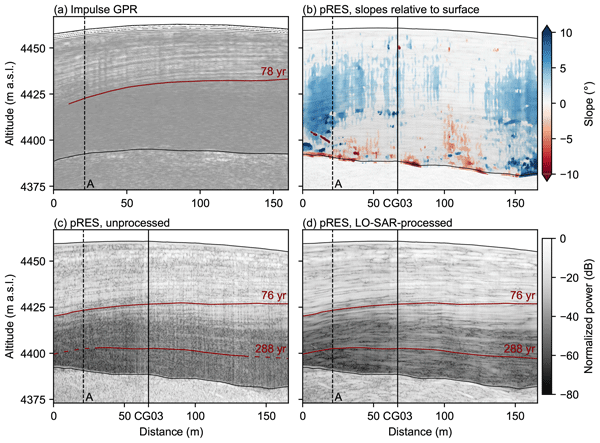
Mountain glaciers have a layered structure which contains information about past snow accumulation and ice flow. Using ground-penetrating radar instruments, the internal structure can be observed. The detection of layers in the deeper parts of a glacier is often difficult. Here, we present a new approach for imaging the englacial structure of an Alpine glacier (Colle Gnifetti, Switzerland and Italy) using a phase-sensitive radar that can detect reflection depth changes at sub-wavelength scales.
Siobhan F. Killingbeck, Anja Rutishauser, Martyn J. Unsworth, Ashley Dubnick, Alison S. Criscitiello, James Killingbeck, Christine F. Dow, Tim Hill, Adam D. Booth, Brittany Main, and Eric Brossier
The Cryosphere, 18, 3699–3722, https://doi.org/10.5194/tc-18-3699-2024, https://doi.org/10.5194/tc-18-3699-2024, 2024
Short summary
Short summary
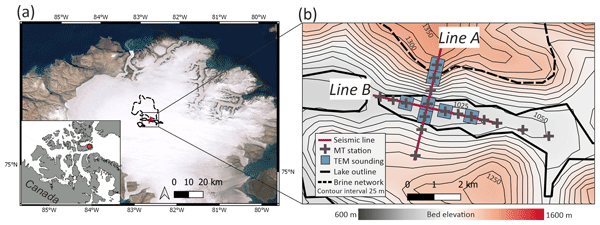
A subglacial lake was proposed to exist beneath Devon Ice Cap in the Canadian Arctic based on the analysis of airborne data. Our study presents a new interpretation of the subglacial material beneath the Devon Ice Cap from surface-based geophysical data. We show that there is no evidence of subglacial water, and the subglacial lake has likely been misidentified. Re-evaluation of the airborne data shows that overestimation of a critical processing parameter has likely occurred in prior studies.
Laura J. Larocca, James M. Lea, Michael P. Erb, Nicholas P. McKay, Megan Phillips, Kara A. Lamantia, and Darrell S. Kaufman
The Cryosphere, 18, 3591–3611, https://doi.org/10.5194/tc-18-3591-2024, https://doi.org/10.5194/tc-18-3591-2024, 2024
Short summary
Short summary
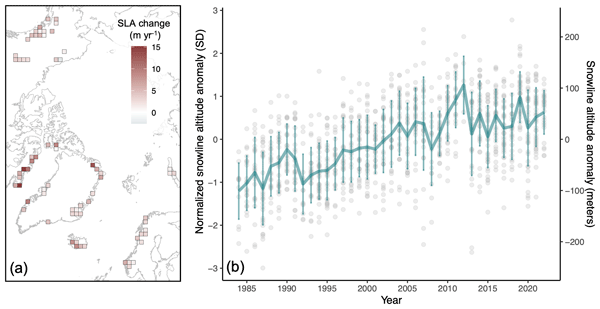
Here we present summer snowline altitude (SLA) time series for 269 Arctic glaciers. Between 1984 and 2022, SLAs rose ∼ 150 m, equating to a ∼ 127 m shift per 1 °C of summer warming. SLA is most strongly correlated with annual temperature variables, highlighting their dual effect on ablation and accumulation processes. We show that SLAs are rising fastest on low-elevation glaciers and that > 50 % of the studied glaciers could have SLAs that exceed the maximum ice elevation by 2100.
Nanna B. Karlsson, Dustin M. Schroeder, Louise Sandberg Sørensen, Winnie Chu, Jørgen Dall, Natalia H. Andersen, Reese Dobson, Emma J. Mackie, Simon J. Köhn, Jillian E. Steinmetz, Angelo S. Tarzona, Thomas O. Teisberg, and Niels Skou
Earth Syst. Sci. Data, 16, 3333–3344, https://doi.org/10.5194/essd-16-3333-2024, https://doi.org/10.5194/essd-16-3333-2024, 2024
Short summary
Short summary
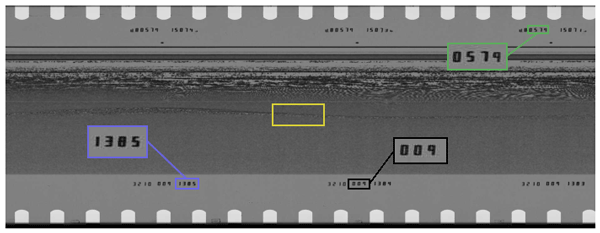
In the 1970s, more than 177 000 km of observations were acquired from airborne radar over the Greenland ice sheet. The radar data contain information on not only the thickness of the ice, but also the properties of the ice itself. This information was recorded on film rolls and subsequently stored. In this study, we document the digitization of these film rolls that shed new and unprecedented detailed light on the Greenland ice sheet 50 years ago.
Livia Piermattei, Michael Zemp, Christian Sommer, Fanny Brun, Matthias H. Braun, Liss M. Andreassen, Joaquín M. C. Belart, Etienne Berthier, Atanu Bhattacharya, Laura Boehm Vock, Tobias Bolch, Amaury Dehecq, Inés Dussaillant, Daniel Falaschi, Caitlyn Florentine, Dana Floricioiu, Christian Ginzler, Gregoire Guillet, Romain Hugonnet, Matthias Huss, Andreas Kääb, Owen King, Christoph Klug, Friedrich Knuth, Lukas Krieger, Jeff La Frenierre, Robert McNabb, Christopher McNeil, Rainer Prinz, Louis Sass, Thorsten Seehaus, David Shean, Désirée Treichler, Anja Wendt, and Ruitang Yang
The Cryosphere, 18, 3195–3230, https://doi.org/10.5194/tc-18-3195-2024, https://doi.org/10.5194/tc-18-3195-2024, 2024
Short summary
Short summary
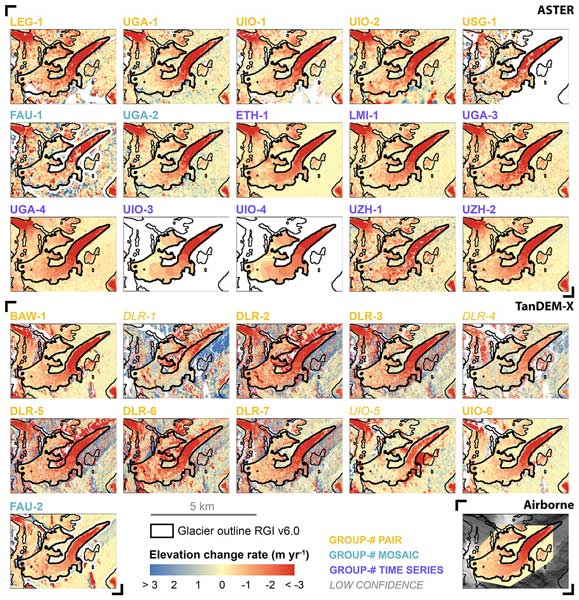
Satellites have made it possible to observe glacier elevation changes from all around the world. In the present study, we compared the results produced from two different types of satellite data between different research groups and against validation measurements from aeroplanes. We found a large spread between individual results but showed that the group ensemble can be used to reliably estimate glacier elevation changes and related errors from satellite data.
Anja Rutishauser, Kirk M. Scanlan, Baptiste Vandecrux, Nanna B. Karlsson, Nicolas Jullien, Andreas P. Ahlstrøm, Robert S. Fausto, and Penelope How
The Cryosphere, 18, 2455–2472, https://doi.org/10.5194/tc-18-2455-2024, https://doi.org/10.5194/tc-18-2455-2024, 2024
Short summary
Short summary
The Greenland Ice Sheet interior is covered by a layer of firn, which is important for surface meltwater runoff and contributions to global sea-level rise. Here, we combine airborne radar sounding and laser altimetry measurements to delineate vertically homogeneous and heterogeneous firn. Our results reveal changes in firn between 2011–2019, aligning well with known climatic events. This approach can be used to outline firn areas primed for significantly changing future meltwater runoff.
Christoph Posch, Jakob Abermann, and Tiago Silva
The Cryosphere, 18, 2035–2059, https://doi.org/10.5194/tc-18-2035-2024, https://doi.org/10.5194/tc-18-2035-2024, 2024
Short summary
Short summary
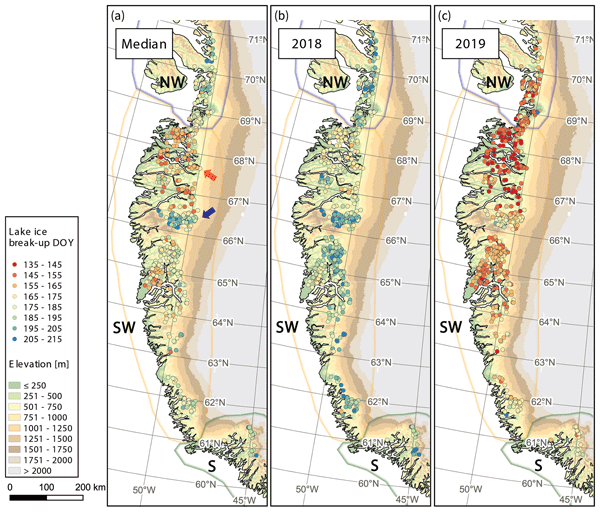
Radar beams from satellites exhibit reflection differences between water and ice. This condition, as well as the comprehensive coverage and high temporal resolution of the Sentinel-1 satellites, allows automatically detecting the timing of when ice cover of lakes in Greenland disappear. We found that lake ice breaks up 3 d later per 100 m elevation gain and that the average break-up timing varies by ±8 d in 2017–2021, which has major implications for the energy budget of the lakes.
Aslak Grinsted, Nicholas Mossor Rathmann, Ruth Mottram, Anne Munck Solgaard, Joachim Mathiesen, and Christine Schøtt Hvidberg
The Cryosphere, 18, 1947–1957, https://doi.org/10.5194/tc-18-1947-2024, https://doi.org/10.5194/tc-18-1947-2024, 2024
Short summary
Short summary
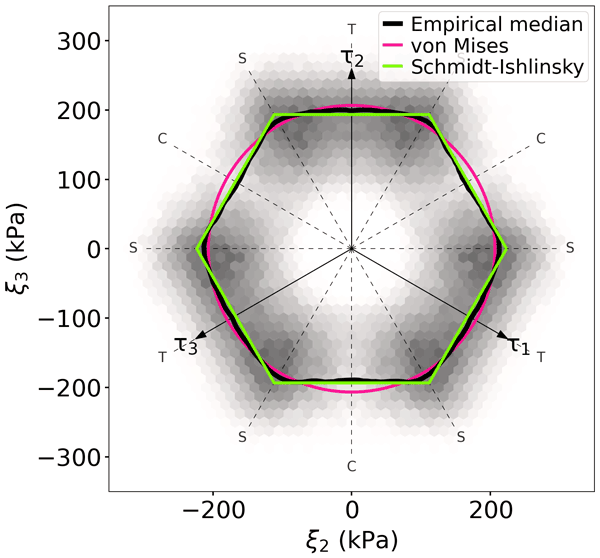
Ice fracture can cause glacier crevassing and calving. These natural hazards can also modulate the flow and evolution of ice sheets. In a new study, we use a new high-resolution dataset to determine a new failure criterion for glacier ice. Surprisingly, the strength of ice depends on the mode of deformation, and this has potential implications for the currently used flow law of ice.
Florian Lippl, Alexander Maringer, Margit Kurka, Jakob Abermann, Wolfgang Schöner, and Manuela Hirschmugl
Earth Syst. Sci. Data Discuss., https://doi.org/10.5194/essd-2024-12, https://doi.org/10.5194/essd-2024-12, 2024
Preprint withdrawn
Short summary
Short summary
The aim of our work was to give an overview of data currently available for the National Park Gesäuse and Johnsbachtal relevant to the European long-term ecosystem monitoring. This data, further was made available on respective data repositories, where all data is downloadable free of charge. Data presented in our paper is from all compartments, the atmosphere, social & economic sphere, biosphere and geosphere. We consider our approach as an opportunity to function as a showcase for other sites.
Annelies Voordendag, Brigitta Goger, Rainer Prinz, Tobias Sauter, Thomas Mölg, Manuel Saigger, and Georg Kaser
The Cryosphere, 18, 849–868, https://doi.org/10.5194/tc-18-849-2024, https://doi.org/10.5194/tc-18-849-2024, 2024
Short summary
Short summary
Wind-driven snow redistribution affects glacier mass balance. A case study of Hintereisferner glacier in Austria used high-resolution observations and simulations to model snow redistribution. Simulations matched observations, showing the potential of the model for studying snow redistribution on other mountain glaciers.
Baptiste Vandecrux, Robert S. Fausto, Jason E. Box, Federico Covi, Regine Hock, Åsa K. Rennermalm, Achim Heilig, Jakob Abermann, Dirk van As, Elisa Bjerre, Xavier Fettweis, Paul C. J. P. Smeets, Peter Kuipers Munneke, Michiel R. van den Broeke, Max Brils, Peter L. Langen, Ruth Mottram, and Andreas P. Ahlstrøm
The Cryosphere, 18, 609–631, https://doi.org/10.5194/tc-18-609-2024, https://doi.org/10.5194/tc-18-609-2024, 2024
Short summary
Short summary
How fast is the Greenland ice sheet warming? In this study, we compiled 4500+ temperature measurements at 10 m below the ice sheet surface (T10m) from 1912 to 2022. We trained a machine learning model on these data and reconstructed T10m for the ice sheet during 1950–2022. After a slight cooling during 1950–1985, the ice sheet warmed at a rate of 0.7 °C per decade until 2022. Climate models showed mixed results compared to our observations and underestimated the warming in key regions.
Louise Sandberg Sørensen, Rasmus Bahbah, Sebastian B. Simonsen, Natalia Havelund Andersen, Jade Bowling, Noel Gourmelen, Alex Horton, Nanna B. Karlsson, Amber Leeson, Jennifer Maddalena, Malcolm McMillan, Anne Solgaard, and Birgit Wessel
The Cryosphere, 18, 505–523, https://doi.org/10.5194/tc-18-505-2024, https://doi.org/10.5194/tc-18-505-2024, 2024
Short summary
Short summary
Under the right topographic and hydrological conditions, lakes may form beneath the large ice sheets. Some of these subglacial lakes are active, meaning that they periodically drain and refill. When a subglacial lake drains rapidly, it may cause the ice surface above to collapse, and here we investigate how to improve the monitoring of active subglacial lakes in Greenland by monitoring how their associated collapse basins change over time.
Tong Zhang, William Colgan, Agnes Wansing, Anja Løkkegaard, Gunter Leguy, William H. Lipscomb, and Cunde Xiao
The Cryosphere, 18, 387–402, https://doi.org/10.5194/tc-18-387-2024, https://doi.org/10.5194/tc-18-387-2024, 2024
Short summary
Short summary
The geothermal heat flux determines how much heat enters from beneath the ice sheet, and thus impacts the temperature and the flow of the ice sheet. In this study we investigate how much geothermal heat flux impacts the initialization of the Greenland ice sheet. We use the Community Ice Sheet Model with two different initialization methods. We find a non-trivial influence of the choice of heat flow boundary conditions on the ice sheet initializations for further designs of ice sheet modeling.
Michael Paster, Peter Flödl, Anton Neureiter, Gernot Weyss, Berhnard Hynek, Ulrich Pulg, Rannveig Øvrevik Skoglund, Helmut Habersack, and Christoph Hauer
Hydrol. Earth Syst. Sci. Discuss., https://doi.org/10.5194/hess-2023-267, https://doi.org/10.5194/hess-2023-267, 2024
Manuscript not accepted for further review
Short summary
Short summary
Triggered by global warming, glacier melt is repeatedly reaching peak values year by year. This development leads to a continuous enlargement of glacier forelands, accompanied by increasing sediment availability and a change in meltwater runoff behavior. The study describes an essential development step of proglacial channel evolution using river engineering methods. This is relevant to adequately define glacifluvial processes and downstream sediment yields in these transitioning landscapes.
Dominik Fahrner, Donald Slater, Aman KC, Claudia Cenedese, David A. Sutherland, Ellyn Enderlin, Femke de Jong, Kristian K. Kjeldsen, Michael Wood, Peter Nienow, Sophie Nowicki, and Till Wagner
Earth Syst. Sci. Data Discuss., https://doi.org/10.5194/essd-2023-411, https://doi.org/10.5194/essd-2023-411, 2023
Preprint withdrawn
Short summary
Short summary
Marine-terminating glaciers can lose mass through frontal ablation, which comprises submarine and surface melting, and iceberg calving. We estimate frontal ablation for 49 marine-terminating glaciers in Greenland by combining existing, satellite derived data and calculating volume change near the glacier front over time. The dataset offers exciting opportunities to study the influence of climate forcings on marine-terminating glaciers in Greenland over multi-decadal timescales.
Baptiste Vandecrux, Jason E. Box, Andreas P. Ahlstrøm, Signe B. Andersen, Nicolas Bayou, William T. Colgan, Nicolas J. Cullen, Robert S. Fausto, Dominik Haas-Artho, Achim Heilig, Derek A. Houtz, Penelope How, Ionut Iosifescu Enescu, Nanna B. Karlsson, Rebecca Kurup Buchholz, Kenneth D. Mankoff, Daniel McGrath, Noah P. Molotch, Bianca Perren, Maiken K. Revheim, Anja Rutishauser, Kevin Sampson, Martin Schneebeli, Sandy Starkweather, Simon Steffen, Jeff Weber, Patrick J. Wright, Henry Jay Zwally, and Konrad Steffen
Earth Syst. Sci. Data, 15, 5467–5489, https://doi.org/10.5194/essd-15-5467-2023, https://doi.org/10.5194/essd-15-5467-2023, 2023
Short summary
Short summary
The Greenland Climate Network (GC-Net) comprises stations that have been monitoring the weather on the Greenland Ice Sheet for over 30 years. These stations are being replaced by newer ones maintained by the Geological Survey of Denmark and Greenland (GEUS). The historical data were reprocessed to improve their quality, and key information about the weather stations has been compiled. This augmented dataset is available at https://doi.org/10.22008/FK2/VVXGUT (Steffen et al., 2022).
Timo Schmid, Valentina Radić, Andrew Tedstone, James M. Lea, Stephen Brough, and Mauro Hermann
The Cryosphere, 17, 3933–3954, https://doi.org/10.5194/tc-17-3933-2023, https://doi.org/10.5194/tc-17-3933-2023, 2023
Short summary
Short summary
The Greenland Ice Sheet contributes strongly to sea level rise in the warming climate. One process that can affect the ice sheet's mass balance is short-term ice speed-up events. These can be caused by high melting or rainfall as the water flows underneath the glacier and allows for faster sliding. In this study we found three main weather patterns that cause such ice speed-up events on the Russell Glacier in southwest Greenland and analyzed how they induce local melting and ice accelerations.
Anja Løkkegaard, Kenneth D. Mankoff, Christian Zdanowicz, Gary D. Clow, Martin P. Lüthi, Samuel H. Doyle, Henrik H. Thomsen, David Fisher, Joel Harper, Andy Aschwanden, Bo M. Vinther, Dorthe Dahl-Jensen, Harry Zekollari, Toby Meierbachtol, Ian McDowell, Neil Humphrey, Anne Solgaard, Nanna B. Karlsson, Shfaqat A. Khan, Benjamin Hills, Robert Law, Bryn Hubbard, Poul Christoffersen, Mylène Jacquemart, Julien Seguinot, Robert S. Fausto, and William T. Colgan
The Cryosphere, 17, 3829–3845, https://doi.org/10.5194/tc-17-3829-2023, https://doi.org/10.5194/tc-17-3829-2023, 2023
Short summary
Short summary
This study presents a database compiling 95 ice temperature profiles from the Greenland ice sheet and peripheral ice caps. Ice viscosity and hence ice flow are highly sensitive to ice temperature. To highlight the value of the database in evaluating ice flow simulations, profiles from the Greenland ice sheet are compared to a modeled temperature field. Reoccurring discrepancies between modeled and observed temperatures provide insight on the difficulties faced when simulating ice temperatures.
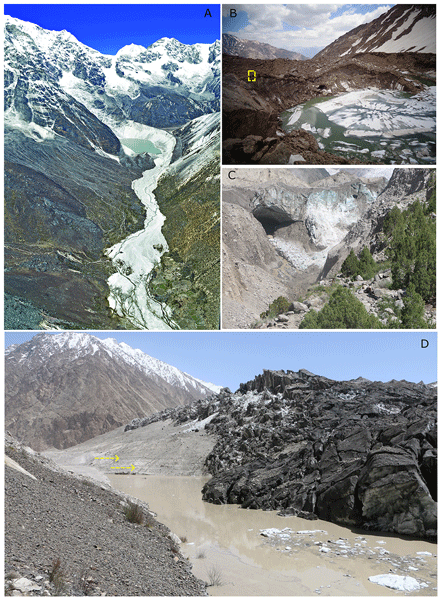
Finu Shrestha, Jakob F. Steiner, Reeju Shrestha, Yathartha Dhungel, Sharad P. Joshi, Sam Inglis, Arshad Ashraf, Sher Wali, Khwaja M. Walizada, and Taigang Zhang
Earth Syst. Sci. Data, 15, 3941–3961, https://doi.org/10.5194/essd-15-3941-2023, https://doi.org/10.5194/essd-15-3941-2023, 2023
Short summary
Short summary
A new inventory of glacial lake outburst floods (GLOFs) in High Mountain Asia found 697 events, causing 906 deaths, 3 times more than previously reported. This study provides insights into the contributing factors behind GLOFs on a regional scale and highlights the need for interdisciplinary approaches, including scientific communities and local knowledge, to understand GLOF risks in Asia. This study allows integration with other datasets, enabling future local and regional risk assessments.
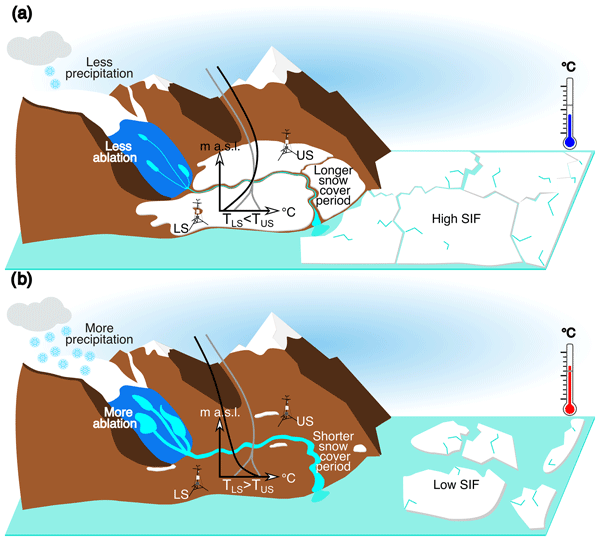
Sonika Shahi, Jakob Abermann, Tiago Silva, Kirsty Langley, Signe Hillerup Larsen, Mikhail Mastepanov, and Wolfgang Schöner
Weather Clim. Dynam., 4, 747–771, https://doi.org/10.5194/wcd-4-747-2023, https://doi.org/10.5194/wcd-4-747-2023, 2023
Short summary
Short summary
This study highlights how the sea ice variability in the Greenland Sea affects the terrestrial climate and the surface mass changes of peripheral glaciers of the Zackenberg region (ZR), Northeast Greenland, combining model output and observations. Our results show that the temporal evolution of sea ice influences the climate anomaly magnitude in the ZR. We also found that the changing temperature and precipitation patterns due to sea ice variability can affect the surface mass of the ice cap.
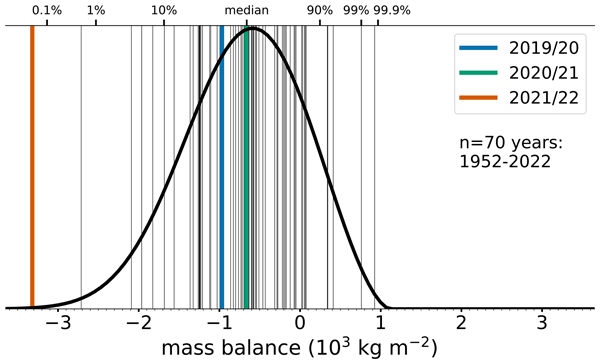
Annelies Voordendag, Rainer Prinz, Lilian Schuster, and Georg Kaser
The Cryosphere, 17, 3661–3665, https://doi.org/10.5194/tc-17-3661-2023, https://doi.org/10.5194/tc-17-3661-2023, 2023
Short summary
Short summary
The Glacier Loss Day (GLD) is the day on which all mass gained from the accumulation period is lost, and the glacier loses mass irrecoverably for the rest of the mass balance year. In 2022, the GLD was already reached on 23 June at Hintereisferner (Austria), and this led to a record-breaking mass loss. We introduce the GLD as a gross yet expressive indicator of the glacier’s imbalance with a persistently warming climate.
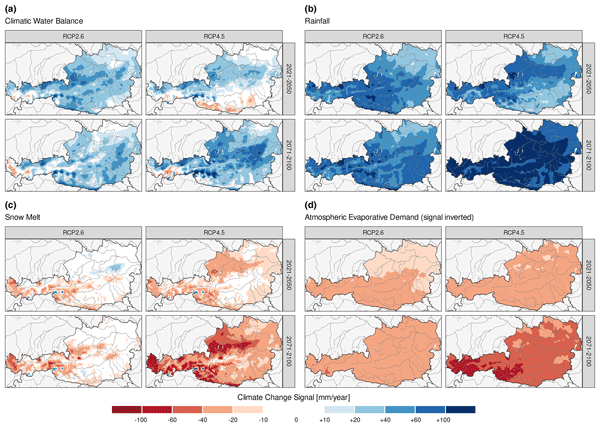
Klaus Haslinger, Wolfgang Schöner, Jakob Abermann, Gregor Laaha, Konrad Andre, Marc Olefs, and Roland Koch
Nat. Hazards Earth Syst. Sci., 23, 2749–2768, https://doi.org/10.5194/nhess-23-2749-2023, https://doi.org/10.5194/nhess-23-2749-2023, 2023
Short summary
Short summary
Future changes of surface water availability in Austria are investigated. Alterations of the climatic water balance and its components are analysed along different levels of elevation. Results indicate in general wetter conditions with particular shifts in timing of the snow melt season. On the contrary, an increasing risk for summer droughts is apparent due to increasing year-to-year variability and decreasing snow melt under future climate conditions.
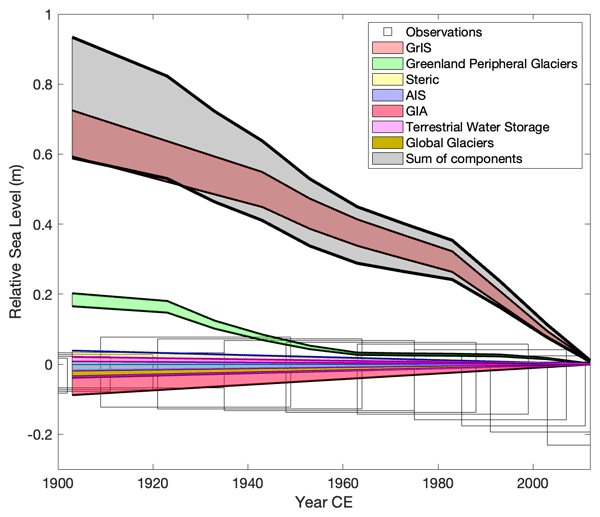
Sarah A. Woodroffe, Leanne M. Wake, Kristian K. Kjeldsen, Natasha L. M. Barlow, Antony J. Long, and Kurt H. Kjær
Clim. Past, 19, 1585–1606, https://doi.org/10.5194/cp-19-1585-2023, https://doi.org/10.5194/cp-19-1585-2023, 2023
Short summary
Short summary
Salt marsh in SE Greenland records sea level changes over the past 300 years in sediments and microfossils. The pattern is rising sea level until ~ 1880 CE and sea level fall since. This disagrees with modelled sea level, which overpredicts sea level fall by at least 0.5 m. This is the same even when reducing the overall amount of Greenland ice sheet melt and allowing for more time. Fitting the model to the data leaves ~ 3 mm yr−1 of unexplained sea level rise in SE Greenland since ~ 1880 CE.
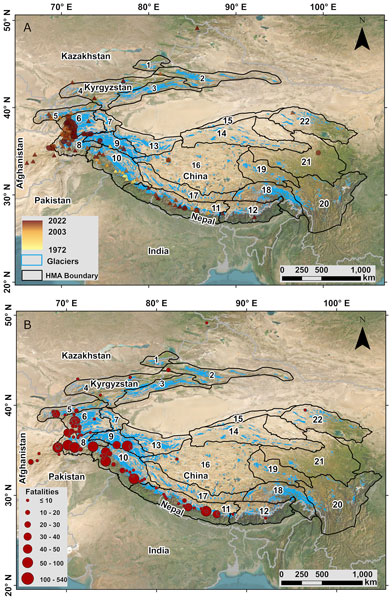
Anushilan Acharya, Jakob F. Steiner, Khwaja Momin Walizada, Salar Ali, Zakir Hussain Zakir, Arnaud Caiserman, and Teiji Watanabe
Nat. Hazards Earth Syst. Sci., 23, 2569–2592, https://doi.org/10.5194/nhess-23-2569-2023, https://doi.org/10.5194/nhess-23-2569-2023, 2023
Short summary
Short summary
All accessible snow and ice avalanches together with previous scientific research, local knowledge, and existing or previously active adaptation and mitigation solutions were investigated in the high mountain Asia (HMA) region to have a detailed overview of the state of knowledge and identify gaps. A comprehensive avalanche database from 1972–2022 is generated, including 681 individual events. The database provides a basis for the forecasting of avalanche hazards in different parts of HMA.
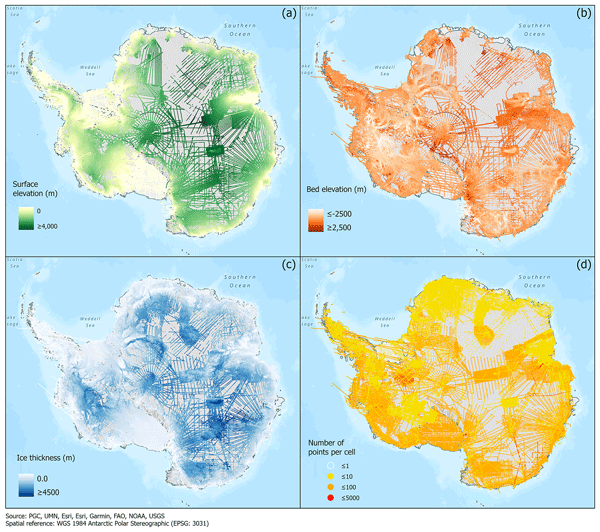
Alice C. Frémand, Peter Fretwell, Julien A. Bodart, Hamish D. Pritchard, Alan Aitken, Jonathan L. Bamber, Robin Bell, Cesidio Bianchi, Robert G. Bingham, Donald D. Blankenship, Gino Casassa, Ginny Catania, Knut Christianson, Howard Conway, Hugh F. J. Corr, Xiangbin Cui, Detlef Damaske, Volkmar Damm, Reinhard Drews, Graeme Eagles, Olaf Eisen, Hannes Eisermann, Fausto Ferraccioli, Elena Field, René Forsberg, Steven Franke, Shuji Fujita, Yonggyu Gim, Vikram Goel, Siva Prasad Gogineni, Jamin Greenbaum, Benjamin Hills, Richard C. A. Hindmarsh, Andrew O. Hoffman, Per Holmlund, Nicholas Holschuh, John W. Holt, Annika N. Horlings, Angelika Humbert, Robert W. Jacobel, Daniela Jansen, Adrian Jenkins, Wilfried Jokat, Tom Jordan, Edward King, Jack Kohler, William Krabill, Mette Kusk Gillespie, Kirsty Langley, Joohan Lee, German Leitchenkov, Carlton Leuschen, Bruce Luyendyk, Joseph MacGregor, Emma MacKie, Kenichi Matsuoka, Mathieu Morlighem, Jérémie Mouginot, Frank O. Nitsche, Yoshifumi Nogi, Ole A. Nost, John Paden, Frank Pattyn, Sergey V. Popov, Eric Rignot, David M. Rippin, Andrés Rivera, Jason Roberts, Neil Ross, Anotonia Ruppel, Dustin M. Schroeder, Martin J. Siegert, Andrew M. Smith, Daniel Steinhage, Michael Studinger, Bo Sun, Ignazio Tabacco, Kirsty Tinto, Stefano Urbini, David Vaughan, Brian C. Welch, Douglas S. Wilson, Duncan A. Young, and Achille Zirizzotti
Earth Syst. Sci. Data, 15, 2695–2710, https://doi.org/10.5194/essd-15-2695-2023, https://doi.org/10.5194/essd-15-2695-2023, 2023
Short summary
Short summary
This paper presents the release of over 60 years of ice thickness, bed elevation, and surface elevation data acquired over Antarctica by the international community. These data are a crucial component of the Antarctic Bedmap initiative which aims to produce a new map and datasets of Antarctic ice thickness and bed topography for the international glaciology and geophysical community.
William Colgan, Christopher Shields, Pavel Talalay, Xiaopeng Fan, Austin P. Lines, Joshua Elliott, Harihar Rajaram, Kenneth Mankoff, Morten Jensen, Mira Backes, Yunchen Liu, Xianzhe Wei, Nanna B. Karlsson, Henrik Spanggård, and Allan Ø. Pedersen
Geosci. Instrum. Method. Data Syst., 12, 121–140, https://doi.org/10.5194/gi-12-121-2023, https://doi.org/10.5194/gi-12-121-2023, 2023
Short summary
Short summary
We describe a new drill for glaciers and ice sheets. Instead of drilling down into the ice, via mechanical action, our drill melts into the ice. Our goal is simply to pull a cable of temperature sensors on a one-way trip down to the ice–bed interface. Here, we describe the design and testing of our drill. Under laboratory conditions, our melt-tip drill has an efficiency of ∼ 35 % with a theoretical maximum penetration rate of ∼ 12 m h−1. Under field conditions, our efficiency is just ∼ 15 %.

Kristian Chan, Cyril Grima, Anja Rutishauser, Duncan A. Young, Riley Culberg, and Donald D. Blankenship
The Cryosphere, 17, 1839–1852, https://doi.org/10.5194/tc-17-1839-2023, https://doi.org/10.5194/tc-17-1839-2023, 2023
Short summary
Short summary
Climate warming has led to more surface meltwater produced on glaciers that can refreeze in firn to form ice layers. Our work evaluates the use of dual-frequency ice-penetrating radar to characterize these ice layers on the Devon Ice Cap. Results indicate that they are meters thick and widespread, and thus capable of supporting lateral meltwater runoff from the top of ice layers. We find that some of this meltwater runoff could be routed through supraglacial rivers in the ablation zone.
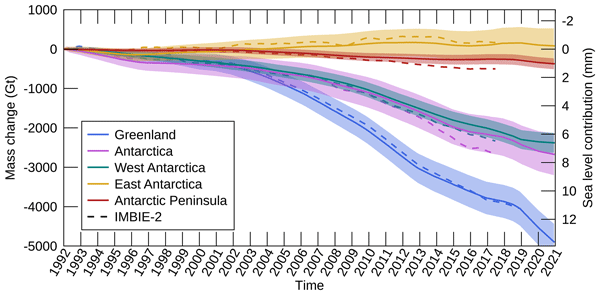
Inès N. Otosaka, Andrew Shepherd, Erik R. Ivins, Nicole-Jeanne Schlegel, Charles Amory, Michiel R. van den Broeke, Martin Horwath, Ian Joughin, Michalea D. King, Gerhard Krinner, Sophie Nowicki, Anthony J. Payne, Eric Rignot, Ted Scambos, Karen M. Simon, Benjamin E. Smith, Louise S. Sørensen, Isabella Velicogna, Pippa L. Whitehouse, Geruo A, Cécile Agosta, Andreas P. Ahlstrøm, Alejandro Blazquez, William Colgan, Marcus E. Engdahl, Xavier Fettweis, Rene Forsberg, Hubert Gallée, Alex Gardner, Lin Gilbert, Noel Gourmelen, Andreas Groh, Brian C. Gunter, Christopher Harig, Veit Helm, Shfaqat Abbas Khan, Christoph Kittel, Hannes Konrad, Peter L. Langen, Benoit S. Lecavalier, Chia-Chun Liang, Bryant D. Loomis, Malcolm McMillan, Daniele Melini, Sebastian H. Mernild, Ruth Mottram, Jeremie Mouginot, Johan Nilsson, Brice Noël, Mark E. Pattle, William R. Peltier, Nadege Pie, Mònica Roca, Ingo Sasgen, Himanshu V. Save, Ki-Weon Seo, Bernd Scheuchl, Ernst J. O. Schrama, Ludwig Schröder, Sebastian B. Simonsen, Thomas Slater, Giorgio Spada, Tyler C. Sutterley, Bramha Dutt Vishwakarma, Jan Melchior van Wessem, David Wiese, Wouter van der Wal, and Bert Wouters
Earth Syst. Sci. Data, 15, 1597–1616, https://doi.org/10.5194/essd-15-1597-2023, https://doi.org/10.5194/essd-15-1597-2023, 2023
Short summary
Short summary
By measuring changes in the volume, gravitational attraction, and ice flow of Greenland and Antarctica from space, we can monitor their mass gain and loss over time. Here, we present a new record of the Earth’s polar ice sheet mass balance produced by aggregating 50 satellite-based estimates of ice sheet mass change. This new assessment shows that the ice sheets have lost (7.5 x 10¹²) t of ice between 1992 and 2020, contributing 21 mm to sea level rise.
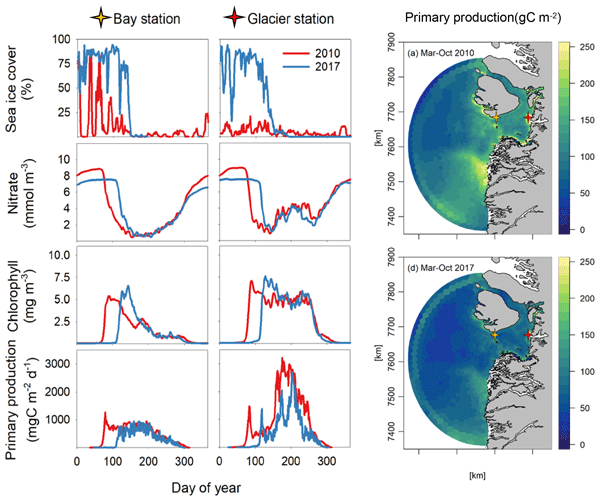
Eva Friis Møller, Asbjørn Christensen, Janus Larsen, Kenneth D. Mankoff, Mads Hvid Ribergaard, Mikael Sejr, Philip Wallhead, and Marie Maar
Ocean Sci., 19, 403–420, https://doi.org/10.5194/os-19-403-2023, https://doi.org/10.5194/os-19-403-2023, 2023
Short summary
Short summary
Melt from the Greenland ice sheet and sea ice both influence light and nutrient availability in the Arctic coastal ocean. We use a 3D coupled hydrodynamic–biogeochemical model to evaluate the relative importance of these processes for timing, distribution, and magnitude of phytoplankton production in Disko Bay, west Greenland. Our study indicates that decreasing sea ice and more freshwater discharge can work synergistically and increase primary productivity of the coastal ocean around Greenland.

Mads Dømgaard, Kristian K. Kjeldsen, Flora Huiban, Jonathan L. Carrivick, Shfaqat A. Khan, and Anders A. Bjørk
The Cryosphere, 17, 1373–1387, https://doi.org/10.5194/tc-17-1373-2023, https://doi.org/10.5194/tc-17-1373-2023, 2023
Short summary
Short summary
Sudden releases of meltwater from glacier-dammed lakes can influence ice flow, cause flooding hazards and landscape changes. This study presents a record of 14 drainages from 2007–2021 from a lake in west Greenland. The time series reveals how the lake fluctuates between releasing large and small amounts of drainage water which is caused by a weakening of the damming glacier following the large events. We also find a shift in the water drainage route which increases the risk of flooding hazards.

Connor J. Shiggins, James M. Lea, and Stephen Brough
The Cryosphere, 17, 15–32, https://doi.org/10.5194/tc-17-15-2023, https://doi.org/10.5194/tc-17-15-2023, 2023
Short summary
Short summary
Iceberg detection is spatially and temporally limited around the Greenland Ice Sheet. This study presents a new, accessible workflow to automatically detect icebergs from timestamped ArcticDEM strip data. The workflow successfully produces comparable output to manual digitisation, with results revealing new iceberg area-to-volume conversion equations that can be widely applied to datasets where only iceberg outlines can be extracted (e.g. optical and SAR imagery).
Michael Paster, Peter Flödl, Anton Neureiter, Gernot Weyss, Bernhard Hynek, Ulrich Pulg, Rannveig Øvrevik Skoglund, Helmut Habersack, and Christoph Hauer
Hydrol. Earth Syst. Sci. Discuss., https://doi.org/10.5194/hess-2022-347, https://doi.org/10.5194/hess-2022-347, 2022
Manuscript not accepted for further review
Short summary
Short summary
Glaciers experienced record-breaking melting rates in recent years. This development leads to a continuous enlargement of glacier forelands, accompanied by increasing sediment availability and altered meltwater runoff behavior. This study describes the final development step of the gradual meltwater channel evolution using river engineering techniques. This is relevant to adequately define high alpine fluvial processes and sediment yields in these transitional landscapes.
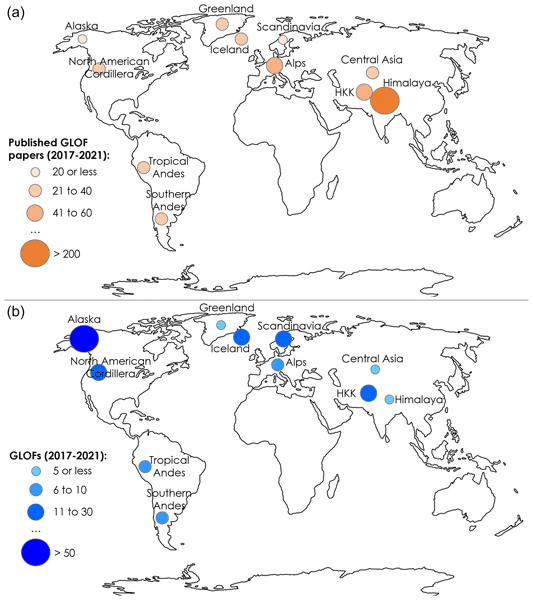
Adam Emmer, Simon K. Allen, Mark Carey, Holger Frey, Christian Huggel, Oliver Korup, Martin Mergili, Ashim Sattar, Georg Veh, Thomas Y. Chen, Simon J. Cook, Mariana Correas-Gonzalez, Soumik Das, Alejandro Diaz Moreno, Fabian Drenkhan, Melanie Fischer, Walter W. Immerzeel, Eñaut Izagirre, Ramesh Chandra Joshi, Ioannis Kougkoulos, Riamsara Kuyakanon Knapp, Dongfeng Li, Ulfat Majeed, Stephanie Matti, Holly Moulton, Faezeh Nick, Valentine Piroton, Irfan Rashid, Masoom Reza, Anderson Ribeiro de Figueiredo, Christian Riveros, Finu Shrestha, Milan Shrestha, Jakob Steiner, Noah Walker-Crawford, Joanne L. Wood, and Jacob C. Yde
Nat. Hazards Earth Syst. Sci., 22, 3041–3061, https://doi.org/10.5194/nhess-22-3041-2022, https://doi.org/10.5194/nhess-22-3041-2022, 2022
Short summary
Short summary
Glacial lake outburst floods (GLOFs) have attracted increased research attention recently. In this work, we review GLOF research papers published between 2017 and 2021 and complement the analysis with research community insights gained from the 2021 GLOF conference we organized. The transdisciplinary character of the conference together with broad geographical coverage allowed us to identify progress, trends and challenges in GLOF research and outline future research needs and directions.

Tiago Silva, Jakob Abermann, Brice Noël, Sonika Shahi, Willem Jan van de Berg, and Wolfgang Schöner
The Cryosphere, 16, 3375–3391, https://doi.org/10.5194/tc-16-3375-2022, https://doi.org/10.5194/tc-16-3375-2022, 2022
Short summary
Short summary
To overcome internal climate variability, this study uses k-means clustering to combine NAO, GBI and IWV over the Greenland Ice Sheet (GrIS) and names the approach as the North Atlantic influence on Greenland (NAG). With the support of a polar-adapted RCM, spatio-temporal changes on SEB components within NAG phases are investigated. We report atmospheric warming and moistening across all NAG phases as well as large-scale and regional-scale contributions to GrIS mass loss and their interactions.
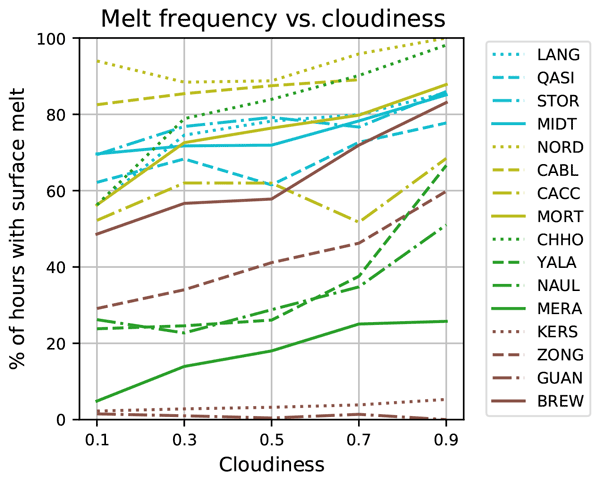
Jonathan P. Conway, Jakob Abermann, Liss M. Andreassen, Mohd Farooq Azam, Nicolas J. Cullen, Noel Fitzpatrick, Rianne H. Giesen, Kirsty Langley, Shelley MacDonell, Thomas Mölg, Valentina Radić, Carleen H. Reijmer, and Jean-Emmanuel Sicart
The Cryosphere, 16, 3331–3356, https://doi.org/10.5194/tc-16-3331-2022, https://doi.org/10.5194/tc-16-3331-2022, 2022
Short summary
Short summary
We used data from automatic weather stations on 16 glaciers to show how clouds influence glacier melt in different climates around the world. We found surface melt was always more frequent when it was cloudy but was not universally faster or slower than under clear-sky conditions. Also, air temperature was related to clouds in opposite ways in different climates – warmer with clouds in cold climates and vice versa. These results will help us improve how we model past and future glacier melt.
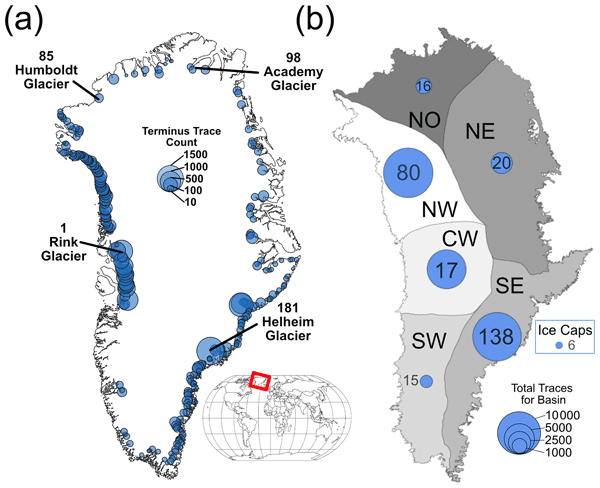
Sophie Goliber, Taryn Black, Ginny Catania, James M. Lea, Helene Olsen, Daniel Cheng, Suzanne Bevan, Anders Bjørk, Charlie Bunce, Stephen Brough, J. Rachel Carr, Tom Cowton, Alex Gardner, Dominik Fahrner, Emily Hill, Ian Joughin, Niels J. Korsgaard, Adrian Luckman, Twila Moon, Tavi Murray, Andrew Sole, Michael Wood, and Enze Zhang
The Cryosphere, 16, 3215–3233, https://doi.org/10.5194/tc-16-3215-2022, https://doi.org/10.5194/tc-16-3215-2022, 2022
Short summary
Short summary
Terminus traces have been used to understand how Greenland's glaciers have changed over time; however, manual digitization is time-intensive, and a lack of coordination leads to duplication of efforts. We have compiled a dataset of over 39 000 terminus traces for 278 glaciers for scientific and machine learning applications. We also provide an overview of an updated version of the Google Earth Engine Digitization Tool (GEEDiT), which has been developed specifically for the Greenland Ice Sheet.
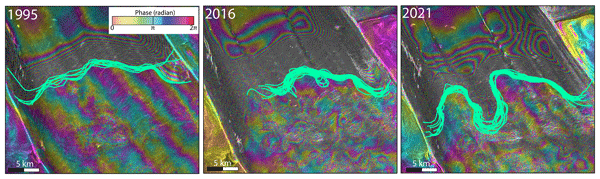
Romain Millan, Jeremie Mouginot, Anna Derkacheva, Eric Rignot, Pietro Milillo, Enrico Ciraci, Luigi Dini, and Anders Bjørk
The Cryosphere, 16, 3021–3031, https://doi.org/10.5194/tc-16-3021-2022, https://doi.org/10.5194/tc-16-3021-2022, 2022
Short summary
Short summary
We detect for the first time a dramatic retreat of the grounding line of Petermann Glacier, a major glacier of the Greenland Ice Sheet. Using satellite data, we also observe a speedup of the glacier and a fracturing of the ice shelf. This sequence of events is coherent with ocean warming in this region and suggests that Petermann Glacier has initiated a phase of destabilization, which is of prime importance for the stability and future contribution of the Greenland Ice Sheet to sea level rise.

Thomas Goelles, Tobias Hammer, Stefan Muckenhuber, Birgit Schlager, Jakob Abermann, Christian Bauer, Víctor J. Expósito Jiménez, Wolfgang Schöner, Markus Schratter, Benjamin Schrei, and Kim Senger
Geosci. Instrum. Method. Data Syst., 11, 247–261, https://doi.org/10.5194/gi-11-247-2022, https://doi.org/10.5194/gi-11-247-2022, 2022
Short summary
Short summary
We propose a newly developed modular MObile LIdar SENsor System (MOLISENS) to enable new applications for small industrial light detection and ranging (lidar) sensors. MOLISENS supports both monitoring of dynamic processes and mobile mapping applications. The mobile mapping application of MOLISENS has been tested under various conditions, and results are shown from two surveys in the Lurgrotte cave system in Austria and a glacier cave in Longyearbreen on Svalbard.

Joseph A. MacGregor, Winnie Chu, William T. Colgan, Mark A. Fahnestock, Denis Felikson, Nanna B. Karlsson, Sophie M. J. Nowicki, and Michael Studinger
The Cryosphere, 16, 3033–3049, https://doi.org/10.5194/tc-16-3033-2022, https://doi.org/10.5194/tc-16-3033-2022, 2022
Short summary
Short summary
Where the bottom of the Greenland Ice Sheet is frozen and where it is thawed is not well known, yet knowing this state is increasingly important to interpret modern changes in ice flow there. We produced a second synthesis of knowledge of the basal thermal state of the ice sheet using airborne and satellite observations and numerical models. About one-third of the ice sheet’s bed is likely thawed; two-fifths is likely frozen; and the remainder is too uncertain to specify.
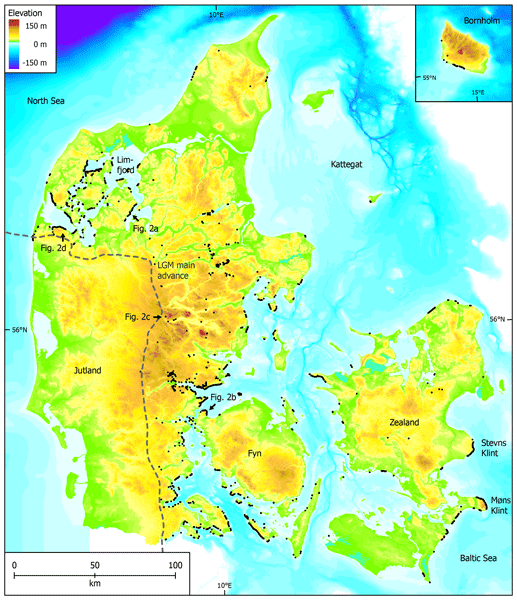
Gregor Luetzenburg, Kristian Svennevig, Anders A. Bjørk, Marie Keiding, and Aart Kroon
Earth Syst. Sci. Data, 14, 3157–3165, https://doi.org/10.5194/essd-14-3157-2022, https://doi.org/10.5194/essd-14-3157-2022, 2022
Short summary
Short summary
We produced the first landslide inventory for Denmark. Over 3200 landslides were mapped using a high-resolution elevation model and orthophotos. We implemented an independent validation into our mapping and found an overall level of completeness of 87 %. The national inventory represents a range of landslide sizes covering all regions that were covered by glacial ice during the last glacial period. This inventory will be used for investigating landslide causes and for natural hazard mitigation.
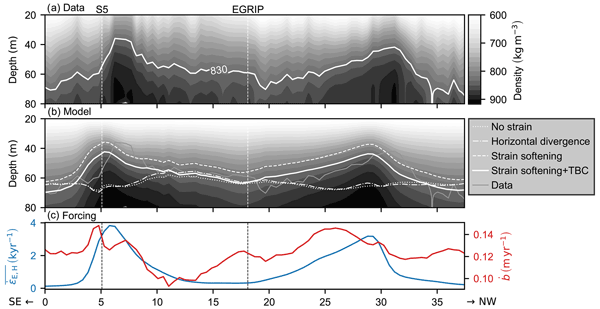
Falk M. Oraschewski and Aslak Grinsted
The Cryosphere, 16, 2683–2700, https://doi.org/10.5194/tc-16-2683-2022, https://doi.org/10.5194/tc-16-2683-2022, 2022
Short summary
Short summary
Old snow (denoted as firn) accumulates in the interior of ice sheets and gets densified into glacial ice. Typically, this densification is assumed to only depend on temperature and accumulation rate. However, it has been observed that stretching of the firn by horizontal flow also enhances this process. Here, we show how to include this effect in classical firn models. With the model we confirm that softening of the firn controls firn densification in areas with strong horizontal stretching.

Mimmi Oksman, Anna Bang Kvorning, Signe Hillerup Larsen, Kristian Kjellerup Kjeldsen, Kenneth David Mankoff, William Colgan, Thorbjørn Joest Andersen, Niels Nørgaard-Pedersen, Marit-Solveig Seidenkrantz, Naja Mikkelsen, and Sofia Ribeiro
The Cryosphere, 16, 2471–2491, https://doi.org/10.5194/tc-16-2471-2022, https://doi.org/10.5194/tc-16-2471-2022, 2022
Short summary
Short summary
One of the questions facing the cryosphere community today is how increasing runoff from the Greenland Ice Sheet impacts marine ecosystems. To address this, long-term data are essential. Here, we present multi-site records of fjord productivity for SW Greenland back to the 19th century. We show a link between historical freshwater runoff and productivity, which is strongest in the inner fjord – influenced by marine-terminating glaciers – where productivity has increased since the late 1990s.
A. B. Voordendag, B. Goger, C. Klug, R. Prinz, M. Rutzinger, and G. Kaser
Int. Arch. Photogramm. Remote Sens. Spatial Inf. Sci., XLIII-B2-2022, 1093–1099, https://doi.org/10.5194/isprs-archives-XLIII-B2-2022-1093-2022, https://doi.org/10.5194/isprs-archives-XLIII-B2-2022-1093-2022, 2022
William Colgan, Agnes Wansing, Kenneth Mankoff, Mareen Lösing, John Hopper, Keith Louden, Jörg Ebbing, Flemming G. Christiansen, Thomas Ingeman-Nielsen, Lillemor Claesson Liljedahl, Joseph A. MacGregor, Árni Hjartarson, Stefan Bernstein, Nanna B. Karlsson, Sven Fuchs, Juha Hartikainen, Johan Liakka, Robert S. Fausto, Dorthe Dahl-Jensen, Anders Bjørk, Jens-Ove Naslund, Finn Mørk, Yasmina Martos, Niels Balling, Thomas Funck, Kristian K. Kjeldsen, Dorthe Petersen, Ulrik Gregersen, Gregers Dam, Tove Nielsen, Shfaqat A. Khan, and Anja Løkkegaard
Earth Syst. Sci. Data, 14, 2209–2238, https://doi.org/10.5194/essd-14-2209-2022, https://doi.org/10.5194/essd-14-2209-2022, 2022
Short summary
Short summary
We assemble all available geothermal heat flow measurements collected in and around Greenland into a new database. We use this database of point measurements, in combination with other geophysical datasets, to model geothermal heat flow in and around Greenland. Our geothermal heat flow model is generally cooler than previous models of Greenland, especially in southern Greenland. It does not suggest any high geothermal heat flows resulting from Icelandic plume activity over 50 million years ago.
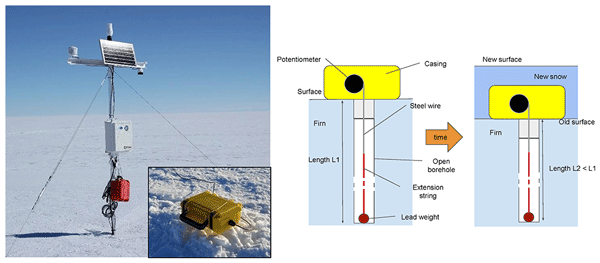
Michael J. MacFerrin, C. Max Stevens, Baptiste Vandecrux, Edwin D. Waddington, and Waleed Abdalati
Earth Syst. Sci. Data, 14, 955–971, https://doi.org/10.5194/essd-14-955-2022, https://doi.org/10.5194/essd-14-955-2022, 2022
Short summary
Short summary
The vast majority of the Greenland ice sheet's surface is covered by pluriannual snow, also called firn, that accumulates year after year and is compressed into glacial ice. The thickness of the firn layer changes through time and responds to the surface climate. We present continuous measurement of the firn compaction at various depths for eight sites. The dataset will help to evaluate firn models, interpret ice cores, and convert remotely sensed ice sheet surface height change to mass loss.
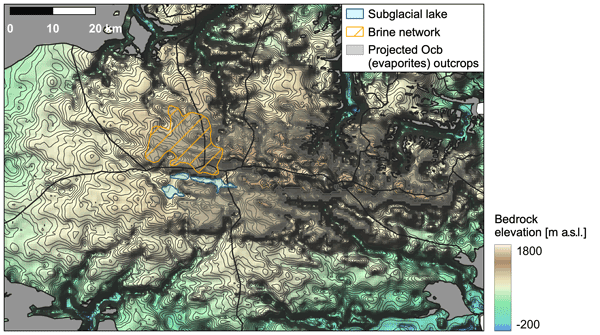
Anja Rutishauser, Donald D. Blankenship, Duncan A. Young, Natalie S. Wolfenbarger, Lucas H. Beem, Mark L. Skidmore, Ashley Dubnick, and Alison S. Criscitiello
The Cryosphere, 16, 379–395, https://doi.org/10.5194/tc-16-379-2022, https://doi.org/10.5194/tc-16-379-2022, 2022
Short summary
Short summary
Recently, a hypersaline subglacial lake complex was hypothesized to lie beneath Devon Ice Cap, Canadian Arctic. Here, we present results from a follow-on targeted aerogeophysical survey. Our results support the evidence for a hypersaline subglacial lake and reveal an extensive brine network, suggesting more complex subglacial hydrological conditions than previously inferred. This hypersaline system may host microbial habitats, making it a compelling analog for bines on other icy worlds.
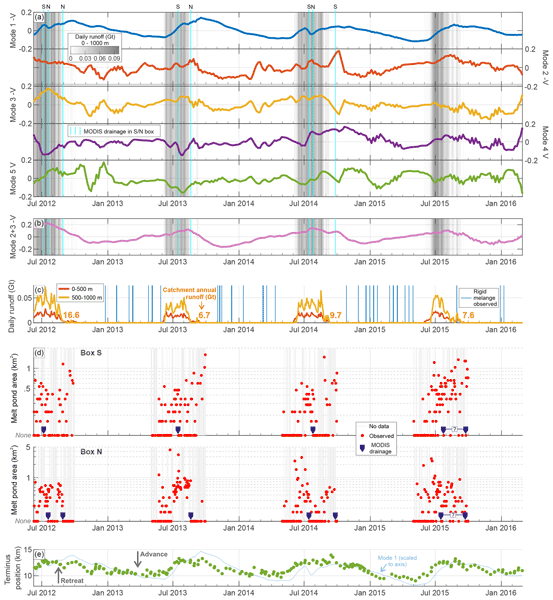
David W. Ashmore, Douglas W. F. Mair, Jonathan E. Higham, Stephen Brough, James M. Lea, and Isabel J. Nias
The Cryosphere, 16, 219–236, https://doi.org/10.5194/tc-16-219-2022, https://doi.org/10.5194/tc-16-219-2022, 2022
Short summary
Short summary
In this paper we explore the use of a transferrable and flexible statistical technique to try and untangle the multiple influences on marine-terminating glacier dynamics, as measured from space. We decompose a satellite-derived ice velocity record into ranked sets of static maps and temporal coefficients. We present evidence that the approach can identify velocity variability mainly driven by changes in terminus position and velocity variation mainly driven by subglacial hydrological processes.
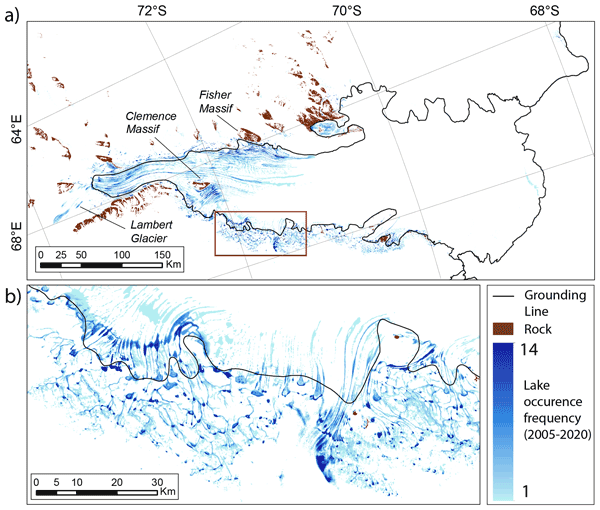
Peter A. Tuckett, Jeremy C. Ely, Andrew J. Sole, James M. Lea, Stephen J. Livingstone, Julie M. Jones, and J. Melchior van Wessem
The Cryosphere, 15, 5785–5804, https://doi.org/10.5194/tc-15-5785-2021, https://doi.org/10.5194/tc-15-5785-2021, 2021
Short summary
Short summary
Lakes form on the surface of the Antarctic Ice Sheet during the summer. These lakes can generate further melt, break up floating ice shelves and alter ice dynamics. Here, we describe a new automated method for mapping surface lakes and apply our technique to the Amery Ice Shelf between 2005 and 2020. Lake area is highly variable between years, driven by large-scale climate patterns. This technique will help us understand the role of Antarctic surface lakes in our warming world.
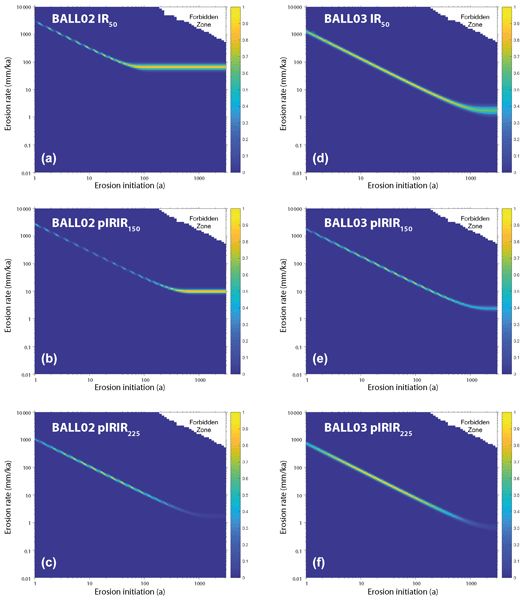
Rachel K. Smedley, David Small, Richard S. Jones, Stephen Brough, Jennifer Bradley, and Geraint T. H. Jenkins
Geochronology, 3, 525–543, https://doi.org/10.5194/gchron-3-525-2021, https://doi.org/10.5194/gchron-3-525-2021, 2021
Short summary
Short summary
We apply new rock luminescence techniques to a well-constrained scenario of the Beinn Alligin rock avalanche, NW Scotland. We measure accurate erosion rates consistent with independently derived rates and reveal a transient state of erosion over the last ~4000 years in the wet, temperate climate of NW Scotland. This study shows that the new luminescence erosion-meter has huge potential for inferring erosion rates on sub-millennial scales, which is currently impossible with existing techniques.
Kenneth D. Mankoff, Xavier Fettweis, Peter L. Langen, Martin Stendel, Kristian K. Kjeldsen, Nanna B. Karlsson, Brice Noël, Michiel R. van den Broeke, Anne Solgaard, William Colgan, Jason E. Box, Sebastian B. Simonsen, Michalea D. King, Andreas P. Ahlstrøm, Signe Bech Andersen, and Robert S. Fausto
Earth Syst. Sci. Data, 13, 5001–5025, https://doi.org/10.5194/essd-13-5001-2021, https://doi.org/10.5194/essd-13-5001-2021, 2021
Short summary
Short summary
We estimate the daily mass balance and its components (surface, marine, and basal mass balance) for the Greenland ice sheet. Our time series begins in 1840 and has annual resolution through 1985 and then daily from 1986 through next week. Results are operational (updated daily) and provided for the entire ice sheet or by commonly used regions or sectors. This is the first input–output mass balance estimate to include the basal mass balance.
Cited articles
Abermann, J., Van As, D., Wacker, S., Langley, K., Machguth, H., and Fausto, R. S.: Strong contrast in mass and energy balance between a coastal mountain glacier and the Greenland ice sheet, J. Glaciology, 65, 263–269, https://doi.org/10.1017/jog.2019.4, 2019. a, b
Abermann, J., Vandecrux, B., Scher, S., Löffler, K., Schalamon, F., Trügler, A., Fausto, R. S., and Schöner, W.: Learning from Alfred Wegener’s pioneering field observations in West Greenland after a century of climate change, Sci. Rep., 13, 8174, https://doi.org/10.1038/s41598-023-33225-9, 2023. a
Ahlstrøm, A. P., Gravesen, P., Andersen, S. B., van As, D., Citterio, M., Fausto, R. S., Nielsen, S., Jepsen, H. F., Kristensen, S. S., Christensen, E. L., Stenseng, L., Forsberg, R., Hanson, S., Petersen, D., and project team, P.: A new programme for monitoring the mass loss of the Greenland ice sheet, GEUS Bulletin, 15, 61–64, https://doi.org/10.34194/geusb.v15.5045, 2008. a
Aoki, T., Matoba, S., Uetake, J., Takeuchi, N., and Motoyama, H.: Field activities of the “Snow Impurity and Glacial Microbe effects on abrupt warming in the Arctic” (SIGMA) Project in Greenland in 2011-2013, Bulletin of Glaciological Research, 32, 3–20, 2014. a
Bøggild, C. E., Olesen, O. B., Andreas, P. A., and Jørgensen, P.: Automatic glacier ablation measurements using pressure transducers, J. Glaciology, 50, 303–304, 2004. a
Box, J. E. and Steffen, K.: Sublimation on the Greenland ice sheet from automated weather station observations, J. Geophys. Res.-Atmos., 106, 33965–33981, 2001. a
Box, J. E., Hubbard, A., Bahr, D. B., Colgan, W. T., Fettweis, X., Mankoff, K. D., Wehrlé, A., Noël, B., van den Broeke, M. R., Wouters, B., Bjørk, A. A., and Fausto, R. S.: Greenland ice sheet climate disequilibrium and committed sea-level rise, Nat. Clim. Change, 12, 808–813, https://doi.org/10.1038/s41558-022-01441-2, 2022. a
Box, J. E., Nielsen, K. P., Yang, X., Niwano, M., Wehrlé, A., van As, D., Fettweis, X., Køltzow, M. A. o., Palmason, B., Fausto, R. S., van den Broeke, M. R., Huai, B., Ahlstrøm, A. P., Langley, K., Dachauer, A., and Noël, B.: Greenland ice sheet rainfall climatology, extremes and atmospheric river rapids, Meteorol. Appl., 30, e2134, https://doi.org/10.1002/met.2134, 2023. a
Braithwaite, R. J. and Olesen, O. B.: Calculation of glacier ablation from air temperature, West Greenland, in: Glacier fluctuations and climatic change, Springer, 219–233, https://doi.org/10.1007/978-94-015-7823-3_15, 1989. a
Brock, B. W., Willis, I. C., and Sharp, M. J.: Measurement and parameterization of aerodynamic roughness length variations at Haut Glacier d’Arolla, Switzerland, J. Glaciology, 52, 281–297, 2006. a
Chen, Z., Zheng, L., Zhang, B., Zhao, T., Zinglersen, K. B., Ding, M., Zhang, W., Hui, F., and Cheng, X.: The first Chinese automatic weather station on the Greenland ice sheet, Sci. Bull., 68, 452–455, https://doi.org/10.1016/j.scib.2023.02.012, 2023. a
Citterio, M., van As, D., Ahlstrøm, A. P., Andersen, M. L., Andersen, S. B., Box, J. E., Charalampidis, C., Colgan, W. T., Fausto, R. S., Nielsen, S., and Veicherts, M.: Automatic weather stations for basic and applied glaciological research, Geol. Surv. Den. Greenl. Bull., 33, 69–72, https://doi.org/10.34194/geusb.v33.4512, 2015. a
Claesson Liljedahl, L., Kontula, A., Harper, J., Näslund, J.-O., Selroos, J.-O., Pitkänen, P., Puigdomenech, I., Hobbs, M., Follin, S., Hirschorn, S., Jansson, P., Kennell, L., Marcos, N., Ruskeeniemi, T., Tullborg, E.-L., and Vidstrand, P.: The Greenland Analogue Project: Final report, Svensk Kärnbränslehantering AB (SKB), Technical Report TR-14-13, Stockholm, Sweden, https://skb.com/publication/2484498/TR-14-13.pdf (last access: 12 November 2025), 2016. a
Cornillon, P., Gallagher, J., and Sgouros, T.: OPeNDAP: Accessing Data in a Distributed, Heterogeneous Environment, Data Science Journal, 2, 164–174, https://doi.org/10.2481/dsj.2.164, 2003. a
Eaton, B., Gregory, J., Drach, B., Taylor, K., Hankin, S., Caron, J., Signell, R., Bentley, P., Rappa, G., Hock, H., Pamment, A., Juckes, M., Raspaud, M., Blower, J., Horne, R., Whiteaker, T., Blodgett, D., Zender, C., Lee, D., Hassell, D., Snow, A. D., Kolling, T., Allured, D., Jelenak, A., Soerensen, A. M., Gaultier, L., Herledan, S., Manzano, F., Barring, L., Barker, C., and Bartholomew, S. L.: NetCDF Climate and Forecast (CF) Metadata Conventions, Zenodo, https://doi.org/10.5281/zenodo.14275599, 2024. a, b
Fausto, R. S., van As, D., Box, J. E., Colgan, W., and Langen, P. L.: Quantifying the surface energy fluxes in south Greenland during the 2012 high melt episodes using in-situ observations, Front. Earth Sci., 4, 82, https://doi.org/10.3389/feart.2016.00082, 2016a. a, b, c
Fausto, R. S., van As, D., Box, J. E., Colgan, W., Langen, P. L., and Mottram, R. H.: The implication of nonradiative energy fluxes dominating Greenland ice sheet exceptional ablation area surface melt in 2012, Geophys. Res. Lett., 43, 2649–2658, 2016b. a
Fausto, R. S., Abermann, J., and Ahlstrøm, A. P.: Annual Surface Mass Balance Records (2009–2019) From an Automatic Weather Station on Mittivakkat Glacier, SE Greenland, Front. Earth Sci., 8, https://doi.org/10.3389/feart.2020.00251, 2020. a, b
Fausto, R. S., van As, D., Mankoff, K. D., Vandecrux, B., Citterio, M., Ahlstrøm, A. P., Andersen, S. B., Colgan, W., Karlsson, N. B., Kjeldsen, K. K., Korsgaard, N. J., Larsen, S. H., Nielsen, S., Pedersen, A. Ø., Shields, C. L., Solgaard, A. M., and Box, J. E.: Programme for Monitoring of the Greenland Ice Sheet (PROMICE) automatic weather station data, Earth Syst. Sci. Data, 13, 3819–3845, https://doi.org/10.5194/essd-13-3819-2021, 2021. a, b, c, d, e, f, g, h, i
Fettweis, X., Box, J. E., Agosta, C., Amory, C., Kittel, C., Lang, C., van As, D., Machguth, H., and Gallée, H.: Reconstructions of the 1900–2015 Greenland ice sheet surface mass balance using the regional climate MAR model, The Cryosphere, 11, 1015–1033, https://doi.org/10.5194/tc-11-1015-2017, 2017. a
Fettweis, X., Hofer, S., Krebs-Kanzow, U., Amory, C., Aoki, T., Berends, C. J., Born, A., Box, J. E., Delhasse, A., Fujita, K., Gierz, P., Goelzer, H., Hanna, E., Hashimoto, A., Huybrechts, P., Kapsch, M.-L., King, M. D., Kittel, C., Lang, C., Langen, P. L., Lenaerts, J. T. M., Liston, G. E., Lohmann, G., Mernild, S. H., Mikolajewicz, U., Modali, K., Mottram, R. H., Niwano, M., Noël, B., Ryan, J. C., Smith, A., Streffing, J., Tedesco, M., van de Berg, W. J., van den Broeke, M., van de Wal, R. S. W., van Kampenhout, L., Wilton, D., Wouters, B., Ziemen, F., and Zolles, T.: GrSMBMIP: intercomparison of the modelled 1980–2012 surface mass balance over the Greenland Ice Sheet, The Cryosphere, 14, 3935–3958, https://doi.org/10.5194/tc-14-3935-2020, 2020. a
Hanna, E., Pattyn, F., Navarro, F., Favier, V., Goelzer, H., van den Broeke, M. R., Vizcaino, M., Whitehouse, P. L., Ritz, C., Bulthuis, K., and Smith, B.: Mass balance of the ice sheets and glaciers – Progress since AR5 and challenges, Earth-Sci. Rev., 201, 102976, https://doi.org/10.1016/j.earscirev.2019.102976, 2020. a
Harrison, R. G., Chalmers, N., and Hogan, R. J.: Retrospective cloud determinations from surface solar radiation measurements, Atmos. Res., 90, 54–62, 2008. a
Hassell, D., Gregory, J., Blower, J., Lawrence, B. N., and Taylor, K. E.: A data model of the Climate and Forecast metadata conventions (CF-1.6) with a software implementation (cf-python v2.1), Geosci. Model Dev., 10, 4619–4646, https://doi.org/10.5194/gmd-10-4619-2017, 2017. a
Holtslag, A. and De Bruin, H.: Applied modeling of the nighttime surface energy balance over land, J. Appl. Meteorol. Clim., 27, 689–704, 1988. a
How, P., Lund, M., Ahlstrøm, A., Andersen, S., Box, J., Citterio, M., Colgan, W., Fausto, R., Karlsson, N., Jakobsen, J., Jakobsgaard, H., Larsen, S., Mankoff, K., Nielsen, R., Rutishauser, A., Shield, C., Solgaard, A., Stevens, I., van As, D., Vandecrux, B., Abermann, J., Bjørk, A., Langley, K., Lea, J., and Prinz, R.: PROMICE and GC-Net automated weather station data in Greenland, V36, GEUS Dataverse [data set], https://doi.org/10.22008/FK2/IW73UU, 2022a. a, b, c, d, e, f, g
How, P., Lund, M., Ahlstrøm, A., Andersen, S., Box, J., Citterio, M., Colgan, W., Fausto, R., Karlsson, N., Jakobsen, J., Jakobsgaard, H., Larsen, S., Mankoff, K., Nielsen, R., Rutishauser, A., Shield, C., Solgaard, A., Stevens, I., van As, D., Vandecrux, B., Abermann, J., Bjørk, A., Langley, K., Lea, J., and Prinz, R.: AWS_data_readme.pdf, https://doi.org/10.22008/FK2/IW73UU/XCAQHJ, 2022b. a
How, P., Lund, M., Nielsen, R., Ahlstrøm, A., Fausto, R., Larsen, S., Mankoff, K., Vandecrux, B., and Wright, P.: pypromice v1.10.1, V35, GEUS Dataverse [data set], https://doi.org/10.22008/FK2/3TSBF0, 2023a. a, b, c, d
How, P., Wright, P. J., Mankoff, K. D., Vandecrux, B., Fausto, R. S., and Ahlstrøm, A. P.: pypromice: A Python package for processing automated weather station data, Journal of Open Source Software, 8, 5298, https://doi.org/10.21105/joss.05298, 2023b. a, b, c, d
Hynek, B., Binder, D., Citterio, M., Larsen, S. H., Abermann, J., Verhoeven, G., Ludewig, E., and Schöner, W.: Accumulation by avalanches as a significant contributor to the mass balance of a peripheral glacier of Greenland, The Cryosphere, 18, 5481–5494, https://doi.org/10.5194/tc-18-5481-2024, 2024. a
Khan, S. A., Seroussi, H., Morlighem, M., Colgan, W., Helm, V., Cheng, G., Berg, D., Barletta, V. R., Larsen, N. K., Kochtitzky, W., van den Broeke, M., Kjær, K. H., Aschwanden, A., Noël, B., Box, J. E., MacGregor, J. A., Fausto, R. S., Mankoff, K. D., Howat, I. M., Oniszk, K., Fahrner, D., Løkkegaard, A., Lippert, E. Y. H., Bråtner, A., and Hassan, J.: Smoothed monthly Greenland ice sheet elevation changes during 2003–2023, Earth Syst. Sci. Data, 17, 3047–3071, https://doi.org/10.5194/essd-17-3047-2025, 2025. a
Kokhanovsky, A., Box, J. E., Vandecrux, B., Mankoff, K. D., Lamare, M., Smirnov, A., and Kern, M.: The determination of snow albedo from satellite measurements using fast atmospheric correction technique, Remote Sens., 12, 234, https://doi.org/10.3390/rs12020234, 2020. a
Larsen, S. H., Binder, D., Rutishauser, A., Hynek, B., Fausto, R. S., and Citterio, M.: Climate and ablation observations from automatic ablation and weather stations at A. P. Olsen Ice Cap transect, northeast Greenland, for May 2008 through May 2022, Earth Syst. Sci. Data, 16, 4103–4118, https://doi.org/10.5194/essd-16-4103-2024, 2024. a, b
Mankoff, K. D., Solgaard, A., Colgan, W., Ahlstrøm, A. P., Khan, S. A., and Fausto, R. S.: Greenland Ice Sheet solid ice discharge from 1986 through March 2020, Earth Syst. Sci. Data, 12, 1367–1383, https://doi.org/10.5194/essd-12-1367-2020, 2020. a
Messerli, A., Arthur, J., Langley, K., How, P., and Abermann, J.: Snow cover evolution at Qasigiannguit Glacier, southwest Greenland, Front. Earth Sci., 10, https://doi.org/10.3389/feart.2022.970026, 2022. a, b
Miller, N. B., Shupe, M. D., Cox, C. J., Noone, D., Persson, P. O. G., and Steffen, K.: Surface energy budget responses to radiative forcing at Summit, Greenland, The Cryosphere, 11, 497–516, https://doi.org/10.5194/tc-11-497-2017, 2017. a
Mouginot, J., Rignot, E., van den Broeke, M. R., Millan, R., Morlighem, M., Noël, B., Scheuchl, B., and Wood, M.: Forty-six years of Greenland Ice Sheet mass balance from 1972 to 2018, P. Natl. Acad. Sci. USA, 116, 9239–9244, https://doi.org/10.1073/pnas.1904242116, 2019. a
Nativi, S., Manzella, G. M. R., Paolucci, F., Mazzetti, P., Pecci, L., Bigagli, L., and Reseghetti, F.: Federated data bases for the development of an operational monitoring and forecasting system of the ocean: the THREDDS Dataset Merger, Adv. Geosci., 8, 39–47, https://doi.org/10.5194/adgeo-8-39-2006, 2006. a
Noël, B., van de Berg, W. J., van Wessem, J. M., van Meijgaard, E., van As, D., Lenaerts, J. T. M., Lhermitte, S., Kuipers Munneke, P., Smeets, C. J. P. P., van Ulft, L. H., van de Wal, R. S. W., and van den Broeke, M. R.: Modelling the climate and surface mass balance of polar ice sheets using RACMO2 – Part 1: Greenland (1958–2016), The Cryosphere, 12, 811–831, https://doi.org/10.5194/tc-12-811-2018, 2018. a
OPeNDAP, Inc.: OPeNDAP: The Open-source Project for a Network Data Access Protocol, comprehensive User Guide, https://opendap.github.io/documentation/UserGuideComprehensive.pdf (last access: 12 November 2025), 2024. a
Otosaka, I. N., Shepherd, A., Ivins, E. R., Schlegel, N.-J., Amory, C., van den Broeke, M. R., Horwath, M., Joughin, I., King, M. D., Krinner, G., Nowicki, S., Payne, A. J., Rignot, E., Scambos, T., Simon, K. M., Smith, B. E., Sørensen, L. S., Velicogna, I., Whitehouse, P. L., A, G., Agosta, C., Ahlstrøm, A. P., Blazquez, A., Colgan, W., Engdahl, M. E., Fettweis, X., Forsberg, R., Gallée, H., Gardner, A., Gilbert, L., Gourmelen, N., Groh, A., Gunter, B. C., Harig, C., Helm, V., Khan, S. A., Kittel, C., Konrad, H., Langen, P. L., Lecavalier, B. S., Liang, C.-C., Loomis, B. D., McMillan, M., Melini, D., Mernild, S. H., Mottram, R., Mouginot, J., Nilsson, J., Noël, B., Pattle, M. E., Peltier, W. R., Pie, N., Roca, M., Sasgen, I., Save, H. V., Seo, K.-W., Scheuchl, B., Schrama, E. J. O., Schröder, L., Simonsen, S. B., Slater, T., Spada, G., Sutterley, T. C., Vishwakarma, B. D., van Wessem, J. M., Wiese, D., van der Wal, W., and Wouters, B.: Mass balance of the Greenland and Antarctic ice sheets from 1992 to 2020, Earth Syst. Sci. Data, 15, 1597–1616, https://doi.org/10.5194/essd-15-1597-2023, 2023. a
Paulson, C. A.: The mathematical representation of wind speed and temperature profiles in the unstable atmospheric surface layer, J. Appl. Meteorol. Clim., 9, 857–861, 1970. a
Poinar, K., Box, J. E., Mote, T. L., Loomis, B. D., Smith, B. E., Medley, B. C., Askjaer, T. G., Mankoff, K. D., Fausto, R. S., and Tedesco, M.: Greenland Ice Sheet, Tech. rep., NOAA Arctic Report Card 2024, https://doi.org/10.25923/njxd-b826, 2024. a
Poinar, K., Box, J. E., Mote, T. L., Fettweis, X., Loomis, B. D., Smith, B. E., Medley, B. C., Mankoff, K. D., Askjaer, T. G., Scheller, J. H., Fausto, R. S., and Tedesco, M.: Greenland Ice Sheet, in: State of the Climate in 2024, edited by: Blunden, J. and Boyer, T., B. Am. Meteorol. Soc., 106, S338–S341, https://doi.org/10.1175/BAMS-D-25-0104.1, 2025. a
Prinz, R., Abermann, J., and Steiner, J.: LATTICE – Land-terminating ice cliffs in North Greenland: Processes, drivers and their relation to regional climate, Austrian Science Fund (FWF) Project P36306, https://doi.org/10.55776/P36306, funding period: 2023–2027, 2023. a
Python Software Foundation: Python Language Reference, version 3.x, https://docs.python.org/3/reference/ (last access: 12 November 2025), 2024. a
Rew, R. and Davis, G.: NetCDF: an interface for scientific data access, IEEE Comput. Graph., 10, 76–82, https://api.semanticscholar.org/CorpusID:11171299 (last access: 12 November 2025), 1990. a
Schneebeli, M., Pielmeier, C., and Johnson, J. B.: Measuring snow microstructure and hardness using a high resolution penetrometer, Cold Reg. Sci. Technol., 30, 101–114, https://doi.org/10.1016/S0165-232X(99)00030-0, 1999. a
Shepherd, A., Ivins, E., Rignot, E., Smith, B., van den Broeke, M., Velicogna, I., Whitehouse, P., Briggs, K., Joughin, I., Krinner, G., Nowicki, S., Payne, T., Scambos, T., Schlegel, N., Geruo, A., Agosta, C., Ahlstrøm, A., Babonis, G., Barletta, V. R., Bjørk, A. A., Blazquez, A., Bonin, J., Colgan, W., Csatho, B., Cullather, R., Engdahl, M. E., Felikson, D., Fettweis, X., Forsberg, R., Hogg, A. E., Gallee, H., Gardner, A., Gilbert, L., Gourmelen, N., Groh, A., Gunter, B., Hanna, E., Harig, C., Helm, V., Horvath, A., Horwath, M., Khan, S., Kjeldsen, K. K., Konrad, H., Langen, P. L., Lecavalier, B., Loomis, B., Luthcke, S., McMillan, M., Melini, D., Mernild, S., Mohajerani, Y., Moore, P., Mottram, R., Mouginot, J., Moyano, G., Muir, A., Nagler, T., Nield, G., Nilsson, J., Noël, B., Otosaka, I., Pattle, M. E., Peltier, W. R., Pie, N., Rietbroek, R., Rott, H., Sørensen, L. S., Sasgen, I., Save, H., Scheuchl, B., Schrama, E., Schröder, L., Seo, K.-W., Simonsen, S. B., Slater, T., Spada, G., Sutterley, T., Talpe, M., Tarasov, L., van de Berg, W. J., van der Wal, W., van Wessem, M., Vishwakarma, B. D., Wiese, D., Wilton, D., Wagner, T., Wouters, B., and Wuite, J.: Mass balance of the Greenland Ice Sheet from 1992 to 2018, Nature, 579, 233–239, https://doi.org/10.1038/s41586-019-1855-2, 2020. a
Smeets, P. C., Kuipers Munneke, P., Van As, D., van den Broeke, M. R., Boot, W., Oerlemans, H., Snellen, H., Reijmer, C. H., and van de Wal, R. S.: The K-transect in west Greenland: Automatic weather station data (1993–2016), Arct. Antarct. Alp. Res., 50, S100002, https://doi.org/10.1080/15230430.2017.1420954, 2018. a
Solgaard, A., Kusk, A., Merryman Boncori, J. P., Dall, J., Mankoff, K. D., Ahlstrøm, A. P., Andersen, S. B., Citterio, M., Karlsson, N. B., Kjeldsen, K. K., Korsgaard, N. J., Larsen, S. H., and Fausto, R. S.: Greenland ice velocity maps from the PROMICE project, Earth Syst. Sci. Data, 13, 3491–3512, https://doi.org/10.5194/essd-13-3491-2021, 2021. a
Steffen, K. and Box, J. E.: Surface climatology of the Greenland Ice Sheet: Greenland Climate Network 1995–1999, J. Geophys. Res.-Atmos., 106, 33951–33964, https://doi.org/10.1029/2001JD900161, 2001. a, b
Stober, M., Hitziger, T., Näke, L., Heim, J., and Hepperle, J.: Dreißig Jahre Eishöhenänderungen am Swiss Camp (Grönland), Polarforschung, 91, 95–104, https://doi.org/10.5194/polf-91-95-2023, 2023. a
Studinger, M.: IceBridge ATM L2 Icessn Elevation, Slope, and Roughness, elevation variable: “z” data, NASA National Snow and Ice Data Center Distributed Active Archive Center (NSIDC DAAC) [data set], Boulder, Colorado., https://doi.org/10.5067/CPRXXK3F39RV, 2014. a
Swinbank, W. C.: Long-wave radiation from clear skies, Q. J. Roy. Meteor. Soc., 89, 339–348, 1963. a
Thomas, R. and Studinger, M.: Pre-IceBridge ATM L2 Icessn Elevation, Slope, and Roughness, Version 1, NASA National Snow and Ice Data Center Distributed Active Archive Center (NSIDC DAAC) [data set], https://doi.org/10.5067/6C6WA3R918HJ, 2010. a
Van As, D., Fausto, R. S., and project team, P.: Programme for Monitoring of the Greenland Ice Sheet (PROMICE): first temperature and ablation records, Geol. Surv. Den. Greenl., 23, 73–76, 2011. a
Van As, D., Fausto, R. S., Colgan, W. T., and Box, J. E.: Darkening of the Greenland ice sheet due to the meltalbedo feedback observed at PROMICE weather stations, Geol. Surv. Den. Greenl., 28, 69–72, 2013. a
van As, D., Andersen, M. L., Petersen, D., Fettweis, X., van Angelen, J. H., Lenaerts, J. T. M., van den Broeke, M. R., Lea, J. M., Bøggild, C. E., Ahlstrøm, A. P., and Steffen, K.: Increasing meltwater discharge from the Nuuk region of the Greenland ice sheet and implications for mass balance (1960–2012), J. Glaciol., 60, 314–322, https://doi.org/10.3189/2014JoG13J065, 2014a. a
Van As, D., Fausto, R. S., Steffen, K., Ahlstrøm, A. P., Andersen, S. B., Andersen, M. L., Box, J. E., Charalampidis, C., Citterio, M., Colgan, W. T., Edelvang, K., Larsen, S. H., Nielsen, S., Veicherts, M., and Weidick, A.: Katabatic winds and piteraq storms: Observations from the Greenland ice sheet, Geol. Surv. Den. Greenl., 31, 83–86, 2014b. a, b
Vandecrux, B., Mottram, R., Langen, P. L., Fausto, R. S., Olesen, M., Stevens, C. M., Verjans, V., Leeson, A., Ligtenberg, S., Kuipers Munneke, P., Marchenko, S., van Pelt, W., Meyer, C. R., Simonsen, S. B., Heilig, A., Samimi, S., Marshall, S., Machguth, H., MacFerrin, M., Niwano, M., Miller, O., Voss, C. I., and Box, J. E.: The firn meltwater Retention Model Intercomparison Project (RetMIP): evaluation of nine firn models at four weather station sites on the Greenland ice sheet, The Cryosphere, 14, 3785–3810, https://doi.org/10.5194/tc-14-3785-2020, 2020. a
Vandecrux, B., Box, J. E., Ahlstrøm, A. P., Andersen, S. B., Bayou, N., Colgan, W. T., Cullen, N. J., Fausto, R. S., Haas-Artho, D., Heilig, A., Houtz, D. A., How, P., Iosifescu Enescu, I., Karlsson, N. B., Kurup Buchholz, R., Mankoff, K. D., McGrath, D., Molotch, N. P., Perren, B., Revheim, M. K., Rutishauser, A., Sampson, K., Schneebeli, M., Starkweather, S., Steffen, S., Weber, J., Wright, P. J., Zwally, H. J., and Steffen, K.: The historical Greenland Climate Network (GC-Net) curated and augmented level-1 dataset, Earth Syst. Sci. Data, 15, 5467–5489, https://doi.org/10.5194/essd-15-5467-2023, 2023. a, b, c, d, e, f
Vandecrux, B., Fausto, R. S., Box, J. E., Covi, F., Hock, R., Rennermalm, Å. K., Heilig, A., Abermann, J., van As, D., Bjerre, E., Fettweis, X., Smeets, P. C. J. P., Kuipers Munneke, P., van den Broeke, M. R., Brils, M., Langen, P. L., Mottram, R., and Ahlstrøm, A. P.: Recent warming trends of the Greenland ice sheet documented by historical firn and ice temperature observations and machine learning, The Cryosphere, 18, 609–631, https://doi.org/10.5194/tc-18-609-2024, 2024. a, b
Wilkinson, M. D., Dumontier, M., Aalbersberg, I. J., Appleton, G., Axton, M., Baak, A., Blomberg, N., Boiten, J., da Silva Santos, L. B., Bourne, P. E., Bouwman, J., Brookes, A. J., Clark, T., Crosas, M., Dillo, I., Dumon, O., Edmunds, S., Evelo, C. T., Finkers, R., Gonzalez-Beltran, A., Gray, A. J. G., Groth, P., Goble, C., Grethe, J. S., Heringa, J., ’t Hoen, P. A. C., Hooft, R., Kuhn, T., Kok, R., Kok, J., Lusher, S. J., Martone, M. E., Mons, B., Packer, A. L., Persson, B., Rocca-Serra, P., Roos, M., van Schaik, R., Sansone, S., Schultes, E., Sengstag, T., Slater, T., Strawn, G., Swertz, M. A., Thompson, M., van der Lei, J., van Mulligen, E., Velterop, J., Waagmeester, A., Wittenburg, P., Wolstencroft, K., Zhao, J., and Mons, B.: The FAIR Guiding Principles for scientific data management and stewardship, Scientific Data, 3, 160018, https://doi.org/10.1038/sdata.2016.18, 2016. a, b
Yang, D., Ishida, S., Goodison, B. E., and Gunther, T.: Bias correction of daily precipitation measurements for Greenland, J. Geophys. Res.-Atmos., 104, 6171–6181, https://doi.org/10.1029/1998JD200110, 1999. a, b, c
Short summary
In summary, the PROMICE (Programme for Monitoring of the Greenland Ice Sheet ) | GC-NET AWS (Greenland Climate Network automatic weather station) data product update represents a significant advancement in Arctic climate monitoring. Through enhanced station designs, state-of-the-art instrumentation, and a transparent, automated data processing workflow, the dataset offers an essential resource for studying the Greenland Ice Sheet and its periphery, validating climate models, and supporting global assessments of cryospheric change.
In summary, the PROMICE (Programme for Monitoring of the Greenland Ice Sheet ) | GC-NET AWS...


Altmetrics
Final-revised paper
Preprint