Articles | Volume 18, issue 2
https://doi.org/10.5194/essd-18-1665-2026
© Author(s) 2026. This work is distributed under
the Creative Commons Attribution 4.0 License.
the Creative Commons Attribution 4.0 License.
https://doi.org/10.5194/essd-18-1665-2026
© Author(s) 2026. This work is distributed under
the Creative Commons Attribution 4.0 License.
the Creative Commons Attribution 4.0 License.
Data description article
| 
03 Mar 2026
Data description article |
| 03 Mar 2026
| 03 Mar 2026
Global mapping of lake-terminating glaciers

Institute of Geography and Regional Studies, University of Graz, Graz, Austria
Asian Mountain Academic Alliance, Lalitpur, Nepal
William Armstrong
CORRESPONDING AUTHOR
Department of Geological and Environmental Sciences, Appalachian State University, Boone, NC, USA
School of Marine and Environmental Programs, University of New England, Biddeford, Maine, USA
School of Geography and Environmental Sciences, Ulster University, Coleraine, UK
Rodrigo Aguayo
Department of Water and Climate, Vrije Universiteit Brussel, Brussels, Belgium
Tobias Bolch
Institute of Geodesy, Graz University of Technology, Graz, Austria
Fabien Maussion
School of Geographical Sciences, University of Bristol, Bristol, UK
Vibhor Agarwal
Emporia State University, Emporia, Kansas, USA
Authors from, and including this author are listed alphabetically
Iestyn Barr
Department of Natural Sciences, Manchester Metropolitan University, Manchester, UK
Nathaniel R. Baurley
School of Geography and Environmental Science, University of Southampton, Southampton, UK
Mike Cloutier
Polar Geospatial Center, University of Minnesota, St. Paul, USA
Katelyn DeWater
School of Marine and Environmental Programs, University of New England, Biddeford, Maine, USA
Frank Donachie
Department of Geography, University of Sheffield, Sheffield, UK
Yoann Drocourt
ACRI-ST, Sophia-Antipolis, France
Siddhi Garg
University of Dayton, Dayton, Ohio, USA
Gunjan Joshi
Department of Information Services and Computing, Helmholtz-Zentrum Dresden-Rossendorf, Dresden, Germany
Byron Guzman
Universidad Austral de Chile, Valdivia, Chile
Stanislav Kutuzov
School of Earth Sciences, Ohio State University, Columbus, USA
Byrd Polar and Climate Research Center, Columbus, USA
Thomas Loriaux
Universidad de Santiago de Chile, Santiago, Chile
Caleb Mathias
Department of Geography, Earth, and Environmental Sciences, University of Northern British Columbia, Prince George, British Columbia, Canada
Brian Menounos
Department of Geography, Earth, and Environmental Sciences, University of Northern British Columbia, Prince George, British Columbia, Canada
Evan Miles
Department of Geography, University of Zurich, Zurich, Switzerland
Department of Geosciences, University of Fribourg, Fribourg, Switzerland
Swiss Federal Institute for Forest, Snow, and Landscape Research, Birmensdorf, Switzerland
Aleksandra Osika
Institute of Earth Sciences, University of Silesia in Katowice, Katowice, Poland
Kaleigh Potter
School of Marine and Environmental Programs, University of New England, Biddeford, Maine, USA
Adina Racoviteanu
Université Grenoble Alpes, CNRS, IRD, IGE – Saint Martin d’Hères, Saint Martin d’Hères, France
Brianna Rick
RedCastle Resources, Salt Lake City, Utah, USA
Miles Sterner
Polar Geospatial Center, University of Minnesota, St. Paul, USA
Guy D. Tallentire
Department of Geography and Environment, Loughborough University, Loughborough, UK
Levan Tielidze
Securing Antarctica’s Environmental Future, School of Earth, Atmosphere and Environment, Monash University, Clayton, Australia
School of Natural Sciences and Medicine, Ilia State University, Tbilisi, Georgia
Rebecca White
School of Geography, University of Leeds, Leeds, UK
Kunpeng Wu
Institute of Geodesy, Graz University of Technology, Graz, Austria
Institute of International Rivers and Eco-Security, Yunnan University, Kunming, China
Whyjay Zheng
Center for Space and Remote Sensing Research, National Central University, Taoyuan, Taiwan
Related authors
Marie Schroeder, Ivana Stiperski, Michael Winkler, Georg Kaser, Jakob Steiner, Jakob Abermann, Georg Wohlfahrt, and Rainer Prinz
EGUsphere, https://doi.org/10.5194/egusphere-2026-5112, https://doi.org/10.5194/egusphere-2026-5112, 2026
This preprint is open for discussion and under review for The Cryosphere (TC).
Short summary
Short summary
Steep ice cliffs can lose ice much faster than flat glacier surfaces, yet little is known about how they interact with the air around them. Measurements at a 25-metre-high ice cliff on Kilimanjaro revealed distinct day–night air flows and major differences in how heat is transported. Higher up, heat is transported in an organised way, while near the cliff base this exchange was more complex. The cliff shape and its surroundings can strongly influence how heat reaches the ice and how it is lost.
Aris Kwadijk, Philip D. A. Kraaijenbrink, Faezeh M. Nick, Joseph M. Shea, Jakob F. Steiner, René R. Wijngaard, and Walter W. Immerzeel
EGUsphere, https://doi.org/10.5194/egusphere-2026-5005, https://doi.org/10.5194/egusphere-2026-5005, 2026
This preprint is open for discussion and under review for Hydrology and Earth System Sciences (HESS).
Short summary
Short summary
The Himalayas supply water to millions of people downstream, yet high-altitude rainfall remains poorly understood. Using thirteen years of data from weather stations across Nepal's Langtang Valley, we found that during the monsoon the moist atmosphere causes rainfall to be highly sensitive to topography. We show how precipitation-elevation gradients shift during the day. This shift is captured in a numerical relation, that can serve to validate weather models.
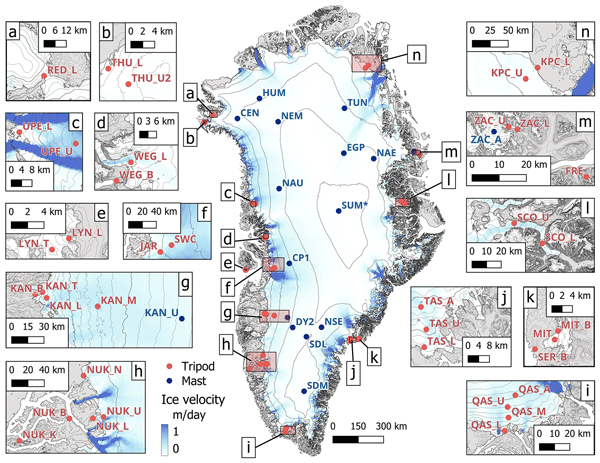
Robert S. Fausto, Penelope How, Baptiste Vandecrux, Mads C. Lund, Jason E. Box, Kenneth D. Mankoff, Signe B. Andersen, Dirk van As, Rasmus Bahbah, Michele Citterio, William Colgan, Henrik T. Jakobsgaard, Nanna B. Karlsson, Kristian K. Kjeldsen, Signe H. Larsen, Charlotte Olsen, Falk M. Oraschewski, Anja Rutishauser, Christopher L. Shields, Anne M. Solgaard, Ian T. Stevens, Synne H. Svendsen, Kirsty Langley, Alexandra Messerli, Anders A. Bjørk, Jonas K. Andersen, Jakob Abermann, Jakob Steiner, Rainer Prinz, Berhard Hynek, James M. Lea, Stephen Brough, and Andreas P. Ahlstrøm
Earth Syst. Sci. Data, 18, 2829–2873, https://doi.org/10.5194/essd-18-2829-2026, https://doi.org/10.5194/essd-18-2829-2026, 2026
Short summary
Short summary
In summary, the PROMICE (Programme for Monitoring of the Greenland Ice Sheet ) | GC-NET AWS (Greenland Climate Network automatic weather station) data product update represents a significant advancement in Arctic climate monitoring. Through enhanced station designs, state-of-the-art instrumentation, and a transparent, automated data processing workflow, the dataset offers an essential resource for studying the Greenland Ice Sheet and its periphery, validating climate models, and supporting global assessments of cryospheric change.
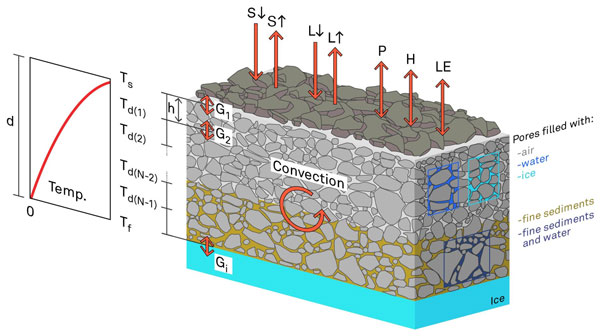
Francesca Pellicciotti, Adrià Fontrodona-Bach, David R. Rounce, Catriona L. Fyffe, Leif S. Anderson, Álvaro Ayala, Ben W. Brock, Pascal Buri, Stefan Fugger, Koji Fujita, Prateek Gantayat, Alexander R. Groos, Walter Immerzeel, Marin Kneib, Christoph Mayer, Shelley MacDonell, Michael McCarthy, James McPhee, Evan Miles, Heather Purdie, Ekaterina Rets, Akiko Sakai, Thomas E. Shaw, Jakob Steiner, Patrick Wagnon, and Alex Winter-Billington
The Cryosphere, 20, 1895–1928, https://doi.org/10.5194/tc-20-1895-2026, https://doi.org/10.5194/tc-20-1895-2026, 2026
Short summary
Short summary
Rock debris covers many of the world glaciers, modifying the transfer of atmospheric energy to the debris and into the ice. Models of different complexity simulate this process, and we compare 15 models at 9 sites to show that the most complex models at the debris-atmosphere interface have the highest performance. However, we lack debris properties and their derivation from measurements is ambiguous, hindering global modelling and calling for both model development and data collection.
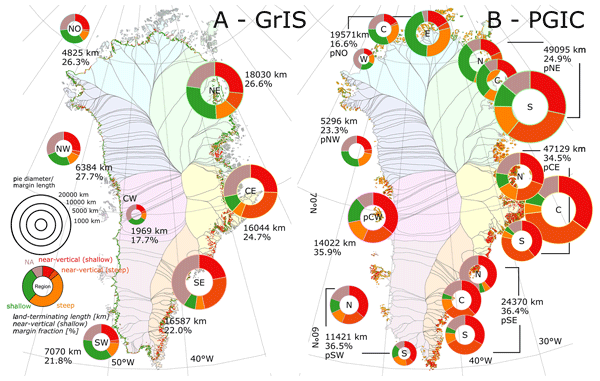
Jakob Steiner, Jakob Abermann, and Rainer Prinz
The Cryosphere, 20, 1797–1814, https://doi.org/10.5194/tc-20-1797-2026, https://doi.org/10.5194/tc-20-1797-2026, 2026
Short summary
Short summary
Nearly 95% of the Greenland ice margin ends on land, where meltwater leaves the ice to supply surrounding ecosystems. Here we show that nearly 30% of this land-terminating margin ends in extremely steep, often vertical sections, previously only described in individual locations. Less than 20% are shallow ramps. Knowledge of these margin shapes and their locations allows us to further investigate what they can potentially tell us about the current ice sheet health and its future evolution.
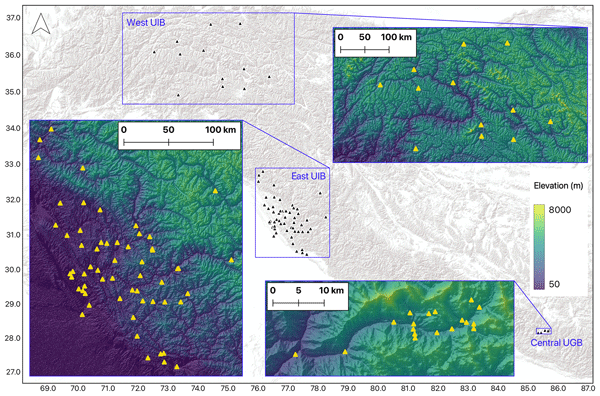
Marc Girona-Mata, Andrew Orr, Martin Widmann, Daniel Bannister, Ghulam Hussain Dars, Scott Hosking, Jesse Norris, David Ocio, Tony Phillips, Jakob Steiner, and Richard E. Turner
Hydrol. Earth Syst. Sci., 29, 3073–3100, https://doi.org/10.5194/hess-29-3073-2025, https://doi.org/10.5194/hess-29-3073-2025, 2025
Short summary
Short summary
We introduce a novel method for improving daily precipitation maps in mountain regions and pilot it across three basins in the Hindu Kush Himalaya (HKH). The approach leverages climate model and weather station data, along with statistical or machine learning techniques. Our results show that this approach outperforms traditional methods, especially in remote ungauged areas, suggesting that it could be used to improve precipitation maps across much of the HKH, as well as other mountain regions.
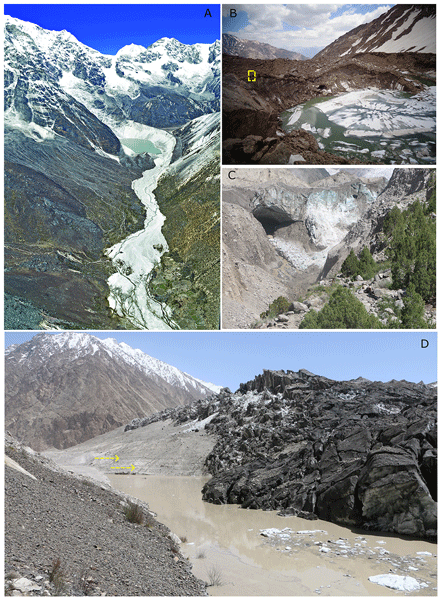
Finu Shrestha, Jakob F. Steiner, Reeju Shrestha, Yathartha Dhungel, Sharad P. Joshi, Sam Inglis, Arshad Ashraf, Sher Wali, Khwaja M. Walizada, and Taigang Zhang
Earth Syst. Sci. Data, 15, 3941–3961, https://doi.org/10.5194/essd-15-3941-2023, https://doi.org/10.5194/essd-15-3941-2023, 2023
Short summary
Short summary
A new inventory of glacial lake outburst floods (GLOFs) in High Mountain Asia found 697 events, causing 906 deaths, 3 times more than previously reported. This study provides insights into the contributing factors behind GLOFs on a regional scale and highlights the need for interdisciplinary approaches, including scientific communities and local knowledge, to understand GLOF risks in Asia. This study allows integration with other datasets, enabling future local and regional risk assessments.
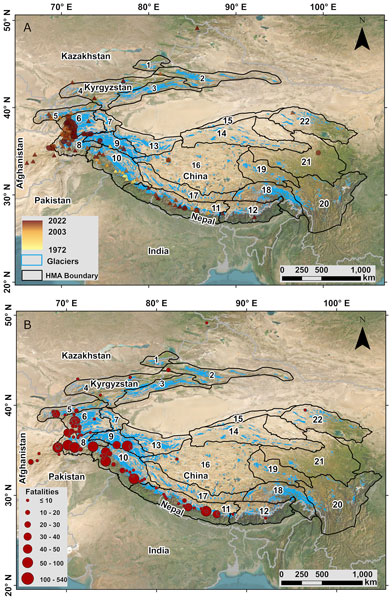
Anushilan Acharya, Jakob F. Steiner, Khwaja Momin Walizada, Salar Ali, Zakir Hussain Zakir, Arnaud Caiserman, and Teiji Watanabe
Nat. Hazards Earth Syst. Sci., 23, 2569–2592, https://doi.org/10.5194/nhess-23-2569-2023, https://doi.org/10.5194/nhess-23-2569-2023, 2023
Short summary
Short summary
All accessible snow and ice avalanches together with previous scientific research, local knowledge, and existing or previously active adaptation and mitigation solutions were investigated in the high mountain Asia (HMA) region to have a detailed overview of the state of knowledge and identify gaps. A comprehensive avalanche database from 1972–2022 is generated, including 681 individual events. The database provides a basis for the forecasting of avalanche hazards in different parts of HMA.
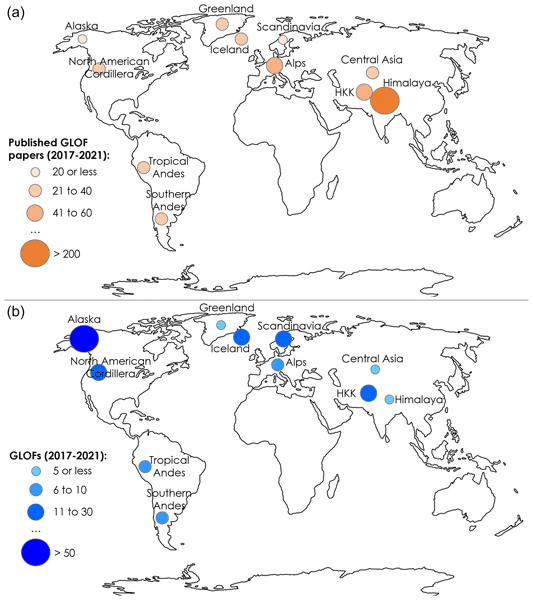
Adam Emmer, Simon K. Allen, Mark Carey, Holger Frey, Christian Huggel, Oliver Korup, Martin Mergili, Ashim Sattar, Georg Veh, Thomas Y. Chen, Simon J. Cook, Mariana Correas-Gonzalez, Soumik Das, Alejandro Diaz Moreno, Fabian Drenkhan, Melanie Fischer, Walter W. Immerzeel, Eñaut Izagirre, Ramesh Chandra Joshi, Ioannis Kougkoulos, Riamsara Kuyakanon Knapp, Dongfeng Li, Ulfat Majeed, Stephanie Matti, Holly Moulton, Faezeh Nick, Valentine Piroton, Irfan Rashid, Masoom Reza, Anderson Ribeiro de Figueiredo, Christian Riveros, Finu Shrestha, Milan Shrestha, Jakob Steiner, Noah Walker-Crawford, Joanne L. Wood, and Jacob C. Yde
Nat. Hazards Earth Syst. Sci., 22, 3041–3061, https://doi.org/10.5194/nhess-22-3041-2022, https://doi.org/10.5194/nhess-22-3041-2022, 2022
Short summary
Short summary
Glacial lake outburst floods (GLOFs) have attracted increased research attention recently. In this work, we review GLOF research papers published between 2017 and 2021 and complement the analysis with research community insights gained from the 2021 GLOF conference we organized. The transdisciplinary character of the conference together with broad geographical coverage allowed us to identify progress, trends and challenges in GLOF research and outline future research needs and directions.
Marie Schroeder, Ivana Stiperski, Michael Winkler, Georg Kaser, Jakob Steiner, Jakob Abermann, Georg Wohlfahrt, and Rainer Prinz
EGUsphere, https://doi.org/10.5194/egusphere-2026-5112, https://doi.org/10.5194/egusphere-2026-5112, 2026
This preprint is open for discussion and under review for The Cryosphere (TC).
Short summary
Short summary
Steep ice cliffs can lose ice much faster than flat glacier surfaces, yet little is known about how they interact with the air around them. Measurements at a 25-metre-high ice cliff on Kilimanjaro revealed distinct day–night air flows and major differences in how heat is transported. Higher up, heat is transported in an organised way, while near the cliff base this exchange was more complex. The cliff shape and its surroundings can strongly influence how heat reaches the ice and how it is lost.
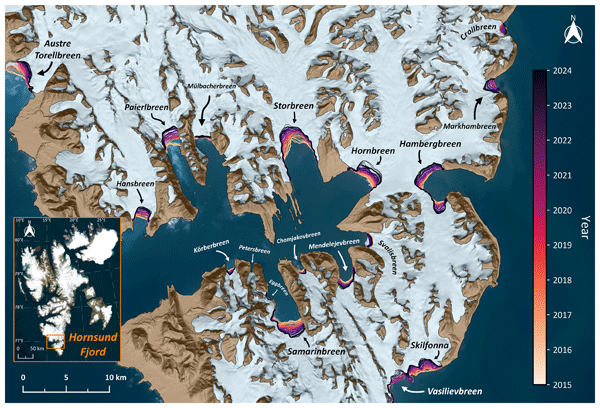
Dakota Pyles, Marcel Dreier, Anna Wendleder, Will Kochtitzky, Nora Gourmelon, Vincent Christlein, and Thorsten Seehaus
Earth Syst. Sci. Data, 18, 7319–7344, https://doi.org/10.5194/essd-18-7319-2026, https://doi.org/10.5194/essd-18-7319-2026, 2026
Short summary
Short summary
Monthly frontal ablation is quantified at 147 Svalbard tidewater glaciers from 2015–2024 using terminus positions derived from a deep-learning segmentation model's predictions of the calving fronts on satellite radar images. Our high spatio-temporal resolution results will improve the process understanding of frontal ablation, provide reference data for the modeling community, and deliver an ideal dataset for studying controls of frontal ablation.
Austin M. Weber, Stanislav Kutuzov, Emilie Beaudon, M. Roxana Sierra-Hernández, Mary Davis, Laurel H. Bayless, Don Kenny, and Lonnie G. Thompson
Atmos. Chem. Phys., 26, 12887–12909, https://doi.org/10.5194/acp-26-12887-2026, https://doi.org/10.5194/acp-26-12887-2026, 2026
Short summary
Short summary
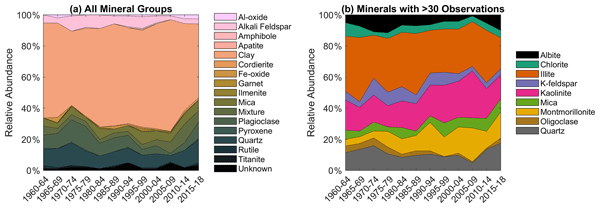
We investigated the physical characteristics (sizes, shapes, and composition) of mineral dust particles preserved in a Peruvian ice core to gain insights into what has been deposited since 1960. We show that the dust originates from a mix of local and distal source areas and note that the information reported in our study has important implications for reconstructing dust emissions and circulation patterns, as well as for estimating the dust’s radiative impacts.
Lea Hartl, Jakob Abermann, Ayla Akgün, Giulia Bertolotti, Tobias Bolch, Svenja Conzelmann, Codrut-Andrei Diaconu, Iris Hansche, Anne Hartig, Anna Haut, Kay Helfricht, Bernhard Hynek, Marie Sophie Kaucher, Andreas Kellerer-Pirklbauer, Ann Christin Kogel, Julie Krippes, Marcela Violeta Lauria, Christoph Mayer, Jan-Christoph Otto, Rainer Prinz, Sina Prölß, Lorenzo Rieg, Lea Schönleber, Gabriele Schwaizer, Bernd Seiser, Martin Stocker-Waldhuber, Markus Strudl, Martin Verhounik, and Harald Zandler
The Cryosphere, 20, 5157–5180, https://doi.org/10.5194/tc-20-5157-2026, https://doi.org/10.5194/tc-20-5157-2026, 2026
Short summary
Short summary
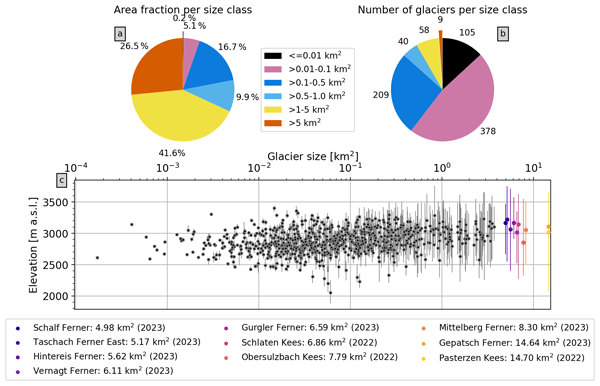
We mapped glacier outlines in Austria using recent, high resolution imagery. The resulting glacier inventory provides an update on glacier area in Austria in 2021-2023. More than 30% of glacier area was lost and 95 glaciers have disappeared since the mid-2000s. Glacier recession is accelerating and regular updates to glacier inventories are needed to understand downstream changes to the hydrological system, quantify glacier mass loss, and support planning and adaptation measures.
Aris Kwadijk, Philip D. A. Kraaijenbrink, Faezeh M. Nick, Joseph M. Shea, Jakob F. Steiner, René R. Wijngaard, and Walter W. Immerzeel
EGUsphere, https://doi.org/10.5194/egusphere-2026-5005, https://doi.org/10.5194/egusphere-2026-5005, 2026
This preprint is open for discussion and under review for Hydrology and Earth System Sciences (HESS).
Short summary
Short summary
The Himalayas supply water to millions of people downstream, yet high-altitude rainfall remains poorly understood. Using thirteen years of data from weather stations across Nepal's Langtang Valley, we found that during the monsoon the moist atmosphere causes rainfall to be highly sensitive to topography. We show how precipitation-elevation gradients shift during the day. This shift is captured in a numerical relation, that can serve to validate weather models.
Zhangyu Sun, Tobias Bolch, Daniel Falaschi, Atanu Bhattacharya, and Lin Liu
EGUsphere, https://doi.org/10.5194/egusphere-2026-3678, https://doi.org/10.5194/egusphere-2026-3678, 2026
This preprint is open for discussion and under review for The Cryosphere (TC).
Short summary
Short summary
Ice-debris complexes (IDC) are common, but their evolution remains poorly understood. We investigated 4 IDCs and identified 3 major zones: a glacier, a glacier-affected, and a periglacial zone. Although glacier-affected and periglacial zones cover much smaller areas than glaciers, their ice volume losses are comparable. IDCs can evolve through multiple pathways, incl. gradual transformation of glacier into rock glaciers and the advance or embedding of glaciers onto pre-existing rock glaciers.
Amaury Dehecq, Friedrich Knuth, Joaquín M. C. Belart, Livia Piermattei, Camillo Ressl, Adina Racoviteanu, Robert McNabb, David Shean, and Luc Godin
Int. Arch. Photogramm. Remote Sens. Spatial Inf. Sci., XLIX-B2-2026, 9–16, https://doi.org/10.5194/isprs-archives-XLIX-B2-2026-9-2026, https://doi.org/10.5194/isprs-archives-XLIX-B2-2026-9-2026, 2026
Daoxun Gao, Kunpeng Wu, Yunpeng Duan, Zhaoqi Ji, Danyu Ma, Tobias Bolch, Cheng Huang, and Shiyin Liu
The Cryosphere, 20, 3559–3579, https://doi.org/10.5194/tc-20-3559-2026, https://doi.org/10.5194/tc-20-3559-2026, 2026
Short summary
Short summary
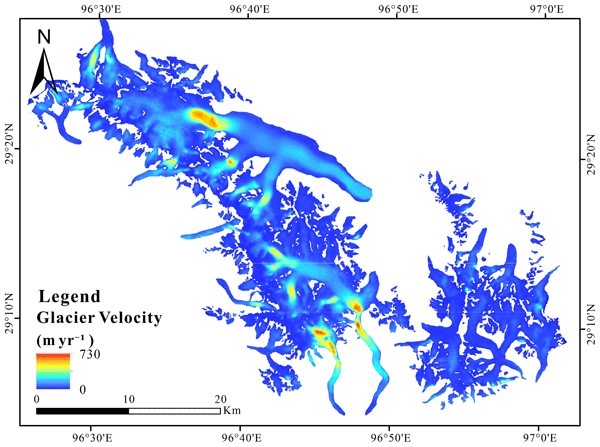
We mapped monthly glacier flow speeds in the Kangri Karpo region from 2015 to 2024 by combining measurements from several satellites and a drone survey. The merged maps are more complete and detailed than maps from any single source, with fewer gaps caused by clouds or difficult terrain. The results show where glaciers move fastest, how their speed changes through the year, and which glaciers have been speeding up or slowing down over the past decade.
Shaoting Ren, Evan S. Miles, Michael McCarthy, Achille Jouberton, Thomas E. Shaw, Pascal Buri, Marin Kneib, Prateek Gantayat, Anneli Guthke, and Francesca Pellicciotti
EGUsphere, https://doi.org/10.5194/egusphere-2026-2524, https://doi.org/10.5194/egusphere-2026-2524, 2026
Short summary
Short summary
Local meteorology is curial to understand glaciers’ response to climate change, yet is hard to quantify due to rare measurements. By combining physical modeling and satellite observations, this study develops a new inference framework to accurately estimate on-glacier temperature and precipitation, therefore derive reliable seasonal glacier melt. Reliable accuracy of this framework paves a way to map these key two meteorological variables for regional and global unmonitored glacier.
Tomos Morgan, Robert McNabb, and Paul Dunlop
EGUsphere, https://doi.org/10.5194/egusphere-2026-2033, https://doi.org/10.5194/egusphere-2026-2033, 2026
Short summary
Short summary
As glaciers retreat, lakes form and grow quickly that poses flood risks in downstream populations. Using satellite imagery, we test ways in which we can improve the accuracy of tracking the changes in the areal extent of glacial lakes. By combining training and testing parameters with terrain and vegetation information we achieved overall accuracies of 94.6 % showing that our method produces a rapid way of delineating glacial lakes to support hazard planning and mitigation.
Mustafo Safarov, Junli Li, Evan Miles, Majid Gulayozov, Ruonan Li, Ali Fazylov, Kamoliddin Nazirzoda, Firdavs Vosidov, Murodkhudzha Murodov, Hofiz Navruzshoev, and Ardamehr Halimov
EGUsphere, https://doi.org/10.5194/egusphere-2026-1923, https://doi.org/10.5194/egusphere-2026-1923, 2026
Short summary
Short summary
This study investigates a rapidly surging glacier in the Pamir Mountains using daily satellite imagery and unmanned aerial vehicle (UAV) data. It reveals that surge-driven ice detachment can rapidly displace ice downstream and transform valley morphology. The findings show that even small glaciers can cause large, rapid environmental impacts and highlight the need for high-frequency observations to understand glacier instability and improve hazard assessment in a warming climate.
Robert S. Fausto, Penelope How, Baptiste Vandecrux, Mads C. Lund, Jason E. Box, Kenneth D. Mankoff, Signe B. Andersen, Dirk van As, Rasmus Bahbah, Michele Citterio, William Colgan, Henrik T. Jakobsgaard, Nanna B. Karlsson, Kristian K. Kjeldsen, Signe H. Larsen, Charlotte Olsen, Falk M. Oraschewski, Anja Rutishauser, Christopher L. Shields, Anne M. Solgaard, Ian T. Stevens, Synne H. Svendsen, Kirsty Langley, Alexandra Messerli, Anders A. Bjørk, Jonas K. Andersen, Jakob Abermann, Jakob Steiner, Rainer Prinz, Berhard Hynek, James M. Lea, Stephen Brough, and Andreas P. Ahlstrøm
Earth Syst. Sci. Data, 18, 2829–2873, https://doi.org/10.5194/essd-18-2829-2026, https://doi.org/10.5194/essd-18-2829-2026, 2026
Short summary
Short summary
In summary, the PROMICE (Programme for Monitoring of the Greenland Ice Sheet ) | GC-NET AWS (Greenland Climate Network automatic weather station) data product update represents a significant advancement in Arctic climate monitoring. Through enhanced station designs, state-of-the-art instrumentation, and a transparent, automated data processing workflow, the dataset offers an essential resource for studying the Greenland Ice Sheet and its periphery, validating climate models, and supporting global assessments of cryospheric change.
Francesca Pellicciotti, Adrià Fontrodona-Bach, David R. Rounce, Catriona L. Fyffe, Leif S. Anderson, Álvaro Ayala, Ben W. Brock, Pascal Buri, Stefan Fugger, Koji Fujita, Prateek Gantayat, Alexander R. Groos, Walter Immerzeel, Marin Kneib, Christoph Mayer, Shelley MacDonell, Michael McCarthy, James McPhee, Evan Miles, Heather Purdie, Ekaterina Rets, Akiko Sakai, Thomas E. Shaw, Jakob Steiner, Patrick Wagnon, and Alex Winter-Billington
The Cryosphere, 20, 1895–1928, https://doi.org/10.5194/tc-20-1895-2026, https://doi.org/10.5194/tc-20-1895-2026, 2026
Short summary
Short summary
Rock debris covers many of the world glaciers, modifying the transfer of atmospheric energy to the debris and into the ice. Models of different complexity simulate this process, and we compare 15 models at 9 sites to show that the most complex models at the debris-atmosphere interface have the highest performance. However, we lack debris properties and their derivation from measurements is ambiguous, hindering global modelling and calling for both model development and data collection.
Jakob Steiner, Jakob Abermann, and Rainer Prinz
The Cryosphere, 20, 1797–1814, https://doi.org/10.5194/tc-20-1797-2026, https://doi.org/10.5194/tc-20-1797-2026, 2026
Short summary
Short summary
Nearly 95% of the Greenland ice margin ends on land, where meltwater leaves the ice to supply surrounding ecosystems. Here we show that nearly 30% of this land-terminating margin ends in extremely steep, often vertical sections, previously only described in individual locations. Less than 20% are shallow ramps. Knowledge of these margin shapes and their locations allows us to further investigate what they can potentially tell us about the current ice sheet health and its future evolution.
Whyjay Zheng, Wesley Van Wychen, Tian Li, and Tsutomu Yamanokuchi
The Cryosphere, 20, 1699–1714, https://doi.org/10.5194/tc-20-1699-2026, https://doi.org/10.5194/tc-20-1699-2026, 2026
Short summary
Short summary
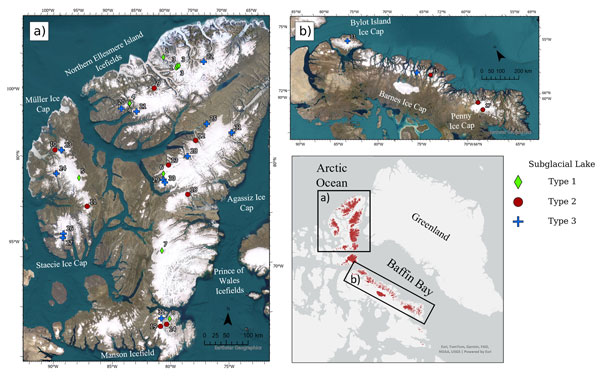
We identify lakes beneath the glaciers in the Canadian Arctic using satellite measurements over a decade, increasing the number of known subglacial lakes in this area from 2 to 37. These lakes are recharged by billions of cubic meters of water, and the draining of these lakes can lower the ice elevation by more than 100 m. We find three types of subglacial lakes, two of which are primarily located in the Canadian Arctic. When glaciers lose their ice quickly, these lakes become active.
Samuel Schilling, Tobias Bolch, Andreas Dietz, Rebecca Jean Herman, and Claudia Kuenzer
EGUsphere, https://doi.org/10.5194/egusphere-2025-6280, https://doi.org/10.5194/egusphere-2025-6280, 2026
Short summary
Short summary
Snow stored in winter snowpacks supplies water to rivers that millions of people depend on. As warming reduces snow amounts, we studied whether melting snow still matters for river flow. Using long records from river basins on four continents, and cause and effect analysis, we found that in some basins melting snow can become more important for river flow even when less snow is available.
Patrick Schmitt, Fabien Maussion, Daniel N. Goldberg, and Philipp Gregor
Geosci. Model Dev., 19, 1301–1319, https://doi.org/10.5194/gmd-19-1301-2026, https://doi.org/10.5194/gmd-19-1301-2026, 2026
Short summary
Short summary
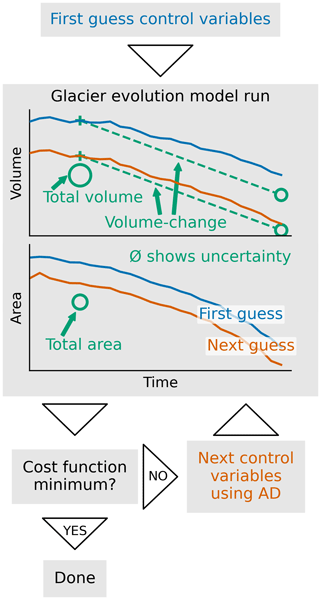
To improve large-scale understanding of glaciers, we developed a new data assimilation method that integrates available observations in a dynamically consistent way, while taking their timestamps into account. It is designed to flexibly include new glacier data as it becomes available. We tested the method with idealized experiments and found promising results in terms of accuracy and efficiency, showing strong potential for real-world applications.
Alexandre R. Bevington, Brian Menounos, and Mark Ednie
The Cryosphere, 20, 811–833, https://doi.org/10.5194/tc-20-811-2026, https://doi.org/10.5194/tc-20-811-2026, 2026
Short summary
Short summary
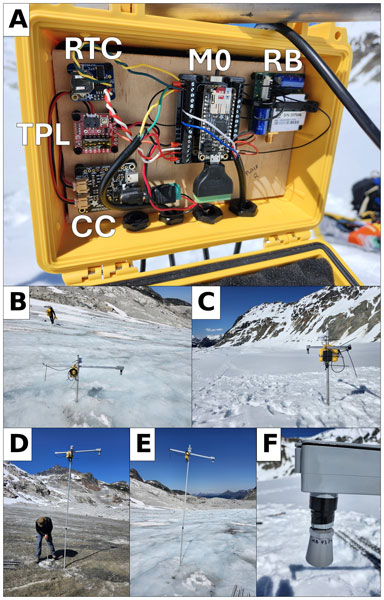
We developed automated "smart stakes" to study how quickly glaciers melt during hot weather. The low-cost devices were installed on Place Glacier in British Columbia and sent data by satellite in 2024. We show that just three heat periods caused more than half of the glacier's total summer melt, even though these events lasted only one-third of the melt season. This system provided measurements that would be impossible with traditional methods and we show that the data can improved melt models.
Jan Niklas Richter, Anselm Arndt, Nikolina Ban, Nicolas Gampierakis, Fabien Maussion, Rainer Prinz, Matthias Scheiter, Nikolaus Umlauf, and Lindsey Nicholson
EGUsphere, https://doi.org/10.5194/egusphere-2025-6249, https://doi.org/10.5194/egusphere-2025-6249, 2026
Short summary
Short summary
We developed a multi-objective Bayesian framework to calibrate a surface energy balance (SEB) model using only publicly available satellite data and climate simulations. The framework constrains model parameters well but also reveals biases in the forcing, affecting the SEB and the simulated mass balance and snowlines. The results indicate that an uncertainty-aware model chain can help identify model errors and provides a first step towards physical glacier modelling without in-situ data.

An Y. Li, Michelle R. Koutnik, Stephen Brough, Matteo Spagnolo, and Iestyn Barr
Earth Surf. Dynam., 14, 1–31, https://doi.org/10.5194/esurf-14-1-2026, https://doi.org/10.5194/esurf-14-1-2026, 2026
Short summary
Short summary
Many alcoves on Mars resemble glacial cirques on Earth. While some contain glacier-like forms, many do not, and they have never been studied at a large scale. We mapped ~2,000 alcoves in Deuteronilus Mensae and identified 435 as "cirque-like." These show geomorphic signs of past glaciation and mainly face south–southeast, implying ice accumulation during high obliquity. Further research is needed to confirm the style of glaciation as either warm-based or cold-based.
Gleb Chernyakov, Nelly Elagina, Taisiia Kiseleva, and Stanislav Kutuzov
The Cryosphere, 19, 6659–6671, https://doi.org/10.5194/tc-19-6659-2025, https://doi.org/10.5194/tc-19-6659-2025, 2025
Short summary
Short summary
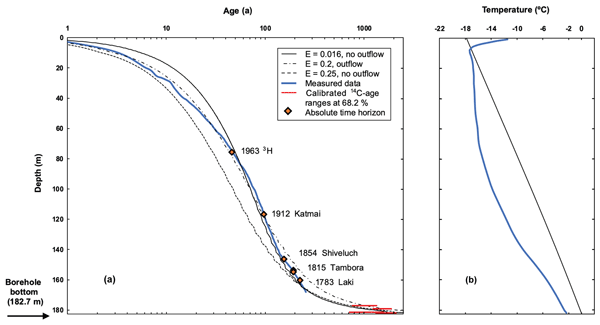
We studied the glaciers of Mount Elbrus, a key site for understanding past climate and environmental changes in Caucasus region. Using advanced glacier numerical modeling calibrated by data from the deep ice core drilled at this site, we calculated the ice flow and age of glacier layers. Our results show detailed ice age patterns and confirm the glacier preserves climate records up to 2000 years old.
Kamilla Hauknes Sjursen, Jordi Bolibar, Marijn van der Meer, Liss Marie Andreassen, Julian Peter Biesheuvel, Thorben Dunse, Matthias Huss, Fabien Maussion, David R. Rounce, and Brandon Tober
The Cryosphere, 19, 5801–5826, https://doi.org/10.5194/tc-19-5801-2025, https://doi.org/10.5194/tc-19-5801-2025, 2025
Short summary
Short summary
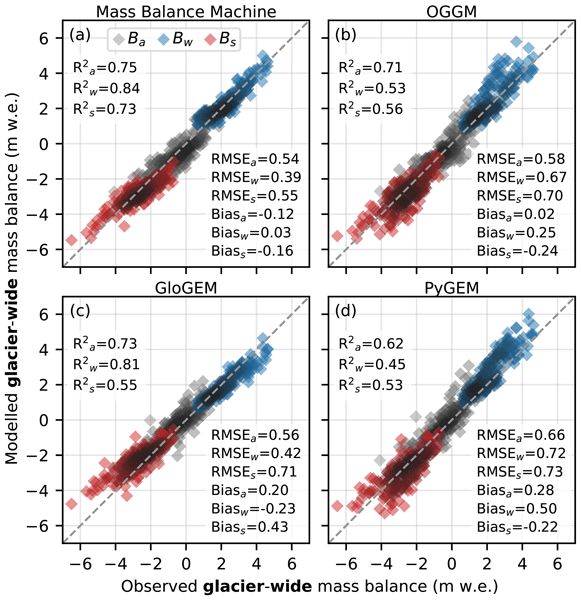
Understanding glacier mass changes is crucial for assessing freshwater availability in many regions of the world. We present the Mass Balance Machine, a machine learning model that learns from sparse measurements of glacier mass change to make predictions on unmonitored glaciers. Using data from Norway, we show that the model provides accurate estimates of mass changes at different spatiotemporal scales. Our findings show that machine learning can be a valuable tool to improve such predictions.
Orie Sasaki, Evan S. Miles, Francesca Pellicciotti, Akiko Sakai, and Koji Fujita
The Cryosphere, 19, 5283–5298, https://doi.org/10.5194/tc-19-5283-2025, https://doi.org/10.5194/tc-19-5283-2025, 2025
Short summary
Short summary
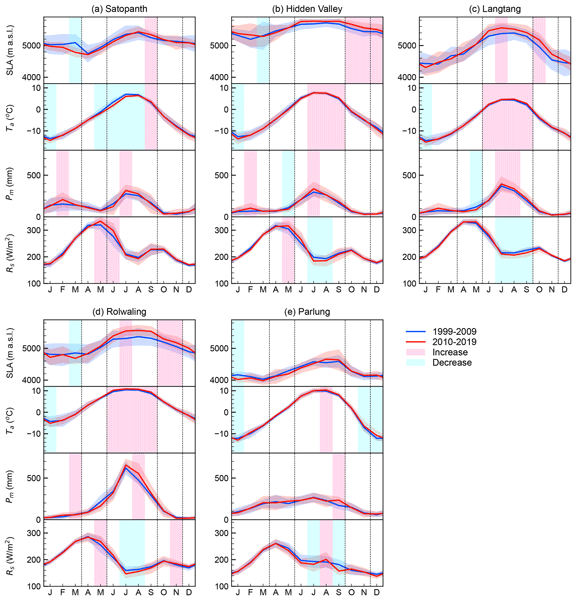
This study adapts a method to detect snowline altitude (SLA) using Google Earth Engine with high-resolution satellite imagery. Applying this method to five glaciated watersheds in the Himalayas reveals regional consistencies and differences in snow dynamics, as well as 20-year trends of snowline increases (3 catchments) and decreases (1) and no trend (1). We investigate the controls of these dynamics by analyzing climatic factors and topographic characteristics.
Stephan Harrison, Adina Racoviteanu, Sarah Shannon, Darren Jones, Karen Anderson, Neil Glasser, Jasper Knight, Anna Ranger, Arindan Mandal, Bramha Dutt Vishwakarma, Jeffrey S. Kargel, Dan Shugar, Umesh Haritashya, Dongfeng Li, Aristeidis Koutroulis, Klaus Wyser, and Sam Inglis
The Cryosphere, 19, 4113–4124, https://doi.org/10.5194/tc-19-4113-2025, https://doi.org/10.5194/tc-19-4113-2025, 2025
Short summary
Short summary
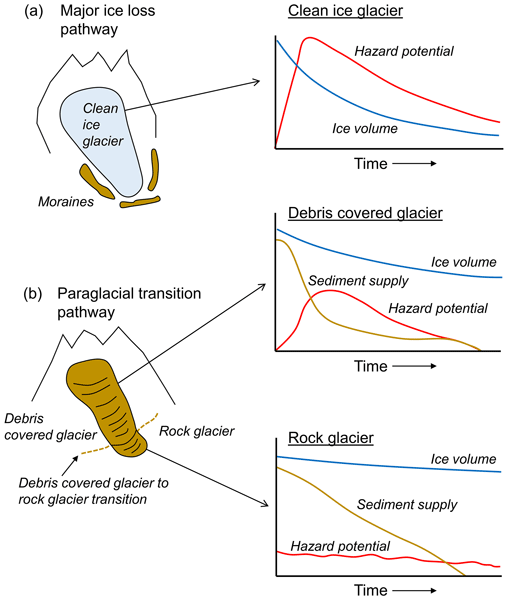
Climate change is leading to a global recession of mountain glaciers, and numerical modelling suggests that this will result in the rapid disappearance of many glaciers, impacting water supplies. However, an alternative scenario suggests that increased rock fall and debris flows to valley bottoms will cover glaciers with thick rock debris, slowing melting and transforming glaciers into rock–ice mixtures called rock glaciers. This paper explores these scenarios.
Larissa Nora van der Laan, Anouk Vlug, Adam A. Scaife, Fabien Maussion, and Kristian Förster
The Cryosphere, 19, 3879–3896, https://doi.org/10.5194/tc-19-3879-2025, https://doi.org/10.5194/tc-19-3879-2025, 2025
Short summary
Short summary
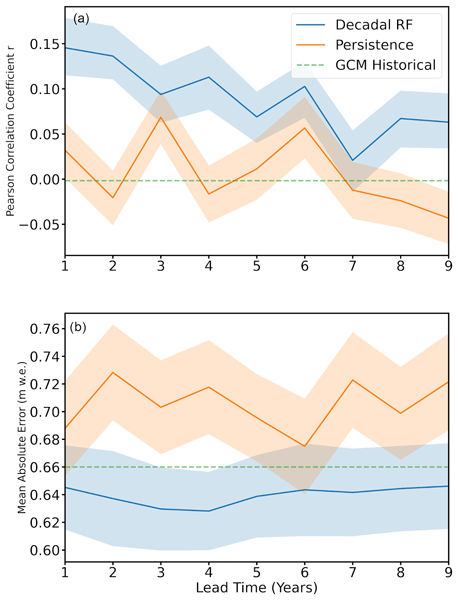
Usually, glacier models are supplied with climate information from long (e.g., 100-year) simulations by global climate models. In this paper, we test the feasibility of supplying glacier models with shorter simulations to get more accurate information on 5–10-year timescales. Reliable information on these timescales is very important, especially for water management experts, to know how much meltwater to expect, affecting rivers, agriculture and drinking water.
Adrià Fontrodona-Bach, Lars Groeneveld, Evan Miles, Michael McCarthy, Thomas Shaw, Vicente Melo Velasco, and Francesca Pellicciotti
Earth Syst. Sci. Data, 17, 4213–4234, https://doi.org/10.5194/essd-17-4213-2025, https://doi.org/10.5194/essd-17-4213-2025, 2025
Short summary
Short summary
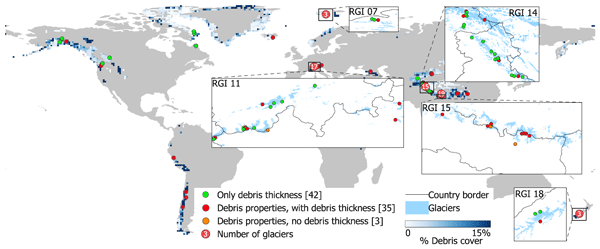
Glaciers with a layer of rocky debris on their surfaces are distinct from clean-ice glaciers, with debris mostly insulating the glacier ice. However, debris data are scarce. We present the Debris Database (DebDaB), a database of debris thickness and physical properties of debris, with data from 84 glaciers in 13 global glacier regions compiled from 172 sources and including previously unpublished data. DebDaB serves as an open central repository for the scientific community to do research on debris-covered glaciers.
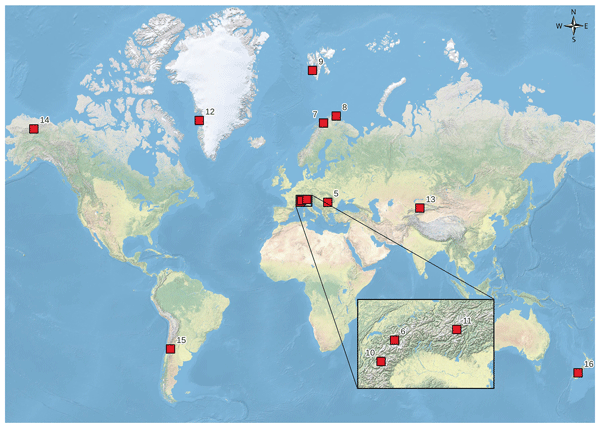
Line Rouyet, Tobias Bolch, Francesco Brardinoni, Rafael Caduff, Diego Cusicanqui, Margaret Darrow, Reynald Delaloye, Thomas Echelard, Christophe Lambiel, Cécile Pellet, Lucas Ruiz, Lea Schmid, Flavius Sirbu, and Tazio Strozzi
Earth Syst. Sci. Data, 17, 4125–4157, https://doi.org/10.5194/essd-17-4125-2025, https://doi.org/10.5194/essd-17-4125-2025, 2025
Short summary
Short summary
Rock glaciers are landforms generated by the creep of frozen ground (permafrost) in cold-climate mountains. Mapping rock glaciers contributes to documenting the distribution and the dynamics of mountain permafrost. We compiled inventories documenting the location, the characteristics, and the extent of rock glaciers in 12 mountain regions around the world. In each region, a team of operators performed the work following common rules and agreed on final solutions when discrepancies were identified.
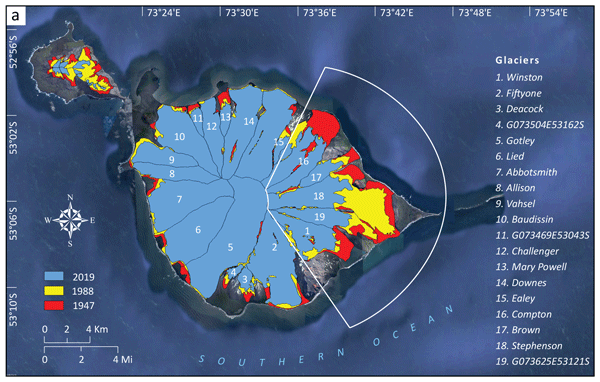
Levan G. Tielidze, Andrew N. Mackintosh, and Weilin Yang
The Cryosphere, 19, 2677–2694, https://doi.org/10.5194/tc-19-2677-2025, https://doi.org/10.5194/tc-19-2677-2025, 2025
Short summary
Short summary
Heard Island is a UNESCO World Heritage site due to its outstanding physical and biological features which are being affected by significant ongoing climatic changes. As one of the only sub-Antarctic islands mostly free of introduced species, its largely undisturbed ecosystems are at risk from the impact of glacier retreat. This glacier inventory will help in designing effective conservation strategies and managing protected areas to ensure the preservation of the biodiversity they support.
Marc Girona-Mata, Andrew Orr, Martin Widmann, Daniel Bannister, Ghulam Hussain Dars, Scott Hosking, Jesse Norris, David Ocio, Tony Phillips, Jakob Steiner, and Richard E. Turner
Hydrol. Earth Syst. Sci., 29, 3073–3100, https://doi.org/10.5194/hess-29-3073-2025, https://doi.org/10.5194/hess-29-3073-2025, 2025
Short summary
Short summary
We introduce a novel method for improving daily precipitation maps in mountain regions and pilot it across three basins in the Hindu Kush Himalaya (HKH). The approach leverages climate model and weather station data, along with statistical or machine learning techniques. Our results show that this approach outperforms traditional methods, especially in remote ungauged areas, suggesting that it could be used to improve precipitation maps across much of the HKH, as well as other mountain regions.
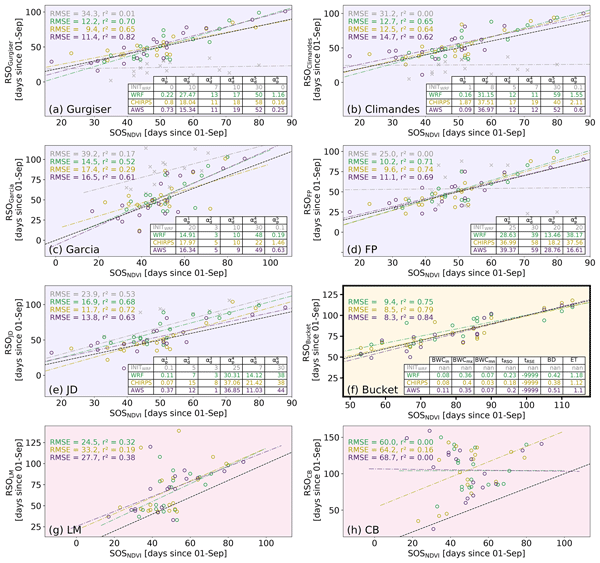
Lorenz Hänchen, Emily Potter, Cornelia Klein, Pierluigi Calanca, Fabien Maussion, Wolfgang Gurgiser, and Georg Wohlfahrt
Hydrol. Earth Syst. Sci., 29, 2727–2747, https://doi.org/10.5194/hess-29-2727-2025, https://doi.org/10.5194/hess-29-2727-2025, 2025
Short summary
Short summary
In semi-arid regions, the timing and duration of the rainy season are crucial for agriculture. This study introduces a new framework for improving estimations of the onset and end of the rainy season by testing how well they fit local vegetation data. We improve the performance of existing methods and present a new one with higher performance. Our findings can help us to make informed decisions about water usage, and the framework can be applied to other regions as well.
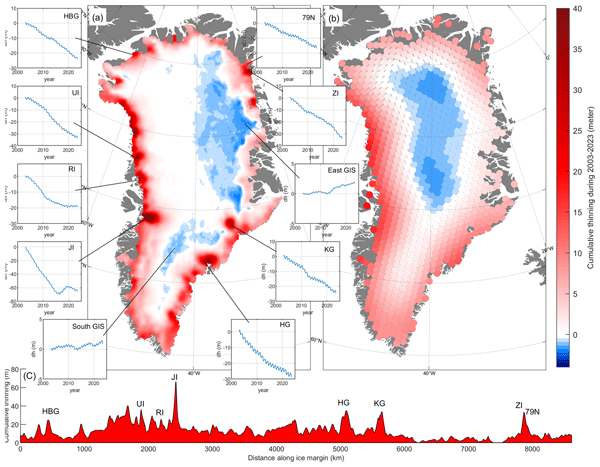
Shfaqat A. Khan, Helene Seroussi, Mathieu Morlighem, William Colgan, Veit Helm, Gong Cheng, Danjal Berg, Valentina R. Barletta, Nicolaj K. Larsen, William Kochtitzky, Michiel van den Broeke, Kurt H. Kjær, Andy Aschwanden, Brice Noël, Jason E. Box, Joseph A. MacGregor, Robert S. Fausto, Kenneth D. Mankoff, Ian M. Howat, Kuba Oniszk, Dominik Fahrner, Anja Løkkegaard, Eigil Y. H. Lippert, Alicia Bråtner, and Javed Hassan
Earth Syst. Sci. Data, 17, 3047–3071, https://doi.org/10.5194/essd-17-3047-2025, https://doi.org/10.5194/essd-17-3047-2025, 2025
Short summary
Short summary
The surface elevation of the Greenland Ice Sheet is changing due to surface mass balance processes and ice dynamics, each exhibiting distinct spatiotemporal patterns. Here, we employ satellite and airborne altimetry data with fine spatial (1 km) and temporal (monthly) resolutions to document this spatiotemporal evolution from 2003 to 2023. This dataset of fine-resolution altimetry data in both space and time will support studies of ice mass loss and be useful for GIS ice sheet modeling.
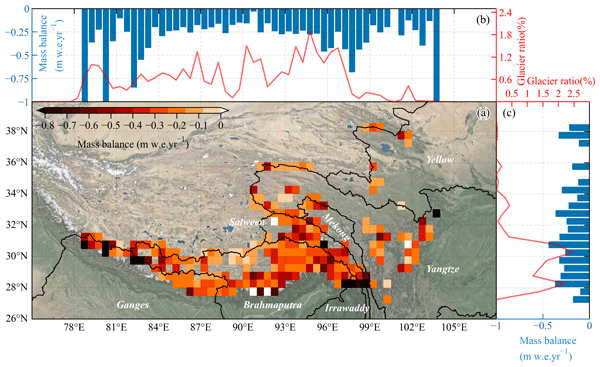
Yu Zhu, Shiyin Liu, Junfeng Wei, Kunpeng Wu, Tobias Bolch, Junli Xu, Wanqin Guo, Zongli Jiang, Fuming Xie, Ying Yi, Donghui Shangguan, Xiaojun Yao, and Zhen Zhang
Earth Syst. Sci. Data, 17, 1851–1871, https://doi.org/10.5194/essd-17-1851-2025, https://doi.org/10.5194/essd-17-1851-2025, 2025
Short summary
Short summary
This study compiled a near-complete inventory of glacier mass changes across the eastern Tibetan Plateau using topographical maps. These data enhance our understanding of glacier change variability before 2000. When combined with existing research, our dataset provides a nearly 5-decade record of mass balance, aiding hydrological simulations and assessments of mountain glacier contributions to sea-level rise.
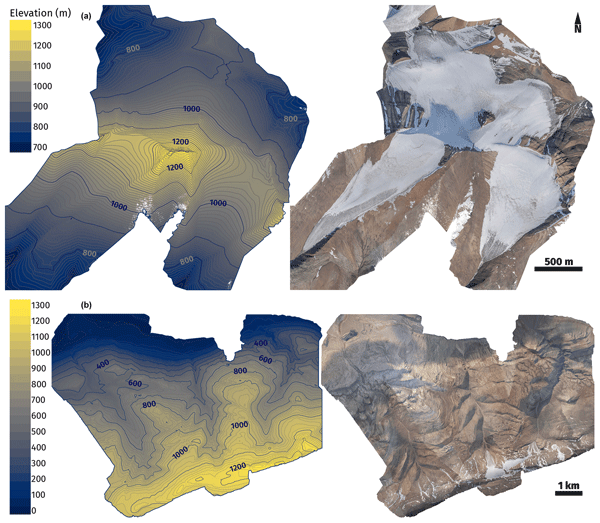
Dorota Medrzycka, Luke Copland, Laura Thomson, William Kochtitzky, and Braden Smeda
Geosci. Instrum. Method. Data Syst., 14, 69–90, https://doi.org/10.5194/gi-14-69-2025, https://doi.org/10.5194/gi-14-69-2025, 2025
Short summary
Short summary
This work explores the use of aerial photography surveys for mapping glaciers, specifically in challenging environments. Using examples from two glaciers in Arctic Canada, we discuss the main factors which can affect data collection and review methods for capturing and processing images to create accurate topographic maps. Key recommendations include choosing the right camera and positioning equipment and adapting survey design to maximise data quality, even under less-than-ideal conditions.
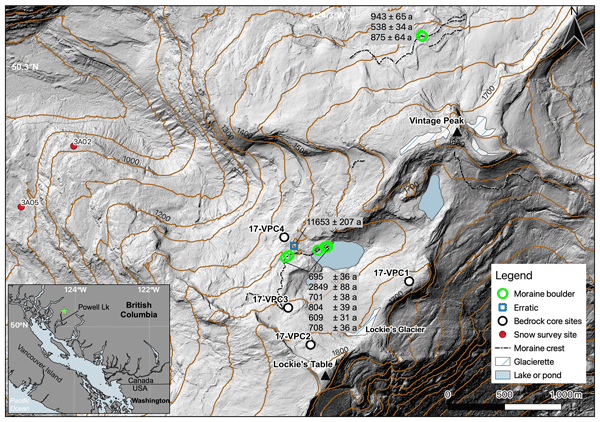
Adam C. Hawkins, Brent M. Goehring, and Brian Menounos
Geochronology, 7, 157–172, https://doi.org/10.5194/gchron-7-157-2025, https://doi.org/10.5194/gchron-7-157-2025, 2025
Short summary
Short summary
We use a method called cosmogenic nuclide dating on bedrock surfaces and moraine boulders to determine the relative length of time an alpine glacier was larger or smaller than its current extent over the past 15 000 years. We also discuss several important limitations to this method. This method gives information on the duration of past ice advances and is useful in areas without other materials that can be dated.
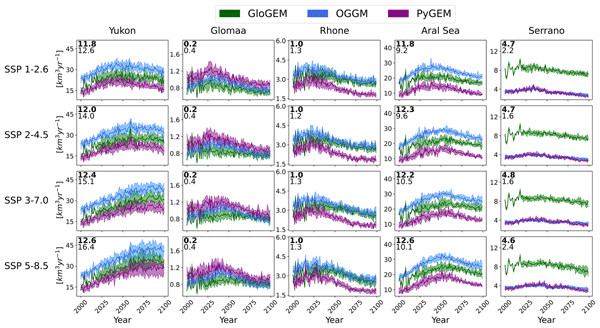
Finn Wimberly, Lizz Ultee, Lilian Schuster, Matthias Huss, David R. Rounce, Fabien Maussion, Sloan Coats, Jonathan Mackay, and Erik Holmgren
The Cryosphere, 19, 1491–1511, https://doi.org/10.5194/tc-19-1491-2025, https://doi.org/10.5194/tc-19-1491-2025, 2025
Short summary
Short summary
Glacier models have historically been used to understand glacier melt’s contribution to sea level rise. The capacity to project seasonal glacier runoff is a relatively recent development for these models. In this study we provide the first model intercomparison of runoff projections for the glacier evolution models capable of simulating future runoff globally. We compare model projections from 2000 to 2100 for all major river basins larger than 3000 km2 with over 30 km2 of initial glacier cover.
Lea Hartl, Patrick Schmitt, Lilian Schuster, Kay Helfricht, Jakob Abermann, and Fabien Maussion
The Cryosphere, 19, 1431–1452, https://doi.org/10.5194/tc-19-1431-2025, https://doi.org/10.5194/tc-19-1431-2025, 2025
Short summary
Short summary
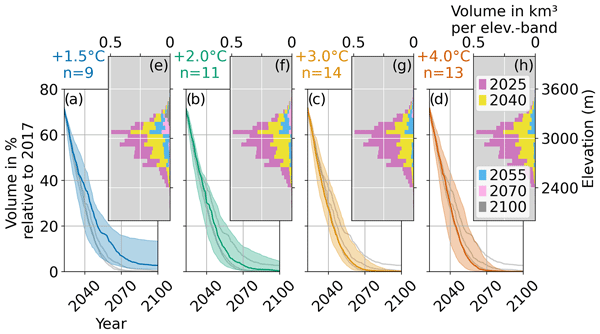
We use regional observations of glacier area and volume change to inform glacier evolution modeling in the Ötztal and Stubai range (Austrian Alps) until 2100 in different climate scenarios. Glaciers in the region lost 23 % of their volume between 2006 and 2017. Under current warming trajectories, glacier loss in the region is expected to be near-total by 2075. We show that integrating regional calibration and validation data in glacier models is important to improve confidence in projections.
Miaomiao Qi, Shiyin Liu, Zhifang Zhao, Yongpeng Gao, Fuming Xie, Georg Veh, Letian Xiao, Jinlong Jing, Yu Zhu, and Kunpeng Wu
Hydrol. Earth Syst. Sci., 29, 969–982, https://doi.org/10.5194/hess-29-969-2025, https://doi.org/10.5194/hess-29-969-2025, 2025
Short summary
Short summary
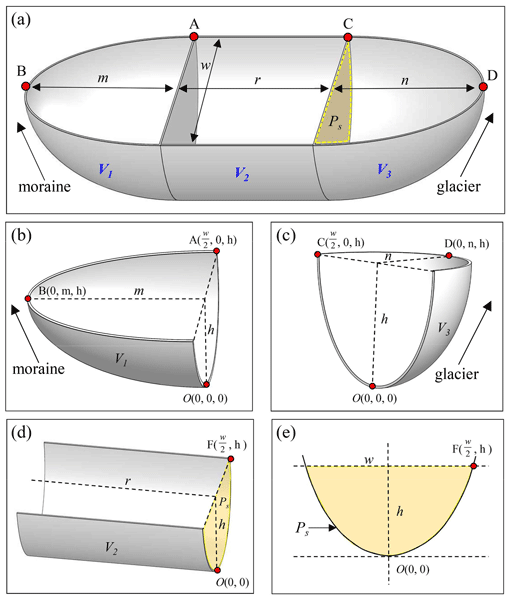
Here we propose a new mathematically robust and cost-effective model to improve glacial lake water storage estimation. We have also provided a dataset of measured water storage in glacial lakes through field depth measurements. Our model incorporates an automated calculation process and outperforms previous ones, achieving an average relative error of only 14 %. This research offers a valuable tool for researchers seeking to improve the risk assessment of glacial lake outburst floods.
Michel Legrand, Mstislav Vorobyev, Daria Bokuchava, Stanislav Kutuzov, Andreas Plach, Andreas Stohl, Alexandra Khairedinova, Vladimir Mikhalenko, Maria Vinogradova, Sabine Eckhardt, and Susanne Preunkert
Atmos. Chem. Phys., 25, 1385–1399, https://doi.org/10.5194/acp-25-1385-2025, https://doi.org/10.5194/acp-25-1385-2025, 2025
Short summary
Short summary
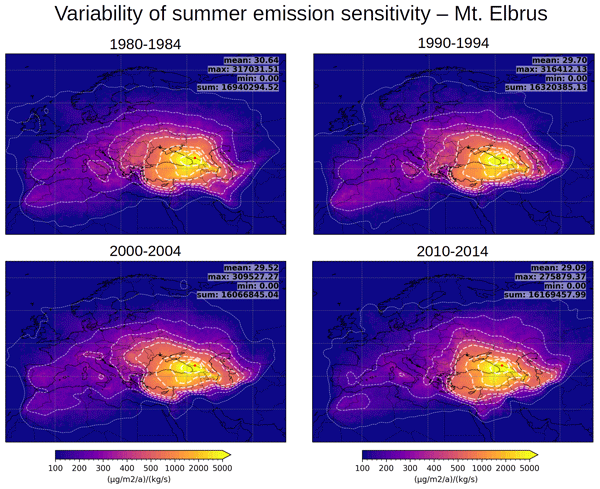
Past atmospheric NH3 pollution in south-eastern Europe was reconstructed by analysing ammonium in an ice core drilled at the Mount Elbrus (Caucasus, Russia). The observed 3.5-fold increase in ice concentrations between 1750 and 1990 CE is in good agreement with estimated past dominant ammonia emissions from agriculture, mainly from south European Russia and Türkiye. In contrast to present-day conditions, the ammonium level observed in 1750 CE indicates significant natural emissions at that time.
Enrico Mattea, Etienne Berthier, Amaury Dehecq, Tobias Bolch, Atanu Bhattacharya, Sajid Ghuffar, Martina Barandun, and Martin Hoelzle
The Cryosphere, 19, 219–247, https://doi.org/10.5194/tc-19-219-2025, https://doi.org/10.5194/tc-19-219-2025, 2025
Short summary
Short summary
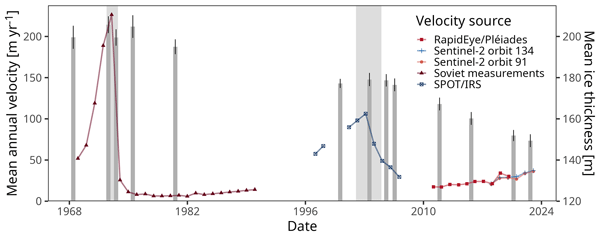
We reconstruct the evolution of terminus position, ice thickness, and surface flow velocity of the reference Abramov glacier (Kyrgyzstan) from 1968 to present. We describe a front pulsation in the early 2000s and the multi-annual present-day buildup of a new pulsation. Such dynamic instabilities can challenge the representativity of Abramov as a reference glacier. For our work we used satellite‑based optical remote sensing from multiple platforms, including recently declassified archives.
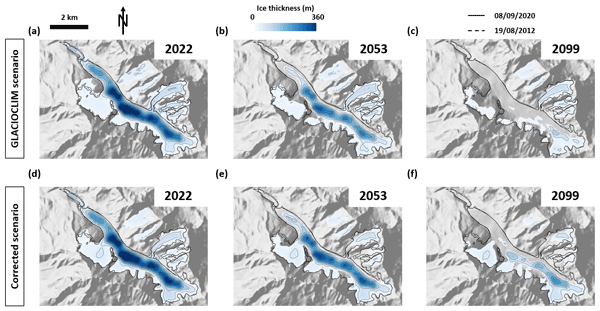
Marin Kneib, Amaury Dehecq, Adrien Gilbert, Auguste Basset, Evan S. Miles, Guillaume Jouvet, Bruno Jourdain, Etienne Ducasse, Luc Beraud, Antoine Rabatel, Jérémie Mouginot, Guillem Carcanade, Olivier Laarman, Fanny Brun, and Delphine Six
The Cryosphere, 18, 5965–5983, https://doi.org/10.5194/tc-18-5965-2024, https://doi.org/10.5194/tc-18-5965-2024, 2024
Short summary
Short summary
Avalanches contribute to increasing the accumulation on mountain glaciers by redistributing snow from surrounding mountains slopes. Here we quantified the contribution of avalanches to the mass balance of Argentière Glacier in the French Alps, by combining satellite and field observations to model the glacier dynamics. We show that the contribution of avalanches locally increases the accumulation by 60–70 % and that accounting for this effect results in less ice loss by the end of the century.
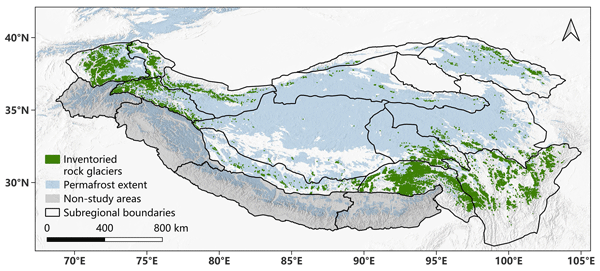
Zhangyu Sun, Yan Hu, Adina Racoviteanu, Lin Liu, Stephan Harrison, Xiaowen Wang, Jiaxin Cai, Xin Guo, Yujun He, and Hailun Yuan
Earth Syst. Sci. Data, 16, 5703–5721, https://doi.org/10.5194/essd-16-5703-2024, https://doi.org/10.5194/essd-16-5703-2024, 2024
Short summary
Short summary
We propose a new dataset, TPRoGI (v1.0), encompassing rock glaciers in the entire Tibetan Plateau. We used a neural network, DeepLabv3+, and images from Planet Basemaps. The inventory identified 44 273 rock glaciers, covering 6 000 km2, mainly at elevations of 4000 to 5500 m a.s.l. The dataset, with details on distribution and characteristics, aids in understanding permafrost distribution, mountain hydrology, and climate impacts in High Mountain Asia, filling a knowledge gap.
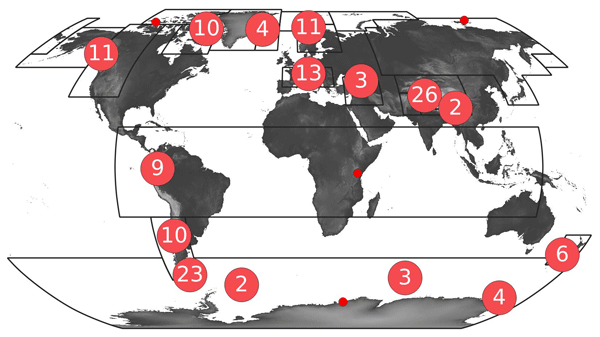
Etienne Berthier, Jérôme Lebreton, Delphine Fontannaz, Steven Hosford, Joaquín Muñoz-Cobo Belart, Fanny Brun, Liss M. Andreassen, Brian Menounos, and Charlotte Blondel
The Cryosphere, 18, 5551–5571, https://doi.org/10.5194/tc-18-5551-2024, https://doi.org/10.5194/tc-18-5551-2024, 2024
Short summary
Short summary
Repeat elevation measurements are crucial for monitoring glacier health and to understand how glaciers affect river flows and sea level. Until recently, high-resolution elevation data were mostly available for polar regions and High Mountain Asia. Our project, the Pléiades Glacier Observatory, now provides high-resolution topographies of 140 glacier sites worldwide. This is a novel and open dataset to monitor the impact of climate change on glaciers at high resolution and accuracy.
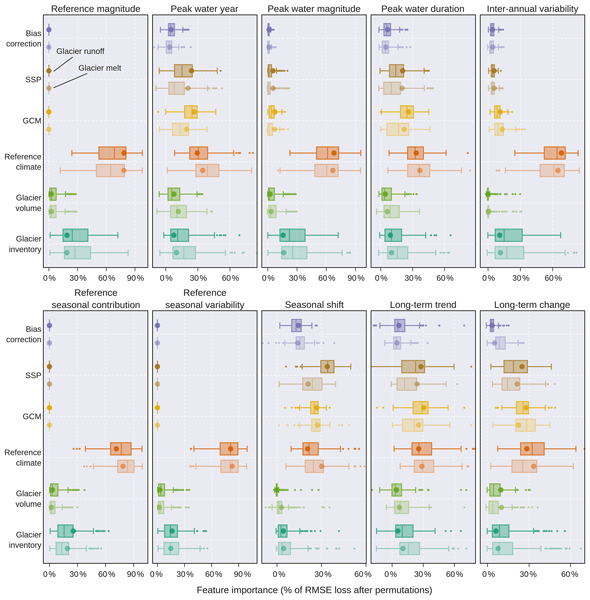
Rodrigo Aguayo, Fabien Maussion, Lilian Schuster, Marius Schaefer, Alexis Caro, Patrick Schmitt, Jonathan Mackay, Lizz Ultee, Jorge Leon-Muñoz, and Mauricio Aguayo
The Cryosphere, 18, 5383–5406, https://doi.org/10.5194/tc-18-5383-2024, https://doi.org/10.5194/tc-18-5383-2024, 2024
Short summary
Short summary
Predicting how much water will come from glaciers in the future is a complex task, and there are many factors that make it uncertain. Using a glacier model, we explored 1920 scenarios for each glacier in the Patagonian Andes. We found that the choice of the historical climate data was the most important factor, while other factors such as different data sources, climate models and emission scenarios played a smaller role.
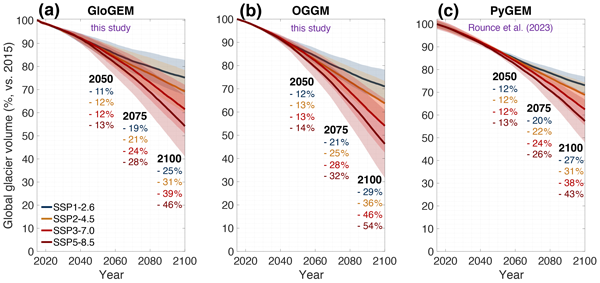
Harry Zekollari, Matthias Huss, Lilian Schuster, Fabien Maussion, David R. Rounce, Rodrigo Aguayo, Nicolas Champollion, Loris Compagno, Romain Hugonnet, Ben Marzeion, Seyedhamidreza Mojtabavi, and Daniel Farinotti
The Cryosphere, 18, 5045–5066, https://doi.org/10.5194/tc-18-5045-2024, https://doi.org/10.5194/tc-18-5045-2024, 2024
Short summary
Short summary
Glaciers are major contributors to sea-level rise and act as key water resources. Here, we model the global evolution of glaciers under the latest generation of climate scenarios. We show that the type of observations used for model calibration can strongly affect the projections at the local scale. Our newly projected 21st century global mass loss is higher than the current community estimate as reported in the latest Intergovernmental Panel on Climate Change (IPCC) report.
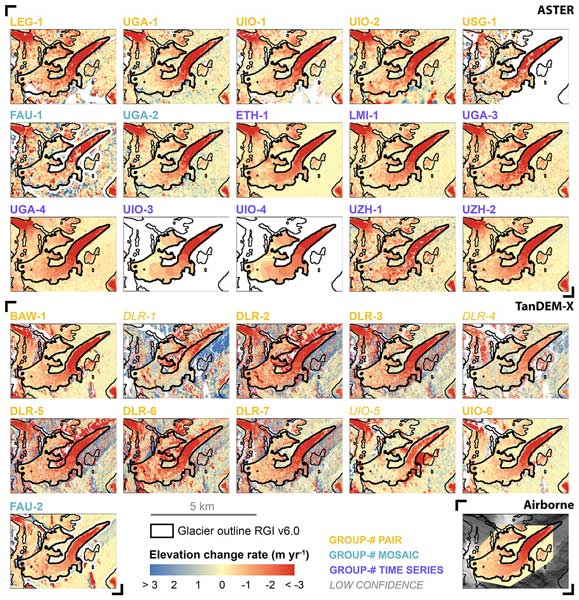
Livia Piermattei, Michael Zemp, Christian Sommer, Fanny Brun, Matthias H. Braun, Liss M. Andreassen, Joaquín M. C. Belart, Etienne Berthier, Atanu Bhattacharya, Laura Boehm Vock, Tobias Bolch, Amaury Dehecq, Inés Dussaillant, Daniel Falaschi, Caitlyn Florentine, Dana Floricioiu, Christian Ginzler, Gregoire Guillet, Romain Hugonnet, Matthias Huss, Andreas Kääb, Owen King, Christoph Klug, Friedrich Knuth, Lukas Krieger, Jeff La Frenierre, Robert McNabb, Christopher McNeil, Rainer Prinz, Louis Sass, Thorsten Seehaus, David Shean, Désirée Treichler, Anja Wendt, and Ruitang Yang
The Cryosphere, 18, 3195–3230, https://doi.org/10.5194/tc-18-3195-2024, https://doi.org/10.5194/tc-18-3195-2024, 2024
Short summary
Short summary
Satellites have made it possible to observe glacier elevation changes from all around the world. In the present study, we compared the results produced from two different types of satellite data between different research groups and against validation measurements from aeroplanes. We found a large spread between individual results but showed that the group ensemble can be used to reliably estimate glacier elevation changes and related errors from satellite data.
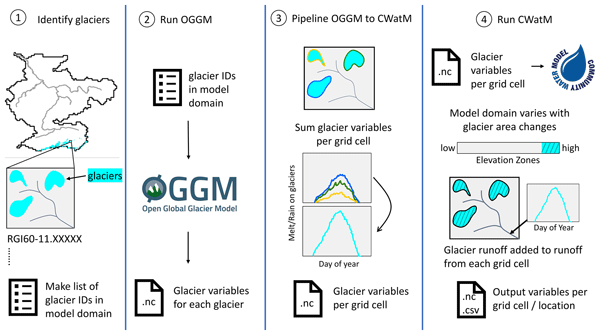
Sarah Hanus, Lilian Schuster, Peter Burek, Fabien Maussion, Yoshihide Wada, and Daniel Viviroli
Geosci. Model Dev., 17, 5123–5144, https://doi.org/10.5194/gmd-17-5123-2024, https://doi.org/10.5194/gmd-17-5123-2024, 2024
Short summary
Short summary
This study presents a coupling of the large-scale glacier model OGGM and the hydrological model CWatM. Projected future increase in discharge is less strong while future decrease in discharge is stronger when glacier runoff is explicitly included in the large-scale hydrological model. This is because glacier runoff is projected to decrease in nearly all basins. We conclude that an improved glacier representation can prevent underestimating future discharge changes in large river basins.
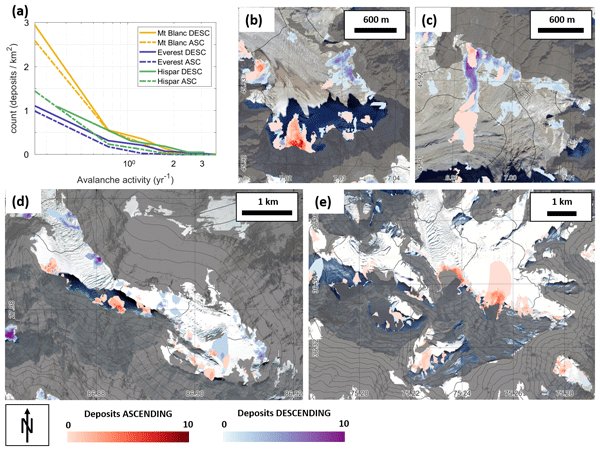
Marin Kneib, Amaury Dehecq, Fanny Brun, Fatima Karbou, Laurane Charrier, Silvan Leinss, Patrick Wagnon, and Fabien Maussion
The Cryosphere, 18, 2809–2830, https://doi.org/10.5194/tc-18-2809-2024, https://doi.org/10.5194/tc-18-2809-2024, 2024
Short summary
Short summary
Avalanches are important for the mass balance of mountain glaciers, but few data exist on where and when they occur and which glaciers they affect the most. We developed an approach to map avalanches over large glaciated areas and long periods of time using satellite radar data. The application of this method to various regions in the Alps and High Mountain Asia reveals the variability of avalanches on these glaciers and provides key data to better represent these processes in glacier models.
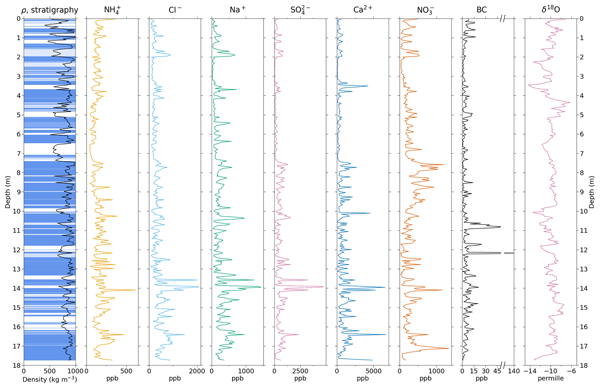
Horst Machguth, Anja Eichler, Margit Schwikowski, Sabina Brütsch, Enrico Mattea, Stanislav Kutuzov, Martin Heule, Ryskul Usubaliev, Sultan Belekov, Vladimir N. Mikhalenko, Martin Hoelzle, and Marlene Kronenberg
The Cryosphere, 18, 1633–1646, https://doi.org/10.5194/tc-18-1633-2024, https://doi.org/10.5194/tc-18-1633-2024, 2024
Short summary
Short summary
In 2018 we drilled an 18 m ice core on the summit of Grigoriev ice cap, located in the Tien Shan mountains of Kyrgyzstan. The core analysis reveals strong melting since the early 2000s. Regardless of this, we find that the structure and temperature of the ice have changed little since the 1980s. The probable cause of this apparent stability is (i) an increase in snowfall and (ii) the fact that meltwater nowadays leaves the glacier and thereby removes so-called latent heat.
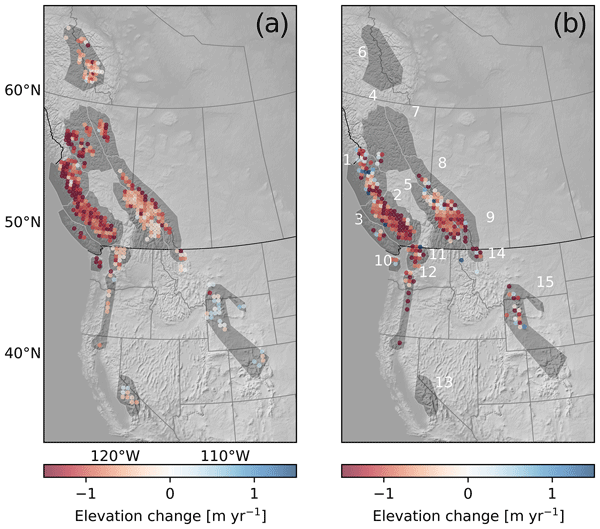
Brian Menounos, Alex Gardner, Caitlyn Florentine, and Andrew Fountain
The Cryosphere, 18, 889–894, https://doi.org/10.5194/tc-18-889-2024, https://doi.org/10.5194/tc-18-889-2024, 2024
Short summary
Short summary
Glaciers in western North American outside of Alaska are often overlooked in global studies because their potential to contribute to changes in sea level is small. Nonetheless, these glaciers represent important sources of freshwater, especially during times of drought. We show that these glaciers lost mass at a rate of about 12 Gt yr-1 for about the period 2013–2021; the rate of mass loss over the period 2018–2022 was similar.
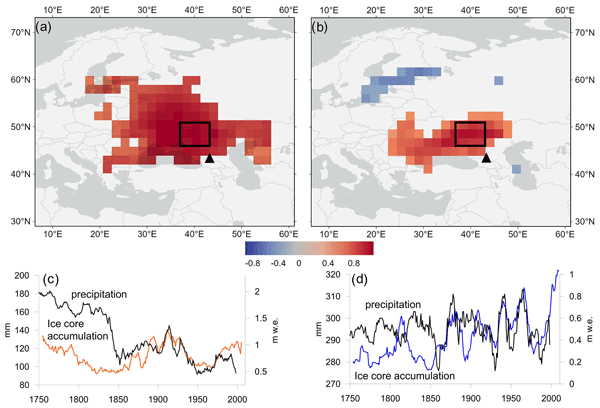
Vladimir Mikhalenko, Stanislav Kutuzov, Pavel Toropov, Michel Legrand, Sergey Sokratov, Gleb Chernyakov, Ivan Lavrentiev, Susanne Preunkert, Anna Kozachek, Mstislav Vorobiev, Aleksandra Khairedinova, and Vladimir Lipenkov
Clim. Past, 20, 237–255, https://doi.org/10.5194/cp-20-237-2024, https://doi.org/10.5194/cp-20-237-2024, 2024
Short summary
Short summary
In this paper, we present a reconstruction of snow accumulation for both summer and winter over the past 260 years using ice-core records obtained from Mt. Elbrus in the Caucasus region. The accumulation record represents the historical precipitation patterns in a vast region encompassing the northern Caucasus, Black Sea, and southeastern Europe. Our findings show that the North Atlantic plays a crucial role in determining precipitation levels in this region.
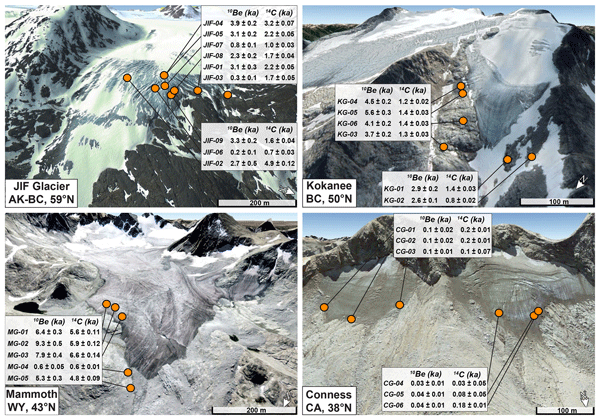
Andrew G. Jones, Shaun A. Marcott, Andrew L. Gorin, Tori M. Kennedy, Jeremy D. Shakun, Brent M. Goehring, Brian Menounos, Douglas H. Clark, Matias Romero, and Marc W. Caffee
The Cryosphere, 17, 5459–5475, https://doi.org/10.5194/tc-17-5459-2023, https://doi.org/10.5194/tc-17-5459-2023, 2023
Short summary
Short summary
Mountain glaciers today are fractions of their sizes 140 years ago, but how do these sizes compare to the past 11,000 years? We find that four glaciers in the United States and Canada have reversed a long-term trend of growth and retreated to positions last occupied thousands of years ago. Notably, each glacier occupies a unique position relative to its long-term history. We hypothesize that unequal modern retreat has caused the glaciers to be out of sync relative to their Holocene histories.
Daniel Falaschi, Atanu Bhattacharya, Gregoire Guillet, Lei Huang, Owen King, Kriti Mukherjee, Philipp Rastner, Tandong Yao, and Tobias Bolch
The Cryosphere, 17, 5435–5458, https://doi.org/10.5194/tc-17-5435-2023, https://doi.org/10.5194/tc-17-5435-2023, 2023
Short summary
Short summary
Because glaciers are crucial freshwater sources in the lowlands surrounding High Mountain Asia, constraining short-term glacier mass changes is essential. We investigate the potential of state-of-the-art satellite elevation data to measure glacier mass changes in two selected regions. The results demonstrate the ability of our dataset to characterize glacier changes of different magnitudes, allowing for an increase in the number of inaccessible glaciers that can be readily monitored.
Matthew C. Morriss, Benjamin Lehmann, Benjamin Campforts, George Brencher, Brianna Rick, Leif S. Anderson, Alexander L. Handwerger, Irina Overeem, and Jeffrey Moore
Earth Surf. Dynam., 11, 1251–1274, https://doi.org/10.5194/esurf-11-1251-2023, https://doi.org/10.5194/esurf-11-1251-2023, 2023
Short summary
Short summary
In this paper, we investigate the 28 June 2022 collapse of the Chaos Canyon landslide in Rocky Mountain National Park, Colorado, USA. We find that the landslide was moving prior to its collapse and took place at peak spring snowmelt; temperature modeling indicates the potential presence of permafrost. We hypothesize that this landslide could be part of the broader landscape evolution changes to alpine terrain caused by a warming climate, leading to thawing alpine permafrost.
Jordi Bolibar, Facundo Sapienza, Fabien Maussion, Redouane Lguensat, Bert Wouters, and Fernando Pérez
Geosci. Model Dev., 16, 6671–6687, https://doi.org/10.5194/gmd-16-6671-2023, https://doi.org/10.5194/gmd-16-6671-2023, 2023
Short summary
Short summary
We developed a new modelling framework combining numerical methods with machine learning. Using this approach, we focused on understanding how ice moves within glaciers, and we successfully learnt a prescribed law describing ice movement for 17 glaciers worldwide as a proof of concept. Our framework has the potential to discover important laws governing glacier processes, aiding our understanding of glacier physics and their contribution to water resources and sea-level rise.
Adam C. Hawkins, Brian Menounos, Brent M. Goehring, Gerald Osborn, Ben M. Pelto, Christopher M. Darvill, and Joerg M. Schaefer
The Cryosphere, 17, 4381–4397, https://doi.org/10.5194/tc-17-4381-2023, https://doi.org/10.5194/tc-17-4381-2023, 2023
Short summary
Short summary
Our study developed a record of glacier and climate change in the Mackenzie and Selwyn mountains of northwestern Canada over the past several hundred years. We estimate temperature change in this region using several methods and incorporate our glacier record with models of climate change to estimate how glacier volume in our study area has changed over time. Models of future glacier change show that our study area will become largely ice-free by the end of the 21st century.
Whyjay Zheng, Shashank Bhushan, Maximillian Van Wyk De Vries, William Kochtitzky, David Shean, Luke Copland, Christine Dow, Renette Jones-Ivey, and Fernando Pérez
The Cryosphere, 17, 4063–4078, https://doi.org/10.5194/tc-17-4063-2023, https://doi.org/10.5194/tc-17-4063-2023, 2023
Short summary
Short summary
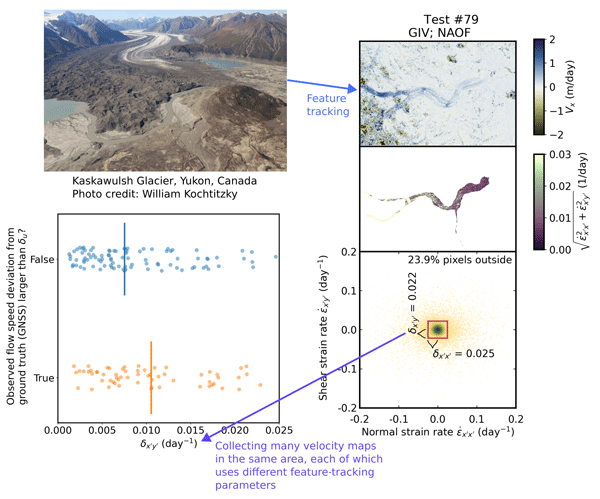
We design and propose a method that can evaluate the quality of glacier velocity maps. The method includes two numbers that we can calculate for each velocity map. Based on statistics and ice flow physics, velocity maps with numbers close to the recommended values are considered to have good quality. We test the method using the data from Kaskawulsh Glacier, Canada, and release an open-sourced software tool called GLAcier Feature Tracking testkit (GLAFT) to help users assess their velocity maps.
Chuanxi Zhao, Wei Yang, Evan Miles, Matthew Westoby, Marin Kneib, Yongjie Wang, Zhen He, and Francesca Pellicciotti
The Cryosphere, 17, 3895–3913, https://doi.org/10.5194/tc-17-3895-2023, https://doi.org/10.5194/tc-17-3895-2023, 2023
Short summary
Short summary
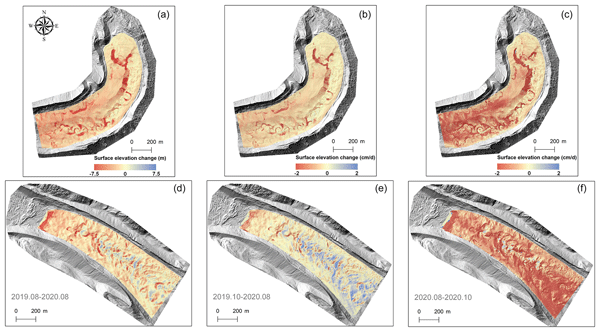
This paper quantifies the thinning and surface mass balance of two neighbouring debris-covered glaciers in the southeastern Tibetan Plateau during different seasons, based on high spatio-temporal resolution UAV-derived (unpiloted aerial
vehicle) data and in situ observations. Through a comparison approach and high-precision results, we identify that the glacier dynamic and debris thickness are strongly related to the future fate of the debris-covered glaciers in this region.
Finu Shrestha, Jakob F. Steiner, Reeju Shrestha, Yathartha Dhungel, Sharad P. Joshi, Sam Inglis, Arshad Ashraf, Sher Wali, Khwaja M. Walizada, and Taigang Zhang
Earth Syst. Sci. Data, 15, 3941–3961, https://doi.org/10.5194/essd-15-3941-2023, https://doi.org/10.5194/essd-15-3941-2023, 2023
Short summary
Short summary
A new inventory of glacial lake outburst floods (GLOFs) in High Mountain Asia found 697 events, causing 906 deaths, 3 times more than previously reported. This study provides insights into the contributing factors behind GLOFs on a regional scale and highlights the need for interdisciplinary approaches, including scientific communities and local knowledge, to understand GLOF risks in Asia. This study allows integration with other datasets, enabling future local and regional risk assessments.
Fanny Brun, Owen King, Marion Réveillet, Charles Amory, Anton Planchot, Etienne Berthier, Amaury Dehecq, Tobias Bolch, Kévin Fourteau, Julien Brondex, Marie Dumont, Christoph Mayer, Silvan Leinss, Romain Hugonnet, and Patrick Wagnon
The Cryosphere, 17, 3251–3268, https://doi.org/10.5194/tc-17-3251-2023, https://doi.org/10.5194/tc-17-3251-2023, 2023
Short summary
Short summary
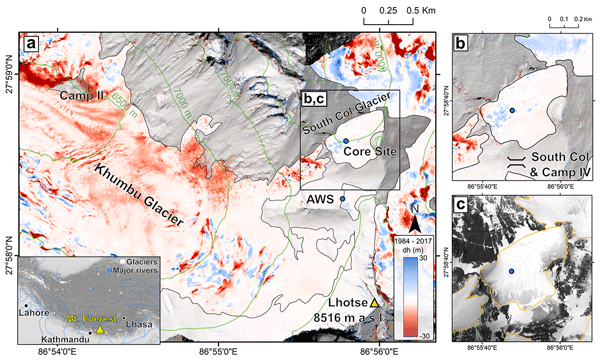
The South Col Glacier is a small body of ice and snow located on the southern ridge of Mt. Everest. A recent study proposed that South Col Glacier is rapidly losing mass. In this study, we examined the glacier thickness change for the period 1984–2017 and found no thickness change. To reconcile these results, we investigate wind erosion and surface energy and mass balance and find that melt is unlikely a dominant process, contrary to previous findings.
Anushilan Acharya, Jakob F. Steiner, Khwaja Momin Walizada, Salar Ali, Zakir Hussain Zakir, Arnaud Caiserman, and Teiji Watanabe
Nat. Hazards Earth Syst. Sci., 23, 2569–2592, https://doi.org/10.5194/nhess-23-2569-2023, https://doi.org/10.5194/nhess-23-2569-2023, 2023
Short summary
Short summary
All accessible snow and ice avalanches together with previous scientific research, local knowledge, and existing or previously active adaptation and mitigation solutions were investigated in the high mountain Asia (HMA) region to have a detailed overview of the state of knowledge and identify gaps. A comprehensive avalanche database from 1972–2022 is generated, including 681 individual events. The database provides a basis for the forecasting of avalanche hazards in different parts of HMA.
Sara E. Darychuk, Joseph M. Shea, Brian Menounos, Anna Chesnokova, Georg Jost, and Frank Weber
The Cryosphere, 17, 1457–1473, https://doi.org/10.5194/tc-17-1457-2023, https://doi.org/10.5194/tc-17-1457-2023, 2023
Short summary
Short summary
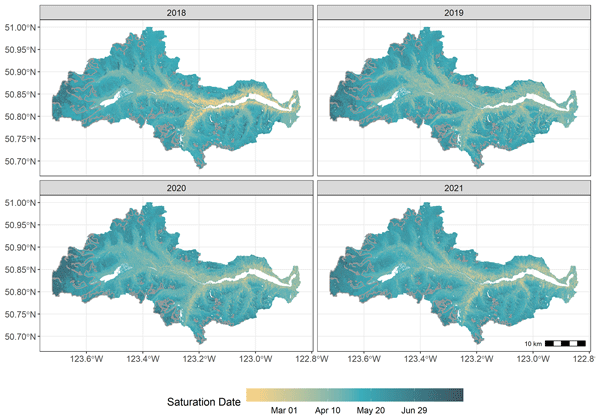
We use synthetic-aperture radar (SAR) and optical observations to map snowmelt timing and duration on the watershed scale. We found that Sentinel-1 SAR time series can be used to approximate snowmelt onset over diverse terrain and land cover types, and we present a low-cost workflow for SAR processing over large, mountainous regions. Our approach provides spatially distributed observations of the snowpack necessary for model calibration and can be used to monitor snowmelt in ungauged basins.
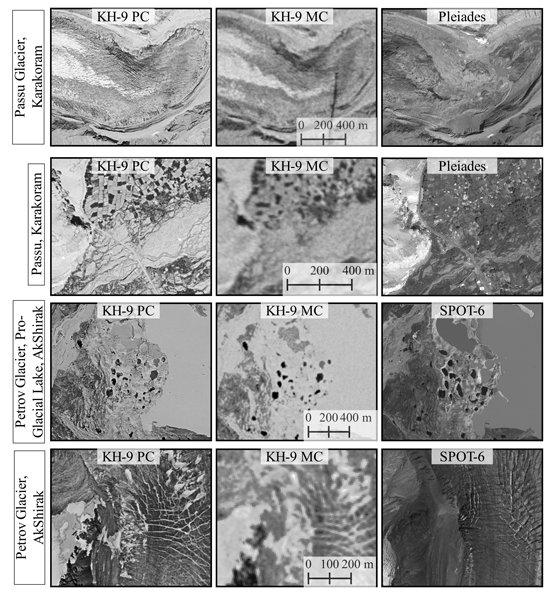
Sajid Ghuffar, Owen King, Grégoire Guillet, Ewelina Rupnik, and Tobias Bolch
The Cryosphere, 17, 1299–1306, https://doi.org/10.5194/tc-17-1299-2023, https://doi.org/10.5194/tc-17-1299-2023, 2023
Short summary
Short summary
The panoramic cameras (PCs) on board Hexagon KH-9 satellite missions from 1971–1984 captured very high-resolution stereo imagery with up to 60 cm spatial resolution. This study explores the potential of this imagery for glacier mapping and change estimation. The high resolution of KH-9PC leads to higher-quality DEMs which better resolve the accumulation region of glaciers in comparison to the KH-9 mapping camera, and KH-9PC imagery can be useful in several Earth observation applications.
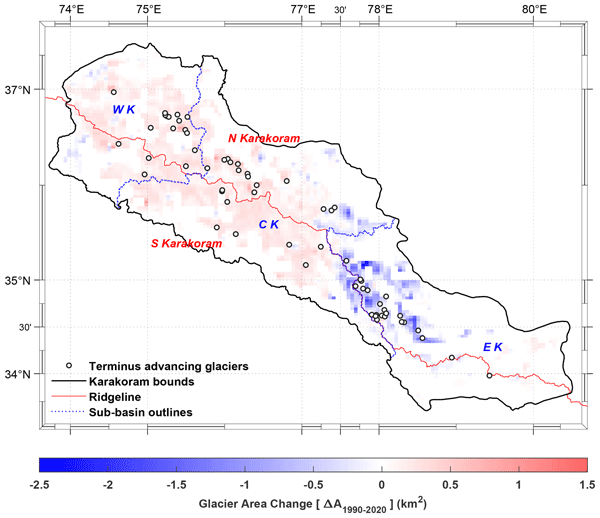
Fuming Xie, Shiyin Liu, Yongpeng Gao, Yu Zhu, Tobias Bolch, Andreas Kääb, Shimei Duan, Wenfei Miao, Jianfang Kang, Yaonan Zhang, Xiran Pan, Caixia Qin, Kunpeng Wu, Miaomiao Qi, Xianhe Zhang, Ying Yi, Fengze Han, Xiaojun Yao, Qiao Liu, Xin Wang, Zongli Jiang, Donghui Shangguan, Yong Zhang, Richard Grünwald, Muhammad Adnan, Jyoti Karki, and Muhammad Saifullah
Earth Syst. Sci. Data, 15, 847–867, https://doi.org/10.5194/essd-15-847-2023, https://doi.org/10.5194/essd-15-847-2023, 2023
Short summary
Short summary
In this study, first we generated inventories which allowed us to systematically detect glacier change patterns in the Karakoram range. We found that, by the 2020s, there were approximately 10 500 glaciers in the Karakoram mountains covering an area of 22 510.73 km2, of which ~ 10.2 % is covered by debris. During the past 30 years (from 1990 to 2020), the total glacier cover area in Karakoram remained relatively stable, with a slight increase in area of 23.5 km2.
Yu Zhu, Shiyin Liu, Junfeng Wei, Kunpeng Wu, Tobias Bolch, Junli Xu, Wanqin Guo, Zongli Jiang, Fuming Xie, Ying Yi, Donghui Shangguan, Xiaojun Yao, and Zhen Zhang
Earth Syst. Sci. Data Discuss., https://doi.org/10.5194/essd-2022-473, https://doi.org/10.5194/essd-2022-473, 2023
Preprint withdrawn
Short summary
Short summary
In this study, we presented a nearly complete inventory of glacier mass change dataset across the eastern Tibetan Plateau by using topographical maps, which will enhance the knowledge on the heterogeneity of glacier change before 2000. Our dataset, in combination with the published results, provide a nearly five decades mass balance to support hydrological simulation, and to evaluate the contribution of mountain glacier loss to sea level.
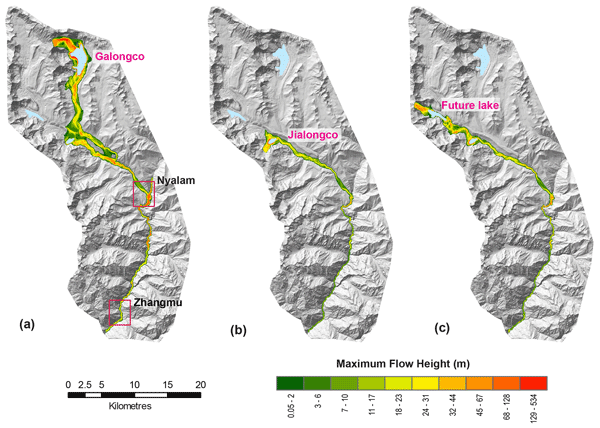
Simon K. Allen, Ashim Sattar, Owen King, Guoqing Zhang, Atanu Bhattacharya, Tandong Yao, and Tobias Bolch
Nat. Hazards Earth Syst. Sci., 22, 3765–3785, https://doi.org/10.5194/nhess-22-3765-2022, https://doi.org/10.5194/nhess-22-3765-2022, 2022
Short summary
Short summary
This study demonstrates how the threat of a very large outburst from a future lake can be feasibly assessed alongside that from current lakes to inform disaster risk management within a transboundary basin between Tibet and Nepal. Results show that engineering measures and early warning systems would need to be coupled with effective land use zoning and programmes to strengthen local response capacities in order to effectively reduce the risk associated with current and future outburst events.
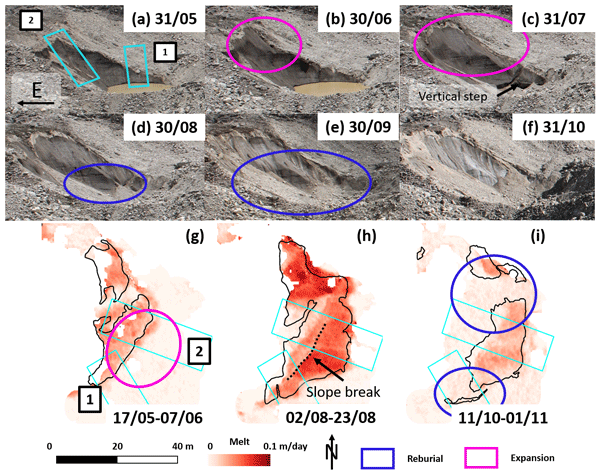
Marin Kneib, Evan S. Miles, Pascal Buri, Stefan Fugger, Michael McCarthy, Thomas E. Shaw, Zhao Chuanxi, Martin Truffer, Matthew J. Westoby, Wei Yang, and Francesca Pellicciotti
The Cryosphere, 16, 4701–4725, https://doi.org/10.5194/tc-16-4701-2022, https://doi.org/10.5194/tc-16-4701-2022, 2022
Short summary
Short summary
Ice cliffs are believed to be important contributors to the melt of debris-covered glaciers, but this has rarely been quantified as the cliffs can disappear or rapidly expand within a few weeks. We used photogrammetry techniques to quantify the weekly evolution and melt of four cliffs. We found that their behaviour and melt during the monsoon is strongly controlled by supraglacial debris, streams and ponds, thus providing valuable insights on the melt and evolution of debris-covered glaciers.
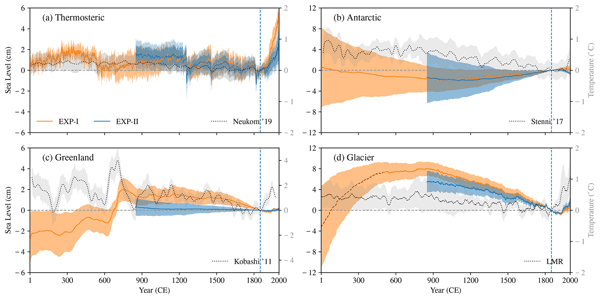
Nidheesh Gangadharan, Hugues Goosse, David Parkes, Heiko Goelzer, Fabien Maussion, and Ben Marzeion
Earth Syst. Dynam., 13, 1417–1435, https://doi.org/10.5194/esd-13-1417-2022, https://doi.org/10.5194/esd-13-1417-2022, 2022
Short summary
Short summary
We describe the contributions of ocean thermal expansion and land-ice melting (ice sheets and glaciers) to global-mean sea-level (GMSL) changes in the Common Era. The mass contributions are the major sources of GMSL changes in the pre-industrial Common Era and glaciers are the largest contributor. The paper also describes the current state of climate modelling, uncertainties and knowledge gaps along with the potential implications of the past variabilities in the contemporary sea-level rise.
Adam Emmer, Simon K. Allen, Mark Carey, Holger Frey, Christian Huggel, Oliver Korup, Martin Mergili, Ashim Sattar, Georg Veh, Thomas Y. Chen, Simon J. Cook, Mariana Correas-Gonzalez, Soumik Das, Alejandro Diaz Moreno, Fabian Drenkhan, Melanie Fischer, Walter W. Immerzeel, Eñaut Izagirre, Ramesh Chandra Joshi, Ioannis Kougkoulos, Riamsara Kuyakanon Knapp, Dongfeng Li, Ulfat Majeed, Stephanie Matti, Holly Moulton, Faezeh Nick, Valentine Piroton, Irfan Rashid, Masoom Reza, Anderson Ribeiro de Figueiredo, Christian Riveros, Finu Shrestha, Milan Shrestha, Jakob Steiner, Noah Walker-Crawford, Joanne L. Wood, and Jacob C. Yde
Nat. Hazards Earth Syst. Sci., 22, 3041–3061, https://doi.org/10.5194/nhess-22-3041-2022, https://doi.org/10.5194/nhess-22-3041-2022, 2022
Short summary
Short summary
Glacial lake outburst floods (GLOFs) have attracted increased research attention recently. In this work, we review GLOF research papers published between 2017 and 2021 and complement the analysis with research community insights gained from the 2021 GLOF conference we organized. The transdisciplinary character of the conference together with broad geographical coverage allowed us to identify progress, trends and challenges in GLOF research and outline future research needs and directions.
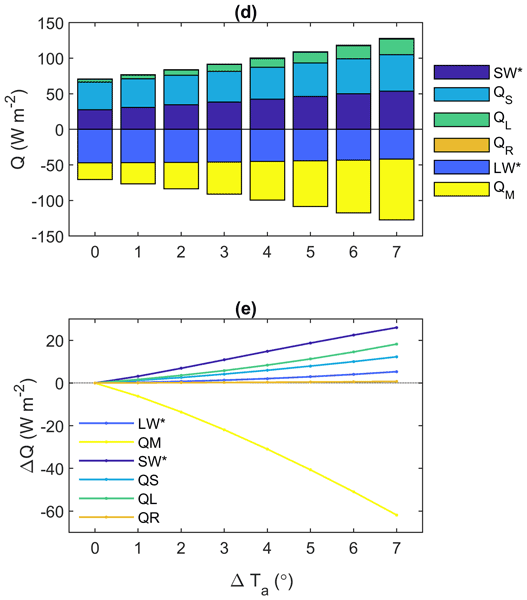
Christophe Kinnard, Olivier Larouche, Michael N. Demuth, and Brian Menounos
The Cryosphere, 16, 3071–3099, https://doi.org/10.5194/tc-16-3071-2022, https://doi.org/10.5194/tc-16-3071-2022, 2022
Short summary
Short summary
This study implements a physically based, distributed glacier mass balance model in a context of sparse direct observations. Carefully constraining model parameters with ancillary data allowed for accurately reconstructing the mass balance of Saskatchewan Glacier over a 37-year period. We show that the mass balance sensitivity to warming is dominated by increased melting and that changes in glacier albedo and air humidity are the leading causes of increased glacier melt under warming scenarios.
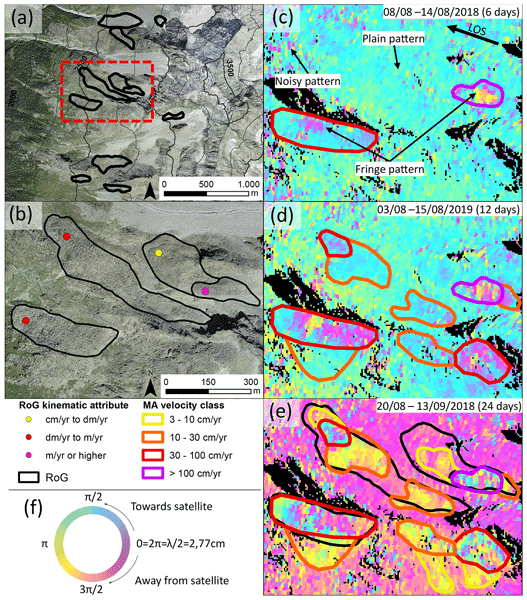
Aldo Bertone, Chloé Barboux, Xavier Bodin, Tobias Bolch, Francesco Brardinoni, Rafael Caduff, Hanne H. Christiansen, Margaret M. Darrow, Reynald Delaloye, Bernd Etzelmüller, Ole Humlum, Christophe Lambiel, Karianne S. Lilleøren, Volkmar Mair, Gabriel Pellegrinon, Line Rouyet, Lucas Ruiz, and Tazio Strozzi
The Cryosphere, 16, 2769–2792, https://doi.org/10.5194/tc-16-2769-2022, https://doi.org/10.5194/tc-16-2769-2022, 2022
Short summary
Short summary
We present the guidelines developed by the IPA Action Group and within the ESA Permafrost CCI project to include InSAR-based kinematic information in rock glacier inventories. Nine operators applied these guidelines to 11 regions worldwide; more than 3600 rock glaciers are classified according to their kinematics. We test and demonstrate the feasibility of applying common rules to produce homogeneous kinematic inventories at global scale, useful for hydrological and climate change purposes.
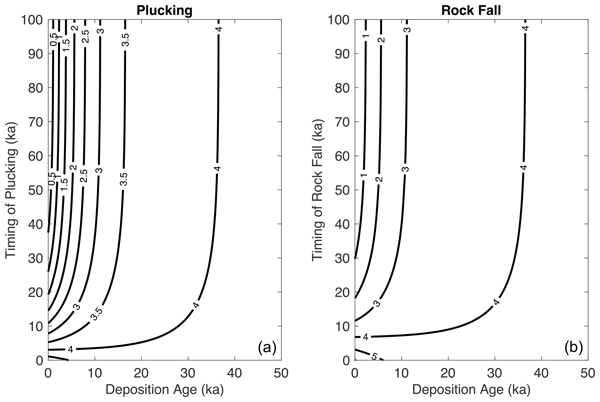
Brent M. Goehring, Brian Menounos, Gerald Osborn, Adam Hawkins, and Brent Ward
Geochronology, 4, 311–322, https://doi.org/10.5194/gchron-4-311-2022, https://doi.org/10.5194/gchron-4-311-2022, 2022
Short summary
Short summary
We explored surface exposure dating with two nuclides to date two sets of moraines from the Yukon Territory and explain the reasoning for the observed ages. Results suggest multiple processes, including preservation of nuclides from a prior exposure period, and later erosion of the moraines is required to explain the data. Our results only allow for the older moraines to date to Marine Isotope Stage 3 or 4 and the younger moraines to date to the very earliest Holocene.

Loris Compagno, Matthias Huss, Evan Stewart Miles, Michael James McCarthy, Harry Zekollari, Amaury Dehecq, Francesca Pellicciotti, and Daniel Farinotti
The Cryosphere, 16, 1697–1718, https://doi.org/10.5194/tc-16-1697-2022, https://doi.org/10.5194/tc-16-1697-2022, 2022
Short summary
Short summary
We present a new approach for modelling debris area and thickness evolution. We implement the module into a combined mass-balance ice-flow model, and we apply it using different climate scenarios to project the future evolution of all glaciers in High Mountain Asia. We show that glacier geometry, volume, and flow velocity evolve differently when modelling explicitly debris cover compared to glacier evolution without the debris-cover module, demonstrating the importance of accounting for debris.
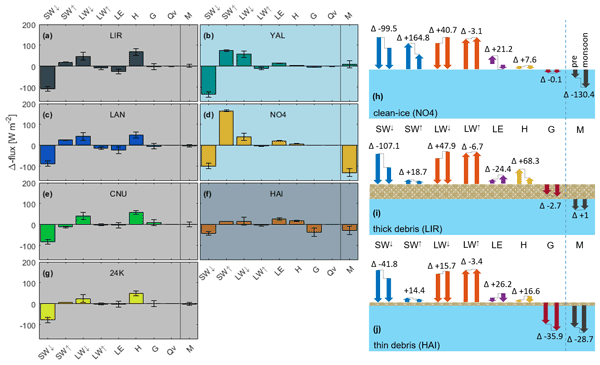
Stefan Fugger, Catriona L. Fyffe, Simone Fatichi, Evan Miles, Michael McCarthy, Thomas E. Shaw, Baohong Ding, Wei Yang, Patrick Wagnon, Walter Immerzeel, Qiao Liu, and Francesca Pellicciotti
The Cryosphere, 16, 1631–1652, https://doi.org/10.5194/tc-16-1631-2022, https://doi.org/10.5194/tc-16-1631-2022, 2022
Short summary
Short summary
The monsoon is important for the shrinking and growing of glaciers in the Himalaya during summer. We calculate the melt of seven glaciers in the region using a complex glacier melt model and weather data. We find that monsoonal weather affects glaciers that are covered with a layer of rocky debris and glaciers without such a layer in different ways. It is important to take so-called turbulent fluxes into account. This knowledge is vital for predicting the future of the Himalayan glaciers.
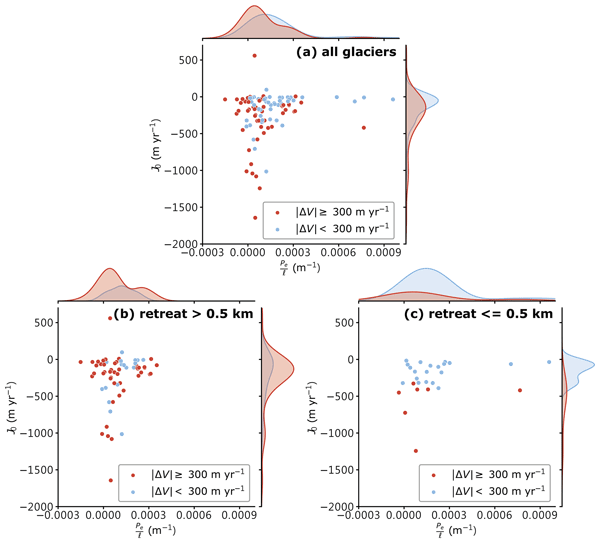
Whyjay Zheng
The Cryosphere, 16, 1431–1445, https://doi.org/10.5194/tc-16-1431-2022, https://doi.org/10.5194/tc-16-1431-2022, 2022
Short summary
Short summary
A glacier can speed up when surface water reaches the glacier's bottom via crevasses and reduces sliding friction. This paper builds up a physical model and finds that thick and fast-flowing glaciers are sensitive to this friction disruption. The data from Greenland and Austfonna (Svalbard) glaciers over 20 years support the model prediction. To estimate the projected sea-level rise better, these sensitive glaciers should be frequently monitored for potential future instabilities.
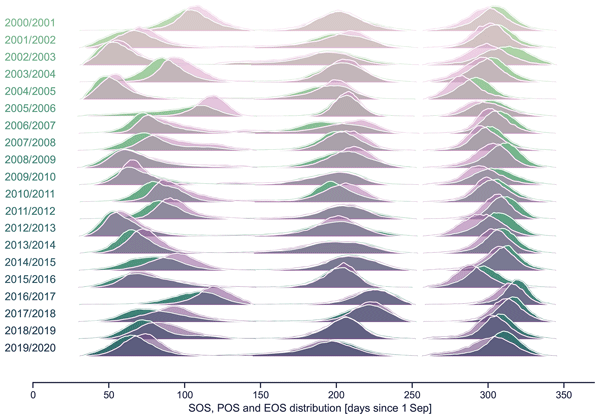
Lorenz Hänchen, Cornelia Klein, Fabien Maussion, Wolfgang Gurgiser, Pierluigi Calanca, and Georg Wohlfahrt
Earth Syst. Dynam., 13, 595–611, https://doi.org/10.5194/esd-13-595-2022, https://doi.org/10.5194/esd-13-595-2022, 2022
Short summary
Short summary
To date, farmers' perceptions of hydrological changes do not match analysis of meteorological data. In contrast to rainfall data, we find greening of vegetation, indicating increased water availability in the past decades. The start of the season is highly variable, making farmers' perceptions comprehensible. We show that the El Niño–Southern Oscillation has complex effects on vegetation seasonality but does not drive the greening we observe. Improved onset forecasts could help local farmers.

Benjamin Aubrey Robson, Shelley MacDonell, Álvaro Ayala, Tobias Bolch, Pål Ringkjøb Nielsen, and Sebastián Vivero
The Cryosphere, 16, 647–665, https://doi.org/10.5194/tc-16-647-2022, https://doi.org/10.5194/tc-16-647-2022, 2022
Short summary
Short summary
This work uses satellite and aerial data to study glaciers and rock glacier changes in La Laguna catchment within the semi-arid Andes of Chile, where ice melt is an important factor in river flow. The results show the rate of ice loss of Tapado Glacier has been increasing since the 1950s, which possibly relates to a dryer, warmer climate over the previous decades. Several rock glaciers show high surface velocities and elevation changes between 2012 and 2020, indicating they may be ice-rich.
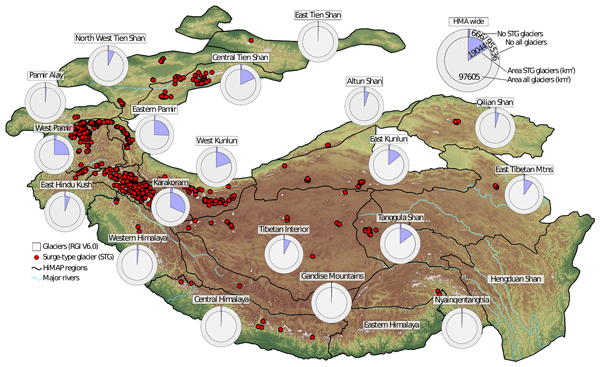
Gregoire Guillet, Owen King, Mingyang Lv, Sajid Ghuffar, Douglas Benn, Duncan Quincey, and Tobias Bolch
The Cryosphere, 16, 603–623, https://doi.org/10.5194/tc-16-603-2022, https://doi.org/10.5194/tc-16-603-2022, 2022
Short summary
Short summary
Surging glaciers show cyclical changes in flow behavior – between slow and fast flow – and can have drastic impacts on settlements in their vicinity.
One of the clusters of surging glaciers worldwide is High Mountain Asia (HMA).
We present an inventory of surging glaciers in HMA, identified from satellite imagery. We show that the number of surging glaciers was underestimated and that they represent 20 % of the area covered by glaciers in HMA, before discussing new physics for glacier surges.
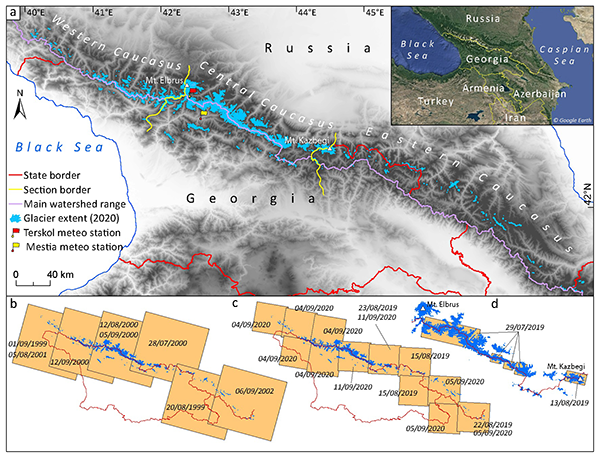
Levan G. Tielidze, Gennady A. Nosenko, Tatiana E. Khromova, and Frank Paul
The Cryosphere, 16, 489–504, https://doi.org/10.5194/tc-16-489-2022, https://doi.org/10.5194/tc-16-489-2022, 2022
Short summary
Short summary
The new Caucasus glacier inventory derived from manual delineation of glacier outlines based on medium-resolution (Landsat, Sentinel) and high-resolution (SPOT) satellite imagery shows the accelerated glacier area loss over the last 2 decades (2000–2020). This new glacier inventory will improve our understanding of climate change impacts at a regional scale and support related modelling studies by providing high-quality validation data.
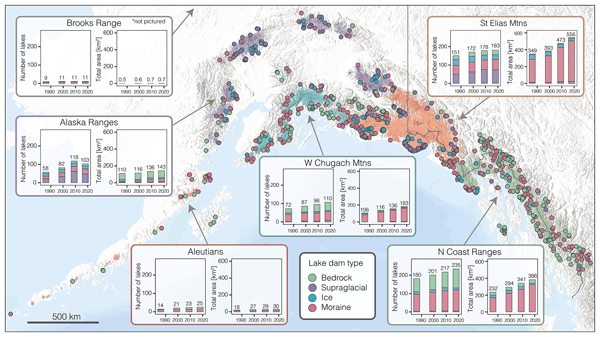
Brianna Rick, Daniel McGrath, William Armstrong, and Scott W. McCoy
The Cryosphere, 16, 297–314, https://doi.org/10.5194/tc-16-297-2022, https://doi.org/10.5194/tc-16-297-2022, 2022
Short summary
Short summary
Glacial lakes impact societies as both resources and hazards. Lakes form, grow, and drain as glaciers thin and retreat, and understanding lake evolution is a critical first step in assessing their hazard potential. We map glacial lakes in Alaska between 1984 and 2019. Overall, lakes grew in number and area, though lakes with different damming material (ice, moraine, bedrock) behaved differently. Namely, ice-dammed lakes decreased in number and area, a trend lost if dam type is not considered.
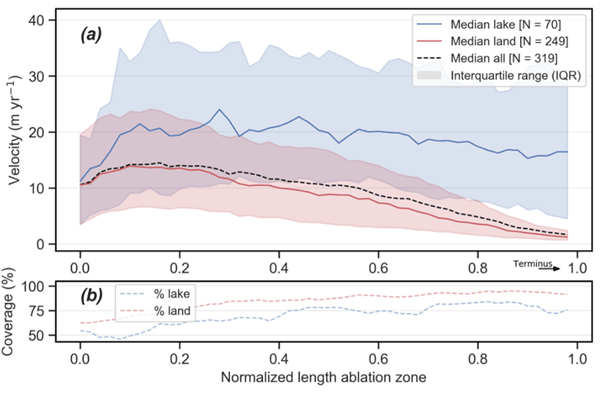
Jan Bouke Pronk, Tobias Bolch, Owen King, Bert Wouters, and Douglas I. Benn
The Cryosphere, 15, 5577–5599, https://doi.org/10.5194/tc-15-5577-2021, https://doi.org/10.5194/tc-15-5577-2021, 2021
Short summary
Short summary
About 10 % of Himalayan glaciers flow directly into lakes. This study finds, using satellite imagery, that such glaciers show higher flow velocities than glaciers without ice–lake contact. In particular near the glacier tongue the impact of a lake on the glacier flow can be dramatic. The development of current and new meltwater bodies will influence the flow of an increasing number of Himalayan glaciers in the future, a scenario not currently considered in regional ice loss projections.
Cited articles
Andreassen, L. M., Nagy, T., Kjøllmoen, B., and Leigh, J. R.: An inventory of Norway's glaciers and ice-marginal lakes from 2018–19 Sentinel-2 data, Journal of Glaciology, 68, 1085–1106, https://doi.org/10.1017/jog.2022.20, 2022. a
Baurley, N. R., Robson, B. A., and Hart, J. K.: Long-term impact of the proglacial lake Jökulsárlón on the flow velocity and stability of Breiðamerkurjökull glacier, Iceland, Earth Surface Processes and Landforms, 45, 2647–2663, https://doi.org/10.1002/esp.4920, 2020. a
Boyce, E. S., Motyka, R. J., and Truffer, M.: Flotation and retreat of a lake-calving terminus, Mendenhall Glacier, southeast Alaska, USA, Journal of Glaciology, 53, 211–224, https://doi.org/10.3189/172756507782202928, 2007. a
Buckel, J., Otto, J. C., Prasicek, G., and Keuschnig, M.: Glacial lakes in Austria – Distribution and formation since the Little Ice Age, Global and Planetary Change, 164, 39–51, https://doi.org/10.1016/j.gloplacha.2018.03.003, 2018. a
Carrivick, J. L., Sutherland, J. L., Huss, M., Purdie, H., Stringer, C. D., Grimes, M., James, W. H. M., and Lorrey, A. M.: Coincident evolution of glaciers and ice-marginal proglacial lakes across the Southern Alps, New Zealand: Past, present and future, Global and Planetary Change, 211, 103792, https://doi.org/10.1016/j.gloplacha.2022.103792, 2022. a
Cogley, J. G., Hock, R., Rasmussen, L. A., Arendt, A. A., Bauder, A., Braithwaite, R. J., Jansson, P., Kaser, G., Möller, M., Nicholson, L., and Zemp, M.: Glossary of Glacier Mass Balance and Related Terms, in: IHP-VII Technical Documents in Hydrology No. 86, IACS Contribution No. 2, UNESCO-IHP, Paris, https://wgms.ch/downloads/Cogley_etal_2011.pdf (last access: 2 Feburay 2026), 2011. a
Dye, A., Bryant , R., Falcini, F., Mallalieu, J., Dimbleby, M., Beckwith, M., Rippin, D., and Kirchner, N.: Warm proglacial lake temperatures and thermal undercutting enhance rapid retreat of an Arctic glacier, The Cryosphere, 19, 4471–4486, https://doi.org/10.5194/tc-19-4471-2025, 2025. a
Field, H. R., Armstrong, W. H., and Huss, M.: Gulf of Alaska ice-marginal lake area change over the Landsat record and potential physical controls, The Cryosphere, 15, 3255–3278, https://doi.org/10.5194/tc-15-3255-2021, 2021. a
Furian, W., Loibl, D., and Schneider, C.: Future glacial lakes in High Mountain Asia: An inventory and assessment of hazard potential from surrounding slopes, Journal of Glaciology, https://doi.org/10.1017/jog.2021.18, 2021. a
Gerrish, L., Ireland, L., Fretwell, P., and Cooper, P.: High resolution vector polylines of the Antarctic coastline (7.9), UK Polar Data Centre, Natural Environment Research Council, UK Research & Innovation [data set], https://doi.org/10.5285/45C3CC90-098B-45E3-A809-16B80EED4EC2, 2024. a
How, P., Messerli, A., Mätzler, E., Santoro, M., Wiesmann, A., Caduff, R., Langley, K., Bojesen, M. H., Paul, F., Kääb, A., and Carrivick, J. L.: Greenland-wide inventory of ice marginal lakes using a multi-method approach, Scientific Reports, 11, 4481, https://doi.org/10.1038/s41598-021-83509-1, 2021. a, b
Kaufman, D. S. and Manley, W. F.: Pleistocene Maximum and Late Wisconsinan glacier extents across Alaska, USA, in: Developments in Quaternary Sciences, vol. 2, Elsevier, 9–27, ISBN 978-0-444-51592-6, https://doi.org/10.1016/S1571-0866(04)80182-9, 2004. a
King, O., Bhattacharya, A., Bhambri, R., and Bolch, T.: Glacial lakes exacerbate Himalayan glacier mass loss, Scientific Reports, 9, 18145, https://doi.org/10.1038/s41598-019-53733-x, 2019. a, b
Larsen, C. F., Burgess, E. W., Arendt, A. A., O'Neel, S., Johnson, A. J., and Kienholz, C.: Surface melt dominates Alaska glacier mass balance, Geophysical Research Letters, 42, 5902–5908, https://doi.org/10.1002/2015GL064349, 2015. a
Loriaux, T. and Casassa, G.: Evolution of glacial lakes from the Northern Patagonia Icefield and terrestrial water storage in a sea-level rise context, Global and Planetary Change, 102, 33–40, https://doi.org/10.1016/j.gloplacha.2012.12.012, 2013. a
Main, B., Copland, L., Smeda, B., Kochtitzky, W., Samsonov, S., Dudley, J., Skidmore, M., Dow, C., Wychen, W. V., Medrzycka, D., Higgs, E., and Mingo, L.: Terminus change of Kaskawulsh Glacier, Yukon, under a warming climate: retreat, thinning, slowdown and modified proglacial lake geometry, Journal of Glaciology, 69, 936–952, https://doi.org/10.1017/jog.2022.114, 2023. a
Minowa, M., Schaefer, M., Sugiyama, S., Sakakibara, D., and Skvarca, P.: Frontal ablation and mass loss of the Patagonian icefields, Earth and Planetary Science Letters, 561, 116811, https://doi.org/10.1016/j.epsl.2021.116811, 2021. a, b
Minowa, M., Schaefer, M., and Skvarca, P.: Effects of topography on dynamics and mass loss of lake-terminating glaciers in southern Patagonia, Journal of Glaciology, 69, 1580–1597, https://doi.org/10.1017/jog.2023.42, 2023. a
Pekel, J.-F., Cottam, A., Gorelick, N., and Belward, A. S.: High-resolution mapping of global surface water and its long-term changes, Nature, 540, 418–422, https://doi.org/10.1038/nature20584, 2016. a
Péwé, T. L.: Quaternary geology of Alaska, USGS Professional Paper 835, US Government Printing Office, Washington DC, https://doi.org/10.3133/pp835, 1975. a
Pratap, B., Oulkar, S. N., Garg, P. K., Sharma, P., and Thamban, M.: Mass balance of lake terminating Gepang Gath glacier (western Himalaya, India) and the role of glacier–lake interactions, Journal of Glaciology, 71, e30, https://doi.org/10.1017/jog.2025.31, 2025. a
Pronk, J. B., Bolch, T., King, O., Wouters, B., and Benn, D. I.: Contrasting surface velocities between lake- and land-terminating glaciers in the Himalayan region, The Cryosphere, 15, 5577–5599, https://doi.org/10.5194/tc-15-5577-2021, 2021. a
RGI Consortium: Randolph Glacier Inventory - A Dataset of Global Glacier Outlines (NSIDC-0770, Version 7), Boulder, Colorado USA, National Snow and Ice Data Center [data set], https://doi.org/10.5067/F6JMOVY5NAVZ, 2023. a
Rick, B., McGrath, D., Armstrong, W., and McCoy, S. W.: Dam type and lake location characterize ice-marginal lake area change in Alaska and NW Canada between 1984 and 2019, The Cryosphere, 16, 297–314, https://doi.org/10.5194/tc-16-297-2022, 2022. a, b
Rick, B., McGrath, D., McCoy, S. W., and Armstrong, W. H.: Unchanged frequency and decreasing magnitude of outbursts from ice-dammed lakes in Alaska, Nature Communications, 14, 6138, https://doi.org/10.1038/s41467-023-41794-6, 2023. a
Röhl, K.: Thermal regime of an ice-contact lake and its implication for glacier retreat, in: Ice in the Environment. Proceedings of the 16th IAHR International Symposium on Ice, International Asociation for Hydraulic Research, Dunedin, 304–312, ISBN 1-877139-52-1, 2003. a
Röhl, K.: Thermo-erosional notch development at fresh-water-calving Tasman Glacier, New Zealand, Journal of Glaciology, 52, 203–213, https://doi.org/10.3189/172756506781828773, 2006. a
Shugar, D. H., Burr, A., Haritashya, U. K., Kargel, J. S., Watson, C. S., Kennedy, M. C., Bevington, A. R., Betts, R. A., Harrison, S., and Strattman, K.: Rapid worldwide growth of glacial lakes since 1990, Nature Climate Change, https://doi.org/10.1038/s41558-020-0855-4, 2020. a, b, c, d, e, f, g, h, i, j, k
Steiner, J., Armstrong, W., Kochtitzky, W., McNabb, R., Aguayo, R., Bolch, T., Maussion, F., Agarwal, V., Barr, I., Cloutier, M., DeWater, K., Donachie, F., Drocourt, Y., Garg, S., Joshi, G., Guzman, B., Kutuzov, S., Loriaux, T., Mathias, C., Menounos, B., Miles, E., Osika, A., Potter, K., Racoviteanu, A., Rick, B., Sterner, M., Tallentire, G., Tielidze, L., White, R., Wu, K., and Zheng, W.: GLIMS-RGI Lake-terminating glaciers: v1.0-subm, Zenodo [data set], https://doi.org/10.5281/zenodo.15524734, 2025. a, b, c
Sugiyama, S., Minowa, M., Sakakibara, D., Skvarca, P., Sawagaki, T., Ohashi, Y., Naito, N., and Chikita, K.: Thermal structure of proglacial lakes in Patagonia, Journal of Geophysical Research: Earth Surface, 121, 2270–2286, https://doi.org/10.1002/2016JF004084, 2016. a
Sugiyama, S., Minowa, M., Fukamachi, Y., Hata, S., Yamamoto, Y., Sauter, T., Schneider, C., and Schaefer, M.: Subglacial discharge controls seasonal variations in the thermal structure of a glacial lake in Patagonia, Nature Communications, 12, 6301, https://doi.org/10.1038/s41467-021-26578-0, 2021. a
Sutherland, J. L., Carrivick, J. L., Gandy, N., Shulmeister, J., Quincey, D. J., and Cornford, S. L.: Proglacial lakes control glacier geometry and behavior during recession, Geophysical Research Letters, https://doi.org/10.1029/2020gl088865, 2020. a
Trüssel, B. L., Motyka, R. J., Truffer, M., and Larsen, C. F.: Rapid thinning of lake-calving Yakutat Glacier and the collapse of the Yakutat Icefield, southeast Alaska, USA, Journal of Glaciology, 59, 149–161, https://doi.org/10.3189/2013J0G12J081, 2013. a
Tsutaki, S., Fujita, K., Nuimura, T., Sakai, A., Sugiyama, S., Komori, J., and Tshering, P.: Contrasting thinning patterns between lake- and land-terminating glaciers in the Bhutanese Himalaya, The Cryosphere, 13, 2733–2750, https://doi.org/10.5194/tc-13-2733-2019, 2019. a
Vamvaka, A., Pross, J., Monien, P., Piepjohn, K., Estrada, S., Lisker, F., and Spiegel, C.: Exhuming the Top End of North America: Episodic Evolution of the Eurekan Belt and Its Potential Relationships to North Atlantic Plate Tectonics and Arctic Climate Change, Tectonics, 38, 4207–4228, https://doi.org/10.1029/2019TC005621, 2019. a
Wang, X., Guo, X., Yang, C., Liu, Q., Wei, J., Zhang, Y., Liu, S., Zhang, Y., Jiang, Z., and Tang, Z.: Glacial lake inventory of high-mountain Asia in 1990 and 2018 derived from Landsat images, Earth System Science Data, 12, 2169–2182, https://doi.org/10.5194/essd-12-2169-2020, 2020. a, b, c
Warren, C. R. and Aniya, M.: The calving glaciers of southern South America, Global and Planetary Change, 22, 59–77, https://doi.org/10.1016/S0921-8181(99)00026-0, 1999. a
Watson, C. S., Kargel, J. S., Shugar, D. H., Haritashya, U. K., Schiassi, E., and Furfaro, R.: Mass Loss From Calving in Himalayan Proglacial Lakes, Frontiers in Earth Science, 7, 342, https://doi.org/10.3389/feart.2019.00342, 2020. a
Wieczorek, I., Strzelecki, M. C., Stachnik, Ł., Yde, J. C., and Małecki, J.: Post-Little Ice Age glacial lake evolution in Svalbard: inventory of lake changes and lake types, Journal of Glaciology, 69, 1449–1465, https://doi.org/10.1017/jog.2023.34, 2023. a
Wilson, R., Glasser, N. F., Reynolds, J. M., Harrison, S., Anacona, P. I., Schaefer, M., and Shannon, S.: Glacial lakes of the Central and Patagonian Andes, Global and Planetary Change, 162, 275–291, https://doi.org/10.1016/j.gloplacha.2018.01.004, 2018. a
Wood, J. L., Harrison, S., Wilson, R., Emmer, A., Yarleque, C., Glasser, N. F., Torres, J. C., Caballero, A., Araujo, J., Bennett, G. L., Diaz-Moreno, A., Garay, D., Jara, H., Poma, C., Reynolds, J. M., Riveros, C. A., Romero, E., Shannon, S., Tinoco, T., Turpo, E., and Villafane, H.: Contemporary glacial lakes in the Peruvian Andes, Global and Planetary Change, 204, 103574, https://doi.org/10.1016/j.gloplacha.2021.103574, 2021. a, b
Zhang, G., Bolch, T., Yao, T., Rounce, D. R., Chen, W., Veh, G., King, O., Allen, S. K., Wang, M., and Wang, W.: Underestimated mass loss from lake-terminating glaciers in the greater Himalaya, Nature Geoscience, 16, 333–338, https://doi.org/10.1038/s41561-023-01150-1, 2023. a
Short summary
Many mountain glaciers around the world flow into lakes – exactly how many however, has never been mapped. Across a large team of experts we have now identified all glaciers that end in lakes. Only about 1% do so, but they are generally larger than those which end on land. This is important to understand, as lakes can influence the behaviour of glacier ice, including how fast it disappears. This new dataset allows us to better model glaciers at a global scale, accounting for the effect of lakes.
Many mountain glaciers around the world flow into lakes – exactly how many however, has never...


Altmetrics
Final-revised paper
Preprint