Articles | Volume 18, issue 2
https://doi.org/10.5194/essd-18-1379-2026
© Author(s) 2026. This work is distributed under
the Creative Commons Attribution 4.0 License.
the Creative Commons Attribution 4.0 License.
https://doi.org/10.5194/essd-18-1379-2026
© Author(s) 2026. This work is distributed under
the Creative Commons Attribution 4.0 License.
the Creative Commons Attribution 4.0 License.
Data description article
| 
24 Feb 2026
Data description article |
| 24 Feb 2026
| 24 Feb 2026
GlobalGeoTree: a multi-granular vision-language dataset for global tree species classification
Technical University of Munich, Munich, Germany
Munich Center for Machine Learning, Munich, Germany
Zhitong Xiong
Technical University of Munich, Munich, Germany
Munich Center for Machine Learning, Munich, Germany
Yi Wang
Technical University of Munich, Munich, Germany
Muhammad Shahzad
University of Reading, Reading, UK
Franz Essl
University of Vienna, Vienna, Austria
Holger Kreft
University of Göttingen, Göttingen, Germany
Mark van Kleunen
University of Konstanz, Konstanz, Germany

Technical University of Munich, Munich, Germany
Munich Center for Machine Learning, Munich, Germany
Related authors
No articles found.

Nils Lehmann, Cesar Aybar, Ando Shah, Marcello Passaro, Jonathan L. Bamber, and Xiao Xiang Zhu
Earth Syst. Sci. Data, 18, 6815–6840, https://doi.org/10.5194/essd-18-6815-2026, https://doi.org/10.5194/essd-18-6815-2026, 2026
Short summary
Short summary
Different satellites, ocean floats and model reanalysis products record sea surface height, temperature, salt content and winds, but each archive stores its data differently, so combining them is tedious and time consuming. We therefore combine these data sources into a consistent collection, so that data retrieval across sources becomes easier. Ocean studies are consequently easier to reproduce and compare, and hopefully support research and better understanding of ocean and climate processes.
Viola Steidl, Jürgen Kusche, Fupeng Li, and Xiao Xiang Zhu
EGUsphere, https://doi.org/10.5194/egusphere-2026-2312, https://doi.org/10.5194/egusphere-2026-2312, 2026
Short summary
Short summary
Terrestrial water storage is an indicator of water availability, but forecasting its changes is difficult as it depends on processes acting at varying spatial and temporal scales. We introduce a hierarchical machine learning model that represents the Earth at two scales, the grid scale and the hydrological basin scale, to forecast global water storage changes up to six months ahead. We identify where model skill fades and which challenges to address to improve its forecasts.
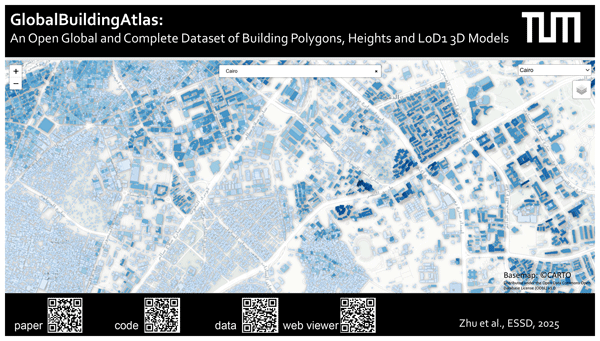
Xiao Xiang Zhu, Sining Chen, Fahong Zhang, Yilei Shi, and Yuanyuan Wang
Earth Syst. Sci. Data, 17, 6647–6668, https://doi.org/10.5194/essd-17-6647-2025, https://doi.org/10.5194/essd-17-6647-2025, 2025
Short summary
Short summary
We introduce GlobalBuildingAtlas, a publicly available dataset offering global and complete coverage of building polygons (GBA.Polygon), heights (GBA.Height) and Level of Detail 1 3D models (GBA.LoD1). This is the first open dataset to offer high quality, consistent, and complete building data in 2D and 3D at the individual building level on a global scale. With more than 2.75 billion buildings worldwide, it surpasses the most comprehensive database to date by more than 1 billion buildings.
Thorge Wintz, Alexander Röll, Gustavo Brant Paterno, Florian Ellsäßer, Delphine Clara Zemp, Hendrayanto, Bambang Irawan, Alexander Knohl, Holger Kreft, and Dirk Hölscher
EGUsphere, https://doi.org/10.5194/egusphere-2025-2596, https://doi.org/10.5194/egusphere-2025-2596, 2025
Short summary
Short summary
We investigated how the size and diversity of tree patches in Indonesian oil palm landscapes influence the movement of water to the atmosphere and local cooling. Our study shows that larger tree patches increase cooling mainly by supporting greater plant diversity and more complex vegetation structure. These findings suggest that expanding and diversifying tree patches can help manage microclimate and water cycling in agricultural areas.
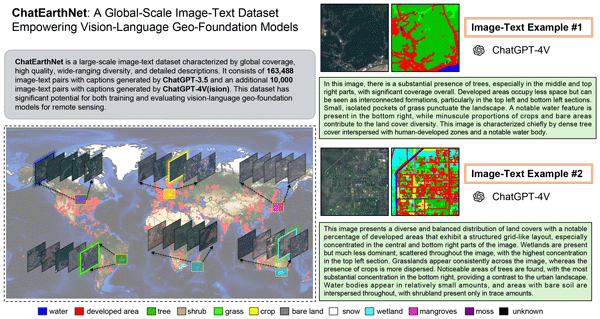
Zhenghang Yuan, Zhitong Xiong, Lichao Mou, and Xiao Xiang Zhu
Earth Syst. Sci. Data, 17, 1245–1263, https://doi.org/10.5194/essd-17-1245-2025, https://doi.org/10.5194/essd-17-1245-2025, 2025
Short summary
Short summary
ChatEarthNet is an image–text dataset that provides high-quality, detailed natural language descriptions for global-scale satellite data. It consists of 163 488 image-text pairs with captions generated by ChatGPT-3.5 and an additional 10 000 image-text pairs with captions generated by ChatGPT-4V(ision). This dataset has significant potential for training and evaluating vision–language geo-foundation models in remote sensing.
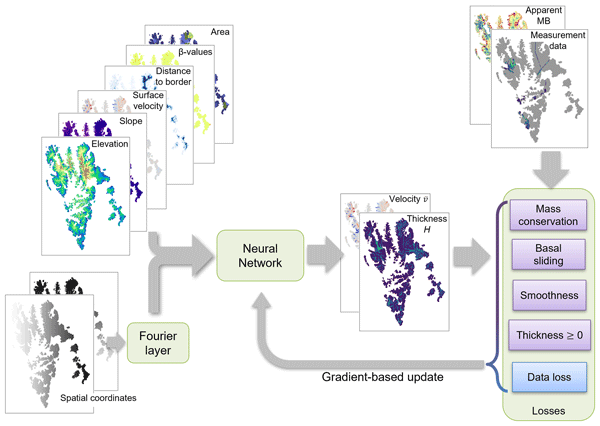
Viola Steidl, Jonathan Louis Bamber, and Xiao Xiang Zhu
The Cryosphere, 19, 645–661, https://doi.org/10.5194/tc-19-645-2025, https://doi.org/10.5194/tc-19-645-2025, 2025
Short summary
Short summary
Glacier ice thickness is difficult to measure directly but is essential for glacier evolution modelling. In this work, we employ a novel approach combining physical knowledge and data-driven machine learning to estimate the ice thickness of multiple glaciers in Spitsbergen, Barentsøya, and Edgeøya in Svalbard. We identify challenges for the physics-aware machine learning model and opportunities for improving the accuracy and physical consistency that would also apply to other geophysical tasks.
Yifan Tian, Yao Sun, and Xiao Xiang Zhu
Abstr. Int. Cartogr. Assoc., 7, 171, https://doi.org/10.5194/ica-abs-7-171-2024, https://doi.org/10.5194/ica-abs-7-171-2024, 2024
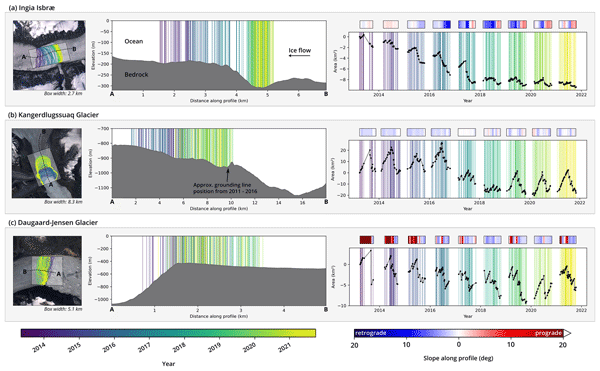
Erik Loebel, Mirko Scheinert, Martin Horwath, Angelika Humbert, Julia Sohn, Konrad Heidler, Charlotte Liebezeit, and Xiao Xiang Zhu
The Cryosphere, 18, 3315–3332, https://doi.org/10.5194/tc-18-3315-2024, https://doi.org/10.5194/tc-18-3315-2024, 2024
Short summary
Short summary
Comprehensive datasets of calving-front changes are essential for studying and modeling outlet glaciers. Current records are limited in temporal resolution due to manual delineation. We use deep learning to automatically delineate calving fronts for 23 glaciers in Greenland. Resulting time series resolve long-term, seasonal, and subseasonal patterns. We discuss the implications of our results and provide the cryosphere community with a data product and an implementation of our processing system.
Weiyan Lin, Jiasong Zhu, Yuansheng Hua, Qingyu Li, Lichao Mou, and Xiao Xiang Zhu
Int. Arch. Photogramm. Remote Sens. Spatial Inf. Sci., XLVIII-1-2024, 371–378, https://doi.org/10.5194/isprs-archives-XLVIII-1-2024-371-2024, https://doi.org/10.5194/isprs-archives-XLVIII-1-2024-371-2024, 2024
Tian Li, Konrad Heidler, Lichao Mou, Ádám Ignéczi, Xiao Xiang Zhu, and Jonathan L. Bamber
Earth Syst. Sci. Data, 16, 919–939, https://doi.org/10.5194/essd-16-919-2024, https://doi.org/10.5194/essd-16-919-2024, 2024
Short summary
Short summary
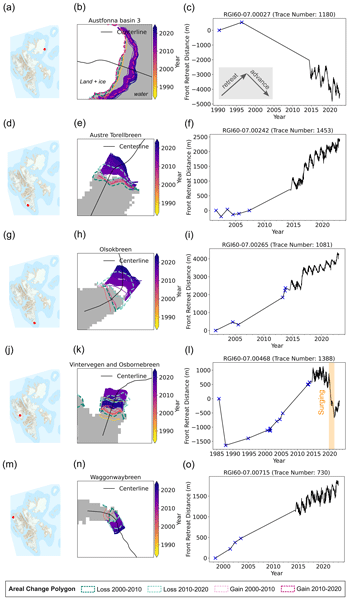
Our study uses deep learning to produce a new high-resolution calving front dataset for 149 marine-terminating glaciers in Svalbard from 1985 to 2023, containing 124 919 terminus traces. This dataset offers insights into understanding calving mechanisms and can help improve glacier frontal ablation estimates as a component of the integrated mass balance assessment.
Y. Sun, A. Kruspe, L. Meng, Y. Tian, E. J. Hoffmann, S. Auer, and X. X. Zhu
Int. Arch. Photogramm. Remote Sens. Spatial Inf. Sci., XLVIII-1-W2-2023, 225–232, https://doi.org/10.5194/isprs-archives-XLVIII-1-W2-2023-225-2023, https://doi.org/10.5194/isprs-archives-XLVIII-1-W2-2023-225-2023, 2023
J. Zhao, F. Roth, B. Bauer-Marschallinger, W. Wagner, M. Chini, and X. X. Zhu
ISPRS Ann. Photogramm. Remote Sens. Spatial Inf. Sci., X-1-W1-2023, 911–918, https://doi.org/10.5194/isprs-annals-X-1-W1-2023-911-2023, https://doi.org/10.5194/isprs-annals-X-1-W1-2023-911-2023, 2023
Yao Sun, Stefan Auer, Liqiu Meng, and Xiao Xiang Zhu
Abstr. Int. Cartogr. Assoc., 6, 250, https://doi.org/10.5194/ica-abs-6-250-2023, https://doi.org/10.5194/ica-abs-6-250-2023, 2023

Jingliang Hu, Rong Liu, Danfeng Hong, Andrés Camero, Jing Yao, Mathias Schneider, Franz Kurz, Karl Segl, and Xiao Xiang Zhu
Earth Syst. Sci. Data, 15, 113–131, https://doi.org/10.5194/essd-15-113-2023, https://doi.org/10.5194/essd-15-113-2023, 2023
Short summary
Short summary
Multimodal data fusion is an intuitive strategy to break the limitation of individual data in Earth observation. Here, we present a multimodal data set, named MDAS, consisting of synthetic aperture radar (SAR), multispectral, hyperspectral, digital surface model (DSM), and geographic information system (GIS) data for the city of Augsburg, Germany, along with baseline models for resolution enhancement, spectral unmixing, and land cover classification, three typical remote sensing applications.
S. Zhao, S. Saha, and X. X. Zhu
Int. Arch. Photogramm. Remote Sens. Spatial Inf. Sci., XLIII-B3-2022, 1407–1413, https://doi.org/10.5194/isprs-archives-XLIII-B3-2022-1407-2022, https://doi.org/10.5194/isprs-archives-XLIII-B3-2022-1407-2022, 2022
S. Saha, J. Gawlikowski, and X. X. Zhu
Int. Arch. Photogramm. Remote Sens. Spatial Inf. Sci., XLIII-B3-2022, 423–428, https://doi.org/10.5194/isprs-archives-XLIII-B3-2022-423-2022, https://doi.org/10.5194/isprs-archives-XLIII-B3-2022-423-2022, 2022
K. R. Traoré, A. Camero, and X. X. Zhu
ISPRS Ann. Photogramm. Remote Sens. Spatial Inf. Sci., V-3-2022, 217–224, https://doi.org/10.5194/isprs-annals-V-3-2022-217-2022, https://doi.org/10.5194/isprs-annals-V-3-2022-217-2022, 2022
T. Beker, H. Ansari, S. Montazeri, Q. Song, and X. X. Zhu
ISPRS Ann. Photogramm. Remote Sens. Spatial Inf. Sci., V-3-2022, 85–92, https://doi.org/10.5194/isprs-annals-V-3-2022-85-2022, https://doi.org/10.5194/isprs-annals-V-3-2022-85-2022, 2022
Cited articles
Ahlswede, S., Schulz, C., Gava, C., Helber, P., Bischke, B., Förster, M., Arias, F., Hees, J., Demir, B., and Kleinschmit, B.: TreeSatAI Benchmark Archive: a multi-sensor, multi-label dataset for tree species classification in remote sensing, Earth System Science Data, 15, 681–695, https://doi.org/10.5194/essd-15-681-2023, 2023. a, b, c
Aizman, A., Maltby, G., and Breuel, T.: High performance I/O for large scale deep learning, in: 2019 IEEE International Conference on Big Data (Big Data), IEEE, 5965–5967, https://doi.org/10.1109/BigData47090.2019.9005703, 2019. a
Beech, E., Rivers, M., Oldfield, S., and Smith, P.: GlobalTreeSearch: The first complete global database of tree species and country distributions, Journal of Sustainable Forestry, 36, 454–489, 2017. a
Bonan, G. B.: Forests and climate change: forcings, feedbacks, and the climate benefits of forests, Science, 320, 1444–1449, 2008. a
Botella, C., Deneu, B., Marcos, D., Servajean, M., Larcher, T., Leblanc, C., Estopinan, J., Bonnet, P., and Joly, A.: Overview of GeoLifeCLEF 2023: Species composition prediction with high spatial resolution at continental scale using remote sensing, arXiv [preprint], https://doi.org/10.48550/arXiv.2509.25816, 2025. a
Bountos, N. I., Ouaknine, A., Papoutsis, I., and Rolnick, D.: FoMo: Multi-Modal, Multi-Scale and Multi-Task Remote Sensing Foundation Models for Forest Monitoring, in: Proceedings of the AAAI Conference on Artificial Intelligence, vol. 39, 27858–27868, https://doi.org/10.1609/aaai.v39i27.35002, 2025. a
Bourgoin, C., Verhegghen, A., Carboni, S., Degrève, L., Ameztoy Aramendi, I., Ceccherini, G., Colditz, R., and Achard, F.: Global forest maps for the year 2020 to support the EU regulation on deforestation-free supply chains, Publications Office of the European Union, https://doi.org/10.2760/1975879, 2025. a
Buchhorn, M., Lesiv, M., Tsendbazar, N.-E., Herold, M., Bertels, L., and Smets, B.: Copernicus global land cover layers – collection 2, Remote Sensing, 12, 1044, https://doi.org/10.3390/rs12061044, 2020. a
Chamberlain, S. A. and Boettiger, C.: R Python, and Ruby clients for GBIF species occurrence data, Tech. rep., PeerJ [preprints], https://doi.org/10.7287/peerj.preprints.3304v1, 2017. a
Dosovitskiy, A., Beyer, L., Kolesnikov, A., Weissenborn, D., Zhai, X., Unterthiner, T., Dehghani, M., Minderer, M., Heigold, G., Gelly, S., Uszkoreit, J., and Houlsby, N.: An image is worth 16x16 words: Transformers for image recognition at scale, arXiv [preprint], https://doi.org/10.48550/arXiv.2010.11929, 2020. a
Farias, H. L. S., Silva, W. R., de Oliveira Perdiz, R., Citó, A. C., da Silva Carvalho, L. C., and Barbosa, R. I.: Dataset on wood density of trees in ecotone forests in Northern Brazilian Amazonia, Data in Brief, 30, 105378, https://doi.org/10.1016/j.dib.2020.105378, 2020. a, b
Felton, A., Petersson, L., Nilsson, O., Witzell, J., Cleary, M., Felton, A. M., Björkman, C., Sang, Å. O., Jonsell, M., Holmström, E., Nilsson, U., Rönnberg, J., Kalén, C., and Lindbladh, M.: The tree species matters: Biodiversity and ecosystem service implications of replacing Scots pine production stands with Norway spruce, Ambio, 49, 1035–1049, 2020. a
Franklin, S. E.: Remote sensing for sustainable forest management, CRC Press, https://doi.org/10.1201/9781420032857, 2001. a
Gastauer, M., Leyh, W., and Meira-Neto, J. A.: Tree diversity and dynamics of the forest of Seu Nico, Viçosa, Minas Gerais, Brazil, Biodiversity Data Journal, e5425, https://doi.org/10.3897/BDJ.3.e5425, 2015. a, b
Gaydon, C. and Roche, F.: Pureforest: A large-scale aerial lidar and aerial imagery dataset for tree species classification in monospecific forests, in: 2025 IEEE/CVF Winter Conference on Applications of Computer Vision (WACV), IEEE, 5895–5904, https://doi.org/10.1109/WACV61041.2025.00575, 2025. a, b, c
GBIF Secretariat: GBIF Backbone Taxonomy, https://doi.org/10.15468/39omei, 2023. a
Gillespie, L. E., Ruffley, M., and Exposito-Alonso, M.: Deep learning models map rapid plant species changes from citizen science and remote sensing data, Proceedings of the National Academy of Sciences, 121, e2318296121, https://doi.org/10.1073/pnas.2318296121, 2024. a, b
Global Biodiversity Information Facility (GBIF): GBIF Species API Documentation, https://techdocs.gbif.org/en/openapi/v1/species (last access: 5 May 2025), 2025. a
Hamann, A. and Wang, T.: Potential effects of climate change on ecosystem and tree species distribution in British Columbia, Ecology, 87, 2773–2786, 2006. a
Hansen, M. C., Potapov, P. V., Moore, R., Hancher, M., Turubanova, S. A., Tyukavina, A., Thau, D., Stehman, S. V., Goetz, S. J., Loveland, T. R., Kommareddy, A., Egorov, A., Chini, L., Justice, C. O., and Townshend, J. R. G.: High-resolution global maps of 21st-century forest cover change, Science, 342, 850–853, 2013. a
He, Y., Xu, X., Chen, H., Li, J., and Pu, F.: Visual global-salient guided network for remote sensing image-text retrieval, IEEE Transactions on Geoscience and Remote Sensing, Vol. 62, https://doi.org/10.1109/TGRS.2024.3466389, 2024. a, b, c
Hermosilla, T., Bastyr, A., Coops, N. C., White, J. C., and Wulder, M. A.: Mapping the presence and distribution of tree species in Canada's forested ecosystems, Remote Sens. Environ., 282, 113276, https://doi.org/10.1016/j.rse.2022.113276, 2022. a
Jenkins, J. C., Chojnacky, D. C., Heath, L. S., and Birdsey, R. A.: National-scale biomass estimators for United States tree species, Forest Sciences, 49, 12–35, 2003. a
Kampe, T. U., Johnson, B. R., Kuester, M. A., and Keller, M.: NEON: the first continental-scale ecological observatory with airborne remote sensing of vegetation canopy biochemistry and structure, Journal of Applied Remote Sensing, 4, 043510, https://doi.org/10.1117/1.3361375, 2010. a
Kindt, R.: TreeGOER: A database with globally observed environmental ranges for 48,129 tree species, Global Change Biology, 29, 6303–6318, 2023. a
Lane, M. A. and Edwards, J. L.: The global biodiversity information facility (GBIF), Systematics Association special volume, 73, https://doi.org/10.1201/9781439832547-1, 2007. a
Lindenmayer, D., Franklin, J., and Fischer, J.: General management principles and a checklist of strategies to guide forest biodiversity conservation, Biological Conservation, 131, 433–445, 2006. a
Liu, F., Chen, D., Guan, Z., Zhou, X., Zhu, J., Ye, Q., Fu, L., and Zhou, J.: Remoteclip: A vision language foundation model for remote sensing, IEEE Transactions on Geoscience and Remote Sensing, Vol. 62, https://doi.org/10.1109/TGRS.2024.3390838, 2024. a, b
Loshchilov, I. and Hutter, F.: Decoupled weight decay regularization, arXiv [preprint], https://doi.org/10.48550/arXiv.1711.05101, 2017. a
Loshchilov, I. and Hutter, F.: SGDR: Stochastic Gradient Descent with Warm Restarts, in: International Conference on Learning Representations, https://doi.org/10.48550/arXiv.1608.03983, 2022. a
Micikevicius, P., Narang, S., Alben, J., Diamos, G., Elsen, E., Garcia, D., Ginsburg, B., Houston, M., Kuchaiev, O., Venkatesh, G., and Wu, H.: Mixed precision training, arXiv [preprint], https://doi.org/10.48550/arXiv.1710.03740, 2017. a
Mu, Y., Guo, J., Shahzad, M., and Zhu, X. X.: National-scale tree species mapping with deep learning reveals forest management insights in Germany, International Journal of Applied Earth Observation and Geoinformation, 139, 104522, https://doi.org/10.1016/j.jag.2025.104522, 2025a. a, b
Mu, Y., Xiong, Z., Wang, Y., Shahzad, M., Essl, F., Kreft, H., Kleunen, M. V., and Zhu, X. X.: GlobalGeoTree: A Multi-Granular Vision-Language Dataset for Global Tree Species Classification, Global Biodiversity Information Facility (GBIF) [data set], https://doi.org/10.15468/dd.9qxqyy, 2025b. a, b, c
Mu, Y.: MUYang99/GlobalGeoTree: GlobalGeoTree v1.0.0 (v1.0.0), Zenodo [code], https://doi.org/10.5281/zenodo.18619541, 2026. a
Oord, A. V. D., Li, Y., and Vinyals, O.: Representation learning with contrastive predictive coding, arXiv [preprint], https://doi.org/10.48550/arXiv.1807.03748, 2018. a
Ouaknine, A., Kattenborn, T., Laliberté, E., and Rolnick, D.: OpenForest: a data catalog for machine learning in forest monitoring, Environmental Data Science, 4, e15, https://doi.org/10.1017/eds.2024.53, 2025. a
Parnami, A. and Lee, M.: Learning from few examples: A summary of approaches to few-shot learning, arXiv [preprint], https://doi.org/10.48550/arXiv.2203.04291, 2022. a
Pazos-Outón, L. M., Vasconcelos, C. N., Raichuk, A., Arnab, A., Morris, D., and Neumann, M.: Planted: a dataset for planted forest identification from multi-satellite time series, in: IGARSS 2024-2024 IEEE International Geoscience and Remote Sensing Symposium, IEEE, 7066–7070, https://doi.org/10.1109/IGARSS53475.2024.10641578, 2024. a, b
Picek, L., Botella, C., Servajean, M., Leblanc, C., Palard, R., Larcher, T., Deneu, B., Marcos, D., Bonnet, P., and Joly, A.: Geoplant: Spatial plant species prediction dataset, Advances in Neural Information Processing Systems, 37, 126653–126676, 2024. a
Poggio, L., de Sousa, L. M., Batjes, N. H., Heuvelink, G. B. M., Kempen, B., Ribeiro, E., and Rossiter, D.: SoilGrids 2.0: producing soil information for the globe with quantified spatial uncertainty, SOIL, 7, 217–240, https://doi.org/10.5194/soil-7-217-2021, 2021. a, b
Radford, A., Wu, J., Child, R., Luan, D., Amodei, D., and Sutskever, I.: Language models are unsupervised multitask learners, OpenAI blog, 1, 9 pp., 2019. a
Radford, A., Kim, J. W., Hallacy, C., Ramesh, A., Goh, G., Agarwal, S., Sastry, G., Askell, A., Mishkin, P., Clark, J., Krueger, G., and Sutskever, I.: Learning transferable visual models from natural language supervision, in: International conference on machine learning, 8748–8763, https://doi.org/10.48550/arXiv.2103.00020, 2021. a, b, c, d
Rosenblatt, F.: The perceptron: a probabilistic model for information storage and organization in the brain, Psychological Review, 65, 386, https://doi.org/10.1037/h0042519, 1958. a
Schuhmann, C., Beaumont, R., Vencu, R., Gordon, C., Wightman, R., Cherti, M., Coombes, T., Katta, A., Mullis, C., Wortsman, M., Schramowski, P., Kundu, S., Crowson, K., Schmidt, L., Kaczmarczyk, R., and Jitsev, J.: Laion-5b: An open large-scale dataset for training next generation image-text models, Advances in Neural Information Processing Systems, 35, 25278–25294, 2022. a
Spoto, F., Sy, O., Laberinti, P., Martimort, P., Fernandez, V., Colin, O., Hoersch, B., and Meygret, A.: Overview of sentinel-2, in: 2012 IEEE international geoscience and remote sensing symposium, IEEE, 1707–1710, https://doi.org/10.1109/IGARSS.2012.6351195, 2012. a
Stevens, S., Wu, J., Thompson, M. J., Campolongo, E. G., Song, C. H., Carlyn, D. E., Dong, L., Dahdul, W. M., Stewart, C., Berger-Wolf, T., Chao, W.-L., and Su, Y.: Bioclip: A vision foundation model for the tree of life, in: Proceedings of the IEEE/CVF conference on computer vision and pattern recognition, 19412–19424, https://doi.org/10.48550/arXiv.2311.18803, 2024. a, b, c
Van der Maaten, L. and Hinton, G.: Visualizing data using t-SNE., Journal of Machine Learning Research, 9, 2579–2605, 2008. a
Weiser, H., Schäfer, J., Winiwarter, L., Krašovec, N., Fassnacht, F. E., and Höfle, B.: Individual tree point clouds and tree measurements from multi-platform laser scanning in German forests, Earth System Science Data, 14, 2989–3012, https://doi.org/10.5194/essd-14-2989-2022, 2022. a, b
Wellbrock, N., Eickenscheidt, N., Hilbrig, L., Dühnelt, P.-E., Holzhausen, M., Bauer, A., Dammann, I., Strich, S., Engels, F., and Wauer, A.: Leitfaden und Dokumentation zur Waldzustandserhebung in Deutschland, Tech. rep., Thünen Working Paper, https://doi.org/10.3220/WP1513589598000, 2018. a
Zhang, X., Liu, L., Zhao, T., Zhang, W., Guan, L., Bai, M., and Chen, X.: GLC_FCS10: a global 10 m land-cover dataset with a fine classification system from Sentinel-1 and Sentinel-2 time-series data in Google Earth Engine, Earth System Science Data, 17, 4039–4062, https://doi.org/10.5194/essd-17-4039-2025, 2025. a
Short summary
To better protect our planet's forests, we need to know what trees are where. We created GlobalGeoTree, a massive public dataset linking 6.3 million tree locations worldwide with satellite data. This dataset helps computers learn to identify tree species from space, supporting biodiversity monitoring and climate action. Our baseline model shows this is a promising path to understanding global forests.
To better protect our planet's forests, we need to know what trees are where. We created...


Altmetrics
Final-revised paper
Preprint