Articles | Volume 18, issue 2
https://doi.org/10.5194/essd-18-1275-2026
© Author(s) 2026. This work is distributed under
the Creative Commons Attribution 4.0 License.
the Creative Commons Attribution 4.0 License.
https://doi.org/10.5194/essd-18-1275-2026
© Author(s) 2026. This work is distributed under
the Creative Commons Attribution 4.0 License.
the Creative Commons Attribution 4.0 License.
Data description article
| 
19 Feb 2026
Data description article |
| 19 Feb 2026
| 19 Feb 2026
Soil surface change data of high spatio-temporal resolution from the plot to the catchment scale
Lea Epple
CORRESPONDING AUTHOR
Institute of Photogrammetry and Remote Sensing, Dresden University of Technology, Helmholtzstr. 10, 01069 Dresden, Germany
Oliver Grothum
Institute of Photogrammetry and Remote Sensing, Dresden University of Technology, Helmholtzstr. 10, 01069 Dresden, Germany
Anne Bienert
Institute of Photogrammetry and Remote Sensing, Dresden University of Technology, Helmholtzstr. 10, 01069 Dresden, Germany
Anette Eltner
CORRESPONDING AUTHOR
Institute of Photogrammetry and Remote Sensing, Dresden University of Technology, Helmholtzstr. 10, 01069 Dresden, Germany
Related authors
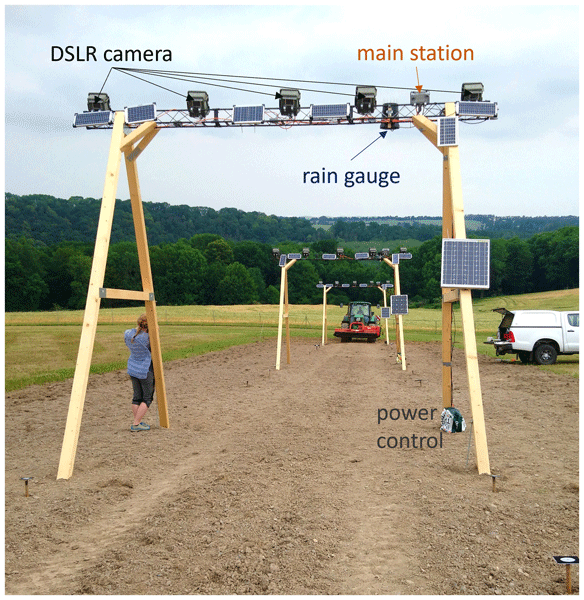
Oliver Grothum, Lea Epple, Anne Bienert, Xabier Blanch, and Anette Eltner
SOIL, 11, 1007–1028, https://doi.org/10.5194/soil-11-1007-2025, https://doi.org/10.5194/soil-11-1007-2025, 2025
Short summary
Short summary
Soil erosion threatens landscapes worldwide, and understanding how surfaces change over time is key to addressing this issue. We developed a new camera-based system that automatically captures and analyzes daily surface changes on a hillside over several years. Triggered by rain and a clock, the system showed how weather and farming impact the land. Our method offers a powerful way to monitor surface changes and can help improve predictions and solutions for soil erosion.
Lea Epple, Andreas Kaiser, Marcus Schindewolf, and Anette Eltner
SOIL Discuss., https://doi.org/10.5194/soil-2021-85, https://doi.org/10.5194/soil-2021-85, 2021
Revised manuscript not accepted
Short summary
Short summary
Intensified extreme weather events due to climate change can result in changes of soil erosion. These unclear developments make an improvement of soil erosion modelling all the more important. Assuming that soil erosion models cannot keep up with the current data, this work gives an overview of 44 models, their strengths and weaknesses and discusses their potential for further development with respect to new and improved soil and soil erosion assessment techniques.
Bindusara Nagathihalli Lokesh, Laura Camila Duran Vergara, Hans-Gerd Maas, and Anette Eltner
Int. Arch. Photogramm. Remote Sens. Spatial Inf. Sci., XLIX-B3-2026, 205–212, https://doi.org/10.5194/isprs-archives-XLIX-B3-2026-205-2026, https://doi.org/10.5194/isprs-archives-XLIX-B3-2026-205-2026, 2026
Felix Rocco Matzke, Hans-Gerd Maas, and Anette Eltner
Int. Arch. Photogramm. Remote Sens. Spatial Inf. Sci., XLIX-B2-2026, 1183–1189, https://doi.org/10.5194/isprs-archives-XLIX-B2-2026-1183-2026, https://doi.org/10.5194/isprs-archives-XLIX-B2-2026-1183-2026, 2026
Pedro Zamboni, Robert Krüger, László Bertalan, Xabier Blanch, Paul Hindorf, and Anette Eltner
Int. Arch. Photogramm. Remote Sens. Spatial Inf. Sci., XLIX-B2-2026, 321–326, https://doi.org/10.5194/isprs-archives-XLIX-B2-2026-321-2026, https://doi.org/10.5194/isprs-archives-XLIX-B2-2026-321-2026, 2026
Carolin Rünger, Stefan Binapfl, Sophia Böhme, Ferdinand Maiwald, and Anette Eltner
Int. Arch. Photogramm. Remote Sens. Spatial Inf. Sci., XLIX-B2-2026, 261–269, https://doi.org/10.5194/isprs-archives-XLIX-B2-2026-261-2026, https://doi.org/10.5194/isprs-archives-XLIX-B2-2026-261-2026, 2026
Anne Bienert, Katja Richter, Sophia Böhme, and Hans-Gerd Maas
Int. Arch. Photogramm. Remote Sens. Spatial Inf. Sci., XLIX-B2-2026, 109–116, https://doi.org/10.5194/isprs-archives-XLIX-B2-2026-109-2026, https://doi.org/10.5194/isprs-archives-XLIX-B2-2026-109-2026, 2026
Stefan Binapfl, Carolin Rünger, Gunnar Lelle-Neumann, Anette Eltner, and Ferdinand Maiwald
Int. Arch. Photogramm. Remote Sens. Spatial Inf. Sci., XLIX-B1-2026, 129–136, https://doi.org/10.5194/isprs-archives-XLIX-B1-2026-129-2026, https://doi.org/10.5194/isprs-archives-XLIX-B1-2026-129-2026, 2026
Laura Camila Duran Vergara, Xabier Blanch Gorriz, Bindusara Nagathihalli Lokesh, and Anette Eltner
ISPRS Ann. Photogramm. Remote Sens. Spatial Inf. Sci., XI-2-2026, 615–622, https://doi.org/10.5194/isprs-annals-XI-2-2026-615-2026, https://doi.org/10.5194/isprs-annals-XI-2-2026-615-2026, 2026
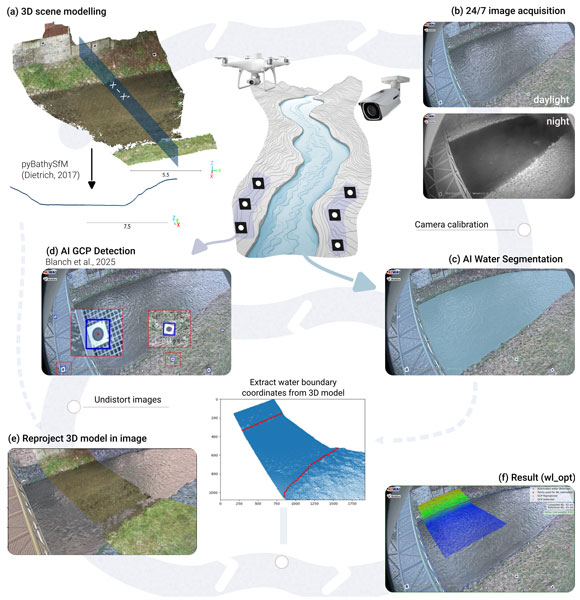
Xabier Blanch, Jens Grundmann, Ralf Hedel, and Anette Eltner
Hydrol. Earth Syst. Sci., 30, 797–824, https://doi.org/10.5194/hess-30-797-2026, https://doi.org/10.5194/hess-30-797-2026, 2026
Short summary
Short summary
This study presents a low-cost, automated system for monitoring river water levels using cameras and AI. By combining AI-based image analysis with photogrammetry, it accurately measures water levels in real-time, even in challenging conditions. Tested over 2.5 years at four sites, it achieved high accuracy (errors of 1.0–2.3 cm) and processed over 219 000 images. Its resilience makes it ideal for flood detection and water management in remote areas.
Oliver Grothum, Lea Epple, Anne Bienert, Xabier Blanch, and Anette Eltner
SOIL, 11, 1007–1028, https://doi.org/10.5194/soil-11-1007-2025, https://doi.org/10.5194/soil-11-1007-2025, 2025
Short summary
Short summary
Soil erosion threatens landscapes worldwide, and understanding how surfaces change over time is key to addressing this issue. We developed a new camera-based system that automatically captures and analyzes daily surface changes on a hillside over several years. Triggered by rain and a clock, the system showed how weather and farming impact the land. Our method offers a powerful way to monitor surface changes and can help improve predictions and solutions for soil erosion.
Felix Rocco Matzke, Tushar Jayesh Barot, Shreeja Sridharan, Nikolaus Ammann, Christoph Kessler, Hans-Gerd Maas, Frank H. P. Fitzek, and Anette Eltner
Int. Arch. Photogramm. Remote Sens. Spatial Inf. Sci., XLVIII-2-W11-2025, 211–218, https://doi.org/10.5194/isprs-archives-XLVIII-2-W11-2025-211-2025, https://doi.org/10.5194/isprs-archives-XLVIII-2-W11-2025-211-2025, 2025
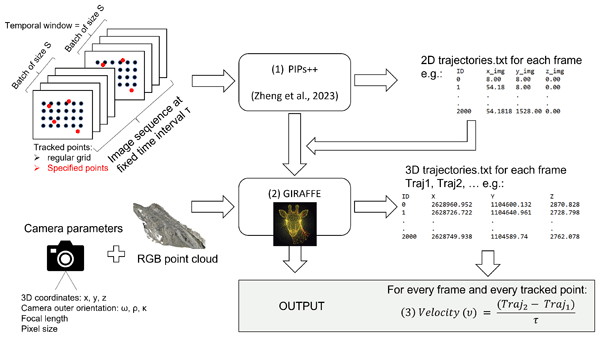
Hanne Hendrickx, Melanie Elias, Xabier Blanch, Reynald Delaloye, and Anette Eltner
Earth Surf. Dynam., 13, 705–721, https://doi.org/10.5194/esurf-13-705-2025, https://doi.org/10.5194/esurf-13-705-2025, 2025
Short summary
Short summary
This study presents a novel AI-based method for tracking and analysing the movement of rock glaciers and landslides, key landforms in high mountain regions. By utilising time-lapse images, our approach generates detailed velocity data, uncovering movement patterns often missed by traditional methods. This cost-effective tool enhances geohazard monitoring, providing insights into environmental drivers, improving process understanding, and contributing to better safety in alpine areas.
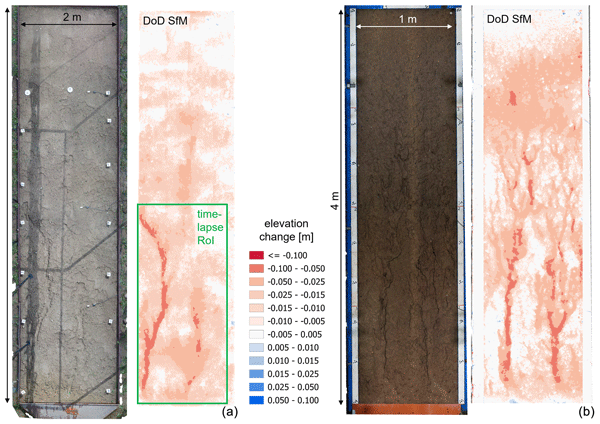
Anette Eltner, David Favis-Mortlock, Oliver Grothum, Martin Neumann, Tomáš Laburda, and Petr Kavka
SOIL, 11, 413–434, https://doi.org/10.5194/soil-11-413-2025, https://doi.org/10.5194/soil-11-413-2025, 2025
Short summary
Short summary
This study develops a new method to improve the calibration and evaluation of models that predict soil erosion by water. By using advanced imaging techniques, we can capture detailed changes in the soil surface over time. This helps improve models that forecast erosion, especially as climate change creates new and unpredictable conditions. Our findings highlight the need for more precise tools to better model erosion of our land and environment in the future.
Pedro Alberto Pereira Zamboni, Hanne Hendrickx, Dennis Sprute, Holger Flatt, Muhtasimul Islam Rushdi, Florian Brodrecht, and Anette Eltner
Int. Arch. Photogramm. Remote Sens. Spatial Inf. Sci., XLVIII-2-W8-2024, 483–490, https://doi.org/10.5194/isprs-archives-XLVIII-2-W8-2024-483-2024, https://doi.org/10.5194/isprs-archives-XLVIII-2-W8-2024-483-2024, 2024
Robert Krüger, Xabier Blanch, Jens Grundmann, Ghazi Al-Rawas, and Anette Eltner
Int. Arch. Photogramm. Remote Sens. Spatial Inf. Sci., XLVIII-2-W8-2024, 243–250, https://doi.org/10.5194/isprs-archives-XLVIII-2-W8-2024-243-2024, https://doi.org/10.5194/isprs-archives-XLVIII-2-W8-2024-243-2024, 2024
Anne Bienert, Katja Richter, Sophia Boehme, and Hans-Gerd Maas
Int. Arch. Photogramm. Remote Sens. Spatial Inf. Sci., XLVIII-2-2024, 33–40, https://doi.org/10.5194/isprs-archives-XLVIII-2-2024-33-2024, https://doi.org/10.5194/isprs-archives-XLVIII-2-2024-33-2024, 2024
Melanie Elias, Steffen Isfort, Anette Eltner, and Hans-Gerd Maas
ISPRS Ann. Photogramm. Remote Sens. Spatial Inf. Sci., X-2-2024, 57–64, https://doi.org/10.5194/isprs-annals-X-2-2024-57-2024, https://doi.org/10.5194/isprs-annals-X-2-2024-57-2024, 2024
Robert Krüger, Pierre Karrasch, and Anette Eltner
Geosci. Instrum. Method. Data Syst., 13, 163–176, https://doi.org/10.5194/gi-13-163-2024, https://doi.org/10.5194/gi-13-163-2024, 2024
Short summary
Short summary
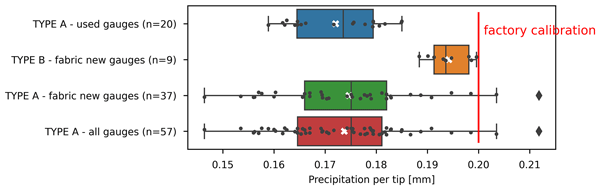
Low-cost sensors could fill gaps in existing observation networks. To ensure data quality, the quality of the factory calibration of a given sensor has to be evaluated if the sensor is used out of the box. Here, the factory calibration of a widely used low-cost rain gauge type has been tested both in the lab (66) and in the field (20). The results of the study suggest that the calibration of this particular type should at least be checked for every sensor before being used.
O. Grothum, A. Bienert, M. Bluemlein, and A. Eltner
Int. Arch. Photogramm. Remote Sens. Spatial Inf. Sci., XLVIII-1-W2-2023, 163–170, https://doi.org/10.5194/isprs-archives-XLVIII-1-W2-2023-163-2023, https://doi.org/10.5194/isprs-archives-XLVIII-1-W2-2023-163-2023, 2023
Xabier Blanch, Marta Guinau, Anette Eltner, and Antonio Abellan
Nat. Hazards Earth Syst. Sci., 23, 3285–3303, https://doi.org/10.5194/nhess-23-3285-2023, https://doi.org/10.5194/nhess-23-3285-2023, 2023
Short summary
Short summary
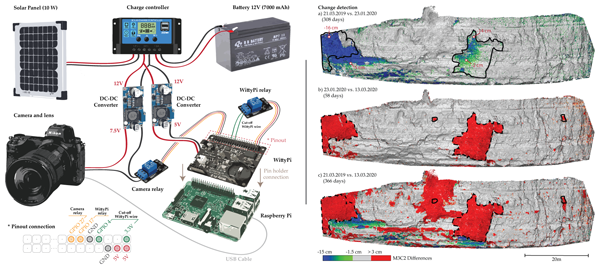
We present cost-effective photogrammetric systems for high-resolution rockfall monitoring. The paper outlines the components, assembly, and programming codes required. The systems utilize prime cameras to generate 3D models and offer comparable performance to lidar for change detection monitoring. Real-world applications highlight their potential in geohazard monitoring which enables accurate detection of pre-failure deformation and rockfalls with a high temporal resolution.
R. Blaskow and A. Eltner
Int. Arch. Photogramm. Remote Sens. Spatial Inf. Sci., XLVIII-1-W1-2023, 45–50, https://doi.org/10.5194/isprs-archives-XLVIII-1-W1-2023-45-2023, https://doi.org/10.5194/isprs-archives-XLVIII-1-W1-2023-45-2023, 2023
Robert Ljubičić, Dariia Strelnikova, Matthew T. Perks, Anette Eltner, Salvador Peña-Haro, Alonso Pizarro, Silvano Fortunato Dal Sasso, Ulf Scherling, Pietro Vuono, and Salvatore Manfreda
Hydrol. Earth Syst. Sci., 25, 5105–5132, https://doi.org/10.5194/hess-25-5105-2021, https://doi.org/10.5194/hess-25-5105-2021, 2021
Short summary
Short summary
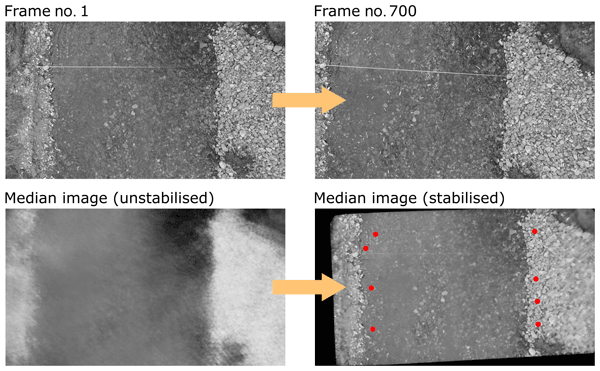
The rise of new technologies such as drones (unmanned aerial systems – UASs) has allowed widespread use of image velocimetry techniques in place of more traditional, usually slower, methods during hydrometric campaigns. In order to minimize the velocity estimation errors, one must stabilise the acquired videos. In this research, we compare the performance of different UAS video stabilisation tools and provide guidelines for their use in videos with different flight and ground conditions.
Lea Epple, Andreas Kaiser, Marcus Schindewolf, and Anette Eltner
SOIL Discuss., https://doi.org/10.5194/soil-2021-85, https://doi.org/10.5194/soil-2021-85, 2021
Revised manuscript not accepted
Short summary
Short summary
Intensified extreme weather events due to climate change can result in changes of soil erosion. These unclear developments make an improvement of soil erosion modelling all the more important. Assuming that soil erosion models cannot keep up with the current data, this work gives an overview of 44 models, their strengths and weaknesses and discusses their potential for further development with respect to new and improved soil and soil erosion assessment techniques.
Cited articles
Batista, P. V., Davies, J., Silva, M. L., and Quinton, J. N.: On the evaluation of soil erosion models: Are we doing enough?, Earth-Sci. Rev., 197, 102898, https://doi.org/10.1016/j.earscirev.2019.102898, 2019.
Blanch, X., Guinau, M., Eltner, A., and Abellan, A.: A cost-effective image-based system for 3D geomorphic monitoring: An application to rockfalls, Geomorphology, 449, 109065, https://doi.org/10.1016/j.geomorph.2024.109065, 2024.
Blanch, X., Jäschke, A., Elias, M., and Eltner, A.: Subpixel Automatic Detection of GCP Coordinates in Time-Lapse Images Using a Deep Learning Keypoint Network, IEEE Trans. Geosci. Remote Sens., 63, 1–14, https://doi.org/10.1109/TGRS.2024.3514854, 2025.
Borrelli, P., Alewell, C., Alvarez, P., Anache, J. A. A., Baartman, J., Ballabio, C., Bezak, N., Biddoccu, M., Cerdà, A., Chalise, D., Chen, S., Chen, W., De Girolamo, A. M., Gessesse, G. D., Deumlich, D., Diodato, N., Efthimiou, N., Erpul, G., Fiener, P., Freppaz, M., Gentile, F., Gericke, A. Haregeweyn, N., Hu, B., Jeanneau, A., Kaffas, K., Kiani-Harchegani, M., Villuendas, I., Li, C., Lombardo, L., López-Vicente, M., Lucas-Borja, M., Märker, M., Naipal, V., Nearing, M., Owusu, S., Panday, D., Patault, E., Patriche, C., Poggio, L., Portes, R., Quijano, L., Rahdari, M., Renima, M., Ricci, G., Rodrigo-Comino, J., Saia, S., Samani, A., Schillaci, C., Syrris, V., Kim, H., Spinola, D., Oliveira, P., Teng, H., Thapa, R., Vantas, K., Vieira, D., Yang, J., Yin, S., Zema, D., Zhao, G., and Panagos, P.: Soil erosion modelling: A global review and statistical analysis, Science of the Total Environment, 780, https://doi.org/10.1016/j.scitotenv.2021.146494, 2021.
Ehrhardt, A., Deumlich, D., and Gerke, H. H.: Soil Surface Micro-Topography by Structure-from-Motion Photogrammetry for Monitoring Density and Erosion Dynamics, Front. Environ. Sci., 9, https://doi.org/10.3389/fenvs.2021.737702, 2022.
Eltner, A. and James, M.: Guidelines for flight operations, 75–86, in: UAVs in Environmental Sciences – Methods and Applications, edited by: Eltner, A., Karrasch, P., Stöcker, C., Klingbeil, L., Hoffmeister, D., Kaiser, A., and Rovere, A., WBG Academic, 492 pp., ISBN 9783534405886, 2022.
Eltner, A. and Sofia, G.: Structure from motion photogrammetric technique, Remote Sensing of Geomorphology, Elsevier, 1–24, https://doi.org/10.1016/B978-0-444-64177-9.00001-1, 2020.
Eltner, A., Kaiser, A., Abellan, A., and Schindewolf, M.: Time lapse structure-from-motion photogrammetry for continuous geomorphic monitoring, Earth Surf. Proc. Land., 42, 2240–2253, https://doi.org/10.1002/esp.4178, 2017.
Eltner, A., Favis-Mortlock, D., Grothum, O., Neumann, M., Laburda, T., and Kavka, P.: Using 3D observations with high spatio-temporal resolution to calibrate and evaluate a process-focused cellular automaton model of soil erosion by water, SOIL, 11, 413–434, https://doi.org/10.5194/soil-11-413-2025, 2025.
Epple, L., Kaiser, A., Schindewolf, M., Bienert, A., Lenz, J., and Eltner, A.: A Review on the Possibilities and Challenges of Today's Soil and Soil Surface Assessment Techniques in the Context of Process-Based Soil Erosion Models, Remote Sens., 14, 2468, https://doi.org/10.3390/rs14102468, 2022.
Epple, L., Grothum, O., Bienert, A., and Eltner, A.: Decoding rainfall effects on soil surface changes: Empirical separation of sediment yield in time-lapse SfM photogrammetry measurements, Soil and Till. Res., 248, 106384, https://doi.org/10.1016/j.still.2024.106384, 2025.
Epple, L., Grothum, O., Bienert, A., and Eltner, A.: Structure from motion cross-scale dataset on agricultural areas in eastern Germany over a period of 3.5 years – plot scale, single slope scale, and catchment scale, TU Dresden Data Publications [data set], https://doi.org/10.25532/OPARA-1038, 2026.
Favis-Mortlock, D.: RillGrow, GitHub, https://github.com/davefavismortlock/RillGrow (last access: 19 June 2025), 2025.
Grothum, O., Bienert, A., Bluemlein, M., and Eltner, A.: USING MACHINE LEARNING TECHNIQUES TO FILTER VEGETATION IN COLORIZED SFM POINT CLOUDS OF SOIL SURFACES, Int. Arch. Photogramm. Remote Sens. Spatial Inf. Sci., XLVIII-1/W2-2023, 163–170, https://doi.org/10.5194/isprs-archives-XLVIII-1-W2-2023-163-2023, 2023.
Grothum, O., Epple, L., Bienert, A., Blanch, X., and Eltner, A.: Near-continuous observation of soil surface changes at single slopes with high spatial resolution via an automated SfM photogrammetric mapping approach, SOIL, 11, 1007–1028, https://doi.org/10.5194/soil-11-1007-2025, 2025.
James, M. R., Robson, S., and Smith, M. W.: 3-D uncertainty-based topographic change detection with structure-from-motion photogrammetry: precision maps for ground control and directly georeferenced surveys, Earth Surf. Process. Land., 42, 1769–1788, https://doi.org/10.1002/esp.4125, 2017.
Jetten, V. and Favis-Mortlock, D.: Modelling Soil Erosion in Europe, in: Soil Erosion in Europe, edited by: Boardman, J. and Poesen, J., John Wiley & Sons, Ltd, Chichester, UK, 695–716, https://doi.org/10.1002/0470859202.ch50, 2006.
Jiang, Y., Shi, H., Wen, Z., Guo, M., Zhao, J., Cao, X., Fan, Y., and Zheng, C.: The dynamic process of slope rill erosion analyzed with a digital close range photogrammetry observation system under laboratory conditions, Geomor., 350, 106893, https://doi.org/10.1016/j.geomorph.2019.106893, 2020.
Kainz, M., Auerswald, K., and Vöhringer, R.,: Comparison of german and swiss rainfall simulators – utility, labour demands and costs, Z. Pflanzenernahr. Bodenkd., 155, 7–11, 1992.
Lague, D., Brodu, N., and Leroux, J.: Accurate 3D comparison of complex topography with terrestrial laser scanner: Application to the Rangitikei canyon (N-Z), ISPRS J. of Photogramm. and Remote Sens., 82, 10–26, https://doi.org/10.1016/j.isprsjprs.2013.04.009, 2013.
Naranjo, S., Rodrigues Jr., F. A., Cadisch, G., Lopez-Ridaura, S., Fuentes Ponce, M., and Marohn, C.: Effects of spatial resolution of terrain models on modelled discharge and soil loss in Oaxaca, Mexico, Hydrol. Earth Syst. Sci., 25, 5561–5588, https://doi.org/10.5194/hess-25-5561-2021, 2021.
Panagos, P., Borrelli, P., Poesen, J., Ballabio, C., Lugato, E., Meusburger, K., Montanarella, L., and Alewell, C.: The new assessment of soil loss by water erosion in Europe. Environmental Science & Policy, 54, 438–447, https://doi.org/10.1016/j.envsci.2015.08.012, 2015.
Pandey, A., Himanshu, S. K., Mishra, S. K., and Singh, V. P.: Physically based soil erosion and sediment yield models revisited, CATENA, 147, 595–620, https://doi.org/10.1016/j.catena.2016.08.002, 2016.
Schindewolf, M.: Prozessbasierte Modellierung von Erosion, Deposition und partikelgebundenem Nähr- und Schadstofftransport in der Einzugsgebiets- und Regionalskala, Dissertation, TU Bergakademie Freiberg, Freiberg, https://nbn-resolving.org/urn:nbn:de:bsz:105-qucosa-86142 (last access: 5 February 2026), 2012.
Schindewolf, M. and Schmidt, J.: Parameterization of the EROSION 2D/3D soil erosion model using a small-scale rainfall simulator and upstream runoff simulation, CATENA, 91, 47–55, https://doi.org/10.1016/j.catena.2011.01.007, 2012.
Yang, Y., Shi, Y., Liang, X., Huang, T., Fu, S., and Liu, B.: Evaluation of structure from motion (SfM) photogrammetry on the measurement of rill and interrill erosion in a typical loess, Geomor., 385, 107734, https://doi.org/10.1016/j.geomorph.2021.107734, 2021.
Short summary
The present study offers a unique, nested, high-resolution dataset that captures soil surface changes every 20 seconds during rainfall events, as well as over seasonal variations, across a range of spatial scales – plot, slope, and catchment. It was collected over a period of 3.5 years and facilitated by a camera-based approach. This open-access resource assists scientists in evaluating and refining existing models, improving process understanding, and training artificial intelligence.
The present study offers a unique, nested, high-resolution dataset that captures soil surface...


Altmetrics
Final-revised paper
Preprint