Articles | Volume 18, issue 2
https://doi.org/10.5194/essd-18-1165-2026
© Author(s) 2026. This work is distributed under
the Creative Commons Attribution 4.0 License.
the Creative Commons Attribution 4.0 License.
https://doi.org/10.5194/essd-18-1165-2026
© Author(s) 2026. This work is distributed under
the Creative Commons Attribution 4.0 License.
the Creative Commons Attribution 4.0 License.
Data description article
| 
11 Feb 2026
Data description article |
| 11 Feb 2026
| 11 Feb 2026
High-resolution atmospheric data cubes from the WegenerNet 3D Open-Air Laboratory for Climate Change Research

Wegener Center for Climate and Global Change, University of Graz, Graz, Austria
Gottfried Kirchengast
Wegener Center for Climate and Global Change, University of Graz, Graz, Austria
Institute of Physics, University of Graz, Graz, Austria
Jürgen Fuchsberger
Wegener Center for Climate and Global Change, University of Graz, Graz, Austria
Related authors
Esmail Ghaemi, Andreas Kvas, Ulrich Foelsche, and Pavlos Kollias
EGUsphere, https://doi.org/10.5194/egusphere-2026-4256, https://doi.org/10.5194/egusphere-2026-4256, 2026
This preprint is open for discussion and under review for Atmospheric Chemistry and Physics (ACP).
Short summary
Short summary
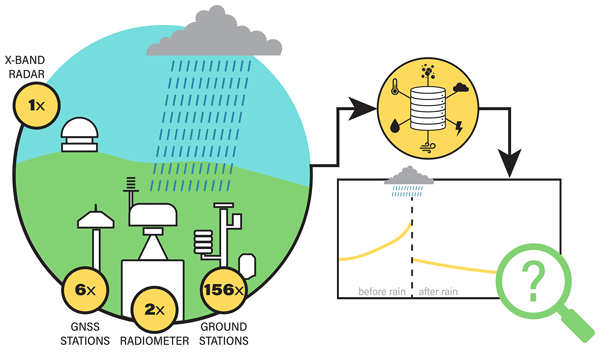
Knowing how moisture and cloud water change before rain helps to understand and predict precipitation. We used four years of ground-based measurements in southeast Austria to follow water vapor, cloud liquid water, and cloud base height during the hours before rain. We found that the column moistens first and the liquid water builds up mainly in the last hour, with clear differences between shower-type and widespread rain. These signals can help to test weather models and their prediction.
Stephanie J. Haas, Andreas Kvas, and Jürgen Fuchsberger
Weather Clim. Dynam., 6, 949–963, https://doi.org/10.5194/wcd-6-949-2025, https://doi.org/10.5194/wcd-6-949-2025, 2025
Short summary
Short summary
In southeast Austria, summer thunderstorms often cause severe damage but are very hard to accurately forecast. With data from the WegenerNet 3D Open-Air Laboratory, we study these storms from beginning to end in multiple atmospheric parameters, like temperature, cloud properties, and wind speed. The characteristic features we find in these parameters expand our understanding of intense storms and can improve their prediction.
Esmail Ghaemi, Andreas Kvas, Ulrich Foelsche, and Pavlos Kollias
EGUsphere, https://doi.org/10.5194/egusphere-2026-4256, https://doi.org/10.5194/egusphere-2026-4256, 2026
This preprint is open for discussion and under review for Atmospheric Chemistry and Physics (ACP).
Short summary
Short summary
Knowing how moisture and cloud water change before rain helps to understand and predict precipitation. We used four years of ground-based measurements in southeast Austria to follow water vapor, cloud liquid water, and cloud base height during the hours before rain. We found that the column moistens first and the liquid water builds up mainly in the last hour, with clear differences between shower-type and widespread rain. These signals can help to test weather models and their prediction.
Stephanie J. Haas, Andreas Kvas, and Jürgen Fuchsberger
Weather Clim. Dynam., 6, 949–963, https://doi.org/10.5194/wcd-6-949-2025, https://doi.org/10.5194/wcd-6-949-2025, 2025
Short summary
Short summary
In southeast Austria, summer thunderstorms often cause severe damage but are very hard to accurately forecast. With data from the WegenerNet 3D Open-Air Laboratory, we study these storms from beginning to end in multiple atmospheric parameters, like temperature, cloud properties, and wind speed. The characteristic features we find in these parameters expand our understanding of intense storms and can improve their prediction.
Irena Nimac, Julia Danzer, and Gottfried Kirchengast
Atmos. Meas. Tech., 18, 265–286, https://doi.org/10.5194/amt-18-265-2025, https://doi.org/10.5194/amt-18-265-2025, 2025
Short summary
Short summary
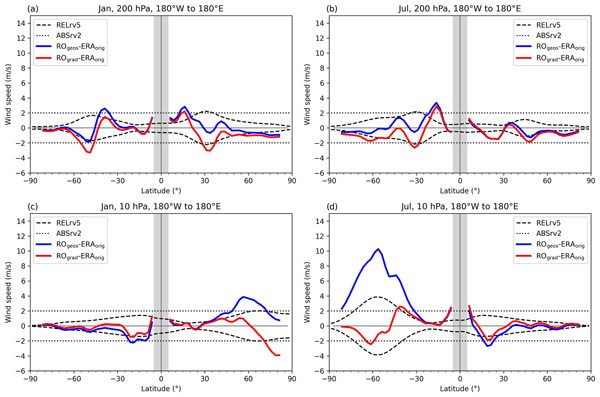
Due to the shortcomings of available observations, having accurate global 3D wind fields remains a challenge. A promising option is radio occultation (RO) satellite data, which enable the derivation of winds based on wind approximations. We test how well RO winds describe the ERA5 winds. We separate the total wind difference into the approximation bias and the systematic difference between the two datasets. The results show the utility of RO winds for climate monitoring and analyses.
Julia Danzer, Magdalena Pieler, and Gottfried Kirchengast
Atmos. Meas. Tech., 17, 4979–4995, https://doi.org/10.5194/amt-17-4979-2024, https://doi.org/10.5194/amt-17-4979-2024, 2024
Short summary
Short summary
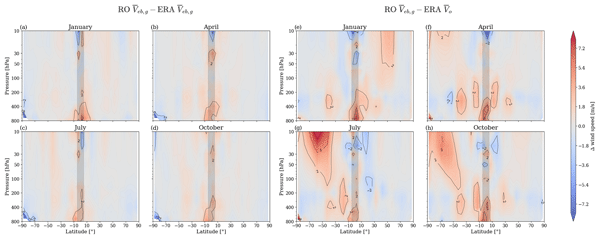
We investigated the potential of radio occultation (RO) data for climate-oriented wind field monitoring, focusing on the equatorial band within ±5° latitude. In this region, the geostrophic balance breaks down, and the equatorial balance approximation takes over. The study encourages the use of RO wind fields for mesoscale climate monitoring for the equatorial region, showing a small improvement in the troposphere when including the meridional wind in the zonal-mean total wind speed.
Josef Innerkofler, Gottfried Kirchengast, Marc Schwärz, Christian Marquardt, and Yago Andres
Atmos. Meas. Tech., 16, 5217–5247, https://doi.org/10.5194/amt-16-5217-2023, https://doi.org/10.5194/amt-16-5217-2023, 2023
Short summary
Short summary
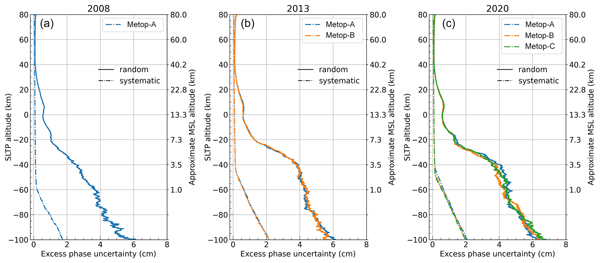
Atmosphere remote sensing using GNSS radio occultation provides a highly valuable basis for atmospheric and climate science. For the highest-quality demands, the Wegener Center set up a rigorous system for processing low-level measurement data. This excess-phase processing setup includes integrated quality control and uncertainty estimation. It was successfully evaluated and inter-compared, ensuring the capability of producing reliable long-term data records for climate applications.
Irena Nimac, Julia Danzer, and Gottfried Kirchengast
Atmos. Meas. Tech. Discuss., https://doi.org/10.5194/amt-2023-100, https://doi.org/10.5194/amt-2023-100, 2023
Revised manuscript not accepted
Short summary
Short summary
As global wind measurements are limited by low spatial coverage or lack of vertical profile information, radio occultation (RO) satellite data might be of help. Wind fields are indirectly retrieved using the geostrophic approximation. We first test how well the method performs, finding agreement better than 2 m/s in wind speed. In a second step, we investigate how good RO and reanalysis data compare. The results suggest that RO-derived wind fields provide added value for climate monitoring.
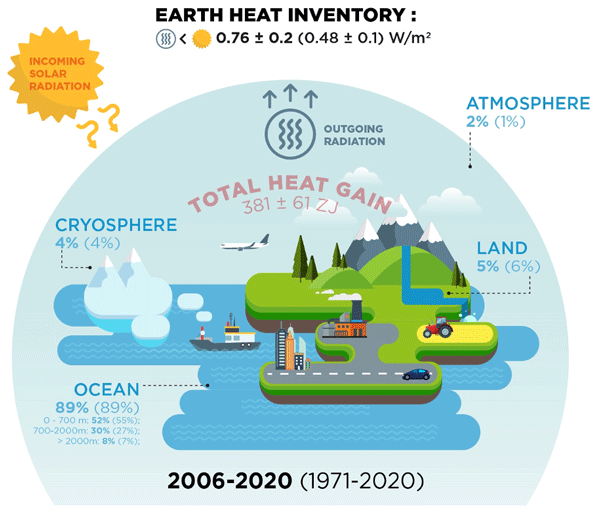
Karina von Schuckmann, Audrey Minière, Flora Gues, Francisco José Cuesta-Valero, Gottfried Kirchengast, Susheel Adusumilli, Fiammetta Straneo, Michaël Ablain, Richard P. Allan, Paul M. Barker, Hugo Beltrami, Alejandro Blazquez, Tim Boyer, Lijing Cheng, John Church, Damien Desbruyeres, Han Dolman, Catia M. Domingues, Almudena García-García, Donata Giglio, John E. Gilson, Maximilian Gorfer, Leopold Haimberger, Maria Z. Hakuba, Stefan Hendricks, Shigeki Hosoda, Gregory C. Johnson, Rachel Killick, Brian King, Nicolas Kolodziejczyk, Anton Korosov, Gerhard Krinner, Mikael Kuusela, Felix W. Landerer, Moritz Langer, Thomas Lavergne, Isobel Lawrence, Yuehua Li, John Lyman, Florence Marti, Ben Marzeion, Michael Mayer, Andrew H. MacDougall, Trevor McDougall, Didier Paolo Monselesan, Jan Nitzbon, Inès Otosaka, Jian Peng, Sarah Purkey, Dean Roemmich, Kanako Sato, Katsunari Sato, Abhishek Savita, Axel Schweiger, Andrew Shepherd, Sonia I. Seneviratne, Leon Simons, Donald A. Slater, Thomas Slater, Andrea K. Steiner, Toshio Suga, Tanguy Szekely, Wim Thiery, Mary-Louise Timmermans, Inne Vanderkelen, Susan E. Wjiffels, Tonghua Wu, and Michael Zemp
Earth Syst. Sci. Data, 15, 1675–1709, https://doi.org/10.5194/essd-15-1675-2023, https://doi.org/10.5194/essd-15-1675-2023, 2023
Short summary
Short summary
Earth's climate is out of energy balance, and this study quantifies how much heat has consequently accumulated over the past decades (ocean: 89 %, land: 6 %, cryosphere: 4 %, atmosphere: 1 %). Since 1971, this accumulated heat reached record values at an increasing pace. The Earth heat inventory provides a comprehensive view on the status and expectation of global warming, and we call for an implementation of this global climate indicator into the Paris Agreement’s Global Stocktake.

Ying Li, Gottfried Kirchengast, Marc Schwaerz, and Yunbin Yuan
Atmos. Chem. Phys., 23, 1259–1284, https://doi.org/10.5194/acp-23-1259-2023, https://doi.org/10.5194/acp-23-1259-2023, 2023
Short summary
Short summary
We develop a new approach to monitor sudden stratospheric warming (SSW) events since 1980 and develop a 42-year SSW event climatology. Detection and evaluation results suggest that the new method is robust for SSW monitoring. We also found an increase in the duration of SSW main-phase warmings of about 5(±2) d over the three decades from the 1980s to the 2010s, raising the average duration from about 10 to 15 d, and the warming strength is also found increased.
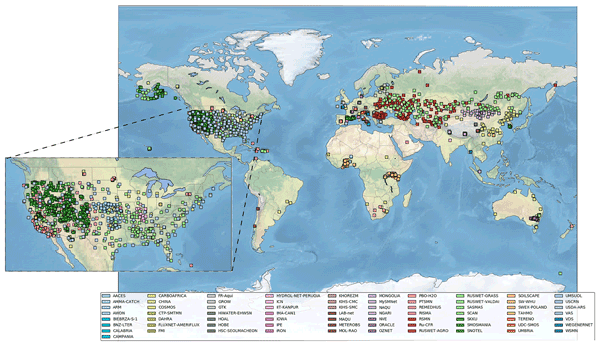
Wouter Dorigo, Irene Himmelbauer, Daniel Aberer, Lukas Schremmer, Ivana Petrakovic, Luca Zappa, Wolfgang Preimesberger, Angelika Xaver, Frank Annor, Jonas Ardö, Dennis Baldocchi, Marco Bitelli, Günter Blöschl, Heye Bogena, Luca Brocca, Jean-Christophe Calvet, J. Julio Camarero, Giorgio Capello, Minha Choi, Michael C. Cosh, Nick van de Giesen, Istvan Hajdu, Jaakko Ikonen, Karsten H. Jensen, Kasturi Devi Kanniah, Ileen de Kat, Gottfried Kirchengast, Pankaj Kumar Rai, Jenni Kyrouac, Kristine Larson, Suxia Liu, Alexander Loew, Mahta Moghaddam, José Martínez Fernández, Cristian Mattar Bader, Renato Morbidelli, Jan P. Musial, Elise Osenga, Michael A. Palecki, Thierry Pellarin, George P. Petropoulos, Isabella Pfeil, Jarrett Powers, Alan Robock, Christoph Rüdiger, Udo Rummel, Michael Strobel, Zhongbo Su, Ryan Sullivan, Torbern Tagesson, Andrej Varlagin, Mariette Vreugdenhil, Jeffrey Walker, Jun Wen, Fred Wenger, Jean Pierre Wigneron, Mel Woods, Kun Yang, Yijian Zeng, Xiang Zhang, Marek Zreda, Stephan Dietrich, Alexander Gruber, Peter van Oevelen, Wolfgang Wagner, Klaus Scipal, Matthias Drusch, and Roberto Sabia
Hydrol. Earth Syst. Sci., 25, 5749–5804, https://doi.org/10.5194/hess-25-5749-2021, https://doi.org/10.5194/hess-25-5749-2021, 2021
Short summary
Short summary
The International Soil Moisture Network (ISMN) is a community-based open-access data portal for soil water measurements taken at the ground and is accessible at https://ismn.earth. Over 1000 scientific publications and thousands of users have made use of the ISMN. The scope of this paper is to inform readers about the data and functionality of the ISMN and to provide a review of the scientific progress facilitated through the ISMN with the scope to shape future research and operations.
Cited articles
Alfieri, L., Claps, P., and Laio, F.: Time-dependent Z–R relationships for estimating rainfall fields from radar measurements, Nat. Hazards Earth Syst. Sci., 10, 149–158, https://doi.org/10.5194/nhess-10-149-2010, 2010. a
Bevis, M., Businger, S., Herring, T. A., Rocken, C., Anthes, R. A., and Ware, R. H.: GPS meteorology: Remote sensing of atmospheric water vapor using the global positioning system, J. Geophys. Res.-Atmos, 97, 15787–15801, https://doi.org/10.1029/92JD01517, 1992. a
Bojinski, S., Verstraete, M., Peterson, T. C., Richter, C., Simmons, A., and Zemp, M.: The Concept of Essential Climate Variables in Support of Climate Research, Applications, and Policy, B. Am. Meteorol. Soc., 95, 1431–1443, https://doi.org/10.1175/BAMS-D-13-00047.1, 2014. a
Brede, B., Thies, B., Bendix, J., and Feister, U.: Spatiotemporal High-Resolution Cloud Mapping with a Ground-Based IR Scanner, Adv. Meteorol., 2017, 6149831, https://doi.org/10.1155/2017/6149831, 2017. a
Brenot, H., Neméghaire, J., Delobbe, L., Clerbaux, N., De Meutter, P., Deckmyn, A., Delcloo, A., Frappez, L., and Van Roozendael, M.: Preliminary signs of the initiation of deep convection by GNSS, Atmos. Chem. Phys., 13, 5425–5449, https://doi.org/10.5194/acp-13-5425-2013, 2013. a
Cortés-Hernández, V. E., Caillaud, C., Bellon, G., Brisson, E., Alias, A., and Lucas-Picher, P.: Evaluation of the convection permitting regional climate model CNRM-AROME on the orographically complex island of Corsica, Clim. Dynam., 62, 4673–4696, https://doi.org/10.1007/s00382-024-07232-z, 2024. a
Crewell, S., Czekala, H., Löhnert, U., Simmer, C., Rose, T., Zimmermann, R., and Zimmermann, R.: Microwave Radiometer for Cloud Carthography: A 22-channel ground-based microwave radiometer for atmospheric research, Radio Sci., 36, 621–638, https://doi.org/10.1029/2000RS002396, 2001. a
Elgered, G., Ning, T., Diamantidis, P.-K., and Nilsson, T.: Assessment of GNSS stations using atmospheric horizontal gradients and microwave radiometry, Global Navigation Satellite Systems: Recent Scientific Advances, 74, 2583–2592, https://doi.org/10.1016/j.asr.2023.05.010, 2024. a
Evaristo, R. M., Xie, X., Trömel, S., and Simmer, C.: A holistic view of precipitation systems from macro- and microscopic perspective, in: 36th Conference on Radar Meteorology, abstract no. 233, 2013. a
Flato, G., Marotzke, J., Abiodun, B., Braconnot, P., Chou, S., Collins, W., Cox, P., Driouech, F., Emori, S., Eyring, V., Forest, C., Gleckler, P., Guilyardi, E., Jakob, C., Kattsov, V., Reason, C., and Rummukainen, M.: Evaluation of Climate Models, in: Climate Change 2013: The Physical Science Basis, Contribution of Working Group I to the Fifth Assessment Report of the Intergovernmental Panel on Climate Change, edited by: Stocker, T., Qin, D., Plattner, G.-K., Tignor, M., Allen, S., Boschung, J., Nauels, A., Xia, Y., Bex, V., and Midgley, P., book section 9, Cambridge University Press, Cambridge, UK and New York, NY, USA, 741–866, ISBN 978-1-107-66182-0, https://doi.org/10.1017/CBO9781107415324.020, 2013. a
Fuchsberger, J. and Kirchengast, G.: Release Notes for Version 8.0 of the WegenerNet Processing System (WPS Level 2 data v8), Release Notes 1, Wegener Center for Climate and Global Change, University of Graz, Graz, https://wegenernet.org/downloads/Fuchsberger-Kirchengast_2023_WPSv8_release_notes-WEGN-TR-1-2023.pdf (last access: 9 January 2025), 2023. a, b
Giordani, A., Kunz, M., Bedka, K. M., Punge, H. J., Paccagnella, T., Pavan, V., Cerenzia, I. M. L., and Di Sabatino, S.: Characterizing hail-prone environments using convection-permitting reanalysis and overshooting top detections over south-central Europe, Nat. Hazards Earth Syst. Sci., 24, 2331–2357, https://doi.org/10.5194/nhess-24-2331-2024, 2024. a
Gubler, S., Hunziker, S., Begert, M., Croci-Maspoli, M., Konzelmann, T., Brönnimann, S., Schwierz, C., Oria, C., and Rosas, G.: The influence of station density on climate data homogenization, Int. J. Climatol., 37, 4670–4683, https://doi.org/10.1002/joc.5114, 2017. a
Guichard, F. and Couvreux, F.: A short review of numerical cloud-resolving models, Tellus A, 69, 1373578, https://doi.org/10.1080/16000870.2017.1373578, 2017. a
Haas, S., Kirchengast, G., and Fuchsberger, J.: Exploring possible climate change amplification of warm-season precipitation extremes in the southeastern Alpine forelands at regional to local scales, J. Hydrol.: Reg. Stud., 56, 101987, https://doi.org/10.1016/j.ejrh.2024.101987, 2024. a
Hassell, D., Gregory, J., Blower, J., Lawrence, B. N., and Taylor, K. E.: A data model of the Climate and Forecast metadata conventions (CF-1.6) with a software implementation (cf-python v2.1), Geosci. Model Dev., 10, 4619–4646, https://doi.org/10.5194/gmd-10-4619-2017, 2017. a
Hiebl, J. and Frei, C.: Daily precipitation grids for Austria since 1961 – development and evaluation of a spatial dataset for hydroclimatic monitoring and modelling, Theor. Appl. Climatol., 132, 327–345, https://doi.org/10.1007/s00704-017-2093-x, 2018. a
Houze, R. A., McMurdie, L. A., Petersen, W. A., Schwaller, M. R., Baccus, W., Lundquist, J. D., Mass, C. F., Nijssen, B., Rutledge, S. A., Hudak, D. R., Tanelli, S., Mace, G. G., Poellot, M. R., Lettenmaier, D. P., Zagrodnik, J. P., Rowe, A. K., DeHart, J. C., Madaus, L. E., Barnes, H. C., and Chandrasekar, V.: The Olympic Mountains Experiment (OLYMPEX), B. Am. Meteorol. Soc., 98, 2167–2188, https://doi.org/10.1175/BAMS-D-16-0182.1, 2017. a
Hulton, F. and Schultz, D. M.: Climatology of large hail in Europe: characteristics of the European Severe Weather Database, Natural Hazards and Earth System Sciences, 24, 1079–1098, https://doi.org/10.5194/nhess-24-1079-2024, 2024. a
Illingworth, A. J., Barker, H. W., Beljaars, A., Ceccaldi, M., Chepfer, H., Clerbaux, N., Cole, J., Delanoë, J., Domenech, C., Donovan, D. P., Fukuda, S., Hirakata, M., Hogan, R. J., Huenerbein, A., Kollias, P., Kubota, T., Nakajima, T., Nakajima, T. Y., Nishizawa, T., Ohno, Y., Okamoto, H., Oki, R., Sato, K., Satoh, M., Shephard, M. W., Velázquez-Blázquez, A., Wandinger, U., Wehr, T., and van Zadelhoff, G.-J.: The EarthCARE Satellite: The Next Step Forward in Global Measurements of Clouds, Aerosols, Precipitation, and Radiation, B. Am. Meteorol. Soc., 96, 1311–1332, https://doi.org/10.1175/BAMS-D-12-00227.1, 2015. a
Jaffrain, J. and Berne, A.: Quantification of the Small-Scale Spatial Structure of the Raindrop Size Distribution from a Network of Disdrometers, J. Appl. Meteorol. Clim., 51, 941–953, https://doi.org/10.1175/JAMC-D-11-0136.1, 2012. a
Jung, T., Ruprecht, E., and Wagner, F.: Determination of Cloud Liquid Water Path over the Oceans from Special Sensor Microwave/Imager (SSM/I) Data Using Neural Networks, J. o Appl. Meteorol., 37, 832–844, https://doi.org/10.1175/1520-0450(1998)037<0832:DOCLWP>2.0.CO;2, 1998. a
Kaspar, F., Müller-Westermeier, G., Penda, E., Mächel, H., Zimmermann, K., Kaiser-Weiss, A., and Deutschländer, T.: Monitoring of climate change in Germany – data, products and services of Germany's National Climate Data Centre, Adv. Sci. Res., 10, 99–106, https://doi.org/10.5194/asr-10-99-2013, 2013. a
Kirchengast, G., Kabas, T., Leuprecht, A., Bichler, C., and Truhetz, H.: WegenerNet: A Pioneering High-Resolution Network for Monitoring Weather and Climate, B. Am. Meteorol. Soc., 95, 227–242, https://doi.org/10.1175/BAMS-D-11-00161.1, 2014. a
Krajewski, W. and Smith, J.: Radar hydrology: rainfall estimation, Adv. in Water Resour., 25, 1387–1394, https://doi.org/10.1016/S0309-1708(02)00062-3, 2002. a
Kvas, A., Fuchsberger, J., Kirchengast, G., and Scheidl, D.: WegenerNet 3D Open-Air Laboratory Level 1b Data, Version 1.0, WegenerNet Data Portal [data set], https://doi.org/10.25364/WEGC/WPS3D-L1B-10, 2024a. a, b, c
Kvas, A., Fuchsberger, J., Kirchengast, G., and Scheidl, D.: WegenerNet 3D Open-Air Laboratory Level 2 Data, Version 1.0, WegenerNet Data Portal [data set], https://doi.org/10.25364/WEGC/WPS3D-L2-10, 2024b. a, b, c
Lasser, M., O, S., and Foelsche, U.: Evaluation of GPM-DPR precipitation estimates with WegenerNet gauge data, Atmos. Meas. Tech., 12, 5055–5070, https://doi.org/10.5194/amt-12-5055-2019, 2019. a, b
Li, X., Dick, G., Ge, M., Heise, S., Wickert, J., and Bender, M.: Real-time GPS sensing of atmospheric water vapor: Precise point positioning with orbit, clock, and phase delay corrections, Geophys. Res. Lett., 41, 3615–3621, https://doi.org/10.1002/2013GL058721, 2014. a
Loew, A., Bell, W., Brocca, L., Bulgin, C. E., Burdanowitz, J., Calbet, X., Donner, R. V., Ghent, D., Gruber, A., Kaminski, T., Kinzel, J., Klepp, C., Lambert, J.-C., Schaepman-Strub, G., Schröder, M., and Verhoelst, T.: Validation practices for satellite-based Earth observation data across communities, Rev. Geophys., 55, 779–817, https://doi.org/10.1002/2017RG000562, 2017. a
Männel, B., Zus, F., Dick, G., Glaser, S., Semmling, M., Balidakis, K., Wickert, J., Maturilli, M., Dahlke, S., and Schuh, H.: GNSS-based water vapor estimation and validation during the MOSAiC expedition, Atmos. Meas. Tech., 14, 5127–5138, https://doi.org/10.5194/amt-14-5127-2021, 2021. a
Nicolai, R. and Simensen, G.: The New EPSG Geodetic Parameter Registry, in: 70th EAGE Conference and Exhibition incorporating SPE EUROPEC 2008, European Association of Geoscientists – Engineers, https://doi.org/10.3997/2214-4609.20147655, 2008. a
Ning, T., Wickert, J., Deng, Z., Heise, S., Dick, G., Vey, S., and Schöne, T.: Homogenized Time Series of the Atmospheric Water Vapor Content Obtained from the GNSS Reprocessed Data, J. Climate, 29, 2443–2456, https://doi.org/10.1175/JCLI-D-15-0158.1, 2016. a
O, S., Foelsche, U., Kirchengast, G., Fuchsberger, J., Tan, J., and Petersen, W. A.: Evaluation of GPM IMERG Early, Late, and Final rainfall estimates using WegenerNet gauge data in southeastern Austria, Hydrol. Earth Syst. Sci., 21, 6559–6572, https://doi.org/10.5194/hess-21-6559-2017, 2017. a
Ochoa-Rodriguez, S., Wang, L.-P., Willems, P., and Onof, C.: A Review of Radar-Rain Gauge Data Merging Methods and Their Potential for Urban Hydrological Applications, Water Resour. Res., 55, 6356–6391, https://doi.org/10.1029/2018WR023332, 2019. a
Pail, R., Kühtreiber, N., Wiesenhofer, B., Hofmann-Wellenhof, B., Of, G., Steinbach, O., Höggerl, N., Imrek, E., Ruess, D., and Ullrich, C.: The Austrian hybrid geoid in the ETRS89 system: Austrian Geoid 2008 (GRS80), GFZ Potsdam, https://doi.org/10.5880/ISG.2008.001, 2008. a, b
Pail, R., Kühtreiber, N., Wiesenhofer, B., Hofmann-Wellenhof, B., Ullrich, C., Höggerl, N., Ruess, D., and Imrek, E.: The official Austrian geoid solution 2008: Data, Method and Results, in: Geophysical Research Abstracts, european Geosciences Union General Assembly 2009: EGU 2009 Conference, 19–24 April 2009, abstract no. EGU2009-2974, 2009. a, b
Peleg, N., Ben-Asher, M., and Morin, E.: Radar subpixel-scale rainfall variability and uncertainty: lessons learned from observations of a dense rain-gauge network, Hydrol. Earth Syst. Sci., 17, 2195–2208, https://doi.org/10.5194/hess-17-2195-2013, 2013. a
Powell, S. W., Houze Jr., R. A., and Brodzik, S. R.: Rainfall-Type Categorization of Radar Echoes Using Polar Coordinate Reflectivity Data, J. Atmos. Ocean. Tech., 33, 523–538, https://doi.org/10.1175/JTECH-D-15-0135.1, 2016. a
Prein, A. F., Langhans, W., Fosser, G., Ferrone, A., Ban, N., Goergen, K., Keller, M., Tölle, M., Gutjahr, O., Feser, F., Brisson, E., Kollet, S., Schmidli, J., van Lipzig, N. P. M., and Leung, R.: A review on regional convection-permitting climate modeling: Demonstrations, prospects, and challenges, Rev. Geophys., 53, 323–361, https://doi.org/10.1002/2014RG000475, 2015. a
Ratynski, M., Khaykin, S., Hauchecorne, A., Wing, R., Cammas, J.-P., Hello, Y., and Keckhut, P.: Validation of Aeolus wind profiles using ground-based lidar and radiosonde observations at Réunion island and the Observatoire de Haute-Provence, Atmos. Meas. Tech., 16, 997–1016, https://doi.org/10.5194/amt-16-997-2023, 2023. a
Rew, R. and Davis, G.: NetCDF: an interface for scientific data access, IEEE Comput. Graph. Appl., 10, 76–82, https://doi.org/10.1109/38.56302, 1990. a
Ryzhkov, A., Zhang, P., Bukovčić, P., Zhang, J., and Cocks, S.: Polarimetric Radar Quantitative Precipitation Estimation. Review, Remote Sens., 14, https://doi.org/10.3390/rs14071695, 2022. a
Schroeer, K., Kirchengast, G., and O, S.: Strong Dependence of Extreme Convective Precipitation Intensities on Gauge Network Density, Geophys. Res. Lett., 45, 8253–8263, https://doi.org/10.1029/2018GL077994, 2018. a
Sen, P. K.: Estimates of the Regression Coefficient Based on Kendall's Tau, J. Am. Stat. Assoc., 63, 1379–1389, https://doi.org/10.1080/01621459.1968.10480934, 1968. a
Smith, S. and Toumi, R.: Measuring Cloud Cover and Brightness Temperature with a Ground-Based Thermal Infrared Camera, J. Appl. Meteorol. Clim., 47, 683–693, https://doi.org/10.1175/2007JAMC1615.1, 2008. a
Spence, T. and Townshend, J.: The Global Climate Observing System (GCOS), in: Long-Term Climate Monitoring by the Global Climate Observing System: International Meeting of Experts, Asheville, North Carolina, USA, edited by: Karl, T. R., Springer Netherlands, Dordrecht, 1–4, ISBN 978-94-011-0323-7, https://doi.org/10.1007/978-94-011-0323-7_1, 1996. a
Straka, J. M., Zrnić, D. S., and Ryzhkov, A. V.: Bulk Hydrometeor Classification and Quantification Using Polarimetric Radar Data: Synthesis of Relations, J. Appl. Meteorol., 39, 1341–1372, https://doi.org/10.1175/1520-0450(2000)039<1341:BHCAQU>2.0.CO;2, 2000. a
Tan, J., Petersen, W. A., Kirchengast, G., Goodrich, D. C., and Wolff, D. B.: Evaluation of Global Precipitation Measurement Rainfall Estimates against Three Dense Gauge Networks, J. Hydrometeorol., 19, 517–532, https://doi.org/10.1175/JHM-D-17-0174.1, 2018. a
Taszarek, M., Allen, J., Púčik, T., Groenemeijer, P., Czernecki, B., Kolendowicz, L., Lagouvardos, K., Kotroni, V., and Schulz, W.: A Climatology of Thunderstorms across Europe from a Synthesis of Multiple Data Sources, J. Climate, 32, 1813–1837, https://doi.org/10.1175/JCLI-D-18-0372.1, 2019. a
Teke, K., Böhm, J., Nilsson, T., Schuh, H., Steigenberger, P., Dach, R., Heinkelmann, R., Willis, P., Haas, R., García-Espada, S., Hobiger, T., Ichikawa, R., and Shimizu, S.: Multi-technique comparison of troposphere zenith delays and gradients during CONT08, J. Geod., 85, 395–413, https://doi.org/10.1007/s00190-010-0434-y, 2011. a
Theil, H.: A Rank-Invariant Method of Linear and Polynomial Regression Analysis, in: Henri Theil's Contributions to Economics and Econometrics: Econometric Theory and Methodology, edited by: Raj, B. and Koerts, J., Springer Netherlands, Dordrecht, 345–381, ISBN 978-94-011-2546-8, https://doi.org/10.1007/978-94-011-2546-8_20, 1992. a
Thyng, K., Greene, C., Hetland, R., Zimmerle, H., and DiMarco, S.: True Colors of Oceanography: Guidelines for Effective and Accurate Colormap Selection, Oceanography, 29, 9–13, https://doi.org/10.5670/oceanog.2016.66, 2016. a, b, c
Van Malderen, R., Pottiaux, E., Klos, A., Domonkos, P., Elias, M., Ning, T., Bock, O., Guijarro, J., Alshawaf, F., Hoseini, M., Quarello, A., Lebarbier, E., Chimani, B., Tornatore, V., Zengin Kazancı, S., and Bogusz, J.: Homogenizing GPS Integrated Water Vapor Time Series: Benchmarking Break Detection Methods on Synthetic Data Sets, Earth Space Sci., 7, e2020EA001 121, https://doi.org/10.1029/2020EA001121, 2020. a
Vautard, R., Kadygrov, N., Iles, C., Boberg, F., Buonomo, E., Bülow, K., Coppola, E., Corre, L., van Meijgaard, E., Nogherotto, R., Sandstad, M., Schwingshackl, C., Somot, S., Aalbers, E., Christensen, O. B., Ciarlo, J. M., Demory, M.-E., Giorgi, F., Jacob, D., Jones, R. G., Keuler, K., Kjellström, E., Lenderink, G., Levavasseur, G., Nikulin, G., Sillmann, J., Solidoro, C., Sørland, S. L., Steger, C., Teichmann, C., Warrach-Sagi, K., and Wulfmeyer, V.: Evaluation of the Large EURO-CORDEX Regional Climate Model Ensemble, J. Geophys. Res.-Atmos., 126, e2019JD032344, https://doi.org/10.1029/2019JD032344, 2021. a
Wang, W., Murk, A., Sauvageat, E., Fan, W., Dätwyler, C., Hervo, M., Haefele, A., and Hocke, K.: An Indoor Microwave Radiometer for Measurement of Tropospheric Water, IEEE T. Geosci. Remote, 61, 1–13, https://doi.org/10.1109/TGRS.2023.3261067, 2023. a
Ware, R., Cimini, D., Herzegh, P., Marzano, F., Vivekanandan, J., and Westwater, E.: Ground-based microwave radiometer measurements during precipitation, in: 8th Specialst Meeting on Microwave Radiometry, Rome, Italy, https://radiometrics.com/wp-content/uploads/2021/10/ware_microrad04.pdf (last access: 9 February 2026), 2004. a
Watters, D. C., Gatlin, P. N., Bolvin, D. T., Huffman, G. J., Joyce, R., Kirstetter, P., Nelkin, E. J., Ringerud, S., Tan, J., Wang, J., and Wolff, D.: Oceanic Validation of IMERG-GMI Version 6 Precipitation Using the GPM Validation Network, J. Hydrometeorol., 25, 125–142, https://doi.org/10.1175/JHM-D-23-0134.1, 2024. a
Wilgan, K., Dick, G., Zus, F., and Wickert, J.: Towards operational multi-GNSS tropospheric products at GFZ Potsdam, Atmos. Meas. Tech., 15, 21–39, https://doi.org/10.5194/amt-15-21-2022, 2022. a
Wood, S. J., Jones, D. A., and Moore, R. J.: Static and dynamic calibration of radar data for hydrological use, Hydrol. Earth Syst. Sci., 4, 545–554, https://doi.org/10.5194/hess-4-545-2000, 2000. a
World Meteorological Organization (WMO), United Nations Environment Programme (UNEP), International Science Council (ISC), and Intergovernmental Oceanographic Commission of the United Nations Educational, Scientific and Cultural Organization (IOC-UNESCO): The 2022 GCOS ECVs Requirements (GCOS 245), Tech. rep., WMO – World Meteorological Organization, https://library.wmo.int/idurl/4/58111 (last access: 9 January 2026), 2022. a
Zeng, Y., Su, Z., Calvet, J.-C., Manninen, T., Swinnen, E., Schulz, J., Roebeling, R., Poli, P., Tan, D., Riihelä, A., Tanis, C.-M., Arslan, A.-N., Obregon, A., Kaiser-Weiss, A., John, V., Timmermans, W., Timmermans, J., Kaspar, F., Gregow, H., Barbu, A.-L., Fairbairn, D., Gelati, E., and Meurey, C.: Analysis of current validation practices in Europe for space-based climate data records of essential climate variables, Int. J. Appl. Earth Obs. Geoinf., 42, 150–161, https://doi.org/10.1016/j.jag.2015.06.006, 2015. a
Zrnić, D. S., Ryzhkov, A., Straka, J., Liu, Y., and Vivekanandan, J.: Testing a Procedure for Automatic Classification of Hydrometeor Types, J. Atmos. Ocean. Tech., 18, 892–913, https://doi.org/10.1175/1520-0426(2001)018<0892:TAPFAC>2.0.CO;2, 2001. a
Short summary
The WegenerNet 3D Open-Air Laboratory for Climate Change Research in southeastern Austria observes the atmosphere from the surface up to an altitude of 10 km. A variety of different sensors measure precipitation, water vapor content, humidity, temperature, and cloud properties in high spatial and temporal resolution. This enables detailed analyses of weather phenomena in a changing climate, such as heavy rainfall events and thunderstorms.
The WegenerNet 3D Open-Air Laboratory for Climate Change Research in southeastern Austria...


Altmetrics
Final-revised paper
Preprint