the Creative Commons Attribution 4.0 License.
the Creative Commons Attribution 4.0 License.
 | 20 Nov 2026
SISAL_monv1: a global database of cave monitoring observations

Yining Zang
Péter Tanos
Zoltan Kern
Andy Baker
Andreas Hartmann
Franziska A. Lechleitner
Bryce Belanger
Bruna Daudt de Oliveira
Will Sinclair
Dana F. C. Riechelmann
András Hidas
Kei Yoshimura
Laia Comas-Bru
Cave monitoring is the process of collecting observational data such as microclimate conditions, hydrogeochemistry and water movement in cave systems. The most common motivation is for speleothem science – the reconstruction of past climate and environmental variability from cave formations such as stalagmites. Applications also include the monitoring of potential recharge to aquifers, as well as cave conservation. PAGES-SISAL (Past Global Changes – Speleothem Isotope Synthesis and AnaLysis), an international working group focused on speleothem science, has created a new global database of cave monitoring data consisting of drip rates and drip water isotopes, and the modern carbonate precipitates that form from these drip waters (so called farmed carbonates, grown on artificial substrates). Moreover, we report meteoric precipitation amounts and water isotopes at or near to cave sites. The database is available at https://doi.org/10.5158/ARP/29W5J3 (Treble et al., 2026). Access to the database is also supported via the SISAL webApp at http://geochem.hu/SISAL_webApp (last access: 12 November 2026). The database contains datasets from 75 caves, with summary information including meta-data on location, elevation, cave depth, lithology, measurement methods and citations for original publications. Speleothem records previously curated by SISAL in SISAL speleothem database versions and corresponding to monitored drip sites are also identified in the new SISAL monitoring database. To supplement observational data gaps and provide accessible and consistent climate data for users, surface climate (precipitation, evaporation, temperature) and meteoric water isotope data extracted from global climate model products are also included in the database.
- Article
(3003 KB) - Full-text XML
-
Supplement
(1033 KB) - BibTeX
- EndNote


1.1 Background
Speleothems are secondary carbonate formations, such as stalagmites or flowstones, that form from the precipitation of calcium carbonate from drip water in caves in carbonate host rocks. Precise and accurate chronologies can be constructed for their growth intervals, while the stable isotopes of oxygen (δ18O) and carbon (δ13C) as well as trace elements, can be readily measured. These geochemical data reflect the hydrochemistry of the parent drip water at the time of mineralisation (accounting for aqueous to solid phase isotopic fractionation factors) (e.g. Mattey et al., 2008; Pérez-Mejías et al., 2018) that can be related to past climatic conditions at the cave site. Hence speleothem records are considered powerful archives of past climate information (e.g. Cheng et al., 2016; Moseley et al., 2021).
Cave monitoring is the process of collecting data on cave systems, typically to understand hydrochemical and gas fluxes from the surface to the cave and their response to climatic and environmental forcing (Fairchild and Baker, 2012). The interpretation of speleothem proxies can be site specific, owing to local climate, vegetation, soil, host rock lithology and cave depth. The source of cave drip water is infiltration from meteoric precipitation (rainfall and/or snowmelt). The meteoric precipitation isotopic values may be generalised from isoscapes (Bowen and Wilkinson, 2002; Terzer-Wassmuth et al., 2021) or simulated using isotope-enabled Earth System models (Haese et al., 2013; Brady et al., 2019). However, regional and local atmospheric circulation as well as altitude and distance from the coast, also influence the meteoric precipitation isotopic values. Hence local monitoring of the meteoric precipitation isotopes at the cave site is also often conducted and necessary for a robust interpretation of speleothem isotope records (e.g. Riechelmann et al., 2017; Zhang et al., 2025). The drip water oxygen isotopic value relative to the rainfall δ18O value depends on recharge thresholds and infiltration flow path properties (i.e., antecedent soil moisture, karst water residence times, preferential/fast versus diffuse/slow flow, mixing, attenuation, partial re-evaporation; Bradley et al., 2010).
SISAL is an international working group of the Past Global Changes (PAGES) project (https://pastglobalchanges.org/sisal, last access: 12 November 2026) that is currently in Phase III (Hatvani et al., 2025). The first two phases focused on compiling speleothem data into a global databases to be used for paleoclimate and data-model comparison studies (Atsawawaranunt et al., 2018; Comas-Bru et al., 2020, 2019; Kaushal et al., 2024). Studies have used the SISAL speleothem database, currently SISALv3, to produce synthesis papers on regional speleothem-based paleoclimate interpretations (e.g., Burstyn et al., 2019; Lorrey et al., 2020); for data-model comparisons (Comas Bru et al., 2019; Parker et al., 2021; Bühler et al., 2021) and proxy evaluations (Treble et al., 2022; Skiba and Fohlmeister, 2023; Fohlmeister et al., 2020).
The SISAL community have created a new database (SISAL_monv1) of cave monitoring datasets to further support the goals of SISAL, i.e., to: (i) increase accessibility and sharing of data; (ii) enable data-model comparisons; and (iii) constrain and/or quantify hydroclimate and hydrogeochemical processes related to speleothem and cave science. In addition to speleothem science, cave monitoring also has applications, for example, the monitoring of cave climate to preserve cultural artefacts (Bourges et al., 2014), and the monitoring of water movement through the vadose zone as an indicator of potential rainfall recharge to groundwater aquifers (Poulain et al., 2018) or supporting the protection of the cave environment (Cigna, 2016).
1.2 Potential applications
Monitoring cave drip waters for speleothem science began more than 50 years ago (e.g., Holland et al., 1963). The number of cave monitoring datasets has risen since and this has permitted the compilation of cave monitoring data and site metadata into global datasets (Baker et al., 2019; Treble et al., 2022). This elevates the utility of these datasets from informing studies at a particular location to informing studies on a regional or global scale. Potential applications of global compilations of cave monitoring data are to:
-
Highlight the dominant controls on drip water hydrochemistry and speleothems (Feng et al., 2012; Duan et al., 2016b), and identify, for example, climatic forcing versus local factors (Zhang et al., 2025).
-
Provide baseline data to inform repeat future measurements of cave data to assess long-term changes, e.g., responses to fire, land-use or climate change (Wong and Banner, 2010).
-
Broaden the comparison of SISALv3 speleothem oxygen isotope data with monitoring data at sites overlapping (or in close proximity) to assist with local studies and better understand isotopic fractionation processes during carbonate precipitation in natural caves.
-
Enable global and regional meta-analyses of the isotopic relationships between meteoric precipitation to drip water (Baker et al., 2019), and the drip water to farmed carbonates.
-
Constrain laboratory experiments (Wiedner et al., 2008) and/or theoretical models of carbonate precipitation (Dreybrodt and Romanov, 2016) by providing farmed carbonate data grown under field conditions for comparison.
-
Improve isoscapes by increasing the spatial coverage of precipitation water isotope monitored sites (Falster et al., 2026).
-
Assist with data-model comparisons. Monitoring data can guide the level of complexity needed for proxy system forward models (Hu et al., 2021). This may be particularly important for global initiatives as models built and parameterised for a specific site may not be useful or practical when applied at a global scale.
-
Calibrate groundwater recharge models (Baker et al., 2024).
2.1 Data types
The website https://cavemonitoringgroup.wordpress.com/ (last access: 12 November 2026) contains meta-data on cave monitoring studies. This information was used as a starting point to identify monitored cave sites as well as identify the types of observations being made. The metadata mainly include the locations of caves, the variables being monitored, the length of time for which these variables have been monitored, and contact information. From this dataset (accessed 27 August 2026), we identified a total of 154 cave sites that have been monitored, of which 97 cave sites have drip water oxygen isotope measurements, 62 cave sites have meteoric precipitation oxygen isotope measurements and 62 cave sites have modern carbonate measurements. This information was recorded in a spreadsheet (Table S1 in the Supplement) and confirmed that the most commonly measured variables were: precipitation δ18O and δ2H from above/nearby the cave, cave temperature, drip rate, cave drip δ18O and δ2H. Table S1 lists many other types of observations that can capture a range of processes in the cave and its vicinity, and that were considered for inclusion in SISAL_monv1. However, after consultation and discussion with researchers in the SISAL community, it was decided to commit to compiling the following data:
-
Precipitation amount, precipitation δ18O and δ2H from above/nearby the cave;
-
Cave drip water δ18O, δ2H and drip rate;
-
Carbonate δ18O and δ13C of modern carbonates grown on substrates in cave experiments and/or active speleothem growth from monitored drips.
The consideration of the types of monitoring data to include was driven by the likely scientific value of the data in a global database, their ubiquity and also pragmatism. Speleothem δ18O are the most common proxy measured in speleothems and drip water stable isotopes are the most commonly measured drip water monitoring variable (Table S1). Drip water stable isotopes and drip rate are also the primary variables for tracing water movement through the karst and ultimately are the basis for the climate proxy-speleothem relationship (Duan et al., 2016). Modern carbonates were also considered valuable for inclusion, also due to their relevance for the climate proxy-speleothem relationship (e.g, Tremaine et al., 2011; Riechelmann et al., 2013). Furthermore, the methods for the collection of drip water and carbonate isotopic data are relatively consistent across the community hence the precision and accuracy of these methods are generally well-understood. Similarly for meteoric precipitation amount and drip rate. However, this is not the case for many other observations, e.g., soil moisture, cave atmosphere parameters, etc., for which methods, hence precision and accuracy of such measurements, as well as the temporal resolution of their sampling, vary considerably. These data would have required greater amounts of pre-processing efforts to homogenise input to the database in order to be used for paleoclimate and data-model comparison studies.
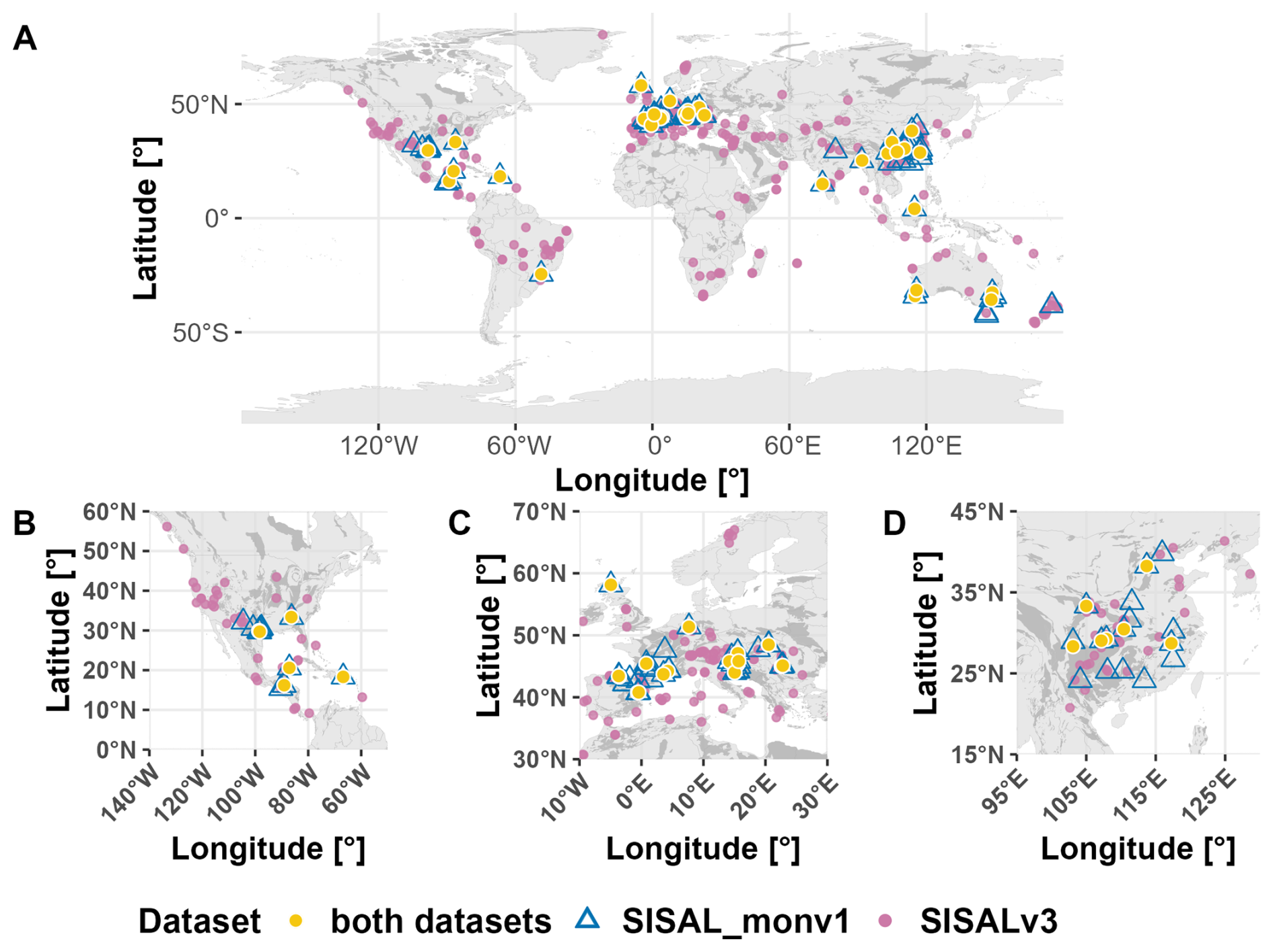
Figure 1Global map of cave locations in SISAL_monv1 (SISAL cave monitoring database records) and SISALv3 (SISAL speleothem database records). Legend key distinguishes the sites as SISAL_monv1 data only, SISALv3 data only, or caves with both speleothem and monitoring datasets. Karst areas are shaded in darker grey and were extracted from the World Karst Aquifer Map (WOKAM, Goldscheider et al., 2020).
2.2 Data collection
Using the initial survey as a starting point, a literature search for published papers and research theses containing these data was conducted. The literature search was then expanded to identify other published studies not listed on our initial survey. Corresponding authors were contacted, as well as a general call to our networks for data contribution. Corresponding authors were asked to supply data and these were transferred to a standardised workbook template by SISAL_monv1 working group members. If data were available as tables in papers or electronic attachments, these were input into the workbooks. In some cases where the original data were not readily available, authors consented to data being digitised from original publications. Additional information was compiled from publications, or direct communication with data contributors. Following Quality Checks (see Sect. 2.4) workbooks were shared with corresponding authors for approval and consent.
All of the records in SISAL_monv1 are given in Table 1. Listed are the data contained for each cave and whether speleothem entities in SISAL are also common to the cave. Spatial distribution is visualized on a global map (Fig. 1). Overall, there are 75 cave sites in SISAL_monv1 with 40 of these (53 %) in common with entities (speleothem records) in SISALv3. An outline of the database structure and fields, the data and meta-data contained within these are presented in Sect. 2.3. The quality control (QC) process is outlined in Sect. 2.4. See also the ReadMe file accompanying the database.
Table 1List of all sites in the SISAL_monv1 database. Latitude and longitude are given in decimal degrees; measurements are primary data compiled for SISAL_monv1 (* indicates data digitised from original publications with consent from the corresponding author). Precip_amount is meteoric precipitation amount, precip_δ18O and/or d2H are meteoric precipitation water isotopes, drip_rate is cave drip rate, drip_iso is drip water δ18O and/or δ2H, mod_carb is modern carbonate. Speleothem entity (Y/N/unknown) indicates if speleothem records from the same cave are in the SISALv3 database. The “Measurements” column indicates the presence of numeric values in the SISAL_monv1 database for a given site. The metadata tables in the database reflect all measurements that have been made by researchers rather than all measurements that are available in SISAL_monv1 database itself.

2.3 Description of database structure and fields
The structure of the SISAL_monv1 database follows the well-established logic of the original SISAL speleothem databases (Atsawawaranunt et al., 2018; Comas-Bru et al., 2020; Kaushal et al., 2024). The data are stored in a relational database (MySQL), which consists of 15 linked tables, specifically cave_entity, drip_entity, drip_iso_sample, drip_rate_sample, entity_link_reference, site_link_precip, site_link_reference, mod_carb_sample, precip_sample, precip_entity, precip_site, p_t_pet_aet, reference, site and notes (Fig. 2). A description of the structure and content of each of the tables is given below.
-
site: provides information about the cave site. It provides the site_name, geographic coordinates (latitude and longitude in decimal degrees, and elevation in meters above sea level). If a site is included in both SISAL_monv1 and SISALv3, then the same site_id is used for both databases.
-
reference: contains the DOI and bibliographic details of the original publication(s) with source information on the monitoring data, descriptions, literature, reports, and datasets related to the cave monitoring dataset.
-
notes: is a flexible sheet for recording observations, comments, or additional details not captured in other structured fields. This allows for contextual or qualitative information to be included, such as field notes, anomalies, or unresolved questions.
-
p_t_pet_aet: includes monthly gridded climate variables at each cave site, derived from global models. These include precipitation from MSWEP, air temperature from ERA5, actual and potential evapotranspiration (AET and PET), and the stable isotopes of precipitation (δ18O and δ2H) from the IsoGSM model.
-
precip_site: contains metadata specific to the precipitation monitoring sites (precip_site_name) including geographic coordinates (precip_latitude and precip_longitude) and elevation (precip_elevation). It establishes the context for interpreting precipitation measurements.
-
precip_entity: provides the name of the precipitation dataset, same name as in precip_site sheet, the monitoring methods, and the name of the person filling in this workbook.
-
precip_sample: lists the actual precipitation data, including isotopic measurements δ18O and δ2H with precision values, precipitation amount, and timing of sample collection (start and end date/time).
-
cave_entity: provides information on the availability, frequency, instrumentation of cave_temperature, cave_relative_humidity and cave_pCO2 measurements for each cave_entity, as well as the name of the person filling in this workbook. These meta-data were included to direct the user to the original publications for these data.
-
drip_entity: provides information on the availability of data describing drip rates (drip_rate), isotopic measurements (drip_iso), modern carbonate (mod_carb) from the dripping waters with data on the instrumentation, analytical methodology and frequency of sample collection. The entity_id of any speleothem record currently in SISALv3 that corresponds to a drip entity is given. The table also includes metadata such as geology, rock age, free-text regarding a description of the drip site or each cave_entity, as well as the name of the person filling in this workbook.
-
drip_iso_sample: lists the actual dripping waters sample data, including isotopic measurements δ18O and δ2H with precision values, the period of time for which the drip water sample was collected (drip_iso_accumulation_time) and its unit (drip_iso_accumulation_unit), and timing of sample collection (start and end date/time).
-
drip_rate_sample: documents the drip rate (drip_rate_measurement) with precision values, drip rate accumulation time (drip_rate_accumulation_time) and its unit (drip_rate_accumulation_unit), and timing of sample collection (start and end date/time). The values in drip_rate_measurement are in drips per minute. If data were originally contributed as drip volume, these were converted to drips per minute and the conversion is reported in the notes sheet. The conversion was performed either by using the site drip volume if reported in the original source or otherwise an assumed drip volume of 0.2 mL was applied. Collister and Mattey (2008) show that drip volume can vary as a function of stalactite width, morphology, drip interval, drip height, although it was not possible nor practical to account for these factors so a uniform conversion was applied. This conversion is common in the reported Methods of drip monitoring studies, e.g., Surić et al. (2017).
-
mod_carb_sample: lists the isotopic measurements δ18O and δ13C from modern carbonate with precision values, modern carbonate accumulation time (mod_carb_accumulation_time) and its unit (mod_carb_accumulation_unit), and timing of sample collection (start and end date/time). In addition, it provides information on the surface substrate (mod_carb_surface) and mineralogy of modern carbonate growth (mod_carb_mineralogy). Here modern carbonates refer to so called “farmed” carbonates grown on substrates during an in cave experiment and further details on these and other data types are given in Sect. 2.3. It does not include modern speleothem entities which appear in SISALv3 and are now linked by entity ID in SISAL_monv1.
-
junction tables: lists the link between the named tables, site_link_precip, site_link_reference, entity_link_reference tables.
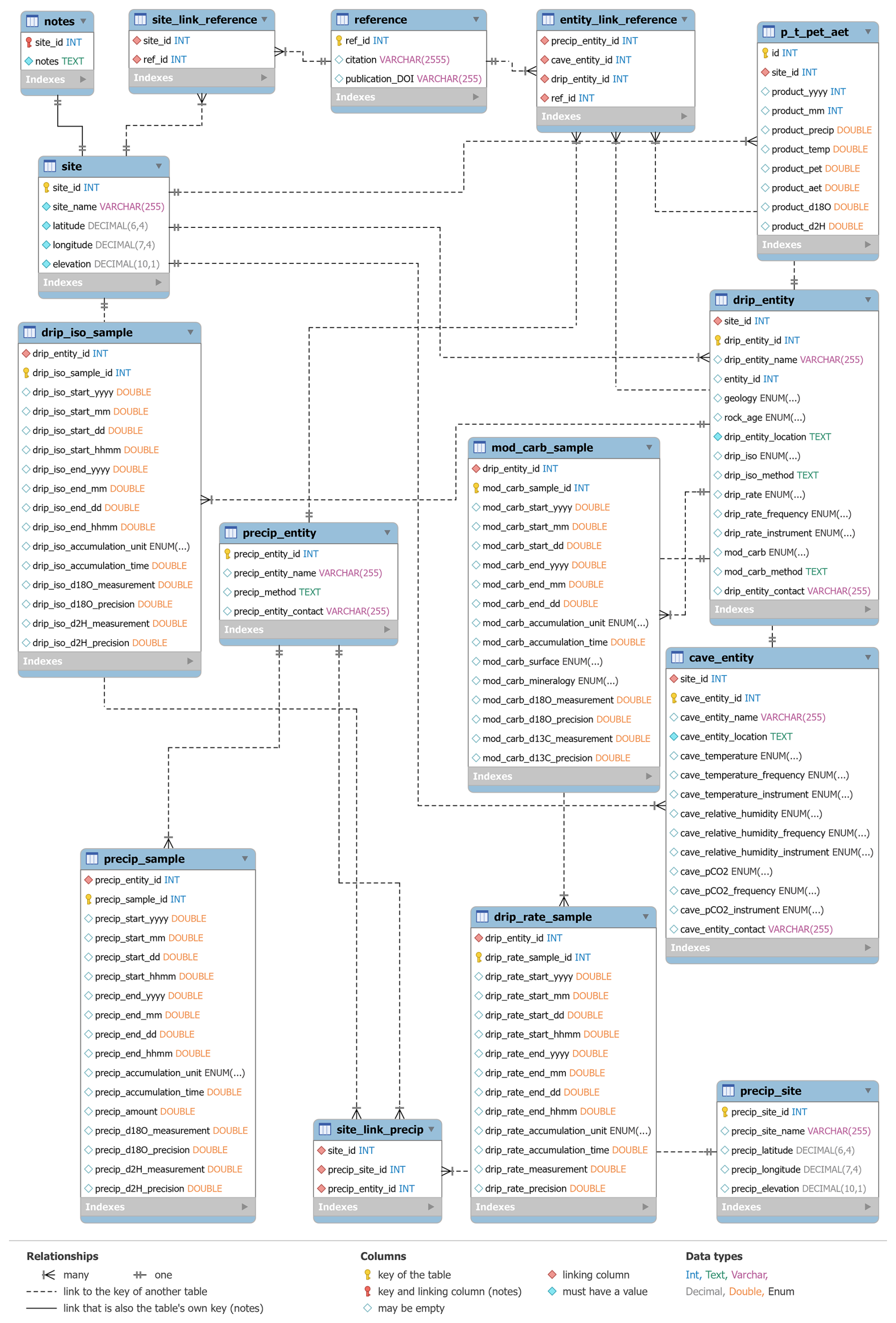
Figure 2The structure of the SISAL_monv1 database showing individual tables (and their contents) and the nature of the relationships between them where “many to one linkages” indicate that it is possible to have several entries in one table linked to a single entry in another table. The colours refer to the format of that field: Enum, Int, Varchar, Double or Decimal.
2.4 Quality control
An automated quality control procedure was developed and scripted in R (R Core Team, 2024) and is summarised below (see also the Supplement). The quality control procedure were performed on the cave monitoring datasets to ensure data integrity and consistency across the Excel worksheets containing the information for individual sites.
General metadata checks included verifying that site names were unique and uniform across the worksheets, ensuring that latitude and longitude values fell within valid ranges, and confirming that elevation data consisted of numeric entries in all site metadata tables (site, precip_site). Next, the references were validated and checks were done for proper formatting, no duplicates and presence of proper doi-s and at least one reference. Quality control in the entity metadata tables (precip_entity, cave_entity, drip_entity) included verification that drop-down menu cells were filled in with predefined options.
Sample tables (precip_sample, drip_iso_sample, drip_rate_sample, mod_carb_sample) were uniformly checked that dates were correctly formatted and fell within a logical range and the measurements and corresponding precision values fell within plausible ranges. It was verified in all tables that all the drop-down menu cells were filled in with predefined options. In the precip_sample worksheet additional checks were performed ensuring precip_amount and precip_accumulation_time are numeric.
Consistency checks were conducted across tables to ensure that all site names listed in the metadata were also present in related sample sheets and that entities in dependent tables, such as drip or cave data, correspond correctly to the sites they referenced. The script also identified missing or null values in critical columns across all tables, flagging incomplete rows for manual review. The results of these checks were summarized in a pass/fail format for each table, highlighting areas that required attention before further analysis. A series of plots were generated for visual inspection and to identify data entry errors across various tables. Spatial coordinates for “site” and “precip_site” were displayed on a map to verify geographic accuracy. Temporal relationships were explored through scatter and bar plots, with specific variables plotted against date and time ranges. Precipitation-related data, including “precip_amount” versus “precip_accumulation_time” and isotopic measurements (e.g., “precip_d18O_measurement” and “precip_d2H_measurement”), were examined for consistency in units and values. Similar scatter and bar plots were used for cave and drip data, including isotopic and drip rate measurements such as “drip_iso_d18O”, “drip_iso_d2H”, “drip_rate_measurement”, “mod_carb_d18O” and “mod_carb_d13C”. These plots effectively highlighted anomalies, such as mismatched units, implausible numeric values, or incorrect date-time entries, across all data types, enabling targeted corrections.
Flags raised by the automated quality control procedure were followed by manual checks by the database team and contributing authors. As a final step, during database compilation water isotope data were trimmed to two decimal places, and drip rate data to two significant figures (or three significant figures for values in the hundreds). Nevertheless, users should be guided by the precision reported in the data source (also listed in the precision column if reported).
2.5 Synthesized climate and precipitation isotope data
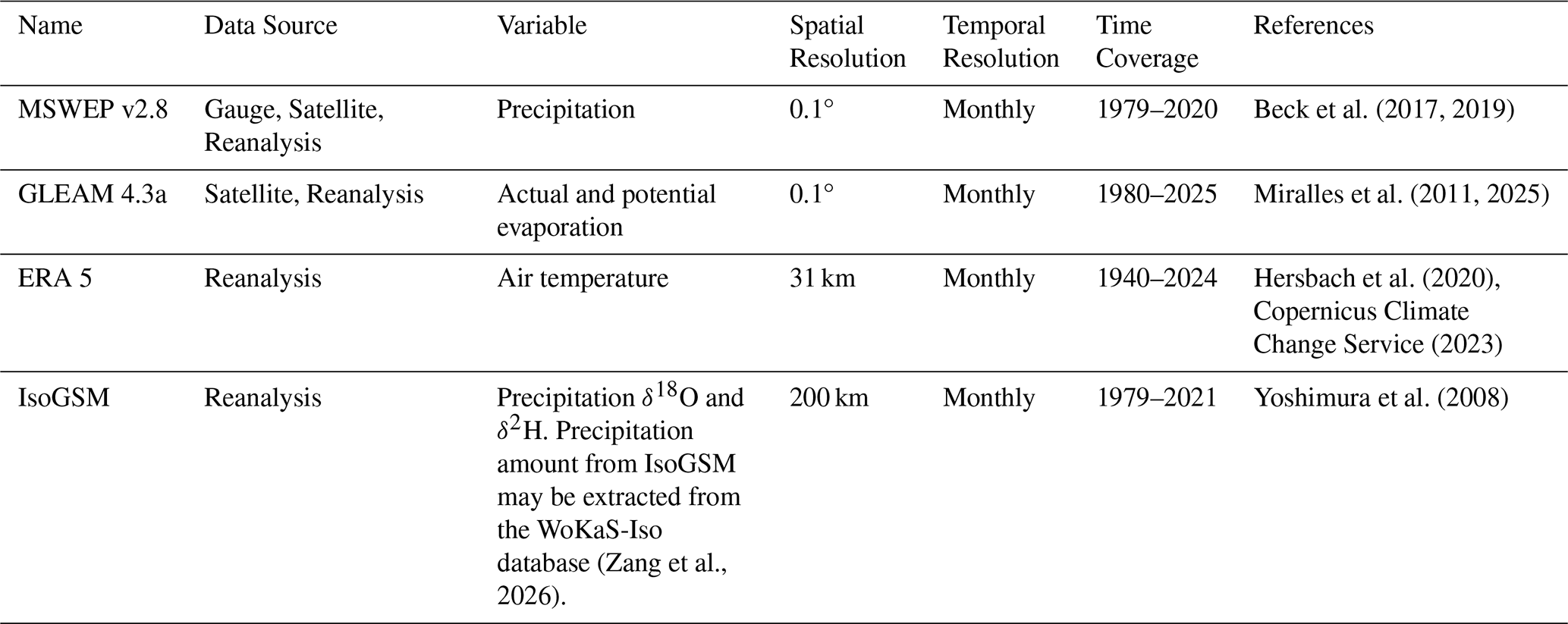
The SISAL_monv1 database provides monthly climate and precipitation-isotope inputs for each cave entity from four global products (Table 2): MSWEP v2.8 (precipitation), GLEAM 4.3a (actual and potential evaporation), ERA5 (air temperature), and IsoGSM (precipitation water isotopes, δ18O and δ2H).
The preparation of these datasets for all cave monitoring sites and evaluation of the IsoGSM precipitation-isotope datasets against alternative isotope products were carried out by Zang et al. (2026) when preparing their global dataset for karst system characterisation and modeling (WoKaS-Iso). There, local observations of precipitation isotopic compositions at selected cave sites and karst springs were used to benchmark multiple isotope products. Based on performance across 55 sites (lowest median RMSE and highest median R2), IsoGSM was identified as the most reliable product. Users are referred to Zang et al. (2026) for full methodological detail.
Although the original temporal resolutions of the selected products vary (hourly to daily), all variables are provided at monthly resolution to align with the cadence of most cave monitoring datasets and to facilitate cross-site comparison. The period of coverage of the extracted data matches the length available in the global product dataset (listed in Table 2) and data were extracted using the cave site co-ordinates (“site” in Sect. 2.3). Precipitation is obtained from MSWEP v2.8 (0.1°, 1979–2020), a gauge–satellite–reanalysis blend (Beck et al., 2017, 2019). Evaporation is derived from GLEAM 4.3a (0.1°, 1980–2025), providing actual and potential evaporation derived from satellite/reanalysis (Miralles et al., 2011; Martens et al., 2017; Miralles et al., 2025). ERA5 provided air temperature (∼ 31 km, 1940–2024) (Hersbach et al., 2020; Copernicus Climate Change Service, 2023). As stated above, precipitation water isotopes are from IsoGSM (∼ 200 km, 1979–2021) and represent precipitation-weighted means (Yoshimura et al., 2008; Zang et al., 2026). All products were extracted at the grid cell nearest to each cave site, without elevation or lapse-rate adjustment. For the two sites whose nearest cell falls outside that product's land mask, values were taken from the nearest valid land cell. Together, these gridded products provide consistent, gap-filling inputs where cave-site observations are unavailable; key spatial and temporal characteristics are summarized in Table 2.
Table 2Summary of global products for precipitation, evaporation, air temperature and precipitation isotopes.
The SISAL_monv1 is a standardised, quality-checked global database of surface meteoric precipitation amount and water isotopes at or near to cave sites, as well as the drip rates and water isotopes of drip waters and the modern carbonates that form from these drip water. Metadata including cave site location, elevation, cave depth, lithology, location of drip entities within the cave and links to original source publication are provided. Cave site identification codes, site names and latitude-longitude data for caves that appear in SISALv3 were carried into SISAL_monv1 in order to easily identify if monitoring data and speleothem records are from the same cave. Furthermore, if a drip entity corresponds to a speleothem entity, these are also identified in SISAL_monv1. Thus the creation of SISAL_monv1 greatly improves the identification and accessibility of the extent of data types available at cave sites. This will enable and enhance future studies using data from cave systems.
Figure 3 shows the number of SISAL_monv1 sites by region and by the generalized climate classification scheme for Global-Aridity values (UNEP, 1997). The highest number of monitored cave sites in SISAL_monv1 database are from Europe and Asia, followed by North and Central America, with the least in the South American regions. Drip water isotopes are the most common measurement in the database. By climate classification, monitored sites are dominated by humid regions. This representation in the database likely reflects relative accessibility to sites and also water availability for long-term monitoring.
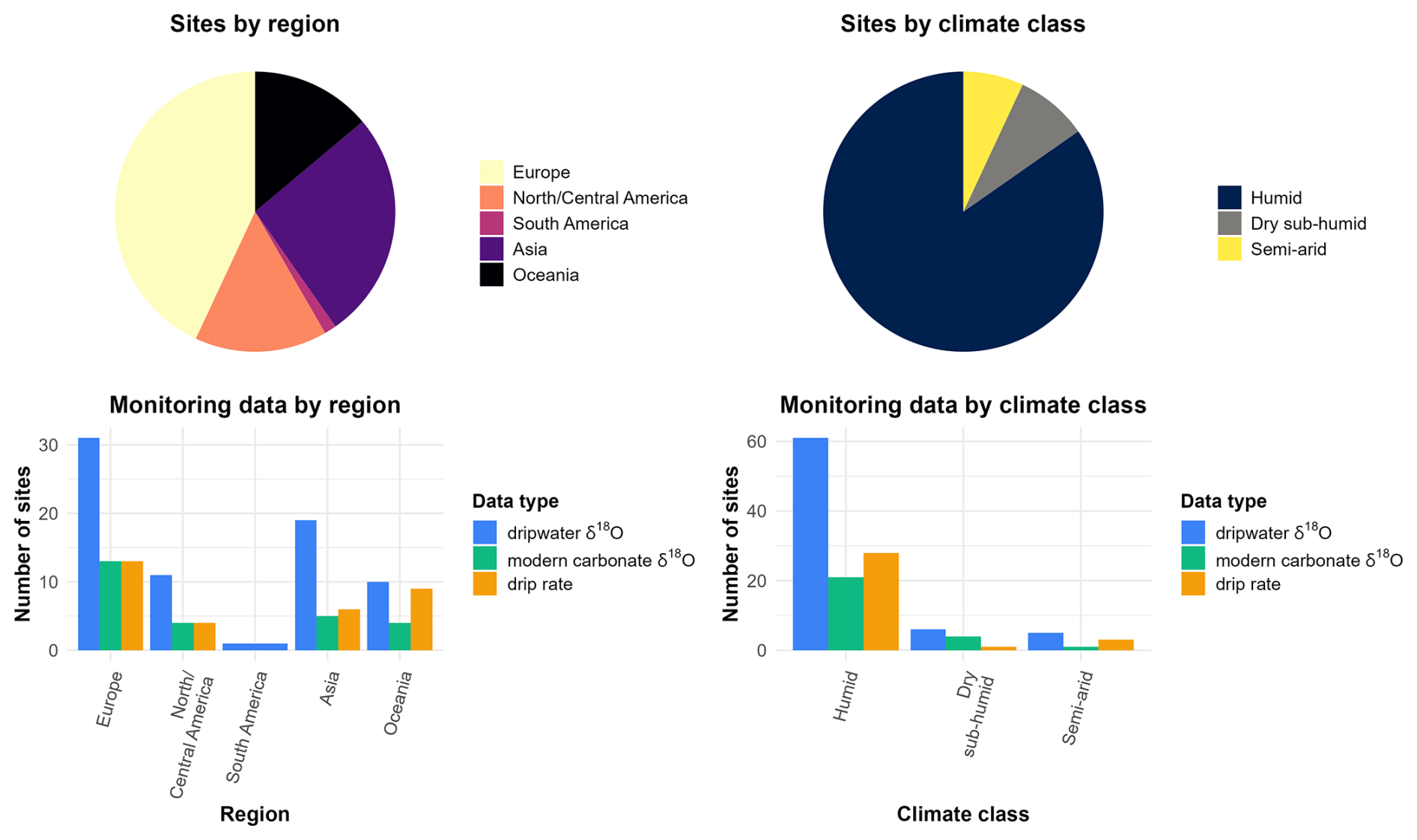
Figure 3Number of SISAL_monv1 sites by region (left column), and by the generalized climate classification scheme for Global-Aridity values (UNEP, 1997) (right column). The numbers reflect the sites with numeric values for a given variable in SISAL_monv1. No sites were in arid or hyper-arid classes.
More than half (53 %) of the sites appearing in the SISAL_monv1 database also have speleothem data in the SISALv3 database. If considering a wider proximity, 64 % SISAL_monv1 sites are within 25 km of a SISALv3 site, and 68 % are within 50 km. Depending on the location, these monitoring sites may be sufficiently close in proximity that they may be representative of the SISALv3 sites. For speleothem science, the access to monitoring and speleothem data from the same or nearby drip sites, or karst areas, will enable further refinement of the interpretation of the speleothem record. Previously, these data may have appeared in separate publications and may have lacked clarity whether drip sites were common to speleothem records. The inclusion of climate data products from global models will also assist with monitoring – speleothem data comparisons. Moreover, the significant gain here is that such investigations could now be performed on a regional scale, rather than on single cave locations for which almost all published studies were based on.
The metadata (e.g., location, elevation, cave depth and lithology) will also help in the exploration of cave drip water and climate versus non-climate relationships. Understanding these and their relationship to water infiltrating to caves are relevant for calibrating forward models of paleoclimate proxies and groundwater recharge studies. Similarly, this global compilation of modern farmed carbonates and their drip waters, as well as the linking of drip water and modern stalagmites between SISAL databases, will also greatly assist the characterisation and understanding of isotopic fractionation factors for speleothems and their drip waters in natural rather than laboratory settings.
The database permits spatial and temporal analysis of stable water isotopes in meteoric precipitation and drip waters at cave sites globally. These data are visualised on Fig. 4. Sixty-two of SISAL_monv1 sites (83 %) contain precipitation water isotope data and IsoGSM simulated precipitation stable water isotopes are provided for all cave sites. The precipitation water isotope observations from cave sites in SISAL_monv1 are outside of the GNIP network and as such, may also be used to improve data gaps in isoscape studies. These precipitation water isotopes (measured and/or simulated) are a rich source for future studies investigating cave drip water isotopes, such as surface infiltration factors which may be investigated with the compiled climate and site meta-data, as well as karst flowpath variability and rainfall recharge to groundwater studies.
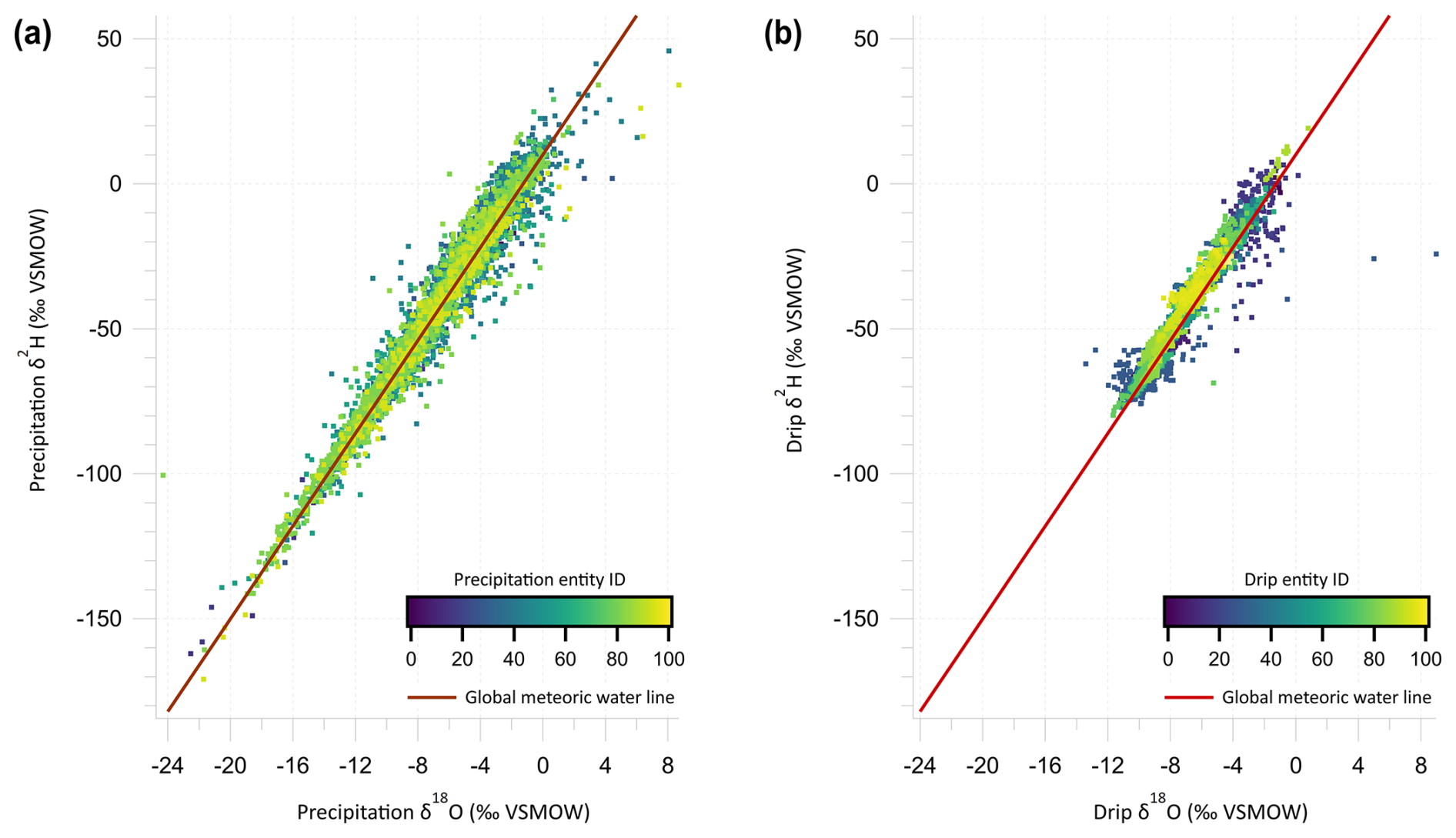
Figure 4Scatter plot of δ18O vs. δ2H for all the meteoric precipitation observation data in SISAL_monv1 (a) and drip water observation data in SISAL_monv1 (b). Both plots are shown with the Global Meteoric Water Line (). Precipitation entity ID and drip entity ID refer to the unique codes in SISAL_monv1 database assigned for meteoric precipitation measurement sites and drip measurement sites, respectively (see schematic in Fig. 2).
3.1 Code and data availability
The database is available in CSV and SQL format in a repository at https://doi.org/10.5158/ARP/29W5J3 (Treble et al., 2026). This dataset is licensed by the rights holder(s) under a Creative Commons Attribution 4.0 International licence: https://creativecommons.org/licenses/by/4.0/ (last access: 5 November 2026). The codes that can help to connect to and use the database are described in the README file. The code used to extract global product data can be found on the repository and the code used to derive the Figs. 1–3 in this paper can be found here: https://github.com/istvan60/SISAL_monv1/tree/essd-2026 (Hatvani et al., 2026).
The SISAL_monv1 database, as is standard SISAL Working group practice, lists the original references, and users are encouraged to consult original authors for interpretative details.
The structure of the SISAL_monv1 database requires use of codes (SQL, R, Python, MATLAB) which may make it difficult to access the database for everyday research. Thus, the “SISAL webApp” (http://geochem.hu/SISAL_webApp, last access: 12 November 2026; Hatvani et al., 2024) – a GUI for exploring the SISAL databases – has been extended with an option to also query the cave monitoring database, based on site name, SISAL site_id and geographical location (Hatvani et al., 2025). This complements the existing SISAL speleothem database of speleothem data and serves to develop a more robust understanding of the speleothem oxygen isotope records, by far the most ubiquitously measured and applied speleothem proxy.
3.2 How to cite the database
The SISAL_monv1 database is a community-driven effort to synthesize and standardize cave monitoring data and make them available to the wider palaeoclimate community. In agreement with the FAIR principles for scientific data management and stewardship, the database itself should be cited (available at https://doi.org/10.5158/ARP/29W5J3, Treble et al., 2026), along with this publication. If individual records are extracted from the database, the original publications should also be listed. More details on the terms of use are provided in the repository.
The supplement related to this article is available online at https://doi.org/10.5194/essd-18-8667-2026-supplement.
The following authors are members of the SISAL Working Group and contributed data to the database: James U. L. Baldini (Department of Earth Sciences, Durham University, Durham DH1 3LE, UK), Lisa Miller Baldini (Baldini, L. M.) (School of Health & Life Sciences, Teesside University, Middlesbrough TS1 3BX, UK), J. L. Bernal-Wormull (Quaternary Geology. Department of Environmental Science, University of Basel, Bernoullistrasse 32, 4056 Basel, Switzerland), Ronny Boch (Graz University of Technology, Institute of Applied Geosciences, Rechbauerstrasse 12, 8010 Graz, Austria), Jenny B. Chapman (Desert Research Institute, Division of Hydrologic Sciences, 755 East Flamingo Road, Las Vegas, NV 89119, USA), Kim M. Cobb (Institute at Brown for Environment and Society, Dept of Earth, Environmental, and Planetary Sciences, 85 Waterman St., Providence, RI 02912, USA), György Czuppon (Institute for Geological and Geochemical Research, HUN-REN Research Centre for Astronomy and Earth Sciences, Budaörsi út 45, Budapest, 1112, Hungary), Francisco William da Cruz Junior (University of São Paulo, Brazil), David Domínguez-Villar (University of Salamanca; Department of Geology, Science Faculty, Plaza de los Caidos s/n, 37008; Salamanca, Spain), Virgil Drăgușin (Emil Racoviță Institute of Speleology, Romanian Academy, Frumoasă 31, 010986, Bucharest, Romania), Wuhui Duan (State Key Laboratory of Lithospheric and Environmental Coevolution, Institute of Geology and Geophysics, Chinese Academy of Sciences, Beijing 100029, China), Dominique Genty (EPOC, CNRS UMR 5805, University of Bordeaux, CS 50023, bât B18N, Allée Geoffroy Saint-Hilaire, 33615 Pessac CEDEX, France), Alena Giesche (Department of Earth Sciences, University of Cambridge, Cambridge, CB2 3EQ, United Kingdom), Reyes Giménez (Pyrenean Institute of Ecology – CSIC Avda. Montañana 1005, 50059 Zaragoza, Spain), Alexander J. Janelle (Department of Earth & Planetary Sciences, Jackson School of Geosciences, The University of Texas at Austin, Austin, USA), Ana Moreno (Pyrenean Institute of Ecology – CSIC, Avda. Montañana 1005, 50059 Zaragoza, Spain), Cinthya Nava-Fernandez (unaffiliated), Carlos Pérez-Mejías (Institute of Global Environmental Change, Xi'an Jiaotong University, Xi'an 710054, China), Christoph Spötl (Institut für Geologie, Universität Innsbruck, Innrain 52 6020 Innsbruck, Austria), Maša Surić (Department of Geography, University of Zadar, F. Tuđmana 24 i, 23000 Zadar, Croatia), Carol V. Tadros (ANSTO, Lucas Heights, NSW, 2234, Australia; School of Biological, Earth and Environmental Sciences, UNSW Sydney, Sydney, NSW, 2052, Australia), Quan Wang (Research Center for Environmental Change and Sustainable Development, Ningbo Polytechnic, Ningbo 315800, China), Sophie F. Warken (Institute of Earth Sciences, Ruprecht Karls University Heidelberg, Im Neuenheimer Feld 234, 69120 Heidelberg, Germany; Institute of Environmental Physics, Ruprecht Karls University Heidelberg, Im Neuenheimer Feld 229, 69120 Heidelberg, Germany), Yan Yang (Chongqing Key Laboratory of Karst Environment, Institute of Geographical Sciences, Southwest University, Chongqing 400715, China), Jian-Jun Yin (Key Laboratory of Karst Dynamics, MNR & Guangxi, Institute of Karst Geology, Chinese Academy of Geological Sciences, Guilin 541004, China), Haiwei Zhang (Institute of Global Environmental Change, Xi'an Jiaotong University, China).
NK and LC-B designed the original database structure. NK, FL, AB, DR and PCT tested the initial database structure and refined the primary data entry worksheets. PCT, NK, and YZ contacted and liaised with the community for data contributions. PCT, YZ, NK, AB, ZK, IGH, BB, BD, WC performed workbook data entry, consulted original sources and communicated with data contributors. YZ, AH and KY extracted global product data for each site. PT wrote the code and compiled the ultimate version of the database with inputs from IGH and NK. IGH, PT, ZK, and NK wrote auto-quality control scripts, ran quality control and created the SQL version of the database. András H incorporated the database into the SISAL webApp. PCT wrote the original draft with inputs from YZ, AB, ZK, NK, IGH, PT, BB, DR and FL. FL IGH and PCT created the figures. “SISAL working group members” contributed published and/or unpublished data and all authors contributed to the final version.
The contact author has declared that none of the authors has any competing interests.
Publisher's note: Copernicus Publications remains neutral with regard to jurisdictional claims made in the text, published maps, institutional affiliations, or any other geographical representation in this paper. The authors bear the ultimate responsibility for providing appropriate place names. Views expressed in the text are those of the authors and do not necessarily reflect the views of the publisher.
We thank everyone who contributed data and additional information to compile the primary workbooks. We thank all SISAL members who contributed their data to this project and were available to provide additional information where necessary. We also acknowledge Juan Pablo Bernal (Instituto de Geociencias, Campus UNAM Juriquilla, Querétaro, México, 76230), Sebastian Breitenbach (Department of Geography and Environmental Sciences, Ellison D116, Northumbria University, Newcastle upon Tyne, NE1 8ST, UK), Chaojun Chen (No.768, Juxian Street, Chenggong District, Kunming, Yunnan, 650500, China), Albert Goede (Retired, formerly University of Tasmania, Australia), Yunxia Li (Hunan Normal University, No. 36 Lushan South Road, Changsha 410081, China), Yongjin Wang (School of Geography, Nanjing Normal University, Nanjing 210023, China), Paul W. Williams (Retired, formerly University of Auckland, School of Environment, Auckland, New Zealand) for specific data contributions to the database.
The design and construction of the SISAL_monv1 database were financially supported by a PAGES Data Stewardship Scholarship to István G. Hatvani, P. Tanos. (grant no. DSS-117). This study was conducted by SISAL (Speleothem Isotopes Synthesis and AnaLysis), a working group of the Past Global Changes (PAGES) project. In this framework, we received financial support from the Swiss Academy of Sciences and the Chinese Academy of Sciences. We also received funding from PAGES, the Minerva Stiftung (grant no. 3063000253), and the Institute of Earth Sciences at the Hebrew University Jerusalem (Israel) to support the organization of a workshop to kick-start the initiative. Yining Zang acknowledges the financial support from the China Scholarship Council (grant no. 202207720061). Yining Zang and Andreas Hartmann were supported by the German Research Foundation (DFG, grant number: HA 8113/6–1, project “Robust Conceptualisation of KArst Transport (ROCKAT)”).
This paper was edited by Kirsten Elger and reviewed by two anonymous referees.
Atsawawaranunt, K., Comas-Bru, L., Amirnezhad Mozhdehi, S., Deininger, M., Harrison, S. P., Baker, A., Boyd, M., Kaushal, N., Ahmad, S. M., Ait Brahim, Y., Arienzo, M., Bajo, P., Braun, K., Burstyn, Y., Chawchai, S., Duan, W., Hatvani, I. G., Hu, J., Kern, Z., Labuhn, I., Lachniet, M., Lechleitner, F. A., Lorrey, A., Pérez-Mejías, C., Pickering, R., Scroxton, N., and SISAL Working Group Members: The SISAL database: a global resource to document oxygen and carbon isotope records from speleothems, Earth Syst. Sci. Data, 10, 1687–1713, https://doi.org/10.5194/essd-10-1687-2018, 2018.
Baker, A., Hartmann, A., Duan, W., Hankin, S., Comas-Bru, L., Cuthbert, M. O., Treble, P. C., Banner, J., Genty, D., Baldini, L. M., Bartolomé, M., Moreno, A., Pérez-Mejías, C., and Werner, M.: Global analysis reveals climatic controls on the oxygen isotope composition of cave drip water, Nat. Commun., 10, 2984, https://doi.org/10.1038/s41467-019-11027-w, 2019.
Baker, A., Shanafield, M., Timms, W., Andersen, M. S., Priestley, S., and Melo Zurita, M.: An underground drip water monitoring network to characterize rainfall recharge of groundwater at different geologies, environments, and climates across Australia, Geosci. Instrum. Method. Data Syst., 13, 117–129, https://doi.org/10.5194/gi-13-117-2024, 2024.
Baldini, L. M., McDermott, F., Baldini, J. U. L., Arias, P., Cueto, M., Fairchild, I. J., Hoffmann, D. L., Mattey, D. P., Müller, W., Nita, D. C., Ontañón, R., Garciá-Moncó, C., and Richards, D. A.: Regional temperature, atmospheric circulation, and sea-ice variability within the Younger Dryas Event constrained using a speleothem from northern Iberia, Earth Planet. Sc. Lett., 419, 101–110, https://doi.org/10.1016/j.epsl.2015.03.015, 2015.
Baldini, L. M., Baldini, J. U. L., McDermott, F., Arias, P., Cueto, M., Fairchild, I. J., Hoffmann, D. L., Mattey, D. P., Müller, W., Nita, D. C., Ontañón, R., Garciá-Moncó, C., and Richards, D. A.: North Iberian temperature and rainfall seasonality over the Younger Dryas and Holocene, Quaternary Sci. Rev., 226, 105998, https://doi.org/10.1016/j.quascirev.2019.105998, 2019.
Beck, H. E., van Dijk, A. I. J. M., Levizzani, V., Schellekens, J., Miralles, D. G., Martens, B., and de Roo, A.: MSWEP: 3-hourly 0.25° global gridded precipitation (1979–2015) by merging gauge, satellite, and reanalysis data, Hydrol. Earth Syst. Sci., 21, 589–615, https://doi.org/10.5194/hess-21-589-2017, 2017.
Beck, H. E., Wood, E. F., Pan, M., Fisher, C. K., Miralles, D. G., Van Dijk, A. I. J. M., McVicar, T. R., and Adler, R. F.: MSWEP v2 Global 3-hourly 0.1° precipitation: Methodology and quantitative assessment, B. Am. Meteorol. Soc., 100, 473–500, https://doi.org/10.1175/BAMS-D-17-0138.1, 2019.
Bernal, J. P., Revolorio, F., Cu-Xi, M., Lases-Hernández, F., Piacsek, P., Lachniet, M. S., Beddows, P. A., Lucia, G., López-Aguiar, K., Capella-Vizcaíno, S., López-Martínez, R., and Vásquez, O. J.: Variability of trace-elements and δ18O in drip water from Gruta del Rey Marcos, Guatemala; seasonal and environmental effects, and its implications for paleoclimate reconstructions, Front. Earth Sci., 11, 1112957, https://doi.org/10.3389/feart.2023.1112957, 2023.
Bernal-Wormull, J. L., Moreno, A., Bartolomé, M., Arriolabengoa, M., Pérez-Mejías, C., Iriarte, E., Osácar, C., Spötl, C., Stoll, H., Cacho, I., Edwards, R. L., and Cheng, H.: New insights into the climate of northern Iberia during the Younger Dryas and Holocene: The Mendukilo multi-speleothem record, Quaternary Sci. Rev., 305, 108006, https://doi.org/10.1016/j.quascirev.2023.108006, 2023.
Bian, F., Coleborn, K., Flemons, I., Baker, A., Treble, P. C., Hughes, C. E., Baker, A., Andersen, M. S., Tozer, M. G., Duan, W., Fogwill, C. J., and Fairchild, I. J.: Hydrological and geochemical responses of fire in a shallow cave system, Sci. Total Environ., 662, 180–191, https://doi.org/10.1016/j.scitotenv.2019.01.102, 2019.
Boch, R.: Stalagmites from Katerloch Cave, Austria: Growth dynamics and high-resolution records of climate change, https://doi.org/10.13140/RG.2.1.2932.6320, 2008.
Boch, R., Spötl, C., and Frisia, S.: Origin and palaeoenvironmental significance of lamination in stalagmites from Katerloch Cave, Austria, Sedimentology, 58, 508–531, https://doi.org/10.1111/j.1365-3091.2010.01173.x, 2011.
Bourges, F., Mangini, A., and Hulst, D.: Le Gaz carbonique dans la dynamique de l'atmosphère des cavités karstiques : l'exemple de l'Aven d'Orgnac (Ardèche), CR. Acad. Sci., 333, 685–692, https://doi.org/10.1016/S1251-8050(01)01682-2, 2001.
Bourges, F., Genthon, P., Genty, D., Lorblanchet, M., Mauduit, E., and D'Hulst, D.: Conservation of prehistoric caves and stability of their inner climate: Lessons from Chauvet and other French caves, Sci. Total Environ., 493, 79–91, https://doi.org/10.1016/j.scitotenv.2014.05.137, 2014.
Bowen, G. J. and Wilkinson, B.: Spatial distribution of δ18O in meteoric precipitation, Geology, 30, 315, https://doi.org/10.1130/0091-7613(2002)030<0315:SDOOIM>2.0.CO;2, 2002.
Bradley, C., Baker, A., Jex, C. N., and Leng, M. J.: Hydrological uncertainties in the modelling of cave drip-water δ18O and the implications for stalagmite palaeoclimate reconstructions, Quaternary Sci. Rev., 29, 2201–2214, https://doi.org/10.1016/j.quascirev.2010.05.017, 2010.
Brady, E., Stevenson, S., Bailey, D., Liu, Z., Noone, D., Nusbaumer, J., Otto-Bliesner, B. L., Tabor, C., Tomas, R., Wong, T., Zhang, J., and Zhu, J.: The connected isotopic water cycle in the Community Earth System Model Version 1, J. Adv. Model. Earth Sy., 11, 2547–2566, https://doi.org/10.1029/2019MS001663, 2019.
Breitenbach, S. F. M., Lechleitner, F. A., Meyer, H., Diengdoh, G., Mattey, D., and Marwan, N.: Cave ventilation and rainfall signals in dripwater in a monsoonal setting – a monitoring study from NE India, Chem. Geol., 402, 111–124, https://doi.org/10.1016/j.chemgeo.2015.03.011, 2015.
Bühler, J. C., Roesch, C., Kirschner, M., Sime, L., Holloway, M. D., and Rehfeld, K.: Comparison of the oxygen isotope signatures in speleothem records and iHadCM3 model simulations for the last millennium, Clim. Past, 17, 985–1004, https://doi.org/10.5194/cp-17-985-2021, 2021.
Burstyn, Y., Martrat, B., Lopez, J. F., Iriarte, E., Jacobson, M. J., Lone, M. A., and Deininger, M.: Speleothems from the Middle East: an example of water-limited environments in the SISAL database, Quaternary, 2, 16, https://doi.org/10.3390/quat2020016, 2019.
Chapman, J. B.: Stable isotopes in southeastern New Mexico groundwater: implications for dating recharge in the WIPP area, Santa Fe, https://www.osti.gov/biblio/6524459 (last access: 12 November 2026), 1986.
Chapman, J. B., Ingraham, N. L., and Hess, J. W.: Isotopic investigation of infiltration and unsaturated zone flow processes at Carlsbad Cavern, New Mexico, J. Hydrol., 133, 343–363, https://doi.org/10.1016/0022-1694(92)90262-T, 1992.
Chen, C.-J. and Li, T.-Y.: Geochemical characteristics of cave drip water respond to ENSO based on a 6-year monitoring work in Yangkou Cave, Southwest China, J. Hydrol., 561, 896–907, https://doi.org/10.1016/j.jhydrol.2018.04.061, 2018.
Chen, X., Jiang, X., Wang, X., Zhao, J., Sun, Z., Li, Y., Ye, Z., Cai, J., Fu, X., Xu, Y., and Yang, Y.: New insights into potential effects of solar activity on the oxygen isotope composition of modern speleothems: Observations from Jiguan Cave, central China II, J. Hydrol., 625, 130114, https://doi.org/10.1016/j.jhydrol.2023.130114, 2023.
Cheng, H., Edwards, R. L., Sinha, A., Spötl, C., Yi, L., Chen, S., Kelly, M., Kathayat, G., Wang, X., Li, X., Kong, X., Wang, Y., Ning, Y., and Zhang, H.: The Asian monsoon over the past 640,000 years and ice age terminations, Nature, 534, 640–646, https://doi.org/10.1038/nature18591, 2016.
Cigna, A. A.: Modern trend in cave monitoring, Acta Carsol., 31, 35–54, https://doi.org/10.3986/ac.v31i1.402, 2016.
Coleborn, K., Rau, G. C., Cuthbert, M. O., Baker, A., and Navarre, O.: Solar-forced diurnal regulation of cave drip rates via phreatophyte evapotranspiration, Hydrol. Earth Syst. Sci., 20, 4439–4455, https://doi.org/10.5194/hess-20-4439-2016, 2016.
Coleborn, K., Baker, A., Treble, P. C., Andersen, M. S., Baker, A., Tadros, C. V., Tozer, M., Fairchild, I. J., Spate, A., and Meehan, S.: The impact of fire on the geochemistry of speleothem-forming drip water in a sub-alpine cave, Sci. Total Environ., 642, 408–420, https://doi.org/10.1016/j.scitotenv.2018.05.310, 2018.
Collister, C. and Mattey, D.: Controls on water drop volume at speleothem drip sites: an experimental study, J. Hydrol., 358, 259–267, https://doi.org/10.1016/j.jhydrol.2008.06.008, 2008.
Comas-Bru, L., Harrison, S. P., Werner, M., Rehfeld, K., Scroxton, N., Veiga-Pires, C., and SISAL working group members: Evaluating model outputs using integrated global speleothem records of climate change since the last glacial, Clim. Past, 15, 1557–1579, https://doi.org/10.5194/cp-15-1557-2019, 2019.
Comas-Bru, L., Rehfeld, K., Roesch, C., Amirnezhad-Mozhdehi, S., Harrison, S. P., Atsawawaranunt, K., Ahmad, S. M., Brahim, Y. A., Baker, A., Bosomworth, M., Breitenbach, S. F. M., Burstyn, Y., Columbu, A., Deininger, M., Demény, A., Dixon, B., Fohlmeister, J., Hatvani, I. G., Hu, J., Kaushal, N., Kern, Z., Labuhn, I., Lechleitner, F. A., Lorrey, A., Martrat, B., Novello, V. F., Oster, J., Pérez-Mejías, C., Scholz, D., Scroxton, N., Sinha, N., Ward, B. M., Warken, S., Zhang, H., and SISAL Working Group members: SISALv2: a comprehensive speleothem isotope database with multiple age–depth models, Earth Syst. Sci. Data, 12, 2579–2606, https://doi.org/10.5194/essd-12-2579-2020, 2020.
Copernicus Climate Change Service (CDS): ERA5 hourly data on single levels from 1940 to present, Climate Data Store (CDS) [data set], https://doi.org/10.24381/cds.adbb2d47, 2023.
Cruz, F. W., Karmann, I., Viana, O., Burns, S. J., Ferrari, J. A., Vuille, M., Sial, A. N., and Moreira, M. Z.: Stable isotope study of cave percolation waters in subtropical Brazil: Implications for paleoclimate inferences from speleothems, Chem. Geol., 220, 245–262, https://doi.org/10.1016/j.chemgeo.2005.04.001, 2005.
Cuthbert, M. O., Baker, A., Jex, C. N., Graham, P. W., Treble, P. C., Andersen, M. S., and Ian Acworth, R.: Drip water isotopes in semi-arid karst: Implications for speleothem paleoclimatology, Earth Planet. Sc. Lett., 395, 194–204, https://doi.org/10.1016/j.epsl.2014.03.034, 2014.
Czuppon, G., Demény, A., Leél-Őssy, S., Óvari, M., Molnár, M., Stieber, J., Kiss, K., Kármán, K., Surányi, G., and Haszpra, L. Cave monitoring in the Béke and Baradla caves (Northeastern Hungary): implications for the conditions for the formation cave carbonates, Int. J. Speleol., 47, https://doi.org/10.5038/1827-806X.47.1.2110, 2018a.
Czuppon, G., Bočić, N., Buzjak, N., Óvári, M., and Molnár, M.: Monitoring in the Barać and Lower Cerovačka caves (Croatia) as a basis for the characterization of the climatological and hydrological processes that control speleothem formation, Quaternary Int., 494, 52–65, https://doi.org/10.1016/j.quaint.2018.02.003, 2018b.
Czuppon, G., Demény, A., Leél-Őssy, S., Stieber, J., Óvári, M., Dobosy, P., Berentés, Á., and Kovács, R.: Cave monitoring in Hungary: An overview, Central European Geology, 65, https://doi.org/10.1556/24.2021.00109, 2022.
Domínguez-Villar, D., Lojen, S., Krklec, K., Kozdon, R., Edwards, R. L., and Cheng, H.: Ion microprobe δ18O analyses to calibrate slow growth rate speleothem records with regional δ18O records of precipitation, Earth Planet. Sc. Lett., 482, 367–376, https://doi.org/10.1016/j.epsl.2017.11.012, 2018.
Drăguşin, V., Balan, S., Blamart, D., Forray, F. L., Marin, C., Mirea, I., Nagavciuc, V., Orăşeanu, I., Perşoiu, A., Tîrlă, L., Tudorache, A., and Vlaicu, M.: Transfer of environmental signals from the surface to the underground at Ascunsă Cave, Romania, Hydrol. Earth Syst. Sci., 21, 5357–5373, https://doi.org/10.5194/hess-21-5357-2017, 2017.
Drăgușin, V., Mirea, I. C., Ersek, V., and Tîrlă, L.: Farmed calcite δ13C at Ascunsă cave, Romania, and its relation with CO2, Quaternaire, 165–174, https://doi.org/10.4000/quaternaire.13792, 2020.
Dreybrodt, W. and Romanov, D.: The evolution of 13C and 18O isotope composition of DIC in a calcite depositing film of water with isotope exchange between the DIC and a CO2 containing atmosphere, and simultaneous evaporation of the water, Implication to climate proxies from stalagmites: A theoretical model, Geochim. Cosmochim. Ac., 195, 323–338, https://doi.org/10.1016/j.gca.2016.07.034, 2016.
Duan, W., Ruan, J., Luo, W., Li, T., Tian, L., Zeng, G., Zhang, D., Bai, Y., Li, J., Tao, T., Zhang, P., Baker, A., and Tan, M.: The transfer of seasonal isotopic variability between precipitation and drip water at eight caves in the monsoon regions of China, Geochim. Cosmochim. Ac., 183, 250–266, https://doi.org/10.1016/j.gca.2016.03.037, 2016.
Ellis, S. A., Cobb, K. M., Moerman, J. W., Partin, J. W., Bennett, A. L., Malang, J., Gerstner, H., and Tuen, A. A.: Extended Cave Drip Water Time Series Captures the 2015–2016 El Niño in Northern Borneo, Geophys. Res. Lett., 47, e2019GL086363, https://doi.org/10.1029/2019GL086363, 2020.
Fairchild, I. J. and Baker, A.: Speleothem Science: From Process to Past Environments, Wiley-Blackwell, Oxford, https://doi.org/10.1002/9781444361094, 2012.
Falster, G., Abramowitz, G., Hobeichi, S., Hughes, C., Treble, P., Abram, N. J., Bird, M. I., Cauquoin, A., Dixon, B., Drysdale, R., Jin, C., Munksgaard, N., Proemse, B., Tyler, J. J., Werner, M., and Tadros, C. V.: High resolution monthly precipitation isotope estimates across Australia from machine learning, Hydrol. Earth Syst. Sci., 30, 289–315, https://doi.org/10.5194/hess-30-289-2026, 2026.
Feng, W., Banner, J. L., Guilfoyle, A. L., Musgrove, M., and James, E. W.: Oxygen isotopic fractionation between drip water and speleothem calcite: A 10-year monitoring study, central Texas, USA, Chem. Geol., 304–305, 53–67, https://doi.org/10.1016/j.chemgeo.2012.02.004, 2012.
Feng, W., Casteel, R. C., Banner, J. L., and Heinze-Fry, A.: Oxygen isotope variations in rainfall, drip-water and speleothem calcite from a well-ventilated cave in Texas, USA: Assessing a new speleothem temperature proxy, Geochim. Cosmochim. Ac., 127, 233–250, https://doi.org/10.1016/j.gca.2013.11.039, 2014.
Fohlmeister, J., Voarintsoa, N. R. G., Lechleitner, F. A., Boyd, M., Brandtstätter, S., Jacobson, M. J., and Oster, J. L.: Main controls on the stable carbon isotope composition of speleothems, Geochim. Cosmochim. Ac., 279, 67–87, https://doi.org/10.1016/j.gca.2020.03.042, 2020.
Fuller, L.: High-resolution multiproxy geochemical Holocene climate records from 1000-year old Scottish stalagmites, University of Birmingham, https://birmingham.primo.exlibrisgroup.com/permalink/44BIR_INST/sbqp9i/alma990026259500204871 (last access: 12 November 2026), 2007.
Fuller, L., Baker, A., Fairchild, I. J., Spötl, C., Marca-Bell, A., Rowe, P., and Dennis, P. F.: Isotope hydrology of dripwaters in a Scottish cave and implications for stalagmite palaeoclimate research, Hydrol. Earth Syst. Sci., 12, 1065–1074, https://doi.org/10.5194/hess-12-1065-2008, 2008.
Genty, D., Labuhn, I., Hoffmann, G., Danis, P. A., Mestre, O., Bourges, F., Wainer, K., Massault, M., Van Exter, S., Régnier, E., Orengo, Ph., Falourd, S., and Minster, B.: Rainfall and cave water isotopic relationships in two South-France sites, Geochim. Cosmochim. Ac., 131, 323–343, https://doi.org/10.1016/j.gca.2014.01.043, 2014.
Giesche, A., Hodell, D. A., Petrie, C. A., Haug, G. H., Adkins, J. F., Plessen, B., Marwan, N., Bradbury, H. J., Hartland, A., French, A. D., and Breitenbach, S. F. M.: Cave measurements made during the field campaign in April and October 2006, including δD and δ18O from cave drip water, a nearby pond, and rainwater (Table X4), PANGAEA [data set], https://doi.org/10.1594/PANGAEA.956777, 2023a.
Giesche, A., Hodell, D. A., Petrie, C. A., Haug, G. H., Adkins, J. F., Plessen, B., Marwan, N., Bradbury, H. J., Hartland, A., French, A. D., and Breitenbach, S. F. M.: Dharamjali speleothem trace elements and stable isotopes, PANGAEA [data set], https://doi.org/10.1594/PANGAEA.956928, 2023b.
Giménez, R., Bartolomé, M., Gázquez, F., Iglesias, M., and Moreno, A.: Underlying Climate Controls in Triple Oxygen (16O, 17O, 18O) and Hydrogen (1H, 2H) Isotopes Composition of Rainfall (Central Pyrenees), Front. Earth Sci., 9, 633698, https://doi.org/10.3389/feart.2021.633698, 2021.
Goede, A., Green, D. C., and Harmon, R. S.: Isotopic composition of precipitation, cave drips and actively forming speleothems at three Tasmanian cave sites, Helictite, 20, 17–28, https://helictite.caves.org.au/contents2.php#020.01 (last access: 12 November 2026), 1982.
Goldscheider, N., Chen, Z., Auler, A. S., Bakalowicz, M., Broda, S., Drew, D., Hartmann, J., Jiang, G., Moosdorf, N., Stevanovic, Z., and Veni, G.: Global distribution of carbonate rocks and karst water resources, Hydrogeol. J., 28, 1661–1677, https://doi.org/10.1007/s10040-020-02139-5, 2020.
Griffiths, A. D., Treble, P. C., Hope, P., and Rudeva, I.: Rainfall Stable Water Isotope Variability in Coastal Southwestern Western Australia and Its Relationship to Climate on Multiple Timescales, J. Geophys. Res.-Atmos., 127, e2021JD035433, https://doi.org/10.1029/2021JD035433, 2022.
Haese, B., Werner, M., and Lohmann, G.: Stable water isotopes in the coupled atmosphere–land surface model ECHAM5-JSBACH, Geosci. Model Dev., 6, 1463–1480, https://doi.org/10.5194/gmd-6-1463-2013, 2013.
Hatvani, I. G., Kern, Z., Tanos, P., Wilhelm, M., Lechleitner, F. A., and Kaushal, N.: The SISAL webApp: exploring the speleothem climate and environmental archives of the world, Quaternary Res., 118, 211–217, https://doi.org/10.1017/qua.2023.39, 2024.
Hatvani, I. G., Tanos, P., Zang, Y., Kaushal, N., Kern, Z., Lechleitner, F., and Treble, P. C.: SISAL_monv1: A global database of cave-site rainfall, drip-water and modern carbonate isotopes, PAGES Mag., 33, 86–86, https://doi.org/10.22498/pages.33.2.86, 2025.
Holland, H., Kirsipu, T., Huebner, J., and Oxburgh, U.: On some aspects of the chemical evolution of cave waters, J. Geol., 72, 36–67, https://doi.org/10.1086/626964, 1963.
Hoy, R. and Gross, G.: A Baseline Study of Oxygen 18 and Deuterium in the Roswell New Mexico Groundwater Basin, New Mexico Water Resources Research Institute, https://nmwrri.nmsu.edu/publications/technical-reports/tr-reports/tr-144.html (last access: 12 November 2026), 1982.
Hughes, C. E. and Crawford, J.: Spatial and temporal variation in precipitation isotopes in the Sydney Basin, Australia, J. Hydrol., 489, 42–55, https://doi.org/10.1016/j.jhydrol.2013.02.036, 2013.
Hatvani, I. G., Tanos, P., Kern, Z., Kaushal, N., Zang, Y., Lechleitner, F. A., and Treble, P. C.: SISAL_monv1 scripts, version essd-2026, GitHub [code], https://github.com/istvan60/SISAL_monv1/tree/essd-2026, last access: 12 November 2026.
Hu, J., Dee, S. G., Wong, C. I., Harman, C. J., Banner, J. L., and Bunnell, K. E.: Assessing proxy system models of cave dripwater δ18O variability, Quaternary Sci. Rev., 254, 106799, https://doi.org/10.1016/j.quascirev.2021.106799, 2021.
Kaushal, N.: High resolution paleo-monsoon records from peninsular Indian speleothems, Doctoral dissertation, University of Oxford, High resolution paleo-monsoon records from peninsular Indian speleothems – ORA – Oxford University Research Archive, https://ora.ox.ac.uk/objects/uuid:ab1ca849-185f-4619-83d9-fffe48e5cd2b (last access: 12 November 2026), 2017.
Kaushal, N.: Air temperature measurements in Akalagavi cave, India from January-October 2015, PANGAEA [data set], https://doi.org/10.1594/PANGAEA.921580, 2020.
Kaushal, N., Lechleitner, F. A., Wilhelm, M., Azennoud, K., Bühler, J. C., Braun, K., Ait Brahim, Y., Baker, A., Burstyn, Y., Comas-Bru, L., Fohlmeister, J., Goldsmith, Y., Harrison, S. P., Hatvani, I. G., Rehfeld, K., Ritzau, M., Skiba, V., Stoll, H. M., Szűcs, J. G., Tanos, P., Treble, P. C., Azevedo, V., Baker, J. L., Borsato, A., Chawchai, S., Columbu, A., Endres, L., Hu, J., Kern, Z., Kimbrough, A., Koç, K., Markowska, M., Martrat, B., Masood Ahmad, S., Nehme, C., Novello, V. F., Pérez-Mejías, C., Ruan, J., Sekhon, N., Sinha, N., Tadros, C. V., Tiger, B. H., Warken, S., Wolf, A., Zhang, H., and SISAL Working Group members: SISALv3: a global speleothem stable isotope and trace element database, Earth Syst. Sci. Data, 16, 1933–1963, https://doi.org/10.5194/essd-16-1933-2024, 2024.
Kennett, D. J., Breitenbach, S. F. M., Aquino, V. V., Asmerom, Y., Awe, J., Baldini, J. U. L., Bartlein, P., Culleton, B. J., Ebert, C., Jazwa, C., Macri, M. J., Marwan, N., Polyak, V., Prufer, K. M., Ridley, H. E., Sodemann, H., Winterhalder, B., and Haug, G. H.: Development and Disintegration of Maya Political Systems in Response to Climate Change, Science, 338, 788–791, https://doi.org/10.1126/science.1226299, 2012.
Lambert, J. and Aharon, P.: Oxygen and hydrogen isotopes of rainfall and dripwater at DeSoto Caverns (Alabama, USA): Key to understanding past variability of moisture transport from the Gulf of Mexico, Geochim. Cosmochim. Ac., 74, 846–861, https://doi.org/10.1016/j.gca.2009.10.043, 2010.
Lases-Hernández, F., Medina-Elizalde, M., and Benoit Frappier, A.: Drip water δ18O variability in the northeastern Yucatán Peninsula, Mexico: Implications for tropical cyclone detection and rainfall reconstruction from speleothems, Geochim. Cosmochim. Ac., 285, 237–256, https://doi.org/10.1016/j.gca.2020.07.008, 2020.
Li, Y., Zhang, S., Liu, X., Gao, Y., and Rao, Z.: Variations of the stable isotopic composition of precipitation and cave drip water at zhenzhu cave, north China: a two-year monitoring study, JCKS, 81, 123–135, https://doi.org/10.4311/2018ES0128, 2019.
Lorrey, A. M., Williams, P. W., Woolley, J.-M., Fauchereau, N. C., Hartland, A., Bostock, H., Eaves, S., Lachniet, M. S., Renwick, J. A., and Varma, V.: Late Quaternary climate variability and change from Aotearoa New Zealand speleothems: progress in age modelling, oxygen isotope master record construction and proxy-model comparisons, Quaternary, 3, 24, https://doi.org/10.3390/quat3030024, 2020.
Hersbach, H., de Rosnay, P., Bell, B., Schepers, D., Simmons, A., Soci, C., Abdalla, S., Alonso-Balmaseda, M., Balsamo, G., and Bechtolg, P.: Operational Global Reanalysis: Progress, Future Directions and Synergies with NWP, European Centre for Medium Range Weather Forecasts, Reading, ERA Report Series no. 27, https://doi.org/10.21957/tkic6g3wm, 2018.
Martens, B., Miralles, D. G., Lievens, H., van der Schalie, R., de Jeu, R. A. M., Fernández-Prieto, D., Beck, H. E., Dorigo, W. A., and Verhoest, N. E. C.: GLEAM v3: satellite-based land evaporation and root-zone soil moisture, Geosci. Model Dev., 10, 1903–1925, https://doi.org/10.5194/gmd-10-1903-2017, 2017.
Mattey, D., Lowry, D., Duffet, J., Fisher, R., Hodge, E., and Frisia, S.: A 53 year seasonally resolved oxygen and carbon isotope record from a modern Gibraltar speleothem: reconstructed drip water and relationship to local precipitation, Earth Planet. Sc. Lett., 269, 80–95, https://doi.org/10.1016/j.epsl.2008.01.051, 2008.
McDonough, L. K., Treble, P. C., Baker, A., Borsato, A., Frisia, S., Nagra, G., Coleborn, K., Gagan, M. K., Zhao, J., and Paterson, D.: Past fires and post-fire impacts reconstructed from a southwest Australian stalagmite, Geochim. Cosmochim. Ac., 325, 258–277, https://doi.org/10.1016/j.gca.2022.03.020, 2022.
Miller, N., Banner, J., Feng, W., Gonzales, A., and Kozdon, R.: Hydroclimate response in Texas and Gulf of Mexico to rapid warming during the last deglacial: High-resolution speleothem proxy and monitoring evidence, Quaternary Sci. Rev., 273, 107244, https://doi.org/10.1016/j.quascirev.2021.107244, 2021.
Miralles, D. G., Holmes, T. R. H., De Jeu, R. A. M., Gash, J. H., Meesters, A. G. C. A., and Dolman, A. J.: Global land-surface evaporation estimated from satellite-based observations, Hydrol. Earth Syst. Sci., 15, 453–469, https://doi.org/10.5194/hess-15-453-2011, 2011.
Miralles, D. G., Bonte, O., Koppa, A., Baez-Villanueva, O. M., Tronquo, E., Zhong, F., Beck, H. E., Hulsman, P., Dorigo, W., Verhoest, N. E. C., and Haghdoost, S.: GLEAM4: global land evaporation and soil moisture dataset at 0.1° resolution from 1980 to near present, Sci. Data, 12, 416, https://doi.org/10.1038/s41597-025-04610-y, 2025.
Moerman, J. W., Cobb, K. M., Adkins, J. F., Sodemann, H., Clark, B., and Tuen, A. A.: Diurnal to interannual rainfall δ18O variations in northern Borneo driven by regional hydrology, Earth Planet. Sc. Lett., 369–370, 108–119, https://doi.org/10.1016/j.epsl.2013.03.014, 2013.
Moreno, A., Iglesias, M., Azorin-Molina, C., Pérez-Mejías, C., Bartolomé, M., Sancho, C., Stoll, H., Cacho, I., Frigola, J., Osácar, C., Muñoz, A., Delgado-Huertas, A., Bladé, I., and Vimeux, F.: Measurement report: Spatial variability of northern Iberian rainfall stable isotope values – investigating atmospheric controls on daily and monthly timescales, Atmos. Chem. Phys., 21, 10159–10177, https://doi.org/10.5194/acp-21-10159-2021, 2021.
Moreno, A., Sancho, C., Bartolomé, M., Oliva-Urcia, B., Delgado-Huertas, A., Estrela, M. J., Corell, D., López-Moreno, J. I., and Cacho, I.: Climate controls on rainfall isotopes and their effects on cave drip water and speleothem growth: the case of Molinos cave (Teruel, NE Spain), Clim. Dynam., 43, 221–241, https://doi.org/10.1007/s00382-014-2140-6, 2014.
Moseley, G. E., Edwards, R. L., Lord, N. S., Spötl, C., and Cheng, H.: Speleothem record of mild and wet mid-Pleistocene climate in northeast Greenland, Sci. Adv., 7, eabe1260, https://doi.org/10.1126/sciadv.abe1260, 2021.
Musgrove, M.: Temporal links between climate and hydrology: Insights from central Texas cave deposits and groundwater, PhD thesis, University of Texas, https://www.texasspeleologicalsurvey.org/publications/TSS_Monographs.php (last access: 12 November 2026), 2000.
Nagra, G., Treble, P. C., Andersen, M. S., Fairchild, I. J., Coleborn, K., and Baker, A.: A post-wildfire response in cave dripwater chemistry, Hydrol. Earth Syst. Sci., 20, 2745–2758, https://doi.org/10.5194/hess-20-2745-2016, 2016.
Nava-Fernandez, C., Hartland, A., Gázquez, F., Kwiecien, O., Marwan, N., Fox, B., Hellstrom, J., Pearson, A., Ward, B., French, A., Hodell, D. A., Immenhauser, A., and Breitenbach, S. F. M.: Pacific climate reflected in Waipuna Cave drip water hydrochemistry, Hydrol. Earth Syst. Sci., 24, 3361–3380, https://doi.org/10.5194/hess-24-3361-2020, 2020.
Osácar, M. C., Sancho, C., Muñoz, A., Bartolomé, M., Moreno, A., Delgado-Huertas, A., and Cacho, I.: Trazabilidad de la señal isotópica del oxígeno desde la lluvia a los espeleotemas en las cuevas de Ortigosa de Cameros (La Rioja, España), Estud. Geol., 70, e021, https://doi.org/10.3989/egeol.41730.319, 2014.
Pape, J. R., Banner, J. L., Mack, L. E., Musgrove, M., and Guilfoyle, A.: Controls on oxygen isotope variability in precipitation and cave drip waters, central Texas, USA, J. Hydrol., 385, 203–215, https://doi.org/10.1016/j.jhydrol.2010.02.021, 2010.
Parker, S. E., Harrison, S. P., Comas-Bru, L., Kaushal, N., LeGrande, A. N., and Werner, M.: A data–model approach to interpreting speleothem oxygen isotope records from monsoon regions, Clim. Past, 17, 1119–1138, https://doi.org/10.5194/cp-17-1119-2021, 2021.
Pérez-Mejías, C., Moreno, A., Sancho, C., Bartolomé, M., Stoll, H., Osácar, M. C., Cacho, I., and Delgado-Huertas, A.: Transference of isotopic signal from rainfall to dripwaters and farmed calcite in Mediterranean semi-arid karst, Geochim. Cosmochim. Ac., 243, 66–98, https://doi.org/10.1016/j.gca.2018.09.014, 2018.
Peyraube, N., Lastennet, R., Villanueva, J. D., Houillon, N., Malaurent, P., and Denis, A.: Effect of diurnal and seasonal temperature variation on Cussac cave ventilation using CO2 assessment, Theor. Appl. Climatol., 129, 1045–1058, https://doi.org/10.1007/s00704-016-1824-8, 2017.
Poulain, A., Watlet, A., Kaufmann, O., Van Camp, M., Jourde, H., Mazzilli, N., Rochez, G., Deleu, R., Quinif, Y., and Hallet, V.: Assessment of groundwater recharge processes through karst vadose zone by cave percolation monitoring, Hydrol. Process., 32, 2069–2083, https://doi.org/10.1002/hyp.13138, 2018.
Qiu, H.-Y., Li, T.-Y., Chen, C.-J., Huang, R., Wang, T., Wu, Y., Xiao, S.-Y., Xu, Y.-Z., Huang, Y.-Y., Zhang, J., Yang, Y., and Li, J.-Y.: Significance of active speleothem δ18O at annual-decadal timescale-A case study from monitoring in Furong Cave, Appl. Geochem., 126, 104873, https://doi.org/10.1016/j.apgeochem.2021.104873, 2021.
Qiu, W., Yang, Y., Jiang, X., Wang, X., Wang, Y., Cai, J., Liao, Y., Feng, T., Gao, K., and Zhai, S.: Oxygen isotope variability in precipitation, dripwater, and modern calcite responding to ENSO based on 11 years' monitoring in Yuhua Cave, Southeast China, J. Hydrol., 624, 129937, https://doi.org/10.1016/j.jhydrol.2023.129937, 2023.
R Core Team: R: A Language and Environment for Statistical Computing, R Foundation for Statistical Computing, Vienna, Austria, https://www.R-project.org/ (last access: 12 November 2026), 2024.
Ridley, H., Baldini, J., Prufer, K., Walczak, I., and Breitenbach, S.: High-resolution monitoring of Yok Balum Cave, Belize: An investigation of seasonal ventilation regimes and the atmospheric and drip-flow response to a local earthquake, JCKS, 77, 183–199, https://doi.org/10.4311/2014ES0117, 2015.
Riechelmann, D. F. C., Schröder-Ritzrau, A., Scholz, D., Fohlmeister, J., Spötl, C., Richter, D. K., and Mangini, A.: Monitoring Bunker Cave (NW Germany): A prerequisite to interpret geochemical proxy data of speleothems from this site, J. Hydrol., 409, 682–695, https://doi.org/10.1016/j.jhydrol.2011.08.068, 2011.
Riechelmann, D. F. C., Deininger, M., Scholz, D., Riechelmann, S., Schröder-Ritzrau, A., Spötl, C., Richter, D. K., Mangini, A., and Immenhauser, A.: Disequilibrium carbon and oxygen isotope fractionation in recent cave calcite: Comparison of cave precipitates and model data, Geochim. Cosmochim. Ac., 103, 232–244, https://doi.org/10.1016/j.gca.2012.11.002, 2013.
Riechelmann, D. F. C., Riechelmann, S., and Schröder-Ritzrau, A.: Long-term elemental trends in drip waters from monitoring Bunker Cave: new insights for past precipitation variability, Chem. Geol., 590, 120704, https://doi.org/10.1016/j.chemgeo.2021.120704, 2022.
Riechelmann, S., Schröder-Ritzrau, A., Spötl, C., Riechelmann, D. F. C., Richter, D. K., Mangini, A., Frank, N., Breitenbach, S. F. M., and Immenhauser, A.: Sensitivity of Bunker Cave to climatic forcings highlighted through multi-annual monitoring of rain-, soil-, and dripwaters, Chem. Geol., 449, 194–205, https://doi.org/10.1016/j.chemgeo.2016.12.015, 2017.
Riechelmann, S., Breitenbach, S. F. M., Schröder-Ritzrau, A., Mangini, A., and Immenhauser, A.: Ventilation and cave air pCO2 in the Bunker-Emst Cave system (NW Germany): implications for speleothem proxy data, J. Cave Karst Stud., 81, 98–112, https://doi.org/10.4311/2018ES0110, 2019.
Rudzka, D., Mcdermott, F., and Surić, M.: A late Holocene climate record in stalagmites from Modrič Cave (Croatia), J. Quaternary Sci., 27, 585–596, https://doi.org/10.1002/jqs.2550, 2012.
Skiba, V. and Fohlmeister, J.: Contemporaneously growing speleothems and their value to decipher in-cave processes – a modelling approach, Geochim. Cosmochim. Ac., 348, 381–396, https://doi.org/10.1016/j.gca.2023.03.016, 2023.
Smith, A., Wynn, P., Lancaster University, Barker, P., Lancaster University, Leng, M., British Geological Survey, Noble, S., British Geological Survey, Stott, A., and Centre for Ecology and Hydrology: Cave monitoring and the potential for palaeoclimate reconstruction from Cueva de Asiul, Cantabria (N. Spain), IJS, 45, 1–9, https://doi.org/10.5038/1827-806X.45.1.1928, 2016.
Spötl, C., Fairchild, I. J., and Tooth, A. F.: Cave air control on dripwater geochemistry, Obir Caves (Austria): Implications for speleothem deposition in dynamically ventilated caves, Geochim. Cosmochim. Ac., 69, 2451–2468, https://doi.org/10.1016/j.gca.2004.12.009, 2005.
Surić, M., Roller-Lutz, Z., Mandić, M., Bronić, I., and Juračić, M.: Modern C, O, and H isotope composition of speleothem and dripwater from Modrič Cave, eastern Adriatic coast (Croatia), IJS, 39, 91–97, https://doi.org/10.5038/1827-806X.39.2.4, 2010.
Surić, M., Lončarić, R., Lončar, N., Buzjak, N., and Bajo, P.: Isotopic characterization of cave environments at varying altitudes on the eastern Adriatic coast (Croatia) – implications for future speleothem-based studies, J. Hydrol., 545, 367–380, https://doi.org/10.1016/j.jhydrol.2016.12.051, 2017.
Surić, M., Lončarić, R., Bočić, N., Lončar, N., and Buzjak, N.: Monitoring of selected caves as a prerequisite for the speleothem-based reconstruction of the Quaternary environment in Croatia, Quaternary Int., 494, 263–274, https://doi.org/10.1016/j.quaint.2017.06.042, 2018.
Surić, M., Czuppon, G., Lončarić, R., Bočić, N., Lončar, N., Bajo, P., and Drysdale, R. N.: Stable isotope hydrology of cave groundwater and its relevance for speleothem-based paleoenvironmental reconstruction in Croatia, Water, 12, 2386, https://doi.org/10.3390/w12092386, 2020.
Surić, M., Bajo, P., Lončarić, R., Lončar, N., Drysdale, R. N., Hellstrom, J. C., and Hua, Q.: Speleothem Records of the Hydroclimate Variability throughout the Last Glacial Cycle from Manita peć Cave (Velebit Mountain, Croatia), Geosciences, 11, 347, https://doi.org/10.3390/geosciences11080347, 2021.
Surić, M., Bajo, P., Columbu, A., Lončarić, R., Lončar, N., Drysdale, R. N., and Hellstrom, J. C.: Reconstruction of environmental and hydroclimate changes in the Adriatic region over the last 367 kyr from Modrič Cave (Croatia) speleothems, Quaternary Sci. Rev., 358, 109351, https://doi.org/10.1016/j.quascirev.2025.109351, 2025.
Tadros, C.: Inorganic elements: from sources to cave drip water, Yarrangobilly, south-eastern Australia, UNSW Sydney, https://doi.org/10.26190/UNSWORKS/21139, 2018.
Tadros, C. V., Treble, P. C., Baker, A., Fairchild, I., Hankin, S., Roach, R., Markowska, M., and McDonald, J.: ENSO–cave drip water hydrochemical relationship: a 7-year dataset from south-eastern Australia, Hydrol. Earth Syst. Sci., 20, 4625–4640, https://doi.org/10.5194/hess-20-4625-2016, 2016.
Tadros, C. V., Markowska, M., Treble, P. C., Baker, A., Frisia, S., Adler, L., and Drysdale, R. N.: Recharge variability in Australia's southeast alpine region derived from cave monitoring and modern stalagmite δ18O records, Quaternary Sci. Rev., 295, 107742, https://doi.org/10.1016/j.quascirev.2022.107742, 2022.
Tan, L., Zhao, J., Li, D., and Gao, Y.: Cave air CO2 monitoring in Shenqi Cave, southwest China, in: Proceedings of the 16th Multidisciplinary Conference on Sinkholes and the Engineering and Environmental Impacts of Karst, National Cave and Karst Research Institute Symposium 8, Puerto Rico, https://doi.org/10.5038/9781733375313.1006, 2020.
Terzer-Wassmuth, S., Wassenaar, L. I., Welker, J. M., and Araguás-Araguás, L. J.: Improved high-resolution global and regionalized isoscapes of δ18O, δ2H and d-excess in precipitation, Hydrol. Process., 35, e14254, https://doi.org/10.1002/hyp.14254, 2021.
Tian, Y., Zhang, H., Zhang, R., Zhang, F., Liang, Z., Cai, Y., and Cheng, H.: Seasonal and inter-annual variations of stable isotopic characteristics of rainfall and cave water in Shennong Cave, southeast China, and its paleoclimatic implication, Front. Earth Sci., 9, 794762, https://doi.org/10.3389/feart.2021.794762, 2021.
Treble, P. C., Bradley, C., Wood, A., Baker, A., Jex, C. N., Fairchild, I. J., Gagan, M. K., Cowley, J., and Azcurra, C.: An isotopic and modelling study of flow paths and storage in Quaternary calcarenite, SW Australia: implications for speleothem paleoclimate records, Quaternary Sci. Rev., 64, 90–103, https://doi.org/10.1016/j.quascirev.2012.12.015, 2013.
Treble, P. C., Fairchild, I. J., Griffiths, A., Baker, A., Meredith, K. T., Wood, A., and McGuire, E.: Impacts of cave air ventilation and in-cave prior calcite precipitation on Golgotha Cave dripwater chemistry, southwest Australia, Quat. Sci. Rev., 127, 61–72, https://doi.org/10.1016/j.quascirev.2015.06.001, 2015.
Treble, P. C., Baker, A., Abram, N. J., Hellstrom, J. C., Crawford, J., Gagan, M. K., Borsato, A., Griffiths, A. D., Bajo, P., Markowska, M., Priestley, S. C., Hankin, S., and Paterson, D.: Ubiquitous karst hydrological control on speleothem oxygen isotope variability in a global study, Commun. Earth Environ., 3, 29, https://doi.org/10.1038/s43247-022-00347-3, 2022.
Treble, P. C., Zang, Y., Kaushal, N., Hatvani, I. G., Tanos, P., Kern, Z., Baker, A., Hartmann, A., Lechleitner, F. A., Belanger, B., Daudt de Oliveira, B., Sinclair, W., Riechelmann, D. F. C., Hidas, A., Yoshimura, K., and Comas-Bru, L.: SISAL_monv1: a global database of cave monitoring observations, HUN-REN ARP [data set], https://doi.org/10.5158/ARP/29W5J3, 2026.
Tremaine, D. M., Froelich, P. N., and Wang, Y.: Speleothem calcite farmed in situ: modern calibration of δ18O and δ13C paleoclimate proxies in a continuously-monitored natural cave system, Geochim. Cosmochim. Ac., 75, 4929–4950, https://doi.org/10.1016/j.gca.2011.06.005, 2011.
Turin, H. J., Plummer, M. A., and Phillips, F. M.: Tritium, Chlorine-36, and water isotopologue profiles from Lechuguilla Cave and Carlsbad Cavern, New Mexico, USA, Appl. Geochem., 138, 105212, https://doi.org/10.1016/j.apgeochem.2022.105212, 2022.
UNEP (United Nations Environment Programme): World atlas of desertification, 2nd edn., UNEP, London, https://wedocs.unep.org/handle/20.500.11822/30300 (last access: 12 November 2026), 1997.
Vieten, R., Warken, S., Winter, A., Scholz, D., Miller, T., Spötl, C., and Schröder-Ritzrau, A.: Monitoring of Cueva Larga, Puerto Rico – A First Step to Decode Speleothem Climate Records, in: Karst Groundwater Contamination and Public Health: Beyond Case Studies, edited by: White, W. B., Herman, J. S., Herman, E. K., and Rutigliano, M., Springer International Publishing, 319–331, https://doi.org/10.1007/978-3-319-51070-5_36, 2018a.
Vieten, R., Warken, S., Winter, A., Schröder-Ritzrau, A., Scholz, D., and Spötl, C.: Hurricane impact on seepage water in Larga Cave, Puerto Rico, J. Geophys. Res.-Biogeo., 123, 879–888, https://doi.org/10.1002/2017JG004218, 2018b.
Vieten, R., Zanchettin, D., Winter, A., Scholz, D., Warken, S., Black, D. E., Koltai, G., and Spötl, C.: NOAA/WDS Paleoclimatology – Larga Cave, Puerto Rico Oxygen Isotope and Trace Metal Data Over the Past 500 Years, https://doi.org/10.25921/1RDE-T169, 2023.
Vieten, R., Warken, S. F., Zanchettin, D., Winter, A., Scholz, D., Black, D., Koltai, G., and Spötl, C.: Northeastern Caribbean Rainfall Variability Linked to Solar and Volcanic Forcing, Paleoceanog. Paleoclim., 39, e2023PA004720, https://doi.org/10.1029/2023PA004720, 2024.
Wang, Q., Wang, Y., Zhao, K., Chen, S., Liu, D., Zhang, Z., Huang, W., Yang, S., and Liang, Y.: The transfer of oxygen isotopic signals from precipitation to drip water and modern calcite on the seasonal time scale in Yongxing Cave, central China, Environ. Earth Sci., 77, 474, https://doi.org/10.1007/s12665-018-7607-z, 2018.
Warken, S. F., Fohlmeister, J., Schröder-Ritzrau, A., Constantin, S., Spötl, C., Gerdes, A., Esper, J., Frank, N., Arps, J., Terente, M., Riechelmann, D. F. C., Mangini, A., and Scholz, D.: Reconstruction of late Holocene autumn/winter precipitation variability in SW Romania from a high-resolution speleothem trace element record, Earth Planet Sc. Lett., 499, 122–133, https://doi.org/10.1016/j.epsl.2018.07.027, 2018.
Warken, S. F., Kuchalski, L., Schröder-Ritzrau, A., Vieten, R., Schmidt, M., Höpker, S. N., Hartland, A., Spötl, C., Scholz, D., and Frank, N.: The impact of seasonal and event-based infiltration on transition metals (Cu, Ni, Co) in tropical cave drip water, Rapid. Comm. Mass Spectrom., 36, e9278, https://doi.org/10.1002/rcm.9278, 2022.
Wiedner, E., Scholz, D., Mangini, A., Polag, D., Mühlinghaus, C., and Segl, M.: Investigation of the stable isotope fractionation in speleothems with laboratory experiments, Quaternary Int., 187, 15–24, https://doi.org/10.1016/j.quaint.2007.03.017, 2008.
Williams, P. W. and Fowler, A.: Relationship between oxygen isotopes in rainfall, cave percolation waters and speleothem calcite at Waitomo, New Zealand, J. Hydrol., 41, 53–70, 2002.
Wong, C. and Banner, J. L.: Response of cave air CO2 and drip water to brush clearing in central Texas: implications for recharge and soil CO2 dynamics, J. Geophys. Res., 115, G00H11, https://doi.org/10.1029/2010JG001301, 2010.
Yin, J., Tang, W., Wu, X., Pu, J., Zhu, X., Wang, Z., Lan, G., and Yang, H.: Individual event, seasonal and interannual variations in δ18O values of drip water in Maomaotou Big Cave, Guilin, South China, and their implications for palaeoclimatic reconstructions, Boreas, 49, 769–782, https://doi.org/10.1111/bor.12454, 2020.
Yoshimura, K., Kanamitsu, M., Noone, D., and Oki, T.: Historical isotope simulation using reanalysis atmospheric data, J. Geophys. Res.-Atmos., 113, D19108, https://doi.org/10.1029/2008JD010074, 2008.
Zang, Y., Treble, P. C., Yoshimura, K., Pinza, J. G., Zhang, F., Özdemir Çallı, K., Mei, X., Husic, A., Gessert, A., Stroj, A., Andreo, B., Ladouche, B., Stumpp, C., Mance, D., Zagana, E., Huang, F., Sappa, G., Kunstmann, H., Brielmann, H., Zhou, H., Wu, H., Garvelmann, J., Berglund, J., Charlier, J.-B., Lange, J., Barberá Fornell, J. A., Pu, J., Katsanou, K., Ren, K., Toran, L., Gill, L., Filippini, M., Kralik, M., Mudarra Martínez, M., Zhao, M., Luo, M., Goldscheider, N., Lambrakis, N., De Vita, P., Xiao, Q., Yu, S., Iacurto, S., Coda, S., McCormack, T., Allocca, V., Darling, W. G., D'Alessandro, W., Guo, X., Hu, Y., Wang, Z., Kaminsky, E., Faimon, J., Lang, M., Pracný, P., Persoiu, A., and Hartmann, A.: The WoKaS-Iso database: workflow for a global compilation of oxygen-18 and deuterium records in karst springs and cave drip water for enhanced understanding of karst systems, Earth Syst. Sci. Data, 18, 7199–7225, https://doi.org/10.5194/essd-18-7199-2026, 2026.
Zhang, J., Genty, D., Bourges, F., Minster, B., Régnier, E., Devaux, L., Bujan, S., and Li, T.-Y.: Depth-dependent isotope dynamics in karst reservoirs: multi-decadal monitoring insights from French caves, J. Hydrol., 656, 133028, https://doi.org/10.1016/j.jhydrol.2025.133028, 2025.
Zhao, J., Tan, L., Li, D., Pérez-Mejías, C., Dong, X., Wang, J., Zhang, H., and Cheng, H.: The seasonally altered atmosphere moisture circulations with rainfall and rainfall isotopes in Southwest China, Front. Earth Sci., 10, 795857, https://doi.org/10.3389/feart.2022.795857, 2022.