Articles | Volume 18, issue 11
https://doi.org/10.5194/essd-18-8667-2026
© Author(s) 2026. This work is distributed under
the Creative Commons Attribution 4.0 License.
the Creative Commons Attribution 4.0 License.
https://doi.org/10.5194/essd-18-8667-2026
© Author(s) 2026. This work is distributed under
the Creative Commons Attribution 4.0 License.
the Creative Commons Attribution 4.0 License.
Data description article
| 
20 Nov 2026
Data description article |
| 20 Nov 2026
| 20 Nov 2026
SISAL_monv1: a global database of cave monitoring observations

ANSTO, Lucas Heights, NSW, 2234, Australia
School of Biological, Earth and Environmental Sciences, UNSW Sydney, Kensington, NSW, 2052, Australia
Yining Zang
CORRESPONDING AUTHOR
Institute of Groundwater Management, Technical University of Dresden, Dresden, 01069, Germany
Earth and Planetary Science, American Museum of Natural History, 200 Central Park West, New York, NY 10024, USA
Institute for Geological and Geochemical Research, HUN-REN Research Centre for Astronomy and Earth Sciences, Budapest, 1112, Hungary
HUN-REN CSFK, MTA Centre of Excellence, Budapest, Budapest, 1121, Hungary
Institute of Geography and Environmental Sciences, Eszterhazy Karoly University, H3300, Eger, Hungary
Péter Tanos
Department of Geology, Eötvös Loránd University, 1112, Budapest, Hungary
Zoltan Kern
Institute for Geological and Geochemical Research, HUN-REN Research Centre for Astronomy and Earth Sciences, Budapest, 1112, Hungary
HUN-REN CSFK, MTA Centre of Excellence, Budapest, Budapest, 1121, Hungary
Andy Baker
School of Biological, Earth and Environmental Sciences, UNSW Sydney, Kensington, NSW, 2052, Australia
ANSTO, Lucas Heights, NSW, 2234, Australia
Andreas Hartmann
Institute of Groundwater Management, Technical University of Dresden, Dresden, 01069, Germany
Franziska A. Lechleitner
Department of Chemistry, Biochemistry and Pharmaceutical Sciences, University of Bern, Bern, 3012, Switzerland
Oeschger Centre for Climate Change Research, University of Bern, Bern, 3012, Switzerland
Bryce Belanger
Department of Earth and Environmental Sciences, Vanderbilt University, Nashville, TN 37235, USA
Bruna Daudt de Oliveira
School of Biological, Earth and Environmental Sciences, UNSW Sydney, Kensington, NSW, 2052, Australia
Will Sinclair
School of Biological, Earth and Environmental Sciences, UNSW Sydney, Kensington, NSW, 2052, Australia
Dana F. C. Riechelmann
Institute for Geosciences, Johannes Gutenberg University Mainz, Mainz, 55128, Germany
András Hidas
Institute of Aquatic Ecology, HUN-REN Centre for Ecological Research, Budapest, 1113, Hungary
Kei Yoshimura
Institute of Industrial Science, The University of Tokyo, Kashiwa, Japan
Japan Atmosphere and Ocean Research Institute, The University of Tokyo, Kashiwa, Japan
Laia Comas-Bru
independent researcher: Barcelona, Spain
A full list of authors appears at the end of the paper.
Related authors
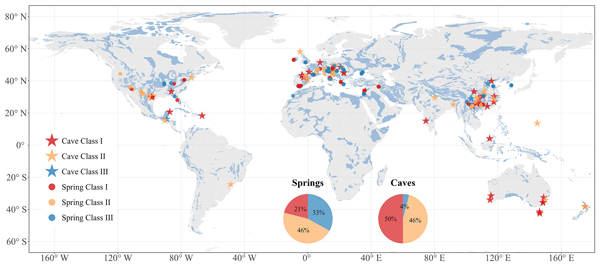
Yining Zang, Pauline C. Treble, Kei Yoshimura, Jayson Gabriel Pinza, Fengbo Zhang, Kübra Özdemir Çallı, Xiaojun Mei, Admin Husic, Alena Gessert, Andrej Stroj, Bartolomé Andreo, Bernard Ladouche, Christine Stumpp, Diana Mance, Eleni Zagana, Fen Huang, Giuseppe Sappa, Harald Kunstmann, Heike Brielmann, Hong Zhou, Huaying Wu, Jakob Garvelmann, James Berglund, Jean-Baptiste Charlier, Jens Lange, Juan Antonio Barberá Fornell, Junbing Pu, Konstantina Katsanou, Kun Ren, Laura Toran, Laurence Gill, Maria Filippini, Martin Kralik, Matías Mudarra Martínez, Min Zhao, Mingming Luo, Nico Goldscheider, Nikolaos Lambrakis, Pantaleone De Vita, Qiong Xiao, Shi Yu, Silvia Iacurto, Silvio Coda, Ted McCormack, Vincenzo Allocca, W. George Darling, Walter D'Alessandro, Xulei Guo, Yundi Hu, Zhijun Wang, Eva Kaminsky, Jiří Faimon, Marek Lang, Pavel Pracný, Aurel Persoiu, and Andreas Hartmann
Earth Syst. Sci. Data, 18, 7199–7225, https://doi.org/10.5194/essd-18-7199-2026, https://doi.org/10.5194/essd-18-7199-2026, 2026
Short summary
Short summary
We developed the first global database of water from karst springs and cave drips that records different forms of oxygen and hydrogen, which naturally trace how rainwater moves through rocks. By gathering and checking thousands of measurements from around the globe and linking them with flow and rainfall data, the database provides a comprehensive view of water movement, allows scientists to compare regions, understand groundwater processes, and support sustainable water management worldwide.
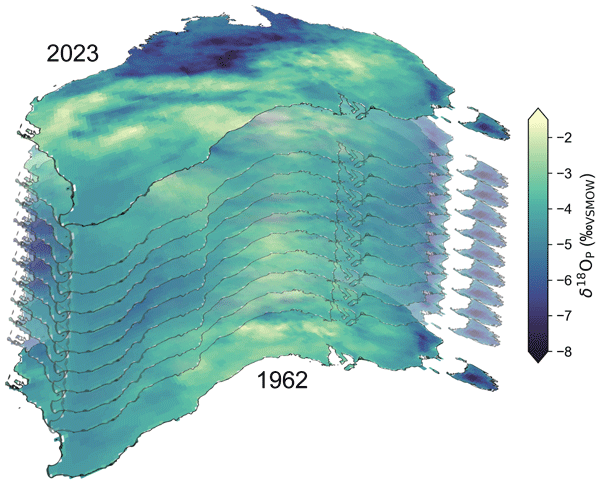
Georgina Falster, Gab Abramowitz, Sanaa Hobeichi, Catherine Hughes, Pauline Treble, Nerilie J. Abram, Michael I. Bird, Alexandre Cauquoin, Bronwyn Dixon, Russell Drysdale, Chenhui Jin, Niels Munksgaard, Bernadette Proemse, Jonathan J. Tyler, Martin Werner, and Carol V. Tadros
Hydrol. Earth Syst. Sci., 30, 289–315, https://doi.org/10.5194/hess-30-289-2026, https://doi.org/10.5194/hess-30-289-2026, 2026
Short summary
Short summary
We used a random forest approach to produce estimates of monthly precipitation stable isotope variability from 1962–2023, at high resolution across the entire Australian continent. Comprehensive skill and sensitivity testing shows that our random forest models skilfully predict precipitation isotope values in places and times that observations are not available. We make all outputs freely available, facilitating use in fields from ecology and hydrology to archaeology and forensic science.
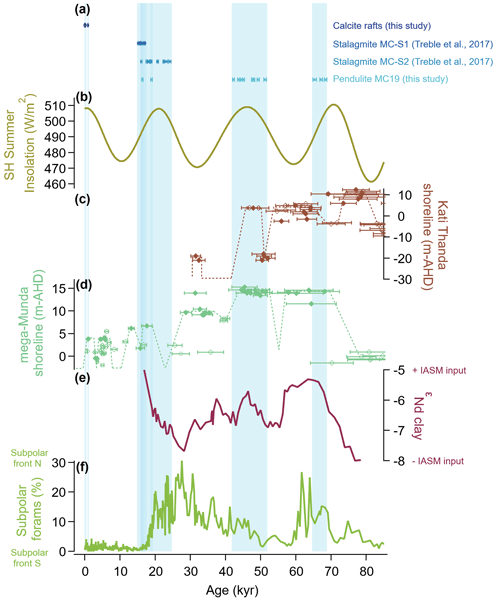
Calla N. Gould-Whaley, Russell N. Drysdale, Pauline C. Treble, Jan-Hendrik May, Stacey C. Priestley, John C. Hellstrom, Christopher R. Vardanega, and Clare C. Buswell
Clim. Past, 21, 857–876, https://doi.org/10.5194/cp-21-857-2025, https://doi.org/10.5194/cp-21-857-2025, 2025
Short summary
Short summary
Climate change is causing enhanced aridity across many regions of the globe, leading to increased reliance on groundwater resources. We need to understand how groundwater recharge behaves in arid regions over long timescales; unfortunately, arid landscapes tend to preserve very little evidence of their climatic past. We present evidence to suggest that carbonate formations that grow in groundwater can be used as archives of past groundwater recharge in Australia's arid zone.
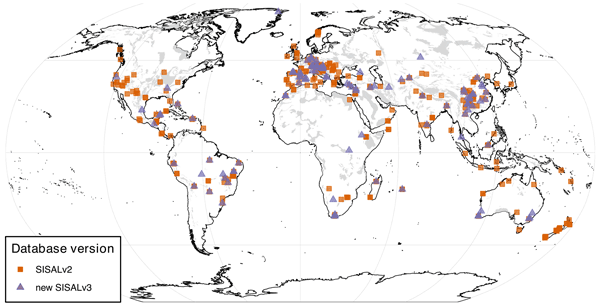
Nikita Kaushal, Franziska A. Lechleitner, Micah Wilhelm, Khalil Azennoud, Janica C. Bühler, Kerstin Braun, Yassine Ait Brahim, Andy Baker, Yuval Burstyn, Laia Comas-Bru, Jens Fohlmeister, Yonaton Goldsmith, Sandy P. Harrison, István G. Hatvani, Kira Rehfeld, Magdalena Ritzau, Vanessa Skiba, Heather M. Stoll, József G. Szűcs, Péter Tanos, Pauline C. Treble, Vitor Azevedo, Jonathan L. Baker, Andrea Borsato, Sakonvan Chawchai, Andrea Columbu, Laura Endres, Jun Hu, Zoltán Kern, Alena Kimbrough, Koray Koç, Monika Markowska, Belen Martrat, Syed Masood Ahmad, Carole Nehme, Valdir Felipe Novello, Carlos Pérez-Mejías, Jiaoyang Ruan, Natasha Sekhon, Nitesh Sinha, Carol V. Tadros, Benjamin H. Tiger, Sophie Warken, Annabel Wolf, Haiwei Zhang, and SISAL Working Group members
Earth Syst. Sci. Data, 16, 1933–1963, https://doi.org/10.5194/essd-16-1933-2024, https://doi.org/10.5194/essd-16-1933-2024, 2024
Short summary
Short summary
Speleothems are a popular, multi-proxy climate archive that provide regional to global insights into past hydroclimate trends with precise chronologies. We present an update to the SISAL (Speleothem Isotopes
Synthesis and AnaLysis) database, SISALv3, which, for the first time, contains speleothem trace element records, in addition to an update to the stable isotope records available in previous versions of the database, cumulatively providing data from 365 globally distributed sites.
Synthesis and AnaLysis) database, SISALv3, which, for the first time, contains speleothem trace element records, in addition to an update to the stable isotope records available in previous versions of the database, cumulatively providing data from 365 globally distributed sites.
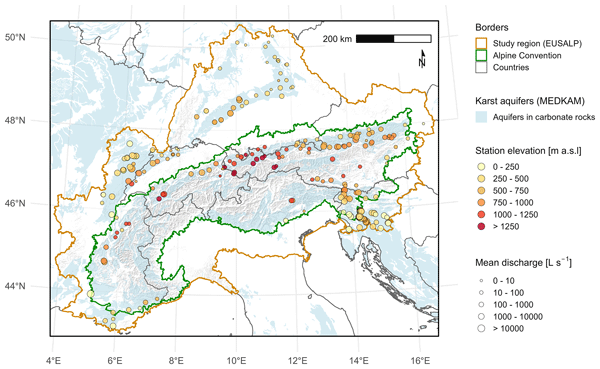
Felix Joger, Pauline Thinius, Zhao Chen, Andreas Hartmann, Nico Goldscheider, Tanja Liesch, Gerhard Schubert, and Stefan Broda
Earth Syst. Sci. Data, 18, 8377–8406, https://doi.org/10.5194/essd-18-8377-2026, https://doi.org/10.5194/essd-18-8377-2026, 2026
Short summary
Short summary
Karst aquifers are important water sources in the Alps, but comparable spring discharge data have been lacking. We created ALPAKAS, the first large-sample benchmark dataset dedicated to karst springs across the wider Alpine region. It provides 242 daily and 182 hourly harmonized and quality-controlled discharge records, along with catchment delineations, meteorological time series, catchment attributes, and karst-specific indices. The dataset supports comparative analyses and model benchmarking.

Saaya Hamamoto, Yoshinori Iizuka, Takuro Aizawa, Kaoru Kawakami, Mai Matsumoto, Sumito Matoba, Hayoung Bong, Kei Yoshimura, Atsushi Okazaki, Laura J. Dietrich, Hans Christian Steen-Larsen, and Ryu Uemura
Clim. Past, 22, 2045–2066, https://doi.org/10.5194/cp-22-2045-2026, https://doi.org/10.5194/cp-22-2045-2026, 2026
Short summary
Short summary
We developed a new 150-year age scale for an ice core from southeast Greenland by matching its oxygen-isotope variations with climate-model simulations. The record resolves changes over several months and shows that snowfall remained nearly evenly distributed through the seasons from 1871 to 2020. This stability suggests that the regional balance of atmospheric circulation and moisture transport changed little at this site despite recent Arctic warming.
Diego Chávez-Espinoza, Christine Vallet-Coulomb, Sylvain Kuppel, Christophe Peugeot, Hayoung Bong, and Kei Yoshimura
EGUsphere, https://doi.org/10.5194/egusphere-2026-5632, https://doi.org/10.5194/egusphere-2026-5632, 2026
This preprint is open for discussion and under review for Hydrology and Earth System Sciences (HESS).
Short summary
Short summary
In a large basin in Benin, water movement is controlled by complex interactions between precipitation, soil and plants. We studied these interactions using natural chemical fingerprints in precipitation and river water, tracked through computer simulations. Our results show these fingerprints can reveal contributions from water stored below the surface that may otherwise go undetected, improving understanding of how water moves through the landscape and informing water resource assessments.
Sarah Rowan, Marc Luetscher, Negar Haghipour, Heather M. Stoll, Laura Endres, Sönke Szidat, and Franziska A. Lechleitner
EGUsphere, https://doi.org/10.5194/egusphere-2026-5813, https://doi.org/10.5194/egusphere-2026-5813, 2026
This preprint is open for discussion and under review for Biogeosciences (BG).
Short summary
Short summary
Soils and plants store three times as much carbon as the atmosphere but how carbon is lost to inland water bodies remains uncertain. We present two years of data from a cave system, revealing contrasting sources and ages of dissolved carbon pools, as well as strong seasonal dynamics. A speleothem (secondary cave carbonate deposit) allows us to trace these signatures back in time. Our findings highlight the complexity of belowground transport and transformation of carbon.
Yining Zang, Pauline C. Treble, Kei Yoshimura, Jayson Gabriel Pinza, Fengbo Zhang, Kübra Özdemir Çallı, Xiaojun Mei, Admin Husic, Alena Gessert, Andrej Stroj, Bartolomé Andreo, Bernard Ladouche, Christine Stumpp, Diana Mance, Eleni Zagana, Fen Huang, Giuseppe Sappa, Harald Kunstmann, Heike Brielmann, Hong Zhou, Huaying Wu, Jakob Garvelmann, James Berglund, Jean-Baptiste Charlier, Jens Lange, Juan Antonio Barberá Fornell, Junbing Pu, Konstantina Katsanou, Kun Ren, Laura Toran, Laurence Gill, Maria Filippini, Martin Kralik, Matías Mudarra Martínez, Min Zhao, Mingming Luo, Nico Goldscheider, Nikolaos Lambrakis, Pantaleone De Vita, Qiong Xiao, Shi Yu, Silvia Iacurto, Silvio Coda, Ted McCormack, Vincenzo Allocca, W. George Darling, Walter D'Alessandro, Xulei Guo, Yundi Hu, Zhijun Wang, Eva Kaminsky, Jiří Faimon, Marek Lang, Pavel Pracný, Aurel Persoiu, and Andreas Hartmann
Earth Syst. Sci. Data, 18, 7199–7225, https://doi.org/10.5194/essd-18-7199-2026, https://doi.org/10.5194/essd-18-7199-2026, 2026
Short summary
Short summary
We developed the first global database of water from karst springs and cave drips that records different forms of oxygen and hydrogen, which naturally trace how rainwater moves through rocks. By gathering and checking thousands of measurements from around the globe and linking them with flow and rainfall data, the database provides a comprehensive view of water movement, allows scientists to compare regions, understand groundwater processes, and support sustainable water management worldwide.
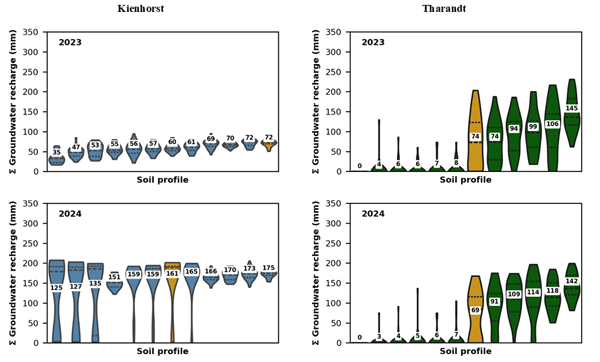
Thomas Fichtner, Yuly Juliana Aguilar Avila, Katja Ehrenberg, Stefan Seeger, Martin Maier, Stephan Raspe, and Andreas Hartmann
Hydrol. Earth Syst. Sci., 30, 5711–5734, https://doi.org/10.5194/hess-30-5711-2026, https://doi.org/10.5194/hess-30-5711-2026, 2026
Short summary
Short summary
The study examines how spatial soil moisture variability affects Soil-Vegetation-Atmosphere Transfer (SVAT) model calibration and groundwater recharge estimates in forest ecosystems. It is demonstrated that model-inherent uncertainties outweight the influence of soil moisture variability. The results indicate that reliable groundwater recharge can be achieved using data from three to eleven profiles, offering practical guidance for efficient monitoring and calibration.
Tamara Leins, Nikolai Späth, Jan Seibert, Francesca Pianosi, Christian Reinhardt-Imjela, and Andreas Hartmann
EGUsphere, https://doi.org/10.5194/egusphere-2026-4470, https://doi.org/10.5194/egusphere-2026-4470, 2026
Short summary
Short summary
In this study, we found large uncertainties in the simulation of Subsurface Stormflow (SSF) in a lumped hydrological model using only discharge data for parameter estimation. High-flow-based parameter estimation could extract some additional information, but SSF-specific data remain necessary to achieve more realistic SSF simulations. Occurrence uncertainty dominated total SSF uncertainty, suggesting proxy data on SSF occurrence could already substantially reduce SSF simulation uncertainties.
Wenpeng Xie, Hongmei Li, and Kei Yoshimura
EGUsphere, https://doi.org/10.5194/egusphere-2026-4009, https://doi.org/10.5194/egusphere-2026-4009, 2026
Short summary
Short summary
This study develops a new way to calibrate land surface models by combining a machine-learning surrogate with automated parameter estimation. Tested across 20 ecosystem sites, the method improved simulations of sensible and latent heat while greatly reducing the need for repeated full-model runs. It also checks whether the surrogate is reliable and whether calibrated parameters remain physically plausible, making the calibration process more transparent and scalable.
Süleyman Selim Çallı, Kübra Özdemir Çallı, Brahim Akdim, Bruno Arfib, Aleksey Benderev, Sandra Beranger, Avi Burg, Onur Can, Jean-Baptiste Charlier, Mehmet Çelik, Arda Melih Çetin, Fehdi Chemseddine, Miroslava Deliyska, Lucio Di Matteo, Marco Dionigi, Romeo Eftimi, Jutta Eybl, Davide Fronzi, Nico Goldscheider, Ergin Gökkaya, Jorge Jodar, Herve Jourde, Eva Kaminsky, Konstantina Katsanou, Alireza Kavousi, Melike Kaya, David Labat, Tanja Liesch, Peter Malik, Christian Massari, Cyril Mayaud, Naomi Mazzilli, Pavel Pracny, Natasa Ravbar, Nathan Rispal, Simon Seelig, Vianney Sivelle, Marc Steinmann, Daniela Valigi, Gerfried Winkler, Ahmet Kemal Yahşi, and Andreas Hartmann
Earth Syst. Sci. Data Discuss., https://doi.org/10.5194/essd-2026-281, https://doi.org/10.5194/essd-2026-281, 2026
Revised manuscript accepted for ESSD
Short summary
Short summary
Karst groundwater systems are vital but highly sensitive to climate change. Their complex underground flow makes them hard to manage without good data, so we gathered 118 high-quality records of spring discharge across Mediterranean mountain ranges. With an average of 19 years of data – including one nearly century-long record – this collection provides the detailed information needed to better predict water availability and protect these vulnerable groundwater sources.
Georgina Falster, Gab Abramowitz, Sanaa Hobeichi, Catherine Hughes, Pauline Treble, Nerilie J. Abram, Michael I. Bird, Alexandre Cauquoin, Bronwyn Dixon, Russell Drysdale, Chenhui Jin, Niels Munksgaard, Bernadette Proemse, Jonathan J. Tyler, Martin Werner, and Carol V. Tadros
Hydrol. Earth Syst. Sci., 30, 289–315, https://doi.org/10.5194/hess-30-289-2026, https://doi.org/10.5194/hess-30-289-2026, 2026
Short summary
Short summary
We used a random forest approach to produce estimates of monthly precipitation stable isotope variability from 1962–2023, at high resolution across the entire Australian continent. Comprehensive skill and sensitivity testing shows that our random forest models skilfully predict precipitation isotope values in places and times that observations are not available. We make all outputs freely available, facilitating use in fields from ecology and hydrology to archaeology and forensic science.
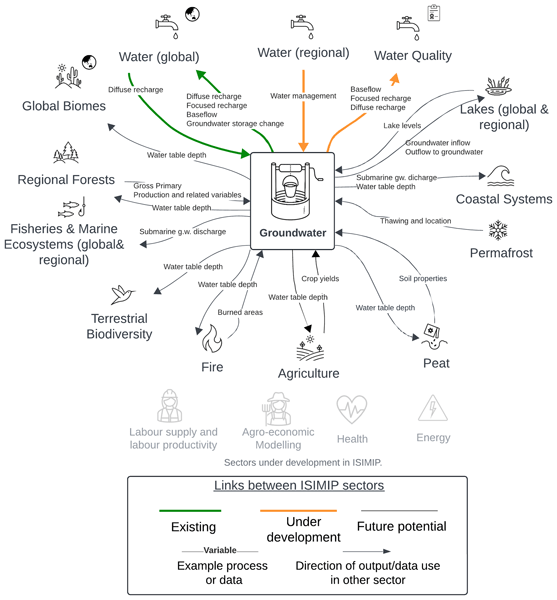
Robert Reinecke, Tanjila Akhter, Annemarie Bäthge, Ricarda Dietrich, Sebastian Gnann, Simon N. Gosling, Danielle Grogan, Andreas Hartmann, Stefan Kollet, Rohini Kumar, Richard Lammers, Sida Liu, Yan Liu, Nils Moosdorf, Bibi Naz, Sara Nazari, Chibuike Orazulike, Yadu Pokhrel, Jacob Schewe, Mikhail Smilovic, Maryna Strokal, Wim Thiery, Yoshihide Wada, Shan Zuidema, and Inge de Graaf
Geosci. Model Dev., 19, 523–542, https://doi.org/10.5194/gmd-19-523-2026, https://doi.org/10.5194/gmd-19-523-2026, 2026
Short summary
Short summary
Here we describe a collaborative effort to improve predictions of how climate change will affect groundwater. The ISIMIP (The Inter-Sectoral Impact Model Intercomparison Project) groundwater sector combines multiple global groundwater models to capture a range of possible outcomes and reduce uncertainty. Initial comparisons reveal significant differences between models in key metrics like water table depth and recharge rates, highlighting the need for structured model intercomparisons.
Zoltán Kern and István Gábor Hatvani
EGUsphere, https://doi.org/10.5194/egusphere-2025-5493, https://doi.org/10.5194/egusphere-2025-5493, 2025
Short summary
Short summary
The study provides the first systematic benchmarking of multiple temporal and spatial imputation techniques on water isotope datasets under controlled missingness scenarios. It offers practical recommendations on method selection depending on data availability and spatial coverage. It uses a secondary-isotopic parameter as a diagnostic indicator for identifying imputation-related distortions, enhancing data quality assurance in hydrologycal studies.
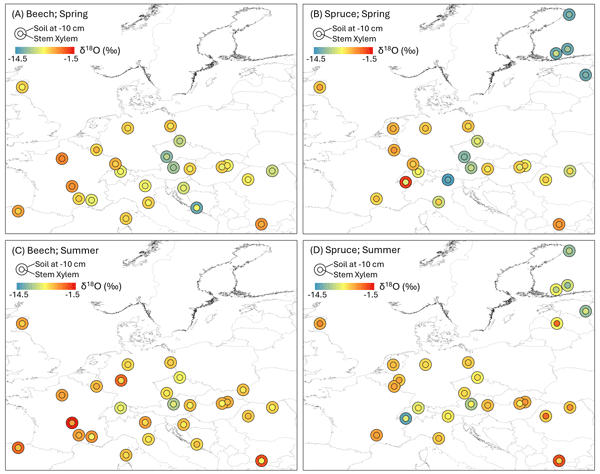
Marco M. Lehmann, Josie Geris, Ilja van Meerveld, Daniele Penna, Youri Rothfuss, Matteo Verdone, Pertti Ala-Aho, Matyas Arvai, Alise Babre, Philippe Balandier, Fabian Bernhard, Lukrecija Butorac, Simon D. Carrière, Natalie C. Ceperley, Zuosinan Chen, Alicia Correa, Haoyu Diao, David Dubbert, Maren Dubbert, Fabio Ercoli, Marius G. Floriancic, Alligin Ghazoul, Teresa E. Gimeno, Damien Gounelle, Frank Hagedorn, Christophe Hissler, Frédéric Huneau, Alberto Iraheta, Tamara Jakovljević, Nerantzis Kazakis, Zoltan Kern, Laura Kinzinger, Karl Knaebel, Johannes Kobler, Jiri Kocum, Charlotte Koeber, Gerbrand Koren, Angelika Kübert, Dawid Kupka, Samuel Le Gall, Aleksi Lehtonen, Thomas Leydier, Philippe Malagoli, Francesca Sofia Manca di Villahermosa, Chiara Marchina, Núria Martínez-Carreras, Nicolas Martin-StPaul, Hannu Marttila, Aline Meyer Oliveira, Gael Monvoisin, Natalie Orlowski, Kadi Palmik-Das, Aurel Persoiu, Andrei Popa, Egor Prikaziuk, Cécile Quantin, Katja T. Rinne-Garmston, Clara Rohde, Martin Sanda, Matthias Saurer, Daniel Schulz, Michael P. Stockinger, Christine Stumpp, Jean-Stéphane Vénisse, Lukas Vlcek, Stylianos Voudouris, Björn Weeser, Mark E. Wilkinson, Giulia Zuecco, and Katrin Meusburger
Earth Syst. Sci. Data, 17, 6129–6147, https://doi.org/10.5194/essd-17-6129-2025, https://doi.org/10.5194/essd-17-6129-2025, 2025
Short summary
Short summary
This study describes a unique large-scale isotope dataset to study water dynamics in European forests. Researchers collected data from 40 beech and spruce forest sites in spring and summer 2023, using a standardized method to ensure consistency. The results show that water sources for trees change between seasons and vary by tree species. This large dataset offers valuable information for understanding plant water use, improving ecohydrological models, and mapping water cycles across Europe.
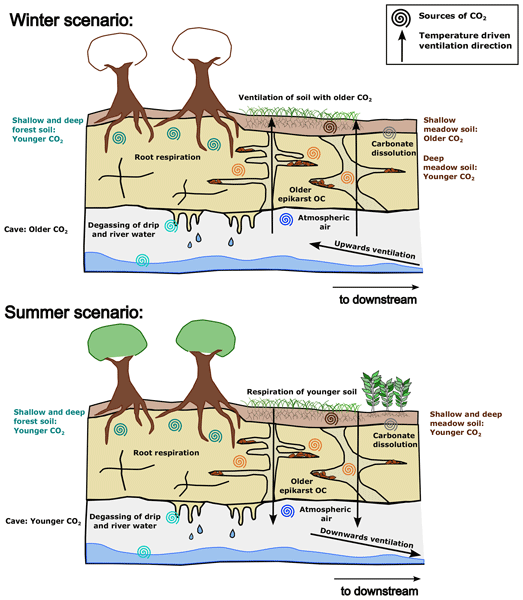
Sarah Ann Rowan, Marc Luetscher, Thomas Laemmel, Anna Harrison, Sönke Szidat, and Franziska A. Lechleitner
Biogeosciences, 22, 6173–6203, https://doi.org/10.5194/bg-22-6173-2025, https://doi.org/10.5194/bg-22-6173-2025, 2025
Short summary
Short summary
We explored CO2 from the soil to subsurface at Milandre cave, finding very high concentrations at all depths. While forest soils produced modern CO2 year-round, cave and meadow soil CO2 influences vary with temperature-controlled cave ventilation, with older CO2 input in winter from old organic matter stored underground. These findings show that CO2 fluxes in karst systems are highly dynamic, and a better understanding of them is important for accurate carbon cycle modelling.
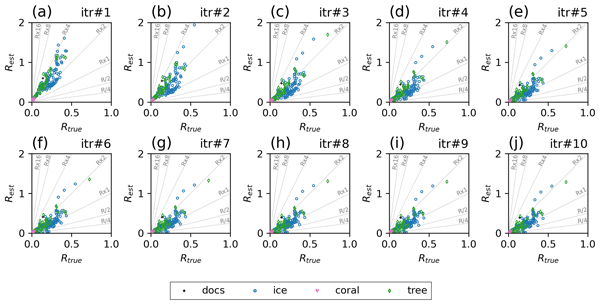
Atsushi Okazaki, Diego S. Carrió, Quentin Dalaiden, Jarrah Harrison-Lofthouse, Shunji Kotsuki, and Kei Yoshimura
Clim. Past, 21, 1801–1819, https://doi.org/10.5194/cp-21-1801-2025, https://doi.org/10.5194/cp-21-1801-2025, 2025
Short summary
Short summary
Data assimilation (DA) has been used to reconstruct paleoclimate fields. DA integrates model simulations and climate proxies based on their error sizes. Consequently, error information is vital for DA to function optimally. This study estimated observation errors using "innovation statistics" and demonstrated that DA with estimated errors outperformed previous studies.
Theresa Blume, Peter Chifflard, Stefan Achleitner, Andreas Hartmann, Stefan Hergarten, Luisa Hopp, Bernhard Kohl, Florian Leese, Ilja van Meerveld, Christian Reinhardt-Imjela, and Markus Weiler
EGUsphere, https://doi.org/10.5194/egusphere-2025-4424, https://doi.org/10.5194/egusphere-2025-4424, 2025
Short summary
Short summary
Subsurface stormflow (SSF) is one of the least studied and therefore least understood runoff generation processes because detecting and quantifying SSF is extremely challenging. We present an ongoing concerted experimental effort to systematically investigate SSF across four catchments using a variety of methods covering different spatial scales. Centerpiece of this effort is the construction of 12 large trenches to capture and monitor SSF.
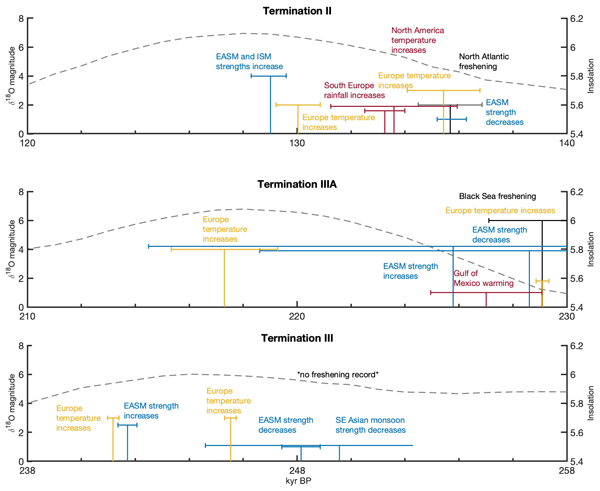
Nikita Kaushal, Carlos Pérez-Mejías, and Heather M. Stoll
Clim. Past, 21, 1633–1660, https://doi.org/10.5194/cp-21-1633-2025, https://doi.org/10.5194/cp-21-1633-2025, 2025
Short summary
Short summary
Terminations are large-magnitude rapid events triggered in the North Atlantic region that manifest across the global climate system. They provide key examples of climatic teleconnections and dynamics. In this study, we use the SISAL global speleothem database and find that there are sufficient climatic records from key locations to make speleothems a valuable archive for studying terminations and provide instances for more targeted work on speleothem research.
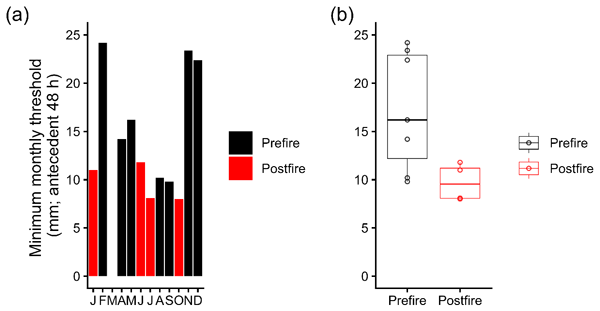
Christina Song, Micheline Campbell, and Andy Baker
Hydrol. Earth Syst. Sci., 29, 4241–4250, https://doi.org/10.5194/hess-29-4241-2025, https://doi.org/10.5194/hess-29-4241-2025, 2025
Short summary
Short summary
Groundwater can be replenished by rainfall that percolates from the surface to the water table. The amount of rainfall that is needed to generate this groundwater recharge is hard to measure. We determined this rainfall amount by identifying recharge events as water percolates from the surface, through a cave. During our monitoring, an intense fire occurred above the cave, and we were able to quantify any change in the amount of rainfall necessary to generate recharge before and after the fire.

Stuart Umbo, Franziska Lechleitner, Thomas Opel, Sevasti Modestou, Tobias Braun, Anton Vaks, Gideon Henderson, Pete Scott, Alexander Osintzev, Alexandr Kononov, Irina Adrian, Yuri Dublyansky, Alena Giesche, and Sebastian F. M. Breitenbach
Clim. Past, 21, 1533–1551, https://doi.org/10.5194/cp-21-1533-2025, https://doi.org/10.5194/cp-21-1533-2025, 2025
Short summary
Short summary
We use cave rocks to reconstruct northern Siberian climate in 8.68 ± 0.09 Ma. We show that when the global average temperature was about 4.5 °C warmer than today (similar to what is expected in the coming decades should carbon emissions continue unabated), the Siberian Arctic temperature increased by more than 18 °C.
Wenpeng Xie, Hongmei Li, and Kei Yoshimura
EGUsphere, https://doi.org/10.5194/egusphere-2025-3301, https://doi.org/10.5194/egusphere-2025-3301, 2025
Preprint archived
Short summary
Short summary
Forecasts of land–air heat and moisture exchange often depend on experts manually adjusting settings, causing inconsistencies. We developed a deep learning method that automatically calibrates these simulations using observations from twenty sites, reducing average errors by fifteen percent. It kept high accuracy at new forest locations while showing more variability at farms. This tool enables faster, more reliable forecasts without manual tuning.
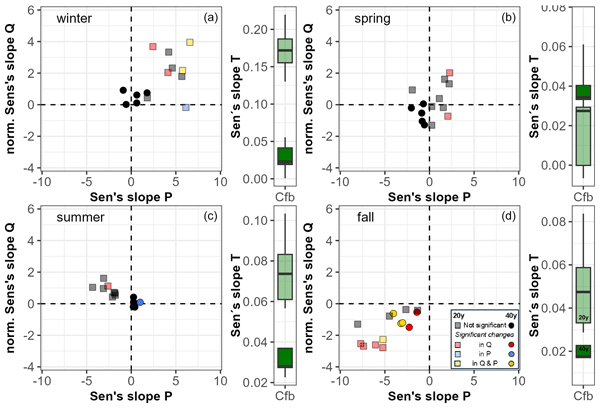
Markus Giese, Yvan Caballero, Andreas Hartmann, and Jean-Baptiste Charlier
Hydrol. Earth Syst. Sci., 29, 3037–3054, https://doi.org/10.5194/hess-29-3037-2025, https://doi.org/10.5194/hess-29-3037-2025, 2025
Short summary
Short summary
Karst springs respond quickly to environmental changes, making them crucial to understanding climate impacts on groundwater. This study analyses long-term trends in precipitation, temperature, and discharge from more than 50 springs across Europe. Results show that while historical discharge trends align with those of rivers, recent changes are driven by rising temperatures rather than precipitation. These findings highlight climate-driven shifts in groundwater recharge and storage processes.
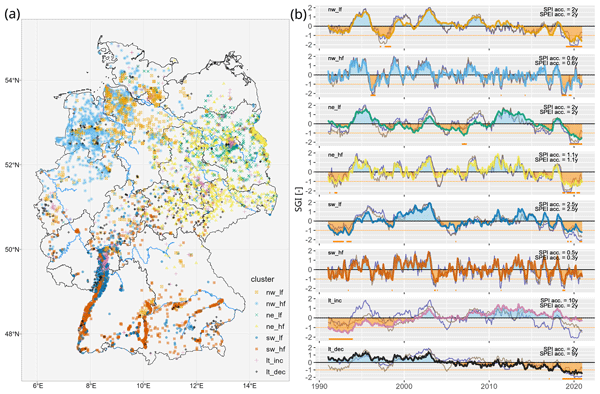
Pia Ebeling, Andreas Musolff, Rohini Kumar, Andreas Hartmann, and Jan H. Fleckenstein
Hydrol. Earth Syst. Sci., 29, 2925–2950, https://doi.org/10.5194/hess-29-2925-2025, https://doi.org/10.5194/hess-29-2925-2025, 2025
Short summary
Short summary
Groundwater is a crucial resource at risk due to droughts. To understand drought effects on groundwater levels in Germany, we grouped 6626 wells into six regional and two national patterns. Weather explained half of the level variations with varied response times. Shallow groundwater responds fast and is more vulnerable to short droughts (a few months). Dampened deep heads buffer short droughts but suffer from long droughts and recoveries. Two nationwide trend patterns were linked to human water use.
Calla N. Gould-Whaley, Russell N. Drysdale, Pauline C. Treble, Jan-Hendrik May, Stacey C. Priestley, John C. Hellstrom, Christopher R. Vardanega, and Clare C. Buswell
Clim. Past, 21, 857–876, https://doi.org/10.5194/cp-21-857-2025, https://doi.org/10.5194/cp-21-857-2025, 2025
Short summary
Short summary
Climate change is causing enhanced aridity across many regions of the globe, leading to increased reliance on groundwater resources. We need to understand how groundwater recharge behaves in arid regions over long timescales; unfortunately, arid landscapes tend to preserve very little evidence of their climatic past. We present evidence to suggest that carbonate formations that grow in groundwater can be used as archives of past groundwater recharge in Australia's arid zone.
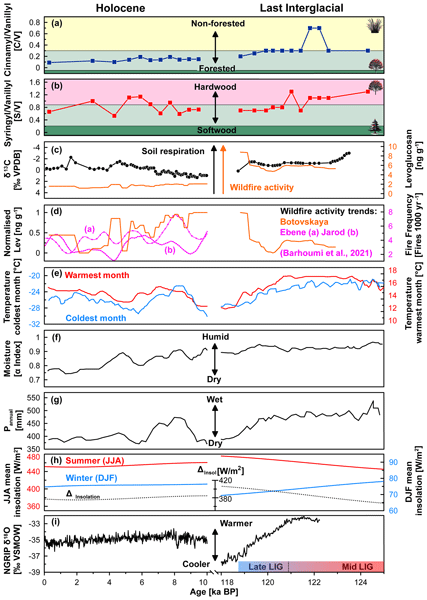
Jade Margerum, Julia Homann, Stuart Umbo, Gernot Nehrke, Thorsten Hoffmann, Anton Vaks, Aleksandr Kononov, Alexander Osintsev, Alena Giesche, Andrew Mason, Franziska A. Lechleitner, Gideon M. Henderson, Ola Kwiecien, and Sebastian F. M. Breitenbach
Clim. Past, 21, 661–677, https://doi.org/10.5194/cp-21-661-2025, https://doi.org/10.5194/cp-21-661-2025, 2025
Short summary
Short summary
We analyse a southern Siberian stalagmite to reconstruct soil respiration, wildfire, and vegetation trends during the Last Interglacial (LIG) (124.1–118.8 ka) and the Holocene (10–0 ka). Wildfires were more prevalent during the LIG than the Holocene and were supported by fire-prone species, low soil respiration, and a greater difference between summer and winter temperature. We show that vegetation type and summer/winter temperature contrast are strong drivers of Siberian wildfires.
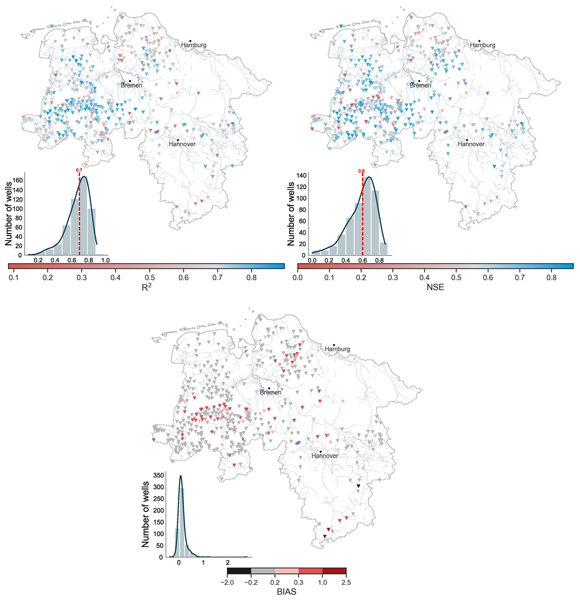
Mariana Gomez, Maximilian Nölscher, Andreas Hartmann, and Stefan Broda
Hydrol. Earth Syst. Sci., 28, 4407–4425, https://doi.org/10.5194/hess-28-4407-2024, https://doi.org/10.5194/hess-28-4407-2024, 2024
Short summary
Short summary
To understand the impact of external factors on groundwater level modelling using a 1-D convolutional neural network (CNN) model, we train, validate, and tune individual CNN models for 505 wells distributed across Lower Saxony, Germany. We then evaluate the performance of these models against available geospatial and time series features. This study provides new insights into the relationship between these factors and the accuracy of groundwater modelling.
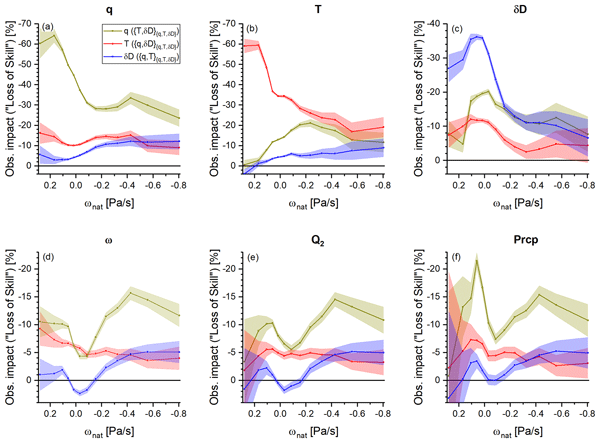
Matthias Schneider, Kinya Toride, Farahnaz Khosrawi, Frank Hase, Benjamin Ertl, Christopher J. Diekmann, and Kei Yoshimura
Atmos. Meas. Tech., 17, 5243–5259, https://doi.org/10.5194/amt-17-5243-2024, https://doi.org/10.5194/amt-17-5243-2024, 2024
Short summary
Short summary
Despite its importance for extreme weather and climate feedbacks, atmospheric convection is not well constrained. This study assesses the potential of novel tropospheric water vapour isotopologue satellite observations for improving the analyses of convective events. We find that the impact of the isotopologues is small for stable atmospheric conditions but significant for unstable conditions, which have the strongest societal impacts (e.g. storms and flooding).
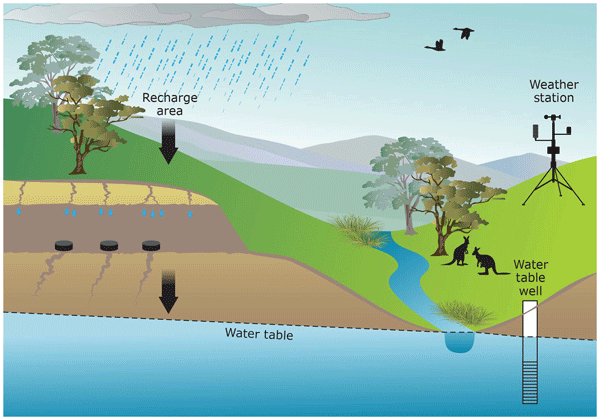
Andy Baker, Margaret Shanafield, Wendy Timms, Martin Sogaard Andersen, Stacey Priestley, and Marilu Melo Zurita
Geosci. Instrum. Method. Data Syst., 13, 117–129, https://doi.org/10.5194/gi-13-117-2024, https://doi.org/10.5194/gi-13-117-2024, 2024
Short summary
Short summary
Much of the world relies on groundwater as a water resource, yet it is hard to know when and where rainfall replenishes our groundwater aquifers. Caves, mines, and tunnels that are situated above the groundwater table are unique observatories of water transiting from the land surface to the aquifer. This paper will show how networks of loggers deployed in these underground spaces across Australia have helped understand when, where, and how much rainfall is needed to replenish the groundwater.
Nikita Kaushal, Franziska A. Lechleitner, Micah Wilhelm, Khalil Azennoud, Janica C. Bühler, Kerstin Braun, Yassine Ait Brahim, Andy Baker, Yuval Burstyn, Laia Comas-Bru, Jens Fohlmeister, Yonaton Goldsmith, Sandy P. Harrison, István G. Hatvani, Kira Rehfeld, Magdalena Ritzau, Vanessa Skiba, Heather M. Stoll, József G. Szűcs, Péter Tanos, Pauline C. Treble, Vitor Azevedo, Jonathan L. Baker, Andrea Borsato, Sakonvan Chawchai, Andrea Columbu, Laura Endres, Jun Hu, Zoltán Kern, Alena Kimbrough, Koray Koç, Monika Markowska, Belen Martrat, Syed Masood Ahmad, Carole Nehme, Valdir Felipe Novello, Carlos Pérez-Mejías, Jiaoyang Ruan, Natasha Sekhon, Nitesh Sinha, Carol V. Tadros, Benjamin H. Tiger, Sophie Warken, Annabel Wolf, Haiwei Zhang, and SISAL Working Group members
Earth Syst. Sci. Data, 16, 1933–1963, https://doi.org/10.5194/essd-16-1933-2024, https://doi.org/10.5194/essd-16-1933-2024, 2024
Short summary
Short summary
Speleothems are a popular, multi-proxy climate archive that provide regional to global insights into past hydroclimate trends with precise chronologies. We present an update to the SISAL (Speleothem Isotopes
Synthesis and AnaLysis) database, SISALv3, which, for the first time, contains speleothem trace element records, in addition to an update to the stable isotope records available in previous versions of the database, cumulatively providing data from 365 globally distributed sites.
Synthesis and AnaLysis) database, SISALv3, which, for the first time, contains speleothem trace element records, in addition to an update to the stable isotope records available in previous versions of the database, cumulatively providing data from 365 globally distributed sites.
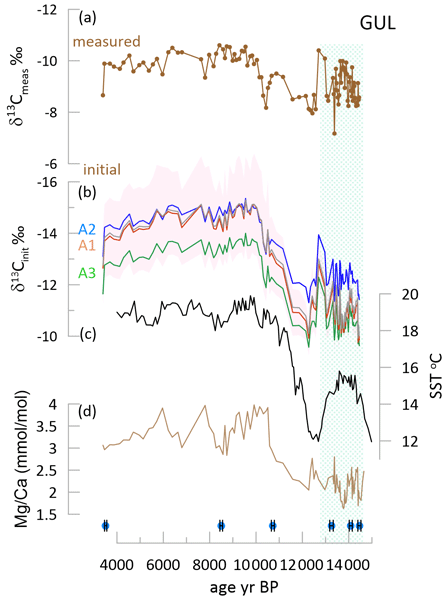
Heather M. Stoll, Chris Day, Franziska Lechleitner, Oliver Kost, Laura Endres, Jakub Sliwinski, Carlos Pérez-Mejías, Hai Cheng, and Denis Scholz
Clim. Past, 19, 2423–2444, https://doi.org/10.5194/cp-19-2423-2023, https://doi.org/10.5194/cp-19-2423-2023, 2023
Short summary
Short summary
Stalagmites formed in caves provide valuable information about past changes in climate and vegetation conditions. In this contribution, we present a new method to better estimate past changes in soil and vegetation productivity using carbon isotopes and trace elements measured in stalagmites. Applying this method to other stalagmites should provide a better indication of past vegetation feedbacks to climate change.
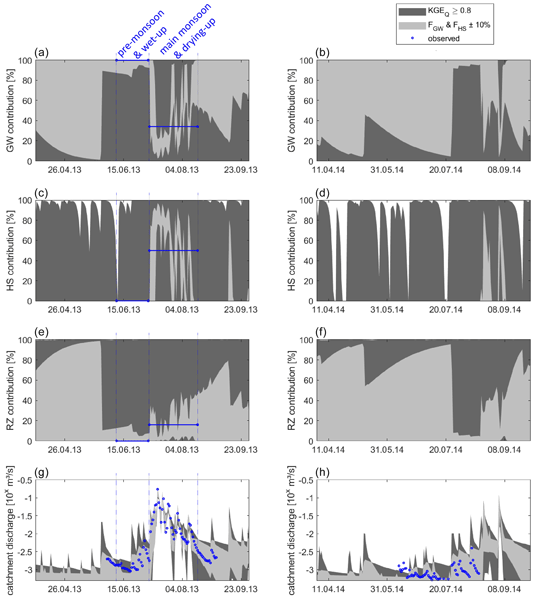
Andreas Hartmann, Jean-Lionel Payeur-Poirier, and Luisa Hopp
Hydrol. Earth Syst. Sci., 27, 1325–1341, https://doi.org/10.5194/hess-27-1325-2023, https://doi.org/10.5194/hess-27-1325-2023, 2023
Short summary
Short summary
We advance our understanding of including information derived from environmental tracers into hydrological modeling. We present a simple approach that integrates streamflow observations and tracer-derived streamflow contributions for model parameter estimation. We consider multiple observed streamflow components and their variation over time to quantify the impact of their inclusion for streamflow prediction at the catchment scale.
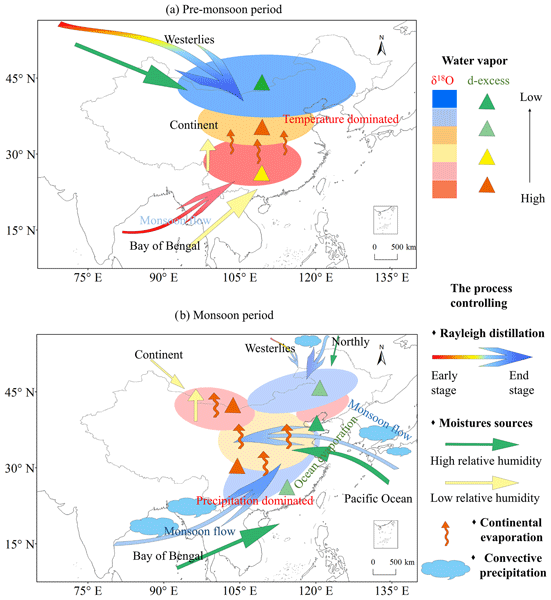
Di Wang, Lide Tian, Camille Risi, Xuejie Wang, Jiangpeng Cui, Gabriel J. Bowen, Kei Yoshimura, Zhongwang Wei, and Laurent Z. X. Li
Atmos. Chem. Phys., 23, 3409–3433, https://doi.org/10.5194/acp-23-3409-2023, https://doi.org/10.5194/acp-23-3409-2023, 2023
Short summary
Short summary
To better understand the spatial and temporal distribution of vapor isotopes, we present two vehicle-based spatially continuous snapshots of the near-surface vapor isotopes in China during the pre-monsoon and monsoon periods. These observations are explained well by different moisture sources and processes along the air mass trajectories. Our results suggest that proxy records need to be interpreted in the context of regional systems and sources of moisture.
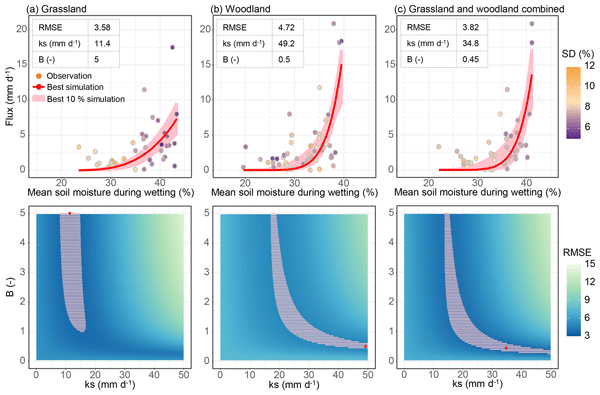
Romane Berthelin, Tunde Olarinoye, Michael Rinderer, Matías Mudarra, Dominic Demand, Mirjam Scheller, and Andreas Hartmann
Hydrol. Earth Syst. Sci., 27, 385–400, https://doi.org/10.5194/hess-27-385-2023, https://doi.org/10.5194/hess-27-385-2023, 2023
Short summary
Short summary
Karstic recharge processes have mainly been explored using discharge analysis despite the high influence of the heterogeneous surface on hydrological processes. In this paper, we introduce an event-based method which allows for recharge estimation from soil moisture measurements. The method was tested at a karst catchment in Germany but can be applied to other karst areas with precipitation and soil moisture data available. It will allow for a better characterization of karst recharge processes.
Farahnaz Khosrawi, Kinya Toride, Kei Yoshimura, Christopher Diekmann, Benjamin Ertl, Frank Hase, and Matthias Schneider
EGUsphere, https://doi.org/10.5194/egusphere-2022-1408, https://doi.org/10.5194/egusphere-2022-1408, 2022
Preprint withdrawn
Short summary
Short summary
We assess with an Observation System Simulation Experiment the potential of mid-tropospheric water isotopologue data for constraining uncertainties in meteorological analysis fields in the tropics. Our assimilation experiments indicate that isotopologue observations have the potential to reduce the uncertainties of diabatic heating rates and precipitation in the tropics and in consequence offer potential for improving meteorological analysis in the tropical regions.
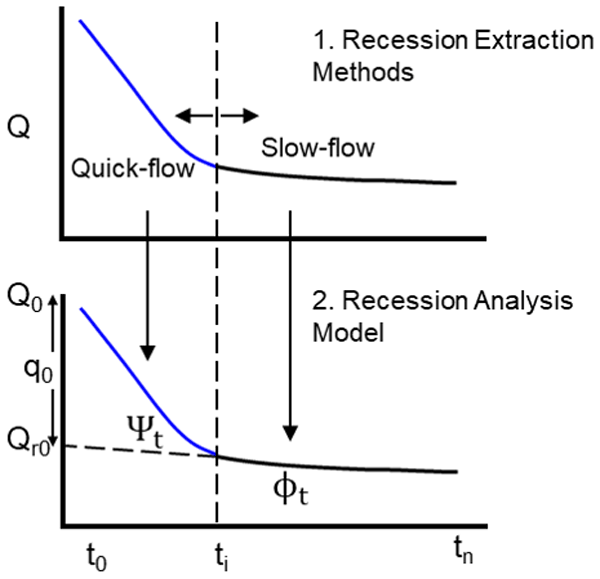
Tunde Olarinoye, Tom Gleeson, and Andreas Hartmann
Hydrol. Earth Syst. Sci., 26, 5431–5447, https://doi.org/10.5194/hess-26-5431-2022, https://doi.org/10.5194/hess-26-5431-2022, 2022
Short summary
Short summary
Analysis of karst spring recession is essential for management of groundwater. In karst, recession is dominated by slow and fast components; separating these components is by manual and subjective approaches. In our study, we tested the applicability of automated streamflow recession extraction procedures for a karst spring. Results showed that, by simple modification, streamflow extraction methods can identify slow and fast components: derived recession parameters are within reasonable ranges.
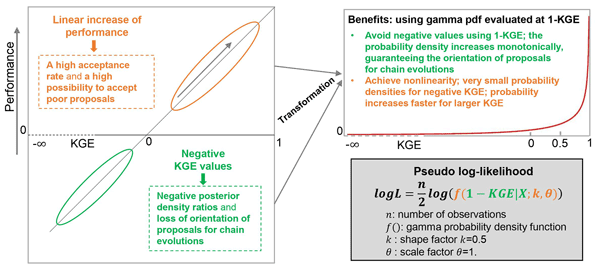
Yan Liu, Jaime Fernández-Ortega, Matías Mudarra, and Andreas Hartmann
Hydrol. Earth Syst. Sci., 26, 5341–5355, https://doi.org/10.5194/hess-26-5341-2022, https://doi.org/10.5194/hess-26-5341-2022, 2022
Short summary
Short summary
We adapt the informal Kling–Gupta efficiency (KGE) with a gamma distribution to apply it as an informal likelihood function in the DiffeRential Evolution Adaptive Metropolis DREAM(ZS) method. Our adapted approach performs as well as the formal likelihood function for exploring posterior distributions of model parameters. The adapted KGE is superior to the formal likelihood function for calibrations combining multiple observations with different lengths, frequencies and units.
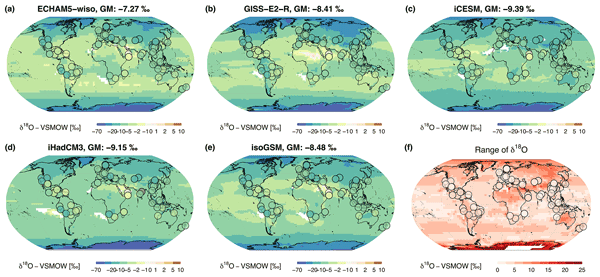
Janica C. Bühler, Josefine Axelsson, Franziska A. Lechleitner, Jens Fohlmeister, Allegra N. LeGrande, Madhavan Midhun, Jesper Sjolte, Martin Werner, Kei Yoshimura, and Kira Rehfeld
Clim. Past, 18, 1625–1654, https://doi.org/10.5194/cp-18-1625-2022, https://doi.org/10.5194/cp-18-1625-2022, 2022
Short summary
Short summary
We collected and standardized the output of five isotope-enabled simulations for the last millennium and assess differences and similarities to records from a global speleothem database. Modeled isotope variations mostly arise from temperature differences. While lower-resolution speleothems do not capture extreme changes to the extent of models, they show higher variability on multi-decadal timescales. As no model excels in all comparisons, we advise a multi-model approach where possible.
Yong Chang, Benjamin Mewes, and Andreas Hartmann
Hydrol. Earth Syst. Sci. Discuss., https://doi.org/10.5194/hess-2022-77, https://doi.org/10.5194/hess-2022-77, 2022
Preprint withdrawn
Short summary
Short summary
This study presents a work to investigate the feasibility of using EC to predict the discharge in a typical karst catchment. We found that the spring discharge can be well predicted by EC in storms using LSTM (Long Short Term Memory) model, while the prediction has relatively large uncertainties in small recharge events. To establish a roust LSTM model for long-term discharge prediction from EC in ungauged catchments, the random or fixed-interval discharge monitoring strategy is recommended.
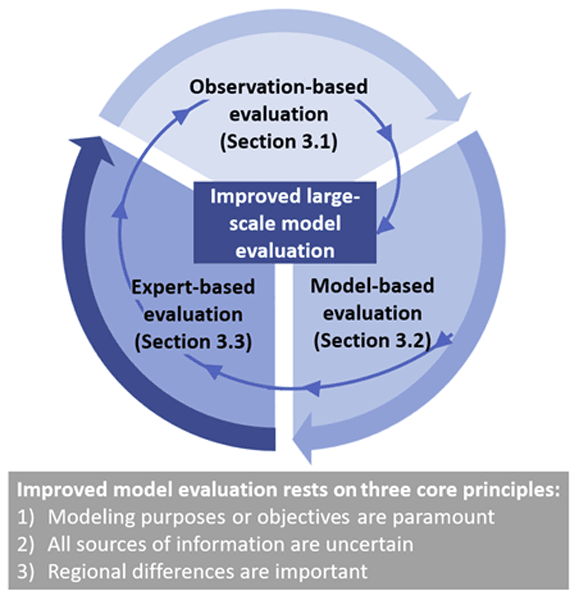
Tom Gleeson, Thorsten Wagener, Petra Döll, Samuel C. Zipper, Charles West, Yoshihide Wada, Richard Taylor, Bridget Scanlon, Rafael Rosolem, Shams Rahman, Nurudeen Oshinlaja, Reed Maxwell, Min-Hui Lo, Hyungjun Kim, Mary Hill, Andreas Hartmann, Graham Fogg, James S. Famiglietti, Agnès Ducharne, Inge de Graaf, Mark Cuthbert, Laura Condon, Etienne Bresciani, and Marc F. P. Bierkens
Geosci. Model Dev., 14, 7545–7571, https://doi.org/10.5194/gmd-14-7545-2021, https://doi.org/10.5194/gmd-14-7545-2021, 2021
Short summary
Short summary
Groundwater is increasingly being included in large-scale (continental to global) land surface and hydrologic simulations. However, it is challenging to evaluate these simulations because groundwater is
hiddenunderground and thus hard to measure. We suggest using multiple complementary strategies to assess the performance of a model (
model evaluation).
Cited articles
Atsawawaranunt, K., Comas-Bru, L., Amirnezhad Mozhdehi, S., Deininger, M., Harrison, S. P., Baker, A., Boyd, M., Kaushal, N., Ahmad, S. M., Ait Brahim, Y., Arienzo, M., Bajo, P., Braun, K., Burstyn, Y., Chawchai, S., Duan, W., Hatvani, I. G., Hu, J., Kern, Z., Labuhn, I., Lachniet, M., Lechleitner, F. A., Lorrey, A., Pérez-Mejías, C., Pickering, R., Scroxton, N., and SISAL Working Group Members: The SISAL database: a global resource to document oxygen and carbon isotope records from speleothems, Earth Syst. Sci. Data, 10, 1687–1713, https://doi.org/10.5194/essd-10-1687-2018, 2018.
Baker, A., Hartmann, A., Duan, W., Hankin, S., Comas-Bru, L., Cuthbert, M. O., Treble, P. C., Banner, J., Genty, D., Baldini, L. M., Bartolomé, M., Moreno, A., Pérez-Mejías, C., and Werner, M.: Global analysis reveals climatic controls on the oxygen isotope composition of cave drip water, Nat. Commun., 10, 2984, https://doi.org/10.1038/s41467-019-11027-w, 2019.
Baker, A., Shanafield, M., Timms, W., Andersen, M. S., Priestley, S., and Melo Zurita, M.: An underground drip water monitoring network to characterize rainfall recharge of groundwater at different geologies, environments, and climates across Australia, Geosci. Instrum. Method. Data Syst., 13, 117–129, https://doi.org/10.5194/gi-13-117-2024, 2024.
Baldini, L. M., McDermott, F., Baldini, J. U. L., Arias, P., Cueto, M., Fairchild, I. J., Hoffmann, D. L., Mattey, D. P., Müller, W., Nita, D. C., Ontañón, R., Garciá-Moncó, C., and Richards, D. A.: Regional temperature, atmospheric circulation, and sea-ice variability within the Younger Dryas Event constrained using a speleothem from northern Iberia, Earth Planet. Sc. Lett., 419, 101–110, https://doi.org/10.1016/j.epsl.2015.03.015, 2015.
Baldini, L. M., Baldini, J. U. L., McDermott, F., Arias, P., Cueto, M., Fairchild, I. J., Hoffmann, D. L., Mattey, D. P., Müller, W., Nita, D. C., Ontañón, R., Garciá-Moncó, C., and Richards, D. A.: North Iberian temperature and rainfall seasonality over the Younger Dryas and Holocene, Quaternary Sci. Rev., 226, 105998, https://doi.org/10.1016/j.quascirev.2019.105998, 2019.
Beck, H. E., van Dijk, A. I. J. M., Levizzani, V., Schellekens, J., Miralles, D. G., Martens, B., and de Roo, A.: MSWEP: 3-hourly 0.25° global gridded precipitation (1979–2015) by merging gauge, satellite, and reanalysis data, Hydrol. Earth Syst. Sci., 21, 589–615, https://doi.org/10.5194/hess-21-589-2017, 2017.
Beck, H. E., Wood, E. F., Pan, M., Fisher, C. K., Miralles, D. G., Van Dijk, A. I. J. M., McVicar, T. R., and Adler, R. F.: MSWEP v2 Global 3-hourly 0.1° precipitation: Methodology and quantitative assessment, B. Am. Meteorol. Soc., 100, 473–500, https://doi.org/10.1175/BAMS-D-17-0138.1, 2019.
Bernal, J. P., Revolorio, F., Cu-Xi, M., Lases-Hernández, F., Piacsek, P., Lachniet, M. S., Beddows, P. A., Lucia, G., López-Aguiar, K., Capella-Vizcaíno, S., López-Martínez, R., and Vásquez, O. J.: Variability of trace-elements and δ18O in drip water from Gruta del Rey Marcos, Guatemala; seasonal and environmental effects, and its implications for paleoclimate reconstructions, Front. Earth Sci., 11, 1112957, https://doi.org/10.3389/feart.2023.1112957, 2023.
Bernal-Wormull, J. L., Moreno, A., Bartolomé, M., Arriolabengoa, M., Pérez-Mejías, C., Iriarte, E., Osácar, C., Spötl, C., Stoll, H., Cacho, I., Edwards, R. L., and Cheng, H.: New insights into the climate of northern Iberia during the Younger Dryas and Holocene: The Mendukilo multi-speleothem record, Quaternary Sci. Rev., 305, 108006, https://doi.org/10.1016/j.quascirev.2023.108006, 2023.
Bian, F., Coleborn, K., Flemons, I., Baker, A., Treble, P. C., Hughes, C. E., Baker, A., Andersen, M. S., Tozer, M. G., Duan, W., Fogwill, C. J., and Fairchild, I. J.: Hydrological and geochemical responses of fire in a shallow cave system, Sci. Total Environ., 662, 180–191, https://doi.org/10.1016/j.scitotenv.2019.01.102, 2019.
Boch, R.: Stalagmites from Katerloch Cave, Austria: Growth dynamics and high-resolution records of climate change, https://doi.org/10.13140/RG.2.1.2932.6320, 2008.
Boch, R., Spötl, C., and Frisia, S.: Origin and palaeoenvironmental significance of lamination in stalagmites from Katerloch Cave, Austria, Sedimentology, 58, 508–531, https://doi.org/10.1111/j.1365-3091.2010.01173.x, 2011.
Bourges, F., Mangini, A., and Hulst, D.: Le Gaz carbonique dans la dynamique de l'atmosphère des cavités karstiques : l'exemple de l'Aven d'Orgnac (Ardèche), CR. Acad. Sci., 333, 685–692, https://doi.org/10.1016/S1251-8050(01)01682-2, 2001.
Bourges, F., Genthon, P., Genty, D., Lorblanchet, M., Mauduit, E., and D'Hulst, D.: Conservation of prehistoric caves and stability of their inner climate: Lessons from Chauvet and other French caves, Sci. Total Environ., 493, 79–91, https://doi.org/10.1016/j.scitotenv.2014.05.137, 2014.
Bowen, G. J. and Wilkinson, B.: Spatial distribution of δ18O in meteoric precipitation, Geology, 30, 315, https://doi.org/10.1130/0091-7613(2002)030<0315:SDOOIM>2.0.CO;2, 2002.
Bradley, C., Baker, A., Jex, C. N., and Leng, M. J.: Hydrological uncertainties in the modelling of cave drip-water δ18O and the implications for stalagmite palaeoclimate reconstructions, Quaternary Sci. Rev., 29, 2201–2214, https://doi.org/10.1016/j.quascirev.2010.05.017, 2010.
Brady, E., Stevenson, S., Bailey, D., Liu, Z., Noone, D., Nusbaumer, J., Otto-Bliesner, B. L., Tabor, C., Tomas, R., Wong, T., Zhang, J., and Zhu, J.: The connected isotopic water cycle in the Community Earth System Model Version 1, J. Adv. Model. Earth Sy., 11, 2547–2566, https://doi.org/10.1029/2019MS001663, 2019.
Breitenbach, S. F. M., Lechleitner, F. A., Meyer, H., Diengdoh, G., Mattey, D., and Marwan, N.: Cave ventilation and rainfall signals in dripwater in a monsoonal setting – a monitoring study from NE India, Chem. Geol., 402, 111–124, https://doi.org/10.1016/j.chemgeo.2015.03.011, 2015.
Bühler, J. C., Roesch, C., Kirschner, M., Sime, L., Holloway, M. D., and Rehfeld, K.: Comparison of the oxygen isotope signatures in speleothem records and iHadCM3 model simulations for the last millennium, Clim. Past, 17, 985–1004, https://doi.org/10.5194/cp-17-985-2021, 2021.
Burstyn, Y., Martrat, B., Lopez, J. F., Iriarte, E., Jacobson, M. J., Lone, M. A., and Deininger, M.: Speleothems from the Middle East: an example of water-limited environments in the SISAL database, Quaternary, 2, 16, https://doi.org/10.3390/quat2020016, 2019.
Chapman, J. B.: Stable isotopes in southeastern New Mexico groundwater: implications for dating recharge in the WIPP area, Santa Fe, https://www.osti.gov/biblio/6524459 (last access: 12 November 2026), 1986.
Chapman, J. B., Ingraham, N. L., and Hess, J. W.: Isotopic investigation of infiltration and unsaturated zone flow processes at Carlsbad Cavern, New Mexico, J. Hydrol., 133, 343–363, https://doi.org/10.1016/0022-1694(92)90262-T, 1992.
Chen, C.-J. and Li, T.-Y.: Geochemical characteristics of cave drip water respond to ENSO based on a 6-year monitoring work in Yangkou Cave, Southwest China, J. Hydrol., 561, 896–907, https://doi.org/10.1016/j.jhydrol.2018.04.061, 2018.
Chen, X., Jiang, X., Wang, X., Zhao, J., Sun, Z., Li, Y., Ye, Z., Cai, J., Fu, X., Xu, Y., and Yang, Y.: New insights into potential effects of solar activity on the oxygen isotope composition of modern speleothems: Observations from Jiguan Cave, central China II, J. Hydrol., 625, 130114, https://doi.org/10.1016/j.jhydrol.2023.130114, 2023.
Cheng, H., Edwards, R. L., Sinha, A., Spötl, C., Yi, L., Chen, S., Kelly, M., Kathayat, G., Wang, X., Li, X., Kong, X., Wang, Y., Ning, Y., and Zhang, H.: The Asian monsoon over the past 640,000 years and ice age terminations, Nature, 534, 640–646, https://doi.org/10.1038/nature18591, 2016.
Cigna, A. A.: Modern trend in cave monitoring, Acta Carsol., 31, 35–54, https://doi.org/10.3986/ac.v31i1.402, 2016.
Coleborn, K., Rau, G. C., Cuthbert, M. O., Baker, A., and Navarre, O.: Solar-forced diurnal regulation of cave drip rates via phreatophyte evapotranspiration, Hydrol. Earth Syst. Sci., 20, 4439–4455, https://doi.org/10.5194/hess-20-4439-2016, 2016.
Coleborn, K., Baker, A., Treble, P. C., Andersen, M. S., Baker, A., Tadros, C. V., Tozer, M., Fairchild, I. J., Spate, A., and Meehan, S.: The impact of fire on the geochemistry of speleothem-forming drip water in a sub-alpine cave, Sci. Total Environ., 642, 408–420, https://doi.org/10.1016/j.scitotenv.2018.05.310, 2018.
Collister, C. and Mattey, D.: Controls on water drop volume at speleothem drip sites: an experimental study, J. Hydrol., 358, 259–267, https://doi.org/10.1016/j.jhydrol.2008.06.008, 2008.
Comas-Bru, L., Harrison, S. P., Werner, M., Rehfeld, K., Scroxton, N., Veiga-Pires, C., and SISAL working group members: Evaluating model outputs using integrated global speleothem records of climate change since the last glacial, Clim. Past, 15, 1557–1579, https://doi.org/10.5194/cp-15-1557-2019, 2019.
Comas-Bru, L., Rehfeld, K., Roesch, C., Amirnezhad-Mozhdehi, S., Harrison, S. P., Atsawawaranunt, K., Ahmad, S. M., Brahim, Y. A., Baker, A., Bosomworth, M., Breitenbach, S. F. M., Burstyn, Y., Columbu, A., Deininger, M., Demény, A., Dixon, B., Fohlmeister, J., Hatvani, I. G., Hu, J., Kaushal, N., Kern, Z., Labuhn, I., Lechleitner, F. A., Lorrey, A., Martrat, B., Novello, V. F., Oster, J., Pérez-Mejías, C., Scholz, D., Scroxton, N., Sinha, N., Ward, B. M., Warken, S., Zhang, H., and SISAL Working Group members: SISALv2: a comprehensive speleothem isotope database with multiple age–depth models, Earth Syst. Sci. Data, 12, 2579–2606, https://doi.org/10.5194/essd-12-2579-2020, 2020.
Copernicus Climate Change Service (CDS): ERA5 hourly data on single levels from 1940 to present, Climate Data Store (CDS) [data set], https://doi.org/10.24381/cds.adbb2d47, 2023.
Cruz, F. W., Karmann, I., Viana, O., Burns, S. J., Ferrari, J. A., Vuille, M., Sial, A. N., and Moreira, M. Z.: Stable isotope study of cave percolation waters in subtropical Brazil: Implications for paleoclimate inferences from speleothems, Chem. Geol., 220, 245–262, https://doi.org/10.1016/j.chemgeo.2005.04.001, 2005.
Cuthbert, M. O., Baker, A., Jex, C. N., Graham, P. W., Treble, P. C., Andersen, M. S., and Ian Acworth, R.: Drip water isotopes in semi-arid karst: Implications for speleothem paleoclimatology, Earth Planet. Sc. Lett., 395, 194–204, https://doi.org/10.1016/j.epsl.2014.03.034, 2014.
Czuppon, G., Demény, A., Leél-Őssy, S., Óvari, M., Molnár, M., Stieber, J., Kiss, K., Kármán, K., Surányi, G., and Haszpra, L. Cave monitoring in the Béke and Baradla caves (Northeastern Hungary): implications for the conditions for the formation cave carbonates, Int. J. Speleol., 47, https://doi.org/10.5038/1827-806X.47.1.2110, 2018a.
Czuppon, G., Bočić, N., Buzjak, N., Óvári, M., and Molnár, M.: Monitoring in the Barać and Lower Cerovačka caves (Croatia) as a basis for the characterization of the climatological and hydrological processes that control speleothem formation, Quaternary Int., 494, 52–65, https://doi.org/10.1016/j.quaint.2018.02.003, 2018b.
Czuppon, G., Demény, A., Leél-Őssy, S., Stieber, J., Óvári, M., Dobosy, P., Berentés, Á., and Kovács, R.: Cave monitoring in Hungary: An overview, Central European Geology, 65, https://doi.org/10.1556/24.2021.00109, 2022.
Domínguez-Villar, D., Lojen, S., Krklec, K., Kozdon, R., Edwards, R. L., and Cheng, H.: Ion microprobe δ18O analyses to calibrate slow growth rate speleothem records with regional δ18O records of precipitation, Earth Planet. Sc. Lett., 482, 367–376, https://doi.org/10.1016/j.epsl.2017.11.012, 2018.
Drăguşin, V., Balan, S., Blamart, D., Forray, F. L., Marin, C., Mirea, I., Nagavciuc, V., Orăşeanu, I., Perşoiu, A., Tîrlă, L., Tudorache, A., and Vlaicu, M.: Transfer of environmental signals from the surface to the underground at Ascunsă Cave, Romania, Hydrol. Earth Syst. Sci., 21, 5357–5373, https://doi.org/10.5194/hess-21-5357-2017, 2017.
Drăgușin, V., Mirea, I. C., Ersek, V., and Tîrlă, L.: Farmed calcite δ13C at Ascunsă cave, Romania, and its relation with CO2, Quaternaire, 165–174, https://doi.org/10.4000/quaternaire.13792, 2020.
Dreybrodt, W. and Romanov, D.: The evolution of 13C and 18O isotope composition of DIC in a calcite depositing film of water with isotope exchange between the DIC and a CO2 containing atmosphere, and simultaneous evaporation of the water, Implication to climate proxies from stalagmites: A theoretical model, Geochim. Cosmochim. Ac., 195, 323–338, https://doi.org/10.1016/j.gca.2016.07.034, 2016.
Duan, W., Ruan, J., Luo, W., Li, T., Tian, L., Zeng, G., Zhang, D., Bai, Y., Li, J., Tao, T., Zhang, P., Baker, A., and Tan, M.: The transfer of seasonal isotopic variability between precipitation and drip water at eight caves in the monsoon regions of China, Geochim. Cosmochim. Ac., 183, 250–266, https://doi.org/10.1016/j.gca.2016.03.037, 2016.
Ellis, S. A., Cobb, K. M., Moerman, J. W., Partin, J. W., Bennett, A. L., Malang, J., Gerstner, H., and Tuen, A. A.: Extended Cave Drip Water Time Series Captures the 2015–2016 El Niño in Northern Borneo, Geophys. Res. Lett., 47, e2019GL086363, https://doi.org/10.1029/2019GL086363, 2020.
Fairchild, I. J. and Baker, A.: Speleothem Science: From Process to Past Environments, Wiley-Blackwell, Oxford, https://doi.org/10.1002/9781444361094, 2012.
Falster, G., Abramowitz, G., Hobeichi, S., Hughes, C., Treble, P., Abram, N. J., Bird, M. I., Cauquoin, A., Dixon, B., Drysdale, R., Jin, C., Munksgaard, N., Proemse, B., Tyler, J. J., Werner, M., and Tadros, C. V.: High resolution monthly precipitation isotope estimates across Australia from machine learning, Hydrol. Earth Syst. Sci., 30, 289–315, https://doi.org/10.5194/hess-30-289-2026, 2026.
Feng, W., Banner, J. L., Guilfoyle, A. L., Musgrove, M., and James, E. W.: Oxygen isotopic fractionation between drip water and speleothem calcite: A 10-year monitoring study, central Texas, USA, Chem. Geol., 304–305, 53–67, https://doi.org/10.1016/j.chemgeo.2012.02.004, 2012.
Feng, W., Casteel, R. C., Banner, J. L., and Heinze-Fry, A.: Oxygen isotope variations in rainfall, drip-water and speleothem calcite from a well-ventilated cave in Texas, USA: Assessing a new speleothem temperature proxy, Geochim. Cosmochim. Ac., 127, 233–250, https://doi.org/10.1016/j.gca.2013.11.039, 2014.
Fohlmeister, J., Voarintsoa, N. R. G., Lechleitner, F. A., Boyd, M., Brandtstätter, S., Jacobson, M. J., and Oster, J. L.: Main controls on the stable carbon isotope composition of speleothems, Geochim. Cosmochim. Ac., 279, 67–87, https://doi.org/10.1016/j.gca.2020.03.042, 2020.
Fuller, L.: High-resolution multiproxy geochemical Holocene climate records from 1000-year old Scottish stalagmites, University of Birmingham, https://birmingham.primo.exlibrisgroup.com/permalink/44BIR_INST/sbqp9i/alma990026259500204871 (last access: 12 November 2026), 2007.
Fuller, L., Baker, A., Fairchild, I. J., Spötl, C., Marca-Bell, A., Rowe, P., and Dennis, P. F.: Isotope hydrology of dripwaters in a Scottish cave and implications for stalagmite palaeoclimate research, Hydrol. Earth Syst. Sci., 12, 1065–1074, https://doi.org/10.5194/hess-12-1065-2008, 2008.
Genty, D., Labuhn, I., Hoffmann, G., Danis, P. A., Mestre, O., Bourges, F., Wainer, K., Massault, M., Van Exter, S., Régnier, E., Orengo, Ph., Falourd, S., and Minster, B.: Rainfall and cave water isotopic relationships in two South-France sites, Geochim. Cosmochim. Ac., 131, 323–343, https://doi.org/10.1016/j.gca.2014.01.043, 2014.
Giesche, A., Hodell, D. A., Petrie, C. A., Haug, G. H., Adkins, J. F., Plessen, B., Marwan, N., Bradbury, H. J., Hartland, A., French, A. D., and Breitenbach, S. F. M.: Cave measurements made during the field campaign in April and October 2006, including δD and δ18O from cave drip water, a nearby pond, and rainwater (Table X4), PANGAEA [data set], https://doi.org/10.1594/PANGAEA.956777, 2023a.
Giesche, A., Hodell, D. A., Petrie, C. A., Haug, G. H., Adkins, J. F., Plessen, B., Marwan, N., Bradbury, H. J., Hartland, A., French, A. D., and Breitenbach, S. F. M.: Dharamjali speleothem trace elements and stable isotopes, PANGAEA [data set], https://doi.org/10.1594/PANGAEA.956928, 2023b.
Giménez, R., Bartolomé, M., Gázquez, F., Iglesias, M., and Moreno, A.: Underlying Climate Controls in Triple Oxygen (16O, 17O, 18O) and Hydrogen (1H, 2H) Isotopes Composition of Rainfall (Central Pyrenees), Front. Earth Sci., 9, 633698, https://doi.org/10.3389/feart.2021.633698, 2021.
Goede, A., Green, D. C., and Harmon, R. S.: Isotopic composition of precipitation, cave drips and actively forming speleothems at three Tasmanian cave sites, Helictite, 20, 17–28, https://helictite.caves.org.au/contents2.php#020.01 (last access: 12 November 2026), 1982.
Goldscheider, N., Chen, Z., Auler, A. S., Bakalowicz, M., Broda, S., Drew, D., Hartmann, J., Jiang, G., Moosdorf, N., Stevanovic, Z., and Veni, G.: Global distribution of carbonate rocks and karst water resources, Hydrogeol. J., 28, 1661–1677, https://doi.org/10.1007/s10040-020-02139-5, 2020.
Griffiths, A. D., Treble, P. C., Hope, P., and Rudeva, I.: Rainfall Stable Water Isotope Variability in Coastal Southwestern Western Australia and Its Relationship to Climate on Multiple Timescales, J. Geophys. Res.-Atmos., 127, e2021JD035433, https://doi.org/10.1029/2021JD035433, 2022.
Haese, B., Werner, M., and Lohmann, G.: Stable water isotopes in the coupled atmosphere–land surface model ECHAM5-JSBACH, Geosci. Model Dev., 6, 1463–1480, https://doi.org/10.5194/gmd-6-1463-2013, 2013.
Hatvani, I. G., Kern, Z., Tanos, P., Wilhelm, M., Lechleitner, F. A., and Kaushal, N.: The SISAL webApp: exploring the speleothem climate and environmental archives of the world, Quaternary Res., 118, 211–217, https://doi.org/10.1017/qua.2023.39, 2024.
Hatvani, I. G., Tanos, P., Zang, Y., Kaushal, N., Kern, Z., Lechleitner, F., and Treble, P. C.: SISAL_monv1: A global database of cave-site rainfall, drip-water and modern carbonate isotopes, PAGES Mag., 33, 86–86, https://doi.org/10.22498/pages.33.2.86, 2025.
Holland, H., Kirsipu, T., Huebner, J., and Oxburgh, U.: On some aspects of the chemical evolution of cave waters, J. Geol., 72, 36–67, https://doi.org/10.1086/626964, 1963.
Hoy, R. and Gross, G.: A Baseline Study of Oxygen 18 and Deuterium in the Roswell New Mexico Groundwater Basin, New Mexico Water Resources Research Institute, https://nmwrri.nmsu.edu/publications/technical-reports/tr-reports/tr-144.html (last access: 12 November 2026), 1982.
Hughes, C. E. and Crawford, J.: Spatial and temporal variation in precipitation isotopes in the Sydney Basin, Australia, J. Hydrol., 489, 42–55, https://doi.org/10.1016/j.jhydrol.2013.02.036, 2013.
Hatvani, I. G., Tanos, P., Kern, Z., Kaushal, N., Zang, Y., Lechleitner, F. A., and Treble, P. C.: SISAL_monv1 scripts, version essd-2026, GitHub [code], https://github.com/istvan60/SISAL_monv1/tree/essd-2026, last access: 12 November 2026.
Hu, J., Dee, S. G., Wong, C. I., Harman, C. J., Banner, J. L., and Bunnell, K. E.: Assessing proxy system models of cave dripwater δ18O variability, Quaternary Sci. Rev., 254, 106799, https://doi.org/10.1016/j.quascirev.2021.106799, 2021.
Kaushal, N.: High resolution paleo-monsoon records from peninsular Indian speleothems, Doctoral dissertation, University of Oxford, High resolution paleo-monsoon records from peninsular Indian speleothems – ORA – Oxford University Research Archive, https://ora.ox.ac.uk/objects/uuid:ab1ca849-185f-4619-83d9-fffe48e5cd2b (last access: 12 November 2026), 2017.
Kaushal, N.: Air temperature measurements in Akalagavi cave, India from January-October 2015, PANGAEA [data set], https://doi.org/10.1594/PANGAEA.921580, 2020.
Kaushal, N., Lechleitner, F. A., Wilhelm, M., Azennoud, K., Bühler, J. C., Braun, K., Ait Brahim, Y., Baker, A., Burstyn, Y., Comas-Bru, L., Fohlmeister, J., Goldsmith, Y., Harrison, S. P., Hatvani, I. G., Rehfeld, K., Ritzau, M., Skiba, V., Stoll, H. M., Szűcs, J. G., Tanos, P., Treble, P. C., Azevedo, V., Baker, J. L., Borsato, A., Chawchai, S., Columbu, A., Endres, L., Hu, J., Kern, Z., Kimbrough, A., Koç, K., Markowska, M., Martrat, B., Masood Ahmad, S., Nehme, C., Novello, V. F., Pérez-Mejías, C., Ruan, J., Sekhon, N., Sinha, N., Tadros, C. V., Tiger, B. H., Warken, S., Wolf, A., Zhang, H., and SISAL Working Group members: SISALv3: a global speleothem stable isotope and trace element database, Earth Syst. Sci. Data, 16, 1933–1963, https://doi.org/10.5194/essd-16-1933-2024, 2024.
Kennett, D. J., Breitenbach, S. F. M., Aquino, V. V., Asmerom, Y., Awe, J., Baldini, J. U. L., Bartlein, P., Culleton, B. J., Ebert, C., Jazwa, C., Macri, M. J., Marwan, N., Polyak, V., Prufer, K. M., Ridley, H. E., Sodemann, H., Winterhalder, B., and Haug, G. H.: Development and Disintegration of Maya Political Systems in Response to Climate Change, Science, 338, 788–791, https://doi.org/10.1126/science.1226299, 2012.
Lambert, J. and Aharon, P.: Oxygen and hydrogen isotopes of rainfall and dripwater at DeSoto Caverns (Alabama, USA): Key to understanding past variability of moisture transport from the Gulf of Mexico, Geochim. Cosmochim. Ac., 74, 846–861, https://doi.org/10.1016/j.gca.2009.10.043, 2010.
Lases-Hernández, F., Medina-Elizalde, M., and Benoit Frappier, A.: Drip water δ18O variability in the northeastern Yucatán Peninsula, Mexico: Implications for tropical cyclone detection and rainfall reconstruction from speleothems, Geochim. Cosmochim. Ac., 285, 237–256, https://doi.org/10.1016/j.gca.2020.07.008, 2020.
Li, Y., Zhang, S., Liu, X., Gao, Y., and Rao, Z.: Variations of the stable isotopic composition of precipitation and cave drip water at zhenzhu cave, north China: a two-year monitoring study, JCKS, 81, 123–135, https://doi.org/10.4311/2018ES0128, 2019.
Lorrey, A. M., Williams, P. W., Woolley, J.-M., Fauchereau, N. C., Hartland, A., Bostock, H., Eaves, S., Lachniet, M. S., Renwick, J. A., and Varma, V.: Late Quaternary climate variability and change from Aotearoa New Zealand speleothems: progress in age modelling, oxygen isotope master record construction and proxy-model comparisons, Quaternary, 3, 24, https://doi.org/10.3390/quat3030024, 2020.
Hersbach, H., de Rosnay, P., Bell, B., Schepers, D., Simmons, A., Soci, C., Abdalla, S., Alonso-Balmaseda, M., Balsamo, G., and Bechtolg, P.: Operational Global Reanalysis: Progress, Future Directions and Synergies with NWP, European Centre for Medium Range Weather Forecasts, Reading, ERA Report Series no. 27, https://doi.org/10.21957/tkic6g3wm, 2018.
Martens, B., Miralles, D. G., Lievens, H., van der Schalie, R., de Jeu, R. A. M., Fernández-Prieto, D., Beck, H. E., Dorigo, W. A., and Verhoest, N. E. C.: GLEAM v3: satellite-based land evaporation and root-zone soil moisture, Geosci. Model Dev., 10, 1903–1925, https://doi.org/10.5194/gmd-10-1903-2017, 2017.
Mattey, D., Lowry, D., Duffet, J., Fisher, R., Hodge, E., and Frisia, S.: A 53 year seasonally resolved oxygen and carbon isotope record from a modern Gibraltar speleothem: reconstructed drip water and relationship to local precipitation, Earth Planet. Sc. Lett., 269, 80–95, https://doi.org/10.1016/j.epsl.2008.01.051, 2008.
McDonough, L. K., Treble, P. C., Baker, A., Borsato, A., Frisia, S., Nagra, G., Coleborn, K., Gagan, M. K., Zhao, J., and Paterson, D.: Past fires and post-fire impacts reconstructed from a southwest Australian stalagmite, Geochim. Cosmochim. Ac., 325, 258–277, https://doi.org/10.1016/j.gca.2022.03.020, 2022.
Miller, N., Banner, J., Feng, W., Gonzales, A., and Kozdon, R.: Hydroclimate response in Texas and Gulf of Mexico to rapid warming during the last deglacial: High-resolution speleothem proxy and monitoring evidence, Quaternary Sci. Rev., 273, 107244, https://doi.org/10.1016/j.quascirev.2021.107244, 2021.
Miralles, D. G., Holmes, T. R. H., De Jeu, R. A. M., Gash, J. H., Meesters, A. G. C. A., and Dolman, A. J.: Global land-surface evaporation estimated from satellite-based observations, Hydrol. Earth Syst. Sci., 15, 453–469, https://doi.org/10.5194/hess-15-453-2011, 2011.
Miralles, D. G., Bonte, O., Koppa, A., Baez-Villanueva, O. M., Tronquo, E., Zhong, F., Beck, H. E., Hulsman, P., Dorigo, W., Verhoest, N. E. C., and Haghdoost, S.: GLEAM4: global land evaporation and soil moisture dataset at 0.1° resolution from 1980 to near present, Sci. Data, 12, 416, https://doi.org/10.1038/s41597-025-04610-y, 2025.
Moerman, J. W., Cobb, K. M., Adkins, J. F., Sodemann, H., Clark, B., and Tuen, A. A.: Diurnal to interannual rainfall δ18O variations in northern Borneo driven by regional hydrology, Earth Planet. Sc. Lett., 369–370, 108–119, https://doi.org/10.1016/j.epsl.2013.03.014, 2013.
Moreno, A., Iglesias, M., Azorin-Molina, C., Pérez-Mejías, C., Bartolomé, M., Sancho, C., Stoll, H., Cacho, I., Frigola, J., Osácar, C., Muñoz, A., Delgado-Huertas, A., Bladé, I., and Vimeux, F.: Measurement report: Spatial variability of northern Iberian rainfall stable isotope values – investigating atmospheric controls on daily and monthly timescales, Atmos. Chem. Phys., 21, 10159–10177, https://doi.org/10.5194/acp-21-10159-2021, 2021.
Moreno, A., Sancho, C., Bartolomé, M., Oliva-Urcia, B., Delgado-Huertas, A., Estrela, M. J., Corell, D., López-Moreno, J. I., and Cacho, I.: Climate controls on rainfall isotopes and their effects on cave drip water and speleothem growth: the case of Molinos cave (Teruel, NE Spain), Clim. Dynam., 43, 221–241, https://doi.org/10.1007/s00382-014-2140-6, 2014.
Moseley, G. E., Edwards, R. L., Lord, N. S., Spötl, C., and Cheng, H.: Speleothem record of mild and wet mid-Pleistocene climate in northeast Greenland, Sci. Adv., 7, eabe1260, https://doi.org/10.1126/sciadv.abe1260, 2021.
Musgrove, M.: Temporal links between climate and hydrology: Insights from central Texas cave deposits and groundwater, PhD thesis, University of Texas, https://www.texasspeleologicalsurvey.org/publications/TSS_Monographs.php (last access: 12 November 2026), 2000.
Nagra, G., Treble, P. C., Andersen, M. S., Fairchild, I. J., Coleborn, K., and Baker, A.: A post-wildfire response in cave dripwater chemistry, Hydrol. Earth Syst. Sci., 20, 2745–2758, https://doi.org/10.5194/hess-20-2745-2016, 2016.
Nava-Fernandez, C., Hartland, A., Gázquez, F., Kwiecien, O., Marwan, N., Fox, B., Hellstrom, J., Pearson, A., Ward, B., French, A., Hodell, D. A., Immenhauser, A., and Breitenbach, S. F. M.: Pacific climate reflected in Waipuna Cave drip water hydrochemistry, Hydrol. Earth Syst. Sci., 24, 3361–3380, https://doi.org/10.5194/hess-24-3361-2020, 2020.
Osácar, M. C., Sancho, C., Muñoz, A., Bartolomé, M., Moreno, A., Delgado-Huertas, A., and Cacho, I.: Trazabilidad de la señal isotópica del oxígeno desde la lluvia a los espeleotemas en las cuevas de Ortigosa de Cameros (La Rioja, España), Estud. Geol., 70, e021, https://doi.org/10.3989/egeol.41730.319, 2014.
Pape, J. R., Banner, J. L., Mack, L. E., Musgrove, M., and Guilfoyle, A.: Controls on oxygen isotope variability in precipitation and cave drip waters, central Texas, USA, J. Hydrol., 385, 203–215, https://doi.org/10.1016/j.jhydrol.2010.02.021, 2010.
Parker, S. E., Harrison, S. P., Comas-Bru, L., Kaushal, N., LeGrande, A. N., and Werner, M.: A data–model approach to interpreting speleothem oxygen isotope records from monsoon regions, Clim. Past, 17, 1119–1138, https://doi.org/10.5194/cp-17-1119-2021, 2021.
Pérez-Mejías, C., Moreno, A., Sancho, C., Bartolomé, M., Stoll, H., Osácar, M. C., Cacho, I., and Delgado-Huertas, A.: Transference of isotopic signal from rainfall to dripwaters and farmed calcite in Mediterranean semi-arid karst, Geochim. Cosmochim. Ac., 243, 66–98, https://doi.org/10.1016/j.gca.2018.09.014, 2018.
Peyraube, N., Lastennet, R., Villanueva, J. D., Houillon, N., Malaurent, P., and Denis, A.: Effect of diurnal and seasonal temperature variation on Cussac cave ventilation using CO2 assessment, Theor. Appl. Climatol., 129, 1045–1058, https://doi.org/10.1007/s00704-016-1824-8, 2017.
Poulain, A., Watlet, A., Kaufmann, O., Van Camp, M., Jourde, H., Mazzilli, N., Rochez, G., Deleu, R., Quinif, Y., and Hallet, V.: Assessment of groundwater recharge processes through karst vadose zone by cave percolation monitoring, Hydrol. Process., 32, 2069–2083, https://doi.org/10.1002/hyp.13138, 2018.
Qiu, H.-Y., Li, T.-Y., Chen, C.-J., Huang, R., Wang, T., Wu, Y., Xiao, S.-Y., Xu, Y.-Z., Huang, Y.-Y., Zhang, J., Yang, Y., and Li, J.-Y.: Significance of active speleothem δ18O at annual-decadal timescale-A case study from monitoring in Furong Cave, Appl. Geochem., 126, 104873, https://doi.org/10.1016/j.apgeochem.2021.104873, 2021.
Qiu, W., Yang, Y., Jiang, X., Wang, X., Wang, Y., Cai, J., Liao, Y., Feng, T., Gao, K., and Zhai, S.: Oxygen isotope variability in precipitation, dripwater, and modern calcite responding to ENSO based on 11 years' monitoring in Yuhua Cave, Southeast China, J. Hydrol., 624, 129937, https://doi.org/10.1016/j.jhydrol.2023.129937, 2023.
R Core Team: R: A Language and Environment for Statistical Computing, R Foundation for Statistical Computing, Vienna, Austria, https://www.R-project.org/ (last access: 12 November 2026), 2024.
Ridley, H., Baldini, J., Prufer, K., Walczak, I., and Breitenbach, S.: High-resolution monitoring of Yok Balum Cave, Belize: An investigation of seasonal ventilation regimes and the atmospheric and drip-flow response to a local earthquake, JCKS, 77, 183–199, https://doi.org/10.4311/2014ES0117, 2015.
Riechelmann, D. F. C., Schröder-Ritzrau, A., Scholz, D., Fohlmeister, J., Spötl, C., Richter, D. K., and Mangini, A.: Monitoring Bunker Cave (NW Germany): A prerequisite to interpret geochemical proxy data of speleothems from this site, J. Hydrol., 409, 682–695, https://doi.org/10.1016/j.jhydrol.2011.08.068, 2011.
Riechelmann, D. F. C., Deininger, M., Scholz, D., Riechelmann, S., Schröder-Ritzrau, A., Spötl, C., Richter, D. K., Mangini, A., and Immenhauser, A.: Disequilibrium carbon and oxygen isotope fractionation in recent cave calcite: Comparison of cave precipitates and model data, Geochim. Cosmochim. Ac., 103, 232–244, https://doi.org/10.1016/j.gca.2012.11.002, 2013.
Riechelmann, D. F. C., Riechelmann, S., and Schröder-Ritzrau, A.: Long-term elemental trends in drip waters from monitoring Bunker Cave: new insights for past precipitation variability, Chem. Geol., 590, 120704, https://doi.org/10.1016/j.chemgeo.2021.120704, 2022.
Riechelmann, S., Schröder-Ritzrau, A., Spötl, C., Riechelmann, D. F. C., Richter, D. K., Mangini, A., Frank, N., Breitenbach, S. F. M., and Immenhauser, A.: Sensitivity of Bunker Cave to climatic forcings highlighted through multi-annual monitoring of rain-, soil-, and dripwaters, Chem. Geol., 449, 194–205, https://doi.org/10.1016/j.chemgeo.2016.12.015, 2017.
Riechelmann, S., Breitenbach, S. F. M., Schröder-Ritzrau, A., Mangini, A., and Immenhauser, A.: Ventilation and cave air pCO2 in the Bunker-Emst Cave system (NW Germany): implications for speleothem proxy data, J. Cave Karst Stud., 81, 98–112, https://doi.org/10.4311/2018ES0110, 2019.
Rudzka, D., Mcdermott, F., and Surić, M.: A late Holocene climate record in stalagmites from Modrič Cave (Croatia), J. Quaternary Sci., 27, 585–596, https://doi.org/10.1002/jqs.2550, 2012.
Skiba, V. and Fohlmeister, J.: Contemporaneously growing speleothems and their value to decipher in-cave processes – a modelling approach, Geochim. Cosmochim. Ac., 348, 381–396, https://doi.org/10.1016/j.gca.2023.03.016, 2023.
Smith, A., Wynn, P., Lancaster University, Barker, P., Lancaster University, Leng, M., British Geological Survey, Noble, S., British Geological Survey, Stott, A., and Centre for Ecology and Hydrology: Cave monitoring and the potential for palaeoclimate reconstruction from Cueva de Asiul, Cantabria (N. Spain), IJS, 45, 1–9, https://doi.org/10.5038/1827-806X.45.1.1928, 2016.
Spötl, C., Fairchild, I. J., and Tooth, A. F.: Cave air control on dripwater geochemistry, Obir Caves (Austria): Implications for speleothem deposition in dynamically ventilated caves, Geochim. Cosmochim. Ac., 69, 2451–2468, https://doi.org/10.1016/j.gca.2004.12.009, 2005.
Surić, M., Roller-Lutz, Z., Mandić, M., Bronić, I., and Juračić, M.: Modern C, O, and H isotope composition of speleothem and dripwater from Modrič Cave, eastern Adriatic coast (Croatia), IJS, 39, 91–97, https://doi.org/10.5038/1827-806X.39.2.4, 2010.
Surić, M., Lončarić, R., Lončar, N., Buzjak, N., and Bajo, P.: Isotopic characterization of cave environments at varying altitudes on the eastern Adriatic coast (Croatia) – implications for future speleothem-based studies, J. Hydrol., 545, 367–380, https://doi.org/10.1016/j.jhydrol.2016.12.051, 2017.
Surić, M., Lončarić, R., Bočić, N., Lončar, N., and Buzjak, N.: Monitoring of selected caves as a prerequisite for the speleothem-based reconstruction of the Quaternary environment in Croatia, Quaternary Int., 494, 263–274, https://doi.org/10.1016/j.quaint.2017.06.042, 2018.
Surić, M., Czuppon, G., Lončarić, R., Bočić, N., Lončar, N., Bajo, P., and Drysdale, R. N.: Stable isotope hydrology of cave groundwater and its relevance for speleothem-based paleoenvironmental reconstruction in Croatia, Water, 12, 2386, https://doi.org/10.3390/w12092386, 2020.
Surić, M., Bajo, P., Lončarić, R., Lončar, N., Drysdale, R. N., Hellstrom, J. C., and Hua, Q.: Speleothem Records of the Hydroclimate Variability throughout the Last Glacial Cycle from Manita peć Cave (Velebit Mountain, Croatia), Geosciences, 11, 347, https://doi.org/10.3390/geosciences11080347, 2021.
Surić, M., Bajo, P., Columbu, A., Lončarić, R., Lončar, N., Drysdale, R. N., and Hellstrom, J. C.: Reconstruction of environmental and hydroclimate changes in the Adriatic region over the last 367 kyr from Modrič Cave (Croatia) speleothems, Quaternary Sci. Rev., 358, 109351, https://doi.org/10.1016/j.quascirev.2025.109351, 2025.
Tadros, C.: Inorganic elements: from sources to cave drip water, Yarrangobilly, south-eastern Australia, UNSW Sydney, https://doi.org/10.26190/UNSWORKS/21139, 2018.
Tadros, C. V., Treble, P. C., Baker, A., Fairchild, I., Hankin, S., Roach, R., Markowska, M., and McDonald, J.: ENSO–cave drip water hydrochemical relationship: a 7-year dataset from south-eastern Australia, Hydrol. Earth Syst. Sci., 20, 4625–4640, https://doi.org/10.5194/hess-20-4625-2016, 2016.
Tadros, C. V., Markowska, M., Treble, P. C., Baker, A., Frisia, S., Adler, L., and Drysdale, R. N.: Recharge variability in Australia's southeast alpine region derived from cave monitoring and modern stalagmite δ18O records, Quaternary Sci. Rev., 295, 107742, https://doi.org/10.1016/j.quascirev.2022.107742, 2022.
Tan, L., Zhao, J., Li, D., and Gao, Y.: Cave air CO2 monitoring in Shenqi Cave, southwest China, in: Proceedings of the 16th Multidisciplinary Conference on Sinkholes and the Engineering and Environmental Impacts of Karst, National Cave and Karst Research Institute Symposium 8, Puerto Rico, https://doi.org/10.5038/9781733375313.1006, 2020.
Terzer-Wassmuth, S., Wassenaar, L. I., Welker, J. M., and Araguás-Araguás, L. J.: Improved high-resolution global and regionalized isoscapes of δ18O, δ2H and d-excess in precipitation, Hydrol. Process., 35, e14254, https://doi.org/10.1002/hyp.14254, 2021.
Tian, Y., Zhang, H., Zhang, R., Zhang, F., Liang, Z., Cai, Y., and Cheng, H.: Seasonal and inter-annual variations of stable isotopic characteristics of rainfall and cave water in Shennong Cave, southeast China, and its paleoclimatic implication, Front. Earth Sci., 9, 794762, https://doi.org/10.3389/feart.2021.794762, 2021.
Treble, P. C., Bradley, C., Wood, A., Baker, A., Jex, C. N., Fairchild, I. J., Gagan, M. K., Cowley, J., and Azcurra, C.: An isotopic and modelling study of flow paths and storage in Quaternary calcarenite, SW Australia: implications for speleothem paleoclimate records, Quaternary Sci. Rev., 64, 90–103, https://doi.org/10.1016/j.quascirev.2012.12.015, 2013.
Treble, P. C., Fairchild, I. J., Griffiths, A., Baker, A., Meredith, K. T., Wood, A., and McGuire, E.: Impacts of cave air ventilation and in-cave prior calcite precipitation on Golgotha Cave dripwater chemistry, southwest Australia, Quat. Sci. Rev., 127, 61–72, https://doi.org/10.1016/j.quascirev.2015.06.001, 2015.
Treble, P. C., Baker, A., Abram, N. J., Hellstrom, J. C., Crawford, J., Gagan, M. K., Borsato, A., Griffiths, A. D., Bajo, P., Markowska, M., Priestley, S. C., Hankin, S., and Paterson, D.: Ubiquitous karst hydrological control on speleothem oxygen isotope variability in a global study, Commun. Earth Environ., 3, 29, https://doi.org/10.1038/s43247-022-00347-3, 2022.
Treble, P. C., Zang, Y., Kaushal, N., Hatvani, I. G., Tanos, P., Kern, Z., Baker, A., Hartmann, A., Lechleitner, F. A., Belanger, B., Daudt de Oliveira, B., Sinclair, W., Riechelmann, D. F. C., Hidas, A., Yoshimura, K., and Comas-Bru, L.: SISAL_monv1: a global database of cave monitoring observations, HUN-REN ARP [data set], https://doi.org/10.5158/ARP/29W5J3, 2026.
Tremaine, D. M., Froelich, P. N., and Wang, Y.: Speleothem calcite farmed in situ: modern calibration of δ18O and δ13C paleoclimate proxies in a continuously-monitored natural cave system, Geochim. Cosmochim. Ac., 75, 4929–4950, https://doi.org/10.1016/j.gca.2011.06.005, 2011.
Turin, H. J., Plummer, M. A., and Phillips, F. M.: Tritium, Chlorine-36, and water isotopologue profiles from Lechuguilla Cave and Carlsbad Cavern, New Mexico, USA, Appl. Geochem., 138, 105212, https://doi.org/10.1016/j.apgeochem.2022.105212, 2022.
UNEP (United Nations Environment Programme): World atlas of desertification, 2nd edn., UNEP, London, https://wedocs.unep.org/handle/20.500.11822/30300 (last access: 12 November 2026), 1997.
Vieten, R., Warken, S., Winter, A., Scholz, D., Miller, T., Spötl, C., and Schröder-Ritzrau, A.: Monitoring of Cueva Larga, Puerto Rico – A First Step to Decode Speleothem Climate Records, in: Karst Groundwater Contamination and Public Health: Beyond Case Studies, edited by: White, W. B., Herman, J. S., Herman, E. K., and Rutigliano, M., Springer International Publishing, 319–331, https://doi.org/10.1007/978-3-319-51070-5_36, 2018a.
Vieten, R., Warken, S., Winter, A., Schröder-Ritzrau, A., Scholz, D., and Spötl, C.: Hurricane impact on seepage water in Larga Cave, Puerto Rico, J. Geophys. Res.-Biogeo., 123, 879–888, https://doi.org/10.1002/2017JG004218, 2018b.
Vieten, R., Zanchettin, D., Winter, A., Scholz, D., Warken, S., Black, D. E., Koltai, G., and Spötl, C.: NOAA/WDS Paleoclimatology – Larga Cave, Puerto Rico Oxygen Isotope and Trace Metal Data Over the Past 500 Years, https://doi.org/10.25921/1RDE-T169, 2023.
Vieten, R., Warken, S. F., Zanchettin, D., Winter, A., Scholz, D., Black, D., Koltai, G., and Spötl, C.: Northeastern Caribbean Rainfall Variability Linked to Solar and Volcanic Forcing, Paleoceanog. Paleoclim., 39, e2023PA004720, https://doi.org/10.1029/2023PA004720, 2024.
Wang, Q., Wang, Y., Zhao, K., Chen, S., Liu, D., Zhang, Z., Huang, W., Yang, S., and Liang, Y.: The transfer of oxygen isotopic signals from precipitation to drip water and modern calcite on the seasonal time scale in Yongxing Cave, central China, Environ. Earth Sci., 77, 474, https://doi.org/10.1007/s12665-018-7607-z, 2018.
Warken, S. F., Fohlmeister, J., Schröder-Ritzrau, A., Constantin, S., Spötl, C., Gerdes, A., Esper, J., Frank, N., Arps, J., Terente, M., Riechelmann, D. F. C., Mangini, A., and Scholz, D.: Reconstruction of late Holocene autumn/winter precipitation variability in SW Romania from a high-resolution speleothem trace element record, Earth Planet Sc. Lett., 499, 122–133, https://doi.org/10.1016/j.epsl.2018.07.027, 2018.
Warken, S. F., Kuchalski, L., Schröder-Ritzrau, A., Vieten, R., Schmidt, M., Höpker, S. N., Hartland, A., Spötl, C., Scholz, D., and Frank, N.: The impact of seasonal and event-based infiltration on transition metals (Cu, Ni, Co) in tropical cave drip water, Rapid. Comm. Mass Spectrom., 36, e9278, https://doi.org/10.1002/rcm.9278, 2022.
Wiedner, E., Scholz, D., Mangini, A., Polag, D., Mühlinghaus, C., and Segl, M.: Investigation of the stable isotope fractionation in speleothems with laboratory experiments, Quaternary Int., 187, 15–24, https://doi.org/10.1016/j.quaint.2007.03.017, 2008.
Williams, P. W. and Fowler, A.: Relationship between oxygen isotopes in rainfall, cave percolation waters and speleothem calcite at Waitomo, New Zealand, J. Hydrol., 41, 53–70, 2002.
Wong, C. and Banner, J. L.: Response of cave air CO2 and drip water to brush clearing in central Texas: implications for recharge and soil CO2 dynamics, J. Geophys. Res., 115, G00H11, https://doi.org/10.1029/2010JG001301, 2010.
Yin, J., Tang, W., Wu, X., Pu, J., Zhu, X., Wang, Z., Lan, G., and Yang, H.: Individual event, seasonal and interannual variations in δ18O values of drip water in Maomaotou Big Cave, Guilin, South China, and their implications for palaeoclimatic reconstructions, Boreas, 49, 769–782, https://doi.org/10.1111/bor.12454, 2020.
Yoshimura, K., Kanamitsu, M., Noone, D., and Oki, T.: Historical isotope simulation using reanalysis atmospheric data, J. Geophys. Res.-Atmos., 113, D19108, https://doi.org/10.1029/2008JD010074, 2008.
Zang, Y., Treble, P. C., Yoshimura, K., Pinza, J. G., Zhang, F., Özdemir Çallı, K., Mei, X., Husic, A., Gessert, A., Stroj, A., Andreo, B., Ladouche, B., Stumpp, C., Mance, D., Zagana, E., Huang, F., Sappa, G., Kunstmann, H., Brielmann, H., Zhou, H., Wu, H., Garvelmann, J., Berglund, J., Charlier, J.-B., Lange, J., Barberá Fornell, J. A., Pu, J., Katsanou, K., Ren, K., Toran, L., Gill, L., Filippini, M., Kralik, M., Mudarra Martínez, M., Zhao, M., Luo, M., Goldscheider, N., Lambrakis, N., De Vita, P., Xiao, Q., Yu, S., Iacurto, S., Coda, S., McCormack, T., Allocca, V., Darling, W. G., D'Alessandro, W., Guo, X., Hu, Y., Wang, Z., Kaminsky, E., Faimon, J., Lang, M., Pracný, P., Persoiu, A., and Hartmann, A.: The WoKaS-Iso database: workflow for a global compilation of oxygen-18 and deuterium records in karst springs and cave drip water for enhanced understanding of karst systems, Earth Syst. Sci. Data, 18, 7199–7225, https://doi.org/10.5194/essd-18-7199-2026, 2026.
Zhang, J., Genty, D., Bourges, F., Minster, B., Régnier, E., Devaux, L., Bujan, S., and Li, T.-Y.: Depth-dependent isotope dynamics in karst reservoirs: multi-decadal monitoring insights from French caves, J. Hydrol., 656, 133028, https://doi.org/10.1016/j.jhydrol.2025.133028, 2025.
Zhao, J., Tan, L., Li, D., Pérez-Mejías, C., Dong, X., Wang, J., Zhang, H., and Cheng, H.: The seasonally altered atmosphere moisture circulations with rainfall and rainfall isotopes in Southwest China, Front. Earth Sci., 10, 795857, https://doi.org/10.3389/feart.2022.795857, 2022.
Short summary
Water dripping from cave ceilings is studied to understand how water moves from the surface to the cave. This has applications for palaeoclimate, groundwater and cave conservation studies. We present a new database containing water isotope measurements for drip water and rainfall at 75 cave locations globally. The database is a SISAL working group initiative (Speleothem Isotopes Synthesis and AnaLysis) and complements cave speleothem databases previously constructed by SISAL.
Water dripping from cave ceilings is studied to understand how water moves from the surface to...


Altmetrics
Final-revised paper
Preprint