Articles | Volume 18, issue 11
https://doi.org/10.5194/essd-18-8569-2026
© Author(s) 2026. This work is distributed under
the Creative Commons Attribution 4.0 License.
the Creative Commons Attribution 4.0 License.
https://doi.org/10.5194/essd-18-8569-2026
© Author(s) 2026. This work is distributed under
the Creative Commons Attribution 4.0 License.
the Creative Commons Attribution 4.0 License.
Data description article
| 
20 Nov 2026
Data description article |
| 20 Nov 2026
| 20 Nov 2026
SMHIGridClim, 2.5 km resolution gridded climatology of Fennoscandia
Sandra Andersson
CORRESPONDING AUTHOR

Swedish Meteorological and Hydrological Institute (SMHI), 601 76 Norrköping, Sweden
Maria Norman
Swedish Meteorological and Hydrological Institute (SMHI), 601 76 Norrköping, Sweden
Tomas Landelius
Swedish Meteorological and Hydrological Institute (SMHI), 601 76 Norrköping, Sweden
Patrick Samuelsson
Swedish Meteorological and Hydrological Institute (SMHI), 601 76 Norrköping, Sweden
Semjon Schimanke
Swedish Meteorological and Hydrological Institute (SMHI), 601 76 Norrköping, Sweden
Maida Zahid
Swedish Meteorological and Hydrological Institute (SMHI), 601 76 Norrköping, Sweden
Lars Bärring
Swedish Meteorological and Hydrological Institute (SMHI), 601 76 Norrköping, Sweden
Related authors
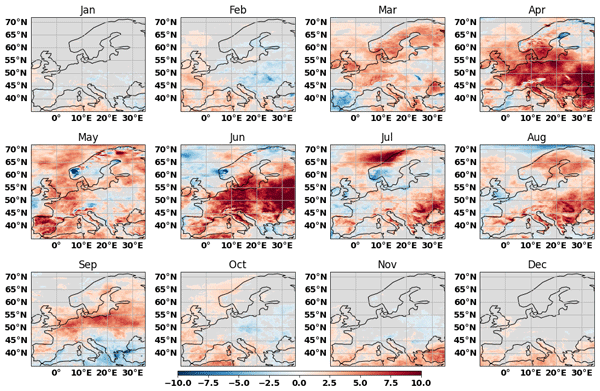
Abhay Devasthale, Sandra Andersson, Erik Engström, Frank Kaspar, Jörg Trentmann, Anke Duguay-Tetzlaff, Jan Fokke Meirink, Erik Kjellström, Tomas Landelius, Manu Anna Thomas, and Karl-Göran Karlsson
Earth Syst. Dynam., 16, 1169–1182, https://doi.org/10.5194/esd-16-1169-2025, https://doi.org/10.5194/esd-16-1169-2025, 2025
Short summary
Short summary
By compositing trends in multiple climate variables, this study presents emerging regimes that are relevant for solar energy applications. It is shown that the favourable conditions for exploiting solar energy are emerging during spring and early summer. The study also underscores the increasingly important role of clouds in regulating surface solar radiation as the aerosol concentrations are decreasing over Europe and the societal value of satellite-based climate monitoring.
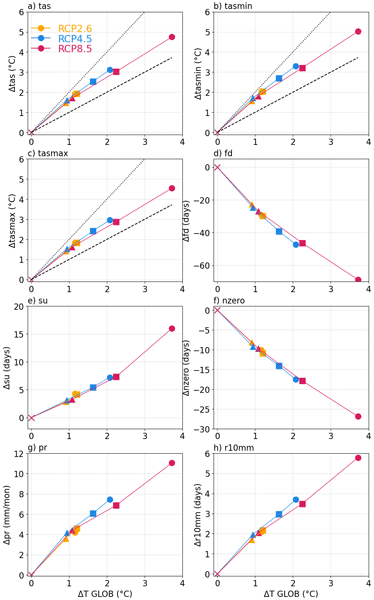
Gustav Strandberg, August Thomasson, Lars Bärring, Erik Kjellström, Michael Sahlin, Renate Anna Irma Wilcke, and Grigory Nikulin
Weather Clim. Dynam., 7, 185–200, https://doi.org/10.5194/wcd-7-185-2026, https://doi.org/10.5194/wcd-7-185-2026, 2026
Short summary
Short summary
The need for information about climate change is ever increasing. Therefore, it is important to have knowledge about climate change, along with an understanding of the uncertainties of climate model ensembles. Here, climate change in Sweden and neighbouring countries and its relation to global warming is described. Global warming results in higher temperature, more warm days and fewer cold days. The local and global warming suggest that climate change in Sweden may currently be at its fastest.
Abhay Devasthale, Sandra Andersson, Erik Engström, Frank Kaspar, Jörg Trentmann, Anke Duguay-Tetzlaff, Jan Fokke Meirink, Erik Kjellström, Tomas Landelius, Manu Anna Thomas, and Karl-Göran Karlsson
Earth Syst. Dynam., 16, 1169–1182, https://doi.org/10.5194/esd-16-1169-2025, https://doi.org/10.5194/esd-16-1169-2025, 2025
Short summary
Short summary
By compositing trends in multiple climate variables, this study presents emerging regimes that are relevant for solar energy applications. It is shown that the favourable conditions for exploiting solar energy are emerging during spring and early summer. The study also underscores the increasingly important role of clouds in regulating surface solar radiation as the aerosol concentrations are decreasing over Europe and the societal value of satellite-based climate monitoring.
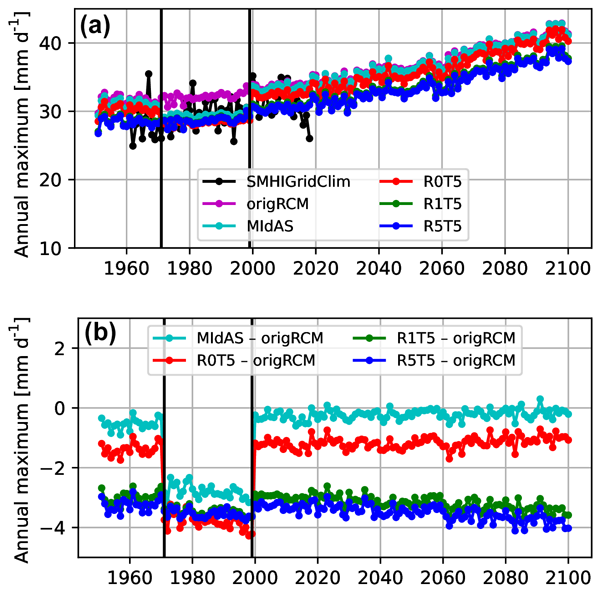
Peter Berg, Thomas Bosshard, Denica Bozhinova, Lars Bärring, Joakim Löw, Carolina Nilsson, Gustav Strandberg, Johan Södling, Johan Thuresson, Renate Wilcke, and Wei Yang
Geosci. Model Dev., 17, 8173–8179, https://doi.org/10.5194/gmd-17-8173-2024, https://doi.org/10.5194/gmd-17-8173-2024, 2024
Short summary
Short summary
When bias adjusting climate model data using quantile mapping, one needs to prescribe what to do at the tails of the distribution, where a larger data range is likely encountered outside of the calibration period. The end result is highly dependent on the method used. We show that, to avoid discontinuities in the time series, one needs to exclude data in the calibration range to also activate the extrapolation functionality in that time period.
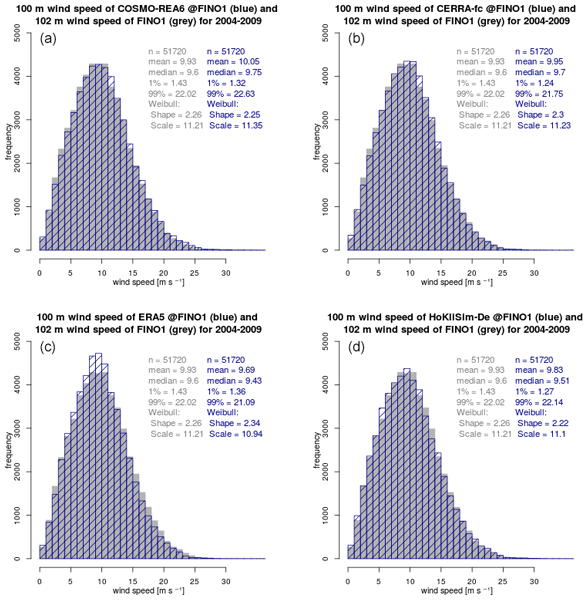
Thomas Spangehl, Michael Borsche, Deborah Niermann, Frank Kaspar, Semjon Schimanke, Susanne Brienen, Thomas Möller, and Maren Brast
Adv. Sci. Res., 20, 109–128, https://doi.org/10.5194/asr-20-109-2023, https://doi.org/10.5194/asr-20-109-2023, 2023
Short summary
Short summary
The quality of the global reanalysis ERA5, the regional reanalysis COSMO-REA6 and a successor version (R6G2), the new Copernicus European Regional Re-Analysis (CERRA) and a regional downscaling simulation with COSMO-CLM (HoKliSim-De) is assessed for offshore wind farm planning in the German Exclusive Economic Zone (EEZ) of the North Sea. The quality is assessed using in-situ wind measurements at the research platform FINO1 and satellite-based data of the near-surface wind speed as reference.
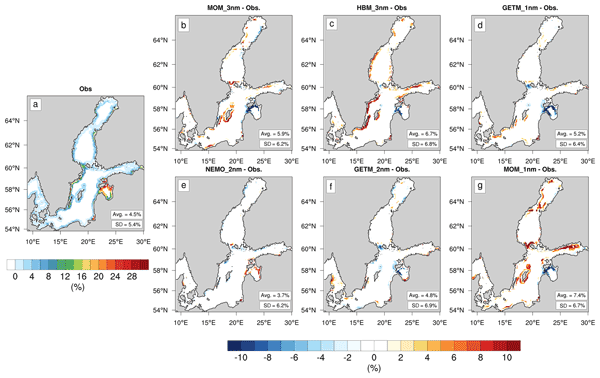
Matthias Gröger, Manja Placke, H. E. Markus Meier, Florian Börgel, Sandra-Esther Brunnabend, Cyril Dutheil, Ulf Gräwe, Magnus Hieronymus, Thomas Neumann, Hagen Radtke, Semjon Schimanke, Jian Su, and Germo Väli
Geosci. Model Dev., 15, 8613–8638, https://doi.org/10.5194/gmd-15-8613-2022, https://doi.org/10.5194/gmd-15-8613-2022, 2022
Short summary
Short summary
Comparisons of oceanographic climate data from different models often suffer from different model setups, forcing fields, and output of variables. This paper provides a protocol to harmonize these elements to set up multidecadal simulations for the Baltic Sea, a marginal sea in Europe. First results are shown from six different model simulations from four different model platforms. Topical studies for upwelling, marine heat waves, and stratification are also assessed.
Cited articles
Aalto, J., Pirinen, P., and Jylhä, K.: New gridded daily climatology of Finland: Permutation-based uncertainty estimates and temporal trends in climate, J. Geophys. Res.-Atmos., 121, 3807–3823, https://doi.org/10.1002/2015JD024651, 2016.
Abdalla, S., Isaksen, L., Janssen, P. A. E. M., and Wedi, N.: Effective spectral resolution of ECMWF atmospheric forecast models, ECMWF Newslett., 137, 19–22, https://doi.org/10.21957/rue4o7ac, 2013.
Andersson, S., Bärring, L., Landelius, T., Samuelsson, P., and Schimanke, S.: SMHI Gridded Climatology, SMHI – Swedish Meteorological and Hydrological Institute, 61 pp., https://urn.kb.se/resolve?urn=urn:nbn:se:smhi:diva-6192 (last access: 9 November 2026), 2021.
Andersson, S., Norman, M., Landelius, T., Samuelsson, P., Schimanke S., Zahid M., and Bärring, L.: SMHIGridClim, 2.5 km resolution gridded climatology of Fennoscandia, Harvard Dataverse [data set], https://doi.org/10.7910/DVN/ZFZL6K, 2025.
Barnes, S. L.: Mesoscale objective map analysis using weighted time series observations, NOAA Tech. Memo. ERL NSSL-62, 60 pp., NOAA, https://repository.library.noaa.gov/view/noaa/17647 (last access: 9 November 2026), 1973.
Båserud, L., Lussana, C., Nipen, T. N., Seierstad, I. A., Oram, L., and Aspelien, T.: TITAN automatic spatial quality control of meteorological in-situ observations, Adv. Sci. Res., 17, 153–163, https://doi.org/10.5194/asr-17-153-2020, 2020.
Bazile, E., Abida, R., Verelle, A., Le Moigne, P., and Szczypta, C.: Report for the 55 years MESCAN-SURFEX re-analysis, Copernicus Climate Change Service, https://uerra.eu/component/dpattachments/?task=attachment.download&id=399 (last access: 18 November 2024), 2017.
Brohan, P., Kennedy, J. J., Harris, I., Tett, S. F. B., and Jones, P. D.: Uncertainty estimates in regional and global observed temperature changes: A new data set from 1850, J. Geophys. Res., 111, D12106, https://doi.org/10.1029/2005JD006548, 2006.
Caesar, J., Alexander, L., and Vose, R.: Large-scale changes in observed daily maximum and minimum temperatures: Creation and analysis of a new gridded data set, J. Geophys. Res., 111, D05101, https://doi.org/10.1029/2005JD006280, 2006.
Copernicus Climate Change Service, Climate Data Store: UERRA regional reanalysis for Europe on single levels from 1961 to 2019, Copernicus Climate Change Service (C3S) Climate Data Store (CDS) [data set], https://doi.org/10.24381/cds.32b04ec5"10.24381/cds.32b04ec5, 2019.
Cornes, R.C., van der Schrier, G., van den Besselaar, E. J. M., and Jones, P. D.: An ensemble version of the E-OBS temperature and precipitation data sets, J. Geophys. Res.-Atmos., 123, 9391–9409, https://doi.org/10.1029/2017JD028200, 2018.
Dee, D. P., Uppala, S. M., Simmons, A. J., Berrisford, P., Poli, P., Kobayashi, S., Andrae, U., Balmaseda, M. A., Balsamo, G., Bauer, P., Bechtold, P., Beljaars, A. C. M., van de Berg, L., Bidlot, J., Bormann, N., Delsol, C., Dragani, R., Fuentes, M., Geer, A. J., Haimberger, L., Healy, S. B., Hersbach, H., Hólm, E. V., Isaksen, L., Kållberg, P., Köhler, M., Matricardi, M., McNally, A. P., Monge-Sanz, B. M., Morcrette, J.-J., Park, B.-K., Peubey, C., de Rosnay, P., Tavolato, C., Thépaut, J.-N., and Vitart, F.: The ERA-Interim reanalysis: Configuration and performance of the data assimilation system, Q. J. Roy. Meteorol. Soc., 137, 553–597, https://doi.org/10.1002/qj.828, 2011.
Essou, G. R. C., Arsenault, R., and Brissette, F. P.: Comparison of climate datasets for lumped hydrological modeling over the continental United States, J. Hydrol., 537, 334–345, https://doi.org/10.1016/j.jhydrol.2016.03.063, 2016.
Førland, E. J., Hanssen-Bauer, I., Jónsson, T., Kern-Hansen, C., Nordli, P. Ø., Tveito, O. E., and Laursen, E. V.: Twentieth-century variations in temperature and precipitation in the Nordic Arctic, Polar Rec., 38, 203–210, https://doi.org/10.1017/S0032247400017721, 2002.
Fountain, A. G., Campbell, J. L., Schuur, E. A. G., Stammerjohn, S. E., Williams, M. W., and Ducklow, H. W.: The disappearing cryosphere: Impacts and ecosystem responses to rapid cryosphere loss, BioScience, 62, 405–415, https://doi.org/10.1525/bio.2012.62.4.11, 2012.
Frogner, I.-L., Singleton, A. T., Køltzow, M. Ø., and Andrae, U.: Convection-permitting ensembles: Challenges related to their design and use, Q. J. Roy. Meteorol. Soc., 145, 90–106, https://doi.org/10.1002/qj.3525, 2019.
Gandin, L. S.: Objective analysis of meteorological fields, Translated from Russian, Jerusalem (Israel Program for Scientific Translations), Q. J. Roy. Meteorol. Soc., 92, 447, https://doi.org/10.1002/qj.49709239320, 1965.
Grusson, Y., Wesström, I., and Abraham, J.: Impact of climate change on Swedish agriculture: Growing season rain deficit and irrigation need, Agr. Water Manage., 251, 106858, https://doi.org/10.1016/j.agwat.2021.106858, 2021.
Harris, I., Jones, P. D., Osborn, T. J., and Lister, D. H.: Updated high-resolution grids of monthly climatic observations – the CRU TS4.05 dataset, Int. J. Climatol., 40, 5280–5292, https://doi.org/10.1002/joc.3711, 2020.
Haylock, M. R., Hofstra, N., Klein Tank, A. M. G., Klok, E. J., Jones, P. D., and New, M.: A European daily high-resolution gridded data set of surface temperature and precipitation for 1950–2006, J. Geophys. Res.-Atmos., 113, D20119, https://doi.org/10.1029/2008JD010201, 2008.
Hersbach, H., Bell, B., Berrisford, P., Hiahara, S., Horányi, A., Muñoz-Sabater, J., Nicolas, J., Peubey, C., Radu, R., Schepers, D., Simmons, A., Soci, C., Abdalla, S., Abellan, X., Balsamo, G., Bechtold, P., Biavati, G., Bidlot, J., Bonavita, M., De Chiara, G., Dahlgren, P., Dee, D., Diamantakis, M., Dragani, R., Flemming, J., Forbes, R., Fuentes, M., Geer, A., Haimberger, L., Healy, S., Hogan, R. J., Hólm, E., Janisková, M., Keeley, S., Laloyaux, P., Lopez, P., Lupu, C., Radnoti, G., de Rosnay, P., Rozum, I., Vamborg, F., Villaume, S., and Thépaut, J.-N.: The ERA5 global reanalysis, Q. J. Roy. Meteorol. Soc., 146, 1999–2049, https://doi.org/10.1002/qj.3803, 2020.
IPCC: Summary for policymakers, in Climate Change 2013: The Physical Science Basis, in: Contribution of Working Group I to the Fifth Assessment Report of the Intergovernmental Panel on Climate Change, edited by: Stocker, T. F., Qin, D., Plattner, G.-K., Tignor, M., Allen, S. K., Boschung, J., Nauels, A., Xia, Y., Bex, V., and Midgley, P. M., Cambridge Univ. Press, Cambridge, UK, and New York, 3–29, https://www.ipcc.ch/site/assets/uploads/2018/02/WG1AR5_SPM_FINAL.pdf (last access: 9 November 2026), 2013.
IPCC: Sixth Assessment Report (AR6): The Physical Science Basis, Intergovernmental Panel on Climate Change, https://www.ipcc.ch/report/ar6/wg1/ (last access: 13 November 2024), 2021.
Klein Tank, A. M. G., Wijngaard, J. B., Können, G. P., Böhm, R., Demarée, G., Gocheva, A., Mileta, M., Pashiardis, S., Hejkrlik, L., Kern-Hansen, C., Heino, R., Bessemoulin, P., Müller-Westermeier, G., Tzanakou, M., Szalai, S., Pálsdóttir, T., Fitzgerald, D., Rubin, S., Capaldo, M., Maugeri, M., Leitlass, A., Bukantis, A., Aberfeld, R., van Engelen, A. F. V., Forland, E., Mietus, M., Coelho, F., Mares, C., Razuvaev, V., Nieplova, E., Cegnar, T., Antonio López, J., Dahlström, B., Moberg, A., Kirchhofer, W., Ceylan, A., Pachaliuk, O., Alexander, L. V., and Petrovic, P.: Daily dataset of 20th-century surface air temperature and precipitation series for the European Climate Assessment, Int. J. Climatol., 22, 1441–1453, https://doi.org/10.1002/joc.773, 2002.
Klok, E. J. and Klein Tank, A. M. G.: Updated and extended European dataset of daily climate observations, Int. J. Climatol., 29, 1182–1191, https://doi.org/10.1002/joc.1779, 2009.
Le Moigne, P., Besson, F., Martin, E., Boé, J., Boone, A., Decharme, B., Etchevers, P., Faroux, S., Habets, F., Lafaysse, M., Leroux, D., and Rousset-Regimbeau, F.: The latest improvements with SURFEX v8.0 of the Safran–Isba–Modcou hydrometeorological model for France, Geosci. Model Dev., 13, 3925–3946, https://doi.org/10.5194/gmd-13-3925-2020, 2020.
Lind, P., Belušić, D., Médus, E., Dobler, A., Pedersen, R. A., Wang, F., Matte, D., Kjellström, E., Landgren, O., Lindstedt, D., Christensen, O. B., and Christensen, J. H.: Climate change information over Fenno-Scandinavia produced with a convection-permitting climate model, Clim. Dynam., 61, 519–541, https://doi.org/10.1007/s00382-022-06589-3, 2023.
Lussana, C., Uboldi, F., and Salvati, M. R.: A spatial consistency test for surface observations from mesoscale meteorological networks, Q. J. Roy. Meteorol. Soc., 136, 1075–1088, https://doi.org/10.1002/qj.622, 2010.
Lussana, C., Saloranta, T., Skaugen, T., Magnusson, J., Tveito, O. E., and Andersen, J.: seNorge2 daily precipitation, an observational gridded dataset over Norway from 1957 to the present day, Earth Syst. Sci. Data, 10, 235–249, https://doi.org/10.5194/essd-10-235-2018, 2018.
Lussana, C., Tveito, O. E., Dobler, A., and Tunheim, K.: seNorge_2018, daily precipitation and temperature datasets over Norway, Earth Syst. Sci. Data, 11, 1331–1351, https://doi.org/10.5194/essd-11-1531-2019, 2019.
Mankin, K. R., Mehan, S., Green, T. R., and Barnard, D. M.: Review of Gridded Climate Products and Their Use in Hydrological Analyses Reveals Overlaps, Gaps, and Need for More Objective Approach to Model Forcings, Hydrol. Earth Syst. Sci., 29, 85–108, https://doi.org/10.5194/hess-29-85-2025, 2025.
Monteiro, D. and Morin, S.: Multi-decadal analysis of past winter temperature, precipitation and snow cover data in the European Alps from reanalyses, climate models and observational datasets, The Cryosphere, 17, 3617–3660, https://doi.org/10.5194/tc-17-3617-2023, 2023.
Mikkonen, S., Laine, M., Mäkelä, H., Gregow, H., Tuomenvirta, H., Lahtinen, M., and Laaksonen, A.: Trends in the average temperature in Finland, 1847–2013, Stoch. Environ. Res. Risk A., 29, 1521–1529, https://doi.org/10.1007/s00477-014-0992-2, 2015.
Nikulin, G., Kjellström, E., Hansson, U., Strandberg, G., and Ullerstig, A.: Evaluation and future projections of temperature, precipitation and wind extremes over Europe in an ensemble of regional climate simulations, Tellus A, 63, 41–55, https://doi.org/10.1111/j.1600-0870.2010.00466.x, 2011.
Overpeck, J. T., Meehl, G. A., Bony, S., and Easterling, D. R.: Climate data challenges in the 21st century, Science, 331, 700–702, https://doi.org/10.1126/science.1197869, 2011.
Panofsky, H. W. and Brier, G. W.: Some Applications of Statistics to Meteorology, The Pennsylvania State University Press, Philadelphia, https://digital.libraries.psu.edu/digital/collection/digitalbks2/id/48196/ (last access: 9 November 2026), 1968.
Raza, A., Partonen, T., Magnusson Hansson, L., Asp, M., Engström, E., Westerlund, H., and Halonen, J. I.: Daylight during winter and symptoms of depression and sleep problems: A within-individual analysis, Environ. Int., 183, 108413, https://doi.org/10.1016/j.envint.2023.108413, 2024.
Schimanke, S., Ridal, M., Le Moigne, P., Berggren, L., Undén, P., Randriamampianina, R., Andrea, U., Bazile, E., Bertelsen, A., Brousseau, P., Dahlgren, P., Edvinsson, L., El Said, A., Glinton, M., Hopsch, S., Isaksson, L., Mladek, R., Olsson, E., Verrelle, A., and Wang, Z. Q.: CERRA sub-daily regional reanalysis data for Europe on single levels from 1984 to present, Copernicus Climate Change Service (C3S) Climate Data Store (CDS) [data set], https://doi.org/10.24381/cds.622a565a, 2021.
Soci, C., Bazile, E., Besson, F., and Landelius, T.: High-resolution precipitation re-analysis system for climatological purposes, Tellus A, 68, https://doi.org/10.3402/tellusa.v68.29879, 2016.
SOU: Sweden facing climate change – threats and opportunities, Report 2007:60, Swedish Government Official Reports, https://www.government.se/legal-documents/2007/12/sou-200760/ (last access: 15 November 2024), 2007.
Themeßl, M. J., Gobiet, A., and Heinrich, G.: Empirical-statistical downscaling and error correction of regional climate models and its impact on the climate change signal, Climatic Change, 112, 449–468, https://doi.org/10.1007/s10584-011-0224-4, 2012.
Tietäväinen, H., Tuomenvirta, H., and Venäläinen, A.: Annual and seasonal mean temperatures in Finland during the last 160 years based on gridded temperature data, Int. J. Climatol., 30, 2247–2256, https://doi.org/10.1002/joc.2046, 2010.
Tveito, O. E. and Lussana, C.: The Nordic Gridded Climate Dataset stable release, ECMWF Copernicus note, Copernicus Climate Change Service, 29 pp., https://surfobs.climate.copernicus.eu/documents/C3S_M311a_Lot4.2.3.3_201809_report_stable_release_v1.pdf (last access: 30 September 2025), 2018.
WMO: Manual on Codes, Volume I.2 – International Codes, WMO-No. 306, WMO, Geneva, https://library.wmo.int/idurl/4/35625 (last access: 9 November 2026). 2025.
Yu, Y., Schneider, U., Yang, S., Becker, A., and Ren, Z.: Evaluating the GPCC Full Data Daily Analysis Version 2018 through ETCCDI indices and comparison with station observations over mainland of China, Theor. Appl. Climatol., 142, 835–845, https://doi.org/10.1007/s00704-020-03352-8, 2020.
Zandler, H., Haag, I., and Samimi, C.: Evaluation needs and temporal performance differences of gridded precipitation products in peripheral mountain regions, Sci. Rep., 9, 15118, https://doi.org/10.1038/s41598-019-51666-z, 2019.
Short summary
This study introduces SMHIGridClim (Swedish Meteorological and Hydrological Institute Gridded Climatology), a high-resolution gridded climatology for Fennoscandia, covering the period from 1961 to 2018. It provides detailed climate data, including temperature, humidity, precipitation, and snow depth at a 2.5 km resolution. The dataset is created by combining observations from multiple meteorological institutes with reanalysis data. The study highlights the benefits of SMHIGridClim, making it a valuable resource for climate research in the Nordic region.
This study introduces SMHIGridClim (Swedish Meteorological and Hydrological Institute Gridded...


Altmetrics
Final-revised paper
Preprint