Articles | Volume 18, issue 11
https://doi.org/10.5194/essd-18-7963-2026
© Author(s) 2026. This work is distributed under
the Creative Commons Attribution 4.0 License.
https://doi.org/10.5194/essd-18-7963-2026
© Author(s) 2026. This work is distributed under
the Creative Commons Attribution 4.0 License.
MLAWind: a monthly sea surface wind dataset derived from an interpretable machine learning approach integrating in-situ observations and satellite data

Weihao Guo
State Key Laboratory of Tropical Oceanography, South China Sea Institute of Oceanology, Chinese Academy of Sciences, Guangzhou, 510301, China
Global Ocean and Climate Research Center, South China Sea Institute of Oceanology, Chinese Academy of Sciences, Guangzhou, 510301, China
State Key Laboratory of Tropical Oceanography, South China Sea Institute of Oceanology, Chinese Academy of Sciences, Guangzhou, 510301, China
Global Ocean and Climate Research Center, South China Sea Institute of Oceanology, Chinese Academy of Sciences, Guangzhou, 510301, China
Xin Wang
CORRESPONDING AUTHOR
State Key Laboratory of Tropical Oceanography, South China Sea Institute of Oceanology, Chinese Academy of Sciences, Guangzhou, 510301, China
Global Ocean and Climate Research Center, South China Sea Institute of Oceanology, Chinese Academy of Sciences, Guangzhou, 510301, China
Dongxiao Wang
School of Marine Sciences, Sun Yat-Sen University, Zhuhai, 519082, China
Southern Marine Science and Engineering Guangdong Laboratory (Zhuhai), Zhuhai, 519080, China
Related authors
No articles found.
Chengyan Liu, Zhaomin Wang, Dake Chen, Xianxian Han, Hengling Leng, Xi Liang, Liangjun Yan, Xiang Li, Craig Stevens, Andrew McC. Hogg, Kazuya Kusahara, Kaihe Yamazaki, Kay I. Ohshima, Meng Zhou, Xiao Cheng, Dongxiao Wang, Changming Dong, Jiping Liu, Qinghua Yang, Xichen Li, Ruibo Lei, Minghu Ding, Zhaoru Zhang, Dujuan Kang, Di Qi, Tongya Liu, Jihai Dong, Lu An, Ru Chen, Tong Zhang, Xiaoming Hu, Bo Han, Haibo Bi, Qi Shu, Longjiang Mu, Shiming Xu, Hu Yang, Hailong Liu, Tingfeng Dou, Zhixuan Feng, Lei Zheng, Xueyuan Tang, Guitao Shi, Yongqing Cai, Bingrui Li, Yang Wu, Xia Lin, Wenjin Sun, Yu Liu, Kai Yu, Yu Zhang, Weizeng Shao, Xiaoyu Wang, Shaojun Zheng, Chengyi Yuan, Chunxia Zhou, Jian Liu, Yang Liu, Yue Xia, Xiaoyu Pan, Jiabao Zeng, Kechen Liu, Jiahao Fan, Chen Cheng, and Qi Li
Geosci. Model Dev., 19, 2985–3033, https://doi.org/10.5194/gmd-19-2985-2026, https://doi.org/10.5194/gmd-19-2985-2026, 2026
Short summary
Short summary
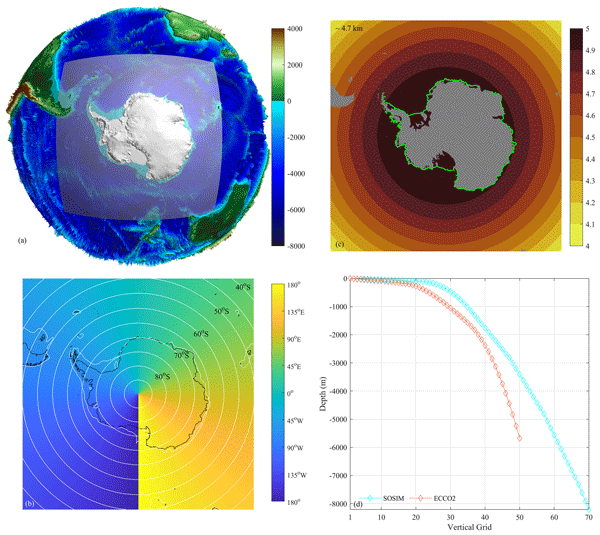
We developed a high-resolution computer model to simulate how the ocean, sea ice, and ice shelves interact around Antarctica. This helps us understand their critical role in global climate and sea-level rise. Our model successfully captures essential features like major currents and seasonal ice changes. Despite some remaining biases, it provides a useful tool for predicting future changes in this vital and rapidly evolving region.
Qi'an Chen, Hongzhou Xu, Dongxiao Wang, Bo Hong, Chunlei Liu, Zheyang Zhang, Huichang Jiang, Wei Song, Tong Long, Ling Wang, Sumin Liu, and Rongjie Chen
Ocean Sci., 21, 2631–2642, https://doi.org/10.5194/os-21-2631-2025, https://doi.org/10.5194/os-21-2631-2025, 2025
Short summary
Short summary
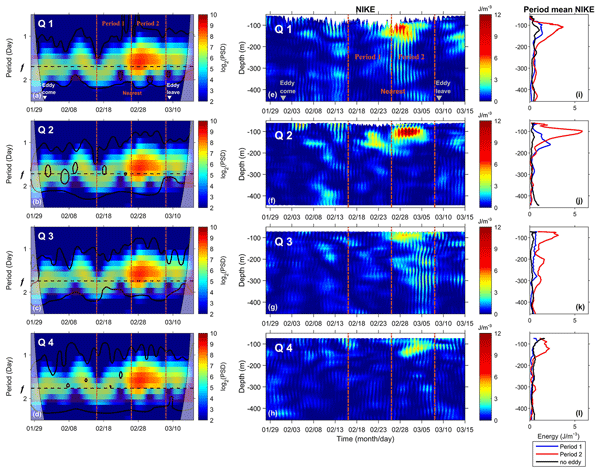
NIWs (near-inertial waves) have horizontal spatial scales of 10–100 km and slow group velocities, making them to interact strongly with mesoscale eddies. In the northwestern SCS (South China Sea), large portion of eddy propagate westward and may interact with local NIWs. In this study, four moorings were deployed in this area and they captured a vivid case of interaction between a cyclonic eddy and NIWs. Our paper provides direct evidence of strong interaction between eddy and NIWs in the northwestern SCS.
Chunhua Qiu, Zhenyang Du, Haibo Tang, Zhenhui Yi, Jiawei Qiao, Dongxiao Wang, Xiaoming Zhai, and Wenbo Wang
Earth Syst. Sci. Data, 17, 3189–3202, https://doi.org/10.5194/essd-17-3189-2025, https://doi.org/10.5194/essd-17-3189-2025, 2025
Short summary
Short summary
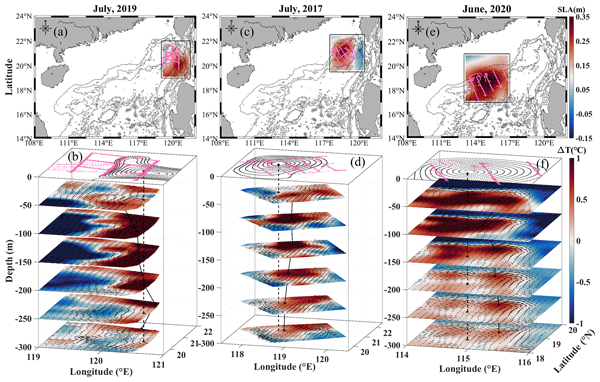
The high-resolution autonomous underwater vehicle (AUV) dataset for the South China Sea (SCS) provides 13 491 temperature and salinity profiles and covers 463 d of experiments. To our knowledge, the resolution and length of this dataset are enough to detect the asymmetry, vertical tilt, and temporal evolution of mesoscale eddies (MEs) and the corresponding submesoscale processes. The dataset is expected to improve the accuracy of current and biogeochemistry numerical models. More projects conducting AUV experiments will be promoted in the future.
Cited articles
Bagnell, A. and DeVries, T.: 20(th) century cooling of the deep ocean contributed to delayed acceleration of Earth's energy imbalance, Nat. Commun., 12, 4604, https://doi.org/10.1038/s41467-021-24472-3, 2021.
Berry, D. I. and Kent, E. C.: Air–Sea fluxes from ICOADS: the construction of a new gridded dataset with uncertainty estimates, Int. J. Climatol., 31, 987–1001, https://doi.org/10.1002/joc.2059, 2011.
Bjerknes, J.: Atmospheric teleconnections from the equatorial Pacific, Mon. Weather Rev., 97, 163–172, https://doi.org/10.1175/1520-0493(1969)097<0163:ATFTEP>2.3.CO;2, 1969.
Breiman, L.: Random Forests, Mach. Learning, 45, 5–32, https://doi.org/10.1023/A:1010933404324, 2001.
Clarke, A. J.: El Niño physics and El Niño predictability, Annu. Rev. Mar. Sci., 6, 79–99, https://doi.org/10.1146/annurev-marine-010213-135026, 2014.
Compo, G. P., Whitaker, J. S., Sardeshmukh, P. D., Matsui, N., Allan, R. J., Yin, X., Gleason, B. E., Vose, R. S., Rutledge, G., Bessemoulin, P., Brönnimann, S., Brunet, M., Crouthamel, R. I., Grant, A. N., Groisman, P. Y., Jones, P. D., Kruk, M. C., Kruger, A. C., Marshall, G. J., Maugeri, M., Mok, H. Y., Nordli, Ø., Ross, T. F., Trigo, R. M., Wang, X. L., Woodruff, S. D., and Worley, S. J.: The Twentieth Century Reanalysis Project, Q. J. Roy. Meteor. Soc., 137, 1–28, https://doi.org/10.1002/qj.776, 2011.
Deser, C., Alexander, M. A., and Timlin, M. S.: Evidence for a wind-driven intensification of the Kuroshio Current extension from the 1970s to the 1980s, J. Climate, 12, 1697–1706, https://doi.org/10.1175/1520-0442(1999)012<1697:EFAWDI>2.0.CO;2, 1999.
Doury, A., Somot, S., Gadat, S., Ribes, A., and Corre, L.: Regional climate model emulator based on deep learning: concept and first evaluation of a novel hybrid downscaling approach, Clim. Dynam., 60, 1751–1779, https://doi.org/10.1007/s00382-022-06343-9, 2023.
Findell, K. L., Keys, P. W., Ent R. J. V. D., Lintner, B. R., Berg, A., and Krasting, J. P.: Rising temperatures increase importance of oceanic evaporation as a source for continental precipitation, J. Climate, 32, 7713–7726, https://doi.org/10.1175/JCLI-D-19-0145.1, 2019.
Freeman, E., Woodruff, S. D., Worley, S. J., Lubker, S. J., Kent, E. C., Lubker, W. E., Berry, D. I., Brohan, P., Eastman, R., Gates, L., Gloeden, W., Ji, Z., Lawrimore, J., Rayner, N. A., Rosenhagen, G., and Smith, S. R.: ICOADS Release 3.0: a major update to the historical marine climate record, Int. J. Climatol., 37, 2211–2232, https://doi.org/10.1002/joc.4775, 2017.
Garreaud, R., Lopez, P., Minvielle, M., and Rojas, M.: Large-scale control on the Patagonian climate, J. Climate, 26, 215–230, https://doi.org/10.1175/JCLI-D-12-00001.1, 2013.
Guo, W., Zhang, R., Wang, X., Wang, C., Li, X., Han, W., and Zhang, L.: Unveiling the drivers of tropical Indian Ocean warming through machine learning-assisted surface wind, J. Climate, 38, 6763–6779, https://doi.org/10.1175/JCLI-D-25-0003.1, 2025a.
Guo, W., Zhang, R., and Wang, X.: Machine learning-assisted sea surface wind dataset (MLAWind), Zenodo [data set], https://doi.org/10.5281/zenodo.17354864, 2025b.
Guo, W., Zhang, R., and Wang, X.: Machine learning-assisted sea surface wind dataset (MLAWind), Marine Science Data Center of the Chinese Academy of Science [data set], https://doi.org/10.12157/IOCAS.20250707.001, 2025c.
He, Q., Wang, M., Liu, K., Li, K., and Jiang, Z.: GPRChinaTemp1km: a high-resolution monthly air temperature data set for China (1951–2020) based on machine learning, Earth Syst. Sci. Data, 14, 3273–3292, https://doi.org/10.5194/essd-14-3273-2022, 2022.
He, J., Lu, W., Liu, Y., Yang, G., Jo, Y.-H., and Lai, Z.: Accurate Sea Level Anomaly Forecast over North Pacific with Improved AI Training Strategies, Ocean-Land-Atmos. Res., 5, 0128, https://doi.org/10.34133/olar.0128, 2026.
Held, I. M. and Soden, B. J.: Robust responses of the hydrological cycle to global warming, J. Climate, 19, 5686–5699, https://doi.org/10.1175/JCLI3990.1, 2006.
Hersbach, H., Bell, B., Berrisford, P., Horányi, A., Muñoz Sabater, J., Nicolas, J., Radu, R., Schepers, D., Simmons, A., Soci, C., and Dee, D.: Global reanalysis: goodbye ERA-Interim, hello ERA5, Meteorology section of ECMWF Newsletter, 159, 17–24, https://doi.org/10.21957/vf291hehd7, 2019.
Huang, B., Yin, X., Boyer, T., Liu, C., Menne, M., Rao, Y. D., Smith, T., Vose, R., and Zhang, H.-M.: Extended Reconstructed Sea Surface Temperature Version 6 (ERSSTv6): Part I. An Artificial Neural Network Approach, J. Climate, 38, 1105–1121, https://doi.org/10.1175/JCLI-D-23-0707.1, 2025.
IPCC: Climate Change 2021: The Physical Science Basis, in: Contribution of Working Group I to the Sixth Assessment Report of the Intergovernmental Panel on Climate Change, edited by: Masson-Delmotte, V., Zhai, P., Pirani, A., Connors, S. L., Péan, C., Berger, S., Caud, N., Chen, Y., Goldfarb, L., Gomis, M. I., Huang, M., Leitzell, K., Lonnoy, E., Matthews, J. B. R., Maycock, T. K., Waterfield, T., Yelekçi, O., Yu, R., and Zhou, B., Cambridge University Press, 2391 pp, https://doi.org/10.1017/9781009157896, 2023.
Jiang, S., Sweet, L.-b., Blougouras, G., Brenning, A., Li, W., Reichstein, M., Denzler, J., Shangguan, W. Yu, G., Huang, F., and Zscheischler, J.: How interpretable machine learning can benefit process understanding in the geosciences, Earths Future, 12, e2024EF004540, https://doi.org/10.1029/2024EF004540, 2024.
Kalnay, E., Kanamitsu, M., Kistler, R., Collins, W., Deaven, D., Gandin, L., Iredell, M., Saha, S., White, G., Woollen, J., Zhu, Y., Chelliah, M., Ebisuzaki, W., Higgins, W., Janowiak, J., Mo, K. C., Ropelewski, C., Wang, J., Leetmaa, A., Reynolds, R., Jenne, R., and Joseph, D.: The NCEP/NCAR 40-Year Reanalysis Project, B. Am. Meteorol. Soc., 77, 437–471, https://doi.org/10.1175/1520-0477(1996)077<0437:TNYRP>2.0.CO;2, 1996.
Kanamitsu, M., Ebisuzaki, W., Woollen, J., Yang, S.-K., Hnilo, J. J., Fiorino, M., and Potter, G. L.: NCEP–DOE AMIP-II Reanalysis (R-2), B. Am. Meteorol. Soc., 83, 1631–1643, https://doi.org/10.1175/BAMS-83-11-1631, 2002.
Kim, S., Alizamir, M., Heddam, S., Chang, S. W., Chung, I. M., Kisi, O., and Kulls, C.: Development of the machine learning and deep learning models with SHAP strategy for predicting groundwater levels in South Korea, Sci. Rep., 15, 35523, https://doi.org/10.1038/s41598-025-19545-y, 2025.
Kobayashi, S., Ota, Y., Harada, Y., Ebita, A., Moriya, M., Onoda, H., Onogi, K., Kamahori, H., Kobayashi, C., Endo, H., Miyaoka, K., and Takahashi, K.: The JRA-55 Reanalysis: General Specifications and Basic Characteristics, J. Meteorol. Soc. Jpn. Ser. II, 93, 5–48. https://doi.org/10.2151/jmsj.2015-001, 2015.
Kug, J.-S., Jin, F.-F., and An, S.-I.: Two types of El Niño events: Cold tongue El Niño and warm pool El Niño, J. Climate, 22, 1499–1515, https://doi.org/10.1175/2008JCLI2624.1, 2009.
Leng, J., Chen, J. M., Li, W., Luo, X., Xu, M., Liu, J., Wang, R., Rogers, C., Li, B., and Yan, Y.: Global datasets of hourly carbon and water fluxes simulated using a satellite-based process model with dynamic parameterizations, Earth Syst. Sci. Data, 16, 1283–1300, https://doi.org/10.5194/essd-16-1283-2024, 2024.
Li, R., Li, Y., Lyu, Y., Sprintall, J., and Wang, F.: Role of the Indian Ocean Wind-Driven Dynamics in the Indonesian Throughflow Variability, J. Geophys. Res.-Oceans, 130, e2025JC022503, https://doi.org/10.1029/2025JC022503, 2025.
Lundberg, S. and Lee, S.-I.: A unified approach to interpreting model predictions, Adv. Neural Inf. Process. Syst., 30, 1–10, https://doi.org/10.48550/arXiv.1705.07874, 2017.
Mao, W., Mu, X., Zheng, Y., and Yan, G.: Leave-one-out cross-validation-based model selection for multi-input multi-output support vector machine, Neural Comput. App., 24, 441–451, https://doi.org/10.1007/s00521-012-1234-5, 2014.
McPhaden, M. J., Zebiak, S. E., and Glantz, M. H.: ENSO as an integrating concept in Earth science, Science, 314, 1740–1745, https://doi.org/10.1126/science.1132588, 2006.
McPhaden, M. J., Ando, K., Bourlès, B., Freitag, H. P., Lumpkin, R., Masumoto, Y., Murty, V., Nobre, P., Ravichandran, M., Vialard, J., Vousden, D., and Yu, W.: The global tropical moored buoy array, in: Proceedings of the “OceanObs'09: Sustained Ocean Observations and Information for Society” conference, vol 2, Venice, Italy, 21–25 September 2009, edited by: Hall, J., Harrison, D. E., and Stammer, D., ESA Publication WPP-306, https://doi.org/10.5270/OceanObs09.cwp.61, 2010.
Mears, C. A., Scott, J., Wentz, F. J., Ricciardulli, L., Leidner, S. M., Hoffman, R., and Atlas, R.: A near-real-time version of the cross-calibrated multiplatform (CCMP) ocean surface wind velocity data set, J. Geophys. Res.-Oceans, 124, 6997–7010, https://doi.org/10.1029/2019JC015367, 2019.
Qin, L., Zhu, L., Liu, B., Li, Z., Tian, Y., Mitchell, G., Shen, S., Xu, W., and Chen, J.: Global expansion of tropical cyclone precipitation footprint, Nat. Commun., 15, https://doi.org/10.1038/s41467-024-49115-1, 2024.
Reichstein, M., Camps-Valls, G., Stevens, B., Jung, M., Denzler, J., Carvalhais, N., and Prabhat: Deep learning and process understanding for data-driven Earth system science, Nature, 566, 195–204, https://doi.org/10.1038/s41586-019-0912-1, 2019.
Ren, H. L., Zuo, J., and Deng, Y.: Statistical predictability of Niño indices for two types of ENSO, Clim. Dynam., 52, 5361–5382. https://doi.org/10.1007/s00382-018-4453-3, 2019.
Sayani, H. R., Thompson, D. M., Carilli, J. E., Marchitto, T. M., Chapman, A. U., and Cobb, K. M.: Reproducibility of coral Mn/Ca-based wind reconstructions at Kiritimati Island and Butaritari Atoll, Geochem. Geophy. Geosy., 22, e2020GC009398, https://doi.org/10.1029/2020GC009398, 2021.
Schott, F. A., Xie, S.-P., and McCreary, J. P.: Indian ocean circulation and climate variability, Rev. Geophys., 47, RG1002, https://doi.org/10.1029/2007RG000245, 2009.
Shen, G. T., Linn, L. J., Campbell, T. M., Cole, J. E., and Fairbanks, R. G.: A chemical indicator of trade wind reversal in corals from the western tropical Pacific, J. Geophys. Res.-Oceans., 97, 12689–12697, https://doi.org/10.1029/92JC00951, 1992.
Smith, S. D.: Wind stress and heat flux over the ocean in gale force winds, J. Phys. Oceanogr., 10, 709–726, https://doi.org/10.1175/1520-0485(1980)010<0709:WSAHFO>2.0.CO;2, 1980.
Su, H., Li, W. and Yan, X.-H.: Retrieving temperature anomaly in the global subsurface and deeper ocean from satellite observations, J. Geophys. Res.-Oceans., 123, 399–410, https://doi.org/10.1002/2017JC013631, 2018.
Su, H., Zhang, H., Geng, X., Qin, T., Lu, W., and Yan, X. H.: OPEN: A new estimation of global ocean heat content for upper 2000 meters from remote sensing data, Remote Sens., 12, 2294, https://doi.org/10.3390/rs12142294, 2020.
Thompson, D. M., Cole, J. E., Shen, G. T., Tudhope, A. W., and Meehl, G. A.: Early twentieth-century warming linked to tropical Pacific wind strength, Nat. Geosci., 8, 117–121, https://doi.org/10.1038/ngeo2321, 2015.
Tian, T., Cheng, L., Wang, G., Abraham, J., Wei, W., Ren, S., Zhu, J., Song, J., and Leng, H.: Reconstructing ocean subsurface salinity at high resolution using a machine learning approach, Earth Syst. Sci. Data, 14, 5037–5060, https://doi.org/10.5194/essd-14-5037-2022, 2022.
Tokinaga, H. and Xie, S.-P.: Wave- and Anemometer-Based Sea Surface Wind (WASWind) for Climate Change Analysis, J. Climate, 24, 267–285, https://doi.org/10.1175/2010JCLI3789.1, 2011.
Tokinaga, H., Xie, S.-P., Timmermann, A., McGregor, S., Ogata, T., Kubota, H., and Okumura, Y. M.: Regional Patterns of Tropical Indo-Pacific Climate Change: Evidence of the Walker Circulation Weakening*, J. Climate, 25, 1689–1710, https://doi.org/10.1175/JCLI-D-11-00263.1, 2012.
Trenberth, K. E., Branstator, G. W., Karoly, D., Kumar, A., Lau, N. C., and Ropelewski, C.: Progress during TOGA in understanding and modeling global teleconnections associated with tropical sea surface temperatures, J. Geophys. Res.-Oceans., 103, 14291–14324, https://doi.org/10.1029/97jc01444, 1998.
Tseng, Y. H., Huang, J. H., and Chen, H. C.: Improving the Predictability of Two Types of ENSO by the Characteristics of Extratropical Precursors, Geophys. Res. Lett., 49, e2021GL097190, https://doi.org/10.1029/2021GL097190, 2022.
Vinoth, J. and Young, I. R.: Global Estimates of Extreme Wind Speed and Wave Height, J. Climate, 24, 1647–1665, https://doi.org/10.1175/2010JCLI3680.1, 2011.
Wang, C.: Three-ocean interactions and climate variability: A review and perspective, Clim. Dynam., 53, 18–5136, https://doi.org/10.1007/s00382-019-04930-x, 2019.
Wang, D., Liu, Q., Huang, R. X., Du, Y., and Qu T.: Interannual variability of the South China Sea throughflow inferred from wind data and an ocean data assimilation product, Geophys. Res. Lett., 33, L14605, https://doi.org/10.1029/2006GL026316, 2006.
Wang, H. and Li, X.: DeepBlue: Advanced convolutional neural network applications for ocean remote sensing, IEEE Geosci. Remote, 12, 138–161, https://doi.org/10.1109/MGRS.2023.3343623, 2024.
Wang, J., Liu, Z., Foster, I., Chang, W., Kettimuthu, R., and Kotamarthi, V. R.: Fast and accurate learned multiresolution dynamical downscaling for precipitation, Geosci. Model Dev., 14, 6355–6372, https://doi.org/10.5194/gmd-14-6355-2021, 2021.
Wang, Q., Zeng, L., Chen, J., He, Y., Liu, Q., Sui, D., and Wang, D.: Phase shift of the winter South China Sea western boundary current over the past two decades and its drivers, Geophys. Res. Lett., 50, e2023GL103145, https://doi.org/10.1029/2023GL103145, 2023.
Wang, X., Dickinson, R. E., Su, L., Zhou, C., and Wang, K.: PM2.5 pollution in China and how it has been exacerbated by terrain and meteorological conditions, B. Am. Meteorol. Soc., 99, 105–119, https://doi.org/10.1175/bams-d-16-0301.1, 2018.
Watt-Meyer, O., Brenowitz, N. D., Clark, S. K., Henn, B., and Bretherton, C. S.: Correcting weather and climate models by machine learning nudged historical simulations, Geophys. Res. Lett., 48, e2021GL092555, https://doi.org/10.1029/2021GL092555, 2021.
Yang, L., Wang, D., Huang, J., Wang, X., Zeng, L., Shi, R., He, Y., Xie, Q., Wang, S., Chen, R., Yuan, J., Wang, Q., Chen, J., Zu, T., Li, J., Sui, D., and Peng, S.: Toward a Mesoscale Hydrological and Marine Meteorological Observation Network in the South China Sea, B. Am. Meteorol. Soc., 96, 1117–1135, https://doi.org/10.1175/BAMS-D-14-00159.1, 2015.
Yin, J., Slater, L. J., Khouakhi, A., Yu, L., Liu, P., Li, F., Pokhrel, Y., and Gentine, P.: GTWS-MLrec: global terrestrial water storage reconstruction by machine learning from 1940 to present, Earth Syst. Sci. Data, 15, 5597–5615, https://doi.org/10.5194/essd-15-5597-2023, 2023.
Yoo, C., Im, J., Park, S., and Quackenbush, L. J.: Estimation of daily maximum and minimum air temperatures in urban landscapes using MODIS time series satellite data, ISPRS J. Photogramm., 137, 149–162, https://doi.org/10.1016/j.isprsjprs.2018.01.018, 2018.
Young, I. and Ribal, A.: Multiplatform evaluation of global trends in wind speed and wave height, Science, 364, 548, https://doi.org/10.1126/science.aav9527, 2019.
Zhang, H., Chen, D., Liu, T., Tian, D., He, M., Li, Q., Wei, G., and Liu, J.: MASCS 1.0: synchronous atmospheric and oceanic data from a cross-shaped moored array in the northern South China Sea during 2014–2015, Earth Syst. Sci. Data, 16, 5665–5679, https://doi.org/10.5194/essd-16-5665-2024, 2024.
Zhang, R., Guo, W., and Wang, X.: Deep Learning to Near-Surface Humidity Retrieval from Multi-Sensor Remote Sensing Data over the China Seas, Remote Sens., 14, 4353, https://doi.org/10.3390/rs14174353, 2022.
Zhang, R., Guo, W., Wang, X., and Wang, C.: Ambiguous Variations in Tropical Latent Heat Flux since the Years around 1998, J. Climate, 36, 3403–3415, https://doi.org/10.1175/JCLI-D-22-0381.1, 2023a.
Zhang, X., Nikurashin, M., Pena-Molino, B., Rintoul, S. R., and Doddridge, E.: A Theory of Standing Meanders of the Antarctic Circumpolar Current and Their Response to Wind, J. Phys. Oceanogr., 53, 235–251, https://doi.org/10.1175/JPO-D-22-0086.1, 2023b.
Zhou, C., Azorin-Molina, C., Engström, E., Minola, L., Wern, L., Hellström, S., Lönn, J., and Chen, D.: HomogWS-se: a century-long homogenized dataset of near-surface wind speed observations since 1925 rescued in Sweden, Earth Syst. Sci. Data, 14, 2167–2177, https://doi.org/10.5194/essd-14-2167-2022, 2022.
Short summary
This study develops a monthly near-global sea surface wind dataset (MLAWind) from 1950–2023 through an interpretable machine learning framework integrating in-situ observations and satellite data. Evaluations show that MLAWind achieves comparable performance to the widely-used reanalysis datasets at different time scales. It provides reliable historical wind data during both satellite and non-satellite periods, demonstrating broad application prospects in ocean and climate research.
This study develops a monthly near-global sea surface wind dataset (MLAWind) from 1950–2023...
Altmetrics
Final-revised paper
Preprint