the Creative Commons Attribution 4.0 License.
the Creative Commons Attribution 4.0 License.
 | 22 Sep 2026
A random forest isoscape model of bioavailable Sr for South America: a focus on southern Brazil
Cinzia Scaggion
Tommaso Giovanardi

László Palcsu
Daniel Loponte
Mirian Carbonera
Sara Bernardini
Stefano Benazzi
Giulia Marciani
Marcos Cesar Pereira Santos
Eugenio Bortolini
Anna Cipriani
Federico Lugli
In recent years, advances in machine learning have greatly improved the generation of maps showing the geographic distribution of isotope ratios (isoscapes), which have become essential tools for environmental, mobility and provenance studies in both modern and archaeological contexts. Among the various isotopic systems employed, strontium (Sr) is particularly useful because its 87Sr 86Sr ratio in the environment is largely controlled by the underlying geology through the composition of local soils and rocks.
In this work, we present a new dataset of bioavailable 87Sr 86Sr ratios derived from n=233 plant samples collected across southern Brazil, covering the states of Santa Catarina and Rio Grande do Sul (ca. 370 000 km2). The measured ratios span from 0.70521 to 0.76039 and capture the bioavailable Sr isotope signatures over all major geological units in the region.
We combined these new data with an extensive compilation of published bioavailable Sr measurements from across South America (including plants, fauna, ancient human remains, shells, snails, lichens, water and soils) to construct three random forest Sr isoscapes using different subsets of the combined dataset at the regional and continental scales. The first model incorporates the entire dataset (“All” dataset, n= 883 sites), the second is based on plant + fauna + lichen + human (n= 661 sites) and the third is limited to plant + lichen samples (n= 531 sites). Among the three models, the full dataset model shows lower predictive power, while the plant + fauna + lichen + human and the plant + lichen models yield better results, with similar RMSE (0.0049 and 0.0054) and R2 values (ca. 0.76). Compared to existing Sr isoscapes of South America, our models significantly enhance both spatial coverage and resolution of bioavailable Sr predictions, particularly in southern Brazil.
The new bioavailable Sr isotope dataset from Santa Catarina and Rio Grande do Sul states is available at https://doi.org/10.5281/zenodo.17988601 (Scaggion et al., 2025a) and the compiled literature dataset is reported as supplementary material.
- Article
(7248 KB) - Full-text XML
-
Supplement
(2370 KB) - BibTeX
- EndNote


Maps of isotopic variability through the landscape are powerful tools used for answering questions related to migration, trade, diet, provenance, forensic investigations, and environmental changes in both modern and ancient contexts (e.g. Hobson, 1999; Benson et al., 2006; Makarewicz and Sealy, 2015; Bataille et al., 2018, 2020; Hoogerwerff et al., 2019; Lugli et al., 2022; Gigante et al., 2023; Armaroli et al., 2024, Asrat et al., 2025; Dosseto et al., 2025; Scaggion et al., 2025b).
Among the various isotopic systems, strontium (Sr) isotopes play a central role in geotracing and provenance studies of biological materials because biota obtains Sr primarily from soils derived through weathering and disaggregation of local rocks. As a result, the so-called bioavailable 87Sr 86Sr act as a proxy for the underlying geology of a region.
Radiogenic 87Sr originates by β-decay of rubidium-87 (87Rb), while 86Sr is stable. Consequently, the 87Sr 86Sr ratio in rocks and minerals changes depending on their 87Rb content, their ages and geological history providing characteristic isotopic signatures for different geological domains (Faure and Mensing, 2005; Dickin, 2018). Through alteration and pedogenetic processes, Sr ions are leached from rocks into soils and waters, where they mix with other Sr pools derived from rainfall, snow, groundwater, atmospheric deposition or anthropic activities (Vitousek et al., 1999; Voerkelius et al., 2010). These processes can shift the local Sr isotopic signature away from the original bedrock. From soil and water, Sr enters the local ecosystem (Bullen et al., 1996; Capo et al., 1998). This bioavailable Sr is passively absorbed by plant roots and transported to leaves, where Sr2+ substitutes for calcium2+ (Ca) in metabolic processes (Poszwa et al., 2000; White and Broadley, 2003). From plants and water, the bioavailable Sr enters the local trophic chain. In vertebrates, Sr replaces Ca in the crystalline structure of carbonated-hydroxyapatite (Pors Nielsen, 2004; Bentley, 2006), the main inorganic constituent of bones and teeth (Weiner and Wagner, 1998; Hughes and Rakovan, 2002). Thus, the 87Sr 86Sr ratios of bone and dental tissues reflect those of water, plants and animals consumed, which, in turn, mirror the bioavailable isotopic signature of the environment (Schwarcz et al., 2010; Crowley et al., 2017).
Although isotopic fractionation can occur along the trophic chain and through metabolic processes, its enrichment is generally minimal (Lahtinen et al., 2020) and can be effectively corrected using standard normalization protocols during mass spectrometry analysis (Fietzke and Eisenhaure, 2006; Frei and Frei, 2011; Spies et al., 2025). For this reason, the isotopic composition of low-mobility fauna and plants represents a valuable, though not exclusive, proxy for estimating the local bioavailable Sr isotope signatures (Spies et al., 2025). However, deciphering environmental heterogeneity and trophic complexity is not always straightforward; therefore, integrating multiple isotopic and environmental datasets is crucial for constructing robust isoscapes.
Over the last decade, advances in spatial modelling and machine learning techniques such as kriging and random forest algorithms (e.g. Bataille et al., 2018, 2020; Hoogerwerff et al., 2019; Gigante et al., 2023; Armaroli et al., 2024; Scaggion et al., 2025b; Spies et al., 2025), have significantly increased the predictive potential of isoscapes models, by linking spatial isotopic variability to environmental predictors (Bataille et al., 2020). One of the main challenges, however, remains the acquisition of spatially representative and geologically diverse samples, making well designed sampling strategies crucial for developing accurate predictive models.
Brazil represents a particularly interesting case study for Sr isoscape research, due to its geological diversity and rich archaeological and ecological history. In southern Brazil, the states of the Santa Catarina (SC) and Rio Grande do Sul (RGS) encompass various geological formations, from ancient Precambrian crystalline rocks to younger sedimentary basins, which provide a good opportunity to test the spatial resolution, robustness, and applicability of Sr isoscapes. Despite the relevance of Brazil for provenance studies in archaeology, ecology, and food authentication, to date a comprehensive isoscape of bioavailable Sr has not been produced.
In this study, we present a newly generated dataset of n= 233 plant samples, collected across SC and RGS, representing all major geological units of the region (ca. 370 000 km2). This dataset was integrated with a literature-based compilation of bioavailable Sr data from across South America to develop new isoscapes of bioavailable strontium (87Sr 86Sr) for South America and southern Brazil, with a focus on SC and RGS. Using a random forest machine learning model following Bataille et al. (2020), we incorporated global environmental variables described in Bataille et al. (2018, 2020) and Reich et al. (2024) to estimate spatial patterns of bioavailable 87Sr 86Sr ratios.
The sampled region represents a pivotal area for understanding the expansion of pre-Columbian populations, constituting pass-through areas that facilitated the spread of natives such as the Guaraní, who from approximately the 5th c. CE gradually occupied the continent from the Amazon to the Paraná Delta (Loponte et al., 2024) as well as the movements of Southern Brazilian Highland populations toward the coast. The geological heterogeneity of these states provides a unique natural context for investigating large-scale dynamics of mobility, settlement, and cultural interaction.
We focused our sampling on the southern portion of Brazil, targeting the main geological units in detail to increase the reliability and spatial resolution of the resulting Sr database and isoscape.
The study area, comprising the states of RGS and SC, represents a key segment of the South American continent. The region preserves a long and complex geological evolution, spanning from the Archean to the Cenozoic, encompassing processes of crustal growth, continental collision, sedimentary basin development, and large igneous province magmatism. A simplified overview of this geological complexity is provided in Fig. 1, modified from the 1:5 000 000 geological map of Brazil (Medeiros et al., 2025) downloaded from the Serviço Geológico do Brasil (https://geosgb.sgb.gov.br/geosgb/downloads.html, last access: 3 September 2025) for use in QGis software.

Figure 1Simplified geological map of southern Brazil, modified from Medeiros et al. (2025) with sample locations collected in this study. The lithology codes are simplified from Medeiros et al. (2025) and grouped according to the two main geological domains of the area: the Mantiqueira Province and the Paraná Basin. The supergroups of the Paraná Basin are subdivided following Milani et al. (2007).
Two major geological provinces dominate this area: the southern Brazilian Shield, representing the Precambrian crystalline basement, and the Paraná Basin, a large Paleozoic-Mesozoic sedimentary and volcanic basin. In addition to these two major geological provinces, Pleistocene and Holocene sediments outcrop along the coast and the southern lagoons of RGS.
The southern Brazilian Shield, also known as the Mantiqueira Province (Heilbron et al., 2004) is composed of a mosaic of cratonic nuclei, accreted terranes, and mobile belts that were amalgamated during the Neoproterozoic, culminating with the Gondwana accretion (Brito Neves et al., 2014). In the state of RGS, the principal tectonic domains of the Mantiqueira Province are the Dom Feliciano Belt and the São Gabriel Terrane (Brito Neves et al., 2014; Philipp et al., 2018). The Dom Feliciano Belt extends in a NE-SW orientation and consists of high-grade metamorphic complexes, syn- to post-tectonic granitic intrusions (650–540 Ma), and metavolcanic-sedimentary sequences (2.35–0.78 Ga). It is interpreted as a Neoproterozoic collisional orogen, developed during the closure of oceanic domains between the Rio de la Plata Craton and the Kalahari-Congo Craton (Brito Neves et al., 2014; Philipp et al., 2018). The belt includes the voluminous granites of the Pelotas Batholith dated between 650 and 580 Ma. The São Gabriel Terrane, located west of the Dom Feliciano Belt, comprises volcanic-arc sequences, ophiolitic remnants, and accretionary complexes. Geochemical data indicate that it represents an intra-oceanic arc formed between 900 and 700 Ma, subsequently accreted to the continental margin during the Brasiliano Orogeny (Cerva-Alves et al., 2021). The Dom Feliciano Belt is also exposed along the coast in the eastern part of SC where it includes the Florianópolis granitic batholiths and the metavolcanic-sedimentary sequences (Brito Neves et al., 2014; Philipp et al., 2018).
The Paraná Basin is one of the world's largest intracratonic sedimentary basins, covering approximately 1.4 ×10⁶ km2 across Brazil, Paraguay, Uruguay, and Argentina (Holz et al., 2010; Scherer et al., 2023). It developed over the consolidated Precambrian basement during a long-lived post-orogenic to extensional tectonic regime that lasted from the Ordovician to the Cretaceous.
Milani et al. (2007) divided the Paraná Basin succession into six different second-order supersequences (from oldest to youngest): Rio Ivaí, Paraná, Gondwana I, Gondwana II, Gondwana III (which includes the Serra Geral) and Bauru. In the studied area, the exposed units comprise: (1) Carboniferous-Permian volcanic-sedimentary units of the Gondwana I Supersequence (Itararé group and the Rio Bonito, Palermo and Irati formations); (2) Triassic sedimentary rocks of the Santa Maria Formation belonging to the Gondwana II Supersequence; and (3) Jurassic volcanic rocks of the Serra Geral Formation and aeolian sandstones of the Botucatu Formation, representing the Gondwana III Supersequence.
The volcanic-sedimentary units outcrop along the eastern margin of the basin, in contact with the rocks of Dom Feliciano Belt, while the volcanic rocks of Serra Geral Formation outcrop in the western part of the studied area (Fig. 1). The stratigraphic record documents alternating marine, glacial, and continental depositional environments. The major stratigraphic units include: the Itararé Group (Late Carboniferous-Early Permian) composed of glaciogenic diamictites, sandstones, and shales deposited during the Gondwanan glaciation (Holz et al., 2010); the Rio Bonito and Palermo formations (Permian) composed of coal-bearing strata deposited in deltaic and coastal-plain environments, marking post-glacial transgression (Holz et al., 2010); the Irati Formation (Late Permian) composed of organic-rich black shales and carbonates deposited under restricted marine conditions and considered one of the principal source rocks for hydrocarbons in the basin (Holz et al., 2010); the Santa Maria Formation (Triassic) composed of fluvial and aeolian sandstones (Scherer et al., 2023); and the Botucatu Formation (Jurassic) composed of cross-bedded aeolian sandstones indicative of an extensive desert environment prior to the onset of volcanism (Scherer at al., 2023).
One of the main geological domains in southern Brazil is the Serra Geral Formation which records the bimodal volcanism of the Paraná-Etendeka Large Igneous Province (LIP). This volcanic province covers an area of approximately 1.2×10⁶ km2 in South America, extending across Brazil, Argentina, Uruguay and Paraguay, and constitutes the upper volcanic portion of the Paraná Basin (e.g. Piccirillo and Melfi, 1988). The magmatism has a bimodal character, with tholeiitic basalts and andesites as the dominant lithologies coupled with subordinate more silicic rocks (rhyodacite and rhyolite, also occurring as high-grade ignimbrites; Peate et al., 1992; Luchetti et al., 2018). The eruptive history is short, with ages constrained between 135.0 ± 0.6 Ma and 132.0 ± 0.2 Ma, with a time span of 1.6–3.0 Ma for the extrusive activity (Gomes and Vasconcelos, 2021). The Sr isotopic composition of this magmatism is extremely variable (e.g. 87Sr 86Sr130 between 0.705–0.728; Peate et al., 1992), reflecting significant crustal contamination during magmas ascent and/or derivation from metasomatized mantle sources (e.g. Giovanardi et al., 2022). These volcanic rocks form a plateau in the western part of the studied area separated from other geological domains by a stiff cliff.
3.1 Materials
A total of n= 233 samples of plant leaves were collected across the study area (Fig. 1), covering all of the geological units identified on state geological maps (downloaded from the Serviço Geológico do Brasil website https://geosgb.sgb.gov.br/geosgb/downloads_en.html, last access: 3 September 2025; geological map of Santa Catarina from Wildner et al., 2014; Rio Grande do Sul map from Wildner et al., 2008).
Sampling was designed to minimize potential contamination from agriculture, waste disposal or other anthropogenic sources. To this end, leaves were taken from trees as far as possible from anthropic activities (Spies et al., 2025). The sampled taxa include: Eucalyptus sp., Phytolacca dioica, Neltume nigra, Smilax campestris, Celtis australis, Fraxinus excelsior (Common ash) and Nerium oleander. Different plant taxa were intentionally collected at each location to account for different rooting depths at each location.
3.2 Isotopic analyses
Chromatographic separation of Sr was conducted at the MeGic lab (https://www.geochem.unimore.it/, last access: 10 October 2025) of the Department of Chemical and Geological Sciences (Unimore, Italy). Leaf samples were cleaned to remove major impurities using ultrapure MilliQ® water and then dried for 24 h on a hotplate at 50 °C. Approximately 20 g of dried clean plant material was reduced to ash in a porcelain crucible in a muffle oven at 650 °C for 6 h. Five milligrams of ash were then dissolved in 0.5 ml of 3M HNO3 and centrifuged prior to loading into the chromatographic column. Sr separation was performed using a standard procedure in ∼ 30 µL columns filled with the 100–150 µm bead size Eichrom Sr-spec Resin (Eichrom Technologies, LLC) as described in Argentino et al. (2021). The Sr was eluted with MilliQ® water. Through the chromatographic separation runs, n= 5 blanks were produced to monitor possible contamination during the procedure.
Strontium isotope ratios (87Sr 86Sr) of 197 samples were measured with the Thermo Scientific NEPTUNE Plus multi-collector ICP-MS (MC-ICPMS) at the HUN-REN Institute for Nuclear Research (ATOMKI), Debrecen, Hungary. Isotopic ratios were corrected for instrumental mass discrimination using 88Sr/86Sr = 8.375209 and by applying an interference correction for 87Rb+, 84Kr+and 86Kr+ with 85Rb+ and 83Kr+, respectively. The same method, shared between the two laboratories (Cavazzuti et al., 2021), was used to analyse n= 36 samples at the laboratory of the Centro Interdipartimentale Grandi Strumenti of Unimore using a Thermo Scientific NEPTUNE MC-ICPMS. Data reduction was performed with a modified version of the “SrDR” spreadsheet (Lugli et al., 2020). Data are available at https://doi.org/10.5281/zenodo.17988601 (Scaggion et al., 2025a).
3.3 Quality assessment of isotopic data
Poor chromatographic removal of Rb from the sample could lead to overestimation of the 87Sr 86Sr ratio due to the isobaric interference of 87Rb on 87Sr. Before isotopic analyses, the Rb and Sr concentration of the separated solutions were determined using a triple quadrupole ICPMS iCAP TQ (Thermo Fisher) at the laboratory of the Centro Interdipartimentale Grandi Strumenti of Unimore. A 115In solution was employed as an internal standard. Calibration curves were obtained using the multi-element standard IVICP- MS-71A (Inorganic Venture), in the range of 1–1000 ppb. Samples containing Rb higher than 0.5 ppb and with Rb/Sr ratio higher than 0.005 were reprocessed through a second chromatographic separation.
Potential contamination during the chromatographic separation was evaluated with laboratory blank samples, which were monitored during the isotopic analyses at the Centro Interdipartimentale Grandi Strumenti of Unimore. The resulting signals were indistinguishable from the analytical blank (i.e. 4 % suprapur HNO3).
To ensure homogeneous reproducibility of the data, both laboratories followed the same analytical protocol, already used in previous publications (e.g. Cavazzuti et al., 2021). The international Sr carbonate isotope Standard Reference Material NBS987, produced by the National Institute of Standard and Technology (NIST), was used by both laboratories as an external standard for instrumental bias correction. Each session includes the analysis of three samples bracketed by the NBS-987 reference material. The instrumental bias was corrected independently for each analytical session by normalizing to the accepted NBS-987 value of 0.710248 (McArthur et al., 2001). The average 87Sr 86Sr value of the NBS-987 across all sessions was 0.710329 ± 0.000006 at the HUN-REN laboratory and 0.710250 ± 0.000007 at Unimore.
3.4 Dataset compilation
The dataset of the bioavailable Sr isotopic data analysed in this work and published on Zenodo (Scaggion et al., 2025a) includes: Sample ID; 87Sr 86Sr; 1SE; Latitude (in decimal degrees); Longitude (in decimal degrees); State; Country; Geographic Coordinate Systems; Coordinate Instrument; Coordinate Type; Bedrock Type; Bedrock Age; Geological Unit; Sample Type; Sample Part; Collected Sample Source; Preparation Step; Laboratory; Technique; Instrument; Reference Material; Normalizing Value; Reference of the Normalizing Value; Avg. 87Sr 86Sr Reference Material; 1SD.
3.5 Statistical analysis and geospatial modelling
We built the Sr isoscapes of South America by combining the new Sr isotope dataset of 233 plant samples with literature data. The latter includes the Isoarch South America dataset (Salesse et al., 2018, 2020), excluding rock samples, and additional published sources (see Table S1 in the Supplement) for a total of 1588 data points. For the continental-scale compilation, we included both environmental samples (plants, lichens, soils, and water) and archaeological human and faunal samples identified as local in the original publications. Non-local individuals were excluded. Metadata relating to coordinates and material categories were harmonized, and duplicates were consolidated by site. Uncertainty values not reported in the original publications or datasets were excluded. All primary datasets used in the compilation, including the open-access IsoArcH repository, Borges et al. (2021), Plomp (2021), Stantis et al. (2024) and Seferidou (2025), have been integrated with all additional sources and reported in Table S1. Overall data are from: Brass (1976), Palmer and Edmond (1989), Edmond et al. (1995, 1996), Hieronymus et al. (1993), Gaillardet et al. (1997), Négrel and Lachassagne (2000), Grove et al. (2003), Knudson et al. (2004, 2013), Brunet et al. (2005), Pasquini et al. (2005), Knudson and Price (2007), Knudson (2008), Martins et al. (2008), Andrushko et al. (2009), Bastos (2009, 2014), Fiege et al. (2009), Hermenegildo (2009), Poszwa et al. (2009), Bastos et al. (2011, 2014, 2015, 2016, 2019, 2021), Laffoon et al. (2012), Lee et al. (2013), Machado (2013), Malaspinas et al. (2014), Pouilly et al. (2014), Santos et al. (2014), Oppitz (2015), Strauss et al. (2016), Barberena et al. (2017, 2019, 2020, 2021), Chala-Aldana et al. (2018), Slovak et al. (2018), Plomp et al. (2019), Moquet et al. (2020), Serna et al. (2020), Azevedo et al. (2021), Washburn et al. (2021), Fernandez et al. (2022), Quaggio et al. (2022), Torres-Rouff et al. (2022), Avigliano et al. (2023), Seferidou et al. (2023), Silva et al. (2023), Kafino et al. (2024), Martinelli et al. (2025), Loponte et al. (2025), Scaggion et al. (2025a). The final dataset used for the model includes 1821 data from 883 sites (i.e., same coordinate samples) divided in 9 categories as follows: plant, fauna (archaeological remains, non-local excluded based on publication results), human (archaeological remains, non-local excluded), shell, snail, lichen, water and soil. The dataset is updated to September 2025. We constructed three different models, the first utilizing the whole dataset (hereafter “All” dataset), the second limited to plant + fauna + lichen + human (661 sites) and the third using only the plant + lichen samples (531 sites). After a preliminary run of the random forest model, we noticed remarkably large residuals for 87Sr 86Sr values higher than 0.900. We thus excluded from the models n= 5 “anomalous” values of river waters from the Parguaza Batholith (Venezuela; 87Sr 86Sr > 0.900) from Edmond et al. (1995). In the main text, we mainly focus on the plant + lichen isoscape, while the other models are reported in the Text S1 in the Supplement. Note that the quantile colour scale is the same for each model, but rescaled to the values of the highlighted areas.
The dataset was regressed using the random forest machine-learning model from Bataille et al. (2020) in the R free software (version 4.0.5), which reconstructs the Sr isotopic ratio variability with a resolution of 1 km2. The method uses external predictors variables to generate multiple decision trees using each time a random subset of data and covariates. For the models generation we used the global variables presented in Bataille et al. (2018, 2020) and Reich et al. (2024) as external predictors (Table 1), filtering for each model the variables with high correlation (, Fig. 2) to avoid multicollinearity in the model and inflation of the variables importance (Strobl et al., 2008), as in Scaggion et al. (2025b). This resulted in the use of n= 14 external predictors, which were identical for the three models: r.elevation, r.bulk, r.fert, r.dust, r.pet, r.cec, r.meanage_geol, r.ssaw, r.ph, r.srsrq1, r.clay, r.age, r.volc and r.GUM.
We thus optimized the mtry parameter for the random trees construction at 5 random variables at the time. The spatial-uncertainty map was generated with the ranger package of Wright and Ziegler (2017), which calculates a quantile random forest regression, and then halving the random forest q0.84 − q0.16 difference (i.e., lower and upper limits of a ∼ 68 % interval: Funck et al., 2021, and Armaroli et al., 2024).
The models were evaluated with a 10-fold cross validation by calculating the Root Mean Squared Error (RMSE). This method requires partitioning of the data into multiple subsets (folds) which are used as unknown to train and test the model, ensuring that it is not biased by single subsets. Using this approach, the model's accuracy and precision are tested across multiple subsets of data, providing a comprehensive assessment of the model's predictive capabilities.
Table 1List of global variables used in the model as external predictors before filtering.


Figure 2Pearson's correlation coefficients (r) of the external predictors used in the random forest model.
4.1 87Sr 86Sr of novel plant samples
Collected samples from the studied area yielded a broad range of 87Sr 86Sr ratios, between 0.70521 and 0.76039 with a median of 0.71360 (Fig. 3). The dataset shows an asymmetric distribution (kurtosis = 13.03, skewness = 2.77) with a long tail towards more radiogenic values (Fig. 3). A Shapiro-Wilk test indicates significant deviation from normality (W=0.733, p<0.01). To facilitate interpretation, results of novel plant samples are presented here according to the underlying geological units or rock type as in Fig. 1 and Table 2. We stress however that plants were collected from soils developed on these units.
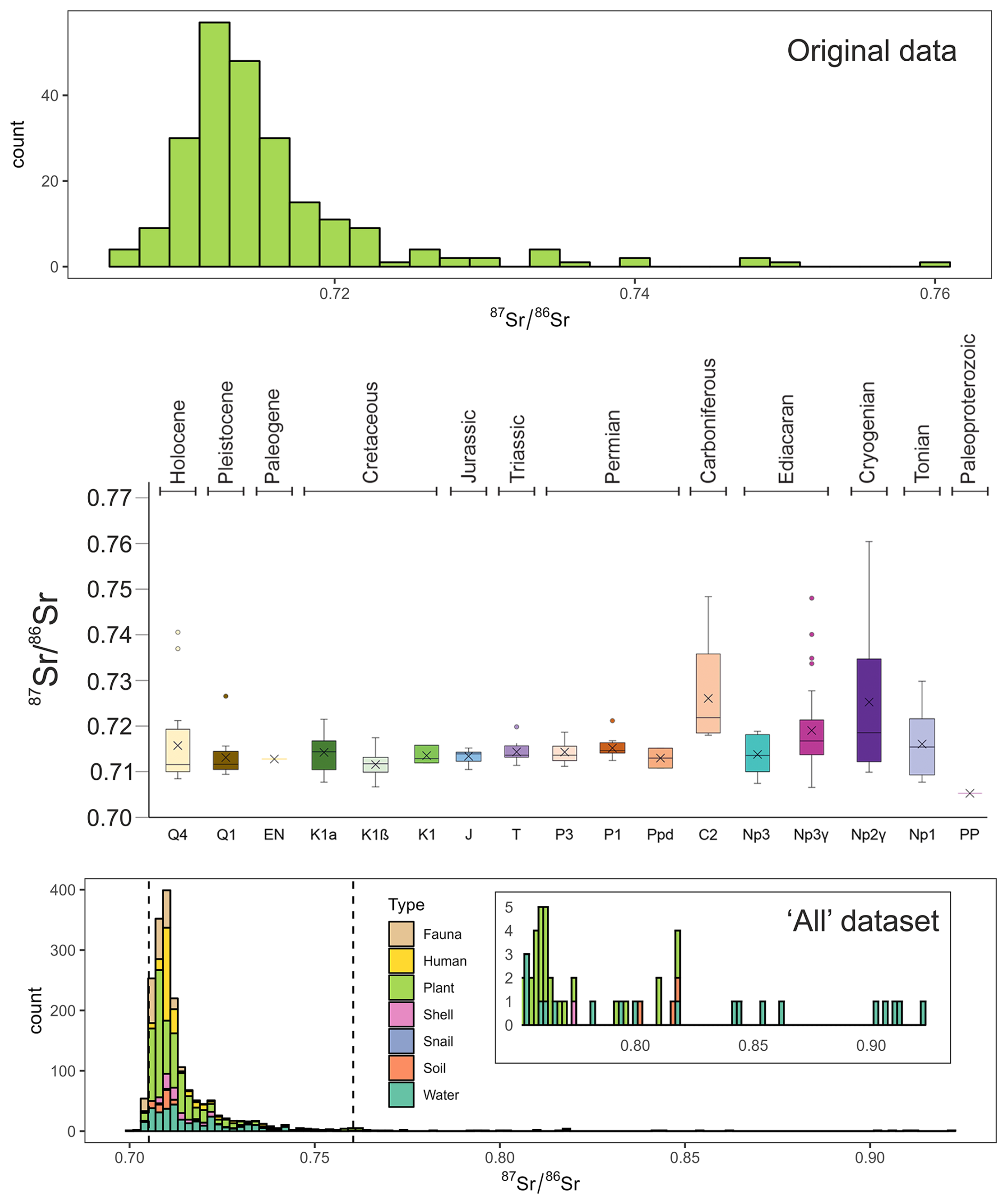
Figure 3Histogram of the whole dataset utilized to construct the isoscape model and of the new plant data. Boxplots of the plant samples from SC and RGS clustered by geological units as in Fig. 1: Q4 – Holocene sediments; Q1 – Pleistocene sediments; EN – Paleogene sedimentary; K1α – Serra Geral Formation, felsic; K1β – Serra Geral Formation, basic; K1 – Cretaceous sedimentary; J – Jurassic sedimentary; T – Triassic sedimentary; P3 – Late Permian sedimentary; P1 – Early Permian sedimentary; Ppd – Permian andesite; C2 – Carboniferous sedimentary; Np3 – Ediacaran metasedimentary; Np3γ – Ediacaran metaigneous; Np2γ – Cryogenian metaigneous; Np1 – Tonian metamorphic; PP – Paleoproterozoic basement.
Table 2Bioavailable Sr isotopic average composition of this work plant samples divided for the different geological super-units of the region as reported in Fig. 1. The order follows the stratigraphic order.
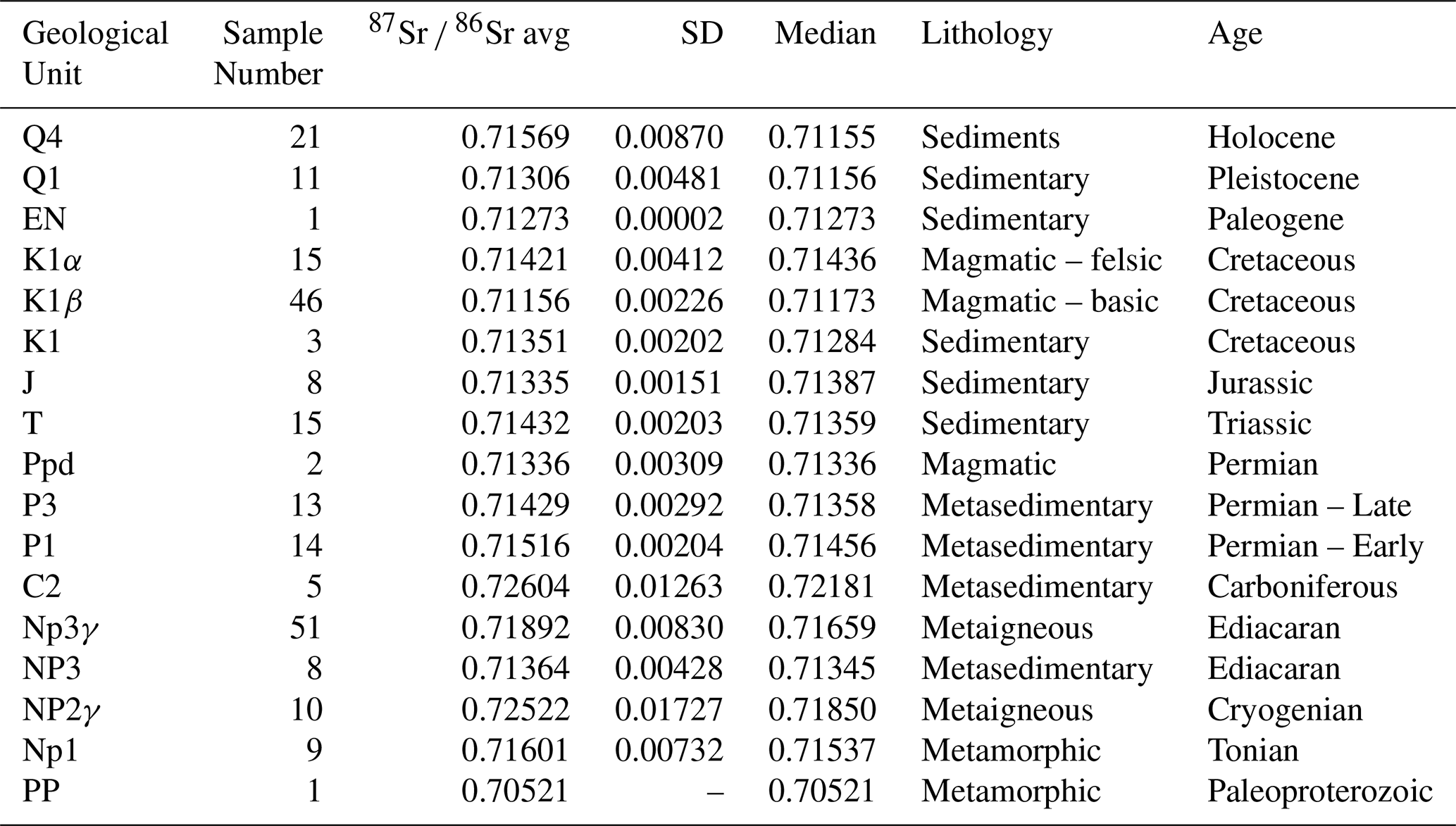
Plants from Holocene sediments (Q4) show values between 0.70843 and 0.74054, with an average of 0.71569 ± 0.00870 (n= 21; error calculated as standard deviation; Fig. 3; Table 2) while those from Pleistocene sediments (Q1, Q2, and Q3) have a narrower range from 0.70940 to 0.72650, with an average of 0.71306 ± 0.00481 (n=11), similar to only one Paleogene sample (EN) with a value of 0.71273 ± 0.00002 (Table 2). Plants from both these sedimentary groups include anomalous values, as outliers of the distribution (Fig. 3).
Samples from the Cretaceous felsic volcanics units of the Paraná LIP (K1α) show higher values (between 0.70766 and 0.72147; average of 0.71421 ± 0.00412, n=15) than those from the basic volcanics units (K1β; between 0.70666 and 0.71741; average of 0.71156 ± 0.00226, n=46; Fig. 3, Table 2). Plants from Cretaceous sediments of the Paraná Basin (K1) have similar K1α values, (0.71191 and 0.71578; average of 0.71351 ± 0.00202; n=3; Table 2), almost indistinguishable from those from Jurassic sediments (J; between 0.71045 and 0.71515; average of 0.71335 ± 0.00151; n= 8; Fig. 3, Table 2). Plants from other sedimentary units of the Paraná Basin (i.e., T, P1, and P3 units) show progressive radiogenic enrichment over time (averages at 0.71432 ± 0.00203; 0.71429 ± 0.00292; 0.71516 ± 0.00204, respectively). Samples from Permian volcanics (Ppd) have comparable values, between 0.71118 and 0.71554 with an average of 0.71336 ± 0.00309 (n=2; Table 2). In contrast, plants from Carboniferous sedimentary rocks (C2), have a distinct and more radiogenic signature between 0.71796 and 0.74832, average at 0.72604 ± 0.01263 (n= 5; Fig. 3, Table 2).
Samples collected from units of the Mantiqueira Province show broader ranges and generally higher values than those from Paraná Basin samples (except for C2 unit; Fig. 3). Plants from Ediacaran sediments of the Dom Feliciano Belt (Np3) yielded 87Sr 86Sr values between 0.70733 and 0.71871, with an average of 0.71364 ± 0.00428 (n= 8), while plants from metaigneous units (Np3γ) show higher and more variable values (0.7064 to 0.74790, with an average of 0.71892 ± 0.00830; n= 51; Fig. 3, Table 2). Samples from Cryogenian metaigneous units from the São Gabriel Terrane (Np2γ) show the widest range in the dataset (from 0.70987 to 0.76039; average of 0.72522 ± 0.01727; n= 10; Fig. 3, Table 2). Plants from the Tonian metasedimentary units (Np1) show values between 0.70769 and 0.72978 with an average of 0.71601 ± 0.00732 (n= 9; Fig. 3, Table 2). Finally, the sample from the Paleoproterozoic basement (PP) yielded the lowest value of the entire dataset (0.70521 ± 0.00002; Table 2).
4.2 Random forest models
The presence of isotopic outliers in our plant dataset, with ratios higher than those expected for unconsolidated coastal deposits, can be explained by the heterogeneity of the Holocene and Pleistocene deposits (fluvial, marine, aeolian) on which the plants grew, and the characteristics of the parental lithologies. Since these values reflect geological variability, they were retained in the model. In contrast, the extremely radiogenic values for river waters (> 0.900) were excluded.
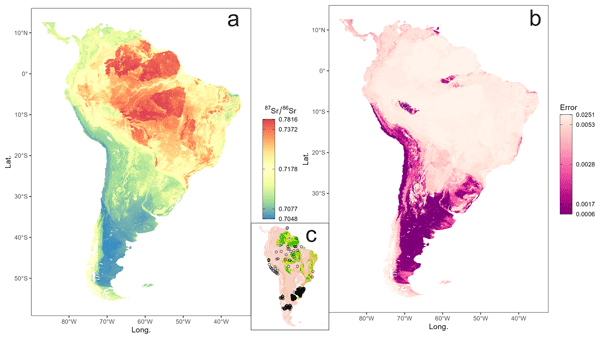
The three constructed isoscape models clearly distinguish the most radiogenic areas of the SC and RGS, which often correspond to the oldest geological units in the region (Figs. 4 and 5). In all models, the associated errors are higher in these radiogenic areas (Figs. 4 and 5), indicating lower predictive power of the models in these regions.
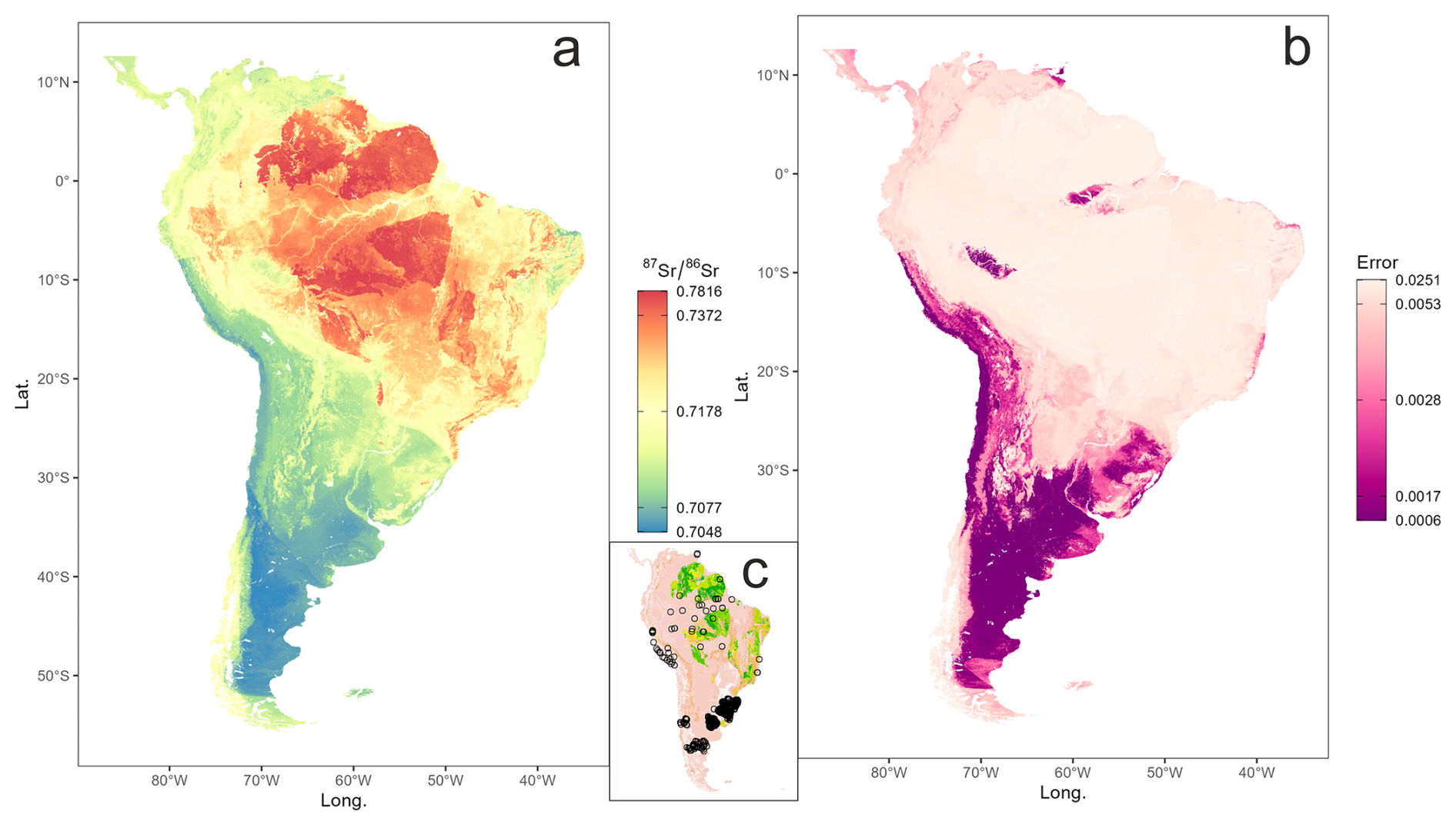
Figure 4Spatial distribution of strontium isotopes in South America based on plant + lichen samples (n= 531 sites). Isoscape random forest model (a), associated spatial uncertainty map (b) and sample distribution (c).
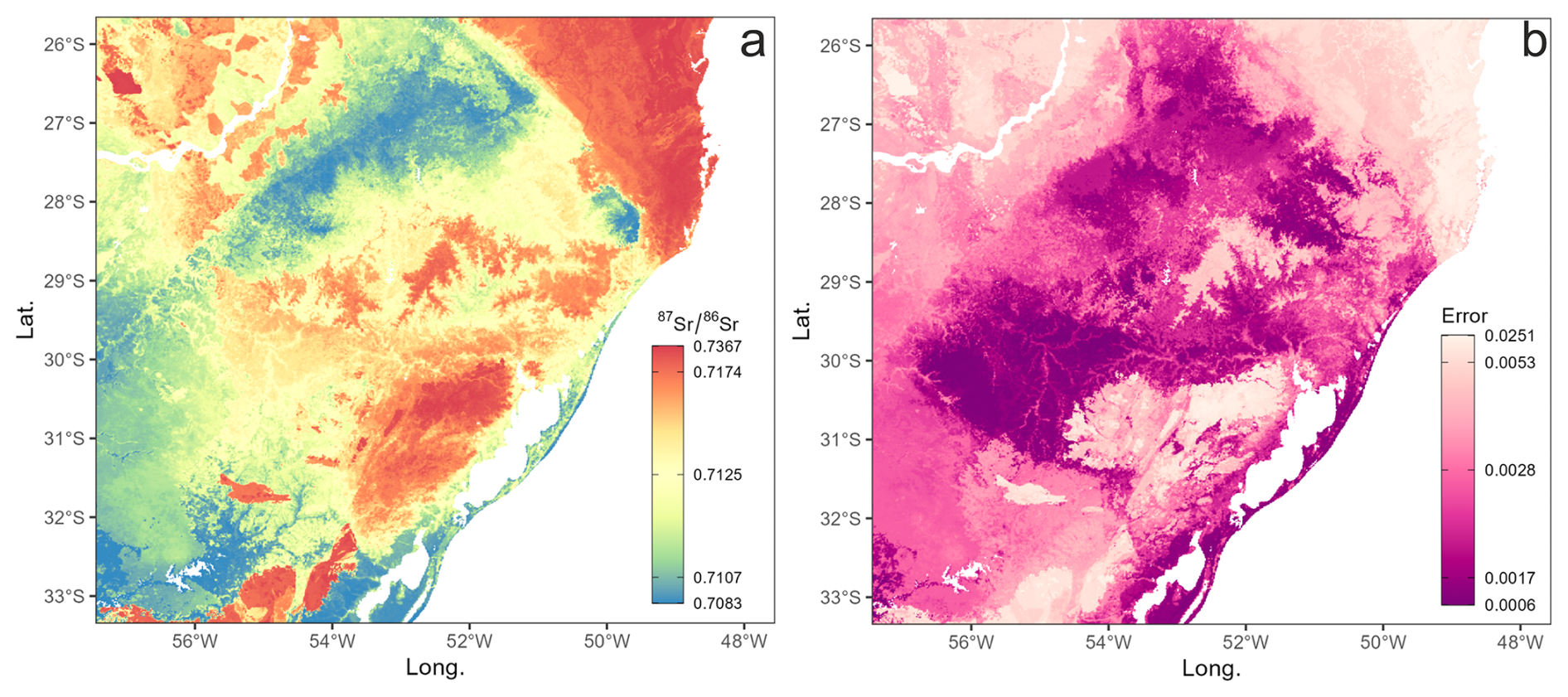
Figure 5Spatial distribution of strontium isotopes in Santa Catarina and Rio Grande do Sul states based on plant + lichen samples (n= 531 sites). Isoscape random forest model (a) and associated spatial uncertainty map (b).
Evaluation metrics reported in Table 3 show significant differences between the datasets: the model based on the “All” dataset exhibits the lowest predictive power, with a RMSE of 0.0086 and an R2 of 0.639, while the models built on the plant + fauna + lichen + human and the plant + lichen datasets show similar RMSE values of 0.0049 and 0.0054 respectively, and an R2 of ca. 0.76 each. The lower variance observed in these latter models likely reflects the smaller number and lower variability of samples compared to the “All” dataset, which includes outliers with 87Sr 86Sr higher than 0.818 in water samples (Fig. 3).

The evaluation of the predictive power of the independent variables using the Increase in Node Purity (IncNodePurity; Fig. 6; Text S1 in the Supplement), shows that in the plant + fauna + lichen + human and plant + lichen models, the most relevant variables are r.srsrq1 (predicted first quartile of the global 87Sr 86Sr bedrock model; Bataille et al., 2018) and r.ph (soil pH in H2O solution × 10; Bataille et al., 2020), both with IncNodePurity values just below 0.012 (Fig. 6), followed by r.meanage_geol (GLiM age attribute in Myrs; Bataille et al., 2020) and r.cec (cation exchange capacity; Bataille et al., 2020) with values of around 0.009, while all other variables have a contribution lower than 0.004 (Fig. 6).

Figure 6Predictive variables and model accuracy for random forest model based on plant + lichen samples. Increase in Node Purity (IncNodePurity) of the n= 14 external predictors (a); cross-validation scatterplot of observed vs. predicted 87Sr 86Sr values for the test-validation sample splits (b); model residuals vs. predicted 87Sr 86Sr ratios (c).
Notably, a 2D-Partial Dependence Plot (PDP, Fig. 7) shows a nonlinear interaction between r.ph and r.srsrq1, and indicates that the RF model predicts higher 87Sr 86Sr ratios when pH is low and – as expected – when the r.srsrq1 bedrock model value is high (Fig. 7).

Figure 72D Partial Dependence Plot for predictive variables r.srsrq1 and r.ph for random forest model based on plant + lichen samples.
In contrast, within the “All” model the most predictive variable is r.pet (global potential evo-transpiration; Bataille et al., 2018) with an IncNodePurity value equal to 0.038, followed by r.ph at 0.020, r.age (Terrane age attribute in Myrs; Bataille et al., 2020) at 0.018, and r.cec and r.srsrq1 at 0.015 (Text S1 in the Supplement).
5.1 Validation of the novel dataset against bedrock geology
Several inputs and processes govern the bioavailable Sr isotopic signature of local areas. However, considering a regional dataset, the bedrock geology is one of the main factors which govern the isotopic distribution (Vitousek et al., 1999; Voerkelius et al., 2010), and thus its relationship with the dataset could be a useful proxy to validate it.
The asymmetric statistical distribution of 87Sr 86Sr values observed in the novel dataset (Fig. 3), characterized by a long tail toward more radiogenic ratios, reflects the geological complexity of the area and the variety of contributing lithologies (Cryogenian igneous rocks, Ediacaran sedimentary sequences, Cretaceous volcanic flows, etc.). The presence of anomalous values, i.e., ratios higher than those expected for unconsolidated coastal deposits and identified as outliers of the distribution, among plants growing on Holocene and Pleistocene sediments can be explained by the heterogeneity of the deposits (fluvial, marine, aeolian) and the characteristics of the parental lithologies.
The more radiogenic values of plants samples growth on soils from felsic igneous and metamorphic units compared to igneous basic and sedimentary units (e.g. units K1α, magmatic felsic, and K1β, magmatic basic with the same age), are consistent with well-known geological differentiation processes, as Rb commonly behaves as a more incompatible element in magmatic and metamorphic processes than Sr, thus becoming enriched during fractionation, forming rocks with higher or lower Rb content, which over time produce higher or lower 87Sr 86Sr ratios, as in K1α and K1β, respectively.
Another aspect related to geology, is the increase of the 87Sr 86Sr ratio in rocks with time, which we expect to be reflected in the derived soil and then in the local vegetation. The plant dataset presented here follows this rule, with a general increase of the 87Sr 86Sr ratio as the bedrock is older in age (Fig. 3; Table 2) as observed for the Paranà Basin samples vs. Mantiqueira Province ones.
All this evidence suggests that the dataset is in overall agreement with bedrock geology which is the primary source of bioavailable Sr in nature.
5.2 Limits, advantages and predicting variables of the random forest models
Across the developed models, higher spatial uncertainties are associated with the most radiogenic areas of SC and RGS, generally corresponding to the oldest geological units in the area (Figs. 4, 5). This pattern, also reported in random forest models from the literature (e.g., Bataille et al., 2018; Gigante et al., 2023; Scaggion et al., 2025b), reflects the pronounced contrast in isotope composition between radiogenic bedrock and less radiogenic end-members such as aerosols, seawater, and precipitation. Such contrast complicates the mixing relationships processes that govern the bioavailable Sr isotope signature. Another parameter that influences model accuracy and associated errors is the uneven distribution of samples on a continental scale. Nonuniform sampling tends to introduce bias towards specific geological contexts, thereby limiting the ability to generalize predictions in unrepresented areas.
The improved performance observed in the plant + fauna + lichen + human and plant + lichen models, compared to the “All” dataset, can be attributed to the reduced variability of the data, which limits the influence of outliers and improves the overall model stability. We reiterate that these differences in RMSE and R2 more accurately reflect the isotopic range and internal heterogeneity of the training datasets, rather than intrinsic differences in model quality. The absence of significant differences in the predictiveness between these two best performing models may reflect (i) nonuniform and incomplete geographic coverage associated with water and soil sampling strategies, and (ii) the limited representativeness of inorganic samples compared to biological and bioderived materials in representing the local terrestrial bioavailable Sr signature, as recently reported by Spies et al. (2025). In this regard, for random forest models, a smaller but more geologically representative dataset of biological samples is preferable over a larger but uneven dataset. Indeed, the latter reduces the representativeness of the isotopic variability and, consequently, compromises the accuracy and reliability of the models. Conversely, a smaller dataset anchored to the local geological context is more stable, robust, and useful for modelling (Marsh et al., 2025).
The predicted distribution map of the bioavailable 87Sr 86Sr isotope ratio shows a consistent correlation with the data obtained as a function of the variables r.srsrq1 and r.ph. The combined marginal effect (Fig. 7) between these two independent variables reveals that isotopic predictions are influenced by non-linear interactions between strontium isotope ratios (r.srsrq1) and soil pH (r.ph). Higher 87Sr 86Sr ratios correlate with more acidic soils, a pattern consistent with pedogenesis on ancient silicate igneous-metamorphic rocks. In the Amazon region, low pH values result from intense decomposition of organic matter, which leads to strong leaching of the bedrock and, consequently, increases Sr availability in the soil. The PDP (Fig. 7) explains how the geological context, pedogenic processes, and environmental conditions shape the spatio-temporal distribution of Sr isotope values.
Compared to existing Sr isoscapes, this study substantially improves both the spatial coverage and resolution of bioavailable predictions for South America, particularly southern Brazil. Although global or continental-scale isoscapes are essential for broader applications, developing regional models based on dense, geologically informed sampling offer much higher resolution and are essential for fine-scale provenance studies, such as intra-site archaeological mobility or ecological habitat use. Despite being focused on SC and the RGS regions, our dataset allowed us to obtain a reasonably robust continental-scale model with an R2 of 0.764 (Fig. 4). Our model compares positively with other continental-scale isoscapes (e.g. the bioavailable Sr isoscape of Australia, with an R2 of 0.590; Dosseto et al., 2025). With this comparison, we do not intend to downplay the importance of large-scale modeling approaches, which are essential for global applications, but rather to highlight how carefully planned sampling strategies at the local level can provide robust, useful, and informative models at larger scales.
This highlights how carefully designed local sampling strategies not only strengthen regional provenance studies but also provide a reliable base for modeling at broader geographical scales.
The bioavailable Sr plant isotope dataset of Santa Catarina and Rio Grande do Sul states analysed in this work, the R script and the raster files of the plant + lichen model are available at https://doi.org/10.5281/zenodo.17988601 (Scaggion et al., 2025a). Check the latest version of the dataset. The literature dataset is reported in Table S1 in the Supplement.
This work presents a comprehensive dataset of 233 bioavailable 87Sr 86Sr values from plant samples collected across the main geological units of Santa Catarina and Rio Grande do Sul states (southern Brazil). The measured 87Sr 86Sr ratios in the terrestrial biosphere are consistent with lithological patterns, reflecting the pronounced geological heterogeneity of the region.
By integrating these new data with a multi-material dataset of literature data, we developed three isoscapes of bioavailable Sr distribution for South America and the studied region (ca. 370 000 km2) using advanced random forest modelling. Among the tested approaches, the plant + fauna + lichen + human and plant + lichen models achieved the best predictive performance, while the addition of water and soil reduced model performance due to their lower representativeness of locally bioavailable Sr.
Despite the limited dataset, the resulting models show robust predictive performance even at the continental scale. This result demonstrates how well-designed local sampling strategies can ensure reliable regional models that maintain their relevance and applicability at larger spatial scales. Beyond providing a new baseline for environmental, archaeological, and palaeoecological research in southern Brazil, our study highlights an important methodological insight: strategically constructed regional datasets can play a key role in refining continental-scale isoscapes. Future efforts should focus on expanding high resolution datasets across underrepresented geological domains.
The supplement related to this article is available online at https://doi.org/10.5194/essd-18-6925-2026-supplement.
C.S. was in charge of Conceptualization, Data curation, Formal analysis, Investigation, Methodology, Roles/Writing – original draft and Writing – review and editing; T.G. was in charge of Conceptualization, Data curation, Formal analysis, Funding acquisition, Investigation, Methodology, Project administration, Resources, Supervision, Visualization, Roles/Writing – original draft and Writing – review and editing; L.P. was in charge of Data curation, Formal analysis; D.L. was in charge of Data curation; M.C. was in charge of Data curation; S.B. was in charge of Formal analysis; S.B. was in charge of Data curation; G.M. was in charge of Data curation; M.C.P.S. was in charge of Data curation; E.B. was in charge of Funding acquisition, Project administration; A.C. was in charge of Formal analysis, Methodology, Supervision, Roles/Writing – original draft and Writing – review and editing; F.L. was in charge of Conceptualization, Formal analysis, Data curation, Investigation, Methodology, Software, Visualization, Roles/Writing – original draft and Writing – review and editing.
The contact author has declared that none of the authors has any competing interests.
Publisher's note: Copernicus Publications remains neutral with regard to jurisdictional claims made in the text, published maps, institutional affiliations, or any other geographical representation in this paper. The authors bear the ultimate responsibility for providing appropriate place names. Views expressed in the text are those of the authors and do not necessarily reflect the views of the publisher.
SB and GM want to thank Antonino Vazzana and Owen Higgins.
This research has been supported by the Ministero dell'Università e della Ricerca (the European Union – Next Generation EU, Mission 4 Component 1 through grant no. PRIN2022 – HABITS 2022BC2Z5F project, CUP E53D23000130001; the European Union – Next Generation EU, Mission 4 Component 1 through grant no. PRIN2022 – HABITS 2022BC2Z5F project, CUP J53D23000140001; the European Union – NextGenerationEU through the National Recovery and Resilience Plan (PNRR) – Mission 4, Component 2, Investment 1.3, titled: CHANGES – Cultural Heritage Active Innovation for Sustainable Society (grant no. PE0000020 – CUP J33C22002850006); and the European Union – Next-GenerationEU – National Recovery and Resilience Plan (NRRP) – MISSION 4 COMPONENT 2, INVESTIMENT N. 1.1, CALL PRIN 2022 PNRR D.D. 1409 14-09-2022 – “CAST Copper Accumulation, Supply, and Technology among Italian prehistoric societies, project no. P202275A2M – CUP E53D23020120001).
This paper was edited by Kirsten Elger and reviewed by Mael Le Corre and Clement Bataille.
Andrushko, V. A., Buzon, M. R., Simonetti, A., and Creaser, R. A.: Strontium isotope evidence for prehistoric migration at Chokepukio, valley of Cuzco, Perù, Lat. Am. Antiq., 20, 57–75, 2009.
Argentino, C., Lugli, F., Cipriani, A., and Panieri, G.: Testing miniaturized extraction chromatography protocols for combined 87Sr 86Sr and Sr analyses of pore water by MC-ICP-MS, Limnol. Oceanogr.: Methods, 19, 431–440, https://doi.org/10.1002/lom3.10435, 2021.
Armaroli, E., Lugli, F., Cipriani, A., and Tütken, T.: Spatial ecology of moose in Sweden: Combined Sr-O-C isotope analyses of bone and antler, PLoS One, 19, e0300867. https://doi.org/10.1371/journal.pone.0300867, 2024.
Asrat, S., Lucchini, F., Tafuri, M. A., Aureli, C., Gallinaro, M., Zerboni, A., Fusco, M., and Spinapolice, E. E.: A strontium (87Sr 86Sr) isoscape of Southern Ethiopia: implications for hominin land use and faunal mobility patterns, Front. Environ. Archaeol. 4, https://doi.org/10.3389/fearc.2025.1499291, 2025.
Avigliano, E., Chung, M.-T., Pouilly, M., Huang, K.-F., Casalinuovo, M., Dominino, J., Silva, N., Sánchez, S., Facetti, J. F., and Volpedo, A. V.: Strontium isotope mapping and its application to study the fish life history (Salminus brasiliensis) in semi-fragmented rivers (La Plata Basin, South America), Fish. Res., 265, 106741, https://doi.org/10.1016/j.fishres.2023.106741, 2023.
Azevedo, V., Strikis, N., M., Novello, V. F., Roland, C. L., Cruz, F. W., Santos, R. V., Vuille, M., Utida, G., De Andrade, F. R. D., Cheng, H., and Edwards, R. L.: Paleovegetation seesaw in Brazil since the Late Pleistocene: A multiproxy study of two biomes, Earth Planet. Sci. Lett., 563, 116880, https://doi.org/10.1016/j.epsl.2021.116880, 2021.
Balmino, G., Vales, N., Bonvalot, S., and Briais, A.: Spherical harmonic modelling to ultra-high degree of Bouguer and isostatic anomalies, J. Geod., 86, 499–520. https://doi.org/10.1007/s00190-011-0533-4, 2012.
Barberena, R., Durán, V. A., Novellino, P., Winocur, D., Benítez, A., Tessone, A., Quiroga, M. N., Marsh, E. J., Gasco, A., Cortegoso, V., Lucero, G., Llano, C., and Knudson, J. K.: Scale of human mobility in the southern Andes (Argentina and Chile): A new framework based on strontium isotopes, Am. J. Biol. Anthropol., 164, 305–320, https://doi.org/10.1002/ajpa.23270, 2017.
Barberena, R., Tessone, A., Cagnoni, M., Gasco, A., Durán, V., Winocur, D., Benítez, A., Lucero, G., Trillas, D., Zonana, I., Novellino, P., Fernández, M., Bavio, M. A., Zubillaga, E., and Gautier, E. A.: Bioavailable Strontium in the Southern Andes (Argentina and Chile): A Tool for Tracking Human and Animal Movement, Environ. Archaeol., 26, 323–335, https://doi.org/10.1080/14614103.2019.1689894, 2019.
Barberena, R., Menéndez, L., Novellino, P., Lucero, G., Luyt, J., Sealy, J., Cardillo, M., Gasco, A., Llano, C., Frigolé, C., Guevara, D., Da Pena, G., Winocur, D., Benitez, A., Cornejo, L., Falabella, F., Mendez, C., Nuevo-Delaunay, A., Sanhueza, L., Sagredo, F. S., Troncoso, A., Zarate, S., Duran, V. A., and Cortegoso, V.: Multi-isotopic and morphometric evidence for the migration of farmers leading up to the Inka conquest of the southern Andes, Sci. Rep., 10, 21171, https://doi.org/10.1038/s41598-020-78013-x, 2020.
Barberena, R., Cardillo, M., Lucero, G., le Roux, P. J., Tessone, A., Llano, C., Gasco, A., Marsh, E. J., Nuevo-Delaunay, A., Novellino, P., Frigolé, C., Winocur, D., Benítez, A., Cornejo, L., Falabella, F., Sanhueza, L., Santana Sagredo, F., Troncoso, A., Cortegoso, V., Durán, V. A., and Méndez, C.: Bioavailable Strontium, Human Paleogeography, and Migrations in the Southern Andes: A Machine Learning and GIS Approach, Front. Ecol. Evol., 9, 584325, https://doi.org/10.3389/fevo.2021.584325, 2021.
Bastos, M. Q. R.: Mobilidade humana na pré-história do litoral brasileiro: Análise de isótopos instáveis de estrôncio no sambaqui do Forte Marechal Luz, PhD thesis, Fundação Oswaldo Cruz, Rio de Janeiro, 2009.
Bastos, M. Q. R.: Dos sambaquis do sul do brasil à diáspora africana: Estudos de geoquímica isotópica de séries esqueléticas humanas escavadas de sítios arqueológicos brasileiros, PhD thesis, Universidade de Brasília, Brasília, 2014.
Bastos, M. Q. R., Souza, S. M. F. M. D., Santos, R. V., Lima, B. A. F., Santos, R.V., and Rodrigues-Carvalho, C.: Human mobility on the Brazilian coast: an analysis of strontium isotopes in archaeological human remains from Forte Marechal Luz Sambaqui, An. Acad. Bras. Ciênc., 83, 731–743, https://doi.org/10.1590/s0001-37652011000200030, 2011.
Bastos, M. Q. R., Lessa, A., Rodrigues-Carvalho, C., Tykot, R. H., and Santos, R. V.: Análise de isótopos de carbono e nitrogênio: A dieta antes e após a presença de cerâmica no sítio Forte Marechal Luz, Revista do Museu de Arqueologia e Etnologia, 0, 137–151, https://doi.org/10.11606/issn.2448-1750.revmae.2014.109329, 2014.
Bastos, M. Q. R., Santos, R. V., Tykot, R. H., Souza, S. M. F. M. D., Rodrigues-Carvalho, C., and Lessa, A.: Isotopic evidences regarding migration at the archeological site of Praia da Tapera: New data to an old matter, J. Archaeol. Sci. Rep., 4, 588–595, https://doi.org/10.1016/j.jasrep.2015.10.028, 2015.
Bastos, M. Q. R., Santos, R. V., Souza, S. M. F. M. D., Rodrigues-Carvalho, C., Tykot, R. H., Cook, D.C., and Santos, R. V.: Isotopic study of geographic origins and diet of enslaved africans buried in two brazilian cemeteries, J. Archaeolog. Sci., 70, 82–90, https://doi.org/10.1016/j.jas.2016.04.020, 2016.
Bastos, M. Q. R., Solari, A., da Silva, S. F. S. M., and Martin, G.: Estudo preliminar de dieta à partir de isótopos em grupos caçadores-coletores do agreste pernambucano (Holoceno recente – Nordeste do Brasil), FUMDHAMentos 16, 3–18, 2019.
Bastos, M. Q. R., Murilo; Souza, S. M. F. M. D., Santos, R. V., Cook, D.C., Rodrigues-Carvalho, C., and Santos, R.V.: Da África ao Cemitério dos Pretos Novos , Rio de Janeiro, Revista de Arqueologia da SAB 24, 66–81, https://doi.org/10.24885/sab.v24i1.315, 2021.
Bataille, C. P., von Holstein, I. C. C., Laffoon, J. E., Willmes, M., Liu, X.-M., and Davies, G. R.: A bioavailable strontium isoscape for Western Europe: A machine learning approach, PLoS One, 13, e0197386, https://doi.org/10.1371/journal.pone.0197386, 2018.
Bataille, C. P., Crowley, B. E., Wooller, M. J., and Bowen, G. J.: Advances in global bioavailable strontium isoscapes, Palaeogeogr. Palaeoclimatol. Palaeoecol., 555, 109849, https://doi.org/10.1016/j.palaeo.2020.109849, 2020.
Benson, S., Lennard, C., Maynard, P., and Roux, C.: Forensic applications of isotope ratio mass spectrometry–a review, Forensic Sci. Int., 157, 1–22, https://doi.org/10.1016/j.forsciint.2005.03.012, 2006.
Bentley, A. R.: Strontium Isotopes from the Earth to the Archaeological Skeleton: A Review, J. Archaeol. Method Theory, 13, 135–87, https://doi.org/10.1007/s10816-006-9009-x, 2006.
Borges, C., Chanca, I., and Salesse, K.: Stable and radiogenic isotope data from Brazilian bioarchaeological samples: a synthesis, IsoArcH [data set], https://doi.org/10.48530/isoarch.2021.005, 2021.
Börker, J., Hartmann, J., Amann, T., and Romero-Mujalli, G.: Terrestrial sediments of the earth: development of a global unconsolidated sediments map database (gum), Geochem. Geophys. Geosyst., 19, 997–1024. https://doi.org/10.1002/2017GC007273, 2018.
Brahney, J., Ballantyne, A. P., Kociolek, P., Leavitt, P. R., Farmer, G. L., and Neff, J. C.: Ecological changes in two contrasting lakes associated with human activity and dust transport in western Wyoming: Dust-P controls on alpine lake ecology, Limnol. Oceanogr., 60, 678–695, https://doi.org/10.1002/lno.10050, 2015.
Brass, G. W.: The variation of the marine ratio during Phanerozonic time: interpretation using a flux model, Geochim. Cosmochim. Acta, 40, 721–730, https://doi.org/10.1016/0016-7037(76)90025-9, 1976.
Brito Neves, B. B., Fuck, R. A., and Pimentel, M. M.: The Brasiliano collage in South America: a review, Braz. J. Geol., 44, 493–518, 2014.
Brunet, F., Gaiero, D., Probst, J. L., Depetris, P. J., Gauthier Lafaye, F., and Stille, P.: δ13C tracing of dissolved inorganic carbon sources in Patagonian rivers (Argentina), Hydrol. Process., 19, 3321–3344, https://doi.org/10.1002/hyp.5973, 2005.
Bullen, T. D., Krabbenhoft, D. P., and Kendall, C.: Kinetic and mineralogic controls on the evolution of groundwater chemistry and 87Sr 86Sr in a sandy silicate aquifer, northern Wisconsin, USA, Geochim. Cosmochim. Acta, 60, 1807–1821, https://doi.org/10.1016/0016-7037(96)00052-x, 1996.
Capo, R. C., Stewart, B. W., and Chadwick, O. A.: Strontium isotopes as tracers of ecosystem processes: theory and methods, Geoderma 82, 197–225, https://doi.org/10.1016/s0016-7061(97)00102-x, 1998.
Cavazzuti, C., Hajdu, T., Lugli, F., Sperduti, A., Vicze, M., Horváth A, Major, I., Molnár, M., Palcsu, L., and Kiss, V.: Human mobility in a Bronze Age Vatya `urnfield' and the life history of a high-status woman, PLoS ONE, 16, e0254360, https://doi.org/10.1371/journal.pone.0254360, 2021.
Cerva-Alves, T., Hartmann, L. A., Lana, C., Queiroga, G. N., Maciel, L. A. C., Leandro, C. G., and Savian, J. F.: Rutile and zircon age and geochemistry in the evolution of the juvenile São Gabriel Terrane early in the Brasiliano Orogeny, J. South Am. Earth Sci., 112, 103505, https://doi.org/10.1016/j.jsames.2021.103505, 2021.
Chala-Aldana, D., Bocherens, H., Miller, C., Moore, K., Hodgins, G., and Rademaker, K.: Investigating mobility and highland occupation strategies during the Early Holocene at the Cuncaicha rock shelter through strontium and oxygen isotopes, J. Archaeol. Sci. Rep., 19, 811–827, https://doi.org/10.1016/j.jasrep.2017.10.023, 2018.
Crowley, B. E., Miller, J. H., and Bataille, C. P.: Strontium isotopes (87Sr 86Sr) in terrestrial ecological and palaeoecological research: empirical efforts and recent advances in continental-scale models, Biol. Rev., 92, 43–59, https://doi.org/10.1111/brv.12217, 2017.
Dickin, A. P.: Radiogenic Isotope Geology, third edn., McMaster University, Cambridge University Press, Cambridge, https://doi.org/10.1017/9781316163009, 2018.
Dosseto, A., Dux, F., Bataille, C., and de Caritat, P.: A bioavailable strontium isoscape of Australia, Earth Syst. Sci. Data, 17, 4865–4880, https://doi.org/10.5194/essd-17-4865-2025, 2025.
Durán, V., Novellino, P., Menéndez, L., Gasco, A., Marsh, E., Barberena, R., and Frigolé, C.: Barrio Ramos I. Prácticas funerarias en el inicio del período de dominación Inca del valle de Uspallata (Mendoza, Argentina), Relaciones de la Sociedad Argentina de Antropologíá, XLIII, 55–86, ISSN 1852-1479, 2018.
Edmond, J. M., Palmer, M. R., Measures, C. I., Grant, B., and Stallard, R. F.: The fluvial geochemistry and denudation rate of the Guayana Shield in Venezuela, Colombia, and Brazil, Geochim. Cosmochim. Acta, 59, 3301–3325. https://doi.org/10.1016/0016-7037(95)00128-m, 1995.
Edmond, J. M., Palmer, M. R., Measures, C. I., Brown, E. T., and Huh, Y.: Fluvial geochemistry of the eastern slope of the northeastern Andes and its foredeep in the drainage of the Orinoco in Colombia and Venezuela, Geochim. Cosmochim. Acta, 16, 2949–2976, https://doi.org/10.1016/0016-7037(96)00142-1, 1996.
Faure, G. and Mensing, T. M.: Isotopes: Principles and Applications, third edn., John Wiley & Sons, New York, ISBN: 978-0-471-38437-3, 2005.
Fernandez, M. V., Gordon, F., Le Roux, P. J., Winocur, D., Lucero, G., Benitez, A., Rindel, D., Della Negra, C., Bernal, V., and Barberena, R.: Scale of human mobility in northwestern Patagonia: An approach based on regional geology and strontium isotopes in human remains, Geoarchaeology, 37, 227–241, https://doi.org/10.1002/gea.21881, 2022.
Fiege, K., Miller, C. A., Robinson, L. F., Figueroa, R., and Peucker-Ehrenbrink, B.: Strontium isotopes in Chilean rivers: The flux of unradiogenic continental Sr to seawater, Chem. Geol., 268, 337–343, https://doi.org/10.1016/j.chemgeo.2009.09.013, 2009.
Fietzke, J. and Eisenhauer, A.: Determination of temperature‐dependent stable strontium isotope (88Sr 86Sr) fractionation via bracketing standard MC‐ICP‐MS, Geochem. Geophys. Geosyst., 7, https://doi.org/10.1029/2006gc001243, 2006.
Frei, K. M. and Frei, R.: The geographic distribution of strontium isotopes in Danish surface waters – A base for provenance studies in archaeology, hydrology and agriculture, Appl. Geochem., 26, 326–40, https://doi.org/10.1016/j.apgeochem.2010.12.006, 2011.
Funck, J., Bataille, C., Rasic, J., and Wooller, M.: A bio‐available strontium isoscape for eastern Beringia: A tool for tracking landscape use of Pleistocene megafauna, J Quat Sci., 36, 76–90, https://doi.org/10.1002/jqs.3262, 2021.
Gaillardet, J., Dupre, B., Allegre, C. J., and Négrel, P.: Chemical and physical denudation in the Amazon River Basin, Chem. Geol., 142, 141–173, https://doi.org/10.1016/s0009-2541(97)00074-0, 1997.
Gigante, M., Mazzariol, A., Bonetto, J., Armaroli, E., Cipriani, A., and Lugli, F.: Machine learning-based Sr isoscape of southern Sardinia: A tool for bio-geographic studies at the Phoenician-Punic site of Nora, PLoS One, 18, e0287787, https://doi.org/10.1371/journal.pone.0287787, 2023.
Giovanardi, T., da Costa, P. C. C., Girardi, V. A. V., Weska, R. K., Vasconcelos, P. M., Thiede, D. S., Mazzucchelli, M., and Cipriani, A.: Age, geochemistry and mantle source of the Alto Diamantino basalts: Insights on NW Paraná Magmatic Province, Lithos, 426–427, 106797, https://doi.org/10.1016/j.lithos.2022.106797, 2022.
Gomes, A. S. and Vasconcelos, P. M.: Geochronology of the Paraná-Etendeka large igneous province, Earth-Sci. Rev., 220, 103716 https://doi.org/10.1016/j.earscirev.2021.103716, 2021.
Grove, M. J., Baker, P. A., Cross, S. L., Rigsby, C. A., and Seltzer, G. O.: Application of strontium isotopes to understanding the hydrology and paleohydrology of the Altiplano, Bolivia-Peru, Palaeogeogr. Palaeoclimatol. Palaeoecol., 194, 281–297, https://doi.org/10.1016/s0031-0182(03)00282-7, 2003.
Hartmann, J. and Moosdorf, N.: The new global lithological map database GLiM: a representation of rock properties at the Earth surface, Geochem. Geophys. Geosyst., 13, Q12004, https://doi.org/10.1029/2012GC004370, 2012.
Heilbron, M., Pedrosa-Soares, A. C., Campos Neto, M. C., Silva, L. C., Trouw, R. A. J., and Janasi, V. A.: Província Mantiqueira, in: Geologia do Continente Sul-Americano: Evolução da Obra de Fernando Flávio Marques de Almeida, edited by: Mantesso-Neto, V., Bartorelli, A., Carneiro, C. D. R., Brito Neves, B. B., 203–234, ISBN: 8587256459, 2004.
Hengl, T., Mendes de Jesus, J., Heuvelink, G. B. M., Ruiperez Gonzalez, M., Kilibarda, M., Blagotić, A., Shangguan, W., Wright, M. N., Geng, X., Bauer-Marschallinger, B., Guevara, M. A., Vargas, R., MacMillan, R. A., Batjes, N. H., Leenaars, J. G. B., Ribeiro, E., Wheeler, I., Mantel, S., and Kempen, B.: SoilGrids250m: Global gridded soil information based on machine learning, PLoS One 12, e016974, https://doi.org/10.1371/journal.pone.0169748, 2017.
Henry, F., Probst, J. L., Thouron, D., Depetris, P., and Garçon, V.: Nd-Sr isotopic compositions of dissolved and particulate material transported by the Parana and Uruguay rivers during high (December 1993) and low (September 1994) water periods / Compositions isotopiques de Nd et Sr des matières en suspension et dissoutes transportées par les fleuves Parana et Uruguay en périodes de hautes (décembre 1993) et basses (septembre 1994) eaux, Sci. Géol. Bull., 49, 89–100, https://doi.org/10.3406/sgeol.1996.1937, 1996.
Hermenegildo, T.: Reconstituição da dieta e dos padrões de subsistência das populações pré-históricas de caçadores-coletores do Brasil Central através da ecologia isotópica, Universidade de São Paulo, thesis dissertation, https://doi.org/10.11606/D.91.2009.tde-14092009-084156, 2009.
Hieronymus, B., Godot, J. M., Boulègue, J., Bariac, T., Negrel, P., and Dupré, B.: Chimie du fleuve Tocantins et de rivières côtières de l'est du Para (Brésil), Grands Bassins Fluviaux, November 1993, Paris, France, hal-04002094, 1993.
Hijmans, R. J., Cameron, S. E., Parra, J. L., Jones, P. G., and Jarvis, A.: Very high resolution interpolated climate surfaces for global land areas, Int. J. Climatol., 25, 1965–1978, https://doi.org/10.1002/joc.1276, 2005.
Hobson, K. A.: Tracing origins and migration of wildlife using stable isotopes: a review, Oecologia, 120, 314–26, https://doi.org/10.1007/s004420050865, 1999.
Holz, M., França, A. B., Souza, P. A., Iannuzzi, R., and Rohn, R.: A stratigraphic chart of the Late Carboniferous/Permian succession of the eastern border of the Paraná Basin, Brazil, South America, J. South Am. Earth Sci., 29, 381–399, https://doi.org/10.1016/j.jsames.2009.04.004, 2010.
Hoogerwerff, J. A., Reimann, C., Ueckermann, H., Frei, R., Frei, K. M., van Aswegen, T., Stirling, C., Reid, M., Clayton, A., and Ladenberger, A.: Bioavailable 87Sr 86Sr in European soils: A baseline for provenancing studies, Sci. Total Environ., 672, 1033–44, https://doi.org/10.1016/j.scitotenv.2019.03.387, 2019.
Hughes, J. M. and Rakovan, J.: The Crystal Structure of Apatite, Ca5(PO4)3(F,OH,Cl), Rev. Mineral. Geochem., 48, 1–12, https://doi.org/10.2138/rmg.2002.48.1, 2002.
Jarvis, A., Reuter, A., Nelson, A., and Guevara, E.: Hole-filled SRTM for the globe Version 4, CGIAR-CSI SRTM 90 m Database, CGIAR CSI Consort. Spat. Inf., 1–9, http://srtm.csi.cgiar.org/ (last access: 16 September 2025), 2008.
Kafino, C. V., de Sousa, I. M. C., Barbieri, C. B., de Amorim, A. M., and Santos, R. V.: A proof-of-concept study: Determining the geographical origin of Brazilwood, (Paubrasilia echinata) with the use of strontium isotopic fingerprinting, Sci. Justice, 64, 159–165, https://doi.org/10.1016/j.scijus.2023.12.006, 2024.
Knudson, K. J.: Tiwanaku influence in the South Central Andes: strontium isotope analysis and Middle Horizon migration, Lat. Am. Antiq., 19, 3–23, https://doi.org/10.2307/25478206, 2008.
Knudson, K. J. and Price, T. D.: Utility of multiple chemical techniques in archaeological residential mobility studies: case studies from Tiwanaku- and Chiribaya-affiliated sites in the Andes, Am. J. Phys. Anthropol., 132, 25–39, https://doi.org/10.1002/ajpa.20480, 2007.
Knudson, K. J., Price, T. D., Buikstra, J. E., and Blom, D. E.: The use of strontium isotope analysis to investigate tiwanaku migration and mortuary ritual in Bolivia and Peru, Archaeometry, 46, 5–18, https://doi.org/10.1111/j.1475-4754.2004.00140.x, 2004.
Knudson, K. J., Webb, E., White, C., and Longstaffe, F. J.: Baseline data for Andean paleomobility research: a radiogenic strontium isotope study of modern Peruvian agricultural soils, Archaeol. Anthropol. Sci., 6, 205–219, https://doi.org/10.1007/s12520-013-0148-1, 2013.
Laffoon, J. E., Davies, G. R., Hoogland, M. L. P., and Hofman, C. L.: Spatial variation of biologically available strontium isotopes (87Sr 86Sr) in an archipelagic setting: a case study from the Caribbean, J. Archaeol. Sci., 39, 2371–2384, https://doi.org/10.1016/j.jas.2012.02.002, 2012.
Lahtinen, M., Arppe, L., and Nowell, G.: Source of strontium in archaeological mobility studies – marine diet contribution to the isotopic composition, Archaeol. Anthropol. Sci., 13, 1, https://doi.org/10.1007/s12520-020-01240-w, 2020.
Lee, B., Han, Y., Huh, Y., Lundstrom, C., Siame, L. L., Lee, J. I., and Park, B.-K.: Chemical and physical weathering in south Patagonian rivers: A combined Sr-U-Be isotope approach, Geochim. Cosmochim. Acta, 101, 173–190, https://doi.org/10.1016/j.gca.2012.09.054, 2013.
Loponte, D., Carbonera, M., and Radaeski, J.: The Guaraní expansion in the Upper Uruguay River. Chronology, colonization strategies, social impacts and environmental changes, J. Archaeol. Sci.: Rep., 60, 104826, https://doi.org/10.1016/j.jasrep.2024.104826, 2024.
Loponte, D., Acosta, A., Giovanardi, T., Corriale, M. J., Higgins, O. A., Carbonera, M., Buc, N., Scaggion, C., Bortolini, E., Marciani, G., Benazzi, S., Rombolá, L. T., Gascue, A., and Westbury, M. V.: A multidisciplinary investigation into whether Andean caravans reached the southern lowlands of the Paraná-Plata basin during pre-Columbian times, J. Archaeol. Sci. Rep., 64, 105118, https://doi.org/10.1016/j.jasrep.2025.105118, 2025.
Luchetti, A. C. F., Nardy, A. J. R., and Madeira, J.: Silicic, high- to extremely high-grade ignimbrites and associated deposits from the Paraná Magmatic Province, southern Brazil, J. Volcanol. Geotherm. Res., 355, 270–286, 2018.
Lugli, F., Weber, M., Giovanardi, T., Arrighi, S., Bortolini, E., Figus, C., Marciani, G., Oxilia, G., Romandini, M., Silvestrini, S., Jochum, K. P., Benazzi, S., and Cipriani, A.: Fast offline data reduction of laser ablation MC-ICP-MS Sr isotope measurements: Via an interactive Excel-based spreadsheet “SrDR”, J. Anal. At. Spectrom., 35, 852–862, https://doi.org/10.1039/C9JA00424F, 2020.
Lugli, F., Cipriani, A., Bruno, L., Ronchetti, F., Cavazzuti, C., and Benazzi, S.: A strontium isoscape of Italy for provenance studies, Chem. Geol., 587, 120624, https://doi.org/10.1016/j.chemgeo.2021.120624, 2022.
Machado, M. C.: Metodologias isotopicas 87Sr 86Sr, δC13 e δ18O em estudos geologicos e arqueologicos, Universidade Federal do Rio Grande do Sul, Instituto de Geociências, Programa de Pós-Graduação em Geociências, LUME repository, http://hdl.handle.net/10183/76142 (last access: 16 November 2023), 2013.
Mahowald, N. M., Muhs D. R., Levis S., Rasch P. J., Yoshioka M., and Zender C. S., and Luo, C.: Change in atmospheric mineral aerosols in response to climate: Last glacial period, preindustrial, modern, and doubled carbon dioxide climates, J. Geophys. Res. Atmos., 111, D10202, https://doi.org/10.1029/2005JD006653, 2006.
Makarewicz, C. A. and Sealy, J.: Dietary reconstruction, mobility, and the analysis of ancient skeletal tissues: Expanding the prospects of stable isotope research in archaeology, J. Archaeol. Sci., 56, 146–58, https://doi.org/10.1016/j.jas.2015.02.035, 2015.
Malaspinas, A.-S., Lao, O., Schroeder, H., Rasmussen, M., Raghavan, M., Moltke, I., Campos, P. F., Sagredo, F. S., Rasmussen, S., Gonçalves, V. F., Albrechtsen, A., Allentoft, M. E., Johnson, P. L. F., Li, M., Reis, S., Bernardo, D. V., DeGiorgio, M., Duggan, A. T., Bastos, M., Wang, Y., Stenderup, J., Moreno-Mayar, J. V., Brunak, S., Sicheritz-Ponten, T., Hodges, E., Hannon, G. J., Orlando, L., Price, T. D., Jensen, J. D., Nielsen, R., Heinemeier, J., Olsen, J., Rodrigues-Carvalho, C., Lahr, M. M., Neves, W. A., Kayser, M., Higham, T., Stoneking, M., Pena, S. D.J., and Willerslev, E.: Two ancient human genomes reveal Polynesian ancestry among the indigenous Botocudos of Brazil, Curr. Biol., 24, R1035–R1037, https://doi.org/10.1016/j.cub.2014.09.078, 2014.
Marsh, E. J., Cardillo, M., Knudson, K. J., Dahlstedt, A., and Barberena, R.: A bioavailable strontium isoscape for the Andes based on machine learning, J. Archaeol. Sci., 184, 106410, https://doi.org/10.1016/j.jas.2025.106410, 2025.
Martinelli, L. A., Bataille, C. P., Batista, A. C., Souza-Silva, I. M., Araujo, M. G., Abdalla Filho, A. L., Brunello, A., Tommasiello Filho, M., Higuchi, N., Barboas, A. C., Costa, F., and Nardoto, G. B.: Bioavailable strontium isoscape for the Amazon region using tree wood, For. Ecol. Manag., 594, 122963, https://doi.org/10.1016/j.foreco.2025.122963, 2025.
Martins, V., Babinski, M., Ruiz, I., Sato, K., Souza, S., and Hirata, R.: Analytical procedures for determining Pb and Sr isotopic compositions in water samples by ID-TIMS, Quím. Nova, 31, 1836–1842, https://doi.org/10.1590/s0100-40422008000700040, 2008.
McArthur, J. M., Howarth, R. J., and Bailey, T. R.: Strontium isotope stratigraphy: LOWESS version 3: best fit to the marine Sr-isotope curve for 0–509 Ma and accompanying look-up table for deriving numerical age, J. Geol., 109, 155–170, 2001.
Medeiros, V. C., Santos, F. G., Quadros, M. L. E. S., Espirito Santo, E. B. S., Silva, M. A., Moreira. G., Santana, J. S., Domingos, N. R. R., Barros, T. S. C., Santos, P. A., Almeida, M. E., and Wanderley, A. A.: Mapa Geológico do Brasil, Escala 1:5 000 000, Salvador, SGB-CPRM, ISBN 978-65-5664-643-5, 2025.
Milani, E. J., Melo, J. H. G., de Souza, P. A., de Fernandes, L. A., and França, A. B.: Bacia do Paraná, Bol. Geociênc, Petrobras, 15, 265–287, 2007.
Mooney, W. D., Laske, G., and Masters, T. G.: CRUST 5.1: A global crustal model at 5° × 5°, J. Geophys. Res. Solid Earth, 10, 727–747, https://doi.org/10.1029/97JB02122, 1998.
Moquet, J.-S., Morera, S., Turcq, B., Poitrasson, F., Roddaz, M., Moreira-Turcq, P., Espinoza, J. C., Guyot, J.-L., Takahashi, K., Orrillo-Vigo, J., Petrick, S., Mounic, S., and Sondag, F.: Control of seasonal and inter-annual rainfall distribution on the Strontium-Neodymium isotopic compositions of suspended particulate matter and implications for tracing ENSO events in the Pacific coast (Tumbes basin, Peru), Glob. Planet. Change, 185, 103080, https://doi.org/10.1016/j.gloplacha.2019.103080, 2020.
Négrel, P. and Lachassagne, P.: Geochemistry of the Maroni River (French Guiana) during the low water stage: implications for water-rock interaction and groundwater characteristics, J. Hydrol., 237, 212–233, https://doi.org/10.1016/s0022-1694(00)00308-5, 2000.
Oppitz, G.: Coisas que mudam: os processos de mudança nos sítios conchíferos catarinenses e um olhar isotópico sobre o caso do sítio Armação do Sul, Florianópolis/SC, Revista de Arqueologia, 28, 166–170, https://doi.org/10.24885/sab.v28i1.421, 2015.
Palmer, M. R. and Edmond, J. M.: The strontium isotope budget of the modern ocean, Earth Planet. Sci. Lett., 92, 11–26, https://doi.org/10.1016/0012-821x(89)90017-4, 1989.
Pasquini, A. I., Depetris, P. J., Gaiero, D. M., and Probst, J.‐L.: Material Sources, Chemical Weathering, and Physical Denudation in the Chubut River Basin (Patagonia, Argentina): Implications for Andean Rivers, J. Geol., 113, 451–469, https://doi.org/10.1086/430243, 2005.
Peate, D. W., Hawkesworth, C. J., and Mantovani, M. S. M.: Chemical stratigraphy of the Paraná lavas (South America): classification of magma types and their spatial distribution, Bull. Volcanol., 55, 119–139, 1992.
Philipp, R. P., Pimentel, M. M., and Basei, M. A. S.: The Tectonic Evolution of the São Gabriel Terrane, Dom Feliciano Belt, Southern Brazil: The Closure of the Charrua Ocean, edited by: Siegesmund, S., Geology of Southwest Gondwana, Reg. Geol. Rev., 243–265, https://doi.org/10.1007/978-3-319-68920-3_10, 2018.
Piccirillo, E. M. and Melfi, A. J.: The Mesozoic Flood Volcanism of the Paraná Basin: Petrogenetic and Geophysical Aspects, Universidade de São Paulo, São Paulo, 600, ISBN: 8585047046, 1988.
Plomp, E.: Neodymium isotopes in modern human dental enamel: an exploratory dataset, IsoArcH [data set], https://doi.org/10.48530/isoarch.2021.011, 2021.
Plomp, E., von Holstein, I. C. C., Koornneef, J. M., Smeets, R. J., Baart, J. A., Forouzanfar, T., and Davies, G. R.: Evaluation of neodymium isotope analysis of human dental enamel as a provenance indicator using 1013 Ω amplifiers (TIMS), Sci. Justice, 59, 322–331, https://doi.org/10.1016/j.scijus.2019.02.001, 2019.
Pors Nielsen, S.: The biological role of strontium, Bone, 35, 583–588, https://doi.org/10.1016/j.bone.2004.04.026, 2004.
Poszwa, A., Dambrine, E., Pollier, B., and Atteia, O.: A comparison between Ca and Sr cycling in forest ecosystems, Plant Soil, 225, 299–310, https://doi.org/10.1023/a:1026570812307, 2000.
Poszwa, A., Ferry, B., Pollie, B., Grimaldi, C., Charles-Dominique, P., Loubet, M., and Dambrine, E.: Variations of plant and soil 87Sr 86Sr along the slope of a tropical inselberg, Ann. For. Sci., 66, 512, https://doi.org/10.1051/forest/2009036, 2009.
Potter, P., Ramankutty, N., Bennett, E.M., and Donner, S.D.: Characterizing the spatial patterns of global fertilizer application and manure production, Earth Interact., 14, 1–22, https://doi.org/10.1175/2009EI288.1, 2010.
Pouilly, M., Point, D., Sondag, F., Henry, M., and Santos, R. V.: Geographical Origin of Amazonian Freshwater Fishes Fingerprinted by 87Sr 86Sr Ratios on Fish Otoliths and Scales, Environ. Sci. Technol., 48, 8980–8987, https://doi.org/10.1021/es500071w, 2014.
Quaggio, C. S., Gastmans, D., Martins, V. T. de S., and Gilmore, T. E.: Combined use of statistical Bayesian model and strontium isotopes deciphering the high complexity groundwater flow in the Guarani Aquifer System (GAS), Appl. Geochem., 146, 105473, https://doi.org/10.1016/j.apgeochem.2022.105473, 2022.
Reich, M.S., Ghouri, S., Zabudsky, S., Hu, L., Le Corre, M., Ng'iru I, Benyamini, D., Shipilina, D., Collins, S. C., Martins, D. J., Vila, R., Talavera, G., and Bataille, C. P.: Trans-Saharan migratory patterns in Vanessa cardui and evidence for a southward leapfrog migration, iScience, 27, 111342, https://doi.org/10.1016/j.isci.2024.111342, 2024.
Salesse, K., Fernandes, R., de Rochefort, X., Bružek, J., Castex, D., and Dufour, É.: isoarch.org: An open-access and collaborative isotope database for bioarcheological samples from Graeco-Roman World and its margins, J. Archaeol. Sci.: Rep., 19, 1050–1055, 2018.
Salesse, K., Fernandes, R., de Rochefort, X., Bružek, J., Castex, D., and Dufour, É.: isoarch.org (v.1.1), https://www.isoarch.org (last access: 15 October 2025), 2020.
Santos, R. V., Sondag, F., Cochonneau, G., Lagane, C., Brunet, P., Hattingh, K., and Chaves, J. G. S.: Source area and seasonal 87Sr 86Sr variations in rivers of the Amazon basin, Hydrol. Process., 29, 187–197, https://doi.org/10.1002/hyp.10131, 2014.
Scaggion, C., Giovanardi, T., Palcsu, L., Cipriani, A., and Lugli, F.: Bioavailable Sr isotopes of plants from Rio Grande do Sul and Santa Catarina states (Brazil, South America), related isoscape R script and raster files (Version 02), Zenodo [data set], https://doi.org/10.5281/zenodo.17988601, 2025a.
Scaggion, C., Giovanardi, T., Loponte, D., Carbonera, M., Armaroli, E., Bernardini, S., Benazzi, S., Gascue, A., Acosta, A., Marciani, G., Bortolini, E., Cipriani, A., and Lugli, F.: Random forest-based bioavailable strontium isoscape for environmental and archaeological applications in central eastern Argentina and western Uruguay, PLoS One, 20, e0326047, https://doi.org/10.1371/journal.pone.0326047, 2025b.
Scherer, C. M S., Reis, A. D., Horn, B. L. D., Bertolini, G., Lavina, E. L. C., Kifumbi, C., and Aguilar, C. G.: The stratigraphic puzzle of the permo-mesozoic southwestern Gondwana: The Paraná Basin record in geotectonic and palaeoclimatic context, Earth Sci. Rev., 240, 104397, https://doi.org/10.1016/j.earscirev.2023.104397, 2023.
Schwarcz, H. P., White, C. D., and Longstaffe, F. J.: Stable and Radiogenic Isotopes in Biological Archaeology: Some Applications, Isoscapes, Dordrecht: Springer Netherlands, 335–356, https://doi.org/10.1007/978-90-481-3354-3_16, 2010.
Seferidou, E.: Isotopic analysis in pre-colonial Bonaire, Dutch Caribbean, IsoArcH [data set], https://doi.org/10.48530/isoarch.2025.006, 2025.
Seferidou, E., Knippenberg, S., and Laffoon, J. E.: Reconstructing past lifeways of Indigenous individuals in pre-colonial Bonaire, through multi-isotope analysis, J. Isl. Coast. Archaeol., 20, 346–370, https://doi.org/10.1080/15564894.2023.2289190, 2023.
Serna, A., Prates, L., Mange, E., Salazar-García, D. C., and Bataille, C. P.: Implications for paleomobility studies of the effects of quaternary volcanism on bioavailable strontium: A test case in North Patagonia (Argentina), J. Archaeol. Sci., 121, 105198, https://doi.org/10.1016/j.jas.2020.105198, 2020.
Silva, C., dos Santos, E. A., Dussin, I. A., Montibeller, C. C., de Avelar Las Casas Rebelo, V., da Costa Pereira Lavalle Heilbron, M., Pimentel, L. C. G., and Landau, L.: Spatial distribution of strontium and neodymium isotopes in South America: a summary for provenance research, Environ. Earth Sci., 82, 348, https://doi.org/10.1007/s12665-023-11028-5, 2023.
Slovak, N. M., Paytan, A., Rick, J. W., and Chien, C.-T.: Establishing radiogenic strontium isotope signatures for Chavín de Huántar, Peru, J. Archaeol. Sci. Rep., 19, 411–419, https://doi.org/10.1016/j.jasrep.2018.03.014, 2018.
Spies, M. J., Alblas, A., Ambrose, S. H., Barakat, S., Barberena, R., Bataille, C. P., Bowen, G. J., Britton, K., Cawthra, H., Diamond, R., Dosseto, A., Evans, J. A., Fisher, E., Gray, K., Heddell-Stevens, P., Holt, E., James, H. F., Janzen, A., Le Corré, M., le Roux, P., Lee-Thorp, J., Mackay, A., McNeill, P. J., Montgomery, J., Mugabe, B., Oelze, V. M., Pfab, M., Richards, M. P., Samec, C. T., Santana-Sagredo, F., Serna, A., Stantis, C., Snoeck, C., Stewart, B., Stuurman, C., Tarrant, D., West, A. G., Winter-Schuh, C., and Sealy, J.: Strontium isoscapes for provenance, mobility and migration: the way forward, R. Soc. Open Sci., 12, 12250283, https://doi.org/10.1098/rsos.250283, 2025.
Stantis, C., Bataille, C., Bowen, G., James, H., Kafino, C., Salesse, K., Verostick, K., and Willmes, M.: The ARDUOUS dataset, IsoArcH [data set], https://doi.org/10.48530/isoarch.2024.002, 2024.
Strauss, A., Oliveira, R. E., Villagran, X. S., Bernardo, D. V., Salazar-García, D. C., Bissaro, M. C.,Pugliese, F., Hermenegildo, T., Santos, R., Barioni, A., de Oliveira, E.C., de Sousa, J.C.M., Jaouen, K., Ernani, M., Hubbe, M., Inglez, M., Gratao, M., Rockwell, H., Machado, M., de Souza, G., Chemale, F., Kawashita, K., O'Connell, T.C., Israde I., Feathers, J., Campi, C., Richards, M., Wahl, J., Kipnis, R., Araujo, A., and Neves, W.: Early Holocene ritual complexity in South America: thearchaeological record of Lapa do Santo (east-central Brazil), Antiquity, 90, 1454–1473, https://doi.org/10.15184/aqy.2016.220, 2016.
Strobl, C., Boulesteix, A.-L., Kneib, T., Augustin, T., and Zeileis, A.: Conditional variable importance for random forests, BMC Bioinformatics, 9, 307, https://doi.org/10.1186/1471-2105-9-307, 2008.
Torres-Rouff, C., Pimentel, G., Pestle, W. J., Ugarte, M., and Knudson, K. J.: The Life and Death of a Child: Mortuary and Bodily Manifestations of Coast-Interior Interactions during the Late Formative Period (AD 100–400), Northern Chile, Lat. Am. Antiq., 33, 187–204, https://doi.org/10.1017/laq.2021.56, 2022.
Vet, R., Artz, R. S., Carou, S., Shaw, M., Ro, C. U., Aas, W., Baker, A., Bowersox, V. C., Dentener, F., Galy-Lacaux, C., Hou, A., Pienaar, J. J., Gillett, R., Forti, M. C., Gromov, S., Hara, H., Khodzher, T., Mahowald, N. M., Nickovic, S., Rao, P. S. P., and Reid, N. W.: A global assessment of precipitation chemistry and deposition of sulfur, nitrogen, sea salt, base cations, organic acids, acidity and pH, and phosphorus, Atmos. Environ., 93, 3–100, https://doi.org/10.1016/j.atmosenv.2013.10.060, 2014.
Vitousek, P. M., Kennedy, M. J., Derry, L. A., and Chadwick, O. A.: Weathering versus atmospheric sources of strontium in ecosystems on young volcanic soils, Oecologia, 121, 255–9, https://doi.org/10.1007/s004420050927, 1999.
Voerkelius, S., Lorenz, G. D., Rummel, S., Quétel, C. R., Heiss, G., Baxter, M., Brach-Papa, C., Deters-Itzelsberger, P., Hoelzl, S., Hoogewerff, J., Ponzevera, E., Van Bocxstaele, M., and Ueckermann, H.: Strontium isotopic signatures of natural mineral waters, the reference to a simple geological map and its potential for authentication of food, Food Chem., 118, 933–940, https://doi.org/10.1016/j.foodchem.2009.04.125, 2010.
Washburn, E., Nesbitt, J., Ibarra, B., Fehren-Schmitz, L., and Oelze, V. M.: A strontium isoscape for the Conchucos region of highland Peru and its application to Andean archaeology, PloS One, e0248209, https://doi.org/10.1371/journal.pone.0248209, 2021
Weiner, S. and Wagner, H. D.: The Material Bone: Structure-Mechanical Function Relations, Annu. Rev. Mater. Res., 28, 271–98, https://doi.org/10.1146/annurev.matsci.28.1.271, 1998.
Wildner, W., Ramgrab, G. E., Lopes, R. C., Iglesias, C. M. F., and Laux, J. H.: Mapa geológico do estado de Rio Grande do Sul. Porto Alegre: CPRM. Escala 1:750 000, Programa geologia do Brasil, Subprograma de Cartografia Geologica Regional, 2008.
Wildner, W., Camozzato, E., Toniolo, J. A., Binotto, R. B., Iglesias, C. M. F., and Laux, J. H.: Mapa geologoco do estado de Santa Catarina. Porto Alegre: CPRM. Escala 1:500 000, Programa geologia do Brasil, Subprograma de Cartografia Geologica Regional, 2014.
White, P. J. and Broadley, M. R.: Calcium in plants, Ann. Bot., 92, 487–511, https://doi.org/10.1093/aob/mcg164, 2003.
Wright, M. N. and Ziegler, A.: ranger: A Fast Implementation of Random Forests for High Dimensional Data in C and R, J. Stat. Softw., 77, 1–17, https://doi.org/10.18637/jss.v077.i01, 2017.
Zomer, R. J., Trabucco, A., Bossio, D. A., and Verchot, L. V.: Climate change mitigation: A spatial analysis of global land suitability for clean development mechanism afforestation and reforestation, Agric. Ecosyst. Environ., 126, 67–80, https://doi.org/10.1016/j.agee.2008.01.014, 2008.