Articles | Volume 18, issue 9
https://doi.org/10.5194/essd-18-6667-2026
© Author(s) 2026. This work is distributed under
the Creative Commons Attribution 4.0 License.
the Creative Commons Attribution 4.0 License.
https://doi.org/10.5194/essd-18-6667-2026
© Author(s) 2026. This work is distributed under
the Creative Commons Attribution 4.0 License.
the Creative Commons Attribution 4.0 License.
Data description article
| 
10 Sep 2026
Data description article |
| 10 Sep 2026
| 10 Sep 2026
A 19-year record of atmospheric sulphur dioxide (SO2) derived from IASI measurements

Université libre de Bruxelles (ULB), BLU–ULB research Center, Spectroscopy, Quantum Chemistry and Atmospheric Remote Sensing (SQUARES), Brussels, Belgium
Université libre de Bruxelles (ULB), BLU–ULB research Center, Spectroscopy, Quantum Chemistry and Atmospheric Remote Sensing (SQUARES), Brussels, Belgium
Lorenzo Fabris
Royal Belgian Institute for Space Aeronomy (BIRA–IASB), Brussels, Belgium
Nicolas Theys
Royal Belgian Institute for Space Aeronomy (BIRA–IASB), Brussels, Belgium
Juliette Hadji-Lazaro
LATMOS/IPSL, Sorbonne Université, UVSQ, CNRS, Paris, France
Daniel Hurtmans
Université libre de Bruxelles (ULB), BLU–ULB research Center, Spectroscopy, Quantum Chemistry and Atmospheric Remote Sensing (SQUARES), Brussels, Belgium
Cathy Clerbaux
LATMOS/IPSL, Sorbonne Université, UVSQ, CNRS, Paris, France
Université libre de Bruxelles (ULB), BLU–ULB research Center, Spectroscopy, Quantum Chemistry and Atmospheric Remote Sensing (SQUARES), Brussels, Belgium
Pierre Coheur
Université libre de Bruxelles (ULB), BLU–ULB research Center, Spectroscopy, Quantum Chemistry and Atmospheric Remote Sensing (SQUARES), Brussels, Belgium
Related authors
Lorenzo Fabris, Nicolas Theys, Lieven Clarisse, Bruno Franco, Mike Burton, Benjamin Esse, Jonas Vlietinck, Huan Yu, Hugues Brenot, Thomas Danckaert, and Michel Van Roozendael
EGUsphere, https://doi.org/10.5194/egusphere-2026-5282, https://doi.org/10.5194/egusphere-2026-5282, 2026
This preprint is open for discussion and under review for Atmospheric Chemistry and Physics (ACP).
Short summary
Short summary
In this study, we present the first global SO2 plume-height dataset from the TROPOspheric Monitoring Instrument (TROPOMI), covering 2018–2025. We evaluate the product against independent observations from the Infrared Atmospheric Sounding Interferometer (IASI) and SO2 height estimates from the PlumeTraj toolkit. Overall, the results show good agreement and highlight the complementarity of these approaches for monitoring SO2 emissions and their atmospheric and climatic impacts.
Shangyi Liu, Cathy Clerbaux, Anne Boynard, Mingjian Gu, Chengli Qi, Bruno Franco, Lieven Clarisse, Shan Han, Mengya Sheng, Nicolas Theys, and Zhao-Cheng Zeng
EGUsphere, https://doi.org/10.5194/egusphere-2026-5017, https://doi.org/10.5194/egusphere-2026-5017, 2026
This preprint is open for discussion and under review for Atmospheric Chemistry and Physics (ACP).
Short summary
Short summary
The March 2026 Tehran refinery explosions released massive amounts of toxic sulfur dioxide gas. We used multiple satellites to track this plume, discovering that intense fires pushed the pollution high into the atmosphere, causing it to travel across continents for days. Current air quality forecast models completely missed this major event. This highlights the urgent need to use advanced satellites to monitor pollution from armed conflicts to assess global climate risks.
Sarah Safieddine, Selviga Sinnathamby, Juliette Hadji-Lazaro, Marie Doutriaux-Boucher, Darren Ghent, Simon Whitburn, Lieven Clarisse, and Cathy Clerbaux
Earth Obs., 1, 59–75, https://doi.org/10.5194/eo-1-59-2026, https://doi.org/10.5194/eo-1-59-2026, 2026
Short summary
Short summary
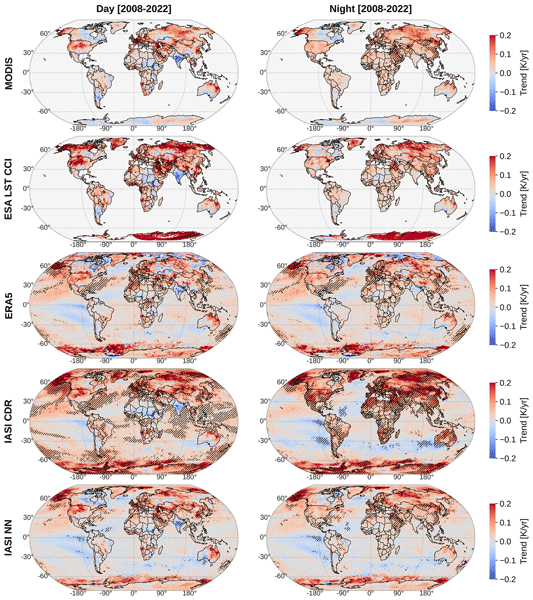
Land and sea surface temperatures, collectively called skin temperature (Tskin), are available from satellite measurements since few decades now and provide a holistic view of the Earth's climate system. Here we review 6 different datasets of Tskin to show that climate change signature is clear from the different datasets with notable exception, such as a significant cooling in India, parts of Africa and the Pacific.
Selviga Sinnathamby, Sarah Safieddine, Anne Boynard, Juliette Hadji-Lazaro, Solène Turquety, Simon Whitburn, Lieven Clarisse, Marie Doutriaux-Boucher, Pierre Coheur, and Cathy Clerbaux
EGUsphere, https://doi.org/10.5194/egusphere-2026-4393, https://doi.org/10.5194/egusphere-2026-4393, 2026
This preprint is open for discussion and under review for Atmospheric Chemistry and Physics (ACP).
Short summary
Short summary
South and East Asia have experienced contrasting air pollution changes over recent decades, with implications for regional surface temperature. Using satellite observations and CMIP6 simulations, we assess how pollutant trends relate to temperature changes and whether models reproduce these contrasts. While CMIP6 models capture some air pollution changes under certain scenarios, they fail to reproduce the regional temperature contrast, highlighting the need for extended historical simulations.
Simeng Li, Enrico Dammers, Beatriz Herrera, Arjo Segers, Mark W. Shephard, Martin Van Damme, Lieven Clarisse, Shelley van der Graaf, Roy Wichink Kruit, and Jan Willem Erisman
EGUsphere, https://doi.org/10.5194/egusphere-2026-4245, https://doi.org/10.5194/egusphere-2026-4245, 2026
This preprint is open for discussion and under review for Geoscientific Instrumentation, Methods and Data Systems (GI).
Short summary
Short summary
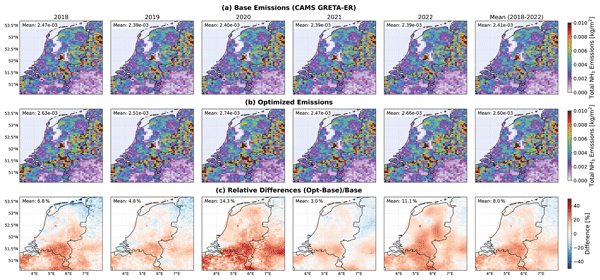
Ammonia from agriculture can harm ecosystems and air quality, but tracking emissions accurately is difficult. We developed a method combining in situ measurements and satellite observations to estimate ammonia emissions across the Netherlands. In situ measurement captures local detail while satellites provide broad coverage; combining both improves estimates. We also identified where new measurement stations would most improve emission monitoring, helping guide future network design.
Tyler Wizenberg, Enrico Dammers, Arjo Segers, Mark W. Shephard, Pierre Coheur, Lieven Clarisse, Martin Van Damme, Henk Eskes, Roy Wichink Kruit, Shelley van der Graaf, and Martijn Schaap
Atmos. Chem. Phys., 26, 9589–9623, https://doi.org/10.5194/acp-26-9589-2026, https://doi.org/10.5194/acp-26-9589-2026, 2026
Short summary
Short summary
We combined five years of satellite data on ammonia and nitrogen dioxide concentrations with a regional model to better estimate nitrogen emissions and deposition in the Netherlands. This improved the accuracy of pollution maps and trends, especially in agricultural regions. Our approach helps identify when and where emissions are highest, supporting better air quality management and environmental protection by showing the benefits of using multiple complimentary satellite datasets together.
Mengya Sheng, Runyi Zhou, Jiancong Hua, Shan Han, Shangyi Liu, Lin Zhang, Wei Wang, Ruijun Dang, Hansen Cao, Zichong Chen, Yixuan Gu, Mingxu Liu, Lu Lee, Chengli Qi, Feng Lu, Changpei Han, Mark W. Shephard, Nadir Guendouz, Camille Viatte, Lieven Clarisse, Martin Van Damme, Cathy Clerbaux, and Zhao-Cheng Zeng
Atmos. Chem. Phys., 26, 7803–7826, https://doi.org/10.5194/acp-26-7803-2026, https://doi.org/10.5194/acp-26-7803-2026, 2026
Short summary
Short summary
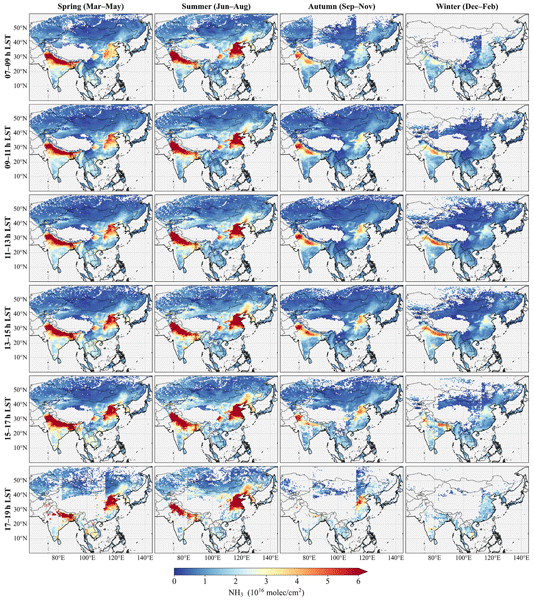
Geostationary observations of NH3 provide an unprecedented opportunity to monitor spatial and temporal variations in emissions and their evolution throughout the day. Using 3 years of observations from FY-4B/GIIRS over East Asia, we demonstrated the enhanced capability of geostationary observations to identify emission sources and capture daytime variations associated with agricultural activities. This shows the potential of future geostationary satellites for monitoring air quality globally.
Wenfu Sun, Frederik Tack, Lieven Clarisse, and Michel Van Roozendael
Atmos. Chem. Phys., 26, 7741–7764, https://doi.org/10.5194/acp-26-7741-2026, https://doi.org/10.5194/acp-26-7741-2026, 2026
Short summary
Short summary
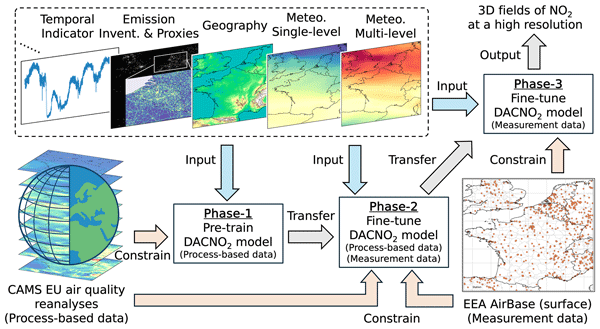
Accurate maps of nitrogen dioxide pollution at fine scales are essential for assessing air quality and protecting public health. We developed a machine learning model that produces daily high-resolution 3D nitrogen dioxide fields across Western Europe by combining large-scale atmospheric simulations with ground-based measurements. This approach outperforms traditional methods, especially over cities and complex terrain, and can enhance satellite-based air quality monitoring.
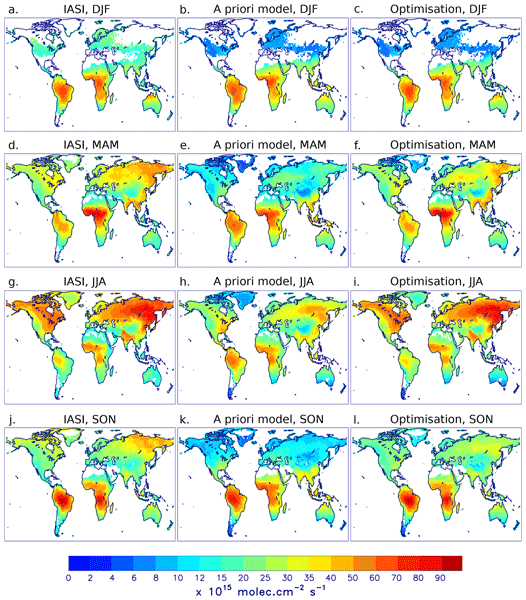
Jean-François Müller, Trissevgeni Stavrakou, Bruno Franco, Lieven Clarisse, Crist Amelynck, Niels Schoon, Bert W. D. Verreyken, Beata Opacka, Corinne Vigouroux, Alex B. Guenther, Emmanuel Mahieu, Maria Makarova, and Kimberly Strong
Atmos. Chem. Phys., 26, 5375–5406, https://doi.org/10.5194/acp-26-5375-2026, https://doi.org/10.5194/acp-26-5375-2026, 2026
Short summary
Short summary
We use an atmospheric model and aircraft measurements to evaluate methanol measurements from satellite sensors. The spaceborne data are found to be too low over source regions. Next, we use the model and the bias-corrected satellite data to derive improved terrestrial emissions of methanol between 2008 and 2019, and we evaluate the results against aircraft and ground-based measurements. This work shows that biogenic emissions of methanol might be ~ 60 % larger than previously estimated.
Shangyi Liu, Yingjun Zheng, Mengya Sheng, Lu Lee, Chengli Qi, Feng Lu, Bruno Franco, Lieven Clarisse, Cathy Clerbaux, Nicolas Theys, Jhoon Kim, and Zhao-Cheng Zeng
EGUsphere, https://doi.org/10.5194/egusphere-2026-1745, https://doi.org/10.5194/egusphere-2026-1745, 2026
Short summary
Short summary
Volcanic sulfur dioxide evolves rapidly after an eruption, which makes it challenging to monitor. Taking the 2024 Kanlaon eruption as a case study, we propose using a constellation of GEO and LEO satellites to track SO2 mass and layer height at high frequency. In particular, we present the first quantitative SO2 retrieval from a GEO hyperspectral infrared sounder (FY-4B/GIIRS). This research provides a vital blueprint for the future global monitoring of volcanic events.
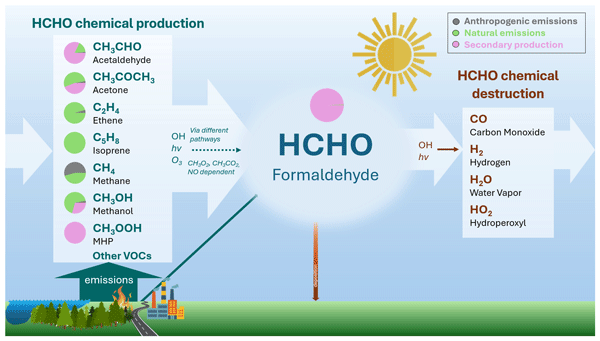
Gunnar Myhre, Øivind Hodnebrog, Srinath Krishnan, Maria Sand, Marit Sandstad, Ragnhild B. Skeie, Lieven Clarisse, Bruno Franco, Dylan B. Millet, Kelley C. Wells, Alexander Archibald, Hannah N. Bryant, Alex T. Chaudhri, David S. Stevenson, Didier Hauglustaine, Michael Prather, J. Christopher Kaiser, Dirk J. L. Olivie, Michael Schulz, Oliver Wild, Ye Wang, Thérèse Salameh, Jason E. Williams, Philippe Le Sager, Fabien Paulot, Kostas Tsigaridis, and Haley E. Plaas
Geosci. Model Dev., 19, 2577–2591, https://doi.org/10.5194/gmd-19-2577-2026, https://doi.org/10.5194/gmd-19-2577-2026, 2026
Short summary
Short summary
Volatile organic compounds (VOCs) affect air quality and climate, but their behavior in the atmosphere is still uncertain. We launched a global research effort to compare how different models represent these compounds and to improve their accuracy. By analyzing model results alongside observations and satellite data, we aim to better understand the atmospheric composition of these compounds.
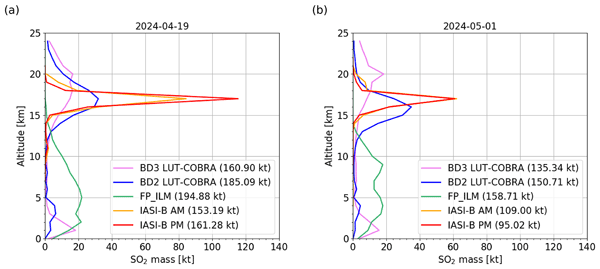
Lorenzo Fabris, Nicolas Theys, Lieven Clarisse, Bruno Franco, Jonas Vlietinck, Huan Yu, Hugues Brenot, Thomas Danckaert, Pascal Hedelt, and Michel Van Roozendael
Atmos. Meas. Tech., 19, 1801–1824, https://doi.org/10.5194/amt-19-1801-2026, https://doi.org/10.5194/amt-19-1801-2026, 2026
Short summary
Short summary
In this study, we developed an improved algorithm to retrieve the sulfur dioxide plume height and column density from the spectral band 2 of the TROPOspheric Monitoring Instrument onboard the Sentinel-5 Precursor satellite. We tested its sensitivity to various conditions and applied it to real volcanic eruptions. Overall, our approach shows high precision, accuracy, and sensitivity, and the results are consistent with other satellite measurements.
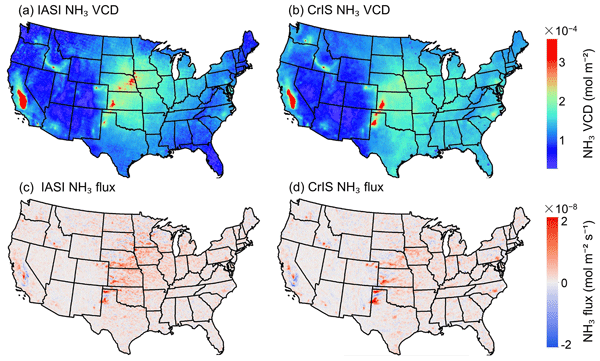
Zitong Li, Kang Sun, Kaiyu Guan, Sheng Wang, Bin Peng, Lieven Clarisse, Martin Van Damme, Pierre-François Coheur, Karen Cady-Pereira, Mark W. Shephard, Mark Zondlo, and Daniel Moore
Atmos. Chem. Phys., 26, 703–721, https://doi.org/10.5194/acp-26-703-2026, https://doi.org/10.5194/acp-26-703-2026, 2026
Short summary
Short summary
We estimate ammonia fluxes over the contiguous U.S. from 2008 to 2022 using a directional derivative approach applied to satellite observations from the Infrared Atmospheric Sounding Interferometer (IASI) and Cross-track Infrared Sounder (CrIS). The resulting flux estimates reveal pronounced seasonal and spatial patterns driven by agricultural activities and indicate substantial local deposition to surrounding vegetation, underscoring the need for improved monitoring and management strategies.
Pramod Kumar, Grégoire Broquet, Didier Hauglustaine, Maureen Beaudor, Lieven Clarisse, Martin Van Damme, Pierre Coheur, Anne Cozic, Bo Zheng, Beatriz Revilla Romero, Antony Delavois, and Philippe Ciais
Atmos. Chem. Phys., 25, 12379–12407, https://doi.org/10.5194/acp-25-12379-2025, https://doi.org/10.5194/acp-25-12379-2025, 2025
Short summary
Short summary
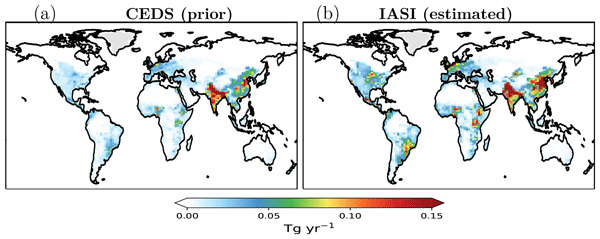
Global maps of the NH3 emissions over 2019–2022 are derived using IASI NH3 spaceborne observations, the LMDZ-INCA chemistry transport model at 1.27°×2.5° resolution, and the mass-balance approach. The average global NH3 emissions over the period are ~97 Tg NH3 yr-1, which is significantly higher than three reference inventories. The analysis provides confidence in the seasonal variability and regional budgets and provides new insights into NH3 emissions at global and regional scales.
Lara Noppen, Lieven Clarisse, Frederik Tack, Thomas Ruhtz, Martin Van Damme, Michel Van Roozendael, Dirk Schuettemeyer, and Pierre Coheur
Atmos. Meas. Tech., 18, 4183–4205, https://doi.org/10.5194/amt-18-4183-2025, https://doi.org/10.5194/amt-18-4183-2025, 2025
Short summary
Short summary
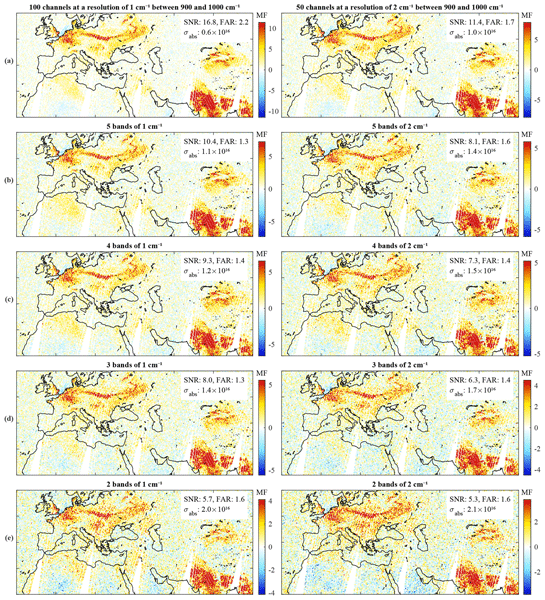
Current infrared satellite sounders offer high spectral but low spatial resolution, limiting their ability to quantify atmospheric ammonia (NH3) at small scales. Through simulations and analysis of real data, we show that NH3 can be measured effectively from spectra with reduced resolution, either in a contiguous spectral range or in select well-chosen bands. This approach opens possibilities for the development of smaller dedicated instruments for observing NH3 at high spatial resolution.
Maureen Beaudor, Didier Hauglustaine, Juliette Lathière, Martin Van Damme, Lieven Clarisse, and Nicolas Vuichard
Atmos. Chem. Phys., 25, 2017–2046, https://doi.org/10.5194/acp-25-2017-2025, https://doi.org/10.5194/acp-25-2017-2025, 2025
Short summary
Short summary
Agriculture is the biggest ammonia (NH3) source, impacting air quality, climate, and ecosystems. Because of food demand, NH3 emissions are projected to rise by 2100. Using a global model, we analyzed the impact of present and future NH3 emissions generated from a land model. Our results show improved ammonia patterns compared to a reference inventory. Future scenarios predict up to 70 % increase in global NH3 burden, with significant changes in radiative forcing that can greatly elevate N2O.
Monica Crippa, Diego Guizzardi, Federico Pagani, Marcello Schiavina, Michele Melchiorri, Enrico Pisoni, Francesco Graziosi, Marilena Muntean, Joachim Maes, Lewis Dijkstra, Martin Van Damme, Lieven Clarisse, and Pierre Coheur
Earth Syst. Sci. Data, 16, 2811–2830, https://doi.org/10.5194/essd-16-2811-2024, https://doi.org/10.5194/essd-16-2811-2024, 2024
Short summary
Short summary
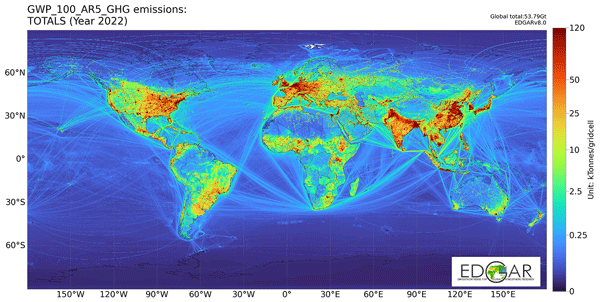
Knowing where emissions occur is essential for planning effective emission reduction measures and atmospheric modelling. Disaggregating national emissions over high-resolution grids requires spatial proxies that contain information on the location of different emission sources. This work incorporates state-of-the-art spatial information to improve the spatial representation of global emissions with the Emissions Database for Global Atmospheric Research (EDGAR).
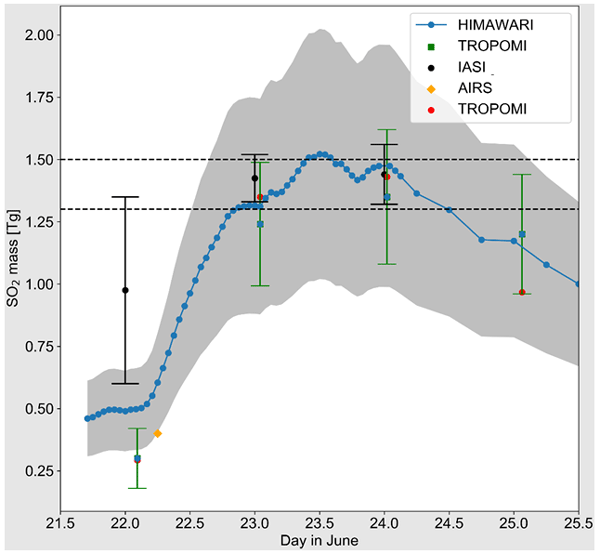
Jean-Paul Vernier, Thomas J. Aubry, Claudia Timmreck, Anja Schmidt, Lieven Clarisse, Fred Prata, Nicolas Theys, Andrew T. Prata, Graham Mann, Hyundeok Choi, Simon Carn, Richard Rigby, Susan C. Loughlin, and John A. Stevenson
Atmos. Chem. Phys., 24, 5765–5782, https://doi.org/10.5194/acp-24-5765-2024, https://doi.org/10.5194/acp-24-5765-2024, 2024
Short summary
Short summary
The 2019 Raikoke eruption (Kamchatka, Russia) generated one of the largest emissions of particles and gases into the stratosphere since the 1991 Mt. Pinatubo eruption. The Volcano Response (VolRes) initiative, an international effort, provided a platform for the community to share information about this eruption and assess its climate impact. The eruption led to a minor global surface cooling of 0.02 °C in 2020 which is negligible relative to warming induced by human greenhouse gas emissions.
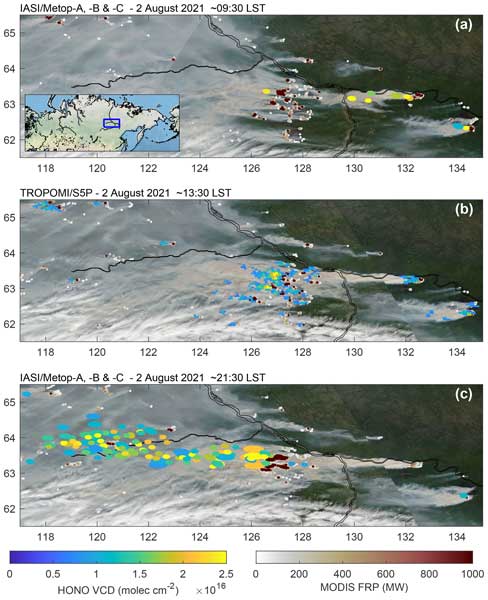
Bruno Franco, Lieven Clarisse, Nicolas Theys, Juliette Hadji-Lazaro, Cathy Clerbaux, and Pierre Coheur
Atmos. Chem. Phys., 24, 4973–5007, https://doi.org/10.5194/acp-24-4973-2024, https://doi.org/10.5194/acp-24-4973-2024, 2024
Short summary
Short summary
Using IASI global infrared measurements, we retrieve nitrous acid (HONO) in fire plumes from space. We detect large enhancements of pyrogenic HONO worldwide, especially from intense wildfires at Northern Hemisphere mid- and high latitudes. Predominance of IASI nighttime over daytime measurements sheds light on HONO's extended lifetime and secondary formation during long-range transport in smoke plumes. Our findings deepen the understanding of atmospheric HONO, crucial for air quality assessment.
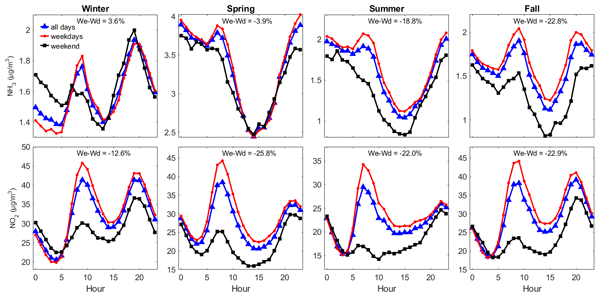
Camille Viatte, Nadir Guendouz, Clarisse Dufaux, Arjan Hensen, Daan Swart, Martin Van Damme, Lieven Clarisse, Pierre Coheur, and Cathy Clerbaux
Atmos. Chem. Phys., 23, 15253–15267, https://doi.org/10.5194/acp-23-15253-2023, https://doi.org/10.5194/acp-23-15253-2023, 2023
Short summary
Short summary
Ammonia (NH3) is an important air pollutant which, as a precursor of fine particulate matter, raises public health concerns. Models have difficulty predicting events of pollution associated with NH3 since ground-based observations of this gas are still relatively sparse and difficult to implement. We present the first relatively long (2.5 years) and continuous record of hourly NH3 concentrations in Paris to determine its temporal variabilities at different scales to unravel emission sources.
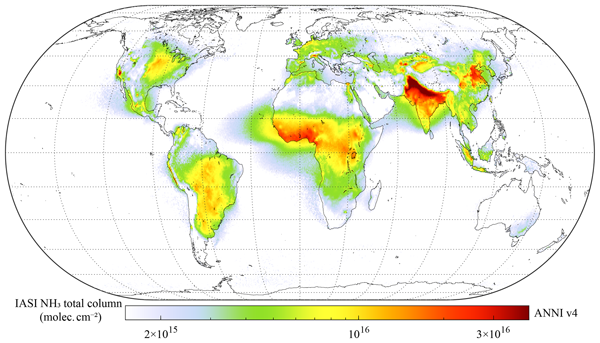
Lieven Clarisse, Bruno Franco, Martin Van Damme, Tommaso Di Gioacchino, Juliette Hadji-Lazaro, Simon Whitburn, Lara Noppen, Daniel Hurtmans, Cathy Clerbaux, and Pierre Coheur
Atmos. Meas. Tech., 16, 5009–5028, https://doi.org/10.5194/amt-16-5009-2023, https://doi.org/10.5194/amt-16-5009-2023, 2023
Short summary
Short summary
Ammonia is an important atmospheric pollutant. This article presents version 4 of the algorithm which retrieves ammonia abundances from the infrared measurements of the satellite sounder IASI. A measurement operator is introduced that can emulate the measurements (so-called averaging kernels) and measurement uncertainty is better characterized. Several other changes to the product itself are also documented, most of which improve the temporal consistency of the 2007–2022 IASI NH3 dataset.
Rui Wang, Da Pan, Xuehui Guo, Kang Sun, Lieven Clarisse, Martin Van Damme, Pierre-François Coheur, Cathy Clerbaux, Melissa Puchalski, and Mark A. Zondlo
Atmos. Chem. Phys., 23, 13217–13234, https://doi.org/10.5194/acp-23-13217-2023, https://doi.org/10.5194/acp-23-13217-2023, 2023
Short summary
Short summary
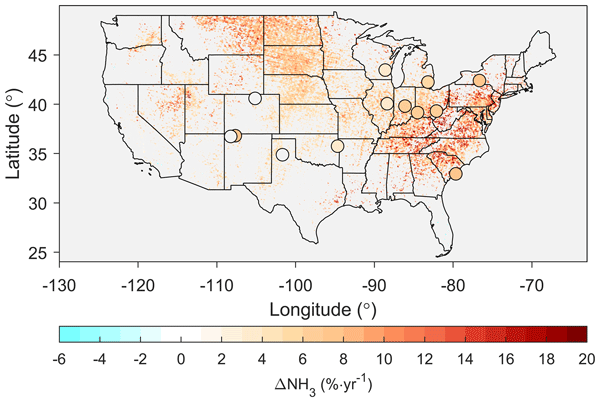
Ammonia (NH3) is a key precursor for fine particulate matter (PM2.5) and a primary form of reactive nitrogen, yet it has sparse ground measurements. We perform the first comprehensive comparison between ground observations and satellite retrievals in the US, demonstrating that satellite NH3 data can help fill spatial gaps in the current ground monitoring networks. Trend analyses using both datasets highlight increasing NH3 trends across the US, including the NH3 hotspots and urban areas.
Rimal Abeed, Camille Viatte, William C. Porter, Nikolaos Evangeliou, Cathy Clerbaux, Lieven Clarisse, Martin Van Damme, Pierre-François Coheur, and Sarah Safieddine
Atmos. Chem. Phys., 23, 12505–12523, https://doi.org/10.5194/acp-23-12505-2023, https://doi.org/10.5194/acp-23-12505-2023, 2023
Short summary
Short summary
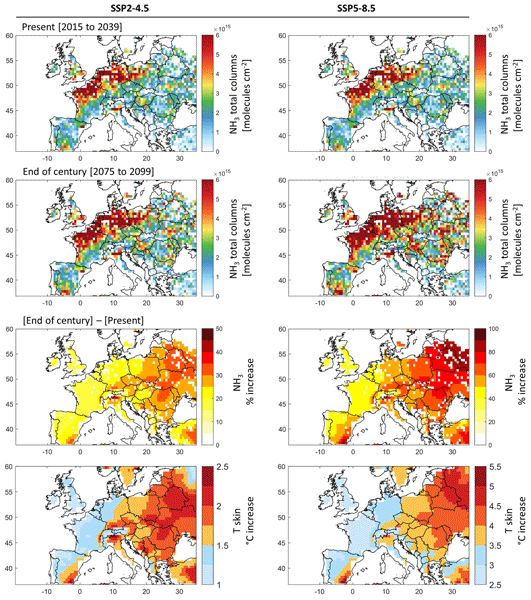
Ammonia emissions from agricultural activities will inevitably increase with the rise in population. We use a variety of datasets (satellite, reanalysis, and model simulation) to calculate the first regional map of ammonia emission potential during the start of the growing season in Europe. We then apply our developed method using a climate model to show the effect of the temperature increase on future ammonia columns under two possible climate scenarios.
Money Ossohou, Jonathan Edward Hickman, Lieven Clarisse, Pierre-François Coheur, Martin Van Damme, Marcellin Adon, Véronique Yoboué, Eric Gardrat, Maria Dias Alvès, and Corinne Galy-Lacaux
Atmos. Chem. Phys., 23, 9473–9494, https://doi.org/10.5194/acp-23-9473-2023, https://doi.org/10.5194/acp-23-9473-2023, 2023
Short summary
Short summary
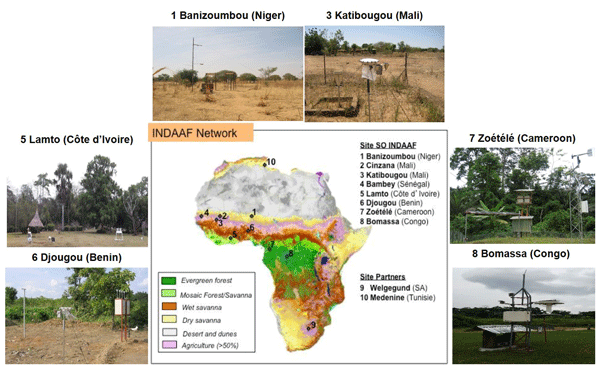
The updated analyses of ground-based concentrations and satellite total vertical columns of atmospheric ammonia help us to better understand 21st century ammonia dynamics in sub-Saharan Africa. We conclude that the drivers of trends are agriculture in the dry savanna of Katibougou, Mali; air temperature and agriculture in the wet savanna of Djougou, Benin, and Lamto, Côte d'Ivoire; and leaf area index, air temperature, residential, and agriculture in forests of Bomassa, Republic of Congo.
Zhao-Cheng Zeng, Lu Lee, Chengli Qi, Lieven Clarisse, and Martin Van Damme
Atmos. Meas. Tech., 16, 3693–3713, https://doi.org/10.5194/amt-16-3693-2023, https://doi.org/10.5194/amt-16-3693-2023, 2023
Short summary
Short summary
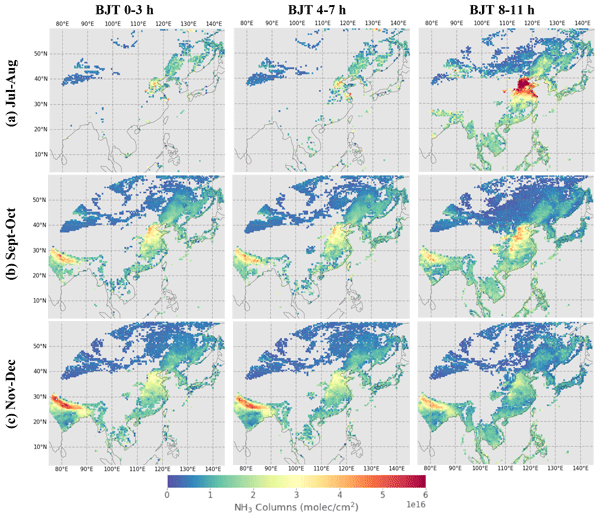
This study presents an NH3 retrieval algorithm based on the optimal estimation method for the Geostationary Interferometric Infrared Sounder (GIIRS) on board China’s FengYun-4B satellite (FY-4B/GIIRS). Retrieval results demonstrate the capability of FY-4B/GIIRS in capturing the diurnal NH3 changes in East Asia. This operational geostationary observation by FY-4B/GIIRS represents an important advancement over the twice-per-day observations provided by current low-Earth-orbit (LEO) instruments.

Adrien Vu Van, Anne Boynard, Pascal Prunet, Dominique Jolivet, Olivier Lezeaux, Patrice Henry, Claude Camy-Peyret, Lieven Clarisse, Bruno Franco, Pierre-François Coheur, and Cathy Clerbaux
Atmos. Meas. Tech., 16, 2107–2127, https://doi.org/10.5194/amt-16-2107-2023, https://doi.org/10.5194/amt-16-2107-2023, 2023
Short summary
Short summary
With its near-real-time observations and good horizontal coverage, the Infrared Atmospheric Sounding Interferometer (IASI) instrument can contribute to the monitoring systems for a systematic and continuous detection of exceptional atmospheric events such as fires, anthropogenic pollution episodes, volcanic eruptions, or industrial releases. In this paper, a new approach is described for the detection and characterization of unexpected events in terms of trace gases using IASI radiance spectra.
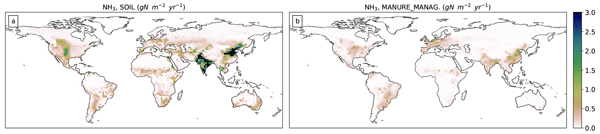
Maureen Beaudor, Nicolas Vuichard, Juliette Lathière, Nikolaos Evangeliou, Martin Van Damme, Lieven Clarisse, and Didier Hauglustaine
Geosci. Model Dev., 16, 1053–1081, https://doi.org/10.5194/gmd-16-1053-2023, https://doi.org/10.5194/gmd-16-1053-2023, 2023
Short summary
Short summary
Ammonia mainly comes from the agricultural sector, and its volatilization relies on environmental variables. Our approach aims at benefiting from an Earth system model framework to estimate it. By doing so, we represent a consistent spatial distribution of the emissions' response to environmental changes.
We greatly improved the seasonal cycle of emissions compared with previous work. In addition, our model includes natural soil emissions (that are rarely represented in modeling approaches).
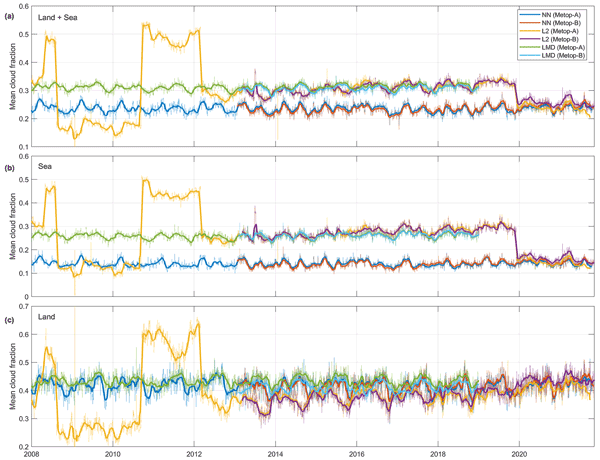
Simon Whitburn, Lieven Clarisse, Marc Crapeau, Thomas August, Tim Hultberg, Pierre François Coheur, and Cathy Clerbaux
Atmos. Meas. Tech., 15, 6653–6668, https://doi.org/10.5194/amt-15-6653-2022, https://doi.org/10.5194/amt-15-6653-2022, 2022
Short summary
Short summary
With more than 15 years of measurements, the IASI radiance dataset is becoming a reference climate data record. Its exploitation for satellite applications requires an accurate and unbiased detection of cloud scenes. Here, we present a new cloud detection algorithm for IASI that is both sensitive and consistent over time. It is based on the use of a neural network, relying on IASI radiance information only and taking as a reference the last version of the operational IASI L2 cloud product.
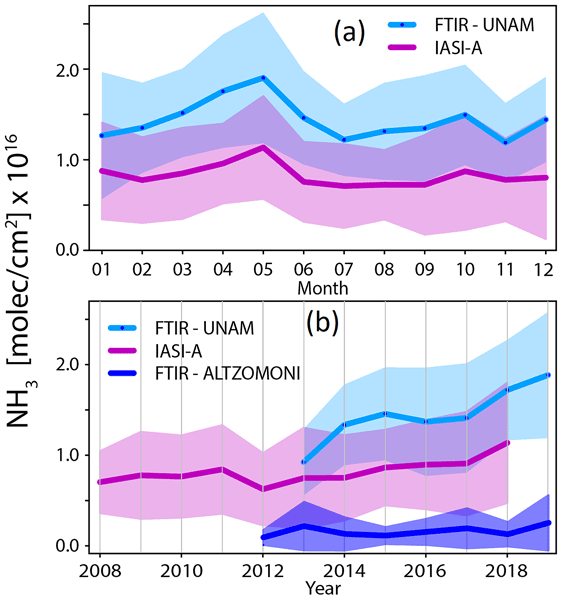
Beatriz Herrera, Alejandro Bezanilla, Thomas Blumenstock, Enrico Dammers, Frank Hase, Lieven Clarisse, Adolfo Magaldi, Claudia Rivera, Wolfgang Stremme, Kimberly Strong, Camille Viatte, Martin Van Damme, and Michel Grutter
Atmos. Chem. Phys., 22, 14119–14132, https://doi.org/10.5194/acp-22-14119-2022, https://doi.org/10.5194/acp-22-14119-2022, 2022
Short summary
Short summary
This work investigates atmospheric ammonia (NH3), a key trace gas with consequences for the environment and human health, in Mexico City. The results from the ground-based and satellite instruments show the variability and spatial distribution of NH3 over this region. NH3 in Mexico City has been increasing for the past 10 years and most of its sources are urban. This work contributes to a better understanding of NH3 sources and variability in urban and remote areas.
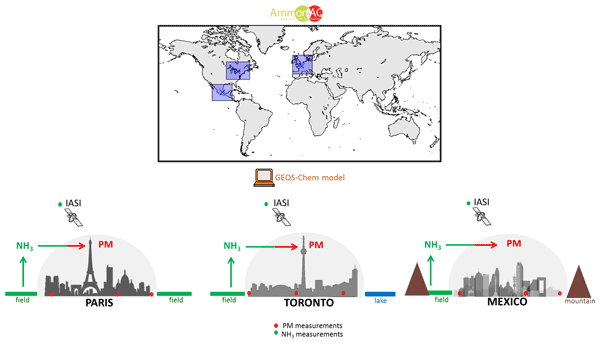
Camille Viatte, Rimal Abeed, Shoma Yamanouchi, William C. Porter, Sarah Safieddine, Martin Van Damme, Lieven Clarisse, Beatriz Herrera, Michel Grutter, Pierre-Francois Coheur, Kimberly Strong, and Cathy Clerbaux
Atmos. Chem. Phys., 22, 12907–12922, https://doi.org/10.5194/acp-22-12907-2022, https://doi.org/10.5194/acp-22-12907-2022, 2022
Short summary
Short summary
Large cities can experience high levels of fine particulate matter (PM2.5) pollution linked to ammonia (NH3) mainly emitted from agricultural activities. Using a combination of PM2.5 and NH3 measurements from in situ instruments, satellite infrared spectrometers, and atmospheric model simulations, we have demonstrated the role of NH3 and meteorological conditions on pollution events occurring over Paris, Toronto, and Mexico City.
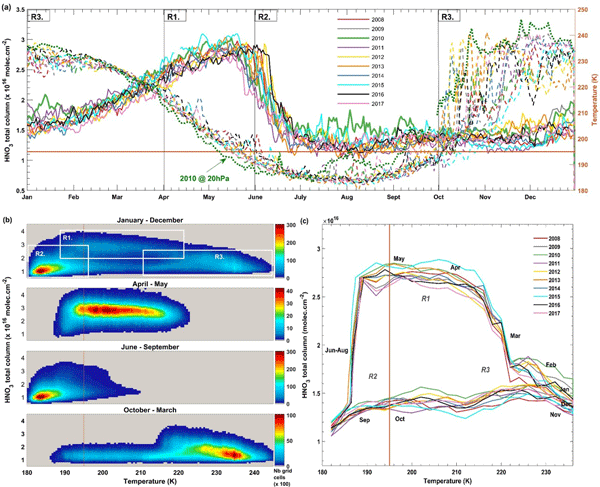
Catherine Wespes, Gaetane Ronsmans, Lieven Clarisse, Susan Solomon, Daniel Hurtmans, Cathy Clerbaux, and Pierre-François Coheur
Atmos. Chem. Phys., 22, 10993–11007, https://doi.org/10.5194/acp-22-10993-2022, https://doi.org/10.5194/acp-22-10993-2022, 2022
Short summary
Short summary
The first 10-year data record (2008–2017) of HNO3 total columns measured by the IASI-A/MetOp infrared sounder is exploited to monitor the relationship between the temperature decrease and the HNO3 loss observed each year in the Antarctic stratosphere during the polar night. We verify the recurrence of specific regimes in the cycle of IASI HNO3 and identify the day and the 50 hPa temperature (
drop temperature) corresponding to the onset of denitrification in Antarctic winter for each year.

Nicolas Theys, Christophe Lerot, Hugues Brenot, Jeroen van Gent, Isabelle De Smedt, Lieven Clarisse, Mike Burton, Matthew Varnam, Catherine Hayer, Benjamin Esse, and Michel Van Roozendael
Atmos. Meas. Tech., 15, 4801–4817, https://doi.org/10.5194/amt-15-4801-2022, https://doi.org/10.5194/amt-15-4801-2022, 2022
Short summary
Short summary
Sulfur dioxide plume height after a volcanic eruption is an important piece of information for many different scientific studies and applications. Satellite UV retrievals are useful in this respect, but available algorithms have shown so far limited sensitivity to SO2 height. Here we present a new technique to improve the retrieval of SO2 plume height for SO2 columns as low as 5 DU. We demonstrate the algorithm using TROPOMI measurements and compare with other height estimates.
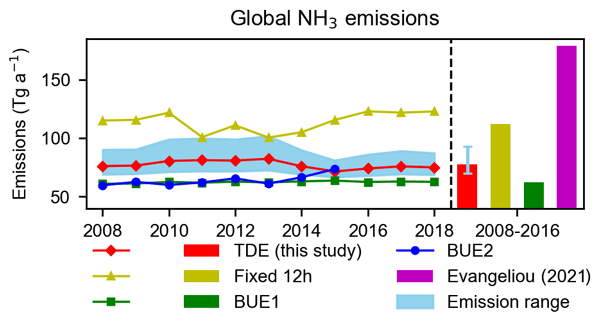
Zhenqi Luo, Yuzhong Zhang, Wei Chen, Martin Van Damme, Pierre-François Coheur, and Lieven Clarisse
Atmos. Chem. Phys., 22, 10375–10388, https://doi.org/10.5194/acp-22-10375-2022, https://doi.org/10.5194/acp-22-10375-2022, 2022
Short summary
Short summary
We quantify global ammonia (NH3) emissions over the period from 2008 to 2018 using an improved fast top-down method that incorporates Infrared Atmospheric
Sounding Interferometer (IASI) satellite observations and GEOS-Chem atmospheric chemical simulations. The top-down analysis finds a global total NH3 emission that is 30 % higher than the bottom-up estimate, largely reconciling a large discrepancy of more than a factor of 2 found in previous top-down studies using the same satellite data.
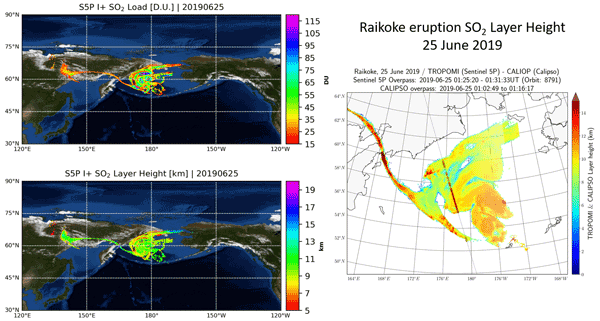
Maria-Elissavet Koukouli, Konstantinos Michailidis, Pascal Hedelt, Isabelle A. Taylor, Antje Inness, Lieven Clarisse, Dimitris Balis, Dmitry Efremenko, Diego Loyola, Roy G. Grainger, and Christian Retscher
Atmos. Chem. Phys., 22, 5665–5683, https://doi.org/10.5194/acp-22-5665-2022, https://doi.org/10.5194/acp-22-5665-2022, 2022
Short summary
Short summary
Volcanic eruptions eject large amounts of ash and trace gases into the atmosphere. The use of space-borne instruments enables the global monitoring of volcanic SO2 emissions in an economical and risk-free manner. The main aim of this paper is to present its extensive verification, accomplished within the ESA S5P+I: SO2LH project, over major recent volcanic eruptions, against collocated space-borne measurements, as well as assess its impact on the forecasts provided by CAMS.
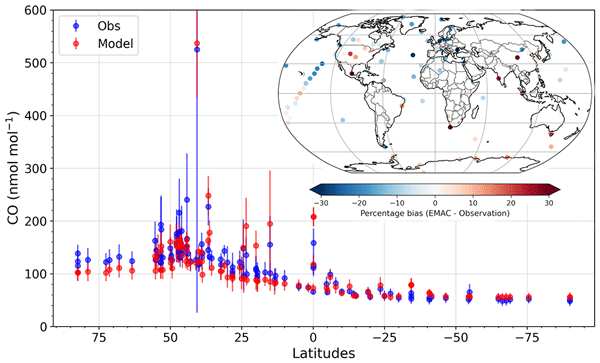
Andrea Pozzer, Simon F. Reifenberg, Vinod Kumar, Bruno Franco, Matthias Kohl, Domenico Taraborrelli, Sergey Gromov, Sebastian Ehrhart, Patrick Jöckel, Rolf Sander, Veronica Fall, Simon Rosanka, Vlassis Karydis, Dimitris Akritidis, Tamara Emmerichs, Monica Crippa, Diego Guizzardi, Johannes W. Kaiser, Lieven Clarisse, Astrid Kiendler-Scharr, Holger Tost, and Alexandra Tsimpidi
Geosci. Model Dev., 15, 2673–2710, https://doi.org/10.5194/gmd-15-2673-2022, https://doi.org/10.5194/gmd-15-2673-2022, 2022
Short summary
Short summary
A newly developed setup of the chemistry general circulation model EMAC (ECHAM5/MESSy for Atmospheric Chemistry) is evaluated here. A comprehensive organic degradation mechanism is used and coupled with a volatility base model.
The results show that the model reproduces most of the tracers and aerosols satisfactorily but shows discrepancies for oxygenated organic gases. It is also shown that this model configuration can be used for further research in atmospheric chemistry.
Marie Bouillon, Sarah Safieddine, Simon Whitburn, Lieven Clarisse, Filipe Aires, Victor Pellet, Olivier Lezeaux, Noëlle A. Scott, Marie Doutriaux-Boucher, and Cathy Clerbaux
Atmos. Meas. Tech., 15, 1779–1793, https://doi.org/10.5194/amt-15-1779-2022, https://doi.org/10.5194/amt-15-1779-2022, 2022
Short summary
Short summary
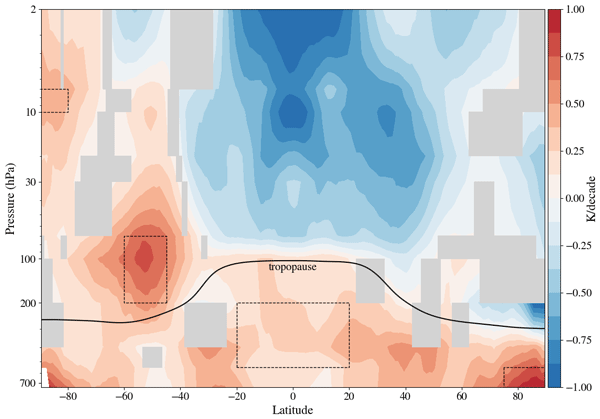
The IASI instruments have been observing Earth since 2007. We use a neural network to retrieve atmospheric temperatures. This new temperature data record is validated against other datasets and shows good agreement. We use this new dataset to compute trends over the 2008–2020 period. We found a warming of the troposphere, more important at the poles. In the stratosphere, we found that temperatures decrease everywhere except at the South Pole. The cooling is more pronounced at the South pole.
Nicolas Theys, Vitali Fioletov, Can Li, Isabelle De Smedt, Christophe Lerot, Chris McLinden, Nickolay Krotkov, Debora Griffin, Lieven Clarisse, Pascal Hedelt, Diego Loyola, Thomas Wagner, Vinod Kumar, Antje Innes, Roberto Ribas, François Hendrick, Jonas Vlietinck, Hugues Brenot, and Michel Van Roozendael
Atmos. Chem. Phys., 21, 16727–16744, https://doi.org/10.5194/acp-21-16727-2021, https://doi.org/10.5194/acp-21-16727-2021, 2021
Short summary
Short summary
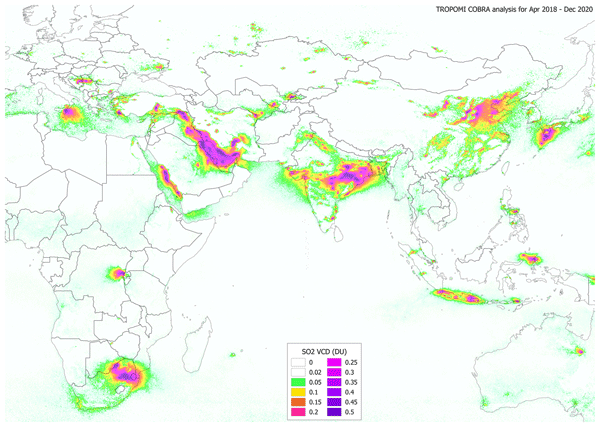
We present a new algorithm to retrieve sulfur dioxide from space UV measurements. We apply the technique to high-resolution TROPOMI measurements and demonstrate the high sensitivity of the approach to weak SO2 emissions worldwide with an unprecedented limit of detection of 8 kt yr−1. This result has broad implications for atmospheric science studies dealing with improving emission inventories and identifying and quantifying missing sources, in the context of air quality and climate.
Jonathan E. Hickman, Niels Andela, Enrico Dammers, Lieven Clarisse, Pierre-François Coheur, Martin Van Damme, Courtney A. Di Vittorio, Money Ossohou, Corinne Galy-Lacaux, Kostas Tsigaridis, and Susanne E. Bauer
Atmos. Chem. Phys., 21, 16277–16291, https://doi.org/10.5194/acp-21-16277-2021, https://doi.org/10.5194/acp-21-16277-2021, 2021
Short summary
Short summary
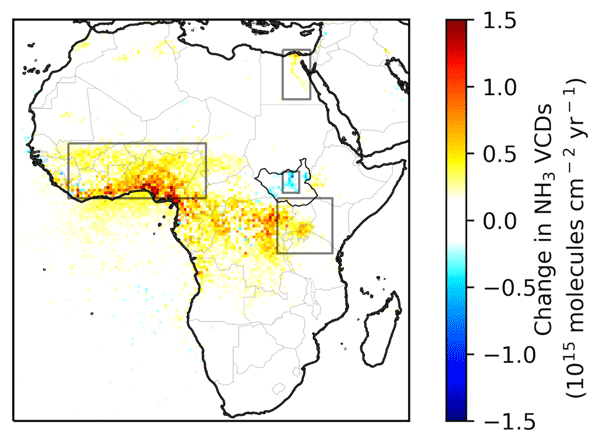
Ammonia (NH3) gas emitted from soils and biomass burning contributes to particulate air pollution. We used satellite observations of the atmosphere over Africa to show that declines in NH3 concentrations over South Sudan's Sudd wetland in 2008–2017 are related to variation in wetland extent. We also find NH3 concentrations increased in West Africa as a result of biomass burning and increased in the Lake Victoria region, likely due to agricultural expansion and intensification.
Hugues Brenot, Nicolas Theys, Lieven Clarisse, Jeroen van Gent, Daniel R. Hurtmans, Sophie Vandenbussche, Nikolaos Papagiannopoulos, Lucia Mona, Timo Virtanen, Andreas Uppstu, Mikhail Sofiev, Luca Bugliaro, Margarita Vázquez-Navarro, Pascal Hedelt, Michelle Maree Parks, Sara Barsotti, Mauro Coltelli, William Moreland, Simona Scollo, Giuseppe Salerno, Delia Arnold-Arias, Marcus Hirtl, Tuomas Peltonen, Juhani Lahtinen, Klaus Sievers, Florian Lipok, Rolf Rüfenacht, Alexander Haefele, Maxime Hervo, Saskia Wagenaar, Wim Som de Cerff, Jos de Laat, Arnoud Apituley, Piet Stammes, Quentin Laffineur, Andy Delcloo, Robertson Lennart, Carl-Herbert Rokitansky, Arturo Vargas, Markus Kerschbaum, Christian Resch, Raimund Zopp, Matthieu Plu, Vincent-Henri Peuch, Michel Van Roozendael, and Gerhard Wotawa
Nat. Hazards Earth Syst. Sci., 21, 3367–3405, https://doi.org/10.5194/nhess-21-3367-2021, https://doi.org/10.5194/nhess-21-3367-2021, 2021
Short summary
Short summary
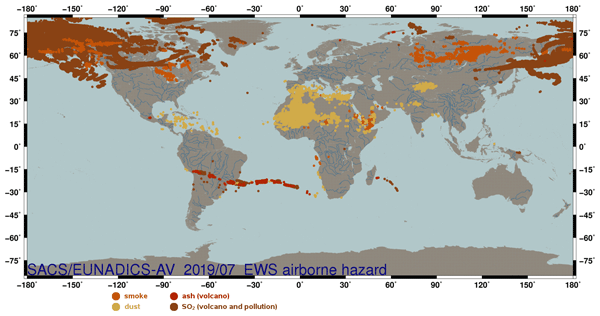
The purpose of the EUNADICS-AV (European Natural Airborne Disaster Information and Coordination System for Aviation) prototype early warning system (EWS) is to develop the combined use of harmonised data products from satellite, ground-based and in situ instruments to produce alerts of airborne hazards (volcanic, dust, smoke and radionuclide clouds), satisfying the requirement of aviation air traffic management (ATM) stakeholders (https://cordis.europa.eu/project/id/723986).
Lorenzo Fabris, Nicolas Theys, Lieven Clarisse, Bruno Franco, Mike Burton, Benjamin Esse, Jonas Vlietinck, Huan Yu, Hugues Brenot, Thomas Danckaert, and Michel Van Roozendael
EGUsphere, https://doi.org/10.5194/egusphere-2026-5282, https://doi.org/10.5194/egusphere-2026-5282, 2026
This preprint is open for discussion and under review for Atmospheric Chemistry and Physics (ACP).
Short summary
Short summary
In this study, we present the first global SO2 plume-height dataset from the TROPOspheric Monitoring Instrument (TROPOMI), covering 2018–2025. We evaluate the product against independent observations from the Infrared Atmospheric Sounding Interferometer (IASI) and SO2 height estimates from the PlumeTraj toolkit. Overall, the results show good agreement and highlight the complementarity of these approaches for monitoring SO2 emissions and their atmospheric and climatic impacts.
Shangyi Liu, Cathy Clerbaux, Anne Boynard, Mingjian Gu, Chengli Qi, Bruno Franco, Lieven Clarisse, Shan Han, Mengya Sheng, Nicolas Theys, and Zhao-Cheng Zeng
EGUsphere, https://doi.org/10.5194/egusphere-2026-5017, https://doi.org/10.5194/egusphere-2026-5017, 2026
This preprint is open for discussion and under review for Atmospheric Chemistry and Physics (ACP).
Short summary
Short summary
The March 2026 Tehran refinery explosions released massive amounts of toxic sulfur dioxide gas. We used multiple satellites to track this plume, discovering that intense fires pushed the pollution high into the atmosphere, causing it to travel across continents for days. Current air quality forecast models completely missed this major event. This highlights the urgent need to use advanced satellites to monitor pollution from armed conflicts to assess global climate risks.
Sarah Safieddine, Selviga Sinnathamby, Juliette Hadji-Lazaro, Marie Doutriaux-Boucher, Darren Ghent, Simon Whitburn, Lieven Clarisse, and Cathy Clerbaux
Earth Obs., 1, 59–75, https://doi.org/10.5194/eo-1-59-2026, https://doi.org/10.5194/eo-1-59-2026, 2026
Short summary
Short summary
Land and sea surface temperatures, collectively called skin temperature (Tskin), are available from satellite measurements since few decades now and provide a holistic view of the Earth's climate system. Here we review 6 different datasets of Tskin to show that climate change signature is clear from the different datasets with notable exception, such as a significant cooling in India, parts of Africa and the Pacific.
Selviga Sinnathamby, Sarah Safieddine, Anne Boynard, Juliette Hadji-Lazaro, Solène Turquety, Simon Whitburn, Lieven Clarisse, Marie Doutriaux-Boucher, Pierre Coheur, and Cathy Clerbaux
EGUsphere, https://doi.org/10.5194/egusphere-2026-4393, https://doi.org/10.5194/egusphere-2026-4393, 2026
This preprint is open for discussion and under review for Atmospheric Chemistry and Physics (ACP).
Short summary
Short summary
South and East Asia have experienced contrasting air pollution changes over recent decades, with implications for regional surface temperature. Using satellite observations and CMIP6 simulations, we assess how pollutant trends relate to temperature changes and whether models reproduce these contrasts. While CMIP6 models capture some air pollution changes under certain scenarios, they fail to reproduce the regional temperature contrast, highlighting the need for extended historical simulations.
Simeng Li, Enrico Dammers, Beatriz Herrera, Arjo Segers, Mark W. Shephard, Martin Van Damme, Lieven Clarisse, Shelley van der Graaf, Roy Wichink Kruit, and Jan Willem Erisman
EGUsphere, https://doi.org/10.5194/egusphere-2026-4245, https://doi.org/10.5194/egusphere-2026-4245, 2026
This preprint is open for discussion and under review for Geoscientific Instrumentation, Methods and Data Systems (GI).
Short summary
Short summary
Ammonia from agriculture can harm ecosystems and air quality, but tracking emissions accurately is difficult. We developed a method combining in situ measurements and satellite observations to estimate ammonia emissions across the Netherlands. In situ measurement captures local detail while satellites provide broad coverage; combining both improves estimates. We also identified where new measurement stations would most improve emission monitoring, helping guide future network design.
Tyler Wizenberg, Enrico Dammers, Arjo Segers, Mark W. Shephard, Pierre Coheur, Lieven Clarisse, Martin Van Damme, Henk Eskes, Roy Wichink Kruit, Shelley van der Graaf, and Martijn Schaap
Atmos. Chem. Phys., 26, 9589–9623, https://doi.org/10.5194/acp-26-9589-2026, https://doi.org/10.5194/acp-26-9589-2026, 2026
Short summary
Short summary
We combined five years of satellite data on ammonia and nitrogen dioxide concentrations with a regional model to better estimate nitrogen emissions and deposition in the Netherlands. This improved the accuracy of pollution maps and trends, especially in agricultural regions. Our approach helps identify when and where emissions are highest, supporting better air quality management and environmental protection by showing the benefits of using multiple complimentary satellite datasets together.
Mengya Sheng, Runyi Zhou, Jiancong Hua, Shan Han, Shangyi Liu, Lin Zhang, Wei Wang, Ruijun Dang, Hansen Cao, Zichong Chen, Yixuan Gu, Mingxu Liu, Lu Lee, Chengli Qi, Feng Lu, Changpei Han, Mark W. Shephard, Nadir Guendouz, Camille Viatte, Lieven Clarisse, Martin Van Damme, Cathy Clerbaux, and Zhao-Cheng Zeng
Atmos. Chem. Phys., 26, 7803–7826, https://doi.org/10.5194/acp-26-7803-2026, https://doi.org/10.5194/acp-26-7803-2026, 2026
Short summary
Short summary
Geostationary observations of NH3 provide an unprecedented opportunity to monitor spatial and temporal variations in emissions and their evolution throughout the day. Using 3 years of observations from FY-4B/GIIRS over East Asia, we demonstrated the enhanced capability of geostationary observations to identify emission sources and capture daytime variations associated with agricultural activities. This shows the potential of future geostationary satellites for monitoring air quality globally.
Wenfu Sun, Frederik Tack, Lieven Clarisse, and Michel Van Roozendael
Atmos. Chem. Phys., 26, 7741–7764, https://doi.org/10.5194/acp-26-7741-2026, https://doi.org/10.5194/acp-26-7741-2026, 2026
Short summary
Short summary
Accurate maps of nitrogen dioxide pollution at fine scales are essential for assessing air quality and protecting public health. We developed a machine learning model that produces daily high-resolution 3D nitrogen dioxide fields across Western Europe by combining large-scale atmospheric simulations with ground-based measurements. This approach outperforms traditional methods, especially over cities and complex terrain, and can enhance satellite-based air quality monitoring.
Jean-François Müller, Trissevgeni Stavrakou, Bruno Franco, Lieven Clarisse, Crist Amelynck, Niels Schoon, Bert W. D. Verreyken, Beata Opacka, Corinne Vigouroux, Alex B. Guenther, Emmanuel Mahieu, Maria Makarova, and Kimberly Strong
Atmos. Chem. Phys., 26, 5375–5406, https://doi.org/10.5194/acp-26-5375-2026, https://doi.org/10.5194/acp-26-5375-2026, 2026
Short summary
Short summary
We use an atmospheric model and aircraft measurements to evaluate methanol measurements from satellite sensors. The spaceborne data are found to be too low over source regions. Next, we use the model and the bias-corrected satellite data to derive improved terrestrial emissions of methanol between 2008 and 2019, and we evaluate the results against aircraft and ground-based measurements. This work shows that biogenic emissions of methanol might be ~ 60 % larger than previously estimated.
Shangyi Liu, Yingjun Zheng, Mengya Sheng, Lu Lee, Chengli Qi, Feng Lu, Bruno Franco, Lieven Clarisse, Cathy Clerbaux, Nicolas Theys, Jhoon Kim, and Zhao-Cheng Zeng
EGUsphere, https://doi.org/10.5194/egusphere-2026-1745, https://doi.org/10.5194/egusphere-2026-1745, 2026
Short summary
Short summary
Volcanic sulfur dioxide evolves rapidly after an eruption, which makes it challenging to monitor. Taking the 2024 Kanlaon eruption as a case study, we propose using a constellation of GEO and LEO satellites to track SO2 mass and layer height at high frequency. In particular, we present the first quantitative SO2 retrieval from a GEO hyperspectral infrared sounder (FY-4B/GIIRS). This research provides a vital blueprint for the future global monitoring of volcanic events.
Gunnar Myhre, Øivind Hodnebrog, Srinath Krishnan, Maria Sand, Marit Sandstad, Ragnhild B. Skeie, Lieven Clarisse, Bruno Franco, Dylan B. Millet, Kelley C. Wells, Alexander Archibald, Hannah N. Bryant, Alex T. Chaudhri, David S. Stevenson, Didier Hauglustaine, Michael Prather, J. Christopher Kaiser, Dirk J. L. Olivie, Michael Schulz, Oliver Wild, Ye Wang, Thérèse Salameh, Jason E. Williams, Philippe Le Sager, Fabien Paulot, Kostas Tsigaridis, and Haley E. Plaas
Geosci. Model Dev., 19, 2577–2591, https://doi.org/10.5194/gmd-19-2577-2026, https://doi.org/10.5194/gmd-19-2577-2026, 2026
Short summary
Short summary
Volatile organic compounds (VOCs) affect air quality and climate, but their behavior in the atmosphere is still uncertain. We launched a global research effort to compare how different models represent these compounds and to improve their accuracy. By analyzing model results alongside observations and satellite data, we aim to better understand the atmospheric composition of these compounds.
Lorenzo Fabris, Nicolas Theys, Lieven Clarisse, Bruno Franco, Jonas Vlietinck, Huan Yu, Hugues Brenot, Thomas Danckaert, Pascal Hedelt, and Michel Van Roozendael
Atmos. Meas. Tech., 19, 1801–1824, https://doi.org/10.5194/amt-19-1801-2026, https://doi.org/10.5194/amt-19-1801-2026, 2026
Short summary
Short summary
In this study, we developed an improved algorithm to retrieve the sulfur dioxide plume height and column density from the spectral band 2 of the TROPOspheric Monitoring Instrument onboard the Sentinel-5 Precursor satellite. We tested its sensitivity to various conditions and applied it to real volcanic eruptions. Overall, our approach shows high precision, accuracy, and sensitivity, and the results are consistent with other satellite measurements.
Jan-Lukas Tirpitz, Nathaniel Brockway, Santo Fedele Colosimo, Robert Spurr, Matt Christi, Samuel Hall, Kirk Ullmann, Vijay Natraj, Nicolas Theys, Johnathan Hair, Taylor Shingler, Rodney Weber, Ruchen Zhu, Jack Dibb, Richard Moore, Elizabeth Wiggins, and Jochen Stutz
EGUsphere, https://doi.org/10.5194/egusphere-2025-5541, https://doi.org/10.5194/egusphere-2025-5541, 2026
Short summary
Short summary
This study applies a novel remote sensing algorithm to airborne radiation measurements performed in wildfire plumes, to retrieve the absorptive properties of biomass burning aerosols. The results provide new insights on the magnitude, wavelength dependence, and atmospheric aging of the imaginary refractive index, volume absorption cross-section, and single scattering albedo of the smoke particles. Furthermore, potential and limitations of the applied method are discussed.
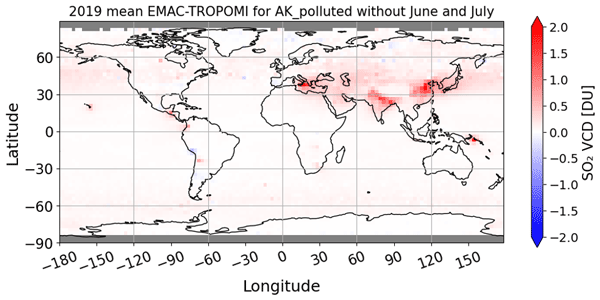
Ismail Makroum, Patrick Jöckel, Martin Dameris, Nicolas Theys, and Johannes De Leeuw
Geosci. Model Dev., 19, 447–476, https://doi.org/10.5194/gmd-19-447-2026, https://doi.org/10.5194/gmd-19-447-2026, 2026
Short summary
Short summary
We use a state-of-the-art numerical chemistry-climate model to study the atmospheric sulfur dioxide budget. We simulate the atmospheric concentration of sulfur dioxide (SO2) and corresponding sulfur deposition fluxes and compare the results with observational data from a satellite instrument and with ground-based in-situ measurements. For the evaluation of the simulated atmospheric lifetime of SO2, we also simulate the fate of SO2 emitted by two volcanic eruptions that happened in 2019.
Zitong Li, Kang Sun, Kaiyu Guan, Sheng Wang, Bin Peng, Lieven Clarisse, Martin Van Damme, Pierre-François Coheur, Karen Cady-Pereira, Mark W. Shephard, Mark Zondlo, and Daniel Moore
Atmos. Chem. Phys., 26, 703–721, https://doi.org/10.5194/acp-26-703-2026, https://doi.org/10.5194/acp-26-703-2026, 2026
Short summary
Short summary
We estimate ammonia fluxes over the contiguous U.S. from 2008 to 2022 using a directional derivative approach applied to satellite observations from the Infrared Atmospheric Sounding Interferometer (IASI) and Cross-track Infrared Sounder (CrIS). The resulting flux estimates reveal pronounced seasonal and spatial patterns driven by agricultural activities and indicate substantial local deposition to surrounding vegetation, underscoring the need for improved monitoring and management strategies.
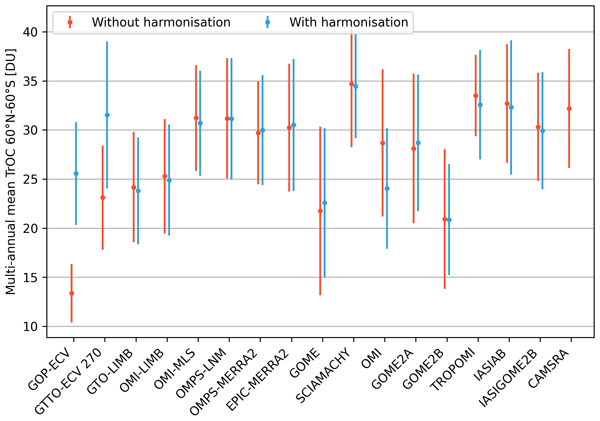
Arno Keppens, Daan Hubert, José Granville, Oindrila Nath, Jean-Christopher Lambert, Catherine Wespes, Pierre-François Coheur, Cathy Clerbaux, Anne Boynard, Richard Siddans, Barry Latter, Brian Kerridge, Serena Di Pede, Pepijn Veefkind, Juan Cuesta, Gaelle Dufour, Klaus-Peter Heue, Melanie Coldewey-Egbers, Diego Loyola, Andrea Orfanoz-Cheuquelaf, Swathi Maratt Satheesan, Kai-Uwe Eichmann, Alexei Rozanov, Viktoria F. Sofieva, Jerald R. Ziemke, Antje Inness, Roeland Van Malderen, and Lars Hoffmann
Atmos. Meas. Tech., 18, 6893–6916, https://doi.org/10.5194/amt-18-6893-2025, https://doi.org/10.5194/amt-18-6893-2025, 2025
Short summary
Short summary
The first Tropospheric Ozone Assessment Report (TOAR) encountered discrepancies between several satellite sensors’ estimates of the distribution and change of ozone in the free troposphere. Therefore, contributing to the second TOAR, we harmonise as much as possible the observational perspective of sixteen tropospheric ozone products from satellites. This only partially accounts for the observed discrepancies, with a reduction of 10–40 % of the inter-product dispersion upon harmonisation.
Pramod Kumar, Grégoire Broquet, Didier Hauglustaine, Maureen Beaudor, Lieven Clarisse, Martin Van Damme, Pierre Coheur, Anne Cozic, Bo Zheng, Beatriz Revilla Romero, Antony Delavois, and Philippe Ciais
Atmos. Chem. Phys., 25, 12379–12407, https://doi.org/10.5194/acp-25-12379-2025, https://doi.org/10.5194/acp-25-12379-2025, 2025
Short summary
Short summary
Global maps of the NH3 emissions over 2019–2022 are derived using IASI NH3 spaceborne observations, the LMDZ-INCA chemistry transport model at 1.27°×2.5° resolution, and the mass-balance approach. The average global NH3 emissions over the period are ~97 Tg NH3 yr-1, which is significantly higher than three reference inventories. The analysis provides confidence in the seasonal variability and regional budgets and provides new insights into NH3 emissions at global and regional scales.
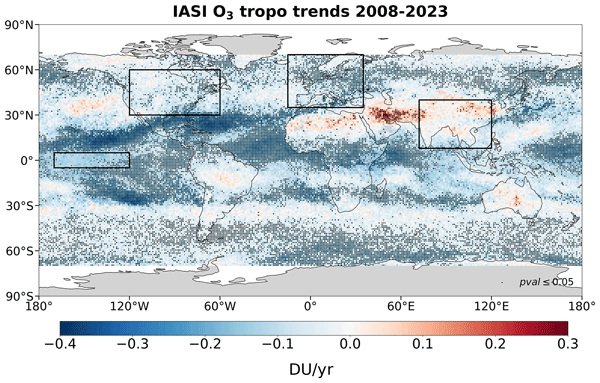
Anne Boynard, Catherine Wespes, Juliette Hadji-Lazaro, Selviga Sinnathamby, Daniel Hurtmans, Pierre-François Coheur, Marie Doutriaux-Boucher, Jacobus Onderwaater, Wolfgang Steinbrecht, Elyse A. Pennington, Kevin Bowman, and Cathy Clerbaux
Atmos. Chem. Phys., 25, 11719–11755, https://doi.org/10.5194/acp-25-11719-2025, https://doi.org/10.5194/acp-25-11719-2025, 2025
Short summary
Short summary
This study analyzes 16 years of global ozone data to assess its impact on air quality and climate. Using satellite measurements, we observed a global decrease in tropospheric ozone, particularly in tropical and European regions. The drop became more noticeable around 2020, partly due to reduced emissions during the pandemic. The study highlights the need for better data processing and integration to more accurately monitor ozone changes over time.
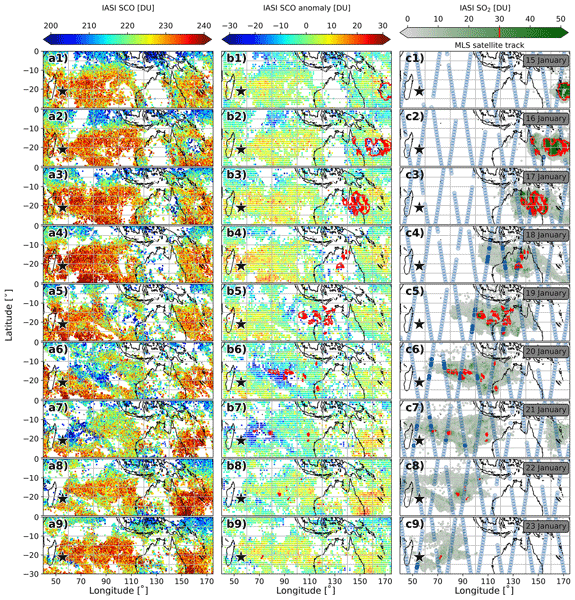
Tristan Millet, Hassan Bencherif, Thierry Portafaix, Nelson Bègue, Alexandre Baron, Valentin Duflot, Cathy Clerbaux, Pierre-François Coheur, Andrea Pazmiño, Michaël Sicard, Anne Boynard, Jean-Marc Metzger, Guillaume Payen, Nicolas Marquestaut, and Sophie Godin-Beekmann
Atmos. Chem. Phys., 25, 10887–10905, https://doi.org/10.5194/acp-25-10887-2025, https://doi.org/10.5194/acp-25-10887-2025, 2025
Short summary
Short summary
On 15 January 2022, the Hunga volcano erupted, releasing sulfur dioxide and water vapor into the stratosphere, impacting ozone levels over the Indian Ocean. Satellite data show the presence of a transient ozone depletion event related to the water vapor anomalies and sulfate aerosol clouds. Ozone reduction was confined to two distinct layers. On 21 January, the fifth percentile of total and stratospheric column ozone anomalies reached −18.6 and −14.5 DU, respectively.
Lara Noppen, Lieven Clarisse, Frederik Tack, Thomas Ruhtz, Martin Van Damme, Michel Van Roozendael, Dirk Schuettemeyer, and Pierre Coheur
Atmos. Meas. Tech., 18, 4183–4205, https://doi.org/10.5194/amt-18-4183-2025, https://doi.org/10.5194/amt-18-4183-2025, 2025
Short summary
Short summary
Current infrared satellite sounders offer high spectral but low spatial resolution, limiting their ability to quantify atmospheric ammonia (NH3) at small scales. Through simulations and analysis of real data, we show that NH3 can be measured effectively from spectra with reduced resolution, either in a contiguous spectral range or in select well-chosen bands. This approach opens possibilities for the development of smaller dedicated instruments for observing NH3 at high spatial resolution.
Huan Yu, Isabelle De Smedt, Nicolas Theys, Maarten Sneep, Pepijn Veefkind, and Michel Van Roozendael
Atmos. Meas. Tech., 18, 4131–4163, https://doi.org/10.5194/amt-18-4131-2025, https://doi.org/10.5194/amt-18-4131-2025, 2025
Short summary
Short summary
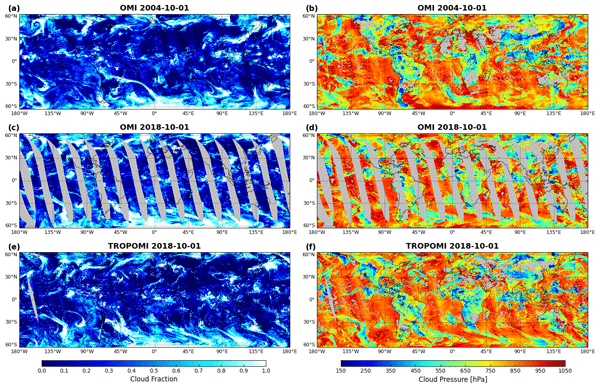
We introduce a new cloud retrieval algorithm using the O2–O2 absorption band at 477 nm to generate harmonized cloud datasets from OMI and TROPOMI. The algorithm improves upon the OMI O2–O2 operational cloud algorithm in several aspects. The new approach improves consistency in cloud parameters and NO2 retrievals between two sensors.
Antoine Ehret, Solène Turquety, Maya George, Juliette Hadji-Lazaro, and Cathy Clerbaux
Atmos. Chem. Phys., 25, 6365–6394, https://doi.org/10.5194/acp-25-6365-2025, https://doi.org/10.5194/acp-25-6365-2025, 2025
Short summary
Short summary
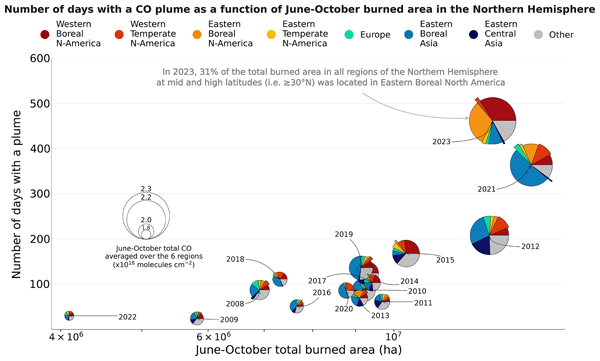
Biomass burning has a considerable effect on the chemical composition of the atmosphere and climate, due to the emission of trace gases and aerosols. We examine the relationship between fire variability and the values of carbon monoxide and aerosol optical depth observed by satellites. The observed increase in wildfires has led to a corresponding rise in the mean and extreme values of carbon monoxide and aerosol optical depth during the summer and early autumn across the Northern Hemisphere.
Yuhang Zhang, Huan Yu, Isabelle De Smedt, Jintai Lin, Nicolas Theys, Michel Van Roozendael, Gaia Pinardi, Steven Compernolle, Ruijing Ni, Fangxuan Ren, Sijie Wang, Lulu Chen, Jos Van Geffen, Mengyao Liu, Alexander M. Cede, Martin Tiefengraber, Alexis Merlaud, Martina M. Friedrich, Andreas Richter, Ankie Piters, Vinod Kumar, Vinayak Sinha, Thomas Wagner, Yongjoo Choi, Hisahiro Takashima, Yugo Kanaya, Hitoshi Irie, Robert Spurr, Wenfu Sun, and Lorenzo Fabris
Atmos. Meas. Tech., 18, 1561–1589, https://doi.org/10.5194/amt-18-1561-2025, https://doi.org/10.5194/amt-18-1561-2025, 2025
Short summary
Short summary
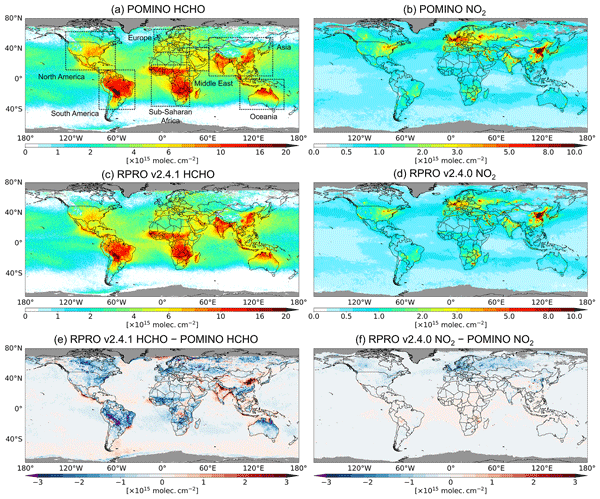
We developed an advanced algorithm for global retrieval of TROPOspheric Monitoring Instrument (TROPOMI) HCHO and NO2 vertical column densities with much improved consistency. Sensitivity tests demonstrate the complexity and nonlinear interactions of auxiliary parameters in the air mass factor calculation. An improved agreement is found with measurements from a global ground-based instrument network. The scientific retrieval provides a useful source of information for studies combining HCHO and NO2.
Maureen Beaudor, Didier Hauglustaine, Juliette Lathière, Martin Van Damme, Lieven Clarisse, and Nicolas Vuichard
Atmos. Chem. Phys., 25, 2017–2046, https://doi.org/10.5194/acp-25-2017-2025, https://doi.org/10.5194/acp-25-2017-2025, 2025
Short summary
Short summary
Agriculture is the biggest ammonia (NH3) source, impacting air quality, climate, and ecosystems. Because of food demand, NH3 emissions are projected to rise by 2100. Using a global model, we analyzed the impact of present and future NH3 emissions generated from a land model. Our results show improved ammonia patterns compared to a reference inventory. Future scenarios predict up to 70 % increase in global NH3 burden, with significant changes in radiative forcing that can greatly elevate N2O.
Jan-Lukas Tirpitz, Santo Fedele Colosimo, Nathaniel Brockway, Robert Spurr, Matt Christi, Samuel Hall, Kirk Ullmann, Johnathan Hair, Taylor Shingler, Rodney Weber, Jack Dibb, Richard Moore, Elizabeth Wiggins, Vijay Natraj, Nicolas Theys, and Jochen Stutz
Atmos. Chem. Phys., 25, 1989–2015, https://doi.org/10.5194/acp-25-1989-2025, https://doi.org/10.5194/acp-25-1989-2025, 2025
Short summary
Short summary
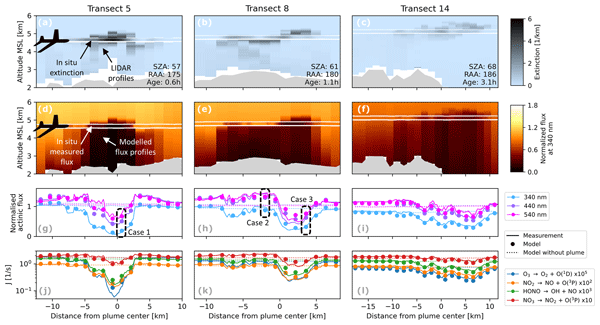
We combine plume composition data from the 2019 NASA FIREX-AQ campaign with state-of-the-art radiative transfer modeling techniques to calculate distributions of actinic flux and photolysis frequencies in a wildfire plume. Excellent agreement of the model and observations demonstrates the applicability of this approach to constrain photochemistry in such plumes. We identify limiting factors for the modeling accuracy and discuss spatial and spectral features of the distributions.
Yutao Chen, Ronald J. van der A, Jieying Ding, Henk Eskes, Jason E. Williams, Nicolas Theys, Athanasios Tsikerdekis, and Pieternel F. Levelt
Atmos. Chem. Phys., 25, 1851–1868, https://doi.org/10.5194/acp-25-1851-2025, https://doi.org/10.5194/acp-25-1851-2025, 2025
Short summary
Short summary
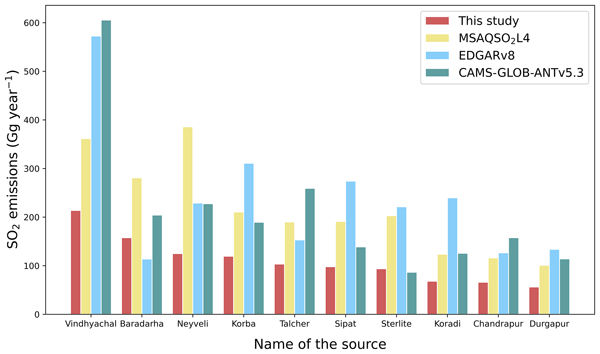
There is a lack of local SO2 top-down emission inventories in India. With the improvement in the divergence method and the derivation of SO2 local lifetime, gridded SO2 emissions over a large area can be estimated efficiently. This method can be applied to any region in the world to derive SO2 emissions. Especially for regions with high latitudes, our methodology has the potential to significantly improve the top-down derivation of SO2 emissions.
Pascal Hedelt, Jens Reichardt, Felix Lauermann, Benjamin Weiß, Nicolas Theys, Alberto Redondas, Africa Barreto, Omaira Garcia, and Diego Loyola
Atmos. Chem. Phys., 25, 1253–1272, https://doi.org/10.5194/acp-25-1253-2025, https://doi.org/10.5194/acp-25-1253-2025, 2025
Short summary
Short summary
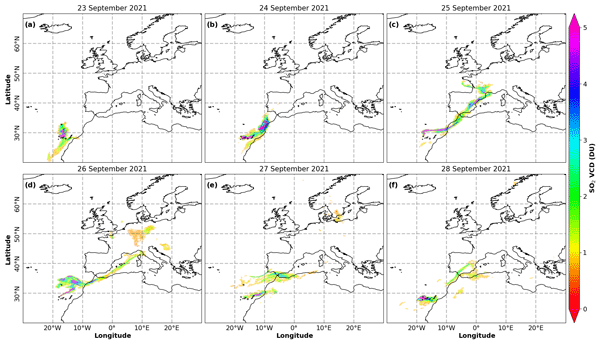
The 2021 volcanic eruption of Tajogaite on La Palma is investigated using ground-based and satellite measurements. In addition, the atmospheric transport of the volcanic cloud towards Europe is studied in detail. The amount of SO2 released during the eruption and the height of the volcanic plume are in excellent agreement among the different measurements. Furthermore, volcanic aerosol microphysical properties could be retrieved using a new retrieval approach based on lidar measurements.
Brice Barret, Pierre Loicq, Eric Le Flochmoën, Yasmine Bennouna, Juliette Hadji-Lazaro, Daniel Hurtmans, and Bastien Sauvage
Atmos. Meas. Tech., 18, 129–149, https://doi.org/10.5194/amt-18-129-2025, https://doi.org/10.5194/amt-18-129-2025, 2025
Short summary
Short summary
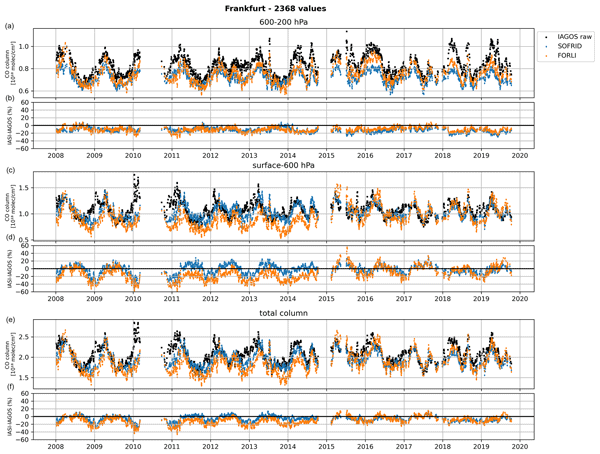
Profiles of carbon monoxide (CO) retrieved from the Infrared Atmospheric Sounding Interferometer (IASI) with the SOftware for a Fast Retrieval of IASI Data (SOFRID) and Fast Optimal Retrievals on Layers for IASI (FORLI) are validated with 8500 observations at 33 airports from the In-service Aircraft for a Global Observing System (IAGOS) for 2008–2019. IASI retrievals underestimate CO, with stronger bias in the middle to upper troposphere for SOFRID and in the lower troposphere for FORLI.
Nelson Bègue, Alexandre Baron, Gisèle Krysztofiak, Gwenaël Berthet, Corinna Kloss, Fabrice Jégou, Sergey Khaykin, Marion Ranaivombola, Tristan Millet, Thierry Portafaix, Valentin Duflot, Philippe Keckhut, Hélène Vérèmes, Guillaume Payen, Mahesh Kumar Sha, Pierre-François Coheur, Cathy Clerbaux, Michaël Sicard, Tetsu Sakai, Richard Querel, Ben Liley, Dan Smale, Isamu Morino, Osamu Uchino, Tomohiro Nagai, Penny Smale, John Robinson, and Hassan Bencherif
Atmos. Chem. Phys., 24, 8031–8048, https://doi.org/10.5194/acp-24-8031-2024, https://doi.org/10.5194/acp-24-8031-2024, 2024
Short summary
Short summary
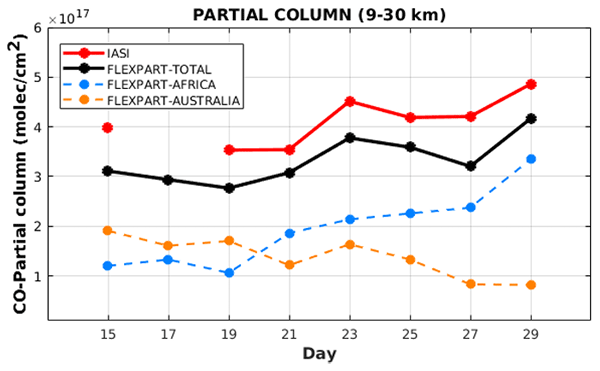
During the 2020 austral summer, the pristine atmosphere of the southwest Indian Ocean basin experienced significant perturbations. Numerical models indicated that the lower-stratospheric aerosol content was influenced by the intense and persistent stratospheric aerosol layer generated during the 2019–2020 extreme Australian bushfire events. Ground-based observations at Réunion confirmed the simultaneous presence of African and Australian aerosol layers.
Monica Crippa, Diego Guizzardi, Federico Pagani, Marcello Schiavina, Michele Melchiorri, Enrico Pisoni, Francesco Graziosi, Marilena Muntean, Joachim Maes, Lewis Dijkstra, Martin Van Damme, Lieven Clarisse, and Pierre Coheur
Earth Syst. Sci. Data, 16, 2811–2830, https://doi.org/10.5194/essd-16-2811-2024, https://doi.org/10.5194/essd-16-2811-2024, 2024
Short summary
Short summary
Knowing where emissions occur is essential for planning effective emission reduction measures and atmospheric modelling. Disaggregating national emissions over high-resolution grids requires spatial proxies that contain information on the location of different emission sources. This work incorporates state-of-the-art spatial information to improve the spatial representation of global emissions with the Emissions Database for Global Atmospheric Research (EDGAR).
Jean-Paul Vernier, Thomas J. Aubry, Claudia Timmreck, Anja Schmidt, Lieven Clarisse, Fred Prata, Nicolas Theys, Andrew T. Prata, Graham Mann, Hyundeok Choi, Simon Carn, Richard Rigby, Susan C. Loughlin, and John A. Stevenson
Atmos. Chem. Phys., 24, 5765–5782, https://doi.org/10.5194/acp-24-5765-2024, https://doi.org/10.5194/acp-24-5765-2024, 2024
Short summary
Short summary
The 2019 Raikoke eruption (Kamchatka, Russia) generated one of the largest emissions of particles and gases into the stratosphere since the 1991 Mt. Pinatubo eruption. The Volcano Response (VolRes) initiative, an international effort, provided a platform for the community to share information about this eruption and assess its climate impact. The eruption led to a minor global surface cooling of 0.02 °C in 2020 which is negligible relative to warming induced by human greenhouse gas emissions.
Bruno Franco, Lieven Clarisse, Nicolas Theys, Juliette Hadji-Lazaro, Cathy Clerbaux, and Pierre Coheur
Atmos. Chem. Phys., 24, 4973–5007, https://doi.org/10.5194/acp-24-4973-2024, https://doi.org/10.5194/acp-24-4973-2024, 2024
Short summary
Short summary
Using IASI global infrared measurements, we retrieve nitrous acid (HONO) in fire plumes from space. We detect large enhancements of pyrogenic HONO worldwide, especially from intense wildfires at Northern Hemisphere mid- and high latitudes. Predominance of IASI nighttime over daytime measurements sheds light on HONO's extended lifetime and secondary formation during long-range transport in smoke plumes. Our findings deepen the understanding of atmospheric HONO, crucial for air quality assessment.
Camille Viatte, Nadir Guendouz, Clarisse Dufaux, Arjan Hensen, Daan Swart, Martin Van Damme, Lieven Clarisse, Pierre Coheur, and Cathy Clerbaux
Atmos. Chem. Phys., 23, 15253–15267, https://doi.org/10.5194/acp-23-15253-2023, https://doi.org/10.5194/acp-23-15253-2023, 2023
Short summary
Short summary
Ammonia (NH3) is an important air pollutant which, as a precursor of fine particulate matter, raises public health concerns. Models have difficulty predicting events of pollution associated with NH3 since ground-based observations of this gas are still relatively sparse and difficult to implement. We present the first relatively long (2.5 years) and continuous record of hourly NH3 concentrations in Paris to determine its temporal variabilities at different scales to unravel emission sources.
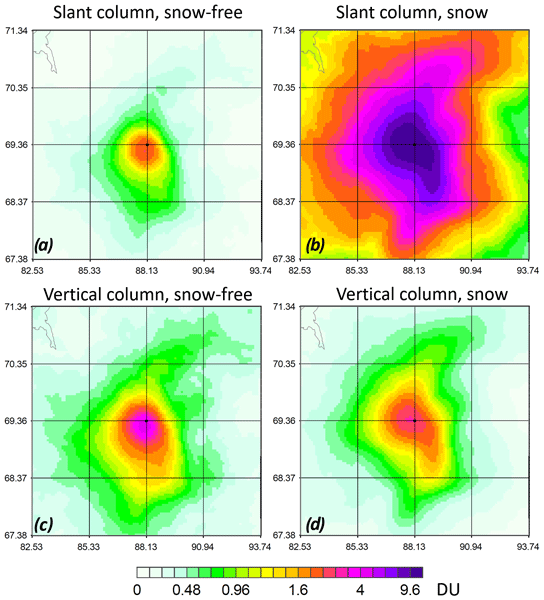
Vitali E. Fioletov, Chris A. McLinden, Debora Griffin, Nickolay A. Krotkov, Can Li, Joanna Joiner, Nicolas Theys, and Simon Carn
Atmos. Meas. Tech., 16, 5575–5592, https://doi.org/10.5194/amt-16-5575-2023, https://doi.org/10.5194/amt-16-5575-2023, 2023
Short summary
Short summary
Snow-covered terrain, with its high reflectance in the UV, typically enhances satellite sensitivity to boundary layer pollution. However, a significant fraction of high-quality cloud-free measurements over snow is currently excluded from analyses. In this study, we investigated how satellite SO2 measurements over snow-covered surfaces can be used to improve estimations of annual SO2 emissions.
Lieven Clarisse, Bruno Franco, Martin Van Damme, Tommaso Di Gioacchino, Juliette Hadji-Lazaro, Simon Whitburn, Lara Noppen, Daniel Hurtmans, Cathy Clerbaux, and Pierre Coheur
Atmos. Meas. Tech., 16, 5009–5028, https://doi.org/10.5194/amt-16-5009-2023, https://doi.org/10.5194/amt-16-5009-2023, 2023
Short summary
Short summary
Ammonia is an important atmospheric pollutant. This article presents version 4 of the algorithm which retrieves ammonia abundances from the infrared measurements of the satellite sounder IASI. A measurement operator is introduced that can emulate the measurements (so-called averaging kernels) and measurement uncertainty is better characterized. Several other changes to the product itself are also documented, most of which improve the temporal consistency of the 2007–2022 IASI NH3 dataset.
Rui Wang, Da Pan, Xuehui Guo, Kang Sun, Lieven Clarisse, Martin Van Damme, Pierre-François Coheur, Cathy Clerbaux, Melissa Puchalski, and Mark A. Zondlo
Atmos. Chem. Phys., 23, 13217–13234, https://doi.org/10.5194/acp-23-13217-2023, https://doi.org/10.5194/acp-23-13217-2023, 2023
Short summary
Short summary
Ammonia (NH3) is a key precursor for fine particulate matter (PM2.5) and a primary form of reactive nitrogen, yet it has sparse ground measurements. We perform the first comprehensive comparison between ground observations and satellite retrievals in the US, demonstrating that satellite NH3 data can help fill spatial gaps in the current ground monitoring networks. Trend analyses using both datasets highlight increasing NH3 trends across the US, including the NH3 hotspots and urban areas.
Rimal Abeed, Camille Viatte, William C. Porter, Nikolaos Evangeliou, Cathy Clerbaux, Lieven Clarisse, Martin Van Damme, Pierre-François Coheur, and Sarah Safieddine
Atmos. Chem. Phys., 23, 12505–12523, https://doi.org/10.5194/acp-23-12505-2023, https://doi.org/10.5194/acp-23-12505-2023, 2023
Short summary
Short summary
Ammonia emissions from agricultural activities will inevitably increase with the rise in population. We use a variety of datasets (satellite, reanalysis, and model simulation) to calculate the first regional map of ammonia emission potential during the start of the growing season in Europe. We then apply our developed method using a climate model to show the effect of the temperature increase on future ammonia columns under two possible climate scenarios.
Money Ossohou, Jonathan Edward Hickman, Lieven Clarisse, Pierre-François Coheur, Martin Van Damme, Marcellin Adon, Véronique Yoboué, Eric Gardrat, Maria Dias Alvès, and Corinne Galy-Lacaux
Atmos. Chem. Phys., 23, 9473–9494, https://doi.org/10.5194/acp-23-9473-2023, https://doi.org/10.5194/acp-23-9473-2023, 2023
Short summary
Short summary
The updated analyses of ground-based concentrations and satellite total vertical columns of atmospheric ammonia help us to better understand 21st century ammonia dynamics in sub-Saharan Africa. We conclude that the drivers of trends are agriculture in the dry savanna of Katibougou, Mali; air temperature and agriculture in the wet savanna of Djougou, Benin, and Lamto, Côte d'Ivoire; and leaf area index, air temperature, residential, and agriculture in forests of Bomassa, Republic of Congo.
Zhao-Cheng Zeng, Lu Lee, Chengli Qi, Lieven Clarisse, and Martin Van Damme
Atmos. Meas. Tech., 16, 3693–3713, https://doi.org/10.5194/amt-16-3693-2023, https://doi.org/10.5194/amt-16-3693-2023, 2023
Short summary
Short summary
This study presents an NH3 retrieval algorithm based on the optimal estimation method for the Geostationary Interferometric Infrared Sounder (GIIRS) on board China’s FengYun-4B satellite (FY-4B/GIIRS). Retrieval results demonstrate the capability of FY-4B/GIIRS in capturing the diurnal NH3 changes in East Asia. This operational geostationary observation by FY-4B/GIIRS represents an important advancement over the twice-per-day observations provided by current low-Earth-orbit (LEO) instruments.
Adrien Vu Van, Anne Boynard, Pascal Prunet, Dominique Jolivet, Olivier Lezeaux, Patrice Henry, Claude Camy-Peyret, Lieven Clarisse, Bruno Franco, Pierre-François Coheur, and Cathy Clerbaux
Atmos. Meas. Tech., 16, 2107–2127, https://doi.org/10.5194/amt-16-2107-2023, https://doi.org/10.5194/amt-16-2107-2023, 2023
Short summary
Short summary
With its near-real-time observations and good horizontal coverage, the Infrared Atmospheric Sounding Interferometer (IASI) instrument can contribute to the monitoring systems for a systematic and continuous detection of exceptional atmospheric events such as fires, anthropogenic pollution episodes, volcanic eruptions, or industrial releases. In this paper, a new approach is described for the detection and characterization of unexpected events in terms of trace gases using IASI radiance spectra.
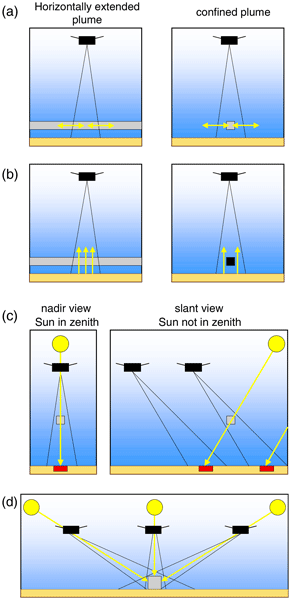
Thomas Wagner, Simon Warnach, Steffen Beirle, Nicole Bobrowski, Adrian Jost, Janis Puķīte, and Nicolas Theys
Atmos. Meas. Tech., 16, 1609–1662, https://doi.org/10.5194/amt-16-1609-2023, https://doi.org/10.5194/amt-16-1609-2023, 2023
Short summary
Short summary
We investigate 3D effects of volcanic plumes on the retrieval results of satellite and ground-based UV–Vis observations. With its small ground pixels of 3.5 x 5.5 km², the TROPOMI instrument can detect much smaller volcanic plumes than previous instruments. At the same time, 3D effects become important. The effect of horizontal photon paths especially can lead to a strong underestimation of the derived plume contents of up to > 50 %, which can be further increased for strong absorbers like SO2.
Maureen Beaudor, Nicolas Vuichard, Juliette Lathière, Nikolaos Evangeliou, Martin Van Damme, Lieven Clarisse, and Didier Hauglustaine
Geosci. Model Dev., 16, 1053–1081, https://doi.org/10.5194/gmd-16-1053-2023, https://doi.org/10.5194/gmd-16-1053-2023, 2023
Short summary
Short summary
Ammonia mainly comes from the agricultural sector, and its volatilization relies on environmental variables. Our approach aims at benefiting from an Earth system model framework to estimate it. By doing so, we represent a consistent spatial distribution of the emissions' response to environmental changes.
We greatly improved the seasonal cycle of emissions compared with previous work. In addition, our model includes natural soil emissions (that are rarely represented in modeling approaches).
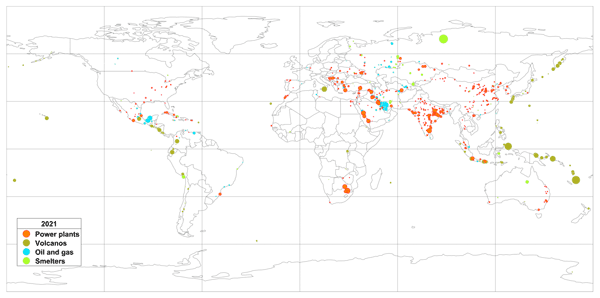
Vitali E. Fioletov, Chris A. McLinden, Debora Griffin, Ihab Abboud, Nickolay Krotkov, Peter J. T. Leonard, Can Li, Joanna Joiner, Nicolas Theys, and Simon Carn
Earth Syst. Sci. Data, 15, 75–93, https://doi.org/10.5194/essd-15-75-2023, https://doi.org/10.5194/essd-15-75-2023, 2023
Short summary
Short summary
Sulfur dioxide (SO2) measurements from three satellite instruments were used to update and extend the previously developed global catalogue of large SO2 emission sources. This version 2 of the global catalogue covers the period of 2005–2021 and includes a total of 759 continuously emitting point sources. The catalogue data show an approximate 50 % decline in global SO2 emissions between 2005 and 2021, although emissions were relatively stable during the last 3 years.
Simon Whitburn, Lieven Clarisse, Marc Crapeau, Thomas August, Tim Hultberg, Pierre François Coheur, and Cathy Clerbaux
Atmos. Meas. Tech., 15, 6653–6668, https://doi.org/10.5194/amt-15-6653-2022, https://doi.org/10.5194/amt-15-6653-2022, 2022
Short summary
Short summary
With more than 15 years of measurements, the IASI radiance dataset is becoming a reference climate data record. Its exploitation for satellite applications requires an accurate and unbiased detection of cloud scenes. Here, we present a new cloud detection algorithm for IASI that is both sensitive and consistent over time. It is based on the use of a neural network, relying on IASI radiance information only and taking as a reference the last version of the operational IASI L2 cloud product.
Beatriz Herrera, Alejandro Bezanilla, Thomas Blumenstock, Enrico Dammers, Frank Hase, Lieven Clarisse, Adolfo Magaldi, Claudia Rivera, Wolfgang Stremme, Kimberly Strong, Camille Viatte, Martin Van Damme, and Michel Grutter
Atmos. Chem. Phys., 22, 14119–14132, https://doi.org/10.5194/acp-22-14119-2022, https://doi.org/10.5194/acp-22-14119-2022, 2022
Short summary
Short summary
This work investigates atmospheric ammonia (NH3), a key trace gas with consequences for the environment and human health, in Mexico City. The results from the ground-based and satellite instruments show the variability and spatial distribution of NH3 over this region. NH3 in Mexico City has been increasing for the past 10 years and most of its sources are urban. This work contributes to a better understanding of NH3 sources and variability in urban and remote areas.
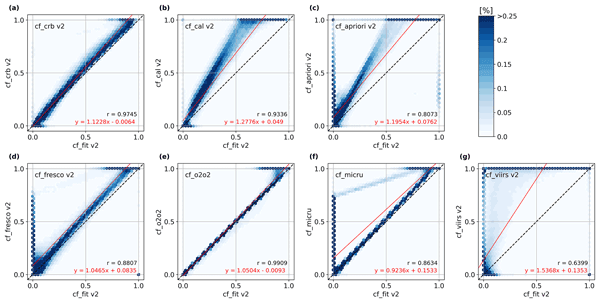
Miriam Latsch, Andreas Richter, Henk Eskes, Maarten Sneep, Ping Wang, Pepijn Veefkind, Ronny Lutz, Diego Loyola, Athina Argyrouli, Pieter Valks, Thomas Wagner, Holger Sihler, Michel van Roozendael, Nicolas Theys, Huan Yu, Richard Siddans, and John P. Burrows
Atmos. Meas. Tech., 15, 6257–6283, https://doi.org/10.5194/amt-15-6257-2022, https://doi.org/10.5194/amt-15-6257-2022, 2022
Short summary
Short summary
The article investigates different S5P TROPOMI cloud retrieval algorithms for tropospheric trace gas retrievals. The cloud products show differences primarily over snow and ice and for scenes under sun glint. Some issues regarding across-track dependence are found for the cloud fractions as well as for the cloud heights.
Camille Viatte, Rimal Abeed, Shoma Yamanouchi, William C. Porter, Sarah Safieddine, Martin Van Damme, Lieven Clarisse, Beatriz Herrera, Michel Grutter, Pierre-Francois Coheur, Kimberly Strong, and Cathy Clerbaux
Atmos. Chem. Phys., 22, 12907–12922, https://doi.org/10.5194/acp-22-12907-2022, https://doi.org/10.5194/acp-22-12907-2022, 2022
Short summary
Short summary
Large cities can experience high levels of fine particulate matter (PM2.5) pollution linked to ammonia (NH3) mainly emitted from agricultural activities. Using a combination of PM2.5 and NH3 measurements from in situ instruments, satellite infrared spectrometers, and atmospheric model simulations, we have demonstrated the role of NH3 and meteorological conditions on pollution events occurring over Paris, Toronto, and Mexico City.
Catherine Wespes, Gaetane Ronsmans, Lieven Clarisse, Susan Solomon, Daniel Hurtmans, Cathy Clerbaux, and Pierre-François Coheur
Atmos. Chem. Phys., 22, 10993–11007, https://doi.org/10.5194/acp-22-10993-2022, https://doi.org/10.5194/acp-22-10993-2022, 2022
Short summary
Short summary
The first 10-year data record (2008–2017) of HNO3 total columns measured by the IASI-A/MetOp infrared sounder is exploited to monitor the relationship between the temperature decrease and the HNO3 loss observed each year in the Antarctic stratosphere during the polar night. We verify the recurrence of specific regimes in the cycle of IASI HNO3 and identify the day and the 50 hPa temperature (
drop temperature) corresponding to the onset of denitrification in Antarctic winter for each year.
Nicolas Theys, Christophe Lerot, Hugues Brenot, Jeroen van Gent, Isabelle De Smedt, Lieven Clarisse, Mike Burton, Matthew Varnam, Catherine Hayer, Benjamin Esse, and Michel Van Roozendael
Atmos. Meas. Tech., 15, 4801–4817, https://doi.org/10.5194/amt-15-4801-2022, https://doi.org/10.5194/amt-15-4801-2022, 2022
Short summary
Short summary
Sulfur dioxide plume height after a volcanic eruption is an important piece of information for many different scientific studies and applications. Satellite UV retrievals are useful in this respect, but available algorithms have shown so far limited sensitivity to SO2 height. Here we present a new technique to improve the retrieval of SO2 plume height for SO2 columns as low as 5 DU. We demonstrate the algorithm using TROPOMI measurements and compare with other height estimates.
Zhenqi Luo, Yuzhong Zhang, Wei Chen, Martin Van Damme, Pierre-François Coheur, and Lieven Clarisse
Atmos. Chem. Phys., 22, 10375–10388, https://doi.org/10.5194/acp-22-10375-2022, https://doi.org/10.5194/acp-22-10375-2022, 2022
Short summary
Short summary
We quantify global ammonia (NH3) emissions over the period from 2008 to 2018 using an improved fast top-down method that incorporates Infrared Atmospheric
Sounding Interferometer (IASI) satellite observations and GEOS-Chem atmospheric chemical simulations. The top-down analysis finds a global total NH3 emission that is 30 % higher than the bottom-up estimate, largely reconciling a large discrepancy of more than a factor of 2 found in previous top-down studies using the same satellite data.
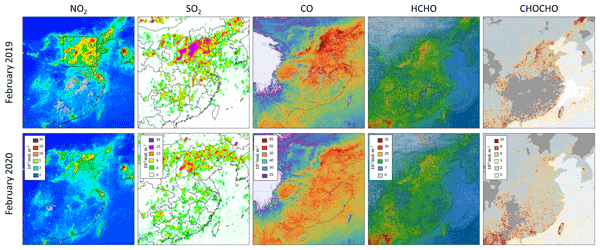
Pieternel F. Levelt, Deborah C. Stein Zweers, Ilse Aben, Maite Bauwens, Tobias Borsdorff, Isabelle De Smedt, Henk J. Eskes, Christophe Lerot, Diego G. Loyola, Fabian Romahn, Trissevgeni Stavrakou, Nicolas Theys, Michel Van Roozendael, J. Pepijn Veefkind, and Tijl Verhoelst
Atmos. Chem. Phys., 22, 10319–10351, https://doi.org/10.5194/acp-22-10319-2022, https://doi.org/10.5194/acp-22-10319-2022, 2022
Short summary
Short summary
Using the COVID-19 lockdown periods as an example, we show how Sentinel-5P/TROPOMI trace gas data (NO2, SO2, CO, HCHO and CHOCHO) can be used to understand impacts on air quality for regions and cities around the globe. We also provide information for both experienced and inexperienced users about how we created the data using state-of-the-art algorithms, where to get the data, methods taking meteorological and seasonal variability into consideration, and insights for future studies.
Maria-Elissavet Koukouli, Konstantinos Michailidis, Pascal Hedelt, Isabelle A. Taylor, Antje Inness, Lieven Clarisse, Dimitris Balis, Dmitry Efremenko, Diego Loyola, Roy G. Grainger, and Christian Retscher
Atmos. Chem. Phys., 22, 5665–5683, https://doi.org/10.5194/acp-22-5665-2022, https://doi.org/10.5194/acp-22-5665-2022, 2022
Short summary
Short summary
Volcanic eruptions eject large amounts of ash and trace gases into the atmosphere. The use of space-borne instruments enables the global monitoring of volcanic SO2 emissions in an economical and risk-free manner. The main aim of this paper is to present its extensive verification, accomplished within the ESA S5P+I: SO2LH project, over major recent volcanic eruptions, against collocated space-borne measurements, as well as assess its impact on the forecasts provided by CAMS.
Andrea Pozzer, Simon F. Reifenberg, Vinod Kumar, Bruno Franco, Matthias Kohl, Domenico Taraborrelli, Sergey Gromov, Sebastian Ehrhart, Patrick Jöckel, Rolf Sander, Veronica Fall, Simon Rosanka, Vlassis Karydis, Dimitris Akritidis, Tamara Emmerichs, Monica Crippa, Diego Guizzardi, Johannes W. Kaiser, Lieven Clarisse, Astrid Kiendler-Scharr, Holger Tost, and Alexandra Tsimpidi
Geosci. Model Dev., 15, 2673–2710, https://doi.org/10.5194/gmd-15-2673-2022, https://doi.org/10.5194/gmd-15-2673-2022, 2022
Short summary
Short summary
A newly developed setup of the chemistry general circulation model EMAC (ECHAM5/MESSy for Atmospheric Chemistry) is evaluated here. A comprehensive organic degradation mechanism is used and coupled with a volatility base model.
The results show that the model reproduces most of the tracers and aerosols satisfactorily but shows discrepancies for oxygenated organic gases. It is also shown that this model configuration can be used for further research in atmospheric chemistry.
Marie Bouillon, Sarah Safieddine, Simon Whitburn, Lieven Clarisse, Filipe Aires, Victor Pellet, Olivier Lezeaux, Noëlle A. Scott, Marie Doutriaux-Boucher, and Cathy Clerbaux
Atmos. Meas. Tech., 15, 1779–1793, https://doi.org/10.5194/amt-15-1779-2022, https://doi.org/10.5194/amt-15-1779-2022, 2022
Short summary
Short summary
The IASI instruments have been observing Earth since 2007. We use a neural network to retrieve atmospheric temperatures. This new temperature data record is validated against other datasets and shows good agreement. We use this new dataset to compute trends over the 2008–2020 period. We found a warming of the troposphere, more important at the poles. In the stratosphere, we found that temperatures decrease everywhere except at the South Pole. The cooling is more pronounced at the South pole.
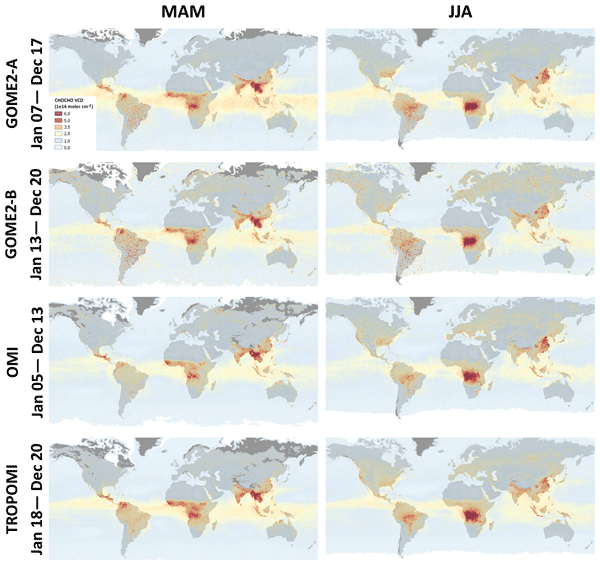
Christophe Lerot, François Hendrick, Michel Van Roozendael, Leonardo M. A. Alvarado, Andreas Richter, Isabelle De Smedt, Nicolas Theys, Jonas Vlietinck, Huan Yu, Jeroen Van Gent, Trissevgeni Stavrakou, Jean-François Müller, Pieter Valks, Diego Loyola, Hitoshi Irie, Vinod Kumar, Thomas Wagner, Stefan F. Schreier, Vinayak Sinha, Ting Wang, Pucai Wang, and Christian Retscher
Atmos. Meas. Tech., 14, 7775–7807, https://doi.org/10.5194/amt-14-7775-2021, https://doi.org/10.5194/amt-14-7775-2021, 2021
Short summary
Short summary
Global measurements of glyoxal tropospheric columns from the satellite instrument TROPOMI are presented. Such measurements can contribute to the estimation of atmospheric emissions of volatile organic compounds. This new glyoxal product has been fully characterized with a comprehensive error budget, with comparison with other satellite data sets as well as with validation based on independent ground-based remote sensing glyoxal observations.
Nicolas Theys, Vitali Fioletov, Can Li, Isabelle De Smedt, Christophe Lerot, Chris McLinden, Nickolay Krotkov, Debora Griffin, Lieven Clarisse, Pascal Hedelt, Diego Loyola, Thomas Wagner, Vinod Kumar, Antje Innes, Roberto Ribas, François Hendrick, Jonas Vlietinck, Hugues Brenot, and Michel Van Roozendael
Atmos. Chem. Phys., 21, 16727–16744, https://doi.org/10.5194/acp-21-16727-2021, https://doi.org/10.5194/acp-21-16727-2021, 2021
Short summary
Short summary
We present a new algorithm to retrieve sulfur dioxide from space UV measurements. We apply the technique to high-resolution TROPOMI measurements and demonstrate the high sensitivity of the approach to weak SO2 emissions worldwide with an unprecedented limit of detection of 8 kt yr−1. This result has broad implications for atmospheric science studies dealing with improving emission inventories and identifying and quantifying missing sources, in the context of air quality and climate.
Jonathan E. Hickman, Niels Andela, Enrico Dammers, Lieven Clarisse, Pierre-François Coheur, Martin Van Damme, Courtney A. Di Vittorio, Money Ossohou, Corinne Galy-Lacaux, Kostas Tsigaridis, and Susanne E. Bauer
Atmos. Chem. Phys., 21, 16277–16291, https://doi.org/10.5194/acp-21-16277-2021, https://doi.org/10.5194/acp-21-16277-2021, 2021
Short summary
Short summary
Ammonia (NH3) gas emitted from soils and biomass burning contributes to particulate air pollution. We used satellite observations of the atmosphere over Africa to show that declines in NH3 concentrations over South Sudan's Sudd wetland in 2008–2017 are related to variation in wetland extent. We also find NH3 concentrations increased in West Africa as a result of biomass burning and increased in the Lake Victoria region, likely due to agricultural expansion and intensification.
Hugues Brenot, Nicolas Theys, Lieven Clarisse, Jeroen van Gent, Daniel R. Hurtmans, Sophie Vandenbussche, Nikolaos Papagiannopoulos, Lucia Mona, Timo Virtanen, Andreas Uppstu, Mikhail Sofiev, Luca Bugliaro, Margarita Vázquez-Navarro, Pascal Hedelt, Michelle Maree Parks, Sara Barsotti, Mauro Coltelli, William Moreland, Simona Scollo, Giuseppe Salerno, Delia Arnold-Arias, Marcus Hirtl, Tuomas Peltonen, Juhani Lahtinen, Klaus Sievers, Florian Lipok, Rolf Rüfenacht, Alexander Haefele, Maxime Hervo, Saskia Wagenaar, Wim Som de Cerff, Jos de Laat, Arnoud Apituley, Piet Stammes, Quentin Laffineur, Andy Delcloo, Robertson Lennart, Carl-Herbert Rokitansky, Arturo Vargas, Markus Kerschbaum, Christian Resch, Raimund Zopp, Matthieu Plu, Vincent-Henri Peuch, Michel Van Roozendael, and Gerhard Wotawa
Nat. Hazards Earth Syst. Sci., 21, 3367–3405, https://doi.org/10.5194/nhess-21-3367-2021, https://doi.org/10.5194/nhess-21-3367-2021, 2021
Short summary
Short summary
The purpose of the EUNADICS-AV (European Natural Airborne Disaster Information and Coordination System for Aviation) prototype early warning system (EWS) is to develop the combined use of harmonised data products from satellite, ground-based and in situ instruments to produce alerts of airborne hazards (volcanic, dust, smoke and radionuclide clouds), satisfying the requirement of aviation air traffic management (ATM) stakeholders (https://cordis.europa.eu/project/id/723986).
Cited articles
Bacles, M., Améric, J., and Guidard, V.: Assimilation of volcanic sulfur dioxide products from IASI and TROPOMI into the chemical transport model MOCAGE: case study of the 2021 La Soufrière Saint Vincent eruption with the March 2022 version of MOCAGE, Atmos. Meas. Tech., 18, 2659–2680, https://doi.org/10.5194/amt-18-2659-2025, 2025. a
Bani, P., Aiuppa, A., Coppola, D., Carn, S., Cluzel, D., Rose-Koga, E., Medard, E., Nauret, F., Moussallam, Y., Tari, D., and Bani, I.: Magmatic volatiles control the sub-plinian basaltic eruptions at Ambae volcano, Vanuatu, Commun. Earth Environ., 6, 84, https://doi.org/10.1038/s43247-025-02018-5, 2025. a, b, c, d
Baray, J., Gheusi, F., Duflot, V., and Tulet, P.: Removal Processes of the Stratospheric SO2 Volcanic Plume From the 2015 Calbuco Eruption, J. Geophys. Res.-Atmos., 130, https://doi.org/10.1029/2025jd043850, 2025. a, b
Baron, A., Chazette, P., Khaykin, S., Payen, G., Marquestaut, N., Bègue, N., and Duflot, V.: Early Evolution of the Stratospheric Aerosol Plume Following the 2022 Hunga Tonga-Hunga Ha’apai Eruption: Lidar Observations From Reunion (21° S, 55° E), Geophys. Res. Lett., 50, e2022GL101751, https://doi.org/10.1029/2022gl101751, 2023. a
Bauduin, S., Clarisse, L., Clerbaux, C., Hurtmans, D., and Coheur, P.-F.: IASI observations of sulfur dioxide (SO2) in the boundary layer of Norilsk, J. Geophys. Res.-Atmos., 119, 4253–4263, https://doi.org/10.1002/2013jd021405, 2014. a
Bauduin, S., Clarisse, L., Hadji-Lazaro, J., Theys, N., Clerbaux, C., and Coheur, P.-F.: Retrieval of near-surface sulfur dioxide (SO2) concentrations at a global scale using IASI satellite observations, Atmos. Meas. Tech., 9, 721–740, https://doi.org/10.5194/amt-9-721-2016, 2016. a
Bègue, N., Vignelles, D., Berthet, G., Portafaix, T., Payen, G., Jégou, F., Benchérif, H., Jumelet, J., Vernier, J.-P., Lurton, T., Renard, J.-B., Clarisse, L., Duverger, V., Posny, F., Metzger, J.-M., and Godin-Beekmann, S.: Long-range transport of stratospheric aerosols in the Southern Hemisphere following the 2015 Calbuco eruption, Atmos. Chem. Phys., 17, 15019–15036, https://doi.org/10.5194/acp-17-15019-2017, 2017. a, b, c
Beirle, S., Hörmann, C., Penning de Vries, M., Dörner, S., Kern, C., and Wagner, T.: Estimating the volcanic emission rate and atmospheric lifetime of SO2 from space: a case study for Kīlauea volcano, Hawai`i, Atmos. Chem. Phys., 14, 8309–8322, https://doi.org/10.5194/acp-14-8309-2014, 2014. a
Bennis, K. and Venzke, E.: Global Volcanism Program, 2021. Report on Lewotolok (Indonesia), Tech. Rep. 46:2, Smithsonian Institution, https://doi.org/10.5479/si.gvp.bgvn202102-264230, 2021. a
Bennis, K. L.: Global Volcanism Program, 2023. Report on Sheveluch (Russia), Tech. Rep. 48:5, Smithsonian Institution, https://volcano.si.edu/ShowReport.cfm?doi=10.5479/si.GVP.BGVN202305-300270 (last access: 8 September 2026), 2023. a
Björnham, O., Grahn, H., von Schoenberg, P., Liljedahl, B., Waleij, A., and Brännström, N.: The 2016 Al-Mishraq sulphur plant fire: Source and health risk area estimation, Atmos. Environ., 169, 287–296, https://doi.org/10.1016/j.atmosenv.2017.09.025, 2017. a
Boichu, M., Clarisse, L., Khvorostyanov, D., and Clerbaux, C.: Improving volcanic sulfur dioxide cloud dispersal forecasts by progressive assimilation of satellite observations, Geophys. Res. Lett., 41, 2637–2643, https://doi.org/10.1002/2014gl059496, 2014. a
Boynard, A., Hurtmans, D., Garane, K., Goutail, F., Hadji-Lazaro, J., Koukouli, M. E., Wespes, C., Vigouroux, C., Keppens, A., Pommereau, J.-P., Pazmino, A., Balis, D., Loyola, D., Valks, P., Sussmann, R., Smale, D., Coheur, P.-F., and Clerbaux, C.: Validation of the IASI FORLI/EUMETSAT ozone products using satellite (GOME-2), ground-based (Brewer–Dobson, SAOZ, FTIR) and ozonesonde measurements, Atmos. Meas. Tech., 11, 5125–5152, https://doi.org/10.5194/amt-11-5125-2018, 2018. a
Brenot, H., Theys, N., Clarisse, L., van Gent, J., Hurtmans, D. R., Vandenbussche, S., Papagiannopoulos, N., Mona, L., Virtanen, T., Uppstu, A., Sofiev, M., Bugliaro, L., Vázquez-Navarro, M., Hedelt, P., Parks, M. M., Barsotti, S., Coltelli, M., Moreland, W., Scollo, S., Salerno, G., Arnold-Arias, D., Hirtl, M., Peltonen, T., Lahtinen, J., Sievers, K., Lipok, F., Rüfenacht, R., Haefele, A., Hervo, M., Wagenaar, S., Som de Cerff, W., de Laat, J., Apituley, A., Stammes, P., Laffineur, Q., Delcloo, A., Lennart, R., Rokitansky, C.-H., Vargas, A., Kerschbaum, M., Resch, C., Zopp, R., Plu, M., Peuch, V.-H., Van Roozendael, M., and Wotawa, G.: EUNADICS-AV early warning system dedicated to supporting aviation in the case of a crisis from natural airborne hazards and radionuclide clouds, Nat. Hazards Earth Syst. Sci., 21, 3367–3405, https://doi.org/10.5194/nhess-21-3367-2021, 2021. a
Bruckert, J., Hoshyaripour, G. A., Horváth, Á., Muser, L. O., Prata, F. J., Hoose, C., and Vogel, B.: Online treatment of eruption dynamics improves the volcanic ash and SO2 dispersion forecast: case of the 2019 Raikoke eruption, Atmos. Chem. Phys., 22, 3535–3552, https://doi.org/10.5194/acp-22-3535-2022, 2022. a, b, c
Carboni, E., Grainger, R., Walker, J., Dudhia, A., and Siddans, R.: A new scheme for sulphur dioxide retrieval from IASI measurements: application to the Eyjafjallajökull eruption of April and May 2010, Atmos. Chem. Phys., 12, 11417–11434, https://doi.org/10.5194/acp-12-11417-2012, 2012. a, b, c
Carboni, E., Grainger, R. G., Mather, T. A., Pyle, D. M., Thomas, G. E., Siddans, R., Smith, A. J. A., Dudhia, A., Koukouli, M. E., and Balis, D.: The vertical distribution of volcanic SO2 plumes measured by IASI, Atmos. Chem. Phys., 16, 4343–4367, https://doi.org/10.5194/acp-16-4343-2016, 2016. a, b, c, d, e, f, g, h, i, j, k, l, m, n
Carboni, E., Mather, T. A., Schmidt, A., Grainger, R. G., Pfeffer, M. A., Ialongo, I., and Theys, N.: Satellite-derived sulfur dioxide (SO2) emissions from the 2014–2015 Holuhraun eruption (Iceland), Atmos. Chem. Phys., 19, 4851–4862, https://doi.org/10.5194/acp-19-4851-2019, 2019. a, b, c, d, e, f, g, h, i
Carn, S. A., Krotkov, N. A., Yang, K., and Krueger, A. J.: Measuring global volcanic degassing with the Ozone Monitoring Instrument (OMI), Geol. Soc. Spec. Publ., 380, 229–257, https://doi.org/10.1144/SP380.12, 2013. a
Carn, S. A., Clarisse, L., and Prata, A. J.: Multi-decadal satellite measurements of global volcanic degassing, J. Volcanol. Geoth. Res., 311, 99–134, https://doi.org/10.1016/j.jvolgeores.2016.01.002, 2016. a, b, c, d, e, f, g, h, i, j, k, l, m, n, o, p, q, r, s, t, u, v, w, x, y, z, aa, ab, ac, ad, ae, af, ag, ah, ai, aj, ak, al, am, an, ao
Carn, S. A., Fioletov, V. E., McLinden, C. A., Li, C., and Krotkov, N. A.: A decade of global volcanic SO2 emissions measured from space, Sci. Rep.-UK, 7, 44095, https://doi.org/10.1038/srep44095, 2017. a, b, c
Carn, S. A., Krotkov, N. A., Fisher, B. L., Li, C., and Prata, A. J.: First Observations of Volcanic Eruption Clouds From the L1 Earth-Sun Lagrange Point by DSCOVR/EPIC, Geophys. Res. Lett., 45, 11456–11464, https://doi.org/10.1029/2018gl079808, 2018. a
Carr, J. L., Horváth, Á., Wu, D. L., and Friberg, M. D.: Stereo Plume Height and Motion Retrievals for the Record-Setting Hunga Tonga-Hunga Ha’apai Eruption of 15 January 2022, Geophys. Res. Lett., 49, e2022GL098131, https://doi.org/10.1029/2022gl098131, 2022. a
Chevallier, F.: Sampled databases of 60-level atmospheric profiles from the ECMWF analyses, Tech. rep., Eumetsat/ECMWF SAF Programme, Research Report No. 4, 2001. a
Clarisse, L. and Franco, B.: Reanalyzed bi-daily IASI/Metop-A ULB-LATMOS sulphur dioxide (SO2) L2 product (columns and altitude), Aeris [data set], https://doi.org/10.25326/870, 2026a. a, b
Clarisse, L. and Franco, B.: Reanalyzed bi-daily IASI/Metop-B ULB-LATMOS sulphur dioxide (SO2) L2 product (columns and altitude), Aeris [data set], https://doi.org/10.25326/869, 2026b. a, b
Clarisse, L. and Franco, B.: Reanalyzed bi-daily IASI/Metop-C ULB-LATMOS sulphur dioxide (SO2) L2 product (columns and altitude), Aeris [data set], https://doi.org/10.25326/868, 2026c. a, b
Clarisse, L., Coheur, P. F., Prata, A. J., Hurtmans, D., Razavi, A., Phulpin, T., Hadji-Lazaro, J., and Clerbaux, C.: Tracking and quantifying volcanic SO2 with IASI, the September 2007 eruption at Jebel at Tair, Atmos. Chem. Phys., 8, 7723–7734, https://doi.org/10.5194/acp-8-7723-2008, 2008. a, b, c
Clarisse, L., Fromm, M., Ngadi, Y., Emmons, L., Clerbaux, C., Hurtmans, D., and Coheur, P.-F.: Intercontinental transport of anthropogenic sulfur dioxide and other pollutants; an infrared remote sensing case study, Geophys. Res. Lett., 38, L19806, https://doi.org/10.1029/2011GL048976, 2011. a
Clarisse, L., Hurtmans, D., Clerbaux, C., Hadji-Lazaro, J., Ngadi, Y., and Coheur, P.-F.: Retrieval of sulphur dioxide from the infrared atmospheric sounding interferometer (IASI), Atmos. Meas. Tech., 5, 581–594, https://doi.org/10.5194/amt-5-581-2012, 2012. a, b, c, d, e, f, g, h, i, j, k, l, m, n, o
Clarisse, L., Clerbaux, C., Franco, B., Hadji-Lazaro, J., Whitburn, S., Kopp, A. K., Hurtmans, D., and Coheur, P.-F.: A Decadal Data Set of Global Atmospheric Dust Retrieved From IASI Satellite Measurements, J. Geophys. Res.-Atmos., 124, 1618–1647, https://doi.org/10.1029/2018jd029701, 2019. a
Clarisse, L., Franco, B., Van Damme, M., Di Gioacchino, T., Hadji-Lazaro, J., Whitburn, S., Noppen, L., Hurtmans, D., Clerbaux, C., and Coheur, P.: The IASI NH3 version 4 product: averaging kernels and improved consistency, Atmos. Meas. Tech., 16, 5009–5028, https://doi.org/10.5194/amt-16-5009-2023, 2023. a, b, c
Clerbaux, C., Coheur, P.-F., Clarisse, L., Hadji-Lazaro, J., Hurtmans, D., Turquety, S., Bowman, K., Worden, H., and Carn, S.: Measurements of SO2 profiles in volcanic plumes from the NASA Tropospheric Emission Spectrometer (TES), Geophys. Res. Lett., 35, L22807, https://doi.org/10.1029/2008GL035566, 2008. a, b
Clerbaux, C., Boynard, A., Clarisse, L., George, M., Hadji-Lazaro, J., Herbin, H., Hurtmans, D., Pommier, M., Razavi, A., Turquety, S., Wespes, C., and Coheur, P.-F.: Monitoring of atmospheric composition using the thermal infrared IASI/MetOp sounder, Atmos. Chem. Phys., 9, 6041–6054, https://doi.org/10.5194/acp-9-6041-2009, 2009. a, b
Coheur, P.-F., Barret, B., Turquety, S., Hurtmans, D., Hadji-Lazaro, J., and Clerbaux, C.: Retrieval and characterization of ozone vertical profiles from a thermal infrared nadir sounder, J. Geophys. Res., 110, D24303, https://doi.org/10.1029/2005JD005845, 2005. a
Corradini, S., Merucci, L., Prata, A. J., and Piscini, A.: Volcanic ash and SO2 in the 2008 Kasatochi eruption: Retrievals comparison from different IR satellite sensors, J. Geophys. Res., 115, D00L21, https://doi.org/10.1029/2009JD013634, 2010. a
Corradini, S., Guerrieri, L., Stelitano, D., Salerno, G., Scollo, S., Merucci, L., Prestifilippo, M., Musacchio, M., Silvestri, M., Lombardo, V., and Caltabiano, T.: Near Real-Time Monitoring of the Christmas 2018 Etna Eruption Using SEVIRI and Products Validation, Remote Sens.-Basel, 12, 1336, https://doi.org/10.3390/rs12081336, 2020. a
Corradini, S., Guerrieri, L., Brenot, H., Clarisse, L., Merucci, L., Pardini, F., Prata, A. J., Realmuto, V. J., Stelitano, D., and Theys, N.: Tropospheric Volcanic SO2 Mass and Flux Retrievals from Satellite. The Etna December 2018 Eruption, Remote Sens.-Basel, 13, 2225, https://doi.org/10.3390/rs13112225, 2021. a, b
Cotterill, A. S., Nicholson, E. J., Hayer, C. S. L., and Kilburn, C. R. J.: Magma recharge at Manam volcano, Papua New Guinea, identified through thermal and SO2 satellite remote sensing of open-vent emissions, B. Volcanol., 86, 87, https://doi.org/10.1007/s00445-024-01772-2, 2024. a
Crafford, A. E. and Venzke, E.: Global Volcanism Program, 2016. Report on Wolf (Ecuador), Tech. Rep. 41:10, Smithsonian Institution, https://doi.org/10.5479/si.gvp.bgvn201610-353020, 2016. a
Crafford, A. E. and Venzke, E.: Global Volcanism Program, 2017. Report on Pavlof (United States), Tech. Rep. 42:3, Smithsonian Institution, https://doi.org/10.5479/si.gvp.bgvn201703-312030, 2017. a
Crafford, A. E. and Venzke, E.: Global Volcanism Program, 2018. Report on Ambae (Vanuatu), Tech. Rep. 43:7, Smithsonian Institution, https://doi.org/10.5479/si.gvp.bgvn201807-257030, 2018. a
Crafford, A. E. and Venzke, E.: Global Volcanism Program, 2020. Report on Nishinoshima (Japan), Tech. Rep. 45:9, Smithsonian Institution, https://doi.org/10.5479/si.gvp.bgvn202009-284096, 2020. a, b, c
Crafford, A. E. and Venzke, E.: Global Volcanism Program, 2022. Report on Wolf (Ecuador), Tech. Rep. 47:5, Smithsonian Institution, https://doi.org/10.5479/si.gvp.bgvn202205-353020, 2022. a
Crevoisier, C., Clerbaux, C., Guidard, V., Phulpin, T., Armante, R., Barret, B., Camy-Peyret, C., Chaboureau, J.-P., Coheur, P.-F., Crépeau, L., Dufour, G., Labonnote, L., Lavanant, L., Hadji-Lazaro, J., Herbin, H., Jacquinet-Husson, N., Payan, S., Péquignot, E., Pierangelo, C., Sellitto, P., and Stubenrauch, C.: Towards IASI-New Generation (IASI-NG): impact of improved spectral resolution and radiometric noise on the retrieval of thermodynamic, chemistry and climate variables, Atmos. Meas. Tech., 7, 4367–4385, https://doi.org/10.5194/amt-7-4367-2014, 2014. a
Crippa, M., Guizzardi, D., Muntean, M., Schaaf, E., Dentener, F., van Aardenne, J. A., Monni, S., Doering, U., Olivier, J. G. J., Pagliari, V., and Janssens-Maenhout, G.: Gridded emissions of air pollutants for the period 1970–2012 within EDGAR v4.3.2, Earth Syst. Sci. Data, 10, 1987–2013, https://doi.org/10.5194/essd-10-1987-2018, 2018. a, b
de Leeuw, J., Schmidt, A., Witham, C. S., Theys, N., Taylor, I. A., Grainger, R. G., Pope, R. J., Haywood, J., Osborne, M., and Kristiansen, N. I.: The 2019 Raikoke volcanic eruption – Part 1: Dispersion model simulations and satellite retrievals of volcanic sulfur dioxide, Atmos. Chem. Phys., 21, 10851–10879, https://doi.org/10.5194/acp-21-10851-2021, 2021. a, b, c
Di Gioacchino, T., Clarisse, L., Noppen, L., Van Damme, M., Bauduin, S., and Coheur, P.: Spatial and Temporal Variations of Thermal Contrast in the Planetary Boundary Layer, J. Remote Sens., 28, 0142, https://doi.org/10.34133/remotesensing.0142, 2024. a
D’Aleo, R., Bitetto, M., Delle Donne, D., Coltelli, M., Coppola, D., McCormick Kilbride, B., Pecora, E., Ripepe, M., Salem, L. C., Tamburello, G., and Aiuppa, A.: Understanding the SO2 Degassing Budget of Mt Etna’s Paroxysms: First Clues From the December 2015 Sequence, Front. Earth Sci., 6, https://doi.org/10.3389/feart.2018.00239, 2019. a, b
Eaton, A. R. V., Amigo, Á., Bertin, D., Mastin, L. G., Giacosa, R. E., González, J., Valderrama, O., Fontijn, K., and Behnke, S. A.: Volcanic lightning and plume behavior reveal evolving hazards during the April 2015 eruption of Calbuco volcano, Chile, Geophys. Res. Lett., 43, 3563–3571, https://doi.org/10.1002/2016gl068076, 2016. a
Eckhardt, S., Prata, A. J., Seibert, P., Stebel, K., and Stohl, A.: Estimation of the vertical profile of sulfur dioxide injection into the atmosphere by a volcanic eruption using satellite column measurements and inverse transport modeling, Atmos. Chem. Phys., 8, 3881–3897, https://doi.org/10.5194/acp-8-3881-2008, 2008. a, b, c
Esse, B., Burton, M., Hayer, C., Contreras-Arratia, R., Christopher, T., Joseph, E. P., Varnam, M., and Johnson, C.: SO2 emissions during the 2021 eruption of La Soufrière, St Vincent, revealed with back-trajectory analysis of TROPOMI imagery, Geol. Soc. London Spec. Publ., 539, 231–244, https://doi.org/10.1144/sp539-2022-77, 2023. a
Esse, B., Burton, M., Brenot, H., and Theys, N.: Insights into eruption dynamics from TROPOMI/PlumeTraj-derived SO2 emissions during the 2022 eruption of Mauna Loa, Hawaii, B. Volcanol., 87, 69, https://doi.org/10.1007/s00445-025-01839-8, 2025. a, b
EUMETSAT: Product User Guide: IASI Level 2 TS, T, Q, European Organisation for the Exploitation of Meteorological Satellites, Darmstadt, Germany, release 1.1 edn., https://user.eumetsat.int/s3/eup-strapi-media/Product_User_Guide_IASI_level2_TS_T_Q_bb33631ebf.pdf (last access: 2 February 2026), 2022. a
Fabris, L., Theys, N., Clarisse, L., Franco, B., Vlietinck, J., Yu, H., Brenot, H., Danckaert, T., Hedelt, P., and Van Roozendael, M.: Enhanced characterization of SO2 plume height and column density using the second UV spectral band of TROPOMI, Atmos. Meas. Tech., 19, 1801–1824, https://doi.org/10.5194/amt-19-1801-2026, 2026. a, b, c, d, e
Fadnavis, S., Müller, R., Kalita, G., Rowlinson, M., Rap, A., Li, J.-L. F., Gasparini, B., and Laakso, A.: The impact of recent changes in Asian anthropogenic emissions of SO2 on sulfate loading in the upper troposphere and lower stratosphere and the associated radiative changes, Atmos. Chem. Phys., 19, 9989–10008, https://doi.org/10.5194/acp-19-9989-2019, 2019. a
Fedkin, N. M., Li, C., Krotkov, N. A., Hedelt, P., Loyola, D. G., Dickerson, R. R., and Spurr, R.: Volcanic SO2 effective layer height retrieval for the Ozone Monitoring Instrument (OMI) using a machine-learning approach, Atmos. Meas. Tech., 14, 3673–3691, https://doi.org/10.5194/amt-14-3673-2021, 2021. a
Ferguson, D. J., Barnie, T. D., Pyle, D. M., Oppenheimer, C., Yirgu, G., Lewi, E., Kidane, T., Carn, S., and Hamling, I.: Recent rift-related volcanism in Afar, Ethiopia, Earth Planet. Sc. Lett., 292, 409–418, https://doi.org/10.1016/j.epsl.2010.02.010, 2010. a
Filonchyk, M., Peterson, M. P., Gusev, A., Hu, F., Yan, H., and Zhou, L.: Measuring air pollution from the 2021 Canary Islands volcanic eruption, Sci. Total Environ., 849, 157827, https://doi.org/10.1016/j.scitotenv.2022.157827, 2022. a, b
Fioletov, V. E., McLinden, C. A., Krotkov, N., Yang, K., Loyola, D. G., Valks, P., Theys, N., Van Roozendael, M., Nowlan, C. R., Chance, K., Liu, X., Lee, C., and Martin, R. V.: Application of OMI, SCIAMACHY, and GOME-2 satellite SO2 retrievals for detection of large emission sources, J. Geophys. Res.-Atmos., 118, 11399–11418, https://doi.org/10.1002/jgrd.50826, 2013. a
Fioletov, V. E., McLinden, C. A., Krotkov, N., and Li, C.: Lifetimes and emissions of SO2 from point sources estimated from OMI, Geophys. Res. Lett., 42, 1969–1976, https://doi.org/10.1002/2015gl063148, 2015. a
Fioletov, V. E., McLinden, C. A., Griffin, D., Abboud, I., Krotkov, N., Leonard, P. J. T., Li, C., Joiner, J., Theys, N., and Carn, S.: Version 2 of the global catalogue of large anthropogenic and volcanic SO2 sources and emissions derived from satellite measurements, Earth Syst. Sci. Data, 15, 75–93, https://doi.org/10.5194/essd-15-75-2023, 2023. a, b, c, d, e, f, g
Fischer, T. P., Arellano, S., Carn, S., Aiuppa, A., Galle, B., Allard, P., Lopez, T., Shinohara, H., Kelly, P., Werner, C., Cardellini, C., and Chiodini, G.: The emissions of CO2 and other volatiles from the world’s subaerial volcanoes, Sci. Rep.-UK, 9, 18716, https://doi.org/10.1038/s41598-019-54682-1, 2019. a
Fisher, B. L., Krotkov, N. A., Bhartia, P. K., Li, C., Carn, S. A., Hughes, E., and Leonard, P. J. T.: A new discrete wavelength backscattered ultraviolet algorithm for consistent volcanic SO2 retrievals from multiple satellite missions, Atmos. Meas. Tech., 12, 5137–5153, https://doi.org/10.5194/amt-12-5137-2019, 2019. a
Fowler, D., Pilegaard, K., Sutton, M. A., Ambus, P., Raivonen, M., Duyzer, J., Simpson, D., Fagerli, H., Fuzzi, S., Schjoerring, J. K., Granier, C., Neftel, A., Isaksen, I. S. A., Laj, P., Maione, M., Monks, P. S., Burkhardt, J., Daemmgen, U., Neirynck, J., Personne, E., Wichink-Kruit, R., Butterbach-Bahl, K., Flechard, C., Tuovinen, J. P., Coyle, M., Gerosa, G., Loubet, B., Altimir, N., Gruenhage, L., Ammann, C., Cieslik, S., Paoletti, E., Mikkelsen, T. N., Ro-Poulsen, H., Cellier, P., Cape, J. N., Horváth, L., Loreto, F., Niinemets, Ü., Palmer, P. I., Rinne, J., Misztal, P., Nemitz, E., Nilsson, D., Pryor, S., Gallagher, M. W., Vesala, T., Skiba, U., Brüggemann, N., Zechmeister-Boltenstern, S., Williams, J., O'Dowd, C., Facchini, M. C., de Leeuw, G., Flossman, A., Chaumerliac, N., and Erisman, J. W.: Atmospheric composition change: Ecosystems–Atmosphere interactions, Atmos. Environ., 43, 5193–5267, https://doi.org/10.1016/j.atmosenv.2009.07.068, 2009. a
Franco, B., Clarisse, L., Stavrakou, T., Müller, J.-F., Van Damme, M., Whitburn, S., Hadji-Lazaro, J., Hurtmans, D., Taraborrelli, D., Clerbaux, C., and Coheur, P.-F.: A General Framework for Global Retrievals of Trace Gases From IASI: Application to Methanol, Formic Acid, and PAN, J. Geophys. Res.-Atmos., 123, 13963–13984, https://doi.org/10.1029/2018jd029633, 2018. a
Fromm, M., Kablick, G., Nedoluha, G., Carboni, E., Grainger, R., Campbell, J., and Lewis, J.: Correcting the record of volcanic stratospheric aerosol impact: Nabro and Sarychev Peak, J. Geophys. Res.-Atmos., 119, 10343–10364, https://doi.org/10.1002/2014JD021507, 2014. a
Fromm, M. D., Kablick, G. P., Taylor, I. A., Grainger, R. G., Seftor, C., Welton, E. J., and Fochesatto, J.: Raikoke Volcanic Sulfate/SO2 Anticyclonic Contained Circulations: In Situ Proof, Morphology, and Radiative Signature, J. Geophys. Res.-Atmos., 130, e2024JD041653, https://doi.org/10.1029/2024jd041653, 2025. a
Gauthier, P.-J., Sigmarsson, O., Gouhier, M., Haddadi, B., and Moune, S.: Elevated gas flux and trace metal degassing from the 2014–2015 fissure eruption at the Bárðarbunga volcanic system, Iceland, J. Geophys. Res.-Sol. Ea., 121, 1610–1630, https://doi.org/10.1002/2015jb012111, 2016. a, b, c, d, e, f
Ge, C., Wang, J., Carn, S., Yang, K., Ginoux, P., and Krotkov, N.: Satellite-based global volcanic SO2 emissions and sulfate direct radiative forcing during 2005–2012, J. Geophys. Res.-Atmos., 121, 3446–3464, https://doi.org/10.1002/2015jd023134, 2016. a, b
Giammanco, S., Salerno, G., La Spina, A., Bonfanti, P., Caltabiano, T., Maugeri, S. R., Murè, F., and Principato, P.: Tracing Magma Migration at Mt. Etna Volcano during 2006–2020, Coupling Remote Sensing of Crater Gas Emissions and Ground Measurement of Soil Gases, Remote Sens.-Basel, 16, 1122, https://doi.org/10.3390/rs16071122, 2024. a
Girina, O. A., Loupian, E. A., Horvath, A., Melnikov, D. V., Manevich, A. G., Nuzhdaev, A. A., Bril, A. A., Ozerov, A. Y., Kramareva, L. S., and Sorokin, A. A.: Analysis of the Development of the Paroxysmal Eruption of the Sheveluch Volcano on April 10–13, 2023, Based on Data from Various Satellite Systems, Cosmic Res.+, 61, S182–S187, https://doi.org/10.1134/s0010952523700533, 2023. a
Gorkavyi, N., Krotkov, N., Li, C., Lait, L., Colarco, P., Carn, S., DeLand, M., Newman, P., Schoeberl, M., Taha, G., Torres, O., Vasilkov, A., and Joiner, J.: Tracking aerosols and SO2 clouds from the Raikoke eruption: 3D view from satellite observations, Atmos. Meas. Tech., 14, 7545–7563, https://doi.org/10.5194/amt-14-7545-2021, 2021. a, b
Gouhier, M. and Paris, R.: SO2 and tephra emissions during the December 22, 2018 Anak Krakatau eruption, Volcanica, 2, 91–103, https://doi.org/10.30909/vol.02.02.91103, 2019. a
Guizzardi, D., Crippa, M., Butler, T., Keating, T., Wu, R., Kaminski, J., Kuenen, J., Kurokawa, J., Chatani, S., Morikawa, T., Pouliot, G., Racine, J., Moran, M. D., Klimont, Z., Manseau, P. M., Mashayekhi, R., Henderson, B. H., Smith, S. J., Hoesly, R., Muntean, M., Banja, M., Schaaf, E., Pagani, F., Woo, J.-H., Kim, J., Pisoni, E., Zhang, J., Niemi, D., Sassi, M., Duhamel, A., Ansari, T., Foley, K., Geng, G., Chen, Y., and Zhang, Q.: The HTAP_v3.2 emission mosaic: merging regional and global monthly emissions (2000–2020) to support air quality modelling and policies, Earth Syst. Sci. Data, 17, 5915–5950, https://doi.org/10.5194/essd-17-5915-2025, 2025. a
Gupta, A. K., Bennartz, R., Fauria, K. E., and Mittal, T.: Eruption chronology of the December 2021 to January 2022 Hunga Tonga-Hunga Ha’apai eruption sequence, Commun. Earth Environ., 3, 314, https://doi.org/10.1038/s43247-022-00606-3, 2022. a
Haywood, J. M., Jones, A., Clarisse, L., Bourassa, A., Barnes, J., Telford, P., Bellouin, N., Boucher, O., Agnew, P., Clerbaux, C., Coheur, P., Degenstein, D., and Braesicke, P.: Observations of the eruption of the Sarychev volcano and simulations using the HadGEM2 climate model, J. Geophys. Res., 115, D21212, https://doi.org/10.1029/2010JD014447, 2010. a
Hedelt, P., Efremenko, D. S., Loyola, D. G., Spurr, R., and Clarisse, L.: Sulfur dioxide layer height retrieval from Sentinel-5 Precursor/TROPOMI using FP_ILM, Atmos. Meas. Tech., 12, 5503–5517, https://doi.org/10.5194/amt-12-5503-2019, 2019. a, b
Hersbach, H., Bell, B., Berrisford, P., Hirahara, S., Horányi, A., Muñoz-Sabater, J., Nicolas, J., Peubey, C., Radu, R., Schepers, D., Simmons, A., Soci, C., Abdalla, S., Abellan, X., Balsamo, G., Bechtold, P., Biavati, G., Bidlot, J., Bonavita, M., Chiara, G., Dahlgren, P., Dee, D., Diamantakis, M., Dragani, R., Flemming, J., Forbes, R., Fuentes, M., Geer, A., Haimberger, L., Healy, S., Hogan, R. J., Hólm, E., Janisková, M., Keeley, S., Laloyaux, P., Lopez, P., Lupu, C., Radnoti, G., Rosnay, P., Rozum, I., Vamborg, F., Villaume, S., and Thépaut, J.-N.: The ERA5 global reanalysis, Q. J. Roy. Meteor. Soc., 146, 1999–2049, https://doi.org/10.1002/qj.3803, 2020. a, b
Horváth, Á., Girina, O. A., Carr, J. L., Wu, D. L., Bril, A. A., Mazurov, A. A., Melnikov, D. V., Hoshyaripour, G. A., and Buehler, S. A.: Geometric estimation of volcanic eruption column height from GOES-R near-limb imagery – Part 2: Case studies, Atmos. Chem. Phys., 21, 12207–12226, https://doi.org/10.5194/acp-21-12207-2021, 2021. a, b
Hyman, D. M. and Pavolonis, M. J.: Probabilistic retrieval of volcanic SO2 layer height and partial column density using the Cross-track Infrared Sounder (CrIS), Atmos. Meas. Tech., 13, 5891–5921, https://doi.org/10.5194/amt-13-5891-2020, 2020. a, b, c
Inness, A., Ades, M., Balis, D., Efremenko, D., Flemming, J., Hedelt, P., Koukouli, M.-E., Loyola, D., and Ribas, R.: Evaluating the assimilation of S5P/TROPOMI near real-time SO2 columns and layer height data into the CAMS integrated forecasting system (CY47R1), based on a case study of the 2019 Raikoke eruption, Geosci. Model Dev., 15, 971–994, https://doi.org/10.5194/gmd-15-971-2022, 2022. a, b, c, d
Jégou, F., Berthet, G., Brogniez, C., Renard, J.-B., François, P., Haywood, J. M., Jones, A., Bourgeois, Q., Lurton, T., Auriol, F., Godin-Beekmann, S., Guimbaud, C., Krysztofiak, G., Gaubicher, B., Chartier, M., Clarisse, L., Clerbaux, C., Balois, J. Y., Verwaerde, C., and Daugeron, D.: Stratospheric aerosols from the Sarychev volcano eruption in the 2009 Arctic summer, Atmos. Chem. Phys., 13, 6533–6552, https://doi.org/10.5194/acp-13-6533-2013, 2013. a
Kaneko, T., Maeno, F., Ichihara, M., Yasuda, A., Ohminato, T., Nogami, K., Nakada, S., Honda, Y., and Murakami, H.: Episode 4 (2019–2020) Nishinoshima activity: abrupt transitions in the eruptive style observed by image datasets from multiple satellites, Earth Planets Space, 74, 34, https://doi.org/10.1186/s40623-022-01578-6, 2022. a, b, c, d
Karagulian, F., Clarisse, L., Clerbaux, C., Prata, A. J., Hurtmans, D., and Coheur, P. F.: Detection of volcanic SO2, ash and H2SO4 using the IASI sounder, J. Geophys. Res., 115, D00L02, https://doi.org/10.1029/2009JD012786, 2010. a, b
Khaykin, S. M., de Laat, A. T. J., Godin-Beekmann, S., Hauchecorne, A., and Ratynski, M.: Unexpected self-lofting and dynamical confinement of volcanic plumes: the Raikoke 2019 case, Sci. Rep.-UK, 12, 22409, https://doi.org/10.1038/s41598-022-27021-0, 2022. a, b
Kim, M.-H., Omar, A. H., Tackett, J. L., Vaughan, M. A., Winker, D. M., Trepte, C. R., Hu, Y., Liu, Z., Poole, L. R., Pitts, M. C., Kar, J., and Magill, B. E.: The CALIPSO version 4 automated aerosol classification and lidar ratio selection algorithm, Atmos. Meas. Tech., 11, 6107–6135, https://doi.org/10.5194/amt-11-6107-2018, 2018. a
Kloss, C., Berthet, G., Sellitto, P., Ploeger, F., Taha, G., Tidiga, M., Eremenko, M., Bossolasco, A., Jégou, F., Renard, J.-B., and Legras, B.: Stratospheric aerosol layer perturbation caused by the 2019 Raikoke and Ulawun eruptions and their radiative forcing, Atmos. Chem. Phys., 21, 535–560, https://doi.org/10.5194/acp-21-535-2021, 2021. a
Kremser, S., Thomason, L. W., von Hobe, M., Hermann, M., Deshler, T., Timmreck, C., Toohey, M., Stenke, A., Schwarz, J. P., Weigel, R., Fueglistaler, S., Prata, F. J., Vernier, J.-P., Schlager, H., Barnes, J. E., Antuña-Marrero, J.-C., Fairlie, D., Palm, M., Mahieu, E., Notholt, J., Rex, M., Bingen, C., Vanhellemont, F., Bourassa, A., Plane, J. M. C., Klocke, D., Carn, S. A., Clarisse, L., Trickl, T., Neely, R., James, A. D., Rieger, L., Wilson, J. C., and Meland, B.: Stratospheric aerosol-Observations, processes, and impact on climate: Stratospheric Aerosol, Rev. Geophys., 54, 278–335, https://doi.org/10.1002/2015rg000511, 2016. a, b
Krippner, J. B. and Venzke, E.: Global Volcanism Program, 2019. Report on Ambae (Vanuatu), Tech. Rep. 44:2, Smithsonian Institution, https://doi.org/10.5479/si.gvp.bgvn201902-257030, 2019a. a
Krippner, J. B. and Venzke, E.: Global Volcanism Program, 2019. Report on Ambrym (Vanuatu), Tech. Rep. 44:1, Smithsonian Institution, https://doi.org/10.5479/si.gvp.bgvn201901-257040, 2019b. a
Krotkov, N., Schoeberl, M., Morris, G., Carn, S., and Yang, K.: Dispersion and lifetime of the SO2 cloud from the August 2008 Kasatochi eruption, J. Geophys. Res., 115, D00L20, https://doi.org/10.1029/2010JD013984, 2010. a, b
Krotkov, N., Realmuto, V., Li, C., Seftor, C., Li, J., Brentzel, K., Stuefer, M., Cable, J., Dierking, C., Delamere, J., Schneider, D., Tamminen, J., Hassinen, S., Ryyppö, T., Murray, J., Carn, S., Osiensky, J., Eckstein, N., Layne, G., and Kirkendall, J.: Day–Night Monitoring of Volcanic SO2 and Ash Clouds for Aviation Avoidance at Northern Polar Latitudes, Remote Sens.-Basel, 13, 4003, https://doi.org/10.3390/rs13194003, 2021. a
Krotkov, N. A., McLinden, C. A., Li, C., Lamsal, L. N., Celarier, E. A., Marchenko, S. V., Swartz, W. H., Bucsela, E. J., Joiner, J., Duncan, B. N., Boersma, K. F., Veefkind, J. P., Levelt, P. F., Fioletov, V. E., Dickerson, R. R., He, H., Lu, Z., and Streets, D. G.: Aura OMI observations of regional SO2 and NO2 pollution changes from 2005 to 2015, Atmos. Chem. Phys., 16, 4605–4629, https://doi.org/10.5194/acp-16-4605-2016, 2016. a
Krueger, A. J.: Sighting of El Chichón Sulfur Dioxide Clouds with the Nimbus 7 Total Ozone Mapping Spectrometer, Science, 220, 1377–1379, https://doi.org/10.1126/science.220.4604.1377, 1983. a
Krueger, A. J., Walter, L. S., Bhartia, P. K., Schnetzler, C. C., Krotkov, N. A., Sprod, I., and Bluth, G. J. S.: Volcanic sulfur dioxide measurements from the total ozone mapping spectrometer instruments, J. Geophys. Res.-Atmos., 100, 14057–14076, https://doi.org/10.1029/95jd01222, 1995. a
Legras, B., Duchamp, C., Sellitto, P., Podglajen, A., Carboni, E., Siddans, R., Grooß, J.-U., Khaykin, S., and Ploeger, F.: The evolution and dynamics of the Hunga Tonga–Hunga Ha'apai sulfate aerosol plume in the stratosphere, Atmos. Chem. Phys., 22, 14957–14970, https://doi.org/10.5194/acp-22-14957-2022, 2022. a
Lelieveld, J., Evans, J. S., Fnais, M., Giannadaki, D., and Pozzer, A.: The contribution of outdoor air pollution sources to premature mortality on a global scale, Nature, 525, 367–371, https://doi.org/10.1038/nature15371, 2015. a
Li, C., Krotkov, N. A., Carn, S., Zhang, Y., Spurr, R. J. D., and Joiner, J.: New-generation NASA Aura Ozone Monitoring Instrument (OMI) volcanic SO2 dataset: algorithm description, initial results, and continuation with the Suomi-NPP Ozone Mapping and Profiler Suite (OMPS), Atmos. Meas. Tech., 10, 445–458, https://doi.org/10.5194/amt-10-445-2017, 2017. a, b, c
Li, C., Krotkov, N. A., Leonard, P. J. T., Carn, S., Joiner, J., Spurr, R. J. D., and Vasilkov, A.: Version 2 Ozone Monitoring Instrument SO2 product (OMSO2 V2): new anthropogenic SO2 vertical column density dataset, Atmos. Meas. Tech., 13, 6175–6191, https://doi.org/10.5194/amt-13-6175-2020, 2020. a
Li, C., Krotkov, N. A., Joiner, J., Fioletov, V., McLinden, C., Griffin, D., Leonard, P. J. T., Carn, S., Seftor, C., and Vasilkov, A.: Version 1 NOAA-20/OMPS Nadir Mapper total column SO2 product: continuation of NASA long-term global data record, Earth Syst. Sci. Data, 16, 4291–4309, https://doi.org/10.5194/essd-16-4291-2024, 2024. a
Li, Q., Qian, Y., Luo, Y., Cao, L., Zhou, H., Yang, T., Si, F., and Liu, W.: Diffusion Height and Order of Sulfur Dioxide and Bromine Monoxide Plumes from the Hunga Tonga–Hunga Ha’apai Volcanic Eruption, Remote Sens.-Basel, 15, 1534, https://doi.org/10.3390/rs15061534, 2023. a
Liu, M., Hoffmann, L., Griessbach, S., Cai, Z., Heng, Y., and Wu, X.: Improved representation of volcanic sulfur dioxide depletion in Lagrangian transport simulations: a case study with MPTRAC v2.4, Geosci. Model Dev., 16, 5197–5217, https://doi.org/10.5194/gmd-16-5197-2023, 2023. a
Lopez, T., Carn, S., Werner, C., Fee, D., Kelly, P., Doukas, M., Pfeffer, M., Webley, P., Cahill, C., and Schneider, D.: Evaluation of Redoubt Volcano's sulfur dioxide emissions by the Ozone Monitoring Instrument, J. Volcanol. Geoth. Res., 259, 290–307, https://doi.org/10.1016/j.jvolgeores.2012.03.002, 2013. a, b
Malavelle, F. F., Haywood, J. M., Jones, A., Gettelman, A., Clarisse, L., Bauduin, S., Allan, R. P., Karset, I. H. H., Kristjánsson, J. E., Oreopoulos, L., Cho, N., Lee, D., Bellouin, N., Boucher, O., Grosvenor, D. P., Carslaw, K. S., Dhomse, S., Mann, G. W., Schmidt, A., Coe, H., Hartley, M. E., Dalvi, M., Hill, A. A., Johnson, B. T., Johnson, C. E., Knight, J. R., O'Connor, F. M., Partridge, D. G., Stier, P., Myhre, G., Platnick, S., Stephens, G. L., Takahashi, H., and Thordarson, T.: Strong constraints on aerosol–cloud interactions from volcanic eruptions, Nature, 546, 485–491, https://doi.org/10.1038/nature22974, 2017. a
Malinina, E., Rozanov, A., Niemeier, U., Wallis, S., Arosio, C., Wrana, F., Timmreck, C., von Savigny, C., and Burrows, J. P.: Changes in stratospheric aerosol extinction coefficient after the 2018 Ambae eruption as seen by OMPS-LP and MAECHAM5-HAM, Atmos. Chem. Phys., 21, 14871–14891, https://doi.org/10.5194/acp-21-14871-2021, 2021. a, b, c, d
Manolakis, D. G., Lockwood, R. B., and Cooley, T. W.: Hyperspectral imaging remote sensing, Cambridge University Press, Cambridge, ISBN 978-1107083660, 2016. a
Marshak, A., Herman, J., Adam, S., Karin, B., Carn, S., Cede, A., Geogdzhayev, I., Huang, D., Huang, L.-K., Knyazikhin, Y., Kowalewski, M., Krotkov, N., Lyapustin, A., McPeters, R., Meyer, K. G., Torres, O., and Yang, Y.: Earth Observations from DSCOVR EPIC Instrument, B. Am. Meteorol. Soc., 99, 1829–1850, https://doi.org/10.1175/bams-d-17-0223.1, 2018. a, b
McKee, K., Smith, C. M., Reath, K., Snee, E., Maher, S., Matoza, R. S., Carn, S., Mastin, L., Anderson, K., Damby, D., Roman, D. C., Degterev, A., Rybin, A., Chibisova, M., Assink, J. D., de Negri Leiva, R., and Perttu, A.: Evaluating the state-of-the-art in remote volcanic eruption characterization Part I: Raikoke volcano, Kuril Islands, J. Volcanol. Geoth. Res., 419, 107354, https://doi.org/10.1016/j.jvolgeores.2021.107354, 2021a. a, b, c
McKee, K., Smith, C. M., Reath, K., Snee, E., Maher, S., Matoza, R. S., Carn, S., Roman, D. C., Mastin, L., Anderson, K., Damby, D., Itikarai, I., Mulina, K., Saunders, S., Assink, J. D., de Negri Leiva, R., and Perttu, A.: Evaluating the state-of-the-art in remote volcanic eruption characterization Part II: Ulawun volcano, Papua New Guinea, J. Volcanol. Geoth. Res., 420, 107381, https://doi.org/10.1016/j.jvolgeores.2021.107381, 2021b. a, b, c
McLinden, C. A., Fioletov, V., Shephard, M. W., Krotkov, N., Li, C., Martin, R. V., Moran, M. D., and Joiner, J.: Space-based detection of missing sulfur dioxide sources of global air pollution, Nat. Geosci., 9, 496–500, https://doi.org/10.1038/ngeo2724, 2016. a
Milford, C., Torres, C., Vilches, J., Gossman, A.-K., Weis, F., Suárez-Molina, D., García, O. E., Prats, N., Barreto, Á., García, R. D., Bustos, J. J., Marrero, C. L., Ramos, R., Chinea, N., Boulesteix, T., Taquet, N., Rodríguez, S., López-Darias, J., Sicard, M., Córdoba-Jabonero, C., and Cuevas, E.: Impact of the 2021 La Palma volcanic eruption on air quality: Insights from a multidisciplinary approach, Sci. Total Environ., 869, 161652, https://doi.org/10.1016/j.scitotenv.2023.161652, 2023. a, b, c
Millán, L., Santee, M. L., Lambert, A., Livesey, N. J., Werner, F., Schwartz, M. J., Pumphrey, H. C., Manney, G. L., Wang, Y., Su, H., Wu, L., Read, W. G., and Froidevaux, L.: The Hunga Tonga-Hunga Ha’apai Hydration of the Stratosphere, Geophys. Res. Lett., 49, https://doi.org/10.1029/2022gl099381, 2022. a
Moxnes, E. D., Kristiansen, N. I., Stohl, A., Clarisse, L., Durant, A., Weber, K., and Vogel, A.: Separation of ash and sulfur dioxide during the 2011 Grímsvötn eruption, J. Geophys. Res.-Atmos., 119, 7477–7501, https://doi.org/10.1002/2013JD021129, 2014. a
Muser, L. O., Hoshyaripour, G. A., Bruckert, J., Horváth, Á., Malinina, E., Wallis, S., Prata, F. J., Rozanov, A., von Savigny, C., Vogel, H., and Vogel, B.: Particle aging and aerosol–radiation interaction affect volcanic plume dispersion: evidence from the Raikoke 2019 eruption, Atmos. Chem. Phys., 20, 15015–15036, https://doi.org/10.5194/acp-20-15015-2020, 2020. a, b, c, d
Noppen, L., Clarisse, L., Tack, F., Ruhtz, T., Van Damme, M., Van Roozendael, M., Schuettemeyer, D., and Coheur, P.: Towards a low-resolution infrared sounder for monitoring atmospheric ammonia (NH3) at high spatial resolution, Atmos. Meas. Tech., 18, 4183–4205, https://doi.org/10.5194/amt-18-4183-2025, 2025. a
Nowlan, C. R., Liu, X., Chance, K., Cai, Z., Kurosu, T. P., Lee, C., and Martin, R. V.: Retrievals of sulfur dioxide from the Global Ozone Monitoring Experiment 2 (GOME-2) using an optimal estimation approach: Algorithm and initial validation, J. Geophys. Res., 116, D18301, https://doi.org/10.1029/2011JD015808, 2011. a
Pardini, F., Burton, M., Arzilli, F., Spina, G. L., and Polacci, M.: SO2 emissions, plume heights and magmatic processes inferred from satellite data: The 2015 Calbuco eruptions, J. Volcanol. Geoth. Res., 361, 12–24, https://doi.org/10.1016/j.jvolgeores.2018.08.001, 2018. a, b, c
Pedersen, G., Höskuldsson, A., Dürig, T., Thordarson, T., Jónsdóttir, I., Riishuus, M., Óskarsson, B., Dumont, S., Magnusson, E., Gudmundsson, M., Sigmundsson, F., Drouin, V., Gallagher, C., Askew, R., Gudnason, J., Moreland, W., Nikkola, P., Reynolds, H., and Schmith, J.: Lava field evolution and emplacement dynamics of the 2014–2015 basaltic fissure eruption at Holuhraun, Iceland, J. Volcanol. Geoth. Res., 340, 155–169, https://doi.org/10.1016/j.jvolgeores.2017.02.027, 2017. a
Prata, A. and Bernardo, C.: Retrieval of volcanic SO2 column abundance from Atmospheric Infrared Sounder data, J. Geophys. Res., 112, D20204, https://doi.org/10.1029/2006JD007955, 2007. a, b
Prata, A., Gangale, G., Clarisse, L., and Karagulian, F.: Ash and sulfur dioxide in the 2008 eruptions of Okmok and Kasatochi: Insights from high spectral resolution satellite measurements, J. Geophys. Res., 115, D00L18, https://doi.org/10.1029/2009JD013556, 2010. a, b
Prata, A. T., Folch, A., Prata, A. J., Biondi, R., Brenot, H., Cimarelli, C., Corradini, S., Lapierre, J., and Costa, A.: Anak Krakatau triggers volcanic freezer in the upper troposphere, Sci. Rep.-UK, 10, 3584, https://doi.org/10.1038/s41598-020-60465-w, 2020. a
Prata, F., Woodhouse, M., Huppert, H. E., Prata, A., Thordarson, T., and Carn, S.: Atmospheric processes affecting the separation of volcanic ash and SO2 in volcanic eruptions: inferences from the May 2011 Grímsvötn eruption, Atmos. Chem. Phys., 17, 10709–10732, https://doi.org/10.5194/acp-17-10709-2017, 2017. a, b, c, d, e, f, g
Pugnaghi, S., Guerrieri, L., Corradini, S., and Merucci, L.: Real time retrieval of volcanic cloud particles and SO2 by satellite using an improved simplified approach, Atmos. Meas. Tech., 9, 3053–3062, https://doi.org/10.5194/amt-9-3053-2016, 2016. a
Qu, Z., Henze, D. K., Worden, H. M., Jiang, Z., Gaubert, B., Theys, N., and Wang, W.: Sector-Based Top-Down Estimates of NOx, SO2, and CO Emissions in East Asia, Geophys. Res. Lett., 49, e2021GL096009, https://doi.org/10.1029/2021gl096009, 2022. a
Richter, A., Wittrock, F., Schönhardt, A., and Burrows, J.: Quantifying volcanic SO2 emissions using GOME-2 measurements, in: EGU General Assembly 2009, EGU2009-7679, http://meetingorganizer.copernicus.org/EGU2009/EGU2009-7679.pdf (last access: 25 February 2026), 2009. a
Rix, M., Valks, P., Hao, N., Loyola, D., Schlager, H., Huntrieser, H., Flemming, J., Koehler, U., Schumann, U., and Inness, A.: Volcanic SO2, BrO and plume height estimations using GOME-2 satellite measurements during the eruption of Eyjafjallajökull in May 2010, J. Geophys. Res., 117, D00U19, https://doi.org/10.1029/2011JD016718, 2012. a, b
Robock, A.: Volcanic eruptions and climate, Rev. Geophys., 38, 191–219, https://doi.org/10.1029/1998RG000054, 2000. a, b
Romero, J. E., Morgavi, D., Arzilli, F., Daga, R., Caselli, A., Reckziegel, F., Viramonte, J., Díaz-Alvaradoa, J., Polaccic, M., Burton, M., and Perugini, D.: Eruption dynamics of the 22–23 April 2015 Calbuco Volcano (Southern Chile): Analyses of tephra fall deposits, J. Volcanol. Geoth. Res., 317, 15–29, https://doi.org/10.1016/j.jvolgeores.2016.02.027, 2016. a
Sadeghi, B., Crawford, A., Chai, T., Cohen, M., Sieglaff, J., Pavolonis, M., Kim, H. C., and Morris, G.: Improving Volcanic SO2 Cloud Modeling Through Data Fusion and Trajectory Analysis: A Case Study of the 2022 Hunga Tonga Eruption, J. Geophys. Res.-Atmos., 130, e2024JD042421, https://doi.org/10.1029/2024jd042421, 2025. a, b, c, d
Schmidt, A., Leadbetter, S., Theys, N., Carboni, E., Witham, C. S., Stevenson, J. A., Birch, C. E., Thordarson, T., Turnock, S., Barsotti, S., Delaney, L., Feng, W., Grainger, R. G., Hort, M. C., Höskuldsson, Á., Ialongo, I., Ilyinskaya, E., Jóhannsson, T., Kenny, P., Mather, T. A., Richards, N. A. D., and Shepherd, J.: Satellite detection, long-range transport, and air quality impacts of volcanic sulfur dioxide from the 2014–2015 flood lava eruption at Bárðarbunga (Iceland), J. Geophys. Res.-Atmos., 120, 9739–9757, https://doi.org/10.1002/2015jd023638, 2015. a, b, c
Sellitto, P., Siddans, R., Belhadji, R., Carboni, E., Legras, B., Podglajen, A., Duchamp, C., and Kerridge, B.: Observing the SO2 and Sulfate Aerosol Plumes From the 2022 Hunga Eruption With the Infrared Atmospheric Sounding Interferometer (IASI), Geophys. Res. Lett., 51, e2023GL105565, https://doi.org/10.1029/2023gl105565, 2024. a, b, c
Sennert, S.: Global Volcanism Program, 2024. Report on Fernandina (Ecuador), Tech. rep., Smithsonian Institution and US Geological Survey, https://volcano.si.edu/showreport.cfm?wvar=GVP.WVAR20240228-353010 (last access: 24 February 2026), 2024. a
Shibata, T. and Kinoshita, T.: Volcanic aerosol layer formed in the tropical upper troposphere by the eruption of Mt. Merapi, Java, in November 2010 observed by the spaceborne lidar CALIOP, Atmos. Res., 168, 49–56, https://doi.org/10.1016/j.atmosres.2015.09.002, 2016. a
Shreve, T., Grandin, R., Boichu, M., Garaebiti, E., Moussallam, Y., Ballu, V., Delgado, F., Leclerc, F., Vallée, M., Henriot, N., Cevuard, S., Tari, D., Lebellegard, P., and Pelletier, B.: From prodigious volcanic degassing to caldera subsidence and quiescence at Ambrym (Vanuatu): the influence of regional tectonics, Sci. Rep.-UK, 9, 18868, https://doi.org/10.1038/s41598-019-55141-7, 2019. a
Sigmarsson, O., Haddadi, B., Carn, S., Moune, S., Gudnason, J., Yang, K., and Clarisse, L.: The sulfur budget of the 2011 Grímsvötn eruption, Iceland, Geophys. Res. Lett., 40, 6095–6100, https://doi.org/10.1002/2013gl057760, 2013. a
Simmons, I. C., Pfeffer, M. A., Calder, E. S., Galle, B., Arellano, S., Coppola, D., and Barsotti, S.: Extended SO2 outgassing from the 2014–2015 Holuhraun lava flow field, Iceland, B. Volcanol., 79, https://doi.org/10.1007/s00445-017-1160-6, 2017. a
Spinei, E., Carn, S. A., Krotkov, N. A., Mount, G. H., Yang, K., and Krueger, A.: Validation of ozone monitoring instrument SO2 measurements in the Okmok volcanic cloud over Pullman, WA, July 2008, J. Geophys. Res., 115, D00L08, https://doi.org/10.1029/2009JD013492, 2010. a
Spurr, R. J. D., Christi, M., Krotkov, N. A., Choi, W.-E., Carn, S., Li, C., Kramarova, N., Haffner, D., Yang, E.-S., Gorkavyi, N., Vasilkov, A., Wargan, K., Torres, O., Loyola, D., Di Pede, S., Pepijn Veefkind, J., Case, P., Schroeder, T., and Bhartia, P. K.: Solar Backscatter Ultraviolet (BUV) retrievals of mid-stratospheric aerosols from the 2022 Hunga Eruption, Atmos. Meas. Tech., 19, 993–1021, https://doi.org/10.5194/amt-19-993-2026, 2026. a
Surono, Jousset, P., Pallister, J., Boichu, M., Buongiorno, M., Budisantoso, A., Costa, F., Andreastuti, S., Prata, F., Schneider, D., Clarisse, L., Humaida, H., Sumarti, S., Bignami, C., Griswold, J., Carn, S., and Oppenheimer, C.: The 2010 explosive eruption of Java's Merapi volcano – a 100-year event, J. Volcanol. Geoth. Res., 241–242, 121–135, https://doi.org/10.1016/j.jvolgeores.2012.06.018, 2012. a, b
Taylor, I. A., Preston, J., Carboni, E., Mather, T. A., Grainger, R. G., Theys, N., Hidalgo, S., and Kilbride, B. M.: Exploring the Utility of IASI for Monitoring Volcanic SO2 Emissions, J. Geophys. Res.-Atmos., 123, 5588–5606, https://doi.org/10.1002/2017jd027109, 2018. a
Taylor, I. A., Grainger, R. G., Prata, A. T., Proud, S. R., Mather, T. A., and Pyle, D. M.: A satellite chronology of plumes from the April 2021 eruption of La Soufrière, St Vincent, Atmos. Chem. Phys., 23, 15209–15234, https://doi.org/10.5194/acp-23-15209-2023, 2023. a
Telling, J., Flower, V., and Carn, S.: A multi-sensor satellite assessment of SO2 emissions from the 2012–13 eruption of Plosky Tolbachik volcano, Kamchatka, J. Volcanol. Geoth. Res., 307, 98–106, https://doi.org/10.1016/j.jvolgeores.2015.07.010, 2015. a, b
Textor, C., Graf, H.-F., and Herzog, M.: Injection of gases into the stratosphere by explosive eruptions, J. Geophys. Res., 108, 4606, https://doi.org/10.1029/2002JD002987, 2003. a, b
Theys, N., Campion, R., Clarisse, L., Brenot, H., van Gent, J., Dils, B., Corradini, S., Merucci, L., Coheur, P.-F., Van Roozendael, M., Hurtmans, D., Clerbaux, C., Tait, S., and Ferrucci, F.: Volcanic SO2 fluxes derived from satellite data: a survey using OMI, GOME-2, IASI and MODIS, Atmos. Chem. Phys., 13, 5945–5968, https://doi.org/10.5194/acp-13-5945-2013, 2013. a, b, c, d, e, f, g
Theys, N., Smedt, I. D., van Gent, J., Danckaert, T., Wang, T., Hendrick, F., Stavrakou, T., Bauduin, S., Clarisse, L., Li, C., Krotkov, N., Yu, H., Brenot, H., and Van Roozendael, M.: Sulfur dioxide vertical column DOAS retrievals from the Ozone Monitoring Instrument: Global observations and comparison to ground-based and satellite data, J. Geophys. Res.-Atmos., 120, 2470–2491, https://doi.org/10.1002/2014jd022657, 2015. a, b
Theys, N., Fioletov, V., Li, C., De Smedt, I., Lerot, C., McLinden, C., Krotkov, N., Griffin, D., Clarisse, L., Hedelt, P., Loyola, D., Wagner, T., Kumar, V., Innes, A., Ribas, R., Hendrick, F., Vlietinck, J., Brenot, H., and Van Roozendael, M.: A sulfur dioxide Covariance-Based Retrieval Algorithm (COBRA): application to TROPOMI reveals new emission sources, Atmos. Chem. Phys., 21, 16727–16744, https://doi.org/10.5194/acp-21-16727-2021, 2021. a
Theys, N., Lerot, C., Brenot, H., van Gent, J., De Smedt, I., Clarisse, L., Burton, M., Varnam, M., Hayer, C., Esse, B., and Van Roozendael, M.: Improved retrieval of SO2 plume height from TROPOMI using an iterative Covariance-Based Retrieval Algorithm, Atmos. Meas. Tech., 15, 4801–4817, https://doi.org/10.5194/amt-15-4801-2022, 2022. a, b, c
Thomas, H. E. and Prata, A. J.: Sulphur dioxide as a volcanic ash proxy during the April–May 2010 eruption of Eyjafjallajökull Volcano, Iceland, Atmos. Chem. Phys., 11, 6871–6880, https://doi.org/10.5194/acp-11-6871-2011, 2011. a, b, c
Van Damme, M., Clarisse, L., Franco, B., Sutton, M. A., Erisman, J. W., Kruit, R. W., van Zanten, M., Whitburn, S., Hadji-Lazaro, J., Hurtmans, D., Clerbaux, C., and Coheur, P.-F.: Global, regional and national trends of atmospheric ammonia derived from a decadal (2008–2018) satellite record, Environ. Res. Lett., 16, 055017, https://doi.org/10.1088/1748-9326/abd5e0, 2021. a
van Donkelaar, A., Martin, R. V., Leaitch, W. R., Macdonald, A. M., Walker, T. W., Streets, D. G., Zhang, Q., Dunlea, E. J., Jimenez, J. L., Dibb, J. E., Huey, L. G., Weber, R., and Andreae, M. O.: Analysis of aircraft and satellite measurements from the Intercontinental Chemical Transport Experiment (INTEX-B) to quantify long-range transport of East Asian sulfur to Canada, Atmos. Chem. Phys., 8, 2999–3014, https://doi.org/10.5194/acp-8-2999-2008, 2008. a
Vasconez, F. J., Ramón, P., Hernandez, S., Hidalgo, S., Bernard, B., Ruiz, M., Alvarado, A., La Femina, P., and Ruiz, G.: The different characteristics of the recent eruptions of Fernandina and Sierra Negra volcanoes (Galápagos, Ecuador), Volcanica, 1, 127–133, https://doi.org/10.30909/vol.01.02.127133, 2018. a, b
Veefkind, J., Aben, I., McMullan, K., Förster, H., de Vries, J., Otter, G., Claas, J., Eskes, H., de Haan, J., Kleipool, Q., van Weele, M., Hasekamp, O., Hoogeveen, R., Landgraf, J., Snel, R., Tol, P., Ingmann, P., Voors, R., Kruizinga, B., Vink, R., Visser, H., and Levelt, P.: TROPOMI on the ESA Sentinel-5 Precursor: A GMES mission for global observations of the atmospheric composition for climate, air quality and ozone layer applications, Remote Sens. Environ., 120, 70–83, https://doi.org/10.1016/j.rse.2011.09.027, 2012. a
Venzke, E.: Global Volcanism Program, 2015. Report on Calbuco (Chile), Tech. Rep. 40:6, Smithsonian Institution, https://doi.org/10.5479/si.gvp.bgvn201506-358020, 2015. a, b
Vernier, J.-P., Aubry, T. J., Timmreck, C., Schmidt, A., Clarisse, L., Prata, F., Theys, N., Prata, A. T., Mann, G., Choi, H., Carn, S., Rigby, R., Loughlin, S. C., and Stevenson, J. A.: The 2019 Raikoke eruption as a testbed used by the Volcano Response group for rapid assessment of volcanic atmospheric impacts, Atmos. Chem. Phys., 24, 5765–5782, https://doi.org/10.5194/acp-24-5765-2024, 2024. a, b, c, d, e, f, g
Walker, J. C., Dudhia, A., and Carboni, E.: An effective method for the detection of trace species demonstrated using the MetOp Infrared Atmospheric Sounding Interferometer, Atmos. Meas. Tech., 4, 1567–1580, https://doi.org/10.5194/amt-4-1567-2011, 2011. a
Walker, J. C., Carboni, E., Dudhia, A., and Grainger, R. G.: Improved detection of sulphur dioxide in volcanic plumes using satellite-based hyperspectral infrared measurements: Application to the Eyjafjallajökull 2010 eruption, J. Geophys. Res., 117, D00U16, https://doi.org/10.1029/2011JD016810, 2012. a
Wang, Y., Wang, J., Xu, X., Henze, D. K., Qu, Z., and Yang, K.: Inverse modeling of SO2 and NOx emissions over China using multisensor satellite data – Part 1: Formulation and sensitivity analysis, Atmos. Chem. Phys., 20, 6631–6650, https://doi.org/10.5194/acp-20-6631-2020, 2020. a
Waythomas, C. F., Scott, W. E., Prejean, S. G., Schneider, D. J., Izbekov, P., and Nye, C. J.: The 7–8 August 2008 eruption of Kasatochi Volcano, central Aleutian Islands, Alaska, J. Geophys. Res., 115, B00B06, https://doi.org/10.1029/2010JB007437, 2010. a
Winker, D. M., Vaughan, M. A., Omar, A., Hu, Y., Powell, K. A., Liu, Z., Hunt, W. H., and Young, S. A.: Overview of the CALIPSO Mission and CALIOP Data Processing Algorithms, J. Atmos. Ocean. Tech., 26, 2310–2323, https://doi.org/10.1175/2009JTECHA1281.1, 2009. a
Winker, D. M., Tackett, J. L., Getzewich, B. J., Liu, Z., Vaughan, M. A., and Rogers, R. R.: The global 3-D distribution of tropospheric aerosols as characterized by CALIOP, Atmos. Chem. Phys., 13, 3345–3361, https://doi.org/10.5194/acp-13-3345-2013, 2013. a
Wunderman, R.: Global Volcanism Program, 2009. Report on Fernandina (Ecuador), Tech. Rep. 34:4, Smithsonian Institution, https://doi.org/10.5479/si.gvp.bgvn200904-353010, 2009. a
Wunderman, R.: Global Volcanism Program, 2011. Report on Merapi (Indonesia), Tech. Rep. 36:1, Smithsonian Institution, https://doi.org/10.5479/si.gvp.bgvn201102-263250, 2011. a
Wunderman, R.: Global Volcanism Program, 2014. Report on Fogo (Cape Verde), Tech. Rep. 39:11, Smithsonian Institution, https://doi.org/10.5479/si.gvp.bgvn201411-384010, 2014. a
Xia, C., Liu, C., Cai, Z., Wu, H., Li, Q., and Gao, M.: Tracking SO2 plumes from the Tonga volcano eruption with multi-satellite observations, iScience, 27, 109446, https://doi.org/10.1016/j.isci.2024.109446, 2024. a, b, c, d
Yang, K., Krotkov, N. A., Krueger, A. J., Carn, S. A., Bhartia, P. K., and Levelt, P. F.: Retrieval of large volcanic SO2 columns from the Aura Ozone Monitoring Instrument: Comparison and limitations, J. Geophys. Res.-Atmos., 112, https://doi.org/10.1029/2007jd008825, 2007. a
Yang, K., Liu, X., Bhartia, P. K., Krotkov, N. A., Carn, S. A., Hughes, E. J., Krueger, A. J., Spurr, R. J. D., and Trahan, S. G.: Direct retrieval of sulfur dioxide amount and altitude from spaceborne hyperspectral UV measurements: Theory and application, J. Geophys. Res., 115, D00L09, https://doi.org/10.1029/2010JD013982, 2010. a, b
Zeng, Z.-C., Clarisse, L., Franco, B., Clerbaux, C., Theys, N., Qi, C., Lee, L., Zhu, L., Hu, X., Gu, M., and Zhang, P.: Volcanic sulfur dioxide monitored from a constellation of FengYun hyperspectral infrared sounders in dawn-dusk, mid-morning, and afternoon sun-synchronous orbits, Remote Sens. Environ., 331, 115057, https://doi.org/10.1016/j.rse.2025.115057, 2025. a, b, c
Zhang, Y., Li, C., Krotkov, N. A., Joiner, J., Fioletov, V., and McLinden, C.: Continuation of long-term global SO2 pollution monitoring from OMI to OMPS, Atmos. Meas. Tech., 10, 1495–1509, https://doi.org/10.5194/amt-10-1495-2017, 2017. a
Zheng, B., Tong, D., Li, M., Liu, F., Hong, C., Geng, G., Li, H., Li, X., Peng, L., Qi, J., Yan, L., Zhang, Y., Zhao, H., Zheng, Y., He, K., and Zhang, Q.: Trends in China's anthropogenic emissions since 2010 as the consequence of clean air actions, Atmos. Chem. Phys., 18, 14095–14111, https://doi.org/10.5194/acp-18-14095-2018, 2018. a
Zhu, Y., Toon, O. B., Jensen, E. J., Bardeen, C. G., Mills, M. J., Tolbert, M. A., Yu, P., and Woods, S.: Persisting volcanic ash particles impact stratospheric SO2 lifetime and aerosol optical properties, Nat. Commun., 11, 4526, https://doi.org/10.1038/s41467-020-18352-5, 2020. a, b, c
Zhu, Y., Bardeen, C. G., Tilmes, S., Mills, M. J., Wang, X., Harvey, V. L., Taha, G., Kinnison, D., Portmann, R. W., Yu, P., Rosenlof, K. H., Avery, M., Kloss, C., Li, C., Glanville, A. S., Millán, L., Deshler, T., Krotkov, N., and Toon, O. B.: Perturbations in stratospheric aerosol evolution due to the water-rich plume of the 2022 Hunga-Tonga eruption, Commun. Earth Environ., 3, 248, https://doi.org/10.1038/s43247-022-00580-w, 2022. a, b, c
Short summary
We present a 19-year (2007–2026) global record of atmospheric sulphur dioxide (SO2) abundances and plume altitudes measured twice a day from space by the Infrared Atmospheric Sounding Interferometers (IASI). The first part of the paper covers the retrieval methodology and detailed comparisons with other satellite measurements. The second part presents an overview of the dataset, offering in particular an analysis of the temporal evolution and vertical distribution of volcanic SO2.
We present a 19-year (2007–2026) global record of atmospheric sulphur dioxide (SO2) abundances...


Altmetrics
Final-revised paper
Preprint